23 Jaw-Dropping Blue Christmas Tree Ideas That Will Transform Your Home This Holiday Season

You finally find the tree that looks exactly right — and then realize the whole thing hinges on one shade of blue you can’t quite name.
After filtering through hundreds of options across Target, Etsy, World Market, and At Home, we narrowed it down to 23 ideas that actually deliver — from $9 boxed ornament sets to an $850 flocked showpiece. You’ll find coastal flocked trees, deep navy jewel-tone palettes, marbled teal glass, glitter-dusted pinecones, and one electric-blue display that will make your neighbors slow down. Budget and luxury versions sit side by side, so you can see where the money matters and where it really doesn’t.
Blue keeps climbing on Pinterest in 2026 because it’s the one holiday color that doesn’t scream holiday — it works in rooms you actually live in all year. And stay until the end — we break down the most common mistakes that can ruin these looks.
Heads up: this post contains affiliate links, and we may earn a small commission if you buy through them, at no cost to you.
📌 Save this to Pinterest for later — you’ll want to revisit these ideas.
1. Coastal Tree with a Glass Sandcastle and Seahorse
There’s a reason this tree reads as collected rather than crowded: the ornaments are spread across three distinct sizes. On a 7.5-foot tree, you want roughly 8 to 10 pieces in the 5-to-7-inch range (the sandcastle and seahorse live here), about 30 mid-size spheres, and 60 small filler pieces tucked deeper into the branches. If every ornament is the same size, the eye has nowhere to rest — it just skims. Vary the scale and the tree suddenly has rhythm.
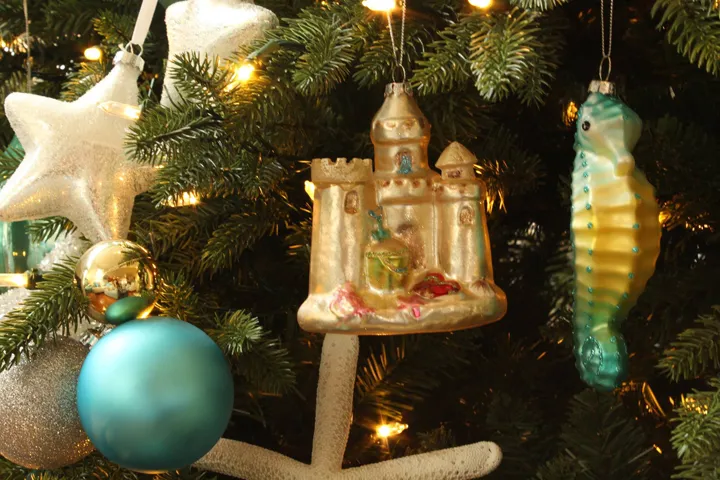
The glass sandcastle is doing all the heavy lifting here. Take it away and you’re left with a perfectly decent green tree wearing aqua baubles and a star — pleasant, forgettable. That one ornament turns the tree into a story about a specific place, and it gives the aqua spheres something to answer to, so the palette feels intentional instead of accidental. If you’re building a themed tree, put your whole splurge budget into one hero piece and let everything else stay quiet.
2. Flocked Tree, Matte Blue Baubles, and a Sage Backdrop
Here’s the formula: roughly 55 percent snow-flocked branches, 30 percent light turquoise ornament, 10 percent sage, and 5 percent white snowflake accents. That’s it — no red, no gold, no competing metallic. Because the percentages are lopsided on purpose, the blue never fights the green armchair or the water outside the window. To swap it, keep the exact same math but trade turquoise for soft blush and sage for warm grey. The proportions are what make it work, not the specific colors.
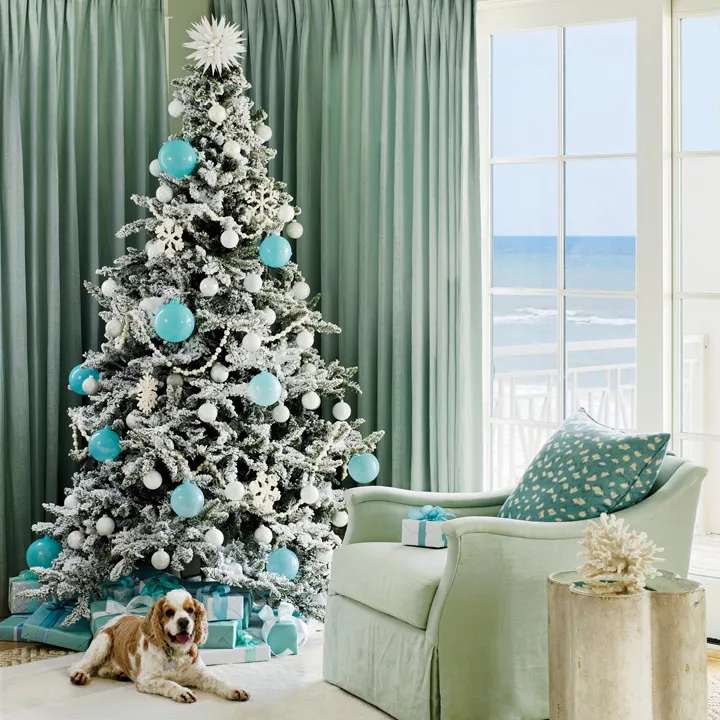
Two honest warnings before you commit. Flocking sheds — expect a light dusting of fake snow on the floor for the first two weeks, so get a mat or skirt under it immediately. And if this tree sits near a window with direct afternoon sun or ocean humidity, the flocking will yellow faster than you’d like. Rotate it a quarter turn every couple of weeks and keep it a foot back from the glass. Beautiful look, just not a low-effort one.
3. Textured Blue Bauble Nestled with Frosted Red Berries
Here’s what this close-up look actually costs to recreate across a standard 7-foot tree:
- Tree and lighting: $120–$400
- Blue textured baubles (set of 12): $18–$45
- Frosted red berry picks (6 stems): $12–$30
- Natural pinecones (bag of 20): $8–$15
- Ornament hooks and ribbon: $6–$12
Total: roughly $165–$500
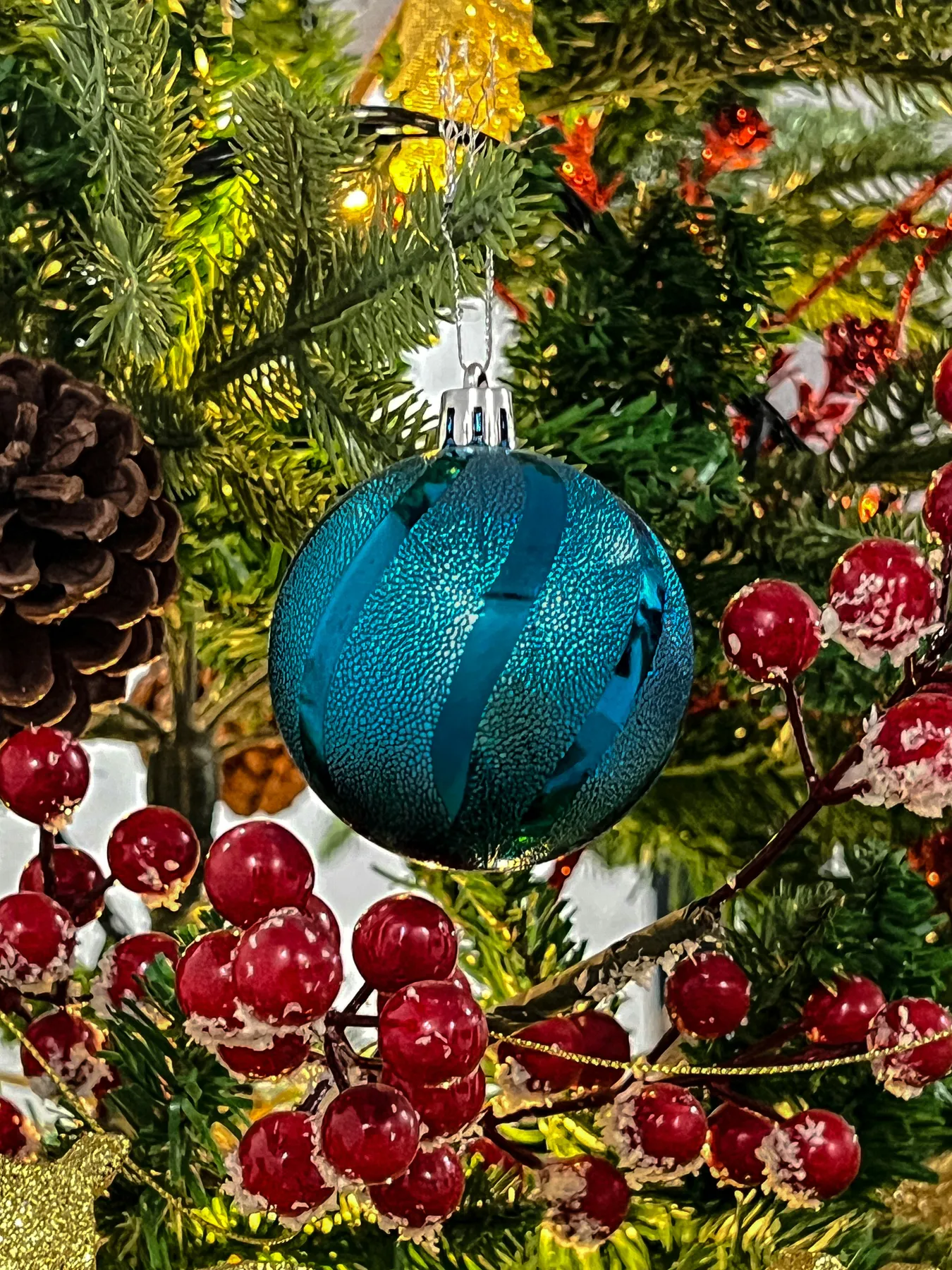
The frosted berries are the easiest part to make yourself:
- Snip berry picks into 4-inch sprigs with wire cutters.
- Dip each sprig lightly into white craft paint, then roll it in fine glitter.
- Tap off the excess and let them dry on parchment for 20 minutes.
- Tuck each frosted sprig directly beside a blue bauble so the contrast lands.
- Add one pinecone just below each cluster for weight.
Time: about 30 minutes. Cost: roughly $8 for a dozen sprigs.
4. Flocked Tree Loaded with Matte, Glossy, and Glitter Blue
The trick is that almost every ornament is the same color and none of them are the same finish. Matte blue absorbs light, glossy blue throws it back, glitter blue scatters it — so a single-hue palette reads as three times deeper. Add the odd shapes (the little boot, the striped candy cane) and you get personality without introducing a fourth color. If your tree looks flat no matter what you hang on it, this is almost always the fix: same hue, more surfaces.
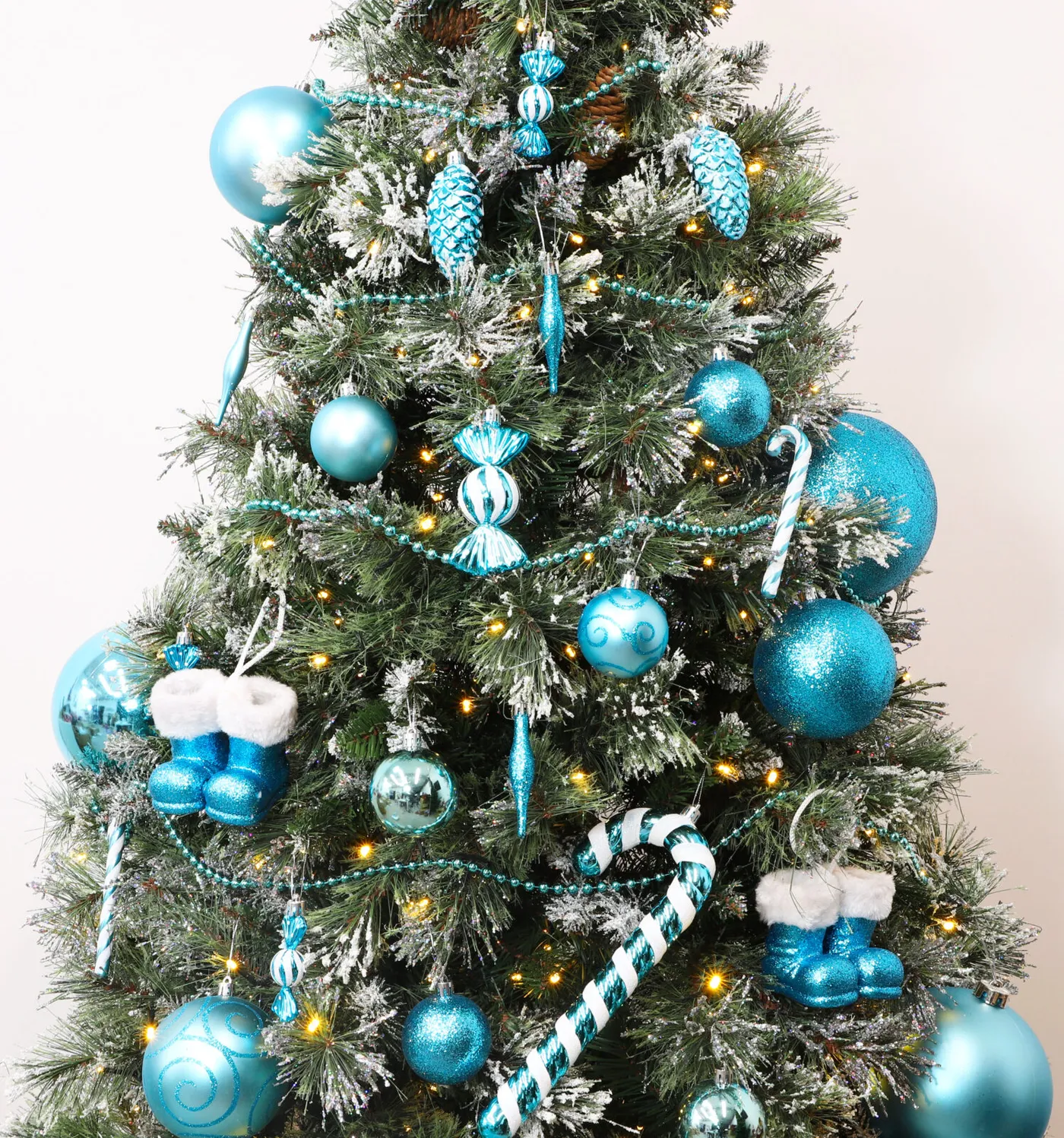
Buy ornaments in clusters of three or five, never pairs. Odd numbers photographed together look intentional; even numbers look like you ran out. When you hang, place the largest pieces first at the outer tips where they catch the light, then work mid-size ones slightly inward, and use the smallest pieces to fill bare gaps near the trunk. A 7-foot tree usually needs 90 to 120 ornaments — genuinely count them, because most people stop at 60 and wonder why it looks thin.
5. Wooden Folk-Art Figure Among Blue and Purple Glitter
That hand-painted wooden figure is the entire personality of this tree. Blue glitter balls are everywhere in 2026; a carved folk-art character in blue and yellow is not. It also does something smart visually — it breaks up a wall of shiny spheres with something dull and matte, which makes the sparkle around it read brighter by contrast. If you collect one artisan ornament a year instead of a dozen mass-market ones, you’ll end up with a tree nobody else on your street can copy.
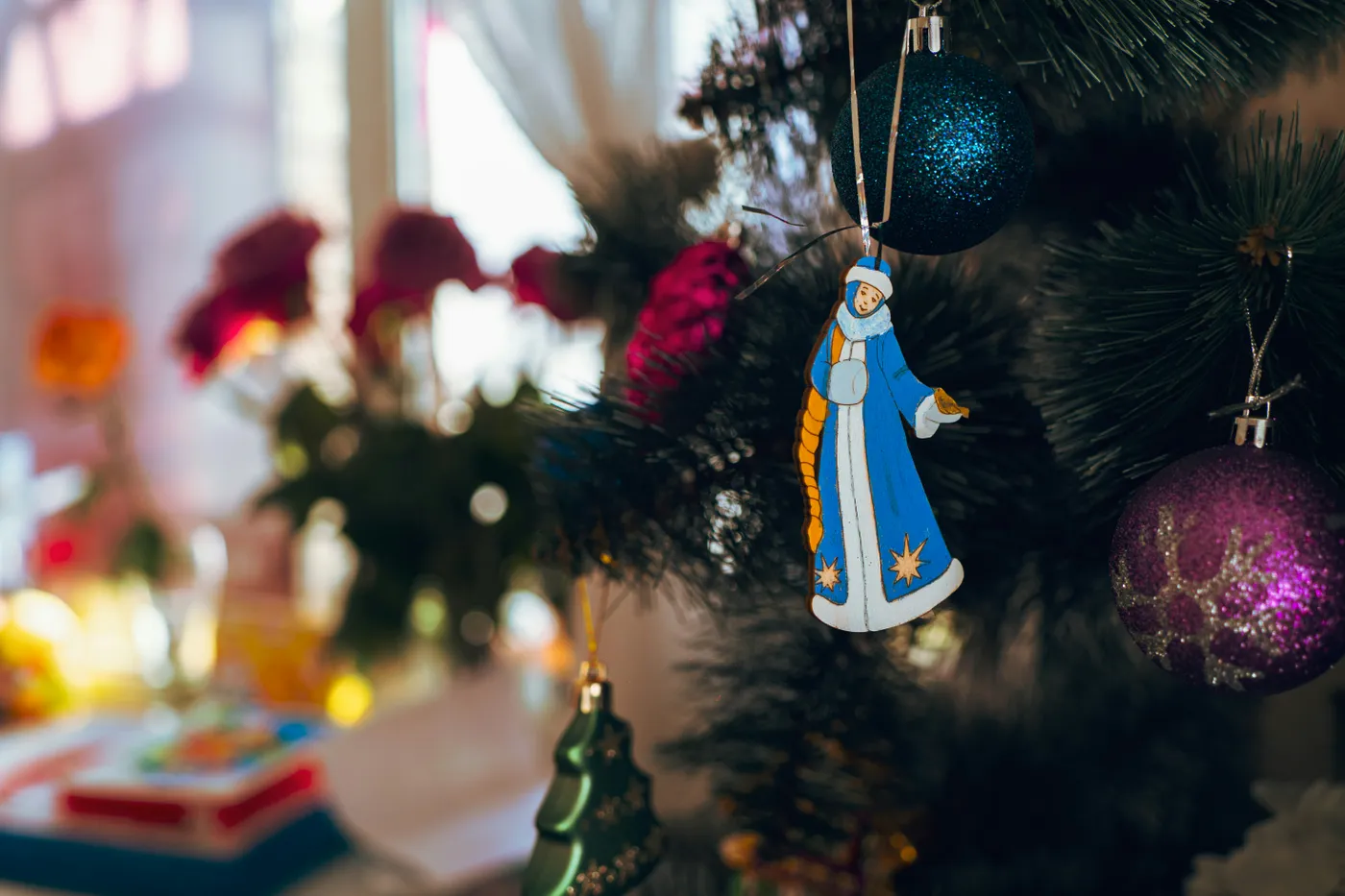
Folk-art and craft-forward ornaments are having a real moment as a counterweight to the last few years of minimalist, single-hue trees. Pinterest searches for painted wooden ornaments and vintage-style character figures keep climbing, and it tracks with a broader shift: people want holiday decor that looks handmade and specific rather than catalog-perfect. Glitter still sells, but the piece guests actually ask about is almost always the hand-painted one. This one has staying power because it’s storytelling, not a color of the season.
6. A Collection of Small Reflective Blue Glass Shapes
This collection lives best in small spaces where you can actually see individual shapes. A 4-foot tree tucked into a 3-by-5-foot entry nook, a mantel shelf, or a single floating ledge in a 10-by-12-foot room all work — anywhere you’re standing within three feet of the ornaments. On a full-size 7-foot tree, these read as filler rather than feature. For the same glassy blue mood at full tree scale, compare with Idea #2.
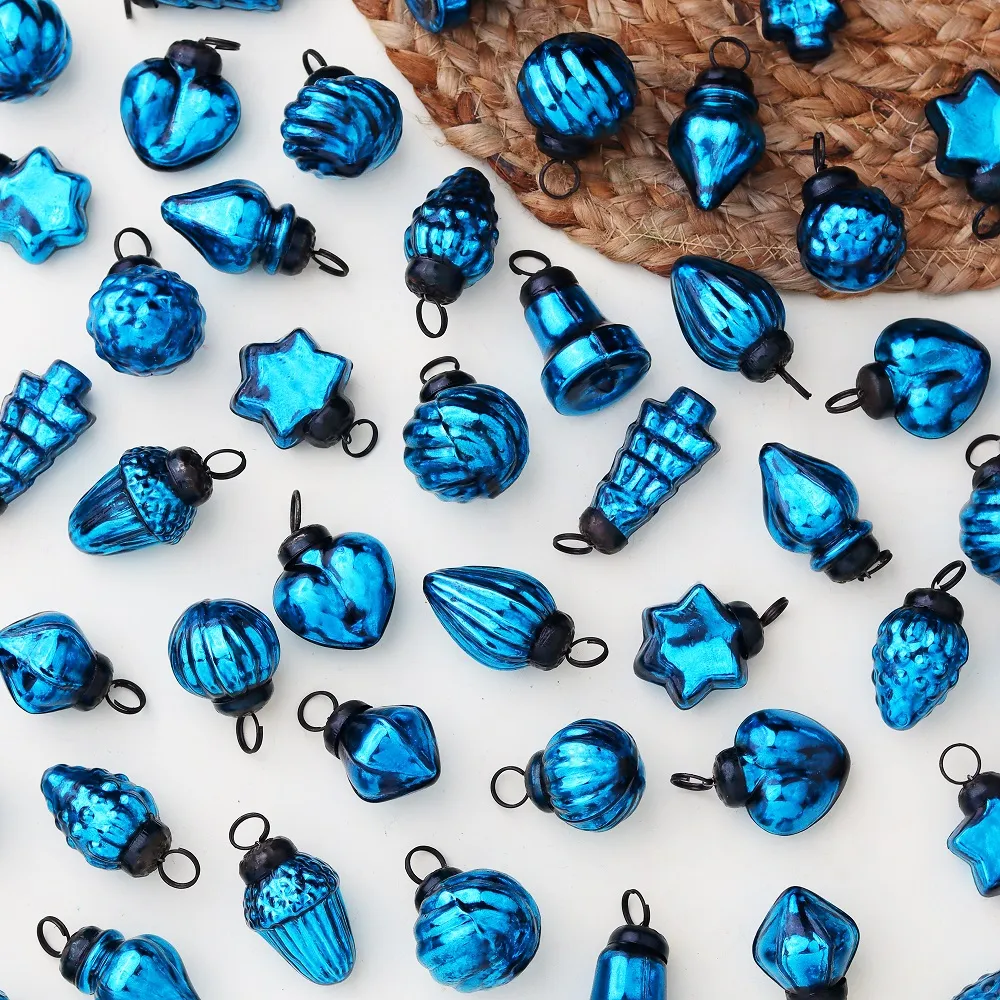
You can absolutely fake the collected-over-time look. Thrift stores and estate sales regularly sell boxed vintage glass ornaments for $3 to $8 a box, and the slightly distressed metallic finish is exactly what makes these interesting. HomeGoods and T.J. Maxx get closeout sets in late October for around $12 for 12 pieces. Want it in one weekend? Buy two multi-shape sets in the same blue and mix them — shape variety is doing the work here, not the price tag.
7. Ribbed Blue Ornaments with Glitter Teal Panels
- Dark blue-green artificial tree (7.5 ft): $150–$400
- Warm white string lights: $20–$45
- Ribbed blue and teal ornaments (24-piece set): $30–$70
- Silver caps and hangers: $5–$12
- Tree skirt and storage bin: $35–$90
Total: about $240–$620 — skipping the flocking here saves real money, since flocked trees run 30 to 50 percent more than plain ones.
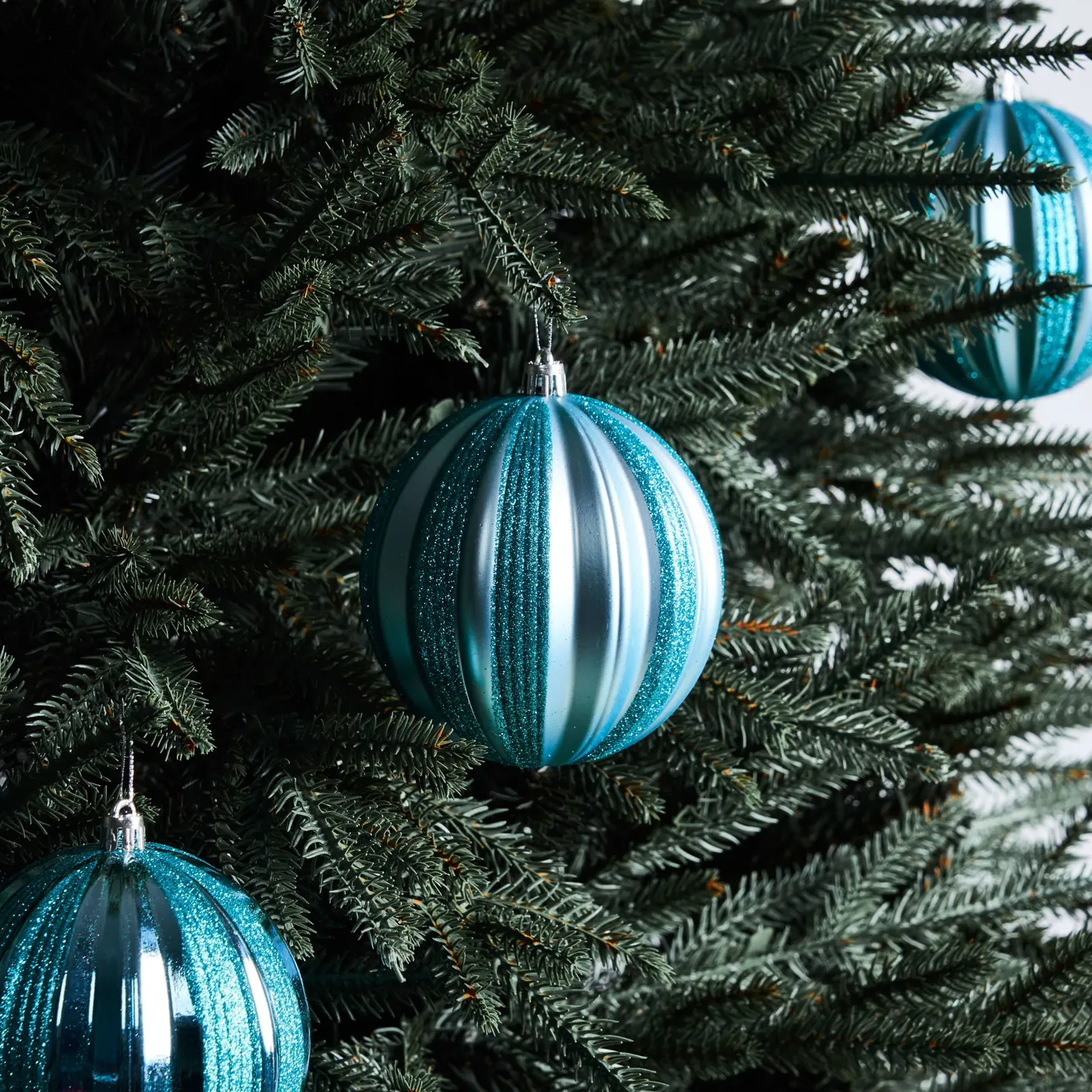
The ribbed pattern solves a problem most ornament sets have. A smooth sphere reflects one clean highlight; a ribbed sphere with alternating glitter and gloss breaks light into several small moments, so even a moderately lit tree looks fully dressed. Teal glitter against dark blue-green needles is also a low-contrast pairing, which sounds boring but actually reads calm and modern — you get sparkle without the tree shouting across the room.
8. Blue-Hued Spruce Dressed in Silver-White Ribbed Baubles
Glitter ornaments are messy in a very specific way: they shed hard for the first season and then mostly stop. A light coat of clear matte spray sealer on the glittered sections locks most of it down before you hang anything — do it outside and give it two hours to cure. Once the tree is up, plan on vacuuming underneath twice in December and shaking out the skirt in January. Storage matters more than people think: tissue-wrapped ornaments in a hard bin survive a decade, loosely bagged ones come out bald.
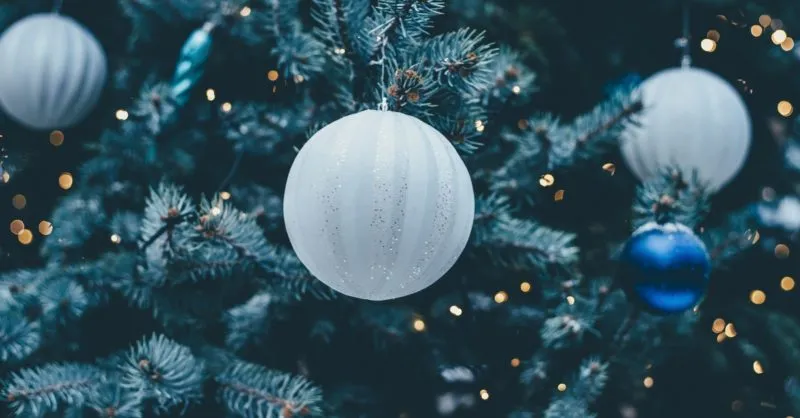
A blue-hued spruce needs more breathing room than a flocked one, because the cooler needles want a neutral wall behind them. It looks best in a room with at least 10 by 12 feet of floor space and 9-foot ceilings, or in a corner where two light-toned walls meet. In a room under 8 feet tall, drop to a 6-to-7-foot tree so the silver-ribbed baubles stay near eye level instead of floating up by the ceiling line.
9. Blue, Bronze, and Wood-Toned Tree Built on Texture
Roughly 50 percent green foliage, 30 percent a blend of dark blue and bronze ornament, 15 percent textured neutrals (velvet, fuzzy, and jute-wrapped spheres), and 5 percent wood. That last 5 percent is what keeps it from feeling cold — the wooden stars and bronze do the warming while the blue keeps it modern. Swap the bronze for aged brass and the wooden stars for ceramic snowflakes and the formula still holds. Cool blue needs one warm counterweight; give it two and the whole thing turns muddy.
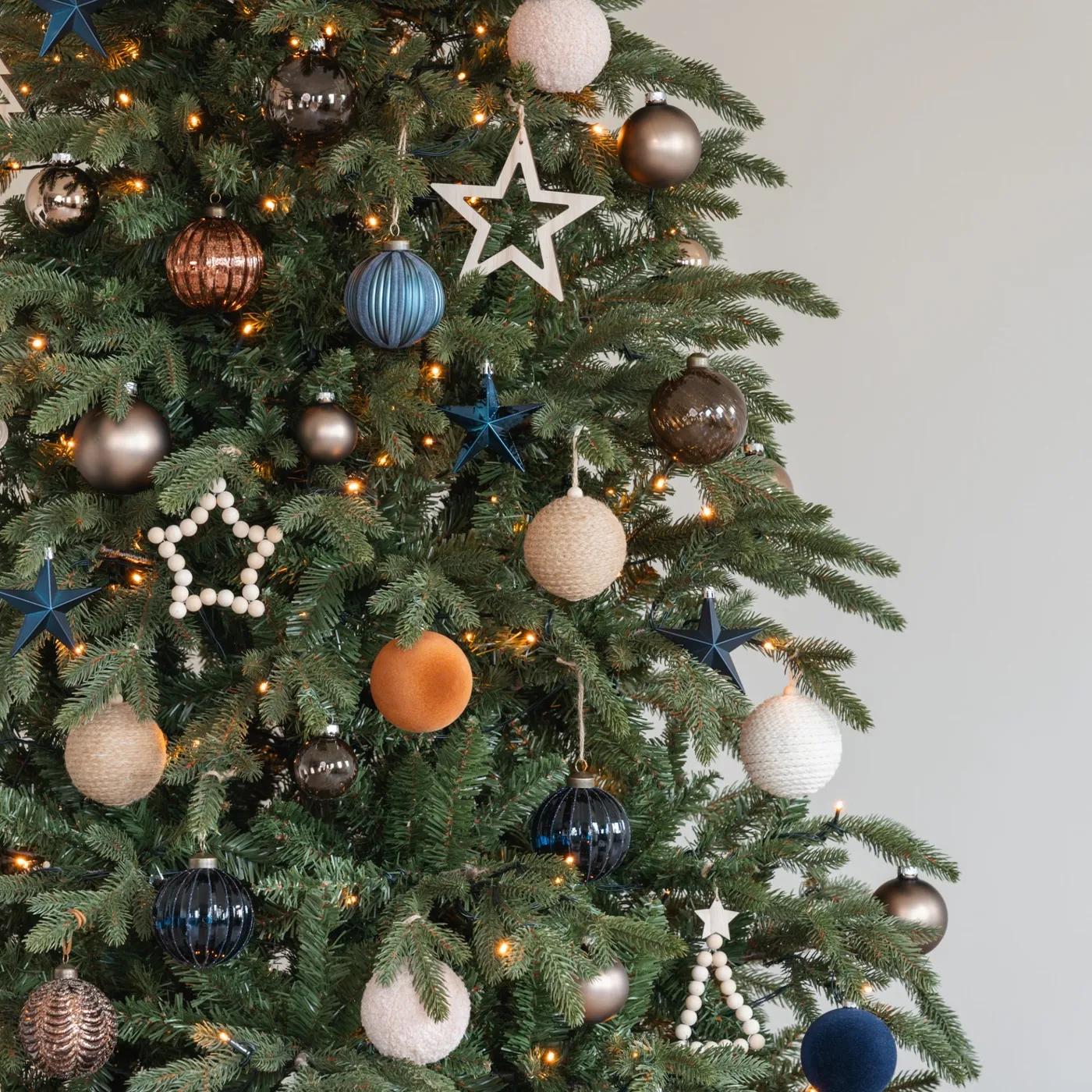
- Measure first — this tree reads best with 18 inches of clearance on at least one side.
- Check your room’s light, because blue and bronze both go dull under cool white bulbs.
- Lay every ornament finish out on a table before you hang a single piece.
- Confirm your stand is rated for the weight — velvet and jute spheres are heavier than they look.
- Set a firm budget and spend 60 percent of it on pieces you’ll reuse for years.
10. Glossy Teal Teardrop with a Beaded Blue Band
That band of tiny blue beads wrapped around the middle is the whole design. Without it you’ve got a nice glossy teardrop — pretty, common, sold in every big-box store by October. With it, the ornament has a waistline, a detail that makes people pull it off the tree to look closer. If you’re decorating on a budget, this is the argument for buying six thoughtful pieces instead of sixty generic ones. One ornament with a real detail beats a tree full of filler.
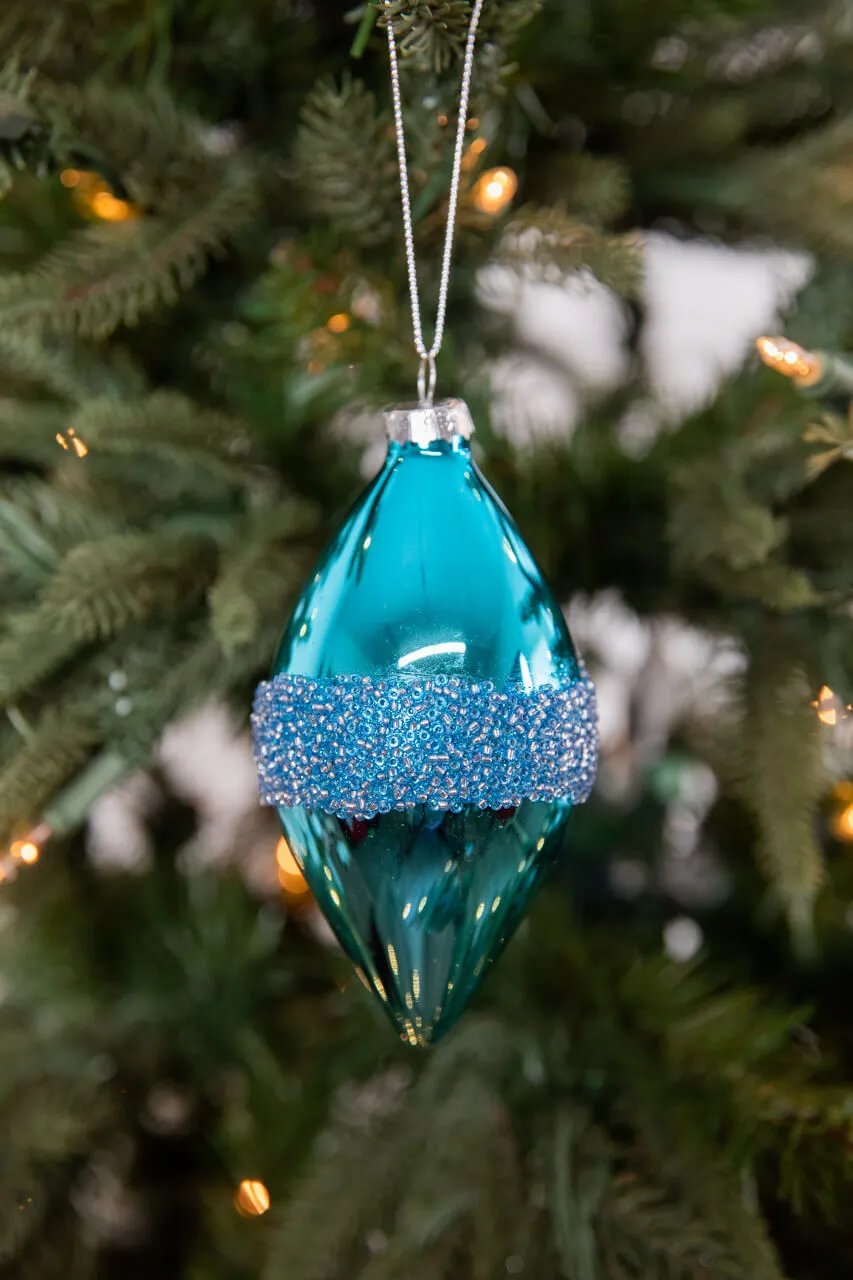
Teardrop ornaments in a decent teal run $4 to $9 each at craft stores, and a strand of tiny glass seed beads costs about $3. Run a thin line of craft glue around the ornament’s middle, press beads in while it’s wet, and you’ve got the same effect for roughly $7 per ornament. Work in small sections — craft glue dries faster than you think. Not happening this year? World Market and At Home both carry beaded-band ornaments seasonally for under $10.
11. Blue and Gold Keepsakes Curated in a Fabric-Lined Box
Build your tree around a 12-piece capsule instead of an open-ended pile. Choose three shapes (a teardrop, a sphere, a finial), two finishes (matte and glitter), and two sizes — that’s six combinations, two of each. A capsule like this costs $60 to $120, hangs in twenty minutes, and always looks composed because the repetition is built in. The gold-sectioned box in this set is doing double duty: it’s how you store them, and it’s genuinely how you should shop. The folk-art figure in Idea #5 belongs in a capsule like this.
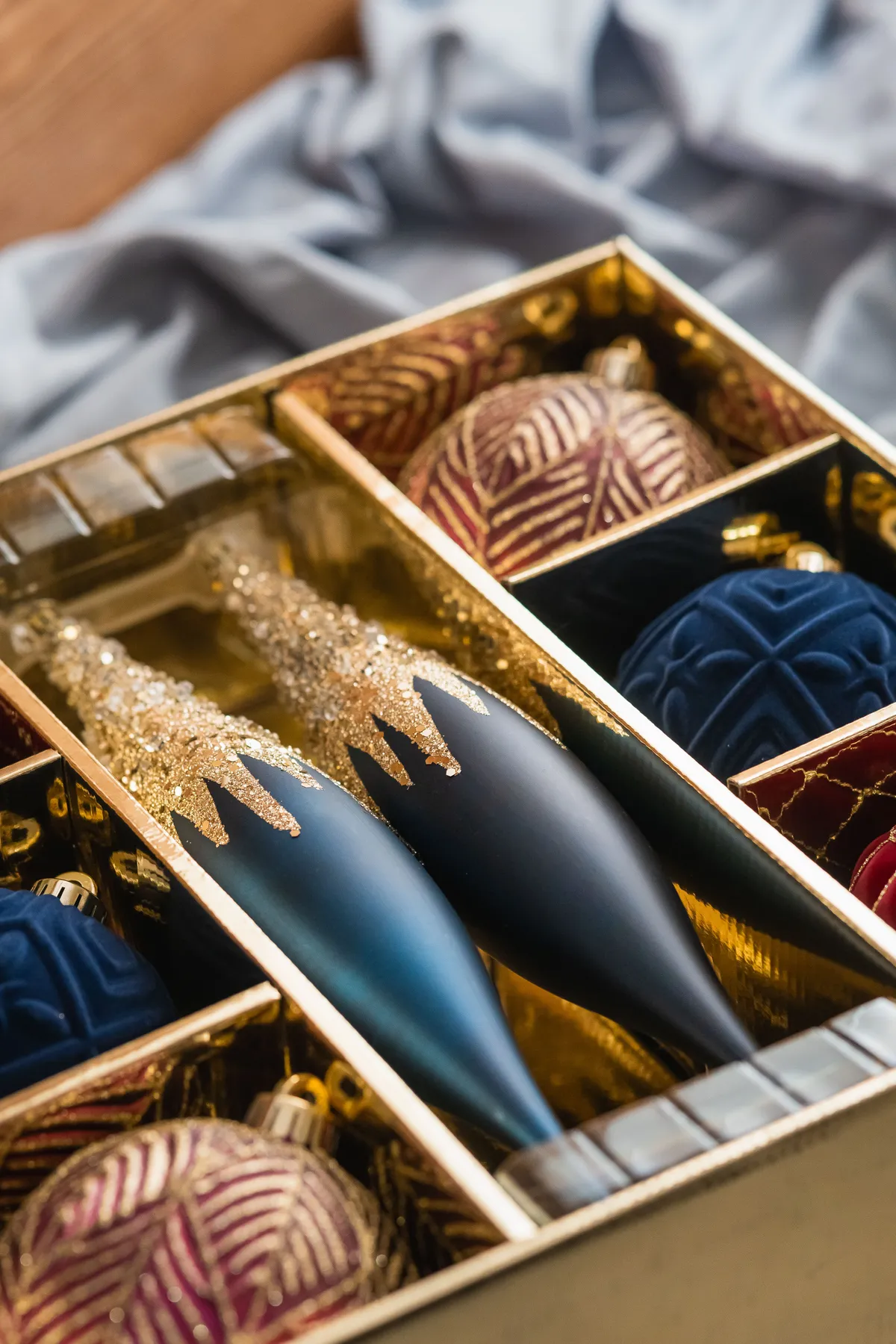
Deep matte blue with gold glitter is a pairing that survives every trend cycle, because it’s borrowed from evening wear rather than holiday decor. The matte surface makes the gold accents read like jewelry instead of tinsel, and a velvet sphere adds texture that photographs beautifully against the light blue fabric underneath. Notice the burgundy and purple pieces in the neighboring compartments — they’d work on the same tree for exactly the same reason: jewel tones, restrained finishes, no competing patterns.
12. Flocked White Tree with Silver Ribbon and a Nativity Plaque
A fully flocked white tree is the least forgiving tree you can buy. Every bare patch shows, because there’s no dark green to hide behind — so plan on two to three times the usual ornament count. String lights are the other issue: white trees glow better with lights pressed deep into the branches rather than looped across the surface. Keep it away from heating vents, too, because flocking and dry indoor heat do not get along. Beautiful result, genuinely more work.
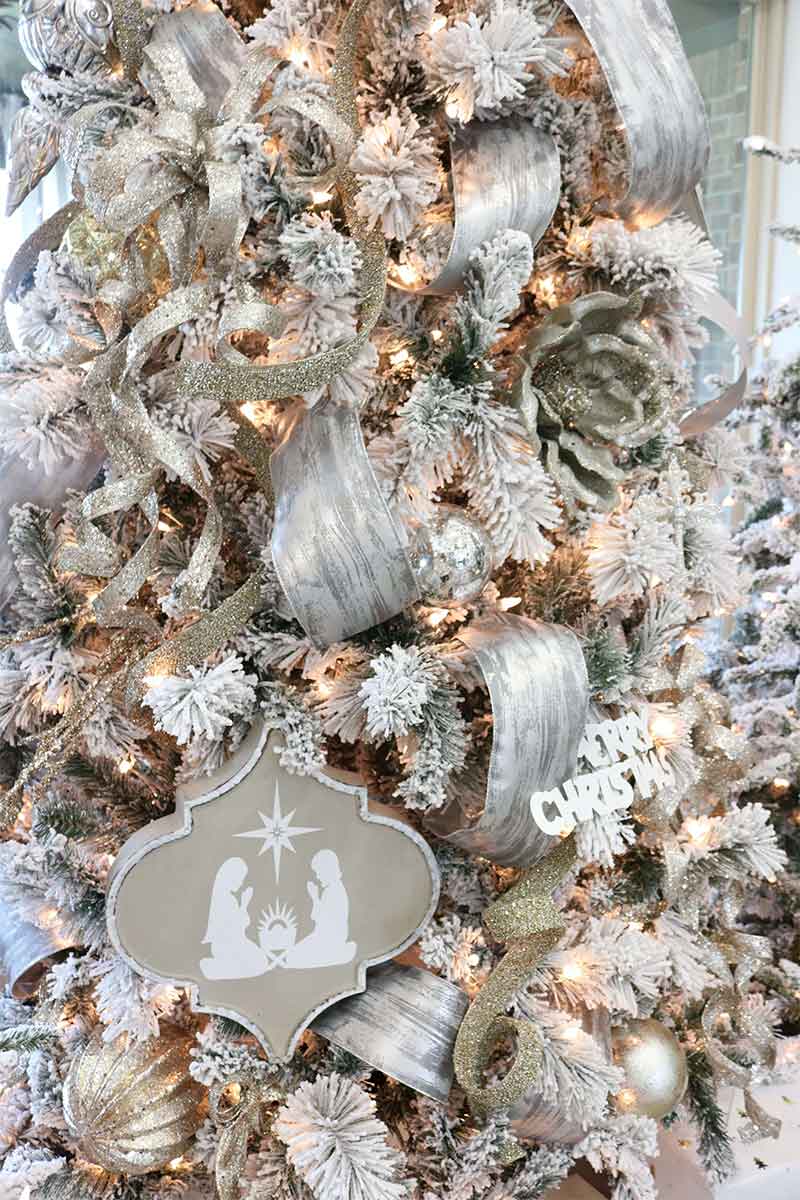
- Flocked white tree (7.5 ft): $200–$550
- Warm white fairy lights: $25–$60
- Silver and gold ribbon (3 rolls): $18–$40
- Glitter ball ornaments (set of 30): $35–$80
- Nativity plaque or keepsake ornament: $20–$65
- Ruffled tree skirt: $30–$75
Total: about $330–$870 — the single biggest savings is buying the tree off-season, when flocked styles drop about 50 percent.
13. Marbled Teal Glass Ornaments Resting on White Faux Fur
- Fill a disposable cup with warm water and add two drops each of teal and white acrylic paint.
- Stir once — overmixing kills the marble.
- Dip a clear glass ornament, rotating slowly, and lift it straight out.
- Blot the excess on a paper towel and dry it upside down for an hour.
- Dust the wet patches with fine silver glitter, then seal with a matte spray.
Time: about 45 minutes for six ornaments. Cost: roughly $12 if you already own the paint.
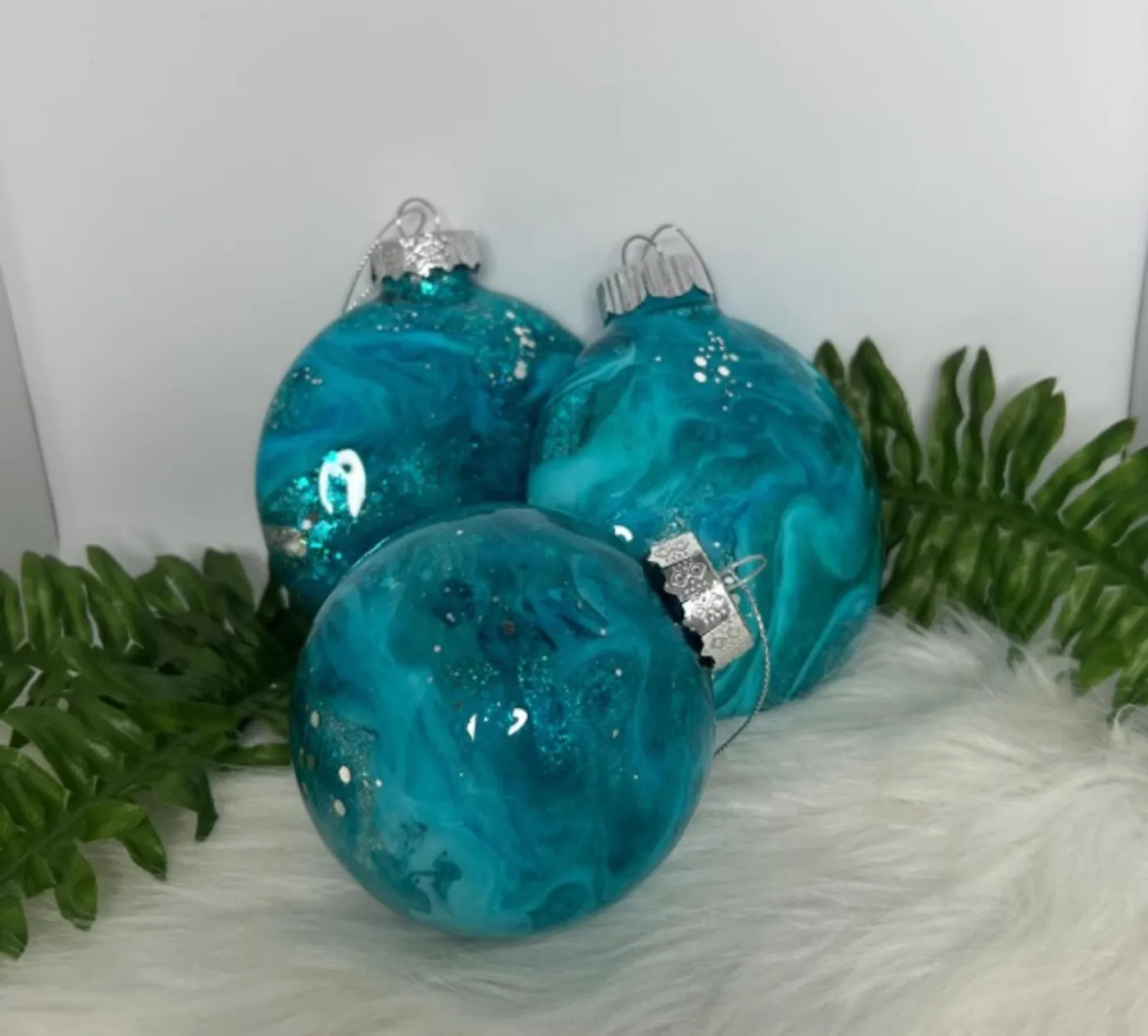
Three statement ornaments need less room than you’d think, but they need the right surface. A 24-inch shelf, a narrow mantel, or a side table in a 10-by-10-foot room all work — what matters is that the fur or fabric underneath is at least twice the width of the ornament cluster. On a full tree, these get lost among sixty other pieces. Think of them as jewelry on a nightstand, not the outfit. Small spaces genuinely suit this idea better than big rooms do.
14. White Tree with Teal, Green, and a Silver Skirt
About 60 percent white tree and white light, 25 percent teal and deep green ornament, 10 percent silver (the star, the skirt, the chandelier reflecting off everything), and 5 percent grey architecture. The marbled grey walls are why this doesn’t turn into a snowman — they give the white tree a mid-tone to sit against. Trade the teal for soft navy and the formula still works. If your walls are warm cream instead of cool grey, add a bronze ornament or two to bridge the temperature gap.
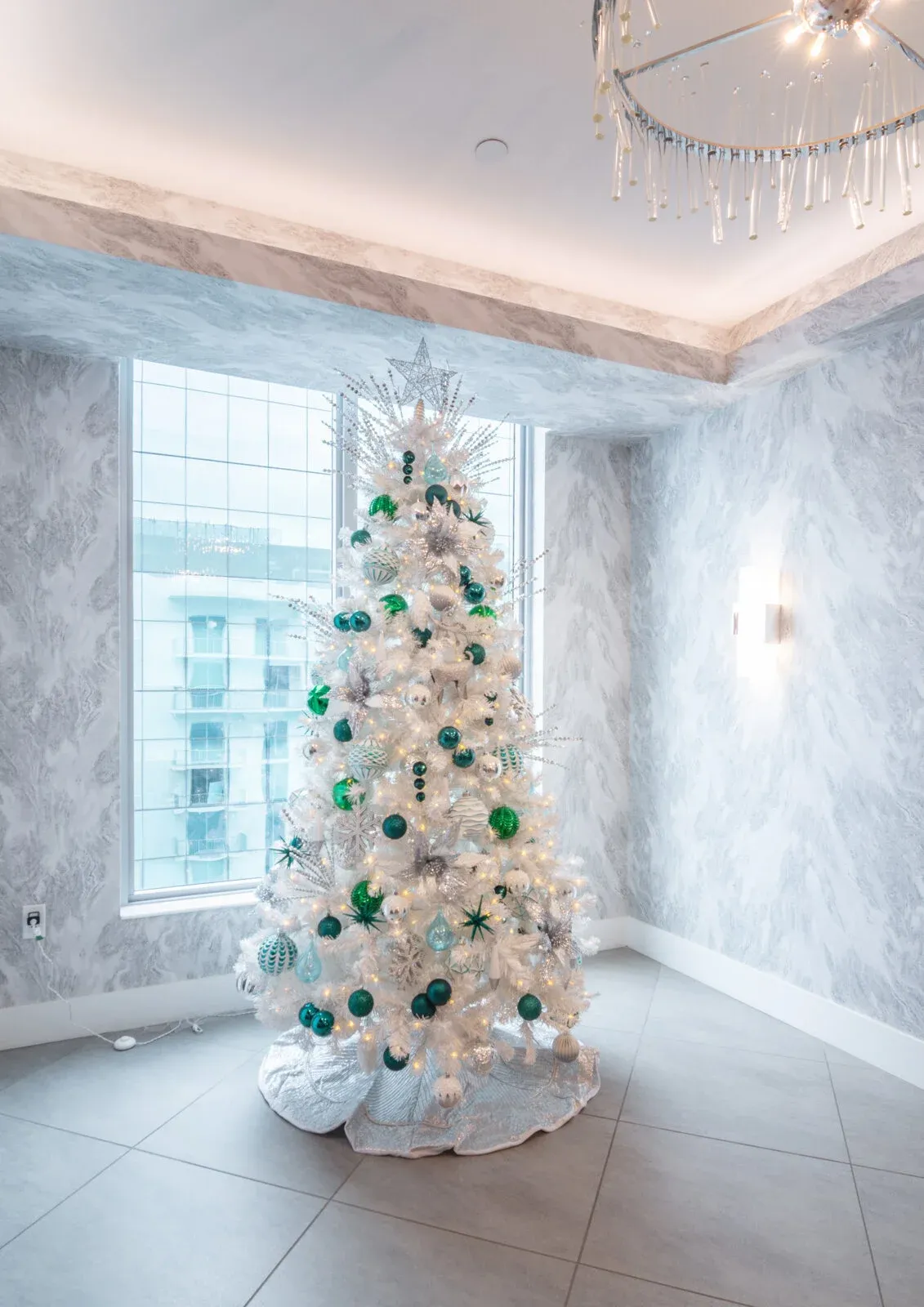
It’s the metallic silver tree skirt. Everything above it is white, silver, and cool — and without that ruffled silver base, the tree would appear to be floating on grey tile, unfinished. The skirt catches the chandelier light and bounces it up into the lowest branches, which makes the whole thing look professionally lit even though it’s just white string lights. If you change one thing in a white-tree setup, change the base.
15. Electric Blue Lights Behind a White Picket Fence
- Confirm an exterior outlet within reach of a heavy-duty outdoor extension cord.
- Count your strands — electric blue LEDs pull more attention per foot than warm white, so you need fewer than you think.
- Check the fence line before you drape anything; wet wood and staples don’t mix.
- Verify one GFCI-protected circuit can carry the total wattage.
- Photograph it at dusk once before the season starts so you can fix timers and run times early.
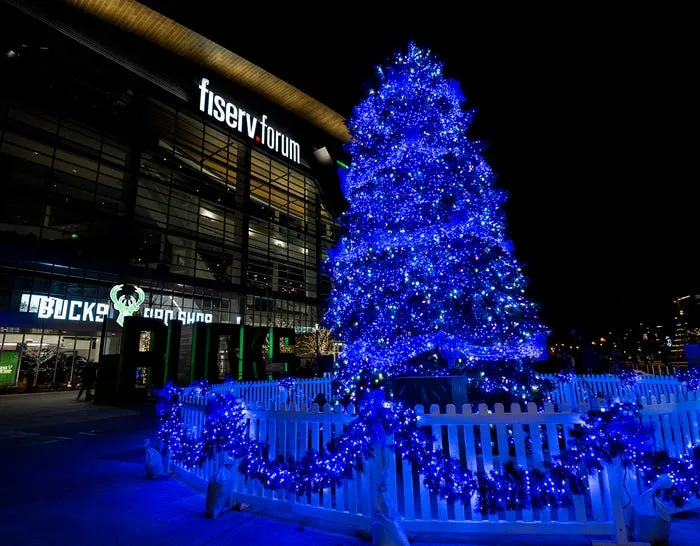
Monochrome outdoor lighting has moved from commercial displays into regular front yards, and electric blue is the most requested color after warm white. It reads as clean, high-contrast, and slightly surreal, which is exactly why it performs so well on Pinterest. The question is staying power: warm white will always be safe, but blue remains a deliberate choice, and deliberate choices are what make a house look designed. Expect this one to keep growing through 2026.
16. Cobalt Candy-Wrapper Ornament with a Gold Cap
Once an ornament passes about 5 inches, branch strength becomes the real issue. Wire the hanger around the branch itself rather than the needle tips — a 6-inch glass piece weighs 8 to 14 ounces, and thin artificial branches will sag by New Year’s if you don’t anchor properly. For anything over 8 inches, hang it within 6 inches of the trunk where the branch is stiffest. And if you have toddlers or cats, keep heavy glass above 4 feet and the fan-shaped pieces in the top third.
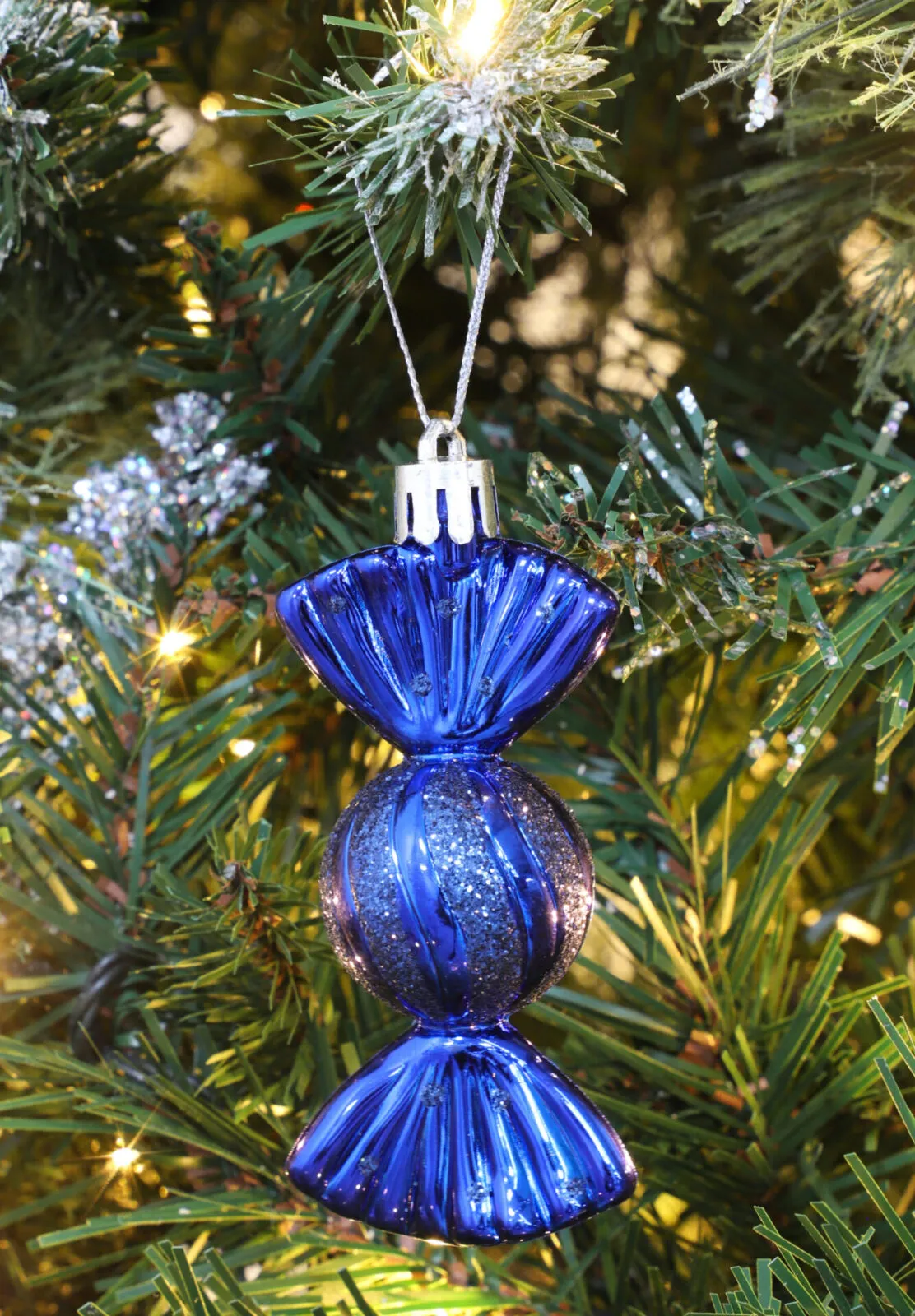
Candy-wrapper and fan-shaped ornaments have one real downside: they’re nearly impossible to store flat and they chip along the ribs. Keep the original box if you can, wrap each piece in tissue, and store them in a single layer. Also worth knowing — deep cobalt with silver glitter is a high-contrast combination, so it looks louder than you expect under warm bulbs. If you want subtle, choose the matte version of the same blue and skip the glittered center entirely.
17. Two-Tone Teal Ornaments with Gold Glitter Stripes
These split-finish ornaments sell for $6 to $14 each, which adds up fast across a whole tree. You don’t need them at that price. Target and Walmart both run multi-packs of plain matte ornaments for around $10 for 12, and a tube of fine gold glitter is $4. Paint the bottom half with craft glue, dip, let it dry. Three hours gets you a dozen custom pieces that match this exact look for roughly $25. Display them on a tiered stand, the way they’re shown, with the marbled glass in Idea #13 nearby.
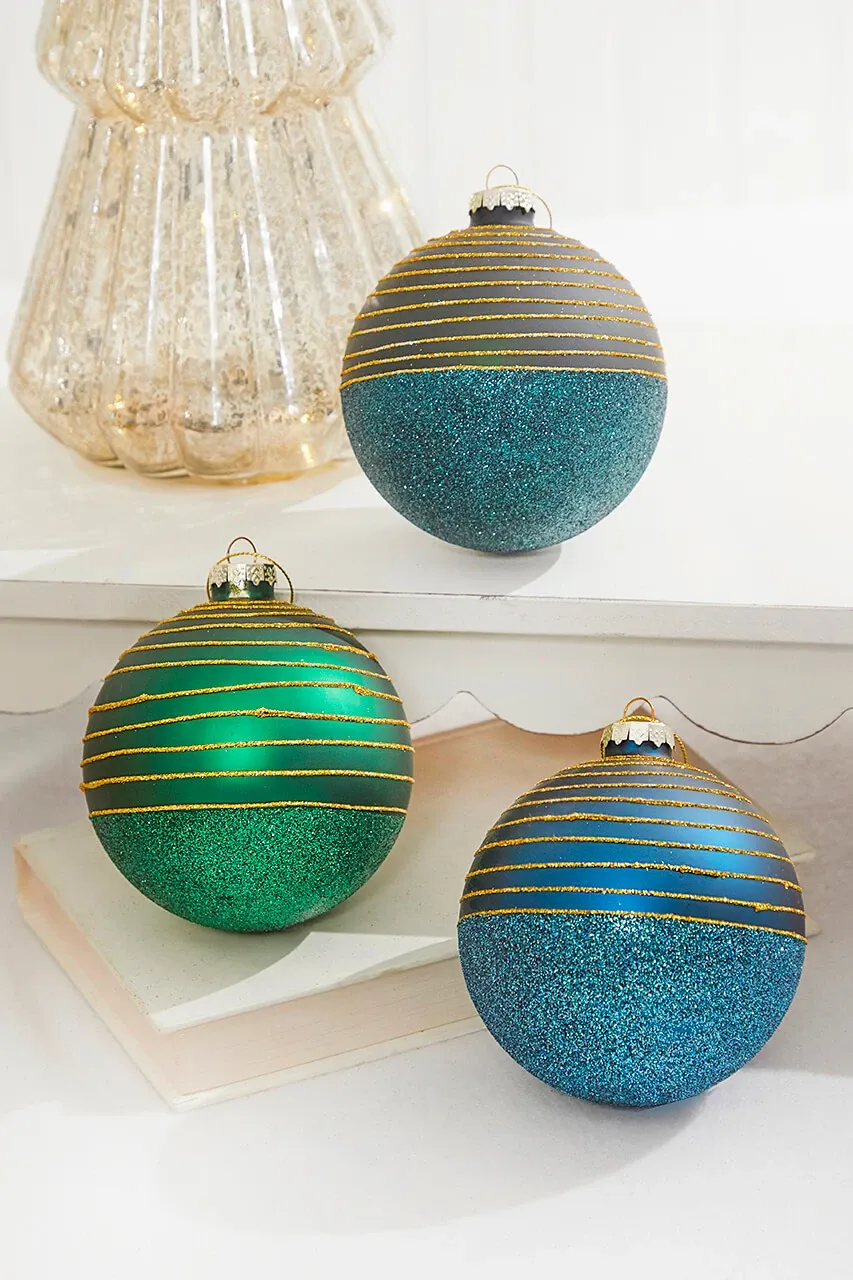
- Wrap painter’s tape around the ornament’s midpoint at a slight downward angle.
- Brush matte craft paint on the top half — two thin coats beat one thick one.
- Peel the tape while the paint is still slightly tacky.
- Apply glue to the bottom half and roll it in a plate of fine gold glitter.
- Add thin gold stripes with a paint pen once dry, then seal with matte spray.
Time: about 15 minutes per ornament once you get moving. Cost: roughly $3 each.
18. Blue Glitter Pinecones Mixed with Real Ones
The blue pinecones work because they share a silhouette with the real ones sitting right beside them. Your eye reads the shape, then catches the color shift — that tiny surprise is what keeps a tree interesting on the fourth look. Natural brown pinecones also give the blue somewhere to land; without them, the glitter would feel like it was floating in green. The frosted white accents do the same job in reverse, softening the edge between glitter and needles.
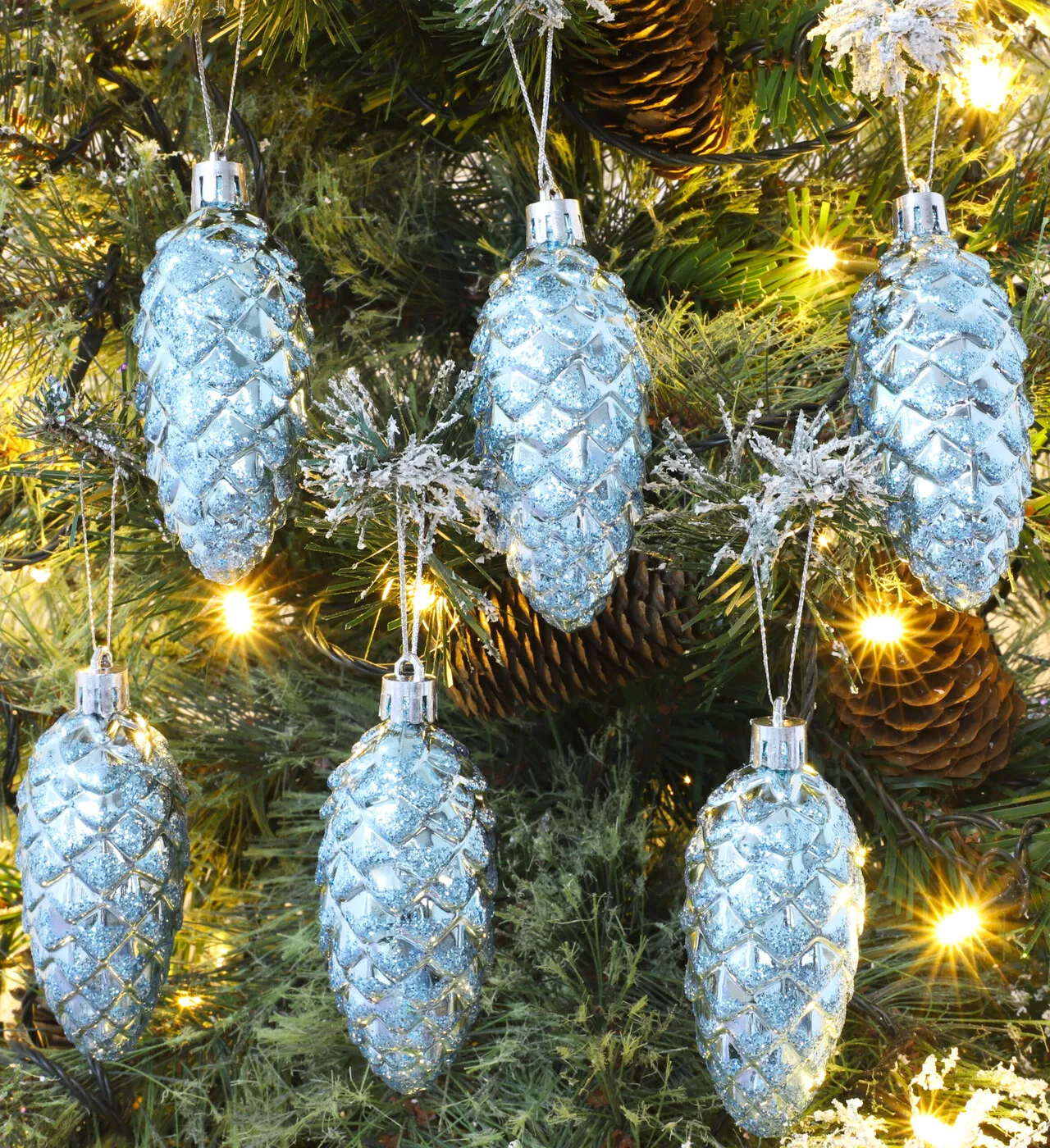
Two maintenance notes. Blue glitter migrates — onto your tree skirt, your rug, and eventually your white sofa — and a light mist of clear sealer cuts the shedding by roughly 80 percent. Real pinecones should also be baked at 200°F for 30 minutes before they come indoors, or you’re introducing whatever was living in them. Between seasons, store pinecones in a zip bag with a few cedar balls so they don’t get musty.
19. Glitter Blue Ornaments Wrapped in Natural Cording
Flocked trees show every ornament, which means a small tree can carry this look beautifully. A 4-to-6-foot flocked tree in a room of 100 square feet or more is the sweet spot — go smaller and the flocking starts to close in. If your ceiling is under 8 feet, keep the tree at 5 to 6 feet so the cording-wrapped ornaments stay in the middle band where people actually look. On larger trees, hang these in an even scatter rather than in clusters.
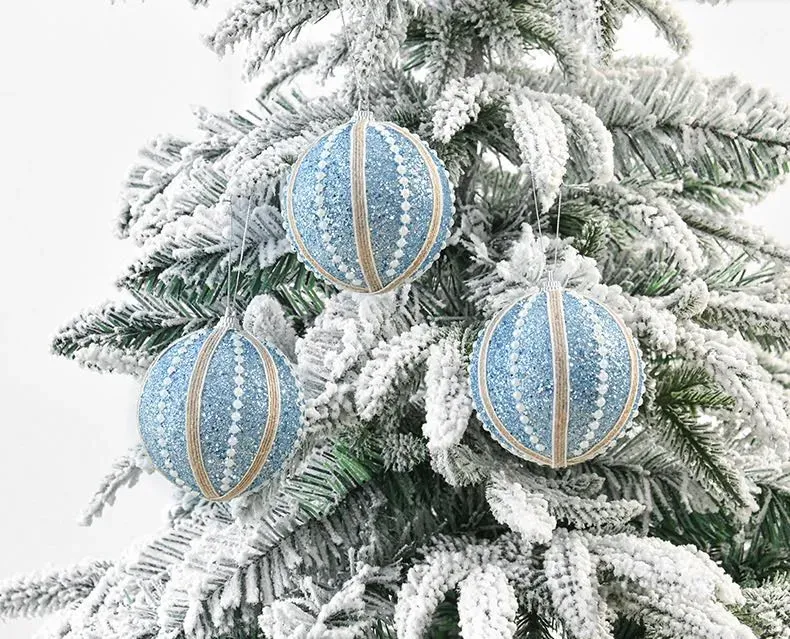
- Cut 18 inches of natural cotton or jute cording per ornament.
- Dab a dot of craft glue at the top of the ornament’s cap.
- Wrap the cord vertically down one side, pressing as you go.
- Repeat with two more strands spaced evenly around the sphere.
- Finish with a small white paint dot at each cord end, then hang to dry.
Time: about 20 minutes for three. Cost: roughly $6 total for the cording.
20. Glossy and Matte Royal Blue on Snow-Flocked Branches
- Flocked artificial tree (7 ft): $130–$350
- Royal blue ornament set, mixed finishes (24 pieces): $28–$65
- Silver caps and hangers: $6–$14
- Warm white string lights: $18–$40
- Snow-white tree skirt: $25–$60
Total: about $210–$530 — dropping from a 7.5-foot to a 7-foot flocked tree saves $40 to $80 with almost no visual difference. Same ink-blue family as Idea #3, just at full-tree scale.
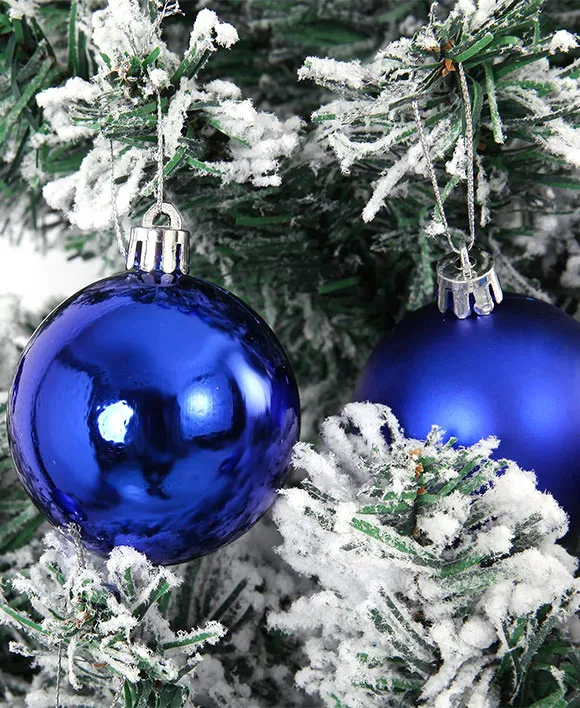
Glass ornaments and flocking are a slightly awkward pairing. Flocked branches are stiffer and the coating can grip an ornament cap, so you’ll be wiggling pieces free in January. Hang heavy glass with ribbon loops rather than metal hooks — ribbon spreads the weight and doesn’t scratch the flocking. And keep matte and glossy pieces roughly 6 to 8 inches apart; packed too close, the two finishes read as a mismatch instead of a deliberate mix.
21. Pale Blue Velvet Armchair in a Blue-and-White Corner
The armchair. Take it away and you have a decorated tree in a corner; keep it and you have a room. Pale blue tufted velvet beside a green-and-blue tree sounds like a clash, and it isn’t, because the tree stays dark and the chair stays quiet. If you only add one thing to a tree corner this year, make it a seat. It solves a practical problem too — people want to sit near the tree, and a chair gives them somewhere to land.
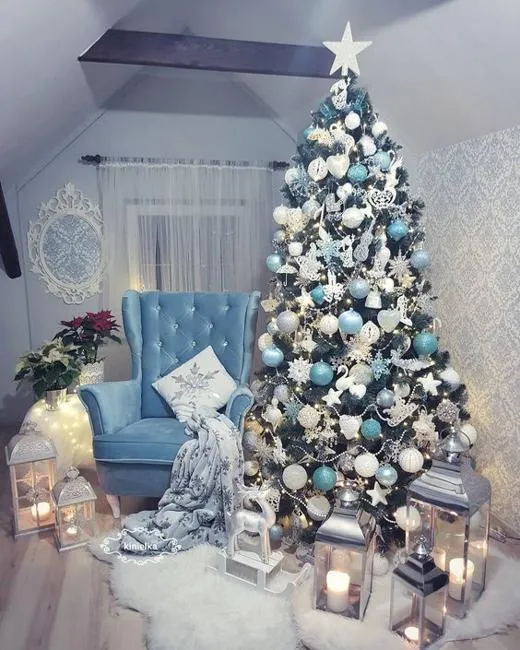
A new tufted pale blue velvet armchair runs $400 to $900, and that’s before the pillow. Marketplace and estate sales turn up velvet chairs in blue and grey constantly for $75 to $200 — upholstery is easy to clean and hard to kill, so secondhand is genuinely smart here. Skip the reupholstery quote and put that money into a snowflake pillow, two lanterns, white poinsettias, and a faux fur rug. If the tree itself feels crowded once it’s up, the fixes are in the mistakes section.
22. Navy, Matte, and Glitter-Black Ornaments in Warm Light
Roughly 60 percent green needles, 30 percent dark blue across three finishes, 10 percent warm white light. That’s a genuinely dark formula, and it only works because of the light. Warm 2700K bulbs give the navy a soft edge; swap in cool white LEDs and the same ornaments turn flat and grey. If your space is small or under-lit, push the math to 50 percent ornament and add a second strand of warm lights before you add another color. Compare with Idea #18, where glitter does the talking instead.
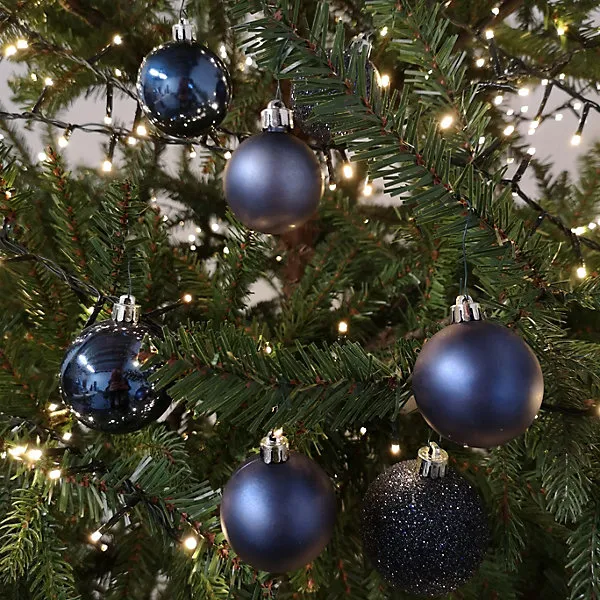
- Sort all navy ornaments into three piles: glossy, matte, glitter.
- Hang the glossy pieces at the outer tips where light hits them.
- Place matte pieces one branch deeper, in the middle zone.
- Tuck the glitter pieces near the trunk so the sparkle reads as depth, not glare.
- Step back every dozen ornaments and check the balance.
Time: about 40 minutes for a 7-foot tree. Cost: $0 — it’s purely placement, and it’s the kind of thing people pay a designer to come do.
23. Navy, Gold, and Matte Red Under a Tinsel Garland
- Measure the tree’s diagonal height — tinsel garland needs about 1.5 times the tree height in length.
- Lay the garland out flat first and untwist any kinks before it goes near the tree.
- Test the ribbon and garland together in daylight to make sure they don’t fight.
- Check fireplace clearance — keep the tree at least 3 feet from an active fire.
- Decide on two to three accent colors before you shop, not after.
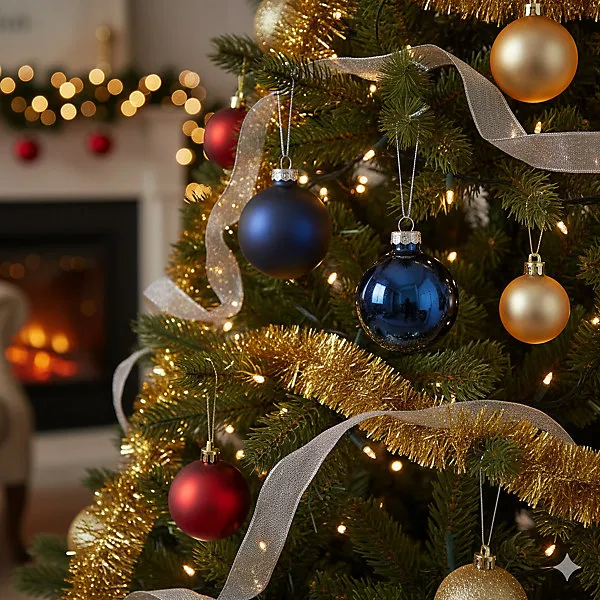
Tinsel garland fails when it’s wound in a tight spiral. Instead, drape it in five or six loose swags from the top down, each dipping about 12 to 18 inches below the last, and pin the high points to the trunk where nobody can see them. Then thread the sheer glitter ribbon on a separate, shallower path so the two never sit side by side. The anchoring advice in Idea #16 applies to the heavy pieces up top.
One Blue Ornament Is All It Takes
Forget the perfect tree — start with the one piece you actually love, hang it somewhere you’ll see it every morning, and build out from there. Whether you land on a flocked coastal look or a deep navy-and-gold classic, the formula never changes: pick a direction and commit to it. Save your favorites to a Pinterest board now, because next December you’ll want the shortlist instead of the scroll.