23 Jaw-Dropping Christmas Bedding Ideas That Will Transform Your Bedroom Into a Winter Wonderland

You know that feeling when you spot a bedding set in a Pinterest photo, screenshot it, and then can’t stop thinking about it at 11 p.m.? That’s how this list started. We spent weeks digging through Target, IKEA, Etsy, Wayfair, and Garnet Hill to find Christmas bedding that looks as good in a real bedroom as it does in a styled photo — and we narrowed hundreds of options down to 23 ideas that actually deliver, from $29 to $340.
Inside you’ll find whimsical reindeer prints, rustic plaid, traditional tartan flannel, woodland nursery sets, and vintage botanical illustrations, with budget and luxury versions compared side by side and every idea shoppable with direct product links. Holiday bedding is having a real moment in 2026 because people are treating the bedroom as the coziest room in the house again — layered, textural, and photographed for inspiration rather than perfection. And stay until the end — we break down the most common mistakes that can ruin these looks.
📌 Save this to Pinterest for later — you’ll want to revisit these ideas.
1. Whimsical Tree and Reindeer Print That Stops Short of Cute
Pattern scale is the whole ballgame here. If your print carries three or more motifs — trees, reindeer, ornaments — the repeat should be at least six inches wide so it still reads from the doorway instead of turning into visual static from three feet away. Cap the pattern at roughly 60% of the visible bed surface: duvet and shams yes, blanket and accent pillows no. One patterned layer, everything else solid. The cream tufted headboard, the white panel molding, the plain white nightstand — that restraint is why this works.
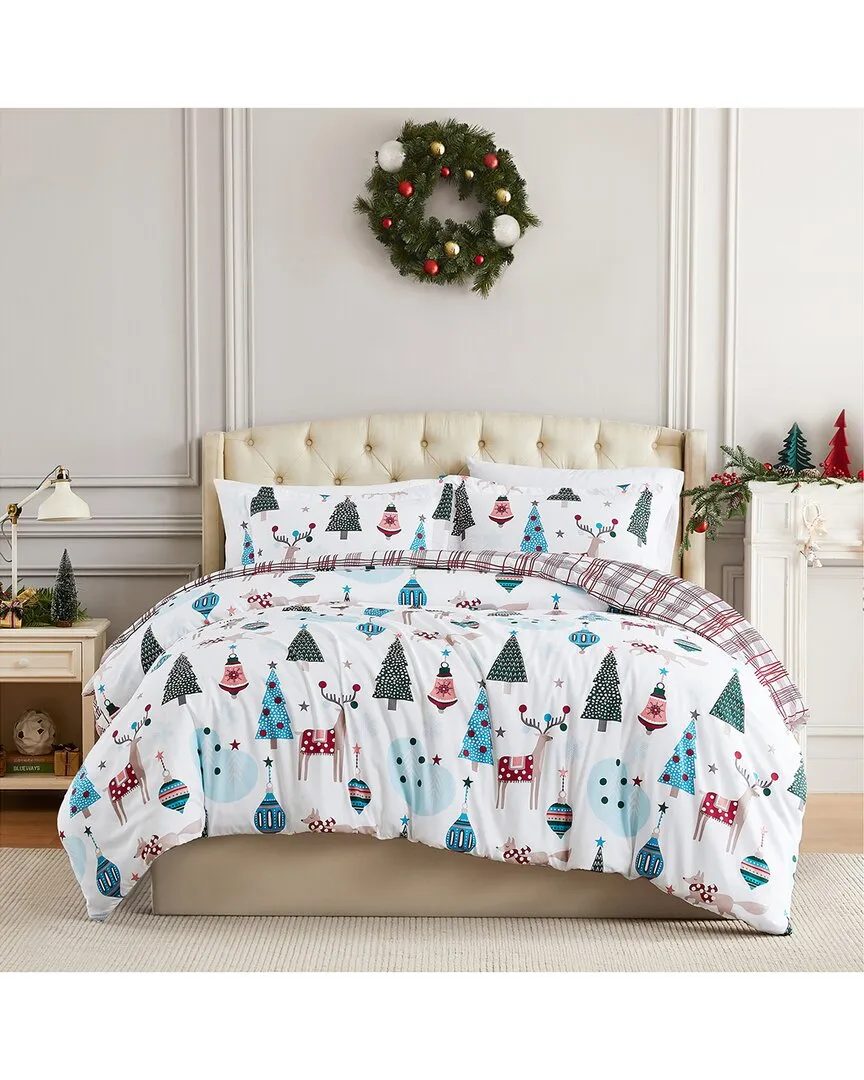
The panel molding behind the bed is the element you can’t remove. Take it away and the same duvet suddenly looks like a novelty purchase instead of a design decision. That boxy white trim gives the eye somewhere to rest between the busy print and the cream headboard, and it’s what makes the wreath read as deliberate rather than leftover. If your walls are flat, hang two large white-framed prints instead — anything that creates a quiet grid behind the pattern.
2. Red Plaid and Exposed Beams in a Cozy Attic Bedroom
Three things are doing the heavy lifting. First, scale contrast: a big graphic plaid against narrow ceiling beams and a plank-wall headboard keeps the room from feeling flat. Second, temperature — that warm beige wall keeps the red from going fire-engine bright. Third, repetition: the small pine branches and the red in the comforter echo each other without matching exactly. The teddy bear propped on a wooden chair is a cheap move that softens an otherwise very architectural room.
Recreating this rustic attic look, costs and all:
- Comforter plus two matching shams: $70–$180
- Warm beige paint for one wall and trim: $45–$90
- Real or faux pine branches in a jug: $15–$35
- Vintage wooden chair from Marketplace or a thrift store: $25–$120
- Teddy bear and small accents: $10–$30
- Total: $165–$455
Budget alternative: skip the paint and lean a reclaimed plank panel behind the bed instead. Salvaged boards usually run $30–$60 and deliver the same dark wood anchor.
3. Snowflake Plaid Paired With Woven Natural Texture
The formula here is roughly 55% red-and-black plaid, 25% natural fiber, 15% white, and 5% dried botanical. The plaid does the talking; the woven wall hanging and the round fringed jute rug act as the breather so the red never overwhelms a small room. Swap the plaid to forest green and white and you keep the exact same balance, just a different holiday mood. Swap the jute for a flat-weave wool rug and it gets quieter still.
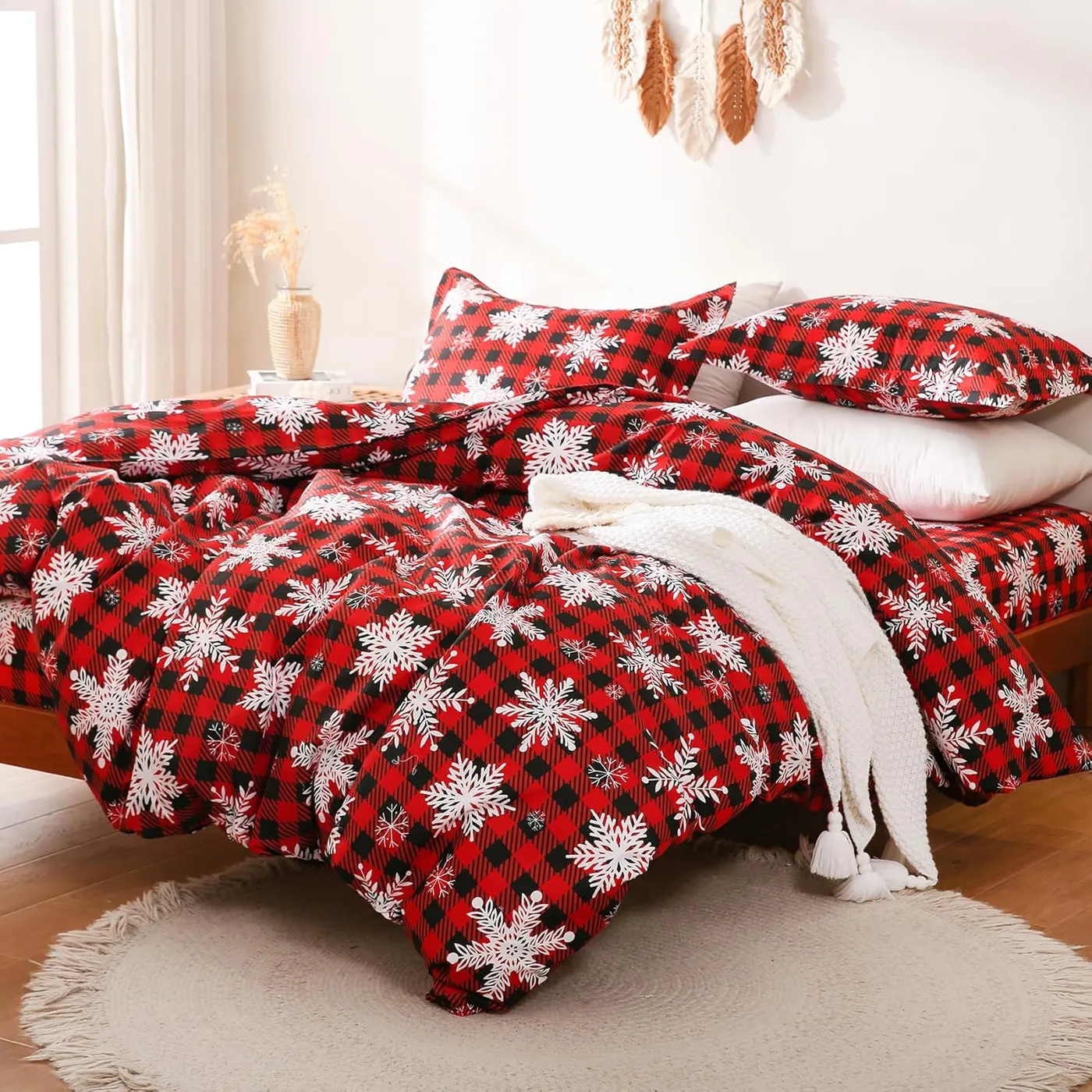
You can build this one almost entirely secondhand:
- Wooden bed frame: Facebook Marketplace, $60–$150
- Plaid duvet and shams: IKEA or Walmart, $40–$90
- Chunky knit white throw with tassels: Target, $25–$45
- Round jute rug: Walmart, $35–$70
- Woven wall hanging: thrift store or Etsy, $20–$60
- Dried grass in a simple vase: $8–$20
Total lands near $190–$435, roughly half a boutique version. The tasseled throw is the detail people notice, so don’t cut that one.
4. Navy and Tartan Layered Over a Tan Upholstered Headboard
The separate plaid flat sheet. Most people fold a patterned duvet over a solid sheet and call it done. Here the tartan sheet shows at the top edge, sandwiched between solid navy shams and the navy duvet — that thin stripe of pattern is what makes the bed look collected over years instead of bought in one cart. Lose it and you have a nice navy bed. Keep it and you have a layered one. If you’re after a cooler-toned version, the flannel in Idea #21 runs the same trick in deeper tartan.
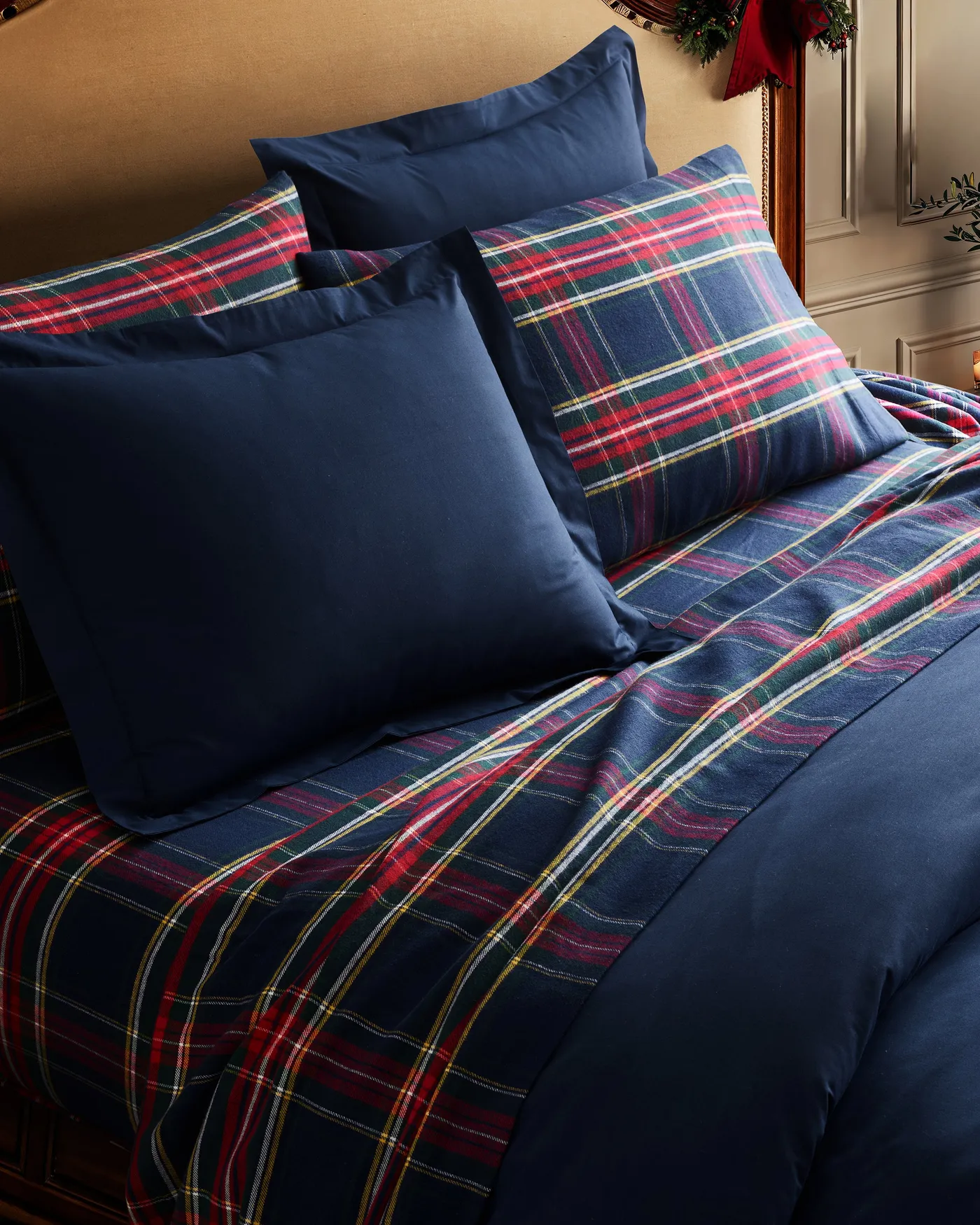
Tartan plus navy is a dark combination, and dark bedding is unforgiving in a room with one small north-facing window — everything goes muddy by 4 p.m. Two bedside lamps with warm 2700K bulbs are basically non-negotiable. Also check your headboard height: under 48 inches tall and that garland with the red bow will crowd it. Keep at least 10 inches between the top of your pillows and the bottom of any greenery.
5. Small-Scale Red Reindeer Print in a Bright Wood-Clad Bedroom
Small motifs need small rooms, or at least short visual distance. This reindeer print repeats every four or five inches, which means it blurs into pinkish noise in a 16-foot-wide primary bedroom but looks charming in anything under 12 feet. The fix isn’t avoiding it — it’s containing it. Use the patterned duvet and shams on the bed only, then keep the rest of the room light wood and cream so the print has space to breathe against the sheers and the chunky knit rug.
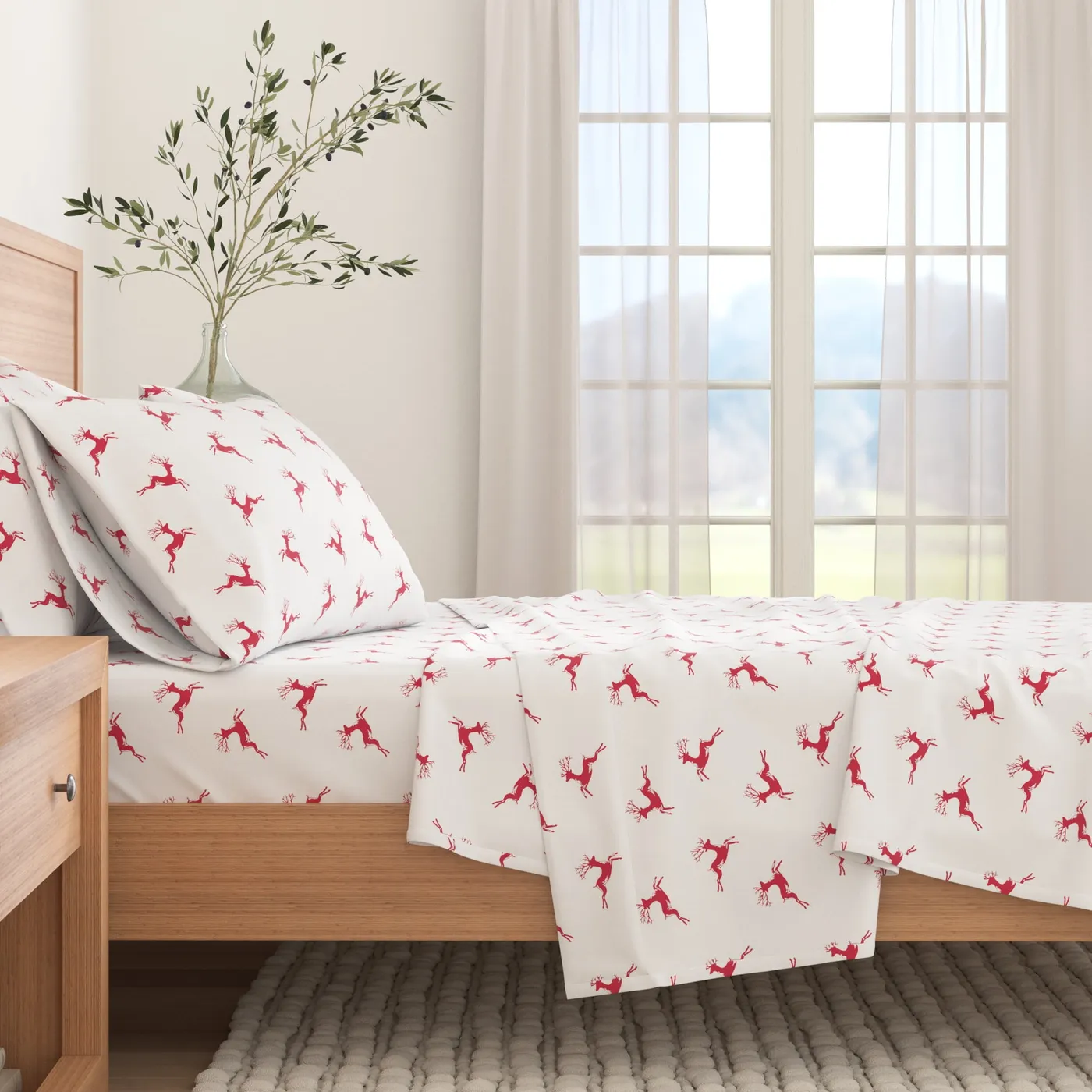
Best in rooms from 10×10 to 12×14 feet with standard 8-foot ceilings, where that big multi-paned window does most of the work. Larger spaces need the pattern scaled up — think a 9-inch repeat rather than 4. In a guest room or dorm, this is one of the easiest wins on the list. If you’re working with a low, sloped ceiling instead, jump to Idea #2, where the beams change the whole equation.
6. Cream Winter Forest Scene With Deer and Pine Trees
The print reads as a picture rather than a pattern, and that’s deliberate. Deer, pine trees, and bare brown trunks sit on a cream ground with soft blue-grey snow, so the palette stays quiet enough to leave up past New Year. The solid light green pillow is the anchor — it pulls one color out of the illustration and gives your eye a place to land. The cream chunky knit at the foot adds a third texture without adding a third color.
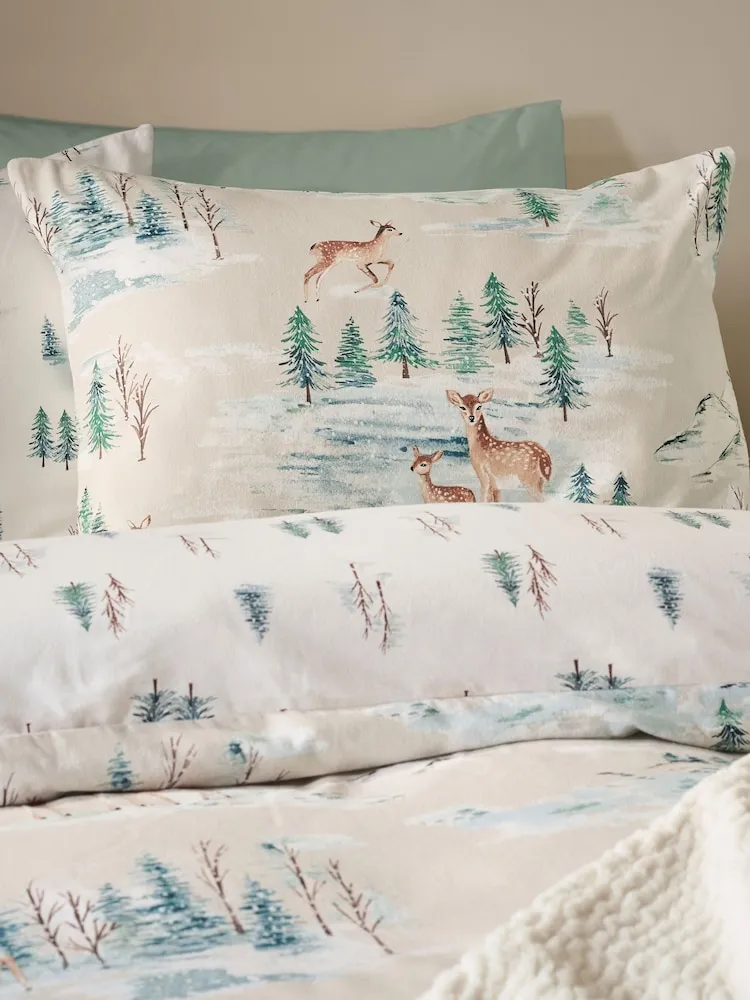
- Start with white or cream sheets so the print has a neutral base.
- Pull the printed duvet up, then fold the top 12 inches back over itself for a soft roll.
- Place a solid light green pillow front and center; patterned shams go behind it.
- Fold a chunky knit blanket in thirds and lay it across the lower third of the bed.
- Step back six feet. If it looks busy, remove the patterned shams first.
About 40 minutes, and $0 if you already own the pieces.
- Printed duvet plus two shams: $80–$200
- Solid light green accent pillow: $20–$45
- Chunky knit throw: $40–$120
- Cream sheets: $35–$90
- Total: $175–$455
Budget alternative: a printed duvet cover from IKEA or Amazon Basics runs $35–$60, and a thrifted knit blanket is usually $10–$25.
7. Dark Green Plaid on a Bare Light Wood Frame
Dark green plaid flannel is the most forgiving holiday bedding you can buy — it hides coffee, it hides dog hair, and it hides the creases from a bed nobody makes. It does not hide lint, so keep a roller in the nightstand drawer. Wash flannel cold and tumble low; hot water shrinks it a full size in one cycle. Expect to replace cheaper flannel in about three seasons. If you want the look with zero fluff maintenance, brushed cotton twill gives you the same deep green with far less pilling.
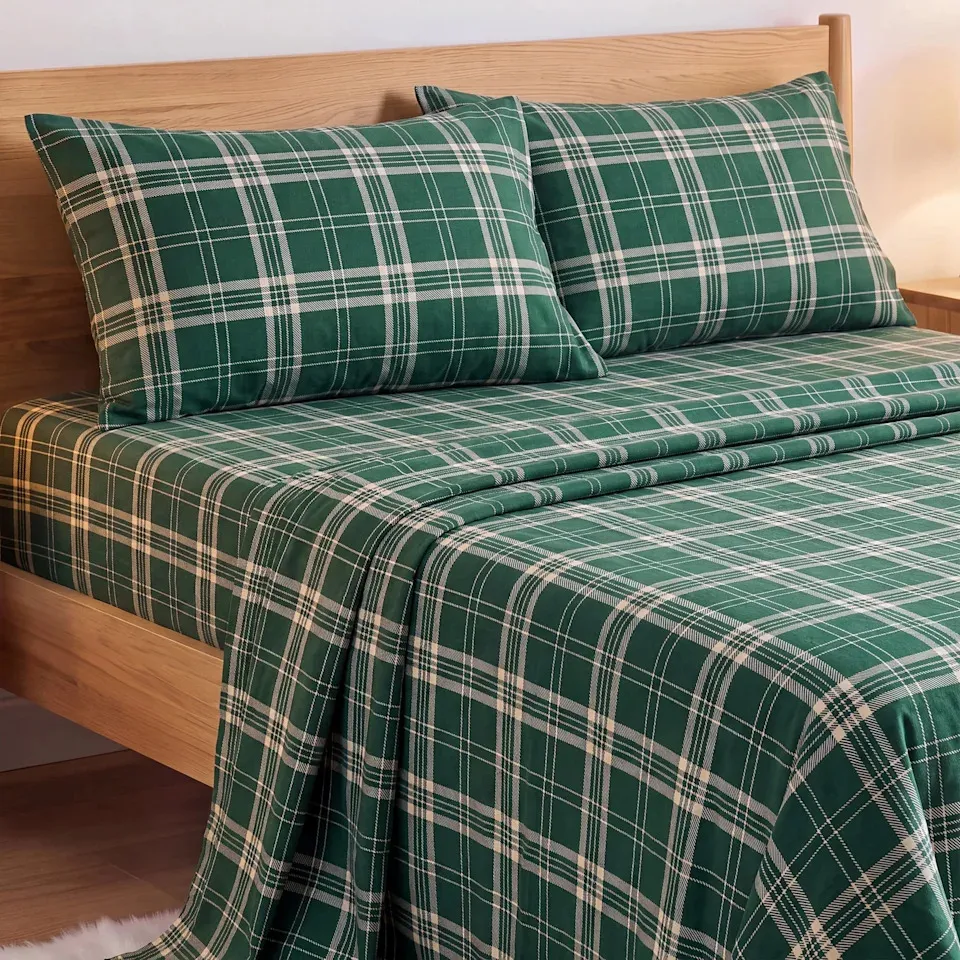
The warm pool of light on the right side of the bed. Without it, this is a green bed in a plain room. With it, the whole thing reads as a lit cabin. That’s the difference between a bedding photo and a bedding idea — one source at 2700K, positioned low and warm, doing more work than any throw pillow. For a room that leans harder into wood and beams, see Idea #2; this is its pared-down cousin.
8. Four Muted Toile Pillows as a Whole Color Story
Four pillows, four colors, one white ground: light blue, beige, sage, terracotta. That’s roughly 70% white, 25% muted floral, 5% holiday red from the evergreen garland behind. The trick is that every color is desaturated to the same level, so the stack reads as a set instead of a collection of leftovers. Swap blue for dusty rose and sage for olive and the formula still holds. These four work stacked on an armchair, a bench, or the foot of a bed.
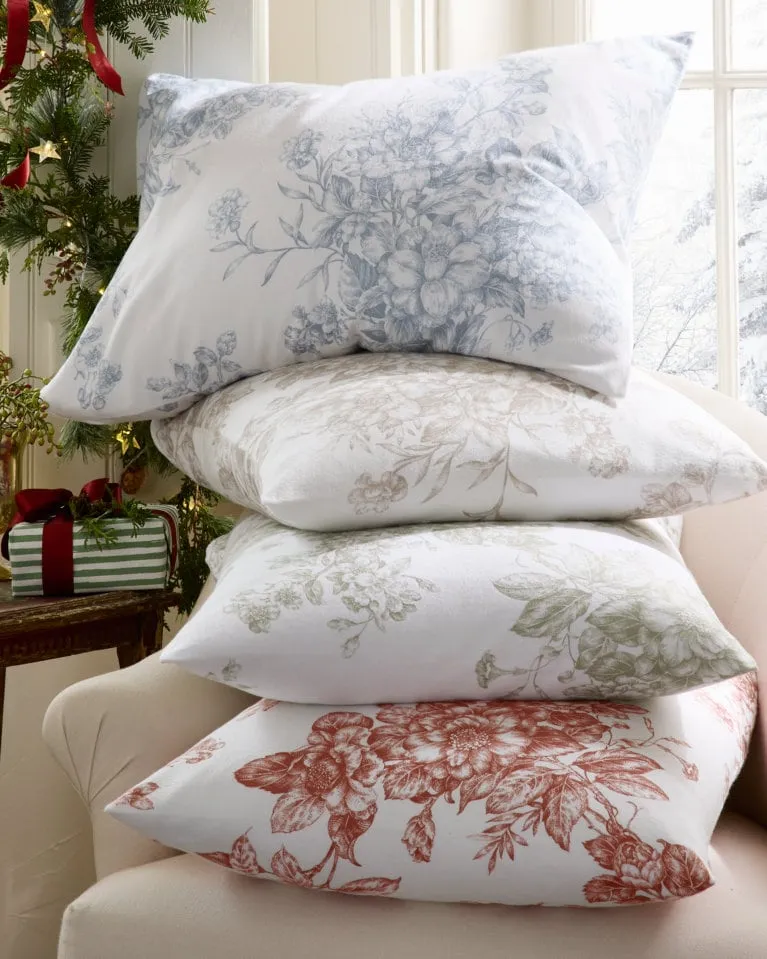
Muted, slightly faded toile is showing up everywhere in 2026 because people are tired of high-contrast holiday decor that has to come down on December 26. This palette survives into January without looking like you forgot to pack it away, and it photographs beautifully in the flat, overcast light that most of the country lives with all winter. Expect this quiet-classic direction to outlast the trend cycle rather than burn out with it.
9. Plaid Duvet With a Solid Red Sheet Showing Through
- Green, red, and white plaid duvet plus shams: $70–$190
- Solid red fitted sheet and pillowcases: $30–$70
- Small wooden nightstand: $60–$180
- Vase with greenery and red berries: $15–$40
- Miniature white Christmas tree: $12–$35
- Total: $187–$515
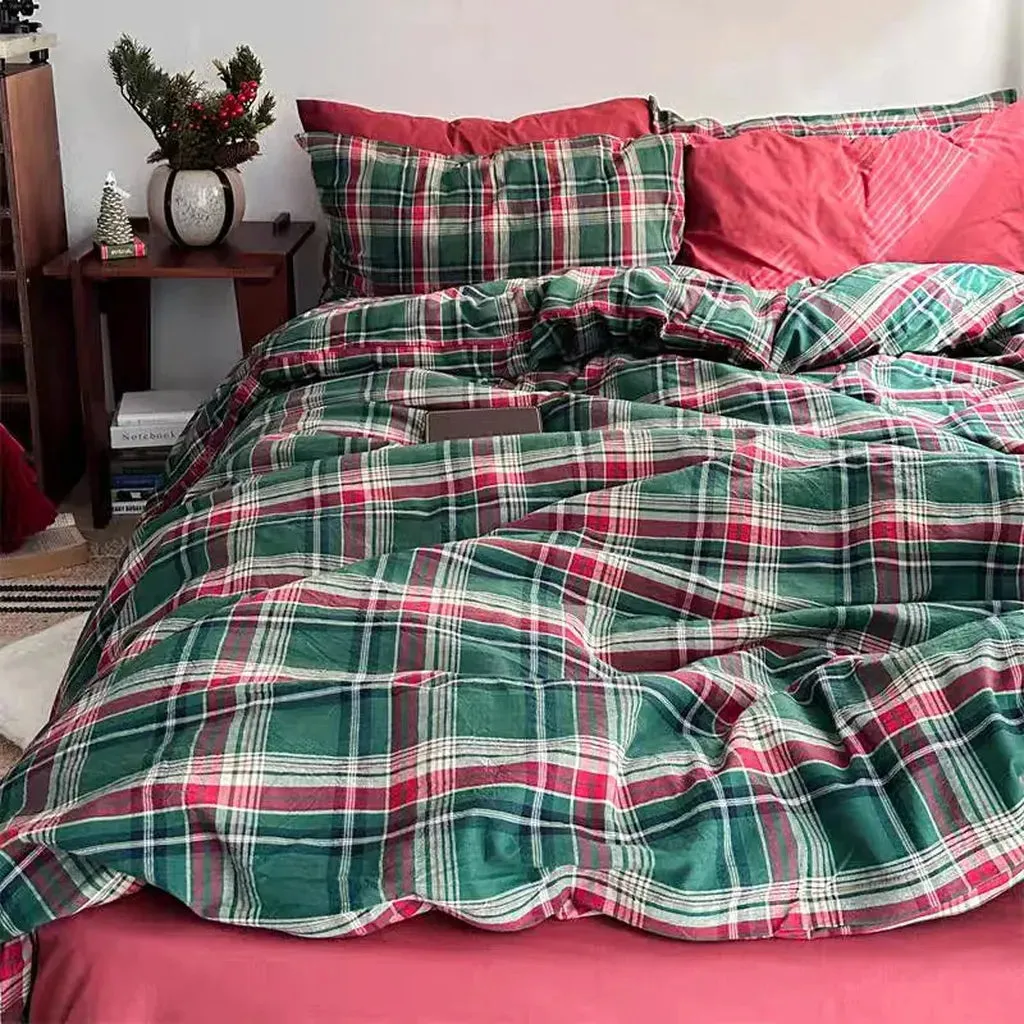
Budget alternative: solid red sheets from Target or Walmart run $15–$30, and a thrifted nightstand plus a grocery-store berry sprig gets you the same look for roughly 40% less.
Two things trip people up here. First, that solid red fitted sheet only looks intentional if you actually see it — the duvet has to be folded back a solid 16 to 20 inches, not a token six. Second, red-dominant bedding drifts toward Valentine’s if the green isn’t strong enough, so keep the plaid’s green lines prominent and skip pink or rose accessories entirely. Add one white or cream element near the pillows to keep the red from taking over.
10. Plaid on Pale Wood With Nothing Else Competing
When your bed frame is pale, nearly unfinished-looking wood, the bedding has to be the only loud thing in the room. That means no patterned rug, no patterned curtains, nothing busy directly above the headboard. Your eye needs the wood grain as a neutral border. Concrete detail: keep at least 18 inches of bare, unpatterned wall visible above the pillows. That clear glass on the nightstand is doing quiet work too — it’s the one non-wood material in the frame.
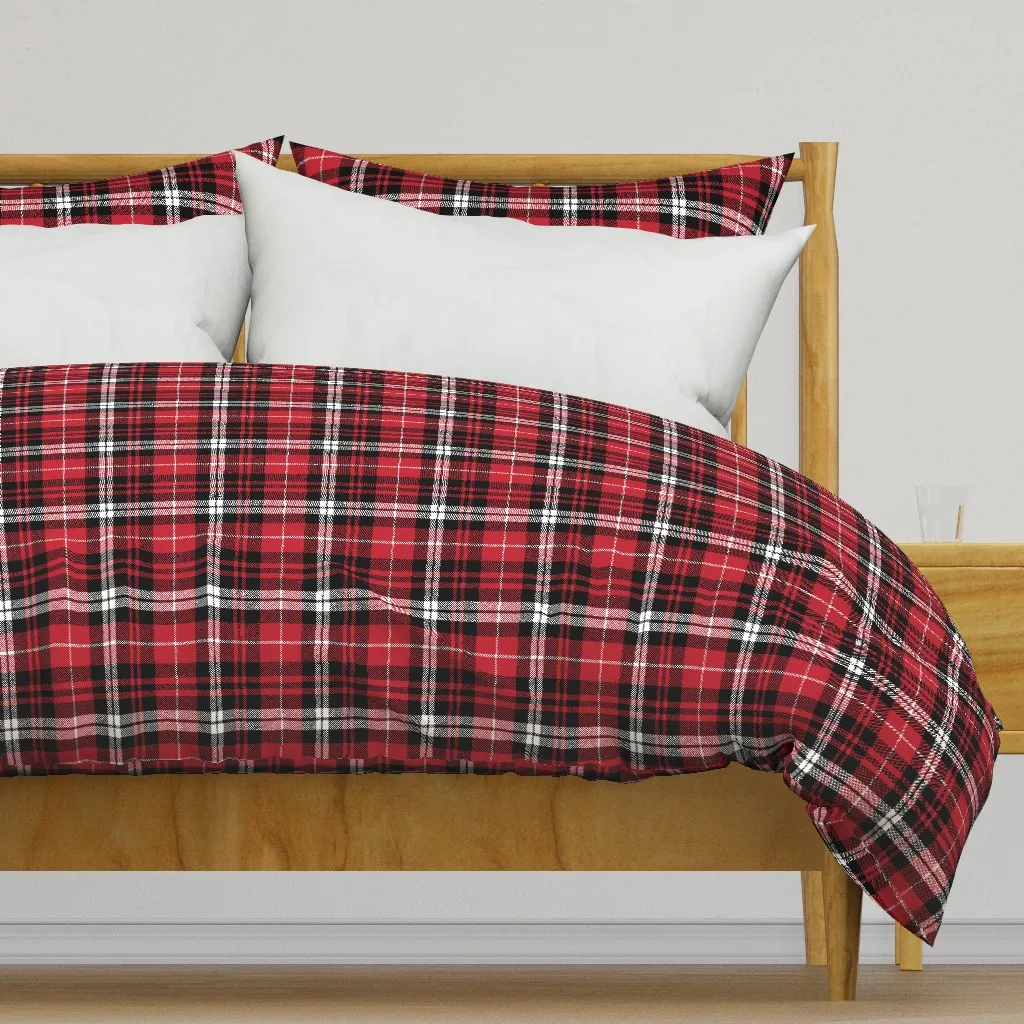
- Measure your bed frame’s interior width — plaid duvet covers run small more often than you’d think.
- Check the plaid’s repeat against your bed width; three to five repeats reads best.
- Confirm your sheets are plain white, not cream — cream shifts the whole palette yellow.
- Decide your pillow stack before buying: two plain white behind, two plaid in front.
- Photograph your bed in daylight first, so you know how warm your light runs.
11. Red Plaid Sheets on a Curved Black Metal Frame
Metal frames are the cheapest route to a genuinely good-looking bed:
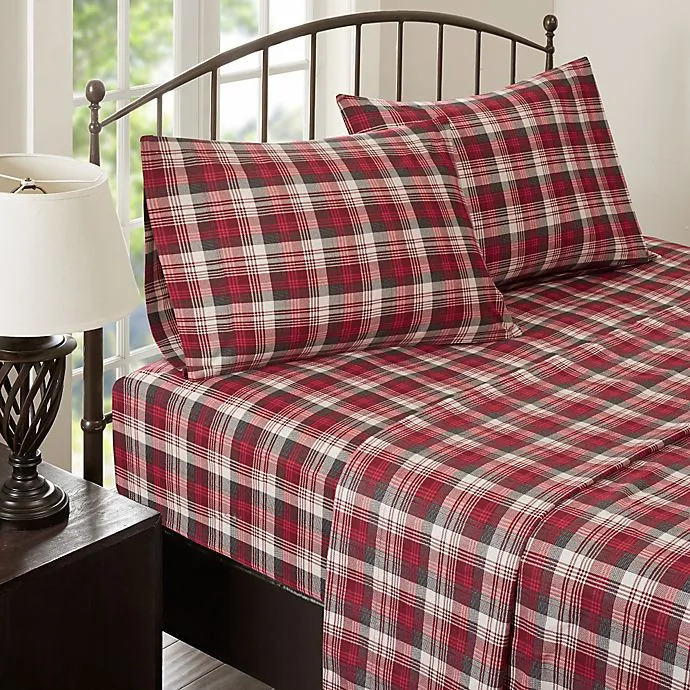
- Black metal frame with curved headboard: Amazon or Wayfair, $90–$220
- Red, white, and charcoal plaid sheet set: $35–$80
- Dark wood nightstand: Marketplace or thrift, $30–$90
- Ceramic lamp with a cream shade: Target, $25–$55
A full setup lands under $400, and that curved headboard gives you more visual weight than a straight rail without the cost of upholstery. Want the same plaid on a warmer foundation? Idea #10 trades the metal for pale wood.
This is a guest-room and small-primary play. It works from about 9×10 feet up to 12×12 with a standard 8-foot ceiling, and it’s forgiving in rooms with limited natural light because the thin metal silhouette keeps everything low to the ground. In anything wider than 13 feet, that single lamp disappears — you’d need a pair, one on each side, or an overhead fixture to balance the room.
12. Flocked Tree Dressed in Burlap, Gingham, and Pom-Poms
- Start with ribbon, not ornaments. Cut four to six wide strips in burlap, red gingham, polka dot, and stripe, each about 36 inches long.
- Weave the ribbons vertically through the branches, tucking the ends rather than tying bows, so the tree looks dipped instead of wrapped.
- Add red berry clusters in threes, spacing them evenly across the front face.
- Drape the red, white, and grey pom-pom garland last, loosely, front to back.
- Finish with wooden and fabric ornaments carrying holiday sayings, hanging the deepest ones first.

About 90 minutes for a six-foot tree, and roughly $35–$70 in new materials if you already own the tree.
Texture is doing what color usually does. Burlap is rough, gingham is crisp, pom-poms are soft, and the flocking is powdery — four surfaces inside one palette of white, red, and natural brown. Because nothing introduces a new hue, the tree holds all that visual noise without going chaotic, and it coordinates with a plaid bed instead of fighting it.
Flocked trees with rustic ribbon styling have held their ground for several seasons, and 2026 keeps the same script with more restraint — fewer ornaments, wider ribbon, and a deliberate brown-and-red palette instead of glitter and gold. It reads handmade without actually being handmade.
13. White Sheets Dotted With Trees, Stars, and Red Ornaments
About 80% white ground, 12% grey-green trees, 5% red, 3% gold. That’s the ratio that keeps a novelty print looking calm. The tiny red dots scattered between the trees are what tie the pattern together — remove them and the motifs float. For a cooler version, swap the red ornaments for slate blue and keep the gold stars. For a warmer one, hold the red and push the stars toward brass. Same structure, different season.
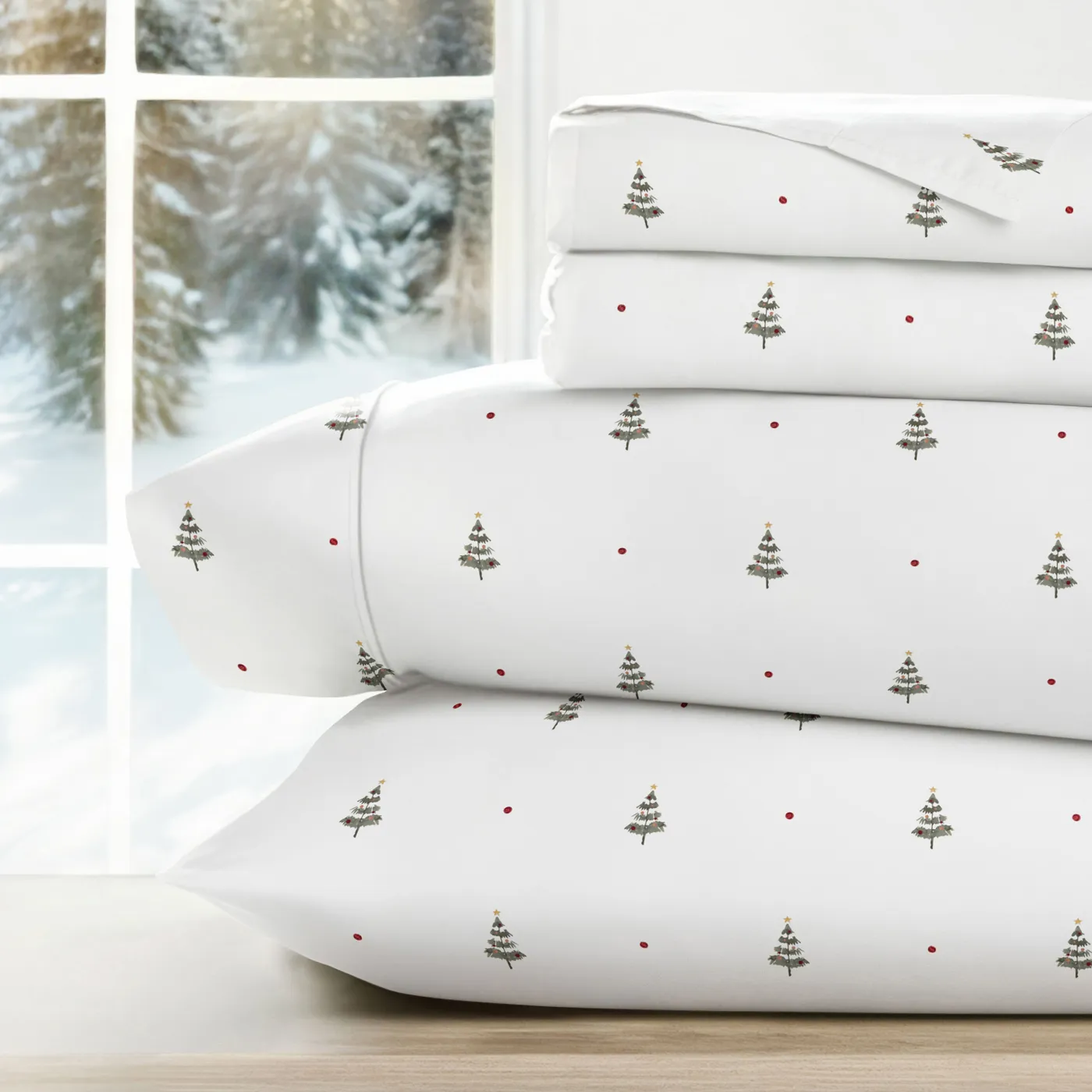
The white window frame. It sounds like nothing, but the tree print is a white-ground pattern and it only reads bright because the window trim behind it repeats that white. In a room with dark trim, the same bedding gets heavy fast. If you can’t change your trim, add a white or cream curtain panel — the goal is one more big white shape near the bed to echo the fabric.
- Patterned sheet set and pillowcases: $35–$90
- Extra white flat sheet and duvet cover: $40–$110
- Gold star accent pillow: $20–$45
- Cream or grey throw: $25–$70
- Total: $120–$315
Budget alternative: sheets are the cheapest place to experiment with a holiday print, because you can layer them under a plain duvet you already own. Walmart and Target both run seasonal prints in the $20–$40 range.
14. Sledding Snowmen on Grey, Framed by a Dark Wood Headboard
That mirrored nightstand is the sneakiest move in this room. It disappears visually, which means the busy snowman print and the tufted headboard get the attention instead of competing with a third piece of furniture. If you can’t find mirrored, a glass-topped table or a white lacquer cube does the same job. Then repeat the dark wood from the headboard frame exactly once — one chair, one tray, one lamp base. Once is a conversation. Twice is a theme.
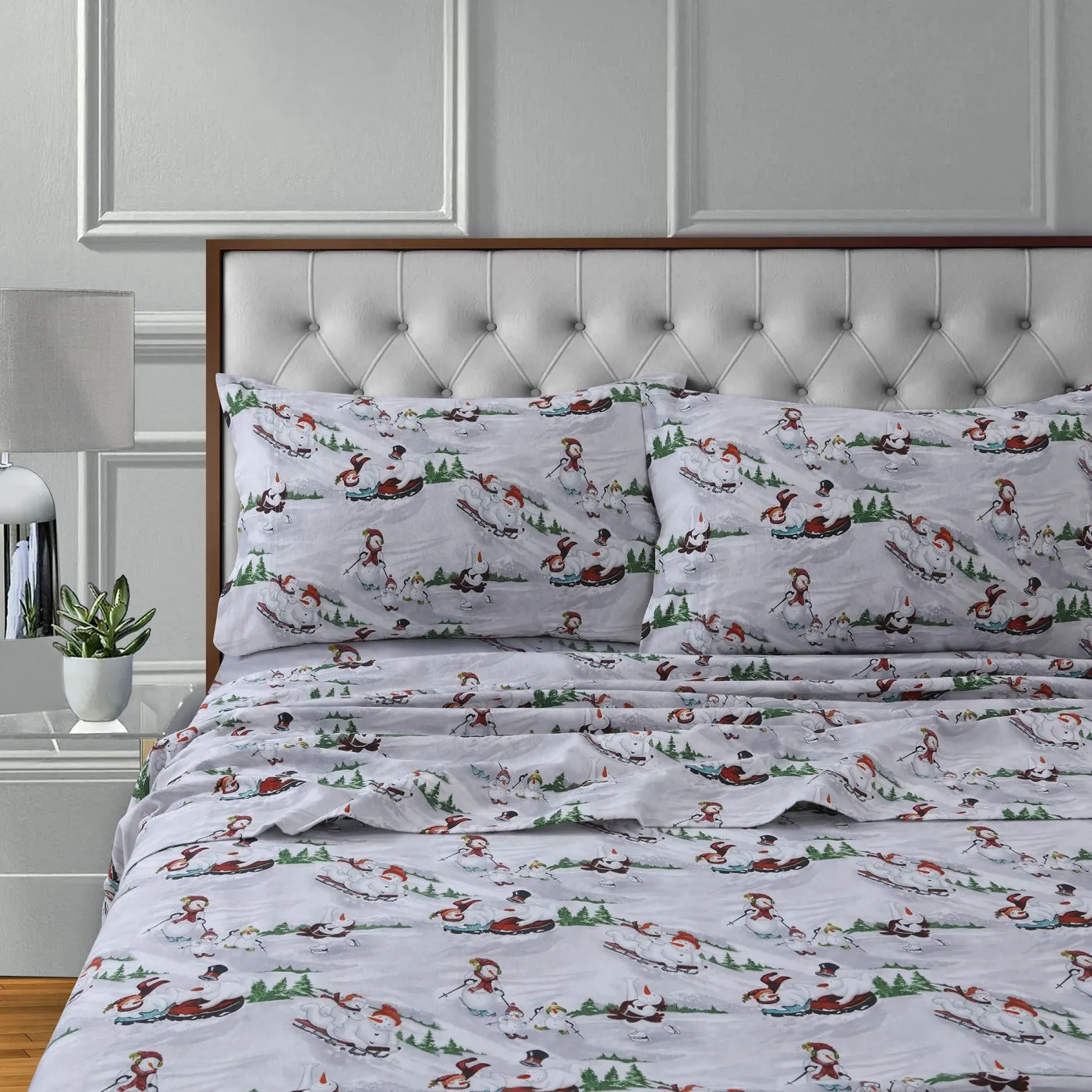
This layout wants roughly 11×12 to 14×16 feet with 8- to 9-foot ceilings, because the tufted headboard and panel molding both add vertical weight. In a smaller bedroom, drop the molding and keep the mirrored table — that alone lightens the wall. Kids’ rooms and guest rooms handle the snowman print better than a primary suite, and anything under 10×10 should skip patterned shams entirely. See Idea #19 for the kid-scale version.
- Measure headboard height plus bedding thickness — a dark wood frame over a tall mattress can overwhelm a short wall.
- Check your wall color in daylight; warm white trim reads cream under 2700K bulbs.
- Confirm outlet placement before buying a mirrored nightstand.
- Test the print from across the room before committing to shams.
15. Tropical Florals That Ignore the Season Entirely
Big orange and purple blooms on white is a bold call for December, and that’s exactly why it holds up. The fitted sheet’s pale grey line-art florals sit underneath the saturated prints, so the eye gets two levels of the same idea — one loud, one whisper. Dark stitching along the edges frames each print like a poster, which keeps large motifs from looking like a printing error. It’s the one bedding idea here you can leave on all year.
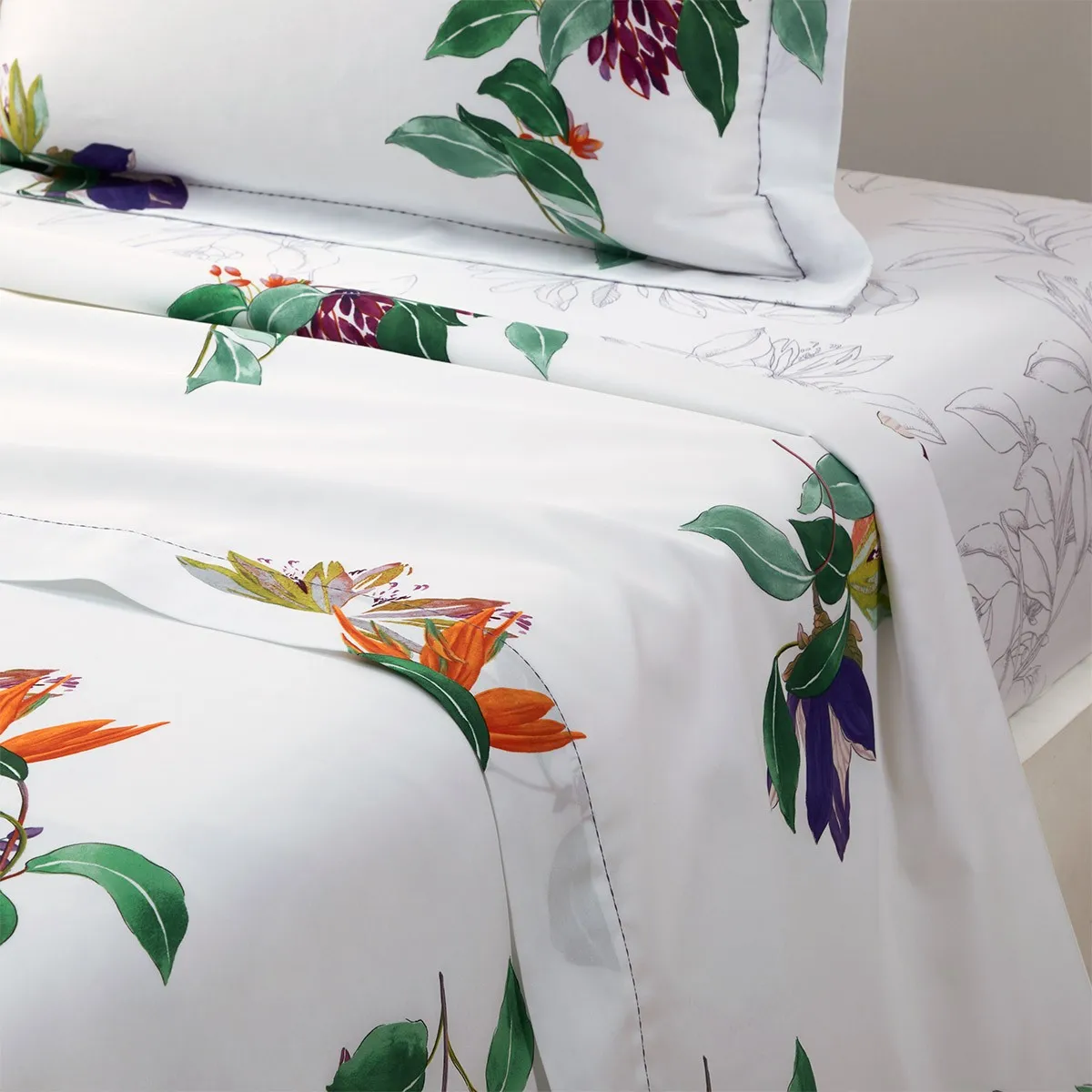
Before you commit, a few practical notes:
- Large-saturation florals need natural light. In a dim room, purple and orange go muddy by evening.
- Match your walls to the quietest color in the print — almost always the white or grey, never the orange.
- Skip matching floral curtains. Repeating the print at window scale is what pushes a room into costume.
- If someone in the house hates bold color, this is not the compromise bedding. Try a white-and-blue tree print instead.
White-ground bedding also shows every sunscreen smudge, so pretreat before you wash.
16. Monochrome Blue Trees in Four Different Drawing Styles
100% white ground, three blues, zero red or green. This is the formula for holiday bedding that doesn’t scream holiday — light, medium, and dark blue render the same tree motif four ways: solid fill, outline, dotted texture. Because the graphic style changes while the color doesn’t, the print looks energetic instead of repetitive. Warm it up with a single camel or oatmeal throw; cool it further with grey sheets. For the same idea flipped, see Idea #18.
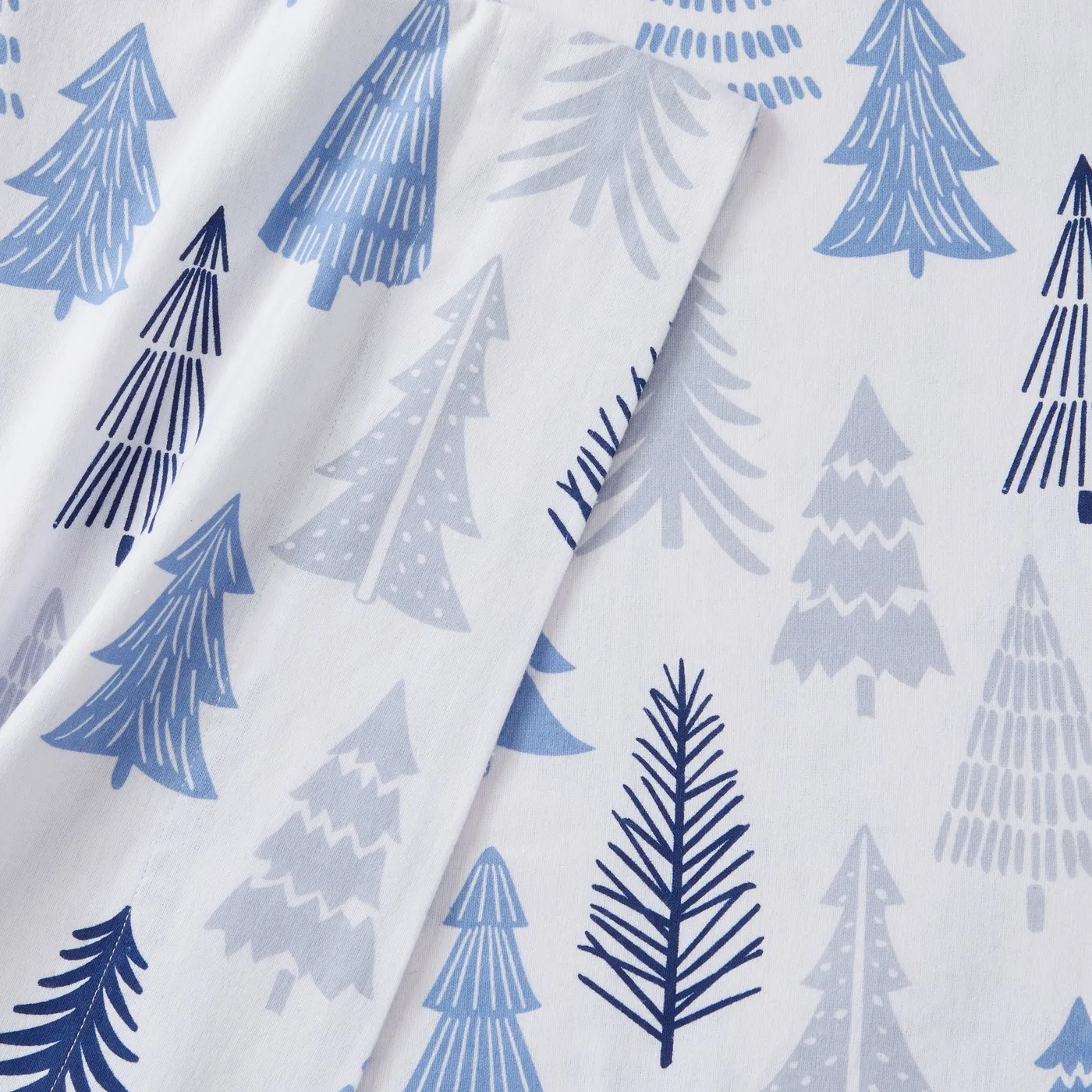
Blue-and-white graphics on white cotton are about as low-maintenance as bedding gets, with one caveat: white grounds yellow over time if you wash hot or dry on high. Cold wash, low tumble, and a scoop of oxygen bleach every fourth wash keeps the ground bright — budget $8–$15 a year for that. Skip fabric softener entirely; it coats the fibers and makes white cotton feel slick.
This is one of the cheapest looks on the list to pull off:
- Blue tree-print sheet set: Amazon or Walmart, $25–$55
- Plain white duvet cover: IKEA, $30–$60
- Oatmeal or grey knit throw: Target or thrift, $15–$40
- Two solid blue pillowcases: $12–$25
Total sits between $80 and $180, and every piece works again next winter.
17. Nutcracker and Holly Print on a White Iron Bed
That dark green throw peeking out from under the duvet isn’t an accident — it’s a two-inch reveal, and it’s the cheapest way to add depth to a busy patterned bed. Fold your throw so about two to four inches show along the side edge and about six inches across the foot. Wider and it reads as a second blanket; narrower and it just looks like a laundry situation. Match the throw to a color already in the print, never to a new color.
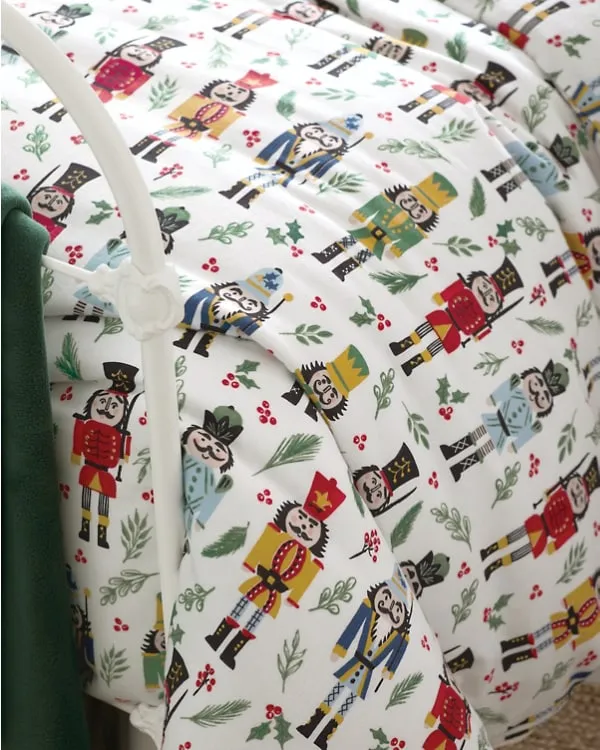
- Dress the bed in the nutcracker-print sheets and duvet, smoothing everything flat.
- Fold the dark green throw in half lengthwise, then lay it across the foot of the bed.
- Tug the throw down so only two to four inches show below the duvet’s edge.
- Prop two patterned shams against the headboard, then one solid white pillow in front.
- Leave the white metal frame visible — don’t cover it with a fabric headboard or skirt.
Fifteen minutes, no sewing, and the green throw runs $20–$45 depending on weight.
18. Navy Silhouette Print With Nowhere to Hide
- Confirm your navy matches across pieces — cheap navy reads almost black next to a truer navy.
- Check the white silhouette contrast in daylight; some prints go grey in dim light.
- Decide whether the pattern lives on the sheets only or the duvet too — folded sheet sets show less.
- Plan one white or cream element (throw, pillow, curtain) so the dark isn’t uninterrupted.
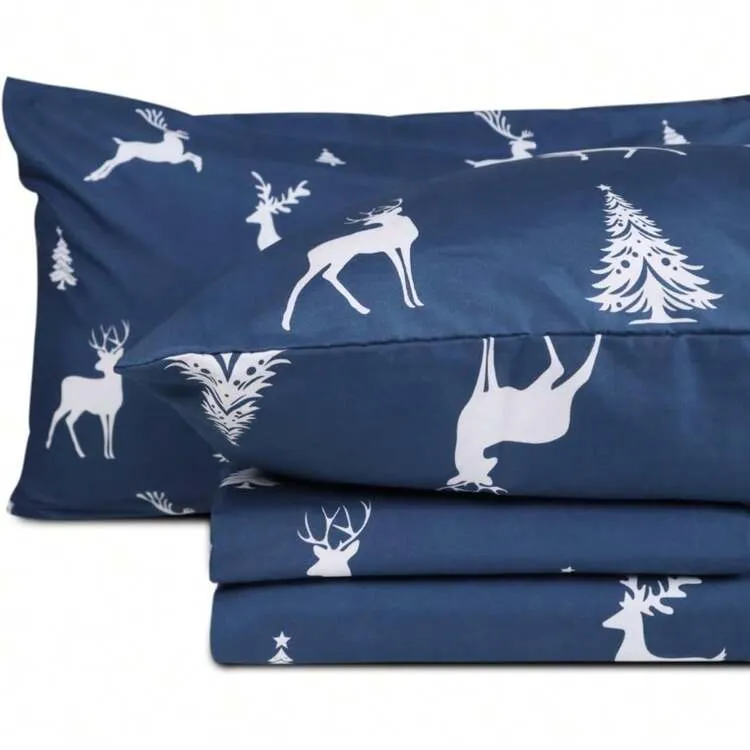
The white silhouette itself. Take the reindeer and tree shapes off this navy ground and you have plain navy bedding — handsome, but completely anonymous. The negative space is doing the design work, which is why you should never pair this print with a patterned quilt or a busy headboard. Solid everything else. Navy is a backdrop, not a co-star.
19. Woodland Crib Bedding in Forest Green and White
Crib bedding has its own rules — no bumpers, fitted sheet only, everything else decorative and out of reach. A dark green woodland print works in nurseries from about 9×10 feet up, but keep the room’s other greens one shade apart or the whole corner turns into a forest floor. The white crib frame is doing important work: against dark wood or dark walls, this same bedding loses all its airiness. Ceiling height barely matters here — wall color matters far more.
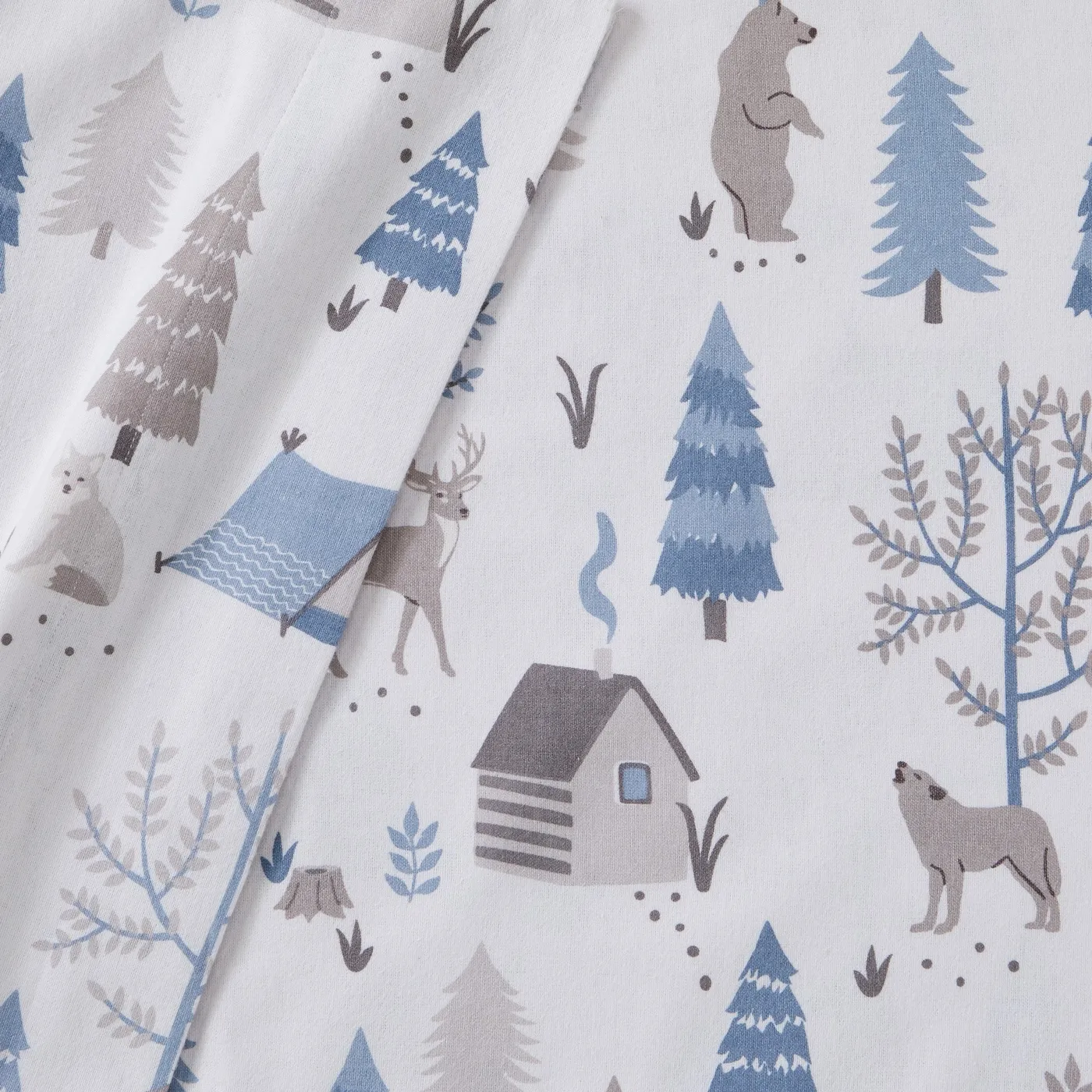
Woodland nursery themes took off because they’re gender-neutral and they age well. The same evergreen, reindeer, and crescent moon motifs still look right at age five, which is more than you can say for most themed sets. In 2026 the shift is toward tighter palettes: one deep green, one white, one natural material. It’s a practical trend, driven by parents who don’t want to repaint in eighteen months.
- Start with a plain white fitted crib sheet as your base layer.
- Add the green woodland-print sheet or quilt for pattern — never both at once.
- Drape a white faux fur throw over the crib rail for texture, and remove it before sleep.
- Repeat evergreens once more in the room, in artwork or a small shelf tree.
- Keep the crib frame white or light — that contrast is what stops green from going dark.
Setup takes twenty minutes and the faux fur throw runs $20–$45.
20. The Whole Woodland Cast, Cabin and Tent Included
Most animal prints pick one animal and repeat it. This one builds a scene — bear, deer, fox, howling wolf, a log cabin with a smoking chimney, a small blue tent, tiny plants and dots. Nothing in this print jumps forward, and that’s the whole trick. Every element sits at the same visual weight and the same low-contrast value. The cabin is the narrative hook that makes you look twice, and it costs nothing in terms of palette.
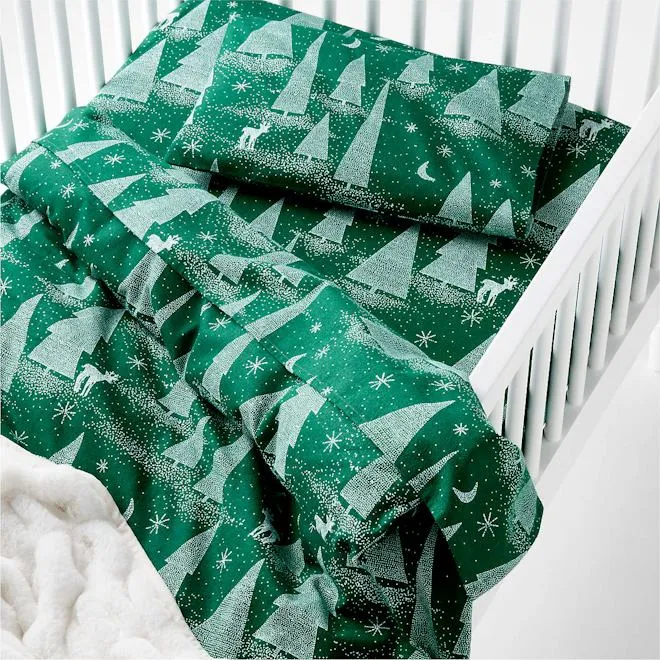
Roughly 65% white ground, 20% blue and grey trees, 10% taupe and brown animals, 5% dark accents like the cabin roof. The discipline is that no color is saturated — everything is slightly faded, which is what makes a busy print read as calm. To warm it, shift the blue-grey trees toward sage and keep the animals taupe. For a girl’s room, swap the blue tent for dusty rose and leave the rest alone.
21. Tartan Flannel With Yellow and White Hairline Stripes
- Flannel tartan duvet cover plus two shams: $60–$170
- Matching flannel flat and fitted sheets: $40–$100
- White or cream flannel pillowcases: $20–$45
- Warm 2700K bedside lamp: $30–$70
- Total: $150–$385

Budget alternative: brushed microfiber tartan sets from Walmart or Amazon run $25–$50 and photograph nearly identically. They won’t last as long, so plan on replacing them in about two seasons rather than five.
Two honest warnings about flannel tartan. First, that yellow hairline stripe is what makes the pattern feel authentic — and it’s also the first thing to fade, so wash cold and never bleach. Second, flannel pills. A lot. Run it through a fabric shaver every few weeks and it looks new all winter; skip that and the bed starts looking worn by mid-January. Neither issue is a dealbreaker, just know what you’re signing up for.
22. A Pastel Pink Tree Beside an All-White Bed
When a tree is this colorful, the bed has to be quiet — and quiet doesn’t mean boring. This bed uses texture instead of color: multiple white pillows in different weaves, a chunky cable-knit throw, crisp sheets. Mix at least three white textiles with different surface qualities or the corner reads flat. One smooth, one knit, one nubby. That’s what keeps an all-white bed from looking like a hotel room, and it’s what lets a pink tree sit next to it without a fight.
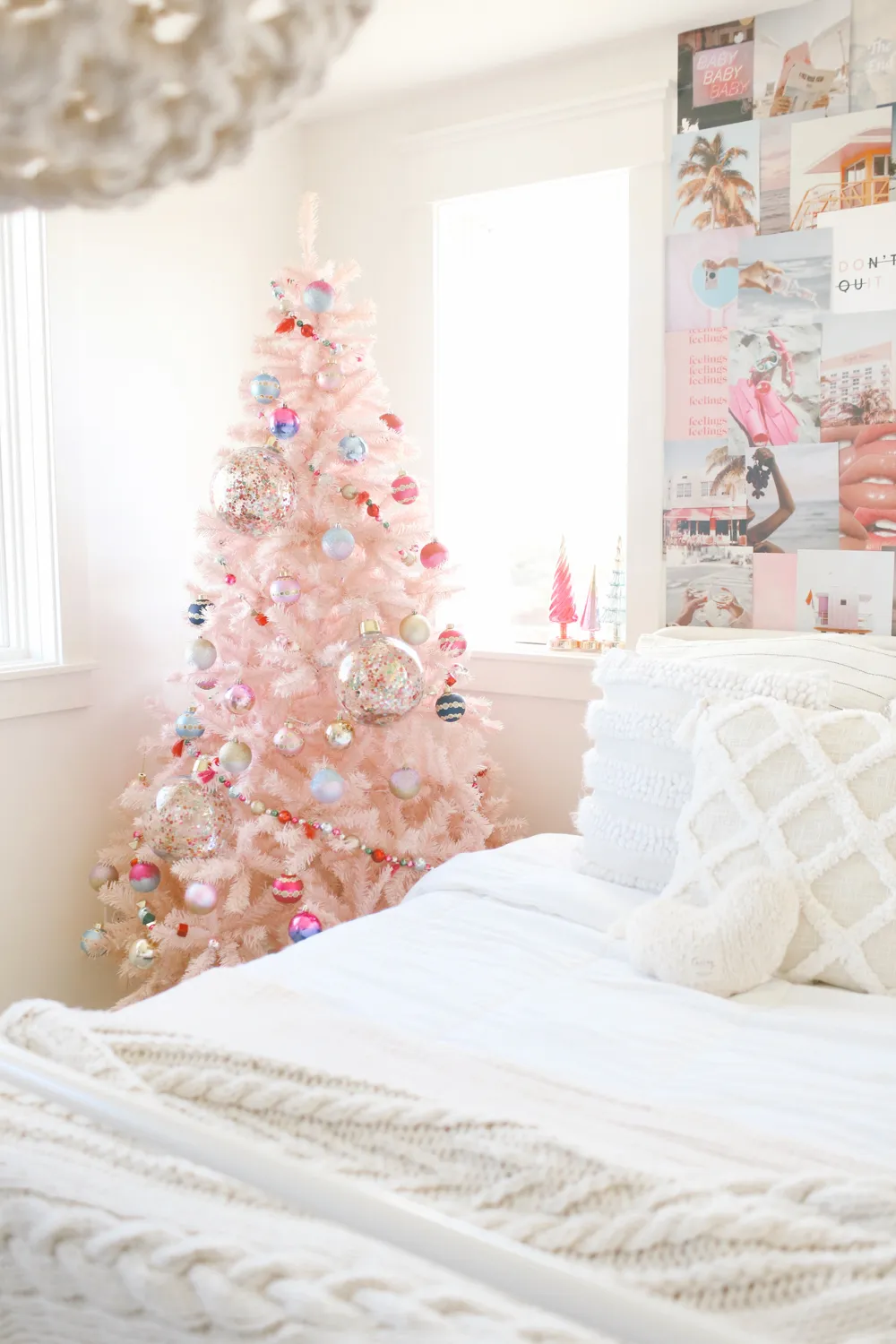
Pink trees look expensive and aren’t:
- Small pink artificial tree: Walmart or Target, $25–$60
- Ornaments in mixed pastels: dollar store, $10–$25
- Chunky cable-knit throw: IKEA or Target, $25–$55
- Two textured white pillow covers: $15–$35
- Collage prints for the wall: $12–$30
Under $200 gets you the whole scene, and ornaments are the one place you can go cheaper without anyone noticing. If the tree is under five feet, style it on a low stool.
23. Botanical Christmas Study With Plant Names in Script
The elegant script labeling each plant — poinsettia, holly, ivy, cranberry. That lettering turns a holiday print into something closer to a vintage botanical plate, and it’s the reason this bedding looks collected rather than purchased. Remove the names and you’d have a pretty but ordinary winter floral. Because the design is illustrative, it also holds up at distance in a way bold motifs don’t: texture from across the room, detail from up close.
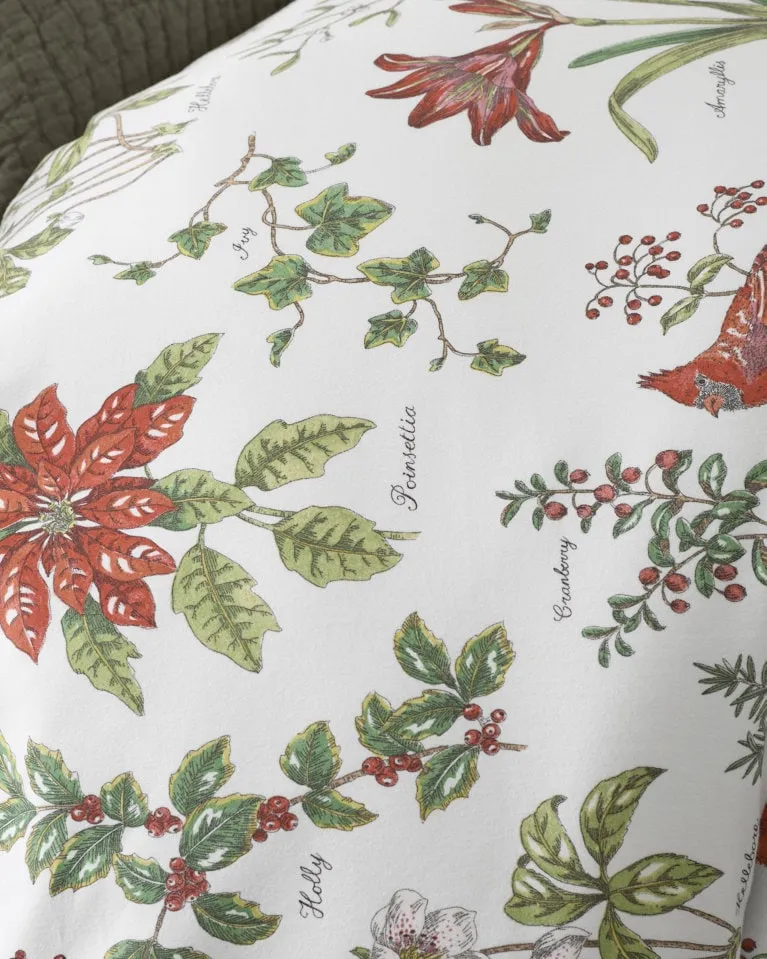
White grounds with deep red and olive illustrations are gorgeous and slightly high-strung. Cranberry and poinsettia reds can bleed, so wash the set alone, cold, for the first three cycles. Printed cottons fade after roughly 30 to 40 washes — expect two to three good winters with weekly laundering. If you want the botanical look with less upkeep, a printed percale in a tighter weave holds its print noticeably longer than soft sateen.
Botanical prints like this need a little distance to read properly — gorgeous in rooms 12×12 and up, slightly frantic in a 9×10 guest room where you’re standing two feet from the bed. Standard 8-foot ceilings are fine; the print is dense but low-contrast, so it adds almost no visual weight. In a small room, keep the pattern to the shams only.
Sleep Inside a Snow Globe This December
Pick the one idea that made you stop scrolling — that’s usually the one that actually fits your room — and start with the bedding, not the ornaments. Everything else in a holiday bedroom gets easier once the bed is right. If you’re still torn between rustic plaid and quiet botanical, trust your light: warm rooms handle red, cool rooms handle blue and white.
Pin your favorite to your Christmas board now, so you can find it again the moment it’s time to order.