You know that feeling when one vase on the dining table does more for the room than the entire tree? That’s the quiet magic of Christmas vase arrangements — a few branches, a handful of berries, and suddenly the whole house smells like December.
We spent serious time browsing Etsy, Target, Wayfair, and Anthropologie to bring you only what’s worth your attention this year, from a $12 bundle of pine sprigs to a $240 hand-thrown urn.
Inside you’ll find 23 curated ideas spanning rustic natural, traditional festive, winter white, and lush elegant floral — with budget and luxury versions compared side by side.
Why now? In 2026 the shift is toward arrangements built from one grocery-store bouquet plus whatever’s already in the yard, and Pinterest saves for foraged holiday centerpieces are climbing fast.
And stay until the end — we break down the most common mistakes that can ruin these looks.
📌 Save this to Pinterest for later — you’ll want to revisit these ideas. Affiliate disclosure: this post contains affiliate links, and we may earn a small commission at no extra cost to you.
1. White Snowman Vase with Juniper Greens on a Wooden Box
Keep your greens to roughly one and a half times the height of the vessel. Taller than that and the snowman vanishes into the foliage; shorter and the arrangement reads as a centerpiece bowl instead of a silhouette. Dense, short-needled evergreens like juniper hold that shape best because they don’t flop after a day. Strip the bottom 3 inches of needles so no leaf sits in the water, and you’ll get two weeks instead of five days.
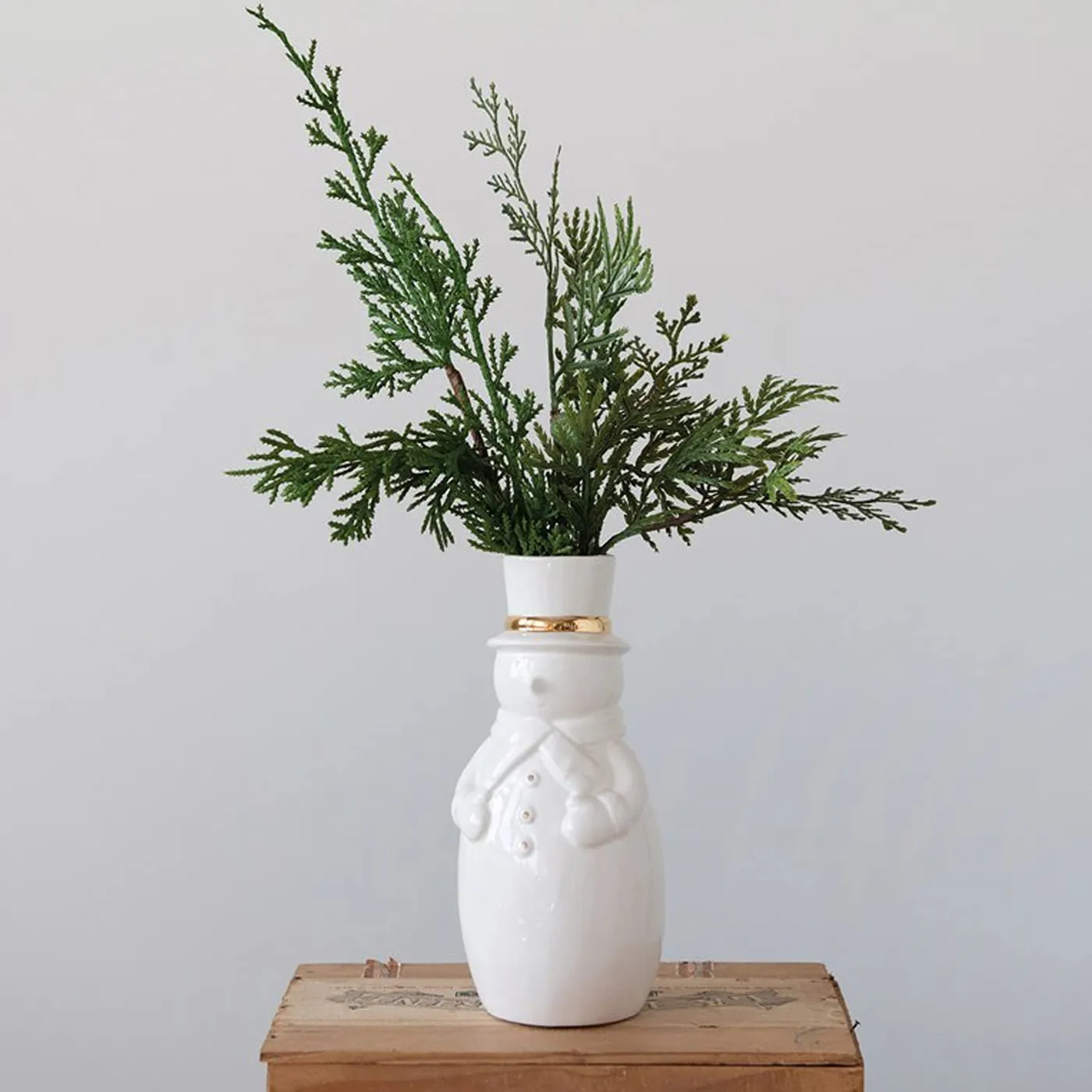
What makes this one work is that nothing competes. One white ceramic form, one gold band, one shade of green, one plain gray wall. That’s three materials and a single color, and the gold band does all the talking — it’s the only warm metallic in frame, so your eye lands there first and reads the snowman as intentional rather than kitschy. Put the same arrangement against busy wallpaper and it falls apart.
2. Rustic Woven Basket with Pinecones, Burlap and Silver Ornaments
You can build this for under $35. Thrift stores and Facebook Marketplace are stuffed with woven baskets every November, usually $4 to $8, and dollar-store pine picks run about $1.25 each — grab five. Burlap ribbon is $4 a roll at Walmart and you almost certainly already own the white and silver ornaments. The one place I’d spend real money is the pinecones: faux ones look like plastic up close, and a bag of real ones is $6 at any craft store. Compare with Idea #3, where those same pinecones get a much moodier treatment.
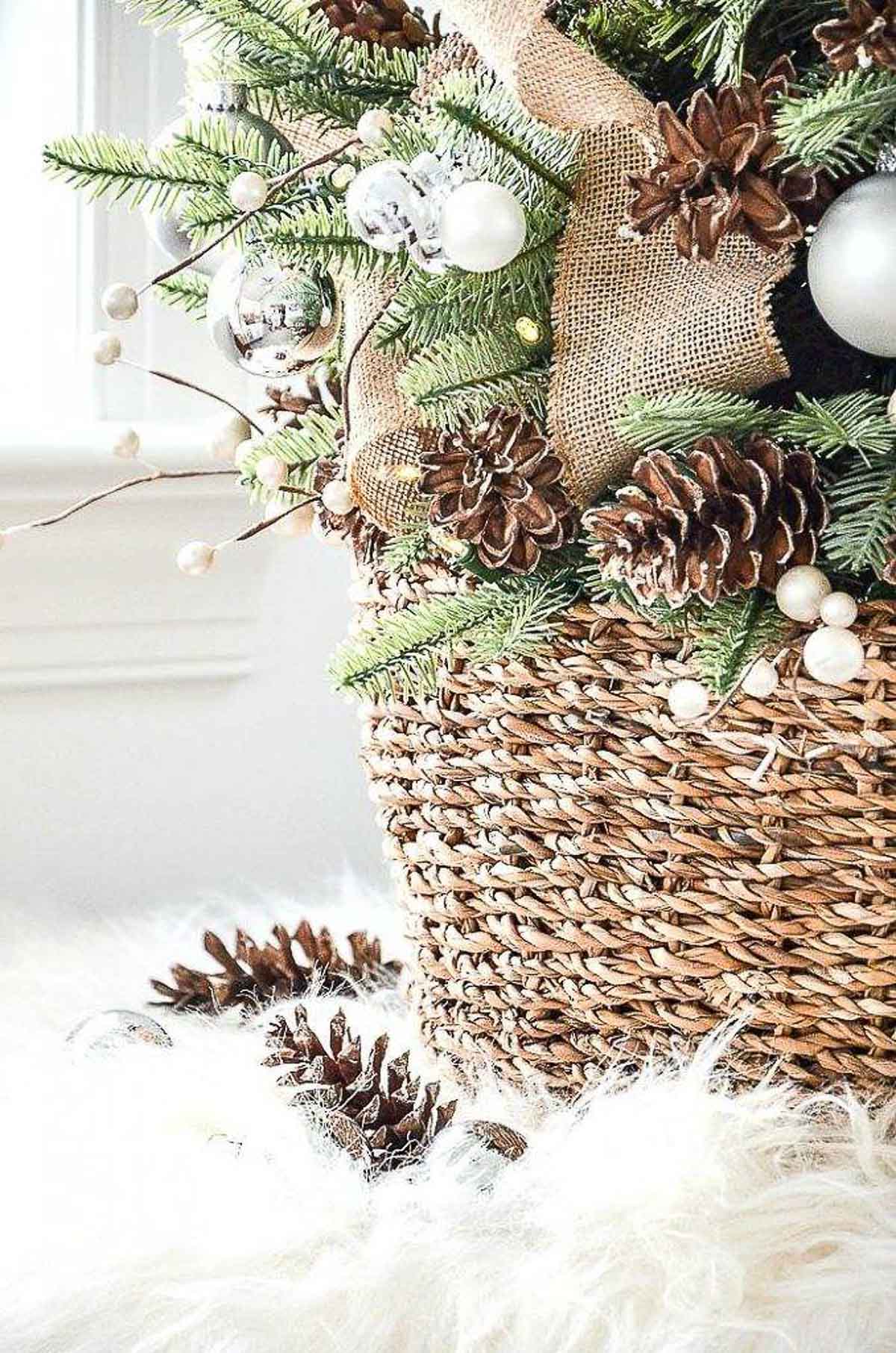
Two honest warnings. Burlap sheds — constantly. If it’s within reach of a toddler or a cat, you’ll be picking fibers out of everything for a month. And that white faux fur underneath photographs beautifully and shows every speck of dust, sap, and stray needle in real life. If your table gets actual use, swap the fur for a cream linen runner and keep the basket. You’ll get most of the cozy and none of the lint-roller lifestyle.
3. Dark Urn of Mixed Evergreens on a Rustic Dining Table
- Large textured urn, 12–14 inches: $45–$140 (Etsy, Wayfair)
- Mixed evergreen bundles, 3–4 varieties: $18–$40
- Pinecones, bag of 20: $6–$12
- Candle pair with holders: $14–$35
- Textured table runner: $22–$55
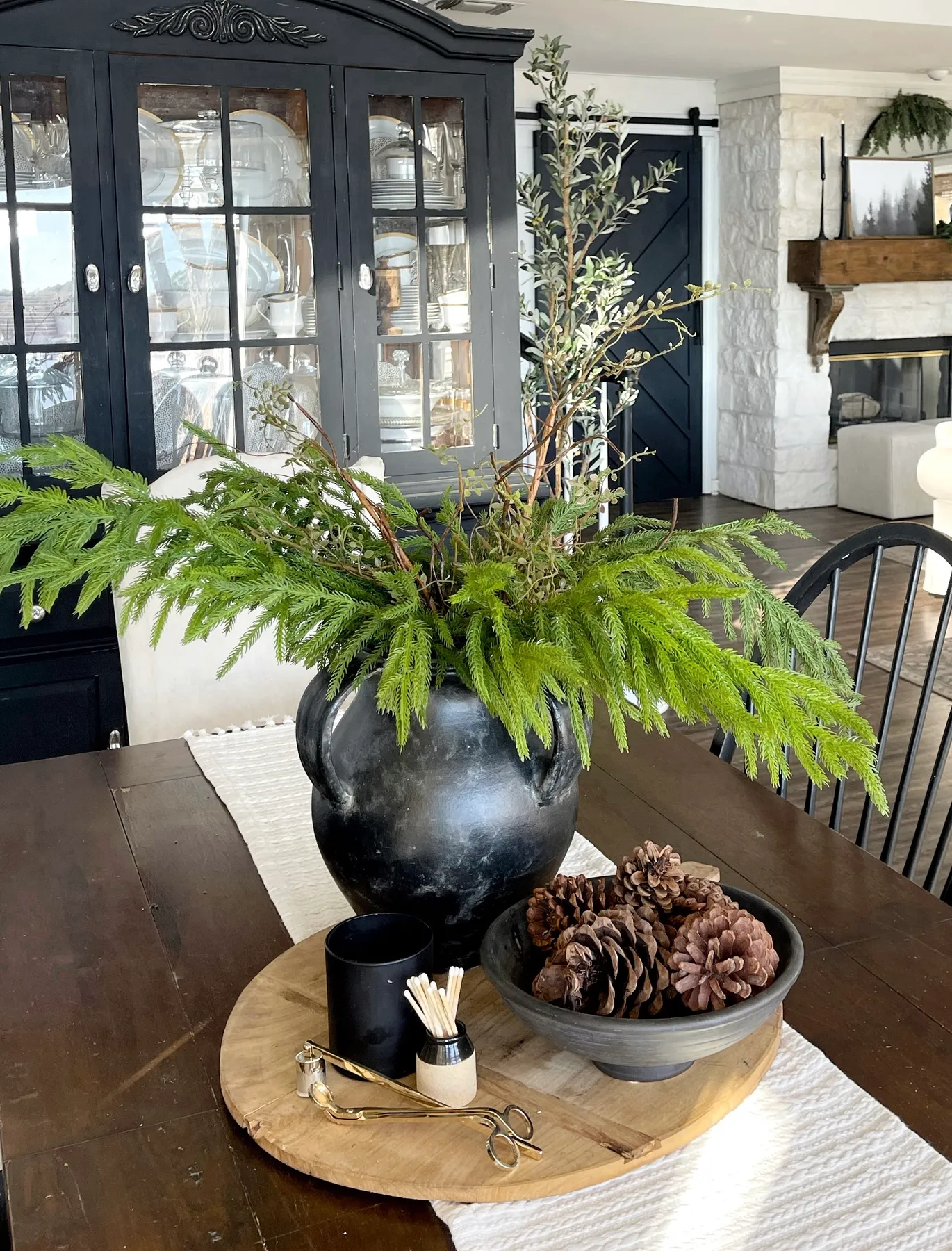
Total: $105–$282
Budget alternative: split one grocery-store evergreen bundle into four piles, use a $12 discount-store urn, and collect pinecones from a park — about $45, and nearly identical at three paces.
The thing you can’t skip is variety. This isn’t “evergreen” in the urn — it’s cedar, fir, seeded eucalyptus, and something lighter and floppier spilling over the rim. That mix is why the arrangement reads as expensive. A single type of greenery, no matter how much you use, always looks like a bundle of branches in a pot. Aim for four textures: one spiky, one soft, one draping, one with a pale, almost silvery leaf.
4. Pink and Red Roses in a Hammered Gold Vase
Read this arrangement as a formula: about 60% warm blooms, 25% dark green foliage, 15% gold metal. That last slice is why it looks opulent instead of merely colorful — a hammered gold vase bounces warm light up into the flowers. Keep the formula and swap the palette for a winter-white version: 60% cream and blush blooms, 25% silver-green eucalyptus, 15% brushed silver vessel. Same structure, entirely different mood.
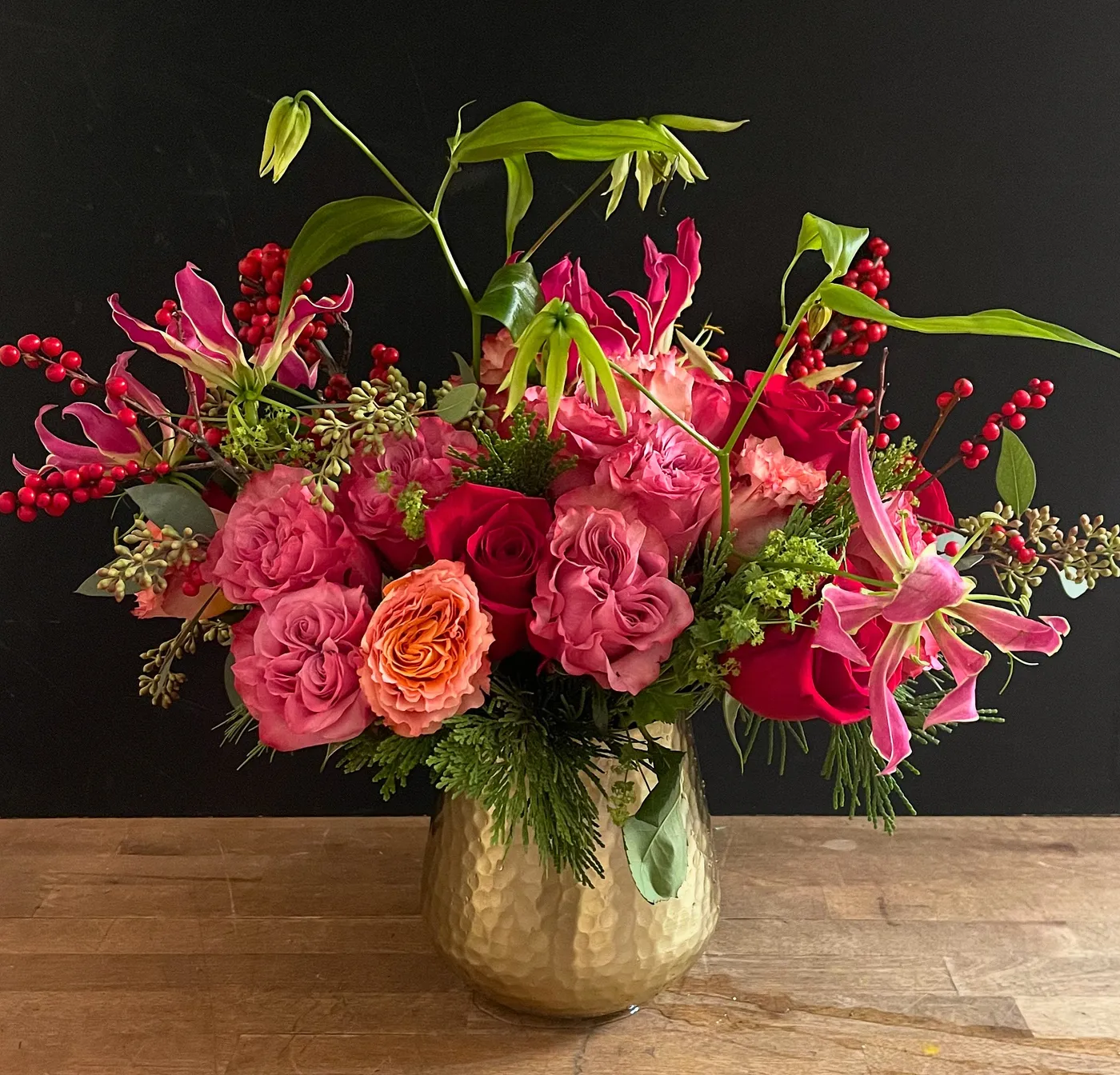
Cut every stem at a 45-degree angle under running water, not in the air — air bubbles lodge in the stem and that’s what kills roses two days early. Then build in a spiral: hold each stem at the same point and let it fan, rotating the vase a quarter turn with every addition. The tall flame lilies go in last and off-center. Placing your tallest bloom dead center creates a triangle that flattens everything else.
5. Fir and Red Berry Arrangement with Glass Tree Figurines
The trick here is repetition of one shape. A fir arrangement’s natural silhouette is already triangular, so lining up a tree-shaped candle, a dark green glass tree, and a clear iridescent one turns a tabletop into a small collection. That’s what makes thrift-store odds and ends look curated instead of cluttered — one motif, three materials. Same shape, three textures, and your eye travels along the row instead of landing on any single object.
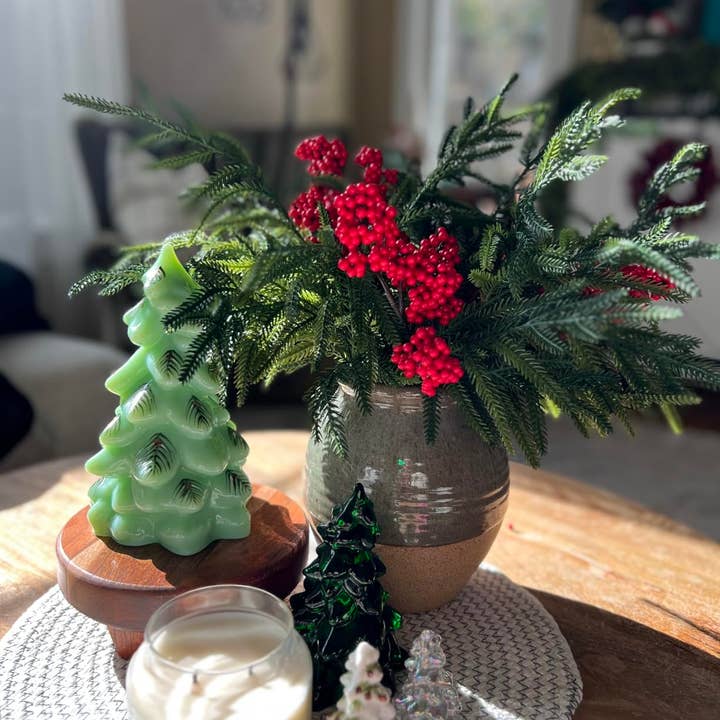
This is the 2026 mood in a nutshell: fewer, better, smaller. After years of hauling out bins of holiday decor, people are styling surfaces with a handful of objects they genuinely like. Pinterest searches for Christmas vignette and small-space holiday decor keep climbing, mostly because apartment dwellers don’t have room for a second tree. It has staying power, too — it costs less, stores in one shoebox, and you can add one piece a year. If you’d rather make your objects than buy them, the project in Idea #21 comes from exactly the same instinct.
6. Frosted Pinecones and Fairy Lights Around a Hurricane Vase
The hurricane is the one piece worth buying new. Cheap glass with a visible seam ruins the whole effect, so spend $12 to $18 at Target rather than $4 at a dollar store. Everything else is negotiable: Walmart sells battery fairy lights under $6, and dollar-store pinecones plus a can of spray adhesive and a bowl of Epsom salt get you the frosted look for about $8. A plain white flour-sack towel works as the soft base. That’s a $30 centerpiece with a $150 presence.
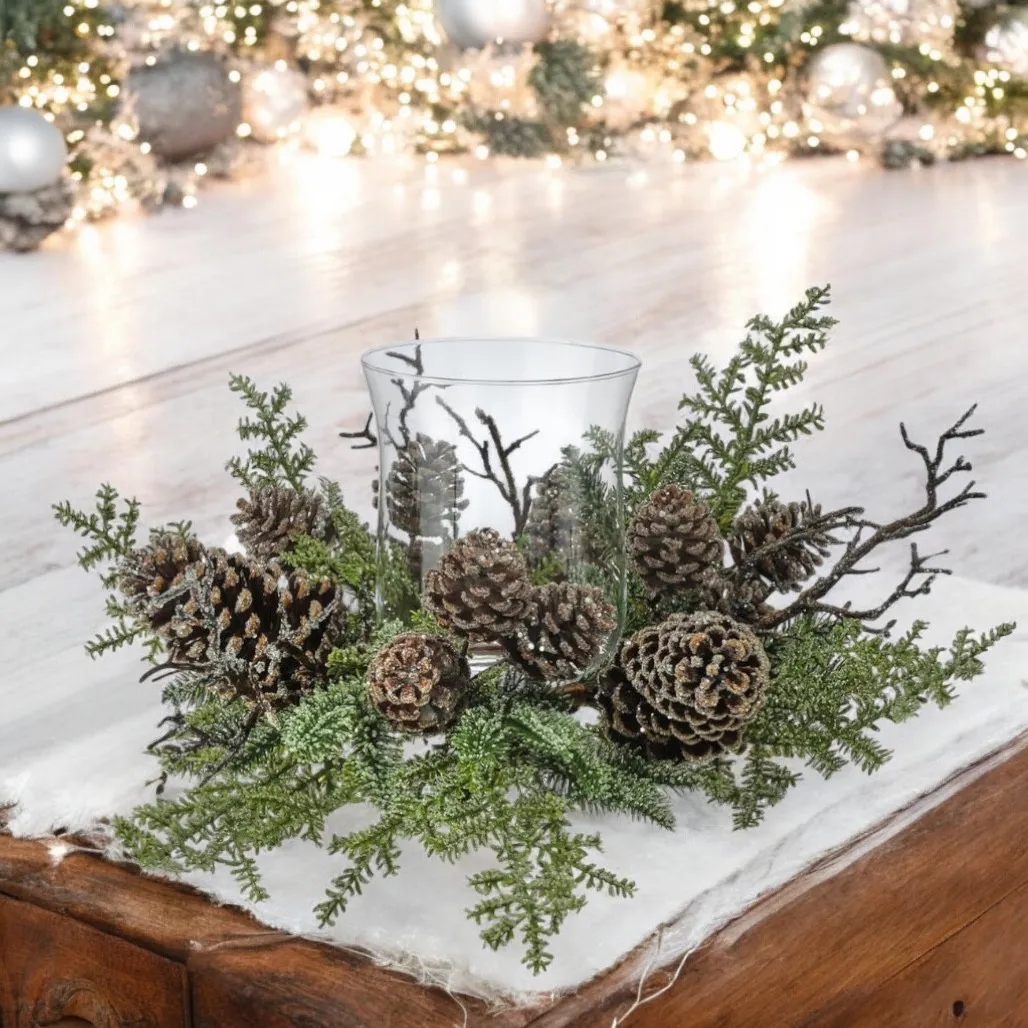
- Set the hurricane in the center of a round tray so everything stays contained.
- Ring the base with frosted foliage first, tucking stems clockwise so it reads as one mass.
- Nestle pinecones into the gaps, pointing them outward at roughly 30 degrees.
- Thread the fairy lights on top of the greens, never underneath.
- Fluff with your hands at the end — never shake a faux arrangement.
Twenty minutes, about $15 in materials once the vase is in hand.
7. Red Berries Floating in a Tall Cylinder of Tinted Water
This is a tall arrangement, and tall arrangements have rules. A 20- to 24-inch cylinder wants a table at least 40 inches wide, or it looks like a stray column in the room. Keep the total height at or under 30 inches from the tabletop so people can still see each other across dinner. On a narrow console or entry table, scale down to a 12-inch vase and a single white bloom — or borrow the tighter proportions in Idea #11.
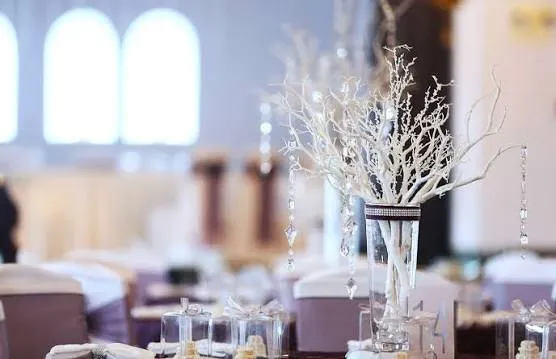
Fair warning: red-tinted water is a commitment. Food coloring is the usual trick, but fresh stems sitting in it will cloud the water within 48 hours, and once it’s murky, no amount of extra dye saves it. Use a glass insert — a narrower vase slipped inside the big one — and tint only the outer layer, or change the water daily. Also, real berries drop. Whatever sits under this should be washable, not a hand-embroidered runner.
8. Wicker Jug with a Red Velvet Bow and Berry Branches
The velvet bow is the whole idea. Take it off and you have a nice basket of greenery — pleasant, forgettable. Tie it back on and the same basket becomes a holiday object with a point of view. That’s because velvet is the only matte, light-absorbing fabric in an otherwise glossy arrangement: shiny berries, shiny metal, waxed leaves. One three-inch ribbon, tied slightly off-center, does more than adding three more types of greenery.
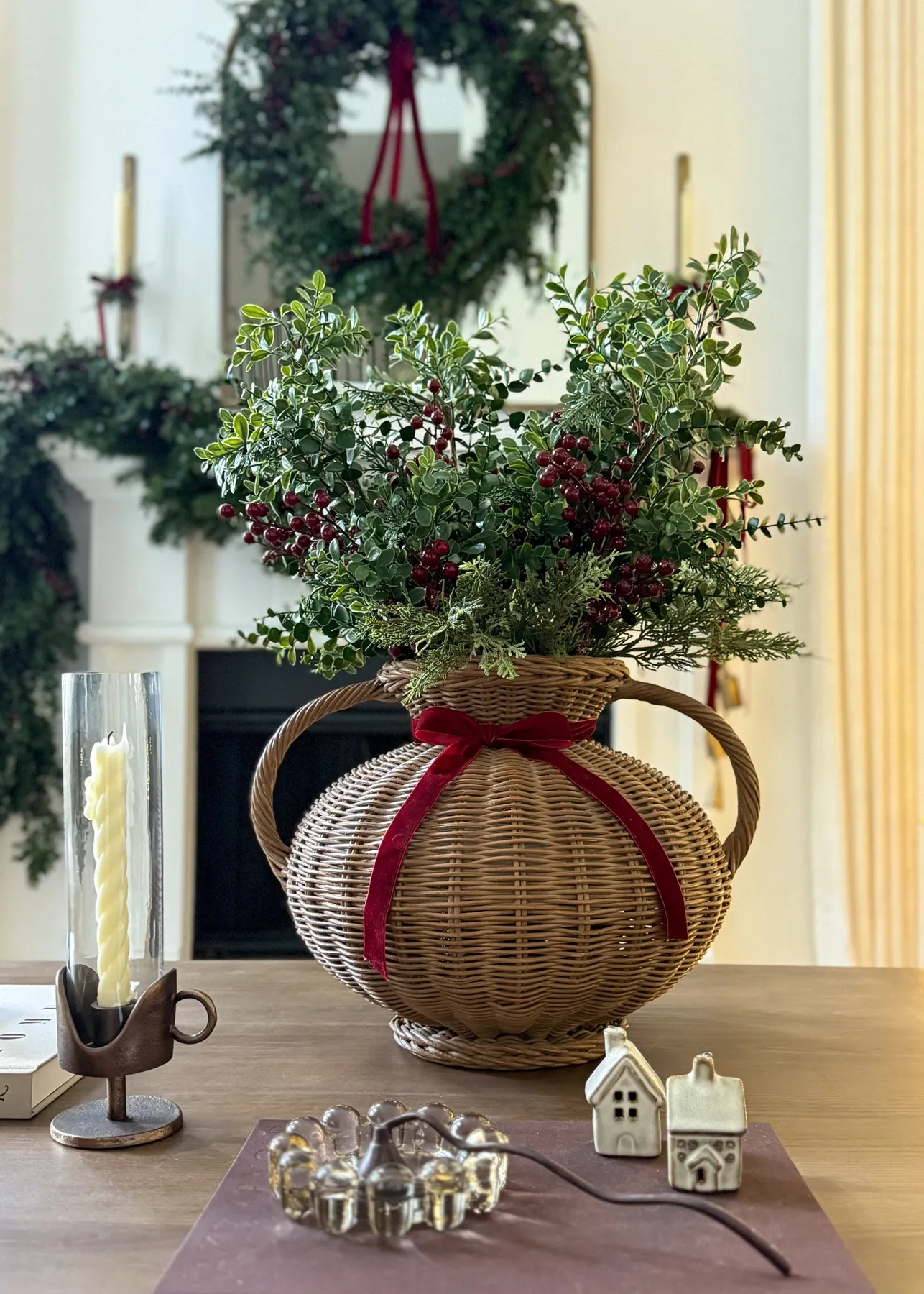
Here’s the formula: 50% warm brown from the wicker, wood, and candle holders, 35% deep green foliage, 10% crimson, 5% cream and bronze. The brown majority is what keeps this from looking like a store display — a wicker vessel makes even faux greenery feel collected rather than purchased. To shift the mood, hold the percentages and swap crimson for copper. Same arrangement, less candy cane, more cabin.
9. Off-White Vase of Evergreens with Gold Gourds
- Large off-white ceramic vase, 14–16 inches: $55–$160
- Evergreen bundle, three varieties: $20–$45
- Pinecones, tinted and natural: $8–$15
- Gold decorative gourds, set of three: $16–$38
- Pillar candle with holder: $10–$25
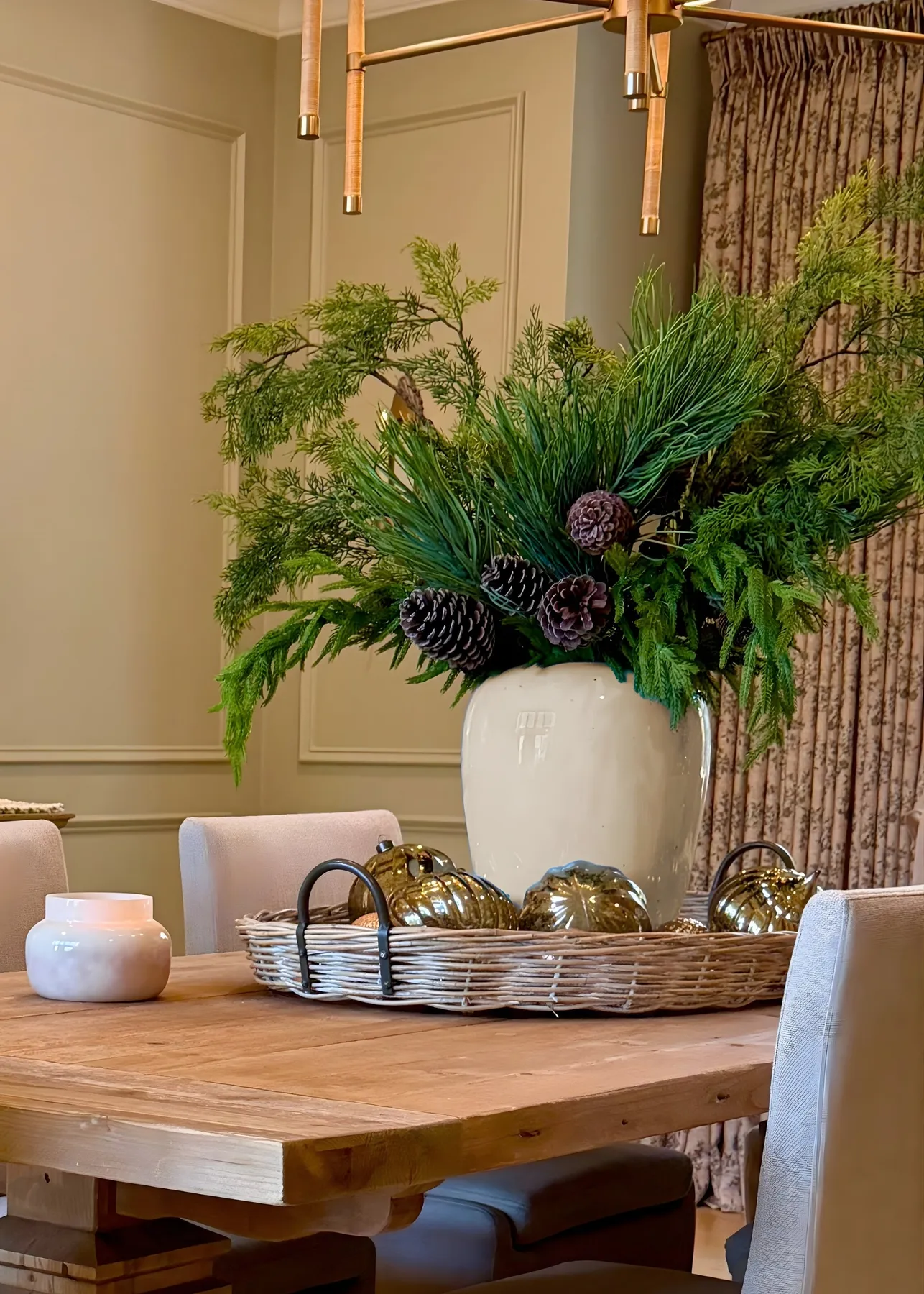
Total: $109–$283 — budget alternative: a thrifted urn and grocery-store greens land near $60.
Wide-mouth urns are the hardest vessels to arrange in because everything sways. Tape a 3×3 grid of clear floral tape across the opening and you’ve just created nine slots that hold stems exactly where you put them. It costs about $6, takes two minutes, and means a 14-inch urn looks full with 12 branches instead of 25. Cream vessels are also the smartest buy of the season — they vanish into any palette, so this same urn works with tulips in March.
Three things are happening here. The off-white vase and deep green branches are a near-maximum contrast pair, so the silhouette reads from across the room. The gold gourds sit in a different shape family than the foliage — round, hard, and shiny next to spiky, soft, and matte — and that tension is what keeps it from feeling flat. Remove the gold and it’s a grocery bouquet; remove the cream vase and it’s a forest floor.
10. Snow-Filled Tray with Votives and Glittered Pinecones
Two things people don’t think about until it’s a problem. Faux snow is basically plastic fluff — it drifts, it clings to sweater sleeves with static, and it will absolutely find its way into a floor register. Give it a tray with a lip and keep it clear of vents. Second: real candles sitting on a bed of fake snow demand attention. Never leave the room, and keep loose pinecones at least 4 inches from any flame.
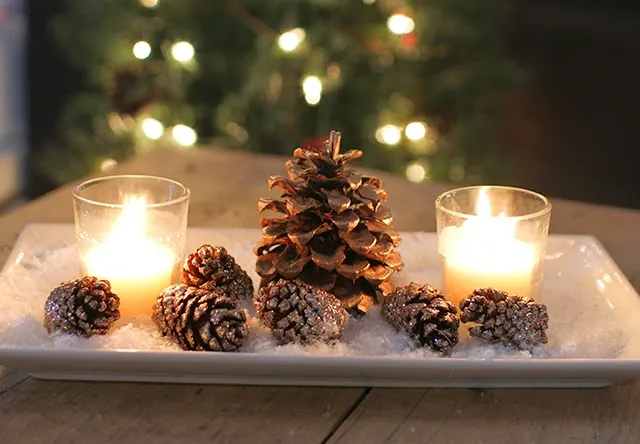
- Measure your tray and confirm it fits with at least 8 inches of table on each side
- Check that your votive holders are heat-safe glass, not thin decorative glass
- Decide whether kids or pets can reach the tray — if yes, switch to flameless
- Test the fairy lights and batteries before you build anything
11. Frosted Pine and White Berries in a Fluted Vase
- Fill the vase two-thirds with cool water and a packet of floral food.
- Place three tall frosted pine stems first to set the height — no more than twice the vase.
- Fill the middle with white berry clusters, tucking them so the spheres face outward.
- Add shorter pine at the rim, angled about 45 degrees, to hide the mechanics.
- Step back and photograph it. If it looks good on your phone, it looks good in the room.

Plan on 25 minutes and about $40 in materials if you already own the vase.
The detail that carries this arrangement is the white spherical berries. Everything else — frosted pine, pinecones, miniature trees, the little deer — is spiky or conical. The berries are the only round, matte element, and they’re what keeps an all-white scheme from collapsing into one single texture. If you’re building your own, prioritize round white clusters over a second type of greenery. One extra berry stem beats three more branches every time.
12. Three Votives on a Deep Red Runner with Gold Confetti
Nothing here needs to be expensive. Gold confetti is $3 at a party store, a red runner runs about $12 at Target, and dollar-store votive holders read as real glass from a foot away. Pinecones are free if you live near any conifer, and the frosted greens come from one $10 bundle split in half. You’re at roughly $40 for the whole table. Compare with Idea #7 — same deep crimson, completely different energy.
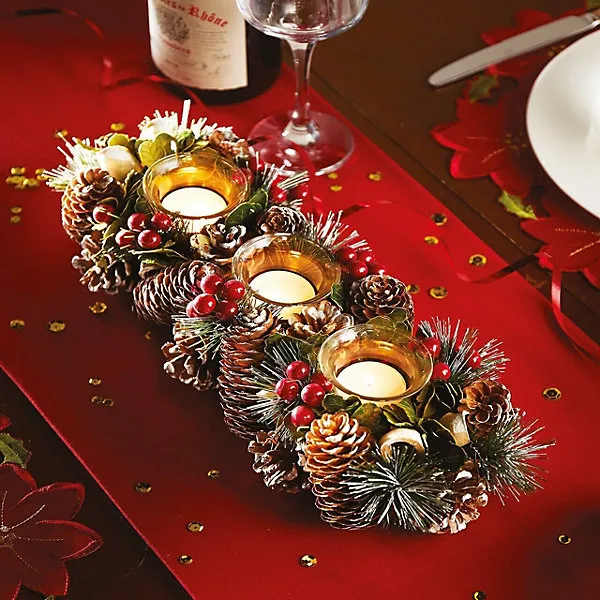
Linear arrangements are the only kind that work on a table you actually eat at. Keep the decorated zone to about one-third of the table’s length, so a 72-inch table gets roughly 24 inches of centerpiece. Hold the width to 5 or 6 inches so serving dishes still fit, and keep the tallest candle under 10 inches so it never blocks a conversation. On a 48-inch table, use two votives instead of three.
13. Birch Bark Vase Holding Bare Branches of Red Berries
Bare branches in a simple vessel are the antidote to a decade of glitter. The 2026 version of holiday decorating leans Scandinavian — fewer ornaments, more natural material, and an emphasis on texture over sparkle. It shows up on Pinterest boards full of birch, lichen, and undyed wool. This one has staying power because it isn’t really a Christmas idea at all; the same vase of bare branches works from November through February with nothing but a swap of the berries.
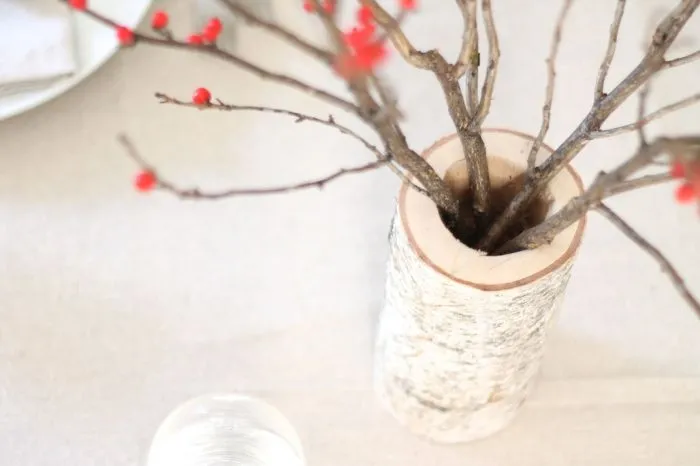
- Birch or birch-wrapped cylinder vase, 10–12 inches: $22–$65
- Faux red-berry branches, 6–8 stems: $18–$42
- Floral foam or a stem grid: $5–$9
- Neutral linen runner: $14–$30
Total: $59–$146 — budget alternative: a plain glass cylinder wrapped in birch-print contact paper with sale berry stems, about $22.
14. Red Roses and White Hydrangeas in a Clear Glass Vase
Hydrangeas wilt first in any mixed arrangement, and the fix is counterintuitive: dunk the entire bloom, petals and all, in cool water for 20 minutes before arranging. They drink through the petals, which buys you three extra days. Roses and hydrangeas also want different water levels, so keep the vase no more than two-thirds full and re-cut both types at an angle every other day. Forty minutes of prep on day one is the difference between four days and eight.
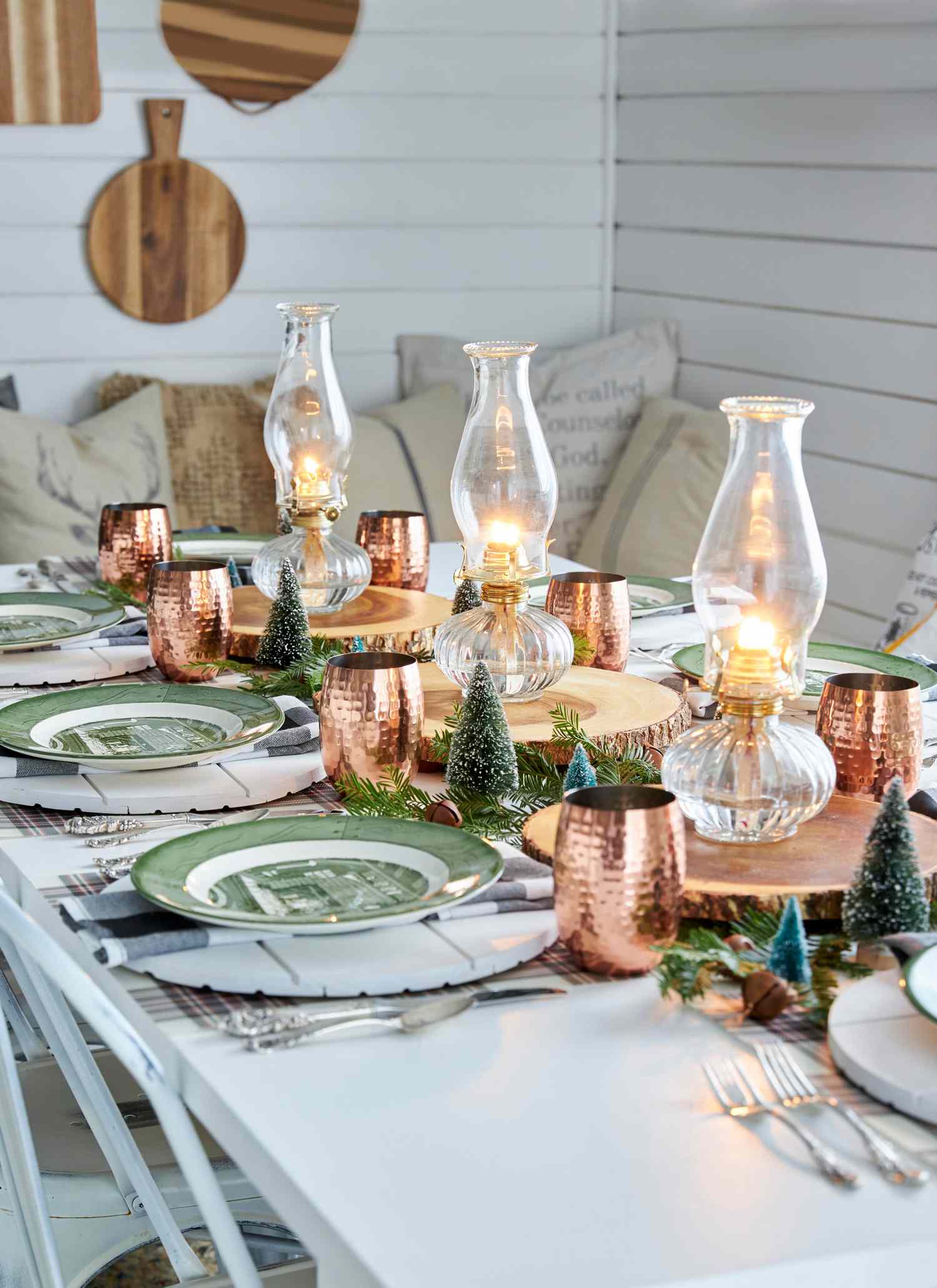
Clear glass is honest. You’ll see every cloudy stem and every fallen leaf, so plan on changing the water daily and rinsing the inside with a drop of bleach once midweek. Silver ornaments tarnish against damp foliage, so dry them off when they come out. And hydrangeas shed florets like confetti — if this vase lives on a dining table, budget a wipe-down before every meal. Give it a week, maybe ten days, and enjoy it for exactly what it is.
15. Red Berries, Pine Sprigs and Tiny White Blooms in Glass
Two principles are doing the work. First, the backdrop: a plain white wall gives this arrangement nothing to fight and nowhere to hide, which is why a $30 grocery-store mix looks gallery-worthy here. Second, proportion — the vase takes up about a third of the total height, leaving two-thirds for the stems. That ratio is why it reads tall and elegant instead of top-heavy. Put the same arrangement in front of patterned wallpaper and the whole thing will look busier and somehow smaller.
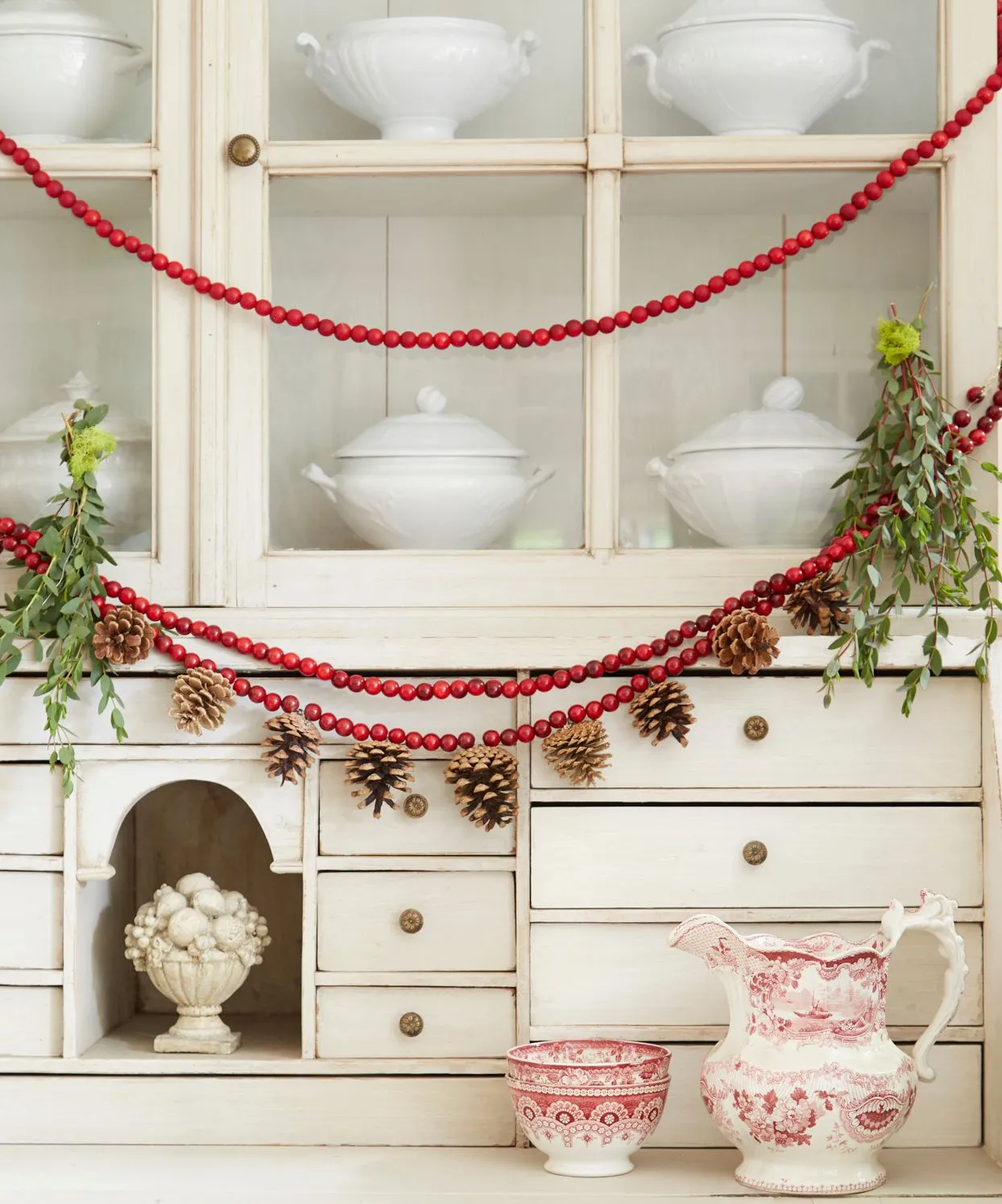
The formula is roughly 55% green pine, 30% red berries, 15% small white blooms. The white is deliberately the smallest share. It’s a highlight, not a color, and pushing it past 20% turns the arrangement pastel and costs you the holiday punch. Hold the ratio and swap freely: pine for silver eucalyptus, red berries for burgundy amaryllis, white blooms for cream ranunculus. What you can’t change is which one stays smallest.
16. Corrugated Paper Trees on a Cream and Hunter Green Table
A repeating row of trees wants room to breathe. Plan on a table at least 72 inches long, and keep the tall pieces under 14 inches so nobody has to crane around them. If your chandelier hangs less than 30 inches above the table, skip the tallest tree — the clutter at eye level is what makes holiday tables feel crowded. Working with a four-foot table? One tree, one candle, a handful of gold pinecones. The look scales down; the repetition doesn’t have to.
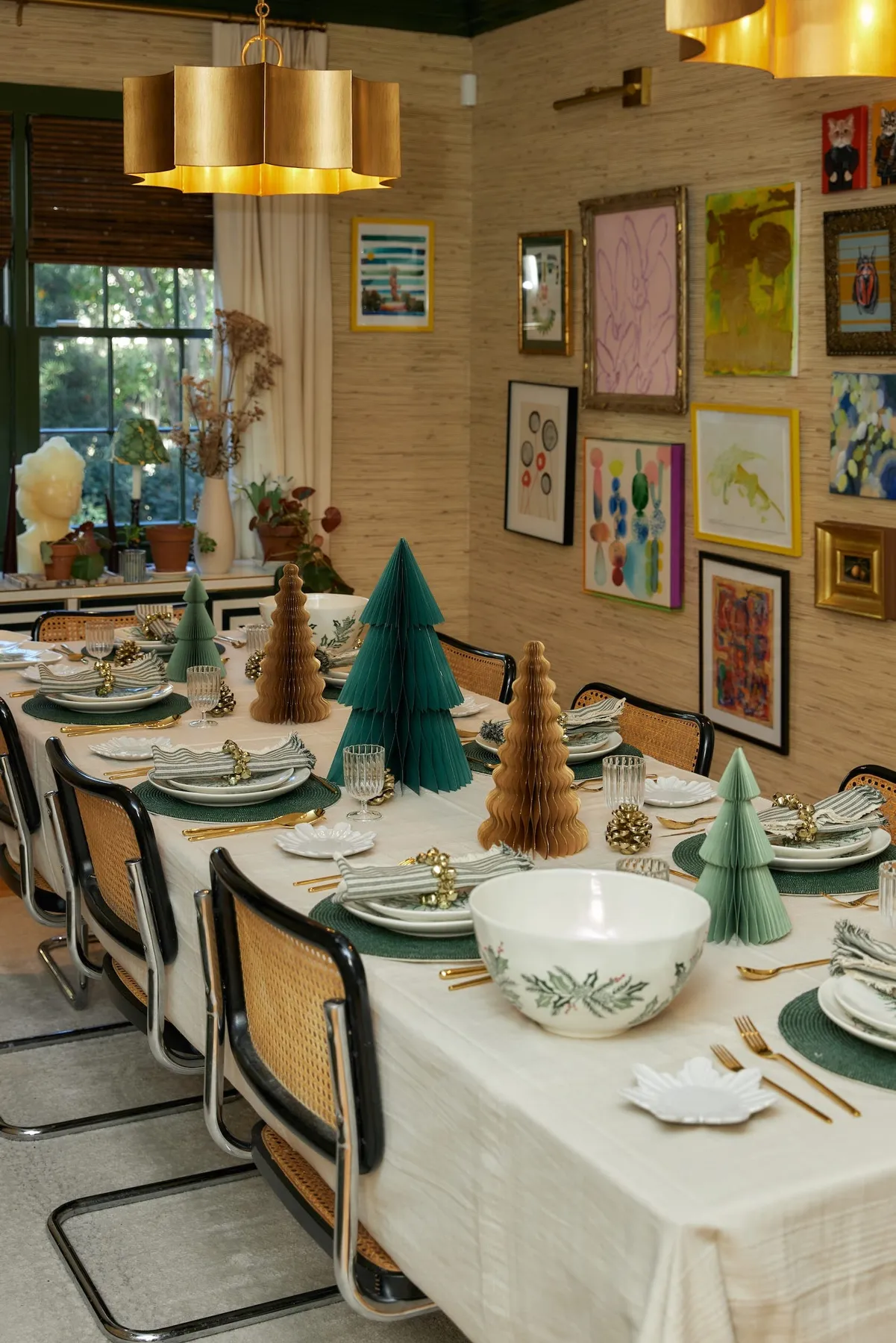
Corrugated paper trees are the best-value holiday decor of the year. Retail versions run $38 to $120 each; a craft-store kit and a glue gun get you the same silhouette for about $4 a tree, and kids can help. Gold flatware is where I’d stop pretending — buy four mismatched gold forks at a thrift store for $8 and mix them with your everyday set. Nobody notices, and honestly the mix looks better. Just watch the surface problem we cover in common mistakes.
Paper trees and open flames don’t mix, and neither do paper trees and toddlers. If either lives in your house, move the candles to a sideboard and let the table be paper and glass only. Corrugated edges also catch on linen napkins, so keep runners flat and skip trailing fabric. And store these flat, wrapped in tissue — otherwise they’re crushed and recycled by January.
17. Matte Gold Bowl with Frosted Pine and a Pillar Candle
The shallow gold bowl is the entire idea. A pillar candle in a hurricane on its own is furniture-store filler. Surround it with a ring of frosted foliage and a matte gold dish and it becomes a composition — the gold reflects candlelight back up into the pinecones, which no other metal does as warmly. Swap it for silver and the centerpiece goes cool and slightly icy. Matte gold, not polished. Shine is the thing you’re trying to avoid.
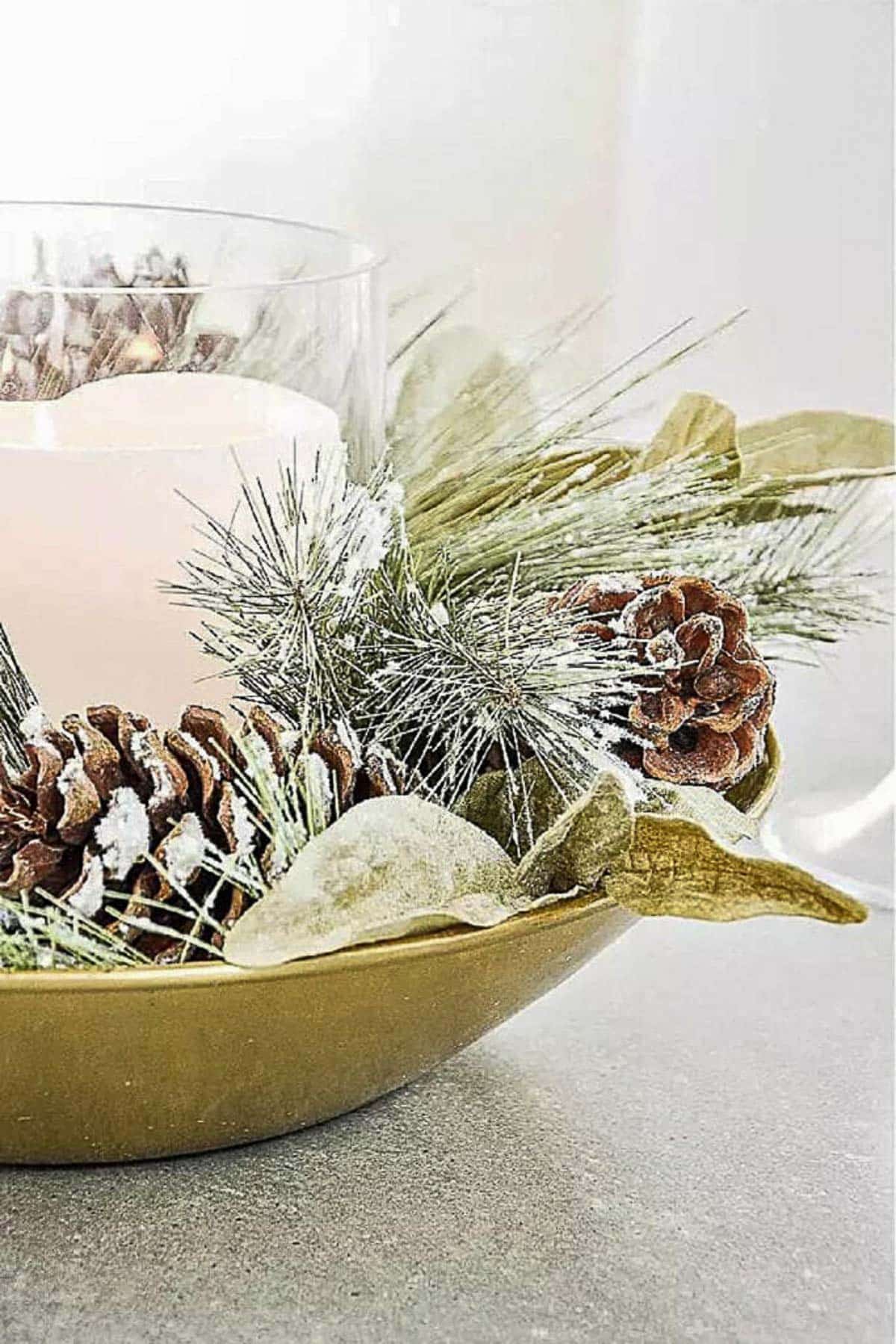
Trim the wick to a quarter inch before every burn and you’ll get a steady flame instead of a smoking one, which matters more than usual with dried foliage nearby. Keep all greenery at least 3 inches from the flame, and never let a candle burn lower than 2 inches from the bottom of the hurricane. Choose a pillar roughly one and a half times the height of the bowl’s rim — shorter and it disappears, taller and the arrangement looks like a torch.
18. Three Pinecone-Shaped Candles Among Blue-Green Evergreens
- Pinecone-shaped candles, set of three: $24–$58
- Fresh evergreen branches with blue-green needles: $12–$28
- Weathered wood board or tray: $18–$45
- Candle drip tray or small saucers: $6–$14
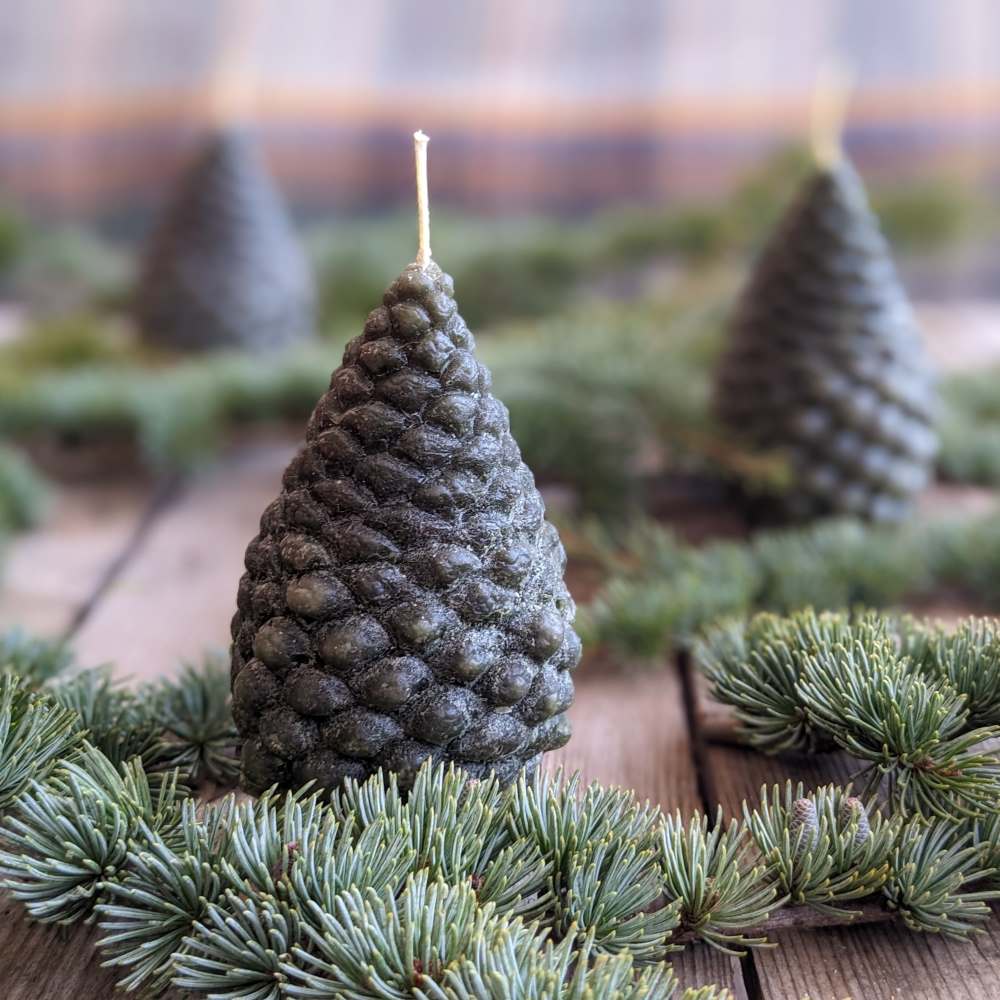
Total: $60–$145 — budget alternative: one pinecone candle plus two thrifted dark green pillars, about $22.
- Melt a pound of dark green pillar wax in a double boiler — roughly 15 minutes.
- Set a silicone pinecone mold on a level tray and thread it with a pre-tabbed cotton wick.
- Pour slowly at about 175°F, tapping the mold to release air bubbles.
- Cool four hours, then trim the wick to a quarter inch.
- Set three at staggered depths among the greens, tallest in back.
Roughly $22 in wax for three candles and about five hours, most of it hands-off.
19. Pinecone Candle and Fir Garland on a Cozy Dinner Table
Fresh garland is beautiful and messy in equal measure. Expect needles on the floor within a week, and mist real cedar or fir every few days to keep it from drying out — once it’s crisp, it’s a fire hazard, not decor. Faux garland skips the mess but collects dust year over year; run it through a cold dryer cycle with a towel to freshen it. If you use string lights, buy battery-powered ones so you aren’t running an extension cord across a walking path.
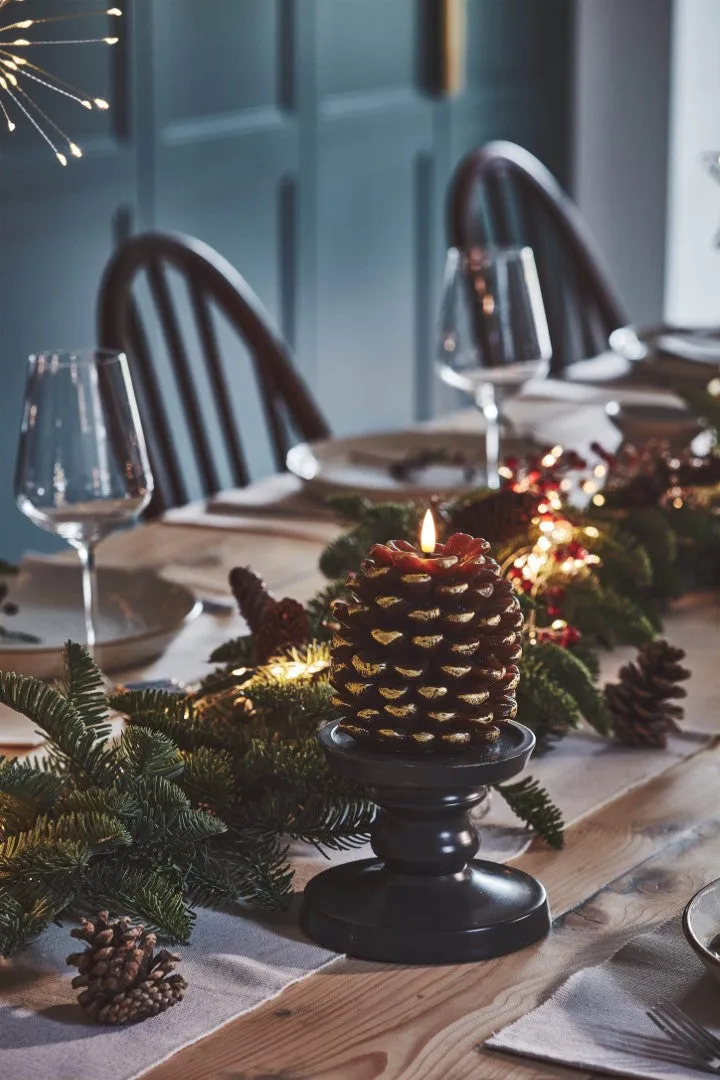
For garland, measure the table and multiply by 1.5 — a 72-inch table wants 9 feet so it can pool at the ends. Keep the candle and holder combo under 12 inches tall on a dining table, and make sure the holder has a wide, flat base if your runner is slippery fabric. A 60-inch round table looks best with a short swag of garland down the middle rather than a full loop around the rim.
20. Painted Pinecone Place Card Holders with Orange-Red Tips
Two things make these work. Scale comes first — a pinecone is about four inches tall, which is exactly the size a place card wants to be. Anything bigger reads as decoration and gets shoved aside before the soup arrives. Then the painted tips. Dipping just the outer scales in orange-red gives you a two-tone object that looks deliberate from across the table and handmade up close. Full-coverage paint would kill it. Cropped color is the whole trick.
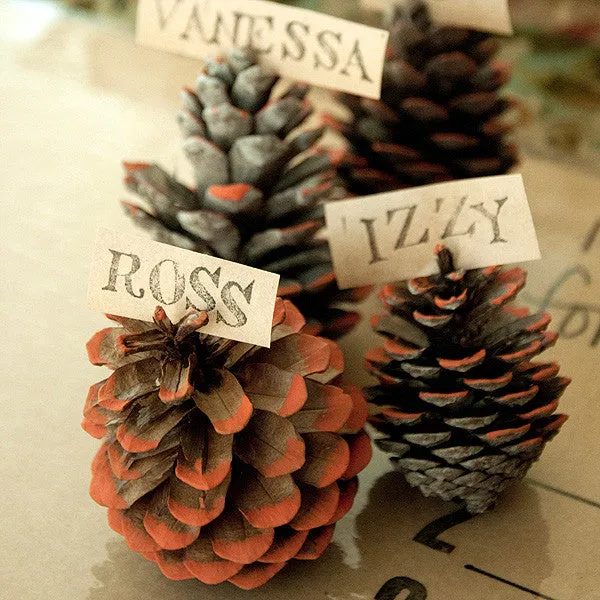
Place cards are back, and not because anyone forgets their cousin’s name. The 2026 dinner-party mood is small, seated, and a little bit handmade — people are hosting six instead of sixteen and putting the effort into details you can hold in your hand. Pinterest saves for handmade place cards climb every November for exactly this reason. It’s cheap, it’s fast, and it’s the rare holiday project you can finish in one evening with a ten-year-old helping.
21. Pinecone Ornaments with Felt Leaves and Fairy Lights
- Hot-glue a small loop of twine or velvet ribbon to the top of each pinecone and hold for 20 seconds.
- Cut two or three leaf shapes from dark green felt, about an inch long.
- Tuck the leaves under the ribbon loop and glue them so they fan slightly outward.
- Sprinkle a pinch of gold glitter onto the wet glue at the leaf base.
- Let them cure for an hour before hanging.
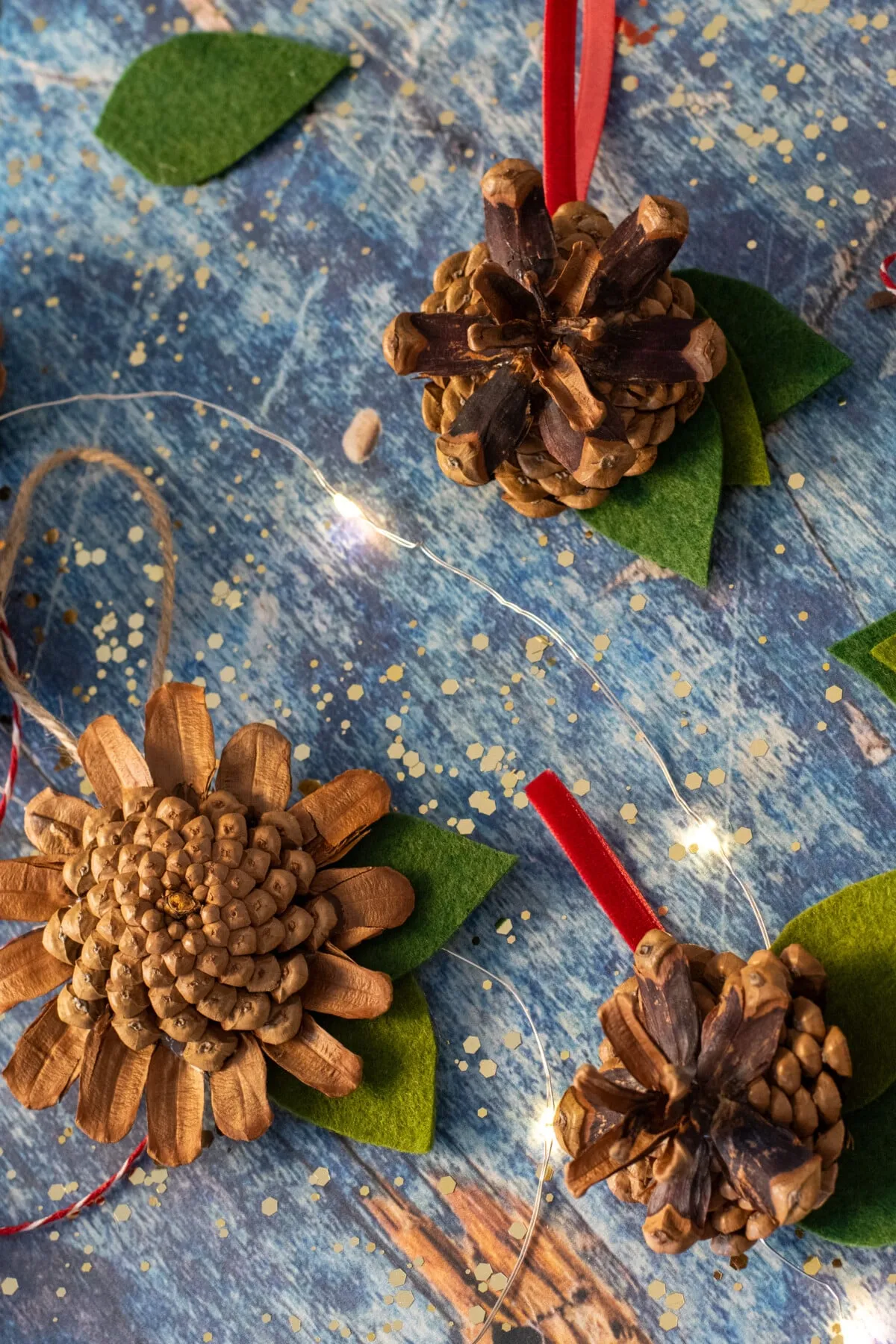
About 30 minutes for three ornaments and under $10 in materials. Same idea as Idea #18, just handheld.
The one detail that makes this collection feel styled instead of homemade is that one pinecone is noticeably lighter than the other two. Three identical ornaments look like a kit; two dark and one pale looks like a collection. It’s a rule worth stealing — odd numbers, slight variation in tone. If all your pinecones are the same shade, bleach one for an hour or brush the scales with a thin white wash.
22. Fresh Conifer Branches in a Ribbed Glass Vase
- Measure the counter — vase plus branches will run about 2.5 feet tall
- Check the light; north-facing kitchens keep conifers fresh longest
- Confirm the vase is heavy enough not to tip once branches get top-heavy
- Put a towel down before you start — conifers drop needles
- Plan where you’ll change the water weekly without moving the vase
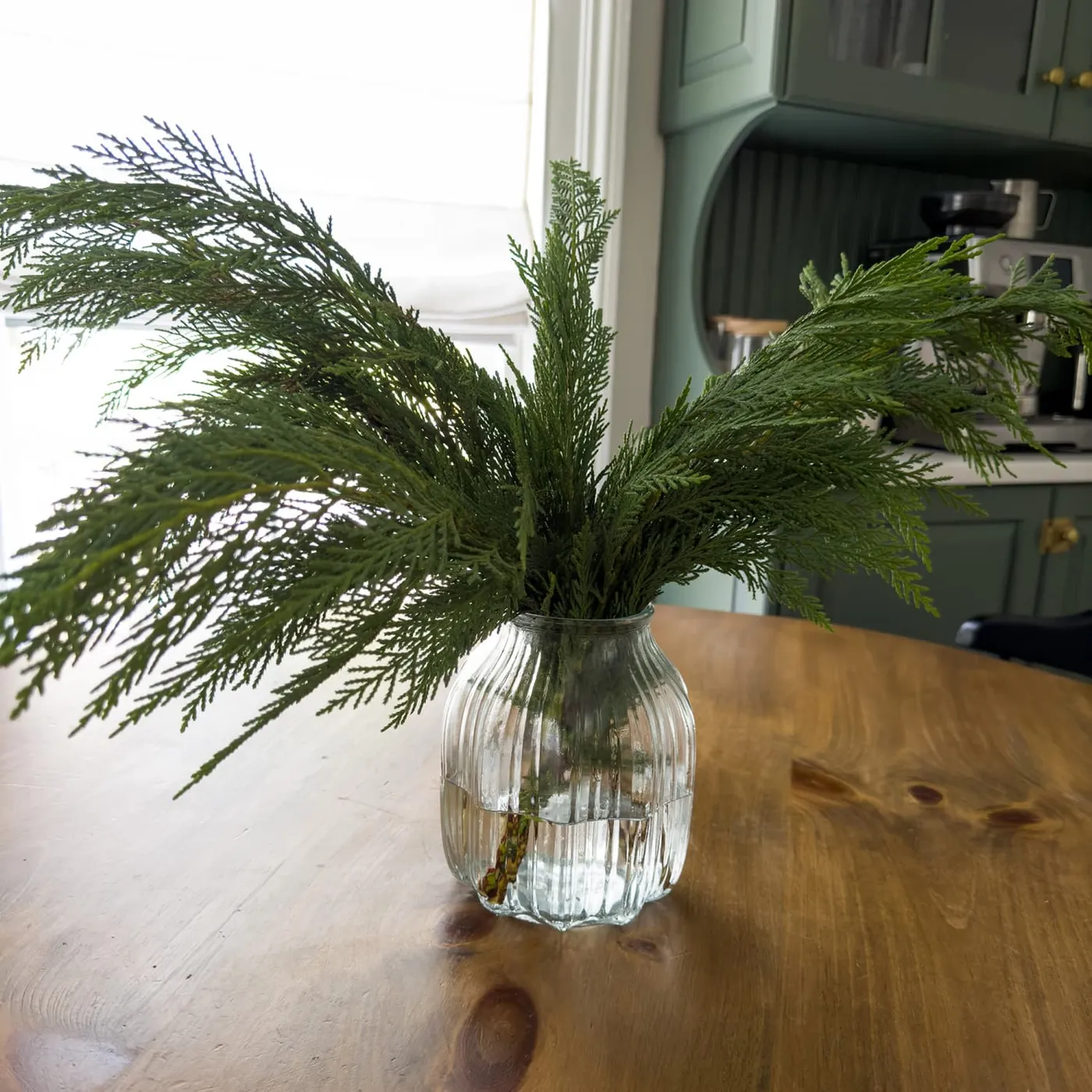
Conifer branches are the longest-lasting cut greenery you can buy, but only if you treat the stems properly. Instead of cutting at an angle, crush the bottom 2 inches with a hammer or the back of a heavy knife — conifer wood is resinous and seals over fast. Change the water weekly and top it up in between, because these branches drink hard for the first ten days. Done right, you’ll get six weeks out of a $14 bundle.
about real branches: they drop needles. Not dramatically, but you’ll find them in a two-foot radius for the first week and again whenever the room air dries out. Resin is the other issue — it leaves sticky spots on a wood table if the vase sweats, so set it on a felt pad. Skip cedar if anyone in the house has allergies, and skip berried branches near a white marble counter, because those stain.
23. Burgundy Home Office with Evergreen Garlands and Wrapped Gifts
The formula is bold and simple: roughly 45% burgundy walls, 30% deep evergreen, 15% light wood, 10% cream. Burgundy is a real commitment, but the light-wood hutch and pale rug keep it from closing in — that’s the balance rule for any saturated wall color. Swap burgundy for deep teal and the garland still works. Swap light wood for dark walnut and the room gets heavy fast. Contrast beats color every time.
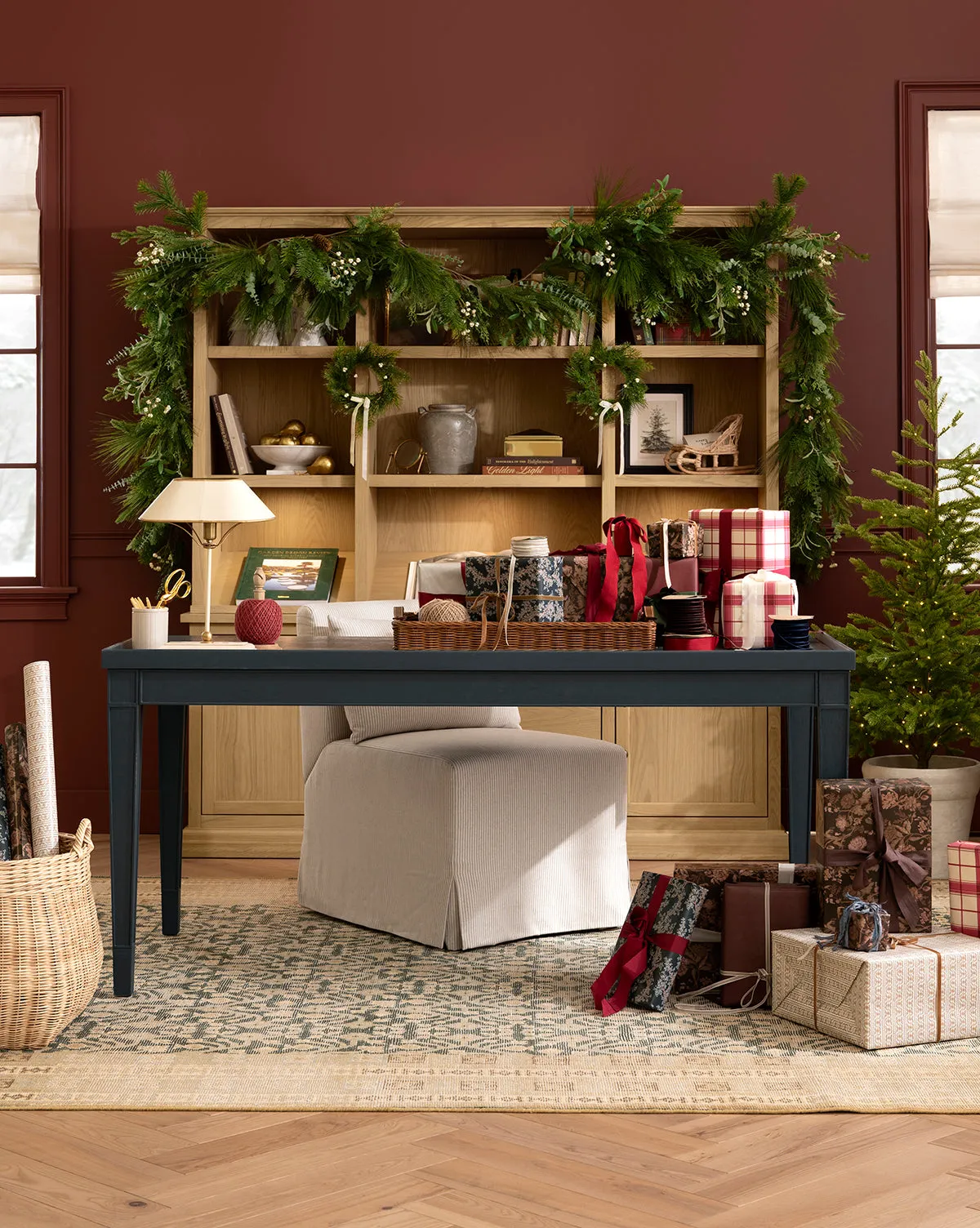
A home office can take holiday decor that would crowd a living room, because you’re sitting in it, not hosting in it. The limits are practical: keep garland at least 18 inches clear of the desk’s working surface, and never drape greenery over a monitor or task lamp where heat builds. A hutch like this one wants garland about 1.5 times its width. Under 80 square feet? Skip the potted tree and put the energy into one good arrangement on the desk.
Go Fill a Vase — the Rest of the House Can Wait
You don’t need a perfect tree or a matching set of anything. You need one vessel, a bundle of greens, and twenty honest minutes — the arrangements above prove that over and over. Start with the one that suits the table you actually have, and let the rest of the house catch up later in the season.
📌 Pin your favorite to your holiday board now, so you can find it again when the greens go on sale in two weeks.