You know that feeling when you finally spot the black Christmas tree decorations that look exactly right for your space — and then realize you have no idea where the tree itself even came from?
We spent serious time browsing Etsy, Amazon, and Walmart to bring you only what’s worth your attention this year. After sorting through hundreds of ornaments, ribbons, skirts, and tabletop trees, we narrowed it down to 24 ideas that actually deliver — from about $8 for a single ornament to $899 for a nine-foot tree.
Inside you’ll find monochrome glam, gothic whimsy, rustic burlap textures, and candy-colored maximalism, with budget and luxury versions compared side by side at every turn. And stay until the end — we break down the most common mistakes that can ruin these looks.
Black trees have moved well past novelty in 2026. They’re the answer for anyone whose home leans moody, warm, or a little bit dark, and they photograph like nothing else against a pale wall.
📌 Save this to Pinterest for later — you’ll want to revisit these ideas.
1. Monochrome Black and Silver Baubles With White Floral Picks
A black tree is already the loudest object in the room, so the real job is control. Every ornament stays inside a three-tone lane — matte black, high-gloss black, and silver — and because only the finish changes, the tree reads as one texture study instead of a jumble.

The white floral picks matter more than they look. A tree of nothing but spheres starts to feel like a bead shop; a few soft, organic sprays break the grid and give the eye somewhere to land. The stockings and the plush white throw echo the palette without copying it.
- 7.5 ft black artificial tree: $120–$450
- Matte, glossy, and silver ball ornaments (60–90 pieces): $60–$180
- White floral picks and sprays (6–10): $25–$70
- Tree collar or skirt: $30–$90
- Throw blanket and stocking accents: $40–$120
Total: roughly $275–$910. Budget alternative: spray your existing ornaments matte black with two cans of flat enamel ($16), then add dollar-store silver balls and a $20 IKEA throw — the same monochrome read for under $400.
2. Black Ribbon and Gold Baubles Framed by a Snowy Lake
Wired ribbon wants to be woven, not draped. Use a 2.5- to 3-inch black ribbon with a wire edge and work it in 6- to 8-inch waves, pinching and twisting at each branch so it looks like it grew there. Leave 4 to 6 inches between passes so the warm fairy lights still show through — black ribbon plus unlit branches is how a beautiful tree becomes a dark blob at 9 p.m.
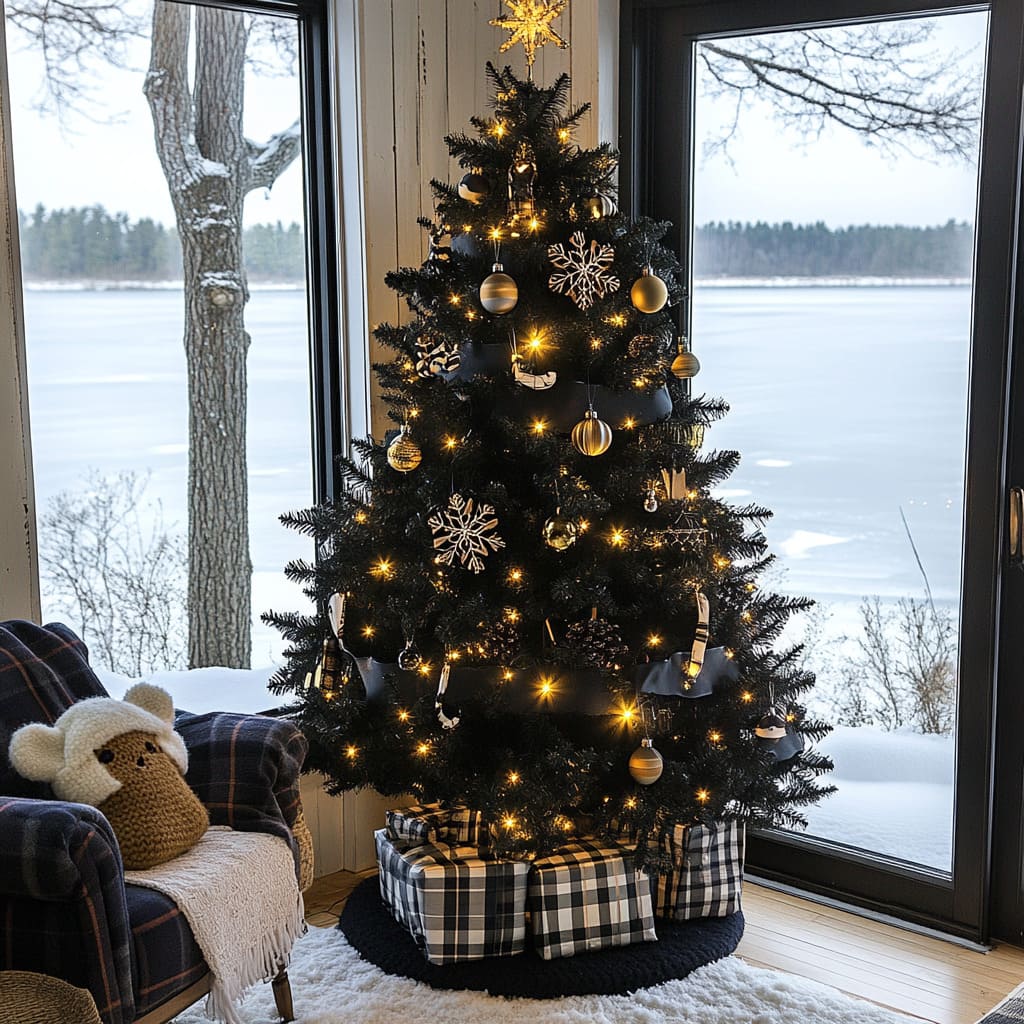
Black satin creases permanently if you fold it tight, so store it rolled around a cardboard tube rather than stuffed in a bag. Gold baubles pick up fingerprints and dull after about five seasons; a microfiber cloth and warm water bring most of it back. And anything parked in front of a big window fades fastest on the sunny side, so rotate the ribbon and the snowflake cutouts next year.
3. Swirl Lollipops, Candy Canes, and One Giant Topper
The oversized red-and-white swirl at the top is the whole idea. Shrink it to a standard star and you’ve got a candy tree that reads cute but scattered; at roughly 14 inches across, it gives the lollipop and candy cane ornaments a punchline to build toward. The top of the tree is the one place every guest’s eye travels first. For the same theatrical instinct in a completely different palette, look at Idea #21.
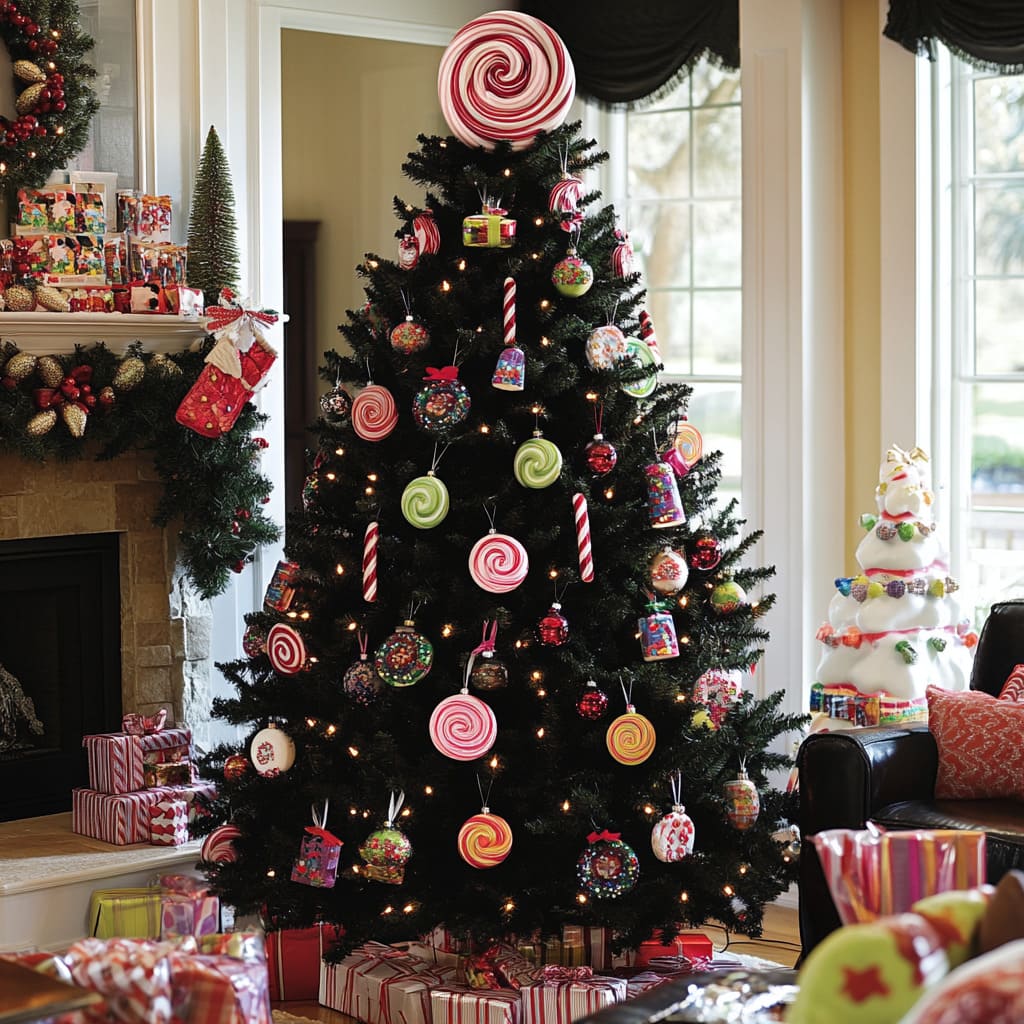
- Trace a 14-inch circle onto 1-inch foam board and cut it with a craft knife in two passes — don’t force it.
- Draw a spiral from the center outward in a 1.5-inch band, then paint alternating red and white sections.
- Hot-glue a 12-inch wooden dowel to the back, centered, and let it cure for an hour.
- Slide the dowel into the top branches and zip-tie it to the trunk so it can’t lean.
About 2 hours plus drying time. Materials run $18–$25.
4. Deep Jewel-Toned Ornaments Against a Dark Evergreen
Dark, moody holiday styling has been building for a few seasons and it’s fully arrived for 2026. Part of it is reaction — after years of white-and-bright farmhouse trees, people want warmth and shadow again, the kind of tree that looks best with one lamp on and a real fire going. It’s also practical. Deep greens, blacks, and bronzes hide the flaws bright palettes amplify, and they photograph beautifully for the verticals everyone’s saving.
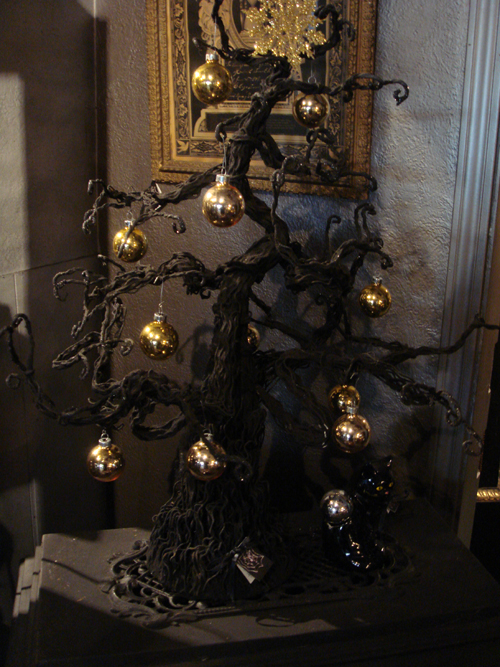
The formula here is roughly 60 percent deep green foliage, 25 percent black and bronze ornament, 10 percent warm gold light, and 5 percent natural wood from the floor and trim. Swap the green base for a black tree and the ornaments for ivory and you keep the same moody structure in a lighter key. Trade bronze for copper and the whole thing warms up without changing a single measurement.
5. A Gothic Tabletop Tinsel Tree on a Mantel Full of Antiques
Tinsel sheds. Every time you move it you’ll find a light dusting of black sparkle on the mantel for a week. The bigger issue is weight — a small tinsel tree on a narrow shelf tips the second someone bumps the books beside it, so anchor the base or set it against the wall. If real pillar candles are part of the scene, keep them at least a foot from any branch. This is a look for people who enjoy dusting, not people who don’t.
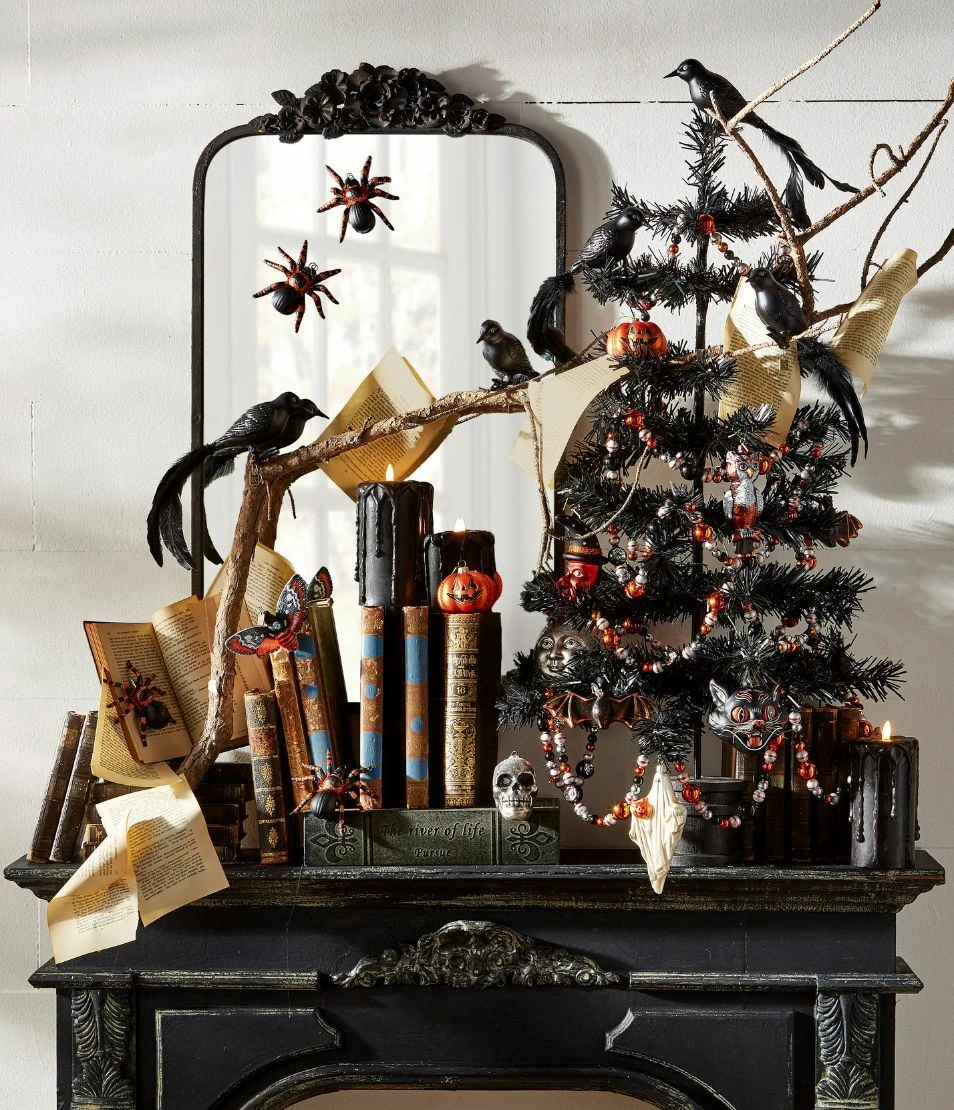
Almost all of this comes from thrift stores and dollar bins. Antique hardcovers run $2–$5 each at estate sales, beaded garlands turn up at Goodwill for $3, and small black birds are a dollar apiece in the floral aisle every October. Working vintage ornaments on eBay or Etsy cost $6–$15 each, and a small black tinsel tree is $12–$25 new. Pair it with the bat ornament in Idea #13 for a consistent thread.
6. Matte Cast Iron Miniature Trees on Wooden Plinth Bases
Tabletop trees like these want a surface at least 36 inches wide — a dining table, a sideboard, a hallway console. They’re the answer for apartments under 500 square feet, where a full tree would eat the only walkway you’ve got. If you’re working with a nine-foot tree instead, you need a wall of at least 10 feet and a 9-foot ceiling, which is exactly the situation in Idea #18. Different scale, same instinct: let the tree own the space.
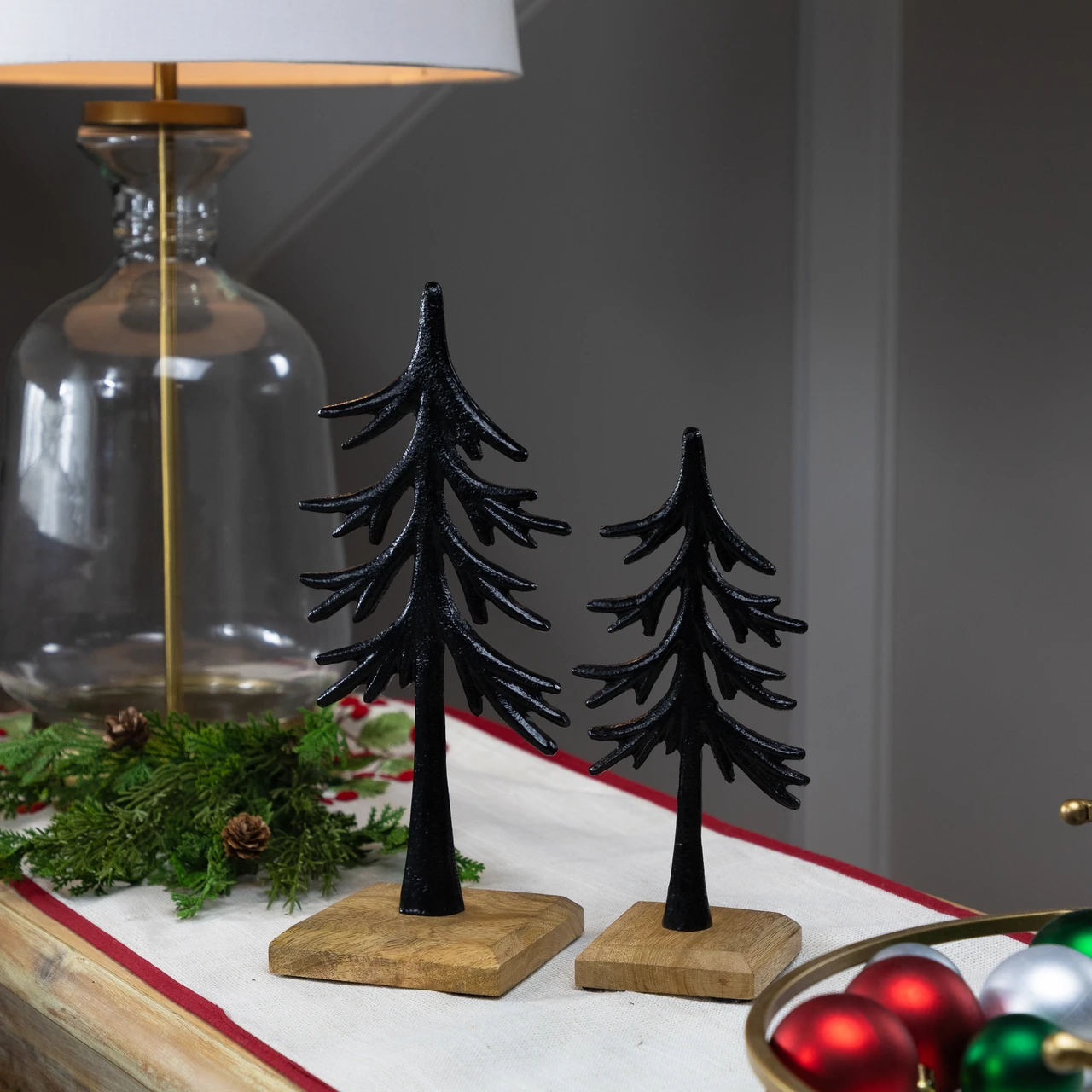
Heft is what separates a $12 tree from a $40 one, and you can feel it in your hand. Cast iron miniatures stay put on a runner; resin ones slide. If you’re grouping them, use three and stagger the heights — 8, 11, and 14 inches — spacing them so the smallest sits about a hand’s width from the tallest. Odd numbers at uneven heights read as collected. Even numbers at matching heights read as a store display.
7. Warm Bulbs, Paper Bats, and Lit Jack-o’-Lanterns on the Mantel
The paper bats taped across the wall and mirror are what make this room. Take them away and you still have a lovely black tree with orange accents on a white mantel — handsome, but contained. The bats pull the decoration off the branches and onto the architecture, so the whole room participates. Notice the distance between the tree and the fireplace too: two separate objects sharing one palette, which is why neither one feels crowded.
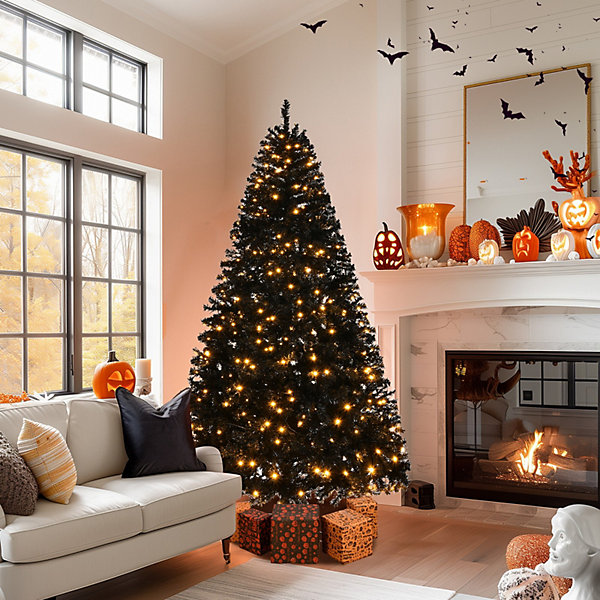
Paper bats curl at the corners within a season, especially near a heat source. Press them flat between two sheets of cardboard for storage and they’ll behave next year. Battery-operated string lights on a tree this size need fresh cells about every three weeks if they run six hours a night, so buy rechargeables in a bigger pack. And anything with an open flame near paper gets checked before bed — no exceptions, even the pretty ones.
8. Burlap Ribbon and Frosted Pinecones Nestled in Green Pine
Break this tree down and it’s about 55 percent green pine foliage, 20 percent burlap beige from the ribbon, 15 percent white frost between the pinecones and berries, and 10 percent rust-orange and gold in the smaller picks. That last 10 percent is the part people skip, and it’s what keeps the whole thing from washing out. If rust isn’t your color, swap it for deep burgundy or smoky blue and the ratio holds.
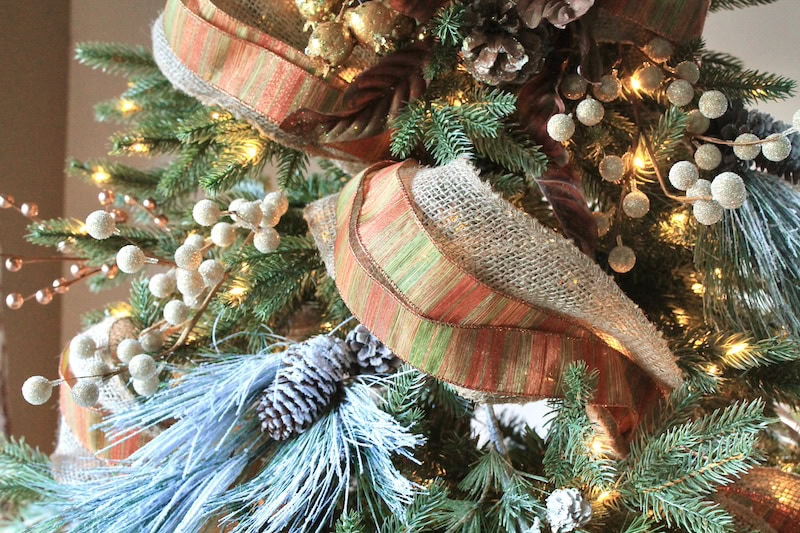
Three matte textures stacked together beat one shiny one every time. The burlap ribbon has a visible woven grid, the frosted pinecones have a soft chalky surface, and the glitter berries carry the only sparkle in the arrangement. That’s a deliberate hierarchy: a lot of quiet texture, one small hit of shine. Warm string lights tucked deep inside the branches rather than draped across the tips add a fourth layer without adding a single ornament.
9. Matte Black, Gold, and Deep Red Around a Dark Grey Fireplace
When you mix patterns, use three sizes and two colors, no more. Here that’s a large black-and-white buffalo check on the wrapping paper, a medium polka dot on the pillow, and a small stripe on the ornaments. The gold mirror frame and the deep red baubles are the only non-black-and-white elements, which is why the corner feels collected rather than chaotic. Skip the third pattern and the whole arrangement loses its rhythm.
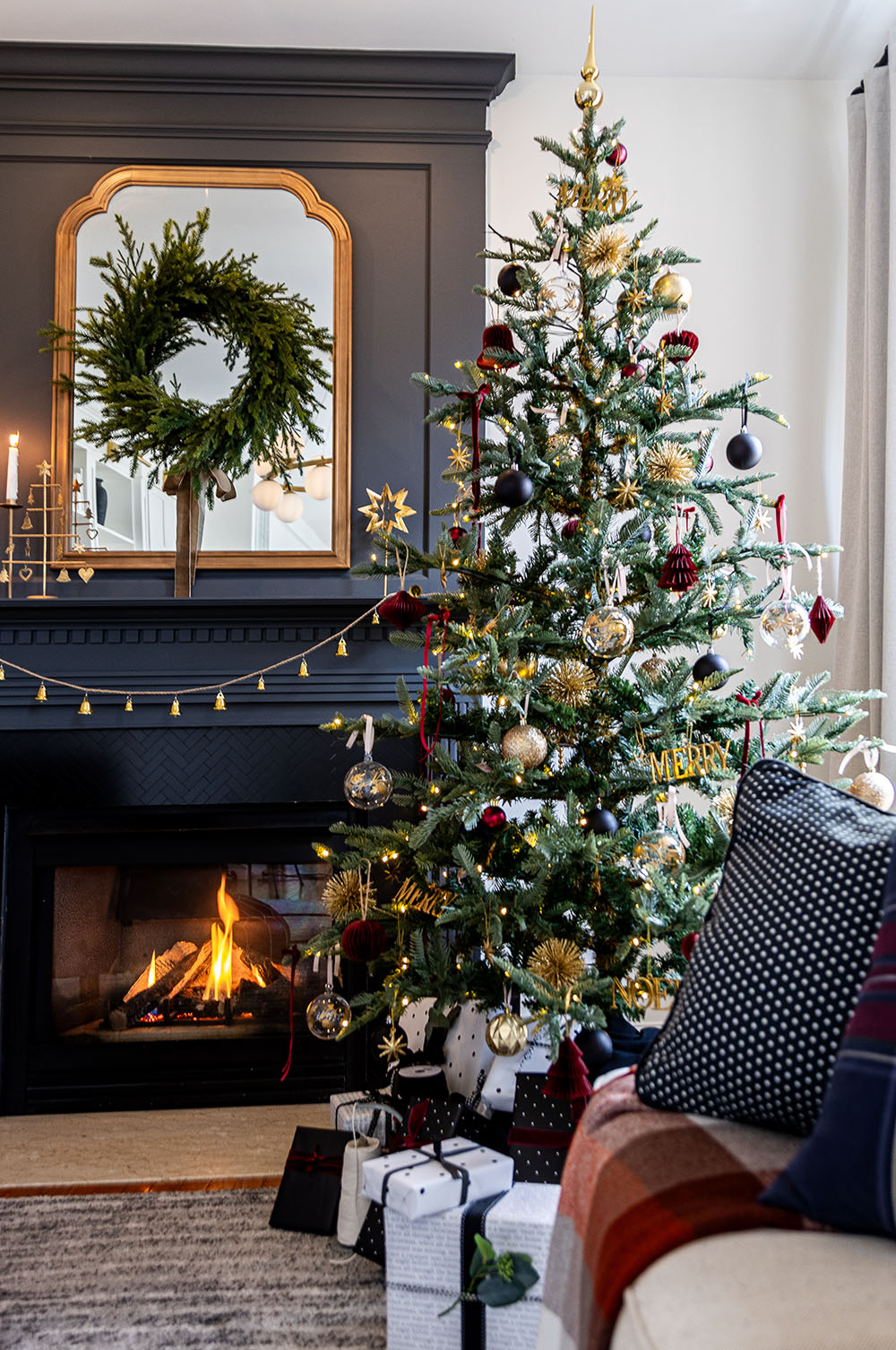
Red is back, and not in the candy-cane way. After several seasons of neutral holidays — cream, sage, brass — deep red has returned as the accent that makes a dark room feel alive. On a black tree it does something no metallic can: it signals Christmas instantly. Compare with Idea #23 — same black tree and dark grey fireplace, but all shine and no color.
10. Black and Sage Baubles on a Lush Faux Fir
Black ornaments on a dark green tree are a genuine risk. In a room with one lamp and no overhead light, they vanish and the tree looks half-finished. Two fixes: keep the wall behind it light, as it is here, and over-light the tree — figure roughly 100 bulbs per foot of height, which is more than most pre-lit trees come with. If you want a lower-maintenance version of the same restraint, see Idea #22.
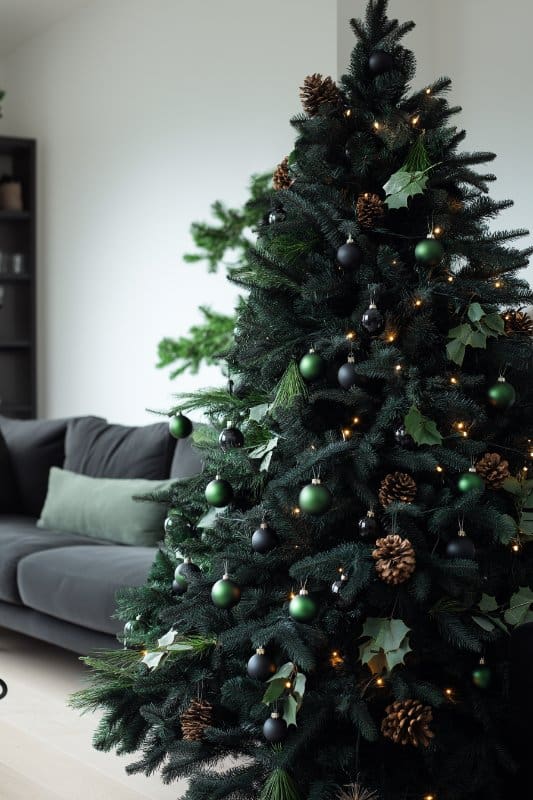
This palette works best in a room around 12 by 14 feet with 8- to 9-foot ceilings and a 7- to 7.5-foot tree. Wider rooms will swallow it unless you add a second light source. The reason is simple: dark-on-dark styling needs contrast, so a white or pale grey wall isn’t a preference here, it’s a requirement. Put this in a north-facing room with a navy wall and you’ll spend December wondering where your tree went.
11. A Plaid Fabric Poinsettia With a White Berry Center
- Cut five petal shapes in three graduated sizes from black, white, and red plaid fabric — two pieces per petal.
- Fuse each pair with iron-on interfacing and pink the edges so they don’t ravel.
- Layer the petals largest to smallest, rotating each layer a half-turn, and hot-glue at the center only.
- Finish with a cluster of small white matte berries and a hidden loop of wire for hanging.
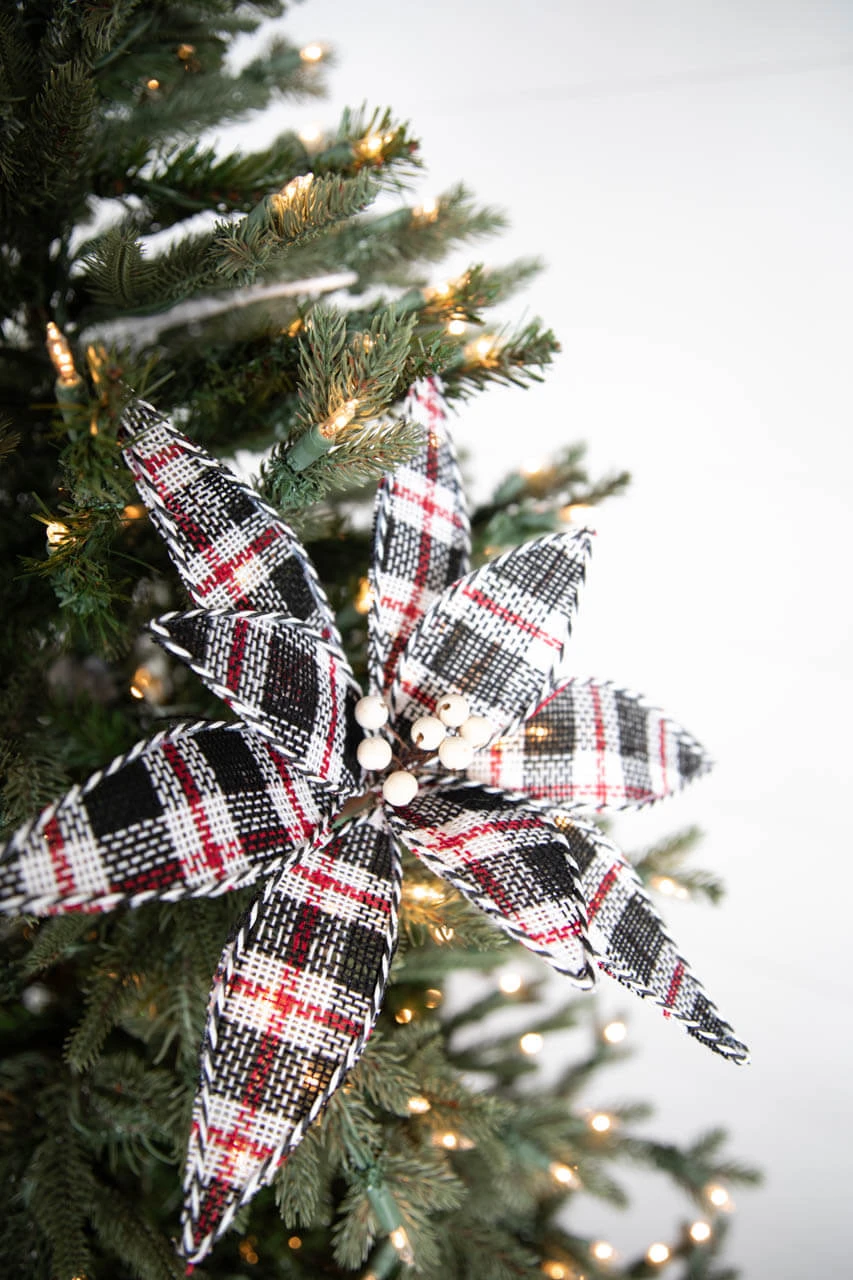
About 45 minutes per flower and roughly $8 in materials.
The white berry cluster at the center is the difference between a craft project and an ornament. Without it, the plaid petals have nowhere to focus and the flower looks unfinished from across the room. With it, you get a bright anchor point that makes the black-and-red plaid read as intentional rather than leftover. It also gives you a white note you can repeat elsewhere — gift wrap, a table runner, the tree skirt.
12. Silver and White Ornaments in a Warm Lit Built-In Niche
- Measure the niche width and depth — a full tree needs about 6 inches of clearance per side so branches aren’t crushed.
- Locate the outlets. If they sit behind the cabinetry, buy a slim extension cord and a timer before you decorate.
- Count what you own. Silver and white ornaments accumulate fast — most people already have 40 percent of this tree in a box.
- Commit to warm or cool bulbs for the whole room, because mixing them is the fastest way to make a refined tree look cheap.
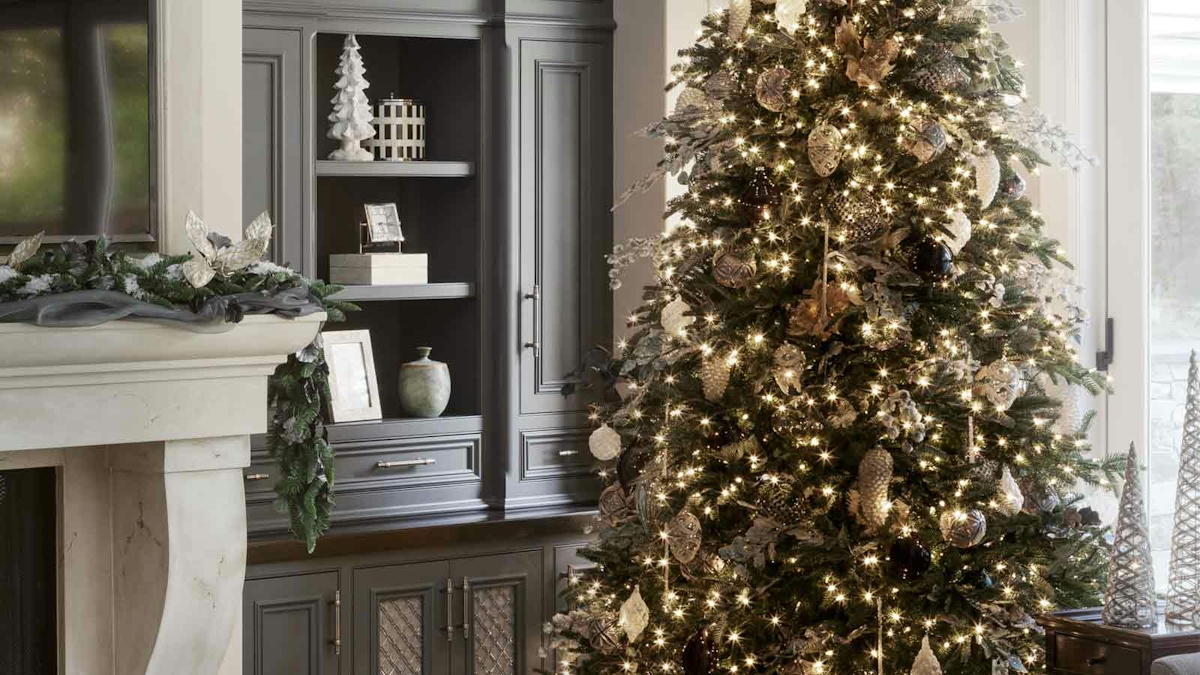
You don’t need custom millwork to get this. IKEA’s HAVSTA and BILLY lines in dark grey run $120–$300 for a two-door unit, and a plug-in picture light adds the warm wash along the shelves for about $30. Silver ornaments are among the most donated holiday items in America, so thrift stores and Facebook Marketplace are goldmines at $2–$5 a box. Compare with Idea #18, which solves the same display problem with plain white cabinetry.
13. A Black Bat Ornament Holding a Silver Bell
Novelty ornaments only work in clusters. Hang three or five of them in one eye-level zone — roughly 48 to 60 inches off the floor — rather than sprinkling them evenly around the tree. Grouped, they read as a deliberate vignette; scattered, they read as clutter. Use gold cord or 2-pound-test line so the hanger disappears, and set each one 4 to 6 inches in front of the branch tip so it catches light instead of sinking into the needles.
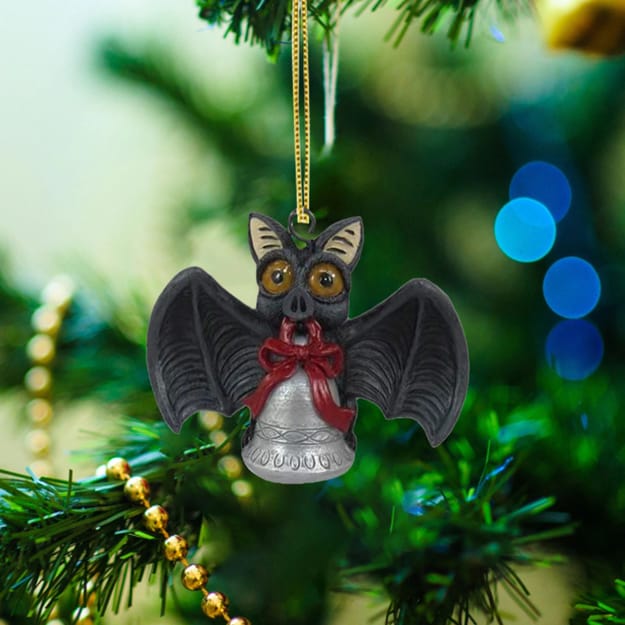
Humor is a design tool, and this bat is doing serious work. A black tree can turn solemn fast — all those matte baubles, all that restraint. One quirky ornament with round yellow eyes and a silver bell breaks the tension without breaking the palette. The scale gap helps too: a small, detailed, slightly ridiculous object against large simple spheres gives the eye something to investigate, and investigation is what makes people linger at a tree.
14. A Graphic Black-and-White Tree Skirt With a Ruffled Edge
The zone around the tree base follows its own ratio: about 70 percent dark ground, 20 percent white line work, and 10 percent warm glow spilling onto the floor. That’s why the light hardwood matters — it’s the fourth element, and it keeps the bottom of the tree from reading as one heavy mass. If you swap the abstract line pattern for a bold plaid, drop the line work to 10 percent and let the pattern carry more weight.
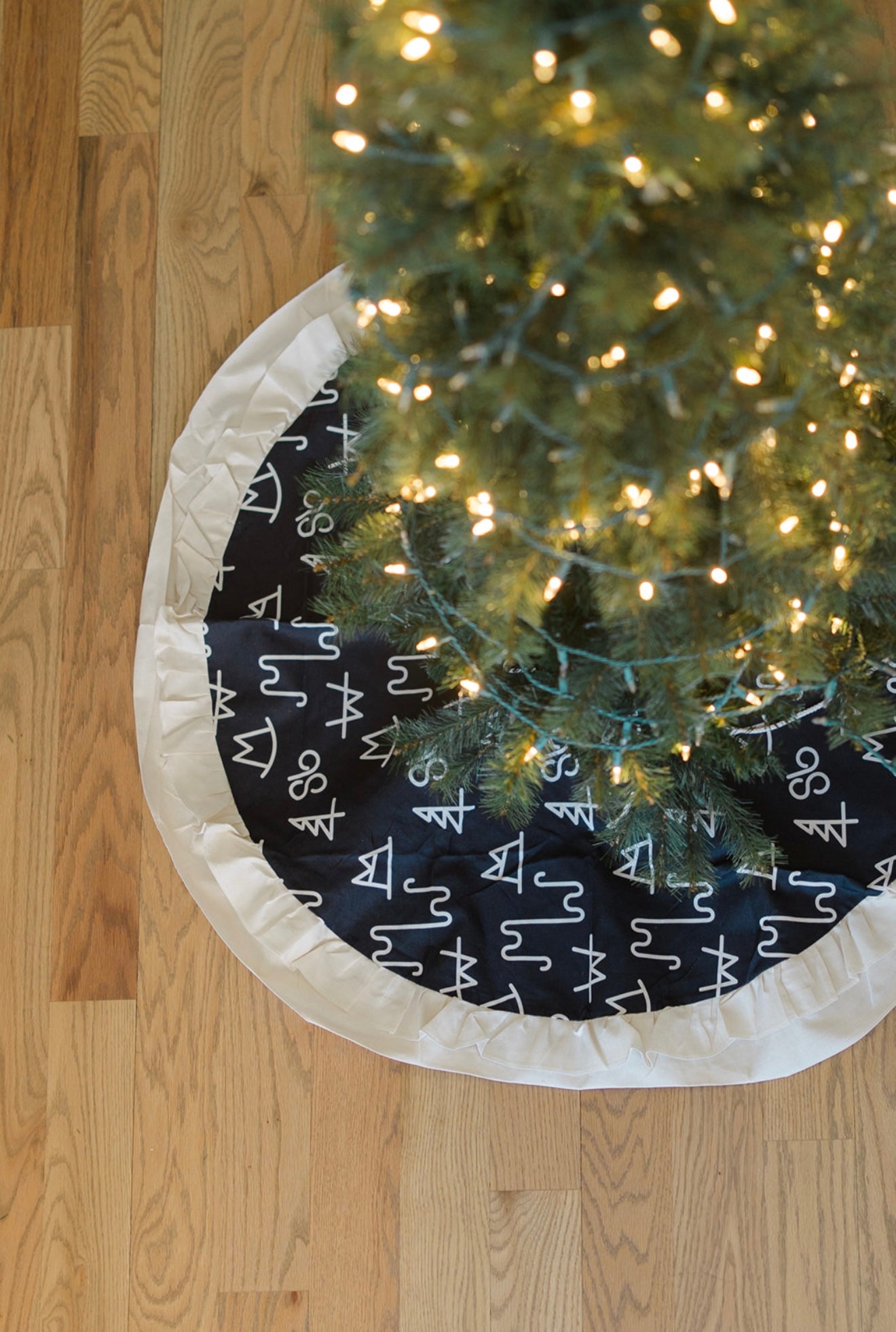
Skirt diameter should relate to tree width, not tree height. A full 7.5-foot tree with wide branches wants a 48-inch skirt; a slim or pencil tree takes a 36-inch; tabletop trees look best with 30 inches or less. Anything bigger and the skirt becomes the feature. This overhead view works because the ruffled edge sits about 4 inches past the branch line — enough to frame, not enough to dominate.
15. A Glittered Black Cone Tree on a Fluted Silver Base
The fluted silver pedestal is what turns this from a craft-store cone into a piece of decor. Without it, you’d have a sparkly black shape sitting directly on a shelf — pleasant, forgettable. With it, the tree gets a foot, a shadow line, and a silhouette that reads as a small sculpture. The matching silver finial on top closes the composition. If you buy one tabletop tree this year, spend the extra $10 on the base rather than the glitter.
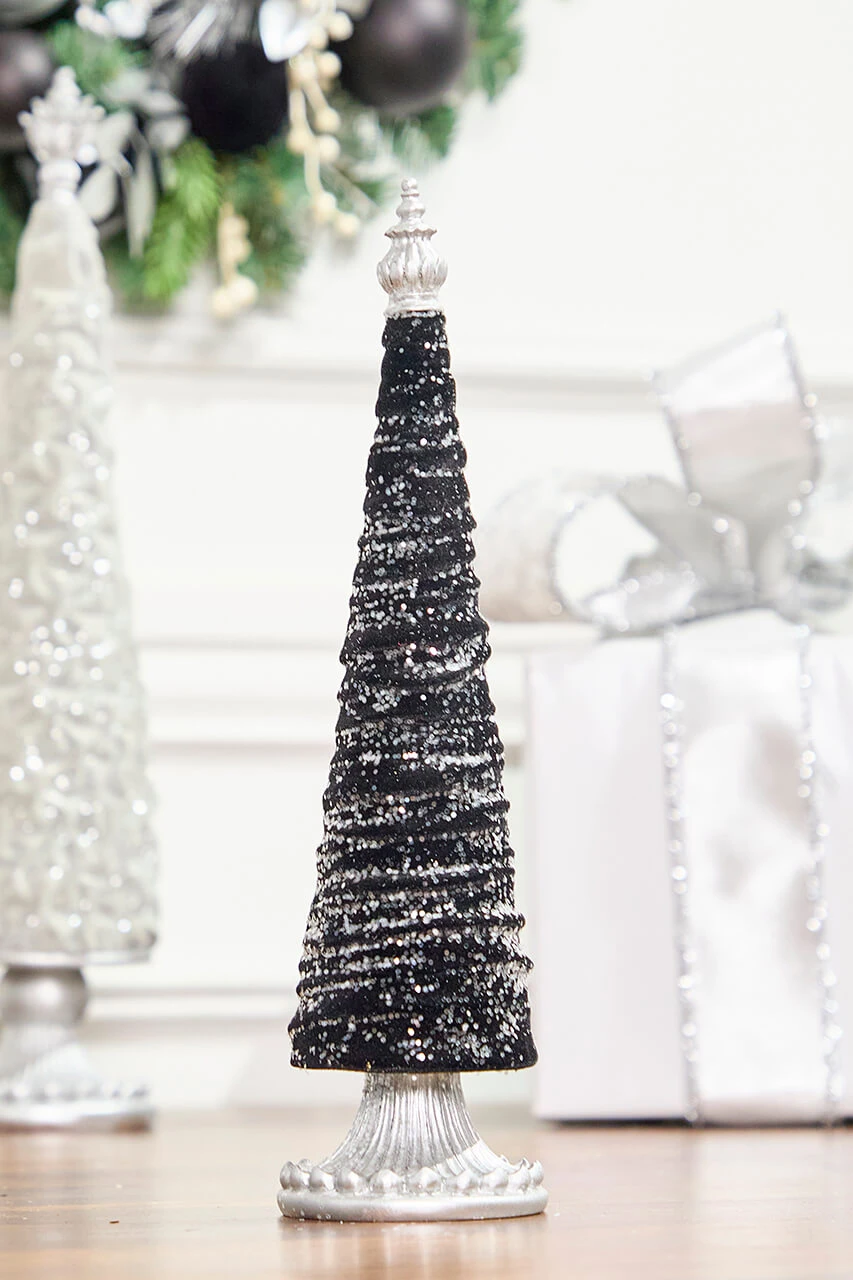
Tabletop trees have quietly become the fastest-growing category in holiday decor, and it’s easy to see why. Fewer people are doing one big tree and more are building small scenes — a trio on a console, a vignette on a bookshelf, a single cone beside a stack of gifts. Call it the miniature-world effect. Glam black specifically holds up because it photographs against almost any wall.
16. Flocked Branches Hung With Glass Icicles
Flocked trees shed. Expect a light dusting of white on the floor every time you move it, and don’t try to compress one back into a narrow box — the flocking cracks and flakes. Glass icicles need a gentle hand too: hand-wash in lukewarm water with a drop of dish soap, dry immediately, and skip the dishwasher entirely. With careful storage a good set lasts decades, which is why older twisted-glass pieces sell for $8–$20 each.
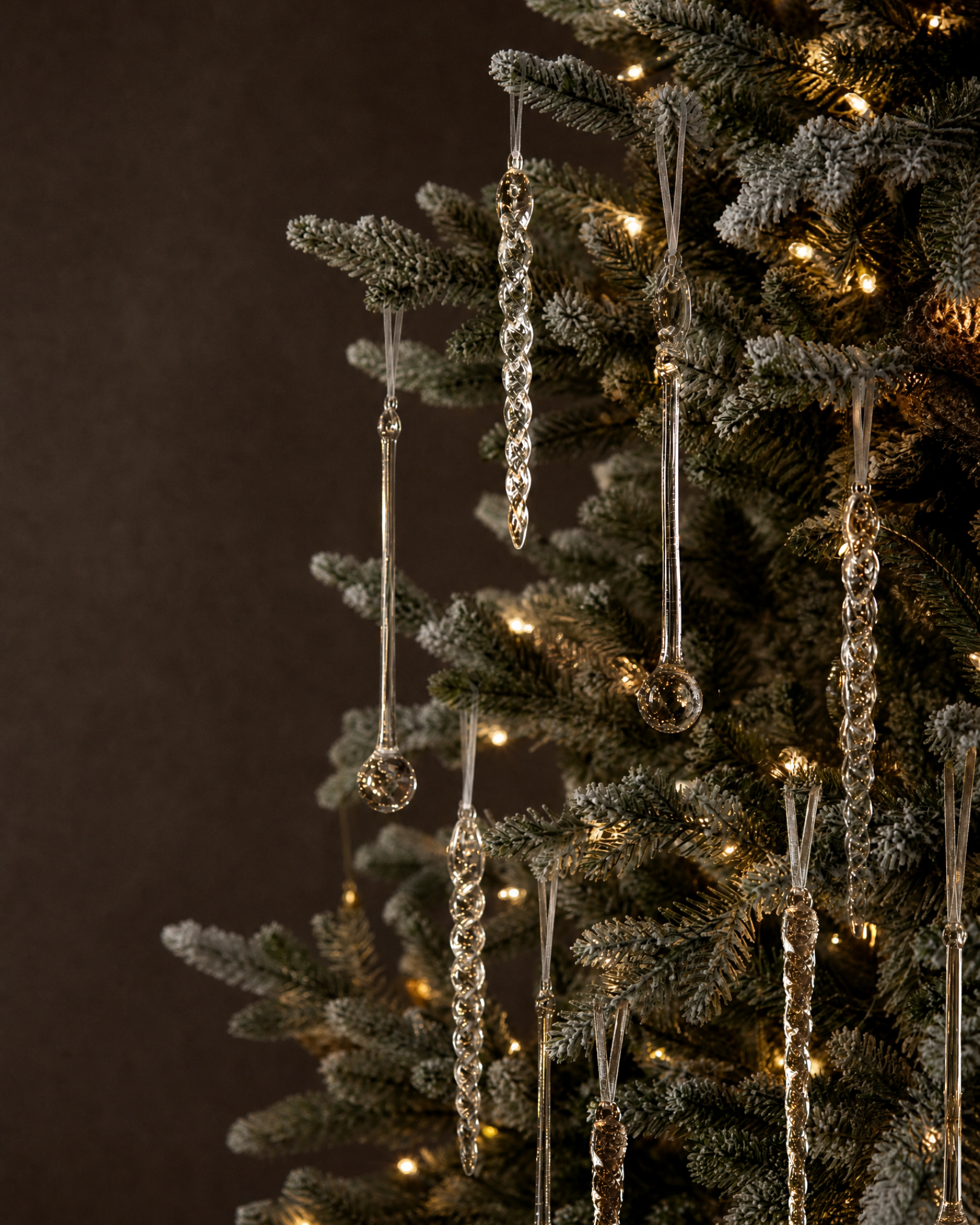
- Start at the back of the tree and work forward so you’re never reaching over finished areas.
- Hang the longest icicles 4 to 6 inches inside the branches, not on the tips, so the light behind them glows through.
- Vary lengths by location: short ones high, long ones low and toward the front.
- Step back every 10 ornaments — from three feet away you’ll spot the clumps instantly.
About an hour for a 7-foot tree.
17. A Gothic Cathedral Ornament With Stained Glass and Tiny Jewels
Architectural ornaments are heavy, and weight is what breaks branches. Hang anything over 3 ounces within 6 inches of the trunk on a branch at least a half-inch thick, and use 6-pound-test monofilament rather than a metal hook that can slip. Rotate the position each season so one side of the tree doesn’t permanently droop. If you can push a branch tip down an inch with your finger and hear nothing snap, it’ll hold.
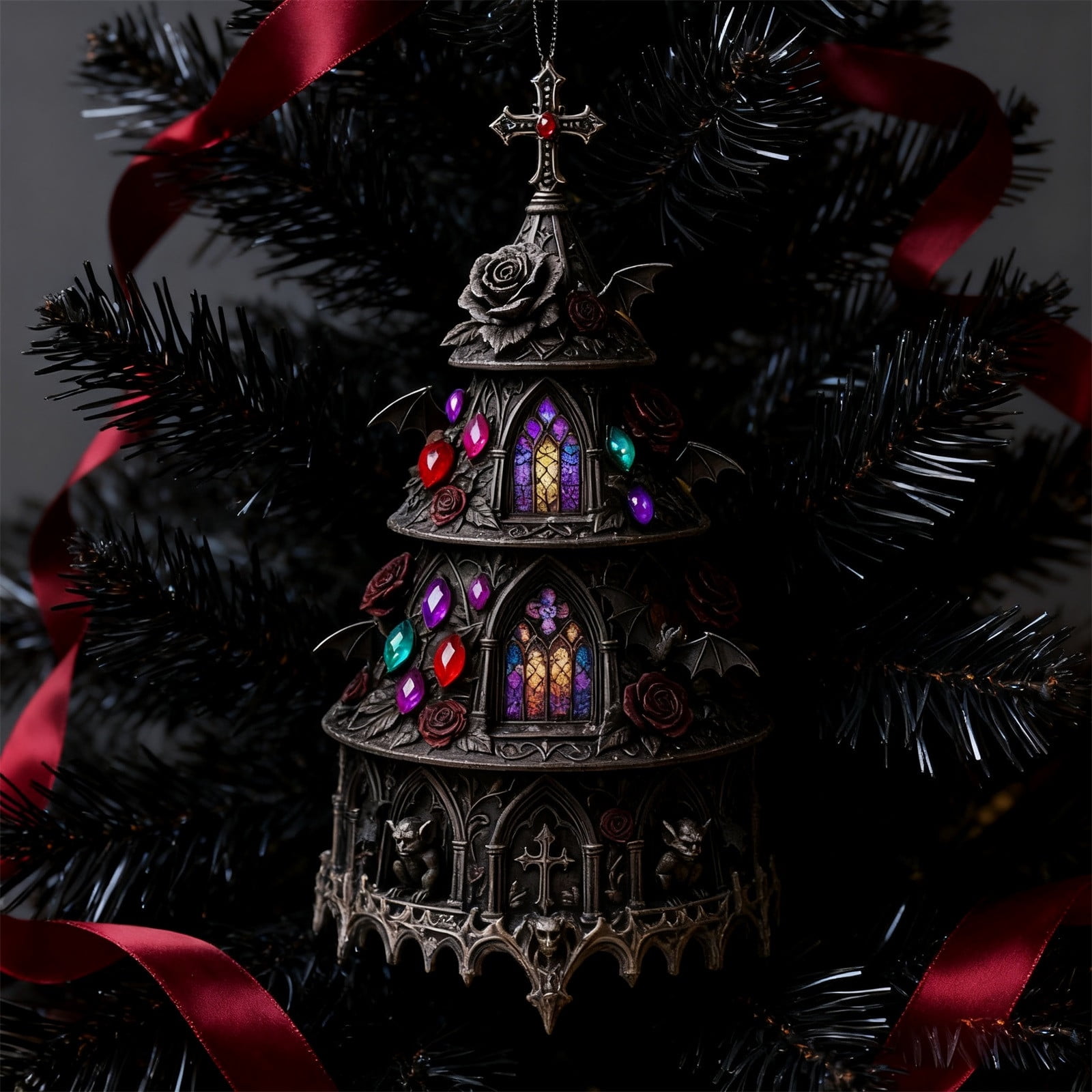
Collector ornaments like this one run $40–$80 each, and the details that make them beautiful — the little stained glass windows, the carved roses, the faceted jewels — are also the parts that chip. Don’t hang them at hip height in a hallway, don’t let them touch each other, and store each in its own tissue-lined box rather than tossing them in a bin. Nothing is sadder than a $60 ornament with a missing bat wing.
18. A Nine-Foot Black Tree With Almost Nothing On It
- 9-foot black artificial tree: $250–$700
- Matte black ball ornaments (40–60 pieces): $40–$140
- Tree collar or plain black fabric wrap: $40–$120
- Timer, extension cord, and spare bulbs: $20–$40
- Framed wall art: $60–$250
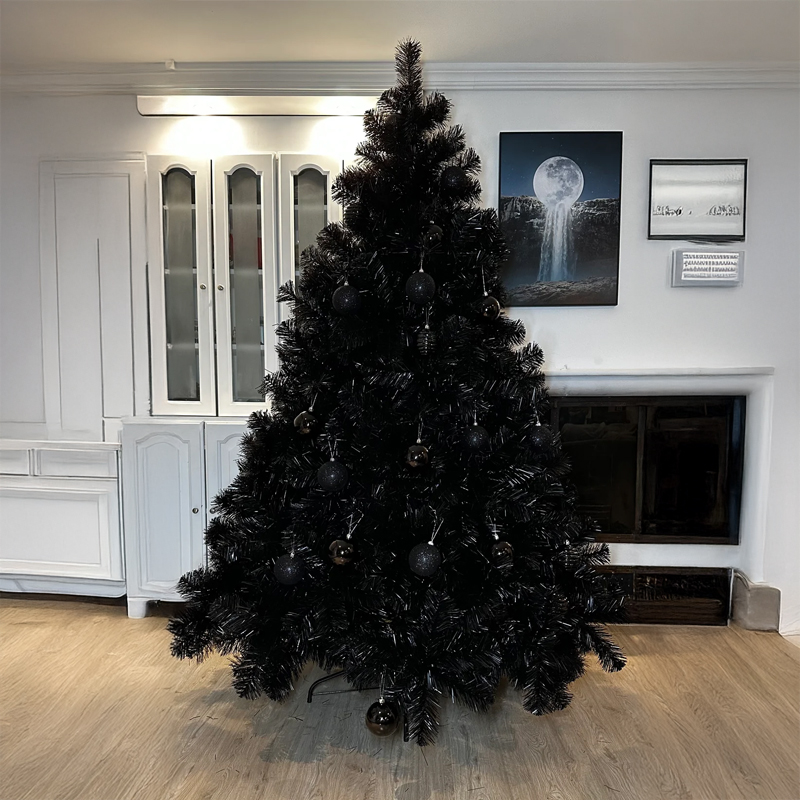
Total: about $410–$1,250. Budget alternative: a 7.5-foot black tree from Walmart ($89–$130), three boxes of matte black baubles from the dollar store, and a canvas drop cloth wrapped at the base — roughly $180 for the same silhouette.
This is a restraint exercise, and restraint is harder than abundance. The ornaments are the same color as the tree, so what you actually see is a black silhouette against a white wall, with light catching the spheres at slightly different angles. Emptiness is doing the decorating. The discipline to leave two-thirds of the branches bare is the entire skill here.
19. Black Embroidery Hoops Stitched With Holiday Scenes
Embroidery hoops cost about $1 each in three-packs at craft stores, and a quarter-yard of black linen is $4–$8. If you already embroider, this tree is nearly free — only your time. If you don’t, thrift stores and estate sales turn up finished needlework constantly for $2–$6, and a black metal reindeer figurine like the one here shows up at Goodwill every December for under $10. Flocked trees from Target start around $60 and give you the snowy base layer.
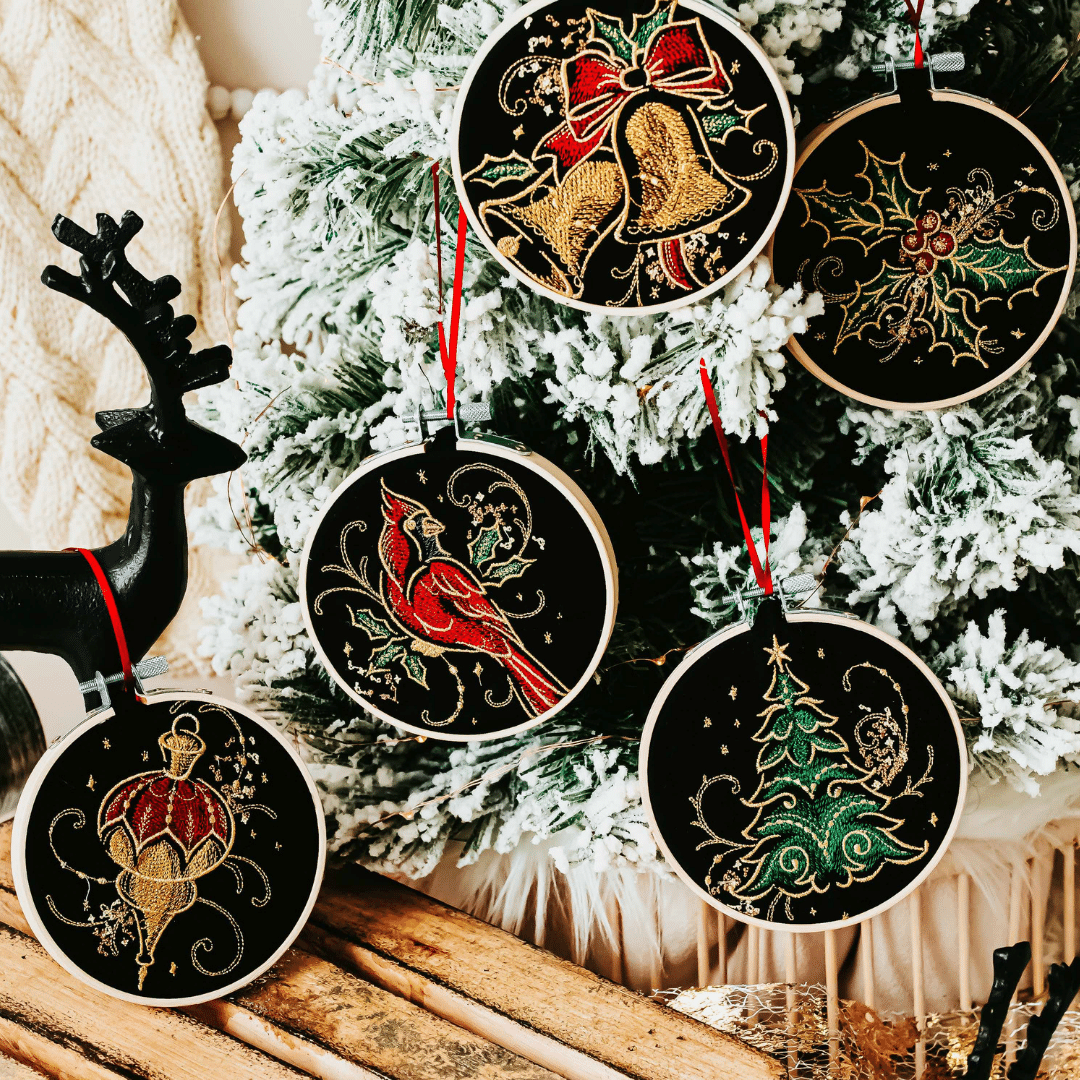
Hoops are heavier than they look, and on a flocked tree they’ll drag a light branch down within a week. Hang them close to the trunk or on wired branches, and space them so they can’t knock into each other — the wood rims clank, and it’s noticeable in a quiet room. They’re also dust magnets; a soft brush every few weeks keeps the fabric from going grey. With toddlers or cats in the house, hang them above 48 inches.
20. Frosted Bottle Brush Trees on Dark Veined Marble
This is a vignette, not a scene, and it lives on a surface 14 to 18 inches deep — a console, a marble side table, a dresser top. The backdrop matters as much as the surface: a dark tapestry or moody print gives the little trees something to sit against, and it’s the reason this feels intentional even in a small apartment. Two trees at 6 and 9 inches are plenty. Any more and it becomes a collection instead of a composition.
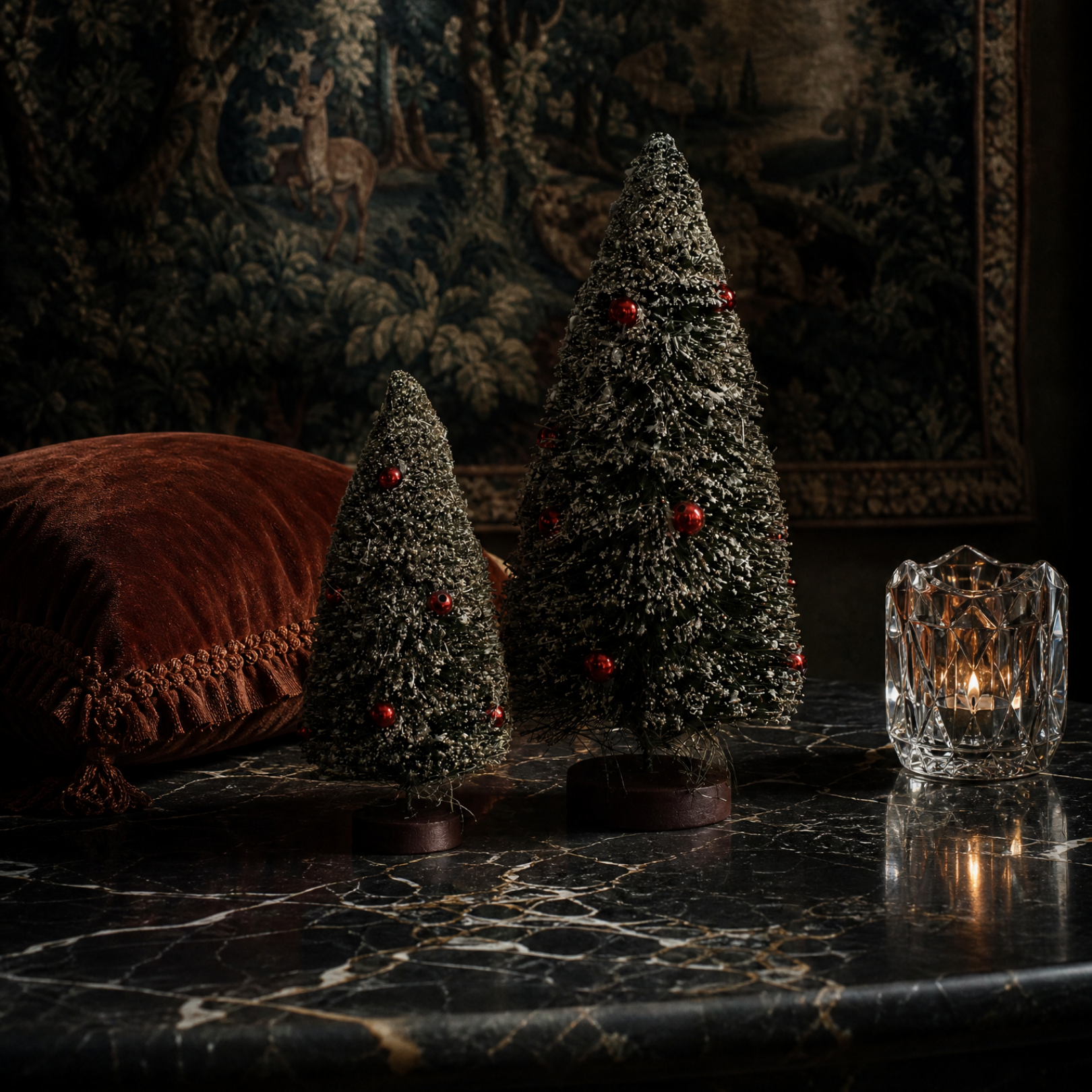
The ratio runs about 60 percent dark — marble, tapestry, the green-grey of the bottle brush — then 25 percent deep green foliage, 10 percent rust from the velvet pillow, and 5 percent warm gold from the candle flame. That 5 percent is small but it’s the whole point: one live light source in a dark arrangement. Trade the rust pillow for charcoal and this gets colder and more formal.
21. Checkerboard Baubles and an Oversized Santa Topper
White trees show everything — scuffs, dust, the faint grey line where branches rub together. If you go this route, budget for a lint roller and a soft brush, and plan to wipe down the frame at the start of every season. The high-contrast decorating here also means every gap is visible, so you’ll need more ornaments than you think: roughly 100 pieces for a 7-foot tree this densely covered. It’s a showpiece, not a set-and-forget tree.
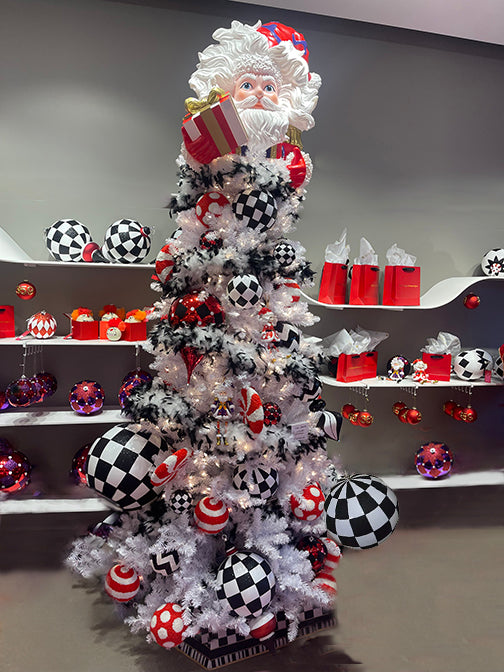
The oversized sculptural Santa at the top is the reason this tree works. With a normal star, the checkerboard and candy stripes would still be fun, but the tree would be a heap of patterns. The Santa gives it a subject — it reads almost as a stage set, with the nearby shelves carrying the same motifs. And notice the base repeats the checkerboard: that’s the detail that makes the whole thing feel designed rather than assembled.
22. Green Lights Woven Through a Bare Black Tree
Almost nothing is happening here, and that’s the point. The tree is black, the wall is white, the floor is wood — three flat fields, no patterns, no ornaments. What makes it interesting is the light color: a soft green glow inside black needles is unexpected, slightly eerie, and completely magnetic at night. Scale matters too. A tree this size against a blank wall reads as a silhouette, and silhouettes need empty space to work.
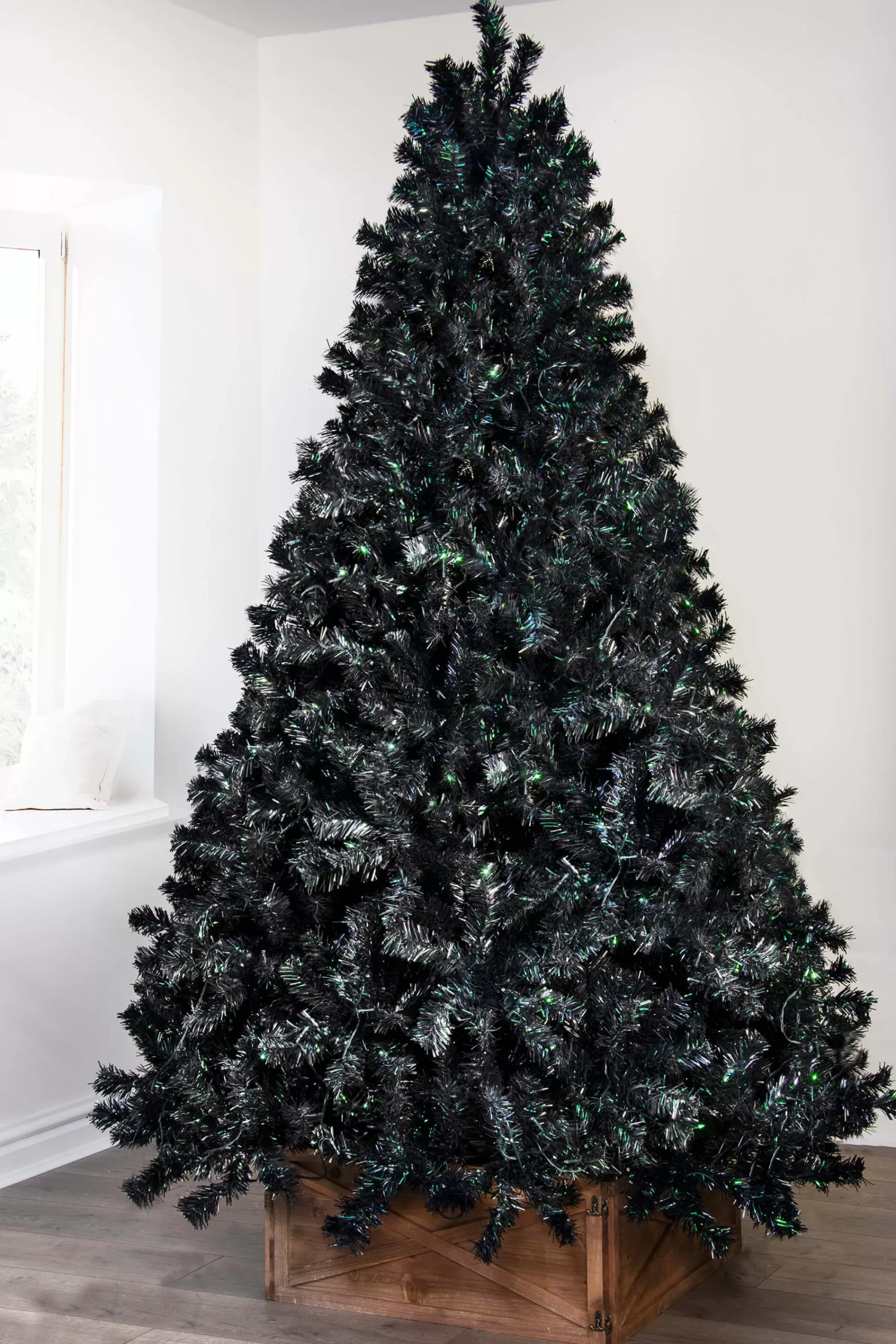
Wooden crates are everywhere. Walmart sells them for $12–$20, craft stores run them three for $30, and Facebook Marketplace is full of wine crates at $5–$15 that look even better because they’re already weathered. Green string lights cost $9–$18 a strand and you’ll want two or three for a tree this size. Whole setup, minus the tree: under $75. If you’re weighing a green tree instead, see the dark-on-dark scheme in Idea #10.
23. Gold and Silver Starbursts on Bare Black Branches
Metallic-on-black has been the most-saved holiday look for a couple of seasons running, and retailers have responded with more gold and silver ornament sets and fewer novelty designs. Part of the appeal is that it’s forgiving — metals reflect whatever light you have, so a black tree looks expensive in a room with one lamp. Part of it is longevity. Gold and silver don’t date the way a themed tree does.
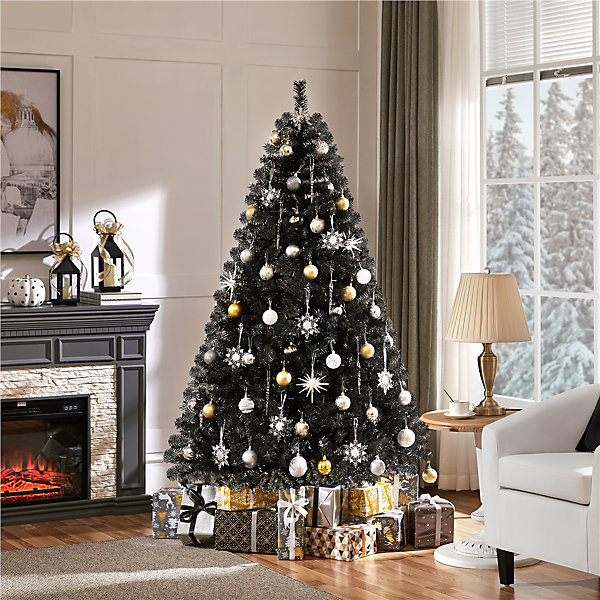
Pick a dominant metal and stick to a rough 70/30 split. Here it’s about 70 percent gold with 30 percent silver, which is why the arrangement feels cohesive instead of cluttered. Repeat that ratio in three places: the ornaments, the ribbon or cord, and the wrapping paper. Starbursts are the wildcard — use four or five, all in the dominant metal, and place them at the outer tips where they’ll catch side light.
24. Dark Blue Paneling, a Toy Train, and Wreaths in the Arched Windows
Call it 50 percent dark blue from the walls and ceiling, 30 percent green tree, 15 percent warm light, and 5 percent red from the ribbon on the wreaths. The ceiling being paneled and painted the same blue is what makes the room feel like a box of night sky, and it’s why the tree reads brighter than it actually is. Swap the blue for deep green and you keep the structure. Swap it for charcoal and it goes formal.
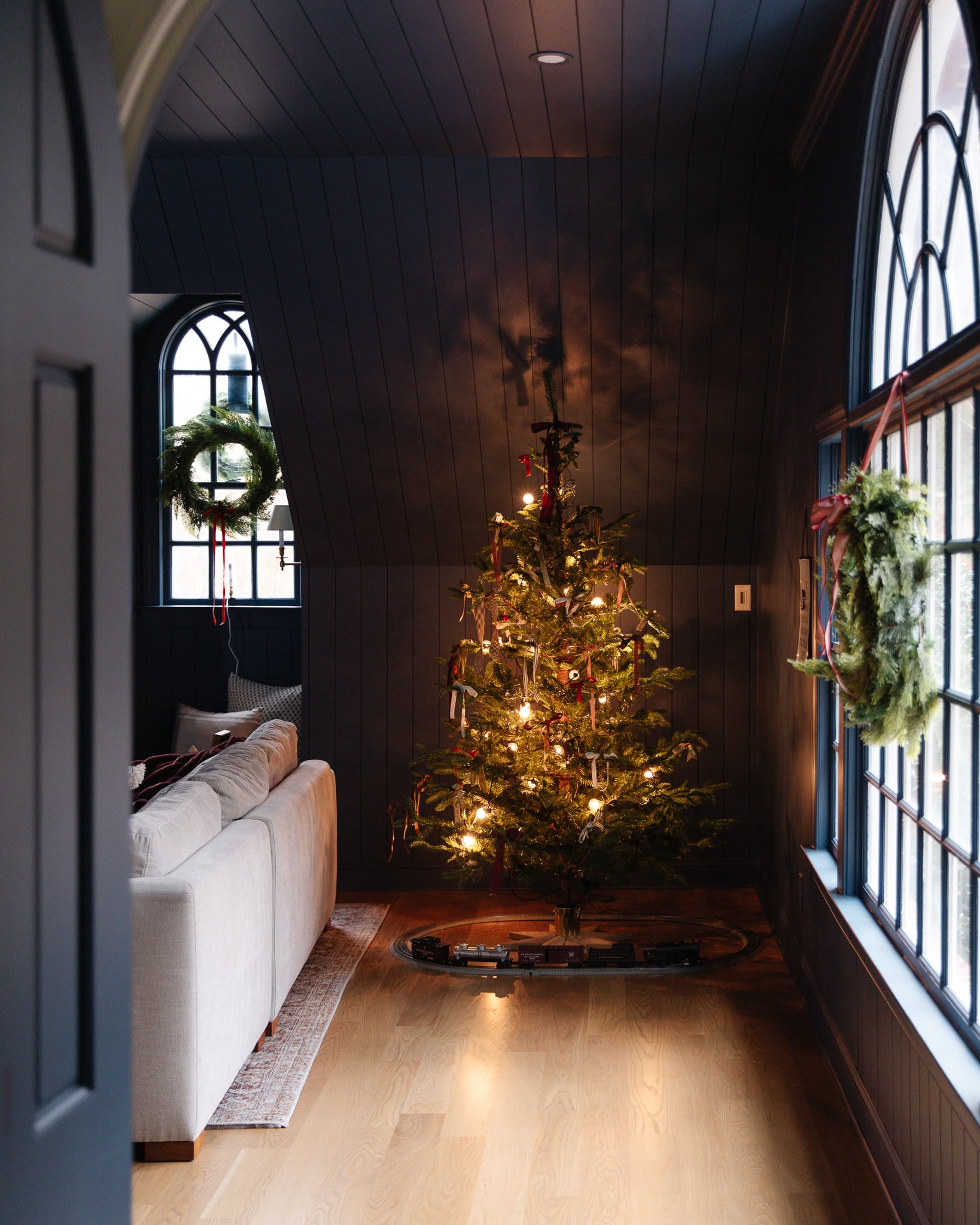
A paneled, painted ceiling needs height — 9 feet minimum, and 10 or 11 is better, because the color makes low ceilings feel lower. The room itself should be at least 14 by 16 feet to carry the dark field without feeling like a tunnel; a toy train needs a clear 24-inch radius around the tree base, so measure before you buy track. For a smaller room with the same moody instinct, Idea #4 gets you there without the paneling.
One Black Tree, Twenty-Four Ways to Make It Yours
Pick the palette that matches the room you actually live in — monochrome if you like calm, jewel tones if you like shadow, candy colors if you want the tree to be the party. The lighting rules and the scale math stay the same no matter which direction you go, so start there and let the rest follow.
📌 Pin your favorite version now so you can find it again when the ornaments come out of storage.