You know that feeling when the tree is up, the lights are glowing, and the base still looks like an afterthought? That is usually the moment a quilted tree skirt stops being a nice-to-have and becomes the thing that pulls the whole room together.
We spent serious time browsing Etsy, Target, West Elm, Pottery Barn, and Amazon to bring you only what is worth your attention this year — from a $24 handmade patchwork skirt to a $189 quilted velvet showpiece.
Inside you will find 28 curated ideas covering traditional red-and-white patchwork, rustic woodland appliqué, quiet neutral quilting, and handmade crochet, with budget and luxury versions compared side by side.
In 2026, quilted tree skirts are having a moment because of the make-it-last shift on Pinterest — saves for handmade and heirloom-style holiday decor are way up, and quilting is the trend quietly anchoring it all.
Save this post now — you will want it when you are ready to shop.
1. Red Quilted Velvet Tree Skirt with a Crisp White Border
The white border is doing all the heavy lifting here. Without it, a solid red velvet skirt under a lit tree reads as one warm blur — tree, skirt, and carpet all melt into the same red-orange glow against that beige flooring. That single band of white gives the base a defined edge, so your eye registers the skirt as an object instead of a shadow. It is a two-dollar design decision with a two-hundred-dollar effect.
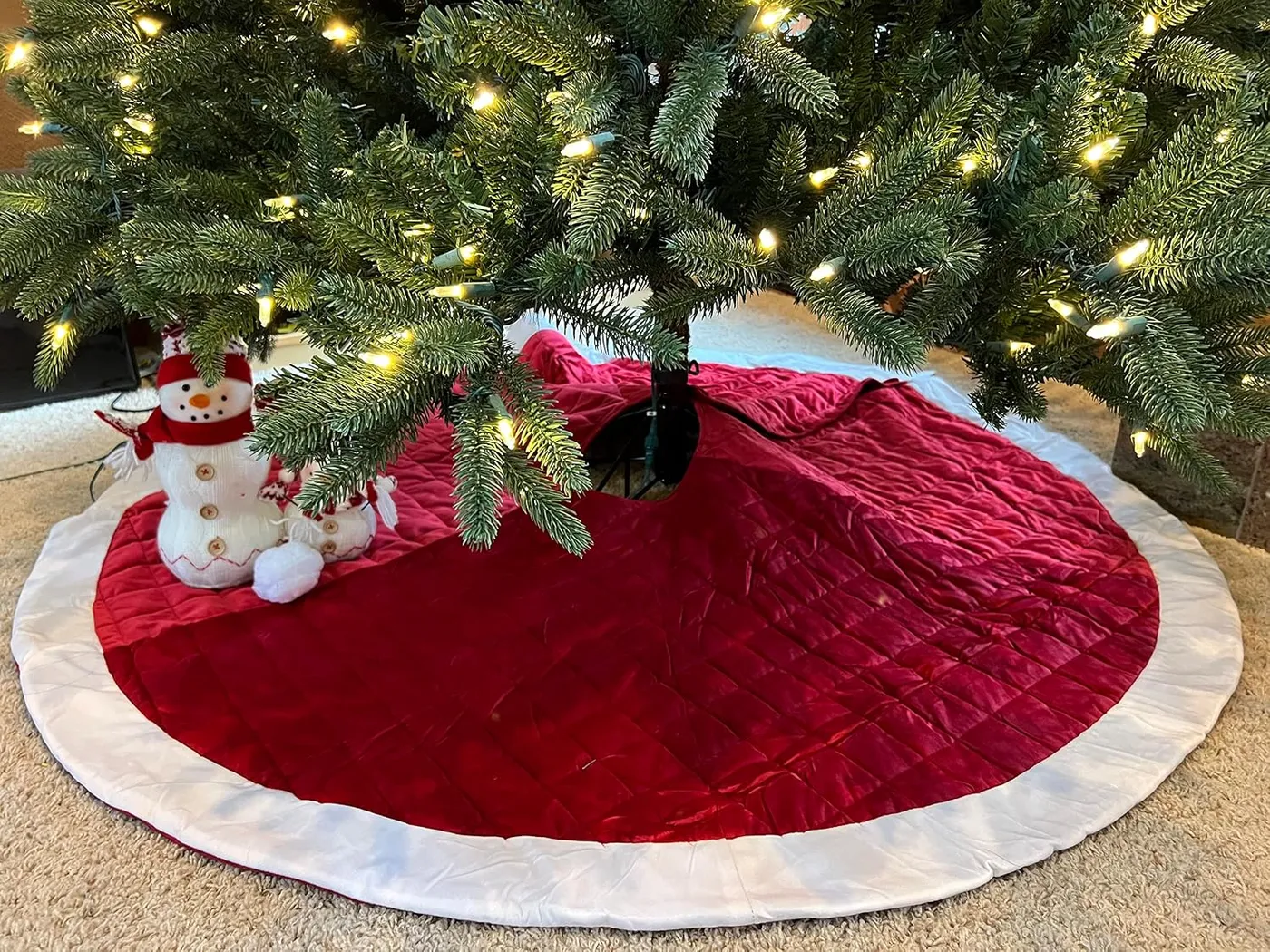
- Quilted red velvet tree skirt, Etsy or Pottery Barn: $60–$180
- Pre-lit 7.5 ft tree with warm white bulbs: $150–$500
- Knit snowman figurine or a similar base character: $15–$45
- Wrapping paper, ribbon, and wrapped fillers: $25–$60
Total: roughly $250–$785 — though if the tree is already yours, you are looking at $100–$285 for the base setup alone. The budget route: a plain red velvet round from Target plus a strip of white cotton quilt binding hand-stitched along the edge gets you 90% of this for under $45.
2. Textured White Quilted Skirt with Red Whipstitch Trim
On a light chevron floor, a white skirt can vanish into the wood. The fix is a 3/8-inch hand whipstitch in saturated red along the outer edge — thick enough to read from across the room, thin enough to look like a detail rather than a stripe. Second rule: your skirt should sit 6 to 8 inches wider than the widest branch spread, or the tree looks like it is standing on a coaster. This is the exact inverse of Idea #1, where white frames red instead of red framing white.
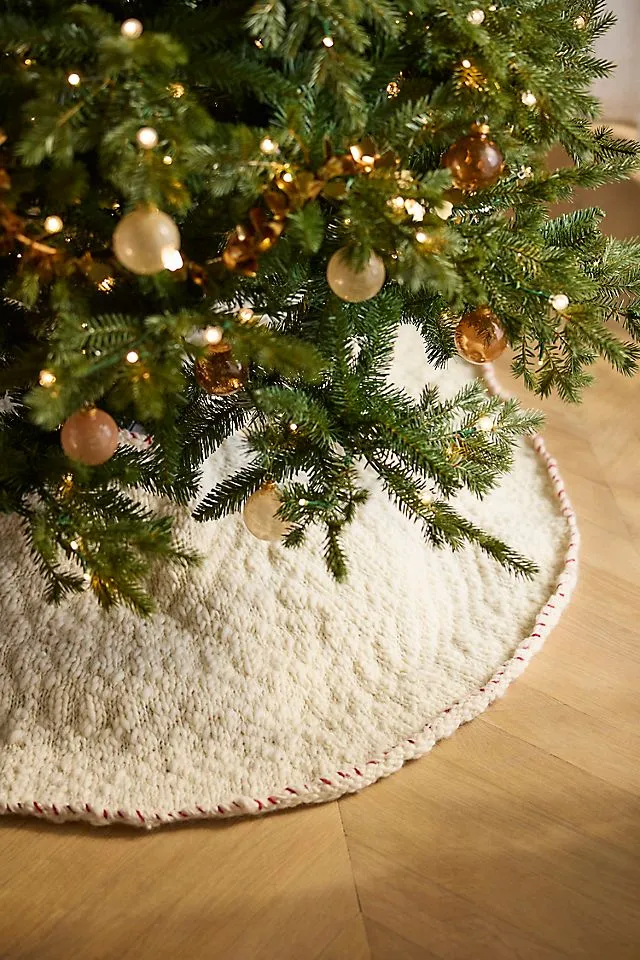
- Cut quilting cotton into a full circle roughly 52 inches across, using a length of string as a compass.
- Layer it over cotton batting and a backing, then pin every 6 inches so nothing shifts.
- Stitch diagonal lines 2 inches apart across the whole circle — this creates the nubby dimensional texture.
- Trim the raw edge and bind it with a red strip cut 2.5 inches wide.
- Fold the binding to the back, then hand-sew the visible edge for that whipstitched look.
About 4 hours of work. Materials run $28–$40 at a fabric store.
3. Taupe Faux Fur Skirt with Bow-Tied Slit Closures
Faux fur is the most forgiving skirt material in the room and also the messiest. Inexpensive fur sheds for the first three weeks and again every time a dog brushes past; better quality faux fur (look for a knit backing, not a woven one) sheds far less. Vacuum it on the lowest setting with a brush attachment, never a beater bar, and spot clean with a damp cloth instead of washing it. If you have a crawling baby or a border collie, this look will test your patience.
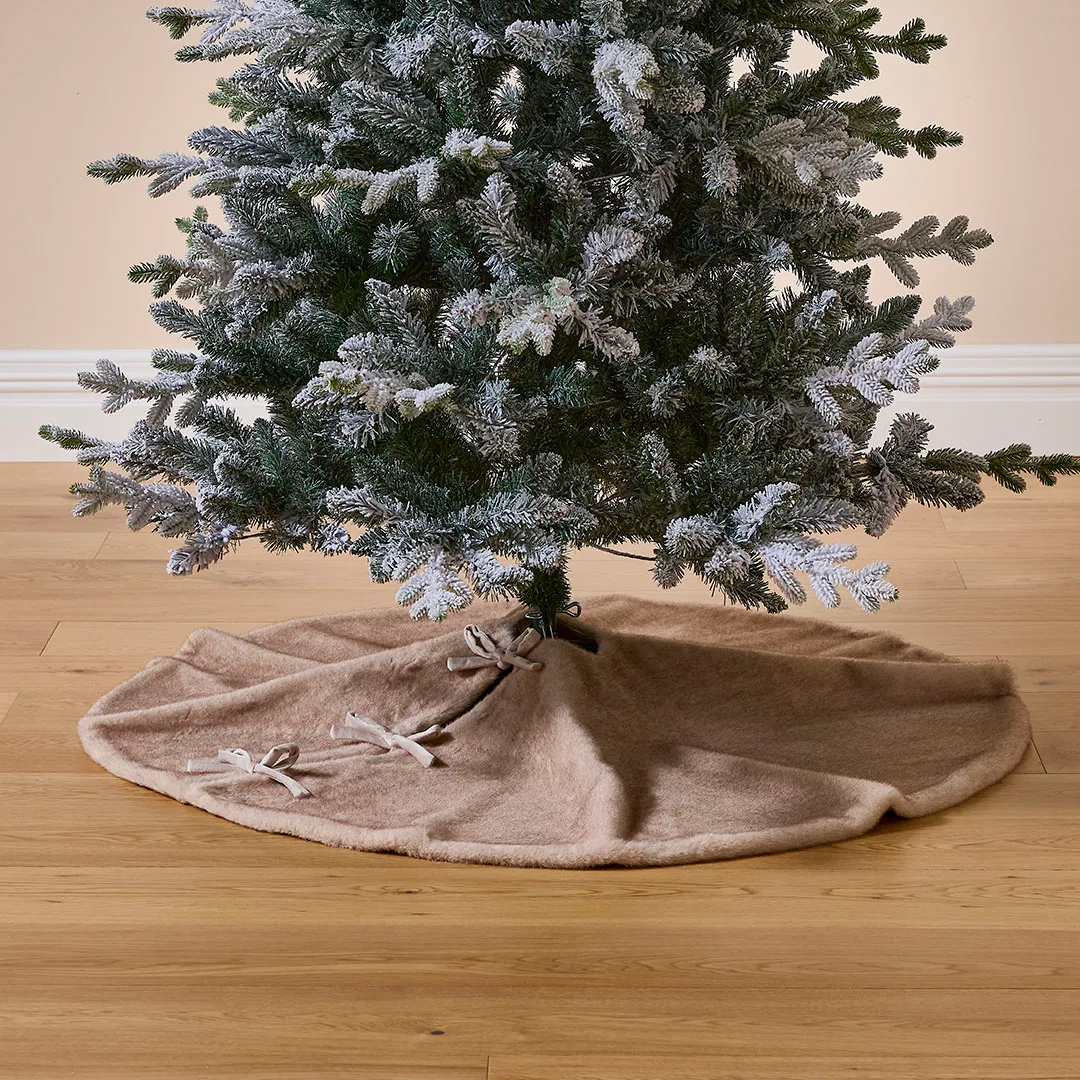
70% warm neutral base + 20% frost white + 10% deep pine green. The taupe fur and light wood floor carry the neutral weight, the frosted branches supply the white, and the actual green of the tree is the only real color in the shot — which is why it feels calm instead of flat. Swap taupe for ivory and the room turns brighter and more coastal; swap it for charcoal and you are suddenly in a modern Scandinavian cabin. Keep the 70/20/10 ratio and the mood stays intact.
4. Red and White Patchwork Geometric on Dark Plank Floors
Three things are working together. First, contrast of temperature — crisp white and true red against rich dark brown wood reads far more expensive than the same skirt on pale laminate. Second, scale: the patchwork squares stay small and dense instead of oversized, which keeps the pattern from competing with the ornaments above. Third, the red binding echoes the red blocks, so the edge looks intentional rather than like a finishing afterthought.
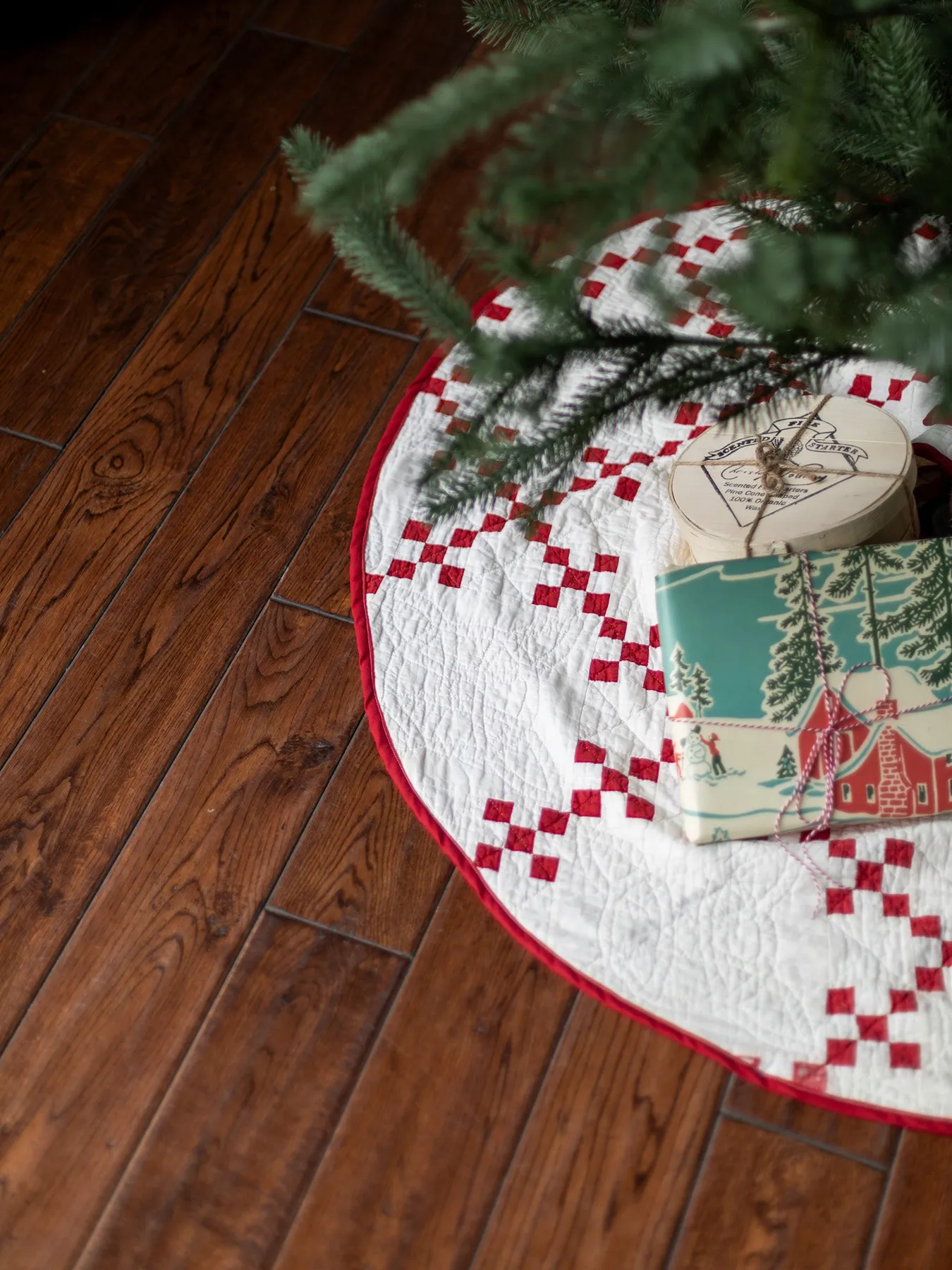
You do not need a $150 handmade patchwork skirt to get this. A plain white cotton round from IKEA or Target ($20–$30) plus a quarter-yard bundle of red and white quilting cotton ($12) gets you the same geometry — cut squares, arrange them in a grid, and appliqué with a simple zigzag stitch. Facebook Marketplace is also quietly full of vintage quilted skirts from the 80s and 90s for $15–$40, and honestly they are often better made.
5. Quilted Striped Skirt with a Gathered Ruffle Edge
Stripes and ruffles are everywhere this season because they solve a real problem: a plain skirt looks flat, but a busy print fights the ornaments. Narrow vertical stripes give you pattern without noise, and the diamond quilting adds just enough dimension to catch the tree lights. Three reasons this pairing keeps working:
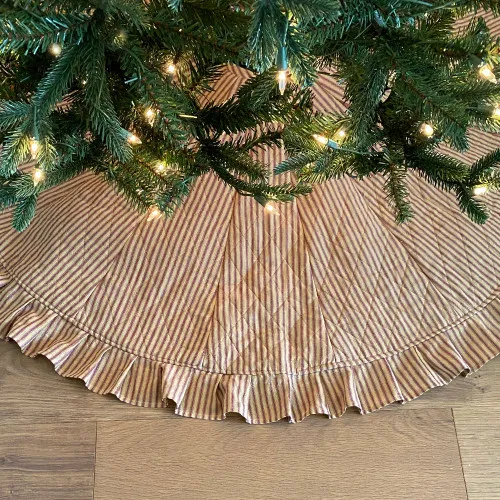
- Narrow stripes visually elongate the base instead of widening it
- A gathered ruffle adds softness under hard plastic branches
- Beige-and-rust stripes read as neutral from across the room
Gather your ruffle at 2.5 to 1 — meaning you need 2.5 times the skirt circumference in fabric strip. Less than 2:1 and the ruffle looks like a wonky hem; more than 3:1 and you are wasting fabric and bulking the skirt off the floor. On a 52-inch skirt that is roughly 4 yards of 4-inch-wide strip. Baste 3/8 inch from the raw edge, pull the bobbin thread, and pin it in quarters before you sew.
6. Red, Green, and Patterned Pieced Skirt in Pointed Segments
- Cut 12 identical wedges — a 30-degree angle each gets you a full circle.
- Alternate solid red, solid green, and a holiday-patterned white, then chain-piece the wedges in pairs.
- Press every seam open as you go; skipping this is why pieced skirts look lumpy.
- Layer with batting and a backing, then quilt 1/4 inch on either side of every seam.
- Bind the outer edge and add two fabric ties at the opening.
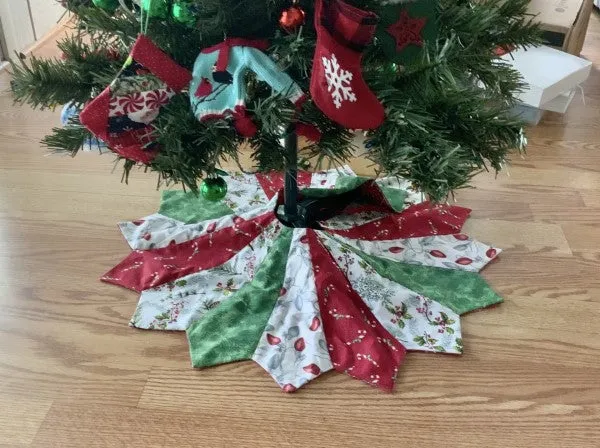
Budget 5 to 6 hours and about $35 in materials. This is a genuine weekend project, not an afternoon one.
The pointed segments are the whole trick. Swap those same red, green, and patterned fabrics into squares and the skirt loses its momentum — it goes from starburst to checkerboard. The points pull your eye outward and up into the tree instead of letting it settle flat on the floor. If you are piecing your own, cut the points sharp rather than blunt; a slightly longer point on a 52-inch skirt makes the base feel bigger than it is.
7. Star-Shaped Crocheted Skirt with Concentric Color Bands
60% deep forest green + 25% maroon + 15% white. The green carries the visual weight and matches the tree, maroon keeps it from looking like a school uniform, and white peeks through in the scalloped edging to lift the whole thing off the floor. Rotate maroon to mustard and it turns vintage-70s; rotate it to slate blue and you are firmly in a coastal cabin. The star shape stays constant either way.
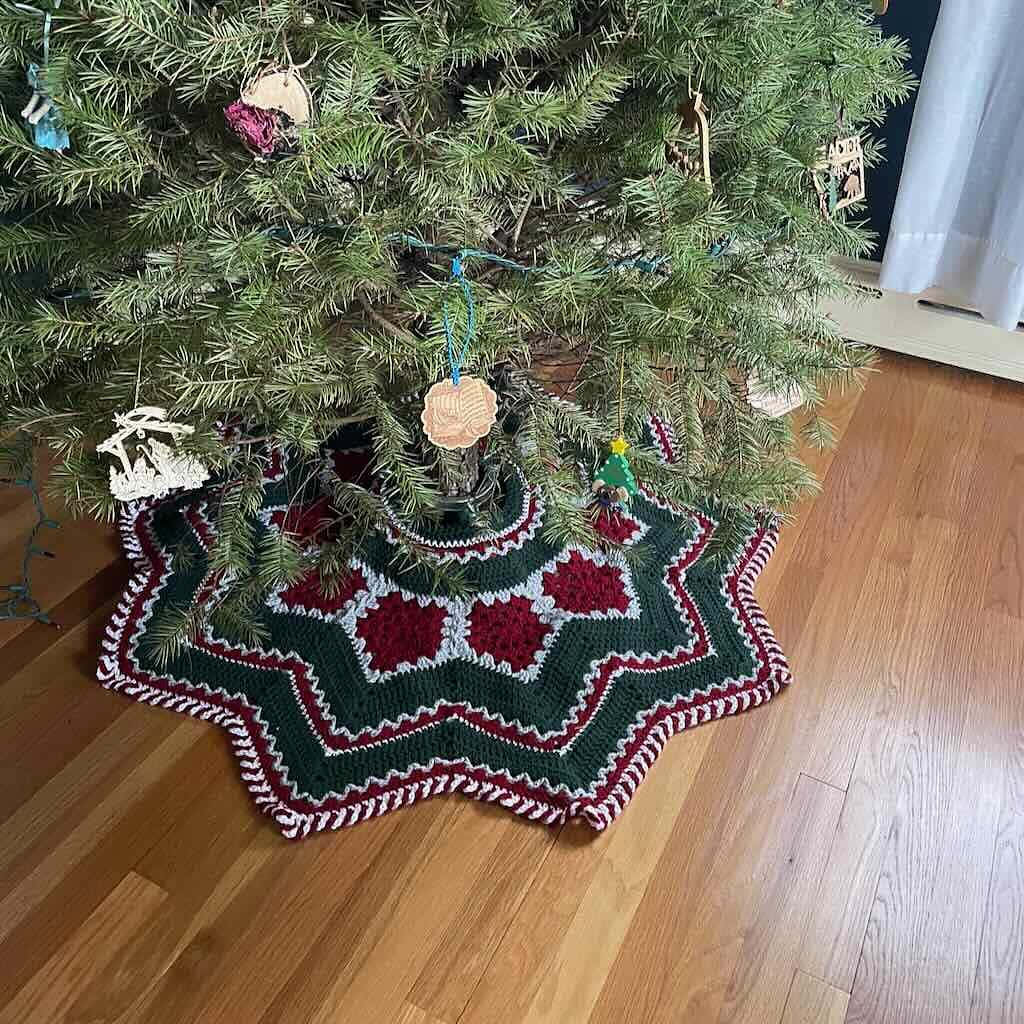
Crochet lives and dies by how you wash it. Acrylic yarn can go in a mesh bag on cold, gentle, then air dry flat — never a dryer, never a hanger. Cotton yarn will stretch if you hang it wet, so block it flat on a towel. Expect to hand-wash once a season and spot clean in between; a floor-length cotton skirt picks up pine needles and pet hair constantly. Upkeep runs about $0 if you are careful, or $25 every few years to replace yarn that has pilled beyond saving.
8. Red Ruffled Velvet Skirt with Matching Tie Closures
This one wants a room with breathing space. The ruffle adds roughly 4 inches of visual radius, so a standard 52-inch skirt effectively covers 60 inches of floor. It works beautifully under a 7 to 7.5-foot tree in a room at least 12 by 14 feet; in a tighter space the ruffle crowds the presents and starts to look droopy. Compare with Idea #19, where a bare scalloped skirt is the smarter move for a small corner.
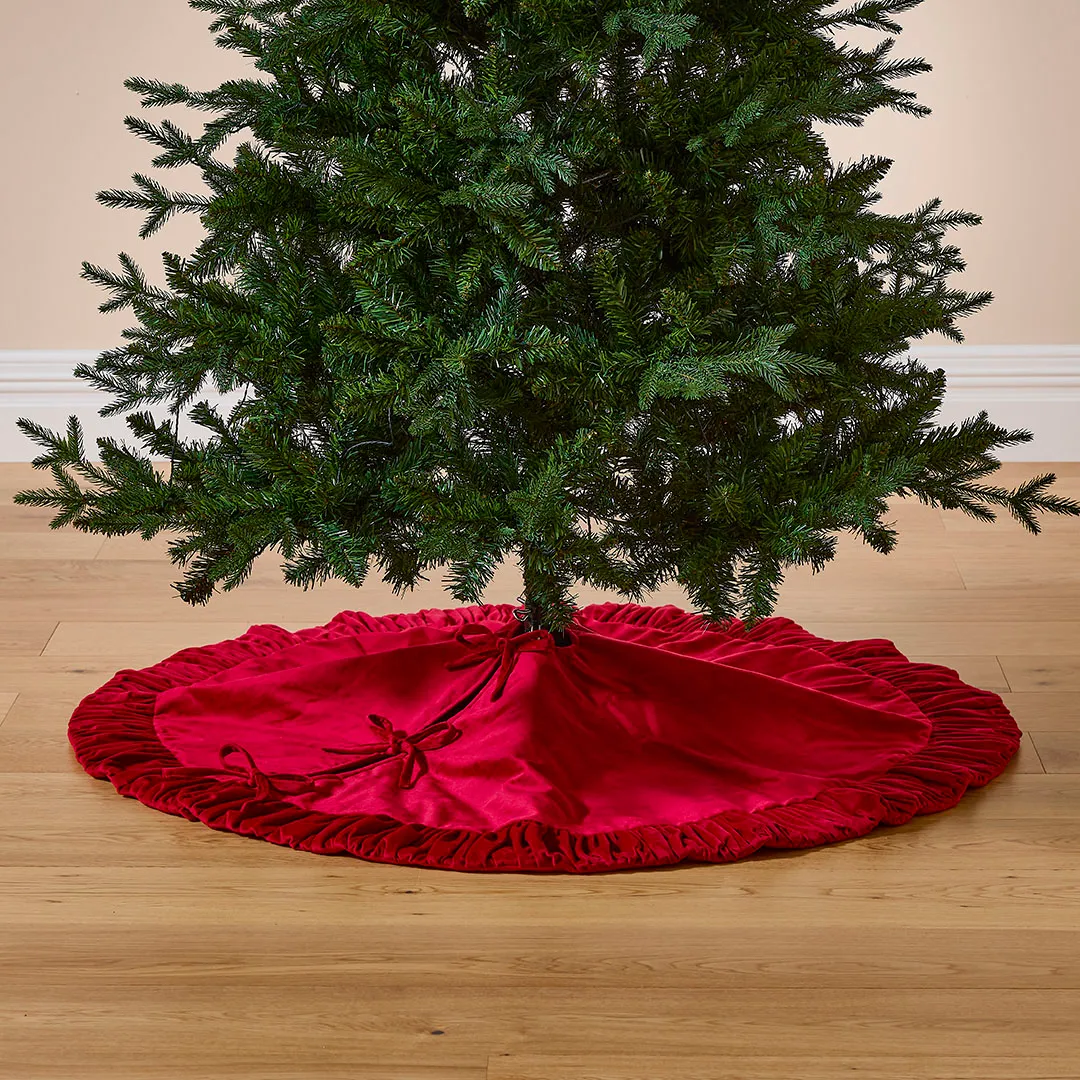
Velvet shows every fold, so storage matters more than styling. Never fold velvet along the same line twice — roll it around a cardboard tube or a pool noodle for the off-season, which is about $3 of hardware protecting a $120 skirt. During the season, steam it, do not iron it. A handheld steamer held 4 inches away releases crush marks without flattening the pile, which is what creates that soft glow the camera loves.
9. Dark Woven Wicker Collar Instead of a Fabric Skirt
- Measure your tree stand’s widest point — the collar has to clear it, usually 20–24 inches across.
- Check your tree’s bottom branch height; you need at least 10 inches of clear trunk.
- Confirm the collar comes with a slit or hinge, or you will be lifting the tree into it.
- Make sure the floor underneath can take a rigid base without scratching.
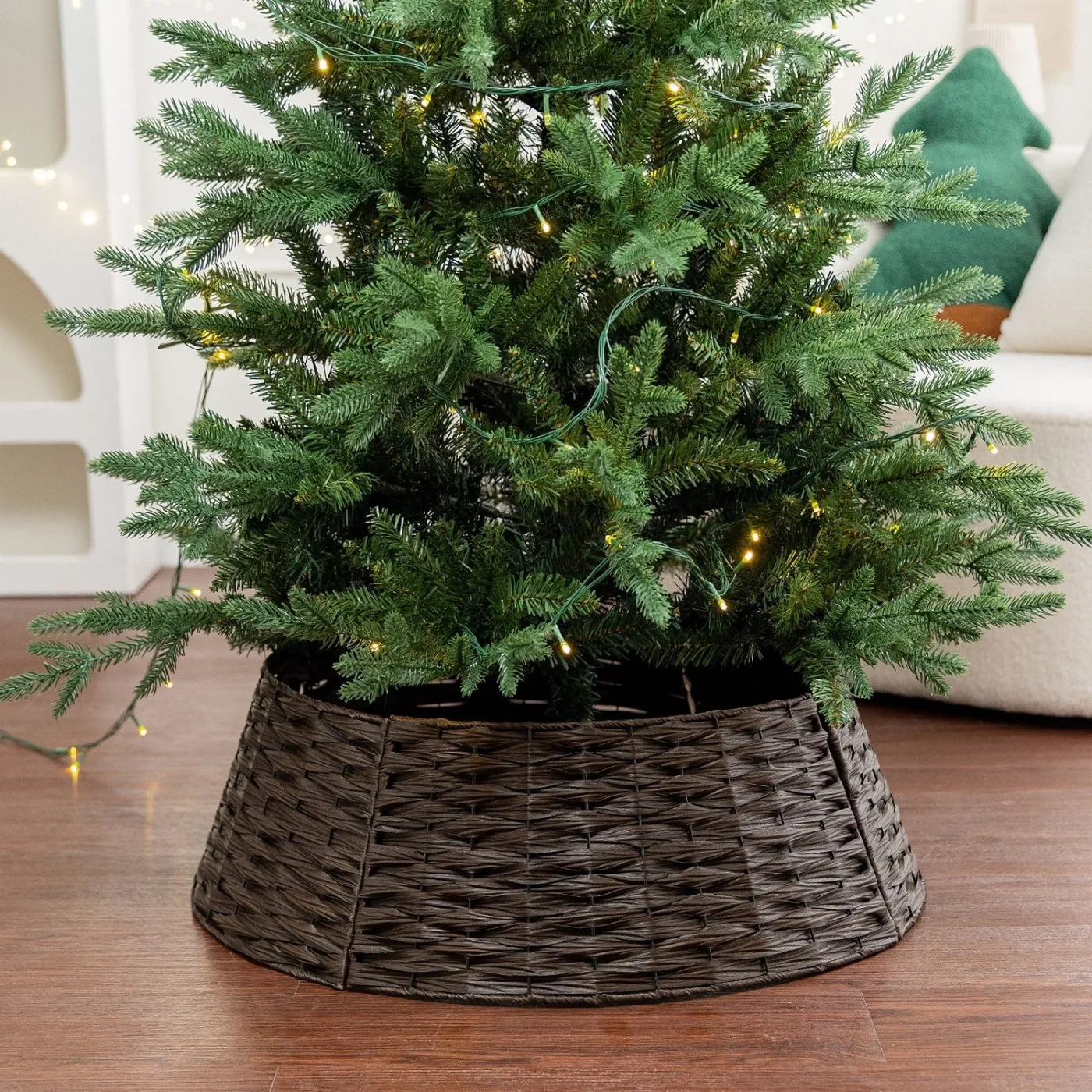
Wicker is the one base option that survives toddlers, cats, and a robot vacuum.
A structured collar does something a soft skirt cannot: it creates a hard edge in a room full of soft ones. Everything else in a holiday scene is fuzzy — needles, ribbons, wrapping paper, the rug. That dark brown woven cylinder stops the eye and gives the tree a plinth. It also hides the stand completely, which no loosely draped skirt truly manages on a tall tree. Warm yellow string lights on thin green wire keep the base reading low and cozy rather than bright and reflective.
10. Red Felt Skirt with Snowflake Appliqués Under a White Tree
- Red felt tree skirt with snowflake appliqués: $30–$70
- White artificial tree, 6.5–7.5 ft: $180–$600
- Pom-pom garland in red and dark green: $12–$28
- Silver and gold ornaments, mixed sizes: $40–$90
- Ribbon and wrapped gift fillers: $25–$50
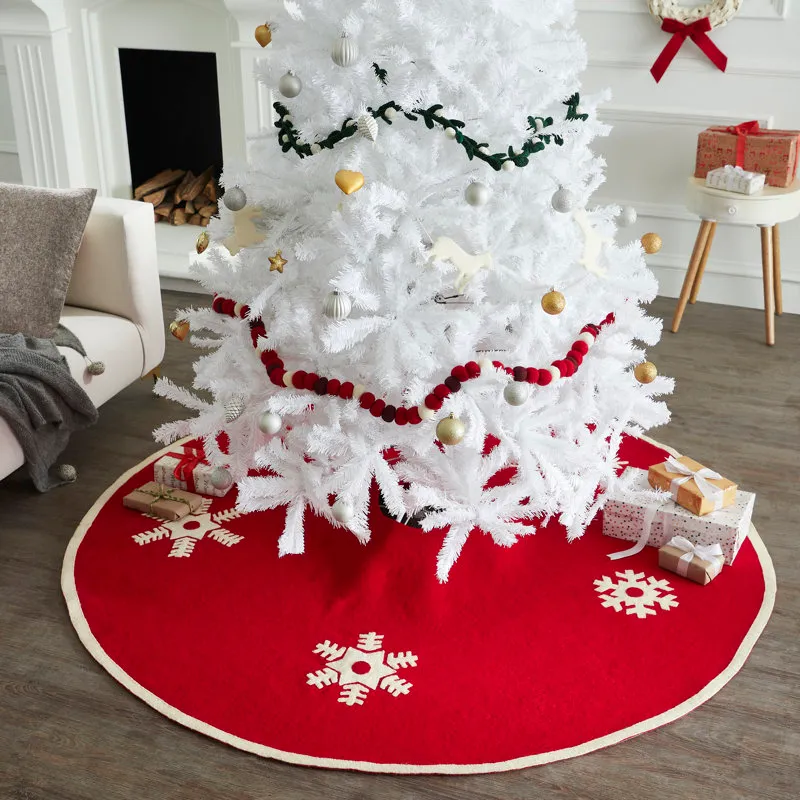
Total: $287–$838. Cut it roughly in half by buying the white tree in a post-holiday clearance and hand-cutting felt snowflakes from $1 sheets — a dozen flakes, some fabric glue, and one evening gets you there.
Felt is forgiving, but a white tree is not. Every scuff, every dusty ornament hook, every pine needle drifting over from a real wreath will show against those white branches. Plan on a wipe-down mid-season and store the tree in a proper bag, not a trash bag. On the plus side, felt does not fray, does not shed, and does not need hemming — it is the most kid-and-pet-tolerant material on this entire list.
11. Dark Green Quilted Skirt with Husky Appliqués and Buffalo Plaid Trim
The huskies in their little red collars. Strip those appliqués off and you still have a perfectly nice dark green quilted skirt with a buffalo plaid border — and nobody would ever mention it. The dogs turn a generic holiday base into a family portrait. That is the real value of a custom skirt: it holds a specific dog, a specific name, a specific year. If you are commissioning one, have the appliqués done in felt or wool rather than printed fabric; they will survive a decade of storage.
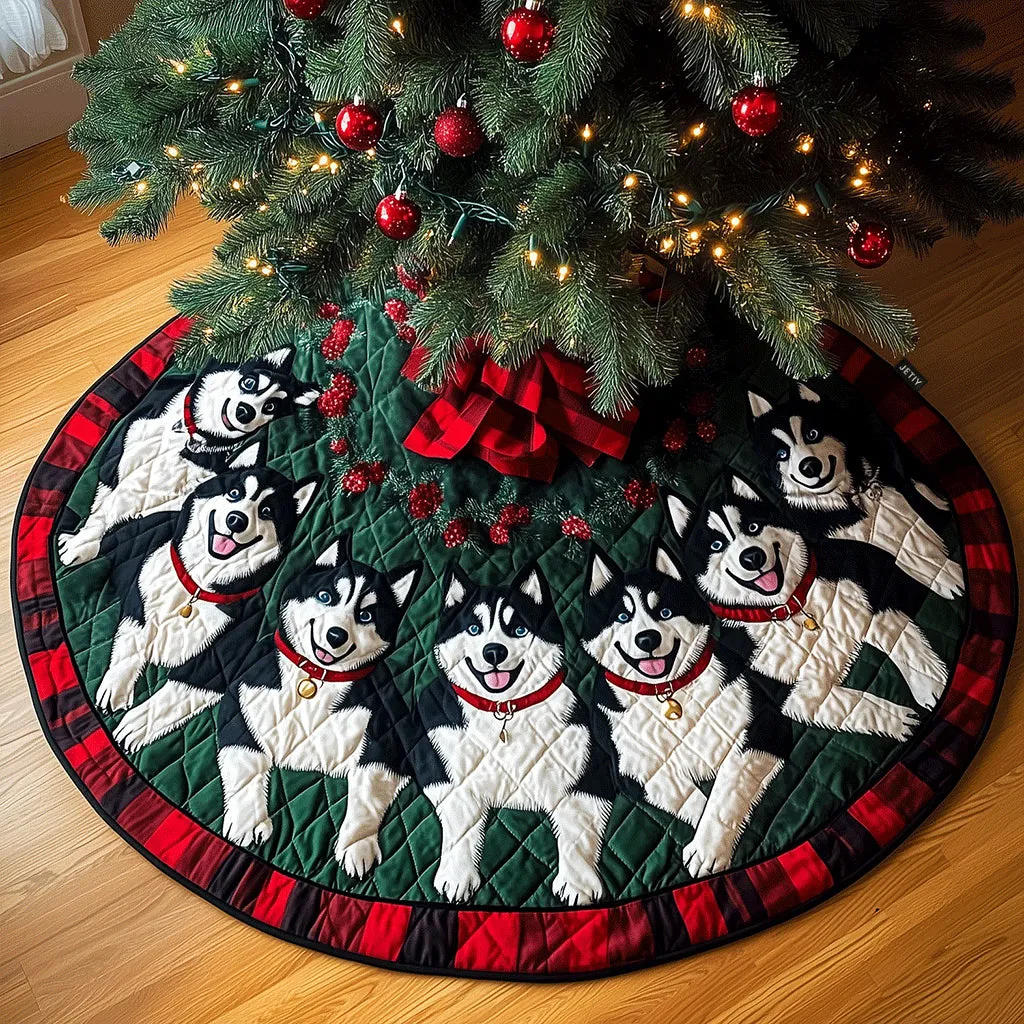
Buffalo plaid and quilting are both busy, so keep everything else quiet. Here the diamond stitching is fine and close, the plaid border is small-scale, and the appliqués are flat — three patterns, all at different scales, none larger than a fist. Swap the plaid for a wide 4-inch check and the skirt starts competing with the tree lights and the whole base looks cluttered. Scale variation is the entire trick.
12. Deep Red Skirt with White Botanical and Star Border Appliqué
55% deep red + 30% forest green + 10% metallic gold + 5% silver. The red skirt and the green tree are the two big blocks; gold and silver are seasoning, not structure. Notice the garland is red pom-poms rather than ribbon — that keeps the matte texture going instead of introducing shine. Want a cooler version? Hold the ratio and swap the red to burgundy and the gold to antique brass. The formula survives; only the temperature changes.
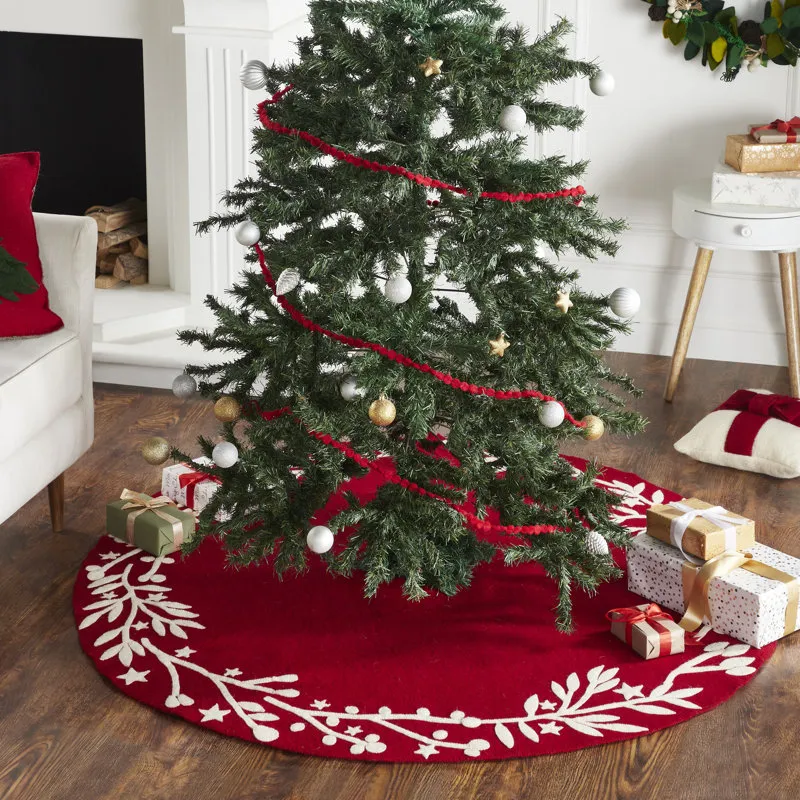
The botanical border is the expensive part, so fake it. A plain deep red round from Amazon or Walmart runs $18–$35, and iron-on embroidered appliqué strips from a craft store cost $8–$15 a yard. Arrange vines and stars along the outer 4 inches, press them on, then stitch around each one for durability. Total: under $55 versus $150+ for a hand-embroidered original. Same silhouette, same story, and a version you will not panic about when a toddler sits on it.
13. White Fabric Skirt with Layered Floral Appliqués on Tile
Layered white-on-white appliqués only read if there is a shadow. Build them in three depths — a flat base layer, a mid layer with a 1/8-inch felt pad underneath, and a top layer with a 1/4-inch pad. Under warm amber string lights those small height differences create the shadows that make the flowers legible. Skip the padding and the whole border looks like a faint smudge from ten feet away.
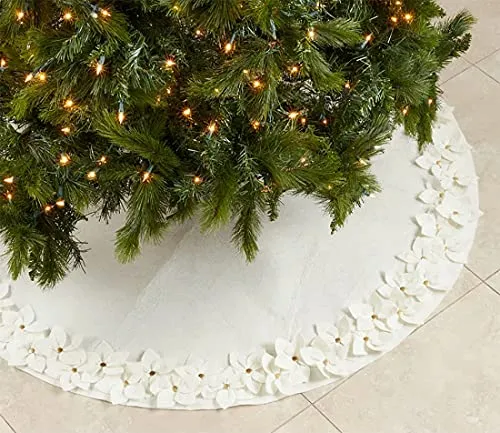
- White on white keeps the base quiet so ornaments stay the star
- Repeating floral shapes create rhythm around the circle
- The neutral tile floor bounces light back up into the branches
Nothing in this scene is loud. The tree is dense and green, the lights are warm, the skirt is white, the tile is soft beige. What makes it feel finished is restraint — one pattern, repeated evenly, at a consistent scale. If you added anything else, a single matte gold ornament resting on the skirt would be enough.
14. Forest Green Skirt with an Embroidered Squirrel and Pine Branches
- Trace a squirrel silhouette onto wool felt and cut two layers.
- Appliqué the base layer to the skirt with a narrow machine zigzag.
- Add the tail as a separate piece so it sits slightly proud of the body.
- Stitch pine branch outlines in dark green thread, working outward from the center.
- Add three or four red French knots for berries, then press the skirt face-down on a towel.
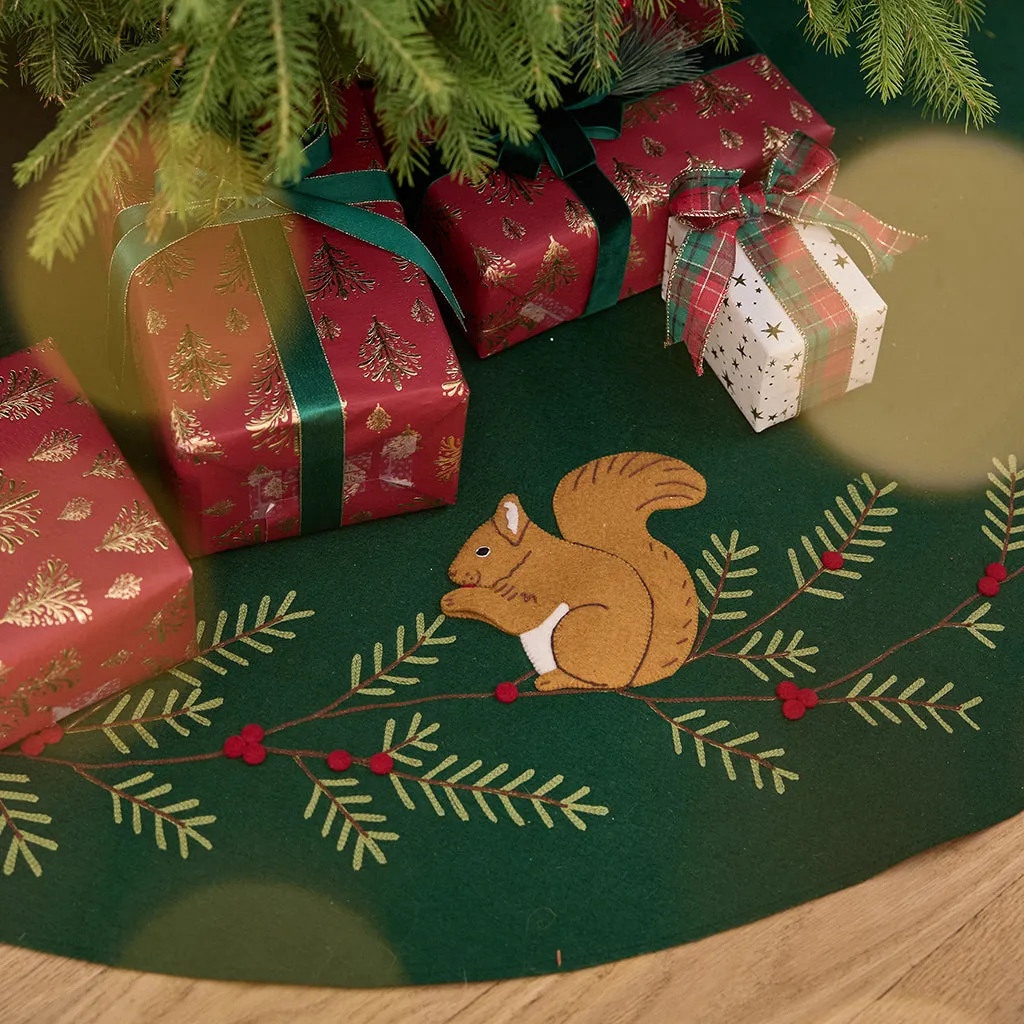
Roughly 2 hours per motif. Felt, thread, and a hoop: about $18.
Woodland motifs — squirrels, foxes, birds, pinecones — have been building on Pinterest for three seasons, and they are not going anywhere, because they scratch an itch glitter cannot. People want holiday decor that feels like a walk in the woods rather than a mall display. It is the same instinct driving the return of wool, felt, and hand-stitching, and it photographs beautifully in low light, which is most of December.
15. Red and Green Patchwork Skirt with Eyelet Lace Ruffle
- Decide whether the print is directional before you cut — some motif fabrics are.
- Check that your eyelet lace is cotton, not polyester; poly lace yellows in storage.
- Measure your opening slit against the tree stand before you sew anything shut.
- Confirm you have enough matching thread for six yards of ruffle.
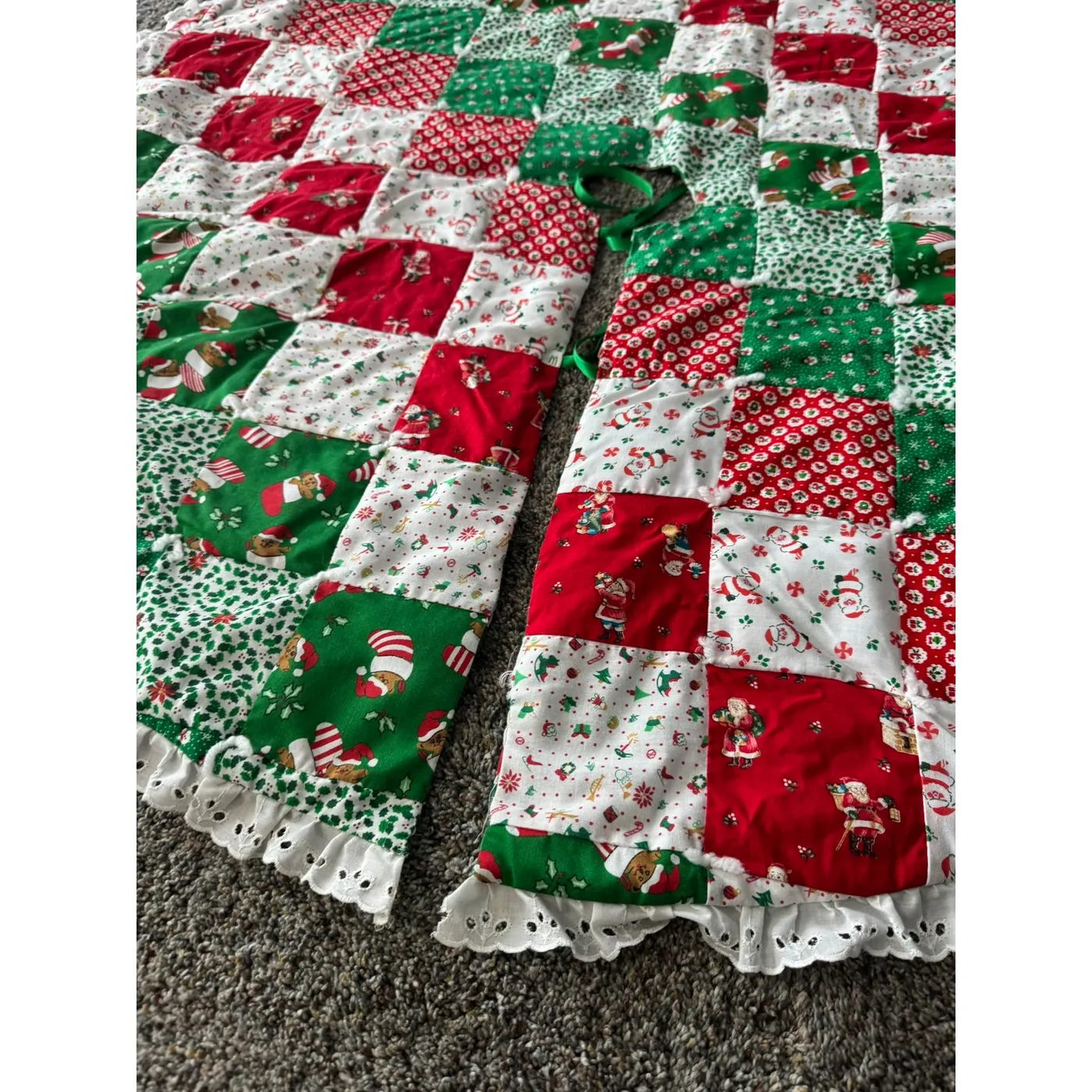
Get those four things right and the rest is straight sewing.
Patchwork with motif prints is charming and also loud. Squares showing Santas, stockings, and snowmen next to a tree full of ornaments can tip into visual chaos fast. The eyelet ruffle is what saves it — that band of plain white gives your eye somewhere to rest. If your tree is already pattern-heavy with ribbon or character ornaments, choose a patchwork skirt with two or three fabrics instead of eight, and let the lace do the talking.
16. Cream Skirt with Beaded Snowflake Embroidery and Bronze Ornaments
- Cream skirt with beaded snowflake border: $70–$160
- Matte beige and bronze ornaments, mixed sizes: $55–$120
- Silver accent baubles: $20–$45
- Neutral ribbon and kraft-toned wrapping: $18–$40
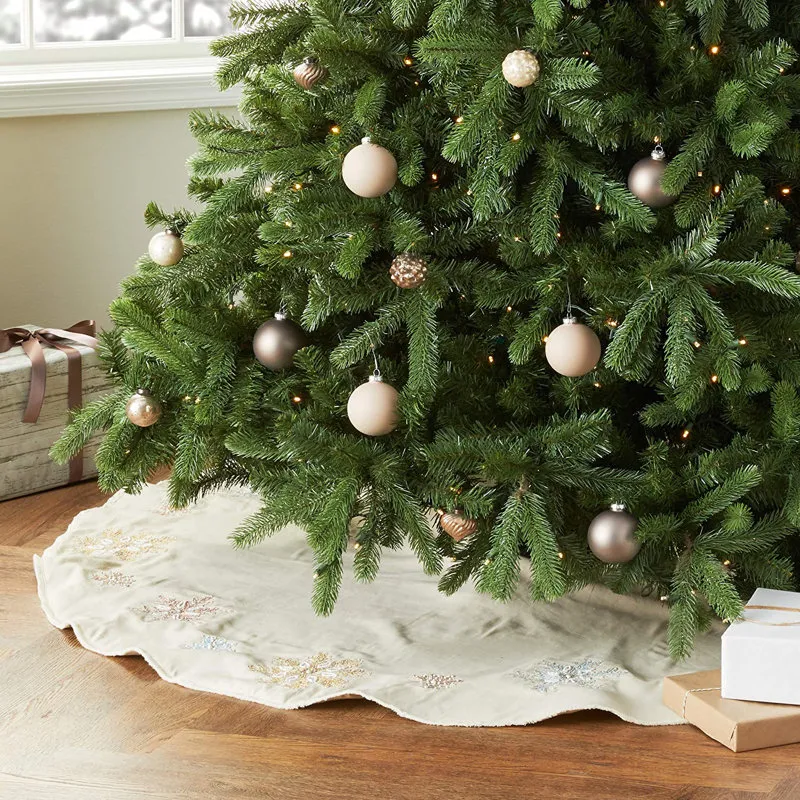
Total: $163–$365 for the base and dressing, assuming you already own the tree. The beading is the one place to spend rather than save — hand-beaded borders are the difference between elegant and crafty, and they are very hard to fake convincingly with glue.
Beadwork and pets are a bad combination. Loose beads become chew toys, and a beaded border that snags a branch will unravel fast. Store this skirt flat in a tissue-lined box, never folded in a bin where beads press against each other, and check the thread every year before it goes out. Realistically, expect to re-stitch a few beads each season — ten minutes with a needle, and the skirt lasts decades.
17. Classic Red Block Quilted Skirt on Dark Plank Floors
White ground, red geometry, red binding. That is it, and that is why it works — the palette is two colors and the pattern does the talking. The dark plank floor underneath adds a third value without adding a color, which keeps the whole base from going pastel. Notice the red binding repeats the red in the blocks: when your edge trim matches something inside the pattern, the border reads as design rather than as a sewing necessity.
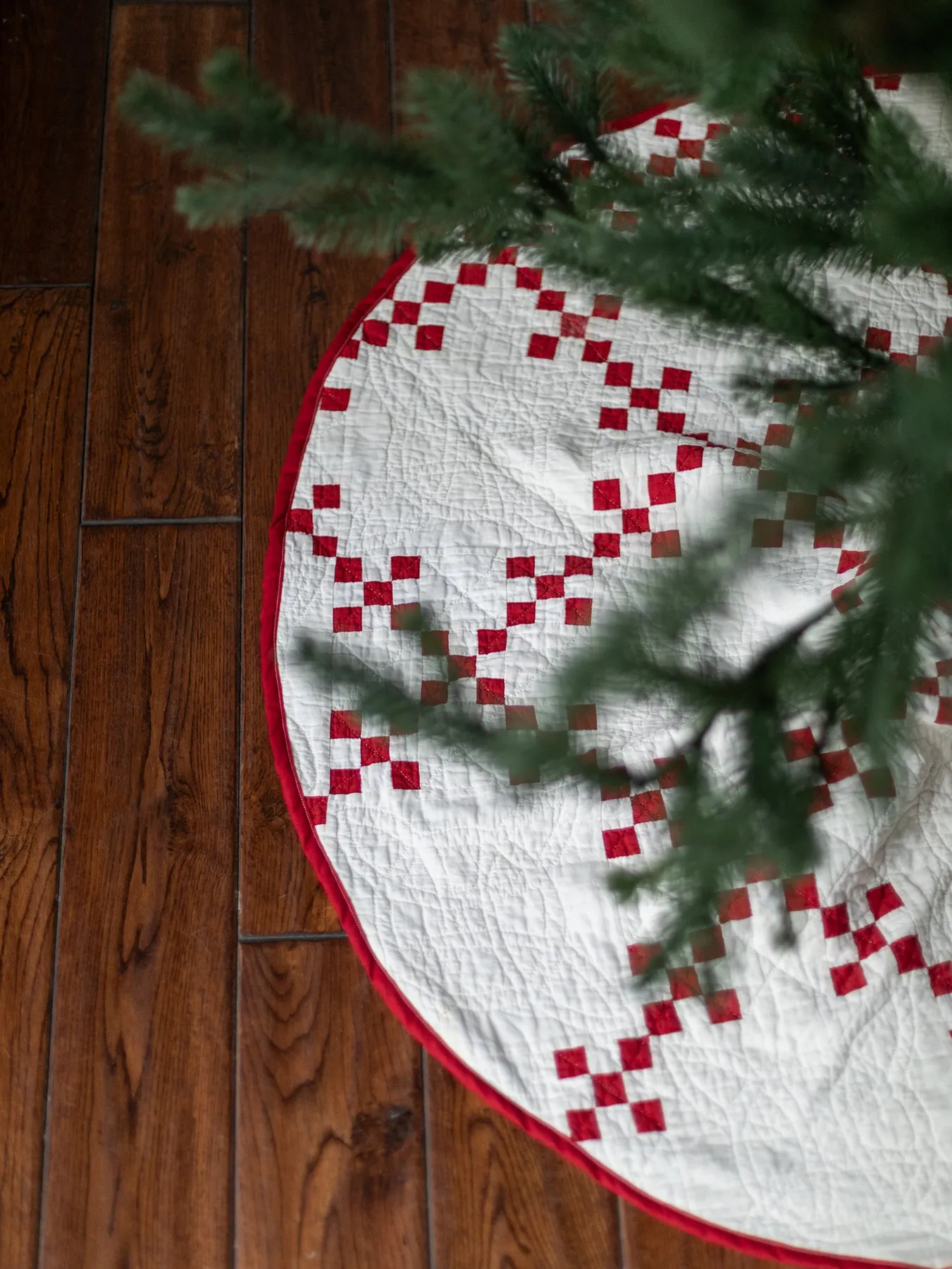
Best for a 6 to 7.5-foot tree in a space at least 10 by 12 feet, with medium or dark flooring. On very light floors this skirt’s white ground can get lost — add a red rug or a dark tree stand ring underneath to rebuild the contrast. Working in a corner under 8 by 8 feet? Go with the tighter Idea #4 silhouette instead, since that dense patchwork reads better at close range.
18. Red and Black Plaid Quilted Skirt with a Gathered Ruffle
Plaid is unforgiving about cutting. To keep the lines running true around a circle, cut your panels on the bias and match the horizontal stripe at every seam — it costs about 30% more fabric and it is the difference between a skirt that looks tailored and one that looks like a wrapped blanket. Quilt it in a simple grid following the plaid lines; diagonal stitching on plaid makes the whole thing look dizzy.
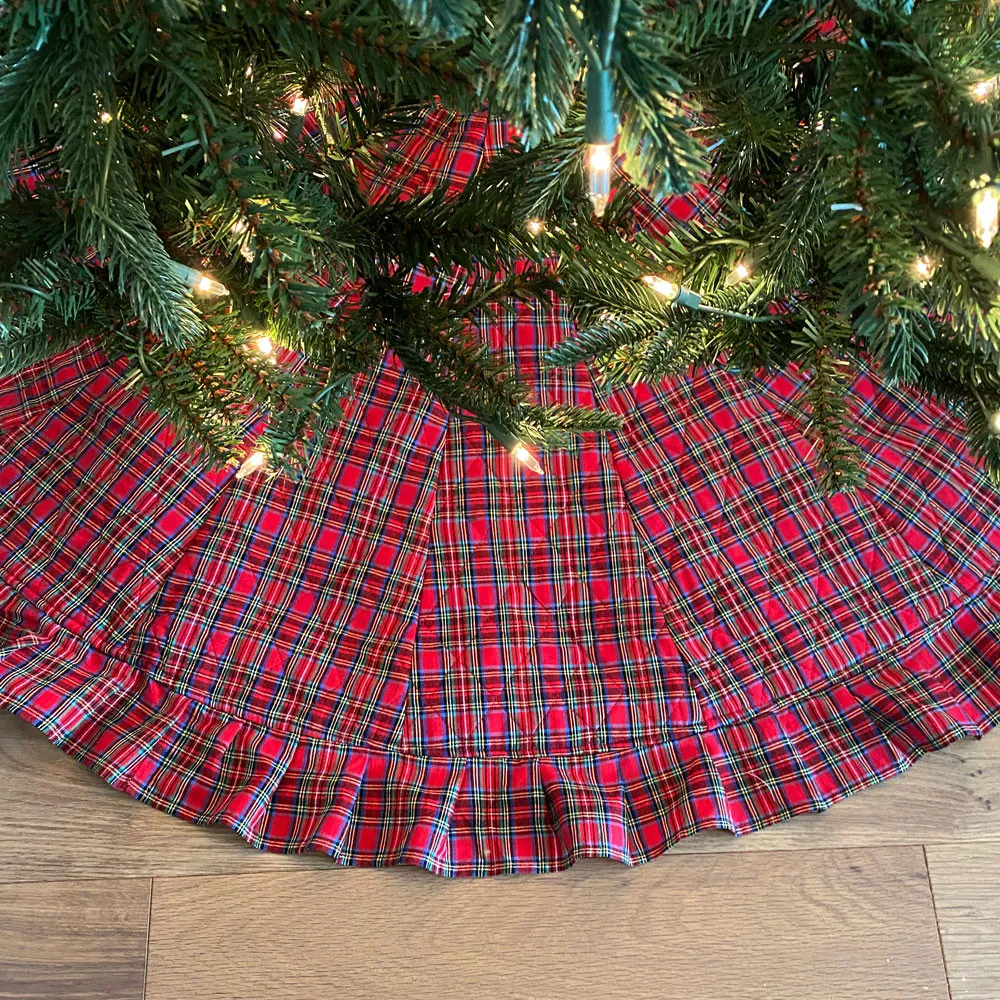
If you would rather not quilt plaid yourself, a flannel plaid round from a big-box store runs $22–$45, and at three feet away nobody can tell it is not quilted. Add a gathered ruffle from a $6 half-yard of matching plaid, or skip the ruffle and bind the edge in black. The buffalo check version in Idea #25 is even cheaper to fake, since buffalo check fabric costs a fraction of a true tartan.
19. Quiet Scalloped White Skirt in a Corner with a Record Player
This is the small-space answer. A slim scalloped skirt adds almost no radius, so it works under a 6 to 7-foot tree in a corner as tight as 6 by 6 feet. You need roughly 14 inches of clearance between trunk and wall on each side so the branches do not brush. Pairing it with a low dark wood bookshelf keeps the vertical interest in one place instead of spreading it around. Compare with Idea #8, which needs real floor space to breathe.
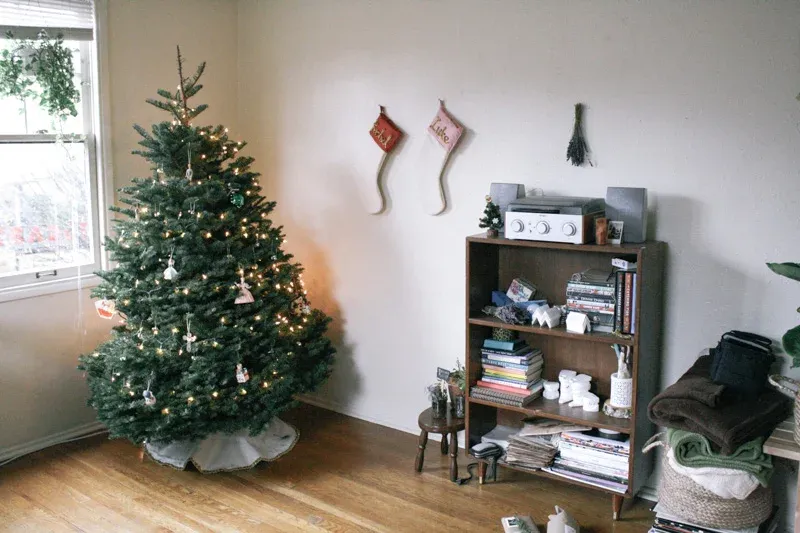
A light scalloped skirt on hardwood is lovely and completely unapologetic about showing dirt. Expect to shake it out weekly and wash a cotton version about once a month through December. If the tree sits in a high-traffic path, pick a mid-tone linen or a small pattern — anything that can take a scuff. And if you have a dog that marks, a machine-washable cotton skirt is the only sane choice. The mistakes roundup below covers two more of these traps.
20. Personalized Red and White Quilted Skirt with Embroidered Names
- Decide your text first — family name, year, or a short phrase — and keep it under 12 characters.
- Print it in a serif font at the size you want, then trace it onto tear-away stabilizer.
- Pin the stabilizer to the skirt where the text goes and hoop it snug.
- Stitch in a satin or tight running stitch in red thread, slowing down through curves.
- Tear away the stabilizer and press the area face-down to set the stitches.
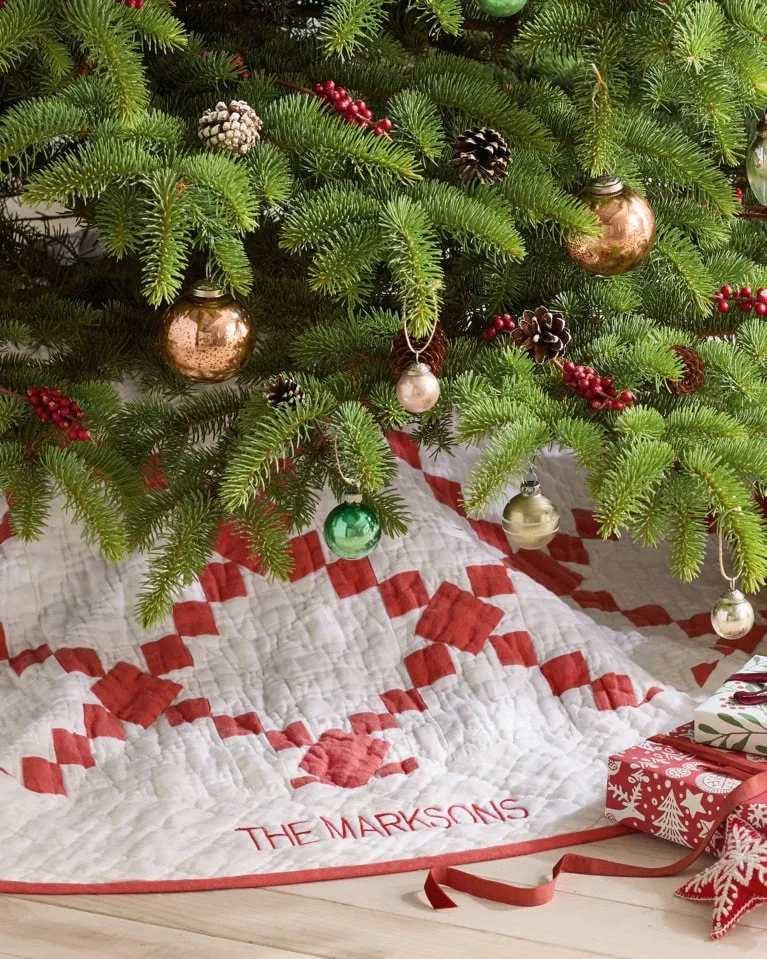
About 45 minutes once your machine is threaded. Stabilizer and thread: under $10.
The embroidered name. It is four square inches of thread that changes the object from decor into heirloom. Everything else here — the patchwork, the red trim, the pinecones — is a standard holiday base, well made but anonymous. The moment your family name is stitched into the edge, the skirt stops being something you bought and becomes something your kids will argue over in thirty years. If you only customize one thing this season, customize this.
21. Overhead View of a Red Quilted Skirt with Faux Fur Border
Seen from directly above, this is 80% red + 15% white + 5% green and brown from the pine sprigs. It is one of the boldest ratios on this list, and it works because the concentric stitching rings give that red field something to do. Without the rings, a solid red circle this size reads as a flat blob. Swap the white fur edge for cream bouclé and it softens; swap it for black velvet ribbon and the whole thing turns dramatic and a little bit moody.
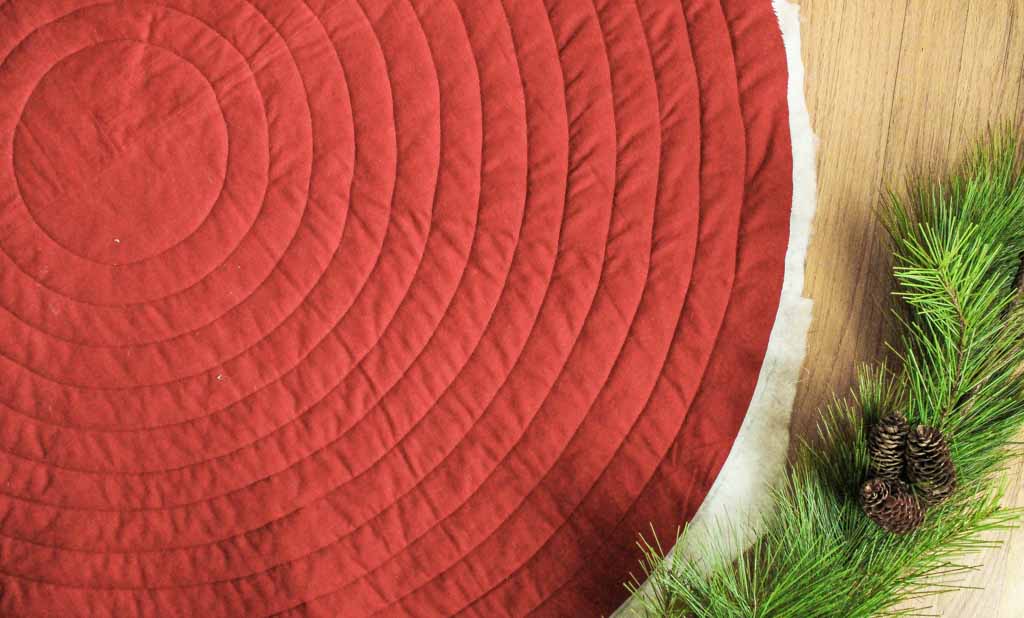
Faux fur borders and pine needles are enemies. Needles weave into the pile and do not shake out; a lint roller handles the surface, but you will pick the deep ones by hand. Fur edging also mats down where gifts sit, and once it mats, a steamer is your only real fix. If you love the look and hate the upkeep, a white cotton binding gives you the same border definition with none of the shedding.
22. Layered Buffalo Check, Red, and White Fabrics with Pinecones
This is the palette board behind half the holiday decor you have been saving this year. Buffalo check stopped being farmhouse-only around 2021 and now reads as a neutral — it is the pattern people reach for when they want holiday without glitter. Three reasons it keeps winning:
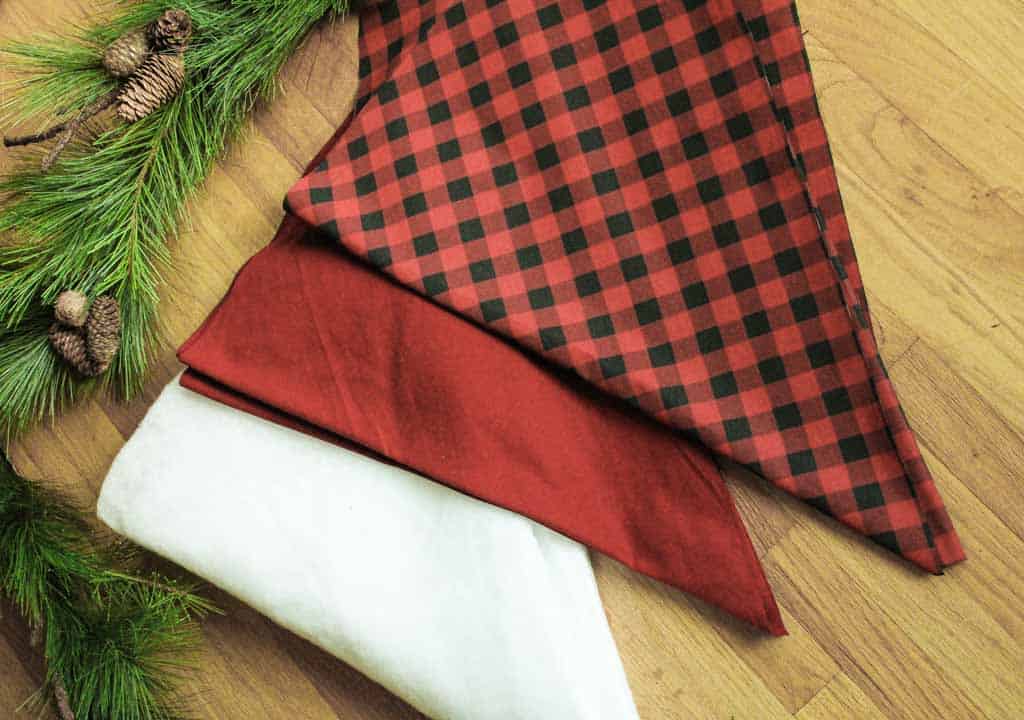
- Red and black reads festive without looking childish
- It pairs with both rustic wood and modern white trim
- Matching it across a skirt, ribbon, and stockings is genuinely easy
Build the whole base from three cuts of fabric. One yard of buffalo check ($10–$16), one yard of solid red cotton ($7–$12), and one yard of white cotton ($6–$10) gets you a layered skirt plus enough leftover for tied gift bows. Layer them asymmetrically rather than in perfect circles — the stacked, slightly off-center look is what makes this arrangement feel styled rather than staged. Under $40 total.
23. Dark Green Skirt with Embroidered Birds and Berry Accents
When you embroider on a dark background, thread weight matters more than color. Use 12-weight thread for the bird outlines so they hold their shape against dark green; standard 40-weight embroidery thread disappears into it. Back the bird appliqués with a light fusible interfacing so the white and black shapes stay crisp after washing, and always stitch the outline first, then fill — it keeps the silhouette from shifting.
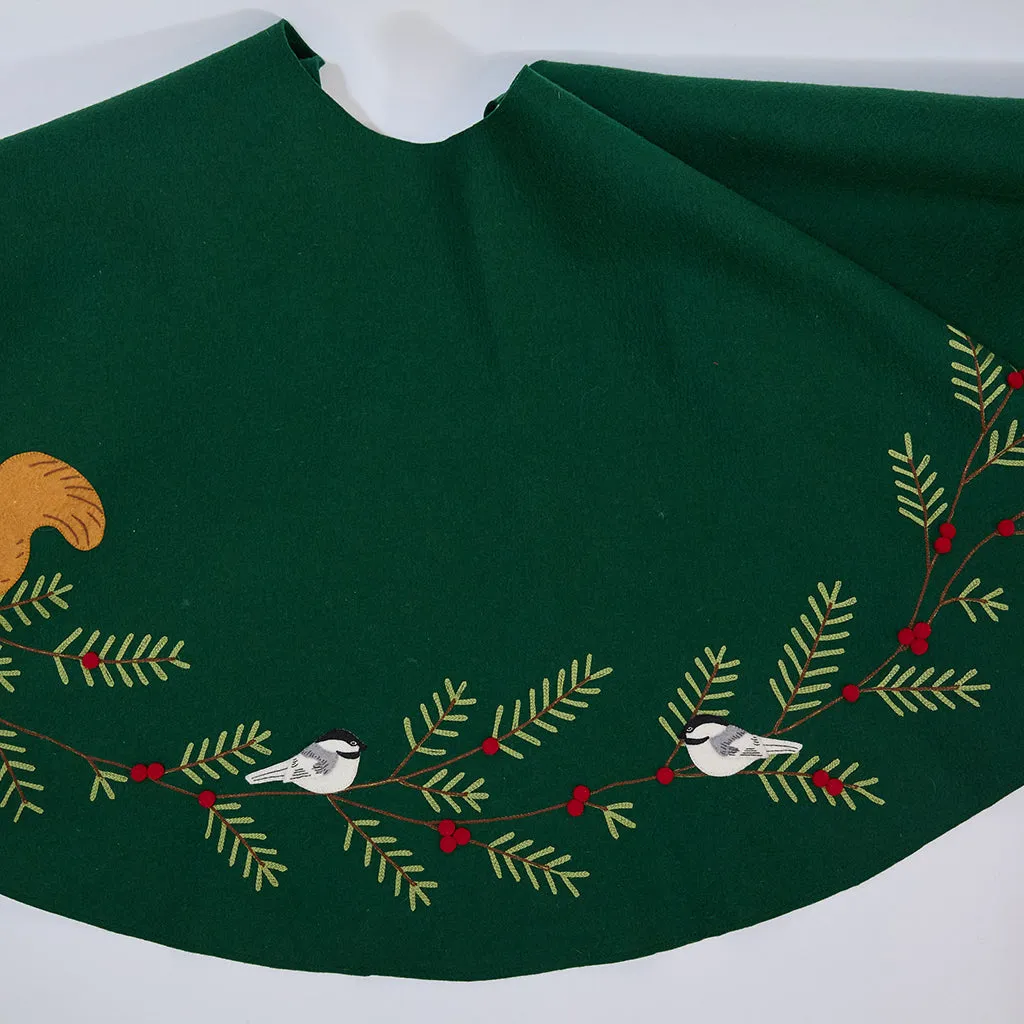
Contrast, repetition, and one surprise. The white birds pop because everything around them is dark. The pine branches and berries repeat around the border at an even rhythm, so your eye travels instead of stopping. And then on the left there is a squirrel in orange — the single warm thing in a cool-toned scene. That one off-palette note is what makes the whole skirt feel handmade rather than manufactured. Deliberate imperfection, on purpose.
24. Patchwork Star Skirt with a Mustard-Yellow Quilted Backing
- Piece your star from eight to twelve triangles in red, green, navy, and cream.
- Cut a backing circle in mustard yellow, 1 inch larger all around than the top.
- Layer top, batting, and backing, then baste in a grid every 4 inches.
- Quilt in diagonal channels 1.5 inches apart across the whole circle.
- Trim and bind the edge with a red plaid strip.
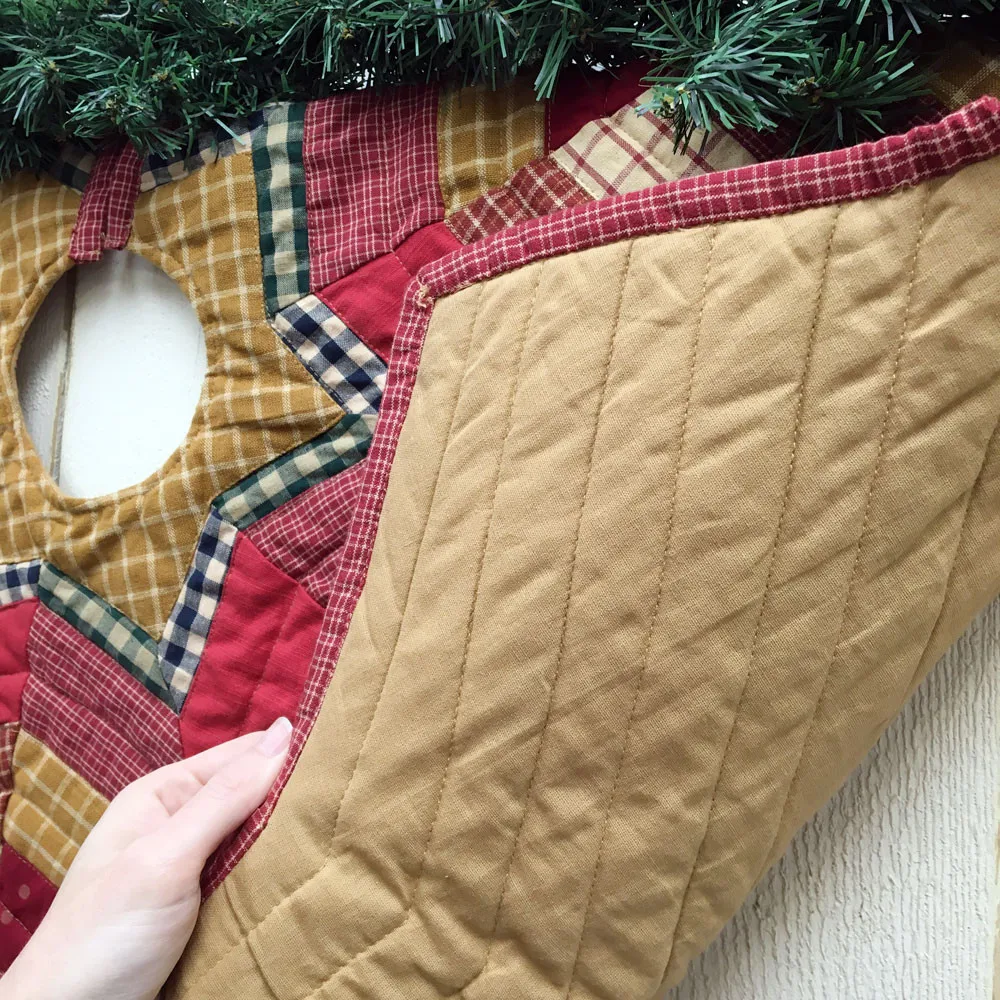
Allow 6 hours. Quilting cotton and batting run roughly $30–$45 depending on whether you shop the sale bin.
- Confirm your batting weight — 80/20 cotton-poly is the sweet spot for a skirt that sits flat.
- Pre-wash your fabric so it does not shrink after quilting.
- Check that your star points land on a full circle, not a chopped one.
- Decide your binding before you trim the edge.
Reversible skirts are worth the extra hour — a mustard backing means you can flip it for a completely different look next year.
25. Buffalo Check Skirt with Diamond Quilting on Dark Wood
Buffalo check is a big pattern, so it needs either a big room or a small skirt. This one works under a 7-foot tree in a 12-by-14-foot living room with dark wood floors; in a small bright room the same skirt can overwhelm the space. Tight on square footage? Choose a smaller check scale — a half-inch check reads as texture, a 3-inch check reads as a statement. Pair with Idea #9 if you would rather skip fabric entirely.
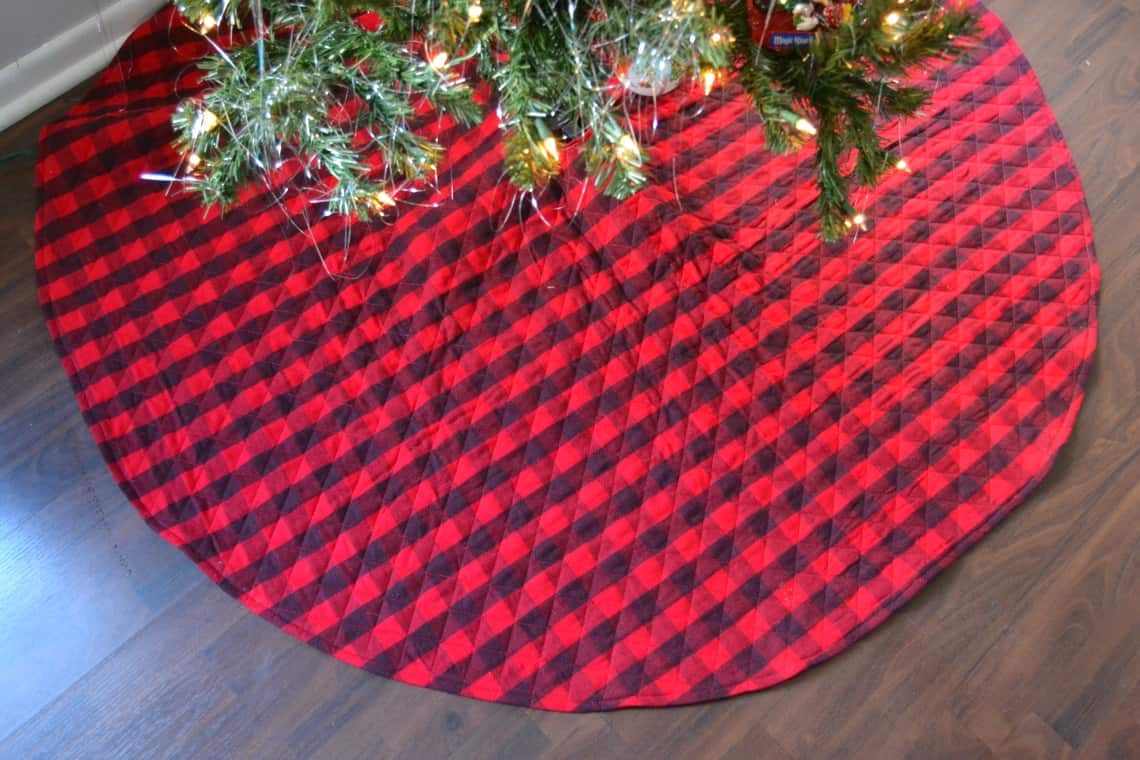
- Buffalo check quilted skirt, ready-made: $35–$85
- DIY version: 1.5 yards buffalo check flannel ($14–$24) plus batting ($8)
- Quilting thread and extra bobbins: $6
- Silver tinsel and an ornament refresh: $20–$45
Total: $48–$159 either way. If you quilt it yourself, use a walking foot and a 3.0 stitch length — buffalo check flannel shifts badly under a standard presser foot.
26. Red Quilted Skirt with Appliquéd Pandas and a Tree Motif
Novelty appliqué skirts are the hardest to store and the easiest to regret. Appliqués with felt backing and satin-stitched edges hold up; anything glued on, or made from craft-store felt that pills, will be shedding by the second December. Before you commit, ask whether you will still love pandas in five years — a custom skirt is a decade-long commitment, and the resale on a panda skirt is basically zero.
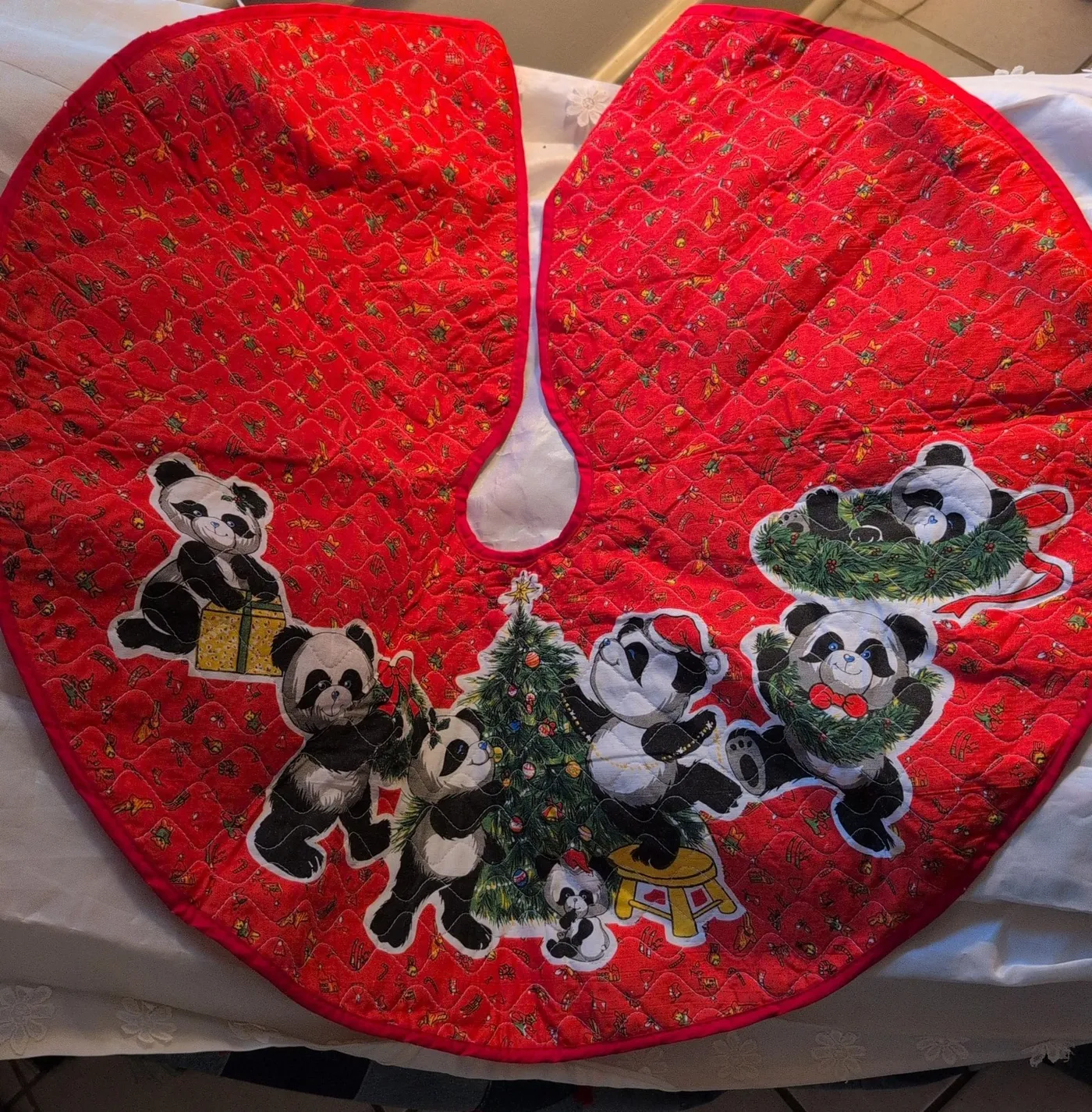
The curve of the quilting. Look closely and the stitching runs in arcs rather than a grid — that is what keeps the busy red print from turning into visual static. Curved lines soften an already-loud fabric, so the appliqués read as illustrations sitting on a soft ground instead of stickers slapped on a flat circle. If you are quilting your own novelty skirt, arc the lines. It takes longer and it is worth it. Same principle as Idea #11, where the diamond stitching does that job for the huskies.
27. Bright Red Knitted Skirt with a Wide Cable-Knit Border
Knits pill, and cable knits pill in the places people touch. Expect fuzz balls along the bottom edge and anywhere a gift box presses for a week. A fabric shaver handles it in five minutes, twice a season. Wash in a mesh bag on cold and dry flat — never hang it, or the cable border stretches into a wavy mess that steam will not fix. A well-cared-for knit skirt easily lasts ten years; a neglected one lasts two.
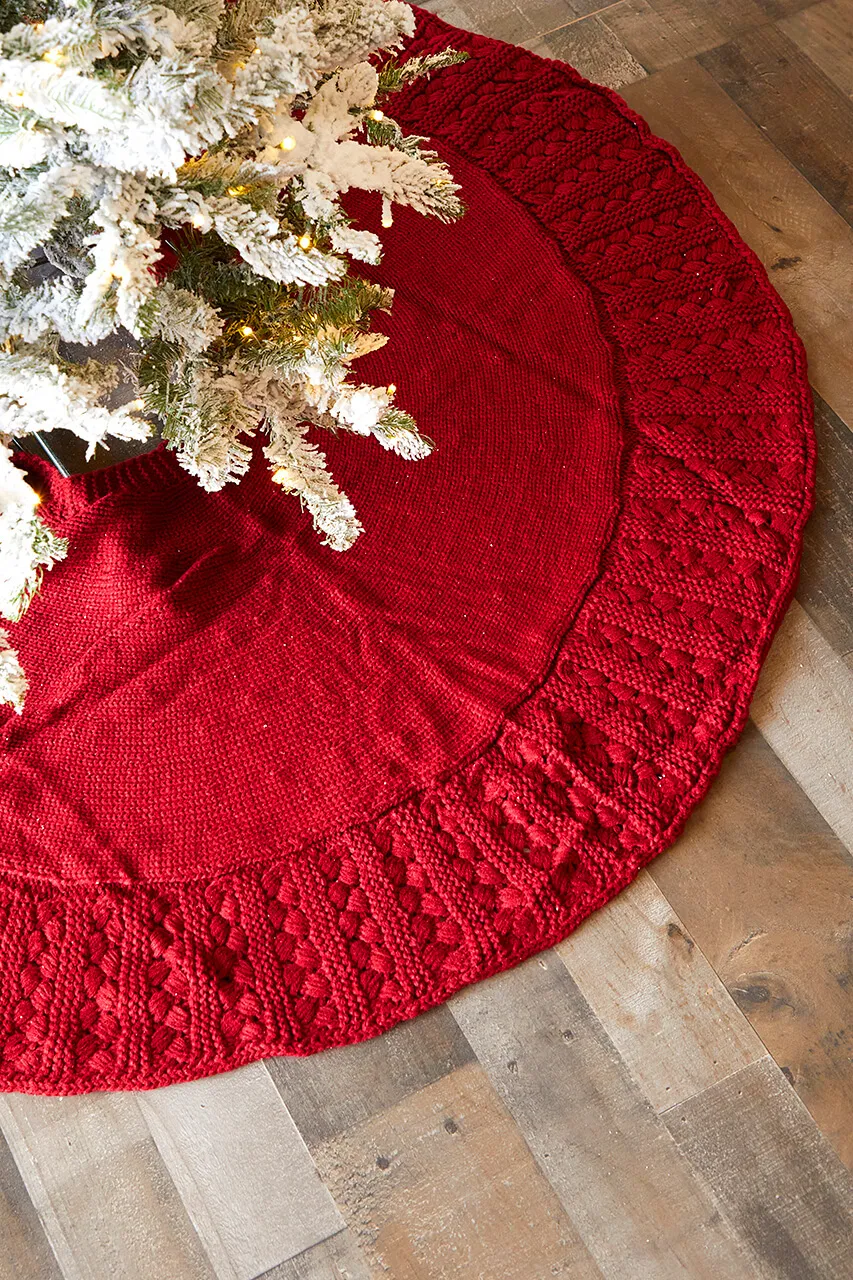
If you do not knit, a chunky cable-knit skirt from a craft marketplace runs $60–$120. To hit the look cheaper, buy a plain red knit round for $25–$40 and stitch a wide cable-patterned band along the outer edge — pre-knit cable trim by the yard is $8–$12 and reads identically at floor level. Nobody kneels down to check whether the cables are continuous. Thrifted cable-knit sweaters can also be repurposed into a skirt for under $20.
28. Multicolored Granny Square Crocheted Skirt with Felt Ornaments
No strict formula here — and that is the point. The granny squares read as roughly 40% red and blue, 30% green, 15% purple, 15% white, but nothing is measured. What keeps it from being chaos is repetition: the same square, the same size, the same stitch count, over and over. Swap purple for pink and the whole thing turns softer; swap blue for teal and it goes coastal. The square stays; only the colors change.
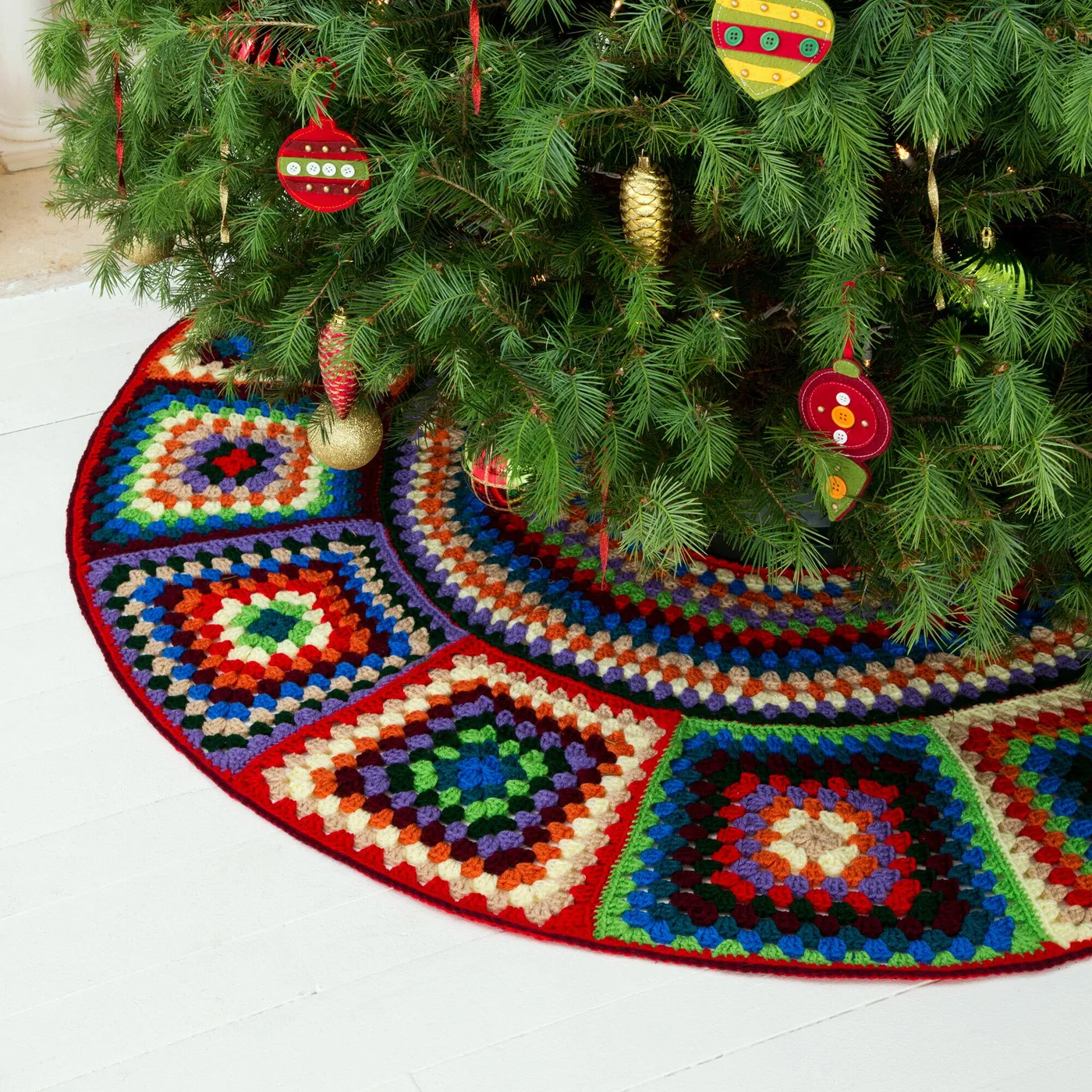
Crochet has been the quiet comeback of the last three holiday seasons, and 2026 is when it fully crossed over — granny squares are showing up on skirts, stockings, and garlands because they are the cheapest route to a genuinely handcrafted base. On white painted floors the color reads bright and playful; on dark wood the same skirt looks like an heirloom. Buying rather than making? Expect $80–$180 for a genuine handmade round.
Your Tree Deserves a Base Worth Wrapping Around
Whether you go handmade patchwork or a five-minute faux fur find, the base of your tree is the one spot nobody thinks about and everybody notices. Pick the idea that matches your floor, your square footage, and your tolerance for pet hair — then stop second-guessing it.
📌 Pin your favorites now so they are waiting for you next December.