29+ Jaw-Dropping Alternative Christmas Tree Ideas You Absolutely Need to Try This Holiday Season

Alternative Christmas trees are quietly taking over Pinterest right now, and one look at the wood-slat builds, wall-traced garlands, and driftwood branch versions explains why — they cost less, they fit corners a seven-footer never could, and they don’t look like everyone else’s living room in December.
We spent serious time browsing Etsy, Target, and IKEA to bring you only what’s worth your attention this year, and the range runs from about $15 in ribbon to $450 for a fully lit statement tree.
Inside are 29 curated ideas across four moods: minimalist wood-and-branch, maximalist metallic glam, boho macrame, and unapologetically colorful. Budget and luxury versions sit side by side, so you can see exactly where the money matters and where it really doesn’t.
The 2026 shift is toward trees you build rather than trees you buy — shapes that leave your floor space alone and come down in ten minutes flat.
And stay until the end — we break down the most common mistakes that can ruin these looks. 📌 Save this to Pinterest for later — you’ll want to revisit these ideas.
1. Rose Gold, Berry Sprays, and a Fluted Gold Collar
A fluted metal collar is the fastest way to make a faux tree look intentional, but only if it actually covers the hardware. Measure your stand’s widest point and add two inches, then check the collar’s height against the bottom of the tree — it should bury the first 8 to 10 inches of trunk. Too short, and you’ll see black metal legs every time the warm lights catch them.
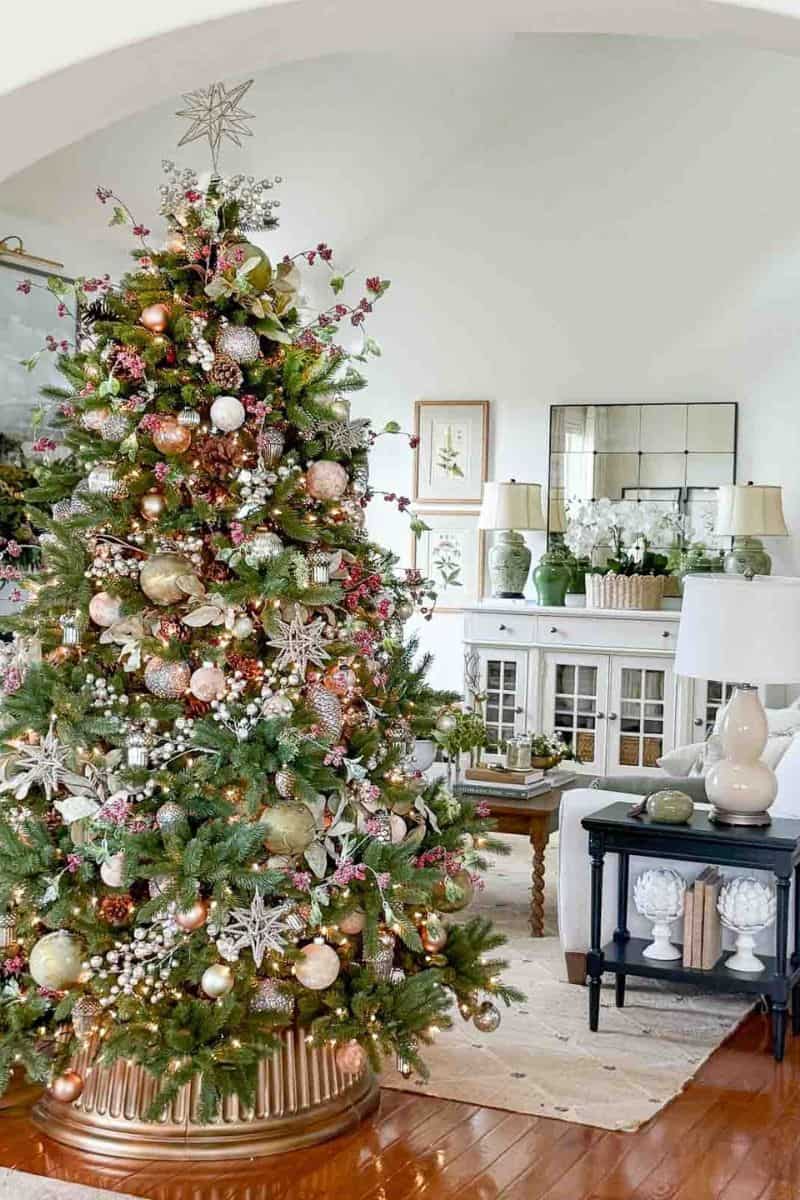
The white and red berry sprays are what keep this tree from reading like a showroom display. Baubles alone give you shine; berries give you asymmetry and a little mess, which is exactly what makes a tree feel decorated by a person instead of a planogram. Tuck them in dead last, after the ornaments, and let a few sprays push straight out past the branch tips so the silhouette stays irregular.
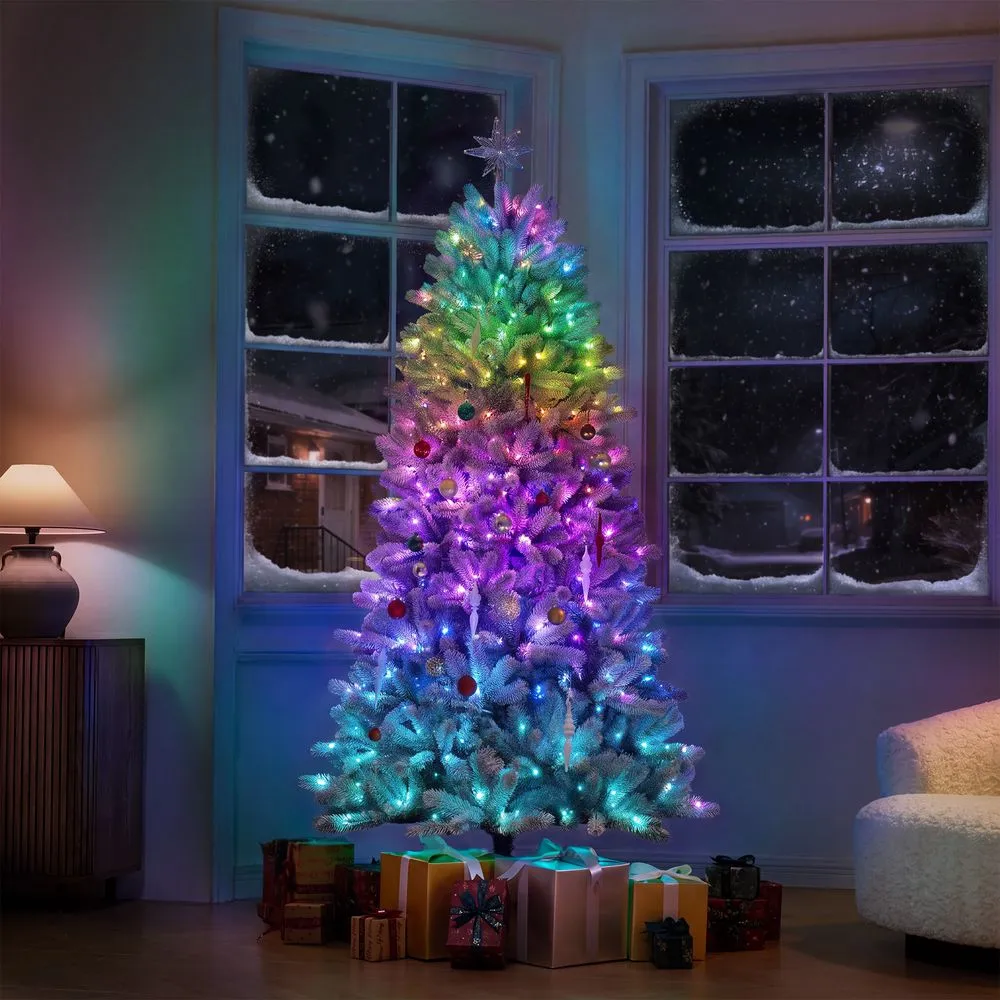
2. A Rainbow Gradient That Runs Green to Teal
You can absolutely fake the gradient-light look without buying a designer tree. Here’s what a realistic version runs:
- Pre-lit tree plus color-changing LED strip: $120–$260
- Ornaments in mixed metallics, gold and red: $30–$60
- Wrapping paper, ribbon, tags: $40–$80
- Star topper: $10–$25
- Extension cord and remote: $15–$30
Total: roughly $215–$455. Budget alternative: buy a plain green tree and a $25 app-controlled LED strip, then wrap it yourself up the trunk. Same effect, about 60% less.
Gradient lighting works because the eye reads it as one continuous object instead of two hundred separate points of light. The hue steps evenly from green at the crown down through purple and teal, so nothing competes — your brain just follows the flow downward and lands on the gifts. The cream bouclé chair does the quiet half of the job, giving all that saturation somewhere soft to land.
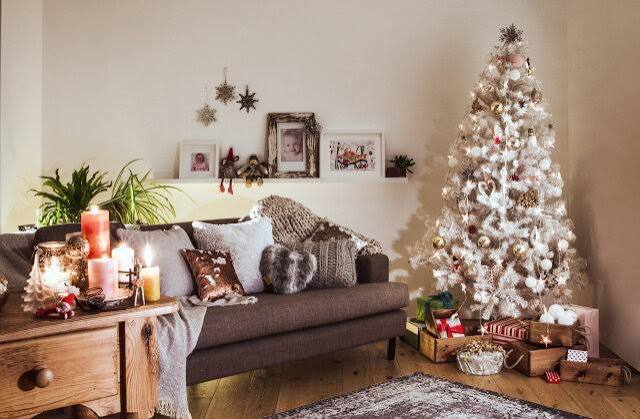
3. The Branch Cone Tree That Fits a Hallway
Wooden dowel trees live or die on spacing. Cut your dowels in graduated lengths and keep the gap between levels at 4 inches, no more — any wider and you get a ladder instead of a cone.
- Top level: 6-inch dowels
- Middle levels: add 1 inch per row
- Gap between rows: 4 inches
- Base width: about 40% of total height
Drill each level into a central dowel at 90 degrees and sand the cut ends so the fairy lights don’t snag as you wrap.
The formula here is roughly 75% light natural wood, 15% warm white light, and 10% near-black. That last 10% is the dark pot at the base, and it is non-negotiable — without it the whole structure floats against a white wall. Swap the wood to pale ash or washed pine, keep the pot charcoal, and the formula holds. Want it warmer? Go amber bulbs and shift to 60/30/10.
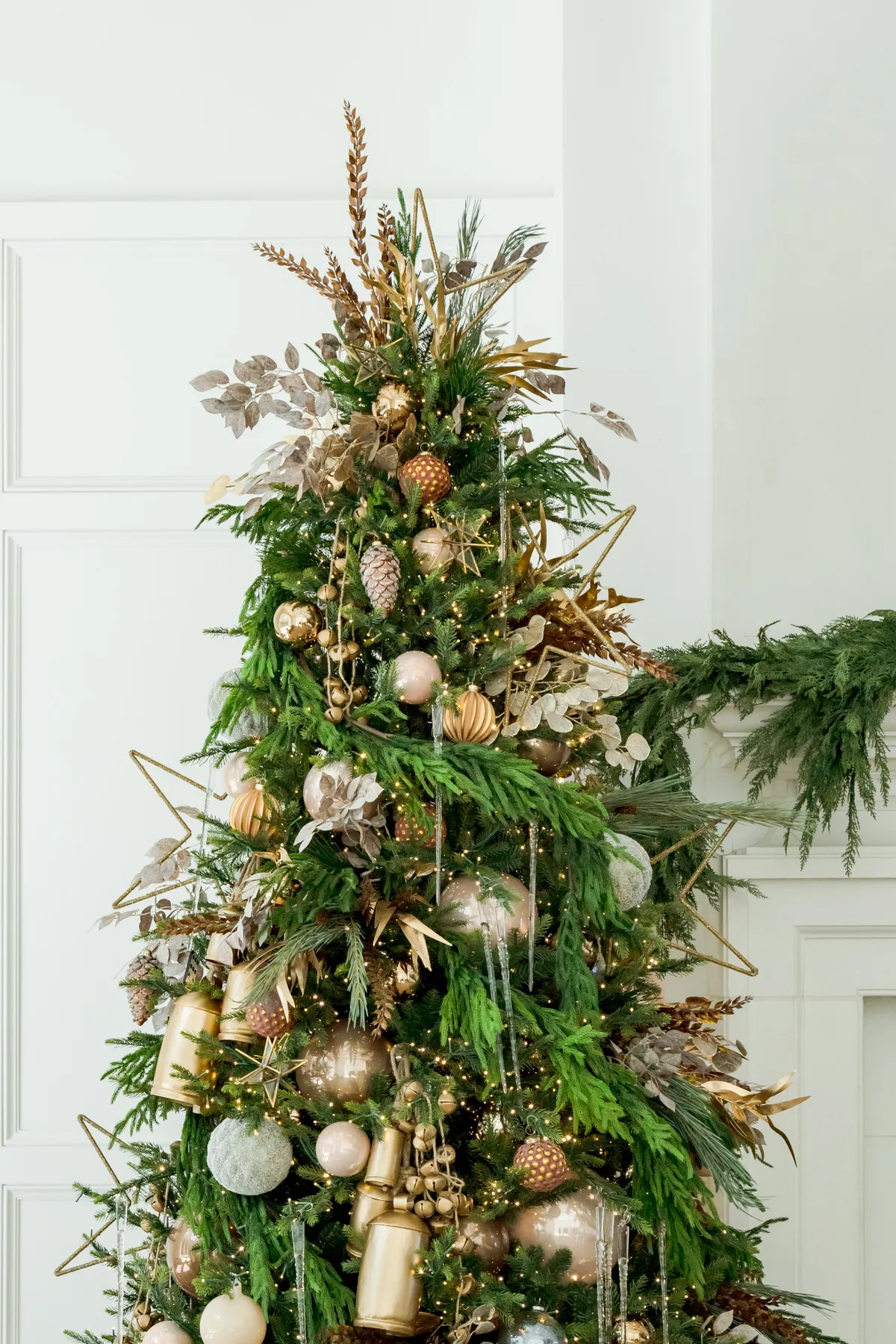
4. Gold, Bronze, and Blush Layered on a Paneled Wall
Dense, layered trees are a numbers game, not a talent game. Here’s the honest math for a 7-foot version:
- Faux tree, 7 ft: $80–$200
- Ornaments, and you’ll need 80 to 120 pieces: $60–$150
- Metallic picks, sprays, faux foliage: $40–$90
- Clear acrylic icicles: $15–$35
- Warm white lights, 600 to 800 count: $20–$45
Total: about $215–$520. Budget alternative: buy ornament multi-packs in gold and blush and let one spray of glitter stars carry all the sparkle.
The clear acrylic icicles are the sleeper element. Everything else — the bells, the bronze spheres, the glitter stars — is opaque, so light sits on the surface. The icicles catch the fairy lights and throw them back at an angle, which is what gives the whole tree that wet, glassy shimmer. Take them away and it’s a nice tree. Leave them in and it looks expensive.
5. A Living Succulent Cone on a Rustic Wood Slice
This one is a weekend project, not a shopping trip. Budget 2 to 3 hours and about $60 to $90 in materials.
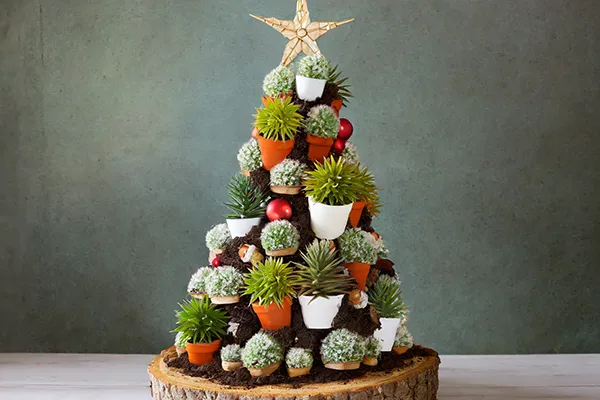
- Start with a 36-inch floral foam cone and soak it overnight.
- Wrap the cone in sheet moss and pin it down with floral U-pins.
- Pot 2-inch succulents in small terracotta and white cups, then press each into the foam at an upward angle.
- Fill gaps with moss, working bottom to top.
- Wire a wooden star to the tip and hang a handful of small red baubles.
- Water with a syringe every 10 to 14 days.
Succulents on foam are a two-to-three-week display, not a month-long one. Under winter light they’ll stretch toward the nearest window and the rosettes loosen. Keep the cone within a few feet of bright light and skip watering until the moss feels dry — and if you want zero upkeep, Idea #17 gives you the same handmade feel in wood.
6. Bronze Spheres and Kraft Paper, Nothing Else
Bronze and copper ornaments are where stores quietly mark things up, so don’t pay full price. Grab a multi-pack of basic spheres at Walmart or Target for $15 to $25, then buy a single can of metallic copper spray for $8 and hit half of them outside. Spray a few twice to get matte next to gloss. The kraft paper is the other cheat — a $6 roll of brown paper and a spool of gold ribbon beats any printed wrap on the shelf.
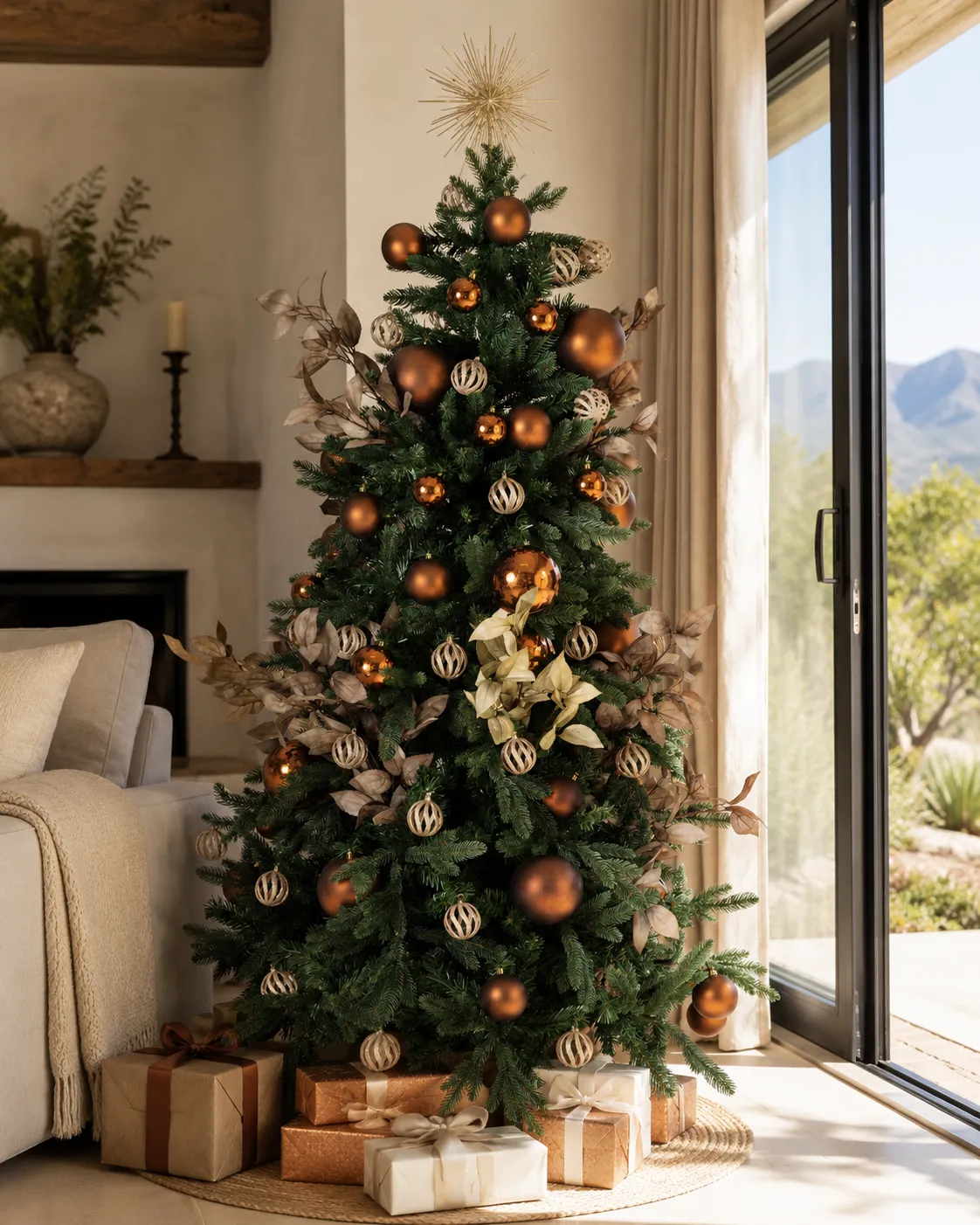
There are exactly three materials on this tree: bronze metal, kraft paper, and green branches. That’s it. Restraint is doing the heavy lifting — because every ornament sits in the same warm metal family, your eye stops counting pieces and reads texture instead. The spiky gold star works for the same reason: it’s the only sharp shape in a sea of spheres, so it earns the top of the tree.
7. Plaid Baubles and Norwegian Flags in the Branches
Heritage ornaments are back in a real way. Plaid, little flags, and hand-me-down-looking pieces fit a broader 2026 shift toward trees that tell a story instead of matching a catalog, which is why memory trees keep climbing on Pinterest. This one leans Nordic, and it has staying power — the pieces are cheap, they layer easily, and they never look dated the way a single trending color does.

Clip-on candle lights need rhythm, not coverage. Space them 8 to 10 inches apart and place them only on the outer third of the branches so the glow reads against dark green instead of disappearing inside. Use LED versions — the warmth is convincing now, and you can leave them on all evening without a second thought.
8. A Ladder Full of Plants and String Lights
Forty-five minutes, one ladder, and whatever plants you already own.
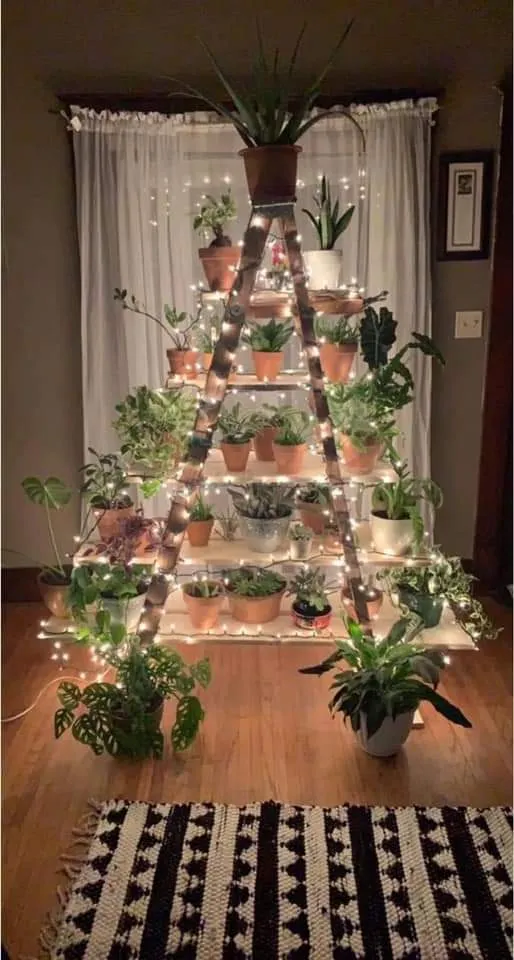
- Lean an A-frame wooden ladder against the wall and strap the top rung to a stud or use anti-tip hardware.
- Set the largest pots on the bottom two rungs and graduate sizes as you climb.
- Weave a 20-foot string of warm lights up one side and down the other, hiding the wire behind the pots.
- Add a timer plug so it comes on at dusk.
Materials run $0 if you own the ladder, or roughly $90 to $140 new.
This works best in a genuinely narrow slot — a 3-to-4-foot wall, a hallway end, the dead corner beside a sofa. You need about 6 feet of height and 18 inches of floor depth for the ladder to sit safely. Ceilings under 8 feet are fine; tall rooms will swallow it, so add a plant stand to gain height. Compare with Idea #19, which needs a much wider footprint.
9. Pine Garland Traced Straight Onto the Wall
Wall trees are the cheapest category in this whole roundup, which is exactly why they keep going viral.
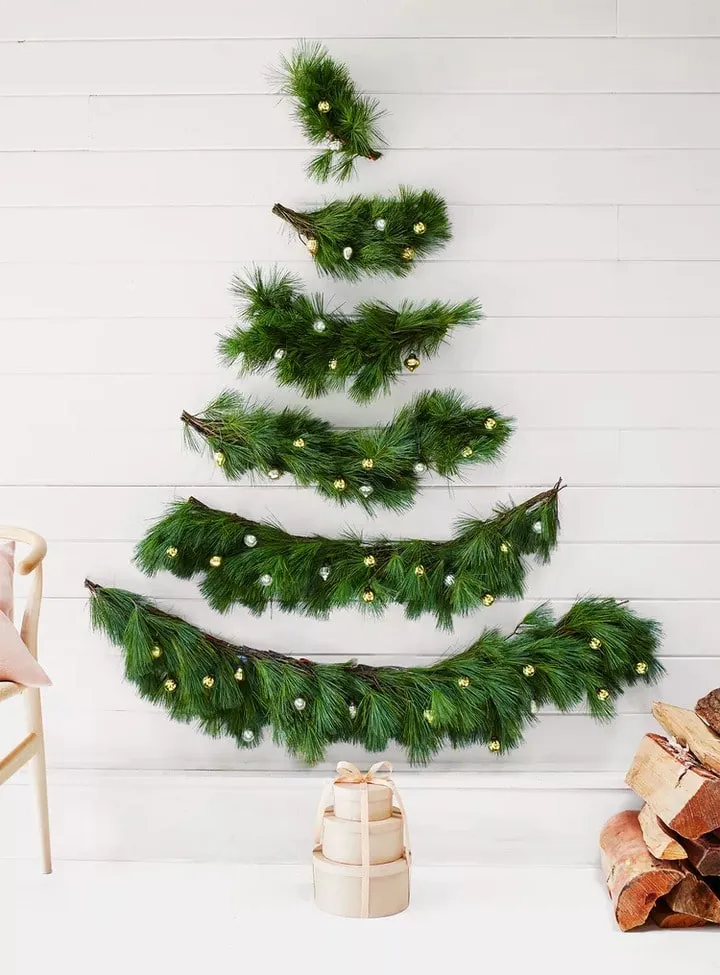
- Pine garland, 4 to 6 sections of 6 ft: $40–$90
- Warm white fairy lights, battery or plug-in: $15–$35
- Gold and silver baubles, mixed sizes: $20–$45
- Damage-free hooks and cable clips: $10–$18
- Gift boxes and ribbon: $20–$50
Total: about $105–$238. Budget alternative: one 9-foot garland cut into sections and reshaped reads nearly identical for half the price.
Stagger the rows so each one overlaps the row beneath by 2 to 3 inches — flush rows look like shelving, overlapping rows look like a tree. Snap a chalk line for the top row only, then eyeball the rest; perfect symmetry is what makes a wall tree feel stiff. Use hooks rated for 5 pounds and run the cord straight down behind the lowest row.
10. One Horizontal Branch, Three Star Ornaments
This is an 80/15/5 composition: 80% empty wall, 15% branch, 5% sparkle. The negative space isn’t leftover — it’s the main material. Fill it in and the whole idea collapses back into ordinary garland. Keep the branches within a 4-foot-wide band, leave at least 18 inches of clear wall above and below, and let warm fairy lights do the rest of the talking.
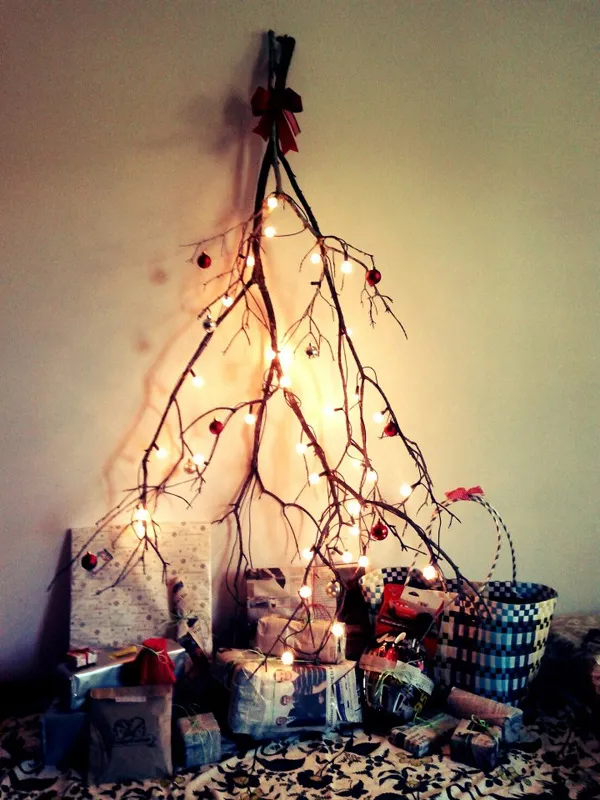
The single green sprig in the white vase below is the detail that turns wall decor into a composition. It’s small, it’s off to one side, and it repeats the branch material at a different scale — which is exactly what your eye wants after scanning all that horizontal wood. Without it the arrangement reads as unfinished. With it, the whole wall feels considered.
11. Twigs, Pinecones, and a Wood Slice Base
Two hours, mostly gathering.
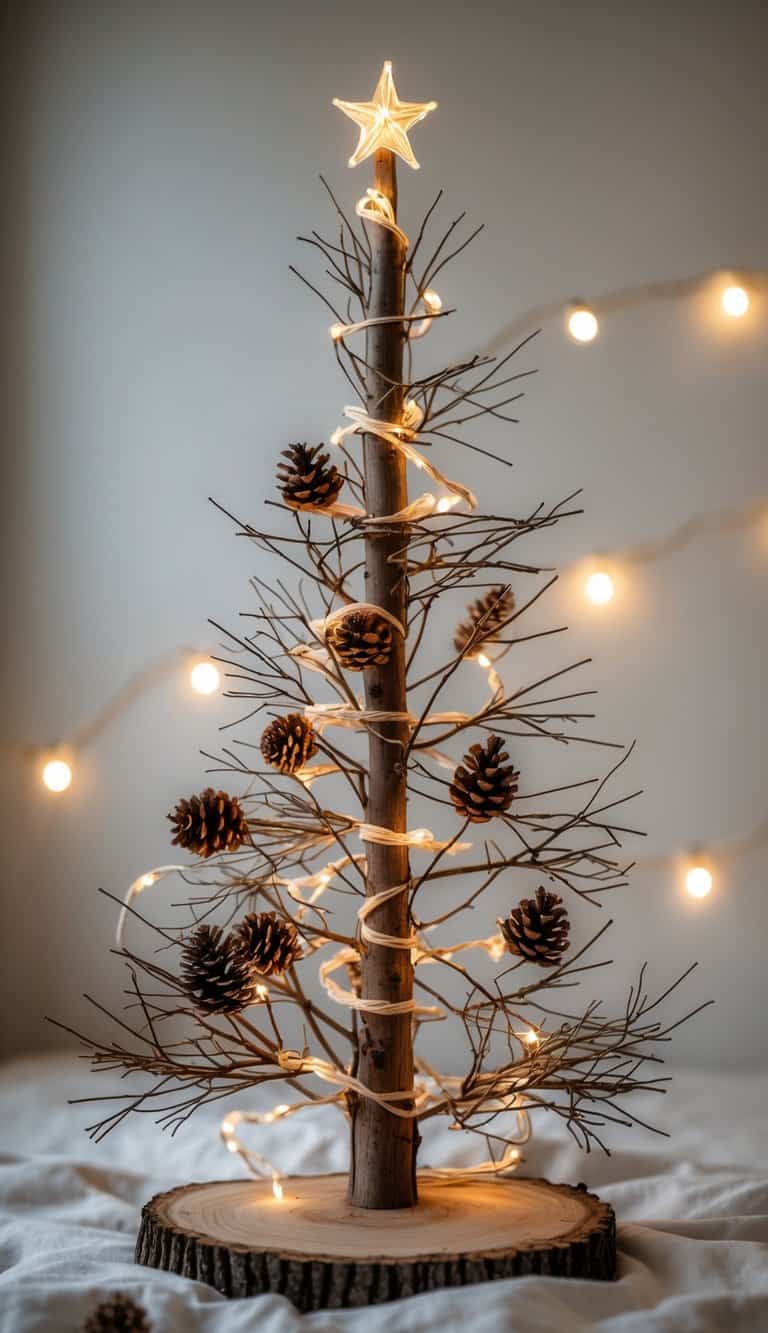
- Drill a 1-inch hole into the center of a 10-inch wood slice and set a 5-foot dowel in with wood glue.
- Cut twigs in descending lengths, from 18 inches at the bottom to 6 at the top.
- Attach each pair at 4-inch intervals using twine and a dab of hot glue.
- Spiral warm fairy lights upward.
- Tie pinecones on with twine, then wire a star to the top.
Ask a Christmas tree lot for their trimmings — most will hand you an armful for free in mid-December. Add a $6 string of lights and a bag of pinecones and you’ve built this for under $20. It’s the zero-budget cousin of Idea #19, which stacks thicker branches and piles on ornaments to fill a bigger room.
12. Macrame Tree and Stocking, Built for a Small Wall
What makes this work is contrast without color. Cream cord against a white wall is a low-contrast pairing, so texture does all the talking — knots, fringe, and the open gaps between them read clearly from across the room. The small red beads are the only saturated note, and because there are maybe a dozen of them, they punch far harder than a whole tree of red ornaments would.
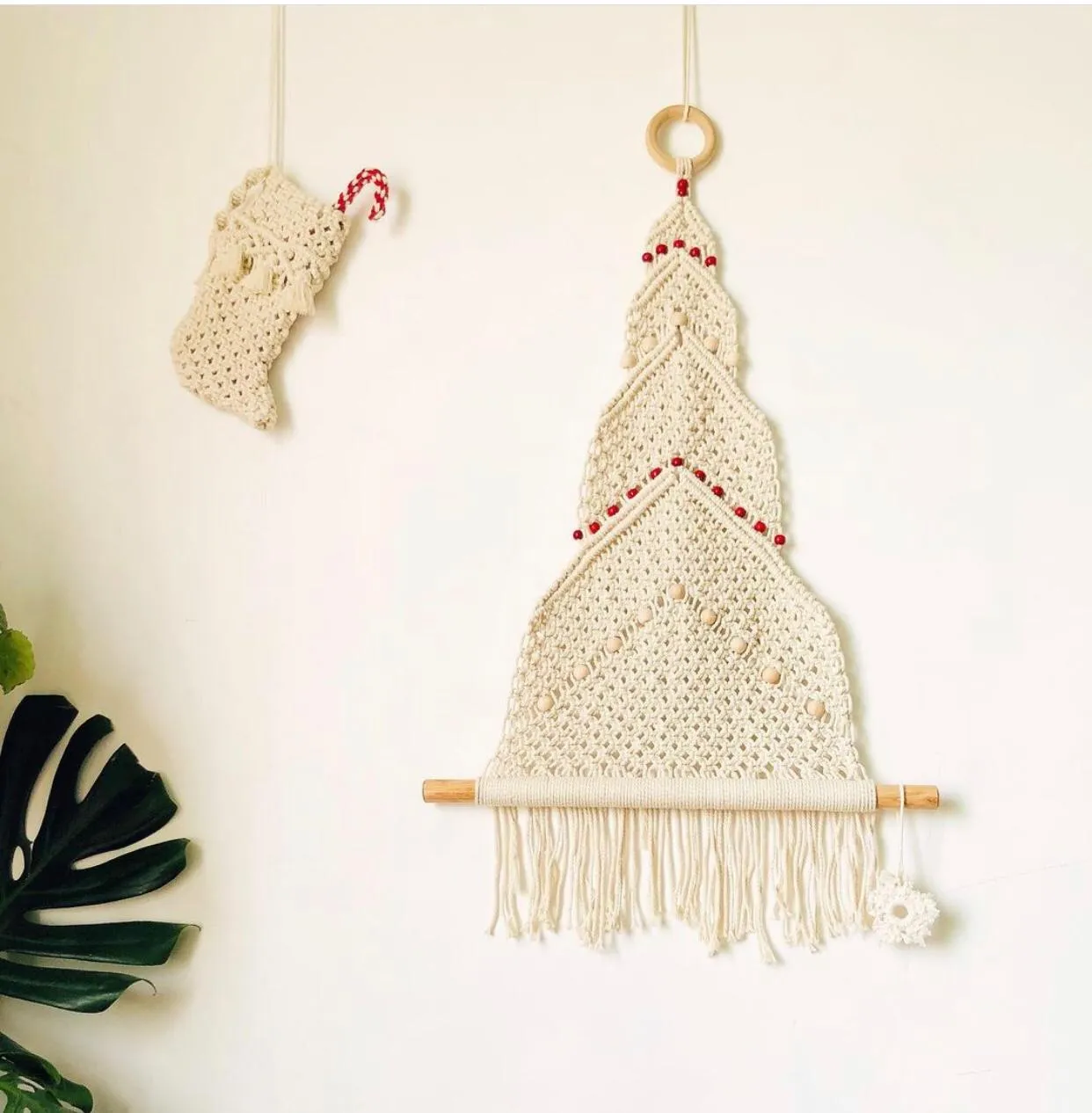
Macrame is a dust magnet, and the fringe is where it collects. Vacuum monthly with a brush attachment on the lowest setting, or shake it out a window. Spot clean with cold water and a drop of dish soap, then blot — never rub. Beads loosen over the years, so keep a spool of matching cord around and expect one small repair per season. Store it rolled around a cardboard tube, never folded.
13. Red, White, and a Fluffy Fur Skirt
A compact pre-lit tree in the 4.5-to-5-foot range is the right call for rooms under about 120 square feet, and it’s the only size that works in a bedroom corner without eating your floor. You need 30 inches of clear wall width and a nearby outlet. With standard 8-foot ceilings you’ll still have plenty of air above it — resist the urge to size up. Bigger rooms have room for Idea #20.

A faux fur skirt should pool, not tent. Buy one 6 to 8 inches wider in radius than your stand and let it puddle on the floor — a skirt that stops mid-air looks like a lampshade. Tuck the front edge slightly under the lowest branches so the transition disappears, and shake it out before guests arrive, because faux fur creases badly in storage.
14. A Gingerbread Snowflake Where the Star Should Be
The gingerbread snowflake is doing something a star can’t: it sets a tone. A star says Christmas. A brown felt cookie with white stitching says someone in this house has a sense of humor. That’s the entire function of a topper — it’s the one ornament at eye level with nothing behind it, so it should be the most personal thing on the tree, not the most expensive. Small rose gold baubles and red ribbon bows stay quiet underneath and let it lead.
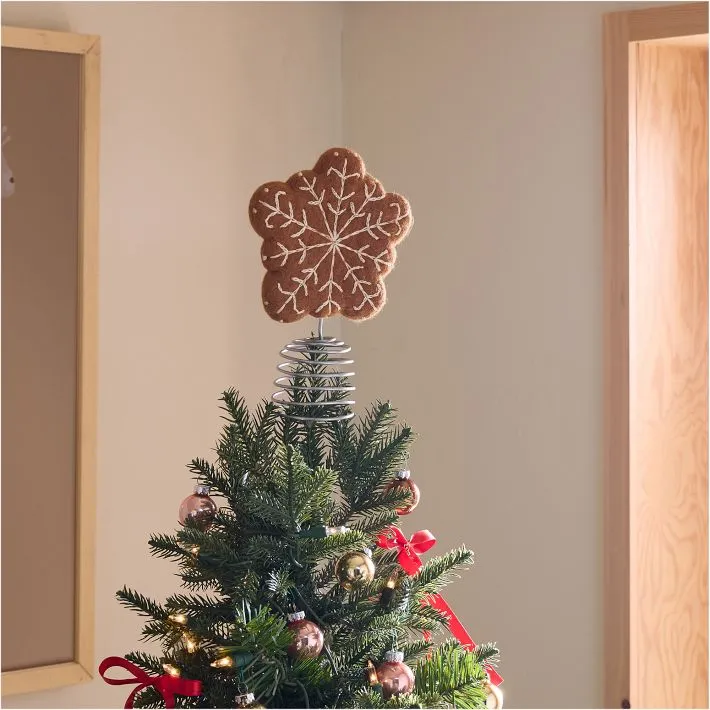
Felt toppers like this turn up at Target and Michaels for $6 to $12, and if you can thread a needle you can make one for about $4 in felt and embroidery floss. Trace a snowflake on paper, cut two layers, blanket-stitch the edge, and stuff it lightly. The silver spiral base is a $3 craft-store part — or bend a loop of heavy-gauge wire.
15. Two Dozen Glitter Bows and Not Much Else
An hour of work and about $20 in ribbon gets you a tree that looks like it took all afternoon.
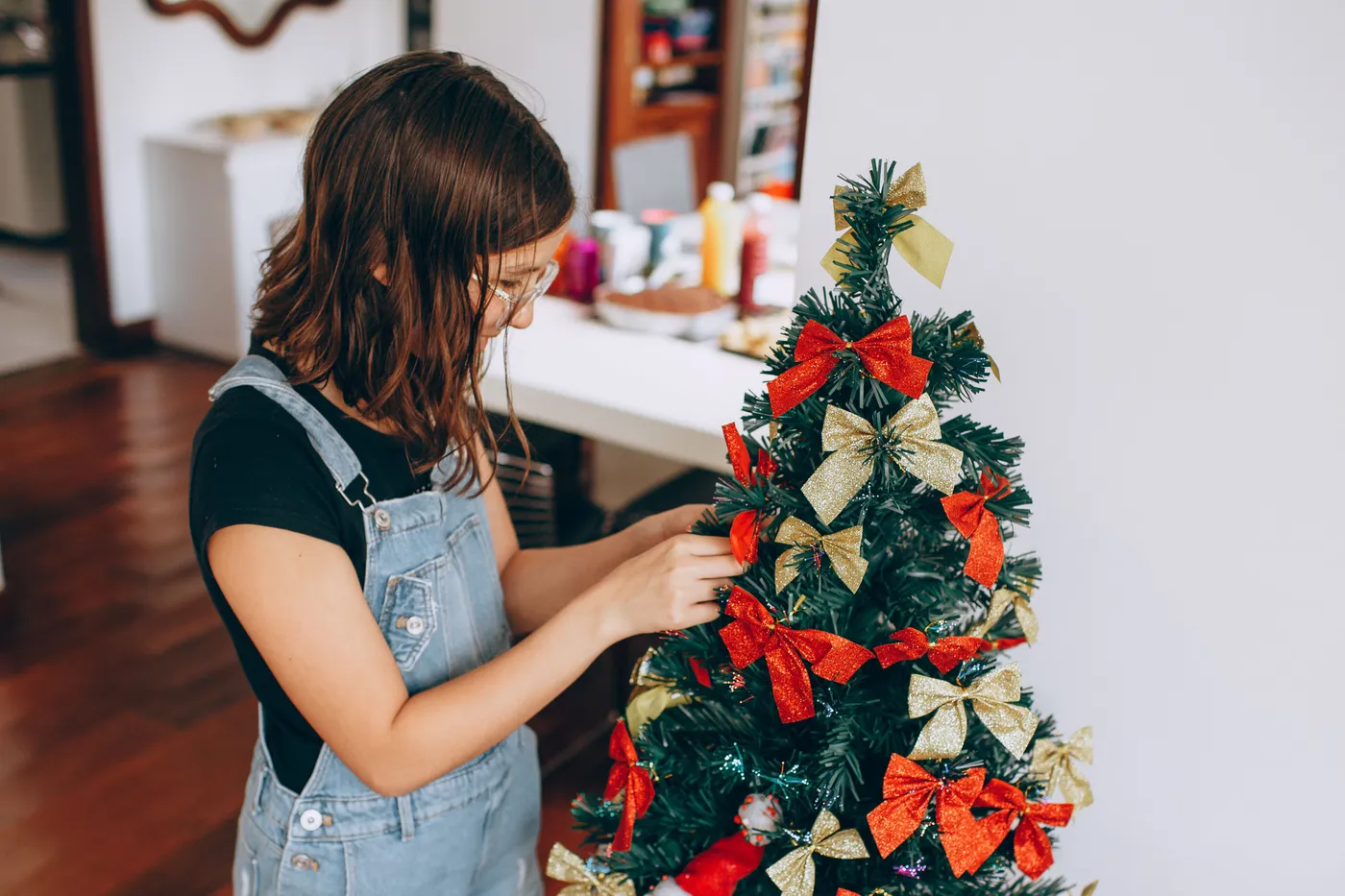
- Use 2.5-inch wire-edge ribbon — paper ribbon won’t hold a bow shape.
- Cut 14-inch strips, fold into a loop, pinch the center, and twist a wire tie around it.
- Fluff each bow by pulling the loops apart.
- Place one every 10 to 12 inches, alternating red and gold.
- Leave the tails at slightly different lengths so nothing looks stamped.
Glitter sheds, and it sheds hardest on day one. Give the bows a light mist of hairspray outside before they go on and you’ll cut the fallout by half. Keep the bottom two feet clear if you have a toddler or a cat who treats low branches as a personal challenge — glitter plus pet fur is a combination you will not fully recover from until February.
16. A Potted Evergreen Beside the Cork Board
This is the least expensive full setup in the article, which is rather the point.
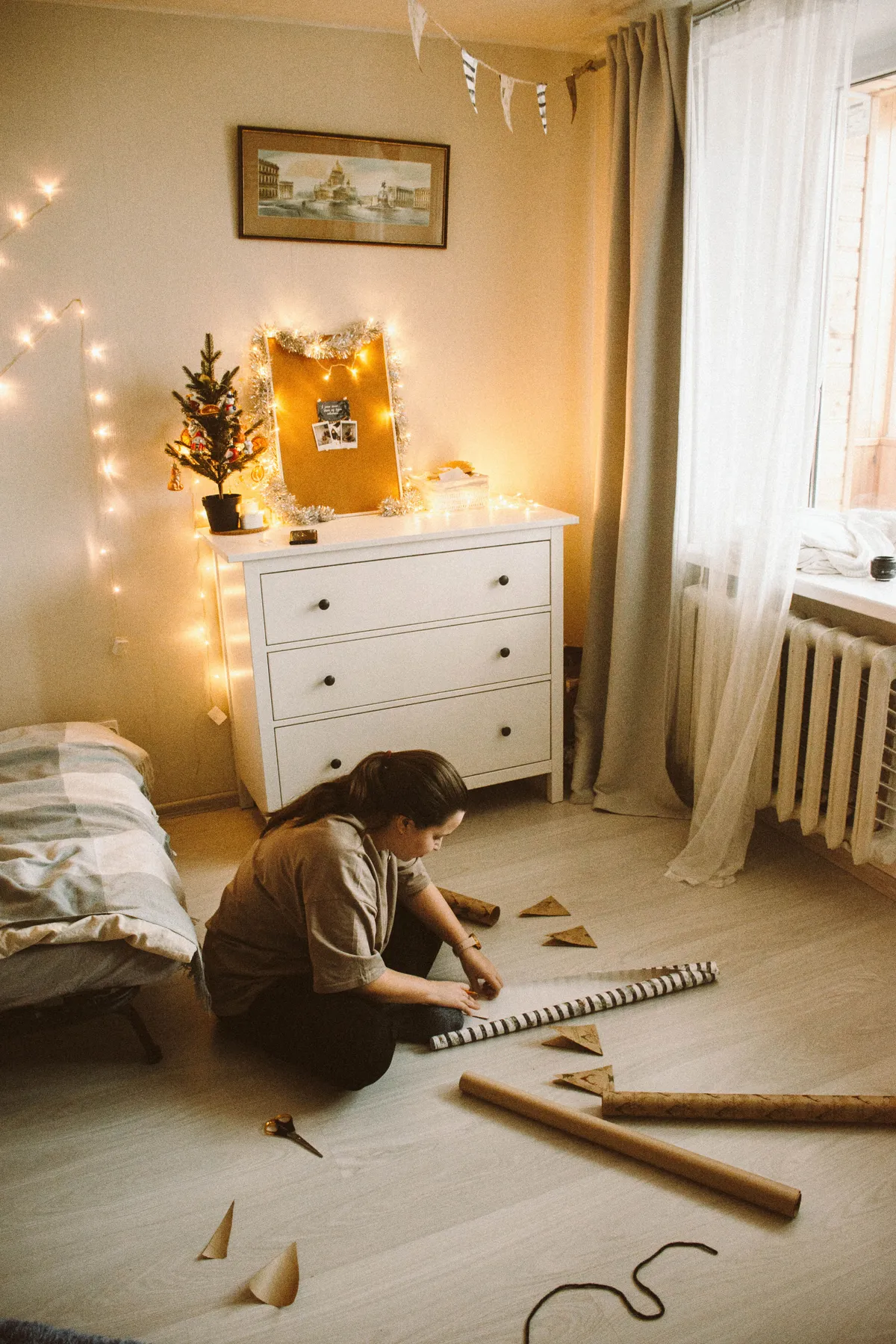
- Small potted evergreen, 2 to 3 ft: $25–$45
- Mini ornaments and string lights: $15–$30
- Cork board and frame: $15–$30
- Silver tinsel and extra lights: $8–$15
- Command hooks and clips: $6–$12
Total: about $69–$132. Budget alternative: skip the cork board and pin your cards straight to the wall with washi tape for about $4.
Small-space decorating stopped being a compromise around 2024 and is now its own aesthetic. Dorm rooms, studios, and shared houses are driving the entire potted-tree category, and the appeal is obvious — you can move it, store it, or plant it in spring. It’s also the version that survives a move, which matters more to this generation of renters than a seven-footer ever did. Pair it with a plaid bed and warm draping lights and no one will call it a downgrade.
17. Horizontal Wood Slats Stacked Into a Triangle
The proportions here are 65% raw wood, 25% warm light, 10% green. That last slice — pine needles tucked into the lower sections — is what keeps a wood structure from reading as furniture. Without it you’ve built a shelf. Swap the pine for eucalyptus or dried citrus and the formula still holds; just keep the green under a fifth of the whole thing.
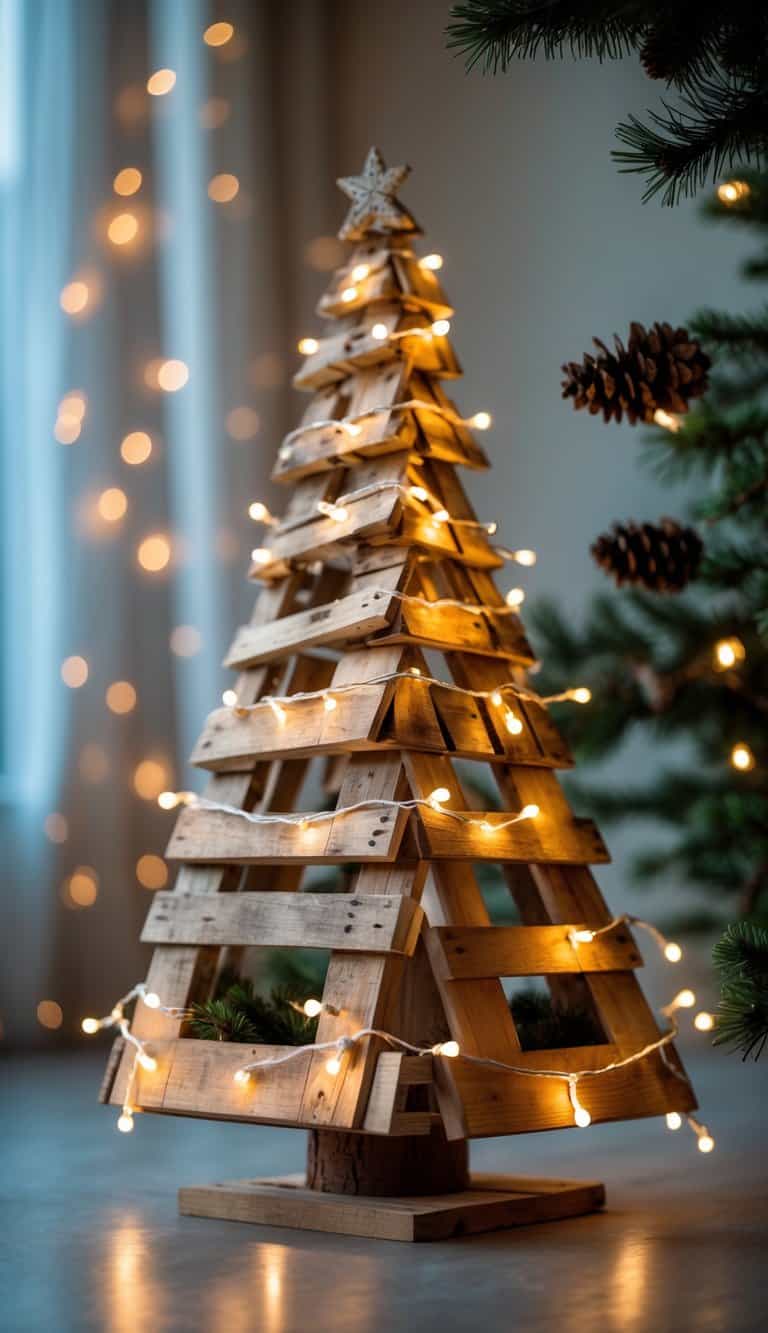
Run the lights along the back edge of each slat, not the front. The wall becomes a reflector and the glow bounces forward, which is why this tree looks lit from within rather than wrapped. Plan on 100 mini lights per 3 feet of horizontal slat, and hide the runs at the ends behind the vertical supports.
18. Red Ribbon Rows With Poinsettias Pinned On
Ribbon trees are temporary by nature. Standard ribbon stretches under its own weight, so a warm room will loosen the rows within a week or two — plan on tightening once mid-season. And if your wall was freshly painted, wait a full seven days before sticking anything to it, or the adhesive will take the paint with it in January.
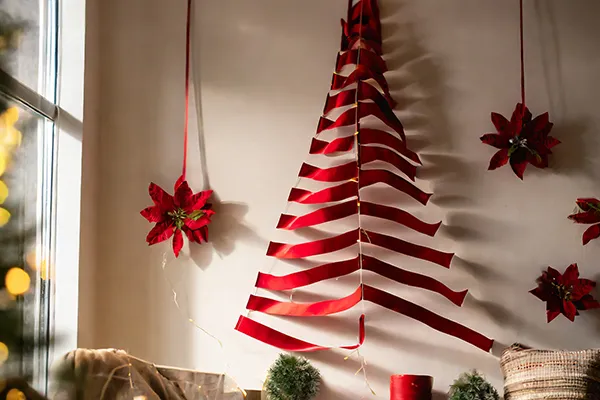
About 90 minutes, one stepladder, and roughly $30 in ribbon.
- Mark 12 inches wide at the top and 30 inches at the base, then divide into 8 rows.
- Cut each ribbon 4 inches longer than its row and press a damage-free strip at both ends and the middle.
- Weave fairy lights along the outer edge of the shape.
- Hang poinsettias on short ribbon loops, spacing them off-center.
- Step back and adjust any row that bows.
19. Driftwood Branches Beside a Marble Fireplace
The trick is texture contrast: raw, irregular branch wood against high-gloss silver ornaments. One material is matte and unpredictable, the other smooth and reflective, and your eye keeps moving between them. The all-white room does the rest — marble, paneling, pale floor — letting the wood read as warm instead of dark, which is the real risk with branch trees in tighter spaces.
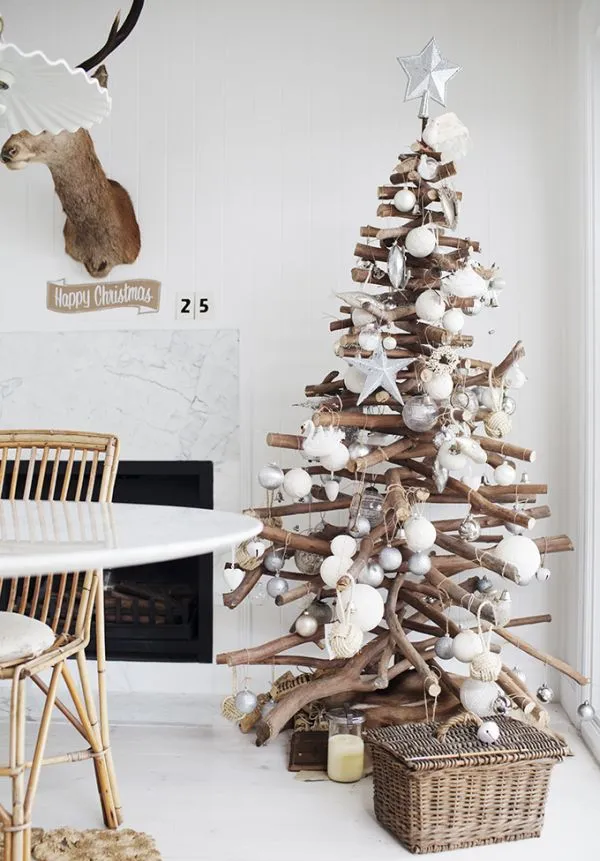
This needs a proper blank wall, think 7 to 8 feet wide, plus about 3 feet of floor clearance around the base. It’s happiest in a 10-by-12 living room or larger, where white walls and a fireplace give the branches something calm to sit against. In a tight apartment, the wall-mounted garland version in Idea #9 delivers a similar silhouette without eating floor space.
20. Deep Green Velvet Bows on a Gold Tree
The bows are where the budget goes, so price them first.
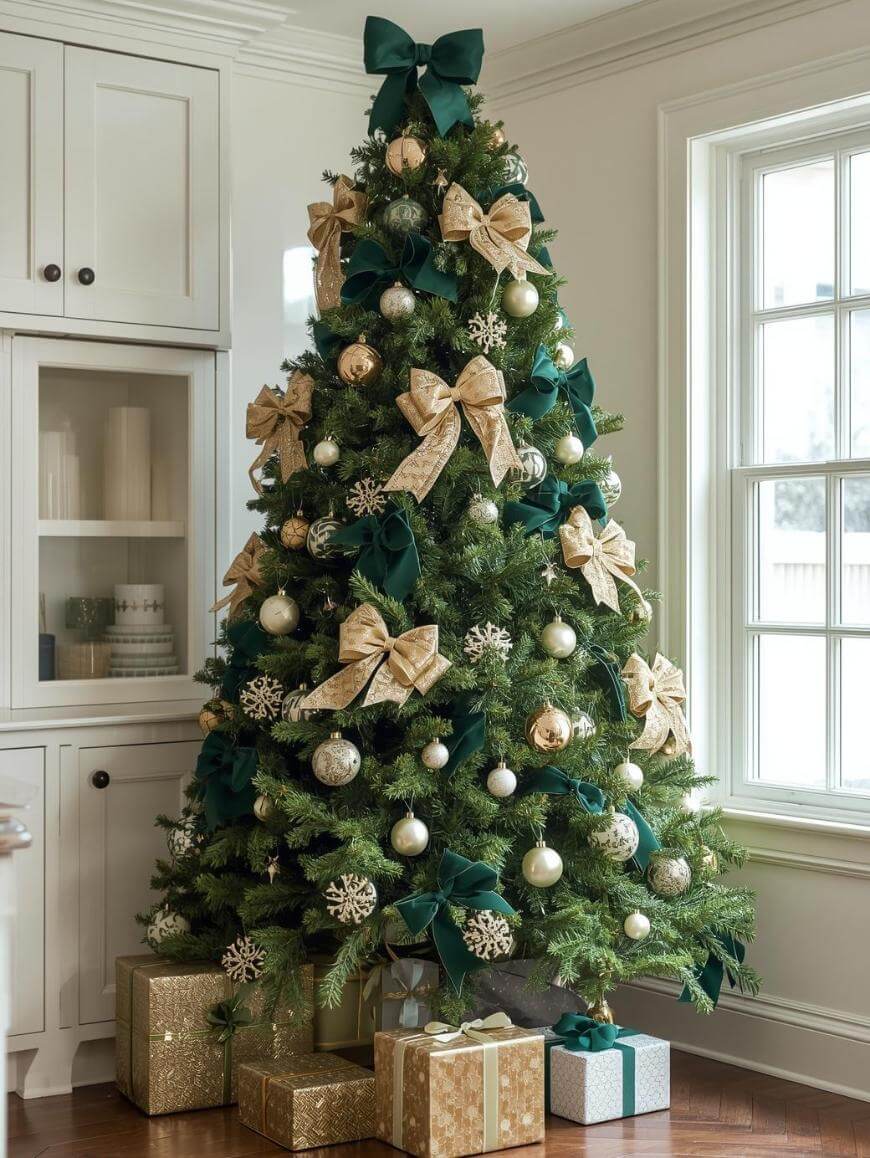
- Green velvet bows, 10 to 14: $30–$70
- Gold and cream ornament set, 60 to 80 pieces: $40–$90
- Gold patterned ribbon for accents: $15–$30
- Gold snowflake picks: $12–$25
- Wrap and ribbon for gifts: $30–$60
Total: about $127–$275. Budget alternative: buy plain green velvet ribbon by the yard and tie your own — about $18 for a dozen.
Check these before you commit to the velvet-bow look:
- Count branch tips — you need roughly one bow per 8 to 10 inches of height
- Note the wall behind the tree; deep green needs light walls or it becomes a dark mass
- Confirm ornament count: this look wants 80 pieces minimum on a 7-footer
- Pick a wrapping palette that matches the tree, not the room
21. A White Tree Dressed Like a Circus Tent
Maximalism got permission to be silly again. Paper honeycomb, circus motifs, and full-saturation color are showing up everywhere in 2026, partly as a reaction to years of beige and partly because honeycomb decor is dirt cheap and ships flat. This one won’t be timeless, and it doesn’t want to be. It’s a two-season look; pretending otherwise misses the whole point of it.
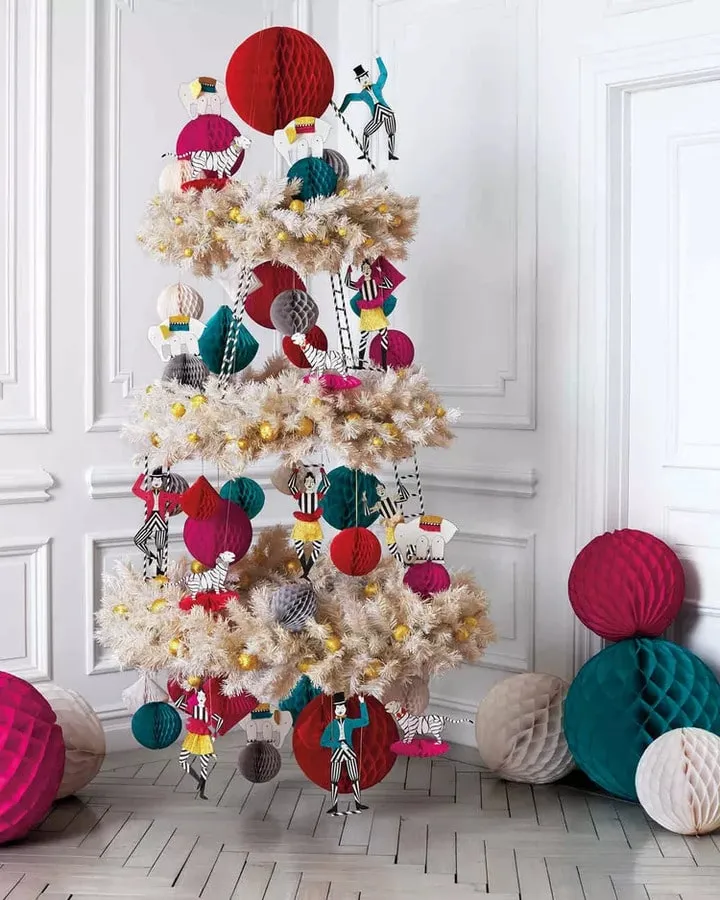
Honeycomb balls need a size hierarchy or they read as confetti. Go largest near the top at 10 to 12 inches, medium through the middle around 8 inches, smallest at the base at 5 to 6 inches — it mimics how gravity actually looks. Open each one fully, crease the edges, then thread floral wire through the center hole and twist it onto a branch.
22. Wooden Slats, Real Candles, a Furry Rug
Real candles on a tree mean one rule: never leave the room while they’re lit. Use dripless tapers, trim wicks to a quarter inch, and keep flames at least 12 inches from any fabric — that includes the white curtains right behind. The furry rug needs a weekly vacuum on low; it mats fast under foot traffic and guest shoes, and a matted pile kills the whole soft, snow-underfoot effect.
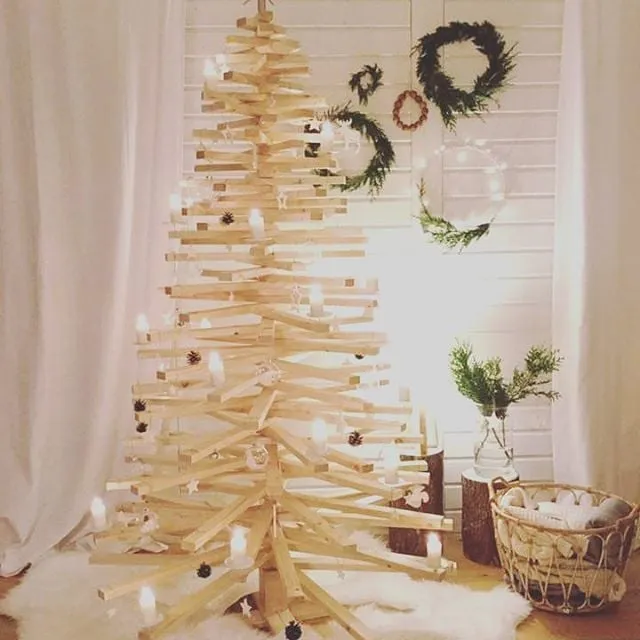
Candles on branches are the oldest version of this idea, and they still land because of the light quality — a flame flickers at a rate LED can’t fake. The rest works on high/low texture: rough wooden slats, soft fur underfoot, glass, greenery on a raw tree stump. Nothing matches, and that’s exactly why it feels collected instead of bought.
23. Silver Berries and Champagne Poinsettias
Champagne poinsettias are the expensive part — fabric stems run $8 to $15 each and this tree wants a dozen. Buy basic cream poinsettia stems at a craft store for $3 to $4, then mist them with champagne metallic spray from 18 inches away. Two light passes, dry them upright, and they’ll hold the same shimmer. Silver berry sprays work identically with a can of gloss silver.
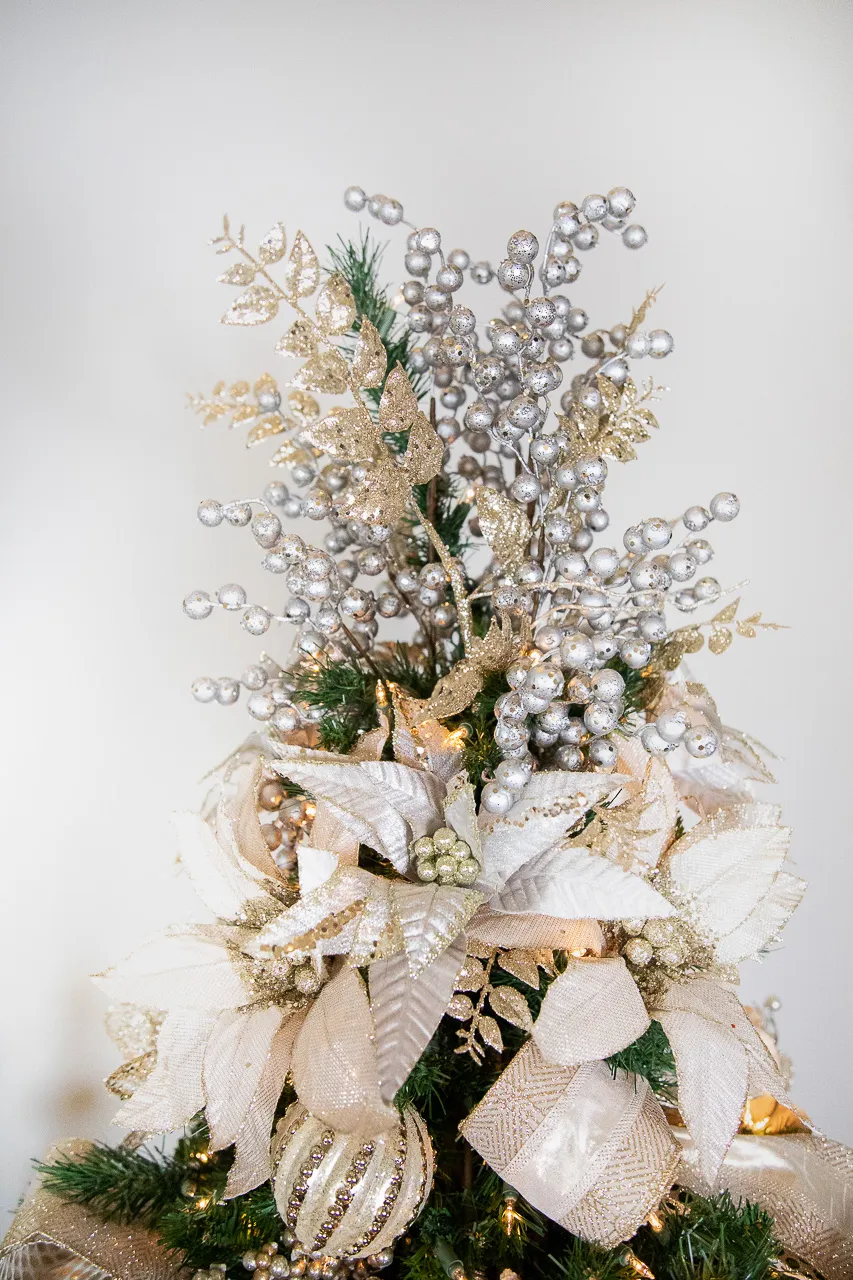
The oversized fabric poinsettias are what separate this from every other gold tree on the internet. They’re soft, matte at the center, and big enough to read from across a room — which ornament clusters never are. Ribbon and ribbed baubles add shine, but the flowers add volume. Without them, the tree looks like it’s wearing jewelry with no dress.
24. Garland Rows That Get Longer as They Go Down
Size the wall tree to the wall, not to your ambition. A good rule: the widest garland row should be about 60% of the wall’s width. Rows sit 8 to 10 inches apart, and the whole shape usually lands between 4 and 6 feet tall. The chair below needs 30 inches of clearance from the wall. If your ceiling runs over 9 feet, start the top row higher than feels natural.
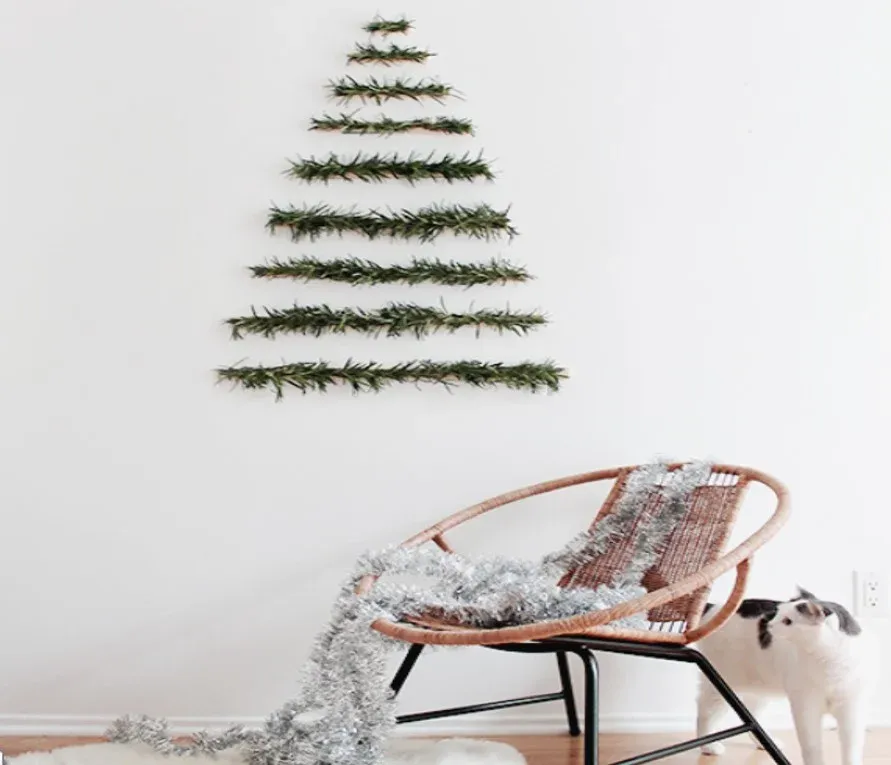
This composition is 60% white wall, 25% green garland, 10% silver, and 5% black — that last bit coming from the chair frame and the cat, honestly. The white wall isn’t background, it’s a material, and it’s what keeps the green from going heavy. Swap silver tinsel for warm brass and the entire thing shifts warmer without changing a single other element.
25. Your Topper Is Doing More Work Than You Think
Size a topper to the tree, not to the shelf it came from. The right proportion is roughly one-eighth to one-tenth of the tree’s height, so a 7-foot tree wants something in the 9-to-11-inch range. Keep it under a pound for a faux tree, and wire the base to the top branch rather than balancing it. That’s the difference between a topper that survives December and one that falls at 2 a.m.

Heavy toppers bend the leader branch, and once it bends it stays bent for the life of the tree. If you’ve got a sentimental piece that genuinely weighs something, don’t force it — set it on a stand beside the tree, or hang it lower where the branches are thicker. Nobody is grading you on whether the star is technically at the very top.
26. A Mini Frosted Pine on a Herringbone Blanket
Five things to check before this goes in the cart:
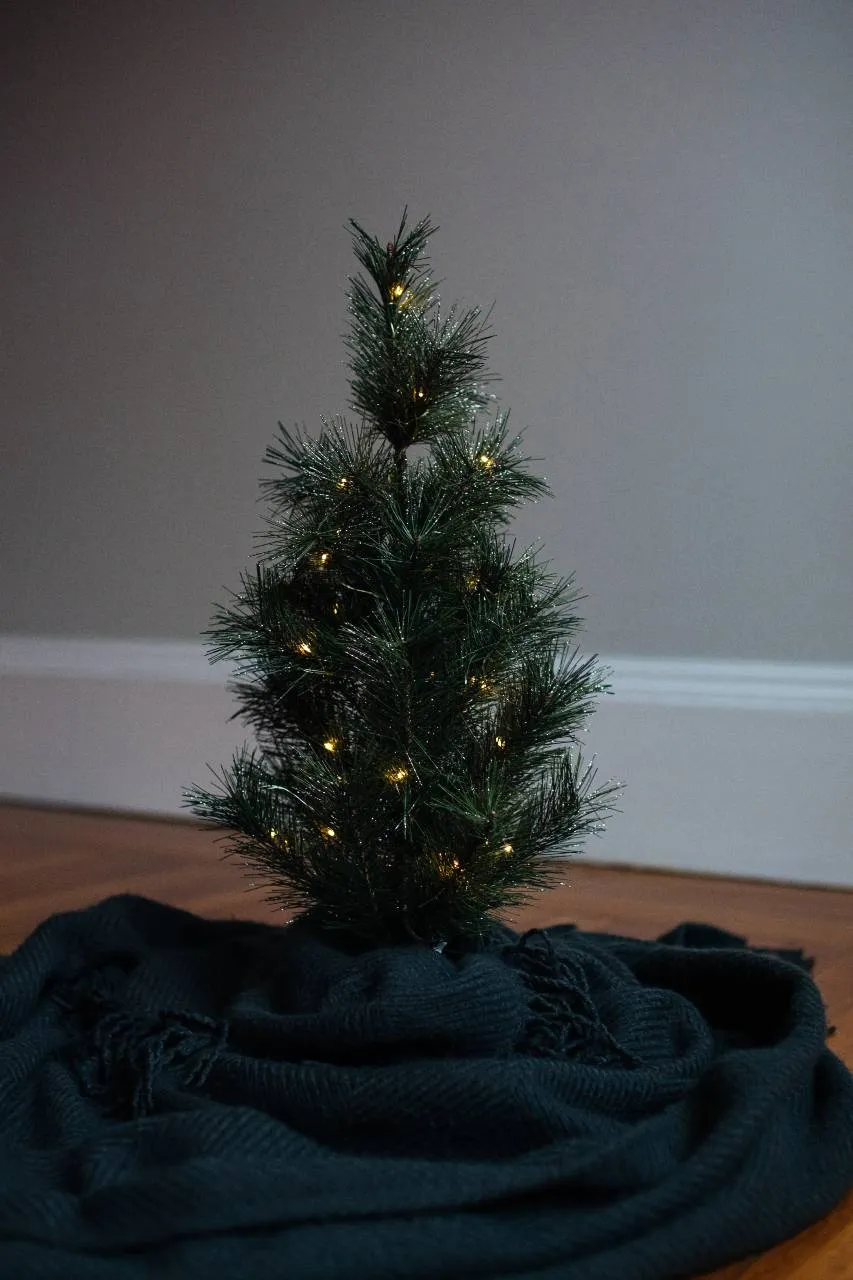
- Floor space — a 3-foot tree wants an 18-inch-wide spot with 6 inches behind it
- An outlet within 3 feet, or a battery-powered light string
- The blanket needs to be at least 12 inches wider than the pot on every side
- Pet-safe: skip tinsel and small removable baubles if you have a chewer
- A timer plug, so the lights aren’t blazing at noon
This is the right tree for entryways, offices, and rooms under about 80 square feet. It also works on a wide dresser or console — frosted branches read bigger than they are, so a 3-footer fills a corner a bare 4-footer couldn’t. Keep the top at least a foot below eye level if it’s on furniture, or it starts to feel like a person standing there.
27. A Basket of Pine, Birch, and Red Branches
Half green pine, a quarter red, 15% white birch, 10% basket. That blend is what separates a floor arrangement from a centerpiece — the birch logs do structural work as much as decorative, giving the eye something vertical inside a very horizontal pile. Trade the red branches for copper and you get a quieter, more adult version of the exact same shape.
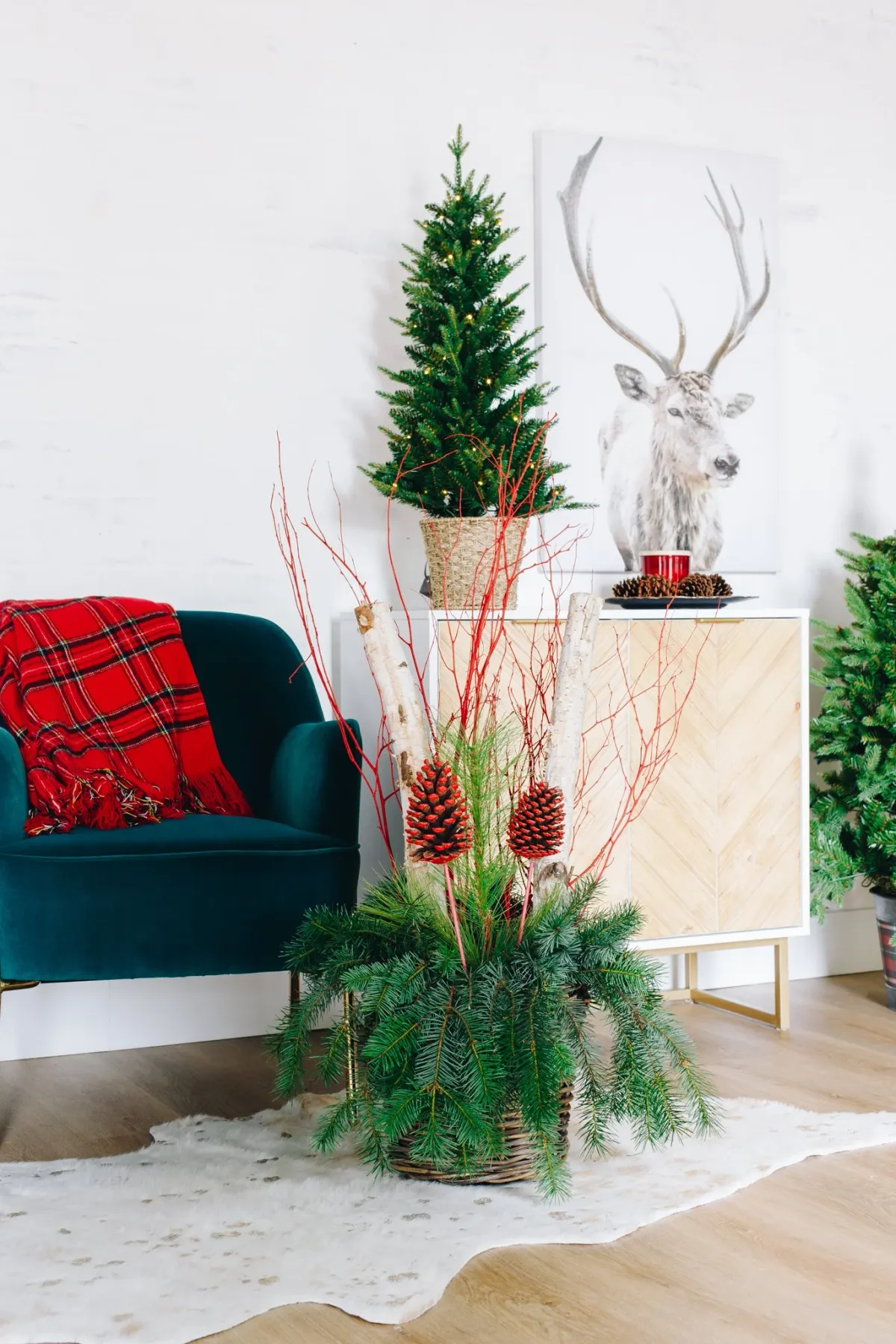
Height is the whole trick. A basket on the floor reads as clutter until something inside it breaks the 3-foot mark, and the red branches do that. The arrangement also gives you a tree you can walk all the way around — no sad back side to hide against a wall. Set beside a teal velvet chair with a red plaid throw, the red repeats twice in the room and suddenly it looks deliberate.
28. Three Macrame Trees Against a Charcoal Wall
Three macrame trees for under $40 is very doable. A 3mm cotton cord runs about $12 for 100 yards — enough for all three. Skip the specialty driftwood stars and tie twigs from the yard into a five-point shape instead. Bottle brush trees are a thrift-store staple at $1 to $3 each, and IKEA pillar candles cost less than a coffee. The dark wall is free, and it’s what makes the off-white cord pop.
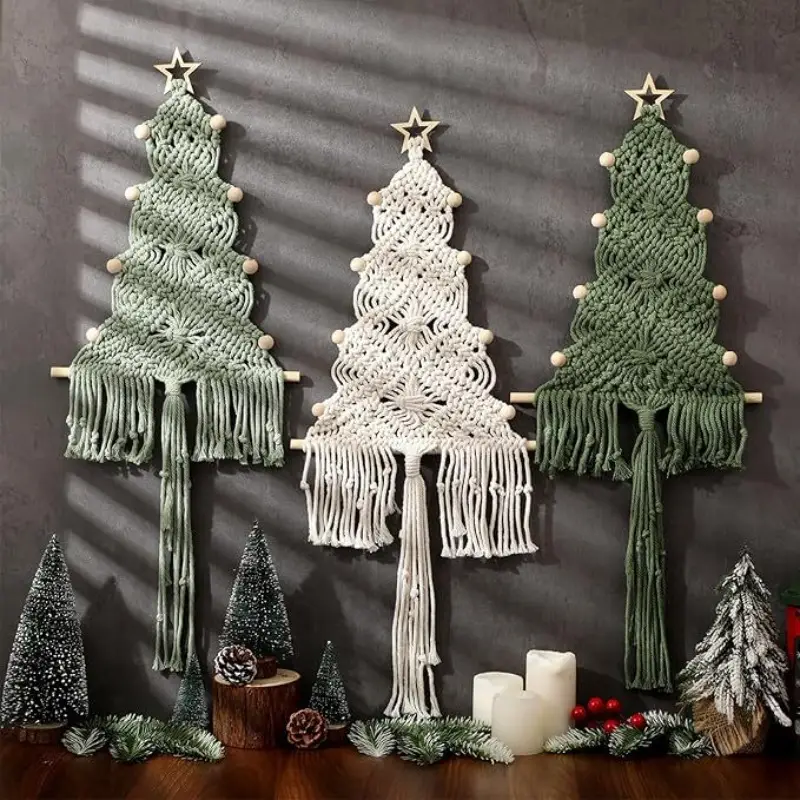
The trio is the idea. One macrame tree on a wall is cute; three in staggered heights with matching wooden star toppers becomes a composition you actually notice. Odd numbers, varied heights, consistent material — that’s the entire formula, and it’s why this reads as a collection rather than a craft project. Group them within a 4-foot span so they stay a single unit.
29. Flocked Branches With Matte Black Baubles
Flocking is essentially fine plastic snow, and it will shed — mostly in the first week, then again every time you move the tree. Vacuum with a hose attachment and no beater bar or you’ll grind it into the carpet. Seal loose patches with a light mist of hairspray. Store the tree upright in a bag rather than crushing it into a box, which is what causes half the shedding next year. If shedding worries you, Idea #6 gets a similar moody look on a plain green tree.
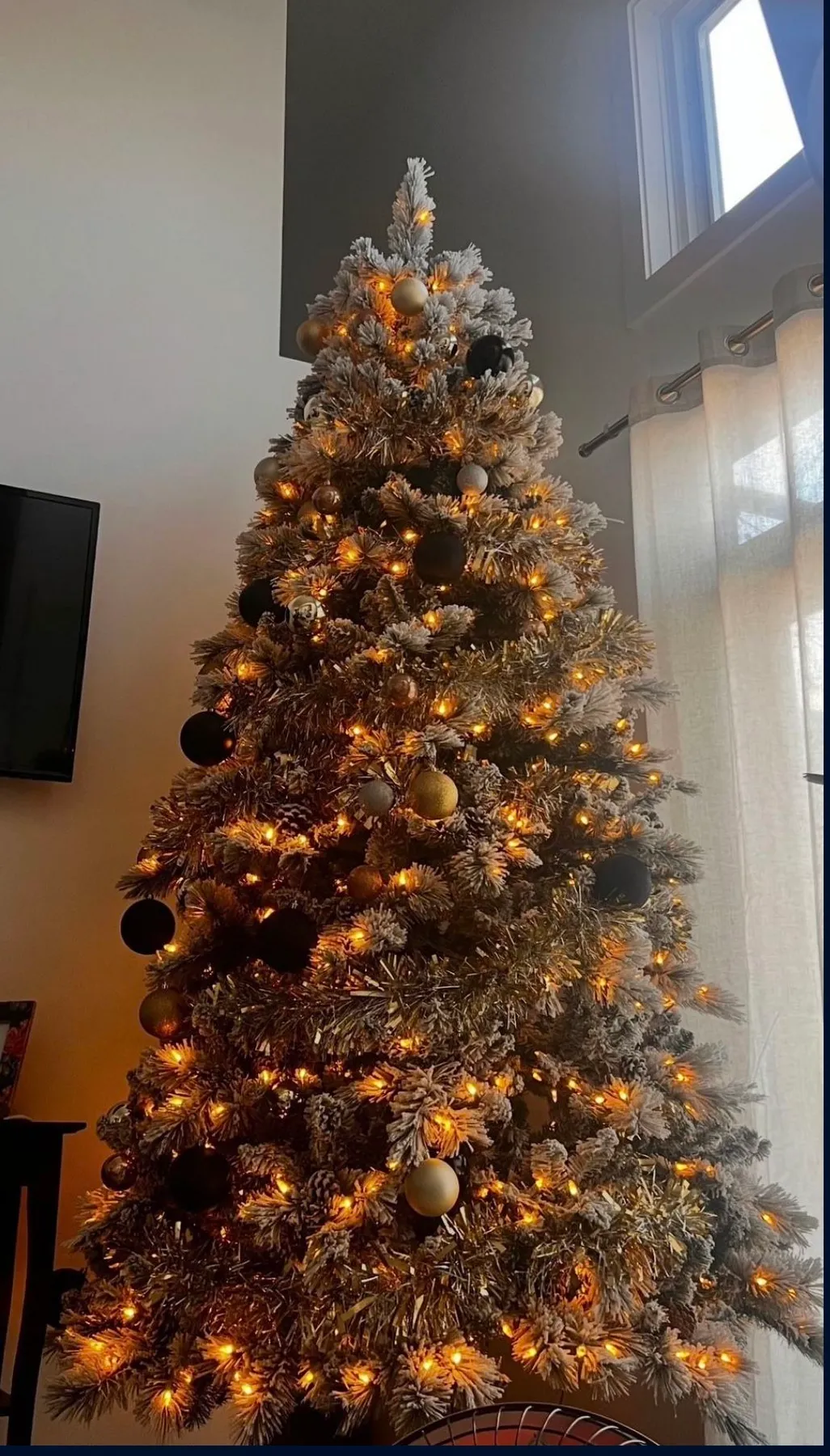
Run through this before you buy flocked:
- Rub a branch with a dark cloth in the store — if it snows there, expect that all season
- Check ceiling clearance; you want 6 inches minimum above the topper
- Count ornament hooks — matte black shows dust, so plan to wipe them
- Confirm a sturdy stand; flocked trees are heavier than they look
No Pine Required — Go Build the Thing
The best alternative Christmas tree is the one that fits your actual room, your actual budget, and the amount of time you’re genuinely willing to spend on a ladder in December. Pick your shape, decide where the money goes, and don’t overthink the rest — imperfection is what makes these read as homemade rather than store-bought.
📌 Save this to Pinterest now so it’s waiting for you when the boxes come down from the attic.