29+ Stunning Glass Christmas Tree Ideas That Will Elevate Your Holiday Decor in 2026

Glass Christmas tree 2026 is having a major moment on Pinterest right now, and the saved boards make it obvious why: these small sculptures do what a full-size tree can’t. After filtering through hundreds of options across Etsy, Anthropologie, Target, and Amazon, we narrowed it down to 29 ideas that actually deliver — from $4 thrifted glass ornaments to $220 hand-blown statement pieces.
You’ll find coastal sea glass, glowing mercury glass, soda-lime stained glass, and minimalist clear glass cones, plus budget and luxury versions compared side by side in almost every idea.
It’s trending in 2026 because smaller homes and quieter Christmas decorating have pushed people toward one beautiful object instead of ten plastic ones. And stay until the end — we break down the most common mistakes that can ruin these looks.
📌 Save this to Pinterest for later — you’ll want to revisit these ideas.
1. Three Textured Glass Trees on a Marble Counter
Three glass trees — one emerald, two clear — sit on a mottled white-and-grey marble counter, and the detail that turns them into a collection instead of three random souvenirs is the matching gold base. Every tree is finished the same way at the bottom. Take that away and you have a green tree and two clear trees with nothing to say to each other. Buy for the base first and the glass second.
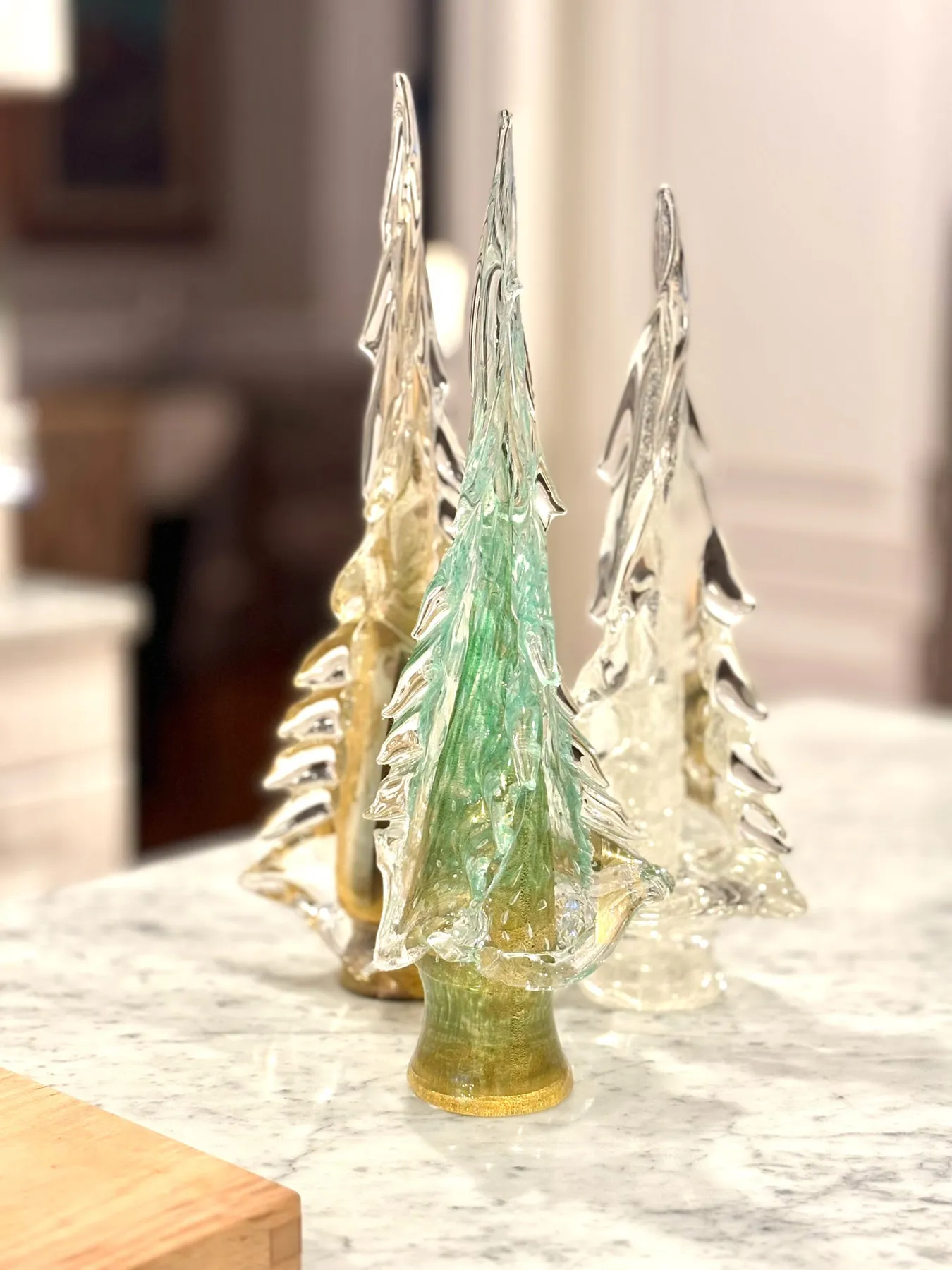
Stagger the heights by at least two inches and leave a hand’s width between pieces. A 10-, 8-, and 6-inch trio reads as a collection; three identical sizes read as inventory. Glass also glows differently depending on what sits under it — pale mottled marble bounces light up through the glass, while dark walnut swallows it. That light wood block in the foreground isn’t clutter; it gives the eye somewhere to land before it hits all that shine.
2. Light-Up Mercury Glass Trees, Three Ways
Two things are working at once here. First, shape repetition: three cones with the same silhouette at three different heights, so your eye reads rhythm instead of clutter. Second, the light comes from inside the glass instead of above it, which is exactly why the mercury finish matters — warm white bulbs bounce off every pitted surface and the tree glows rather than showing a hot spot. The blurry fireplace and decorated tree behind them keep the backdrop busy enough to feel like a real home and soft enough to stay background.
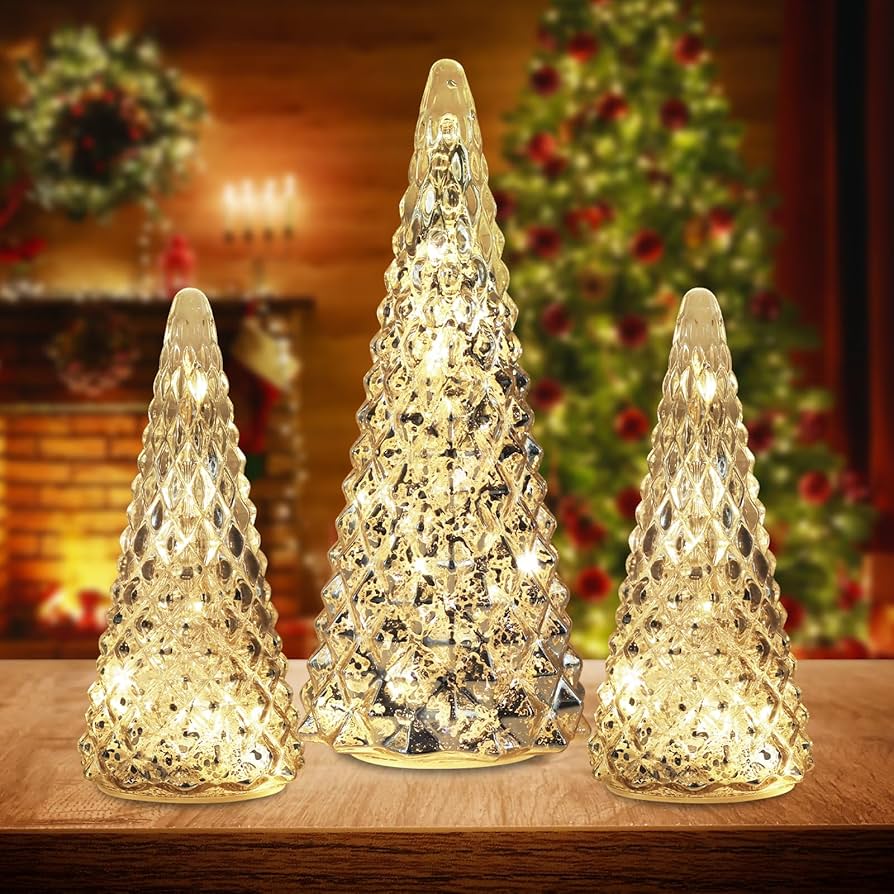
- Three illuminated mercury glass trees, 8–16 in: $45–$120
- Polished wood tray or runner: $20–$60
- Battery fairy lights as backup for dark corners: $8–$15
- Silver and gold glass ball filler ornaments: $12–$25
- Nothing for the wall — the glow is the wall treatment: $0
Total: $85–$220. Budget alternative: buy one lit 12-inch tree and two unlit mercury cones, then tuck a $6 string of fairy lights behind the pair. Same glow, roughly $40.
3. Five Tiered Glass Trees on a Rough-Hewn Wood Plank
Five trees is where collections go wrong, so use a ratio instead of a rule: one dominant color, two supporting tones. Here red does the talking while lime green and amber answer quietly. Keep the tallest tree at one end rather than in the middle — a center peak makes the lineup look symmetrical and stiff, while an off-center high point keeps your eye moving down the row. Buy the plank before the trees if you can; a rough-hewn ledge sets a color ceiling that glossy shelving never will.
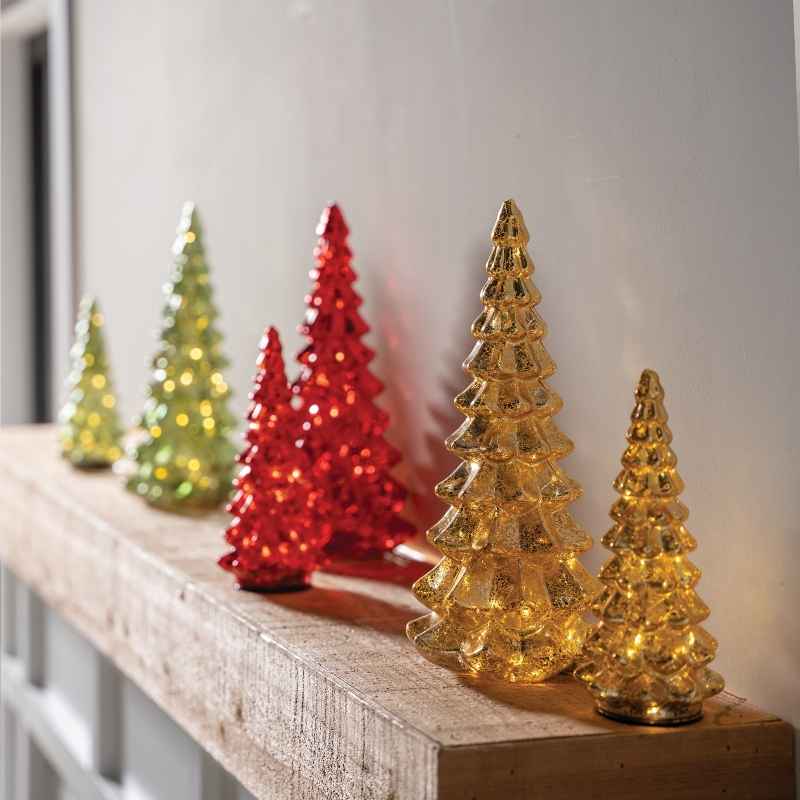
A staggered row like this needs a surface at least 60 inches long and 10 to 12 inches deep — a console, a long mantel, or a sideboard — with a wall behind it that isn’t pure white. Give each tree about four inches of air and keep the tallest between 16 and 20 inches so the group tops out below eye level. Compare with Idea #1, which fits a 30-inch countertop: same collecting instinct, half the footprint.
4. A Single Glass Drop Ornament on a Lighted Stand
- Find a black metal ornament stand with a slim arm — 12 to 16 inches tall is the sweet spot for a drop-shaped bauble.
- Wrap six feet of warm-white micro fairy lights up the pole and tape the battery pack behind the base.
- Hang the ornament so it clears the stand’s base by two inches; any lower and it looks like it fell.
- Build the scene below: kraft-wrapped gifts stacked two high, a pine sprig on a wood slice, a cream knit folded once.
- Set the battery timer for six hours on, eighteen off.
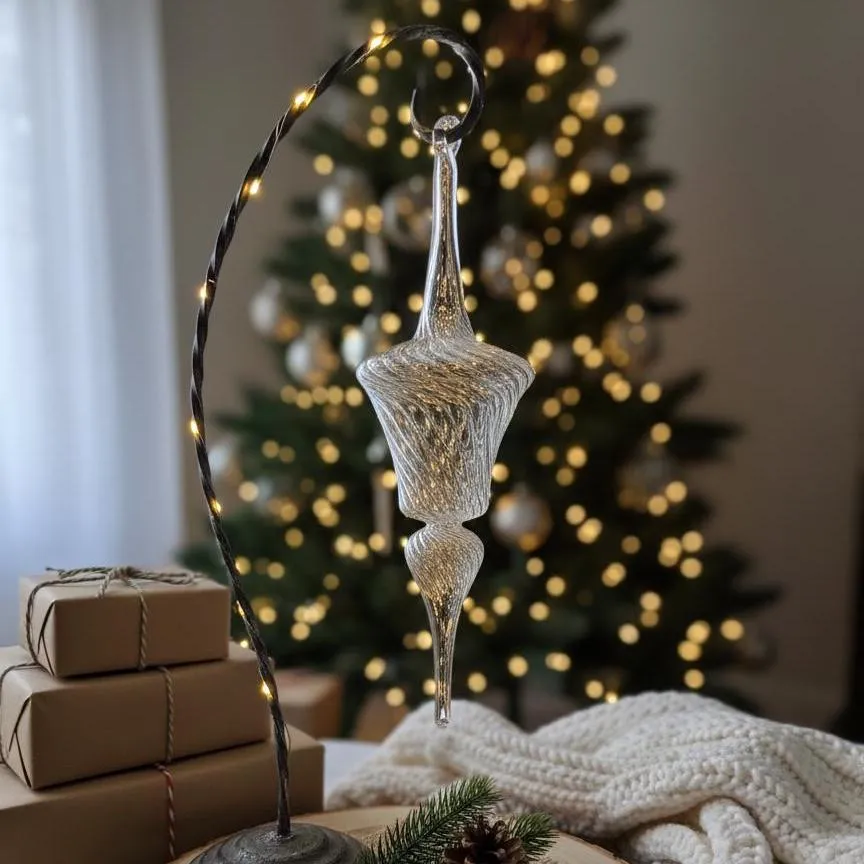
Time: about 40 minutes. Materials: $25–$45 if you already own the ornament.
The whole point of this vignette is that one ornament gets to be the star, so you don’t need a designer bauble. A clear glass drop at Walmart runs about $4, a Dollar Tree fairy light strand is $1.25, and the stand is $8 at Michaels with a coupon. Kraft paper is $5 a roll and covers a dozen gifts. Thrift stores are goldmines for clear glass ornaments in September, long before anyone else starts looking.
5. A Mini Glass Tree on a Cloud-Shaped Blue Pedestal
It’s the pedestal. A glossy, cloud-shaped slab in pale blue lifts a six-inch tree to eye level and turns it into a scene rather than an object. Without it, the tree is a trinket on a shelf; with it, the ruffled blue glass base, the gold star, and the tiny citrus-colored baubles all have a stage. If you’re recreating this, spend your money on the base and stay cheap on the tree.
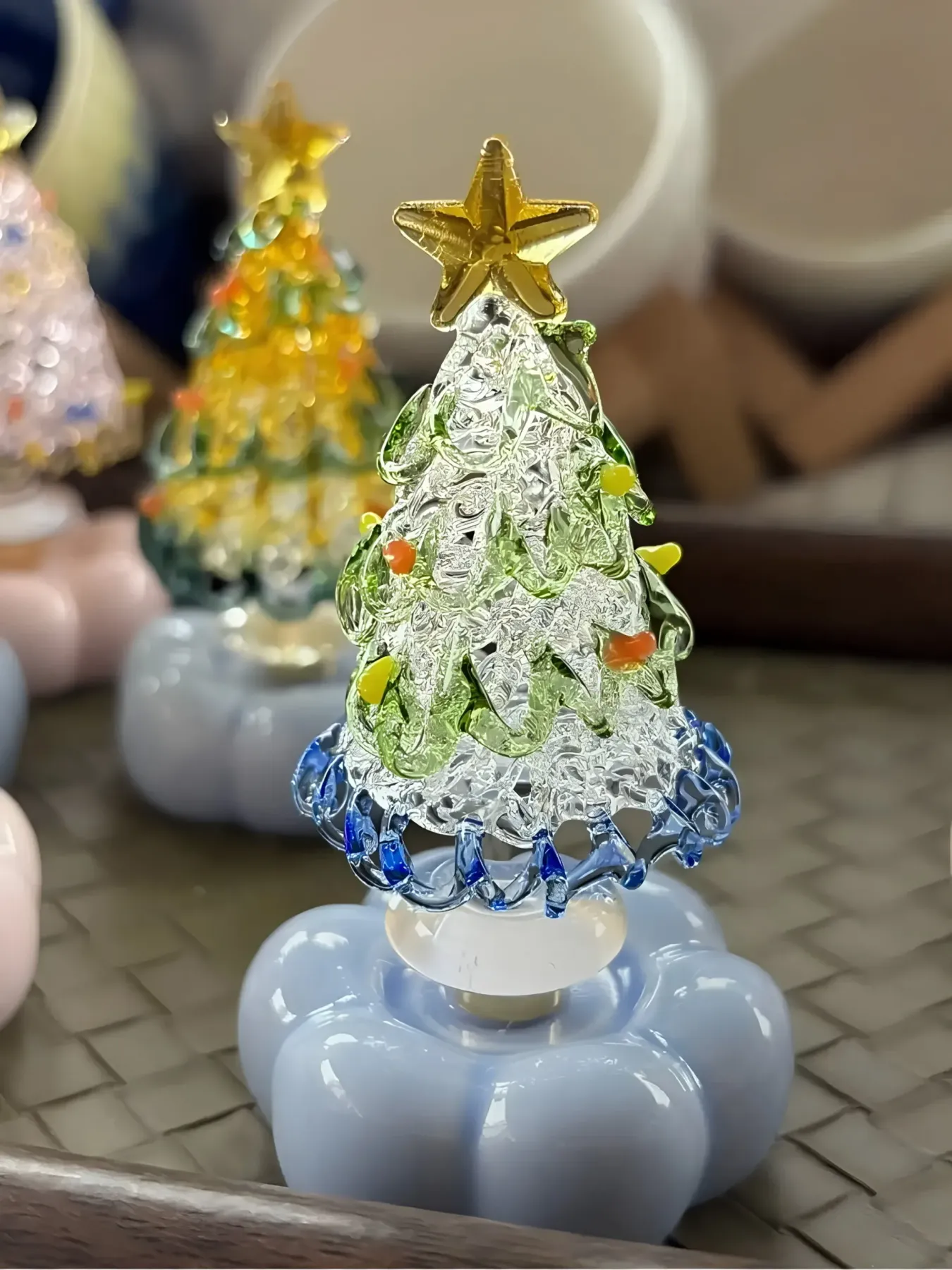
The formula runs about 70 percent clear and lime glass, 20 percent warm citrus — those little yellow and orange baubles — and 10 percent blue surprise at the bottom. The blue is what keeps this from being a generic Christmas green. Swap the palette without breaking anything: hold the 70 percent clear base, trade citrus for blush pink, and let the accent be lilac or mint. Same math, completely different mood.
6. Translucent Blue Glass Tree on a Pink Ceramic Base
Blue and pale pink are a soft complementary pair — close enough in value that nothing shouts, different enough in temperature that your eye stays interested. The base is matte sculpted ceramic, so it grounds the shiny blue glass above it; two glossy surfaces would have fought each other. And the swirling texture inside the tree matters more than the color itself: it scatters light from every angle, which is why a translucent tree in a pastel still reads as bright in a dim room.
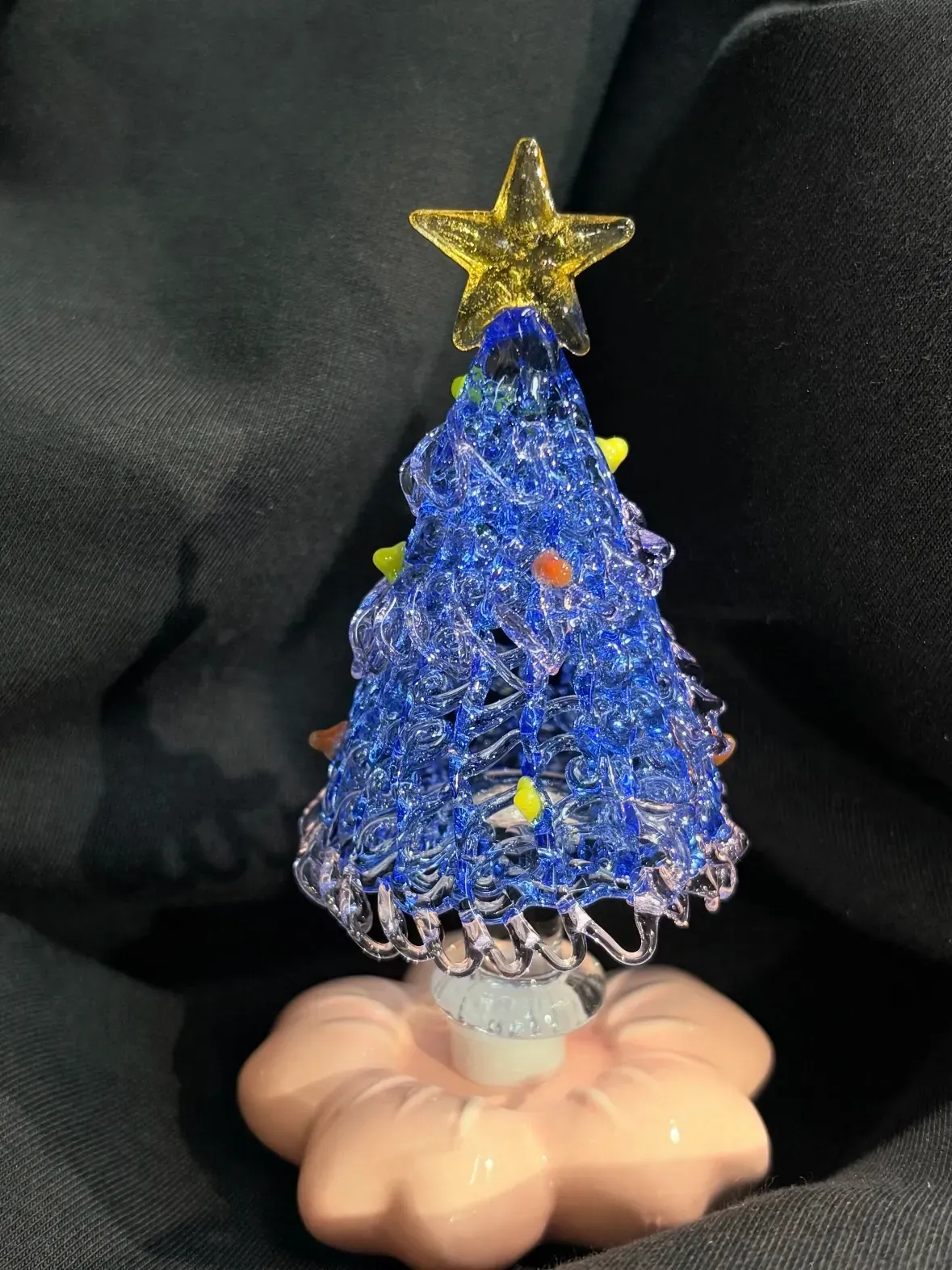
This is the Murano-look moment meeting the pastel decorating wave. Small glassblowing studios have been selling swirled trees for years, and 2026 is the year demand caught up — people are decorating smaller and more sculpturally. The good news is staying power: a hand-blown glass tree doesn’t date the way a printed motif does, and it looks just as right in January as it does in December.
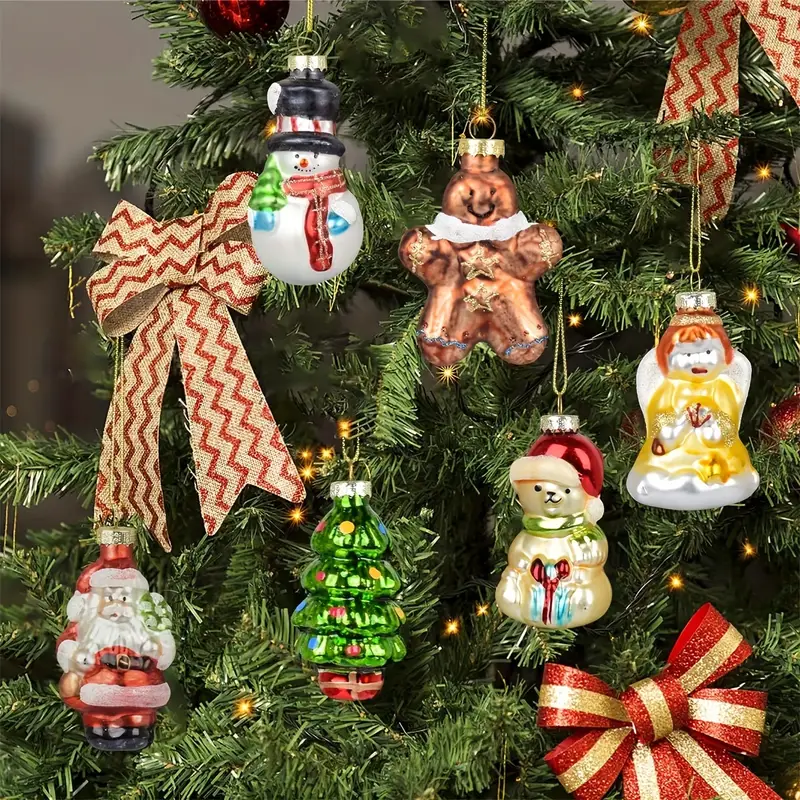
7. Blown-Glass Characters on a Fir Tree
Novelty ornaments only look charming when something formal holds them together. Here it’s the ribbon: use a ribbon at least 2.5 inches wide, cut the tails about nine inches long, and place an odd number of bows — five across a 6-foot tree — spaced unevenly on purpose. Keep the characters to one per branch zone, at least eight inches apart, so the snowman and the gingerbread man read as individuals. Gold string lights, not multicolor, do the rest of the work.
- Cut 2.5-inch wired ribbon into nine-inch lengths, one per bow, plus a few spares.
- Fold each into a simple loop bow and twist a six-inch florist wire around the center.
- Push the wire between two branch tips and bend it back around the stem so it disappears.
- Fluff the loops and pull the tails at slightly different angles — identical tails look machine-made.
- Repeat five to seven times, stepping back after every bow to check balance.
Time: 25 minutes. Ribbon: $12–$20 for 10 yards.
8. An Emerald Glass Tree Ornament with Teardrop Texture
The raised teardrop bumps. A flat emerald ornament would shine and stop there, but those little domes catch light at a dozen angles, so the piece sparkles even when it’s hanging perfectly still against dark needles. It’s the difference between glass that reflects and glass that seems lit from within. If you’re choosing between two green glass trees at the same price, always take the one with texture.
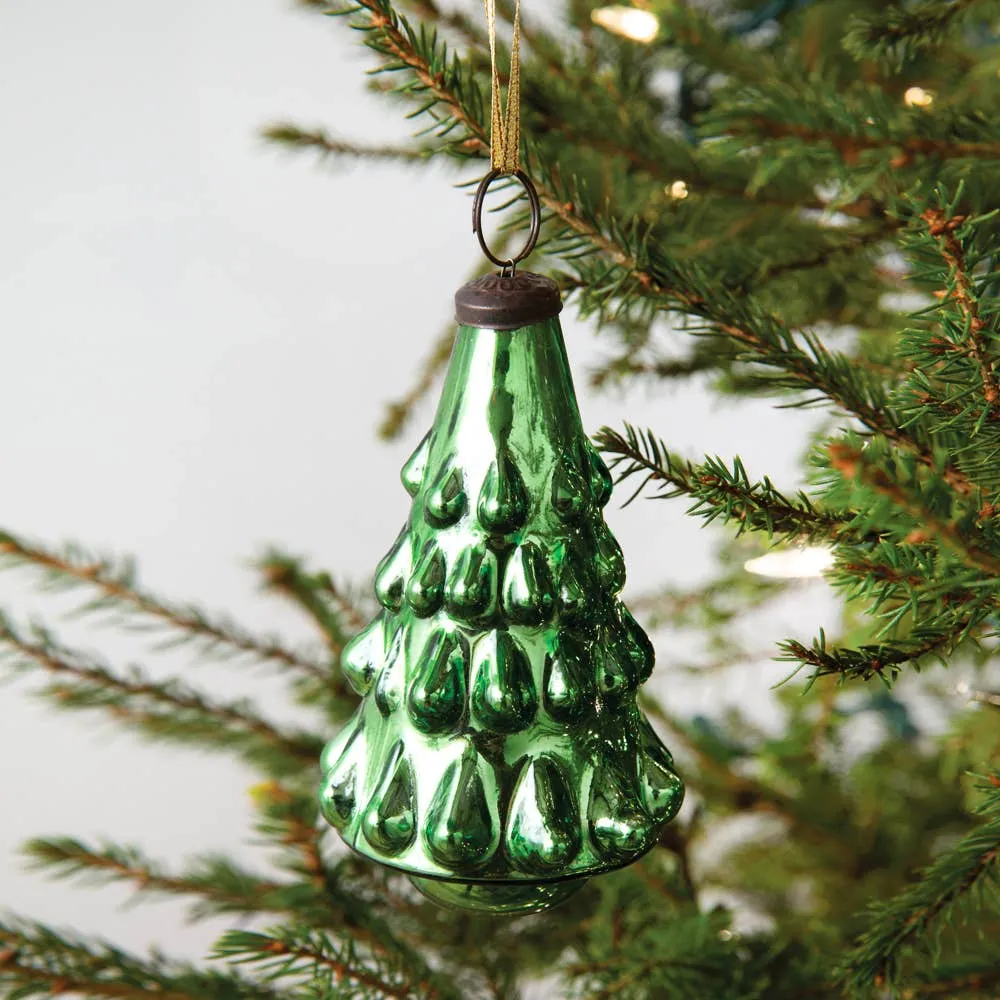
Real evergreen branches mean sap, moisture, and temperature swings, and glass doesn’t love any of them. Wipe the ornament with a microfiber cloth and warm water — never ammonia or vinegar, which cloud the finish over time. The gold hanging string and the brown metal cap age first, so store the piece in acid-free tissue in a rigid box rather than a plastic bag. Check the cap for chips each season; that’s where hairline cracks begin.
9. Ornate Glass Holiday Tree, Displayed Like a Sculpture
- Ornate glass holiday tree, 10–14 in: $40–$150
- Display plinth or riser to lift it: $15–$45
- Neutral linen runner: $20–$50
- One unscented pillar candle or small lamp for glow: $10–$30
- Nothing for the wall — keep it plain: $0
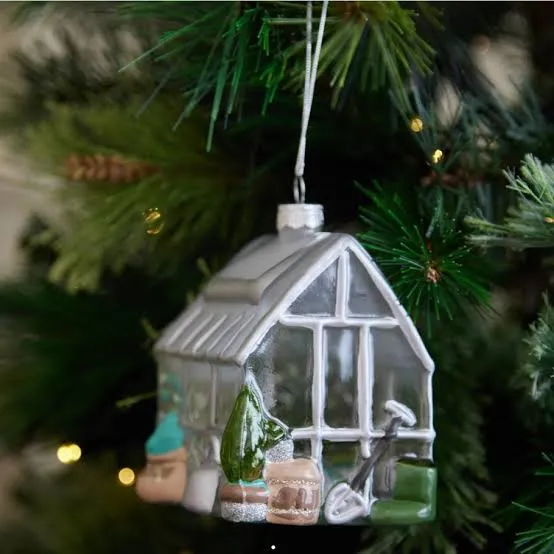
Total: $85–$275. Budget alternative: an ornate glass tree from a thrift store or Facebook Marketplace runs $12–$35, and a stack of two hardcover books does the job of the riser.
Ornate glass is the most photogenic and the least forgiving category here. All that detailing means dust settles into every crevice, and a strong overhead light will show it. Keep the piece back from any edge — one elbow and it’s over — and skip it entirely if you have toddlers or a tail-wagging dog at counter height. Be honest about scale too: heavy detail reads small, so a 10-inch piece can look lost on a big buffet. Skim the mistakes section at the end before you commit.
10. Clear Swirled Glass Tree on Light Wood
Clear glass disappears on white. If you want a transparent tree to actually read, give it a mid-tone or warm backdrop — light wood, a linen runner, a greige wall — and place it 12 to 18 inches from a window so daylight catches the facets from the side instead of behind. Backlighting flattens clear glass; side light makes it glitter. A $6 wooden cutting board underneath does more for the look than any ornament you could buy.
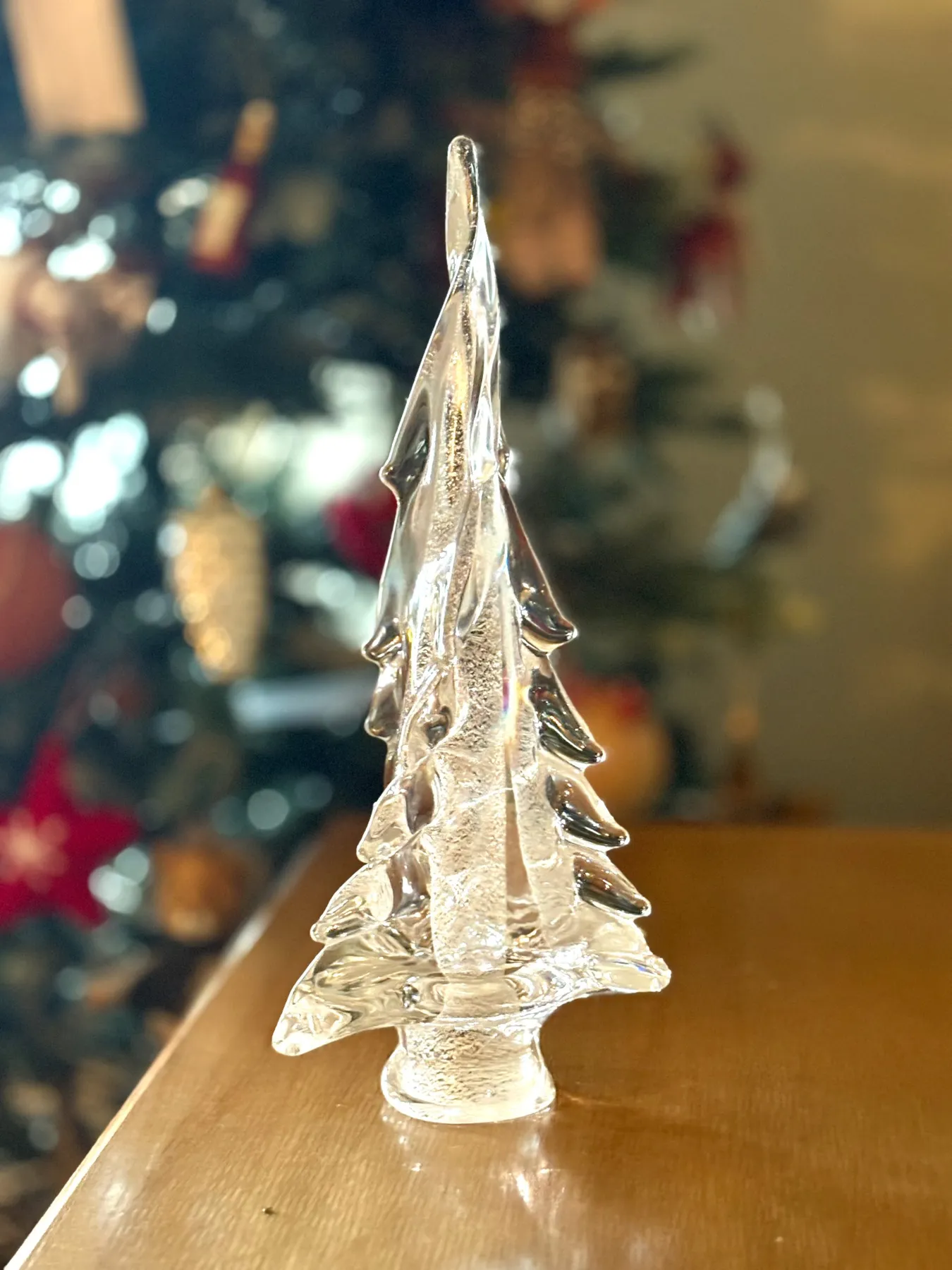
Clear textured glass is the easiest look to fake well. Target and Walmart both carry faceted glass trees under $20 in November, and IKEA’s small glass decor runs $8–$15. The other route is vintage: swirled glass figurines from the 1960s and 70s turn up constantly at estate sales for $5–$12, and older glass is usually heavier and better made. Compare with Idea #22, where the same blown-glass idea gets a two-tone treatment.
11. A Glowing Red Textured Glass Tree Figurine
Tiered, textured red glass does something a smooth red object can’t: the layered edges trap and bounce light internally, so the figurine looks lit even when it’s sitting in a dim corner. The plain light background is doing half the work too. Red against off-white reads crisp and graphic, while the same tree against a dark wall turns muddy. And because the conical shape is so simple, your eye goes straight to color — exactly what you want from a six-inch object.
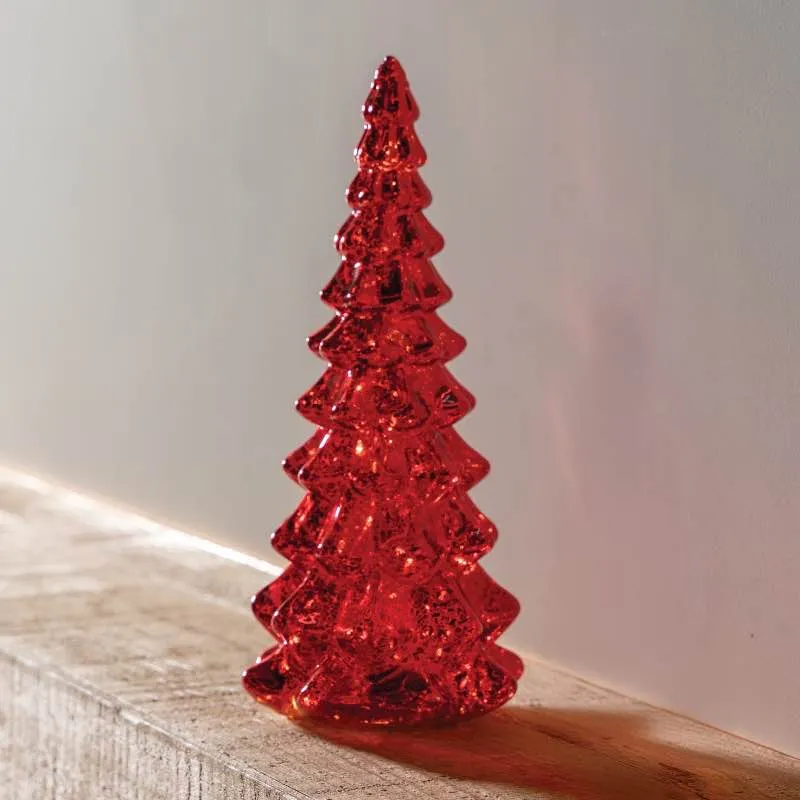
Roughly 80 percent neutral base — light wood surface, off-white wall, nothing patterned — plus 20 percent saturated red. That’s the whole formula. It doesn’t feel flat because the red is glass, so it shifts from deep crimson to bright pink-orange wherever light passes through. To change the mood, hold the 80/20 split and swap the accent: cobalt for something cooler, amber for warm vintage, or smoke grey if you want it modern.
12. Green Glass Tree Speckled with Gold
The clear glass tripod base. It lifts the whole sculpture about an inch off the surface so light passes underneath, and that gap is why the green looks lit rather than painted. A solid base would have killed it. The gold speckle and the gold-tipped point get all the attention, but the tripod is doing the actual work — and it’s the detail most lookalikes skip to save a few dollars.
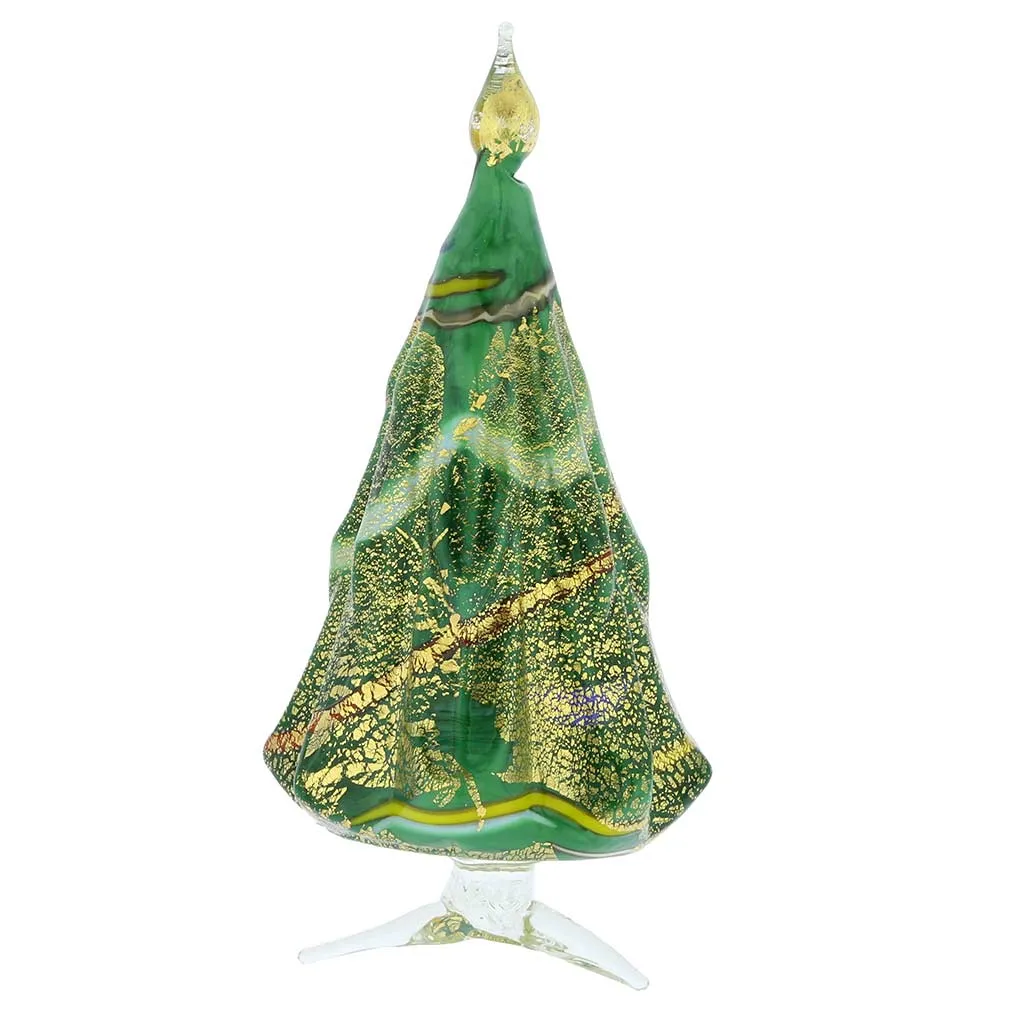
A piece with this much detail needs a narrow, quiet stage. It works on a bookshelf at least 12 inches deep, a windowsill 8 to 10 inches wide, or a nightstand, as long as there are six inches of clearance behind it for light to pass through. Skip it on a wide dining table, where a nine-inch sculpture gets swallowed by the space. For bigger surfaces, look at Idea #19, where the footprint scales up properly.
13. Sea Glass Tree with a Silver Starfish Topper
This is the hand-built version of the ombre look in Idea #16, and it starts with a size guide.
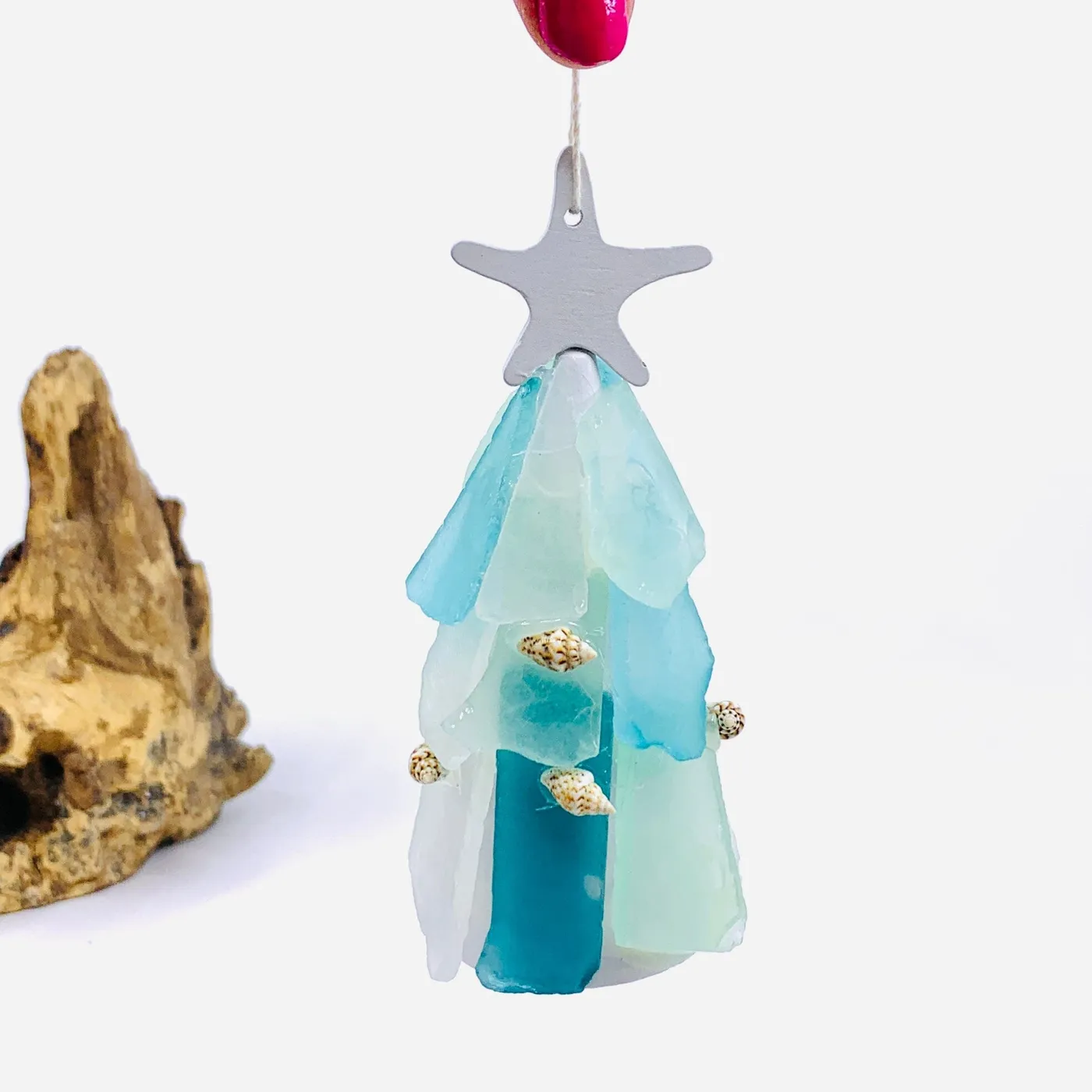
- Sketch a six-inch triangle on scrap cardboard and keep it next to you as the tree grows.
- Sort your sea glass into large, medium, and small piles — biggest at the bottom, smallest near the top.
- Glue the base row to a small driftwood or cork backing with clear-drying craft glue, holding each piece for 20 seconds.
- Work upward in overlapping rows, adding a tiny seashell every third piece for texture.
- Finish with a starfish at the point and a twine loop behind for hanging.
Time: about an hour once the glass is sorted. Materials: $10–$18.
Sea glass is free if you live near water, but craft stores sell bags of tumbled glass for $6–$10 and nobody will know the difference. Dollar Tree stocks seashells and starfish in the summer aisle — grab them in July. Driftwood comes from the beach or a $4 craft wood bag at Michaels. The whole ornament lands under $15, which makes it a genuinely good handmade gift.
14. Frosted Sea Glass Tree Wired with Pearls
Use 24-gauge wire, not glue, and wrap six to eight pearls per tier. Wire lets you adjust placement forever; glue locks you in on the first try. Thread through the drilled hole if your glass pieces have one, otherwise wrap the wire around the piece and twist at the back so the join faces the wall. Frosted glass hides fingerprints and shows cream pearls better than clear glass does — and it photographs softer, which matters if this is going on your feed.
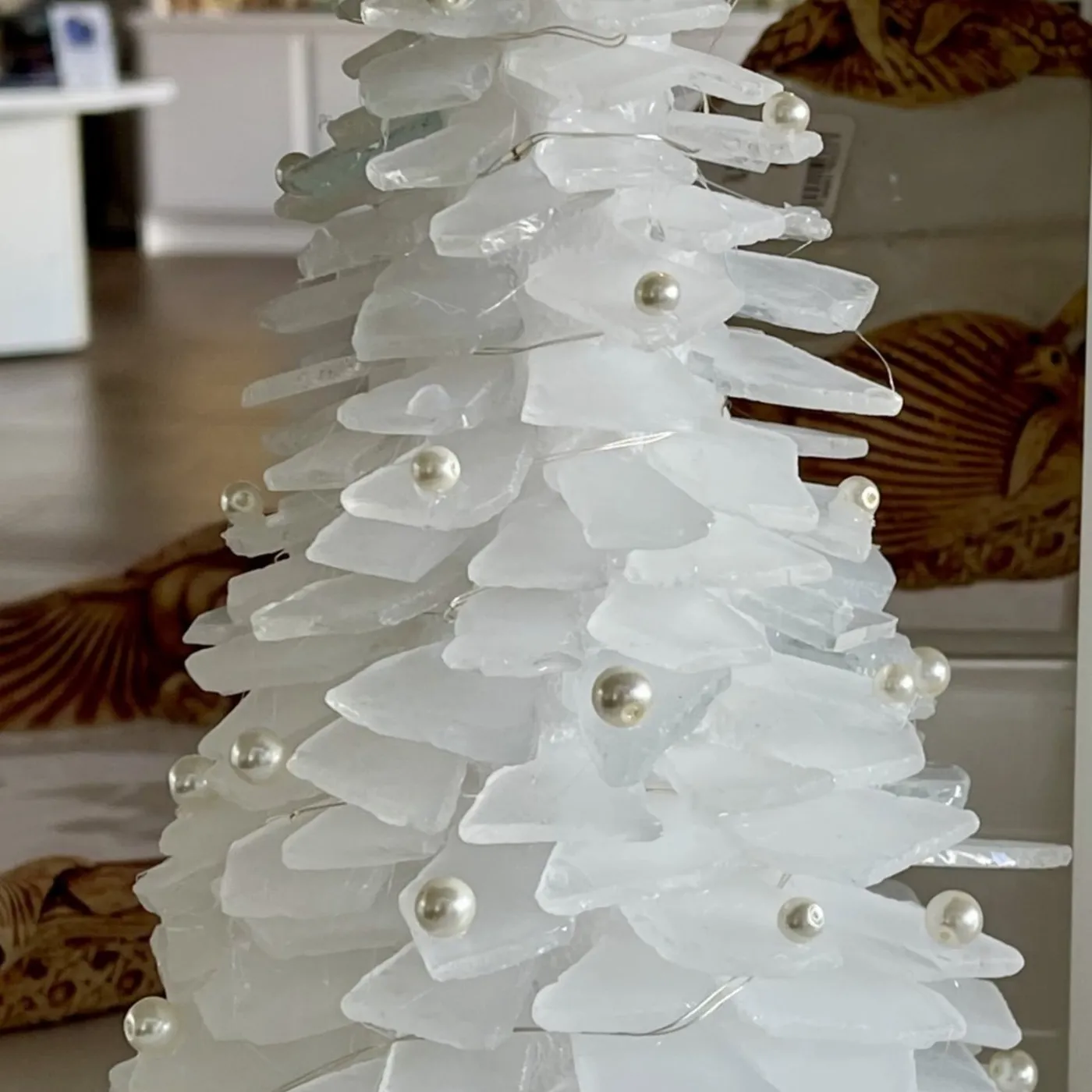
- Measure your display space — these trees read best between 8 and 14 inches tall.
- Confirm your glass is frosted, not clear; clear glass swallows small pearls.
- Buy 24-gauge wire in silver, not gold, to match pearl warmth.
- Test the balance point before finishing the top tier — top-heavy pieces tip.
- Set a budget cap: $35 covers glass, pearls, and wire at most craft stores.
15. Teal Bubbly Glass Tree on a Natural Wood Trunk
About 60 percent teal glass, 25 percent raw wood, 15 percent green stem and any greenery you add. The proportions matter because teal is loud — let the wood and the green do the calming. Swap teal for amber and you get a warmer, more vintage version of the same idea; swap it for smoke grey and it turns Scandinavian. Keep the wood base natural in all three cases, since a painted base kills the contrast that makes this work in the first place.
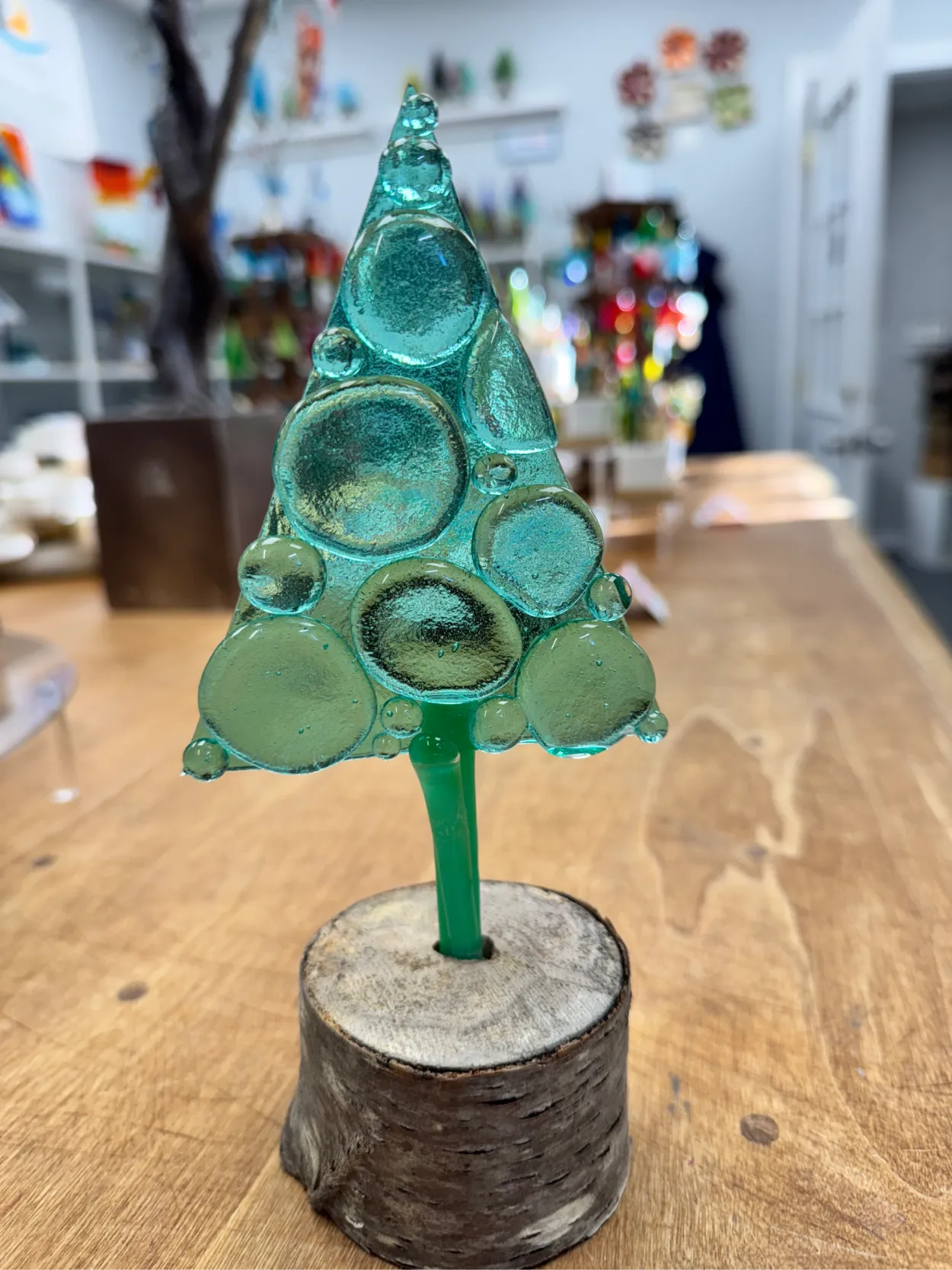
Two honest warnings. First, that bark-covered base will shed. Set it on a tray or a hard surface rather than your grandmother’s linen runner, and expect to vacuum underneath once a month. Second, bubbly glass means visible seams and tiny air pockets up close — that’s the charm, but it photographs better than it inspects. Check the stem joint before buying; a slender green stem in a deep wood hole is the most common break point on this style.
16. Ombre Sea Glass Tree, Lit and Starfish-Topped
- Frosted sea glass pieces, sorted by color: $10–$25
- Warm white LED string lights, battery operated: $8–$14
- Copper or silver craft wire, 24-gauge: $5–$9
- Starfish topper: $3–$8
- Small wood or cork base: $5–$12
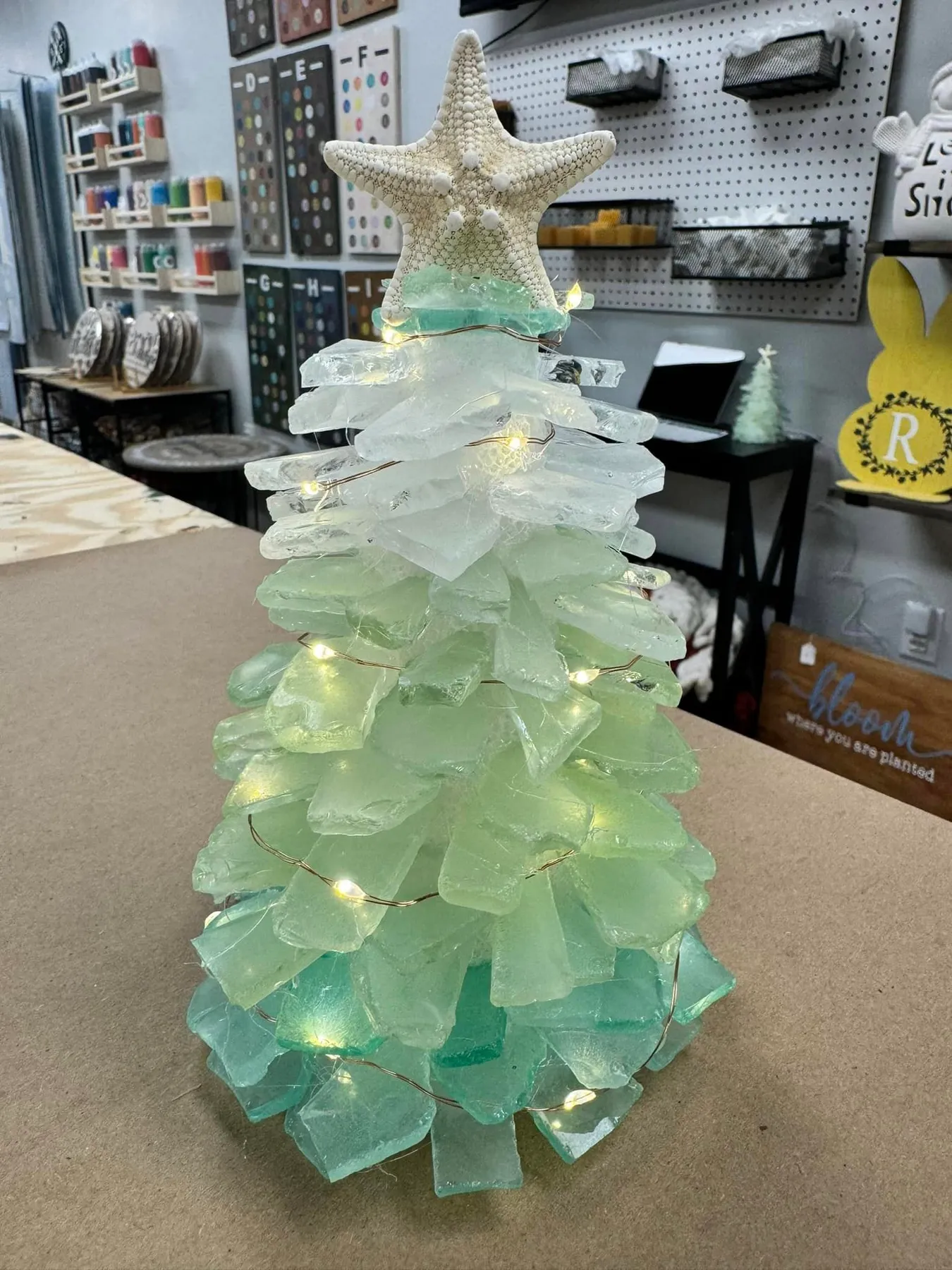
Total: $31–$68. Budget alternative: use glass from a thrifted vase you break and tumble yourself, and swap the starfish for a shell you already own. That gets you to roughly $20.
Battery fairy lights are the maintenance item here, not the glass. Expect to swap AAAs every three to four weeks with daily use, so buy rechargeables — you’ll go through 12 a season otherwise. Copper wire tarnishes to brown within a year, which looks fine, just different. Dust settles between the layered glass, so hit it with a can of compressed air every couple of months rather than a cloth that snags on wire ends.
17. Dark Green Glass Trees and a Glass Bear
This is a figurine vignette, not a tree display, and that changes the rules. The two dark green glass trees set the theme while a glossy black-and-white bear and a clear animal carry the personality — one animal would look accidental, two look collected. Scale does the rest: everything sits within a couple of inches of each other in height, so nothing dominates. That scratched reddish-brown surface is deliberate too, since matte texture under glossy glass makes the shine pop.
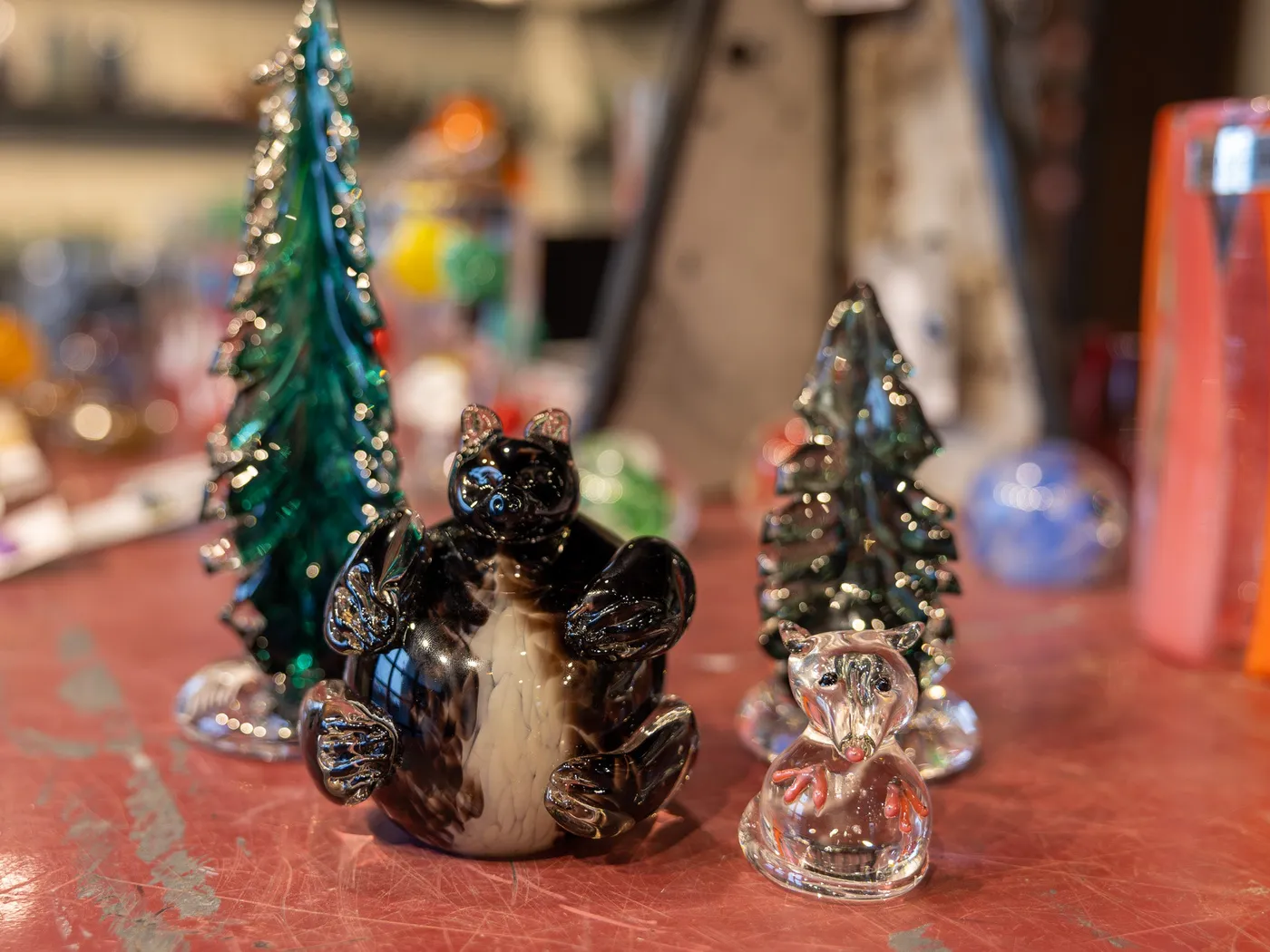
Cabinet-of-curiosities styling is back, and glass menageries are the easiest way in. People have moved away from matched sets toward pieces that look found, and mixed animal figurines hit that note perfectly — they read as personal rather than purchased. The risk is that this style dates quickly if you lean hard on it. Keep it to one shelf and it’ll feel timeless instead of trendy.
18. Green Stained Glass Tree in the Window
Backlight. A stained glass tree only becomes magic when daylight comes through it, which is why this one hangs in a window instead of sitting on a shelf. Turn it around and the same ornament goes dark and heavy. If you own stained glass and you’re displaying it flat against a wall, you’re using about 30 percent of what you paid for. The window is the design decision, not the decoration.
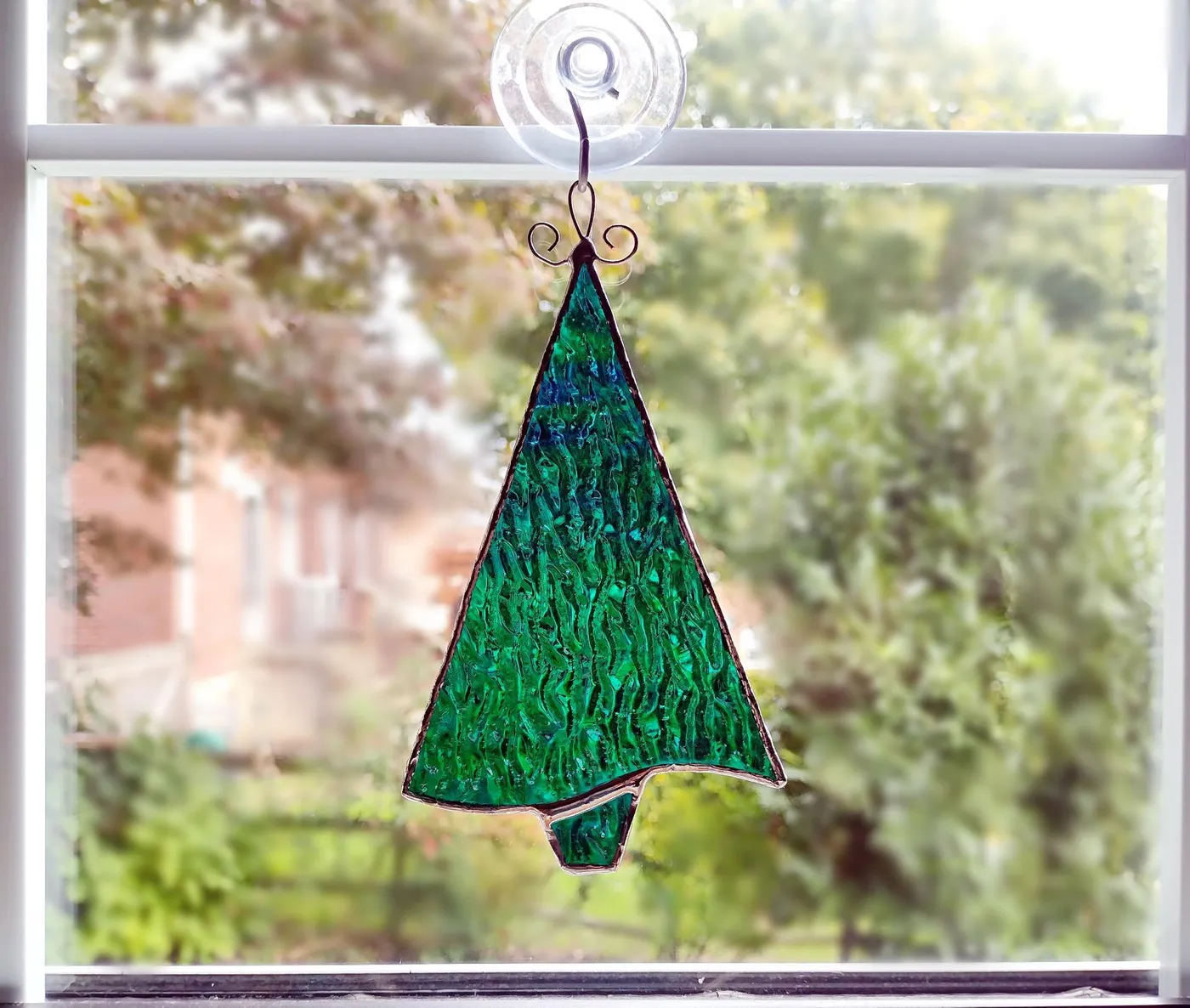
- Clean the window glass with a lint-free cloth and glass cleaner — suction cups fail on dust.
- Wet the suction cup slightly and press for 30 seconds; a little moisture doubles the grip.
- Hang the ornament so its bottom clears the sill by at least three inches.
- Add a clear fishing line safety loop to the window latch for anything over 10 ounces.
- Rotate it a quarter turn every few weeks so the glass fades evenly.
Time: 10 minutes. Supplies: under $10.
19. Three Clear Cones with Fairy Lights and Beads
Internal fairy lights are only worth it if you hide the hardware. Run the strand down through the hollow base and out the back, then tape the battery pack flat to the underside of the table with removable adhesive — nobody notices three glowing trees, but everybody notices a battery pack sitting on the tabletop. Keep the lights on a six-hours-on timer too. Constant glow all evening makes warm white read as yellow by 10 p.m.
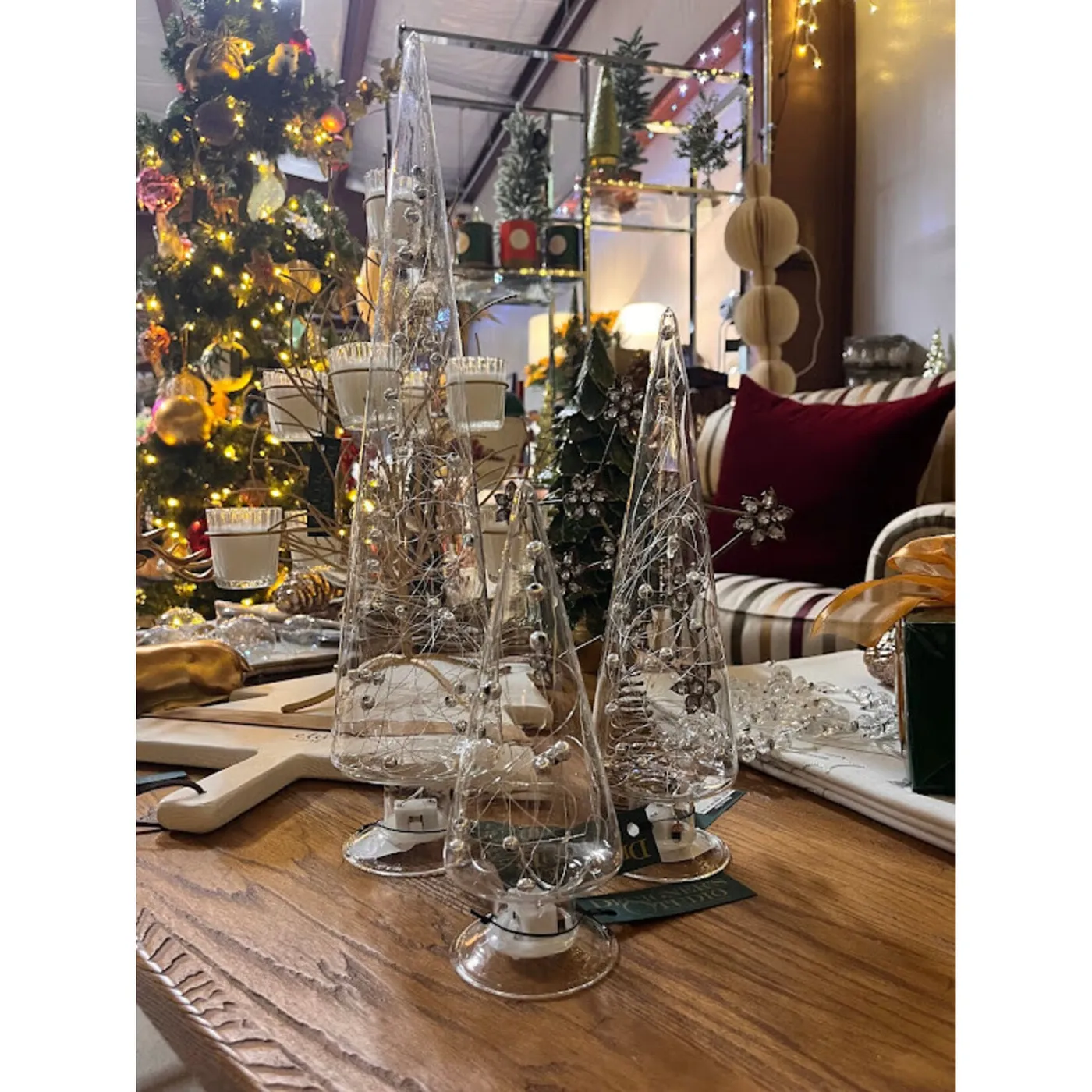
Three cones at 18, 14, and 10 inches need a surface at least 30 inches wide and 12 inches deep, with the tallest set slightly off-center. That fits a console, a buffet, or a 36-inch round entry table. Below 24 inches of width, drop to two trees and keep the full height gap. Compare with Idea #2 — the same three-cone idea in mercury glass, which reads warmer and a touch dressier.
20. A Glass Tree Suspended Inside a Glass Sphere
Fillable clear ornaments cost $2–$4 each at Michaels, and a tiny glass tree runs $5–$10 at Target or on Amazon. Total: under $15. Skip the glass glue and just set the tree inside — the sphere holds it in place once it’s hanging. For the bow, Dollar Tree satin ribbon at $1.25 looks identical to the $9 version. This is one of the few glass looks where the cheap route is genuinely indistinguishable from the expensive one.
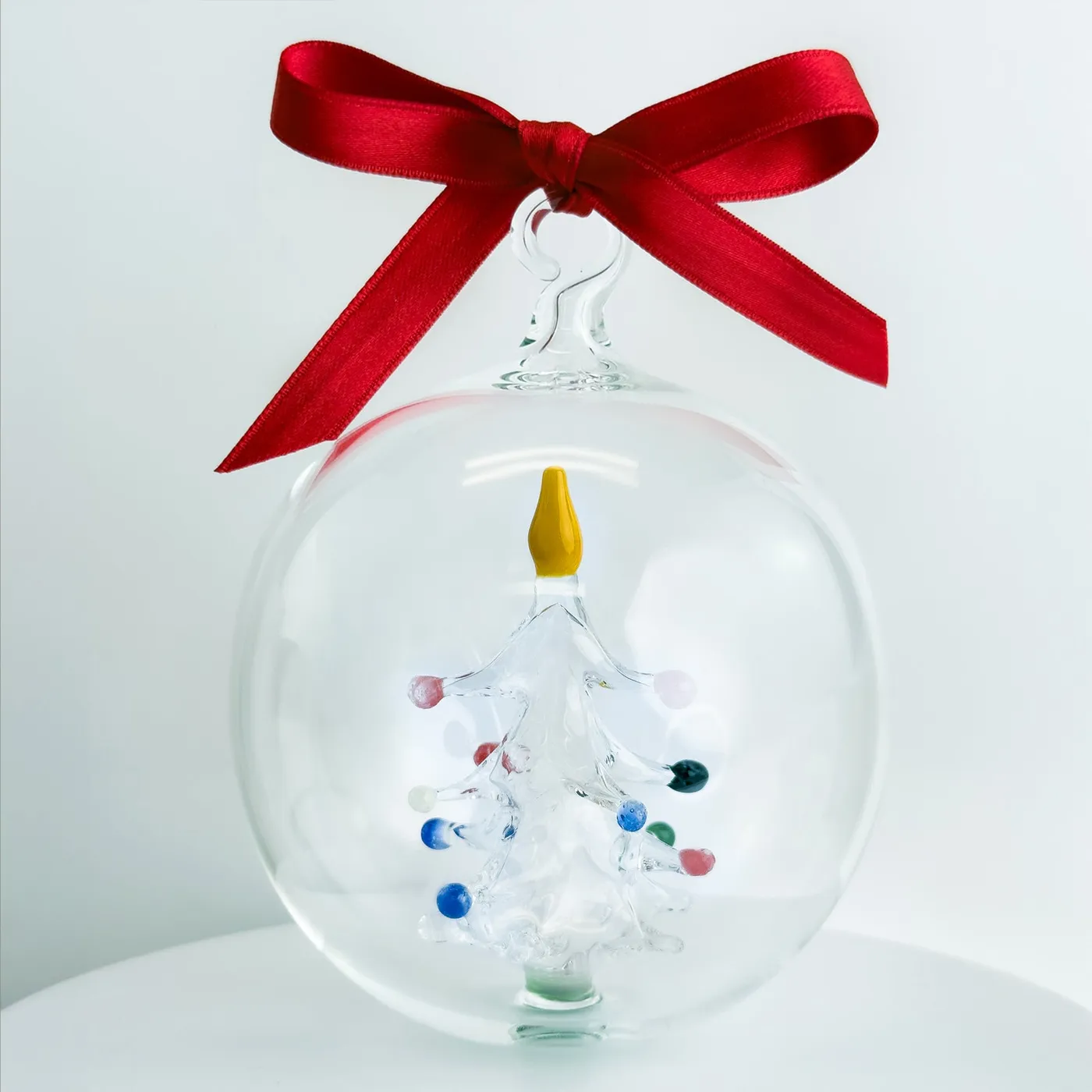
The trick is containment. A miniature tree inside a clear sphere creates a scale jump your brain finds delightful — you’re looking at a diorama, and dioramas never get old. The yellow finial and multicolored baubles give it something to reward a close look, while the red satin bow at the top signals ornament so it never reads as a paperweight. Without a strong color at the top, the whole thing just looks like a snow globe.
21. Blue Glass Tree with Sea Creature Ornaments
Roughly 55 percent translucent blue, 25 percent white surface and pine sprig, and 20 percent multicolored sea creatures. The blue dominates but doesn’t overwhelm because the ornaments are small enough to read as texture from across the room. Swap the blue tree for clear glass and the sea creatures still work — you’d get a subtler, more coastal version. Compare with Idea #5, where the same blue-and-citrus instinct shows up at a much smaller scale.
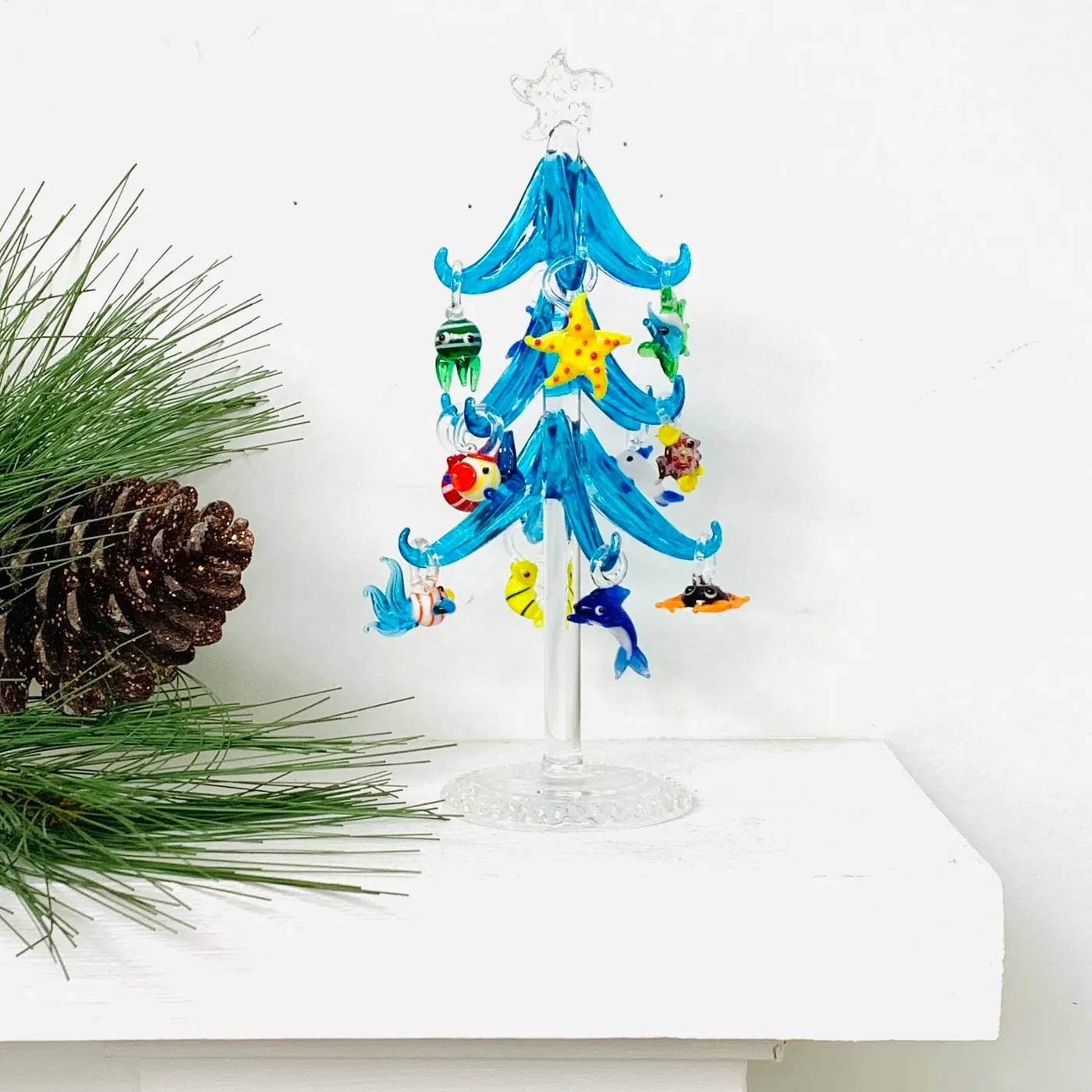
Those little glass sea creatures are the most fragile thing in this entire article. They chip at the fins and tails, and a blue glass tree with a narrow base tips easily — put it against a wall or on a surface with a lip. If you have kids under five or a cat, treat this as a look-from-a-distance piece. On the bright side, individual replacement creatures run $3–$6 and nobody will notice the swap.
22. Clear and Emerald Swirled Glass Trees, Paired
Small-batch glassblowing has quietly become one of the fastest-growing categories on Etsy, and 2026 is the year it crossed into mainstream decorating. People want objects that look made by a hand rather than a mold, and the swirled, melt-textured finish is the giveaway — it’s what separates a blown piece from a factory one. This one has staying power. Clear and emerald glass doesn’t announce a year, so you’ll still be happy with it in 2031.
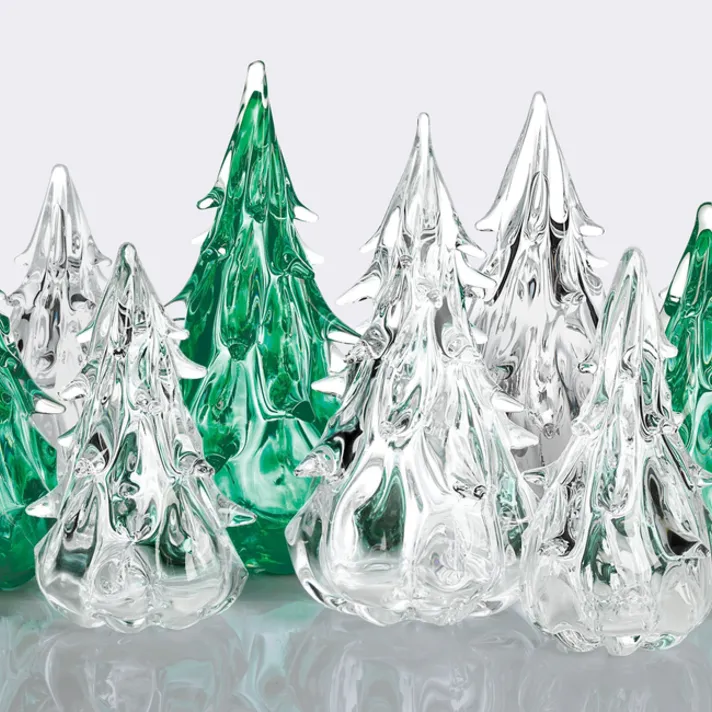
- Set of three blown glass trees, clear and emerald: $60–$180
- Mirrored or lacquered tray: $25–$70
- Sticky wax or museum putty to stop sliding: $6–$10
- Small brass or glass riser: $15–$40
- Nothing for the wall — light grey keeps them glowing: $0
Total: $106–$300. Budget alternative: buy one blown piece at full price, then pair it with two clear glass trees from IKEA at about $10 each.
23. Clear and Dark Red Ribbed Trees on Gold Bases
The ribbing. Two simple conical silhouettes in very different colors could easily look like a mismatched pair, but the vertical ribs connect them — same texture, different color, so your eye reads one set instead of two objects. Ribbing also gives each piece far more light play than a smooth surface, which matters when one is transparent and the other is nearly opaque. It’s the cheapest way to make inexpensive glass look considered.
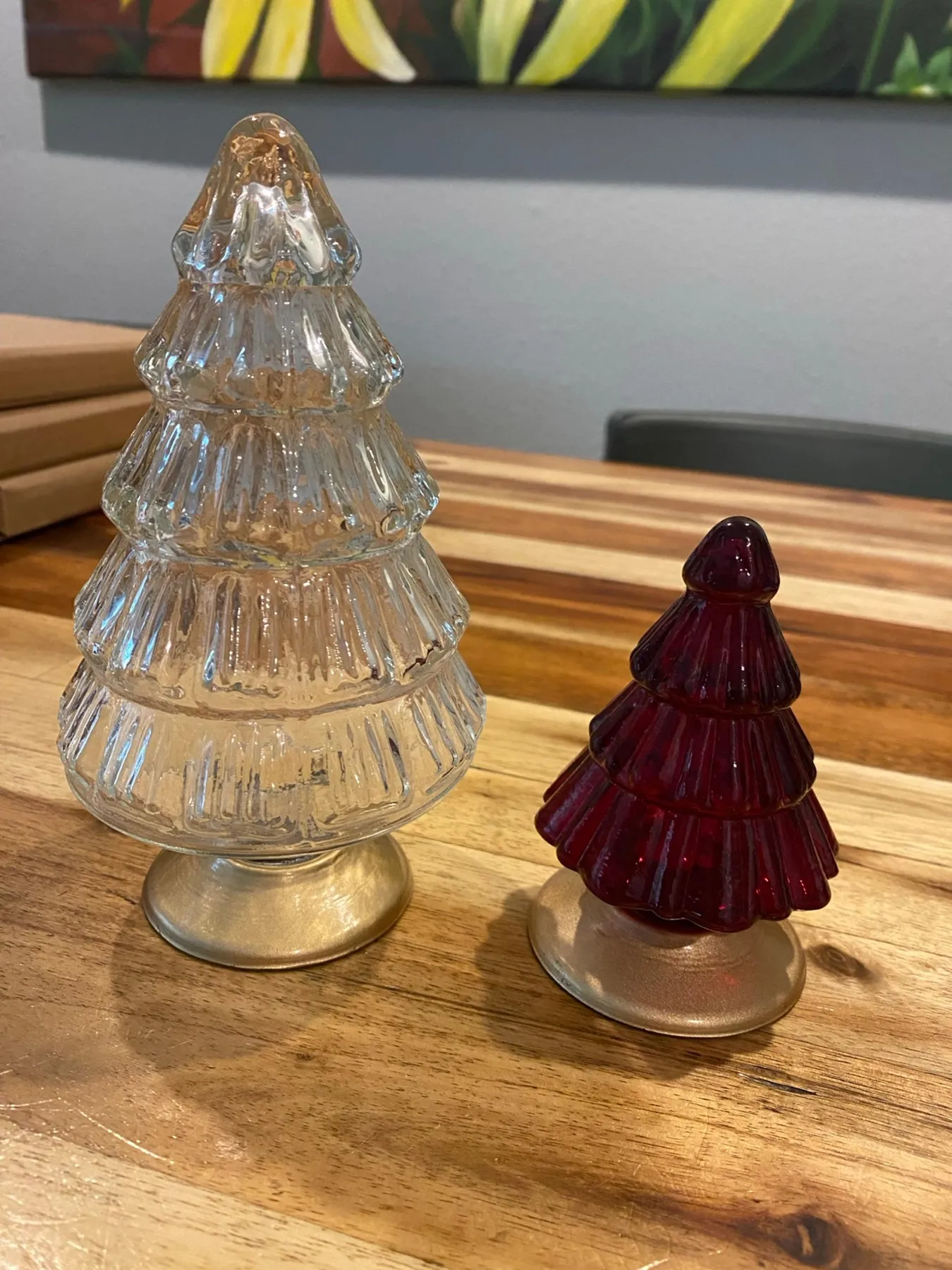
Two pieces at eight to nine inches tall need surprisingly little room — an 18-inch sideboard section, a nightstand, or a shelf 10 inches deep. The one non-negotiable is a plain backdrop: a grey or greige wall, not a patterned one, since the ribbing and the red already carry plenty of visual information. On a wider surface, add a third piece in neutral clear to stretch the vignette without adding another color.
24. Textured Clear Ornaments on Green Velvet Ribbon
This is the same clear-glass discipline you’ll see in Idea #28, just scaled down to six pieces.
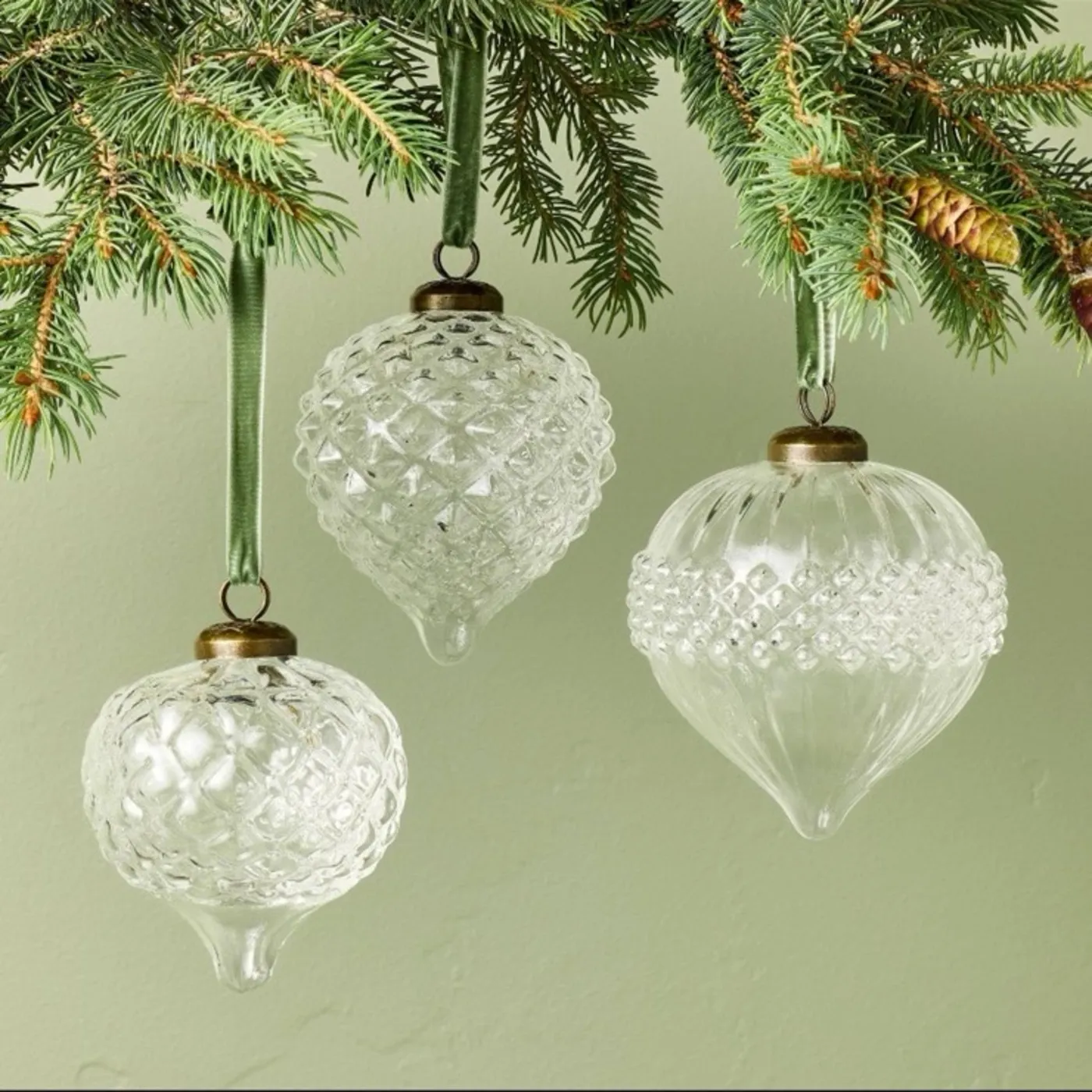
- Choose clear ornaments with three different embossed patterns — repeating pattern reads as a set, repeating shape alone reads as a pack.
- Cut velvet ribbon into 10-inch lengths and thread each through the cap, knotting at the top instead of using a hook.
- Hang so each ornament sits three to four inches below the branch tip and swings free.
- Swap any tarnished caps for antique brass — it warms clear glass instantly.
- Tuck one small pinecone near the group so the arrangement has an anchor.
Time: 15 minutes. Cost: $18–$30 for six ornaments.
Clear textured ornaments are everywhere for cheap: Walmart four-packs run about $6 in November, and Dollar Tree carries singles at $1.25 that are genuinely fine. Velvet ribbon is the splurge at $8–$12 a roll, but you only need about two yards, so buy a short cut from a fabric store rather than a whole spool. Under $20 for the full set, versus $60 for the boutique version.
25. Twisted Glass Icicles on the Branches
Icicles solve a specific problem: gaps. Their long, narrow shape fills the vertical space between branch tiers that round ornaments can’t reach, so the tree looks fuller without looking bulkier. The twist is what makes them sparkle — a spiraled surface presents flat facets in every direction, so wherever you stand, some part of the icicle is catching light. Hang them at varying depths from the branch tips and they’ll pick up the string lights behind them too.
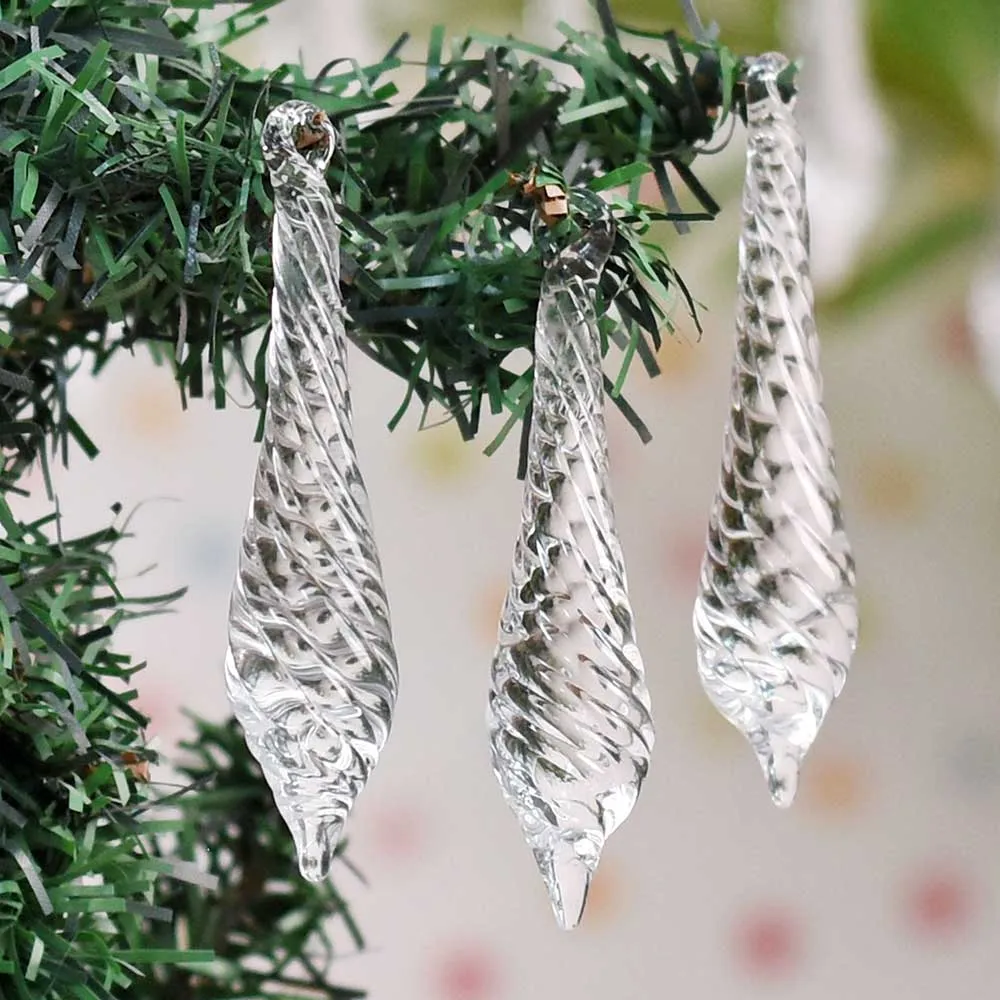
Clear glass is the quiet-luxury move in holiday decorating right now. After years of oversaturated ornament sets, people are pulling back toward transparent and metallic glass that lets the tree lights do the work. Icicles fit that perfectly because they add sparkle without adding color, which is why they’re suddenly everywhere in 2026 styling. No expiration date on this one — clear glass icicles have turned up in trees since the 1950s.
26. Stained Glass Tree on Gift-Box Glass Base
- Illuminated stained glass tabletop tree, 14–18 in: $70–$220
- Stained glass gift-box base, often included: $0–$45
- Patterned table runner or fabric square: $15–$40
- Vintage gold picture frame as backdrop: $8–$35
- Replacement bulb set, because you will need it: $6–$12
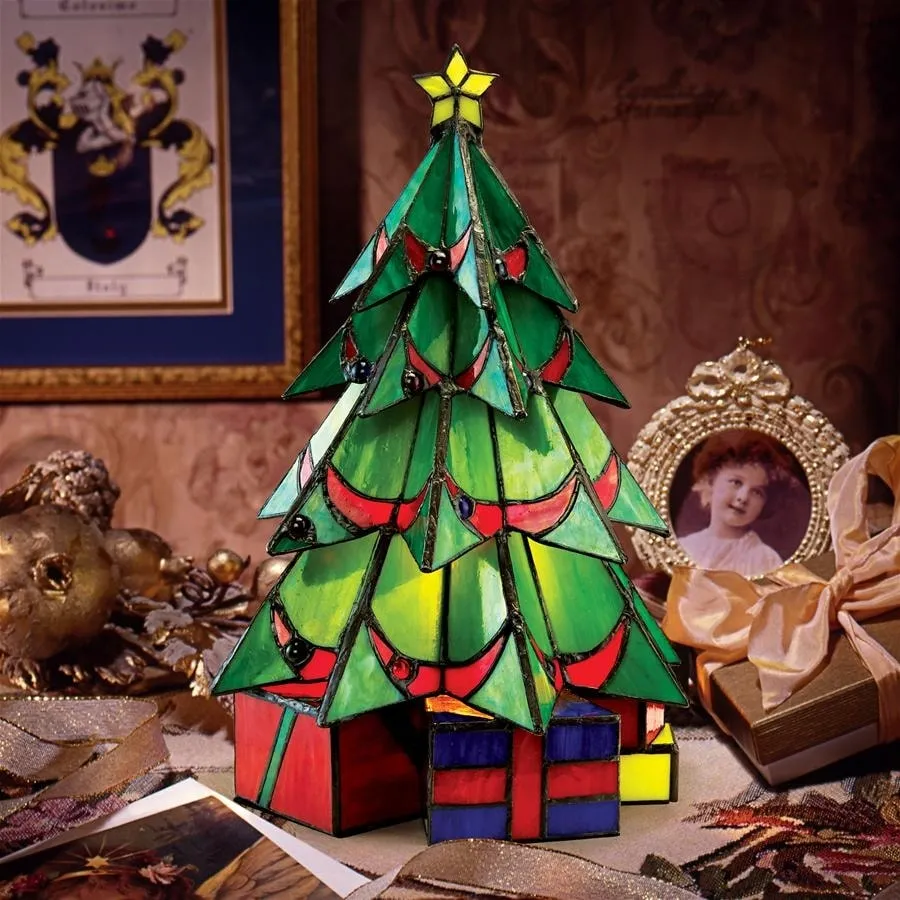
Total: $99–$352. Budget alternative: an LED printed-glass version runs $25–$45 and looks nearly identical from three feet away.
- Measure your table — these pieces need a 16-inch footprint and an outlet within six feet.
- Check the bulb type before buying; odd sizes are impossible to replace in January.
- Confirm the glass is soldered, not printed, if you want it to last decades.
- Plan for heat: older incandescent versions get warm and shouldn’t sit on fabric unattended.
- Decide where it lives year-round — this is a piece people leave out.
27. Black A-Frame Tree Against a Full Tree
When you layer two trees, one has to be the lead. Make the big tree the loud one — warm lights, full ornament load — and keep the small A-frame quiet: fewer pieces, more negative space, and a strict palette of black, gold, white, and raw wood. The A-frame’s tiny string lights should run on the frame itself rather than on the ornaments, so the structure glows as a silhouette. Ten ornaments, not thirty.
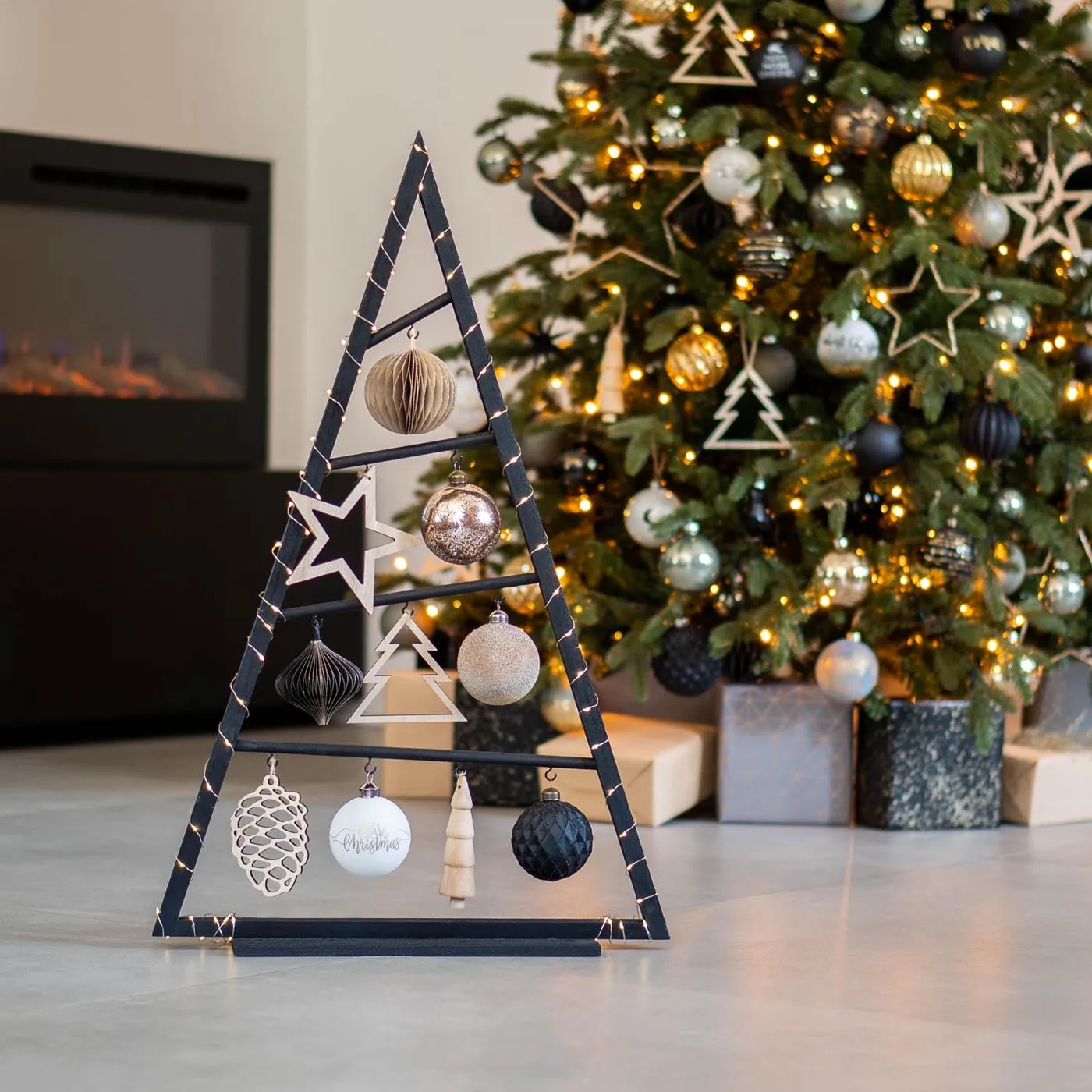
Black Christmas decor has exactly one failure mode: it reads as Halloween. The fix is warmth — bring in gold, natural wood, and white, and make sure there’s a light source behind the pieces so they don’t vanish into shadow. Black glass in a dim corner becomes a black hole. The A-frame shape is also trendy, so if you’re spending real money, buy it in a neutral finish. Compare with Idea #19 for the all-clear version of a layered display.
28. Flocked Tree with Mercury Glass in a Woven Collar
Flocking sheds, period. Expect a light dusting of white under the tree all season, so put a mat or a hard floor underneath and vacuum with a brush attachment rather than a beater bar. Mercury glass is the opposite problem — the silvered finish rubs off, so dust with a dry microfiber only, never a damp cloth and never glass cleaner. The woven collar is the easy part: shake it out, spot clean with a barely damp cloth, and store it flat so it keeps its shape.
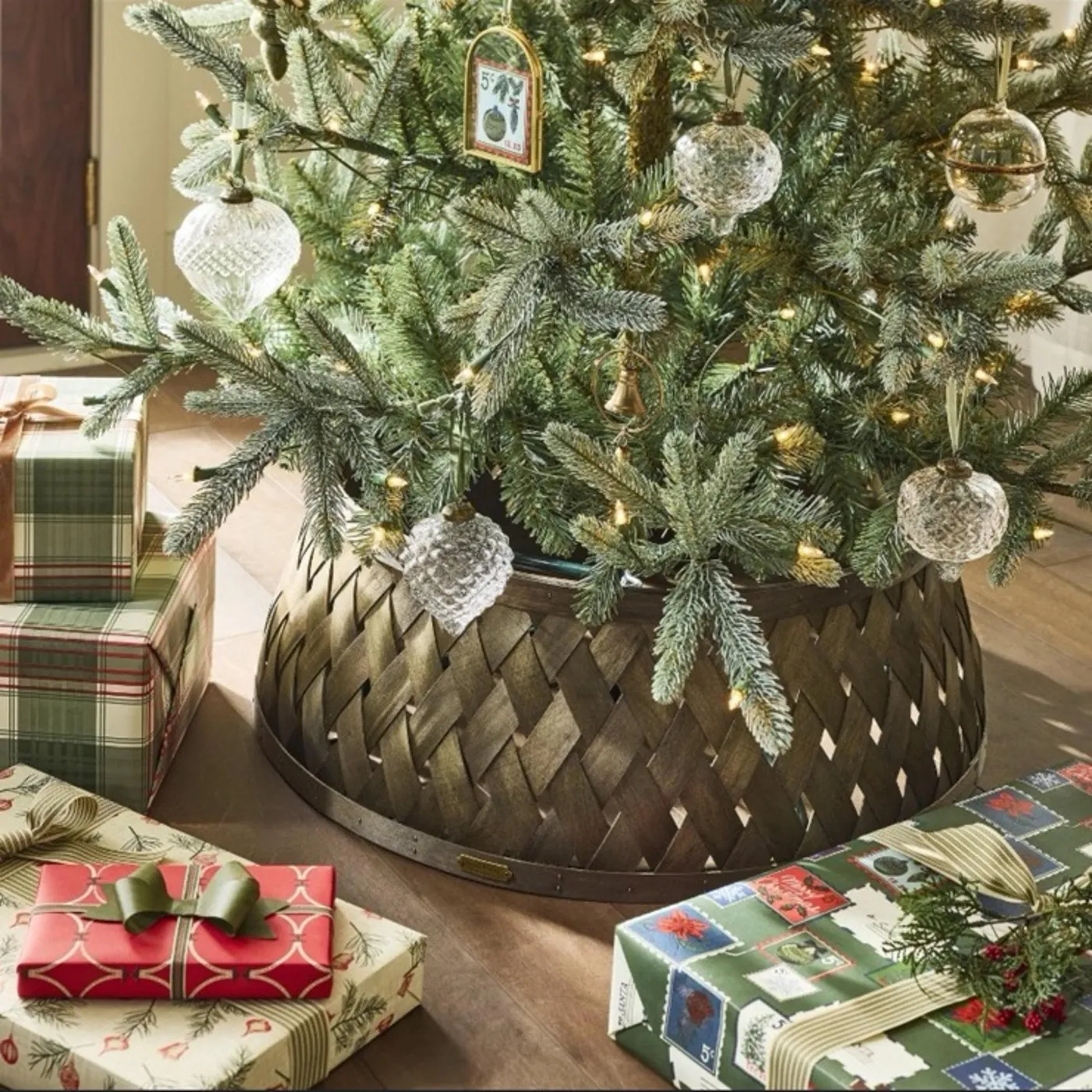
A 7-foot flocked tree with a collar needs about a 30-inch diameter footprint plus three feet of clearance on every side for people to walk past. The collar itself runs 24 to 27 inches — measure before you buy, because a collar that’s too small looks like a scarf. For smaller rooms, compare with Idea #24, which gets a similar glass-and-green effect from a handful of ornaments on a tabletop tree.
29. A Glass Finial on a Holly-Trimmed Stand
Standalone ornaments on a display stand are underrated, and the styling rule is simple: dress the stand, not the ornament. Burlap ribbon wound once around the pole, three or four faux holly leaves, and a small cluster of red berries give a single clear glass finial enough context to feel intentional. Keep the ornament at least eight inches long — anything smaller gets lost on a 16-inch stand. Choose clear glass over colored, so the ribbon reads through it.
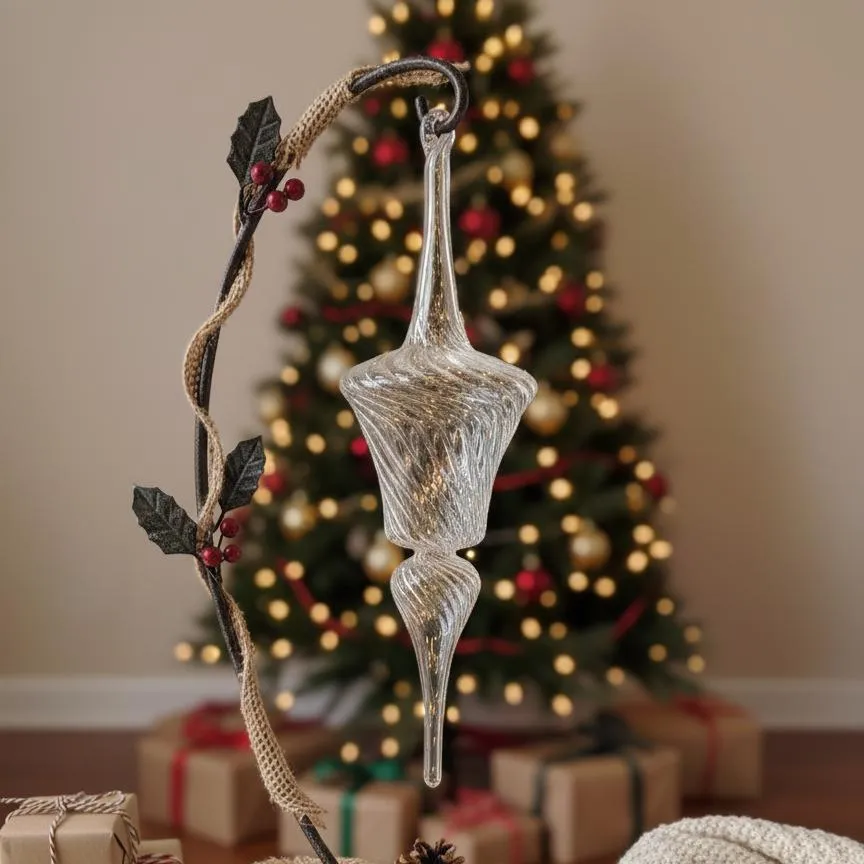
- Measure the stand height against your surface — the ornament should hang at or just above eye level when seated.
- Check the stand’s base width against your table; narrow bases tip with heavy glass.
- Confirm the hook clears the finial cap, or you’ll need a longer wire.
- Buy kraft paper and ribbon before you wrap gifts so the palette stays cohesive.
- Decide on the light source — the finial needs warm light behind it to read.
One Small Tree, a Whole Lot of Glow
You don’t need a bigger tree or a bigger budget — you need one piece of glass that catches the light the way you want your December to feel. Start with a single tree on a surface you already own, live with it for a week, and let it tell you what to add next.
📌 Pin the ideas you love most so they’re waiting for you when the boxes come out again.