You know that feeling when you finally find the Christmas living room that looks exactly how December feels — and you save it before you’ve even read the caption? That’s the entire reason this guide exists.
We spent serious time browsing Target, IKEA, Walmart, and a lot of very persuasive Pinterest boards to bring you only what’s worth your attention this year, from a $120 refresh to a $2,600 full living room reset.
Inside you’ll find 30 curated cozy Christmas living room ideas across rustic farmhouse, moody dark-wall elegance, neutral minimal, and traditional red-and-green. Each one comes with real material lists, honest cost ranges, and side-by-side notes on where to splurge and where to fake it.
Why now? Because 2026 holiday decorating has shifted hard toward warm, dimmable, lived-in rooms — dark walls, real greenery, and candlelight doing the work tinsel used to do. Pin this before you scroll away — your future self will thank you when it’s actually time to decorate.
1. Brick Fireplace, Glowing Tree, and Hung Stockings
A room like this doesn’t need a designer budget — it needs layering.
- Seating: neutral sofa or two armchairs, $500–$1,800
- Fireplace styling: stockings, brass holders, fire tools, $60–$180
- Tree and lighting: 7.5 ft tree plus 600 warm-white minis, $120–$400
- Textiles: two throws, four pillow covers, tree skirt, $90–$250
- Decor: ornaments, wood crate, faux greenery, $70–$200
Total: roughly $840 to $2,830 for a room that looks collected rather than purchased.
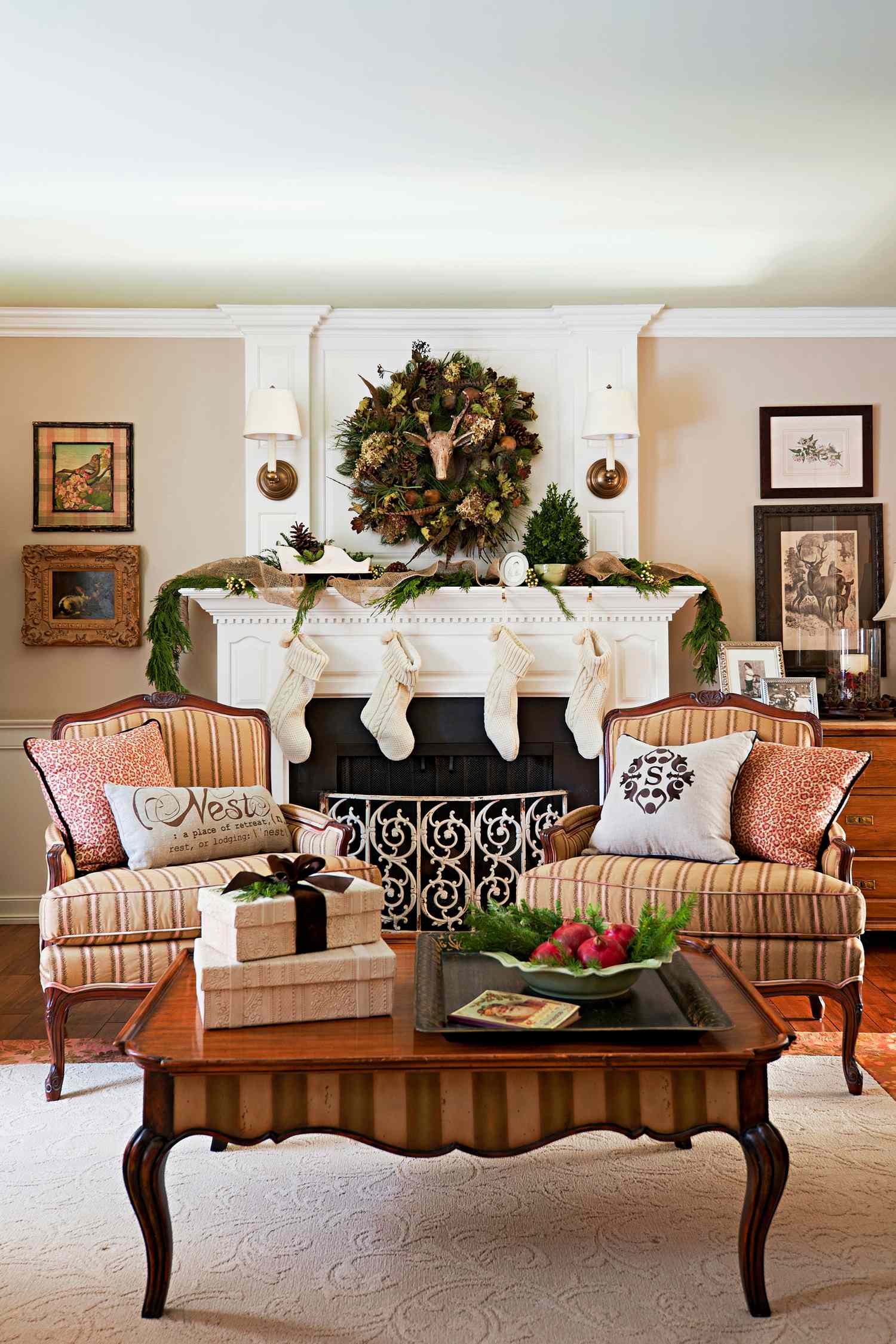
about a real brick fireplace: it eats light. That warm glow you love in photos comes from lamps beside the hearth, not from the firebox alone. Add one table lamp behind the sofa and a second on the opposite side, both on warm 2700K bulbs. Anything above 3000K will make red brick read orange and cheap by 8pm. If the chimney is decorative, a cluster of pillar candles gives you flicker without the sweep.
2. Candy Cane Pillows on a White Sofa, Taper Candles Lit
Here’s the trick that makes a white room feel holiday-warm instead of holiday-cold: repeat your darkest accent three times at three different heights. In this room, deep red shows up in the tree ornaments, in the embroidered pillow at seat level, and in the tapers on the light wood coffee table. Same red, three elevations, so the eye keeps traveling instead of stalling. Buy an extra box of ornaments in your accent color and scatter the leftovers in a bowl.
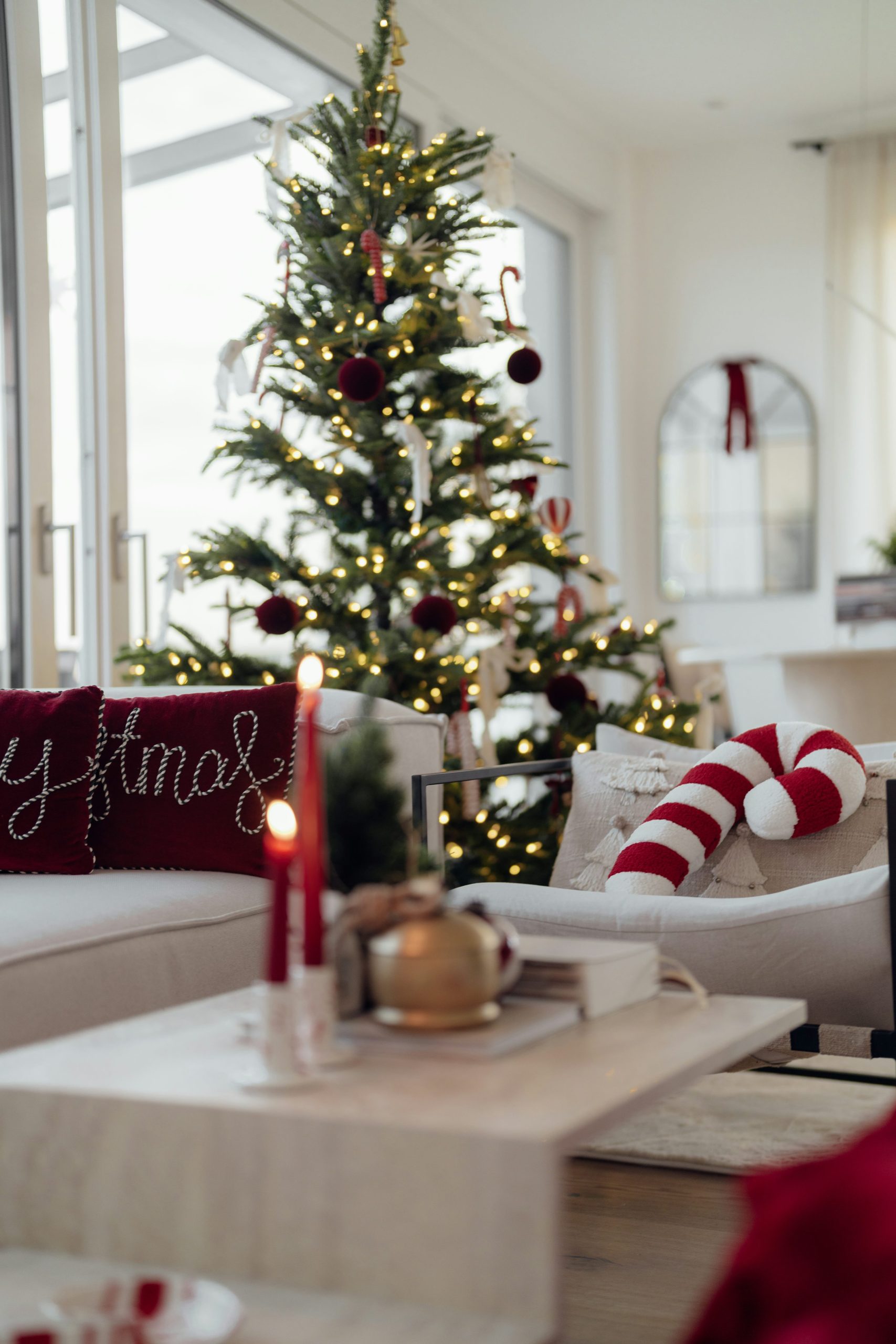
carrying this whole room is the pair of lit red taper candles on that pale wood table. Remove them and you still have a pretty white room with a tree — but you lose the heartbeat. Tapers give you a vertical flame at seated eye level, which string lights never can. Choose a dusty, slightly brownish red rather than bright crimson, and set them in low brass holders so nothing blocks the view across the table.
3. Ornaments Strung Inside the Firebox of a White Mantel
The magic here is placement, not price. Big-box stores sell plain white stockings for $4–$8 each; add a $3 fabric marker and hand-letter names. Colorful knit stockings from Target land around $12–$18, and IKEA’s felt versions run about $6. Decorative red-and-white houses? Thrift stores are swimming in ceramic village pieces for $2–$5 all December, and Facebook Marketplace usually has full sets for $20. For the floor pillows, a $15 insert plus a yard of clearance plaid and fusible tape gets you there without a sewing machine.
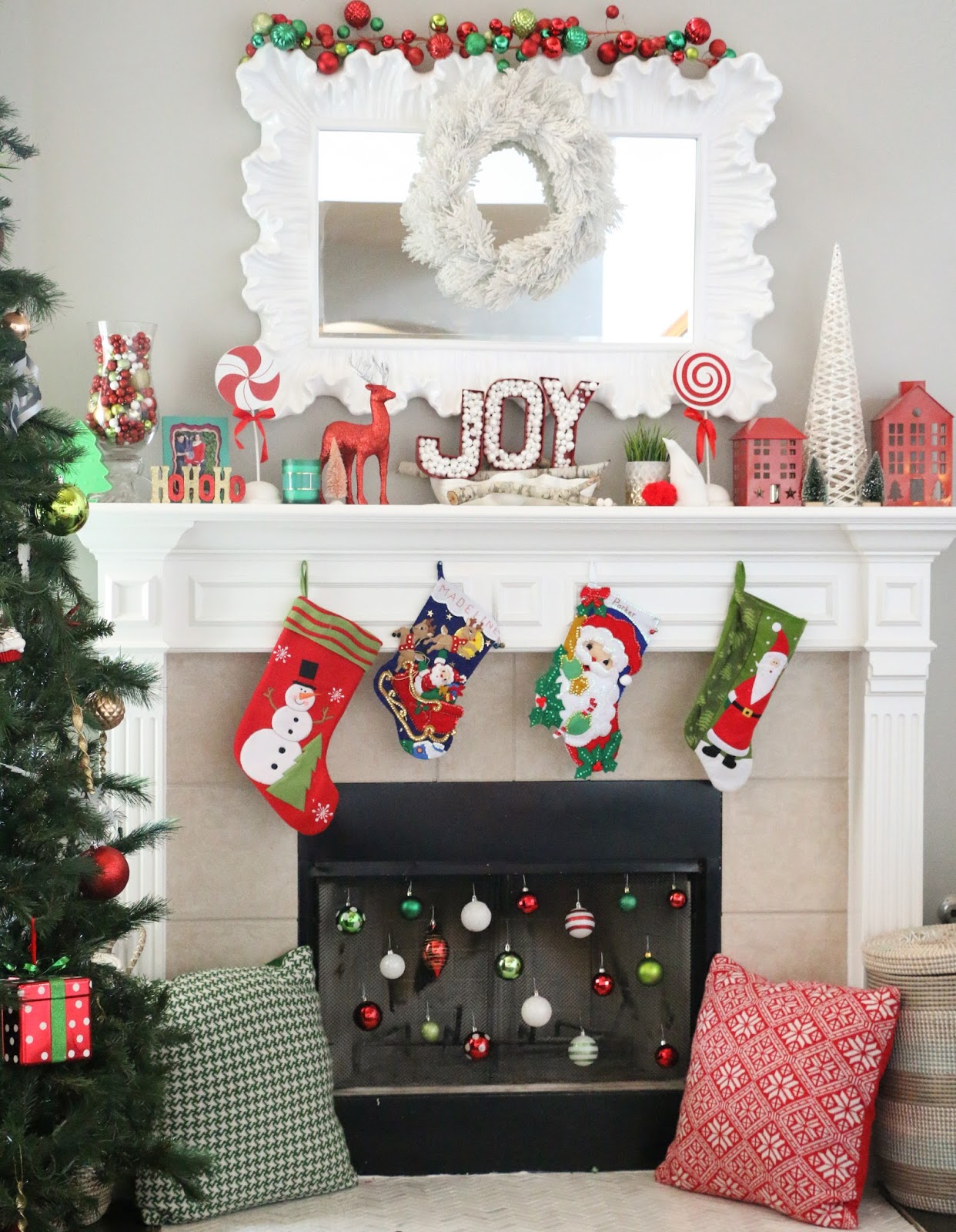
Three principles are doing the heavy lifting. First, the white mantel acts like a blank gallery wall — color pops hardest against zero competition. Second, the mirror above bounces tree lights back into the room, doubling the glow for free. Third, the ornaments strung inside the empty firebox fill the one dark hole in an otherwise bright vignette. That last move is the one most people miss: if your fireplace isn’t burning, it shouldn’t be a black rectangle. Fill it.
4. Wood Stove, Dried Hydrangeas, and Bottle Brush Trees
The formula here is 55% stone and white paneling + 25% natural wood + 15% deep green + 5% matte black. Stone and paint carry the base, wood warms it, garland does the seasonal work, and black appears only twice — the stove and its pipe — which is exactly why it reads as deliberate instead of heavy. Swap the green for burgundy and the hydrangeas for eucalyptus and the same math gives you a completely different holiday. Keep the percentages, change the players.
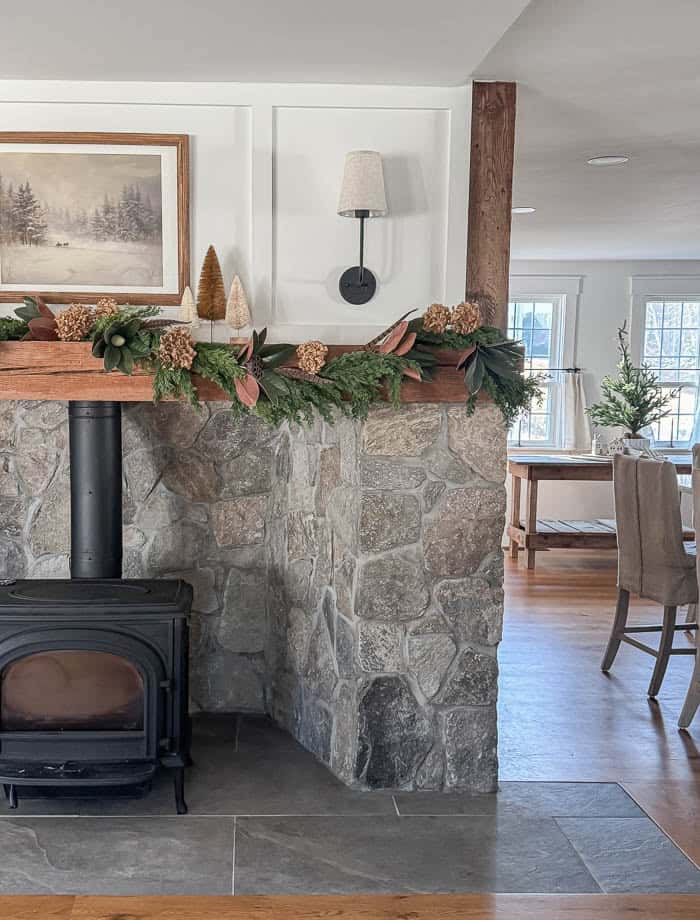
Styled garland, start to finish — about 45 minutes and $60–$120.
- Lay a faux pine garland along the mantel and fluff every branch outward, not down.
- Tuck in three dried hydrangea heads or eucalyptus stems for a faded, non-glittery texture.
- Add three bottle brush trees in graduated heights — smallest at the outside edges.
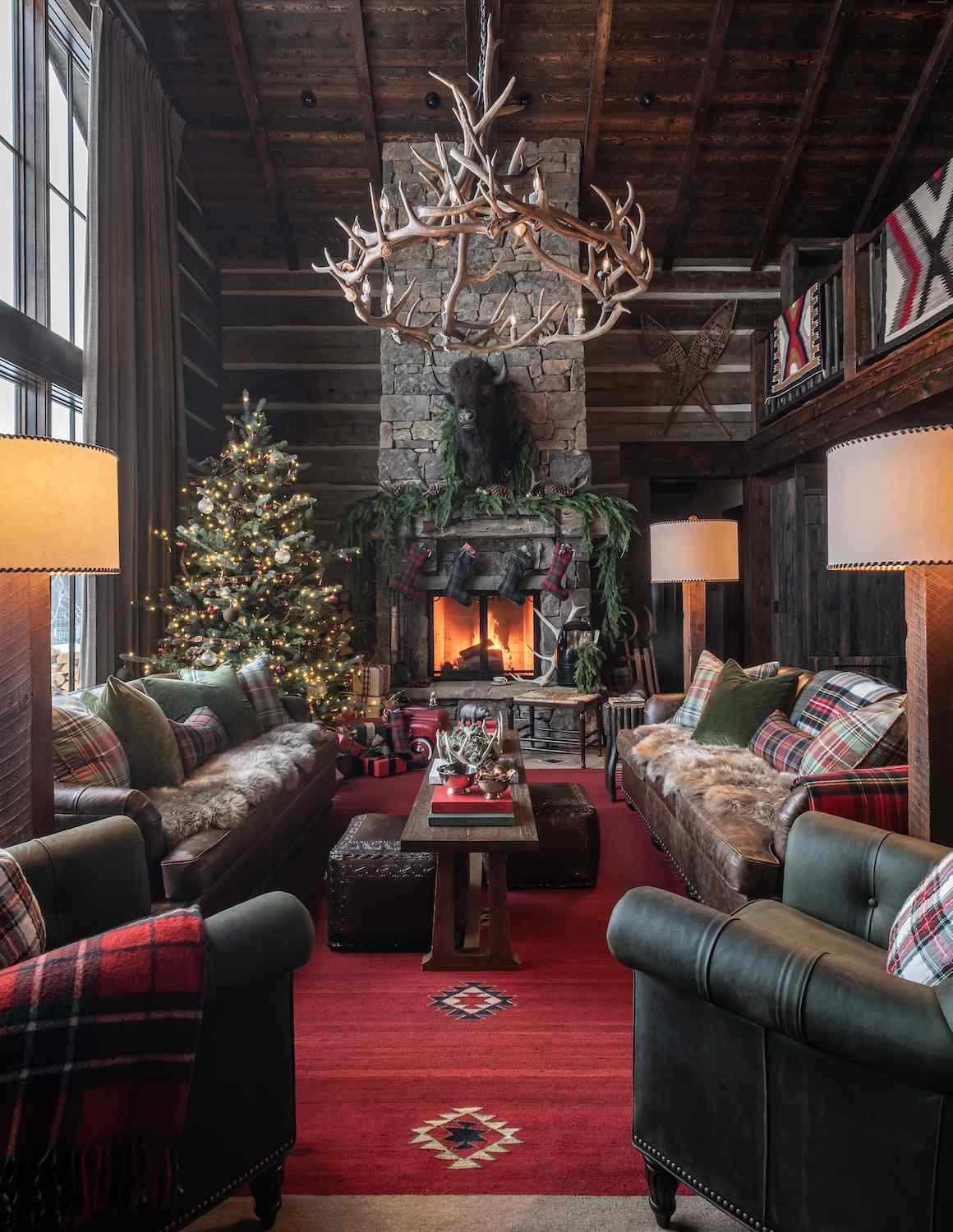
- Thread one strand of warm-white fairy lights along the underside so the glow spills onto the stove.
- Step back ten feet. Remove one thing. That’s the whole trick.
5. A Red Sleigh Parked Under a Flocked Tree
A flocked tree is gorgeous and also a small snowstorm in your living room. Expect to vacuum underneath weekly, and know that flocking yellows if it sits in direct sun — so that big window placement is pretty but wants a sheer curtain on bright afternoons. Never store a flocked tree in a hot attic. A $12 breathable tree bag beats a garbage bag every single time, and it’s the difference between five seasons and one.
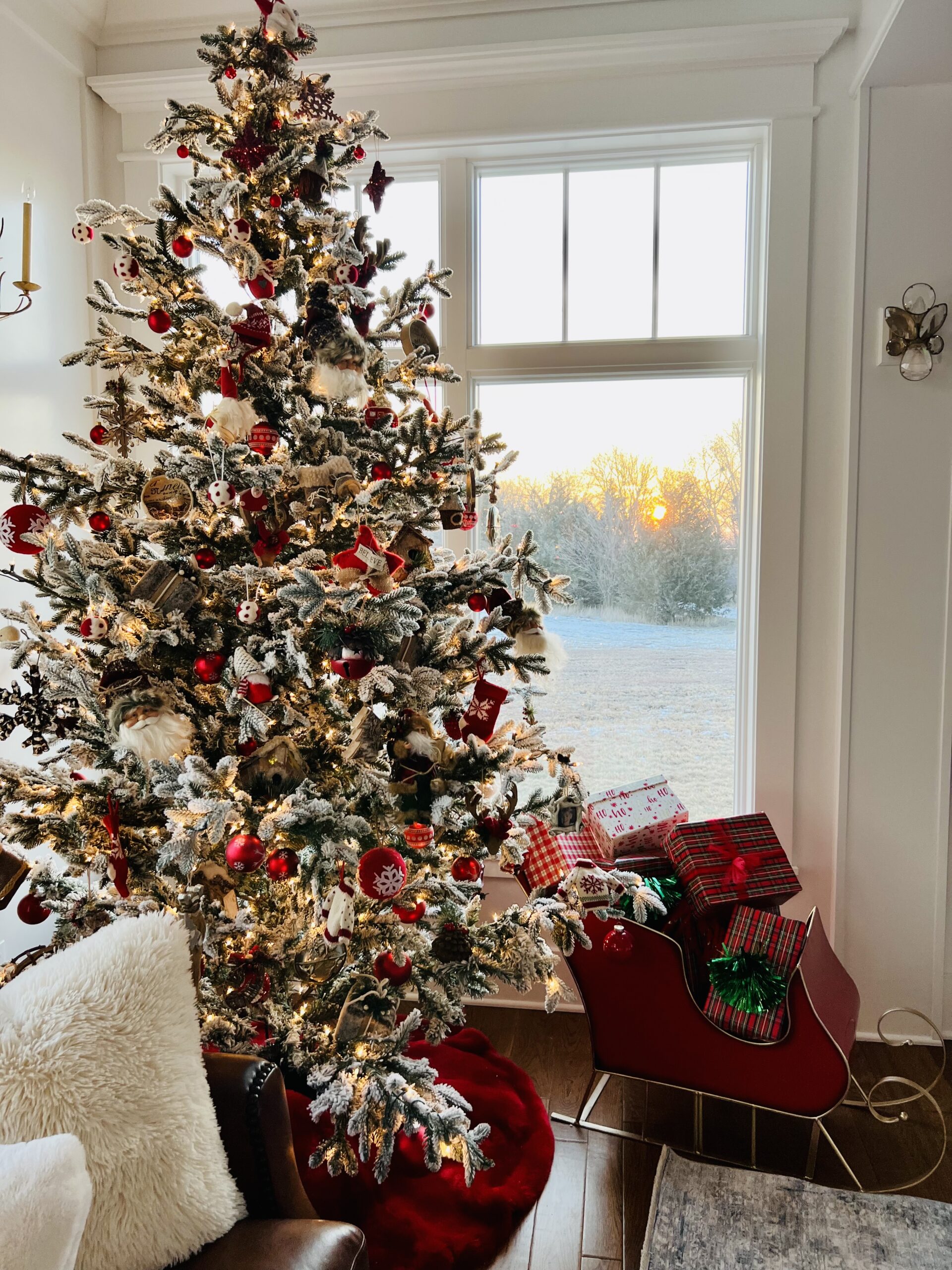
- Flocked tree, 7.5 ft: $180–$600
- Red ornaments and gnome figures: $60–$160
- Sleigh plus gift wrap: $45–$150
- Faux fur pillow, tree collar or skirt: $40–$120
- Window treatment, if you need one: $60–$200
Total: $385 to $1,230, and roughly $200 of that is reusable every year.
Flocked trees have quietly moved from grandma’s attic to the default of 2026 holiday styling, and the reason is photographic — they photograph brighter in low light than green trees, which is exactly what makes a Pinterest shot pop. The sleigh at the base is a 1990s callback that never fully left, and it’s back because it corrals presents without looking like a pile.
6. Dark Wood Paneling Made Cozy With Olive Velvet Drapes
Those olive velvet curtains work because of two numbers most people get wrong. Hang the rod 4 to 6 inches below the ceiling, not above the window trim, and extend it 8 to 12 inches past the frame on each side. Then buy panels at least 1.5 times the window width so they hold soft folds instead of reading as flat fabric. In a dark-paneled room, floor length is non-negotiable — anything above the floor chops the wall and makes the ceiling feel lower than it is.
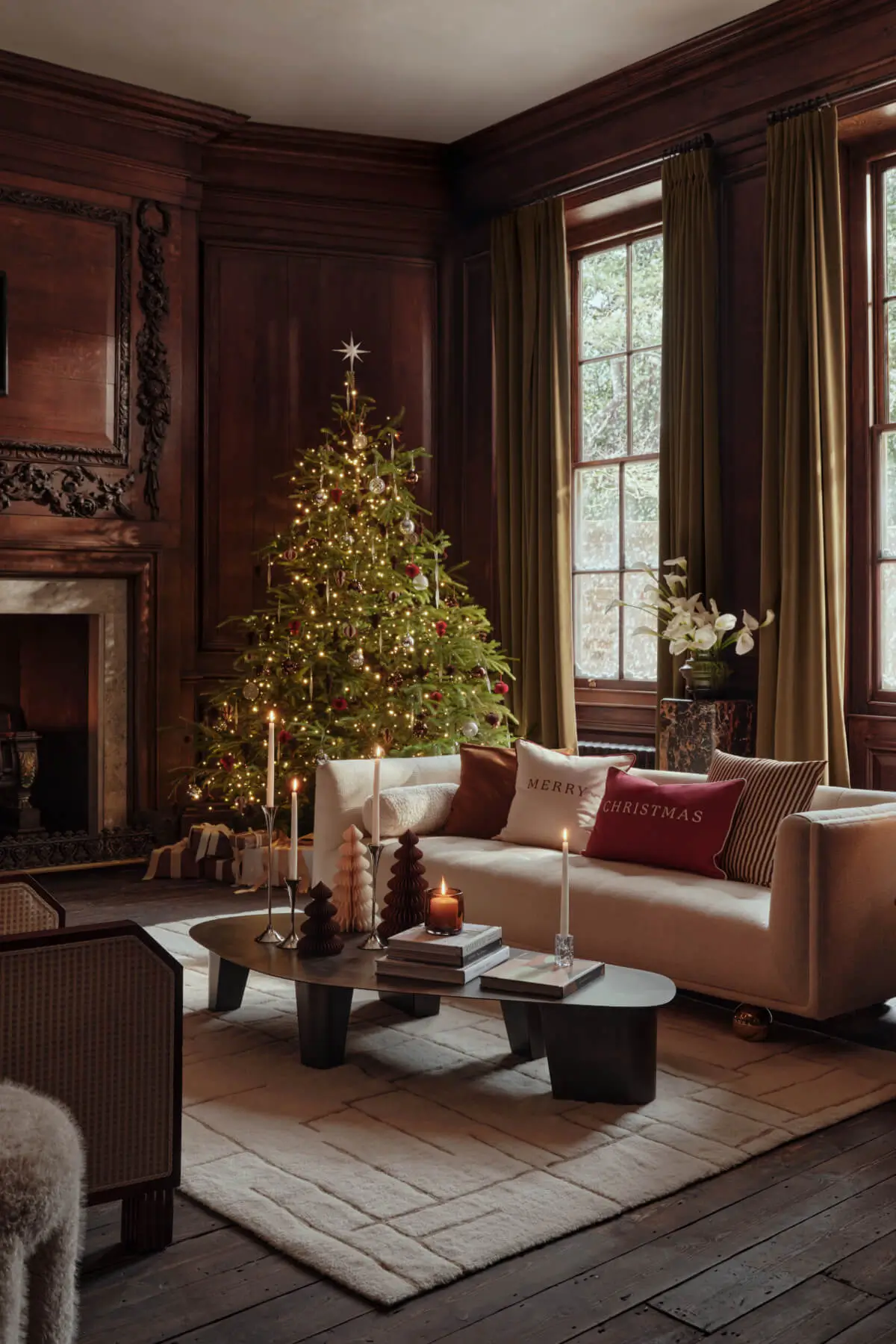
Dark paneling and velvet need room to breathe. This look is happiest in a living room of at least 200 square feet with 9-foot ceilings; below that, wood walls start to feel like a cave. Working with 8-foot ceilings? Keep paneling to one accent wall and choose a 6.5-foot tree so you’re not fighting the star topper. In a small apartment, steal the mood instead — dark olive curtains, a cream sofa, one tall tree in the corner. See Idea #19 for the deep-green-wall version of the same instinct.
7. Plush Seating, Warm Textiles, and a Tree That Glows
Two things make this room read as cozy instead of merely decorated. First, the tree is the only hard glow in the room — everything else is diffusion: soft throws, matte textiles, low warm lamps. Second, the seating sits close enough that you could reach out and touch a branch. Distance kills coziness. A tree you can’t reach might as well be a poster on the wall. Pull your sofa in 12 to 18 inches closer than you think you should and watch the whole room change.
If you strip everything away and keep one element, keep the warm lighting. Not the ornaments, not the tree skirt — the light. A tree with 300 cool-white LEDs and a tree with 600 warm-white minis are the same object with completely different souls. Buy warm white, always, and put a dimmer on at least one lamp. Dimming is the cheapest mood upgrade in decorating, and it’s why photos of this room look like a memory instead of a showroom.
8. Garland-Draped Built-Ins Flanking a Stacked Stone Fireplace
Multiple trees is the one Christmas look people assume is expensive. It isn’t. A 4-foot tree at Walmart runs $25–$40, and a 3-foot tabletop version is often under $20 at Target after Thanksgiving. The stacked stone is the real splurge here, so fake the rest — peel-and-stick stone veneer panels run $8–$15 per square foot, and a thrifted mirror or a $30 shelf can stand in for the built-ins. Garland from Dollar Tree costs $1.25 a strand and looks perfectly full doubled up.

Before you commit to the multi-tree, garland-everywhere version of Christmas:
- Measure your mantel length — garland needs 1.5x the width to swag properly.
- Count your outlets. Multiple trees plus garland means at least four free plugs.
- Decide who vacuums. This much greenery sheds, and someone has to own it.
- Check off-season storage — three trees is a real closet commitment.
- Set a total spending number before you shop. Multiples add up fast.
9. Birch Twig Wreath and Wood Slice Garland on Carved Stone
Birch twig wreath, about 30 minutes and $25–$60.
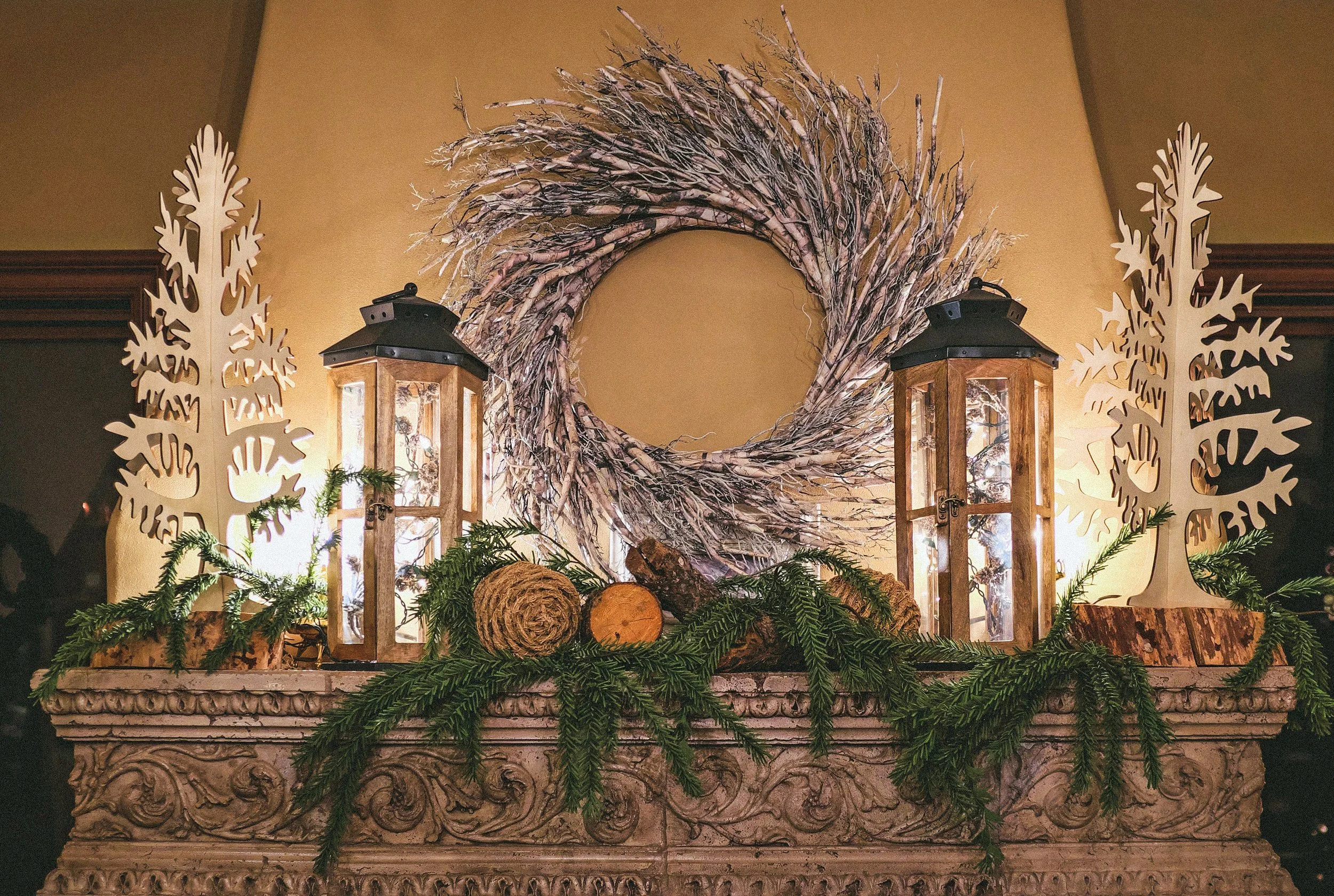
- Start with a grapevine or birch base, 18 to 24 inches across — bigger than feels right for a carved stone mantel.
- Wire on three pinecone clusters at 10, 2, and 6 o’clock so the shape isn’t symmetrical.
- Slice a dried branch into ½-inch wood coins and hot-glue them in a loose arc along one side.
- Hang with a removable adhesive hook rated for 5 pounds; twig wreaths are heavier than they look.
- Lean it slightly forward from the stone so it casts a shadow.
Natural materials come with a short shelf life. Birch sheds small flakes for the first week and can drop a lot once indoor heat pushes humidity below 30% — run a humidifier and it’ll hold through January. Wood slices crack if they dry too fast, so a light coat of mineral oil in November buys you two extra seasons. Store the wreath flat in a box, not hanging, or the circle will gradually egg out of shape.
10. Orange and Pink Pillows on a Grey Sectional (Yes, Really)
This palette breaks the usual rule and it works: 50% grey and white + 30% warm wood + 15% orange and pink + 5% black and brass. The unexpected part is those peachy pillows on a grey sectional in a Christmas room — it shouldn’t feel festive, and yet the tree’s warm lights make the peach tones glow instead of clash. Not a pink person? Swap to rust and cream. Keep the black chandelier and the brass tree tub. The formula holds as long as the metal stays warm.
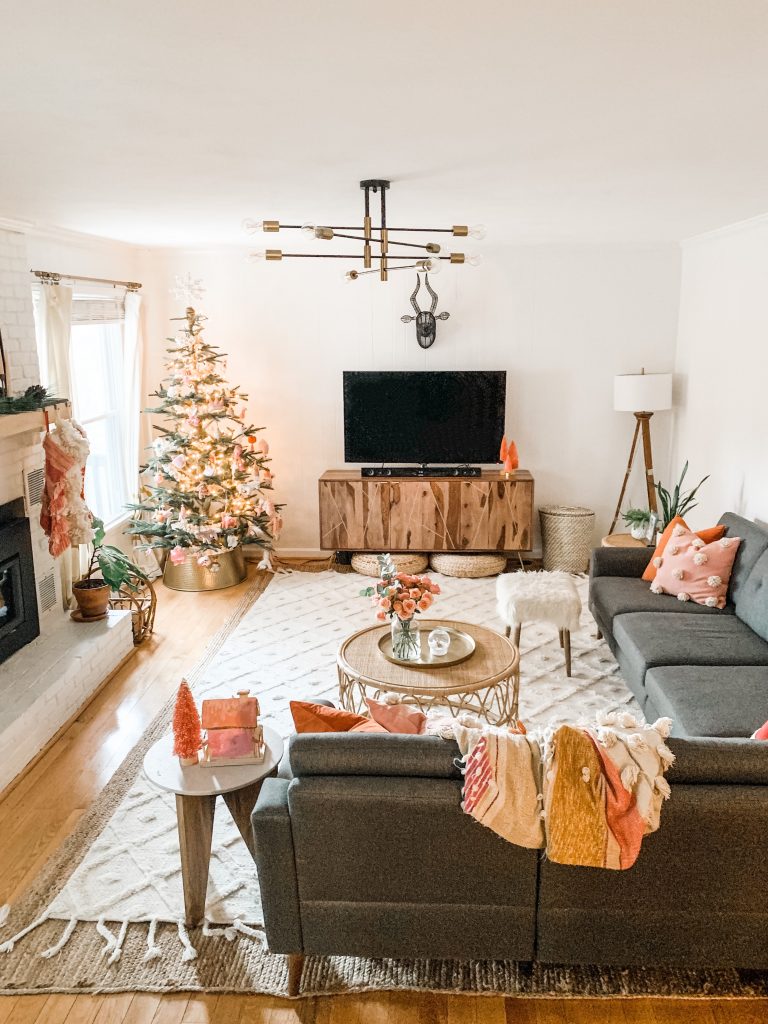
Sectionals eat floor space, so that round woven coffee table is doing quiet structural work — no corners, no traffic jams, and it visually softens a boxy sofa. Aim for a table roughly two-thirds the length of the seating section, about 32 to 36 inches in diameter for a standard three-seater, and leave 14 to 18 inches between the table edge and the sofa. Any tighter and you’re doing the sideways shuffle every time you sit down.
11. A Heavily Dressed Evergreen Next to a Classic Brick Hearth
If you have a real brick fireplace and small children or a curious cat, stockings hung at knee height will get pulled down repeatedly. Move the heavier ones up, leave the lightest at the bottom, or hang a screen in front of a live fire so nobody learns a lesson the hard way. Wooden mantels also get hot — keep candles and dried greenery at least 12 inches back from any fire you actually burn. And check your stocking holders; the cheap ones pop off at the first tug.
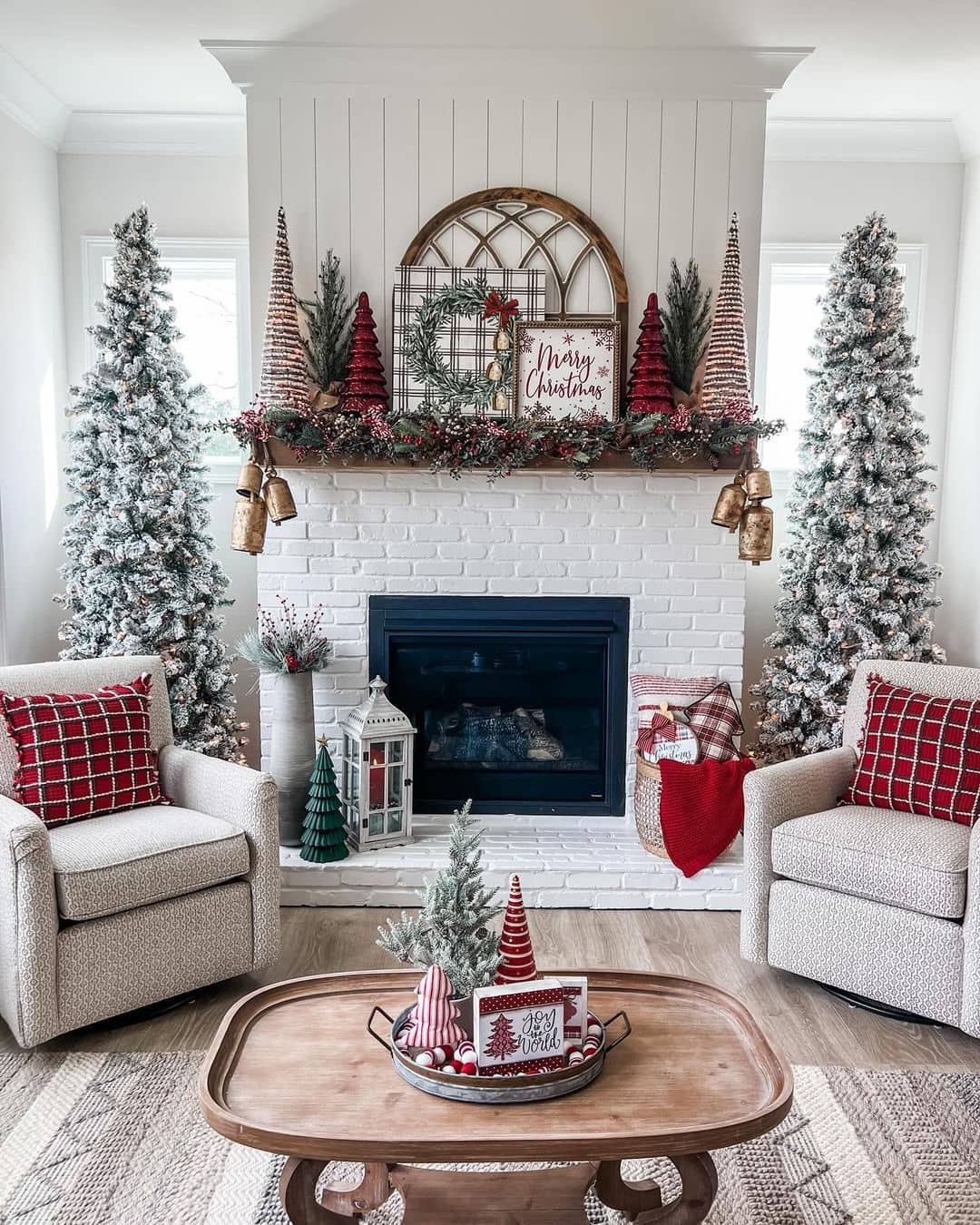
The composition works because the tree and the fireplace are doing different jobs. The tree is tall, vertical, and bright; the hearth is wide, horizontal, and warm. Together they frame the seating without competing. Notice the sofa is neutral — the red and green never turn into a color argument. If your sofa is already a strong color, reverse it: neutral tree, colored hearth. One loud element per sightline. Compare with Idea #13, where the same warm palette goes softer and more rustic.
12. Red Plaid Ottoman Matched to the Armchair Pillow
- Beige armchair with nailhead trim: $450–$1,400
- Red plaid ottoman: $90–$300
- Plaid and textured pillow covers: $40–$110
- Gold accent side table: $80–$250
- Decor: faux arrangement, tray, glass vase, tulips: $50–$160
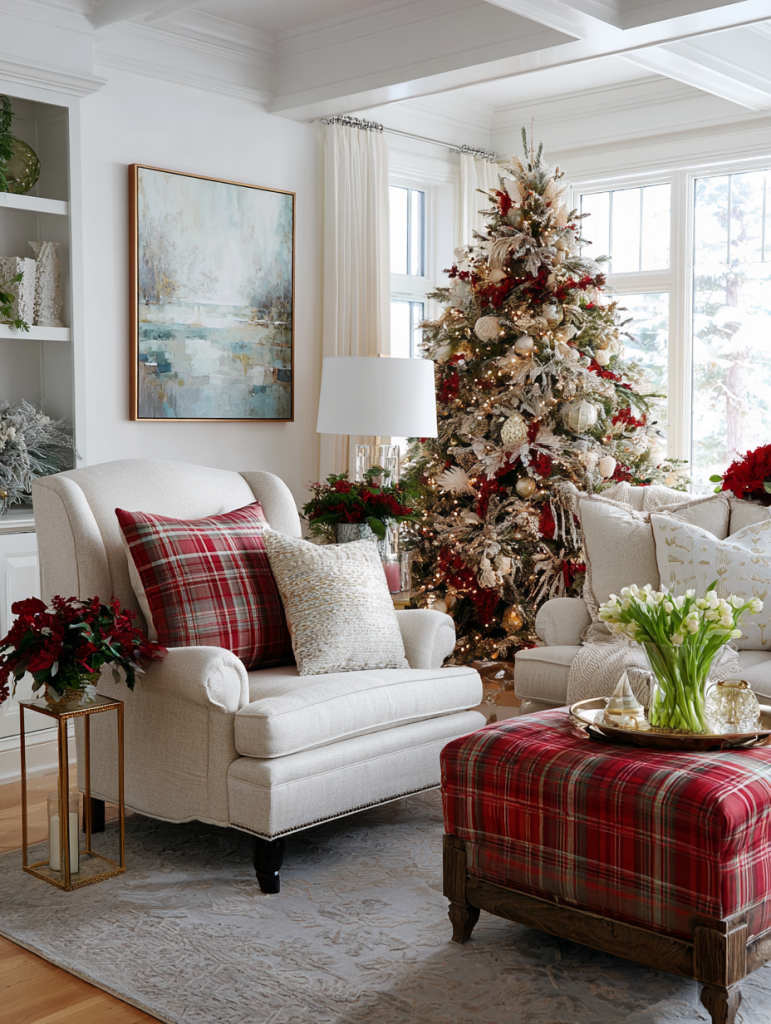
Total: $710 to $2,220 for a corner that reads as a matched set without actually being one.
This vignette fits a corner of about 5 by 5 feet — roughly the best-lit nook of a 150-square-foot living room. The 16- to 18-inch ottoman is the key size: big enough to read as furniture, small enough to shove aside when you need to walk past. Under 120 square feet? Trade the ottoman for a small round side table and keep plaid on the pillows only.
The single element that makes this corner feel intentional is the plaid ottoman matching the armchair pillow. One fabric used twice, at two heights, reads as a designed room — and it’s the cheapest trick in the book. Take the ottoman away and you have a chair with a seasonal pillow, which is just… a pillow. Two yards of plaid and $40 covers both pieces.
13. Fabric Tree Skirt, Patterned Pillows, and Wrapped Gifts
Wrapped gifts left visible under the tree is a real shift. For years, styling magazines showed empty, curated tree skirts; in 2026 the lived-in version wins, and half-wrapped boxes with visible ribbon have become the point rather than the problem. Blend your wrap — kraft paper, one patterned roll, and fabric ribbon in two colors — and save the expensive paper for the smallest boxes up front, where people actually look.
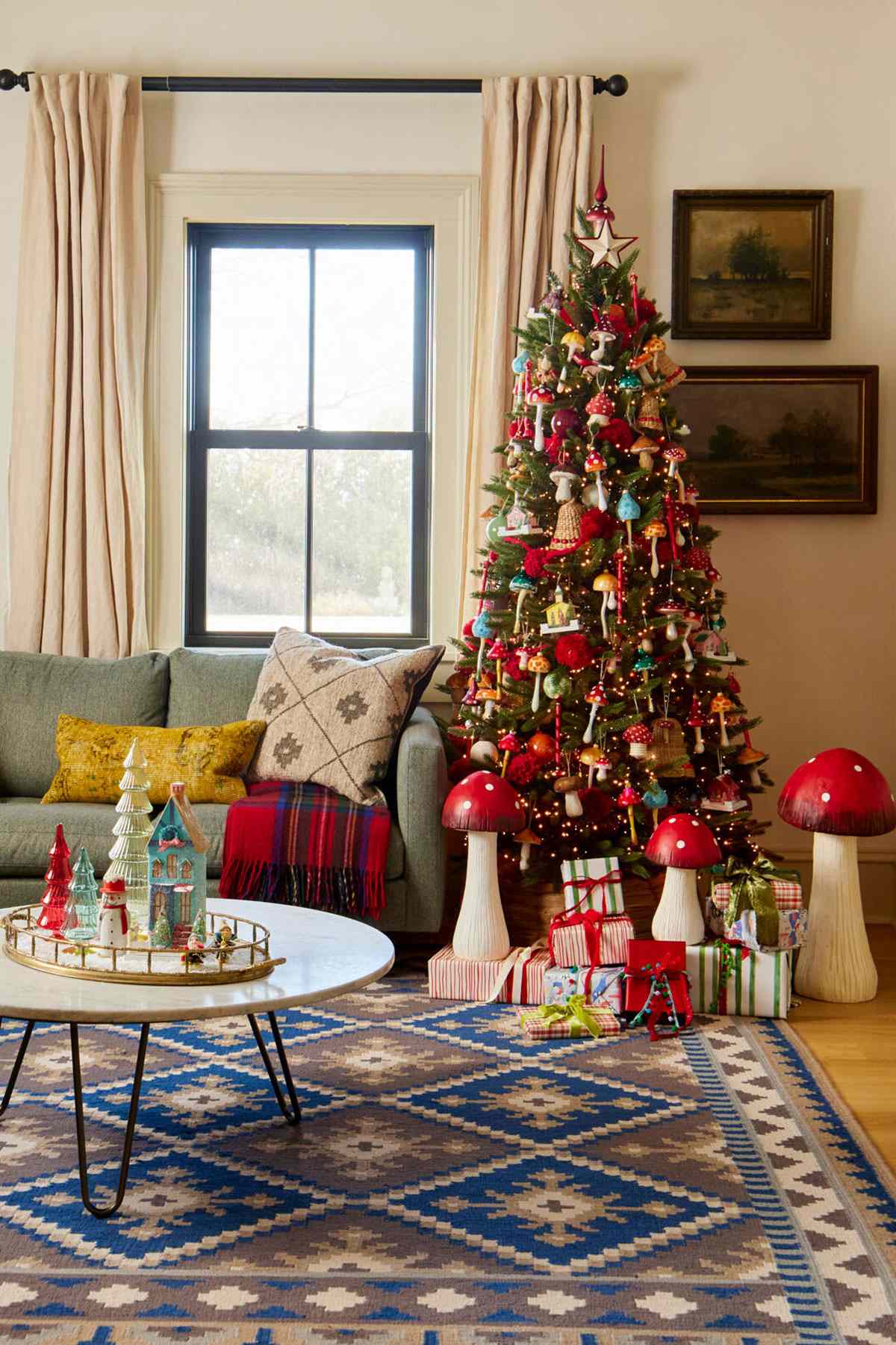
Layer the whole thing on a budget: a sofa you already own, four patterned pillow covers at $8–$15 each, a cotton throw for $20 at IKEA, and a fabric tree skirt for about $18 at Target. For gifts, use boxes from your recycling bin and kraft paper — one $6 roll wraps eight presents. Swap the tree skirt for a woven basket you already have and you save another $20, and honestly the room looks more collected, not less.
14. Flocked Tree Against a Wall of White Glass Cabinets
Flocked trees go grey when the lights are too cool. Use 2700K warm-white LED strands only — no bright white, no color-changing strings set to ice. Keep the ornament palette to two finishes: matte white and one metallic. In a room with white built-ins, a third finish makes the shelving and the tree compete for the eye. Want more texture? Add pinecones — matte, organic, and free if you live near trees.
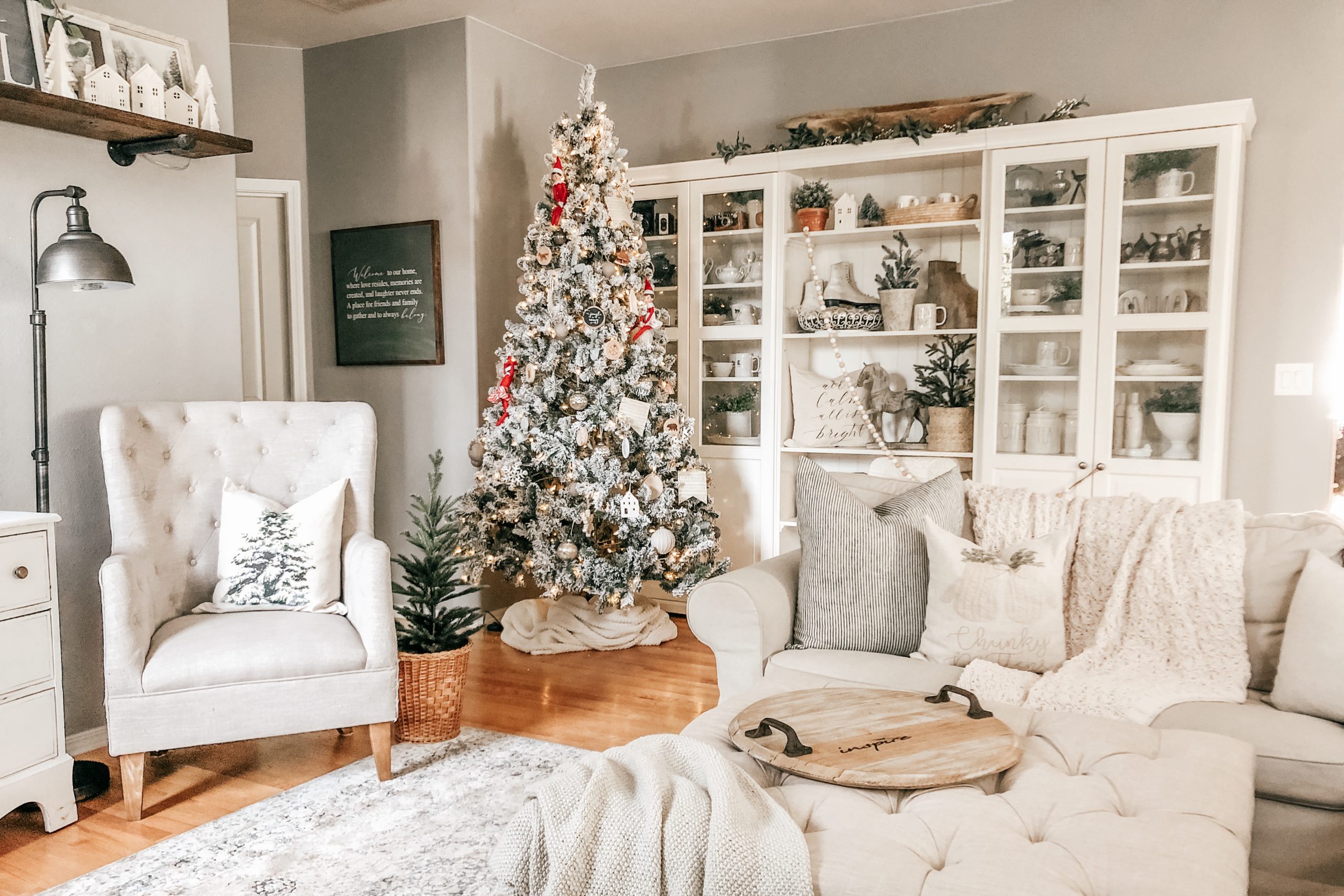
Styling a white glass-front cabinet for the holidays, about 25 minutes, almost free.
- Empty the top shelf and put back only three objects — the emptiest shelf looks the most expensive.
- Add one small green element per shelf: a sprig, a tiny tree, a pinecone.
- Vary heights by stacking one book under a single item, never more than two items tall.
- Keep everything at least two inches back from the glass so reflections don’t muddy.
- Repeat the same three shapes at each level — repetition reads as collection.
15. Buffalo Check Throw Over a Ruffled Cream Slipcover
The formula: 50% cream + 20% black-and-white buffalo check + 15% warm wood + 10% red + 5% green. Buffalo check works in a room this soft because of contrast — a graphic print keeps ruffles from tipping into saccharine. Swap the check for ticking stripe or small-scale gingham and the room goes calmer. Swap it for tartan and it goes more traditional. The proportions stay put either way. In a small room, only the pattern scale should change: smaller checks, smaller prints.
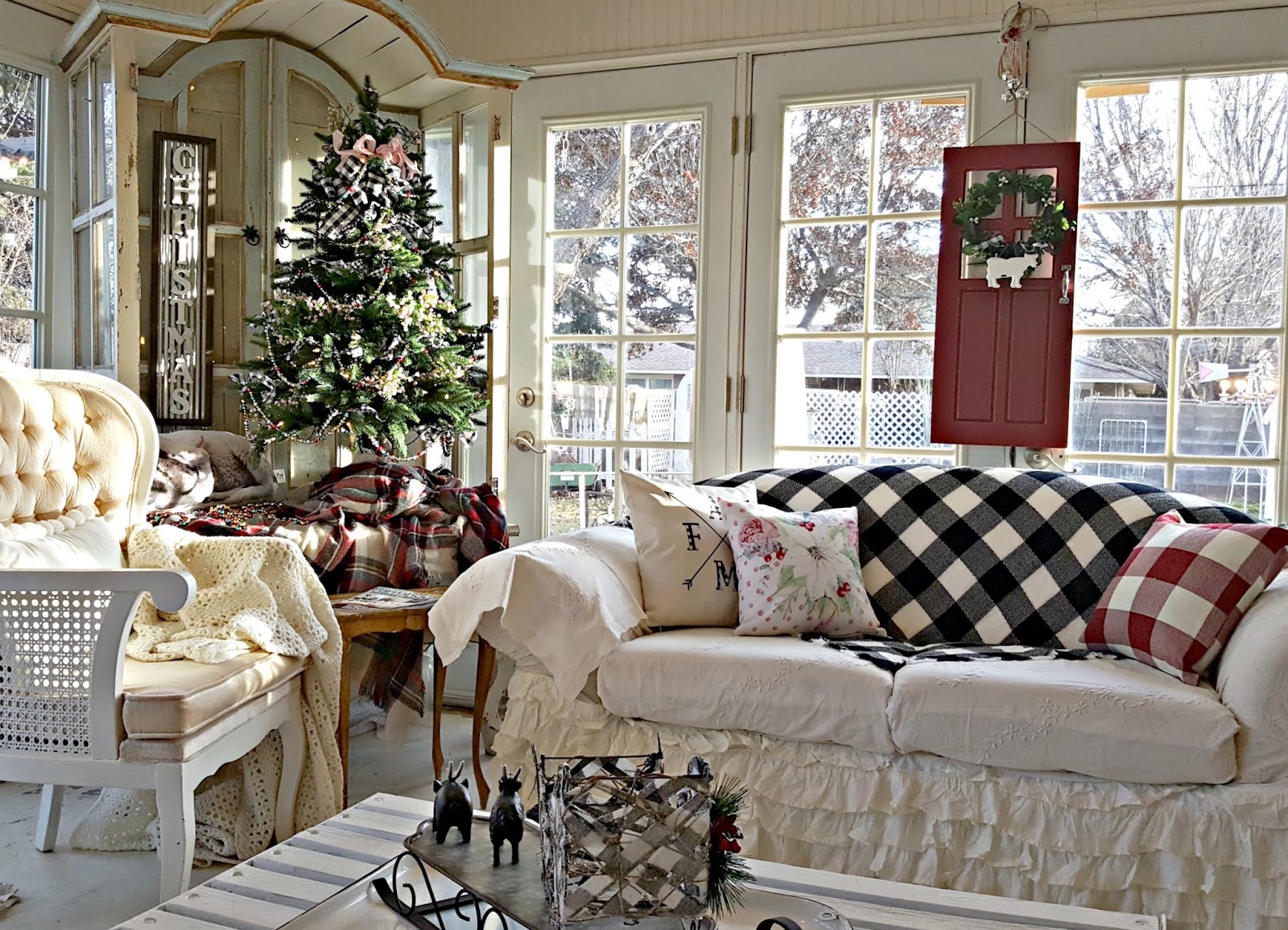
Fifteen feet of window with no sheers means serious afternoon glare from about 2 to 5pm, and sun is the enemy of anything red. Store the buffalo check throw out of direct light when you’re not using it, and expect vivid reds to fade toward pink within two or three seasons on a sunny sill. This room also demands pattern discipline. If you’re considering a fourth print, stop. Three patterns plus a solid is the ceiling.
16. Five Stockings Spelling HO HO HO Over a Sea of Candles
- Five stockings, knit or quilted, with lettering: $60–$175
- Stocking holders or a simple rod: $20–$60
- Metallic gold vases, three varying heights: $45–$150
- Faux red roses and gold foliage stems: $30–$90
- White pillar candles for the hearth, 8 to 10 of them: $25–$70
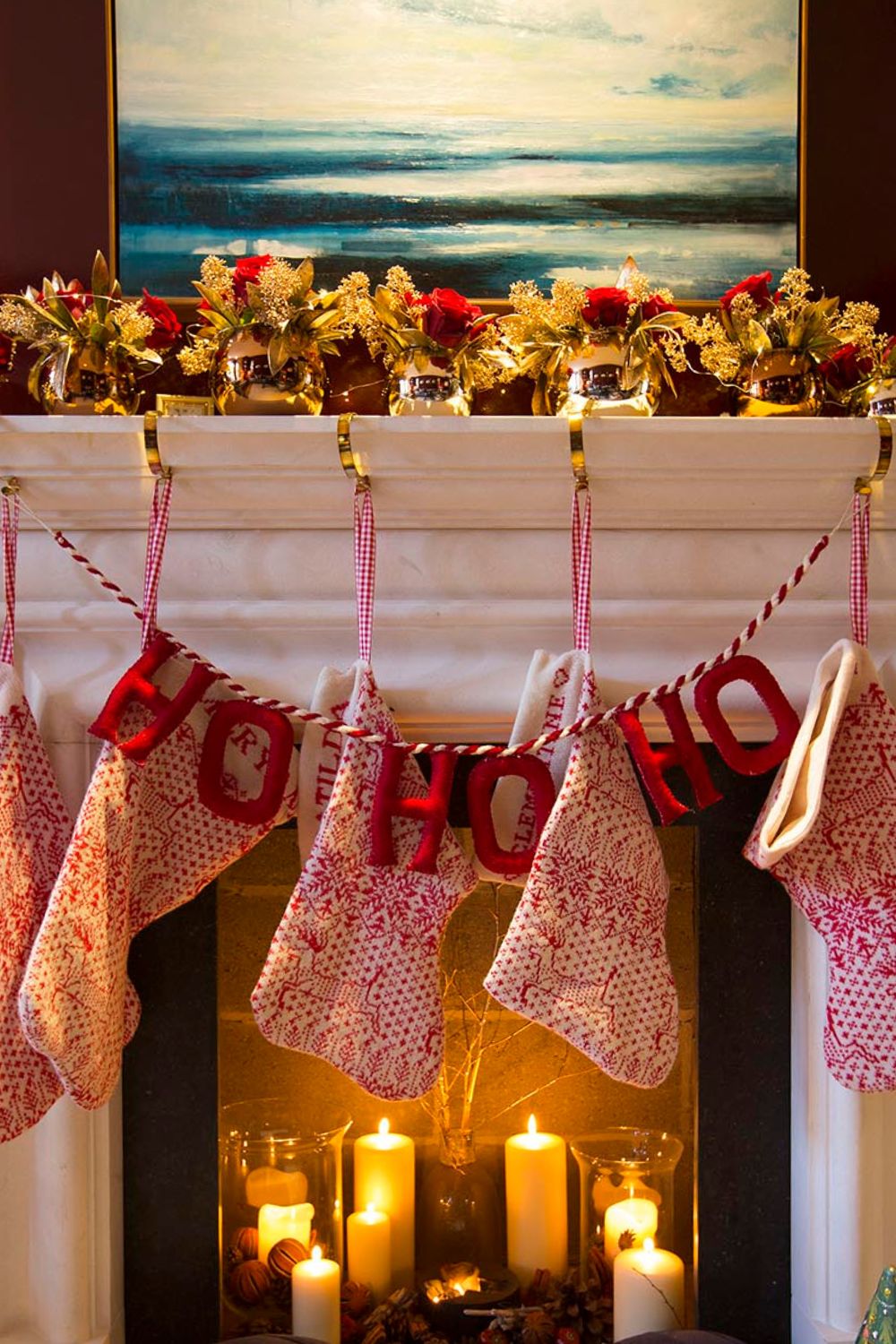
Total: $180 to $545, which makes this one of the most affordable mantels in the entire collection.
The thing you’d miss most if it vanished is the row of candles filling the firebox. Ten unscented white pillars in graduated heights, all lit at once, mimic the light output of a small fire without smoke, ash, or a chimney sweep. Buy them at IKEA or Walmart for $2–$5 each and set them on a heat-proof tray. Compare with Idea #21, where snow and a frosted mini tree take the same hearth in a cooler direction.
17. Cedar Garland and Brown Velvet Bows on Black Stone
Black stone is the reason this room feels grown-up. A dark surround absorbs light, which makes the cedar garland and the lit tree read as actual light sources rather than decorations. Notice the fire is the only thing burning at floor level — no competing lamp glow down low, so your eye goes to the flame and then climbs to the tree. White knit stockings are the third piece, tying back to the cream accents without adding another color to track.
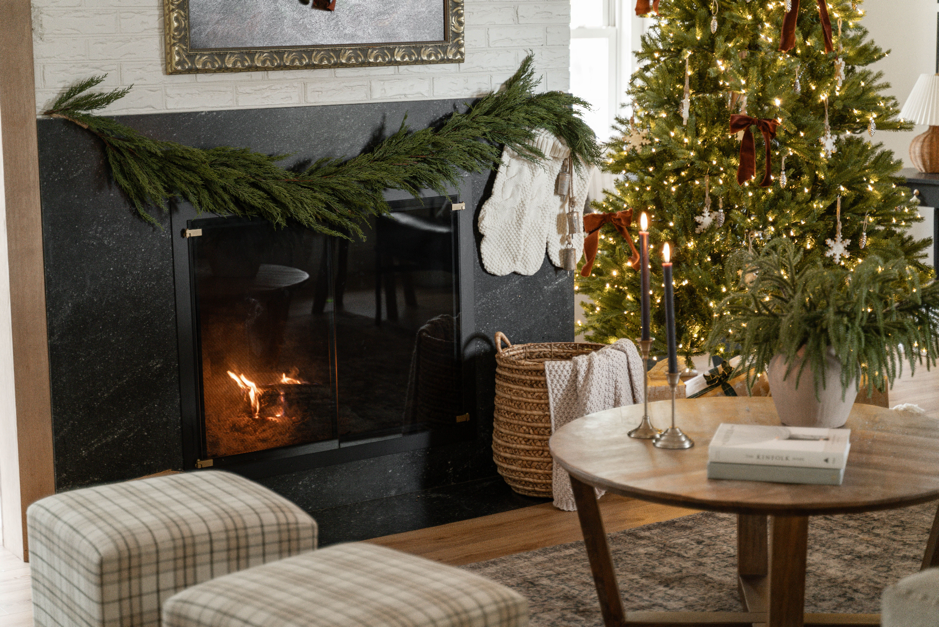
Ceilings matter more than floor plans here. A fireplace this tall wants at least 9 feet of headroom; at 8 feet the stone starts pressing down and the room feels shorter than it is. For 250- to 400-square-foot rooms, keep ottomans small — 18-inch squares rather than 24 — so two fit side by side without blocking the walkway. In a tight apartment, skip them entirely and choose one round wooden coffee table instead.
18. Ribbons, Wreaths, and a Candle Tray on the Coffee Table
Fake the built-ins. Two $40 IKEA Billy bookcases with glass doors, painted the same white as your walls, read as custom cabinetry from across the room. Garland at $5–$8 a strand from Walmart looks full if you double it. The pre-lit garland is the one must-buy — strands start around $25 for 9 feet. Skip pre-made bows entirely; a $6 spool of velvet ribbon and 20 minutes gets you the same effect, and you’ll have ribbon left for the tree.
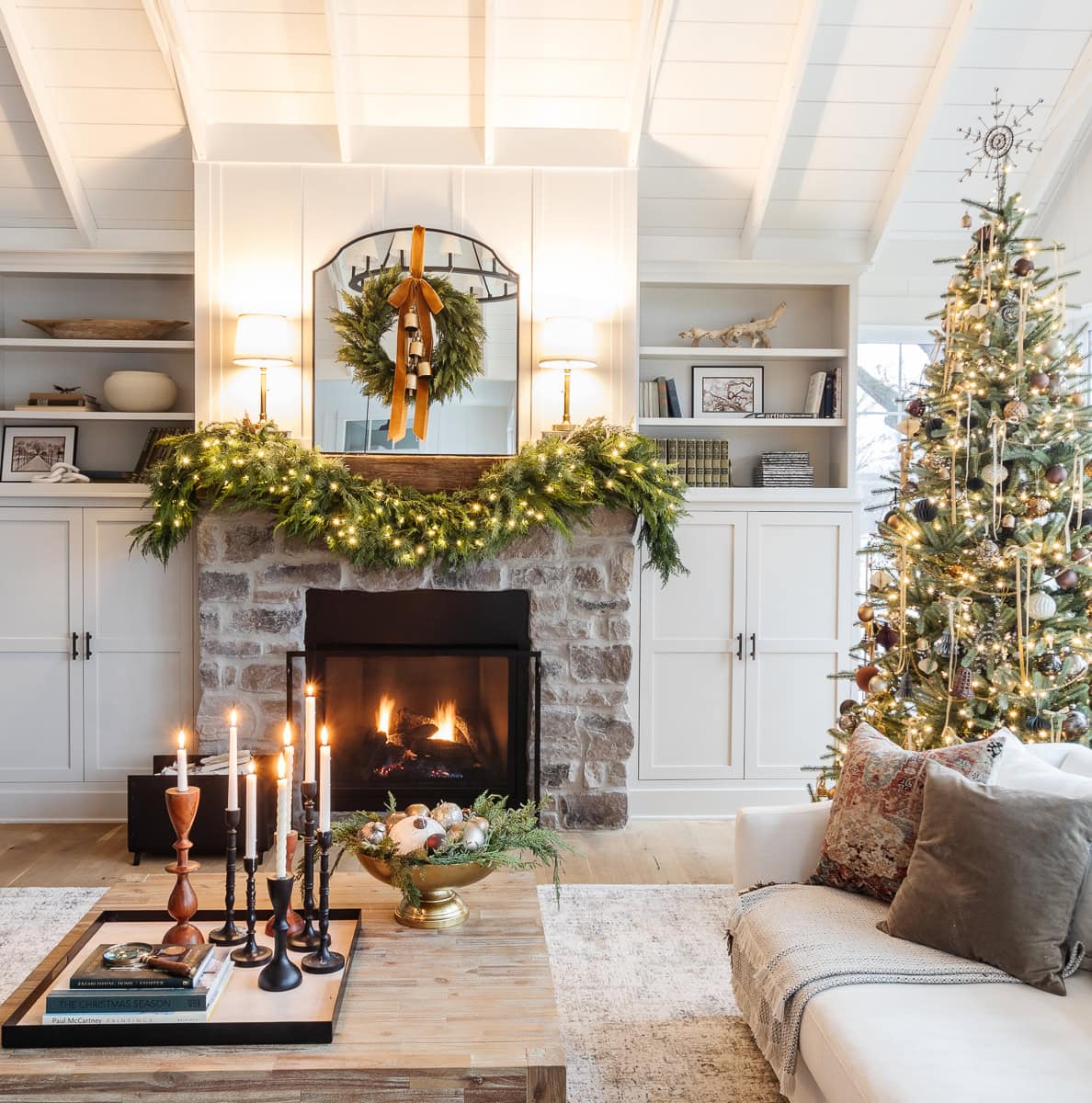
Stop decorating the whole tree with the same ornament. Use three sizes — small fillers toward the trunk, medium through the middle, and six to eight oversized statement pieces hung on the outer tips where the lights actually hit them. The rule: nothing smaller than 3 inches sits within 6 inches of a branch tip. It’s the difference between a tree that reads as a blur of texture and one that reads as designed.
19. Deep Green Walls That Swallow the Tree Light
Deep saturated walls are the biggest shift in holiday decorating right now. After a decade of white-on-white Christmas content, dark green, navy, and even black living rooms are climbing on Pinterest because they make warm lights look luminous instead of washed out. The trade-off is commitment: a dark room needs more light, not less. Expect four to six lamps or sconces instead of two. This one has staying power — colored walls are part of a broader move toward rooms that feel like evening.
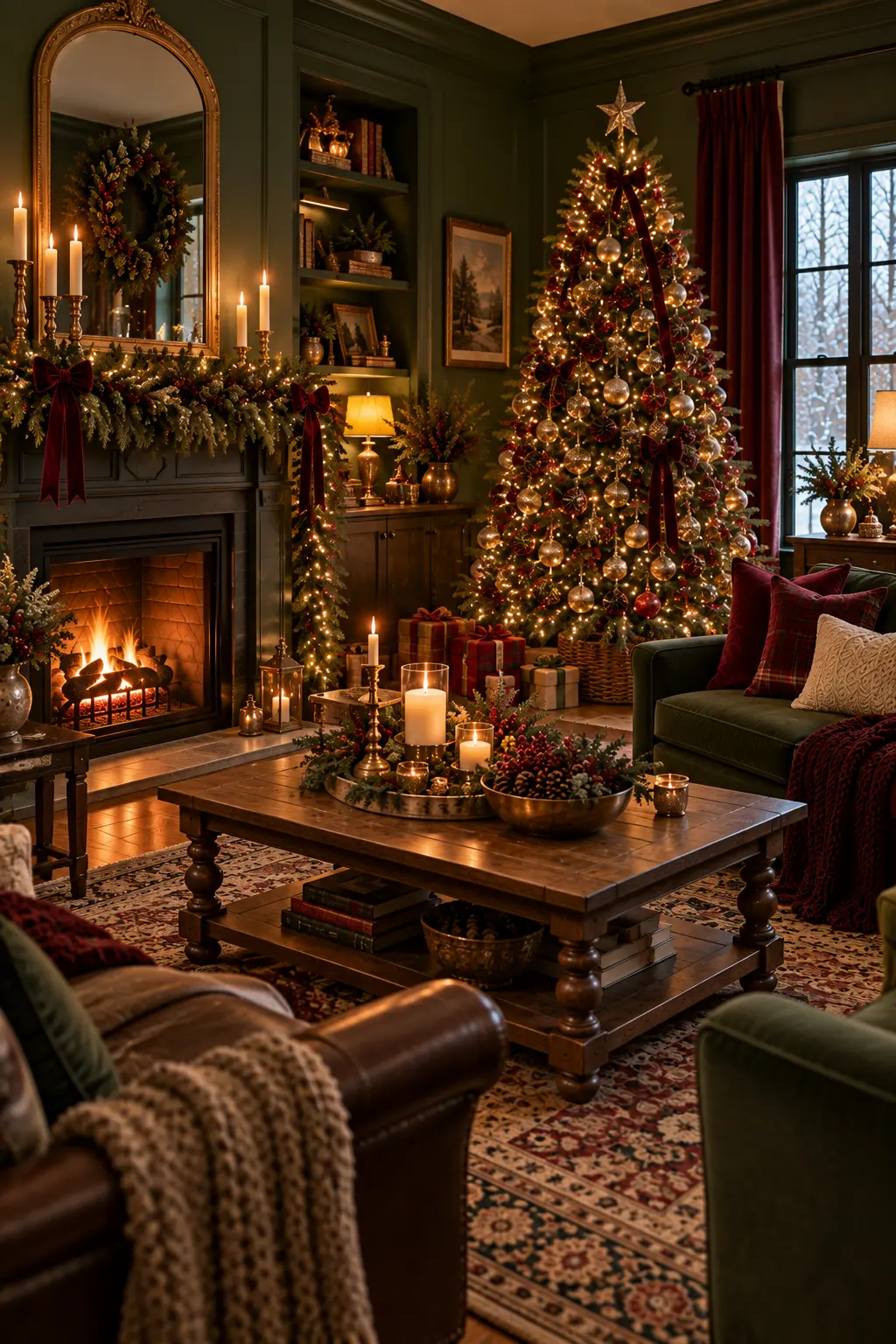
The math: 45% deep green walls and upholstery + 25% warm wood + 15% brass and gold + 10% deep red + 5% white. Green on green sounds risky, but the velvet armchairs are a lighter, warmer, more yellow value than the walls, so the layering reads instead of matching. Leather keeps it from turning costume-like. Swap the wall green for navy and everything else holds; navy with brass is the slightly more modern read.
20. A Village of Tiny Houses Lined Up on the Mantel
Mounted TVs and decorated mantels fight for the same real estate. If your TV hangs above the fireplace, keep the styling low and wide — a line of small houses works, a tall floral arrangement doesn’t. Skip garland swagged over the screen; heat plus dust plus dangling greenery is how you scratch a panel. And if any of those little houses light up, run one discreet extension cord now, before you fall in love with the arrangement and can’t reach an outlet.
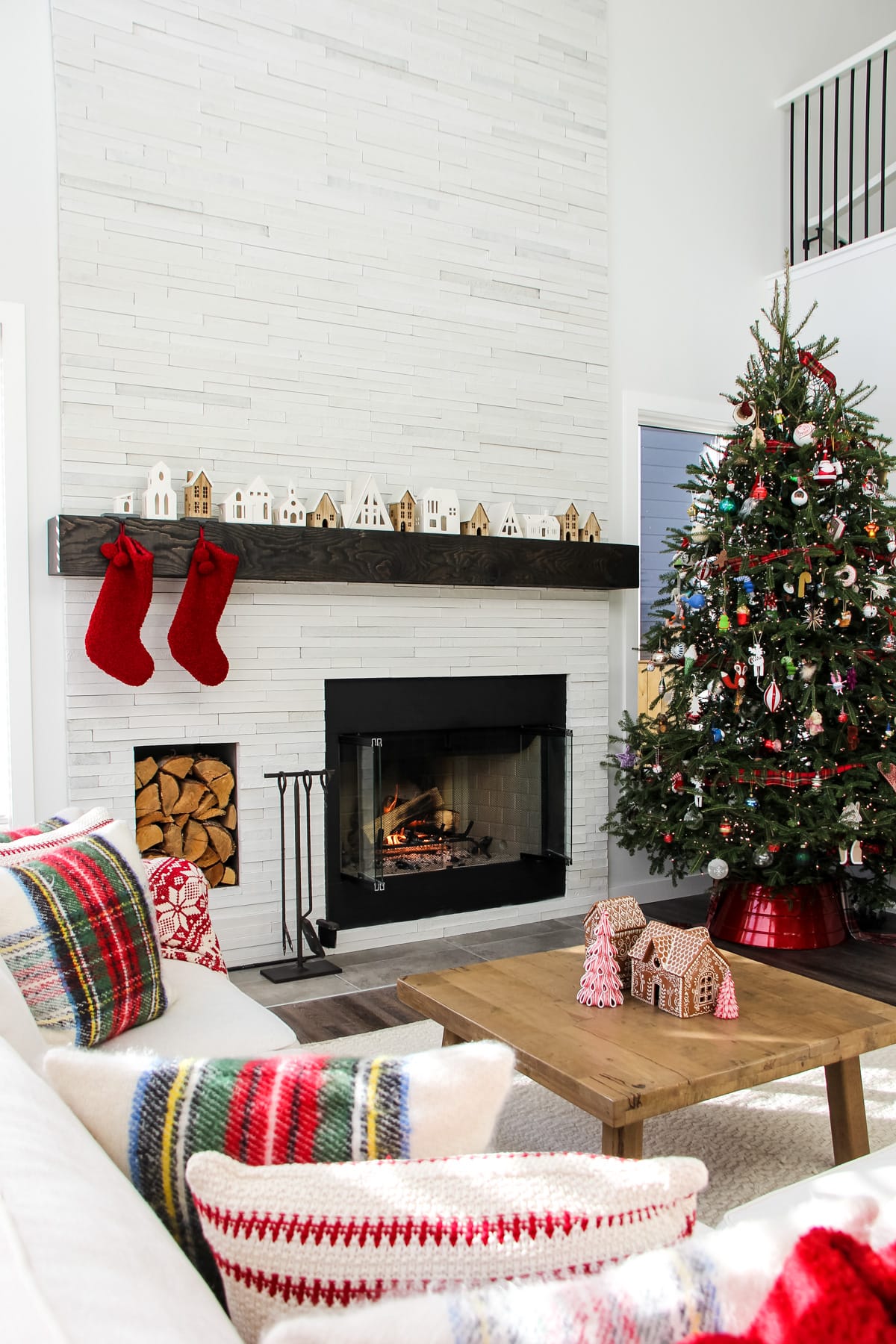
Mantel village, 20 minutes and $0 to $60 depending on what you already own.
- Gather 9 to 15 houses in mixed heights — thrift stores are the best source.
- Arrange largest at the center, descending toward each end.
- Overlap a few so the group reads as one cluster, not a row of soldiers.
- Slip two or three battery tea lights behind the fronts to fake interior glow.
- Leave 4 inches of bare mantel at both ends. Empty space is what makes it look curated.
21. Marble Mantel, Cream Knit Stockings, and a Frosted Mini Tree
If you take one thing from this mantel, take the cream knit stockings. Against white marble and green garland they’re the only soft, non-shiny texture in the entire vignette — and softness is what keeps a marble fireplace from feeling like a hotel lobby. Chunky cable-knit stockings are worth $25 to $40 each; buy them once and they’ll outlast three trees. Pair them with a plain dark hook so nothing metallic steals attention from the knit.
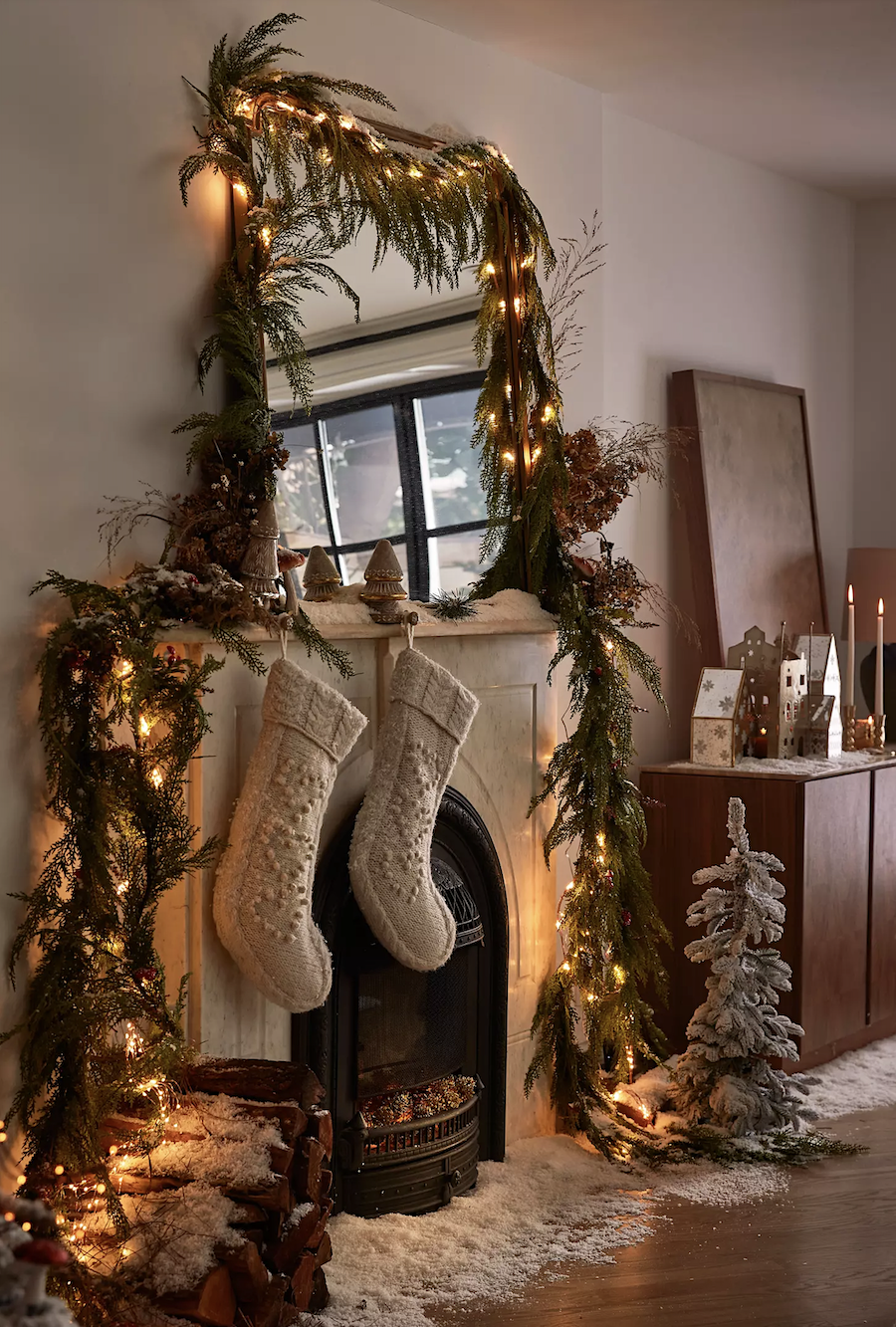
Marble shows every fingerprint and every drop of candle wax. Wipe it with a damp microfiber cloth weekly and never use anything acidic — marble etches permanently. For wax, let it harden completely, then lift it with a plastic card, not a knife. Artificial snow is its own maintenance job: it drifts, it sticks to floors, and pets will absolutely investigate. Vacuum it up with a brush attachment at season’s end instead of sweeping it into a corner.
22. Quiet Holiday Decor: Neutral Sofa, One Warm Tree
Quiet holiday rooms follow one rule: each surface gets one job. Here the tree carries shine, the sofa carries softness, the wood table carries warmth, and nothing doubles up. In practice, that means limiting yourself to three texture types in a room under 200 square feet — pick shine, soft, and matte, then refuse anything that blurs the categories. Faux fur and tinsel on the same surface is what makes a room feel cluttered even when it isn’t.
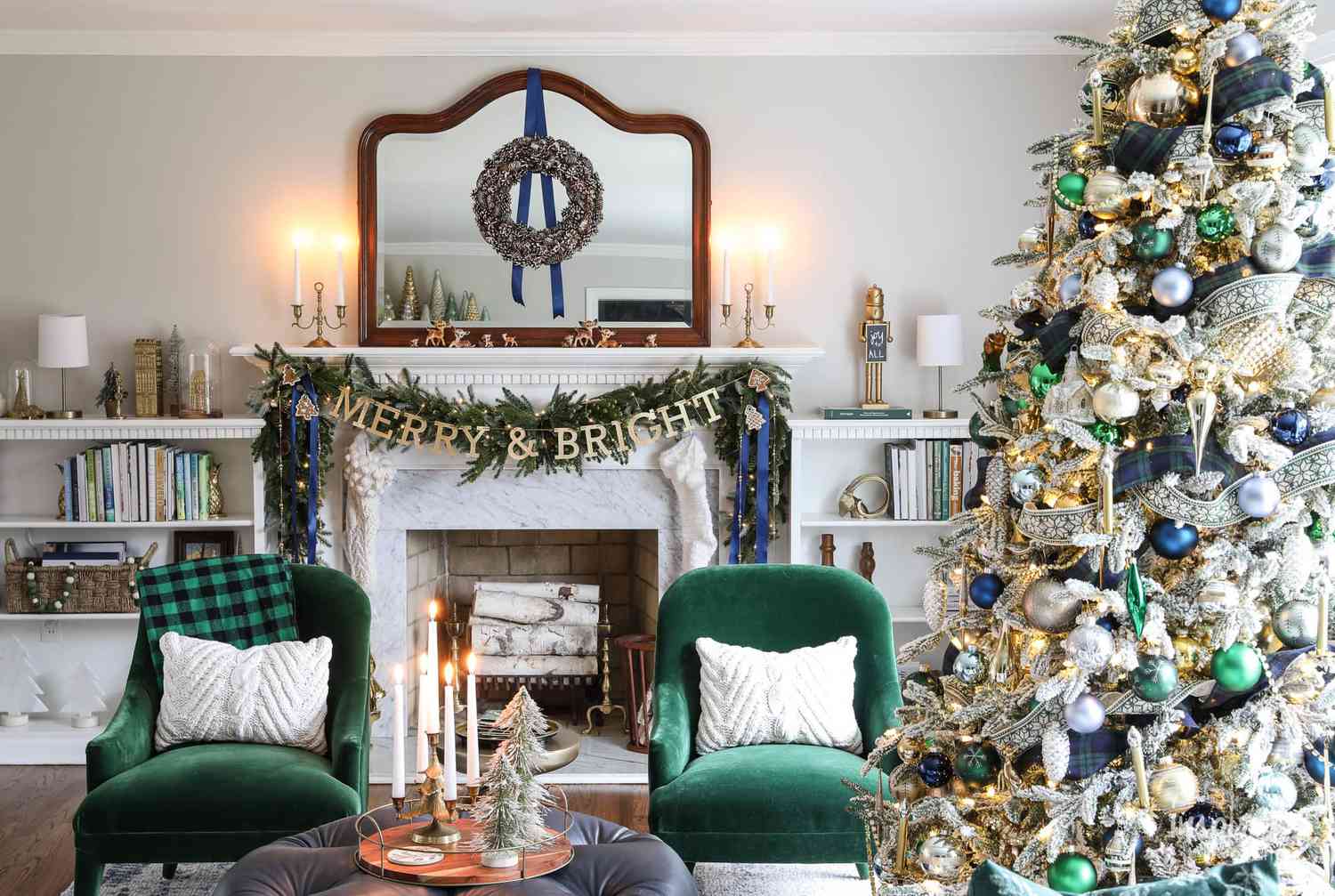
Before you go minimal this year, check these:
- Is your main light source warm? Neutral decor falls flat under cool bulbs.
- Do you have a tree spot that isn’t blocking a walkway?
- Count your surfaces — sofa, table, mantel, shelf. Each gets one texture.
- Do you have storage for the pieces you’re choosing not to use this year?
- Pick your one accent color now, before you shop, or neutral drifts into beige.
23. Blanket Ladder, Lanterns, and Peace on Earth Signage
- Garland for the mantel, 12 to 15 feet: $40–$120
- Knit stockings plus wooden name tags: $50–$140
- Plaid throw and accent pillows: $45–$130
- Lanterns and a wooden blanket ladder: $60–$200
- Sign, greenery, and filler decor: $30–$90
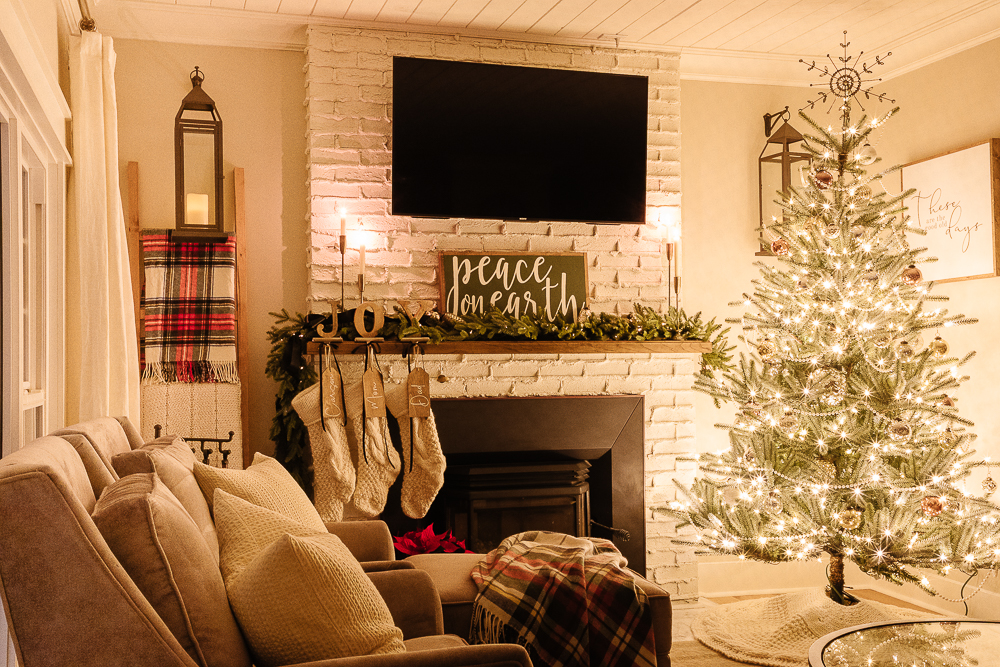
Total: $225 to $680 — most of it reusable, and the ladder earns its keep in January as actual storage.
The unglamorous hero of this room is the blanket ladder. It gives the eye a vertical line on a wall that would otherwise be flat beige, it’s genuinely functional, and it costs about $25 to build from two boards and a dowel. Second principle: the plaid throw repeats plaid elsewhere in the room, which is what turns a pile of seasonal items into a scheme. Pair any strong pattern twice and it stops looking accidental.
24. Shiplap Walls and a Chunky Knit Draped on the Coffee Table
Recipe: 55% cream and white + 20% warm wood + 15% forest green + 10% black hardware. Shiplap and a white mantel lay the base coat, wood brings the age, and green stays confined to the tree, garland, and one small ceramic. Want a different holiday entirely? Swap the green for rust or blush and change the ribbon only. Keep the wood tones and the shiplap exactly where they are — those are the structural part of the formula, not the seasonal one.
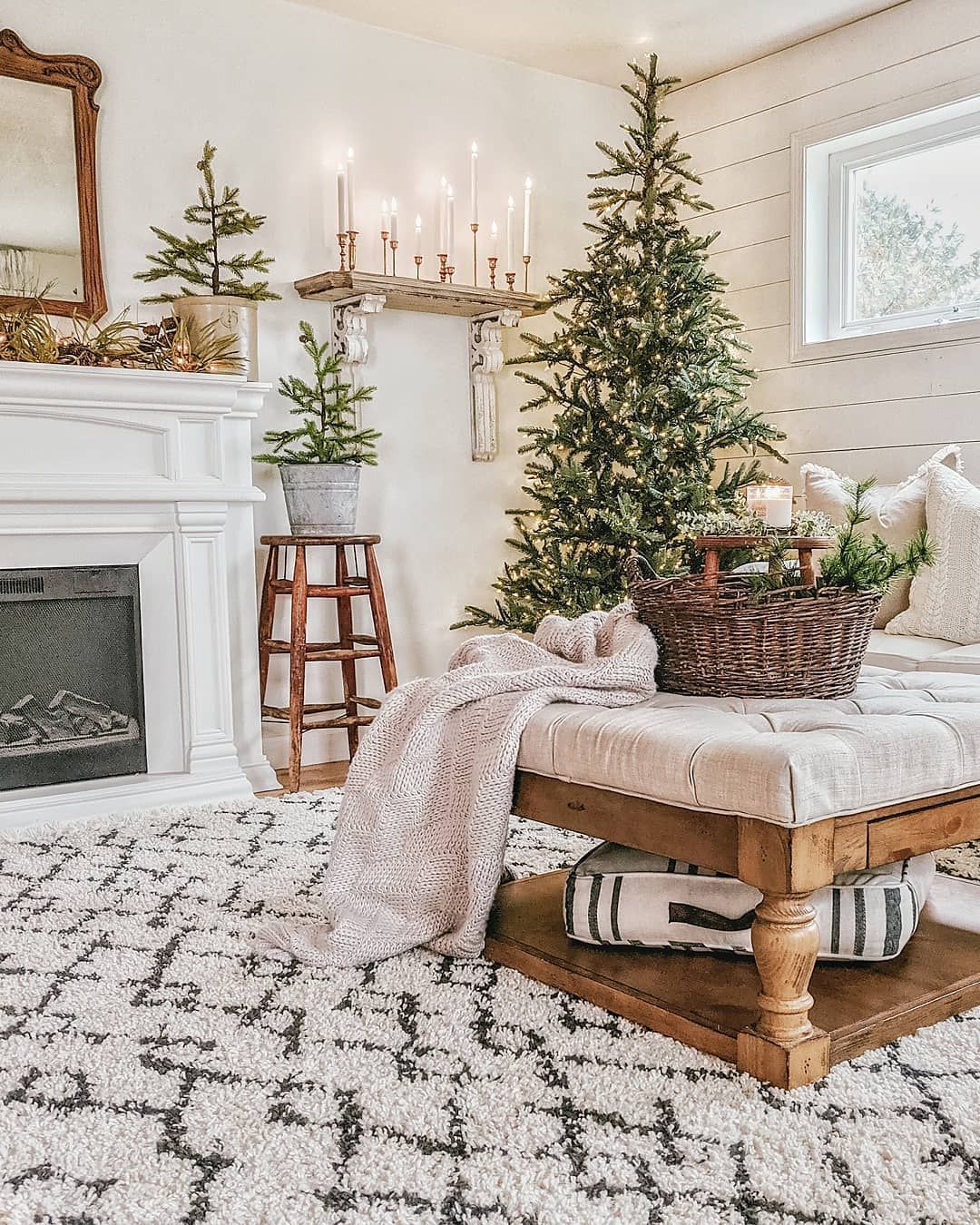
A chunky knit blanket draped over a coffee table is beautiful and a magnet for dust, crumbs, and dog hair. Shake it outside weekly and hand-wash cold two or three times a season; a machine wash will felt it into a doll-sized blanket. Moroccan-style rugs shed for the first two months, then settle, so don’t panic. Shiplap is easy — one damp cloth, no wax, no polish. Its only enemy is a nail hole you didn’t plan for.
25. Two Sofas Facing Off Across a Floor-to-Ceiling Stone Fireplace
Symmetry needs width. This layout wants a room at least 14 feet across and 16 feet deep, with 10-foot ceilings to carry the stacked stone. Below 12 feet wide, facing sofas crowd the center and the coffee table becomes an obstacle course. Smaller room? Keep the symmetry but use one sofa and two matching chairs. In a tighter space, try Idea #14‘s approach instead — one focal point and a wall of white.
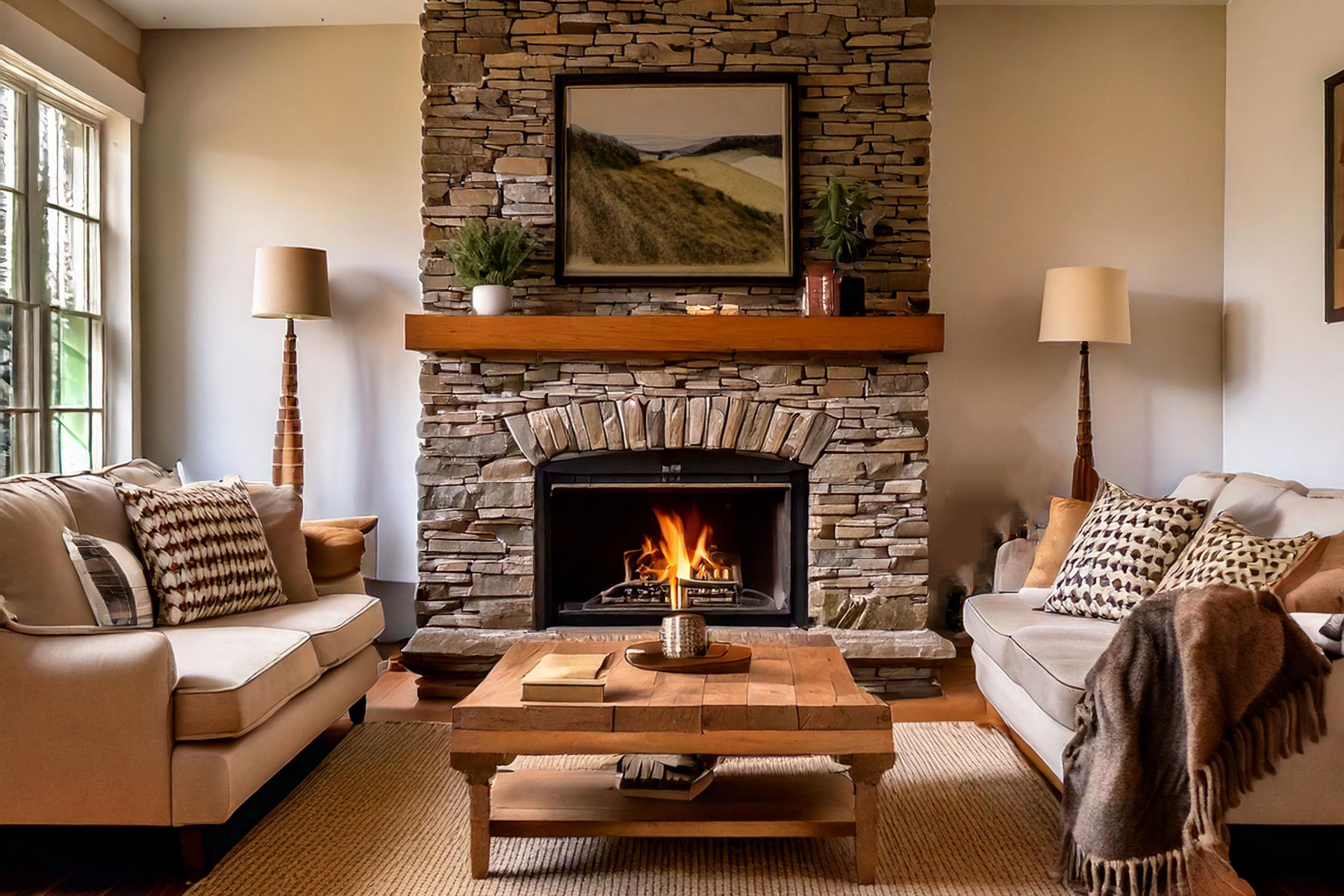
The single element holding this room together is the matched pair of floor lamps flanking the fireplace. They frame the stone, which is what makes a symmetrical arrangement look intentional instead of merely even. Mismatched lamps would soften it — good for a casual room, wrong here. Buy them as a pair with shades at least 16 inches wide, and put both on the same dimmer so they always change together.
26. A Dark Blue Wall, an Arched Mirror, and a Wire Star
Dark blue as a Christmas backdrop is having a quiet breakout. It started in dining rooms and studies, then migrated to living rooms because blue makes candlelight look almost amber — the exact warmth people chase in December. Navy also plays nicer with silver and glass ornaments than green does. It isn’t a trend with an expiration date; blue-and-warm-light combos have cycled through parlors since the colonial era and they always come back.
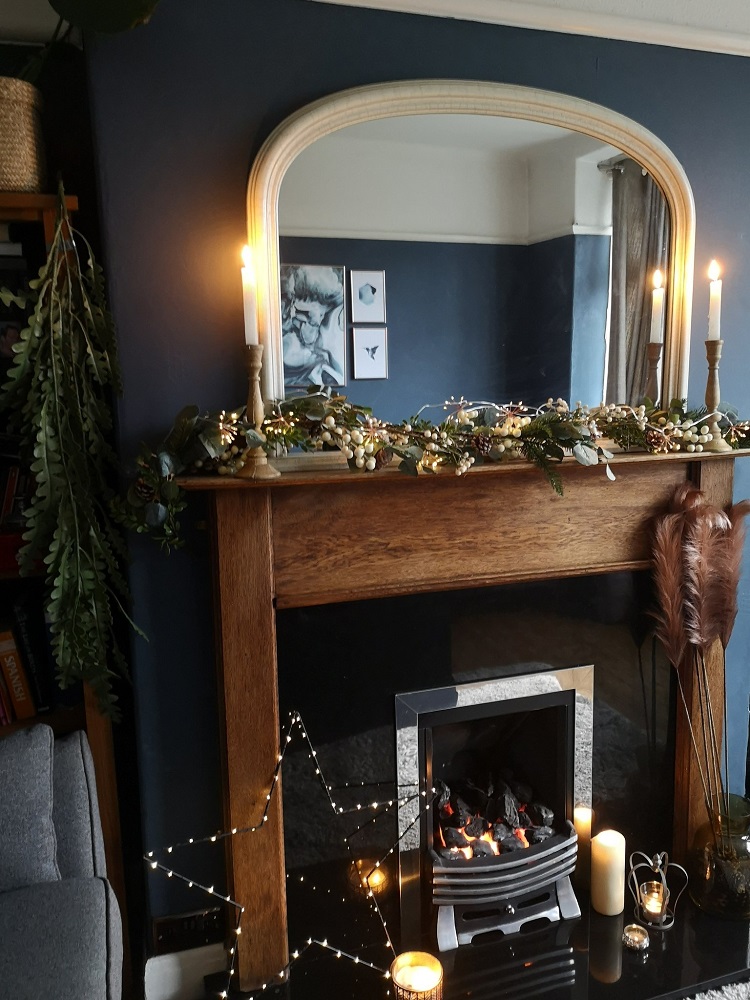
An arched mirror over a mantel does something specific: the curve breaks up the boxy rectangle of every fireplace and every wall around it. Size matters more than shape — aim for a mirror between 60% and 70% of the mantel’s width, hung so the bottom edge sits 4 to 6 inches above the shelf. Any lower and your garland will cover it. Any higher and the mirror floats, which is the single most common mantel mistake I see.
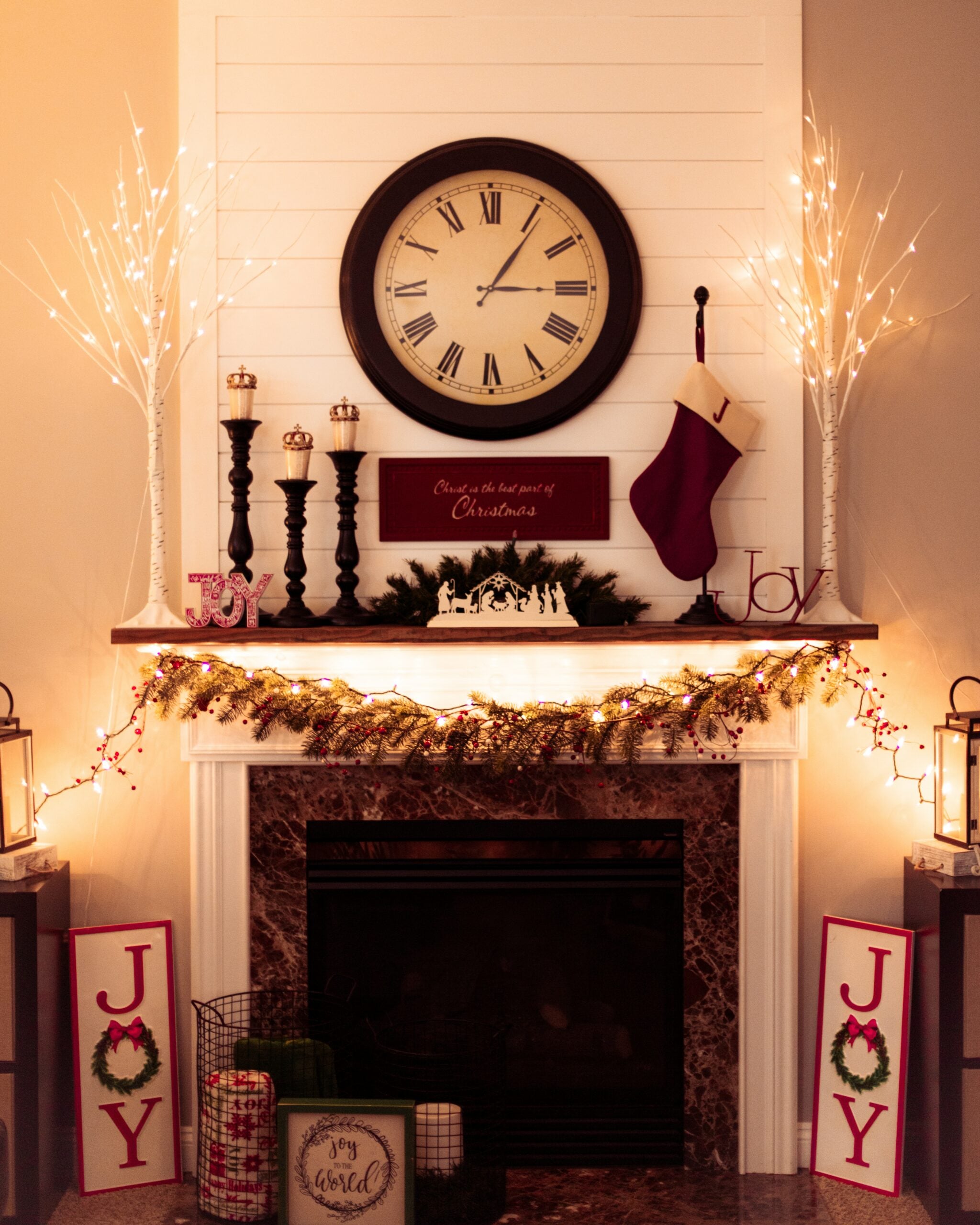
27. Exposed Beams and a Fresh Garland That Smells Like Winter
Keeping a fresh garland alive — 15 minutes of work and about $45–$90 for 8 feet.
- Buy it fresh from a tree lot or florist, not a big-box store, for longer needle retention.
- Soak the cut ends in warm water for two hours before hanging. Yes, really.
- Mist the whole garland every other day and keep it away from heat vents.
- Wire it to the mantel in four places so it doesn’t droop in the middle.
- Compost it in January and reuse the wire next year.
Fresh garland is the most honest decoration in the house and the shortest-lived. Expect two to three weeks of good looks indoors, four to five if you mist faithfully and the room stays under 70°F. Burn fires and you halve that. A good compromise: fresh greenery on the mantel where you can smell it, faux greenery on high shelves where nobody touches it. Nobody has ever noticed the difference from across the room.
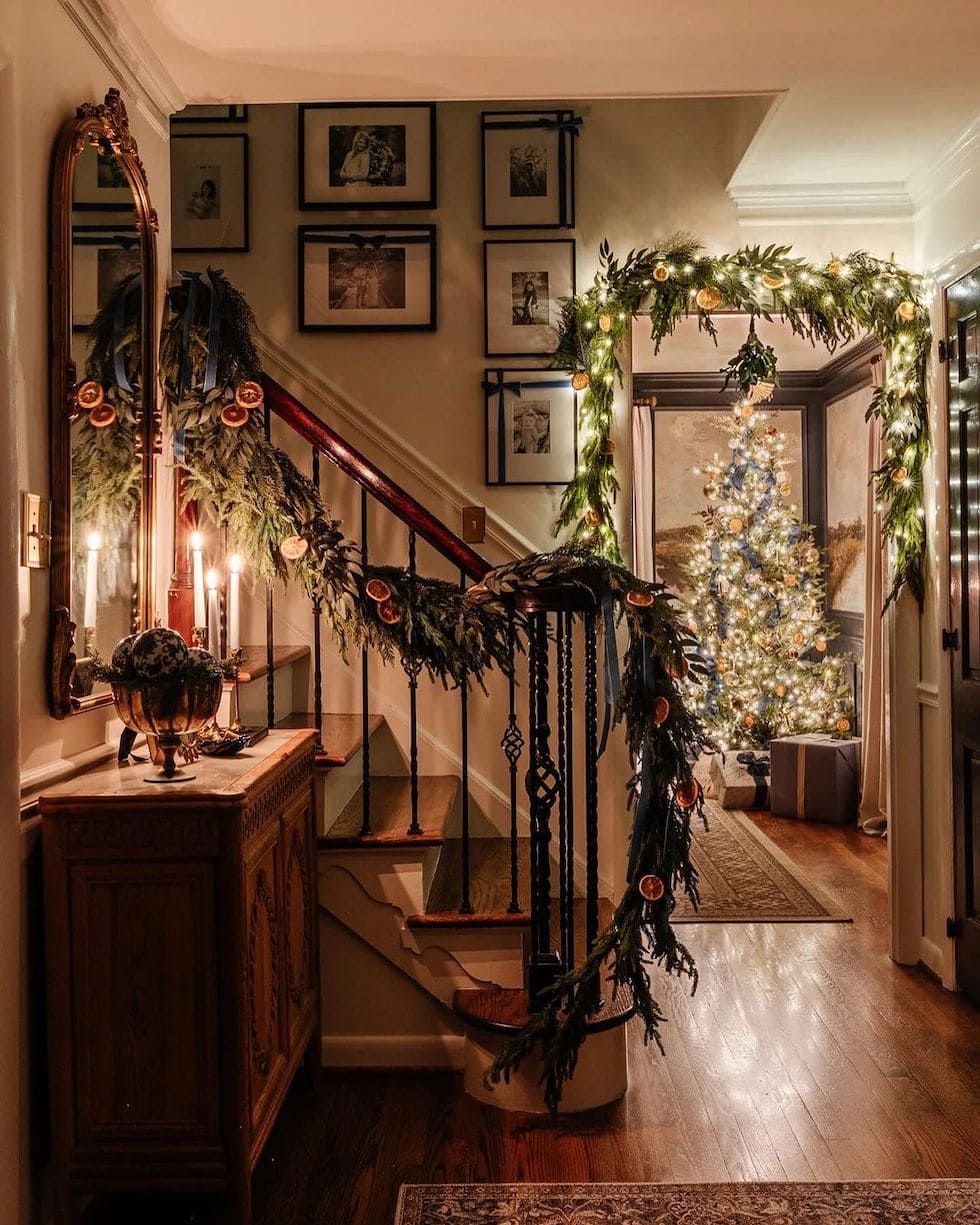
28. Dried Orange Slices Draped Down the Staircase Garland
Before you wrap a single strand around a banister:
- Measure the handrail run and multiply by 1.5 — garland spirals, it doesn’t lie flat.
- Check for an outlet near the base of the stairs. Battery packs die in a week.
- Make sure nothing hangs below the handrail where a hand actually grabs.
- Weigh your garland before choosing hooks — pine plus lights gets heavy.
- Decide how the stair garland connects visually to the tree in the next room.
Two moves make this entryway work. First, the garland repeats around the doorway in the background, so your eye travels from the stairs into the next room — a visual breadcrumb trail. Second, the orange slices are the only warm, non-green element in a very green composition, and dried citrus reads as handmade without looking like a craft fair. Dehydrating your own oranges costs about $4 and four hours in a 200°F oven. Make twice as many as you need; you’ll want them on the tree too.
29. Paper Stars Leaning Against the Hall Mirror
This one is apartment-friendly. Everything here works in 120 to 250 square feet with an 8-foot ceiling: the tree is tall but narrow, the sofa is slipcovered and low-profile, and the wooden slice table is under 20 inches wide. The leaning mirror is the space-saver — it does the work of art without needing a wall anchor. Under 100 square feet? Swap in a 4-foot tree on a small stand and keep the paper stars, which hang from a single hook.
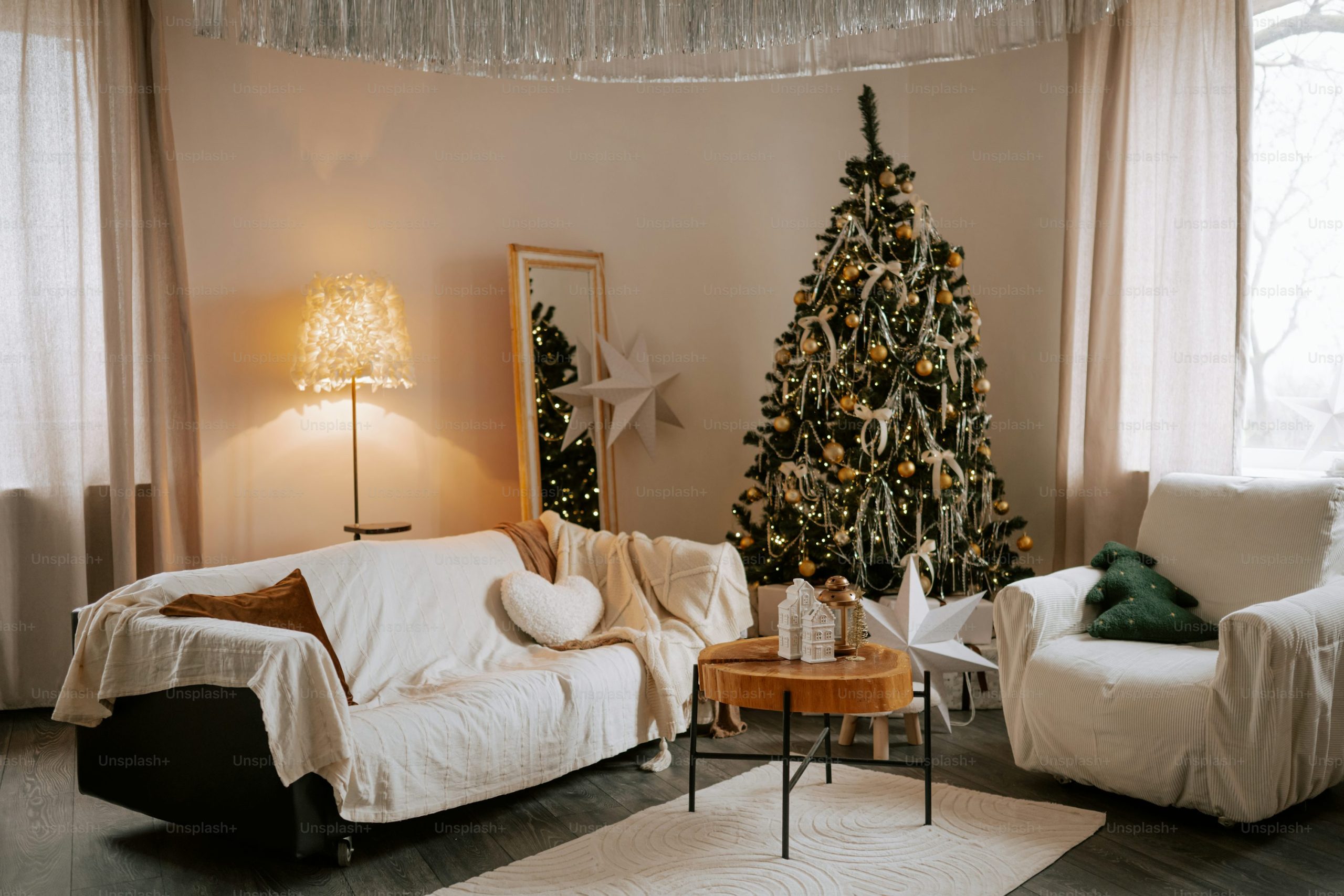
- Tall tree with gold ornaments and tinsel: $150–$450
- White slipcovered sofa, or a cover for yours: $120–$900
- Armchair with green pillow: $200–$700
- Wooden slice coffee table: $60–$200
- Floor lamp, leaning mirror, paper stars: $120–$350
Total: $650 to $2,600 — or about $180 if you’re just adding stars, tinsel, and one green pillow to what you already own.
30. Red Ribbons on the Tree, Leather Sectional Under It
Red ribbon on a tree needs scale to work. Cut strips 2 to 3 inches wide and 18 to 24 inches long, then loop them around branches rather than tying bows — loops are faster, use less ribbon, and read as vertical movement. Space them roughly 8 to 10 inches apart and keep them on the outer third of the tree, where the lights hit. Wide ribbon on a small tree looks like leftover gift wrap; narrow ribbon on a big tree disappears entirely.
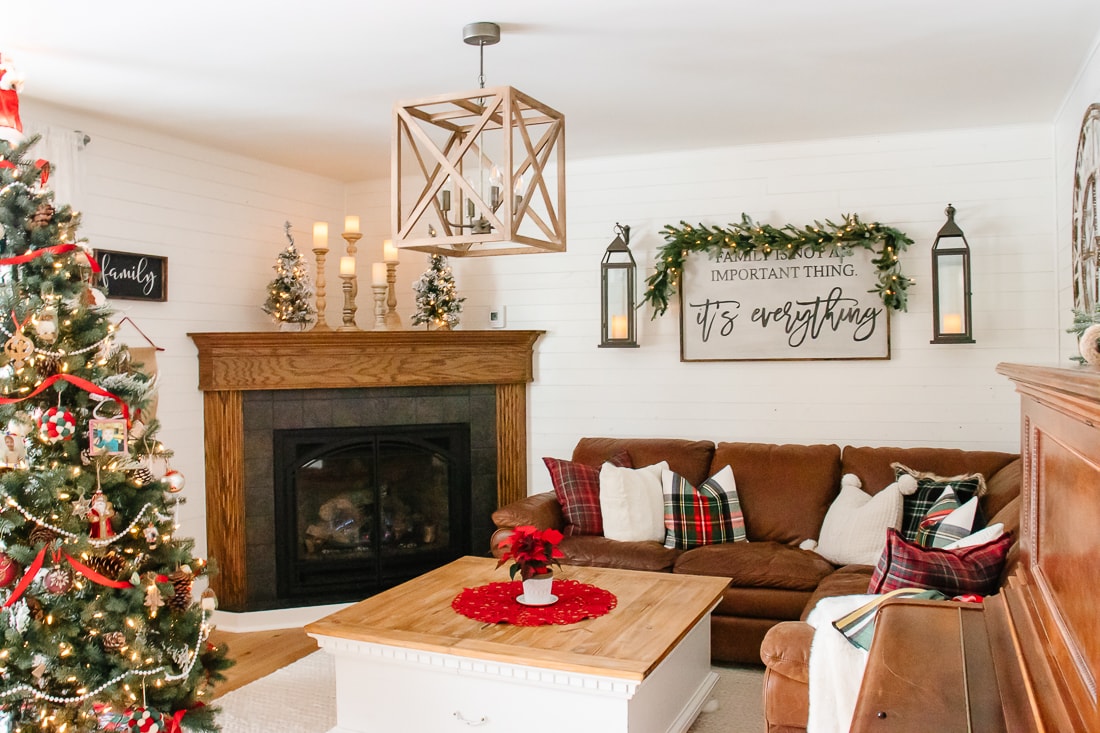
The leather sectional is the expensive part, and honestly a fabric sofa with a $90 leather-look throw over one arm gets you 80% of the vibe. Red satin ribbon at $4 a spool beats pre-made bows. Shiplap in panel form runs about $20 a sheet and a weekend of work. That farmhouse sign? A $6 blank board and a paint pen. Total spend to copy this room’s look: roughly $250 if you already own the sofa. Skim the common mistakes section before you hang anything.
One Warm Corner Is All It Takes
You don’t need thirty ideas, a massive budget, or a perfect tree — you need one warm corner that makes you want to sit down with a mug and stop scrolling for a minute. Start with the light, add the texture, and let the rest of the room follow.
📌 Save this to Pinterest for later — you’ll want to revisit these ideas when the boxes come down from the attic.