30+ Dreamy Boho Christmas Tree Ideas for 2026 That Will Transform Your Holiday Home

Most boho Christmas tree roundups recycle the same three flocked trees with the same white ornaments and never tell you where any of it came from. We did the opposite: we combed Etsy, Target, Walmart, World Market, and Anthropologie’s holiday floor to pull together 30 ideas that actually deliver, from a $4 skein of cotton cord to a $450 statement tree.
Inside you’ll find neutral macramé, earthy rustic garlands, warm vintage palettes, and handmade wall-hanging ornaments — plus budget and luxury versions compared side by side, so you can see what each look really costs before you commit. In 2026 the mood is what designers are calling slow Christmas: fewer, better ornaments you make, thrift, or collect, and trees that look personal instead of purchased.
And stay until the end — we break down the most common mistakes that can ruin these looks. 📌 Save this to Pinterest for later — you’ll want to revisit these ideas.
1. Flocked Tree Dressed in Yarn Tassels and Wooden Beads
Take away the yarn tassels and this is just a nicely flocked tree. Those fringed, hand-tied drops in rust orange and blush are what shift the whole thing from holiday-aisle to someone-made-this-on-the-couch-in-November. They cost almost nothing — a skein of cotton, a pair of scissors — and they carry the exact warm note that ties into the white lace dreamcatcher hanging on the mirror frame a few feet away. Without them, the wooden bead garland and gold ornaments read traditional, not bohemian. If you’re only going to make one thing this year, make these.
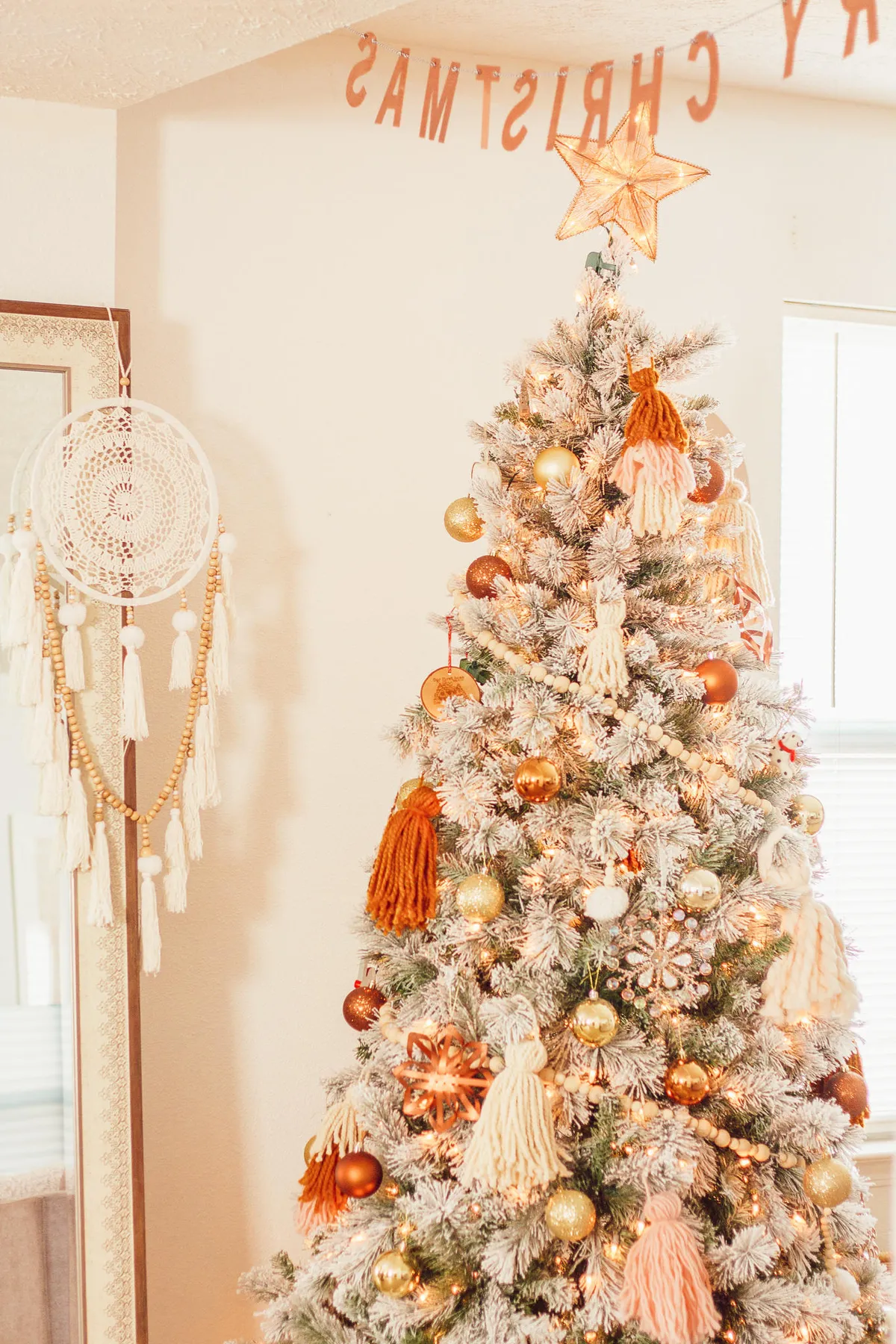
Hang handmade ornaments in odd-numbered clusters of three rather than spacing them evenly, then leave 8 to 10 inches of bare branch between clusters. Even distribution is what makes a tree look store-bought; deliberate gaps are what make it look collected. Keep the tassels in the band between your eye level and about 12 inches below it — that’s the zone guests actually look at. Anything lower gets buried behind gifts, anything higher competes with the lighted star.
2. Slim Green Tree with Velvet Baubles and a Moss Skirt
The formula here is roughly 70% evergreen + 20% muted velvet + 10% natural material. The tree does the heavy lifting in green; the velvet spheres in terracotta and soft sage add weight without any shine; the moss skirt, pinecones, and those tiny decorative mushrooms carry the last 10%. Swap the velvet for mustard and rust and the whole thing turns warmer and more autumnal. Swap the moss for a woven basket and it reads slightly more modern. The percentages stay the same — only the palette moves.
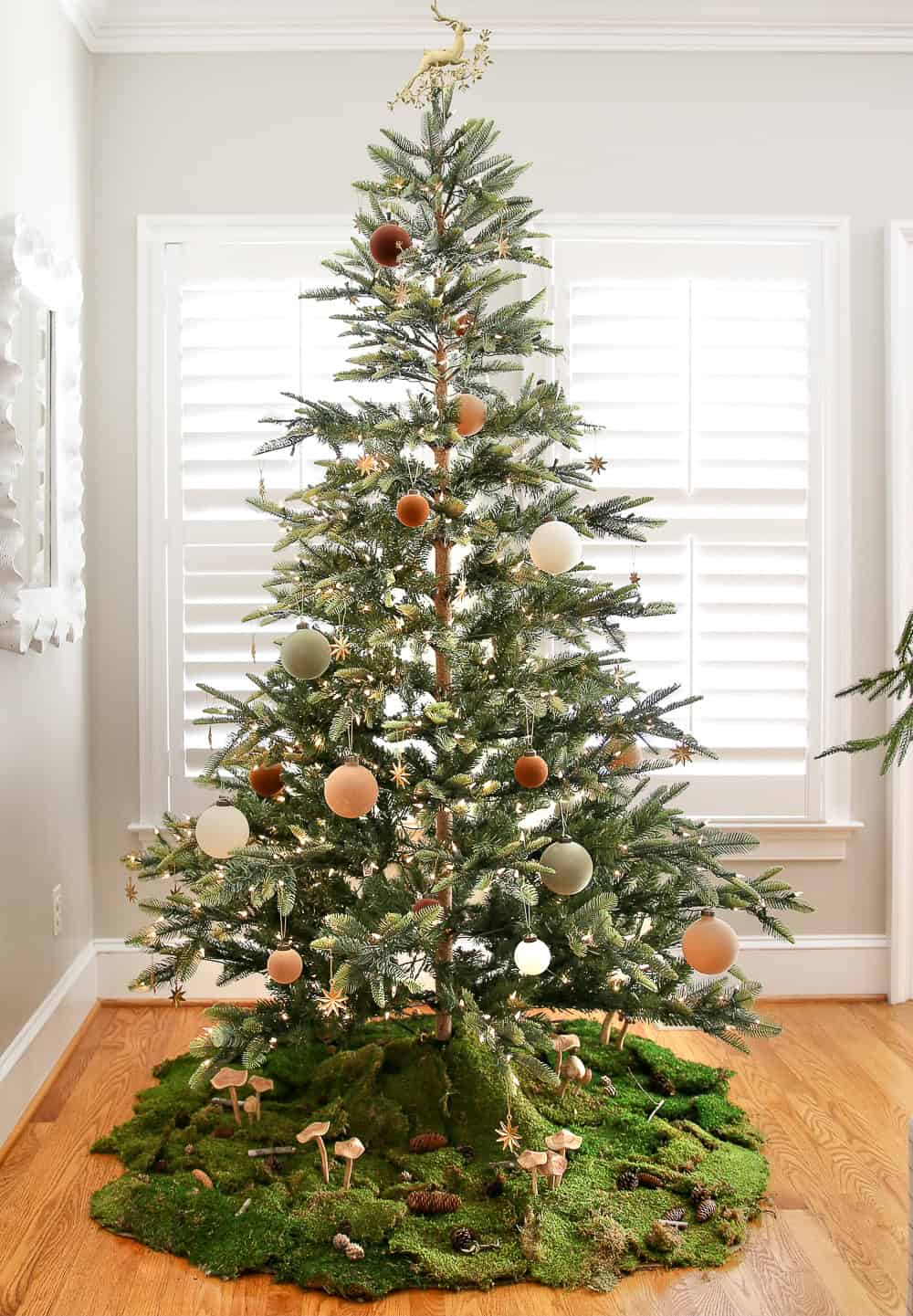
This look eats floor space, so measure before you buy. Plan on a skirt diameter around 30 inches for a 6-foot tree, plus at least 24 inches of clearance from the plantation shutters or any window you actually want to open. It lives happily in a 10×12 room with 8-foot ceilings. Anything tighter and the moss starts to feel like a trip hazard; a slim 5-foot profile against the wall will serve you better than a full 7-footer you have to walk around.
3. Golden Tinsel Tree Styled Beside a Rattan Mirror Vanity
Three things are doing the work in this corner. First, the oval rattan mirror doubles the glow of that golden tinsel tree, so a dim bedroom corner reads bright without a single extra lamp. Second, gold-on-gold layering actually works here because the textures differ — crinkled tinsel, carved floral wall appliques, smooth brass sconces — so the eye still has something to sort. Third, the white mid-century vanity turns the corner into a getting-ready spot, which is why it feels like a room instead of a display. Tinsel is unforgiving under flat light; the mirror fixes that for free.
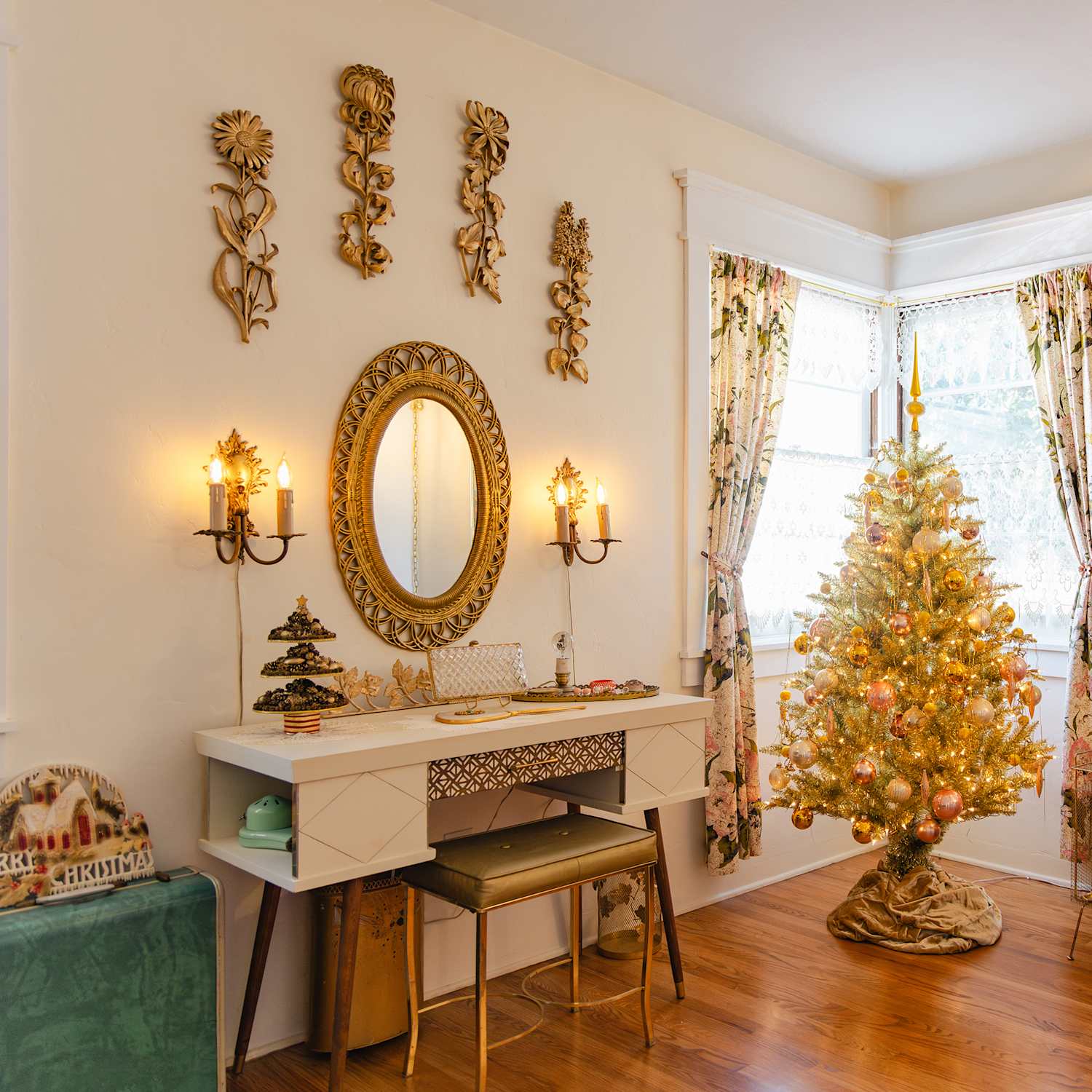
- Golden tinsel tree, 6–7 ft: $60–$180
- Oval rattan mirror: $40–$120
- Plug-in gold sconces (pair): $50–$150
- Carved floral wall appliques: $20–$60
- White mid-century vanity: $150–$600
- Floral curtains and hardware: $60–$140
Total: $380–$1,250
Budget alternative: a thrifted vanity repainted in matte white ($40–$80), peel-and-stick floral decals instead of carved appliques, and a battery-powered puck sconce — roughly 55% less.
4. Classic Red and Gold Tree Anchored by a Fireplace Mantel
Red and gold is the fastest way to make a tree look busy. Once you stack red baubles, metallic spheres, ribbon garland, and beaded icicles on the same branches, the eye has nowhere to land and the tree starts resembling a store display. Pick three ornament types and stop. Metallic ornaments also scratch, so wrap them in tissue when you pack up. For a warmer, less traditional take on that same red note, see Idea #10, which swaps ribbon for soft orange.
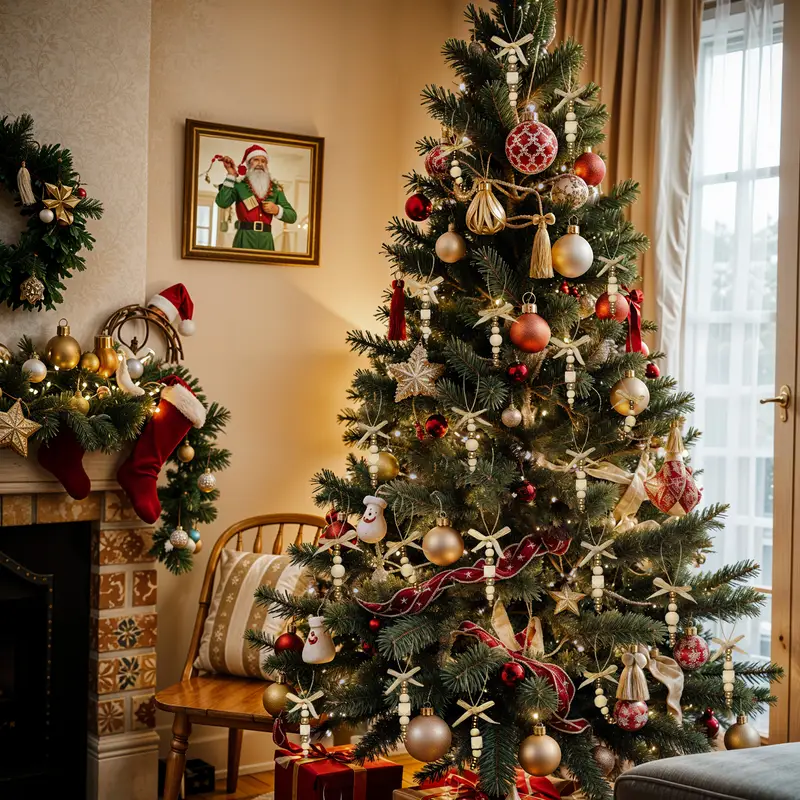
The beaded icicle ornaments are the quiet hero here. Round baubles on a round tree create a wall of circles — pleasant, but flat. Those long beaded drops cut vertical lines through all that roundness, which is what gives a traditional tree its sparkle and sense of movement. Swap them for another box of red balls and you lose it instantly. They’re also the cheapest thing on this tree: a few dollars of beads and wire, and they read like something you inherited from a grandmother.
5. Neutral Tree with Knit Gnomes and a Wooden Village
Keep plush characters and figurines in the 12-to-18-inch range and sit them on the floor or inside the base — never on the branches. Anything larger starts looking like a toy store display; anything smaller disappears behind the gifts. Group them in threes with the tallest in the middle. And place the gnomes slightly off-center. Dead-center at the base of the tree reads like a photo prop; a little to the left reads like a home someone actually lives in. The wooden miniature houses work best clustered at varying depths so they overlap.
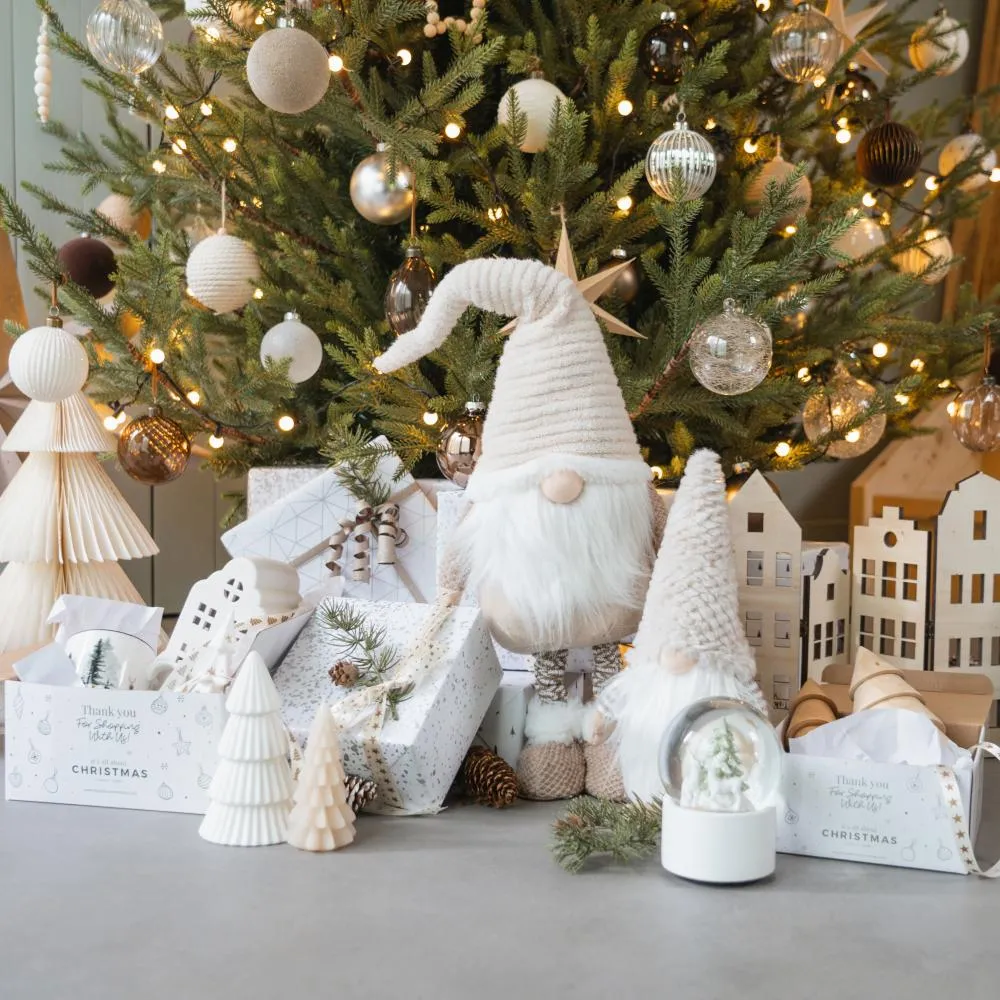
Target and Walmart carry knit gnomes for $12 to $25 almost every November, and the little wooden houses turn up on Facebook Marketplace for $3 to $8 each once people clear out last year’s decor. Paper honeycomb trees are the cheapest hack in this whole article — a pack of six runs about $10 and looks handmade from across the room. You’re after the same neutral, cozy mix for a fraction of boutique prices, and honestly nobody can tell felt from wool once the warm lights are on.
6. Sunlit Corner Tree with Honeycomb Paper Ornaments
- Cut kraft paper to a square roughly 1.5 times the width of your box.
- Fold the long edges in about an inch, tape, then crease the ends into triangles.
- Skip ribbon entirely — wrap two strands of jute twine around the box twice, crossing underneath.
- Tuck one dried orange slice or a sprig of rosemary under the twine before you knot it.
- Stack finished gifts in a woven basket beside the tree instead of under it.
About 20 minutes for six gifts and roughly $12 in materials.
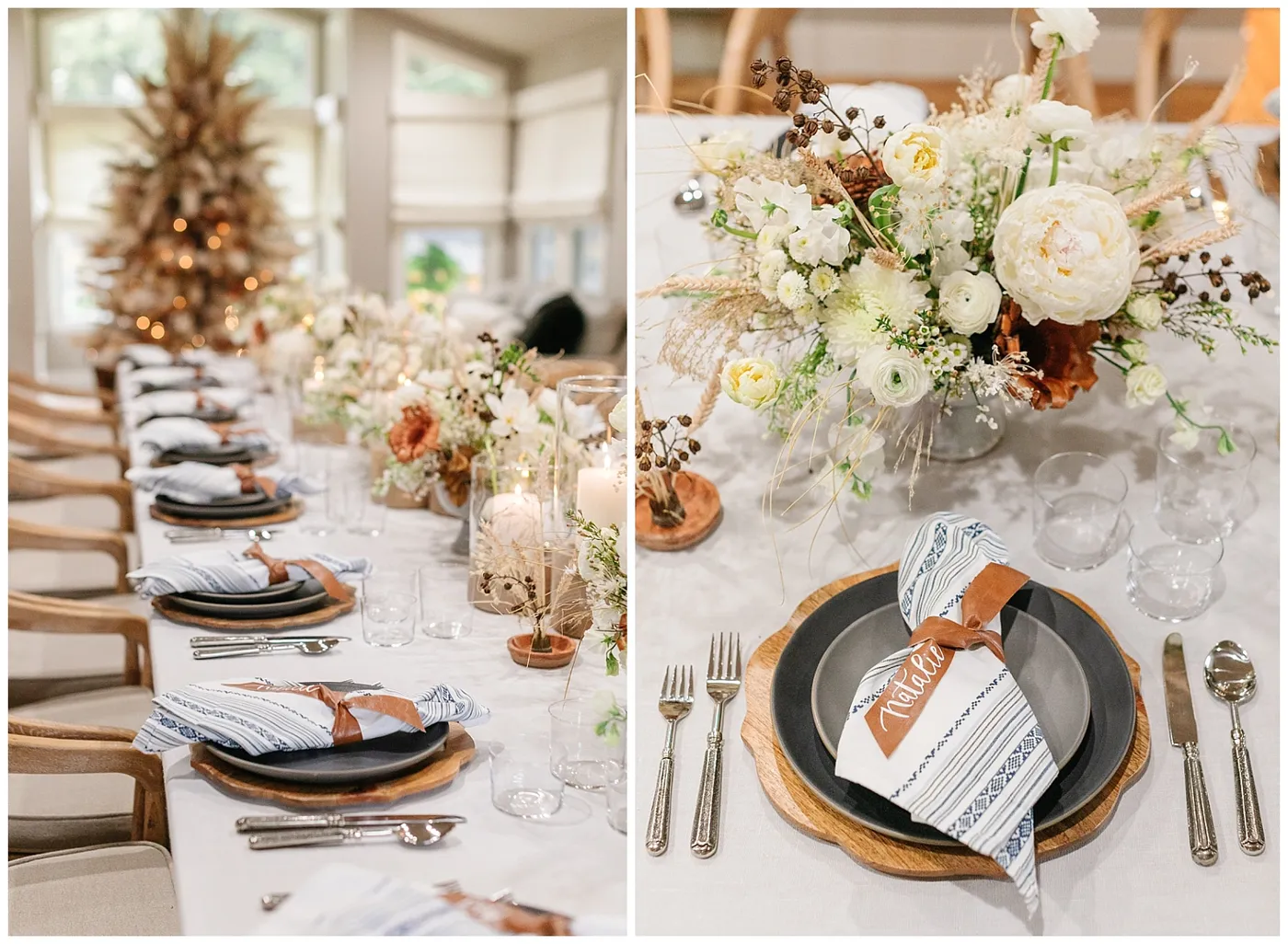
Restraint is doing something specific in this corner. Because the palette only holds green, cream, and natural wood, the paper honeycomb ornaments get to function as the single textural surprise — you actually notice them. Same with the woven basket and the kraft paper: nothing is competing for attention, everything is holding a tone. Add one red ornament or a gold ribbon and the calm breaks immediately. The plain wooden stool earns its place for the same reason — it’s furniture that doesn’t shout.
7. Full Tree Uniformly Dressed in Gold and Silver Balls
- Unlit 7.5 ft full tree: $150–$400
- Shatterproof gold and silver ball sets, mixed sizes, about 150 pieces: $70–$200
- Beaded ornaments with small bows: $25–$60
- Gold snowflake accents: $15–$40
- Warm white string lights, 800–1,000 bulbs: $30–$70
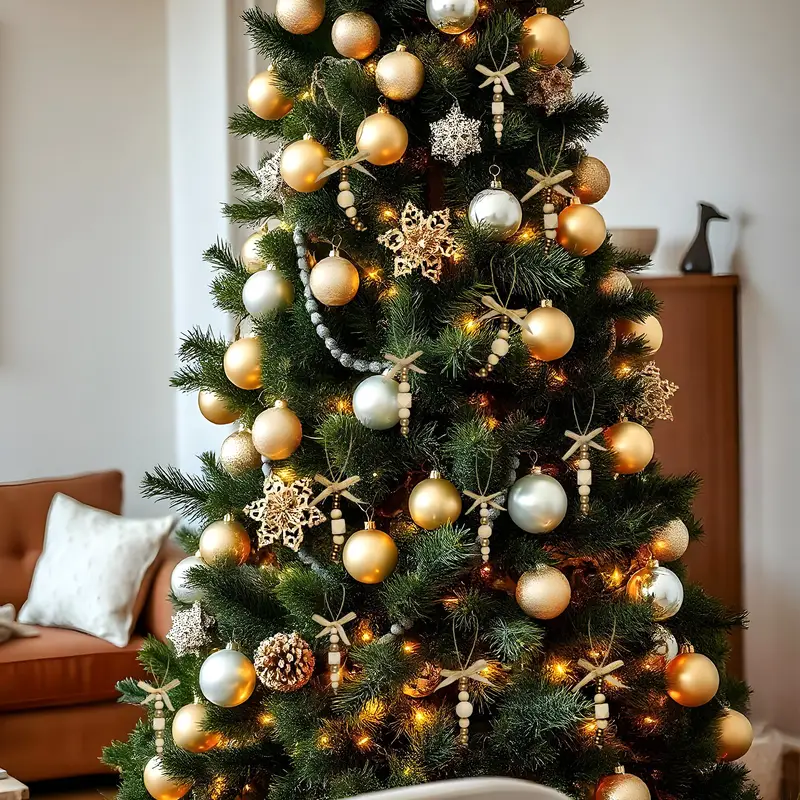
Total: $290–$770
Budget alternative: two 100-piece ball sets from Walmart at $25 each, dollar-store beaded garland cut into individual drops, and paper snowflakes sprayed gold — under $150 for the whole tree.
Buy ornaments in three sizes — roughly 2, 3, and 4 inches — and count on 8 to 10 pieces per foot of tree height. A 7.5-foot tree wants about 65 large and medium ornaments before you add filler. The mistake almost everyone makes is buying one big box of same-size balls, because uniformity of scale is exactly what makes a tree read as a starter kit. Three sizes create depth even when the color never changes, which is the whole reason this gold-and-silver tree looks expensive without a single unusual ornament on it.
8. Cinnamon Stick Macramé Ornaments with Glass Balls
- Cut two 24-inch strands of 3mm cream cotton cord.
- Fold them in half and lark’s head knot both onto a 4-inch cinnamon stick.
- Work three rows of square knots with the four hanging cords, tightening each row evenly.
- Trim the ends to about 2 inches and fray them with a fine-tooth comb.
- Add a hanging loop at the top with a half hitch and slide it onto a branch.
About 25 minutes per ornament and $6 in materials for a batch of four.

Slow Christmas picked up real momentum heading into 2026 — searches for handmade ornaments and macramé decor keep climbing, and craft stores are selling out of cotton cord again. Part of the appeal is anti-consumerist; part is practical, because handmade ornaments don’t shatter and look better as they age. The cinnamon stick hangers lean into the sensory side, which is why they show up in so many holiday photos this year. If you want a version that reads neutral instead of rustic, Idea #16 takes the same knot in plain white cord.
9. Sage Green Dining Room with a Candlelit Tree
Dining rooms are where tree scale goes wrong most often. A 6-foot tree wants about 3 feet of clearance from the table edge so nobody is ducking branches to sit down, which means you need roughly a 10×12 footprint to pull this off comfortably. With 9-foot ceilings, a 6-to-7-foot tree plus topper fits with room to spare under the wooden beams. In a tighter nook, a tabletop version on the sideboard keeps the room functional and still gives you the candlelight and the place settings.
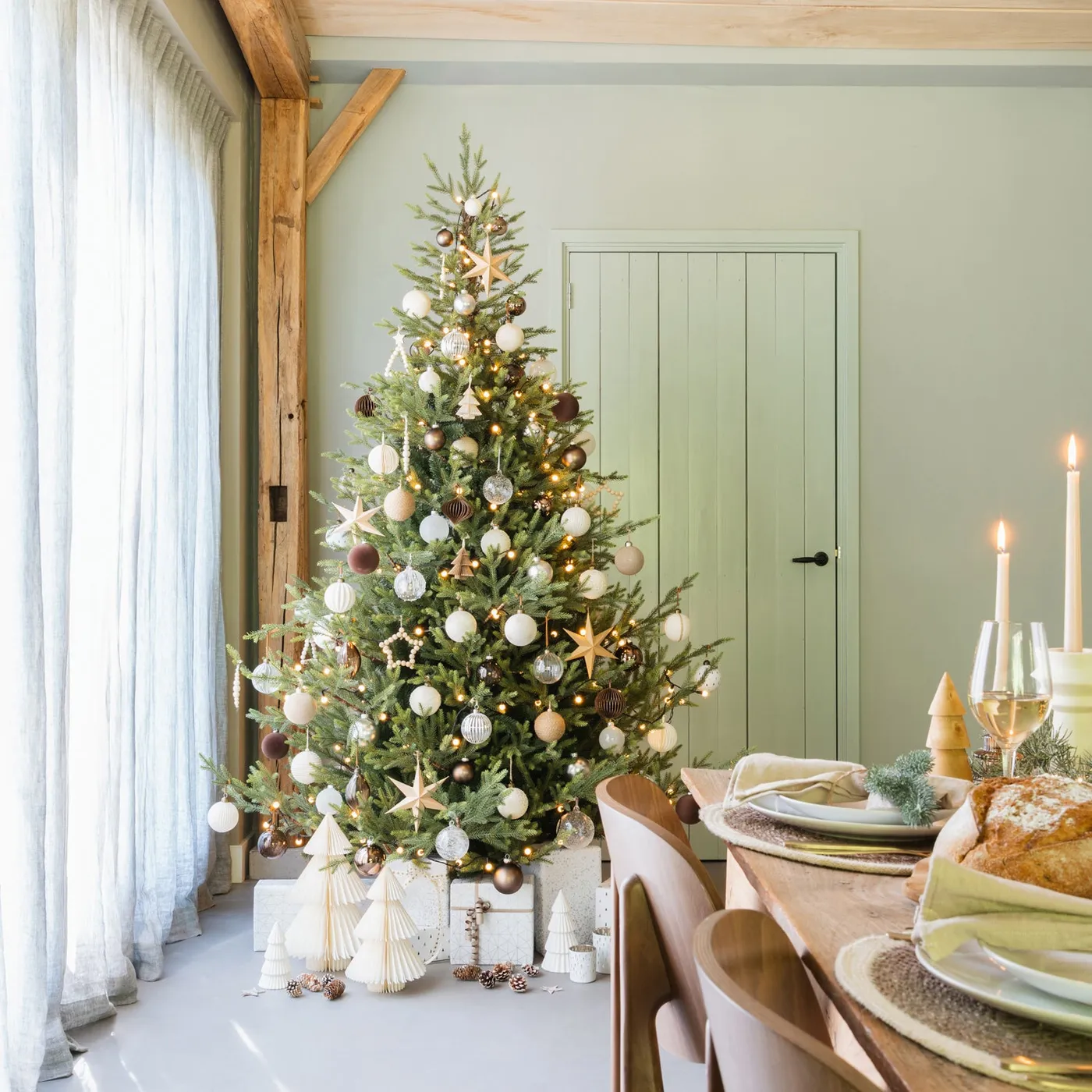
- 60% sage green — walls, tree branches, sheer linen curtains
- 25% natural wood — beams, dining table, chairs
- 10% white — dinnerware, ornaments, candles
- 5% brown — ornaments and dried elements
Trade sage for warm grey and the room goes cooler and more modern. Trade the wood for black metal and it turns sharper. The ratios don’t change.
10. Colorful Vintage Ornaments with Orange Ribbon Garland
Two dogs, a textured rug, and a heavily decorated tree is a lot of moving parts in one room. If your pets climb, anchor the tree to the wall with a small hook and fishing line, and push the breakable vintage glass into the top third where tails can’t reach. Skip tinsel and any food-based ornaments. That patterned rug will also show every pine needle, so keep a cordless vacuum nearby from December 1 to January 6. None of this is a dealbreaker — it just needs planning before the tree goes up, not after.

Vintage ornament boxes at estate sales and Goodwill run $3 to $8 for a full box of glass nobody wanted in 1998, which is precisely the look. Orange ribbon is the cheapest way to pull it together: two 25-yard rolls at Walmart for about $12, woven loosely through the branches rather than looped tight. You can build the entire garland and ornament story here for under $60 if you’re patient. For a pared-back version of that same warm note, Idea #26 uses dried citrus instead of ribbon.
11. Vertical Wooden Bead Ornaments with Red Bell Accents
The vertical drop is the entire point. Round ornaments hang and dangle; these wooden bead strands stand in a straight line down the branch, creating a rhythm you can’t get from spheres no matter how many you own. The geometric beads near the bottom add a small surprise when someone leans in close. Swap them for round beads and the tree is still pretty — it just looks like every other nature-inspired tree on Pinterest. Vertical is the signature, and it’s why a close-up of this branch is more interesting than a wide shot of the whole thing.
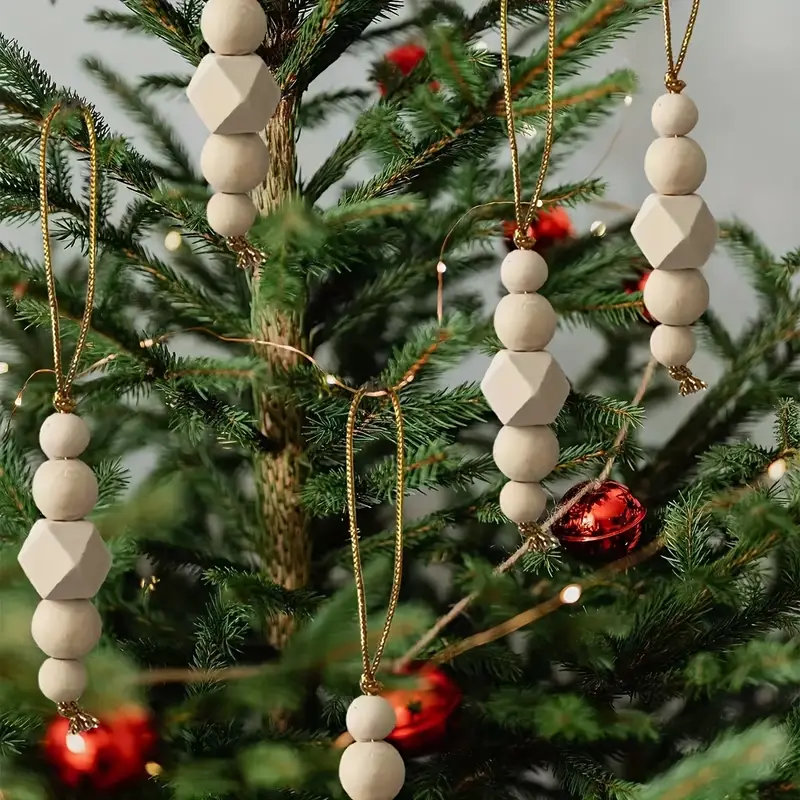
Hang these from the branch itself, not from a hook draped over the top — the weight of wood will bend a thin branch tip, so go one tier back where the wood is thicker. Space them 8 to 10 inches apart and vary lengths in a 3-4-5 sequence so the eye keeps moving. Keep the thin gold string hangers rather than swapping in jute; the gold disappears into the fairy lights and lets the beads float. Jute would make the hangers a design element of their own, which isn’t what you want here.
12. Cream Macramé Tree Ornament with Plaid Ribbon
- Cut eight 20-inch strands of 3mm cream cotton cord and mount them on a small wooden ring with lark’s head knots.
- Work two rows of square knots, then decrease by dropping the outer cords on each row.
- Thread three wooden beads onto the center cords and tie a knot below each one.
- Trim the remaining cord to about 2 inches to form the fringe base.
- Thread a narrow plaid ribbon through the top ring and hang it among the evergreen branches.
Roughly 30 minutes and $5 of materials per ornament.
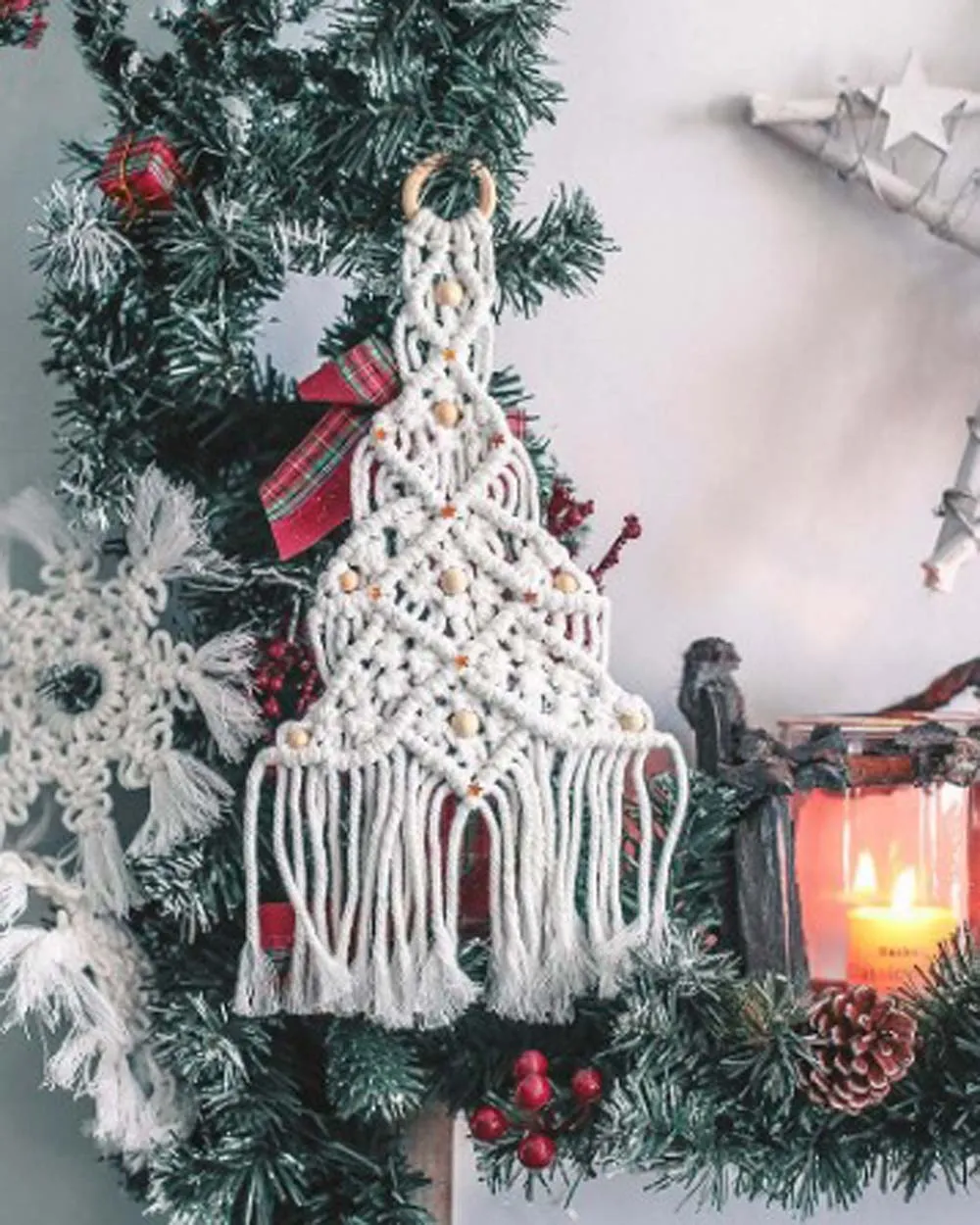
Cotton cord is low maintenance — it just needs dusting. A lint roller once a month handles it, and a quick pass over a steaming kettle reshapes any fringe that got squashed in storage. Two cautions: keep these at least 12 inches from real candle flames, because cotton and soot are a genuinely bad pair, and store them flat rather than hanging in a bin, since the knots will hold a crease. Nothing here fades like dyed fabric does, and unlike glass, dropping one costs you nothing.
13. A Box of Velvet and Pleated Ornaments in Brown and Cream
Velvet ornaments are among the most marked-up items in holiday decor. Target and Walmart sell velvet-finish balls for $1 to $3 each in November, and pleated versions are genuinely easy to make — a strip of fabric, a foam ball, and hot glue, about 10 minutes each. Check Facebook Marketplace in January when people offload whole boxes. Boutiques charge $8 to $14 per ornament for the identical look, which adds up fast when a full tree needs 40 of them. Store them in a padded box with shredded paper so the velvet doesn’t crush.
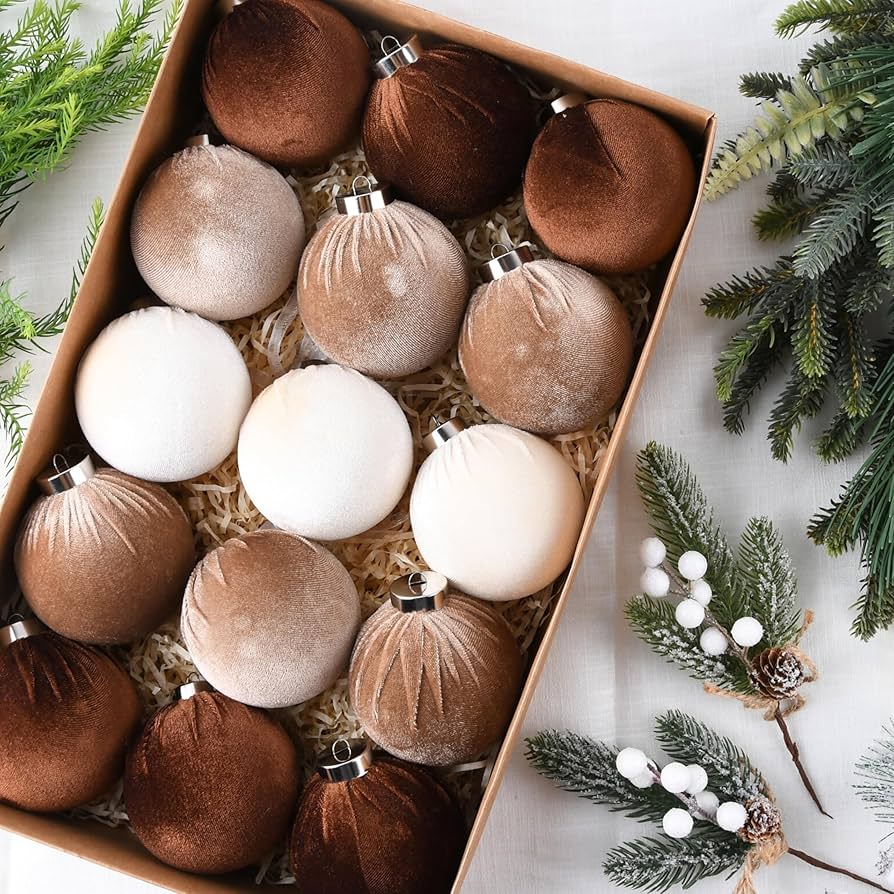
The mix here is roughly 50% brown velvet + 30% tan pleated + 20% cream, with green and silver reserved strictly for the pine sprigs and frosted berries around the box. What makes it work is that all three fabrics are matte. Swap one for shiny satin and the group starts competing with itself and reading cheaper than it is. Prefer cooler tones? Trade brown for charcoal and tan for oatmeal — the ratios hold perfectly.
14. Macramé Ornaments Displayed on a White Plank Wall
Ornament walls are having a moment. Instead of stuffing handmade pieces into a box, people are treating macramé and yarn ornaments like small works of wall art — and it makes sense in 2026, when renters can’t always commit to a full-size tree and small-space dwellers still want festive. A white plank backdrop, a few small hooks, and a vignette that can stay up past December. It’s also the only way to actually see the pieces you spent hours making, which is most of the point.
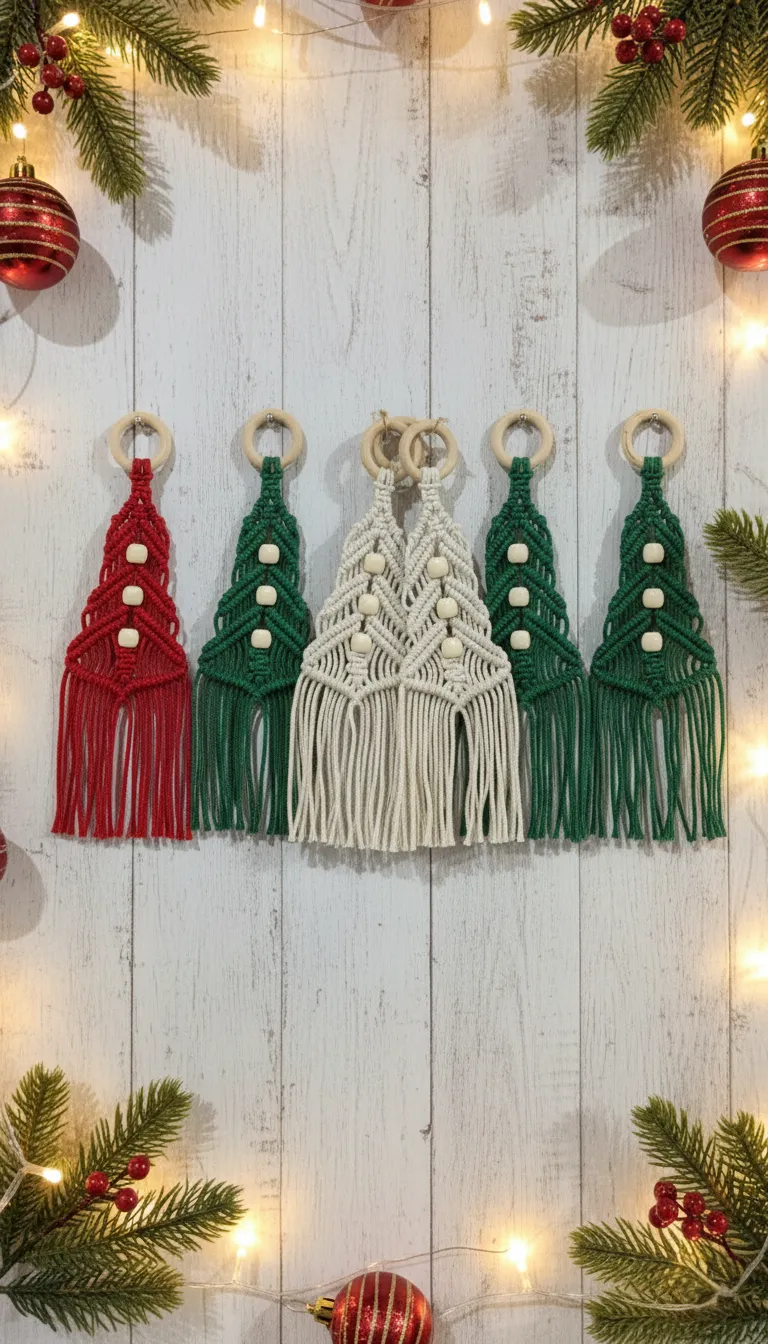
Repetition plus variation. Every ornament here shares the same wooden ring hanger and the same fringed tassel base, so your eye registers them as a set within a second — that’s the repetition. Each one is knotted slightly differently, and that’s the variation keeping it from looking like a retail display. Framing the arrangement with pine branches, a couple of red ornaments, and warm string lights gives the group a border and stops it from floating in the middle of the wall. Take the greenery away and it reads like a craft fair booth.
15. Deep Green Macramé Tree Hanging with Gold Bells
Wall hangings live or die on height. Center yours 57 to 60 inches from the floor — same as you’d hang art — or set it a few inches above a console so the whole arrangement reads as one vignette. Thread the cord over a picture hanger driven into a stud, or use a 20-pound drywall anchor if there isn’t one where you need it. Above a sofa, leave 6 to 10 inches between the top of the hanging and the ceiling line. Any higher and it starts looking like it’s climbing the wall instead of belonging there.
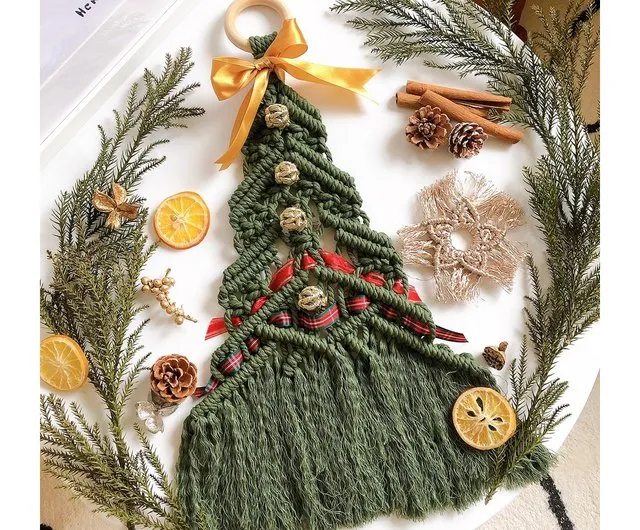
- Green macramé tree hanging: $35–$90, or $18–$25 in cord and a ring to DIY
- Dried orange slices: $8–$15 per bag
- Cinnamon sticks: $5–$10
- Gold jingle bells: $6–$12
- Fresh evergreen boughs: $12–$30
Total: $66–$157
Budget alternative: dry your own citrus (three hours at 200°F), forage the greenery, and make the hanging yourself — about $30.
16. White Macramé Ornament with a Wooden Star Topper
White cotton has one enemy and it’s dust, which is very visible on it. A monthly pass with a lint roller takes ten seconds and keeps the cord looking new. If your tree sits near a kitchen or a wood-burning fireplace, double that frequency. Store these flat in a shoebox with tissue between layers — hanging them in a bin lets the knots take on a permanent crease that no amount of steaming fully fixes. And keep them out of direct sun. Natural cotton yellows over a couple of seasons, and once it goes, no gentle wash brings it back.
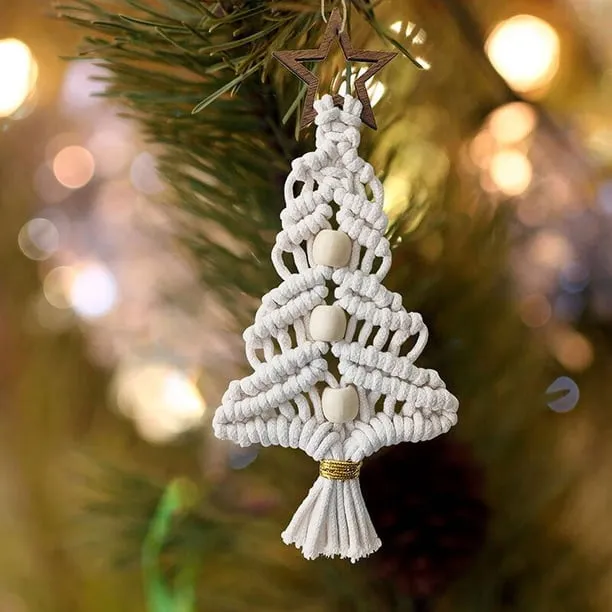
That little wooden star. It’s maybe an inch and a half wide and costs about forty cents, and it’s the entire difference between ornament and Christmas tree. Remove it and the piece reads as a vague knotted triangle. The three wooden beads down the center help, but the star is what tells your brain what you’re looking at from across the room. It’s also the easiest upgrade to any plain macramé piece you already own — a dab of glue, thirty seconds, done.
17. Five Macramé Tree Ornaments in Mustard, Sage, and Dusty Pink
Five colors, chosen deliberately: two warm (mustard, deep red), two cool-leaning neutrals (sage, dark olive), and one soft accent (dusty pink). That balance is why a set like this hangs together as a collection instead of looking like leftover scraps. To build your own version, pick a warm, a cool, a neutral, a dark, and a pastel. Then keep the cord weight identical across all five. Same weight, different colors, and the group still reads as one family even though no two ornaments match.
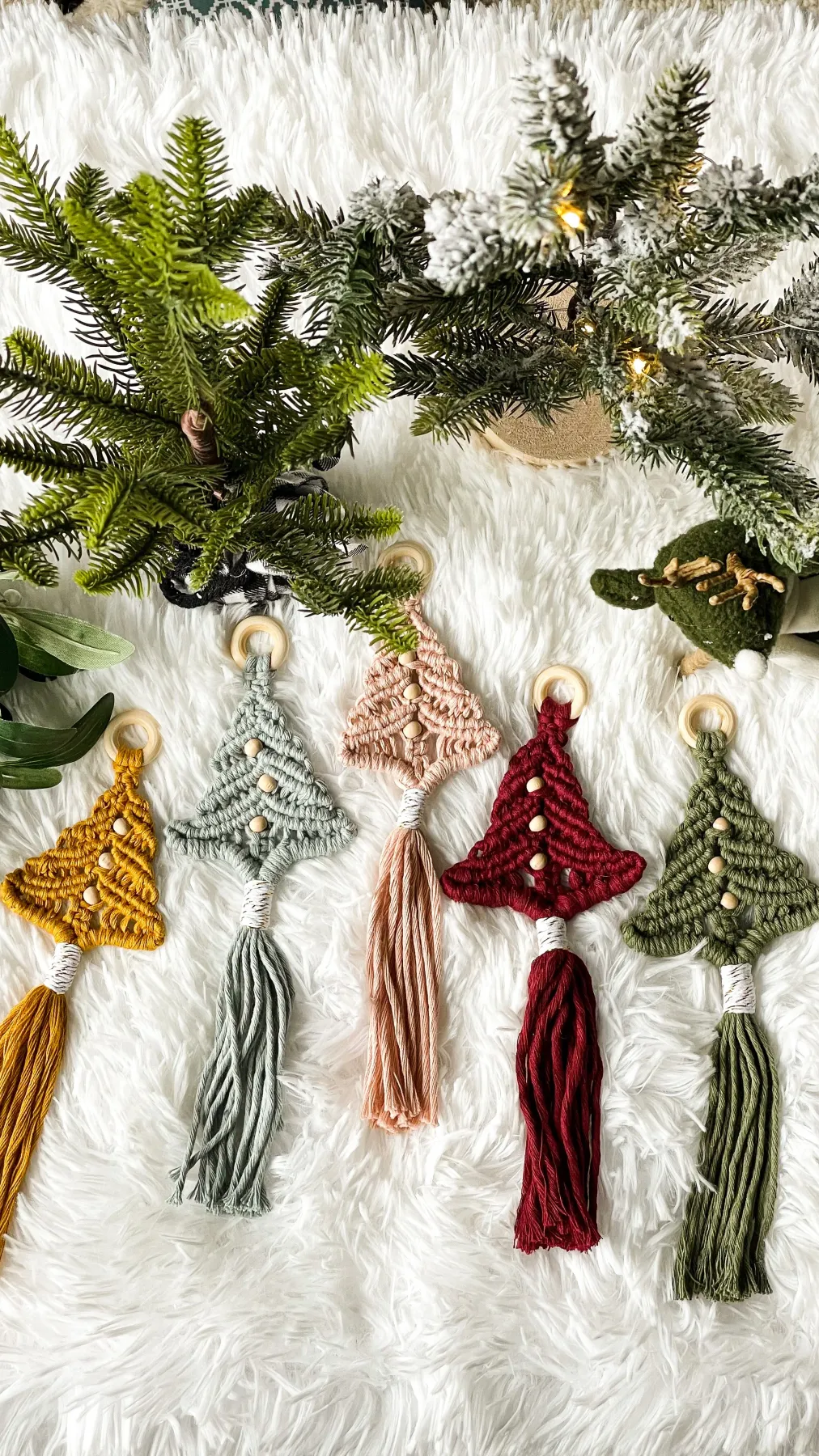
- Decide how many you actually need — about 10 per foot of tree height, fewer on a small tree.
- Buy all your cord in a single order so the dye lots match.
- Knot one complete ornament before you cut cord for twenty.
- Check your hangers — wooden rings read warmer than metal hooks.
- Confirm your tassel lengths line up before trimming anything.
18. A Single White Macramé Ornament Among Warm Lights
Contrast placement matters more than contrast itself. Park a white ornament against the densest, darkest cluster of needles you can find, then check it from the doorway — that’s the view that counts, not the one from six inches away. For lighting, budget about 100 warm white bulbs per foot of tree height, and push the strands in toward the trunk every few branches so the glow comes from inside the tree rather than sitting on the surface. Surface-only lights are the number one reason a beautifully decorated tree still looks flat in photos.
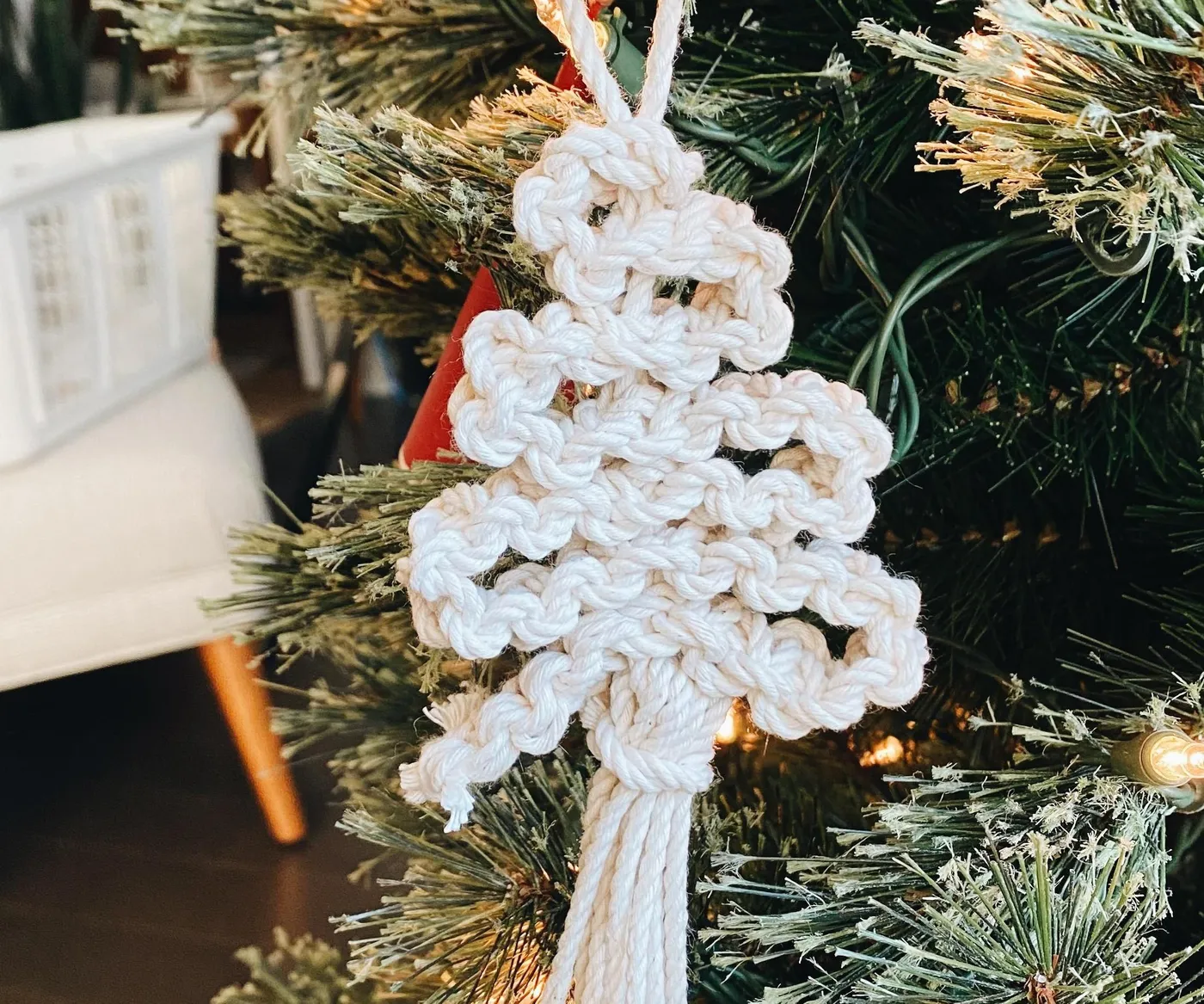
Three principles, one ornament. Contrast: white cotton against dark green needles reads from twenty feet, which is why single macramé pieces photograph so well. Texture: open knots, fringe, and wood beads catch warm light in a completely different way than glass or plastic ever will. Negative space: the gaps in the knotting let the branches show through, so the piece feels light instead of heavy. That last one is the whole reason macramé works on a Christmas tree at all.
19. Rope-Wrapped Cone Tree with Pearl and Rhinestone Trim
- Start with a styrofoam or cardboard cone — 10 to 12 inches tall is the sweet spot for a tabletop piece.
- Run a bead of hot glue around the base and press the rope end into it, holding for 15 seconds.
- Wrap upward in a single layer, gluing every half-turn so the rope doesn’t shift.
- Cut the rope at the top and tuck the raw end under the last loop.
- Glue on a diagonal band of small pearls and a strip of rhinestone trim, then top with the beaded star.
About 45 to 60 minutes and roughly $15 in supplies.
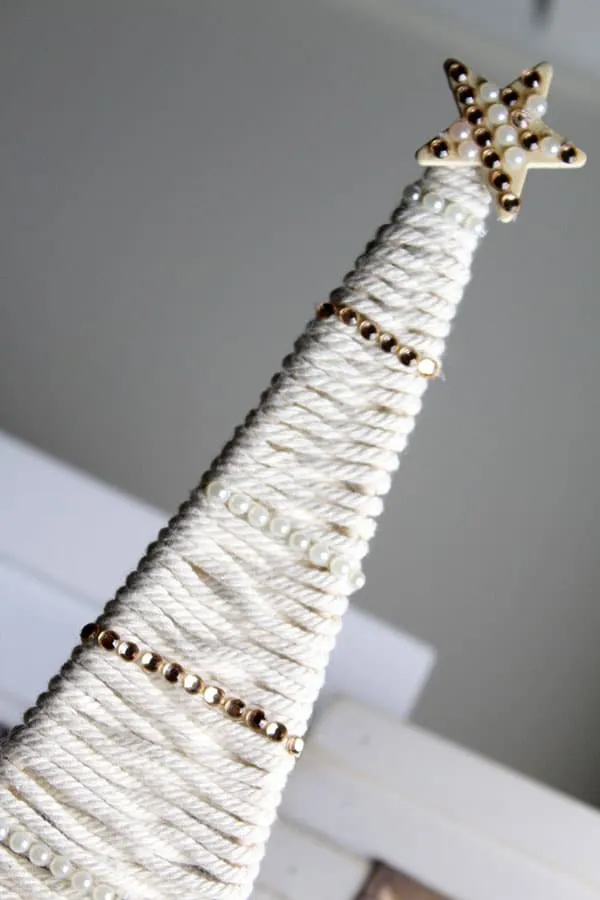
- Styrofoam or cardboard cone: $5–$12
- Off-white rope or thick twine: $8–$15
- Faux pearl strand: $5–$10
- Rhinestone trim: $6–$14
- Beaded star topper: $4–$10
- Hot glue sticks: $5
Total: $33–$66
Budget alternative: dollar-store twine, a plastic pearl garland cut into sections, and a cone rolled from poster board — about $12.
20. Cable Knit Stockings Leaning on a Woven Basket
If you’re building the warm brown story from Idea #13, stockings are the easiest way to extend it all the way to the floor. Cable knit stockings are everywhere in November — Walmart and Target sell them for $8 to $15 each, which is still $45 for a set of three. The better move: buy three thrifted cable-knit sweaters for about $4 each, cut the sleeves and bodies, and sew simple stockings. You get real wool texture for $12 total. Mixing shades of brown, beige, and cream reads intentional, so don’t hunt for a matching set.
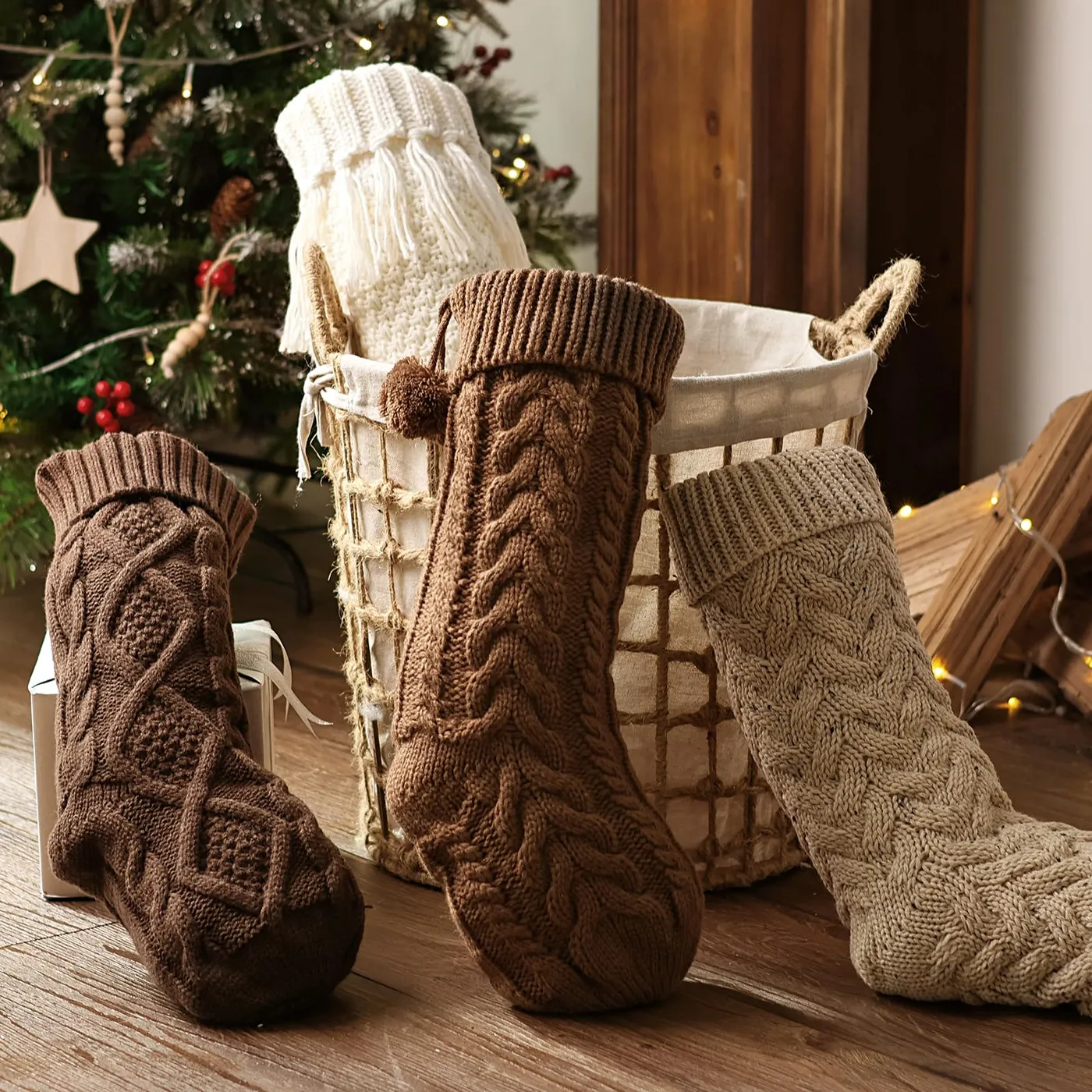
No fireplace? You’re not out of options — a wooden ladder, a row of wall hooks by the entry, or a woven basket on the floor all work, which is exactly what’s happening next to this tree. The honest caveat is that knits stretch. Anything heavy will pull the toe permanently out of shape, so keep gifts light or line the foot with a thin canvas insert. And if you have cats, understand that a knit stocking is a toy first and decor second. Hang them higher than feels necessary.
21. Yarn Candy Canes Striped in Red and White
- Bend a 12-inch piece of craft wire into a candy cane hook.
- Tightly wrap red yarn around the straight section, gluing the start and the end.
- Wrap white yarn over the red in even diagonal stripes, about an inch apart.
- Fray a few short white yarn ends into a small tassel at the base.
- Braid a hanging loop at the top and slide it onto a branch.
About 20 minutes each, and $4 in materials covers a batch of four.
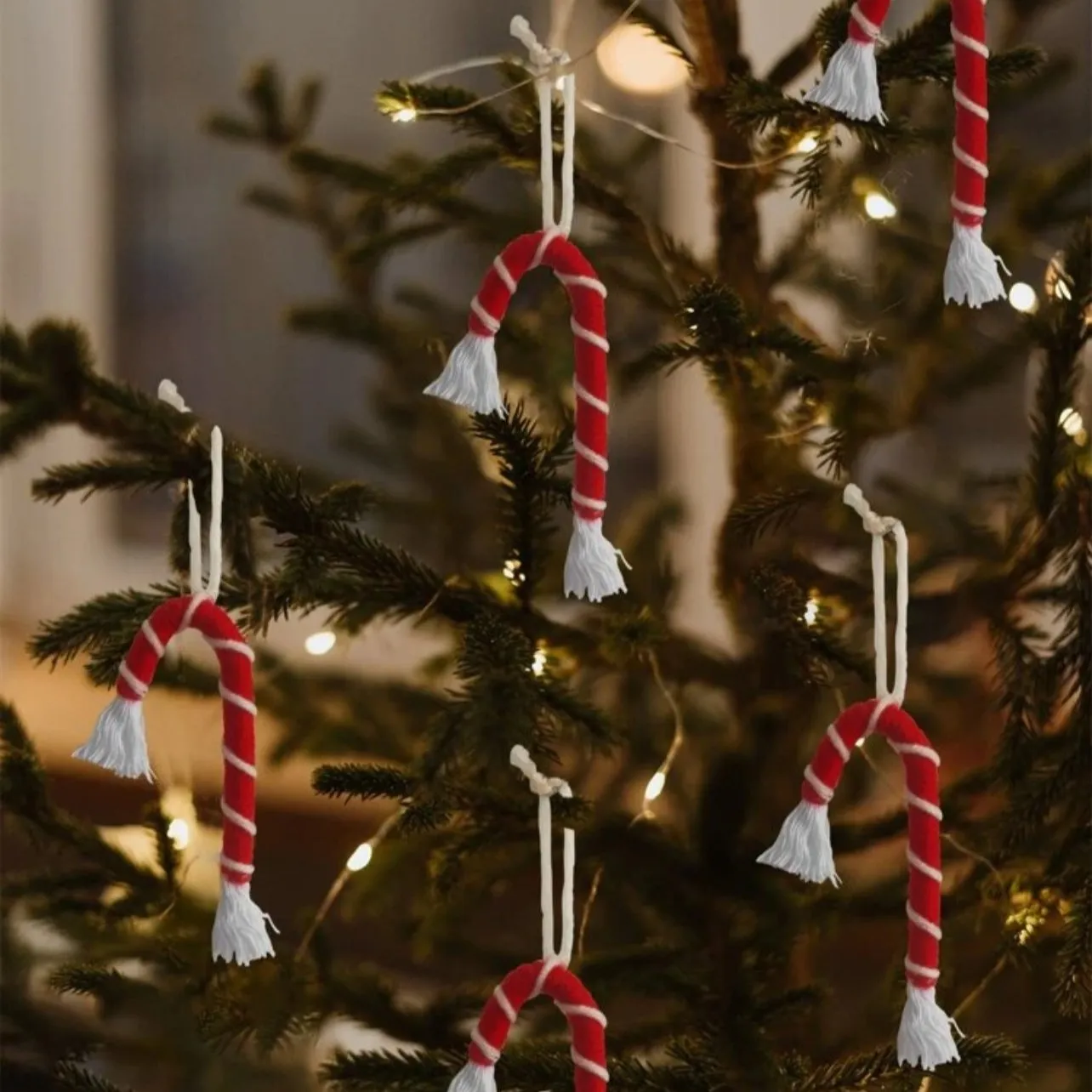
Nostalgia crafts are driving ornament trends into 2026 — yarn ornaments, crochet candy canes, and grandmillennial Christmas searches have all been climbing as people look for decor that doesn’t come off a big-box shelf. Yarn has an obvious advantage: it’s soft, unbreakable, kid-safe, and available in literally every color, so it fits whatever palette you already own. Candy canes read traditional without being fussy, and the warm fairy lights behind them make the red glow. Buy one skein of red and one of white and you have ornaments for years.
22. Mini Macramé Wreath with Red Berries and a Pinecone
The berry cluster. It’s a small cluster of bright red berries plus one mini pinecone, and it’s the only saturated color in the entire ornament — which is exactly why your eye goes there first. On a tree full of cream cord and green needles, that single hit of red does more work than a whole box of red baubles, because it has something to contrast against. Remove it and the little wreath is still charming, just forgettable. Every handmade ornament wants one small, deliberate interruption — this is that piece, hanging from baker’s twine.
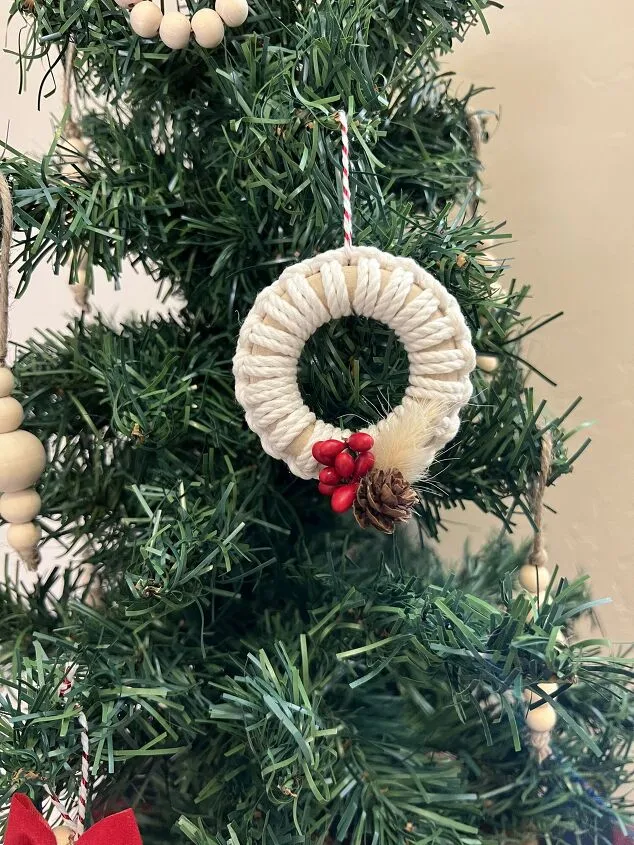
Miniatures like this suit smaller trees. A 4-to-5-foot tree takes about 12 to 15 of these comfortably, spaced 6 to 8 inches apart, and the whole setup fits a compact apartment corner without anyone having to squeeze past it. On a 7.5-foot tree the same ornament disappears unless you cluster four or five together at eye level. If your tree is taller, move to fuller-scale pieces that can hold their own against big branches instead of fighting them.
23. Macramé and Loop Yarn Ornaments on a Marble Tray
Sage and olive together count as one green, white is the neutral, gold is the metallic, and wood is the tie-breaker — roughly 60/25/10/5. It’s a formula that survives almost any swap. Change gold to copper and it warms right up. Change white to cream and it goes softer. Change sage to forest green and it turns more traditional. What you shouldn’t change is the amount of green. Once green drops below half the composition, these pieces stop reading as a curated set and start looking like leftovers.
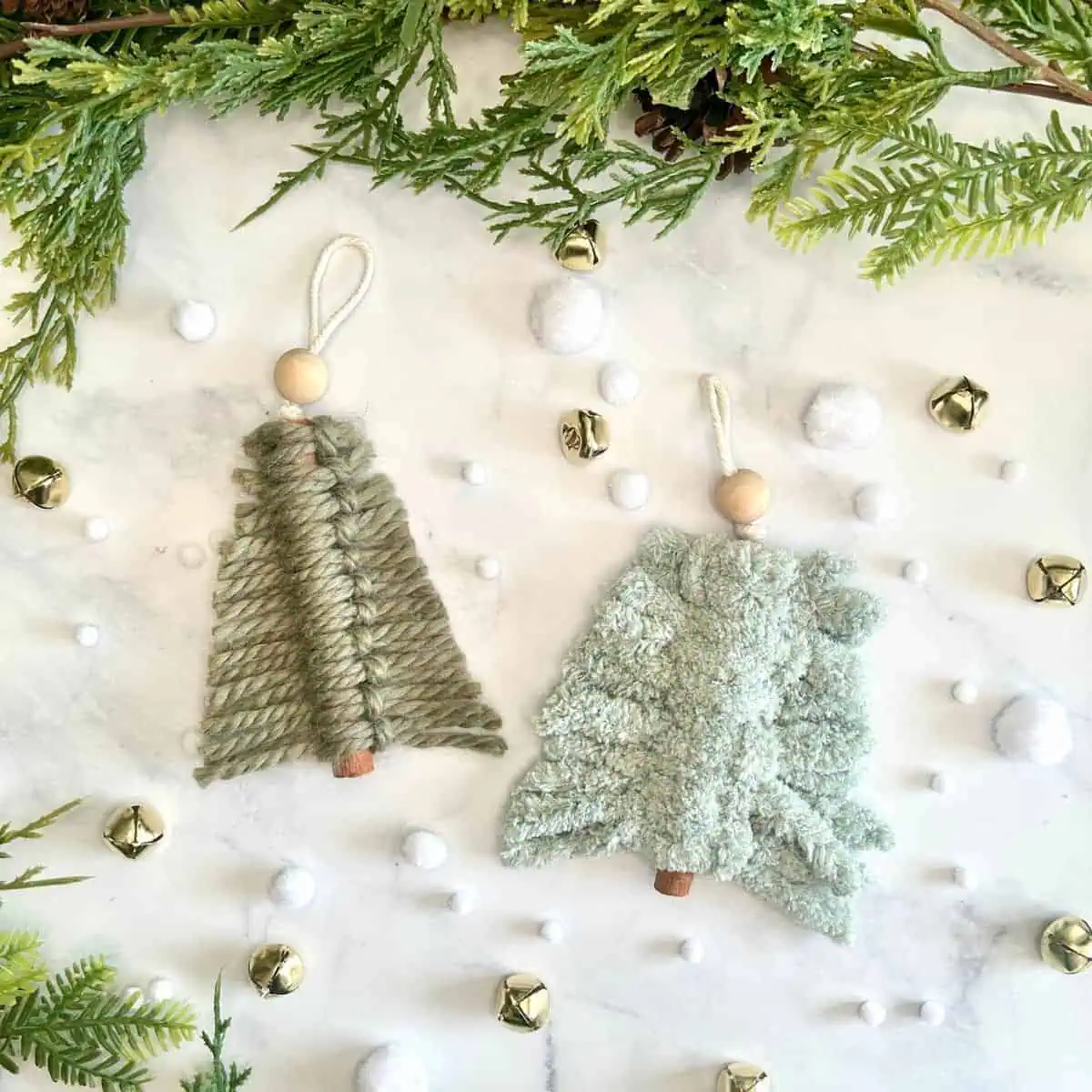
Gold jingle bells are a dollar-store staple — a pack of 20 for $2 to $4, and nobody can tell the difference once they’re scattered on the tray. Yarn runs $3 to $5 a skein at Walmart, and loop yarn pushes out the same tufted tree shape in a fraction of the time if knotting isn’t your thing. Pinecones are free if you take a walk in November. The whole arrangement here costs about $20 to recreate, and the white marble surface is whatever tray or counter you already own.
24. Open Diamond Macramé Ornament on a Wire Frame
Open knotting is counterintuitive on a Christmas tree, because the instinct is always to add density. Here the diamond pattern lets green needles show straight through the ornament, so it feels light and it visually connects to the tree instead of sitting on top of it. The metal frame underneath holds the tree silhouette, which is why an open mesh doesn’t collapse into a wad of cord. Combine that with the fringe at the base and the warm string lights glowing behind it, and the whole thing seems lit from the edges.
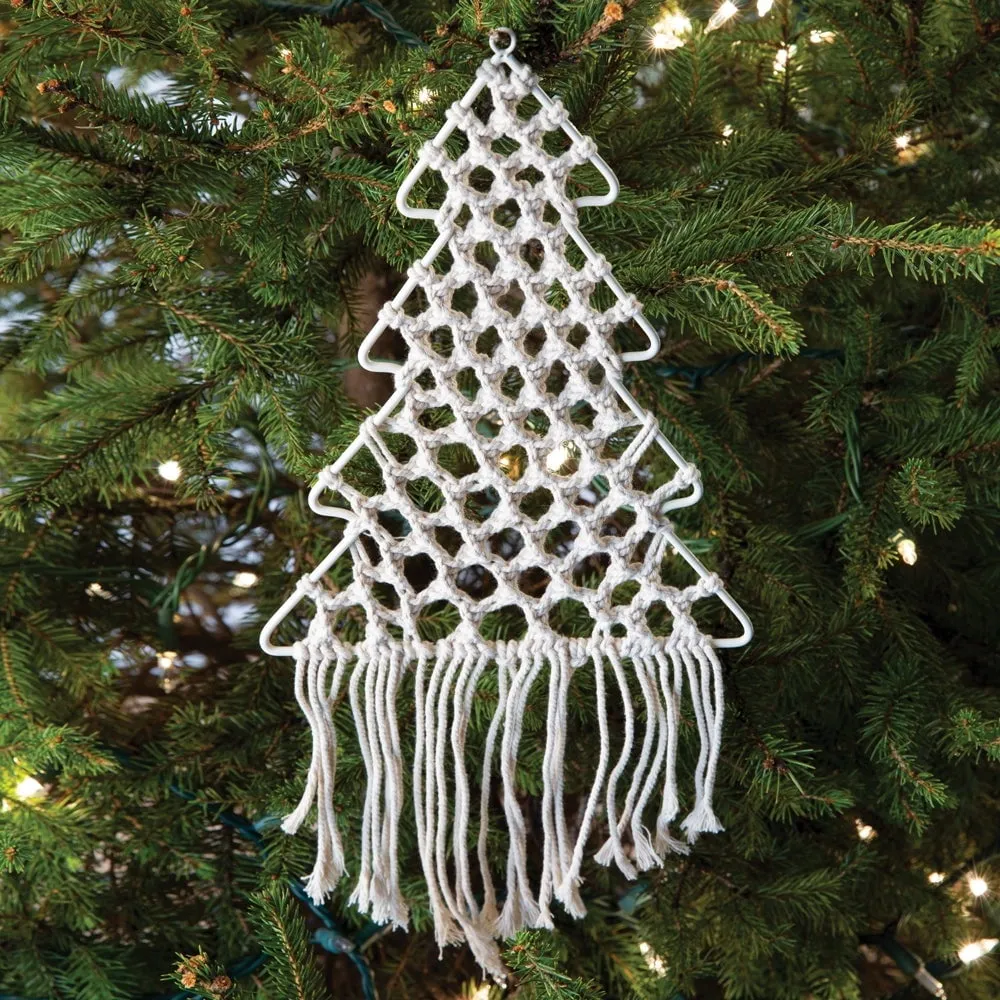
Three things to watch. Bare metal frames can rust in humid climates, so if your tree sits near a window that fogs, give the frame a thin coat of clear matte sealer before you start knotting. The fringe will bend in storage — a two-minute pass with a hair dryer on low reshapes it. And because the mesh is open, dust settles in the gaps; a soft makeup brush lifts it out without tugging the knots loose. Total upkeep is about five minutes a season.
25. Green Yarn Tree Wall Hanging with a Mirrored Star
- Measure the wall space first — this piece wants at least 14 inches of clear height.
- Check the wall type; plaster needs a different anchor than standard drywall.
- Confirm your yarn yardage before knotting a full-size hanging.
- Choose the topper before you start, since it changes the whole silhouette.
- Pick a spot with indirect light so the mirrored star can actually catch it.
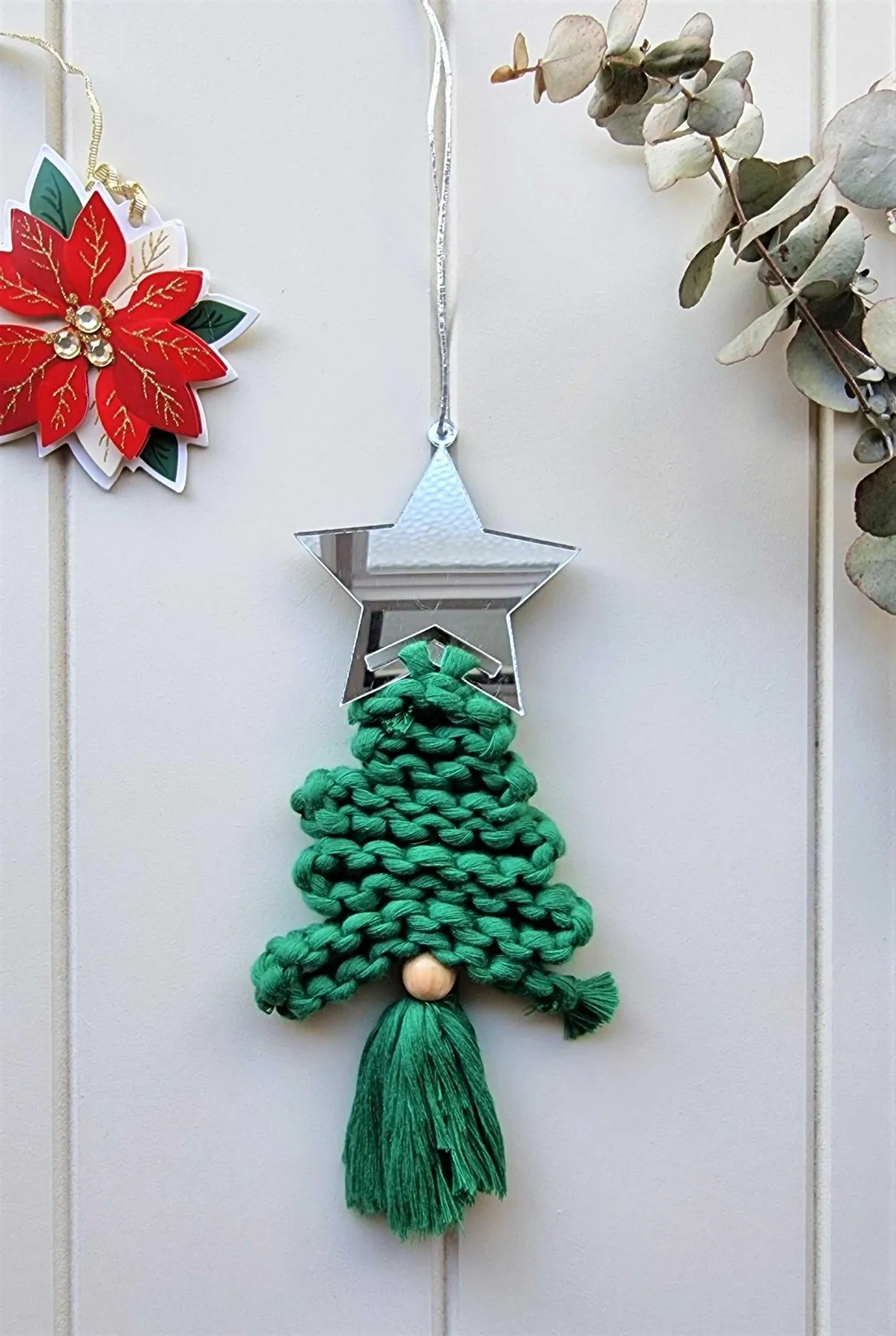
Hang it as part of a small arrangement — it pairs naturally with the wall display in Idea #14 and the paper poinsettia and eucalyptus sprigs beside it on the paneled wall.
The mirrored star topper. On a green yarn body, a silver star pulls in whatever light is in the room and throws it back, which is why this reads as sparkle rather than decoration. Swap it for plain wood and the piece turns warmer and more rustic; swap it for gold and it goes traditional. That mirrored detail is what keeps a handmade object from looking homemade in the wrong way, and it costs about two dollars.
26. Dried Orange Slices and a Bread Ring Garland
If you’re drying your own citrus, slice it 1/8 to 1/4 inch thick and bake at 200°F for three to four hours, flipping once — thicker slices stay moist inside the rind and eventually mold. Seal the finished slices with a light coat of matte polycrylic so they don’t attract pests. For the ring-shaped bread garland, plain unsealed rings crack in a dry house; a coat of clear craft glaze fixes that. Skip food ornaments entirely if you have dogs. Dried citrus is fine, but anything with dough or sugar is a vet visit waiting to happen.
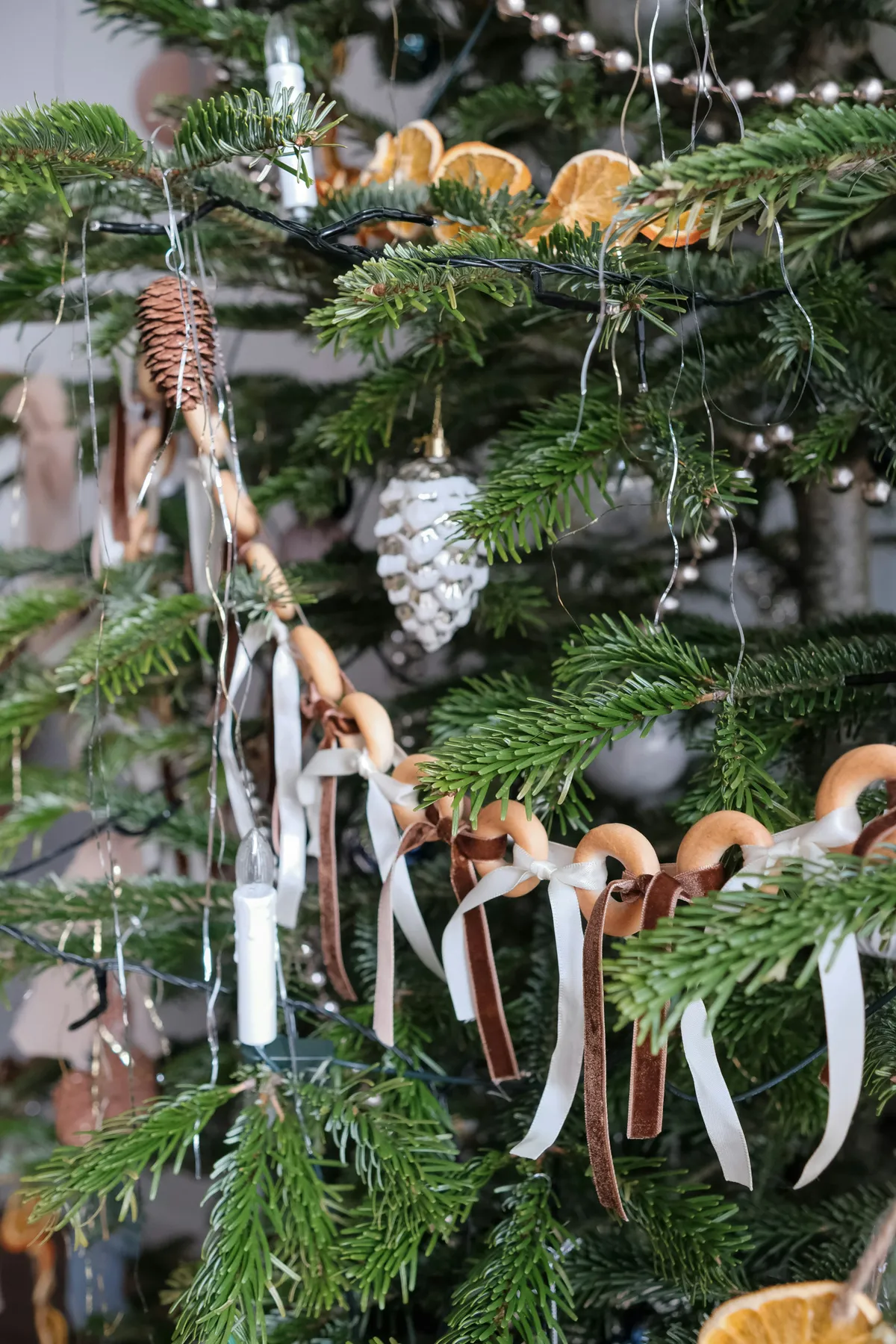
Roughly 60% forest green + 20% warm brown from pinecones, bread, and cinnamon + 15% burnt orange from the citrus + 5% white velvet ribbon. Those velvet ribbons are the quiet glue of this tree — they’re the only soft texture in a composition made of crispy natural materials, and they keep the whole thing from looking like a foraging project. Swap burnt orange for cranberry and it turns traditional; swap white ribbon for oatmeal and it gets quieter.
Natural-material trees need room to be seen. Plan on 7 to 8 feet of tree with 9-foot ceilings, or scale down to a 5-footer and use fewer, larger dried slices. The garland is your real sizing constraint: figure about 9 feet of strung material per foot of tree height, so a 7-foot tree needs roughly 60 feet of garland. In a smaller room, use the citrus and pinecones as individual ornaments and skip the garland completely.
27. White Macramé Ring Ornament with a Wooden Bead
White cord is the most honest material on a Christmas tree: it shows everything. Dust weekly with a lint roller, and if a piece starts looking grey, hand-wash it in cool water with a drop of dish soap, reshape it, and air dry flat — never in a dryer. Store it in a labeled box with tissue between layers so the ring keeps its circle instead of flattening into an oval. Expect to refresh a heavily used white ornament every three or four seasons, which still costs less than replacing broken glass every year.
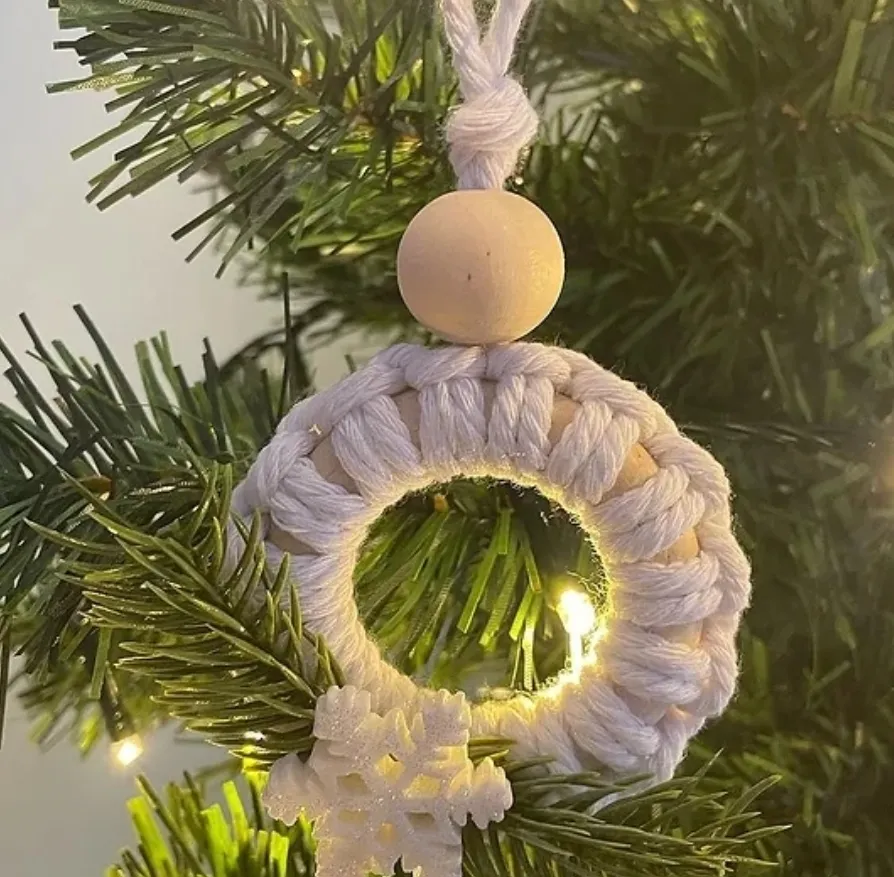
The smooth wooden bead at the top. It’s a single unpainted bead about an inch across, and it’s what makes this read boho rather than craft-kit. Wood next to white cotton is the oldest trick in bohemian decorating — the contrast in hardness and warmth does all the work. Swap it for a plastic bead or a metal ring and the ornament instantly looks like something from a dollar bin, no matter how neat your knots are. The snowflake accent at the bottom is a nice second beat.
28. Red Macramé Tree Ornament with a Stamped JOY Bead
- Thread a 12-inch piece of red cotton cord onto a large-eye needle.
- Loop it around and back through the same point to build a small hanging loop.
- Knot the cord into four rows, increasing the loop size each row to build the tree shape.
- Tie off and glue a short tassel underneath for the trunk.
- Stamp a wooden bead with JOY in archival ink and slide it onto the hanging loop.
Roughly 35 minutes and $6 in materials per ornament.
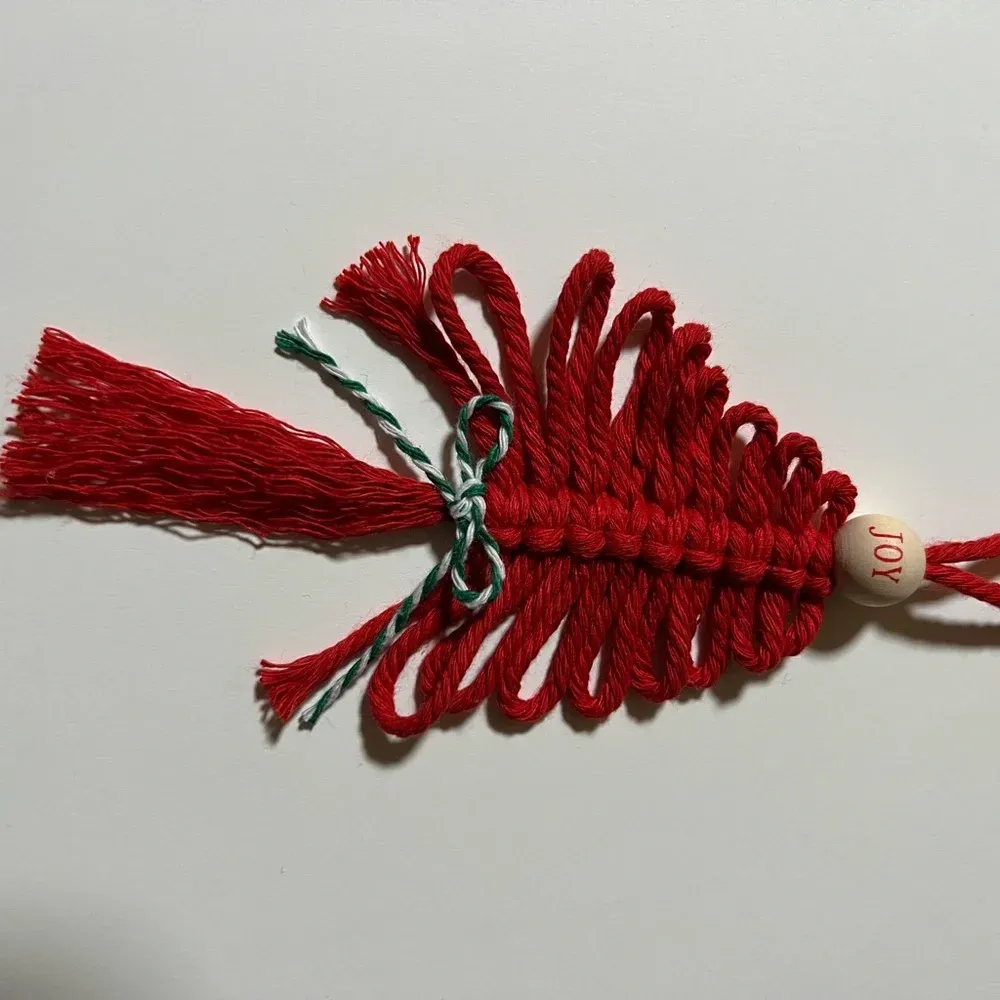
Red cotton cord is beautiful and completely unforgiving in one specific way: the dye can transfer. If these will hang against a cream tree skirt or a light wall, test a scrap first by rubbing it with a damp cloth. Keep them out of direct sun — red fades to pink faster than any other color, and the stamped bead will fade right along with it. Stamp a scrap bead before the real one, too. Archival ink on raw wood spreads more than you expect, especially on end grain.
29. Mini Macramé Ornaments with Wrapped Yarn Trunks
You’re looking at about $12 of supplies for a set of six of these: one skein of cream cotton cord, a pack of wooden rings, and yarn scraps you probably already have in a bin. The same handmade ornaments sell on Etsy for $12 to $20 each, which is completely fair for the labor but unnecessary if you enjoy an evening with a podcast. Thrift stores are full of half-used skeins for a dollar. The only real cost here is time — about 25 minutes per ornament once you’ve made two and found your rhythm.
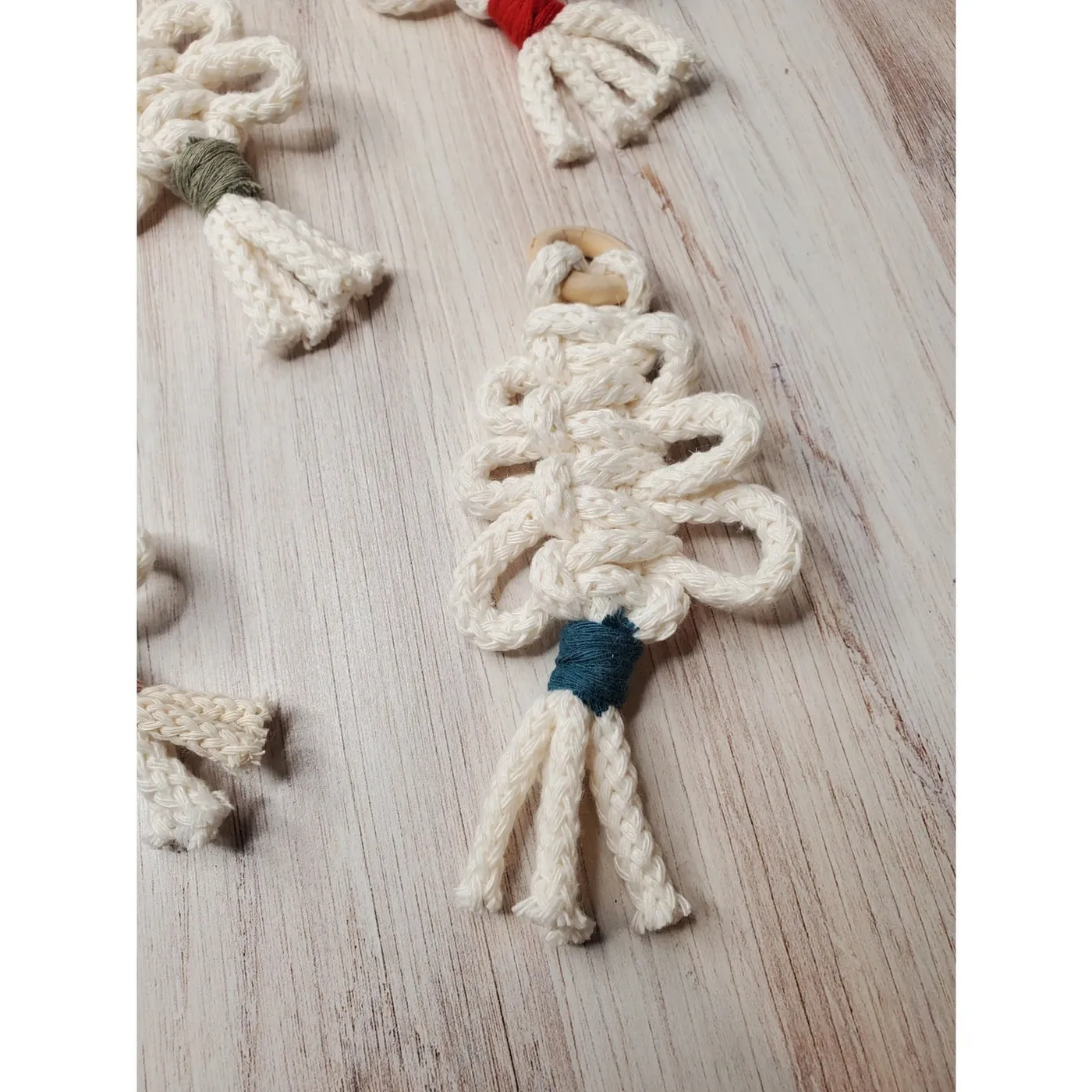
Bohemian handmade ornaments have quietly outperformed mass-market ones for a few years, and 2026 looks like the peak of the craft revival — macramé, punch needle, and loop yarn are all over Pinterest, and people are treating their trees as small showcases for what they made. It has staying power for a practical reason: a neutral, handmade ornament works with next year’s palette, while a themed box from a big-box store rarely does. One caveat before you dive in — check the common mistakes section before hanging handmade pieces on a tree.
30. White Wool Wreath with Sage Macramé and a Berry Sprig
Everything here is one color and three textures — white wool, sage cotton, and natural wood — and that’s the entire trick. A flat lay like this works because the palette is doing no work at all, which frees your eye to notice the looped wool next to the crisp knots next to a soft white berry sprig. Introduce a second green or a metallic and the composition falls apart. It’s the same restraint principle that makes the paper honeycomb tree in Idea #6 feel calm rather than empty.
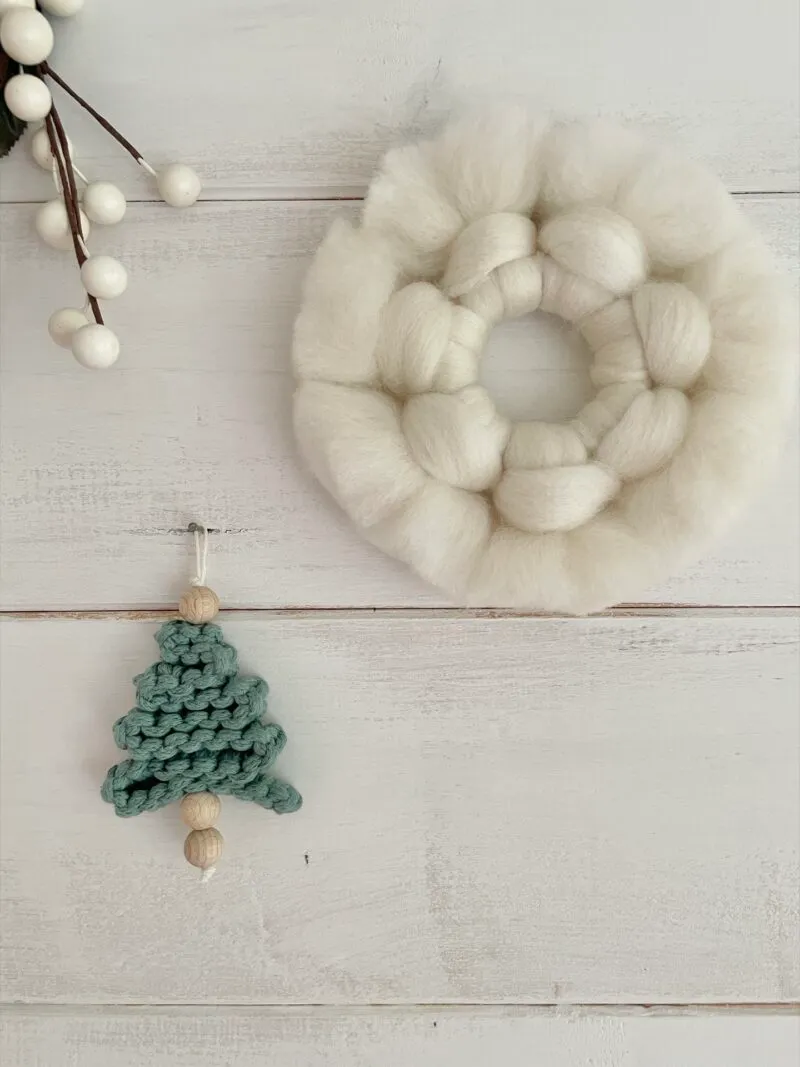
- White wool woven wreath: $25–$60
- Sage green macramé tree ornament: $10–$25, or about $5 to DIY
- Wooden bead pack: $5–$10
- White berry sprig: $8–$18
- Painted wood plank backdrop: $0–$15
Total: $48–$128
Budget alternative: a thrifted grapevine wreath wrapped in $6 Walmart yarn, dollar-store berry sprays, and a plank you already have in the garage — under $25.
Go Make a Tree That Actually Looks Handmade
Pick two or three ideas from this list — a garland, an ornament style, a base treatment — and let the rest fill in over the next few Decembers. Boho trees are built rather than bought, and the pieces you knotted yourself are always the ones you pull out first. 📌 Pin your favorites now so December-you doesn’t have to scroll back through thirty ideas to find them.