White Christmas tree decor is having a serious moment on Pinterest right now — and the 2026 boards make a better case for it than any catalog could. We spent real time digging through Walmart, Target, and IKEA, plus a few late nights on Facebook Marketplace, to pull the ideas actually worth your Saturday afternoon. From $12 ornament swaps to $650 flocked showstoppers, budget and luxury versions are compared side by side, and every idea is shoppable with direct product links.
Inside, you’ll find 30 curated ideas spanning flocked minimalism, blue-and-silver classics, winter-cabin warmth, and quiet jewel-tone drama. The push toward warm-toned lights and heavier flocking is driving most of what’s trending this year, since designers keep leaning into textural, lived-in holiday styling over the perfectly matched look.
And stay until the end — we break down the most common mistakes that can ruin these looks. 📌 Save this to Pinterest for later — you’ll want to revisit these ideas.
1. Blue and Silver on a Frosted White Tree
Three things are doing the heavy lifting here. First, repetition: the same blue shows up in the porcelain on the white built-ins, the pillows on the gray sofa, and the ornaments themselves, so the eye keeps finding it. Second, contrast — deep navy and cool silver read sharply against a flocked white tree in a bright, light-filled room. Third, the warm bulbs under all that frost keep the whole thing from turning icy. Take away the blue and you’d have a pretty but anonymous white tree.
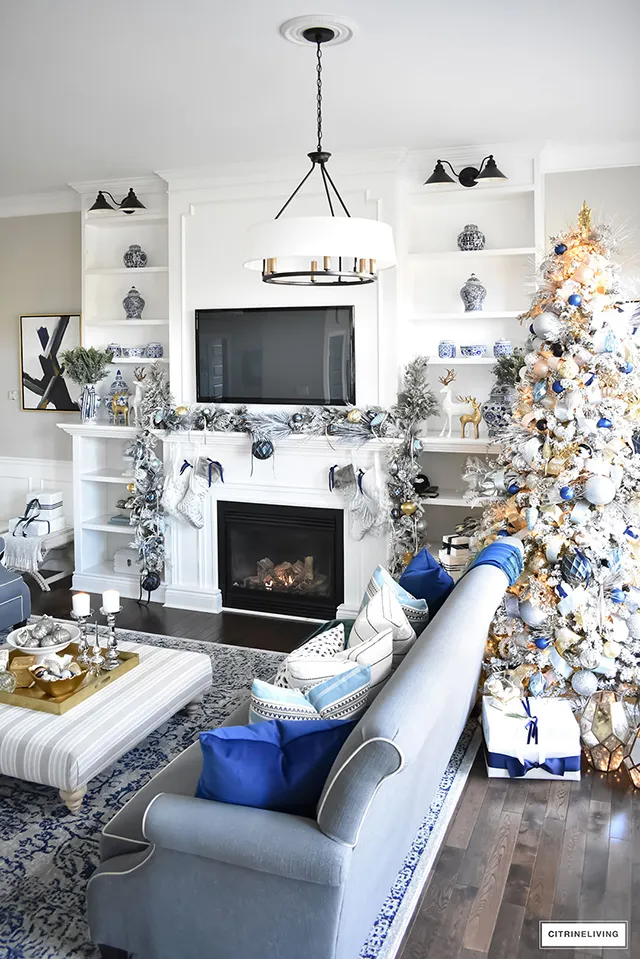
For a 7.5-foot tree, plan on roughly 100 lights per vertical foot and ribbon loops every 12 to 15 inches — about 12 to 15 loops total. Wire-edged ribbon holds its shape; un-wired satin slides down the branches overnight. Keep every ornament within the outer third of the branch tips. Flocked trees are dense, so anything hung deep disappears and you’ve wasted half your ornaments.
2. Flocked Tree Glowing Over a Family Room Floor
Flocking sheds — that’s the deal you make with a snowy tree. Expect a fine white dust on the floor for the first season or two, which is fine on light hardwood and less fine on dark wood or navy rugs. If you’ve got toddlers like this room does, secure the tree to a wall stud with a rated strap, tape the cords down, and skip glass ornaments below four feet. And dry winter air plus dense string lights is a genuine fire risk, so keep a live tree watered daily or run LED strands on an artificial one.
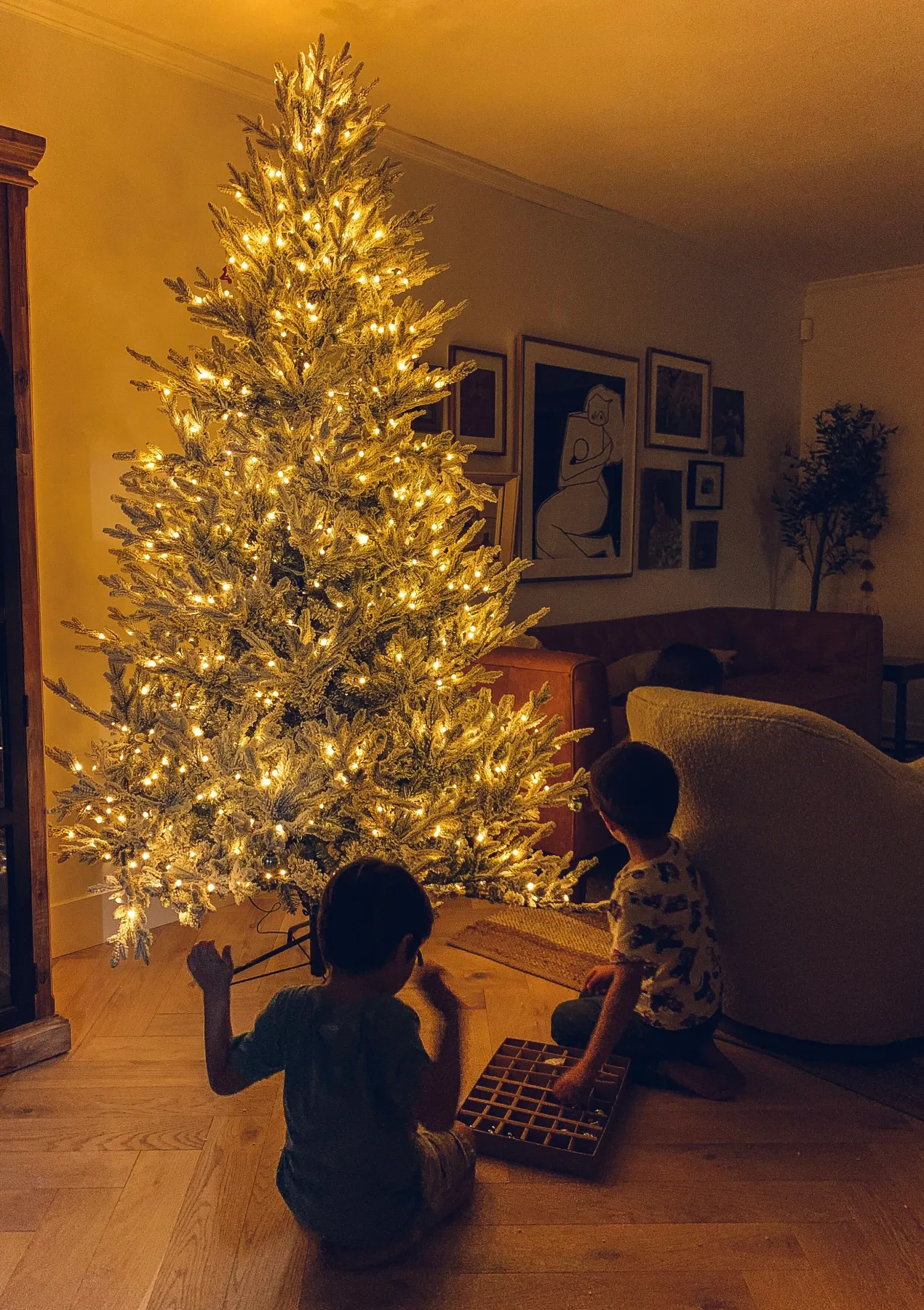
Warm-white bulbs buried deep in heavy flocking are what replaced the icy cool-white trees of the 2010s. Search behavior keeps pointing the same direction: people save cabin and cozy holiday shots far more than the perfectly symmetric ones. It’s partly a reaction to over-styled magazine trees and partly practical — warm light looks good in real, imperfect rooms with gallery walls, leather sofas, and kids playing on the floor.
3. White and Silver Holiday Table With Snowflake Accents
Strip the table down and the formula is roughly 70% white (dishes, cloth, candle, flowers), 20% silver (rims, small gift boxes, ribbon), and 10% living green from the tree glowing in the background. Warm candlelight sits outside the percentages — it’s the finish, not an ingredient. Swap silver for brushed gold and the table warms up several degrees; swap the white flowers for eucalyptus and it turns slightly rustic without losing any of the elegance.
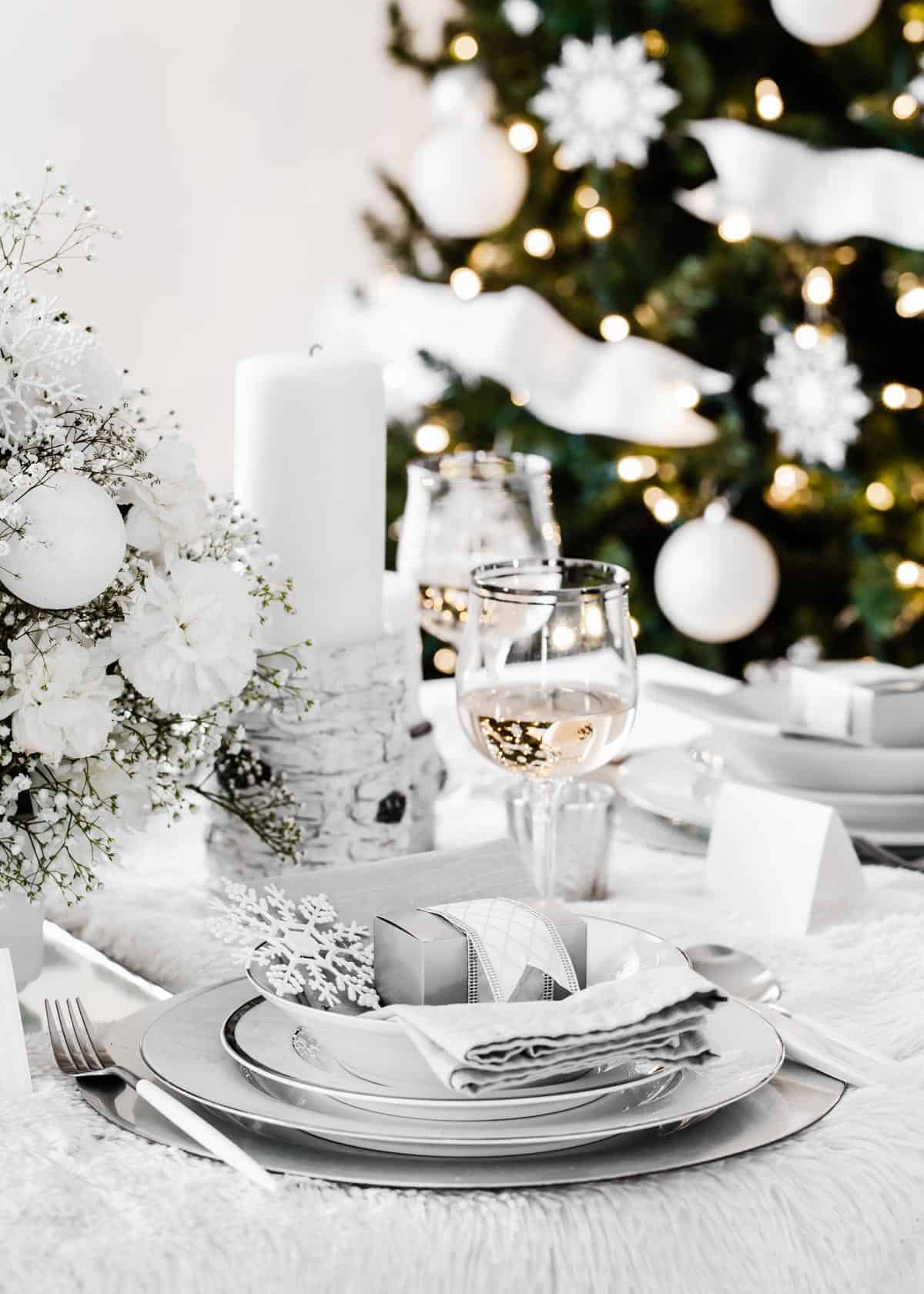
- Lay a faux-fur runner down the center, about 14 inches wide, clearing each place setting.
- Stack a charger, dinner plate, and accent plate — keep it under 3 inches tall so guests can see across.
- Tuck a snowflake ornament at each napkin for a small, cheap moment of sparkle.
- Set two birch candle holders off-center to hit the rule of thirds.
- Finish with a low floral arrangement so nothing blocks conversation.
Time: about 45 minutes. Cost: nearly $0 if the ornaments come off the tree.
4. Frosted Tree Framed by Black Window Frames
This is a tall-tree room: you want a 9-foot ceiling at minimum and roughly 6 feet of clear wall between those black frames. A 7.5- to 9-foot tree reads right in a 14-by-16 space; anything shorter gets swallowed. If your room is tighter, look at Idea #10 or Idea #6, where lean flocked trees work in half the footprint. Bonus: black window frames give a flocked tree a built-in border, so you can skip the ornament-on-overload approach entirely.
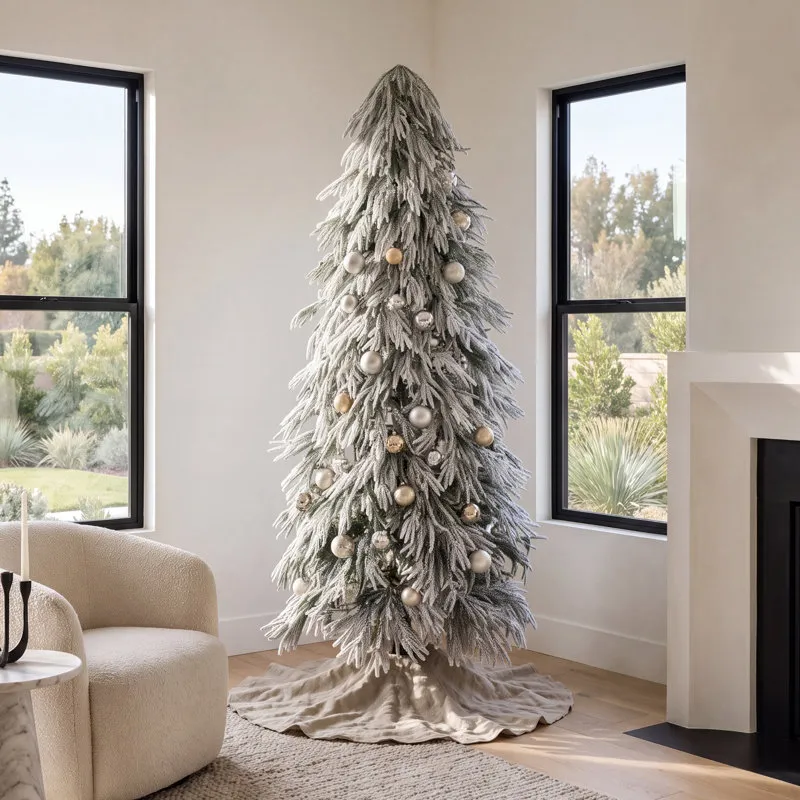
The linen tree skirt is the quiet hero. Remove it and you’d be staring at a metal stand, a tangle of cords, and a visual hole at the base of an otherwise serene tree. A simple neutral skirt — linen, cotton, or wool, no glitter, no embroidery — does two jobs at once: it hides the hardware and grounds the frosted branches so the tree doesn’t float. If you copy one thing from this room, copy that plain, slightly wrinkled texture.
5. The Top of a Flocked Tree, Nothing Else Needed
Flocking is essentially fine paper or PVC powder glued to the needles, and it has a lifespan. Most flocked trees look their best for five to seven seasons; after that the coating starts flaking off in sheets and branches thin out where you’ve handled them most. Vacuum with a brush attachment on low — never a beater bar. Store the tree in a breathable bag, since the plastic it shipped in traps moisture. A can of flocking spray runs about $15 if you want a touch-up year.
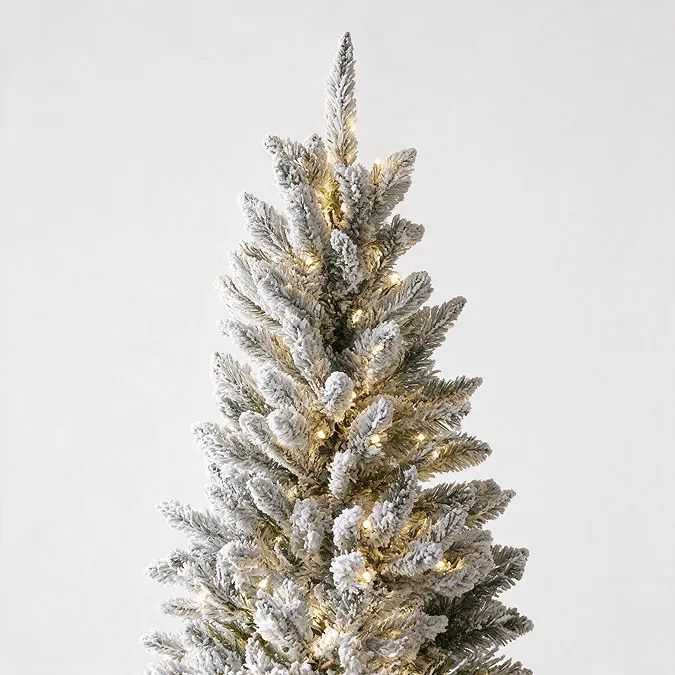
Shape the top third as a cone, not a dome. Bend branch tips outward so each layer steps back roughly 2 inches from the one above it — that’s what makes a slender tree look full. Leave 4 to 6 inches of clearance below the ceiling for the topper; more than that and the tree reads short in the room. And if the topper is a pointed finial like this one, don’t add a bow. Two apex shapes fight each other.
6. Sparse Flocked Tree With Kraft and Gold Gifts
The charm of this look is that it’s already the budget version. Shop Facebook Marketplace in late November for a flocked tree — $40 to $90 for something that retailed at $250. The round gold mirror is a thrift-store find at $15 to $35 with a quick coat of gold spray paint. IKEA sells sheer curtain panels for around $10 a pair, and a roll of kraft paper plus ribbon at Target is roughly $8. The whole scene lands under $150, armchair excluded.
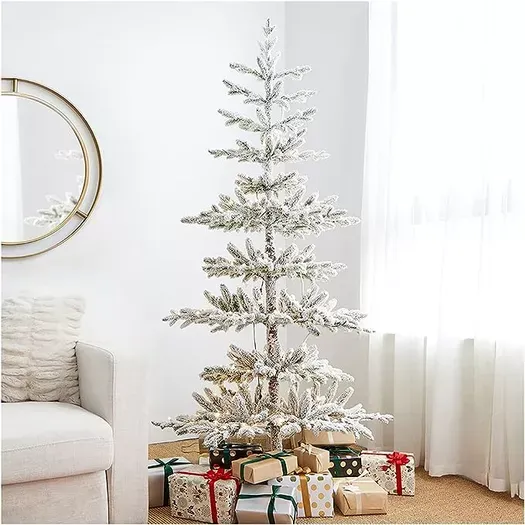
Sparse branches are the point, not a flaw. A tree with visible gaps lets light pass through, so it looks airy in a bright room instead of blocking it — which matters next to a white armchair and sheer curtains. The gifts do double duty as decor: kraft, gold, and plain white wrap repeat the tree’s palette without adding a single ornament. Compare with Idea #10 — same white-on-white calm, half the footprint.
7. Green Tree, Bright White Lights, Quiet Corner
Bright white lights are gorgeous in daylight and brutal at night in a warm room. Against brown leather and light wood floors, cool-white strings can turn a cozy corner into something closer to a hotel lobby at 9 p.m. Buy one strand, plug it in after dark, and look at it from your sofa before you commit to ten more. If it reads blue, switch to warm white or put the tree on a dimmer and run it at 60%.
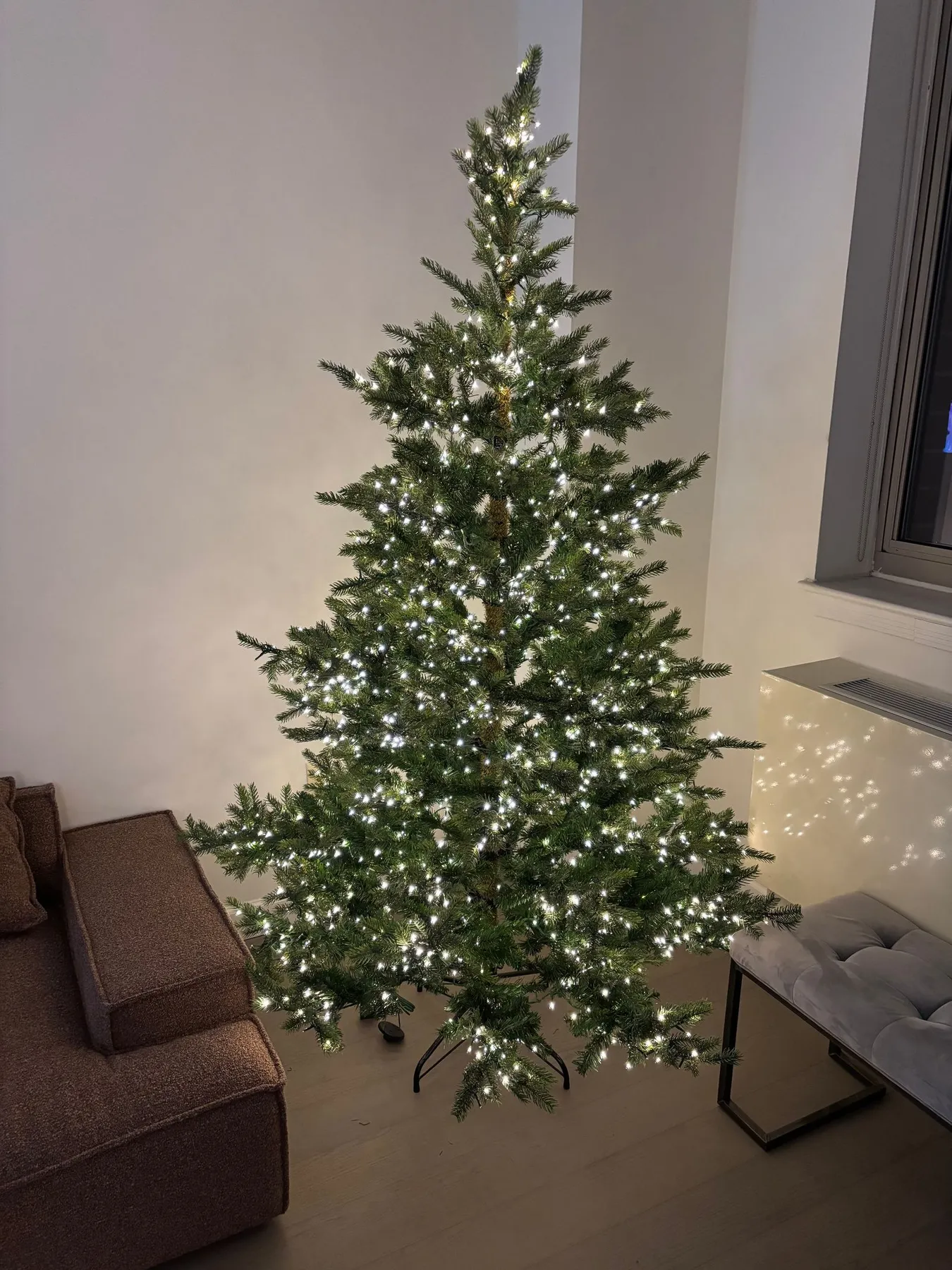
This corner breaks down to about 65% warm neutrals (light wood, brown leather, gray bench), 25% evergreen, and 10% crisp white light. Those proportions are why it feels calm rather than bare. Want to swap? Trade the gray bench for a cream slipcover and the light percentage can climb without the room turning cold. Go black leather and you’d need to add texture — a chunky knit throw — so it doesn’t turn severe.
8. White Dining Room With Paper Snowflake Tree
Paper snowflakes are the cheapest tree decor that still looks intentional. Fold a 6-inch square of white paper into quarters twice, cut a mix of notches and curves, then unfold — you’ll get a different flake every time. Press them flat under a book for an hour, punch a hole, and hang with thin white thread so the snowflakes appear to float. Make 20 to 30 for a 6-foot tree. Time: about 90 minutes including folding. Cost: $5 in paper.
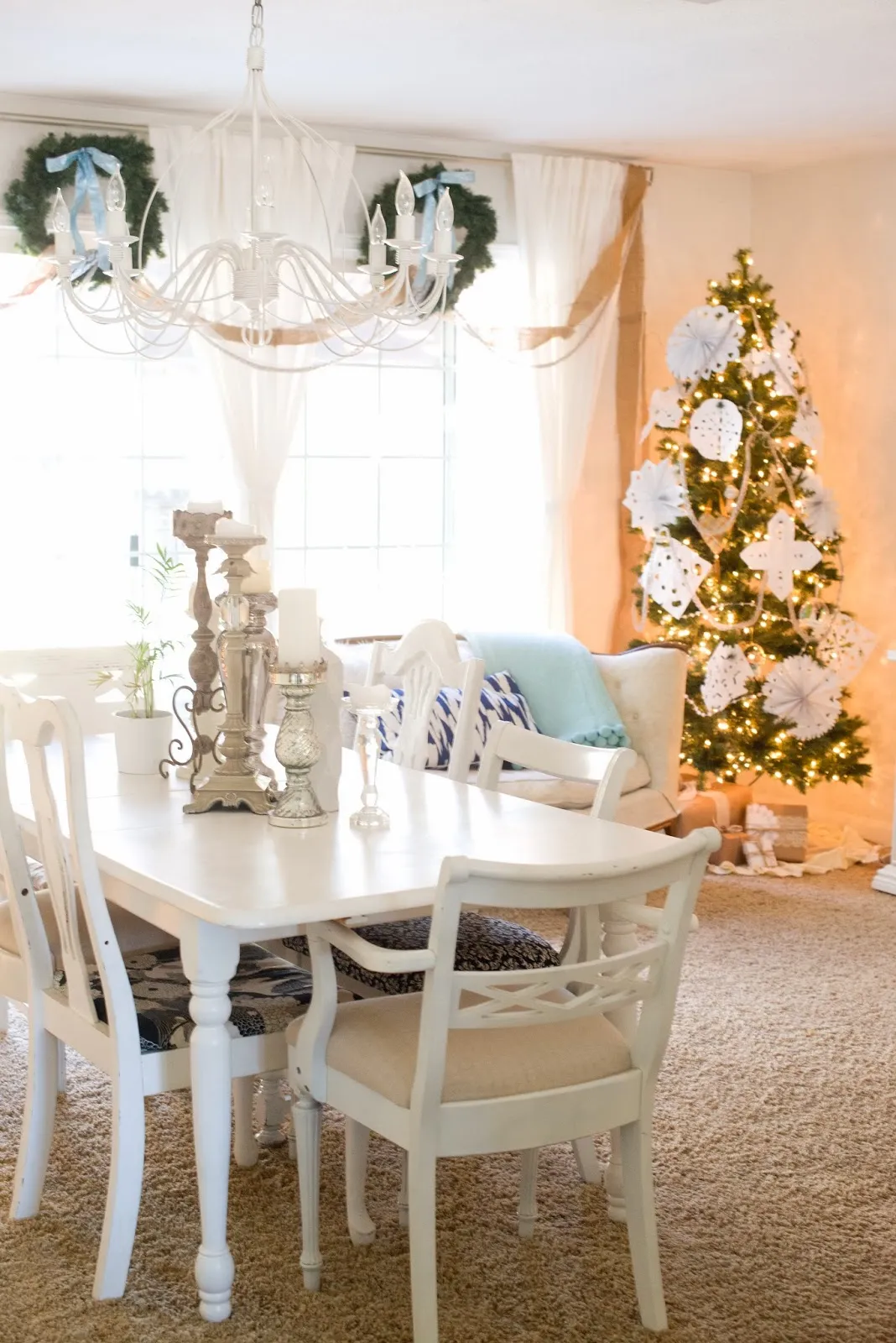
Dining rooms between 100 and 150 square feet are the sweet spot for a corner tree beside a window. You need 36 inches of clearance from the table edge to the tree’s lowest branches, so people can push chairs back without hitting pine. And if there’s a chandelier, keep 30 to 34 inches from its bottom edge to the tabletop — the tree in the background here only works because the chandelier isn’t fighting for the same sightline.
9. Snow-Dusted Tree Against a Deep Blue Wall
Paper honeycomb spheres at the base of a tree need to be bigger than you think. Go with 8, 12, and 16-inch diameters in odd numbers — three, five, or seven pieces — and cluster them slightly off-center so the arrangement reads as styled, not staged. Keep a 10 to 12-inch gap between the largest sphere and the tree skirt, or it looks like it toppled over. Honeycombs fold flat, so they store in a shoebox.
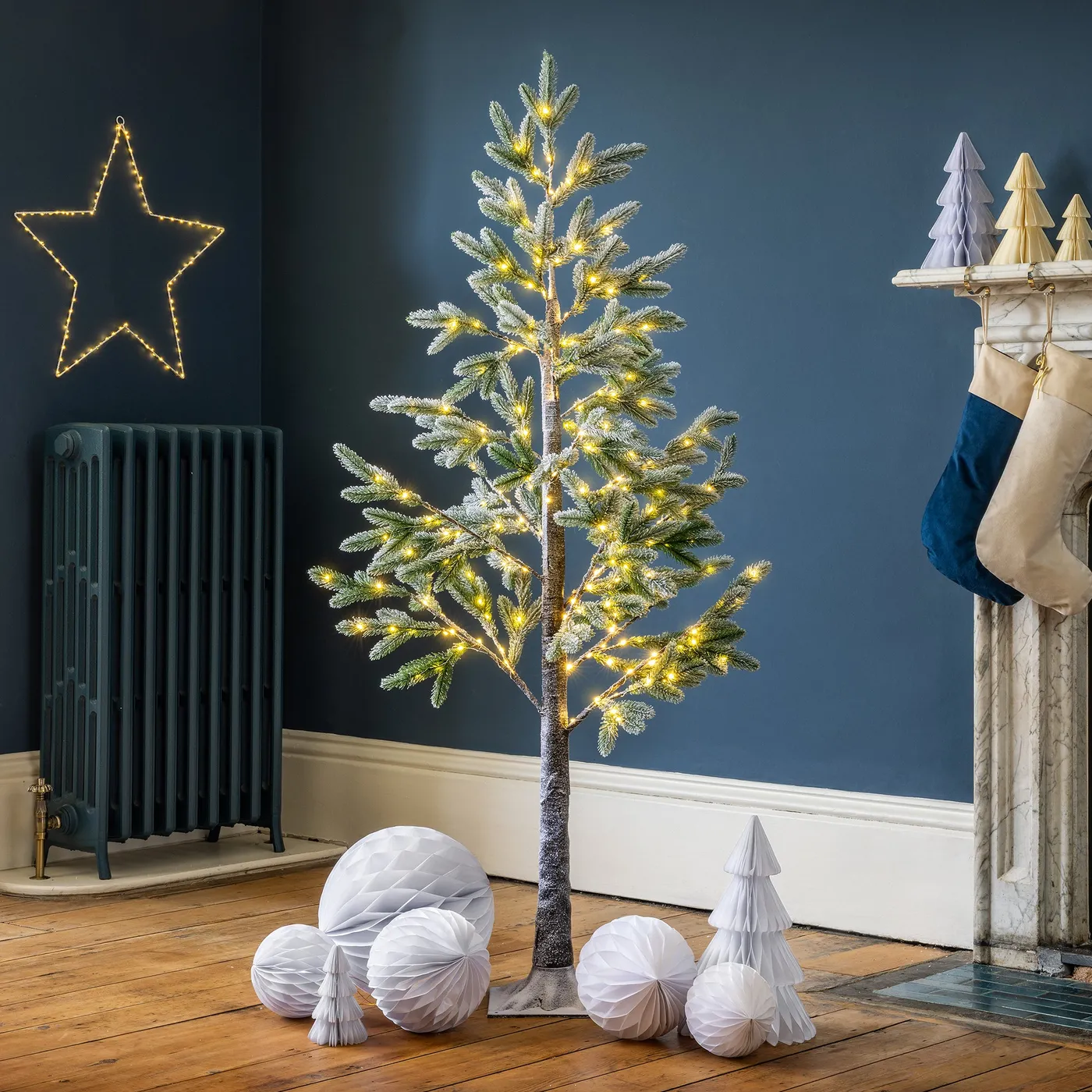
Painting a wall deep and letting the tree go pale is a real shift. Saturated backdrops — navy, forest, oxblood — started showing up behind flocked trees because they make the white pop without a single extra ornament, and they photograph like a studio backdrop. It’s practical too: one gallon of paint costs less than another bin of decorations. This trend has staying power, because the wall works year-round and the tree does the seasonal work.
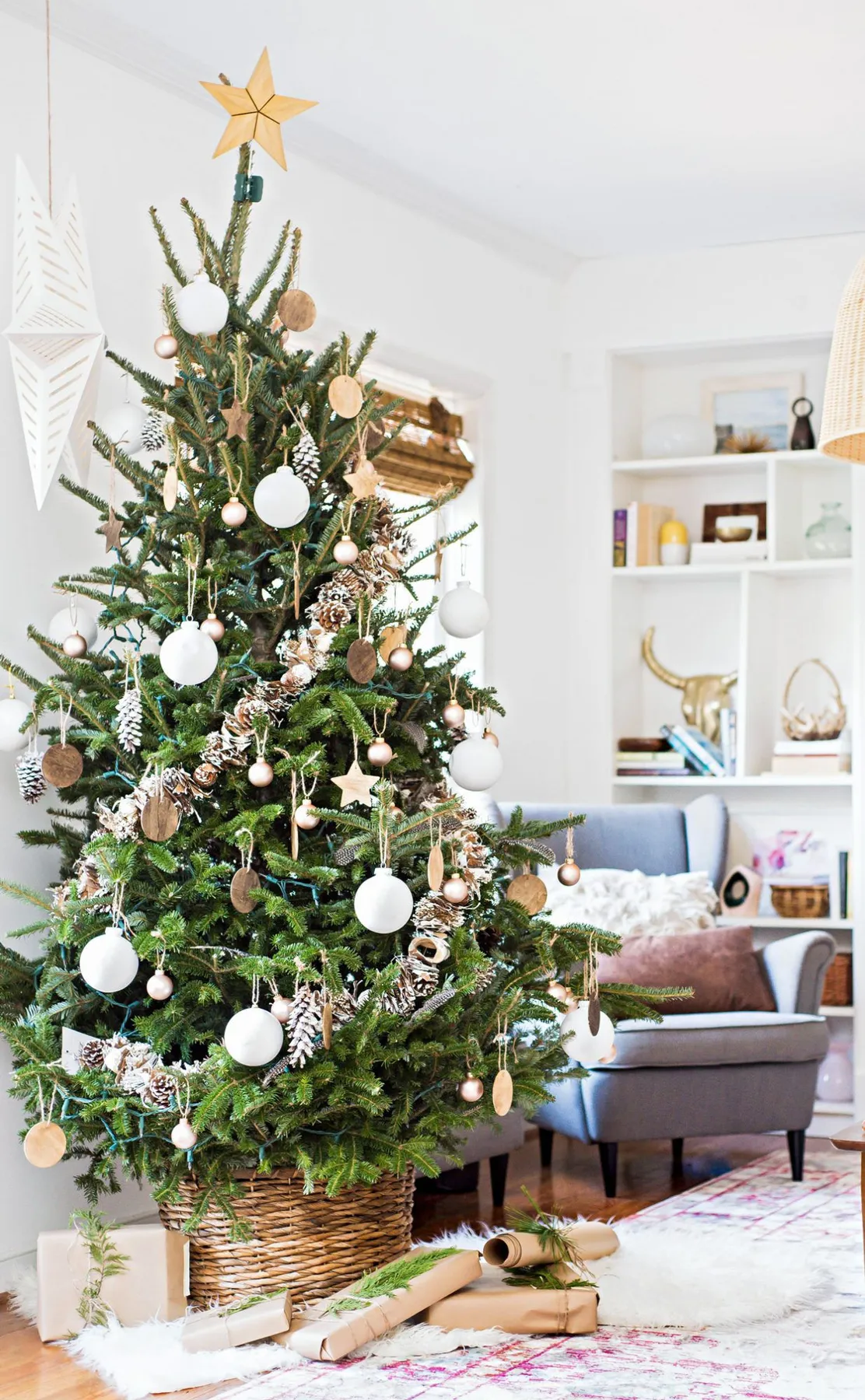
10. White Tree, Wood Stools, One Big Window
The natural wood step stools. Without them you’d have a white tree, a white chair, a beige rug, and a large flat window — technically calm, actually flat. Two small wooden stools add a second material, a lower horizontal line, and a spot for a folded throw or a stack of books. They’re also the reason the tree looks bigger: something human-scaled sits in front of it, and your eye measures upward from there.
- Measure the ceiling and subtract 6 inches — that’s your maximum height with a topper.
- Note which direction the window faces; west light means afternoon glare on white branches.
- Confirm an outlet is within cord reach, or plan a flat extension cord under the rug.
- Check that the widest branches still leave a 3-foot walkway.
- Set a hard budget before you shop, because flocked trees and gold ornaments escalate fast.
11. Flocked Tree Tucked in a Woven Wicker Collar
- Flocked tree, 7 to 7.5 ft: $130 – $400
- Woven wicker or rattan collar: $45 – $120
- Ornaments and picks: $60 – $150
- Warm-white LED strands: $20 – $40
- Felt floor pads: $0 – $20
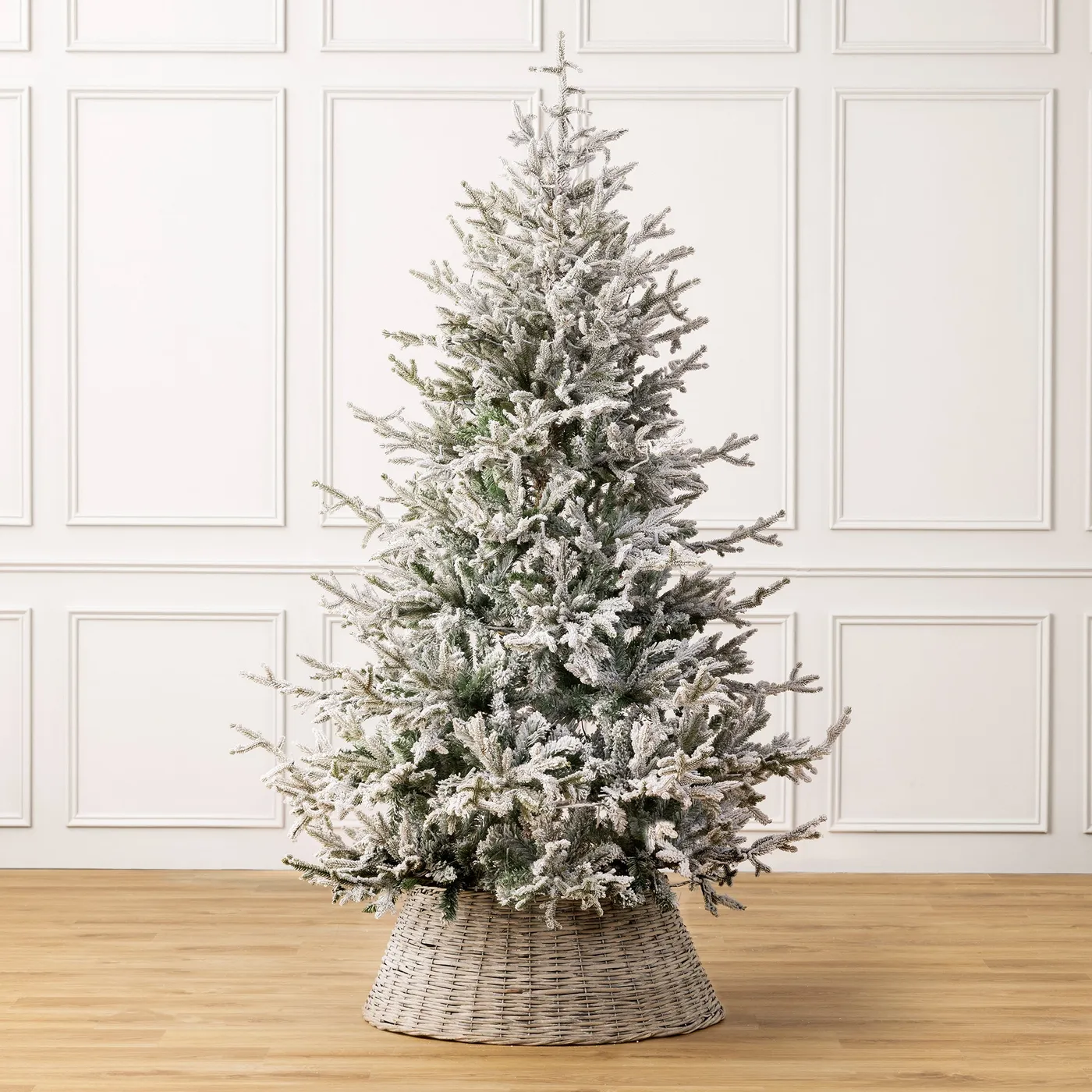
Total: roughly $255 – $730
Budget alternative: watch Marketplace for the tree in early December, reuse last year’s ornaments, and grab a wicker basket at a thrift store for $10 to $15 — that’s 40 to 60% off the same look.
A wicker collar is a disguise, not a stand. The tree still sits in a metal stand inside it, and that stand has to be rated for the tree’s height and weight — a 7.5-foot flocked tree can hit 60 to 80 pounds with lights. Check the collar’s interior width before buying, since most baskets top out around 18 inches across. And on hardwood, felt pads go under both the stand and the basket.
12. Frosted Branches, White Baubles, One Pinecone
- Hang matte spheres at the outer tips, about a hand’s width apart.
- Tuck textured pieces — a pinecone, a snowflake — roughly 6 inches further in, where they catch light without crowding.
- Add one oversized focal ornament per visible quadrant.
- Work in a spiral from the top down so you’re not leaning into finished branches.
- Step back every few minutes and squint; density problems show up instantly.
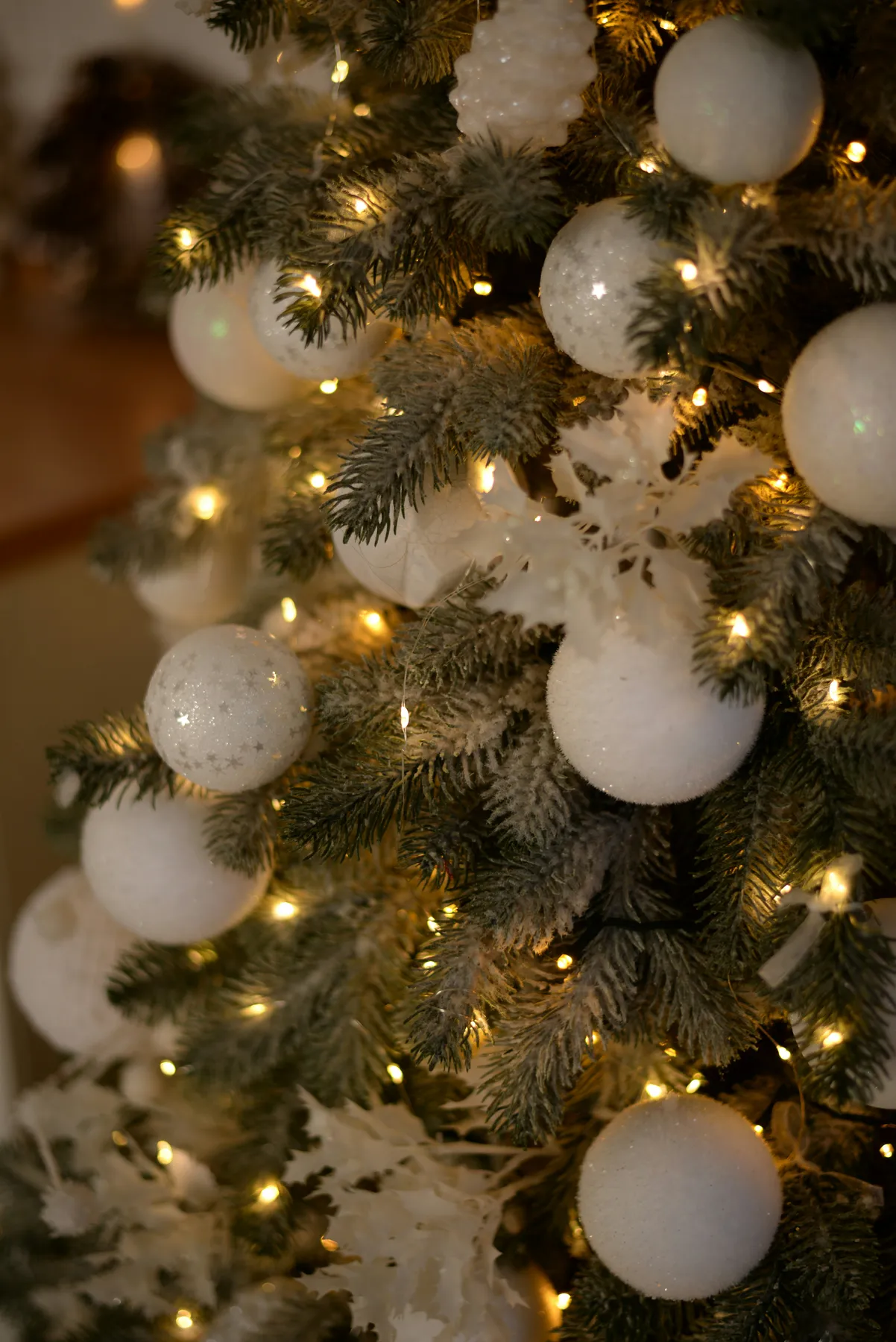
Time: about 45 minutes for a 6-foot tree.
Read this close-up as a recipe: 65% frosted branch, 20% white baubles, 10% textured naturals like the pinecone, 5% sparkle. The matte-to-glitter ratio matters more than the exact ornaments — too much glitter under warm bulbs blurs into a haze. Shift the mood by keeping the branches and swapping the pinecone for a dried orange slice to warm it, or a clear glass bauble to cool it down. The proportions stay identical.
13. Flocked Tree in a Dark Wood Crate
Dark wood floors and white flocking are a tough combination — every shed needle shows. Plan on a quick cordless-vacuum pass two or three times a week through December, and keep a lint roller nearby for the gifts underneath. The crate itself needs felt or rubber pads; sliding a loaded wooden box across a floor is how you get a permanent scratch. And if your room is dry, expect more shedding, because flocking cracks when humidity drops below 30%.
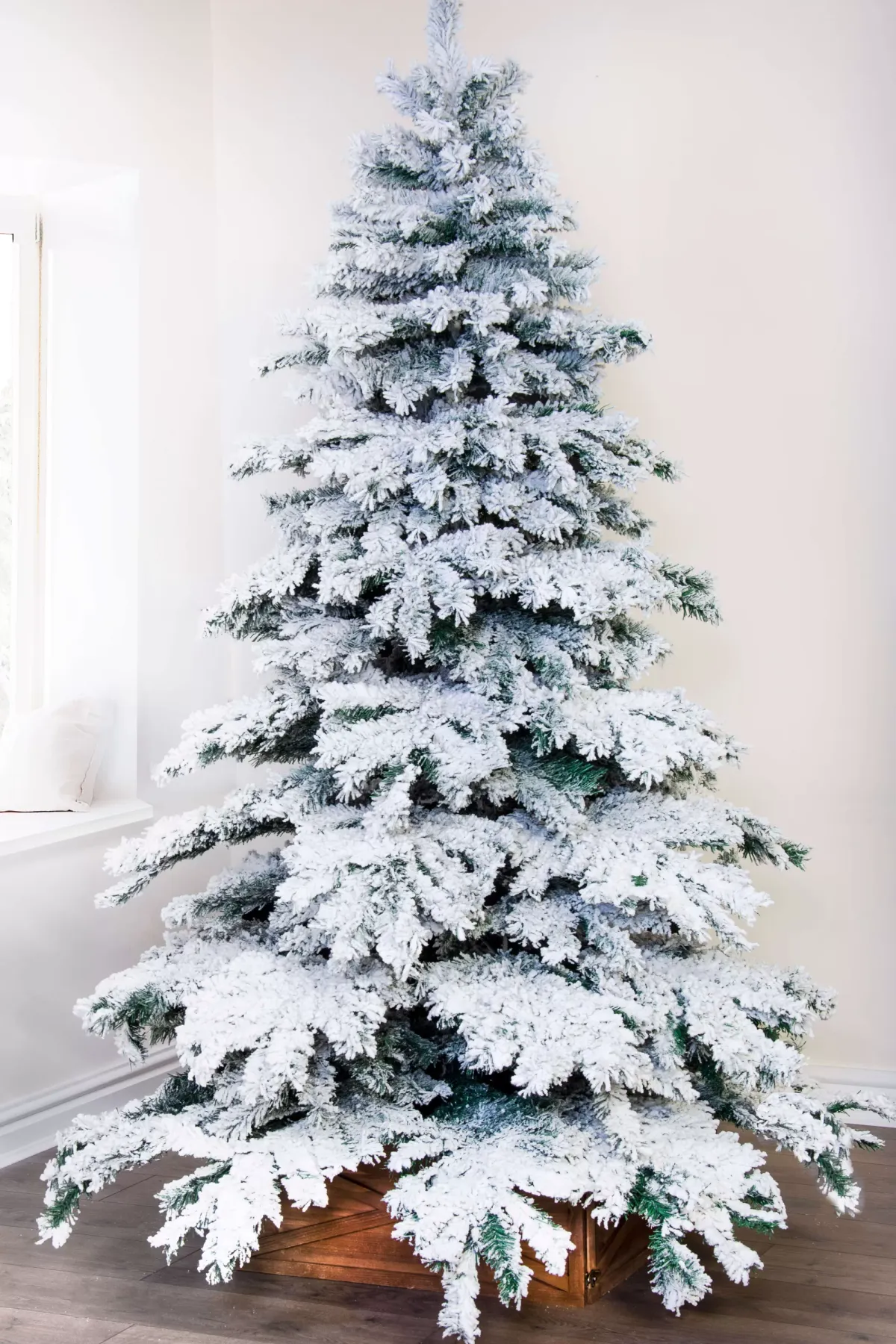
It’s the dark wood crate at the base. Swap it for a white skirt and the tree melts into the off-white wall, and you lose the entire composition. The crate gives those flocked branches a heavy, grounded anchor and echoes the tone of the flooring, so the tree looks like it belongs in the room rather than parked in it. It also quietly suggests a cabin without a single plaid item in sight.
14. Close-Up Flocking With Amber Lights Buried Deep
Color temperature is the whole ballgame with flocking. Warm 2700K bulbs make snow look like lamplight; 4000K and up turns it gray-blue and slightly dirty. Density matters too — roughly 100 bulbs per foot of tree height, so a 7-foot tree wants 700 lights minimum, closer to 900 with heavy flocking. Flocking eats light, and an under-lit tree in a snowy palette just looks dusty instead of glowing.
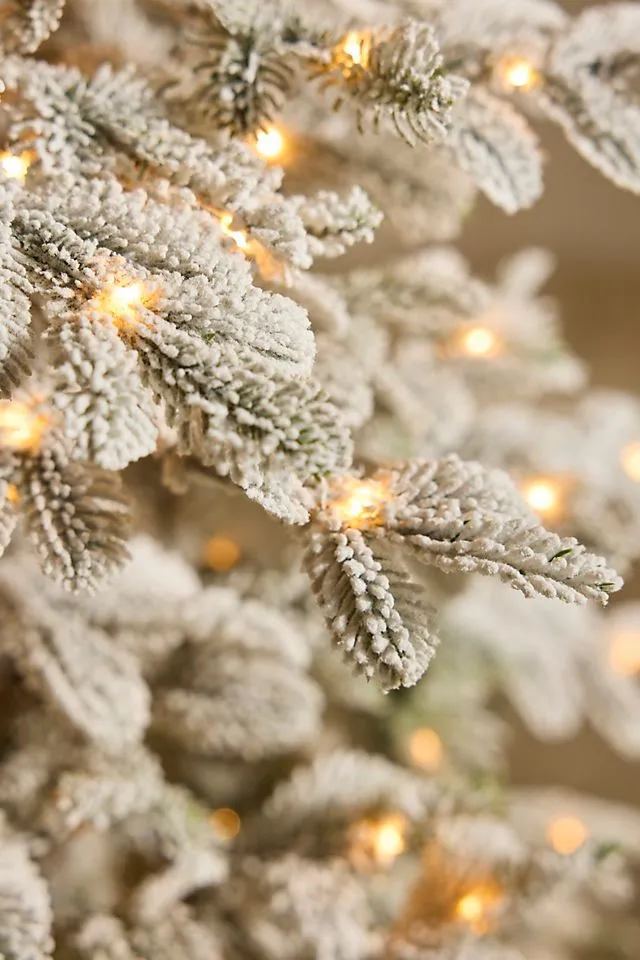
- Wrap the trunk first, then weave each strand along the branch’s inner third.
- Push bulbs down between needles instead of resting them on top.
- Work in 12-inch sections and leave enough slack to shape the branches.
- Test every strand before installing — troubleshooting on a flocked tree is misery.
- Step back at eye level to check for dark pockets and fill them.
Time: 60 to 90 minutes. New LED strands: $20 to $35.
15. Golden Glow Through Heavy Snow Flocking
There’s exactly one ornament visible in this frame and it’s barely there. That’s the trick: when flocking is this heavy, texture becomes the decoration and ornaments become interruptions. Warm gold light bounces off every frosted needle, which multiplies a single strand into what looks like hundreds of sources. Add a dozen glossy baubles and the glow flattens into reflections you can’t see. Restraint is doing more work here than any styling choice.
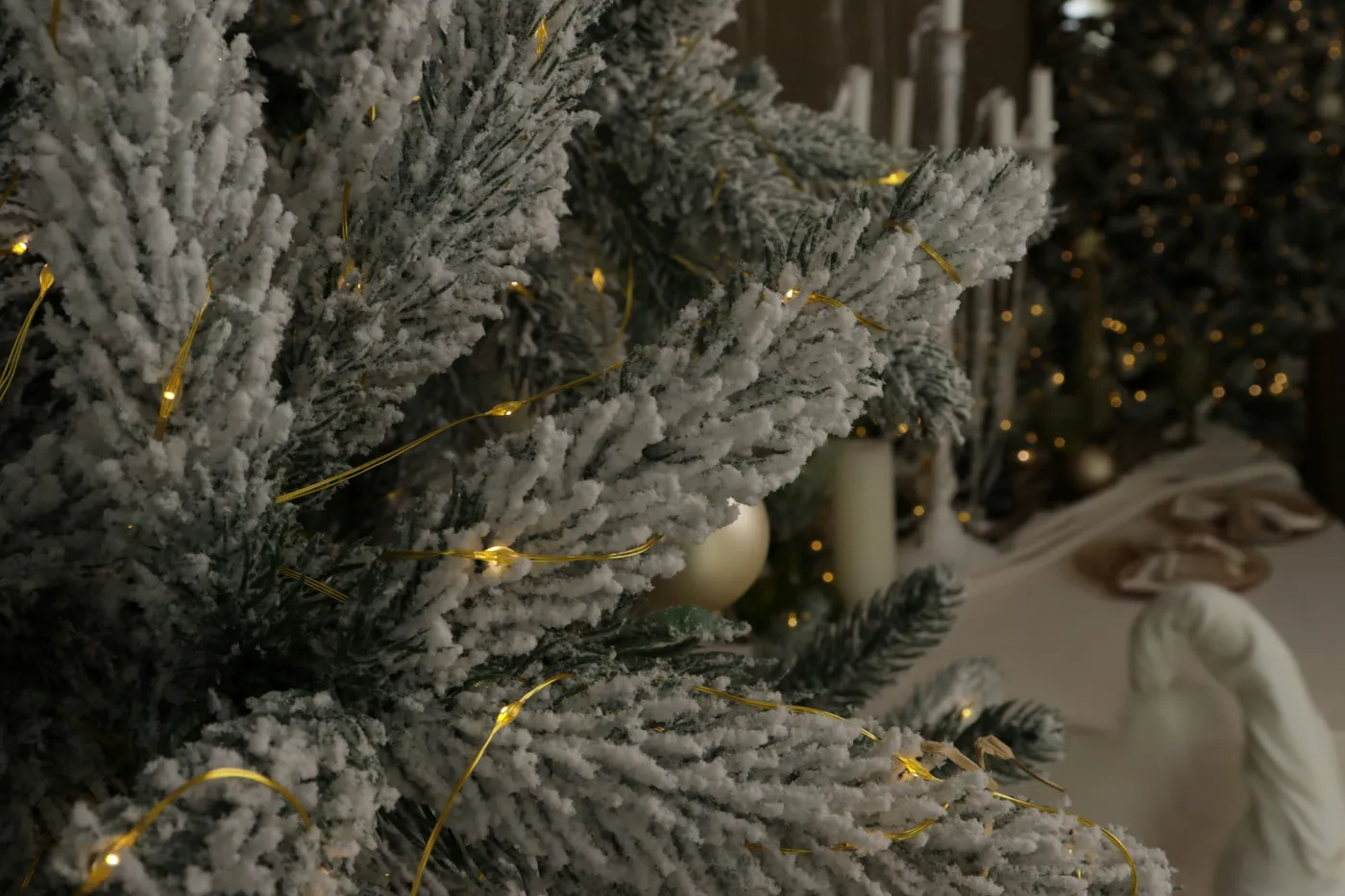
This is a small-room formula. Because the glow reads as depth, a heavily flocked tree works in spaces as tight as 8 by 10 feet, and even a 5-foot version looks substantial against one wall. Ceiling height is forgiving too — a foot of clearance above the topper is plenty when the tree is this dense. In larger, more open rooms like Idea #4, go taller and leaner instead so the tree doesn’t read as a bush in the corner.
16. Blue, Sage, and White on Frosted Pine
Here’s the mix: 50% flocked white branch base, 25% blue and green sphere ornaments, 15% sage flower picks, 10% frosted berry stems. The sage is what keeps navy from reading nautical — it’s a green that goes soft next to blue. To swap the palette, hold the 50/25/15/10 split and trade navy for cranberry, or sage for blush. The proportions, not the colors, are what make a heavily loaded tree look abundant instead of cluttered.
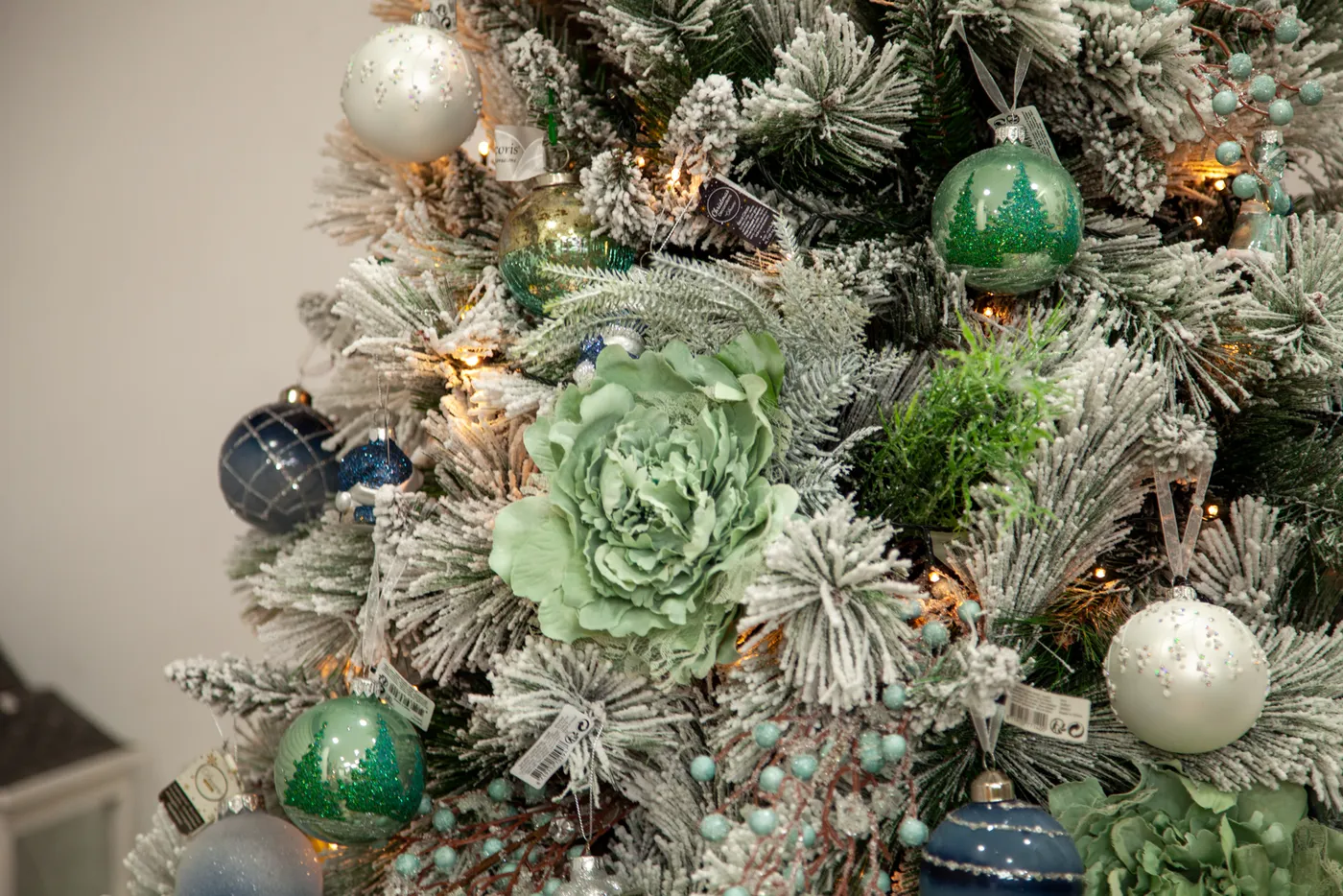
The floral picks are where this gets expensive, and also the easiest place to save. Dollar Tree and Walmart both carry stem picks for $1 to $3 each; you need roughly 12 to 20 for a 7-foot tree, so $20 to $50 instead of $150 at a specialty shop. Navy and sage ornaments show up constantly at HomeGoods and on Marketplace after the first week of December. Frosted berry stems are the last thing to sell out, so grab those early.
17. Silver and Dark Gray on a Blue-Gray Wall
Dark ornaments need to be silhouetted to read. Hang the ribbed gray baubles on the front-facing branch tips where the flocking sits directly behind them, never pushed deep into the tree — gray against a shadowy interior simply disappears. Silver is the opposite: it works anywhere because it throws back whatever light hits it. Rule of thumb — dark finishes go out front, reflective finishes can go deeper.

A blue-gray wall behind a flocked tree is striking in daylight and can go cold at night. If your lamps are all cool-white LEDs, the wall reads gray-blue and the tree looks like it’s sitting in a walk-in freezer. Two warm 2700K bulbs nearby fix it, and a dimmer on the tree lights lets you soften everything after dinner. Worth knowing: flocking against a dark wall shows every bare patch, so fluff thoroughly.
18. Silver Forest Table Setting With Tinsel Garland
- Lay the tinsel garland first, running it straight down the center of the cloth.
- Gently part the garland where each setting lands so plates sit on fabric, not wire.
- Space settings 24 inches apart, center to center.
- Tuck a silver ornament and a cracker between each setting.
- Finish with cutlery laid 1 inch from the plate edge.
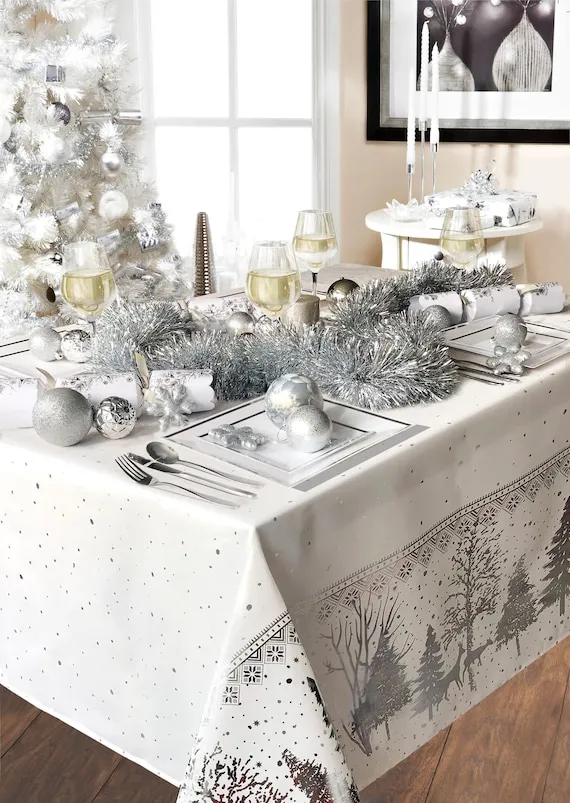
Time: 30 minutes for six seats. Cost: about $45 if everything is new.
Tinsel sheds. It gets into carpet, into food, into the dog. Shake it outdoors over a trash bag before it ever touches the table, and expect to vacuum twice per event. The printed tablecloth here needs a cool, gentle cycle and air drying — foil prints crack in a hot dryer after two or three washes. If that’s too much upkeep, a beaded garland gives nearly the same shimmer with no shedding, though it costs a bit more up front.
19. Flocked Tree, Garland, and Wreath Over a Wood Stove
The repetition. Flocked tree, matching garland on the mantel shelf, matching wreath on the wall above — the trio is what turns a corner into a whole vignette. Pull any one piece and the room still works, but it stops feeling deliberate. The red berries and pinecones running through both the garland and the wreath tie them together without one matching ornament. And keep every piece clear of the stove pipe — decorative or not, heat is heat.
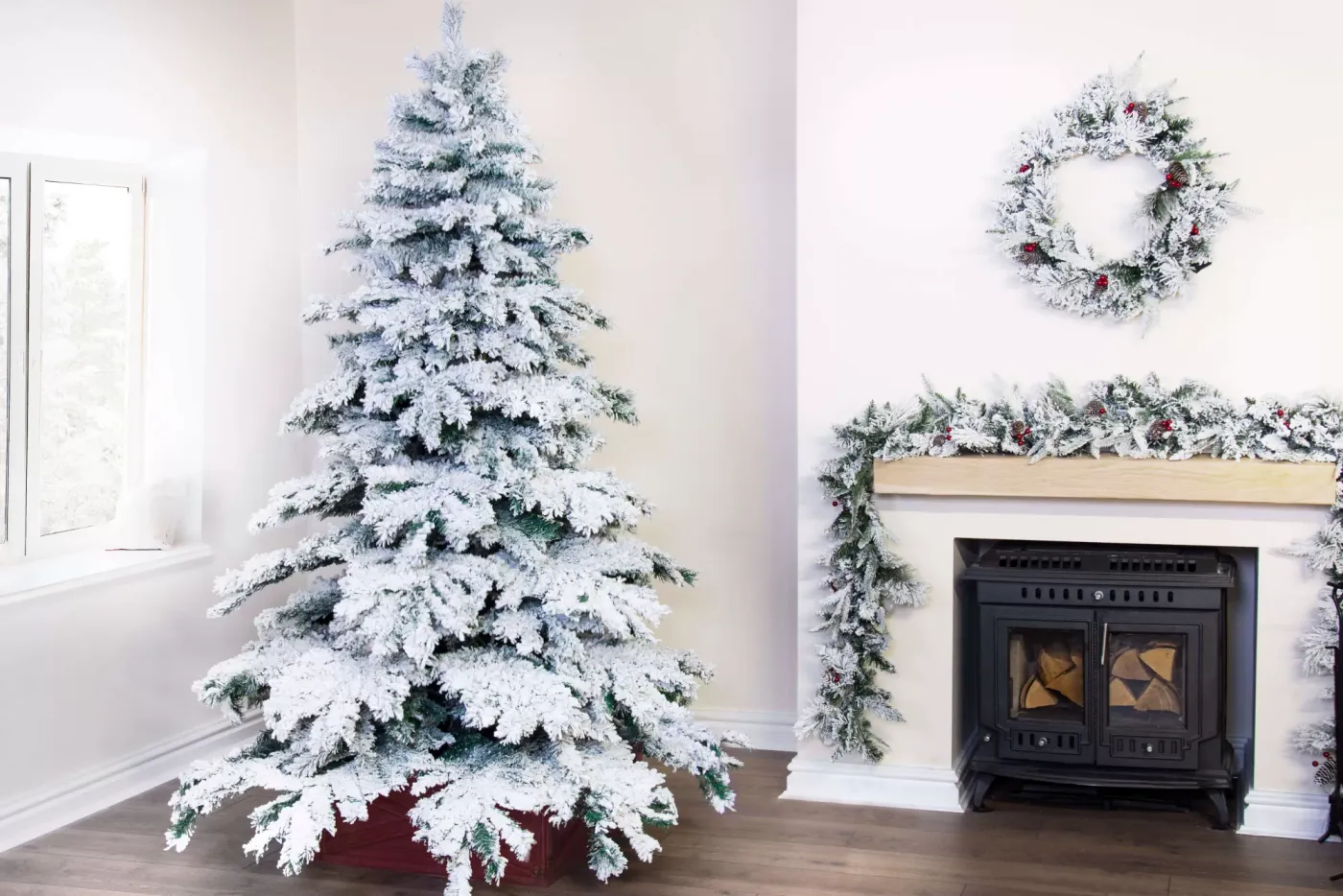
- Flocked tree, 7 ft: $150 – $350
- Matching flocked garland, 9 ft: $30 – $80
- Flocked wreath, 24 in: $25 – $60
- Red berry and pinecone picks: $15 – $40
- Wood crate or basket base: $25 – $70
Total: roughly $245 – $600
Budget alternative: buy the garland and wreath un-flocked and add a $15 can of spray flocking yourself — same look, about half off, and you control the snow density.
20. Warm Ornaments, Stacked Logs, Knitted Throw
Everything in this frame is warm except the snow. Amber and gold ornaments match the glow of the string lights, the stacked logs in the alcove repeat the same brown, and the knitted throw adds a third texture at eye level. The flocking works precisely because it’s the only cool element — it reads as snow rather than as another beige. Layer two or three warm materials and the tree stops being decoration and becomes part of the room.
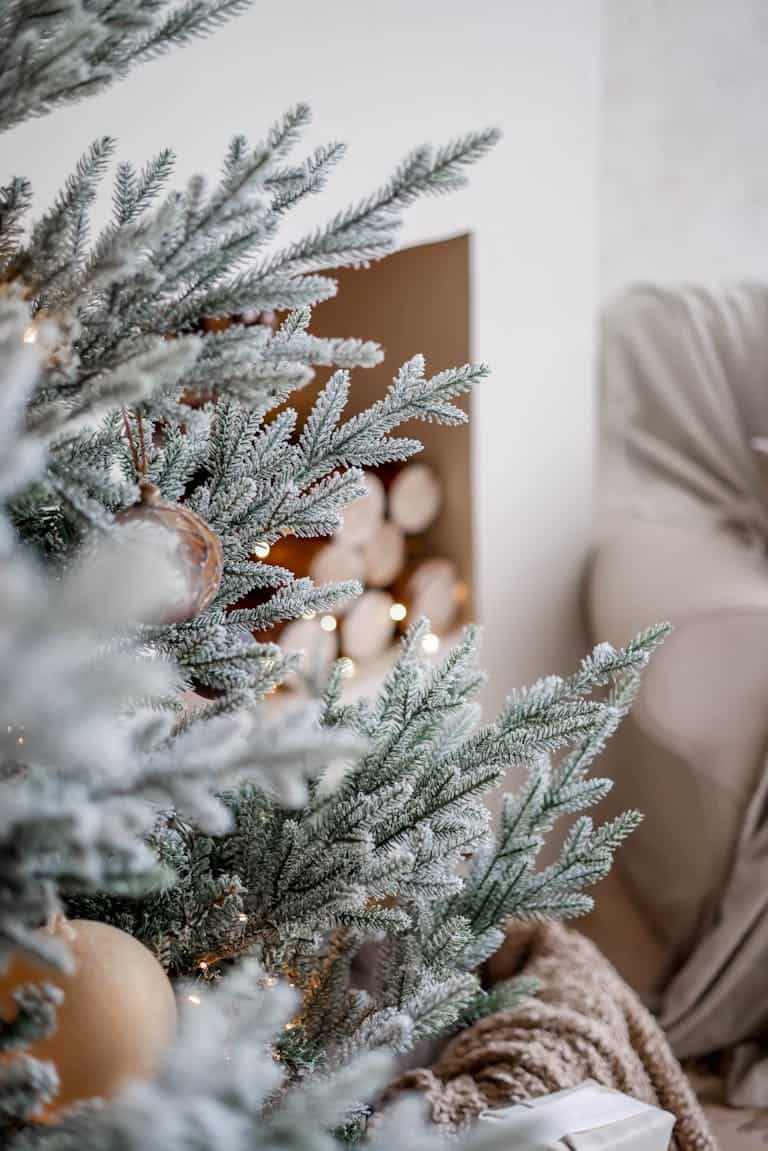
The hearth styling you see here — logs, throws, warm amber glass — grew out of the long-running cottagecore wave and the newer quiet-luxury holiday aesthetic. People aren’t buying more ornaments; they’re buying texture. Searches for knitted throws and wooden decor climb every November, and barely decorated flocked trees get saved far more often than the fully loaded ones. It sticks around because it’s cheap to maintain once you own the pieces.
21. Flocked Tree and Wreath on a Dusty Blue Wall
You need a wall about 6 feet wide and a ceiling of at least 8 feet to stack a tree and a wreath vertically. The tree here is roughly 6.5 to 7 feet with a 24-inch wreath centered 8 to 12 inches above the apex. In a lower room, drop the tree to 5 feet rather than shrinking the wreath — an undersized wreath over a tall tree looks like a mistake. Small wall? See Idea #28 for texture that works without any vertical stack.
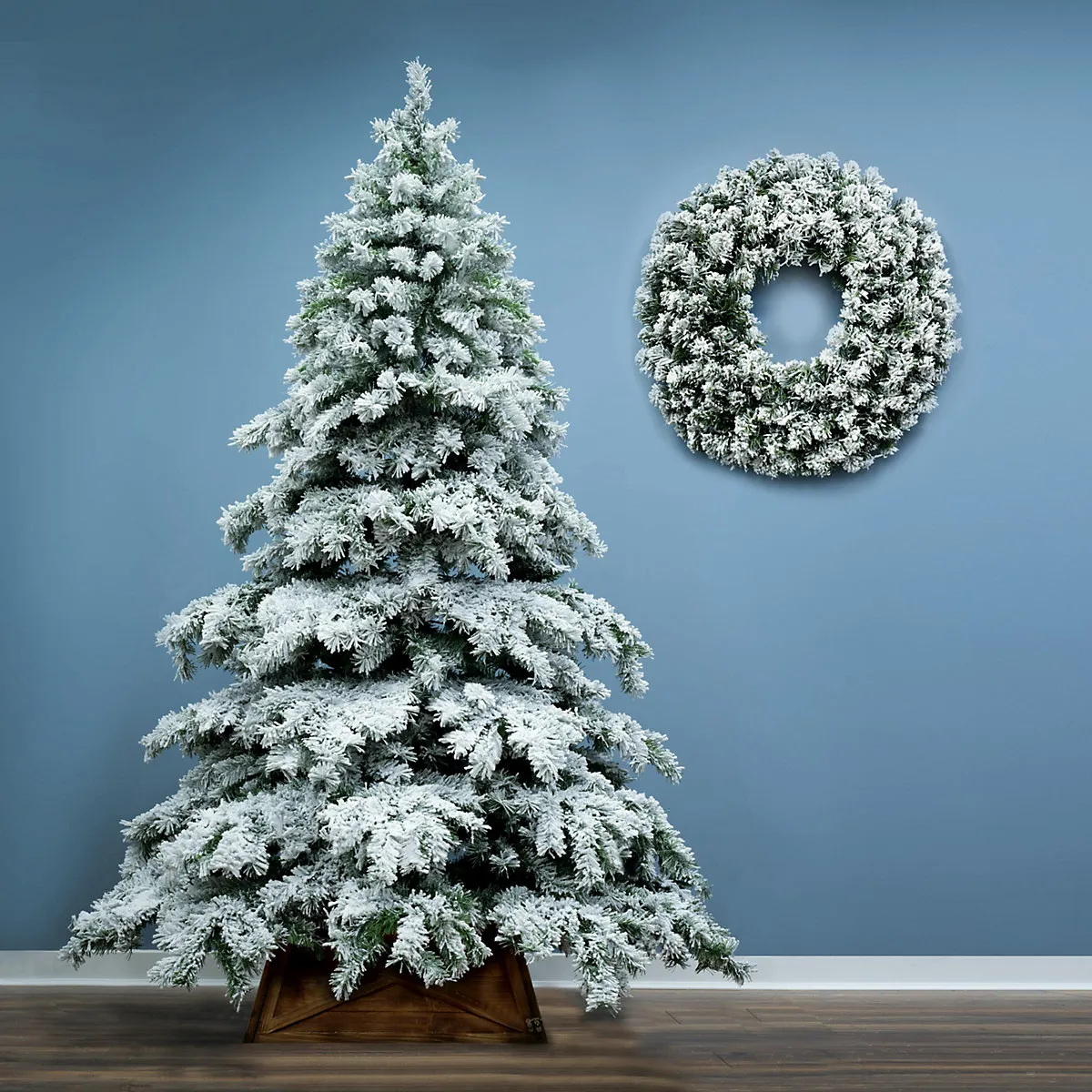
Center the wreath on the tree’s apex, not the wall. Measure from the wall and you’ll be off by however much the tree leans — and trees always lean a little. Hang the wreath from a single nail with a ribbon loop long enough to adjust, step back six feet, and nudge it until the centerlines match. A 3 to 4-inch gap between the top branch and the bottom of the wreath is the sweet spot.
22. Off-White Baubles and Iridescent Snowflakes
Off-white ornaments are sold everywhere in bulk — Walmart and Target both run 30-count sets for $10 to $18, and Dollar Tree carries individual iridescent snowflakes seasonally. The caps are what make cheap ornaments look expensive, so if yours come with plastic loops, a $6 bag of metal caps changes the whole tree. Budget version of this look: about $35 worth of decor for a 6-foot flocked tree, versus $180 at a boutique.
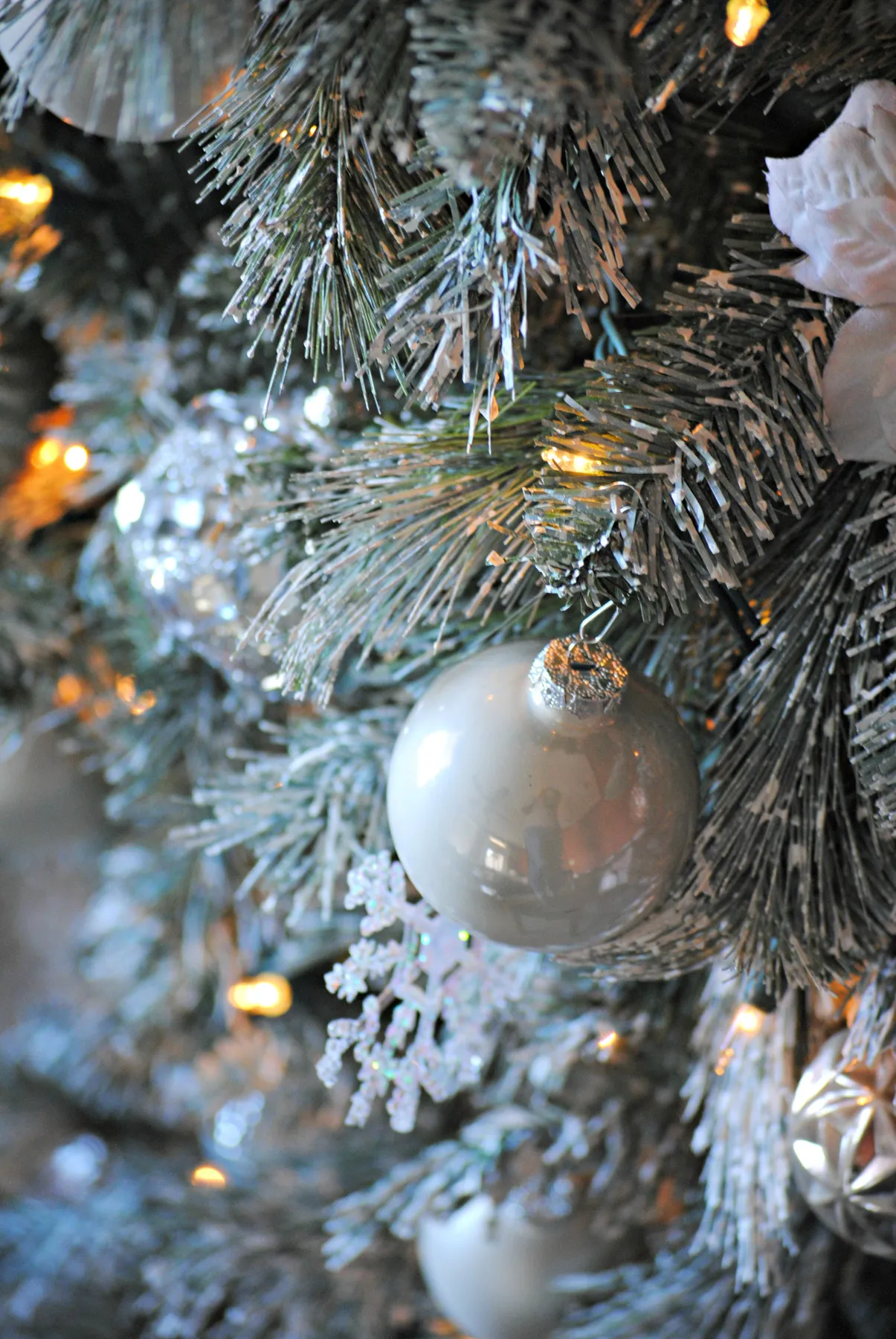
- Alternate finishes rather than sizes: matte, then glittery or iridescent, then plain.
- Repeat that three-step rhythm all the way around the tree.
- Keep iridescent pieces toward the outer branches where side light can catch them.
- Cluster two or three small ornaments in visible gaps instead of spreading everything evenly.
- Finish with a single white fabric flower tucked near the trunk for depth.
Time: about 40 minutes. Cost: $30 to $60 for a 7-foot tree.
23. White Tree, Kraft Gifts, Olive Green Wall
Olive green, warm gold, and heavy flocking can go muddy fast, especially in a room that never gets direct daylight. Under warm bulbs at night this palette turns sepia — which some people love and others really don’t. Test it: photograph the corner at 8 p.m. before you commit to twenty yards of olive ribbon. Also, kraft paper shows every crease and fingerprint. Sharp folds are the difference between intentional and we-ran-out-of-wrapping-paper.
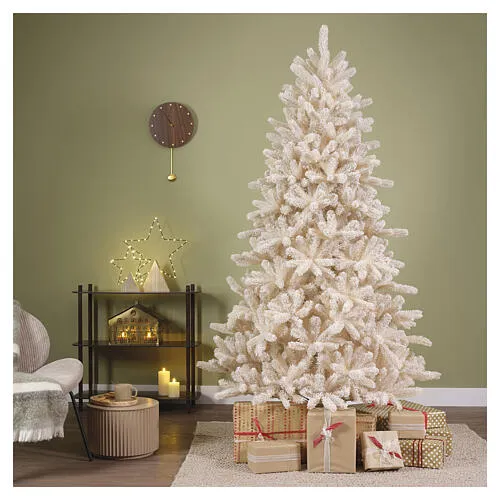
Count it out: about 50% flocked white tree, 20% olive wall and greenery, 20% kraft brown from the gifts, 10% gold. Brown and gold sit close on the color wheel, which is exactly why the room feels calm instead of busy. Want more energy? Drop kraft to 10% and rebalance toward deep green ribbon. Want it quieter? Trade gold for brushed brass and shrink the contrast between tree and wall.
24. Flocking So Thick the Lights Float
Lights and heavy flocking each need attention once a year. Before you pack the tree away, test every strand and mark the dead ones with a twist tie so you’re not guessing next December. Wipe bulbs with a dry microfiber cloth — dust on a bulb is what makes a warm string look dim. Expect to replace about one strand per season on a heavily lit tree, and store lights in a labeled bag rather than wrapped around the trunk.
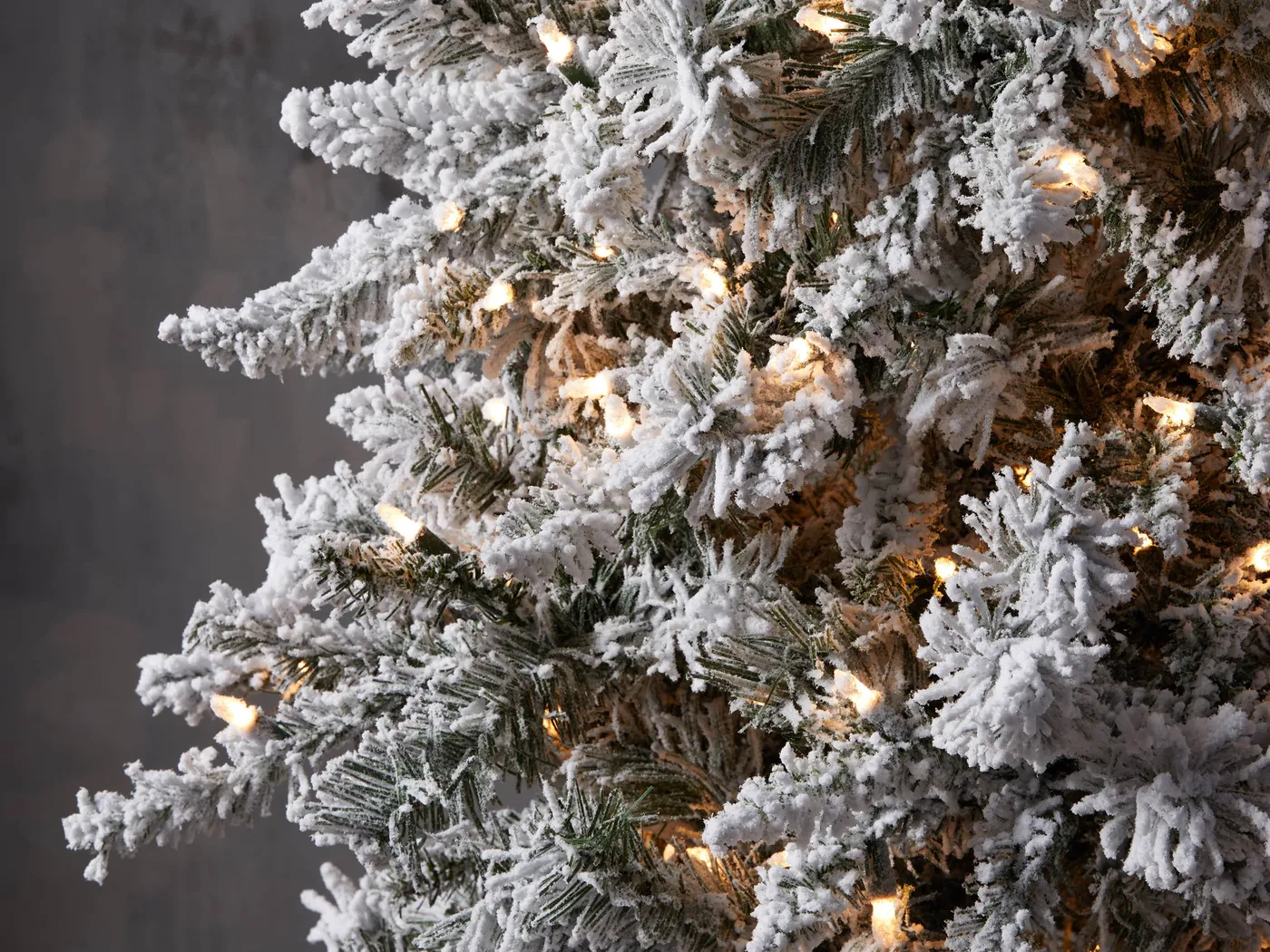
Put flocked-light trees on a dimmer. At full brightness, 900 warm bulbs in a small room becomes a light source rather than an accent — you lose the glow and start squinting. A plug-in inline dimmer costs about $12 and lets you run the tree at 50 to 70% after dinner, which is when the snowy texture actually reads. If paper ornaments are nearby, keep bulbs at least 3 inches clear of them.
25. Sparse Green Tree With Matte Gold and Silver
- Measure your planter footprint — a sparse 6-foot tree still needs a 16 to 20-inch base to look stable.
- Decide matte or shiny before you buy; mixing across an entire tree dulls the finish.
- Check that the skinniest branches can hold an ornament without drooping.
- Confirm an outlet near the fireplace side, not just the far wall.
- Budget for filler — sparse trees need 20 to 30% more ornaments than dense ones.
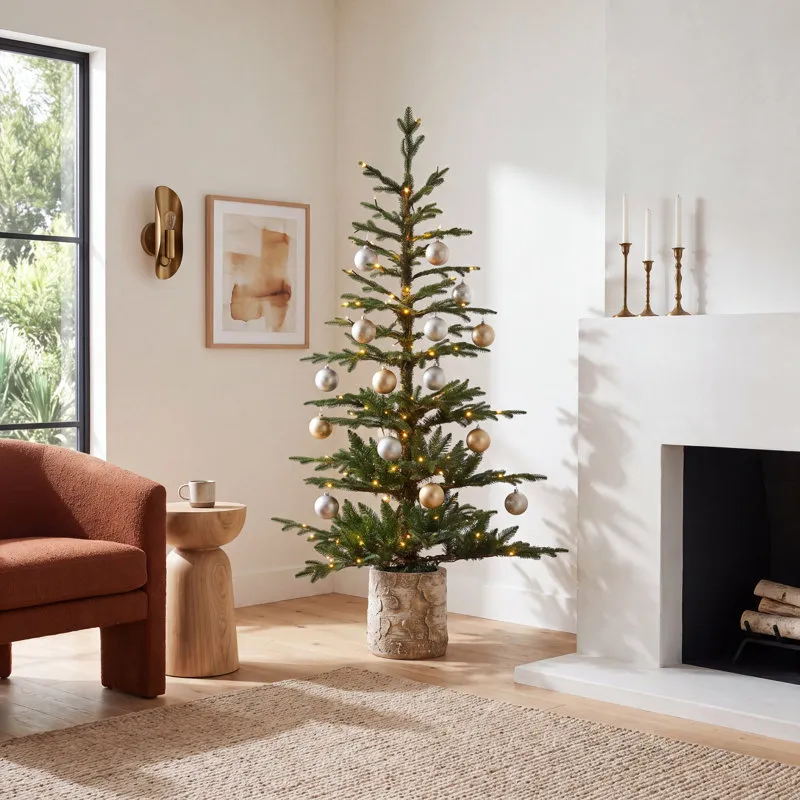
Sparse branches plus matte gold is a deliberate mismatch of textures. Matte ornaments don’t reflect the room, so they read as soft shapes floating in the gaps, and the tree never turns into a shiny blob. The light planter, natural fiber rug, and beige walls keep the green branches as the only saturated color, which is why this reads modern instead of traditional. Take away the matte finish and it’s just another gold tree.
26. Lit Birch Trees and a Pale Blue House Lantern
- Pre-lit birch trees, three heights: $60 – $150
- Pale blue metal house lantern: $20 – $45
- Frosted pinecone trees, set of three: $25 – $60
- Berry garland with faux snow: $15 – $35
- Metal basket and cut logs: $20 – $50
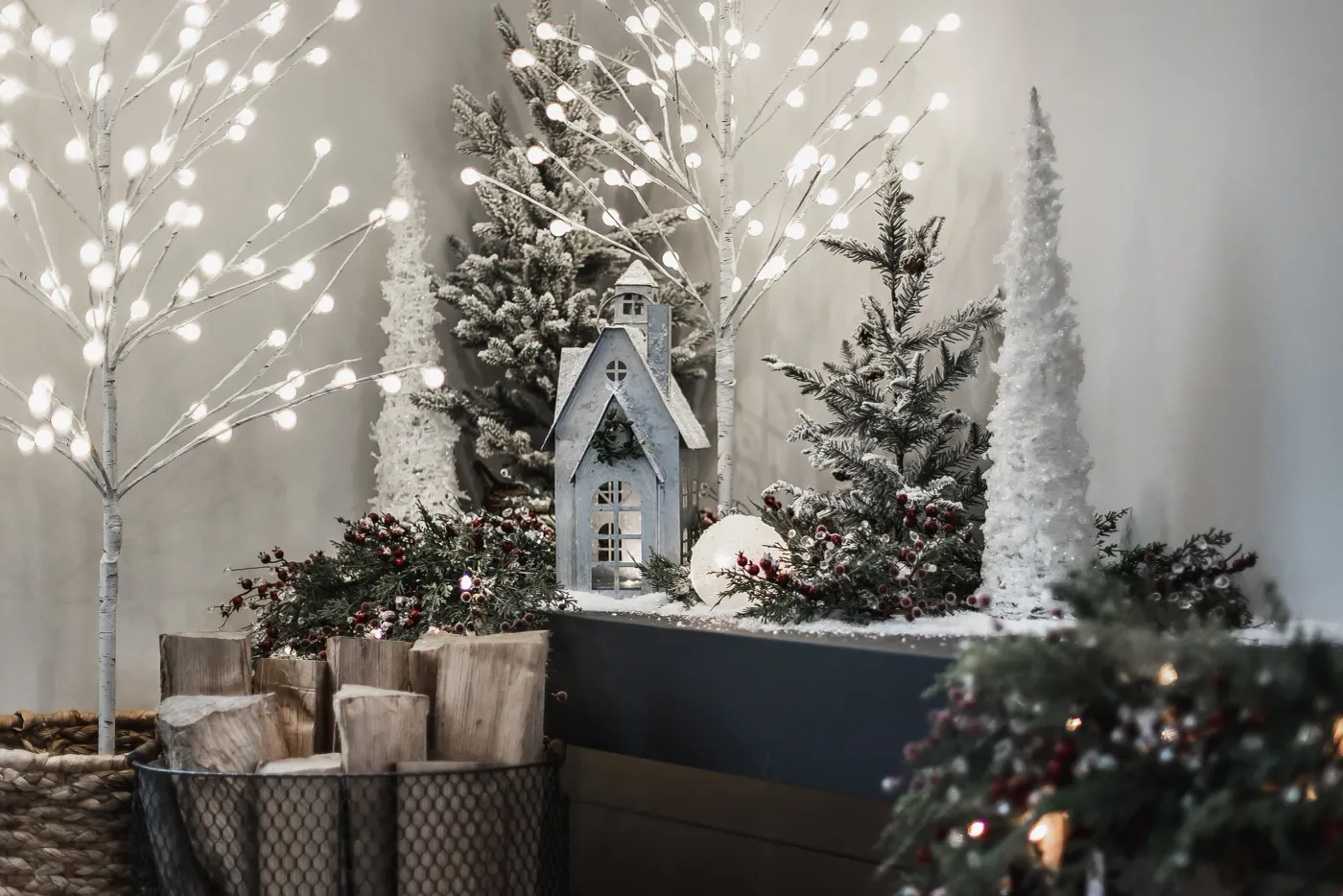
Total: roughly $140 – $340
Budget alternative: skip the birch and cut three branches from the yard, spray them white, and wrap with a $6 strand of battery lights — the silhouette does most of the work anyway.
Miniature winter scenes took over sideboards and entry consoles a few seasons back and they haven’t slowed down. The appeal is scalability: you can build a village on a two-foot surface, which works in apartments where a second tree won’t fit. Birch and lantern shapes sell out at big-box stores every November, which tells you the trend has moved from craft fair to mainstream. It’s also one of the few holiday displays that stores flat in January.
27. An Unadorned White Tree on a Jute Rug
The tree has nothing on it, and that’s the entire idea. No ornaments, no ribbon, no tricks — just white branches, a dark woven skirt, and gifts doing the decorating. It only works because the surroundings are quiet: paneled wall, gray sofa, jute rug. In a busy room, a bare tree reads as unfinished. Here it reads as restraint, and it costs less than anything else in this list. Sometimes the most expensive-looking choice is simply not adding anything else.
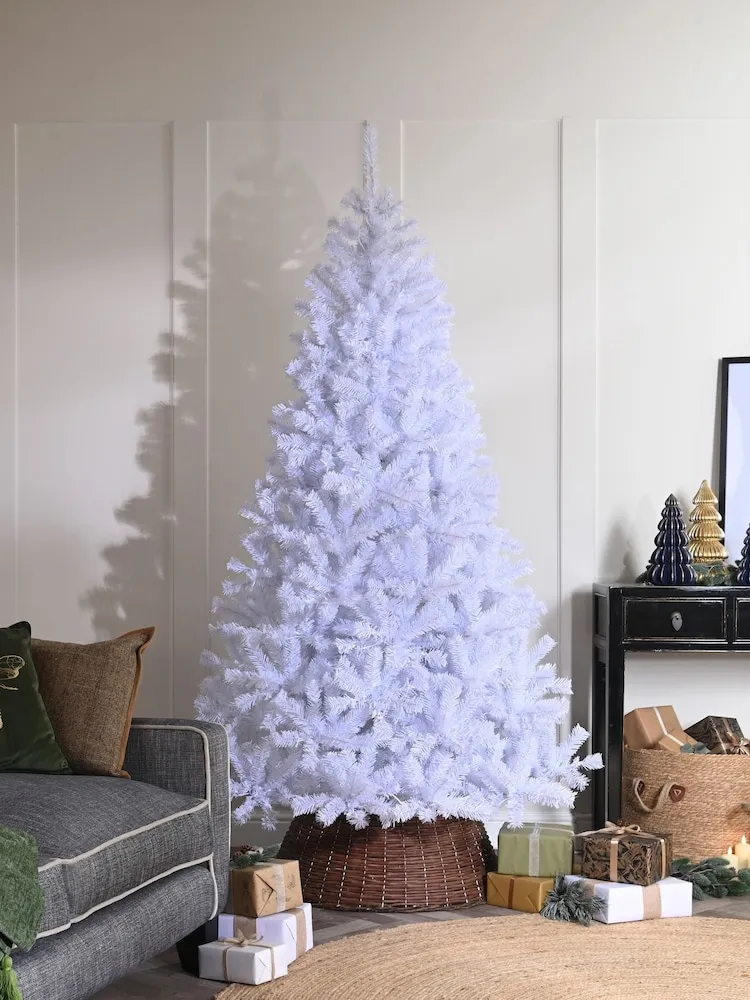
Jute rugs run about $30 to $60 at IKEA for a 5-foot round. The dark woven basket skirt is the kind of thing thrift stores price at $8 to $15 because they don’t know what to call it. Kraft paper is $6 a roll at Target, and white or pale green ribbon adds maybe $4. Already own a tree and a can of white spray paint? You can build this entire corner for under $80 — and the gifts count as decor until December 25.
28. Frost on Dark Needles, Light Behind
Close up, the ratio is simple: 70% deep green, 30% frost white. That’s why it reads natural instead of artificial — heavy snow coverage over light green needles looks like spray paint, and over deep green it looks like weather. To use the same formula elsewhere, keep dark evergreens as the base and let white be the accent: white berries, white ribbon, white candles. Reverse it and you get a candy-cane effect, which is a different and much louder room.
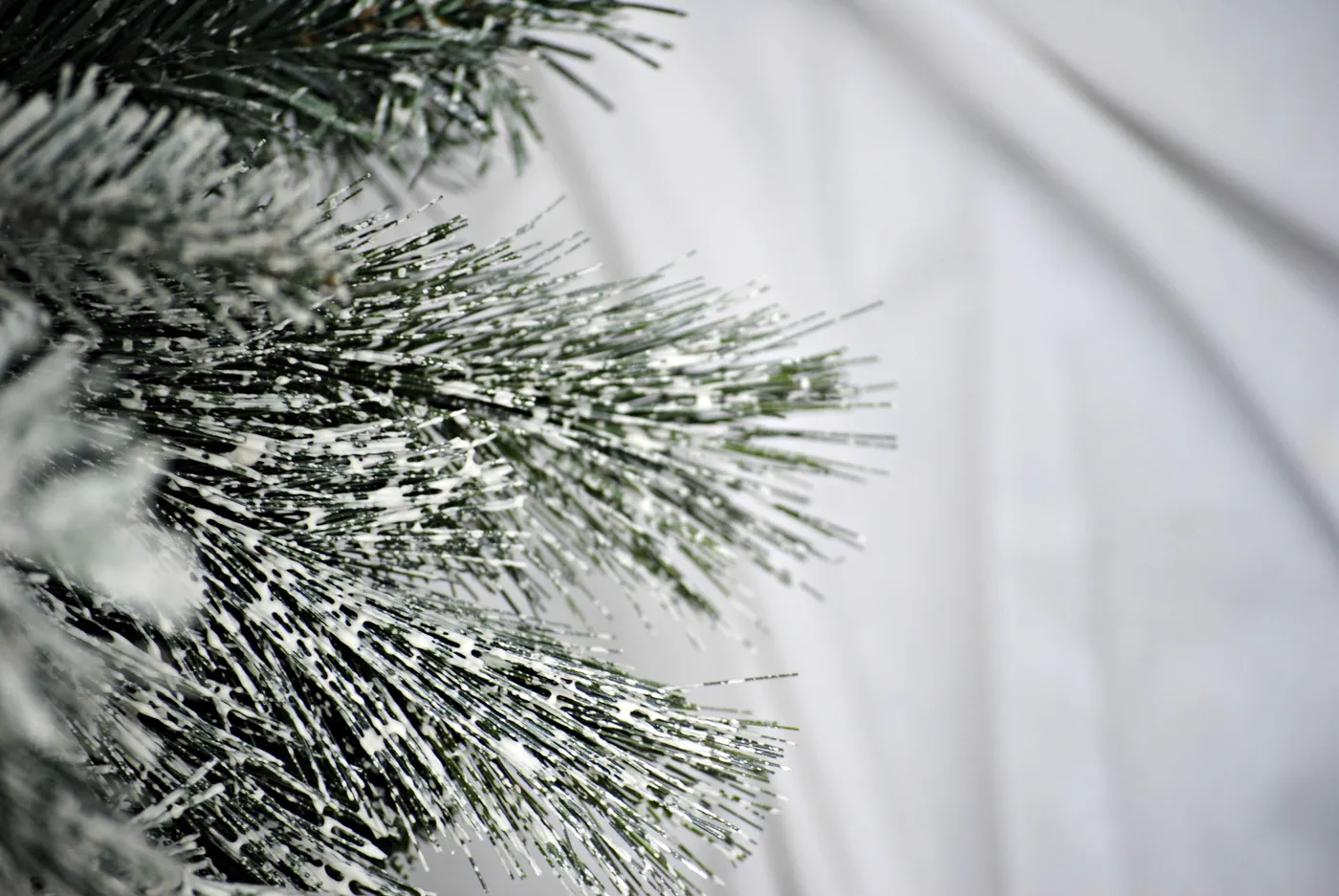
Heavily frosted dark greenery gets dark, literally. In a corner without daylight, that deep green goes nearly black and the frost turns gray-blue — not the serene look you saved. Photograph your corner at the time of day you’ll actually see it most, usually evening. If it goes flat, one warm floor lamp angled up into the branches brings the frost back to life for about $40.
29. Glowing Snow-Covered Gift Boxes at the Base
- Start with three plain gift boxes in graduated sizes — 8, 10, and 12 inches.
- Cut a small hole in the back panel of each and feed a battery fairy-light strand inside.
- Tape the strand down so it doesn’t tangle with the contents.
- Wrap the outsides, then add burlap ribbon, a frosted pinecone, and a few red berries.
- Batch your work — one strand can light two small boxes.
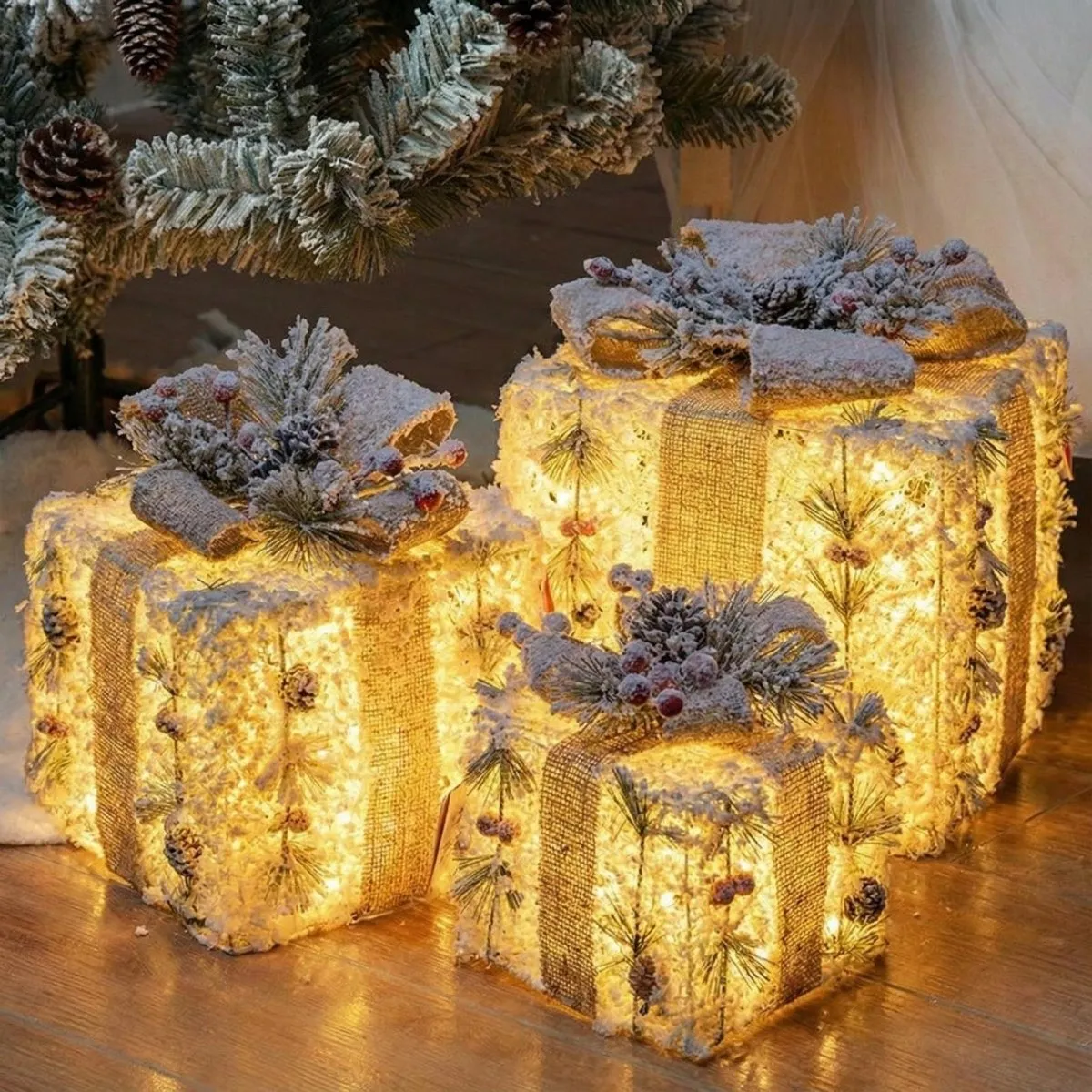
Time: about an hour. Materials: $25 to $40 for all three.
Three boxes is the ceiling for this look. Go bigger than 12 inches and they compete with the tree; use four or more and you’ve built a pile instead of a display. Keep the group within about 18 inches of the tree’s base so the frost reads as one continuous scene, and leave the boxes at floor level rather than on a bench — low placement makes the tree feel taller. Entryways can use a single 8-inch version, like the display in Idea #26.
30. Flocked Branches With Multicolor Bulbs
Multicolor works on a flocked tree only if the bulbs stay in the inner half of the branches. Out at the tips, red and purple bulbs read as candy against the snow and the tree turns chaotic. Pushed in, they glow through the flocking like stained glass — color without losing the white. Cap yourself at three colors. Four or more and the tree stops having a palette and starts having an inventory.
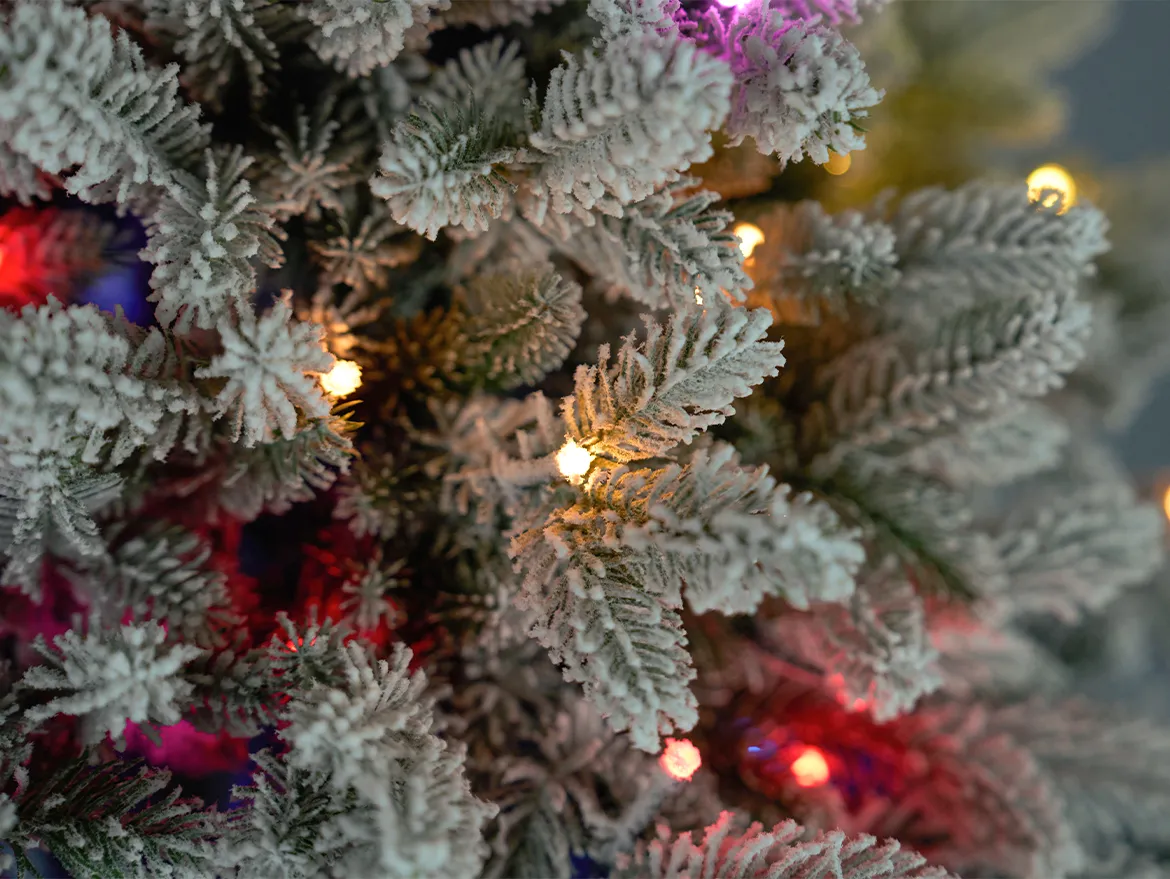
Count on 60% flocked white, 25% evergreen showing through, 15% colored light. The white has to stay the majority or the snow stops reading as snow. Want a warmer version? Trade purple for amber and the tree shifts toward traditional in seconds. Want it cooler? Swap red for teal and blue, and you’re back in the blue-and-silver territory of Idea #1 — same tree, completely different decade.
Let It Snow (Indoors, Obviously)
Whether you go full blue-and-silver or leave the tree completely bare, the white-tree look lives and dies on light temperature, texture, and a base that hides the messy parts. Pick one idea, steal the formula, and adjust the colors to whatever your room already does well. Snap a photo when it’s finished and pin it — next November you’ll be glad you kept track of what worked. 📌 Save this guide and share your tree.