30 Jaw-Dropping Gold Christmas Tree Decorations for 2026 That Will Dazzle Your Guests

You know that feeling when you finally spot the gold tree that looks exactly right — and then realize you have no idea where a single ornament came from? Same. We spent serious time browsing Target, Walmart, Amazon, and IKEA (plus a few thrift-store runs that paid off) to pull together 30 gold Christmas tree ideas that actually work in a real living room, spanning $5 novelty ornaments to a full $745 flocked setup. Inside you’ll find everything from bright navy-and-gold schemes to moody black-and-gold trees, frosted branches, tabletop wire sculptures, and one very charming croissant. Budget and luxury versions get compared side by side throughout, and every idea is shoppable with direct product links. Gold decorating is having a moment in 2026, and the shift is toward mixed finishes over matched sets — Pinterest is full of trees that look collected rather than bought in one trip. And stay until the end — we break down the most common mistakes that can ruin these looks. 📌 Save this to Pinterest for later — you’ll want to revisit these ideas.
1. Sunlit Living Room with Navy-and-Gold Tree Ornaments
The evergreen is the least interesting thing in this room — and that’s exactly why it works. What makes the space read as designed is a stingy handful of navy blue ornaments mixed into an otherwise gold-and-white tree, hung across from a white mantel so heavily draped in garland you can barely see the shelf underneath. Pull the navy out and you’ve got a pretty, forgettable gold tree. Put it back and the whole room snaps into focus.
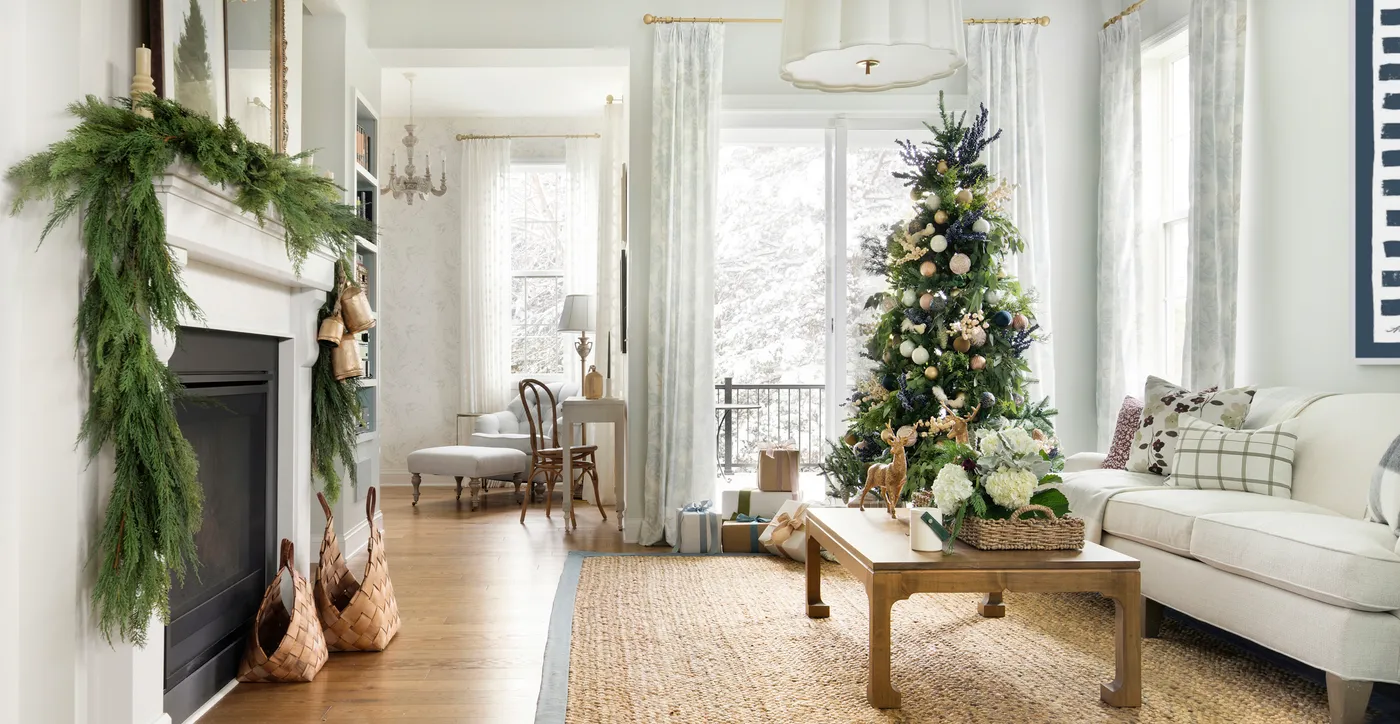
Read the room as a formula: about 50% cream base — sofa, walls, mantel, jute rug — 30% forest green from the tree and garland, 15% gold, and a deliberately small 5% navy. The navy only earns its place because there’s so little of it. Swap it for burgundy and the room turns warmer and more traditional; swap it for black and everything goes graphic and modern. The brass bells tucked into the garland are the texture layer that keeps a two-tone palette from looking flat.
2. Twin Glowing Light-Branch Trees Against Warm Wood
Two glowing trees in one corner sounds like a lot until you see it done with restraint. The trick is contrast, not symmetry — the dark brown branch tree reads as a silhouette against the warm wood paneling, while the pale near-white tree dissolves into the soft green-gray wall behind it. Two numbers worth stealing: keep the trees 18 to 24 inches apart so they register as a deliberate pair, and stagger their heights by at least a foot. If the corner gets no daylight, use warm-white bulbs only — cool white fights the yellow of the wood and makes the vignette look clinical.
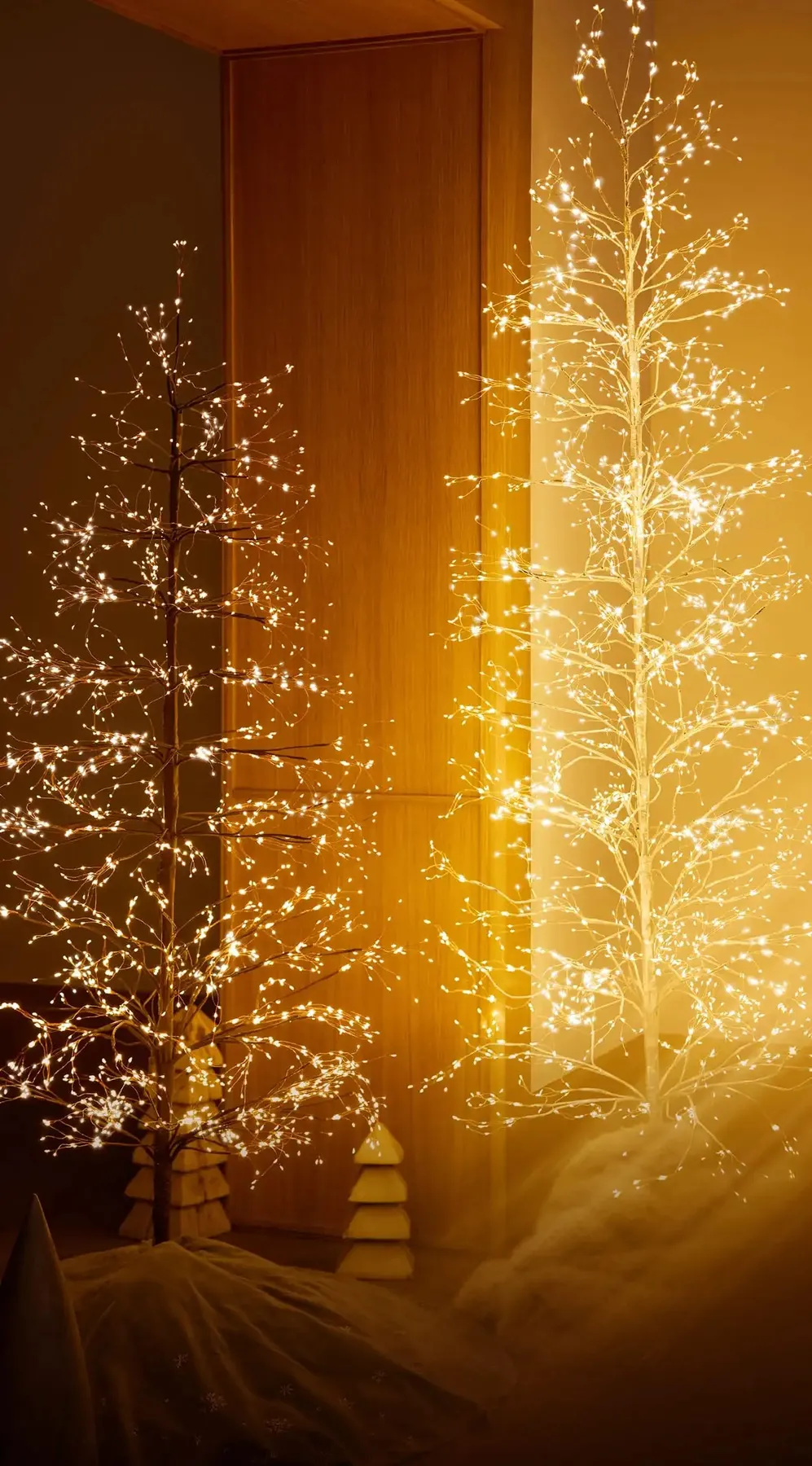
Warm wood slat walls have been the backdrop of choice for two winters running, and that’s a big part of why light-branch trees look so good right now. They don’t compete with the wall, they glow against it. Call it quiet luxury for the holidays: fewer ornaments, more warmth, nothing that needs eleven labeled storage bins in January. It’ll date slowly, because underneath the styling it’s really just good lighting design. The snowflake-draped fabric and stacked cone decorations at the base are doing the quiet work of grounding two objects that would otherwise float.
3. Tabletop Gold Tinsel Tree on a Faux Fur Skirt
A tabletop version of the gold-and-white look, priced out:
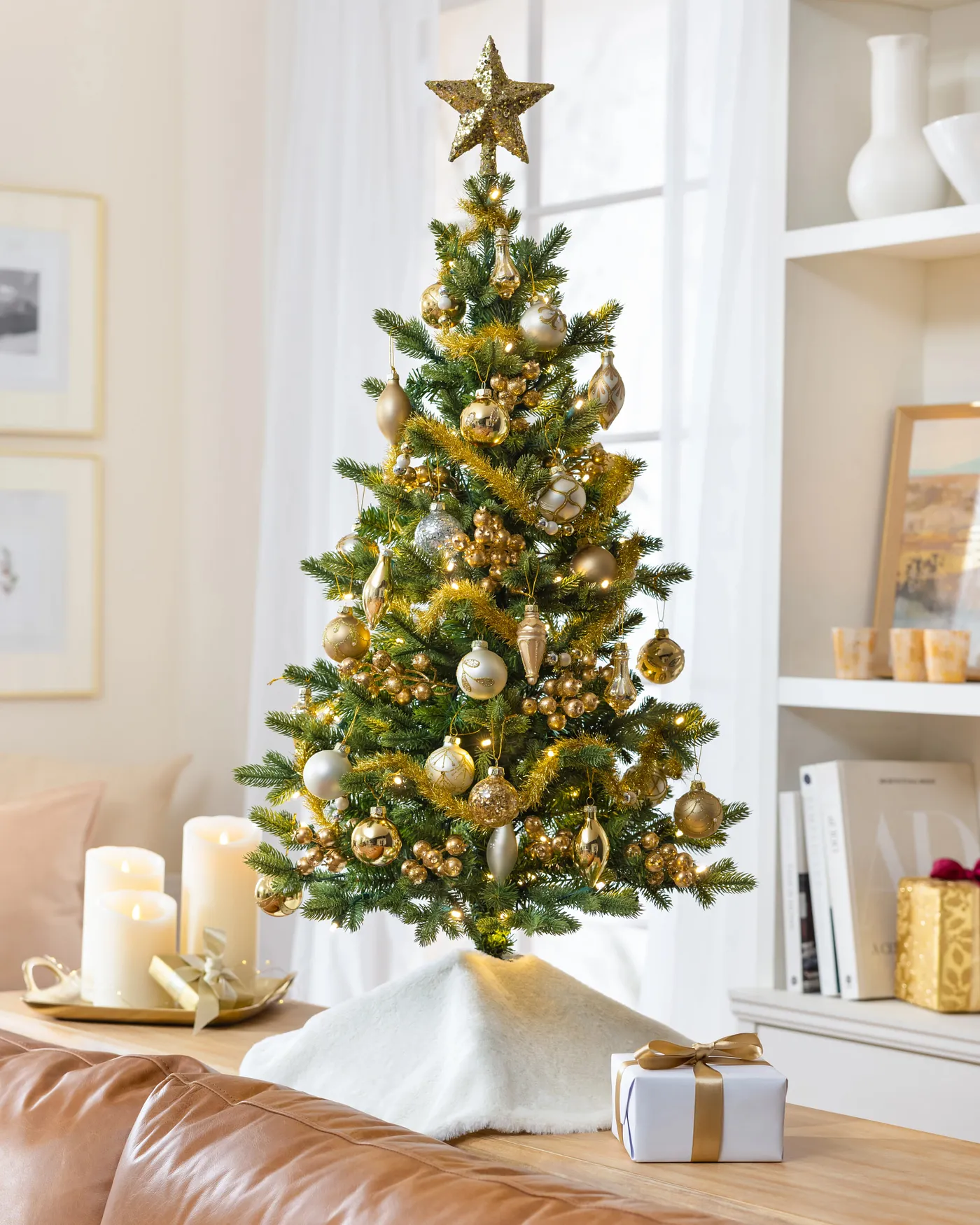
- Tree + skirt: $60–$180 (3–4 ft tabletop tree, white faux fur skirt)
- Lighting: $15–$40 (warm white string lights, pillar candles)
- Ornaments: $40–$120 (gold tinsel, mixed gold and white/silver ball sets)
- Topper + trim: $15–$45 (gold sequined star, bead strands)
- Decor: $25–$70 (gold tray, wrapped gift boxes with gold ribbon)
- Total: $155–$455
Budget alternative: skip the tinsel garland and run two strands of gold bead garland instead — about $12 at a craft store, and it photographs better.
If you remove one thing from this display, take the tinsel. If you remove the sequined gold star topper, the arrangement collapses into a generic mini tree. At four feet tall, a tabletop tree has roughly one place where the eye lands first, and here it’s the sparkle at the top. The white faux fur skirt matters too, but it’s supporting cast — it softens the base so the tree doesn’t look like it’s standing on a table.
4. Golden Deer and a Velvet Armchair by the Tree
Reindeer figures look expensive when they’re mismatched in posture and matched in finish. Pair one standing with one reclining, and let the height difference create a diagonal across the tabletop instead of a flat row of two. Keep tabletop deer between 10 and 16 inches tall — bigger and they start reading as lawn decor that wandered inside. Give them something dark behind them, like the charcoal velvet armchair here, so the gold has something to pop against. And leave the pinecone-and-berry arrangements low so the deer stay the tallest thing on the surface.
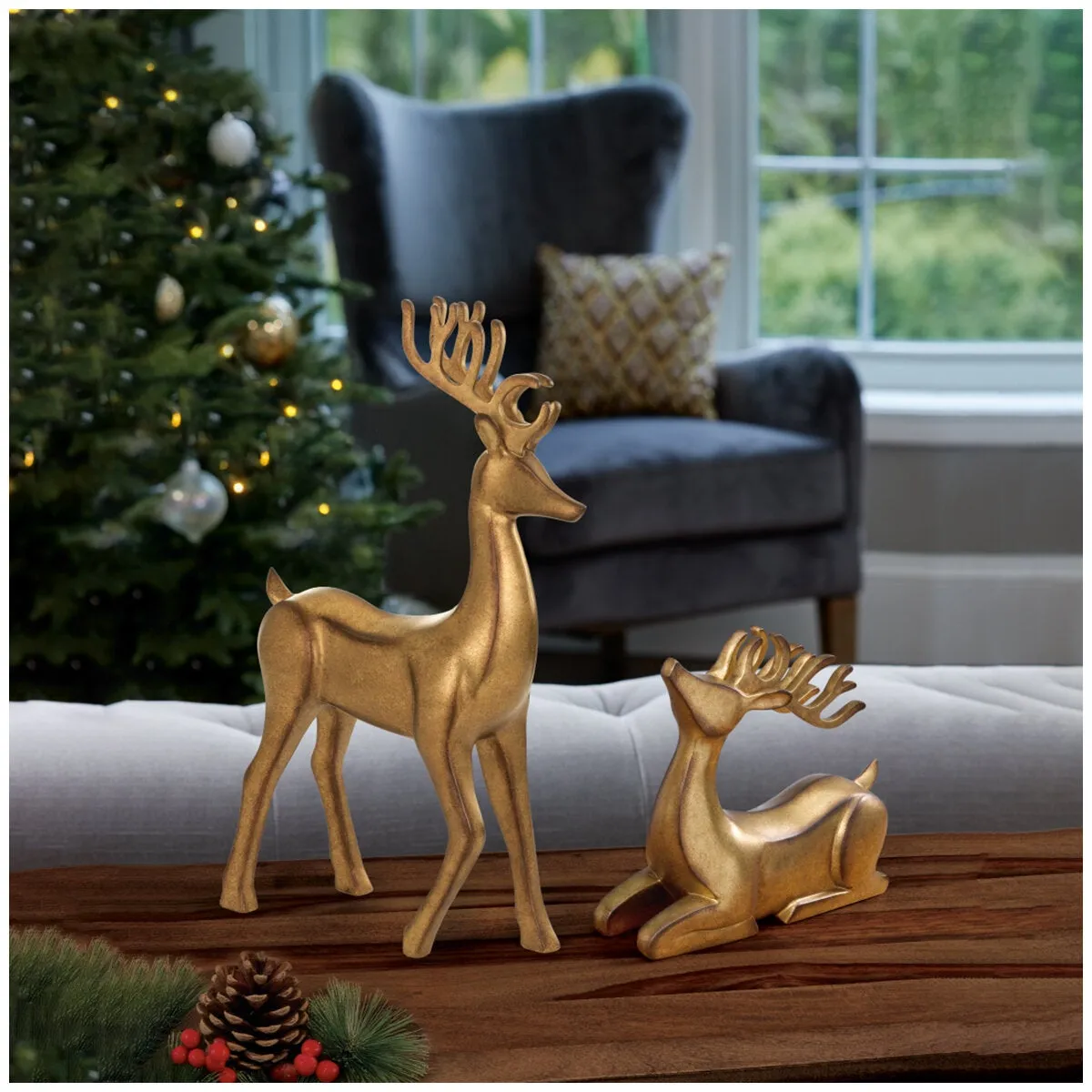
Gold-painted resin shows fingerprints and dust like nothing else in your holiday bin. Plan on a microfiber pass every time you move them, and skip spray polish, which dulls the metallic finish over a season or two. If you have a dog that counter-surfs or a toddler who treats tabletops as climbing gyms, put the deer above waist height — resin antlers snap. Velvet collects pet hair, so keep a lint roller in the drawer next to the decorations. Ten seconds, problem solved.
5. Golden Wire Cone Lights Beside a White Staircase
You don’t need custom lighting to get this glow. Gold wire cone lights run about $12–$25 each at Target or Walmart, and IKEA’s small decorative lamps in warm metallic finishes start around $15. Three clustered near a white staircase, stair-side, is the whole trick. For the look under $40 total, buy one cone light and line two woven baskets with warm fairy lights — same vertical glow, different texture. If the twin trees in Idea #2 caught your eye, these cones are that same idea scaled down to something you can move with one hand.
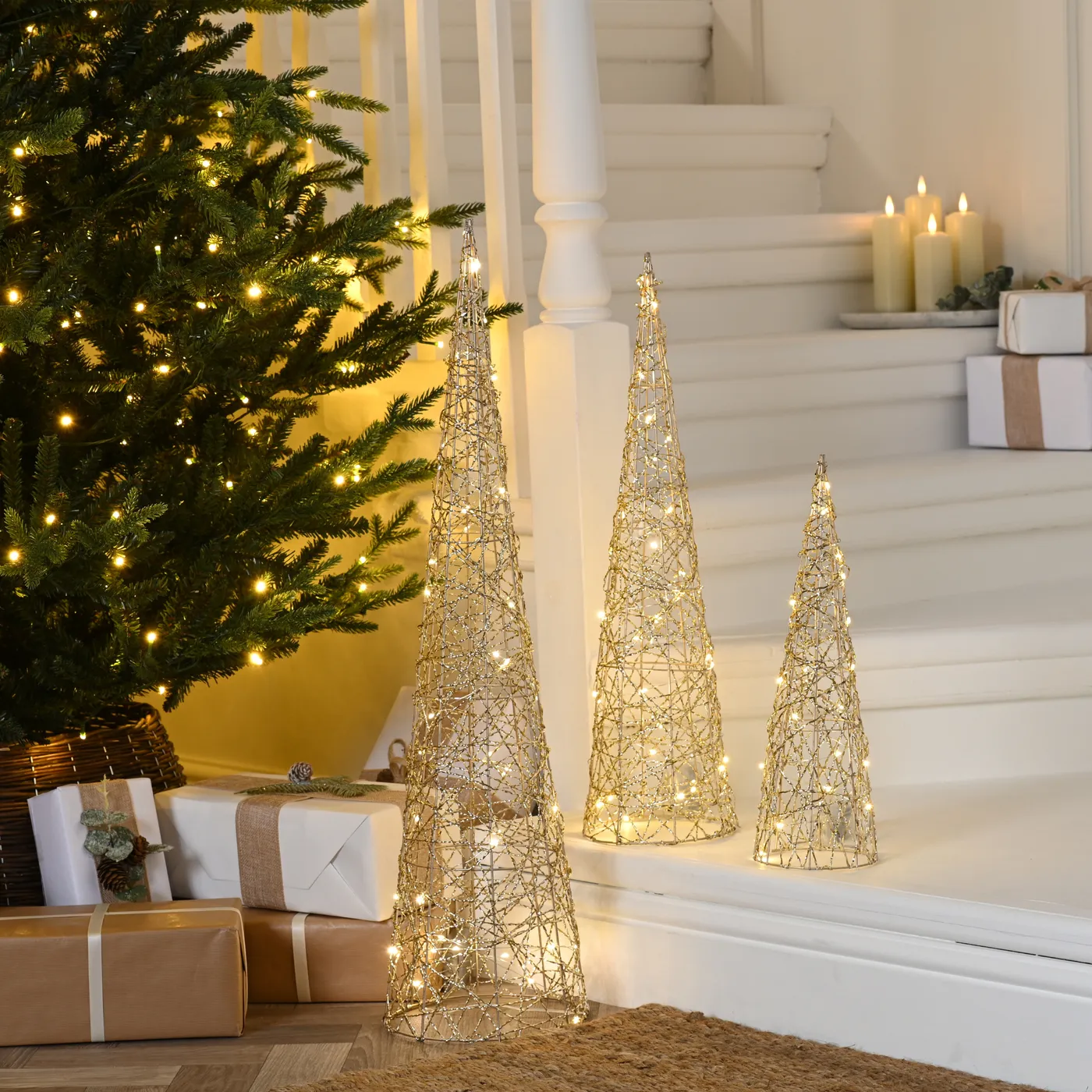
Three cone shapes in a row does something specific: it repeats the tree’s silhouette three times at a smaller scale, which is why the corner feels composed rather than cluttered. They also pick up warm reflection from the white painted staircase, so light bounces instead of dying in a dark corner. The gifts wrapped in natural browns and the woven floor mat give the gold something matte to sit against. Without those, three glowing cones start to read as a bit much.
6. White Bauble with a Gold Glitter Vine Pattern
You can make a vine-wrapped ornament in an afternoon:
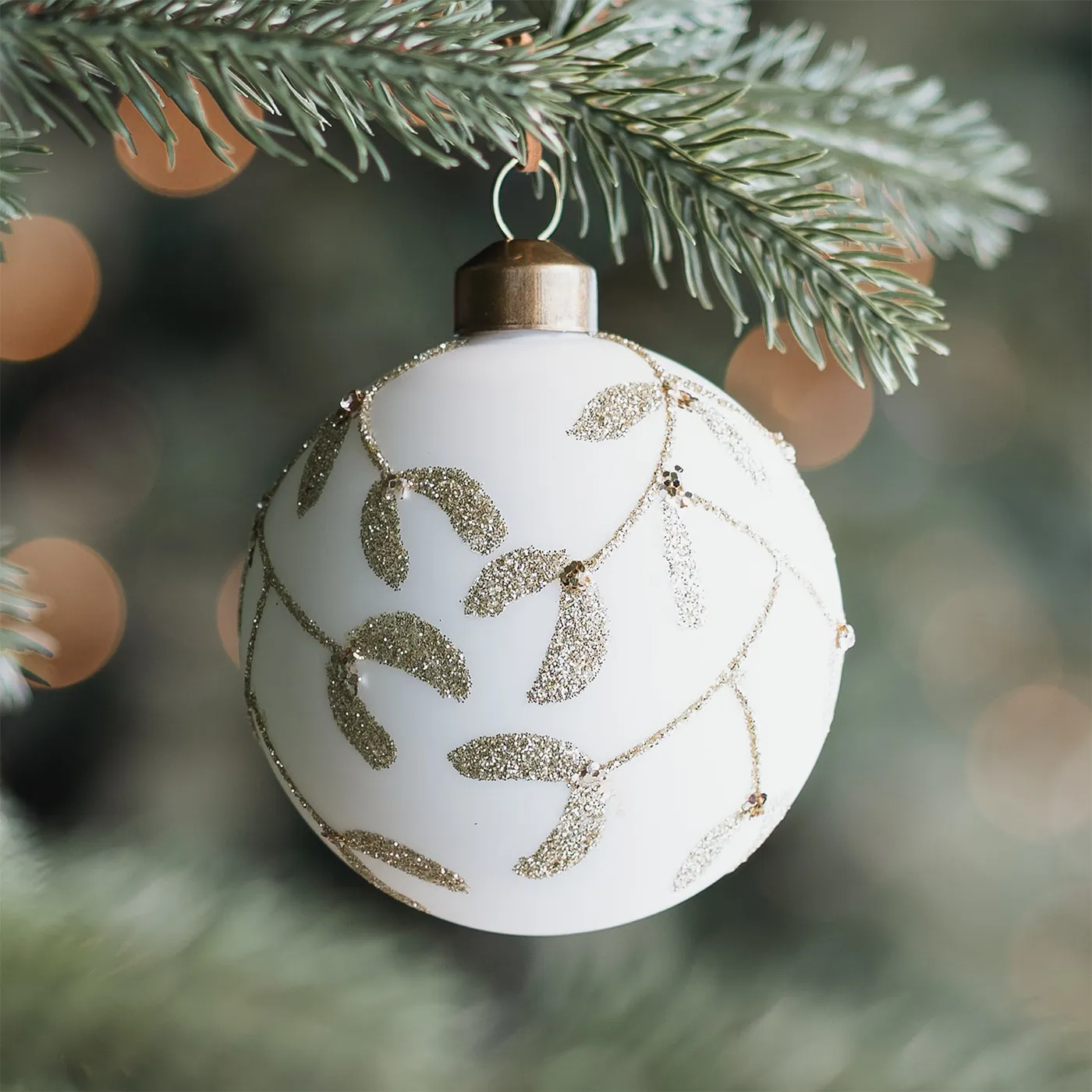
- Start with a 3-inch matte white shatterproof ball and a fine-tip gold paint pen.
- Draw one loose S-curve down from the cap. Don’t overplan it — vines shouldn’t be symmetrical.
- Add five to seven small leaf shapes off that main curve, all angling the same direction.
- Dot craft glue on each leaf, dip into fine gold glitter, and tap off the excess.
- Glue four to six tiny pearl beads along the vine, then seal with matte acrylic spray.
Roughly 40 minutes for the first one, closer to 15 for each after that, and under $10 in materials — most of which is the gold cap.
Glitter sheds. That’s not a flaw, it’s a law of physics, and you should expect a light dusting of gold on whatever sits below these baubles through December. Matte white backgrounds show dust and thumbprints, so handle them by the cap. Store them in individual tissue pouches rather than a jumbled bin, or the vine detail will chip by year two. Gold paint pens fade toward bronze under UV light, so keep handmade pieces off a south-facing windowsill.
7. Red Berry Garland on a Gold-Framed Mirror Mantel
Getting this mantel-and-tree pairing home:
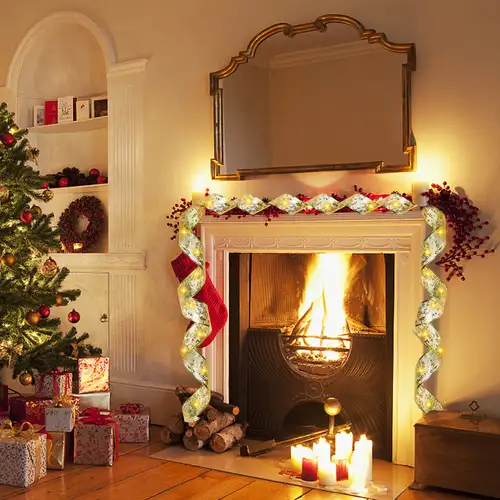
- Light-up garland: $30–$90 (9 ft, warm white, gold-wrapped)
- Red berry picks and sprays: $15–$45 (about 8–12 stems)
- Gold-framed mirror: $60–$250 (or thrift one for $15–$40)
- Tree ornaments, red and gold: $50–$140 (mixed finishes, 60–80 pieces)
- Stocking and holder: $20–$60
- Total: $175–$585
Budget alternative: buy a plain 9 ft garland for $12, wind your own warm-white string lights through it, and add three red berry sprays. That’s the same mantel for about $35.
Hang the mirror four to six inches above the mantel shelf, not flush with it. That gap is where the light-up garland needs to breathe — if the frame sits directly on the shelf, the garland gets squashed and you lose the glow reflecting back into the room. Gold frame, gold garland, gold ornament caps: a mirror roughly doubles the perceived light in a fireplace room, which matters most in the evening when the fire and candles are doing all the work.
8. Smooth and Beaded Gold Baubles, Side by Side
This close-up is a lesson in finish mixing. Break a gold-heavy tree down as roughly 60% matte gold, 30% shiny or glazed gold, and 10% heavily textured gold — the beaded kind that reads almost like hammered metal from three feet away. All three finishes in the same color family read as depth. All three in the same shiny finish read as a discount store. The deep green needles are the fourth color here, and they’re doing more work than they get credit for: that near-black green makes matte gold look brighter than it is.

Before you commit to a texture-mixed tree, check these off:
- Measure your tree’s widest branch span — you want 8 to 10 inches of clearance from the wall on all sides.
- Count your light strands. Two strands of 100 warm-white micro lights per foot of tree, minimum.
- Test bulbs against your ornaments in the evening. Cool white LEDs will kill a matte gold palette.
- Layer lights first, ornaments second, ribbon last — never the reverse.
- Set your finish ratio before you shop so you don’t come home with 90 shiny balls.
9. Wide Gold Ribbon and a Clock-Face Wreath
A roaring fire, garland on the mantel, and string lights pooled on the floor is a gorgeous photo and a mild hazard. Lights on the floor near a hearth get stepped on and snagged — use LED strands rated for continuous indoor use and keep them at least 18 inches from the grate. Real candles plus a dry wreath is the combination to avoid; open flame near fabric garland is how mantels get scorched. If you want candlelight without the worry, battery pillars with a flicker setting do about 90% of the job.
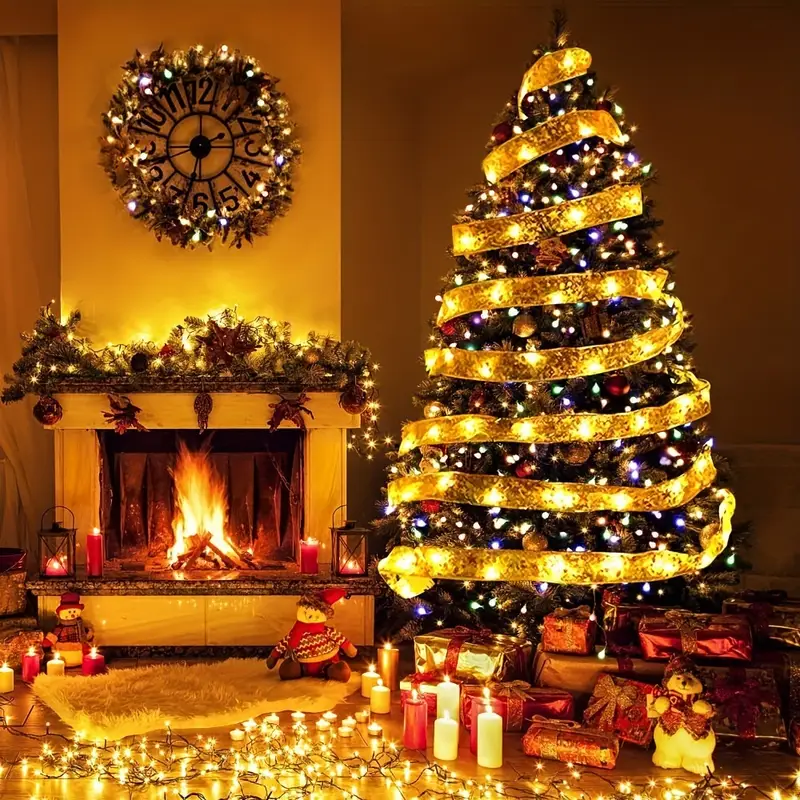
The wide gold ribbon is what holds this whole maximalist scene together. With multi-colored lights, a lit wreath, garland, candles, and gifts all pulling for attention, the ribbon gives the eye one repeating, calming shape — and repetition is what separates abundant from chaotic. Remove the ribbon and the same tree becomes noise. The clock-face wreath above the mantel is the personality here, but the ribbon is the structure holding it upright.
10. Clear Acrylic Reindeer Among Copper-Wire Lights
Clear ornaments had a moment a few winters back and never really left. The appeal is obvious once you try it: acrylic and glass picks let the tree’s own green and the lights show through, so it never looks like it’s wearing a costume. Copper-wire fairy lights have quietly replaced green-strand lights on design-forward trees because the wire nearly disappears into the branches. Add a couple of clear reindeer or sleigh shapes and you get sparkle without weight.
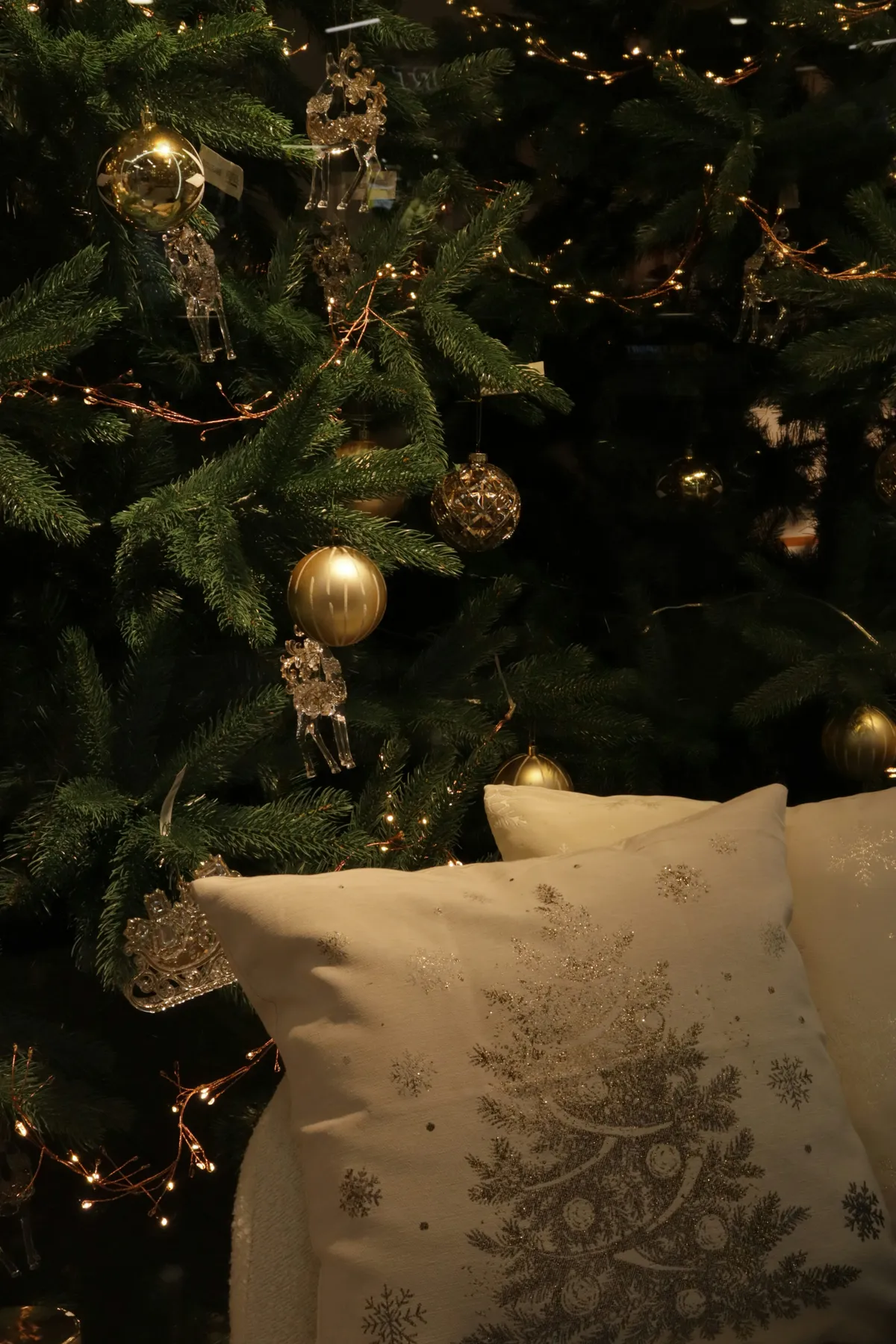
Clear acrylic reindeer and sleigh ornaments are everywhere right now — Target and Walmart run sets of three for $5–$15, and Dollar Tree’s seasonal versions look fine from a distance. Copper-wire fairy lights are $12–$18 for a 33 ft strand on Amazon. The cream cushions with glittered snowflake and tree patterns are the one thing worth spending real money on, since they turn the tree into a whole seating moment. A plain cream cushion plus a $6 glitter stencil kit gets you most of the way. If the tabletop gold tree in Idea #3 felt too formal for your house, this is the looser cousin.
11. Twin Flocked Trees in White and Silver
White ornaments on a flocked tree have a disappearing problem — they vanish into white branches unless you build contrast on purpose. Mix matte white balls with glitter white balls at roughly three matte to one glitter, and use two sizes, 3 inches and 6 inches, so you get rhythm instead of a polka-dot effect. The warm string lights are what saves the whole scheme. Cool white bulbs on a flocked tree turn a cozy winter scene into a dentist’s office.
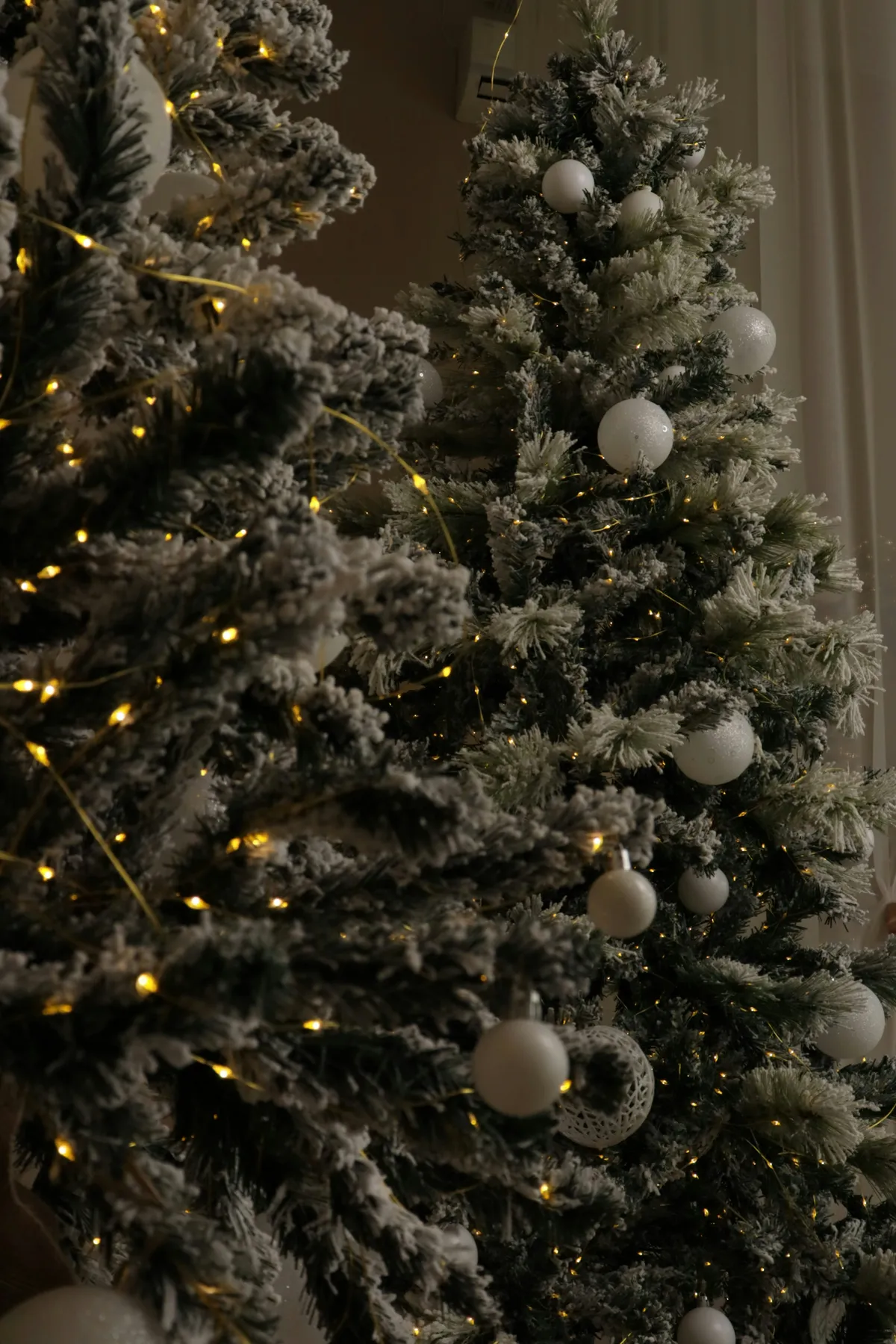
Two flocked trees — say 4 ft and 5 ft — need roughly six feet of uninterrupted wall and a ceiling of at least 7.5 ft to feel intentional rather than squeezed. In a room under 120 square feet, use one flocked tree and move the second onto a console or entry table. Light-colored curtains behind flocked branches are a happy accident: they extend the softness and keep the corner from going dark at the edges.
12. Matte Champagne Bauble Next to a Script Star
Build a cluster that reads from across the room:

- Pick one large focal ornament, 5 to 6 inches — here, the matte champagne ball.
- Pair it with one flat or shaped ornament roughly half the size, like the white script star.
- Hang the focal piece 4 to 6 inches deeper into the tree so it sits behind the smaller shape.
- Keep the whole cluster within a 10-inch circle. Any wider and it stops reading as a group.
- Repeat the same pairing every 18 to 24 inches around the tree.
Ten minutes of rearranging, zero dollars spent, and the tree looks professionally styled.
Three design principles are running at once in this tiny vignette. Scale contrast: a 6-inch sphere next to a star half its size gives the eye somewhere to travel. Finish contrast: matte champagne against glossy white against warm gold light means the ornament never photographs flat. And negative space — the dark needles around the pair make both pieces look brighter than they actually are, which is why gold works so well against deep green.
13. Gold and Green Glitter Ornament with Tiny Pearls
Sequin-and-pearl ornaments are the sparkliest and the highest-maintenance thing on your tree. Sequins catch on wool, on knit stockings, and on each other, so hang them on the outer thirds rather than deep inside where they grind against branches. Pearls discolor if they sit in a hot attic for years — a climate-controlled closet is far kinder. And glitter migrates. Assume a light gold dusting on the tablecloth below these through December and don’t waste energy fighting it.
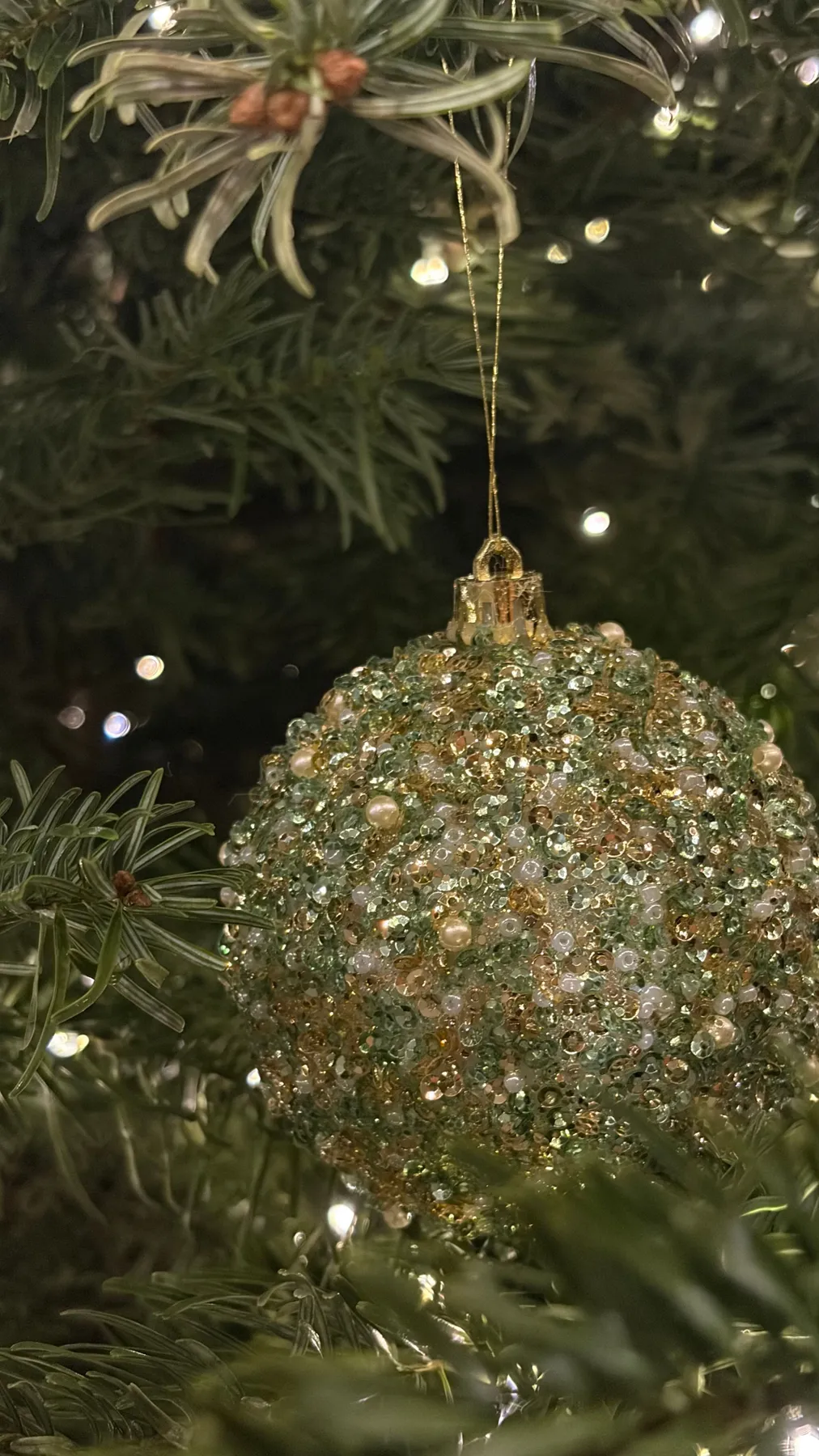
Beaded and sequined ornaments are noticeably heavier than glass or plastic. On a real or slim-profile artificial tree, hang anything over 4 inches on an interior structural branch, not a branch tip, or you’ll have a drooping branch by December 20th. As a rule, keep heavily embellished ornaments at 3 inches and under if you want to hang them near the outer edge where they can actually be seen. The gold cap here is worth checking — it’s the first thing to loosen.
14. Red Plaid Ribbon and a Gold-Bowed Bauble
A wired plaid ribbon bow takes about 15 minutes:
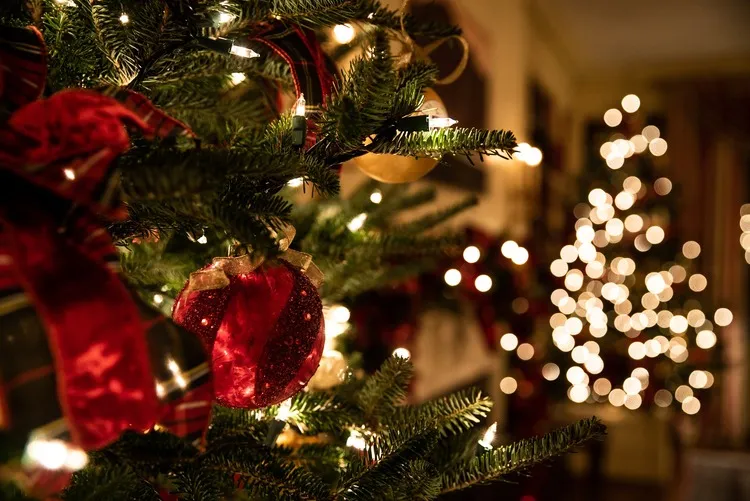
- Cut 24 inches of 2.5-inch wired ribbon with a diagonal tail cut.
- Fold it into a figure-eight, pinching the center between thumb and forefinger.
- Twist a 6-inch piece of florist wire around the pinch and tighten.
- Fluff the loops outward, then fan the tails down at an angle.
- Wire the bow onto an interior branch so it sits tight against the needles.
Roughly $8–$14 in ribbon for six bows, and they’ll store flat for years.
The color math here leans on restraint: about 55% green foliage, 20% warm white light, 15% red plaid ribbon, and 10% gold. Red does the emotional work, gold does the sparkle, and neither gets to be the star. Swap the plaid for solid velvet ribbon and the tree gets dressier; swap it for burlap and it swings farmhouse. This is Idea #9‘s wide gold ribbon cut with a pattern — same structural job, completely different mood.
15. The Gold Croissant Ornament with Powdered-Sugar Glitter
The croissant is the entire point. Strip it away and this is a nice gold-and-green tree you’ve seen a hundred times. Keep it and the tree suddenly has a personality — a small, absurd, very charming joke tucked between the baubles. That’s the real argument for one weird ornament per tree: it gives guests something to find. The white glitter dusted across the top is doing specific work too, mimicking powdered sugar so the shape reads instantly as a pastry instead of a random gold blob.
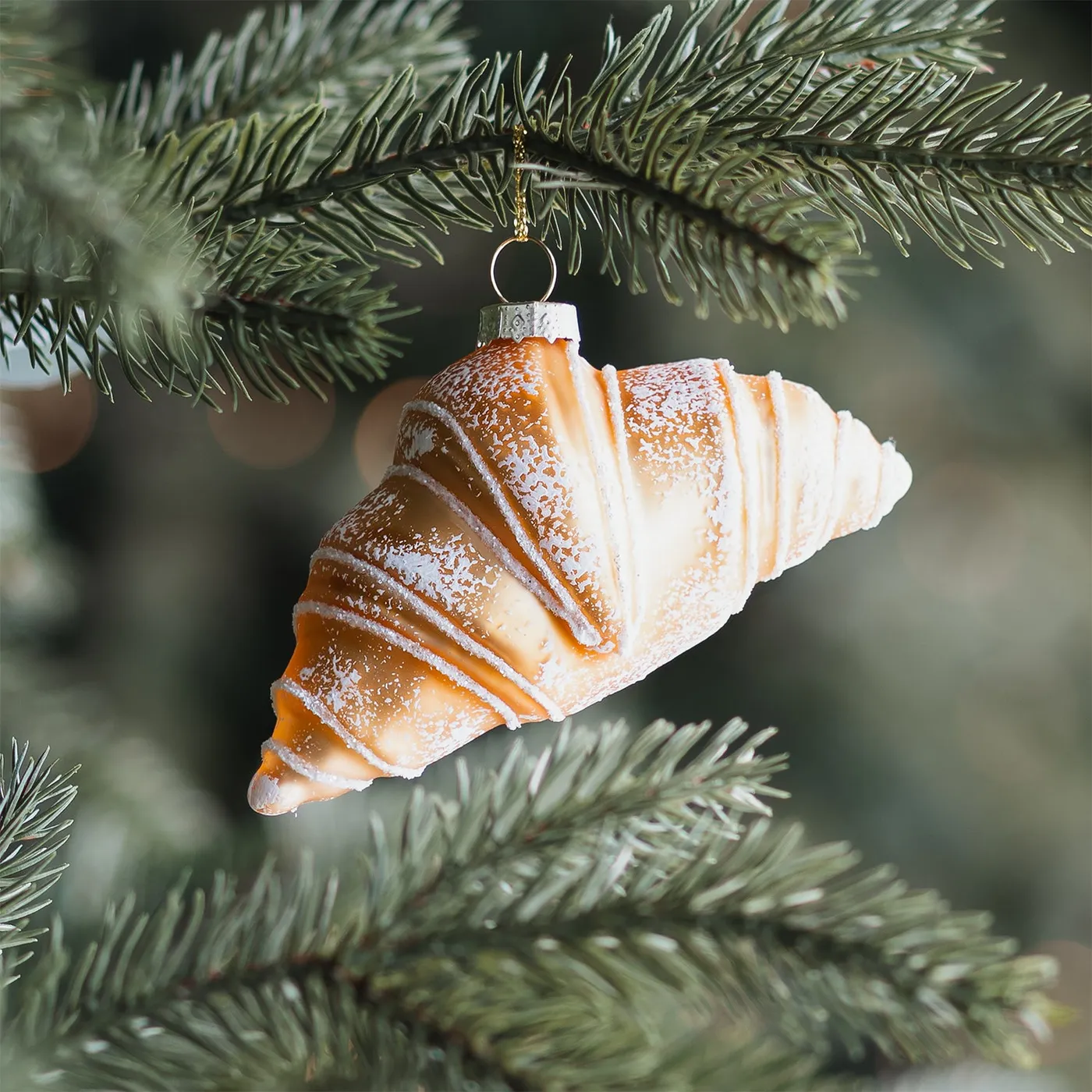
Food-shaped ornaments have quietly become one of the most photographed categories on Pinterest, and it tracks with how people actually decorate now — trees as self-portrait rather than showroom display. A croissant next to your grandmother’s gold balls says more about you than a perfectly matched set ever will. It’s a trend with real legs, because the underlying shift isn’t about croissants; it’s about trees that look collected over time rather than bought in one afternoon.
16. Crystal-Set Tree Ornament on a Sheer Ribbon
A crystal-set tree ornament in a gold frame runs $25–$60 from a specialty shop. The craft-store version — a flat gold-tone frame blank, a bag of clear rhinestones, and some E6000 — lands around $12 and takes one evening. Dollar Tree and Walmart carry rhinestone-embellished flat ornaments seasonally for $5 and under that read nearly identically from three feet away. The sheer ivory ribbon matters more than the crystals do for the finished look; swap in a satin ribbon and the whole thing suddenly feels heavy.
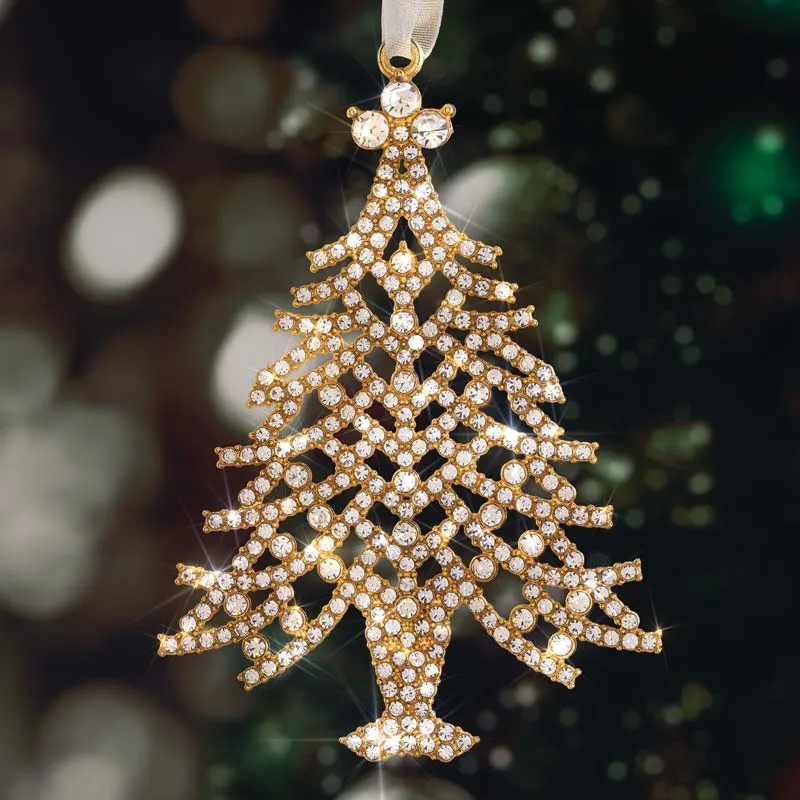
This works because it’s flat. A planar shape hangs steady against a tree instead of spinning, so the crystal pattern stays legible — exactly what you want from a piece meant to be looked at rather than glanced past. The gold frame does two jobs: it contains the sparkle so it doesn’t become a formless glitter blob, and it repeats the gold of the other ornaments. Hanging it on a sheer ribbon keeps the top edge soft so nothing interrupts the light.
17. Clear Glass Bauble with Gold Painted Scrollwork
Build this tabletop vignette in about 20 minutes:
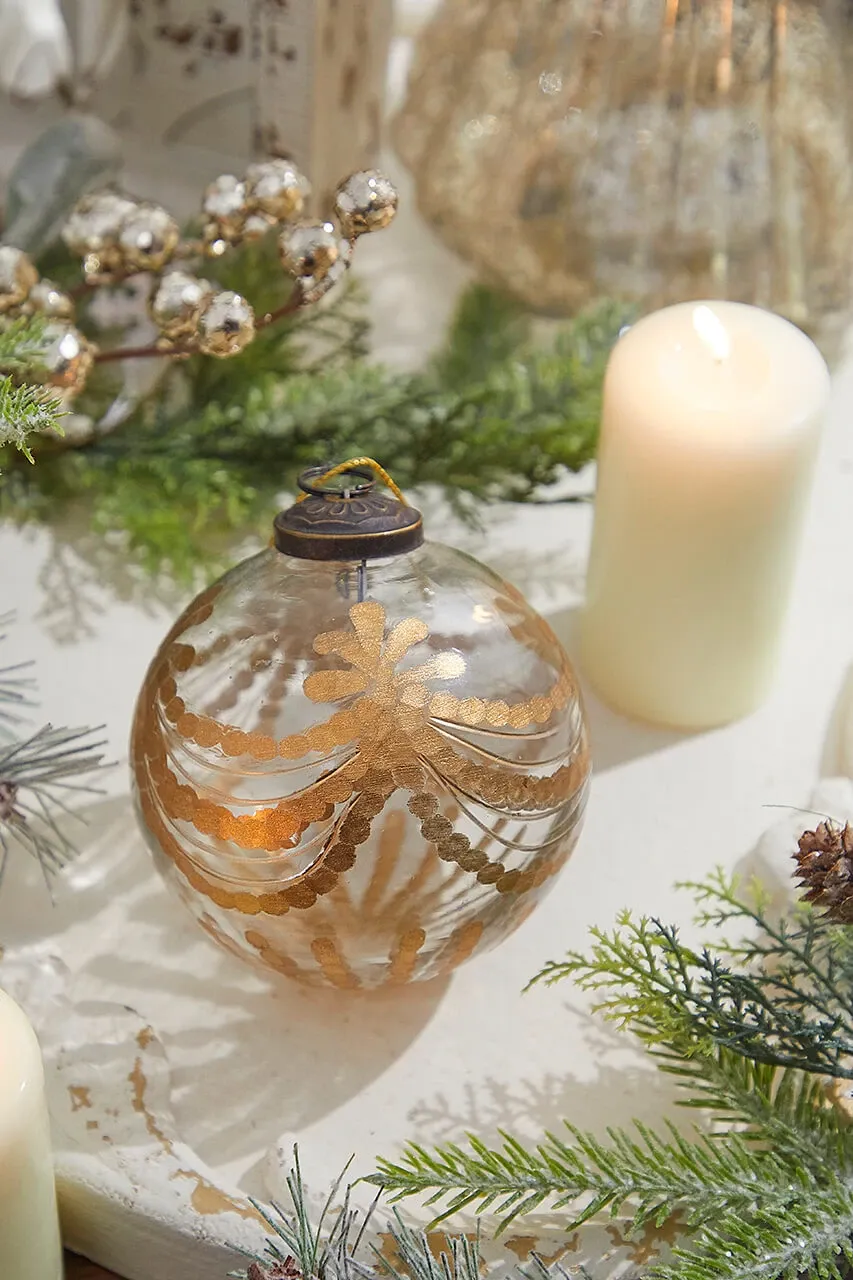
- Start with a distressed white tray or painted board, 12 to 16 inches wide.
- Lay faux pine sprigs across the back third, angled so the tips point outward.
- Set the clear glass ornament on a small riser so its center sits roughly 6 inches off the surface.
- Place a lit white pillar candle 6 to 8 inches to one side — never directly behind the ornament, or it blows out the detail.
- Tuck a gold berry branch behind the ornament, then step back and check the silhouette.
About $35 total if you already own the candle and tray.
This vignette needs a surface at least 30 inches wide and 12 inches deep — a console, a sideboard, or a wide shelf. Below that, the elements crowd and the candle sits too close to the greenery to be safe. Six to eight inches between flame and pine is the minimum; more is better. If your surface is narrow, drop the berry branch and keep the ornament and candle in a tighter diagonal.
18. A Tree Dressed Almost Entirely in Gold Baubles
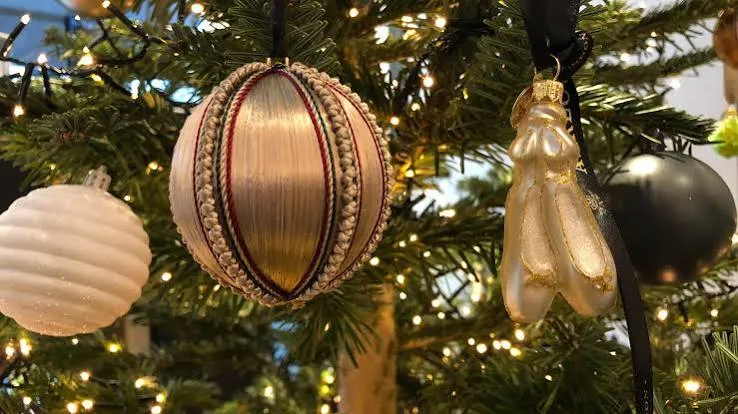
An all-gold tree is cheaper than it looks, because you’re only buying one color:
- Ornaments: $60–$180 (80–100 pieces, mixed sizes and finishes)
- Lights: $20–$50 (three to four warm white strands)
- Tree: $90–$400 (6–7.5 ft, depending on fullness)
- Topper: $15–$45 (oversized gold star or spray)
- Skirt or collar: $25–$70
- Total: $210–$745
Budget alternative: buy ornament sets in bulk after December 26th at 50–70% off, and fill the back of the tree with dollar-store gold balls. Nobody sees the back.
A one-color tree lives or dies on finish variety. Aim for roughly 40% matte gold, 30% glitter, 20% high-shine, and 10% pearlescent or mercury glass. Four finishes, one color — that mix is what keeps a monochrome tree from looking like a bin of identical balls poured over a cone. If you want to bend the rule, add a second metal only in the topper. One silver star on an all-gold tree reads as a mistake; one champagne star reads as a choice.
19. Black, White and Gold with Burlap Snowflake Ribbon
Black ornaments on a Christmas tree are a commitment, and they’re not for every room. In a small space with low ceilings, black absorbs light and the tree can start to read heavy, even gloomy. This tree gets away with it because of how much white and gold surrounds the black — snowflake cutouts, white berry sprigs, gold mesh ribbon. If your room is dark or north-facing, use charcoal or deep bronze instead of true black and you’ll get the graphic look without the weight.
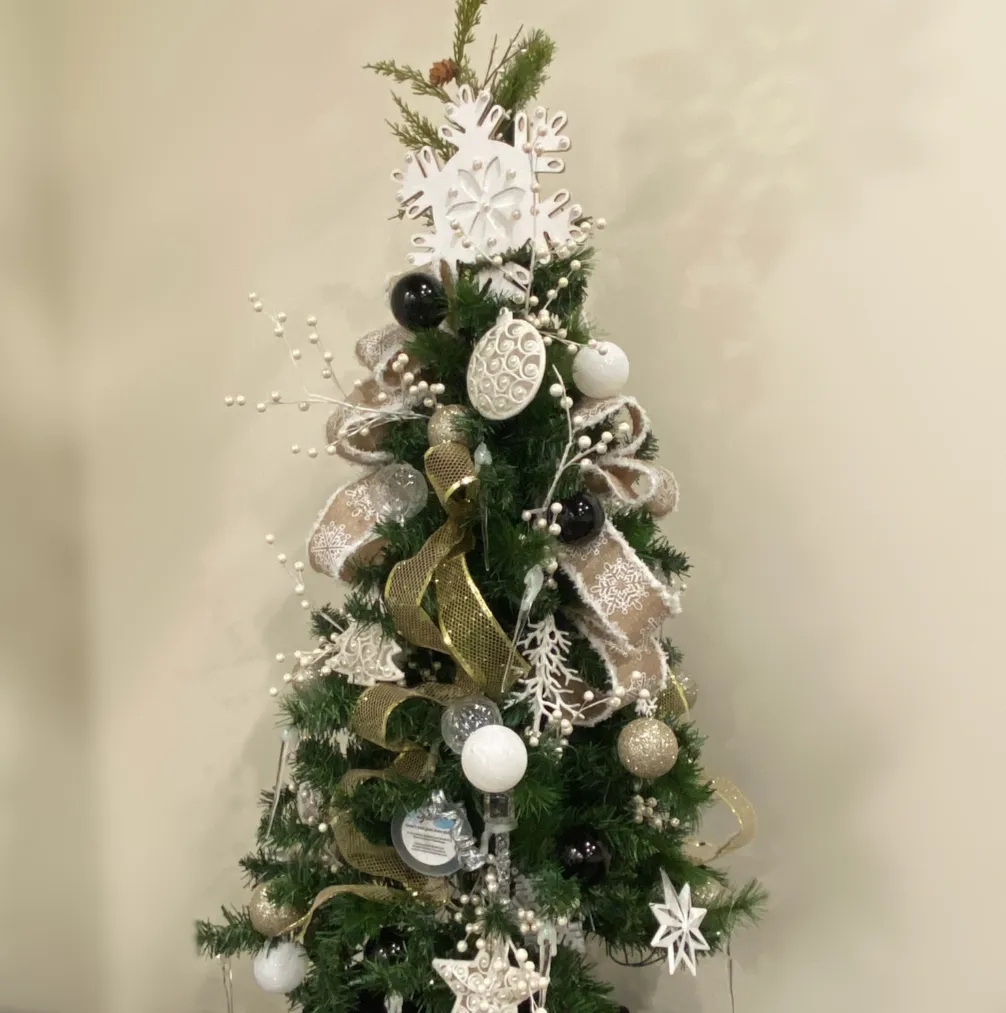
This density — mesh ribbon, patterned burlap ribbon, cutout shapes, berry sprigs, and roughly a hundred ornaments — needs a tree 7 ft or taller to breathe. On a 6 ft tree, cut the ribbons to two and space the larger ornaments 8 to 10 inches apart instead of 6. The burlap-textured ribbon is what keeps this from feeling cold; without a natural element, black and gold and white tips toward hotel lobby. See Idea #23 for the same high-contrast idea in a softer, frosted register.
20. Glitter Pinecone Ornament with Hexagon Sequins
Pinecone ornaments hang wrong more often than any other shape. The weight sits at the wide end, so a wire hook makes them tilt forward and show you their back. Thread a narrow gold ribbon through the top scales and tie a loop instead — the ornament hangs flat and the ribbon reads as part of the design. Cluster three at slightly different depths and sizes rather than spacing them evenly. A pinecone on its own looks like something fell off the tree.
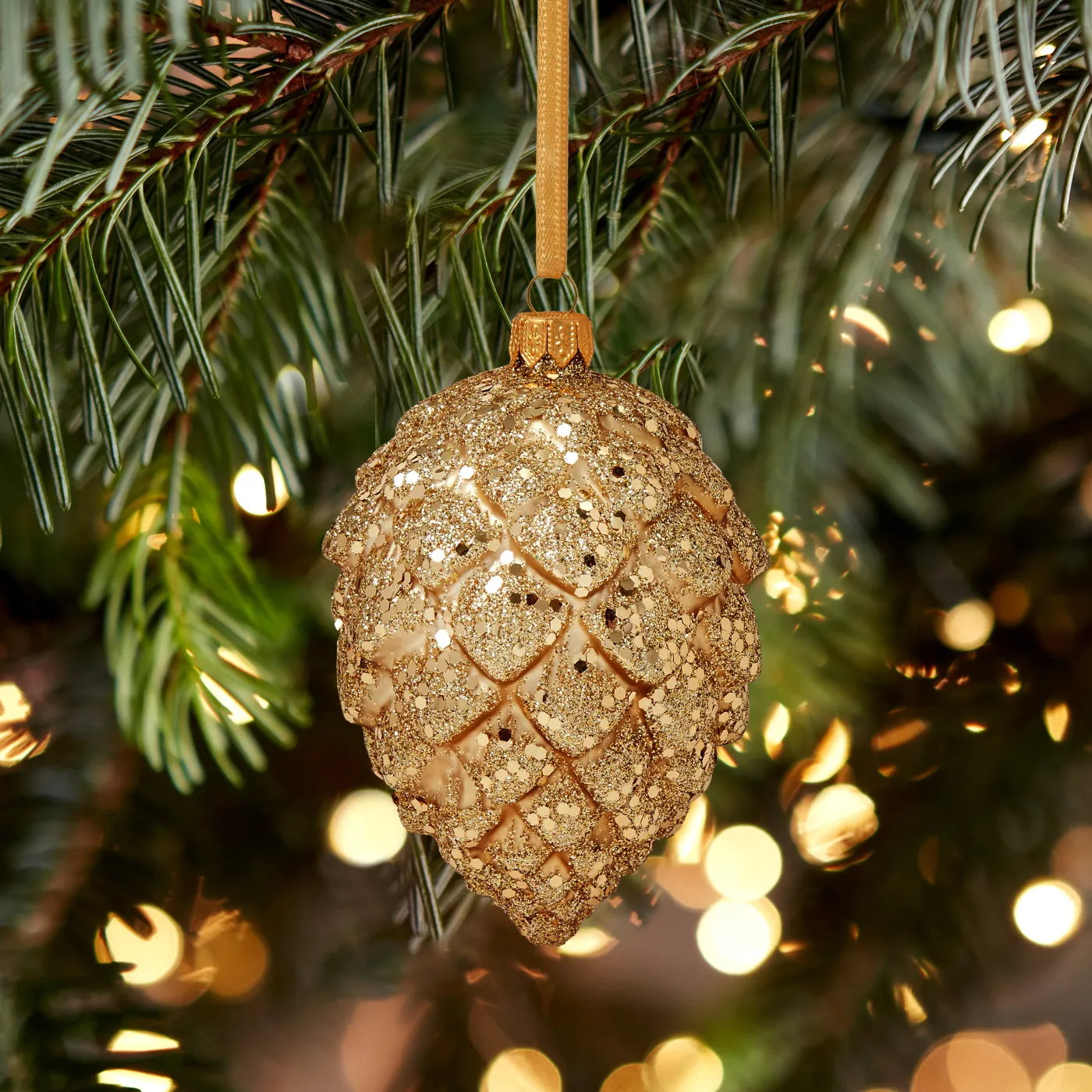
Real pinecones plus a can of gold metallic spray paint is the cheapest good-looking ornament there is — about $5 for a bag of cones and $8 for paint, which covers thirty of them. Bake the cones at 200°F for an hour first to kill anything living inside. If you’d rather buy, Walmart and Target carry glitter pinecone sets for $8–$18. The hexagonal sequins on the version here are what make it look custom; a tube of gold sequins and some tacky glue gets you close for under $10.
21. A Glittered Gold Tree Figurine on Dark Wood
Tabletop figurines work in a narrow size band. This one is at its best between 12 and 18 inches tall, sitting on a surface at least 24 inches wide, because anything smaller disappears and anything larger becomes a floor piece that happens to be elevated. It also needs a dark backdrop to read — a dark wood sideboard, a walnut console, a deep-toned shelf. On a white surface, a gold glitter tree loses about half its impact.
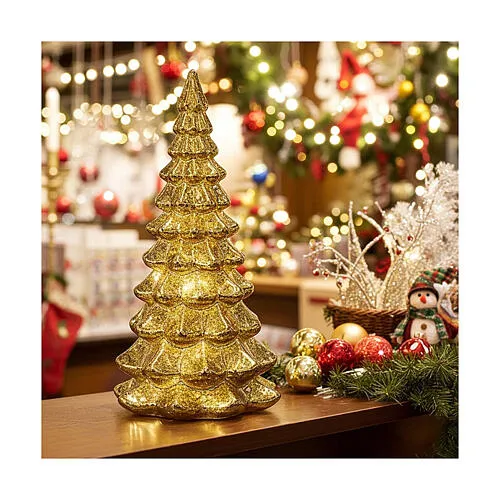
The dark wooden surface is doing more than you’d think. A textured gold glitter tree on dark wood gets that contrast where the gold reads as light rather than as an object — it glows instead of sitting there. Move it onto a white cloth and the sparkle flattens out completely. Everything else in this scene, the red and gold baubles, the frosted branches, the little snowman, is supporting cast. The surface is the design.
22. Gold and Bronze with Faux Candle Lights
Three things make this setup feel bigger than it is. First, the faux candle lights on the branches add a second, warmer layer of glow above the string lights, which reads as depth. Second, the vertical strands hanging in front of the sheer curtains extend the tree’s height visually — your eye follows the lines up past the tree itself. Third, the sheer white curtains diffuse whatever daylight comes through, so the gold stays warm instead of turning brassy at noon.
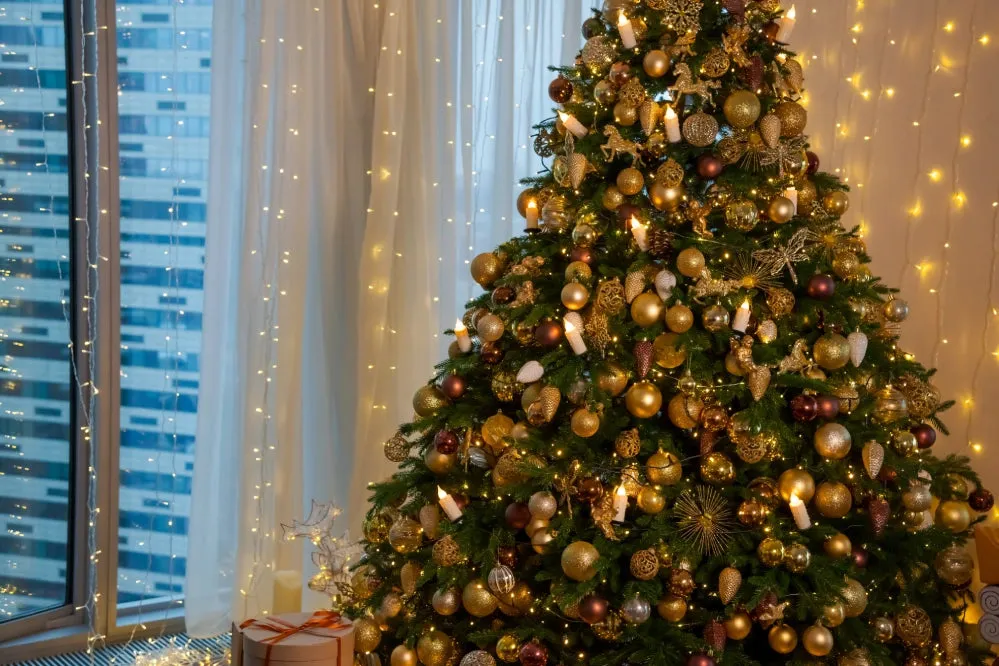
Faux candle lights run on batteries, and 12 to 20 of them means a lot of small cells. Budget roughly $30–$50 a season in batteries, or buy rechargeable AAAs and break even by year two. Sheer curtains and real candles are a hard no — if you want open flame, keep it at least three feet from any fabric. And gold ornaments with bronze or dark-red undertones show dust far less than bright yellow gold, which is one small argument in favor of this palette.
23. Iridescent Frost with Matte and Glitter Gold Balls
Frosted and iridescent finishes have taken over the ornament aisle. Part of it is the snow-globe effect people want from a tree in a warm room; part of it is that flocking photographs beautifully in low light, which is exactly how most of us actually see our trees. It’s a trend that survives because it isn’t really a trend — white-frosted branches have shown up on Christmas trees for a century. What’s new is the iridescent glitter, which shifts color under warm bulbs and makes an all-gold palette feel less monotone.
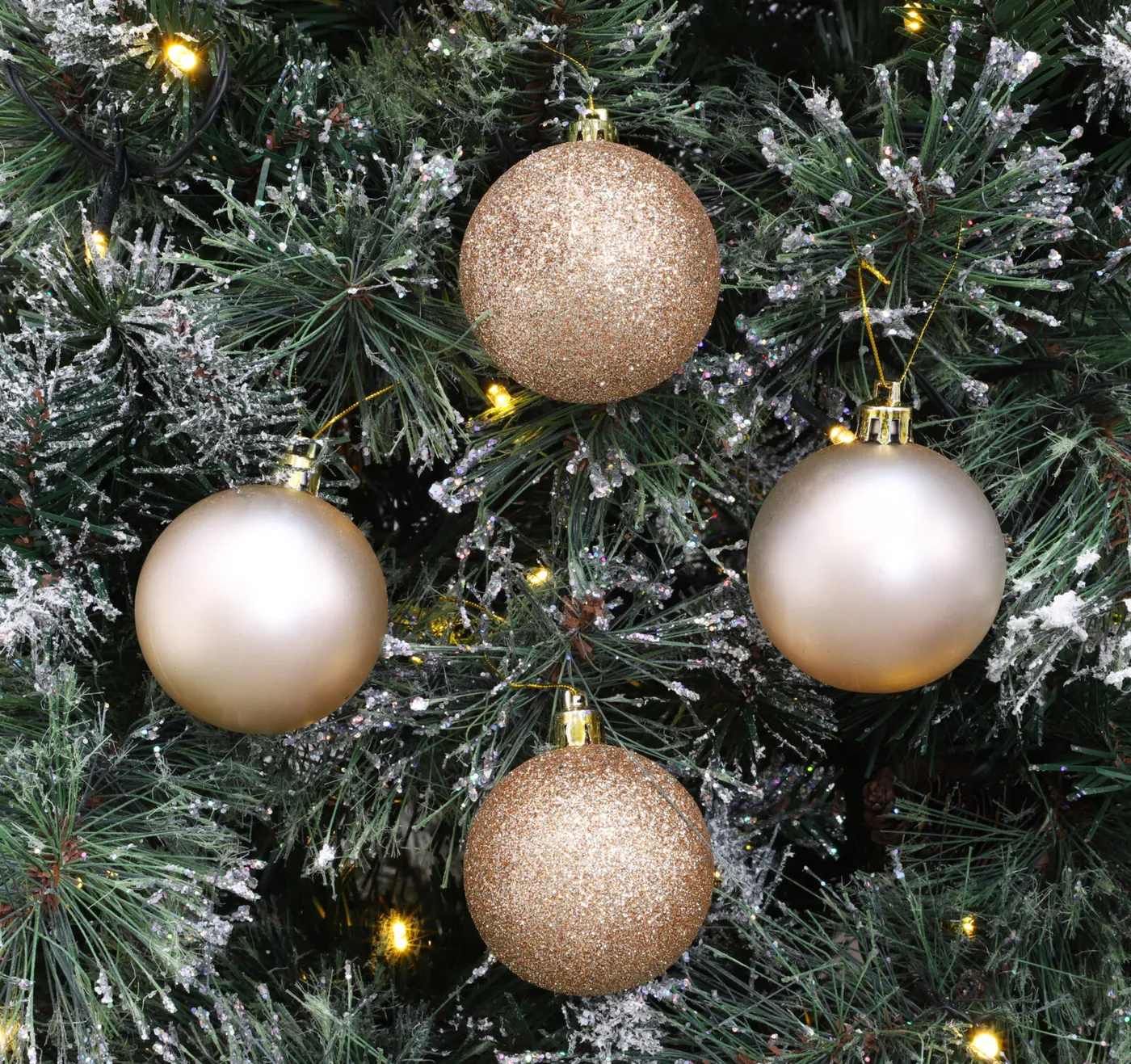
On a frosted tree, silver glitter is the enemy. It fights the iridescent finish and makes everything look slightly gray. Stick to gold glitter and matte gold, and let the frosting supply the white. Space ornaments 3 to 4 inches apart at the front of the tree and cluster them tighter as you work inward. Two matte, two glitter, then repeat — that alternating rhythm is what makes a close-up of a frost-covered branch look styled instead of sprinkled.
24. Gold Pinecones Mixed with Silver and White Baubles
Gold, silver, white, and pinecones is a forgiving mix to shop for:

- Baubles: $45–$130 (gold, silver, and white sets in mixed sizes)
- Pinecones: $10–$35 (natural, plus gold-dusted)
- Star ornament: $12–$40 (ornate gold, oversized)
- Lights: $20–$45
- Ribbon: $10–$25
- Total: $97–$275
Budget alternative: gold-spray real pinecones you forage yourself and buy plain silver shatterproof balls in bulk. That combination runs about $25 and looks better than most boxed sets.
This works best on trees between 6 and 7.5 ft. Below 6 ft, pinecones overwhelm the branches and the tree starts to look lumpy. Space the large ornaments 8 to 10 inches apart and fill the gaps with pinecones, which are naturally smaller and can sit closer. If your tree is slim — under 30 inches at the base — cap yourself at eight pinecones and skip the ribbon. It’s a different flavor than the black-and-gold mix in Idea #19, though the density rules are the same.
25. A Filigree Gold Bauble That Catches Blue Light
Hollow filigree ornaments are gorgeous and a little fussy. The openwork means you see the branch and lights through them, which is the point, but it also means they catch on needles when you hang them and can bend if you’re not careful. The blue reflections in this shot are worth a warning of their own: colored ambient light — a TV, a smart bulb, a blue-lit window — will tint gold ornaments greenish at night. Check your tree after dark before deciding the palette is wrong.

Putting a hollow gold ornament directly in front of a glossy solid gold one is a deliberate pairing: one lets light through, one throws it back. Together they create the sense of depth that makes a tree feel packed rather than flat. The warm white string lights behind the hollowed piece turn it into a tiny lantern. That’s the real argument for mixing textures in a single-color tree — it isn’t variety for variety’s sake, it’s controlling how light moves across the branches.
26. Gold Glitter Star on a Sparkling Surface
Gold decor against green pine and a silver glitter surface reads as three metals at once, and it still works. The formula: about 50% gold, 30% green foliage, 15% silver-white glitter, and 5% deeper shadow. Keep the silver in the background layer and the gold in front — reverse them and the gold looks dirty. Swap the forest green for a blue-green evergreen and the gold turns cooler; swap it for a yellow-green and everything warms up several degrees.

A few things to settle before you buy a single star:
- Photograph your current ornaments in daylight and again at night. Gold changes color under both.
- Decide your metal count. Two is easy, three needs a clear dominant one.
- Confirm your lights are warm white, not cool, before adding metallics.
- Measure your tree’s width — glitter decor needs breathing room to sparkle.
- Set a budget ceiling before you walk into a store in December.
27. Cream Tree Skirt with Gold Embroidered Snowflakes
A cream faux fur tree skirt with gold embroidered snowflakes runs $50–$120 at a home store. A plain cream fleece blanket from Walmart, about $12, folded and tucked around the base does the same job — and if you want the snowflakes, a $7 gold embroidery kit and one evening gets you there. For a low-commitment version, a cream linen skirt edged with thin gold ribbon trim lands around $25 and stores flat. The red, gold, and silver baubles above it don’t care what the skirt cost.
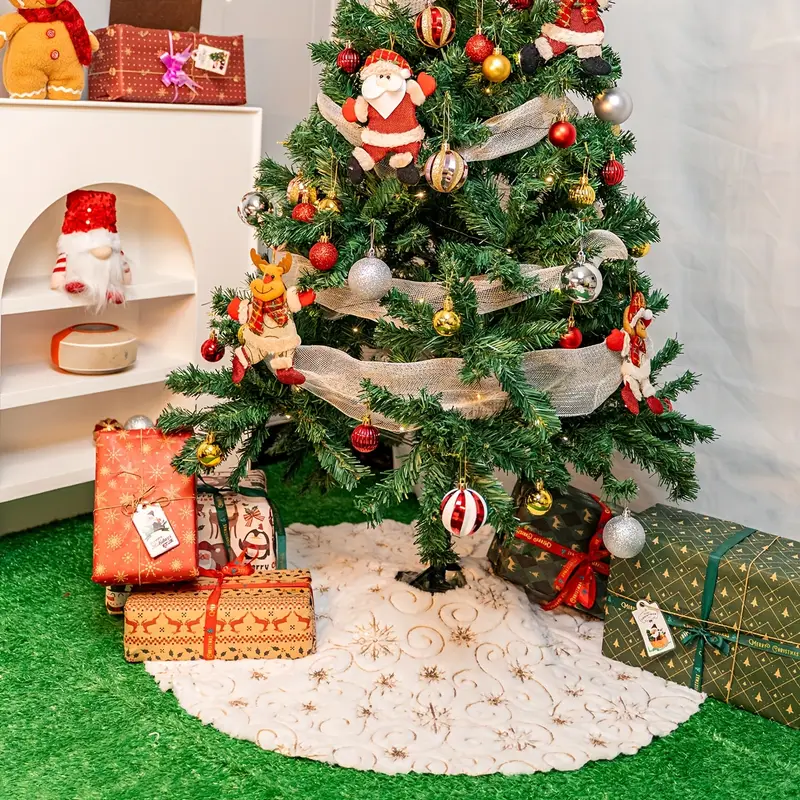
Cream fabric at the base of a tree shows everything: pine needles, dog hair, the one piece of tinsel that migrates. Faux fur needs a shake-out and a vacuum with the brush attachment every couple of weeks through December, plus a cold-water hand wash before storage or it yellows. The gold embroidery is the fragile part — press it, don’t scrub it. With pets or kids, a flat cotton skirt with a gold hem is dramatically easier to live with.
28. A Gold Wire Mesh Tabletop Tree That Glows
Wiring a wire-mesh tree takes one evening:
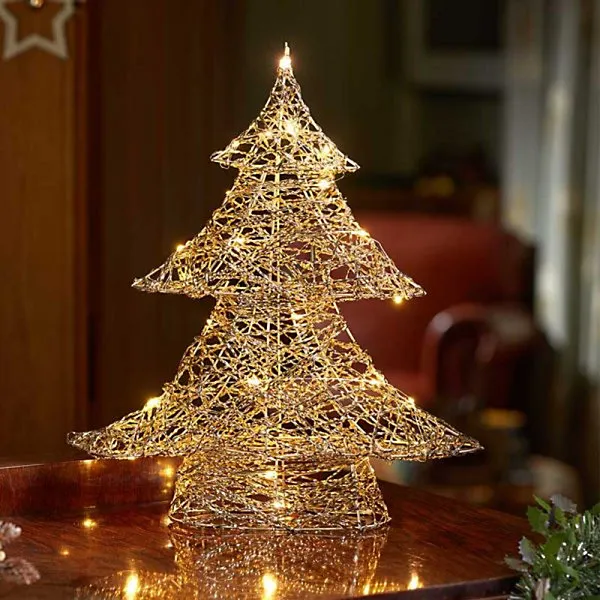
- Choose a tiered wire frame, 14 to 20 inches tall, with an open cone shape.
- Run a 33 ft strand of warm-white copper wire lights up the inside of the frame first.
- Weave a second strand across the front face, following the wire lines rather than wrapping randomly.
- Hide the battery pack at the back base, and use a remote-controlled set if you can.
- Set it on polished dark wood and check the reflection — you want a soft glow, not a hotspot.
About two hours and $35–$60, most of which is the lights.
The polished dark wood is half of this design. A gold wire tree on a matte surface is a nice object; the same tree on lacquered or polished dark wood doubles itself in the reflection and becomes a lighting feature. It also makes the piece read bigger than its 18 inches. If your console is matte, a $15 sheet of self-adhesive glossy film or a dark glass tray underneath gets you most of the effect.
29. Headphone Ornament in Full Gold Glitter
Novelty ornaments are the easiest thing to buy cheap. Target’s Wondershop line runs novelty shapes $3–$8 each, and after Christmas they drop under $2. Thrift stores and estate sales are the real goldmine — a gold headphone ornament shows up for a dollar because nobody knows what to do with it. If you’re crafty, a plain gold ball plus a small shape cut from craft foam and gold-glittered costs about $3. Group any three novelty pieces in one section of the tree so they read as a collection instead of clutter. Pair it with the croissant in Idea #15 and you’ve got a theme going.

One novelty ornament is charming. Twenty is a yard sale. The rule that keeps this from going sideways: group them. Cluster novelty shapes within a 12-inch section rather than scattering them evenly, so they read as an intentional collection. And be honest about the kid factor — if a toddler is going to pull everything off the lower third anyway, keep the delicate novelty pieces above 4 ft and the shatterproof ones down low where they’ll survive.
30. Flocked Tree with Gold Baubles and a Red Wreath
Flocked branches plus gold balls is about as reliable as holiday decorating gets, and the reason is repetition. Gold spheres in three or four sizes, spaced at regular intervals, give the eye a predictable rhythm — which is what makes a heavily decorated tree feel calm instead of frenzied. The red wreath above the mantel is the only saturated color in the room, and it works because it’s alone. Add red ornaments to the tree as well and the whole scene gets noisy fast.
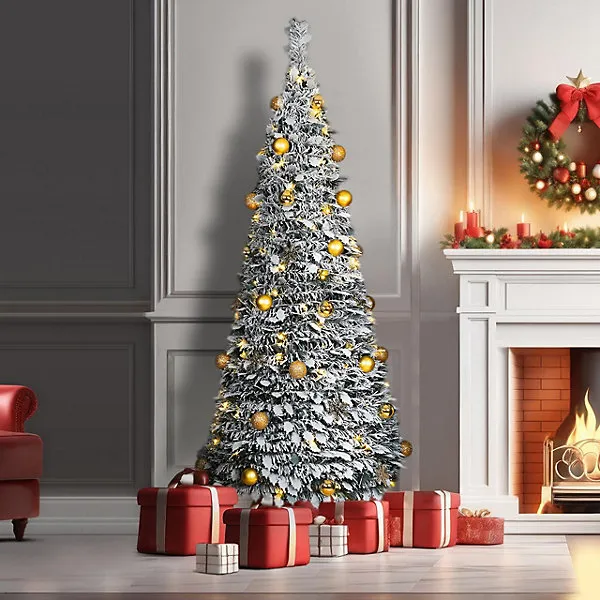
A tree this full needs a 9 ft ceiling or higher and at least 4 ft of clear space on each side so the gifts have somewhere to live. In a smaller living room, drop to a 6.5 ft flocked tree, cut the gold balls to about 60 pieces, and keep the wreath — the mantel styling carries the look at any size. Red and white wrapped gifts are the finishing move; without something at the base, a flocked tree looks like it’s floating.
Time to Hang the First Bauble
Gold is the easiest palette to get wrong and the easiest to get right: pick two or three finishes, let one color dominate, and stop before you’ve filled every gap. Start with the idea that matches the tree you already own and build outward from there. When you try one, snap a photo and pin it — half the fun of a gold tree is seeing how somebody else made it their own.