Still scrolling through outdoor lighting photos at 11 p.m. and wondering which ones would actually work on your house? You’re not alone — “outdoor lights on house” is one of the most-saved searches on Pinterest right now, and it’s easy to see why. Nothing changes a home’s personality faster after dark.
We spent serious time browsing Wayfair, Home Depot, and Amazon (plus a few lighting specialists) to bring you only what’s worth your attention this year, covering everything from $18 path lights to $1,200 statement sconces.
Inside you’ll find 30 curated ideas — warm traditional lanterns, sleek integrated LED strips, dramatic facade uplighting, and modern up/down wall sconces — with budget and luxury versions compared side by side. Every idea is shoppable with direct product links.
In 2026, the shift is toward layered, low-glare lighting: fewer fixtures, smarter placement, and warmer color temperatures around 2700K. Some links here are affiliate links — if you buy, we may earn a small commission at no extra cost to you. Save it now — this one’s worth keeping.
1. Victorian Drama: Uplighting a White Wrap-Around Porch
Facade lighting has officially overtaken the front-door lantern as the move that reads “considered” after dark. On Pinterest, saves for architectural uplighting climbed hard through 2024 and 2025, and 2026 is the year it went mainstream — helped along by LED fixtures that run cool, last a decade, and cost pennies a night compared to the halogen rigs people fought with in the 2000s. This look rewards homes with real architecture: columns, turrets, deep eaves. If your house has bones, this is how you show them off.
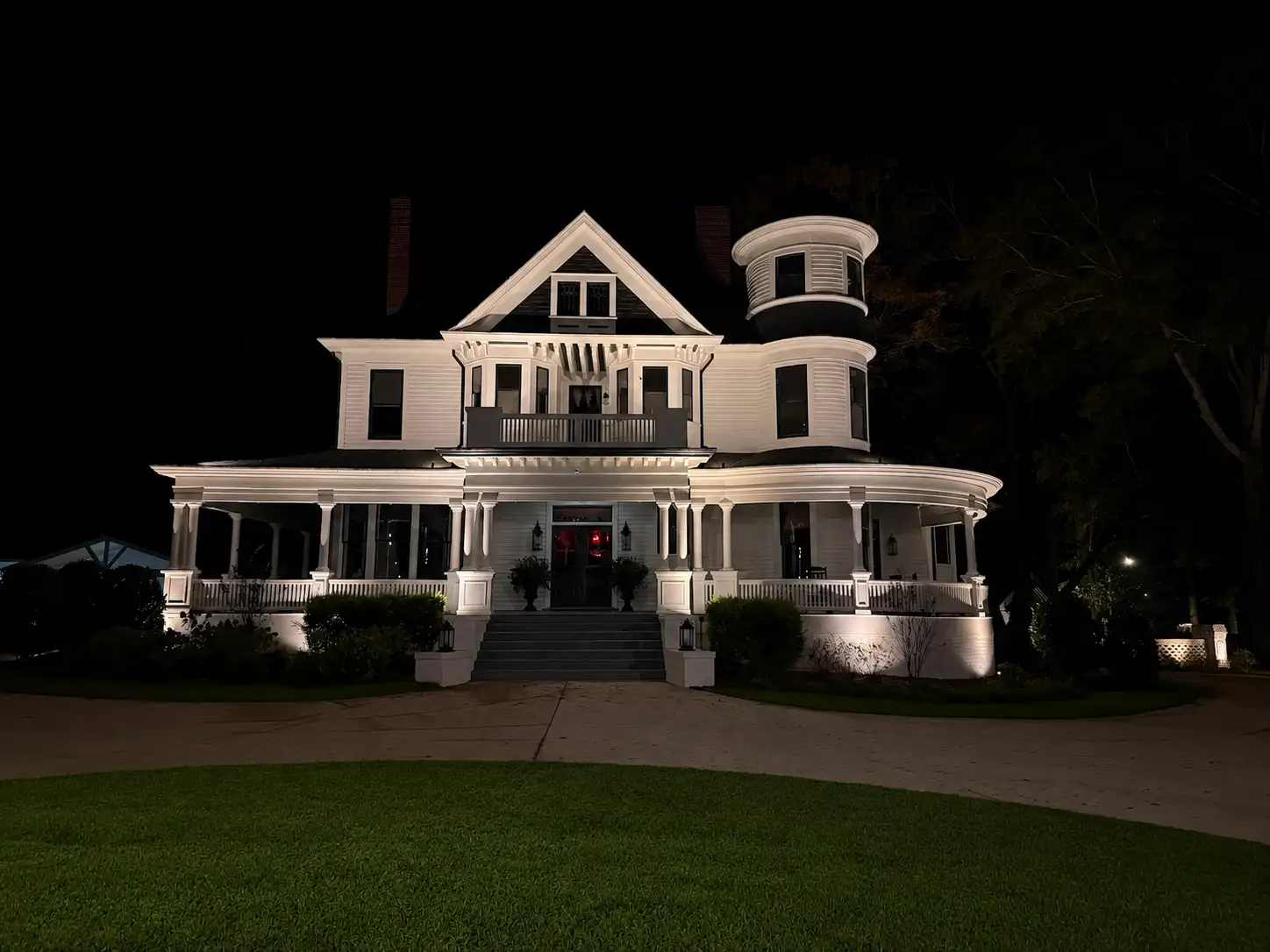
Two things are doing the heavy lifting here. First, contrast — the white facade glows while the roof and window frames hold their dark, so the house reads as a silhouette instead of a flat white blob. Second, repetition: the same warm-white fixture repeated along the porch creates rhythm, and rhythm is what makes a big house feel intentional rather than merely large. Keep every lamp the same color temperature, or the porch will look patched together from three different houses.
2. Linear LED Strips Trace a Dark Modern Facade
Hidden linear LED strip is the cheapest way to make a facade look expensive. Spec it at 2700K to 3000K, 24 volts, and at least 3 watts per foot so it actually washes the wall instead of just glowing in place. Then hide it properly: recess it into a reveal, tuck it under a soffit lip, or run it behind a fascia board so you never see the diode. If you can spot individual LEDs from the street, you’ve gone too bright and too bare.
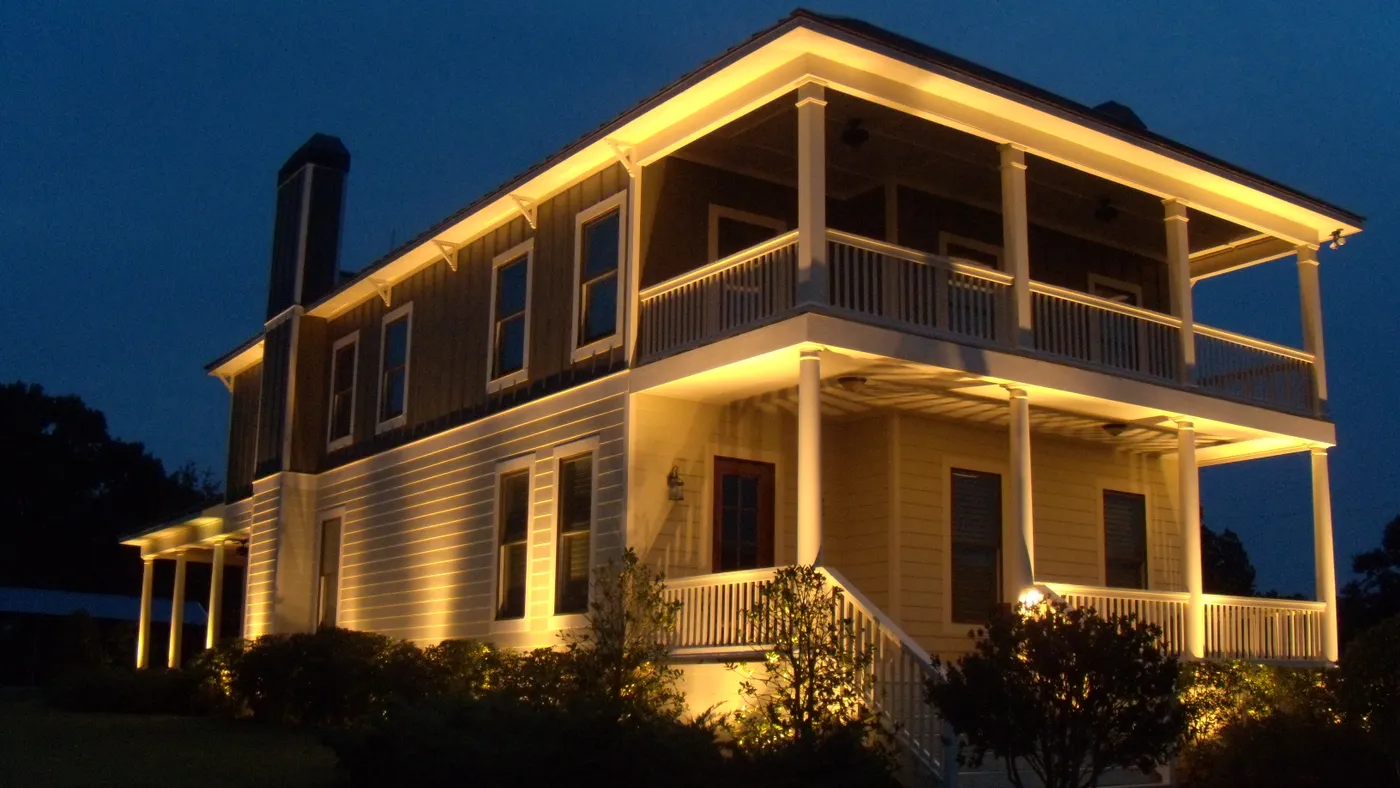
Think of this elevation as 60% dark facade + 25% warm light + 10% wood accent + 5% greenery. The dark cladding is the canvas; the light is the paint. Swap the wood panel for corten steel and the formula still holds. Swap the 2700K strip for a cool 4000K and it falls apart — cool light on dark cladding reads institutional. The percentages matter more than the products.
3. Dusk Glow on a Classic White Porch with Palm Uplighting
The single element carrying this whole scene is the uplighting on the palm trees. Take it away and you still have a pretty house — but you lose the depth, that sense the property continues past the front wall. Landscape uplights extend the light story into the yard, and they’re the difference between “nice porch lights” and “this entire property was designed.” Two or three fixtures on the tallest trunks is usually plenty; more than that and the trees start looking like they’re on a stage.
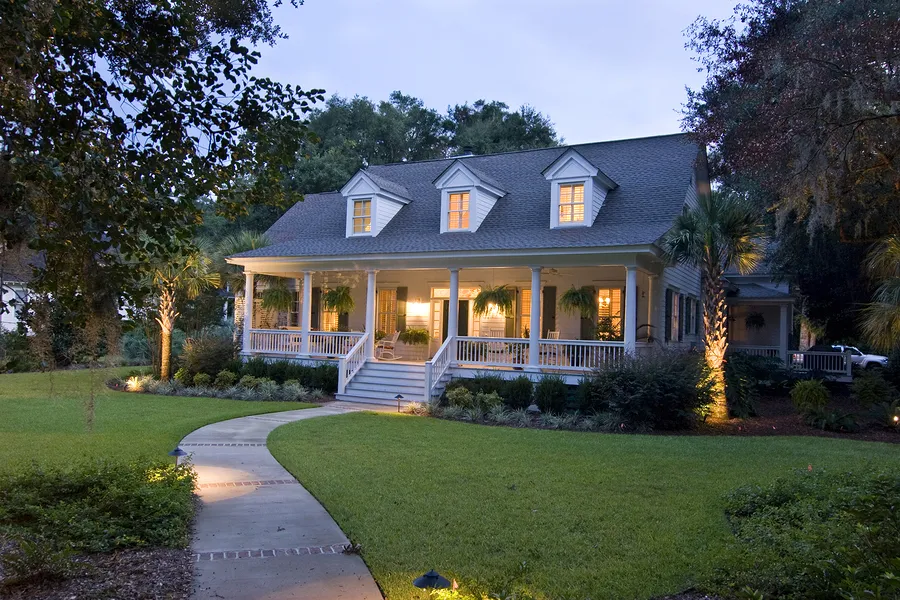
This layered approach — porch lights, tree uplights, and small path lights along the walkway — needs room to breathe. It works best on lots of at least a quarter acre with a front setback of 40 feet or more. On a tight suburban lot with a 20-foot setback, cut it to two layers: the porch and the walkway. Compare with Idea #7, which gets a similar nighttime presence out of a compact modern lot.
4. Brick Facade, Up/Down Sconces, and a Warm Yellow Welcome
Up/down sconces plus a door lantern is a starter-level electrical project — the kind a good handyman finishes in a day.
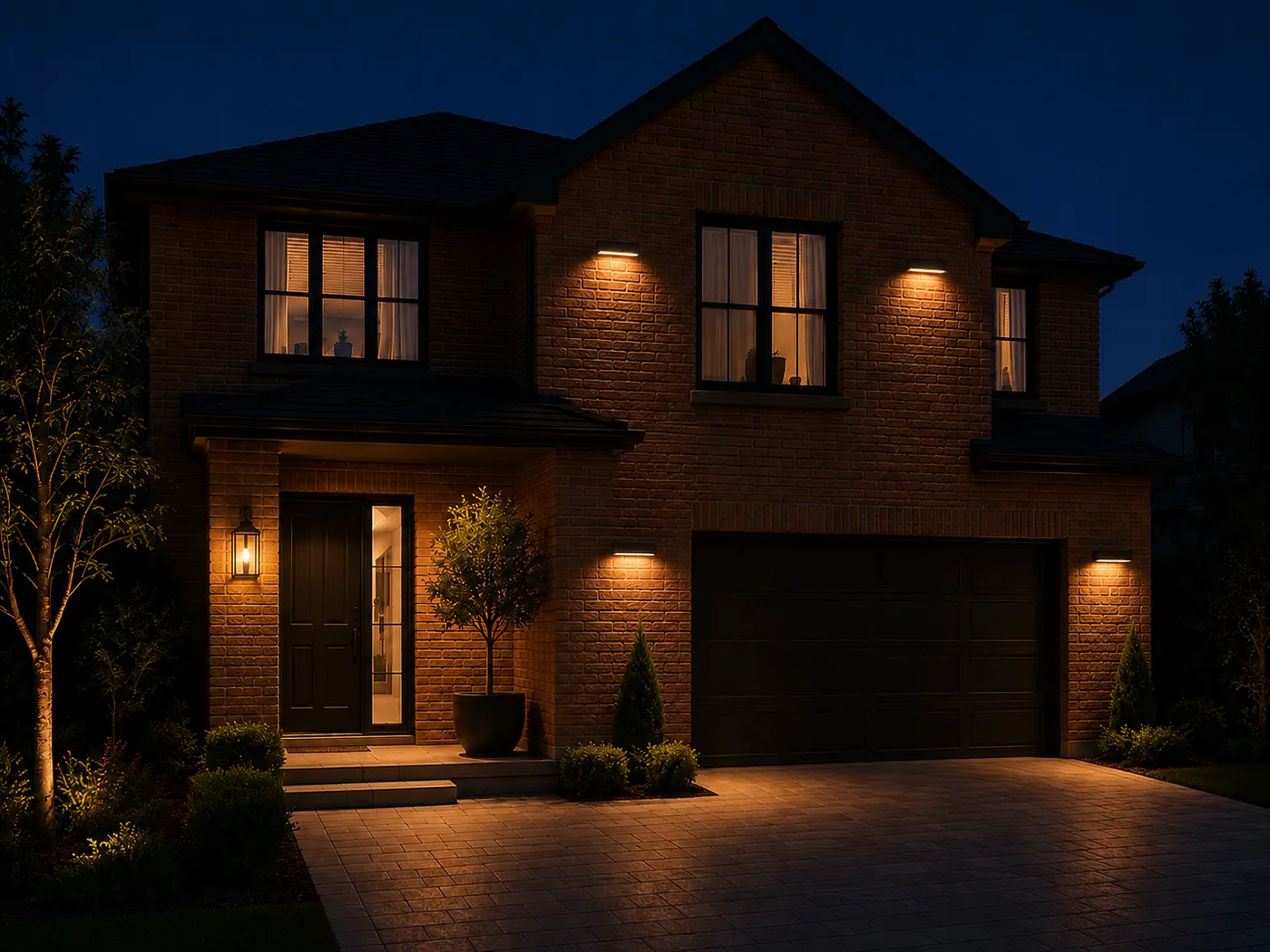
- Mark your fixture centerline 66 to 72 inches off the ground, about 6 inches out from the door frame.
- Set the up/down sconces on wall planes between windows, never on the corners — corner placement throws half the beam into the yard.
- Put every fixture on one circuit with an LED-rated dimmer; a standard dimmer will buzz and flicker at low levels.
- Keep driveway and landscape lights on a separate switch so you can kill them at midnight and leave the entry glow burning.
Time: one day with an electrician. Fixtures run $40 to $120 each, plus $150 to $400 if new wiring is needed.
- Up/down wall sconces (2): $80–$260
- Traditional door lantern: $45–$180
- Landscape uplights (4): $60–$240
- Low-voltage transformer and timer: $60–$150
- LED-rated dimmer and wiring: $40–$200
- Cable, connectors, and clips: $25–$60
5. Hourglass Light on Stone, Framed by a Still Reflecting Pool
Water features and downlighting are a beautiful pair with one catch nobody mentions: the water has to move. A still, dark pool beside a wall-washed facade shows every leaf, every pollen ring, every bit of hard-water scale. Budget for a pump, a skimmer, and roughly an hour of maintenance a month from April through October. If that sounds like more than you signed up for, a gravel bed with the same uplights gives you most of the mood and none of the upkeep.
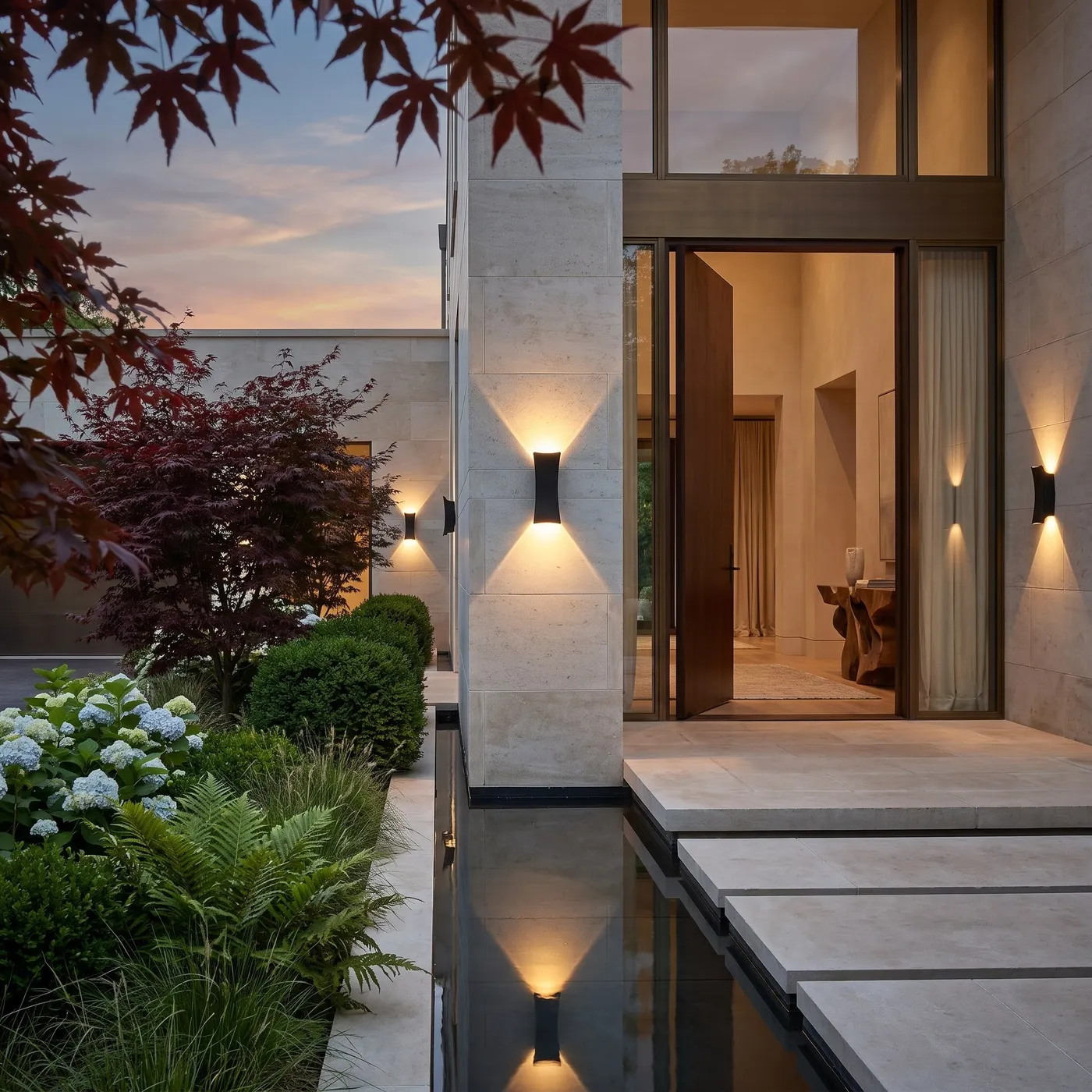
Up/down sconces throw what lighting designers call a scallop, and spacing is everything. Set them 6 to 8 feet apart, then step back to the sidewalk and squint. If the scallops overlap, you’ve gone too tight and the wall will look busy. If you see dead dark gaps, go wider. Spacing matters more than the fixture itself, and it’s free to get right on paper before you drill a single hole.
6. Three Layers of Light Under the Eaves and Along the Steps
Layer one is the wall sconces at eye level. Layer two is the strip light hidden under the eave, which grades the ceiling plane and keeps the upper facade from going black. Layer three is step-tread lighting — the one that actually keeps people from tripping. Most homes stop at layer one and wonder why the entry feels flat. Three layers at three heights, all at the same color temperature, is the entire trick.
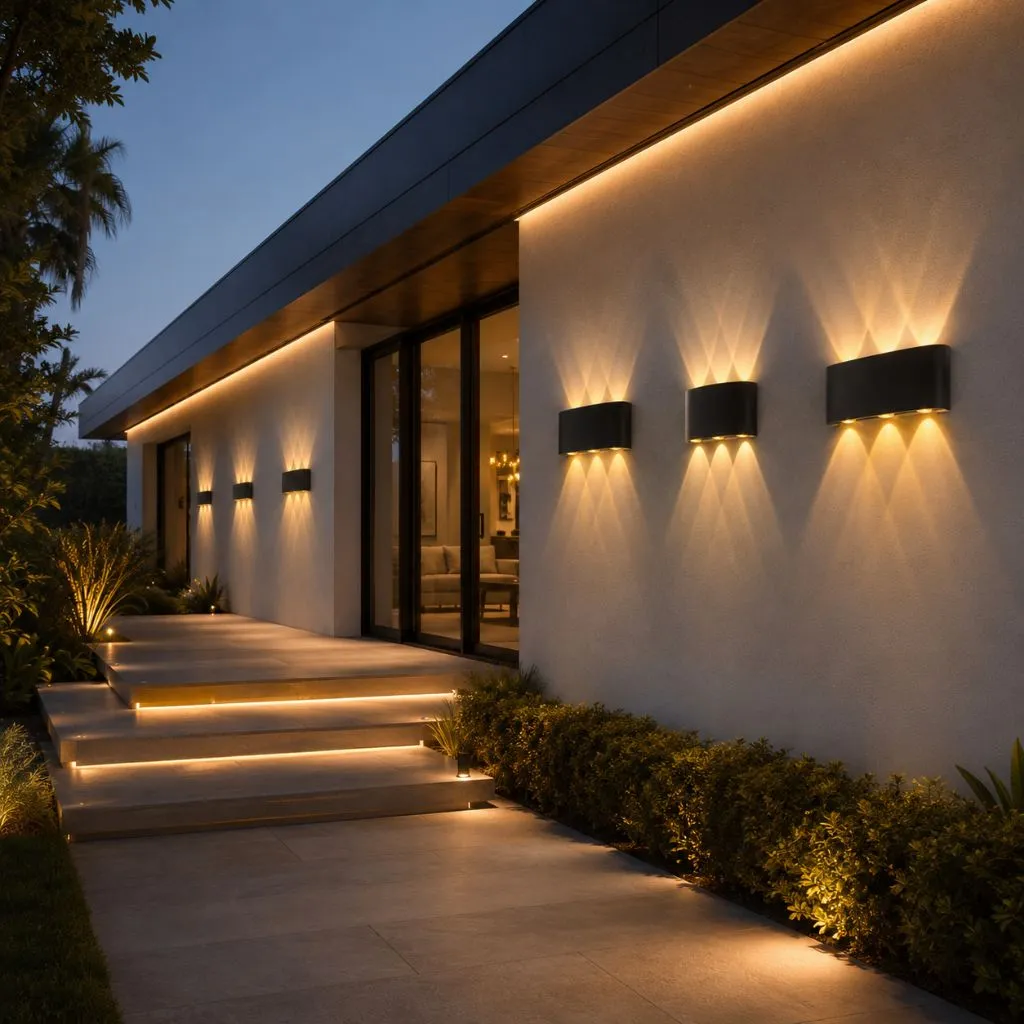
You can approximate the same effect without a single recessed fixture. Run plug-in LED rope light under the eave and hide it behind a strip of painted trim, use solar path lights from IKEA or Target in the beds, and swap step lighting for reflective tape on the tread noses. Total: about $120 instead of $1,500. It won’t be as clean, and you’ll be recharging solar units in January — but from the street on a Tuesday night, nobody can tell.
7. Vertical Linear Lights and Bollards on a Minimalist White House
Here it’s roughly 55% white mass + 20% black metal + 15% green + 10% light. The math only works because the black fixtures are so thin — chunky fixtures on a minimalist facade look like eyebrows. Swap the white stucco for pale limestone and the formula holds; swap the black bollards for bronze and the whole scene warms up noticeably. The one thing you can’t change is the count. Odd numbers of bollards along a path read better than even ones, every time.
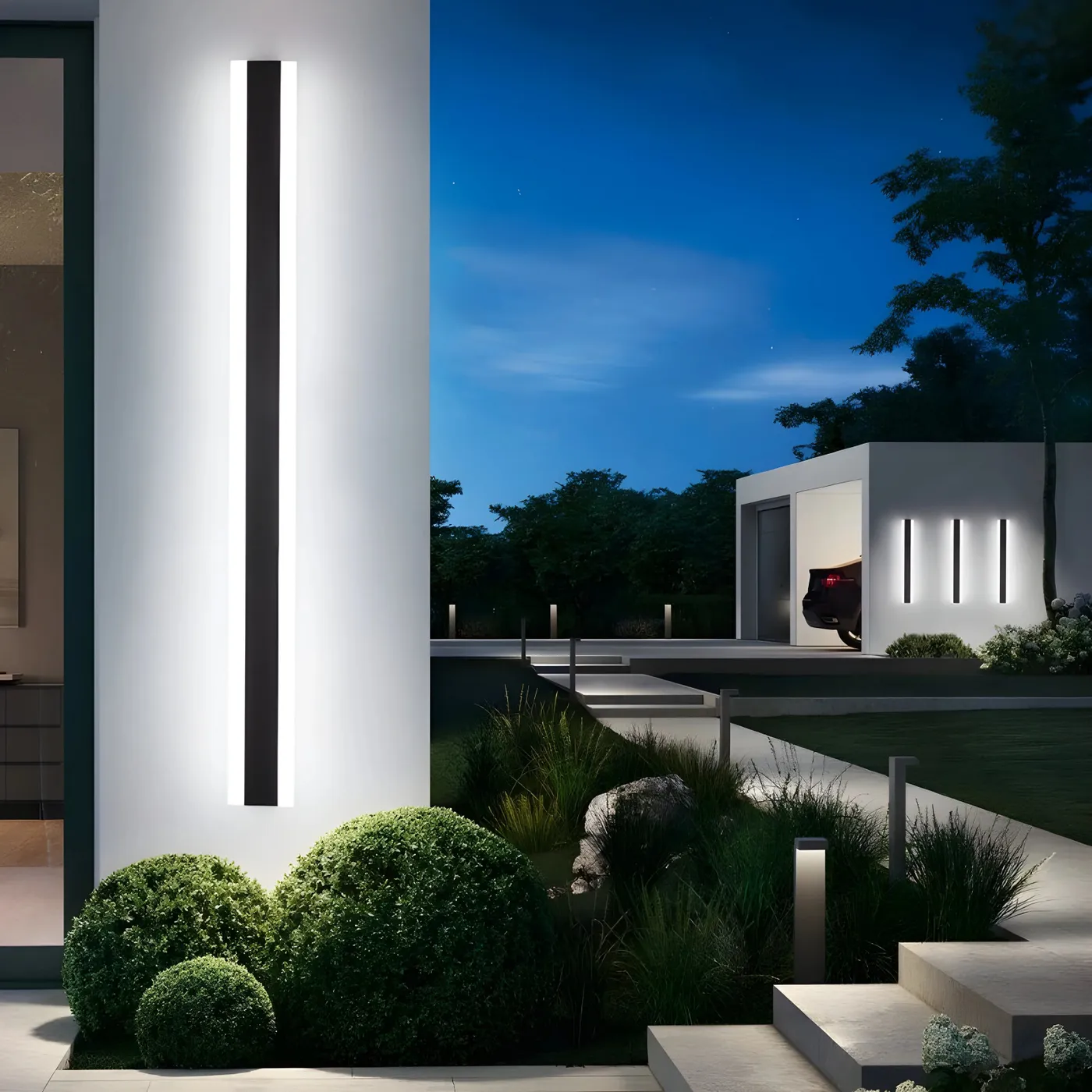
- Measure your facade height first — vertical fixtures under 24 inches get lost on walls taller than 12 feet.
- Check where your existing wiring lands; retrofitting conduit across a concrete path is the expensive part.
- Photograph the house at dusk before you buy anything, so you know which walls actually go dark.
- Confirm your transformer wattage covers every fixture plus 20% headroom for future additions.
8. A Pair of Black Sconces Between Dark-Framed Windows
When sconces sit between windows, center them on the wall plane — not on the window trim, which is usually off-center once you account for shutters. And size up: a sconce should be about one-third the height of the wall section it lives on. On a 9-foot wall, that’s a 36-inch fixture. Most people buy 14-inch sconces and then can’t figure out why the wall looks empty. Bigger fixtures, fewer of them, always looks better than a row of small ones.
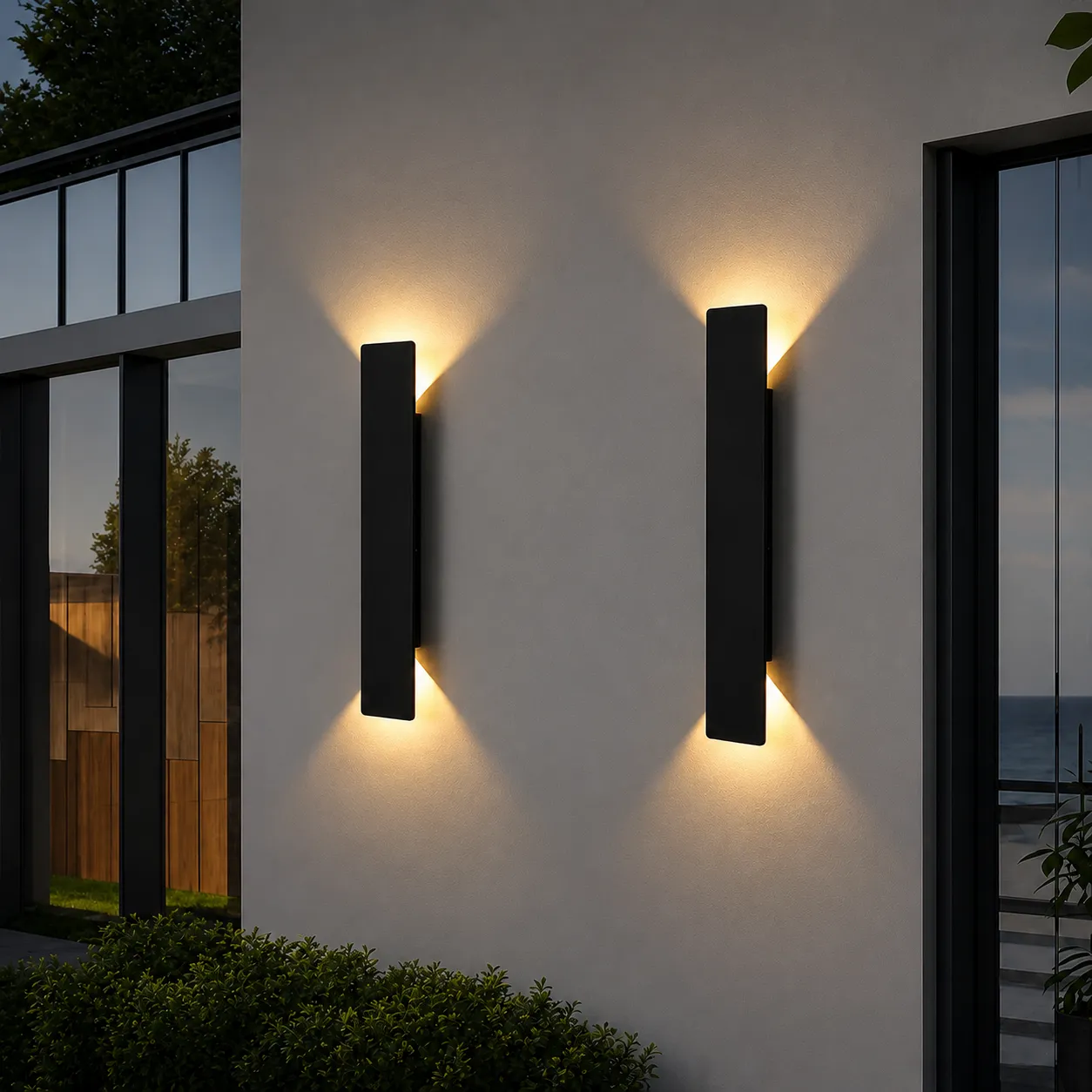
The black metal finish is doing more work than you’d think. On an off-white wall with dark window frames, black sconces pick up the frames and tie the whole elevation together — the eye reads them as part of a set. A bronze or nickel fixture in the same spot reads as an addition. If you’re replacing lights on a house with dark trim, match the trim. That single decision is worth more than any upgrade in wattage.
9. A Single Dark Gray Sconce with a Frosted Center Panel
- Sconce fixture (2-pack, dark gray): $70–$220
- LED bulbs, 2700K, dimmable: $14–$30
- LED-rated dimmer switch: $25–$55
- Electrical box and wiring, if new: $150–$400
- Paint touch-up for the wall: $12–$25
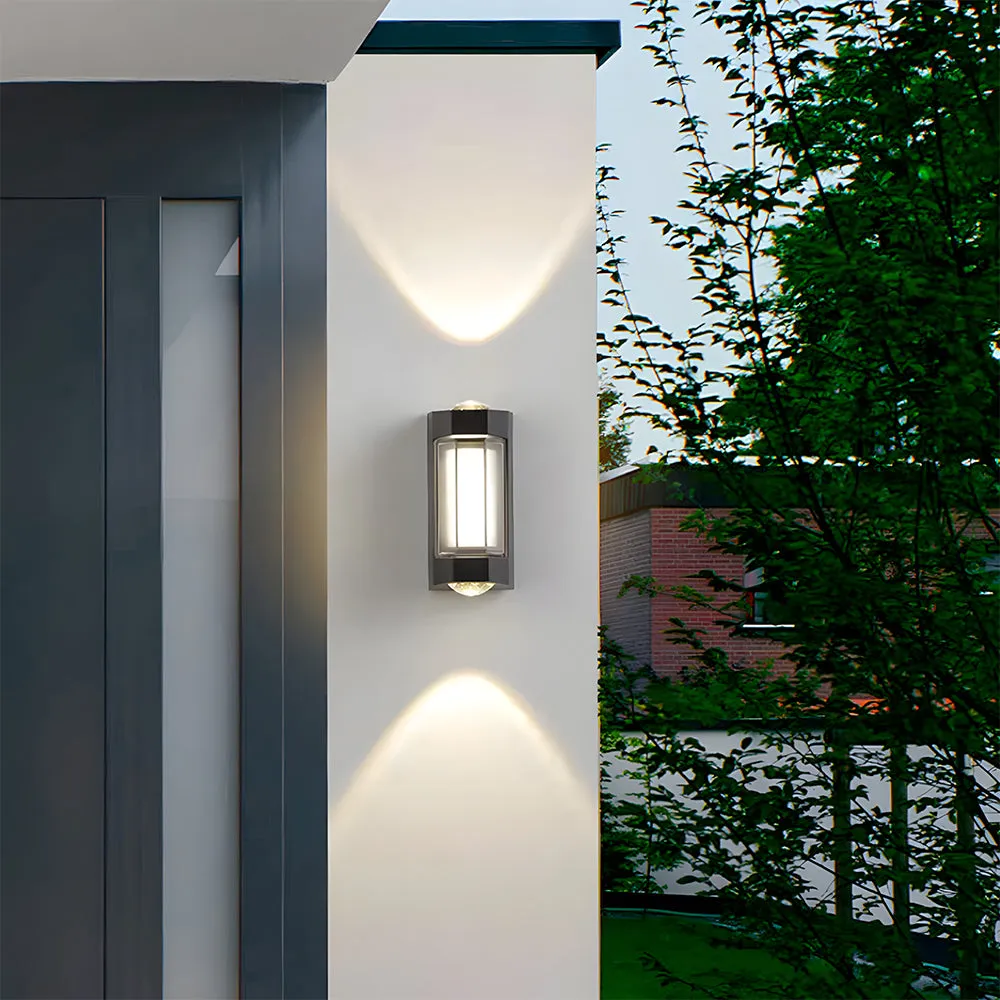
A frosted center panel softens glare, which is lovely — but it also hides the bulb, so people forget to clean it. Dust and bug carcasses collect inside the diffuser and the light goes muddy within a season. Pop the panel off twice a year and wipe it down. Also worth checking: if this is your only light by the door, make sure it’s at least 800 lumens, or your guests will be fumbling for keys in the dark.
10. Warm Up-Down Beams Washing a Concrete Garden Wall
Concrete walls want fixtures spaced at roughly half their height — an 8-foot wall takes sconces every 4 feet, a 6-foot wall every 3. That’s more fixtures than most people expect, but concrete is unforgiving about dark gaps. This works on any wall run over 12 feet; below that, a single centered fixture reads better. For a smaller version of the same idea, see Idea #5, where the wall terminates in a water feature instead of planting.
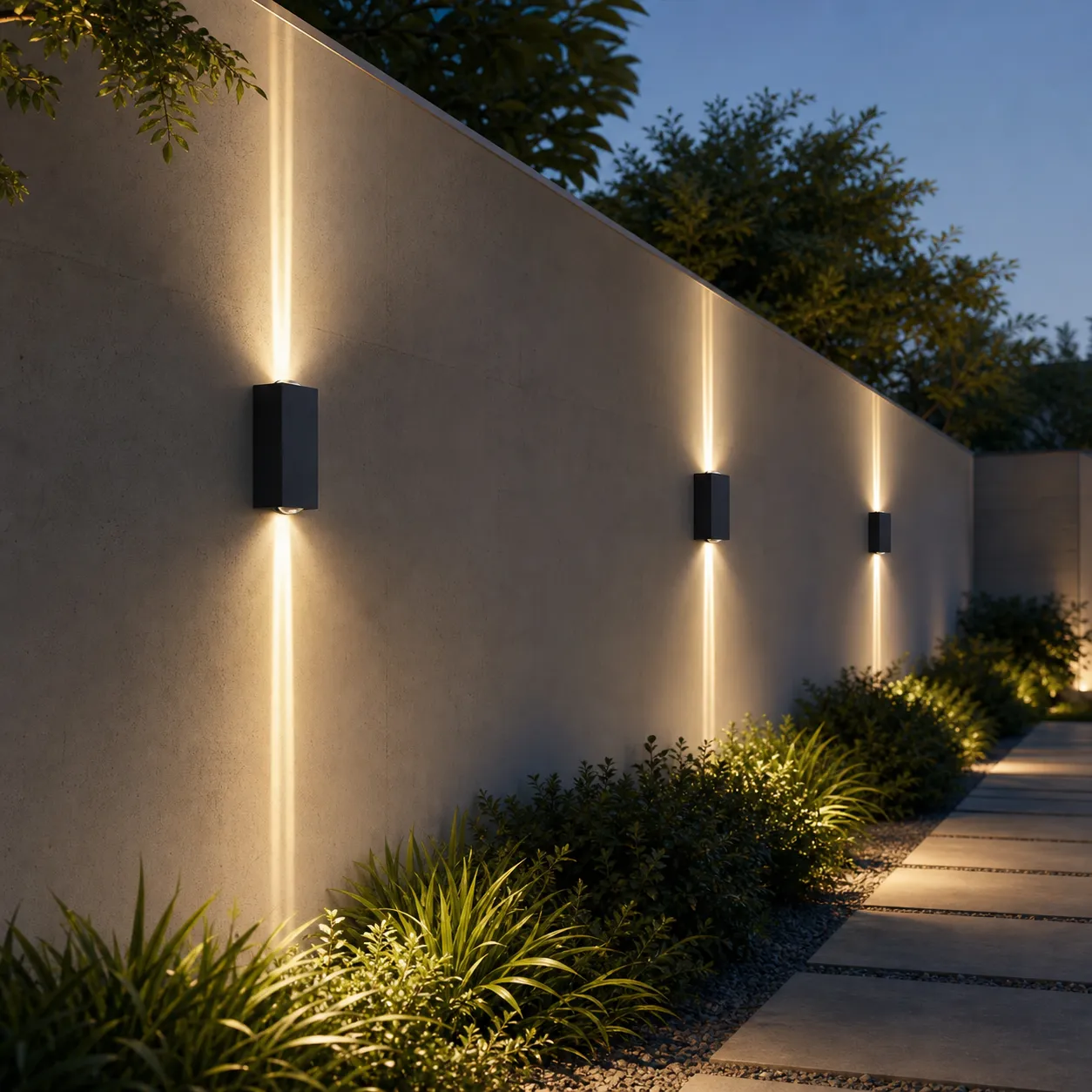
Installing them isn’t complicated if you plan the run first.
- Run 12-gauge low-voltage cable along the wall base and up behind each fixture location.
- Mount sconces at least 12 inches above the tallest shrub so foliage never blocks the down-beam.
- Position the fixture so the up-cone grazes the wall rather than blasting straight into the sky.
- Put the whole run on a photocell timer — wall lights should come on at dusk, not on your schedule.
Expect a half-day of work for four fixtures. Budget $90 to $180 per light once cable and clips are included.
11. A Courtyard Juggling Sconces, Stair Lights, and One Big Globe
Mixed-fixture lighting — where one courtyard carries three or four different fixture types on purpose — is the 2026 look. It came out of landscape architecture rather than residential design, and it’s a reaction to the sameness of the 2010s, when every house got the same six lanterns. Designers are now treating the exterior like an interior: task light, ambient light, accent light. The risk is obvious. Mixing fixtures works when they share a finish. Two metals is a choice; three is a mess.
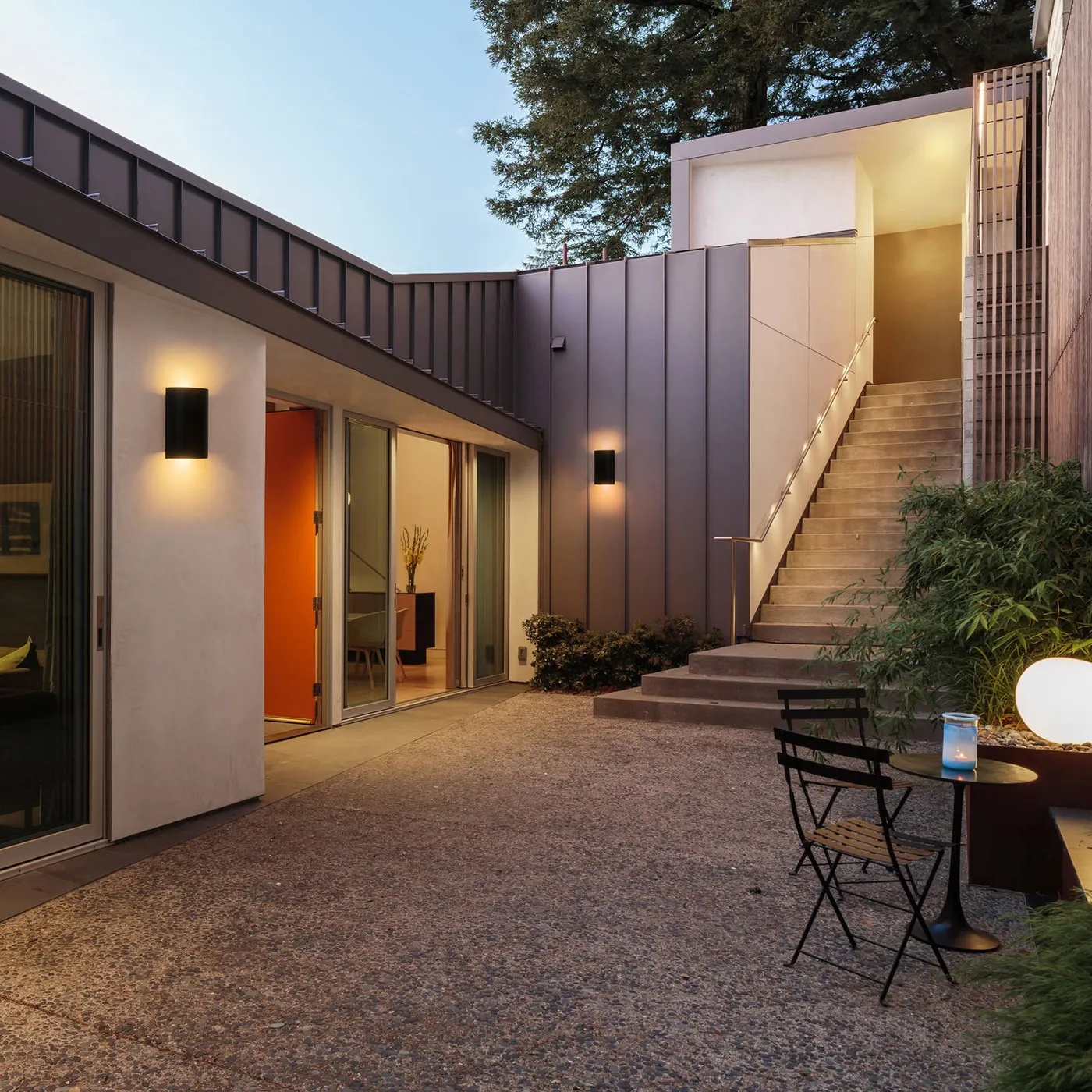
The glowing sphere is the outlier here, and that’s exactly why it works. Everything else in this courtyard is linear — vertical metal siding, straight concrete stairs, rectangular sconces. One round, soft light source breaks the grid and gives the eye somewhere to land. Designers call it a counterpoint. You only need one. Add a second globe and the courtyard starts to look like a hotel lobby, which is not the compliment it sounds like.
12. Fluted Black Sconces Over a Twilight Patio
Fluted metal sconces look bespoke, but the silhouette is easy to fake. Wayfair and Amazon both carry ribbed black up/down sconces in the $45 to $80 range, and the difference from a $350 designer fixture is mostly weight and finish quality — which nobody sees from the patio. Pair two of them with a wood-look dining set from Walmart and you’ve got the entire scene for under $400. Put the savings into good bulbs.
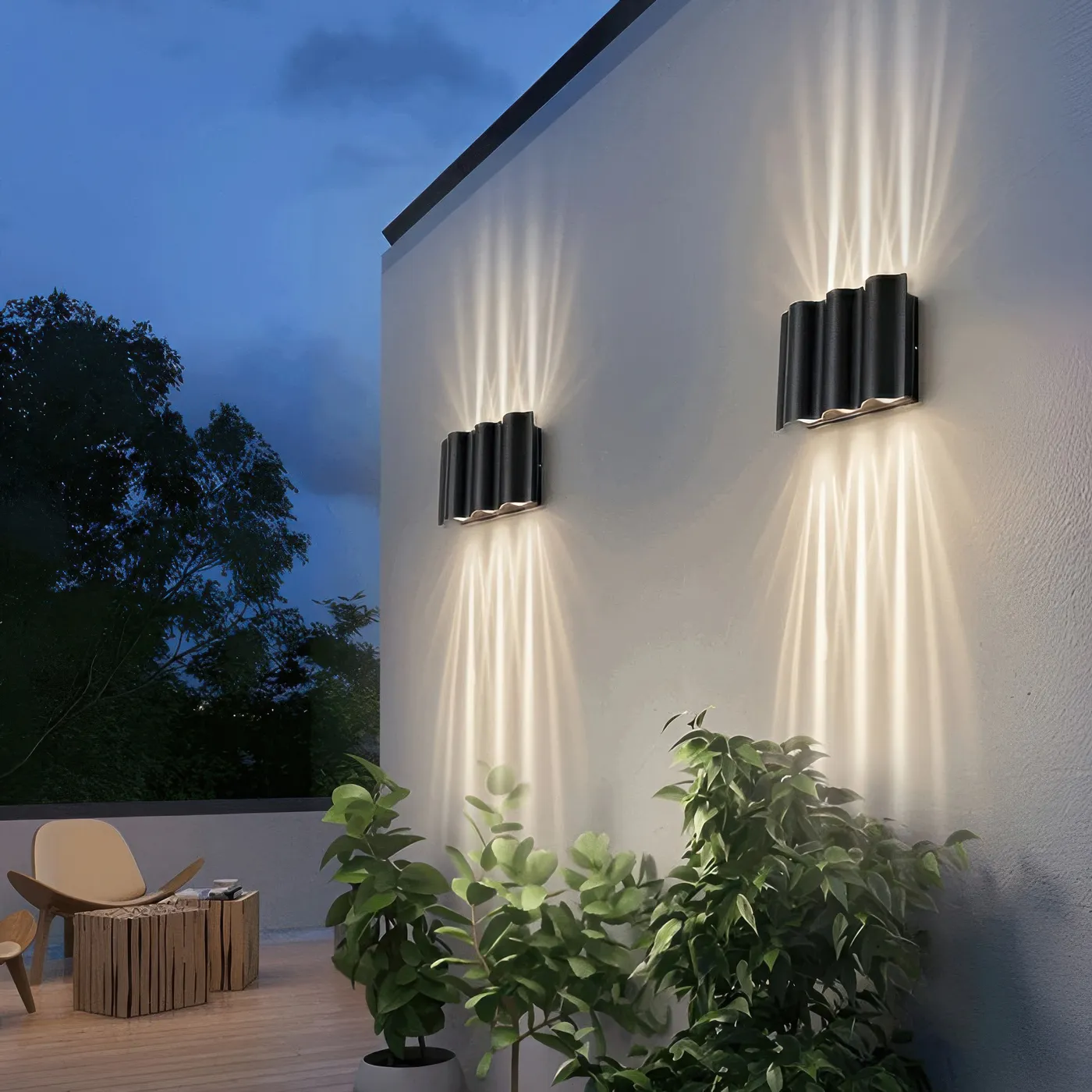
Outdoor dining areas need light lower than you think. Sconces at 72 inches do nothing for a table — you want illumination at or below eye level when seated, around 26 to 30 inches. That’s why the light wood furniture here is doing double duty: it reads as furniture, but it also gives the patio a visual anchor point. Add a rechargeable battery table lamp (they’ve gotten genuinely good) and the space works after dark without a single string light.
13. A Tall Geometric Sconce Over a Patio Water Feature
It’s the water feature. The light fixture is striking, the sectional is perfectly fine, the bamboo is a nice touch — but the dark pool with its small waterfall is what turns a patio into a destination. Water gives you sound, movement, and reflected light, three things no fixture can produce on its own. Remove it and this is a very good modern patio. Keep it and it becomes the reason people wander outside after dinner.
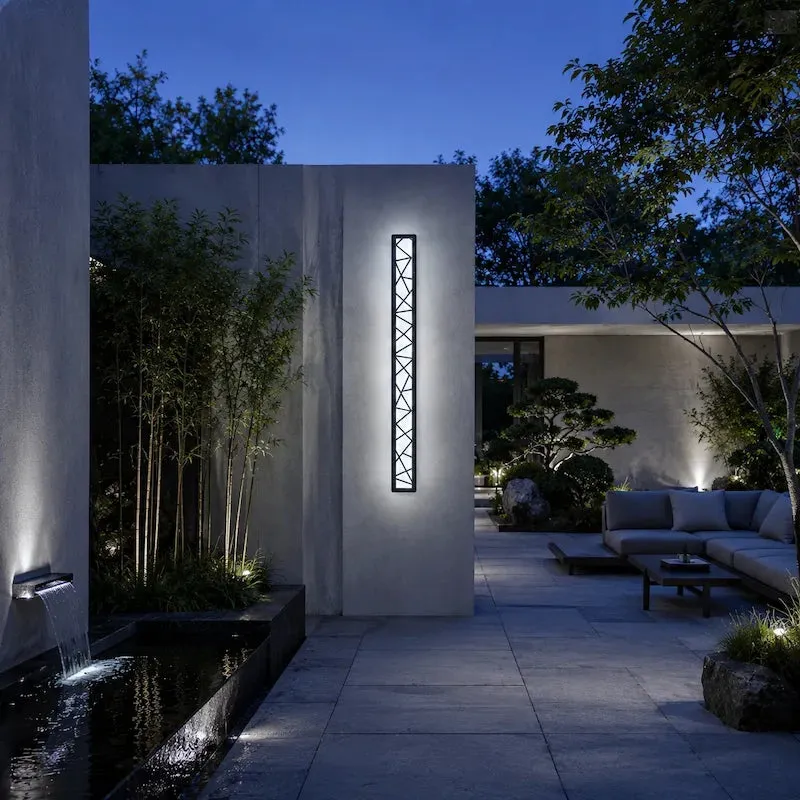
Water features cost more to own than to install. Expect to clean the pump intake monthly, top off evaporation every week or two in summer, and drain-and-scrub the basin twice a year. A small submersible pump runs $60 to $120 to replace and usually lasts three to five years. If that’s more than you want on your plate, a dry gravel bed with the same uplight gives you 70% of the look and needs a rake, not a hose.
14. Geometric Sconces That Throw a Pattern on Rough Stone
Here it’s roughly 50% stone + 25% amber light + 15% black frame + 10% planting. The pierced pattern is the wild card — a lattice or cutout fixture throws a decorative shadow that reads as texture, so you can get away with less natural stone variation than you’d otherwise need. Swap the geometric cutout for a solid shade and the same wall suddenly looks plainer. Keep the amber temperature, too. Cool white on warm stone is the most common mistake in this entire article.
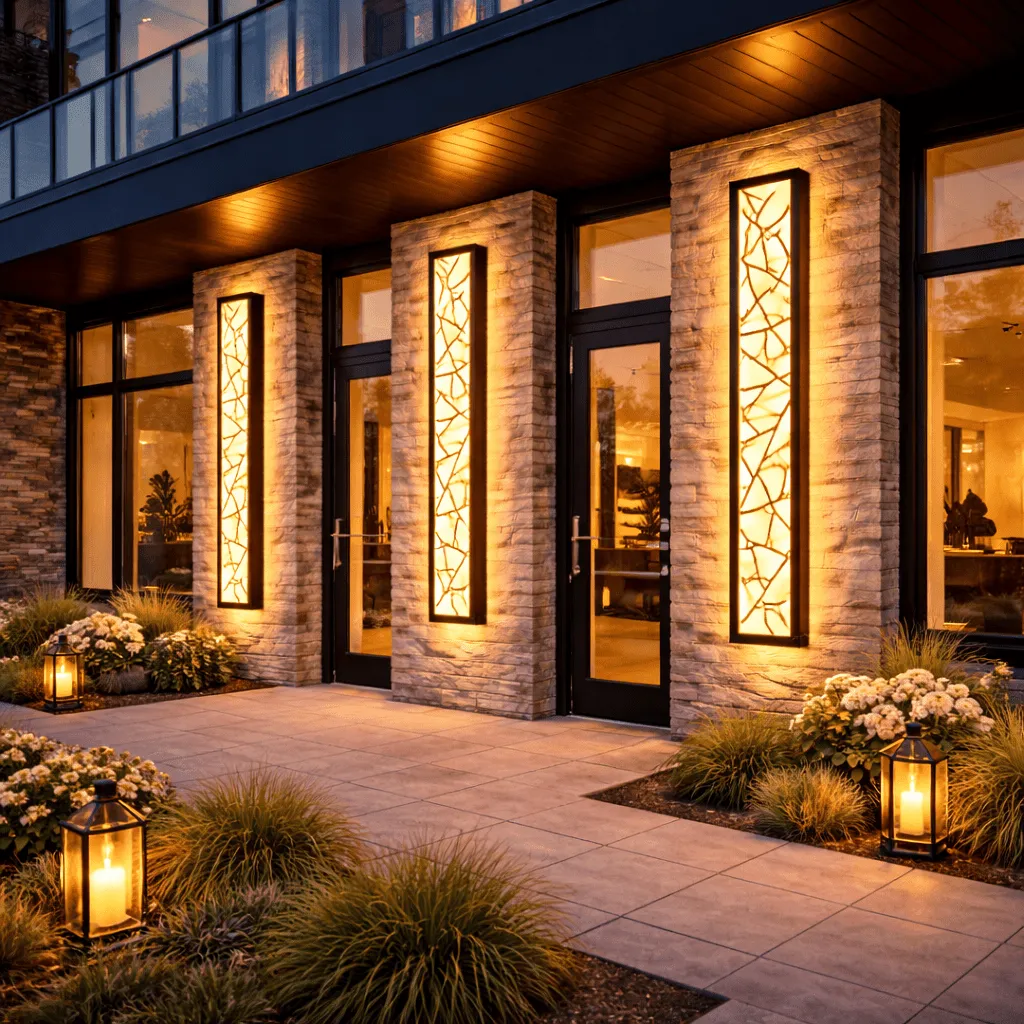
Rough-cut stone is porous, and light amplifies every texture, including the ones you don’t love. If your stone has efflorescence or uneven mortar, uplighting will find it. Fix those first — a $200 cleaning and sealing job is cheaper than replacing fixtures you bought trying to solve the wrong problem. And watch fixture height: sconces mounted below 60 inches will sit in shadow from your own shrubs.
15. Onyx Sconces Glowing Against a Sunset Pool Deck
Translucent stone sconces are essentially lampshades made of rock, and they need a low-wattage bulb — 40 watts equivalent max — or the stone goes from glowing to blown out. Use a 2700K dimmable LED and put it on a dimmer with a 10% bottom end so you can drop the patio light low at dinner. One more thing: translucent fixtures show fingerprints and mineral deposits. Wipe them with a dry microfiber only, never a wet cloth.
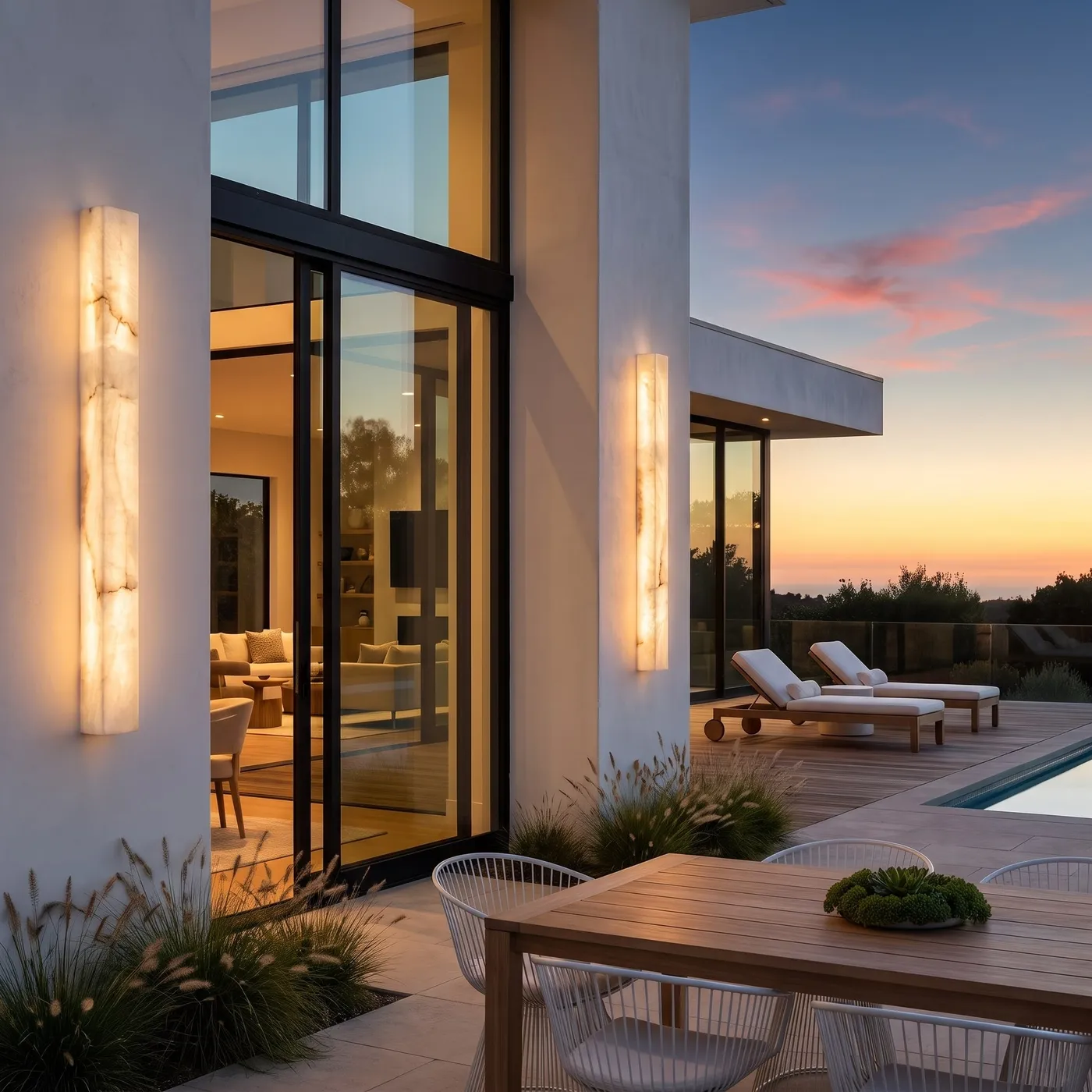
This look needs a patio slab of at least 300 square feet to justify two large sconces — otherwise they overwhelm the wall. Ceiling height matters less outdoors than overhang depth: you want 24 inches of overhang minimum so the sconces have a shadow line to work against. On a smaller deck, one sconce plus path lighting does the job. Compare with Idea #19 for a narrower wall treatment that uses a single fixture.
16. A Golden Bronze Strip Light That Grades a Beige Wall
A tall vertical fixture is less forgiving to install than it looks.
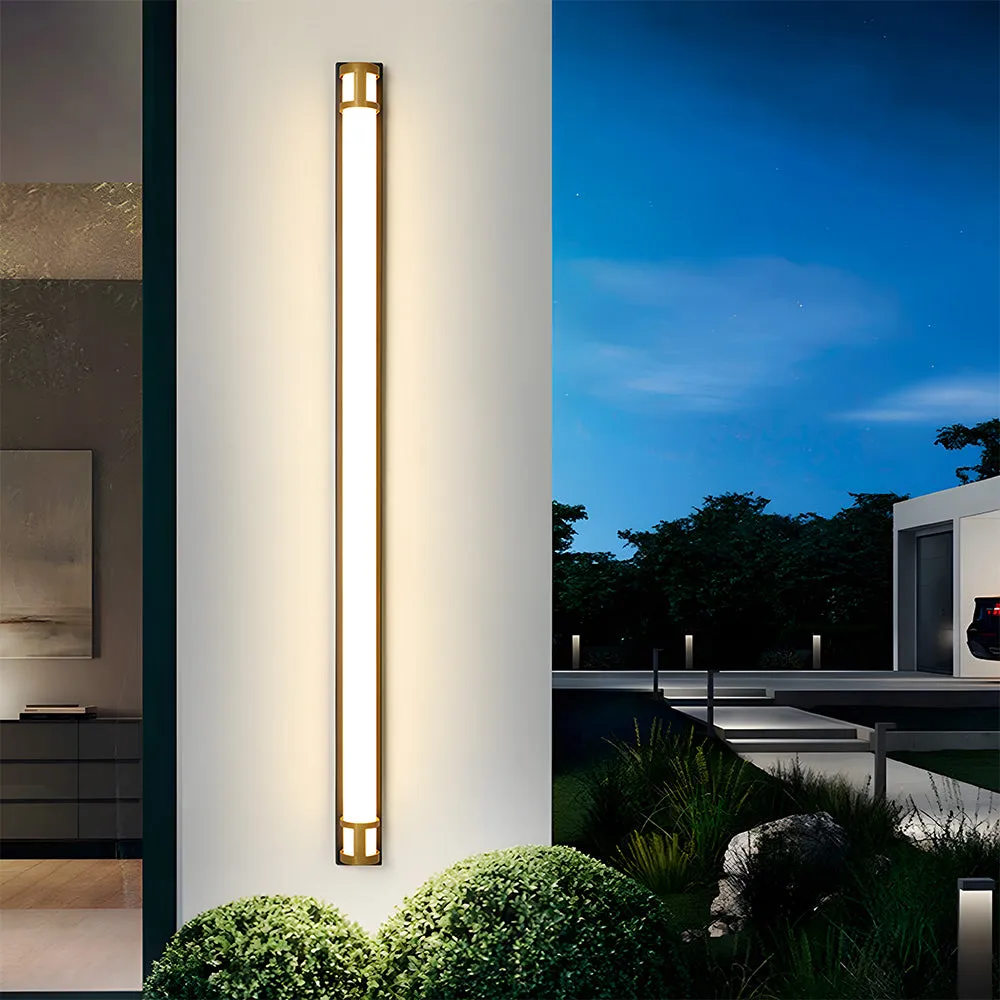
- Set the fixture centerline about one-third up the wall, not at eye level.
- Verify your wall is flat within a quarter inch over the fixture’s length — tall slim lights reveal every bow.
- Seal the backplate with exterior silicone so water can’t track behind it.
- Choose 3000K if the wall is beige or tan; 2700K if it’s gray or white.
About an hour per fixture for a competent DIYer. Fixture cost runs $120 to $400 depending on length.
The length is the whole point. A 36- to 48-inch vertical sconce on a single-story wall does something a standard lantern can’t: it draws the eye upward and makes the house read taller. Shrink it to 16 inches and you’ve got an ordinary porch light with an unusual finish. If you’re buying one, buy the longest one the wall can handle.
17. Uplights Along a Brick Base, Wood Above, Glass Between
The material change is the story here. Dark gray brick below, warm horizontal wood siding above, glass in between — and the uplights do the job of separating them so the transition doesn’t look like a mistake. Ground-level uplights placed close to the wall, 12 to 18 inches out, create a scalloped gradient that shows off the brick texture, while the glass panels glow from inside. That interior glow is free lighting you should be designing around, not competing with.
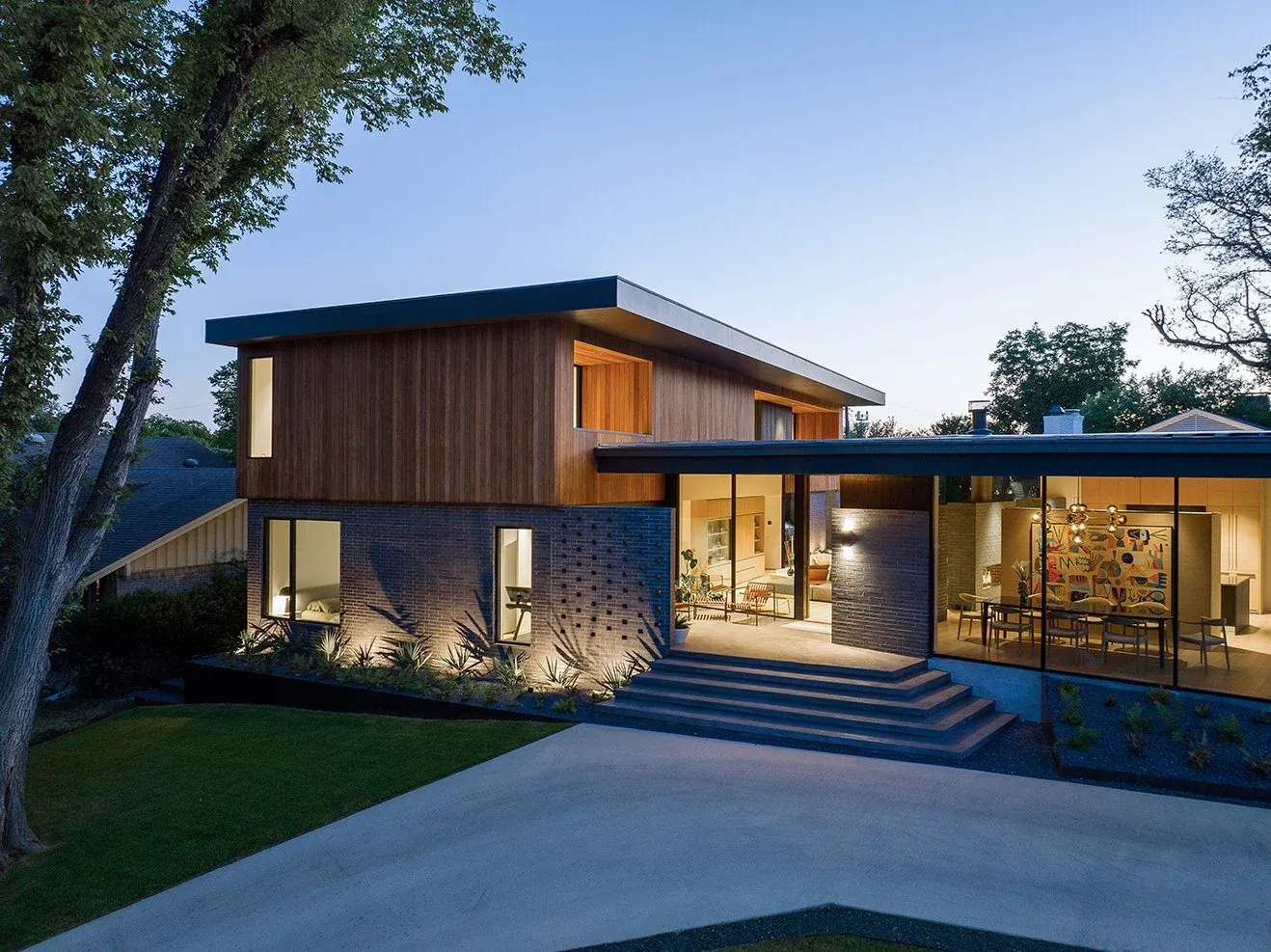
- Well lights (6) with LED lamps: $120–$360
- Low-voltage transformer: $70–$180
- Low-voltage cable and connectors: $40–$90
- Timer or smart controller: $30–$110
- Bed cleanup and fresh mulch: $60–$150
18. A Rectangular Sconce and Twin Disc Floor Lamp by the Pool
Pool lighting has one hard rule: nothing within 5 feet of the water’s edge unless it’s rated for wet locations, and anything within 10 feet should be on a GFCI circuit. Beyond code, think about glare. A bright fixture at the pool’s edge reflects in the water and turns a calm surface into a mirror of harsh light. Put the bright stuff back at the house, where the wall sconce lives, and let the pool stay dark and reflective.
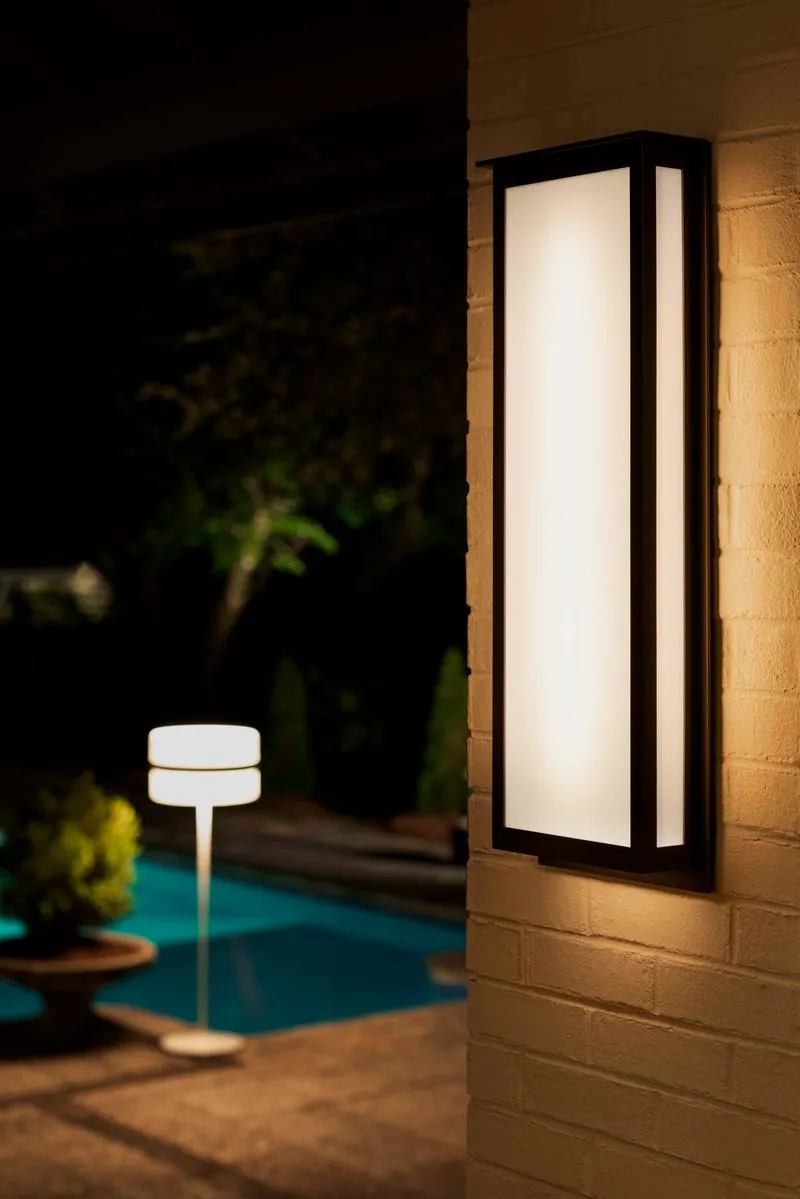
This one is about ratio: 60% dark + 30% warm glow + 10% cool water. The blue pool is the only cool note in the whole composition, and that’s what makes it feel calm rather than sleepy. Swap the water for a fire feature and you lose the temperature contrast — the scene goes one-note warm, still nice but flatter. Keep at least one cool element in any nighttime outdoor scheme. If your facade is a single material instead of several, see Idea #1 for an approach that leans on architecture rather than texture.
19. One Long Strip Light on a Textured Gray Wall
Textured walls and strip lights are a pairing worth understanding: the light rakes across the surface and turns a flat finish into something with depth. The trick is offset. Mount the strip 3 to 4 inches proud of the wall on small standoffs so the beam hits at an angle. Mounted flush, you get a bright halo and no texture at all. A six-dollar pack of standoffs is the difference between a feature and a smudge.
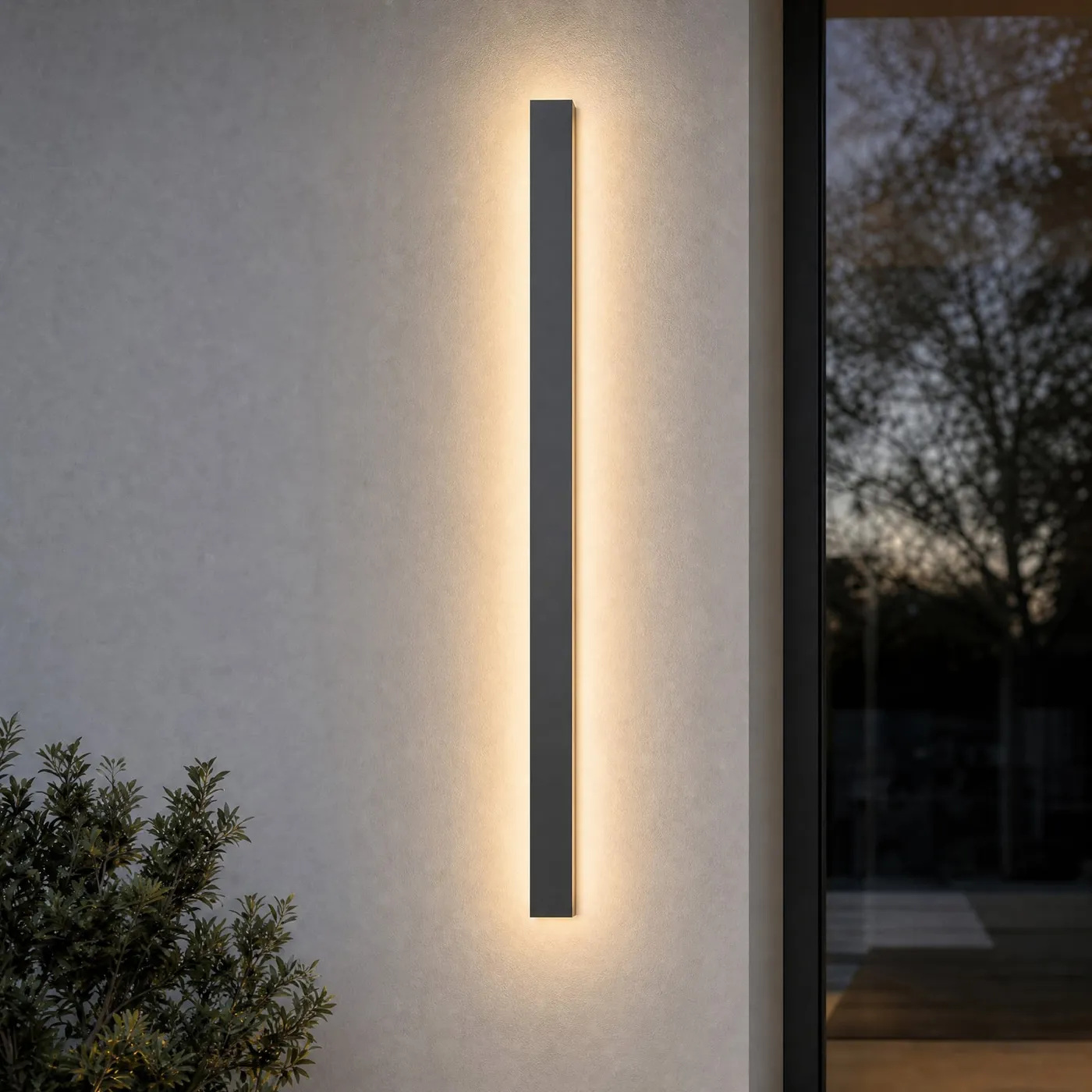
Long strip fixtures get expensive fast — $250 and up for anything over 30 inches. A 24-inch linear LED bath bar is almost the same shape, costs $60 to $90, and is already UL-listed for damp locations. It isn’t rated for direct rain, so tuck it under an overhang. Amazon and Home Depot both carry them in matte black and brushed nickel. You’re saving $150 to $300 and gaining a fixture that’s easier to replace later.
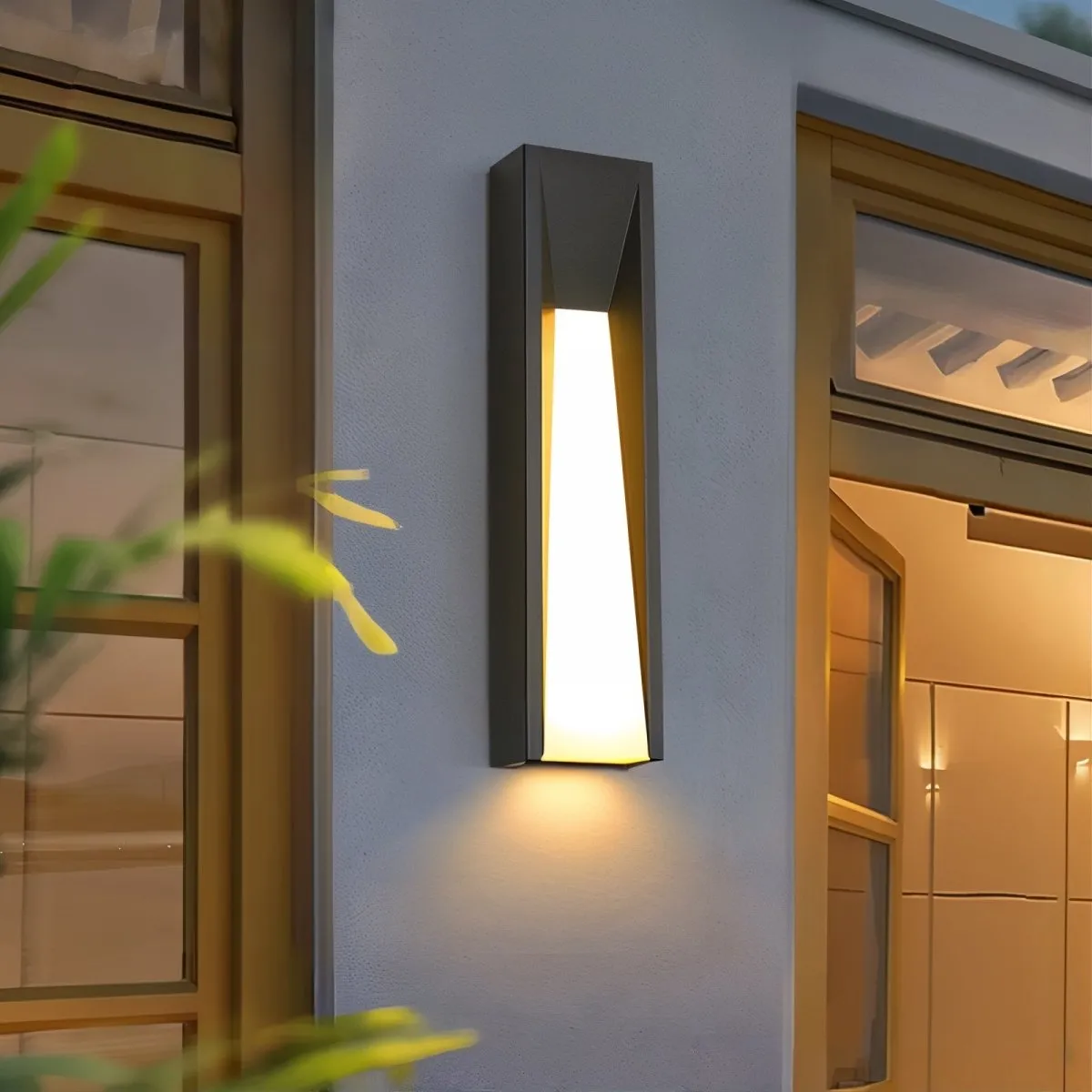
20. Bronze Sconce, Trapezoidal Cutout, Wood-Framed Door
Dark bronze finishes are powder-coated or oil-rubbed, and both fade under direct sun. Fixtures on west- and south-facing walls will drift toward a chalky gray-brown in four to six years. You can slow that with a coat of automotive wax once a year — ten minutes per fixture. The warm white LEDs themselves are basically maintenance-free: expect 25,000 to 50,000 hours, which at six hours a night is well over a decade of service.
- Check the light direction at 8 p.m. from the street, not from your front door.
- Confirm the backplate covers your existing junction box — older boxes are often oddly shaped.
- Decide whether the finish should match or deliberately contrast with your door hardware.
- Test the color temperature against your wood tones in person, not in a product photo.
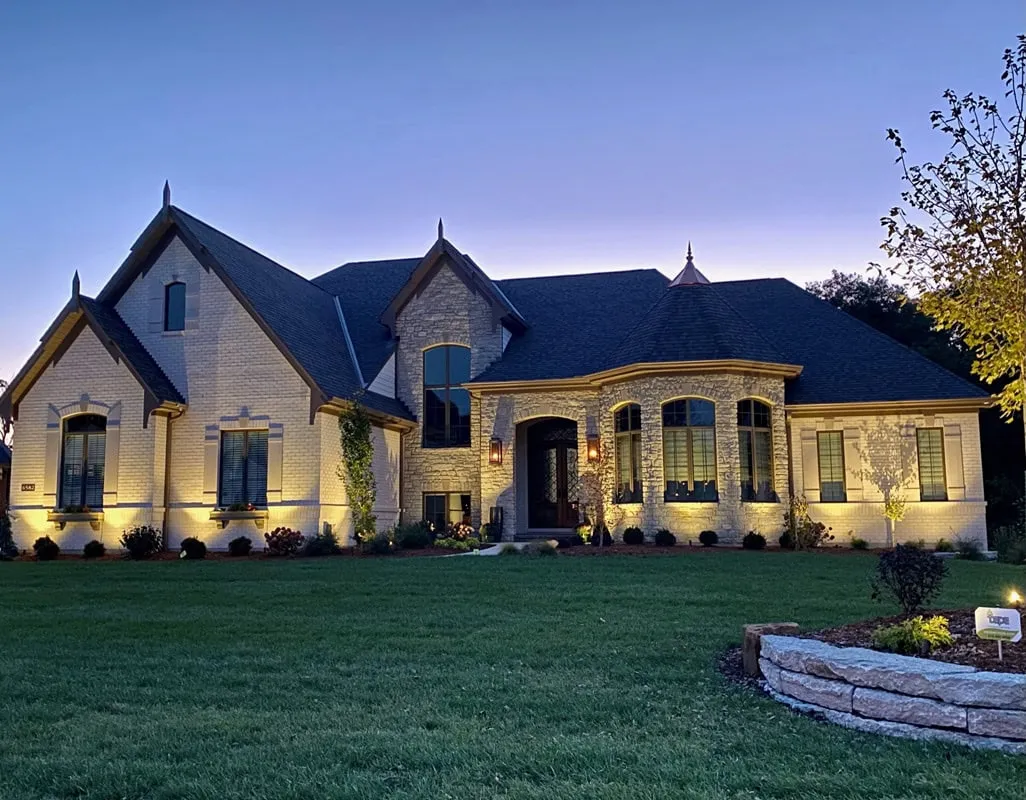
21. Uplighting a Multi-Gabled Brick and Stone Facade
Big gabled facades need more fixtures than you think — roughly one uplight per 8 to 10 feet of wall, plus a dedicated fixture for each gable peak. This is a two-story house with a footprint over 2,500 square feet; below that, the same approach starts to look over-lit. If your house is under 1,800 square feet, skip the gable uplights entirely and concentrate everything on the entry, the way Idea #23 does.
Warm uplighting on brick and stone has been the default on high-end new builds for years, and 2026 is when it filtered into ordinary neighborhoods. The reason is boring but real: LED uplights got cheap. A fixture that cost $200 in 2015 is $35 today, and the light quality is better. That price collapse is why you’re suddenly seeing warm-lit brick all over your street at 9 p.m. on a Tuesday.
22. A Black Lantern with Seeded Glass and an Edison Bulb
It’s the seeded glass. Clear glass shows you a bulb; seeded glass shows you a texture. Those tiny bubbles diffuse the filament just enough that the fixture reads warm and handcrafted rather than industrial, and they hide dust between cleanings. Swap it for plain clear glass and the same lantern becomes a generic big-box fixture. This one detail is the entire difference, and it costs manufacturers about eight dollars. Compare with Idea #25 — same seeded glass, completely different geometry.
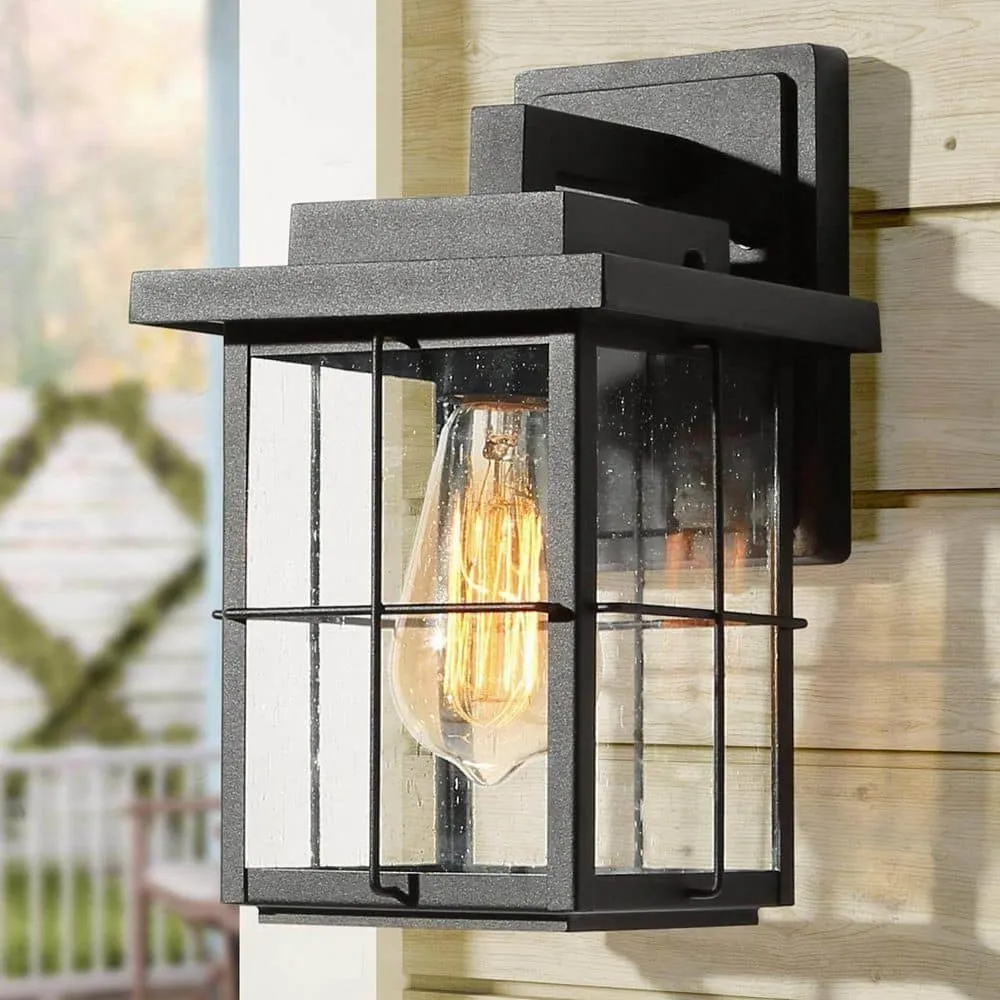
Swapping a fixture is a genuinely easy weekend project.
- Choose a 2200K–2400K Edison-style LED rather than an actual filament bulb.
- Check the lantern’s socket depth — many decorative LEDs are too tall for shallow cages.
- Seal the top cap and glass seams with clear exterior caulk once a year.
- Mount on a level line with the door’s top rail; most lanterns sit about 6 inches below the header.
About 45 minutes for a swap. Bulbs run $6 to $15 each; the lantern itself $60 to $250.
23. Antique Brass Lantern on Painted White Brick
- Antique brass wall lantern (1): $90–$320
- Flame-tip LED bulb: $8–$18
- Mounting hardware and exterior caulk: $10–$20
- Optional matching second fixture: $90–$320
- Climbing ivy and trellis: $25–$70
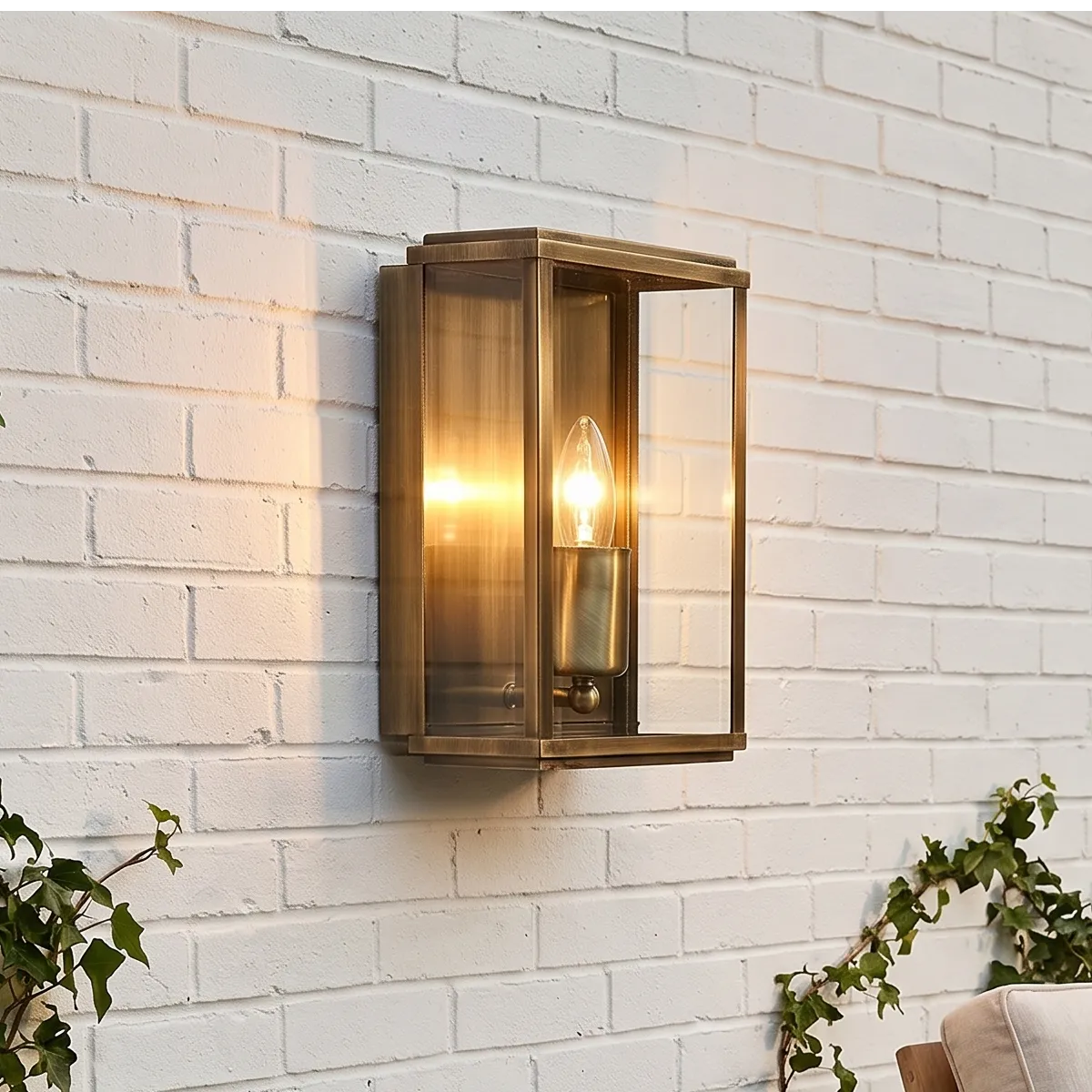
Brass on painted brick is one of the few pairings that genuinely improves with age — the brass patinas, the brick doesn’t. Just keep the fixture proportionally generous: on a wall of painted brick, anything under 10 inches wide disappears entirely. Look for at least a 12-inch body on a single-story entry. And place it so light passes over the ivy rather than through it. Light through leaves gives you shadow confetti.
24. Black Sconces and Wood Paneling Around a Pivot Door
Three things are working: symmetry, material contrast, and a light where you actually need it. The matching sconces flanking the door establish an axis, which makes the entry feel intentional rather than leftover. The warm wood against cool stucco keeps the modern palette from going cold. And the integrated step lighting means the entry works functionally, not just visually. A lot of modern entries nail the first two and forget the third, then wonder why guests hesitate at the front step.
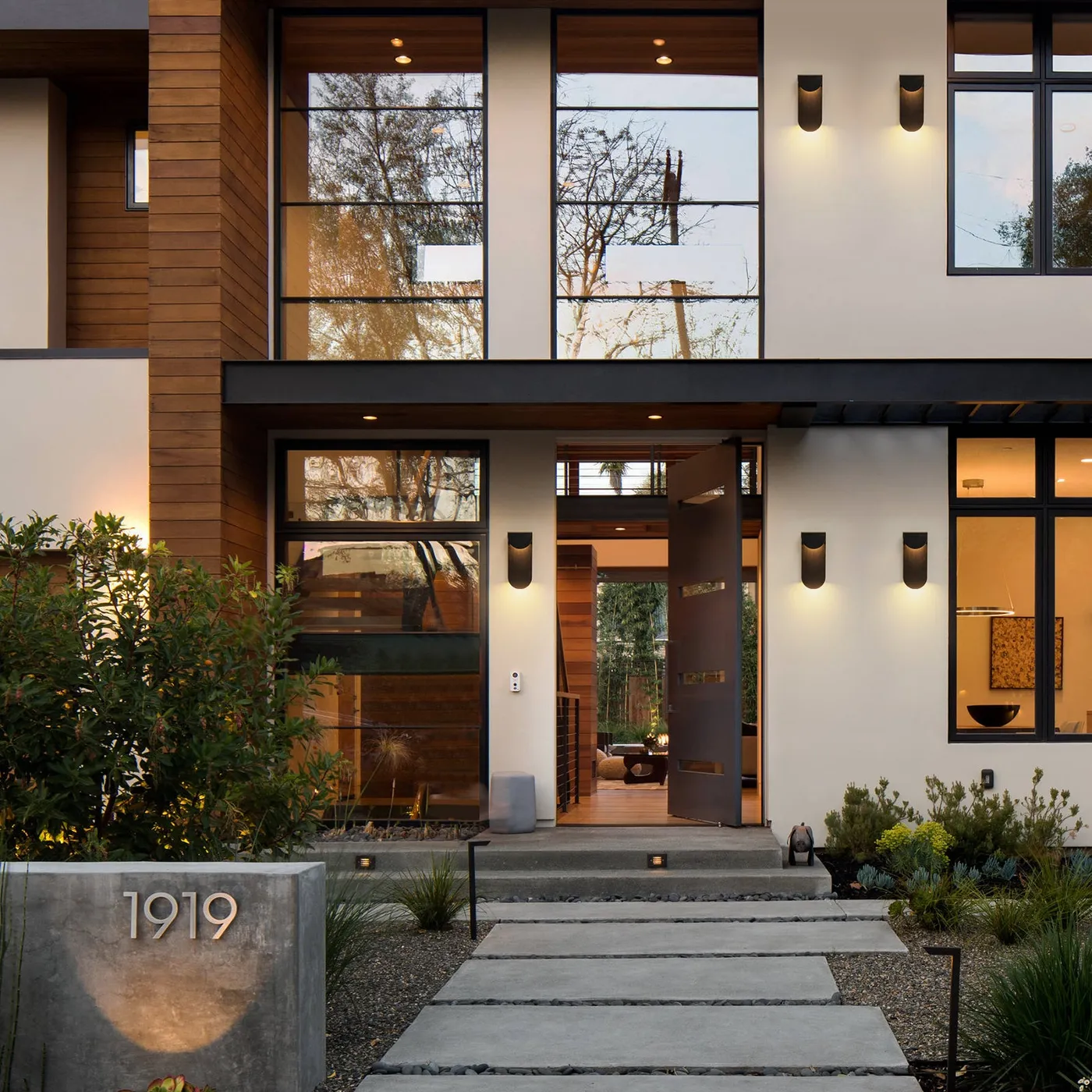
Call it 45% light stucco + 25% warm wood + 20% black + 10% gravel and planting. This is a warmer modern than the 2018 gray-on-gray version, and the wood is what changed. Swap the wood for more stucco and you’re back in 2018. Swap it for black metal panel and you’re in 2021. Wood paneling is the element keeping this current, so if you change one thing, change that.
25. Rectangular Black Lantern with Seeded Glass on Vertical Siding
Edison bulbs look wonderful and last about 15,000 hours — half of a standard LED. At six hours a night that’s roughly seven years, so it’s not a real problem, but buy two spares now, because styling changes and that exact bulb may vanish from shelves. More important: put this fixture on a dimmer. Full brightness at 6 p.m. in July looks like a security light. At 40%, it looks like a home.
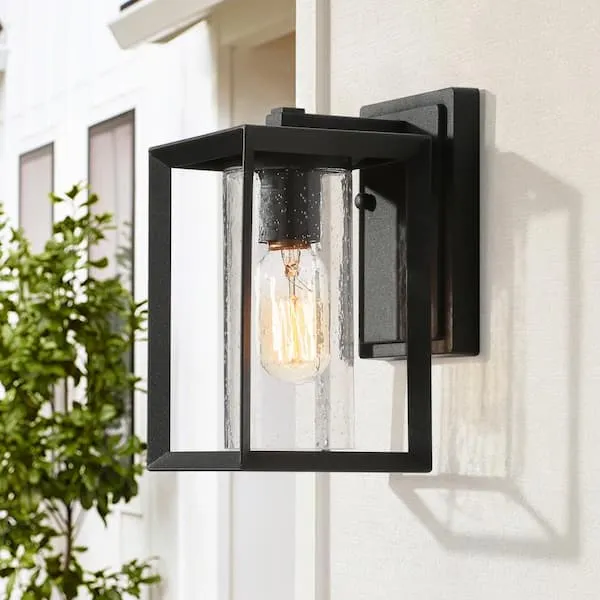
The white vertical siding is doing something subtle: it gives the lantern a striped backdrop, so the black frame reads as a graphic element rather than just a light. Mount the same lantern on plain stucco and it’s fine. Mount it on board-and-batten and it becomes a composition. If you’re re-siding anyway, that’s a real reason to consider going vertical.
26. LED Sconces Split Between Stone and Stucco Facades
Linear LED sconces with integrated diodes run $150 to $500 each, because you’re buying the fixture and the driver together. Big-box alternatives in the $50 to $90 range use replaceable bulbs and look nearly identical from 20 feet away. The trade-off is color-temperature consistency — cheap fixtures vary batch to batch, so buy all of them at once from a single order. Do that and you can save $400 on a four-fixture house.
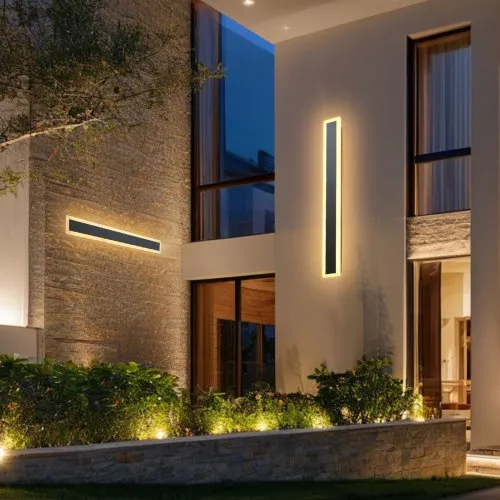
Mixing horizontal and vertical sconces on the same elevation works when the wall materials change too — stacked stone to smooth stucco is a legitimate reason to rotate a fixture. Keep them within 4 inches of the same height when mounted at the same level, and use the same finish across both walls. This approach suits elevations 30 feet wide or more. Narrower than that, and one fixture type reads cleaner.
27. Tall Vertical Lights Glowing Onto a Dark Wood Deck
Dark wood decks fade and gray, and warm light makes both more visible. Plan on a deck stain every two to three years — $200 to $500 if you do it yourself. On the lighting side, tall vertical fixtures collect water in the bottom cap if they aren’t sealed; a bead of silicone around the base once a year prevents rust streaks running down your siding. Ten minutes of work, real money saved.
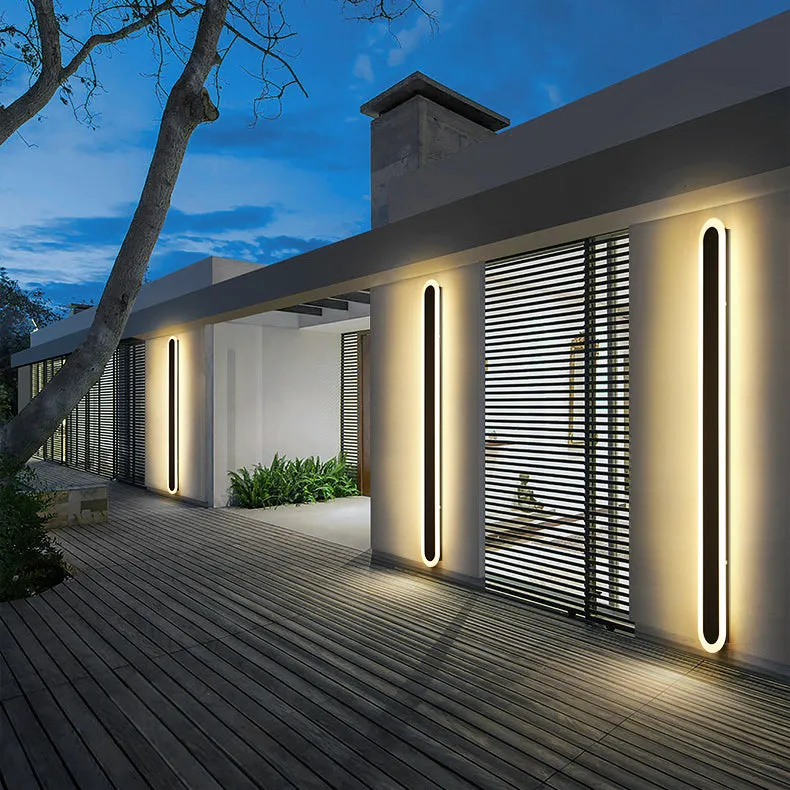
These fixtures are lighting two surfaces at once — the white wall behind them and the deck below. That double bounce is why the scene feels glowing rather than spotlit. It also means you can use lower output: 400 lumens per fixture instead of 800. Lower output means less glare, fewer bugs at the door, and a softer transition into the dark yard beyond. Under-doing it usually looks better outside.
28. Linear Sconces Flanking a Dark Wood Entry Door
Flank a door correctly and it looks architect-designed. The rule: fixture centerline at 66 to 72 inches, and the gap between the door edge and the fixture should be one-quarter to one-third the door’s width. On a 36-inch door, that’s 9 to 12 inches of space. People usually push them out to 18 inches and the door looks abandoned between them. And keep them level — the eye catches asymmetry instantly, even from the curb.
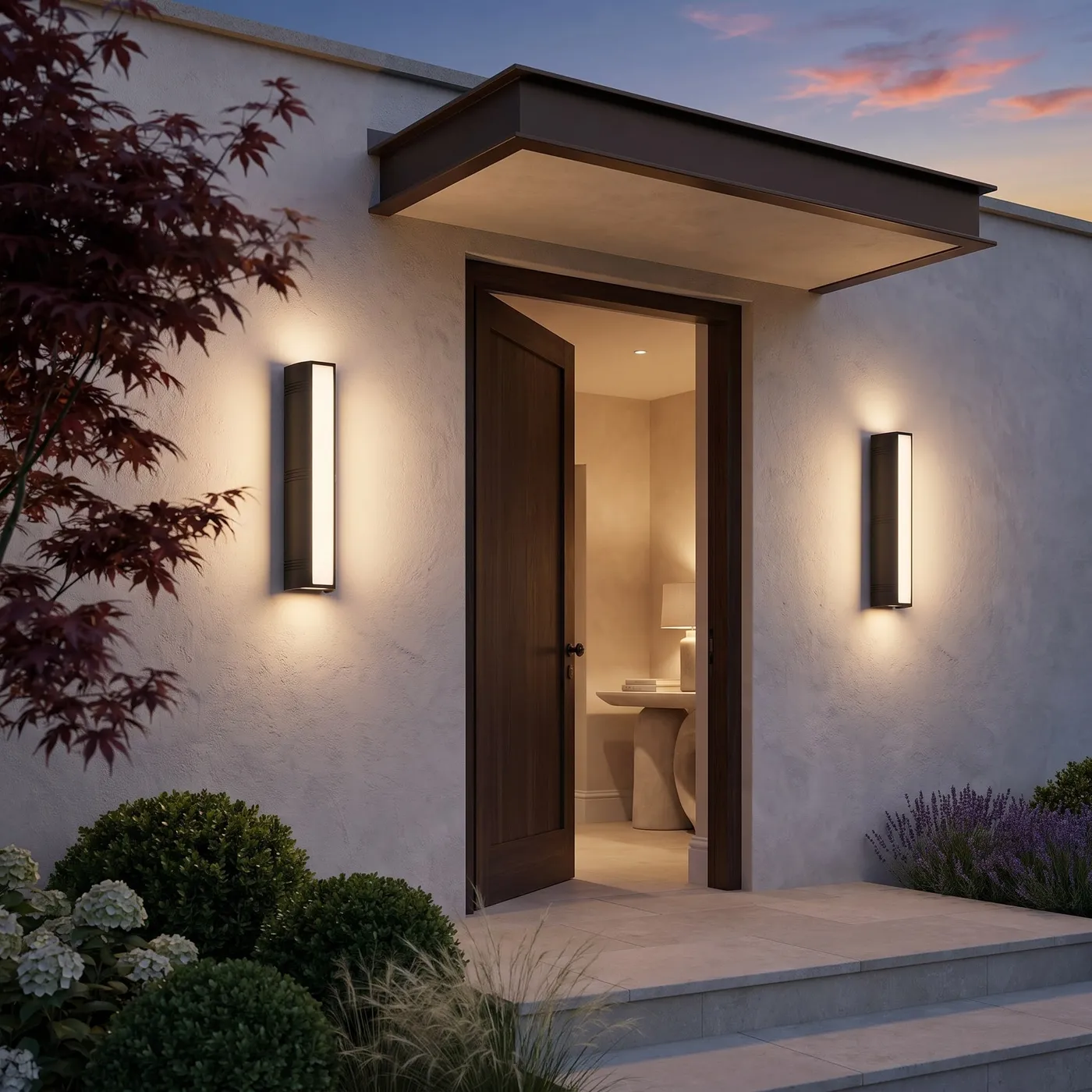
- Linear entry sconces (2): $120–$400
- LED-rated dimmer switch: $25–$60
- Concrete step lighting (4): $80–$220
- Lavender and shrub planting: $60–$180
- Canopy touch-up stain: $20–$45
29. Repeating Sconces Down Light Gray Vertical Siding
- Count your siding courses — the sconce backplate should align with a board edge, not straddle two.
- Confirm the finish matches across all fixtures by buying them in one order.
- Check that your patio pavers aren’t directly under the down-beam, or you’ll get a bright hot spot.
- Set a realistic budget per fixture — a four-fixture run adds up faster than expected.
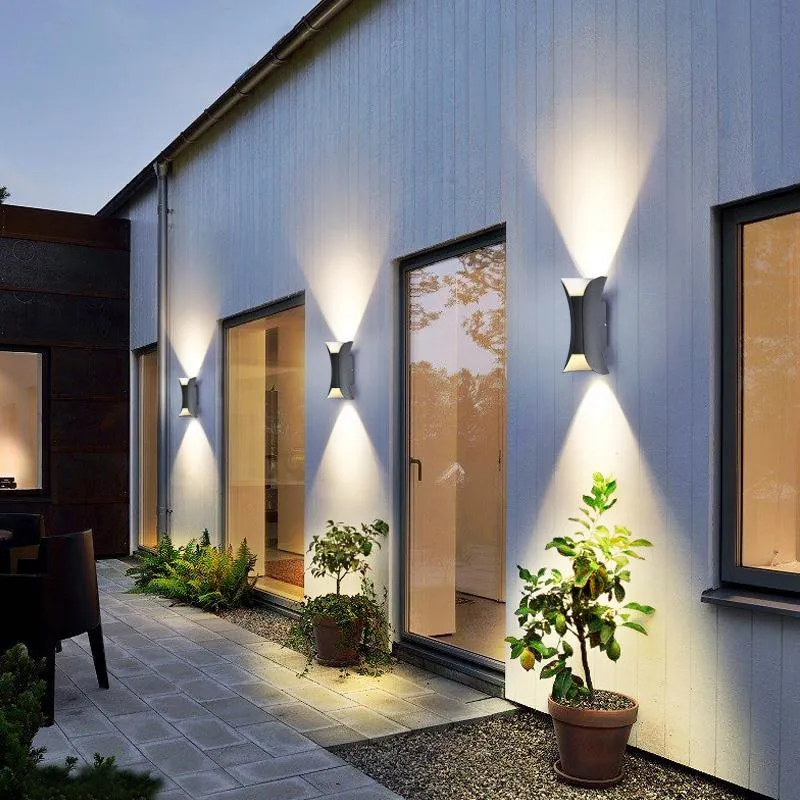
Repetition is powerful and easy to overdo. Four identical sconces along a 20-foot wall is rhythm. Six along the same wall is a runway. The test: stand at the far end and look down the facade. If your eye bounces from fixture to fixture instead of settling on the house, you’ve added one too many. Pull every other fixture and see how it feels. Half the fixtures, twice the impact.
30. A Long Black Linear Sconce on a Beige Facade
Simple ratios here: 70% beige plane + 20% warm light + 10% black trim. The black fixture is the only hard line in the composition, which is exactly why it’s allowed to be this long without looking aggressive. Swap the beige for charcoal and you’d need to shorten it by half. The darker the wall, the smaller the fixture should be — bright objects read larger against dark backgrounds.
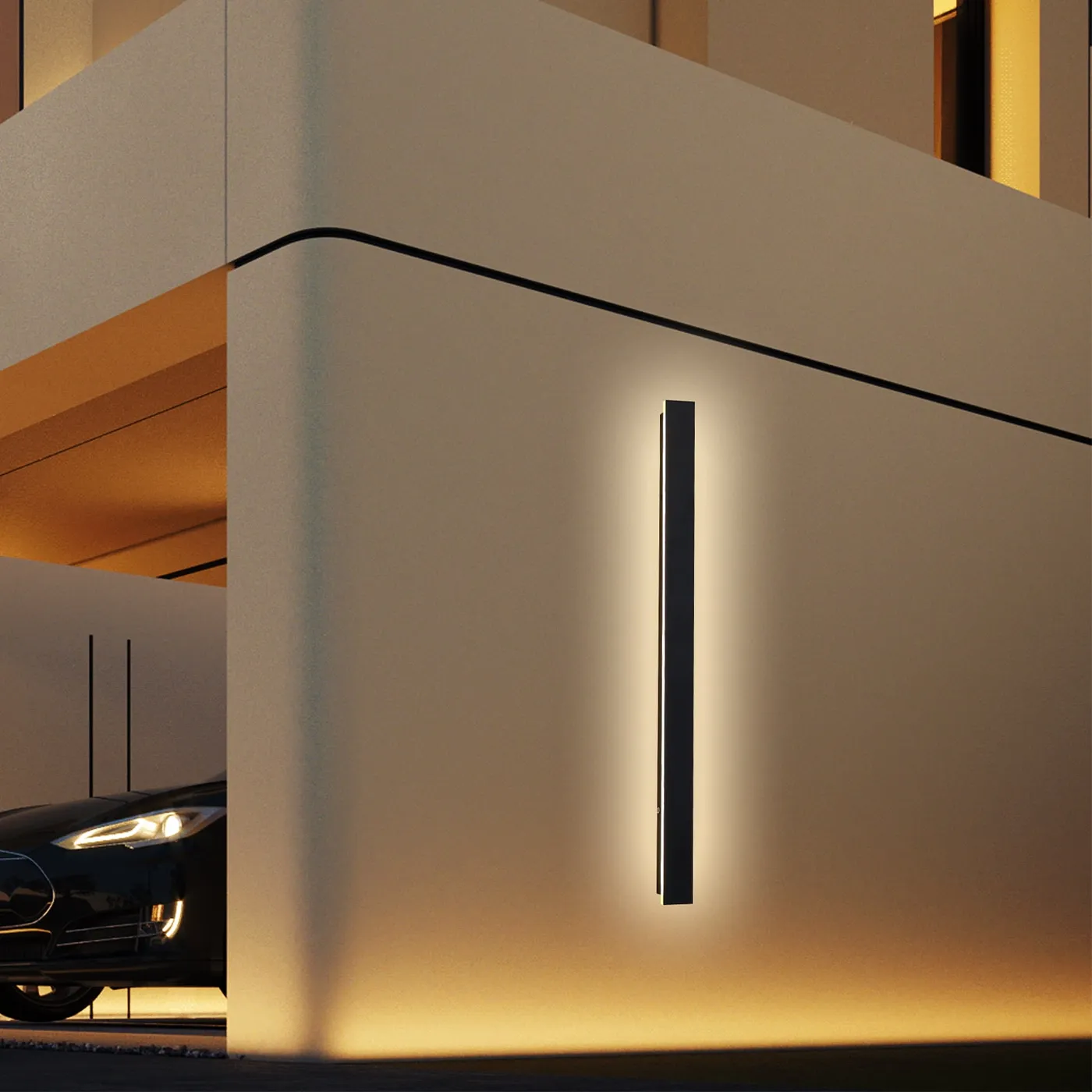
Long linear exterior sconces are the priciest category in this whole guide. A 36-inch architectural fixture can run $600 and up. If that’s not happening, pair two 18-inch linear fixtures 8 inches apart for a fraction of the cost — about $180 total — and most people will read them as one long light. Amazon and Wayfair both carry respectable versions under $120 each. You lose the seamless driver, not the effect.
Now Go Stand at the End of Your Driveway
Here’s the thing nobody tells you: you don’t need thirty fixtures or a designer’s invoice. You need one consistent color temperature, a couple of well-placed fixtures, and the willingness to walk out to the sidewalk at 9 p.m. and actually look at your house. Start with the front door — it’s the one improvement every single visitor notices. Idea #4 is a good weekend project if you want somewhere to begin.
📌 Save this guide to Pinterest so you have the fixtures, the spacing numbers, and the budget math in one place when it’s finally time to buy.