You know that feeling when you finally spot a yard display that looks exactly right for your house — and you have no idea how the person actually pulled it off? Same. So we went digging. We spent serious time browsing Home Depot, Lowe’s, Target, Etsy, and Walmart to bring you only what’s worth your attention this year, and this guide covers everything from a $12 strand of lights to a full $1,290 two-story roofline setup.
Inside you’ll find 30 curated ideas spanning traditional light-wrapped rooflines, rustic handmade wooden cutouts, whimsical painted figures, and elegant wire-lit sculptures — with budget and luxury versions compared side by side so you can see exactly where the money goes.
In 2026 the big shift on Pinterest is toward displays that look handmade rather than mass-produced, and searches for wooden yard cutouts and non-traditional color palettes are climbing fast. And stay until the end — we break down the most common mistakes that can ruin these looks.
📌 Save this to Pinterest for later — you’ll want to revisit these ideas. This post contains affiliate links, and we may earn a small commission at no cost to you.
1. A Two-Story Roofline Packed With Sleigh, Nutcracker, and Snow Globe
Going all-in on a two-story facade plus a fully packed front yard isn’t cheap, but it’s not as brutal as it looks — most of the money is in lights, and lights get discounted the day after Thanksgiving.
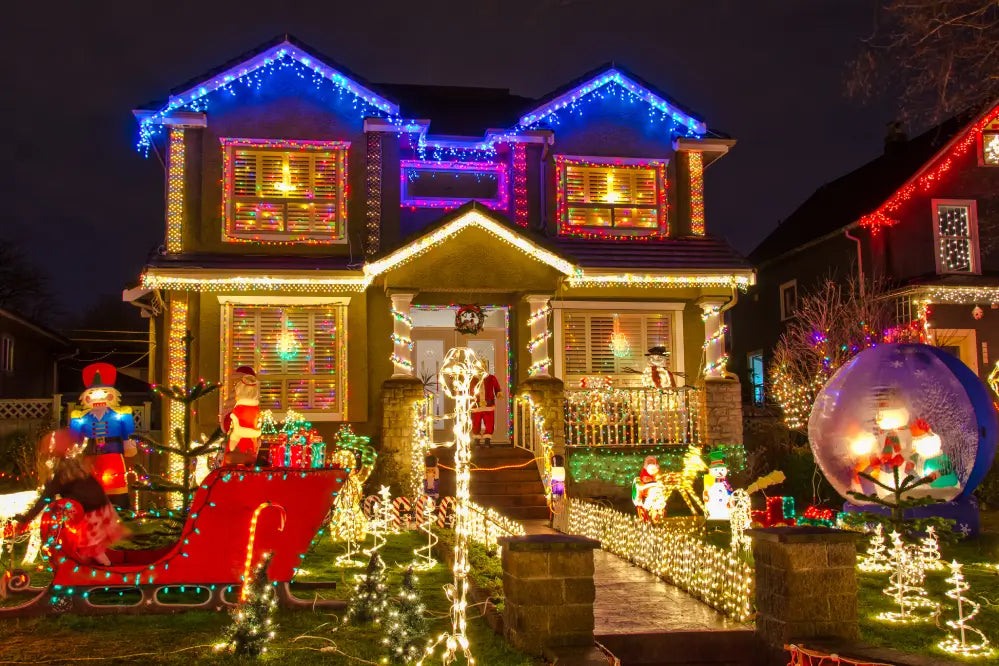
- Roofline and window outline lights (400–600 ft of LED): $130–$380
- Illuminated sleigh with nutcracker figure: $160–$420
- Inflatable snow globe with snowmen: $90–$230
- Lighted pathway fences and mini glowing trees: $70–$190
- Clips, stakes, timers, and outdoor extension cords: $60–$150
Total: $510–$1,370, and a leaner version lands near $300 if you skip the inflatable and buy your strands in clearance bins.
Here’s the part nobody tells you: every glowing figure is a load on a circuit. A 15-amp breaker holds roughly 1,400 watts, and an inflatable blower alone pulls 100–200 watts on top of your light count. Add up wattage on paper before you plug anything in, run it all through GFCI outlets, and split the display across two circuits if you can. Warm white pathway post lights keep the walk safe once the sun drops.
2. Black Urns Overflowing With Evergreens, Ornaments, and Twinkle
The reason these urns look expensive is that the greenery sits high instead of being buried in the pot. Set a 6-inch plastic nursery pot upside down inside the urn as a hidden riser so the evergreen crowns 3 to 4 inches above the rim. Then build the tallest twig to about two and a half times the height of the urn itself — a 24-inch urn wants twigs around 5 feet. Anything shorter reads as a shrub, anything taller goes over in the first real wind.
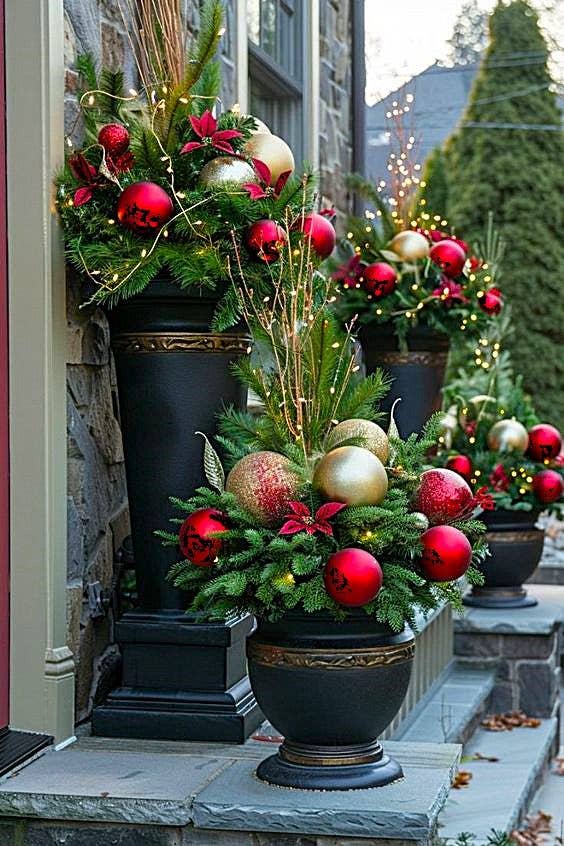
Run the numbers and it’s a simple formula: 55% forest green evergreen, 25% matte black urn, 15% ruby and gold ornaments, 5% string light. Swap the ornaments for all-silver, trade the black urn for aged terracotta, and you keep the identical structure with a completely different mood. The formula is the frame; the colors are just the coat of paint.
3. Warm White Rooflines and a Garland-Wrapped Picket Fence
Three things are doing the heavy lifting here. The lights trace architecture instead of floating free — every roofline, gable, and railing gets an outline, so the house reads as one drawing rather than a pile of decorations. Warm white stays consistent from the roof down to the fence, which is what keeps the whole scene calm. And the garlanded picket fence gives the display a floor, so your eye has somewhere to land.
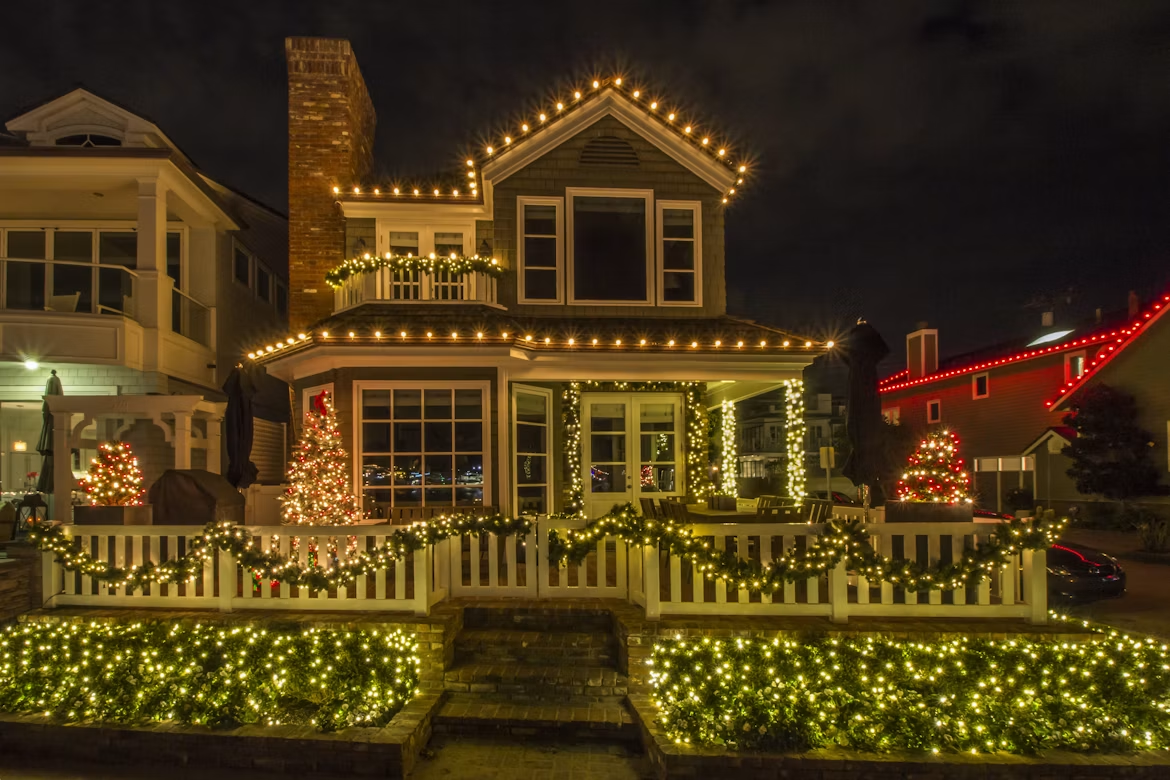
This look wants a two-story facade with at least 25 feet of frontage and a roofline you can safely reach — usually a single gable with a 24-foot extension ladder set on level ground. Under 20 feet of frontage it gets busy fast; the cottage-scale version in Idea #30 reads much better on a smaller footprint. Dense shrub lights fill the middle ground either way.
4. Handmade Yard Gnomes With Fuzzy Beards and Wooden Skis
One gnome takes an afternoon and about $30.
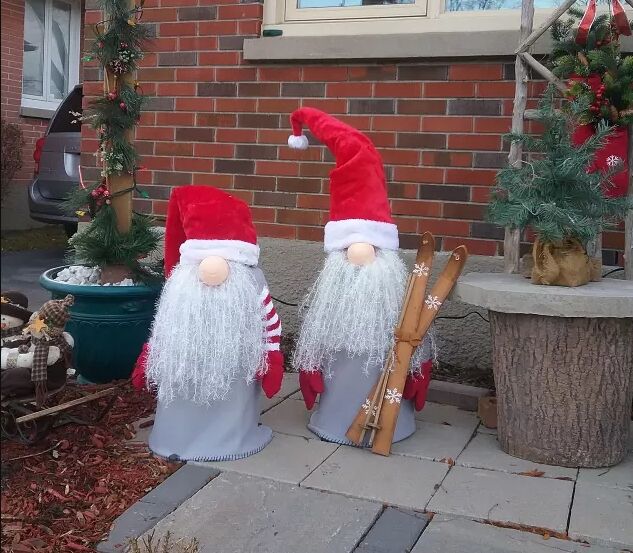
- Start with a 24-inch foam cone as the body and wrap it in gray fleece, hot-gluing the seam at the back.
- Loop three layers of chunky white yarn over a 12-inch piece of cardboard, cut the loops, and stitch the bundle on as the beard.
- Cut a red felt cone for the hat, fold a wide white felt band over the bottom edge, and slide it on.
- Cut two 18-inch skis from 1×2 pine, sand the tips into a curve, and seal with exterior poly.
- Screw the skis to a hidden stake behind the gnome, then zip-tie a red mitten to each side.
Time: 2–3 hours per gnome. Materials: $25–$40.
It’s the skis that make this. Take them away and you have two gray cones with beards — cute, but generic. The skis give the taller gnome a job, and once a decoration has a job it stops being a decoration and becomes a character. Rather skip woodworking? A pair of thrifted child’s skis does the same work in ten minutes.
5. A Stained-Wood Reindeer With White Antlers and a Plaid Bow
Wood yard decor lives or dies by its finish. Two coats of exterior acrylic on the body and three coats of spar urethane on the antlers — front and back — gets you four or five seasons, but only if you seal the end grain on every cut edge, because that’s where water wicks in and splits the board. Drive a half-inch rebar stake 18 inches into the ground and slide the reindeer’s legs over it rather than drilling through the body.
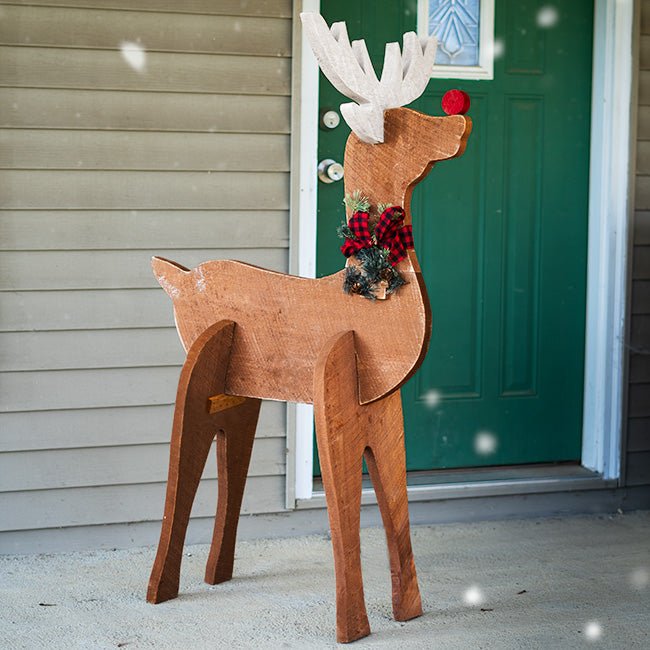
You can build this for about $25. Check Facebook Marketplace for plywood offcuts — cabinet shops practically give away 2×4-foot pieces for $5 to $10. A jigsaw, a sheet of sandpaper, and two sample-size paint pots at $5 each cover the rest. A full-size handmade reindeer lands at $20–$35 versus $120–$250 for a store-bought one, and yours will actually look handmade instead of stamped.
6. A Single Wire Reindeer Glowing Against the Snow
Wire-frame reindeer are gorgeous at night and slightly haunting at noon — an unlit mesh deer on a brown lawn looks like a tumbleweed that gave up. If your yard is visible from the street during the day, either accept that or store it. Also worth knowing: the internal bulbs on cheap versions usually aren’t replaceable, so when a section dies you’re zip-tying a $10 strand over the dead run. Buy the version with a replaceable light harness.
This is almost a monochrome formula: 80% warm white light, 15% silhouette, 5% snow bounce. The single color is the entire point — swap in multi-color bulbs and the elegance evaporates instantly. If you want variety, add a second white sculpture at a different height rather than a second color.
7. Painted Cutout Trees in Stripes, Dots, and Star Toppers
- Measure your widest sightline from the street — cutouts read best between 20 and 60 feet.
- Check your soil: soft beds need 12-inch stakes, clay wants a pilot hole and a mallet.
- Cap your palette at five paint colors, or the row turns into a carnival.
- Confirm storage — seven 4-foot trees need a real bin, not a garage corner.
- Make a wind plan, because flat cutouts tip past about 25 mph.
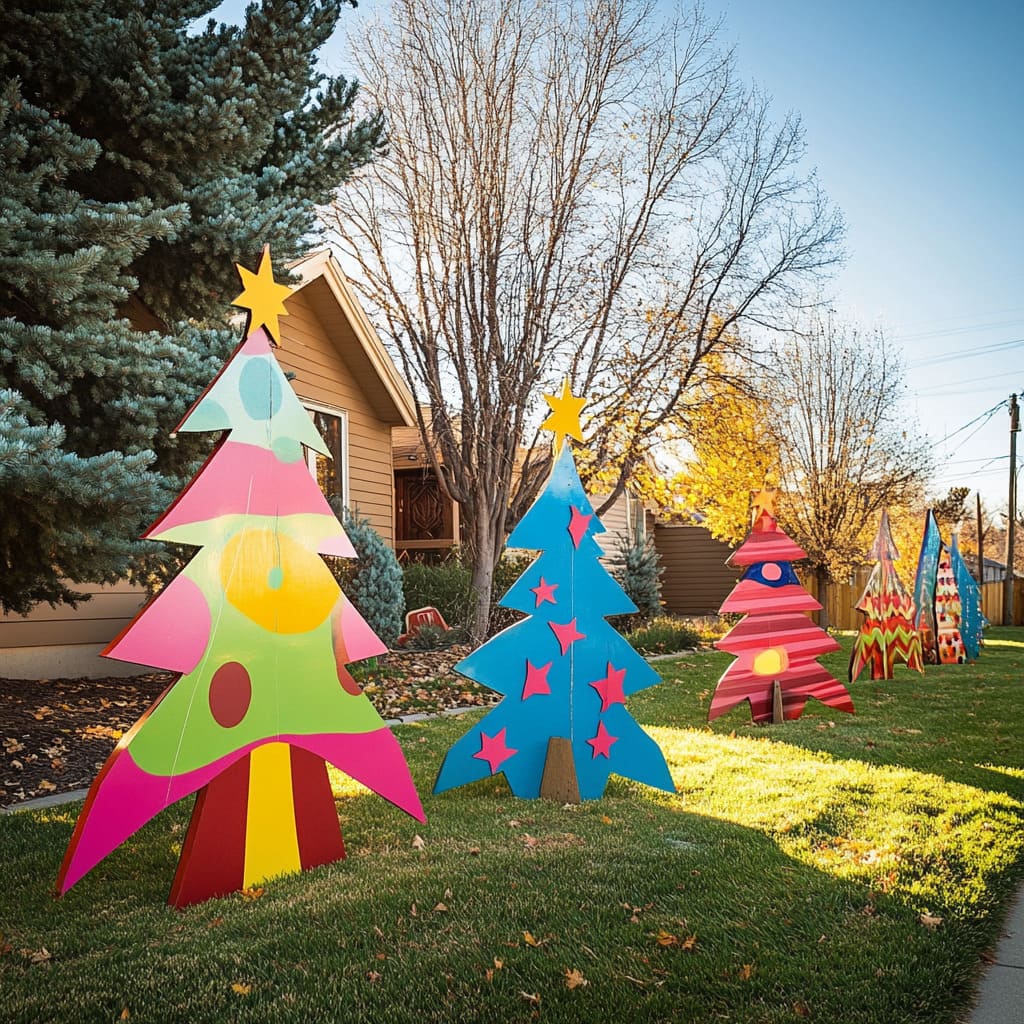
Painted cutouts are having a genuine comeback, and it tracks with the same shift that made thrifted furniture cool again — people want displays that look like a person made them. Saves for colorful, non-traditional holiday palettes keep climbing every season, and this is the yard version of that. My honest read: this one has legs, because it’s cheap, repaintable, and it photographs beautifully in daylight, which inflatables never do.
8. A Stack of Wrapped Gifts That Reads as a Christmas Tree
The gift-stack tree looks expensive and isn’t.
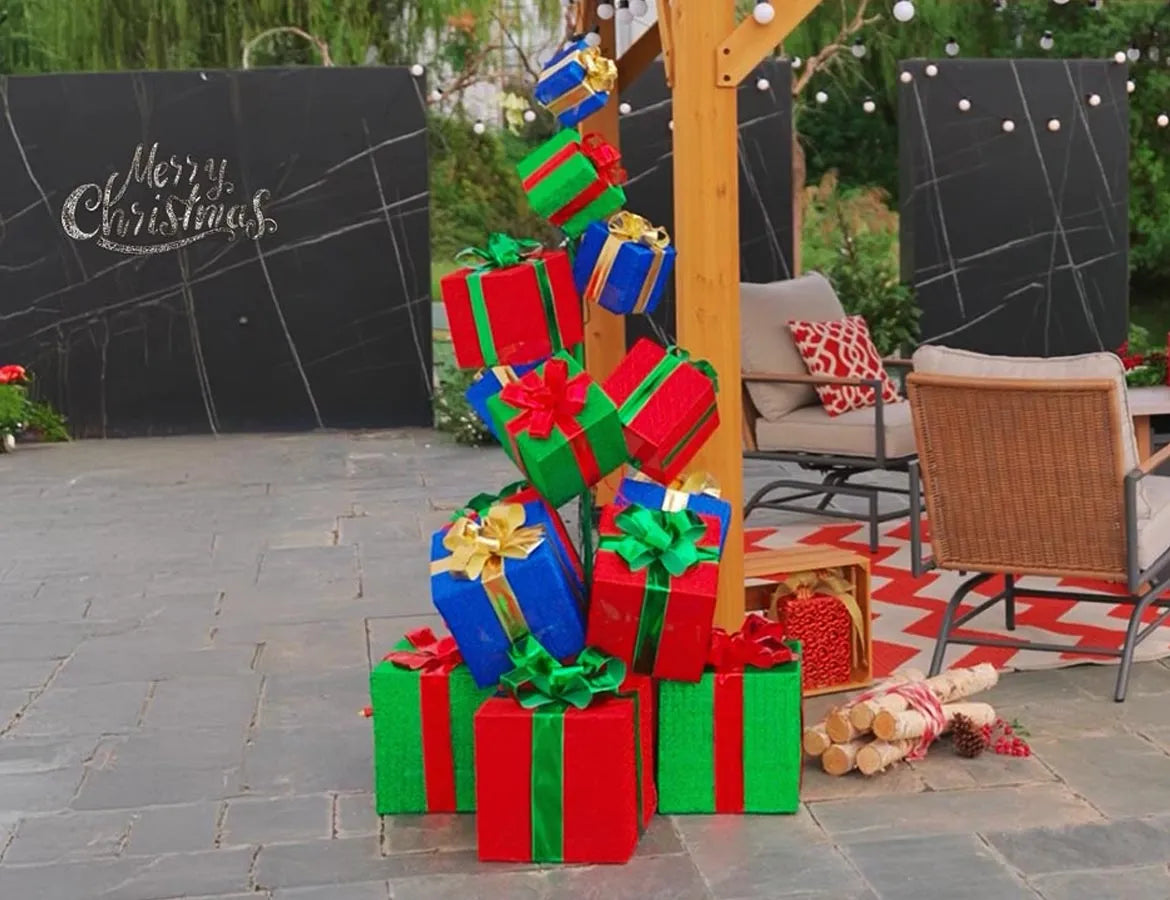
- Wrapped gift box shells (6–10 boxes in mixed sizes): $60–$180
- 4×4 post, concrete, and bucket base: $25–$45
- Oversized ribbon and dimensional bows: $20–$50
- Chalkboard sign with lettering: $15–$40
- Warm white lights and stakes: $25–$60
Total: $145–$375, and if you already own the boxes you’re in under $100 for the whole corner. Want them lit from within? See Idea #14.
Stability is the entire trick. Set a 4×4 post in a 5-gallon bucket with 60 pounds of fast-setting concrete, let it cure overnight, and you can stack eight to ten lightweight boxes up to 6 feet with zero wobble. Wrap the shells in outdoor fabric or coat cardboard in exterior latex, and drill a half-inch drainage hole in the bottom of each one so rain doesn’t turn them to mush.
9. Lighted Wire Dolphins Leaping Over Lit Blue Waves
It’s a joke your eye finishes for you. The dolphins sit at different heights and angles, so even though they’re static you read motion — and the lit blue and white wave shapes below give them something to leap over, which is what sells the illusion. Warm white outlines against a dark waterfront sky do the rest. The lesson: a themed display needs a setting, not just a subject.
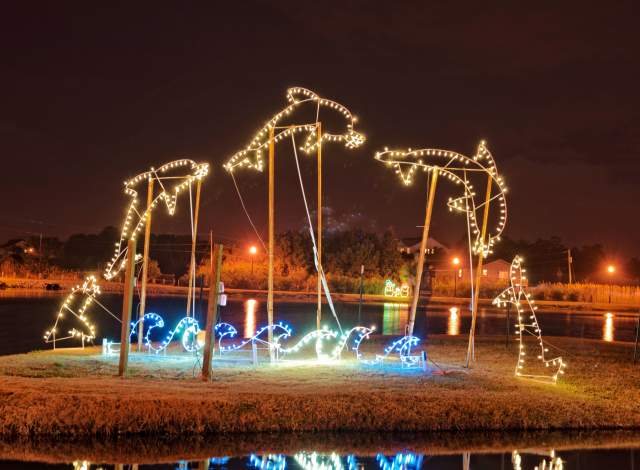
Wire sculptures are the most maintenance-hungry thing on this list. Expect to re-tighten every zip tie each November, replace roughly one dead strand per season, and brush spiderwebs off in spring. Budget $15–$30 a year in replacement lights. Store them flat and wrapped in a sheet — never coiled tightly, because bent wire never straightens back out.
10. Map Your Yard Display Before You Buy a Single Stake
The 2026 shift is toward edited displays instead of packed ones — people are still going big, but they’re choosing three or four strong moments and lighting them well rather than filling every square foot. Call it curated maximalism. It looks better from the street, it’s cheaper to build in stages, and honestly it’s easier to take down in January.
Before you buy anything, sketch the yard. Forty-five minutes, zero dollars.
- Photograph your house from the curb at dusk, then print the photo.
- Mark your power sources first — every GFCI outlet becomes the center of its own zone.
- Circle three focal points: the entry, one roofline, one lawn moment.
- Trace your walking path from car to door and keep stakes out of it.
- Write wattage next to each zone and confirm nothing exceeds 80% of the breaker.
Cost: nothing. Time saved: an entire second trip to the store.
11. Glowing Light Orbs Suspended in Bare Branches
Hang orbs in threes, never twos, and stagger the sizes — 10, 14, and 18 inches — with 18 to 24 inches of vertical separation. Fish them up with black paracord or 30-pound fishing line tied to a beanbag you toss over the limb; two minutes and zero ladders. Keep the lowest orb at least 8 feet above any walkway, and re-tie before the first hard freeze, because cold makes cheap line brittle.
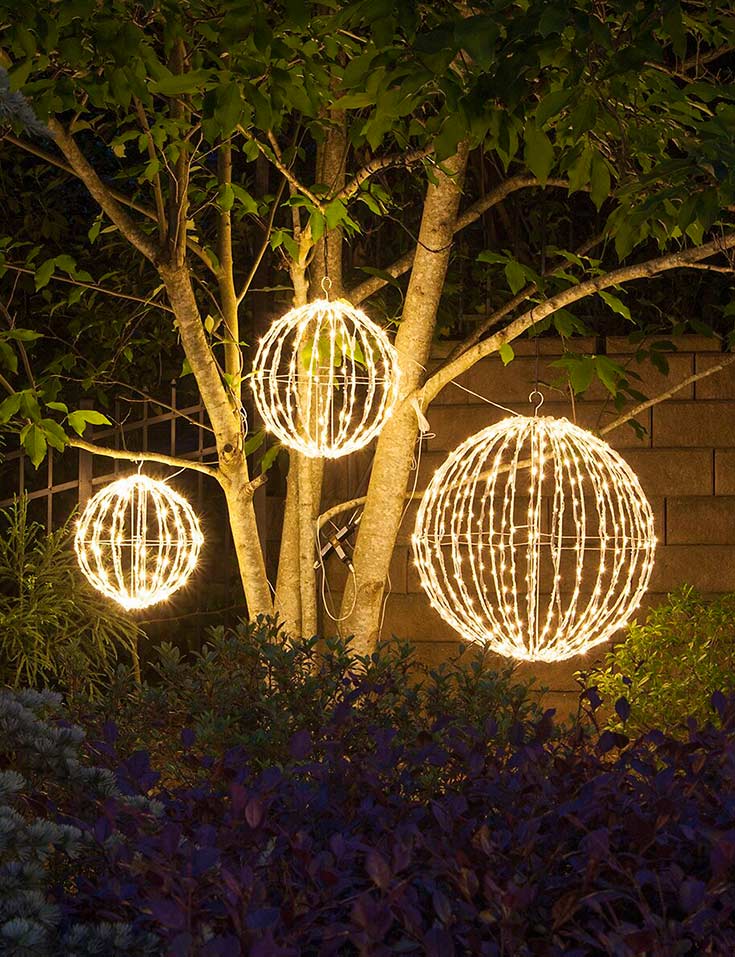
Glowing spheres in bare branches are basically free focal points. The dark foliage behind them does the work — high contrast, soft light, and enough negative space between the orbs that your eye can rest. It’s also the rare holiday element that still looks good in February without reading as “never taken down.”
12. Yellow Siding Porch Dressed in Cedar and Giant Red Baubles
Oversized ornaments are one of the most inflated holiday products out there — $30 to $60 each for plastic. Dollar stores and discount chains sell 8-inch shatterproof baubles for $3–$6, and a can of outdoor spray paint in glossy red makes them look expensive from ten feet away. Add a rope of real-touch pine and cedar garland at $40–$70 for 9 feet and you’re recreating this porch for roughly $120 instead of $500.
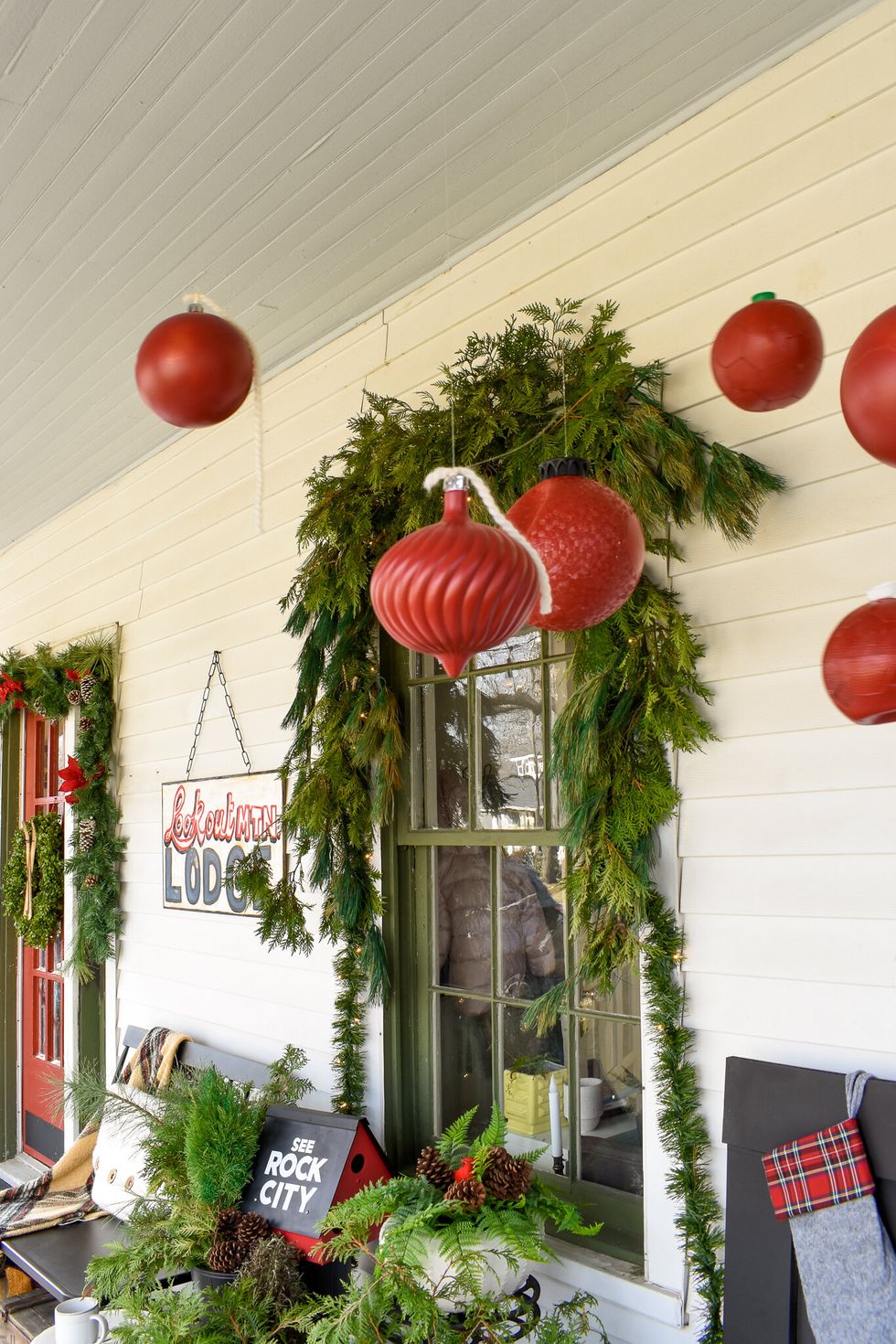
What sells it is the scale of the hanging ornaments. Small ornaments on a porch disappear; these are the size of beach balls, and that’s what makes yellow siding feel like a stage set instead of a front door. If you change nothing else, go bigger than feels reasonable — the planter treatment in Idea #2 follows the exact same rule with urns.
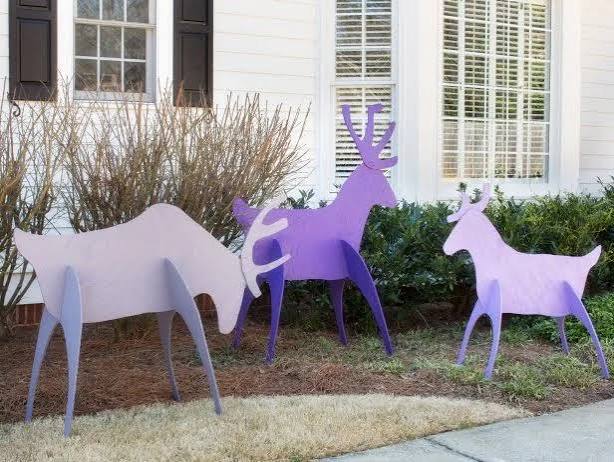
13. Flat-Pack Wooden Reindeer in Three Shades of Purple
Purple reindeer are a choice, and I’m here for it — but know what you’re signing up for. In flat daylight, lilac next to a neighbor’s red-and-green display can read as unfinished rather than intentional. Commit fully: three figures, all in the purple family, in one matching mulch bed, and skip the red bows entirely. Seal every plywood edge, too, because flat silhouettes delaminate at the bottom first.
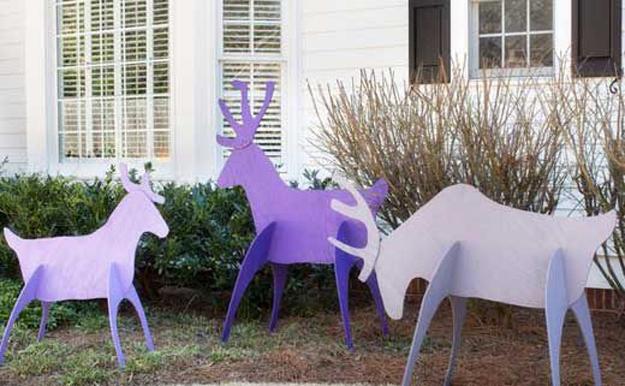
The math here is 70% neutral — white siding, dark shutters, brown mulch — against 25% purple in three depths, from deep plum to pale lavender, plus 5% raw wood grain left unpainted. That neutral dominance is what keeps the odd color from looking accidental. Swap purple for teal or charcoal and the formula holds exactly the same.
14. Plywood Gift Boxes Lit From the Inside Out
One hollow gift box takes about 40 minutes.
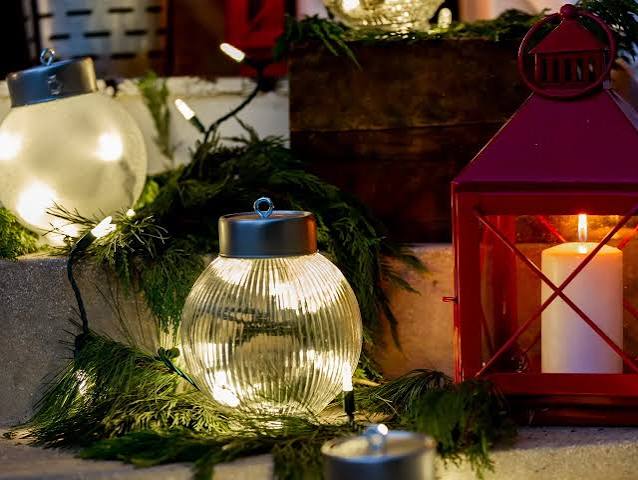
- Cut five panels from half-inch plywood: base and four sides.
- Assemble with exterior screws, leaving one side as a removable access panel.
- Paint the outside in exterior latex, then add polka dots with a round sponge or stripes with painter’s tape.
- Staple a warm white strand inside along the top edge and run the cord out through a drilled grommet hole.
- Build the oversized bow from 3-inch ribbon looped around a wire frame, then bolt it to the lid.
Materials: $30–$55 per box.
- Plywood (three sheets, half-inch): $90–$150
- Exterior paint and primer: $30–$60
- Ribbon, wire frames, and bows: $25–$55
- Warm white LED strands (4): $40–$80
- Stakes, screws, and grommets: $15–$30
Total: $200–$375 for something that looks like a store window.
15. A Slatted Wood Tree That Leans Against the Wall
The version shown runs about 4 feet wide by 3.5 feet tall, which means it works on a porch wall, a fence panel, or a garage door with 6 inches of clearance on each side. Ceiling height doesn’t matter — this is vertical wall decor, so any covered outdoor surface 5 feet wide is enough. Double the slat count and go to 6 feet if you have a full wall to fill.
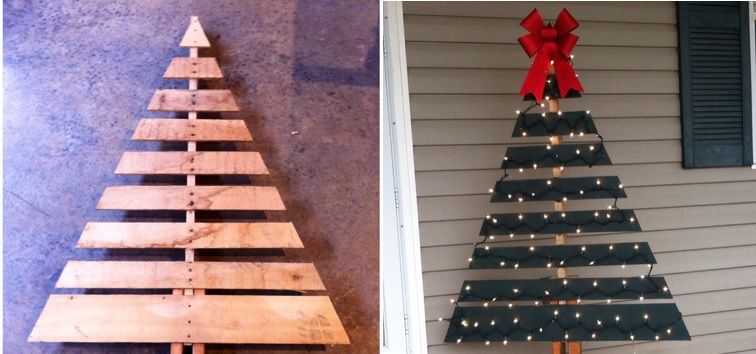
Do the slat math once and it’s easy: your longest slat is 46 inches, and every slat below gets 6 inches shorter. Seven slats gives you a 46 x 42 inch triangle that fits a standard porch wall perfectly. Cut from 1×3 furring strips at about $2 each, screw them to a single vertical spine down the center, and you need no joinery at all. Weaving the lights after assembly is faster than stringing each slat separately.
16. A Birch Bark Basket Stuffed With Greens and Blue Ornaments
The birch bark is the whole thing. Without it this is a standard basket of greens — nice, forgettable. The pale peeling wrap does two jobs: it bounces light into a dark corner, and it adds a texture nothing else in a holiday display has. You’ll find birch-look wrap at craft stores for $12 to $20, or use real bark off a downed limb if you know someone with property.
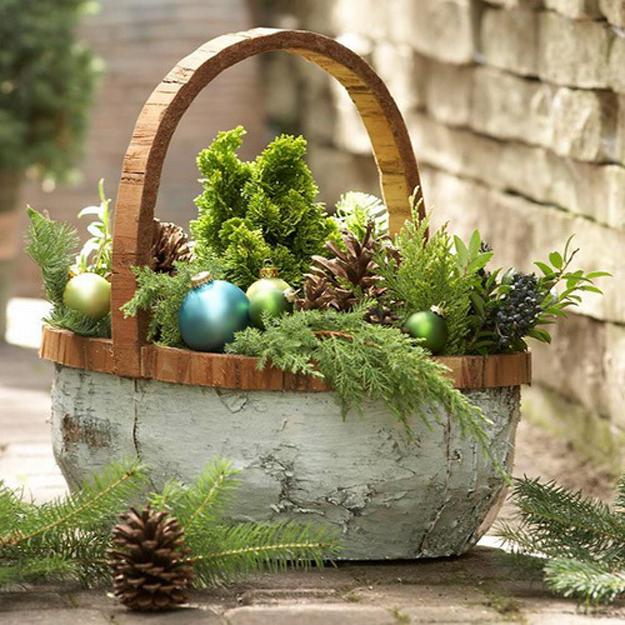
Real greens are gorgeous and temporary. Outdoors in cold weather, expect 4 to 6 weeks under a covered porch and only 2 to 3 weeks in full sun before needles start dropping. Refresh with new cuttings after Christmas, or mist weekly when temps are above freezing. Faux holds up for years but never looks right up close — most people land on a mixed basket, mostly faux with a few real sprigs on top. Compare with the hanging basket in Idea #29, where faux wins outright.
17. Warm Wooden Tree Silhouettes Glowing on Snow
Wooden tree silhouettes are a pallet project waiting to happen. Free pallet wood off Marketplace, a jigsaw, and a quart of exterior stain gets you four trees for about $30 total. Solar fairy lights run $8–$12 a strand and save every extension cord headache. If you’d rather buy than build, IKEA and Target both sell small pre-lit wooden trees in the $20–$40 range that look great in a group of five.

Snow is a reflector. Set a lit wooden silhouette on snow and the ground bounces light back up onto the piece, which is why this looks twice as bright as the same decoration on grass. Warm white against cool snow is also a classic temperature contrast — your eye reads it as cozy rather than clinical. Lay a few loose evergreen branches around the base and the trees look planted instead of dropped.
18. Gingerbread Cutouts Dressed in Overalls and Sneakers
Paint the back. Everyone paints the front of a cutout and leaves the back raw, then wonders why it looks cheap from the neighbor’s angle. Two coats of exterior acrylic on both faces, plus a colorblocked version of the outfit so the reverse isn’t one giant brown slab. Drill your stake holes before painting — a fresh hole chips paint, and you’ll be touching it up in spring.

A 4-foot flat plywood cutout is a sail in a windstorm. Past about 25 mph gusts, unstaked pieces tip and staked pieces crack at the mounting point. Use two stakes per figure if it’s over 3 feet tall, keep the bottom edge 2 inches off the grass so it doesn’t rot, and bring the lightweight ones in for named storms. Kids and dogs will investigate — paint is cheaper to touch up than wood is to replace.
19. Lit Snowmen, a Santa Cutout, and a Santa Stop Here Sign
The color recipe is 70% warm white light, 20% red, and 10% blue and green accents. That ratio is why it feels cheerful instead of chaotic — there’s a clear leader and the brights are punctuation, not paragraphs. Want a calmer version? Drop the blue entirely and let red and green split the 30%. Same structure, completely different personality.
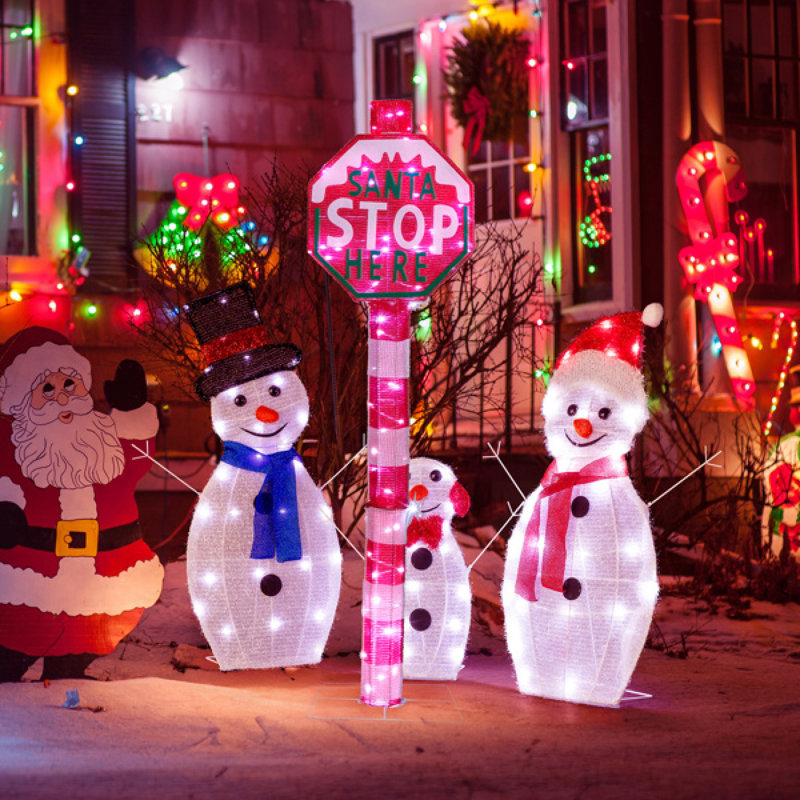
- Wire-frame lit snowmen (3): $120–$300
- Santa flat cutout: $30–$80
- Lit directional sign post: $40–$110
- Oversized candy canes (4): $25–$70
- String lights, stakes, and timers: $50–$130
Total: $265–$690, or closer to $180 if you build the snowmen from wire and zip-tie your own strands.
20. Oversized Patterned Baubles Hanging From a Front Yard Tree
The plaid bows with the little green sprigs. That single detail turns three round ornaments into a designed object instead of three balls on a branch. It costs about $8 and takes ten minutes, and it’s the difference between cute and styled. Clip a bow to each cap, tuck a sprig of cedar or faux pine behind it, done.
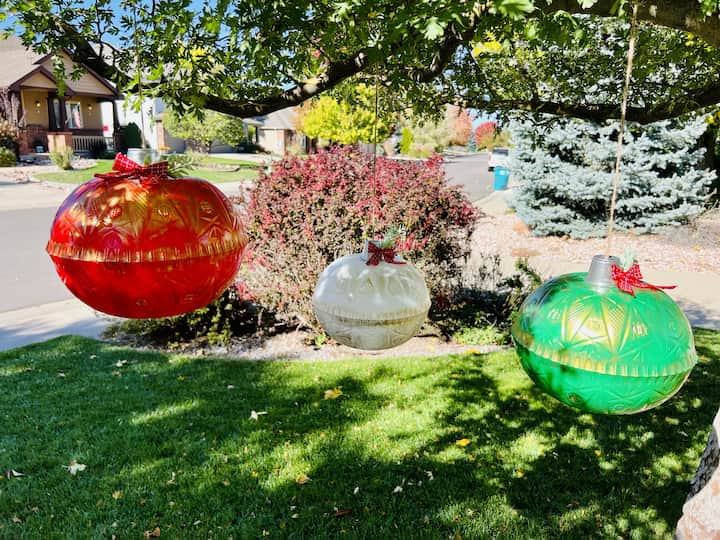
These read best from 20 to 40 feet, which makes them perfect for a front yard tree but too big for a porch. You need a limb at least 12 feet up and clear of the roofline, or a pergola beam, so the ornaments hang 4 to 6 feet below the branch without blocking a walkway. Short tree? Go with the smaller suspended light orbs in Idea #11 — same idea, less airspace required.
21. A Spherical Evergreen Wreath Crowned With Red Velvet
Spherical wreaths started as a florist’s flex and went mainstream fast. The reason is simple — a ball reads as sculptural from every angle, while a flat wreath disappears in profile. Pair that with the broader return to red-and-gold traditionalism and you get a pillar treatment that’s basically 2026 in one object.
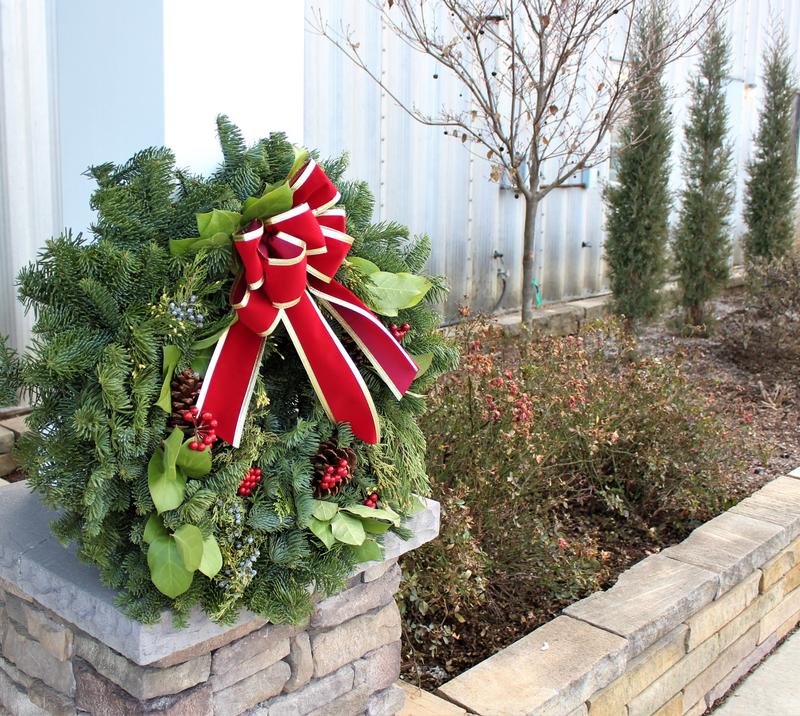
- Sculptural shapes over flat silhouettes
- Deep traditional reds replacing muted palettes
- Real greens mixed with faux for longevity
Build it on a 14-inch wire form, never a foam ball. Wire four 6-inch bunches of cedar and boxwood through the grid with floral wire every 3 inches, then wrap 100 warm white micro lights around the whole thing. Secure the finished sphere to the pillar top with a strap so it doesn’t become a 20-inch projectile in a wind tunnel.
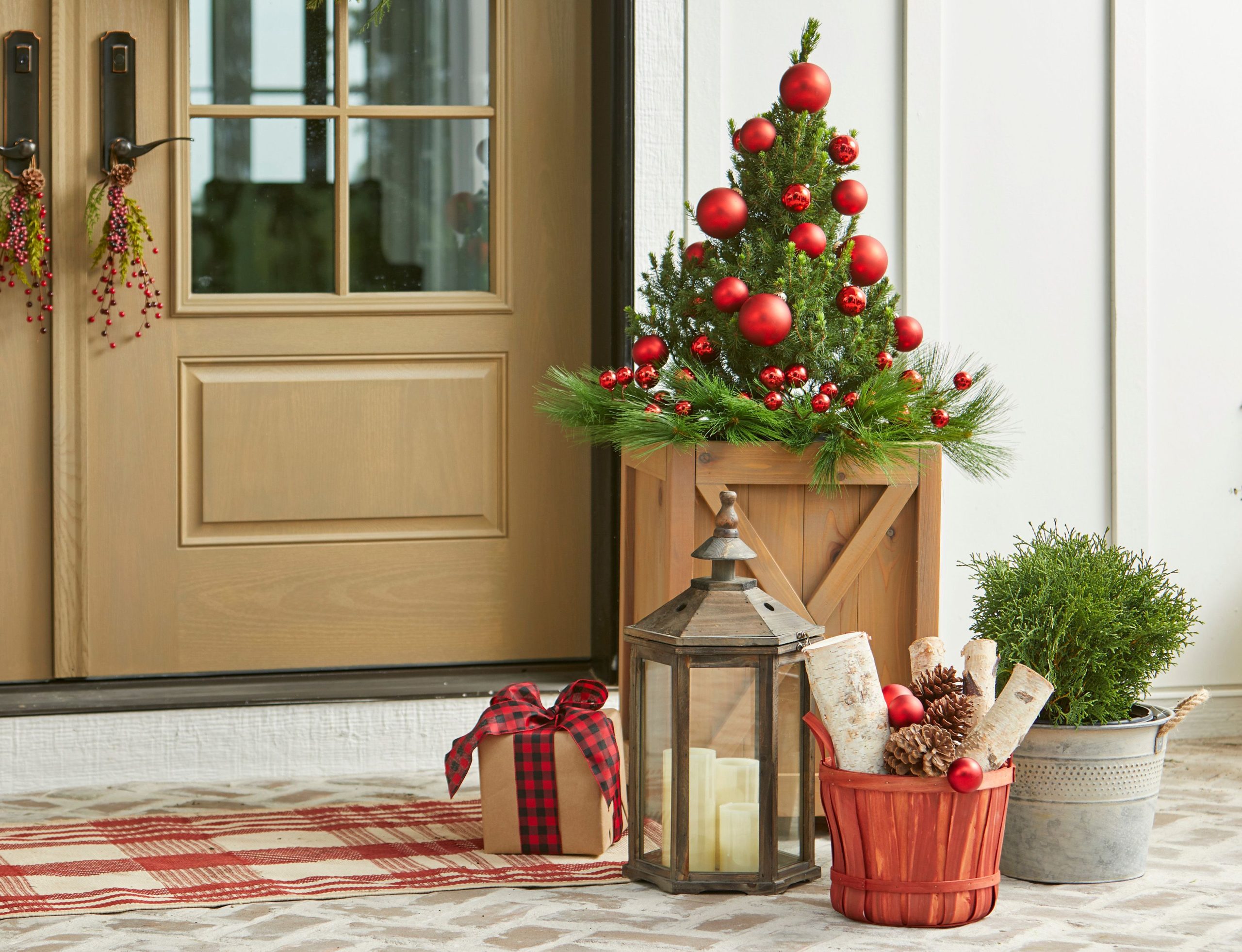
22. A Potted Mini Evergreen on a Rustic Holiday Porch
If you want that potted evergreen to survive to spring, buy a live tree with an intact root ball and keep it outdoors in the planter, mulched, watered until the ground freezes — then plant it in March. Bring it inside for two weeks and expect needle drop and a stressed tree. A cut tree in a wooden box looks identical in photos and costs a third as much, which is why most people go that route.
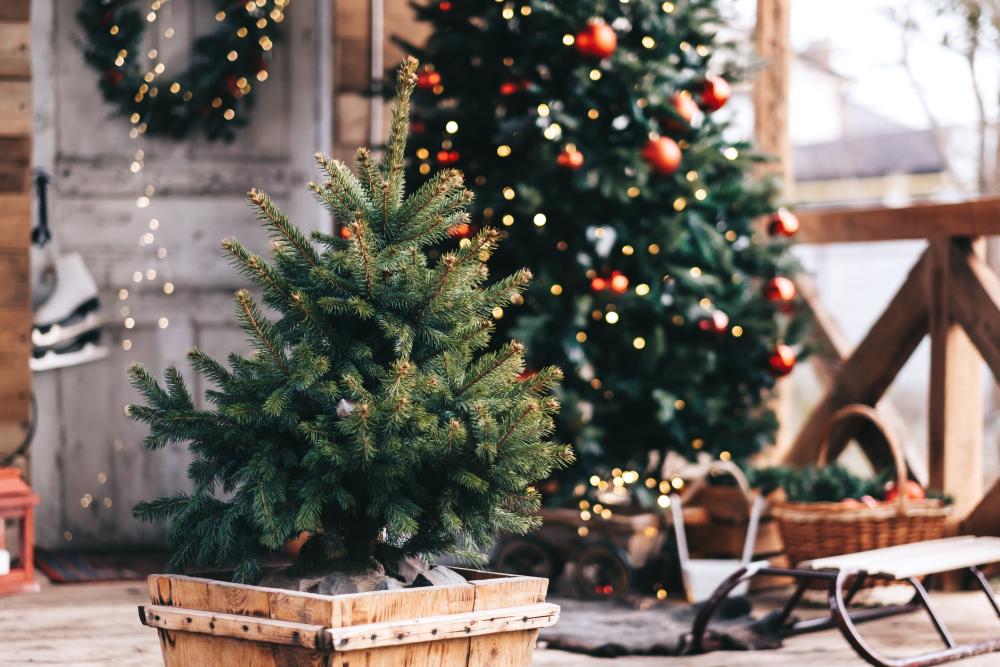
A 3-foot Alberta spruce from a local nursery runs $25–$45, and a planter box built from scrap cedar fence boards costs about $15. Target and Walmart sell pre-lit wreaths in the $20–$35 range that look nearly identical to $90 versions once real ribbon is on them. The sled? Thrift stores in November are full of them for $10–$20. Whole porch: under $150.
23. A Lit Wire Deer Family Beneath Fairy-Lit Windows
A deer family needs room to read as a family. Plan 8 to 10 feet of spread across the lawn, with the buck around 4 feet tall, the doe at 3 feet, and the fawn at 2 feet — spaced so the silhouettes don’t overlap from the street. This works on a yard at least 20 x 40 feet. Tighter than that, drop to two deer and lean harder on the pathway luminaria.
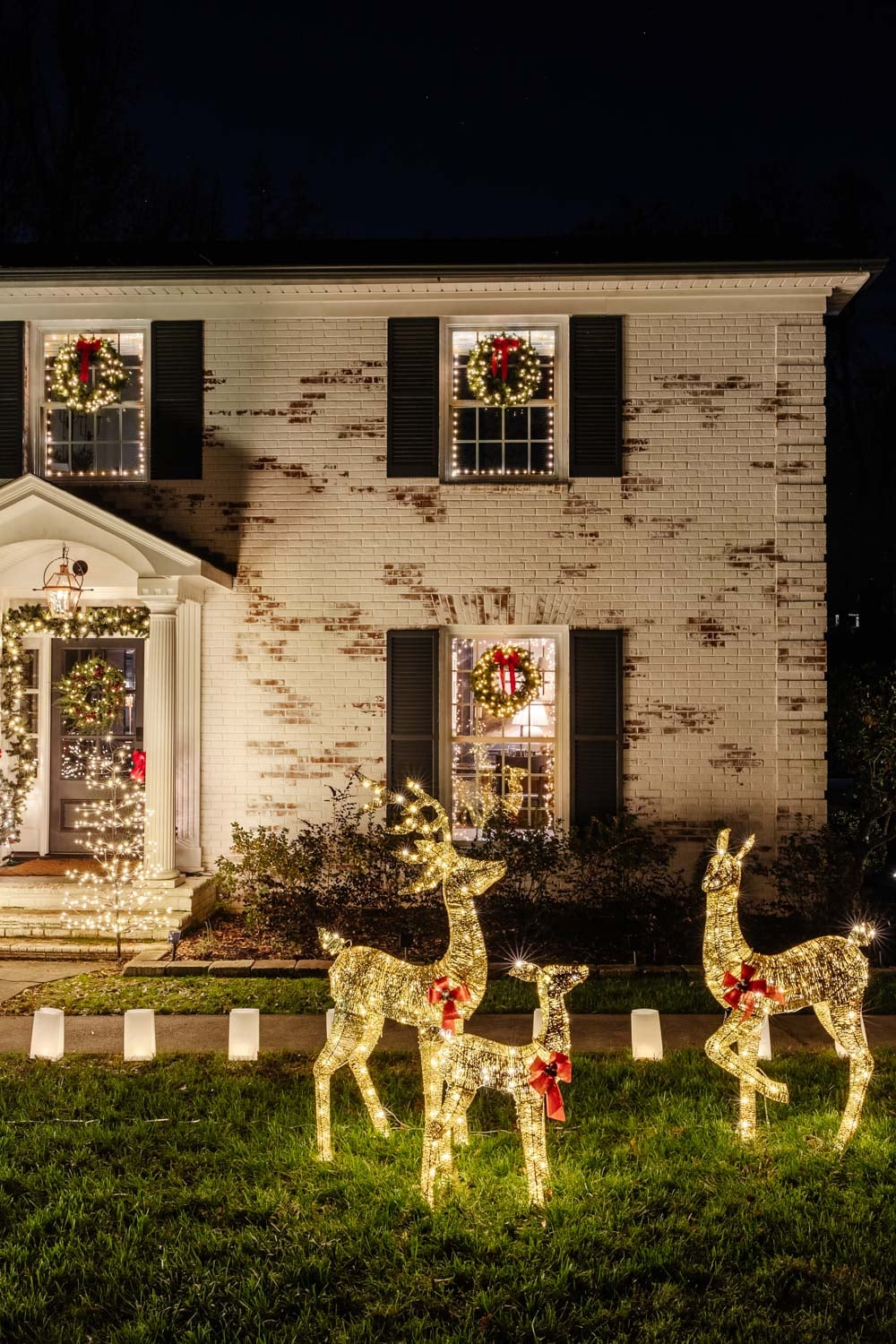
Two principles stack here. Framing: fairy-lit window outlines with wreaths create a repeating rhythm across the facade, so your eye moves left to right and back. Depth layering: house lights, then deer in the mid-yard, then luminaria along the walk, which pulls the viewer forward instead of letting everything flatten into one glowing plane.
24. A Giant Glowing Ornament Archway With a Reindeer Inside
- Giant ornament frame (6 ft): $70–$180
- Wire-frame reindeer (5 ft): $90–$220
- White LED strands (600–900 lights): $60–$150
- Ground stakes and guy lines: $15–$35
- Outdoor extension cord with GFCI timer: $25–$45
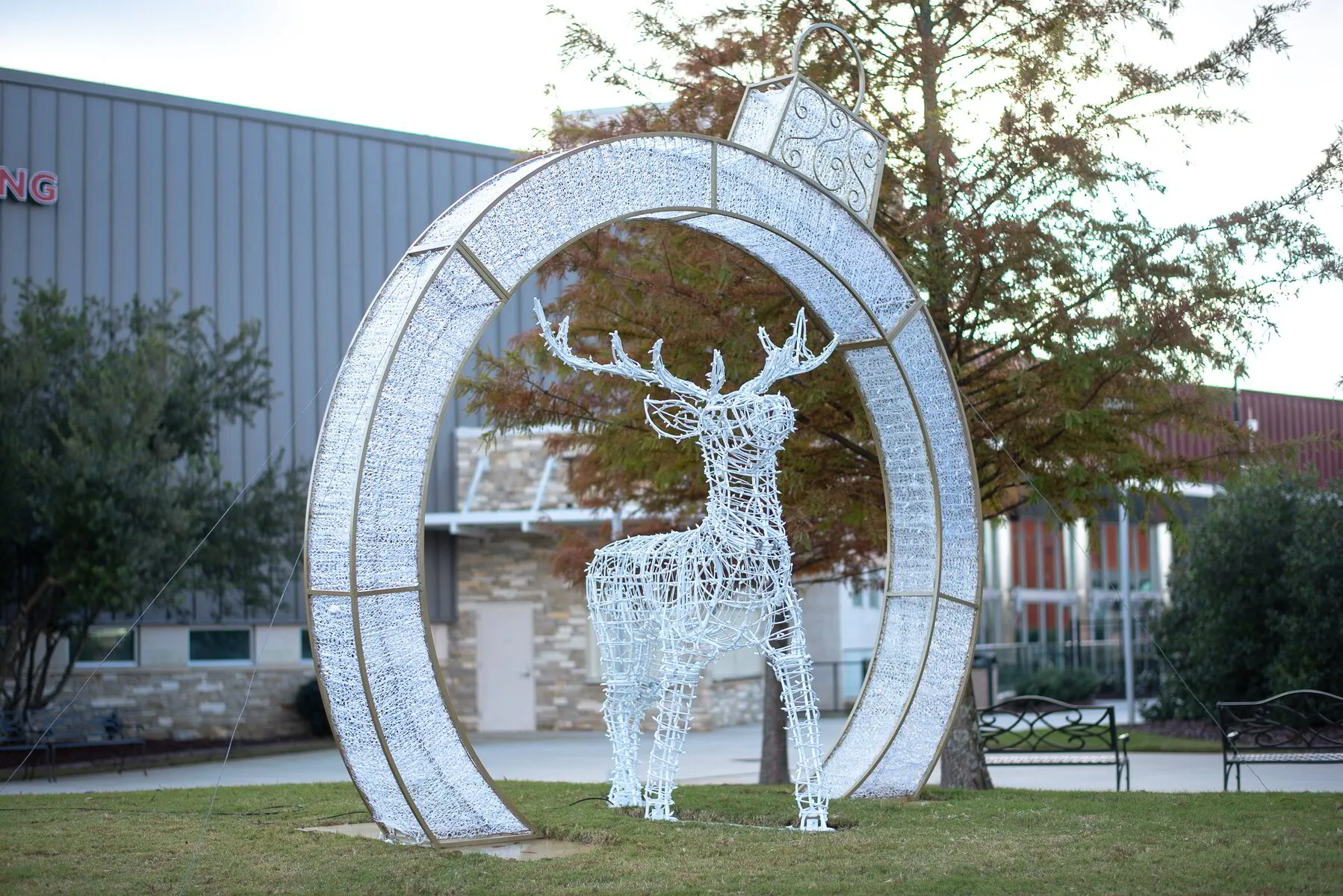
Total: $260–$630 — or build the ring from two hula hoops and PVC for about $30 plus lights.
The framing is everything. The reindeer inside the illuminated ring is what makes this a photo moment instead of two separate decorations — the circle gives your eye somewhere to stop and turns the scene into a portrait. Recreate it with a lit arch, a rectangle, or a teepee shape. Just don’t park the animal beside the frame. And check the mistakes section below before you drive anything into the lawn.
25. Wire Cone Trees With Star Garlands and Ornament Clusters
Wire cone trees live outside, so rust is the enemy. Powder-coated steel frames hold for years; spray-painted ones spot by season two, especially where the lights rub. Touch up any scratch with matching enamel before you store them. The star garlands are the fussiest part — hang each strand on its own hook inside a bin, because untangling beaded garland in the cold is genuinely miserable.
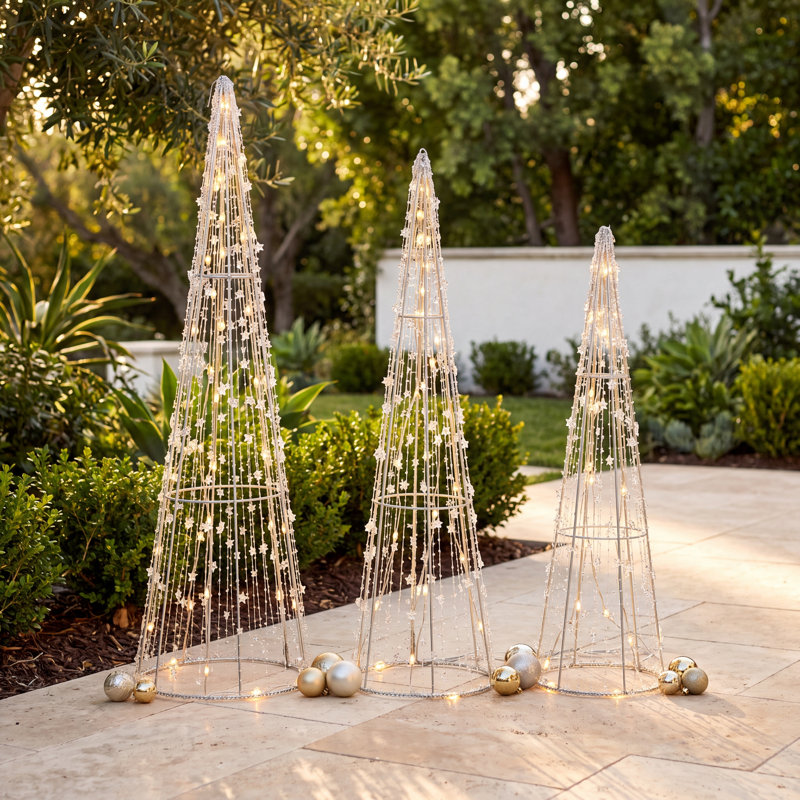
Work in odd numbers and stepped heights: 47, 35, and 24 inches tall, spaced 12 to 16 inches apart on the patio. Cluster ornaments at the base in three sizes — 3-inch, 2.5-inch, and 2-inch balls — about 15 pieces per cluster. Odd counts and repeating sizes create rhythm; even numbers and identical balls look like a spreadsheet.
26. A Gray Door With a Citrus Wreath and a Gold Nutcracker
The dried citrus wreath takes an afternoon and about $20.
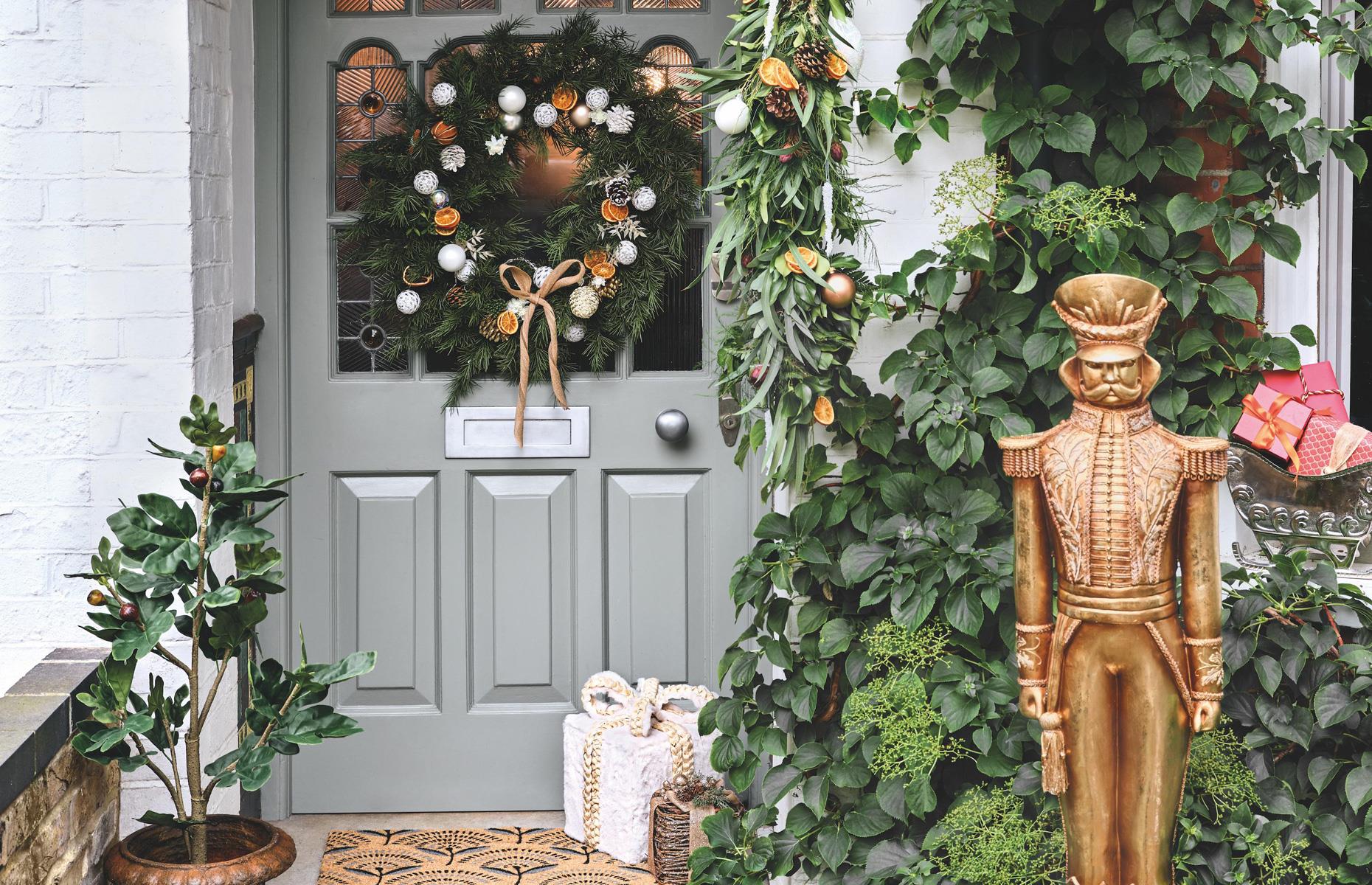
- Slice two oranges and one lemon into quarter-inch rounds and blot them dry.
- Bake at 200°F for 3 hours, flipping once, until leathery — not crisp.
- Wrap a grapevine base with floral wire, adding pine sprigs every 3 inches.
- Wire the citrus slices in a spiral, alternating with small white ornaments.
- Finish with a wide ribbon loop and hang from an over-door hook, not a nail.
Time: 4 hours. Cost: $18–$28.
Read the door as a formula: 50% sage gray base, 35% deep green foliage, 10% gold, 5% white. The gray door is doing more than you think — it keeps the gold from looking brassy and the green from looking like a craft store. If your door is red or black, shift to 45% green and 20% gold so the door doesn’t compete with the wreath.
27. A Tree Wrapped in Green Light With Glowing Star Ornaments
Green light on a tree is dramatic and slightly strange, and I mean that as a compliment. Just know that green on foliage is the one combination where your color can disappear — wrap a green tree and you’re lighting texture, not color, so the blue and white star ornaments have to carry the whole thing. It’s also the display most likely to look eerie unlit in daylight, so tuck your strand ends well out of sight.
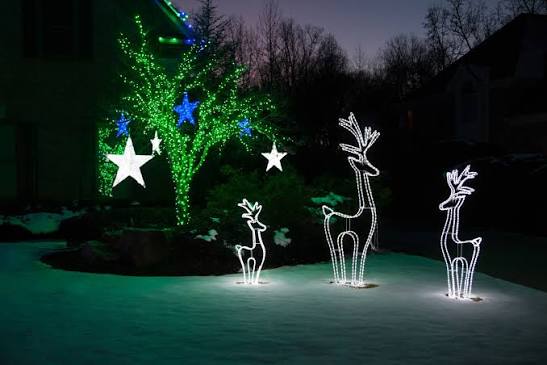
Plan on roughly one 100-light strand per foot of trunk and per major limb, so a 15-foot tree is a 1,200-light project — and a real one. If your tree is under 12 feet or sits in a small yard, wrap a shrub instead for the same height without the ladder. Anything under a 15-foot spread should stick to two wrapped elements, not three.
28. A Rusty Metal Trumpeting Angel on a Bed of Evergreens
The rustic metal look is easier to fake than it appears. Search Facebook Marketplace and estate sales for rusty garden trellises, old sheet-metal signs, or decorative scrollwork — $10–$40, already weathered. Want the angel silhouette specifically? Laser-cut steel versions run $50–$120 online, or a local maker space can cut one from 22-gauge sheet for the cost of material, roughly $25.
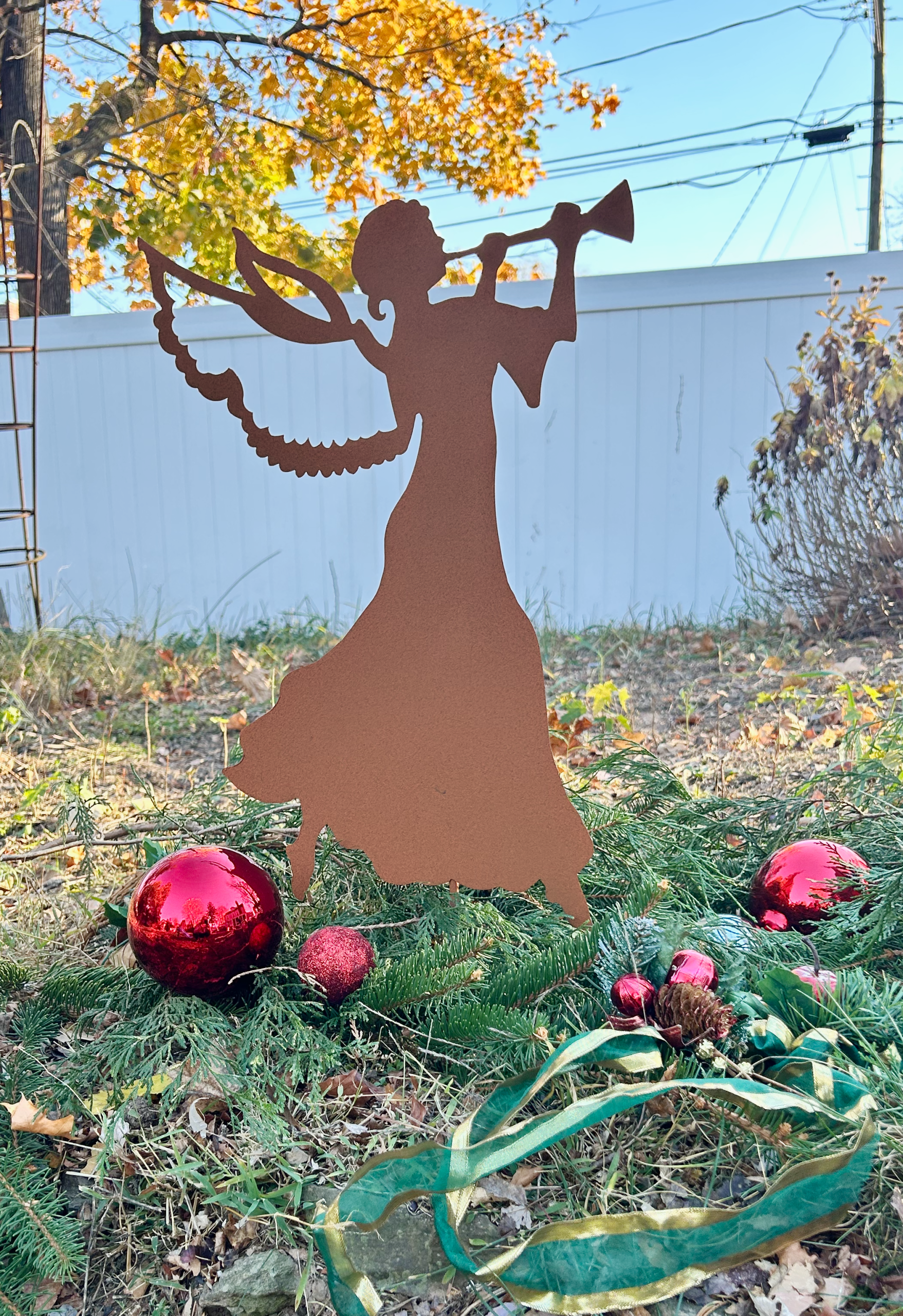
The rust is the point. A polished version of this exact angel would look like a garden center display; the corroded finish is what makes it feel like it’s been standing there for decades. Rust is also the only finish that genuinely improves with weather. To speed it up, spray a new steel cutout with vinegar and salt water and leave it outside for two weeks.
29. A Shepherd’s Hook Basket of Pinecones, Rosemary, and Baubles
- Check your hook’s weight rating — most hold 10–15 pounds, and a full basket plus wet greens gets heavy.
- Confirm you can reach the basket to swap greenery without a ladder.
- Face the hook away from prevailing wind so it swings into the post, not your walkway.
- Verify the bed is at least 18 inches wide so the hook has room to anchor.
- Decide real or faux rosemary now — real sprigs need replacing every few weeks.
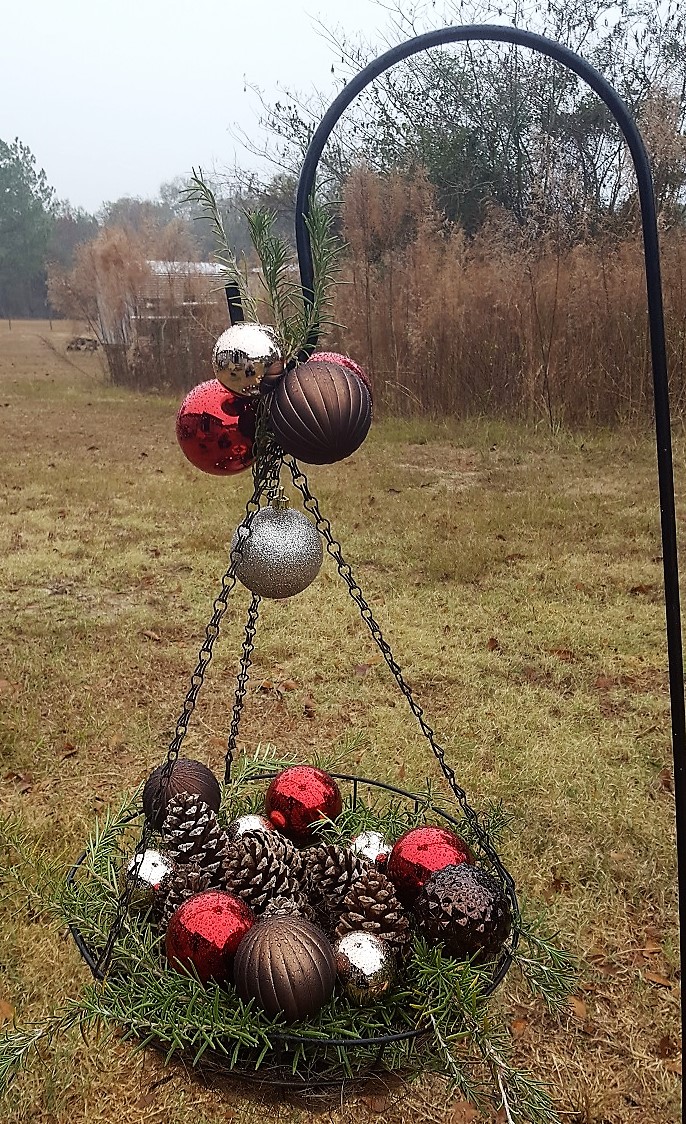
A 6-foot hook is the sweet spot: high enough that the basket clears head height, low enough that you can reach it. It wants an 18-inch-wide planting bed and about 3 feet of clearance from a walkway so nobody clips it with a shoulder. If your bed is narrower, the urn treatment on the steps in Idea #2 fits the same corner without asking for floor space.
30. A Stone Cottage Wrapped in Warm White Light
Three things keep this from looking like too much. The outline lights follow the architecture, so the house still looks like a house. The shrub and tree wraps fill the middle ground and give the display volume instead of a flat plane. And the pathway border lights create a clear, glowing route to the door, which is really what outdoor decorating is for. Warm white throughout means nothing competes.
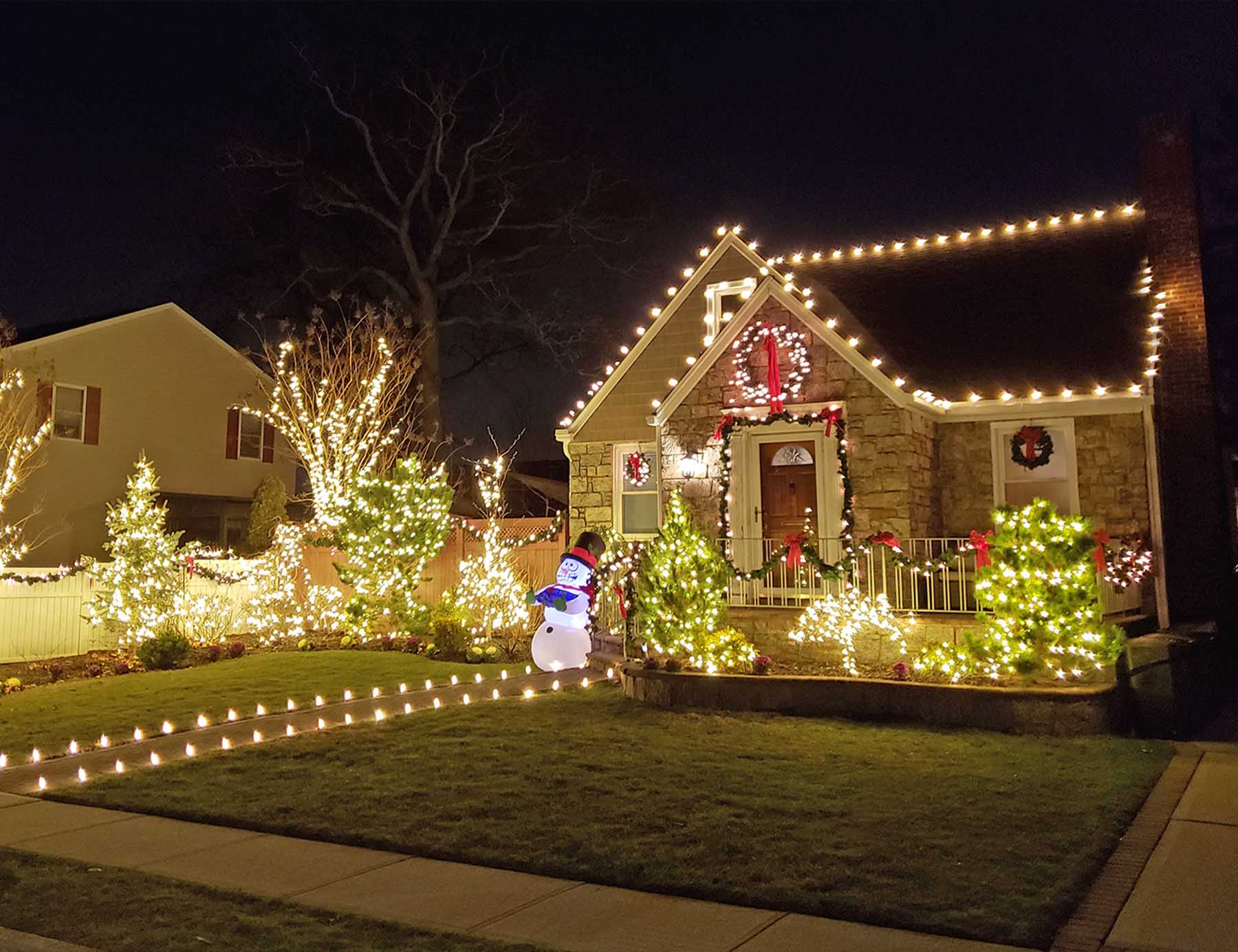
- Roofline and gable outline lights (300 ft): $100–$260
- Shrub and tree wraps (6–8 nets or strands): $90–$220
- Pathway border lights (2 sets): $30–$70
- Inflatable snowman: $60–$160
- Green wreaths with red bows (4): $60–$180
Total: $340–$890, dropping to about $200 if you wrap only the two shrubs closest to the door.
Your Front Yard Is About to Be the Best on the Block
Start with one zone — the porch, the walkway, one wrapped shrub — and let it grow over a couple of seasons. Nobody builds a two-story light display in a single weekend, and the yards that look best are usually the ones that got added to year after year.
📌 Pin your favorite ideas now so you have them when the clearance sales hit, and tag us when your yard starts glowing — we want to see it.