You know that feeling when you finally find the holiday decor that looks exactly right for your home — and it turns out you can make it from a bag of oranges? Dried orange Christmas decorations have quietly become one of the most saved looks on Pinterest, and not just because they’re having a moment. They’re cheap, they smell like a real kitchen, and they photograph like something out of a magazine.
We spent serious time browsing Etsy, Target, and World Market to bring you only what’s worth your attention this year, and pulled together 30 ideas that run from about $2 worth of fruit to a $190 brass centerpiece.
Inside you’ll find rustic natural styling, traditional red-and-green holiday looks, quiet Nordic palettes, and warm farmhouse mantels — with budget and luxury versions side by side where it actually matters, plus real dollar figures for every single one.
What’s driving it in 2026 is a genuine shift on Pinterest: people are decorating the architecture — doorways, stair rails, open shelves — instead of only the tree, and they want decor that composts in January. And stay until the end — we break down the most common mistakes that can ruin these looks.
📌 Save this to Pinterest for later — you’ll want to revisit these ideas.
1. A Corner Tree in a Galvanized Bucket, Draped in Dried Orange
The galvanized bucket is doing quiet, heavy lifting in this corner. Swap it for a red skirted stand and the whole scene collapses into standard holiday decor — the metal keeps the tree feeling like something you dragged in from the garden, which is exactly why the dried orange garlands read as gathered rather than purchased. A bucket also holds the trunk straighter than most stands and gives you back three inches of floor space.
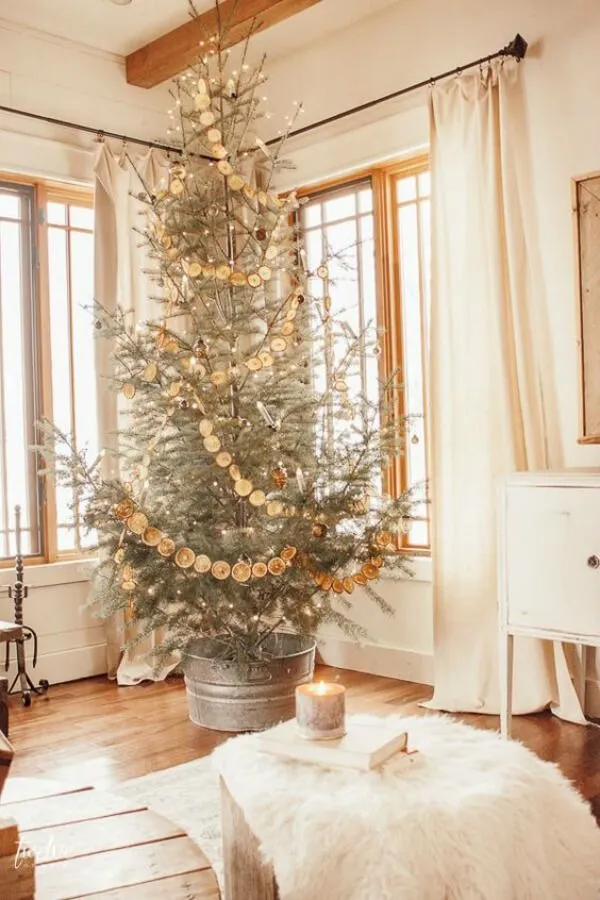
String dried orange slices on florist wire, not twine, if you want them to hold their shape on a slim tree. A 22-gauge wire threaded just off-center through the rind keeps each slice flat and facing forward, and it won’t sag the way cotton string does once the fruit loses its last bit of moisture. Space the slices about 4 inches apart so the garland reads as punctuation instead of a solid band of orange.
2. Dried Orange, Cinnamon and Wooden Beads on a Warm Wood Surface
The formula here is roughly 70% warm brown (the table, the wooden bowl, the cinnamon, the bead garland) + 20% dried orange + 10% living green. That’s the whole recipe. Swap the beads for ivory linen ribbon and it softens toward Scandinavian. Swap the coniferous sprigs for olive branches and it turns Mediterranean in one move. The proportions are what make it look styled instead of scattered — keep the brown dominant and the orange always reads as intentional.
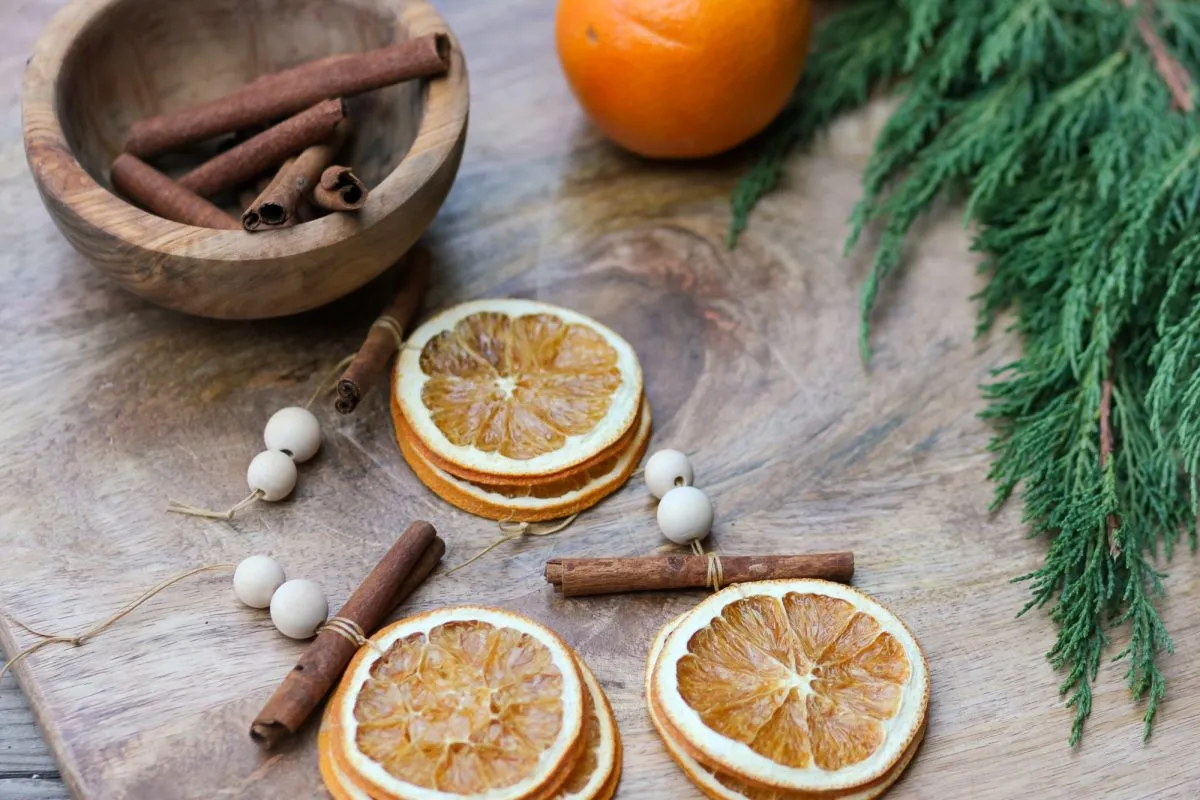
- Wooden bowl and bead garland: $14–$32
- Whole cinnamon sticks, bulk bag: $6–$12
- Fresh oranges, six count: $5–$9
- Spruce or fir sprigs: $0–$12
- Oven-drying electricity cost: under $3
- Wood board or thrifted tray: $0–$25
Total: roughly $28–$93, and most of it comes back out next December.
3. A Dried Orange Garland Draped Over a Dark Stained Cabinet
Two things are working at once. First, contrast: dried orange against dark stained wood glows, because the cabinet pulls the light down and the fruit pushes it back. Second, the mix of shapes — round slices, straight cinnamon sticks, spiky pinecones — keeps your eye traveling along the swag instead of stopping on any one piece. The little white ceramic house and brass bell are the payoff details that make it look collected over years rather than bought in a single trip.
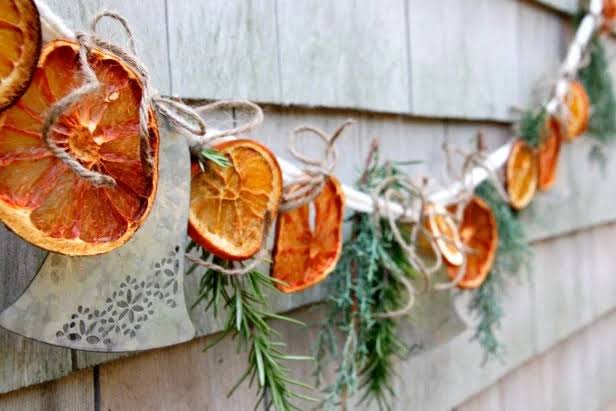
Dried citrus has moved well past farmhouse-kitchen cliché, partly because of the broader 2026 pushback against plastic-heavy holiday decor. Dehydrator sales spiked again last winter, and searches for dried orange garland climb every November like clockwork. The staying power is real: this is compostable decor that costs almost nothing, which is a very different pitch than a $40 glitter wreath you’ll replace in two seasons.
4. Pom-Poms, Paper Snowflakes and Orange Slices Deep in the Branches
When you’re mixing dried orange with pom-poms and paper snowflakes, hang them in clusters of three instead of scattering them evenly. Group one orange slice, one pom-pom and one snowflake within a hand’s width of each other, then leave a bare stretch of branch. Clusters read as deliberate little vignettes; even spacing reads as a craft-fair tree. Aim for one cluster per 8 to 10 inches of branch on a six-foot tree.
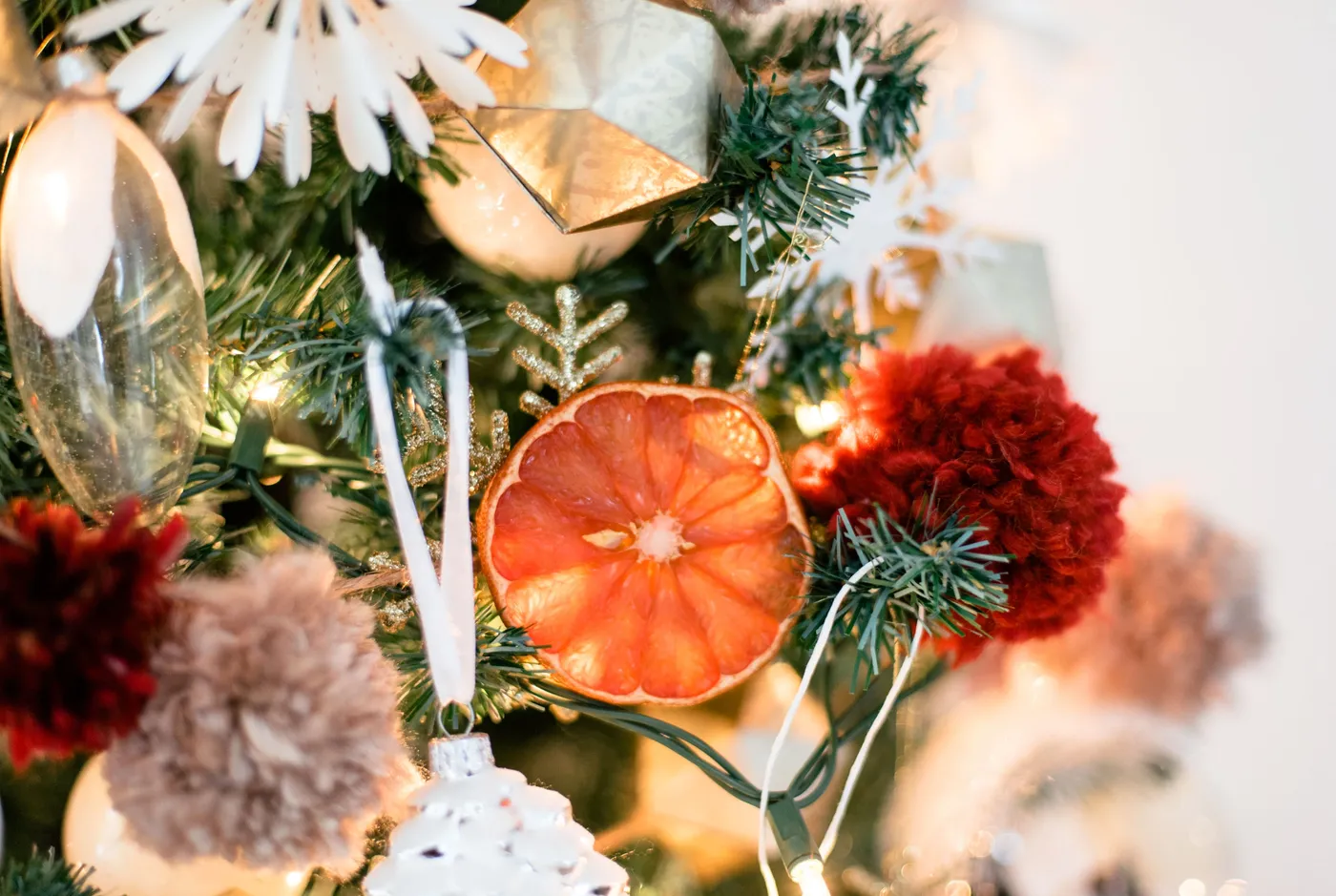
Two honest caveats. Pom-poms shed loose fibers for the first week, so give them a good shake before hanging. And dried slices can look dusty after a few weeks in a warm room — brush them gently with a dry pastry brush rather than wiping, which grinds the dust in. If your tree sits near a heat vent, expect fading by mid-December and plan to rotate the front-facing slices toward the back.
5. A Garland-Making Table with Bay Leaves, Twine and Fresh Oranges
- Thread a large-eye needle with 4 feet of natural jute twine and knot one end.
- Push the needle through a dried orange slice just off-center so it hangs flat.
- Alternate with two bay leaves, threading through the stem end.
- Add a cinnamon stick every eighth slice to break up the pattern.
- Slide a knot in every 18 inches so the spacing can’t shift.
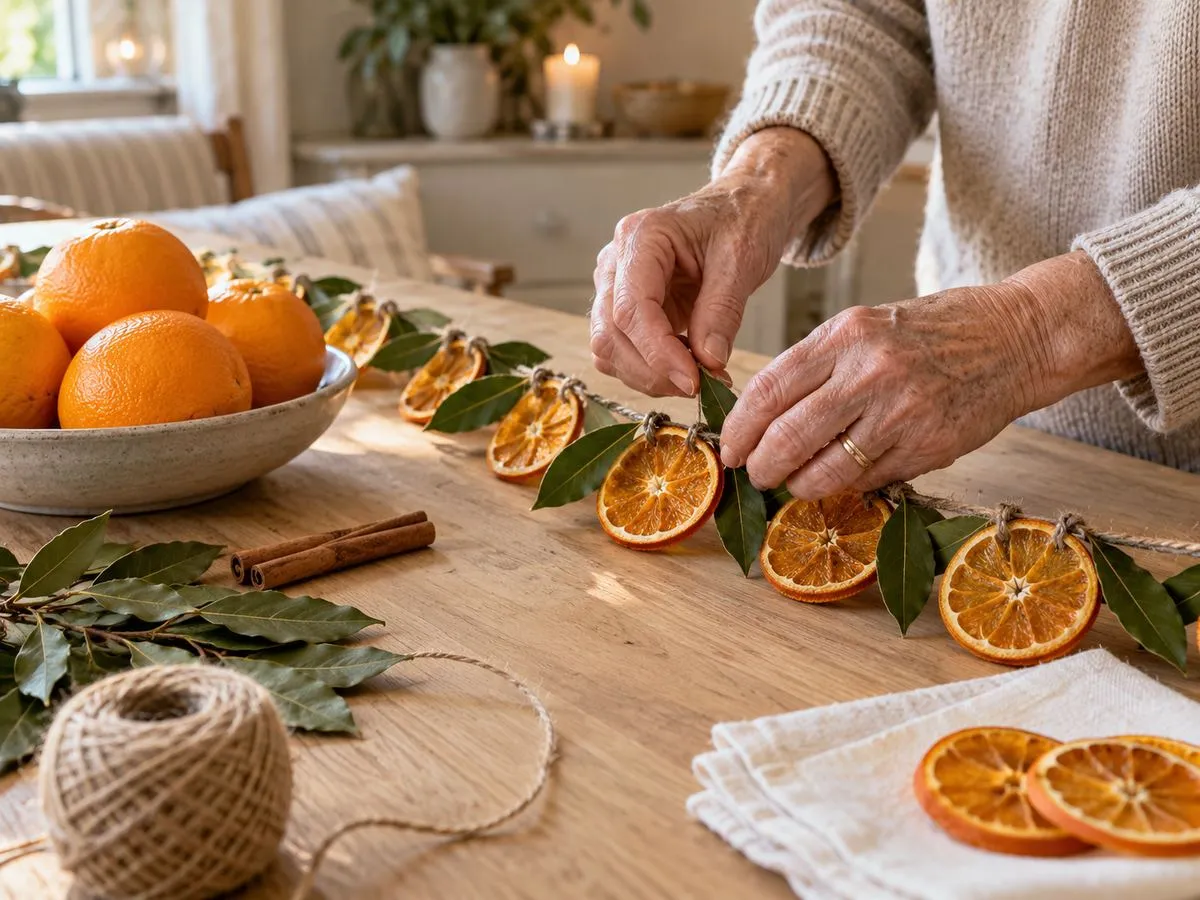
About 45 minutes for four feet, with $10–$18 in materials.
You don’t need a dehydrator for this. Slice oranges a quarter-inch thick, lay them on parchment over a rack, and bake at 200°F for two and a half to three hours, flipping once — the electricity costs under a dollar. Bay leaves come from the spice aisle or a generous neighbor, and jute twine is about $3 for a lifetime supply. For the same technique with star anise in the mix, see Idea #10.
6. Mason Jar Potpourri with Cranberries, Rosemary and Cinnamon
Glass-jar potpourri is close to zero maintenance — no dusting, no drooping, no shedding. The one thing that changes is color: dried cranberries darken to near-burgundy within a season, and fresh rosemary goes olive-grey after about two weeks. If you want the bright red and green to hold, use freeze-dried cranberries and tuck a cotton ball with a few drops of rosemary oil into the back of each jar. Refresh the oil monthly and it’ll scent the room until spring.
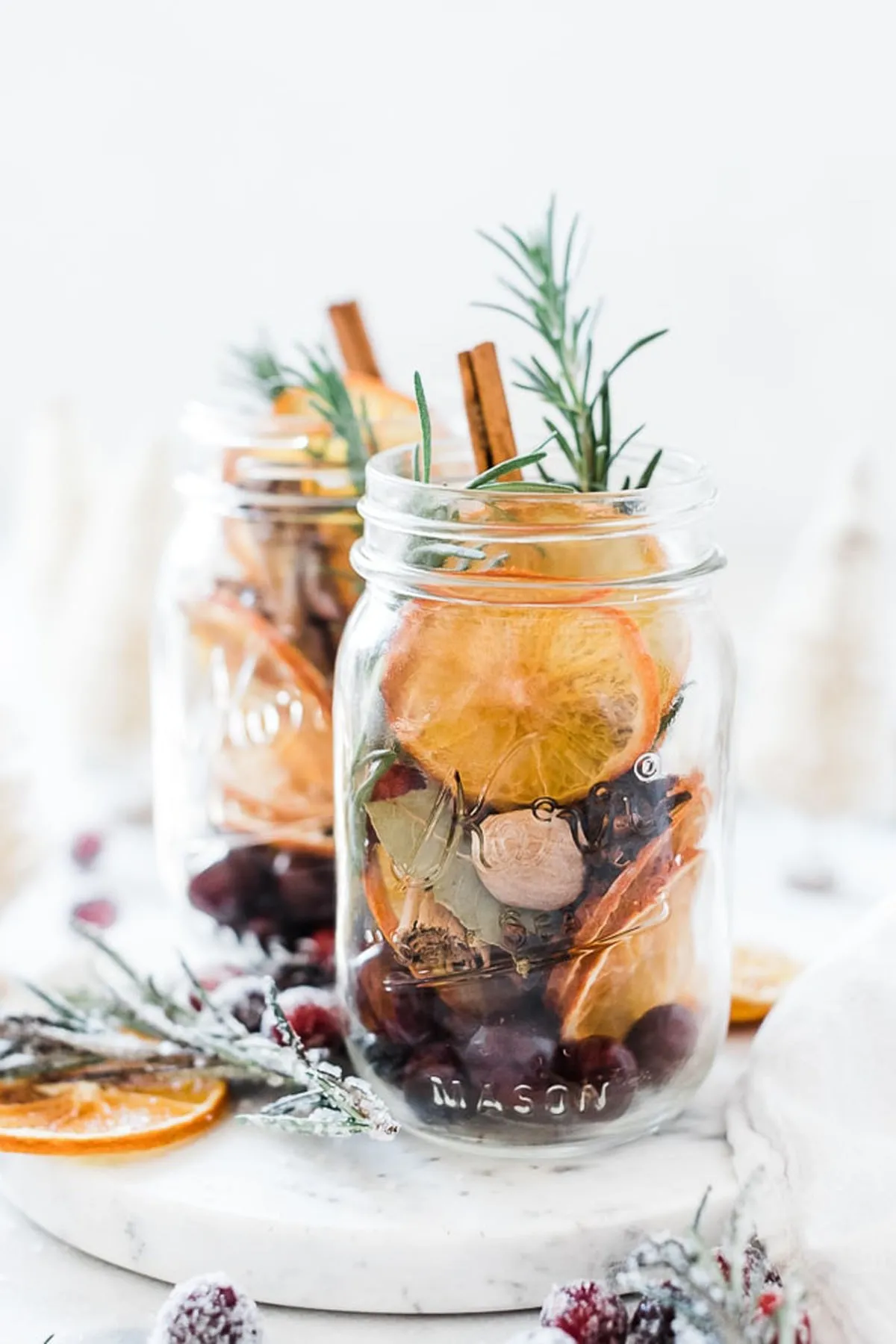
- Two clear Mason jars with lids: $8–$16
- Dried orange slices, homemade: $4–$8
- Freeze-dried cranberries: $6–$11
- Fresh or dried rosemary: $3–$6
- Cinnamon sticks: $5–$10
- Marble tray or thrifted plate: $0–$30
Total: around $26–$81, and the jars pull double duty as hostess gifts.
7. A Staircase Newel Post Garland with Velvet Ribbon and Brass Bells
Full newel-post garlands eat space, so measure before you commit. You want at least a 36-inch-wide staircase and a 9-foot ceiling to keep the drape from brushing heads — anything tighter and a half-swag along the handrail works better. In a narrow stairwell, use dried orange slices and slim velvet ribbon only and skip the bells. If your entry is genuinely tight, the shelf-length version in Idea #29 delivers the same warmth in a fraction of the footprint.
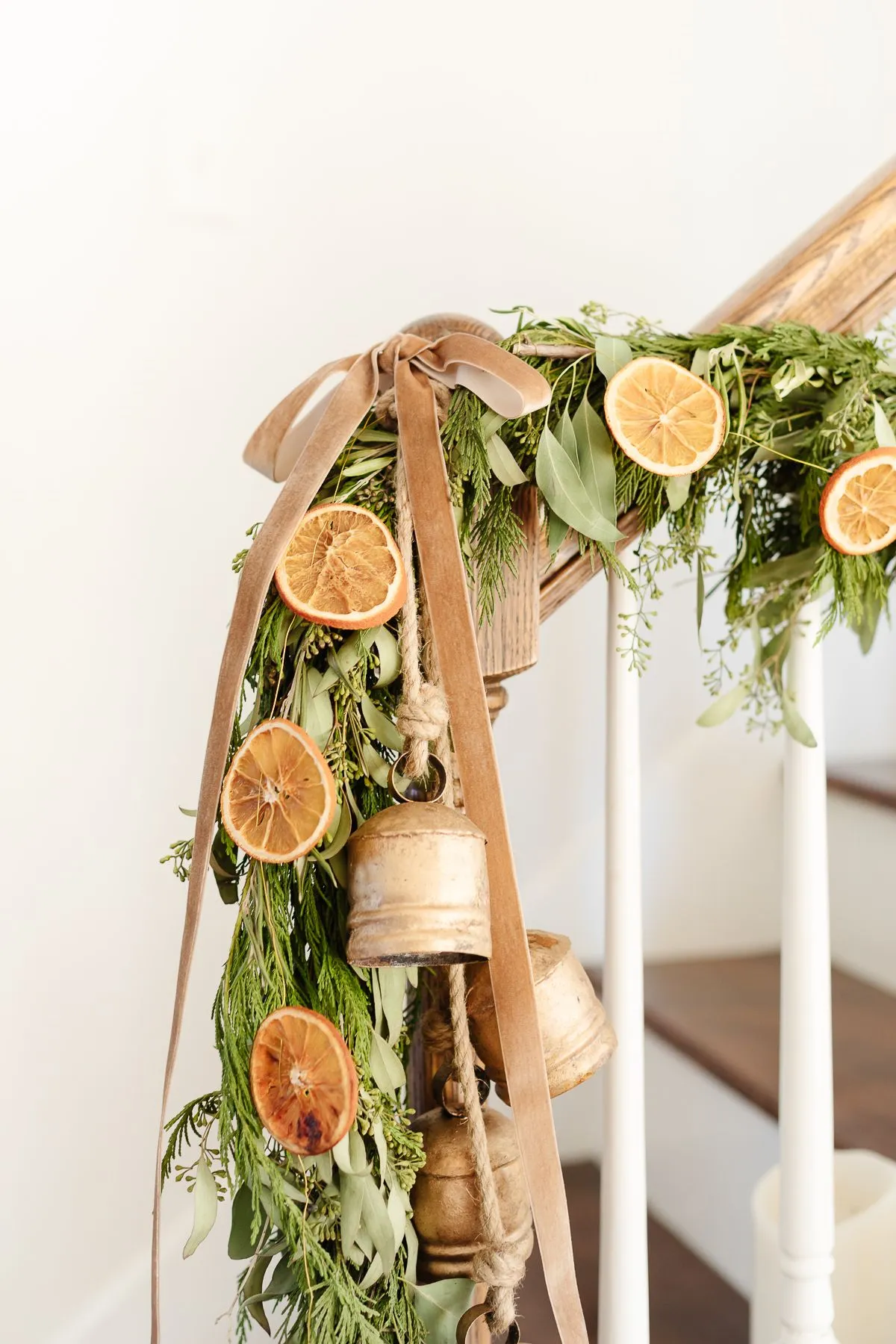
The ribbon-on-the-staircase look crossed over from styled photo shoots to mainstream homes around 2024 and hasn’t slowed. What changed by 2026 is the ribbon itself: wide velvet in muted, earthy tones replaced shiny satin, and people started tying on natural elements — dried orange, brass bells, jute — instead of plastic baubles. The result photographs beautifully and, more to the point, survives actual daily use by actual families.
8. Clove-Studded Oranges: The Pomander, Done Properly
The clove pattern is the one thing that separates a considered pomander from a stubbly orange. Randomly poking cloves gives you a hedgehog; a deliberate band, spiral or cross gives you something that looks like an heirloom. Use a toothpick to pre-punch holes about a quarter-inch apart so the cloves sink in without cracking the peel, and leave a bare ring around the middle so you can actually hold it without getting pricked.
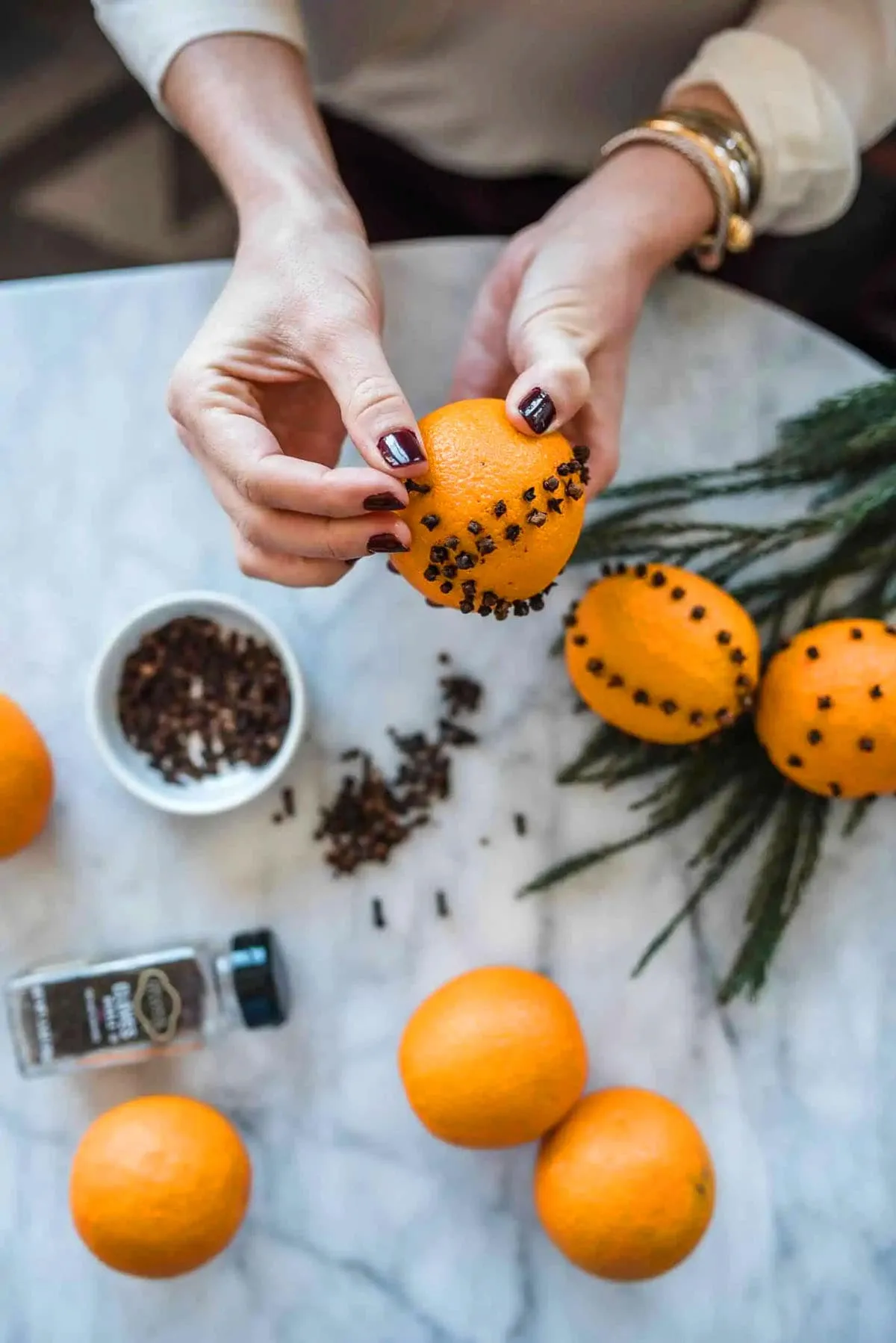
- Choose firm, thick-skinned oranges and wipe them dry.
- Sketch your pattern faintly in pencil, or stretch a rubber band around the fruit as a guide.
- Punch holes with a toothpick, then press a whole clove into each one.
- Roll the finished pomander in ground cinnamon or orris root to help it cure.
- Rest it on a rack in a cool, dry room for two to three weeks, turning every few days.
About 30 minutes of hands-on work per orange.
9. A Wreath with an Oversized Orange Burlap Bow on a Grey-Green Door
This wreath runs about 55% deep green foliage + 25% burnt orange (dried slices, maple leaves, that big burlap bow) + 15% rustic brown from pinecones and cinnamon bark + 5% berry red. That last 5% is doing more work than its size suggests — pull the red berries out and the whole thing flattens into an autumn wreath. To push it toward winter, trade the maple leaves for eucalyptus and swap the burlap bow for plain linen.

Dense wreaths like this one get heavy. Weigh it before you hang it — anything over 5 pounds needs a proper hook, not a suction cup or a thumbtack, and definitely not the flimsy wire loop that comes in the box. Keep it out of direct sun if the door faces south; orange burlap fades to a washed-out peach in about six weeks, and dried orange slices bleach even faster.
10. Star Anise and Bay Leaf Garland on a Warm Wood Tabletop
- Confirm your oven’s lowest setting — 170°F is ideal, though many bottom out at 200°F.
- Block out a full afternoon; slicing and drying is a two-part project.
- Measure the surface you’re draping: roughly one slice per 2 inches of garland.
- Have a large-eye needle and a spool of white twine before you start.
- Set out a cooling rack and parchment so slices don’t stick.
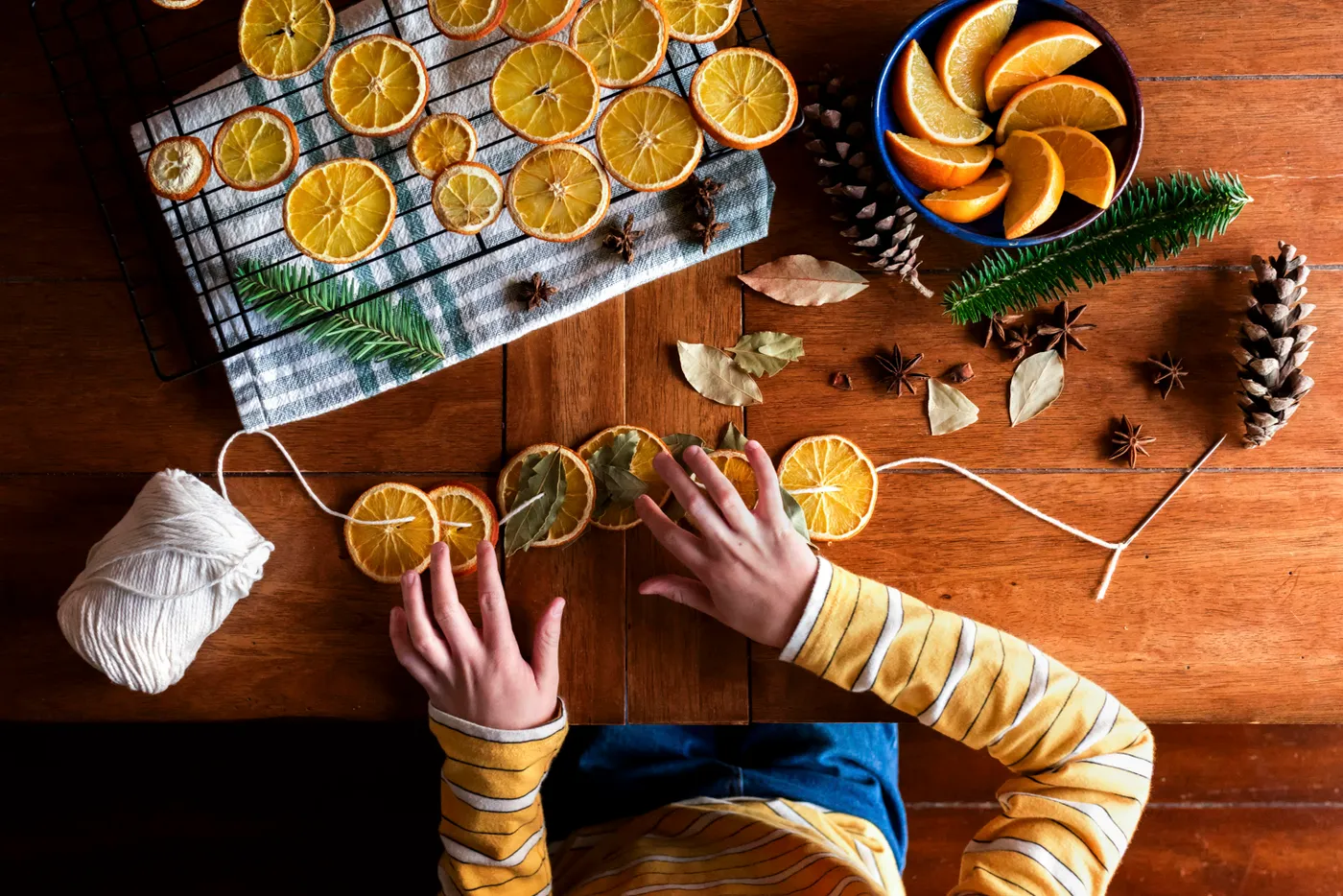
The whole project lands under $20. A bag of oranges from a discount grocer is about $4, star anise runs $3–$5 in the international aisle, and bay leaves are a dollar or two. Thrift stores regularly have bowls and racks for $2–$4, and Facebook Marketplace fills up with free citrus every January when backyard trees finally give out. See Idea #18 for the tray-drying setup that makes all of this easy.
11. A Maximalist Wreath with Dried Apple, Walnuts and Pheasant Feathers
Three principles are stacked here. Texture contrast: soft feathers against hard shells against leathery dried fruit. Value contrast: deep evergreen against pale wood-toned feathers. And asymmetry inside a symmetrical frame — the wreath is round, but the placement of elements is deliberately uneven. That’s what keeps a maximal wreath from turning into a craft-store explosion. Nothing is centered, yet the whole thing reads balanced from three feet away.
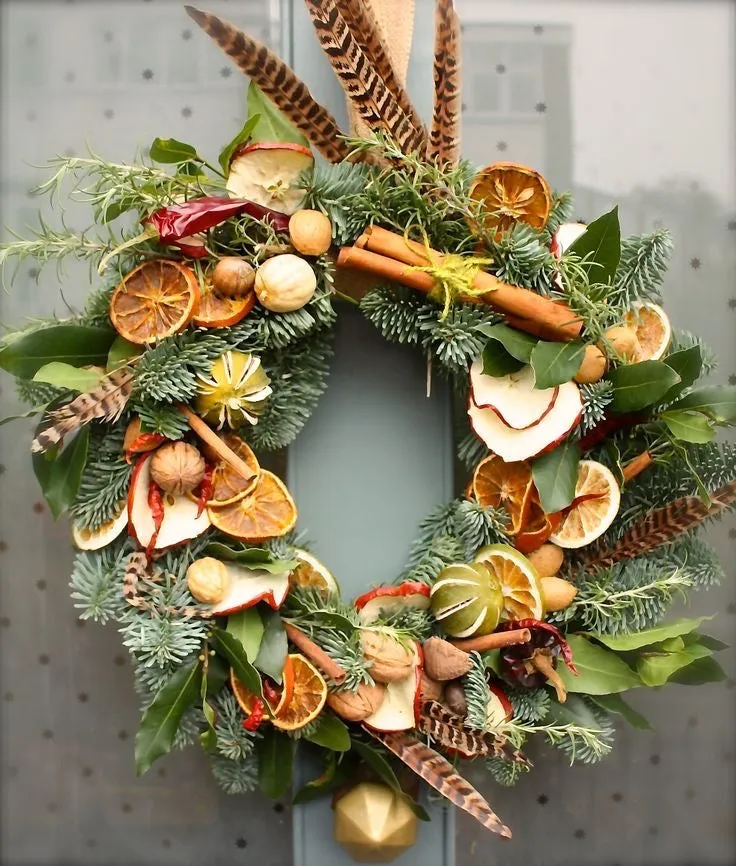
Wire heavy elements — walnuts, whole dried apples, cinnamon bundles — to a hidden second ring of 16-gauge floral wire behind the greenery rather than gluing them to the front. Glue fails in cold weather and leaves shiny residue when it dries. The wire ring also lets you rearrange pieces next year instead of rebuilding from scratch. Budget about 18 inches of wire per heavyweight element.
12. Juniper Berries Paired with Star-Shaped Dried Orange Ornaments
Juniper’s blue berries are having a moment precisely because they deliver color without any red or green at all — a welcome change for anyone tired of the same palette. Pairing them with star-cut dried orange keeps the traditional citrus scent while nudging the whole look toward a quieter, Nordic-tinged Christmas. It’s the kind of styling that works in a modern apartment without fighting the mid-century sofa.
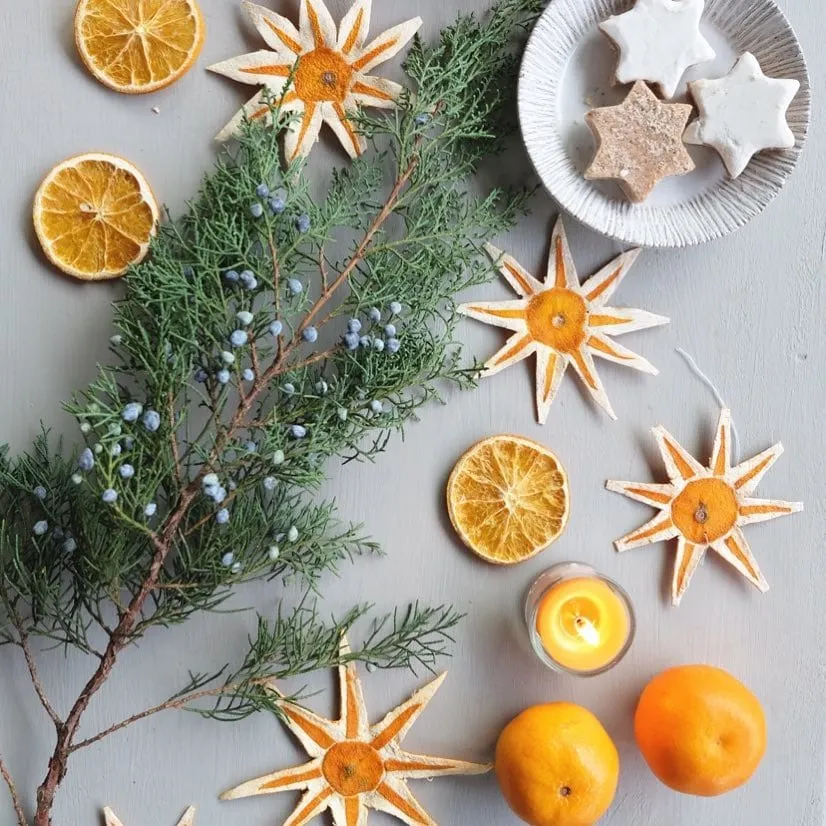
- Juniper branch bunch: $8–$18
- Whole dried oranges and slices: $6–$14
- Star cookie cutter for cutting rind: $3–$6
- Glass candle holder and pillar candle: $10–$22
- Star-shaped shortbread, homemade: under $5
- Light grey tray or marble slab: $0–$28
Total: roughly $27–$93. The juniper dries in place and holds its color for weeks.
13. Miniature Bottle Brush Trees and a Nutcracker on the Mantel
The mixed heights of the bottle brush trees are the element everything else leans on. Three greens at 4, 6 and 9 inches plus one gold at 5 inches creates a tiny forest skyline along the shelf. Remove them and you have a garland and some berries — pleasant, but forgettable. That variation in height is what keeps the arrangement from reading as a single flat line.
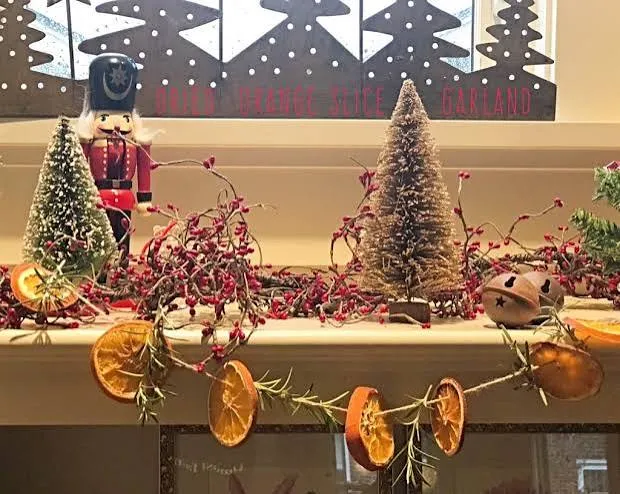
This styling wants a shelf at least 60 inches wide and 6 inches deep, with a good 12 inches of clearance above for the tallest tree and the red berry branches. A standard 5-foot fireplace works fine; a 48-inch apartment mantel will feel crowded, so drop the nutcracker and use two trees instead. For a smaller-scale take on the same festive layering, see Idea #26.
- Measure mantel width and depth, and check outlet access for lights.
- Confirm nothing sits within 12 inches of an active firebox.
- Test the garland’s drop height so it doesn’t block art or a mirror.
- Decide on a color story before you shop — green and gold, or green and red.
- Check that any adhesive hooks are rated for at least 3 pounds.
14. A Rustic Dried Orange Garland on Weathered Wood Planking
Anything displayed on an open, weathered surface collects dust fast — plan on a weekly pass with a soft brush. Jute twine loosens as it moves through humid and dry spells, so re-tighten the knots once mid-season. And the white lace ribbon will yellow; if yours is vintage, keep it out of direct light. Store everything in a paper bag rather than plastic so any residual moisture in the rind can escape without molding.
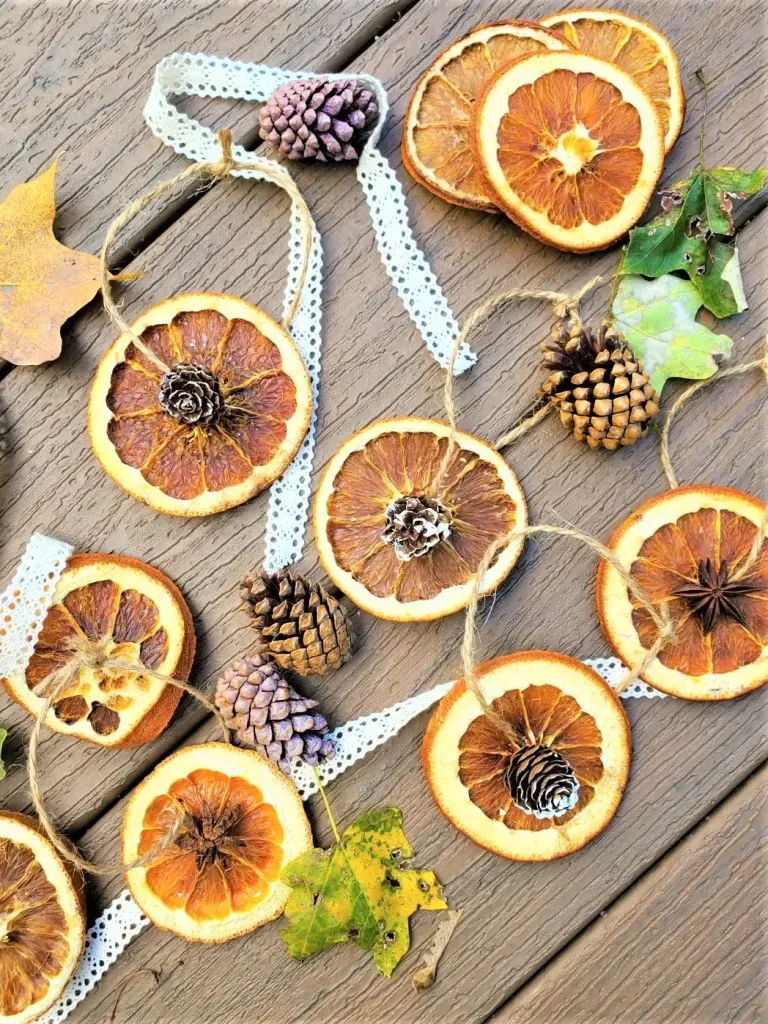
The palette is roughly 70% warm brown + 20% dried orange + 10% off-white, with yellow-green autumn leaves acting as a seasonal accent rather than a defining color. That formula shifts easily: trade the lace for black-and-white gingham and it turns modern farmhouse, or swap the pinecones for wooden beads and it heads Scandinavian. Keep the brown base dominant and the orange never looks accidental.
15. A Red Velvet Bow on a Green Wreath, White Panel Door
A velvet bow wants to be big — aim for a finished width about one-third the diameter of the wreath itself. Anything smaller looks apologetic, and anything bigger swallows the whole thing. Cut velvet ribbon on the bias so the ends don’t fray, then pass them quickly over a lighter to seal. Position the bow at 4 o’clock or 8 o’clock, never dead center, and let one tail hang longer than the other.
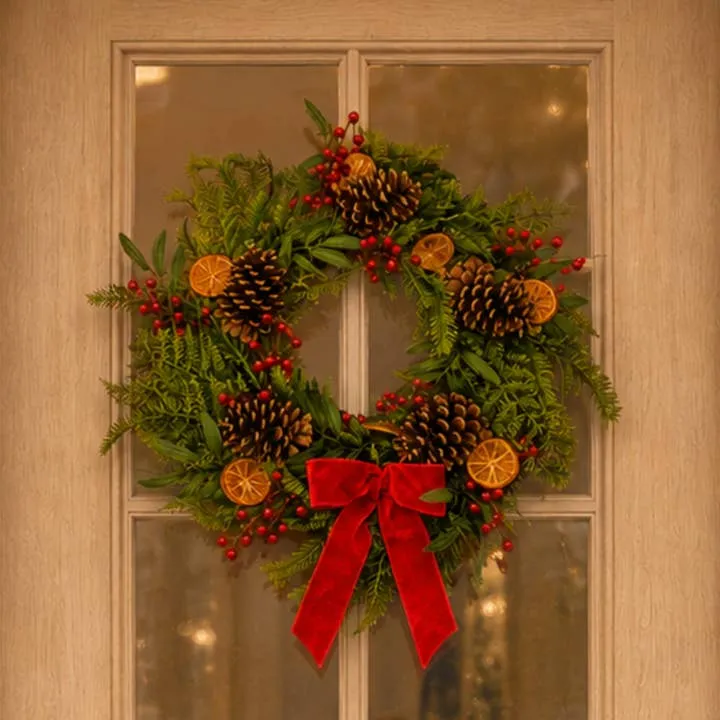
White doors and dried orange are a beautiful pairing with one catch: dried fruit can leave faint amber marks on painted surfaces if it gets damp. Line the back of the wreath with felt or a scrap of batting, and bring it inside during storms. If you rent and can’t risk the door finish, use an over-the-door hanger instead of adhesive — and check with your landlord before drilling anything.
16. Two Citrus Slices on Bright Red String, Buried in the Tree
This is a lesson in restraint. Two slices, two strings, no bow, no ribbon. The color does all the work: rustic orange against dark green needles, with a saturated red hanging string providing a shock of contrast that reads as deliberate rather than leftover. Backlit by multicolored fairy lights, the translucent rind glows from behind — a trick you simply cannot get from a plastic ornament at any price point.
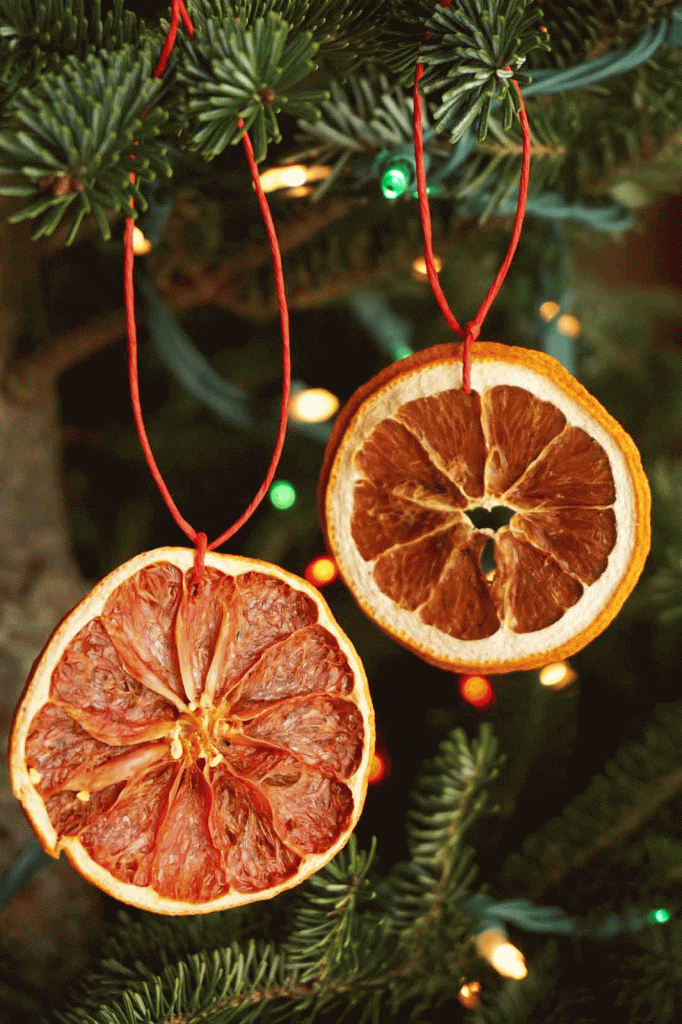
The string is the element. Switch it to jute or invisible filament and the ornament goes dull; that red line is what makes two humble fruit slices feel like a design decision. It also tells your eye where to look on a busy tree. Keep the slices whole rather than halved so the segments stay visible through the skin, and hang them at different depths so the light hits them differently.
17. Dried Orange Garland Above a Herringbone Subway Tile Mantel
The proportions here matter more than the styling. The mantel is roughly 60 inches wide, and the garland drops about 8 inches down the front — roughly a third of the tile’s visible height. On a wider fireplace, don’t just add more garland; keep the drop at 6 to 10 inches and let the extra width stay clean. High ceilings above 10 feet call for vertical interest behind, like the mirror and photo collage used here. See Idea #21 for a smaller-footprint version.
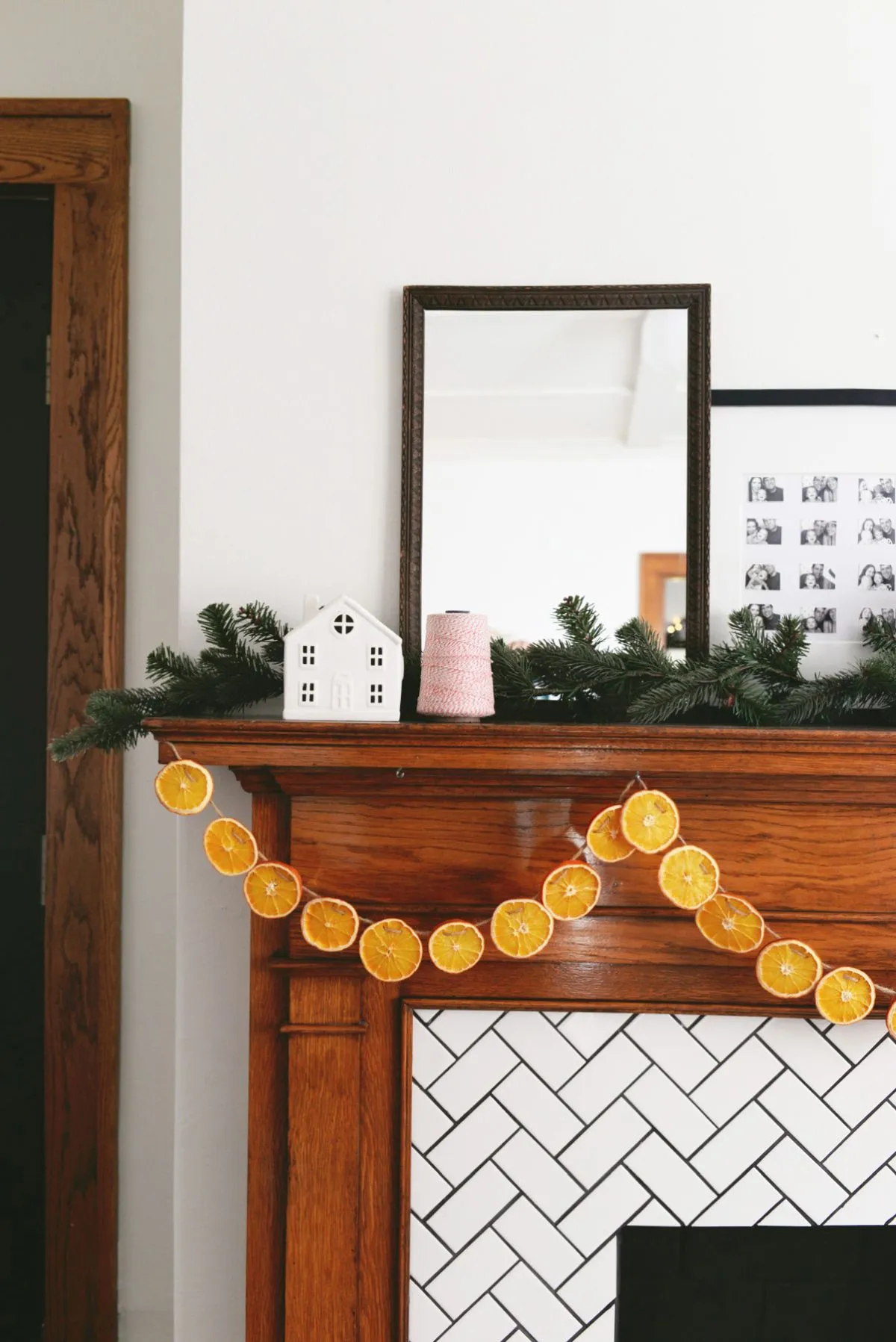
Faux pine garland runs $12–$25 for six feet and looks perfectly good once dried orange is mixed in. Craft-store dried slices cost about $8 a bag, but drying your own brings that under $2. The white ceramic house can come from a dollar store, and the framed photos are prints you already own in $4 frames. Whole mantel, start to finish: under $60.
18. The Tray-Drying Setup: Parchment, Rack and Piled Orange Slices
- Slice oranges 1/8 to 1/4 inch thick with a sharp serrated knife — uneven slices dry unevenly.
- Blot both sides with a clean towel to lift surface juice.
- Arrange in a single layer on parchment over a wire rack, with no overlapping.
- Dry at 200°F for two to three hours, flipping every hour.
- Cool completely before threading, or the rind will crack at the needle hole.
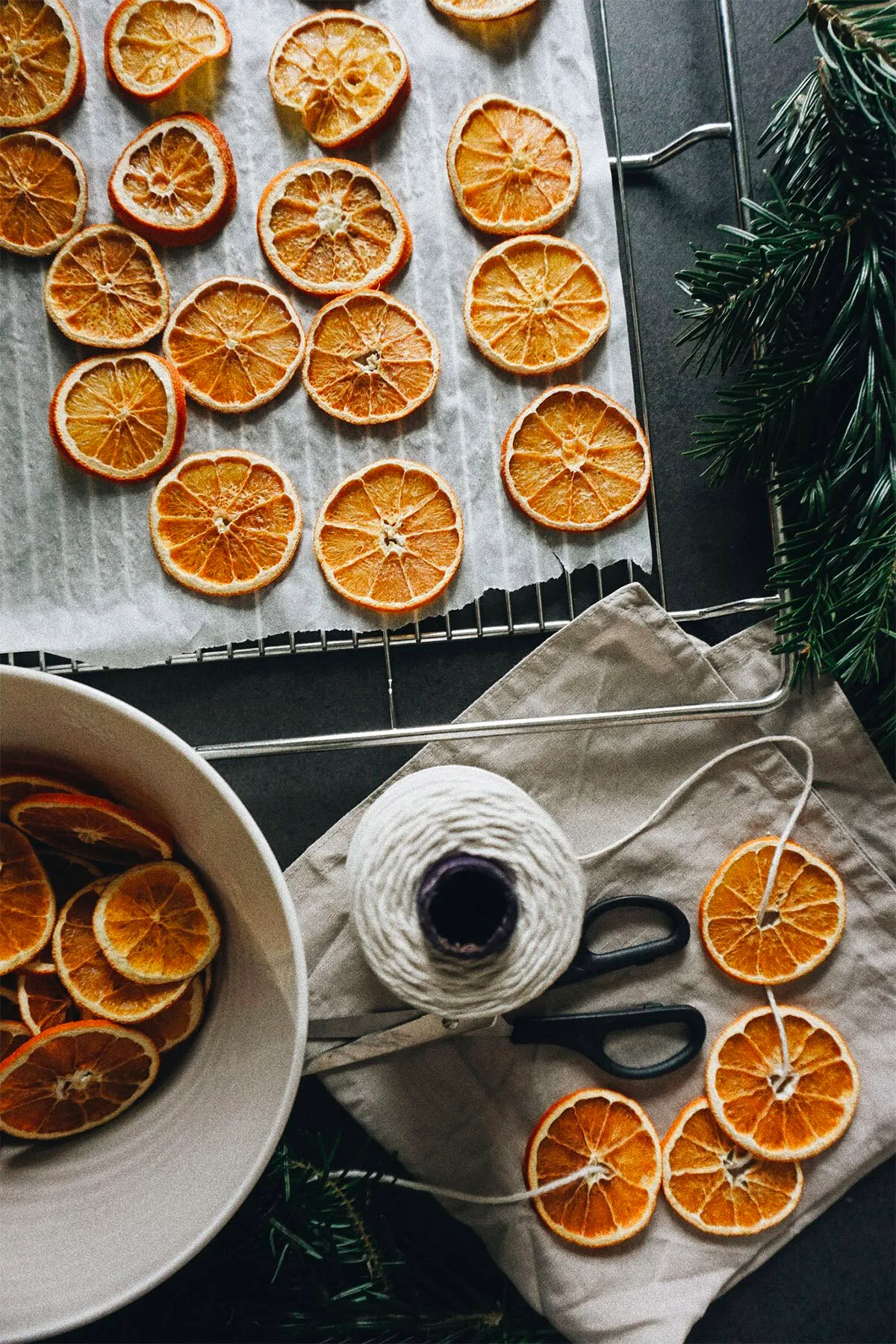
About three and a half hours total, mostly hands-off.
- Six to eight oranges: $5–$10
- Parchment paper roll: $3–$5
- Wire cooling rack, if you don’t own one: $8–$14
- White twine spool: $3–$5
- Large-eye craft needle: $2–$4
- Storage container for finished slices: $0–$9
Total: about $21–$47 for enough slices to garland an entire tree.
19. White Kitchen Shelves with Orange Garland and Fairy Lights
Two things are happening. First, white subway tile and a marble-look counter give the orange nowhere to hide — the high contrast makes every slice read as a deliberate accent rather than clutter. Second, the garland repeats at two heights, over the window and along the open shelves, which sets up a rhythm your eye follows around the room. Repetition, not variety, is what makes a kitchen look decorated rather than decorated at.
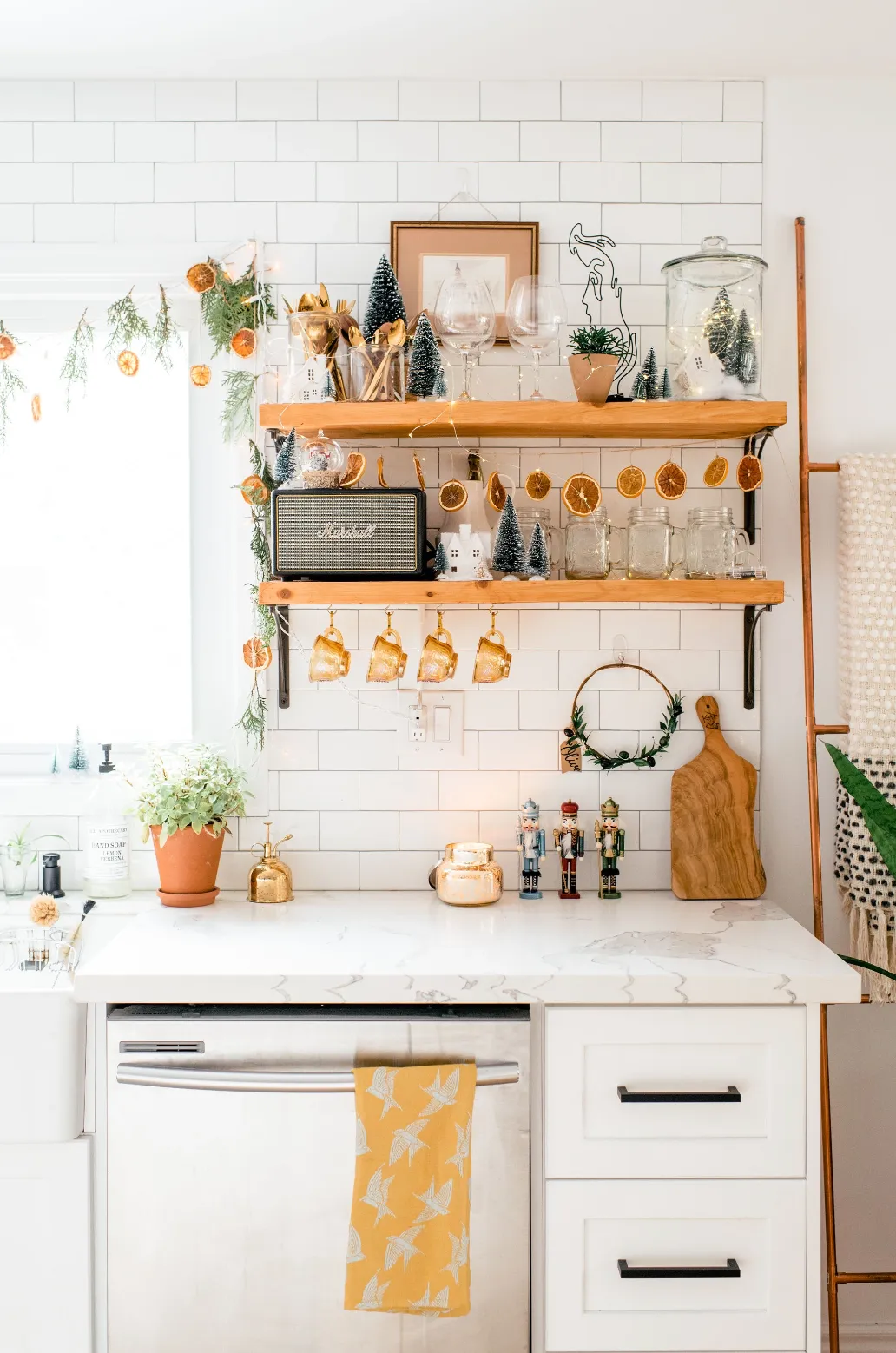
This works in a kitchen of nearly any size, but shelf spacing matters more than square footage. Give yourself at least 12 inches between shelves so the garland has room to hang without tangling with whatever sits below. Across a standard 36-inch window, a 4-foot garland with a shallow swag is plenty. Galley kitchens under 80 square feet do better with garland on the window alone — the doorway version in Idea #24 shows how that same idea scales up.
20. An All-Orange Wreath Finished with a Brown Satin Bow
An orange-only wreath is the cheapest thing in this entire article to make. A straw or wire wreath form from a craft store is $5–$9, dried slices cost about $2 when you make them yourself, and a roll of satin ribbon runs $4–$7. You’re under $20, versus $60 or more for a comparable store wreath. If you’d rather buy than make, check Facebook Marketplace in early January — people unload wreaths for $5 to $10 the week after Christmas.
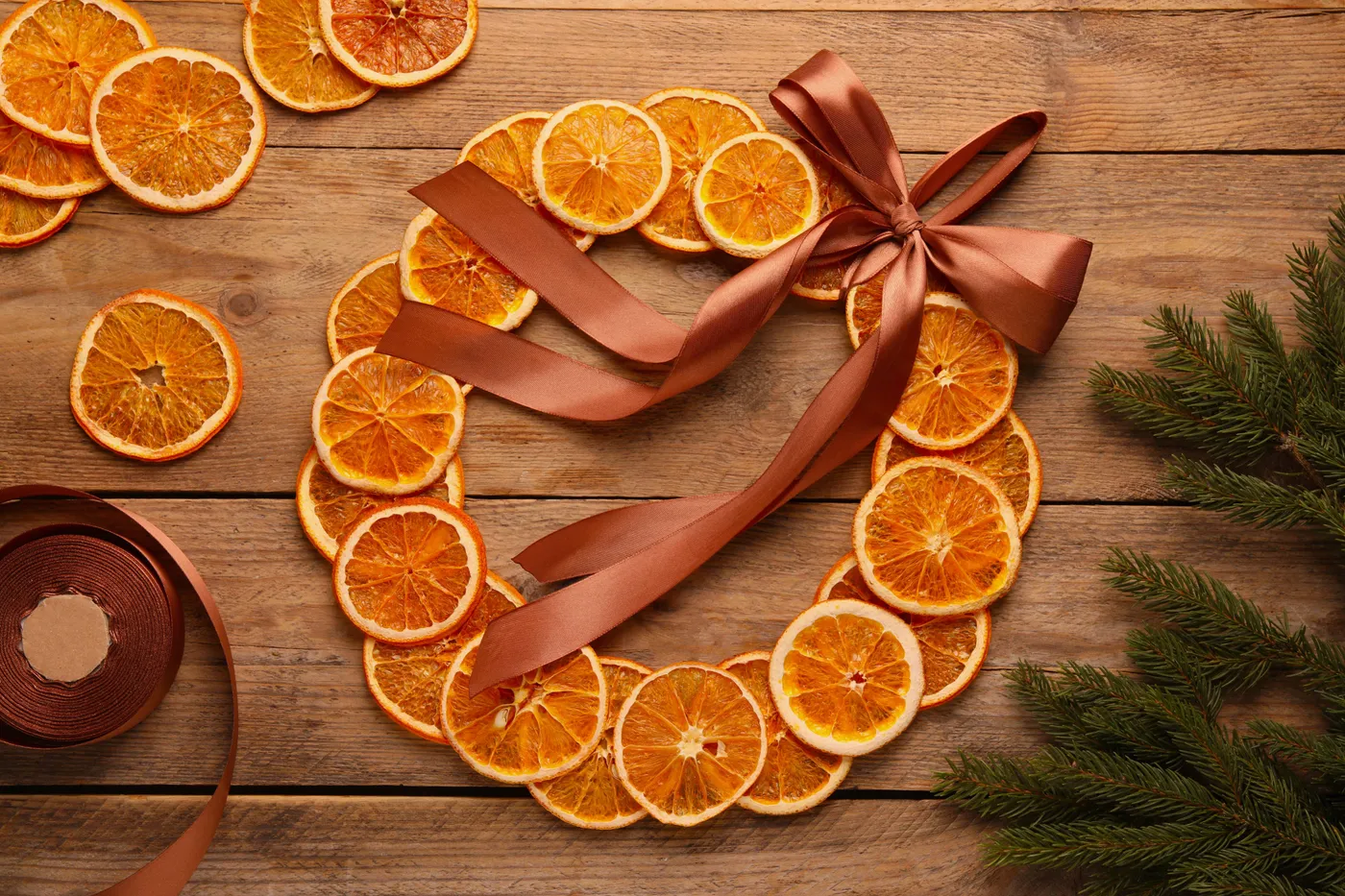
Glue slices so they overlap like roof shingles, each one covering the edge of the last, and work in one direction around the form. It hides the mechanics and gives you a smooth, dense surface. Use a low-temperature glue gun — high-temp glue melts the pith and leaves shiny strings behind. Let it dry 30 minutes before hanging, and reinforce the top three slices with floral wire since they carry the weight.
21. Pine Garland and Little Wooden Houses on a White Mantel
Dried orange strung across a working fireplace opening will brown and eventually scorch if it hangs too close to the flames. Keep a minimum 18 inches of clearance from any active firebox, or treat that lower garland as decorative only on nights when nothing is burning. The small wooden houses also tip easily — a felt pad under each one stops them sliding when someone bumps the shelf and protects the painted mantel from scratches.
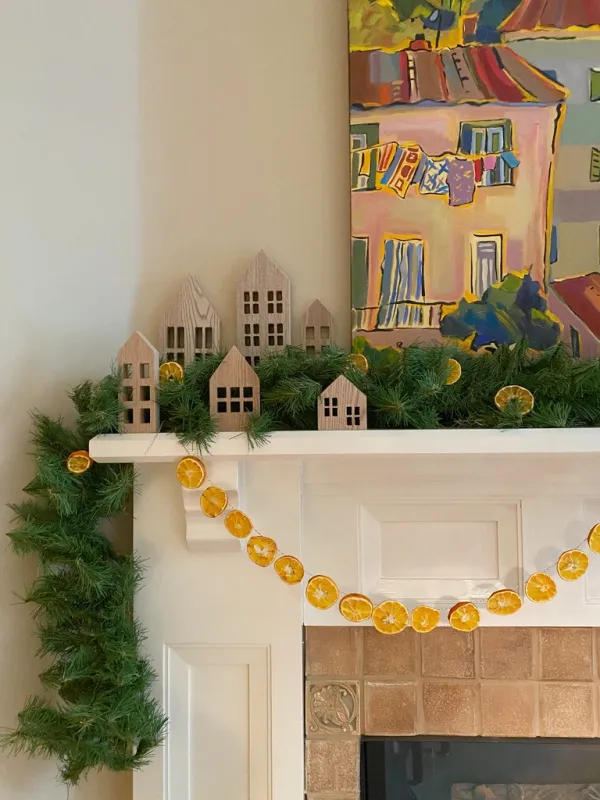
The recipe is about 60% forest green + 25% dried orange + 10% pale wood + 5% brown tile, and the pale wood is what separates this from a standard Christmas mantel. Swap the houses for white ceramic ones and it reads crisper and more modern. Swap them for red-painted versions and you get classic Christmas in about five minutes of shopping. Either way, the orange stays the connector.
22. Brass Jingle Bells, Pomegranates and a Bowl of Dried Orange
- Vintage brass or bronze bowl: $12–$45 (thrifted often under $15)
- Dried orange slices and whole dried oranges: $6–$14
- Three pomegranates: $6–$9
- Large brass jingle bells: $10–$26
- Pair of small gold pleated lamps: $30–$90
- Pinecones and evergreen sprigs: $0–$10
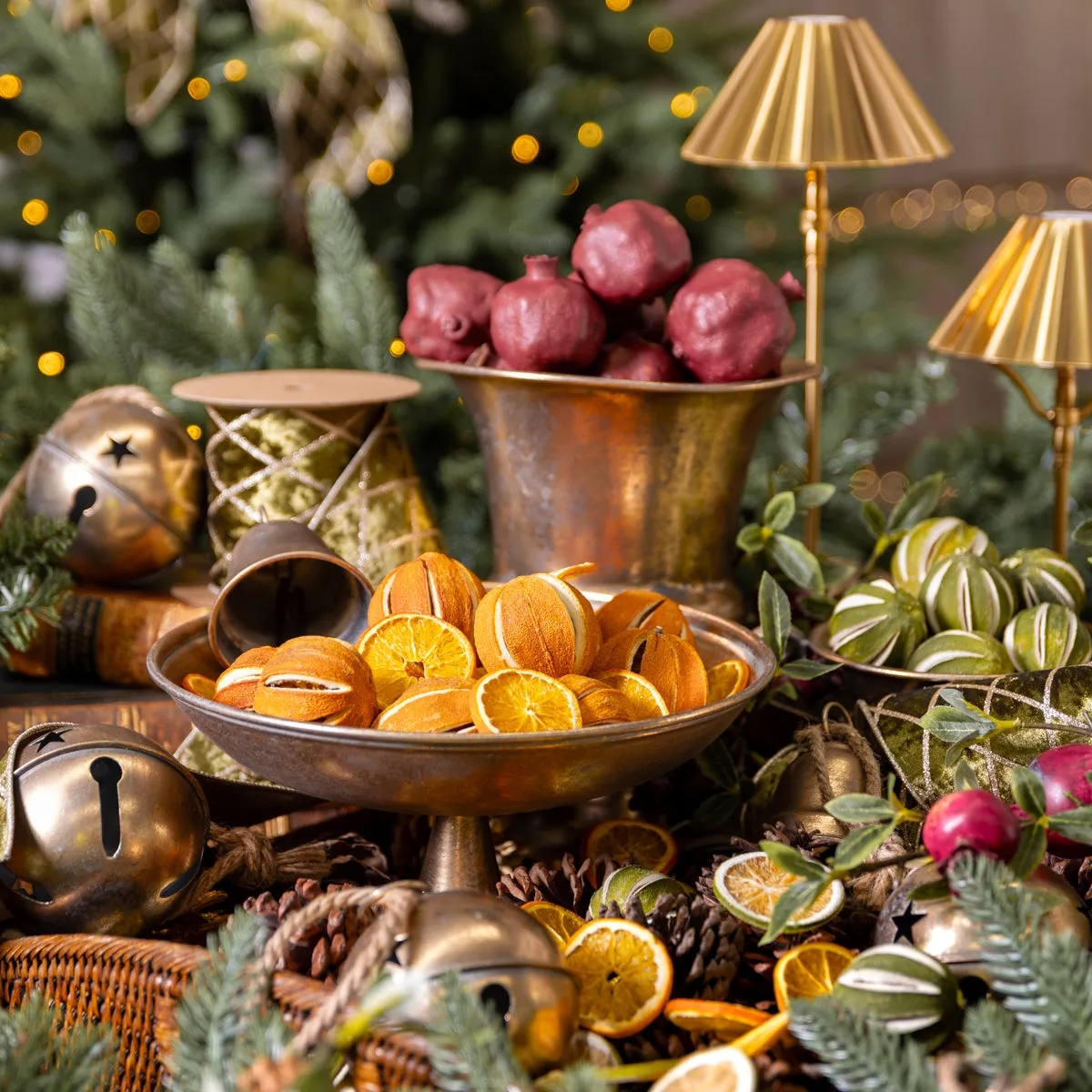
Total: about $64–$194 — the metal is where the money goes, and where it’s worth spending.
The single element holding this together is the metal bowl itself. Glass would make it look like a salad; wood would push it back toward farmhouse. A warm brass bowl ties the dried orange, the pomegranates and the jingle bells into one metallic story, and the pleated-shade lamps echo it from the wings. If you buy one thing for your holiday table this year, buy the bowl.
23. An Illuminated Cranberry and Eucalyptus Garland with a Winter Scene
Warm light plus translucent fruit is the entire trick. Backlighting dried orange slices makes them glow like stained glass, and the cranberries pick up the same warmth. Eucalyptus adds a cooler, silvery green that keeps the palette from sliding toward pumpkin-orange. Below, the tiny winter vignette works because it’s scaled down — brass deer and bottle brush trees at 3 to 6 inches tall read as a scene rather than as clutter on a shelf.
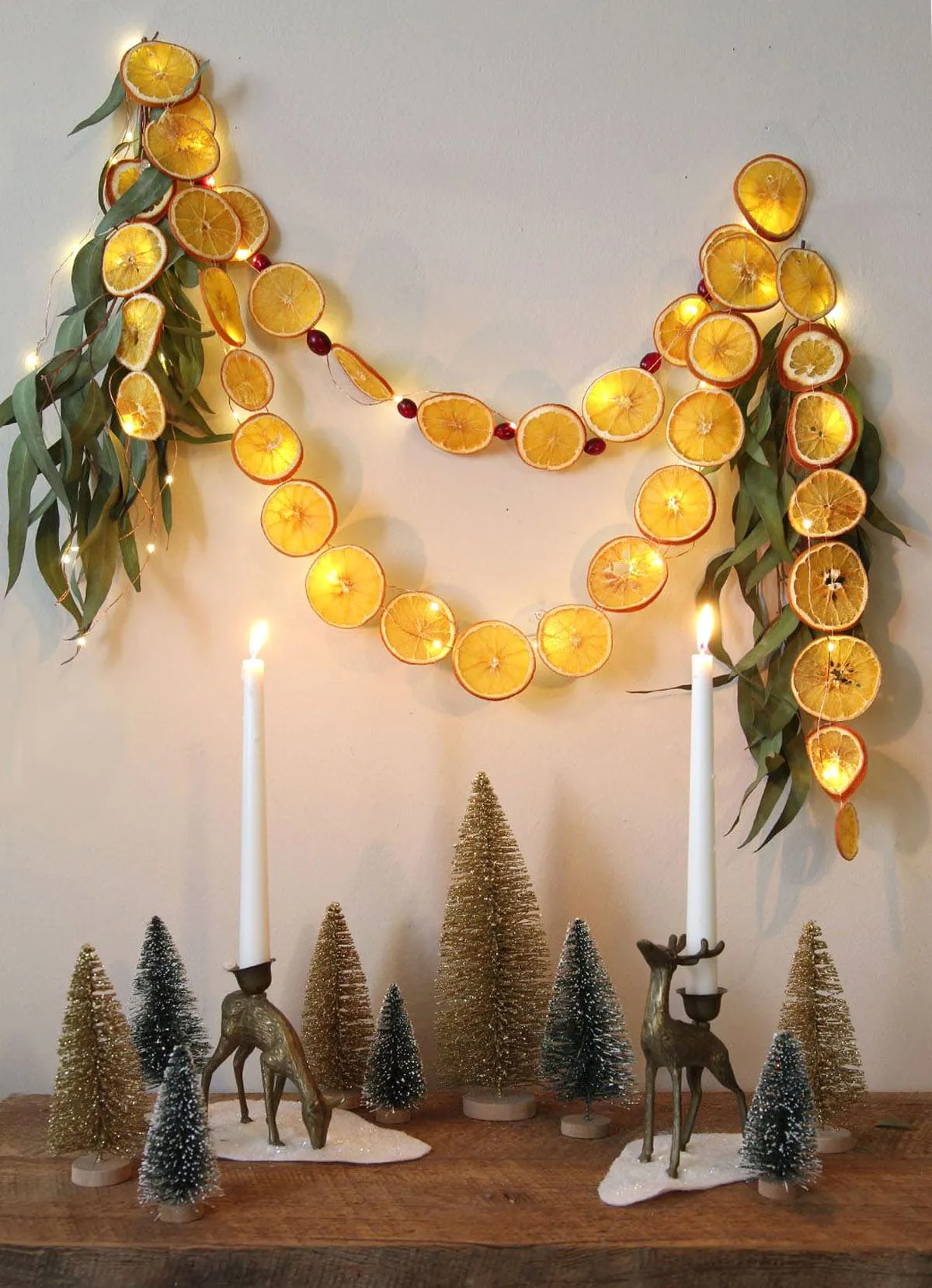
- Lay a 6-foot garland flat and mark it into 8-inch sections.
- Wind warm white fairy lights through first so they hide under the greens.
- Attach dried orange slices with 4-inch lengths of floral wire, twisting tight.
- Thread cranberries on short wire picks and tuck one into every third section.
- Finish with eucalyptus sprigs at each end for a soft, tapered silhouette.
About an hour for six feet.
24. Evergreen Garland Framing a Doorway with Orange Velvet Ribbon
Doorway garlands need a specific scale or they look like a lei. For a standard 32-inch-wide, 80-inch-tall opening, use a 10 to 12 inch swag at the top center with about 30 inches of drop down each side. Wider openings over 40 inches can take a shallower drape and a longer drop without feeling heavy. Keep 12 inches of clearance above the header so it doesn’t crowd the ceiling — the same ribbon-and-green formula also works along a handrail, as in Idea #7.
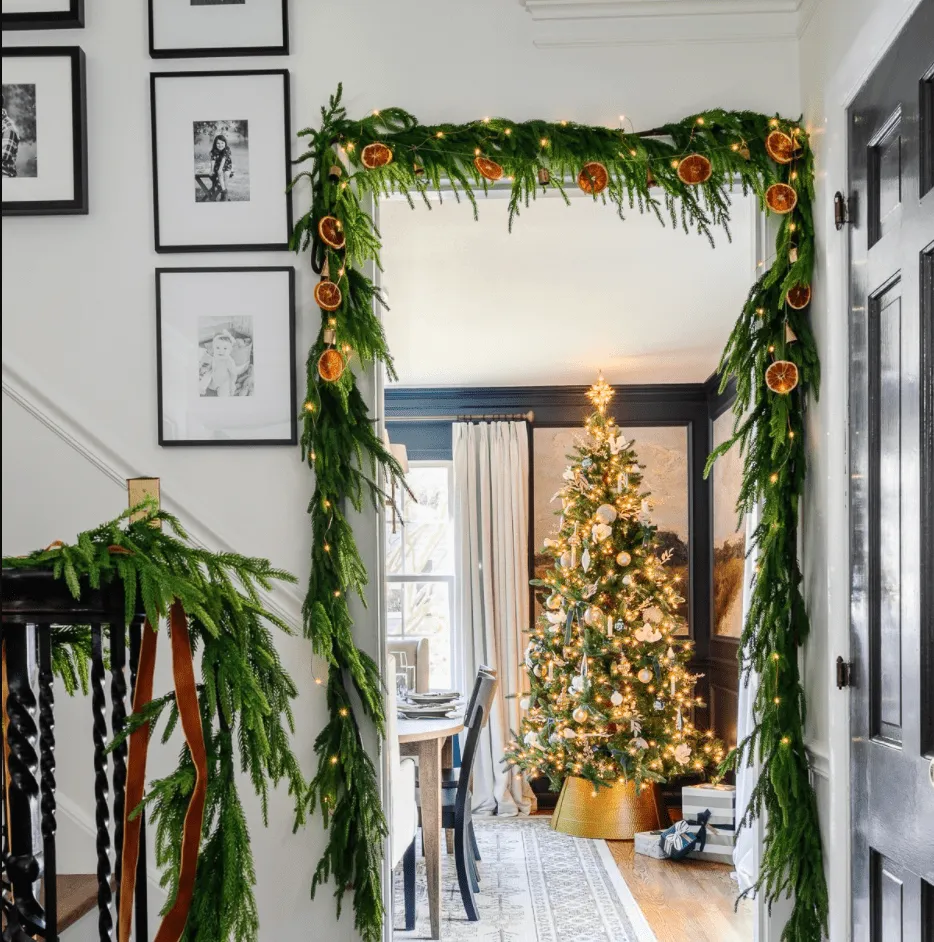
Fresh garland framing is one of the clearest Pinterest shifts of the past two winters: people are decorating the architecture — doorways, stairs, window trim — instead of only the tree. Dried orange keeps showing up in those photos because it’s cheap, it smells like a real kitchen, and it holds up far better than fresh flowers. Add warm white LEDs and you have a look that photographs beautifully in low evening light.
25. Red-and-White Twine Garland on a Marble Worktop
Striped baker’s twine is pretty, but it’s cotton, so it absorbs moisture and can transfer dye to pale stone. Keep the garland off marble and quartz until the slices are bone dry, and wipe the surface with a dry cloth rather than a spray cleaner. Dried slices stored in a sealed jar with a silica packet hold for about a year; left in the open, they start to look dusty after two seasons.
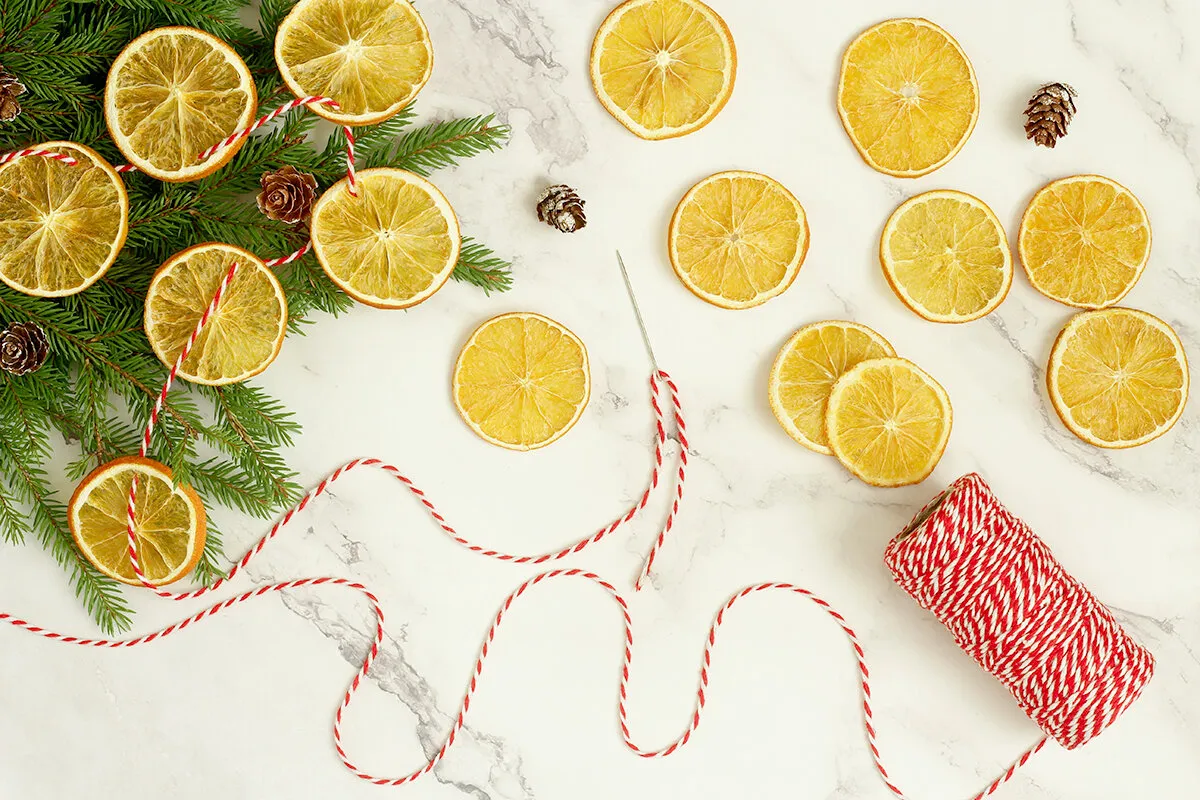
Skip the craft store for this one. Red-and-white baker’s twine is about $4 at a supermarket, small pinecones are free if you have a park nearby, and fir branches come from the bottom of your own Christmas tree after you trim it. A large-eye needle is $2, and slices you dry yourself bring the whole garland in under $10. Compare the twine-free approach in Idea #30.
26. Black Candle Holders, Gold Bells and Orange on a White Mantel
Odd numbers and unequal heights, always. Three slender black candle holders at 8, 11 and 14 inches create a triangle of interest that a matched set never can. Keep them grouped centrally and let the garland stay busier at the ends. If your mantel is over 70 inches wide, go to five holders — but keep the tallest one off-center rather than in the middle, since that asymmetry is what makes the whole thing look curated instead of cataloged.
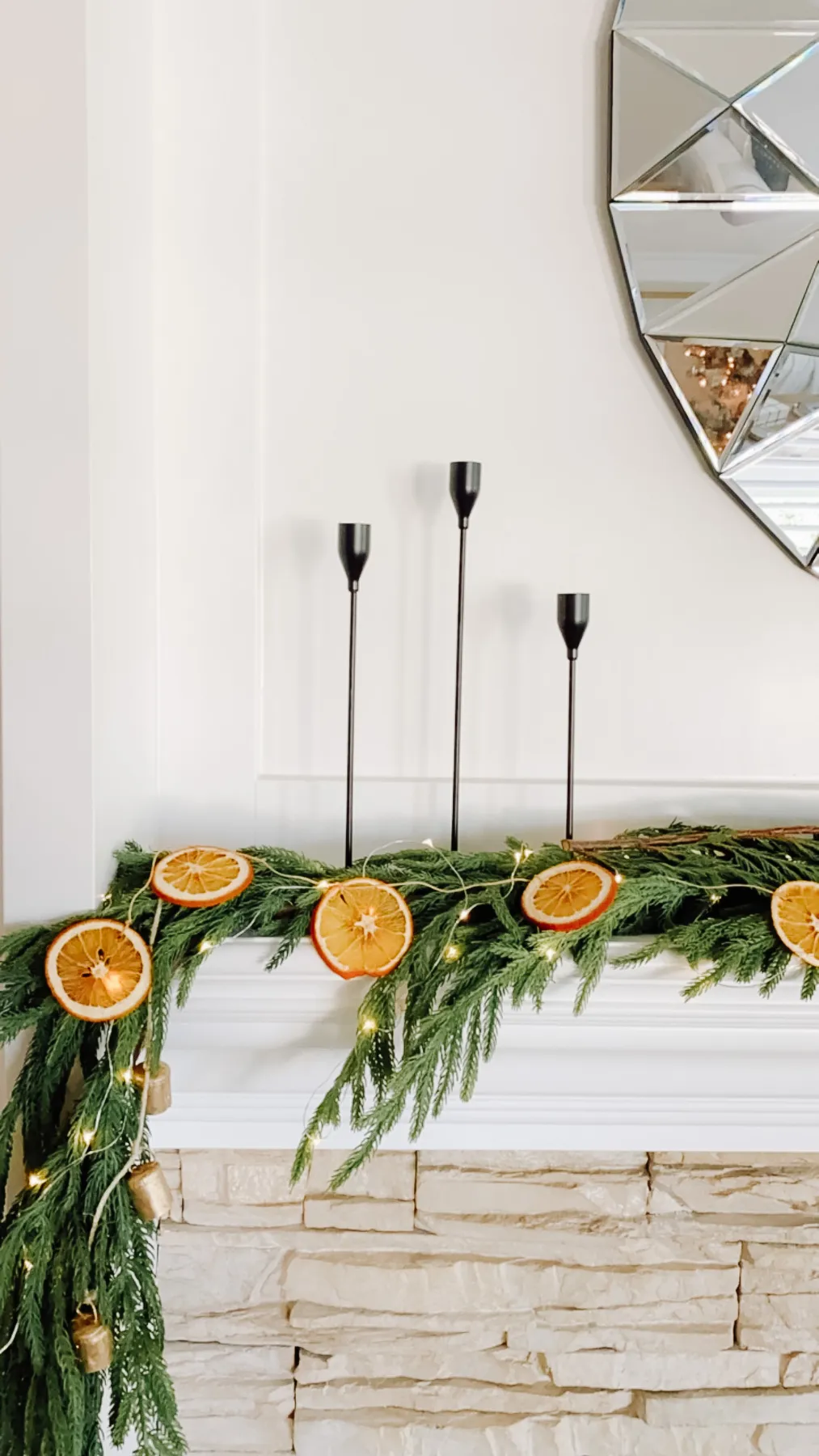
- Check that candles sit at least 12 inches from the garland and any greenery.
- Confirm the mantel can handle the holders plus wax — slender metal gets top-heavy.
- Verify your wall or shelf color before buying black accents; they read harsh on warm cream.
- Test the string lights on the garland before attaching anything.
- Have a drip tray or glass candle plate for every holder.
27. Building an Evergreen Wreath with Gold Baubles and Cinnamon
- Soak the wreath base in water for 20 minutes, shake off the excess, and let it drip dry.
- Wire dried orange slices around the form in a clockwise rhythm, one every 4 inches.
- Tuck pinecones between them, angled outward so they catch light.
- Bundle two cinnamon sticks and wire them in at three points.
- Hot-glue small gold baubles last, on top of the greens rather than behind.
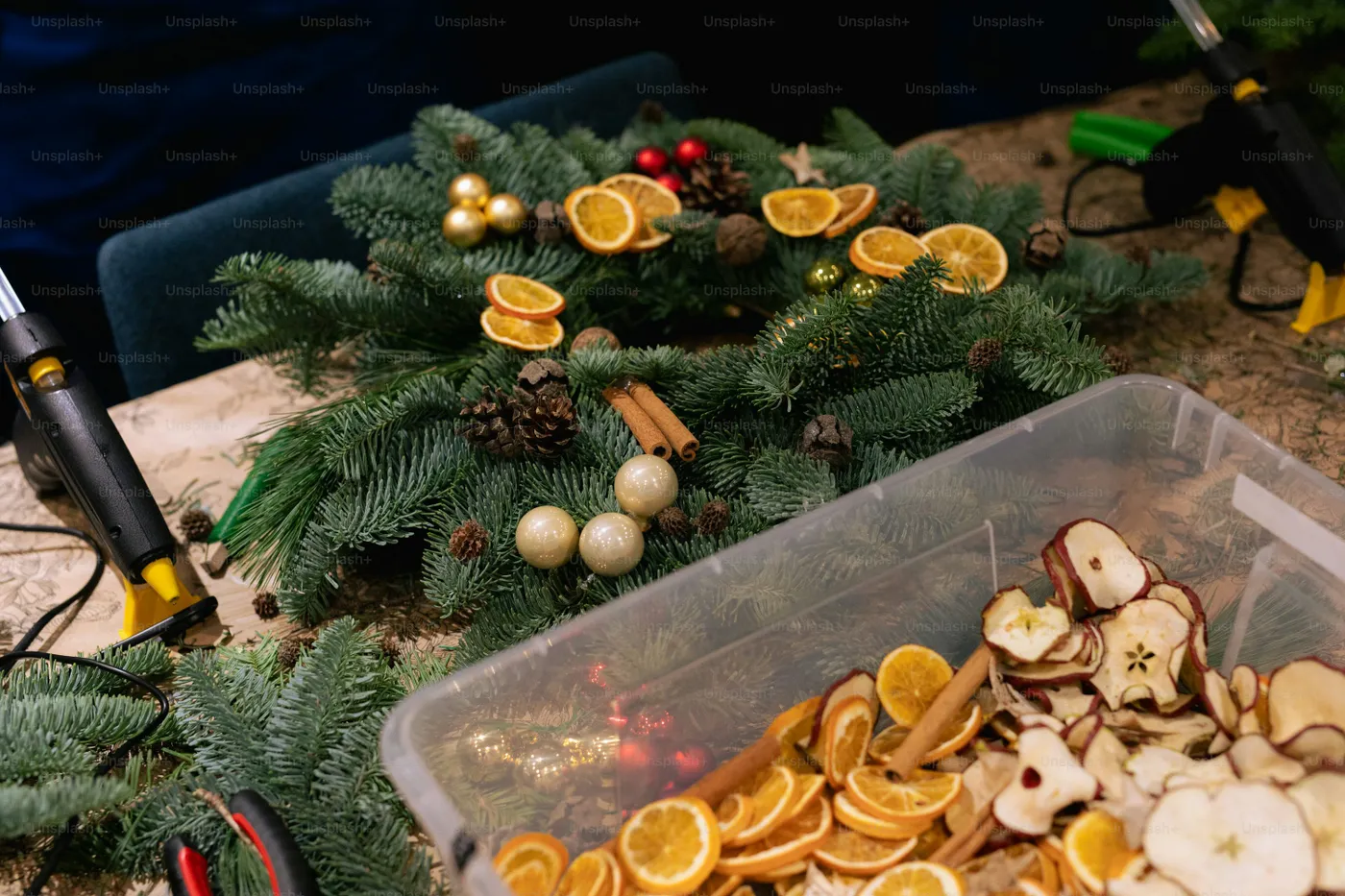
About 90 minutes, materials under $25.
The formula: 65% evergreen + 20% dried orange + 10% natural brown from pinecones and cinnamon + 5% metallic gold. That gold is disproportionately important — remove it and the wreath turns purely rustic. To move toward modern, swap gold for matte black baubles. To go fully traditional, weave a slim red velvet ribbon through the inner ring. The proportions stay identical either way.
28. White Beads, a Rustic Yarn Tassel and Candlelight on Dark Wood
The reddish yarn tassel at the end of the garland is what makes this feel finished rather than interrupted. Without it, the strand just stops somewhere on the table. A tassel — or any deliberate terminal element — signals that someone decided where the garland ends. Yarn costs a dollar and takes ten minutes, and it’s the difference between a craft project and a styled display.
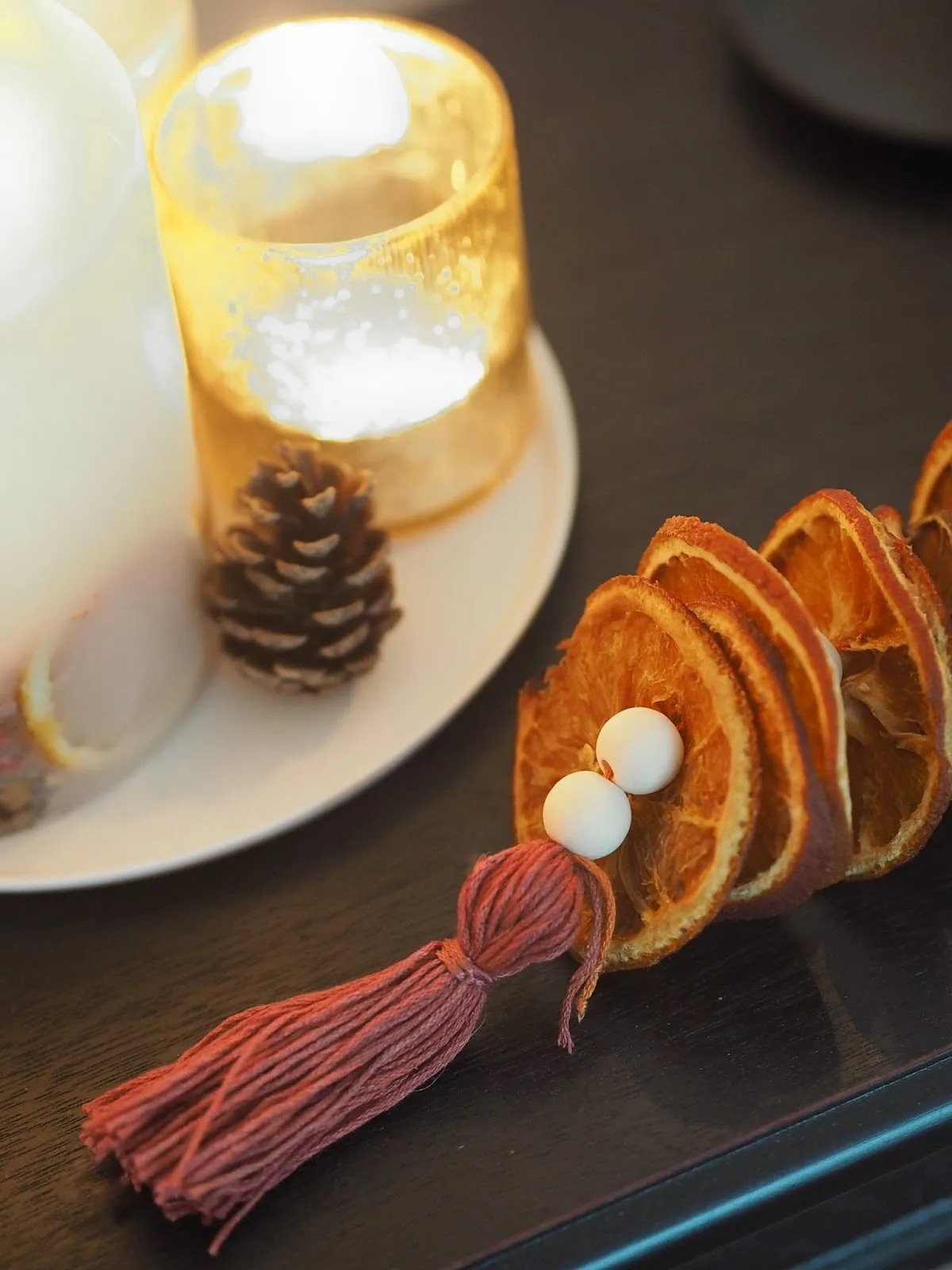
Open flames next to dried fruit and yarn is a real risk, not a decorative choice. Keep the pillar candle at least 12 inches from the garland, trim wicks to a quarter-inch, and never leave the room while it’s lit. Battery-operated tapers have gotten genuinely convincing of late — for a garland this close to wax, that’s the safer call and honestly the better one.
29. An Under-Shelf Orange Garland with Hanging Amber Glass Mugs
- Dried orange slices, threaded: $4–$12
- Warm white fairy lights with adhesive clips: $8–$16
- Miniature bottle brush trees, set of three: $9–$18
- White glitter village house: $6–$14
- Amber glass mugs, set of four: $16–$34
- Under-shelf cup hooks: $5–$10
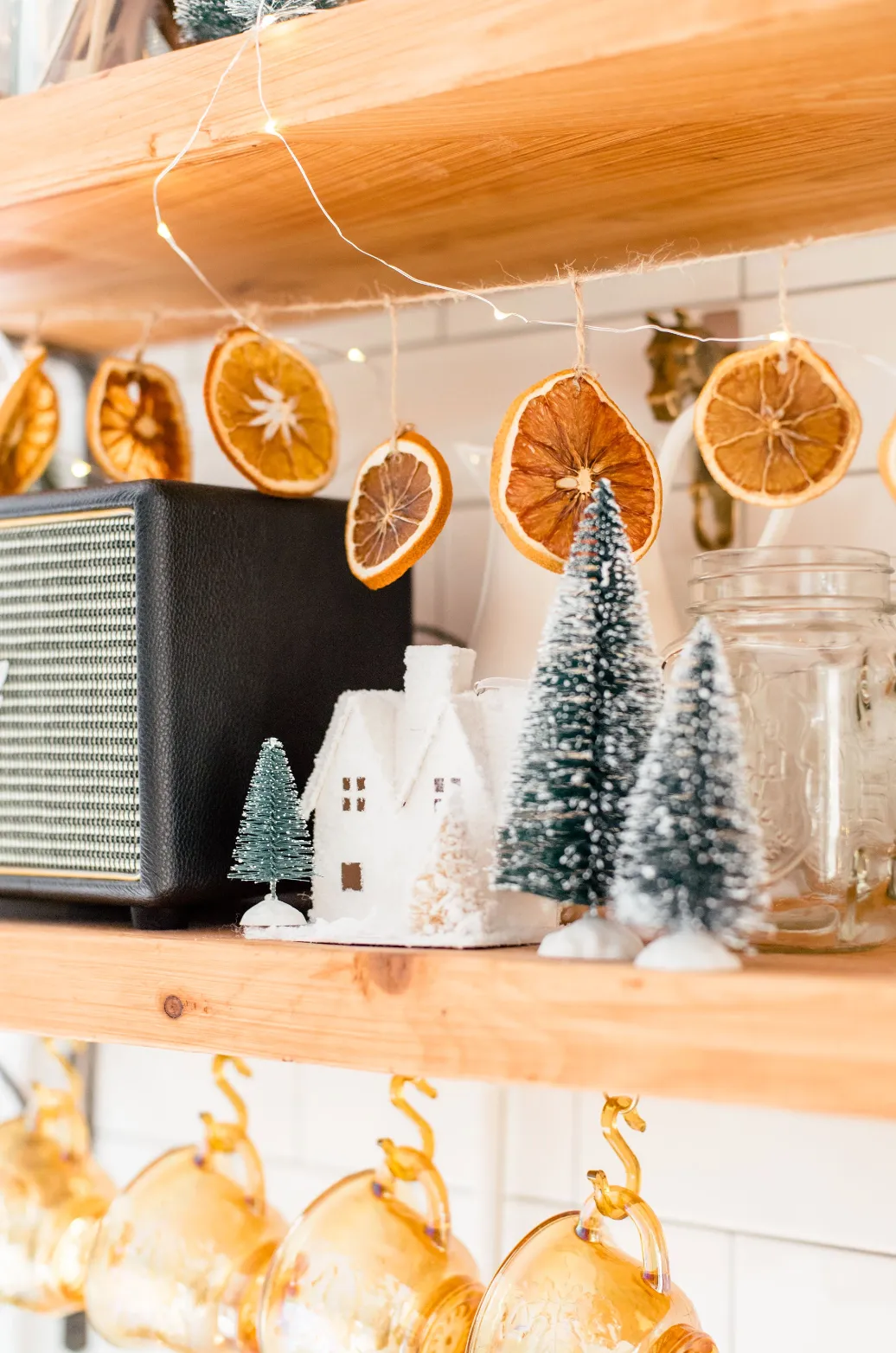
Total: about $48–$104, and the hooks and mugs stay up year-round.
Under-shelf garlands work on shelves at least 8 inches deep and 24 inches wide. You want 6 to 8 inches of clearance underneath so the garland doesn’t brush whatever sits below, and hooks rated for at least 2 pounds if you’re hanging glassware. Shelves under 6 inches deep are better off with a single swag than a full run. For a whole-kitchen shelf treatment, Idea #19 covers it.
30. The Purest Version: Orange Slices and Fresh Greenery, Nothing Else
Strip everything else away and the design still holds, because it leans on one strong contrast: translucent warm orange against opaque dark green, repeated on a steady rhythm. The slices are slightly different sizes, which is exactly what keeps it from looking machine-made. Backlight it with a window or a lamp and the rinds glow through — the single visual payoff you can’t fake with plastic or fabric.
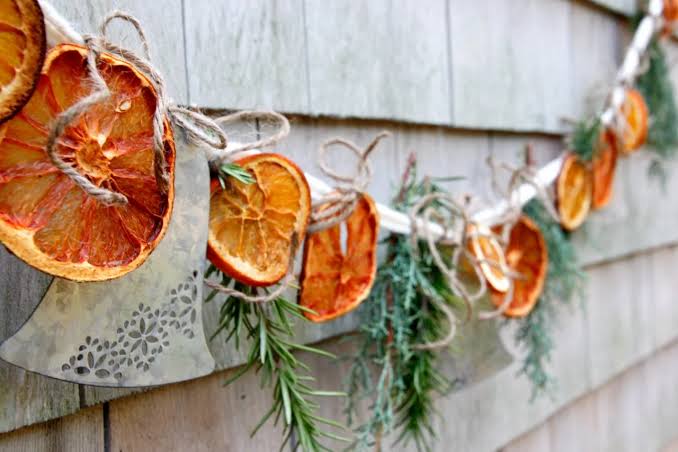
Fresh greenery is the part that needs attention. Mist the foliage every two or three days, keep it away from heat vents, and expect it to look tired after about three weeks indoors. The dried orange outlasts the greens by months, so when the foliage goes, just re-string the fruit on a new garland. Slices that feel soft mean they weren’t fully dried — pull them and give them another hour in a low oven.
Peel, Dry, Thread, Repeat Next December
Here’s the thing about dried orange decor: it asks almost nothing of you. A bag of fruit, a low oven, an afternoon, and you’ve got something that smells better than anything you can buy and costs less than a single candle. Start with one garland this year and see how it feels — nobody starts with a staircase swag and a brass centerpiece on day one.
📌 Pin your favorite version now so it’s waiting for you next November, and tag us when your tree goes up — we genuinely love seeing which idea you ran with.