30 Stunning Pom Pom Garland Ideas You Need to Try to Elevate Your Home Decor This Year

You know the moment: you’re three hours into a Pinterest spiral, the nursery still isn’t finished, and the one thing that actually made you stop scrolling was a string of fuzzy pom-poms strung under a floating shelf.
We spent real time digging through Etsy, Target, and Amazon listings — plus a stack of small handmade shops — to figure out which strands actually hold up and which ones shed all over the rug. The result: 30 ideas that range from an $8 craft-store ball of yarn you string yourself to a $68 artisan garland worth every penny.
Some of these are full-blown nursery setups, some are one clear hook and ten minutes of your Sunday. And stay until the end — we break down the most common mistakes that can ruin these looks.
📌 Save this to Pinterest for later — you’ll want to revisit these ideas.
1. Rainbow Pom-Pom Garlands Draped From a Bunk Bed Beam
The beam above this bunk is doing the heavy lifting, and yours should too. Screw two small half-inch cup hooks directly into the wood — not the drywall — about 14 inches apart, then let the garland fall in one unbroken line. Keep the lowest pom at least 18 inches above the mattress line. Any closer and it becomes a climbing rope by Tuesday.
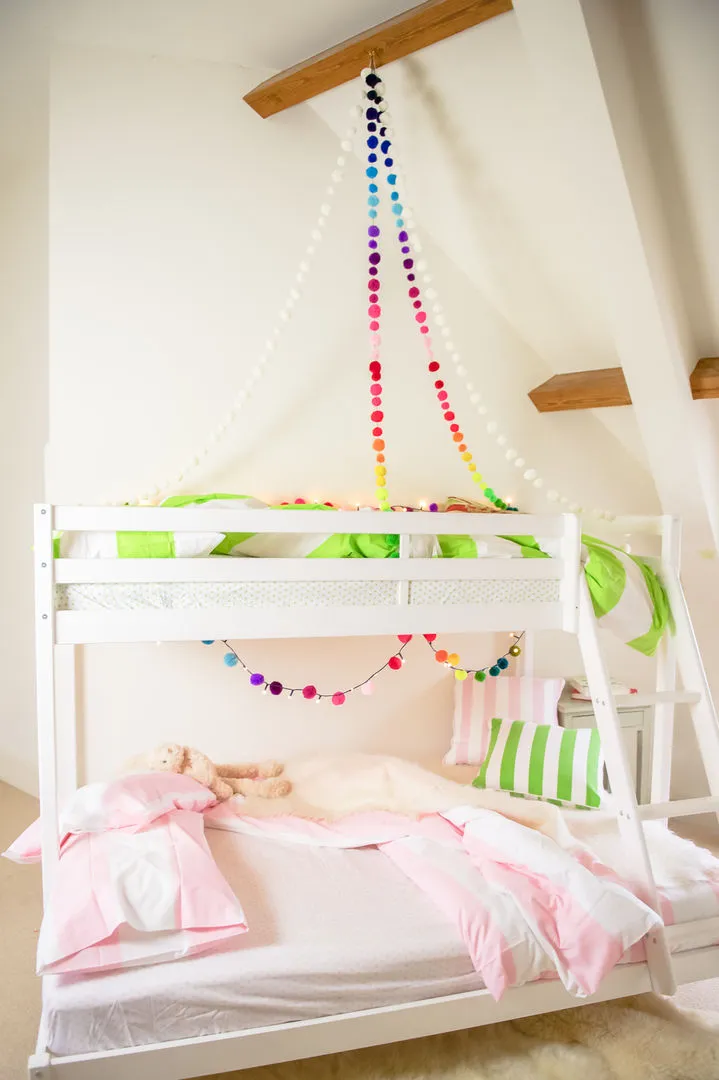
Two garlands drop straight down from the ceiling beam, and a third runs horizontally between the top and bottom bunk. That horizontal strand is the whole trick. It ties the vertical drops back into the room so they read as part of the architecture instead of leftover party decor. Take it away and the room goes flat.
2. Felted Wool Balls in Lime, Peach, and Sky Blue
What makes this strand feel considered isn’t the felt — it’s the finish. Matte wool absorbs light, so two dozen small balls read as one soft wash of color instead of a row of shiny plastic dots. Pairing cool tones (lime, sky blue) with one warm note (peach) keeps the palette from going flat, and that plain white surface behind lets every hue breathe.
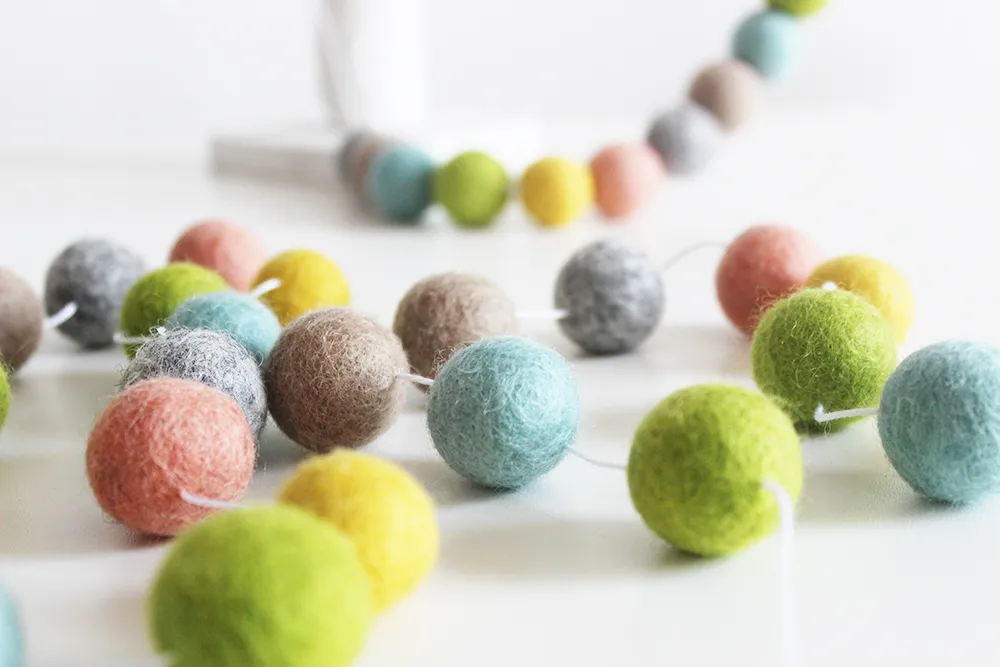
You can absolutely build this yourself. A hundred loose felt balls run about $10–$15 from craft suppliers, and a needle and thin white thread cost almost nothing. String them in a random order — not grouped by color — and space them roughly half an inch apart. Total spend lands near $20 for a strand that looks like the $50 version.
3. Diagonal Pom-Pom Strands in Vivid Yarn
The formula here is roughly 70% saturated color, 20% white breathing room, and 10% visible thread. That last bit matters more than it sounds — the thin contrasting cords cutting diagonally across the frame are what make the wall feel designed rather than decorated. Swap the yarn colors for a tonal scheme and keep the diagonal geometry, and the whole thing still works.
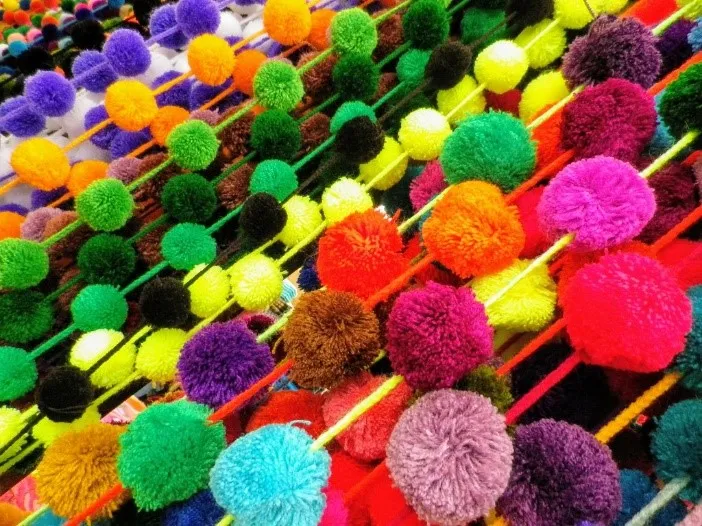
Dense, maximalist wall treatments have been building on Pinterest for a couple of years now, and this is the low-commitment version of that impulse. No paint, no wallpaper, no landlord conversation. It photographs like a mural and comes down in ninety seconds, which is probably why it keeps showing up in rental-friendly roundups heading into 2026.
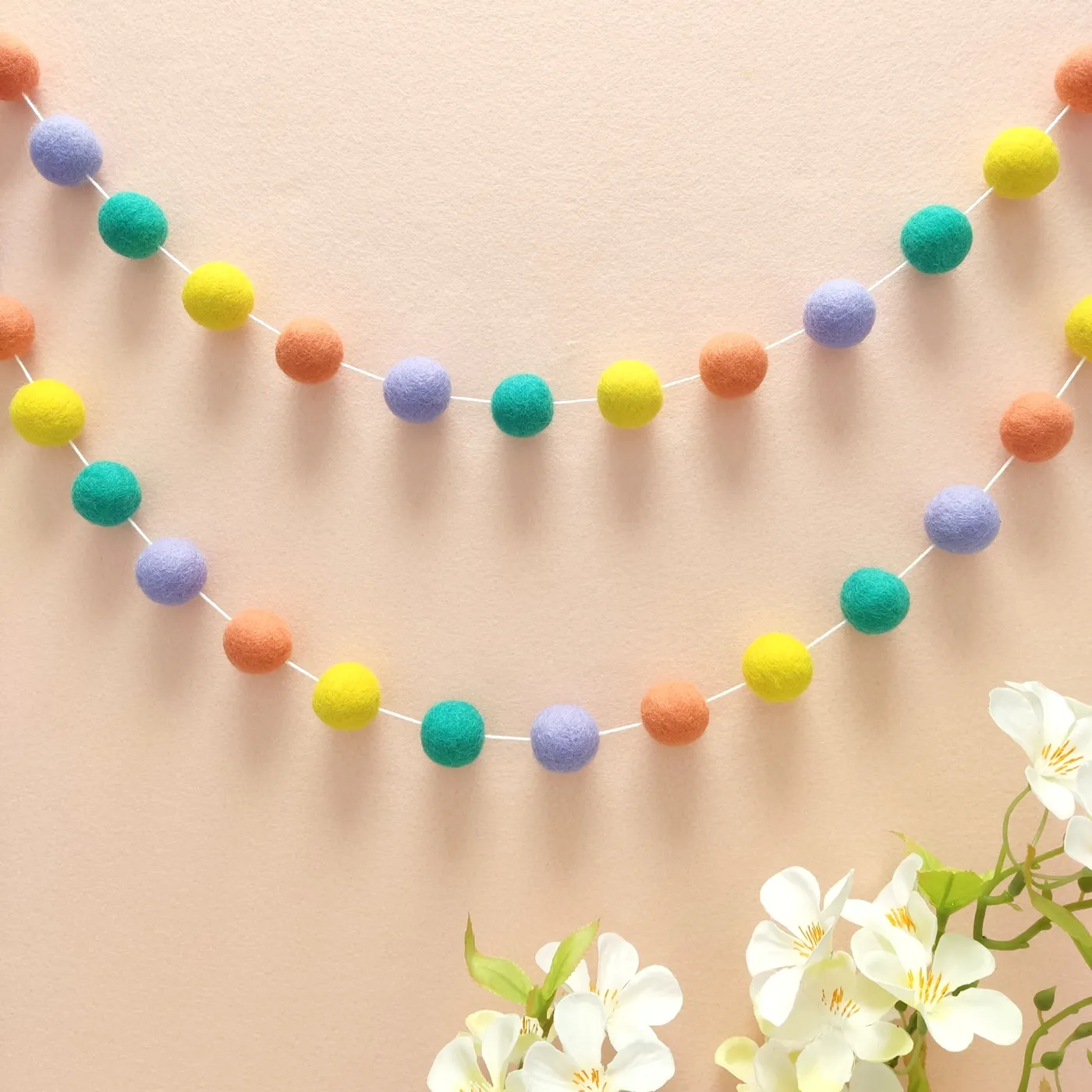
4. Two Draped Felt Strands Against Warm Peach
Here’s what a look like this actually costs to pull together:
- Felt pom-poms, 25–30 count: $8–$14
- White craft string or thin cord: $3–$5
- Clear adhesive hooks, 4-pack: $4–$7
- Faux white flowers with greenery: $6–$12
- Wall paint or a textured backdrop: $0–$28
Total: $21–$66
Budget alternative: skip the florals entirely and drape the strands asymmetrically instead. One high, one lower and crossing — the eye reads it as styling, and you save the twelve dollars.
Hang both strands from the same two hooks and let them cross in the middle. Two separate hook pairs almost always drift apart over a few weeks; a shared pair keeps the drape locked exactly where you placed it.
5. Pom-Poms Under a Kids’ Book Shelf in Soft Pink
The garland isn’t the star here — the shelf is. White floating ledge, picture books standing spine-out, a low wooden table with a drawing pad and a cup of markers. The pom-poms just soften that hard horizontal line so the whole wall feels less like storage and more like a room. Remove them and you have a tidy shelf. Keep them and you have a place a kid wants to sit.
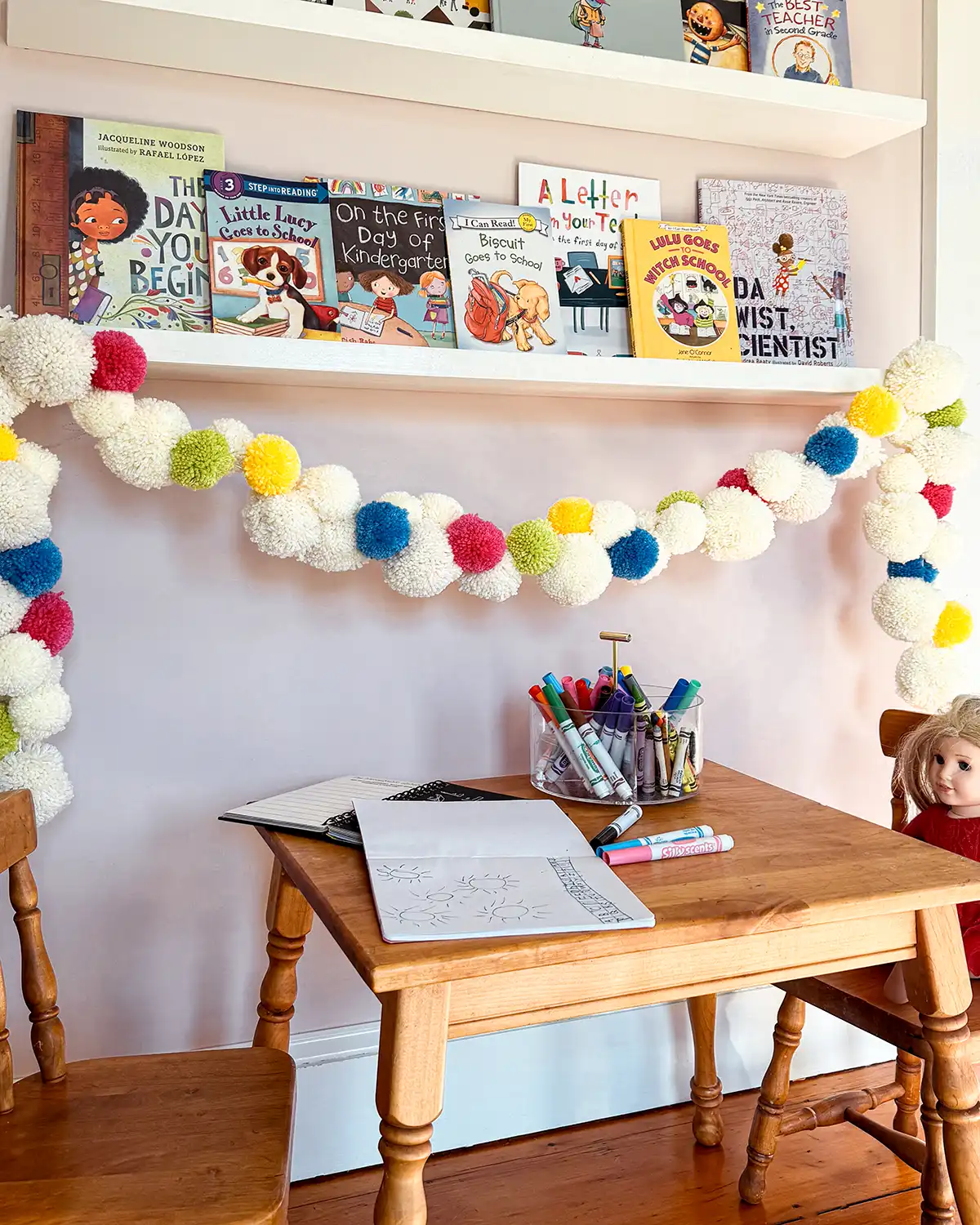
Making the garland takes about 40 minutes and under $15 in materials:
- Cut a length of white string 6 inches longer than your shelf on each side.
- Tie a knot at one end and thread pom-poms on a large-eyed needle.
- Space poms roughly 1 inch apart, sliding them as you go.
- Attach with two clear hooks set just inside the shelf brackets.
- Adjust the center sag until it sits about 4 inches below the shelf.
6. Chunky Cream Pom-Poms with Jewel-Tone Pops
Scale contrast is doing all the work. Big cream pom-poms set the rhythm, then smaller fuchsia, teal, lime, and yellow ones interrupt it every fourth or fifth ball. Your eye keeps traveling because it never quite settles into a pattern. Against a soft pink wall, that cream base also stops the jewel tones from turning into a carnival.
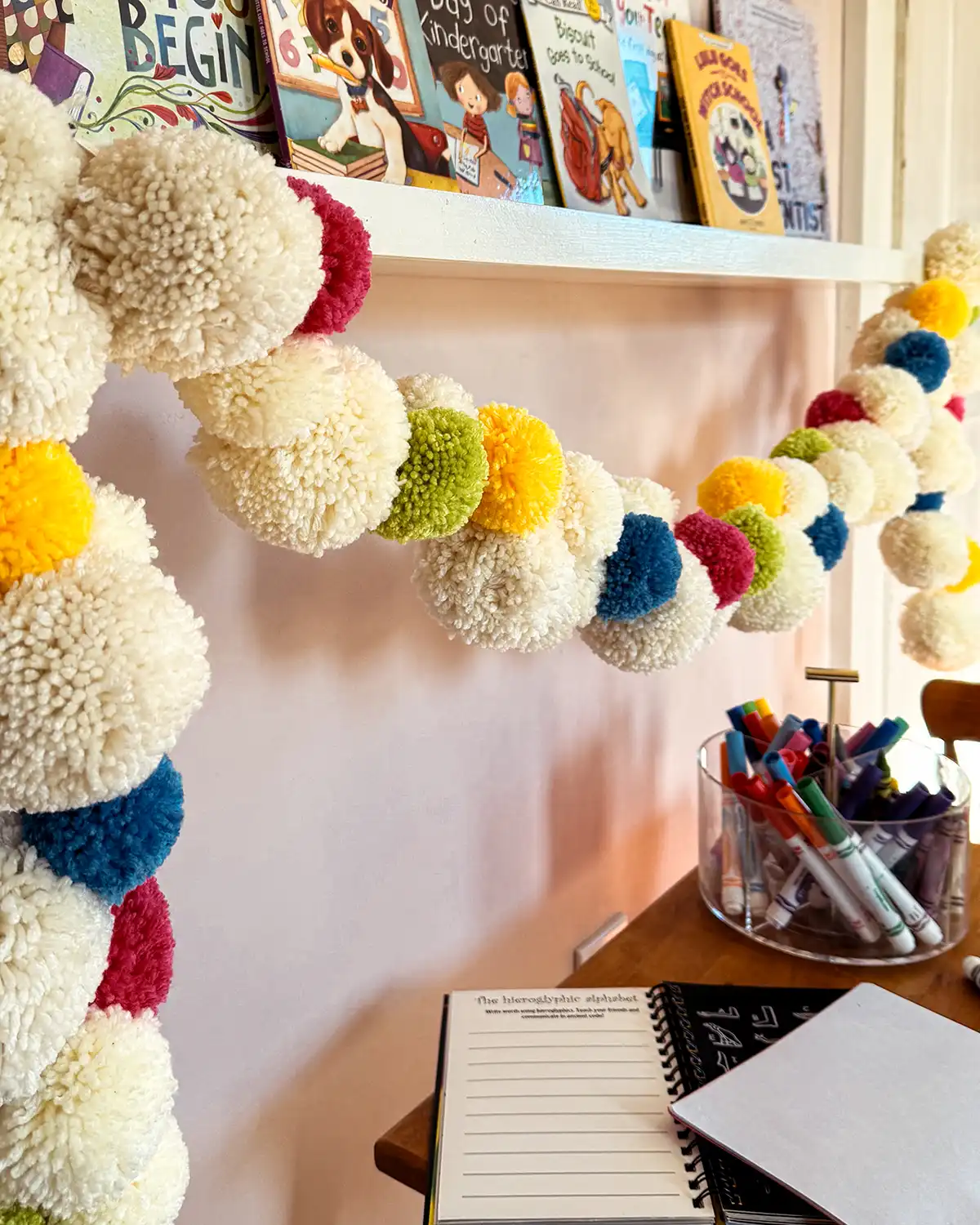
Rule of thumb for mixed sizes: no more than one large pom for every three small ones, and keep the small ones in one color family. Three sizes maximum. When people get this wrong it’s almost always because they bought every size and every color available and let the strand become a sampler platter.
7. Yarn Pom-Poms on a Clear Hook Beneath a Wood-Bracket Shelf
This setup wants a wall run of at least 30 inches wide and a shelf mounted 16–20 inches above whatever sits below it. Ceiling height barely matters here — it’s a horizontal gesture, not a vertical one. Smaller than that and the red-yellow-cream-grey sequence gets cut off mid-pattern. If your wall is tighter, look at Idea #5, which scales down to a single ledge.
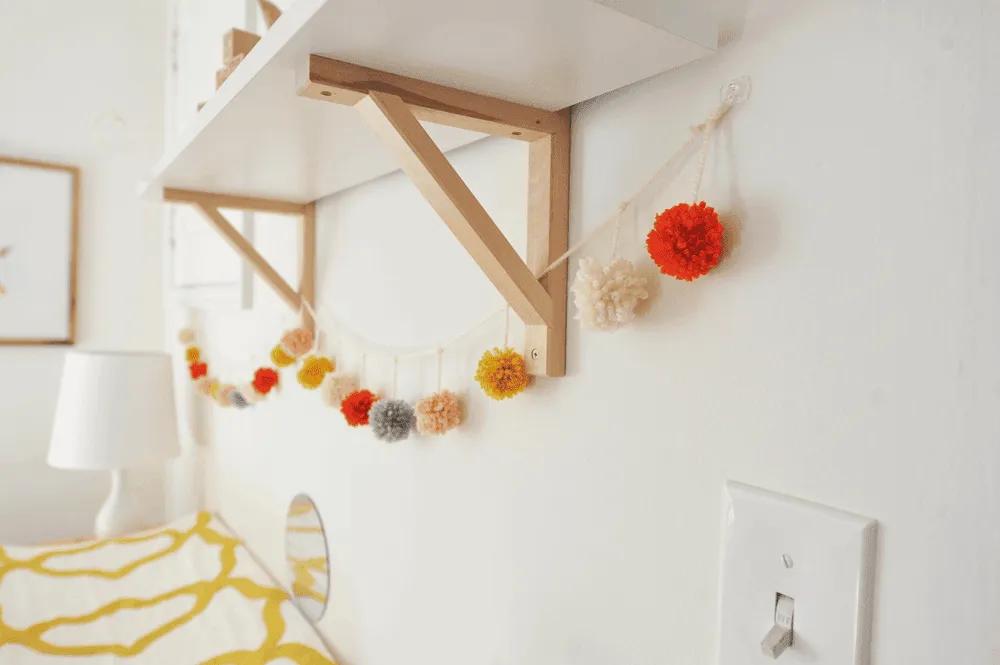
The real money-saver is the hardware. Clear adhesive hooks cost about $5 for a pack of four and hold a yarn garland without complaint — no drill, no anchors, no patching. Pair that with a $12 floating shelf from a big-box store and a $10 skein assortment, and you’re at $30 for a wall that reads far more expensive.
8. Pink and Cream Pom-Poms with Polka-Dot Tulle
Those big tulle-tailed pom-poms are gorgeous and they are also dust magnets. Tulle holds static like nothing else, so plan on a monthly pass with a lint roller or a quick blast from a hair dryer on cool. Keep them above shoulder height near a dresser — trailing ribbon and a toddler with a hairbrush is a combination that ends one way.
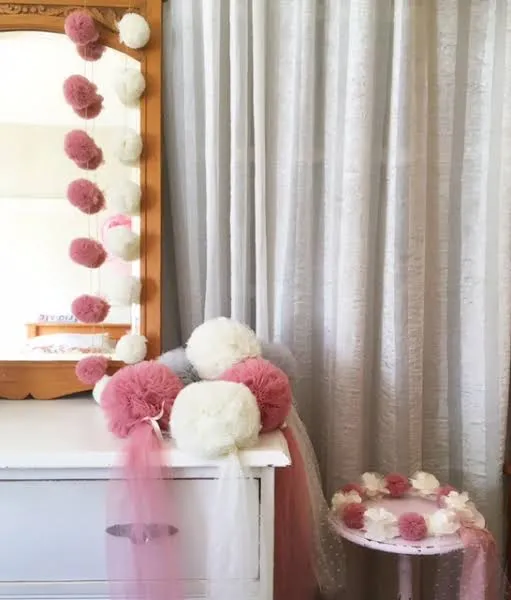
If you want the fluffy tulle look without the shedding, cut your strips on the bias rather than straight across the grain. Bias-cut tulle curls instead of fraying, so the tails keep their shape through handling and washing. It takes an extra ten minutes per pom and saves you a year of trimming loose threads.
9. Pom-Poms and Tassels on a Distressed Window Frame
Three things are happening at once and they’re deliberately mismatched. The frame is chipped white wood, the wall behind is textured light blue, and the garland mixes pom-poms with tassels in peach, coral, navy, and cream. That mix of rough and soft is what keeps the whole arrangement from looking like a craft fair — the garland needs the weathered surface, and the frame needs the color.
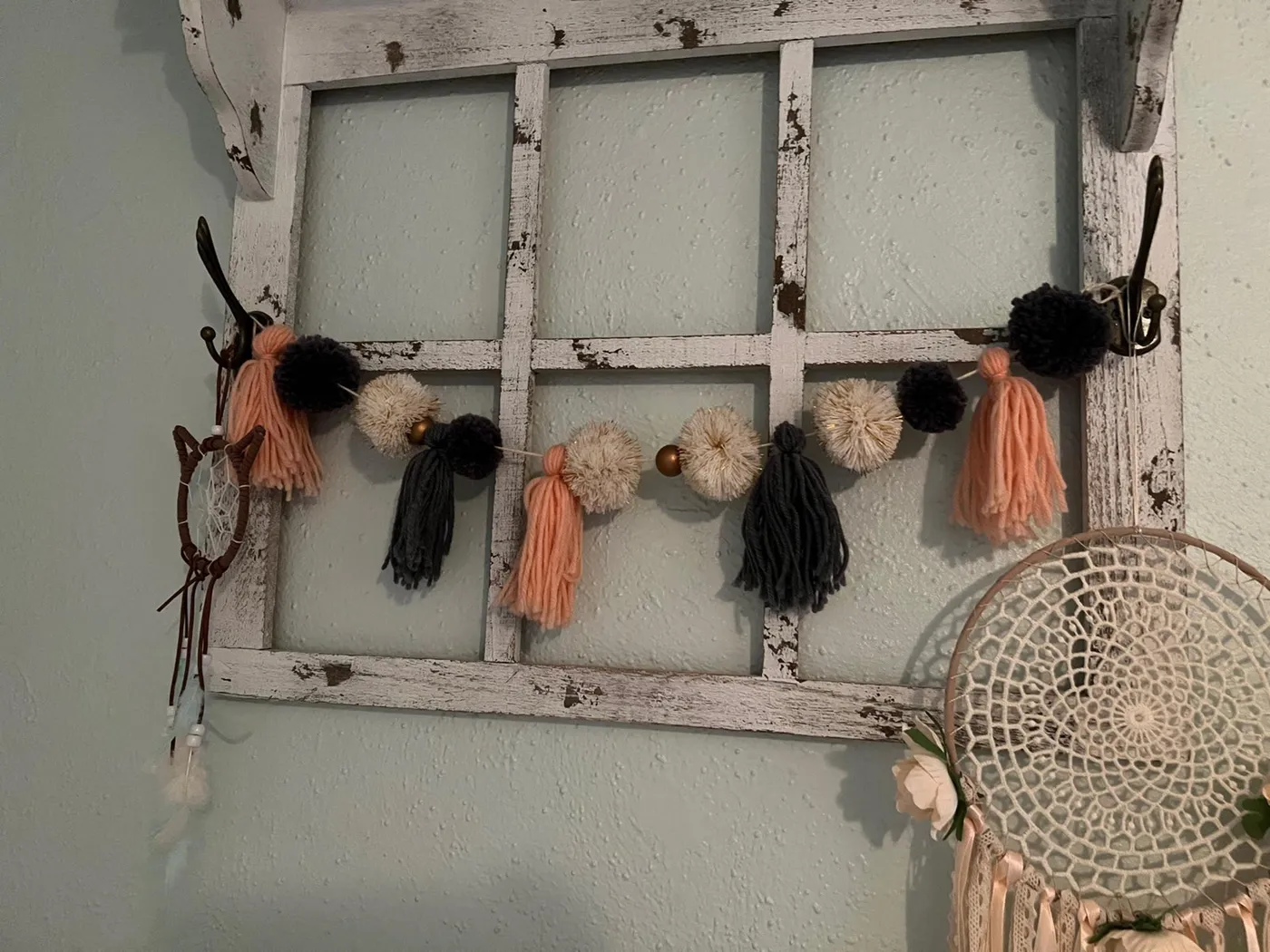
This is the bohemian corner that never really left. Dreamcatchers, macrame, chipped paint, yarn — the current version is just more colorful than the 2019 version, which leaned hard on cream and beige. It has staying power because it’s built from things people make rather than things people buy, and that’s a category Pinterest keeps rewarding.
10. Pastel Pom-Pom Garlands for a Flocked Mini Tree
The palette math is simple: 50% flocked green and warm beige, 35% soft pink, 15% pale grey and white. That middle number is generous on purpose — pastel pink is what separates this from every other neutral holiday setup. To shift the mood, swap pink for dusty blue and keep the beige and grey exactly where they are.
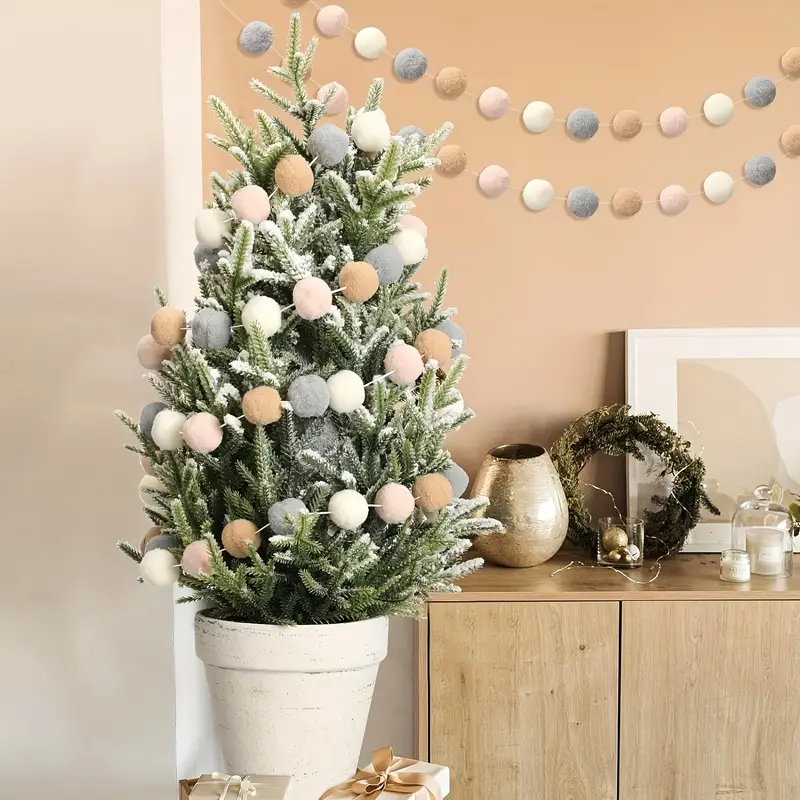
This works best in a corner with at least 4 feet of wall. The garland crossing above the cabinet needs a good 40 inches of uninterrupted run, and the tree needs to sit far enough from the cabinet that the two garlands don’t read as one tangled mess. Smaller nooks? Skip the wall swag and let the tree carry it alone — see Idea #16 for a compact alternative.
11. Red, Green, and Cream Felt Balls on Weathered Wood
It’s the alternating rhythm that makes this one sing — red, deep green, off-white, repeat, no exceptions. Change one ball out of sequence and the whole strand reads as random. That discipline against rough horizontal planks is the entire design. Nothing else needed: no lights, no greenery, no ribbon.
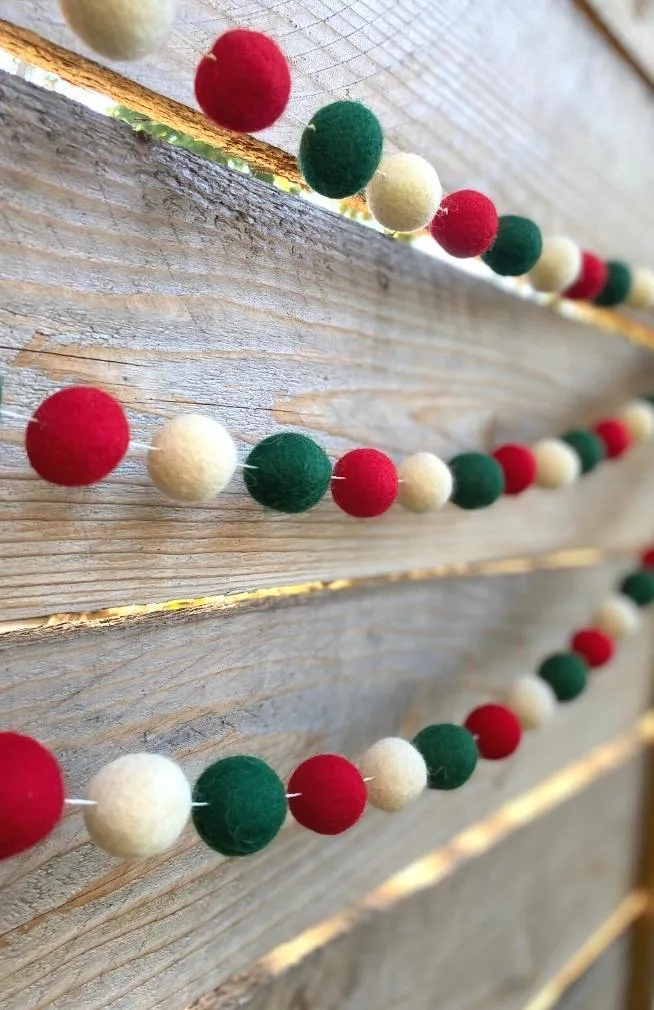
String your own in about 25 minutes:
- Lay out your balls in the repeating order before you thread anything.
- Cut white string 8 inches longer than your planned span.
- Thread with a large-eye needle, knotting between every sixth ball to prevent sliding.
- Pull gently as you go — tight string makes felt balls bunch.
- Hang with a slight sag; a dead-straight line kills the charm.
12. Navy, Hot Pink, and Cream Felt Balls on Polished Wood
Here’s a trick worth stealing: use the off-white balls as spacers, not as members of the color pattern. Navy next to hot pink is a high-contrast pairing that vibrates, and a cream ball between every two colored ones gives the eye somewhere to rest. Without those, the strand looks frantic on a polished wood surface that’s already warm and busy.
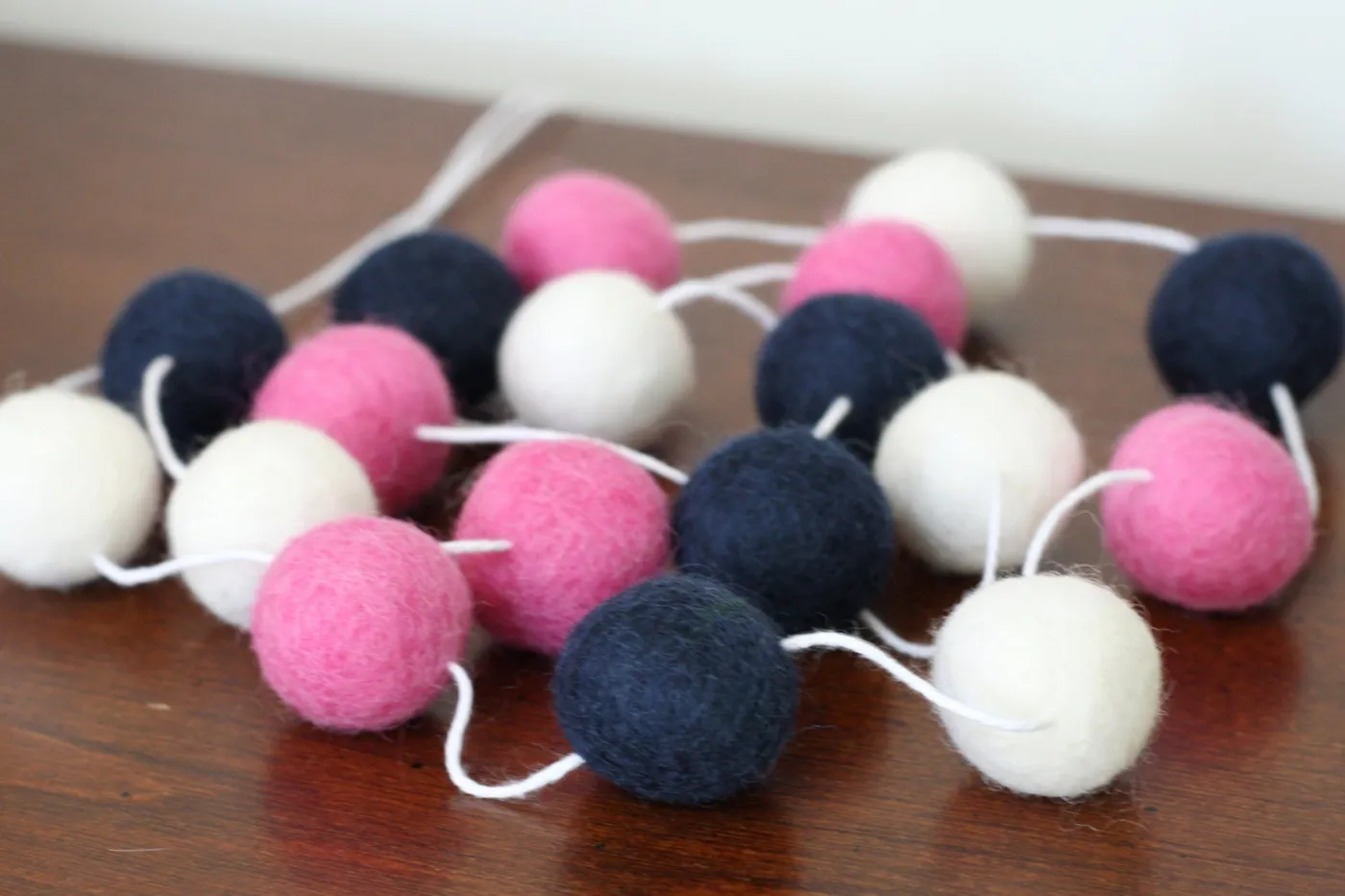
The brown wood underneath is doing quiet work too. Cool navy and hot pink both lean cold, and a medium-brown surface warms them back up so the garland doesn’t look like it landed from a different room. That’s the whole principle: every cool palette needs one warm anchor somewhere in the frame, whether it’s the floor, the shelf, or the surface.
13. A Teddy Bear Wearing a Pink-and-Navy Garland
Yes, draping a garland on a stuffed animal is a little silly. It’s also the exact move that turns a shelf into a vignette. The bear gets a necklace, the string drops below the ledge with a white felt heart on the end, and suddenly there’s a top and a bottom to the composition instead of one lonely row of objects.
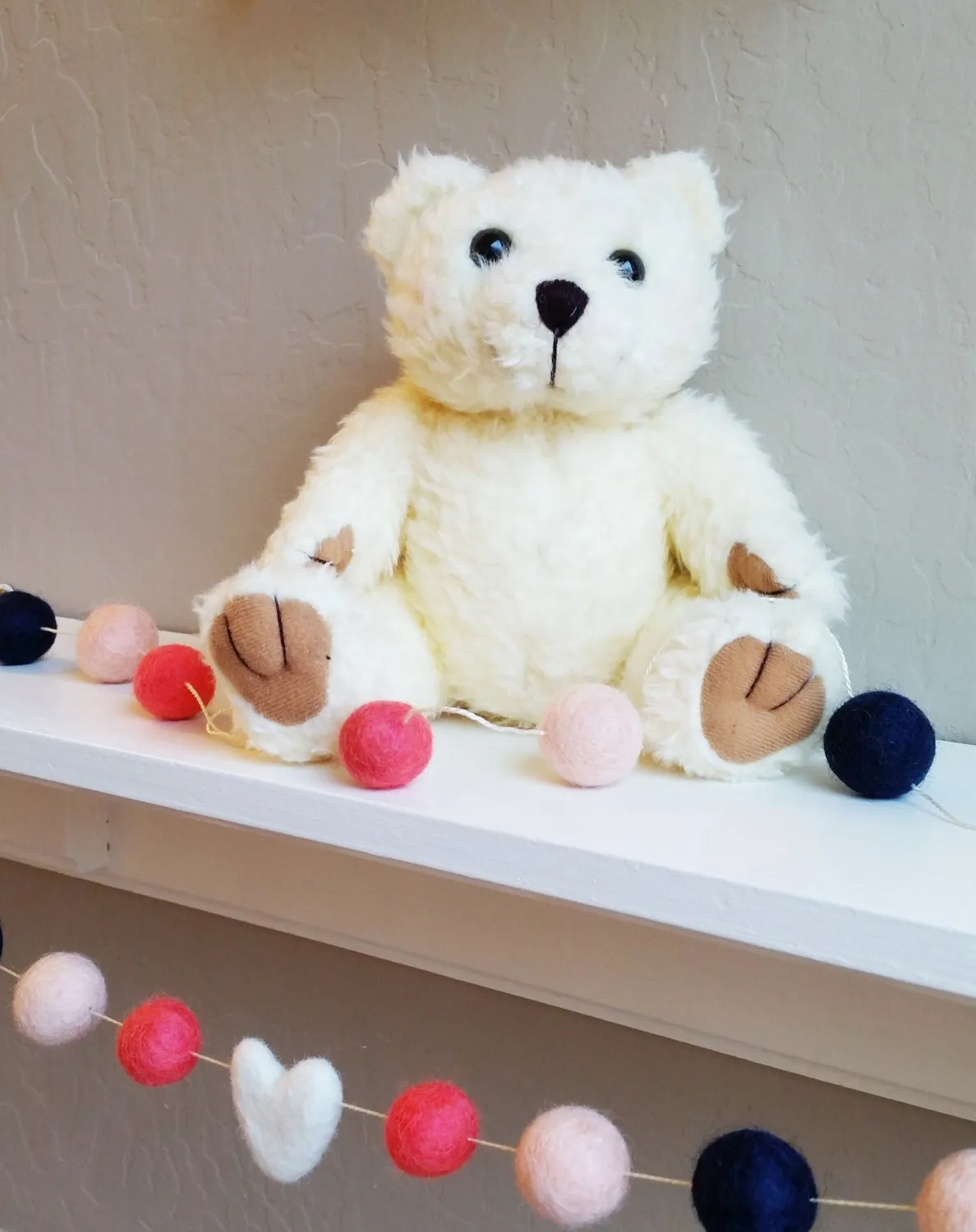
One caution: felt balls and plush toys both hold onto dust, and a shelf at eye level collects plenty. Plan to pull the bear down and give him a shake every few weeks. Also check that the garland isn’t pressing into the toy’s face — after a month or two, yarn dye can transfer onto light plush. Compare with Idea #21, which uses the same idea with a different bear and a wider shelf.
14. White, Sage, and Grey Pom-Poms Under a Toy Shelf
This one is built for small rooms — a single ledge on a plain white wall, a gentle curve of pom-poms beneath, and that’s it. It works on a wall as short as 24 inches wide. Ceiling height is irrelevant, but keep the shelf at least 30 inches off the floor so the garland clears a toddler’s reach. Taller rooms, taller shelves, wider swag.
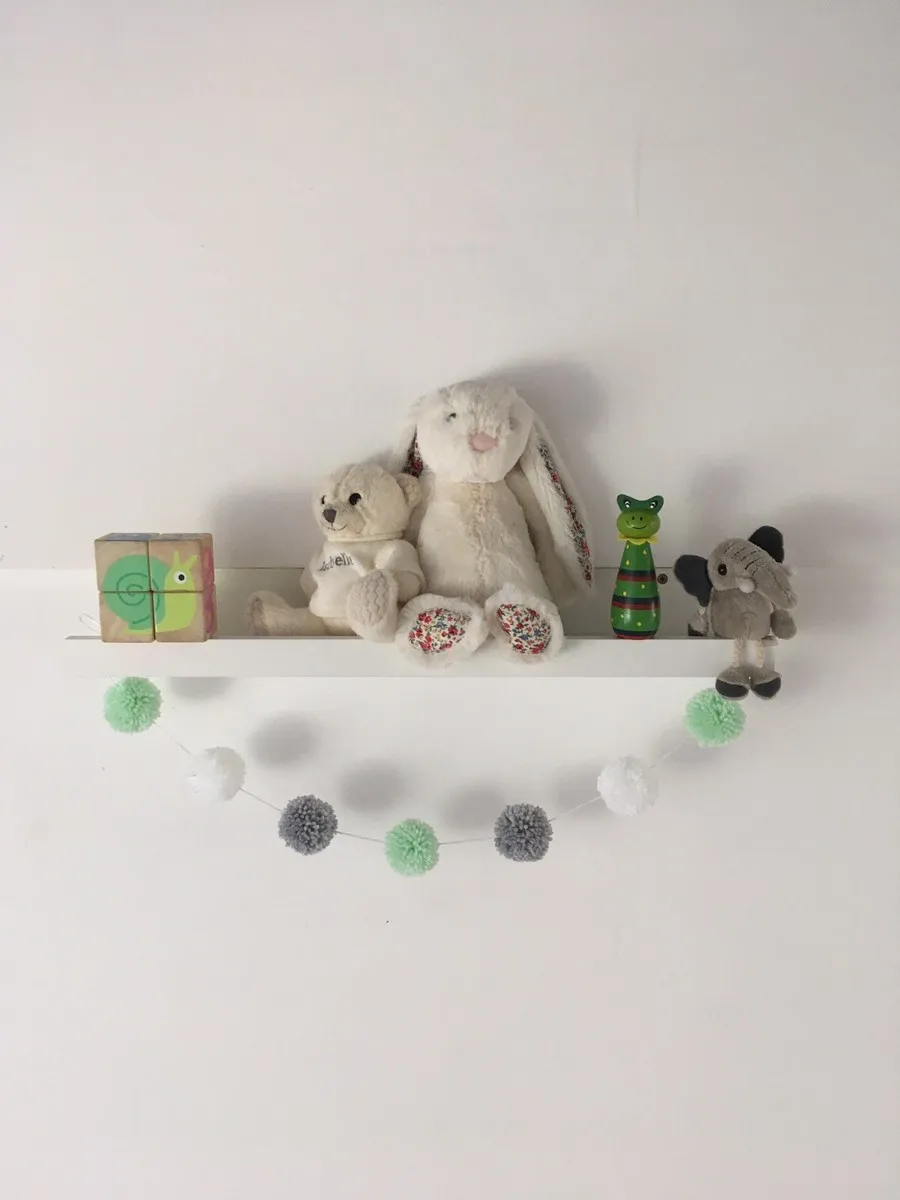
To get a soft curve rather than a droop, use three anchors instead of two:
- Mark your two end points at the same height.
- Add a center hook about 3 inches higher than the ends.
- Run the string through all three, letting it rest on the middle hook.
- Slide pom-poms away from the center hook so the curve stays visible.
Total time: fifteen minutes. Total cost: under $12.
15. Flower-Shaped Pom-Poms in Blush and Brick
The color split here is roughly 80% light blush-brown petals, 20% dense reddish-brown center — an almost monochrome gradient that reads as one object instead of a garland. Because the contrast is low, the shape has to carry everything, which is why the five rounded petals are so pronounced and the center is packed tight.
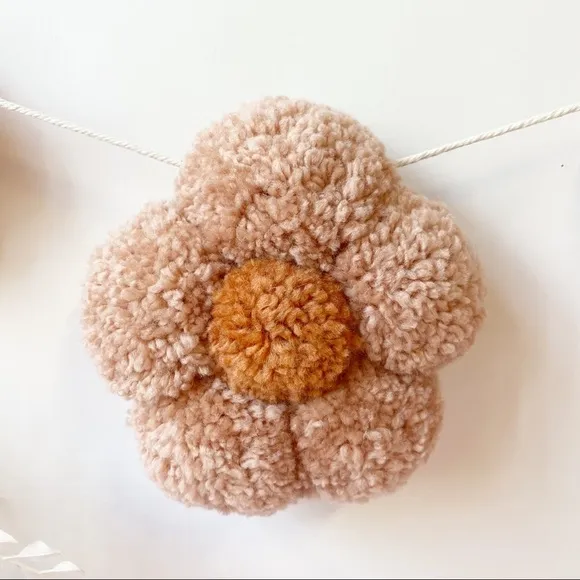
This is what people mean when they say a handmade piece looks store-bought in the good way. A standard round pom-pom is a circle; a flower pom-pom is a silhouette. Strung on a thin twisted off-white cord rather than a flat string, it gets a subtle spiral rhythm that keeps the eye moving along the strand instead of stopping at each flower.
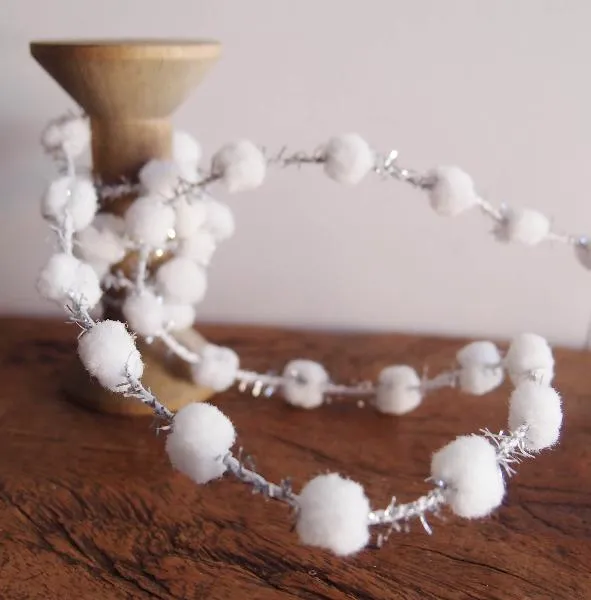
16. White Pom-Poms and Silver Tinsel on a Wooden Spindle
Recreating this little vignette is genuinely cheap:
- White pom-poms, 50 count: $9–$15
- Silver tinsel garland: $4–$8
- Thin white cord: $3–$5
- Vintage wooden spindle or old chair leg (thrifted): $4–$18
- Rustic wood board or tray: $12–$30
Total: $32–$76
Budget alternative: skip the tinsel and use a thrifted wooden rolling pin instead of a spindle. Same silhouette, roughly $15 all in, and no glitter trail across the table.
Tinsel is the maintenance catch here. It sheds every time it’s handled, and the strands never quite go back where they started. Store it loosely wrapped in tissue, not crammed in a bin, or you’ll be picking foil out of white pom-poms next December.
17. Felt Pom-Poms on Clear Hooks Across a Bare White Wall
The whole setup is under $25: a pack of clear adhesive hooks from any big-box store, a strand of felt pom-poms, and a wall you already have. Hooks go on, garland goes up, nothing gets drilled. If you want to spend even less, buy loose felt balls in bulk and string them yourself — you’ll save roughly 40% and get to control the spacing.
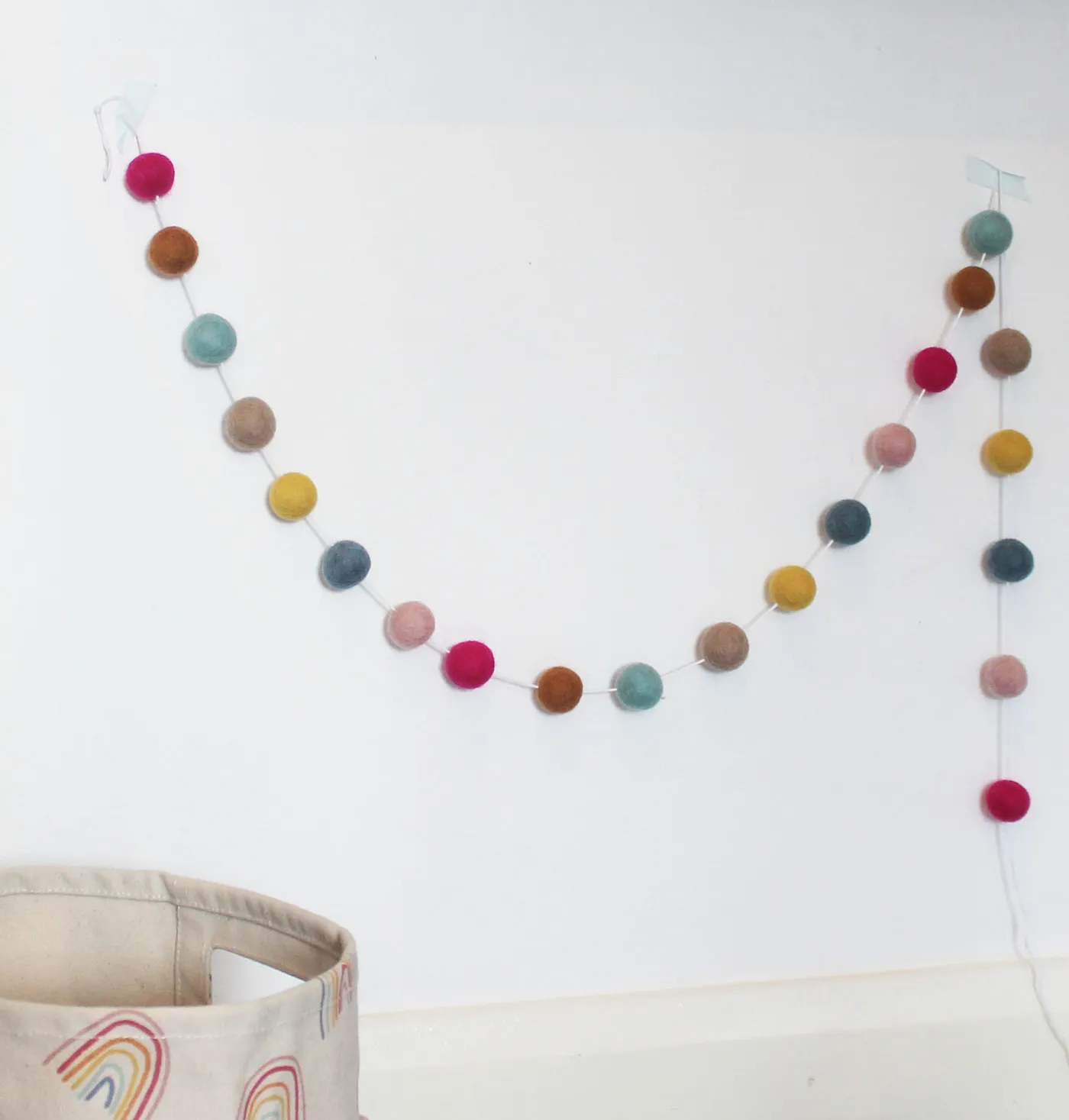
The catch is the wall itself. Clear hooks grip smooth, well-cured paint beautifully and fail on textured finishes, fresh paint, and anything with a slight sheen. Press the hook on, wait the full hour the package tells you to wait, then hang. Skipping that hour is the single most common reason these end up on the floor at 2 a.m.
18. White, Yellow, and Brown Pom-Poms Above Nursery Art
Three colors, three framed prints, one gray dresser below — the garland is echoing the grid. White pom-poms pick up the frames, yellow ones pick up the elephant canisters, dark brown picks up the drawer knobs. That’s repetition across a room, and it’s why the whole corner feels intentional even though nothing technically matches.
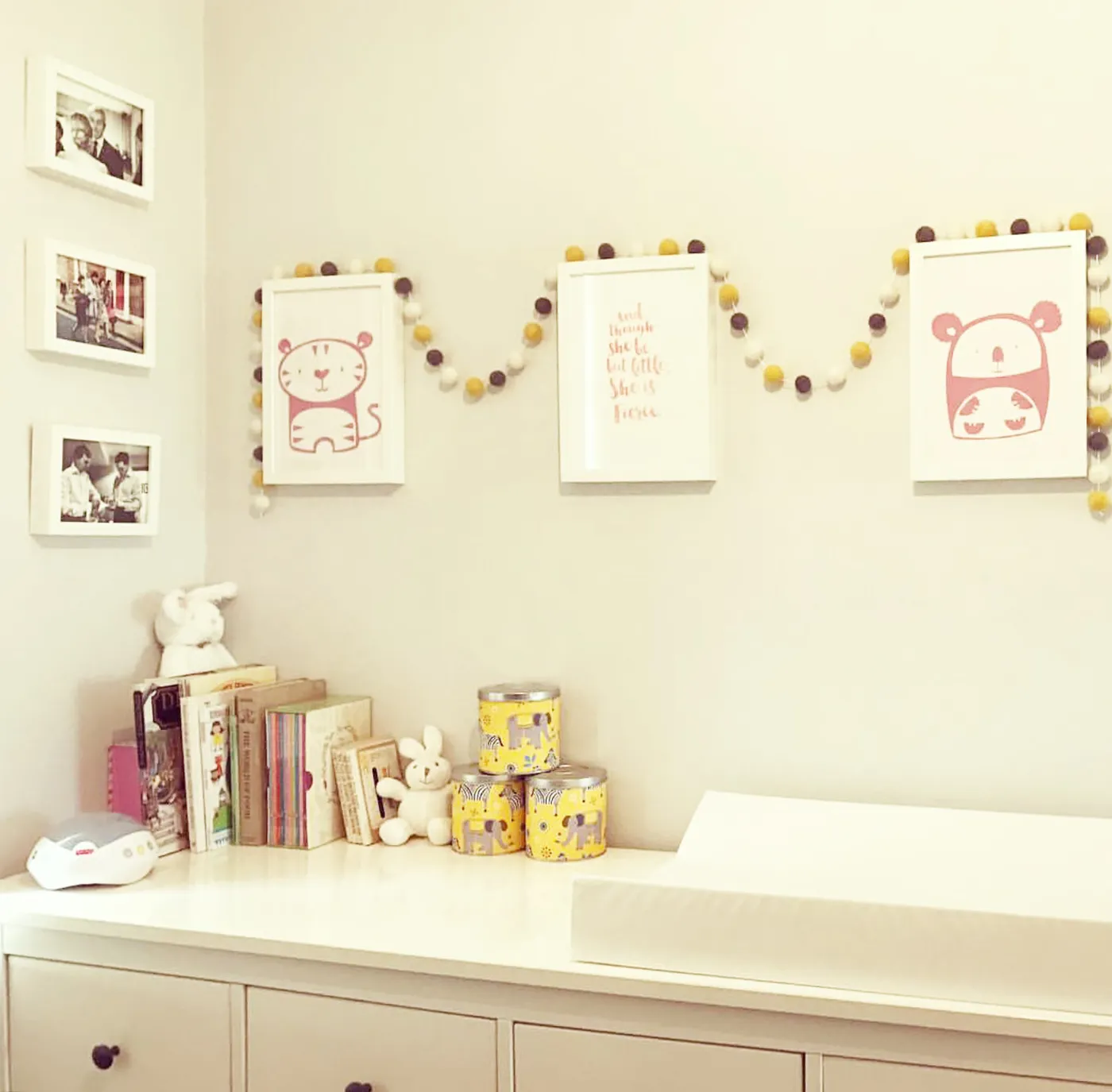
For the proportions to work, the garland should span slightly wider than the art grouping — about 4 to 6 inches of overhang on each side. In a nursery under 100 square feet, keep the swag shallow so it doesn’t crowd the changing table. In bigger rooms you can drop the center 10 inches and let it make a statement. Compare with Idea #28, which uses the same shelf-and-art logic at a smaller scale.
19. Five-Color Felt Ball Strands on Grey Felt
Five colors, one repeating sequence: cream, pink, teal, mustard, grey, then back to the start. That’s it. Odd numbers of colors are easier to repeat convincingly than even ones, and a light grey backing keeps all five from fighting. Want a different mood? Keep the sequence structure and swap mustard for olive, teal for forest.
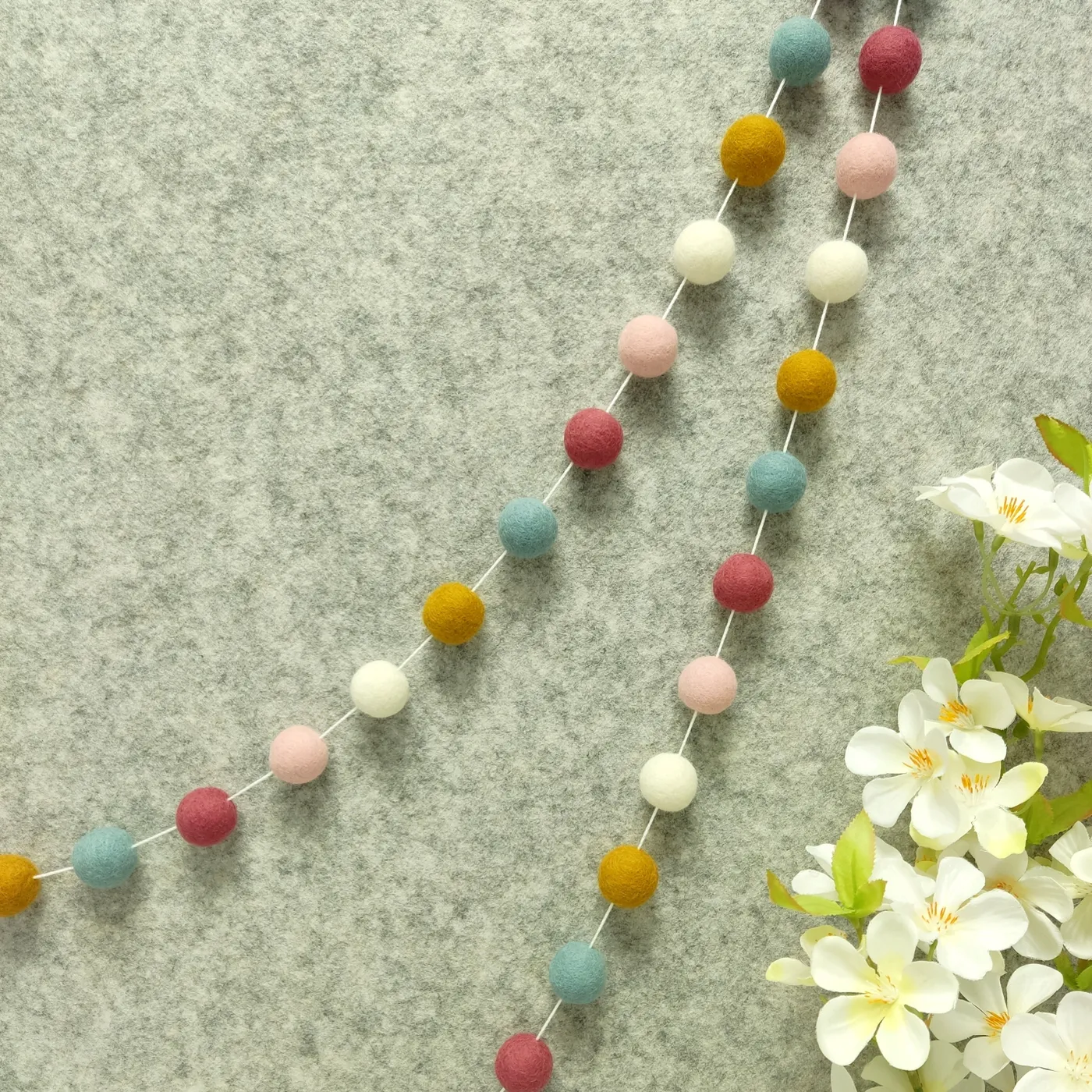
Felt ball garlands in five-color repeats have quietly become the default nursery accessory over the last few years, largely because they photograph well and cost almost nothing. The version getting attention now is about restraint — two clean diagonal strands on one textured surface rather than a tangled wall of yarn. It’s the same idea, edited down, and that edit is what makes it feel current.
20. Embroidered Felt Hearts Mixed with Bright Pom-Poms
The heart shapes here are cut from felt and hand-embroidered with floral and sacred-heart motifs, then threaded onto a braided multicolor yarn string alongside bright pom-poms. If you want to approximate it:
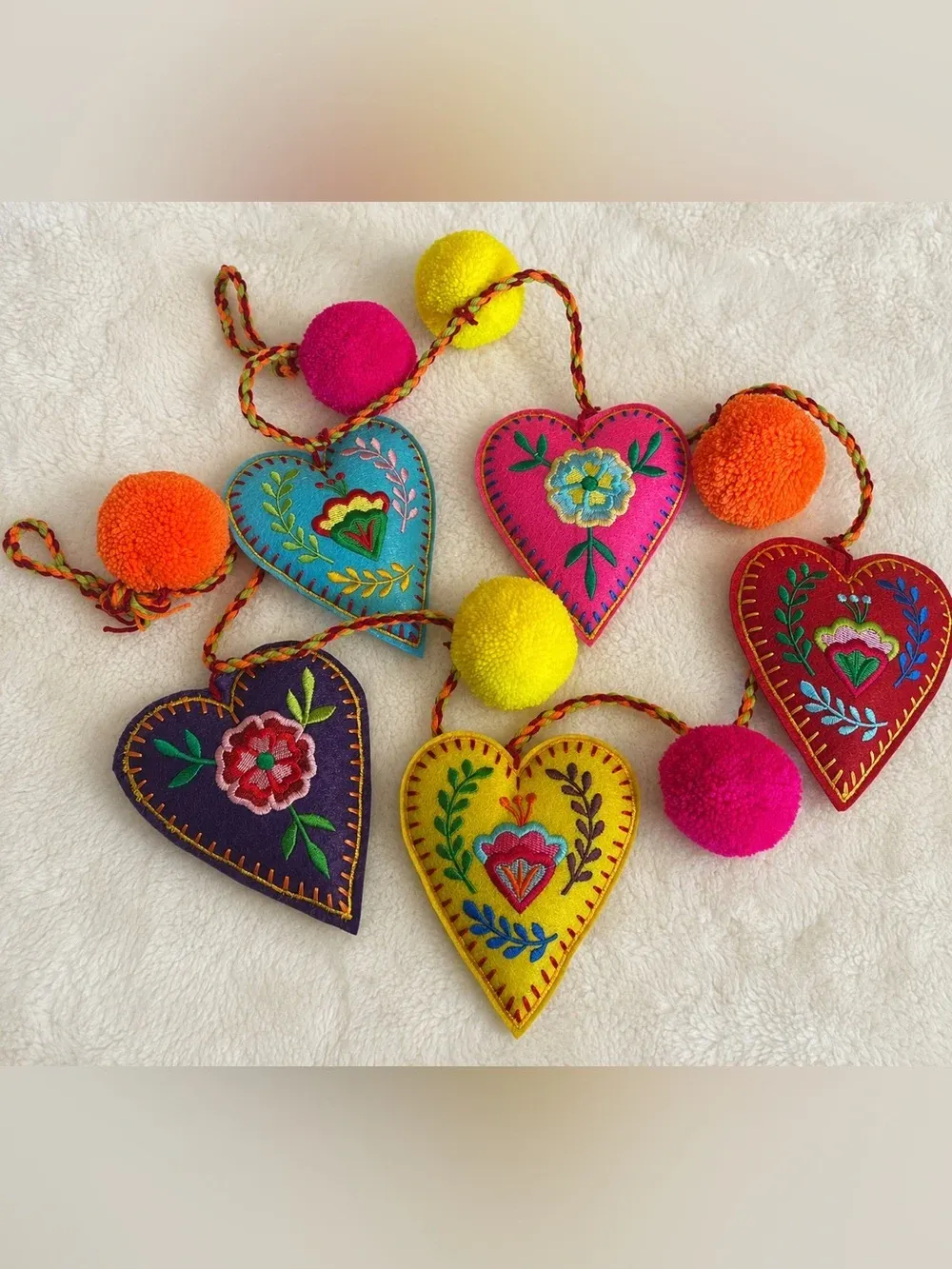
- Cut hearts from wool-blend felt — acrylic frays at the edges.
- Sketch a simple floral or heart motif with a water-soluble pen.
- Backstitch the outline in embroidery floss, then fill two or three petals.
- Knot a braided yarn loop to the top of each heart.
- Alternate hearts and pom-poms along a braided cord, spacing evenly.
Give yourself a weekend. Hand-embroidering six hearts is roughly four hours of work, and that’s before assembly.
felt hearts are not washable. Spot-clean only, and keep them away from windows where dye will fade unevenly across the embroidery.
21. Three Tiers of Pom-Poms and Tassels on a White Mantel
Three garlands, three heights, one mantel — and the mirror behind doubles the whole thing for free. That reflection is why this reads as lush rather than cluttered. Maintenance-wise, tassels are the weak point: sunlight fades the outer strands faster than the pom-poms, so rotate the garlands a few times a year and keep them out of direct afternoon light.
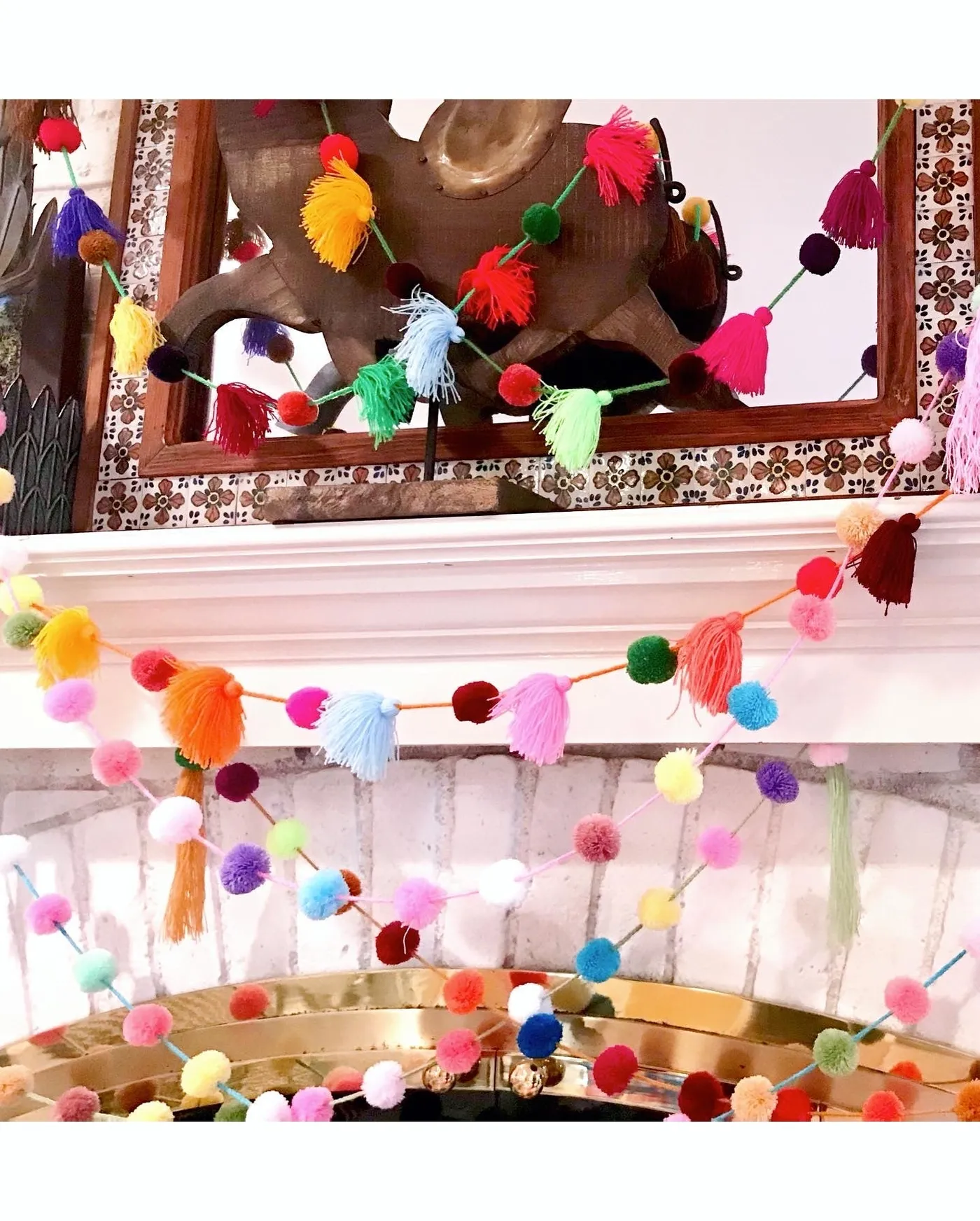
The layering formula is roughly 50% pom-poms, 30% tassels, 20% empty space. That last number is what most people miss — the garlands need visible gaps between them, or the three tiers collapse into one heavy mass. If you’re working on a narrower mantel, drop to two garlands and keep the spacing identical.
22. Pink and Navy Felt Balls with White Felt Hearts
This is the easiest one in the whole roundup to do on a budget. White shelf from a big-box store, roughly $15. Cream plush bear, $10–$20 depending on size. Felt balls in three pinks and a navy, about $12 for the lot. Add a handful of white felt hearts and you’re done for under $50 — and no one walking in will guess that.
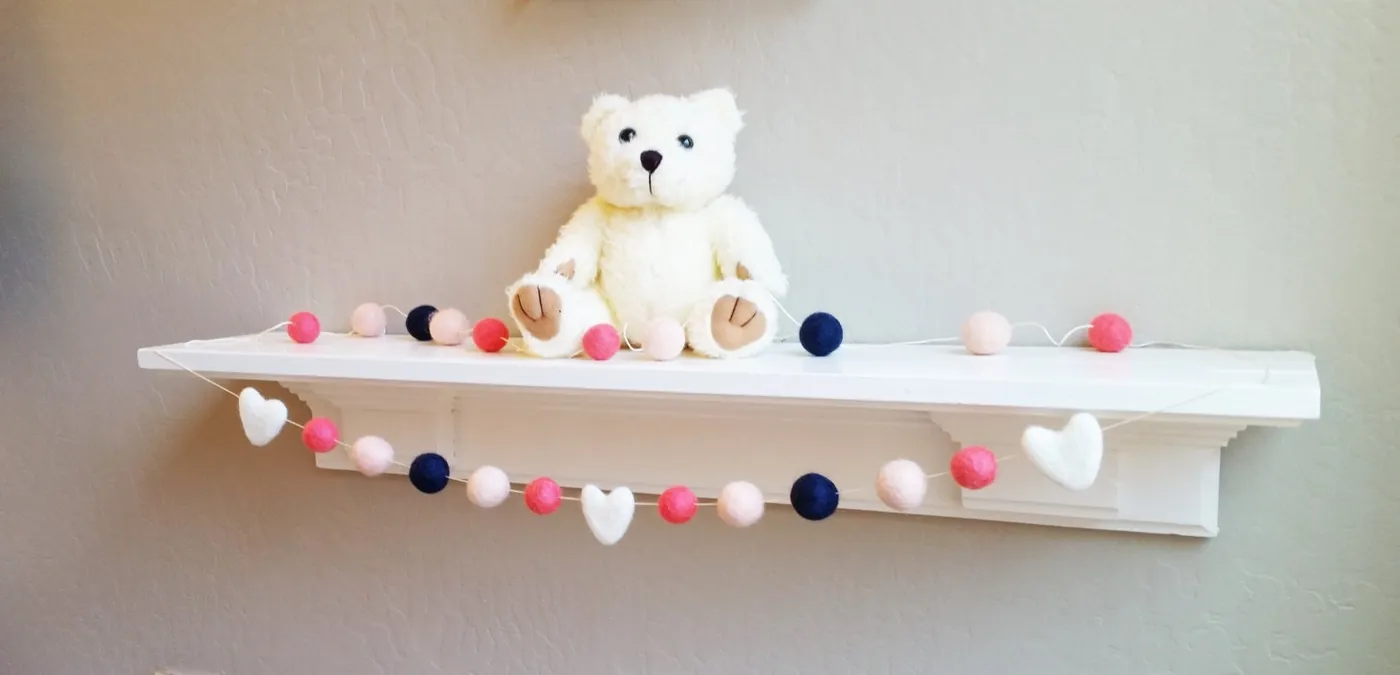
Design detail worth copying: the garland runs along the top of the shelf and another short strand drops below it. That two-plane placement is what makes the vignette feel styled rather than decorated. One strand only ever reads as trim. Two strands read as intention. There’s a version of this with a different bear at Idea #12 if you want to see the contrast.
23. Vertical Pom-Pom Strands with White Tassel Ends
Vertical strands photographed against bright, out-of-focus greenery — this is the version that’s been circulating on Pinterest boards about colorful, plant-filled apartments. It’s the same garland, hung differently. Vertical reads as art installation; swagged reads as nursery. Same product, entirely different room.
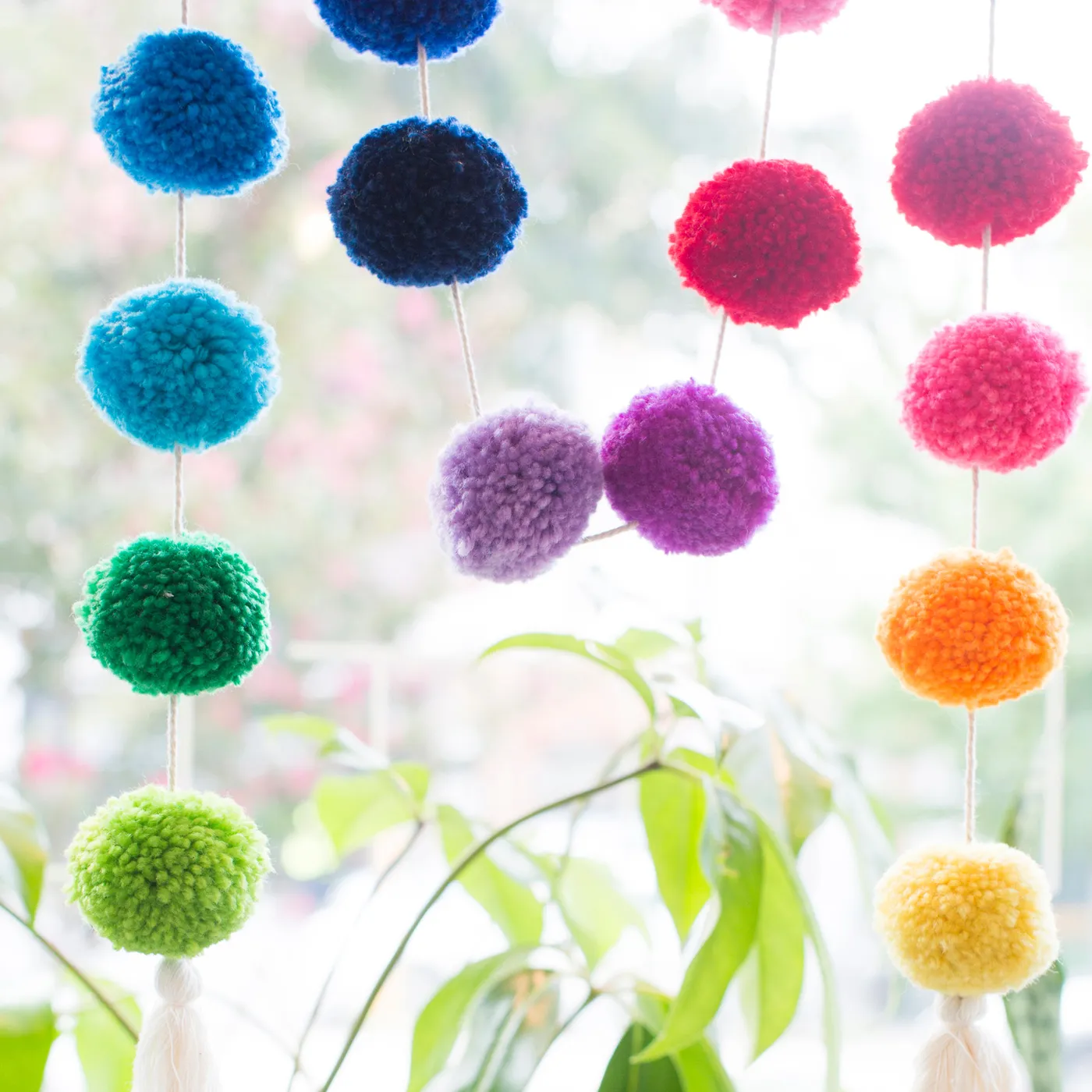
The composition math is about 65% color, 25% white cord, and 10% white tassels at the ends. Those tassels matter — they give each strand a visible stopping point, so the eye doesn’t just run off the bottom of the frame. Green leaves in the foreground and background also do real work here, cooling the palette so the blues, pinks, and purples don’t overheat.
24. Navy, Mint, and Beige Felt Balls on Warm Tan
Warm tan background, cool navy and mint balls, beige and off-white holding it together. This shouldn’t work as well as it does — but the tan surface is what makes the cool tones feel soft instead of icy. If you hang this against a pure white wall, it sharpens considerably and loses the cozy quality entirely.
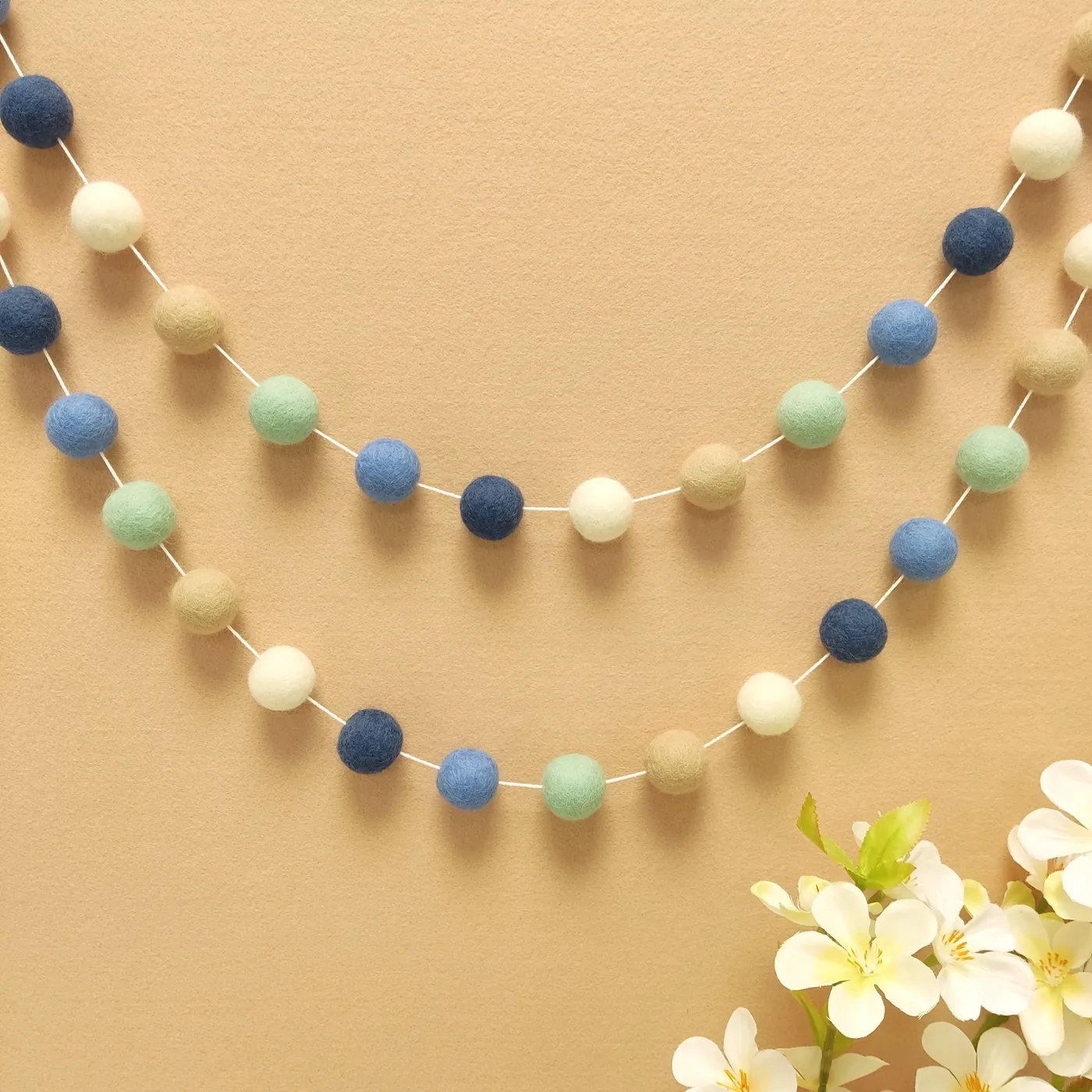
Honest note before you commit: navy felt shows every bit of lint, and mint shows every fingerprint. If this is going in a high-traffic spot or anywhere near a dog, expect to lint-roll it weekly. Lighter palettes hide a lot more. The accent florals at the bottom also need dusting — artificial petals get grim faster than you’d think.
25. Muted Pom-Poms Styled with Wicker and Gold
The garland itself is quiet — off-white, muted pink, light grey, golden brown. What sells it is the company it keeps: a woven wicker mat underneath, a small frosted tree, a gold votive holder, a distressed white tray. Without those warm, textured props on that peach surface, this strand would disappear. Everything around it is doing half the work.
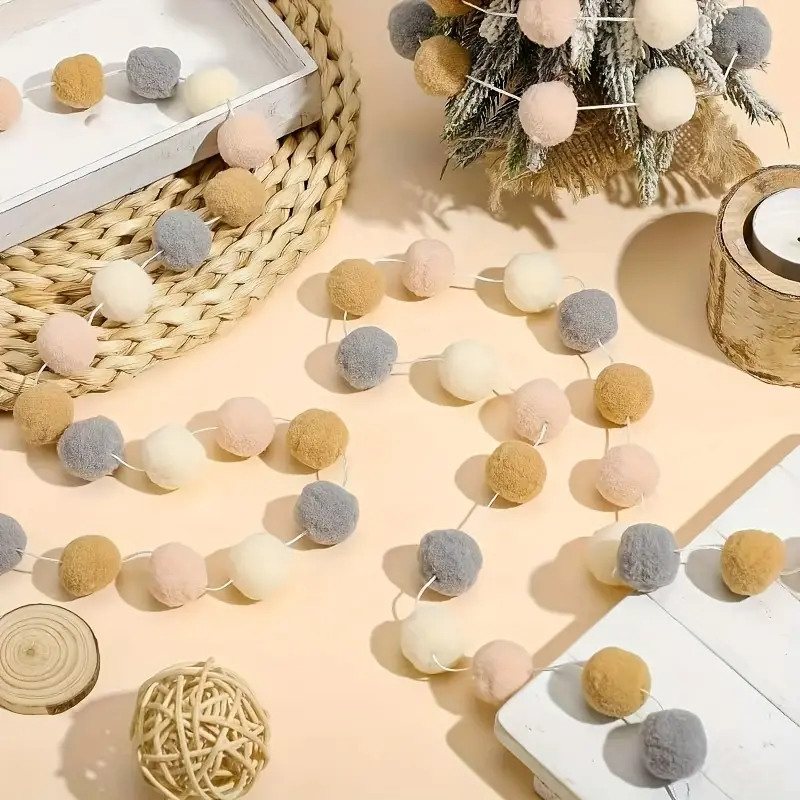
Upkeep is more than you’d expect. Woven wicker collects dust in the gaps, gold-toned metal tarnishes with handling, and pom-poms pick up lint from the mat. A monthly pass with a soft brush handles most of it, and keeping the tray arrangement loose — not stuffed — means you can lift everything out to clean in under five minutes.
26. Neon Pink and Green Pom-Poms for Maximum Pop
Neon pink, neon green, and a bright red-orange on a thin white thread. Three colors, no neutral to break them up. That’s an aggressive combination and it’s completely deliberate — the white string and white wall are the only things keeping it from being unbearable, so don’t add a fourth color or a darker background.
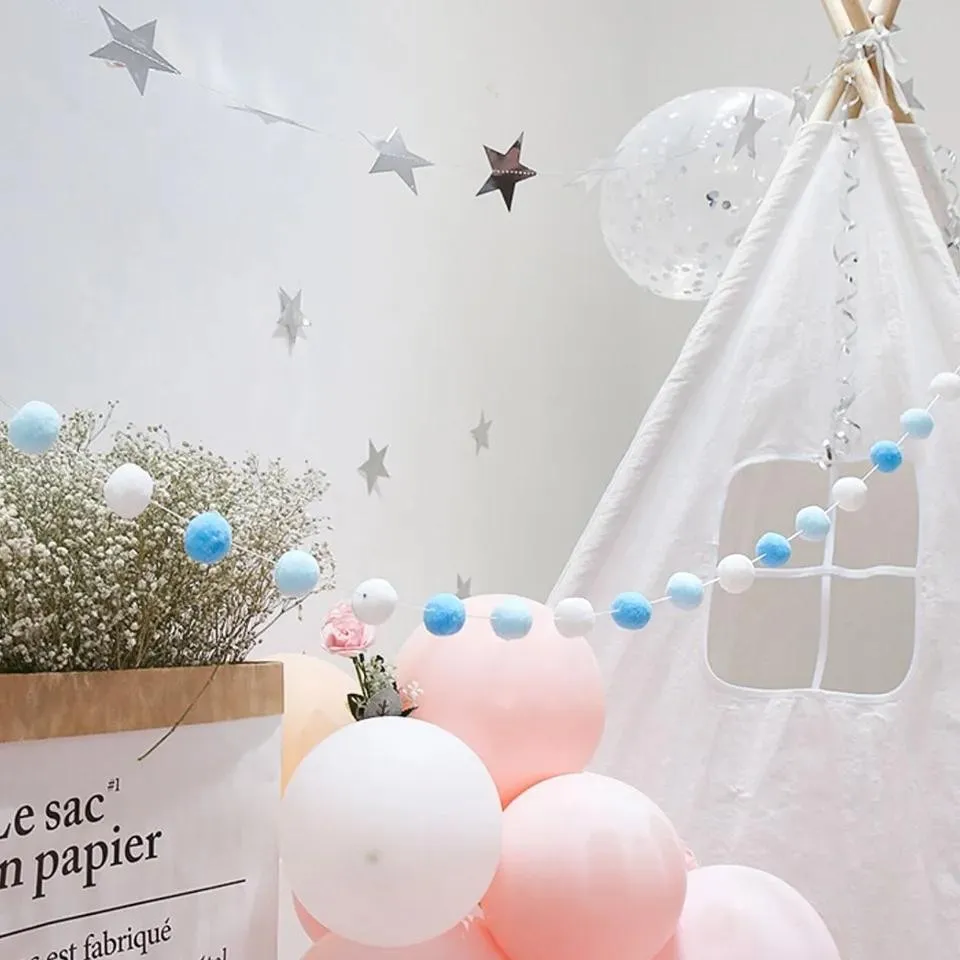
Reality check: neon yarn in direct sunlight fades noticeably within a season, and fluorescent dyes are the first to go. Hang it on an interior wall away from windows, and expect eighteen months of bright before it settles into something softer. Compare with Idea #18 if you want the same energy with a palette that holds its color.
27. White and Light Blue Pom-Poms for a Teepee Corner
Before you buy anything for a setup like this, check four things:
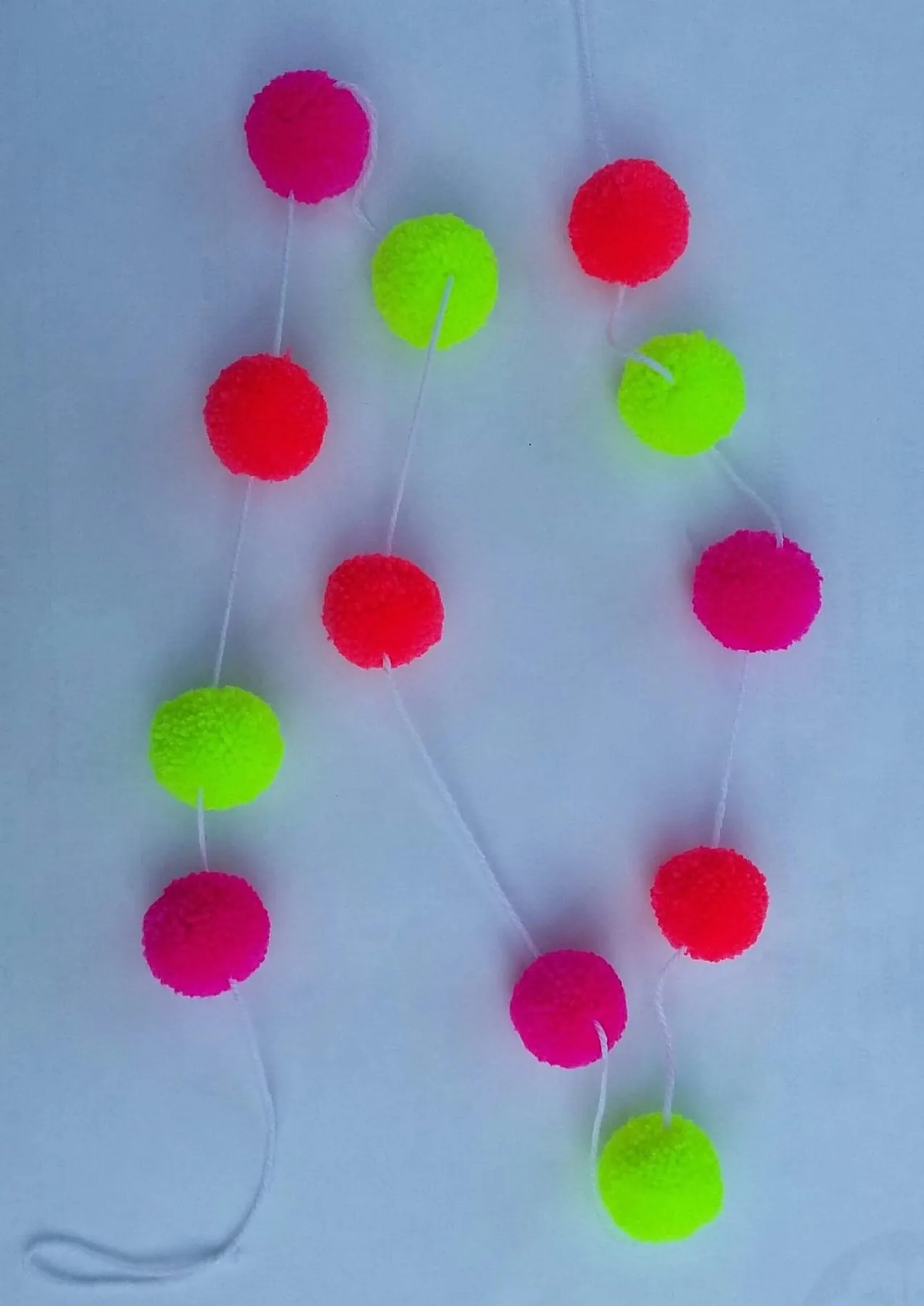
- Measure the wall — the pom-pom garland needs 18 inches of overhang past the teepee on each side.
- Confirm floor space for the teepee plus a 24-inch play radius in front.
- Test one adhesive hook overnight before committing to a full row.
- Set a hard budget — balloons, star garland, and flowers add up faster than the pom-poms do.
On cost: the fabric teepee is the expensive part at $60–$120 new, but these show up on Facebook Marketplace constantly for $25–$40. Silver star garlands run about $8, baby’s breath from a grocery store is $6, and a pom-pom strand is under $15. Everything except the teepee is basically free.
28. Ombre Felt Pom-Poms from Brick Red to Cream
A color gradient, in order, no exceptions. Dark red at one end sliding through muted pink and peach into cream at the other. That’s the entire design and it’s unforgiving — one ball out of sequence and the ombre stops reading as a gradient. Lay every pom out on the floor first and physically arrange them before you thread a single one.
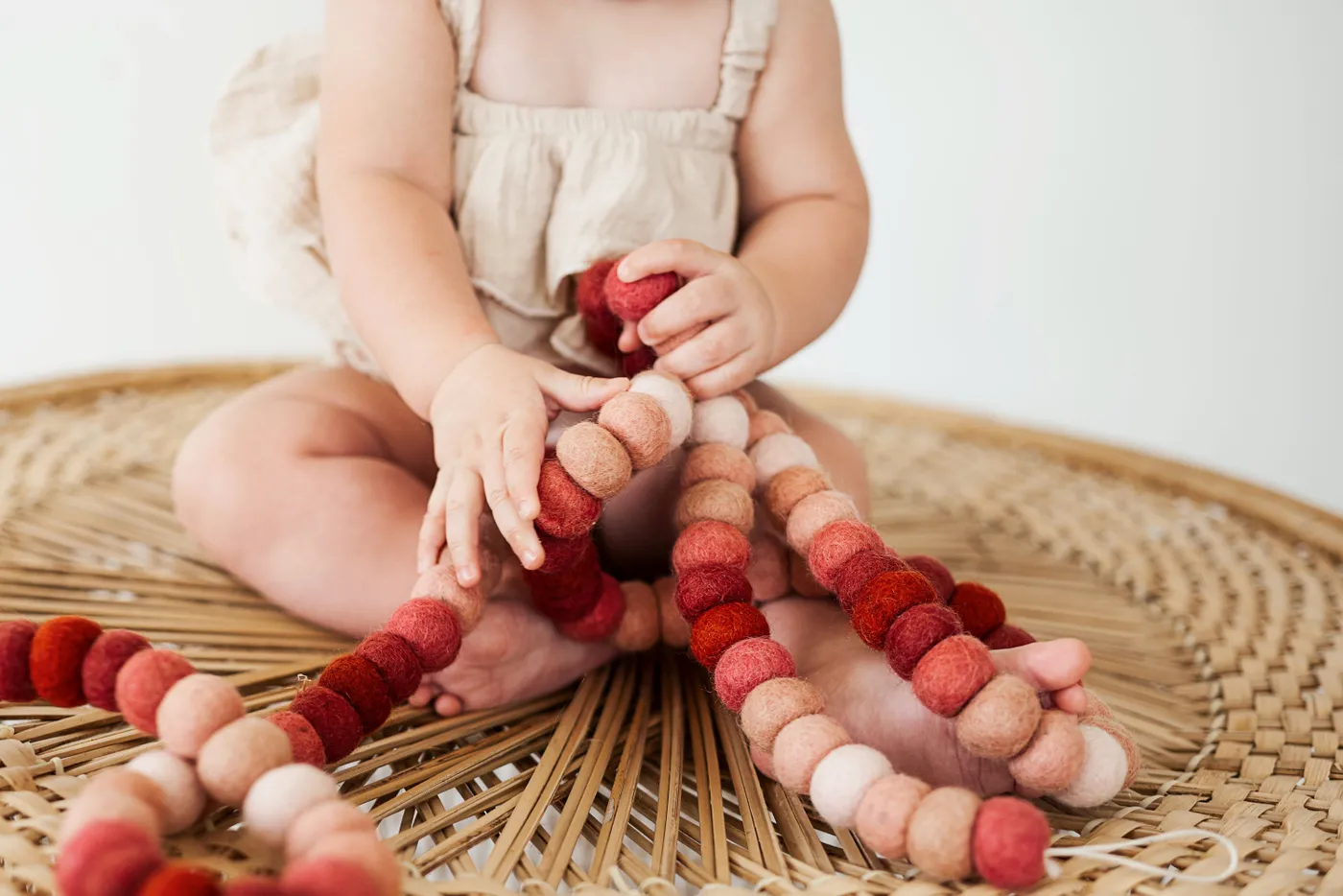
One practical warning about felt and small hands: felt balls are dense, they roll, and they are exactly the right size to be tested orally by anyone under two. If the garland is going anywhere reachable, knot tightly between every ball and check the knots weekly. Wall-mounted above waist height is the safer call, and it keeps the gradient visible.
29. Pink, White, and Grey Pom-Poms Beneath a Pastel Shelf
This is a compact arrangement — one shelf, three objects, one shallow swag — and it’s built for a wall about 28 to 36 inches wide. Ceiling height is irrelevant, but the shelf wants to sit roughly 12 inches above the tallest object on it, and the garland should hang 4 to 6 inches below the shelf edge. Any lower and it starts crowding the bunny.
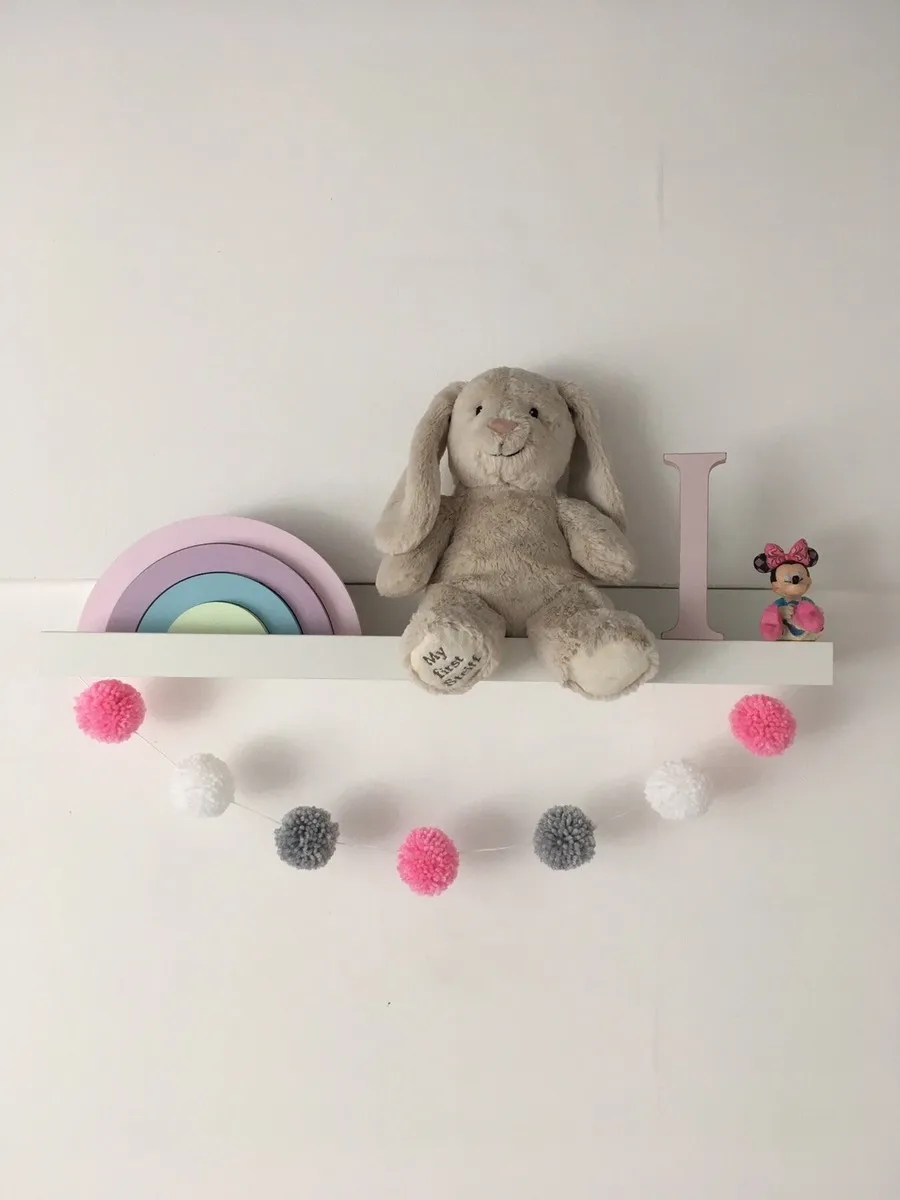
Specific tip: match your pom spacing to your object count. Three objects on the shelf, three visual pauses in the garland. Wide even spacing across a short wall looks sparse; tight clustering looks busy. The pause points don’t have to line up with the objects exactly, but they should feel related.
30. Orange and Yellow Pom-Poms on Striped Fabric
This is a work-in-progress shot, and it’s the most useful one here because you can see the actual method. To finish a strand like it:
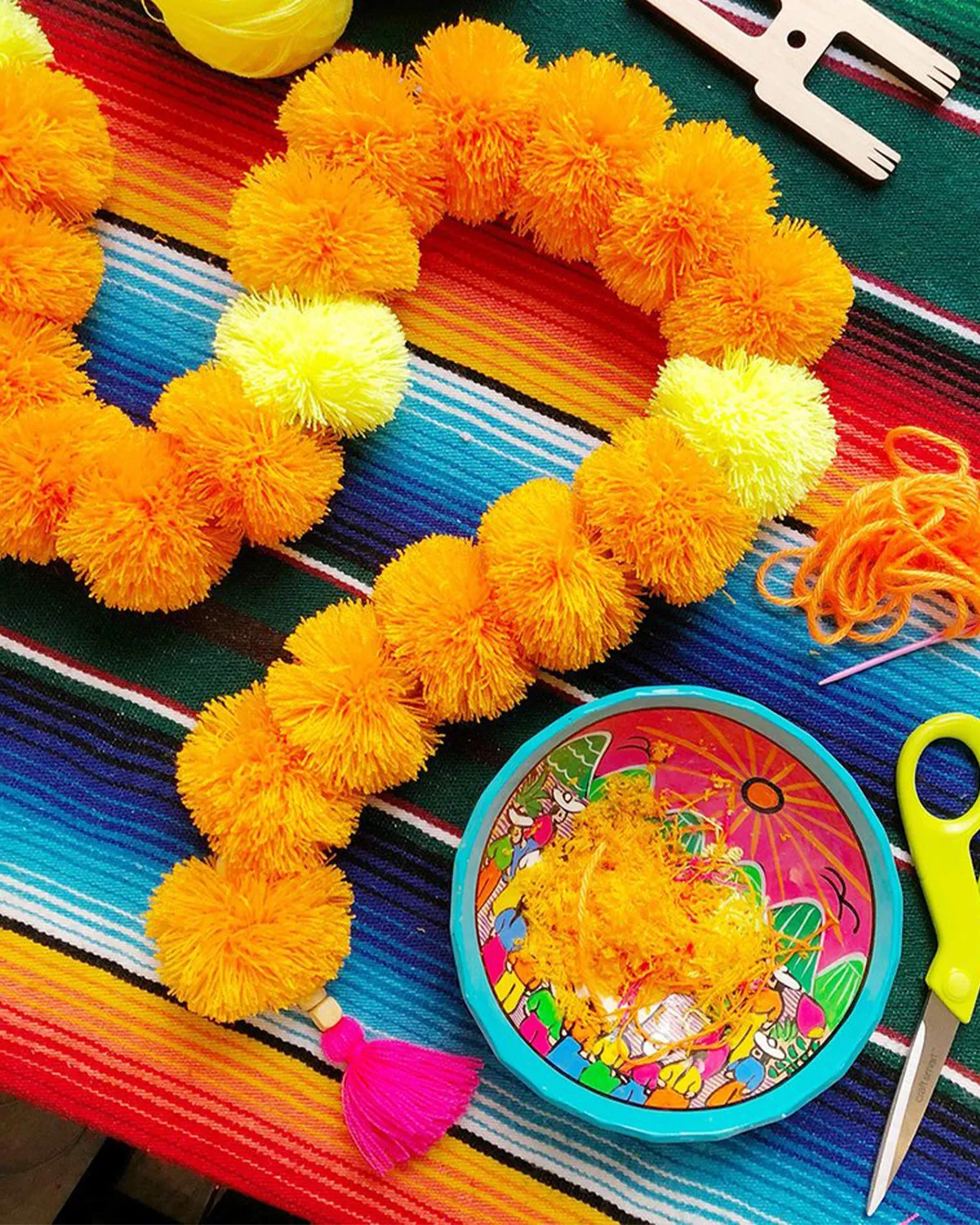
- Pile your pom-poms by color — orange first, yellow as accent.
- Cut cord about 6 inches longer than your finished length.
- Knot at one end, add a tassel and a wooden bead.
- Thread oranges in twos and threes, sliding a yellow in every fourth or fifth.
- Knot firmly at the far end and trim the cord flush.
Materials run about $14 total. Budget version: buy two skeins of yarn at $4 each and make your own pom-poms with a cardboard template — it’s slower but the cost drops to under $8. Same look, different afternoon. See Idea #11 for the strung-by-hand version of this exact technique.
One Hook, Thirty Excuses to Finally Hang Something
You don’t need a renovation, a designer, or even a drill — most of these start with a five-dollar pack of hooks and a strand you can string yourself in under an hour. Pick the one that matches your wall, measure twice, and let the thing hang a little looser than feels comfortable.
📌 Pin your favorite from this list now so you can find it again the day you actually pick up the felt balls.