Christmas lights on house exteriors are having a major moment on Pinterest right now — except the 2026 version looks a whole lot smarter than the tangled bin of strands sitting in your garage. We spent serious time browsing Home Depot, Lowe’s, Target, Walmart, and Amazon to bring you only what actually survives snow, wind, and a Midwestern January, then narrowed it down to 31 ideas that genuinely deliver — from $12 clip packs to $1,800 installations.
Inside you’ll find every direction this year is heading: warm white outlining, icicle-light classics, color-changing RGB rooflines, maximalist multicolor yards, and clean-lined modern treatments. Budget and luxury versions are compared side by side, and every idea is shoppable with direct product links.
Why now? The big shift for 2026 is color temperature — people are moving away from harsh cool white toward 2700K warm LEDs that look like candlelight against snow, plus smart RGB controllers that let one set of lights do both jobs. And stay until the end — we break down the most common mistakes that can ruin these looks.
📌 Save this to Pinterest for later — you’ll want to revisit these ideas.
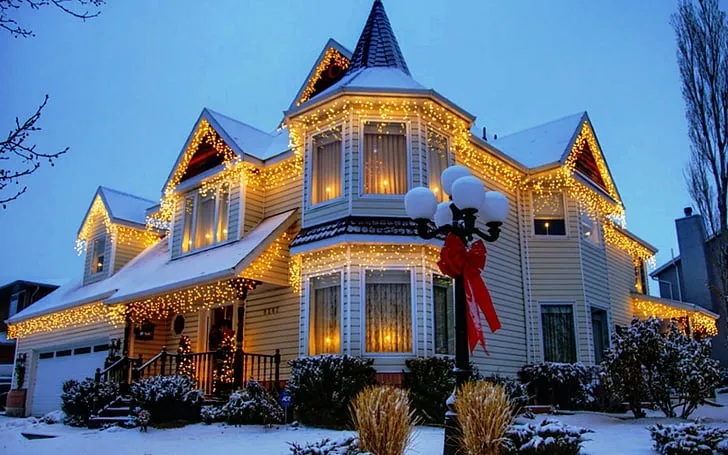
1. Icicle Lights Dripping Down a Snowy Cream Facade
Strip everything else away and the element you cannot lose here is the color temperature — those icicle strands running the rooflines, gables, and porch railings are a warm yellow, closer to candlelight than to daylight. Swap them for cool white LEDs and the same cream house suddenly reads clinical, almost icy. The snow stops feeling cozy and starts feeling like a parking lot in February. Warmth is the entire personality of this facade.
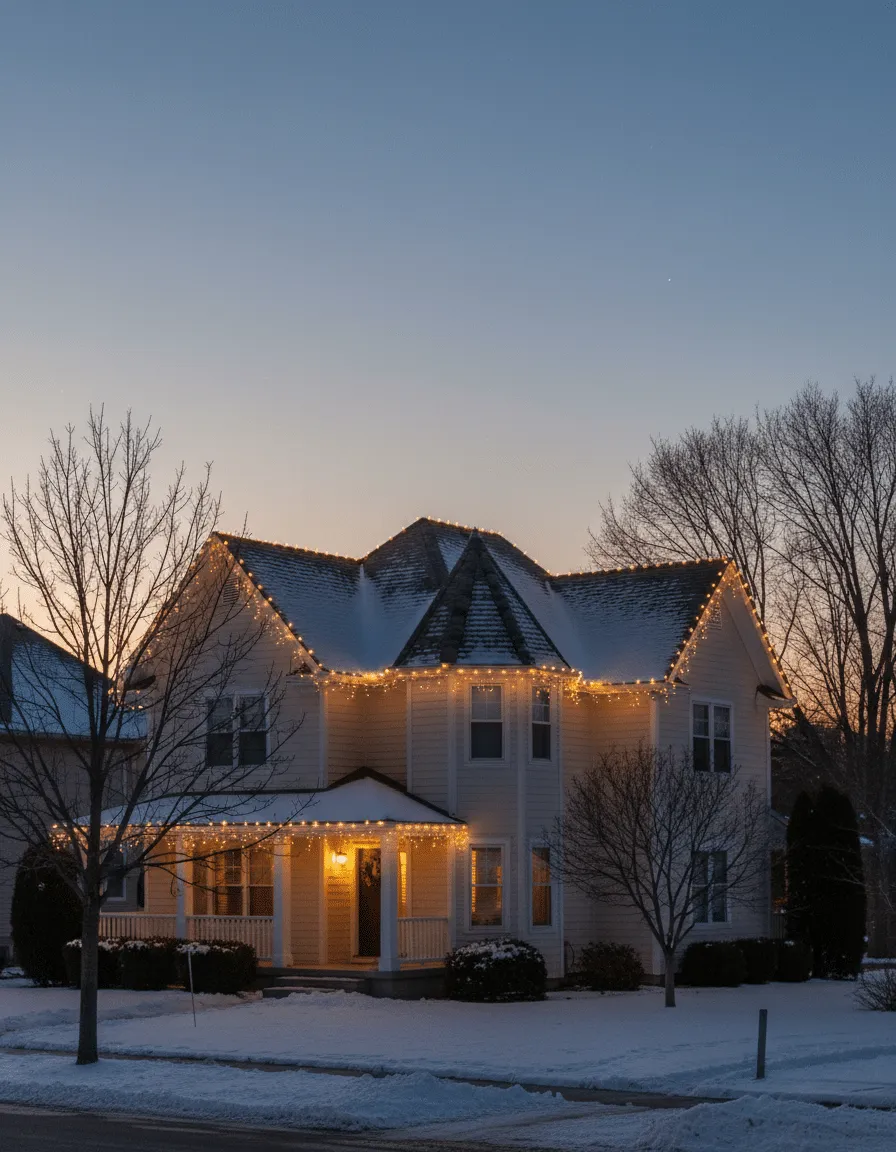
Three quiet decisions are cooperating. The lights follow the architecture — eaves, gable edges, porch rail — and then they simply stop. The bare deciduous trees in the foreground stay dark, giving all that glow something to sit against. And the snow behaves like a bounce card, kicking amber light back up onto the siding so the house looks lit from within.
2. Outline Lighting That Traces Every Roofline and Awning
- Warm white LED spools, 600–900 ft — $120–$260
- Timers, adapters, outdoor extension cords — $60–$120
- Gutter clips, gable hooks, ground stakes — $40–$90
- Two-story install (free if it’s you, $300–$1,200 pro) — $0–$1,200
- Lighted wreath for the gable — $45–$150
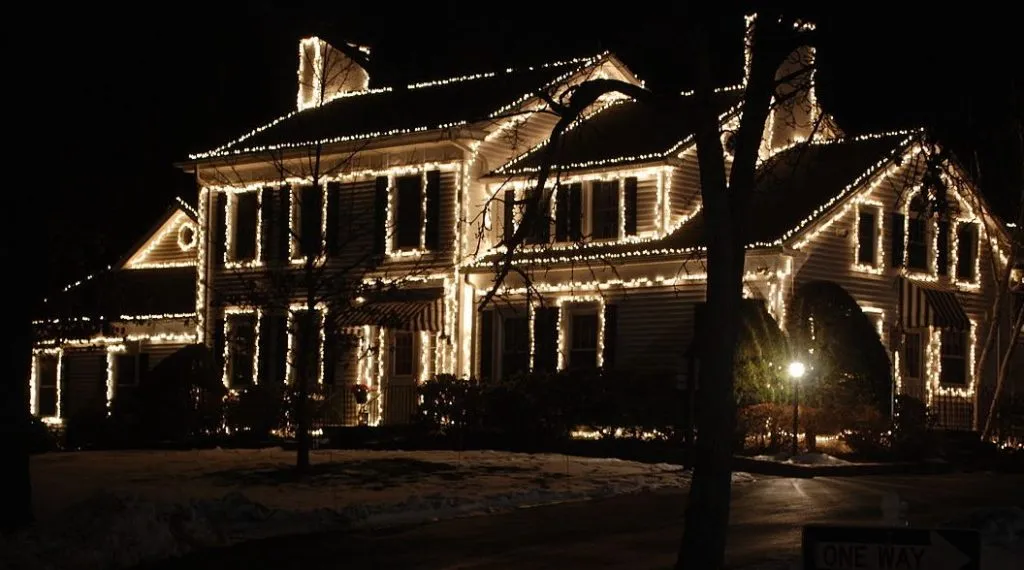
Total: $265–$1,820, and the range is almost entirely about whether you’re the one on the ladder. Budget alternative: buy commercial-grade spools in the January clearance aisle at 50–70% off and store them for next year — same look, roughly 45% less.
Clip spacing separates a crisp outline from a droopy one. On straight horizontal runs, set gutter clips every 15 to 18 inches. On gables and anything angled, tighten it to 8 inches — sag shows up fastest on slopes. Measure your roof perimeter and multiply by 1.1 before you buy; running out of strand three feet from the corner is the most predictable holiday heartbreak there is. Directional LEDs should face outward, never up into the gutter.
3. Green-and-Amber Alternating Bulbs on Red Brick
The formula here is roughly 70% warm amber, 30% green, alternating one bulb at a time along the eaves and gables. That ratio matters — flip it and the house turns into a leprechaun. The brick is already doing heavy lifting on color, so keeping the palette narrow lets the masonry stay the star. Swap green for a deep crimson on a cool-toned house, or run amber with soft gold against stone, and the proportions still hold.
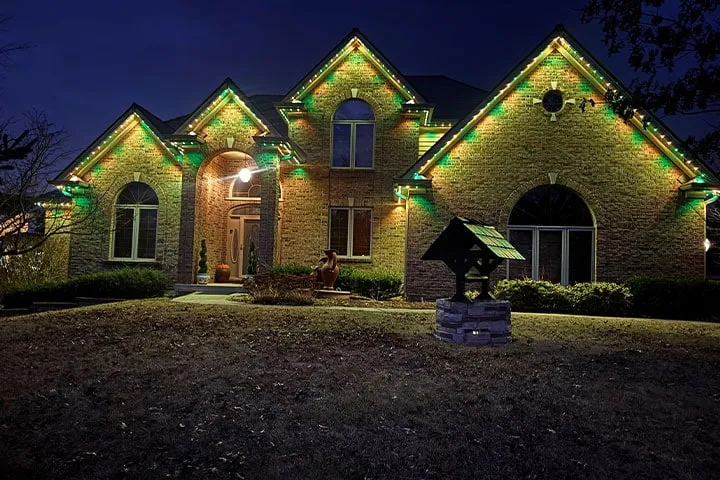
This lives comfortably on a two-story house in the 2,400–3,000 square foot range with at least 60 feet of street frontage, where the alternating pattern has room to repeat. Eave heights under 24 feet keep a homeowner install realistic; anything taller and you’re pricing a lift. Notice the lawn stays wide open — one stone wishing well, nothing else — which is what lets the rhythm read as intentional. For a tighter facade, see Idea #19.
4. Electric Blue Gable Washes Over Warm White Outlines
A gable wash only works if the fixture sits close. Set your wash light 18 to 24 inches out from the wall, tilt it 30 to 45 degrees, and aim slightly off-center so the beam spreads across the triangle instead of punching one hot spot. On a two-story gable that usually means ground-staking at the base of the wall, not climbing on the roof. If the blue starts reading purple, you’re over-lighting it — drop to half brightness and the color settles.
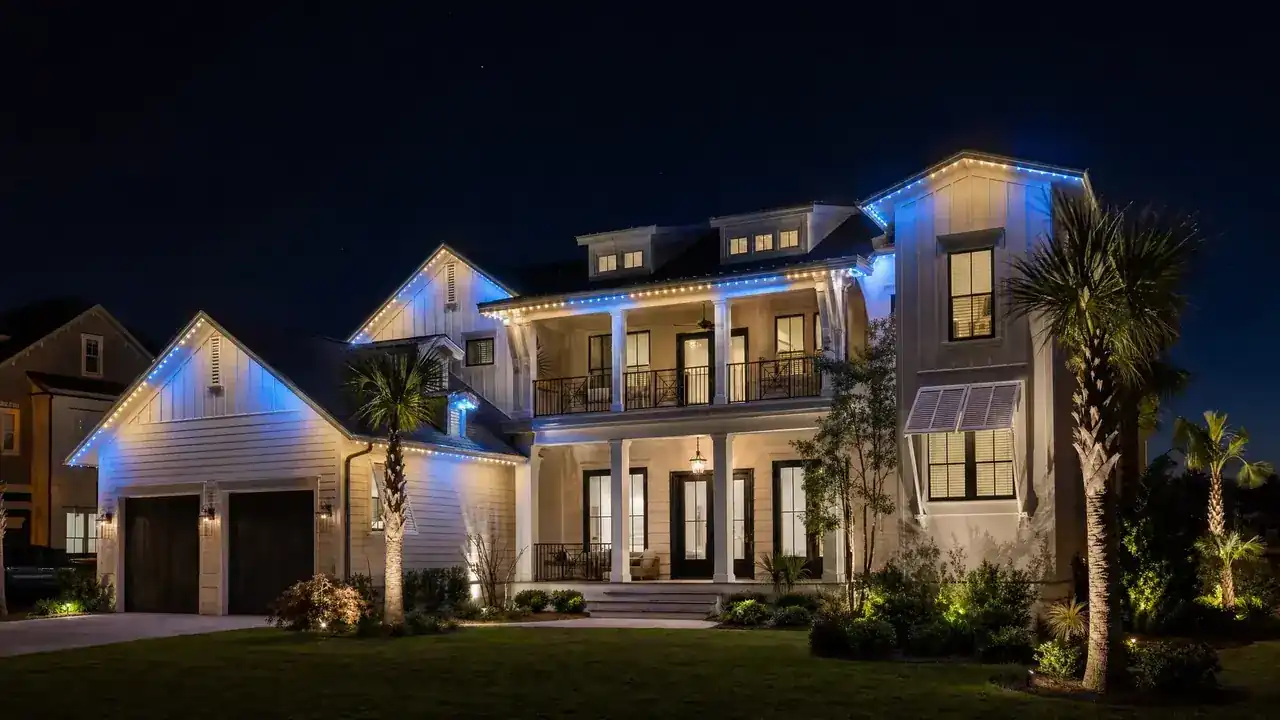
Two-tone exteriors are the loudest thing happening in 2026 holiday lighting: warm white for the architecture, one saturated color for the peaks. It’s a direct pull from theater and event lighting, and it’s why RGB wall washers moved from pro installs into $40 big-box kits. The upside is that you aren’t committing — a smart controller runs electric blue in December and pure 2700K warm white in January. Compare with Idea #27 — same outlining logic, quieter palette.
5. Oversized Ornaments and a Runway of Giant Bulbs
This is a beautiful amount of electricity. A standard household circuit handles 15 amps, roughly 1,440 watts of LEDs, and the safe working load is 80% of that. Count your wattage before you plug in a fifth strand. Use GFCI outlets, keep every connection off the ground and out of standing water, and don’t chain more than three sets end to end. Also consider your neighbors — a display this dense is visible for blocks.
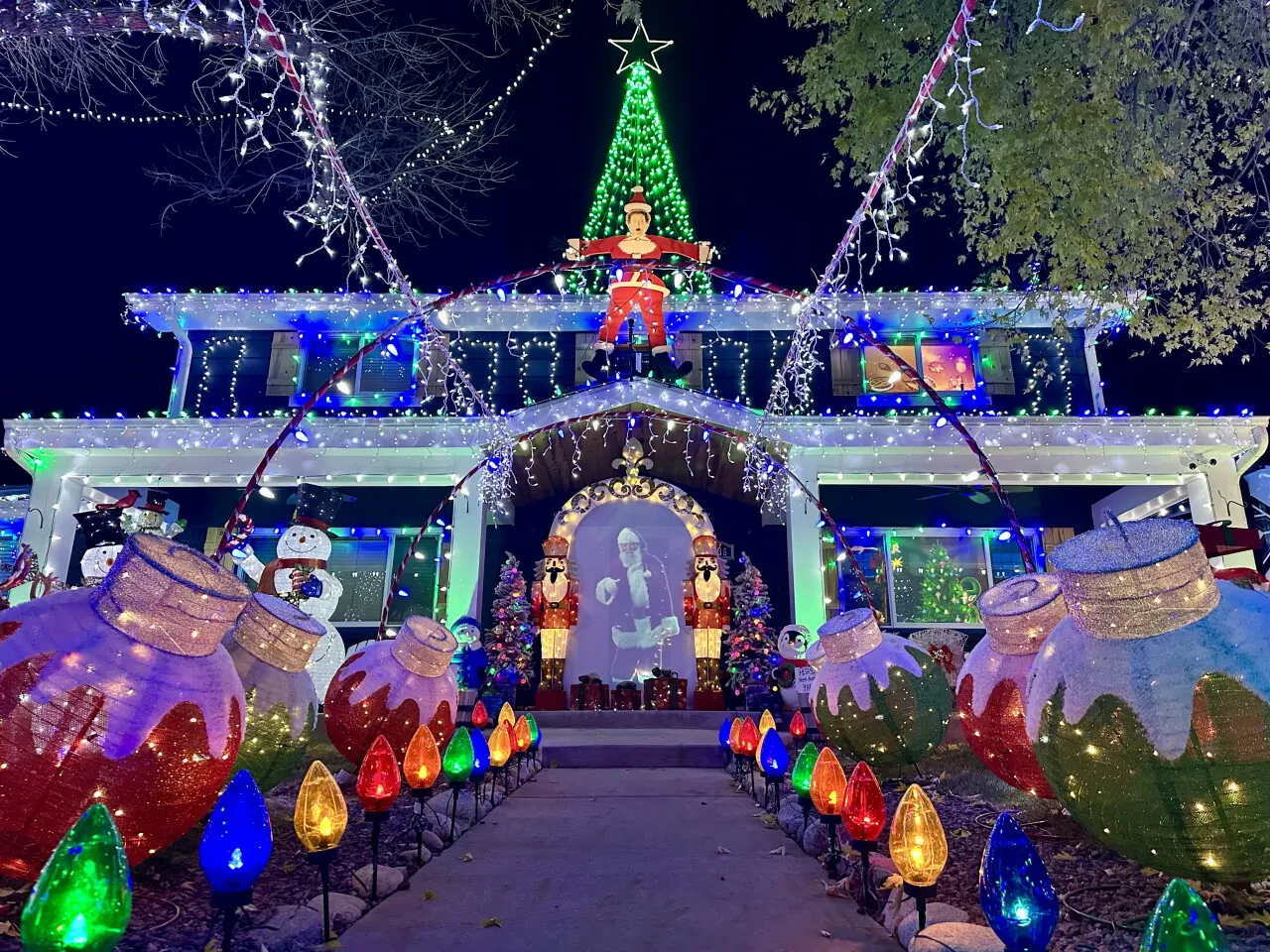
What turns this from a pile of lights into a display is the pathway — those oversized multicolor bulbs lining the walk to the front door. Remove them and you’ve got a bright facade with nowhere to look. They give the eye a route from the street to the entrance, repeat the color story at ground level, and make the yard feel composed instead of merely decorated. Everything else here is volume. The path is the composition.
6. Projected Snowflakes Floating Across the Brick Facade
- Pick a gobo projector with interchangeable snowflake slides and at least 15 ft of throw.
- Stake it 15–25 ft from the facade, angled slightly up, so the pattern spreads without distorting.
- Focus the lens until the edges are crisp — soft edges look like a smudge from the street.
- Add a photocell or smart plug so it only runs after dusk.
- Seal the cord connection with a weatherproof boot and loop it above grade.
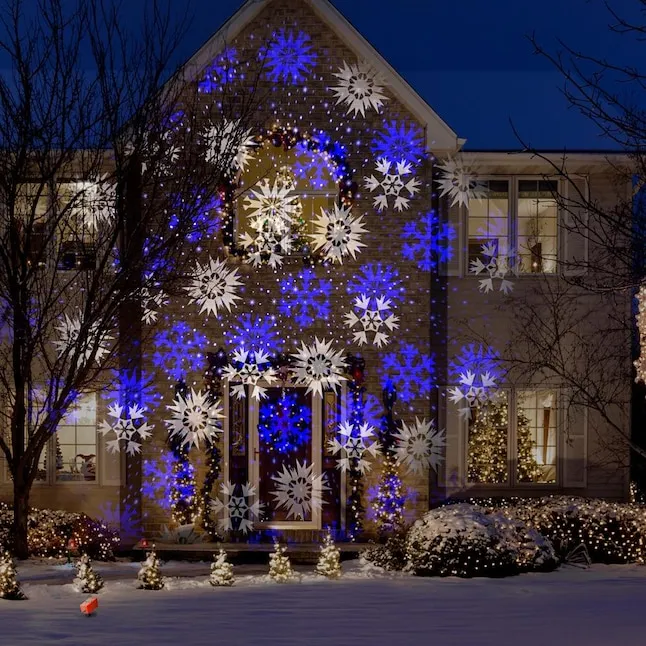
Time: 45 minutes. Cost: $60–$180 for the projector, plus about $15 for a smart plug.
Projection is the quietest cheat in holiday lighting because the pattern repeats without a single ladder climb. Because the snowflakes land on a mostly blank brick face, they read as graphics rather than clutter — the wall becomes a screen. Notice the restraint everywhere else: small lit evergreens and bushes wrapped in warm white, no competing roofline. That contrast between projected blue-white and warm yellow keeps the scene from going flat.
7. A Light-Draped Archway Framing the Garden Path
This setup wants a path at least 40 feet long — that’s what lets the row of glowing dome lights read as a destination instead of decoration. The wooden archway should clear 7 to 8 feet at the apex and span 4 to 5 feet, wide enough to walk through without ducking. Trees receiving blue and multicolor strands need a minimum 6 inches of clearance from any surface, plus 10 feet of vertical structure so they look wrapped rather than tangled. Narrow side yards can borrow this idea at half the length.
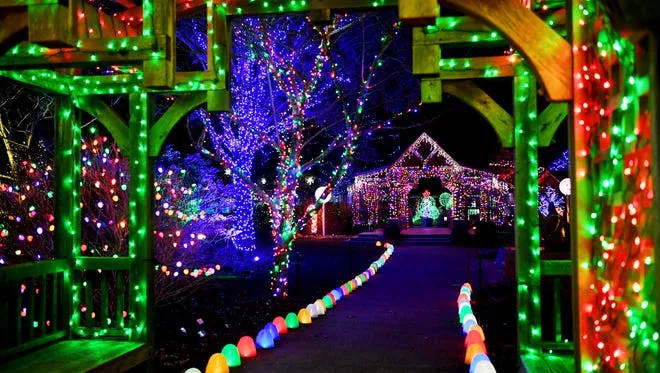
You can build this for far less than it appears. Dollar-store dome path lights run about $1.25 each; buy a dozen and line the walk for under $20. The archway coverage is standard 100-light strands from Walmart at $6–$9 apiece, four twisted together in green and red. Thrift stores and Facebook Marketplace are goldmines for outdoor cords every January. Realistic total: $75–$120 instead of $400 for a packaged garden kit.
8. A Canopy of Warm Bulbs Strung Overhead
- Measure the span and add 10% for sag — a 20 ft span needs 22 ft of strand.
- Run a steel guy wire or 16-gauge cable as the structural support between two solid points.
- Zip-tie strands to the wire every 18 inches; never let the lights carry their own weight.
- Set the sag at 12–18 inches at the midpoint so it reads intentional, not drooping.
- Plug into a GFCI outlet with a smart timer, and drip-loop the cord below the connection.
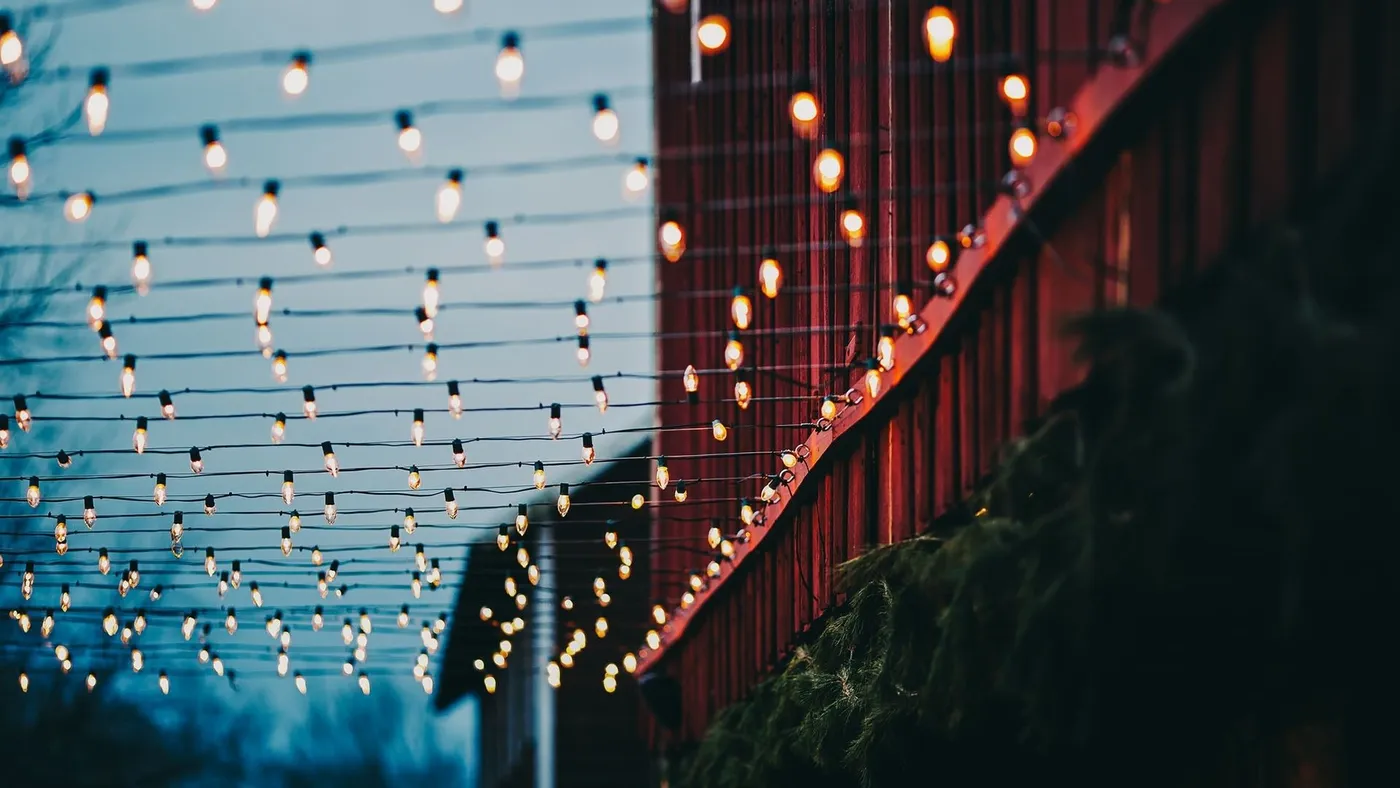
Time: 2–3 hours for a 20 ft span. Materials: $45–$90.
Overhead strands take the worst of the weather. Acrylic bulbs crack around 20°F, and glass ones chip when ice pulls the wire taut — expect to replace 5 to 10% of bulbs each season. Water finds every connection, so drip-loops aren’t optional. Plan a bulb check in early December, an inspection after the first big storm, and takedown by mid-January. Stored on a spool instead of in a ball, a strand lasts four or five seasons instead of two.
9. Warm White Facade With Red Bushes and a Lit Tree
- Warm white roofline and porch strands — $140–$300
- Red strands for bushes and conical light-up tree — $70–$160
- Lighted Santa and reindeer figures — $90–$300
- Garland and lighting for the porch railing — $40–$90
- Clips, stakes, timers, extension cords — $50–$110
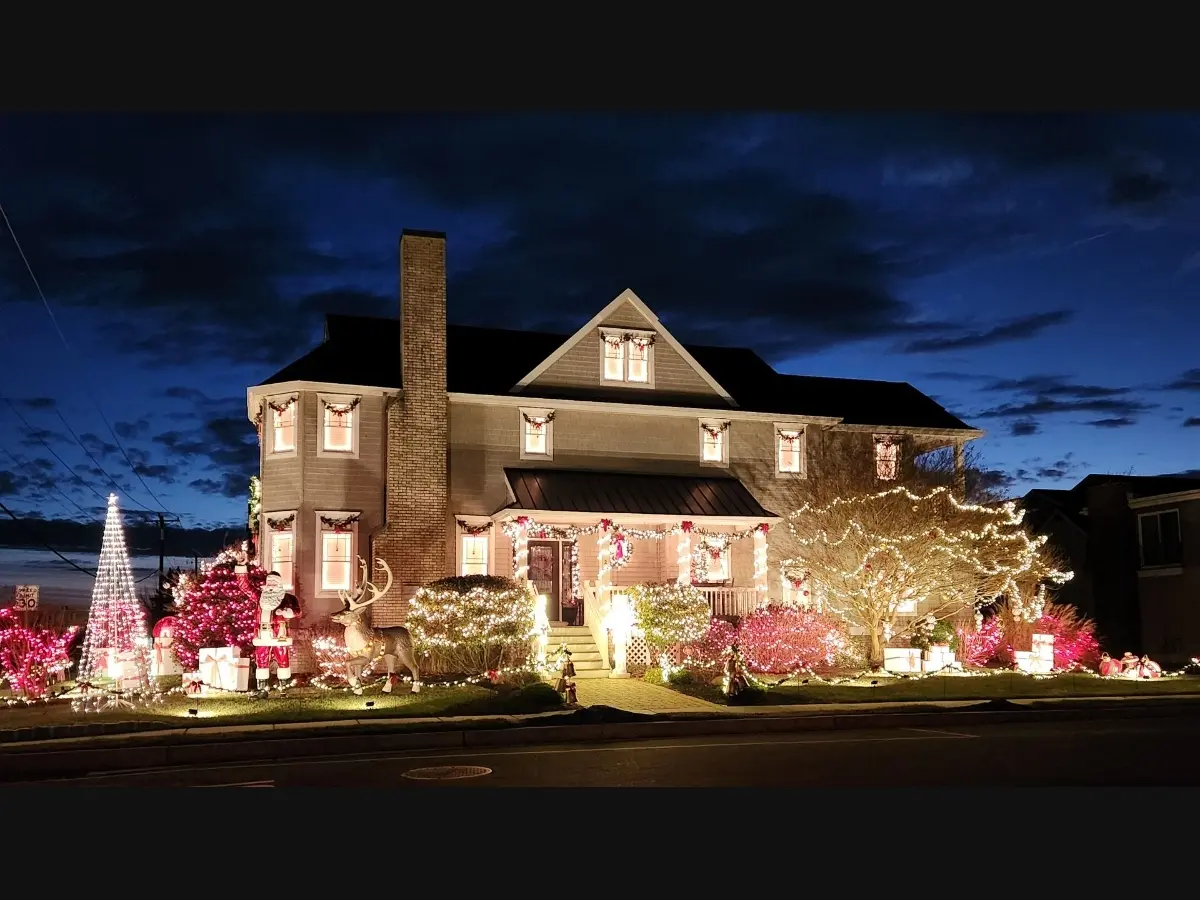
Total: $390–$960. Budget alternative: skip the individual figures entirely and put that money into the tree and the wrapped bushes — about $180 buys the same glow. Same outlining logic as Idea #2, warmer palette.
Think of this as 80% warm white, 20% red — and the 20% is the part people get wrong. Red goes low: bushes, the conical light-up tree, small figures near the ground. Warm white goes high: roofline, windows, porch. Invert it and the house looks bottom-heavy and slightly angry. Swapping palettes is easy inside the same math: 20% deep green reads traditional, 20% gold reads elegant. Keep the ratio, change the accent.
10. Classic Multicolor Outlining With Nothing in the Yard
Multicolor is back, and not by accident. The C7 and C9 color sets that defined the 1980s have been quietly reissued in LED form, and interest in vintage Christmas lighting has climbed steadily for three seasons running. What’s different in 2026 is the restraint: the same saturated palette, but only the architecture gets lit. No inflatables, no lawn clutter, no wishing-well fountain of light. It’s a maximalist color story told with a minimalist layout, which is exactly why it photographs so well.
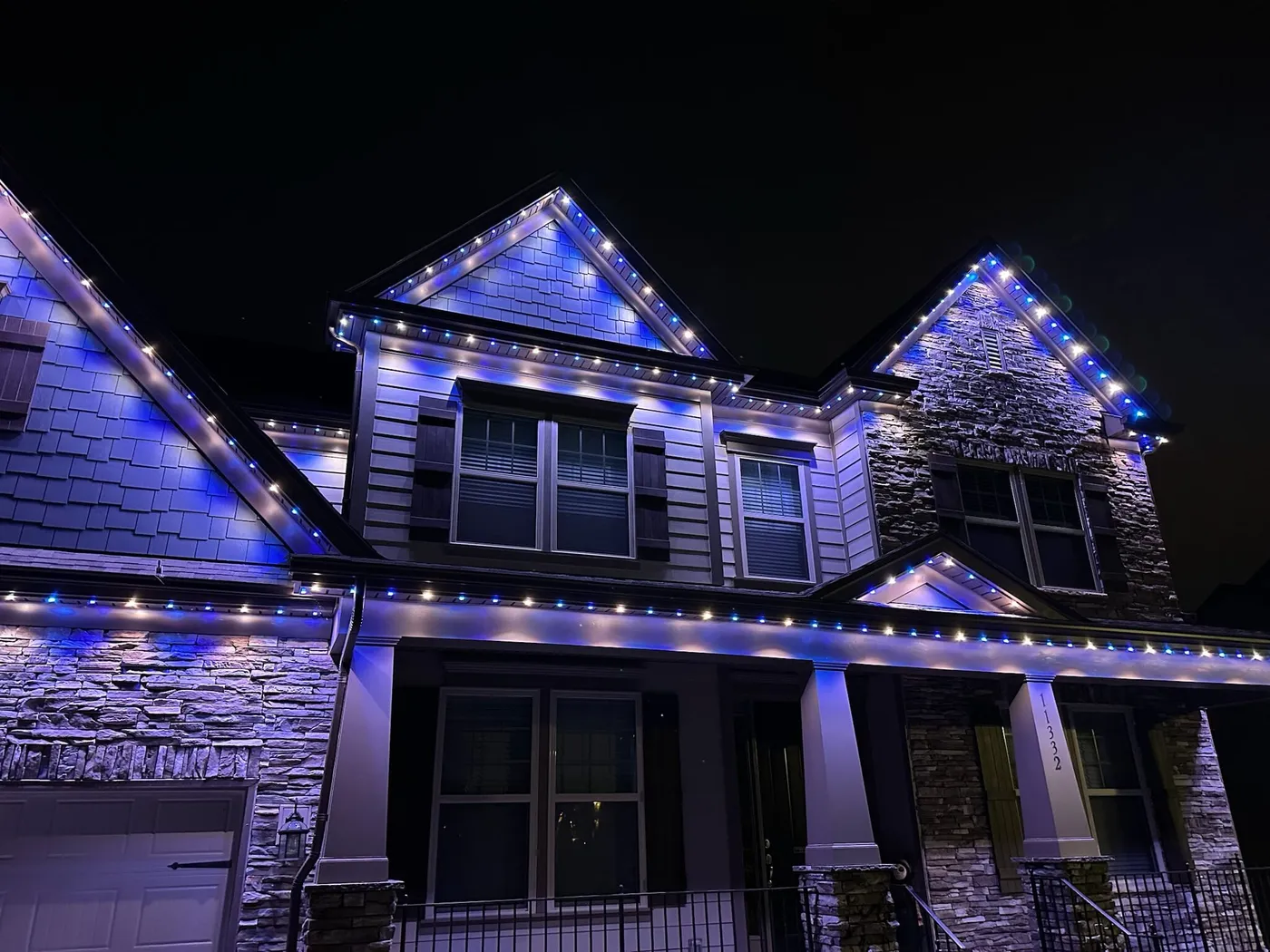
Multicolor outlining is also the least forgiving treatment for a dark facade. On navy, charcoal, or deep brown siding, saturated bulbs can muddy into a brownish blur from 30 feet away. Test one strand against your actual siding after dark before committing to 400 feet of it. Some house colors genuinely flatter a warm white outline better — and if yours does, that isn’t a compromise, that’s just your house talking.
11. Red-Bowed Garlands Framing an Arched Entry
For a standard arched entry you need 9 to 12 feet of garland, and the trick is doubling it: two strands twisted together read twice as full as one expensive strand. Wire in lights at 6-inch intervals — anything wider looks stringy in photographs. Add a single red bow every 3 feet, no more, and secure everything with clear zip ties so no wire shows against the cream siding. Put the biggest bow dead center over the door.
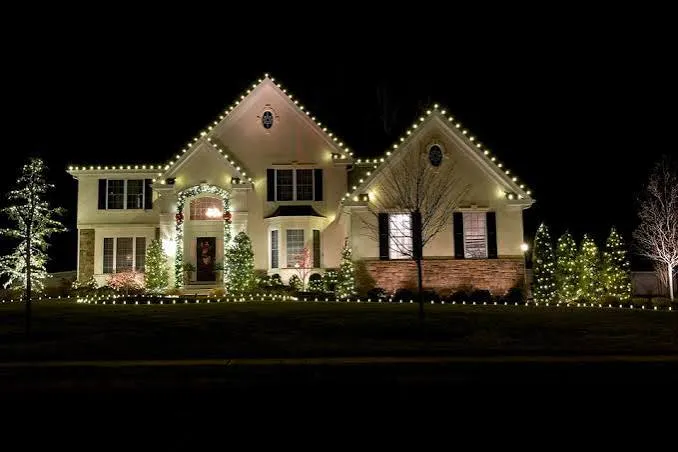
If you removed one element here, take away the roofline lights and the house still works. Take away the garland around the arch and it becomes a light display instead of a home. That’s the piece doing human-scale work — it’s the only thing at eye level, it tells you where the door is, and it signals that somebody actually lives here. Grand lighting impresses. A dressed entry welcomes. Aim for the second one.
12. A Lighted Yard Tree Beside a Snow-Capped Metal Roof
The star of this scene is one tree in the yard, and you don’t need anything custom to copy it. A 300-light net wrap at Walmart runs $18–$25 and covers a small ornamental tree in about 20 minutes. Warm white strings at Target are $9–$14 per 100 lights; three strands handle a 12-foot trunk and main branches. Check Facebook Marketplace in early December — barely-used net lights sell for $5 constantly. Total for this look: $60–$90.
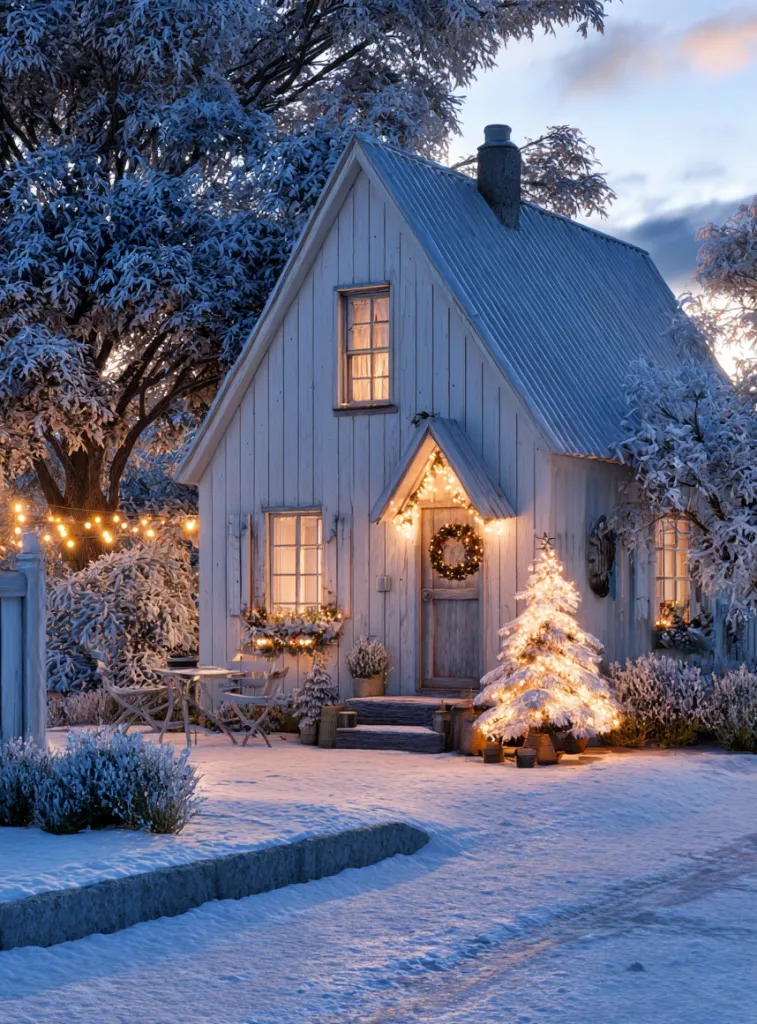
There’s a quiet balance happening. The house stays simple — one warm string run and a wreath — while the yard tree carries all the visual weight. If both were lit heavily they’d fight each other. The snow-covered metal roof matters more than it should, too: that pale matte surface reflects the warm glow instead of swallowing it, which is why white and metal roofs photograph so much warmer at night than dark shingles do.
13. Clear Acrylic Snowmen and Trees With Red Hats
- Group the figures in odd numbers — three large, five small — so the eye gets a hierarchy.
- Space them 18 to 24 inches apart; closer and they blur into one white blob.
- Push ground stakes in until the base sits flush with the grass, not hovering.
- Stagger heights so the tallest tree anchors the back and snowmen sit forward.
- Run one grounded cord to a splitter, then a smart timer set for dusk to 11 p.m.
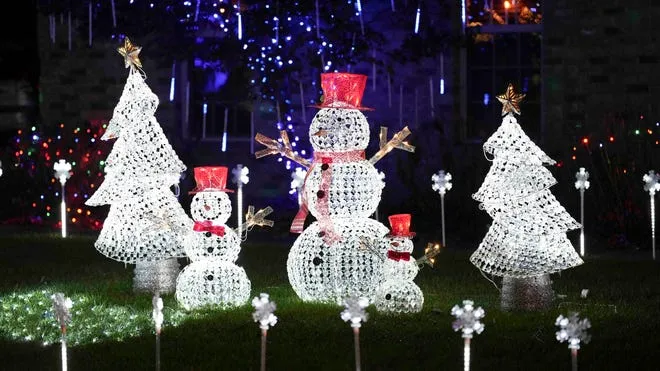
Time: 30 minutes. Cost: $25–$60 per figure.
Figure groupings need a front yard of at least 15 by 20 feet to breathe. Anything smaller and the snowmen crowd the walkway and start to feel like obstacles. Place the tallest piece at least 10 feet from the facade so it reads as its own vignette rather than a decoration stuck to the house. These also photograph best from 30 to 60 feet back — roughly your neighbor’s driveway — so compose for how it looks from the street.
14. Wrapped Shrubs That Read as Glowing Spheres
The ratio is 60% structure, 30% shrubs, 10% red accents. Structure means rooflines, gables, and window edges — the outline that gives the house a shape. Shrubs come next, wrapped completely so each one reads as a soft sphere of light at ground level. Red lives only in the wreath bows, tiny and deliberate. Swap that 10% for plaid ribbon and you have a farmhouse look; make it gold and it turns elegant. The 60/30 split doesn’t move.
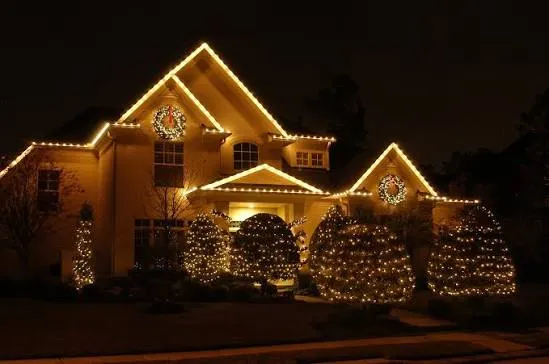
Wrapped evergreens look magical and hate it. Dense foliage traps heat, and a strand pressed against needles for six weeks can scorch inner branches — you’ll find brown patches in March and wonder what happened. Use LED strands only, remove the wraps by mid-January, and never cinch a zip tie around a trunk that’s still growing. If you love the look but not the risk, net lights on a lightweight wire hoop give the same glowing sphere with zero contact.
15. Color-Changing Roofline Lights on Old Brick
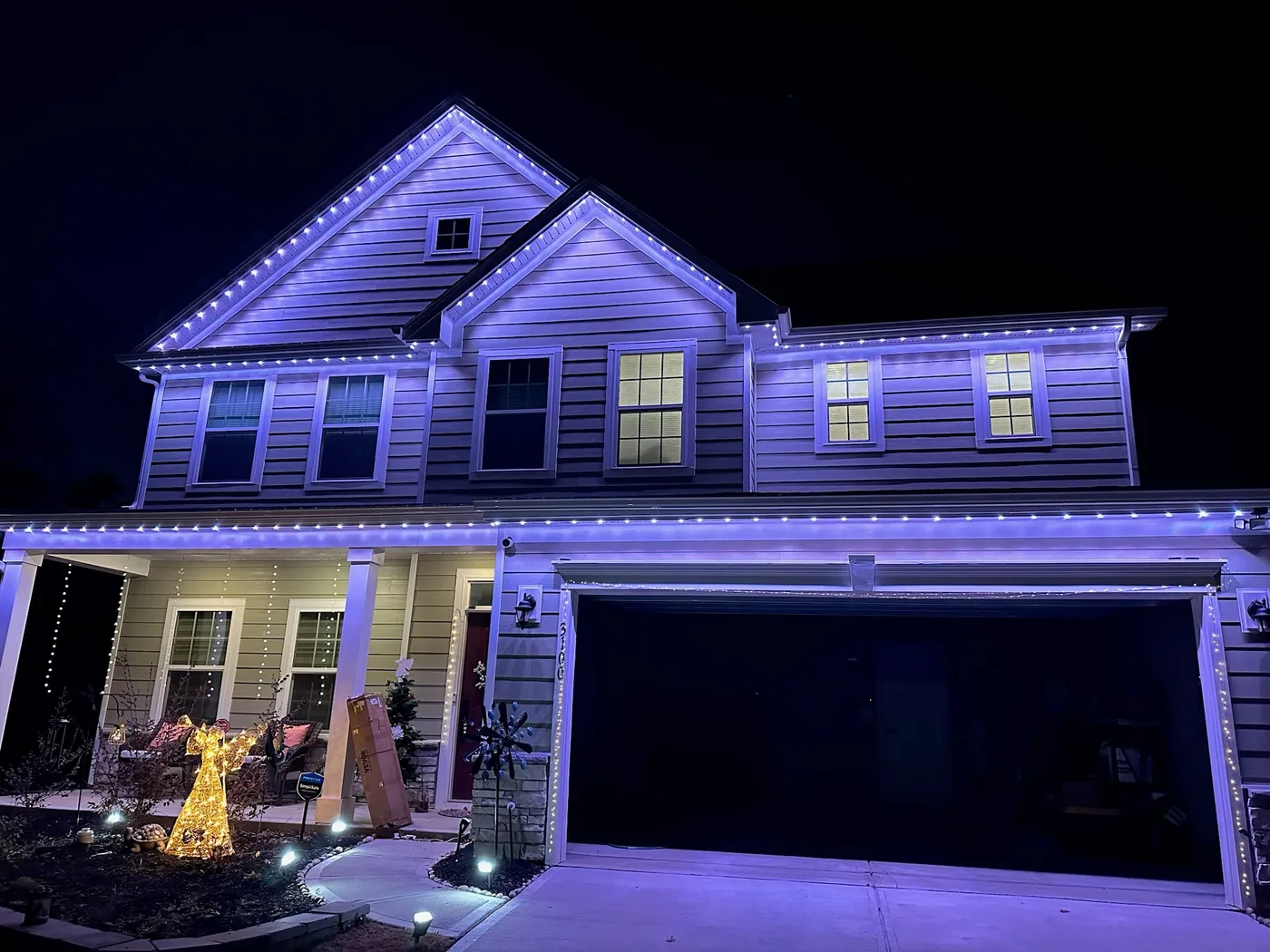
Buy RGBW chips, not RGB. The W is a dedicated white diode, and without it your warm white setting looks like washed-out lavender against brick. Look for 2700K white output, IP65 or better, and a controller that supports schedules. Then do this: set the default scene to warm white, save pink-and-purple as a separate scene, and put the whole run on a timer so the facade isn’t glowing at 2 a.m. One app, two moods, zero re-laddering in January.
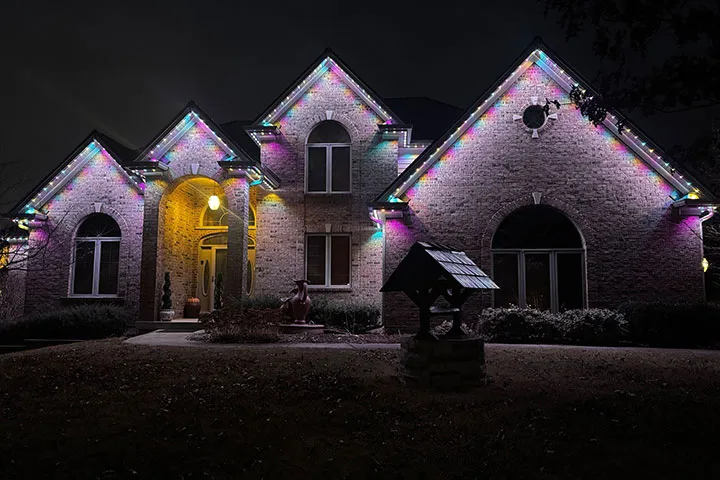
Smart color-changing lighting is the fastest-growing category in holiday decor, and 2026 is the year it stopped looking like a gaming setup. The reason is the chips — earlier RGB LEDs couldn’t produce believable warm white, so color-changing displays always read slightly radioactive. RGBW fixed that. Now you can wash a brick facade in pink and purple through December, then flip the same fixtures to candlelight warm. That’s why one purchase is replacing two.
16. Roofline Lights Above a Stone-Veneer Garage
You don’t need to light the whole house to get this effect — the run only covers the roofline and upper facade above the garage, and honestly, that’s enough. Two 100-foot spools of warm white LEDs from Home Depot run $30–$45 each. Add about $12 of gutter clips and a $15 timer and you’re done for under $100. If you’d rather go multicolor, Walmart’s 300-count sets are $19. Do the garage gable this year, the second story next year if the budget is tight.
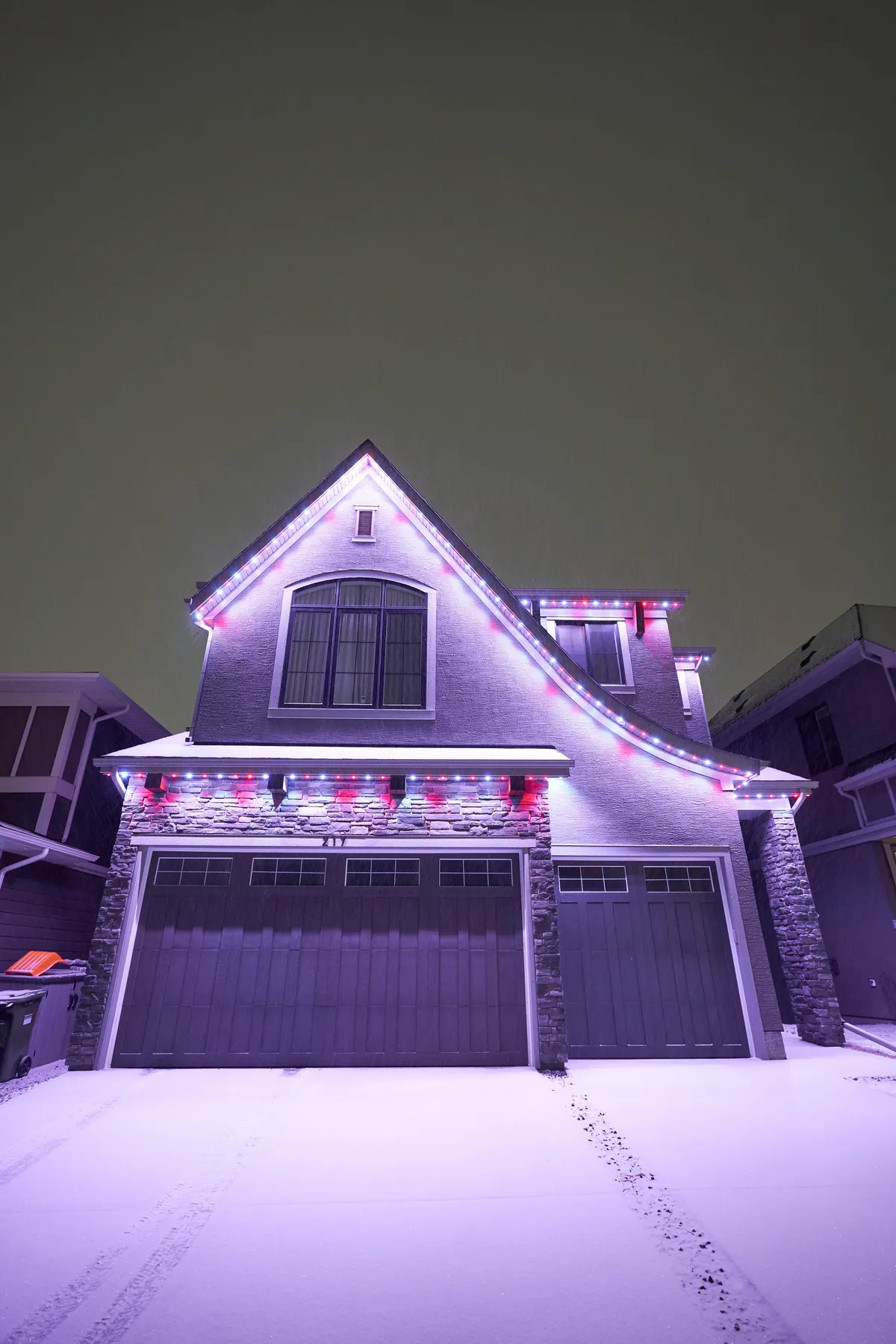
Two things to watch. First, snow and ice load: strands hanging loosely under an eave collect meltwater, freeze, and gain real weight. Secure them every 18 inches and they’ll survive the season. Second, garage door clearance — keep every cord and clip at least 12 inches back from the door’s travel path or you’ll hear a very expensive crunch in the dark. Check your strands after the first thaw; that’s when hidden cord damage shows up.
17. Icicle Lights, Lit Deer, and Spiral Trees in the Snow
- Warm white icicle lights, 400–600 ft — $160–$350
- Lit deer sculptures, set of three — $90–$260
- Spiral light trees, 4–6 ft, set of three — $70–$180
- Lighted gift box structures — $60–$150
- Clips, stakes, timers, outdoor cords — $60–$120
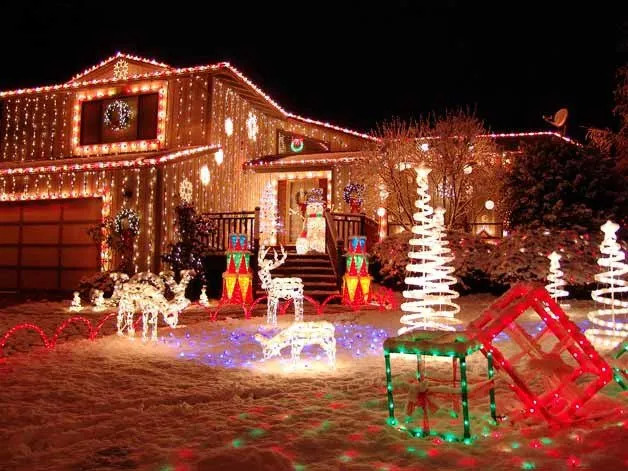
Total: $440–$1,060. Budget alternative: grab the deer set in the after-Christmas sales at half price for next season, and DIY the spiral trees by wrapping tomato cages — about $12 each instead of $45.
It’s a layering lesson more than a shopping list. The house wears icicle lights like a texture, not a spotlight. The deer and spiral trees sit in the midground at varying heights. The gift boxes anchor the foreground, low. Three depths, three scales — and because all of it shares one warm white tone, the density reads as abundant rather than chaotic. Multicolor figures in the same yard would collapse it into noise.
18. Garland Swags on a Light Blue Facade
- Measure the porch span and every swag drop point before buying a single strand.
- Confirm a GFCI outdoor outlet sits within 25 feet of the porch.
- Check that all strands are one color temperature — 2700K, same brand, same batch.
- Verify your ladder reaches the eave line without leaning past 75 degrees.
- Test every strand indoors for 10 minutes before it goes up.
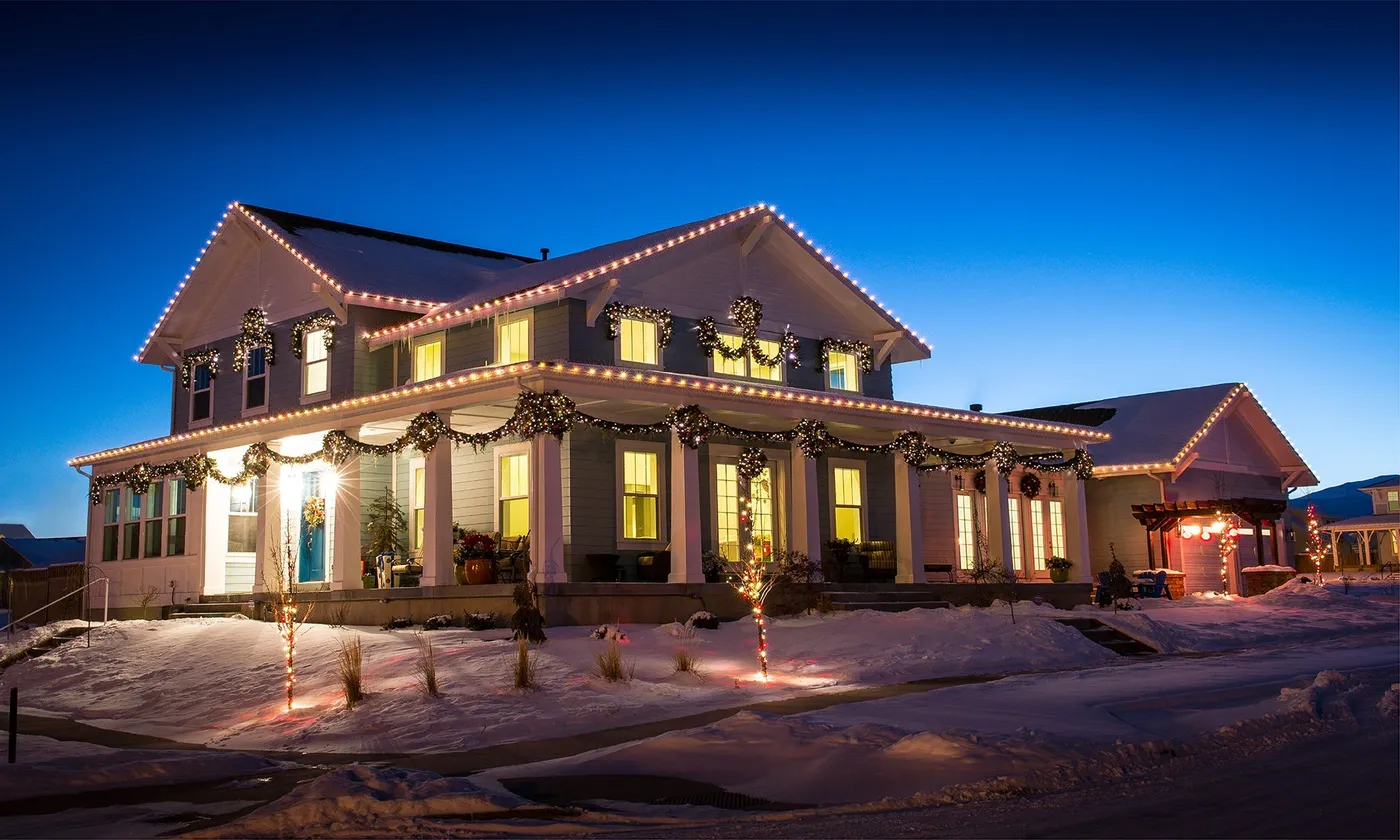
Buy all your lights at once, from one brand, in one order. Warm white is not a standard — 2700K, 3000K, and soft white are all subtly different, and mixing them side by side on the same railing is the number one reason a display looks off. If you must blend brands, keep them on runs that never touch. Swags should also dip 18 to 24 inches at their lowest point. Deeper looks sloppy; shallower just looks like a straight line.
19. Candy Canes, Dalmatians, and Light-Up Messages
Be honest about the time budget. A display at this density takes 20 to 30 hours to install, another 5 to troubleshoot, and roughly 8 to take back down. Storage is the other quiet cost — plan on two or three large bins, labeled by zone, so next year doesn’t start with a mystery pile. Themed figures also age fast; Dalmatians feel dated in three years while candy canes never do. Invest in the classics and treat trend pieces as a rental of your own money.
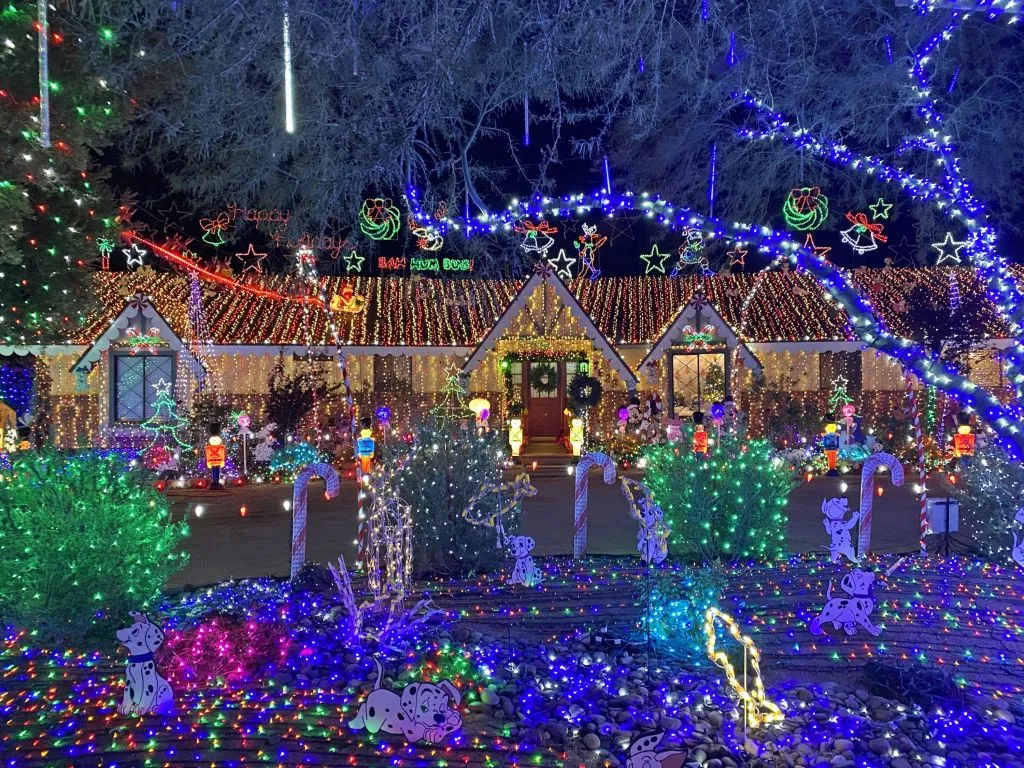
This level of decoration suits a single-story house in the 1,200–1,800 square foot range with 50 to 70 feet of frontage, where the display reads as generous instead of overwhelming. Lots under 45 feet lose the sense of arrival because the decor starts before you’ve seen the house. Keep walkway clearance at 36 inches minimum, too — a bright display shouldn’t become an obstacle course for delivery drivers or kids on bikes.
20. Lighted Garlands Wrapping the Porch Columns
Columns are the easiest win in holiday lighting because they’re vertical, close to the house, and at eye level. Wrapping them gives you a warm frame around the porch without touching the roofline, and it makes a large facade feel intimate. The ground spotlights grazing the brick are the second layer — they add texture rather than brightness, so the wall itself becomes part of the display. Wreaths hung at even intervals repeat the circle motif and keep the composition rhythmic.
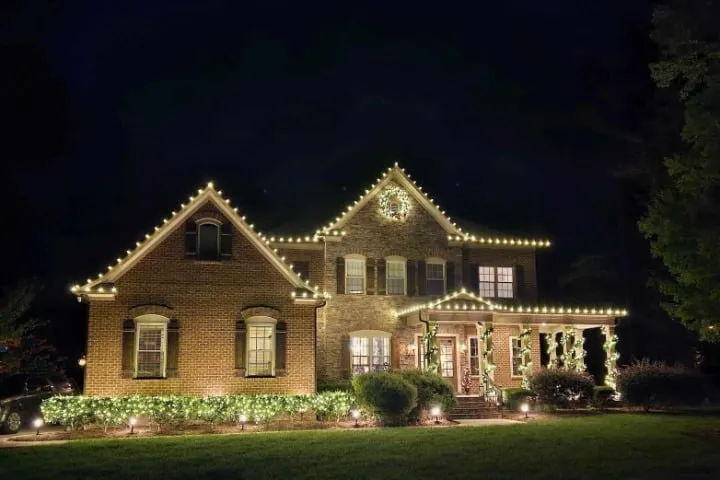
- Zip-tie a garland to the top of each column, then spiral downward at 12-inch intervals.
- Wind the light strand with the garland, not over it, so bulbs peep through the greenery.
- Hide the tail of every cord behind the column with a clear clip.
- Repeat on all columns at the same height — symmetry is what sells this one.
- Stake uplights at the wall base, 24–36 inches out, aimed up at 30 degrees.
Time: about 1 hour per column. Cost: $35–$60 per column.
21. A Cream Sectional Anchored by a Dark-Framed Fireplace
Mantel styling fails when it’s symmetrical and crowded. Here the entire arrangement is a small framed artwork, two small objects, and a plant on the hearth — maybe 25% of the available surface, with nothing mirrored. Keep art hung 4 to 6 inches above the mantel so it doesn’t look glued down, and leave at least a third of the mantel empty. The dark frame is the anchor; every pale thing around it is what makes it read as deliberate instead of accidental.
Cream 60, charcoal 25, warm neutral 15. The cream lives in the sectional, the textured throw, and the patterned rug. Charcoal shows up in the fireplace frame, and it’s the thing stopping the room from floating off into beige oblivion. The last 15% is the soft green and brown of the plant and floor tones. Swap charcoal for black and it sharpens; swap it for warm walnut and the whole room turns Scandinavian. Keep the 60/25/15 skeleton either way.
22. Wrapping the Big Bare Trees by the Porch
- Warm white strands for two large trees — $90–$220
- Porch eave, pillar, and railing lights — $80–$180
- Net lights for wrapped evergreen shrubs — $40–$90
- Wreath for the front door — $35–$120
- Stakes, clips, timers, cords — $45–$100
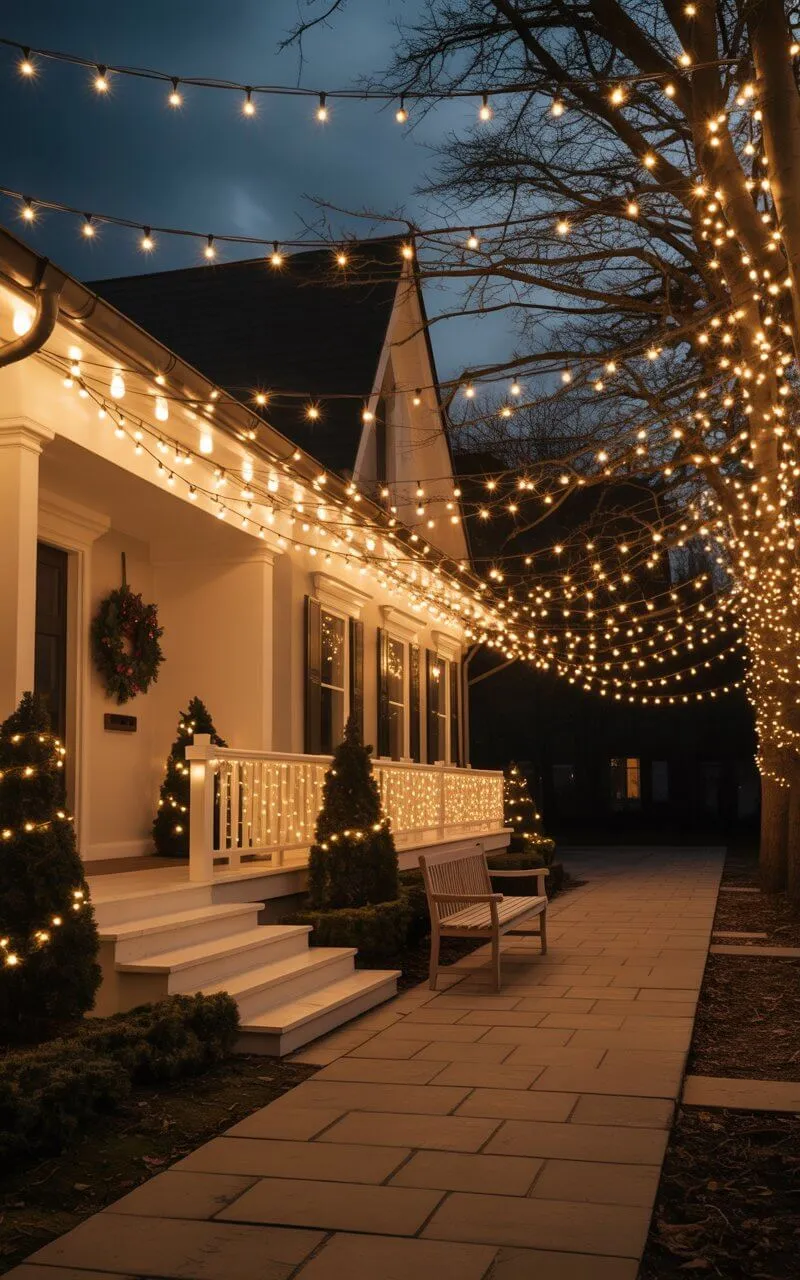
Total: $290–$710. Budget alternative: Walmart’s 100-count warm white sets at $9 each, three per tree, get you roughly 80% of the effect for about $55.
Wrapping a trunk is safe and reversible. Wrapping branches over about 4 inches in diameter is not — bark holds moisture, and a strand cinched tight for six weeks can leave a permanent groove. Stick to the trunk and the two or three lowest branches, use LED strands so heat stays low, and loosen the wrap after the first warm week of January. Expect to replace 10% of bulbs annually; tree wraps take more wind damage than anything else on a house.
23. Red-and-Green Outlining on a Snow-Covered Facade
Red and green together got a bad reputation for a while — too literal, too diner sign. In 2026 it’s back as a deliberate retro move, riding the same wave that brought back plaid ribbon and blown-glass ornaments. What changed is the application: outlining the architecture in two colors rather than scattering them looks graphic instead of kitschy. The oversized lighted wreath over the archway seals it by repeating the palette at a single focal point where the eye naturally lands.
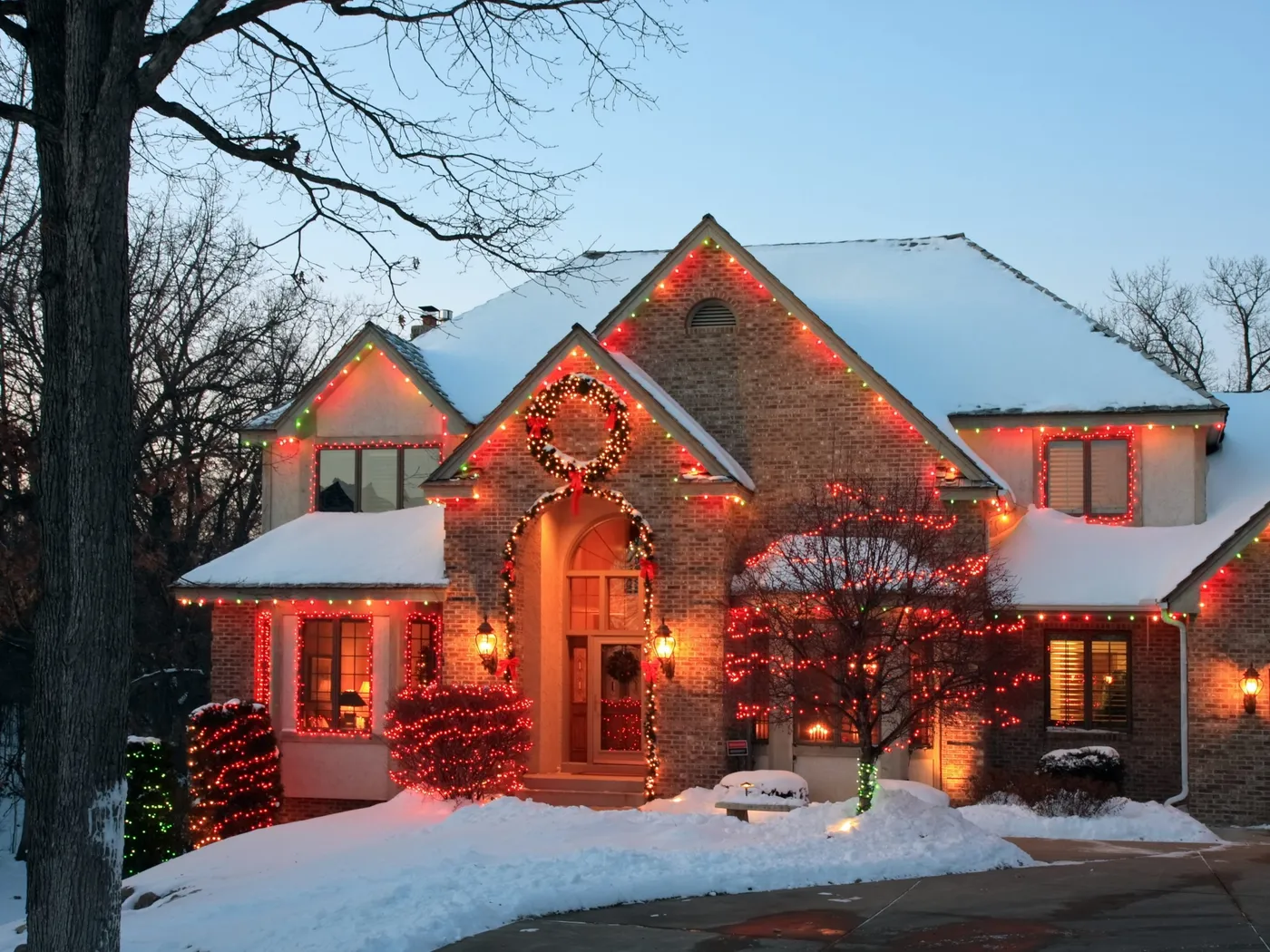
Two colors on brick is riskier than it looks. Red bulbs against reddish-brown masonry can disappear entirely — the light and the wall read as the same value, and you’ve paid for half a display. Green holds up better because it contrasts. Test one strand of each against your siding after dark before you commit, and consider swapping red for a deeper crimson or a warm amber if your brick runs orange.
24. A Lit Star Anchoring the Upper Facade
- Find a solid fastening point — a stud or the siding’s nailing flange, never a drywall anchor.
- Use a flat metal hook rated for at least 5 lbs, hidden behind the star’s top edge.
- Hang the star on clear monofilament rather than wire so it disappears at night.
- Route the cord along the window trim and secure it every 12 inches.
- Point the cord down, never sideways, so water runs away from the connection.
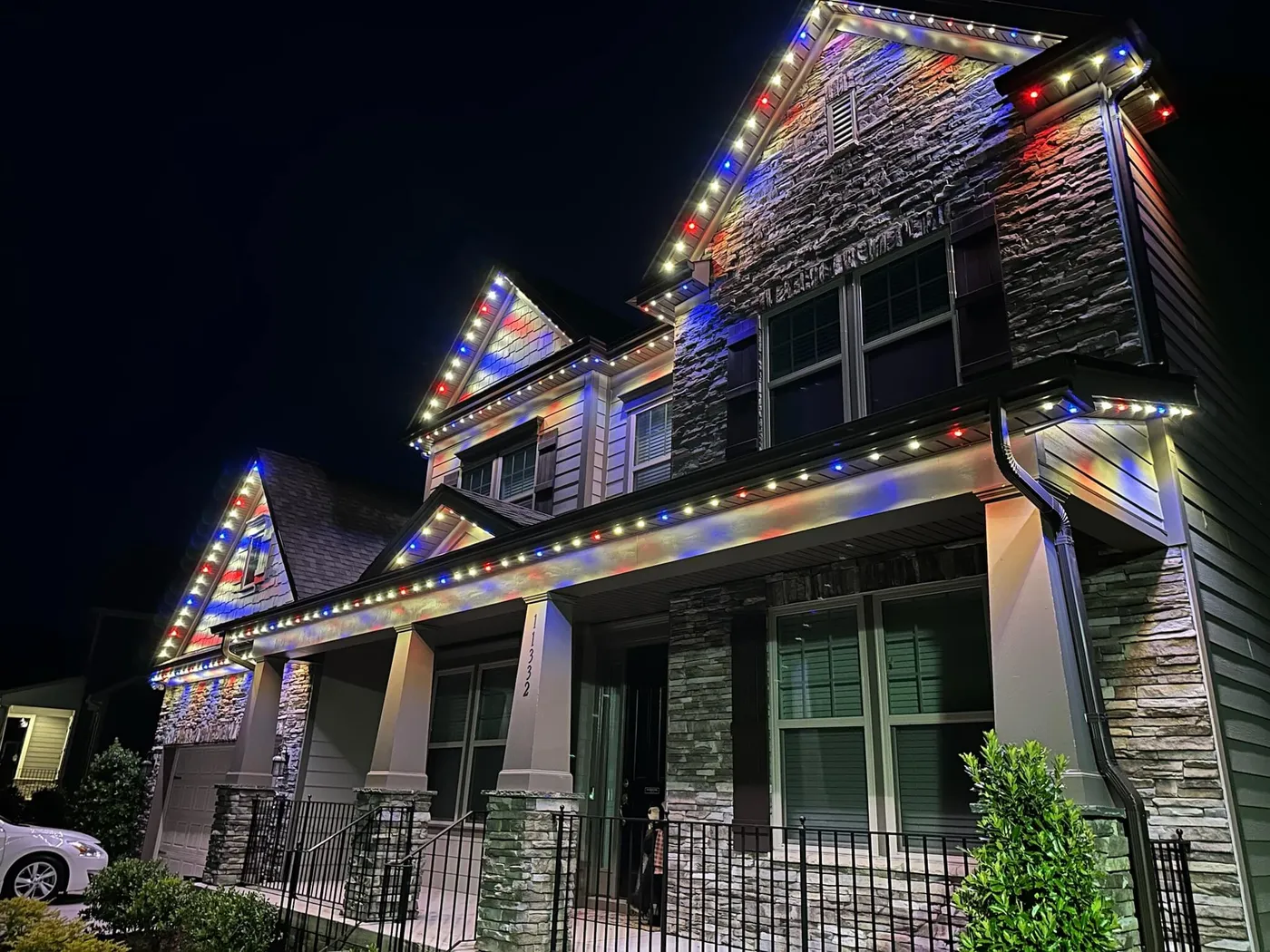
Time: 40 minutes. Cost: $35–$120 for the star, about $10 for hardware.
Star size scales with your facade, not your enthusiasm. On a 20 to 30 foot wide front, a 24 to 36 inch star reads as a focal point; smaller disappears, larger starts looking like a billboard. Hang it at roughly two-thirds the height of the upper story so it sits visually centered, and center it horizontally on the gable or window stack. Under 20 feet wide, drop to an 18-inch star and let the icicle lights carry the rest.
- Confirm the fastening point holds 5 lbs without flexing.
- Make sure the star’s cord reaches an outlet without a run across the facade.
- Check that the door wreath is proportionally smaller than the star.
- Verify the star won’t block attic vents or a window sightline.
25. Outlining the Dormers, Then Wrapping the Big Tree
- Warm white strands, 1,000+ ft for a house this size — $240–$520
- Tree wrap for one large bare tree — $60–$140
- Wreath with red accents for the front window — $45–$130
- Commercial clips, stakes, timers — $70–$150
- Professional installation for a three-story roof — $800–$2,500
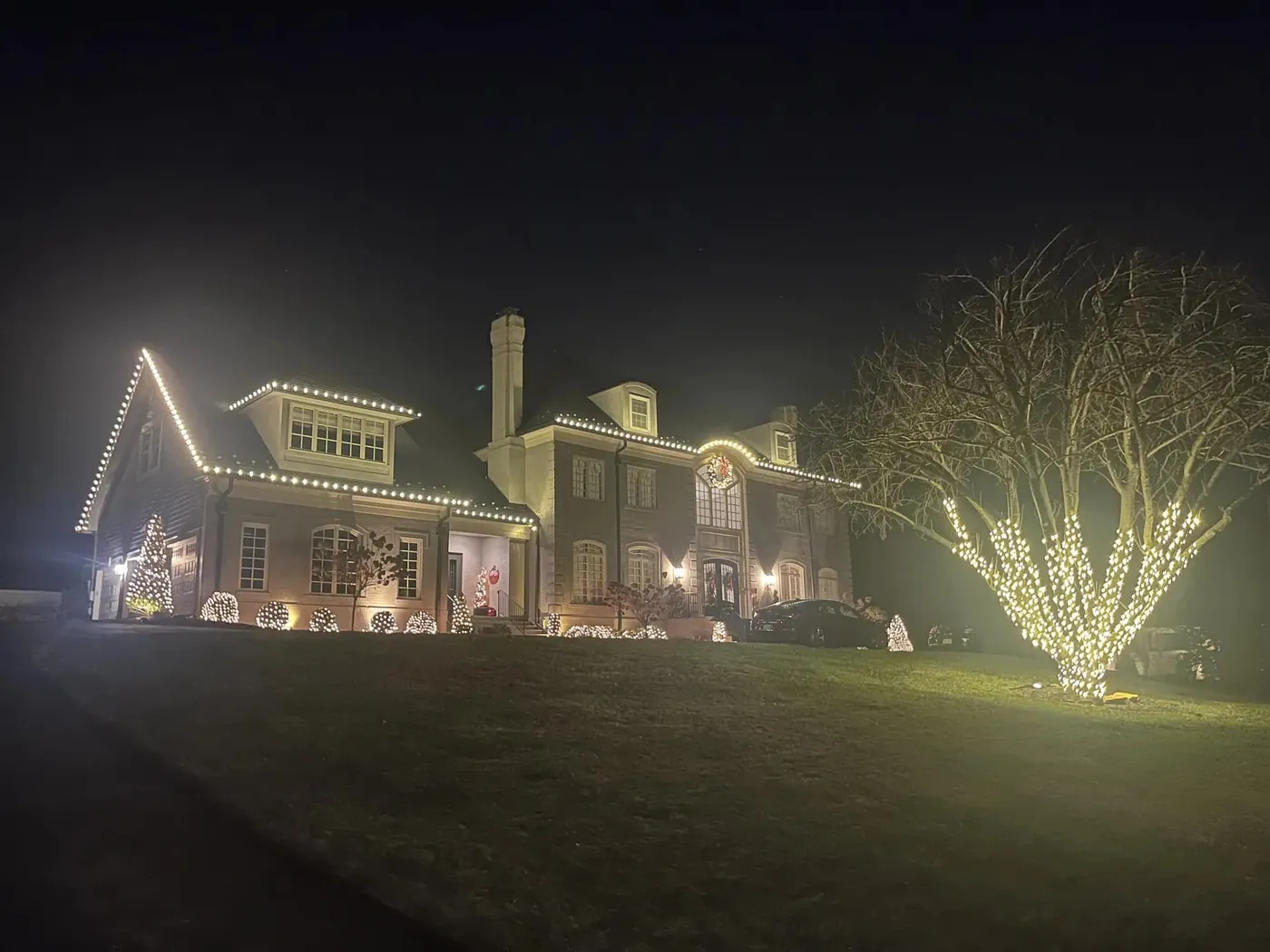
Total: $415–$3,440 — that enormous range is almost entirely about whether you’re climbing. Budget alternative: light the front-facing rooflines and the tree only, skip the sides, and save roughly 40%.
The wrapped tree in the foreground is the piece that makes this composition work. It’s a frame, not a decoration. Without it, the house floats in the dark — bright shape, no context, nothing for the eye to move past. The tree gives you a near element, the house becomes the middle distance, and the night sky becomes the backdrop. That’s a three-layer painting, and it happened because somebody wrapped a tree most people would have ignored.
26. Snowflake Lights Around Every Window on Stone
- Attach brick or masonry clips to the mortar joints — never drill stone or brick.
- Space the window snowflakes 4 to 6 inches out from the frame so light washes the sill.
- Use one clear cord per window and route them along the same line for a tidy look.
- Group by size: large over the entry, medium at eye level, small up high.
- Plug everything into a single smart plug on a dusk-to-midnight schedule.
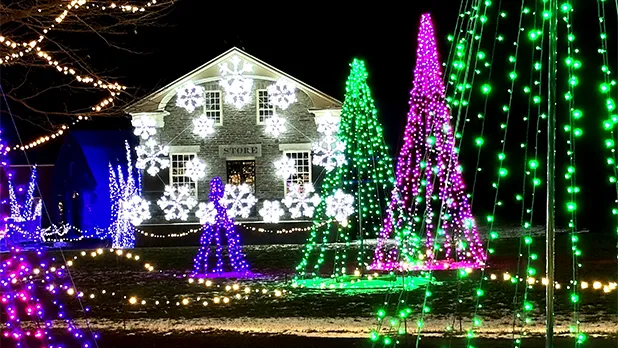
Time: 30 minutes per window. Cost: $8–$25 per snowflake.
Snowflake motifs are also the easiest thing to make yourself. Bend 24 inches of white zip ties or heavy floral wire into a six-point shape, then wind a $6 strand of 50 white LEDs around the frame. Per snowflake: about $12 instead of $40 to $60 store-bought. For the conical light trees, a tomato cage plus two green LED strands gets a near-identical silhouette for $14. After dark, nobody can tell the difference.
27. Warm White Outlines on Graphite Stone and Cedar
Modern architecture and Christmas lights usually have a strained relationship, and the fix is discipline. This house uses exactly one treatment: a precise warm white outline along every roof edge and overhang. No icicles — their drips fight the straight lines. No yard figures — they’d fight the restraint. The gray stone and warm brown paneling already supply the contrast, so the lights just trace the geometry. It’s the difference between decorating a modern house and arguing with it.
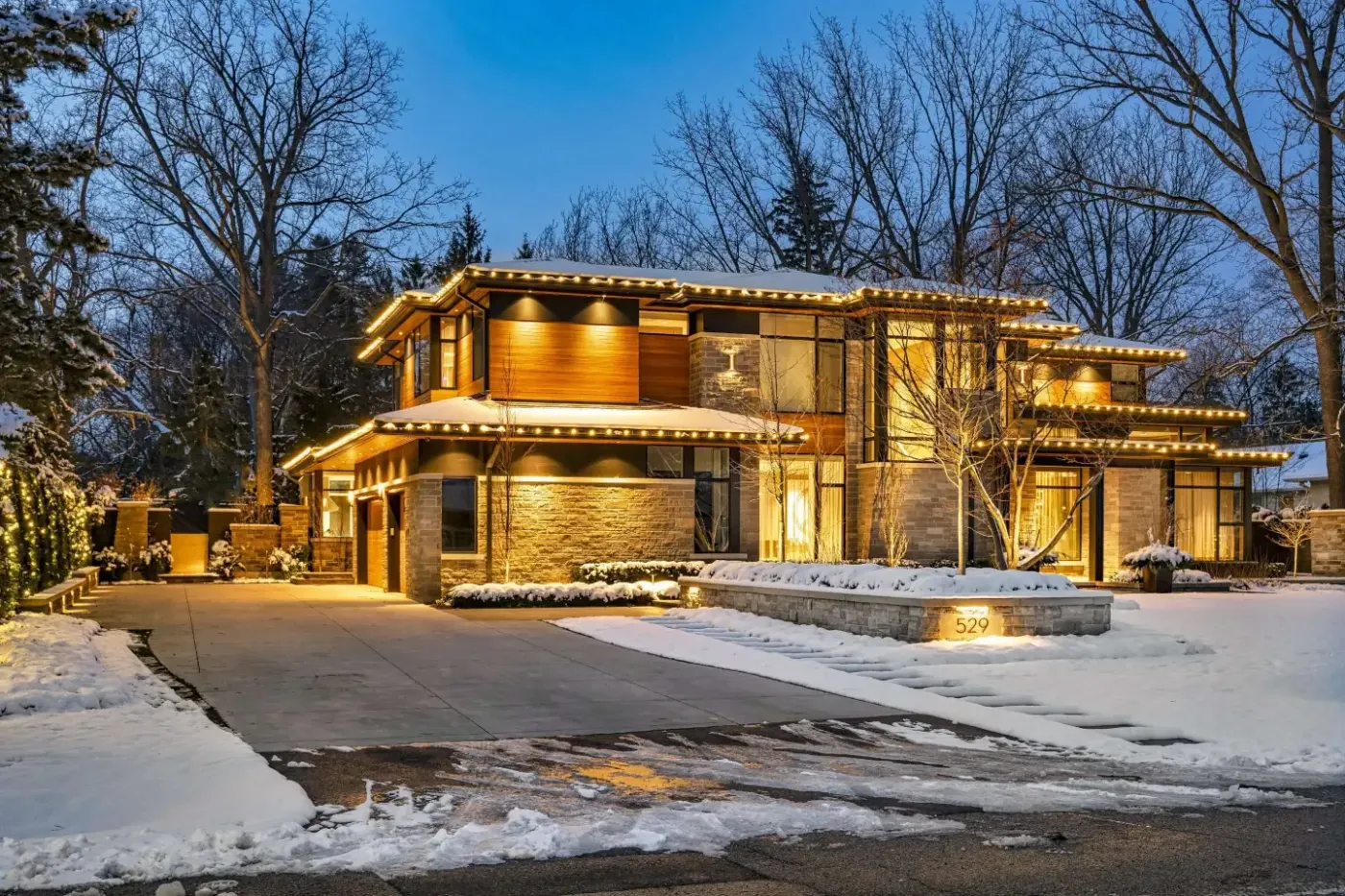
Roughly 70% of the glow comes from the exterior roofline strands, 20% from warm interior light spilling through the black-framed windows, and 10% from snow reflecting it all back. That interior light matters more than people think — a dark-windowed modern house looks abandoned no matter how good the exterior is. Warm lamps on timers cost you nothing and add an entire layer. Compare with Idea #4 — same logic, one bold color added.
28. Two Glowing Triangle Towers Flanking the Entry
- Measure the entry width so the two triangular structures stay symmetrical.
- Confirm planters weigh 15 lbs minimum, or stake them for 30 mph wind.
- Check for an outlet on both sides of the entry, or plan a cord path.
- Verify the towers don’t block the door swing or porch steps.
- Make sure planter bases drain so meltwater doesn’t pool around cords.
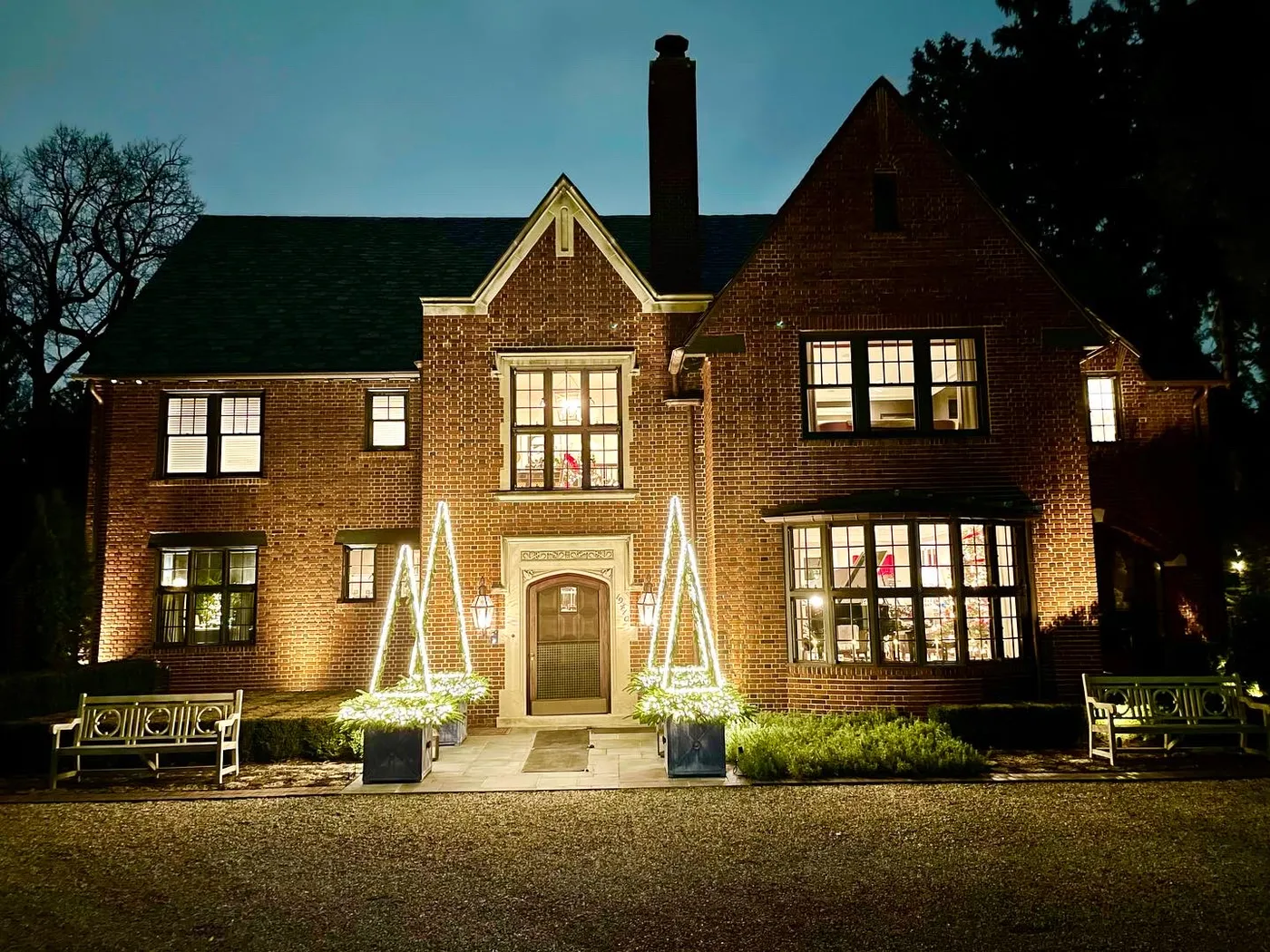
Uplighting is what makes brick look expensive, and the setup is simple math. Stake the fixture 24 to 36 inches out from the wall, aim it up at about 30 degrees, and keep the beam narrow enough to graze the surface rather than flood it. Grazing light throws tiny shadows in the mortar, and those shadows are the texture you’re paying for. Two fixtures per story, spaced evenly from the corners, is almost always enough.
29. Red Starbursts, Gingerbread Cutouts, and Candy Canes
The DIY version of this is genuinely fun. Cut candy cane shapes from white corrugated plastic — about $8 a sheet at any hardware store — outline with red LED rope light at $18 per 10 feet, and you’ve got eight-foot canes for roughly $20 each instead of $80. Gingerbread cutouts from the dollar store, painted and sealed with clear coat, run about $3 apiece. Light-up lollipops are $5 at Walmart in the seasonal aisle. You could build this whole theme for under $250 with an afternoon and a glue gun.
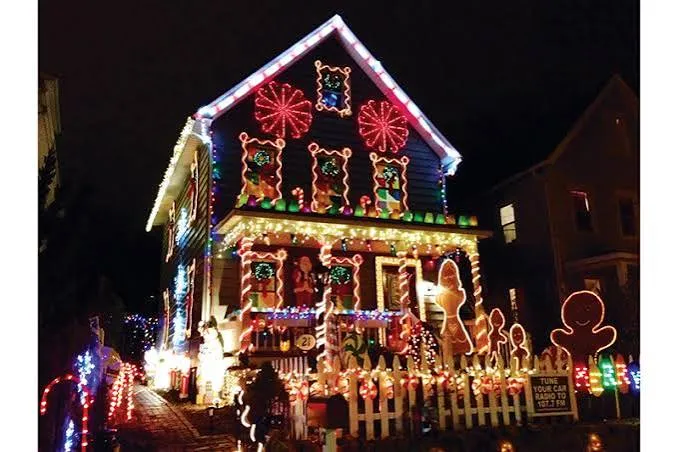
The failure mode here isn’t money, it’s coherence. A themed display works when every piece belongs to the same story; add one inflatable dinosaur and the whole thing deflates. Decide your theme in October, buy within it, and say no to the clearance aisle in November no matter how cheap it gets. Budget your takedown time too — this takes a full weekend to pack, and loose gingerbread cutouts will not survive the year.
30. A Lit Sleigh and Reindeer Set on the Front Lawn
Figure groups need distance to read. A reindeer and sleigh vignette wants at least 12 feet of clear lawn between it and the facade, plus 20 to 30 feet of viewing distance from the street for the proportions to land. Rule of thumb: no single figure should exceed one-fifth of the facade’s height, or it starts competing with the house instead of complementing it. On a lot under 50 feet wide, use three reindeer and skip the sleigh. See Idea #17 for a denser version of this.
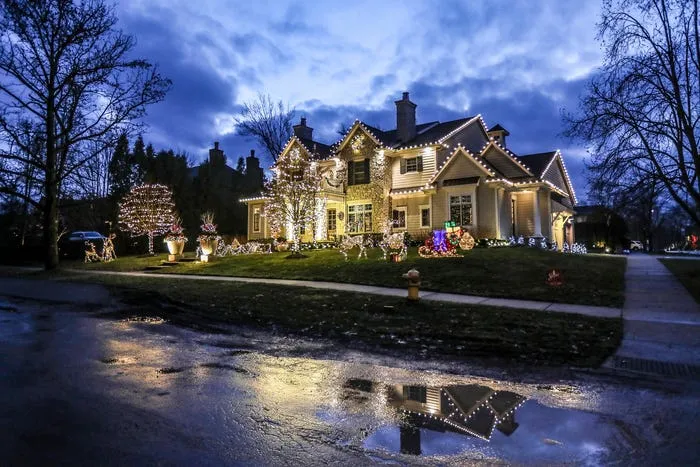
The magic here is that the reindeer and sleigh are staged as one scene rather than scattered across the yard. That grouping creates a narrative — they’re arriving, they’re carrying something — and it gives the composition a focal point the eye can rest on. Separated by 20 feet, the same figures become random objects that happen to light up. Buy the set together, place it together, and angle it slightly toward the street.
31. An Oversized Wreath on a Dark Front Door
Wreath sizing is simple math almost nobody does: measure your door width, then choose a wreath that’s 50 to 60% of it. On a standard 36-inch door that’s an 18 to 22 inch wreath — bigger than most people buy, and it’s exactly why store-bought wreaths so often look apologetic. Hang it so the top of the ring sits about a third of the way down from the door’s top edge, and use a clear over-the-door hook. On glass doors, fishing line on a suction cup beats a metal hanger every time.
Real wreaths shed. Fresh evergreen drops needles for the first two weeks, needs a water source or soaked liner, and looks tired by New Year’s if it sits in direct sun or near a heat vent. Faux wreaths hold their shape for years but fade — expect to replace or repaint one every four or five seasons, especially reds. Store it in a bag rather than a box, keep it off the garage floor where moisture finds it, and a $4 wreath bag doubles its life.
Plug In, Step Back, and Watch the Street Slow Down
Whether you’re outlining a single gable this weekend or wrapping a three-story Victorian like it’s a gift, the whole point is that warm glow hitting the snow at 6 p.m. on a Tuesday in December. Start with one zone, get the color temperature right, and let it grow year by year — nobody’s display came together in one trip to the store.
📌 Pin your favorite from this list so you can find it again when the ladders come out — and tag us when your roofline lights up.