31 Stunning All Red Christmas Tree Ideas for 2026 That Will Make Your Holiday Season Unforgettable

All-red Christmas trees are quietly taking over Pinterest right now — and once you see one styled well, the classic red-and-green thing starts to feel like a compromise. We spent serious time browsing Target, Michaels, Walmart, and Home Depot to bring you only what’s worth your attention this year, and we pulled ideas ranging from about $6 for a box of baubles to $450 for a full flocked tree. Inside you’ll find 31 curated ideas covering all-red maximalism, burgundy elegance, flocked traditional looks, and vintage novelty ornaments — with budget and luxury versions compared side by side, plus direct product links when you’re ready to shop. In 2026, the shift toward single-color trees has gone mainstream: people want one bold statement instead of six competing palettes. And stay until the end — we break down the most common mistakes that can ruin these looks. 📌 Save this to Pinterest for later — you’ll want to revisit these ideas.
Heads up: this post contains affiliate links. If you buy through them, we may earn a small commission at no extra cost to you.
1. Red Magnolias and a Lit Village at the Base
Floral picks are the fastest way to make a tree look collected rather than purchased. Tuck 8- to 10-inch red magnolia stems at a 45-degree downward angle, spacing them about 6 inches apart so a few brush the branches behind them. Keep flowers to roughly 15 percent of the total ornament count — past that, the red baubles and the gold and pale blue pieces disappear and the tree starts reading as a bouquet instead of a Christmas tree.
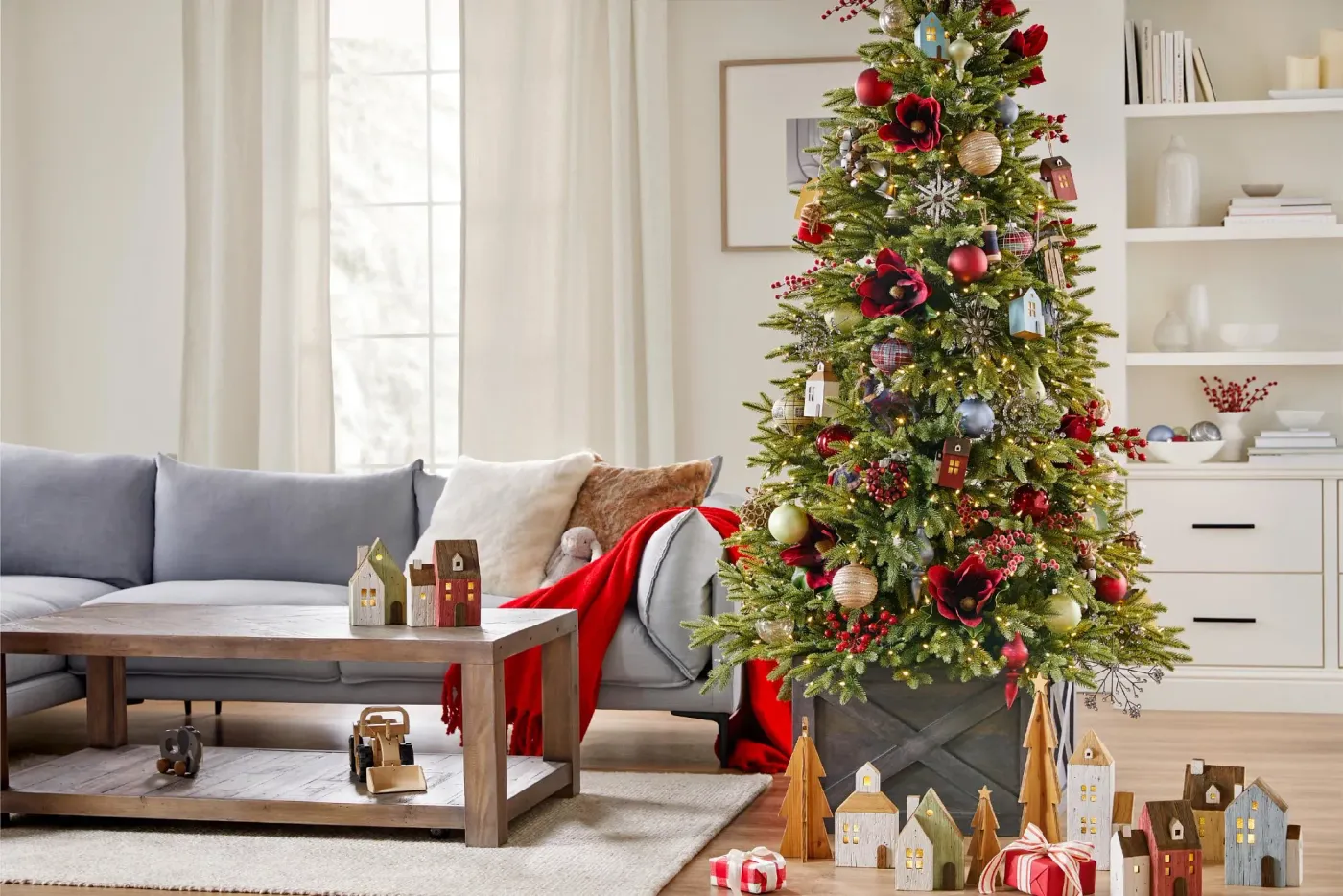
The lit wooden village at the base is doing more work than anything on the branches. Take it away and you have a tall object in the corner; keep it and the eye travels down, and the whole corner becomes a scene. Cluster the little houses at staggered heights on a low board or runner, and keep the tallest one off-center — a perfectly even row of houses looks like a train set, not a village. The red throw on the sectional picks that red up again across the room.
2. All-Red Ornaments in Every Finish, One Single Color
An all-red tree works for the same reason a monochrome outfit does: with color out of the equation, texture has to carry everything. Here the contrast comes from finish rather than hue — glossy baubles catching the string lights, matte ones absorbing them, glitter throwing light back into the branches. Get that mix right and one color reads richer than five. Get it wrong and you have a red blob with no depth at all.
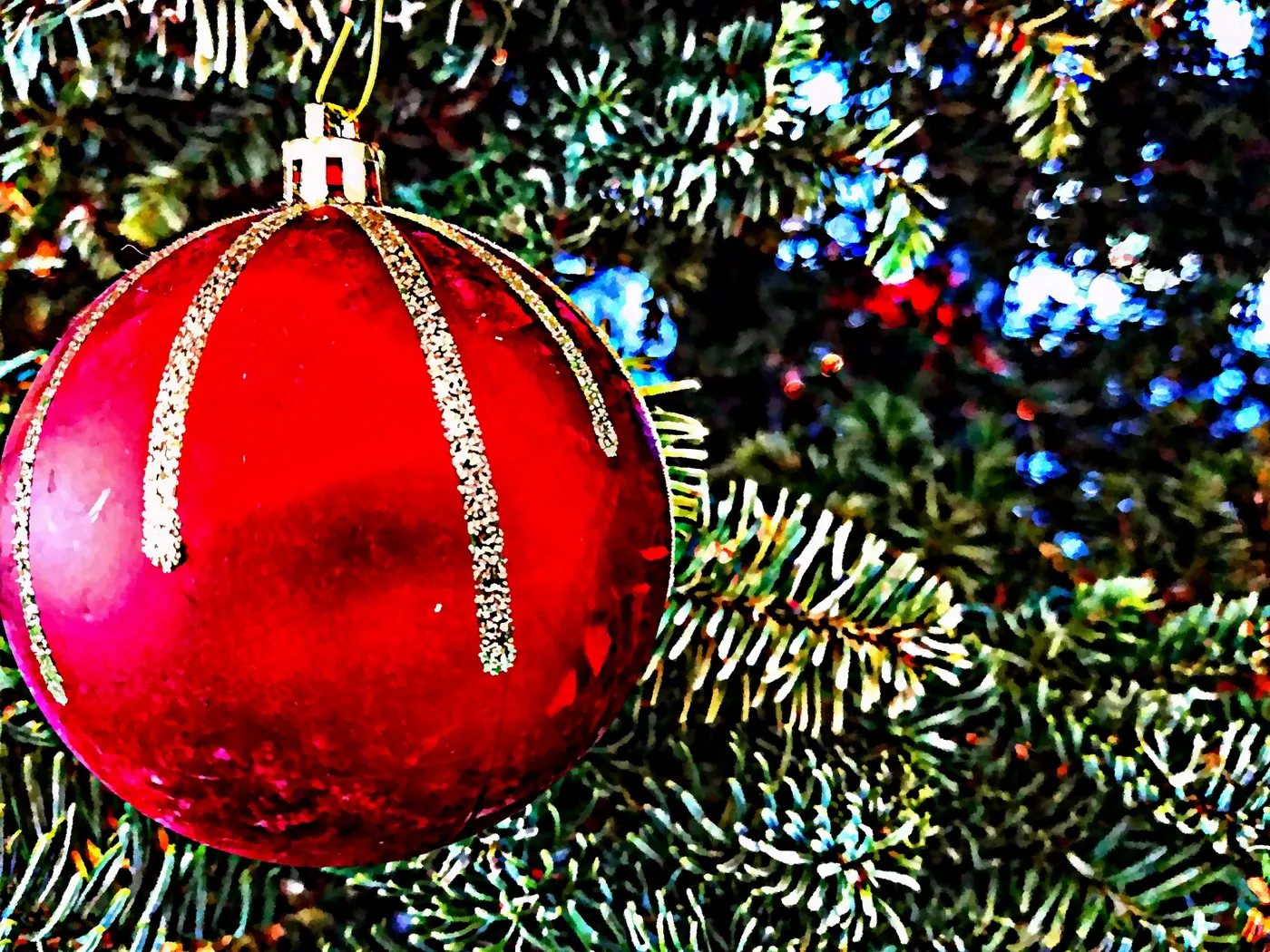
You don’t need designer ornaments to pull this off. Walmart’s 30-count red ball sets run about $10–14, dollar-store shatterproof balls are roughly $1.25 for six, and Facebook Marketplace is full of people offloading last year’s red collection in January for $15 a box. Budget $60–90 for a 7-foot tree. Spend the savings on more lights — they do far more for this look than expensive baubles ever will.
3. Burgundy Tree with Olive, Gold and Dark Purple
Think of it as 55 percent burgundy tree, 25 percent mixed metallics, 15 percent deep olive and purple accents, 5 percent natural woven texture. That last 5 percent is the basket collar, and it’s what keeps a colored tree from looking like plastic. To swap the mood, hold the formula and change the metals: brushed gold with olive goes moody and vintage, bright brass with emerald goes jewel-box.
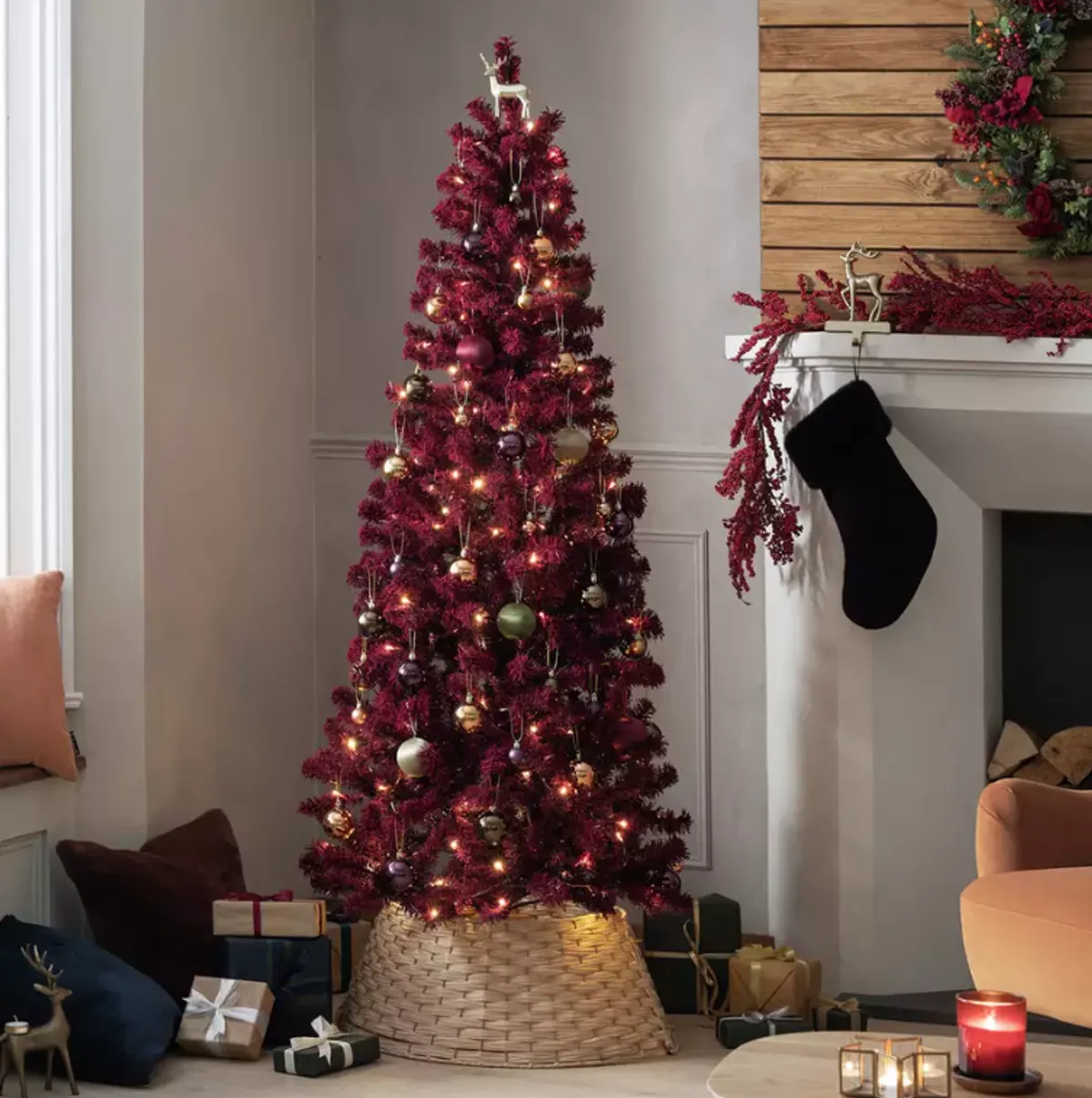
String the lights before a single ornament goes on, and light from the inside out. For a 7.5-foot tree, run 700–900 warm white minis on the trunk and inner branches first, then make a final pass on the outer tips — that inner layer is the depth you can’t fake from outside. Skip cool white LEDs entirely here; 2700K is the only temperature that flatters burgundy, and anything cooler turns it muddy brown.
4. A Red Disco Ball on a Frosted Teal Tree
The faceted mirror finish is the entire trick. A matte red ball would vanish into these frosty teal branches; a disco ball bounces the blue-green needles and the silver-tipped frost right back at you, so the ornament looks lit from within. Hang the mirrored ones where the tree gets its brightest light — usually the outer third, around chest height — and let matte red ornaments fill the shadowed middle where nothing will catch anyway.
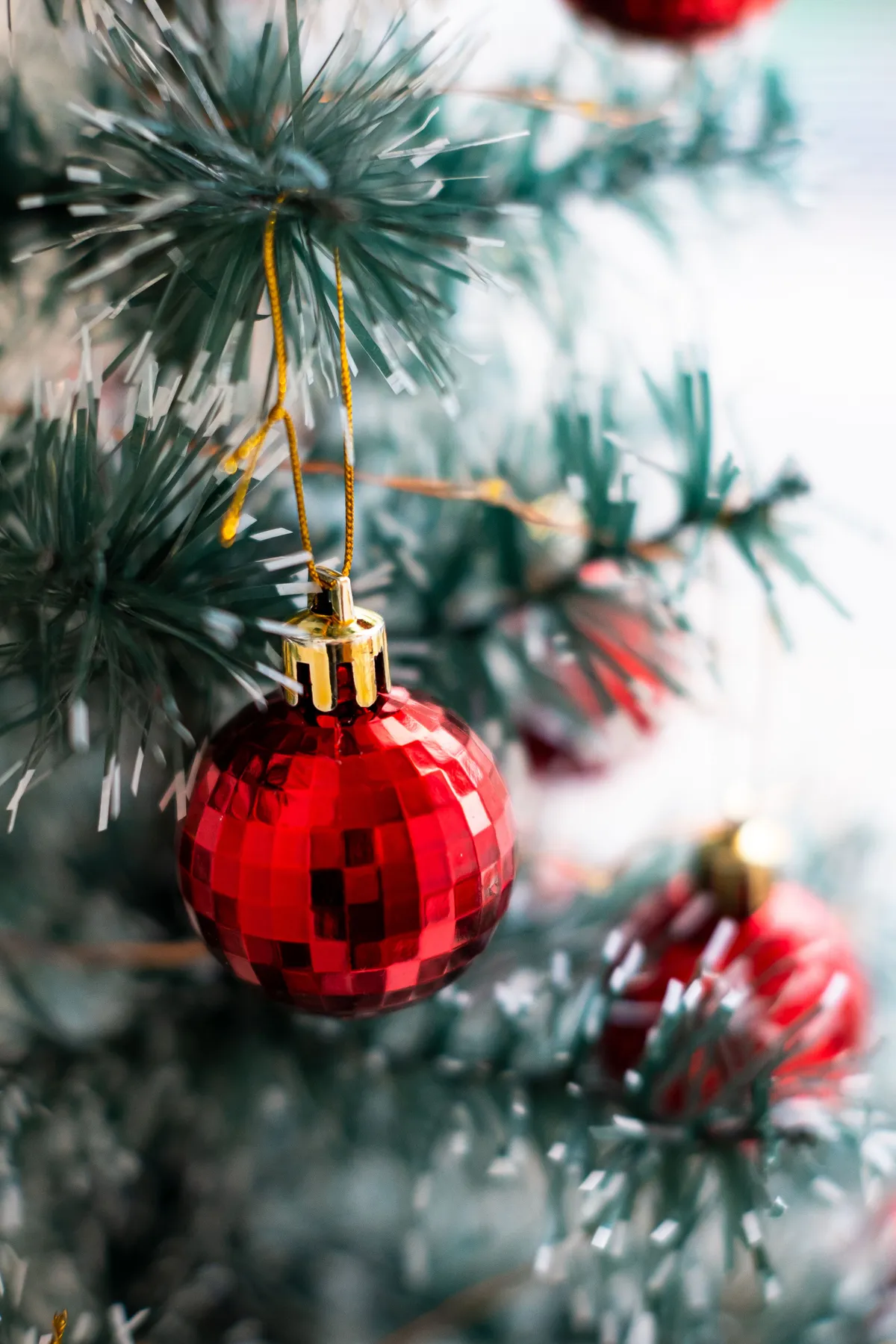
Off-palette pairings like red and teal are a big part of why 2026 trees look different from a decade ago. The frosted-tip tree and that unexpected cool tone give an all-red scheme something to argue with, and Pinterest saves on unexpected Christmas color combinations have been climbing since maximalism took over holiday decor. It has staying power because the underlying idea — one loud color against one quiet one — never really dates.
5. Deep Red Glass, Candle Clips and a Gold Pot
- Tree, 7.5 ft unlit: $120–$300
- Deep red and ribbed clear glass ornaments (60–80): $90–$180
- White clip-on candle lights (12–20): $30–$70
- Warm white string lights, 800 count: $25–$40
- Metallic gold tree pot or collar: $35–$80
- Bead garland and ribbon accents: $20–$50
- Budget alternative: shatterproof red glass-look balls ($40) plus LED clip candles from a dollar store ($20).
Total: roughly $320–$720
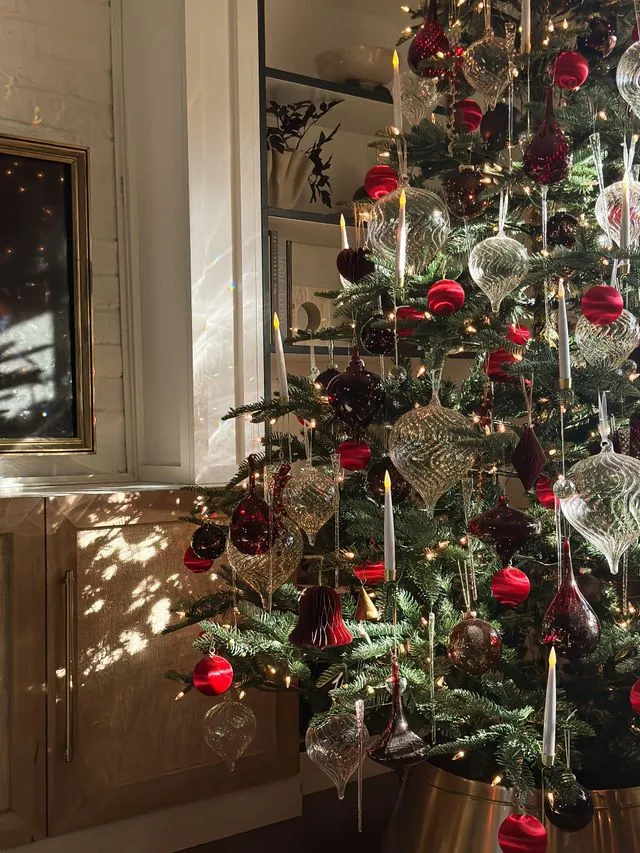
Those clip-on candles are lovely and slightly fussy. Battery versions run around 40 hours per set of cells and always die mid-December; corded strands mean wires you can see. Either way, keep every flame LED — real candles on a dried indoor tree are a genuine fire hazard, and a tree that’s been up three weeks is exactly the tinder you don’t want near an open flame. Check clip tension too, since cheap clips slide down branches overnight.
6. Flocked Tree with a Big Red Bow and Striped Ribbon
Making the oversized bow is a 20-minute job and about $8 in materials.
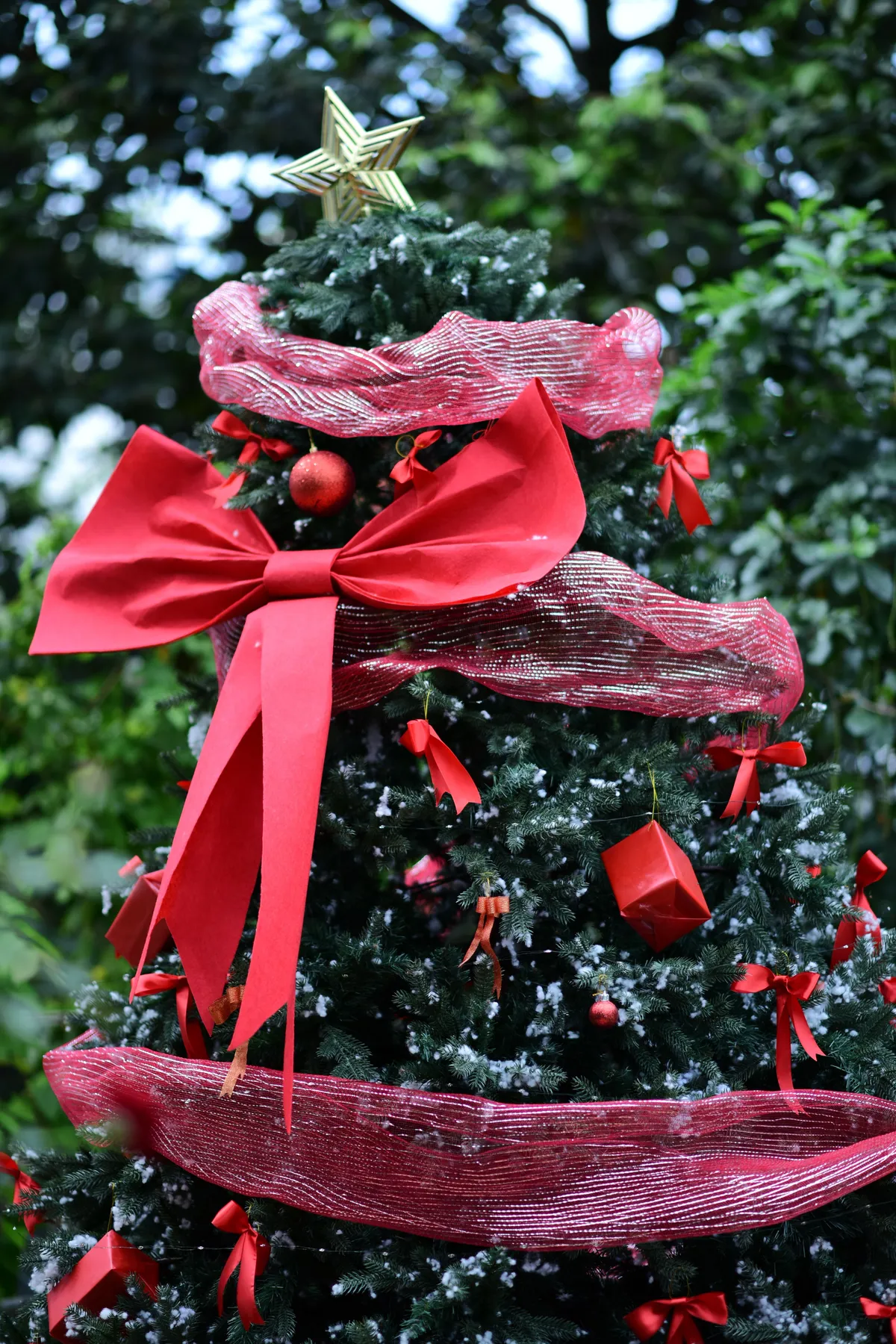
- Cut two 12-inch and two 9-inch strips of stiff red fabric or wide wired ribbon.
- Fold each strip into a loop, pinching the center flat between your fingers.
- Stack the four loops small over large and wire the centers together tightly.
- Wrap a short 4-inch piece around the middle to hide the wire, then trim the tails into a soft V.
- Attach with florist wire rather than a hook — a 14-inch bow is heavier than it looks.
Bow size should scale with the tree, and almost everyone goes too small. A 7.5-foot tree wants bows roughly 10–14 inches across; a 9-foot tree wants 14–18. Place them at the ends of main branches rather than buried in the middle, and resist matching the number of bows to the number of ornaments. Three or four big bows spread out beat twelve small ones every single time.
7. Heavily Flocked Tree with Rhinestone Red Bows
Flocking sheds, and it sheds most in the first two years. Expect a light dusting on the floor every time you brush past, plus white residue in your vacuum canister. Skip a flocked tree in a nursery or any room running a humidifier — moisture makes fake snow clump and yellow. If pets or toddlers are around, confirm the flocking is sealed and flame-retardant, since older or cheaply flocked trees can flake onto small hands that then go straight to mouths.
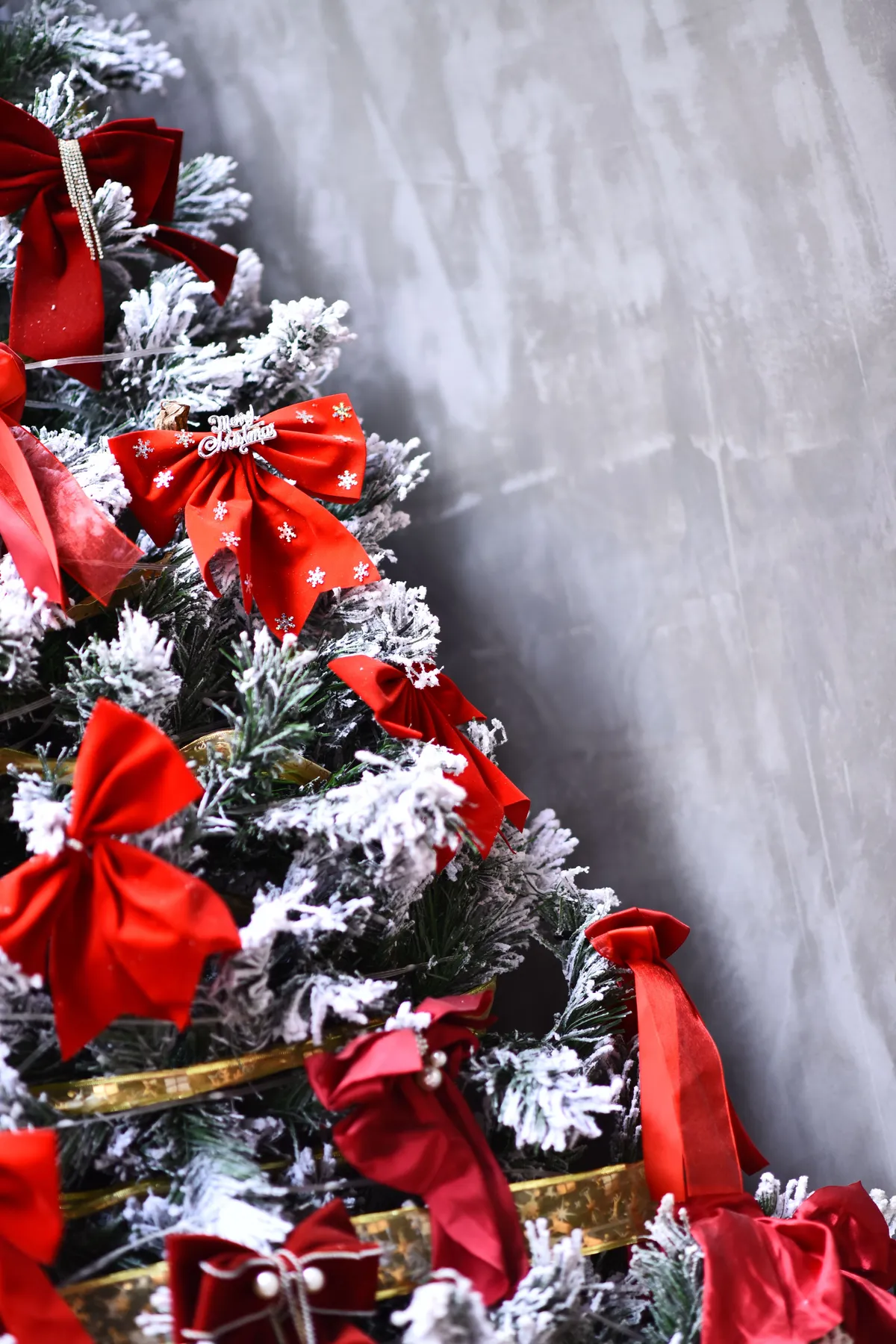
Budget about 20 minutes each December for a lint-roller pass on the bows, and store them flat in a single layer — snowflake and rhinestone trims crease permanently if you stack them. Glitter falls off embellished ornaments for roughly three seasons, so keep a handheld vacuum in the room through the holidays. And a flocked tree needs a dry, cool storage spot; a humid basement will leave it permanently dingy by year three.
8. A Densely Packed Tree Where Red Crowds Out Green
Density is math, not magic. For that packed look, figure 10–12 ornaments per square foot of tree surface — somewhere around 150–200 pieces on a 7.5-foot tree. Then divide by size: roughly 60 percent in the 3-inch range, 30 percent at 4–5 inches, and 10 percent statement pieces at 6 inches and up. Hang the biggest ones first at even intervals, then fill the gaps with the small ones so the green barely shows through.
This look wants a full, wide tree with a 7- to 8-foot footprint, which means at least a 10-foot ceiling and a corner roughly 5 by 5 feet. In a smaller room, go slim: the slender tree in Idea #3 gives you the same density without swallowing floor space. If your ceiling is 8 feet, stop at a 6.5- or 7-foot tree so the topper has room to breathe.
9. Staging Boxes of Red Ornaments on Dark Wood
Fifteen minutes of prep saves an hour of rearranging later.
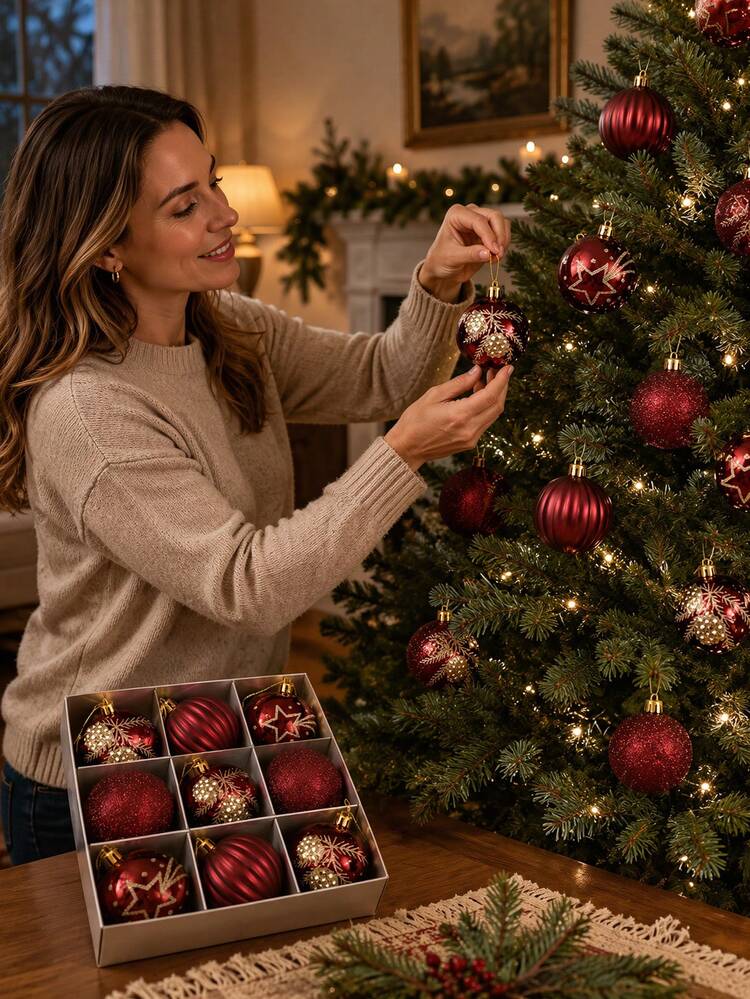
- Pull every ornament out and lay them on a dark wood table or tray, grouped by size and finish.
- Set aside broken caps, dangling strings, and the orphans that lost their hooks.
- Count the statement pieces and decide where your three or four focal clusters will sit.
- Work from the trunk outward, biggest first, one group per branch quadrant.
- Step back and reassess every ten ornaments — from six feet away, not up close.
Boxed sets do the sorting for you. Target’s red-and-gold sets run $15–25 for 30 pieces, and Walmart’s shatterproof 100-count boxes hover near $35 during early November sales. Want the patterned baubles without the price? Wait until December 28 — boxed ornament sets drop 50–70 percent, and red is the color nobody buys in January. Store them in a divided tackle box and they’ll survive the year.
10. A Dim Bar Nook with Red Velvet Baubles
Styling ornaments away from the tree is one of 2026’s quieter moves — a bowl of velvet baubles on a console, a single strand on a shelf, a small lit tree tucked where nobody expects it. It reads as confidence: you bought enough decoration that you can spare some. Deep red velvet in particular keeps showing up alongside moody holiday and quiet Christmas searches, because it photographs beautifully in low light and looks expensive even when it wasn’t.
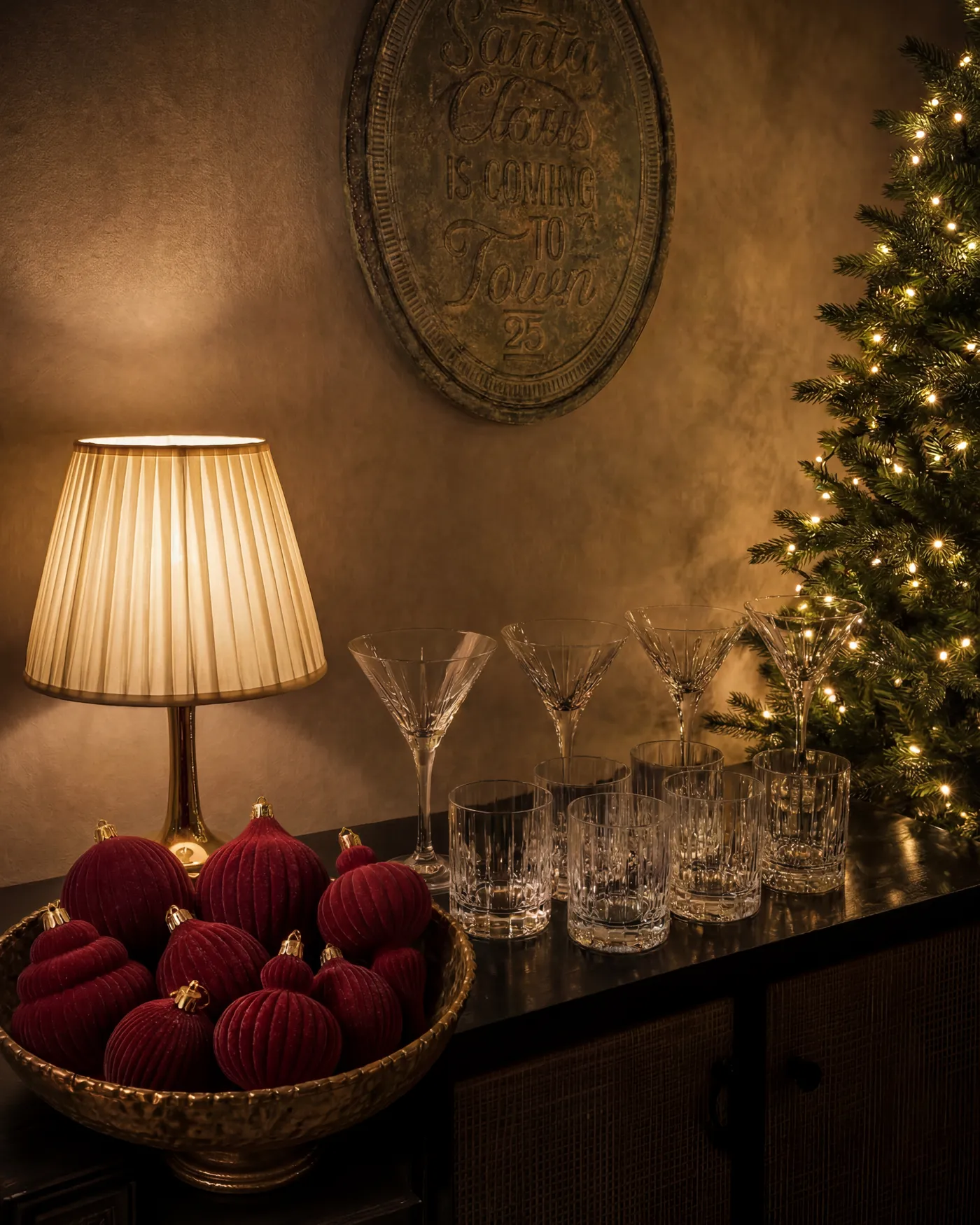
- Small 4-foot pre-lit tree: $40–$90
- Deep red velvet ornament set (12): $20–$45
- Hammered gold bowl: $25–$60
- Crystal glasses, four, thrifted or new: $15–$50
- Pleated-shade table lamp: $35–$90
- Oval metallic sign or framed art: $30–$120
Total: $165–$455
11. Snow-Dusted Outdoor Evergreens Lit Red and Gold
Outdoor ornaments live a harder life. Sun bleaches red faster than any other color, so shatterproof plastic beats glass out there and should be replaced every three or four seasons. Use outdoor-rated extension cords only, plug everything into a GFCI outlet, and keep connections off the ground or inside a weatherproof box. Snow sitting on lit strands is fine; ice is not — it can crack sockets and pull branches down.
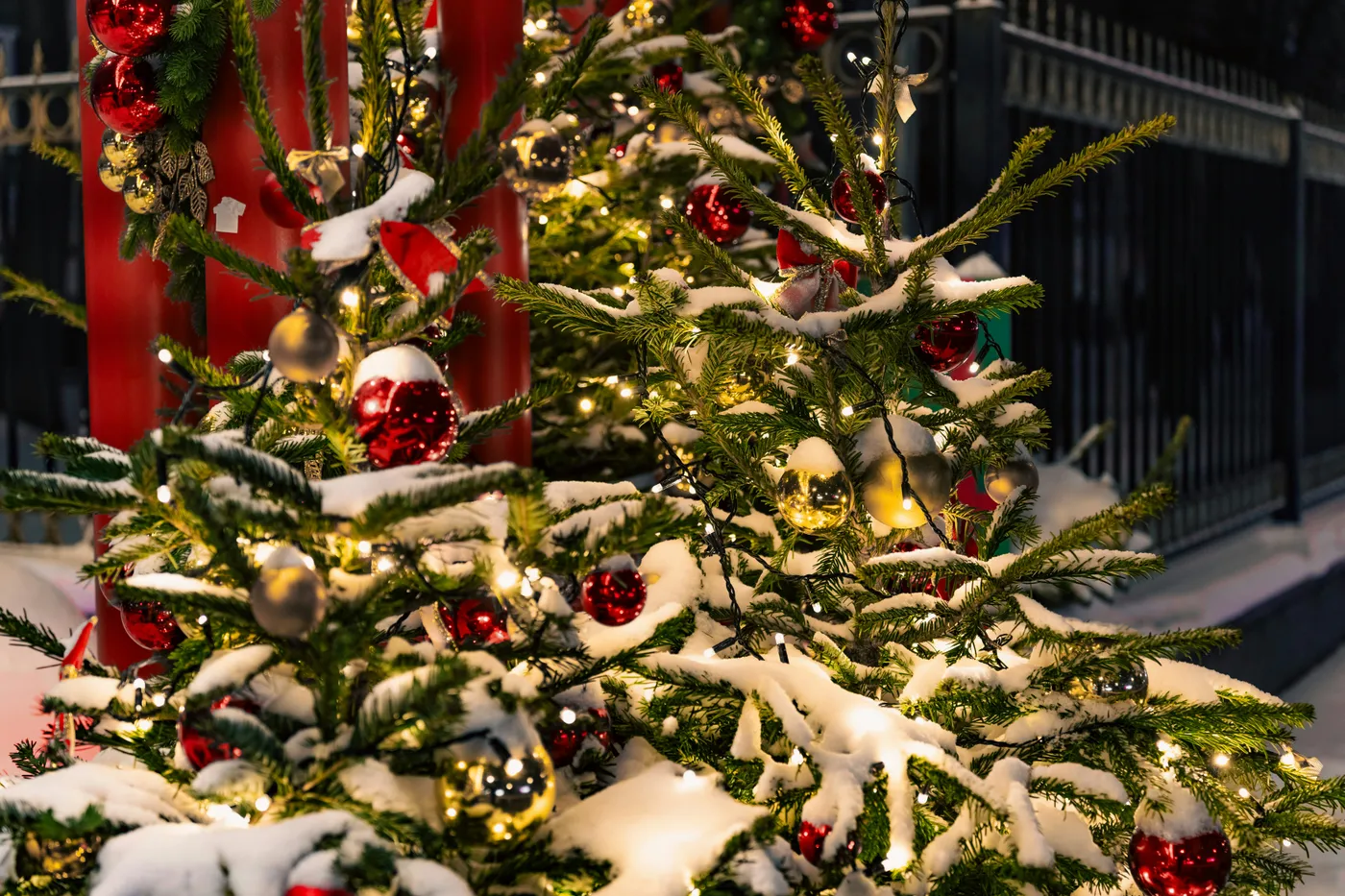
Odd numbers look intentional outdoors. Three trees in a loose cluster, the tallest around 7 feet, reads better than four evenly matched ones. Keep the front tree at least 2 feet off the house wall so the light has somewhere to fall, and size ornaments to viewing distance — anything smaller than 3 inches disappears from the street. If you’d rather do a single tree, see the potted version in Idea #17.
12. Matte Red Baubles with White Outlined Trees and Stars
Three things are working at once here. The matte finish absorbs light, so the white outline drawings stay legible instead of blowing out. The warm string lights behind create bokeh, which reads as depth even in a small room. And the pattern gives the eye something to do after it has already processed the color — a solid red ball is finished in half a second, a patterned one takes a beat longer, and that beat is what makes a tree feel interesting.
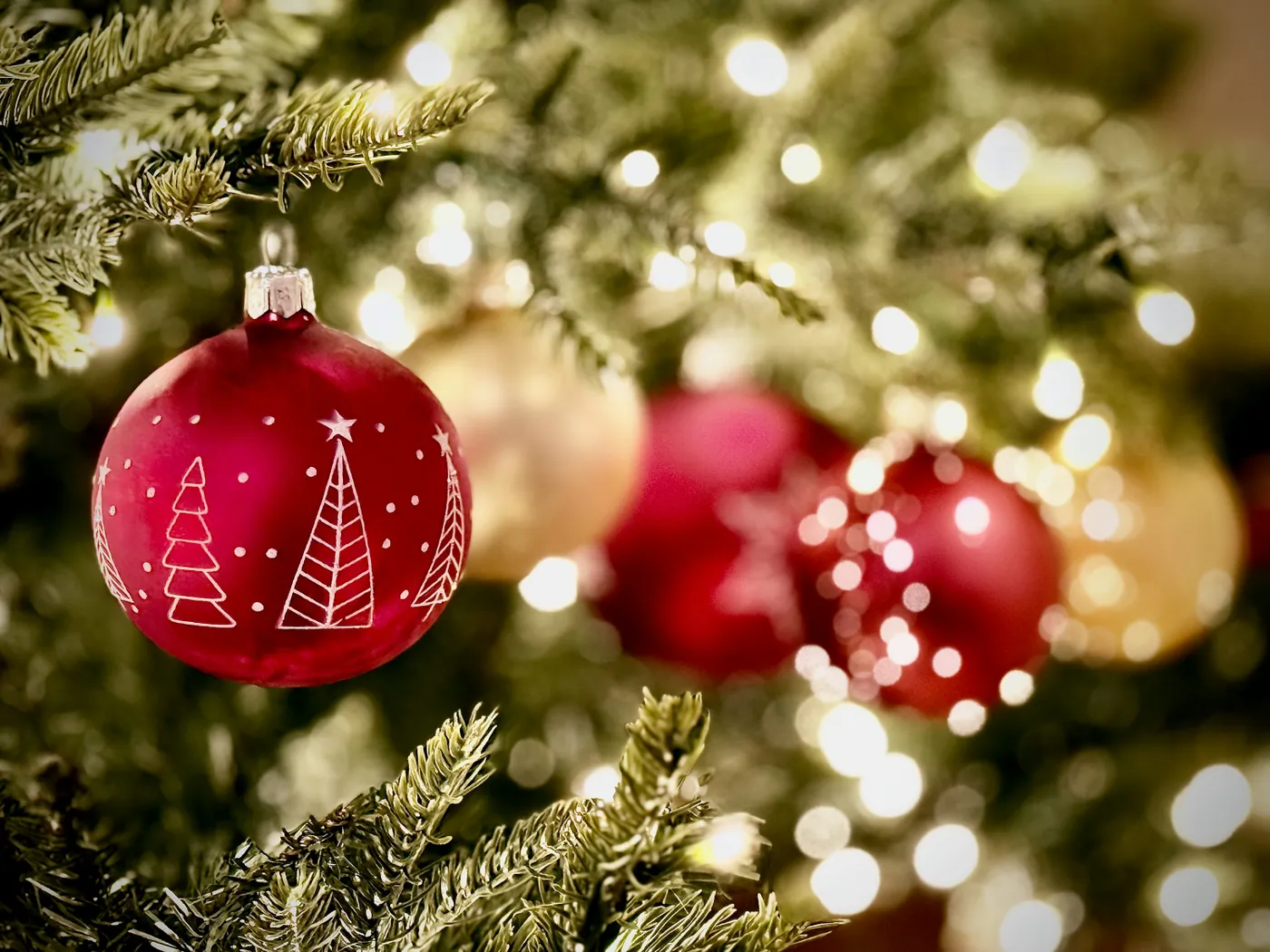
- Matte red patterned ornaments (24): $30–$70
- Gold accent ornaments (12): $18–$40
- Warm white string lights, 600 count: $20–$35
- Tree skirt or collar: $25–$60
- Budget alternative: 24 plain matte red balls ($12) plus a white paint pen ($6) and an evening of drawing.
Total: $93–$205
13. Velvet Bows and Pearl Garlands Carried Onto the Art
When a tree and a wall share a room, echo one element rather than repeating all of them. Here it’s the deep red velvet bow: it appears on the tree, then again on the landscape painting, tied in the same fabric at roughly two-thirds the size. That ratio matters — an identical-size bow on the frame looks like a copy-paste. One repeat, one scale shift, and the whole corner feels composed instead of decorated.
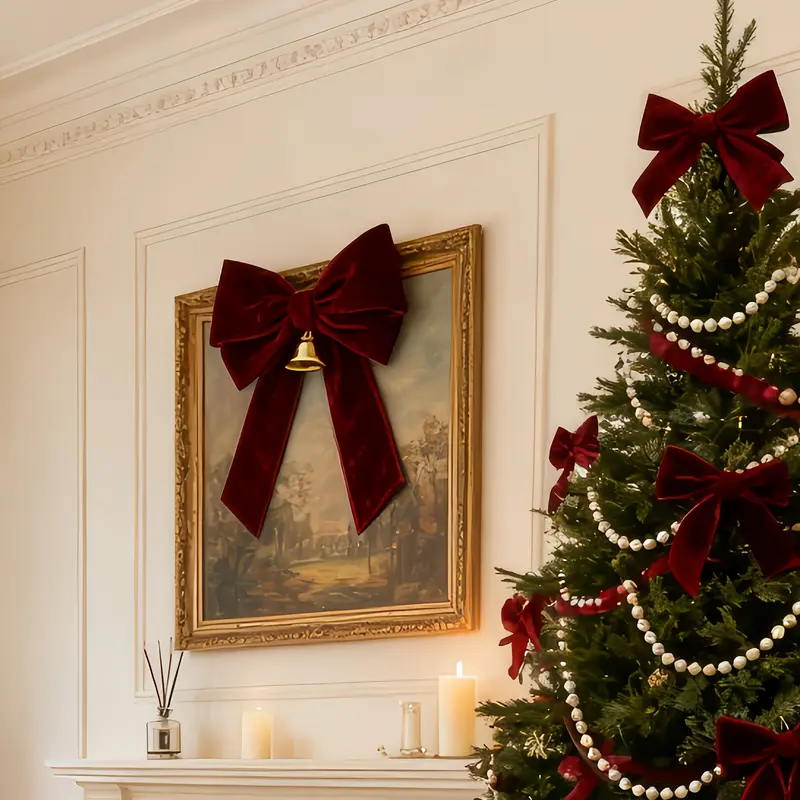
Two 9-foot strands, about $14 total, cover a 7.5-foot tree.
- Start at the top and zig side to side, letting each swag dip about 14 inches.
- Anchor every peak to a branch with a small wire hook — never tie it around needles.
- Loosen the dips by hand afterward so no two swags match exactly.
- Run the final pass down the front only, over the ornaments rather than behind them.
- Check from three feet back, and tighten any swag that sags below eye level.
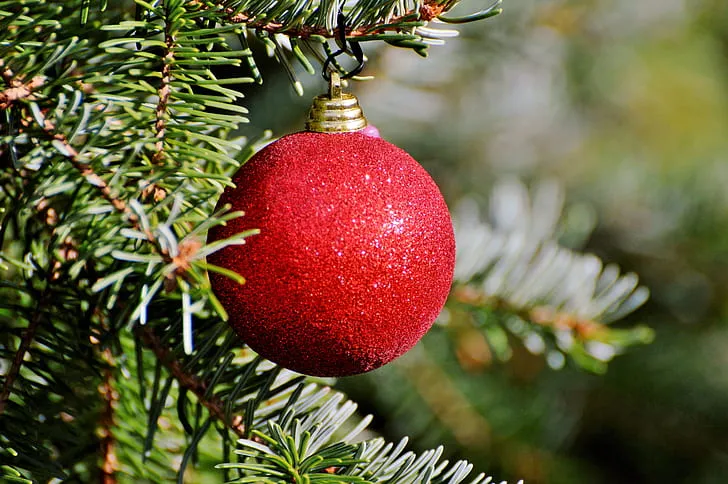
14. Red Glitter Spheres and Gold Snowflakes Up Close
Call it 70 percent red, 20 percent gold, 10 percent pure glitter. The red keeps it a red tree, the gold gives that red something warm to sit against, and the glitter is punctuation — one glittery piece for every four smooth ones is about right. Swap the formula without breaking it: 70 percent burgundy with 20 percent brass and 10 percent frosted white reads vintage, while the same red with silver instead of gold reads modern and slightly cooler.
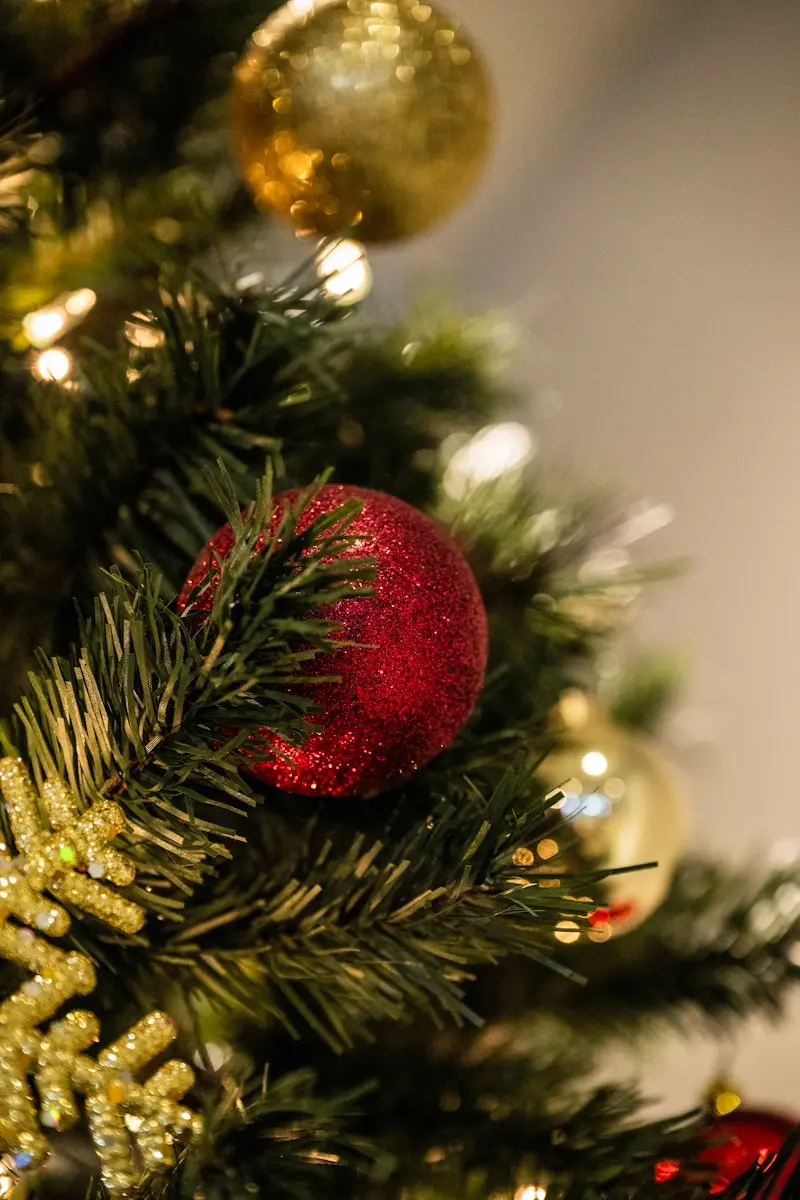
Gold spray paint is the cheapest design tool you’ll buy this month. A $6 can turns a box of tired dollar-store ornaments into the metallic layer of this tree. Add a pack of glitter snowflake ornaments from Michaels at $8–12, and pick up red glitter balls at Walmart for about $10 for 20. That’s a full refresh for under $40, and nobody will guess half your tree is last year’s clearance.
15. A Brightly Lit Tree Where the Robot and Dinosaur Live
The oddballs are the point. A white robot, a gold glitter dinosaur and a tiny sailboat shouldn’t work alongside glossy red baubles — and that’s exactly why the tree feels like someone lives here. Without the mismatched sentimental pieces, this is just another well-styled red tree; with them, it’s a family tree that happens to be beautifully lit. Give each odd ornament its own pocket of light and a little clear space so it can actually be found.
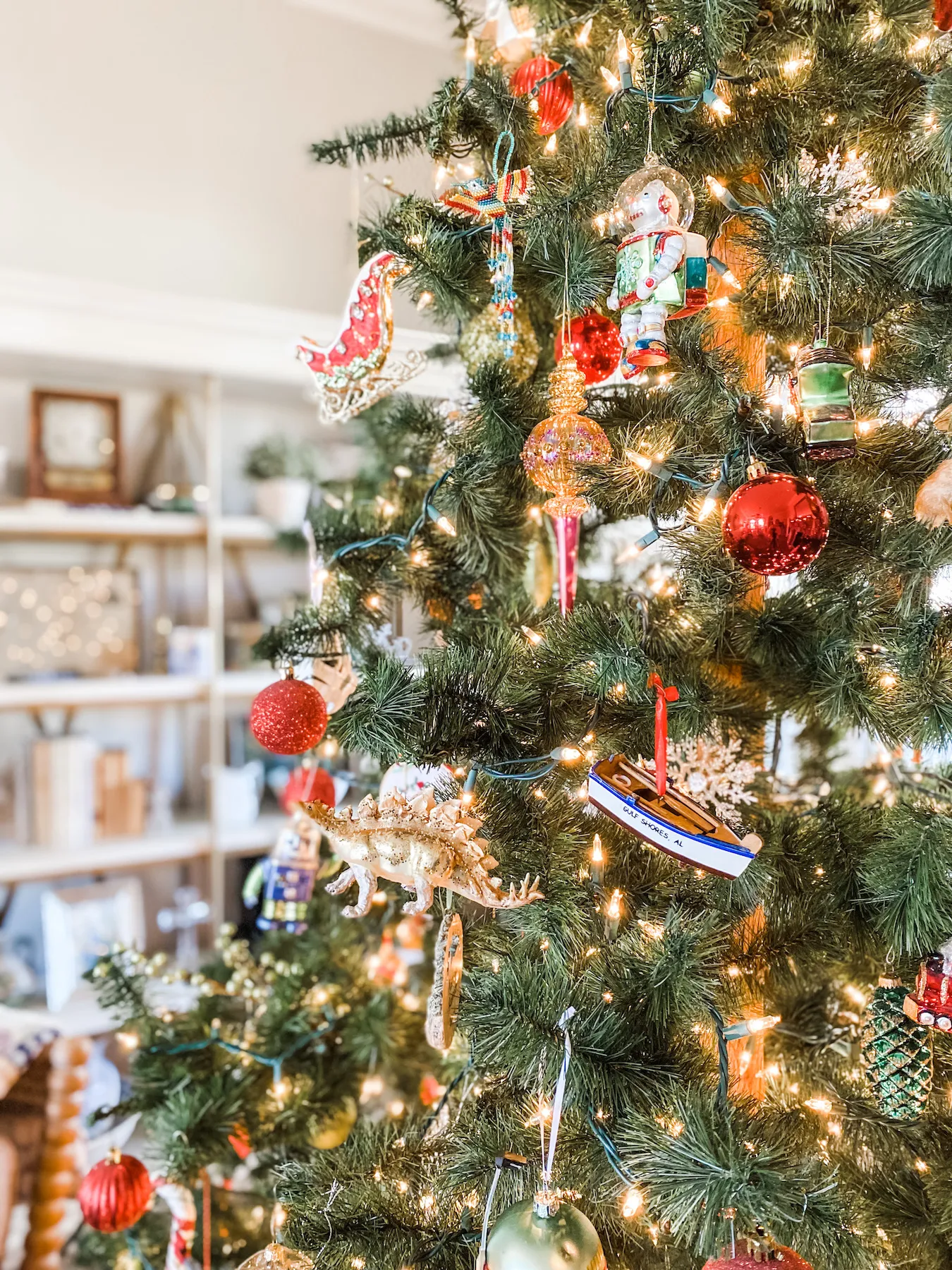
A densely lit tree runs warm, and that matters with kids or pets in the house. Confirm your lights carry a UL listing, never chain more than the manufacturer’s stated strand limit, and turn the tree off before bed or when you leave. Small hands will reach for the robot and the boat, so wire those to sturdy branches and keep breakable pieces above arm’s reach. Untangle rogue strands now, before they become next year’s problem.
16. Blue-Green Needles with Red in Four Finishes
Blue-green needles read darker than standard dark green, so this palette needs light. A 6.5-foot tree is the sweet spot for an 8-foot ceiling in a room under 120 square feet; step up to 7.5 feet in a 12-by-14 room, and keep the base at least 18 inches off any wall so ornaments don’t press into the paint. In a small apartment, a 5-foot tabletop version of the same palette lives happily on a console.
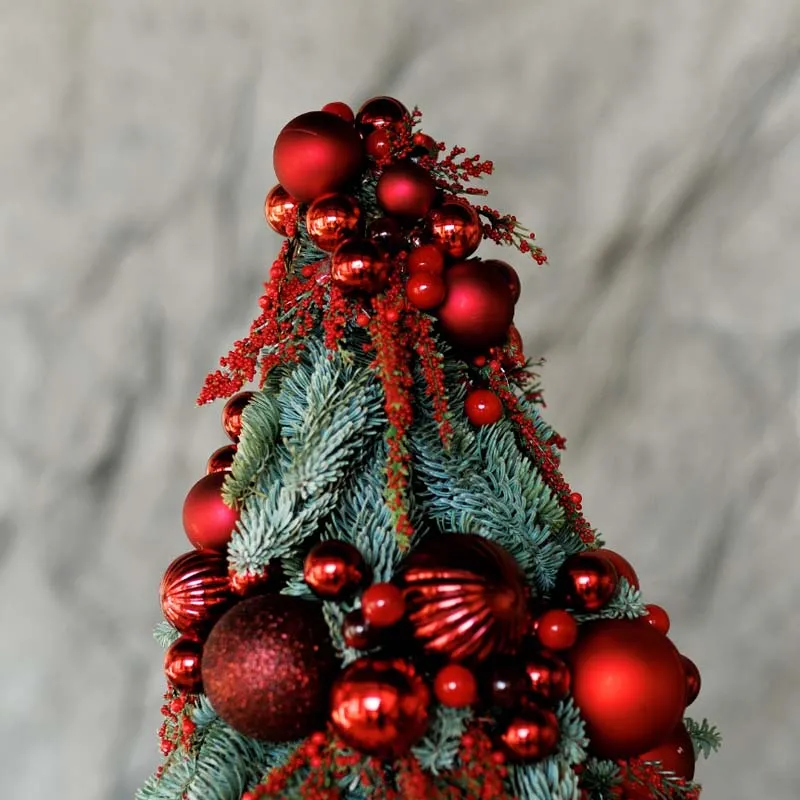
The cool blue cast in the needles makes warm red pop harder than green ever could — a small dose of complementary contrast without adding a second theme. The finish variety handles the rest: glossy catches light, matte swallows it, ribbed scatters it, glitter throws sparks. Four texture types, one color, and the eye never gets bored because there’s always a new surface to read.
17. A Potted Live Tree with Red Bows by the Door
A living potted evergreen buys you about 7–10 days in a sheltered spot before it starts to suffer. Water it every other day — the root ball dries out fast in heated air — and keep it out of direct sun and away from heat vents. If it’s going in the ground, plant within a week of the holiday. If it’s staying in the pot, expect to replace it in a couple of years; most spruces don’t thrive after two seasons in a container.
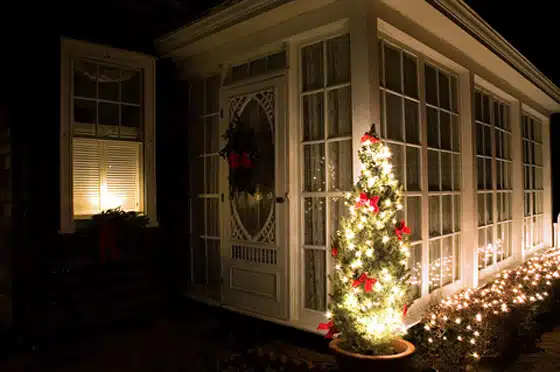
Nurseries discount potted evergreens hard in the first week of December, and Home Depot sometimes drops 3-foot Alberta spruces to $40–$70. A thrifted wreath plus two $3 spools of red ribbon gets you the door treatment for under $15. Cheaper still: skip the tree entirely, wrap the porch posts in ribbon and hang bows — that’s the version of Idea #11 most people can actually pull off.
18. Red Glass Pinecones with White Glitter Flakes
- Weigh your heaviest ornaments and confirm the branches hold them without drooping — glass pinecones are deceptive.
- Measure ceiling height against tree height plus topper, and allow 6 inches of clearance minimum.
- Test how the flocking behaves when you clip a hook; lightly flocked is far easier to work with than heavy snow.
- Count your warm white lights before buying ornaments. Six hundred is the floor for a 7-foot tree.
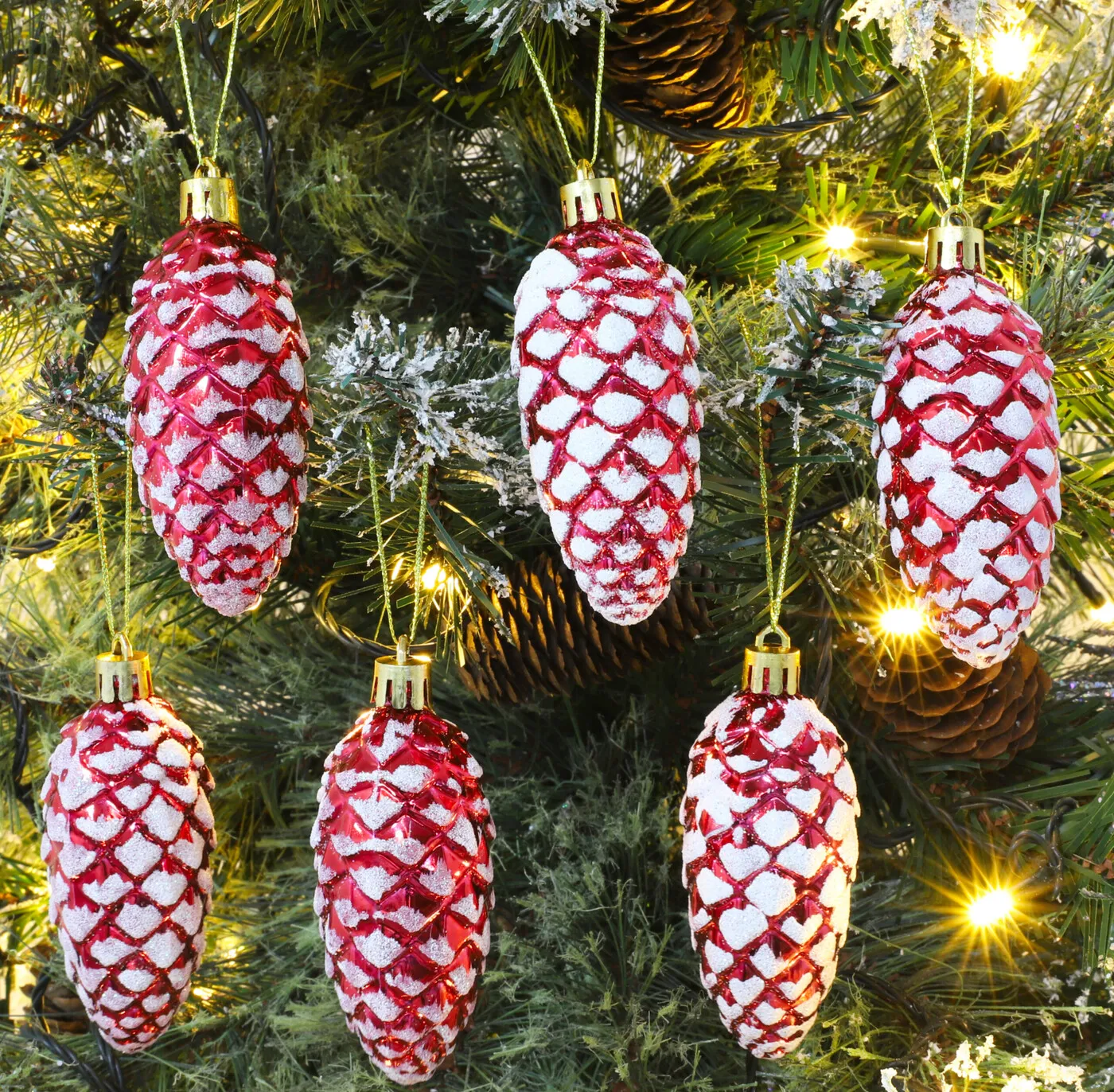
Glass pinecones and other heavy pieces want to sit deep, not dangle. Push them 2–3 inches in toward the trunk and let the outer needles partly hide them — the visible half looks nestled rather than pinned on. Use wire hooks rather than thin metal caps for anything over 4 ounces, and never hang two heavy ornaments on the same branch tip. Move one in on one branch, one out on the next.
19. A Rustic Fir Wreath with Berries and a Gold Bow
About 45 minutes and $25 in materials for a 22-inch wreath.
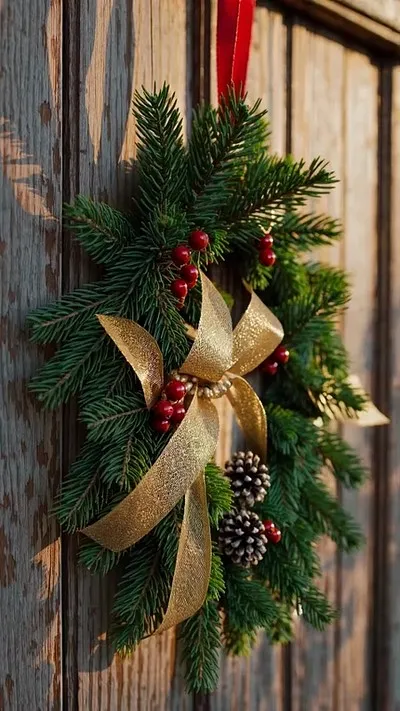
- Start with a grapevine or wire base and wire four fir sprigs onto the frame at 12, 3, 6 and 9 o’clock.
- Fill between them with shorter sprigs, keeping every stem going the same direction.
- Cluster red berries in three groups of five — odd numbers look collected, even ones look placed.
- Tuck two pinecones low and slightly off-center.
- Wire the gold bow at 4 o’clock rather than at the top, then hang with a thin red ribbon.
The recipe is 60 percent greens, 25 percent berries, 10 percent pinecones, 5 percent ribbon. The greens set the shape, the berries carry the red, and the pinecones add weight and brown so the wreath doesn’t look like a craft-store kit. To change the mood, keep the proportions and swap the ribbon — a matte black velvet bow turns this rustic wreath into something a modern front door can wear.
20. Red Gifts Wrapped to Match the Tree
- Wrapping paper, three rolls in coordinating red: $15–$30
- Ribbon, two spools — satin and velvet: $12–$25
- Gift tags and a gold pen: $8–$15
- Red ornaments reused as gift toppers (8): $0–$20
- Under-tree basket or crate: $20–$60
- Budget alternative: plain kraft paper ($6) with red velvet ribbon ($8) reads identical in photos.
Total: $55–$150
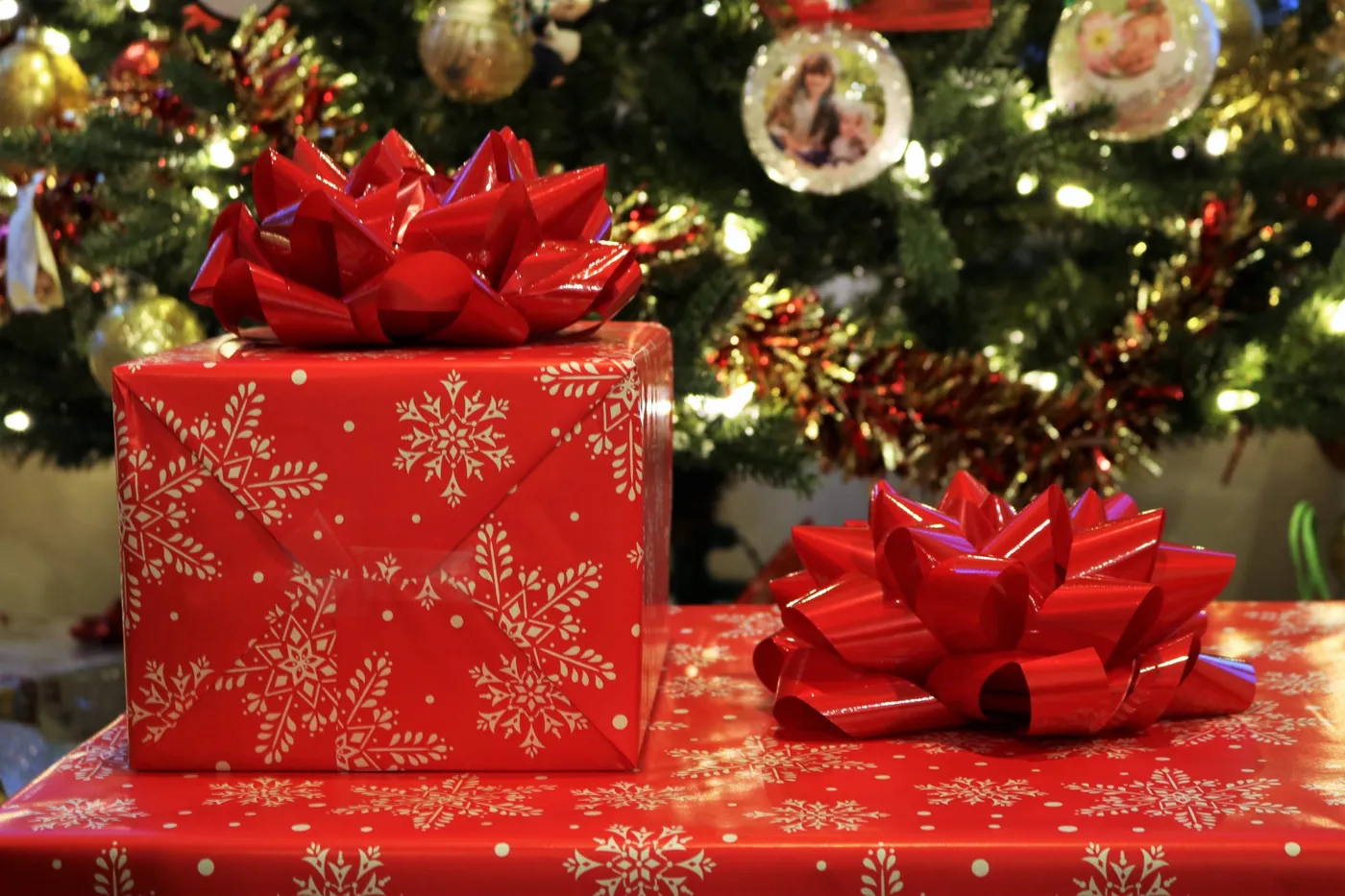
Matching wrapping is the most underrated part of an all-red tree setup. Loose, mismatched gifts under a carefully styled tree undo hours of work, because the eye reads the pile first — it’s at eye level. Stick to two or three reds, use one ribbon type across everything, and tuck the smaller boxes forward so the stack looks curated rather than dumped.
21. Glossy and Matte Red Balls, Plus Glitter Red Birds
Round ornaments repeat themselves, and repetition is comfortable right up until it turns into wallpaper. The birds fix that by changing the silhouette: a tail sweeping sideways, a wing lifted, a beak breaking the circle. Same color, same sparkle, completely different shape. That’s the whole principle in one tree — when you commit to a single color, shape variety is what keeps it from going flat.
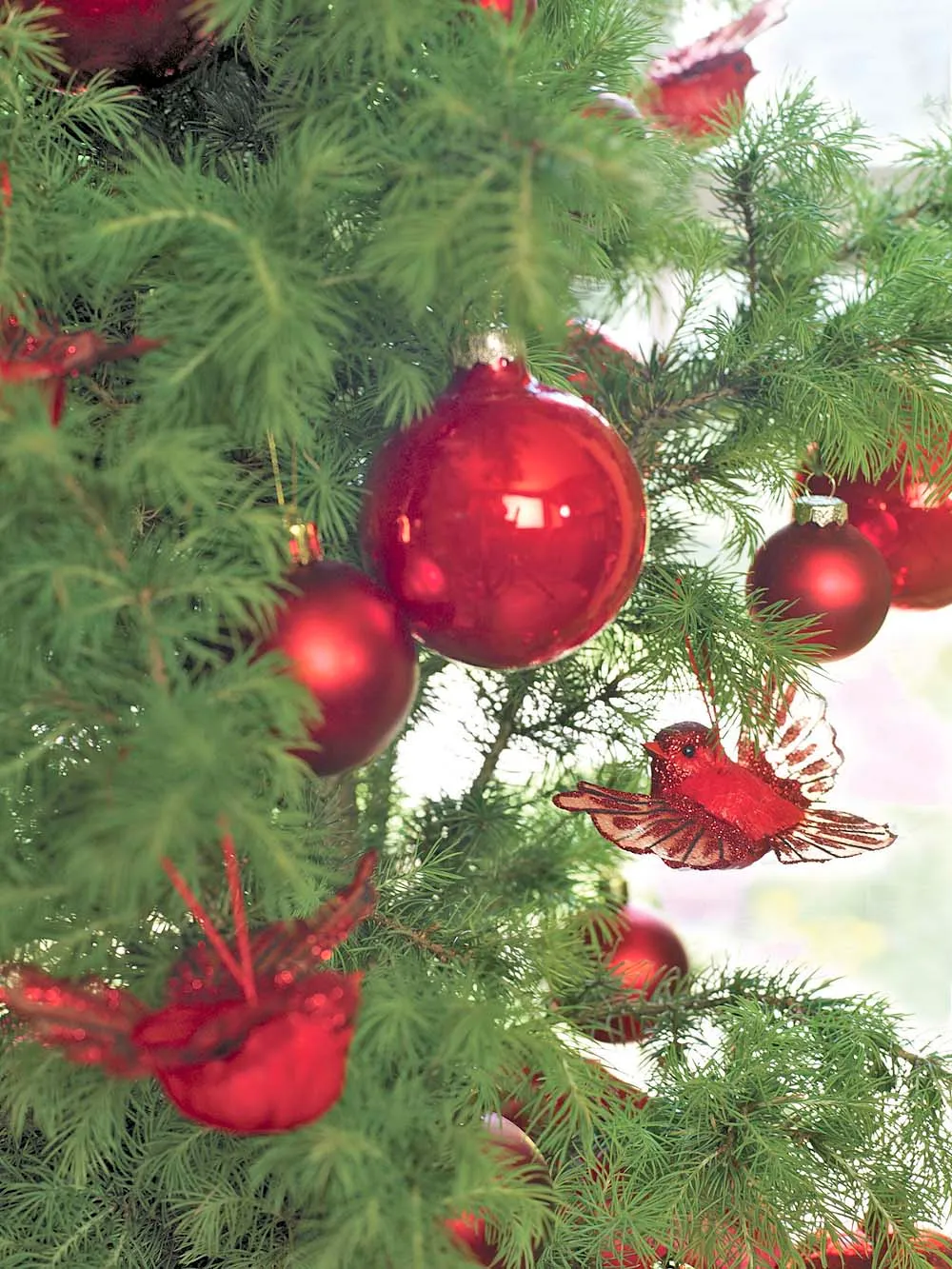
Use a simple ratio to keep the mix from tipping: for every 10 round ornaments, add 2 or 3 shaped ones. On a 7-foot tree that’s roughly 18–25 birds, stars or flowers among 90 balls. Keep the silver caps consistent across everything, and put the shaped pieces where the branches are widest — a bird half-hidden in a tight branch just reads as a red blob from across the room. For finish variety instead of shape variety, see Idea #16.
22. One Glittery Red Bauble, Everything Else Bokeh
Glitter is forever, or at least until you move. Expect to vacuum the tree skirt twice a season, and store ornaments in a covered bin rather than an open cardboard box, because glitter migrates. If shedding genuinely bothers you, glitter-embedded ornaments hold their sparkle far better than glued ones — you can tell the difference by touch, since glued glitter flakes off on your fingers. Keep a lint roller near the tree either way.
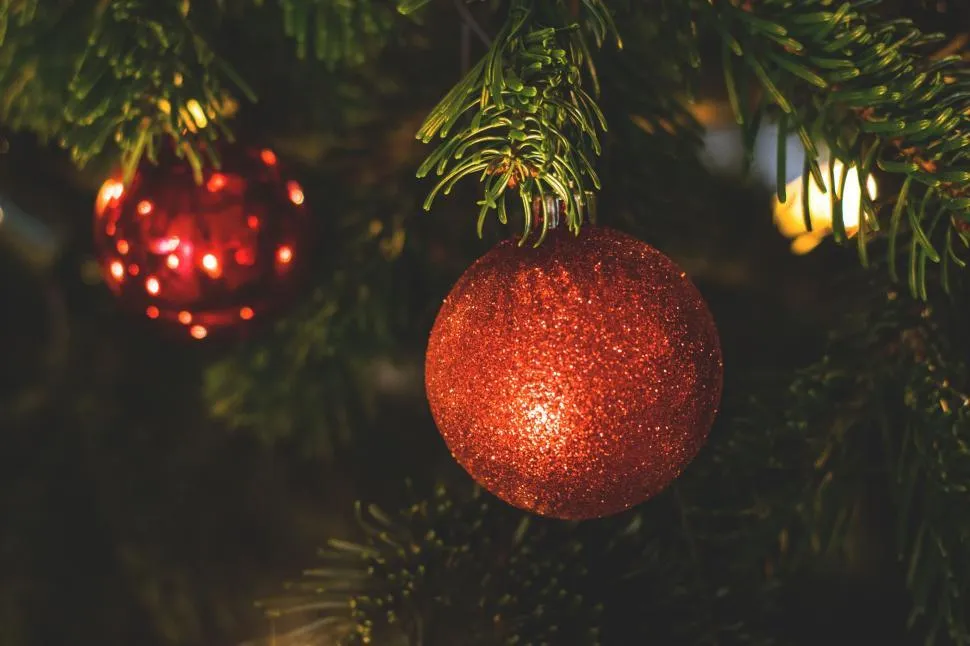
This is the look for small spaces. A 4- to 5-foot tree with fewer than 60 ornaments and a tight red-only palette fills an 8-by-10 apartment corner without swallowing it, and the bokeh from warm lights makes it photograph like something much bigger. In a room under 10 feet wide, choose a slim profile over a full one. For bigger rooms, run the scale math in Idea #8.
23. A Christmas Tree Built from Red and White Flowers
The formula here is botanical rather than ornamental: 55 percent green foliage, 25 percent red blooms, 15 percent creamy white blooms, 5 percent berries. The white flowers matter more than you’d think — without them, red and green tip into a school-play version of Christmas. Keep the white blooms toward the top and edges so the tree shape still reads, and let moss cover the mechanics at the base.
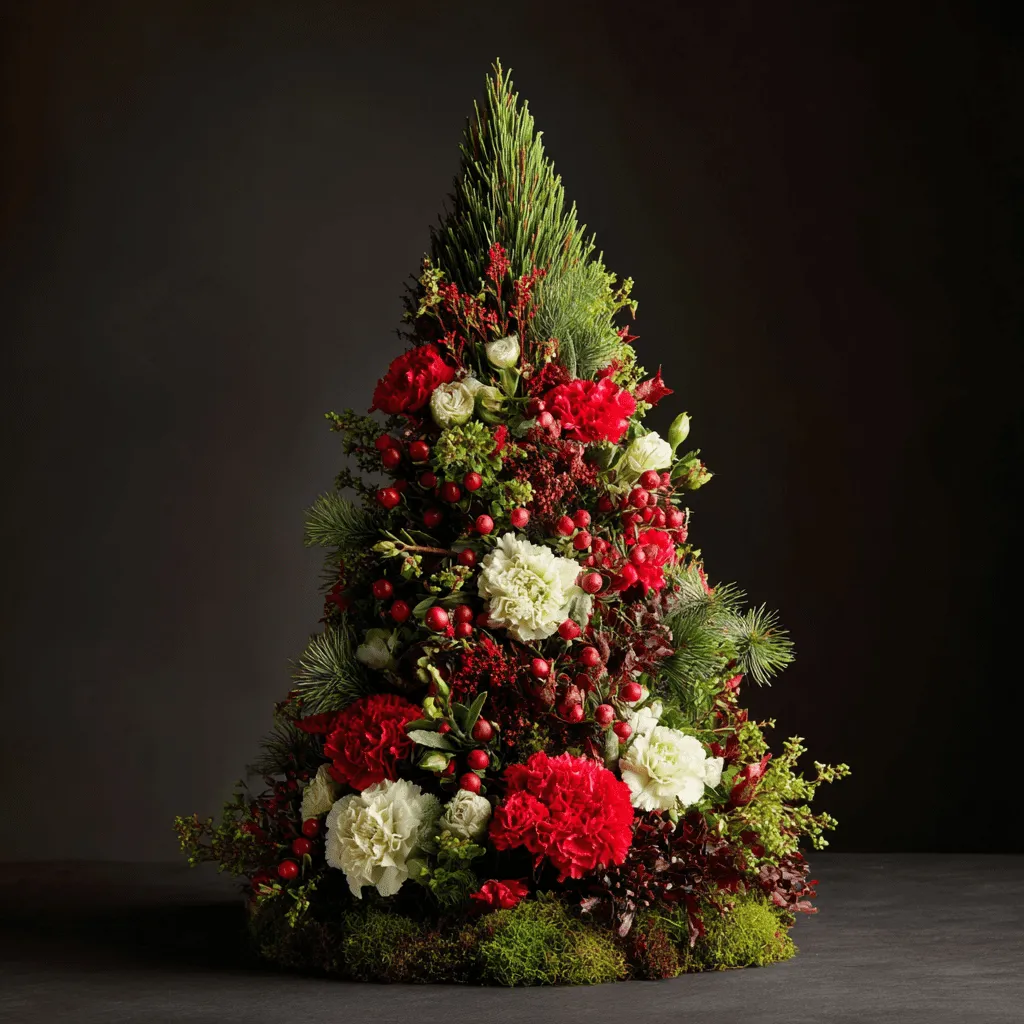
Fresh flowers on a foam base last about four to six days in a heated room, longer if you keep them out of direct sun and away from radiators. Built for one evening, this is stunning. Built for all of December, you need either all faux stems or a hidden water source — and hydrangeas in particular need constant moisture. Check pet safety too, since several holiday blooms and berries aren’t pet-friendly.
24. Red Candy-Shaped Ornaments on a Frosted Tree
Novelty shapes have come back in a serious way. Searches for vintage-style and candy-inspired ornaments keep climbing, because people are tired of buying identical boxed sets — one shapely piece of red among 40 balls reads as personality. It’s also a reaction against years of neutral holiday decor: one color at full volume feels like relief. Candy shapes specifically have staying power, since they’re playful without tipping into kitschy.
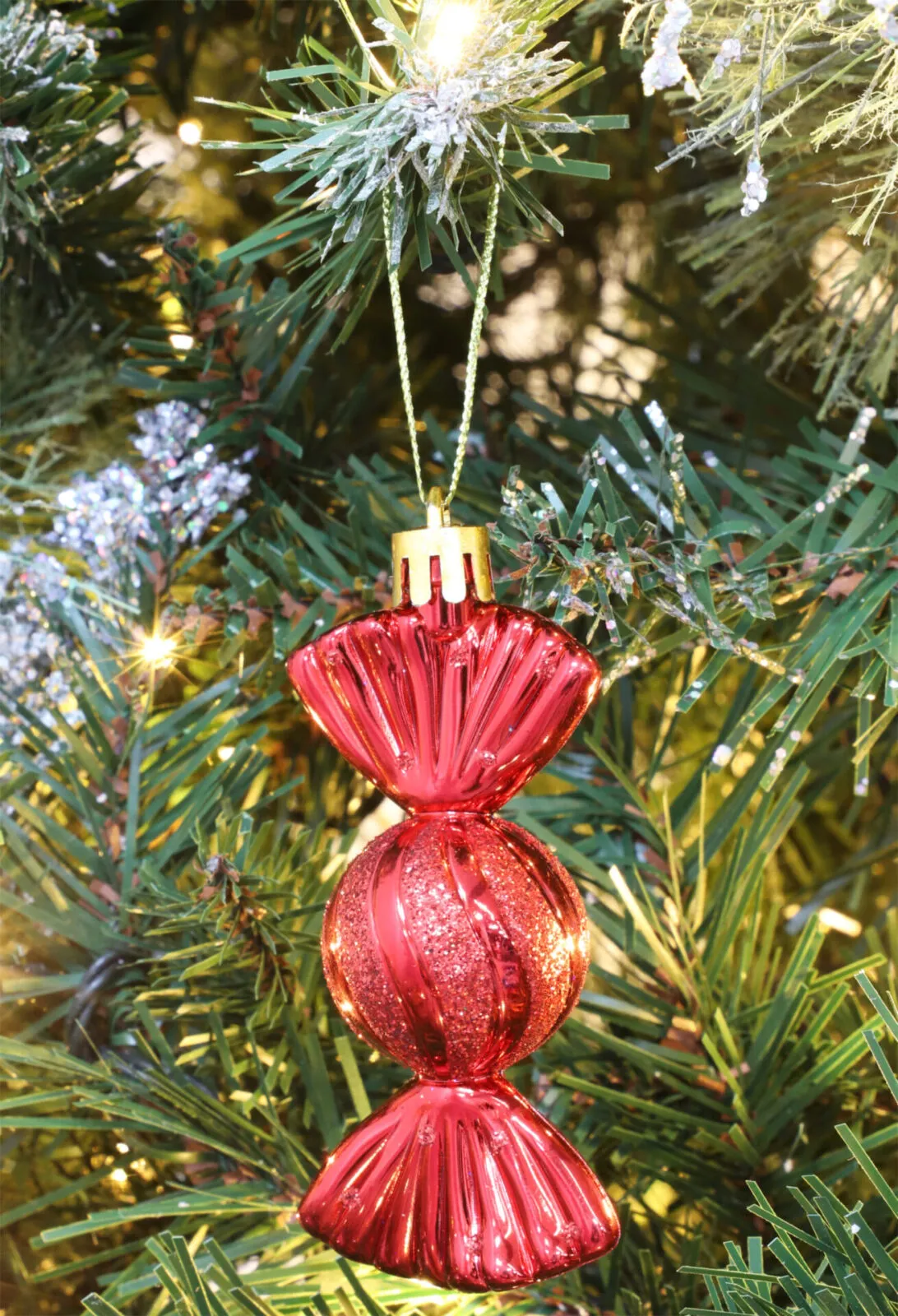
You can build a candy layer for about $25. Dollar Tree carries red ribbon and candy-striped picks seasonally, and Michaels and Hobby Lobby run 40–50 percent off ornaments every few weeks if you catch the rotation. Failing that, wrap a few small candy-striped boxes with ribbon and hang them — a homemade ornament nobody will clock from four feet away.
25. One Matte Red Bauble and a Lot of Warm Light
The matte finish is the whole idea. Shiny red under bright light turns into glare and flattens the tree; matte red absorbs it, holds its color, and lets the lights do the talking around it. Without the soft finish and the restraint, you’d have a perfectly nice red tree with none of the mood. It’s proof that a tree doesn’t need volume to feel finished — it needs one clear decision.
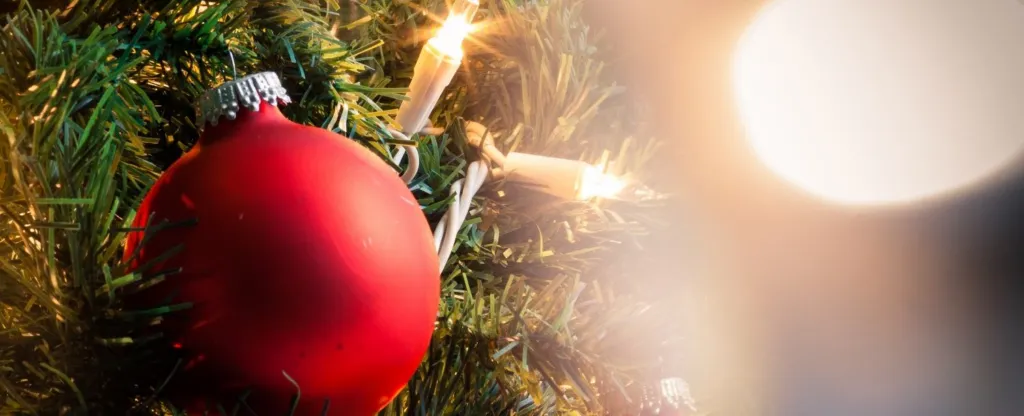
- Confirm your lights are 2700K warm white, not 4000K or cool white.
- Test the strand end to end before anything goes on the tree.
- Measure the ceiling and leave 6 inches for a topper.
- Cap yourself at two finishes for ornaments — restraint is the point.
26. Deep-Set Glitter Baubles Against Dark Green Branches
Push about a third of your ornaments 3–4 inches in toward the trunk and leave them there. Most trees end up looking flat because everything hangs at the branch tips where it’s easy to reach, so from across the room all you see is a shell of ornaments with dark gaps behind. Nestling some deeper creates real shadow and depth, and it costs nothing but a little patience during the hanging.
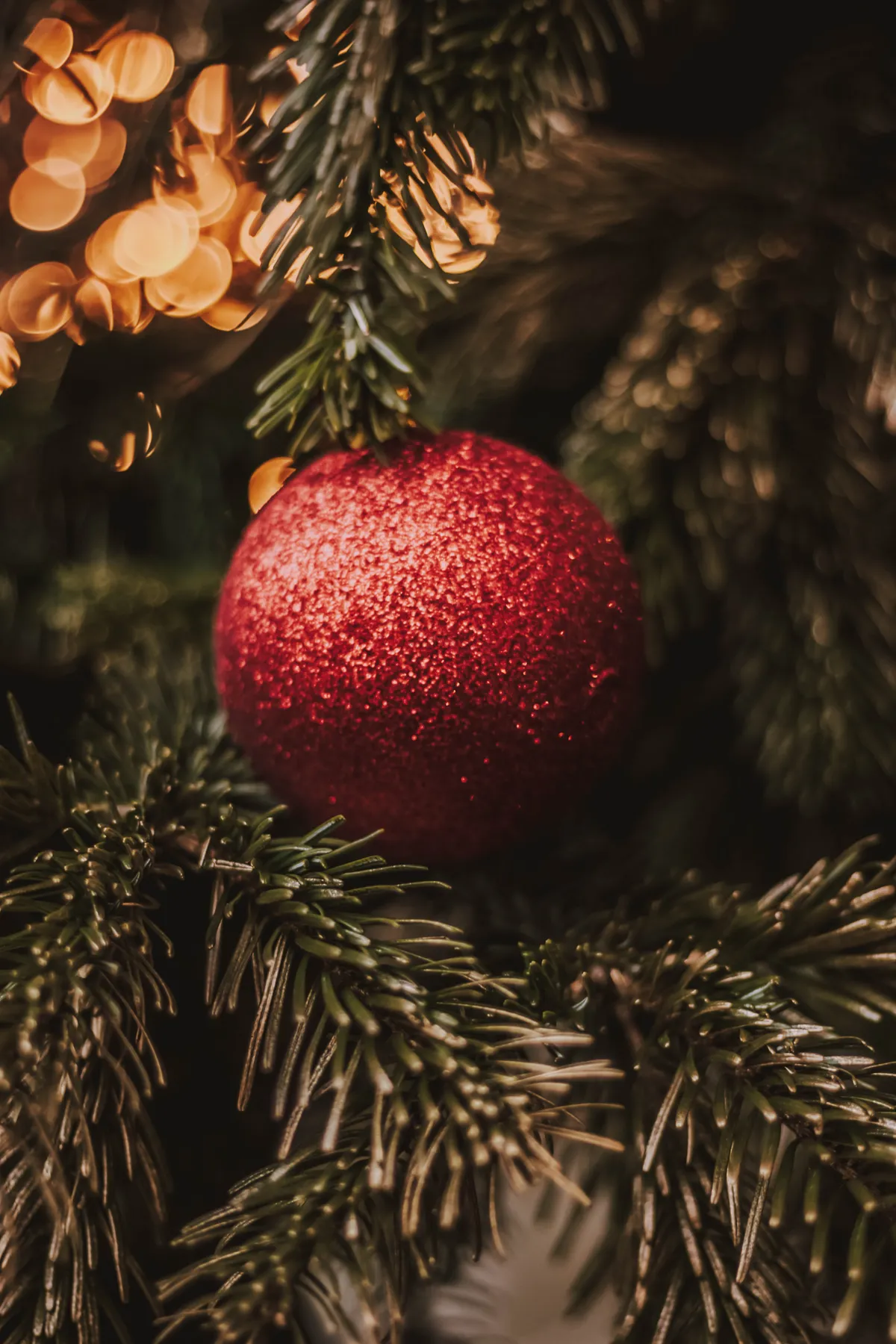
A single glowing red bauble against dark green, with everything else out of focus, is a lesson in hierarchy. The dark needles give the glitter something to be bright against, and the warm bokeh lights soften the edges so the ornament reads as luminous rather than reflective. It’s why close-up holiday photos work so well — the tree doesn’t change, only how much of it you show.
27. Glittery Red Birds with Long Feather Tails
Bird picks are one of the cheapest ways to add the shaped variety a red tree needs. Michaels sells clip-on glitter birds for $3–$6 each, often two for $8, and Hobby Lobby’s seasonal wall clears to 66 percent off in early January if you shop ahead. If you already own plain red ornaments, a $5 bag of red feathers and some craft glue turns a few of them into tailed birds in an evening.
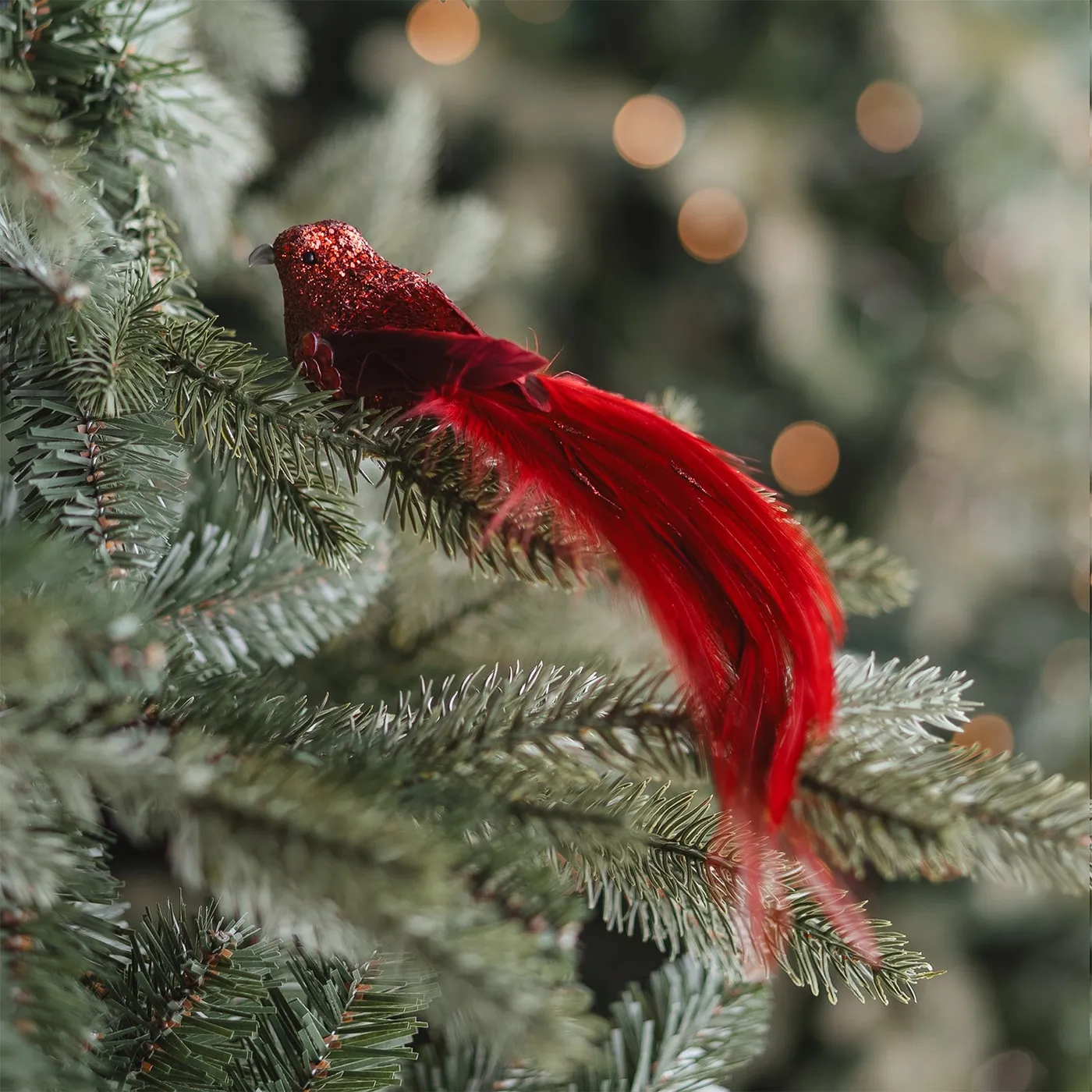
Feathers and glitter are a rough combination with cats — most will treat a bird pick as prey, and shed glitter is unpleasant if ingested. Set feathered ornaments high, or use sparkle-only versions if you have pets. Storage matters too: wrap each bird in its own tissue, because the tails bend permanently under any weight, and keep them out of damp boxes or the wire clips will rust by next December.
28. Ornate Glass Ornaments, Gold Ribbon and Stone Fireplace
This is a high-ceiling look. A tree carrying this much glass, ribbon and garland wants a 9- to 10-foot ceiling and at least a 12-by-16 room — under that, the ornaments crowd each other and the fireplace disappears behind them. In smaller living rooms, use the same palette on a 7.5-foot tree and drop the ribbon entirely; the glass carries enough weight alone. Style the mantel to roughly the same visual density as the tree, never more.
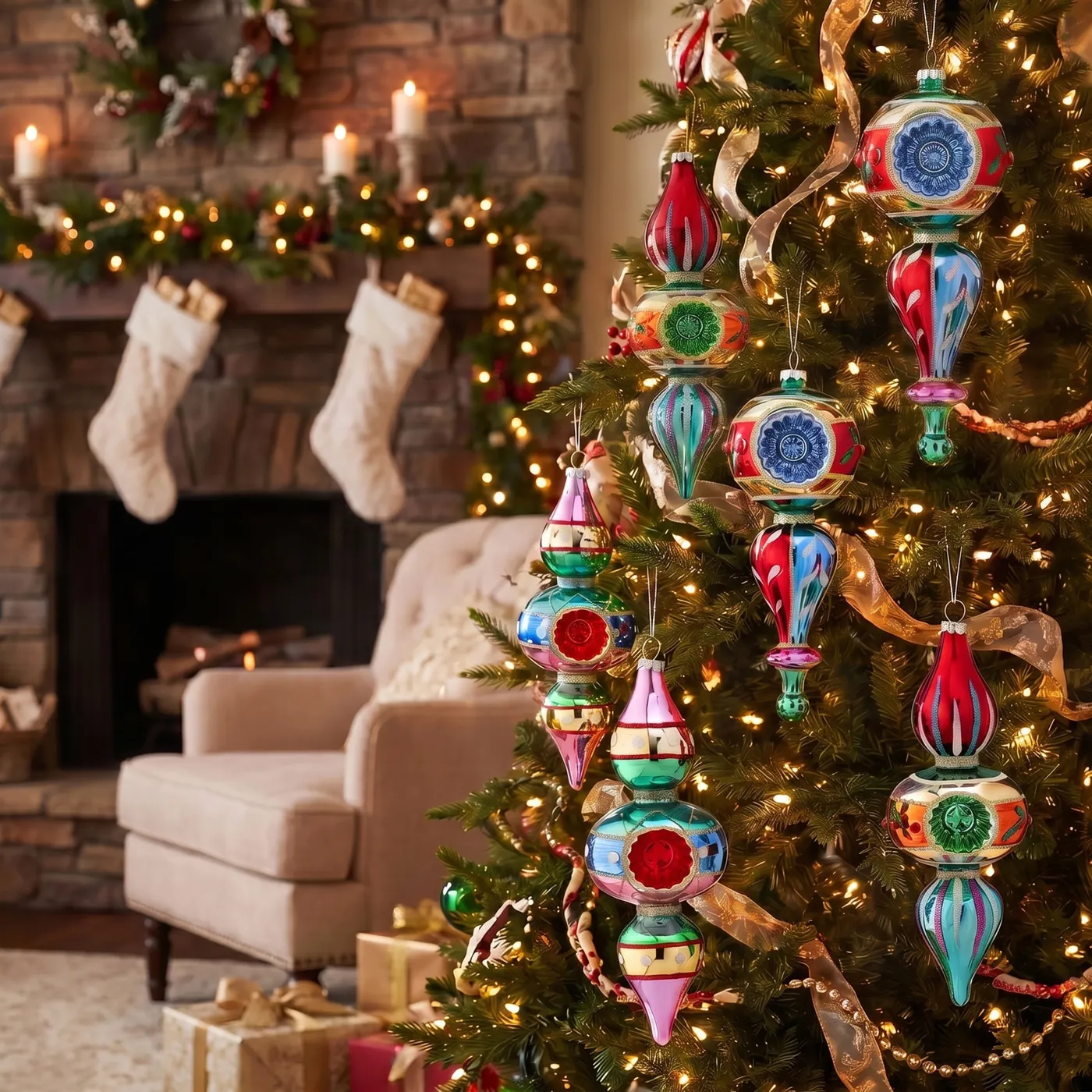
- 9-foot pre-lit tree: $300–$700
- Large glass ornaments (30–40): $150–$400
- Gold sheer ribbon and beaded garland: $30–$70
- Tree collar or skirt: $40–$100
- Mantel garland and knitted stockings: $60–$150
- Budget alternative: 40 mixed-color shatterproof ornaments ($45) with one wide spool of gold ribbon ($12).
Total: $580–$1,420
29. A Tall Red-Only Tree with Poinsettias Tucked In
Poinsettias solve a problem red ornaments can’t: they add scale without adding weight. A 6-inch bloom covers the visual ground of three baubles but reads soft, so the tree gains texture and mass while staying airy. Paired with red bows, they also break the round-ball rhythm — flat petals catch light differently than any sphere will. One color, four shapes, and the tree never feels repetitive.
Adding poinsettia picks without wrecking the tree, for about $12–$25 and 20 minutes:
- Snip each stem to 3–4 inches and bend the wire into a small hook.
- Place blooms on the widest, most visible branches first, roughly 10–12 inches apart.
- Angle blooms slightly downward so they face outward at eye height.
- Fill around each bloom with small baubles, never on top of it.
- Step back and pull any bloom sitting too close to another — spacing reads as intent.
30. The One Whimsical Glass Character Ornament
One small glass character in a Santa hat holds this whole tree together. Take it away and the scene is still pretty, but generic. Keep it, and the tree has a protagonist — something your eye searches for each time you walk past. If you’re committing to an all-red scheme, this is the piece that stops it from being a color exercise. Give it eye-level placement with clear space around it.
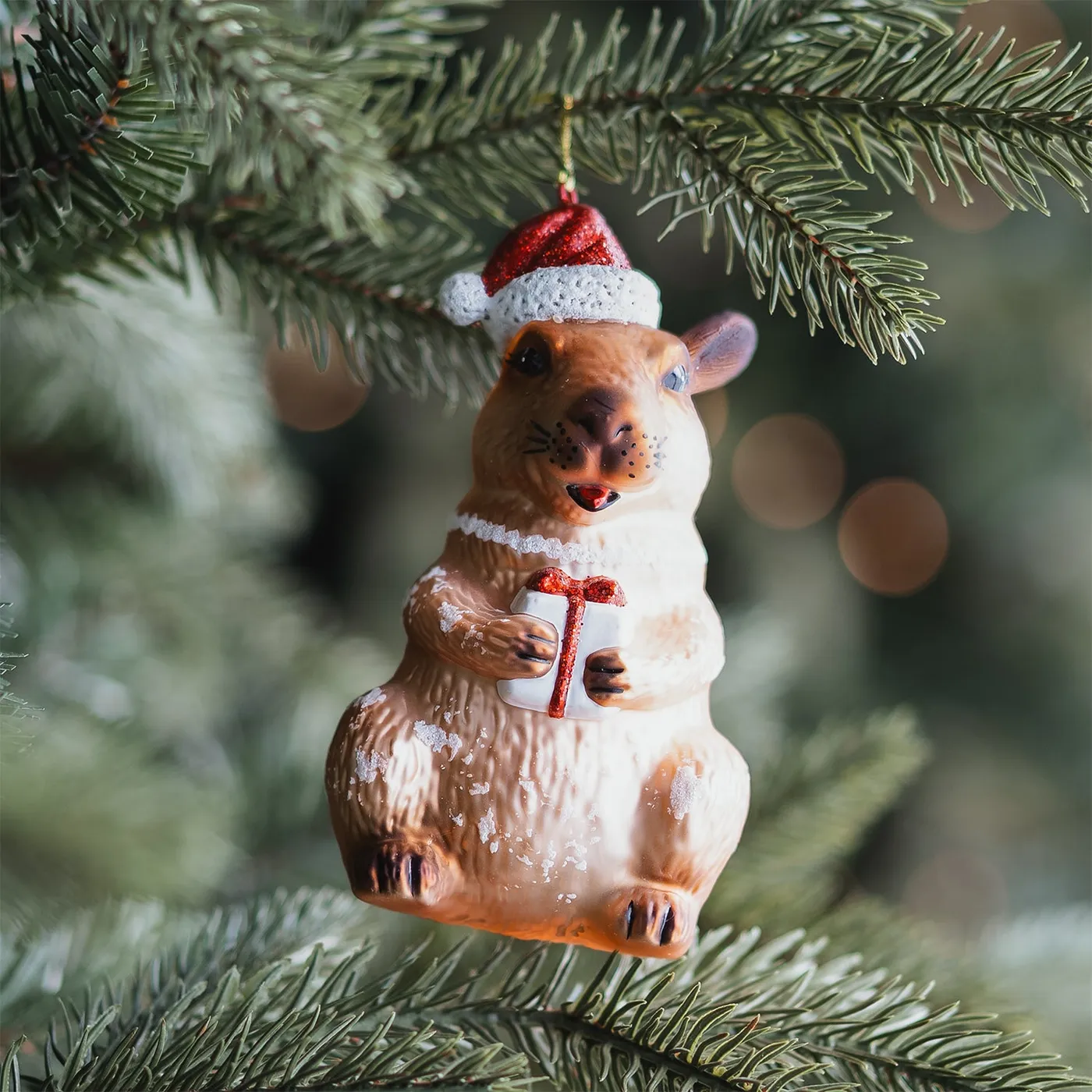
Character ornaments — rodents, foxes, tiny animals in hats — have become a genuine collecting category, helped along by glass figure lines and the general nostalgia tilt in holiday decor. They photograph well, they’re the kind of thing people gift, and they hand a monochrome tree a story. Of all the 2026 trends, this one has the longest shelf life, because it’s less about a look than about having something to look at.
31. Glittered Red Pinecones with Gold Caps
Mix natural and glittered pinecones on the same tree, but not on the same branch. Naturals want to sit low and slightly inside the silhouette, where they read as texture; the glittered red ones want the tips, where the lights catch them. Keep a consistent gold cap and string across both so the pairing looks deliberate rather than accidental, and cluster them in threes or fives instead of spreading them one by one.
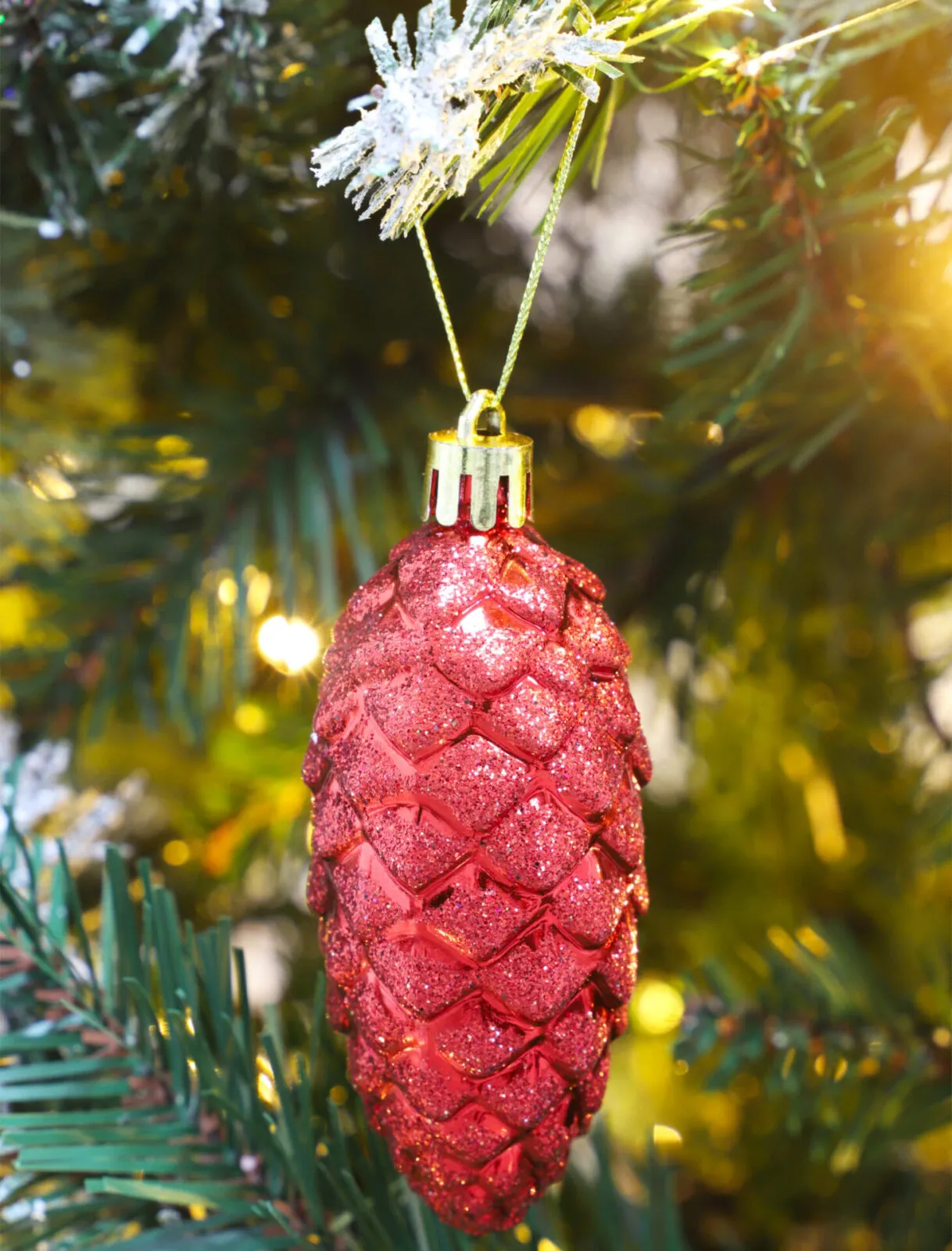
Glitter-coated pinecones shed for the first two seasons, so keep them off the tree skirt if you care about your carpet. Storing them loose in a bin will strip the tops — wrap each in a paper towel and layer them in a rigid box, or leave them on a wreath you hang instead of pack. Natural pinecones should be dried and sprayed with a matte clear sealer, or they’ll drop debris and small insects indoors.
One Color, Thirty-One Ways to Wear It
An all-red tree isn’t a limited palette — it’s a decision that makes every other choice easier, and by now you’ve got 31 versions of it to steal from. Start with the lights, pick two finishes, and let the red do the rest. 📌 Pin your favorite version now so it’s waiting when the boxes come down from the attic.