Most Victorian Christmas tree guides hand you the same red-and-gold ornament list, which is exactly why so many trees end up looking interchangeable. We went through museum holiday displays, historic parlors, and hundreds of real rooms to find the versions that actually feel like someone lives there — 31 of them, shot in real homes and real period interiors. We spent serious time browsing Walmart, Target, Dollar Tree, IKEA, and Facebook Marketplace to bring you only what’s worth your attention this year, from $15 ornament sets to $9,400 wallpaper-and-silk salon builds. You’ll find everything from candle-lit antiques and Neapolitan crèche bases to picket-fenced atrium trees, with budget and luxury versions compared side by side and every idea shoppable with direct product links. The style is surging in 2026 for a specific reason: searches for ‘heirloom tree’ and ‘matte ornament’ are climbing while glitter searches slide, and warm 2200K bulbs have quietly replaced cool white. And stay until the end — we break down the most common mistakes that can ruin these looks. 📌 Save this to Pinterest for later — you’ll want to revisit these ideas.
1. A Densely Lit Fir Against a Dark Wooden Lattice
Light density is the single most common mistake people make on a real tree. Pros work to roughly 100 bulbs per foot of tree height, which means a 7-footer gets 700 minimum and closer to 1,000 if you want that packed, glowing look from across the room. Check your strand spacing before you buy — most big-box strands run four inches between bulbs, so a 7-foot tree needs about five 200-light strands, not the two that come in the box.

Then there’s the backdrop. That dark lattice behind the branches isn’t decoration, it’s contrast: a deep matte surface makes 2700K bulbs look almost molten, and a few strands placed deeper in the frame add soft bokeh without adding clutter. Warm light against dark wood is a trick theatres have leaned on for a century. Skip the bright wall, skip the busy screen behind the tree, and these same bulbs read twice as luminous.
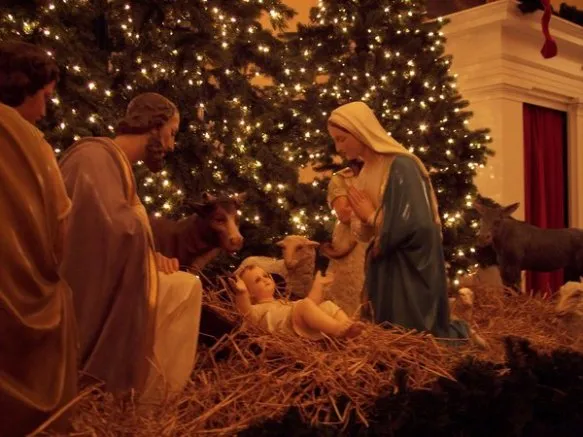
2. The Cathedral Tree: Angels, Candlelights, and a Rocky Crèche Base
The element that makes this tree unforgettable isn’t the height — it’s the base. That rocky crèche scene, populated with dozens of small painted figures, takes the tree from impressive to processional. Take it away and you have a very tall evergreen with lovely ornaments. Keep it and the whole thing becomes a story with a beginning, a middle, and a starburst finial at the top.
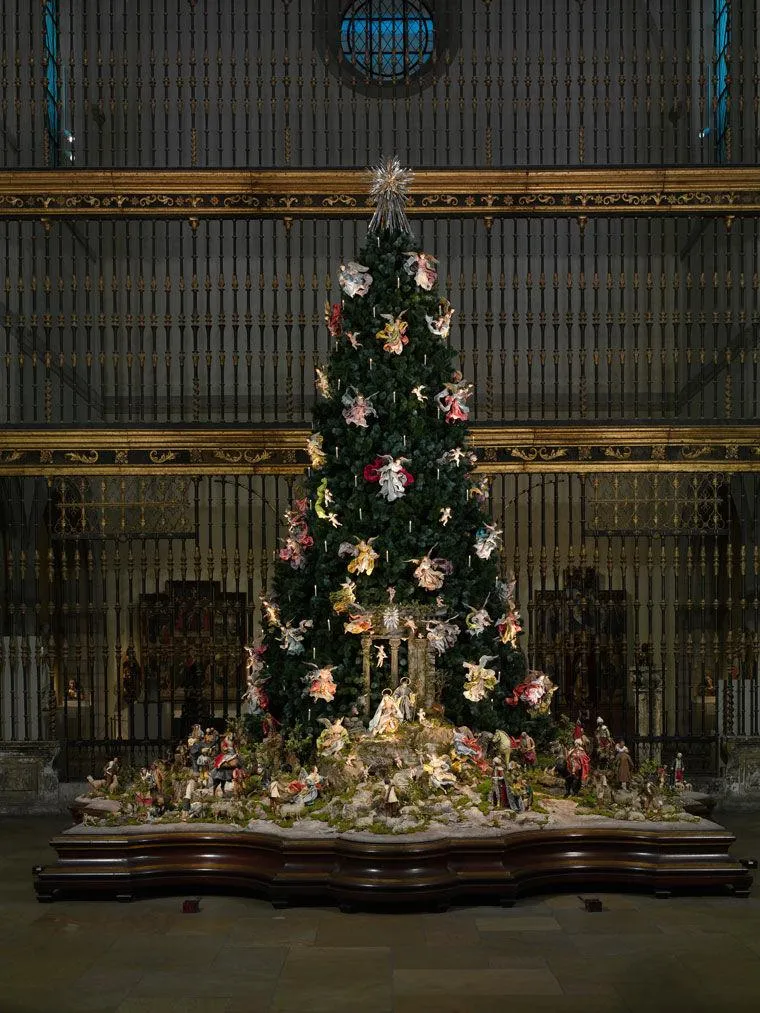
Scale-wise, this is a 14-foot tree in a room with 18 to 20-foot ceilings, and it needs a full 8 feet of floor diameter at the base just for the crèche. That’s a foyer, a church hall, or a grand parlor — not a 9-foot living room. If your ceilings top out around 10 feet, look at Idea #12 instead, where the same vintage ornament vocabulary works at human scale.
These tableau trees are having a real moment. Museum crèche displays have drawn record holiday attendance for two seasons running, and searches for nativity base ideas climb every December. It’s nostalgia with a curator’s eye, and it likely has staying power — the components are heirlooms, not trends.
3. Crimson Baubles and Clustered Bows on a Classic Fir
Reproducing this classic fir is mostly about ornament volume, not price. Budget for a tree with a real branch count (look for 1,300+ tips on a 7-footer), then spend where it shows.
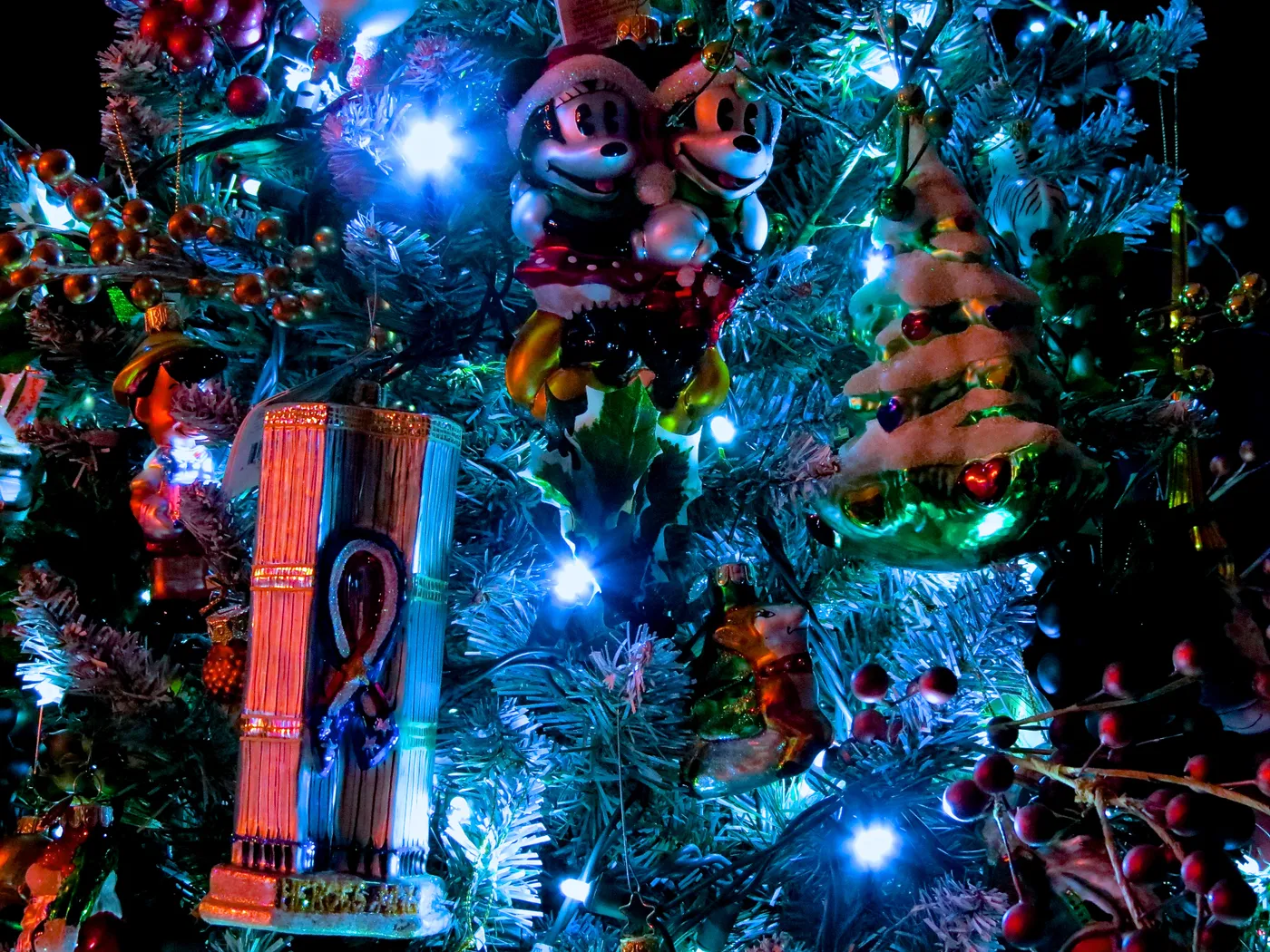
- Main tree: $120–$450 (pre-lit saves you an evening)
- Red ornaments and bows: $60–$180 for roughly 80–120 pieces
- String lights, if not pre-lit: $25–$70
- Tree skirt or collar: $30–$90
- Warm clip-on candles: $20–$60
Total: roughly $255 to $850. Budget alternative: a $60 secondhand tree from Facebook Marketplace, dollar-store red baubles in three sizes, and ribbon instead of pre-made bows — about $140 for the same read.
The formula underneath is simple: 70% deep green canopy, 20% saturated crimson, 10% warm gold. Swap crimson for cobalt and gold for pewter and you get a completely different tree with identical bones, which is how you reuse the same ornaments for a decade without it going stale.
4. Frosted Branches Against a Deep Teal Paneled Wall
Two things are doing the work here. First, the frosted branches carry white into the tree itself, so the teal wall behind it doesn’t have to compete — it just sits there, cool and saturated, and the tree floats in front of it. Second, that green velvet armchair pulls the arrangement out of display territory and into a room someone actually uses. A tree without a chair is a showroom.
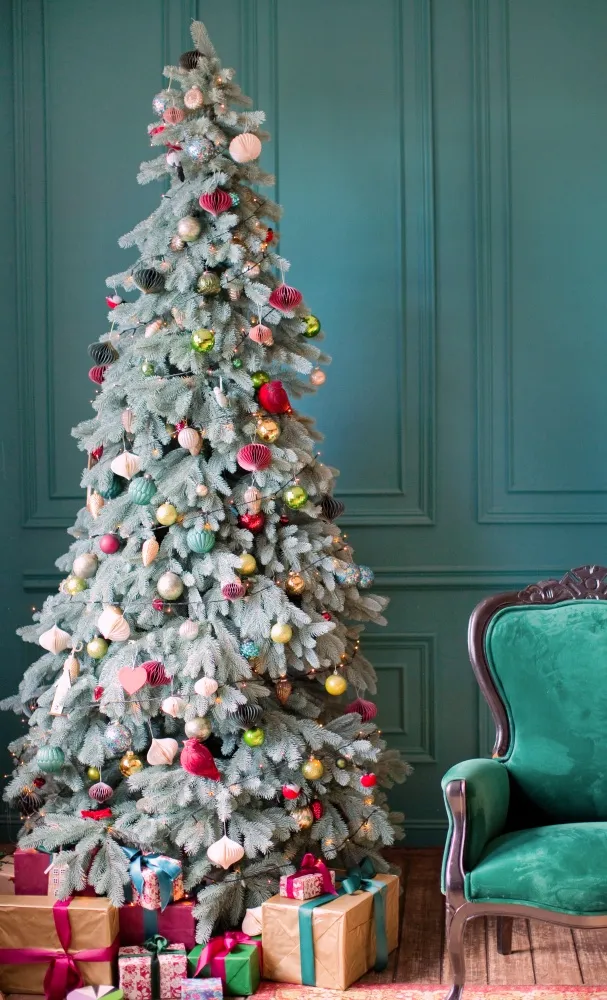
The honeycomb ornaments are the sleeper detail. Papery and matte, they read soft beside satin baubles, and that small texture contrast is what keeps a colorful palette from tipping into garish. Without it, raspberry and sage start arguing.
flocked trees shed. Expect a fine white dust across that hardwood for the first week, and think twice about one in a hallway you vacuum twice a month. Deep teal is also a commitment — it flatters cream, sage, raspberry, and gold, but it will make orange ornaments look like a mistake.
5. Gilded Molding, Blue Walls, and a Model Train Circling the Base
The train is the point. Everything else — the gilded crown molding, the pale blue walls, the gold curtains — is period-appropriate backdrop, and the tree itself is handsomely decorated but not unusual. The model train track circling the base is what turns a decorated corner into something people walk toward. It signals that someone in this house is playing, not just decorating. If you want a base that reads as scenery rather than a toy, the crèche approach in Idea #2 does the same job with more solemnity.
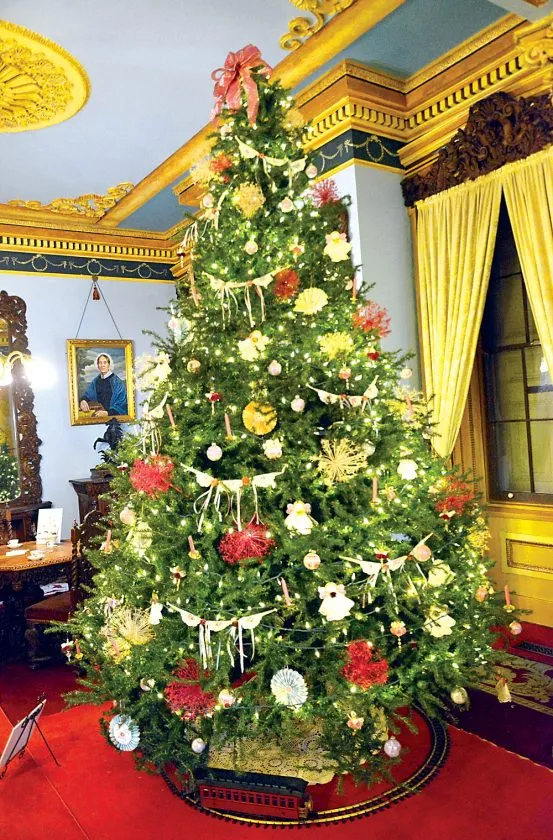
Here’s how to build a track that doesn’t look like a toy aisle:
- Measure the skirt diameter and add 8 to 12 inches for the loop radius.
- Choose O-gauge or G-scale — HO reads too small against a 7-foot tree.
- Lay track on a thin plywood or cork ring to protect floors and cut noise.
- Tuck faux moss or gravel over the ties so the plastic disappears.
- Route the transformer cord behind the skirt, never across a walkway.
One afternoon, $80 to $400 depending on gauge and whether you buy used.
6. Red Velvet Swags, Antique Dolls, and a Draped Crèche Table
The grandeur here comes from fabric, not furniture. Heavy red velvet window swags with gold cornices, a draped nativity table, tufted red armchairs — it’s a lot of yardage.
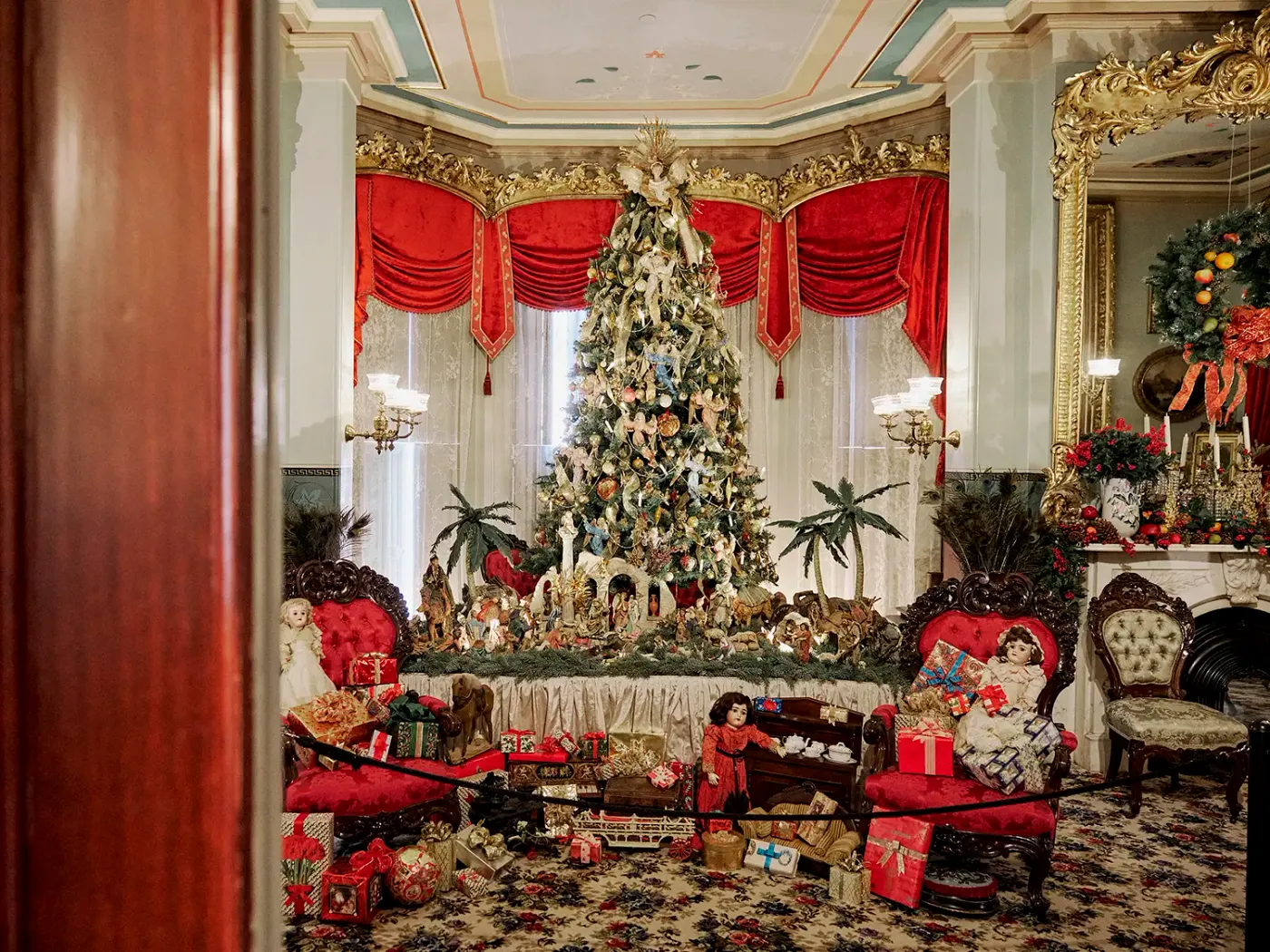
- Tree and dense ornament collection: $250–$700
- Velvet swags with gold cornice boards: $180–$600 per window
- Draped table and crèche figures: $120–$450
- Tufted red armchairs, vintage or new: $400–$1,800 each
- Antique dolls and display pieces: $40–$200
Total: about $990 to $3,750 for the full scene. The budget route: buy velvet by the yard at $25–$45 and pin swags over your existing rods. That’s roughly 60% off, and nobody can tell from four feet away.
One professional note worth paying for: hang swags so the lowest point lands at about one-third the window height. Go lower and the room feels sunken. Go higher and it reads as a valance that gave up halfway.
7. A Picket-Fenced Tree Under a Glass Arcade Roof
The white picket fence is an optical device as much as a decorative one — it gives a 12-foot tree a human-scale boundary and stops the base from becoming a jumble of gifts. But it needs room to breathe.
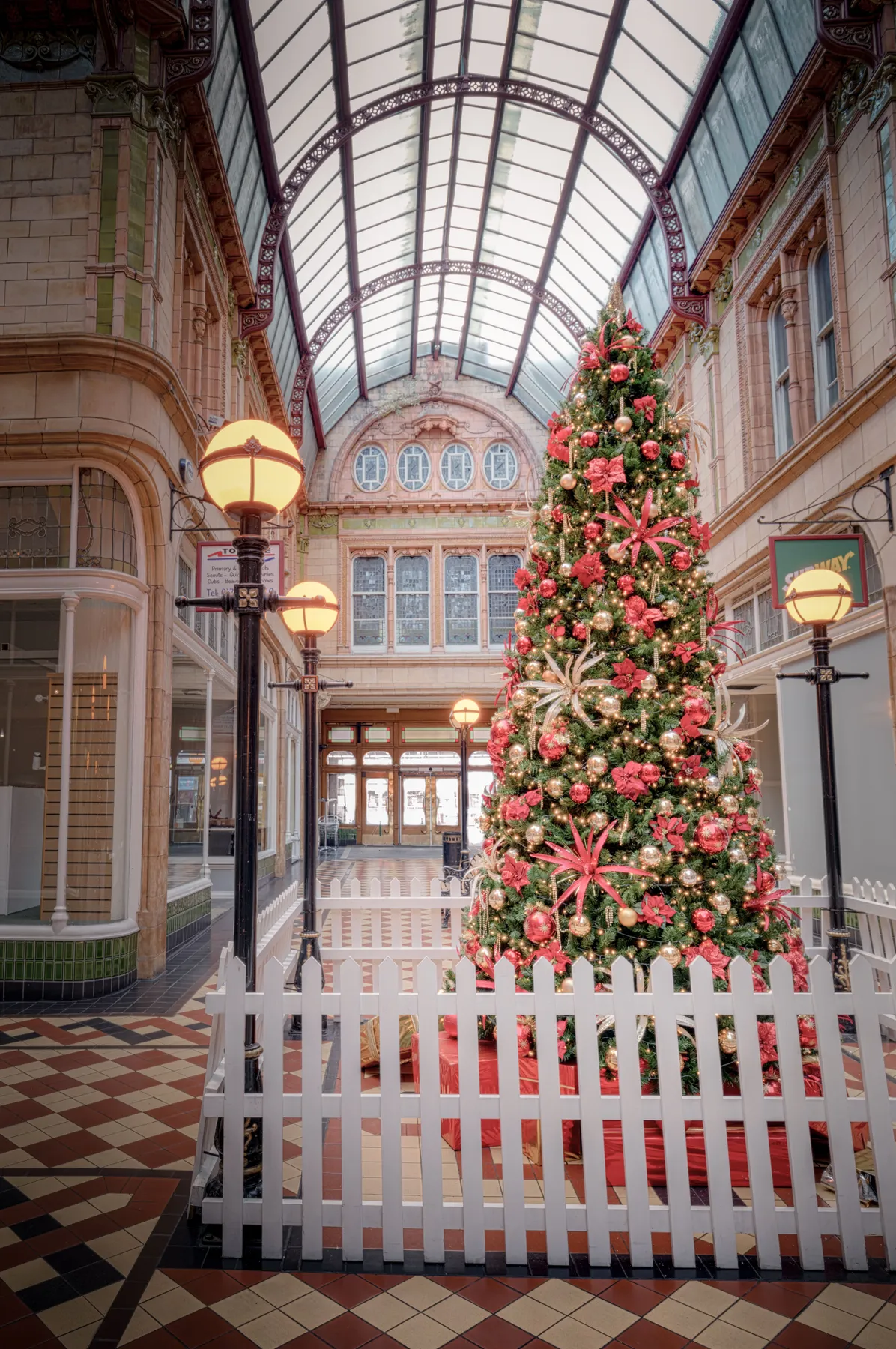
This setup wants ceilings of 14 feet or more and a floor footprint of at least 10 by 10 feet, ideally in a two-story foyer or atrium. In a standard 8-foot room, swap the fence for a low woven collar and scale the tree to 6 or 7 feet — see Idea #22 for how that reads in a normal living room.
What’s driving interest here is a very 2020s habit: people are decorating the way public spaces do. Shopping arcades, hotel lobbies, and botanical gardens have become mood boards. It’s a strong look with one real risk — it can read as a mall if the ornaments are too uniform. Mix in something handmade or inherited to break the pattern.
8. Masquerade Masks and Gold Baubles on a Charcoal Backdrop
The formula: 60% dark green canopy, 25% gold and white ornament, 15% charcoal wall. That’s it. The palette is narrow enough that nothing argues with anything else, which is why it feels expensive even though every component is an ordinary bauble.
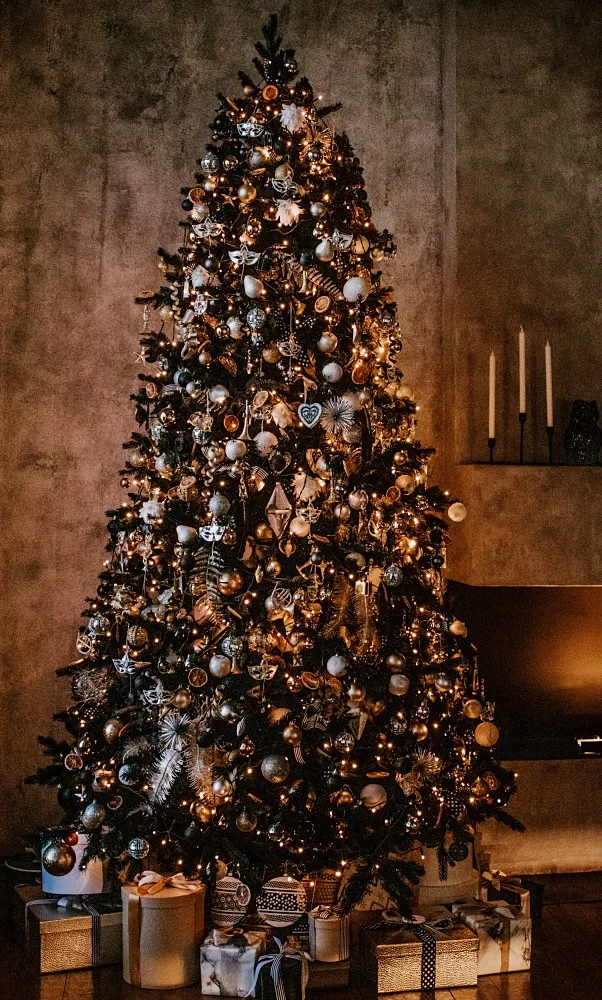
Swap gold for pewter and you get a cooler, more contemporary tree. Swap the charcoal wall for warm greige and the exact same ornaments suddenly read traditional. The proportions stay put; only the temperature changes.
beyond color is the oddity of those masquerade masks. Everything here is round and predictable — spheres, baubles, a finial or two — and then a mask appears and the eye stops dead. One strange object roughly every 18 inches is the difference between a department store display and a tree someone actually lives with.
9. A Flocked Tree with Red, Gold, and White Floral Picks
A flocked tree is the shortcut nobody talks about. You’re buying the snow as part of the tree, so you don’t have to engineer a white accent — the branches deliver it. That’s why the white floral picks read as intentional rather than pasted on: they echo the flocking instead of fighting it.
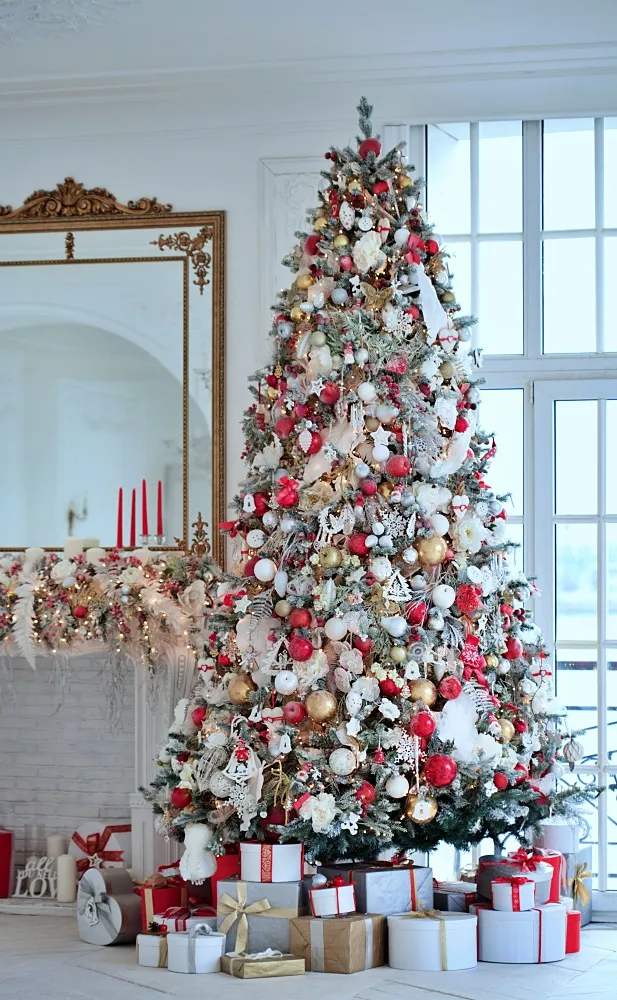
For less: a 7.5-foot flocked tree runs $80–$150 at Walmart in season, Target’s Threshold line lands around $100–$180, and IKEA occasionally carries a frosted option under $120. Fill it with three sizes of red baubles from Dollar Tree at $1.25 a pack (buy 40), a bundle of gold picks, and white faux amaryllis stems from Michaels on a 40% off week. Whole tree, $220 to $300. The ornate gold mirror in the background is doing quiet work too — any large mirror near a tree bounces its light back into the room, which is a free lighting upgrade.
10. The Ornament Mix: Red Glitter, Pearl, and Gilded Pinecones
Ornament placement follows a rule most people never hear: cluster in odd numbers, and never let two identical pieces sit within 18 inches of each other. Group one large ornament with two smaller ones in the same finish, place that cluster every 12 to 15 inches, and fill the gaps with a different finish entirely. It’s how you get a collected look instead of a polka-dot tree.

Maintenance is the trade-off for all that glitter. Glitter baubles shed, permanently, and they’ll dust your skirt, your floor, and your hands through January. Store glass and glitter pieces in acid-free tissue inside a hard-sided bin — never a garbage bag — and don’t stack ornaments more than three deep. Plan on replacing two or three chipped pieces a year. That’s normal, and honestly part of the charm.
11. A Pink Tinsel Tree That Refuses to Be Traditional
You can absolutely do this without designer money. Pink tinsel trees run $60–$120 at Walmart and Big Lots in season, and vintage glass ornaments are cheapest in mixed lots on eBay — search for lots of 30 and expect $1 to $3 per piece. Silver tinsel garland is about $4 a strand, and those bright yellow chairs are thrift store or Facebook Marketplace finds at $40 to $150 each.
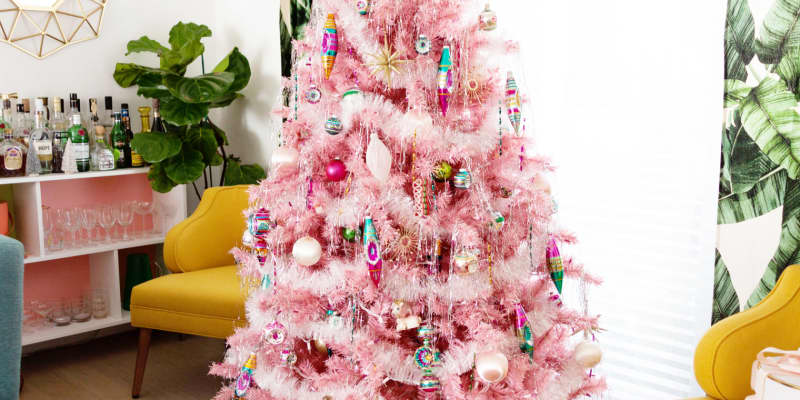
The real talk: tinsel trees photograph beautifully and unforgivingly. In a room with overhead lighting and no daylight, pink reads plastic and washes the whole space out. And if you have cats, tinsel is a vet visit waiting to happen — the garland specifically, not the tree. If you love the color but not the risk, a pink-ribboned green tree gives you 80% of the mood with 5% of the anxiety.
12. Vintage Globes Against a Muted Sage Green Wall
The formula here is gentler than a full Victorian parlor: 65% muted sage green, 25% red and gold ornament, 10% dark wood. Because the wall is a desaturated green, the tree’s own foliage nearly disappears into it and the ornaments do all the announcing. That’s a smart play in a small room — no visual competition, no shrinking feeling.
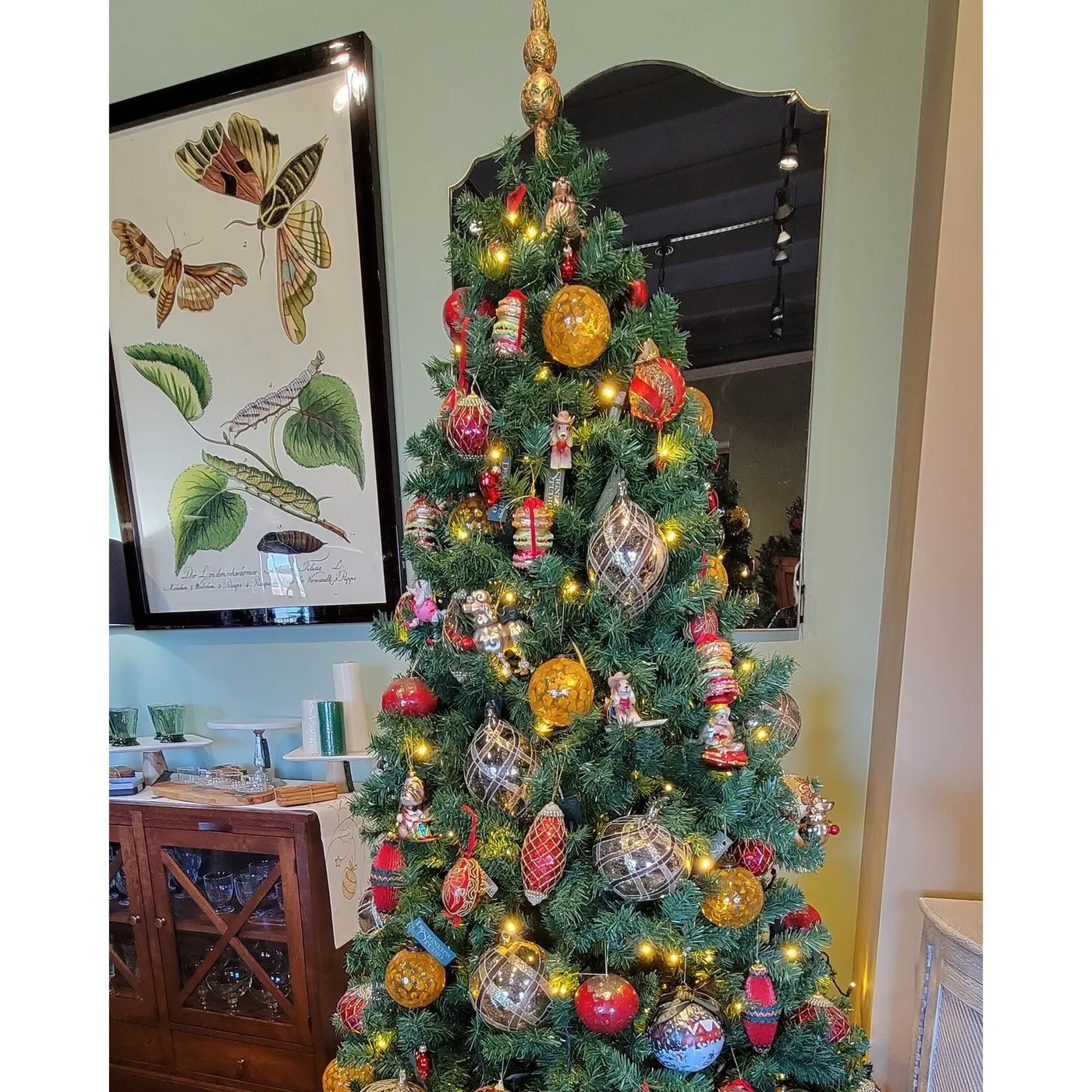
For scale, this works beautifully in a 10-by-12 room with 8-foot ceilings. A 6.5 to 7-foot tree leaves comfortable headroom, and the arched mirror beside it adds depth without consuming floor space. Striped globe ornaments and etched glass read as collected rather than purchased, which is exactly the point. If you have taller ceilings and want the full cathedral effect, Idea #2 is the opposite approach — there, the tree is the architecture.
13. Chinoiserie Walls and a Tree That Joins the Landscape
Hand-painted Chinoiserie is the item that decides everything else in this room. Real hand-painted paper runs $150–$400 per double roll, and a room this size needs 10 to 14 rolls.
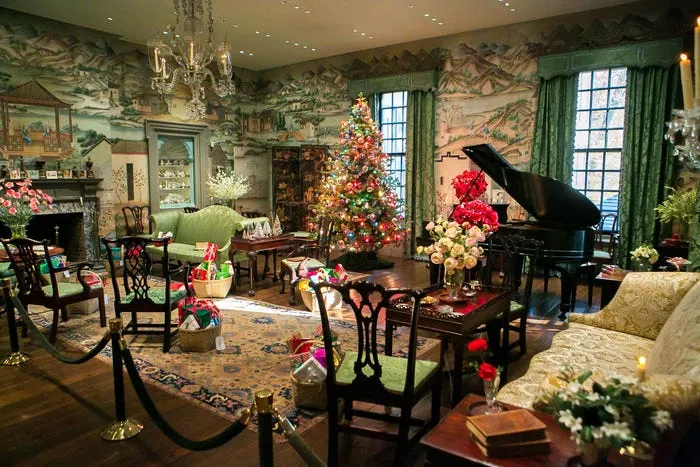
- Hand-painted Chinoiserie wallpaper: $1,800–$5,000 for the room
- Digital-print mural alternative: $300–$900
- Green silk drapes and valances: $400–$1,200 per window
- Tree and ornaments: $300–$800
- Crystal chandelier, vintage: $350–$1,500
Total: roughly $3,150 to $9,400. A mural panel on the focal wall only gets you about 40% of the way there at a fraction of the cost.
Before you commit: measure wall height including crown molding, because printed panels have a fixed repeat and trimming can crop a painted tree in half. Note which direction your windows face — heavy green silk reads nearly black on a north wall. And make sure your tree isn’t taller than the lowest branch in the wallpaper pattern, or the composition fights itself.
14. Sage Walls, Maroon Drapes, and a Ribbon-Wrapped Chandelier
Wrapping a chandelier is the detail nobody expects and everyone remembers. It takes about 45 minutes and $20 in materials.
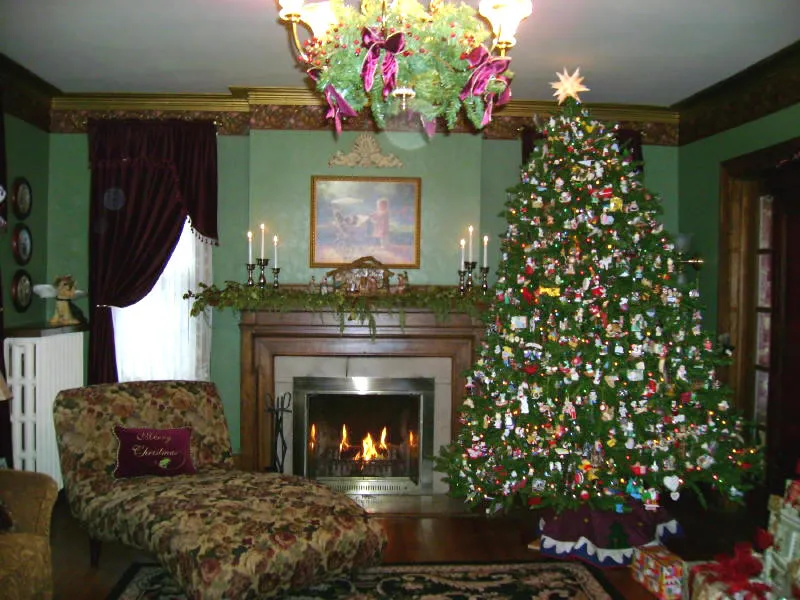
- Cut power at the breaker and let the bulbs cool completely.
- Cut 6 to 8 lengths of 1.5-inch velvet ribbon, each about twice your fixture’s drop.
- Weave each ribbon over the chain or arms in a loose spiral — never tight enough to trap heat.
- Tuck 6-inch sprigs of faux cedar or eucalyptus under the ribbons at each arm.
- Keep all greenery at least 6 inches from any bulb.
One number worth memorizing: ribbon width should be about one-third the width of your tree’s widest branch section. On a 7-foot tree with a 4-foot base, that’s a 2.5-inch ribbon. Narrower disappears from across the room; wider looks like a craft project. The same math applies to the chandelier, just scaled down.
15. The Tree Framed in the Doorway of a Victorian Parlor
What makes this room memorable isn’t the tree’s decoration or the antiques — it’s that you never see the tree directly. It’s framed in the doorway, glowing in the next room, and that glimpse is worth more than any single ornament. Remove the framing and you have a nicely furnished parlor with a tree in it. Keep it and the room holds a secret.
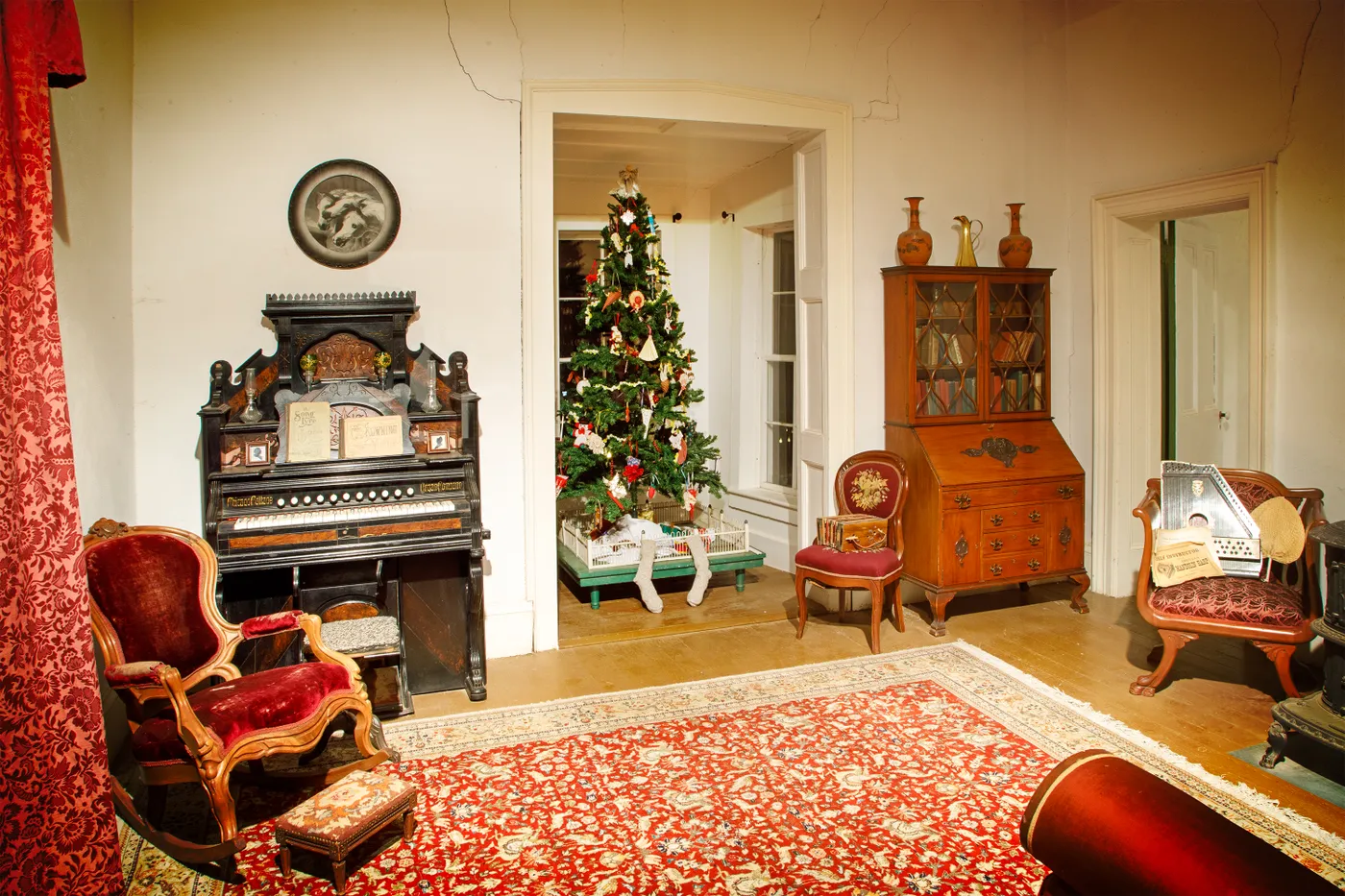
This is part of a broader shift: people are decorating for the view from the hallway, not just the view from the sofa. Pins of trees seen through doorways have become their own category, and it makes sense — most of us pass a tree twenty times a day and sit in front of it three times. If you have a doorway, a pass-through, or even a wide arch, position the tree to be seen through it, and put your best pieces on the side that faces the opening.
16. Antique Ornaments in a Cast Iron Stand on Rough Wood
A cast iron stand is beautiful and heavy in a way that actually matters — it’s why that tree hasn’t moved an inch, and why it stays upright when the cat investigates. Expect $60 to $150 for a period stand at an antique mall, and put a felt pad underneath so it doesn’t scar the table. If yours is rusty inside, line it with a plastic tub insert before adding water.
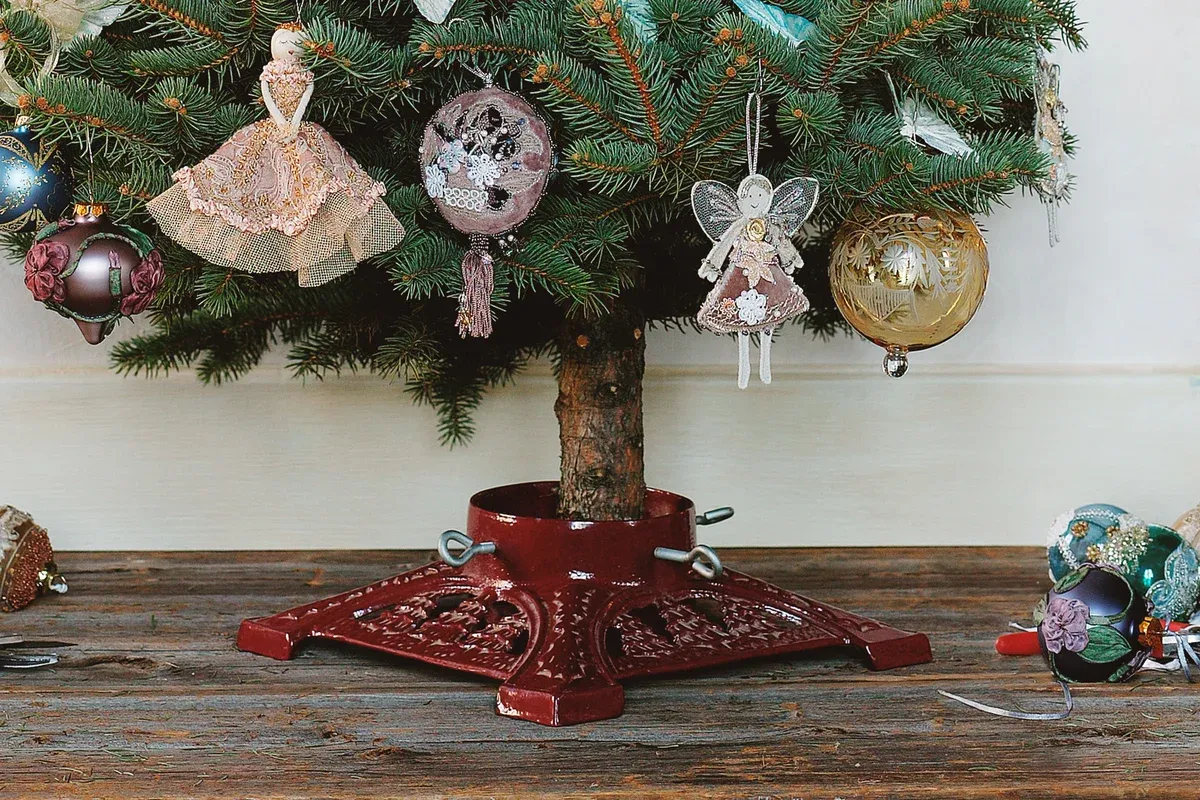
For less: estate sales and Facebook Marketplace turn up cast iron stands for $20 to $45, usually in November when people clear out garages. Vintage glass and fabric ornaments are cheapest in mixed lots at $2 to $5 per piece when you buy 20 at a time. And that rough wooden table is doing more for this composition than you’d think — a $30 flea market find with a coat of paste wax. The texture is the point. Don’t sand it smooth.
17. Yellow-Toned Fairy Lights and Red Ribbon Bows
Two decisions set the temperature in this room. First, those bulbs are warmer than most — closer to 2200K than 2700K — which is why everything reads amber instead of white. Second, red ribbon bows rather than a scatter of red baubles keep the red moving vertically, so the eye travels up the tree instead of stopping at one spot. The round gold skirt at the base catches that warm light and bounces it back onto the lowest branches.
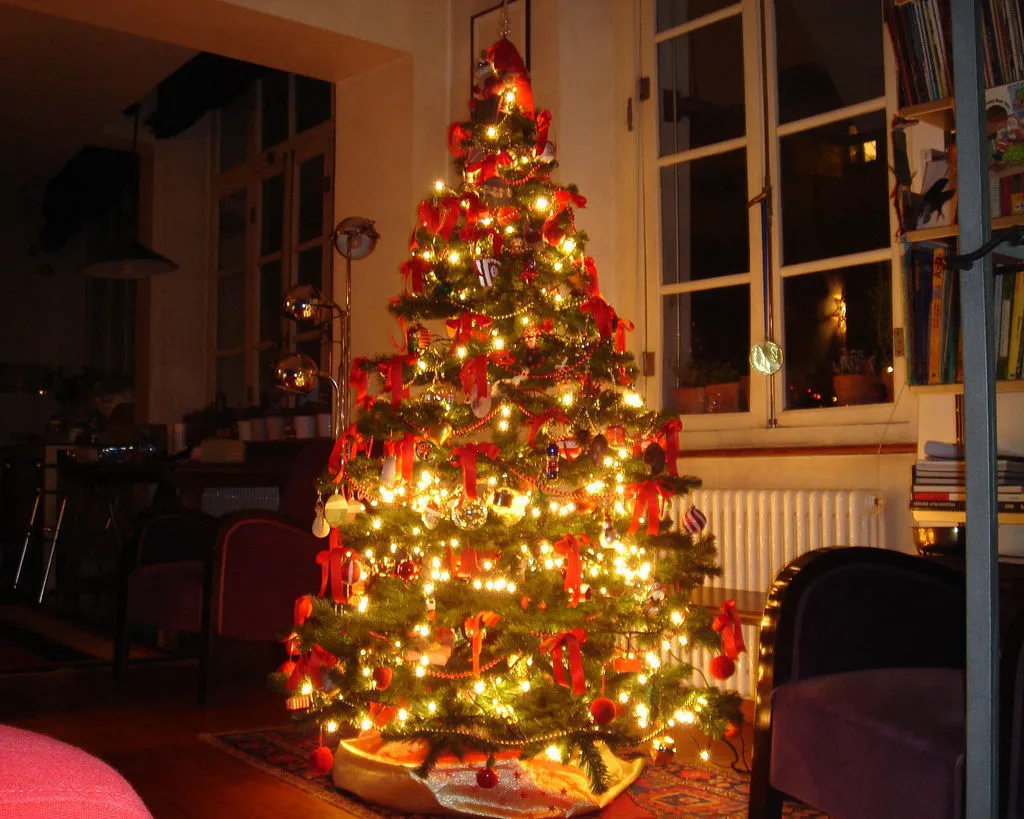
One tip worth the trouble: buy two strands of lights in different color temperatures and plug them in side by side before you commit to a full set. Photos lie, packaging lies, and the difference between 2200K and 3000K on a green tree is the difference between a hearth and a hospital corridor. Return the one you don’t want — nobody minds. Ten minutes saves you an entire evening of unwinding lights from a tree you don’t love.
18. A Stone Hearth with Four Red Stockings and a Giant Bow
Hanging stockings on a stone fireplace is the most-photographed and least-thought-through holiday move there is. If that fire actually burns, give stockings and garland a minimum of 36 inches of clearance, and never leave the room with them hanging over an active flame. Soot also settles into cheap knit overnight — washable cotton is the smarter buy than anything dry-clean-only if your hearth gets real use.
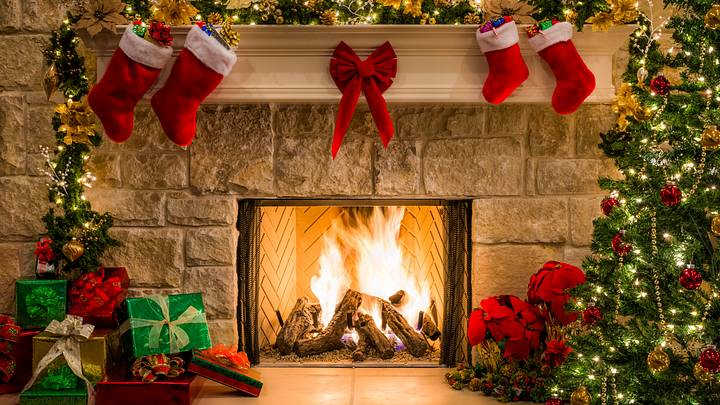
- Faux pine garland, 9-foot: $35–$90
- Four quilted or knit stockings: $40–$140
- Oversized velvet bow: $15–$45
- Tree with red and gold ornaments: $200–$600
- Gift boxes, paper, and ribbon: $30–$80
Total: roughly $320 to $955. Budget version: Walmart stockings at $6 each, dollar-store garland, and last year’s boxes with fresh ribbon — under $130.
19. Beaded Garlands and Glass Baubles, Layer by Layer
Think in materials, not colors, for a tree this layered. The working mix is about 50% glass and reflective baubles, 30% beaded and ribbon garland, 20% visible warm light. When glass dominates, the tree reads antique. When beads dominate, it reads craft fair. Stay above half glass and you stay on the right side of the line.
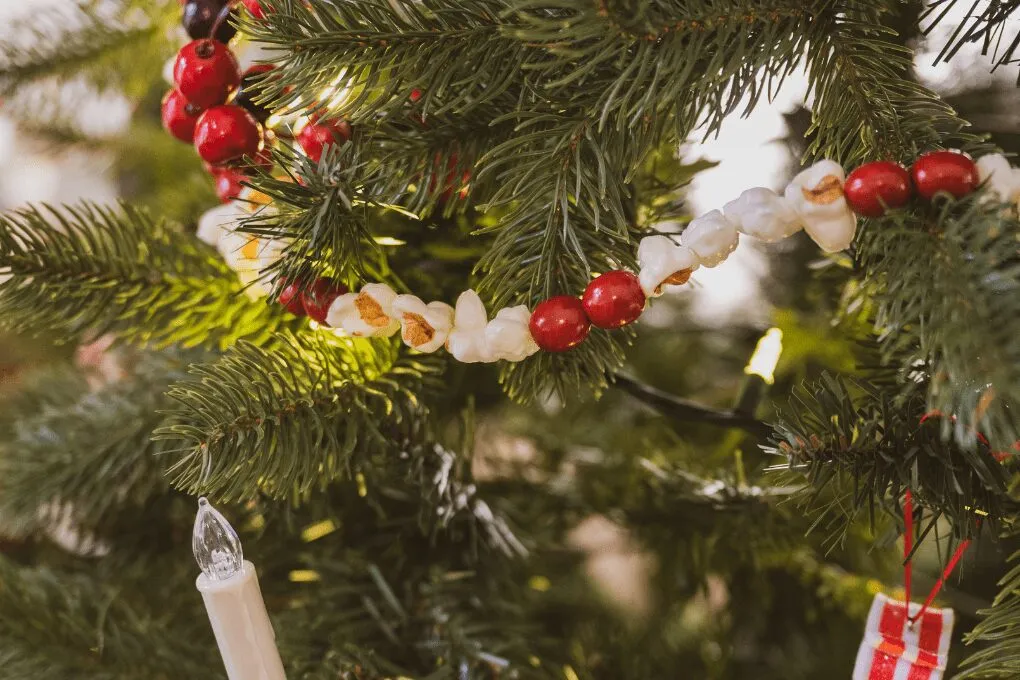
Swap glass for mercury-coated plastic and the look holds at a fraction of the weight and cost. Swap beaded garland for velvet ribbon and you shift the whole thing a decade later in style — useful if you get bored easily.
Upkeep is real, though. Beaded garland tangles into itself the moment you box it, so wind each strand around a piece of cardboard before storing. Glass wants acid-free tissue and a hard bin, and a surprising number of vintage baubles are hand-painted on the inside — those should never be washed, only dusted with a dry soft brush.
20. A Barely-Dressed Tree in a Stern Victorian Parlor
A barely-decorated tree in a formal room is a confidence move, and it needs the right proportions to land. This wants ceilings of 8 to 9 feet, a room around 10 by 12, and a tree no taller than 6 feet. Otherwise it looks like you ran out of ornaments. The window garlands are doing the heavy lifting, which is what lets the tree stay quiet.
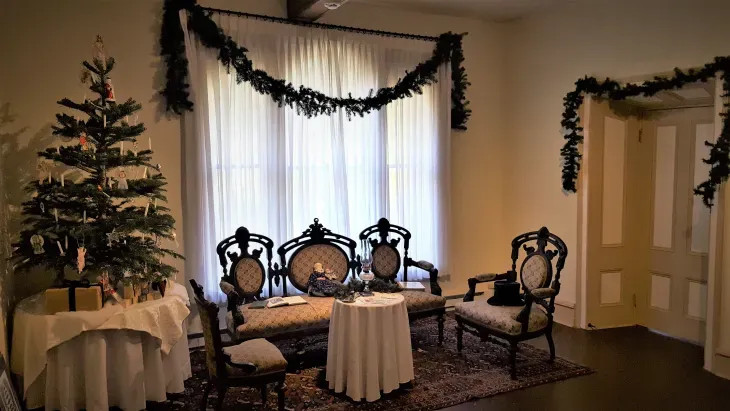
- Measure ceiling height and subtract 12 inches for your maximum tree height.
- Confirm at least 24 inches of clearance where gifts will stack.
- Check that window garlands won’t block the tree’s sightline from the main seating.
- Set an ornament cap in advance — this look fails past about 40 pieces.
- Make sure the rug sits under both front chair legs, or the arrangement floats.
If your room is larger and you want a fuller tree, compare with Idea #13, where the same green-and-gold vocabulary goes full grand salon.
21. Ribbons, Baubles, and a Warm Glow After Dark
This is the most reproducible tree on the list, and almost nobody needs to spend real money on it. Target’s Wondershop baubles run $5 to $12 for a set of six, Walmart’s Better Homes & Gardens line is comparable, and Dollar Tree sells 12-packs of small ornaments for $1.25. Ribbon is the only place worth upgrading — a $12 spool of wired satin looks dramatically better than a $3 craft spool, and you only need two.
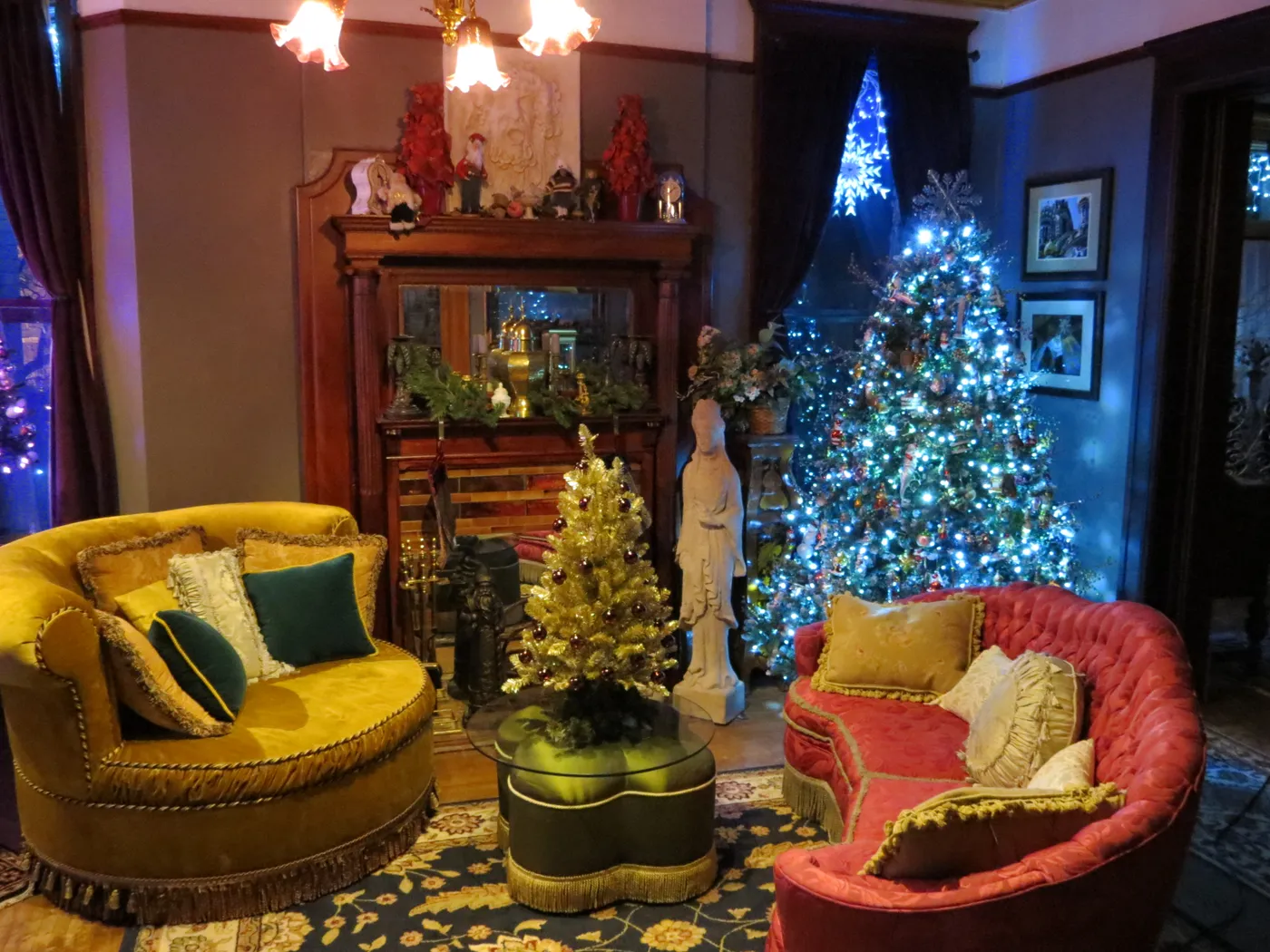
To get ribbon hanging vertically instead of spiraling — the difference between elegant and chaotic:
- Cut 18-inch lengths of wired ribbon.
- Fold each in half and twist once at the fold.
- Tuck the fold over a sturdy branch near the trunk.
- Let the tails fall straight down, trimming to different lengths.
- Space them every 8 to 10 inches around the tree.
Twenty minutes, about $25, and it changes the entire read of a tree.
22. A Tree in a Woven Basket with Bells and Velvet Leaves
Basket sizing is where most people get this wrong. The opening should be 1 to 2 inches wider than the tree’s base diameter — any more and you’ll see a gap between rim and trunk, any less and you’ll be wrestling the tree in with a shoehorn. For a standard 7-foot tree, that’s usually an 18 to 20-inch basket. Line it with a plastic tub if you’re using a live tree, so the wicker doesn’t rot.
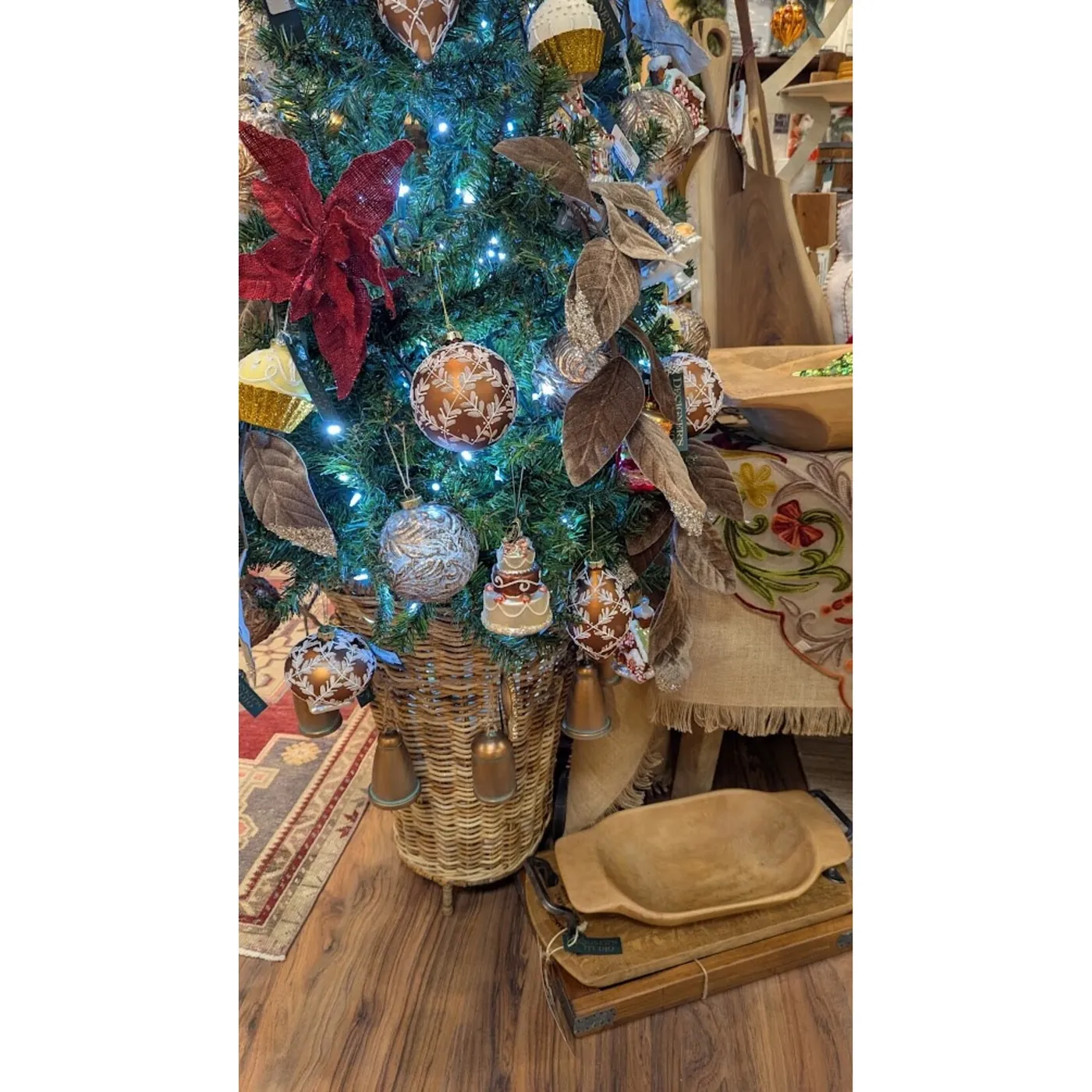
Color-wise, this is a warm, low-contrast formula: 55% natural brown and wicker, 30% white and cream, 15% brass and gold. Brown is the underrated holiday color — it makes white string lights look like candlelight and keeps a tree from reading overly sweet. Swap the brass bells for black metal and you get a moodier, more rustic tree from the exact same base palette.
23. The 2026 Victorian Tree: What’s Actually Changing
Victorian-inspired trees are heading somewhere specific for 2026, and it’s worth knowing before you buy a single thing. The biggest shift is away from more. The trees getting saved and shared now are denser in texture but lighter in ornament count, with fewer shiny baubles and more matte, handmade, and fabric pieces. Colored glass is replacing glitter. Warm bulb temperatures are replacing cool white across the board.

on the downside: this style is expensive to fake. Matte and handmade ornaments are exactly the pieces that look cheap when they are cheap, and there’s no way around it — a $2 matte ball sitting next to a $14 one is visible from across the room. If your budget is tight, buy fewer ornaments and buy them better. Twenty good pieces on a 7-foot tree will beat eighty poor ones every time, and nobody who visits is going to count.
24. A Nutcracker, a Rocking Horse, and a Metallic Pot Base
The base vignette is what makes this work. A tall nutcracker, a small rocking horse, and a metallic pot base are three different heights and three different silhouettes, arranged so the eye travels down from the tree to the floor and back up again. Remove the nutcracker and the corner goes flat. Remove the horse and the nutcracker looks like a guard on duty. It’s the pair that does it.
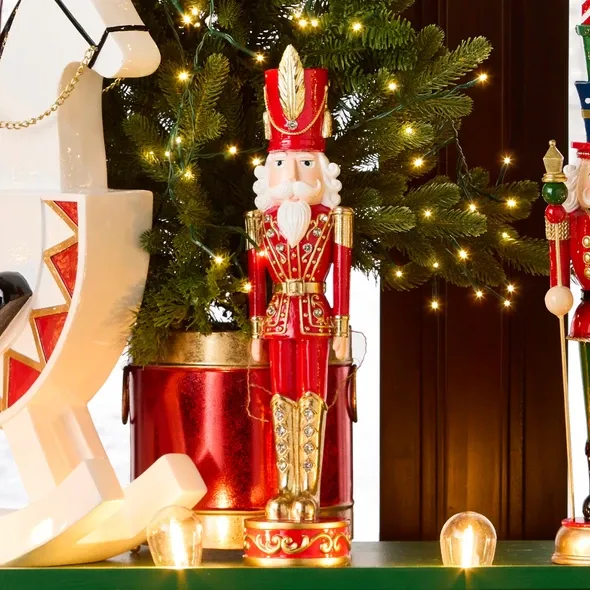
Give this arrangement 24 to 30 inches of clearance in front of the tree — a floor vignette needs room to be walked around, not just seen. It suits a room of 12 by 12 or larger; in anything tighter, keep the nutcracker and drop the horse. Metallic pot bases are also a practical trick: they hide a raw tree stand far better than fabric skirts, which crumple and collect every pine needle you drop. For a more elaborate base display, see Idea #25.
25. Flying Silk Angels Above a Neapolitan Crèche Village
The crèche village at the base is the entire event. The tree above it is spectacular, but it’s a framework — densely lit branches carrying dozens of antique-style angels in colored silk. Take the village away and you’d have an enormous, beautiful, vaguely anonymous tree. The miniature buildings, the rocky terrain, the tiny painted figures: that’s what gives the installation a center of gravity and a reason to walk closer.
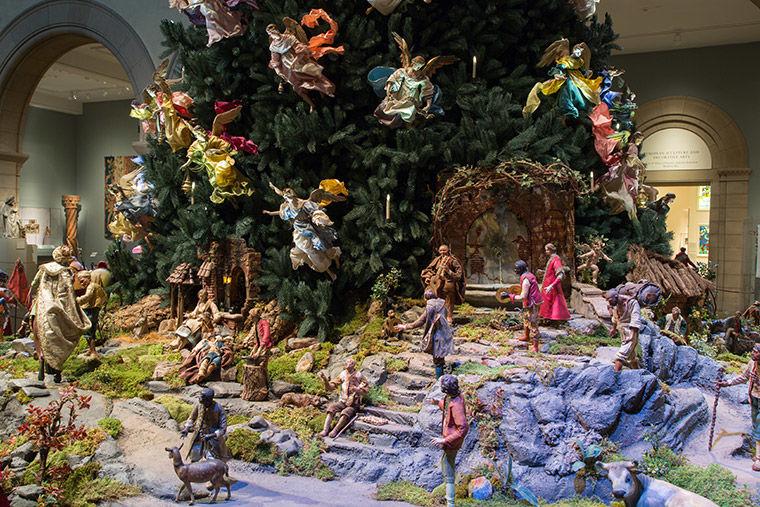
Then there’s the upkeep, which nobody mentions. Dozens of small figurines means dozens of small dust traps every season. Plan on a soft brush and a can of compressed air every few weeks, and store the figures in labeled, padded boxes — not one shoebox, or you’ll spend next December matching shepherd to sheep. If that sounds exhausting, a smaller crèche under a standard tree delivers the same feeling with a fraction of the maintenance.
26. Decorating From the Top: A Sheer Gold Bow at the Peak
A sheer gold bow at the peak does something no star quite manages: it softens the top of the tree so the silhouette doesn’t end in a point. Here’s how to build one that holds its shape.
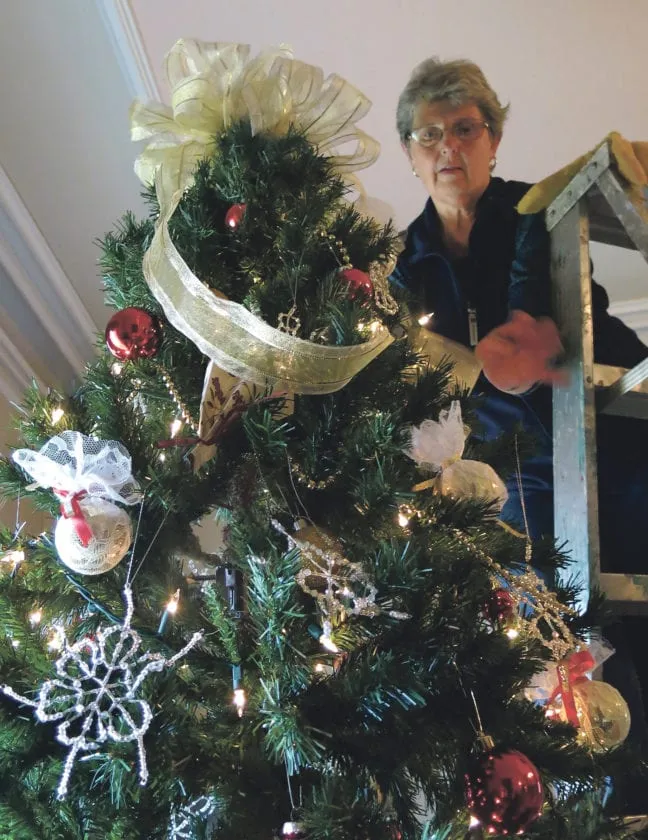
- Buy 3 to 4 yards of sheer wired ribbon, 3 inches wide.
- Make a 10-inch loop, twist at the center, and pinch.
- Add two more loops on each side, each slightly smaller.
- Wrap a short piece of ribbon around the center pinch and tie it off at the back.
- Wire the bow’s back to the top branch and fluff the loops outward.
Materials: about $15. Time: 15 minutes. On cost, though — sheer wired ribbon is one of the few things where the cheap version shows. A $4 spool from Walmart has weak wire and droops by New Year’s, while a $12 craft store spool will last you several seasons and hold its shape through the whole month.
27. A Beaded Star Ornament and the Case for One Hero Piece
The beaded star is the reason this tree photographs the way it does. Crystal beads catch and fracture warm light in a way flat ornaments simply can’t, which is why it reads as the brightest thing on the tree even when it isn’t. Everything around it — the pine, the soft string lights, the blurred dark furniture — exists to make it stand out.
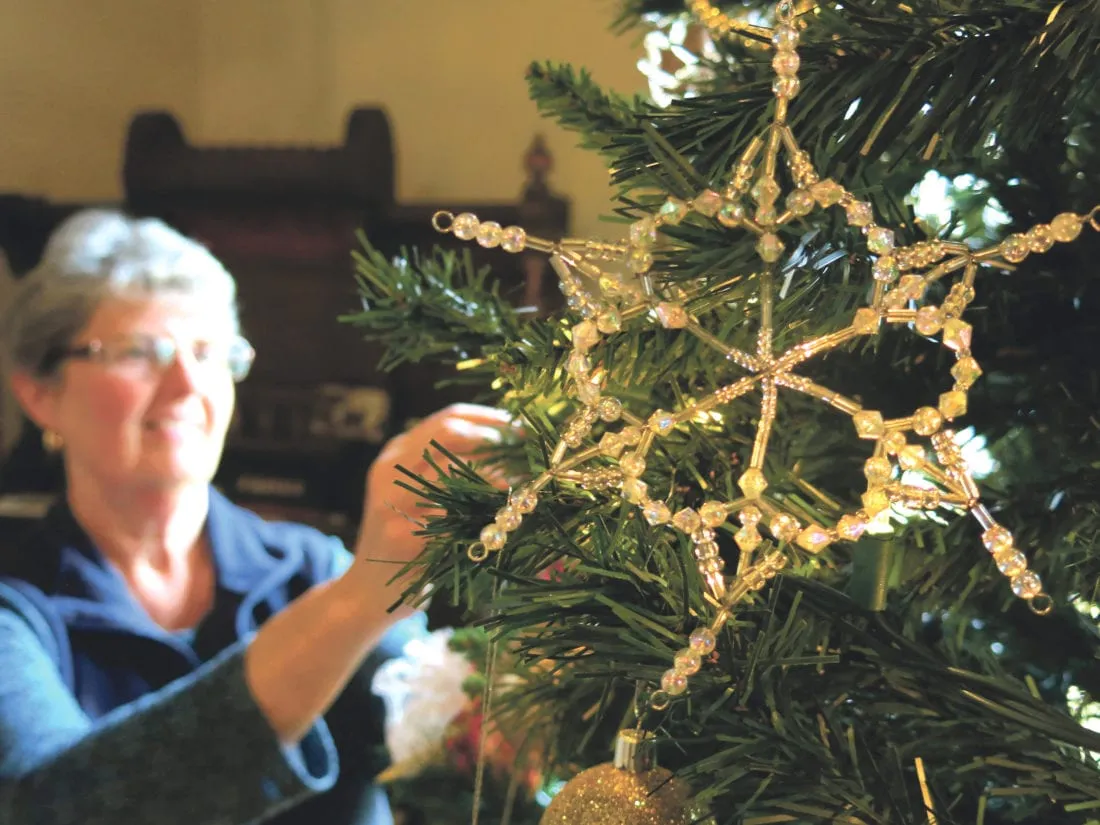
One tip for a hero ornament like this: clear a 6-inch radius around it. Nothing else in the same finish, nothing directly above or below. Hang it from a branch at least an inch thick, using a wire hook rather than a flimsy loop, and place it slightly off-center and about a third of the way down from the top — dead center on a round tree is the one spot the eye skips over. If you have a second favorite piece, put it on the opposite side, not beside this one.
28. Candlelight Glow and Vintage Baubles in a Period Room
Authentic candle-lit trees are the most beautiful and most dangerous version of this look. Here’s the safe reproduction:
- Seven-foot tree with dense branch structure: $150–$500
- Vintage-style baubles, 60–100 pieces: $80–$350
- Beaded and ribbon garland, three strands: $30–$90
- LED candle clips or warm string lights: $25–$120
- Topper and collar: $25–$90
Total: roughly $310 to $1,150. Budget build: a $70 secondhand tree, dollar-store baubles in three finishes, and $20 of warm string lights — about $150 all in.
Now the safety part, which isn’t optional. Real candles on a tree require a live, freshly watered tree, a room with zero air movement, and constant attendance. Fire services consistently report holiday tree fires peaking in the last two weeks of December, mostly from heat sources too close to dry needles. LED clip-on candles give you 95% of the flicker with none of the risk.
29. A Crystal Chandelier and a Red Velvet Settee in the Parlor
Two light sources make this room, and they’re doing different jobs. The crystal chandelier throws patterned light across the ceiling and adds a cooler layer above the warm tree glow. Without it, the room would be all amber and slightly flat. Without the tree, the chandelier would feel formal and chilly. Together, the contrast reads as a room that’s celebrating.
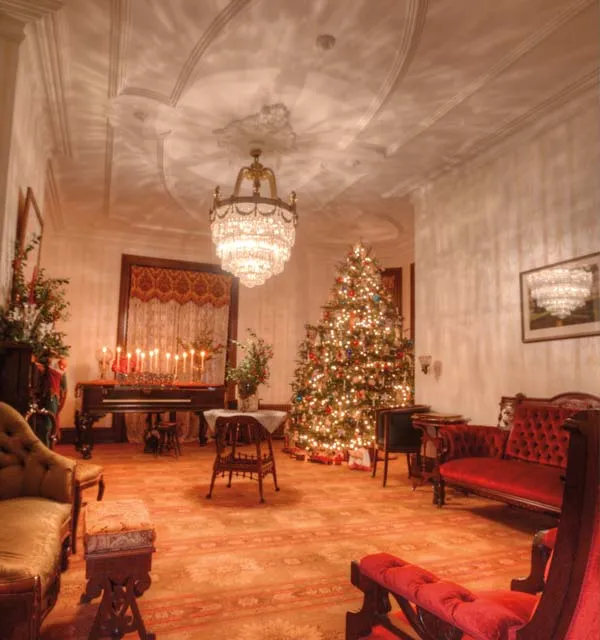
The color formula holds to about 50% crimson, 30% warm gold and cream, 20% dark wood. Crimson is the loudest of the three, so it stays in the soft goods — settee, carpet, ribbon — and never goes on the walls. Swap crimson for deep emerald and you get a cooler, more restrained parlor from the exact same furniture.
One thing that isn’t obvious: that patterned wall-to-wall carpet is quietly holding the whole scheme together. A plain floor here would make every red element shout.
30. Mismatched Stockings on a Lighted Stone Mantel
Mantel garland and a lit fire are a tension worth naming. Real greenery dries out fast above a burning hearth, so if you’re using fresh cedar or pine, plan on replacing it every 7 to 10 days — or go faux and stop worrying. Keep anything hanging at least 36 inches from an open flame, and remember that stockings above a wood-burning insert get warm enough to feel uncomfortable to the touch.
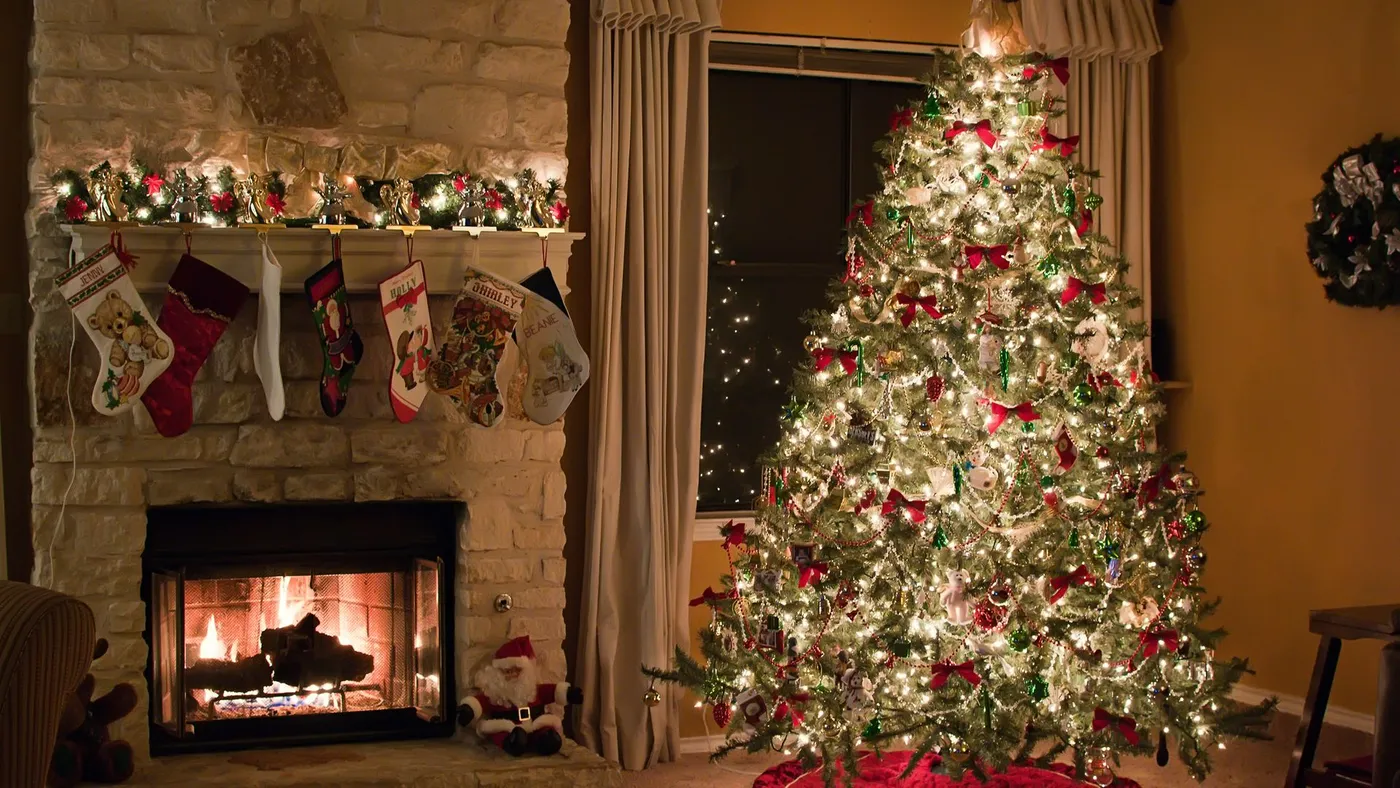
Sizing: this arrangement wants a wall at least 12 feet wide so the tree and fireplace can sit side by side without crowding, plus a 30-inch walkway between the hearth and the nearest seating. In a room under 12 by 14, a slender 6-foot tree and a swagged rather than stacked mantel keeps the wall from becoming a solid mass of decoration. Those beige floor-length curtains are quietly doing scale work too, stretching the wall height so the composition doesn’t look squat.
31. When the Fireplace Is a Screen and the Stockings Hang on the Wall
A video fireplace is a genuinely good solution for apartments, rentals, and anyone whose hearth is a dark media console. A 4K fireplace loop is free on YouTube and Roku, and a decent electric insert with flame effects and heat runs $120 to $300 at Walmart or Amazon — it looks considerably better than a screen from more than six feet away. Real talk: up close, everyone can tell. Sit at least eight feet back and it’s convincing.

If you’re going the screen route, one detail matters more than the rest: get the cables out of sight. Run a single painted cord channel down the wall behind the console, or mount the TV so the only visible line is the tree’s. Nothing kills a cozy corner faster than three black cords sagging beside a glowing tree. Hang the wall stockings low, too — the bottom of a stocking should sit around eye level when you’re seated, not floating up near the ceiling.
Warm Bulbs, Glass Baubles, and a Very Good December
You don’t need a museum budget or an 18-foot ceiling to get the feeling of these rooms — you need warm bulbs, a couple of honest materials, and the patience to hang ornaments where they actually show. Start with the light temperature, build outward from the base, and let one piece be the hero. Then pin your favorite version here so it’s waiting for you next November, when the good ornaments are still in stock.