You know that feeling when you’ve saved 47 Christmas photos and still can’t decide what your own living room should look like? Same. So we went and did the scrolling for you — and what we found is that 2026 Christmas interiors are splitting into two very distinct camps: warm traditional red-and-gold nostalgia, and a cooler, quieter flocked-and-neutral mood that feels almost Scandinavian.
We spent serious time digging through real homes, independent designers, and shops like Target, Walmart, IKEA, and Anthropologie to bring you only what’s actually worth your attention this year — from under $30 ornaments to full-on statement garlands. After filtering through hundreds of options, we narrowed it down to 32 ideas that genuinely deliver, spanning traditional red-and-green, flocked winter white, jewel-toned maximalism, and rustic woodland. Budget and luxury versions are compared side by side throughout.
And 2026 is the year the “quiet Christmas” finally went mainstream — Pinterest searches for flocked trees and neutral palettes have been climbing steadily, while plaid and velvet are staging a very loud comeback at the same time. Go ahead and save this — you’re going to want to reference it when the boxes come down from the attic.
1. Gold, Red, and Wide Ribbon in a Woven Basket Base
What holds this room together is restraint inside abundance. The tree is loaded — gold, red, and white baubles, wide gold ribbons looping through the branches, a star on top — but the color count stays at three. That’s the discipline. A stone fireplace gets a green garland with lights and gold candle holders, and the built-in white shelves echo the same gold-and-green rhythm so the eye travels in a circle instead of stopping dead at the tree.
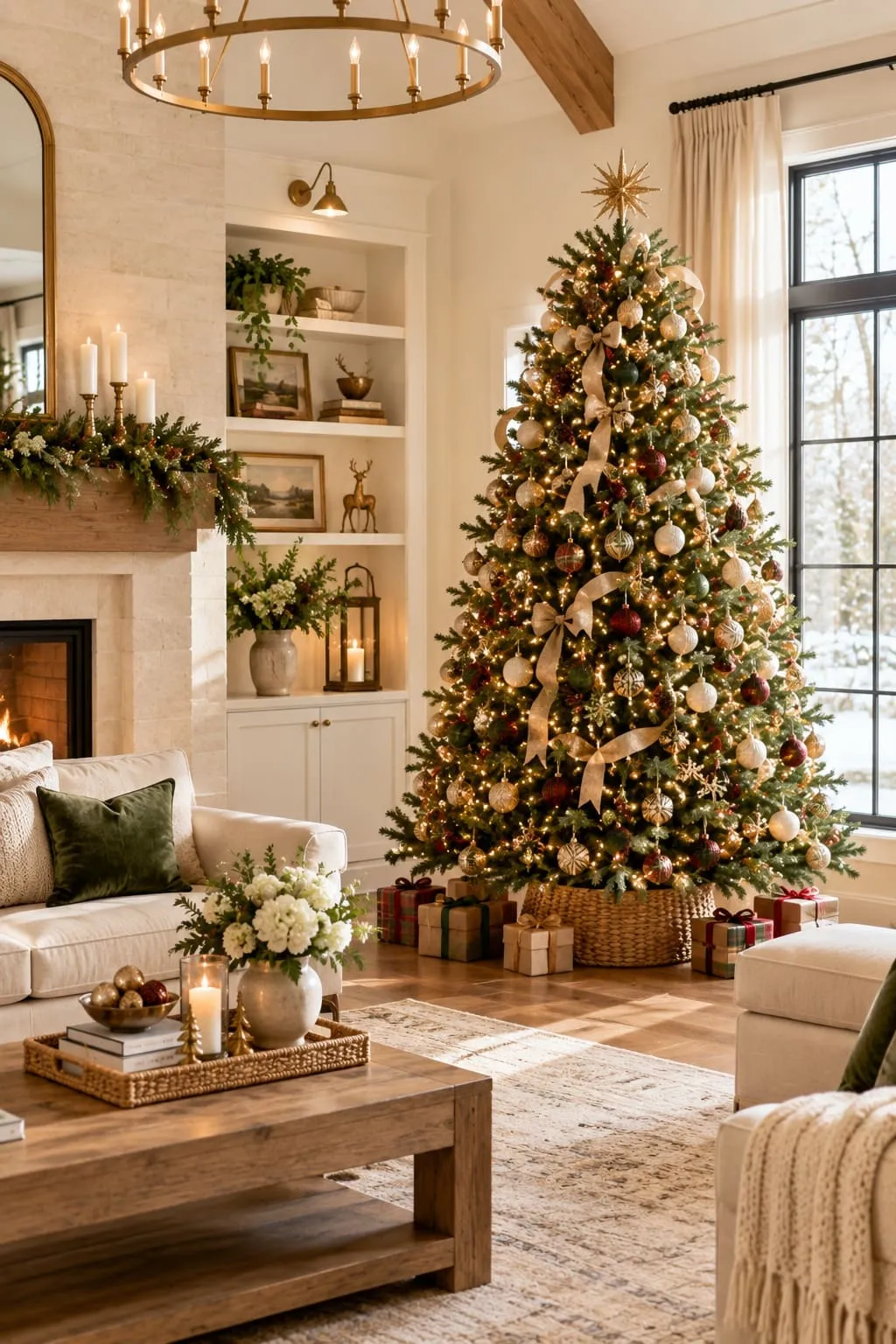
The palette does the emotional work: gold, deep red, forest green, cream, light wood. Light sofas keep it from going heavy, and dark green velvet pillows quietly repeat the garland color across the room. Nothing here is trying to be modern. It’s trying to be remembered.
The single detail I’d fight to keep is the woven basket the tree sits in. Swap it for a metal stand or a fabric skirt and the whole thing loses its footing — literally. The basket signals that the tree is furniture, not decoration, and it softens the transition between the dark green branches and the light wood floor. Everything above it reads warmer because of it.
2. Plaid, Velvet, and Embroidered Pine on a Beige Sofa
This is the cheapest, fastest Christmas upgrade in the entire article, and almost nobody does it properly. Five pillows on a light beige sofa: red plaid, deep red velvet, a cream one with embroidered pine trees, plus a chunky knit throw and a faux fur one layered over the arm. The trick is that no two pillows share a texture — the pattern repeats, the material never does.
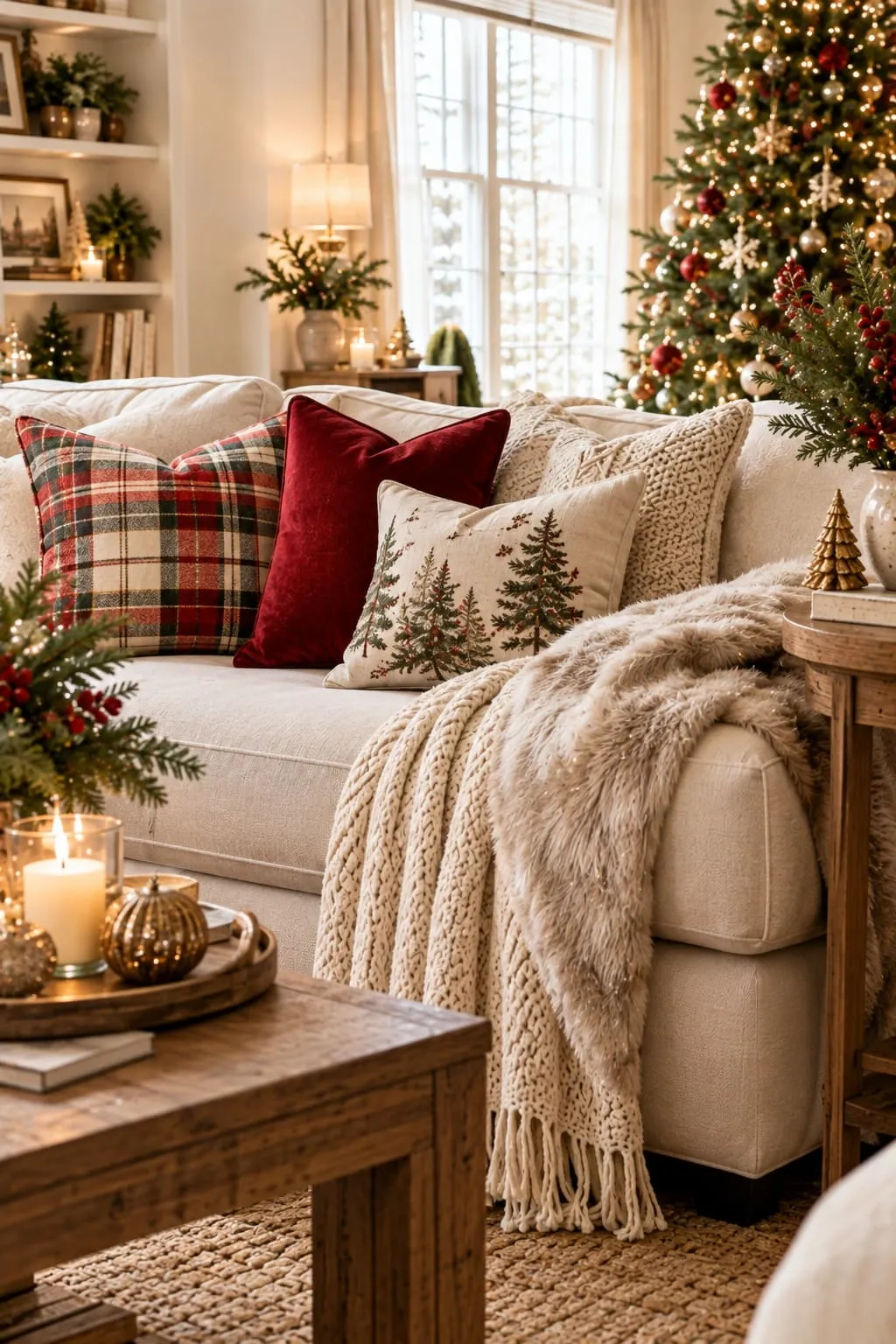
Here’s the formula worth writing down: 60% cream and beige base + 25% deep red + 10% forest green + 5% gold. The beige does all the heavy lifting, which is why the red reads festive instead of aggressive. Swap the red for rust and the green for olive and you have the exact same formula in an autumn palette. Swap red for cobalt and this becomes a completely different, much cooler room.
Professional tip: buy your pillow inserts one size up from the cover — a 22-inch insert in a 20-inch cover. It’s the difference between a pillow that looks like hotel bedding and one that looks like it’s waiting for a customer to fluff it.
3. Flocked Tree, Snowy Garland, and Metallic Deer
A heavily flocked tree with warm white lights, silver and gold baubles, and snowflake ornaments anchors this room, but the supporting cast is what sells it. The stone fireplace wears a matching snowy garland with string lights and metallic deer, glowing lanterns flank the hearth, and cream sofas with chunky knit throws keep the whole thing from tipping into a department store display.
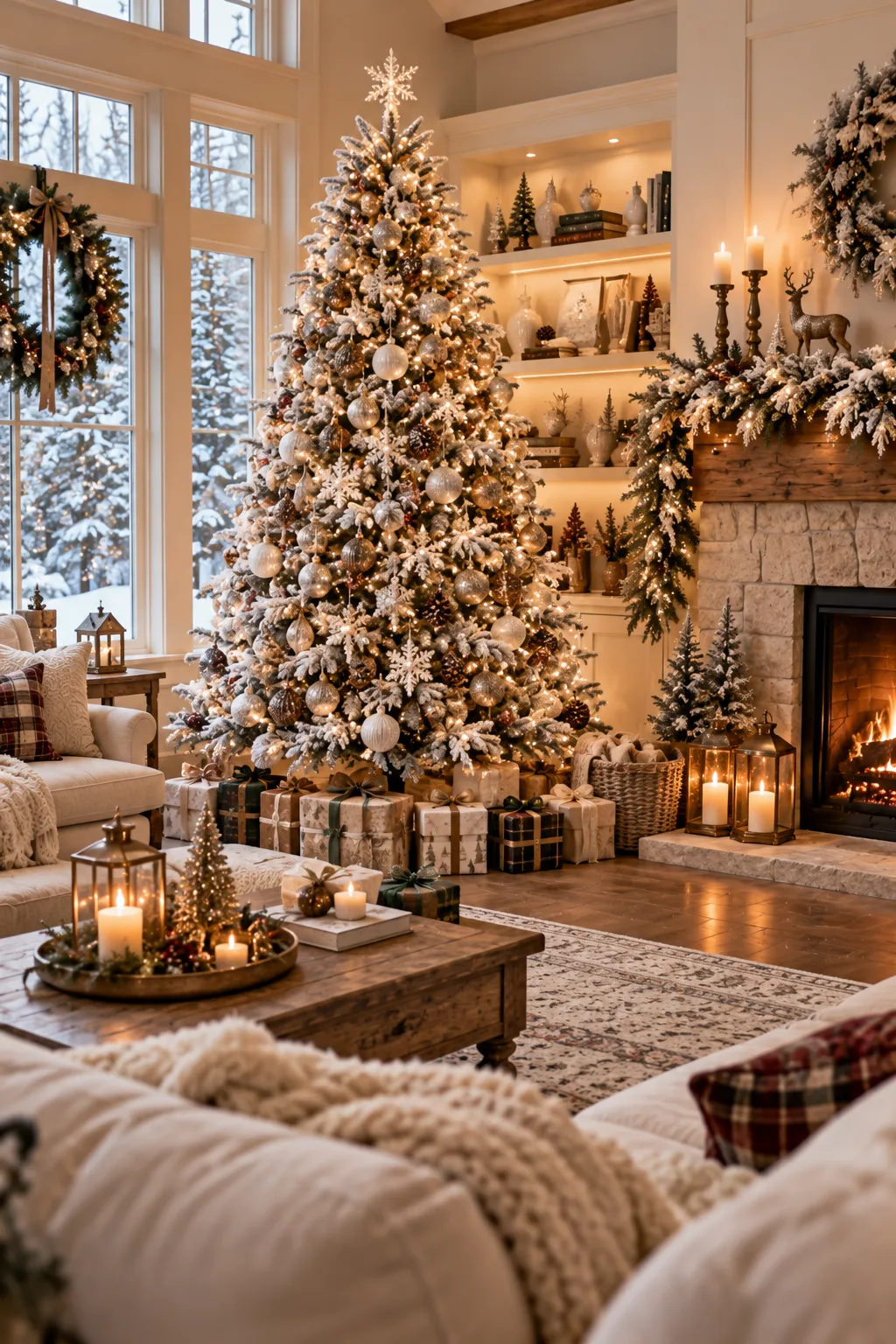
If you removed the flocking, you’d have a nice but ordinary gold-and-silver tree. The flock is the idea. It’s what makes the snowy trees visible through those big windows feel like part of the room instead of a view — the inside and outside are speaking the same language. That’s not a coincidence you can fake with ornaments.
, though: flocking sheds. Expect a fine white dust on your floor for the first week, and don’t put a flocked tree near a heating vent or in direct afternoon sun — the artificial snow yellows over a season or two and there’s no fixing it. If you have toddlers or a dog that investigates everything, a flocked tree at eye level is a losing battle. Consider a flocked garland on the mantel instead and keep the tree natural.
4. Knit Stockings, Red Plaid, and a Tree by the Window
Traditional red and green, done without a single fussy moment. A stone fireplace with a wooden mantel holds a wreath, garland, and knit stockings; a tall lit tree with red and gold ornaments stands beside a large window; cream seating gets green velvet and red plaid pillows; and a rustic turned-leg coffee table grounds it all in light wood.
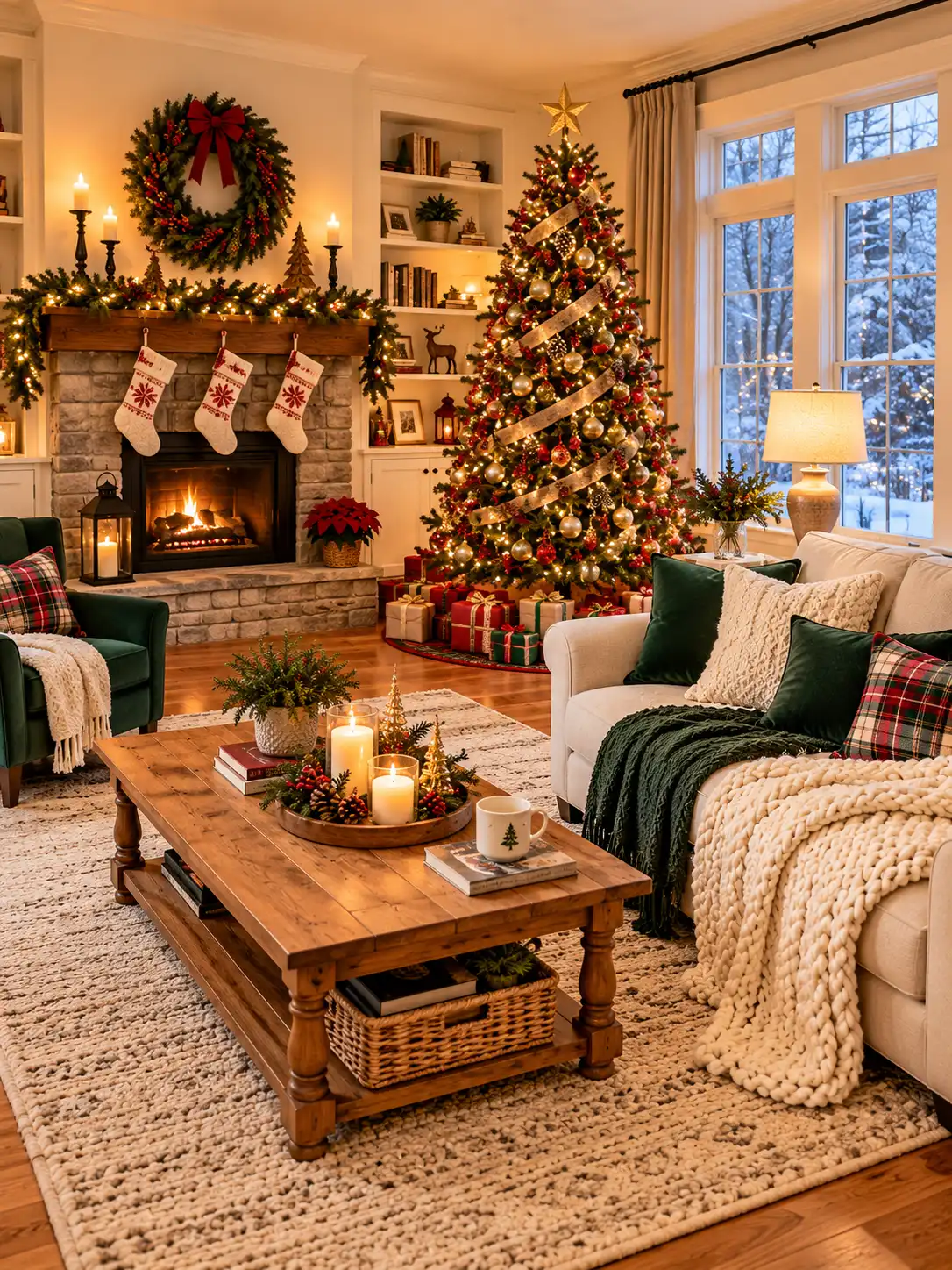
is the vertical layering. Garland at mantel height, tree at window height, textiles at seat height, table at knee height — four distinct horizontal bands, each doing one job. Nothing competes because nothing overlaps. The cream chunky knit throws are the neutralizer that lets red and green sit next to each other without vibrating.
- Main furniture (sofa, coffee table, armchair): $900–$2,400
- Tree, lights, and ornaments: $150–$500
- Textiles (throws, pillows, stockings, rug): $120–$380
- Garland, wreath, and mantel decor: $60–$200
- Paint and wall treatment: $0–$150
Total: roughly $1,230–$3,630. Budget alternative: shop the ornaments and textiles secondhand — December 26th is the single best thrift day of the year — and you’ll land 40–60% under these numbers.
5. Silver Reindeer and Pinecones on a Frosted Tree
White matte baubles, silver glittered ornaments, natural pinecones, and warm fairy lights, with a glittered white reindeer and a fuzzy polar bear standing guard at the base. The tree stays green underneath — that’s the crucial part. It’s a green tree wearing white, not a white tree. The contrast is what keeps the woodland theme from going full ice palace.
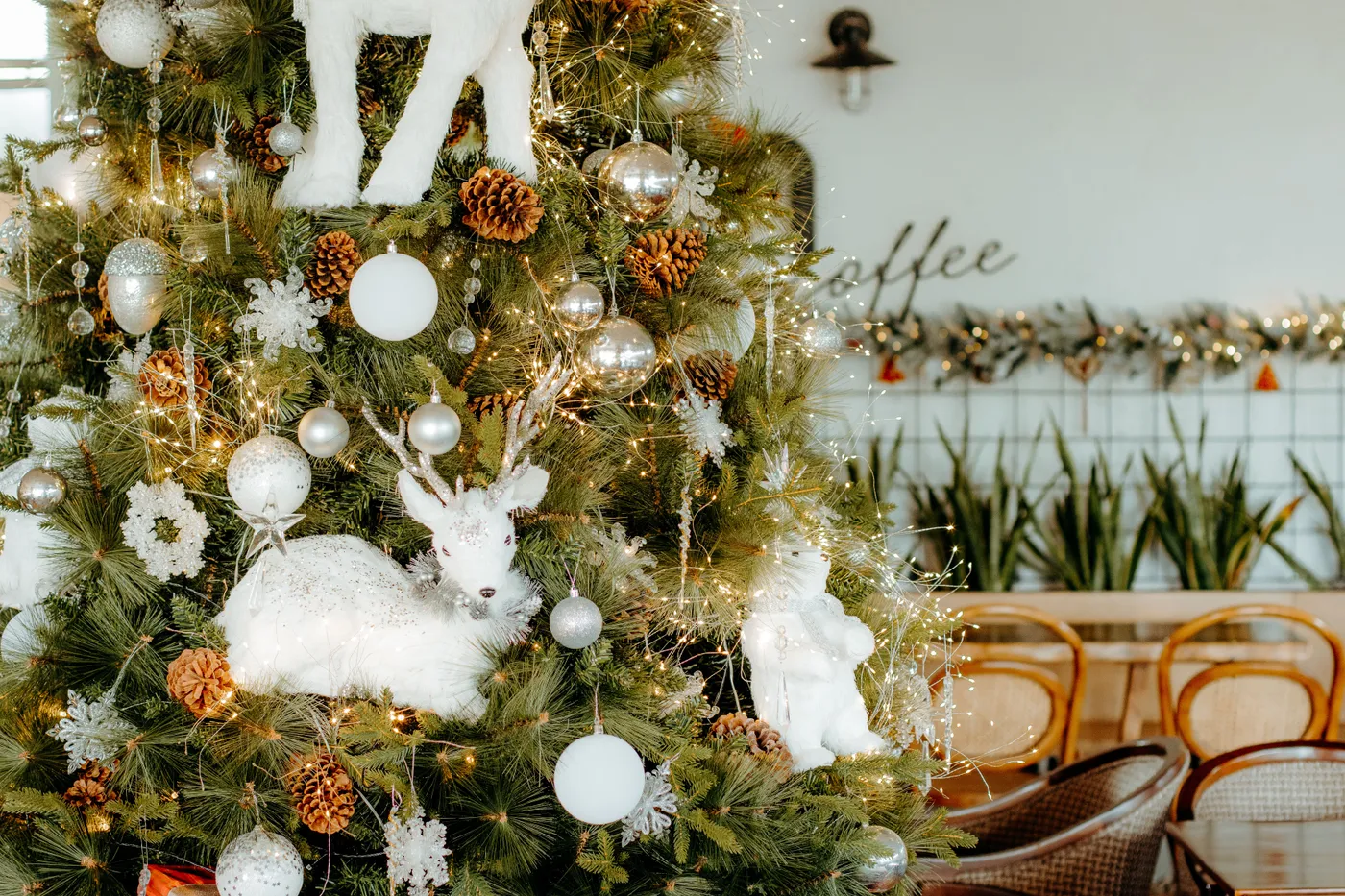
on glitter: it travels. You will find it in your rug, on your sofa, and eventually in a different room. Glittered ornaments shed most in the first season — give them a gentle shake outside before they go on the tree, and handle them with a cloth rather than bare hands when packing up. Pinecones, meanwhile, are the low-maintenance hero of this look: free if you gather them, and they only need a quick bake at 200°F for 30 minutes to kill anything living in them.
A tip that pays for itself: put your fairy lights on a smart plug set to come on at 4pm and off at 11pm. You’ll actually use them every night instead of forgetting, and LED fairy lights cost pennies a month to run.
6. Santa Claus Chair Covers and Gold Charger Plates
Four dining chairs in vibrant red fabric covered with large illustrations of Santa Claus, gifts, and snowflakes, pulled up to a wooden table set with gold charger plates and a garland centerpiece. Behind them, a stone fireplace with a roaring fire and a tall tree loaded with red and gold ornaments. A braided natural fiber rug keeps the floor from disappearing under all that pattern.
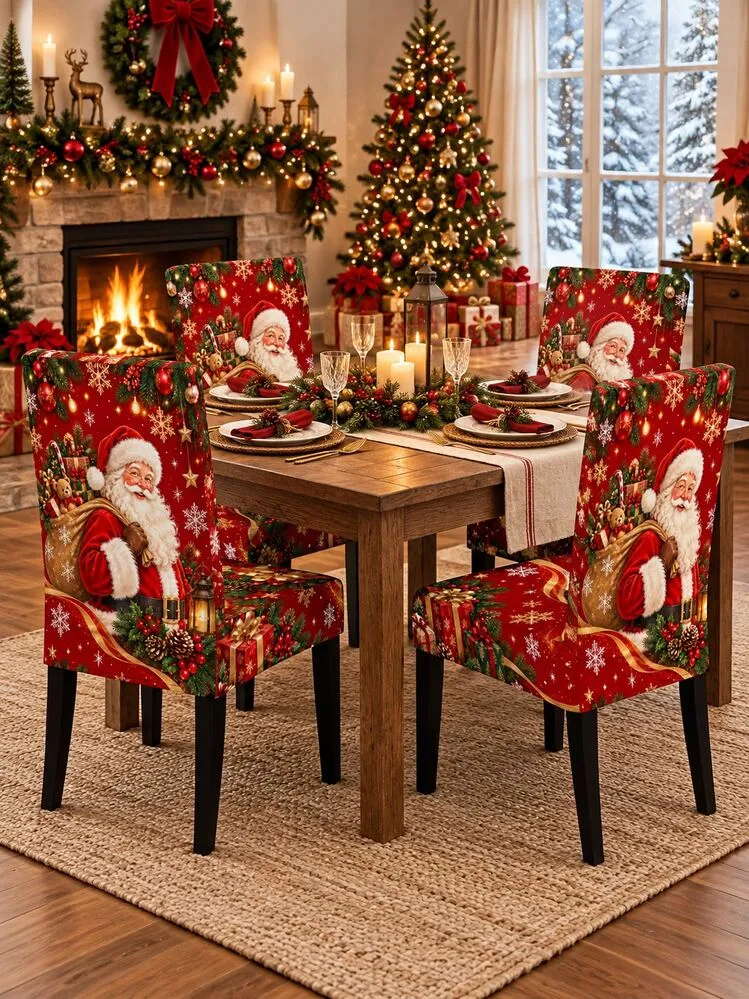
This is maximalism with a sense of humor, and it works because the room is otherwise traditional and calm. Paneled walls, a real fire, classic wood — the Santa chairs are the one loud voice in a quiet choir. Put them in an already-busy room and it becomes chaos.
Honest warning: novelty chair covers are a commitment. They wrinkle, they need to be sized to your chair backs, and fabric ones are not forgiving if someone spills the gravy. If you love the idea but have kids under six, slipcovers in solid red velvet with a printed runner down the table get you 80% of the joy with 20% of the stress. And measure your chair backs before ordering — the number one return reason on these is a back that’s two inches too tall.
7. Gold and Bronze Baubles Against Beige Paneling
One tall green tree carrying gold and bronze baubles, star ornaments, and lights — and then a room that stays deliberately quiet around it. Light beige paneled walls, dark wood flooring, a natural fiber rug, a fluted round light wood coffee table, and a dark wood cane rocking chair.
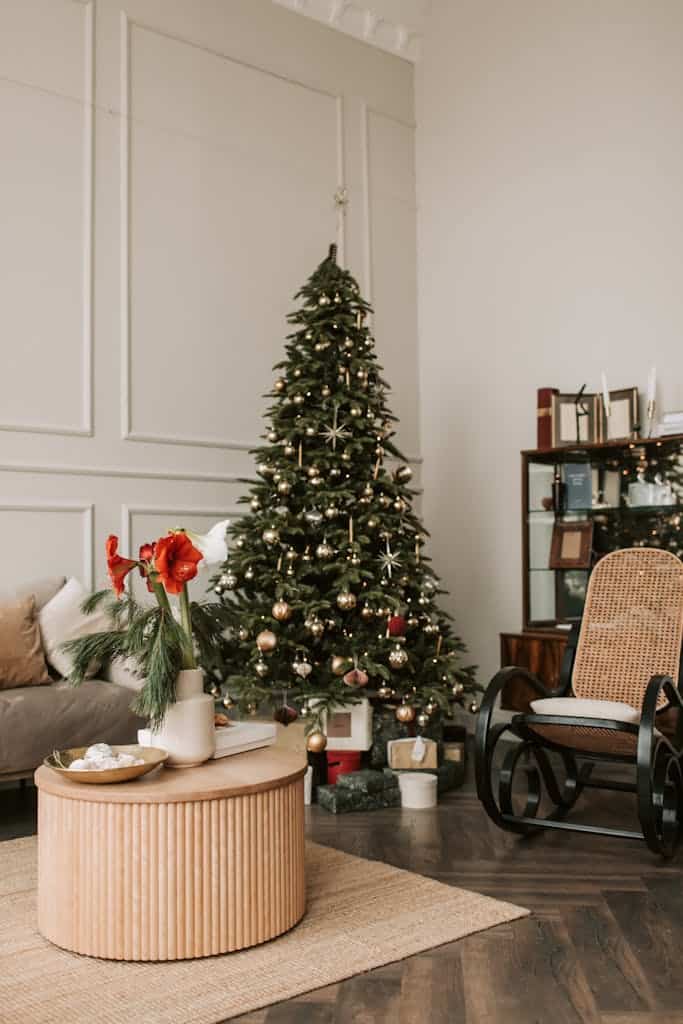
The formula: 70% warm neutral architecture (beige paneling, natural rug) + 20% dark wood anchor (floor, rocking chair) + 10% metallic ornament. That’s it. The tree is the only place saturated color appears, which is why it reads as sculpture rather than clutter. Want the same effect in a cooler room? Trade bronze for brushed nickel and beige walls for greige — the math holds.
This one needs room to breathe. The tree wants at least four feet of clear space in front of it and a ceiling of eight feet or more to carry the height without crowding. In a smaller living room, look at Idea #10 — a slender pre-lit tree gives you the glow without the footprint. If your room is genuinely tight, Idea #16 shows how much impact lives in the ornaments themselves.
8. Dark Wood, Velvet Pillows, and Lit Built-In Shelves
Warmly lit and layered: a tall tree with red and gold ornaments, a cream sofa with velvet and plaid pillows and a chunky knit blanket, a dark wood coffee table holding candles and evergreens, and built-in bookshelves glowing with warm accent lighting behind it all.
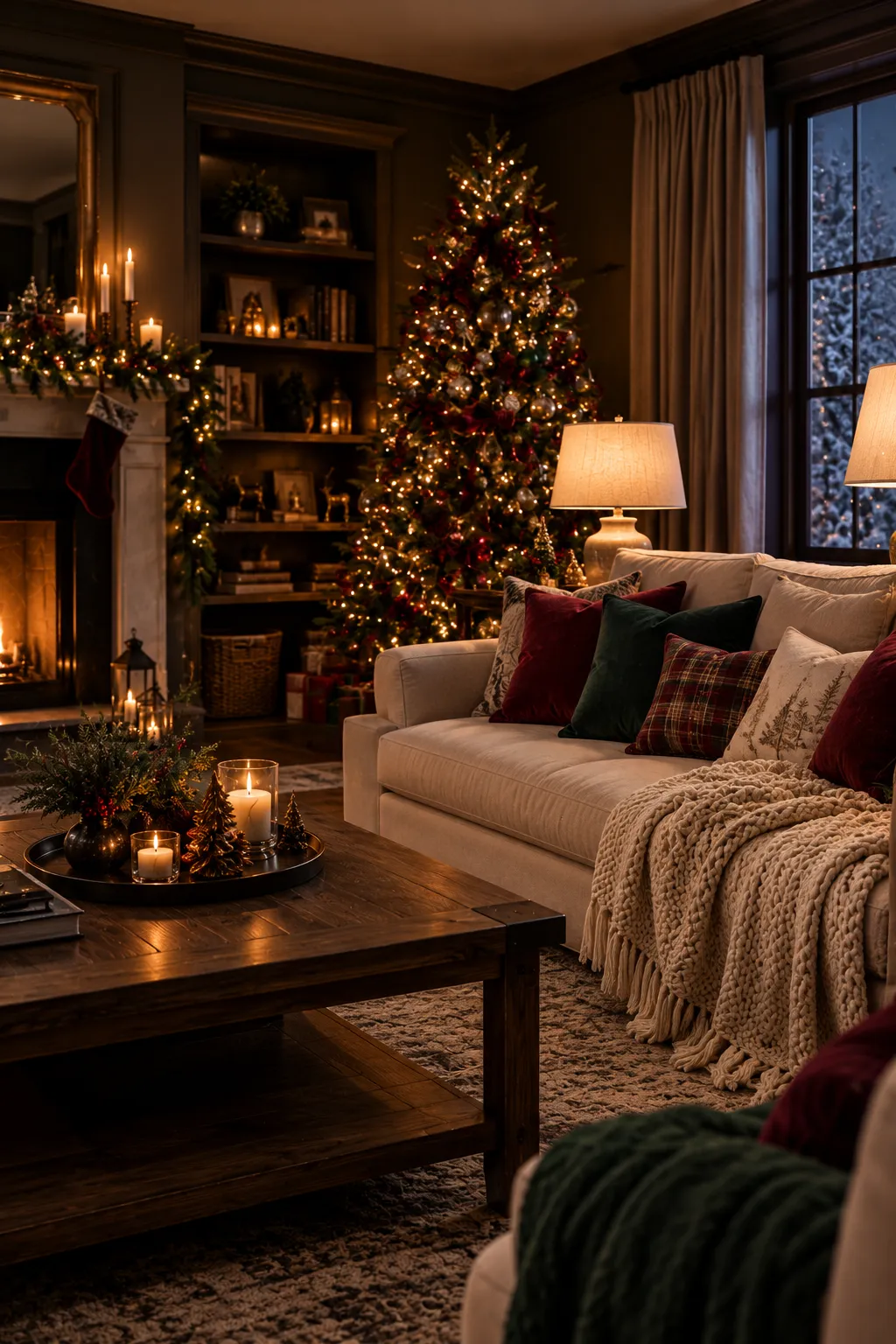
The principle at play is color temperature mixing — and it’s the most underrated skill in holiday decorating. The tree lights are warm white, the shelf lighting is warm, the candle flames are warm, but the daylight coming in is cool. That contrast is what makes the room feel alive at 4pm in December rather than flat. If every light source in the room were the same temperature, this would look like a catalog set.
This is why 2026’s version of traditional is so appealing: it’s nostalgia with better lighting. The last few years pushed minimalism hard, and the pendulum is swinging back toward rooms that feel inhabited and warm. Built-in shelf lighting in particular has moved from luxury upgrade to expected — and it’s the detail people notice without being able to name.
9. Slender Flocked Trees with Oversized Cream Bows
Two narrow flocked trees, small warm lights, and enormous cream fabric bows. Off-white boucle armchair on the left, a light taupe glass side table, and an arched console on the right holding a textured white vase full of orange branches and paper ornaments. Light herringbone floors underneath.
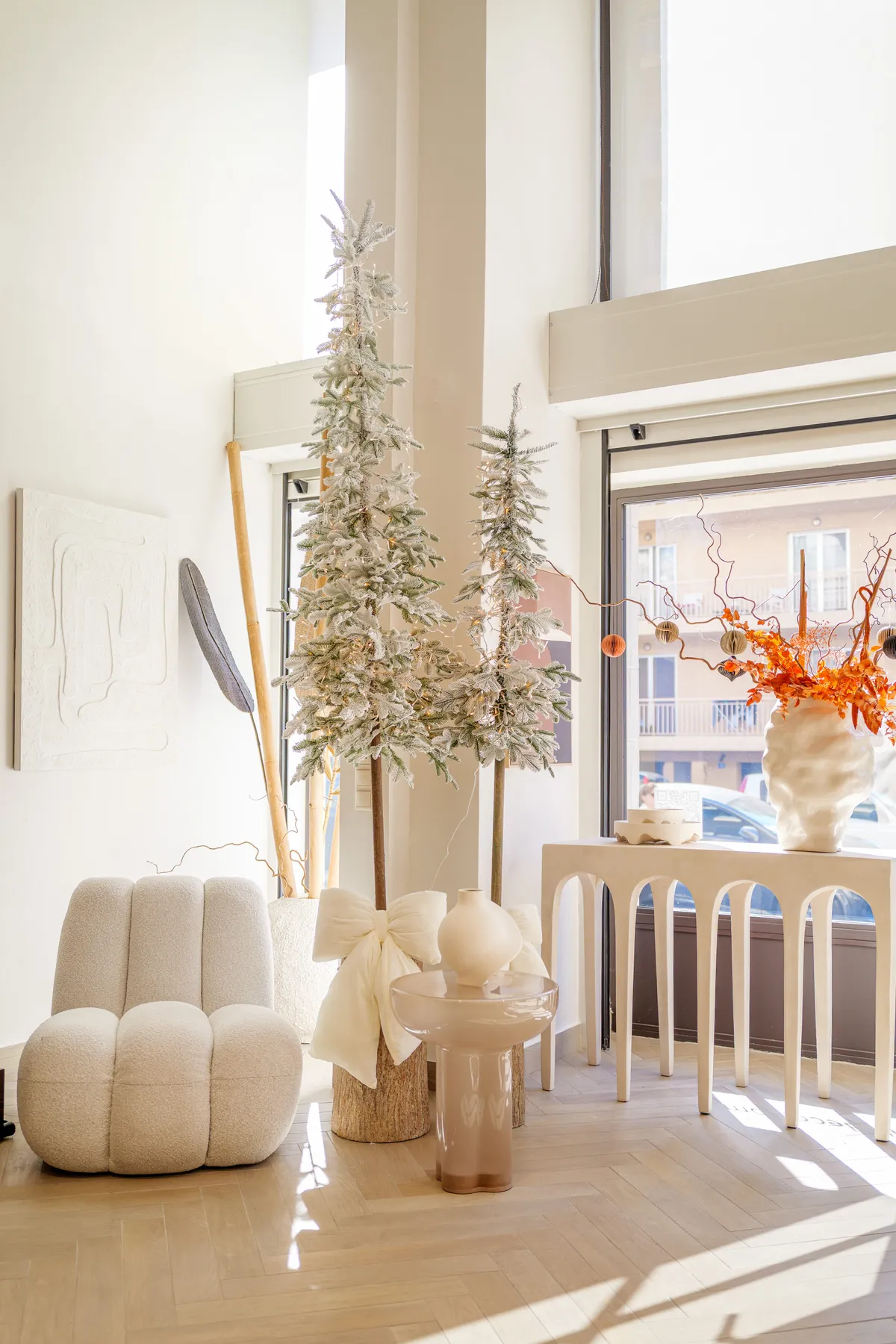
Those bows are doing something specific: they’re sized out of proportion on purpose. A bow that matches the tree’s scale reads polite. A bow that’s almost too big reads intentional and slightly editorial. Same principle as hanging art lower than feels comfortable — the eye wants drama, not tidiness.
If you’re making the bows yourself, use a stiff fabric like canvas or a wired-edge ribbon at least four inches wide, and cut each tail on a sharp diagonal. A fabric store will sell you two yards for under $15 and you’ll get four bows out of it. The orange branches are the other clever move — a single warm non-traditional color keeps a cream-and-white scheme from feeling cold and clinical.
10. A Tall Pre-Lit Tree with a Faux Fur Skirt
A slim pre-lit tree with a lot of warm white lights, sitting in a soft light faux fur skirt against neutral walls, natural wood furniture, and a knitted throw on the sofa. Snowy view through a black-grid window. That’s the whole idea — and it’s the most copyable look in this entire article.
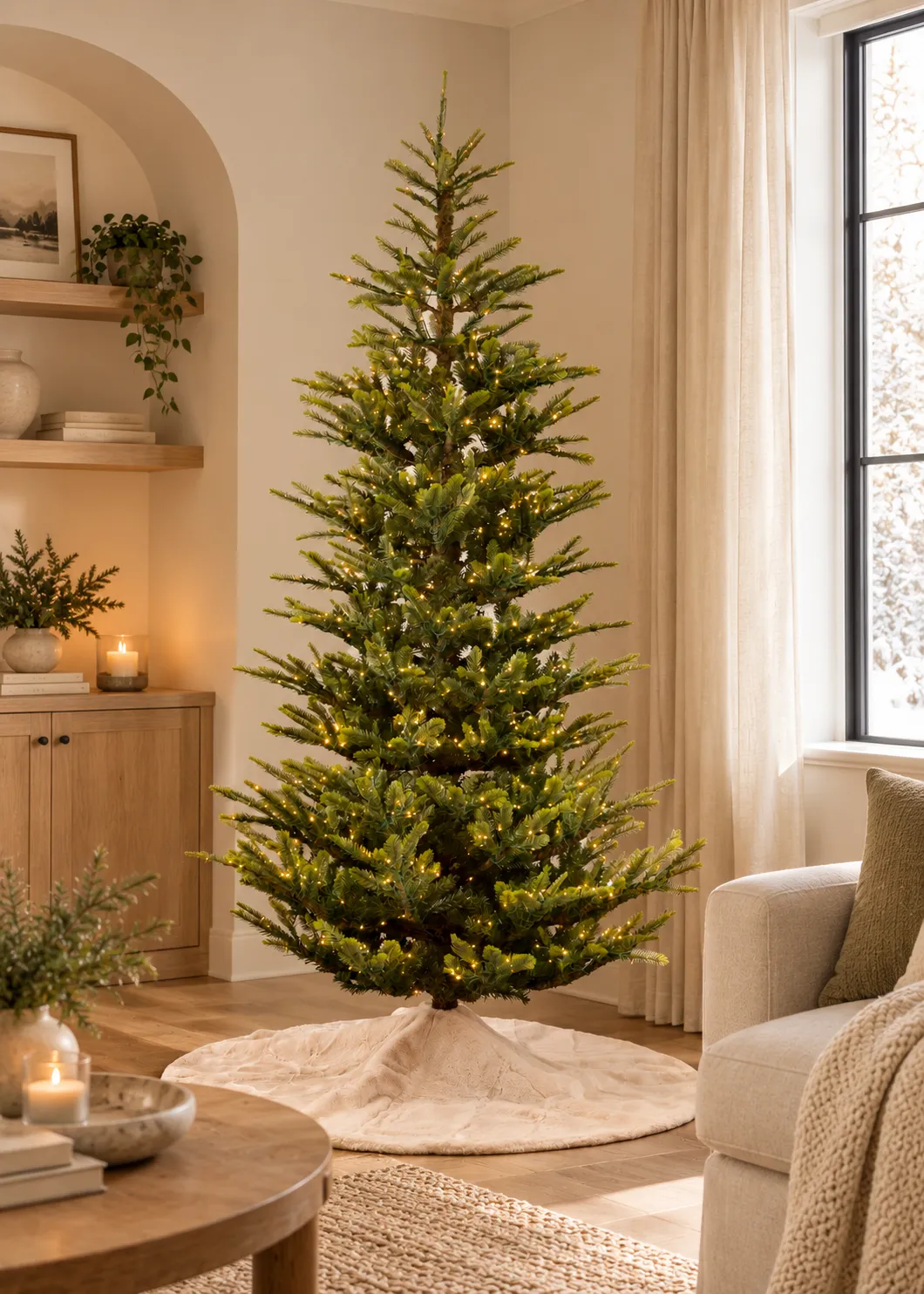
You do not need to spend $800 on this. A pre-lit slim tree at Walmart or Target runs $60–$140, and a faux fur tree skirt is $25–$50 anywhere from Amazon to HomeGoods. Total under $200 for a look that photographs like a boutique hotel. The reason it works is density of light, not quality of tree — more warm bulbs per branch, fewer ornaments. If your existing tree looks sparse, buy two extra strands of warm white LED lights before you buy a single new ornament.
faux fur skirts mat on the bottom where gifts sit and collect every bit of dust in the room. Shake it out weekly and store it in a breathable cotton bag, not plastic — plastic traps moisture and that’s what causes the musty smell people blame on the tree.
11. Champagne Bows and Gold Pinecones on the Staircase
A lush evergreen garland running the staircase, lit with warm white lights, punctuated by gold sphere ornaments, natural pinecones, and sheer champagne ribbon bows. A console table below holds a floral arrangement, brass lanterns with pillar candles, and woven baskets, on light wood floors over a natural fiber rug.
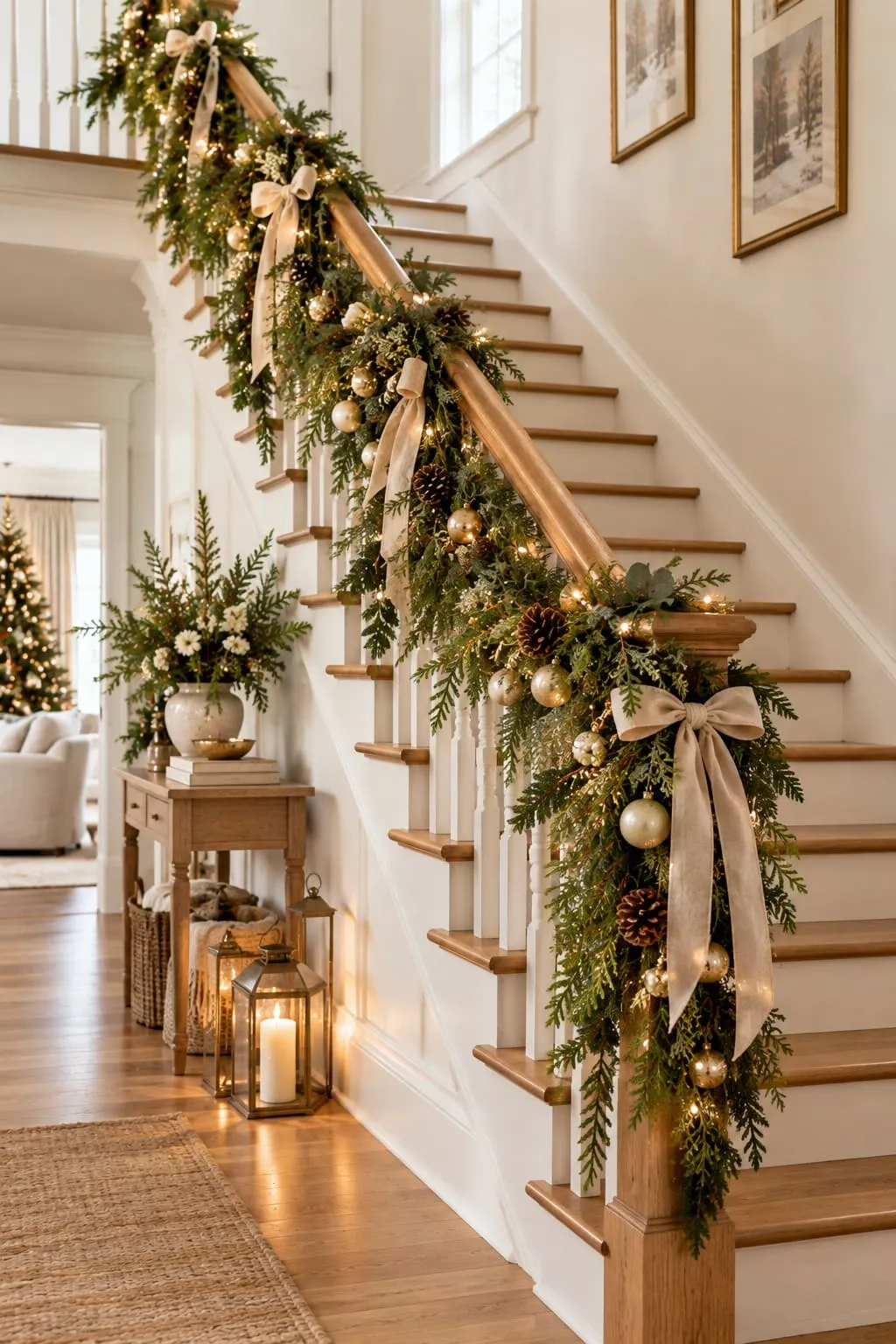
Here’s how to get the garland right, because most people under-buy:
- Measure the banister and multiply by 1.5 — you want an unlit garland to be 50% longer than the run so it can dip and gather. (10 min)
- Zip-tie the garland to the banister every 18 inches, then fluff every branch outward. (20 min)
- Wrap warm white lights separately — never rely on pre-lit garland, it’s always too sparse. (15 min)
- Add ornaments and pinecones in clusters of three, not evenly spaced. (10 min)
- Finish with ribbon bows at the swag low points only. (10 min)
About $90–$180 in materials and a little over an hour. This staircase needs at least five feet of visible railing to read properly — in a smaller entry, see Idea #20 for a different ribbon treatment.
12. Neutral Ornaments and Exposed Ceiling Beams
A large brightly lit tree dressed entirely in neutrals — cream, beige, soft gold ornaments and bows — anchoring a room with exposed light wood ceiling beams, cream sofas with textured and plaid pillows, a white mantel with evergreen garland and candles, and a rustic turned-leg coffee table holding a candle and greenery centerpiece. A chunky knit rug and throws underneath.
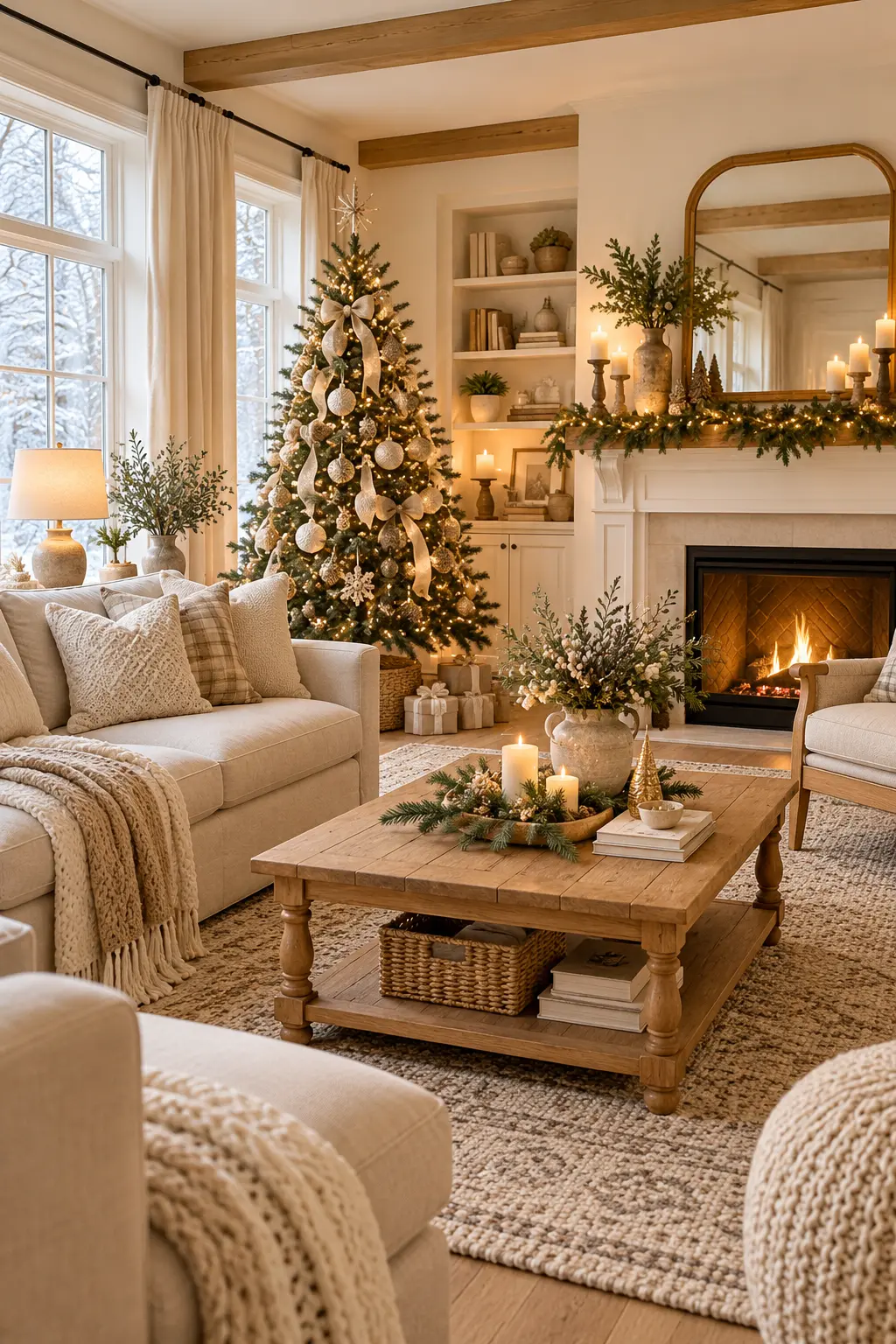
Neutral Christmas is divisive, so let’s be honest about it: it photographs beautifully and it reads calm, but at 7pm in a dark room, neutrals can go flat. The fix is light. This room has a lit fire, candlelight, and warm tree bulbs — three sources minimum, all warm. If your living room only has overhead lighting, a neutral tree will look beige and sad instead of soft and expensive.
- Tree and neutral ornaments: $180–$550
- Lighting (tree lights, candles, string lights): $60–$180
- Textiles (knit rug, throws, pillows): $150–$450
- Mantel garland and greenery: $50–$150
- Wrapping and ribbon: $30–$90
Total: about $470–$1,420. Skip the pre-lit upgrade and add your own strands — you’ll save $150 and get better light placement.
13. A Christmas Village on Tiered Wooden Shelves
A kitchen corner turned into a tiny village: miniature ceramic houses in white, gingerbread, and green, a small lit tree with red and gold ornaments, a red house-shaped mug, holly-patterned textiles, and everything stacked on wooden tiered display stands.
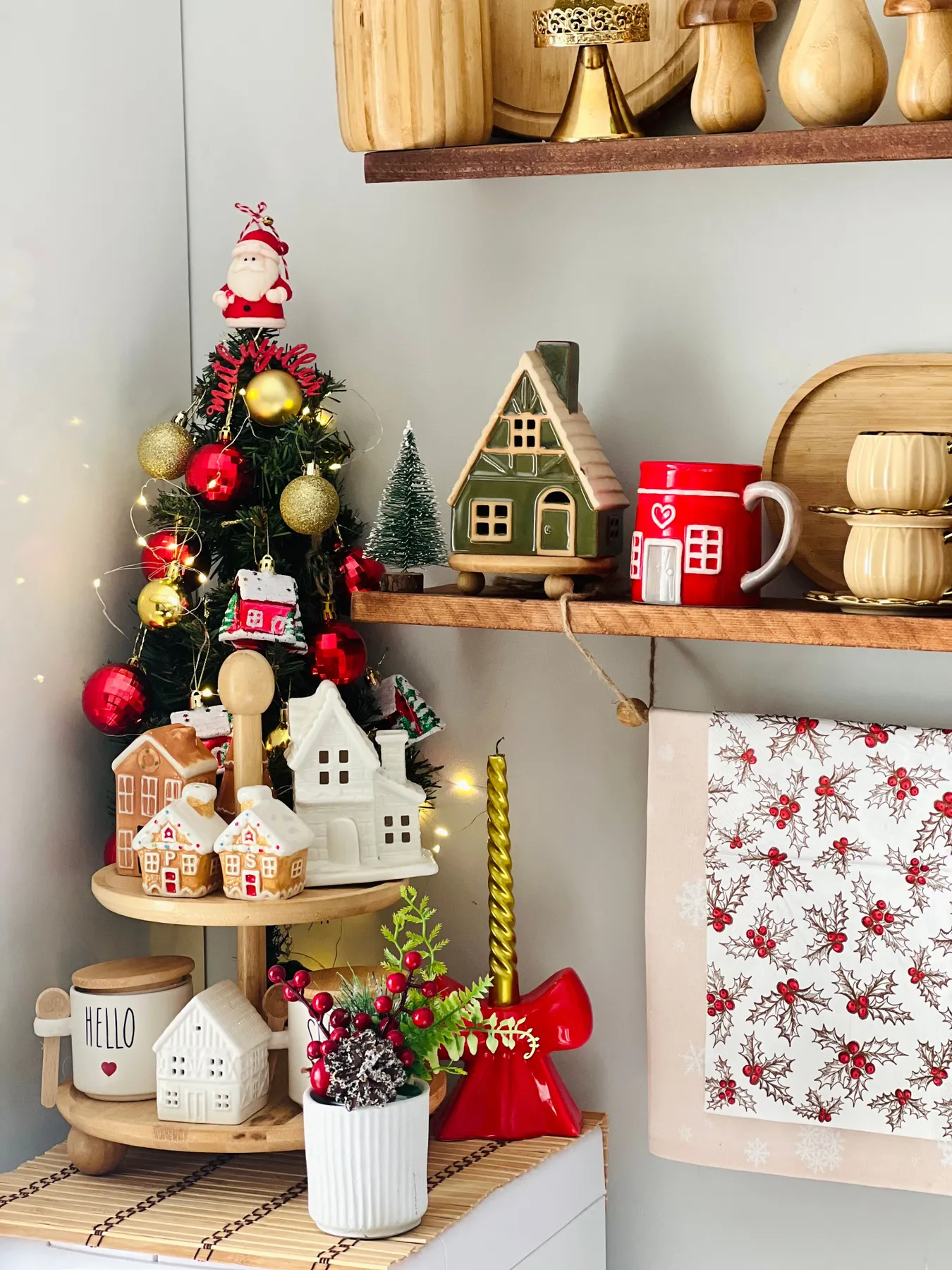
The tiered stands are the whole trick. Put the same eleven objects on a flat counter and it reads as clutter; put them on three different heights and it reads as a scene. Elevation creates a focal point where none existed, and it means the display works in a corner you’d otherwise ignore.
Building your own version takes about 20 minutes and costs almost nothing if you already own the pieces:
- Clear the counter completely — vertical displays need an empty base to look deliberate.
- Place the tallest item (usually the little tree) at the back and off-center, never dead middle.
- Group houses in threes with overlapping rooflines rather than spacing them evenly.
- Add one warm light source inside the display — a battery tea light behind a house works.
- Finish with a textile underneath to define the zone. ($0–$25 total)
14. Cable-Knit Stockings Under a Berry-Stranded Garland
A lush green pine garland across the mantel, threaded with warm fairy lights and draped with red berry beads. Three cream cable-knit stockings with personalized tags hang below, white decorative trees cluster at one end, and a gold wall sconce throws light down the wall above.
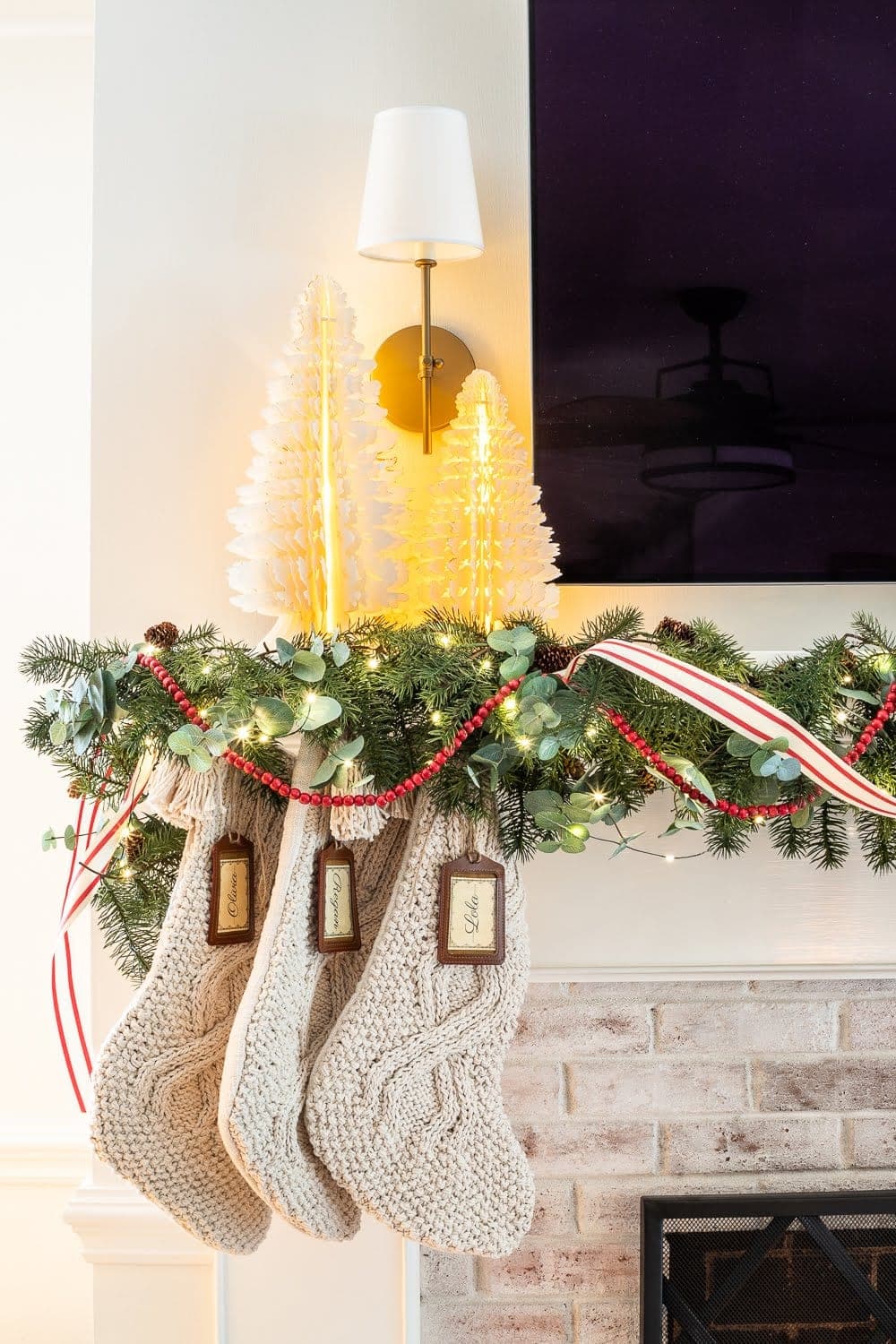
The stocking detail that separates professional mantels from amateur ones: hang them at staggered heights, not in a level row. A two-to-three inch difference between each stocking makes the arrangement feel collected over years instead of bought in one trip. Also, hang stockings from a separate hook or nail rather than the garland itself — the weight pulls garland down and leaves a gap by New Year’s.
You don’t need to spend much here. Cable-knit stockings run $12–$25 at Target and Walmart, red berry strands are $8–$15, and a 9-foot garland is $30–$60 at any craft store. Under $150 total for the whole mantel, and it’s the first thing every guest photographs. Compare with Idea #17 — same mantel, completely different mood.
15. LED Pillar Candles Along the Window Sill
White-framed windows wearing evergreen wreaths, with LED pillar candles, small lit evergreens, and pinecones lined along the sill — a soft glow against the snow outside. Inside, a light sofa with a chunky knit throw, a rustic wooden coffee table with a brass tray of candles and greenery, and a natural fiber rug.
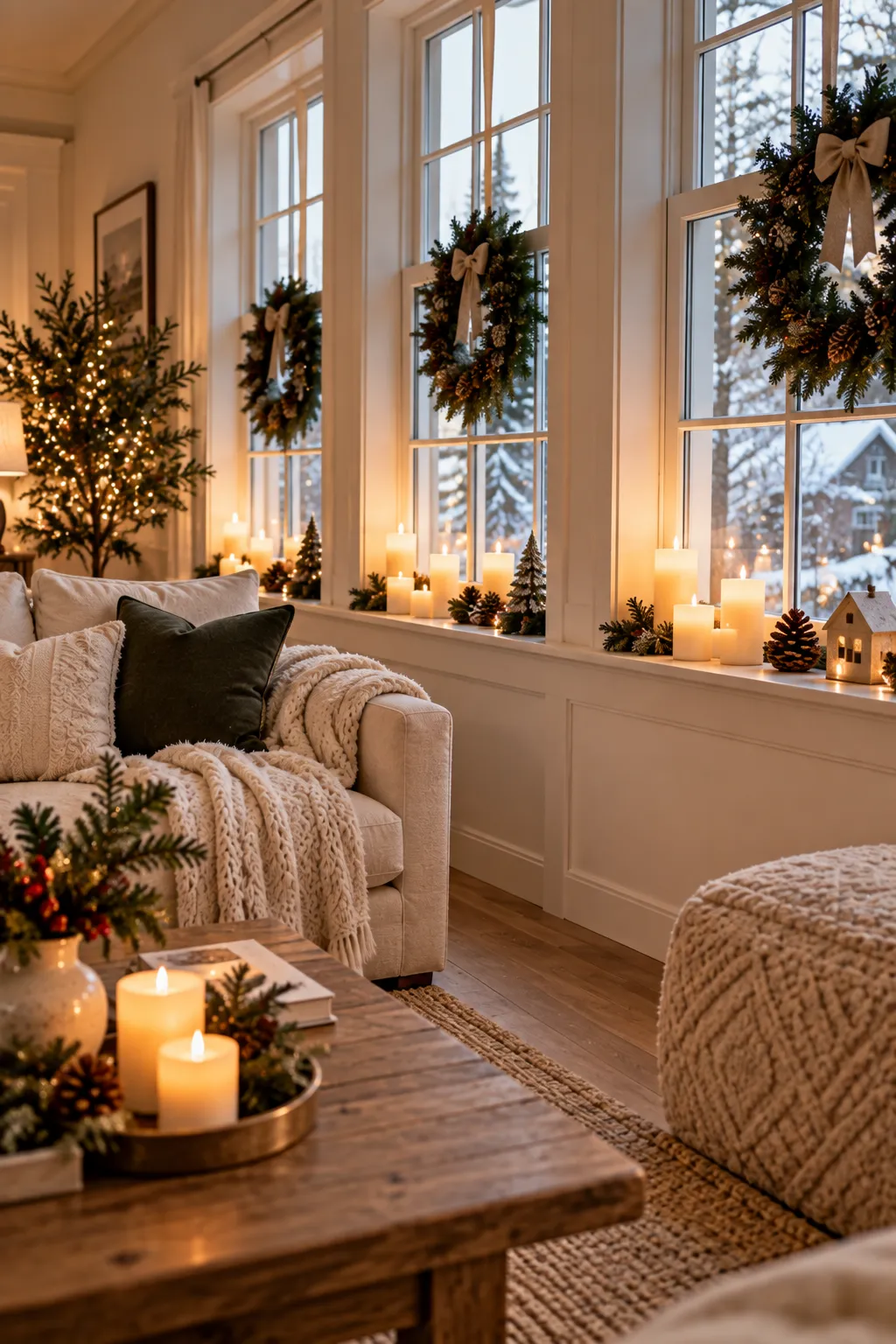
The design principle here is repetition at a distance. Twelve small light sources spread across a window wall create a wash of warmth that one big lamp can never replicate. Your eye reads them as a single glowing band rather than twelve separate objects, which is precisely why window candles have stayed popular for three centuries.
Room requirements: this look needs a window wall at least six feet wide, and ideally the sill should be four inches deep or more to hold candles safely. West and south-facing windows are best because the glow shows up against the dark earlier. In a narrow room, Idea #23 shows the same lighting idea concentrated on one window instead of a whole wall.
16. Matte and Glossy Gold, White, and Warm Bulbs
A close look at a tree dressed with both matte and glossy gold spheres alongside matte white ones, warm white string lights woven through the branches, everything glowing against a softly blurred warm background.
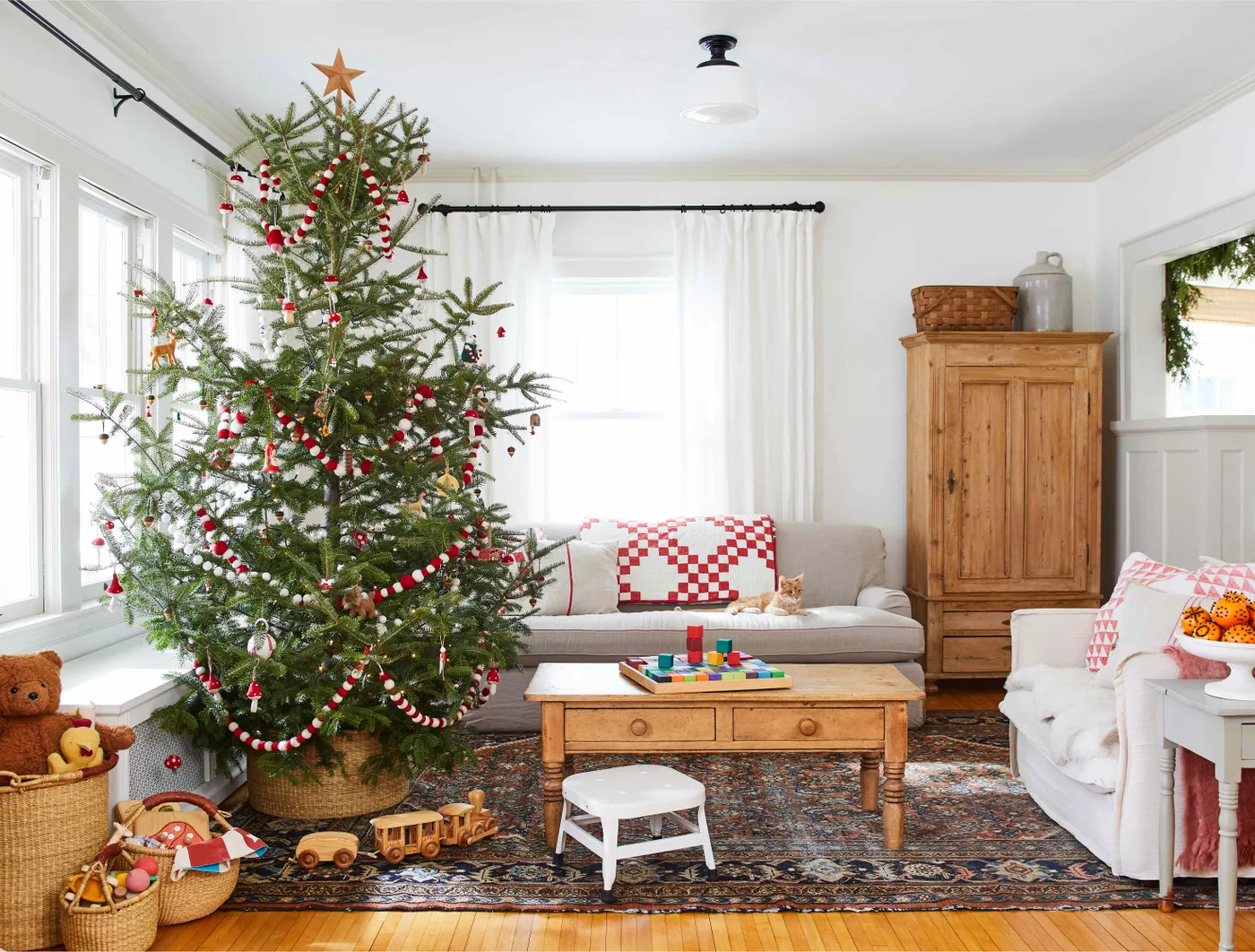
Mixing matte and glossy finishes in the same color is the single most effective ornament trick there is, and it costs nothing extra. Glossy baubles catch and throw light; matte ones absorb it and read as velvet. Together they give a tree depth that an all-shiny tree can’t touch — shiny-only looks like a store display, matte-only looks dusty.
If you’re starting from scratch, buy in this ratio: for every five ornaments, three matte, two glossy, all within two color families. Skip the tiny filler ornaments entirely. Oversized spheres — four inches and up — fill a tree faster and look more expensive per dollar, and eight large ornaments will do more than forty small ones.
17. Candles in Glass Lanterns on a Rustic Wood Plank
A white mantel wearing a rustic wooden plank as a base, topped with evergreen garland, lit white pillar candles in clear glass lanterns, and a row of textured white ceramic Christmas trees. White subway tile behind it.
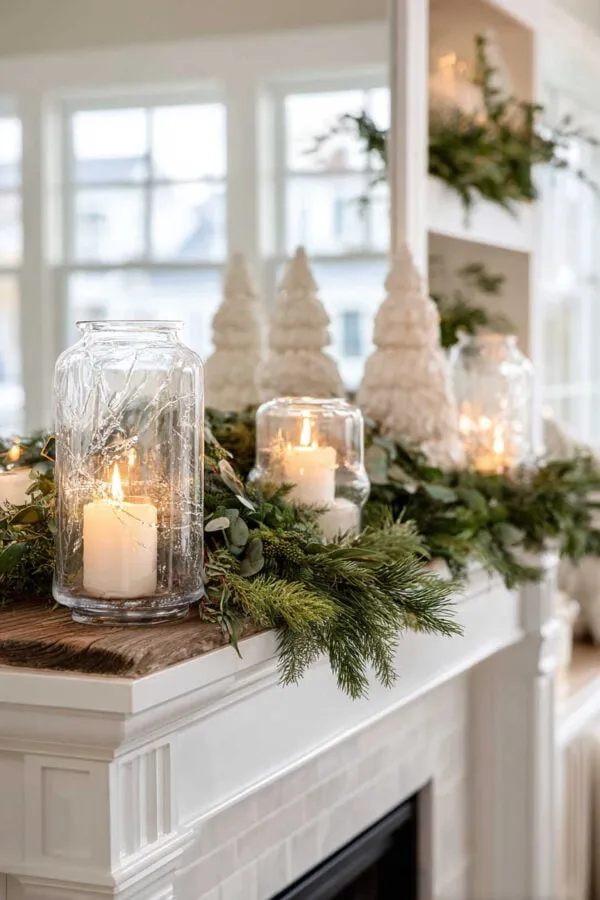
The plank is the quietly smart part. It protects the mantel from candle heat and wax, unifies mismatched decor on one surface, and adds a natural wood tone that keeps all that white from feeling like a hospital. It also means you can lift the entire arrangement off in one piece when it’s time to pack up.
Before you commit, verify these:
- Measure your mantel depth — you need at least 8 inches for lanterns plus garland.
- Check that nothing hangs over the firebox opening; keep 12 inches clear.
- Confirm your candles are LED or in sealed glass if the fireplace gets used.
- Test the plank length — it should overhang by 2–3 inches on each side, not more.
18. Curved Cream Sofas in a Neoclassical Christmas Room
Ornate white wall moldings, archways, and a marble floor with floral inlay — and then a large lit tree with red and gold ornaments, curved cream modular sofas, a dark wood rectangular coffee table, and a round grey rug. Mantel garland with red berries and pine above.
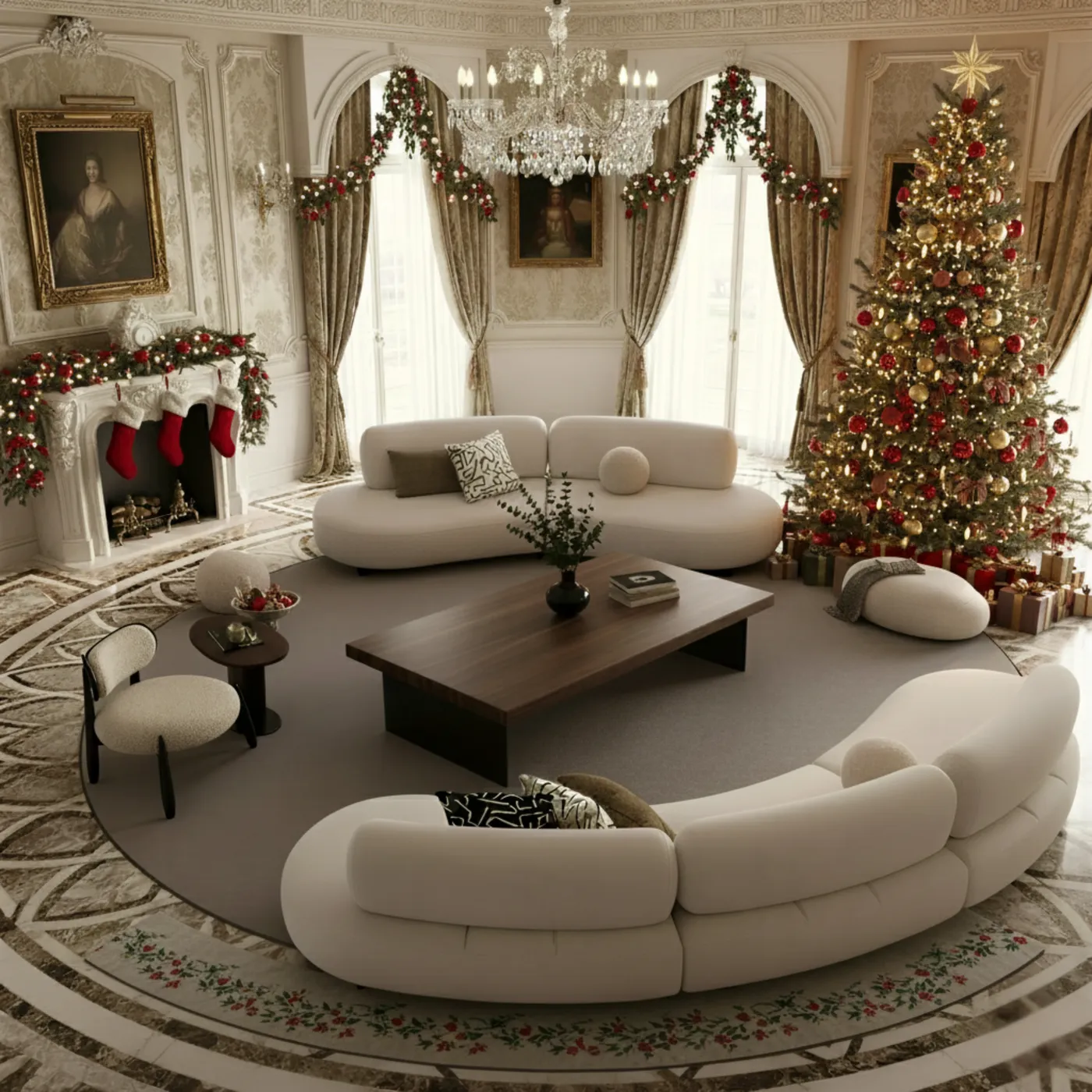
The genius here is contrast of era. Neoclassical architecture is formal, symmetrical, and a little stiff. Curved modular sofas are soft, low, and modern. Put them in the same room and each one makes the other look better — the room becomes grand instead of stuffy, the furniture becomes considered instead of trendy. Trying to match a neoclassical room with neoclassical furniture is how you get a museum.
curved sofas are less flexible than they look. They don’t push flat against a wall, they don’t work in narrow rooms, and they’re hard to pair with a second seating piece. Measure your circulation path first — you want 30 inches minimum between the sofa curve and the coffee table, and honestly 36 is better. If your room is under 200 square feet, this arrangement will feel like a maze.
19. Blue and Silver Against a Deep Blue Accent Wall
A frosted blue, silver, and white tree standing beside a white mantel dressed to match — blue and silver garland, sparkly silver reindeer, blue poinsettia-style florals, and hung stockings. Dark blue walls and floor-length grey curtains behind it all.
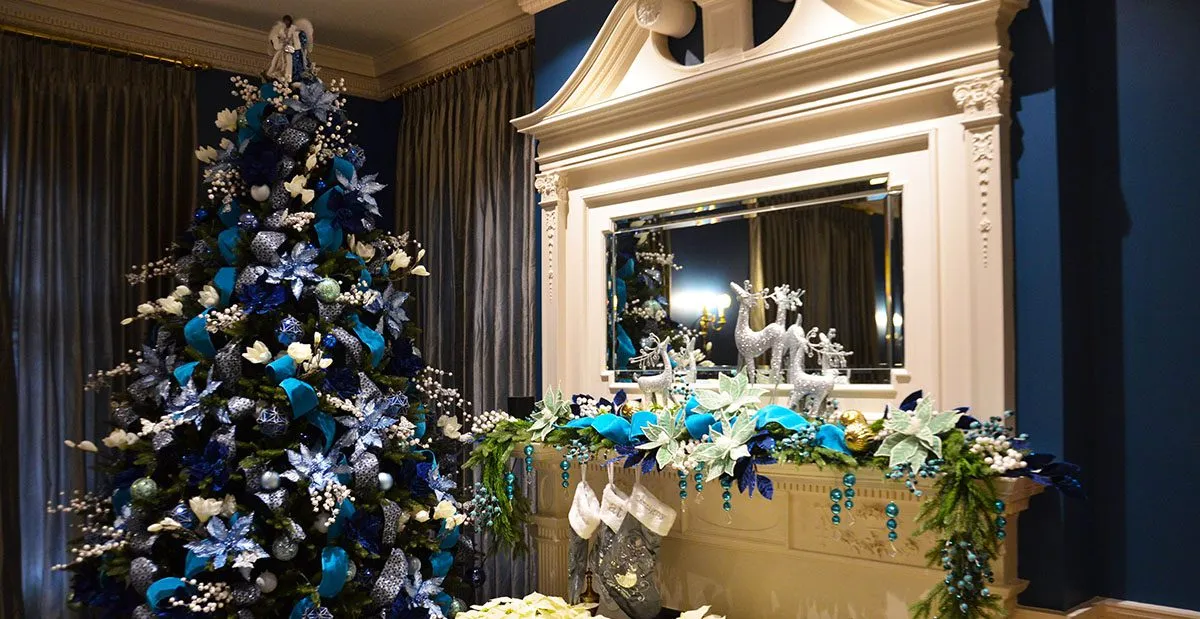
The math is unusual and that’s why it works: 50% deep blue walls + 30% white mantel and trim + 15% silver + 5% cream. Most holiday schemes start with a red or green anchor. This one starts with blue and lets silver be the sparkle instead of gold. The cool palette against warm wood floors is what keeps it from freezing over.
The element I’d protect above all else is that dark blue wall. On a white wall, this same tree reads icy and generic — pretty, forgettable. Against deep blue, the silver suddenly has somewhere to go and the whole scheme feels intentional and a little bit glamorous. If you can’t paint, a single deep blue accent wall behind the tree gets you there. Compare the mood with Idea #25, where jewel tones go warm instead of cool.
20. Red Velvet Bows Draped Down the Banister
Lush green garland running the staircase, wound with fairy lights and punctuated with large red velvet bows, pinecones, and red berries. Below, a wooden console holds a vase of greenery and berries flanked by candles in glass hurricanes, with a lit tree visible through the doorway beyond.
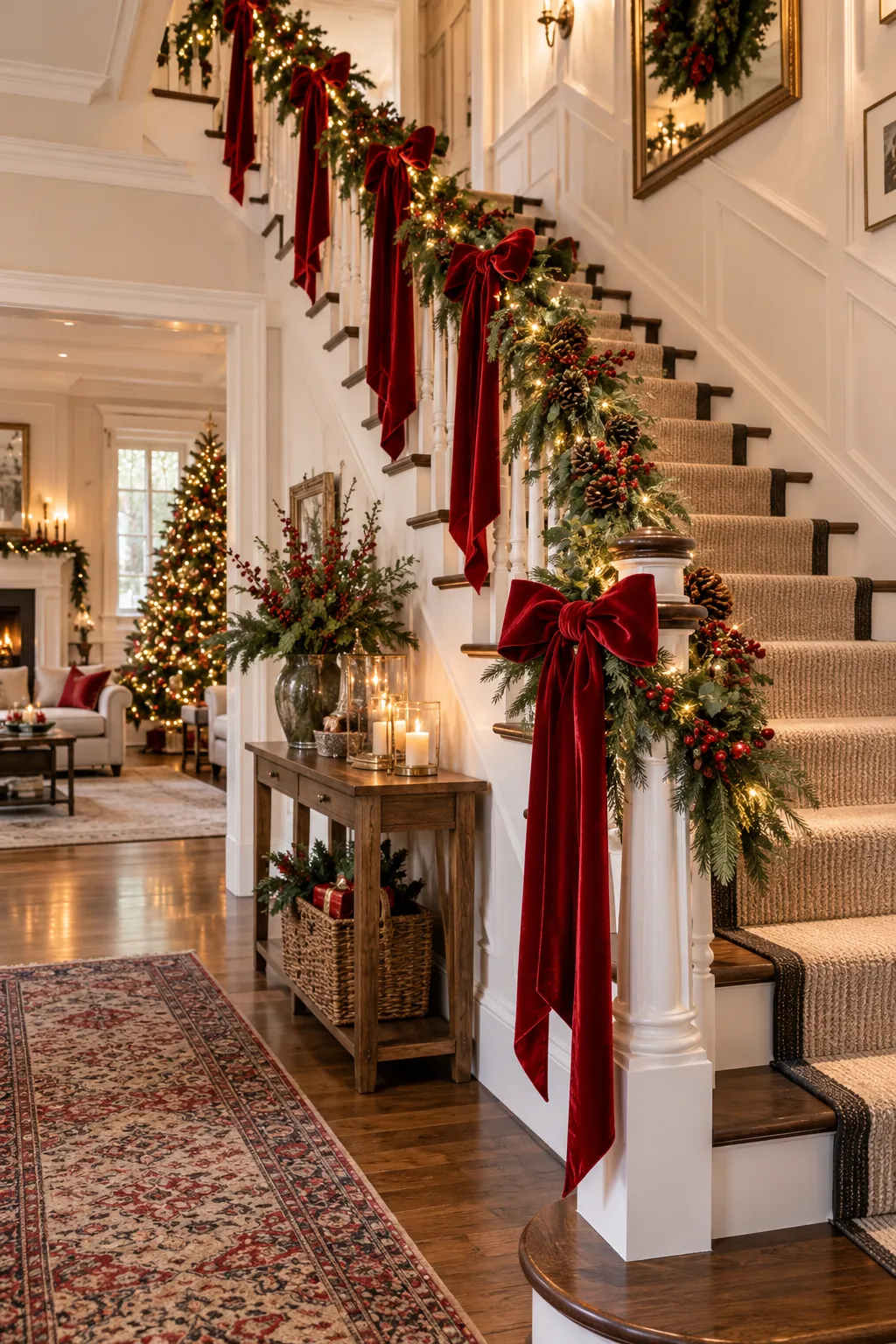
The bows are the statement, so make them properly:
- Buy wired velvet ribbon at 4 inches wide — unwired ribbon sags by day three. (10 min)
- Make each bow with four loops and two tails, pinching the center hard. (5 min per bow)
- Attach at the low points of each garland swag, not the high points — gravity is your friend. (10 min)
- Secure with florist wire, not tape. Tape fails in warm rooms. (5 min)
Materials run $40–$90 and the whole thing takes about an hour. Velvet is the maintenance catch: it holds dust and creases badly if packed flat. Store bows in a rigid box with tissue between layers and they’ll last a decade.
21. Frosted Garland and Candles Inside the Firebox
A wood-paneled fireplace wearing a frosted evergreen garland with gold ornaments and three neutral-toned stockings, while the firebox itself is filled with lit pillar candles instead of a fire. A grey sofa with yellow cushions sits to one side, a rustic wooden side table on the other, faux fur rug and woven pouf on the floor.
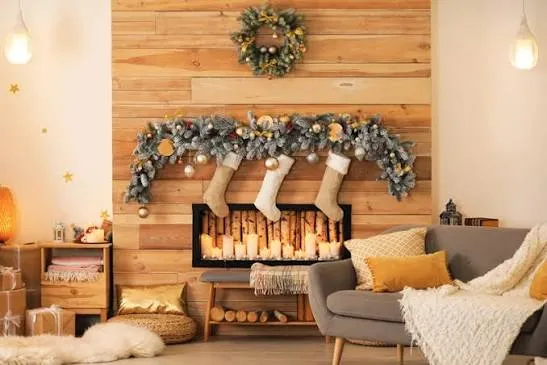
Filling an unused firebox with candles is the single most photographed Christmas trick of the last two years, and it’s still working in 2026 because it solves a real problem: most fireplaces in newer homes are decorative and never lit. Rather than pretend, you lean in — and suddenly a dead cavity becomes the warmest corner of the room.
What you’d lose without it: the entire focal point. The garland is lovely, the stockings are charming, but the candle glow in that dark rectangle is what makes people stop scrolling. Use battery pillar candles with a realistic flicker if the flue is closed, and always keep them on a heatproof tray.
22. A U-Shaped Gray Sectional Built for a Crowd
A big U-shaped dark gray sectional with channel tufting, centered on an off-white textured rug, with two round glass coffee tables on dark bases and festive decor all around — illuminated trees, a white faux fireplace with a real flame effect, dark wood flooring.
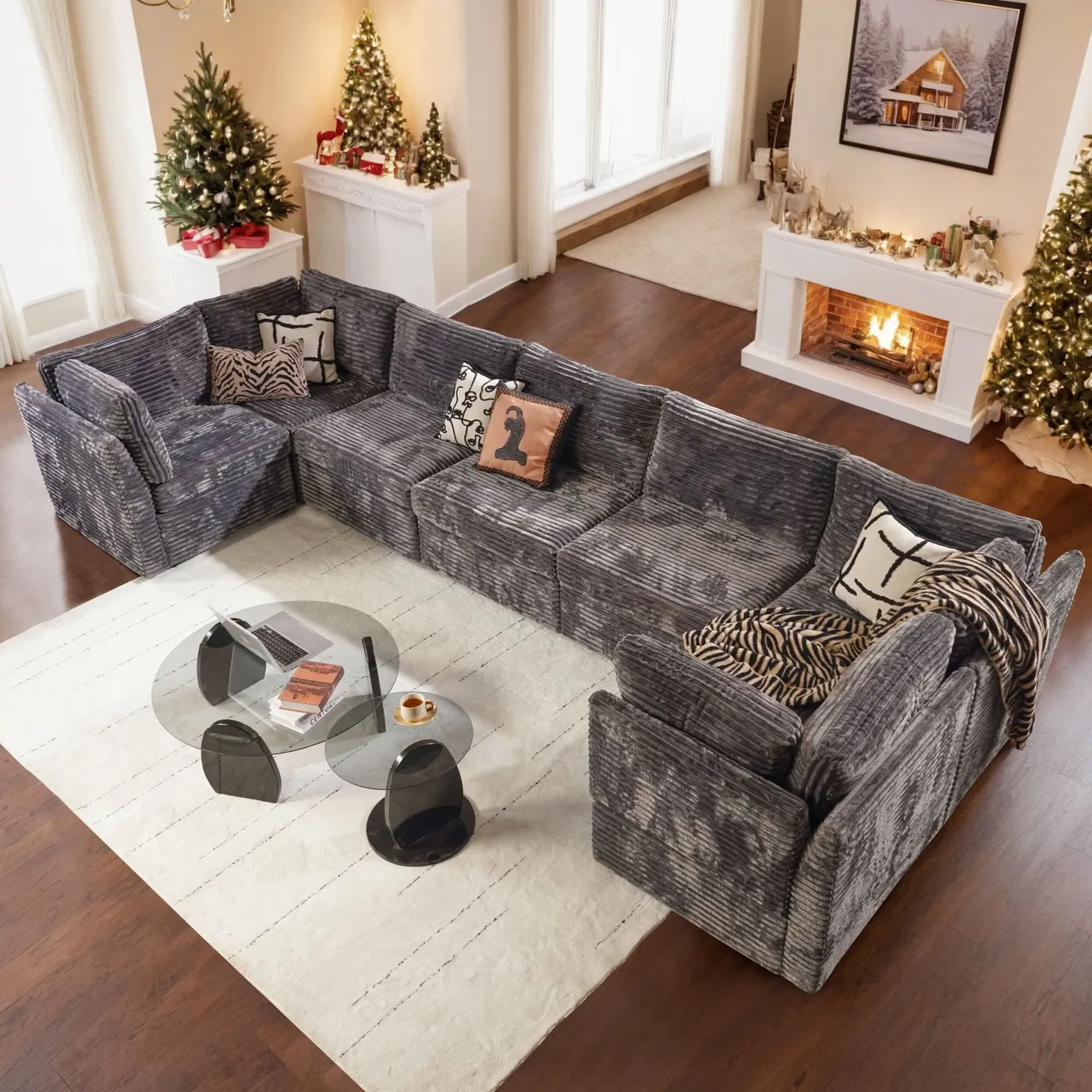
This is the Christmas room for people who host. A U-shape seats six to eight comfortably and puts everyone facing each other, which is exactly what a holiday gathering needs. The two small coffee tables instead of one big one is a deliberate choice too — people can reach a surface from any seat, and you can move one out of the way when the snack table comes in.
The affordable route: sectionals in this shape start around $900 at IKEA and $1,200 at Article, and a textured off-white rug is $150–$300 at Target or Rugs USA. That’s a fraction of custom upholstery pricing for 90% of the look. Just plan your floor plan first — a U-shaped sectional needs roughly 12 by 12 feet of open space to not feel like a pen. In a smaller room, see Idea #30 for a more traditional arrangement.
23. Potted Evergreens and a Paper Star at the Window
A beige tufted sofa with a chunky knit throw, a white electric fireplace with a simulated flame opposite, and a large window turned into the focal point — clustered potted evergreen trees and one oversized paper star hanging in front of it. A woven jute rug and brass floor lamp warm up the room.
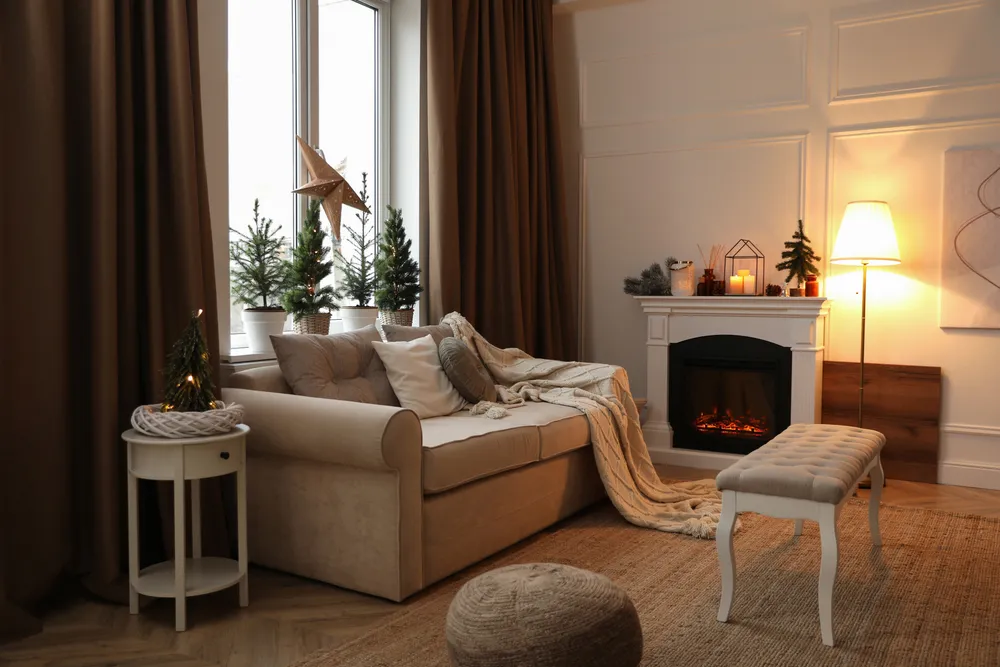
This is Christmas for people who don’t want a Christmas tree, and it’s quietly one of the smartest looks in 2026. The design principle is scale contrast: many small identical objects plus one dramatically large one. The little trees repeat; the paper star interrupts. Without the star it’s a plant collection. With it, it’s a composition.
Get the whole thing for under $150: small potted evergreens are $8–$15 each at Trader Joe’s or Home Depot in December, and a paper star lantern is $20–$35 from IKEA or a craft shop. Bonus — the trees are alive and can go in the ground in spring, and there’s no tree to vacuum around.
24. A Moody Library of Plaid, Velvet, and Deep Green
A richly decorated tree with red and blue ornaments, velvet ribbons, and berries beside a large dark gray bookshelf styled with festive pieces. On a deep forest green wall, an ornate gold mirror draped with evergreen garland and plaid ribbon, with a tufted red velvet ottoman below.
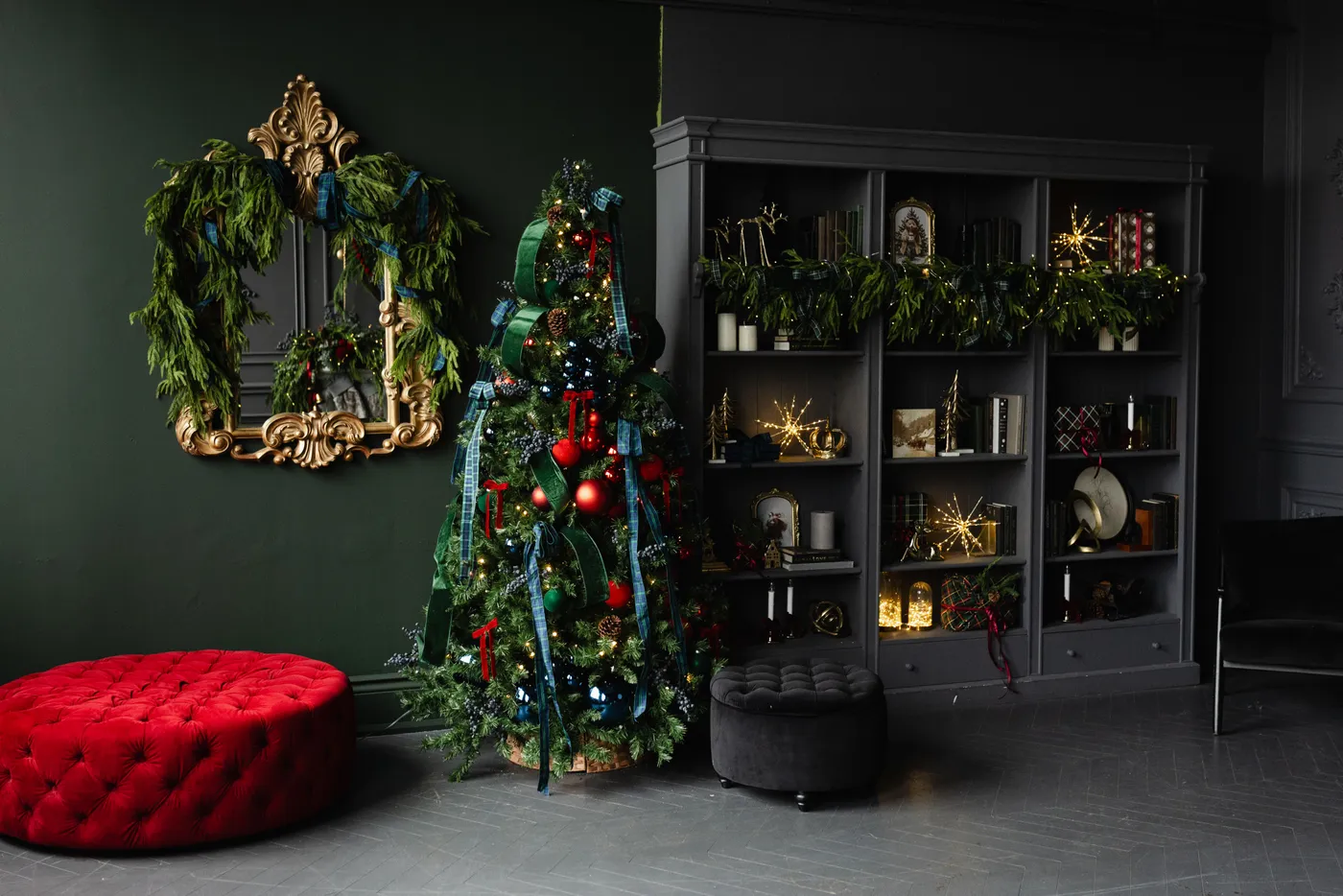
The draped mirror is the element that holds everything. Remove it and you have a nicely decorated tree in a dark room. Keep it and the wall itself becomes part of the holiday — the garland frames the mirror, the plaid ribbon ties the tree’s palette to the architecture, and the gold frame gives the whole thing a reason to glow.
The formula: 55% deep forest green + 20% charcoal + 15% crimson + 10% gold. It’s a high-contrast, low-light scheme, which means it needs generous artificial light to function — three sources minimum in a room this dark. Swap forest green for navy and crimson for burgundy and you have an equally moody winter version that works past December.
25. Plum and Teal Velvet in a Jewel-Toned Christmas
Dark walls, a tall tree blazing with warm white lights, and velvet furniture in deep jewel tones — a plum sofa, teal accents, rose gold metals. A carved stone fireplace mantel, window garlands with string lights, a round glass coffee table holding festive treats, and a gold bar cart in the corner.
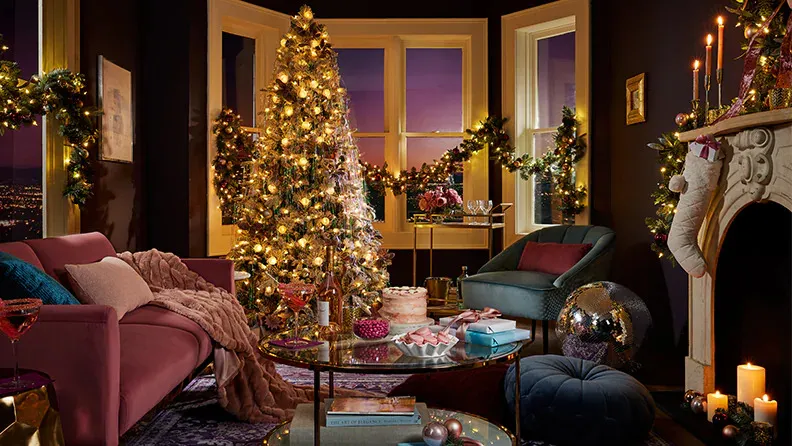
Jewel tones have been building for three seasons and 2026 is the year they fully arrived in holiday decor. The appeal is honesty: after years of cream-and-sage minimalism, people want rooms that feel rich and enveloping at 5pm in December. Plum, teal, and rose gold work because they’re saturated but not bright — they hold up in low light where red and green can go muddy.
Honest caveat: this palette is unforgiving in a small, bright room. Dark plum velvet in a sunlit south-facing living room can read heavy and slightly purple-gray by afternoon. It wants a north-facing room, low ambient light, and preferably walls that are already dark. If you have white walls and big windows, borrow just the velvet in a throw or ottoman and keep the tree warm white.
26. Olive Velvet, Antler Pendants, and Multiple Lit Trees
Several illuminated trees in one room, the largest placed centrally and densely decorated, with a plush olive-toned velvet sofa loaded with textured pillows, a faux fur throw, and wrapped gifts. Rustic antler-inspired pendant lights hang above, and woven baskets climb the wall.
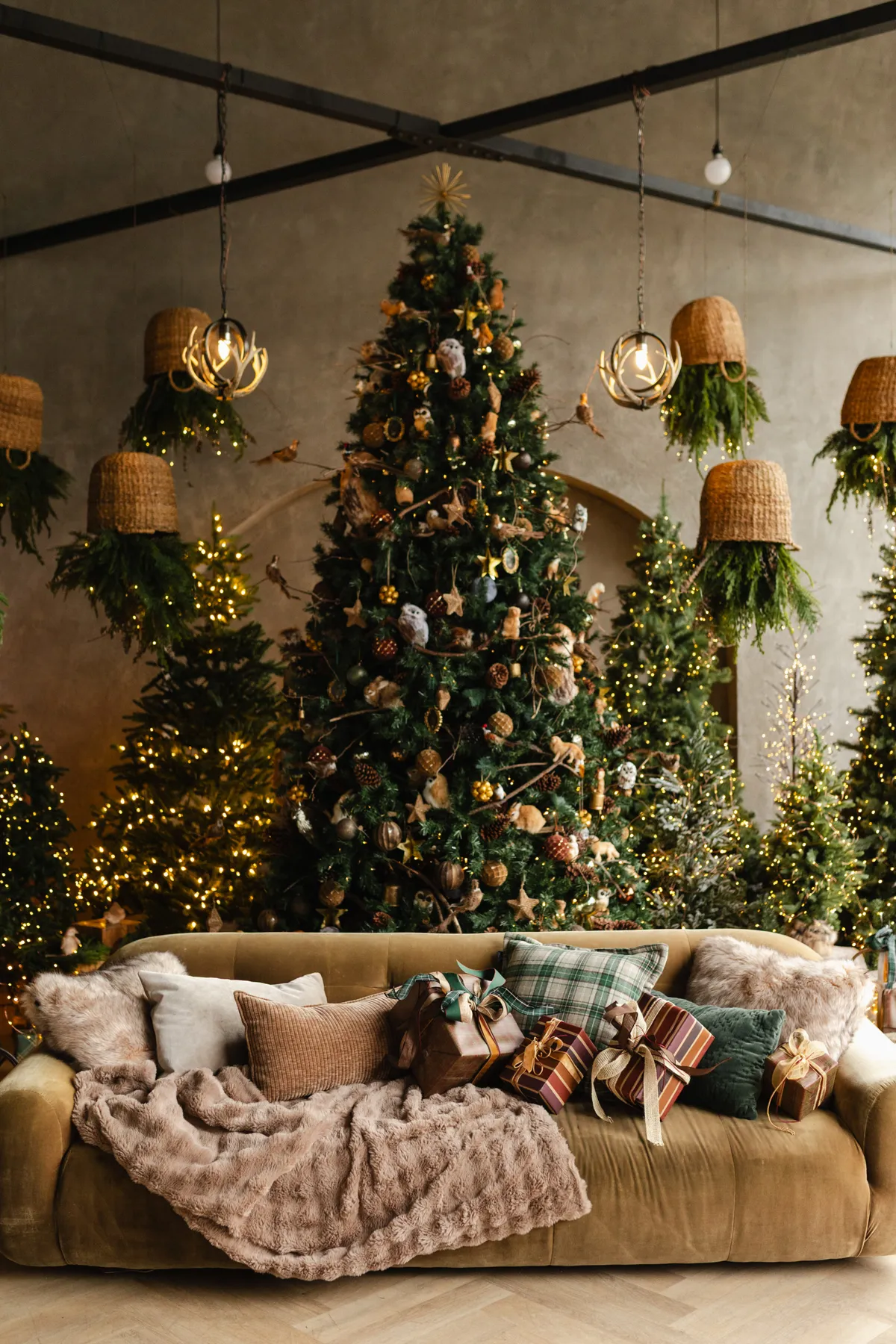
The single decision that makes this room: more than one tree. A big tree plus two smaller ones at different heights creates a forest effect, and it solves the problem of a wide room where one tree looks lonely in a corner. Cluster them within six feet of each other so they read as a group, and vary the height difference by at least 18 inches so it looks chosen rather than accidental.
Olive velvet is the surprise here — it’s a green that works with warm brown, gold, and cream without competing with the tree. And the antler pendant lights are a smart substitute for a chandelier: rustic, low-hanging, and they cast light downward onto the sofa where you actually want it. If you want the tree-count idea without the space, Idea #9 does it with two slender flocked trees.
27. Plaid Cushions on a Cream Circular Sofa
A big lit tree loaded with warm lights, red and plaid ornaments, and green velvet ribbons, standing beside dark paneled walls. A cream circular sofa with tartan cushions and plaid-wrapped gifts sits near a fireplace mantel buried in mixed greenery, red berries, and stockings.
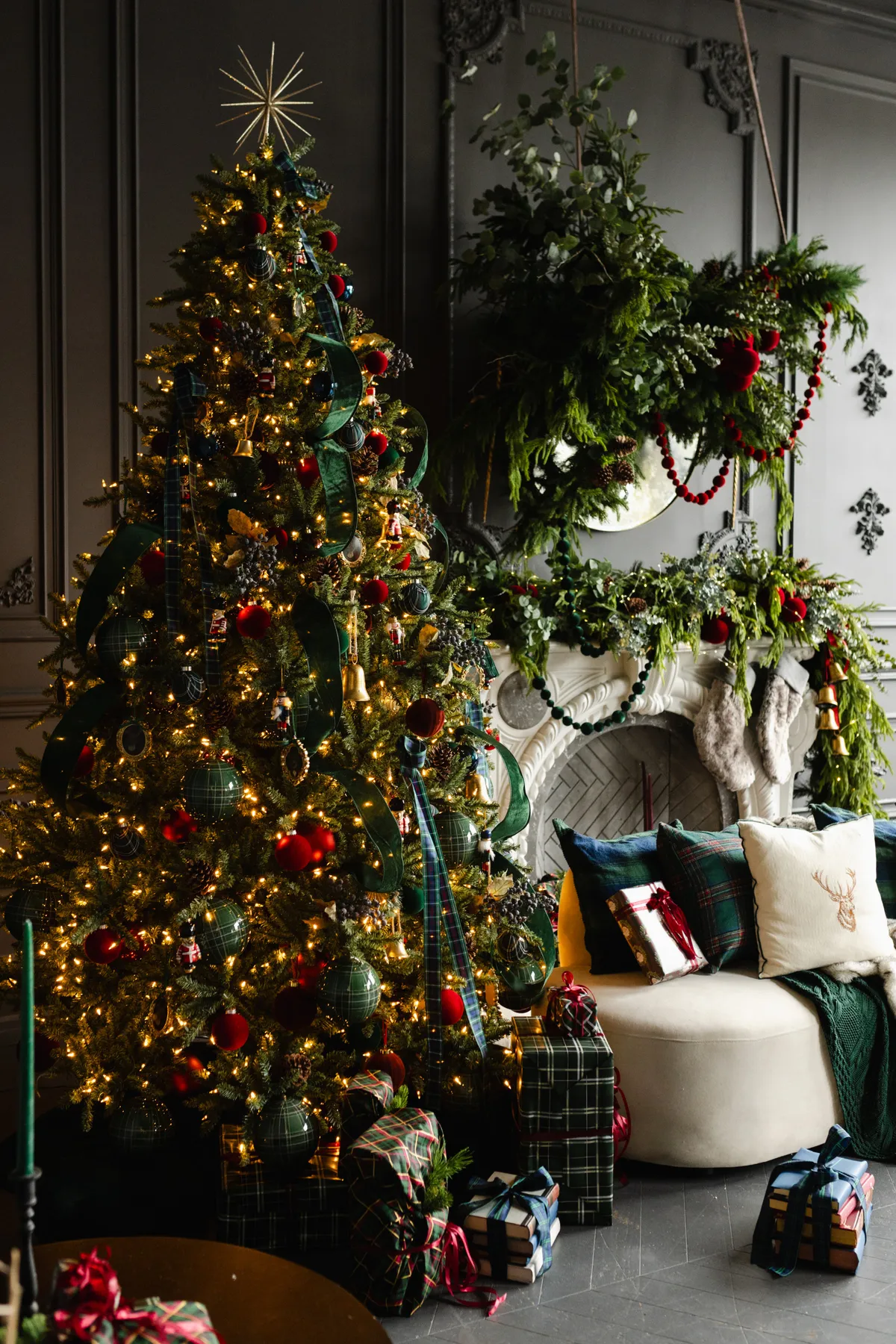
The circular sofa is the move most people wouldn’t think of, and it changes the whole conversation — it turns the tree into something you gather around rather than look at. Designers use round seating in front of a focal point for exactly this reason: no one has a bad seat, and the shape softens a room full of right angles.
Practical warning on plaid: mixing tartans is thrilling until it isn’t. Keep to two plaid patterns maximum in a single room, and make sure they share at least one color. Here, red is the shared thread, which is why the cushions, wrapping paper, and ornaments all feel related. Add a third plaid and the room starts to vibrate. Also — dark paneled walls swallow light, so budget for one more lamp than you think you need.
28. Gold Tinsel and Multi-Colored Lights, Playfully Done
A mid-century wooden coffee table with rounded edges holding ceramic bowls, books, and a small Santa figurine. Behind it, a white armchair with a red and green plaid throw, a wall strung with gold tinsel garland and multi-colored lights, a miniature tree to the right, and artificial snow scattered on the floor with ribbon.
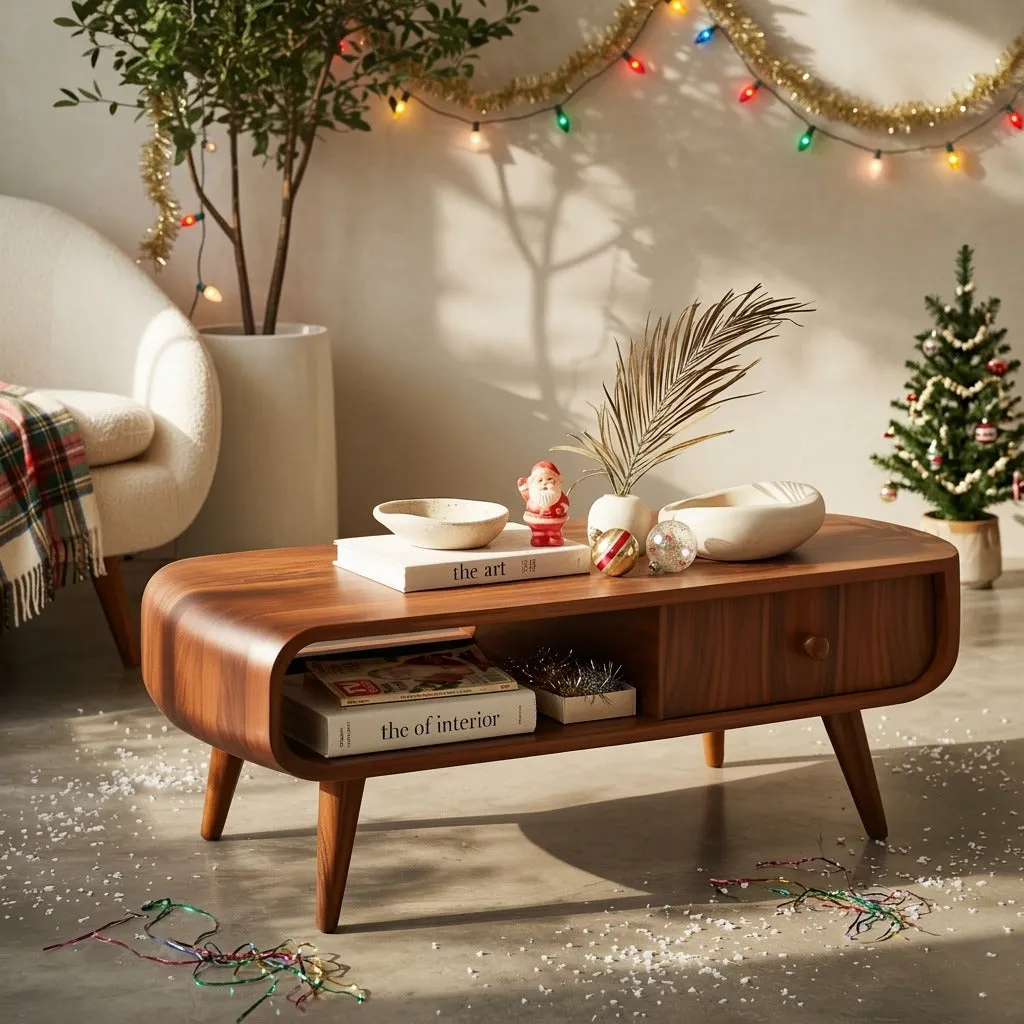
Multi-colored lights were considered tacky for about fifteen years. They’re back, and the reason is generational — people in their thirties and forties are recreating the Christmases they actually had, not the ones Pinterest told them to want. Gold tinsel is the bridge: it’s retro but it reflects the colored bulbs and makes them feel intentional rather than chaotic.
The whole look is remarkably cheap to pull off. Tinsel garland is $10–$20 at Walmart, a strand of vintage-style colored bulbs is $15–$30, and a tabletop tree is $25–$45. Under $100 for a vignette that photographs beautifully. Pro tip: run the colored lights behind the tinsel, not through it — the tinsel acts as a diffuser and the glow gets softer and more expensive-looking.
29. A Candy Cane Lit Corner in a Dark Wood Children’s Room
Two twin beds with cream bedding against a rich dark wood-paneled wall, a lit tree with ornaments tucked into the corner, wrapped gifts, candy cane light garlands, and playful toy figures with a toy train set on the rug. Small rattan chairs and a table at kid height.
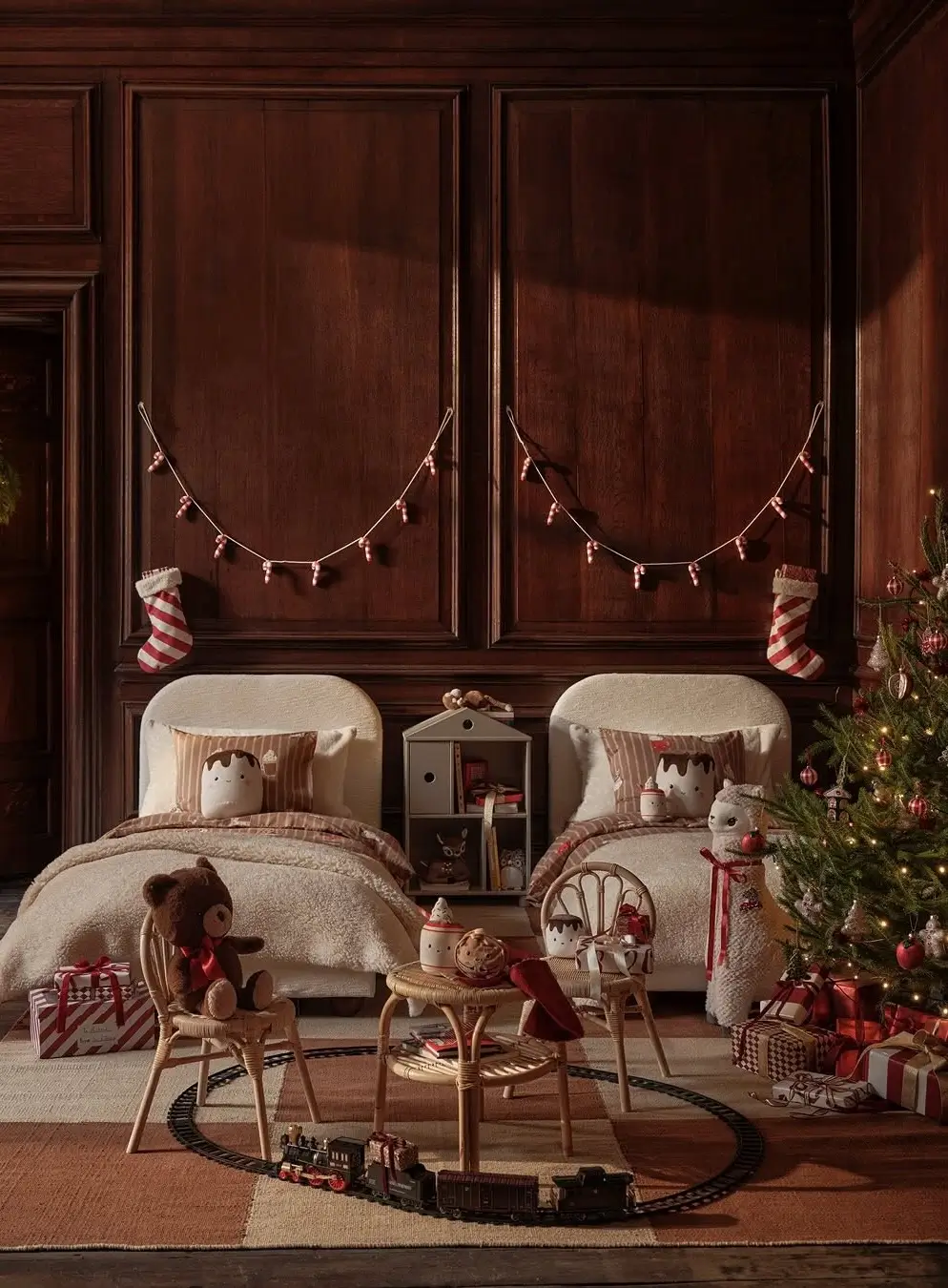
Children’s rooms are where the rules relax, and that’s the point. The candy cane garland works here in a way it never would in a living room because the scale is right — small lights on a short run of wall, at a height a child actually sees. Kids experience rooms from three feet off the floor, so hang decorations lower than feels correct to you.
Room requirements: this works best in a bedroom of at least 110 square feet with two beds, and the tree needs three feet of clearance from the bed edge. Use shatterproof ornaments only — that’s non-negotiable with little ones — and skip real candles entirely. The dark wood paneling is a gift here: it makes warm lights pop, and it hides the scuffs that come with children.
30. Red Velvet and Plaid on a Cream Sofa, Brass Everywhere
A lit tree with red and gold ornaments, a white fireplace mantel with a lush green garland and brass candelabras, a cream sofa with red velvet and plaid pillows and a chunky knit throw, a rustic wooden coffee table with a candle centerpiece, a woven beige rug, and built-in white bookshelves behind.
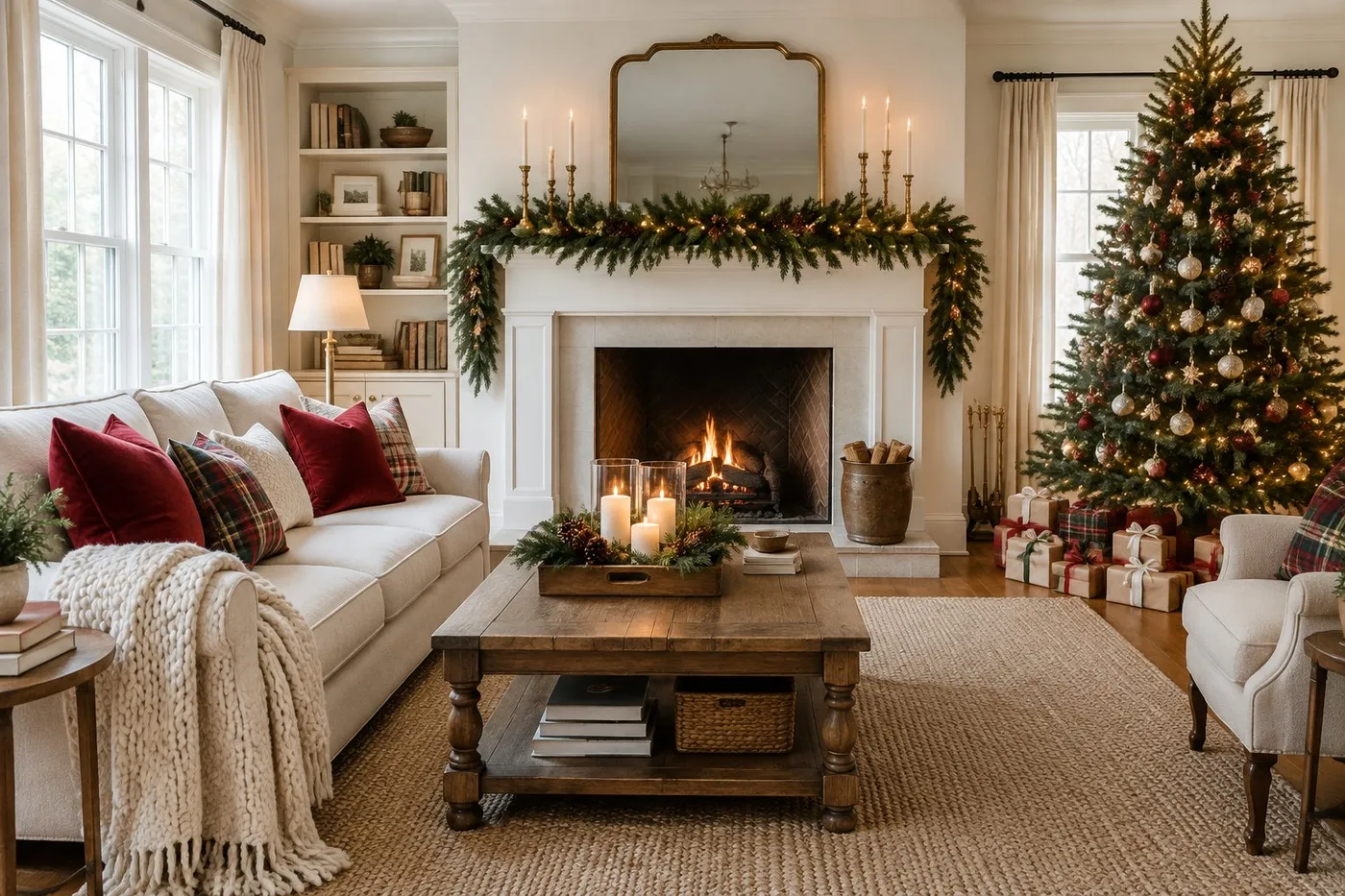
What makes this room work is material warmth. Brass, wool, wood, and velvet are all warm-surfaced materials — they hold light rather than reflect it, which is why a room like this feels cozy at night. Chrome and glass would do the same shapes and feel cold. The built-in white shelves are the neutral canvas that lets all that warmth read clearly.
- Sofa and coffee table: $800–$2,000
- Tree, ornaments, and lights: $180–$500
- Pillows, throws, and rug: $130–$400
- Mantel garland, candelabras, and brass: $70–$220
- Tree skirt and wrapping: $30–$90
Total: around $1,210–$3,210. Buy the candelabras secondhand — brass is everywhere at thrift stores for $5–$15 and a quick polish makes them look new.
31. White, Teal, and Silver in a Bright Tropical Room
A white sofa with dark woven rattan-style accents, a light wood rectangular coffee table, an artificial palm, and a blue and silver decorated tree to the right. Teal and blue accents — a round cushion, a vase arrangement — repeat the tree’s palette across the room, with lush green foliage visible outside the balcony door.
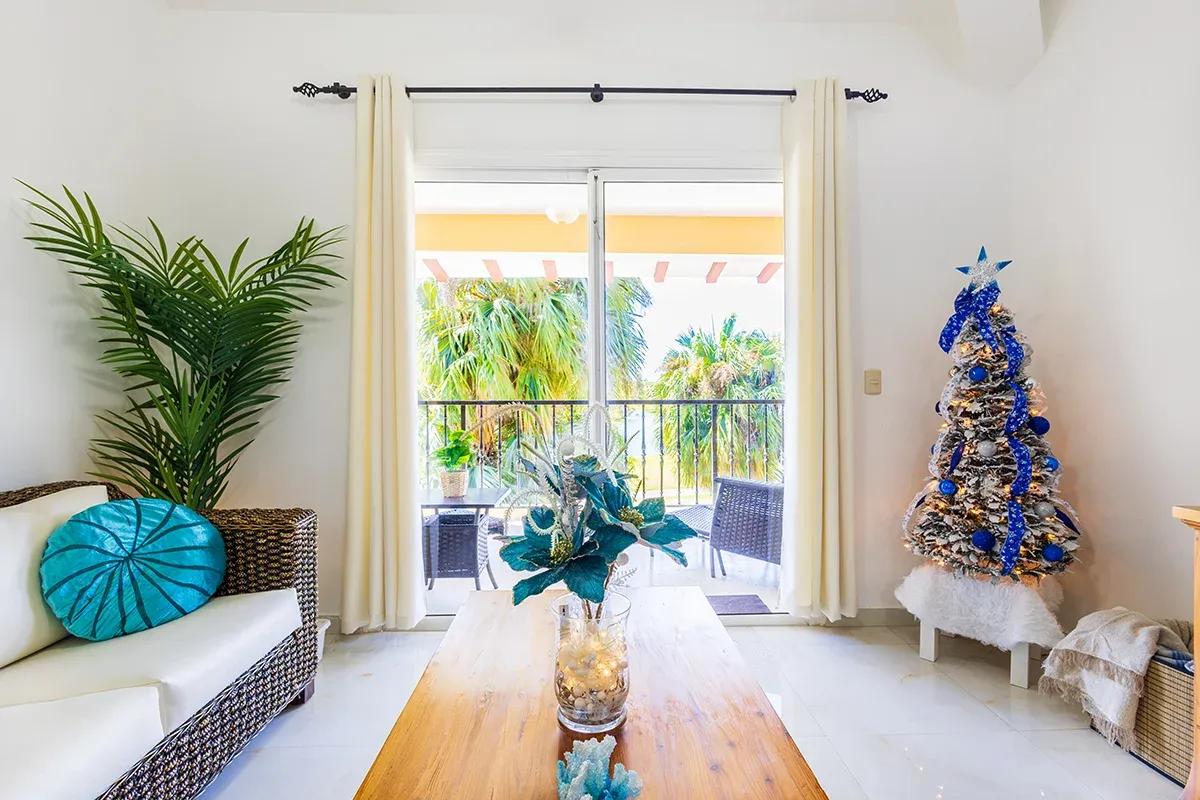
The formula: 55% white + 20% teal and blue + 15% light wood + 10% silver. It’s the coolest palette in this entire article, and it works because the warm wood and the live greenery outside keep it from feeling sterile. If you live somewhere warm, or you just crave a break from red and green, this is your scheme.
not to skip: repeating the tree’s blue in a cushion and a vase elsewhere. Without those echoes, the tree reads as a decoration that doesn’t belong to the room. With them, the whole space becomes a coordinated scheme. Two objects is enough — you’re creating a rhyme, not a chorus.
32. Dried Oranges and Evergreens on a Light Wood Table
A light wood dining table with matching chairs, dressed with a garland of evergreens and dried orange slices and dark candlesticks. Glass-front wooden display cabinets flank a light fireplace mantel topped with a dark wood shelf, and a multi-globe chandelier hangs over it all, with chevron-patterned barn doors beyond.
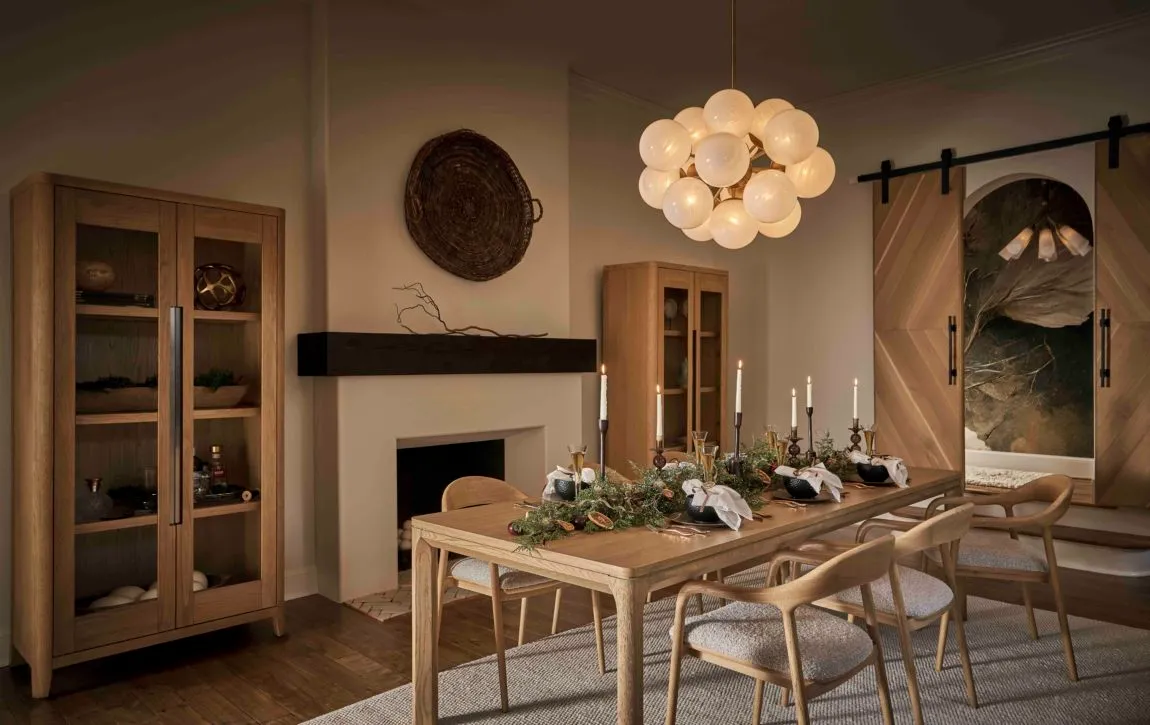
The dried orange garland is the detail people ask about, and it’s genuinely easy:
- Slice oranges 1/4 inch thick and pat dry — thicker slices mold, thinner ones burn. (10 min)
- Bake at 200°F for 3–4 hours, flipping every hour, until leathery. (mostly hands-off)
- Cool completely — they crisp as they cool, so don’t rush this. (30 min)
- Thread onto twine with cinnamon sticks and small evergreen sprigs. (15 min)
Under $15 in materials, and they’ll last for years if stored dry. Maintenance reality: dried citrus fades to brown within two seasons and is fragile — store them flat in a rigid container, not a bag. Pair them with fresh evergreen, which will need replacing by mid-January. That’s the honest trade-off for the most natural-looking garland in this whole article.
Pack It Away Knowing You Got It Right
Here’s the thing about Christmas decorating: the rooms that stick with people aren’t the most expensive ones, they’re the ones with a clear point of view — a woven basket instead of a plastic stand, oversized bows instead of polite ones, candles where a fire never gets lit. Pick two or three ideas from this list that match the room you actually have, and let the rest go without guilt.
📌 Save this to Pinterest now — next December you’ll be glad you didn’t have to scroll for an hour to find the gold-and-bronze tree again.