Most felt stocking DIY guides get it wrong on the very first step: felt isn’t fabric, and the moment you treat it like it is, you get puckered seams and fuzzy monograms. We’d rather show you 32 versions that actually work — hand-stitched ski scenes, sequined Santa appliqués, gold-fringed cuffs, and felt ball garlands strung between them.
We spent a few weekends browsing Etsy, Joann, Michaels, Target, and Walmart to pull together what’s genuinely worth your time this year — everything from $2 scrap-bin ornaments to $250 full mantel setups.
Inside you’ll find 32 curated ideas spanning rustic handmade, jewel-tone maximalist, pastel whimsical, and classic traditional, with budget and luxury versions compared side by side throughout.
Felt is having a real moment in 2026 — Pinterest saves for hand-stitched felt ornaments have climbed three seasons straight as people hunt for decor they can finish in one evening.
📌 Save this to Pinterest for later — you’ll want to revisit these ideas. And stay until the end — we break down the most common mistakes that can ruin these looks.
1. Felt Ball Garlands Winding Through a Five-Stocking Mix
There’s no mantel in this one — it’s a flat lay, which means the whole budget goes into textiles and string. Here’s what a five-stocking mix plus two garlands actually costs:
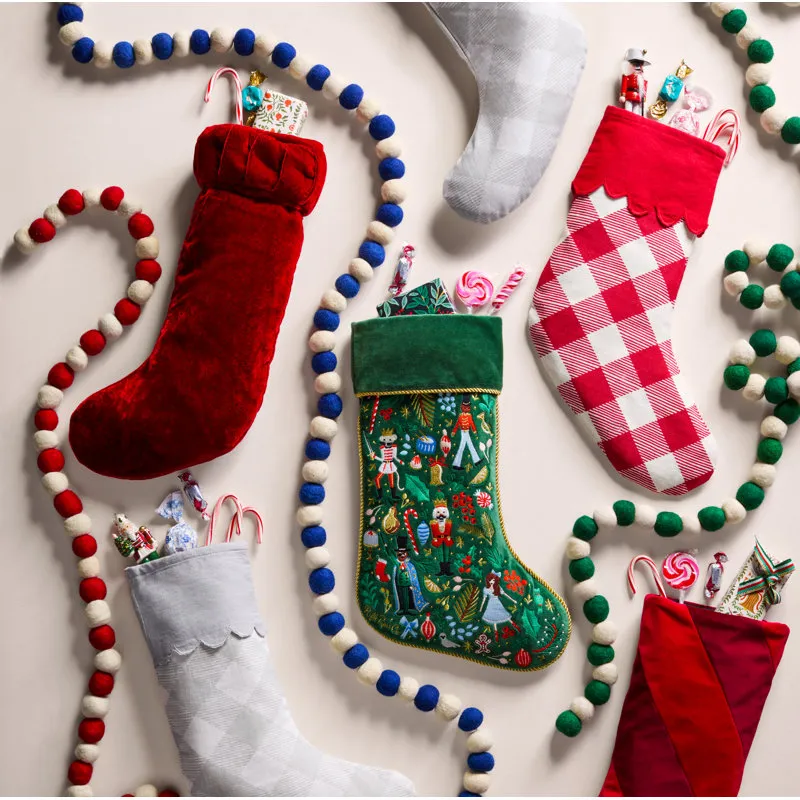
- Five stockings, mixing red velvet, embroidered green felt, buffalo check, and light gray plaid: $60–$150
- Two strung felt ball garlands, 6 ft each, in blue-white and green-white: $18–$45
- Fillers — wrapped candies, small treats, tissue: $15–$35
- Backdrop textile for the flat lay: $0–$30 (use a throw you already own)
Total: roughly $93–$260. Budget alternative: buy loose felt balls and re-string them on jute yourself. Two strands runs about $12.
The rule for a mixed lineup like this is three textures minimum, one pattern maximum. Velvet, felt, and woven plaid are your three; buffalo check carries the single pattern. Add a fourth texture and you have to drop the pattern entirely. Also route the felt ball garlands so they cross at least two stockings — string that touches only one reads as an afterthought.
2. Two Hand-Stitched Cream and Green Stockings Under Pine Branches
Take away the visible charcoal stitching and these stockings are still pretty — and completely forgettable. The exposed hand-stitching is the entire point. It’s deliberately oversized and slightly irregular, which is what separates a made object from a manufactured one. Machine-perfect stitches on felt look like a factory floor; imperfect visible ones look like somebody made them at a kitchen table. Keep yours at roughly 4–5 mm and resist the urge to even them out.
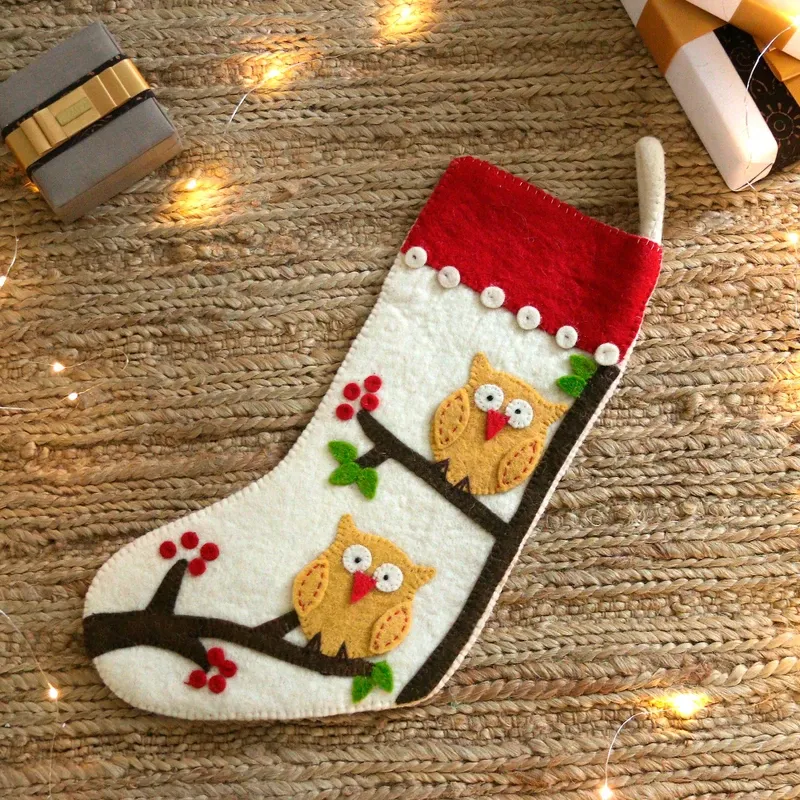
Two honest caveats. Cream felt shows every fingerprint, and it grabs pet hair like a lint roller in reverse — brush it weekly with a soft clothes brush. Second, if you’re hanging on a textured plaster or limewash wall instead of a mantel, skip the adhesive strips. A stuffed stocking needs a small nail or a removable picture hook rated for at least 2 lbs, or you’ll hear it hit the floor at 2 a.m.
3. Named Knit Stockings Under a Boxwood Wreath and Purple Candles
The formula behind this brick fireplace: about 55% white (mantel, stocking bodies, candlelight), 25% evergreen, 12% brick red, and 8% purple. That last 8% is what makes it look styled rather than store-bought — most people stop at red and green and wonder why their mantel feels flat. Swap the purple tapers for amber or cobalt and the mood shifts completely while the ratio stays identical.
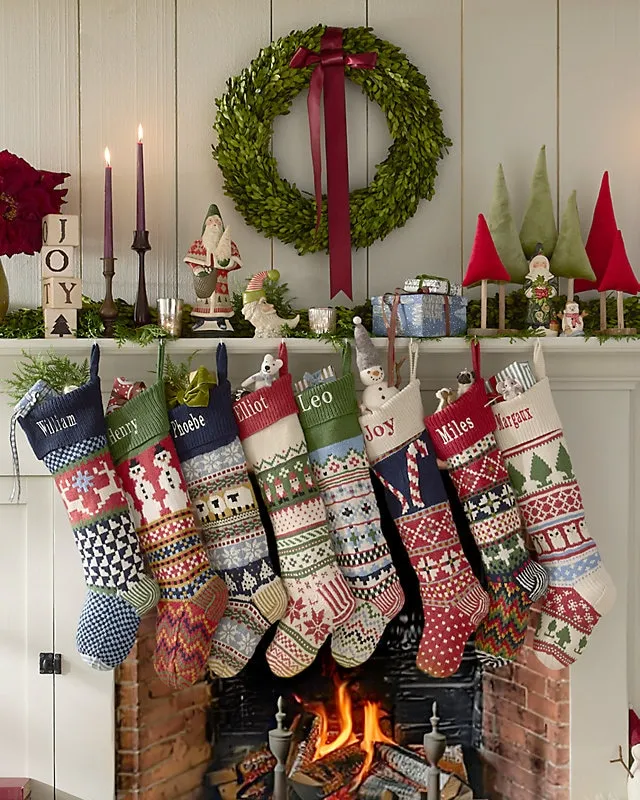
Three things are doing the heavy lifting here. First, contrast — soft knit and boxwood pressed against rough exposed brick reads as expensive because the texture jump is so wide. Second, height: the tall tapered candles break up what would otherwise be a flat horizontal line across the mantel. Third, repetition, in the form of the same stocking silhouette hung in a row with embroidered names to reward close looking.
4. Six Tiny Felt Ornaments Laid Out on a Fluffy White Throw
Start with the gingerbread man — he’s the one with the checkered bow and button details, and he’s the easiest shape to learn on.
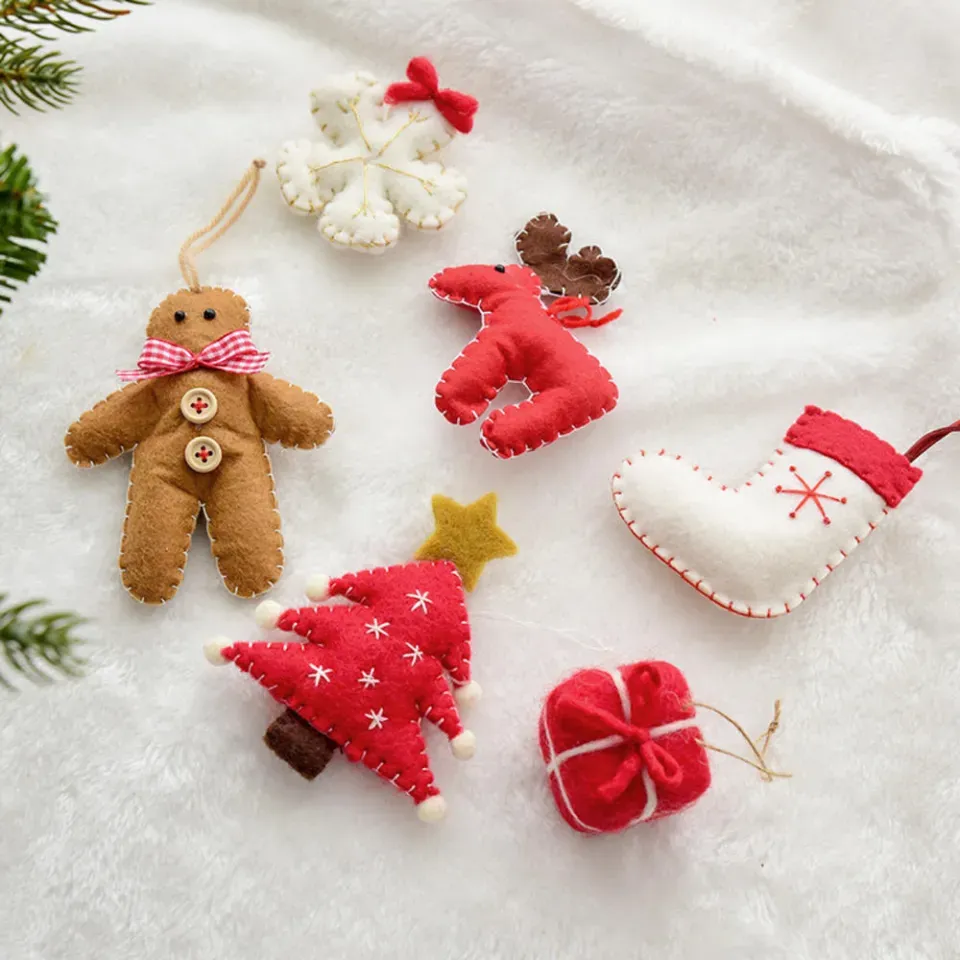
- Cut two mirrored gingerbread shapes from tan felt, plus a small checkered bow rectangle.
- Blanket-stitch around the perimeter in cream thread, leaving a 2-inch gap at the bottom.
- Stuff lightly with poly-fil — you want flat cookie, not pillow.
- Stitch the gap closed, then sew three tiny buttons down the front.
- Tie the checkered bow at the neck and stitch a twine loop to the back.
About 35 minutes per ornament, and under $6 in materials for a set of six. The reindeer, white stocking, and red tree all use the same method with different templates.
Hand-stitched felt ornaments are climbing on Pinterest for the third straight season, and it isn’t nostalgia for nostalgia’s sake. People want decor they can finish in one evening, and felt is the cheapest route to a soft, matte, non-plastic holiday look. The classic shapes — gingerbread, reindeer, snowflakes — will outlast the fads. They already have.
5. Blush Pink Mantel With a Frosted Wreath and Nutcracker Bookends
Pink Christmas doesn’t need a designer budget. A frosted wreath runs $25–$45 at HomeGoods or T.J.Maxx; a plain green wreath from Walmart plus matte white spray snow and a $6 stem bundle of pink and white flowers lands around $22. Nutcracker figurines come from thrift stores at $3–$8 each, or Target’s dollar spot in November. Pink patterned stockings with bows: $8–$14 each. The whole mantel, around $75 instead of $300.
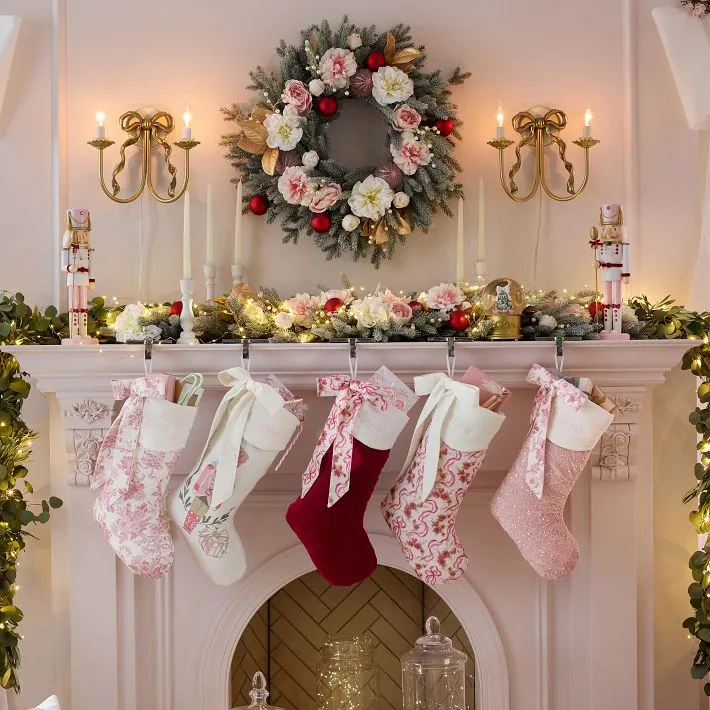
This styling wants at least 60 inches of mantel width and ceilings no lower than 8 feet — a hanging wreath plus tall tapers needs vertical room or everything feels crammed. If your mantel sits below 48 inches off the floor, lean the wreath instead of hanging it. Working with something narrower or a simple ledge? Idea #7 runs the same white-plus-accent formula at a much smaller scale.
6. A Crowned Cat Appliqué on a Pink Stocking With a Pom-Pom Loop
For an appliqué that survives a decade in storage, fuse first and stitch second. Trace the cat shape onto paper-backed fusible web, iron it to the felt, peel, then press onto the stocking body. Satin-stitch around the edge with a 1/8-inch seam. The fusing stops the felt from shifting while you sew, and it keeps small shapes like paws and the crown points from curling after a few seasons in a bin.
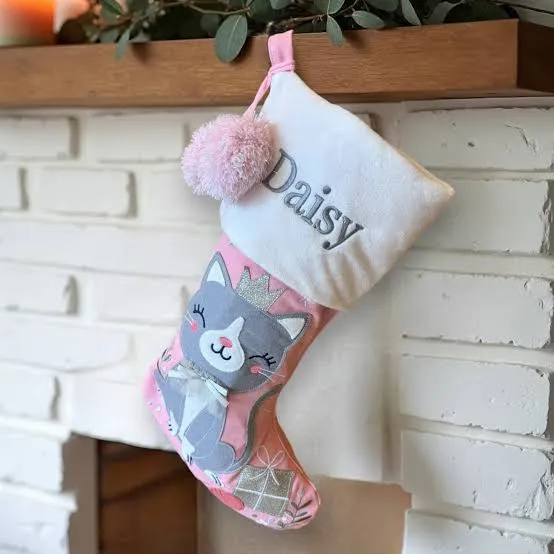
Pink felt is the most fade-prone felt in the box — direct sun through a window will dull it within a single season, so hang it away from southern exposure or accept the shift. The pom-pom loop is the first thing to go, since pom-poms shed fiber when they rub a rough surface. Pick a smooth wood or metal hook. And store felt stockings flat rather than folded, or you’ll get permanent crease lines right across the appliqué.
7. Cream Chunky Knit Stockings With One Motif Each
Run through this before you buy a single skein:
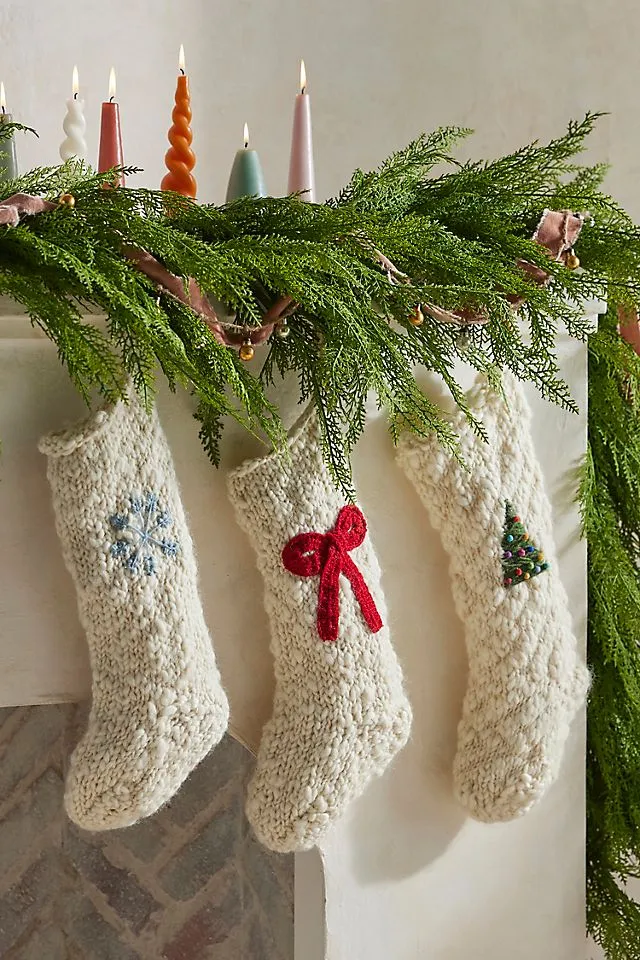
- Measure your mantel’s usable length and divide by three — each chunky stocking needs 7 to 8 inches of spacing to breathe
- Check that your embroidery hoop actually fits the stocking leg; a 4-inch hoop won’t reach the center of a chunky knit body
- Confirm your yarn is a true cream, not ivory — ivory turns yellow next to fresh cedar
- Decide all three motifs before you shop; three different colors on three stockings is the whole design
- Count your candles against the ledge — five tapers need roughly 30 inches of mantel
The genius move is repetition with a single variable. Same chunky knit, same cream yarn, same silhouette — only the embroidered motif changes. That’s what makes a set read as a collection instead of three random buys. The cedar garland does the rest: it’s the only organic texture in the frame, and it softens three very structured, very knitted shapes.
8. White Felt Stocking With a Hand-Embroidered Ski Slope
The scalloped cuff is the fussy part, so do it first.
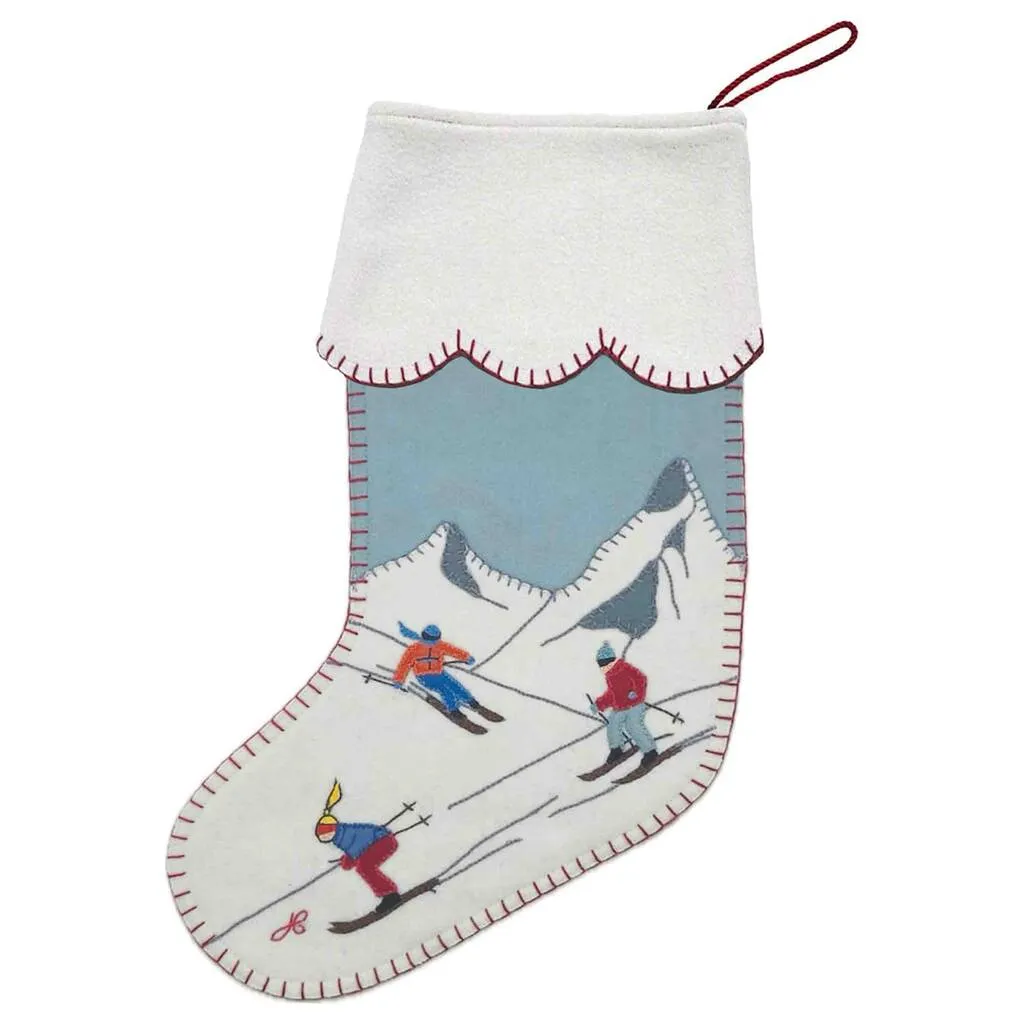
- Cut a scalloped cuff template from cardstock — five scallops across a 6-inch cuff.
- Trace onto white felt and cut slowly; scallop curves show every wobble.
- Thread red floss (3 strands) and blanket-stitch the cuff’s top edge first.
- Stack the cuff on the body and blanket-stitch around each scallop.
- Finish with a perimeter stitch down both sides and around the toe.
Roughly 2 hours and under $10 in floss and felt. The skiers are the next layer — add them after the perimeter is done so you’re not fighting the edge.
Strip away those little embroidered skiers and you’d have a lovely blank white stocking with no reason to photograph it. At about an inch tall they force you to look closely, and that closeness is what makes handmade decor feel personal rather than purchased. Set the mountain scene off-center toward the toe and leave the upper third of the body empty — that negative space is what makes it read as landscape instead of clutter.
9. An Angel in a Tulle Dress on a Stocking Named Luna
Tulle and felt are an odd couple. The angel’s tulle skirt will snag on the stocking’s own stitching every time you pack it, so wrap that one in tissue before it goes in the bin. Silver pom-poms shed, and once one loses volume it looks sad rather than sweet. If this stocking will see real use from kids, hang it on the highest hook and let the sturdier ones take the abuse.
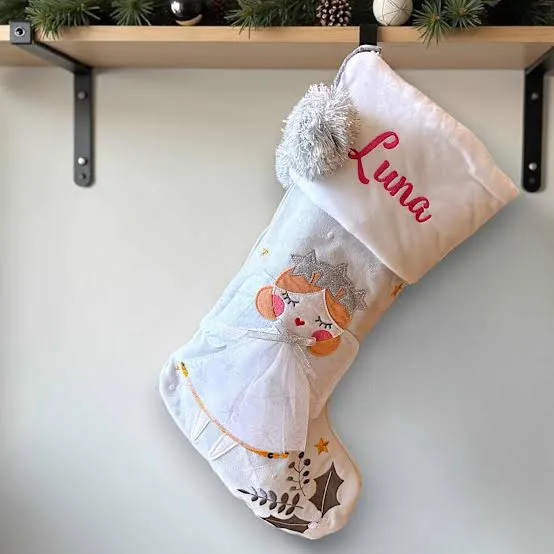
Here’s what a personalized embroidered version actually runs:
- White fabric stocking blank: $10–$20
- Custom embroidered angel motif (Etsy digitizing or a monogram shop): $15–$40
- Tulle scrap and silver pom-pom: $3–$8
- Wooden shelf bracket or hook: $6–$20
- Name embroidery, if outsourced: $12–$25
Total: $46–$113 — or about $15 if you stitch the angel and the name by hand.
10. Mini Red Felt Stocking With a Green Monogram and Snowflakes
Strip it down and the math is almost simple: 70% red felt, 20% green, 10% white, plus a trace of yellow on the clover accent. It works because green never appears as a large shape — it shows up as a monogram letter, a clover, and stitch detail. Flip that ratio and let green take the body, and the stocking turns Christmas-generic. Keep green under a quarter of the surface area and the whole thing looks considered.
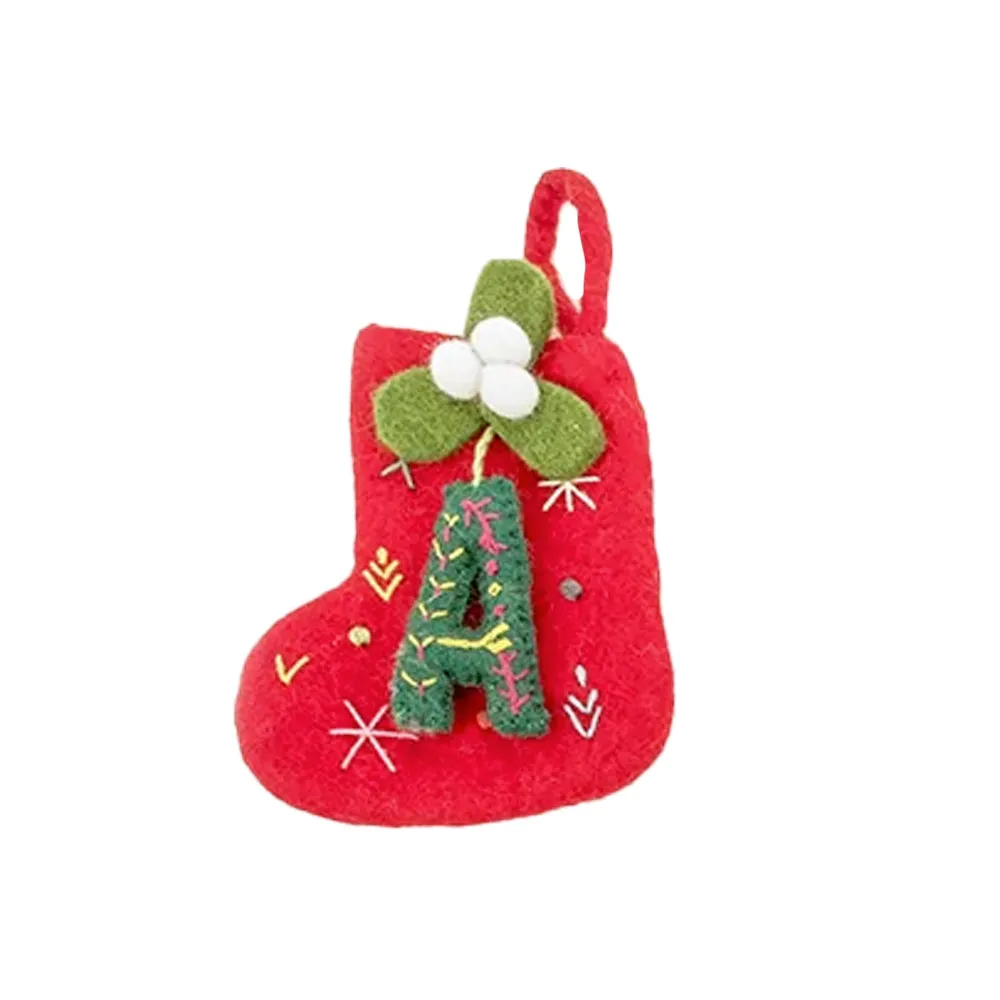
Scale is where mini stockings fail. On a 7-inch stocking, a monogram letter should top out around 1.5 inches tall — bigger and it reads as a keychain, smaller and nobody can read it from across the room. Cut your letter from stiffened felt rather than soft craft felt; it holds an edge, so the curve of an A or an S stays crisp instead of going fuzzy after a season.
11. Magenta Cuff, Gold Fringe, Deep Red Felt — Fully Embroidered
Jewel tones are the story of the 2026 holiday season. After years of neutral Scandinavian Christmas decor, saturated magenta, deep teal, and oxblood pushed their way back into the palette — and gold fringe came along for the ride. It’s a maximalist move borrowed straight from vintage heirloom ornaments. Will it last? Longer than you’d think. Jewel tones photograph beautifully, read as heirloom, and don’t age the way a single trendy pastel does.
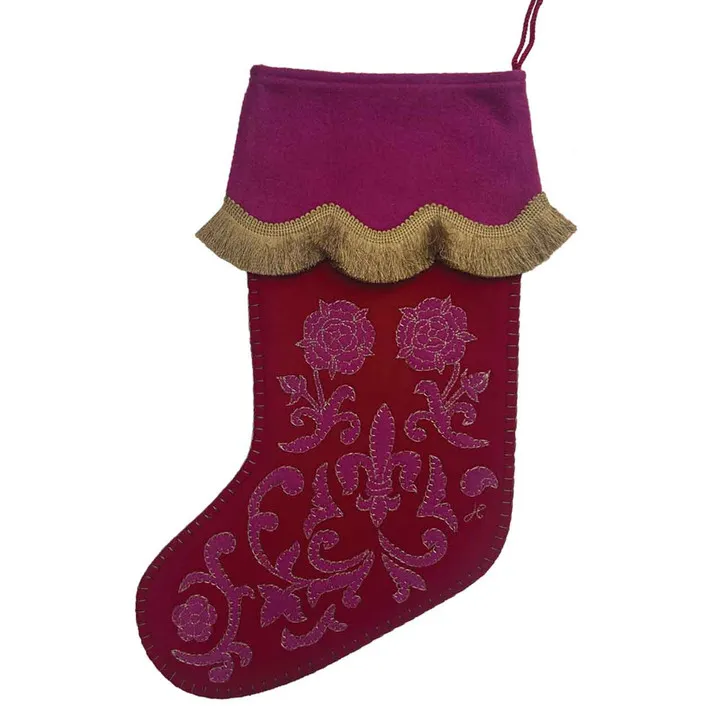
The ornate version isn’t nearly as expensive as it looks. Gold scalloped fringe runs $4–$7 a yard, and one yard covers two cuffs. Deep red felt: about $1.50 a sheet. Magenta embroidery floss: under $1. Stitch the scrolling by hand and the whole stocking lands between $12 and $18. Compare with Idea #21 — same festive red, but a far softer, more traditional finish.
12. Red Knit Stocking With a Ribbed White Cuff and a Letter T
A knit stocking with a folded ribbed cuff is bulkier than a felt one — figure 9 to 10 inches of mantel length per stocking if you want them to hang without overlapping. This single-stocking styling still works on mantels as short as 36 inches, which makes it a smart pick for apartments and narrow fireplace walls. For long runs of 90 inches or more, you’ll want more than one.
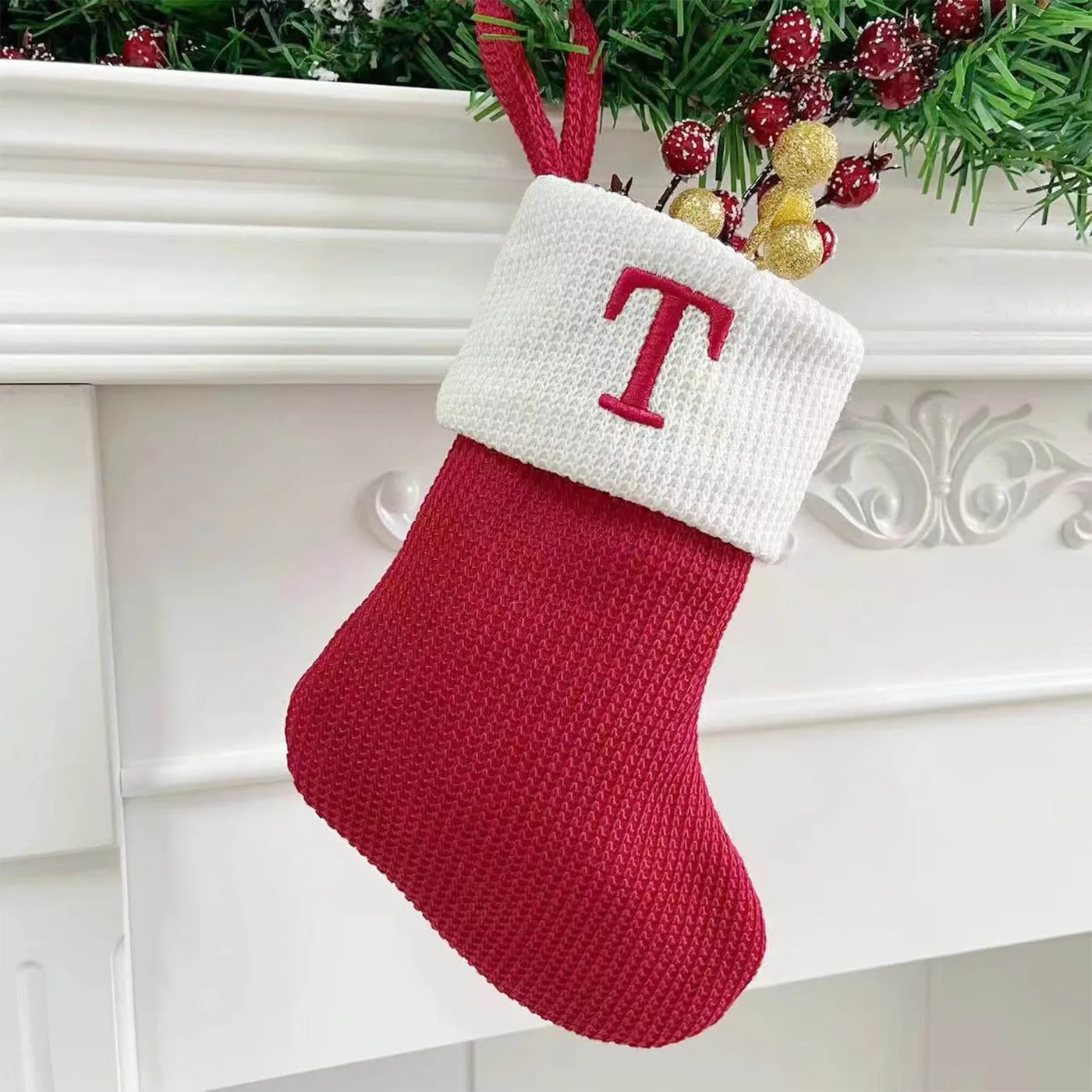
Two things to know before you copy the greenery. Fresh evergreen sprigs drop needles indoors within about ten days, so either plan to replace them or buy faux — nobody notices at eye level. And if that white mantel sits above a working fireplace, keep greenery at least 12 inches from the firebox opening. The resin in pine and cedar pops and smolders when it gets hot, and a festive mantel isn’t worth a scorch mark.
13. A Miniature Felt Stocking Tucked Into a Tabletop Tree
The single element that makes this work is scale discipline. The stocking is miniature, the tree is miniature, the gifts underneath are miniature — nothing in the frame is full-size. Break that and the vignette collapses into clutter. If you’re styling a small tree, buy ornaments sized for it. A 4-inch stocking on a 24-inch tree reads as charming; the identical stocking on a 7-foot tree reads as an error.
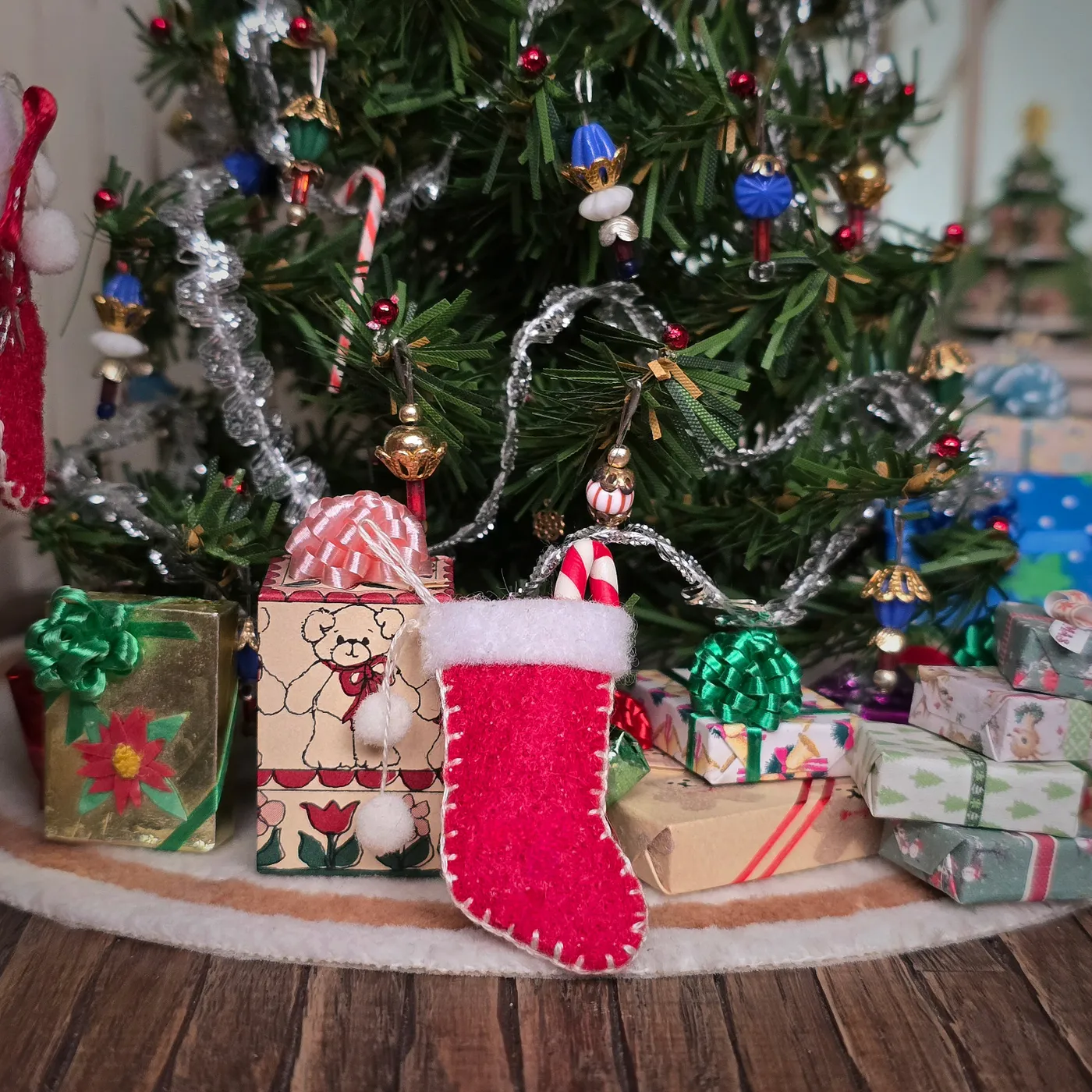
Making the mini version takes about 20 minutes:
- Use a 4-inch stocking template and cut two shapes from red felt.
- Cut a 1-inch white cuff strip and pin it across the top of both pieces.
- Blanket-stitch the two halves together in white floss, stopping 1 inch short at the top.
- Turn right side out, stitch the gap closed, and stitch a 3-inch twine loop inside the cuff.
- Press flat with your fingers — an iron will flatten felt permanently.
Under $2 in materials, and you can batch five in an evening.
14. Quilted Red Stocking on a Black Hook, Eucalyptus Garland Above
Three principles are at play. Texture contrast first: the quilting creates a raised diamond grid that catches light, and it sits right next to smooth, glossy evergreen. Second, restraint in hardware — that black metal hook is the only hard, dark line in the composition, so your eye goes straight to the monogram. Third, cool versus warm: silvery eucalyptus against warm red keeps the mantel from turning syrupy.
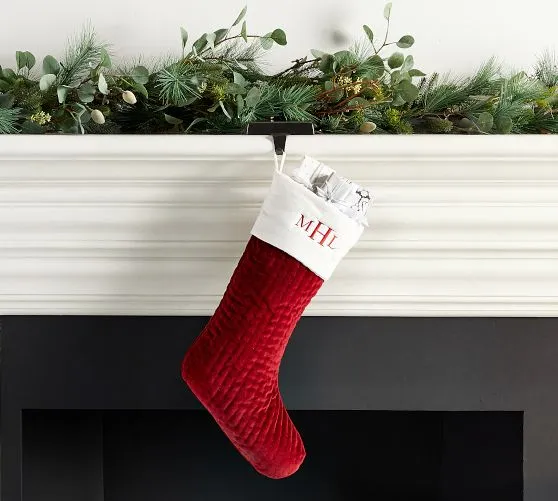
Quilted red fabric is a magnet for dust settling in the stitch channels — a quick lint roller pass every couple of weeks keeps it sharp. More importantly, red dye on cheaper quilting fabric can transfer onto a white cuff when stored damp. Make sure everything is bone dry before it goes in the bin, and toss a silica packet in with the stockings. As for the eucalyptus garland, plan to replace it every season — dried eucalyptus sheds aggressively.
15. Grey Linen Stocking With a Beaded Mistletoe Cuff
Linen frays the second you cut it, so treat the edges before you embroider anything. Run a thin line of fray check along your cut cuff, or iron a strip of lightweight fusible interfacing to the back. Then embroider through both layers — the interfacing gives your needle something to bite into and stops the mistletoe leaves from puckering. With felt you can skip all of this. With linen, skipping it means a ragged cuff by New Year’s.
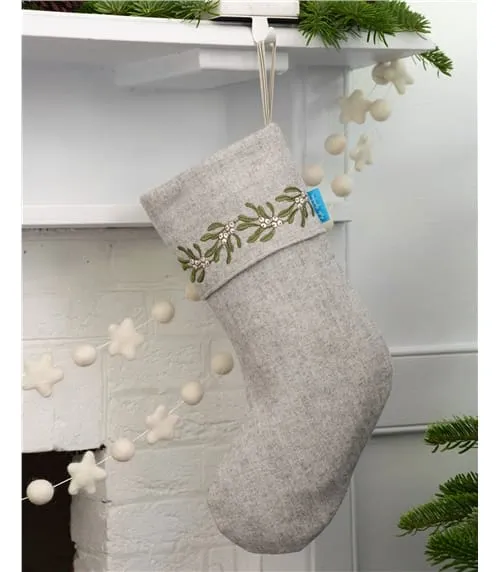
Quick checks before you commit:
- Measure from hook to mantel base — the stocking plus a 4-inch puddle needs at least 22 inches of drop
- Check your mantel lighting; grey linen goes muddy under warm yellow bulbs
- Buy two extra stones for the mistletoe — you will lose a few to the carpet
- Test your hook on a hidden spot; clear plastic hooks can yellow on painted brick
- Confirm your garland is white, not ivory, or the linen reads cool and the garland reads warm
16. Four Bow-Tied Stockings and a Stuffed Monkey on the Mantel
This one is less about the stockings and more about the supporting cast:
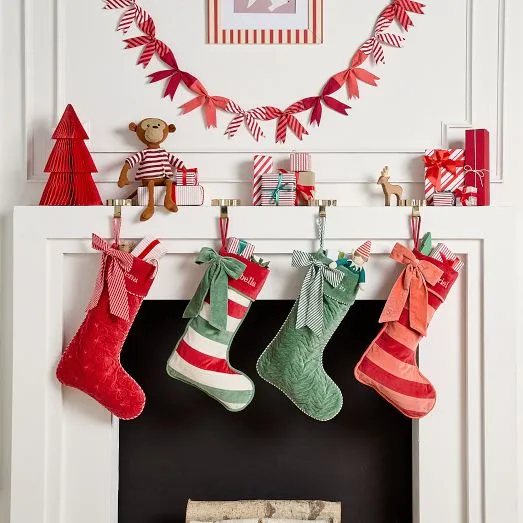
- Four stockings in red, green, and stripes: $40–$120
- Wide fabric ribbon for four big bows, 3 yards: $12–$28
- Red-and-pink ribbon garland draping overhead: $10–$22
- Miniature wrapped gift boxes and tissue: $12–$25
- Folded paper honeycomb tree: $8–$18
- Plush toy or figurine for the mantel ledge: $10–$30
Total: $92–$243. Skip the figurine and reuse last year’s plush and you’re closer to $80.
Four stockings with oversized bows eat real estate. Plan on 12 inches per stocking once the bows are tied, so this setup wants 48 inches of usable ledge — 60 if you also want the gifts and the little paper tree up top. Past about 7 feet of mantel, a four-stocking row starts to look sparse; switch to six or add height with a taller tree. Same formula, different count.
17. Heather Gray and Rust Red Stockings With Heart Name Tags
Read the palette as percentages: 55% heather gray and white, 25% rust red, 12% green from the embroidered mistletoe, 8% brown from pinecones and plaid pillows. The gray is doing the unglamorous work of making rust look intentional instead of loud. Swap heather gray for oatmeal and rust for olive and you have an entirely different room with the exact same ratio.
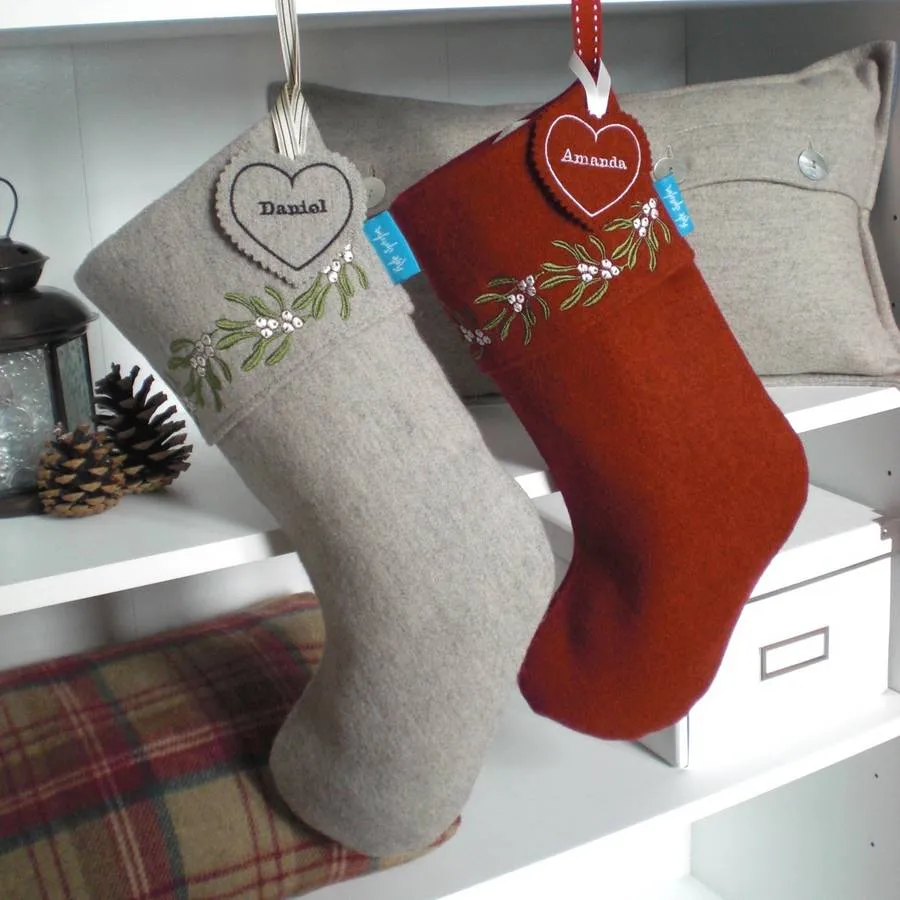
It’s the heart-shaped name tags. Nothing else. Two identical embroidered mistletoe stockings would be a nice pair and nothing more — the hearts turn a matching set into a matched set, and cutting them from felt rather than engraving them in metal keeps them soft and slightly imperfect. Cut yours a touch oversized and stitch them on at a whisker of an angle. Perfectly centered name tags look printed.
18. Peg Rail Mini Stockings: One Tree, One Candy Cane
Mini stockings are where you can be genuinely cheap. A three-pack of cream mini knit stockings runs $8–$15 at Target or Walmart, and the felt appliqués come from scraps you already have. A plain wooden peg rail is $12–$25 at IKEA. The bead garland is a $4 bag of craft beads strung on twine with a handful of brass bells — another $6. Total under $35 for the entire wall.
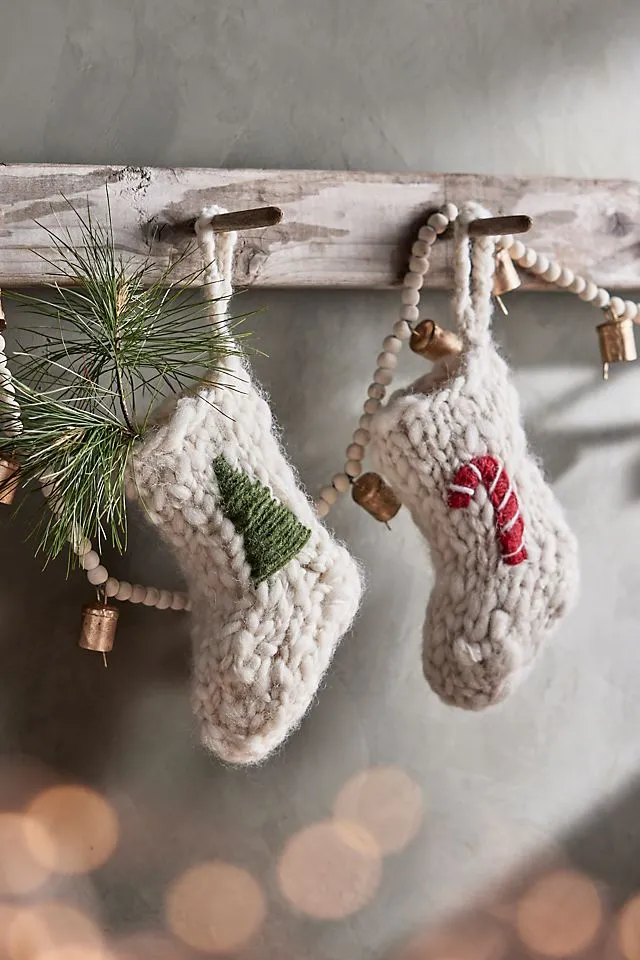
A peg rail looks effortless and is not. Small stockings and tiny gifts are fine, but anything heavier than about 3 lbs will pull out of plain drywall anchors, especially with kids yanking stockings down on Christmas morning. Mount into a stud or use heavy-duty toggle bolts. Also, mini stockings hold roughly one candy cane and a lip balm. If you want them to hold actual gifts, size up. That’s the trade-off.
19. Six Red-Cuffed Stockings Fanned Across White Marble
An arc layout does something a straight row can’t: it gives a flat lay a focal point without adding a single object. Arrange six stockings on an even curve and the eye lands on the center one first, then travels outward. The red cuffs create a repeating anchor across six different motifs, so the set feels curated rather than collected. And white marble beneath off-white felt keeps the whole composition bright instead of muddy. Compare with Idea #3, where the same red-and-white logic plays out vertically.
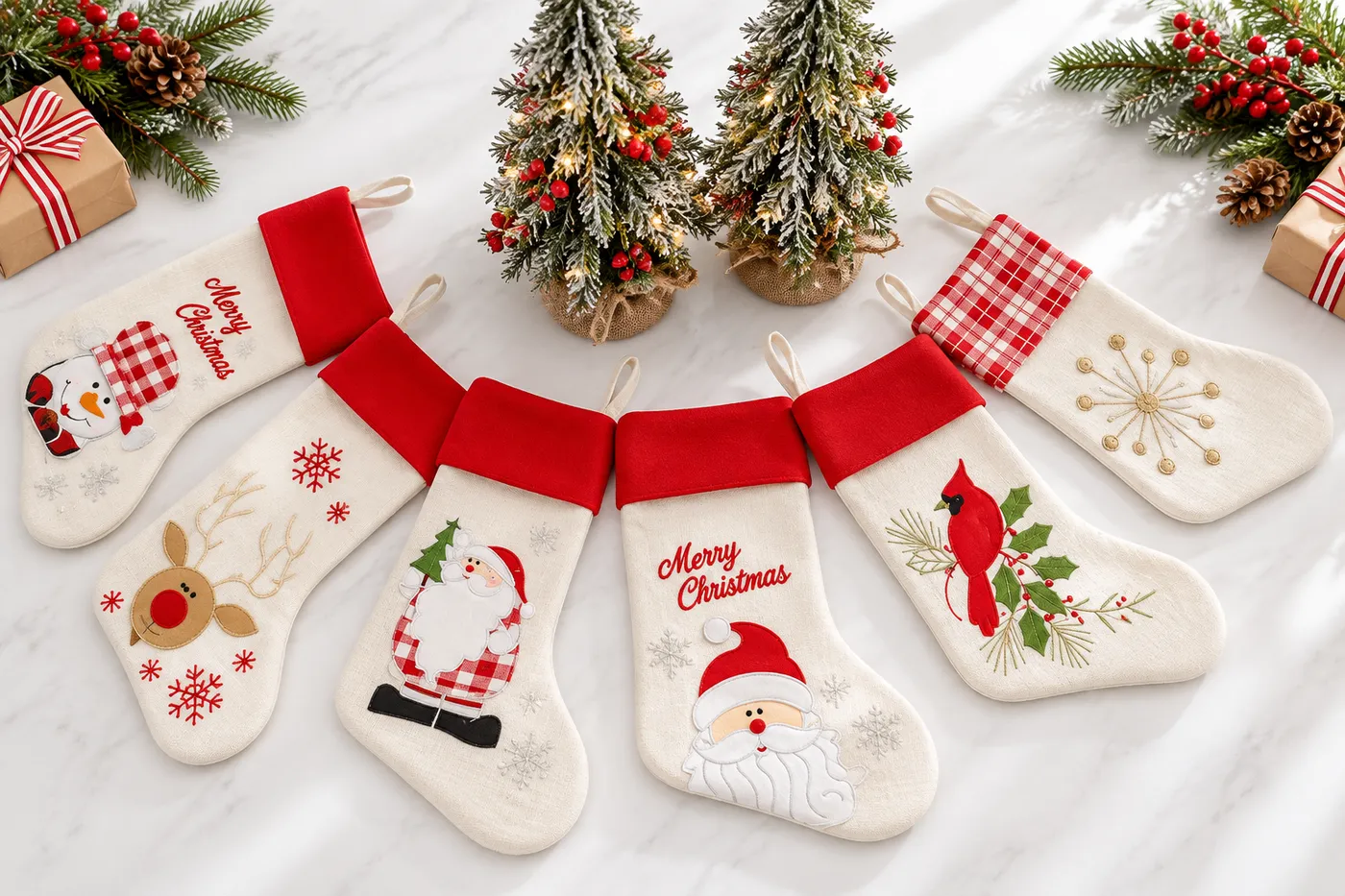
If you’re recreating this flat lay for photos, the arc radius matters more than the props. Lay twine on the surface, pin it at the center-top, and use it as a compass — a radius of about 24 inches keeps six stockings evenly spaced with roughly 1.5 inches of gap. Shoot from slightly above and straight on so the arc stays symmetrical.
20. Three Knit Stockings: Stripes, Solid White, and Fair Isle
Knit stockings are the anti-disposable holiday purchase, and 2026 buyers are treating them that way. Thrifted and vintage knits are outselling new ones on resale sites, and the fair isle revival comes straight out of that hunt. This is the trend least likely to embarrass you in five years, because knitwear doesn’t date the way a specific shade of sage green does. Buy one good pattern and you’ll still hang it in 2036.
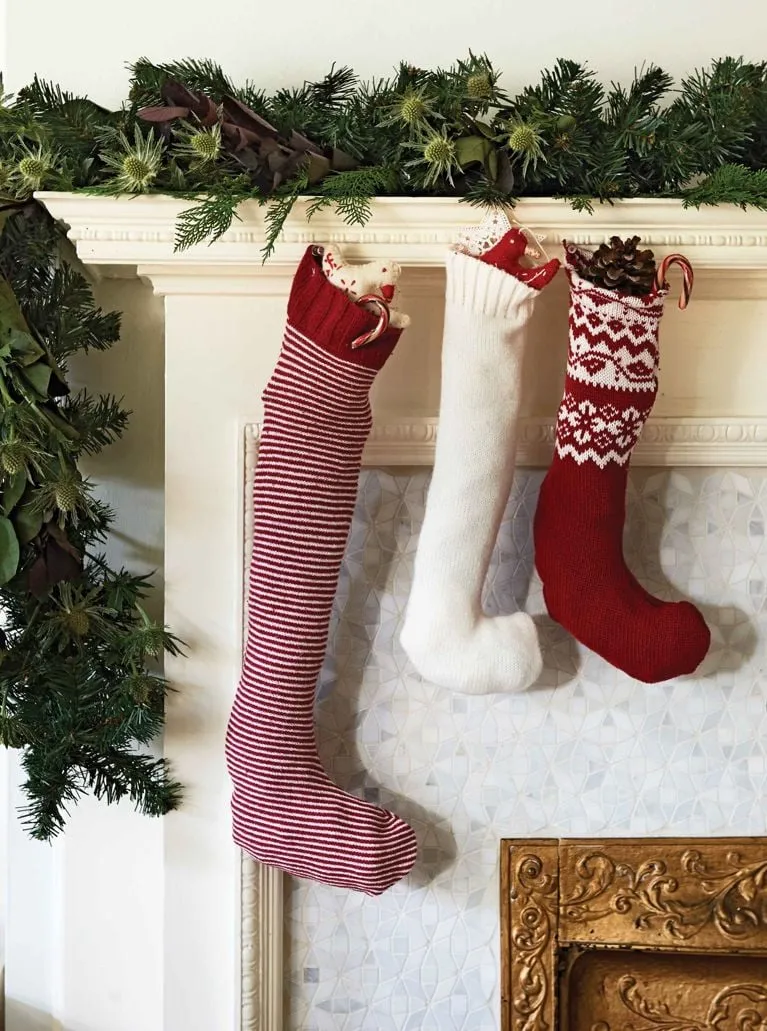
Hanging three knits off a garland without sag is a five-step job:
- Lay the garland across the mantel and mark three evenly spaced points, about 14 inches apart.
- Secure each stocking with its own hook clipped behind the garland, not tied to it.
- Zip-tie the stocking loop to the hook for anything over 2 lbs.
- Tuck the garland’s thistle accents in front of each cuff to hide the hooks.
- Step back five feet and check the hemline — all three toes should land within an inch of each other.
Fifteen minutes, no cost beyond the hooks.
21. Red Velvet and Faux Fur, With Names in Red Script
Velvet and faux fur are both high-maintenance in a way these photos never advertise. Faux fur mats down where it’s handled most and collects dust — brush it back to life with a soft bristle brush, never a vacuum. Velvet develops crush marks if you stack stockings in storage, so hang them or lay them flat with nothing on top. And if kids reach into those cuffs daily, expect the plush to look tired by mid-January. That’s normal wear, not damage.
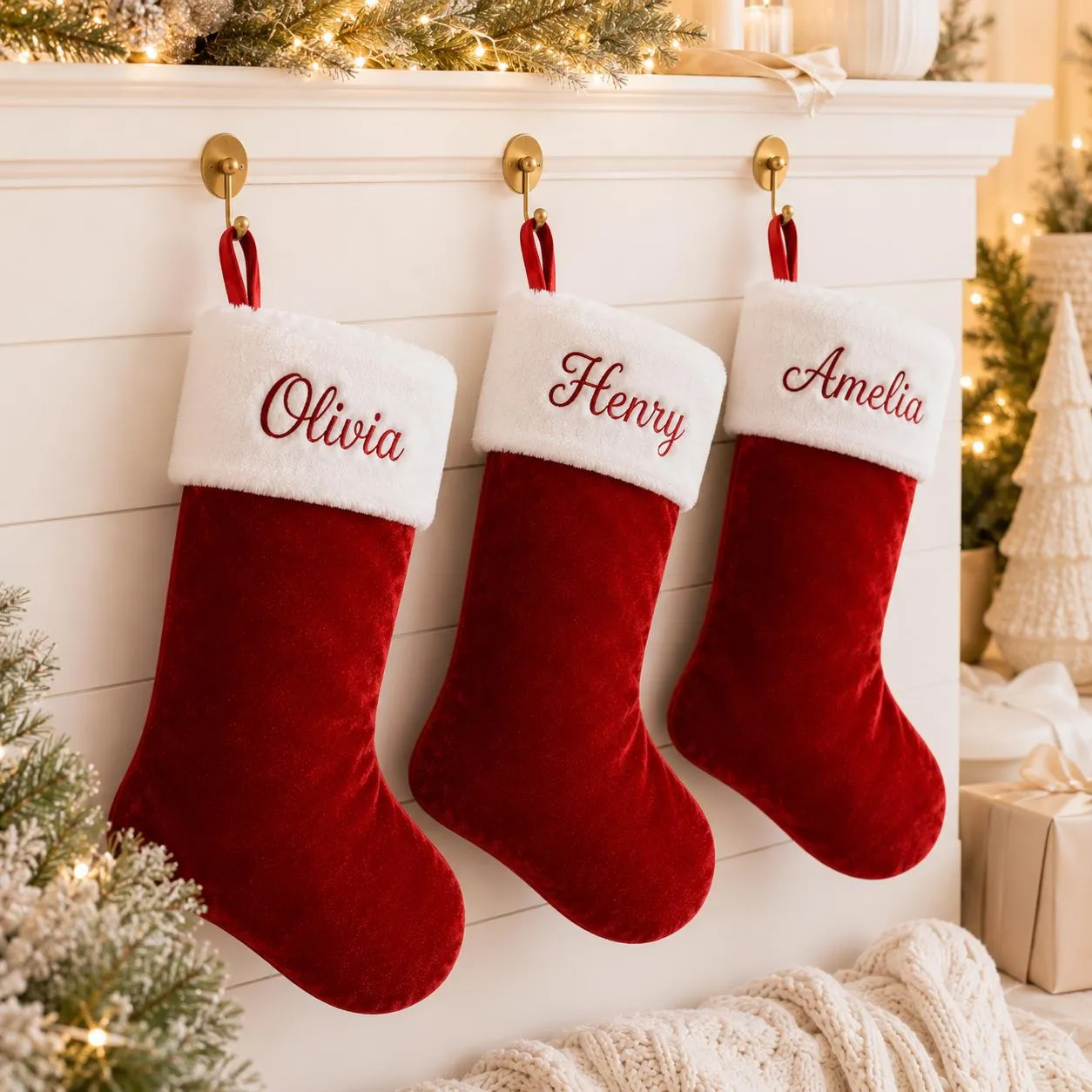
The ratio here is almost brutally simple: about 80% red velvet, 12% white faux fur, 8% gold. Gold earns its place purely through hardware — three round hooks and a script name, nothing more. Push gold past 15% and the mantel starts looking like a department store display. Want a different mood? Swap the gold hooks for matte black and the same red-and-white pairing reads modern instead of traditional.
22. Plaid Bows and Gold Glitter on Red Felt Stockings
Glitter on felt is a flaking problem waiting to happen, so pick your method deliberately. Glitter-felt sheets from a craft store hold their sparkle permanently and don’t shed — use those for the snowflakes and letters. Loose glitter plus fabric glue looks brighter but will drop onto your floor for months. Whichever you choose, apply the sparkle before you sew the stocking together so you’re never wrestling glue around a finished cuff.
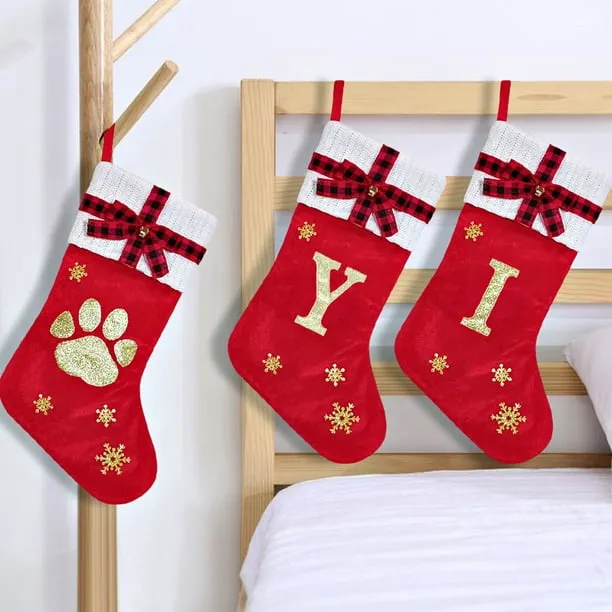
- Three red felt stockings: $15–$30
- Buffalo plaid ribbon for bows, 3 yards: $9–$18
- Gold glitter felt sheets for letters and snowflakes: $6–$14
- Pre-cut gold glitter paw print or initial: $4–$12
- Wooden stocking stand or bed-frame hooks: $15–$45
Total: $49–$119. Using a bed frame with existing posts brings this under $40.
23. Green Velvet Nutcracker Stocking With Twisted Gold Cord
This one is a display stocking rather than a hung one, and that changes the requirements. A green velvet stocking with heavy gold cord and dense embroidery needs a surface at least 24 inches wide and 16 inches deep to arrange with ornaments, ribbon rolls, and candy canes without crowding. A console, a wide dresser top, or a 36-inch shelf all work. On a narrow 12-inch ledge, drop the supporting cast and let the stocking stand alone.
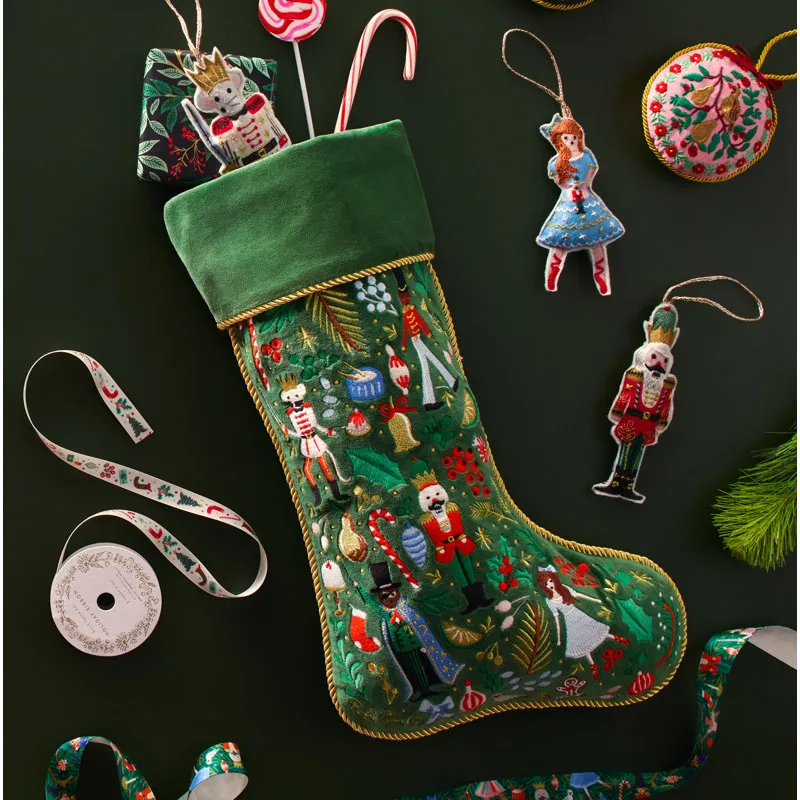
The twisted gold cord is the difference between a hobby stocking and an heirloom. Without it the embroidery is pretty but flat — the cord creates a raised metallic edge that separates cuff from body and gives the whole thing a tailored, finished line. Making your own? Couch the cord by hand with matching thread every half inch. Gluing it will look fine for one season and separate by the next.
24. A Blue Felt Stocking Where Sequins Do the Snowfall
Sequins are tedious and completely worth it. Here’s the order that keeps you sane:

- Cut and assemble the blue felt stocking body and white cuff.
- Cut Santa and reindeer shapes from felt scraps and pin them in place.
- Fuse or stitch the appliqués down flat before any sequins go on.
- Sew sequins along each shape’s outer edge, spacing them about 1/4 inch apart.
- Scatter a few sequins across the blue background as falling snow — then stop while it still looks accidental.
Roughly 2.5 hours, and sequin packs run $3–$6.
A sequined stocking sounds like a splurge and isn’t. Blue felt sheets are about $1 each and you’ll need three. A mixed bag of flat sequins is $4 at any craft store, and the red, brown, and green pieces come from whatever’s already in your scrap bin. Total for one stocking: about $10. Compare with Idea #8, where embroidery floss does the same storytelling job for the price of a skein.
25. Snowman Knit Stocking Against a Black Firebox
That lit garland is charming and slightly risky. Battery-operated string lights in a mantel garland generate almost no heat, so they’re fine — but check that the battery pack isn’t resting against the firebox surround, where it can get hot over a long evening. Also, the wicker basket of gifts on the hearth is lovely until a toddler treats it as a step stool. With small kids in the house, shift the basket to the far side of the tree.
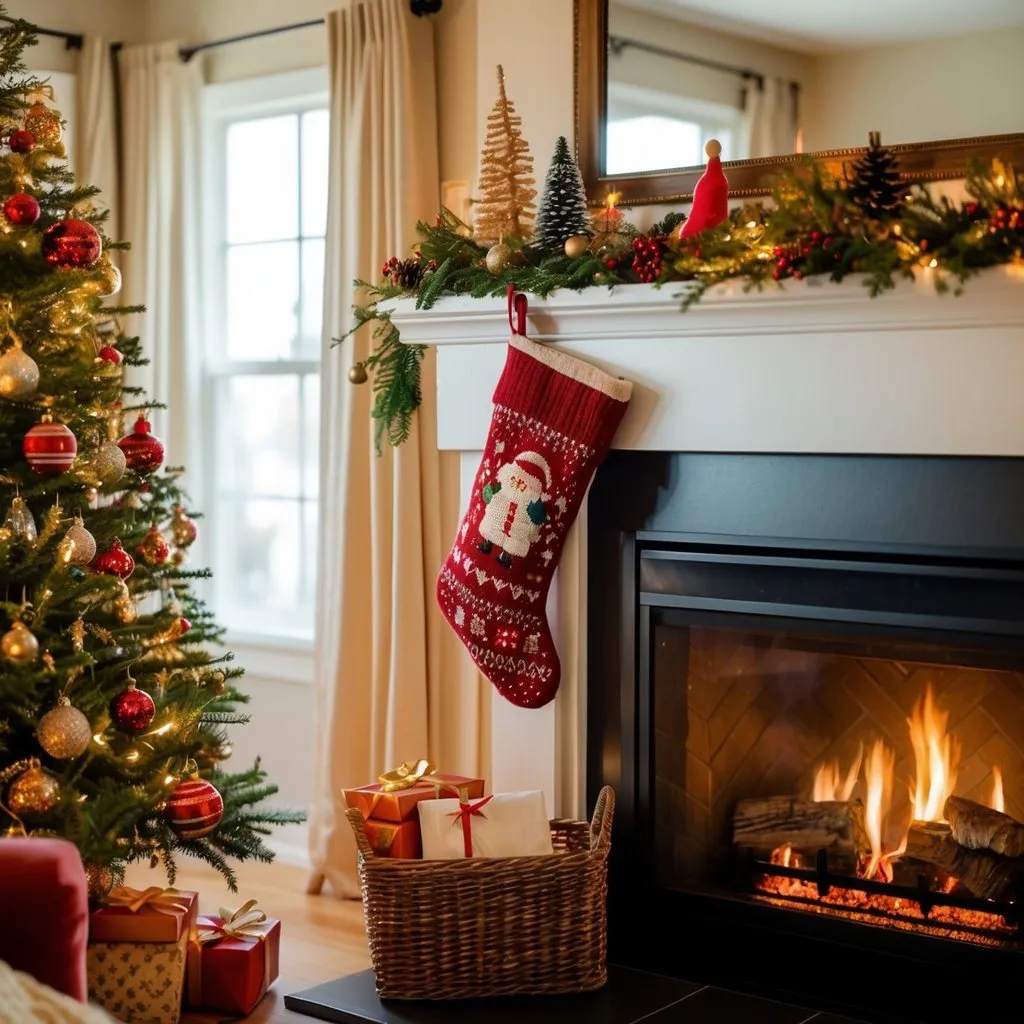
The black firebox is the quiet hero. Against it, a red-and-white knit stocking snaps into focus — the same stocking against a pale surround would visually disappear. The evergreen garland then bridges mantel and firebox, tying the top and bottom halves together. And placing the tree adjacent rather than centered keeps the fireplace as the anchor of the composition instead of competing with it.
26. Donald and Goofy in Santa Hats on Scalloped Green Cuffs
Nostalgia appliqué is one of the cheaper projects here, mostly because the characters do the visual work:
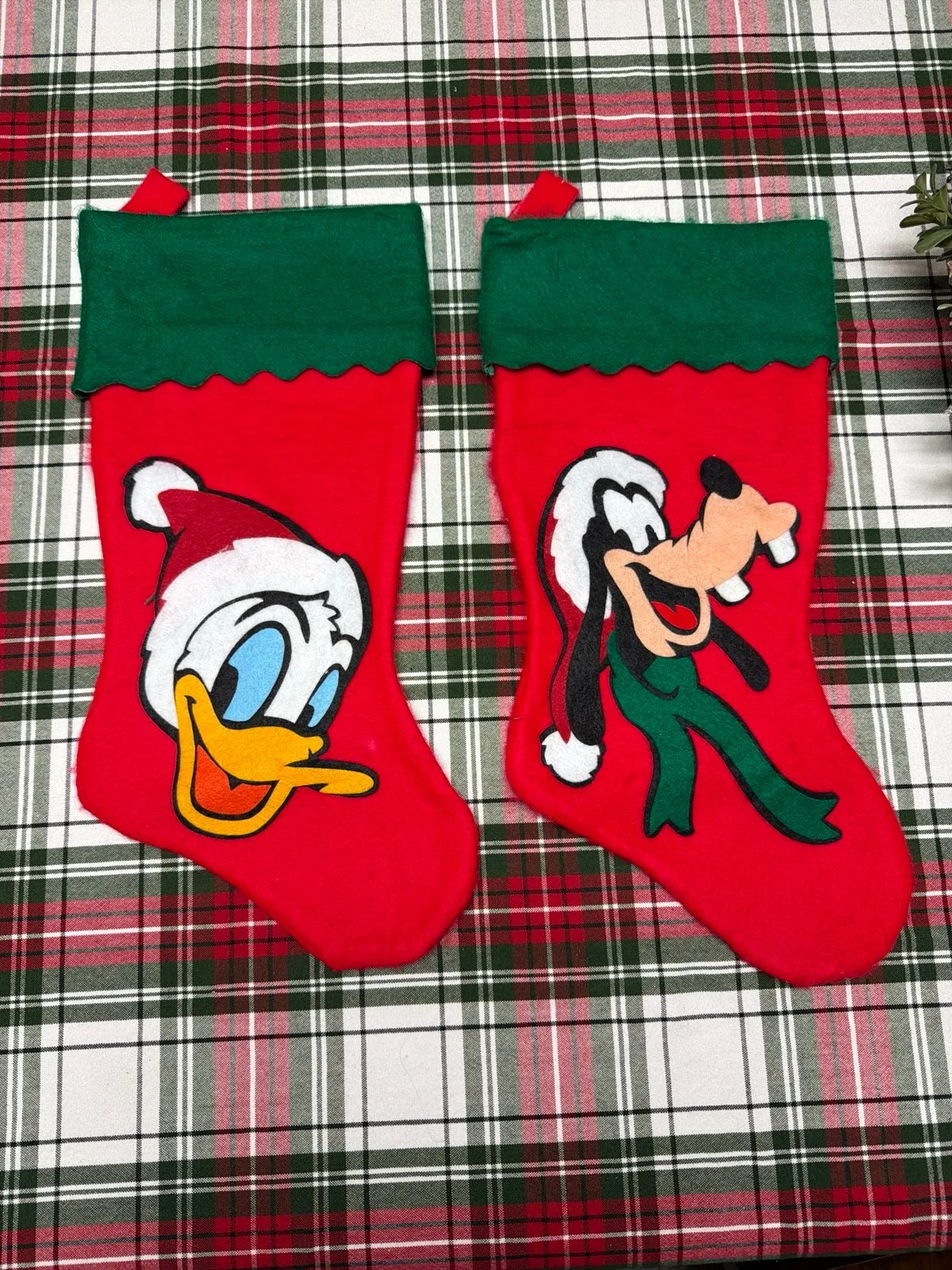
- Red felt for two stockings, four sheets: $6–$12
- Green felt for the scalloped cuffs: $2–$5
- Character appliqués, pre-made or cut from a fabric panel: $8–$25
- Fusible web and matching thread: $5–$12
- Plaid backdrop fabric or tablecloth: $12–$30
Total: $33–$84 — closer to $20 if you cut the characters from a printed panel you already own.
Small felt details like bills, eyes, and hat pompoms are where appliqué goes sideways. Cut them from stiffened felt, or fuse a scrap of interfacing to the back first, and use small sharp embroidery scissors rather than fabric shears. For pieces under half an inch, iron freezer paper to the felt, trace, then cut through both layers — the paper acts as stiff backing and peels off clean.
27. Cable Knit Twins: One Green Trim, One Red Trim
This is a bi-color formula at its most disciplined: about 85% cream and 15% accent, split nearly evenly between green and red — roughly 7% each. The trims are thin bands, and that’s exactly what keeps two accent colors from looking busy. Change one variable at a time: swap the green trim to mustard and you have a warm autumn stocking; swap both trims to charcoal and you’ve got something that works from November through February.
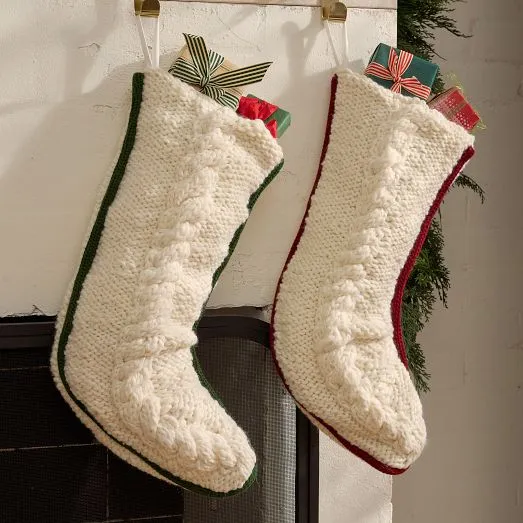
Two stockings is the smallest comfortable lineup for a fireplace, and this pair works on mantels as narrow as 40 inches. Because the knit bodies are cream, they hold up against a white brick surround where darker stockings would fight it. Filled and hanging, each needs about 12 inches of width. If your mantel runs past 60 inches, go to three — Idea #20 shows how to mix knit patterns without creating a mismatched set.
28. A Felt Bow Ornament With Gold Sequins and Baker’s Twine
The sequins are the entire personality of this ornament. A plain dark green felt bow would be perfectly nice and totally invisible on a fully decorated tree. Scattering small gold sequins and white dots along the tails gives it sparkle without shine — the felt stays matte and only the sequins catch light. Keep them clustered toward the tails and leave the knot clean; decoration piled in the center muddies the bow’s shape.
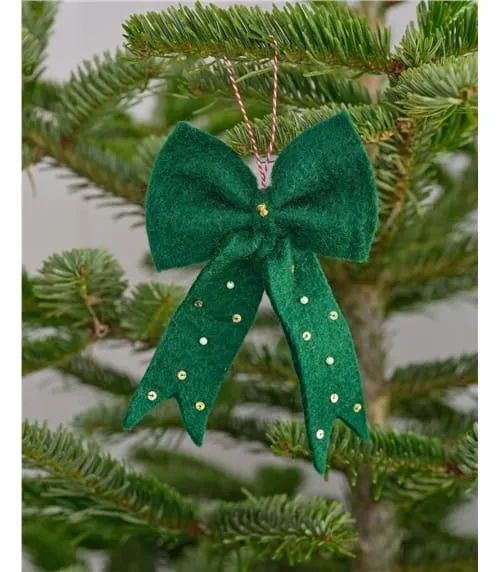
Bows are the ornament trend that refused to leave. They started in the coquette aesthetic, moved into mainstream holiday decorating, and by 2026 they’re the most-saved ornament shape on Pinterest three seasons running. Felt versions are the practical pick — they hold a crisp shape, they don’t dent, and one bow reads as a complete ornament on its own. The bow trend will cool off eventually. Felt and sequins will outlast it.
29. Miniature Stocking Ornament With a Layered Fabric Tree
This is the cheapest project in the entire guide. A miniature stocking ornament takes a 4-by-6-inch piece of off-white felt — about a tenth of a sheet. The tree appliqué uses two scraps of green and brown fabric, and the patterned cuff and toe trim can come from a fabric quarter you already own or a $3 remnant-bin find. One ornament costs under $1.50 in materials. Make eight for the price of a coffee.
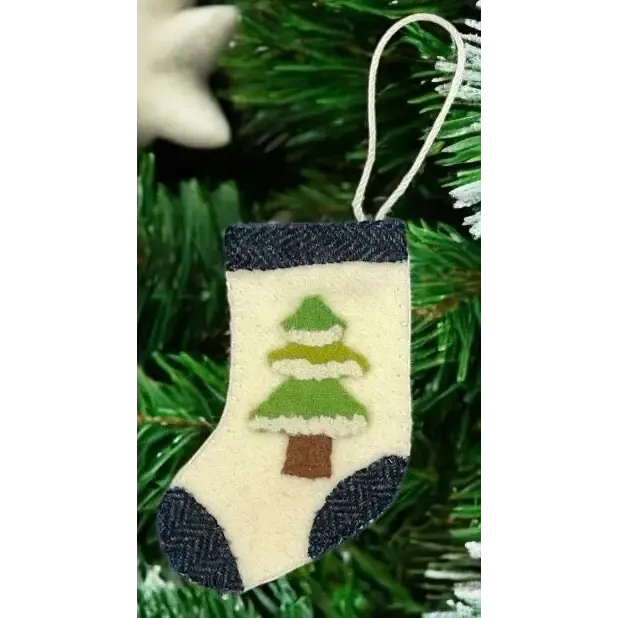
Woven fabric trim on a felt ornament frays at the cut edge unless you finish it. A line of fray check or a quick blanket stitch takes two minutes and adds years. These ornaments also vanish — at two inches tall they slip between couch cushions and into vacuum bags. Store them in a compartmented box, not a loose bin, or you’ll be down to five of your eight by next December. Spot-clean only; felt and water don’t mix.
30. The Starter Stocking: Red Felt, White Stitch, Ribbon Loop
For a first felt stocking, change one thing about your stitching: shorten the stitch length. Long, confident stitches look great on a big cuff but go sloppy on a 3-inch ornament, where a 4 mm stitch eats half the shape. Aim for 2–3 mm on small pieces. Also thread your hanging ribbon through the inside of the cuff and knot it before you close the top — a loop stitched to the outside of a tiny stocking pulls the felt permanently out of shape.
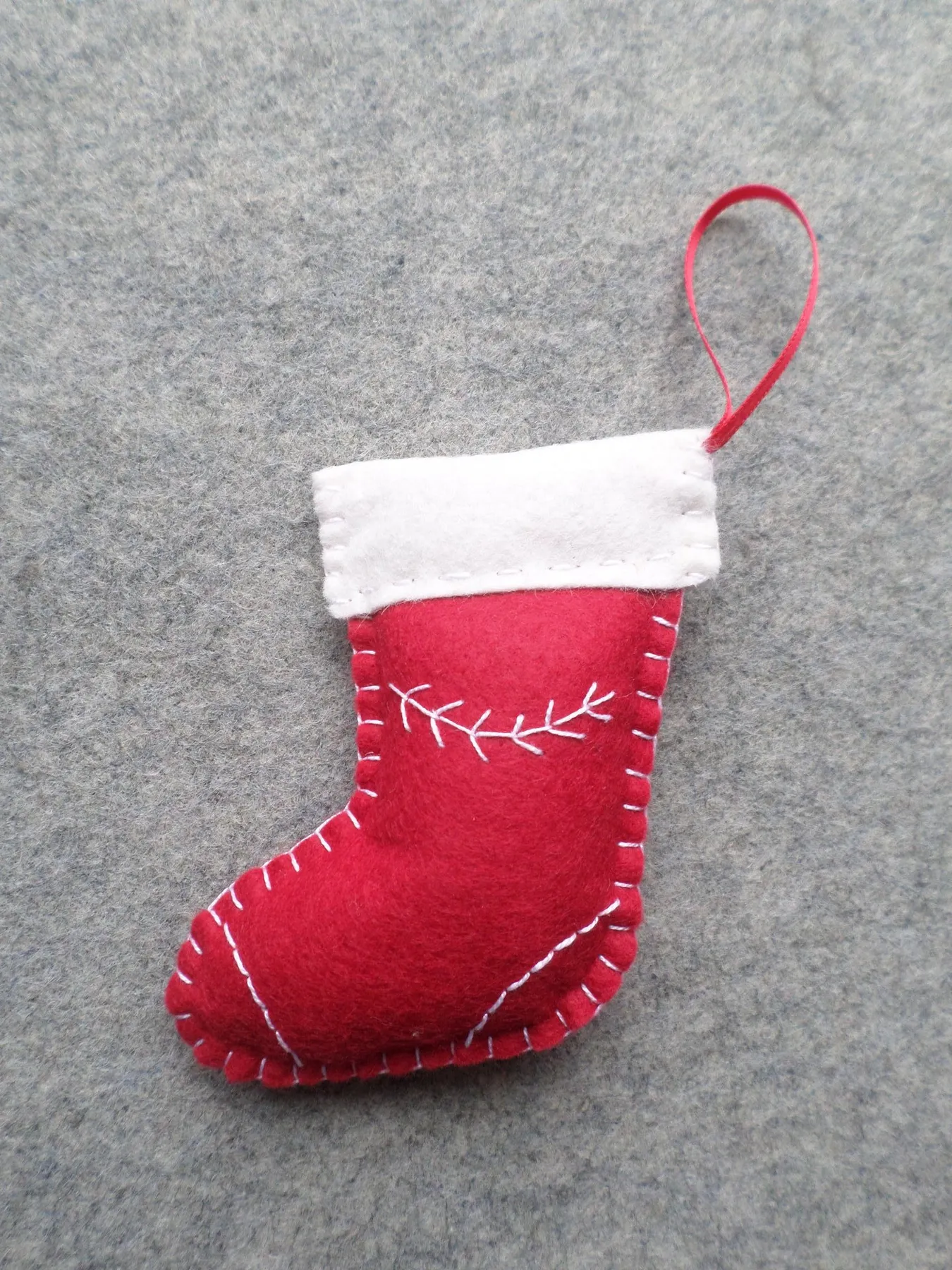
Here’s the full build:
- Cut two mirrored stocking shapes from red felt, about 3 inches tall.
- Cut a white cuff strip 1 inch tall and as wide as the stocking top.
- Blanket-stitch the cuff to the front piece, then stitch front to back around the perimeter.
- Add a simple running stitch 1/4 inch inside the edge for a decorative border.
- Knot a 3-inch red ribbon inside the cuff, then close the top seam.
Twenty minutes, about $2 in materials, no machine required. If your felt puckers or the stocking twists, that’s the first thing we cover in the mistakes section below.
31. Scalloped Stripes and Polka Dot Cherries on One Mantel
Two stockings, two completely different templates — sort that out before you cut:
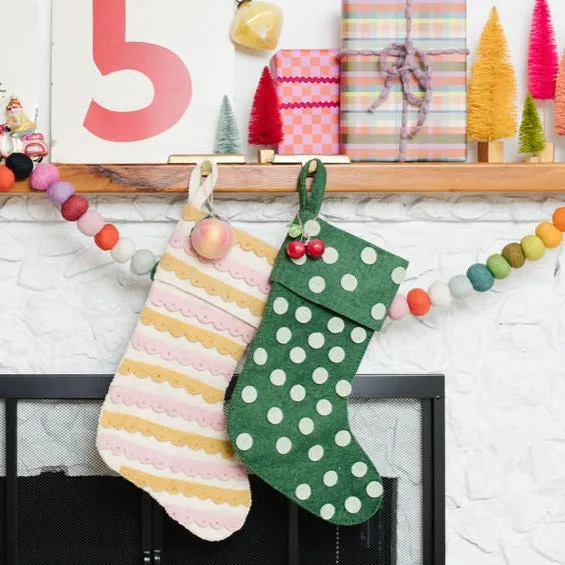
- Measure your wooden mantel’s top and front lip; the felt ball garland needs to drape, not balance
- Decide both stocking designs first, since stripes and polka dots need separate templates
- Buy felt balls in a single mixed pack so the garland colors actually repeat across the frame
- Check that your bottle-brush trees clear the mantel shelf height
- Test one cherry charm against a scrap of green felt — the contrast either sings or disappears
What makes this pair work is that the two stockings share nothing except attitude. One is pink and mustard stripes, one is dark green with polka dots — no shared motif, no shared color, no shared pattern scale. It shouldn’t work, and it does, because both are rounded felt with a crafty, slightly childlike hand, and the multicolored felt ball garland repeats every color in the frame. Compare with Idea #17, where a matched pair plays the exact opposite game.
32. Embroidered Dogs in Sweaters Standing on Felt Snow
This one is styled as a close-up scene rather than a hung stocking, which makes it the easiest to place in a small home. A light blue backdrop about 20 inches wide is all it needs — a dresser runner, a shelf, the top of a console. Because the dogs and snow tufts are small, the composition collapses if you spread the props wider than two feet. Keep everything inside a 24-inch footprint and it holds together.
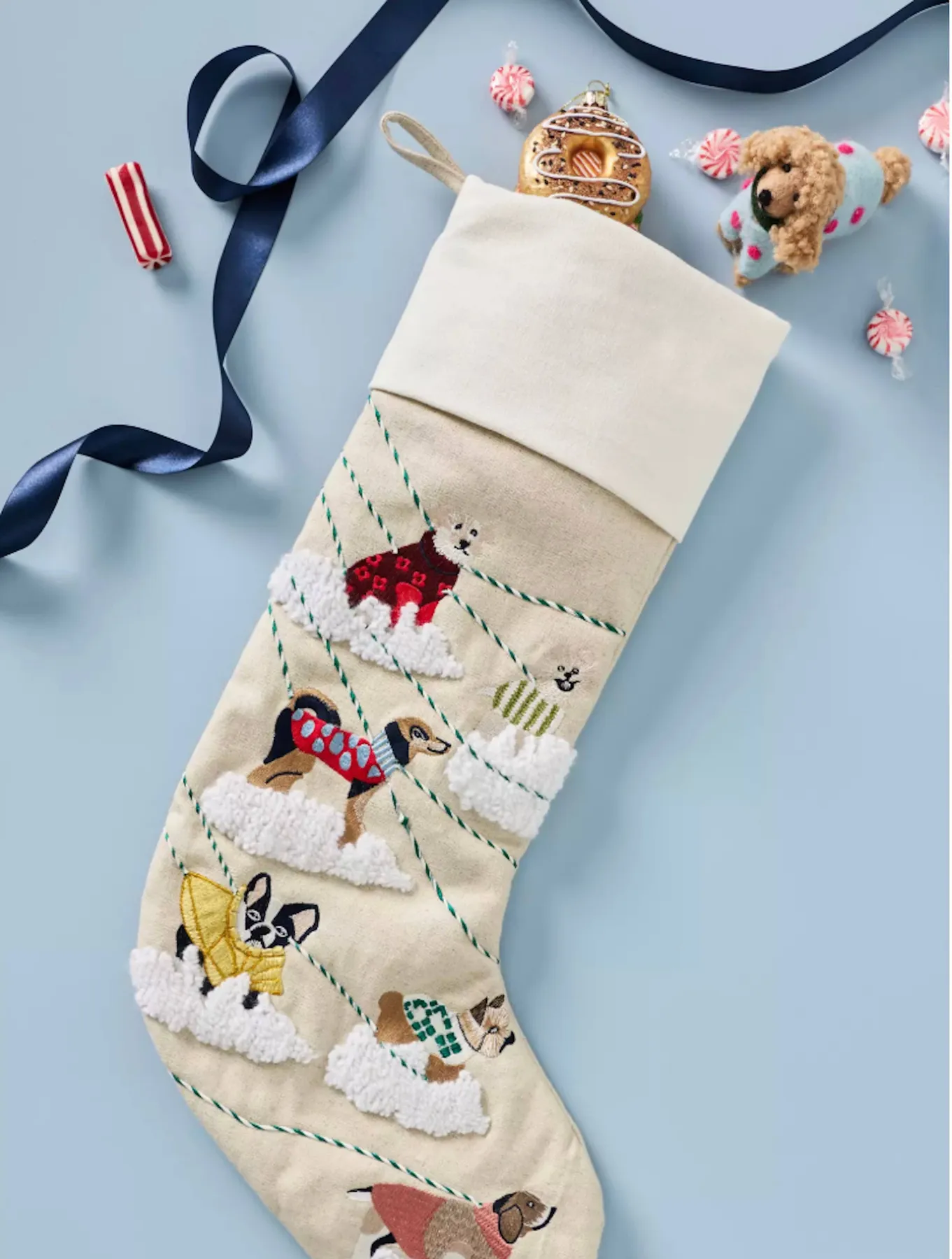
Cream fabric looks lovely and forgives nothing. Candy canes melt, chocolate smears, and a cream stocking handled by kids all December will need a gentle cold-water hand wash by January. Test for color bleed on the embroidered dogs first. And worth saying out loud: a stocking this specific is a commitment. If your household’s dogs change, you’re either making a new one or living with a small inaccuracy.
One Sheet of Felt, One Evening, One Stocking
You don’t need a sewing room or a December of free evenings — you need one sheet of felt, a needle, and about twenty minutes to prove the whole thing is doable. Start with the simplest build, then work your way up to blanket stitching and sequin snow. 📌 Save this to Pinterest so it’s waiting for you the next time you’re standing in the craft aisle wondering where to begin.