32 Jaw-Dropping Dollar Tree Centerpiece Ideas You Need to Try in 2026 That Will Turn Heads

You know that feeling when you spot a $6 centerpiece on Pinterest that looks like it cost $60? That’s the entire premise of Dollar Tree centerpieces in 2026, and the internet has gotten very, very good at it. We spent serious time browsing Dollar Tree, Walmart, Target, and Amazon to bring you only the ideas that actually hold up on a real table, from $3 grab-and-go pieces to a $76 gold-tray setup.
Inside you’ll find 32 curated ideas covering patriotic summer tables, rustic farmhouse autumn, elegant glass-and-candlelight, and full seasonal holiday spreads — with budget and luxe versions compared side by side so you can decide where to spend and where to save. The 2026 shift is toward centerpieces that double as ambient lighting, which is why fairy lights, hurricane candles, and gel beads show up in nearly a third of these looks.
And stay until the end — we break down the most common mistakes that can ruin these looks. 📌 Save this to Pinterest for later — you’ll want to revisit these ideas.
1. Red, White, and Blue Firecracker Cylinders on a Checkered Cloth
Three cylinders in graduated heights read as a plan even though nothing here is expensive — repetition plus one small scale shift is what makes a grouping look chosen instead of gathered. The star, stripe, and plaid papers are all different, but the red-navy-white palette keeps them in line, and the metallic tinsel does the light work so the arrangement still sparks at dusk. The small-checked cloth is the quiet hero: busy prints behave when the pattern is tiny and the color stays in two families.
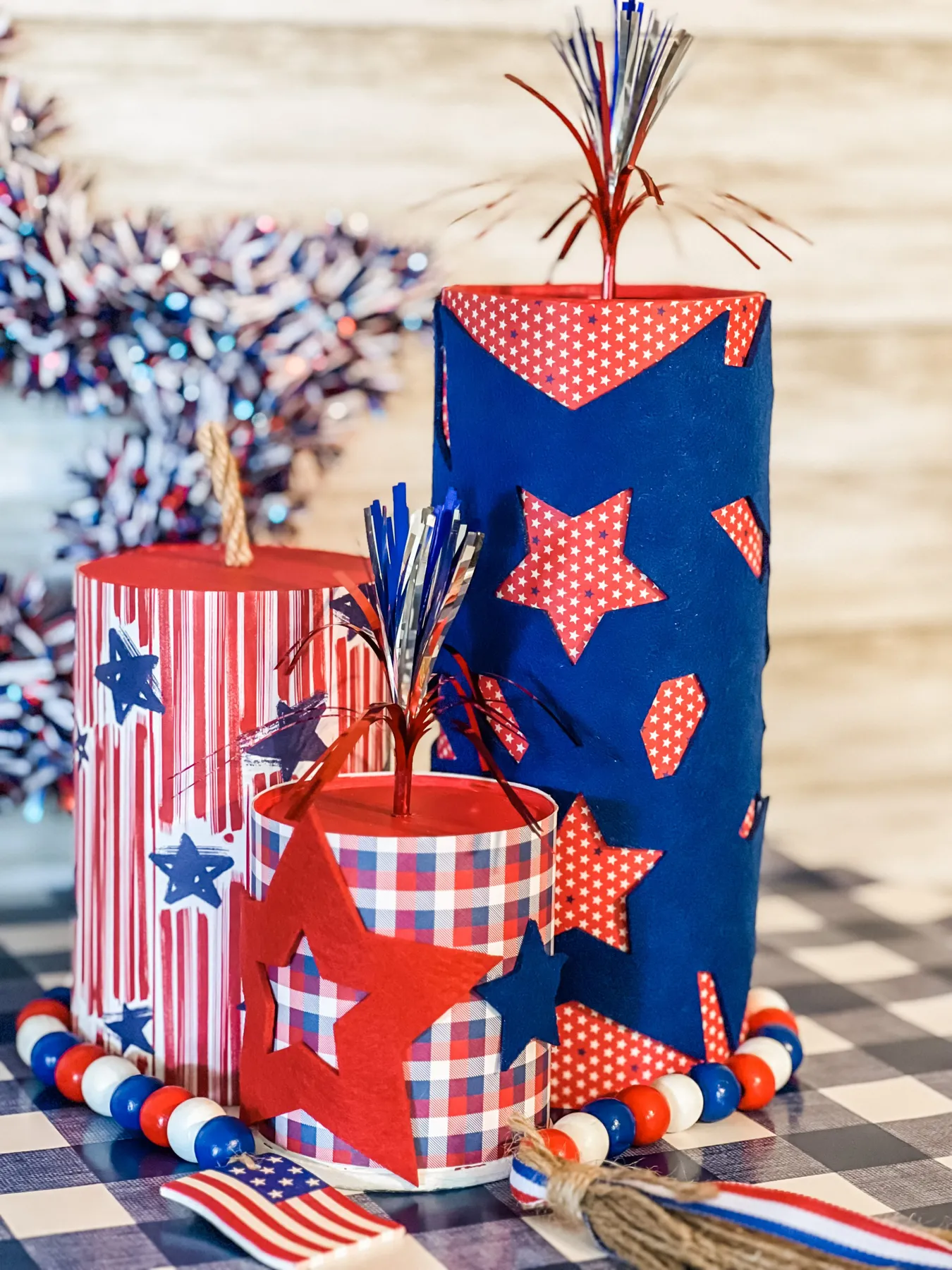
- Three cylinder forms plus patterned paper: $5–$9
- Tinsel garland and star cutouts: $3–$6
- Wooden bead garland and twine tassel: $3–$7
- Small flag and checkered tablecloth: $5–$12
Wrap cardboard tubes in scrapbook paper and tape tinsel at the seams. Total: $16–$34
Budget alternative: skip the wooden bead garland and scatter paper confetti stars instead — you’ll land around $9.
2. White Chrysanthemums and Blue Gems on a Bright Blue Mat
Here’s the trick that makes twenty gems look like fifty: put a 4-inch square mirror tile under the dish before you scatter anything. The mirror doubles every gem and bounces the blue placemat back up into the white blooms, which is why the arrangement reads expensive in photos. Dollar Tree sells mirror tiles in the craft aisle for about $1.25 — buy two so you can layer one under the dish and one flat beneath the flowers.
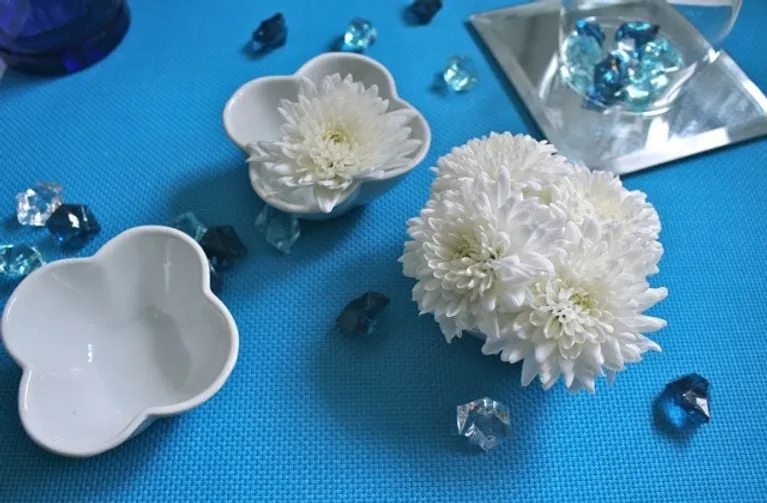
The formula is 60% blue base, 30% white bloom, 10% sparkle. Swap the blue placemat for charcoal and the same arrangement goes moody; swap it for pale sage and it turns spring-bridal. Keep the 10% gem ratio no matter what — that sliver of reflection is what stops an all-white bouquet from looking like a grocery store bunch.
3. Clear Vase, White Roses, and a Glittered Gold Base
Take away the gold glitter base and this becomes a plain white bouquet in a plain glass vase. The glittered dish underneath is doing the work: it throws warm light up into the white petals, it makes the thin gold ribbon feel intentional rather than leftover, and it anchors the vase so the whole thing doesn’t float on the tablecloth. Twenty minutes of glue-and-glitter buys you all of that.
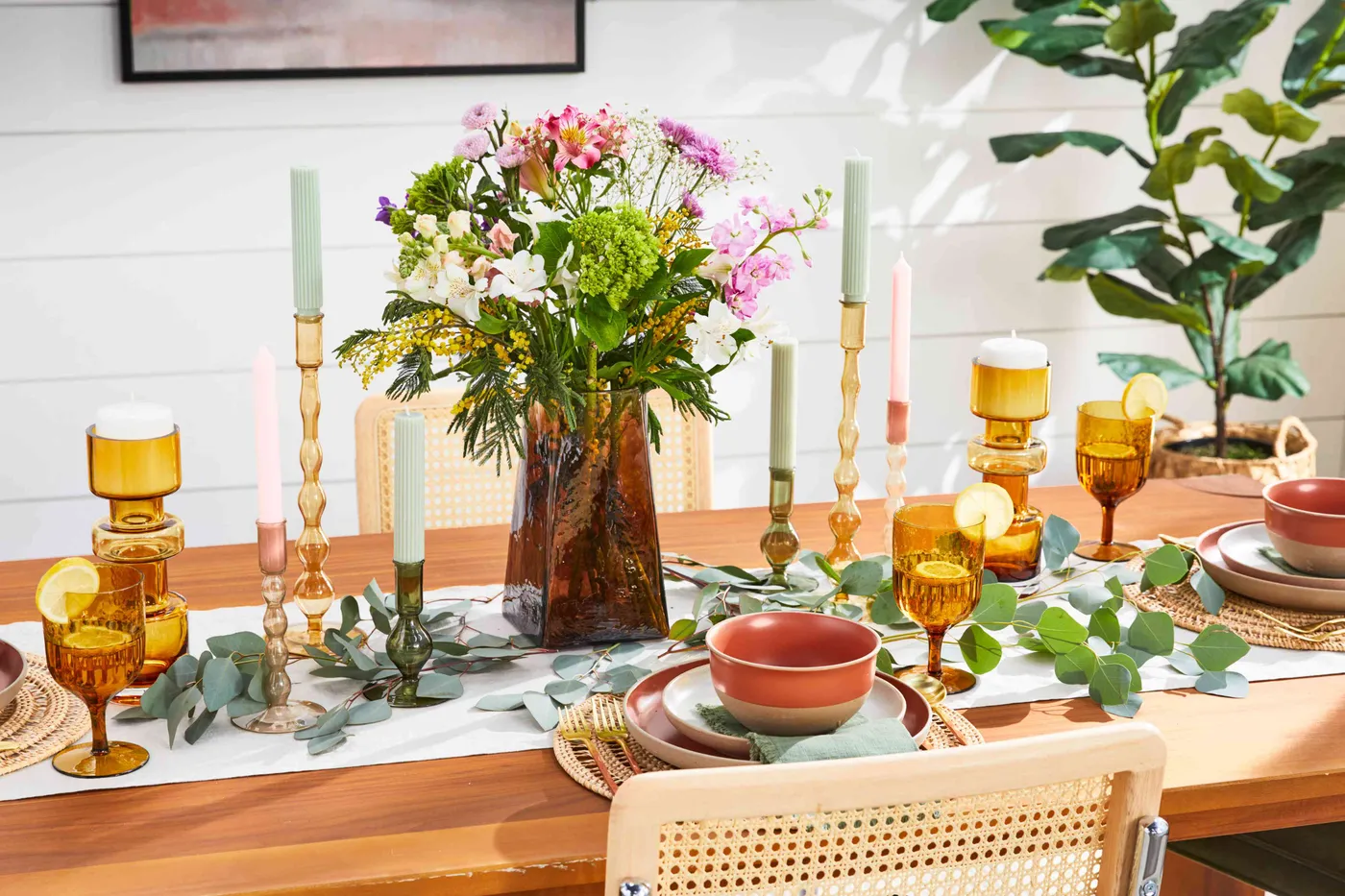
Skip the craft-store glitter dish entirely. A gold foil charger plate from the dollar aisle, flipped upside down at $1.25, gives you the same reflective halo. Faux white roses run $1–$3 a stem at Walmart or on sale at Michaels, and the ribbon is a $2 spool. Under $12 for the full look, versus $45 for a florist version with real blooms — same glow, and the faux stems won’t drop petals on your tablecloth.
4. Lace-Wrapped Mason Jar with Baby’s Breath and Pinecones
Pinecones at the bottom of a water-filled mason jar will mold within a week — that dark fuzz is not the rustic charm you signed up for. Keep the jar dry and use pinecones as filler only, or tuck a narrow drinking glass inside and put the water there. If you love the layered look, set the pinecones around the jar on the wooden coaster instead and skip the water entirely.
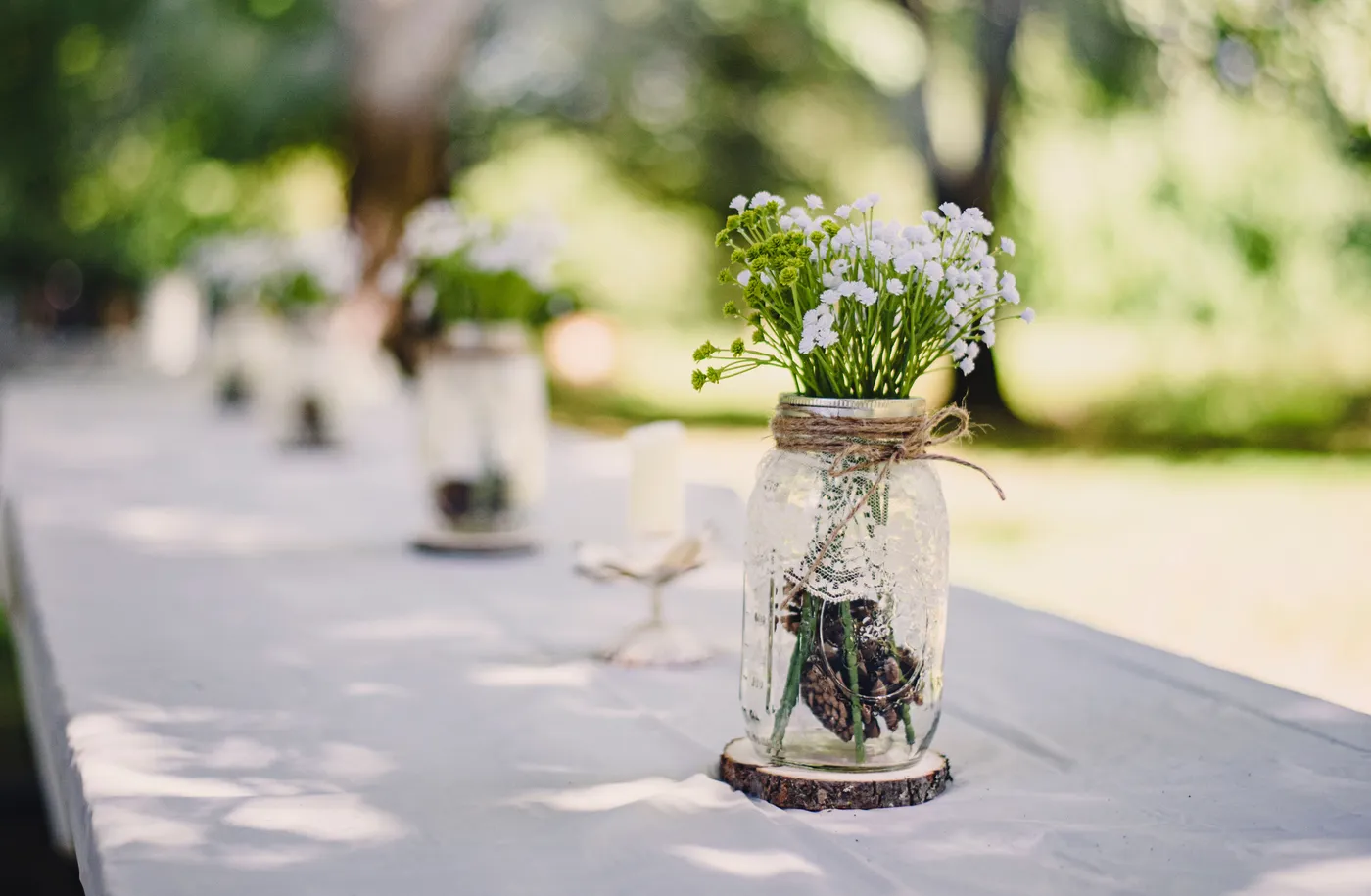
- Cut a 2-inch strip of lace long enough to wrap the jar once, plus an inch of overlap.
- Run a thin bead of hot glue along the strip’s back edge and press it to the glass, holding ten seconds.
- Wrap burlap twine three times around the neck and knot it at the front.
- Tuck two short stems into the twine knot so they arc toward the table.
Fifteen minutes, about $4 in supplies, and the jar is reusable all summer.
5. Velvet Pumpkins Against a Deep Teal Wall
This is mantel math, not dining table math. It wants a shelf between 60 and 72 inches wide with at least 8 inches of depth, so the glass vase and the stacked woven pumpkin can sit at different distances from the wall. On a table, the same cluster works if your surface is 40 inches wide or more — narrower and the vase crowds the plates. For a long-table version of this same autumn palette, see Idea #12.
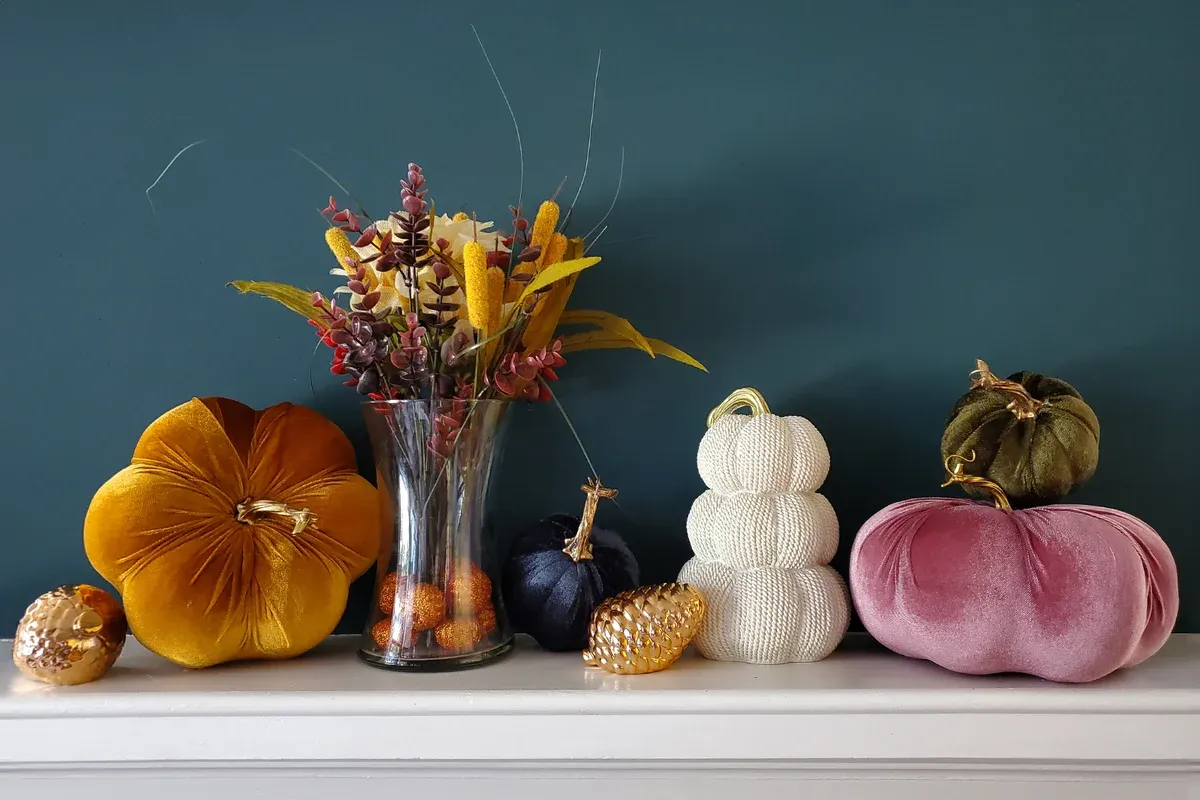
Velvet pumpkins are magnets for dust and lint, so keep a lint roller in the drawer and run it over them once a week — never machine wash. Dried botanicals shed quietly; expect a light sweep every few days and keep them out of direct south-facing light, which bleaches them to beige by November. The glass vase is the easy part, but that glitter band means hand-washing only.
6. White Planter Box, Orange Blooms, and a Candle in Pebbles
- White rectangular planter box: $5–$12
- Faux stems in orange, cream, and white: $9–$18
- Glass hurricane plus yellow pillar candle: $4–$9
- Pebbles, mini white pumpkins, woven runner: $6–$14
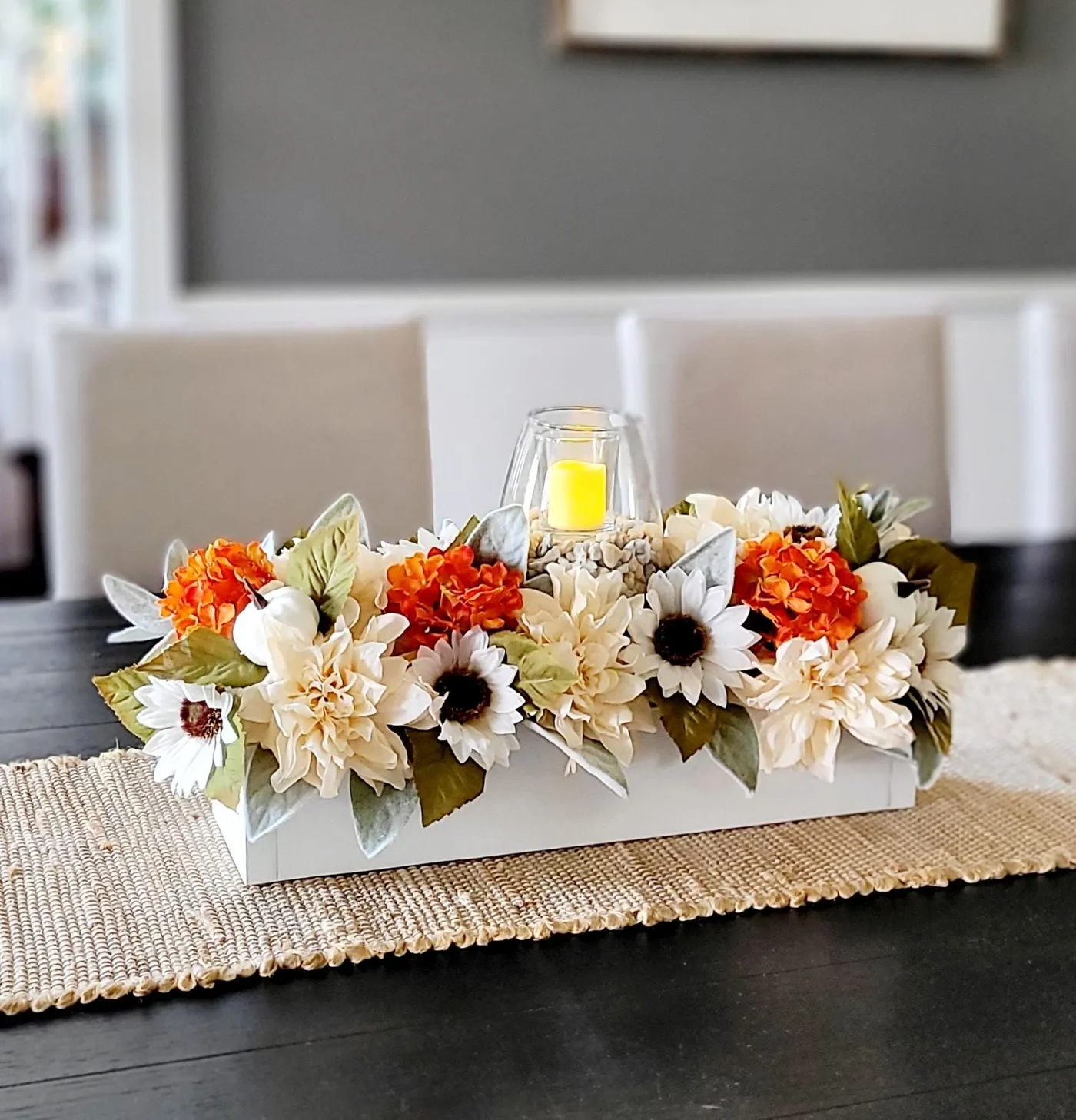
Reusable box, seasonal filler. Total: $24–$53
Budget alternative: a cardboard box spray-painted white plus Dollar Tree faux stems at $1.25 a bunch gets you roughly $14 all in.
Cut your faux stems shorter than feels right. The tallest bloom should clear the candle flame by at least four inches, and the hurricane should stand six inches or more so nothing scorches when the wax pools. Three inches of pebbles in the bottom hides the stem ends and gives the candle a level seat that won’t tip when someone reaches across the table.
7. Ceramic Pumpkins and Brass Candlesticks on a Lace-Trimmed Runner
Read the table as 70% cream and natural jute, 20% warm orange-brown from the foliage and pumpkin ceramics, 10% brass. That’s it. Trade the brass tapers for matte black and the whole thing turns modern farmhouse; swap the lace-trimmed burlap runner for plain linen and it goes quiet Scandinavian. Keep that 10% metal — it’s the difference between cozy and flat.
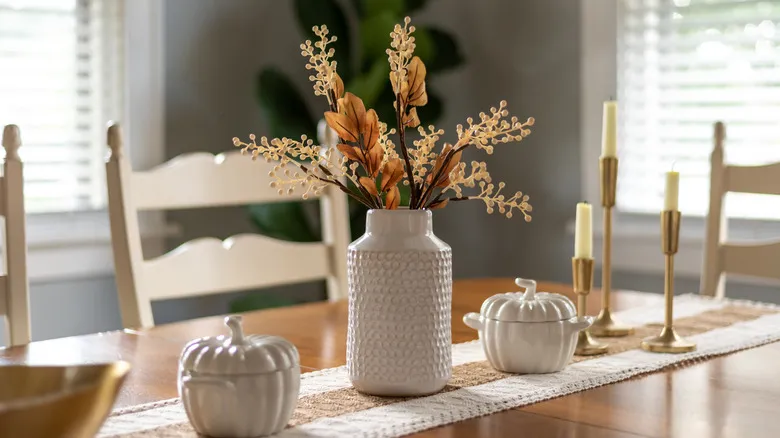
The two brass candlesticks are what lift this from a nice autumn arrangement to a table you’d photograph. Without them, the eye stays low, circling the pumpkins and the runner, and the centerpiece has no vertical line to climb. Brass also does something ceramic can’t: it warms the cream tablecloth and picks up the orange in the leaves without adding another color.
8. Wood Slice, Daisy Vase, and Pink Diamond Goblets
The charm here is a texture argument. Ribbed glass, a raw wood slice, and diamond-patterned pink goblets are three completely different surfaces, and they only get along because the flower is a plain white daisy and the cloth is flat white. That’s the rule: the busier your textures, the quieter your colors need to be. One wood slice is enough — two would tip the whole table into theme-party territory.
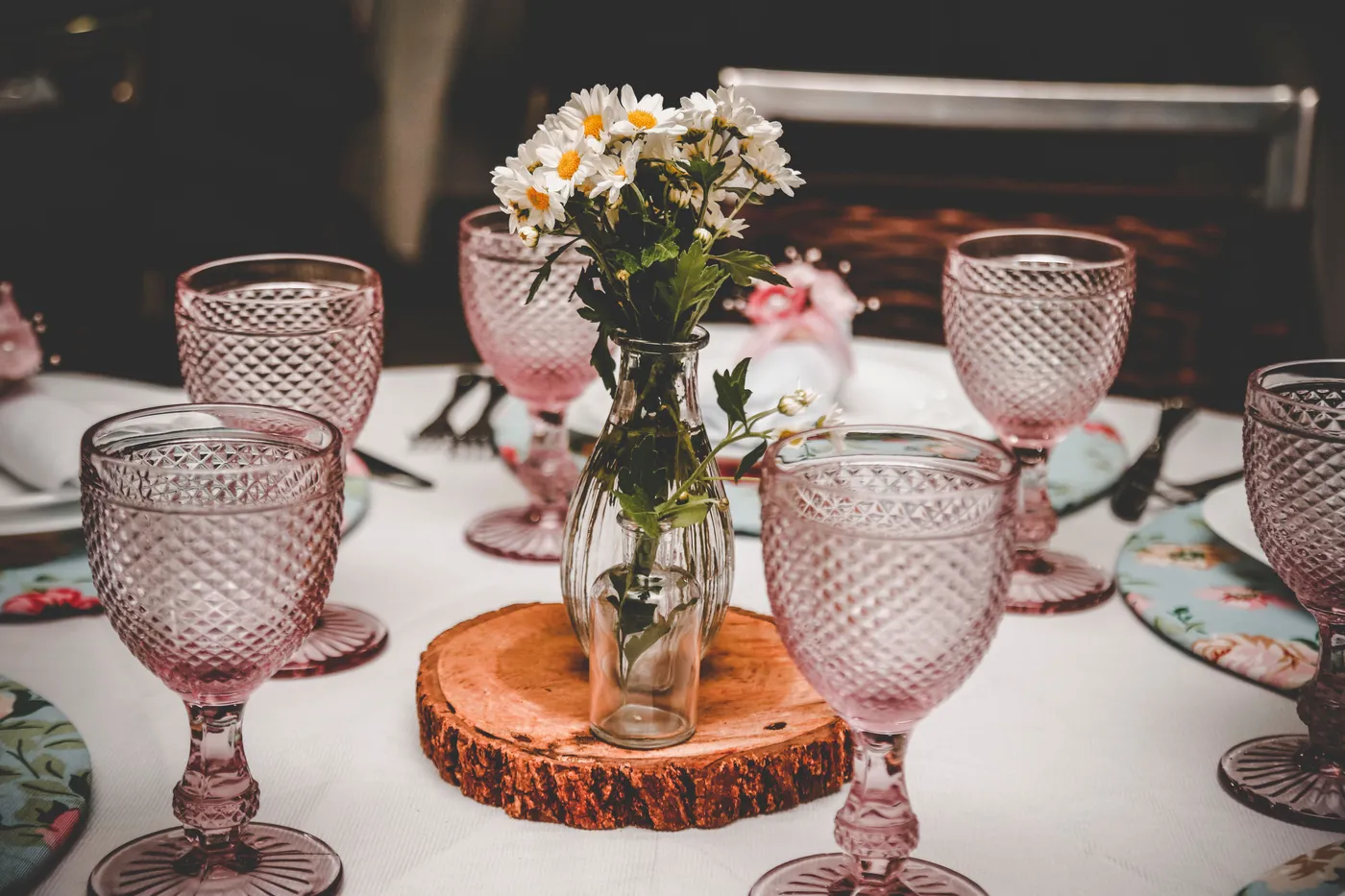
Thrift stores are gold for pink diamond goblets — $2 to $4 each instead of $12 at a home store, and mismatched shades actually look better in a set of four. Cut your own wood slice from a fallen branch and sand it, or buy a pre-cut disc for around $3 in the craft aisle. The patterned placemats are the only thing worth spending on, and even those have near-identical versions at Walmart for $5.
9. White Cylinder Vase with a Gold Band and Soft Hydrangeas
- Trim the hydrangea stems to three different lengths so the dome arcs instead of stacking flat.
- Start with the shortest stem at the front, then build backward in a slow spiral.
- Push the first stem through the vase’s top holes at a 45-degree angle so it stays put.
- Fill the gaps with smaller florets, then turn the vase around and check the back.
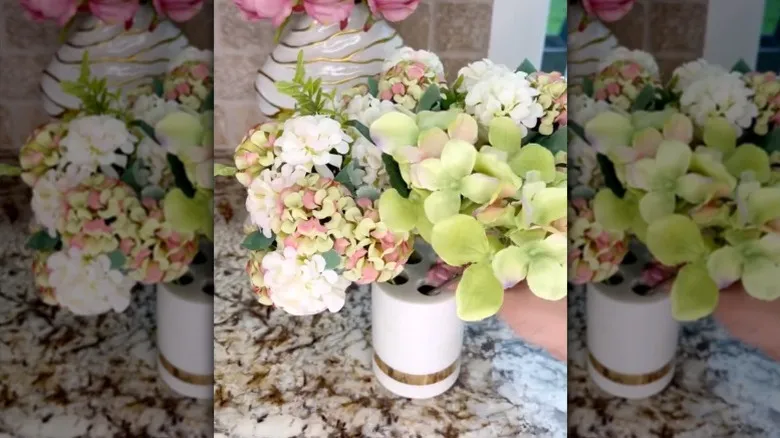
Ten minutes, about $9 in faux stems, and no floral foam needed.
Faux hydrangeas shed tiny plastic florets every time you move them, so expect to pick confetti off your counter for a week. Give them a gentle shake over the sink first. And check that vase’s top plate — if the holes are wider than your stems, the whole arrangement will lean by day three. A dab of hot glue on each stem end fixes it.
10. Skeleton Bust Holding a Bowl of Black Roses and Gold Pumpkins
Spooky-elegant is where Halloween decor has been heading for a few seasons, and 2026 pushes it further: bone tones, black roses, and brushed gold instead of orange plastic. It photographs beautifully against a dark wall, and it’s the kind of thing people leave up from October 1 through Thanksgiving because it reads decadent rather than cartoonish. Expect this dark-romantic look to outlast the season.
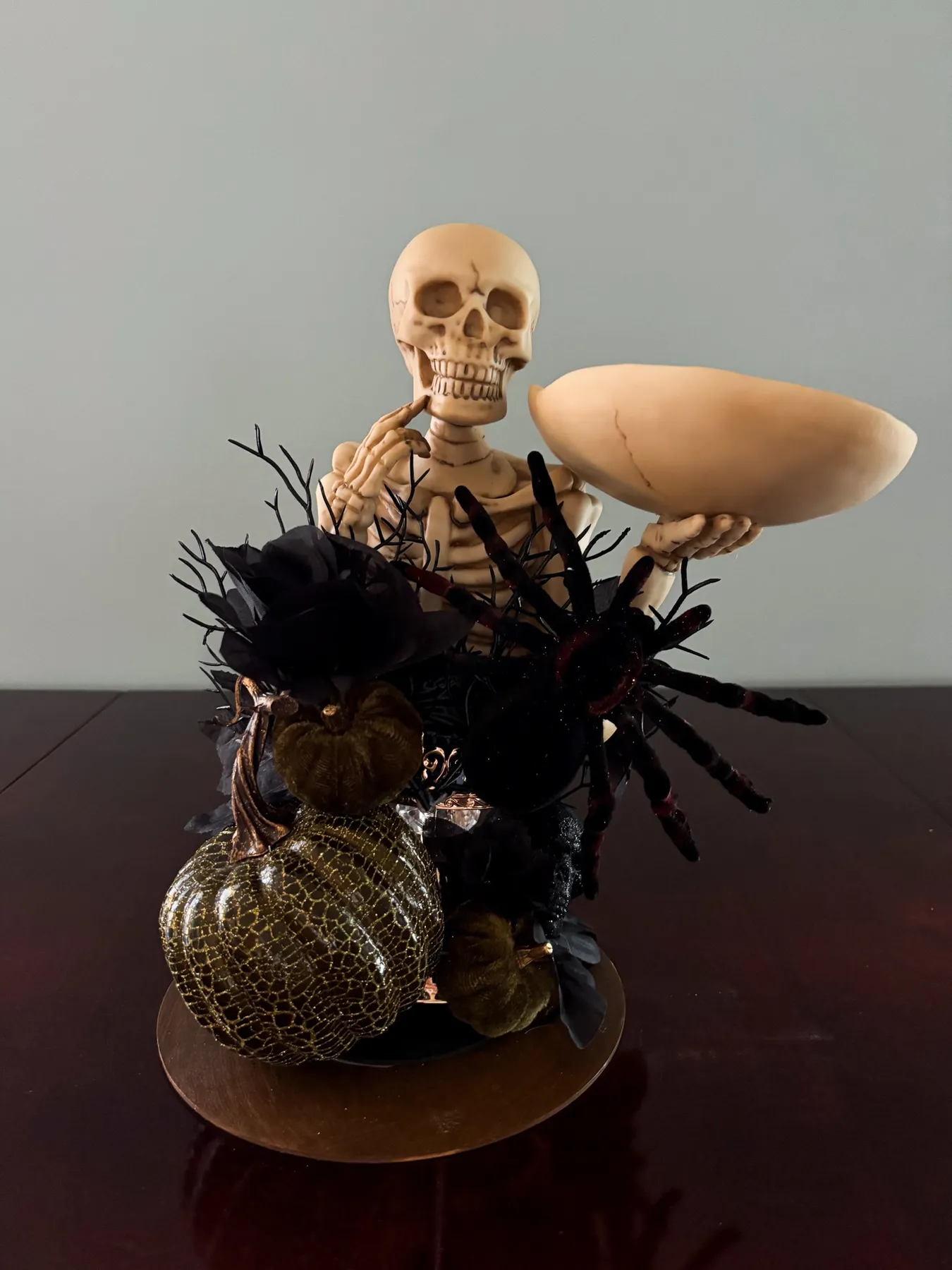
Raise the skeleton. Sitting a bust directly on the table puts it below eye level and it disappears behind glasses. Stack it on a cake pedestal or two books to lift it 5 or 6 inches, then cluster the black roses in odd numbers around the base — three, five, seven — and keep the spider off-center. Odd counts read as styled; even counts read as placed.
11. Moss, Ceramic Mushrooms, and Wooden Moose Figures
The lit jar candles buried in the moss are the whole idea. Take them out and you have a pile of decorative mushrooms on a green mat — pleasant, forgettable. With them in, the moss becomes a landscape and the mushrooms read as something growing out of it. That little flicker also gives the table real depth at night, which is exactly when people sit down to dinner.
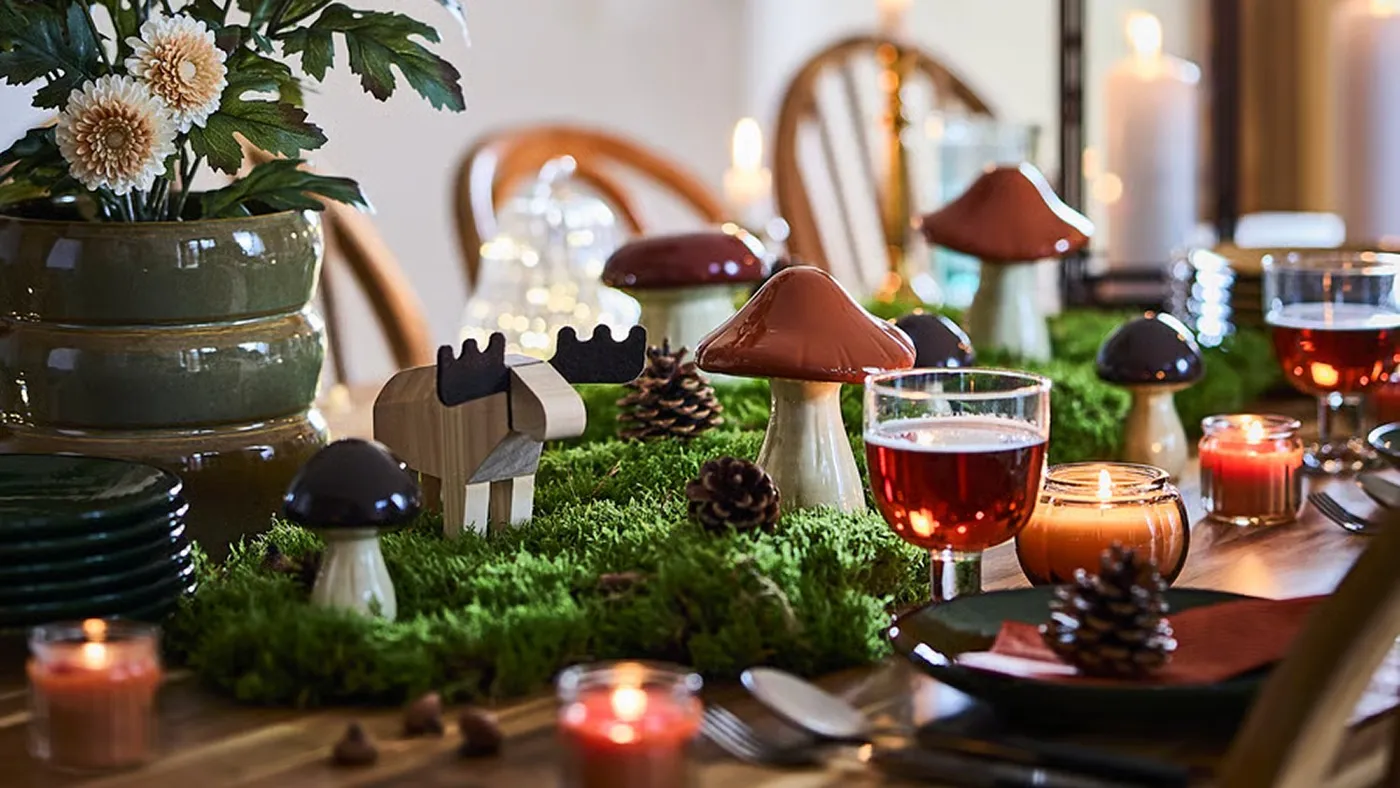
This works on a table 6 feet or longer, and the moss should run 10 to 12 inches wide so there’s room to nest candles and figures without crowding the plates. On a 48-inch table, cut it to a 24-inch strip and drop the moose. Round tables under 45 inches are better served by one single vessel with a low profile.
12. Pampas Grass, Gold Geometric Holders, and a Runner Full of Roses
- Pampas grass, 3–5 stems: $9–$18
- Gold geometric holders, 2–3: $8–$18
- Faux roses and hydrangeas: $15–$30
- Gold-rim chargers, runner, goblets: $18–$40
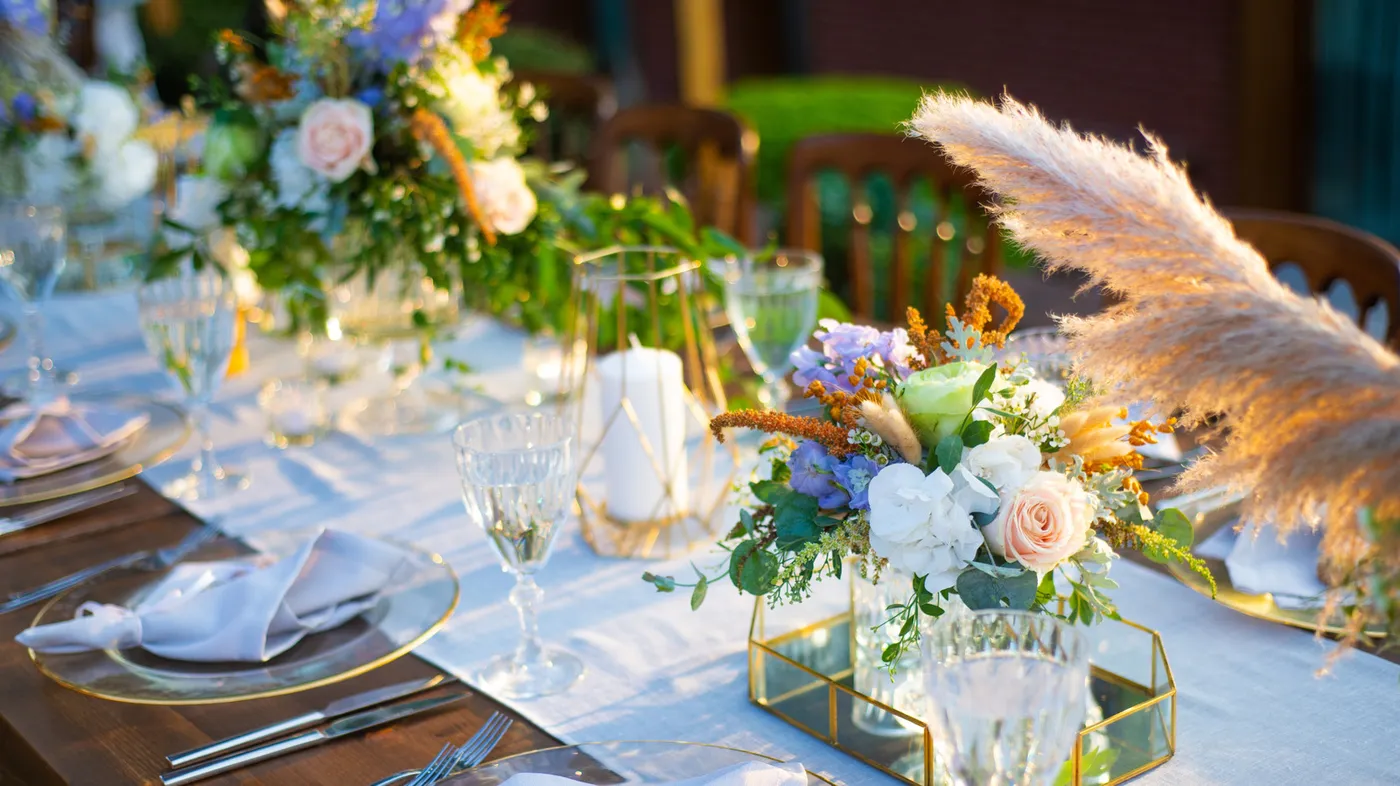
Buy pampas in bundles, never singles. Total: $50–$106
Budget alternative: one shared centerpiece instead of three, Dollar Tree chargers, and dried pampas from a craft store — about $28 for the same silhouette.
Feathery pampas against hard gold geometry is a contrast play: soft-versus-structural is far easier to get right than color-matching five shades of blush. The pampas also gives you height without weight, filling the vertical space above the table so the room feels generous while the low floral clusters keep sightlines open. For this same palette over a fireplace instead, see Idea #5.
13. White Roses and Tea Lights on a Ridged Silver Plate
White faux roses show every fingerprint and dust film, so keep a microfiber cloth nearby and wipe the petals every couple of weeks. Real tea lights burn down in about four hours, which means a bag of 50 from the dollar aisle is your actual recurring cost — roughly $5 a month if you light them for dinner. Never set the silver plate near a hot pan; the plating will spot.
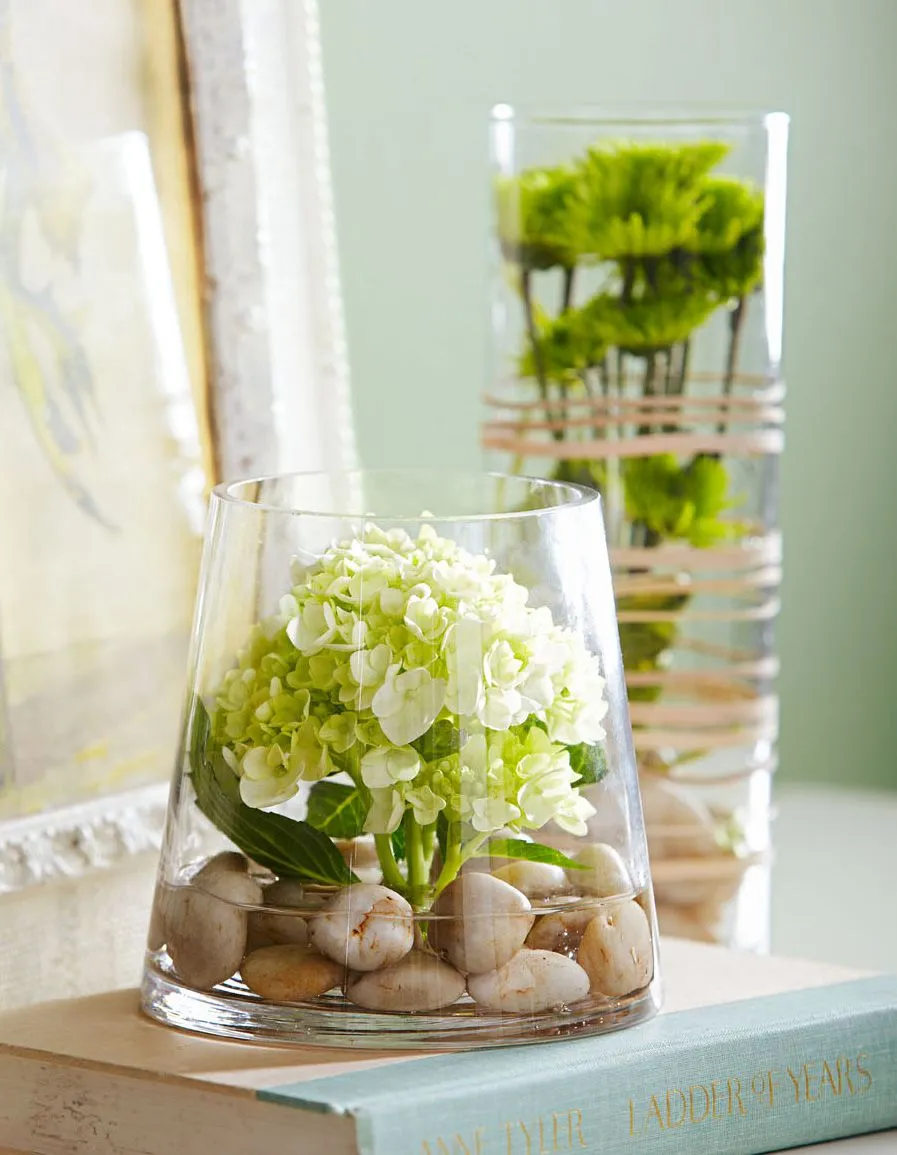
A clear cylinder vase, a bag of tea lights, and a thrifted silver plate run about $8 total if you shop Marketplace and Goodwill, versus $40 for a pre-made version at a home store. The silver band on the vase is optional — a strip of metallic tape from the craft bin reads identical at table distance. Spend your money on the roses instead; cheap white faux roses turn gray in evening light.
14. Floating Candle and Water Beads Wrapped in Fairy Lights
- Soak the water beads overnight in a separate bowl — they’ll grow to marble size.
- Fill the vase two-thirds with water, then spoon the beads in so they settle low.
- Coil a battery string light around the base, hiding the pack behind the vase.
- Float the candle on top, then ring the base with blooms and iridescent gems.
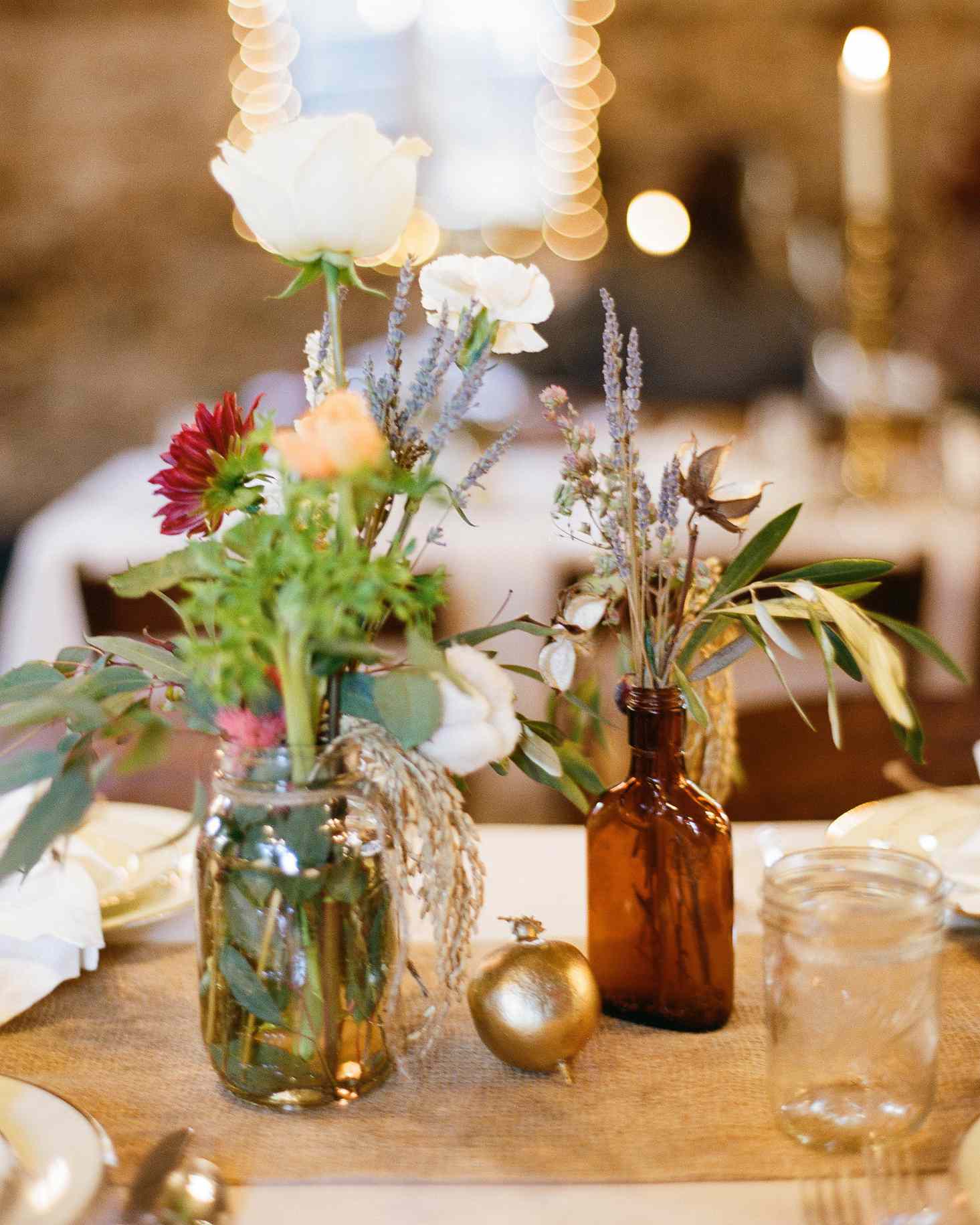
Twenty minutes plus an overnight soak, about $10 in supplies, and one battery pack lasts the whole season.
The ratio is 55% clear glass and water, 30% white, 15% soft blue-green. Clear is the dominant color here, which is why the arrangement feels bigger than it is — light passes straight through and the tablecloth becomes part of the design. Change the 15% to blush and it turns romantic; to amber and it turns autumn. Keep the blue out of the flowers themselves and let the gems carry it.
15. Stacked Vintage Books, a Glass Bottle, and Scattered Greenery
Stack no more than two books and keep the pile under 1.5 inches total. The bottle’s neck should land 12 to 14 inches above the tabletop — high enough to fill the empty air, low enough that nobody has to lean around it to see their dinner date. If your books are thick coffee-table volumes, put one under the votives instead and let the bottle sit flat.
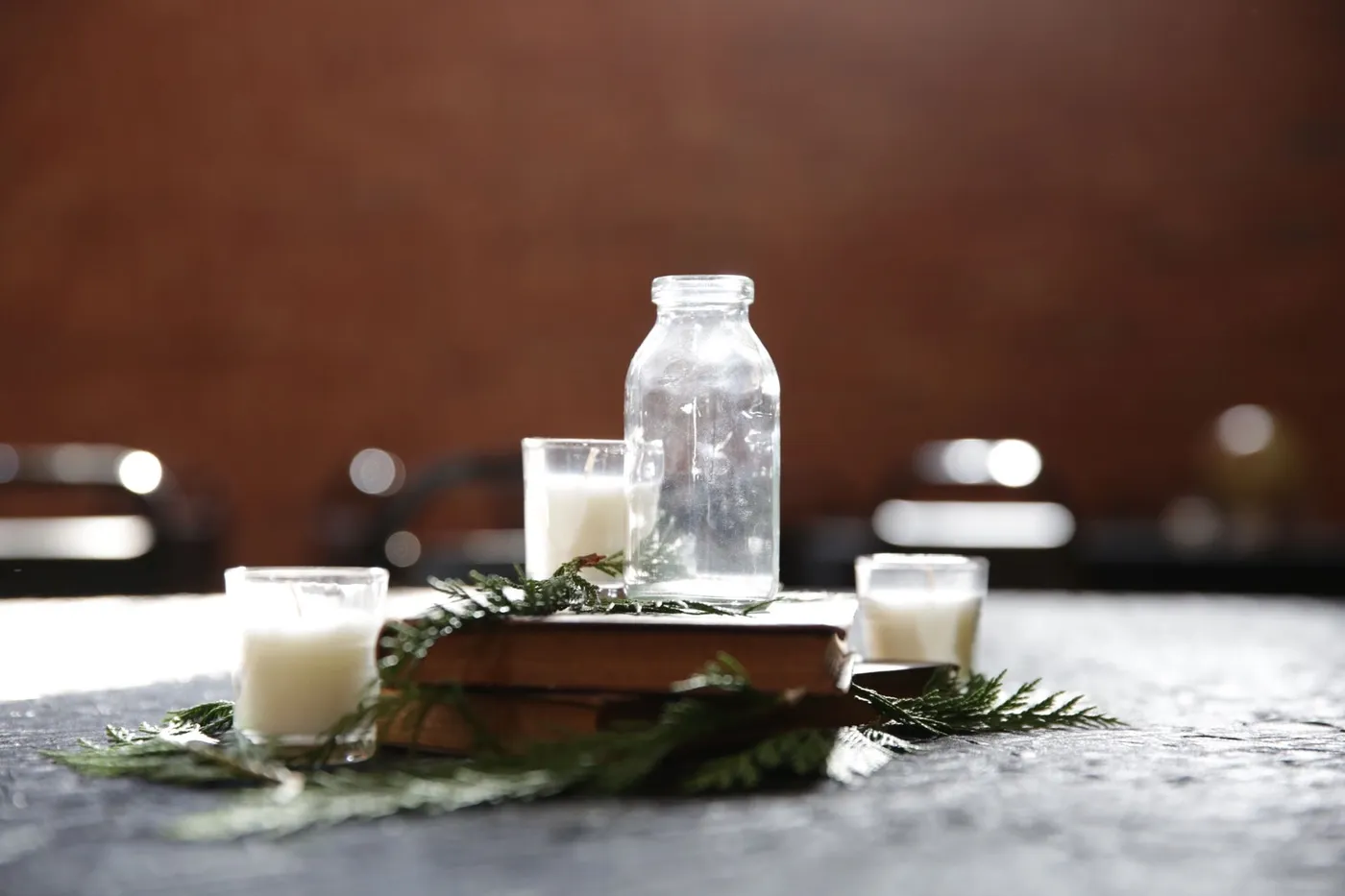
The greenery is the connector. Without those few sprigs threading between the books and the votives, you have three separate objects parked next to each other. With them, the eye travels a continuous line and the whole thing reads as one composition. Tuck stems so they touch both the book edges and the candle bases — anything that floats free gets visually lost.
16. Five-Arm Gold Candelabra with Twisted Candles and Lilac Roses
A five-arm candelabra needs real estate. It wants a table 42 inches wide or more, or a 60-inch rectangle, and you’ll want 30 inches of clear space between the candelabra’s outer arms and each place setting so nobody’s elbow lands in the flame zone. Below that, drop to a three-arm version and skip the roses. This is a formal dining choice — the opposite of a low, compact bowl.
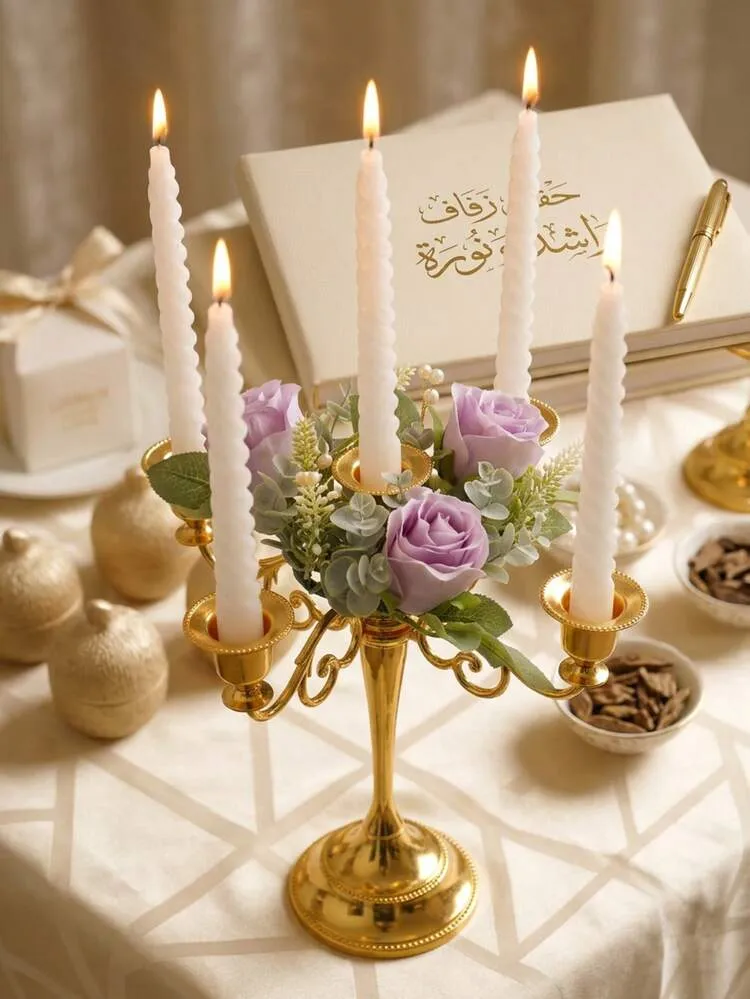
Five open flames on a dining table is lovely until a toddler, a cat, or a rolled-up napkin gets close. Space the arms so each candle has three inches of air, trim wicks to a quarter inch before lighting, and never let the twisted candles burn below two inches from the base. If kids sit here, swap the tapers for battery-operated twisted candles — they look nearly identical at a glance.
17. Wooden Planter Box Filled with Jars and Fairy Lights
- Wooden planter box: $6–$14
- Clear glass jars, 4–6: $5–$10
- Faux white stems and greenery: $8–$16
- Battery fairy lights: $3–$6
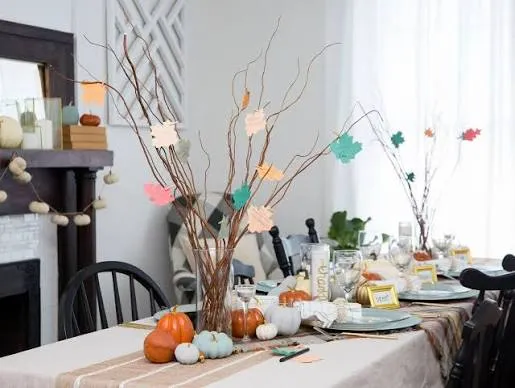
Look for the planter in the garden section, not the craft aisle — same box, half the price. Total: $22–$46
Budget alternative: an empty cardboard wine crate from a liquor store, stained with a $3 sample pot of wood finish, drops this to about $12.
Rhythm is doing the work: four or five jars of different heights, each holding a small cluster, read as a repeated note instead of a single lump. The lights are hidden inside the box rather than draped over the flowers, which is why it glows instead of sparkles — a subtler, more expensive effect for four dollars. Keep the jar heights at least an inch apart so the rhythm actually shows.
18. Draped Fabric Ghosts Over Black ‘Boo’ Placemats
The ghosts are literally squares of white fabric draped over a foam ball or a small balloon on a stick — $2 of material each. Black placemats can be poster board cut with scissors, and white pumpkin bowls show up at Dollar Tree in September for $1.25. Total for four settings: around $18. A boutique version of this exact tablescape runs $120 and up.
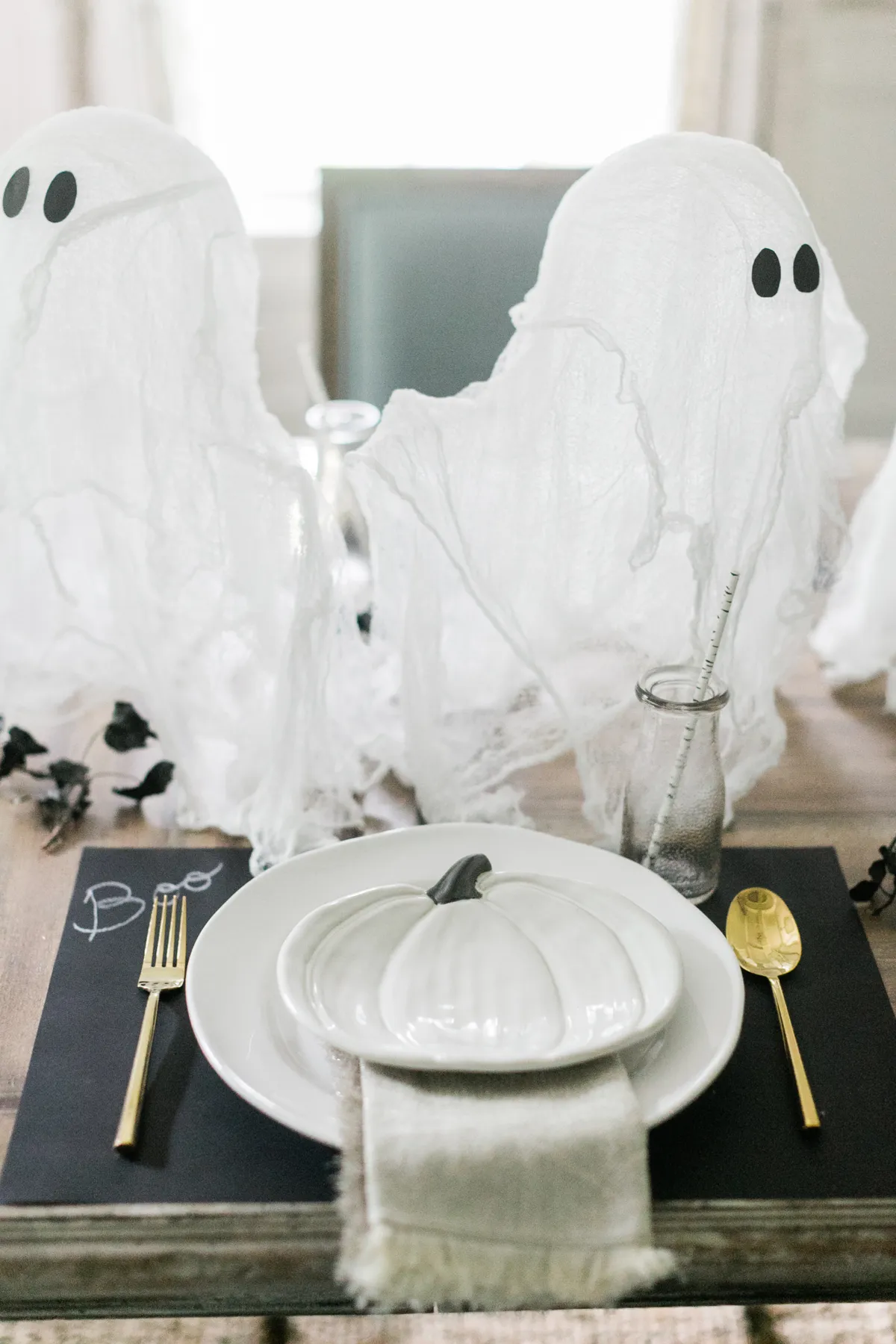
Spray starch is your friend. Lightly starch and press the fabric before you drape it so the folds hold shape instead of collapsing into a puddle by dessert. Pull one side lower than the other for a lopsided, ghostly hem, then hot-glue the fabric to the ball at the crown so it doesn’t slide. Two oval eyes, no mouth — that’s the whole face. For a scarier, more grown-up take on the same holiday, see Idea #10.
19. Bare Branches and Lights in a Gray-and-White Table Setting
This is 65% cool gray, 25% white, 10% silver. The light teal plates are the wildcard that makes it work — they’re a cool accent inside an already cool palette, so nothing fights. Swap teal for warm cream and the table turns icy; swap for charcoal and it turns formal. Keep the branches dark; pale branches would disappear completely against a white-and-gray cloth.
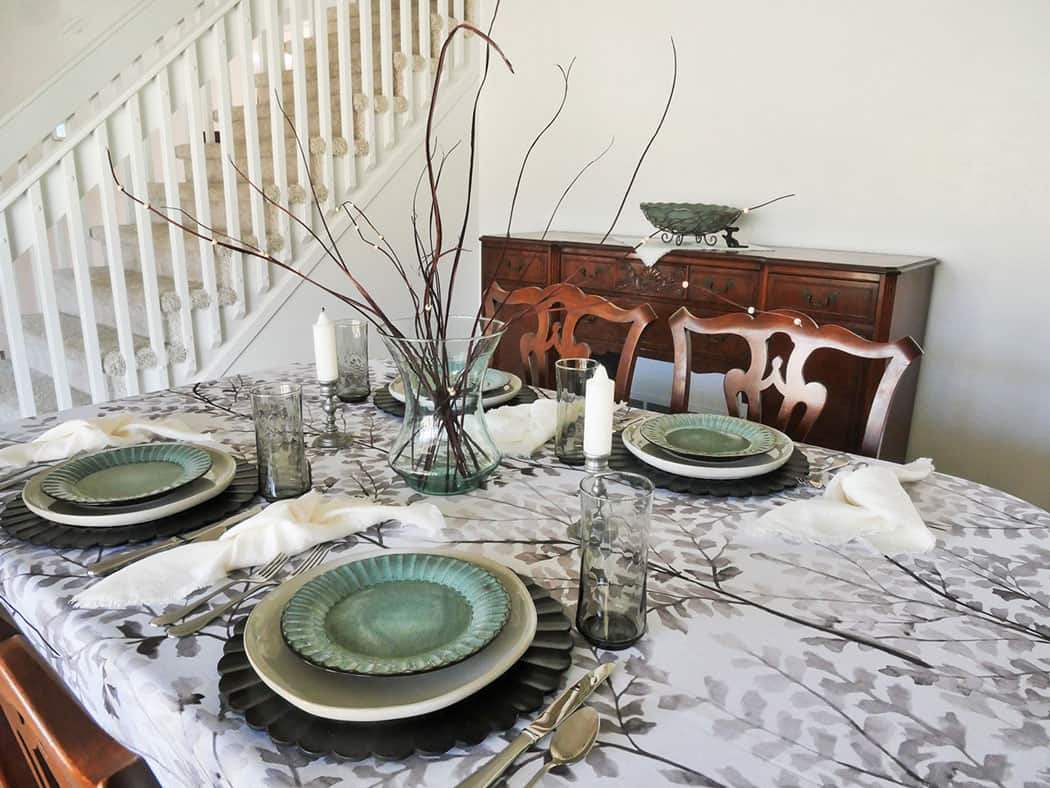
Bare branches drop bits of bark every time the table gets bumped, so seal them with a quick spray of matte craft sealer before they go in the vase. Battery lights need fresh AAAs roughly every three weeks if you run them nightly — buy rechargeables and keep them in a drawer with the candles. The patterned tablecloth hides drips, which is the one maintenance gift here.
20. Pink Florals Suspended in Gel Beads Under a Floating Candle
- Soak clear gel beads for six hours until they’re the size of peas.
- Spoon a one-inch layer into the vase, then add the pink blooms stem-side down.
- Fill around the flowers with more beads so the stems stay upright.
- Top with water and float the candle; it should sit a half inch above the beads.
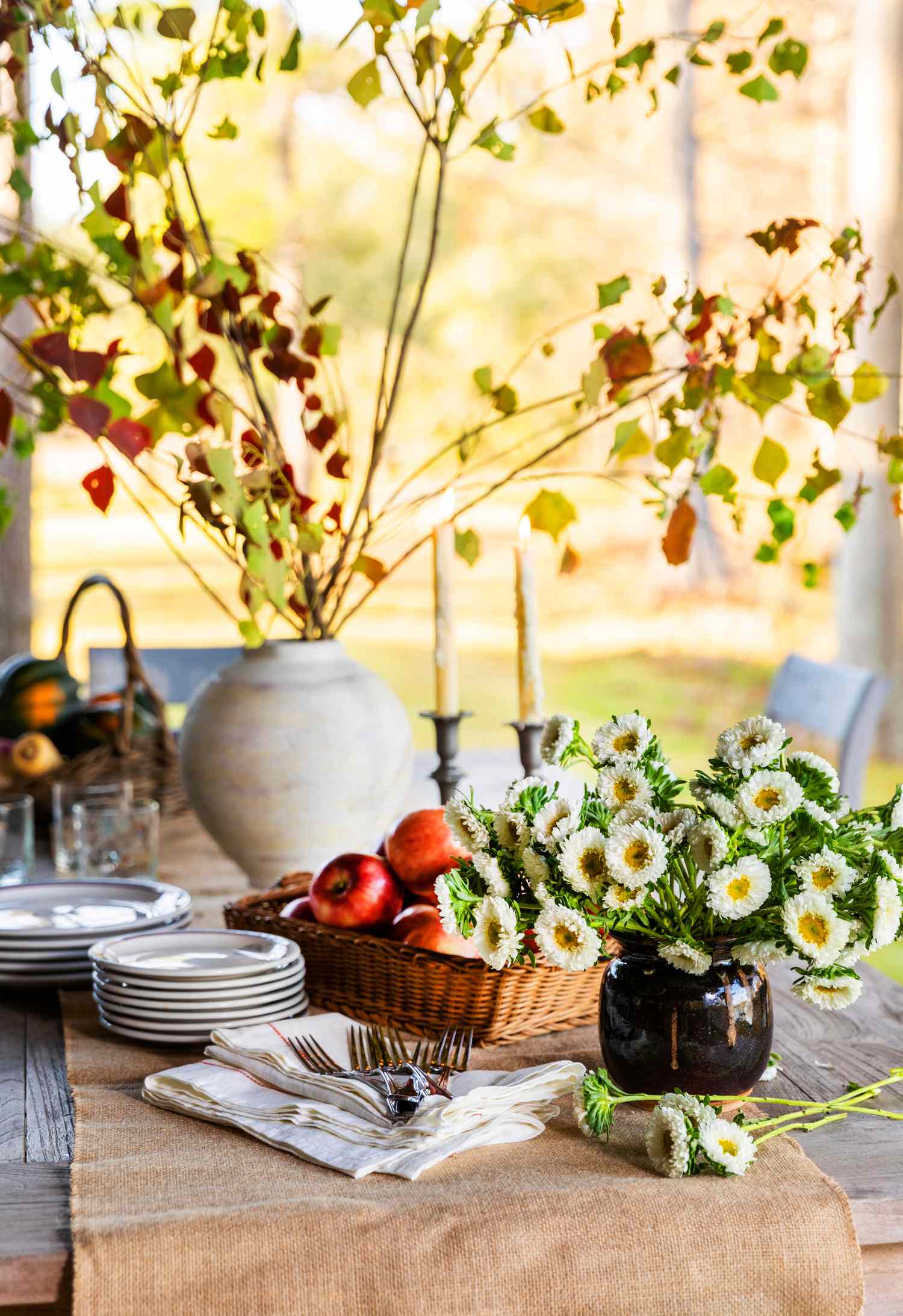
Around 15 minutes of hands-on work, about $6 in materials, and it holds for two weeks.
Gel beads shrink as water evaporates — top the vase off every four or five days or the flowers will lean. Never let a wax candle sit directly against cold beads; the temperature difference can crack cheap glass. And if you’re setting this out for a dinner party, float-test the candle an hour ahead, because a warped one will tip and drown its own wick.
21. Rectangular Vase of Floating Candles Over Clear Gems
The rectangular vase is the entire point. A round bowl would make the floating candles look like a craft project; a long, low rectangle turns them into a run of light down the middle of the table, and the clear gems inside magnify that light upward. Keep the gems fully submerged — anything poking above the waterline catches the wax and looks messy within an hour.
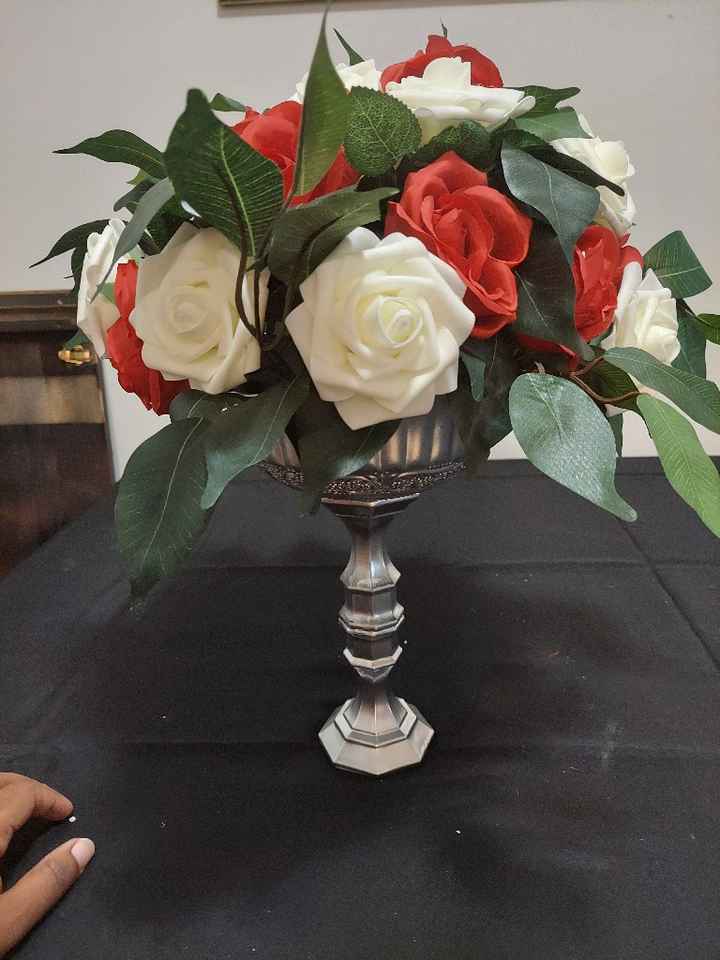
A rectangular vase around 12 inches long is the sweet spot for a table 40 to 48 inches wide; go to 18 inches on a 60-inch table and keep it centered. Keep the total height, vase plus floating candle, under 6 inches so sightlines stay open across the table. If your ceiling is low, this beats anything tall and branched every time.
22. Silver Oval Tray with an Olive Bottle Vase
An olive-green bottle vase is essentially a painted glass bottle — save a nice one, tape off the neck, and hit it with two coats of matte olive spray paint for about $6. The silver tray is $3 at Goodwill on half-off day, and the clear and amber gems come in a mixed bag at the dollar store. Under $15 total, versus $70 for the boutique tray. See Idea #29 for the gold-tray version of this same concept.
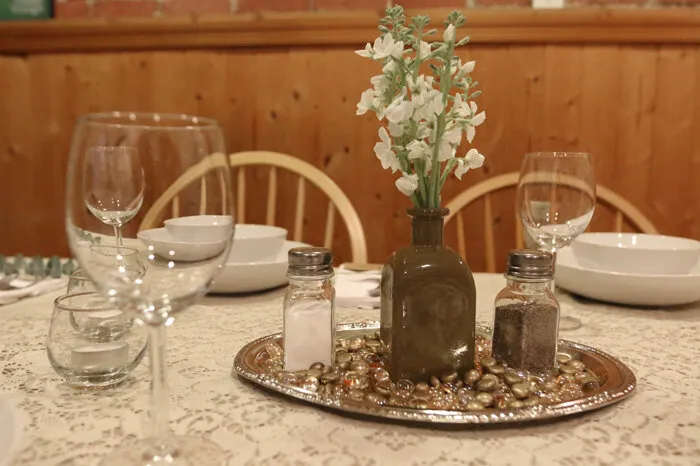
The tray is what makes an asymmetric little group look deliberate. It draws a boundary, so the eye reads “one arrangement” instead of “vase plus salt shaker.” The olive bottle is off-center on purpose, and the gems fill the empty side, which keeps the composition balanced without mirroring it. Cheapest trick in styling, and the one most people skip.
23. Matte Black Candlesticks and Ribbed Vases on Dark Grey
Candle math: keep white tapers 9 to 12 inches above the tabletop, and cluster them in odd numbers with uneven spacing — 4 inches, then 7, then 5. Even spacing looks like a hotel ballroom. Pair each cluster with a ribbed vase so the vertical lines echo each other, and keep the tallest element no closer than 18 inches from the nearest chair back so nobody’s hair becomes the centerpiece.
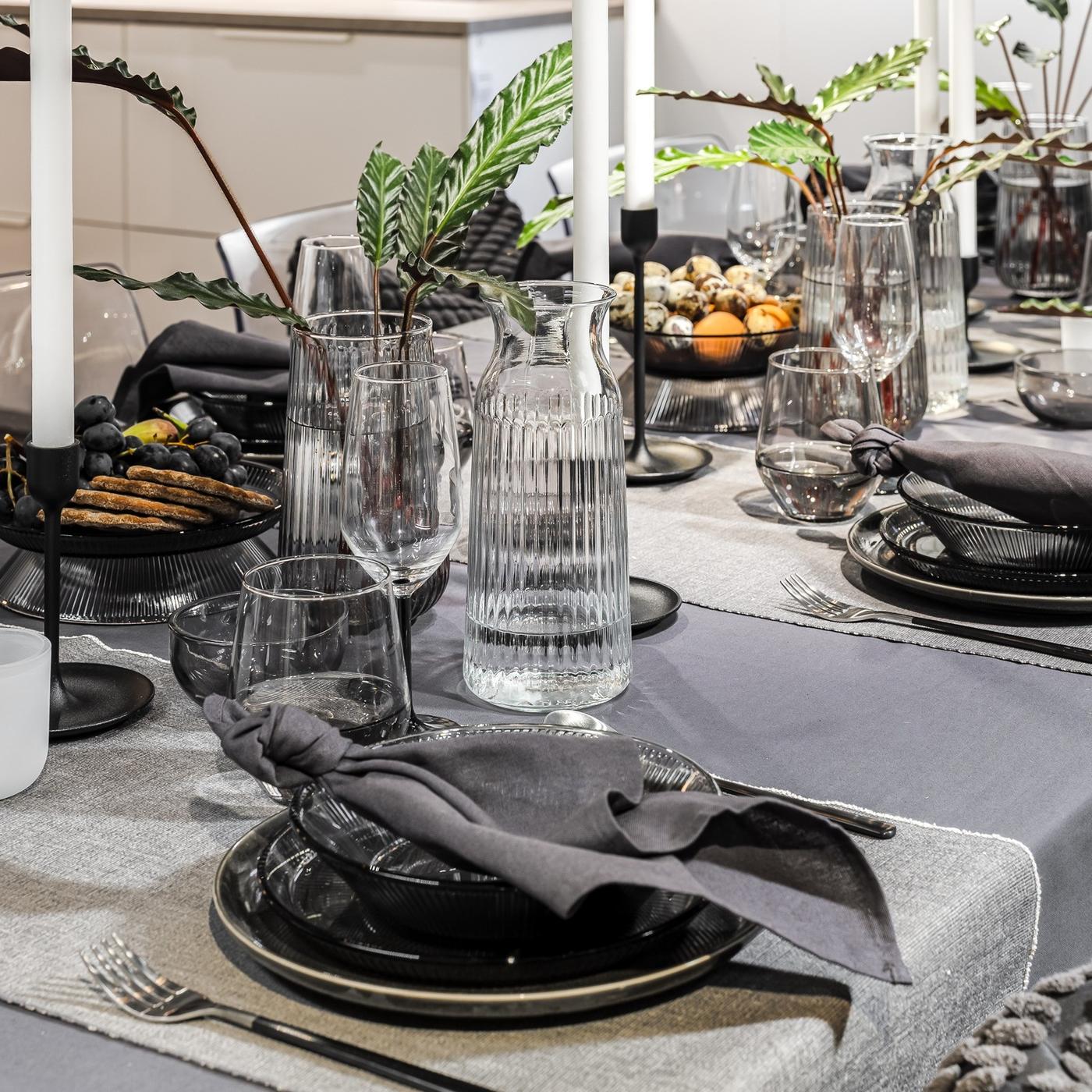
Moody, low-contrast tablescapes are having a real moment — charcoal cloth, black plates, matte black metal, and just enough white candlelight to keep it from going full funeral. It’s the 2026 reaction to years of bright white minimalism, it photographs like a restaurant, and it’s genuinely practical: dark linens hide everything and black plates make home cooking look intentional.
24. Pastel Heart and Star Picks in a White Round Pot
- Cut small hearts and stars from pastel craft foam — two sizes, roughly 1 inch and 1.5 inch.
- Hot-glue each shape to a wooden skewer, then snip the skewer to 4 inches.
- Push the picks into the pot at different heights and angles, avoiding a straight row.
- Fill gaps with rosebuds and green filler so the picks look planted, not stuck in.
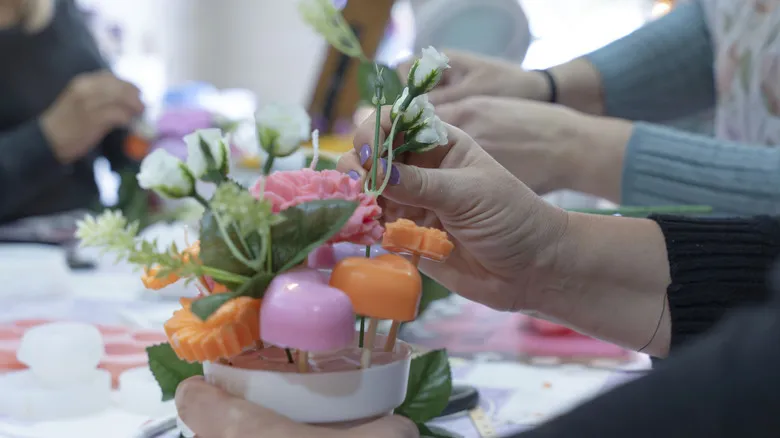
About 20 minutes, roughly $5 in supplies, and the picks are reusable next year.
- Small round white pot: $1–$3
- Faux roses and rosebuds: $4–$8
- Craft foam sheets in pastel: $2–$4
- Wooden skewers and hot glue: $2–$3
One foam sheet yields 20-plus shapes. Total: $9–$18
Budget alternative: cut the shapes from a pastel paper plate and skip the skewers — glue dots hold them straight to the stems.
25. Burlap Cutlery Holders with Maple Leaves and Pearls
- Measure your cutlery first — forks run 7 to 8 inches, so cut pouches to 9 inches tall.
- Buy one yard of burlap for every 8 holders and seal cut edges with fray check or a hot blade.
- Shake your faux leaves outside before gluing — dollar-store leaves shed glitter everywhere.
- Decide the color story before you pick up the glue gun: orange-red only, or mixed with gold.
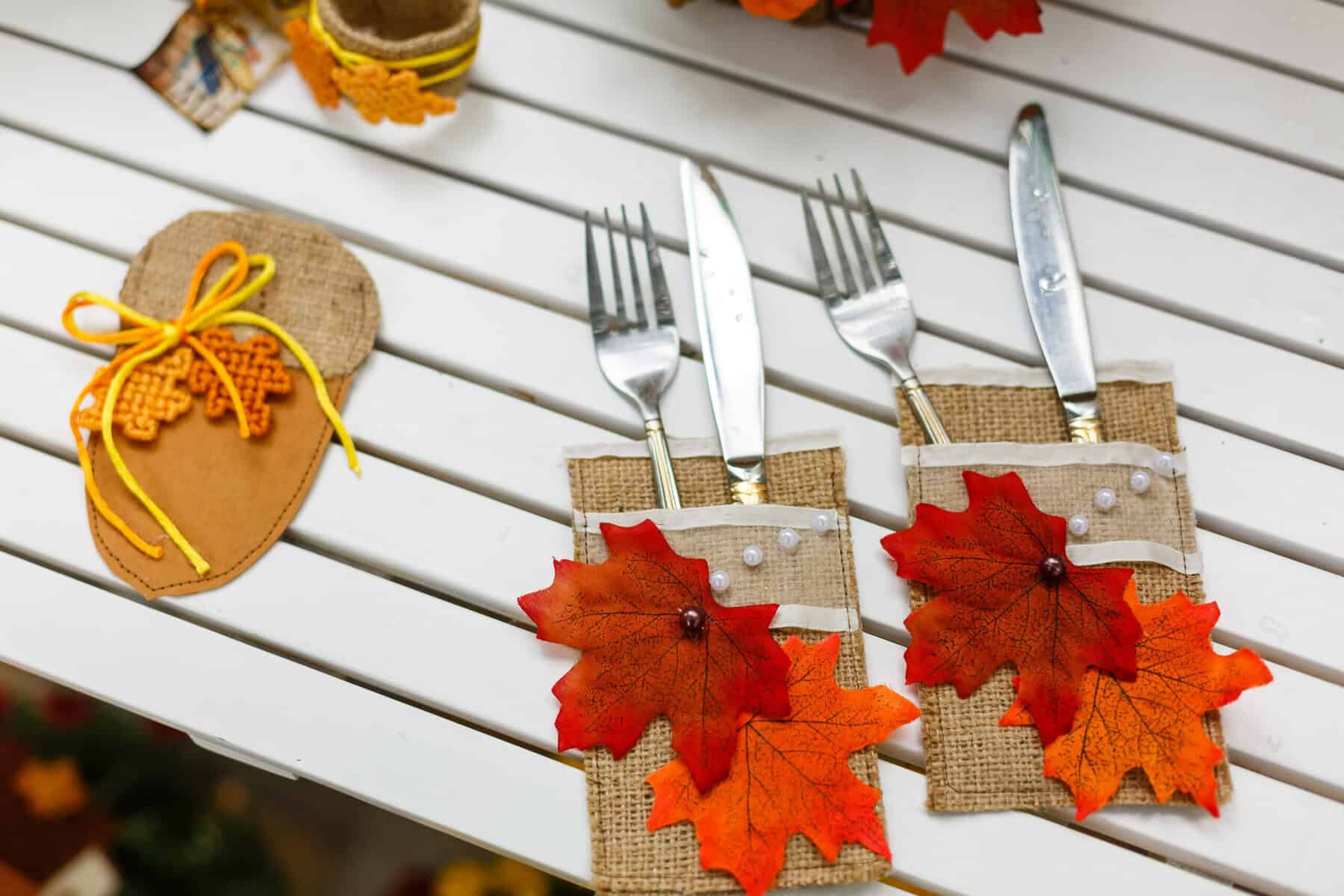
Burlap sheds, so cut it with a hot knife and warn guests that the pouches are decorative — a sharp knife will shred them. If your crowd is messy, pin the leaves on instead of gluing so the holder goes back to plain next season. Also air them in the garage overnight; burlap smells like a feed store for a few days.
26. White Pumpkin Placemats and a ‘Grateful’ Wooden Board
The engraved “grateful” board is the emotional center of this table. Without it, you have a cute pumpkin-themed setting; with it, the table says something. It’s also a smart scale move — a small leaf-shaped board sits low between the settings, filling the dead zone in the middle without blocking anyone’s view. The pumpkin ribbon on the glasses is what ties it back to the plates.
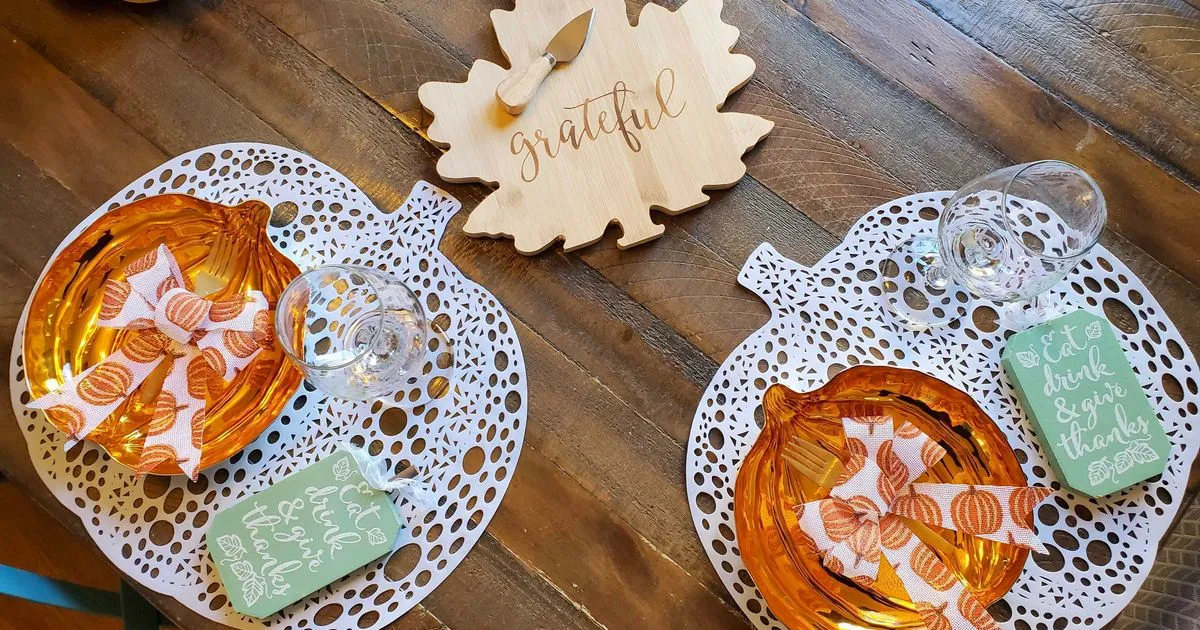
Pumpkin-shaped placemats are the spendy item here; cut them from orange felt backed with cardstock for about $4 for six. The shiny orange plates can be dollar-aisle ceramics spray-painted on the underside, or just use what you have and let the placemat carry the theme. The wooden board is the one piece worth buying. Pair these with the burlap cutlery holders in Idea #25.
27. Slatted Wooden Crate with Sunflower and Amber Bottles
A crate 16 to 20 inches long works on a table 48 inches wide or more and wants to sit alone rather than paired. The bare twigs push the whole arrangement to about 20 inches tall, so it’s better on a sideboard or a long farm table than a small round one — on a 42-inch round, cut the twigs to half height and keep the crate under 12 inches.
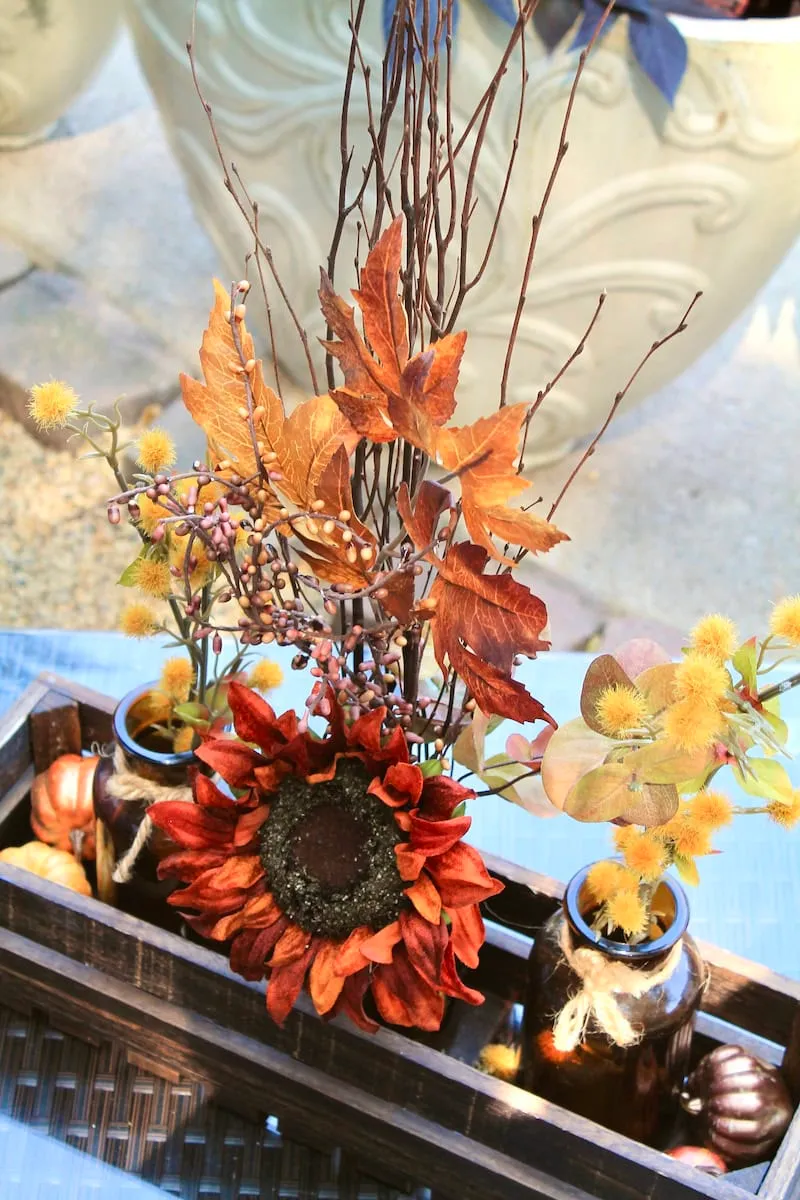
- Line the crate with plastic wrap, then press in a block of dry floral foam cut to fit snugly.
- Push the heaviest twigs in first, angled outward, using three of them to build a triangle.
- Add leaves and berries around the base of the twigs, keeping the back fuller than the front.
- Set the amber bottles and mini pumpkins on top of the foam, not into it.
About 25 minutes and $15 in faux stems and foam.
28. Lime Green Tablecloth with Fuchsia Florals and Pink Chargers
This is color-blocking with a safety valve: 60% lime green, 30% pink in three shades, 10% gold and clear. The greens and pinks sit nearly opposite on the color wheel, which is why the table feels electric — but every pink here is a tint of the same hue, which keeps it from getting chaotic. Swap the lime for cobalt and the whole mood flips from garden party to modern art.
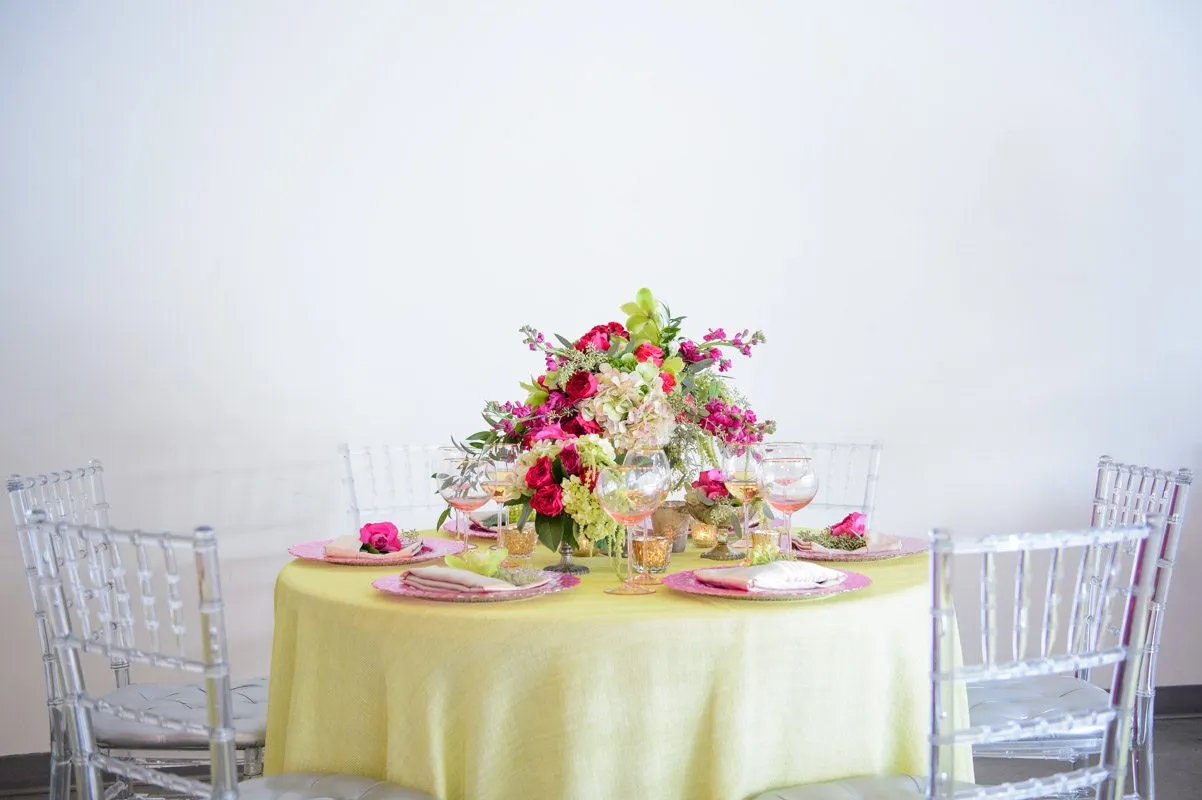
Dopamine color is still driving tablescapes. After years of beige, hosts are renting clear acrylic chairs and committing to one saturated color fully — and in 2026 the commitment is the point. A color-drenched table beats a timid one every single time. It also has legs because it’s rental-friendly: cloths, chargers, and glassware change, the tables don’t.
29. Gold Tray with Hurricane Candles and Eucalyptus Sprigs
- Long gold rectangular tray: $10–$24
- 2–3 glass hurricanes plus cream pillars: $12–$24
- Small white ceramic vases: $6–$12
- Eucalyptus stems and gold geometric objects: $8–$16
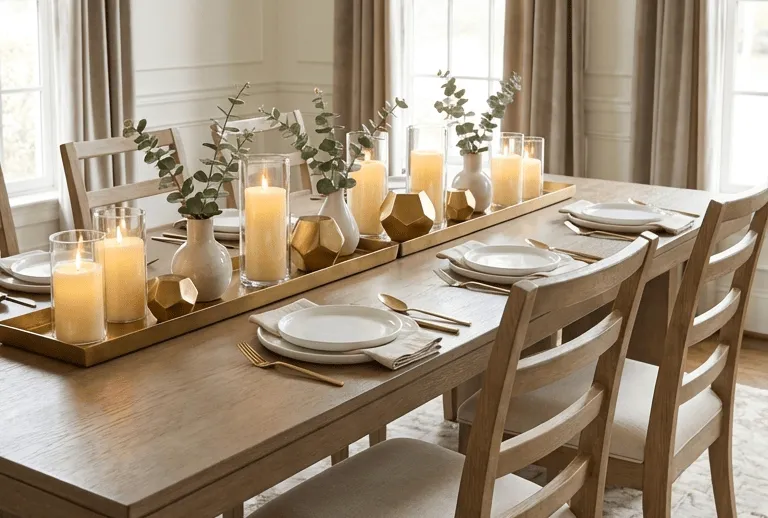
Mix real and faux eucalyptus for scent without the cost. Total: $36–$76
Budget alternative: a gold-sprayed cookie sheet or thrifted brass tray does the same job for $5, and Dollar Tree glass cylinders stand in for the hurricanes.
Rule of thumb for trays: the tray should run about one third of the table’s length. On an 84-inch table, that’s a 28-inch tray — longer and the ends crowd the place settings, shorter and it looks stranded. Build the tray in three zones (candle, greenery, candle) so the eye has a beginning and an end, and leave a sliver of gold visible at each end.
30. Cascading White Florals Spilling to the Floor
Fresh florals at this volume are a commitment: expect to re-cut stems and change the water every two days, and budget for a few stems wilting before the event. The cascade means the lowest blooms sit in water-soaked foam, which starts to smell by day three. If you want this look for more than one evening, use faux blooms for the floor-level cascade and real ones only above the tabletop.
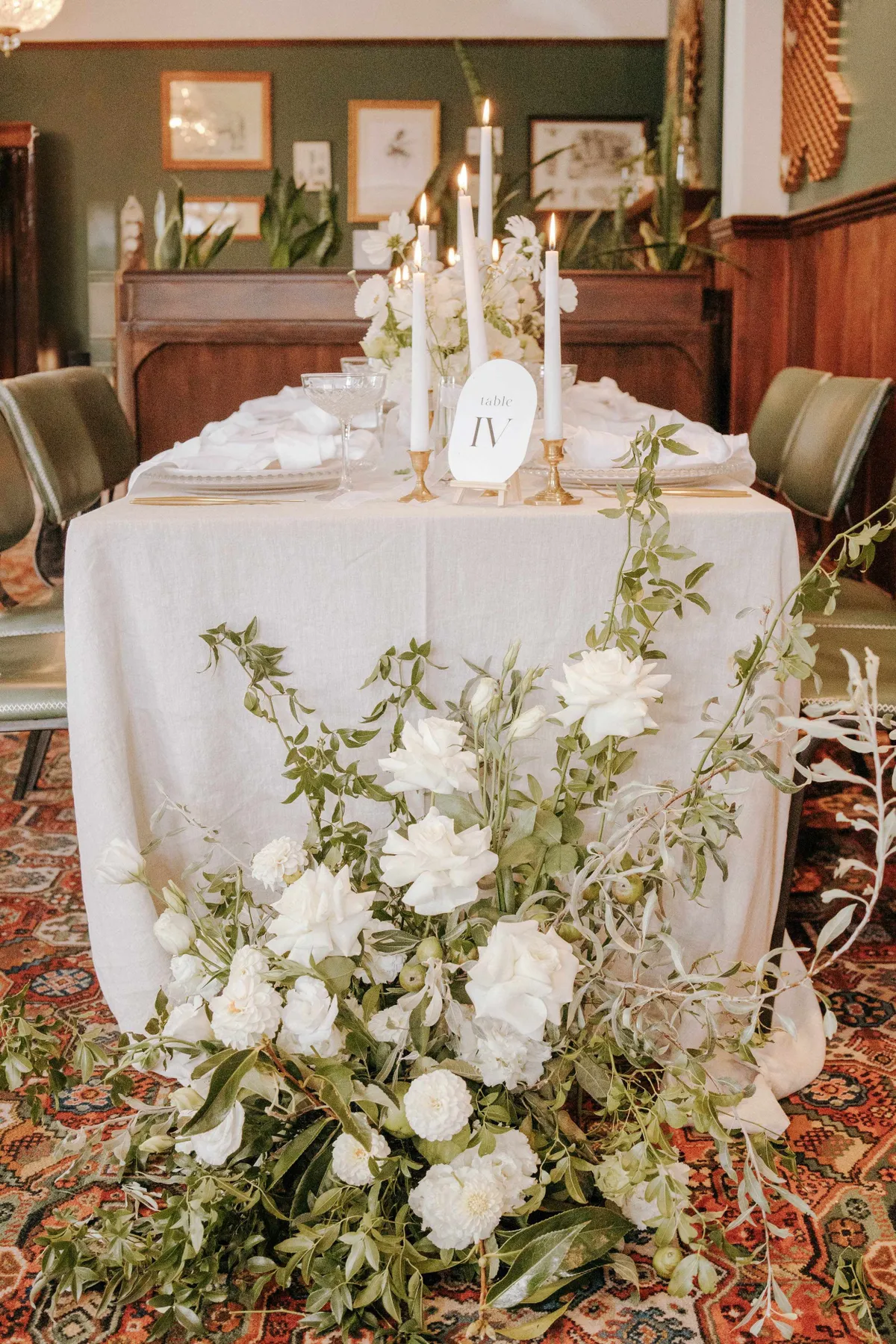
The cascade works because it breaks the table’s edge. Most centerpieces stop at the plane of the tabletop, which is why they read as objects sitting on furniture; this one spills down and turns the whole table into a single gesture. The dark green paneling and cream cloth give it something dramatic to play against. See Idea #32 for a clear-glass take on the same instinct.
31. Half-Cut Lemon Vase with Baby’s Breath
- Pick a lemon with a flat, stable bottom — roll it on the counter first to test.
- Slice only the top third off; a deep cut splits the rind and it won’t hold water.
- Scoop the flesh with a grapefruit spoon and dry the inside before filling.
- Trim baby’s breath stems to 2 inches so the blooms sit just above the rim.
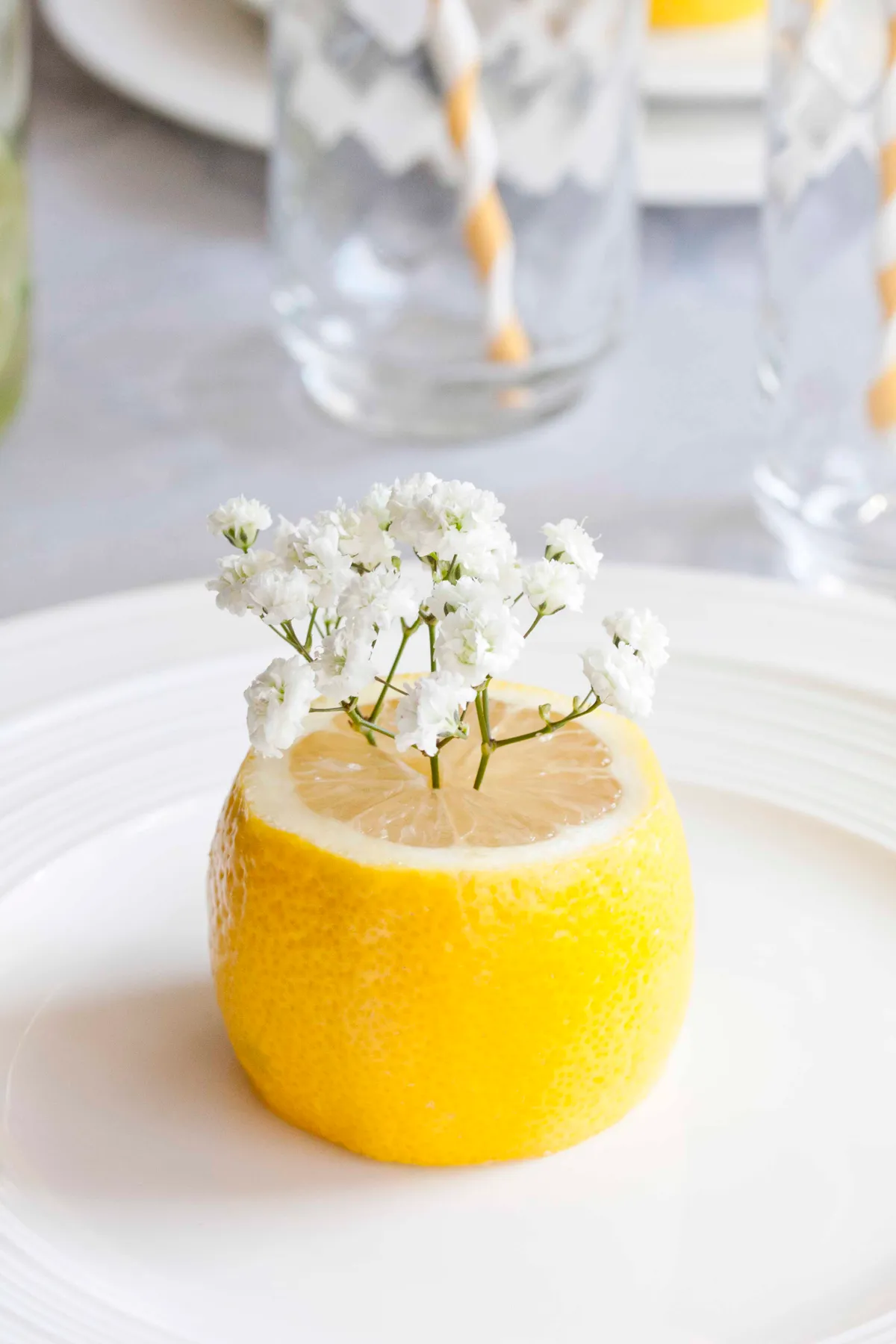
One lemon, one bunch of baby’s breath, and a plate you already own: about $5 and four minutes. For a version that lasts, set a small white ramekin lined with lemon peel inside and put the blooms in a wet floral pillow. Nobody has ever asked me what a centerpiece cost — they ask how I thought of it.
32. Nested Glass Cylinders with Floating Candles and Gel Beads
The nested pair reads best centered on a table 36 to 48 inches wide, where the whole thing tops out around 10 inches tall and nobody has to lean. On a long table, repeat the arrangement three times with 18 inches between them rather than making one giant version — repetition always beats scale. Keep the outer bowl at least 6 inches across so the candles have room to float without bumping.
The inner cylinder should be about 2 inches narrower than the outer bowl, and the water in both should sit at the same level — that’s what makes it look engineered rather than assembled. Weight the gel beads so the inner vessel doesn’t drift, and float no more than three candles; a fourth crowds the surface and they’ll clump at the edge within the hour.
Thirty-Two Centerpieces, One Dollar Tree Run
Start with the one that matches the season you’re actually hosting in — patriotic cylinders in July, velvet pumpkins in October, clear glass and candlelight any time of year. Pick one idea, buy one thing at a time, and let the table tell you what it needs next. 📌 Pin this guide before your next Dollar Tree run — it’s the kind of list you’ll come back to every holiday.