32+ Stunning Angel Tree Topper Ideas That Will Elevate Your Christmas Decor in 2026

You know that feeling when the tree is up, the lights are on, and the top still looks unfinished? That’s usually not a tree problem. It’s a topper problem — and it’s usually the one you grabbed at 11pm on December 23rd.
We spent serious time browsing Etsy, Target, and Anthropologie to bring you only what’s worth your attention this year, and this guide runs from about $6 for a paper-quilled charm to $240 for a hand-finished velvet showpiece. After filtering through hundreds of options, we landed on 32 angel tree topper ideas across four directions: traditional velvet and gold, handmade crochet and felt, vintage-inspired nostalgia, and clean metallic modern. Budget and luxury versions sit side by side, so you can see exactly where the extra money goes.
Every idea comes from a real photograph of a real tree, so you can judge scale, materials, and how a topper behaves under actual warm bulbs instead of studio light. And 2026’s pull toward heirloom, low-plastic holiday decor is exactly why these matter now — people are buying fewer things and keeping them far longer.
And stay until the end — we break down the most common mistakes that can ruin these looks. 📌 Save this to Pinterest for later — you’ll want to revisit these ideas.
1. White and Silver Faux-Fur Angel With Lit Wings
Plenty of white angels sit on a tree and disappear. This one doesn’t, and the reason is the faux fur trim on the hood and sleeves. It softens the silver ribbon details and the white gown into something you want to look at, instead of another shiny cone. Remove the fur and you’re left with a pretty but generic figurine. Keep it, and the topper reads plush and dimensional even from the far side of the room.
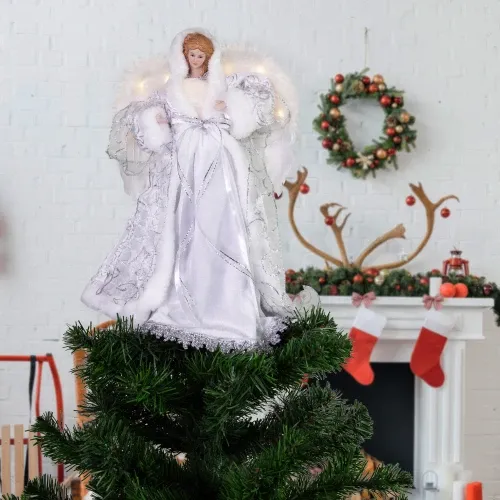
Light placement does the rest. Rather than letting a bulb blast the face, run your string lights so they graze those feathery white wings from behind and below. Give the embedded wing lights about three inches of clearance before the next bulb or the glow muddles into one bright smear. Warm bulbs only, 2700K to 3000K — cool white on a soft painted face turns it gray in photos, and honestly in person too.
2. Porcelain-Faced Angel in a Gold Snowflake Gown
The gold snowflake pattern on that satin skirt isn’t decoration — it’s what keeps the eye moving. Small repeated shapes read as texture up close, the cascading gold ribbon draws long vertical lines from across the room, and the beaded band at the waist stops the whole thing from becoming a wall of white. Contrast, repetition, and a visual stop, all in one figurine.
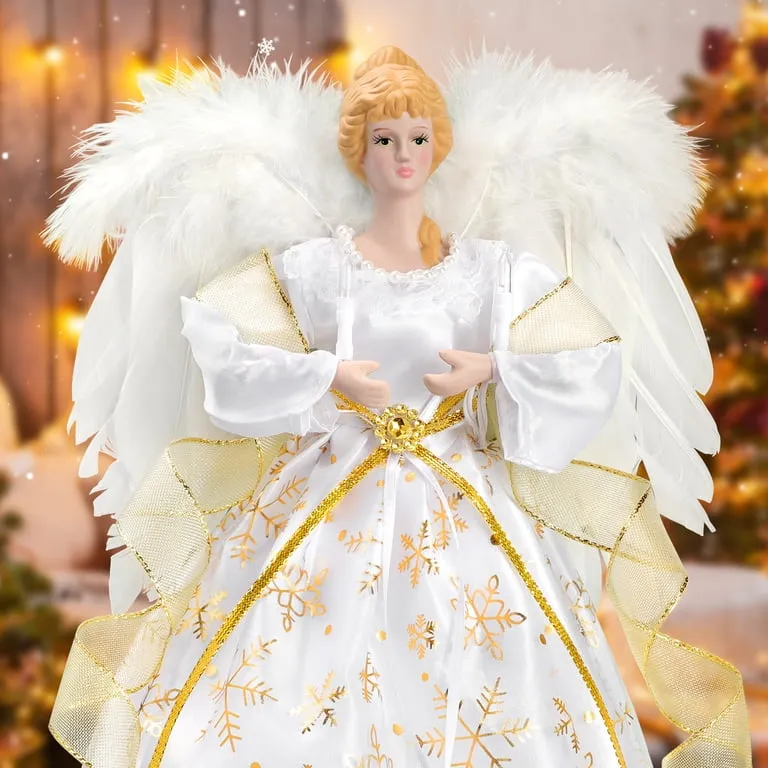
Roughly what it costs to build this look yourself:
- Angel with satin gown and feather wings: $45–$120
- Gold ribbon by the spool: $8–$15
- Beaded or jeweled waist accent: $6–$14
- Warm white light strand for the crown: $10–$20
- Spare feather wings to swap in: $12–$25
Total: $81–$194. Budget alternative: buy a plain white satin angel and add your own gold ribbon and beaded band for under $60. The silhouette does the heavy lifting, not the price tag.
3. Red Velvet Harp Angel With a Thin Gold Halo
The formula here is 60 percent forest green, 30 percent deep red, 10 percent gold. Green is the tree doing quiet work, the red velvet gown is the statement, and every sequined patch, ornate wing, and thin halo is that final tenth. Push it to 50/50 red and gold and the angel stops reading as an angel and starts reading as an ornament.
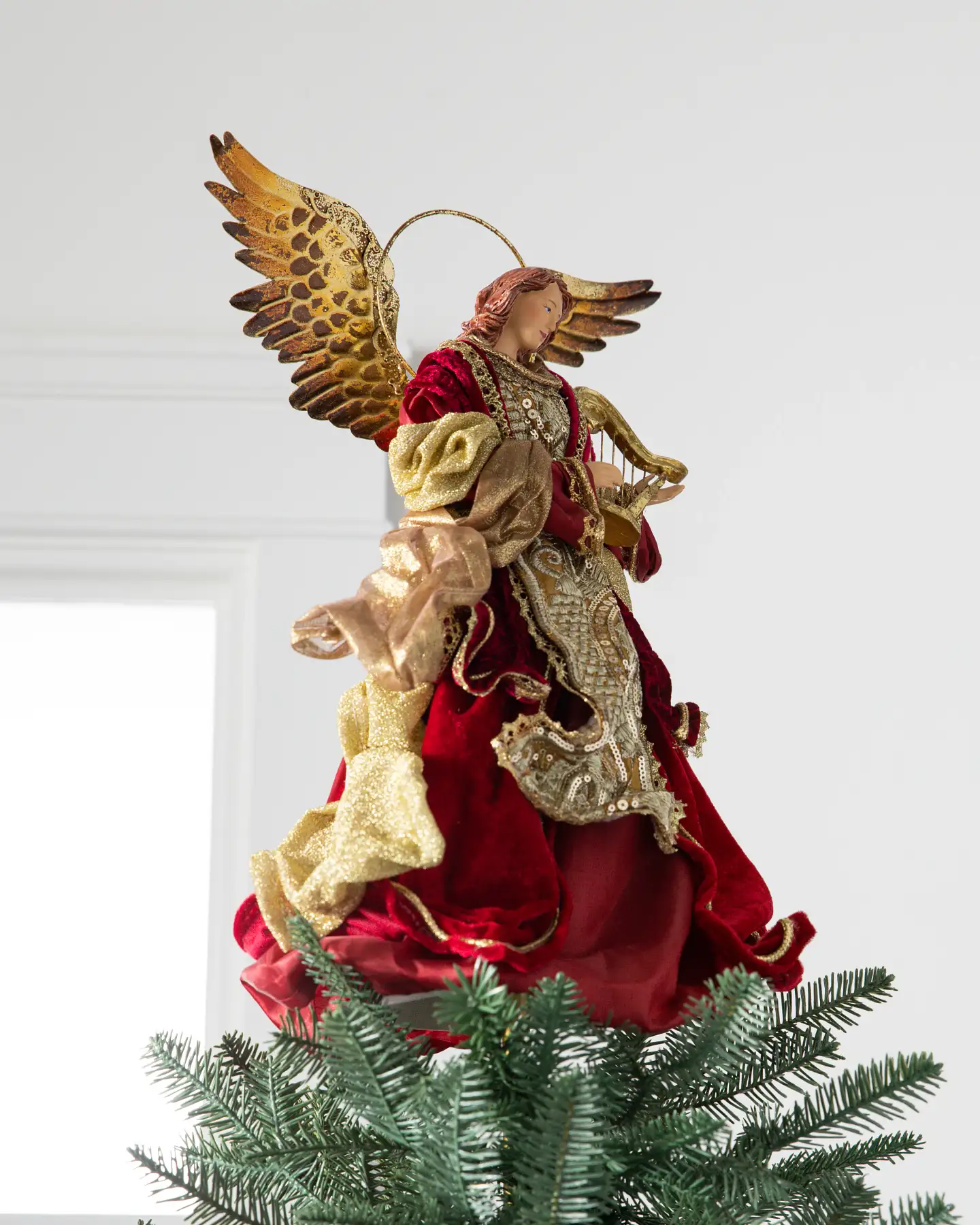
Swap freely inside the formula: burgundy instead of true red, brass instead of bright gold, a darker fir if your room runs cool. Keep the percentages and it still lands.
The harp is the fragile part. Most of these are wire and resin, and the strings bend if you look at them wrong — so the topper goes on last and comes off first, never stuffed in a bin with the extension cords. Same story for that halo: it’s thin, usually attached at a single point, and it warps the moment the tree top bends. Velvet crushes, too. Store it standing or wrap the gown in tissue so the pile doesn’t flatten into a shine mark by next December.
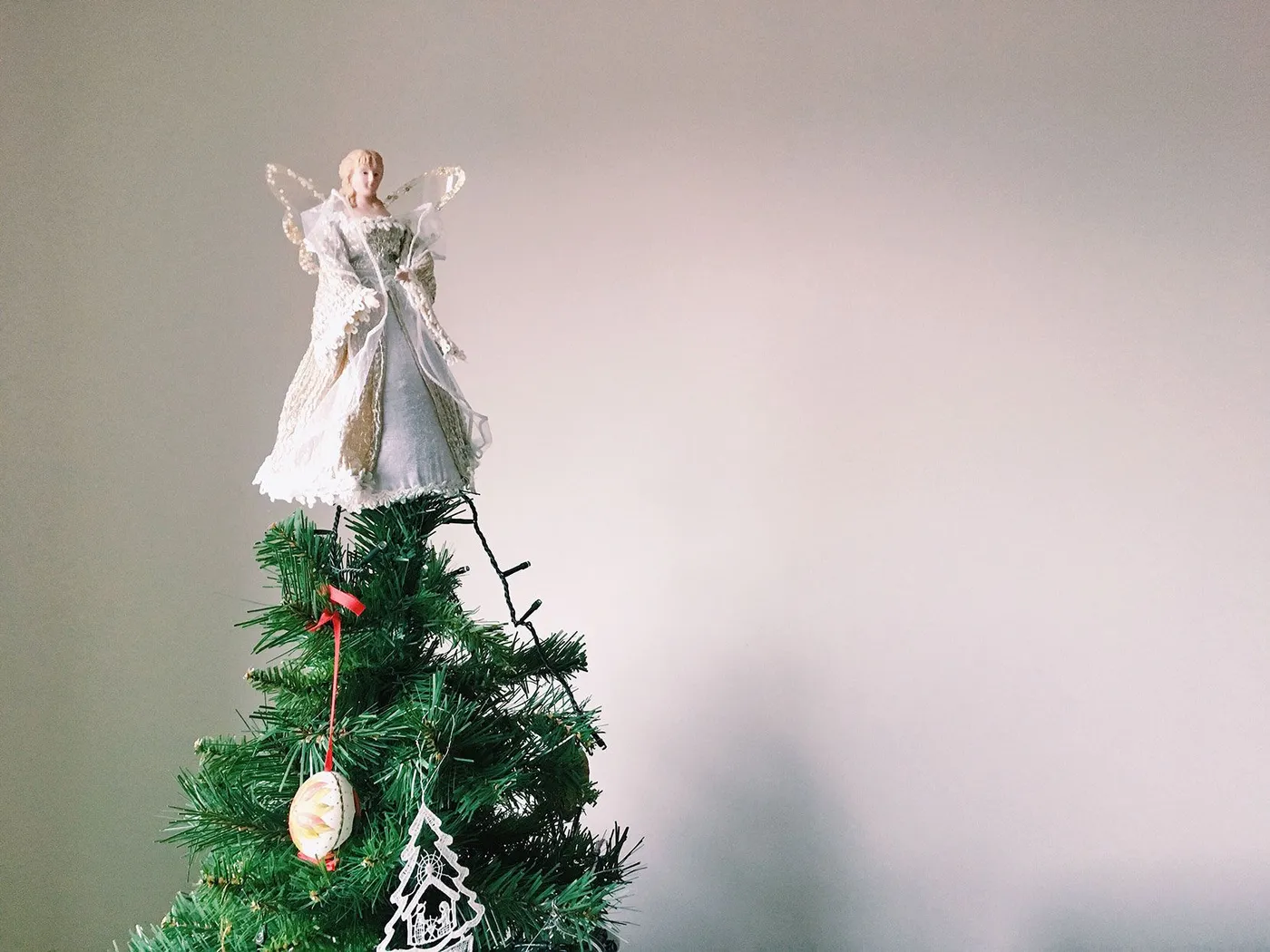
4. Golden-Halo Angel With Iridescent Wings
Here’s the number most people get wrong: topper height. Aim for roughly one-tenth of your tree’s height, measured from the branch collar to the top of the head — a 7.5-foot tree wants a 9- to 11-inch angel, a 9-footer wants 12 to 14. Measure before you fall in love in the store.
- Wingspan no wider than the top third of the tree
- Halo clearance: at least 2 inches below the ceiling
- Base opening sized to your tree’s actual top branch
An angel that’s technically correct but four inches too short reads as a decoration someone forgot to finish.
The iridescent wings are the real trick. They pick up tree lights and scatter them softly instead of throwing a hard shine, which is why this one feels calm rather than glittery. The gold trim on the white gown gives the eye somewhere to land, and the halo closes the silhouette at the top so nothing feels cut off. Notice the gown is white but not flat white — there’s a tonal shift where the gold catches the folds.
5. Crowned Angel Holding a Dove and a Tiny Wreath
The wreath is the detail that makes this an heirloom instead of an ornament. An angel holding a dove is standard. An angel holding a dove plus a small greenery wreath with a single gold bell hanging from it is a vignette — it gives the eye something to discover after the first read, and it fills the awkward air space right where the tree narrows. That’s the piece I’d protect.
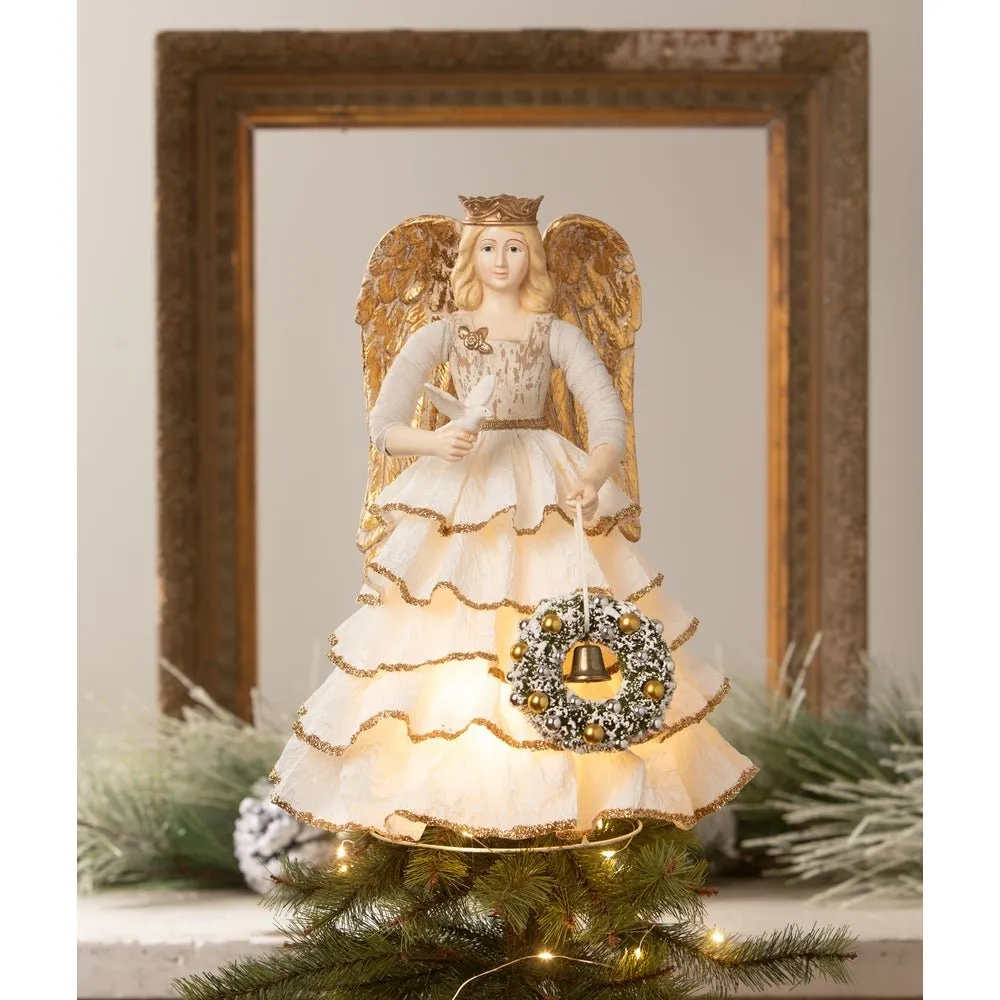
To build the wreath yourself:
- Start with a 3-inch grapevine mini wreath from a craft store, about $4.
- Wire a single gold bell to the bottom center with florist wire, not glue.
- Thread a narrow ribbon through one side and knot it so it hangs slightly off-center.
- Loop the ribbon through the angel’s hand and tack it with a single stitch.
- Step back six feet and check that the bell clears the branches below.
About 25 minutes and $8 to $14 in supplies.
The gold crown and textured wings carry the top, and the warm string lights behind the figure are what make the white ruffled dress glow instead of glare. A distressed gold-framed mirror in the background doubles the light — a free trick if you already own one.
6. Layered White Gown, Shimmering Silver Wings
The gown here flares out over the branches rather than sitting on them, and that flare is what you’re paying for:
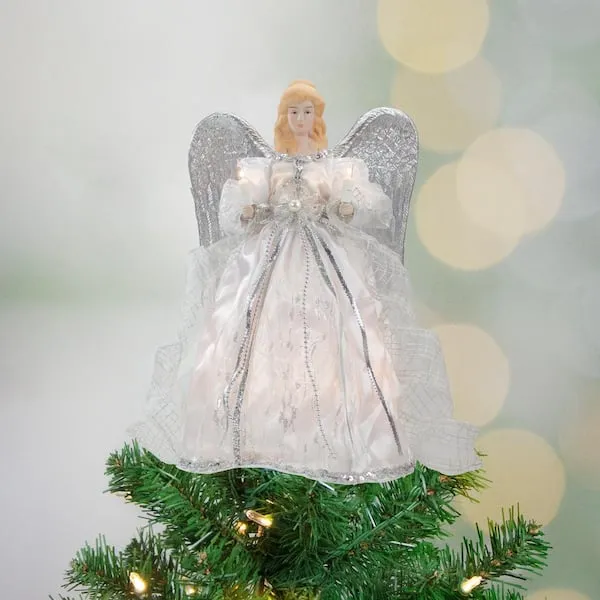
- Lit angel with layered gown: $55–$140
- Silver ribbon trim by the yard: $6–$12
- Warm white LED strand, 20 count: $8–$16
- Tree-top collar or branch support: $5–$10
- Replacement fabric overlay: $15–$30
Total: $89–$208. Budget alternative: re-trim an old white angel with $9 of silver ribbon and a $9 light strand — the layered look comes from the flare, not the fabric quality.
Anything lit from the inside has a lifespan shorter than its fabric. Those internal bulbs are usually non-replaceable LEDs soldered into a small harness — expect four to seven seasons before a section dims. Test it in November, not December 20th. The flared gown also catches dust and vent air, so hit it once a year with a soft brush vacuum attachment. Skip spray cleaners; they dull the silver.
7. Deep Red Velvet Angel With a Matching Hat
This look exists at three prices and the middle one is where you want to be. Etsy makers sell hand-finished red velvet angels with real gold embroidery in the $70 to $110 range, mass retailers do a passable version for $25 to $40, and vintage shops plus Facebook Marketplace regularly turn up nineties velvet angels for under $20 with better fabric than anything new at that price. Buy the vintage one and spend the savings on the tree around it — flocked branches and red berries do more for this palette than a fancier angel would.
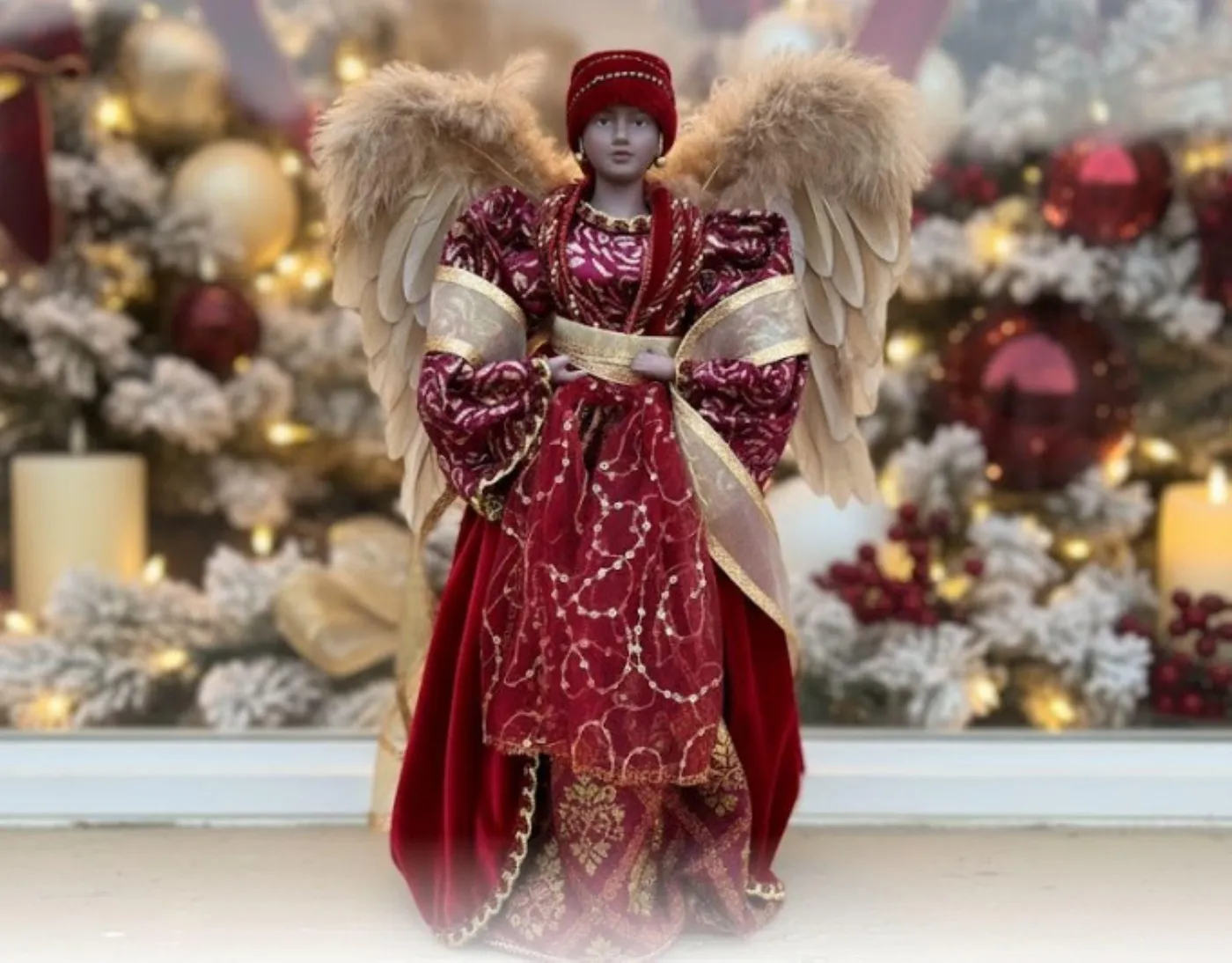
Red velvet plus gold embroidery is a lot of visual weight, and it only works on a tree that can hold it. On a sparse 6-footer the angel swallows the whole silhouette; on a full flocked 7.5-footer it looks correct. If your tree runs small, hunt for the same dress in a 7- to 9-inch figure instead of the 14-inch showpiece. One more thing: dark red velvet photographs nearly black in low light, so add a warm bulb right behind the wings if you mostly see the tree at night.
8. The Back View: Velvet, Glitter Hem, Yarn Hair
That twisted black yarn hair is easy to replicate:
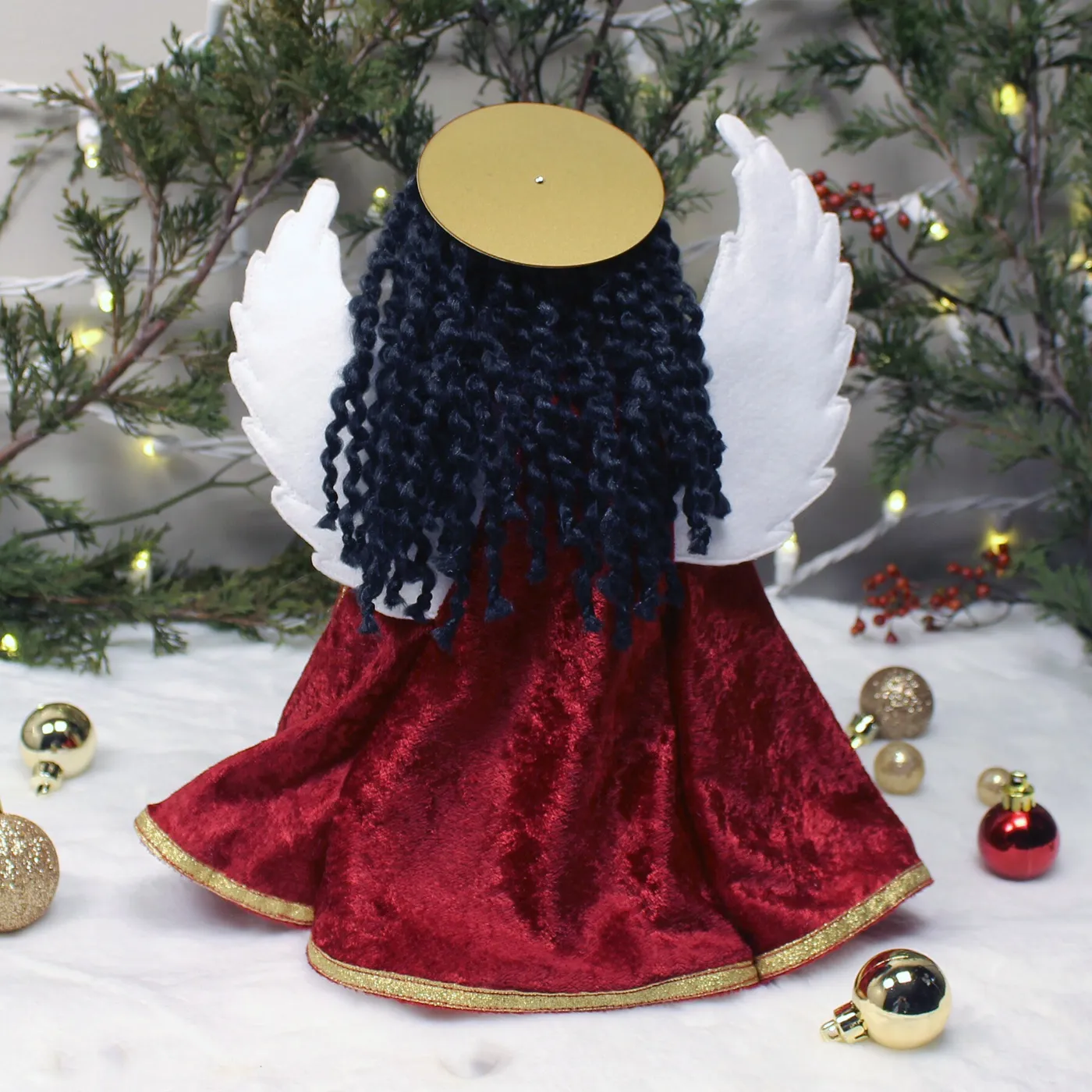
- Wrap black yarn around a 6-inch piece of cardboard about 40 times.
- Slide it off, tie tightly at one end (that becomes the crown), and cut the other end open.
- Separate into two coils and twist each in the same direction to hold the rope shape.
- Hot-glue the tied end to the head, then tack the tails at the shoulders so they hang forward.
- Mount the flat gold halo on a 4-inch wire stem behind the head, not on it.
About 40 minutes and roughly $6 in materials, assuming you already own the yarn.
Remember that a tree-top topper is mostly viewed from below and slightly behind, so the back is not a throwaway. Set the halo so it looks level from your main sightline — walk eight feet back, crouch to five feet, and adjust. And scatter the gold and red ornaments on a white faux-fur tree skirt around the base; the reflected warmth keeps the red velvet from going dark.
9. Crocheted Angel With Gold Yarn Hair
Crochet angels have been quietly climbing since 2023, and 2026 is the year they stopped being the grandma option. It’s part of a bigger move toward handmade, low-plastic holiday decor — the same impulse behind thrifted ornaments and linen stockings. They’re soft, they don’t shatter, and they photograph beautifully against warm lights. Staying power? Reasonably good. Handmade fiber reads as heirloom rather than trend, and this palette is about as safe as palettes get.
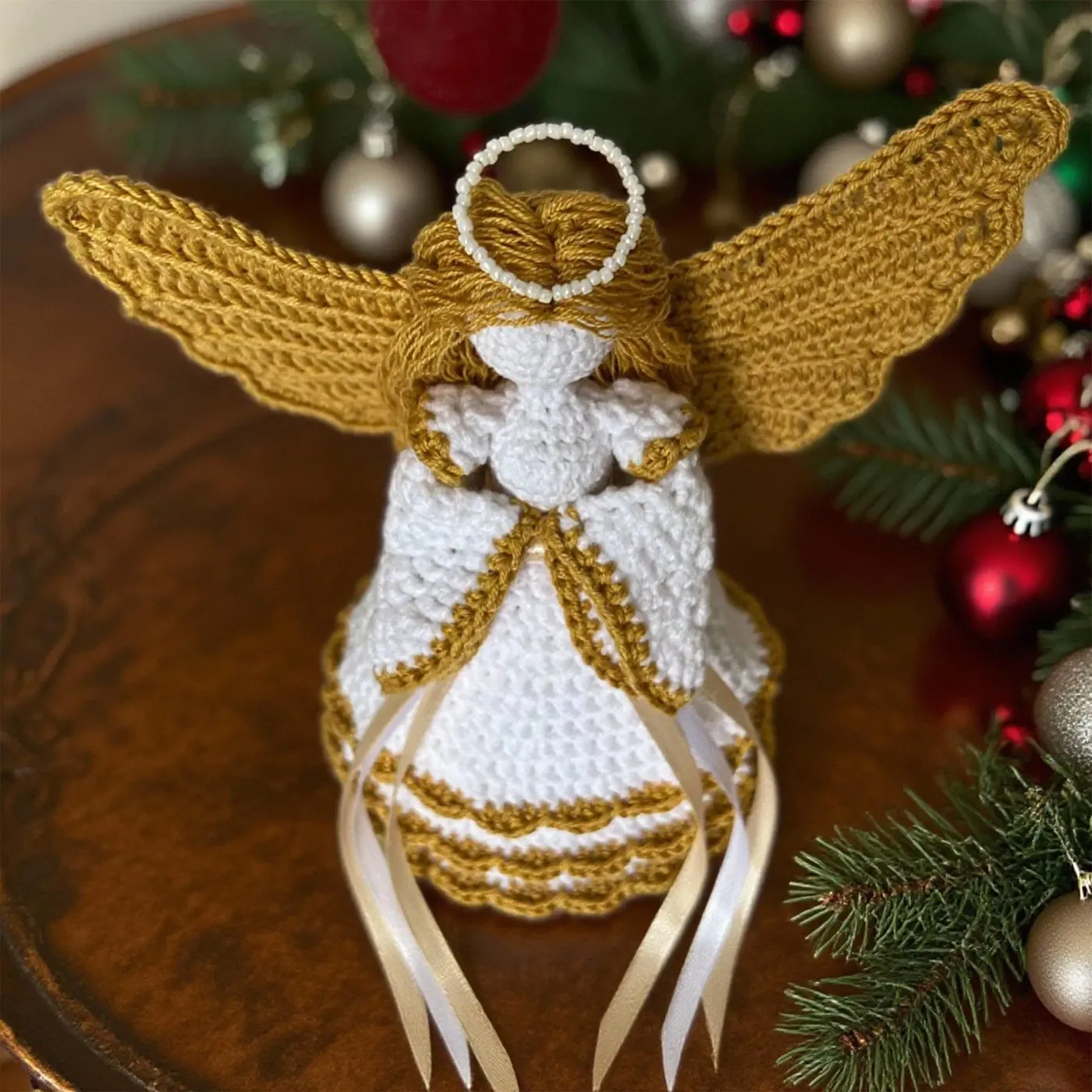
The formula is 70 percent cream, 20 percent gold, 10 percent green bleeding in from the tree. Because the gold arrives as yarn rather than glitter, it reads warmer and less shiny than a metallic angel, which means you can pair it with wooden beads and linen ribbon without a fight. Swaps that keep the math intact: soft taupe yarn for a quieter look, deep ochre for more contrast against green. Keep the dress cream. The moment the dress goes gold too, the whole thing turns into a blob.
10. Hand-Crocheted Angel in White and Mustard
Crochet angels run small — most land between 7 and 10 inches — so they suit 6- to 7.5-foot trees best. On a 9-footer the scale disappears unless you build a small platform of branches beneath it or hang a cluster of ribbon just below to extend the visual weight. Ceiling height matters less than tree height here; an 8-foot ceiling with a 7.5-foot tree leaves room to spare. Small rooms actually handle these better than grand ones. Compare with Idea #26, a much taller lace piece that needs volume around it.
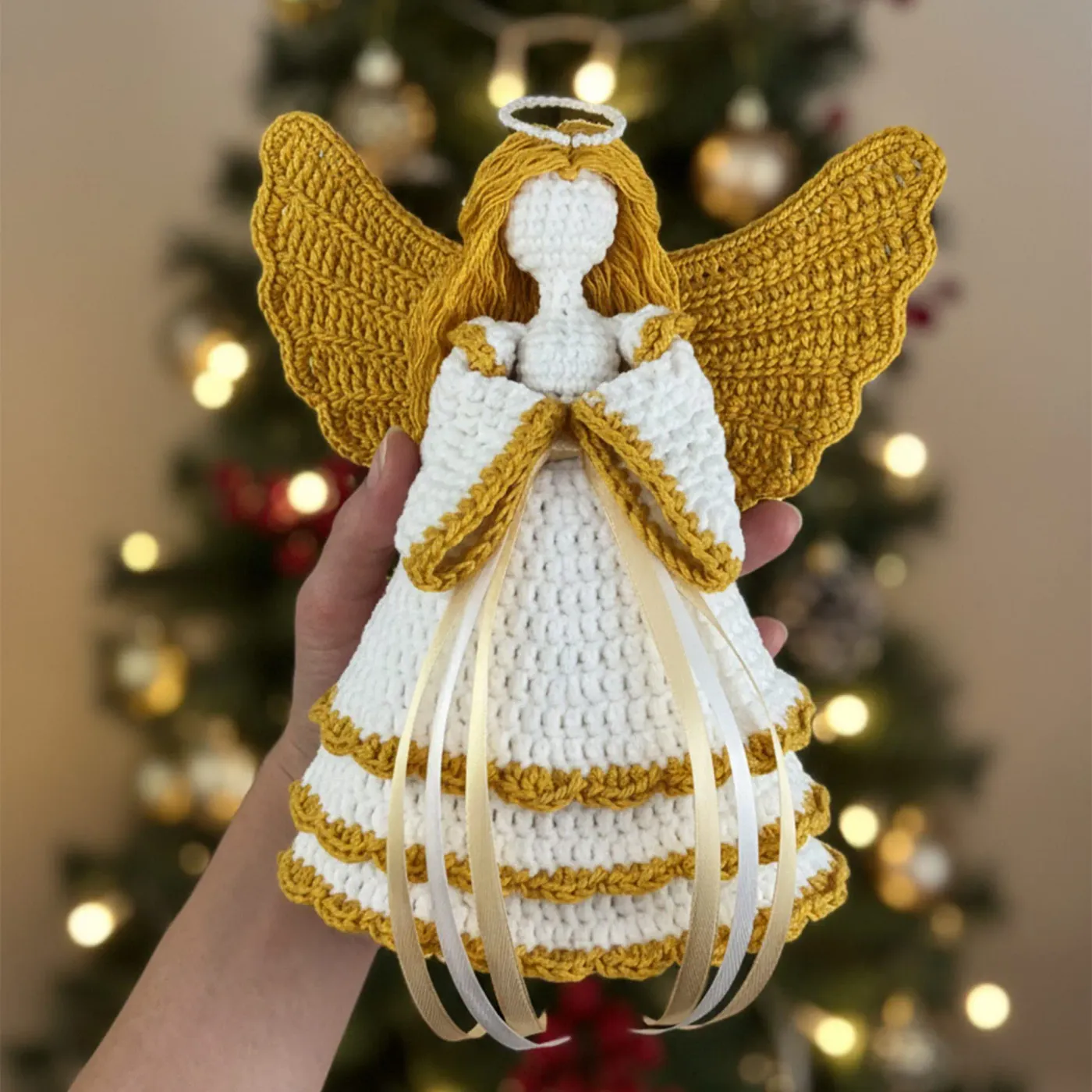
This is one of the few looks where handmade beats store-bought on price. Etsy crochet angels run $18 to $45 depending on complexity, and the pattern alone costs $4 to $7 if you already crochet. A department-store angel with this much detail is $50 and up, and it won’t have the mustard contrast or those thin yellow ribbons hanging from the arms. Secondhand is the wildcard: church sales and estate lots turn up crocheted angels for $3 to $8. Wash in cool water with a drop of dish soap, reshape while damp, and air-dry over a glass.
11. Gold Wire Mesh Angel With Candle Lights
The two candle lights are why this topper works and also why it’s hard to find intact. Wire-mesh angels from the fifties and sixties were built around a light socket, so the mesh glows from within — a completely different effect from surface glitter, and no modern replica gets it right. If the candles are dead you own a sculpture. If they work, you own atmosphere. That glittered gold sphere at the torso only reads as luminous when there’s light behind it.
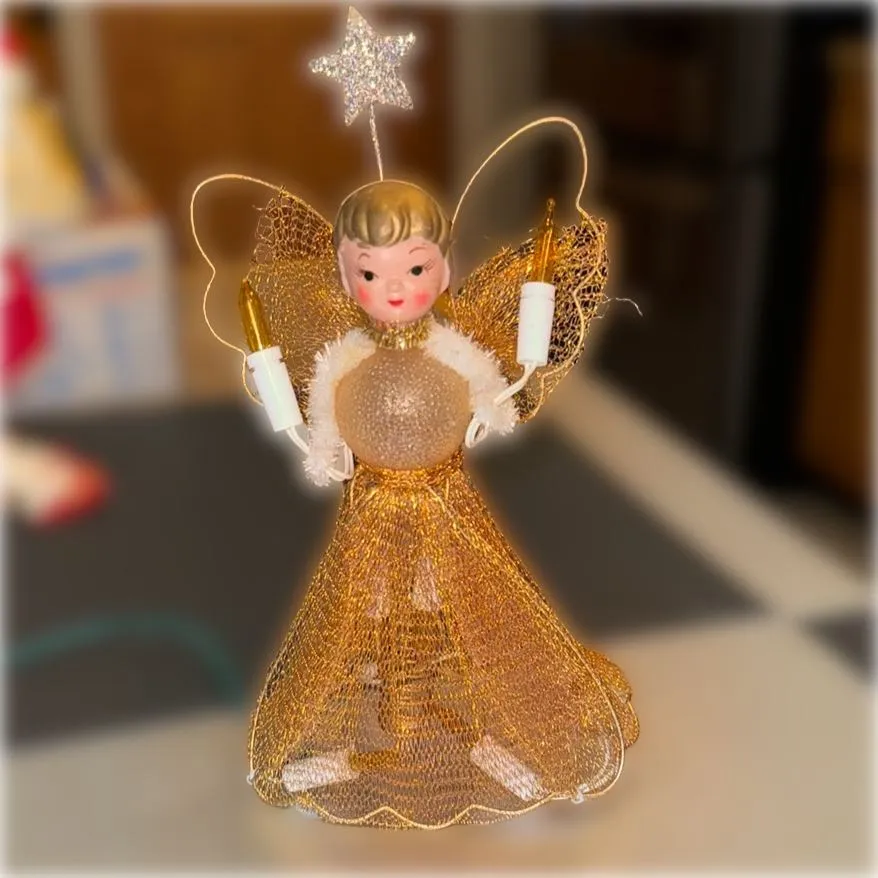
Check these before you commit:
- Test every socket with fresh bulbs — replacements are hard to match
- Inspect the wire mesh hem for rust, which stains everything it touches
- Confirm a plug reaches your tree, or plan for a battery pack
- Measure the star stem; these often run 16 to 20 inches tall
Two minutes of checking saves a December disappointment.
12. Folk-Art Angel With a Plaid Bow and Berries
Plaid ribbon is the cheapest way to make a small topper look intentional, and the trick is size. A bow at the tree top should run about 1.5 times the width of the angel’s shoulders — on an 8-inch folk angel, that’s a 6- to 7-inch bow. Smaller vanishes. Bigger swallows the figure. Use wire-edge ribbon; plain plaid sags into a sad loop by New Year’s.
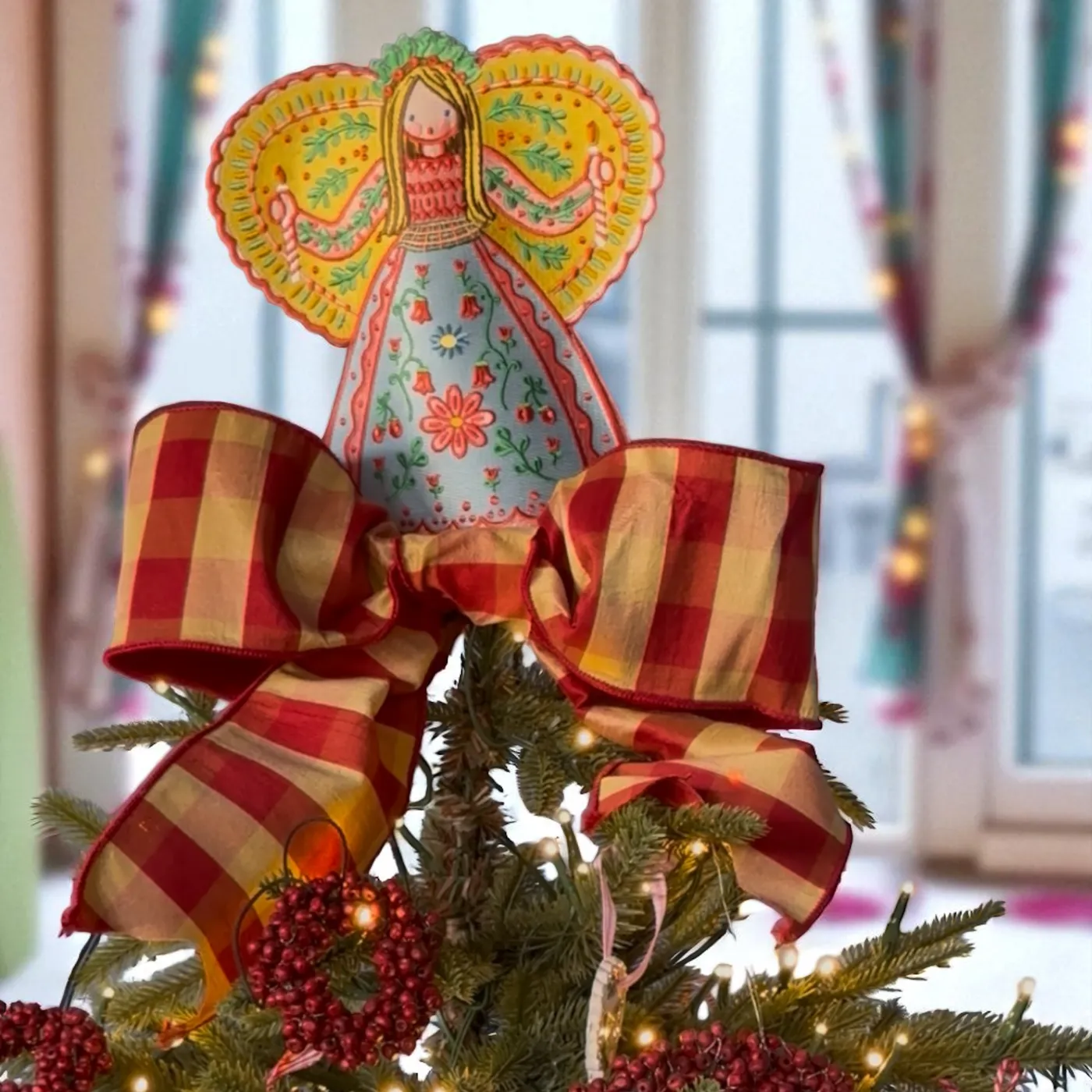
Three colors, each with a job. The yellow wings lift the figure, the light blue floral dress keeps it from going full primary, and the red plaid bow gives the crown of the tree one loud moment. Because the bow repeats the red in the berry clusters, the whole top feels deliberate rather than decorated — same red, three materials: fabric, berries, ribbon.
Folk-art palettes are forgiving in daylight and chaotic by lamplight. Red and yellow both warm up under incandescent bulbs, and a light blue dress can drift toward gray. Turn the tree lights on and look at the topper from across the room at night before you commit to the plaid.
13. Cream Felt Angel Holding a Teal Star
Felt is the most affordable material on this list and the one most people could actually make. A quarter yard of wool-blend felt runs $6 to $9 and yields three angels; the star is a scrap of stiffened felt with a handful of white beads. Etsy sellers price these at $22 to $38, which is fair for the handwork but not necessary if you own scissors. Target and IKEA both sell inexpensive felt ornament kits in November with a similar star shape — borrow the star, use your own angel.
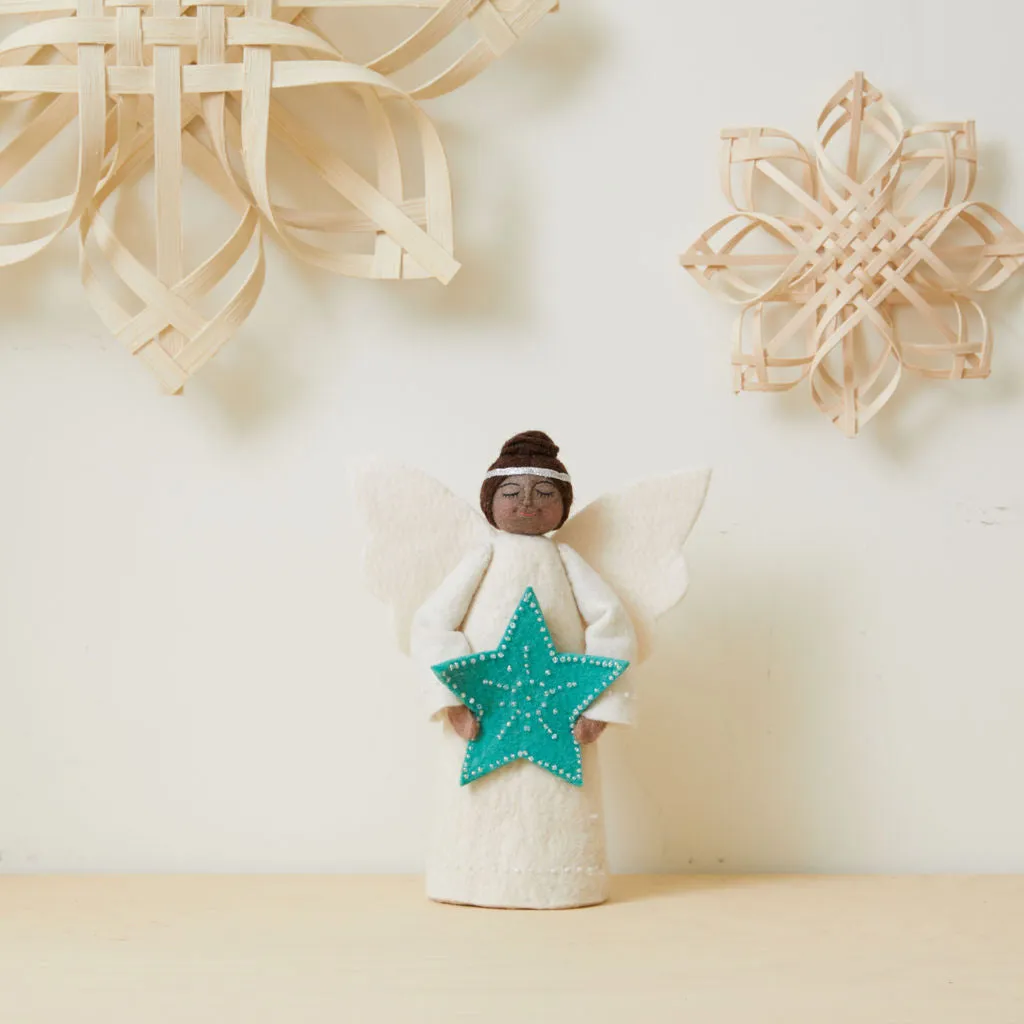
The teal star is the entire personality here. Cream felt, dark skin, a tidy bun, a silver headband: all lovely, all quiet. Then she holds up a teal star with white beading and suddenly there’s a color story. Take the star away and you have a nice handmade figure that disappears against a cream wall — the two woven wood stars hanging behind it seal the palette without competing.
14. Paper-Quilled Angel With Curly Hair
Making the coiled body is the satisfying part:
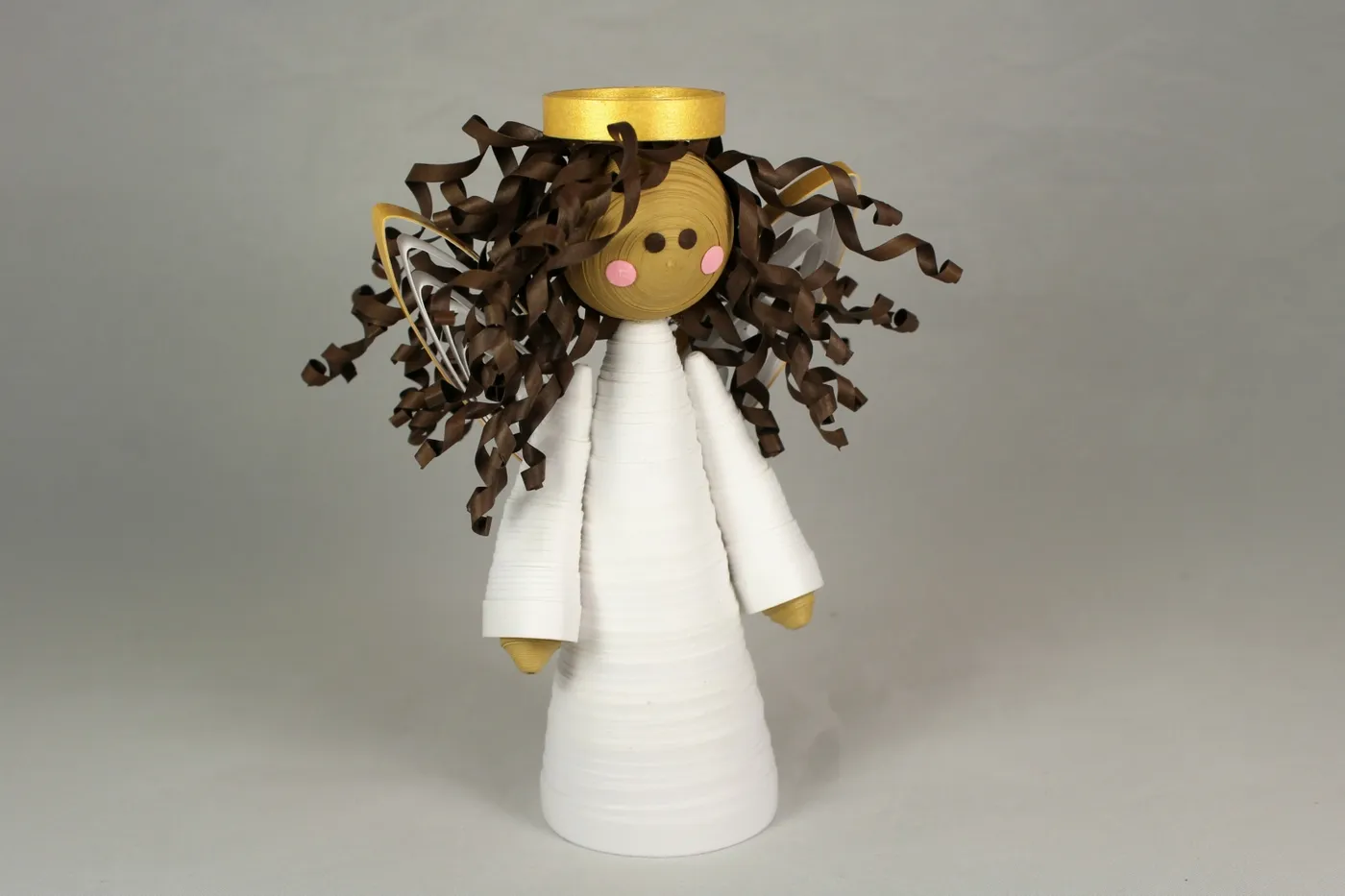
- Cut 1/4-inch strips of white cardstock and coil them around a pencil.
- Build the cone body in four stacked rings, gluing each to the one below and letting it set 10 minutes.
- Roll a 1-inch paper sphere for the head, then curl 3-inch strips around a skewer for the hair.
- Cut the halo from gold cardstock and mount it on stiff wire behind the head.
- Add eyes and cheeks with a fine-tip pen and a dab of pink chalk.
Roughly two hours and about $12 in paper and glue, most of which you probably own.
Quilled paper is light enough that it doesn’t need a heavy anchor, which is exactly why it tips over. Thread a 12-inch pipe cleaner down through the cone and twist it around the top branch — the paper stays upright and nothing shows from the front. Keep the paper clear of the top-third bulbs, too. LEDs run cooler than incandescent, but a paper strip resting against even a warm LED will scorch over a season.
15. Resin Angel With Sheer Golden Wings
Sixty percent cream, twenty-five percent gold, fifteen percent green-and-red print. The print is doing far less than it looks — because it’s small-scale and low-contrast, it reads as texture from three feet away. That’s the rule: the busier the fabric, the quieter the colors need to be. Trade the green-red print for a soft sage stripe and keep the braided gold trim. Trade the gold braid for silver and the whole thing goes cold and a little cheap.
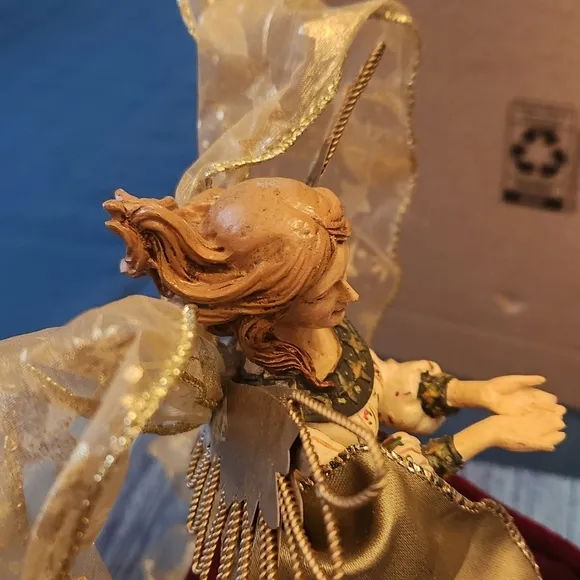
What it costs to assemble:
- Resin angel with fabric wings: $30–$75
- Gold braided trim by the yard: $5–$12
- Cream patterned fabric if you re-dress: $10–$20
- Sheer gold wing overlay: $8–$18
- Warm LED spot for the crown: $12–$25
Total: $65–$150. Budget alternative: a plain cream resin angel from a craft store runs $12 to $20, and the braid plus a wing overlay gets you there. The trim does 80 percent of the work.
16. Vintage Plastic-Face Angel With Amber Gems
Vintage felt bodies are the fragile part, not the wings. Sixty-year-old felt attracts moths, holds dust, and darkens along fold lines, and the sequins are usually stitched with thread that’s already brittle. Store it in a cotton bag, never plastic, and never in a hot attic. Check the thread at the shoulders once a year and reinforce with a single invisible stitch if it’s pulling. Expect to reglue a gem every few seasons — clear craft glue on a toothpick, not hot glue, which will melt the vintage plastic wing.
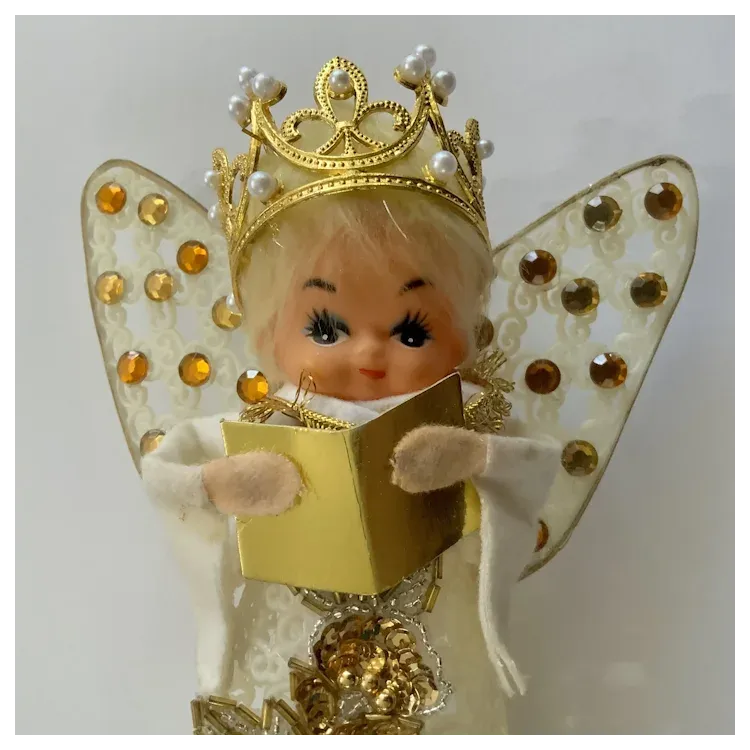
The doll face is make-or-break, and photos lie. Blush from this era yellows; under warm tree lights it reads orange, and under cool LEDs it goes gray. Hold it next to your actual lights before buying, or ask the seller for an unfiltered photo. A repainted face is fine. An unevenly repainted face is not, and the small golden book in her hands only sells the illusion if the face holds up.
17. Five Vintage Angels, One Tinsel Garland
Five angels at different heights, all in white and gold, is an argument for repetition over variety. The gold tinsel and silver beaded garland tie them together, the candy canes add the one hit of red, and the mix of solid and sheer dresses keeps it from looking like a store display. Same principle as a gallery wall: same family, different faces.
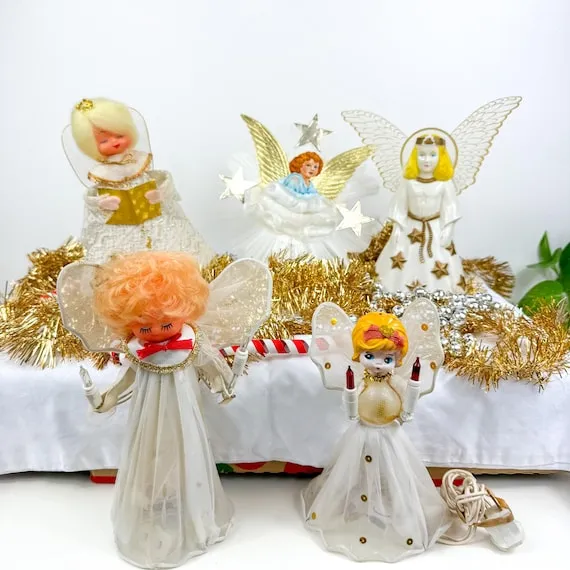
If you’re building a set from thrift shops — and you should, most of these run $4 to $15 — shop with a filter:
- Same finish (all gold or all silver) — mixed metals only work when one dominates
- Heights within 4 inches of each other
- No cracked faces or missing hands
- Exactly one soft element per angel: lace, tulle, or tinsel
Five new angels at $30 each is $150. Five thrifted ones plus a spool of gold tinsel and a strand of silver beads lands near $45, and nobody else owns it. Search “box of Christmas angels” on Marketplace — $10 bundles are still out there. Hand-wash sheer dresses in cool water, blot, reshape over a glass, never wring.
18. Lace-Gown Angel on a Black-Wire Tree
A sparse tree needs a topper that can carry the top third alone, and this one does it because the white-and-gold lace reads solid from a distance. Good fit for a 7- to 8-foot tree under an 8-foot ceiling — the open branches let the angel’s silhouette show completely, which is the entire point. In a double-height room the same piece gets lost. Compare with Idea #22: that red-and-gold topper needs a full tree underneath it, not a sparse one.
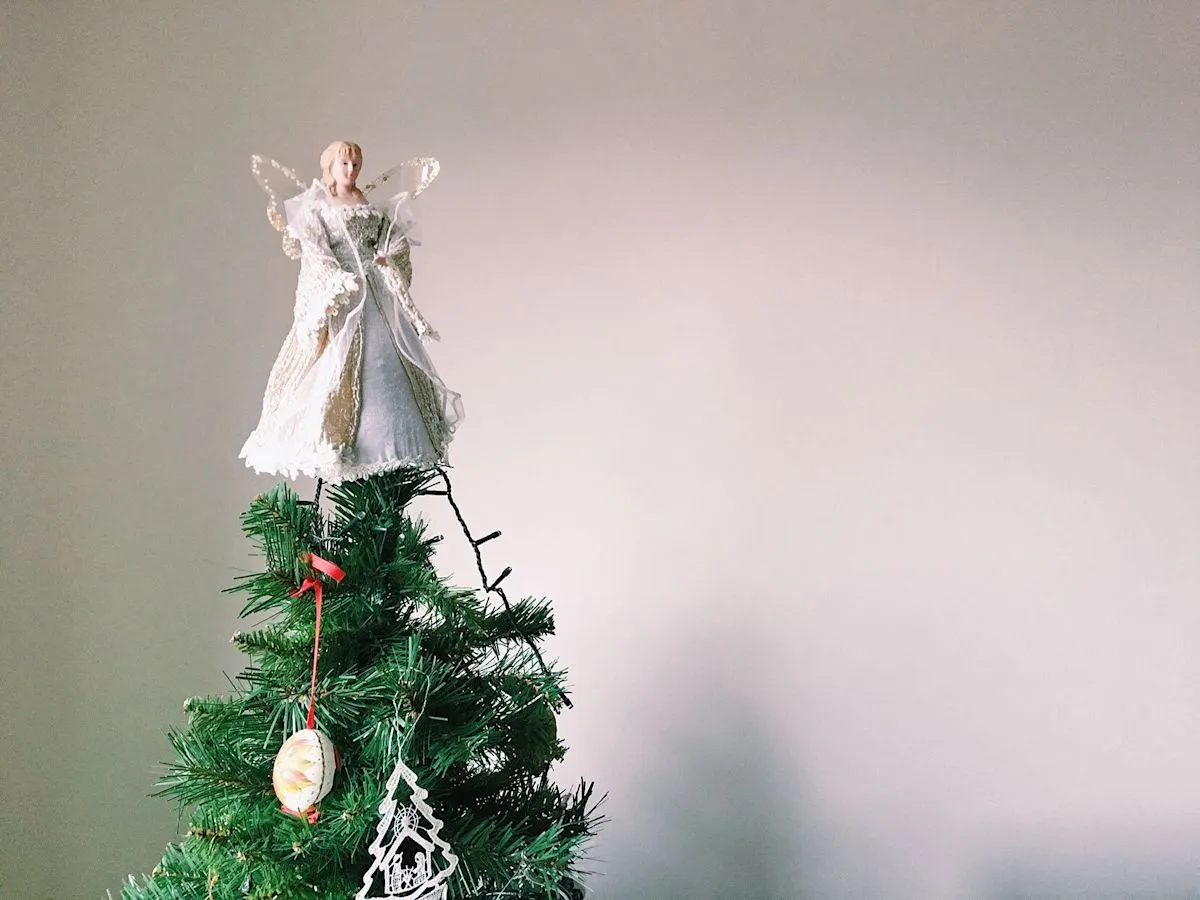
Black wire lights are a deliberate choice on a sparse tree. They vanish against dark branches and keep attention on the few ornaments — here a red ribbon and a nativity cut-out. The catch is contrast: white lace against black wire needs one warm neutral between them or the top of the tree looks harsh. A single cream ribbon looped below the angel fixes it for about $4.
19. Porcelain Angel String Lights in Ruffled White
String-light angels are enjoying a small revival because of a bigger 2026 shift: people are decorating smaller secondary trees — entryway trees, kitchen trees, bedroom trees — and those need lower-stakes toppers. A strand of five small porcelain-faced angels costs less than one statement piece and covers a 4-foot tree completely. They’re also the most giftable thing here, since five angels on white wire doesn’t require knowing someone’s color scheme.
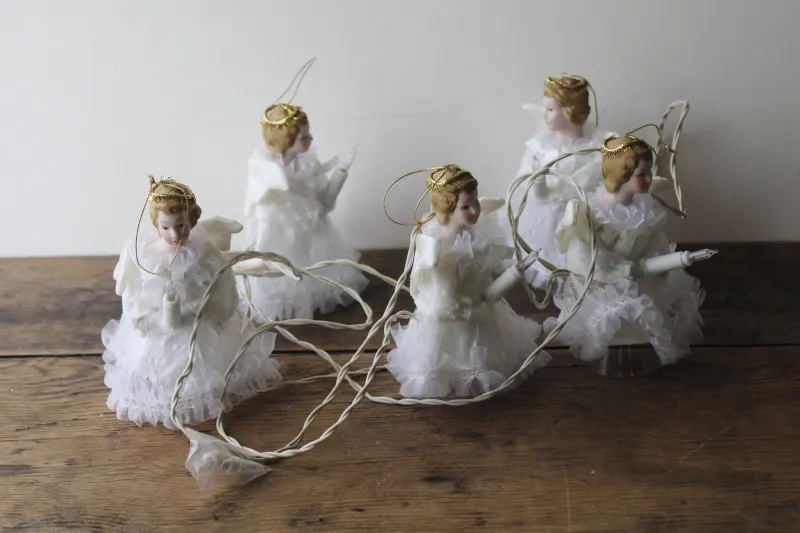
Before you plug anything in:
- Count your outlets — vintage strands often have no end connector
- Verify every socket works; replacements are increasingly rare
- Confirm wire length covers your tree plus 2 feet
- Look for heat damage near the sockets
If more than one socket is dead, treat it as decor rather than lighting. Displayed on dark wood against a pale wall, the golden crowns still do plenty of work unplugged.
20. Gold-and-Cream Angel on a Nearly Bare Fir
The restraint is the design. A cream-and-gold angel with sheer wings on a plainly lit tree with two ornaments — a decorated egg with a red ribbon, a white nativity cut-out — is doing what most decorated trees can’t: leaving space. The angel becomes the subject instead of the punctuation. Take away the empty branches and the mood goes with them. See Idea #18 for the same logic in black wire and lace.
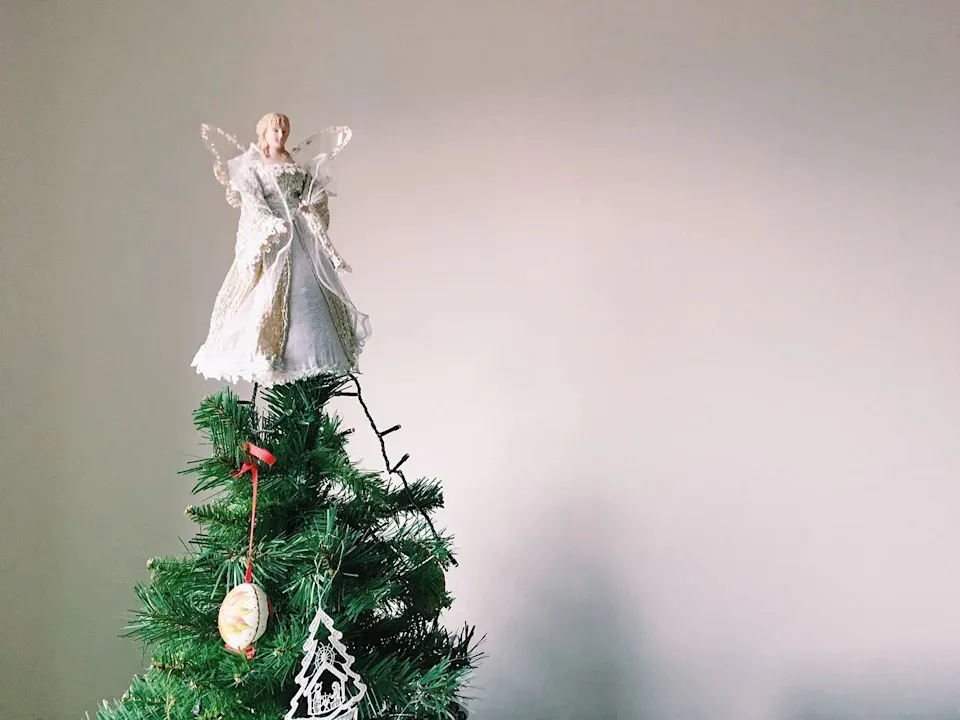
What it costs to keep it this simple:
- Cream and gold angel topper: $25–$60
- Clear string lights, black wire, 100 count: $12–$22
- Two or three heirloom-style ornaments: $8–$20
- Fresh 6.5-foot tree, if starting over: $60–$150
Total: $105–$252 with a new tree, $45–$102 without. Budget alternative: skip the tree entirely and spend $30 — one angel, one strand, two ornaments you already own.
21. Crocheted White and Mustard Angel With Fringe
Eighty percent white yarn, twenty percent mustard — and the mustard is split across hair, wings, and scalloped trim so it never clusters. That distribution is why it doesn’t look like an accident: the eye finds the same color in three places and reads it as a system. Swap the mustard for dusty blue and the math holds. Swap it for red and reduce it to about ten percent or it takes over the whole topper.
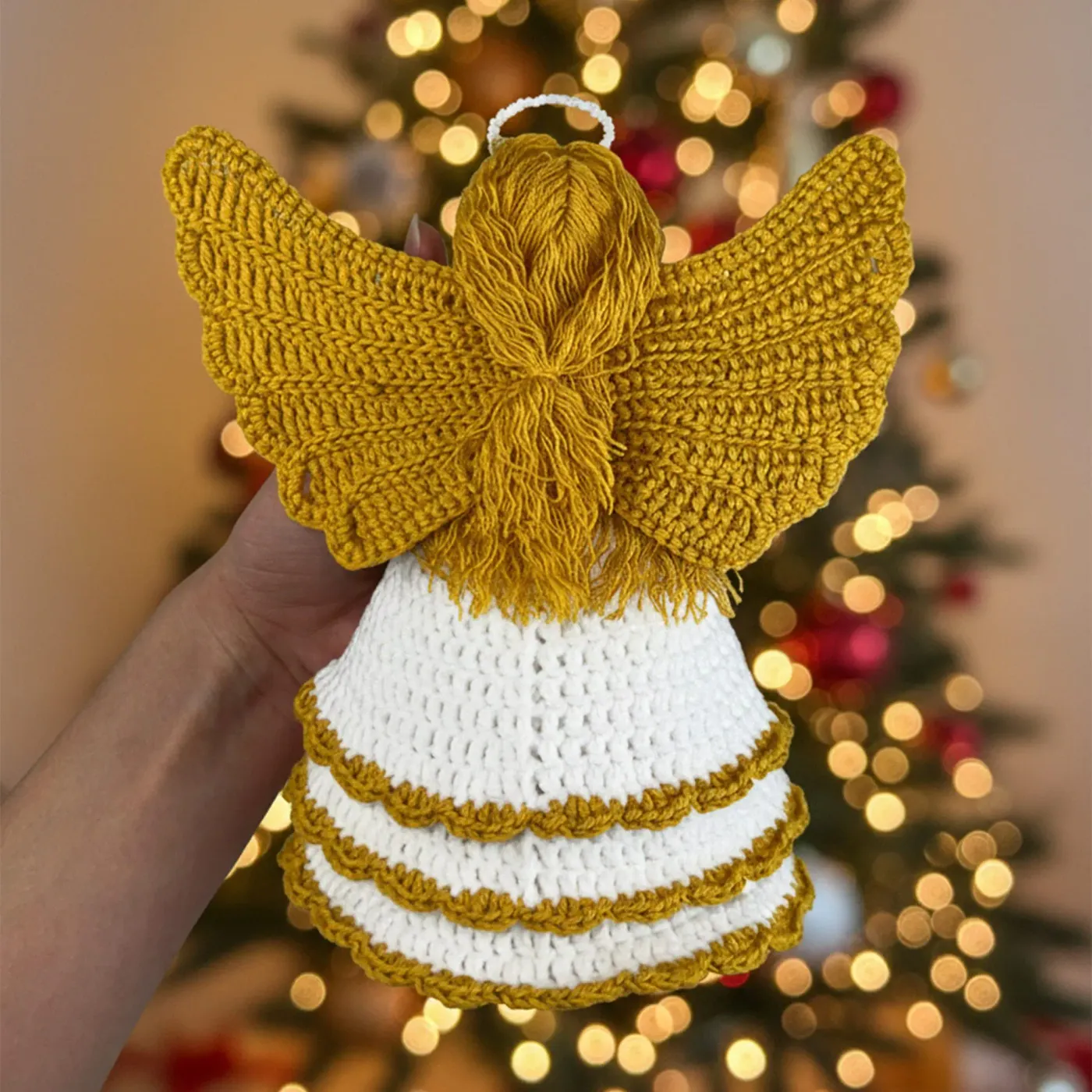
Crochet is durable but it’s a dust magnet, and textured stitches hang onto it. Once a season, put the angel in a pillowcase, tie it off, and run five minutes of air-only dryer cycle. Never machine wash — the halo won’t survive and the scalloped trim will felt. Yarn fades, too: direct sun will bleach mustard to pale yellow in two or three seasons.
Fringed yarn hair looks best cut on a slight angle rather than straight across; a flat cut reads as a broom. Trim in small passes with the fringe held between two fingers, checking from three feet back each time.
22. Red Velvet Top, Gold Skirt, Feather Wings
Two materials and a lot of trim, so the price spreads accordingly:
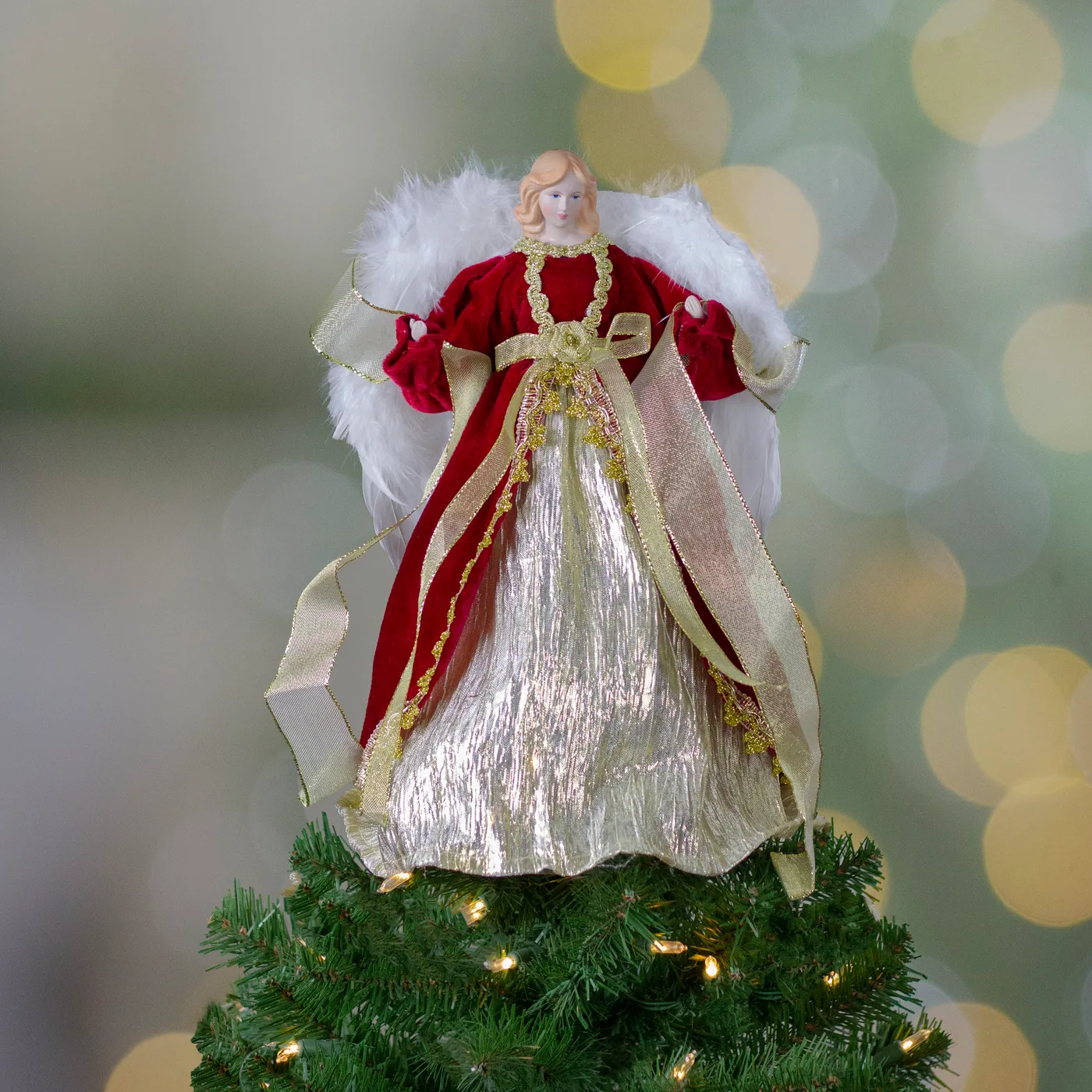
- Angel with velvet bodice and gold skirt: $40–$95
- Gold ribbon assortment: $8–$16
- Feather wings, replacement or upgrade: $10–$22
- Warm white light strand for the crown: $10–$18
Total: $68–$151. Budget alternative: a plain red velvet angel from a discount store runs $15 to $25, and a strip of gold lamé laid across the skirt — pinned, not glued, so you can change your mind — gets you the same two-tone read.
Velvet plus feather attracts dust and static in equal measure, and the pair is genuinely annoying to clean. More practically: this is a tall, wide topper. On a 6-foot tree it eats a third of the visible height and the tree looks top-heavy. Measure your tree’s top section before you buy — you want at least 18 inches of clean branch below the gown so the gold skirt can actually be seen.
23. Close Up on the Soft Feathered Wings
Feather wings are the one part of a topper that benefits from being fluffed. Out of the box they’re compressed. Hold the angel upside down and run your fingers through each wing from the base outward, separating the barbs, then mist very lightly with water and let it dry in shape. Five minutes, and the wings gain roughly 30 percent more volume — which is exactly what you paid for. Do it before you set the topper on the tree, not after.
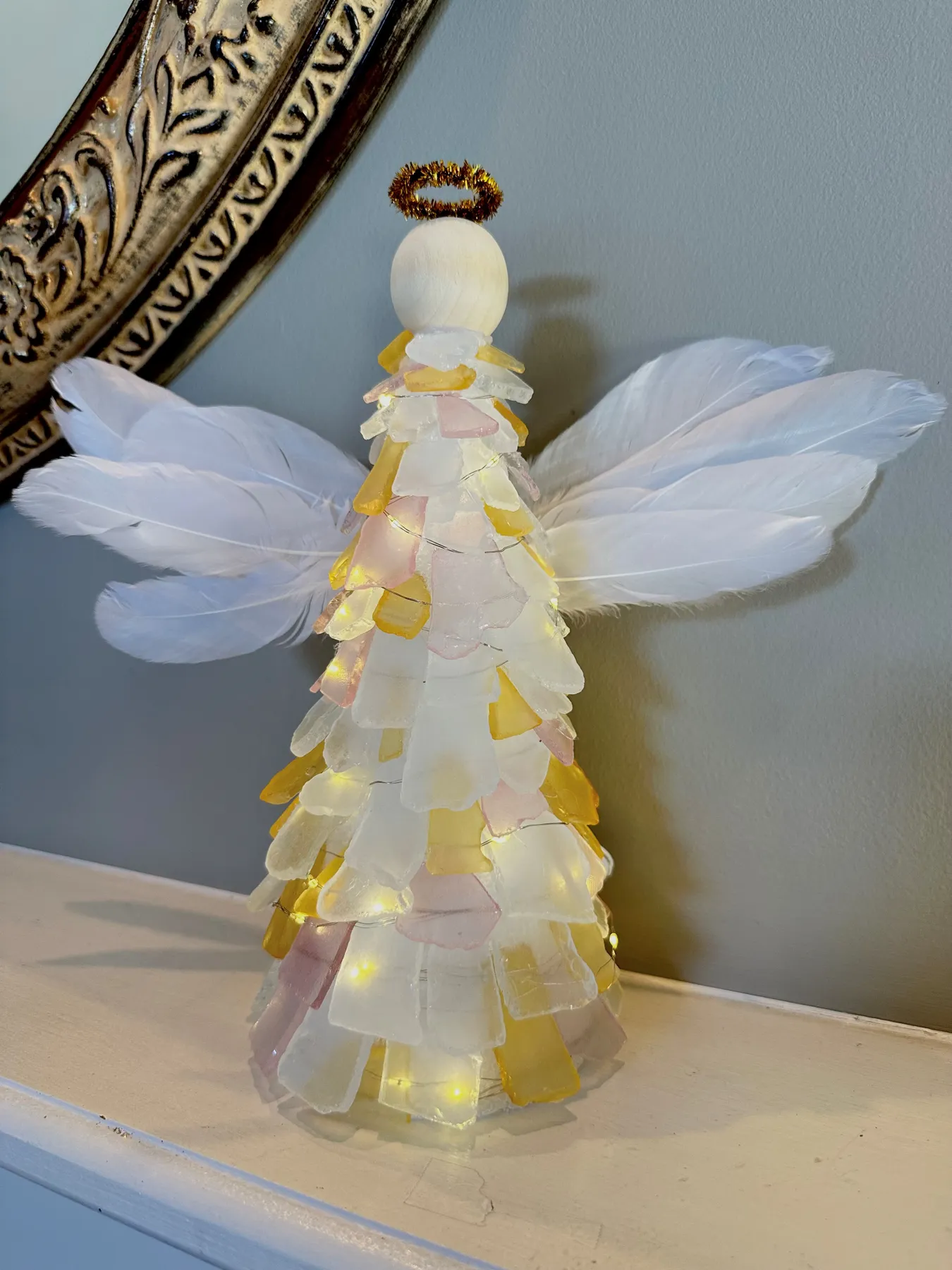
Soft wings plus a detailed gown is a study in texture hierarchy. The feathers are large and low-contrast, the gown is small-scale and intricate, and the gold accents are tiny and bright. Three levels of detail stacked on top of each other, so the eye keeps finding new things as you move closer. That’s what separates a topper that looks inherited from one that looks purchased.
24. Ruffled Red Skirt Angel With a Tinsel Halo
Those tiny props in her hands need real attachment, not hope:
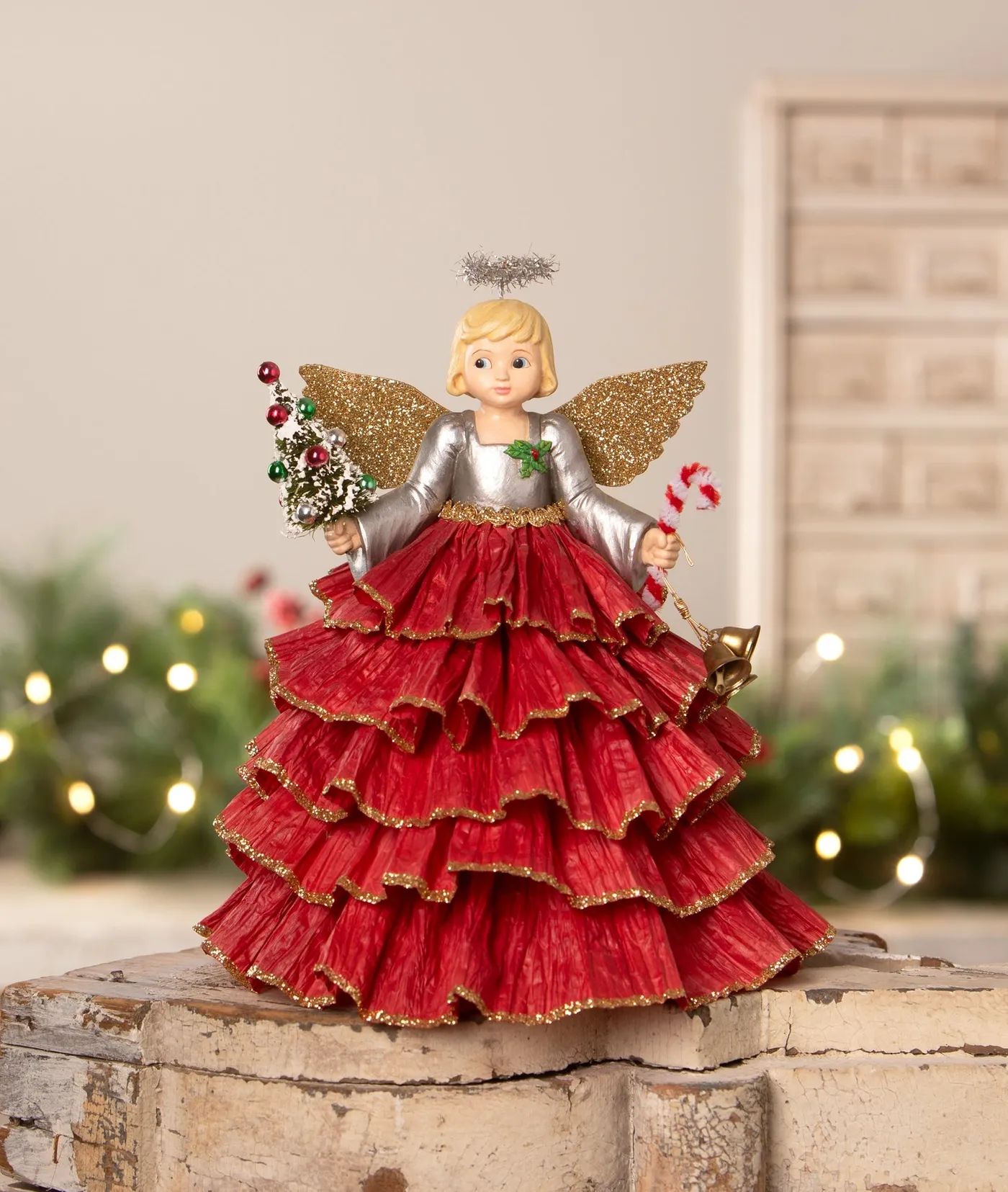
- Clip the mini tree’s base flush and drill a 1/16-inch hole into the hand if it’s resin.
- Insert a 1-inch piece of floral wire and bend it to hook the tree trunk.
- Thread the candy cane onto a second wire at the opposite hand, angled slightly outward.
- Stitch the gold bells on with a single thread, not glue — glue yellows.
- Hold the topper by its base and check it hangs level before it goes up.
About 25 minutes and under $10 in supplies.
Ruffled skirts are the easiest thing to fake. A discount-store angel with a plain red skirt plus pre-gathered red ruffle trim from a fabric store gets you 90 percent of the way for about $22. Run gold glitter glue along the hem and nobody will know. Or thrift it: red ruffled angels were everywhere in the nineties and turn up for $6 to $12. Hand-wash the skirt cool, hang dry, re-glitter the hem.
25. Dark-Haired Angel in a Fur-Trimmed Red Cloak
This is a room-scale topper. The red cloak and gold wings are bold enough to hold their own against a lit mantel and a gold ornament wreath on the wall behind, which means a tree of at least 7 feet and a wall that isn’t already busy. In a small living room with a gallery wall, the same angel competes with everything and loses. Ceiling height is the real constraint: leave 8 inches between the halo and the ceiling so the tree looks crowned rather than crammed.
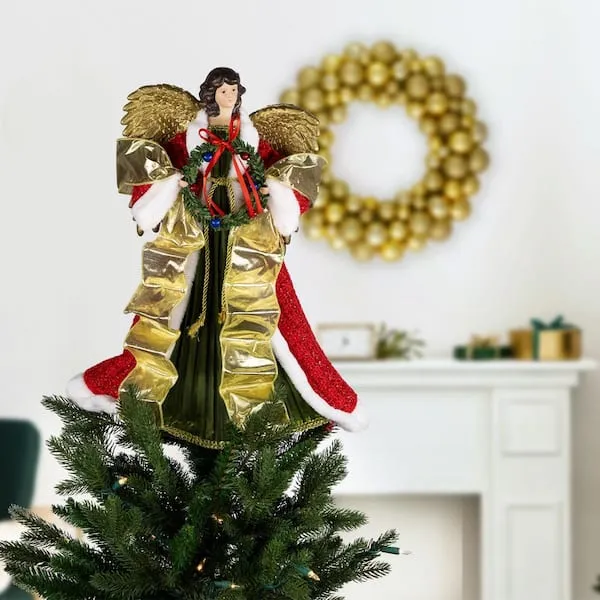
The red cloak with white faux fur trim is what makes this angel read as a character instead of a figurine. A dark green dress and gold wings alone would be handsome but generic. The cloak adds a second color, a texture, and a bit of story — she looks dressed for weather. Remove it and you lose the personality entirely.
26. Porcelain Angel With a Lace Overlay and Gold Sash
When a topper carries this much lace, the halo becomes a lighting problem. A flat gold halo catches the bulb behind it and throws a bright ring onto the wall — very distracting on plain paint. Angle the halo 10 to 15 degrees forward so it reflects down into the gown instead of out into the room. Small adjustment, big difference, and it takes about as long as reading this sentence. The spiky tinsel rays behind the head will do the same thing, so keep the nearest bulb a few inches off-axis.
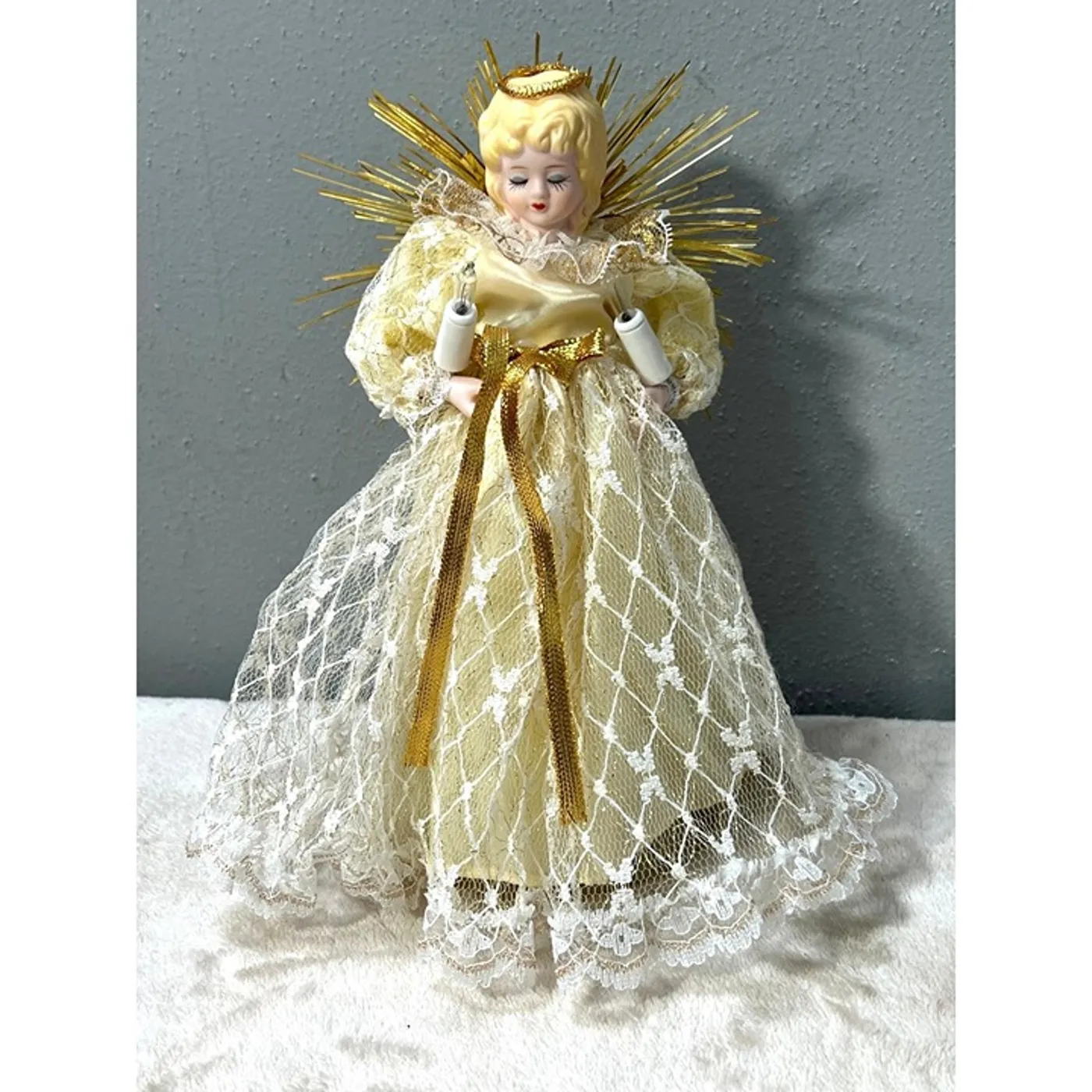
Cream, white, and gold in a 50/35/15 split, and the reason it doesn’t read flat is that the whites are different temperatures. The satin underlayer is warm cream; the lace overlay is cooler white. That subtle mismatch creates depth without adding a single color. To cool the whole piece down, swap the gold bow for champagne and the halo for brushed brass, keeping the cream base exactly where it is. Compare with Idea #15, which gets the same layering from a printed fabric instead of lace.
27. Sparkly Silver Angel With Curled Yarn Hair
Sparkle is cheap to add and expensive to buy:
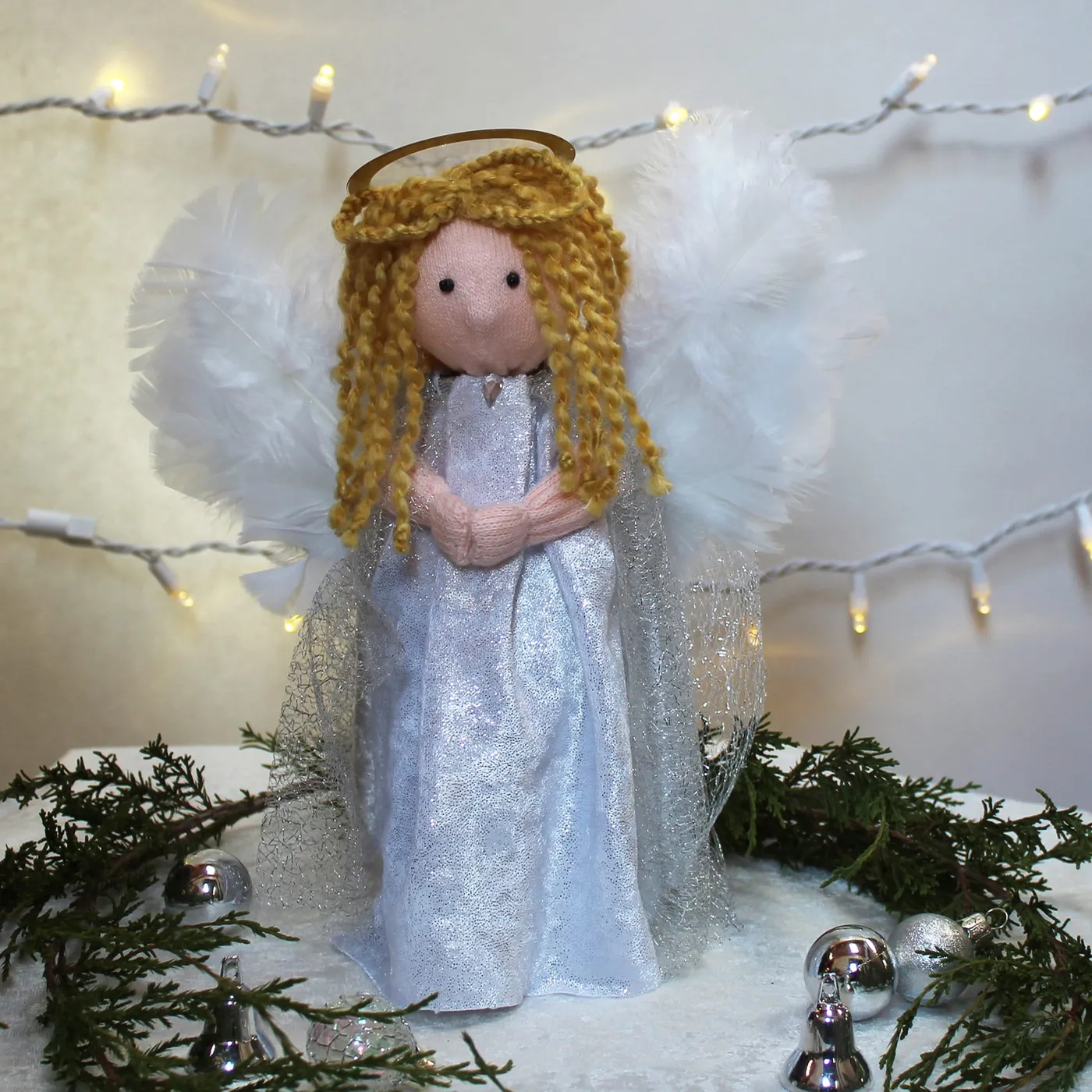
- Plain white fabric angel: $12–$20
- Half yard of sheer silver mesh: $6
- Pack of twelve silver bells: $4
- Silver mini ornaments for the base: $5
That’s about $28 for something that looks bespoke. Target’s after-Christmas clearance is where these live — 70 percent off in the first week of January, which is the correct time to buy next year’s topper.
To put it together:
- Cut a 10-inch square of silver mesh and gather it at the neckline with a running stitch.
- Pull the thread to fit the shoulders and knot it inside the dress.
- Curl 3-inch lengths of yellow yarn around a pencil and steam 20 seconds.
- Glue the curls in a spiral starting at the crown.
- Cluster three silver ornaments and two bells at the base to hide the branch collar.
About 45 minutes and roughly $10 if you own a glue gun.
28. Blonde Angel on a Flocked Tree With Mint Baubles
Flocked trees shed. Every time you move one — and every time you put the topper on — a fine white dust lands on the angel, the floor, and whatever sits underneath. It’s not harmful, just relentless, and a cream gown with silver patterning will show every speck. Put a sheet down before assembly and vacuum the gown with a brush attachment in January before you pack it. Flocking plus faux fur plus warm lights is also a lot of white; one mint bauble and a rose-gold ornament keep it from going monochrome.
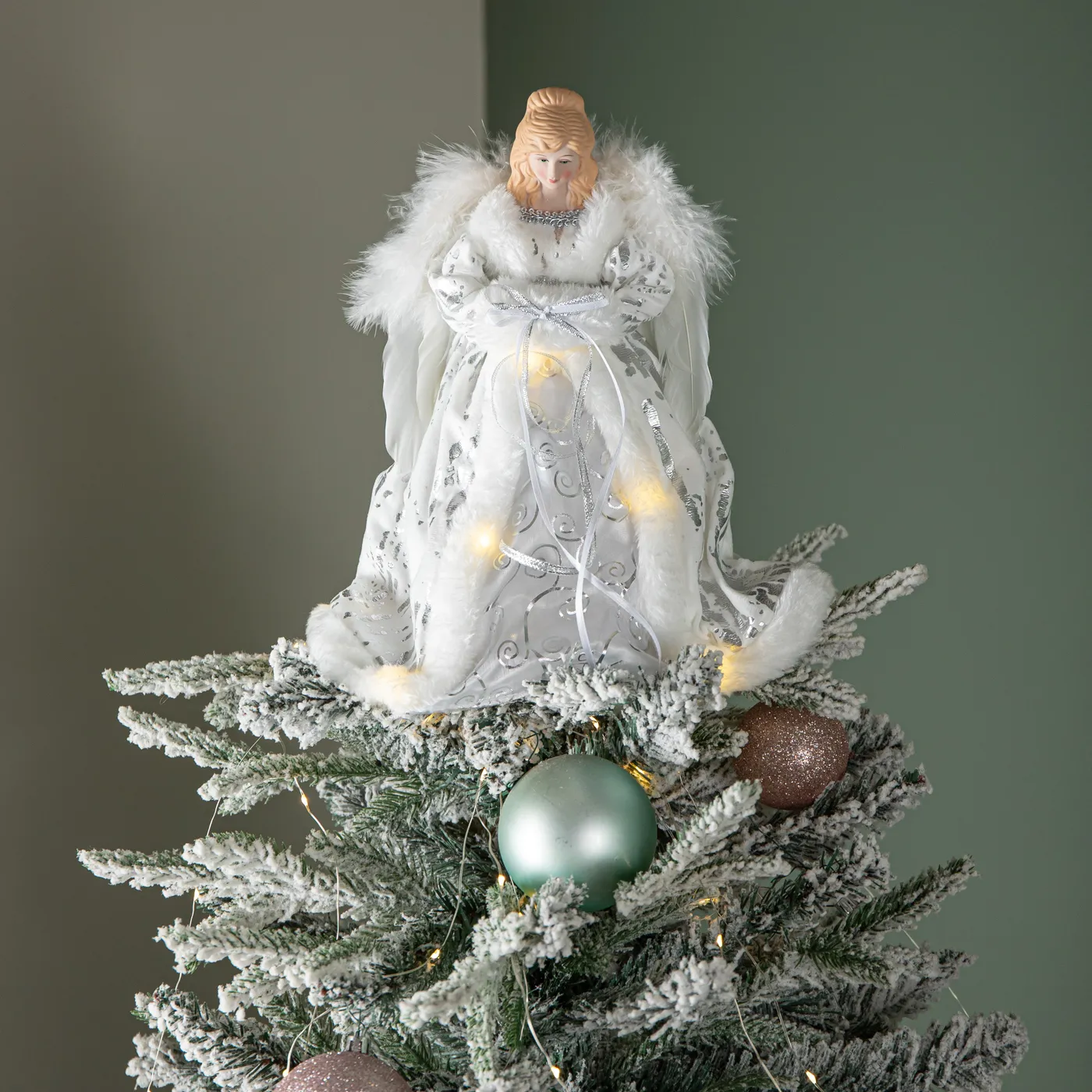
Flocked trees read bigger than they are because white adds visual weight, so a 7-foot flocked tree comfortably takes a 10- to 12-inch angel. With a 6-foot flocked tree in a small room, drop to 8 or 9 inches or the top looks wedged in. Compare with Idea #27 — same silver palette, but that one is built for a tabletop rather than a full tree.
29. Golden Metallic Angel in a Chevron Dress
Metallic angels are the 2026 answer to a very specific problem: modern rooms. If your living room is warm wood, plaster, and matte black, a traditional velvet angel fights everything in it. Brushed gold and off-white metal read as sculpture instead — and they look just as good on a shelf in July as they do on a tree in December. This is the year-round decor habit showing up in holiday aisles. Buy it for the mantel, use it for the tree, leave it out.
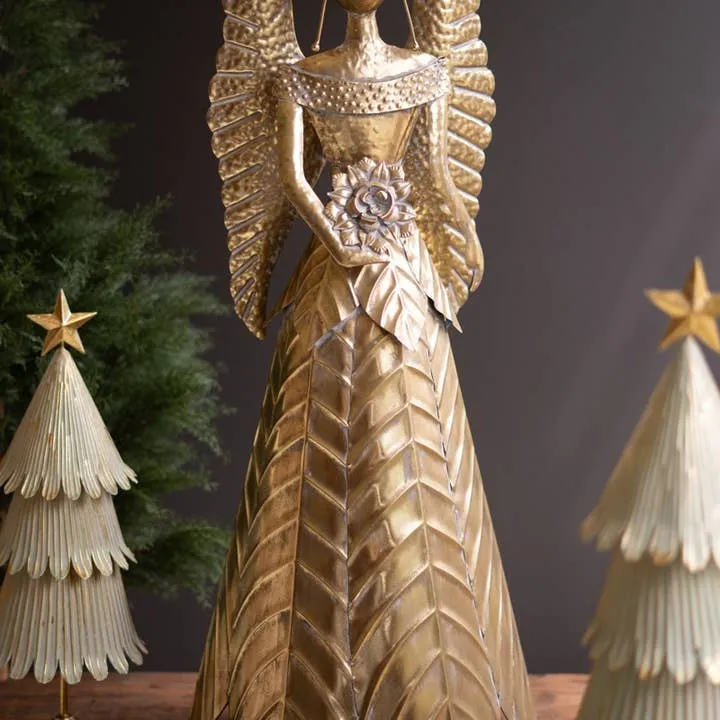
Group metallics in odd numbers and stagger the heights. Here, one large angel flanked by two smaller star-topped trees at roughly two-thirds her height builds a triangle, the most stable composition you can put on a table. Keep the gaps at 2 to 3 inches — touching metals merge into one lump, and too far apart they stop reading as a group. The evergreen sprigs at the base soften the whole arrangement.
30. Cream-Gown Angel With Textured Gold Wings
The crinkled gold sash is doing something clever: it wraps horizontally, which visually breaks a very tall vertical figure. Without it, an angel this elongated reads as a column. With it, your eye stops at the waist and the proportions feel human rather than stretched. The second principle is texture contrast — smooth cream against rough, distressed gold. Same color family, completely different surfaces, which is why it looks aged instead of cheap.
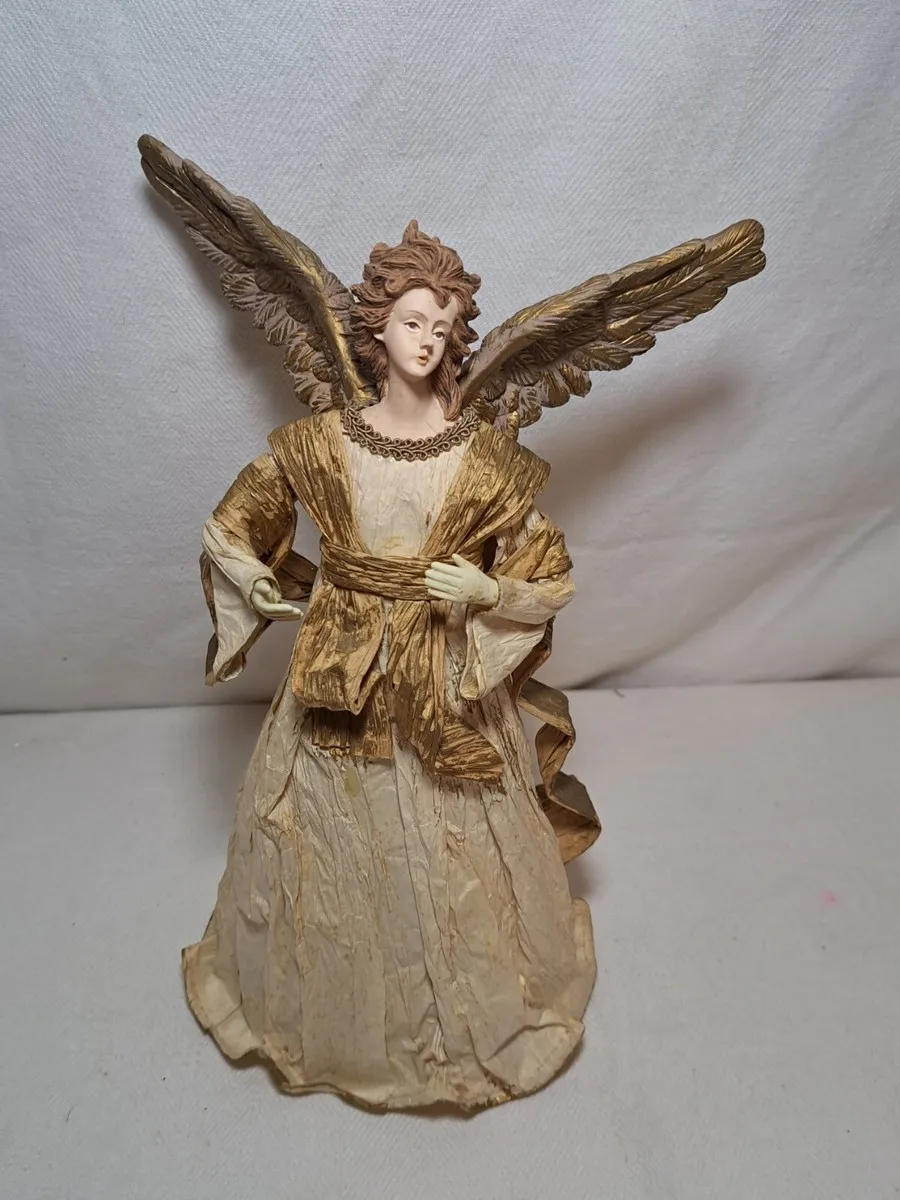
Cost to recreate:
- Angel with draped gold fabric: $35–$85
- Gold crinkle fabric by the yard: $8–$16
- Distressed gold acrylic paint: $5–$9
- Warm clip light: $10–$20
Total: $58–$130. Budget alternative: a plain cream angel, a yard of crinkle fabric, and a dry-brush of gold gets there for around $30.
To age the wings: load a stiff brush with gold acrylic, wipe most of it off on a paper towel, then drag it across the raised texture only, working one direction and stopping before it looks even. Ten minutes, about $6 in paint.
31. Vintage Angel With Light-Up Candles and Red Mats
Those orange candle bulbs are the entire charm and the first thing to fail. They’re usually a 2.5-volt screw base you can still find online for about $3 each — buy four, not two. Before you buy the topper at all, unscrew one bulb and check the socket for corrosion; green crust means the contacts are gone and the candles will flicker or stay dark. Also keep it off a clicking timer. The inrush on old wiring is what kills vintage bulbs.
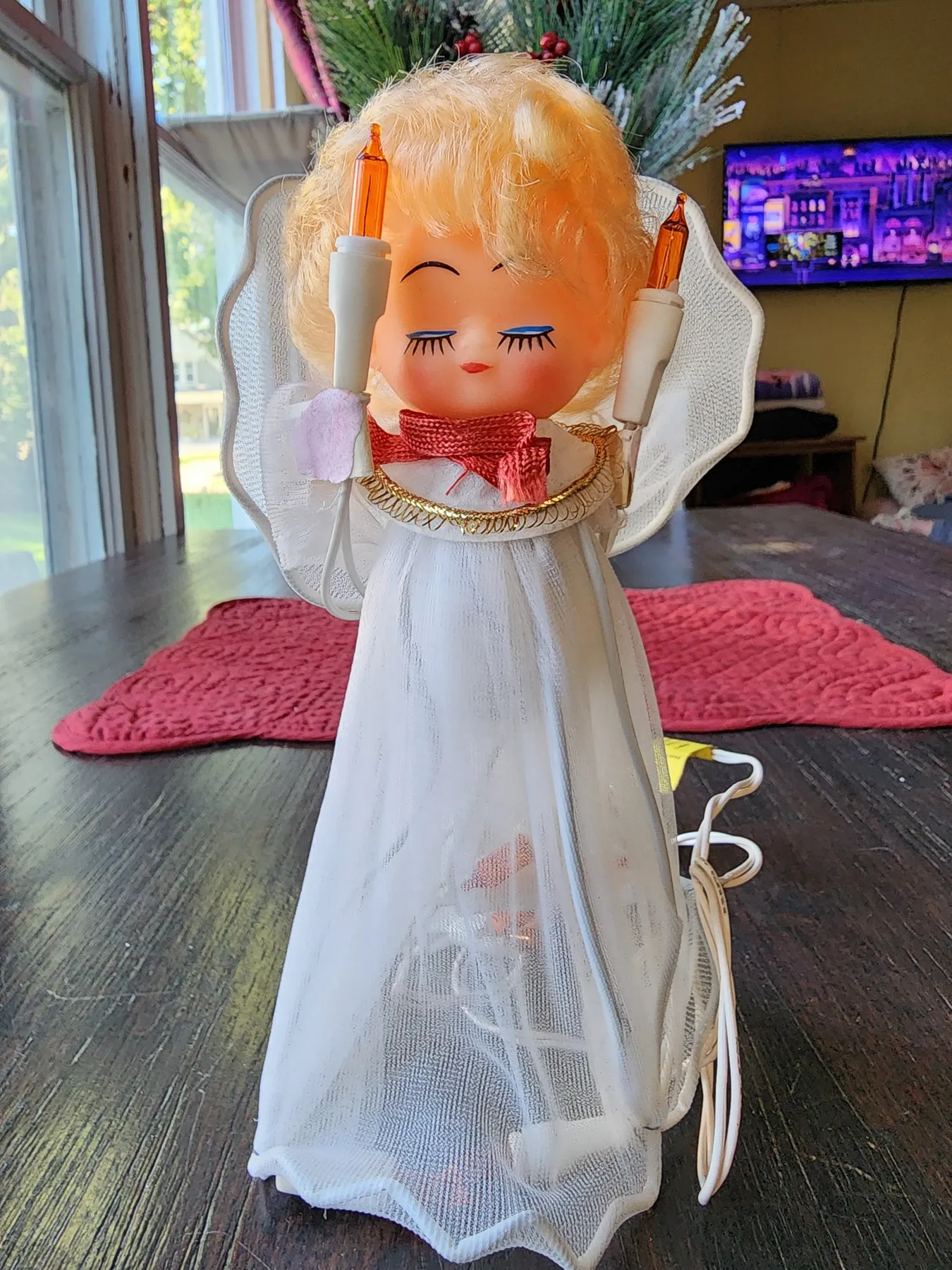
These run $18 to $45 at antique shops and $5 to $12 at estate sales if you’re willing to dig. The red knitted placemats underneath are a five-dollar thrift find doing real work — red under a white angel warms the whole vignette and keeps it from floating on dark wood. If you can’t find one with working candles, buy a dead one cheap and tuck a $6 battery tea light behind each candle shape. Nobody will know, and you skip the wiring entirely.
32. Iridescent-Robed Angel Holding a Golden Lantern
The lantern is what turns this from a figure into a scene. Iridescent blue-green and burnt orange robes with a gold chain are gorgeous, but they’re static; a lantern in the hand implies she’s going somewhere. It also gives you a second, lower light source if you tuck a battery tea light inside — a small warm glow at hip height instead of one big glow at the top of the tree.
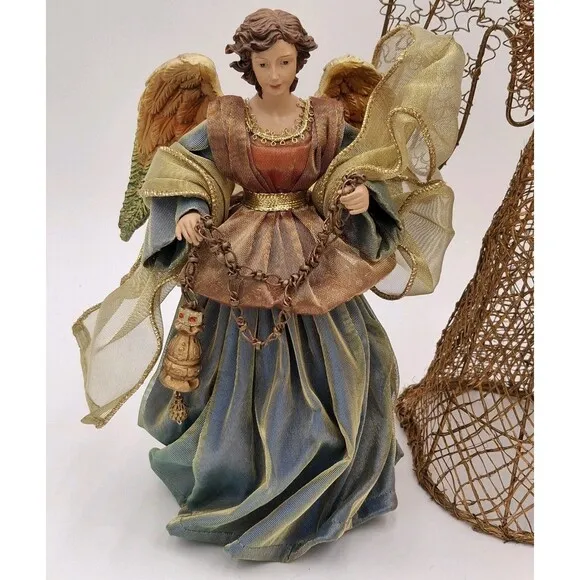
At roughly 14 to 18 inches, this needs generous space: a 7.5- to 9-foot tree, a deep mantel, or a console table. The open-weave metal cone beside her is part of the composition, so leave 6 to 8 inches between the two pieces and they read as a pair instead of a pile. In a small apartment this becomes the whole holiday display, which is a genuinely good use of 18 inches. Compare with Idea #10 for a version that suits a 6-foot tree.
Crown the Tree Like You Mean It
An angel topper is fifteen seconds of decorating and eleven months of being the thing everyone looks at first, so it’s worth choosing like you mean it — measure the tree, match the bulb temperature, and buy the one with the detail you’ll still notice in 2036. Start with one idea here, not five; the best trees are edited, not stocked.
📌 Pin your favorite from this list now — future you, standing in a store in November, will be extremely grateful.