Tartan plaid is having a serious moment on Pinterest right now — and the pile of saved trees in your feed is proof. We spent weeks scrolling Etsy, Target, Pottery Barn, IKEA, and Walmart to bring you only the tartan Christmas ideas that actually hold up once the ribbon comes off the spool, covering everything from $9 ornaments to a $450 statement tree skirt.
Inside you’ll find 32 curated ideas across traditional red-and-green, blue-and-gold elegance, and rustic buffalo plaid — with budget and splurge versions side by side, so you can see exactly what your money buys in 2026. This year the shift is toward layered plaid: two tartans in the same tree instead of one perfectly matched set, which is why we focused on ribbon, skirts, and ornament scale rather than color rules. And stay until the end — we break down the most common mistakes that can ruin these looks.
📌 Save this to Pinterest for later — you’ll want to revisit these ideas.
1. Three-Color Tartan Palettes That Never Fight Each Other
Tartan is a pattern with a built-in formula, so use it. Think 60% dominant ground — bottle green, navy, or deep red — plus 30% secondary stripe color, plus 10% metallic or cream for relief. A red-and-green Black Watch style plaid with gold thread follows the same math as a blue-and-black tartan with silver: same structure, different mood. If you want to swap palettes without rethinking the whole tree, keep the metallic at 10% and change only the ground color.
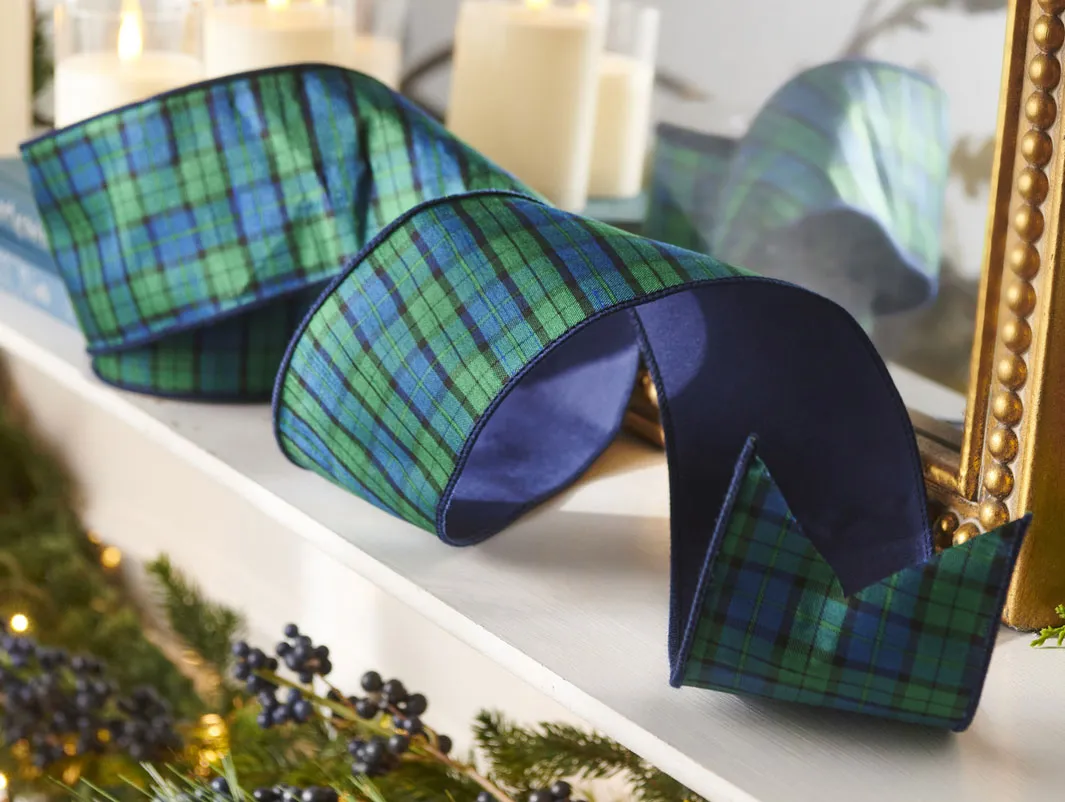
Ribbon width should scale with tree height. For a 7-foot tree, use 2.5-inch wired tartan ribbon; at 9 feet and up, go to 4 inches. Thin ribbon looks stringy on a big tree, and wide ribbon swallows a small one. Buy about 10 yards per foot of tree height if you’re weaving in three or four passes — a 7-foot tree wants roughly 70 yards. Wire-edged fabric holds a loop far better than a plain weave, especially in a warm room where glue and starch soften.
2. A Tartan Ribbon Tree Anchored by Frosted Pinecones
The ribbon does the heavy lifting, and everything else supports it. The tartan runs in loose vertical sweeps, which pulls the eye upward and makes the tree read taller than it is. Round ornaments stay small and uniform so they never compete with the pattern, and frosted pinecones add a matte texture against all that shine. Warm white lights sit deeper in the branches than the ornaments — light first, sparkle second — so the whole thing glows instead of glares.
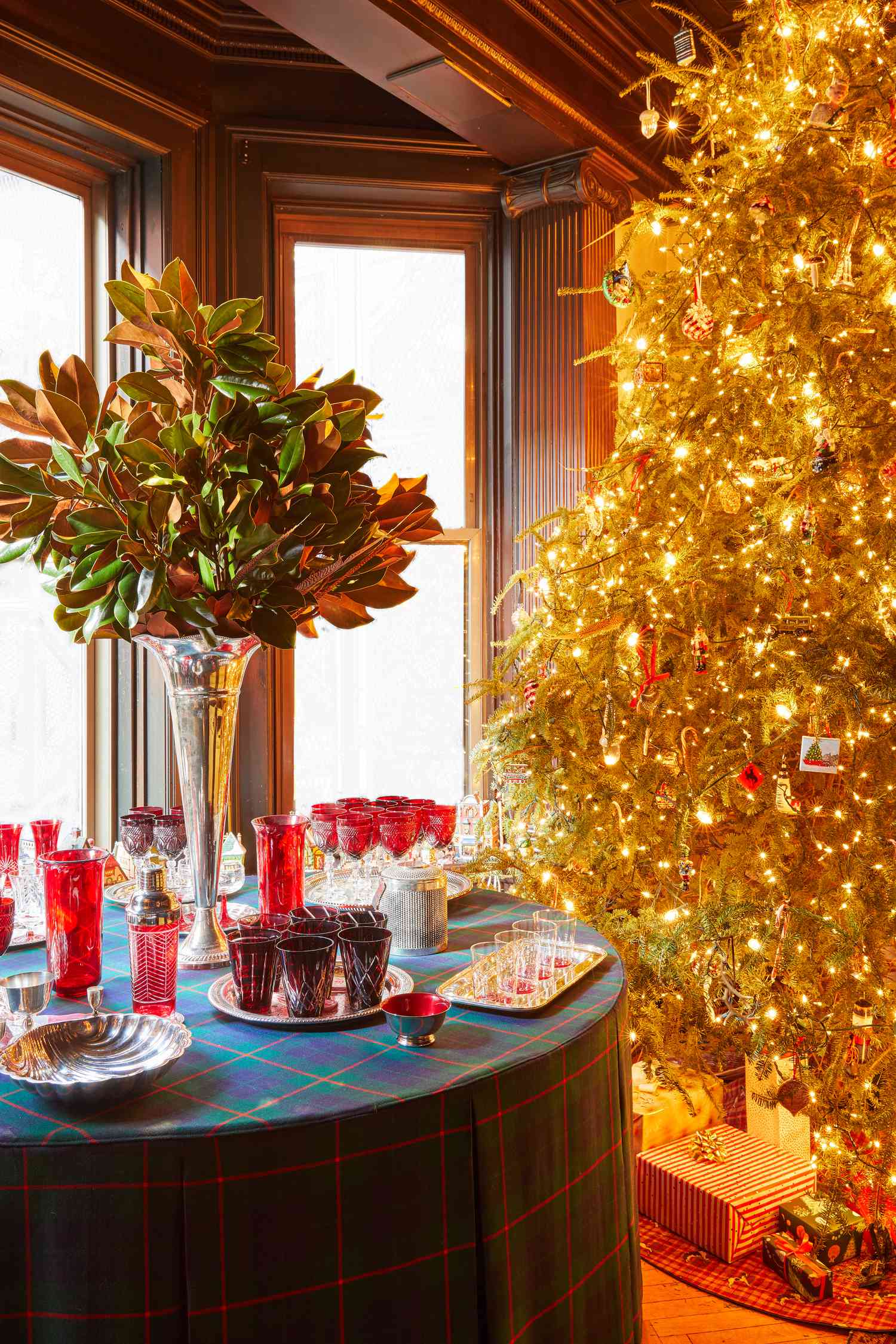
Woven ribbon as the primary tree decoration, rather than ornament density, has been climbing on Pinterest every season since 2023, and 2026 is the year it becomes the default. Part of it is cost: one good spool of tartan covers more visual ground than a dozen baubles. Part of it is the plaid revival in fashion, where tartan moved from holiday novelty to year-round staple. Trends built on pattern instead of novelty tend to stick, which is good news for your storage bin.
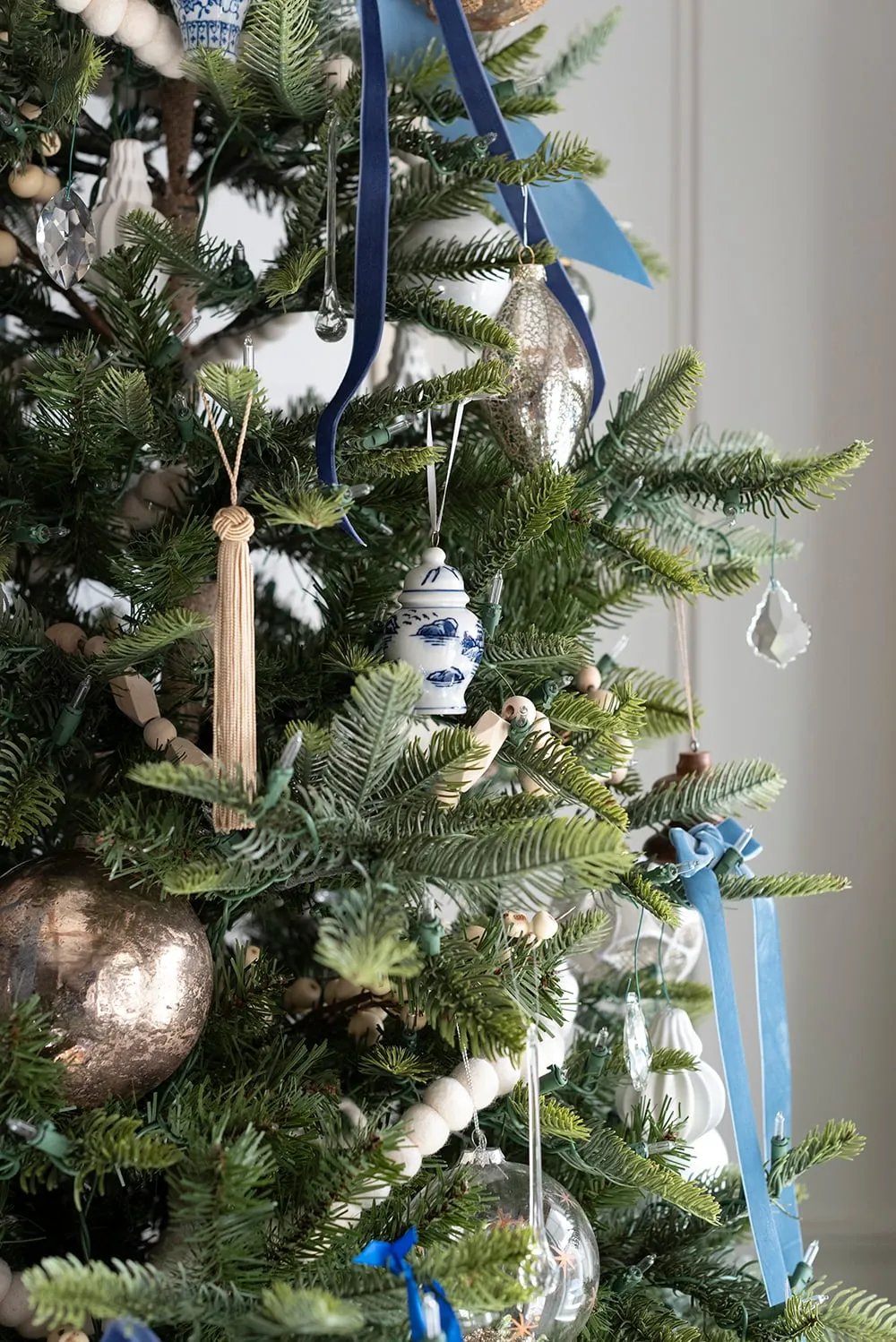
3. A Slim Blue-and-Gold Tree With a Ginger Jar at Its Side
A narrow pre-lit tree earns its keep in rooms under 120 square feet. This one works because it’s tall and thin rather than wide — the vertical line fills the corner without blocking the walking path. With an 8-foot ceiling, a 7.5-foot slim profile leaves room for a finial; go taller and the tree starts to look like a column. In a wide-open living room, this same silhouette reads a little skimpy — see Idea #10 for a fuller shape wearing the same plaid ribbon treatment.
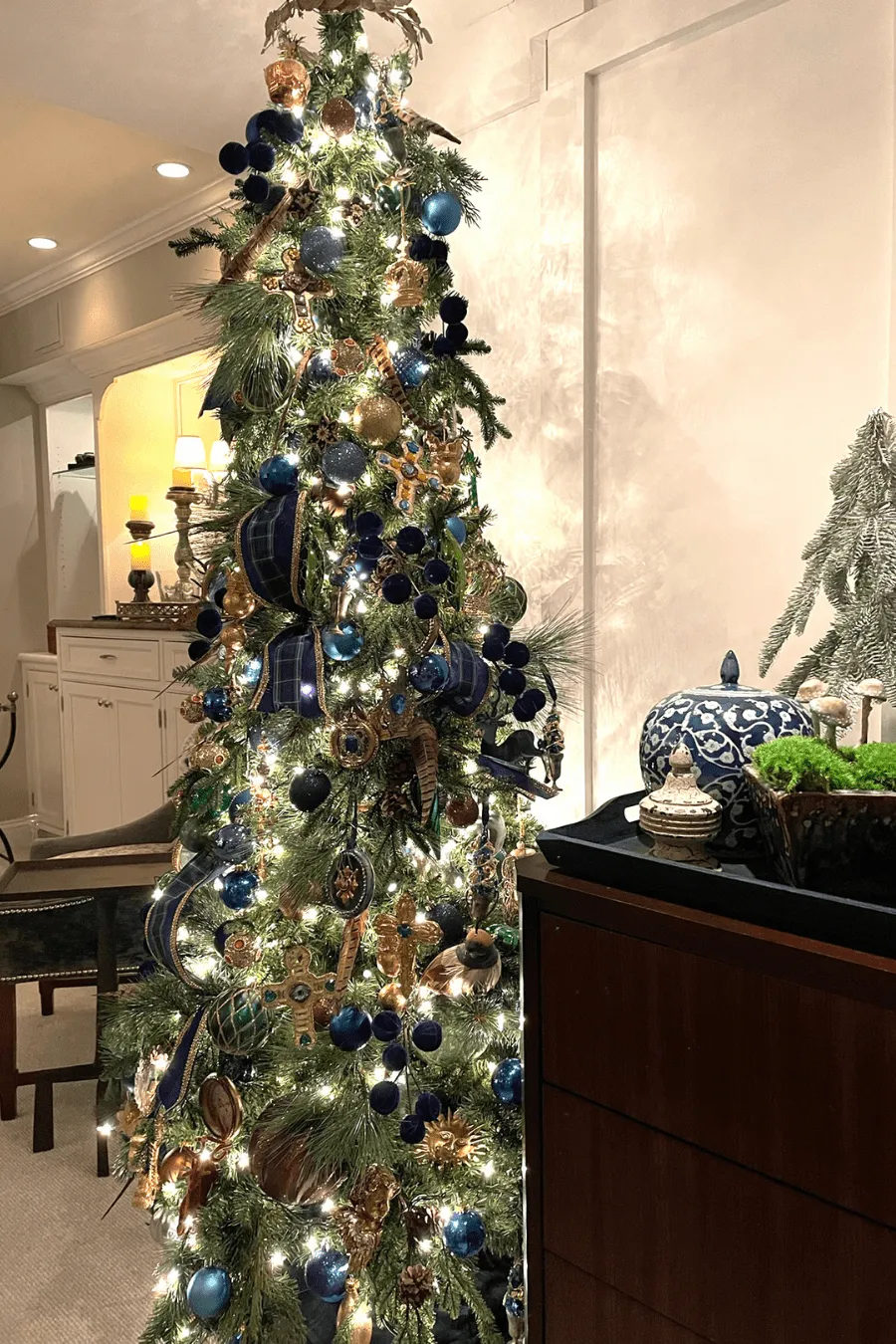
Blue-and-gold trees fail when every blue is the same temperature. Here you get deep navy velvet ribbon against a lighter blue plaid, plus blue glass that catches light differently than matte fabric. Buy ribbon in two finishes — one matte plaid, one satin or velvet — then alternate them on the same sweeps. That contrast costs nothing extra and it’s the difference between a flat blue tree and one that shimmers as you walk past.
4. What a Fully Dressed Tartan Tree Costs, Line by Line
- Tree, 7.5-ft pre-lit: $180-$450
- Extra warm white light strands: $25-$60
- Textiles — 70 yd ribbon plus skirt: $90-$220
- Ornaments, 60-80 pieces: $120-$300
- Topper and floral picks: $35-$90
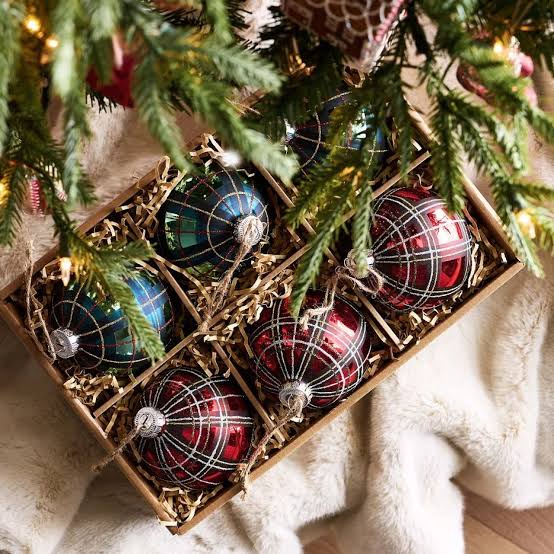
Total: roughly $450-$1,120 for a fully dressed 7.5-foot tartan tree. Budget alternative: reuse a tree you already own, buy ribbon by the roll at $12-$18 each, and mix in thrifted ornaments — that lands closer to $180-$300.
- Measure the ceiling and the widest branch spread, then measure your doorway — a dressed tree is wider than the box claims.
- Count the ornaments and ribbon you already own before buying anything.
- Check outlet placement and how many strands you can safely chain.
- Set a hard number for ornaments, since that’s where spending quietly runs away.
5. Red Berry Picks, Nutcrackers, and a Quilted Skirt by a Blue Armchair
It’s the red berry picks bursting off the top. Without them, this is a lovely traditional tree. With them, it has a crown — a vertical burst of color that replaces a star or angel and gives the silhouette a peak. Everything else here is round: round baubles, round ribbon loops, a round quilted skirt. The spiky, organic top is the only irregular shape in the corner, which is exactly why your eye keeps drifting back to it.
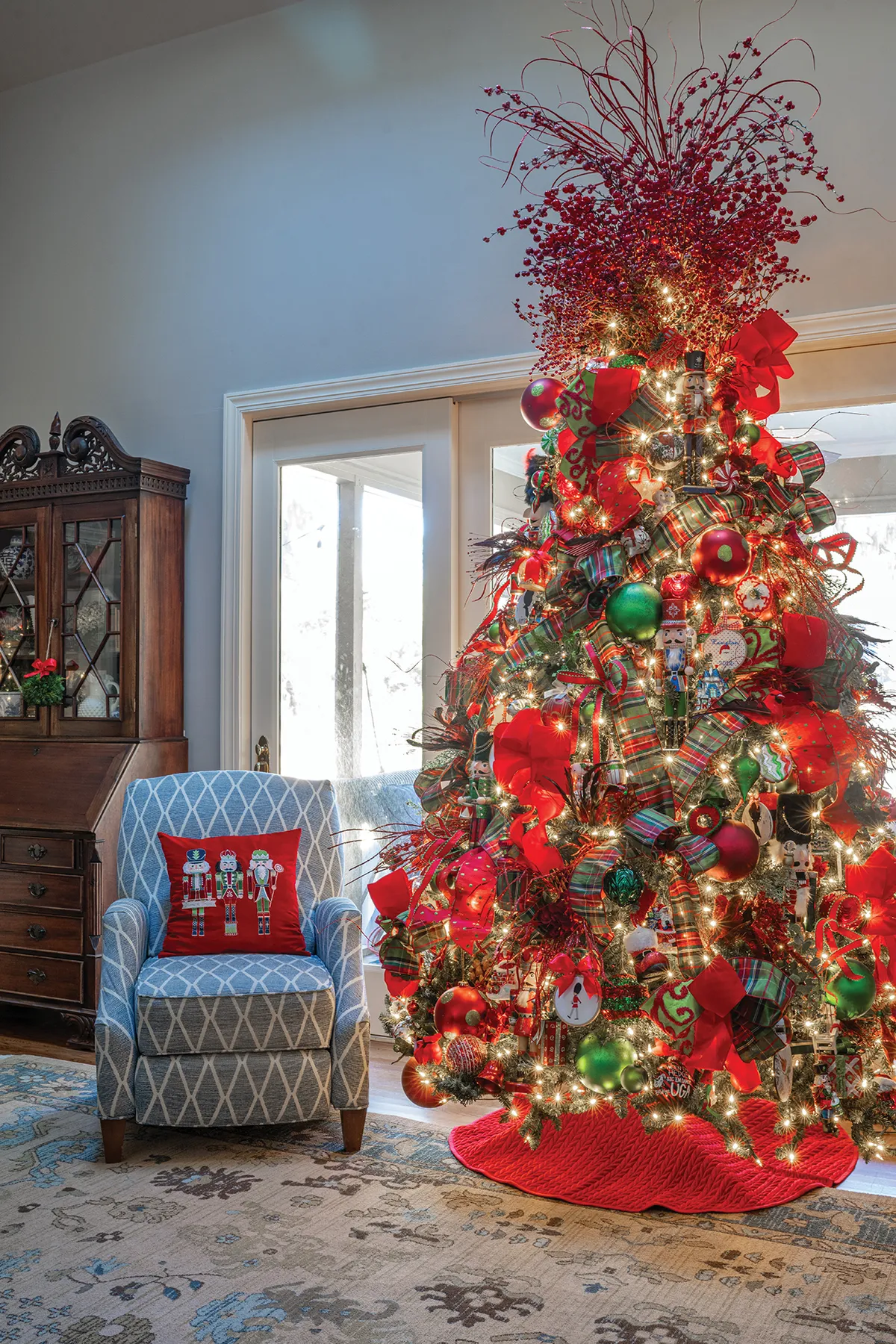
The blue diamond-pattern armchair beside the tree is doing quiet, important work. It picks up the blue in the plaid ribbons and pulls the holiday corner into the rest of the room instead of letting it sit there like a display. The dark wood secretary desk adds weight, and the red quilted skirt softens the base. Notice the palette is only three colors — red, green, blue — with warm wood as the neutral holding it together.
6. A Navy and Emerald Garland With Gold-Embroidered Tartan Ribbon
Garlands need roughly a 1:3 ratio of ribbon to greenery, not the other way around. Here the plaid ribbon appears in short, wide tails tucked between nutcracker figures, so the pine is still the star. Weave ribbon continuously along a garland and it reads as a stripe, flattening the whole thing. Pin your ribbon accents every 14-18 inches, and clip them at different heights so the tails don’t line up in a tidy row.
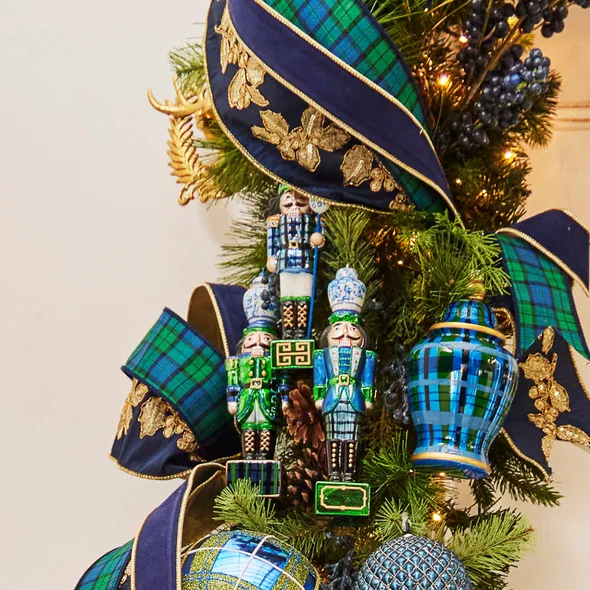
Count pattern scale, not just color. This garland runs a large tartan with fine gold embroidery next to tiny Chinoiserie motifs and small dark blue berry sprays — one big pattern, many small ones. The formula is about 70% greenery, 20% ribbon, 10% figures. Swap navy for burgundy and keep the gold embroidery, and the whole garland shifts to a warmer, cozier register without moving a single stem.
7. Plaid Fabric Baubles With a Pine Sprig and Pinecone Topper
- Cut tartan fabric into 3-inch by 6-inch strips, one per 3-inch foam ball.
- Wrap the strip around the ball, pleating at both poles so no foam shows.
- Secure the top with a dot of fabric glue, then tuck the raw edge under the ribbon loop.
- Glue a small sprig of faux pine and a tiny pinecone to the cap.
- Thread a 6-inch ribbon hanger through the top and knot it.
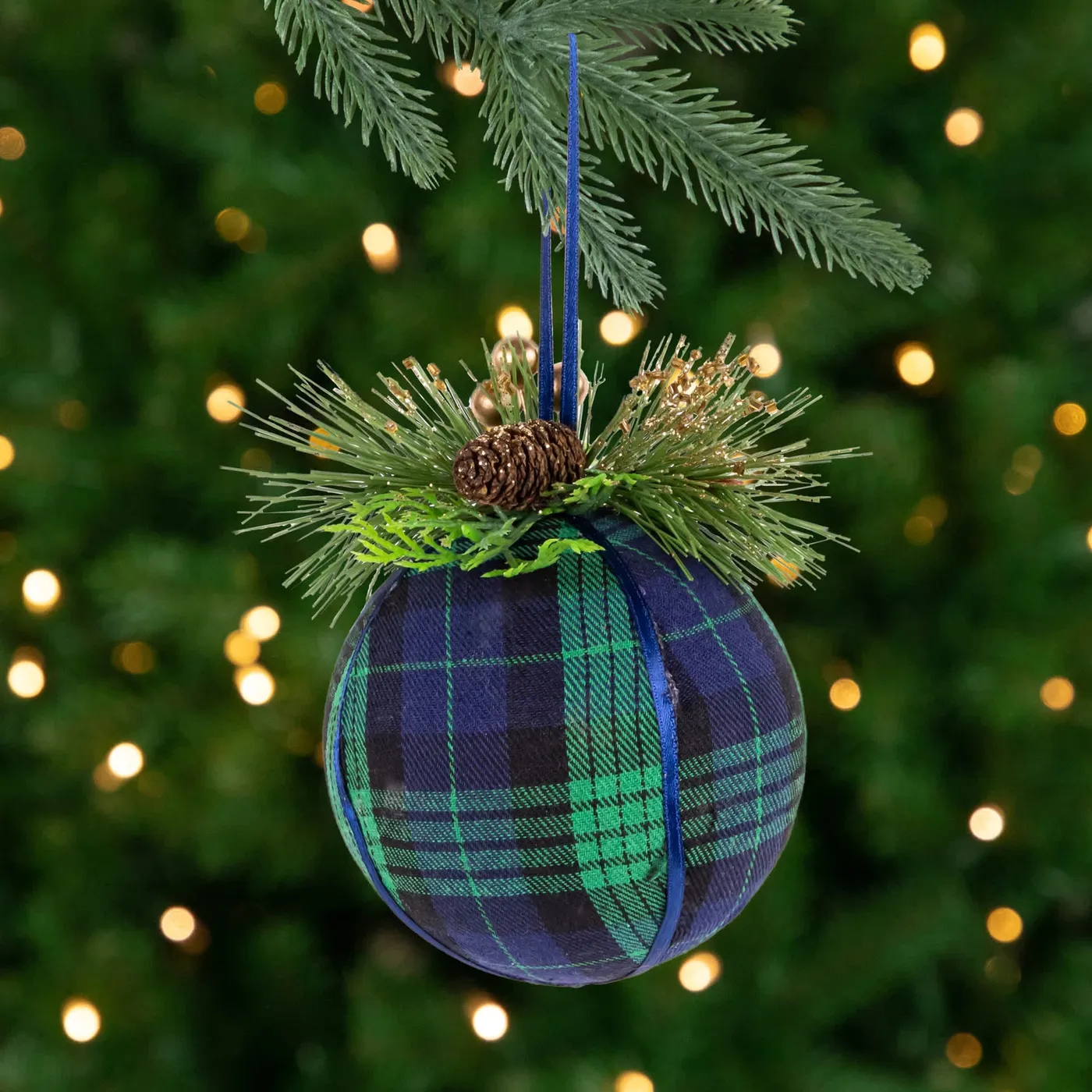
Roughly 20 minutes each, or an hour for a batch of eight. Materials run $12-$25 for the set.
Fabric ornaments on a warm tree can pucker. Hot glue softens above 80°F, so a wrapped ball near a heat vent will eventually lift at the seams. Use fabric glue for the wrap and hot glue only for the topper, which carries no weight. Tartan frays, too — choose a tighter weave like cotton flannel over a loose wool blend, or pink the raw edges before you wrap.
8. A Snowflake Plaid Ornament in Red, Green and Cream
The charm of a snowflake ornament in red, green, and cream plaid isn’t the material — it’s the shape. Plain wood or chipboard snowflake blanks run about $1 each at craft stores; decoupage plaid paper napkins onto them and seal with matte Mod Podge. A batch of twelve costs under $20 versus $8-$14 each for the boutique version. Save your plaid gift-wrap scraps, too — they cut into perfect small-scale snowflake panels.

The cream is what makes it. Without that third color, red-and-green plaid reads like a Christmas card from 1985. The soft cream stripe breaks up the two saturated colors and gives the pattern room to breathe. It’s also why this ornament photographs so well against glossy red baubles — the cream catches warm light and stops the whole frame from going muddy. When you build your own tartan mix, always keep one low-contrast neutral stripe.
9. A Highland Cow in a Santa Hat Hanging Among Fairy Lights
Whimsical sculpted ornaments — animals, tiny vintage objects, miniature scenes — have quietly overtaken uniform bauble sets on Pinterest boards over the last two winters. The reason is simple: a tree of matching balls is beautiful but anonymous, and a tree with a Highland cow holding presents is unmistakably yours. In 2026 the styling move is mixing one or two novelty pieces into a traditional plaid scheme rather than dedicating an entire tree to them. Novelty ages fast, so keep it to a handful.
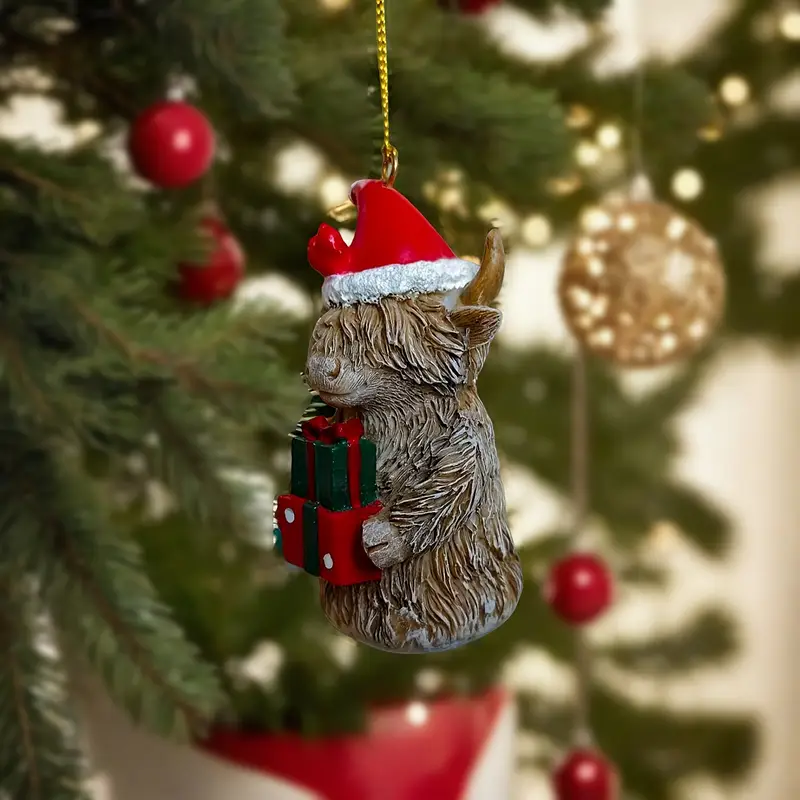
Resin and sculpted pieces chip at ear tips and hat brims — those thin points go first. Store them in a divided box or a single layer of tissue, never loose in a bin with metal hooks. Give any novelty ornament a quick twist test on the branch, since sculpted figures are heavier than a glass ball and will slide off a weak limb at 2 a.m. If something does chip, matching craft acrylic touched in with a toothpick is usually invisible.
10. A Plaid Tree Skirt With a Red Velvet Border and Bow Closures
- Tartan skirt with velvet border: $65-$180
- Wired plaid ribbon, 2.5-inch, 70 yd: $80-$150
- Red and gold glossy baubles, 40-60 pieces: $60-$140
- Berry picks and pinecones, 12-18 stems: $40-$95
- Wrapping paper and ribbon for the base: $25-$60
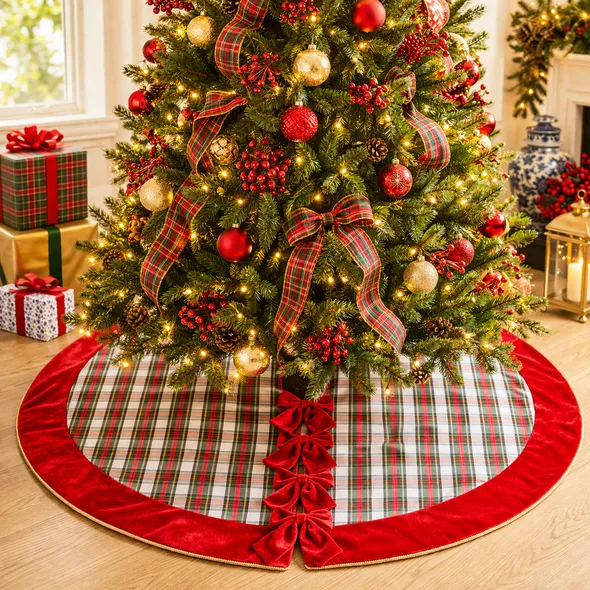
Total: about $270-$625 for the dressed base and ornament layer. Budget alternative: a flat tartan remnant from a fabric store, hemmed and slit at the center, costs $15-$30 and reads nearly identical under a tree.
This look needs a wide base. A skirt with a velvet border and bow closures wants at least a 44-inch diameter, and it only reads correctly under a tree that’s 6.5 feet or taller with a full silhouette. In a small apartment, a 30-inch skirt keeps the same graphic punch without swallowing the floor. For a simpler version of the same idea, try Idea #32 — same tartan family, no velvet trim.
11. Tartan Icing on Gingerbread Cookies by the Tree Lights
- Bake and cool flat gingerbread shapes — squares and rectangles read as plaid far better than gingerbread men.
- Flood each cookie with white royal icing and let it set completely, at least four hours.
- Pipe thin horizontal stripes in red and green, then vertical stripes over them.
- Add a single gold line at each intersection while the icing is still tacky.
- Dry uncovered overnight so the pattern stays crisp.
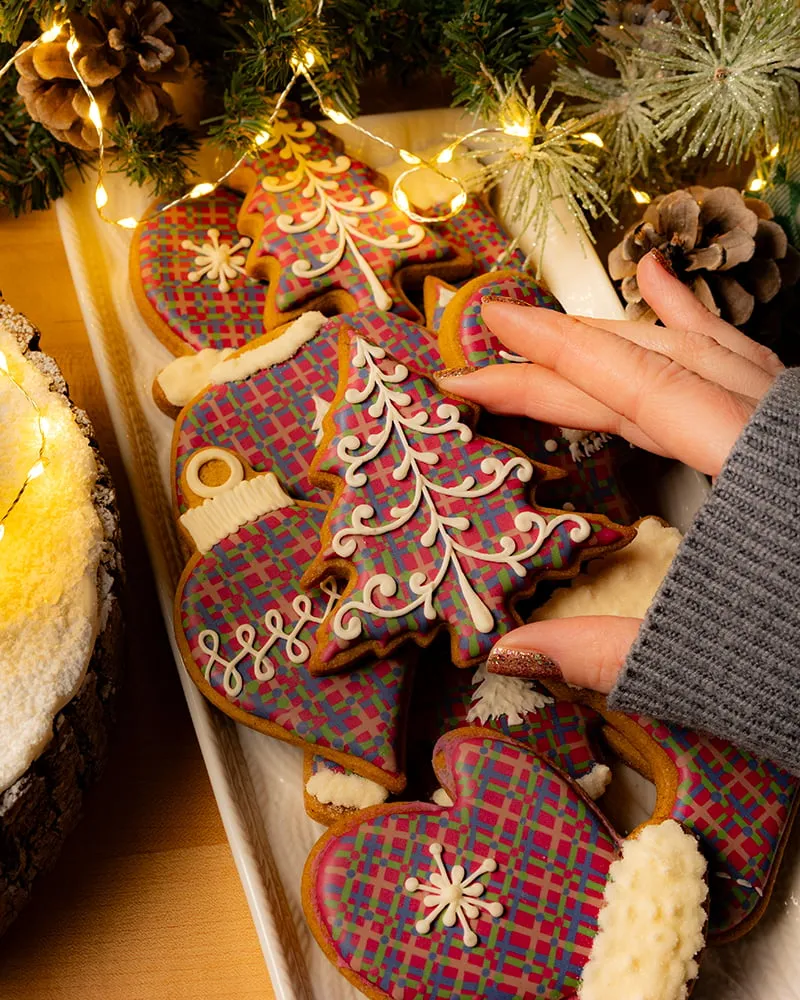
About two hours of work plus drying time. Materials run $15-$20 for icing, gel colors, and piping bags.
Royal icing stripes bleed if the base flood isn’t fully dry — four hours minimum, overnight is safer in humid climates. Pipe with a #1 or #2 tip and pull the bag steadily; stopping mid-line leaves a bulge that shows once it sets. Keep yourself to three colors plus gold, the same rule that makes a real tartan readable from across the room.
12. A Chevron Gift Box Tied With Red Tartan Ribbon
Two patterns, one neutral: about 60% plain chevron paper, 30% tartan ribbon, and 10% contrast from the pink ornaments and multicolored lights behind it. The trick is scale — the chevron is large and quiet, the tartan is small and busy, so they stack instead of shouting over each other. Swap the chevron for a wide stripe, or the tartan for a windowpane check, and the formula still holds. Just never pair two busy small-scale patterns on the same box.

You don’t need boutique wrapping. Kraft paper at $4 a roll takes a tartan ribbon beautifully — the contrast between plain brown and pattern is the whole effect. Buy ribbon by the spool rather than the pre-cut pack: 10 yards runs $8-$14 and wraps eight to ten gifts. Store it wrapped around a cardboard tube so it doesn’t crease, and shop after-Christmas sales for the plaid textiles your gifts are sitting on.
13. Mixing Two Plaid Patterns Without the Visual Chaos
Two tartans can live in the same room, but they need a shared color. If your tree ribbon is red-and-black buffalo check, keep the second plaid in that room navy-and-green — different colors, same visual weight. What breaks the look is pairing a large-scale tartan with a small dense check in identical colors; the eye finds no resting point and the whole corner vibrates. Cap yourself at two plaid patterns per room, three if one of them is as small as a napkin.
The eye reads plaid as a grid, and grids multiply fast. So the rule is either match the scale or match the color — never fight on both. That’s also why a solid is non-negotiable in a plaid-heavy room: velvet, linen, or a woven basket gives the eye somewhere to land. In a room with a tartan tree, runner, and pillows, everything else should be flat color, and ideally one of them lighter or darker in value than the rest.
14. Choosing the One Focal Point on a Plaid Tree
Pick one. On a plaid tree, the focal point is usually the skirt, occasionally the topper, rarely both. If the skirt is your statement, keep the top simple — a clean ribbon loop or a small star, nothing competing. If the topper is the moment, choose a plain or solid-color skirt so the base goes quiet. Rooms feel off when two elements fight for the same job, and plaid is loud enough that two is all it takes.
- Choose the focal point before you buy anything — skirt, topper, or ribbon.
- Photograph the tree corner in daylight, then again at night with the lights on.
- Note whether your lights are warm white or cool white; plaid reads better warm.
- Measure the floor space the skirt will occupy, plus 6 inches all around.
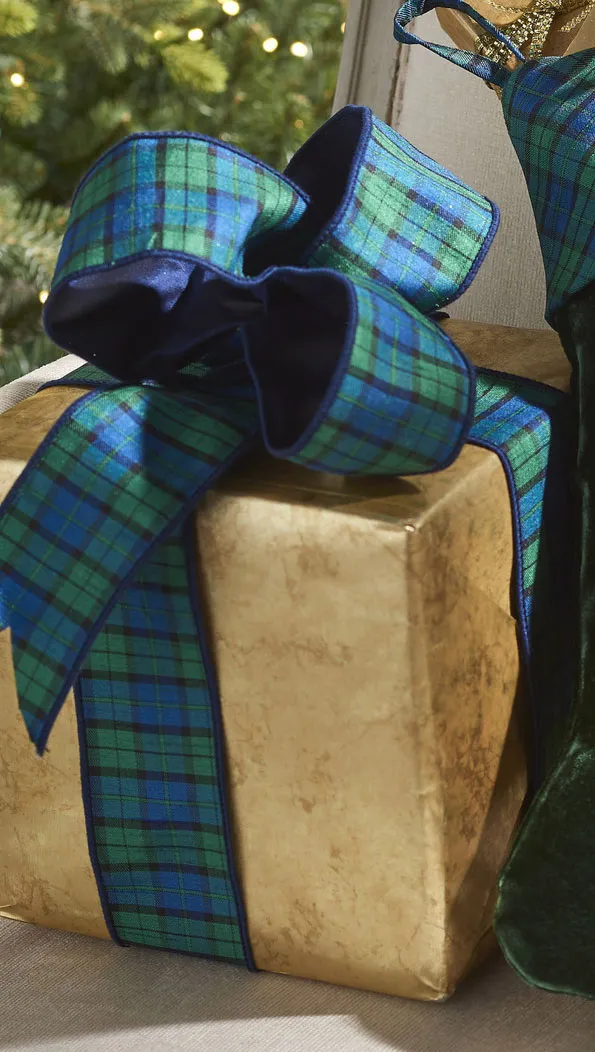
15. A Green and Navy Tartan Skirt With a Silver Star Crest
A crest-centered skirt is a focal point, so it needs room to be seen — at least 40 inches of clear floor around the tree, and a tree set 18 inches off the back wall. In a tight corner the crest disappears behind branches and the whole thing just reads as a dark circle. If you’re working with less than 90 square feet of living room, a slim profile tree like Idea #3 handles a corner far better than a wide base with a crest.
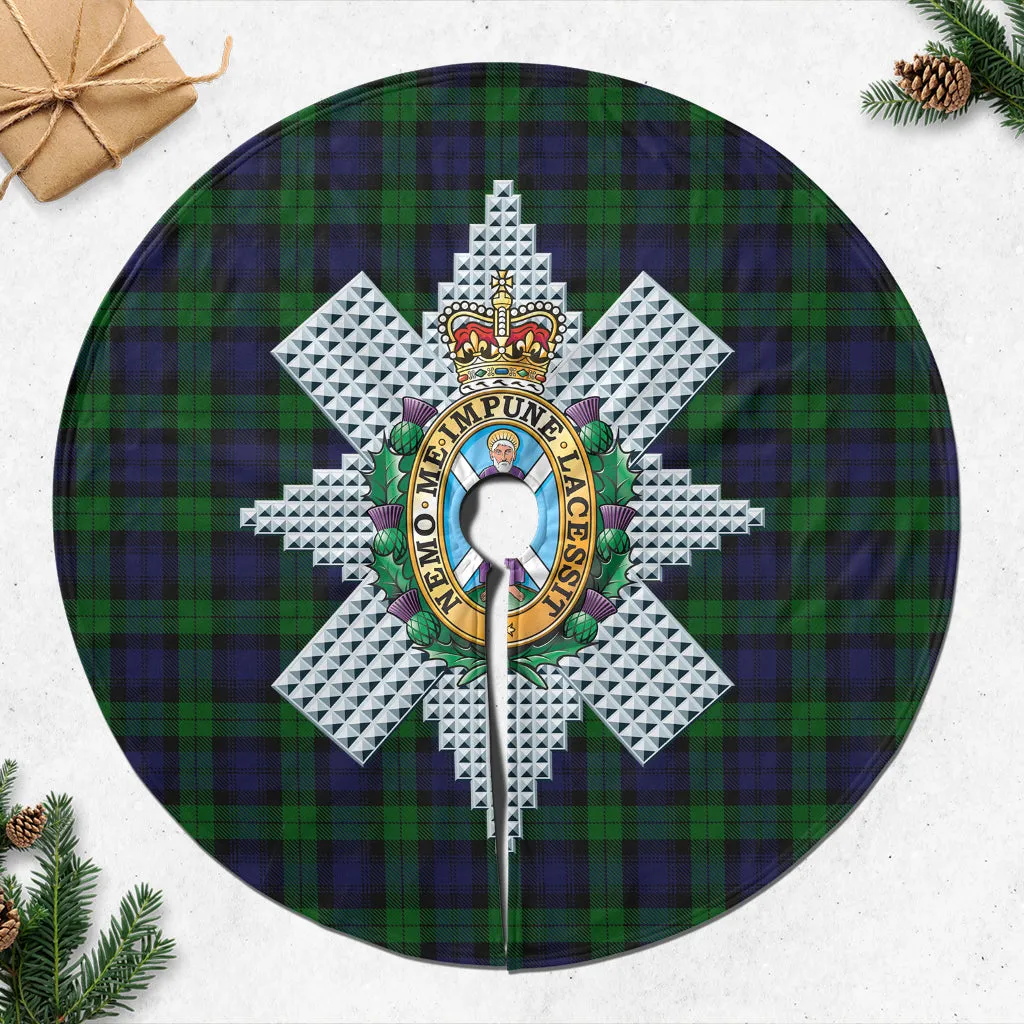
Scottish heritage motifs — thistles, crests, royal stars — have been moving out of souvenir shops and into mainstream holiday decor, partly because plaid itself is on a multi-year run and partly because people want a tree that looks collected rather than bought as a set. Heraldic symbols are a longer commitment than a trend piece, since they never really go out of style. If a crest feels too specific, a plain silver star gets the same regal read.
16. An Evergreen Gnome in a Buffalo Plaid Hat on a Snow-Dusted Bench
- Bundle small evergreen sprigs into a cone shape and zip-tie the base to a wire frame or foam cone.
- Fill gaps with moss so no wire shows through the front.
- Cut a plaid fabric triangle about 14 inches wide and 18 inches tall for the hat.
- Glue a white pom-pom to the tip, then fold the hat over the top of the cone.
- Add a 2-inch round wooden nose and two small felt mittens at the sides.
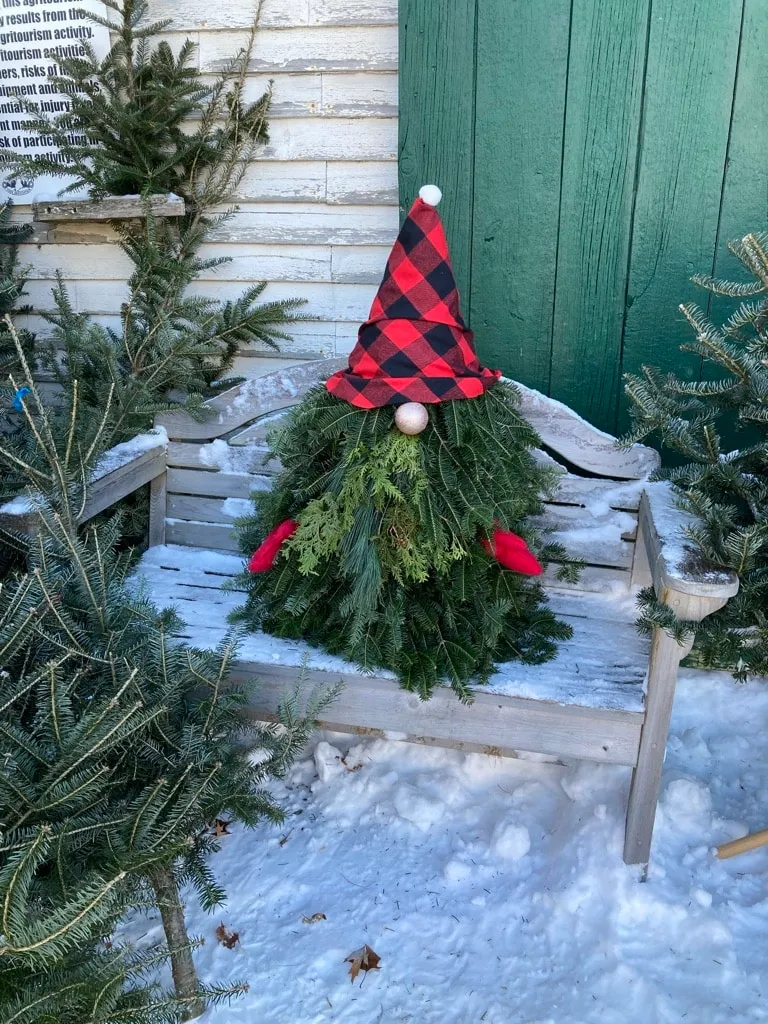
About 45 minutes of work. Materials run $20-$35, less if you’re using clippings from a real tree.
A store-bought version of this gnome runs $60-$120. The DIY above lands around $25 if you’re buying fabric and a foam cone, and closer to $5 if you’re using branch trimmings and a thrifted plaid shirt. Buffalo check flannel pillowcases are a goldmine — one $4 pillowcase gives you the hat plus fabric for two matching ornaments. Same silhouette, same mood, a fraction of the price.
17. A Layered Plaid Table Set With a Gold Foil Snowman Napkin
This table runs three plaid scales on purpose: roughly 30% large plaid tablecloth, 30% medium plaid plates, 20% solid green napkin, 20% solid red charger and gold accents. The solid napkin and solid charger are what keep the layering from turning into visual soup. Want a warmer mood? Swap the green napkin for cream — the plaid stays festive but the table goes softer and less candy-cane.
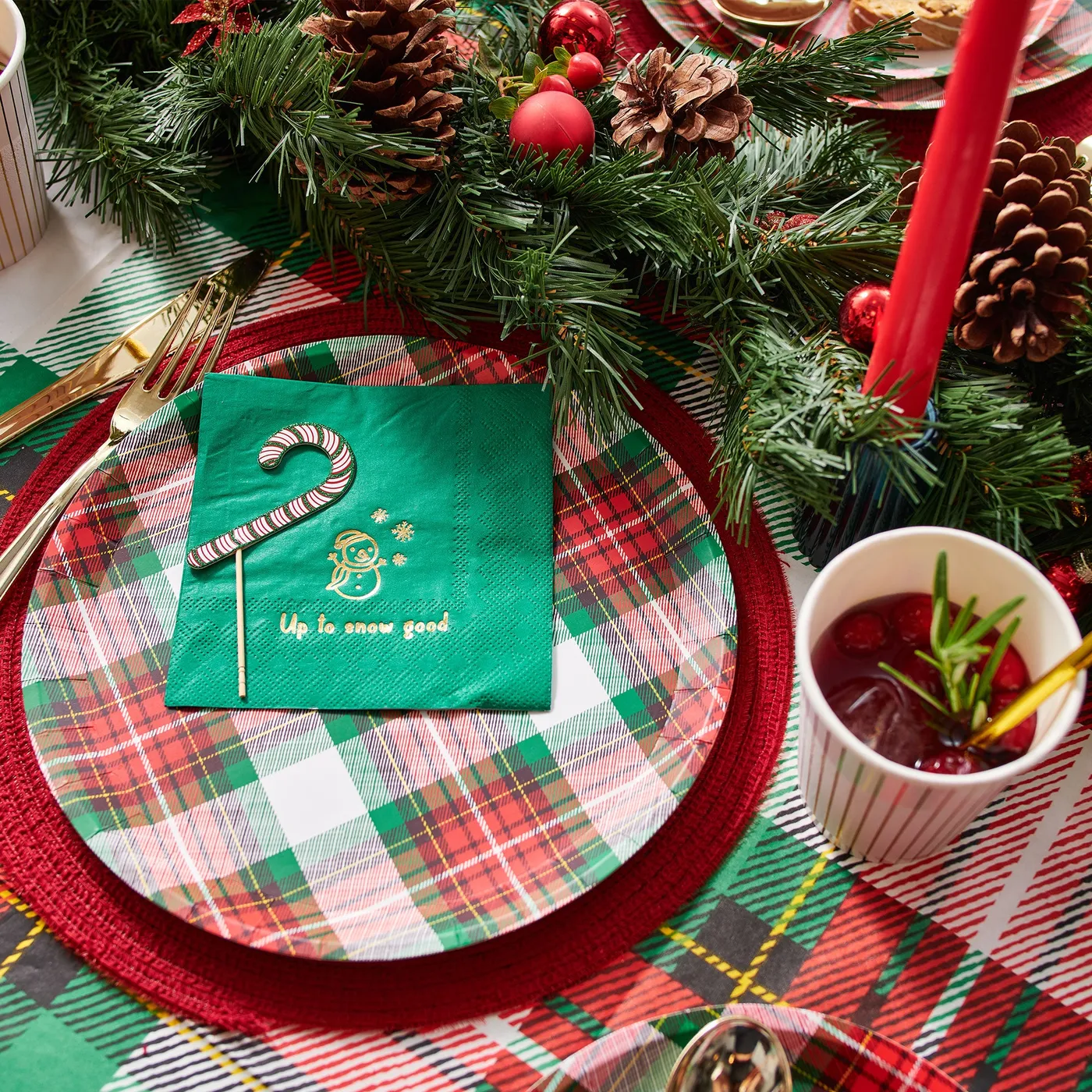
Paper plates can carry a full holiday table; the trick is weight and layering, not material. A 9-inch plaid paper plate needs a 10.5-inch charger underneath so a margin of solid color shows — without it, the plate looks like it’s floating. Put the busiest pattern at the bottom and the calmest at the top, nearest the food. Your eye follows the stack upward, so the quietest element ends up next to what you’re actually looking at all night.
18. A Dark Green and Navy Tartan Skirt on Rustic Wood Planks
Wool-blend skirts and real wood floors are a bad pairing without something underneath. Felt pads or a thin nonslip rug pad keeps the tartan from abrading and stops dye transfer onto pale oak, which happens more than people expect with dark green and navy weaves. Spot clean only — most tartan skirts are dry-clean or cold hand wash, and a machine cycle puckers the hem. Vacuum with a brush attachment on low and store folded flat with cedar instead of hanging.
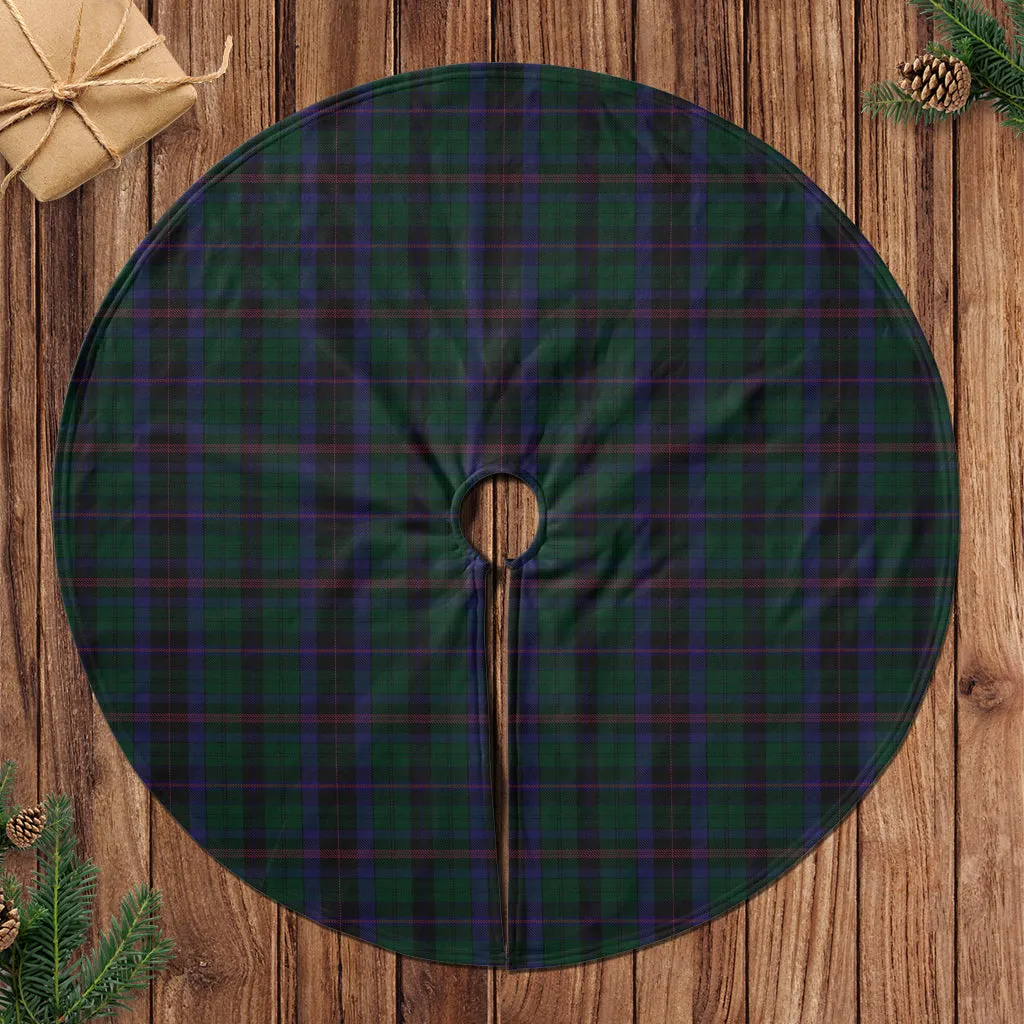
The thin red accent lines are doing everything. Without them, dark green and navy is a moody, almost somber plaid that vanishes against a dark tree. Those fine red threads are why this reads festive instead of corporate. If you find a green-and-navy tartan with no red or gold, add a red ribbon tie or a small red ornament at the base of the skirt — you’re reintroducing the accent at the object level instead of the fabric level.
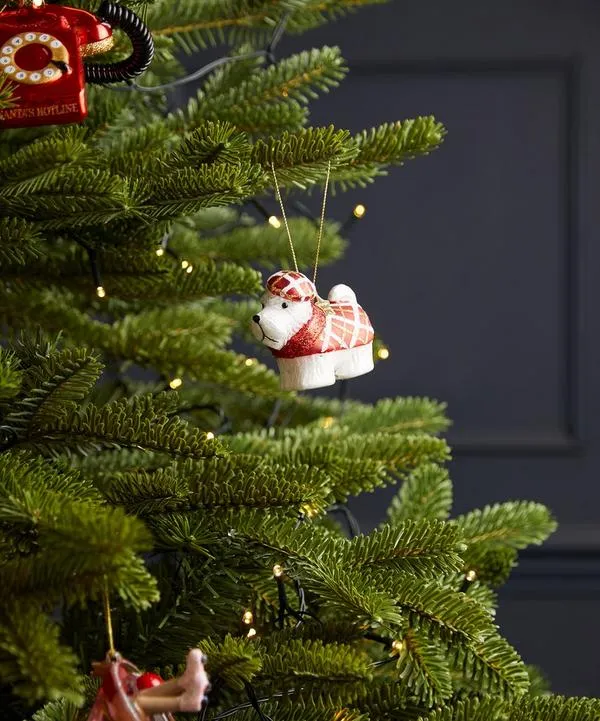
19. A Plaid Dog Ornament and a Red Telephone on a Fairy-Lit Tree
What makes this corner of a tree work is contrast in subject, not color. A tartan dog and a glossy red rotary telephone are both tiny, both sculptural, and neither looks like anything else on the branches — so they hold their own in a frame crowded with pine. The dark paneled wall behind them matters too; a light wall would flatten those silhouettes. The fairy lights sit behind the ornaments rather than in front, which is what creates that soft halo.
- Start with lights: about 100 mini lights per foot of tree height, wrapped in and out of branches.
- Hang the largest, most sculptural ornaments first, spread evenly instead of clustered.
- Add medium baubles into the gaps the big pieces left behind.
- Finish with small fillers only where bare branch still shows.
- Step back three feet and remove anything that makes two identical shapes sit side by side.
20. Two Tiered Plaid Wooden Trees on a White Tabletop
- Tiered wooden tree figurines: $28-$70 for the pair
- Glass candle holder: $12-$30
- Metal and wood lantern: $25-$65
- Pillar candle: $6-$14
- Tabletop greenery or mini tree: $10-$25
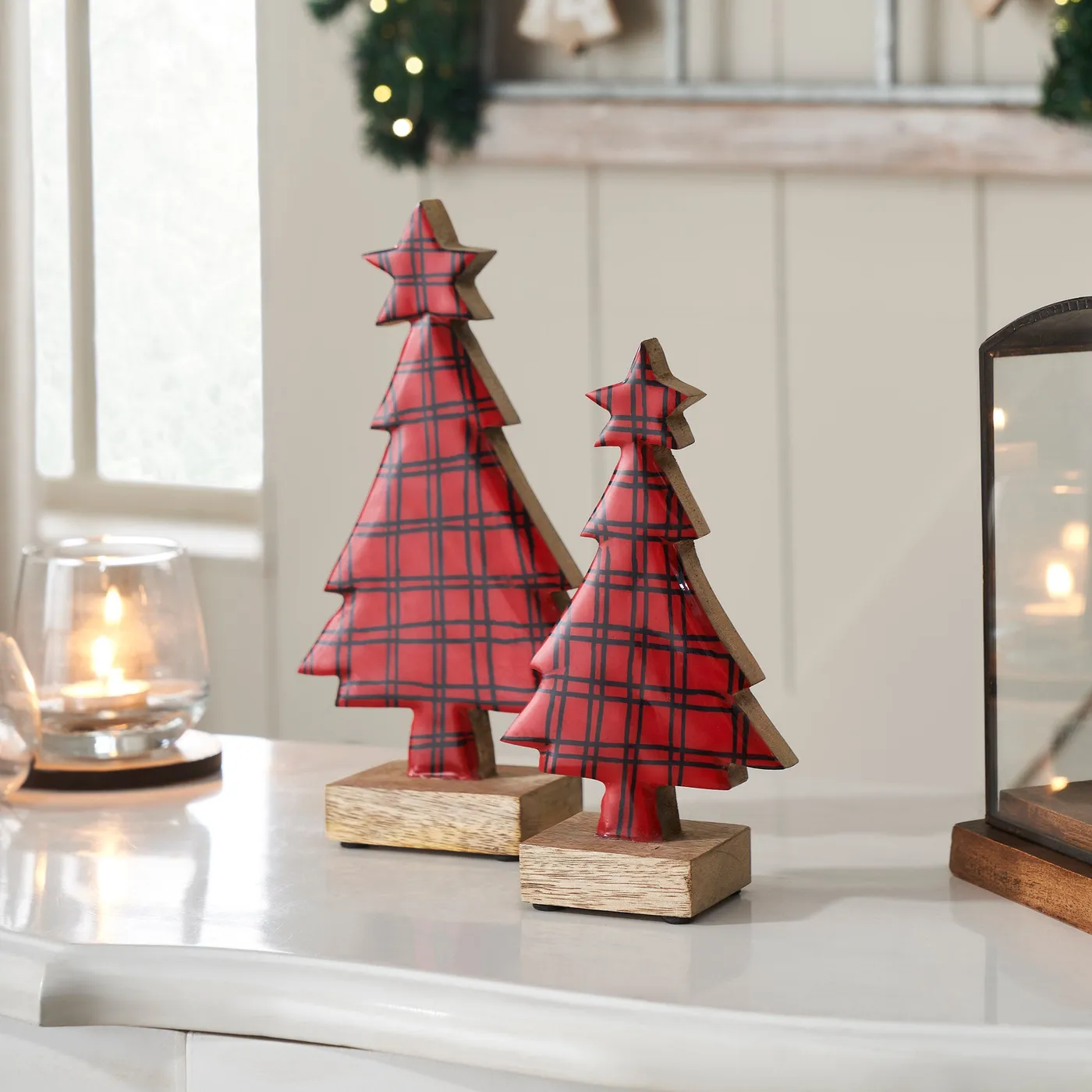
Total: about $80-$205 for the whole vignette. Budget alternative: cut the tiered shapes from quarter-inch plywood with a jigsaw, then stencil or decoupage plaid onto the fronts — under $15 for two plus paint you probably already have.
Tiered tabletop trees are sized for consoles and shelves 12-18 inches deep, and they need a surface at least 36 inches wide so the pair plus a lantern doesn’t feel crowded. On a narrow entry table, use one tree and the candle holder instead of both. For a narrow room where the floor piece is the problem, the crest skirt in Idea #15 covers the base while this covers the surface.
21. A Blue Tartan Bow Tucked Into Pine Needles
A blue-dominant tartan with red, yellow, and white stripes is cheerful on its own — and a headache next to a red-and-green tree if you don’t plan. Blue plaid and green plaid can live together when they share a red thread, which is exactly the case here. But keep them physically separated: a blue bow tucked inside pine needles reads as a detail, while a blue bow sitting right beside a red one reads as a mistake. Distance does the work.
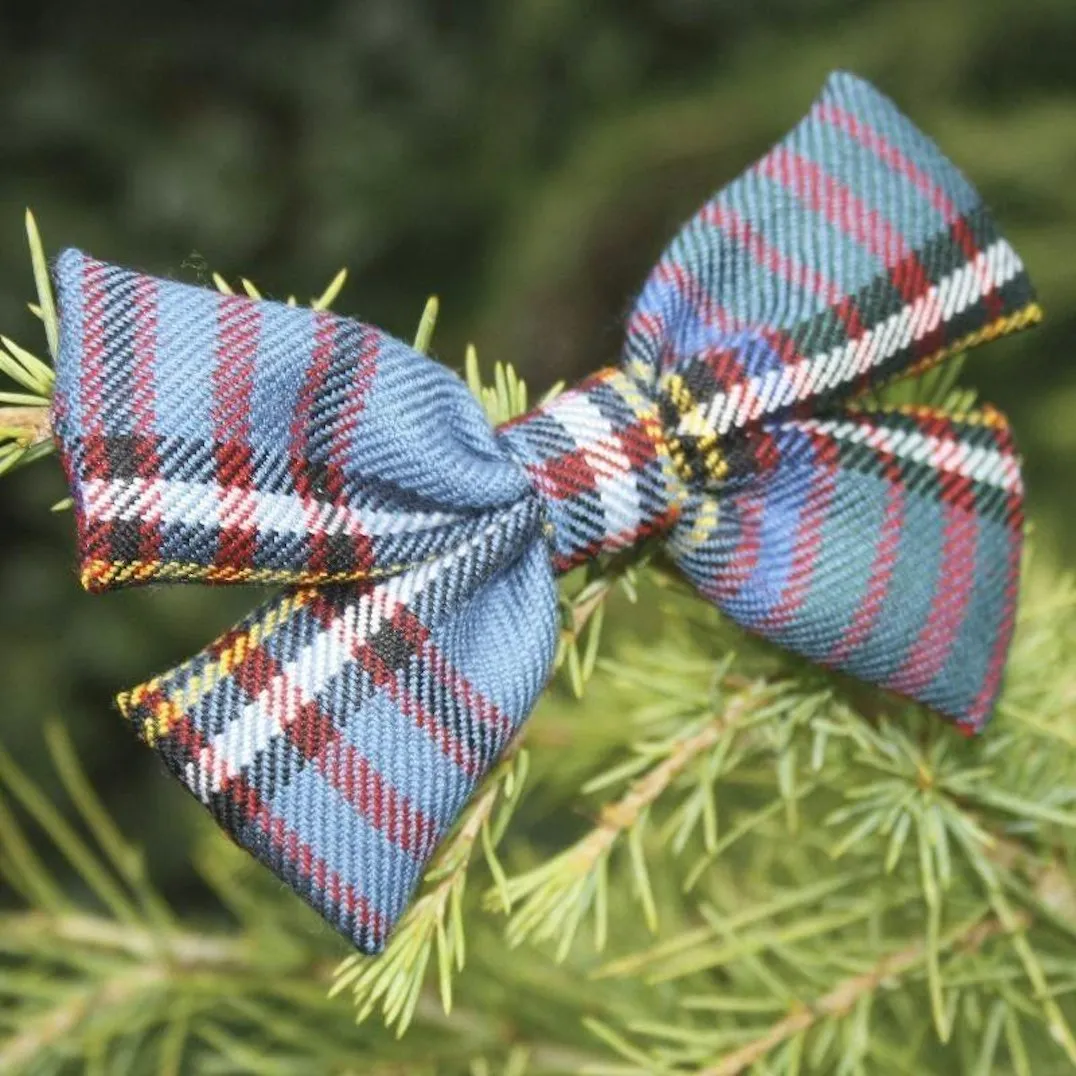
Treat a plaid bow as a color sample of the entire room. This one is roughly 60% light blue, 20% red, 10% black, 10% yellow and white. If your room can’t support that mix, skip the bow and use solid velvet in the blue — same shape, no palette commitment. If your room already has black accents, this bow ties the whole corner together for the price of a few yards.
22. A Red Tartan Runner on a Light Oak Table With Botanical Plates
A table runner is the cheapest plaid statement you can make. Target and Walmart both carry tartan runners in the $12-$25 range, and a fabric-store remnant cut to 14 inches wide and hemmed costs about $8. Layer it over a plain white cloth for volume instead of buying a plaid tablecloth. For the same effect on a console or mantel, the pennant bunting in Idea #26 works at the same price point.
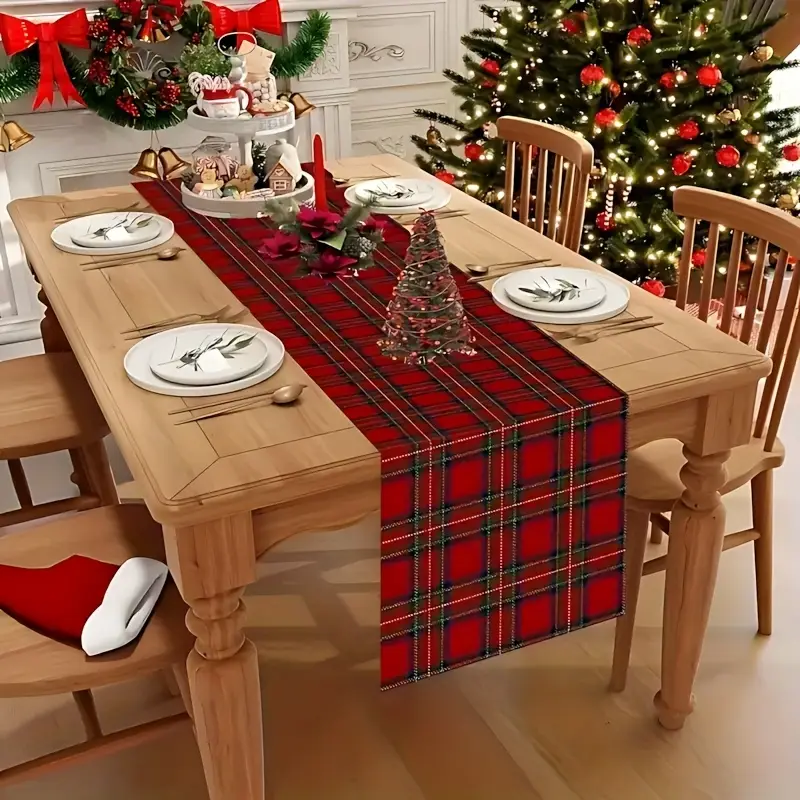
Dining rooms are where plaid quietly became mainstream. Botanical-print plates and simple tartan textiles signal a table that’s festive without being themed, which is exactly what people are searching for now that holiday hosting has gotten more casual. A red runner with white botanical plates and a single miniature tabletop tree will still look current in five years — the pattern carries the season, and the plain dinnerware carries the rest of the year.
23. A Plaid Hat Gnome Ornament With an Orange Yarn Beard
Yarn beards mat down. To make a gnome beard hold its shape, glue the strands flat in a fan on wax paper first, let it dry, then trim into a triangle before attaching. Using two yarn weights — a thick chenille for the bulk and a fine mohair for the wispy ends — reads far more convincingly than one uniform strand. Keep the nose small: a 12-14mm wooden bead is the sweet spot on an ornament this size.
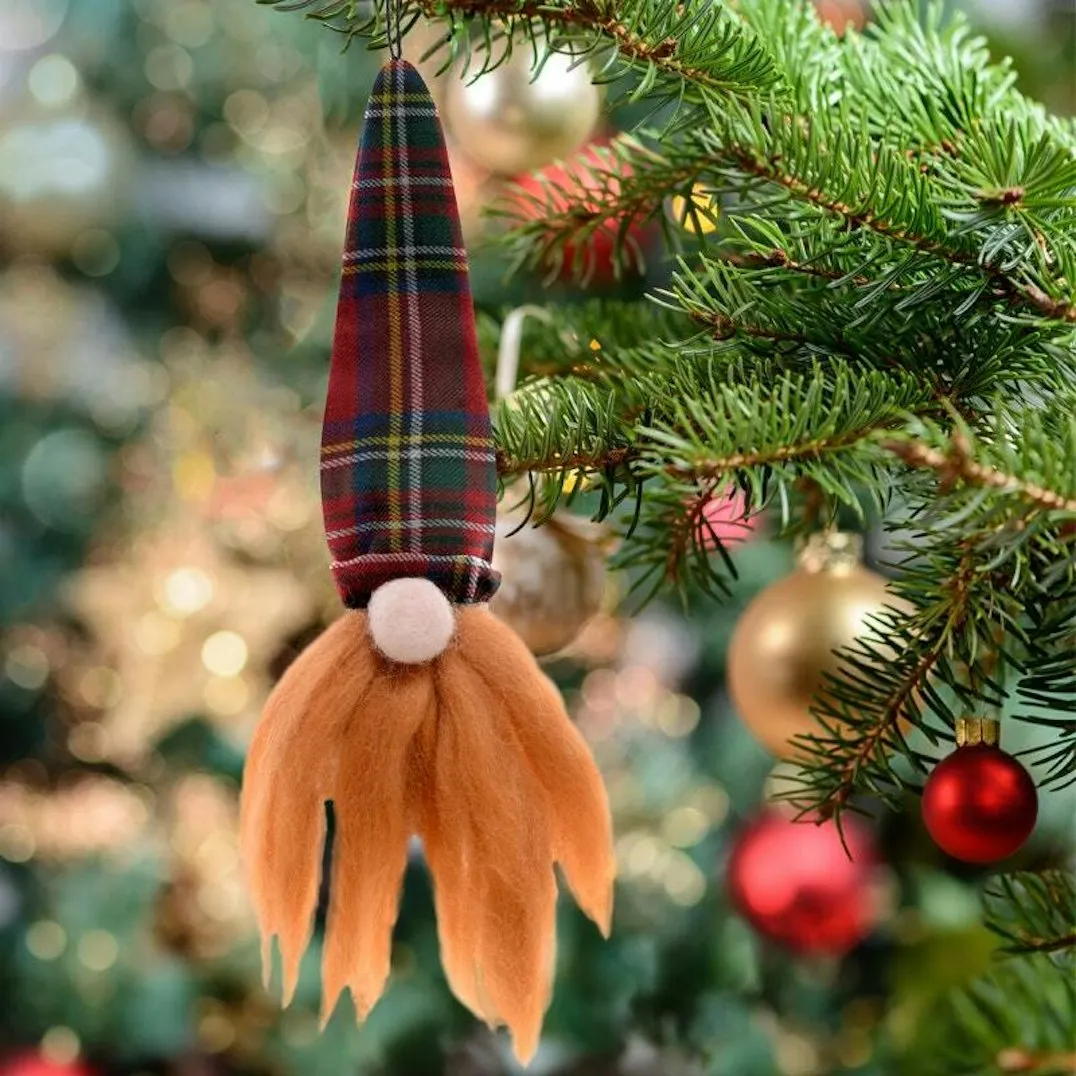
- Cut a 5-inch cone from felt or a knit sweater sleeve for the body.
- Wrap and glue a 4-inch plaid fabric triangle into a tall hat.
- Layer yarn strands below the hat brim and trim them into a beard.
- Glue a 12mm wooden bead nose over the top of the beard.
- Add a twine loop at the hat tip and a small pom-pom.
24. A Rustic Entryway Bench Styled With Red Plaid and Birch Logs
It’s the galvanized bucket of birch logs. Nothing about it is cute or festive — it’s textural, slightly industrial, and it grounds the display so the plaid pillow and hanging scarf don’t tip into craft-store territory. Take the bucket away and you have a bench with a holiday pillow. With it, you have a winter entry. No bucket? A woven basket or a small floor stack of split logs does the same job of adding one element that isn’t decorative at all.
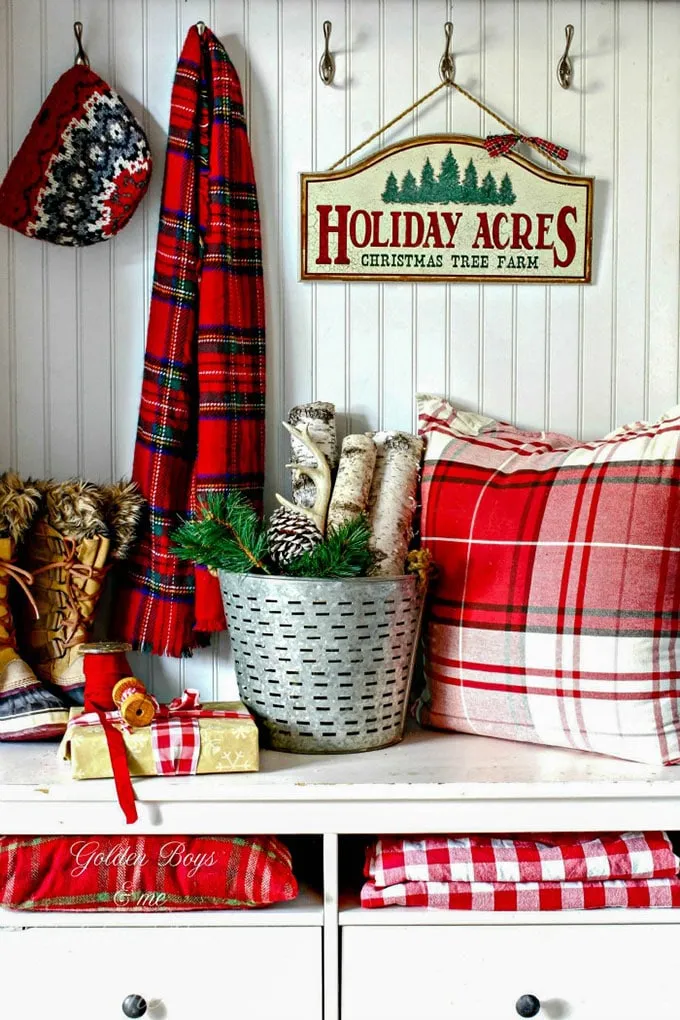
- Rustic bench: $90-$280
- Galvanized bucket and birch logs: $25-$70
- Oversized red and white plaid pillow: $18-$45
- Tartan scarf and knit hat: $20-$50
- Wall sign, boots, and wrapped gift styling: $30-$90
Total: about $185-$535 — though most of it is probably already in your closet. Budget alternative: hunt Facebook Marketplace for the bench, use a bucket or basket you own, and style with last year’s scarf — about $40 total.
25. A Highland Cow Ornament Holding Stacked Green and Red Presents
Matte gold baubles behind a matte brown cow — that’s the entire trick. A glossy backdrop would compete with a detailed sculpted figure; matte gold recedes and lets the ornament be the subject. There’s a scale story too: the presents in the cow’s arms are tiny, which makes the figure feel much larger than it is. Small props on a large figure is an old miniature-maker’s move, and it works on a Christmas tree exactly the same way.

Sculpted ornaments with stacked props are top-heavy. Weigh a piece before you hang it — anything over 3 ounces wants a sturdier branch or a short wire wrapped around the stem instead of a metal hook. Present stacks also snag on ribbon and garland, so hang these on outer, front-facing branches rather than burying them inside. One drop onto hardwood can snap a gift corner clean off.
26. Tartan Pennant Bunting Across a White Multi-Pane Window
- Measure the window width plus 6 inches on each side before ordering bunting.
- Note where your curtain rod or existing hooks sit — you don’t want two lines fighting.
- Check the wall finish: adhesive hooks can lift paint from old plaster.
- Hold the swag at eye level before committing, so the lowest point clears head height.
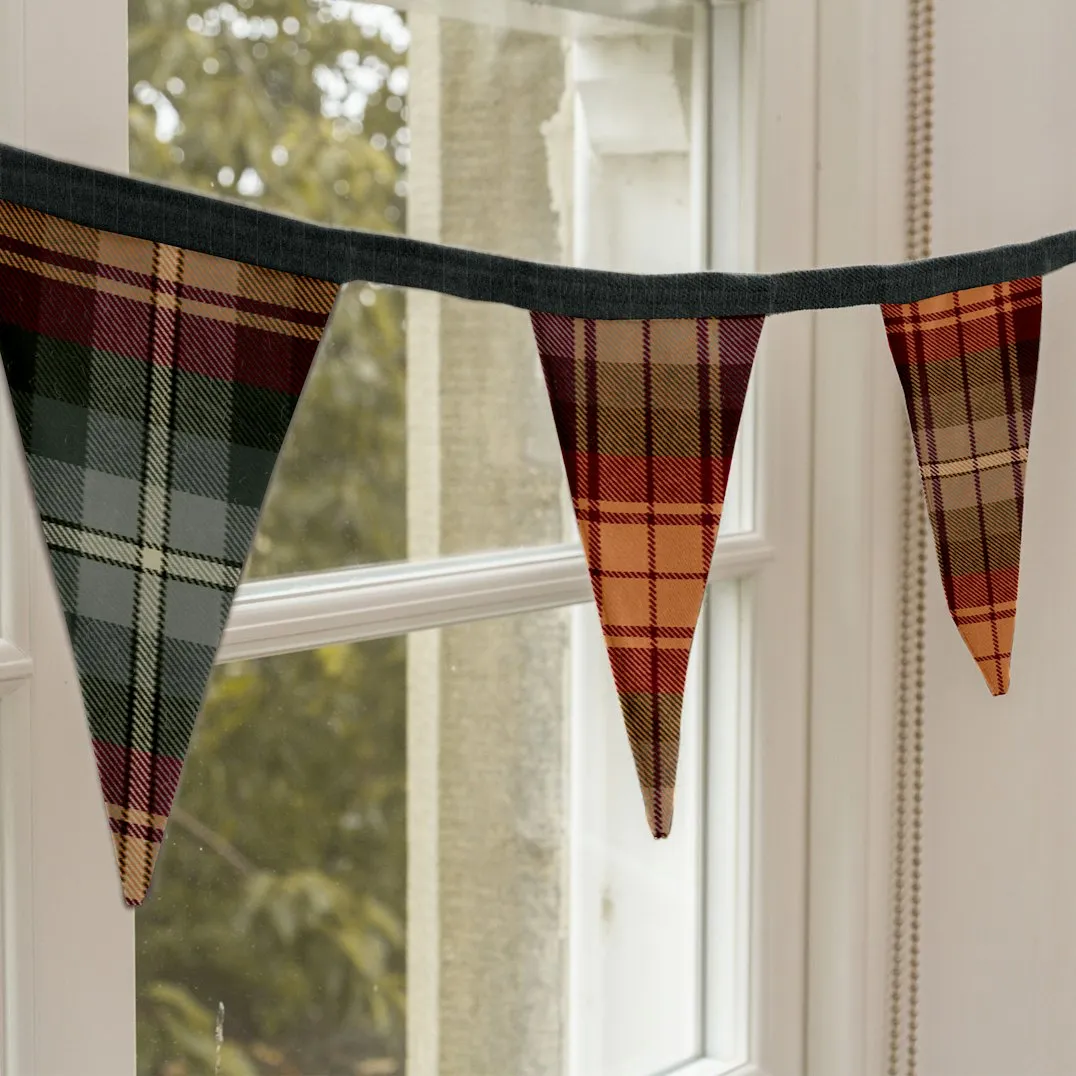
This is one of the least expensive plaid projects in the whole house. Fabric scraps from a quilting store’s remnant bin run $3-$6 for a quarter yard, and one yard of tartan gives you eight to ten pennants. Cut the triangles with pinking shears so they don’t fray, then sew or iron-on hem them to a strip of felt or wide ribbon. Store-bought tartan bunting runs $25-$45; the DIY version lands around $12 for twice the length.
27. A Tartan Ribbon Tree in a Neutral Living Room
Ribbon-forward trees photograph best in rooms with low visual competition, which is why neutral upholstery works so well around this one. The tree needs roughly 3 feet of clearance on at least two sides so you can walk around it, and it looks best when it’s the only strong pattern in the room. In a space that already has a patterned rug or bold wallpaper, either shrink the ribbon width or switch to a solid velvet so you’re not adding a fifth pattern.
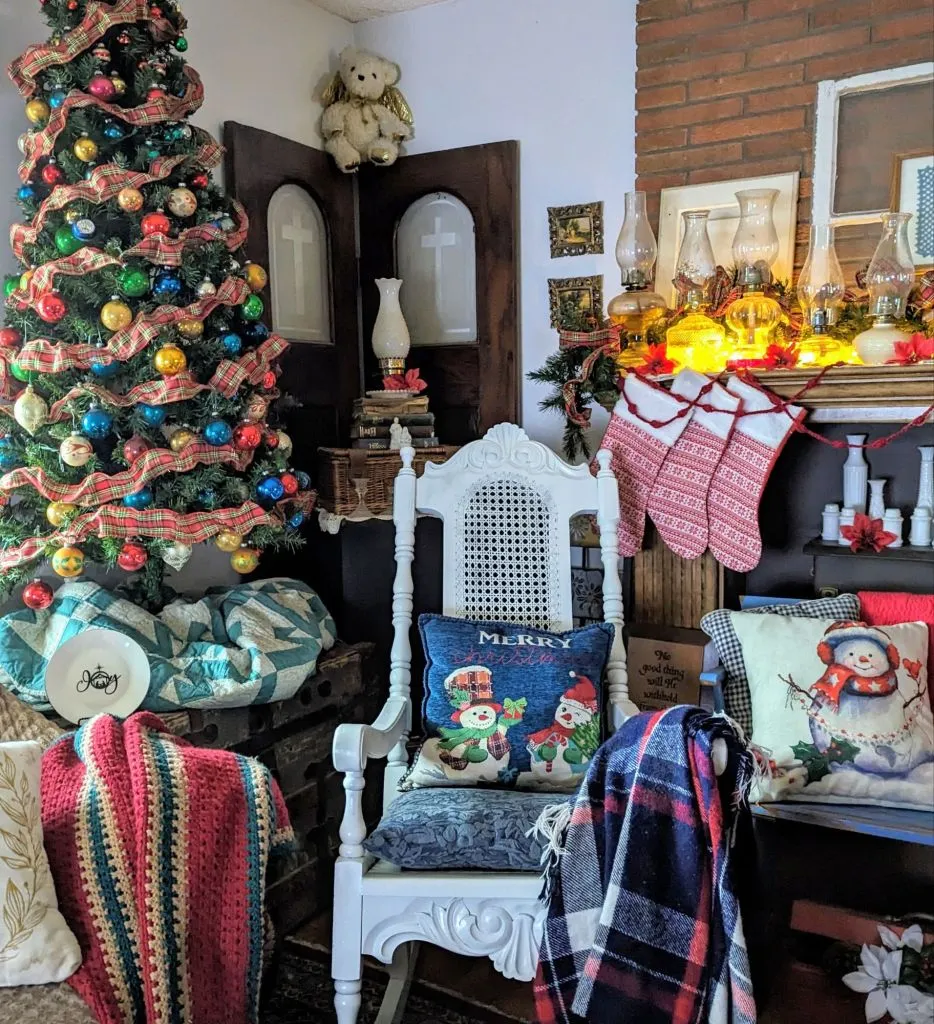
The formula for a ribbon-led tree is roughly 70% evergreen, 20% tartan ribbon, 10% ornaments — nearly the inverse of a bauble-heavy tree, which is why it feels calm even when the pattern is bold. If your dining table already carries a tartan runner like Idea #22, keep the tree ribbon in the same color family one scale larger so the two read as related rather than duplicated.
28. Red Bows and a Buffalo Plaid Truck Skirt Under a Green Tree
- Run gold ribbon garland in wide spirals, spacing passes about 12 inches apart.
- Clip red bows with white dots between the ribbon passes, alternating heights.
- Fill with silver and gold ball ornaments, keeping the largest ones lowest.
- Set small wrapped gift boxes at the base so the skirt graphic stays visible.
- Pull the skirt forward at the end so the truck faces the room.
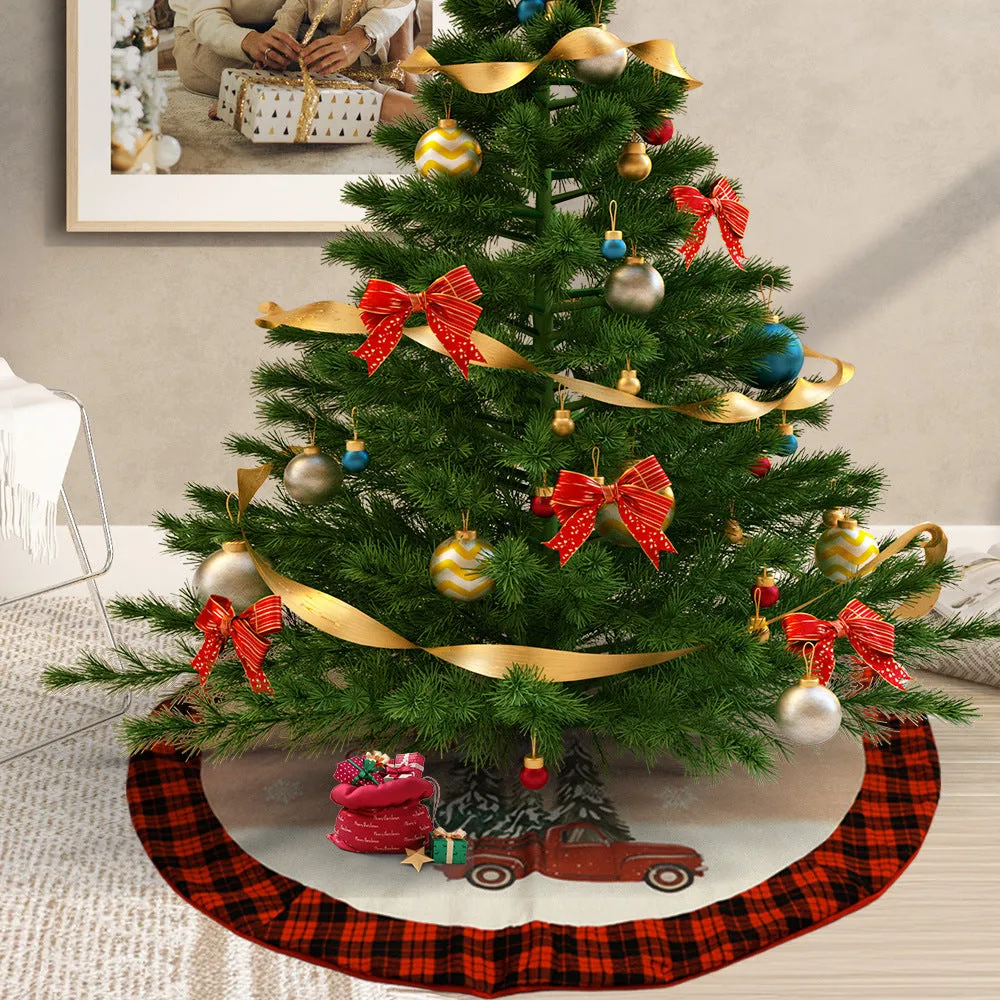
About 90 minutes of work. Materials run $60-$120 if you’re buying ribbon, bows, and ornaments new.
Graphic-print tree skirts are the most seasonal thing you can put under a tree. They’re charming in December and hard to use any other way, and printed panels crease if you fold along the graphic. Roll these skirts around a cardboard tube for storage. Also know that a printed skirt and a busy patterned ribbon compete — choose one to be the statement and let the other go quiet.
29. A Chevron Wrapped Gift With Tartan Ribbon on a Red Knit Throw
- Chevron wrapping paper, one roll: $6-$14
- Red and green tartan ribbon, 10 yd: $8-$16
- Red knit throw blanket: $25-$70
- Frosted tree ornaments, set of 12: $18-$45
- Mini string lights, one strand: $8-$20

Total: roughly $65-$165 for the styled corner under the tree. Budget alternative: use a scarf you already own instead of a throw, kraft paper under a tartan ribbon, and thrifted ornaments — about $20.
Ribbon on a wrapped gift should be cut three times the longest side plus 12 inches for the bow, and always cut on a diagonal. A straight cut frays and looks unfinished on fabric ribbon. For wire-edged tartan, press the fold with your thumbnail before tying so the bow holds a crisp shape. If your paper is a busy chevron, keep the bow wide and simple — a fancy multi-loop bow on a patterned paper reads as noise.
30. A Sugar-Frosted Gingham Ornament on Stacked White Plates
Gingham rather than tartan, but the same idea — one simple pattern panel on a neutral ornament. Start with a plain paper-mâché or foam ball ($1-$2), paint it beige, then decoupage a strip of gingham ribbon or fabric down the center. For the frosted finish, brush on a thin coat of Mod Podge and roll the ornament in coarse sugar or clear craft glitter while it’s wet. A set of six lands around $15 versus $8-$12 each at a boutique.
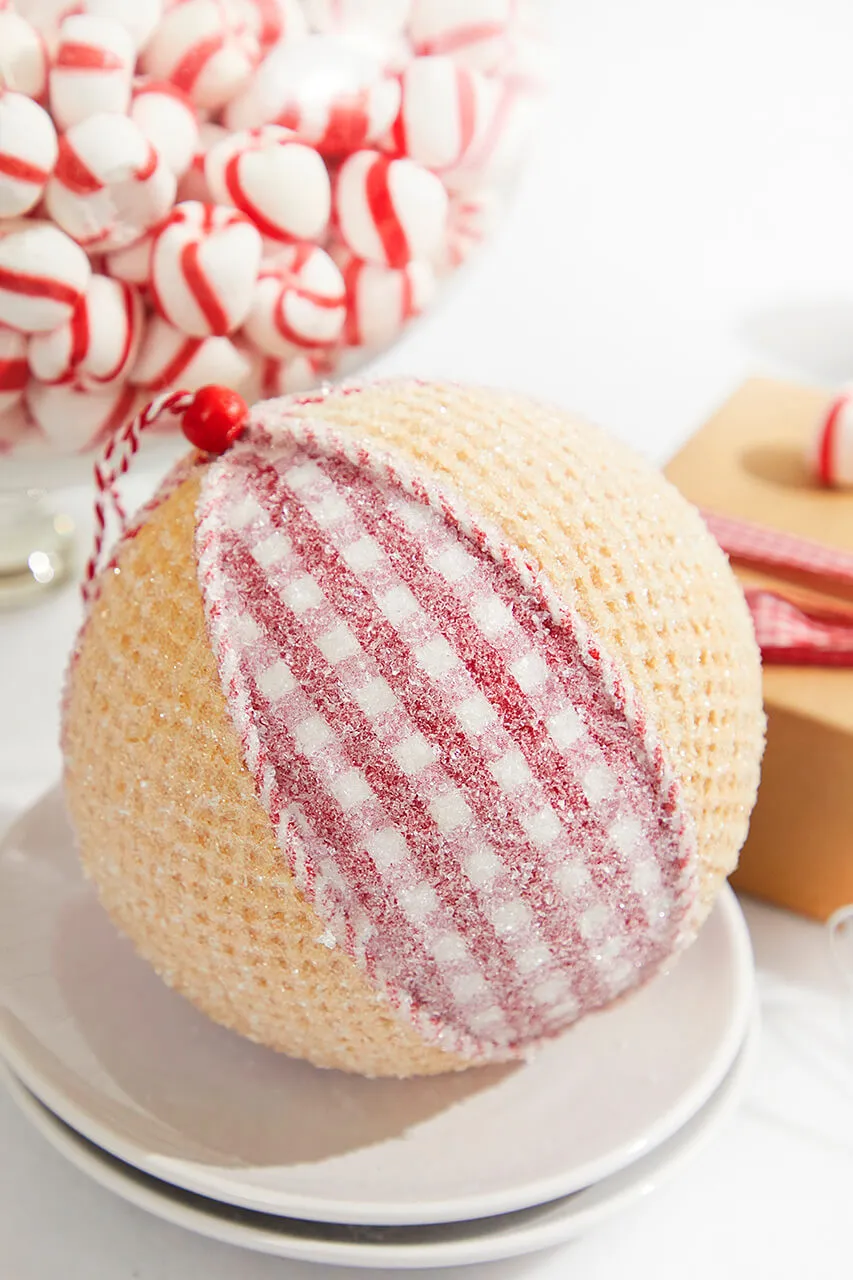
Oversized ornaments like this — four inches or more — need their own space. They look best on a tree at least 6 feet tall, or in a bowl on a kitchen counter where you can actually hold them. On a 4-foot tabletop tree, one 4-inch ornament is already a third of the tree’s width and will look absurd. Scale the tree up or the ornament down; a 2.5-inch version of the same frosted ball works fine on a small display.
31. A Green Tartan Bow Pillow on a Tufted Beige Velvet Sofa
The pillow is shaped like a bow — that’s the entire idea, and everything else exists to support it. On a plain tufted sofa, a bow-shaped pillow reads as sculpture. On a floral sofa it would read as clutter. Notice how the sofa stays neutral, the folded plaid textile stays quiet, and the brass candlesticks add only a thin line of warm metal. Take the bow shape away and you have a pleasant holiday sofa with no point of view.
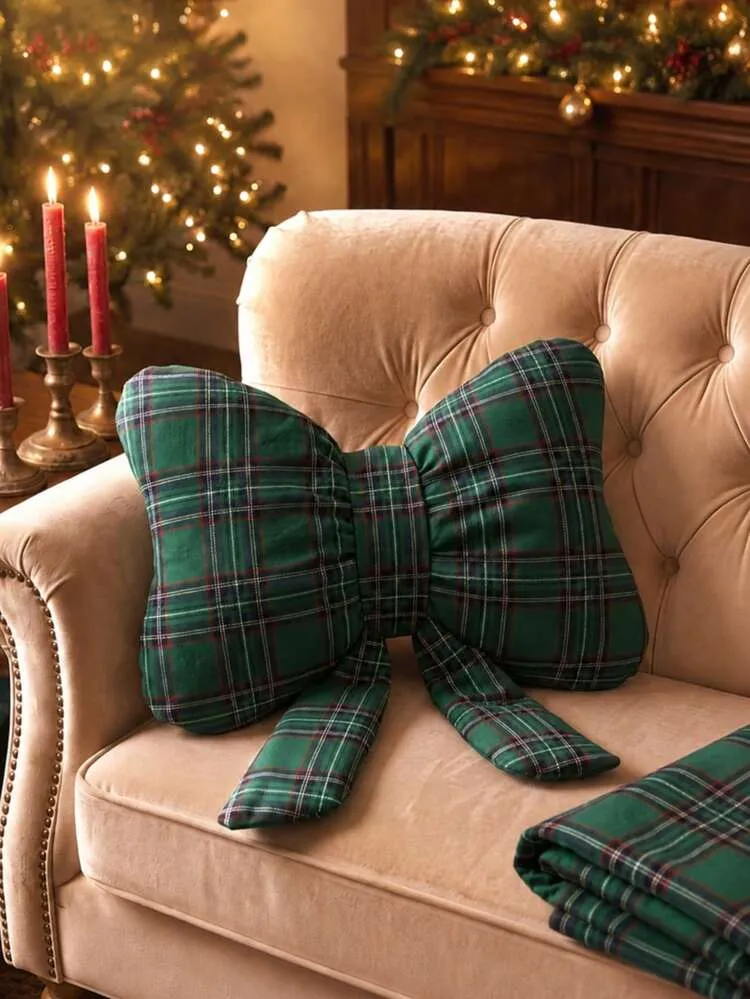
Shaped pillows — bows, stars, stockings, peppermints — went from craft fair to mainstream decor over the last two holiday seasons, and 2026 is peak interest. The appeal is how quickly one pillow changes a room’s mood without touching furniture, paint, or a tree. The risk is that shaped pillows date fast, so buy the version that reads plaid first and shape second — that’s the one you’ll still like in three years.
32. A Navy and Green Tartan Skirt Tied With Satin Ribbon
Satin ribbon closures are the first thing to go — they fray, slip, and lose their sheen after one season of tying and untying. Knot them once in a bow and leave them alone; retying every time you water the tree weakens the weave at the same spot. A fabric skirt like this is cold-wash or dry-clean only, and the scalloped edge curls if you iron it flat. Steam the hem from a few inches away instead.
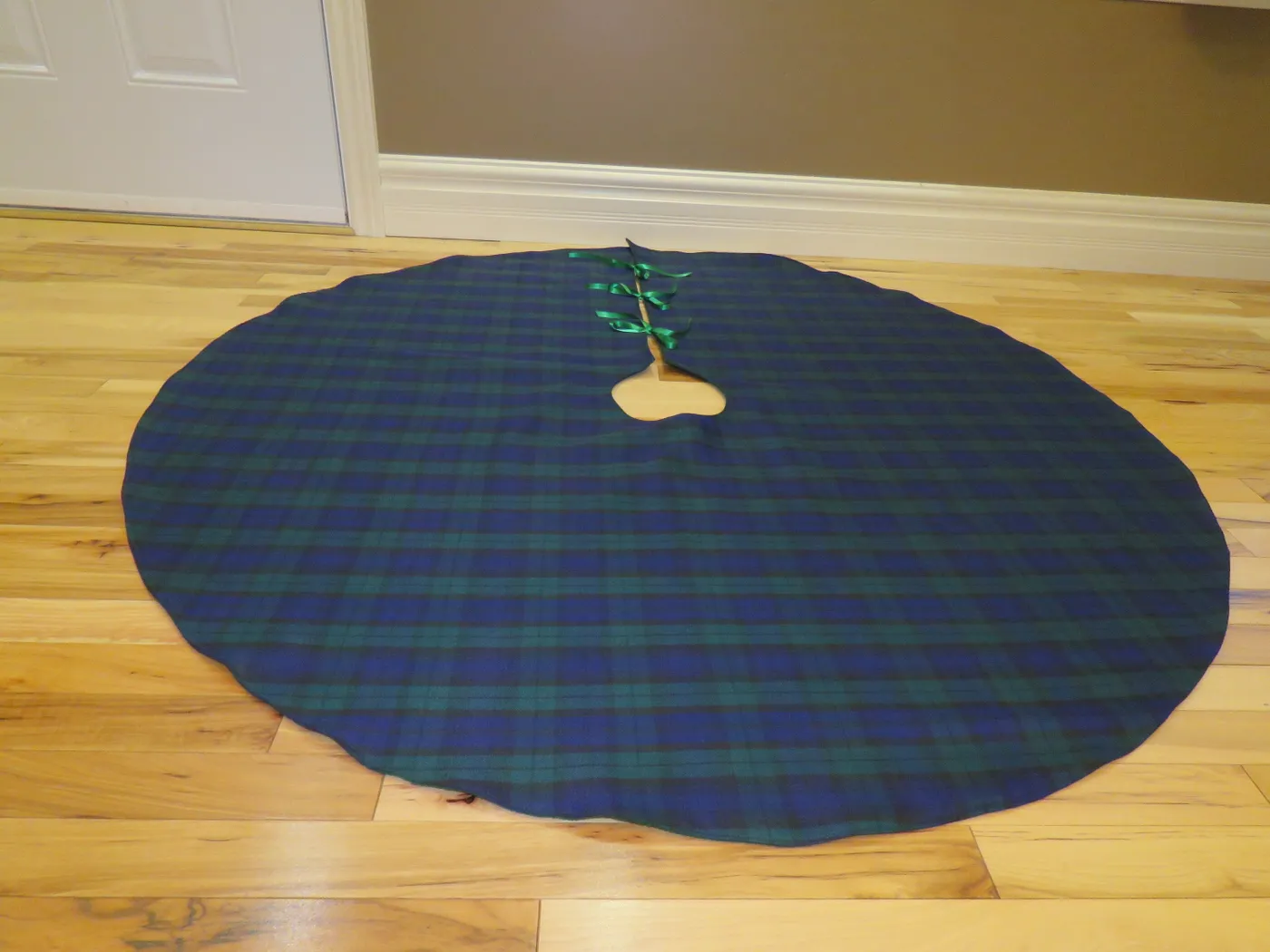
- Tartan skirt with scalloped edge: $45-$130
- Green satin ribbon for the ties: $4-$10
- Tree collar or stand cover: $20-$55
- Wrapped gift props: $10-$30
- Handheld fabric steamer: $25-$45
Total: about $105-$270, or $60-$140 if you’re reusing a skirt you already own. Budget alternative: two yards of navy and green tartan cut into a circle with a slit — $20 and an hour with a sewing machine, or fabric tape if you don’t sew.
Hang the Plaid, Light the Tree, Pour Something Warm
You don’t need a perfect matched set to get a tartan tree that feels collected and warm — you need one good ribbon, a palette that respects the 60/30/10 rule, and the discipline to stop at two plaids per room. Start with the idea that matches your space and build from there, one ornament at a time.
📌 Save this to Pinterest so it’s waiting the next time you’re standing in the ribbon aisle with your phone in one hand.