33 Jaw-Dropping Christmas Tree Garland Ideas You Need to Try in 2026 to Elevate Your Holiday Decor

christmas tree garland 2026 is having a moment on Pinterest right now — and honestly, it’s the one holiday trend that’s actually worth the hype.
We spent serious time browsing Etsy, Michaels, Target, Amazon, and World Market to bring you only what’s worth your attention this year, sorted across every price point from about $12 for a handmade felt ball strand to $800 for a fully styled, ribbon-wrapped tree. Below you’ll find 33 curated ideas: handmade crochet trees, rainbow holly, felt balls, feather boas, pom-poms, and frosted pine draped over a white banister.
The real shift this year is toward things people made — or things that look like it. Slow-craft garlands are crowding plastic tinsel right off the boards, and budget versions are being compared against luxury ones side by side.
And stay until the end — we break down the most common mistakes that can ruin these looks. 📌 Save this to Pinterest for later — you’ll want to revisit these ideas.
1. Frosted Pine, Red Berries, and Pinecones on a White Banister
Frosted garlands look effortless, but they only stay put if you anchor them like a pro. Wrap 22-gauge floral wire around the handrail itself — never the balusters — every 12 to 14 inches, then fluff the branches forward so the wire disappears. Use a 9- to 12-foot garland for a standard staircase run and double it up; a single strand reads thin from the bottom of the stairs, which is exactly where everyone photographs it.
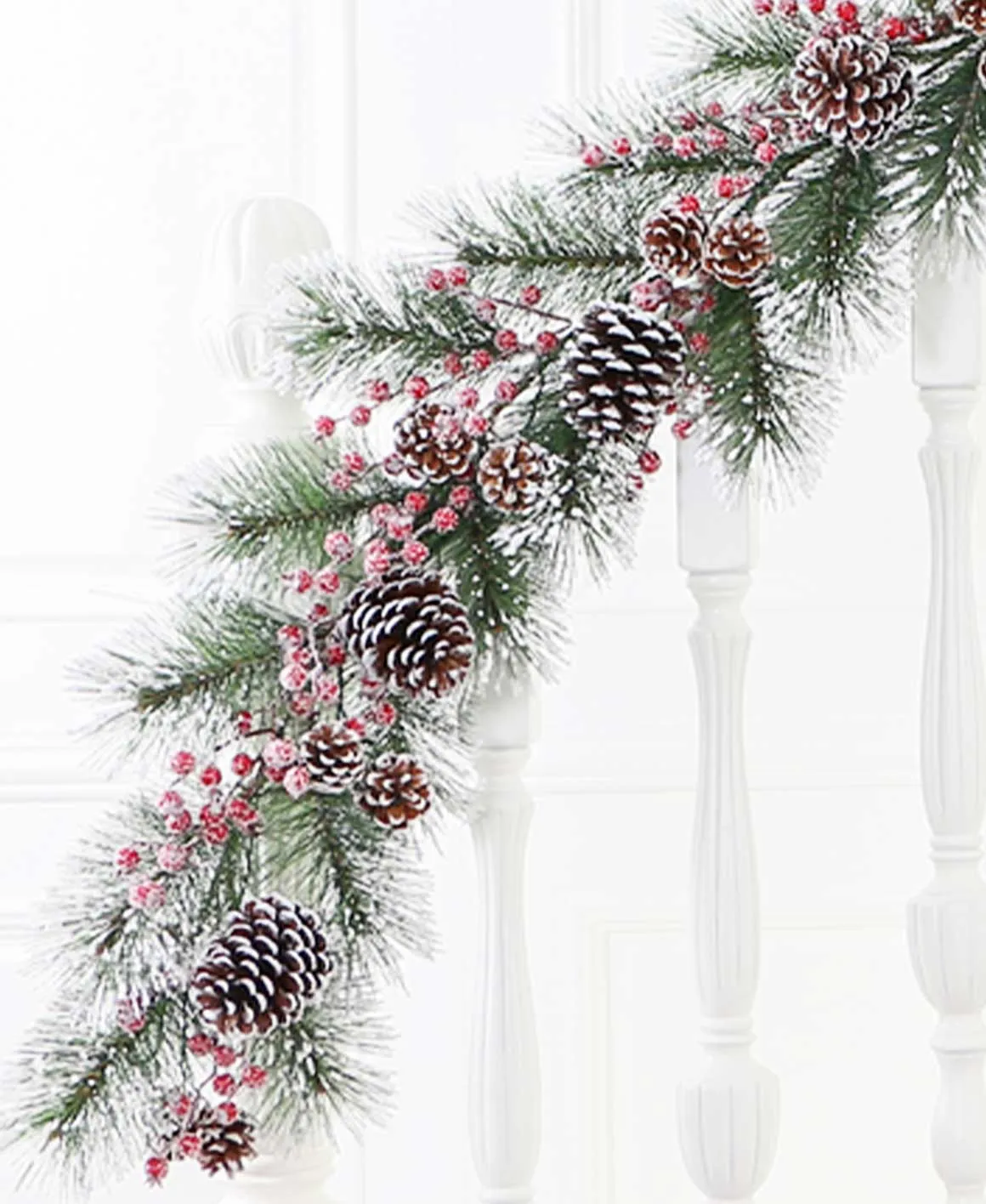
Flocked garlands shed. Constantly. Before you commit, check three things:
- Is your flooring dark or textured? Frost dust shows up like snow on a wood floor.
- Does the banister sit where wet coats and boots pass daily? Skip frosting there.
- Can you reach the full run without a ladder? You’ll be re-fluffing weekly.
Vacuum the branches with a brush attachment on low before hanging, and keep the garland three inches off the wall so the frost doesn’t rub the paint.
2. Pink Feather Fluff Meets Pastel Candy Ornaments
Two things are doing the heavy lifting here. First, texture contrast: that pink feather garland is soft and matte while the candy and gingerbread ornaments are glossy and hard, and your eye needs both to stay interested. Second, color temperature — cool mint and pale teal sit right next to warm pink, which keeps the pastels from going flat. The forest green underneath is the anchor that makes the whole thing read Christmas instead of Easter.
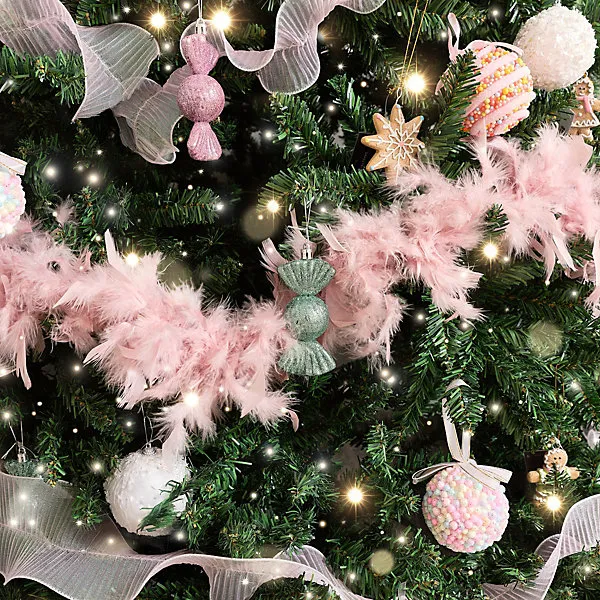
A feather garland does not need boutique money. A 6-foot marabou boa from a craft store runs $6 to $10 in blush pink, and two twisted together give you the density of the designer version. Pair it with candy-shaped ornaments from Target’s dollar section ($3 to $5 each) and a bag of pastel pom-poms. You’ll land around $35 instead of $180. Idea #20 shows the same feather trick on a much darker, moodier tree.
3. Red Pom-Poms on a Potted Evergreen in a Wicker Chest
- Foundation (woven wicker chest or vintage trunk, thrifted): $60–$180
- Tree and planter (3–4 ft evergreen, white ceramic pot): $45–$120
- Lighting (battery warm-white strand): $12–$25
- Garland (red pom-pom strand, 6 ft handmade): $18–$40
- Wall treatment: $0 — the off-white wall is already doing the work
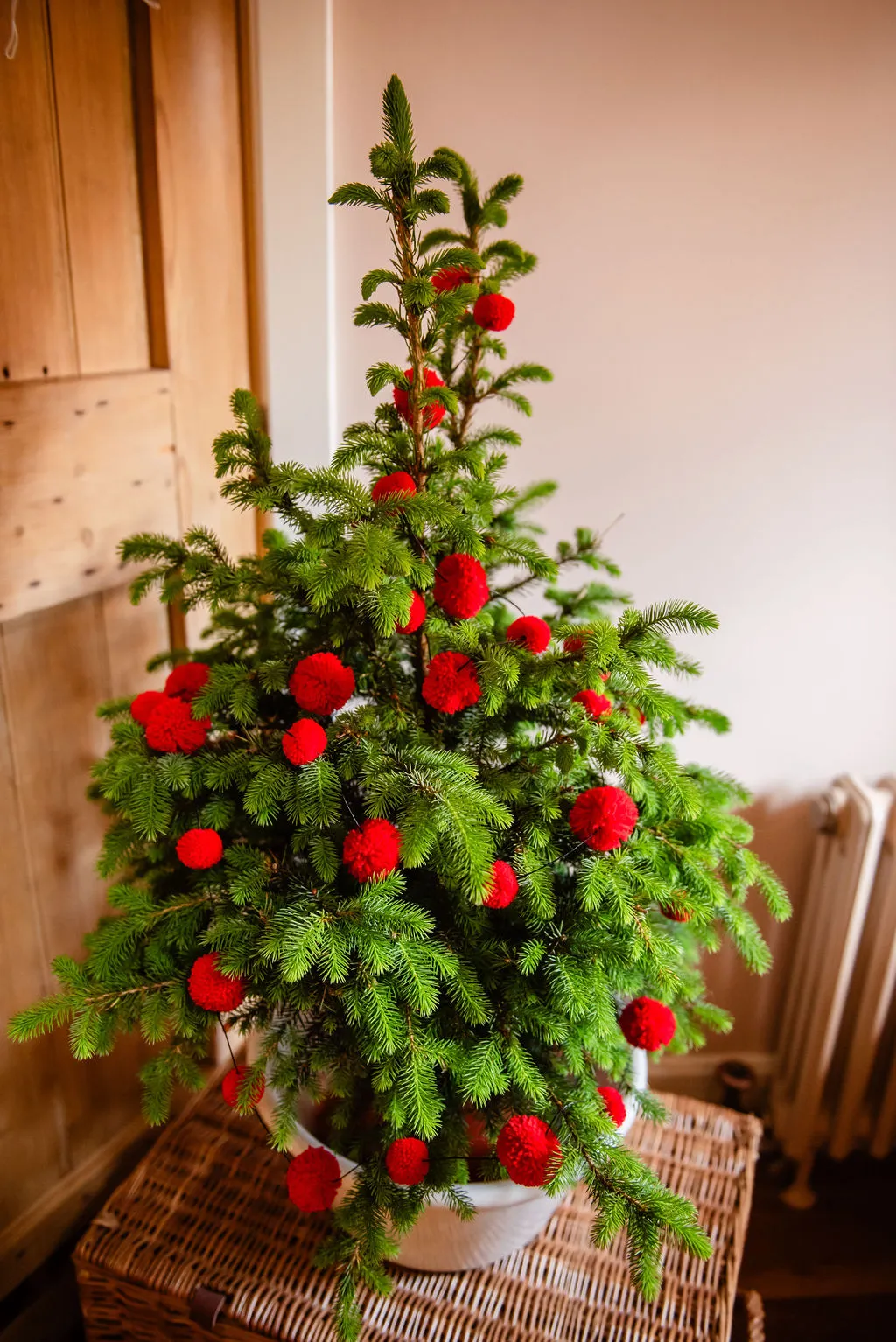
Total: $135–$410. Budget alternative: swap the wicker chest for a Facebook Marketplace steamer trunk at $25 to $50 and DIY the pom-poms from a $6 skein of yarn. You’ll land under $150.
The wicker chest is the one thing. Remove it and you have a small tree in a pot — pleasant, forgettable. The chest raises the arrangement to eye level, adds woven texture that echoes the pom-poms, and gives the vignette a real piece of furniture to stand on. Look for something 30 to 36 inches wide so the pot sits fully on top with breathing room on each side.
4. Red, Lime, and White Pom-Poms Across Dark Branches
The formula here is simple: 60% deep evergreen base, 30% pom-pom color, 10% string light glow. The tree itself has to stay dark — a lighter, flocked tree would wash those lime pom-poms right out. To swap the palette, keep the 60/30/10 ratio and change only the accent: cranberry and ivory for a traditional look, or blush and gold if you want something softer.
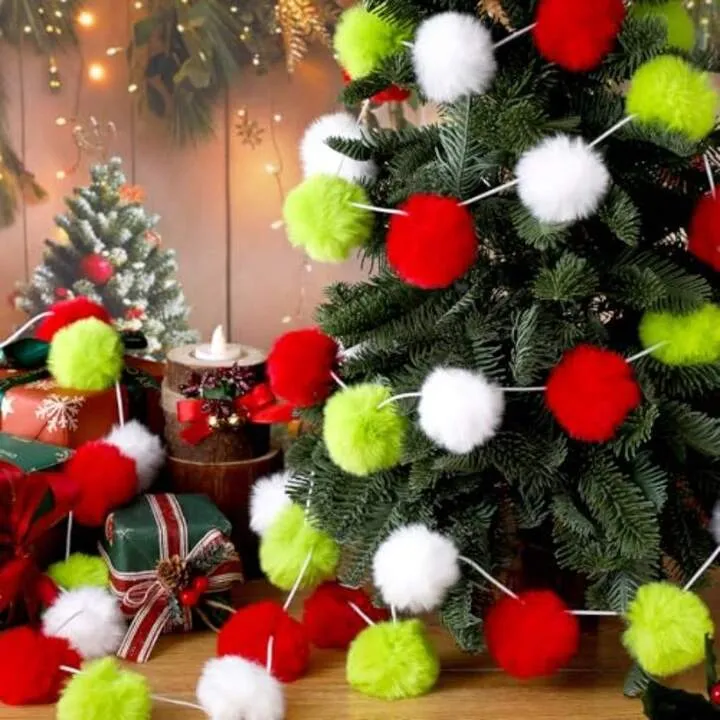
Make the garland yourself in about two hours.
- Wrap yarn around a 3-inch pom-pom maker 80 to 100 times.
- Cut, tie the center tightly, and trim to a full round.
- Make roughly 20 poms, alternating red, lime, and white.
- Thread a tapestry needle with heavy cotton cord and pierce each pom through the center.
- Knot between each pom so they stay evenly spaced.
Cost: about $15 in yarn, which saves you $40 or more versus buying one.
5. Felt Ball Garland in Red, White, and Forest Green
Wool felt ball garlands have quietly become the anti-tinsel of the decade. They fit the slow-craft, buy-less-better mood that’s dominated holiday decor since 2023, and they photograph beautifully — matte texture, soft edges, zero glare. The look has staying power because it isn’t tied to one color story; red, white, and forest green is the classic, but the same strand works in dusty blues or cinnamon tones.
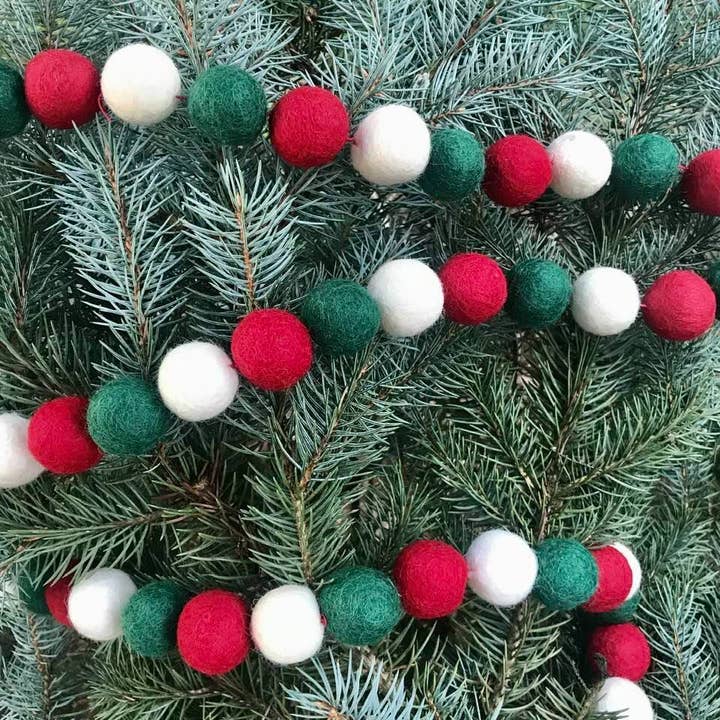
Two honest warnings. Felt balls on a thin string slide — unless the maker knotted between each ball, you’ll find them bunched at one end by New Year’s, so check before buying or add knots yourself. And that white cord is highly visible against blue-green needles, which is either charming or distracting, depending on your taste. If you want the balls to float, choose a strand strung on dark green or black cord instead.
6. Deep Red Textured Spheres Glowing Under Warm String Lights
Rule of thumb for garland density: one strand for every 18 inches of tree height. A 7-foot tree wants roughly five running feet of garland if you’re swagging it, or nine feet if you’re spiraling top to bottom. For a deep red pom garland like this one, keep the strand chunky — 1.5 to 2 inches in diameter — so it holds its own against the glow of the lights instead of disappearing into them.
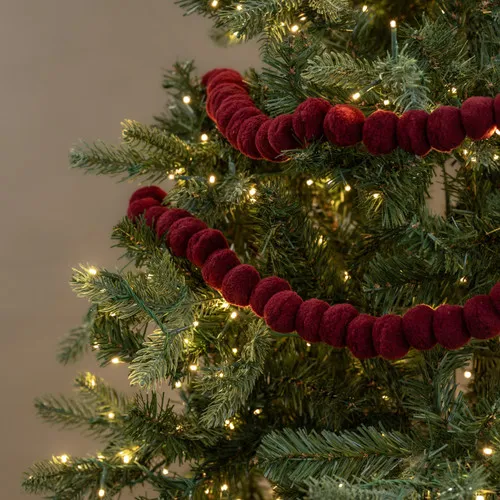
This look needs a tree at least 6 feet tall and reasonably full; a sparse or tabletop tree makes a chunky red garland look like a necklace on a thin neck. Ceiling height matters less than you’d think — a 7.5-foot tree under a 9-foot ceiling is the sweet spot. In a small apartment? Skip to Idea #18, where the garland gets styled on the floor beside the tree instead.
7. White Pom-Poms with Silver and Gold Glitter Ornaments
White pom-poms show everything — dust, pet hair, and the faint gray film that settles on anything near a fireplace. Plan on a lint roller pass every week or two, and hand-wash the garland in cool water with a drop of dish soap at the end of the season. Glitter ornaments are their own chore; they shed constantly, so hang them no lower than knee height if you have toddlers or a dog who investigates everything.
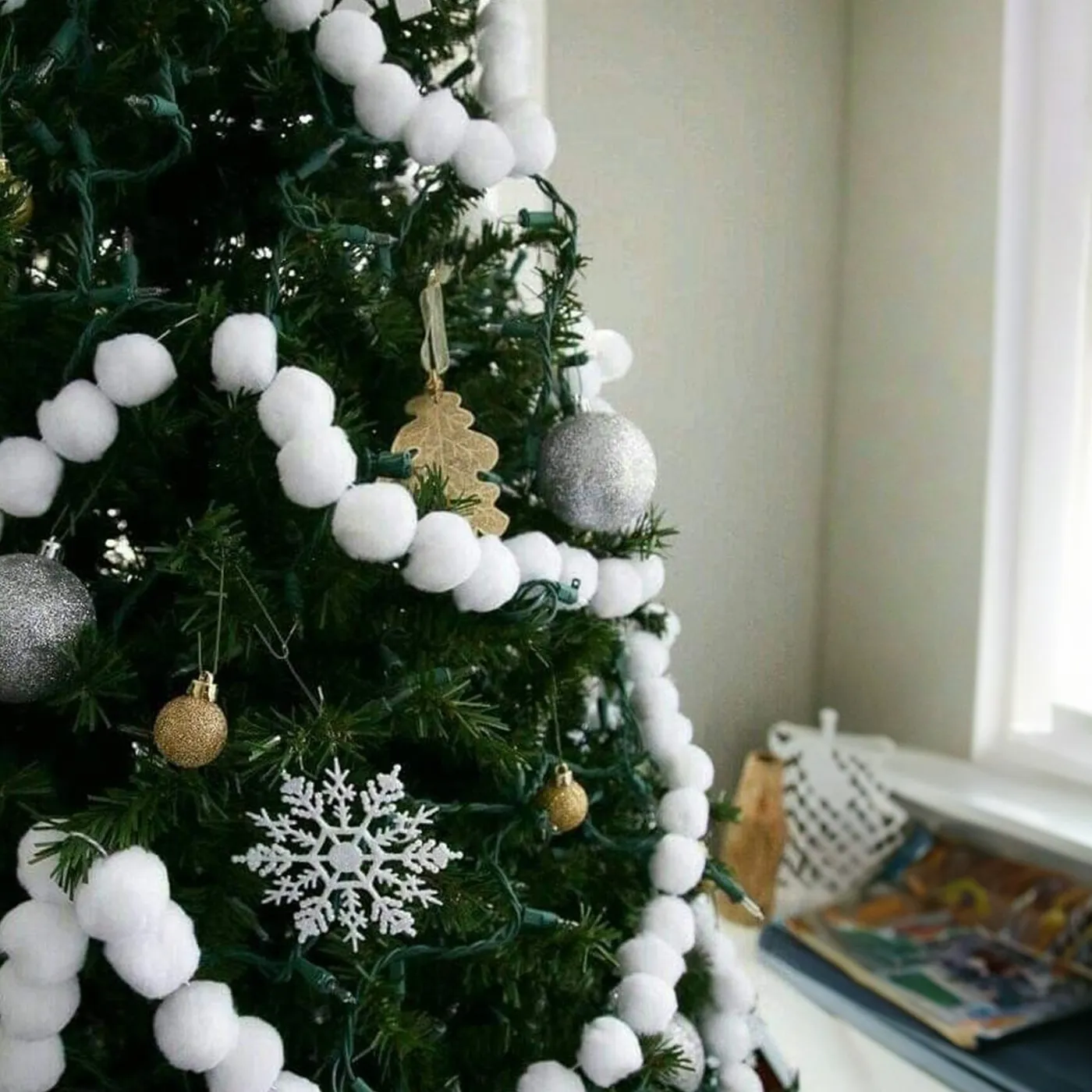
The magic is restraint. White pom-poms, silver and gold balls, one snowflake, warm lights — that’s the entire recipe, and it reads bright and clean rather than cluttered. Silver and gold sit on opposite ends of the temperature spectrum, so mixing them keeps the metallic from feeling matchy, and the white garland repeats the white of the snowflake, tying the tree together without a single extra color.
8. Greenery Garland Layered with White Pom-Poms and Gold Sprigs
You can fake this layering with two inexpensive pieces: a plain green garland from Walmart ($10 to $15) and a bag of white pom-poms ($5). Hot-glue the pom-poms straight onto the greenery instead of stringing them, then tuck in a few gold glitter sprigs from the dollar store. You’ll spend about $25 for something that photographs like $120.
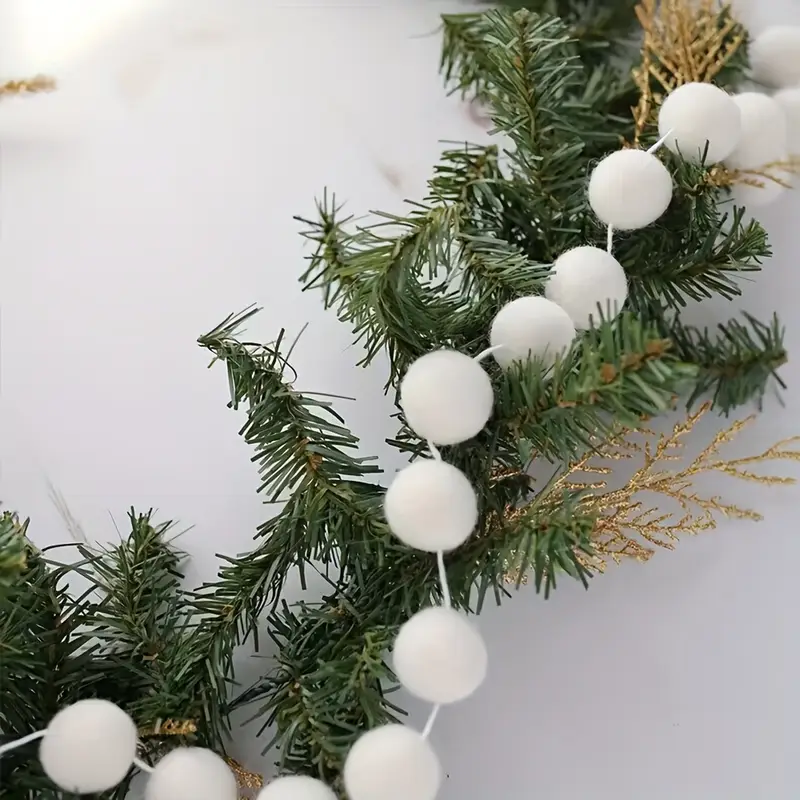
Before you buy anything, confirm:
- Measure the surface — a 6-foot garland covers about 4 feet once it’s swagged.
- Check whether your mantel or shelf sits in direct sun; gold glitter dulls in UV.
- Confirm you have an outlet or battery pack within three feet.
- Count the greenery you already own so you don’t double up on the same shade.
9. White Felt Balls Woven Through Mercury Glass Bulbs
The mercury glass bulbs are the one thing. Take them away and this is a plain white felt ball garland — pretty, but ordinary. The elongated gold bulbs add a vintage shimmer that makes the white felt feel expensive rather than crafty, and because the bulbs run warm, they keep the arrangement from going cold. Look for bulbs with a visible filament or metallic finish; clear glass won’t have the same effect.
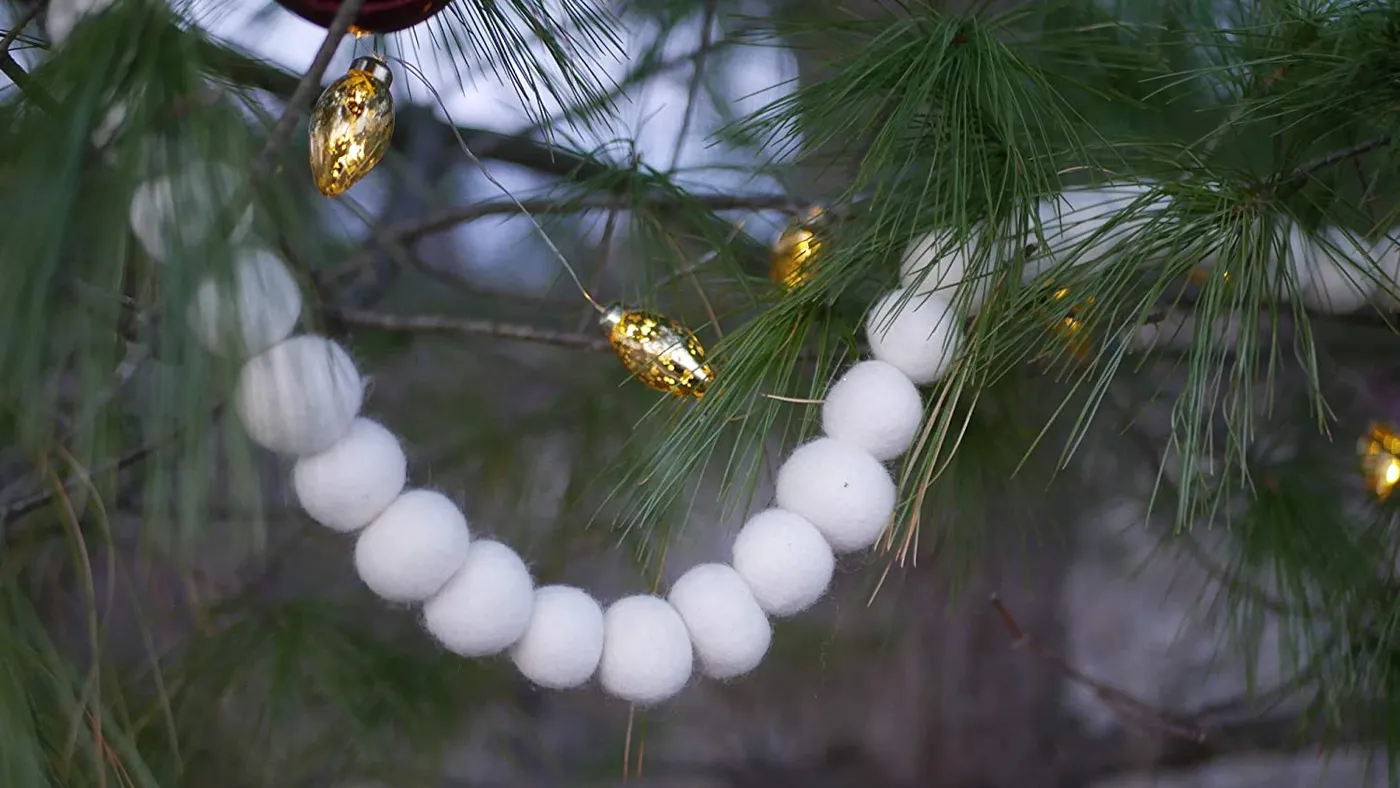
Felt balls read best in mixed sizes. A strand alternating 1-inch and 1.5-inch balls looks intentional; uniform balls look like a craft kit. When you drape it, let the garland fall in loose loops about 8 to 10 inches deep rather than a tight swag — the felt needs room to cast its own soft shadow against the needles.
10. Multi-Color Yarn Pom-Poms on a Red and White Twisted Cord
Build the palette with the 60/30/10 rule: 60% green tree, 30% pom-pom color, 10% string and light. Here the poms take four colors at once, which only works because the dark green and the warm white lights hold everything together. For a calmer version, keep the red-and-white twisted cord and narrow the poms down to two colors.
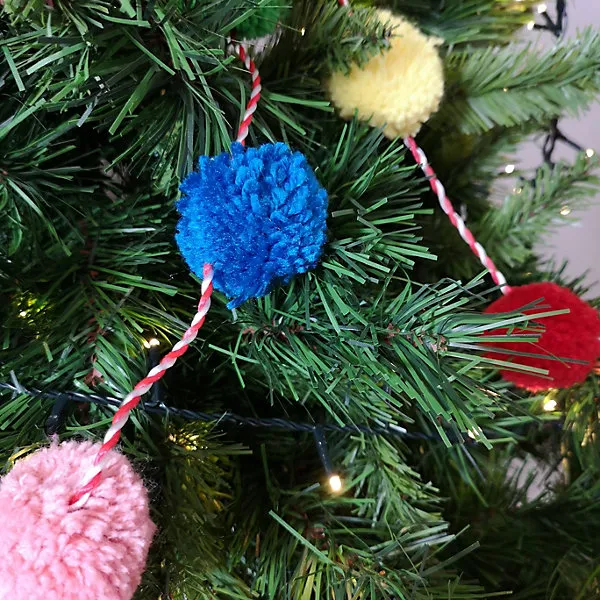
Multi-color pom garlands are forgiving on tree size — they work from a 4-foot tabletop tree up to a 9-footer. The real constraint is width. If your tree is under 30 inches across at the base, use 1-inch poms; anything wider and the garland starts competing with the ornaments. In a room under 100 square feet, this garland on a slim 6-foot tree keeps things festive without swallowing the space.
11. Red and White Pom-Poms Draped Over a Weathered Urn
A garland draped across an urn works beautifully in photos and badly in real life if you don’t anchor it. Pom-poms are lightweight, so a single gust from a heating vent will send the strand sliding off the rim. Run a discreet length of florist wire around the inside lip and hook the garland onto it. Also check the urn’s weight — a tall tree in a light container tips, especially in households with cats.
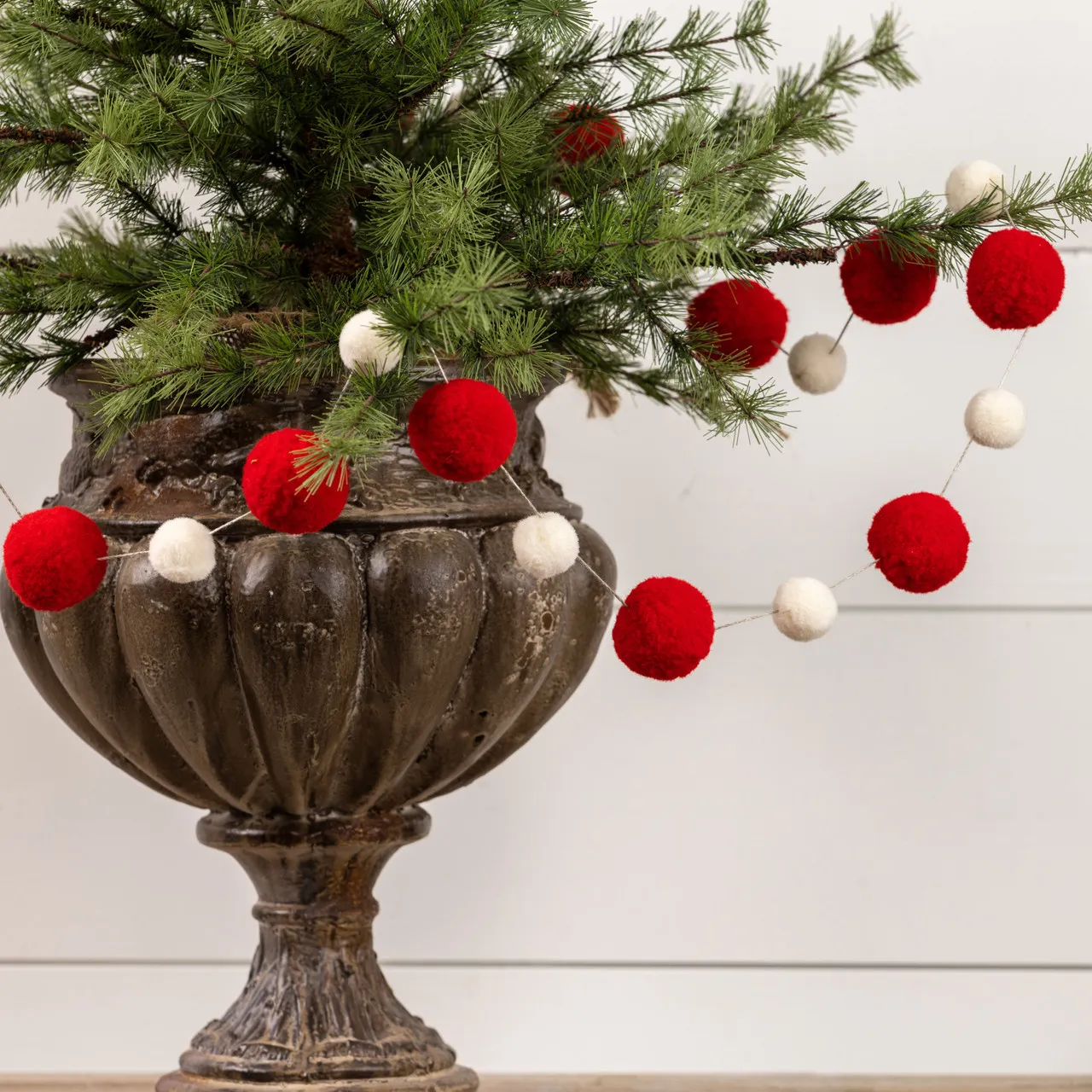
- Urn or planter (distressed metal, resin, or vintage): $35–$140
- Faux evergreen (4–5 ft, pre-lit if possible): $60–$200
- Garland (red and white pom strand, 6 ft): $20–$45
- Spare red and white baubles: $15–$35
Total: $130–$420. Budget alternative: a $25 galvanized bucket and a thrifted faux tree get you most of the look for a third of the price. Compare with Idea #3, which uses a wicker chest for a warmer, more rustic base.
12. Crisp Red and White Pom-Poms with a Stocking by the Fire
Getting that crisp alternating pattern takes about 40 minutes:
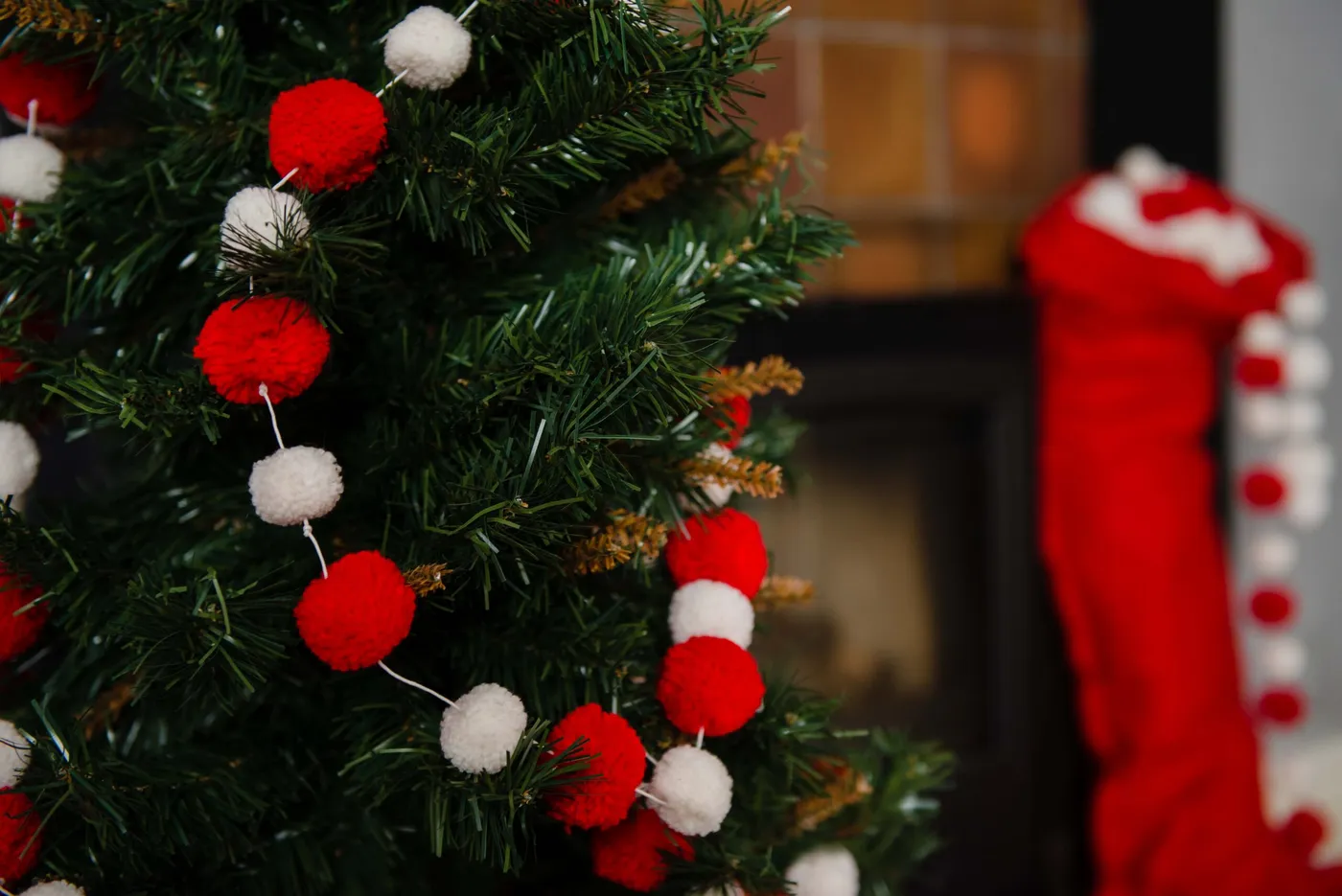
- Lay the pom-pom strand flat and check the color sequence before hanging.
- Start at the top third of the tree, not the very top.
- Wrap in a gentle spiral with 12 to 14 inches between passes.
- Secure the strand to a branch every third loop with a green twist tie.
- Step back 10 feet and check the spacing from across the room.
What makes this one work is the alternation. Red, white, red, white — that regular rhythm is what reads as classic rather than chaotic. Break the pattern with a random third color and the whole thing goes soft. If you want variety, vary size instead: mix 1-inch and 2-inch poms in the same two colors and keep the sequence strict.
13. Crocheted Stars and Trees on a Delicate White String
Handmade crochet garlands have moved from craft fairs to mainstream Pinterest boards, driven partly by the slow Christmas movement and partly by how good they look in photos — soft, matte, impossible to mistake for plastic. The crochet revival also tracks with a broader shift: people want decor they can repair, wash, and keep for a decade instead of replacing every November.
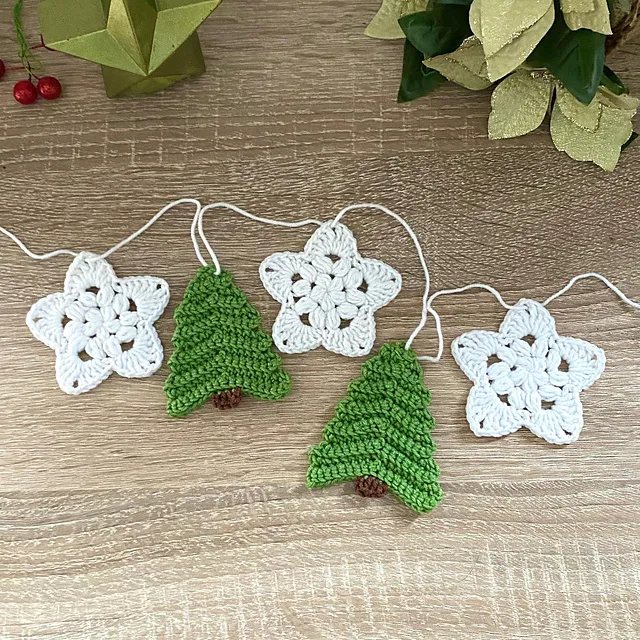
Crochet holds up beautifully, with one caveat: cotton yarn absorbs odors and dust. If your garland hangs near a kitchen or a wood-burning fireplace, plan on hand-washing it in cool water once a season and laying it flat to dry — never in the dryer, or the stars will lose their shape. Store it in a breathable cotton bag, not plastic, so moisture doesn’t get trapped.
14. Crochet Tree Garland Styled Above a Marble Shelf
When you style a garland on a wall or shelf instead of a tree, hang it at 60% of the wall’s height for a balanced composition — roughly 54 inches from the floor on a standard 9-foot wall. Use two small clear adhesive hooks rather than nails, and give the garland a shallow 4- to 6-inch sag between them. Too much droop reads sloppy; too little and it looks like a straight line someone forgot to finish.
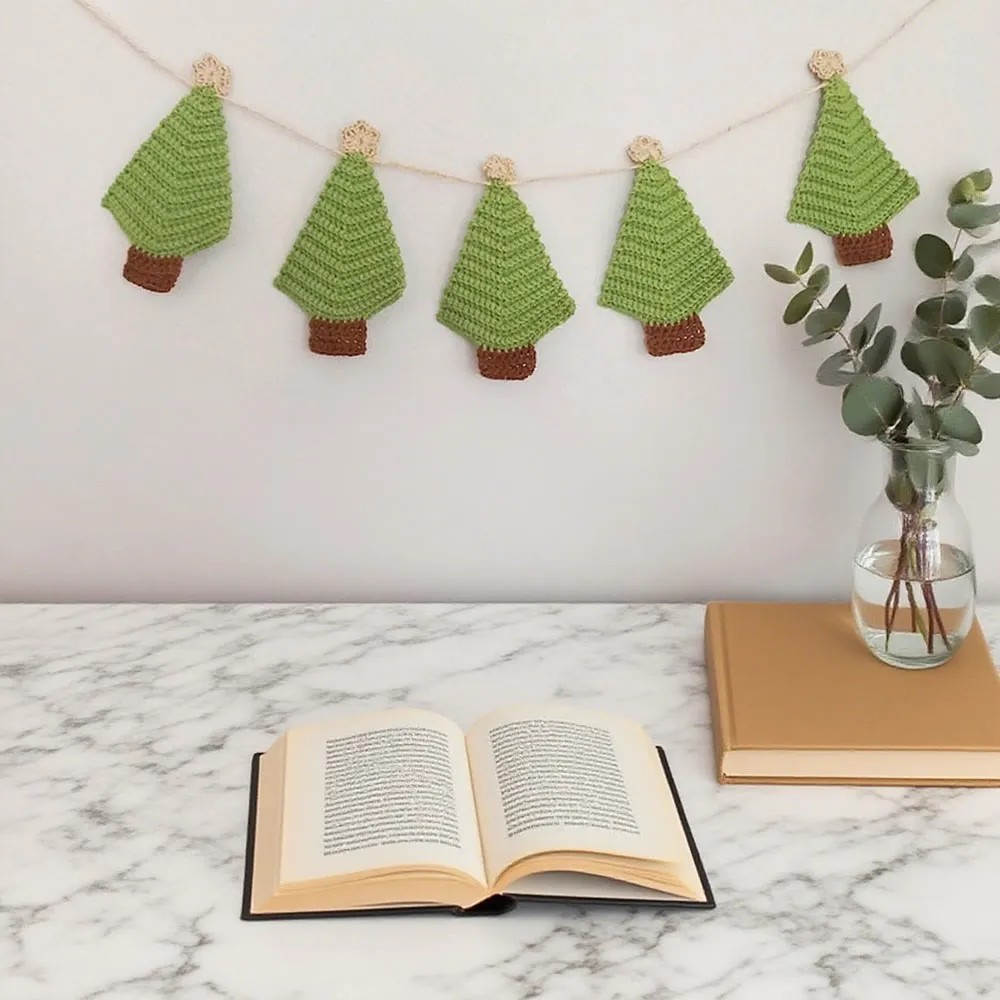
Repetition does the work here. The same tree shape, repeated with tiny variations, creates rhythm without demanding attention — exactly what you want on a slow, styled surface. The books and eucalyptus deliberately break the symmetry so the crochet doesn’t look like a store display, and the marble bounces light up into the texture. Simple rules, but they’re why the vignette feels calm instead of flat.
15. Light Green Crochet Trees on a Soft Gray Chain
This is one of the cheapest looks in the whole article to copy. A crochet tree garland pattern costs nothing on YouTube, and a single skein of light green cotton ($4 to $7) makes about 25 trees. Add a gray yarn chain ($3) and a size G hook, and you’re at $12 for the entire strand. Prefer to buy? Etsy sellers charge $25 to $45 for the same thing.
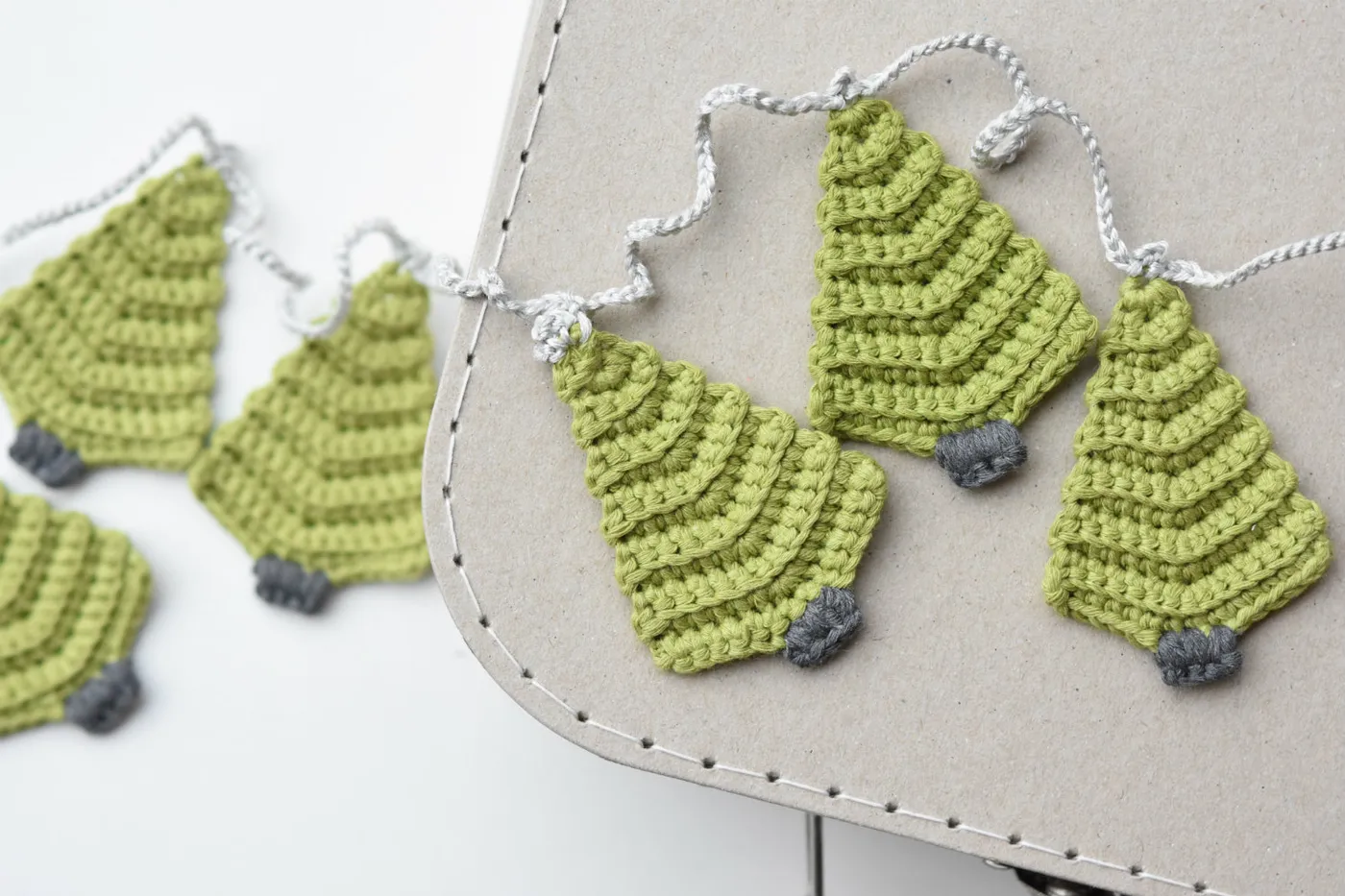
Small-scale crochet garlands work best in small spaces. They shine on tabletop trees under 4 feet, on mantels, or draped across a bookshelf, and they get lost on anything bigger than a 6-foot tree. If you’re working with a 10-foot ceiling and a large room, layer two or three strands at slightly different depths.
16. Crocheted Animal Mittens Nestled in Fresh Pine
This garland works because it’s mostly neutral with a single jolt of red — roughly 55% cream and natural linen, 30% deep red, 15% green from the pine.
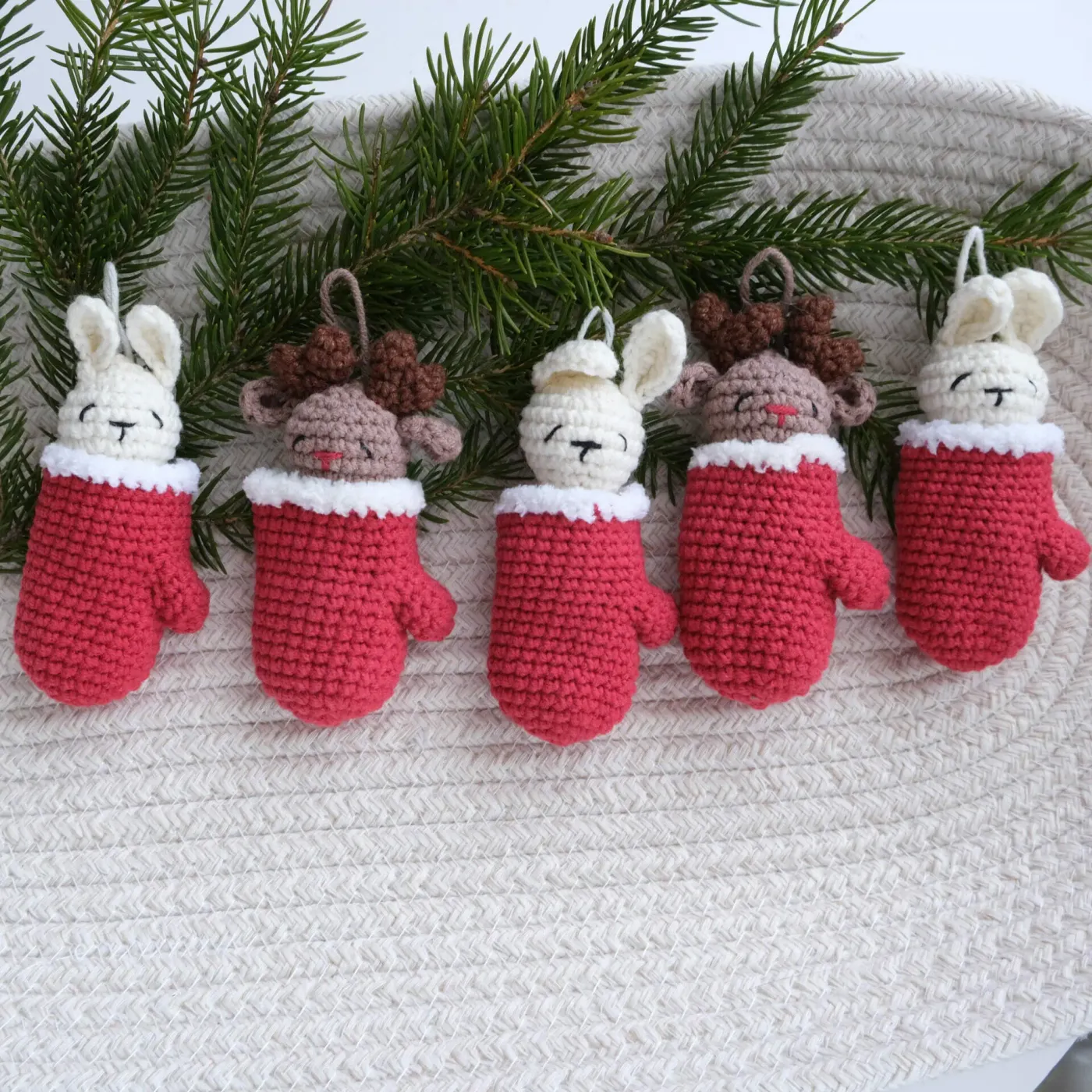
- Want it softer? Keep the red mittens, swap the pine for eucalyptus.
- Want it bolder? Add a second red element, like a ribbon tie.
- Want it kid-proof? Use acrylic yarn where little hands can reach.
Swap the red mittens for oatmeal and the whole thing goes too quiet; swap the white cuffs for black and it turns moody. The ratio matters more than the exact colors.
Adorable, but these are display pieces, not toys. Crocheted ornaments with hanging loops are a choking hazard for kids under three, and the loops snag easily on pine needles, which can pull a stitch out. If you have a toddler or a determined cat, keep these above the four-foot mark.
17. Neon Crochet Light Bulbs and Buttoned Trees on Pale Wood
A crochet light bulb garland takes one evening:
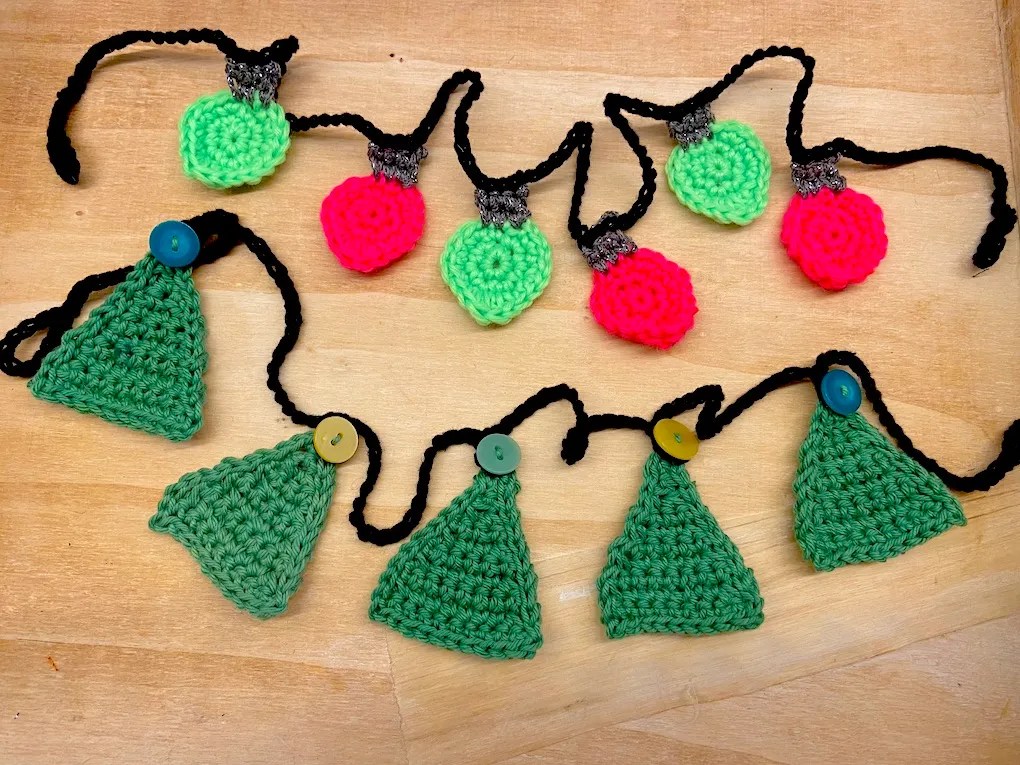
- Chain a 6-inch base in black yarn.
- Work single crochet in the round, increasing to about 12 stitches.
- Switch to neon pink or green and work six rows straight.
- Decrease for two rows, add a gray cap, and stuff lightly.
- Chain 20 stitches between bulbs and repeat.
Materials run about $12, and you should expect two to three hours for a 6-foot strand.
- Yarn (3 colors, worsted weight): $12–$18
- Crochet hook set (if you don’t own one): $8–$15
- Buttons for the tree version: $4–$8
- Storage bag: $6–$12
Total: $30–$53 for two garlands — one of the best values in this entire list, because everything is reusable year after year.
18. Mini Tree with a Crochet Garland Laid on a Beige Rug
Check these before you lay a garland on the floor:
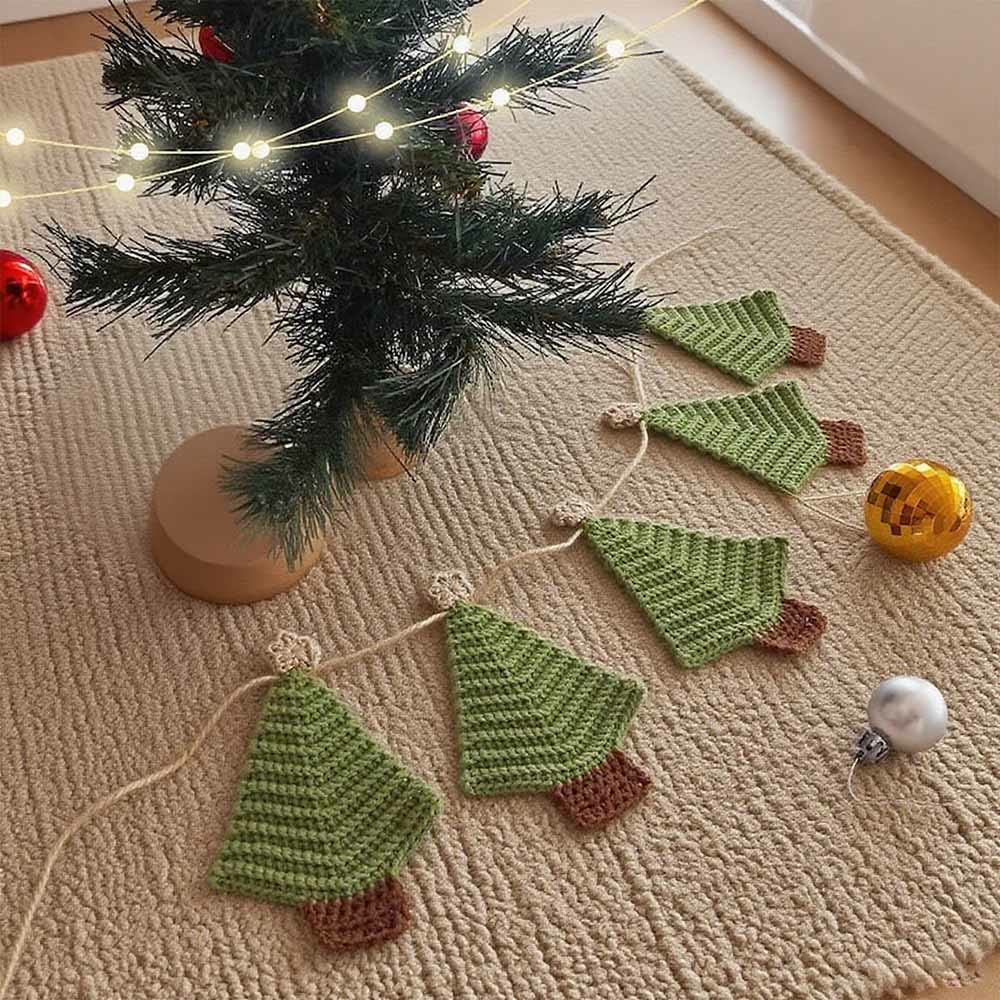
- Is the rug flat weave or high pile? Crochet catches on loops.
- Will anyone walk through this spot? Floor garlands need a clear 18 inches.
- Is the tree’s cord long enough to reach an outlet without a trip hazard?
- Do the garland and tree share at least one color? If not, add a ribbon.
Putting the garland on the floor instead of the tree is the one thing. That single decision makes a small tree feel like part of a whole composition rather than a lonely object in a corner, and it costs nothing. It also solves the classic small-tree problem: a 3-foot tree doesn’t have enough branches to support a full garland, so give the garland its own stage. Compare with Idea #6, which needs a much bigger tree for the same chunky look.
19. Rainbow Crochet Holly Leaves with Red Berry Accents
Color repetition is the whole trick. Each holly leaf carries the same two red berries, so even though the leaves themselves span the full rainbow, the eye reads the strand as one cohesive object. The white crochet chain between the leaves also gives your eye a rest — without it, the colors would fight. Copy this principle with any palette: keep one constant element and let everything else vary.
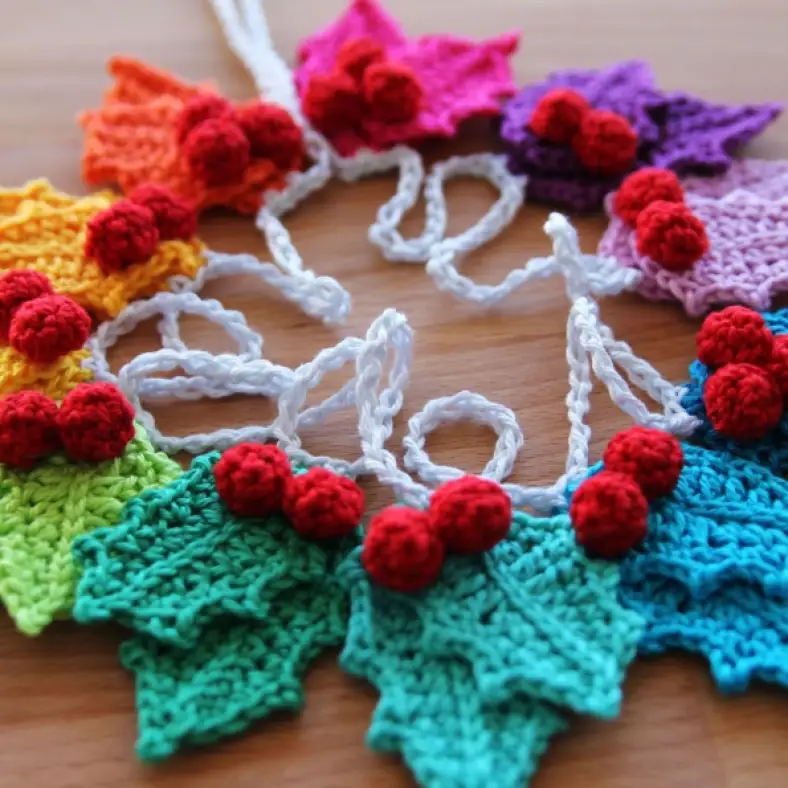
Rainbow works best when the colors are evenly spaced, not clustered. Before you hang a multicolor strand, lay it out on a table and move leaves until no two adjacent ones share a color family. It sounds fussy; it takes four minutes and it’s the difference between playful and chaotic. If you buy pre-made, photograph the strand flat and check the sequence before you commit.
20. Pink Feather Boa Draped Across Dark Green Branches
Feather boas are the divas of holiday decor. They shed, they flatten, and they collect dust like a lint trap. Give yours a gentle shake outdoors before hanging, then fluff the strands with your fingers each time you walk past for the first week. At the end of the season, seal it in a zippered bag — folded, not crushed. A well-kept boa lasts about three seasons before the feathers start looking tired.
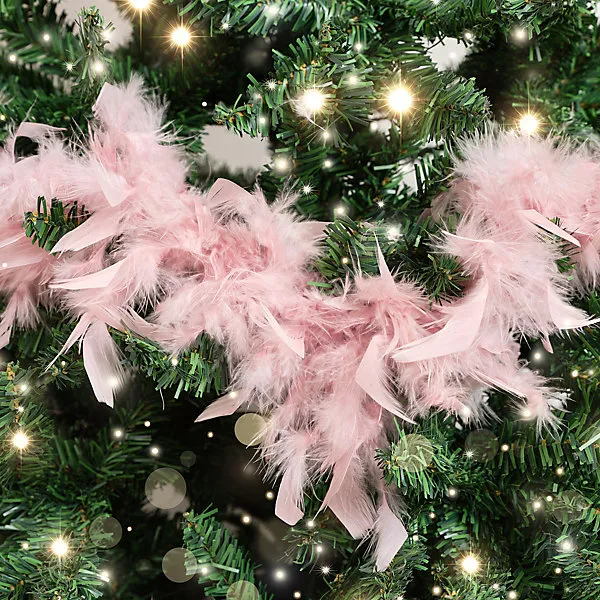
The formula: 70% dark green foliage, 20% pink feather, 10% white light. That 70% base is what makes the pink read as sophisticated rather than saccharine. To shift the mood, keep the ratio and change one variable — swap pink for ivory for a snowier look, or deep burgundy to go dramatic. Change two and the balance collapses.
21. Gold-Flecked Crochet Tree on Twisted White and Gold String
Small crochet ornaments like these are best on a tree between 4 and 6 feet, or on a wall garland in a hallway under 40 inches wide. On a 9-foot tree they vanish entirely. If you already own a big tree, cluster five or six of these little trees together at the top and let them act as one large ornament instead of spreading them thin across the branches.
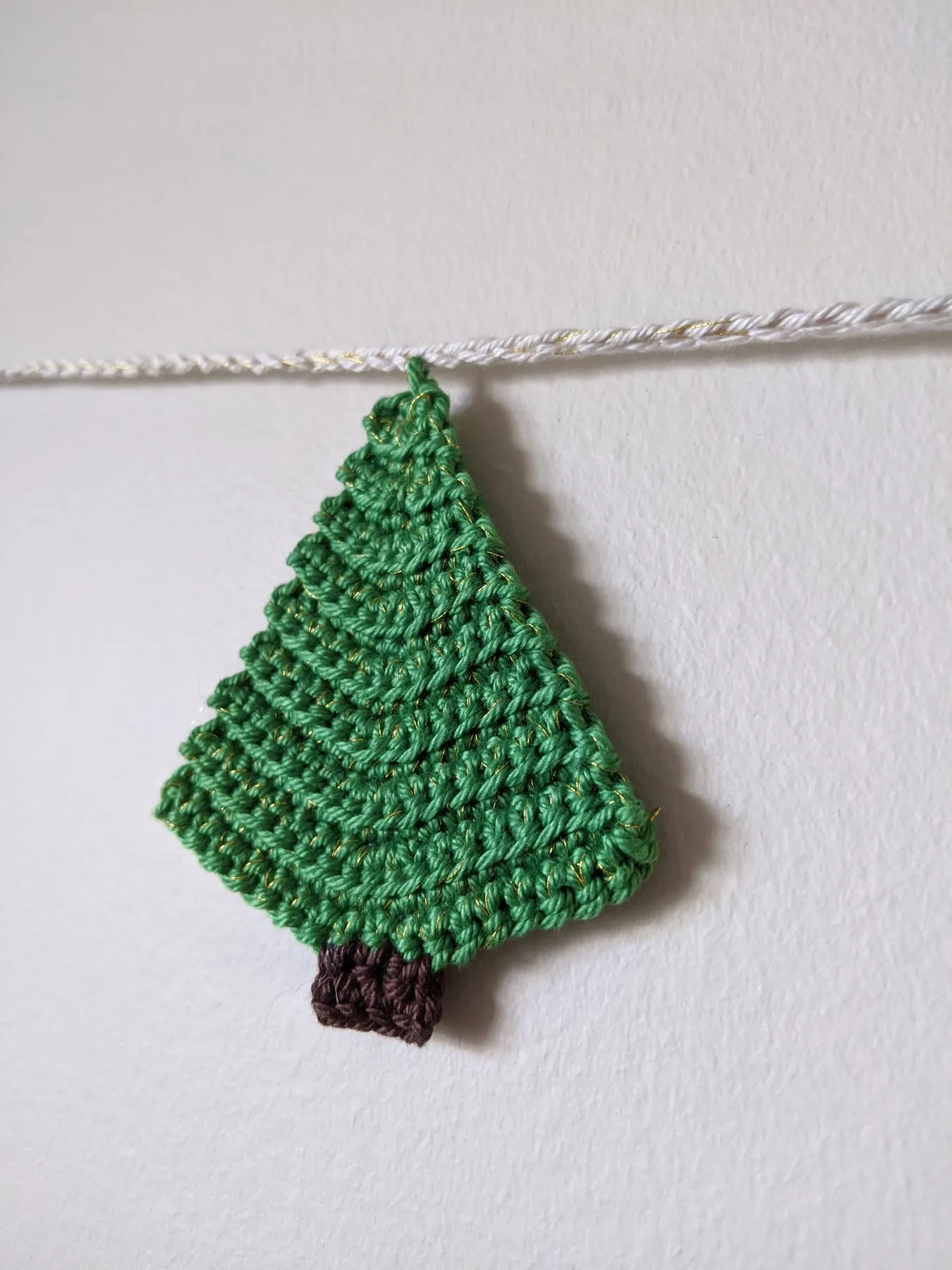
Metallic-flecked yarn costs $5 to $8 a skein and makes four or five little trees. A $3 ball of white cotton makes the twisted string. Even counting the hook, you’re under $20 for a handmade garland that Etsy sellers list at $38 to $60. Buy your yarn in person if you can — the gold thread is often much more subtle online than it looks in the product photo.
22. Crochet Trees and Wreaths with Jingle Bells and Striped Yarn
Bells are charming and loud. If your tree sits in a living room where people walk past constantly, a garland with 15 jingle bells will announce every footstep — and drive you slightly mad by mid-December. Test the sound before you commit, or hang this one somewhere with less traffic, like a hallway or a bedroom door. The striped yarn details and white pompoms work just fine on their own.
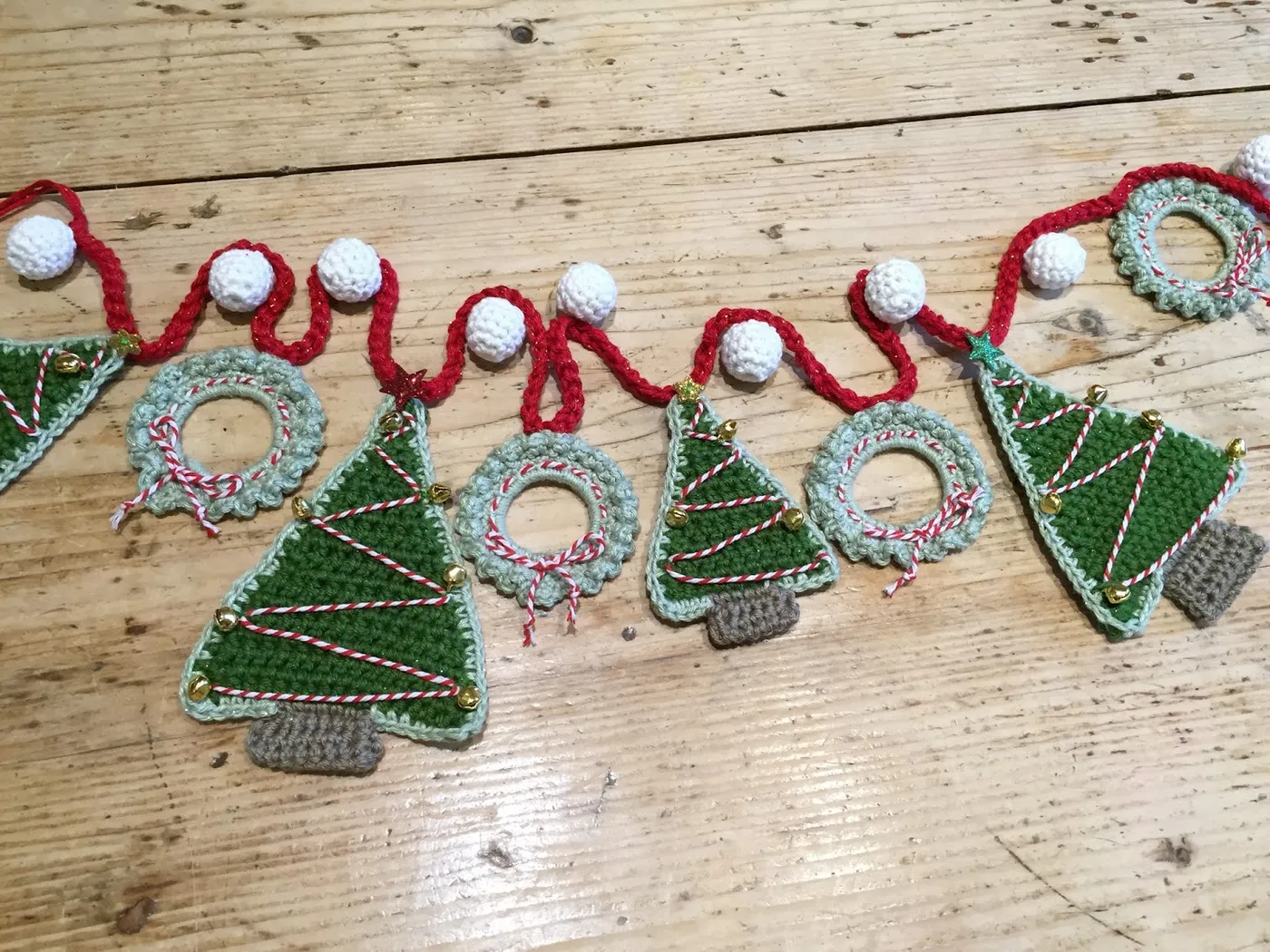
Make the tree and wreath pair in about three hours:
- Crochet a flat triangle in dark green, increasing one stitch per row.
- Add a red and white striped row near the bottom.
- Sew a small gold bell at the base of each tree.
- Crochet a ring for the wreath and add a striped bow.
- Alternate tree, wreath, tree, wreath on a red yarn chain with white pompoms.
23. Two-Tiered Crochet Light Bulbs Above a Winter Village Shelf
Colorful crochet light bulb garlands are having a moment because they solve a real problem: people want the nostalgia of vintage C7 bulbs without the heat, the wiring, or the electric bill. The crochet version reads instantly festive in photos, works on a white wall with zero hardware, and pairs with the bottle-brush tree and ceramic village trend that’s been building since 2022.
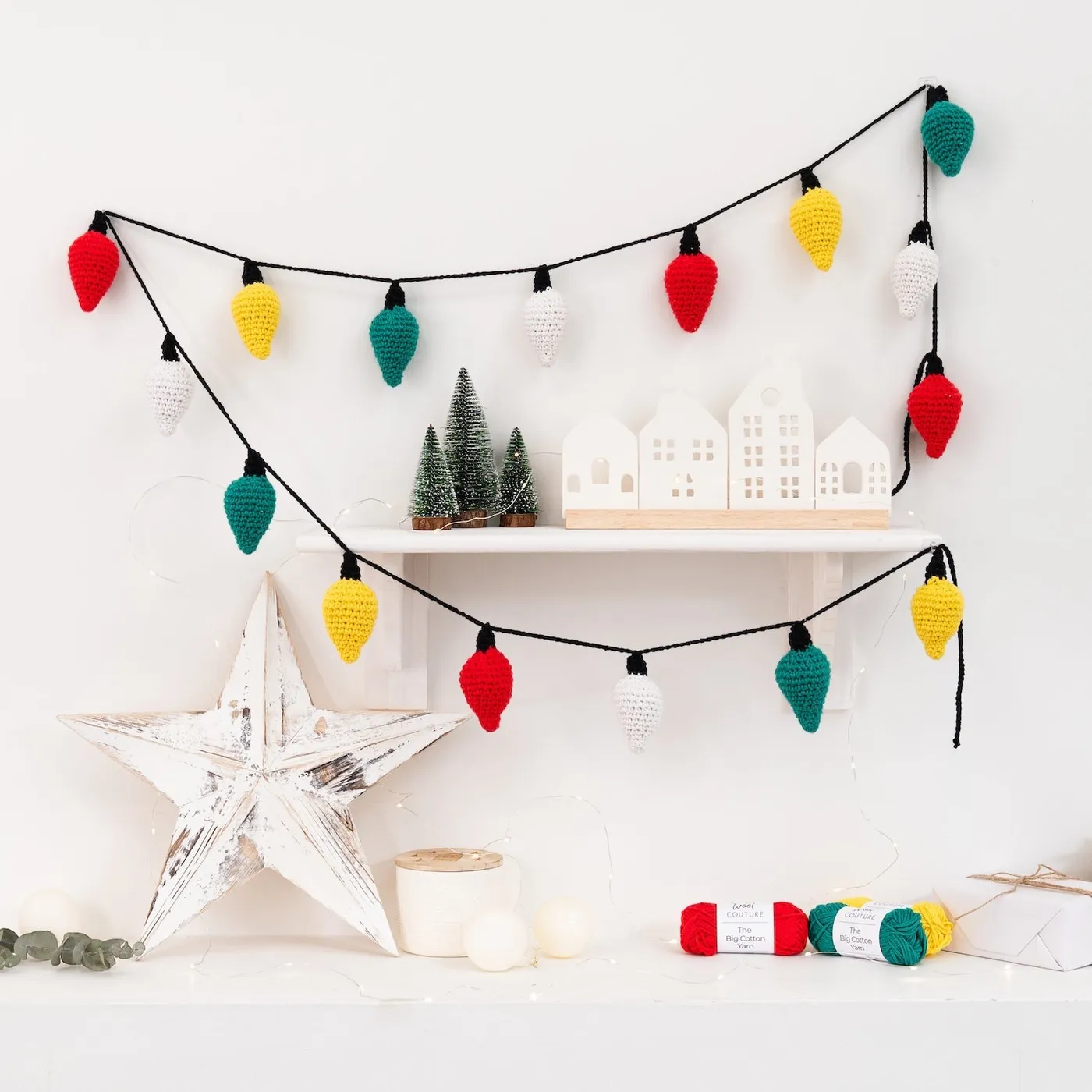
The tiering is the one thing. One strand of crochet bulbs pinned straight across a wall is cute; two strands at different heights is a display. The lower strand animates the shelf below it, and the shelf gives the whole wall a reason to exist. Measure 14 to 18 inches between tiers — closer and they merge into one thick band.
24. Mint Green Crochet Trees on a Cream Crochet Chain
Mint green is a tricky yarn color because it shifts depending on the light. Buy one skein and crochet a test tree before committing to five. Also, chain the connecting cord in the same fiber content as the trees — a cotton chain with acrylic trees will stretch at a different rate, and you’ll have a sagging garland by week two.
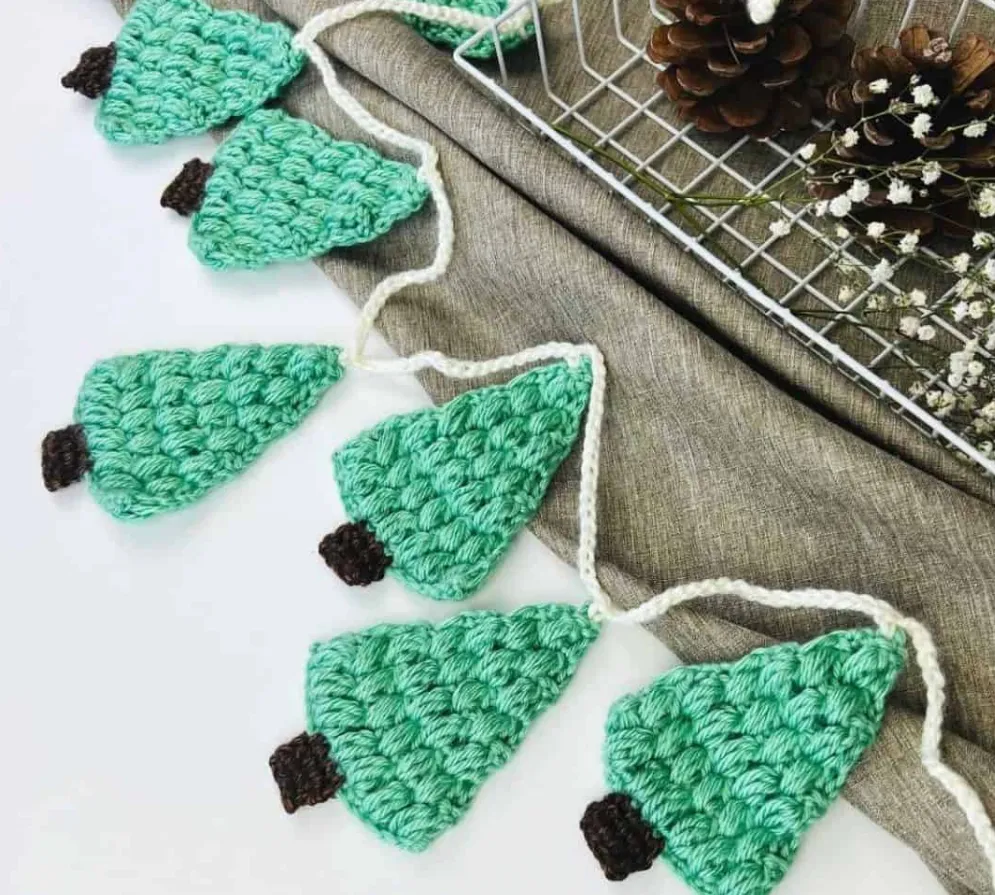
- Mint green cotton yarn (2 skeins): $8–$14
- Cream yarn for the chain: $4–$7
- 3.5mm hook: $3–$6
- Dried florals and pinecones for styling: $0 foraged, up to $20
Total: $15–$47. Budget alternative: use a single skein and space the trees 6 inches apart instead of 3 — same visual rhythm, half the yarn.
25. Button-Topped Crochet Trees Against Distressed Blue Wood
Scale contrast is doing the work here. Big, rough, distressed wood panels behind small, precise, brightly buttoned trees — the texture gap makes both elements look intentional. The colorful buttons repeat the informality of the rough boards, so the garland feels like it belongs on that wall instead of being hung there temporarily. Hang the same garland on a smooth white wall and it reads flat.
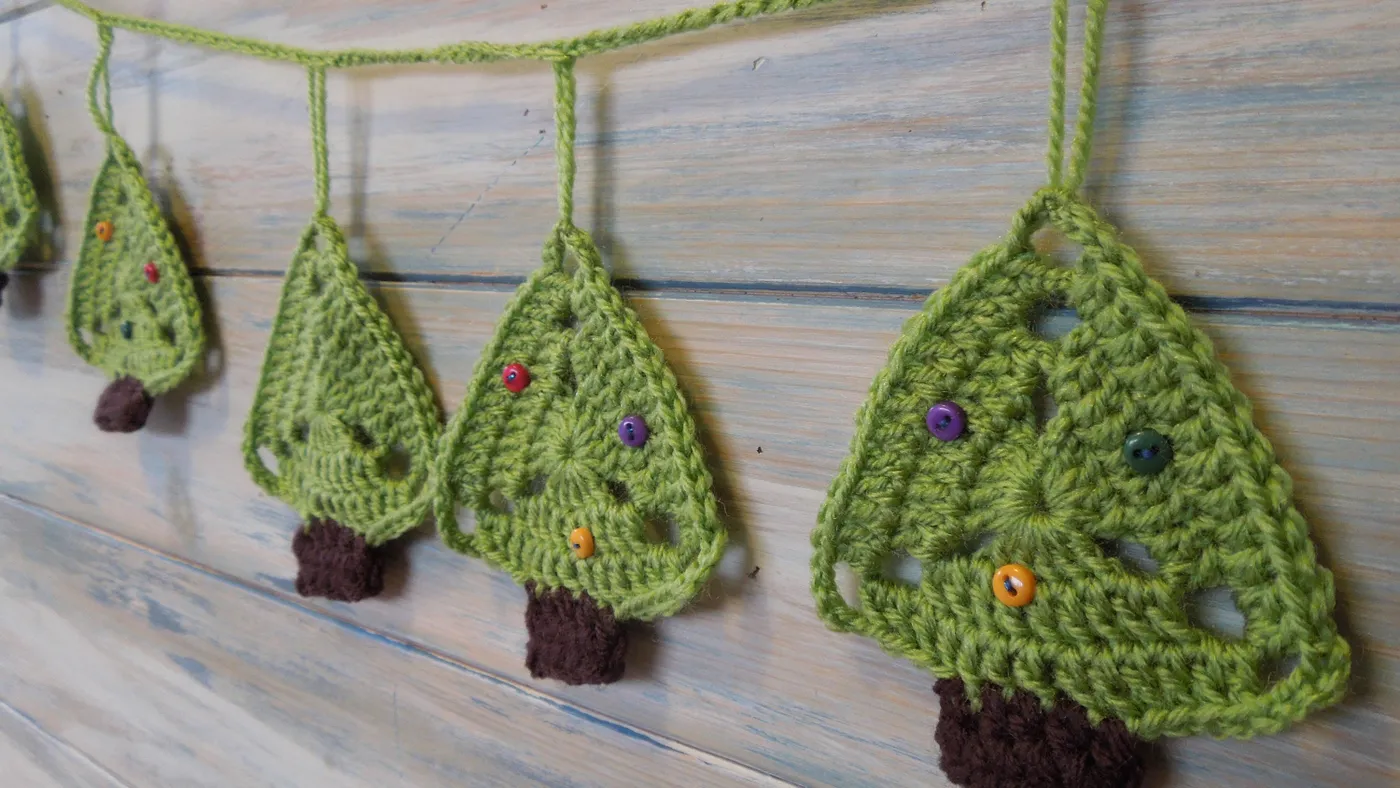
This look wants a narrow, vertical surface — a 12- to 20-inch-wide section of reclaimed wood, a barn door, or the back of a shelf. On a standard 8-foot wall the garland gets swallowed. If you have a big wall, hang three of these strands at staggered heights rather than one long one, and keep the spacing under 10 inches. Compare with Idea #22, which handles wide white walls with tiering instead of texture.
26. White Felt Balls Scattered Loosely Through Evergreen
This is a 90/10 composition: 90% evergreen and felt, 10% everything else. That extreme ratio is why it feels calm. The felt balls vary in size rather than color, which is the key move — you get visual interest without adding a single hue. To adapt it, keep the ratio and change the accent: oatmeal, pale gray, or soft camel all work against green.
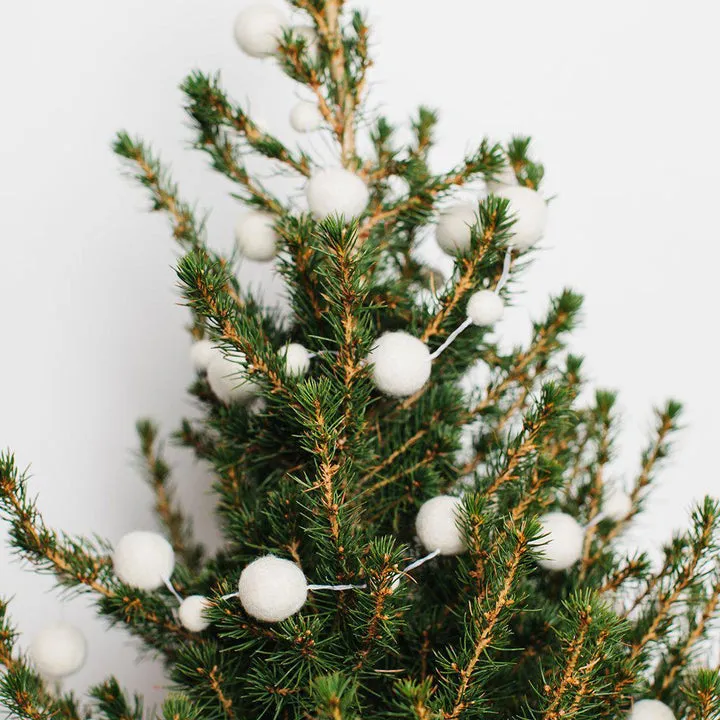
Real trees drop needles, and white felt balls catch every one of them. Plan on a weekly once-over with a soft brush, and keep the garland away from the water reservoir — splashes leave permanent marks on wool felt. Storing is easy: a breathable bag, no folding along the string, and a cedar block to keep moths out. Felt is durable, but it does pill if it rubs against rough branches.
27. Wide Gold Ribbon Woven Through White and Gold Ornaments
- Ribbon garland (3-inch wired gold, 30 ft): $18–$35
- Ornament set (white and gold spheres, 40–60 pieces): $45–$120
- String lights (clear, warm white, 300 count): $20–$45
- Tree (7–8 ft, pre-lit or unlit): $150–$600
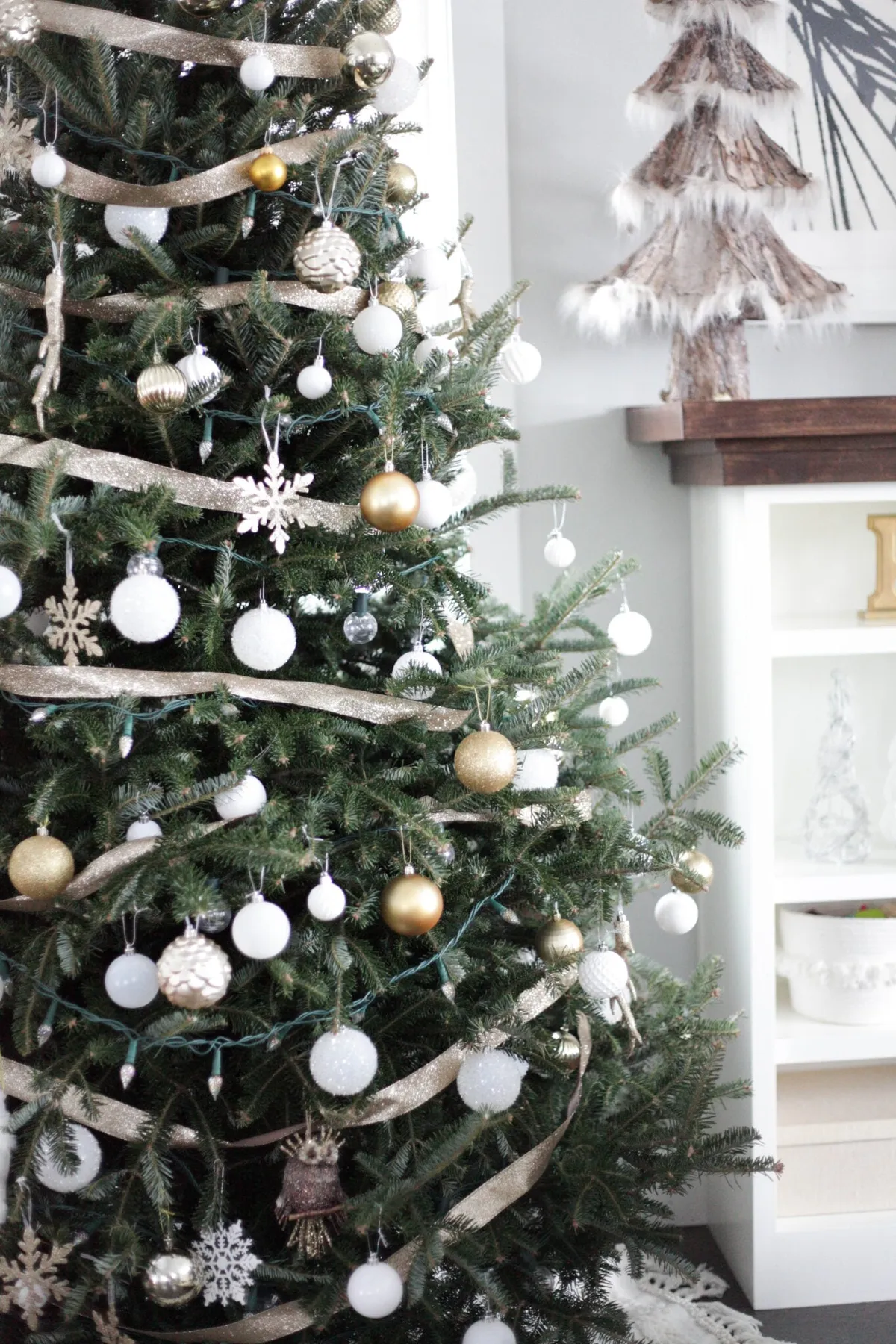
Total: $233–$800. Budget alternative: buy the ribbon at a craft store with a coupon ($12) and mix one new ornament set with last year’s white baubles. You’ll spend around $90 and nobody will know.
Wide wired ribbon is beautiful and merciless. It crushes if you store it wound tightly, and once it holds a crease, that crease shows on the tree. Wrap it around a cardboard tube at the end of the season, never in a plastic bag. Glitter ribbon also sheds — vacuum beneath the tree weekly, or you’ll be finding gold flecks in July.
28. Alternating Felt Stars and Balls on a Real Tree
The alternating shapes are the one thing. Felt stars and felt balls together give you rhythm and variety from a single material, which is why this garland never looks busy even though it’s the only decoration on the tree. Swap it for all balls and it goes dull; all stars and it goes chaotic. The pair is the point.
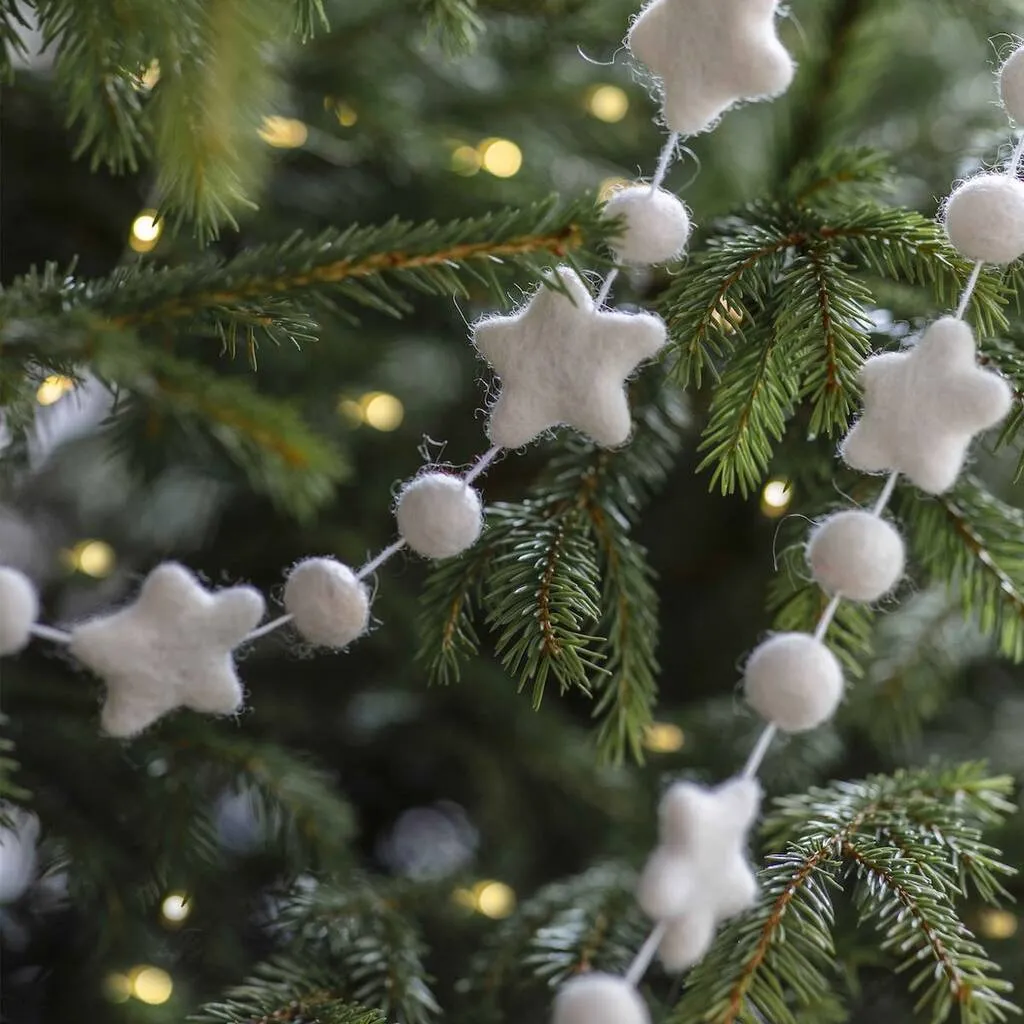
On a real tree, drape garland before ornaments, never after — you want the strand to sit inside the branches, not on top of the baubles. Work from the middle outward, spacing your loops every 12 to 15 inches, and leave the bottom four inches of trunk bare so the tree reads as grounded rather than sagging.
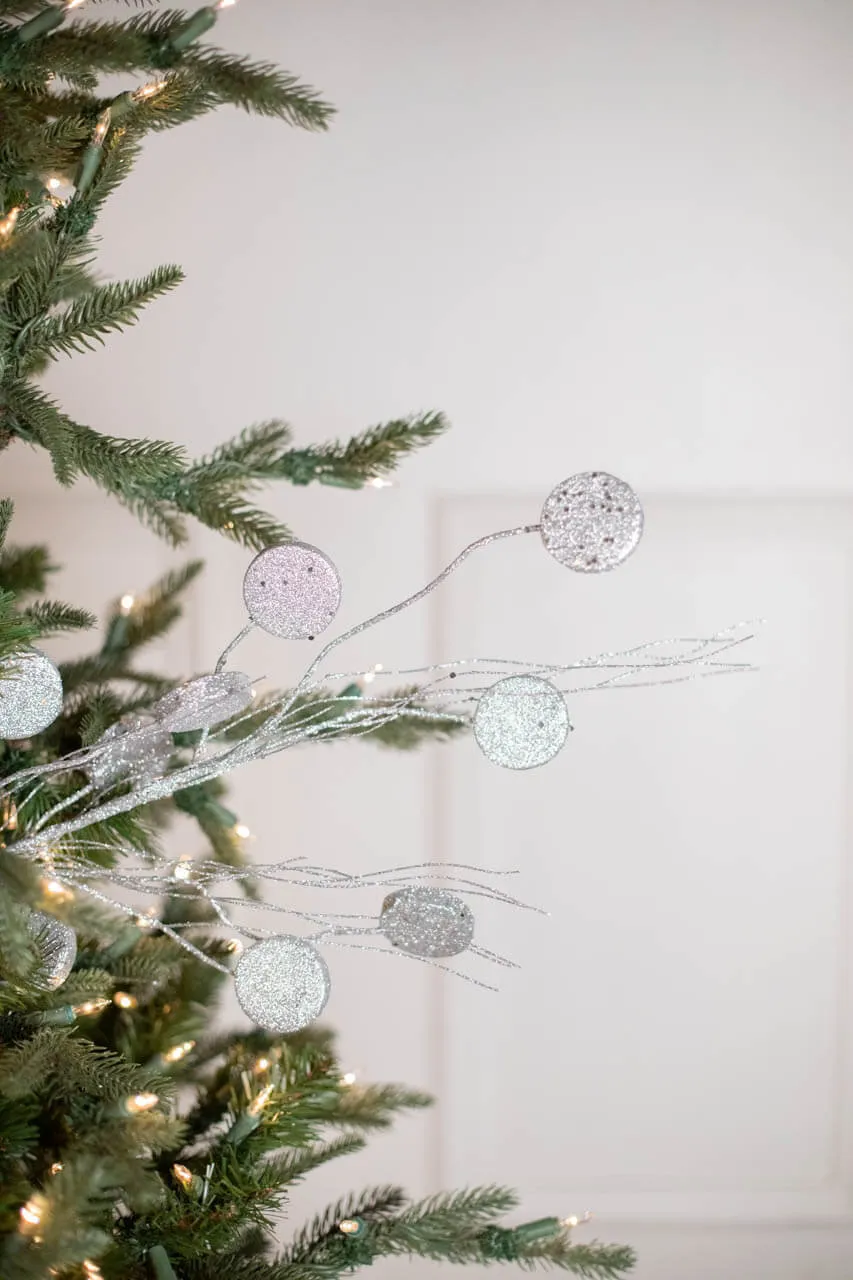
29. Silver Glitter Disc Branches Tucked Into Green Needles
Make your own glitter disc branches in 30 minutes:
- Cut 8-inch lengths of 20-gauge floral wire.
- Thread a 1-inch silver glitter disc onto each wire and bend a small loop to hold it.
- Cluster three discs onto one stem, spacing them an inch apart.
- Wrap the stem with silver florist tape.
- Tuck the finished stems into the tree at slight downward angles.
Materials: about $9 for 20 stems.
Contrast, again. Flat, matte glitter discs against soft, organic pine needles — the two textures bounce light differently, so the tree sparkles even when the string lights are off. The discs are also reflective and warm-toned, which keeps the silver from going cold and icy against the green.
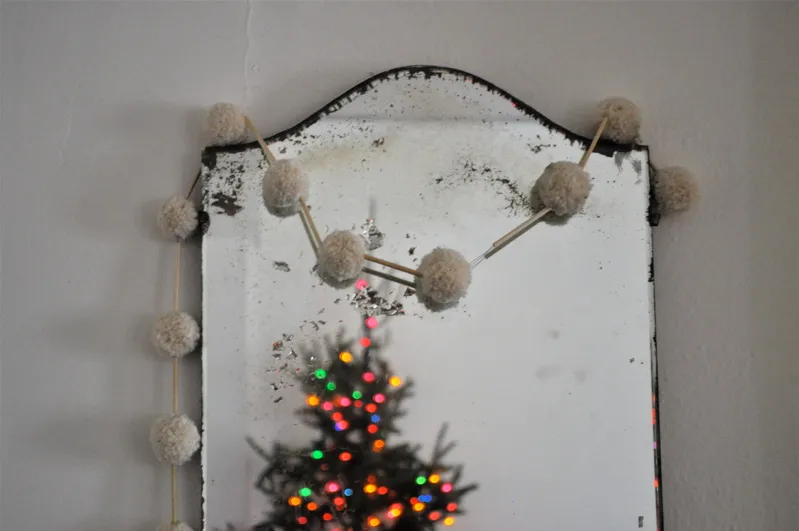
30. Beige Pom-Poms and Wooden Sticks on an Antique Mirror
This is a thrift-store look, and that’s a compliment.
- Antique mirror: $40–$120 at estate sales, $15–$40 at Goodwill
- Beige pom-pom garland: $12–$22 from Etsy, or $6 to DIY
- Thin wooden dowels, cut to 6 inches: $3
- Warm white fairy lights for the tree behind: $8–$15
Realistic total: under $70 if you’re patient.
Mirror styling has become one of the most-saved holiday ideas on Pinterest, partly because it doubles your decorations for free — the reflection shows a completely different part of the room. That heavily distressed antique finish also fits the collected-over-time look that’s replaced matched decorating. A perfect mirror would actually be less interesting here.
31. One Giant Shiny Red Pom-Pom Among Warm Bulb Lights
Oversized poms are a big-tree move. They need at least 6 feet of tree to feel intentional; on a tabletop tree, a 4-inch pom just looks like a mistake. Pair one giant pom with several smaller ones in the same red so the scale shift reads as deliberate rather than accidental, and give the giant one a clear zone of open branches around it.
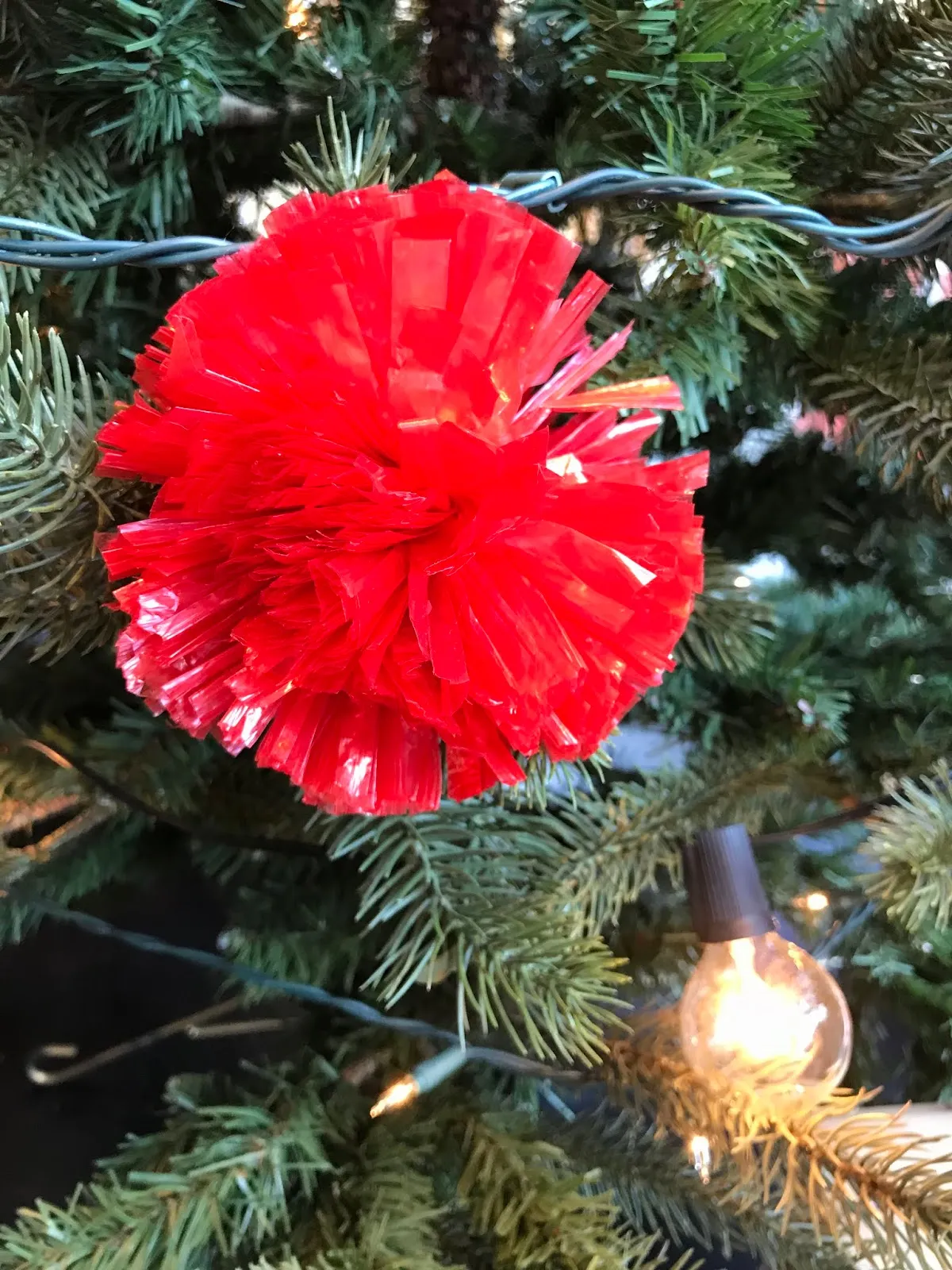
Simple ratio: 80% green, 15% red, 5% warm white light. Because there’s only one accent color, the size of the pom is what creates interest — not the palette. If you want to add a second color, keep it under 5%, or the single-statement effect disappears entirely.
32. Knitted Green Trees on a Braided Green and White Cord
Knitted cotton garlands are washable and sturdy, but burlap backdrops shed fibers constantly if you’re recreating this as a display. Real berries on wired stems dry out and drop, so swap for faux versions if the garland lives somewhere people brush past. Store knitted pieces flat in a cotton bag — hanging them on a nail all year stretches the loops.
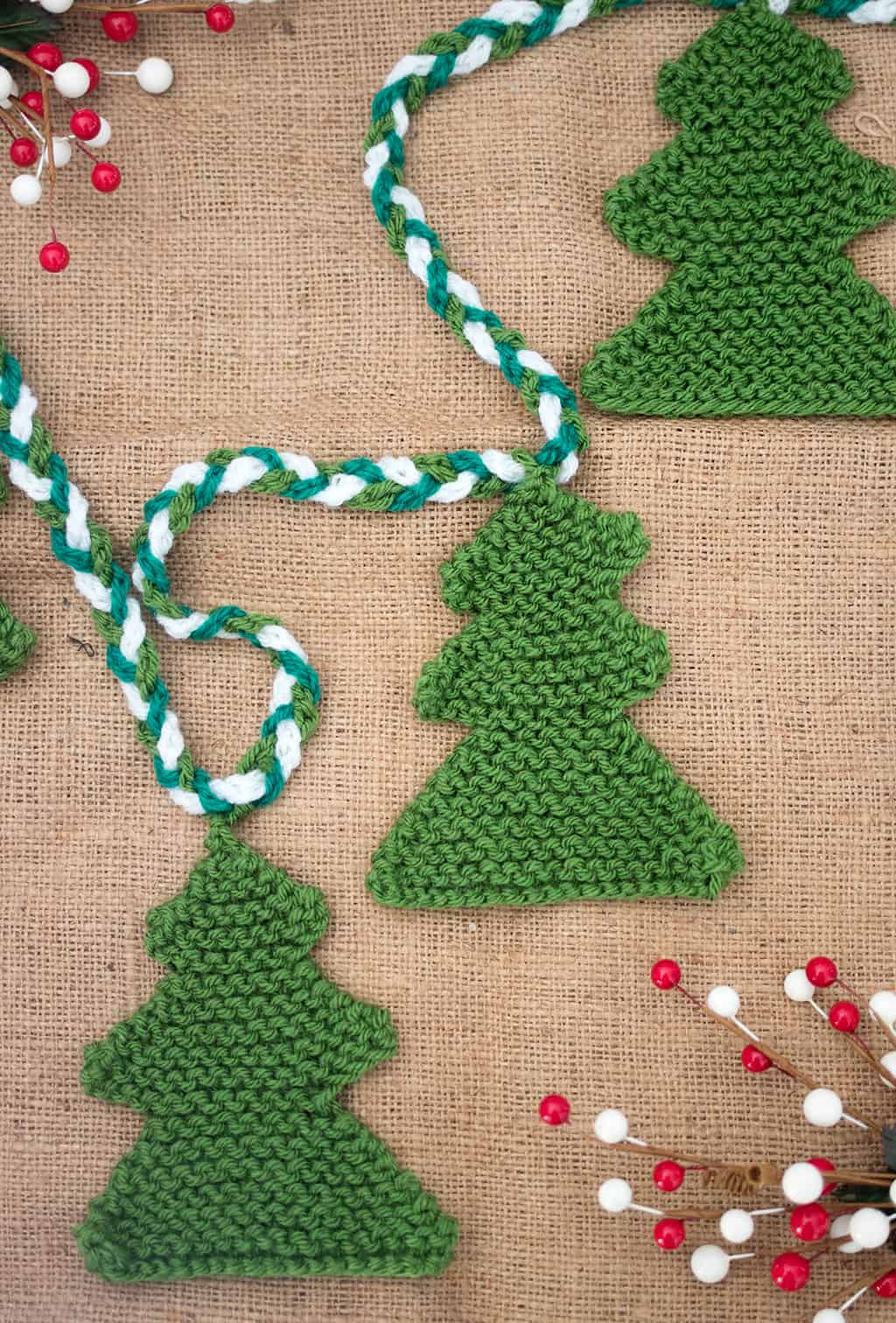
Braided yarn cords look lovely and stretch over time. If you make your own, braid the cord slightly shorter than the final length you want; a 5-foot braid will relax to roughly 5 feet 4 inches by the second season. Knitted tree shapes are also heavier than crocheted ones, so space them 4 to 5 inches apart or the strand will sag between them.
33. Crochet Gingerbread Men and Holly with Wooden Cutouts
The wooden cutouts are the one thing. Gingerbread and holly alone would read as a kids’ craft project; the small natural wood trees and bells scattered beside the garland are what make the arrangement feel styled. They add a matte, warm material that echoes the brown of the gingerbread men, and they cost almost nothing. Buy a pack of wooden blanks and leave them raw.
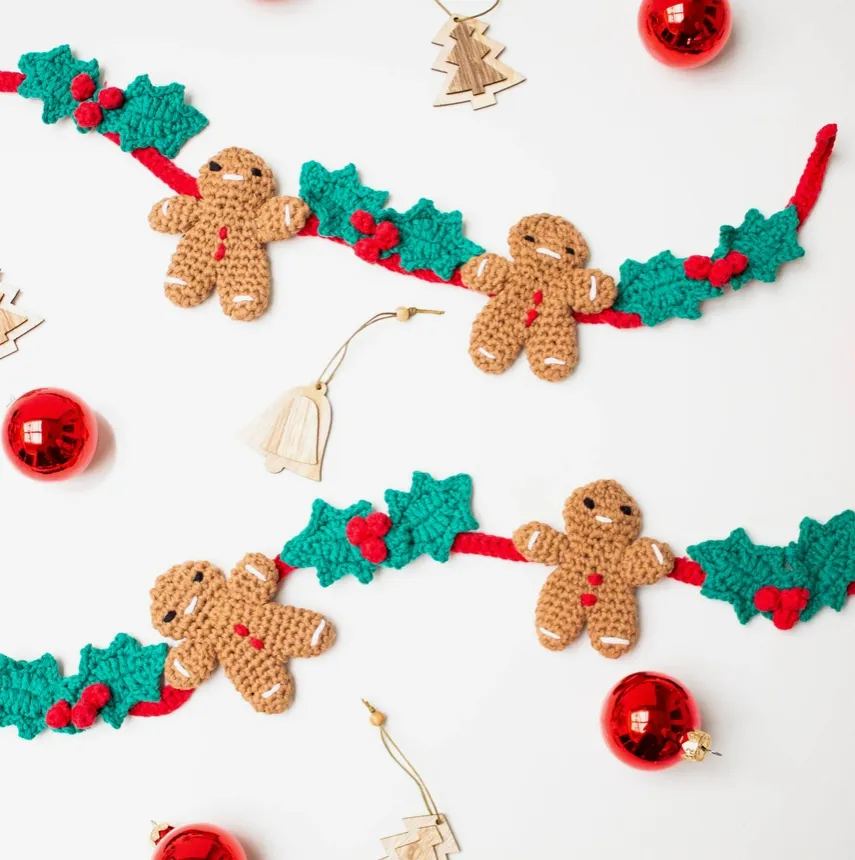
- Cotton yarn (red, green, brown, white): $14–$22
- Crochet hooks (3mm and 3.5mm): $6–$12
- Wooden cutouts (pack of 20): $5–$10
- Red baubles (set of 12, shatterproof): $8–$16
Total: $33–$60. Budget alternative: skip the baubles entirely and let the garland be the star — the wooden cutouts and red yarn already carry the color story.
Your Tree Already Knows What It Wants
Start with one strand. Pick a texture you actually like touching — felt, feather, yarn, frosted pine — and let it set the tone for everything else on the tree. You don’t need to replace what you own; you just need one element that makes the rest look intentional.
📌 Pin this guide now and come back to it when the boxes come down from the attic.