
You know the feeling: you spot a handmade glass ornament on Pinterest, save it, and then spend an hour trying to find anything remotely like it in a store. Fused glass is one of those categories where the good stuff lives in small studios and craft fairs, not on a big-box shelf.
We spent serious time browsing Etsy, Anthropologie, Amazon, and West Elm to bring you only what’s worth your attention this year — from $8 thrift-store finds to $250 statement sculptures.
Inside you’ll find 33 curated ideas covering handcrafted character ornaments, stained glass window pieces, geode-finish glass, and freestanding glass tree sculptures. Budget and luxury versions sit side by side, with real prices so you can shop each one directly.
Handmade has been the story of 2026 holiday decor — Pinterest saves for fused glass ornaments are climbing again, and shoppers are actively choosing one-of-a-kind pieces over mass-produced sets.
And stay until the end — we break down the most common mistakes that can ruin these looks. This post contains affiliate links; if you buy through them we may earn a small commission at no extra cost to you. 📌 Save this to Pinterest for later — you’ll want to revisit these ideas.
1. A Fused Glass Block Where Six Tiny Trees Live
The block is the thing. Not the six miniature trees, not the snowy textured base behind them — the fact that this whole scene stands on a wooden tabletop instead of dangling from a branch. A rectangular fused glass block gives an object weight, and weight is what makes a small piece read as art rather than a bauble. Take the block away and you’ve got six charming little fir trees with nowhere to live.
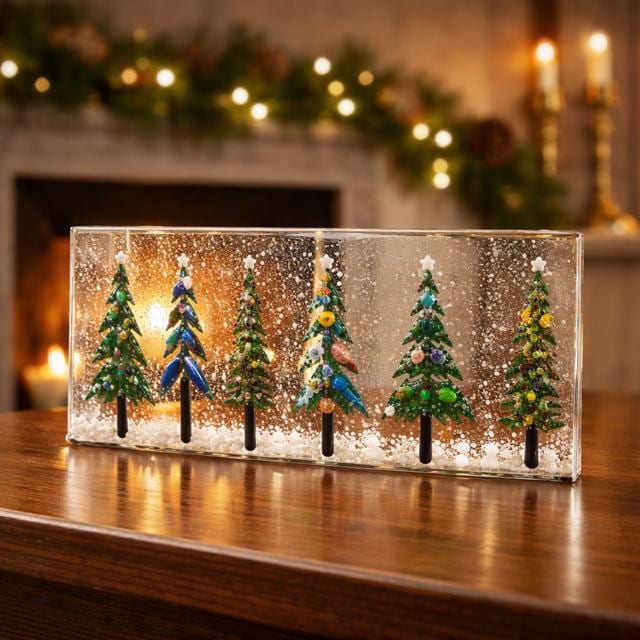
A 2700K bulb about 18 inches away makes the forest greens and warm gold glow from inside; anything cooler turns them muddy. Keep the surface underneath dark — walnut, oak, or a deep-stained tray. A white surface bounces light straight back and flattens out everything you paid for, especially with a lit garland glowing on the mantel behind it.
2. The Amber-Red Ornament With Frosted White Textures
Two finishes doing opposite jobs. The amber-red body is translucent, so the warm string lights behind it bleed straight through and the sphere seems lit from within. The textured white pattern sits on the surface instead — opaque, catching light rather than passing it. That push-pull is why this reads as expensive next to a plain red ball, even though the silhouette is identical.
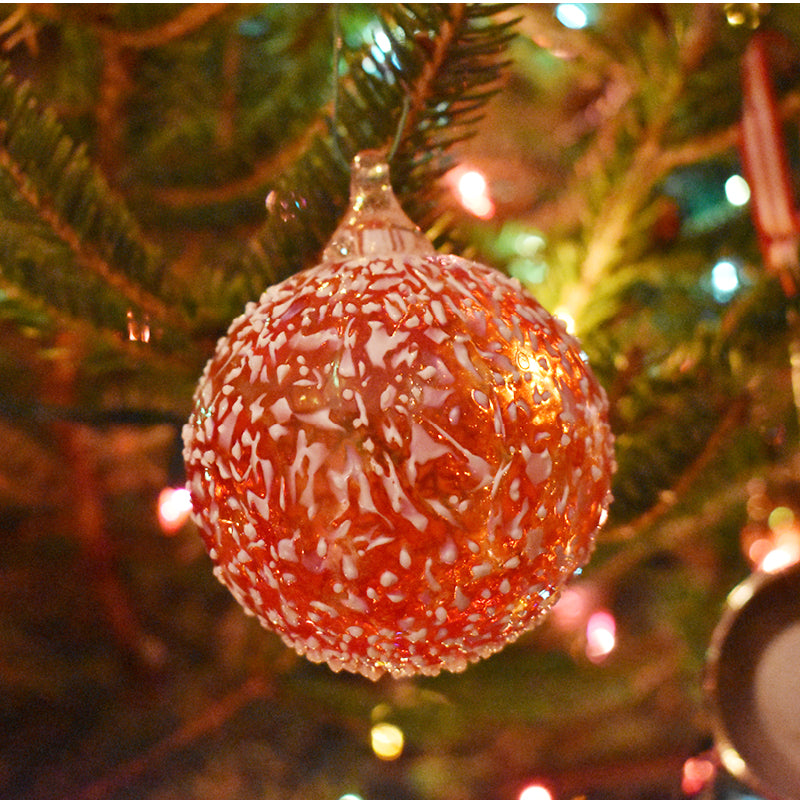
roughly 70% amber-red base, 20% opaque white texture, 10% warm gold from the lights and pine branches. Swap the amber for deep plum and the white for cream and the formula still holds. Change one variable at a time — trade the red for cobalt and the whole ornament turns cold and nautical instead of festive.
3. Fused Glass Trees Standing on Real Wood Slices
- Fused glass tree figurines, set of four: $45–$140
- Natural wood slice stands, four: $8–$20
- White carved serving tray: $25–$60
- Mixed bottlebrush trees for the background: $12–$30
Total: $90–$250 — budget alternative: cut your own wood slices from a fallen branch and use a cake stand you already own to land closer to $60.
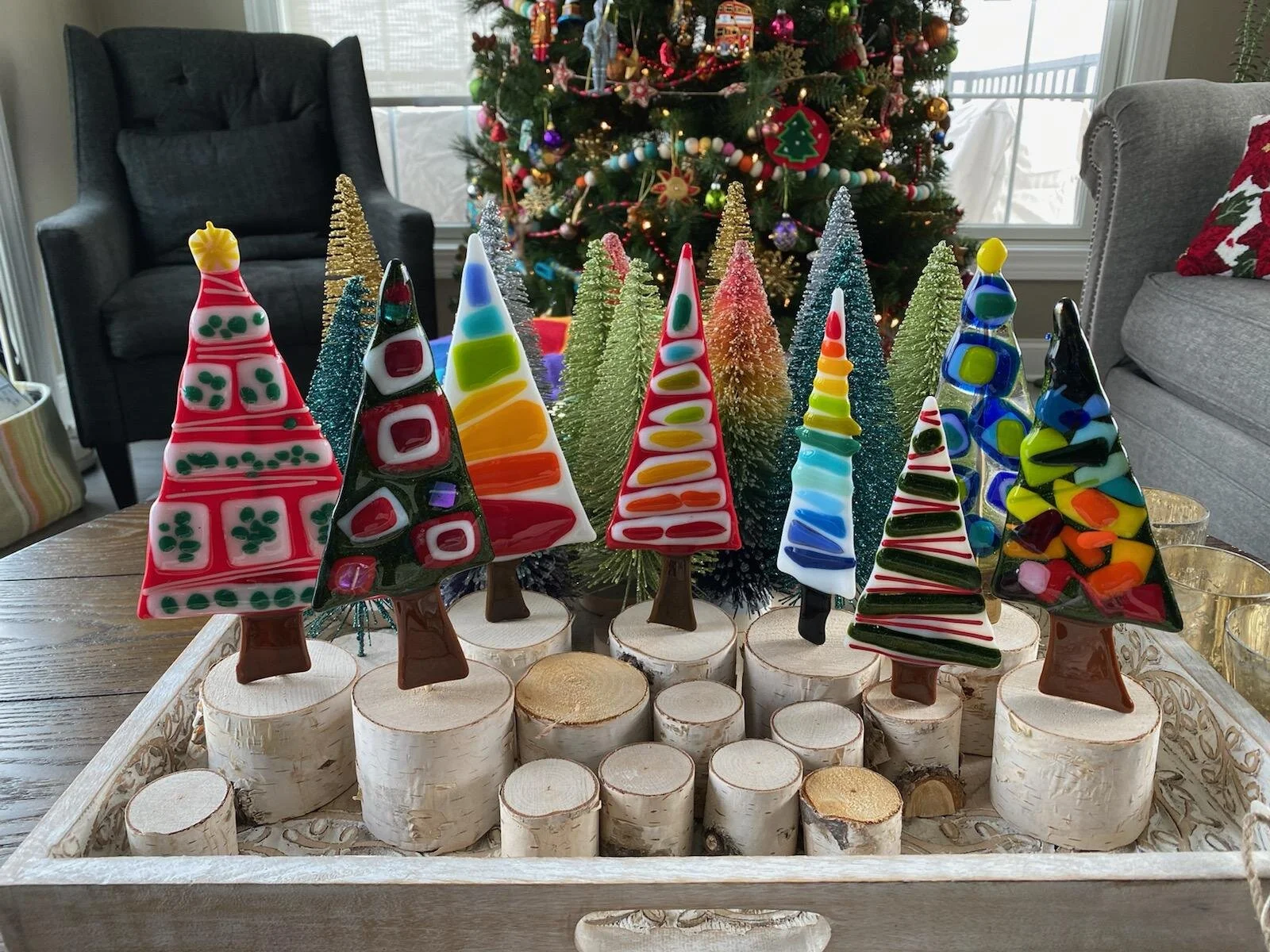
This display wants a console, buffet, or mantel — at least 30 inches wide with 6 inches of depth so the tray doesn’t hang off the edge. Anything narrower and the arrangement crowds itself. On a shallow shelf, switch to the standing pieces in Idea #25, which need about 3 inches each and no tray at all.
4. A Tiered Stained Glass Tree That Lives on Your Window
- Clean the pane with isopropyl alcohol and let it dry completely — dust is what kills suction.
- Dampen the cup slightly, press it on, and hold for 20 seconds.
- Wait an hour before hanging the ornament so the seal sets.
- Re-seat the cup every 3–4 weeks through the season.
Ten minutes, no hardware, nothing drilled into your window trim.
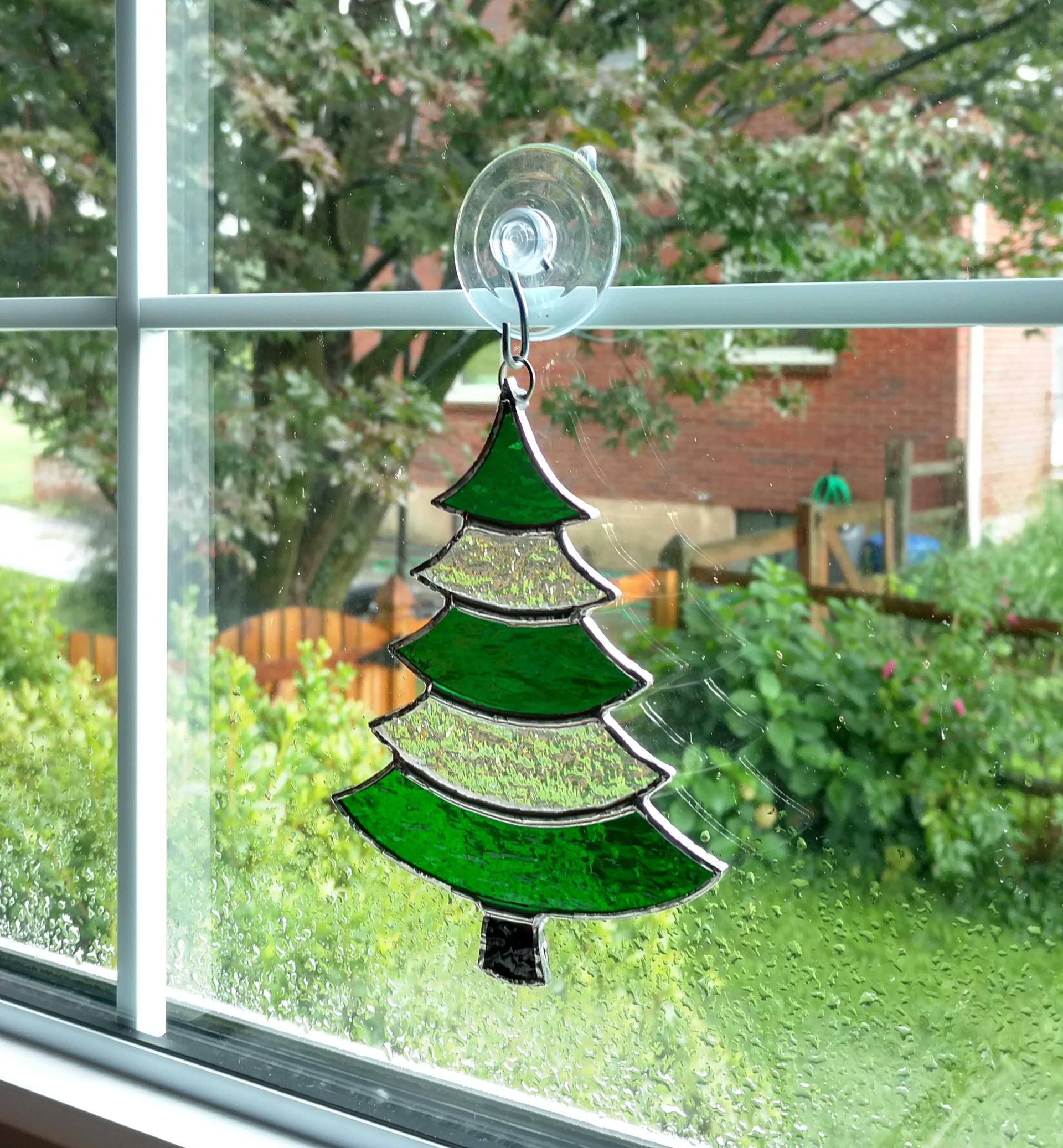
suction cups and cold glass are not friends. Below roughly 40°F on the inside of a single-pane window the seal weakens, and a fused glass tree that drops two feet onto a sill will chip at the corners. All-day southern sun also softens cheaper vinyl cups. If your window runs hot or drafty, hang the piece from a small adhesive hook on the frame instead and leave the glass alone.
5. The Fused Glass Snowman With Green Dot Buttons
Flat, character-shaped glass is the reason fused work stopped being a craft-fair niche. Searches for handmade glass ornaments climbed steadily through 2025, and what people want is pieces that look drawn — an orange carrot nose, a red scarf, three green dots for buttons — rather than perfectly round. Whimsy sells; symmetry doesn’t. This one should age well because it’s tied to a snowman, not to a color trend.
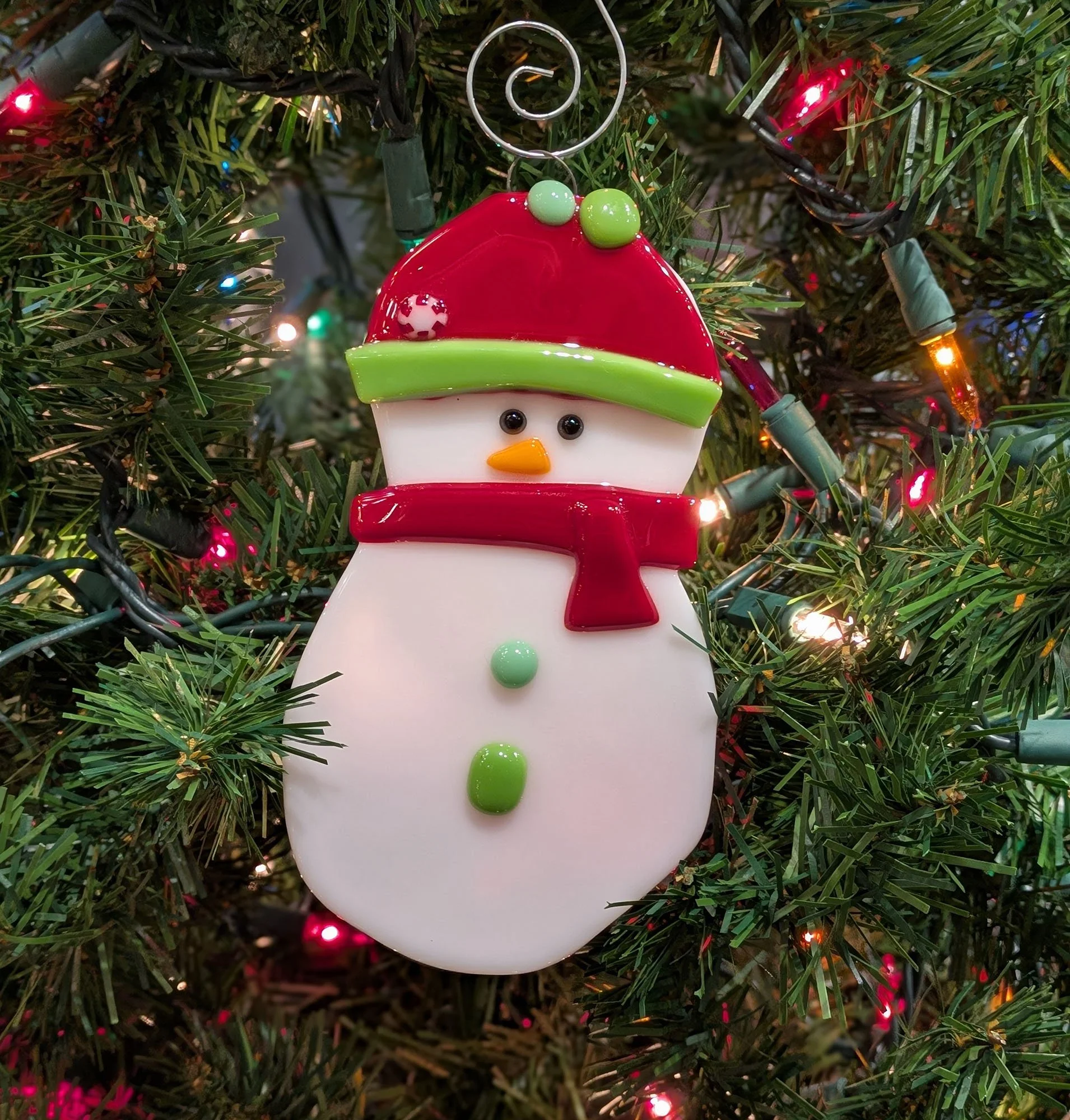
When you’re buying flat fused pieces, run your thumb around the rim. Good work is fire-polished to a soft, rounded edge; sharp corners mean the maker skipped the final firing and it’ll snag ribbon or a tree skirt. Then check the hanging loop — it should be embedded in the glass, not glued on top. Glue lets go by February in a warm room.
6. Three Stacked Trees on a Curved Glass Panel
The curve. A flat panel would be pretty; a curved one makes the three stacked trees in turquoise, red, and green bend and shift as you walk past it, and it drops a soft shadow onto the wood instead of a hard line. That single bend is the difference between a decorative tile you put away in January and a piece that stays out all year.
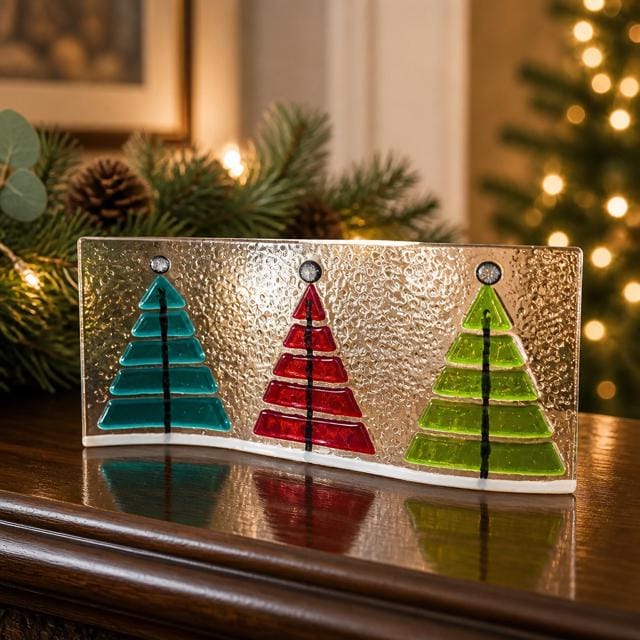
The palette runs about 55% clear textured glass, 30% saturated tree color, 15% dark wood and warm light. Three swaps that keep the formula intact:
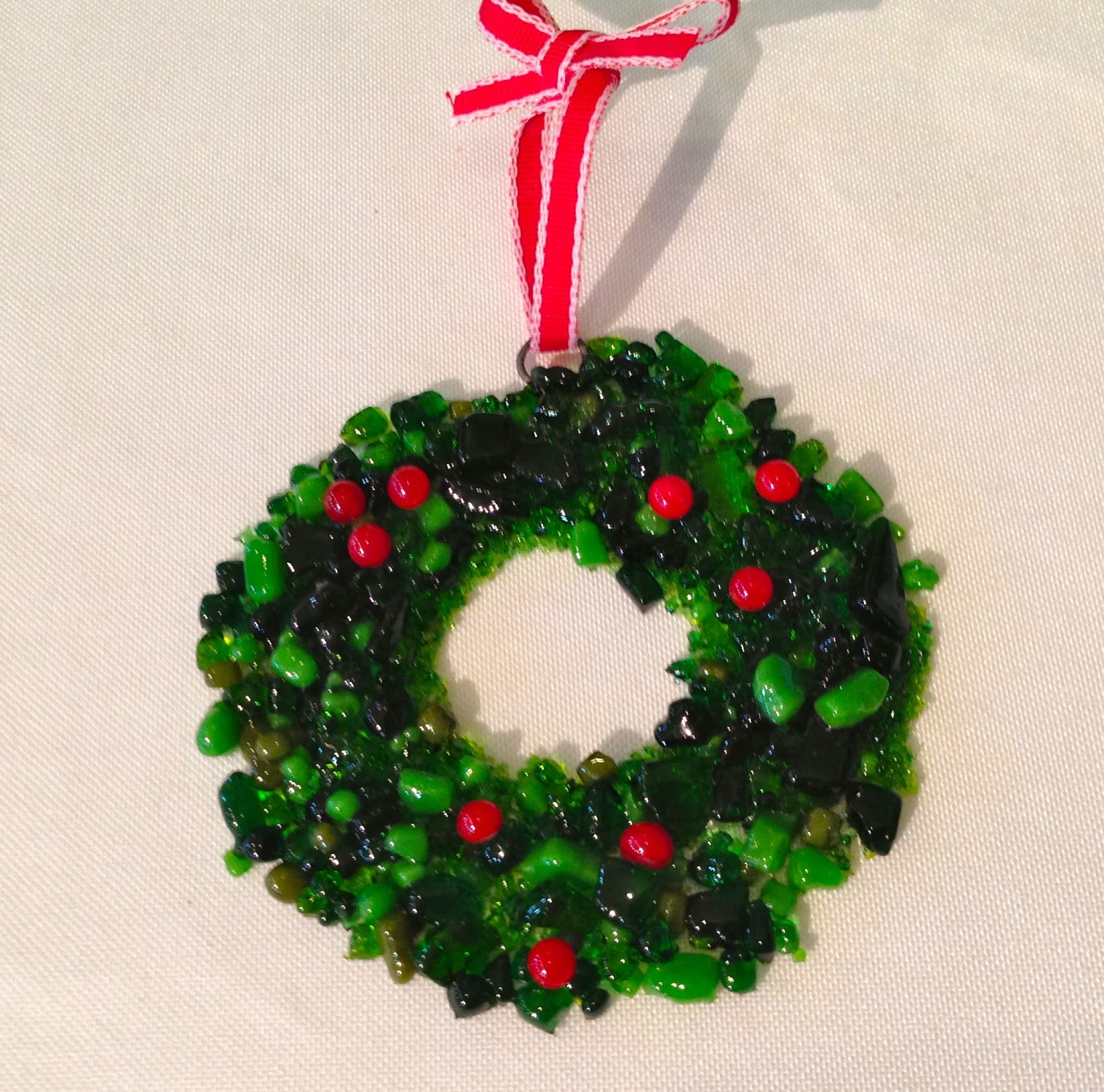
- Turquoise → cobalt for a colder, more modern read
- Dark trunks → amber glass for a vintage feel
- Polished wood → raw oak to make the colors pop harder
7. The Polar Bear Who Won’t Let Go of His Tree
You don’t need a kiln or a $60 ornament. Clear glass blanks and frit run a few dollars at any craft supplier, and a local studio’s open-studio night — usually $25–$45 including firing — gets you a bear-shaped piece with your own hand in it. Thrift stores and Facebook Marketplace also turn up fused glass every December for $3–$8, usually mislabeled as a “stained glass suncatcher.”
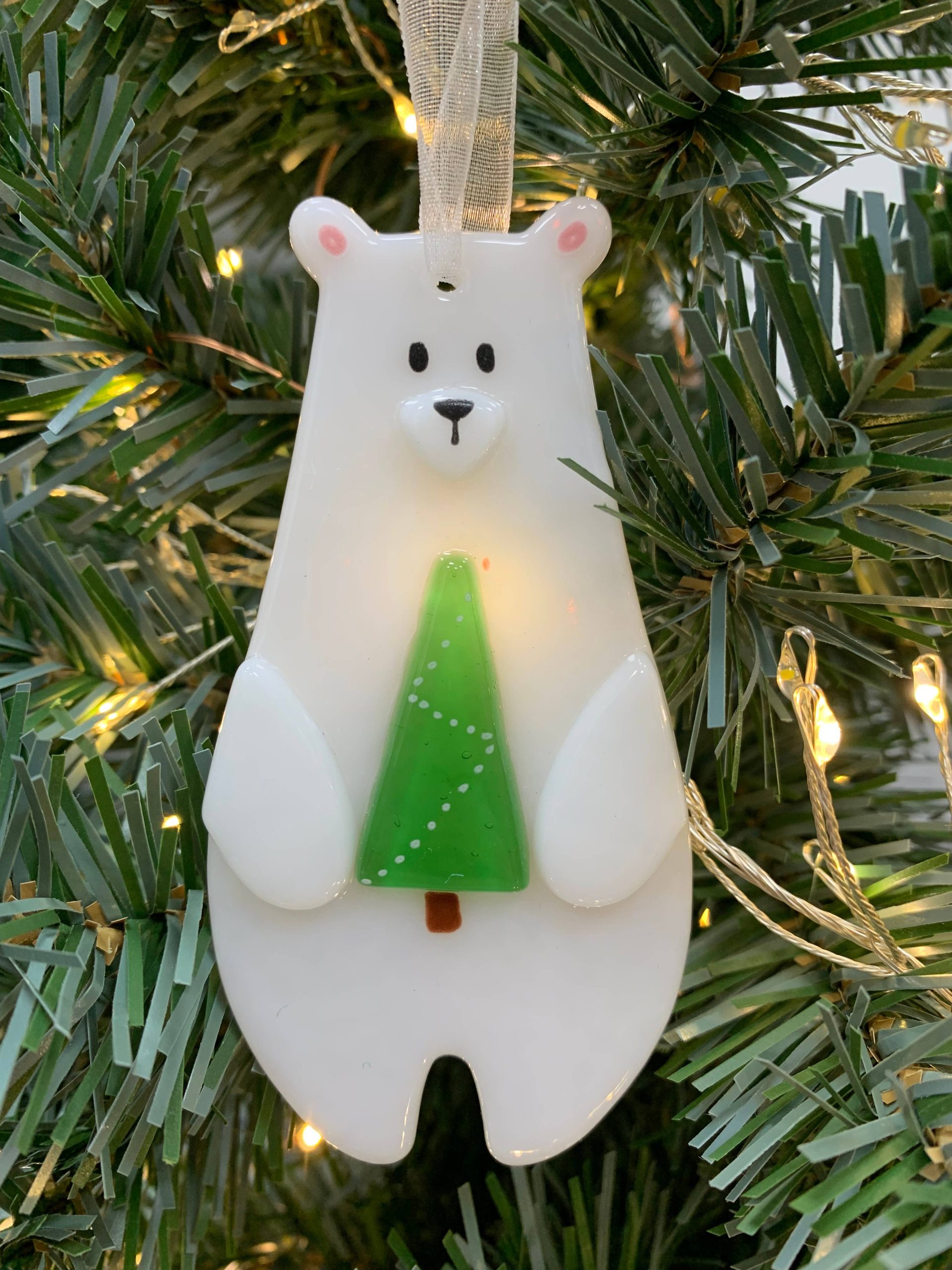
Two things are doing the work here: contrast and a joke. The opaque white bear against a saturated green tree is a hard color break, which is why the silhouette reads from across the room. And the bear holding the tree — not standing beside it — gives the piece a punchline. Cute objects with a small narrative get kept for decades; cute objects without one get donated.
8. Six Holiday Characters, One Fused Glass Series
If you’re collecting a set, buy them all at once or not at all. Fused glass varies batch to batch — the same maker’s red shifts between firings, and a Santa bought in October will sit next to a snowman bought in December looking like they came from two different studios. Ask the seller for the firing date, and if you’re ordering two pieces, request they come from the same kiln load.
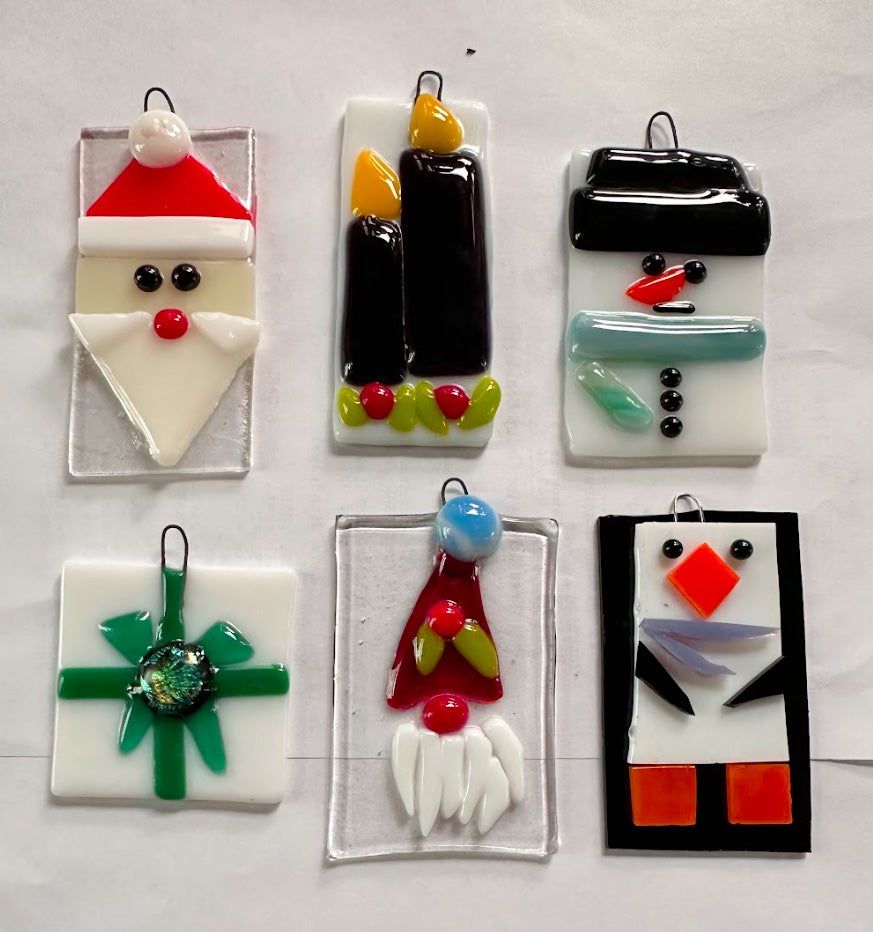
- Measure branch spacing on your tree — 3 inches minimum between hangers
- Confirm every piece has an embedded wire loop, not a glued bail
- Ask for weights; over 3 ounces each will drag a light artificial branch
- Pick one ribbon color so six characters don’t become six statements
9. A Green Glass Tree Wearing Yellow Garland
Fused glass is nearly maintenance-free — a dry microfiber cloth once a season is genuinely enough, and never a paper towel, which leaves lint in the textured pits. Real wear happens in storage. Tossed loose in a bin with metal hooks, edges chip. Keep each piece in a felt bag or a divided box, and store it in a climate-controlled closet rather than a garage that freezes.
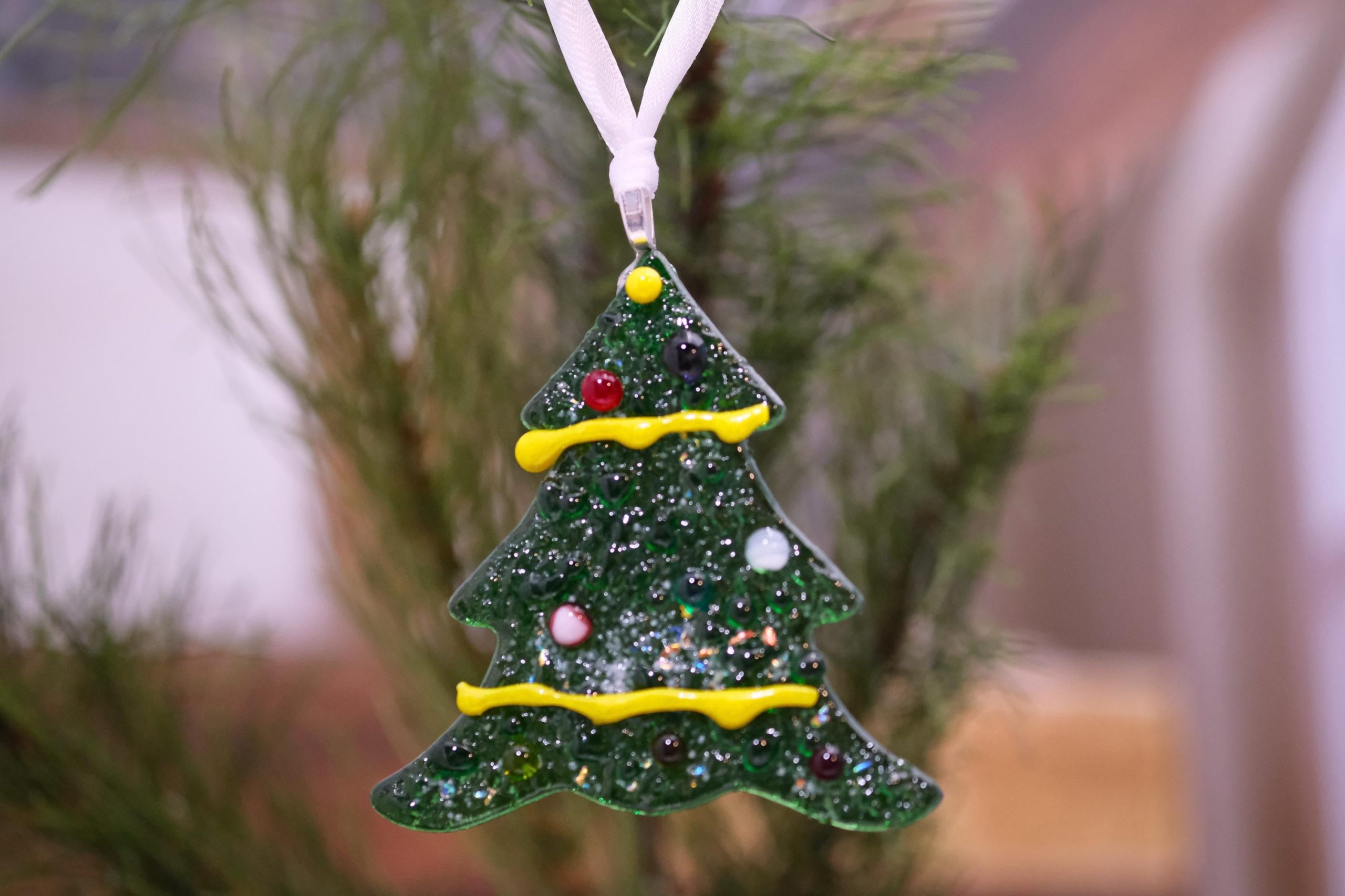
- 2.5 ft tabletop tree: $25–$60
- Fused glass statement ornaments, four: $60–$120
- Warm white string lights: $10–$20
- Velvet ribbon, 3 yards: $8–$15
Total: $103–$215, or near half that with a $10 thrifted tree. The same green-and-yellow idea shows up at Idea #26 with a brighter star on top.
10. A Mosaic Glass Tree on a Wire Stem
about standing glass: it’s top-heavy by design. A triangular body balanced on a thin wire stem over a small green base will tip the first time someone bumps the table or a cat investigates. Put it where it won’t be brushed — the back of a shelf, the center of a buffet — and keep it off the floor and off the coffee table entirely. If it has to live somewhere busy, a dot of museum putty under the base solves it.
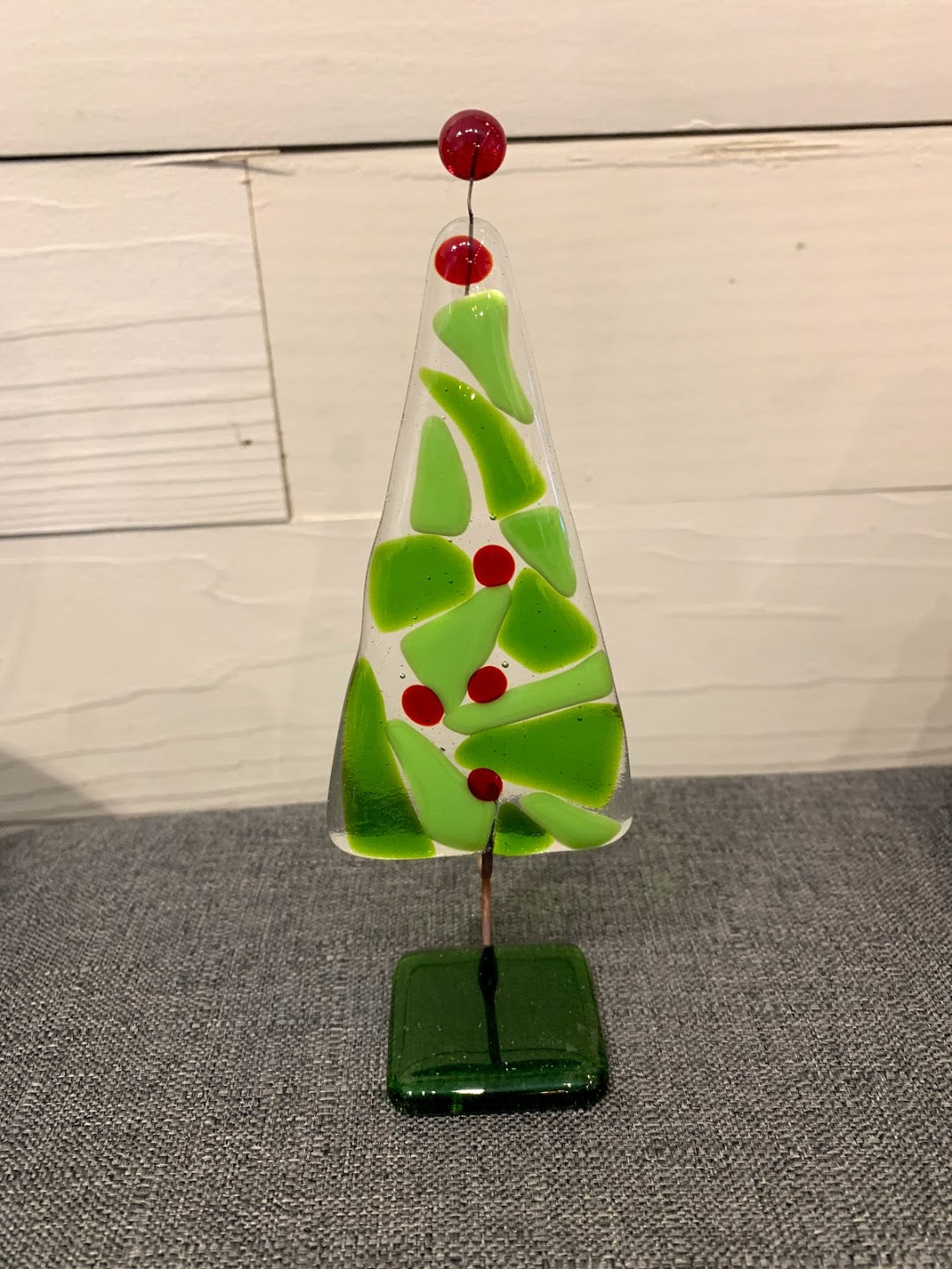
These read best on a surface at least 36 inches wide, because the piece needs empty space around it to look intentional — roughly 8 inches of clear air on each side. Ceiling height doesn’t matter; table height does. A 30-inch console puts the triangle at eye level when you’re seated, which is exactly where the mosaic detail pays off.
11. The Christmas Pudding Ornament With Dripping Frosting
- Cut the amber base circle about 3 inches across.
- Stack two layers of amber frit in the center for a dense body.
- Lay a thin line of white frit along the top edge, letting it slump a quarter inch down the sides.
- Full-fuse so the white bleeds and drips but doesn’t pool.
Roughly 45 minutes of assembly plus one kiln run.
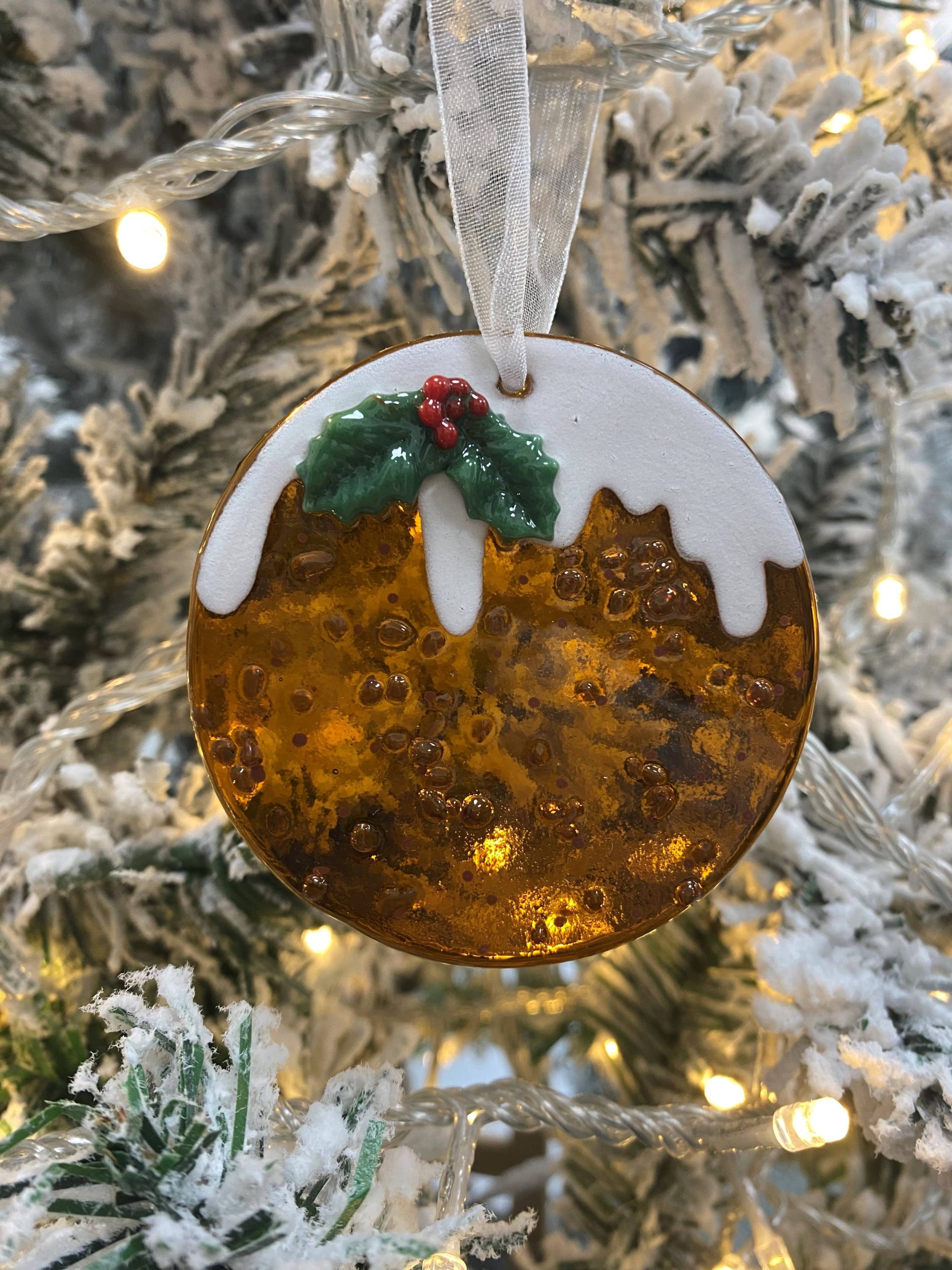
The drip is the whole ornament. Without those uneven white runs down the amber sides, you’re looking at a brown disc with a leaf on top — a blob. The drip gives it the illusion of dessert, and the glossy green holly with red berries gives your eye a second, brighter anchor right where the ribbon attaches.
12. A Frosted Snowman Panel in Black Hat and Blue Scarf
Formula: 50% frosted white background, 30% black and deep blue figure, 15% red accent, 5% yellow. The frosted glass is what holds it together — it diffuses instead of reflecting, so the snowman reads from any angle in the room. Swap the royal blue scarf for emerald and you keep the formula but lose the wintry chill; trade the black hat for charcoal and the whole piece softens considerably.
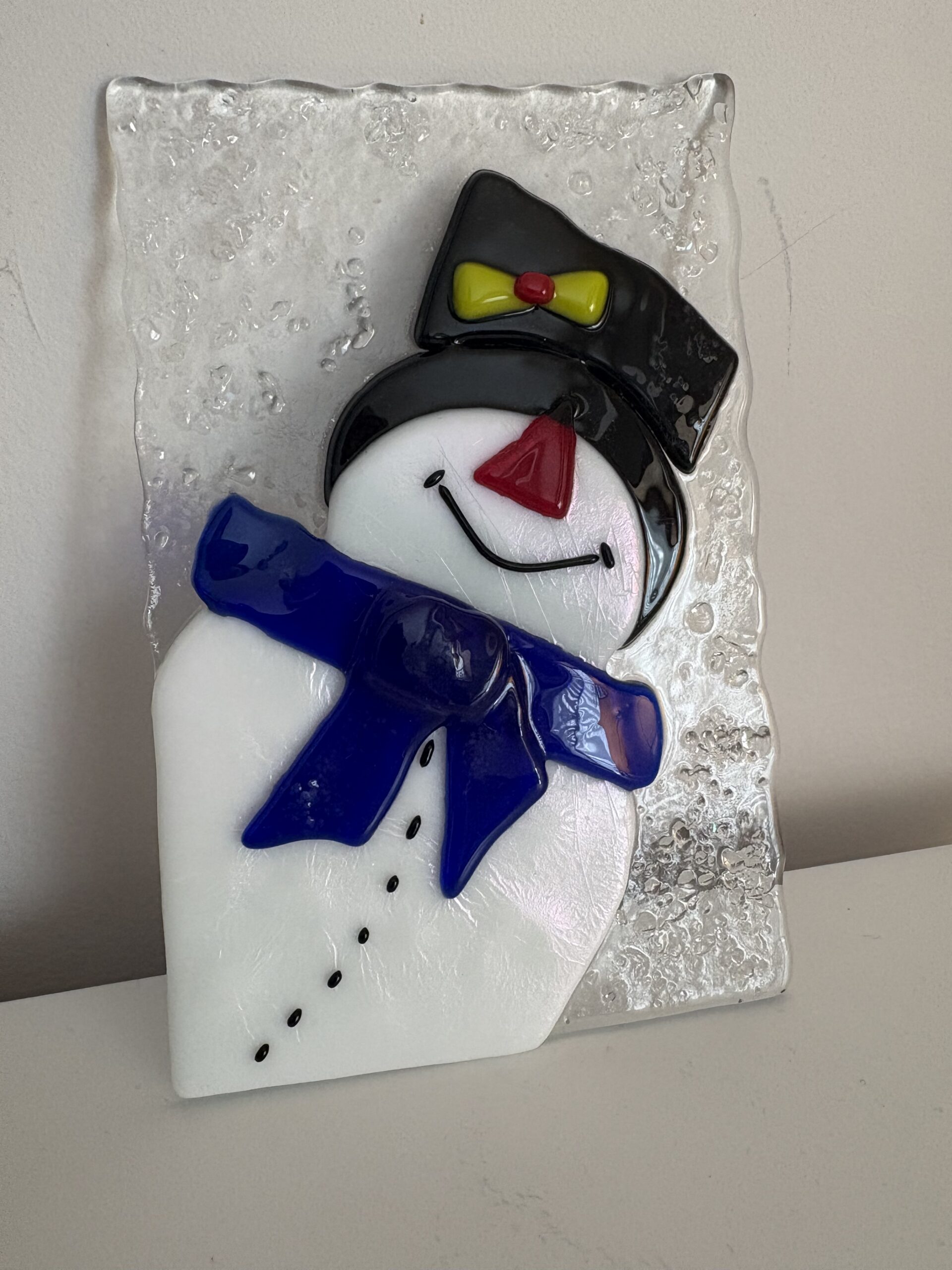
Framed wall glass gets pricey. A six-inch fused panel runs $35–$90; a shadow box from IKEA or Target, $12–$25. Or skip framing altogether — a dollar-store plate stand holds a heavier panel fine, and an $8 easel does the same job on a shelf. Clear an eye-level spot; frosted glass dies in a corner.
13. The Clear Star With Frosted Grey Tips
Negative space, basically. Most ornaments are solid color; this one is mostly transparent, so pine branches and warm lights show straight through the middle and the star seems to belong to the tree instead of sitting on it. The frosted grey tips and gold-toned flecks inside add just enough opacity to define the shape. It’s the rare ornament that looks better the more lights you pile behind it.
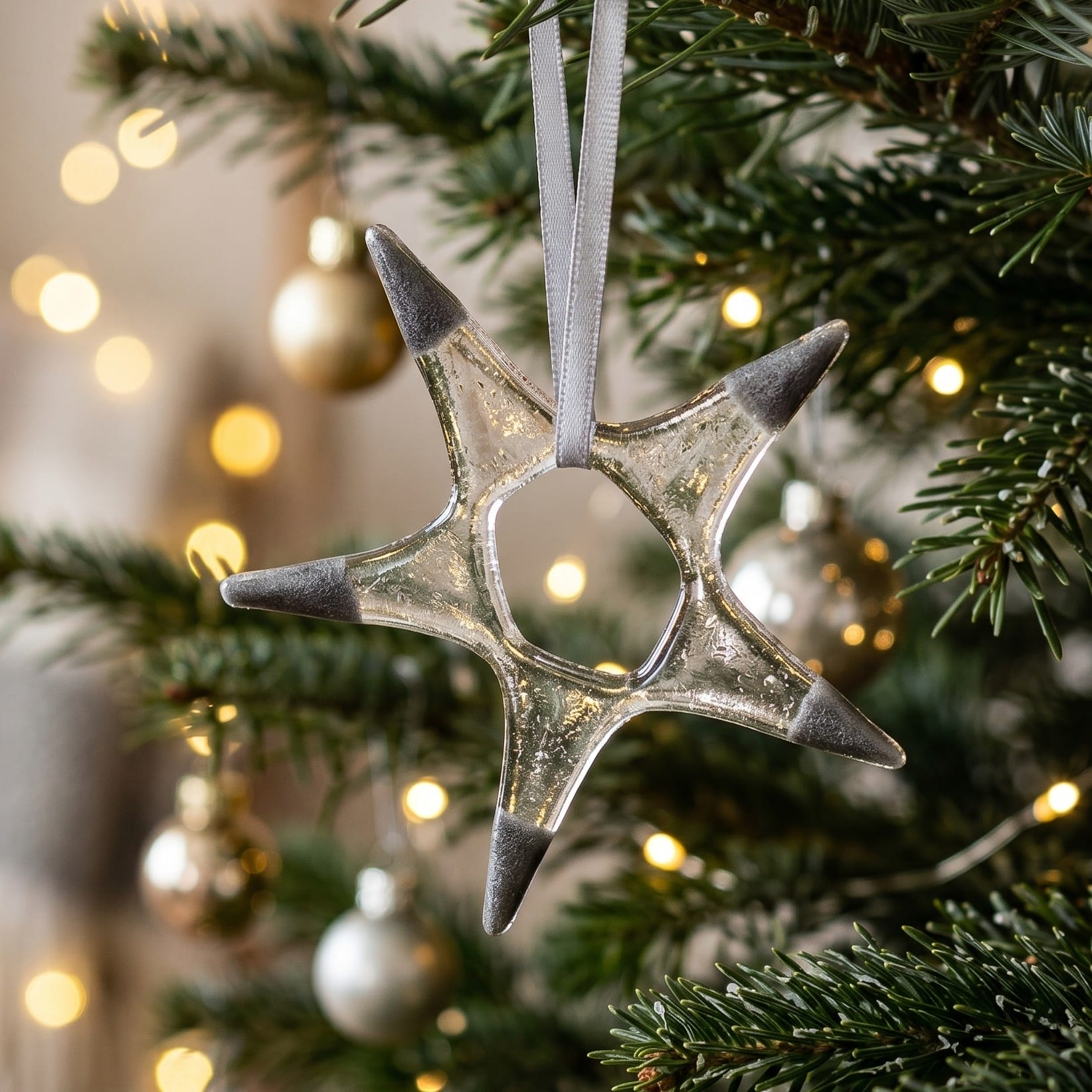
Hang clear glass at least 10 inches from any bulb, and stay with LED. A hot incandescent bulb at close range stresses the glass over weeks, and clear pieces show heat haze and dust like nothing else. Use silver ribbon, not gold — gold ribbon plus gold flecks plus gold lights turns the whole thing into one yellow smudge.
14. A Geode-Center Tree in Muted Blue-Green
- Geode-style tree ornament: $18–$45 each
- Matching ribbon: $6–$12
- Extra pine branches for the display: $10–$25
Total for three pieces, styled: $70–$172. Budget alternative: buy one and let it lead. A single $18 geode piece among plain glass balls reads far more deliberate than three competing showstoppers.
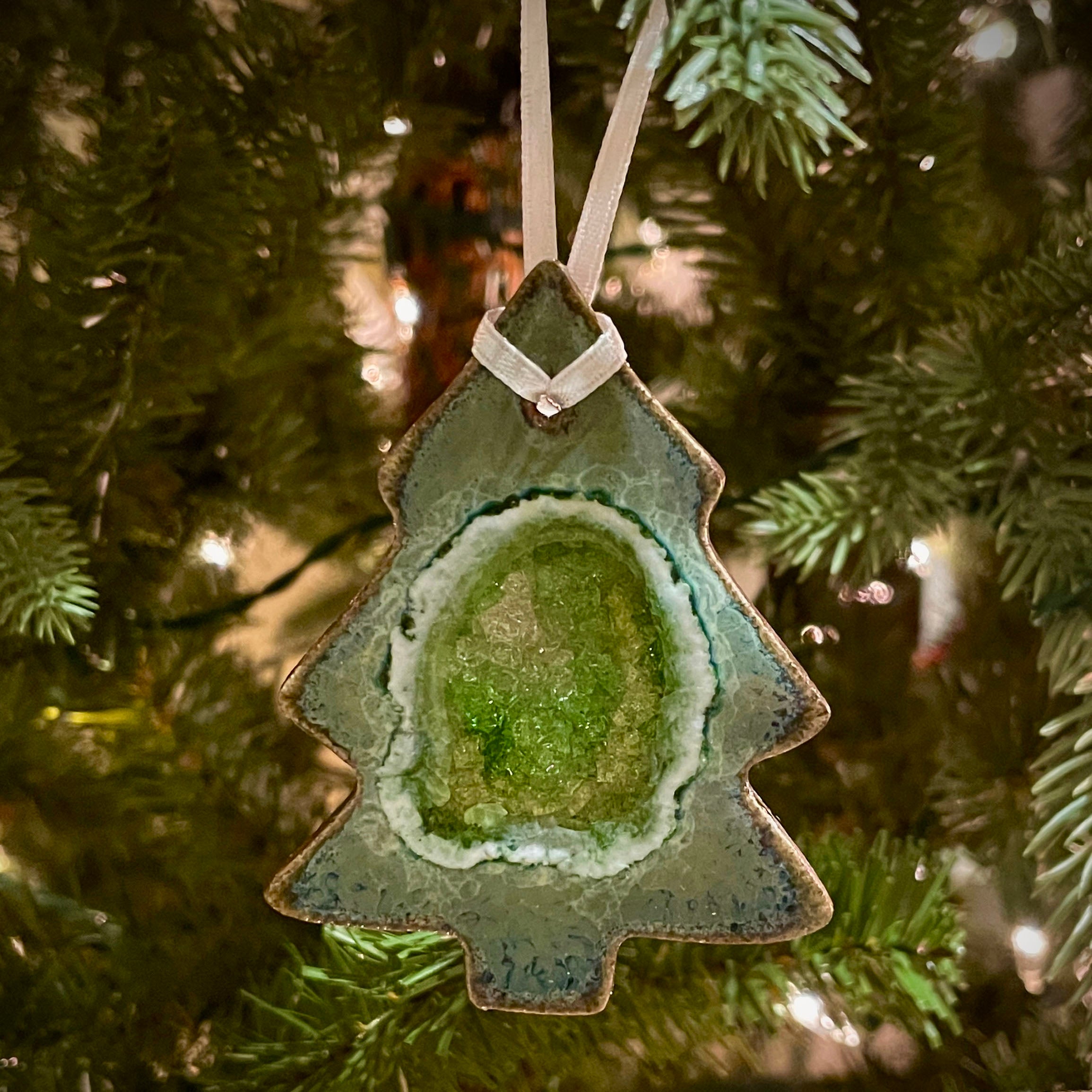
Geode and druzy finishes moved from jewelry into glass over the past two years, and that muted blue-green rim is exactly what people are pinning for a quieter holiday palette. It’s in the same family as the wreath in Idea #31 — glossy center, restrained rim. This one has staying power because it’s texture-led rather than trend-led.
15. A Wreath Ornament Tied With Candy-Striped Ribbon
A wreath is a circle, which means it needs more room than a triangle. Allow 4 inches of branch space so the striped bow doesn’t crimp against needles, and give it a spot in the top third of the tree where it won’t be crowded. On a tabletop tree under three feet, hang no more than two — the round shape reads wide and swallows small trees whole.
For the bow itself:
- Cut 14 inches of ribbon at a 45° angle.
- Fold it in half, pinch the middle, and tie a single knot.
- Pull both tails down and trim them at the same angle.
- Loop it over the wire and slide the knot to the top.
About two minutes and a dollar of ribbon per ornament.
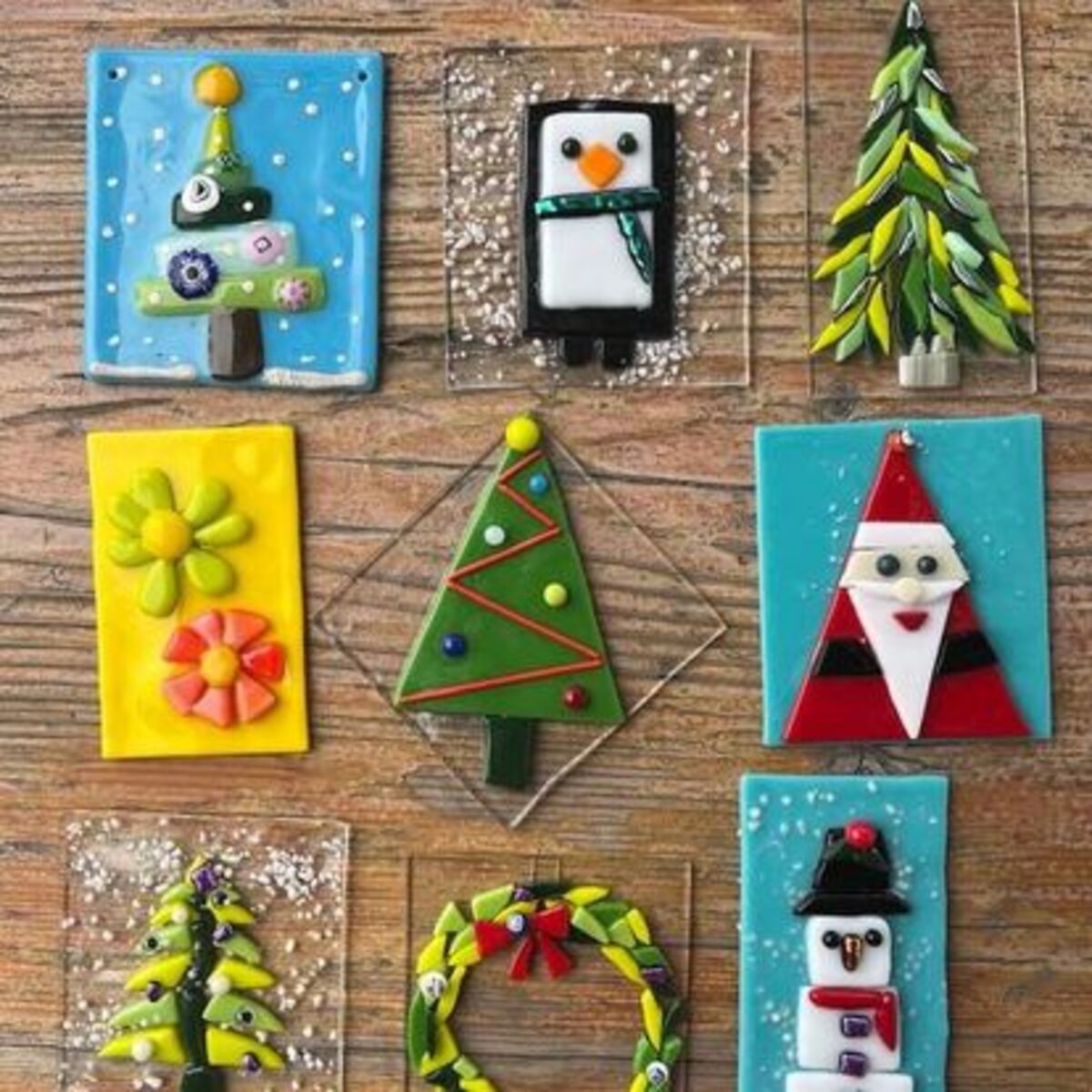
16. A Rustic Wood Tray Full of Glass Holiday Plaques
The tray is the curator. Twelve loose plaques scattered on a table look like an unfinished craft project; the same twelve inside a shallow wooden tray look like a collection. Containment does more for a display of small handmade pieces than any amount of careful arranging, and it means you can lift the whole thing off the table in one move when the real dinner shows up.
 💡 Designer Tip
Two things to know before you commit:
- Keep the tray at least 3 feet from any heat vent
- Rotate pieces every 6–8 weeks so cobalt and red don’t dull
- Dust with a soft makeup brush — frit traps lint forever
Direct afternoon sun is the enemy of saturated glass; a shaded shelf keeps it vivid for years.
17. Stained Glass Reindeer, Santa, and Candles on a Wood Slice
Stained glass is the budget cousin of fused, and it shows in the price. Where a fused piece runs $35–$80, a soldered reindeer or Santa often lands at $15–$35 at craft fairs and on Etsy because the process is faster. Check thrift stores and estate sales for vintage pieces from the 70s and 80s — $4–$10, and the solder work is frequently better than anything made today.
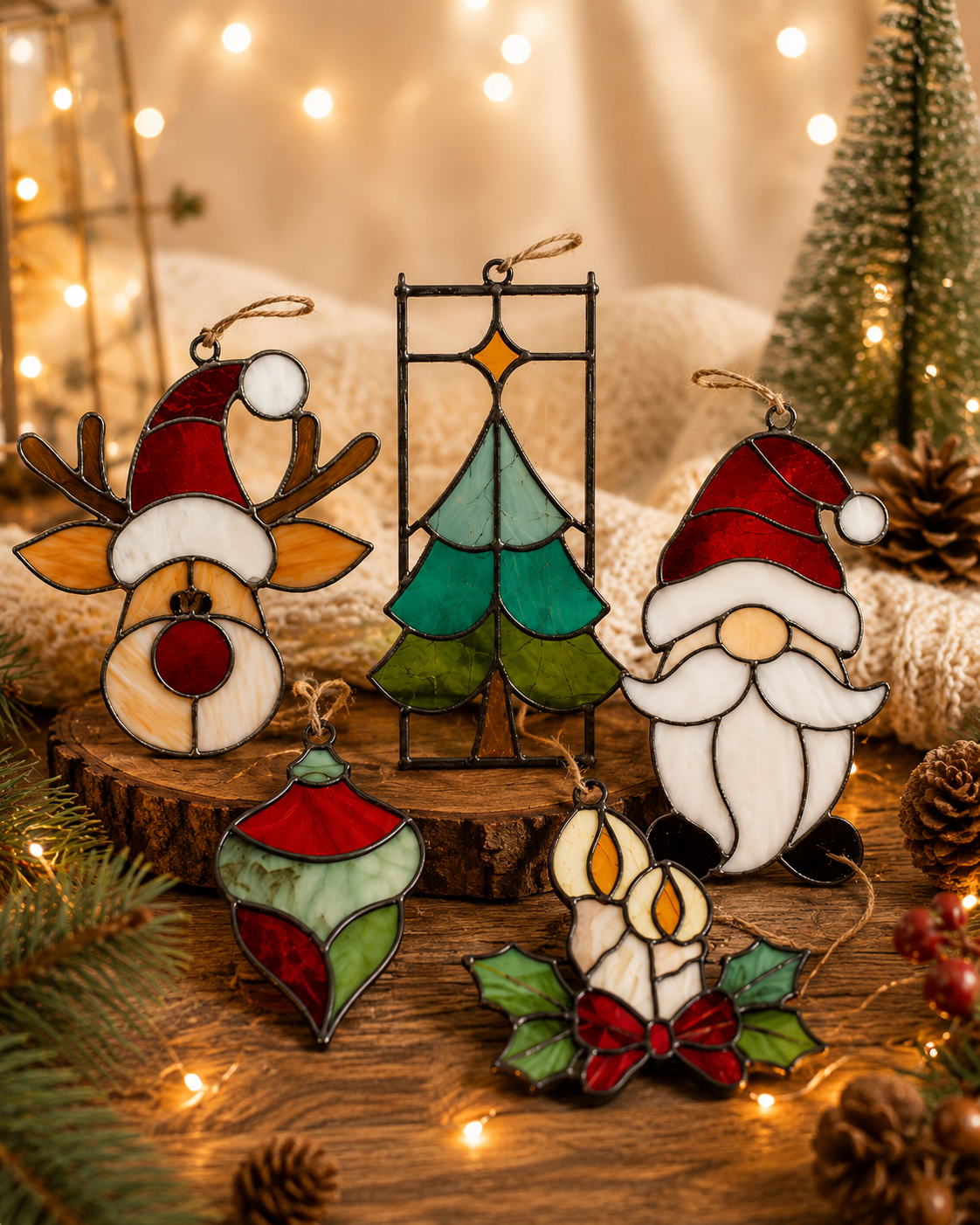
Solder oxidizes. It goes dull grey, then dark, then chalky. A quick buff with 0000 steel wool and a coat of carnauba wax once a year keeps it bright. Never wash stained glass in water — moisture creeps under the came and clouds the glass from the inside. A dry paintbrush gets into the corners just fine.
18. Four Glass Penguins in Their Winter Best
Hand-painted details on glass — those little hats and scarves — are the first thing to wear out. Keep painted pieces out of direct sunlight and away from anything that might rub them; a painted line on glass has no clear coat over it unless the maker says otherwise. If a penguin’s scarf starts to flake, a fine-tip enamel paint pen in the same color fixes it in under a minute.
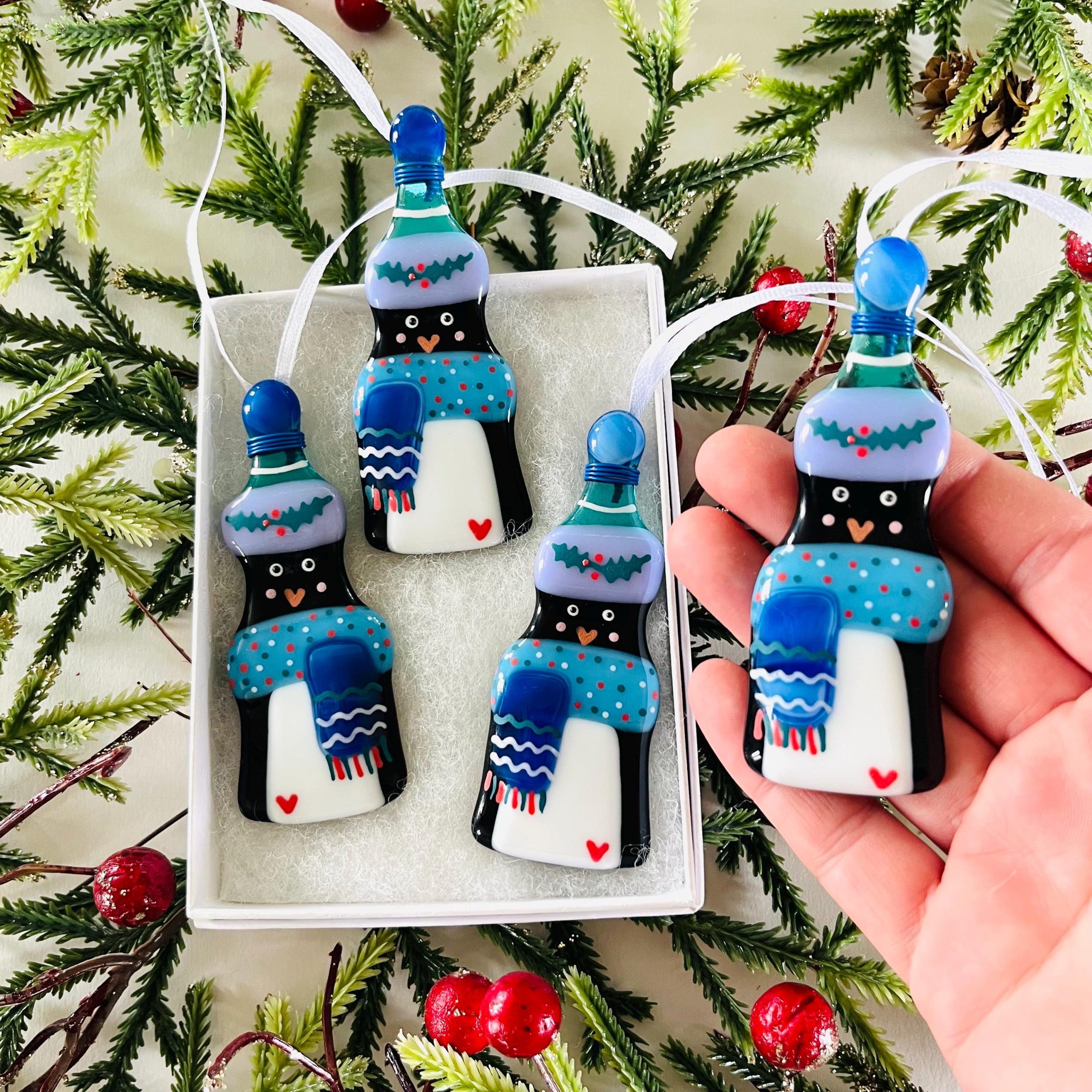
This set runs about 55% black body, 20% white, 15% cool accents (blue, lavender), 10% warm red. The mix works because the black gives your eye a rest between pastel hats. For a warmer version, swap lavender for camel and blue for rust — same proportions, completely different mood.
19. The Gnome Ornament With the Patterned Hem
- Check that hat and body are fully fused, not two pieces glued at the seam
- Confirm the hanger is embedded metal wire, not a glued-on loop
- Measure the branch gap — the tall hat needs 4 inches of clearance
- Decide if it hangs low at kid eye level or high and out of reach
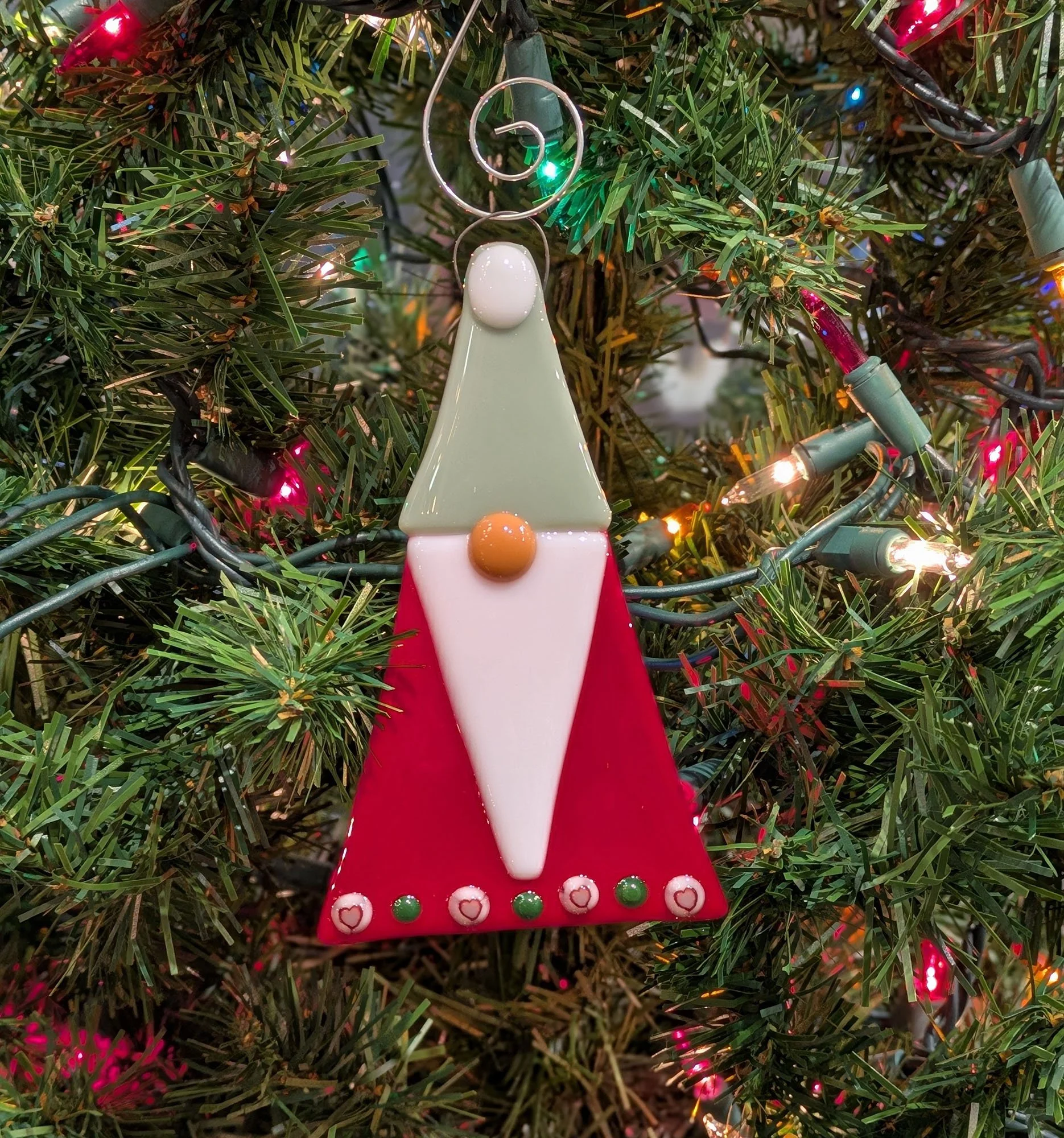
- Fused glass gnome ornament: $16–$40
- Neutral ribbon, 2 yards: $4–$9
- Coordinating plain glass balls, set of six: $12–$24
Total: $32–$73. Budget alternative — one gnome plus six thrifted glass balls at $2 each gets you the same vignette for under $30.
20. Handmade Evergreen Sculptures in Green, Blue, and Brown
Variation on a theme — and the shadow is the secret. Because this group mixes striped bands, textured fronds, and smooth geometric tiers, no two pieces repeat, yet they all share the same silhouette, so your eye reads them as a family. The plain background matters as much as the glass: soft shadows on a neutral wall give the group depth that a busy surface would flatten instantly.
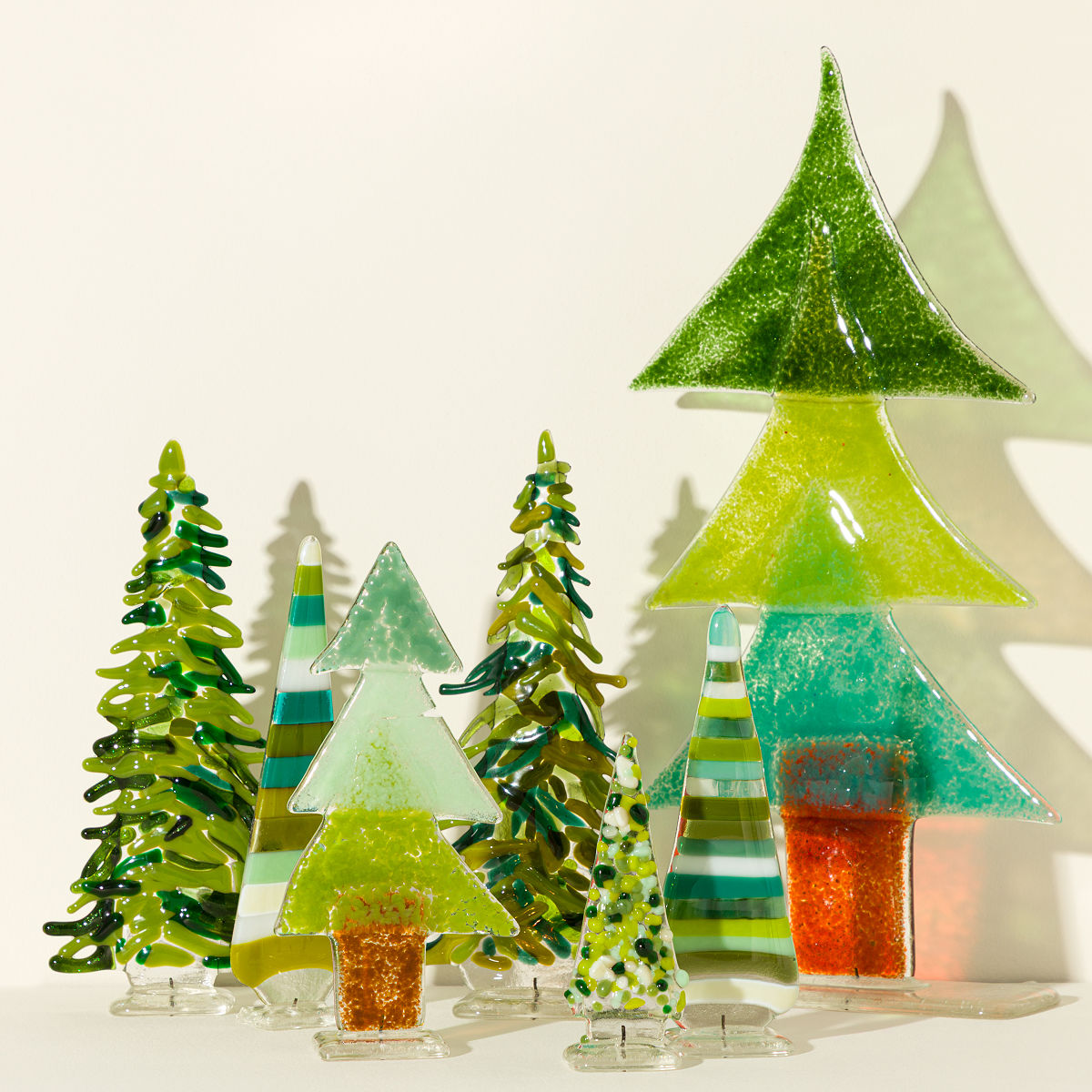
This collection wants a 4-foot-wide surface minimum — a sideboard, a long mantel, a floating shelf. Heights stepping from 4 to 9 inches give the best rhythm; if everything is the same size, cluster them in threes instead of a straight line. Keep at least 2 inches between pieces so each casts its own shadow.
21. Red Polka Dots on a White Tree, Lit By Twigs
Twig trees with built-in lights look magical and behave badly. The wires are thin, the bulbs run warm, and a glass ornament with a metal border resting directly against a lit branch can get surprisingly hot.
- 6-inch minimum spacing between ornaments
- Never let glass rest against a bulb
- Unplug before you rearrange anything
Check the cord and adapter every year before the first plug-in.
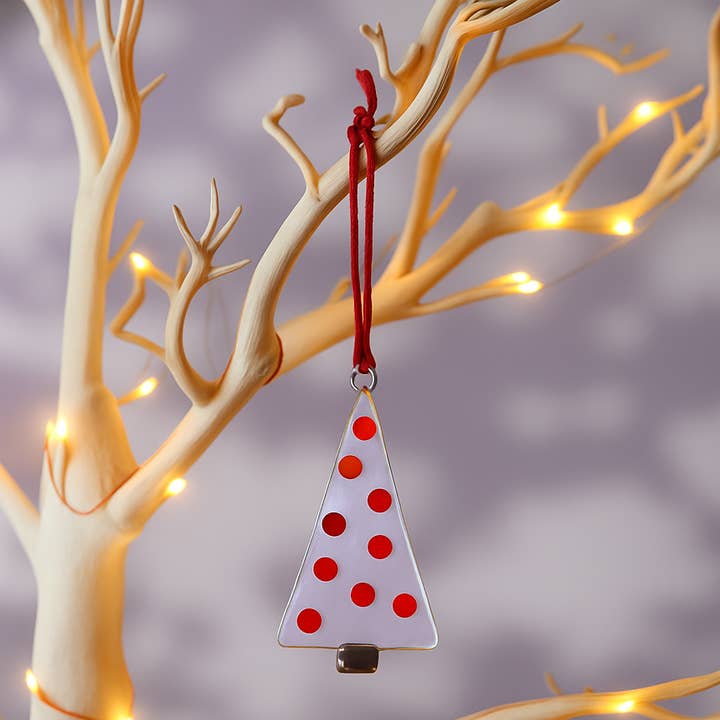
It’s the dot scale. Those red circles are large, evenly spaced, and few — maybe a dozen across the whole triangle — which is why the ornament reads graphic instead of busy. Halve the dot size and double the count and you’d get a much fussier piece. Restraint is the design decision here, not the color.
22. A Green Glass Tree Decaled in Gold Ornaments
- Wipe the fired glass with alcohol to remove kiln dust.
- Position the gold decals with tweezers — they stick instantly.
- Burnish with a soft rubber roller to push out trapped air.
- Fire to the decal maker’s temperature, usually 1050–1100°F.
- Cool slowly overnight in the kiln to avoid thermal shock.
About 30 minutes of hands-on time plus a firing cycle.
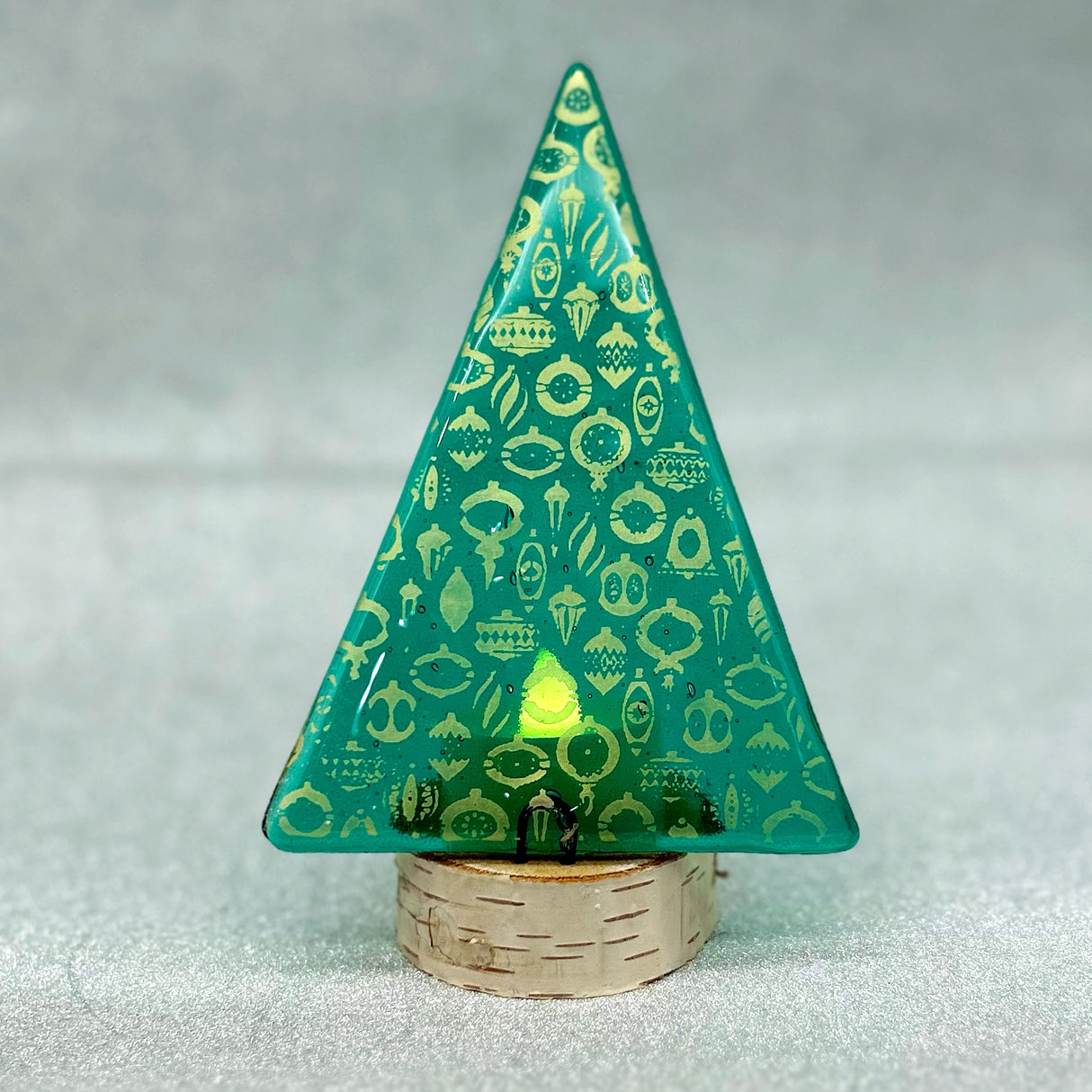
No kiln? Gold glass paint pens and rub-on metallic transfers run $6–$15 and give you 80% of the effect on a piece you already own. Or buy it pre-decaled for $30–$55 online. Look for the same gold-on-glass geometry in Idea #21, where metallic trim does similar work at a fraction of the price.
23. Rainbow Striped Trees Wrapped in Silver Wire
Wire-wrapping came out of the jewelry world and landed in holiday glass around 2024 — makers realized a spiral of silver wire adds shine and structure without needing a kiln. Rainbow stripes are the Pinterest-friendly version: color-blocked, instantly readable in a thumbnail, cheap to produce. Will it last? The wire, yes. The rainbow, probably — the blue and green versions beside it will outlive it in most homes.
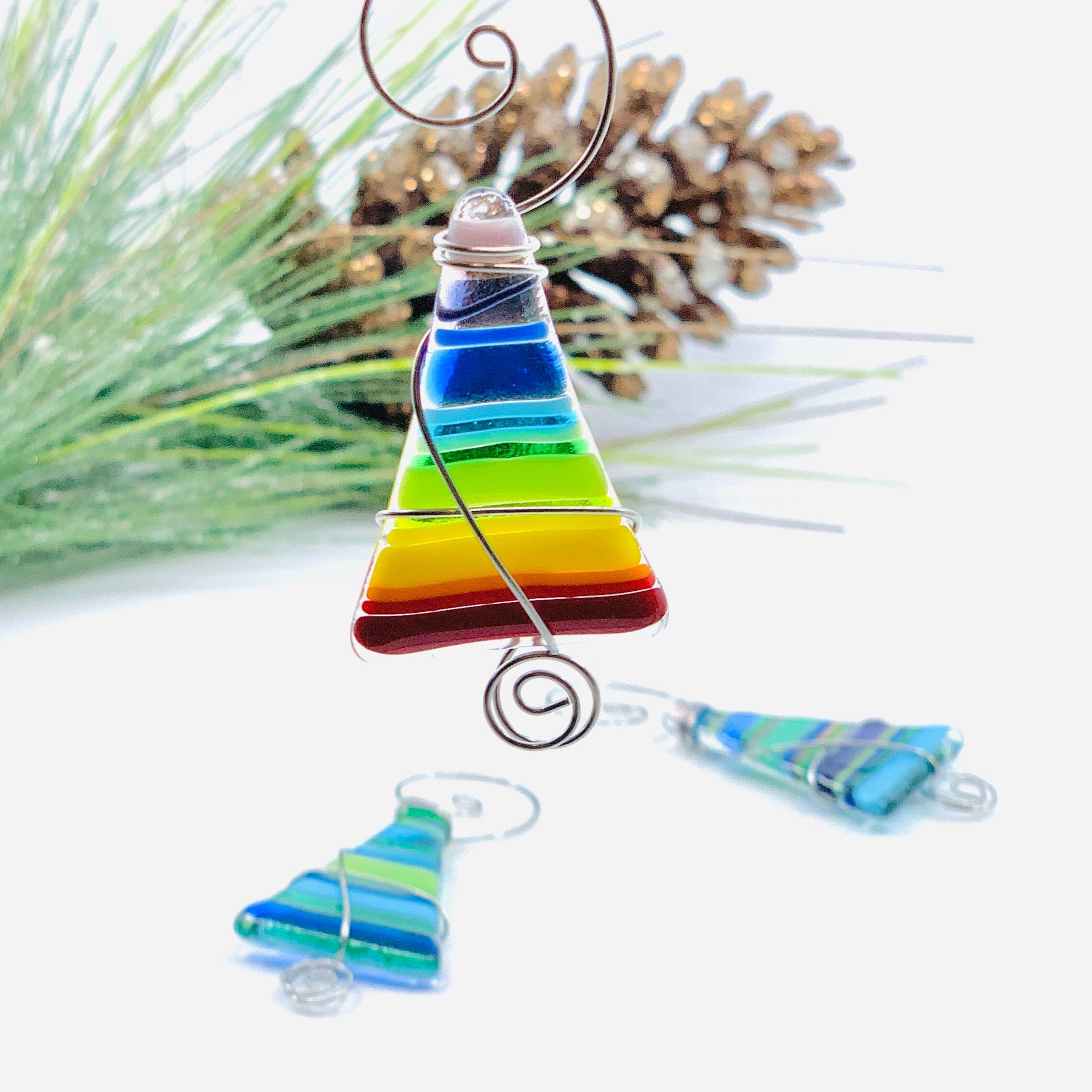
Wire-wrapped pieces should feel tight, not loose. Run a finger along the spiral: if the wire shifts or spins freely around the glass, it was wrapped cold and will loosen further once it’s swinging on a tree. A good wrap grips at the top and bottom loops with zero lateral movement. Check the ends too — tucked and filed, not sharp points near your ribbon.
24. Blue and Turquoise Stripes Held by Spiral Wire
Cool version of a familiar formula: 60% blue and teal stripes, 25% white and lime contrast bands, 15% silver wire. The horizontal banding is what matters — four to six stripes, roughly equal, with one lighter band breaking the pattern near the middle. Swap teal for charcoal and lime for amber and you keep the structure with a completely different color temperature.
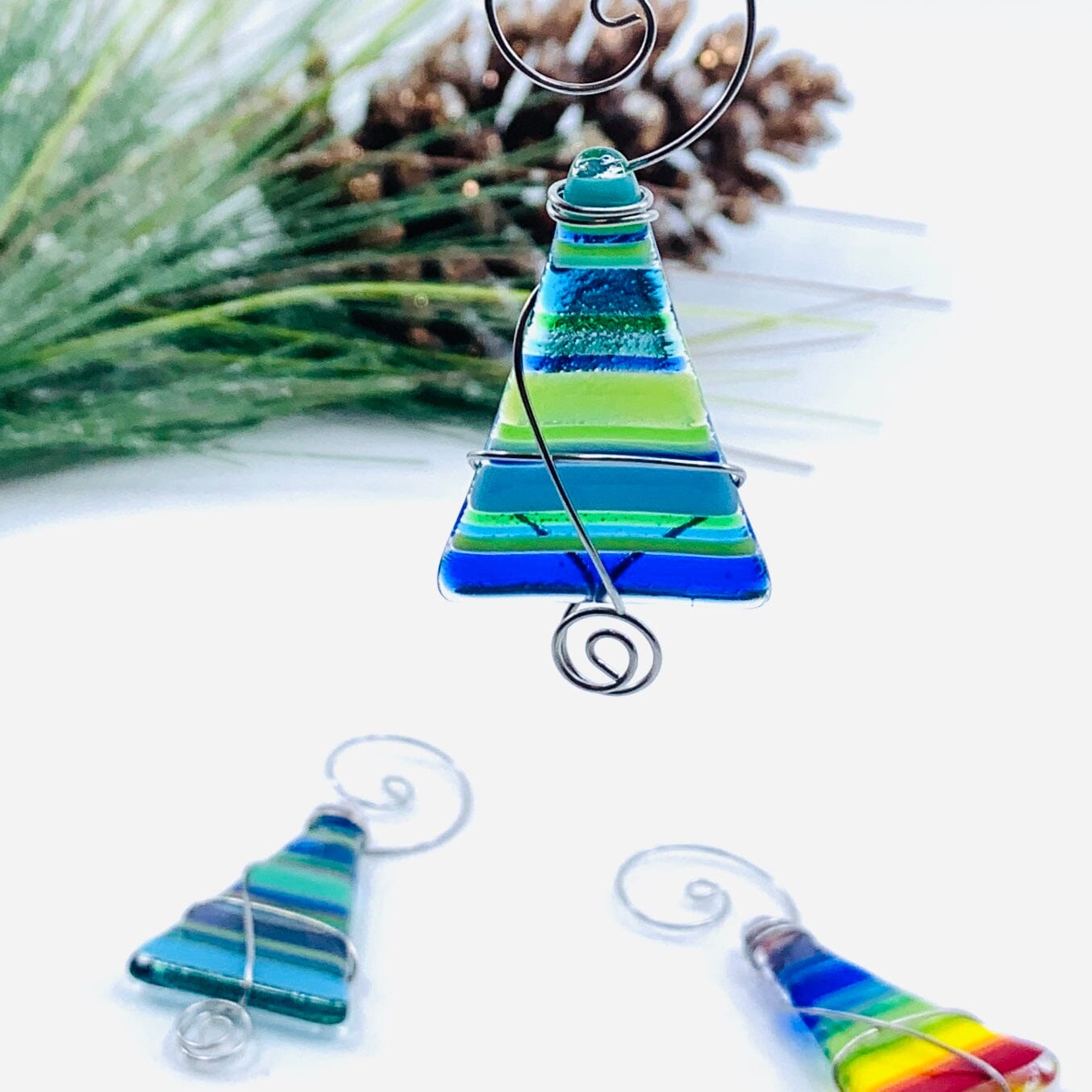
Repetition plus one break. Your eye relaxes into the horizontal stripes, then catches on the silver spiral looping over them, which is why a piece this simple never feels boring. The white display surface does heavy lifting too — cool blues go grey and sad against warm cream, but against true white they stay crisp and bright.
25. Miniature Fused Trees on Natural Branch Slices
- Fused glass miniature trees, set of five: $60–$150
- Natural branch slice bases: $10–$25 (or free from a fallen branch)
- Dark stem wire: $5–$10
- Shallow wooden tray or table runner: $20–$45
Total: $95–$230. Cutting your own slices with a $15 handsaw and letting them air-dry two weeks drops the total by roughly 40%.
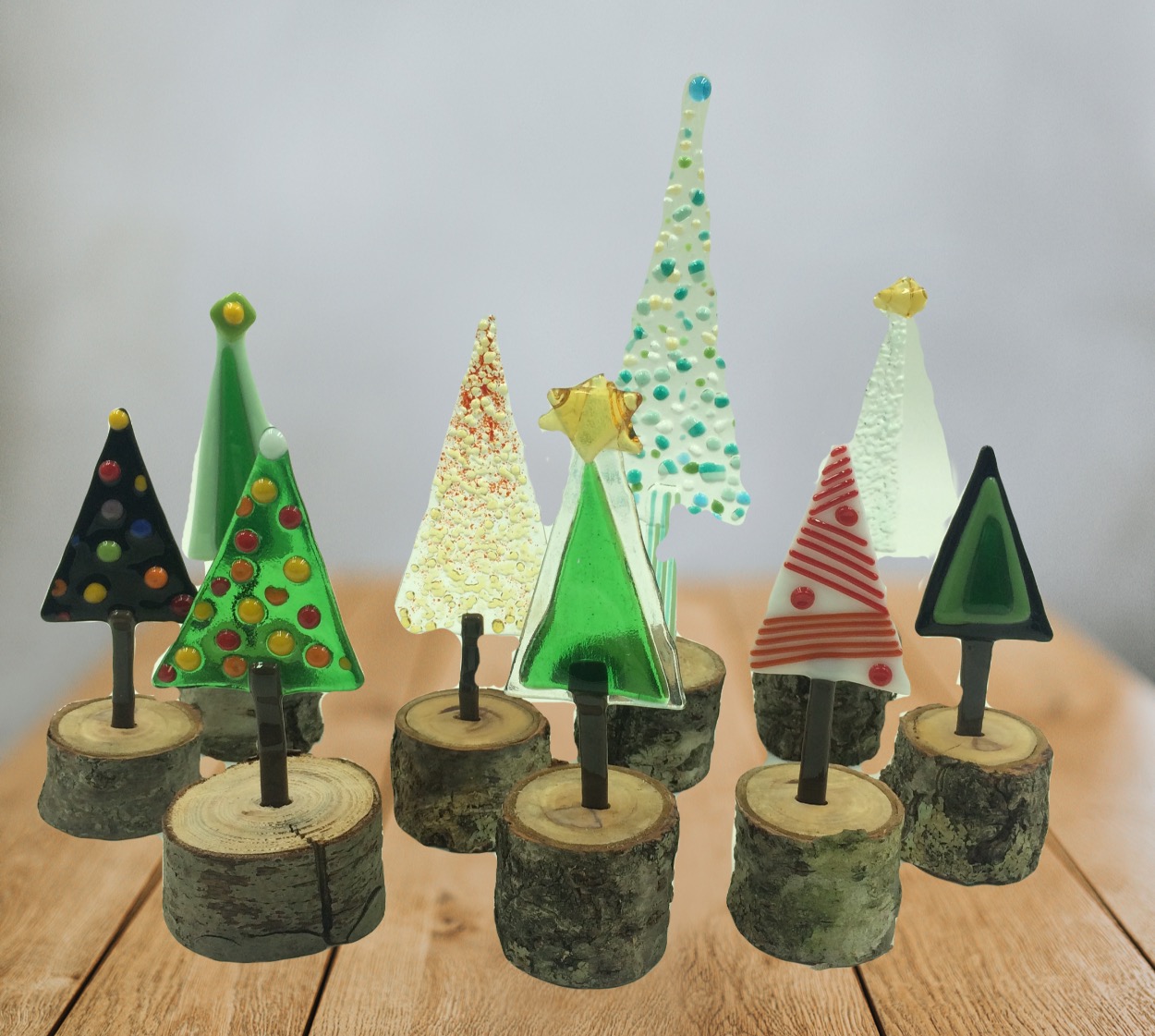
Heights should step, not match. With five standing trees, aim for something like 4, 5.5, 7, 8.5, and 10 inches in an uneven rhythm — a perfect staircase looks like a store display. Keep the bases within an inch of each other in diameter so the group still reads as one set rather than a random assortment.
26. The Green Tree With a Yellow Star and Dot Baubles
The yellow star. Everything else on this ornament is green, textured, and slightly muted — the raised garland lines, the red and white dots, the organic glass body. The star is the one solid, saturated, geometric shape, and it sits at the very top where your eye lands first. Lose it and the piece becomes a pretty lump of green glass with no direction at all.
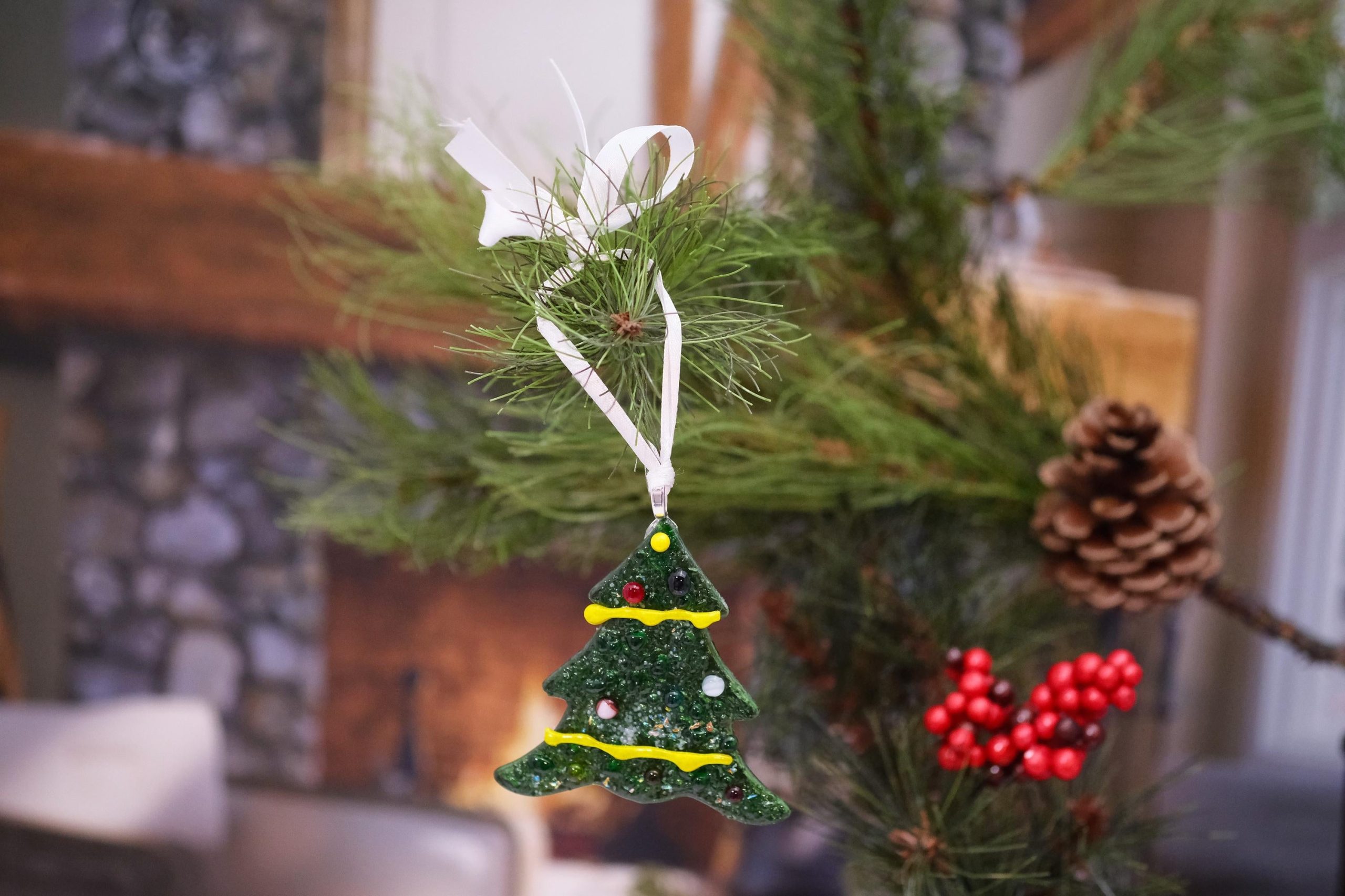
To hang it on a fresh bough:
- Snip a 6-inch pine sprig and wire the stem to a hidden branch.
- Thread 12 inches of white ribbon through the glass loop.
- Tie a loose knot, then a bow, leaving two equal tails.
- Adjust so the star clears the needles by 2 inches.
Five minutes, and the bough holds all season if you mist it weekly.
27. A Clear Snowflake With White Bead Tips
Clear glass shows everything — fingerprints, dust, hard water spots from a humidifier. Plan on a dry microfiber wipe every few weeks, and keep it out of the kitchen and any room running a humidifier. If it does cloud, that’s surface film, not damage: warm water, a drop of dish soap, dry it immediately, and never let it air-dry.
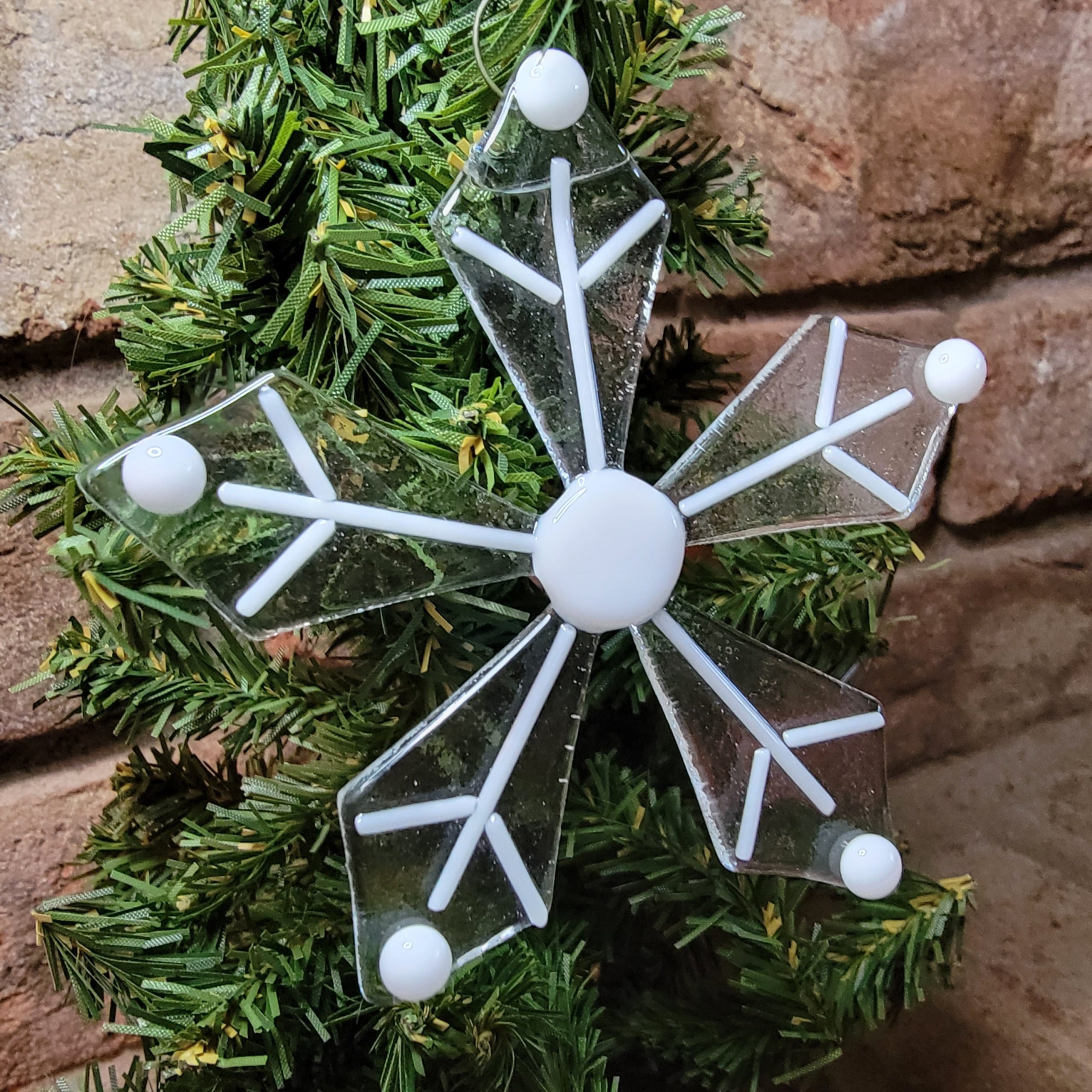
Craft-store blanks, white frit, and bead accents cost $12–$20 for a set of six, and a studio firing fee is $15–$30 per shelf load. Or buy finished: $22–$40 each on Etsy, or $6–$12 for plain clear snowflakes at big-box stores. The clear star in Idea #13 is the same clear-glass-with-frosted-tips idea in a different silhouette.
28. Three Star-Topped Trees Against Warm Wood
When several similar ornaments share a wall or a tree, unify them with one consistent hanger — same ribbon width, same color, same length. Three tree ornaments on three different ribbons read as a craft fair booth; the same three on identical white ribbon read as a curated set. Keep the tails matching within a quarter inch and the whole thing snaps into focus.
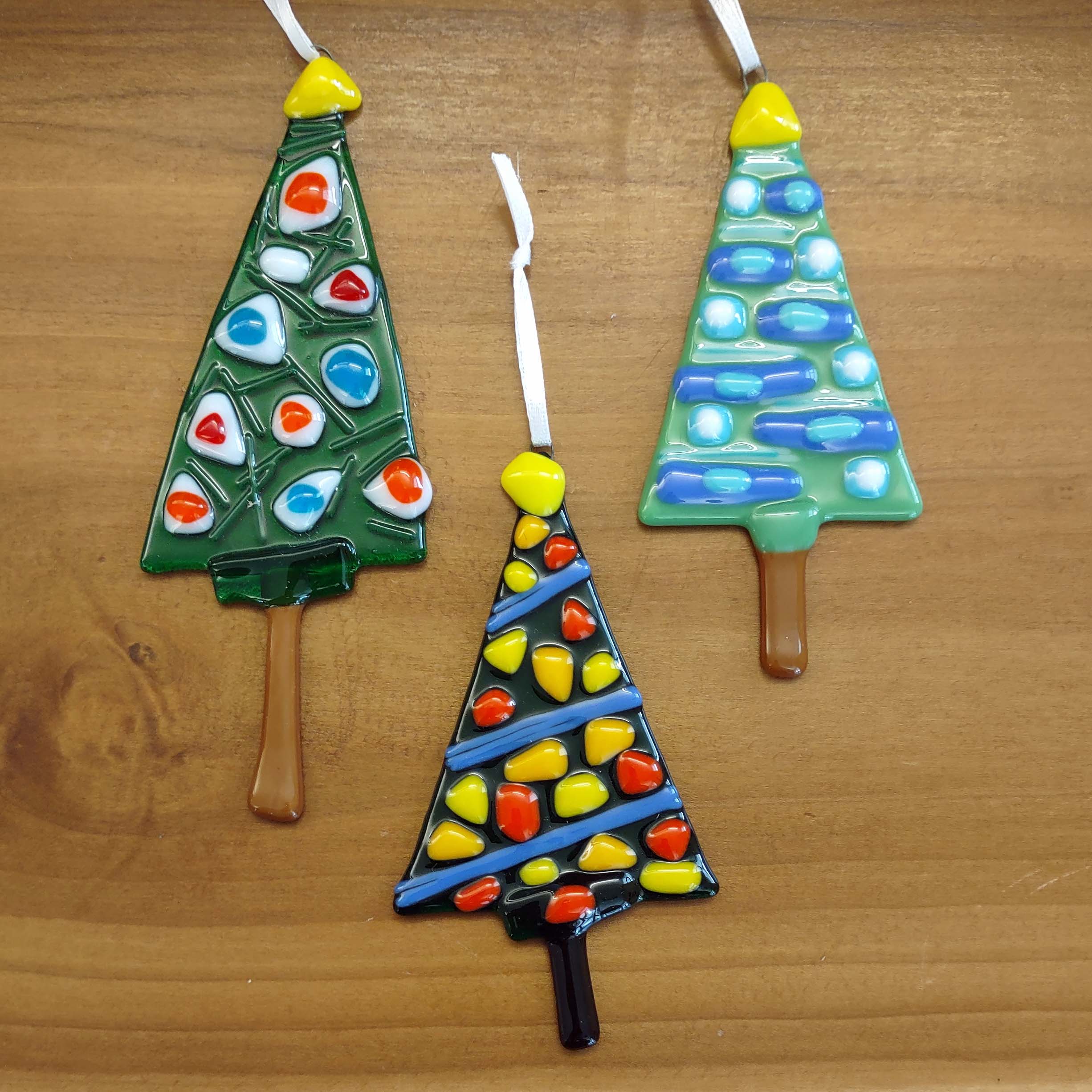
Warm brown backdrops flatter green and yellow but muddy blue and violet. If your pieces lean cool, don’t hang them against a wood panel or a walnut shelf — move to white or pale grey and the blues come back to life. Test it by holding the ornament against both surfaces before you commit to a wall.
29. Iridescent White and Dark Green, Wrapped in Wire
- Confirm the foil inclusions are encased in glass, not glued to the surface
- Check the wire wrap for movement at both loops
- Decide whether they hang on the tree or display flat with pinecones
- Set a budget ceiling before you fall for a matched pair
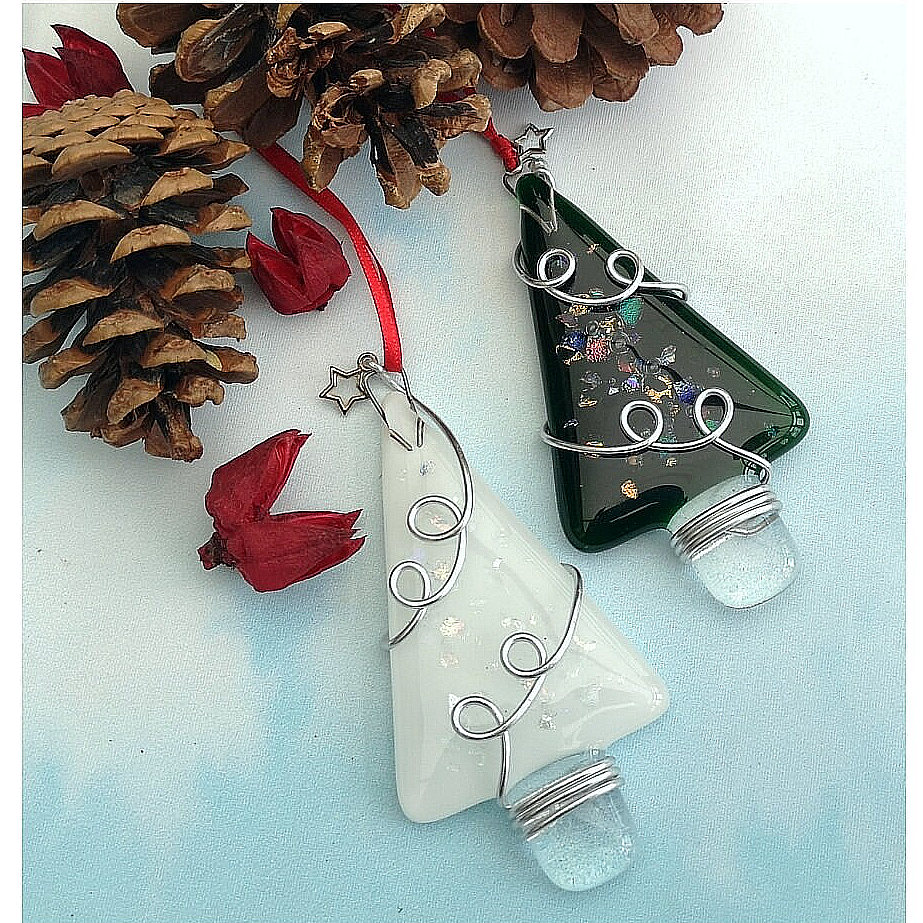
The pairing. Either ornament alone is fine; together, the opaque iridescent white and the dark translucent green play off each other like moonlight and forest. The iridescent flakes catch light at a different angle than the green’s foil inclusions, so the pair sparkles out of sync as you walk past. That timing is the entire reason to buy both.
30. Soldered Stained Glass Trees on a White Wall
Two ornaments on a blank wall panel need a grouping much larger than themselves — treat the pair as a 12-by-18-inch composition on at least 3 feet of empty wall. Hang the centers roughly 5–7 inches apart, with the taller tree’s trunk aligned to the shorter one’s midpoint. On a narrow wall under 30 inches, switch to hanging them on the tree instead.
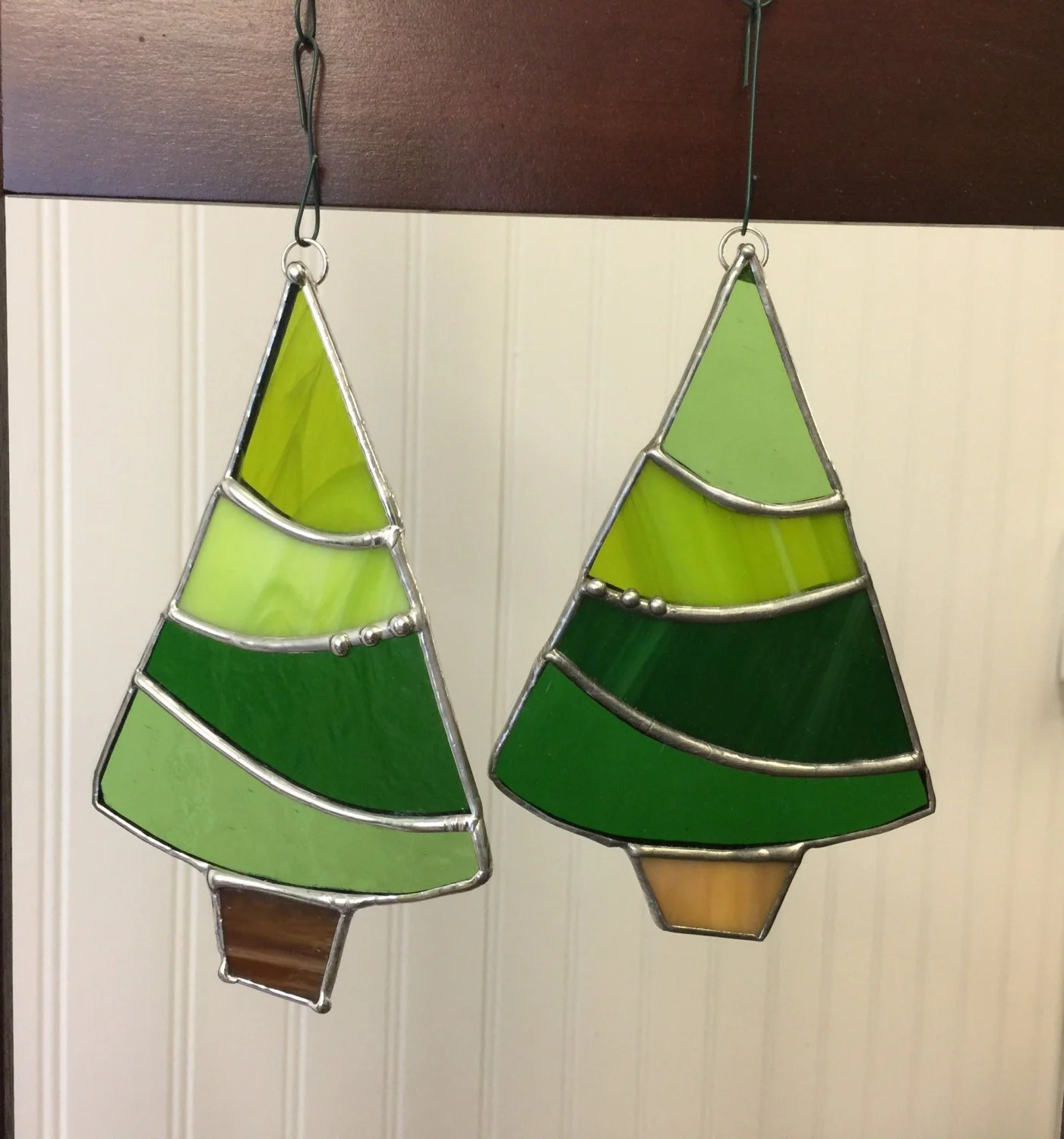
Ten or so horizontal bands in light, lime, and dark green, separated by silver came, with bead accents at three or four intersections. The rule that keeps it from going stripey-cute: bands should vary in width by at least half an inch, and the darkest green belongs at the bottom for visual weight. Swap lime for amber and it becomes a fall piece.
31. A Round Wreath Ornament With a Glossy Red Bow
- Fused glass wreath ornament: $20–$48
- Green frit and red bead assortment: $8–$18
- Kiln firing at a studio: $15–$30
- Wire hanging loop and ribbon: $3–$7
Total: $46–$103 handmade, or $12–$25 bought finished at a craft fair. Buy one, then fill the rest of the tree with plain glass balls.
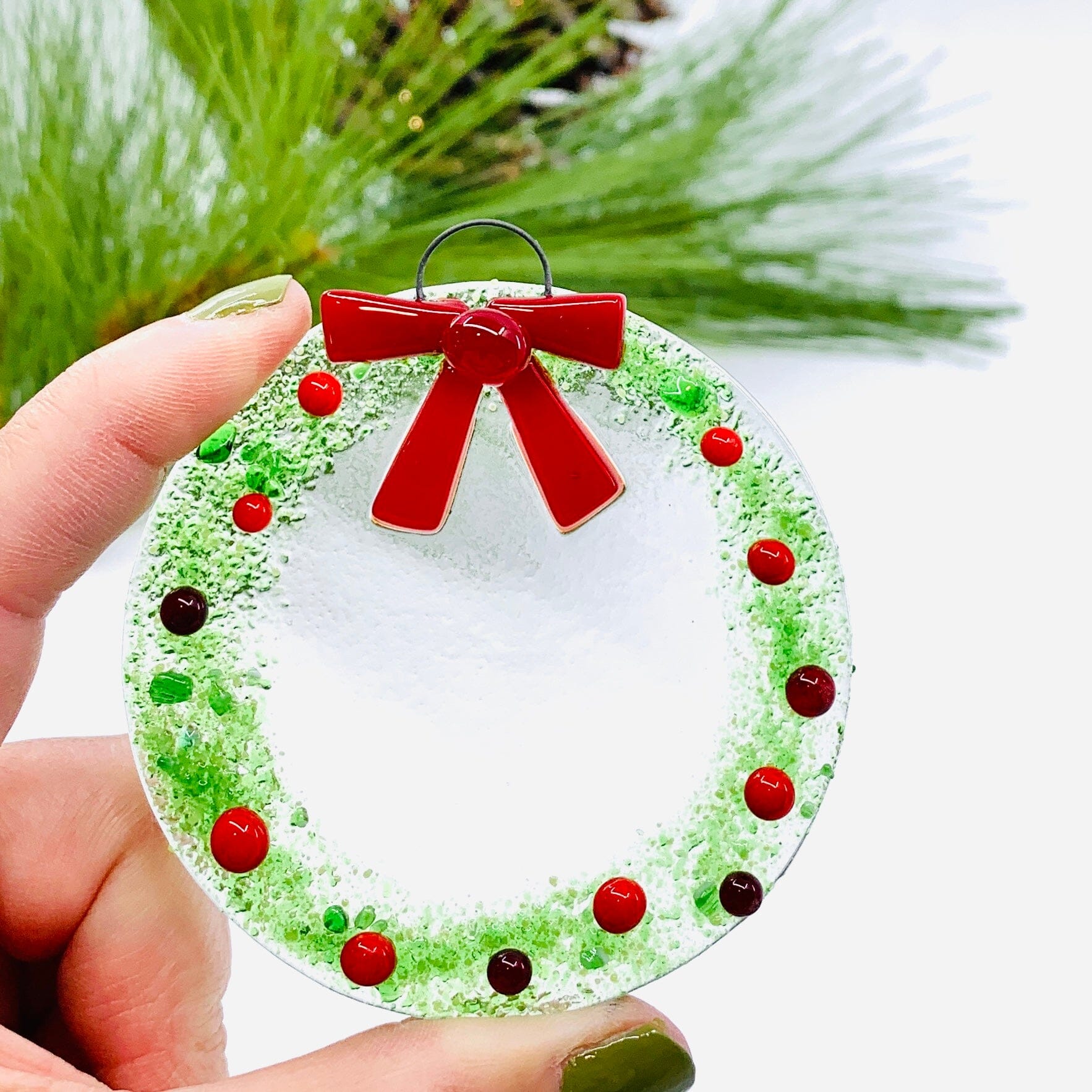
Gloss against texture. The bow is smooth, reflective, and bright; the wreath ring is frit — grainy, matte, dark green. Without that contrast the ornament is a flat red circle. With it, the bow pushes forward and the wreath recedes. Same principle as the wreath in Idea #15, just with a shinier focal point.
32. Tiered Green Branches, Wire Garland, and Bead Charms
- Start at the top loop and anchor the wire with two tight twists.
- Spiral down in even turns, about a quarter inch apart.
- Thread a small bead every second or third pass.
- Finish at the trunk, twist to secure, and tuck the end inward.
About 20 minutes and $6 worth of wire and beads.
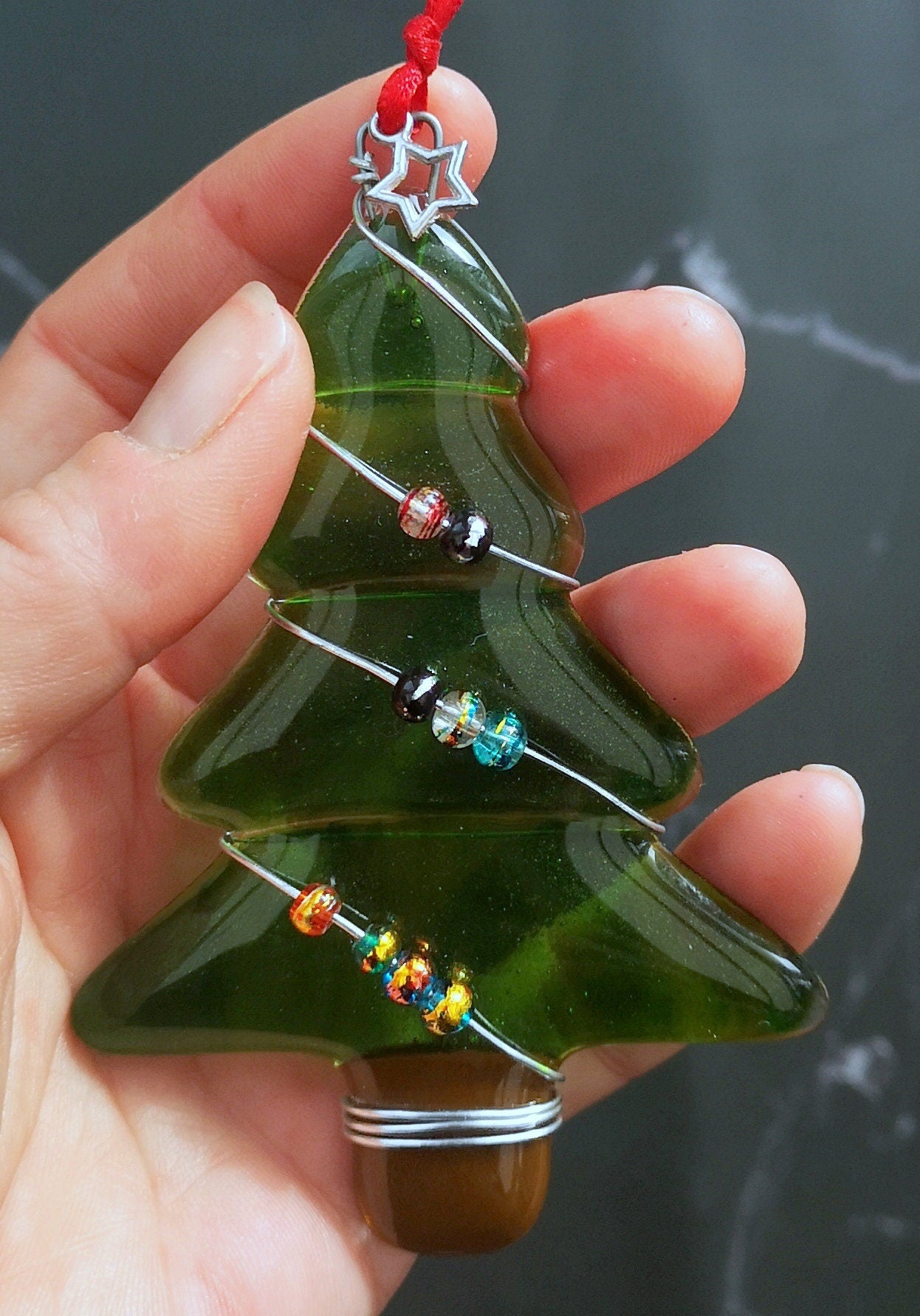
Use 20- or 22-gauge silver-plated wire. Anything thicker won’t wrap the tiered branches cleanly; anything thinner bends out of shape after one season. Check the star charm too — charms hung on a jump ring swing freely and eventually work loose. A dab of clear adhesive at the connection solves that permanently.
33. A Diamond Holly Ornament Among Tin Toys
Mixing handmade glass with painted wood and metal toys can go two ways. The glass will look like the expensive piece in the room, which is good — but it can also look like it wandered in from a different tree. The fix is repetition: a second glass piece elsewhere on the branches makes the holly read as a theme instead of an outlier. Two minimum, three is better.
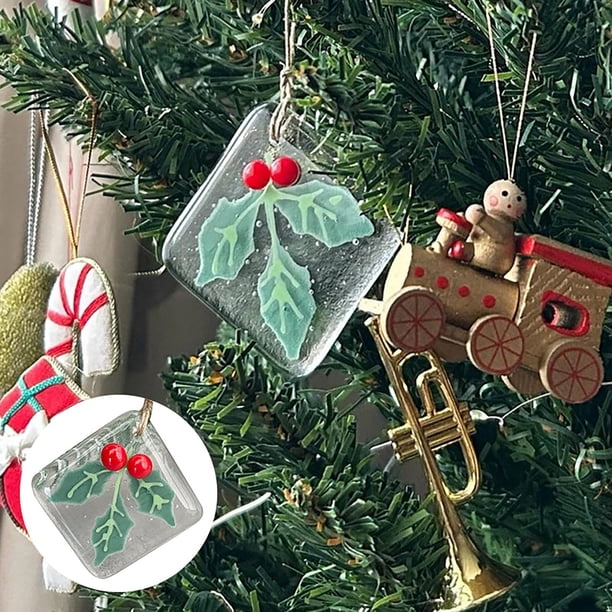
Holly is one of the cheapest shapes to make — a diamond blank, light green frit, three red dots. Studio classes run $25–$50 including materials, and blanks cost $3–$6 online. Finished versions sell for $18–$38. If that’s still steep, a plain glass diamond with a green ribbon and a real sprig tucked behind it reads almost identical from three feet away.
Your Window, Your Mantel, Your Tiny Glass Forest
Whether you’re hanging a single amber-red sphere on a pine branch or building a full tray of mosaic glass trees on the buffet, the pieces that stick around are the ones with a story — a bear holding a tree, a pudding with dripping frosting, a snowflake with white bead tips.
Start with one. See how the light moves through it at 4 p.m., then build from there. 📌 Pin this guide so it’s waiting for you next December — and drop a photo of your finished mantel in the comments; we love seeing how these turn out in real homes.