34 Dreamy 1950s Christmas Tree Ideas You Need to Try This Season for a Chic Home in 2026

You know that feeling when you’ve saved forty vintage Christmas photos and your tree still doesn’t look like the one from 1955? We spent a few evenings digging through Target, Walmart, IKEA, Etsy, and Facebook Marketplace — plus a genuinely alarming number of estate-sale listings — to put together 34 ideas that actually work in a real living room. Prices across the list run from about $8 for a thrifted stoneware crock to $650 for a fully decked traditional tree, and budget and splurge versions sit side by side the whole way through. Inside you’ll find everything from tinsel-and-color-wheel aluminum trees to warm, glowing mantel corners. Interest in vintage Christmas decor has climbed steadily heading into 2026, partly because it photographs beautifully, and partly because it’s the antidote to the beige minimal tree everyone got tired of. And stay until the end — we break down the most common mistakes that can ruin these looks. Save this post now — you’ll want it when you’re ready to shop. 📌 Save this to Pinterest for later — you’ll want to revisit these ideas.
1. Two Small Trees and a Glowing Mantel Corner
What makes this corner work isn’t either tree — it’s the pairing. Two small trees draped in warm yellow string lights flank the room, and a red-and-white stocking hangs from the wooden mantelpiece between them. One tree alone would read as decoration; two read as intention, like someone deliberately built a Christmas Eve ritual around this exact spot. The pleated-shade table lamp and the single lit candle keep the light low and amber rather than white and bright, and the sheer curtains soften the window behind it all.
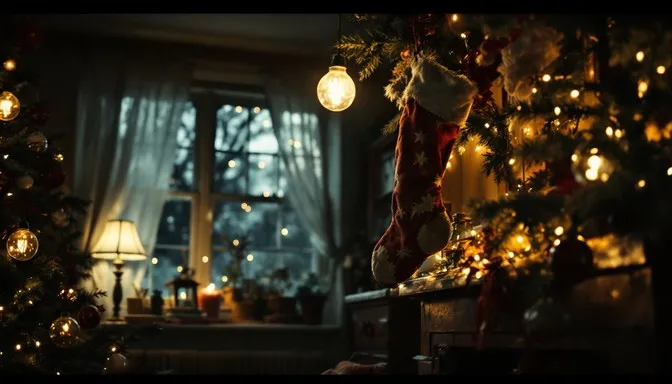
Skip the overhead switch entirely after 5 p.m. in a room like this. Layer three low sources — the tree strings, a lamp with a pleated or fabric shade, and one real candle — and keep every bulb between 2200K and 2700K. That’s the difference between nostalgic glow and shopping mall. If your string lights run cool white, swap them; no amount of clever styling fixes a blue-tinged tree.
2. Silver Tinsel and Big, Loud Ornaments
The 1950s formula here is roughly 55% green tree, 30% silver tinsel, and 15% saturated color. The tinsel does the heavy lifting — draped in long vertical strands rather than clumped, it catches light from every warm bulb and makes the tree read twice as full as it actually is. Swap the ornament colors all you want: blue and gold, pink and copper, orange and turquoise. Keep the tinsel silver and the bulbs warm white and the era still reads instantly.
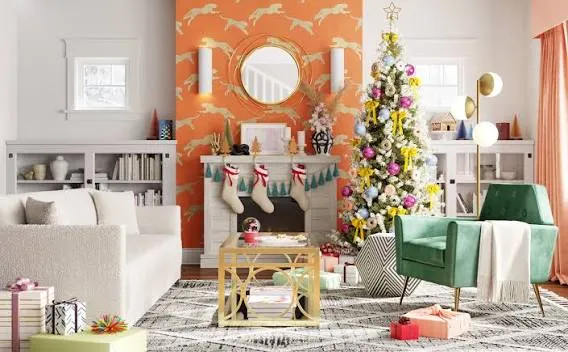
Scale is everything on a tree like this. The ornaments are deliberately oversized — big spheres that would look cartoonish on a modern minimal tree — and that’s exactly why they hold their own against all that shimmer. The silver star topper is the only true metallic note pointing up, and the pale shaggy rug underneath bounces warm light back onto the lower branches, softening the whole silhouette.
3. How to Build a Tree Around Just the Ornaments
Vintage glass ornaments have a weight and reflectivity plastic can’t fake, and they look best grouped by shape rather than scattered. Cluster three to five same-family pieces in one area, leave a hand’s width of bare green between clusters, and let the tree breathe. Push each ornament slightly inward rather than hanging it on the branch tip — recessed ornaments read as depth, tip-heavy ones read as clutter.
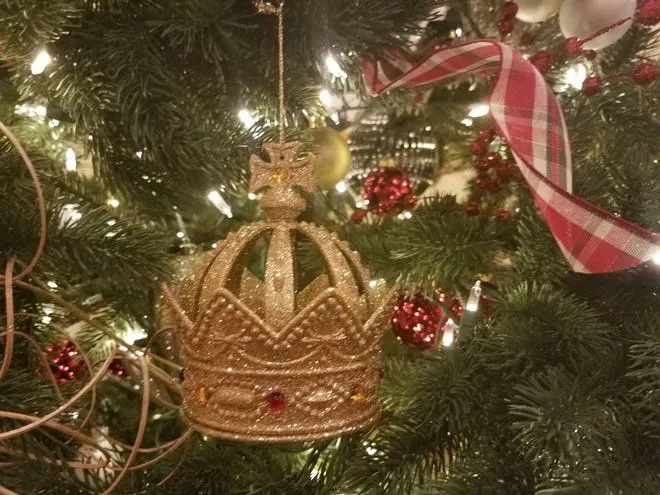
Vintage glass is fragile and usually has some chipped paint, which means two things. Don’t hang your grandmother’s pieces where a toddler or a cat can reach them. And if you’re buying on Etsy or eBay, ask for close-ups of the caps and hangers — that’s where the damage hides. Nineties reproductions from the original molds look close enough at three feet away and cost about a quarter as much.
4. Retro 50s Tree Styling With Southern California Ease
You don’t need a dealer to get this look. Thrift stores and estate sales in warm-weather cities turn up real 1950s ornaments constantly, usually between $1 and $4 each, because nobody knows what they’re holding. Add a modern tinsel garland (about $12 at Target) and a pack of oversized ornament balls ($18 at Walmart) and you’re most of the way there. Facebook Marketplace is where actual vintage trees show up, usually in July, usually cheap.
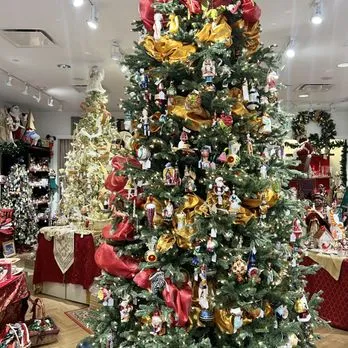
Retro displays like this work best in rooms between 150 and 350 square feet with standard 8-foot ceilings — ceiling height matters because tinsel trees need a little air above them or they feel like they’re pushing against the room. If your living room runs larger than 400 square feet, go with the fuller statement tree in Idea #13 instead; a spare retro tree can look genuinely lost in a big space.
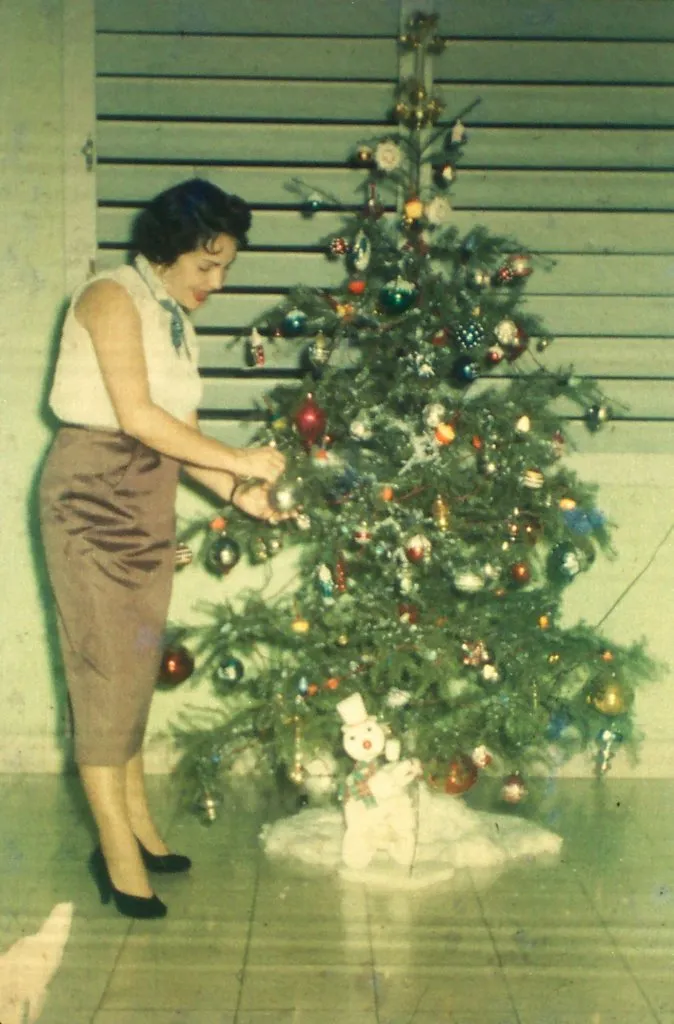
5. Styled Like a Vintage Holiday Postcard
The postcard look is having a real moment in 2026. Search interest in vintage Christmas postcard decor climbed steadily through last season, partly because the palette — faded red, cream, soft gold, a hint of sage — photographs beautifully on a phone with zero editing. It’s also the easiest era to fake: nothing in a 1950s postcard scene requires expensive modern furniture, just warm light and a slightly faded color story.
Before committing to a vintage postcard display, check these first:
- Does your room get direct sun? Faded-looking decor in strong daylight just looks dingy.
- Do you have one warm-toned lamp that can serve as the main light source after dark?
- Is there a surface — mantel, sideboard, windowsill — for non-tree decor?
- What colors already exist in the room? This palette fights cool grey.
6. The Period Living Room Tree, Done With Restraint
A period room doesn’t need a maximalist tree; it needs a tree that agrees with the architecture. In a room with real crown molding and a plaster ceiling, the tree’s job is to sit inside the composition, not fight it. That means a narrower profile, ornaments that read clearly from a distance, and lights that are visible from the doorway. The furniture and trim are already doing the decorative work — the tree is punctuation.
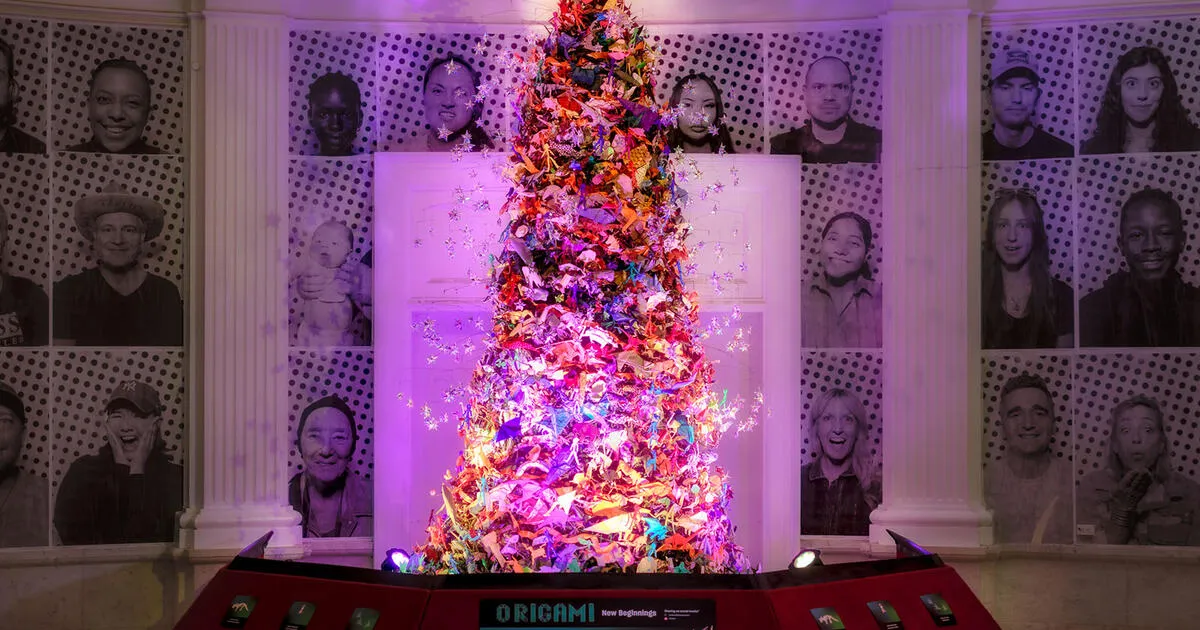
that sells this look is the tree’s height relative to the ceiling. In a period room, keep 12 to 18 inches of clear wall between the topper and the ceiling — no more, no less. Tighter and the room feels compressed; looser and the tree looks borrowed. It’s the measurement most people skip, and it’s the one that changes how period the whole room reads.
7. Gold Ornaments Against Dark Walnut and Burnt Orange
Hang your tree lights in a spiral, not a zigzag. Working from the trunk outward in a slow spiral — four to six inches between passes — means every branch gets light from two angles and nothing looks like a grid. It takes about twenty extra minutes and a lot more bulbs than you’d guess. Against dark walnut paneling like this, that density is what makes gold ornaments glow instead of vanish.
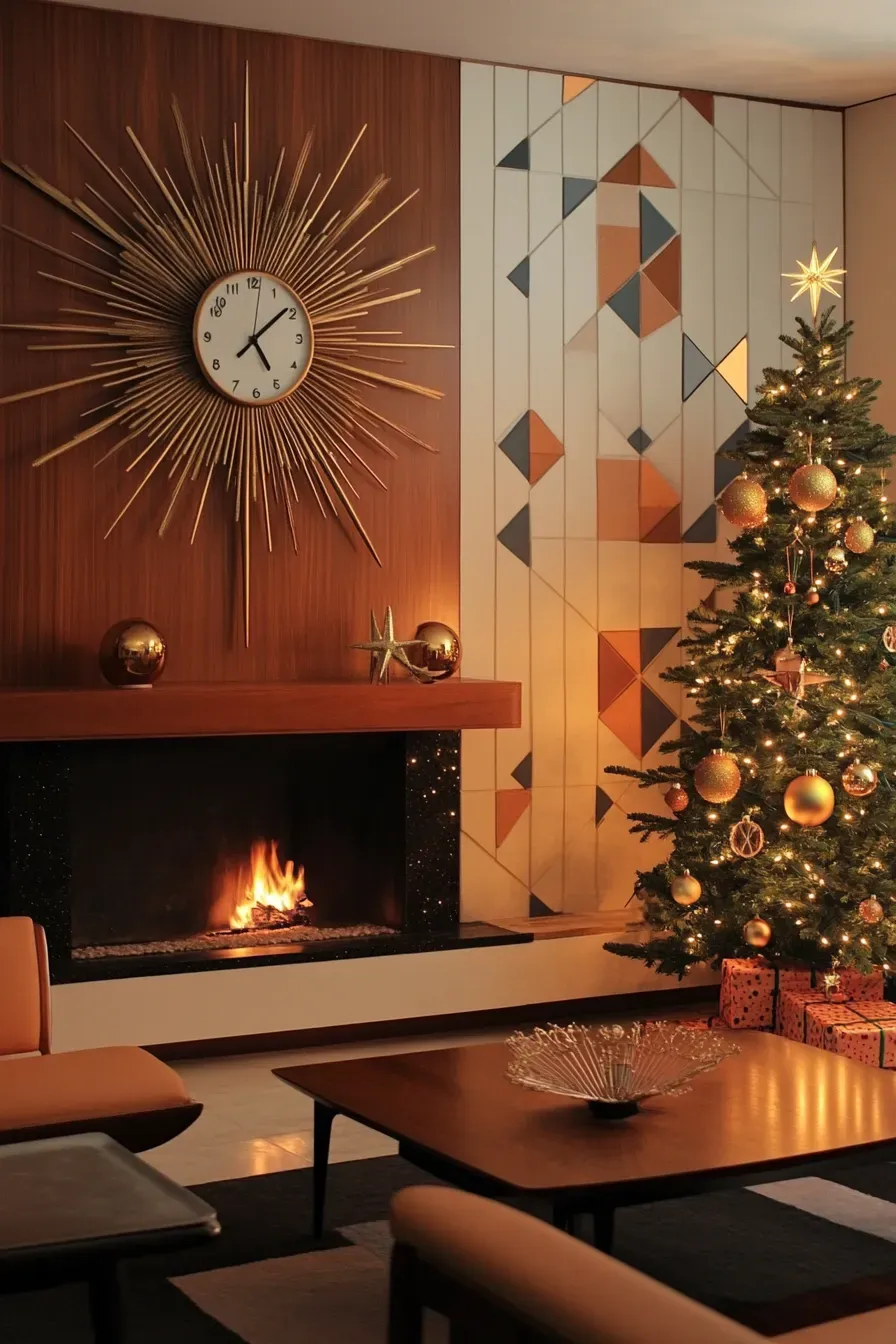
The palette in this room breaks down almost perfectly:
- 45% dark walnut and black — fireplace surround, paneling, coffee table
- 30% white and grey — the geometric panel, the upholstery
- 15% burnt orange, pulled from the patterned wall
- 10% gold, concentrated entirely on the tree and the gifts beneath it
Swap burnt orange for mustard and the formula holds. Swap it for teal and you’ve moved decades, not just colors.
8. The Family-Room 1950s Tree, Lights Left On
- Tree: 7-foot green artificial — $90 to $250
- Lights: 600 warm-white incandescent-style LEDs — $25 to $45
- Ornaments: mixed vintage and reproduction, 80 to 100 pieces — $60 to $180
- Garland and tinsel — $15 to $30
- Tree skirt — $20 to $50
- Timer and extension cord — $15
Total: roughly $225 to $570. Reproduction ornaments cast from the original 1950s molds are the biggest savings lever — about 70% cheaper than originals and they photograph identically.
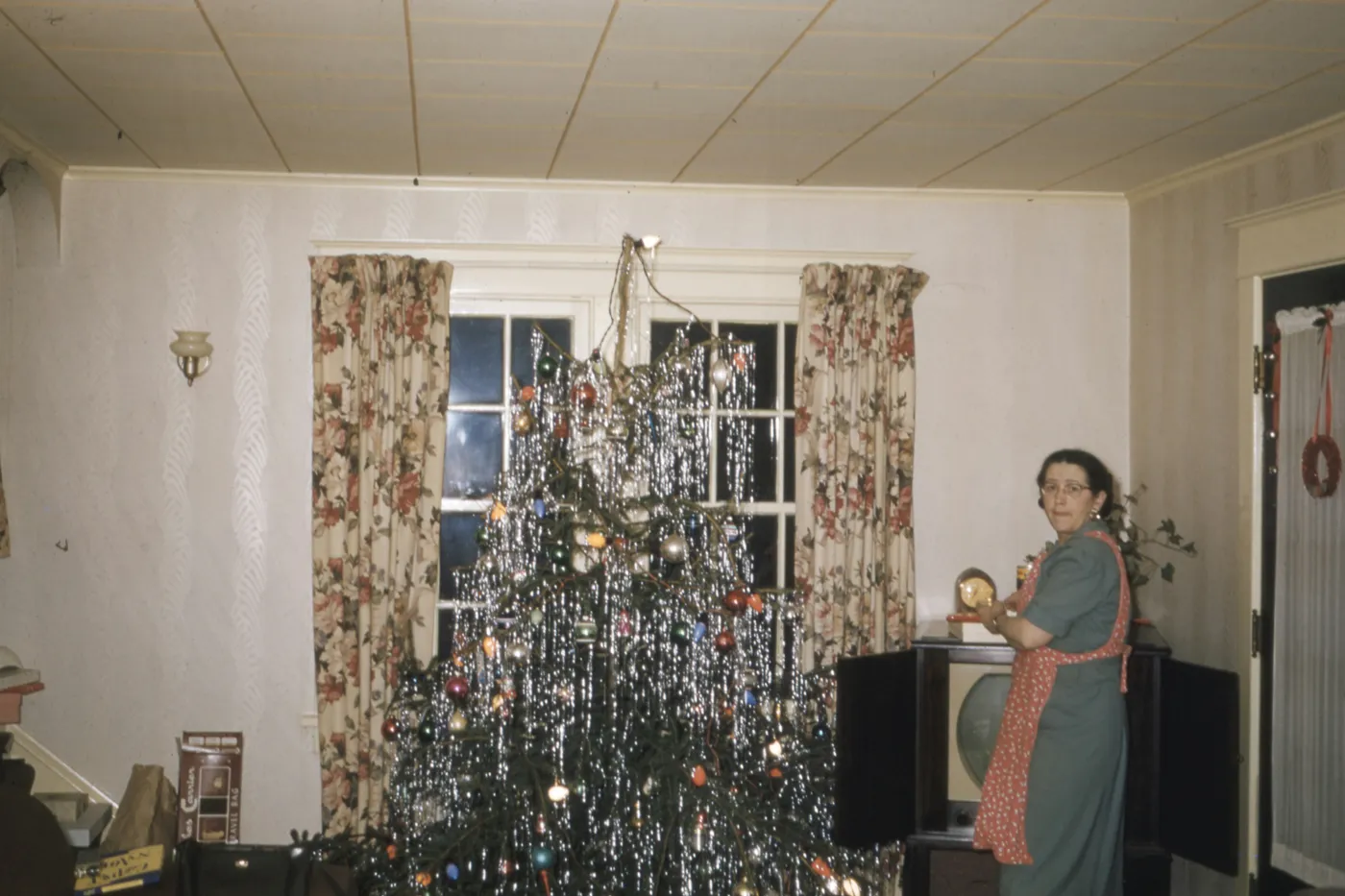
Incandescent-style warm bulbs get hot, and trees from this era often sat near a heat source. If you’re running genuine 1950s lights, put them on a timer that shuts off after four hours and never leave the house with them on. Modern warm-white LEDs look nearly identical in photos and burn cool. A tree this densely decorated is also heavy — check your stand’s rating before you commit.
9. The Aluminum Tree and Its Color Wheel
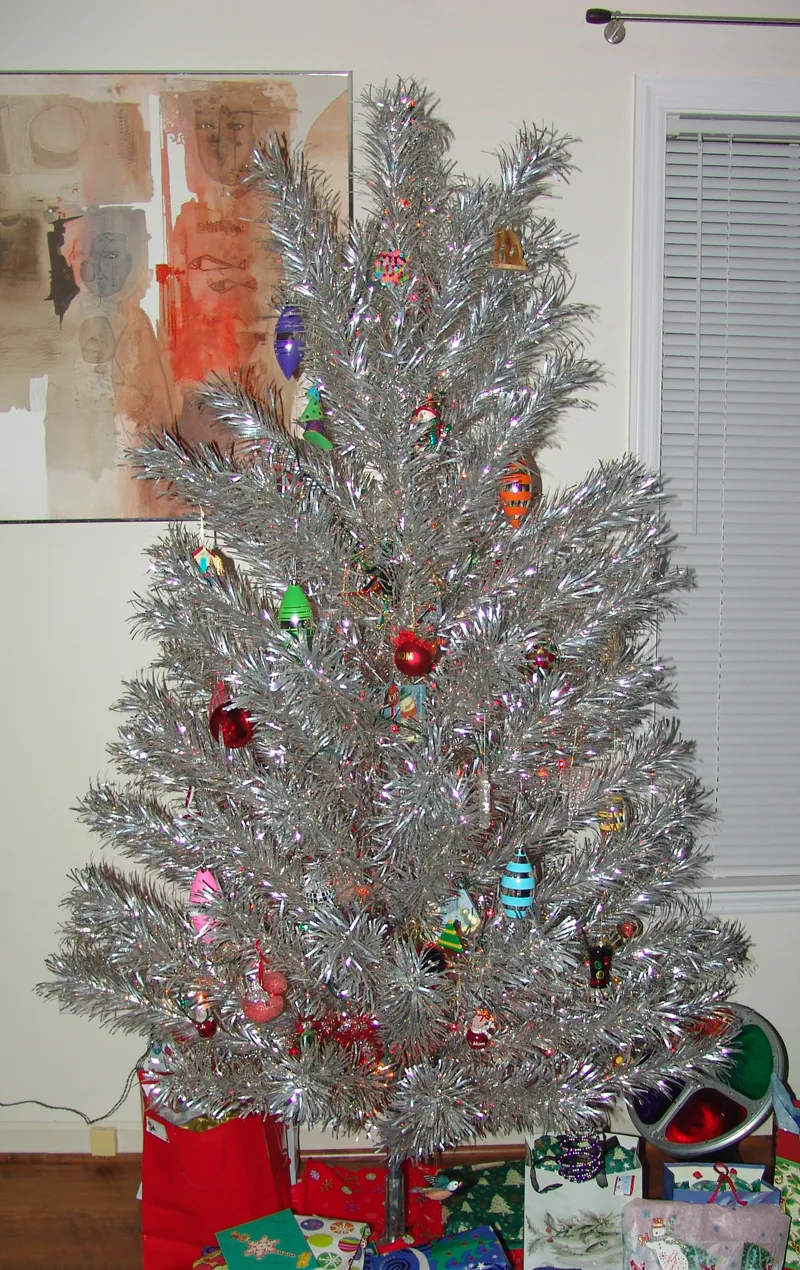
Aluminum trees don’t shed, don’t need watering, and wipe clean with a dry microfiber cloth — that’s the good news. The bad news is that the foil branches dent permanently if you store them bent, so they go back in a long flat bin, not a garbage bag. And you can’t put regular string lights on them. Real aluminum conducts, which is the whole reason the rotating color wheel existed in the first place.
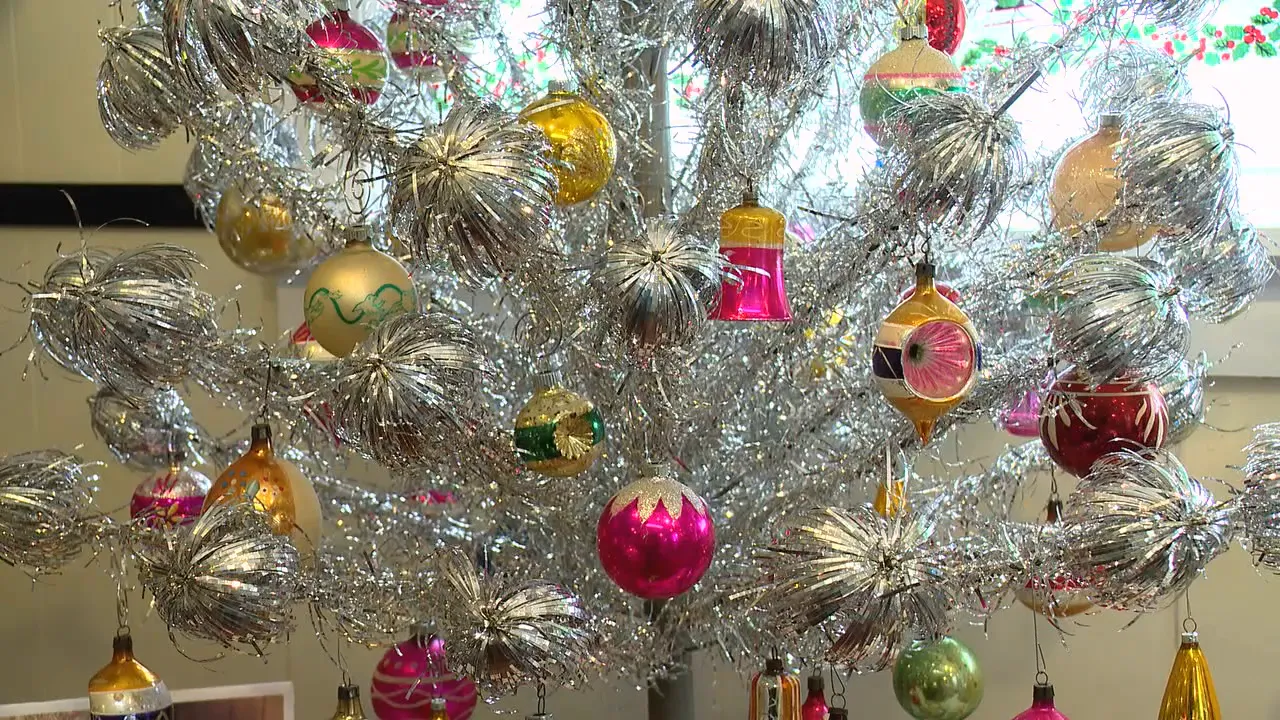
Before buying a vintage aluminum tree, verify:
- Are all the branch tips present? Replacements are nearly impossible to match.
- Is the center pole straight? A bent pole means the tree never stands level.
- Does it include the color wheel? Wheels alone sell for $80 to $200.
- Are the branches flat rather than crushed? Once bent, they don’t come back.
10. The Decorator’s Period Tree: Layered, Not Crowded
A layered period tree needs vertical room to work. Figure a 9-foot ceiling minimum for an 8-foot tree, and at least 4 feet of clear floor around the base for gifts, skirt, and foot traffic. Rooms under 200 square feet will feel swallowed by it. If that’s your situation, the two-tree approach in Idea #1 delivers the same nostalgic warmth without the footprint.
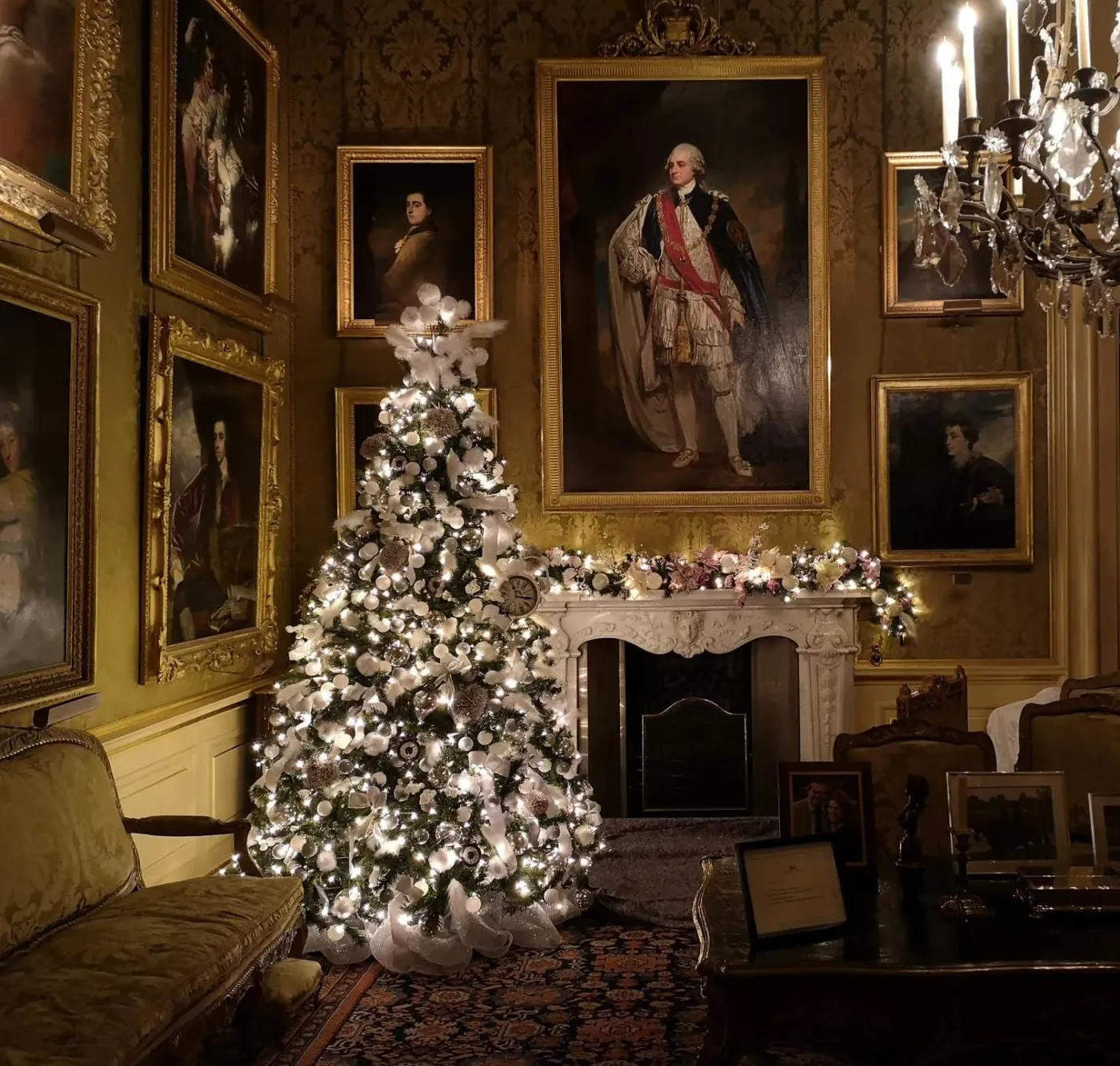
Professional holiday decorators charge $1,500 to $6,000 for a tree like this, and most of that is labor, not materials. You can buy the same bones — a good 7.5-foot tree, 800 warm lights, and 120 ornaments across three coordinated finishes — for under $500 at Target and Hobby Lobby in the off-season. The trick decorators use is volume: more ornaments than feels reasonable, all in two or three finishes.
11. A Period Tree That Doesn’t Get Thrown Out
How to build a reusable period tree that still looks styled:
- Buy a good artificial tree once — $150 to $300 — and pre-hang the lights permanently so you never redo it.
- Store ornaments in labeled zip bags by color family, not by size.
- Photograph your finished tree on December 26th so you can rebuild it in twenty minutes next year.
- Add one new vintage ornament each season instead of a whole new theme.
Time: about 2 hours the first year, 45 minutes every year after. Cost: one-time.
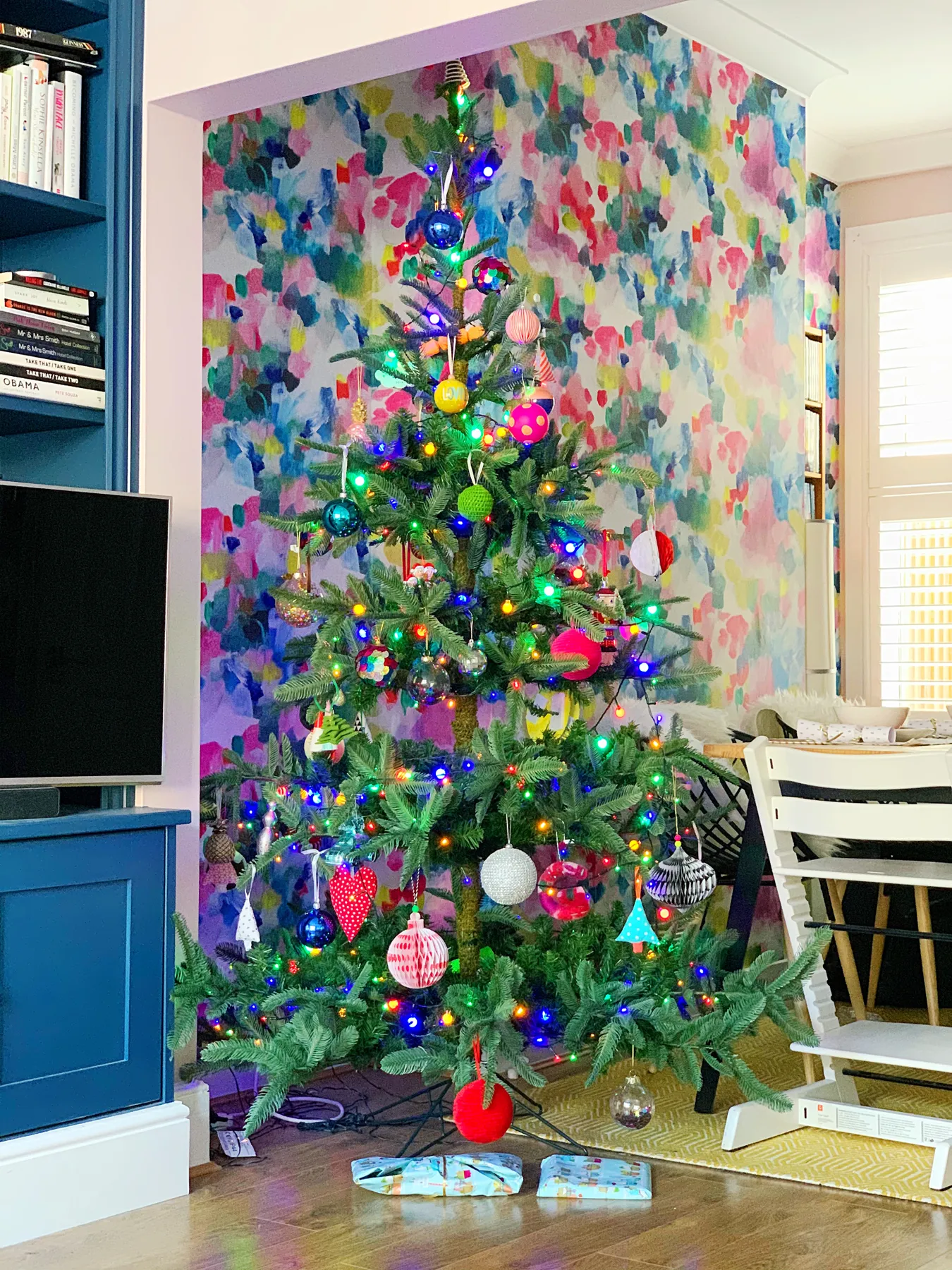
Sustainability messaging around Christmas has shifted from guilt to practicality, and that’s a big part of why the reusable period tree is trending in 2026. Thrifted and inherited ornaments, LED replacements for vintage strings, and rented statement pieces are all part of the same move: people want the nostalgia without the landfill. It also happens to be cheaper, which never hurts.
12. Let the Gift Boxes Do Half the Decorating
Match your wrapping paper to the tree, not to the store aisle. Pick two paper colors pulled straight from your ornament palette plus one ribbon, and wrap everything in that system — no exceptions, no leftover paper from last year. On a 1950s tree, the classic move is red and white paper with gold ribbon. It costs the same and makes the base of the tree look styled instead of accumulated.
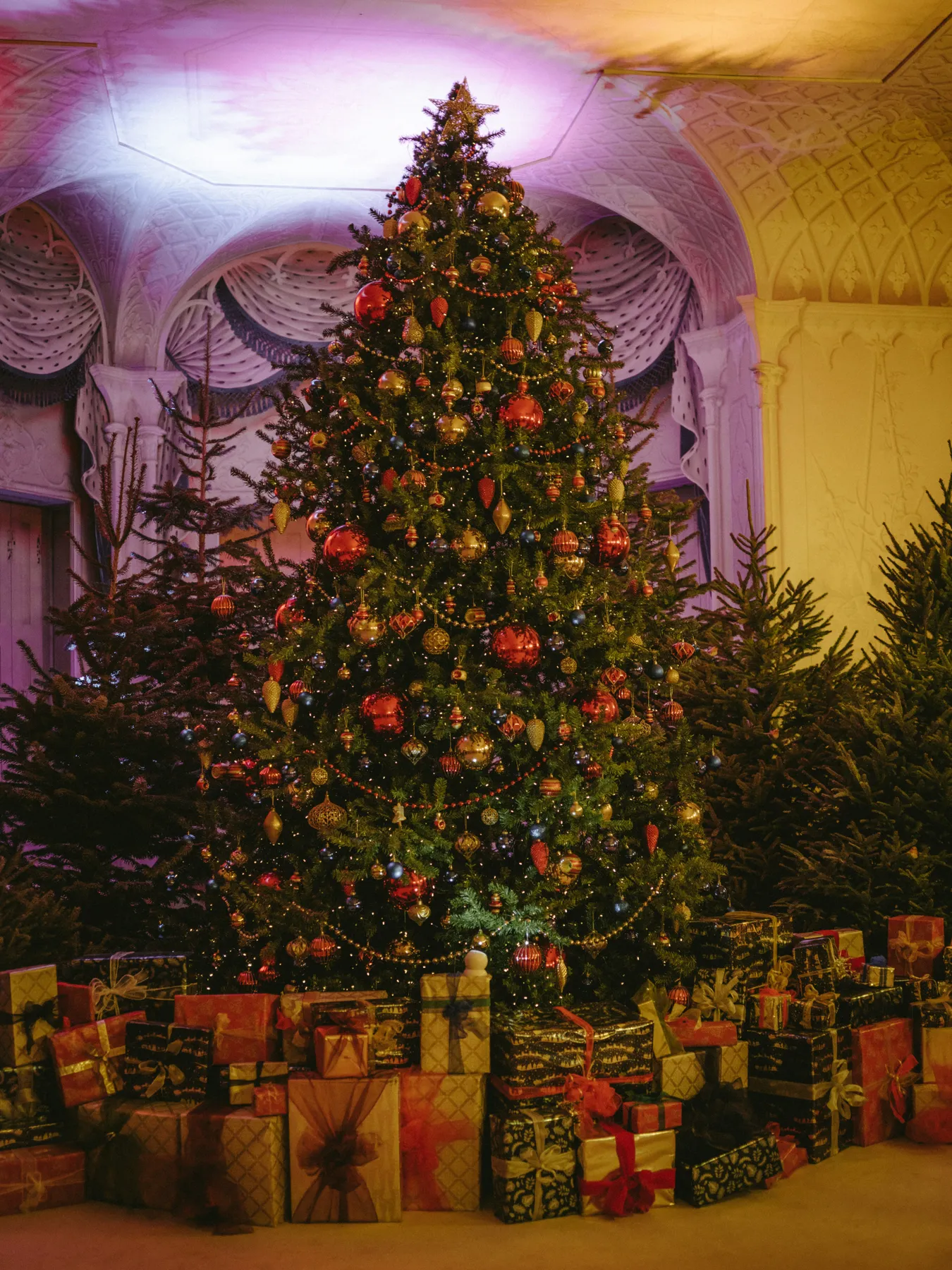
The gift pile is the element most people treat as an afterthought, and it’s the thing that makes a mid-century tree look intentional. Build it up in two staggered tiers with the largest boxes at the back, then set one odd-shaped parcel — a hat box, a round tin — slightly to one side. That asymmetry is what separates presents under a tree from a styled scene.
13. Red Knit, Brick Fire, Wood Walls: Full Traditional
Everything in this room is warm — the wood plank walls, the brick, the fire, the knitted red armchair. Nothing is cool-toned, and that’s the entire trick. When the walls are already doing the texture work, the tree can be a straightforward green with red ornaments and still feel layered rather than flat. The red star in the window echoes both the tree and the chair, giving your eye three matching points to travel between.
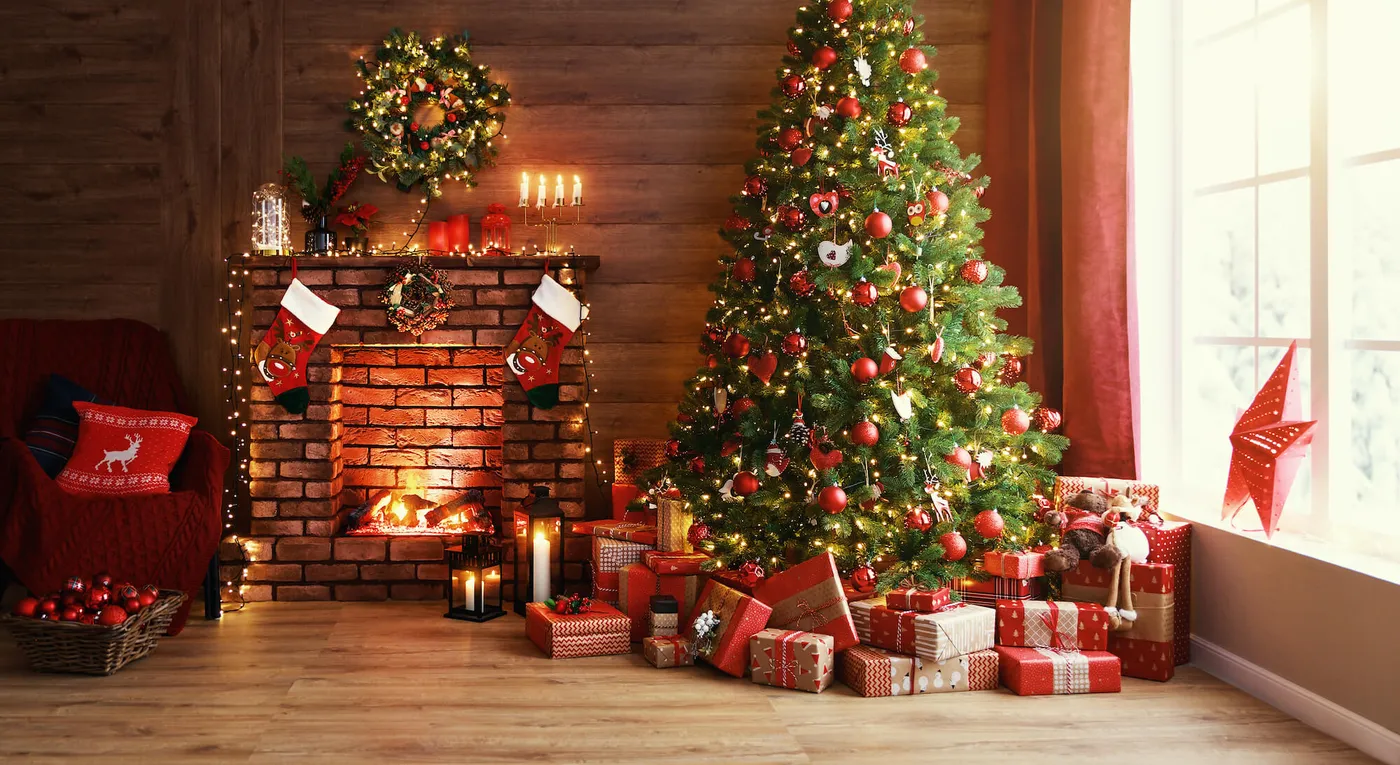
- 7.5-foot tree with 700 warm lights — $120 to $300
- Red glass ornaments, 60 to 80 pieces — $50 to $140
- Tree skirt — $25 to $60
- Fireplace garland — $20 to $50
- Gifts and wrapping — $40 to $100
Total: about $255 to $650. When the room is already this warm, you’re decorating a space that’s doing half the work for you — which is why cozy rustic rooms are the cheapest rooms to Christmas.
14. Green and Gold in a Bright, Airy Room
Gold and bronze ornaments plus white bows read as a single finish family: warm metallics. Roughly 60% evergreen, 25% warm metallic, 10% white, and 5% natural brown from the boxes. It works in a bright room because warm metallics reflect daylight instead of absorbing it — the tree stays visible even with the curtains wide open. Cool silver in this same room would go flat and grey by noon.
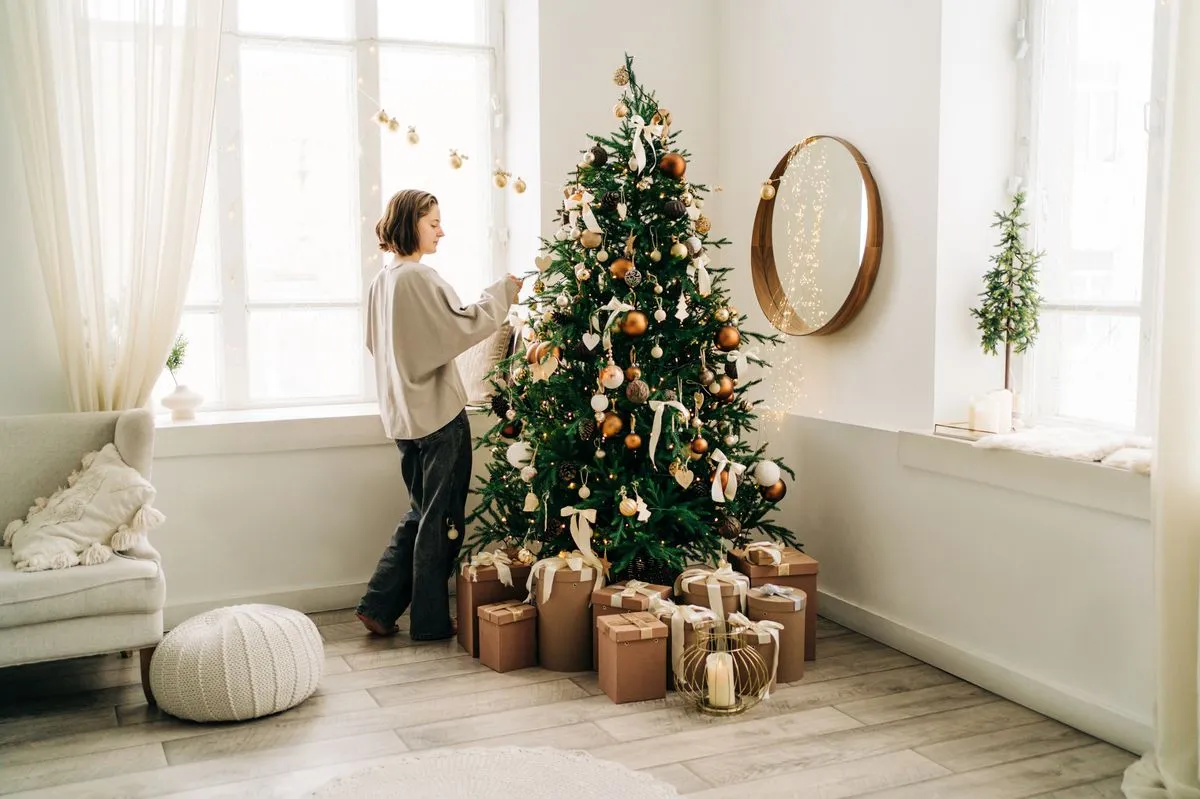
In a bright room, put darker ornaments at the bottom of the tree and lighter, shinier pieces at eye level and above. Light falls from above and from the windows, so low branches get less bounce; darker ornaments there create a grounded base instead of a washed-out one. It’s a five-minute sort, and it makes a bright-room tree look deliberately graded rather than randomly loaded.
15. The Middle-Ground Tree: Not Minimal, Not Maximal
Mid-density trees are the hardest to get right because there’s nowhere to hide. A sparse tree looks intentional, a packed tree looks rich, and a half-full tree just looks like you ran out of ornaments. If you’re decorating to this density, over-buy and return what you don’t use. Check your branch count before you start — under 1,000 tips on a 7-footer and you’ll see daylight through the pole.
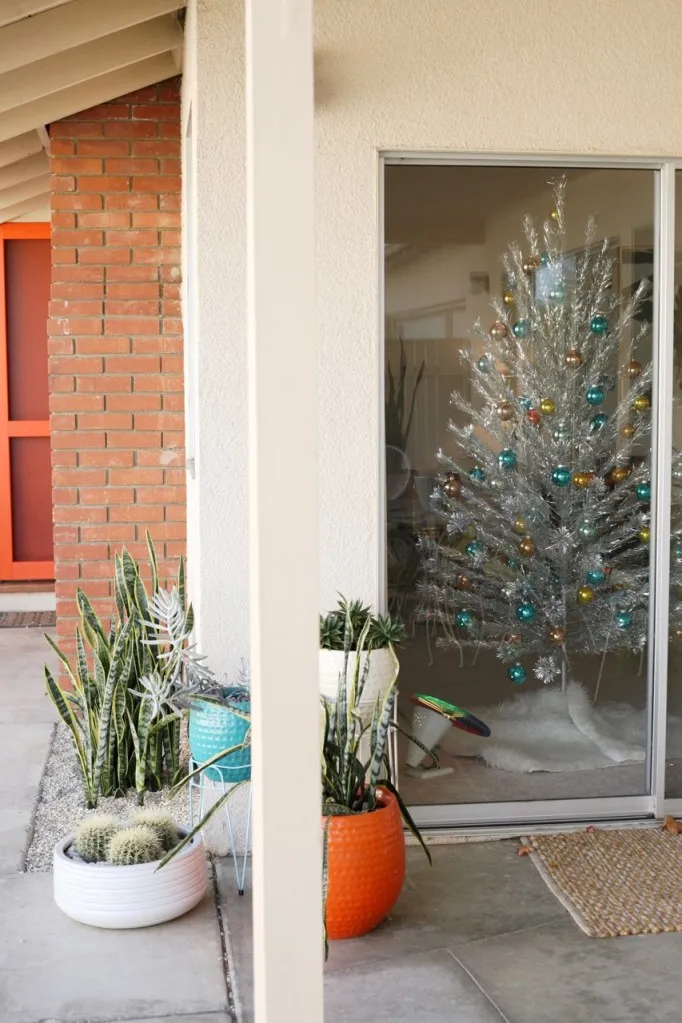
Mid-density trees work best in rooms from 180 to 300 square feet, where they read as a focal point without taking over. In an apartment under 150 square feet, a 6-foot tree at this density actually reads as more festive than a 7.5-footer — less tree, same ornament count. Pair a smaller version with the compact tabletop styling in Idea #28 if space is tight.
16. Beaded Garland, Magnolia Leaves, Quiet Metallics
Adding faux magnolia to a tree without it looking like a craft project:
- Buy 12 to 18 stems, not six — sparse greenery reads as an accident.
- Bend each stem at the leaf joint so it arcs outward from the branch.
- Tuck the stem base into the tree so no wire shows.
- Place them slightly off-center, in two loose diagonal bands.
- Add beaded garland last, draping in 8-to-10-inch swags.
Time: 45 minutes. Cost: $40 to $90 for greenery, $15 to $30 for beads.
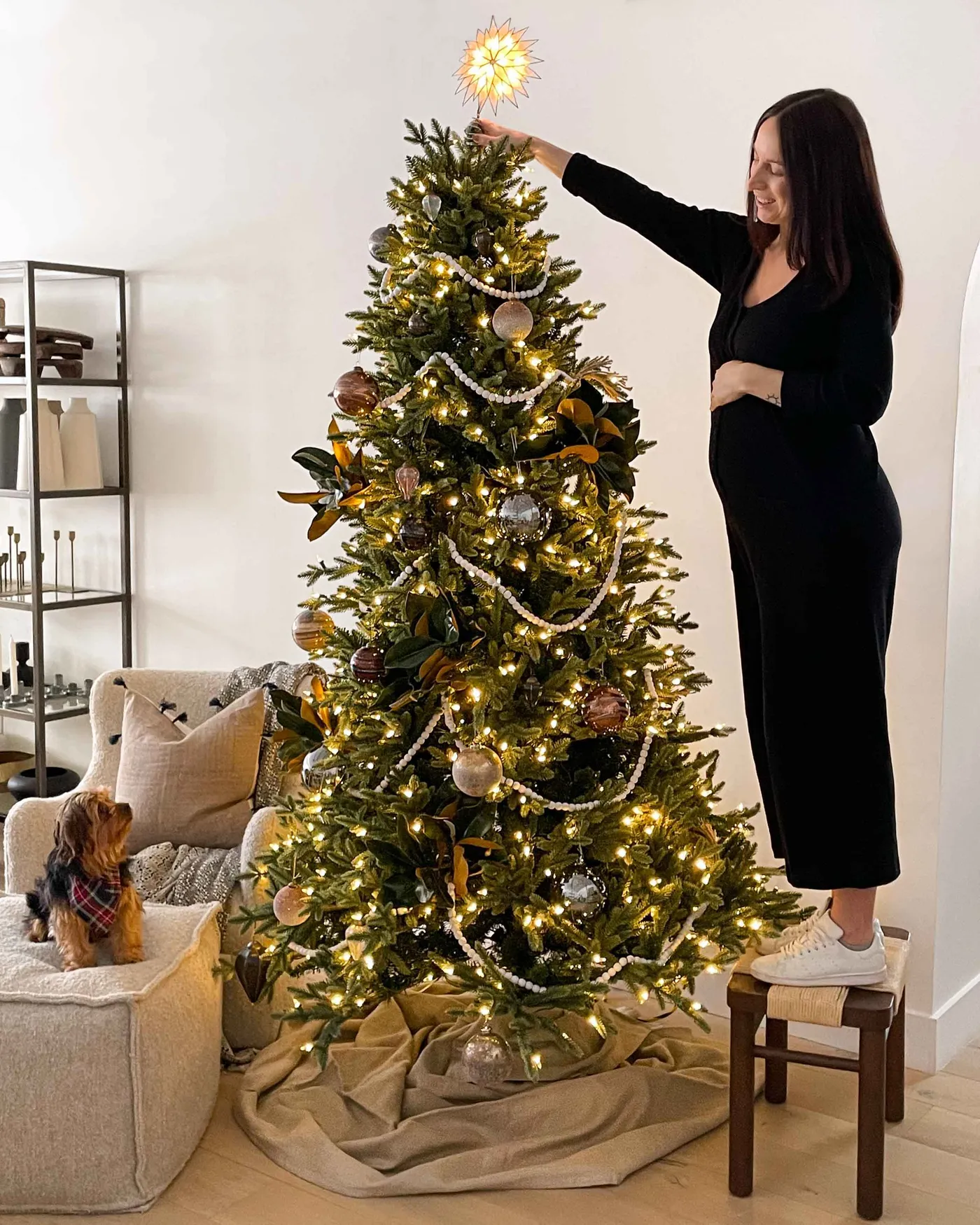
White beaded garland is gorgeous and it is a dust magnet — soft brush and lint roller each season, stored coiled in a zippered bag rather than folded. Faux magnolia holds up for years but fades in direct sun, so don’t leave it displayed on a sunny windowsill through January. The draped beige skirt is machine washable; wash it once a year and it’ll last a decade.
17. Sourcing a Real Aluminum Tree Without Getting Burned
Original 1950s and 60s aluminum trees turn up at estate sales for $30 to $80, on Facebook Marketplace for $50 to $150, and fully restored on Etsy for $200 to $400. If you only want the look, modern reproductions run $60 to $120 and photograph almost identically under a color wheel. Buy the original if you love the object; buy the reproduction if you love the effect.
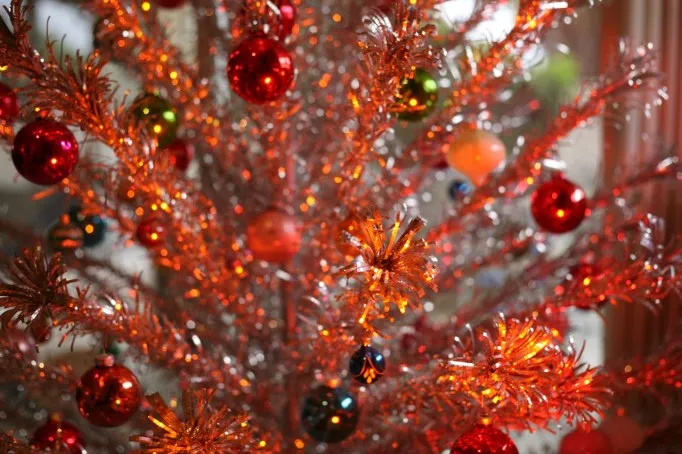
The color wheel is the one element that makes an aluminum tree work. Without it, a silver tree under white light is cool, flat, and honestly a little sad. With it, the whole thing cycles through red, green, blue, and amber and the silver becomes a screen for color. If you’re budgeting, spend on the wheel before you spend on the tree — it isn’t an accessory, it’s the engine.
18. Time-Travel Decorating in a Real Period Room
Period decorating reads as authentic when every object on the tree could plausibly have been bought in the same decade. That doesn’t mean everything must be genuinely old — it means the silhouettes agree. A 1950s tree with papier-mâché Santas, glass balls, and simple tin ornaments works. The same tree with a monogram ornament and buffalo-check ribbon does not, no matter how pretty the ribbon is.
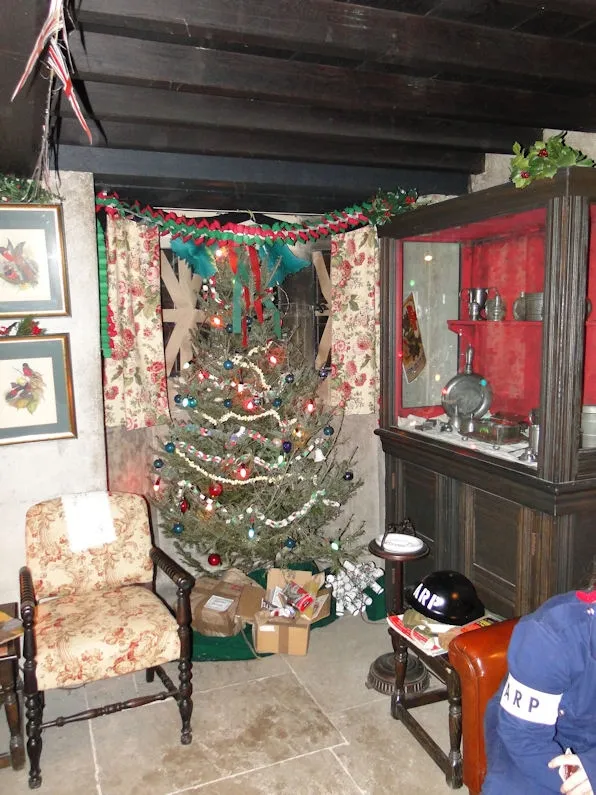
Real period rooms have real period problems: old wiring, no ceiling fixture, low light. If you’re putting a vintage tree in an older house, check whether the outlets can handle a strand of genuine incandescent bulbs — most can’t handle two. Use one vintage string for looks and modern warm LEDs for actual illumination. Nobody notices, and your circuit breaker stays happy.
19. The Vintage Glass Topper Is the Whole Personality
A topper is the last 3% of the tree and it changes everything. Vintage glass spires usually sit between 8 and 12 inches tall including the base — measure before you buy, because anything under 8 inches disappears from across the room. Check the opening too: most vintage toppers were made for a candle-style clip that today’s trees don’t have, so grab a small metal topper adapter for about $6.
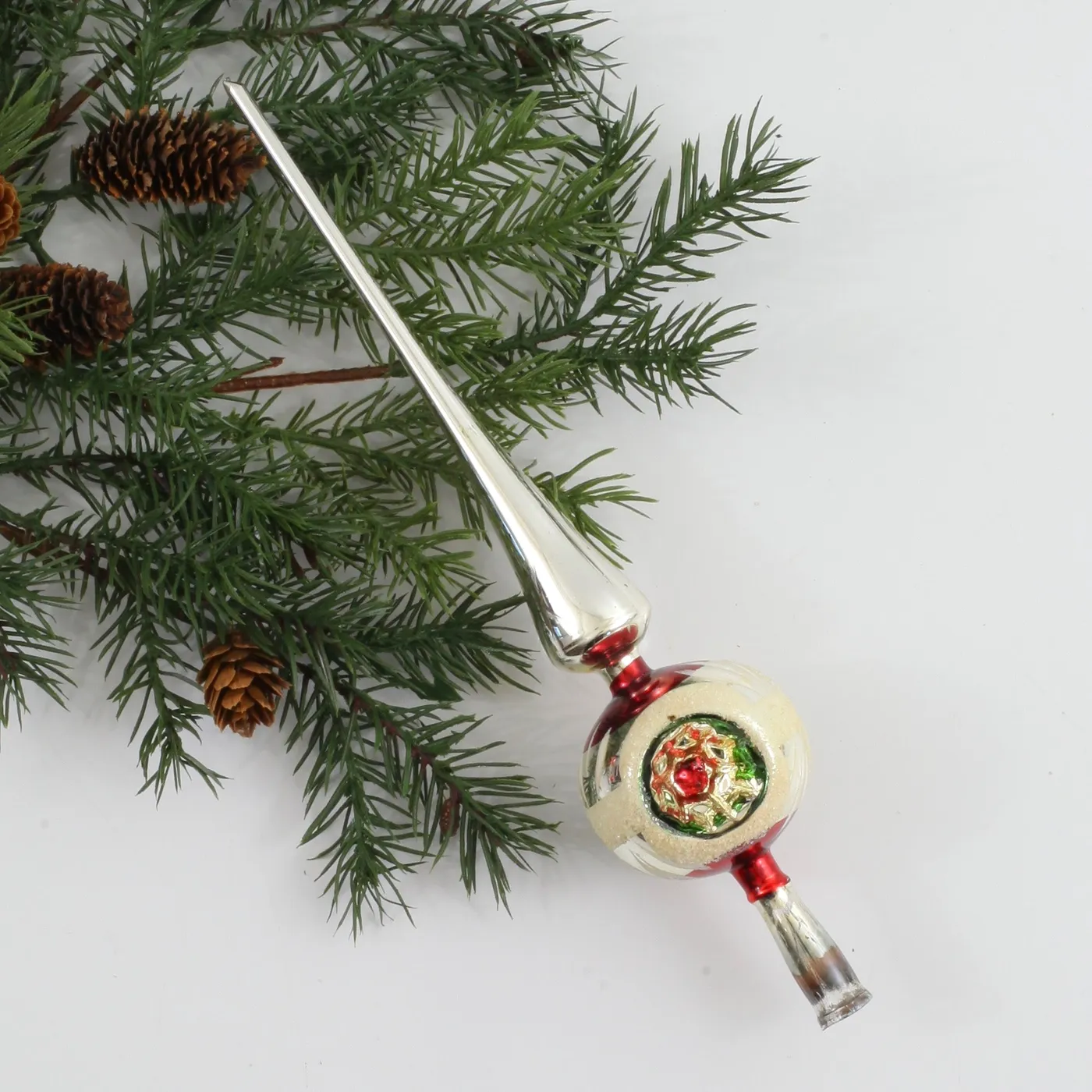
Topper scale should follow tree height, not the other way around. On a 6-foot tree, stay under 9 inches. On a 7.5-footer, 9 to 12 inches is the sweet spot. Anything above 13 inches needs a tree at least 9 feet tall, or it looks like a hat that doesn’t fit. The smaller display in Idea #26 shows how a modest topper can still carry an entire arrangement.
20. Flocked Branches and Pearlescent Glass
- 6.5-to-7-foot flocked tree — $120 to $350
- Warm white string lights, 500 to 700 count — $25 to $50
- Pearlescent glass ornaments, 50 pieces — $60 to $160
- Red berry sprigs, 12 stems — $15 to $35
- Metallic red tinsel garland — $10 to $20
- Red tree skirt — $25 to $55
Total: $255 to $670. Skip spray flocking on a tree you already own — it yellows in storage within two seasons and sheds every time you move it.
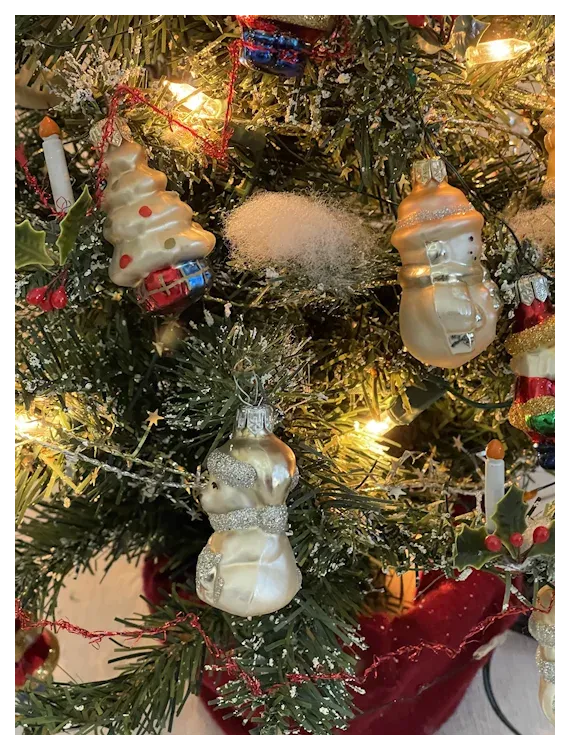
Check before you commit to a flocked tree:
- Is your room free of high humidity? Flocking softens and drops in damp spaces.
- Do you own a vacuum with a soft brush attachment? You’ll need it.
- Will you store it in climate-controlled space? Heat ruins flocking.
- Have you checked the weight? Flocked trees run 20 to 30% heavier than plain ones.
21. Dense, Colorful, and Anchored by a Gold Mirror
Getting a dense traditional tree right:
- Set the tree up and fluff every branch — 30 minutes minimum. This is 80% of the result.
- Light it completely before a single ornament goes on.
- Place your largest pieces first, evenly spaced, like a grid.
- Fill in with medium and small ornaments, working around the large ones.
- Stand ten feet back, find the bare patches, and fix only those.
Time: about 3 hours. Cost: mostly your existing ornament collection.
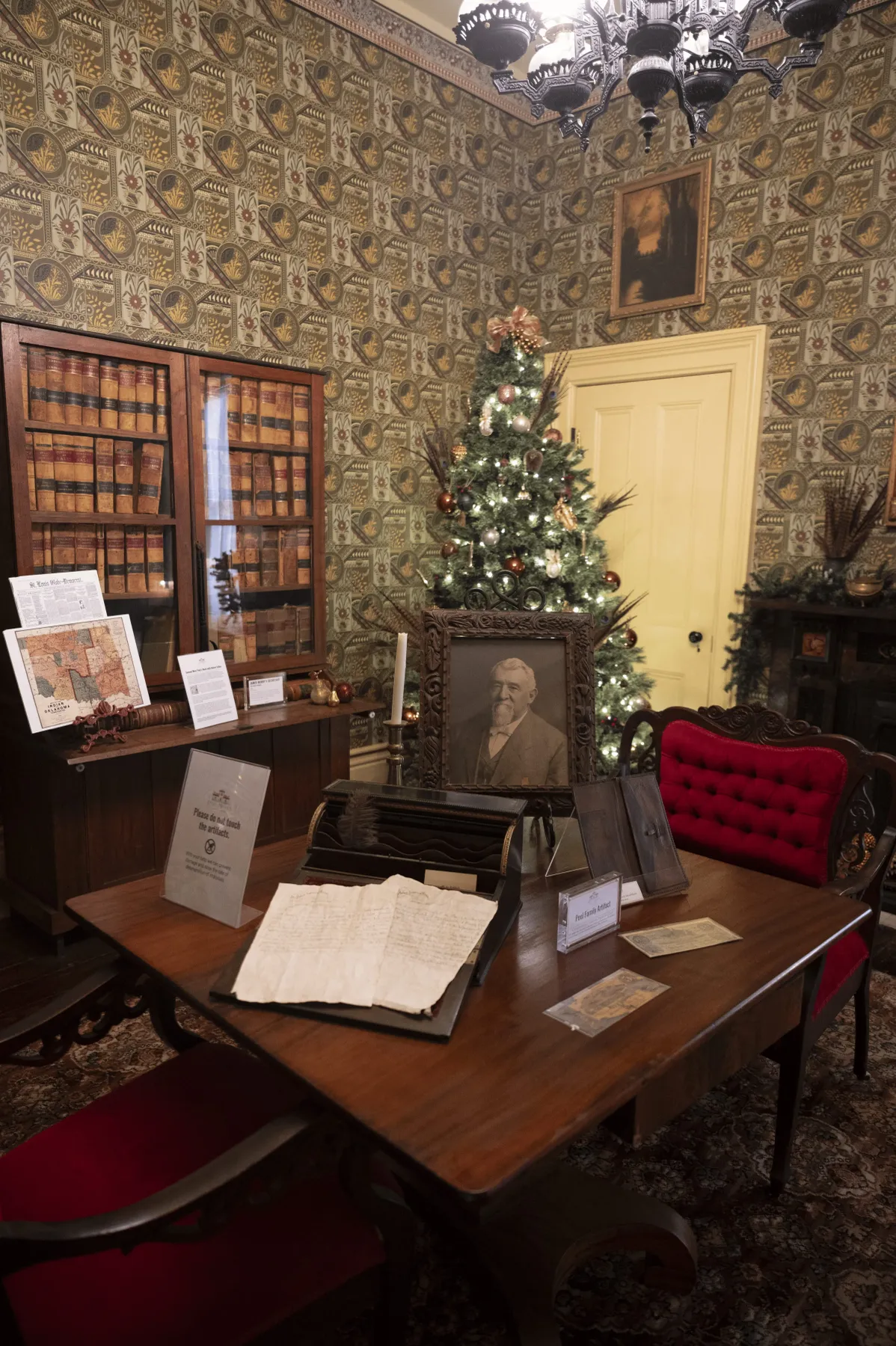
A tree this dense is beautiful and it is also very hard to move. If it sits near a doorway or a high-traffic path, you’ll be picking ornaments off the floor all month. Give it three feet of clearance on the gift-facing side, and consider tying the top third to a wall anchor if you have cats. Yes, really.
22. Blue Ornaments on Silver Tinsel
Silver tinsel is the most forgiving backdrop in Christmas decorating because it takes on whatever color you hand it. Here that’s blue and red — roughly 50% silver, 30% blue, 20% red — and the blue reads as icy rather than cold because everything behind it is warm brown. Swap the blue for teal and the scene turns more 60s. Swap it for cobalt and you’re right back in the mid-fifties.
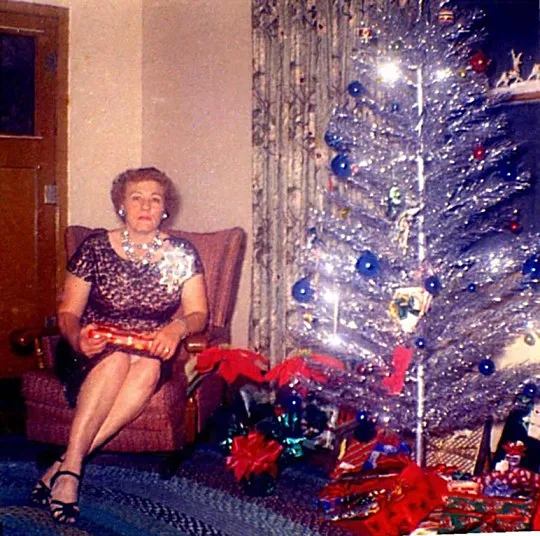
On a tinsel tree, hang ornaments in size bands: large on the lower third, medium through the middle, small at the top. Tinsel creates visual noise at the branch level, so a graded ornament plan gives the eye a structure to follow. Use thin silver cord instead of green wire hangers too — green hooks show up against foil and look like a mistake.
23. Lighted Garland, Lighted Wreath, One Red Ribbon
The magic here is repetition of a single shape: the wreath and the garland are the same material, lit the same way, at two different scales. That’s a rule designers lean on constantly — repeat a material, vary the size, and the room reads as a set rather than a collection. One red ribbon on the wreath and red pillows on the grey chairs are the only two non-green accents, which keeps the color story tight.
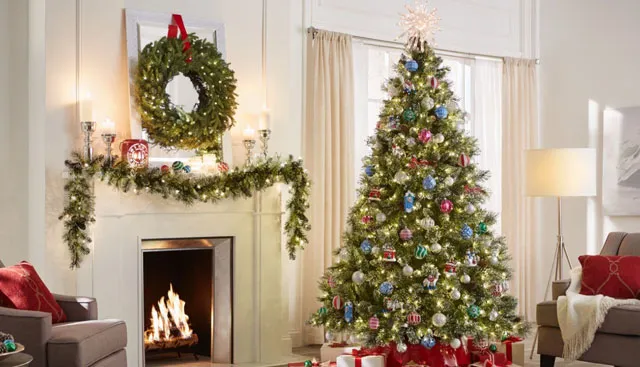
- Pre-lit garland, 9 feet — $35 to $80
- Pre-lit wreath, 24 to 30 inches — $30 to $70
- Multi-colored glass ornaments, 60 pieces — $50 to $130
- Wide red ribbon — $8 to $18
- Two red pillow covers — $20 to $45
Total: $143 to $343. Buy pillow covers, not pillows — they cost a third as much and store flat between seasons.
24. The Tabletop Tinsel Tree With a Color Wheel
Tabletop tinsel trees collect dust in a way full-size trees don’t, mostly because they sit at eye level where you actually notice it. Wipe the branches with a dry microfiber cloth at the start of each season — never wet, the tinsel film will streak. The color wheel bulb is the only part that truly wears out; replace it every three to four seasons for about $12 and it’ll keep cycling color for another decade.
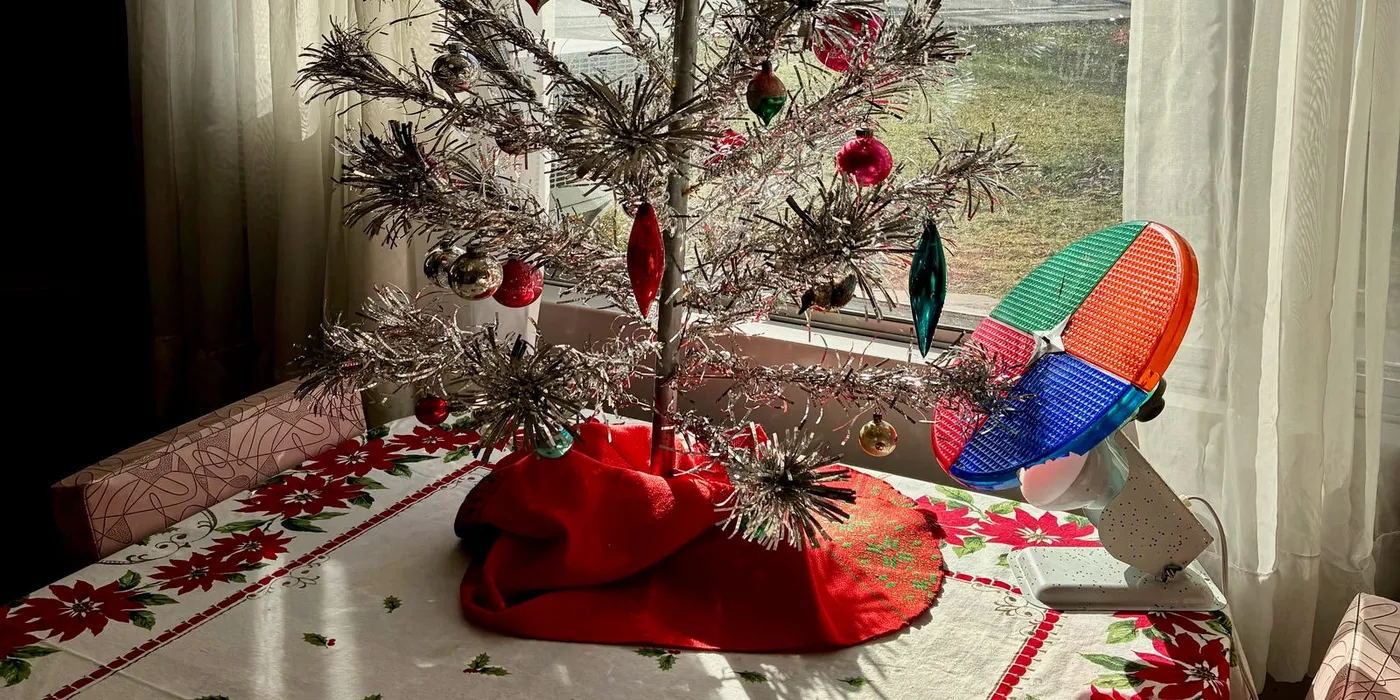
Setting up a tabletop tinsel display:
- Cover the table with the patterned cloth first and smooth every wrinkle.
- Place the color wheel at a 45-degree angle to the tree, about 18 inches away.
- Test it in a dark room — you want color to sweep, not strobe.
- Load ornaments front-heavy; the back won’t be seen.
- Run the cord along the table edge and tape it down.
Time: 30 minutes. Cost: $0 if you already own the pieces.
25. Red and Gold in a Pink-Walled Bedroom
The pink walls are what make this room work, and nobody would guess it. Crimson and gold on their own can turn heavy and hotel-lobby in a hurry. Drop them onto pale pink and the red softens, the gold warms up, and the whole scene reads romantic instead of formal. If your bedroom walls are beige or grey, the same tree and the same garland will look considerably more serious.
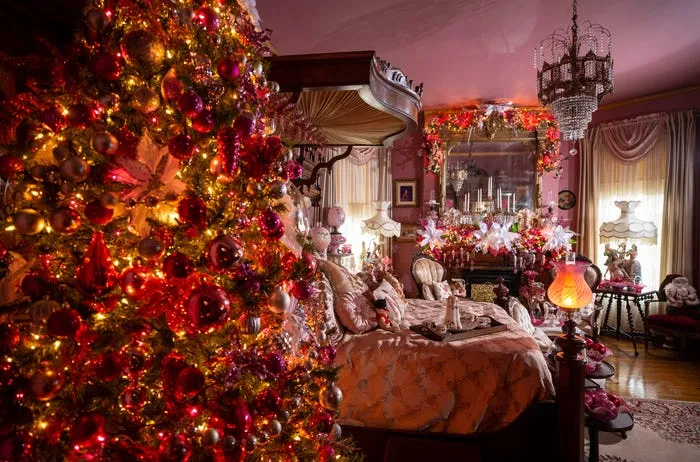
Here’s the ratio to steal for a bedroom-scale version:
- 40% pale pink and cream — walls, bedding, lampshades
- 30% crimson red — ornaments, garland blooms, ribbon
- 20% gold — mirror frame, ornament caps, chandelier
- 10% dark polished wood — the canopy bed and mantel
Keep pink as the largest block of color and red as the accent. Reverse them and the room becomes Valentine’s Day.
26. Evergreen Clippings in a Stoneware Crock
This might be the cheapest good-looking Christmas decoration in the whole article, and it’s nearly free. A stoneware crock from a thrift store runs $8 to $25. Evergreen clippings come free from a Christmas tree lot’s discard pile — just ask, they always say yes — or $10 from a grocery store bundle. Fill the crock with florist foam or a weighted jar inside and you’re done for under $40.
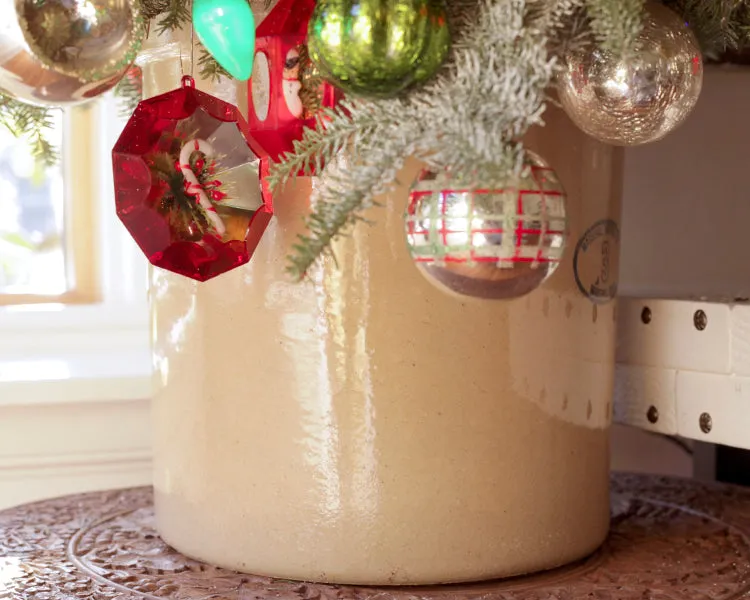
Cut evergreen stems at an angle and they’ll drink for two to three weeks. Keep the water level above the cut ends and check it daily — these arrangements drink fast. Mist the branches every few days if your house runs dry in winter. Pine and cedar hold longest; fir drops needles fastest. Sit it near a heat vent and it’s finished in ten days.
27. Sage Walls, a Gold Harp, and a Tree Full of Stories
A tree like this needs a room that can hold it. Figure 350 square feet minimum, 10-foot ceilings ideally, and enough clear floor for a patterned rug to sit under the entire arrangement. Against pale sage walls like these, the tree’s gold and red have to be dense enough to register against the cool green — thin ornament coverage would simply disappear here.
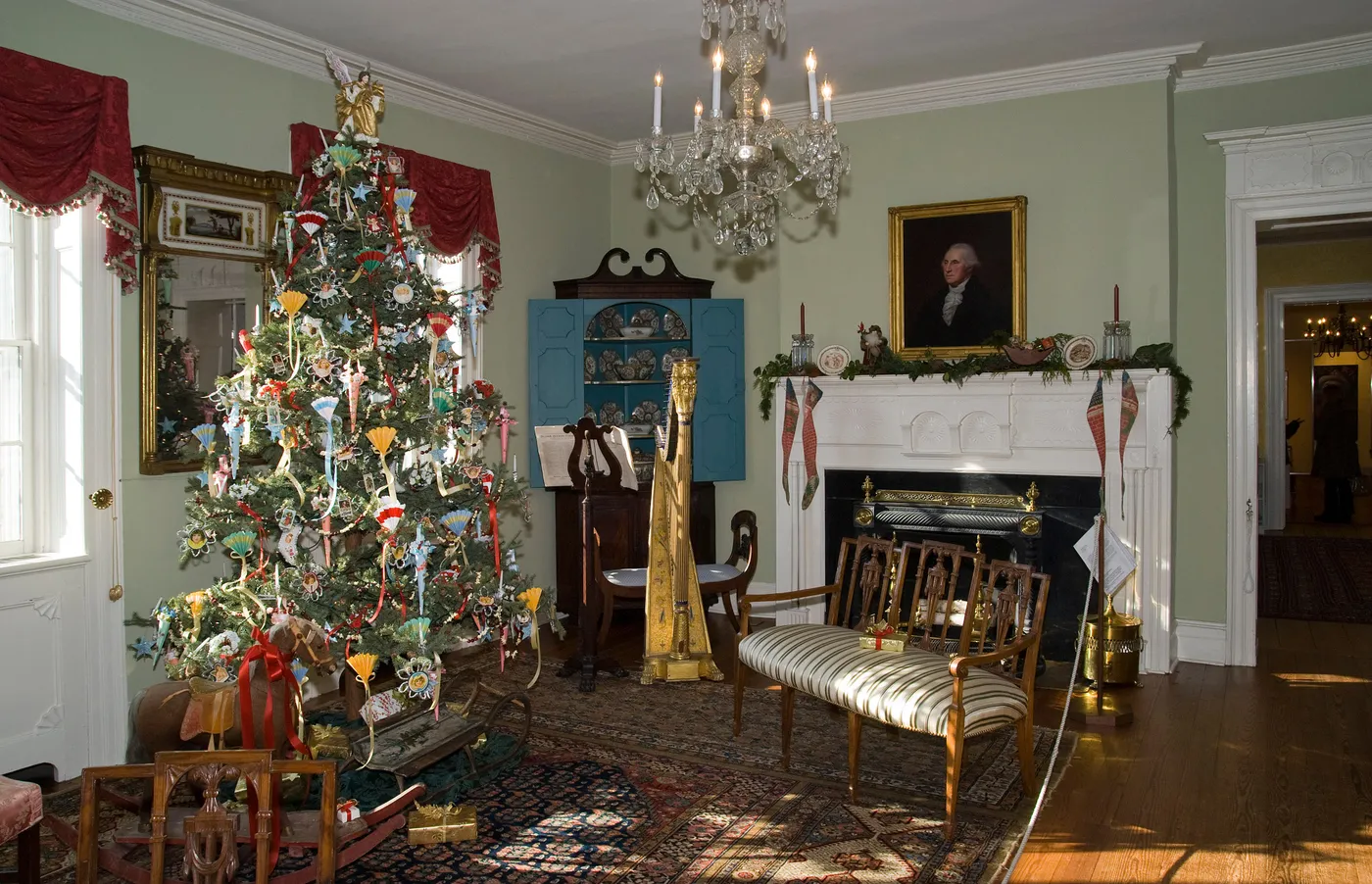
The miniature portrait and fan ornaments are what make this tree feel like an heirloom instead of a display. Mixed ornament types always beat matched sets when the goal is a sense of history: glass balls, papier-mâché figures, tiny framed portraits, fabric fans. The golden angel on top and the crystal chandelier overhead are the only two bright metals in the room, so your eye travels straight up.
28. One Red Star, One Dark Green Sofa
Red ornaments on a green tree in a green room walks a fine line. The sofa here is dark forest green and the tree is bright evergreen — if those two greens were closer in value, the corner would read as one muddy mass. Keep your tree’s green noticeably lighter or darker than your upholstery, and let white or cream furniture sit between them if you have it. Same palette, different energy than Idea #23.
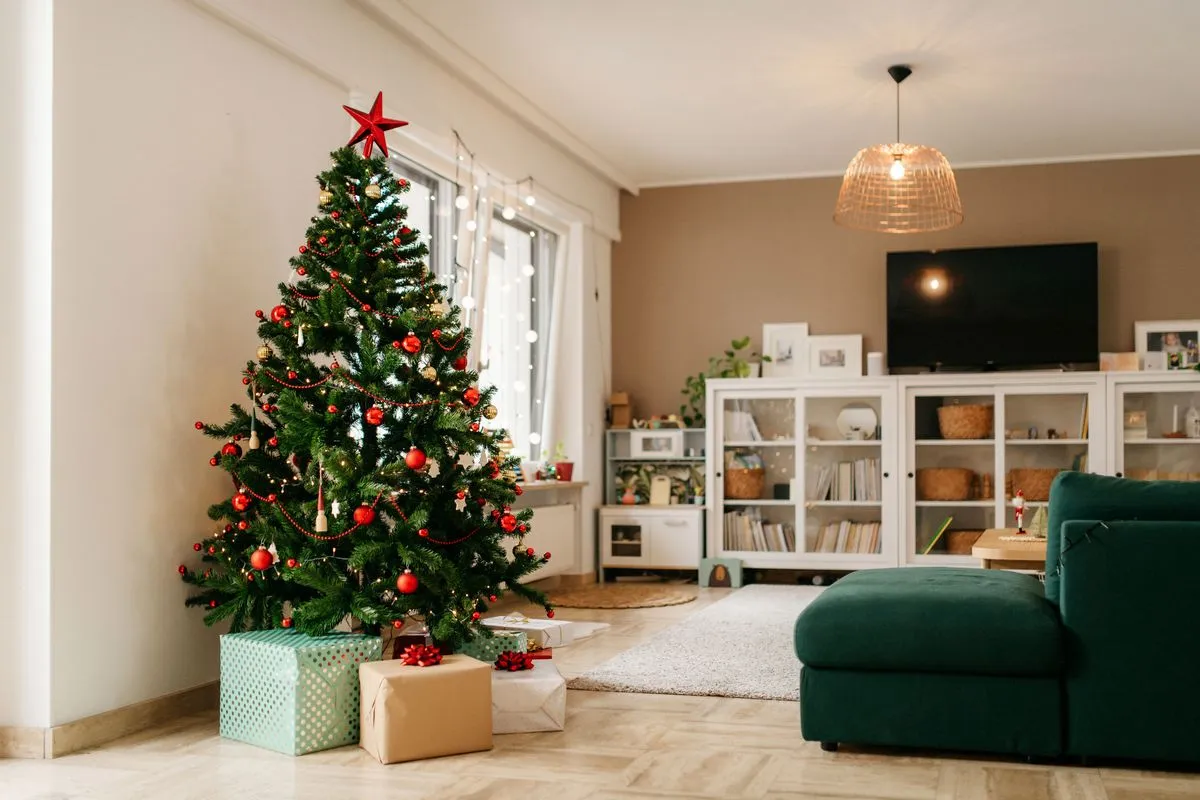
The modern version of this look is genuinely affordable. A 7-foot unlit tree from IKEA runs $70 to $120, 300 warm-white LED lights are $15 at Walmart, a set of red glass ornaments is $20 to $40 at Target, and the red star topper is about $8. Under $150 covers the whole corner. Facebook Marketplace is where the velvet sofa shows up, usually right after New Year.
29. Santa Ornaments and Striped Valances
Before you decorate a bedroom tree like this one:
- Is the tree far enough from the bed that you won’t hit it getting up at night?
- Are the lights on a remote or timer? Reaching behind a tree at bedtime is miserable.
- Do your valances and bedding already have a pattern? The tree has to answer them.
- Is there a fire-safe spot for a lit tree away from fabric drapes?
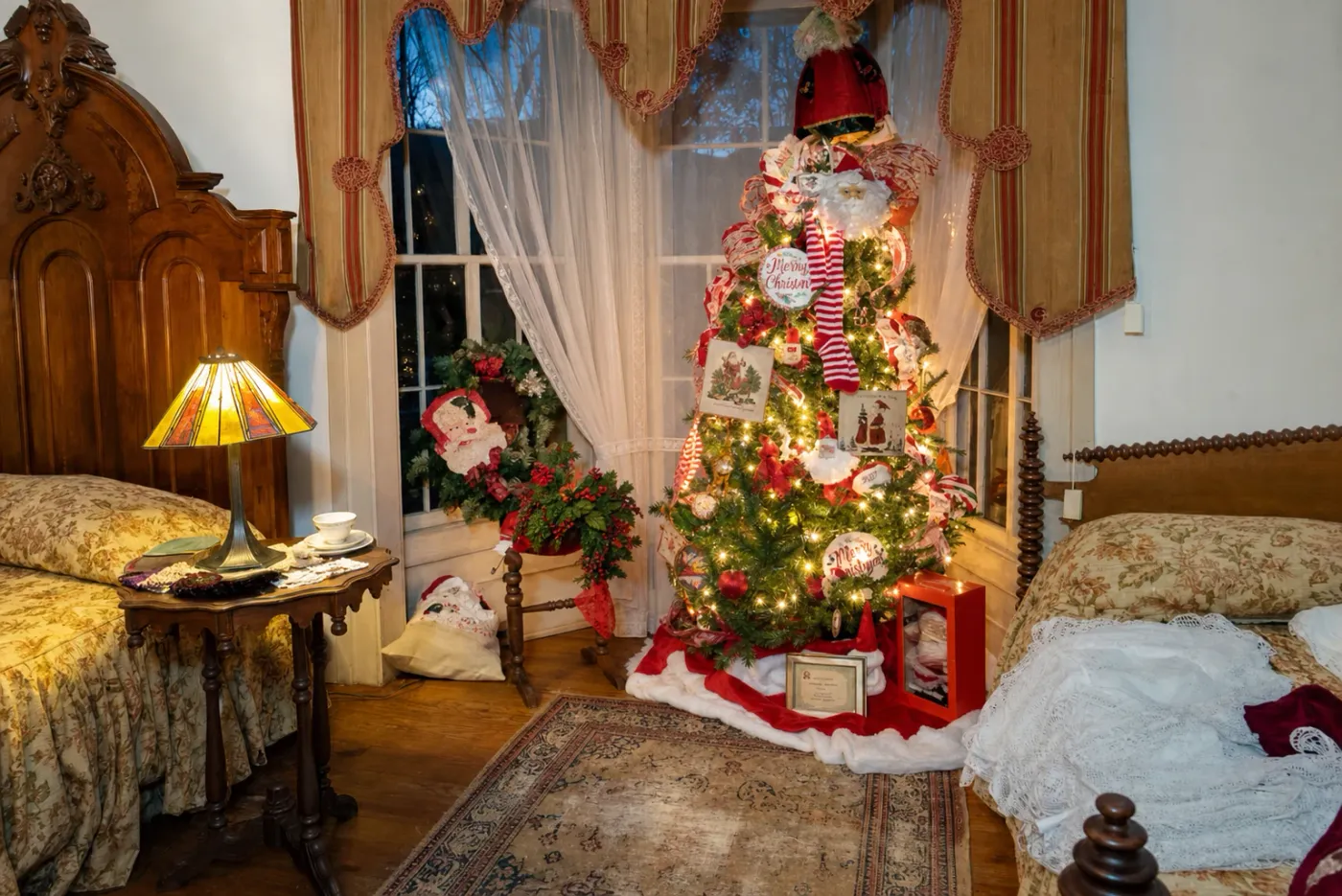
Decorating a tree around a themed collection:
- Lay every themed ornament out on the floor and count them.
- Divide by three — that’s your decorative tiers.
- Space themed pieces evenly first; they’re the structure, not the filler.
- Add plain red ribbons between them to let the theme breathe.
- Finish with warm lights, step back, and stop.
Time: 90 minutes. Cost: ribbons, $10 to $20.
30. Merry and Bright: The Cheerful Fifties Palette
The merry-and-bright fifties look is trending again in 2026 for a very specific reason: it’s the antithesis of the beige, minimal Christmas that dominated Pinterest for years. People are tired of neutral trees. Saturated turquoise, cherry red, and hot pink glass ornaments are back on big-box shelves, and prices for authentic 1950s pieces have climbed roughly 30% in two years.
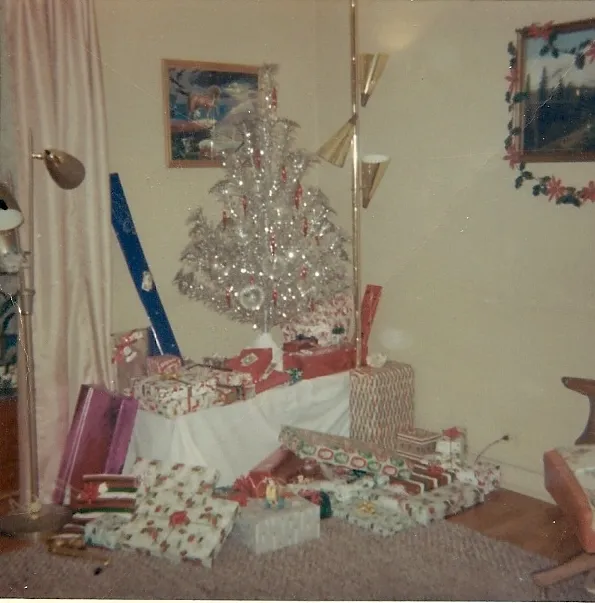
The single element that makes a merry-and-bright tree read correctly is the presence of at least one color that feels almost wrong. Turquoise, hot pink, chartreuse — pick one and use it consistently across a third of the ornaments. Trees that only use red, green, and gold look traditional. Adding that fourth unexpected color is what makes them look specifically mid-century.
31. The Real Period Tree — and What to Do With It After
If you’re going with a real tree, buy a Fraser fir: best needle retention, strongest branches, and the most convincing 1950s silhouette. Budget for a stand with a 1-gallon reservoir — a 6-to-7-foot fir drinks about a quart a day for the first week. Keep it away from radiators and fireplaces too; a real tree next to a heat source dries out in half the time and becomes a genuine fire risk.
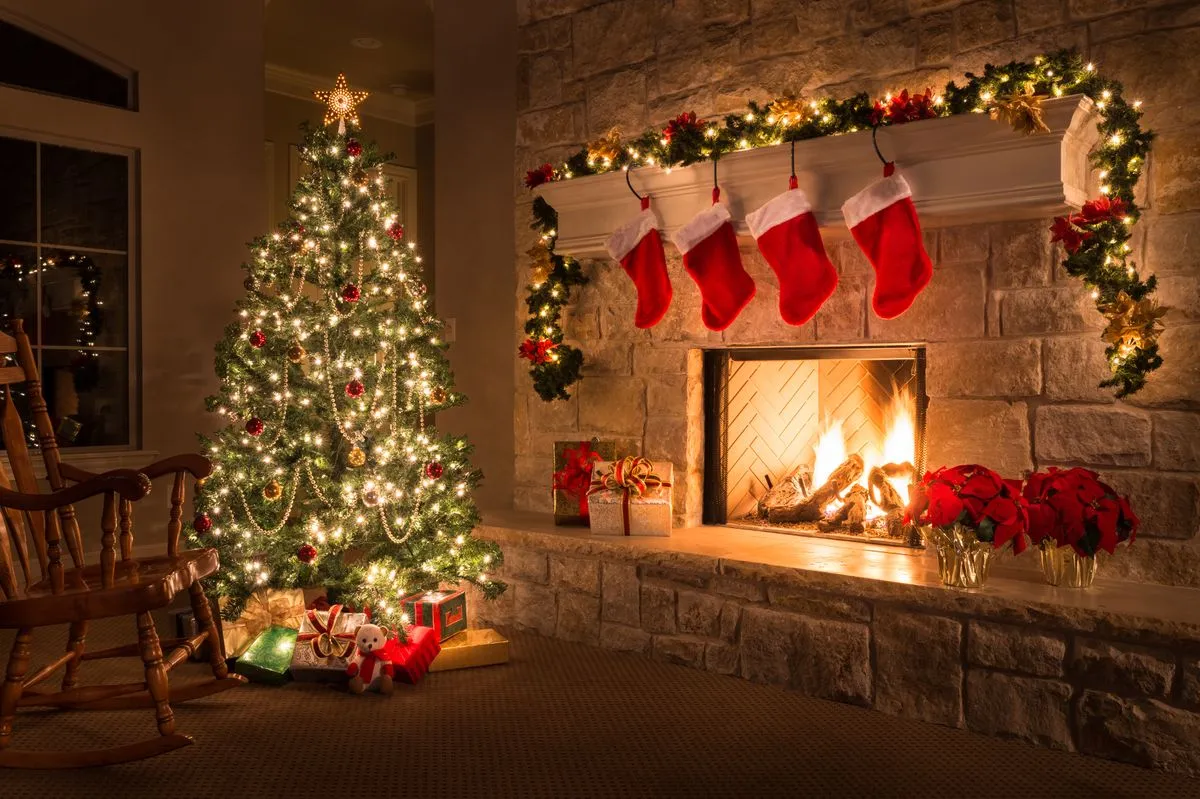
Real trees drop needles. That isn’t a defect, it’s what they do, which means you’ll be vacuuming daily from mid-December on. Put a waterproof liner under the stand and the skirt, and don’t set a real tree on wood flooring you care about without one. The upside: the whole thing composts or gets chipped into mulch in January, which no artificial tree can claim.
32. Fifties Decorating Rules You Can Still Steal
Fifties decorating was built around one idea: a single decorated tree as the visual anchor of a room, with nothing competing. That works best in a room between 150 and 400 square feet where the tree is visible from the doorway. In an open-plan space over 500 square feet you need a second anchor — a mantel, a lit window, or a vignette like the one in Idea #26 — or the tree stops reading as the star.
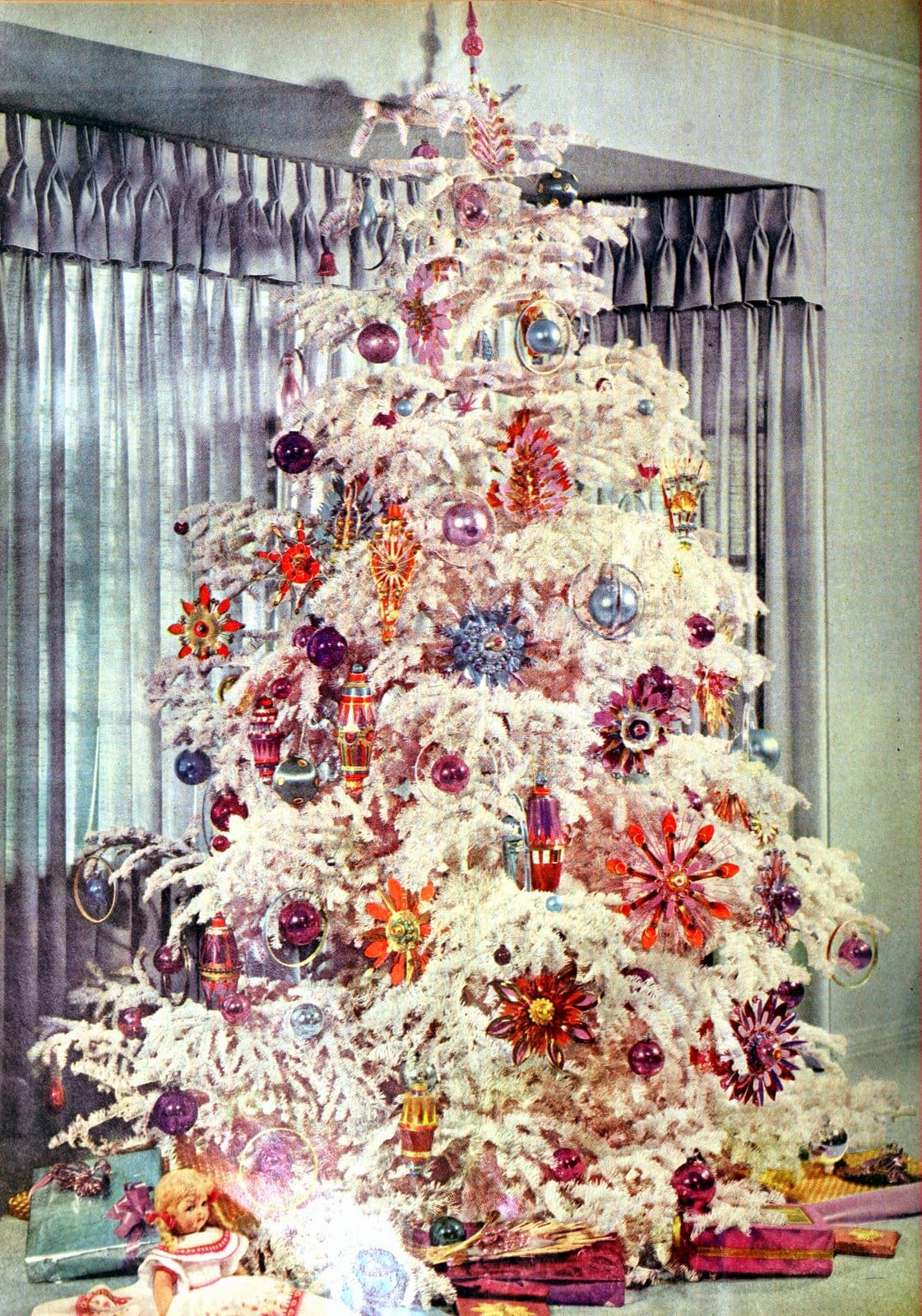
The fifties formula, simplified:
- One green tree, medium to full density
- Three ornament colors, no more
- Warm white lights, never cool
- Silver or gold garland — one or the other, not both
- One star or spire topper
Every era since has added to this list. The fifties version is short, and that’s exactly why it still looks clean seventy years later.
33. Fifties Trees Said Happy New Year Too
Mid-century Christmas trees often stayed up through New Year’s and beyond, and the styling reflects it — ornaments that aren’t strictly religious, a topper that reads as celebratory, and a palette that works all winter. It’s why these trees don’t feel dated on January 3rd. Buy ornaments you’d be happy looking at well into the new year.
- Vintage-inspired glass ornament set, 50 pieces — $45 to $120
- Silver or gold garland, 30 feet — $12 to $25
- Warm white string lights — $20 to $40
- Star or spire topper — $15 to $45
- Tree skirt or vintage-style stand — $20 to $60
Total: $112 to $290 on top of whatever tree you already own. Changing the topper, garland, and bulbs is the cheapest way to convert a modern tree into something that reads 1950s. Keep the tree.
34. Living With an Aluminum Tree, Joyfully
Aluminum trees need almost no upkeep, which is their best-kept secret. No needles, no watering, no bugs. What they do need is gentle handling: store branches flat in a long box, never stack anything on top, and keep the tree out of humid rooms because the foil film can cloud. Expect to spend about $10 every few years on color wheel bulbs and nothing else.
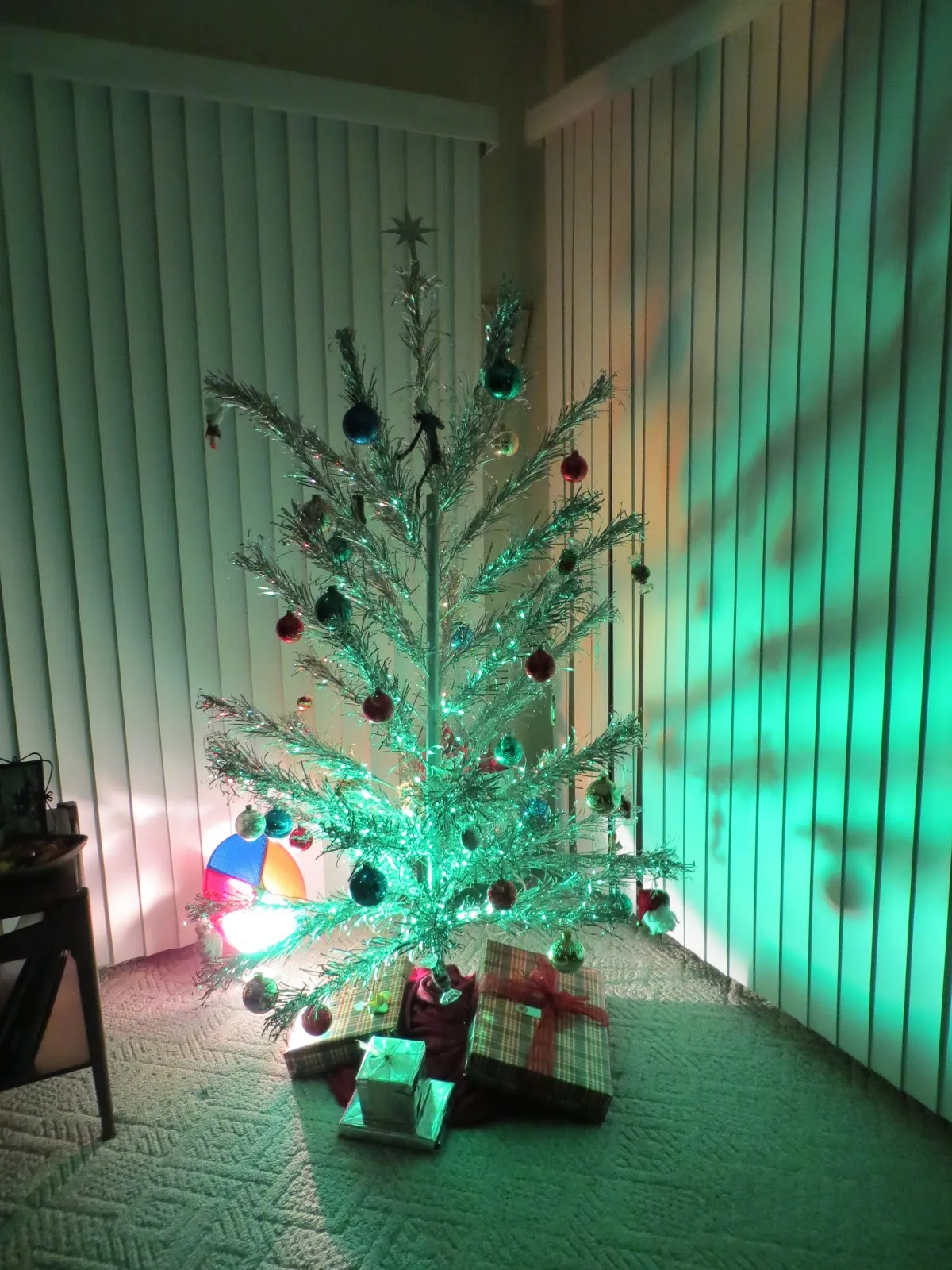
A complete vintage setup — tree, stand, and color wheel — costs $250 to $600 on Etsy. A reproduction tree runs $70 to $140 and a modern color wheel is $40 to $70, so about $130 total. The silver reads nearly identical in a dim room, and you’ll actually use it instead of worrying about it. Buy vintage if you’re a collector; buy new if you want the glow.
Hang the Tinsel, Plug In the Wheel
None of this requires an antiques dealer or a $2,000 decorator invoice — a thrifted crock, a warm bulb swap, and a topper you genuinely love will get you most of the way. Start with one corner, live with it for a week, then add. 📌 Pin this guide so it’s waiting for you next December, and save the ideas that made you stop scrolling.