You know that feeling when you’ve saved 47 fence photos and still can’t decide between a classic red-bow garland and something with a little more sparkle? Same here. So we did the scrolling for you.
After filtering through hundreds of options across Lowe’s, Etsy, Target, and Home Depot, we narrowed it down to 34 ideas that actually deliver — everything from a $12 strand of globe lights to a $690 layered front-yard display.
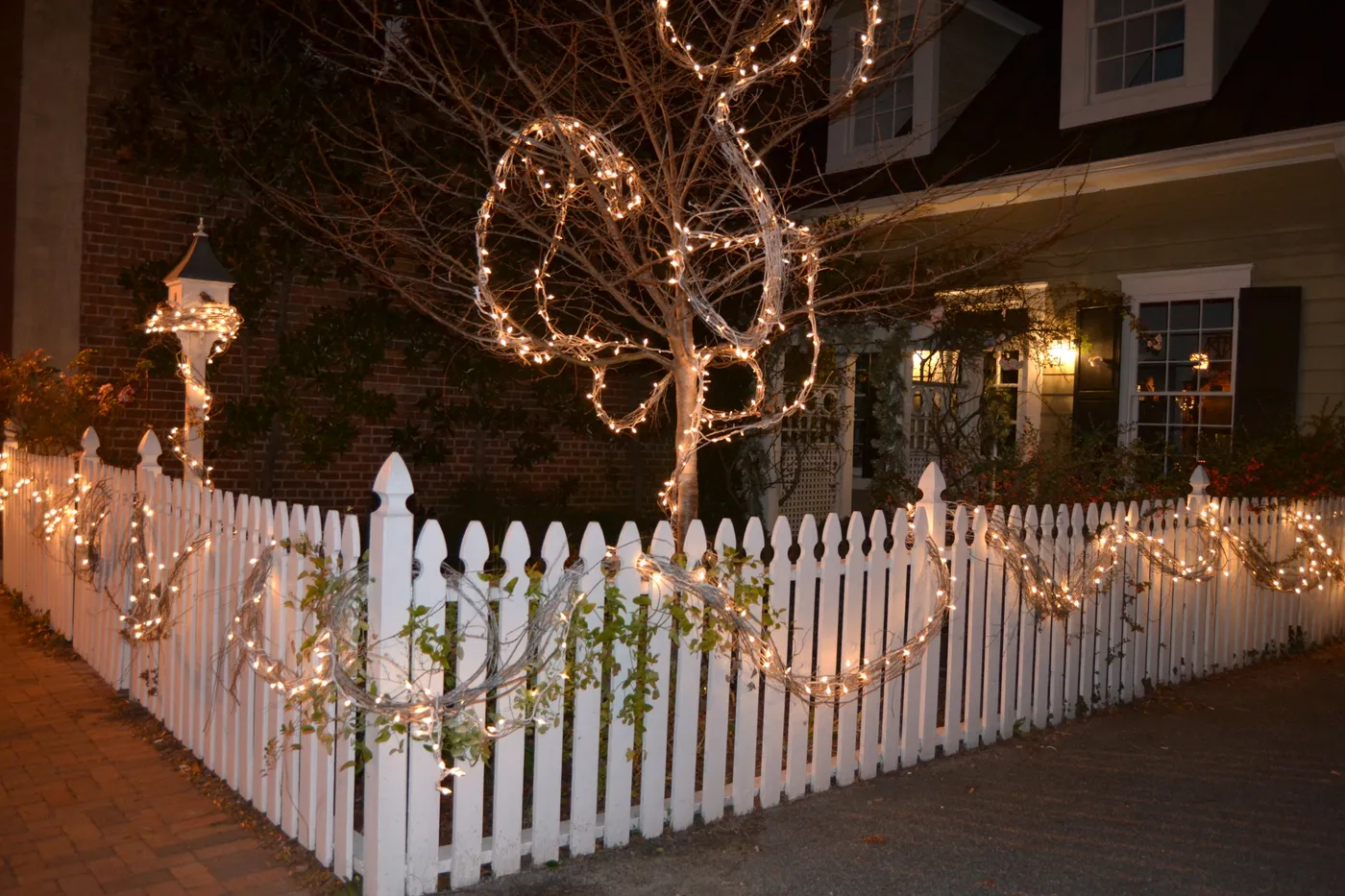
Inside you’ll find traditional evergreen garlands, retro multicolor light displays, warm-white minimalism, and whimsical candy-land themes, with budget and luxury versions compared side by side and every idea shoppable with direct product links.
In 2026, the shift is toward color-considered displays — a warm-white base with one intentional accent — instead of the everything-at-once approach, and Pinterest saves for pink and pastel fence lighting are climbing fast.
Save this post now — you’ll want it when you’re ready to shop. And stay until the end — we break down the most common mistakes that can ruin these looks. 📌 Save this to Pinterest for later — you’ll want to revisit these ideas.
This post contains affiliate links. If you buy through them, we may earn a small commission at no extra cost to you.
1. Thick Evergreen Garland Swagged Across a White Picket Fence
That garland isn’t just “a garland” — it’s roughly 10 to 12 inches thick, which is why it reads as a solid green ribbon rather than a sad green string. Anything under 8 inches disappears against a white picket fence, especially in flat gray daylight. Zip-tie it at every third or fourth picket, about every 18 inches, so the swag stays put, and keep the bottom edge a good 3 inches above the picket line. Snow and rain wick upward through that gap, and garland sitting flush against wood stays wet for days.
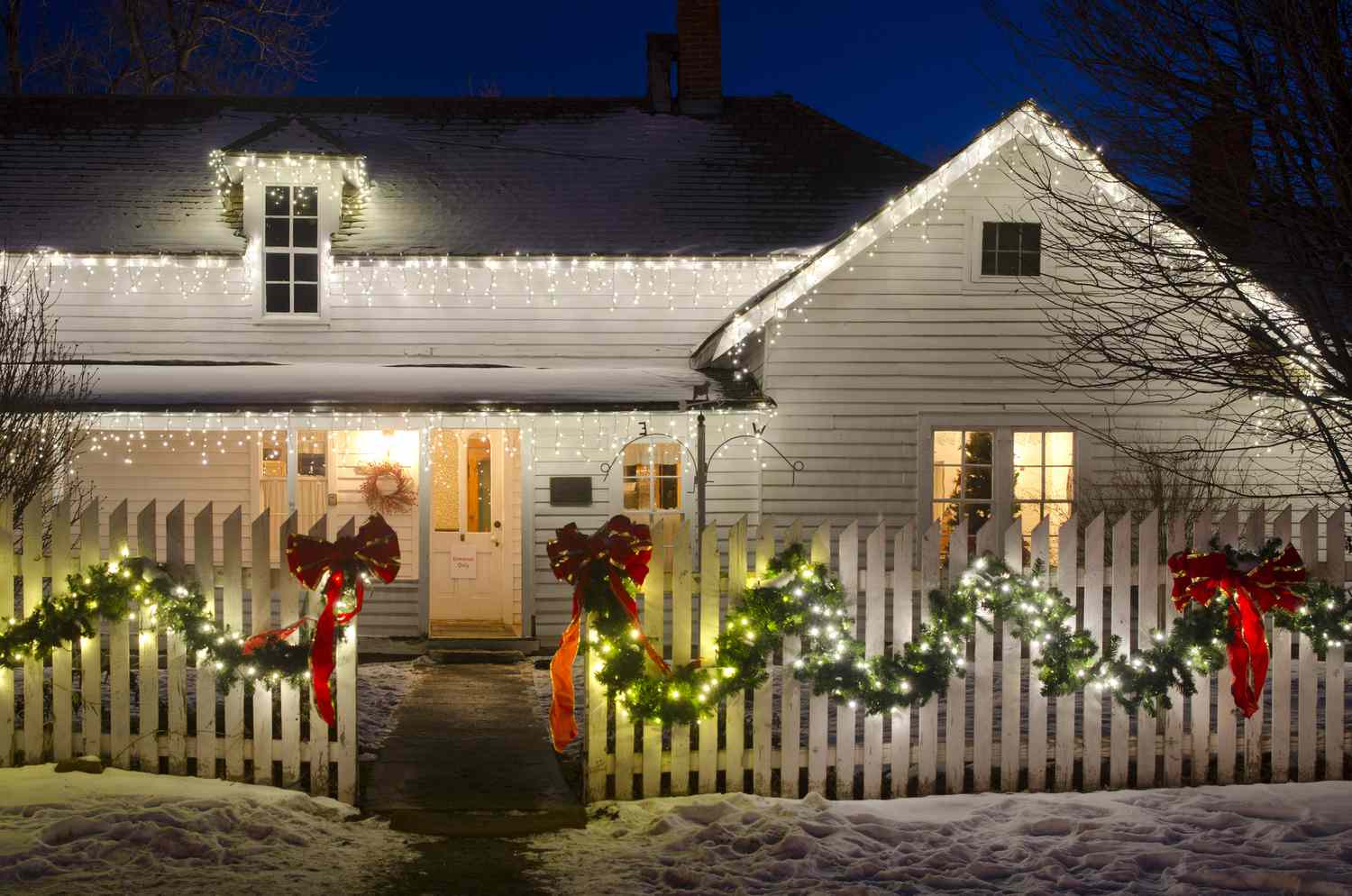
Three things are doing the heavy lifting here. First, contrast: deep evergreen against light wood is one of the highest-contrast pairings you can put outside, which means it stays readable from the street even on a gloomy afternoon. Second, repetition — the red bows land at even intervals, so your eye glides down the fence instead of snagging on one spot. Third, warmth: those bulbs sit around 2700K, so the display feels like candlelight rather than a parking lot.
2. A Snowy Picket Gate, Wreath, and Golden Lights Beyond
If you want the whole picture — wreath on the gate, golden lights filling every window behind it — here’s roughly what that runs in 2026 dollars:
- Lit garland, two 9-foot strands: $50–$90
- Wreath with berries and green apples: $35–$85
- Warm white string lights, 300–500 bulbs: $30–$70
- Timers, stakes, outdoor extension cords: $25–$45
Total: $140–$290, assuming you already own a ladder.
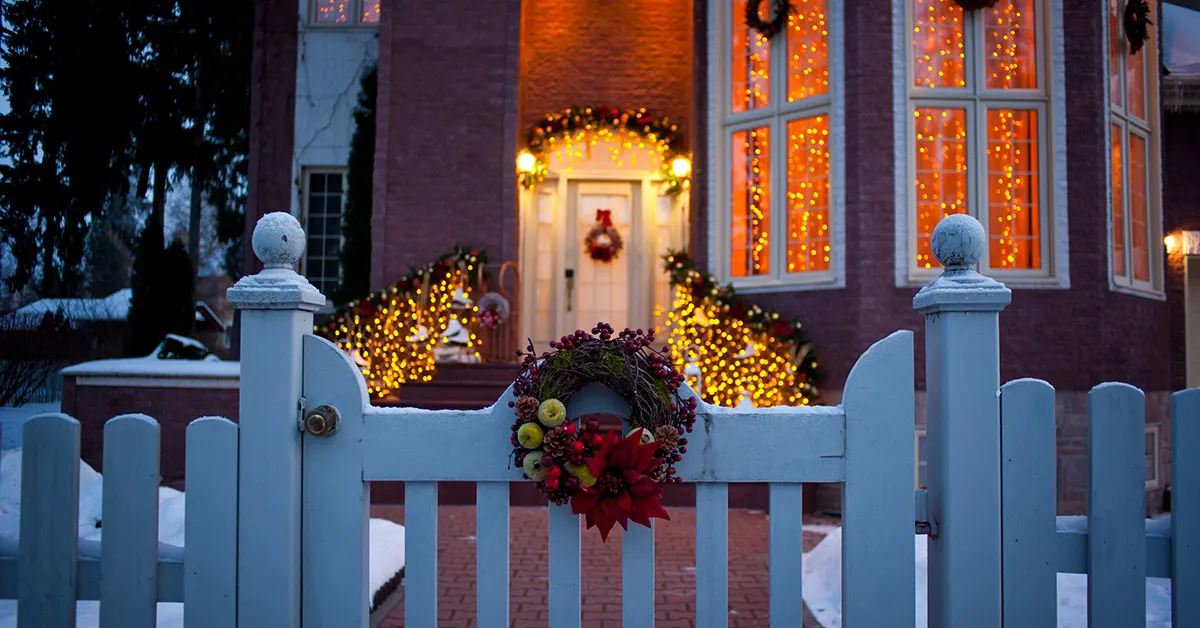
The wreath on the gate is the piece you can’t remove. Everything else — the lights, the garland, the glow behind the windows — is background. The wreath is the handshake. It sits at eye level, right where your hand reaches for the latch, so it’s the one decoration every visitor sees up close. Skip it and the fence is decorated. Hang it and the fence becomes a front door.
3. Pine Swags and Velvet Bows with Golden Trim
Strip this display down and it’s about 65% evergreen, 25% red velvet, 10% gold. The greenery carries the fence line, the bows create the rhythm, and the gold trim is the wink — enough to catch light without turning the whole thing into a gilded lawn ornament. Swap red for burgundy and it turns moody and English. Swap gold trim for antique brass and it edges vintage. Swap the white fence for weathered cedar and you’ll want to push the red brighter, because the base is no longer bouncing light back at you.
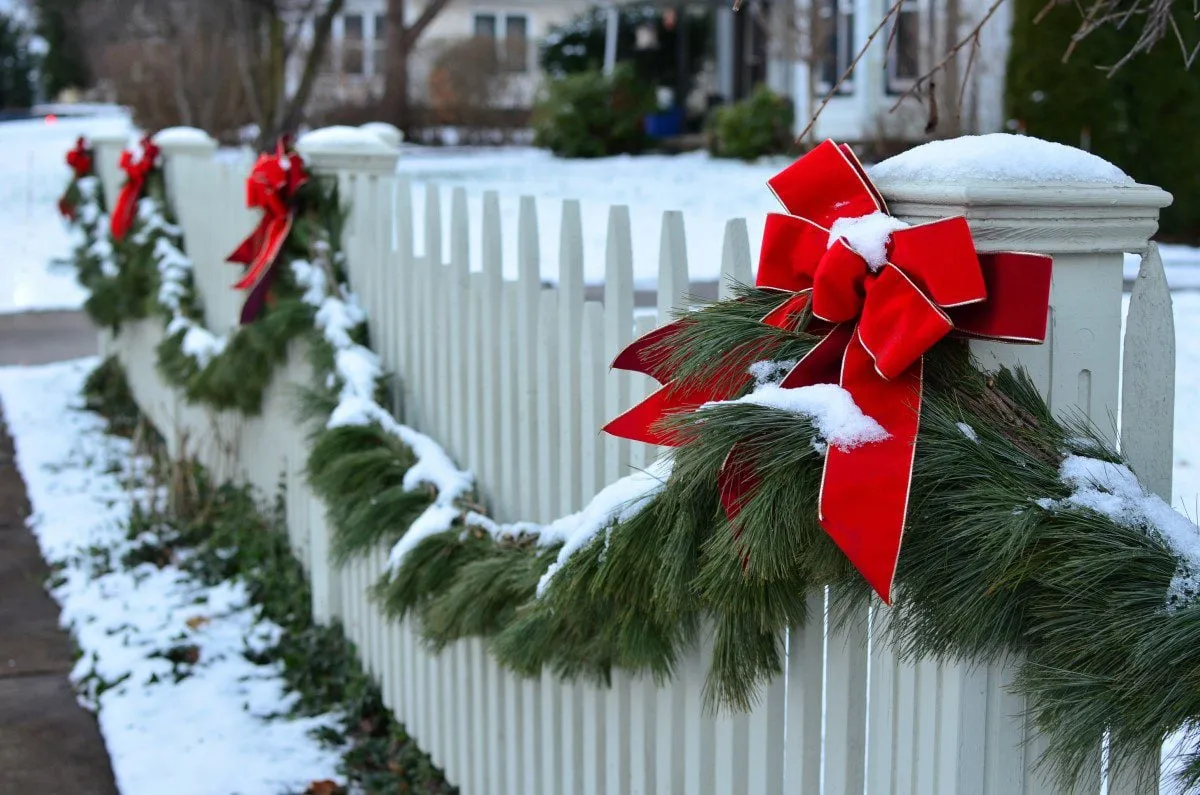
To get swags that hang in soft curves instead of tight zigzags:
- Measure your fence run and divide by 6 feet — that’s your attachment point count.
- Set the points first with adhesive cable clips or zip ties at the post caps.
- Stretch garland between points, letting it drop 10–14 inches at the center.
- Zip-tie a bow at each point to hide the seam.
- Weave lights last, so you’re not fighting the greenery.
Time: about 45 minutes for 20 feet. Materials: $60–$120.
4. Illuminated Candy Canes and Vertical Red and Green Strands
This is the candy cane lane look, and it’s louder than ever in 2026 — partly because retro multicolor displays keep gaining Pinterest saves while warm-white-everything settles into middle age. Oversized lit candy canes, tall vertical strands, a star, a reindeer, a snowman: it’s nostalgia on a budget, and it photographs beautifully from a slowly moving car. The trend has real staying power because it’s kid-facing, and kids vote every single year.
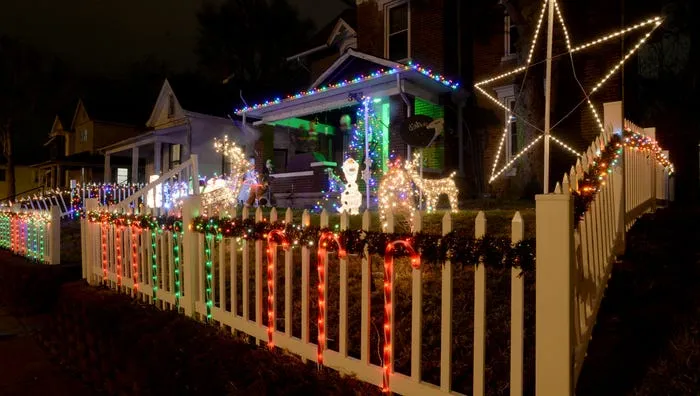
Here’s the part nobody mentions until your breaker trips. LED string sets draw roughly 0.02 amps per bulb, so a 100-bulb strand is about 2 amps. Most household circuits handle 15, but that’s shared with whatever else is on the porch outlet. Run no more than three strands end-to-end, then start a fresh run from a different outlet or a heavy-duty power strip. Outdoor-rated timers cost $15 and save you the nightly unplug — and check an inflatable’s motor draw before you add it, because one blower can eat more power than the entire fence.
5. Red and Gold Bow Garland Without the Custom Price
This is the budget version of Idea #3, and you can get 90% of the look for about a third of the cost. Buy two 9-foot unlit pine garlands at Walmart or Target for $12–$18 each, add a $15 strand of warm white lights, and weave them yourself. Red fabric bows from Dollar Tree, dressed with a strip of gold ribbon, read nearly identical from the sidewalk. Around $60 instead of $200-plus. Then build slowly: buy bows in January at 70% off, add lights in November, and let the display compound year over year.
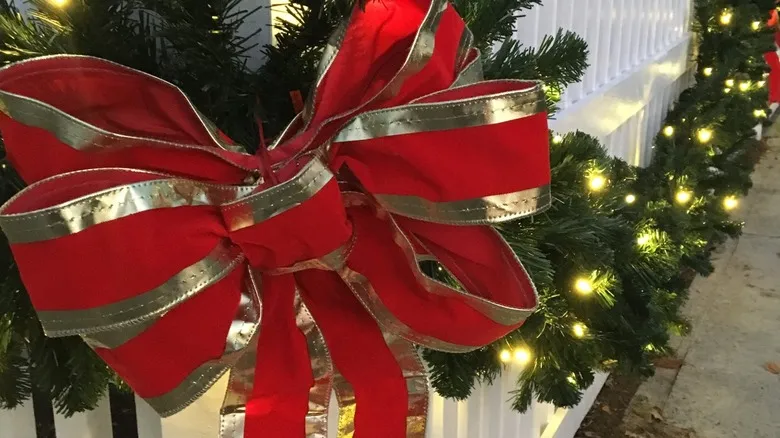
Spacing is what separates “decorated” from “designed.” Place one bow every 4 to 5 feet — closer and it turns into a red blur, wider and the fence looks like it lost interest halfway through. Match bow width to post spacing: 8-inch post gaps suit a 9- to 10-inch bow. And on a tight budget, choose fewer big bows over more small ones. Three large bows on a 15-foot fence beat nine small ones every time.
6. Small Wreaths in a Row Beneath a Light-Outlined Roofline
Two principles, doing two different jobs. The first is repetition at a human scale — those small wreaths are spaced evenly and sized to the pickets, so they read as a pattern rather than a collection of objects. The second is continuity between fence and house: the same multicolor strand that outlines the gables, windows, and roofline also runs along the fence, so your eye travels from the ground up without a break. That’s why the whole property feels like one display instead of two competing ones.
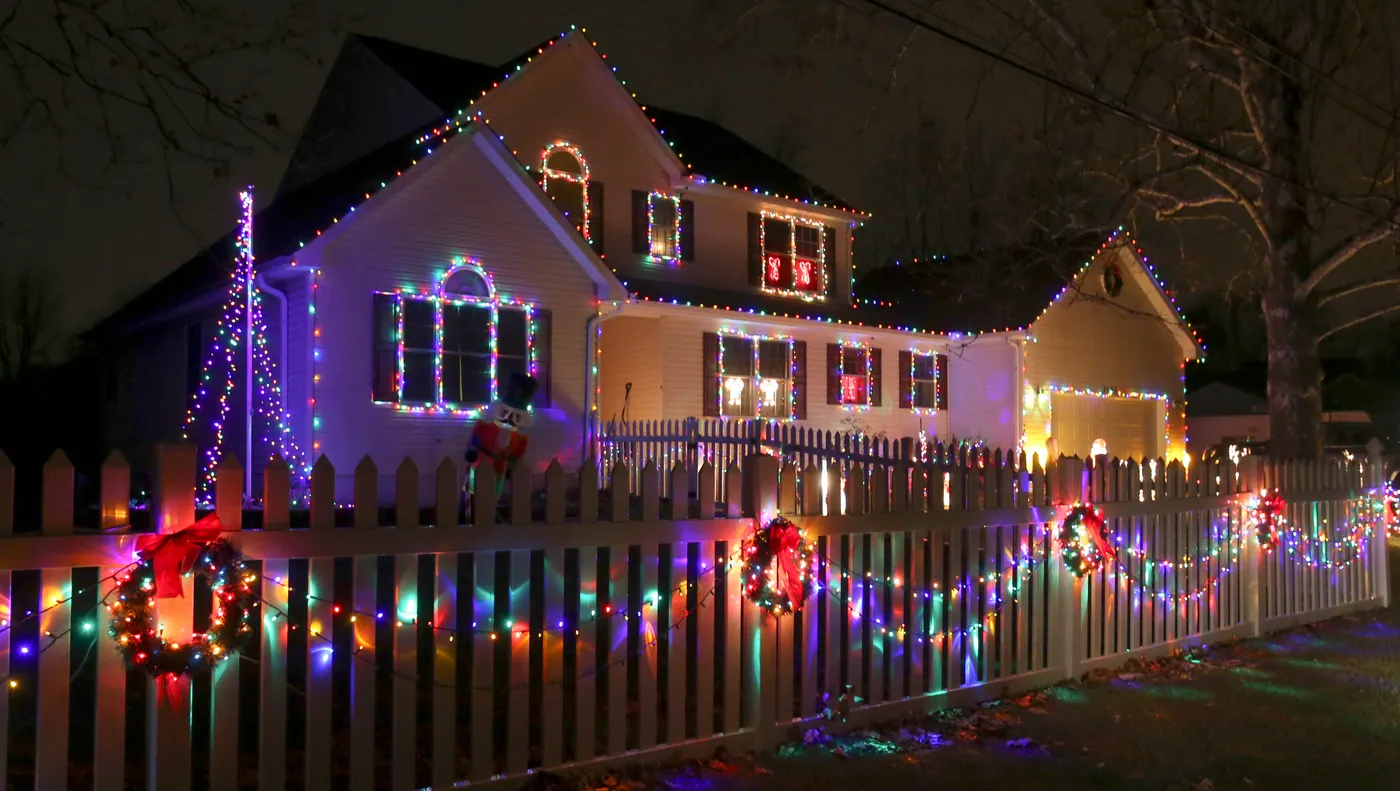
A picket fence 36 to 48 inches tall is the sweet spot: 10- to 14-inch wreaths sit in proportion, one every 6 to 8 feet. Keep the same bulb spacing and color family on the house line or the continuity breaks. On a narrow city lot under 25 feet of frontage, scale wreaths to 8 inches and use a single-color strand. Compare with Idea #18, where one strand keeps a small frontage calm.
7. Color-Washed Wooden Fence with Warm White Ground Lights
Getting those vertical color bands to look intentional instead of accidental comes down to fixture placement:
- Set each uplight 18 to 24 inches from the fence base, angled up at roughly 60 degrees.
- Space fixtures every 4 to 6 feet so the color washes overlap slightly.
- Use one color per fixture, not one fixture per color — the wash is what sells it.
- Run low-voltage cable along the fence base and bury it two inches under mulch.
- Add warm white spotlights on the shrubs last, so greenery reads green.
Time: about 2 hours. Cost: $110–$220 for four to six fixtures plus transformer.
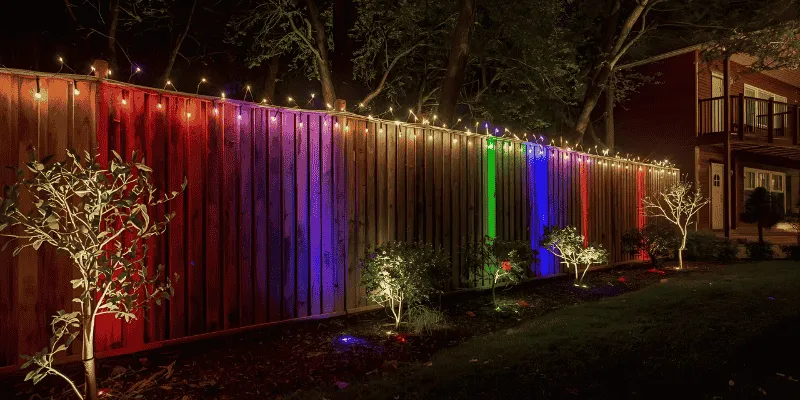
LED wash lights are nearly maintenance-free — no bulbs to replace for around 50,000 hours, a decade of Decembers at four hours a night. What needs attention is everything else. Wooden fences in freeze-thaw climates shift, so check your fixture aim in early December and again in January; a quarter inch of frost heave can turn a clean wash into a stripe across your neighbor’s siding. Wipe the lenses with a damp cloth when you take them down — pollen and spider webs cut brightness noticeably.
8. Purple and Pink Glow with Hanging Snowflakes
If you’re going colored, commit to one hue family and light the whole facade with it — purple and pink here, because they’re adjacent on the color wheel and read as one continuous glow rather than a fight. Keep the function lights, the garlands and window strings, warm white so the colored wash has something neutral to sit against. Aim your floodlights from the ground at a 45-degree angle and keep them at least 12 inches from the wall, or the light pools in one hot spot instead of washing the siding evenly.
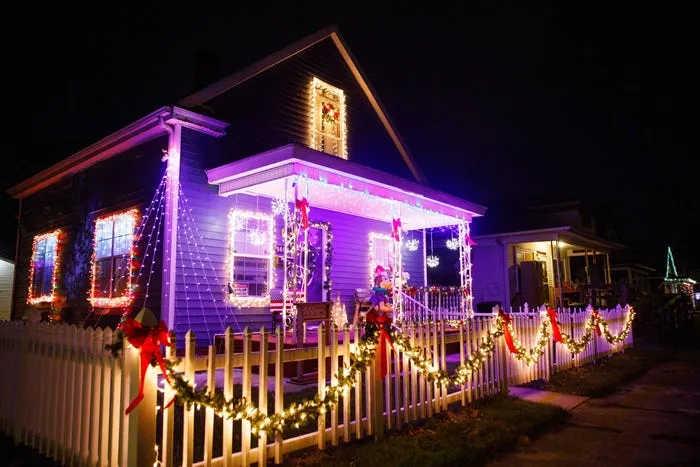
The hanging snowflake ornaments are the detail that makes this feel deliberate. Without them you have a purple house — pretty, but a little nightclub. The snowflakes give the eye a shape to land on between the roofline and the fence, and that’s the difference between colored lighting and a Christmas display. On a budget, order three or four snowflake motifs and hang them at even intervals across the porch. That’s $40 doing the work of $400.
9. Evergreen Garlands on a Black Metal Gate
Roughly 60% of this composition is dark green, 30% is warm white light, and 10% is black metal doing almost nothing — which is exactly the point. On a black fence, greenery has to be thick enough to hold its own shape, because there’s no light-colored background bouncing anything back at it. The warm bulbs then do double duty, illuminating the garland and grazing the brick column behind it. Swap black metal for white vinyl and the same garland reads lighter, airier, and about 30% less dramatic.
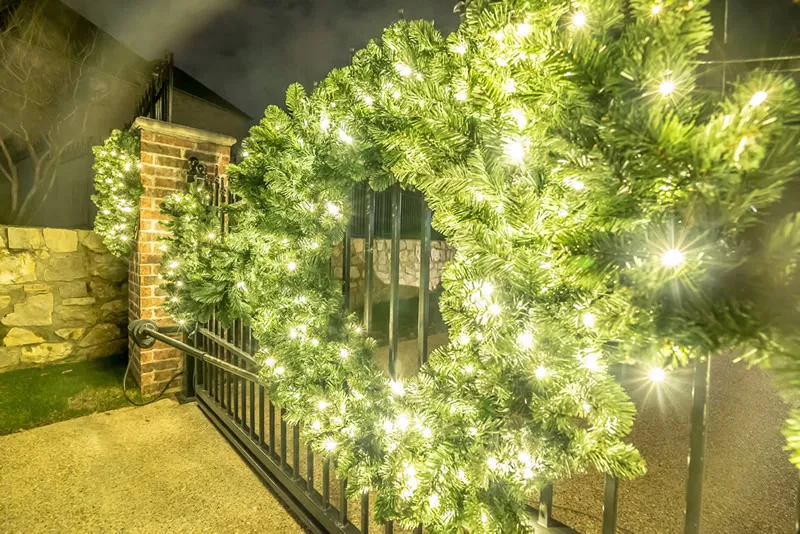
Metal fences have one specific trap: zip ties and moisture. Standard nylon holds fine, but on powder-coated metal, tight ties can wear through the coating at contact points and start rust blooms that show up in March. Use rubber-coated or UV-rated black ties and leave a little slack. Also, black metal gets hot enough in sun to soften cheap plastic clips, so attach at the top rail and skip adhesive hooks on powder coat entirely.
Columns, gates, and piers are where this look earns its money — you’re decorating a frame, not a field. A gate 42 to 48 inches wide takes two garlands and one wreath; add a third swag only if there’s a center stile. On driveway piers, run garland up the faces to about 6 feet and stop, then use a bow break every 8 feet on longer runs, as in Idea #24.
10. Weathered White Picket Fence Glowing at Night
Recreating this nighttime look:
- Pre-lit garland, 18 ft total: $70–$140
- Large red velvet bows with gold trim, set of 6: $45–$90
- Extra warm white strand, 100 bulbs: $18–$30
- Outdoor timer and clips: $20–$35
Total: $155–$295 for about 20 feet of fence. Budget route: unlit garland plus your own lights drops it to $85–$140 and costs an extra hour.
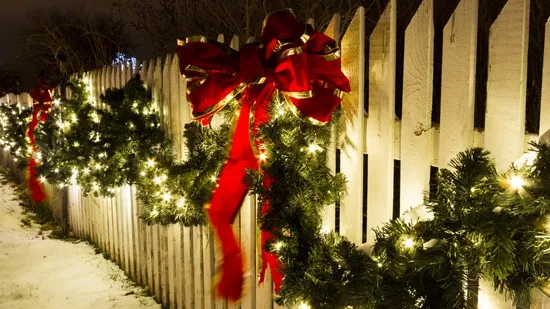
A weathered white fence is a gift, because it doesn’t reflect light the way fresh paint does — it absorbs and softens, which makes warm bulbs look almost candlelit. Keep your bulbs at 2700K or lower; anything at 4000K and up turns weathered white gray and makes red bows look cheap. One more thing: on old pickets, use clip-on light sockets instead of wrapping the strand around the wood. Wrapping traps moisture against the picket and accelerates the exact weathering you’re trying to celebrate.
11. Warm White Restraint with a WELCOME Sign and Frosted Trees
Restraint is the whole design. Every light in this scene — icicle strands on the eaves, the fence line, the wreaths on door and windows — is the same warm white. That single decision makes a modest facade look considered rather than crowded, and it lets the vertical WELCOME sign act as punctuation instead of competing noise. The two frosted trees flanking the entrance do the same job in three dimensions: they frame the door, echo the white of the fence, and give the icicle lights something to fall toward.
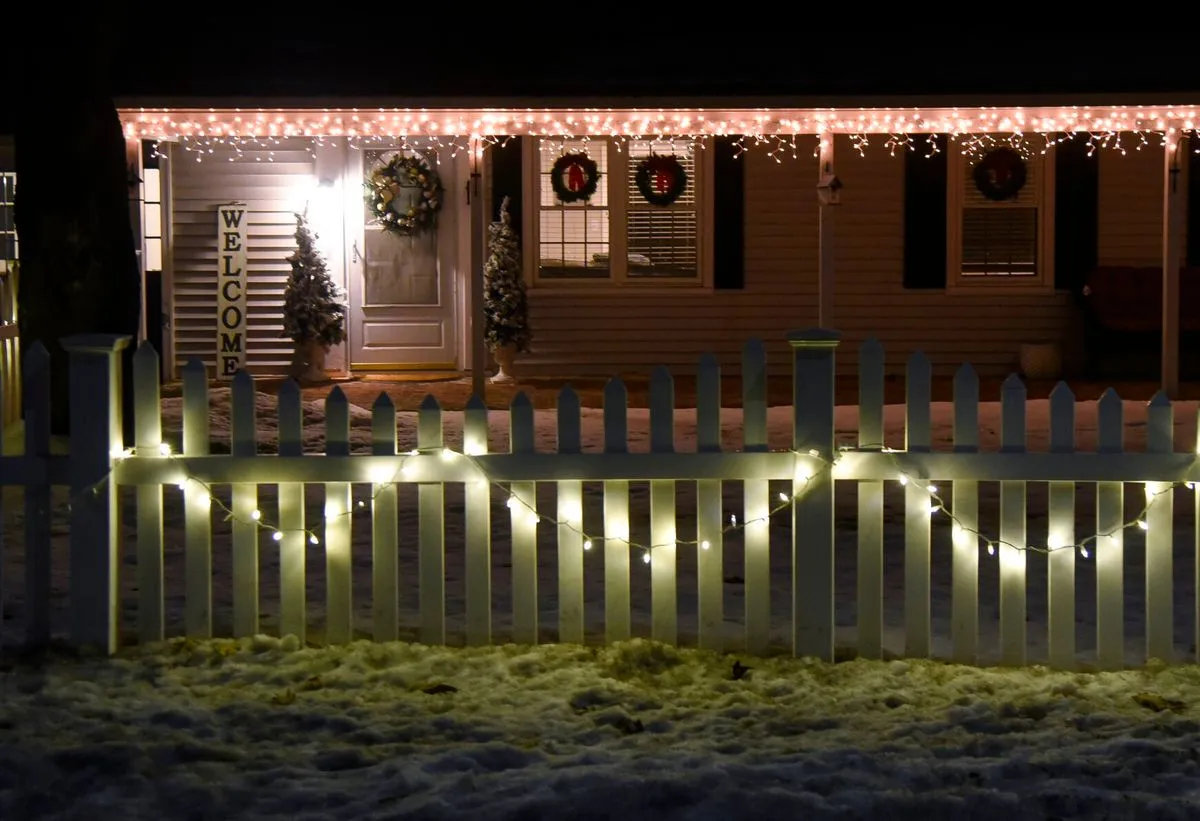
Icicle lights are one of the best dollar-per-impact buys in Christmas decor. A 300-bulb warm white set runs $20 to $35 at Walmart or Target and covers roughly 18 feet of eave. The frosted trees are where you save real money: buy plain 3-foot artificial trees after Thanksgiving for $25 each and hit them with a $10 can of spray flocking snow, or scout Facebook Marketplace in early December — people unload pre-lit trees constantly when they upgrade. Total for this look, fence included: about $180. Compare with Idea #9 — same warm white discipline, completely different fence.
12. A Snow-Dusted Evergreen and Eucalyptus Wreath on a Fence Post
The eucalyptus is the whole reason this works. A wreath made entirely of evergreen on a weathered white post reads traditional and a little expected — pretty, but you’ve seen it. Add seeded eucalyptus and the greens stop being one flat color: silvery sage next to deep pine, and suddenly it looks gathered rather than purchased. It also photographs beautifully against snow, because gray-green tones hold up where pure green goes muddy.
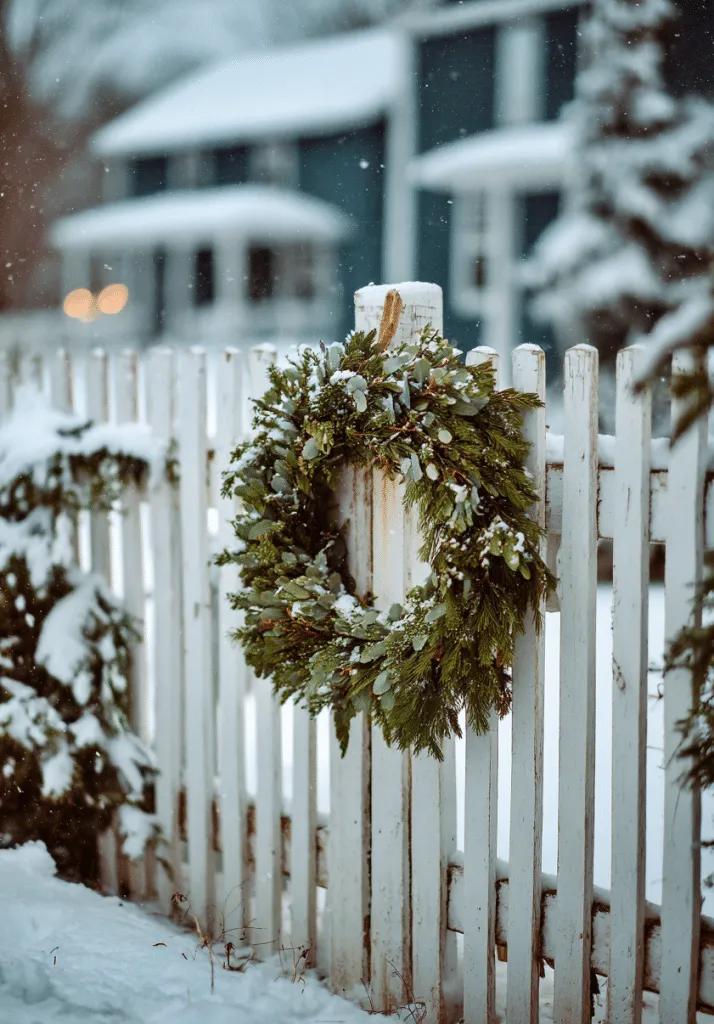
Build it yourself in about half an hour:
- Start with an 18-inch grapevine or wire base from a craft store, about $8.
- Attach evergreen sprigs first, all facing the same direction, overlapping by half.
- Tuck seeded eucalyptus stems into every third gap, letting tips extend past the edge.
- Wire the wreath to the post at two points of contact, not one.
- Dust with faux snow spray from 18 inches away, on the outer thirds only.
Time: 30 minutes. Cost: $25–$45.
13. Globe String Lights in Every Color on a White Picket Fence
Before you buy a single strand, check four things:
- Measure your fence run in feet and divide by the strand’s lit length — most globe sets cover 10 to 12 feet.
- Note which direction your fence faces; south-facing pickets fade faster and want UV-rated wire.
- Count your outlets and their amp capacity — each 25-bulb globe strand draws roughly 1.4 amps.
- Check whether your HOA or city has a color-light ordinance — some do.
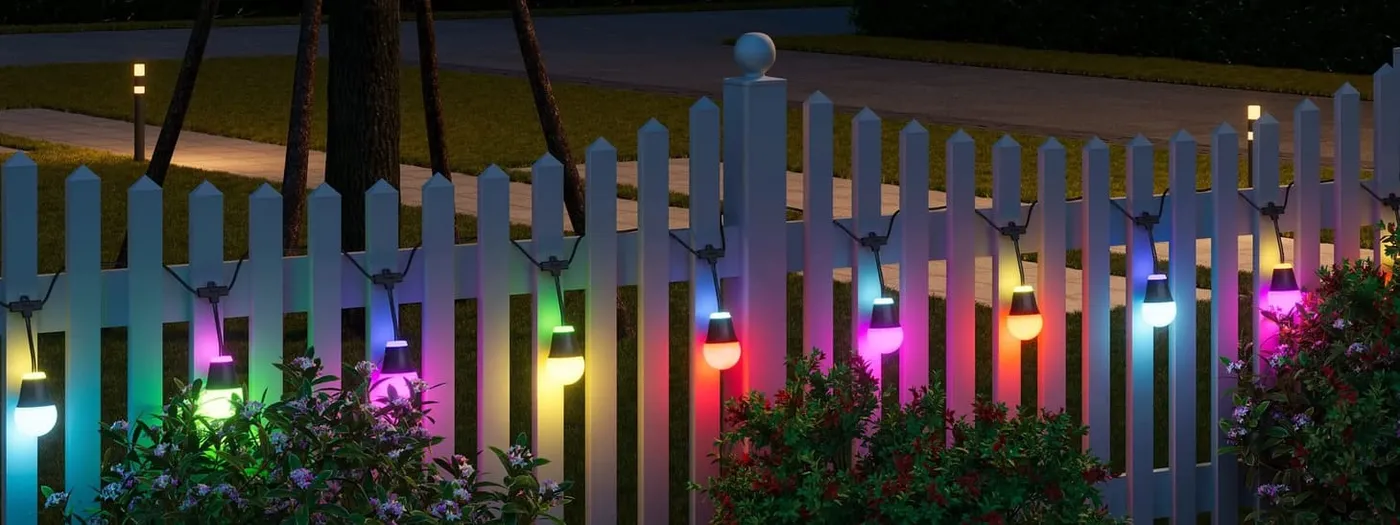
Globe bulbs are the most photogenic option and the most annoying to store. Most sets are glass, which means one good ice storm can end a $60 strand, and the bulbs unscrew themselves in storage if you don’t tape the box shut. Buy a set with a spare-bulb pack and keep the packaging. And if kids or dogs patrol your fence line, mount the strand on the back side of the pickets — you still get the glow, and you lose the temptation to grab.
14. Lighted Garland and Red Bows Against Blue Post Accents
Those blue post accents are doing something most people miss: they’re a third color, which means they should appear in roughly three places or not at all. Here they exist on the post caps and picket tips, so the eye registers blue as a choice rather than an accident. If you’re painting posts to match, use exterior latex in a deep navy and let it cure 48 hours before attaching garland — zip ties on fresh paint leave permanent marks.
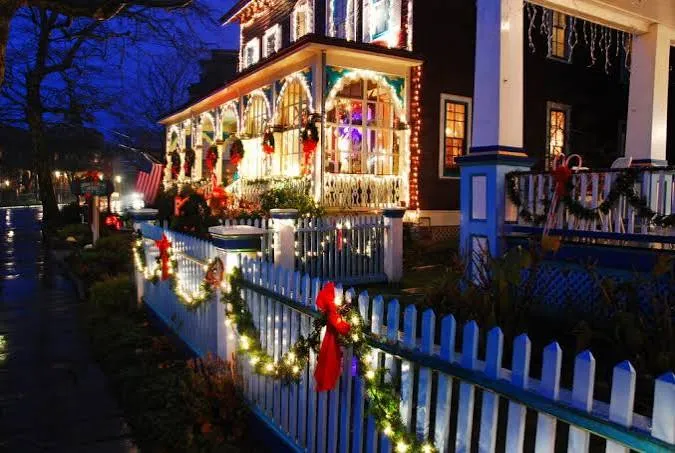
The formula is roughly 60% white fence, 25% green garland, 10% red bows, 5% blue accents. That last 5% is what makes a fence feel designed rather than assembled, and it’s also the easiest thing to overdo — go to 15% blue and the red bows start to look like someone else added them. If blue isn’t your color, swap in black for a modern read or antique gold for something warmer. Keep every other proportion identical and the composition still holds.
15. Inflatable Santas, Penguin Figures, and Wooden Cutouts
Maximalist yards are back in a big way, and 2026 is shaping up to be the year of the “we have everything” front lawn. Part of it is price — inflatables have gotten cheap enough that a 6-foot Santa costs less than a nice dinner out. Part of it is social: a decorated yard is content, and neighbors plan routes around the best displays. Inflatables also solve a real problem. They’re light, they store flat, and they give you instant volume without a single ladder climb.
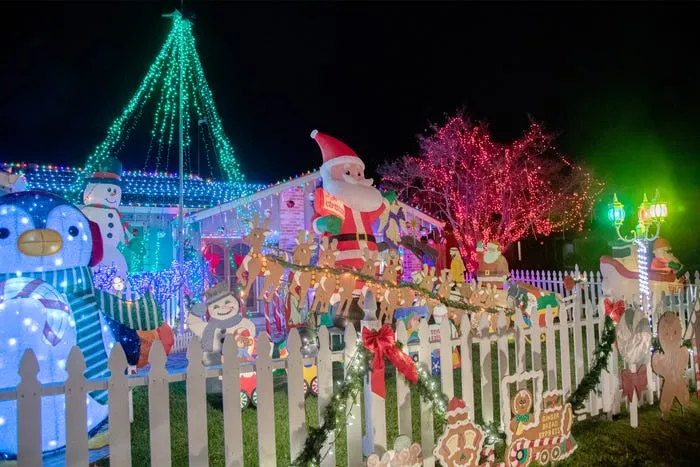
Wooden cutouts are the sleeper value. A 4×8 sheet of exterior plywood runs $45 to $60 and yields four or five full-size figures — reindeer, gingerbread people, penguins — plus paint and a jigsaw you may already own. Paint both sides and seal the edges or they delaminate by February. Inflatables are cheapest in the first week of December and again on December 26, when Walmart and Home Depot dump inventory hard. Check Facebook Marketplace the first weekend of the month, when people realize their yard is smaller than their ambitions.
16. Thick Pine Garlands and Velvet Bows Under Fresh Snow
Real garland versus faux is the decision that shapes your December. Fresh pine smells incredible and lasts four to six weeks outdoors in cold weather, but it drops needles steadily and needs a spritz of water every few days to keep from browning. Faux garland survives decades, though UV exposure dulls it — plan on replacing cheap garland every three or four seasons. Either way, don’t let snow sit on it for weeks. Snow load bends attachment points, and when it melts and refreezes, it welds the garland to your pickets.
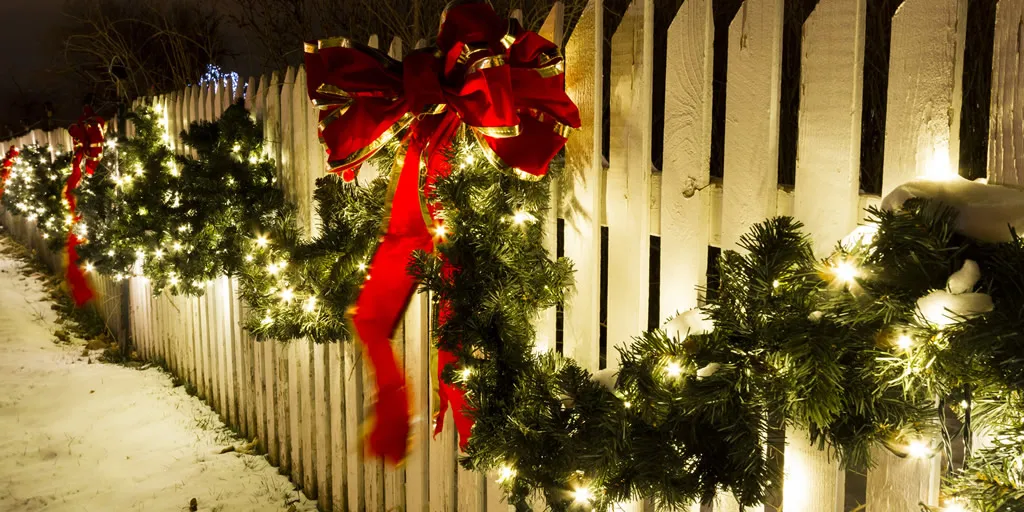
What this exact look costs:
- Thick pine garland, 18–24 ft: $80–$160
- Red velvet bows with gold trim, set of 8: $55–$110
- Warm white string lights, 300 bulbs: $25–$45
- Clips, ties, and timer: $20–$35
Total: $180–$350 for 20 feet. Unlit garland plus your own lights saves about $60 and one evening.
17. Red Glitter Bows and Pinecones on a Snowy Fence Line
Pinecones are the cheapest way to add real texture, if you prep them:
- Gather or buy pinecones and bake at 200°F for 30 minutes to kill anything living inside.
- Wrap each cone with 22-gauge floral wire, twisted at the base into a small loop.
- Attach to the garland every 8 to 10 inches, alternating up and down.
- Add bows last, at the attachment points, so they hide the wire.
Time: 40 minutes for 20 feet. Cost: $15–$30 plus garland.
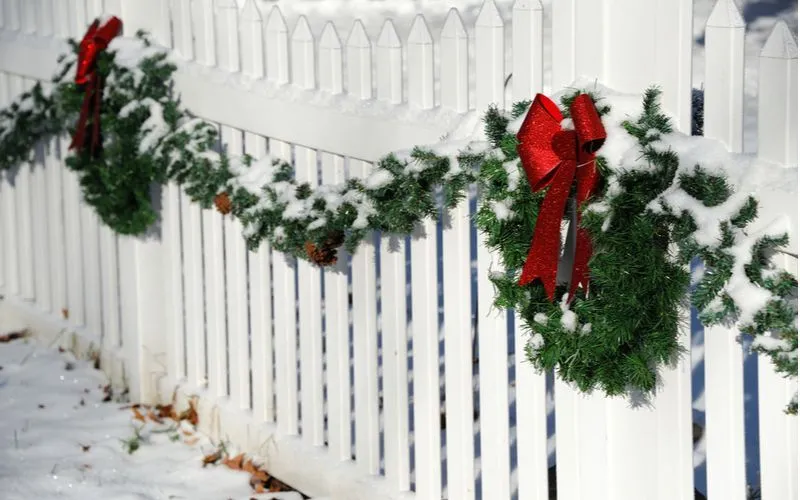
Three textures, three finishes: matte pine needles, glossy glitter ribbon, and the rough spiral of a pinecone. That contrast is why this reads as rich rather than busy — the materials all sit in the same color family, so your eye processes color first and texture second. It also explains why the snow matters. A dusting of white doesn’t add a color; it adds a fourth surface that catches light differently than anything else on the fence.
18. Classic Multi-Color Strands Under a Twilight Blue Sky
What makes this feel calm instead of chaotic isn’t the lights — it’s the ambient. Twilight gives you a wall of cool blue that warm red, green, and yellow bulbs sit against like paint on canvas. In full dark, the same strand looks busier. That’s a styling insight you can use: enjoy and photograph your display during the 20 minutes after sunset, while the sky still has color. For the fence itself, keep it simple — one continuous run, no doubling back, no competing colors layered on top.
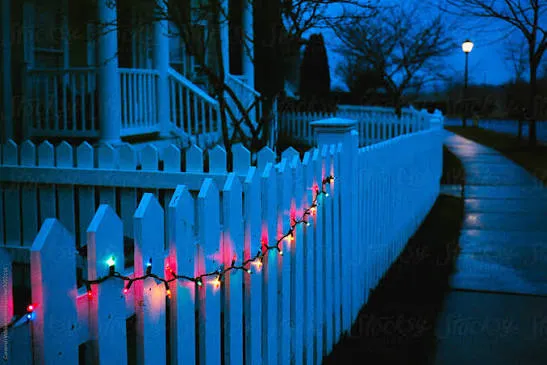
Single-strand displays are the best choice for small frontages. A typical 100-bulb set covers about 20 feet when draped with a gentle sag every few pickets, so a 25-foot fence needs two sets and one connector. Keep the sag shallow, 4 to 6 inches, so the strand reads as a line rather than a rope. On street-facing fences, run the cord along the back of the pickets so wiring isn’t visible, and use a stake-and-clip at each end so the run stays taut through wind.
19. Snowflake Cutouts Above a Green-to-Orange Light Gradient
Ground-level color gradients are the hardest thing in holiday lighting to get right, and it’s all about fixture distance. Place floodlights 6 to 10 inches from the fence base for that tight, saturated wash you see here; push past 18 inches and the colors bleed into mush. Use three fixtures for a green-white-orange progression, angle them slightly toward each other, and put each on its own outlet or channel so you can tune the balance. Cheap colored floods are fine — the gel does the work, not the housing. See Idea #7 for the same technique on a wooden fence.
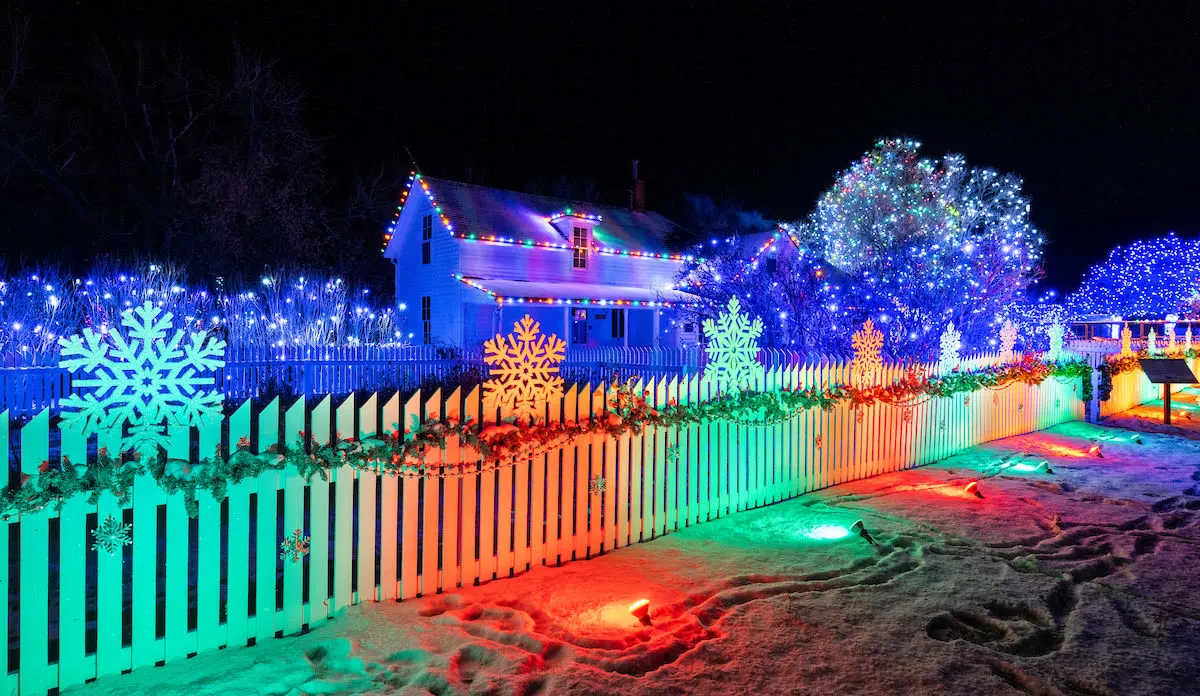
Colored floodlights are the number one source of neighbor complaints, and it’s almost always aim, not color. A fixture tilted slightly upward throws light onto the house next door and into bedroom windows a hundred feet away. Point everything down or across — never above horizontal — and use the glare shield or hood if your fixture came with one. Also worth knowing: snow reflects up to 90% of light, so a display that looks tasteful on bare grass can be genuinely blinding after a snowfall. Test it once with snow on the ground before you commit to the season.
20. Reindeer, Sleigh, and a Conical Light Tree Behind the Fence
This display succeeds because it works in three layers. The fence line gives you a bright, low foreground. The mid-yard — reindeer, sleigh, the conical light tree — fills the middle distance with recognizable silhouettes. The house ties it off at the top with the roofline. Most disappointing holiday yards only have one layer, usually the house, which leaves the whole front forty looking empty. If you’re building from scratch, buy the fence layer first, then add one mid-yard piece per year.
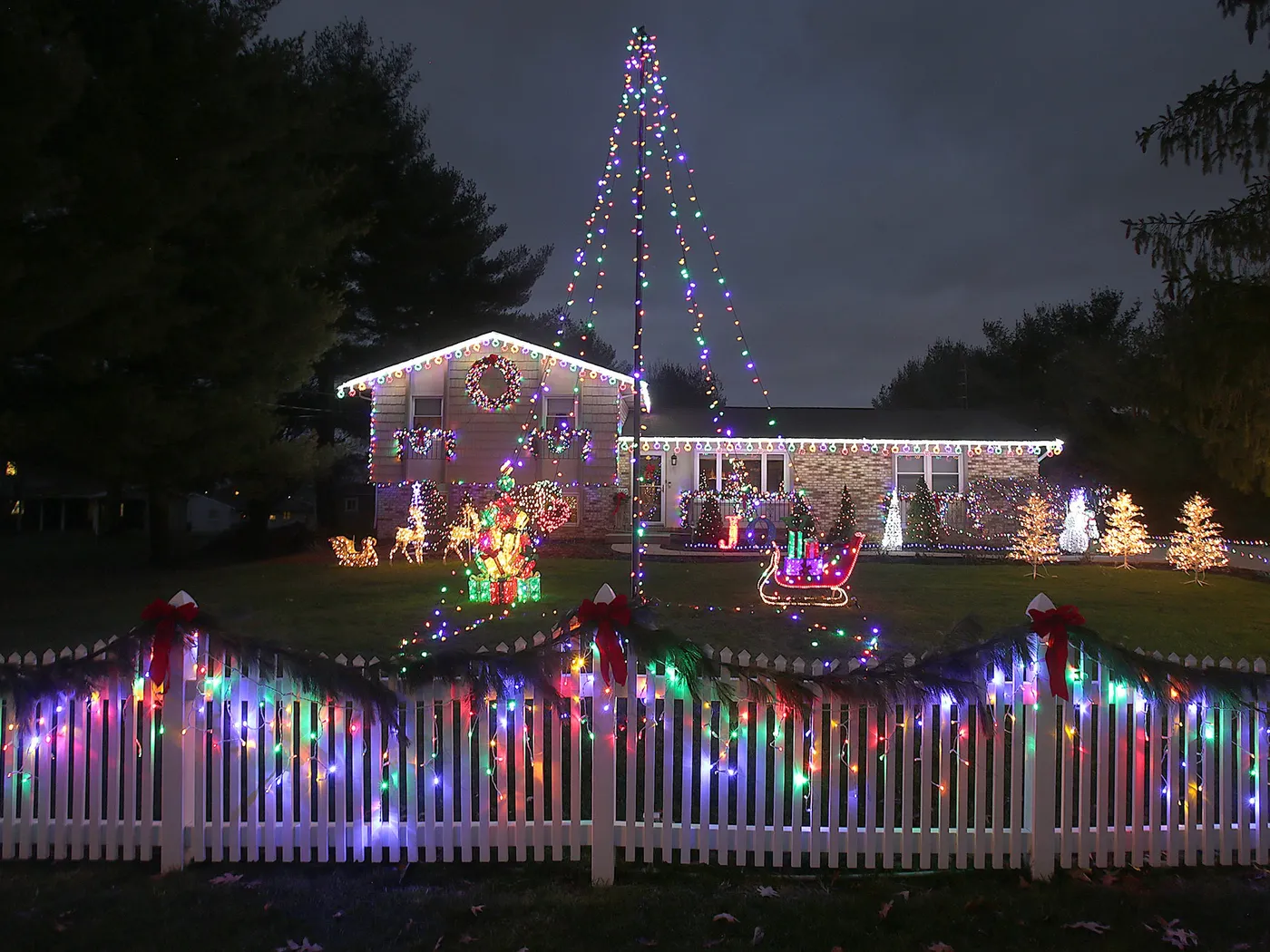
Approximate 2026 costs for this layered look:
- Fence garland, bows, multicolor lights: $120–$240
- Lighted reindeer pair: $70–$150
- Sleigh with gift boxes: $60–$130
- Conical light tree: $50–$110
- Extension cords, stakes, timer: $35–$60
Total: $335–$690. Buy mid-yard pieces in the first week of December, when the deepest cuts land.
21. Pink Cherry Blossom Lights Over a Flower Bed and Stone Path
The unexpected pairing is the entire idea: pink blossom lights, which have nothing to do with Christmas, draped on a picket fence in the middle of winter. It works because of what’s underneath. The flower bed, the purple spires, the rough-hewn stone edging — the lights extend a garden that already exists, so they read as a garden in bloom rather than a seasonal mistake. Take away the planting bed and the blossoms become just a pink fence, which is a much less interesting sentence.
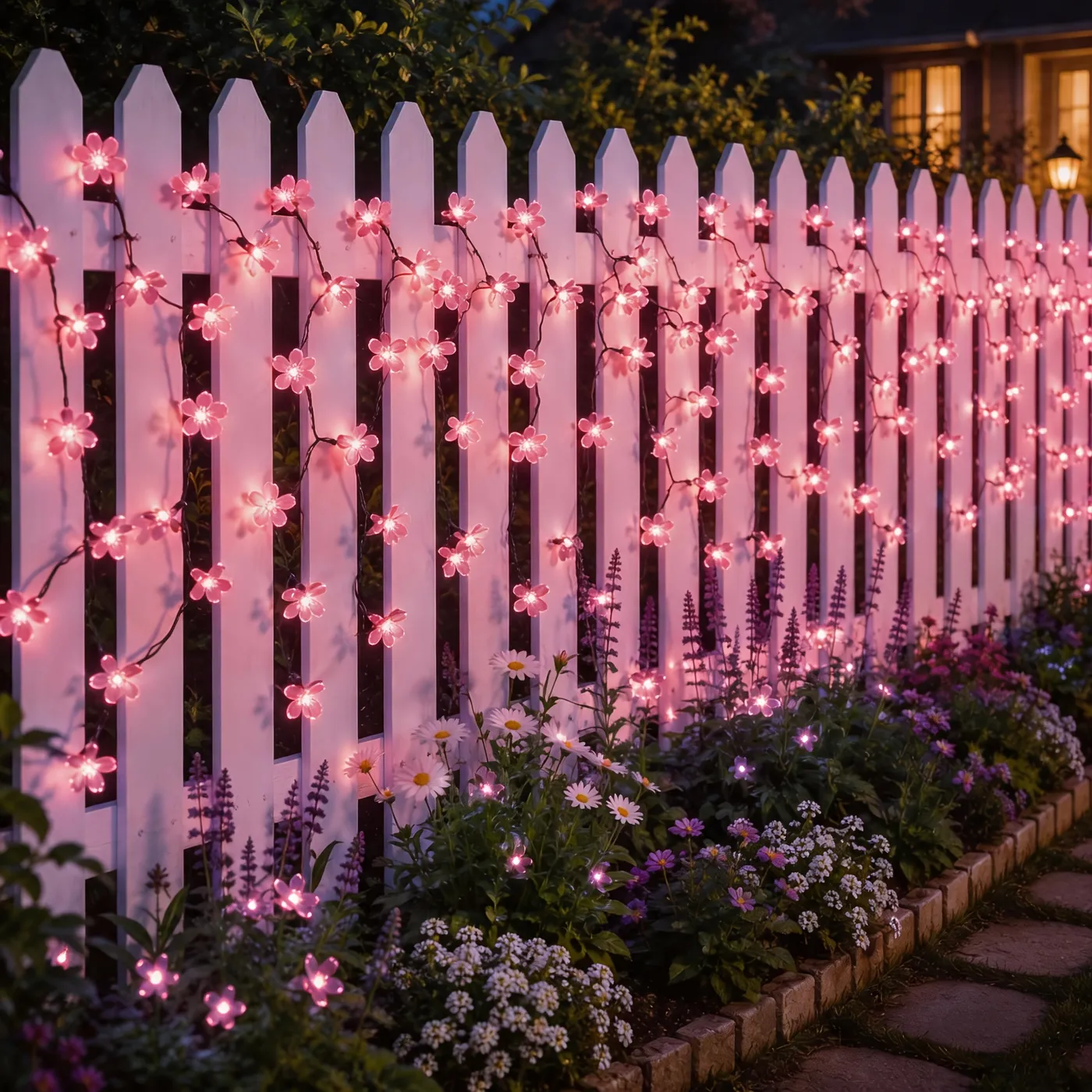
Four things to confirm before you string warm-season lights outdoors in December:
- Check the IP rating — you want IP44 or higher for anything exposed to rain and snow.
- Make sure the set is outdoor-rated with a sealed plug, not a USB end.
- Measure the run and confirm the strand’s lit length; blossom sets tend to be short.
- Decide what happens in January — these are the lights you may want to leave up.
22. Red Ball Ornaments and Pinecones Tucked Into Evergreen
Ornaments are where budget garland becomes convincing. Buy a 60-pack of shatterproof red balls at Walmart or Target for $12 to $18 — outdoor-safe, and they survive hail. Spend another $10 on a pack of pinecones and wire them in. The trick is mixing sizes: 2-inch and 3-inch ornaments together read as collected, while all-one-size reads as a kit. Total upgrade cost for 20 feet: under $30, and it turns a plain garland into the display above.
Cluster ornaments in threes rather than spacing them evenly. Odd numbers of mixed sizes, wired tightly together through the cap, look natural — even spacing looks like a catalog photo. Two more specifics: bend the ornament cap’s wire loop into a hook rather than threading it through the garland, and on a windy corner add a dot of clear silicone to the cap so ornaments don’t unscrew themselves and roll into the storm drain.
23. Solar Post Cap Lights with Multicolor Bulbs on a Weathered Fence
Solar post caps are wonderfully fuss-free for eight months of the year and mildly annoying for four. In northern winters, expect roughly 40 to 60% of summer output — short days plus snow on the panel equals dim light by 7 p.m. Wipe the panel with a damp cloth monthly and clear snow after every storm. Batteries usually last two to four seasons before they stop holding a charge; replacements run $4 to $8 each, and swapping them in November beats doing it in a snowbank.
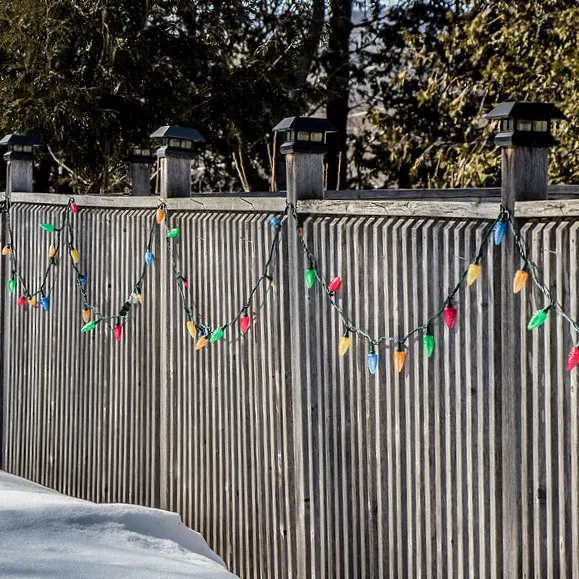
Installing solar caps on wood posts is genuinely a 30-minute job:
- Measure the post tops and confirm you’re buying the right cap size — 4×4 and 6×6 are standard.
- Clean the post tops and let them dry completely.
- Set each cap in place; most use two screws, some use friction clips.
- Switch to “auto” and leave the caps in full sun for a full day before judging brightness.
Time: 30 minutes. Cost: $60–$120 for six caps.
24. Alternating Red Velvet Bows Backed by Dark Evergreen Hedge
The alternating rhythm is what makes this elegant instead of even-keeled. A bow on every post would march; a bow on every other post lets the eye rest. And that dark evergreen hedge behind the fence is doing quiet, important work — it’s a solid dark backdrop that makes the white pickets and red bows snap. Without the hedge you’d be looking at sky, which is bright and low-contrast, and the whole display would flatten out. Compare with Idea #3 — same palette, different energy.
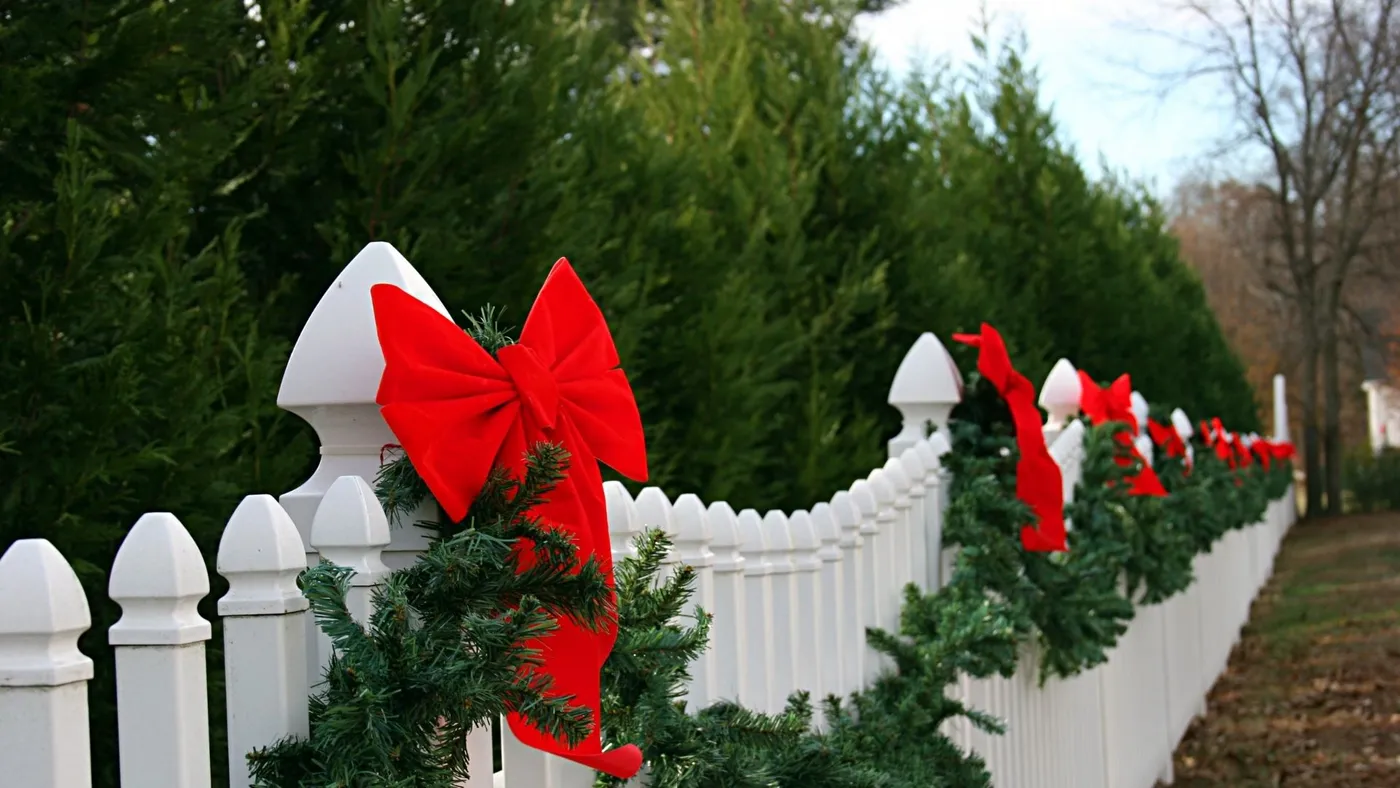
This pattern suits long, unbroken runs best — think 40 feet and up, where bow-to-bow spacing creates a visible cadence. On a short 12-foot fence, alternating bows leave you with two or three and the rhythm never develops; use a bow on every other post plus a wreath at the gate instead. Pointed post caps add roughly 3 inches of height, so keep bows at or just below the cap line for a clean silhouette. If your hedge is shorter than the fence, the contrast trick only works along the top third.
25. Shaped Light Motifs, Trees and Candy Canes, on a Plank Fence
Shaped light motifs are having a moment because they solve a specific problem: a long blank fence is hard to decorate with strands alone, and after about 15 feet the eye stops paying attention. A motif every 6 to 8 feet gives the run a beat. The 2026 versions are mostly LED, cooler-running, and far cheaper than the incandescent shapes people bought in the 2000s. Nostalgia plus lower electricity bills is a durable combination, and these last for years if you store them flat.
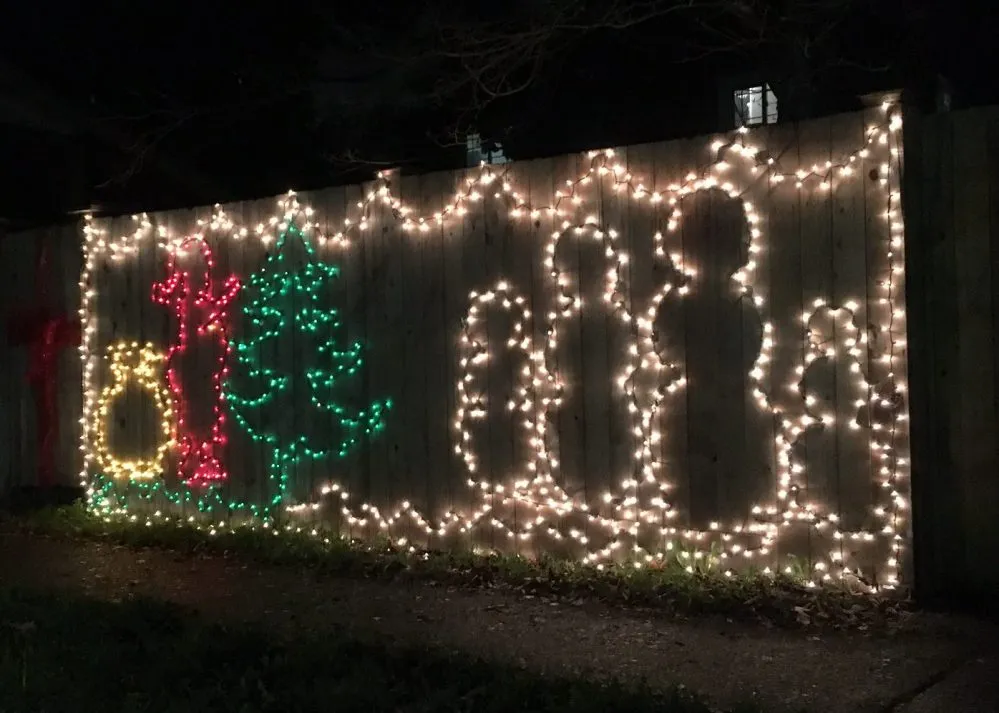
Size motifs to your fence, not your enthusiasm. A good ratio: motif height at about one-third of fence height, and spacing at 1.5 times the motif width. On a 5-foot fence, that means roughly 20-inch motifs with 30 inches of breathing room. Keep motif colors within two families — green and red, or gold and white — or the run starts to look like a discount aisle. If you’re mixing shapes, alternate them so no two of the same kind sit side by side.
26. Multicolor Overload: Cutouts, Inflatables, and a Big Wreath
There’s a maintenance conversation hiding inside this much fun. Inflatables need stakes on all corners — one gust will walk a snowman into the street — and they should be unplugged during storms over 25 mph or they’ll shred. Fabric cutouts fade within one or two seasons of direct sun. And the honest one: storage. A display this size eats an entire shelf in the garage. Before you buy, measure your storage space, not just your yard. If you can’t store it, you’ll end up replacing it.
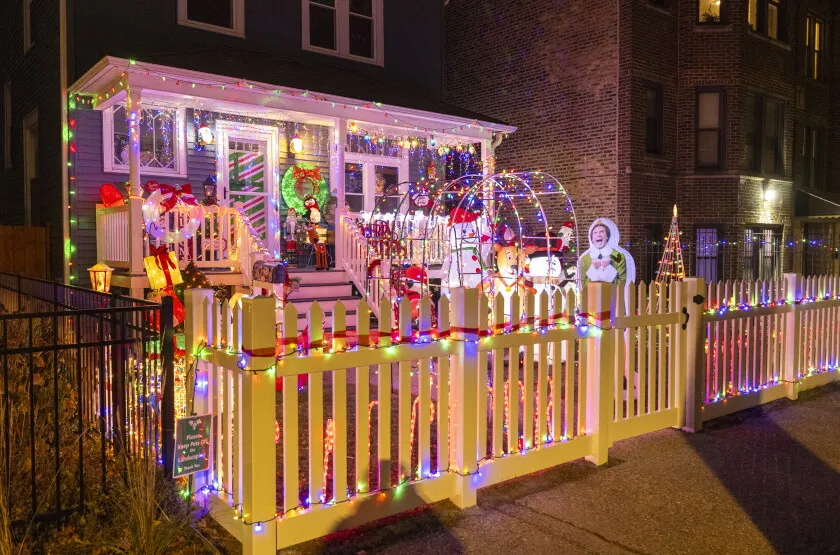
Buying this much decor new runs into four figures. The thriftier route is genuinely fun: Facebook Marketplace in the first week of December is a goldmine, because people move and can’t take the light-up penguin with them. Expect 50 to 70% off retail. After-Christmas clearance drops another 60%, so December 27 is when you buy next year’s display. And for cutouts, $50 in plywood and paint beats $200 in store-bought figures, especially if you own a jigsaw and have a free afternoon.
27. Red and White Bulbs with a Gingerbread Character Peeking Over
Red and white bulbs create a candy stripe, and the only way to ruin it is to add a third color. Keep the fence itself to those two, and let the gingerbread figure introduce the pink hat and green scarf — that way the novelty character reads as the star instead of one more thing in a crowd. If you’re running the strand on a timer, use a single steady setting, not a chase pattern; the even red-white rhythm is what makes it read clean rather than frantic at dusk.
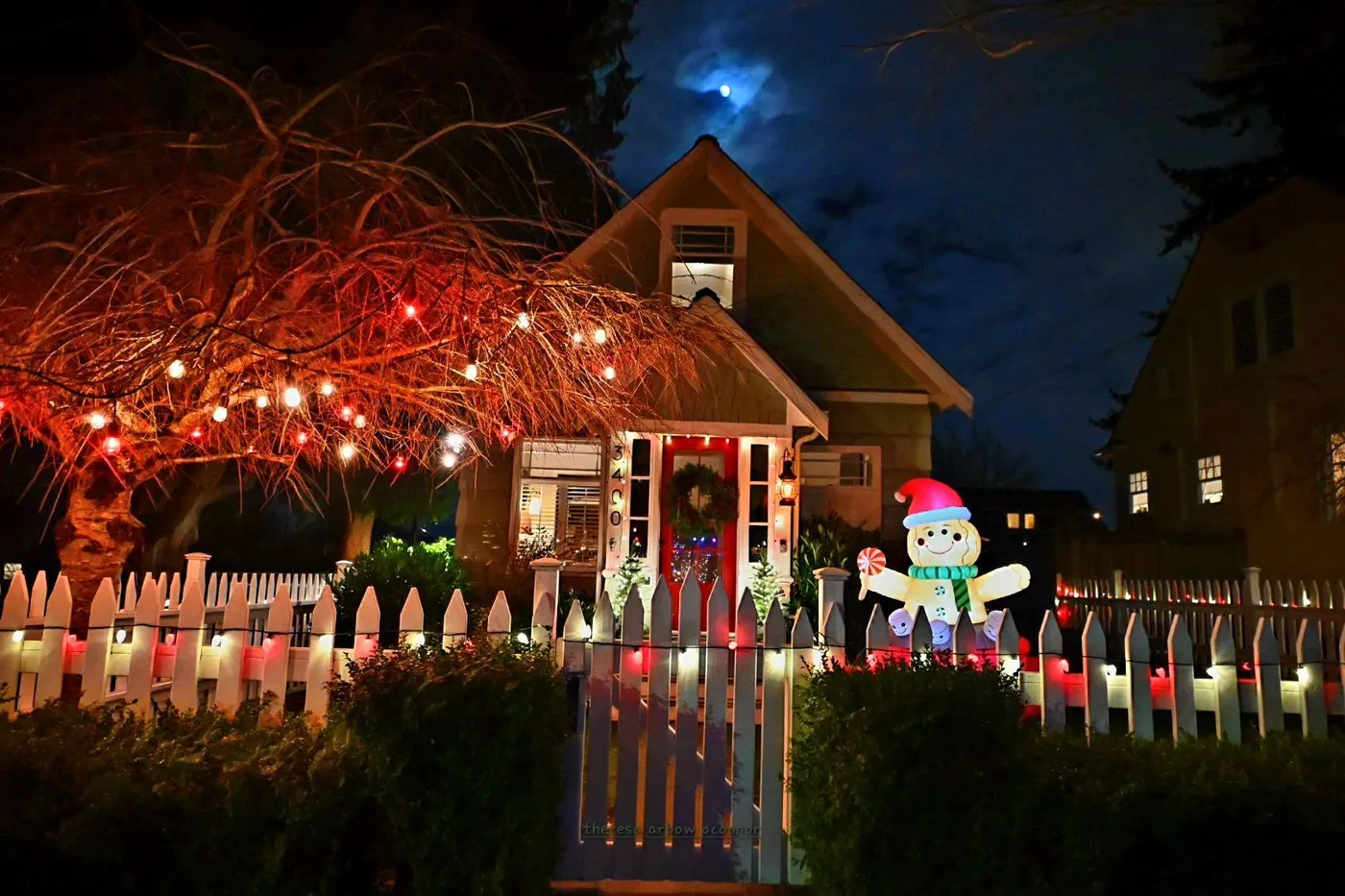
The gingerbread character’s placement is the clever bit. It’s behind the fence, so only its head and shoulders are visible — which is exactly what makes you smile. A full-size inflatable standing in the middle of the yard is just an inflatable. A character peeking over a fence is a character doing something. If you own any inflatable at all, position it so the fence line crops it, and put a light source behind it so the silhouette separates from the house.
28. Warm Garland and Cardinal Ornaments Along a Boardwalk Row
Long runs succeed through repetition with a small variation built in. Here the fence carries the same garland, warm lights, and red bows for the entire block, and the cardinals are the only element that changes — which gives your eye a reason to keep traveling without ever being startled. The white clapboard houses behind repeat the fence’s white, so the whole street reads as one continuous composition. That’s a neighborhood effect, not just a yard effect, and it’s why this kind of display photographs so well from a distance.
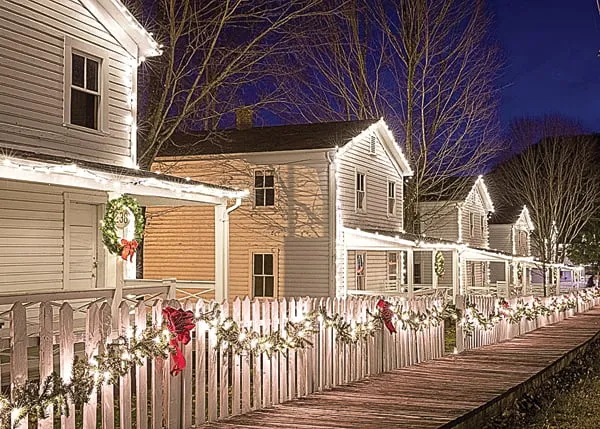
This look is built for scale — 40 to 120 feet of fence, along a boardwalk, sidewalk, or shared walkway. Plan on one bow and one garland attachment every 6 feet, which on a 100-foot run means roughly 17 attachment points, about 150 feet of garland, and six or seven light strands. Keep garland diameter consistent; mixing a thick strand with a thin one halfway down is visible from a block away. On shorter runs, use Idea #24‘s alternating-bow rhythm instead.
29. Warm Lights, Stockings, and a Flocked Tree by the Fence
Building this warm-lit corner:
- Green garland, 18 ft: $45–$90
- Warm white string lights, 400 bulbs: $30–$55
- Outdoor-friendly stockings, set of 5–6: $30–$70
- White flocked tree, 6 ft: $60–$140
- Red ornaments, hooks, timer, cords: $30–$55
Total: $195–$410. A plain green tree plus a $12 can of flocking spray saves $40–$80 and looks nearly identical from the street.
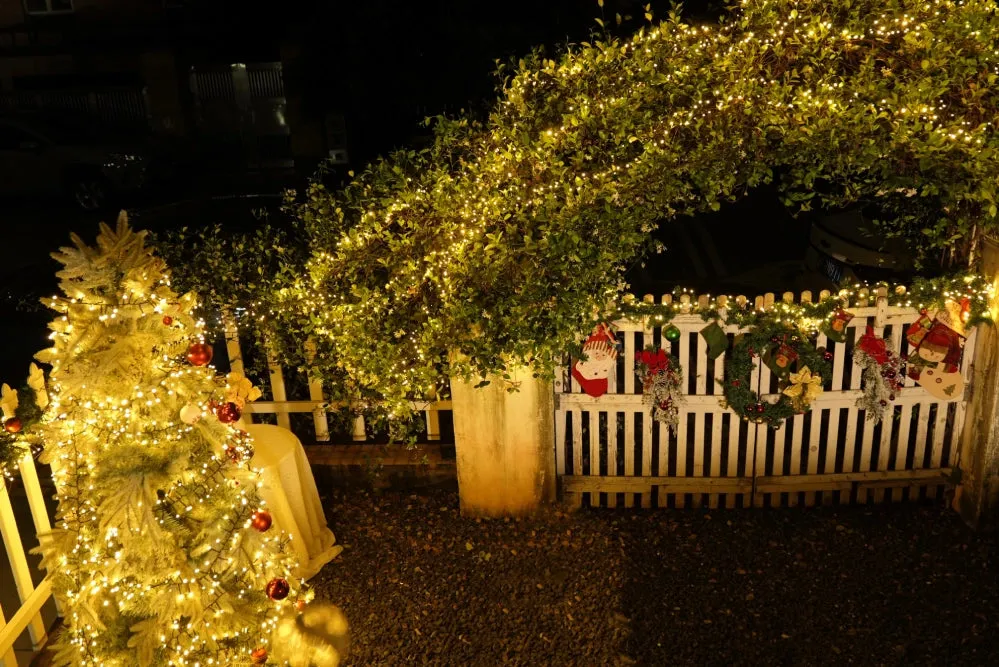
Hanging stockings on a fence looks charming right up until the first windy night:
- Reinforce each stocking’s loop with a second stitch or a small zip tie.
- Attach to the garland, never to a picket — garland flexes in wind, wood doesn’t.
- Add two or three clean river stones in the toe of each stocking as weight.
- Space them evenly at about 14 inches apart so the row reads as a line.
Time: 25 minutes. Cost: $5 for stones, plus stockings.
30. Color-Changing LEDs Hidden Inside a Low Picket Fence
The light source is inside the fence. That’s it — that’s the trick. Because the LEDs sit within or behind the pickets rather than draped on top, the fence itself becomes the fixture, and the rainbow gradient reads as if the wood is glowing from the inside out. Take that away and you have string lights on a garden border. Keep it and you have something people slow down for. It’s also remarkably tidy from the sidewalk, with no visible wiring at all.
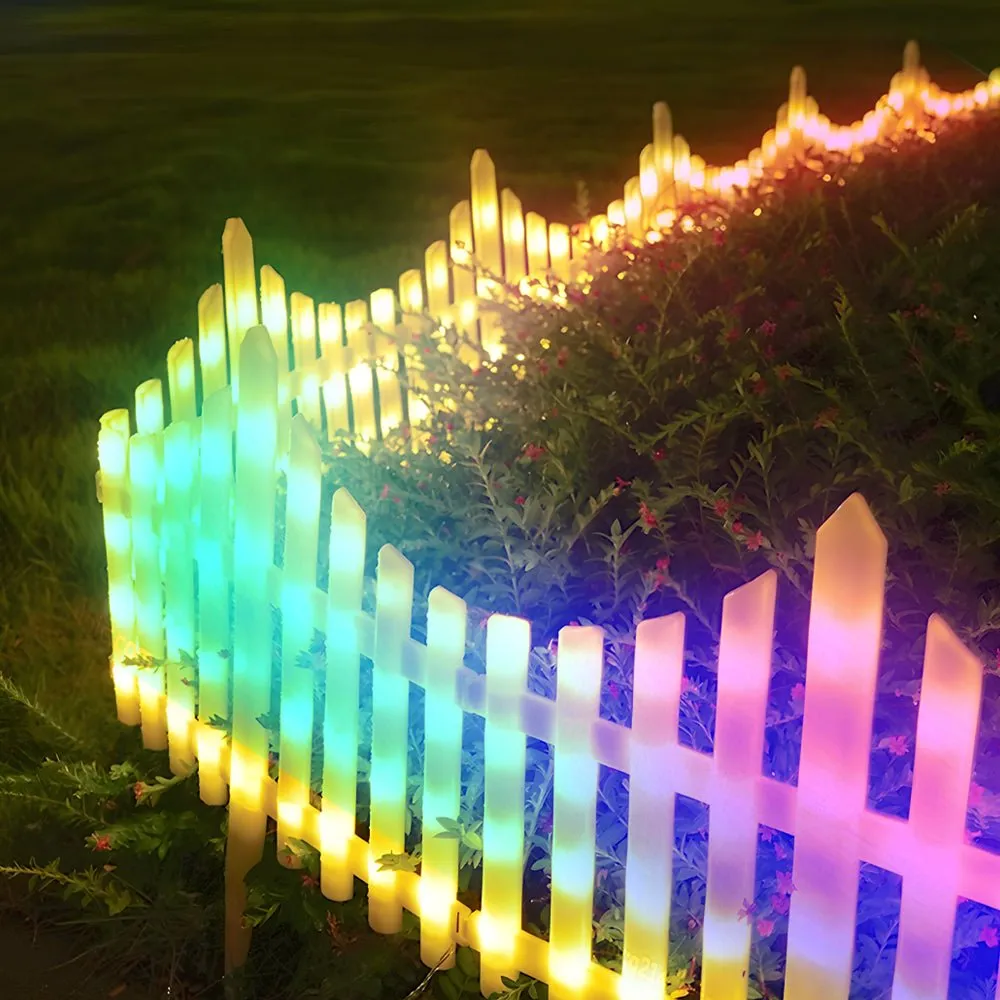
App-controlled color-changing LEDs have changed outdoor decorating more than anything else in the last five years. You can set warm white on December 1st, switch to candy-cane red-and-white mid-month, and go full rainbow on New Year’s Eve without buying a second set. That same hardware is why you’re seeing more color-coordinated displays in 2026 — people schedule colors the way they schedule porch lights. Buy once and you’re decorating every holiday on the calendar, which is genuinely better value than seasonal sets.
31. A Foliage Archway with Stockings, Wreath, and Garland Below
For stockings on a fence, the failure mode is always the same: the stocking fills with rain and sags, or the wind turns it into a flag. Solutions that actually work — poke two small drainage holes near the toe, weight the bottom with a stone, and attach at two points, the loop plus the cuff, rather than one. If you’re hanging them below an illuminated archway, put a warm light source inside the toe of any stocking you want to stand out; backlit stockings look magical, front-lit ones just look wet.
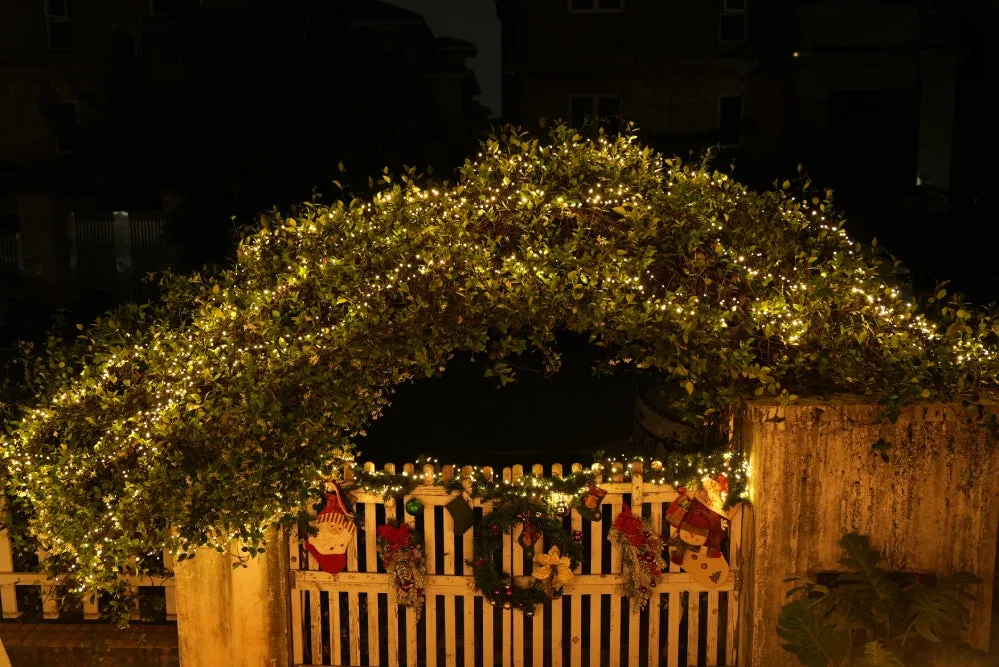
Arches look expensive and mostly aren’t. A basic 8-foot metal garden arch runs $45 to $80, and everything that makes it look lush is zip-tied faux garland — roughly $60 to $100 worth for full coverage. Christmas stockings at Dollar Tree are $1.25 each and read perfectly at fence distance; nobody is inspecting the stitching from the sidewalk. Total for a full arch-and-fence moment: $130 to $200, versus $500-plus for a custom fabricated arch.
32. Red Strands on the Fence, Warm White Wrapped Around Trees
Wrapping bare trees is beautiful on day one and slightly heartbreaking on day thirty. Winter sun and wind abrade the wire insulation, and wrapping too tightly can girdle small trunks, so leave a little slack and never wrap the same spot twice. Take the strands down by early March — bark grows, and a strand left on through spring will scar the tree. Real trees also drop twigs constantly, so expect to untangle debris from the wire at least once mid-season.
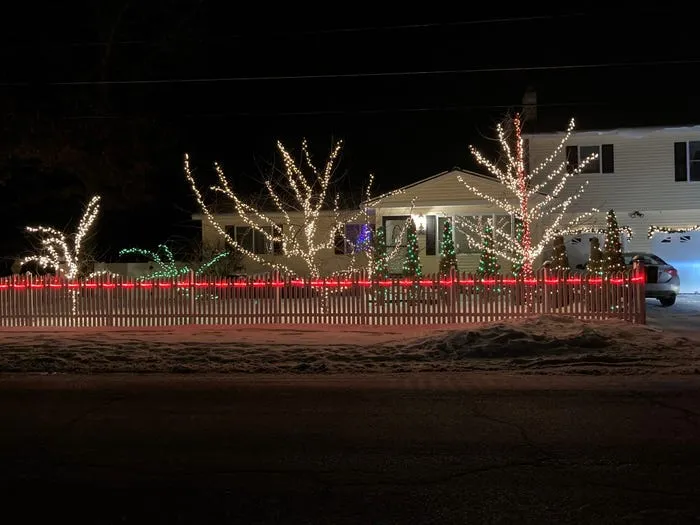
One honest note on red: red bulbs read dimmer than warm white at the same wattage, because the eye is less sensitive to long wavelengths. A fence that looks fully lit in a photo may look sparse in person with red-only strands. If you love the red line, use a denser strand — 150 bulbs per 20 feet instead of 100 — or double up. Also check your fence’s paint color: red string lights against a red-brown fence disappear at dusk, while the same strand on white reads bold.
33. Red Door, White Facade, and Garlanded Picket Fence
The palette math here is clean: about 60% white, 25% red, 15% green, with a small amount of multicolor only in the little lit trees. The white does the heavy lifting — facade, fence, shutters, faux snow — which makes the red door the single loudest element in the composition. That’s why it works. If your facade isn’t white, compensate: choose a lighter fence treatment or add white garland accents so the red still has something crisp to sit against.
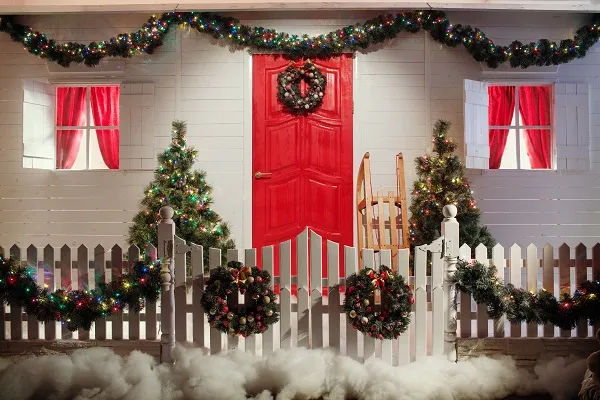
This look scales down beautifully. On a facade under 20 feet wide, use garland along one fence run and a wreath on the door — that’s plenty. Wider facades can take garland on both runs plus matching wreaths on every visible window, spaced evenly. Keep wreath diameter at roughly one-quarter the window width; a 36-inch window takes a 9-inch wreath. If your fence sits more than 15 feet from the house, treat the two as separate displays sharing a palette, like Idea #11.
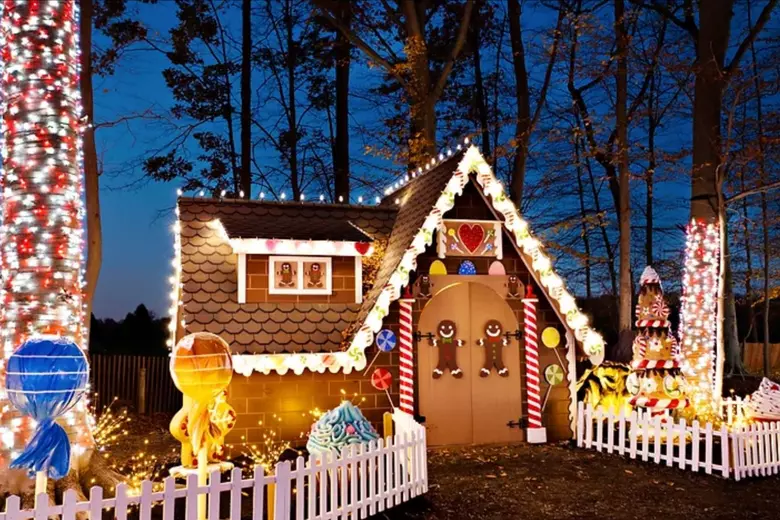
34. Gingerbread House Facade with Oversized Candy Props Outside
The oversized candy props are the reason this reads as a scene instead of a house. Scale is doing all the work: candy canes the size of a person, wrapped in red and white, next to a fence that suddenly looks miniature. Remove them and you have a brown building with white trim. Keep them and you have a story. If you’re recreating this on a budget, go big on three or four pieces rather than small on twelve — the exaggeration is the whole point.
Five checks before you commit to a candy-land front yard:
- Measure fence height; props should be 1.5 to 3 times picket height to read as oversized.
- Confirm you have storage for props this large — a garage shelf won’t do.
- Check wind exposure; hollow props need internal weighting or they roll.
- Verify props are waterproof-sealed, not just painted.
- Plan outlet runs before you place anything.
Whimsy succeeds when it’s committed. Half a candy display looks like a mistake; a full candy display looks like a decision, and that’s what makes people slow down and take photos. The brown gingerbread facade, the white icing trim, the candy props, the red-and-white wrapped trunk — everything speaks the same visual language, which is why the exaggeration lands as charming rather than tacky. When you push scale, push consistency just as hard.
Your Fence Is the Front Row of Christmas
Thirty-four ideas in, the takeaway is simple: a fence is the cheapest square footage you own and the first thing anyone sees. Start with one layer, get your color temperature consistent, and add a piece or two each December — that’s how the best displays in the neighborhood actually get built. Pin this guide before you head to the store.