34 Jaw-Dropping Kitchen Christmas Tree Ideas for 2026 That Will Transform Your Space

You know that feeling — you’ve saved a dozen kitchen Christmas tree photos, and none of them quite fit the eight feet of counter you actually have. That’s the thing about a kitchen tree: it lives in the busiest room in the house, so it has to earn its square footage. We went through hundreds of real photos from real kitchens — modern farmhouse, soft pastel, traditional red-and-green, and rustic natural among them — and narrowed it down to 34 ideas you can genuinely pull off. Budget versions land around $60 with pieces from Target, Walmart, IKEA, Amazon, and Etsy; the full designer treatment runs closer to $2,400. Every idea is shoppable, and where it makes sense we put the budget and luxury versions side by side. And stay until the end — we break down the most common mistakes that can ruin these looks. 📌 Save this to Pinterest for later — you’ll want to revisit these ideas.
1. White-and-Silver Tree Beside a Subway-Tile Galley
Two moves are doing all the heavy lifting. The garland doesn’t drape over the cabinet doors — it traces the line above them, so your eye reads it as part of the architecture instead of clutter. And the tree sits at the seam between the kitchen and the dining table, which means one tree lights two rooms. That’s a lot of holiday for a very small footprint.
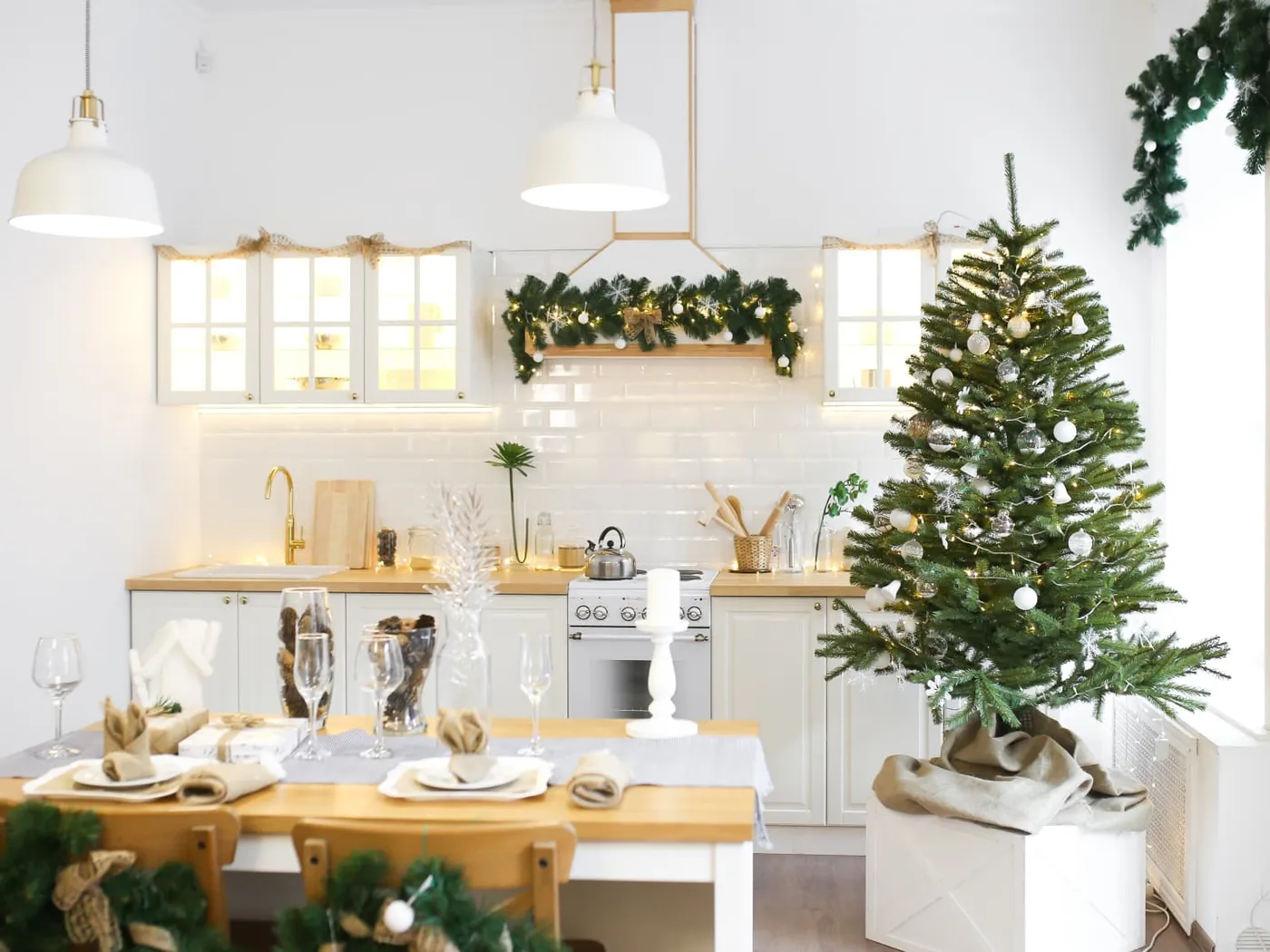
For garland that looks full without looking like a craft store exploded, budget one 9-foot strand for every 6 feet of cabinet run, then run a second string of warm-white lights through it separately from the garland’s own bulbs. Two light sources at slightly different depths are what create the glow-and-shadow effect you keep saving to Pinterest. Skip cool-white LEDs here — the white cabinets, glass-front uppers, and light wood counters already run warm.
2. Soft Pink Wall With Pastel Mugs and Mini Pines
Here’s the formula: 65% soft pink wall and white open shelving, 25% pastel accents — the pink and light blue mugs, the little artificial pines — and 10% chrome and light wood to keep the whole thing from floating away. Swap the pink wall for sage or pale blue and it still works, because the ratio is what makes it read calm instead of candy-shop. Keep the metals to one family: chrome faucet, silver hardware, nothing gold.
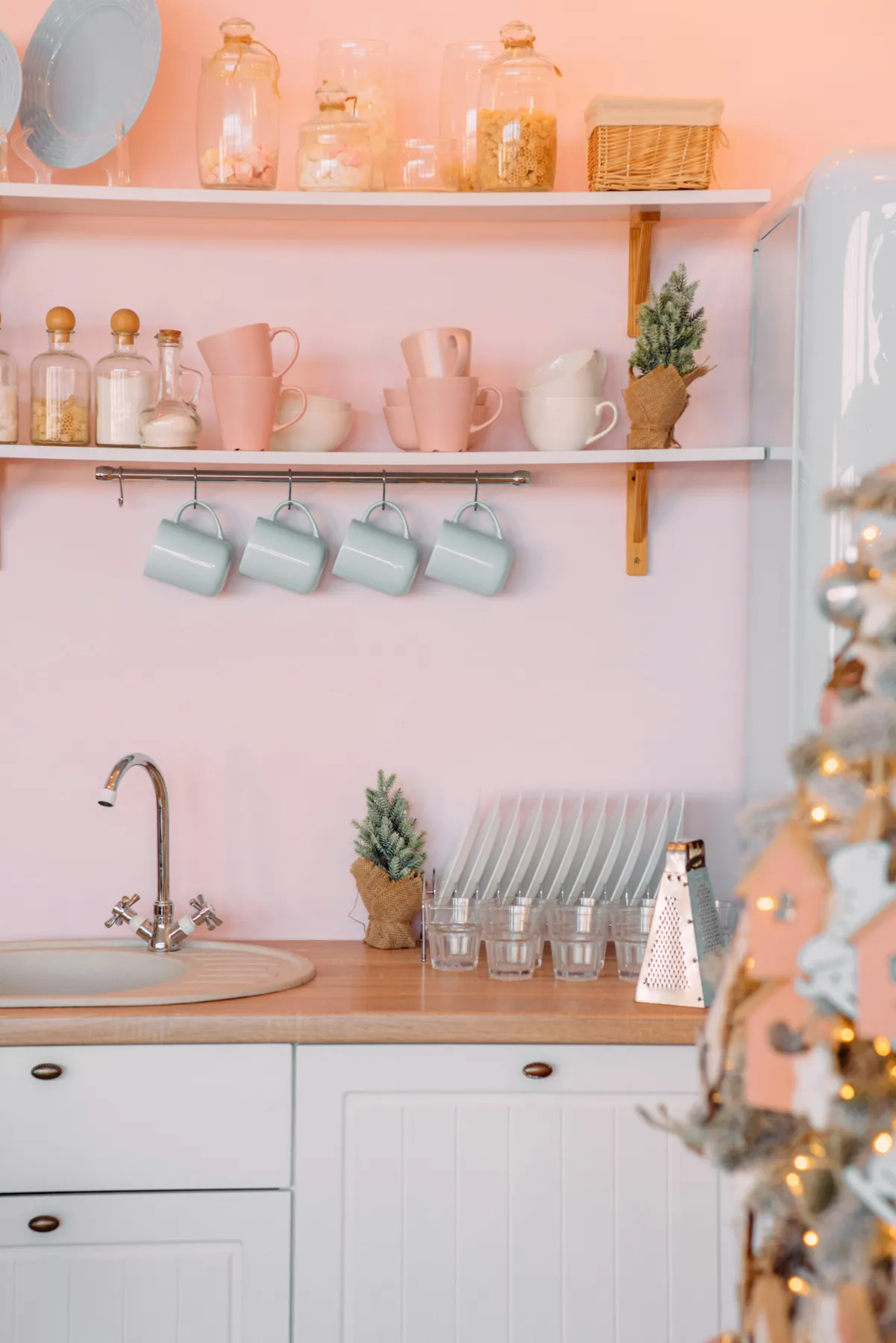
Pink paint is unforgiving of bad light. North-facing kitchens will pull it grey and slightly muddy, so if that’s your situation, go a half-shade warmer than the swatch you love. This look also leans hard on open shelving, which means every mug is on display. If you don’t actually enjoy styling shelves, this isn’t the palette for you — and that’s a reasonable thing to admit before you buy paint.
3. Sage Green Cabinets, Butcher Block, and a Cookie Island
- Main furniture and island styling: $300–$900
- Tree and lighting (7.5 ft tree, red ornaments, warm string lights): $180–$550
- Textiles (garland, tea towels, runner): $60–$180
- Decor and accessories (baskets, tins, cookie display): $70–$220
- Paint or wall treatment (shiplap paneling or cabinet paint): $150–$600
- Total: roughly $760–$2,450
- Budget alternative: paint your existing uppers sage, keep the butcher block you have, and source ornaments at after-Christmas clearance — about $420 all in.
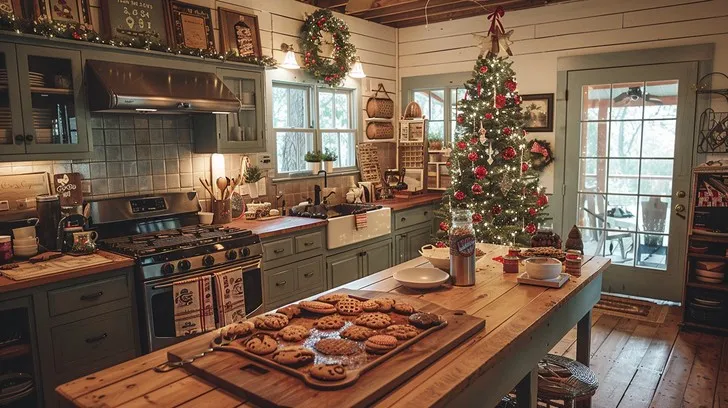
The tree is placed next to the glass-paned door, not jammed into a dead corner, and that matters more than any ornament on it. Daylight behind the branches makes the red baubles glow from two directions, and the tree frames the doorway instead of blocking it, so the room still functions while it’s decorated. Move that same tree six feet to the left and the entire scene goes flat.
4. Flocked Garland Framing White Shaker Cabinets
Flocked garland quietly replaced tinsel as the go-to for people who want snow without snow. The reason it’s everywhere right now: it photographs beautifully against white shaker cabinets, which is exactly what a kitchen with light marble counters needs — texture where there’d otherwise be none. Warm-white lights tucked into the flocking keep it from reading cold and fake. It’s a trend with real legs, because it solves an actual design problem instead of just being cute.
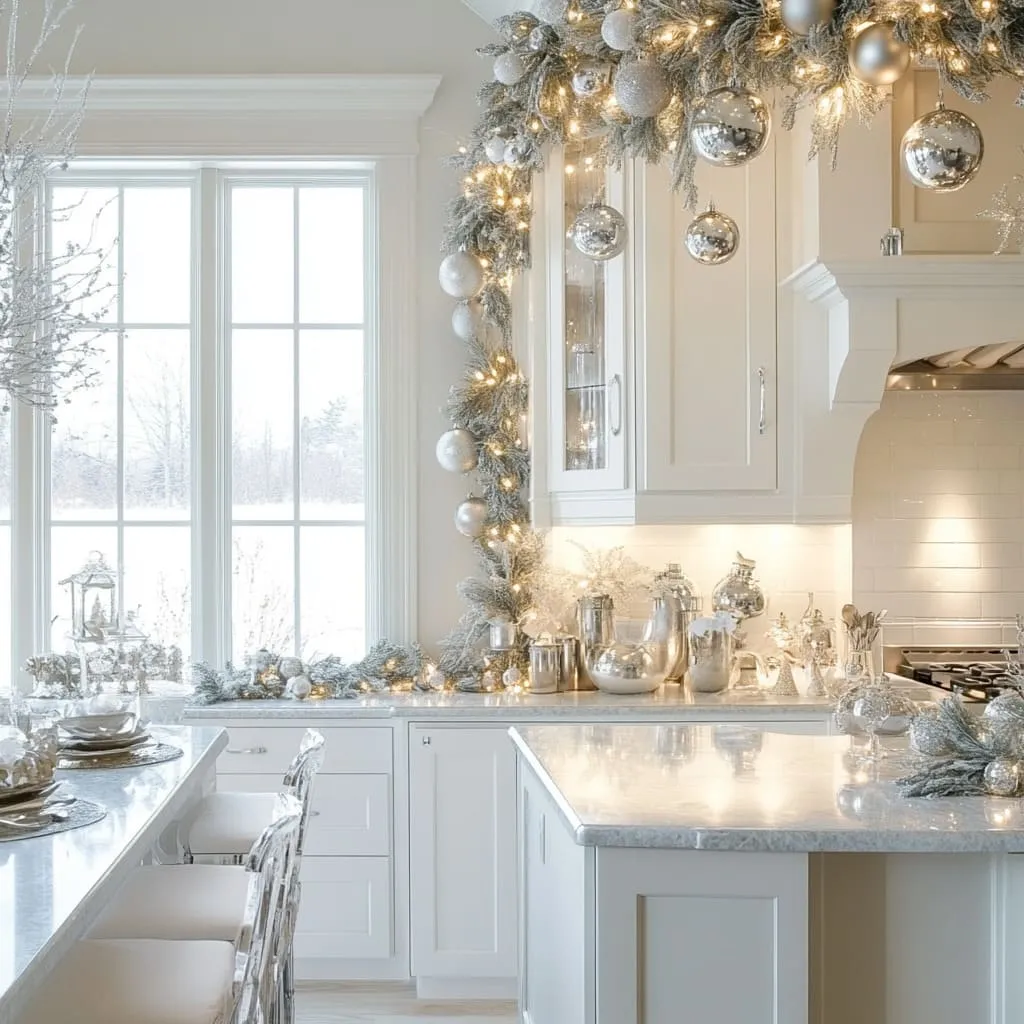
Flocked garland sheds. Before you drape it over cabinets or around a window, hit it outside with a hairdryer on cool for two minutes to knock off loose fibers, then line the cabinet tops with shelf liner. Secure it with adhesive cable clips rated for at least 2 pounds, because the cheap hooks fail in a warm kitchen. Space your silver and white ball ornaments no more than 5 inches apart — anything looser reads sparse from across the room.
5. Tabletop Tree and Pillar Candles on a Wooden Tray
- Find a shallow tray — distressed wood or a vintage dough bowl, roughly 20 by 14 inches.
- Set the mini tree at one end, not dead center; asymmetry keeps it from looking like a hotel lobby.
- Add three pillar candles of graduated heights, all battery-operated so you never worry about leaving them lit.
- Thread a strand of warm-white fairy lights through the tray, hiding the battery pack behind the tree.
- Finish with a few snowflake or gold bauble ornaments resting loose on the tray floor.
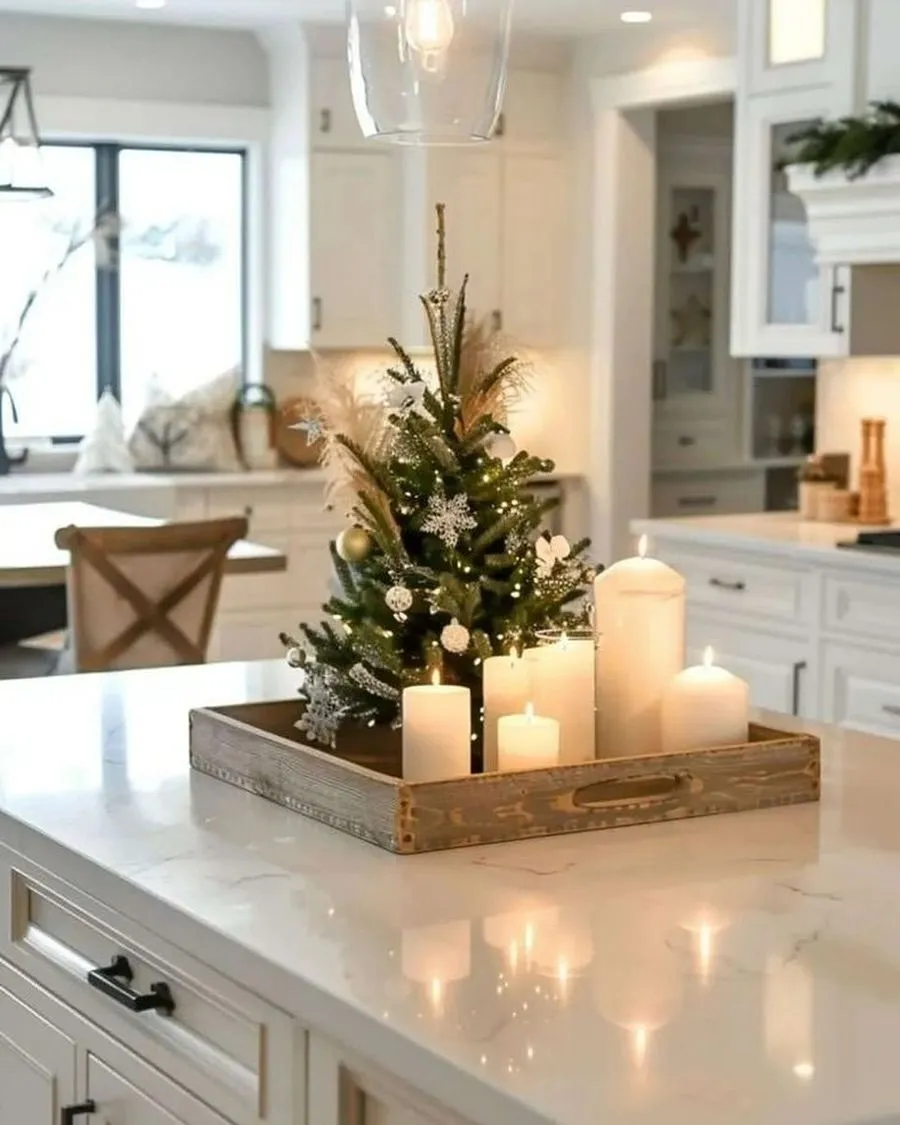
About 45 minutes and $40–$90, and it moves from island to mantel in February.
You don’t need the designer version of this. Target’s mini trees run $15–$25 in early December, Walmart’s flameless pillars are three for about $18, and any thrift store has a wooden tray for $4 with a little furniture wax on it. Total look: under $60. The one thing worth actually spending on is the lights — cheap fairy lights flicker and die by New Year’s, so buy a set rated for indoor use from a brand you recognize.
6. Stacked Ornament Pyramid on a Speckled Countertop
It shouldn’t work. A tree made of stacked ornaments is basically a pile. But the pyramid shape does the organizing for you: big balls on the bottom, small ones climbing up, colors sorted so forest green sits at the base and copper and gold rise toward the top. The two black metal reindeer candle holders flank it at identical distances, which frames the arrangement, and the oversized wooden cutting board behind gives the eye somewhere neutral to rest.
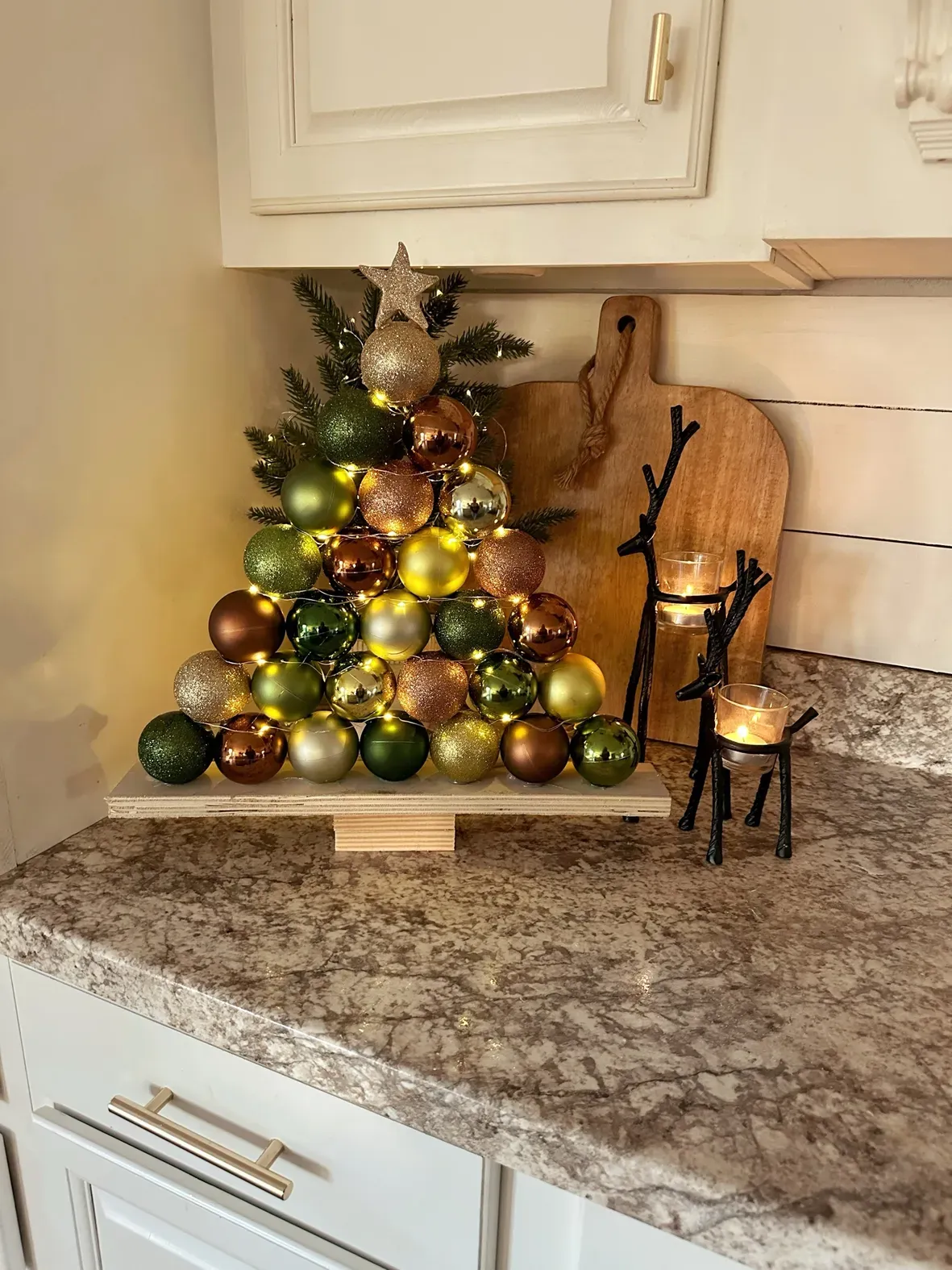
Stacked-ornament trees are dust magnets — all those gaps collect it, and glittery balls show fingerprints. Plan on a quick pass with a microfiber duster every week, and expect to restack it at least twice a season in a kitchen with real traffic. If that sounds exhausting, a single woodland arrangement in a wooden bowl gets you the same cozy note with a tenth of the fuss. Never place this one within splatter range of the stove.
7. Red Berries on Open Shelves Above a Black Sink
Open shelves above a sink are the hardest styling job in the kitchen, because you’re decorating at eye level. Keep everything under 10 inches tall so nothing blocks the white subway tile, group objects in threes, and leave one shelf section nearly empty. The red berries and green garland should occupy no more than a third of the total shelf run — if the shelves start looking like a store display, you’ve gone one item too far.
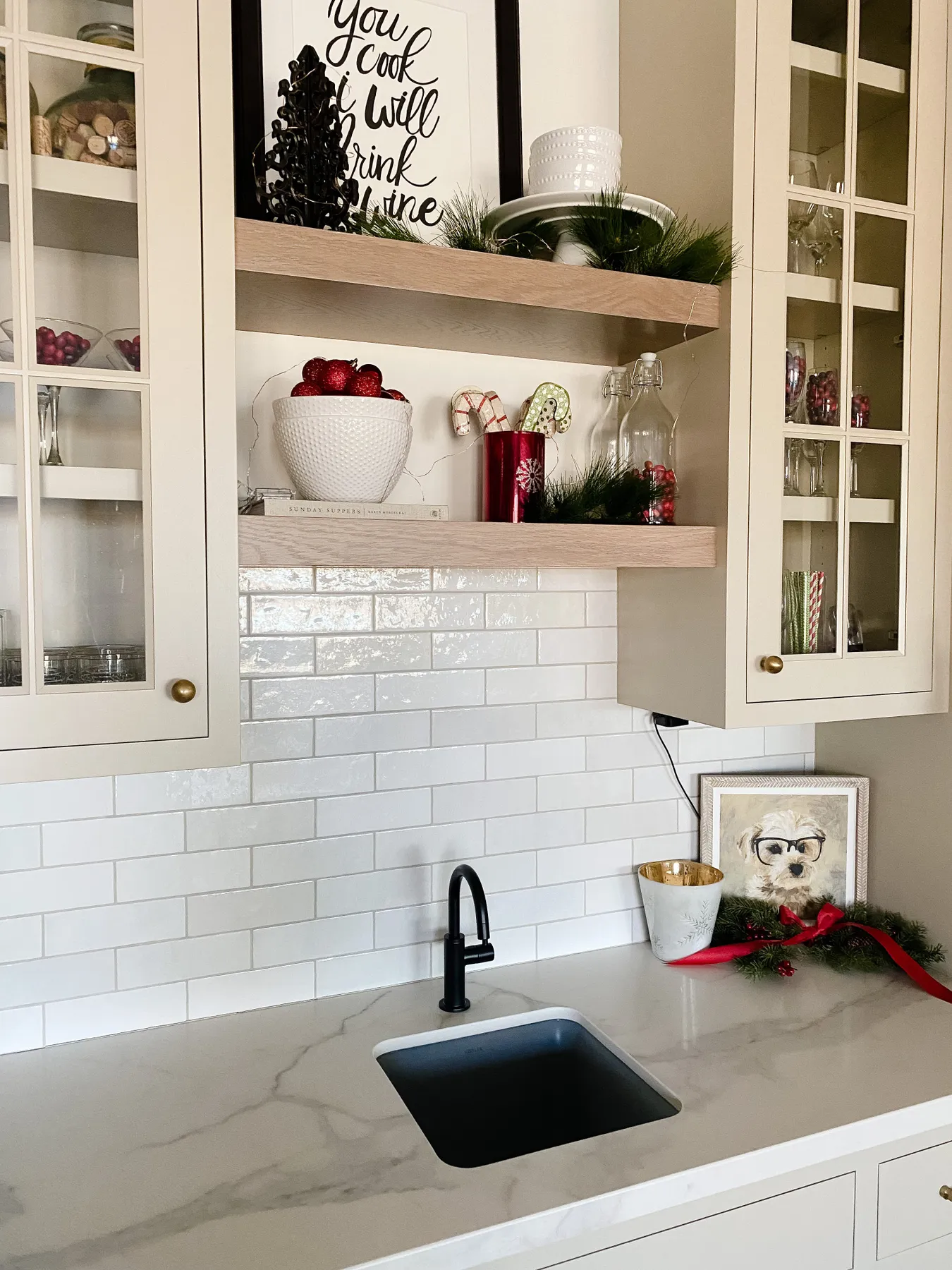
This is a two-wall layout, and it works best in 80–130 square feet with a ceiling at 8 feet or higher. Below 80 square feet, drop the garland from the shelves entirely and keep only the small decorative trees so the room doesn’t close in on you. If you’re working with a bigger open kitchen, see the shelving approach in Idea #10, which spreads the same look across a dining nook instead of a single wall.
8. Burlap-Wrapped Mini Trees and White Ceramic Houses
Burlap and fairy lights are charming right up until you’re handling them in a kitchen. The fabric sheds, and those thin wires mean a hot pan set down too close can do real damage. Keep every wrapped tree at least 18 inches from the cooktop, use battery packs instead of a daisy chain of extension cords, and confirm your lights are cool-touch. If there are toddlers in the house, this whole countertop grouping should move to a shelf above their reach.
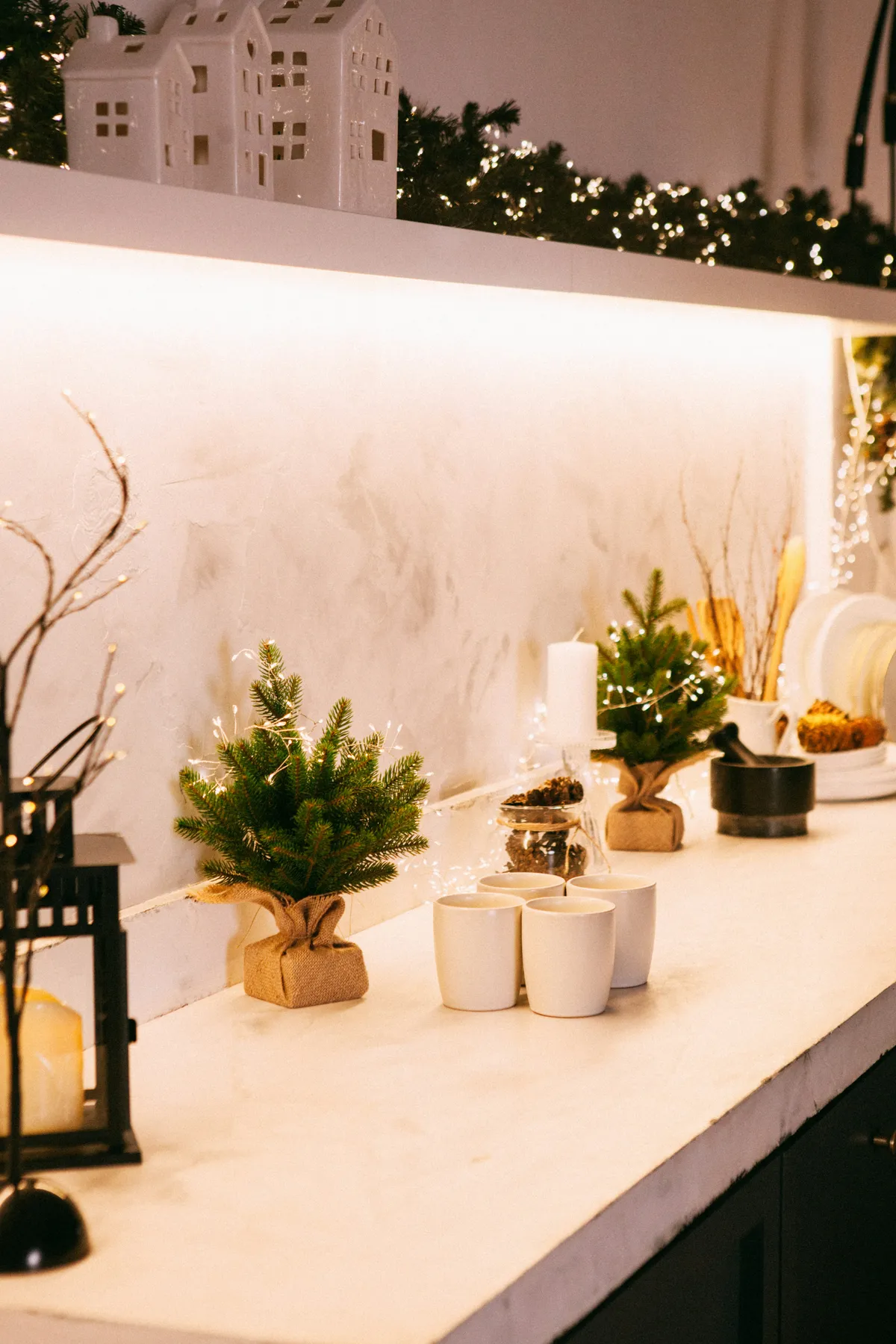
The mix here is 50% warm neutrals (white ceramics, cream mugs, that light grey textured backsplash), 30% natural texture in the brown-and-burlap register, and 20% warm light plus the black lantern to anchor it. That black lantern is doing more than it looks like — without it, the whole arrangement drifts soft and sleepy. Swap the ceramic houses for ceramic trees or little village buildings and the formula still holds.
9. Sheer Red Bows and an Antler Bowl of Baubles
The bows. Big, sheer, completely over-the-top red bows, tied to the garland at generous intervals instead of a fussy cluster of tiny ornaments. That single decision is what makes this read as joyful rather than merely tasteful. Pull them off and you have a nice green garland on white cabinets — pretty, forgettable. Keep them and the whole counter has a pulse. This is the budget cousin of Idea #3: same spirit, more ribbon, no full-size tree.
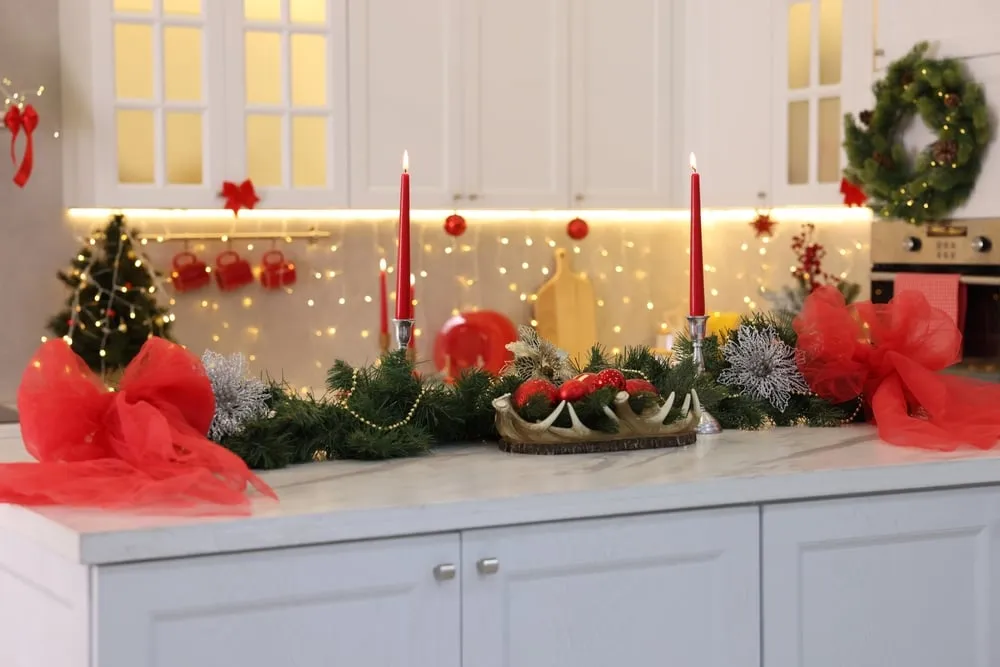
- Garland, 9 ft (real or good faux): $35–$120
- Sheer red ribbon, 2 rolls: $12–$30
- Red taper candles and silver holders: $20–$60
- Antler bowl or similar centerpiece vessel: $25–$95
- String lights and extra baubles: $30–$90
- Total: roughly $122–$395
- Budget alternative: skip the antler bowl and use a white ceramic platter you already own, and buy the ribbon at a craft store’s after-holiday sale — you’ll land near $70.
10. Woven Pendant and a Mini Tree in the Dining Nook
This nook needs 100–150 square feet and ideally a 9-foot ceiling to breathe, because that woven basket pendant hangs low and eats vertical space. A round table 42–48 inches across seats four without crowding the cabinets. If your kitchen is tighter, look at Idea #7, where the same festive notes live entirely on shelves and counters instead of a full dining setup.
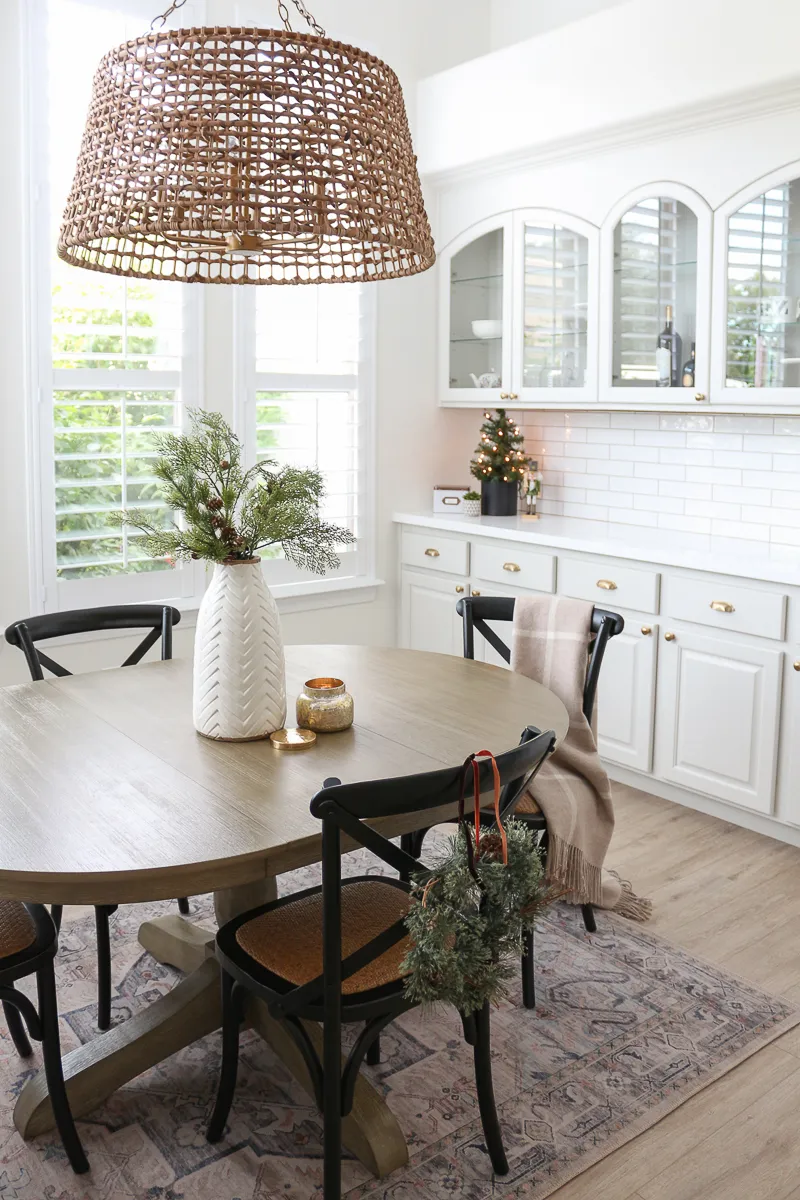
Three materials, repeated: light wood, white, black, with brass as the connector. The wood shows up in the round pedestal table and the pendant, black in the X-back chairs, white in the cabinetry — so even though nothing matches, everything relates. The miniature illuminated tree on the counter is deliberately small; a full-size tree here would fight the pendant for the same airspace. Knowing what not to put in a room is half of what makes a room work.
11. Candy-Themed Flocked Tree in a Laundry Nook
Laundry nooks are the cheapest place in the house to go big, because almost nobody sees them and nobody’s judging. A 6-foot flocked tree from Walmart runs $45–$70, candy-cane ornaments are a dollar or two each at Target and the dollar store, and the vintage-look Santa figurine with his lantern? Thrift stores are full of them in November for $8–$15. Facebook Marketplace is where you find the distressed green table. Under $150 gets you the entire scene.
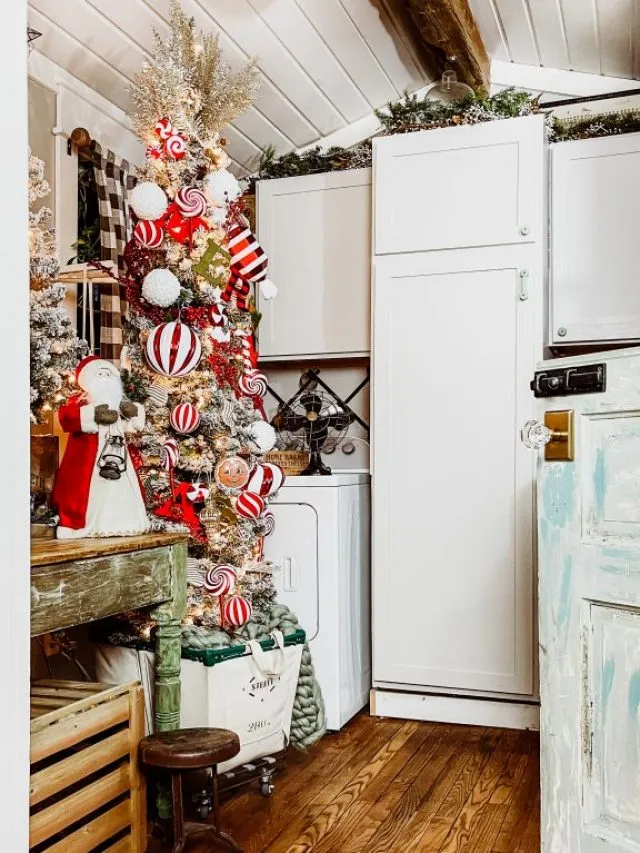
- Measure the door swing — a tree in front of a dryer door is a daily annoyance, not a festive touch.
- Check outlet placement; you want the tree within 6 feet of a plug without a cord crossing the walkway.
- Confirm the flocking is rated for a damp room, since some finishes discolor in humidity.
- Decide now who dusts it. Flocked trees in utility rooms collect lint faster than you’d think.
12. Tree Through the Archway of a Grey Flat-Panel Kitchen
Here’s a trick for open-plan kitchens: don’t put the tree in the kitchen at all. Frame it in the archway instead, so it reads as a vignette from the counter and as a full tree from the living room. Keep the sightline clear by leaving 30 inches of floor visible on either side of the opening, and set the blue and grey runner so its edges stop short of the tree’s drip line. Cost: zero. Effect: you get a two-room tree.
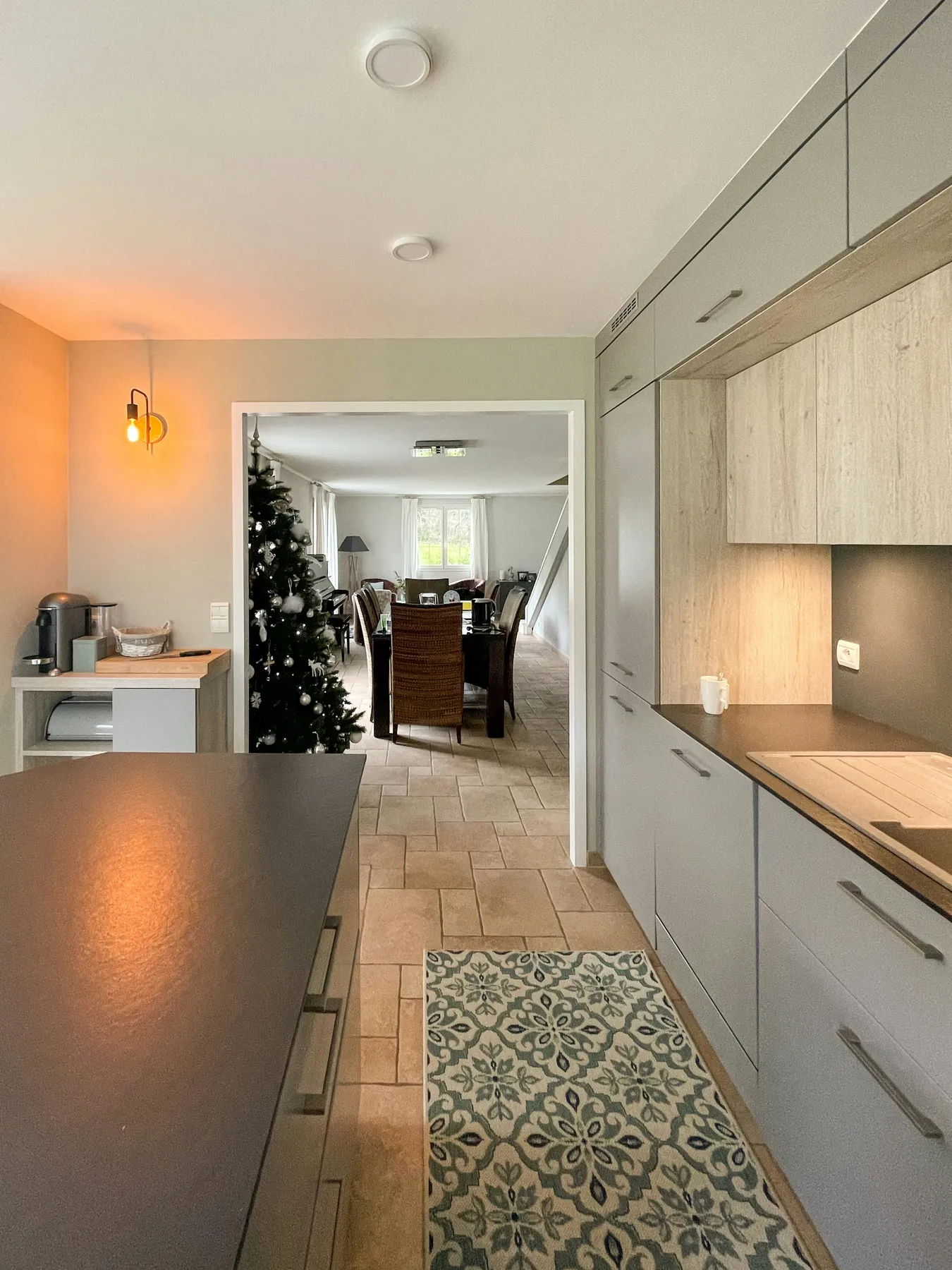
Grey kitchens got a bad rap for a few years, and the fix designers landed on is exactly this — warmth through texture rather than color. The light wood upper run and that patterned runner do work that a different paint color used to do. Layering a Christmas tree into the adjacent room instead of the kitchen itself is a distinctly 2026 move, because it respects how people actually live in open plans: the kitchen is for cooking, the tree is for gathering.
13. Slim Pre-Lit Tree With Plaid Cushions and Wreaths
60% white (round table, X-back chairs, tree) + 25% red and white plaid on the cushions and wreath ribbons + 10% evergreen green + 5% black in that ornate chandelier. The plaid is the loudest thing in the room, and it’s confined to soft goods, which is why it reads charming rather than chaotic. Want a different holiday altogether? Swap the plaid for navy-and-white gingham and the red for cranberry — the formula holds perfectly.
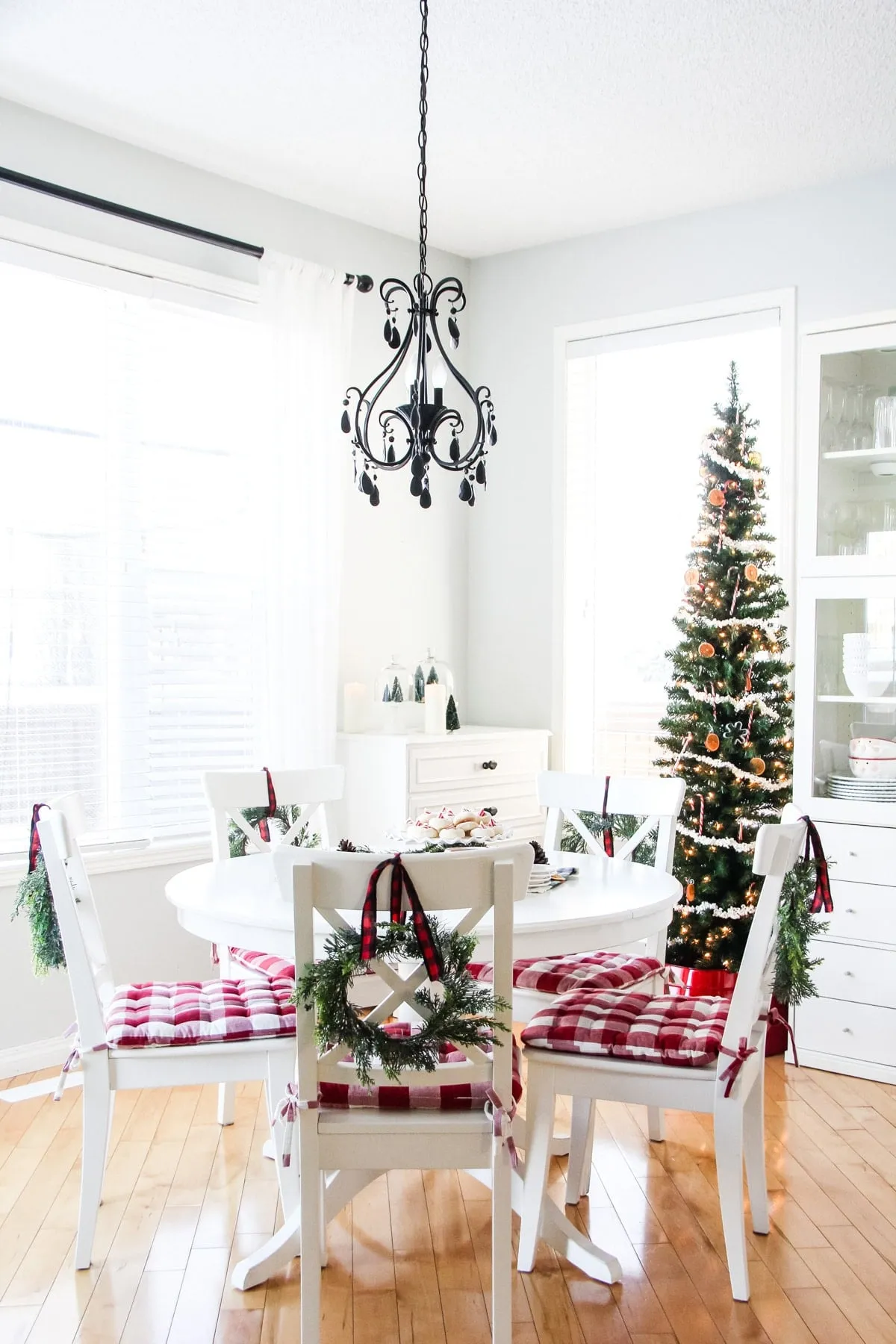
Red and white plaid is a commitment. Those cushions are a single-season look, so come January they’re done, which means you need somewhere to store them. Also, a slim pre-lit tree by a bright window is lovely, but if that window faces south, the lights will look weak all afternoon. Add a plug-in uplight at the base, or accept that this tree shines after 4 p.m. and plan your photos accordingly.
14. Quartz Island Set for a Crowd, Tree in the Corner
- Tree, 7.5 ft pre-lit, plus white and silver ornaments: $200–$650
- Table linens, charcuterie board, serving pieces: $80–$300
- Grey tufted bar stools, set of three (if you’re buying): $300–$900
- Textured glass pendant lights, pair: $120–$450
- Tree decor and skirt: $60–$200
- Total: roughly $760–$2,500
- Budget alternative: keep your existing stools and set the island with a $25 board from Target and good paper napkins — the look survives on tabletop styling alone, about $310.
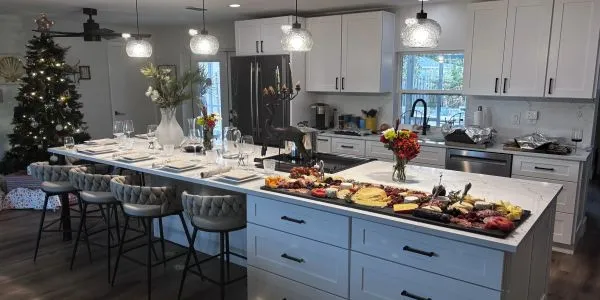
A 7.5-foot tree plus a quartz island with seating wants 200 square feet minimum and ideally a 9-foot ceiling. In an 8-foot room, drop to a 6.5-foot tree so it doesn’t crowd the pendant lights. Leave 36 inches of walkway between island and cabinets when the island is fully set; below that, guests end up shuffling sideways. Compare with Idea #1, which solves the same tree-plus-table problem in half the footprint.
15. Plaid Ornaments in a North Pole Mail Bin
- Find a vintage metal bin or crate — antique malls, estate sales, or a $20 reproduction online.
- Drop a weight in the bottom (bricks wrapped in fabric work fine) so the tree can’t tip.
- Set a small tree inside, then cover the base with burlap or a folded towel in cream or black.
- Add plaid and striped ornaments in alternating pairs, and don’t let any two touch.
- Finish with red poinsettias at the base and a burlap-and-check garland over the window above.
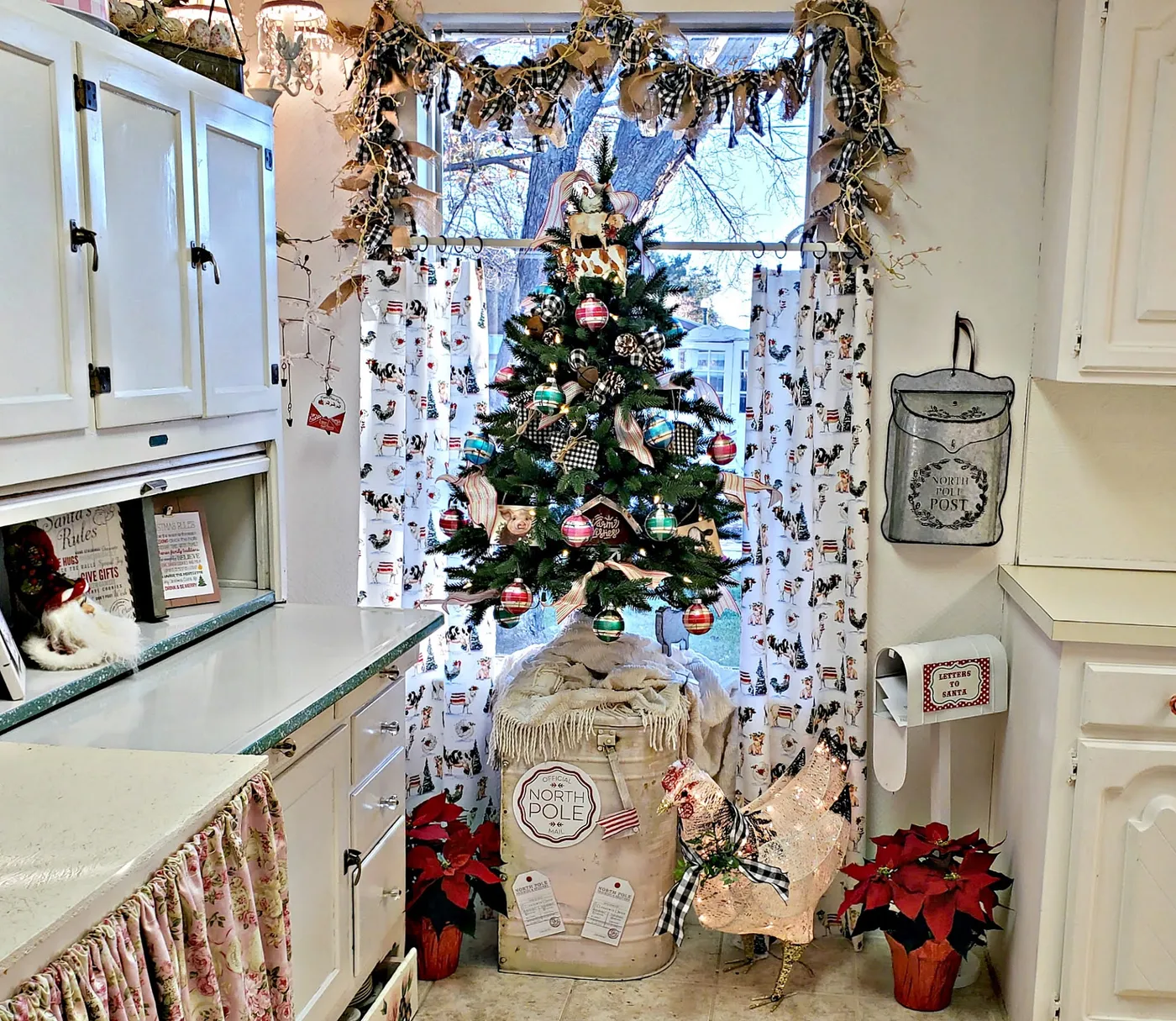
Budget about $55 and an hour. The bin is the part that sells it.
The bin. Not the tree, not the ornaments — the vintage-looking container the tree sits in. It shifts the whole thing from “Christmas decoration” to “scene,” and it costs less than a decent ornament set. Without it you’d have a small tree on the floor. With it, you have a story about the North Pole post office. That’s the cheapest kind of charm there is: one object doing all the storytelling.
16. Dark Green Cabinets, Warm Lights, and a Red Armchair
Dark green cabinetry is gorgeous and shows every crumb, fingerprint, and grease speck. Add a fresh-cut tree beside it and you’ve added needle drop to the chore list. Plan on wiping cabinet fronts weekly through December, and if the tree is real, water it daily — dry needles near warm pendant lights are a genuine hazard. A faux tree with warm LED lights gives you 90% of this look with none of the vacuuming, which is why most kitchens that look like this use one.
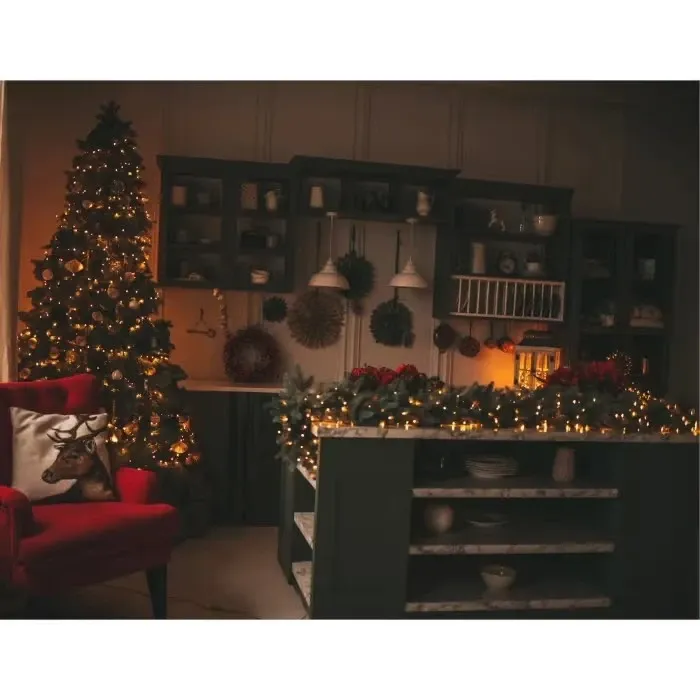
This room leans on a single idea: darkness makes light look better. Against deep green cabinets, warm string lights and white orbs read twice as bright as they would in an all-white kitchen. The red armchair with the deer pillow is the only soft saturated note, so your eye keeps returning to it. And hanging the wreaths flat on the wall instead of on doors keeps sightlines clear while still feeling dressed.
17. Plaid, Velvet, and Glass Trees on a Dark Tray
When you group decorative trees, vary the material every time — three trees in three finishes, not three green ones in different sizes. Here it’s plaid fabric, clear textured glass, and dark green velvet arranged on a tray with handles, which means the whole set moves as one piece when you need the surface back. Keep the group to a triangle: tallest at the back, shortest in front, no two the same height.
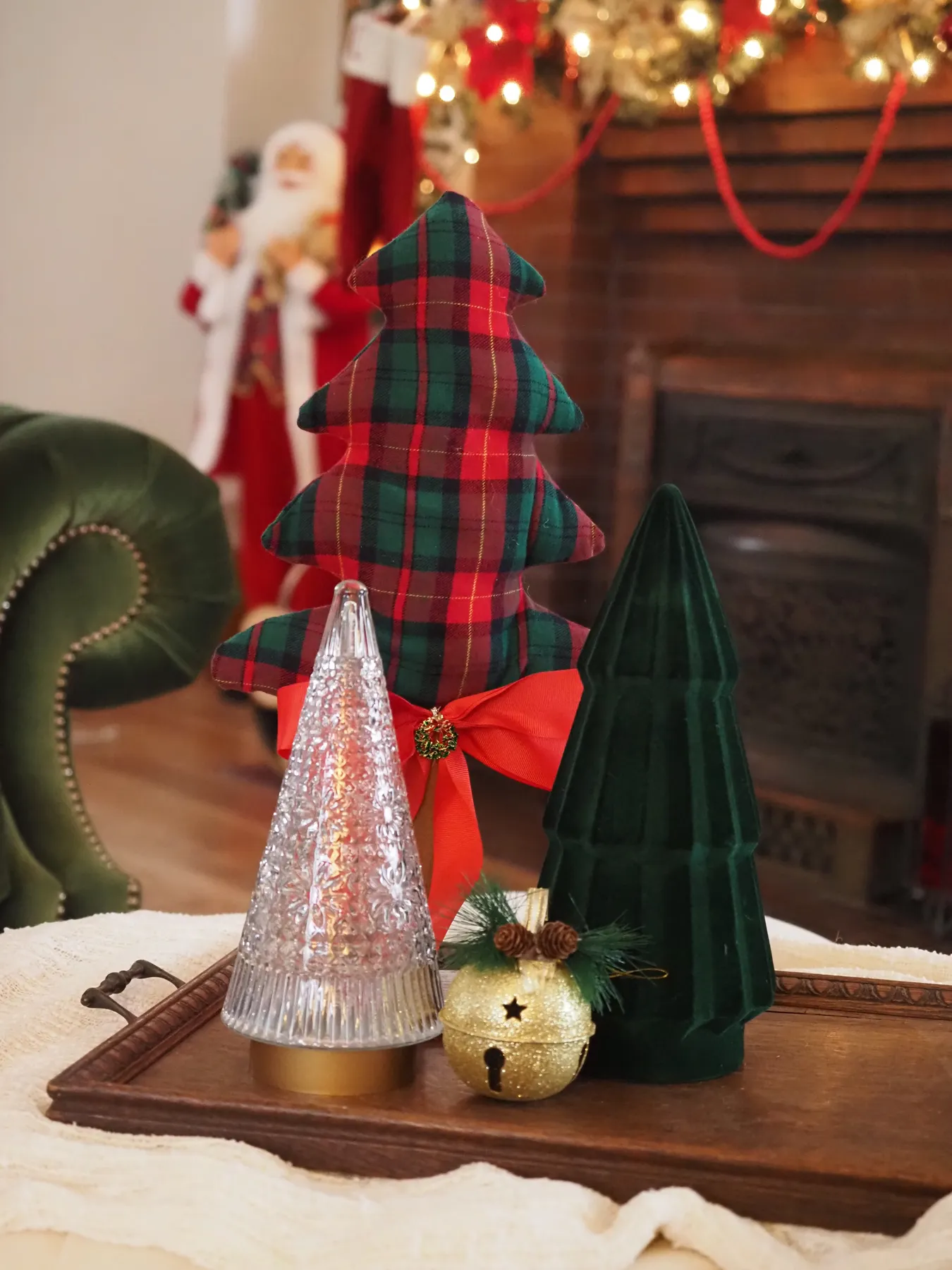
Roughly 40% green (velvet tree, pinecone accents), 30% red (plaid, bow, the golden jingle bell), 20% gold and dark wood (that tray, the pinecones), and 10% clear glass for shine. The tray is what holds it together — that dark wood is the neutral the whole trio sits against. Swap the plaid tree for buffalo check and the velvet for deep burgundy, and you’ve got the same formula in a different mood.
18. Dried Oranges on a Slim Tree by Sheer Curtains
This corner setup suits a 90–150 square foot dining area with decent natural light, since the whole vignette depends on that bright window and the white sheer curtains. The tree is deliberately slender — 5 to 6 feet tall with a narrow profile, roughly 24 inches wide at the base — so it can sit beside the white dresser without blocking traffic. If your dining corner is dim or under 90 square feet, see Idea #5, where the same natural palette shrinks down to a single countertop tray.
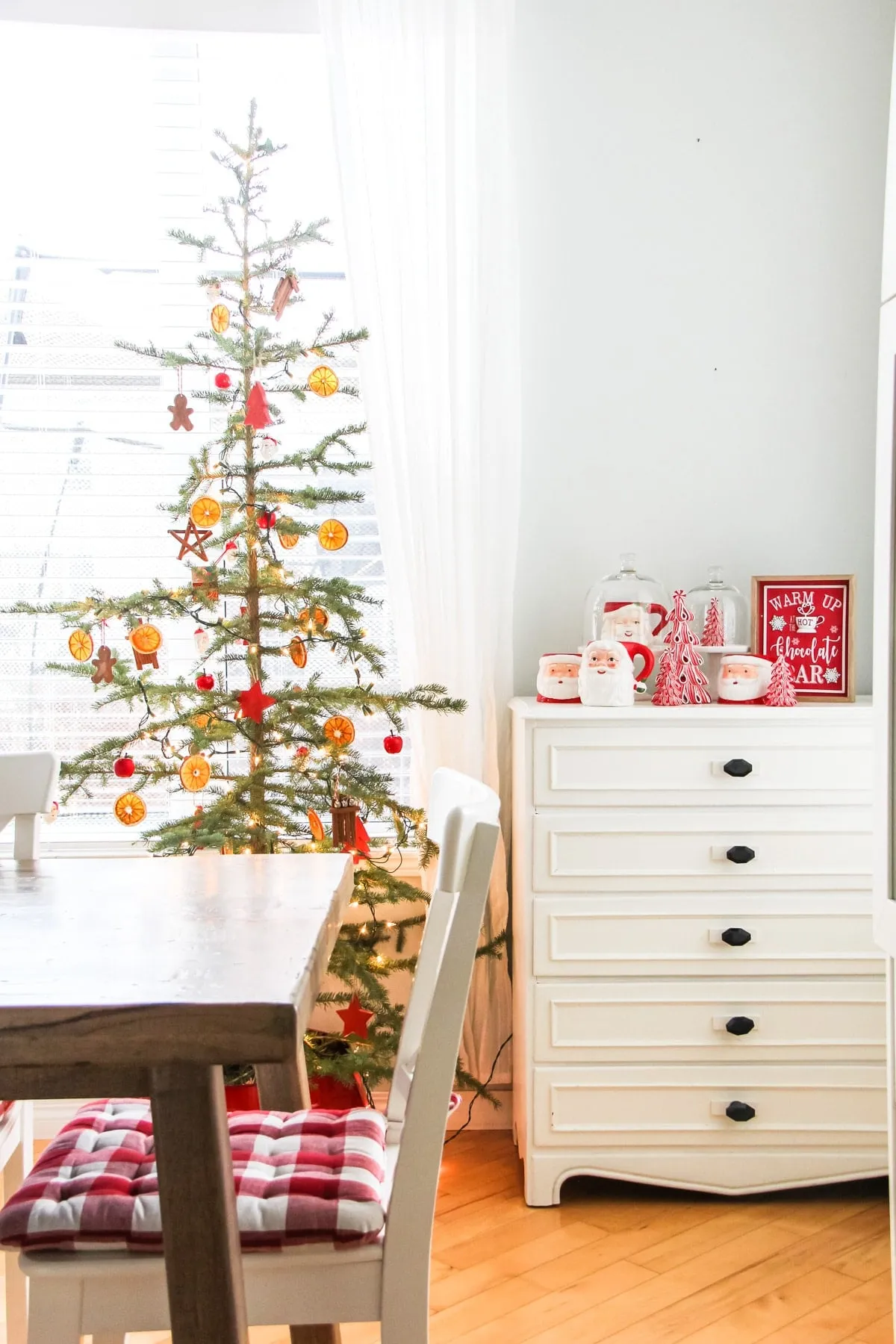
Dried orange slices are the great budget ornament: two oranges, a $15 dehydrator or a low oven, and six hours gets you a dozen slices that look and smell expensive. Buy gingerbread ornament blanks at Target for $6, and hunt the Santa mugs at thrift stores — vintage ones turn up constantly at $2–$4 each. The white dresser? Marketplace, $40–$80, painted. The whole corner comes in under $200.
19. Mini Tree in a Woven Basket on an Olive-Tile Counter
Small trees in woven baskets are the easiest holiday upgrade there is, with one catch: baskets and water don’t mix. If your tree is real, the basket needs a hidden liner and a saucer, or you’ll be refinishing that wooden countertop in January. Also check your backsplash situation — if it’s a hand-painted tile with a motif like these olive branches, resist adding more pattern nearby. Let the tile be the star and keep the tree simple.
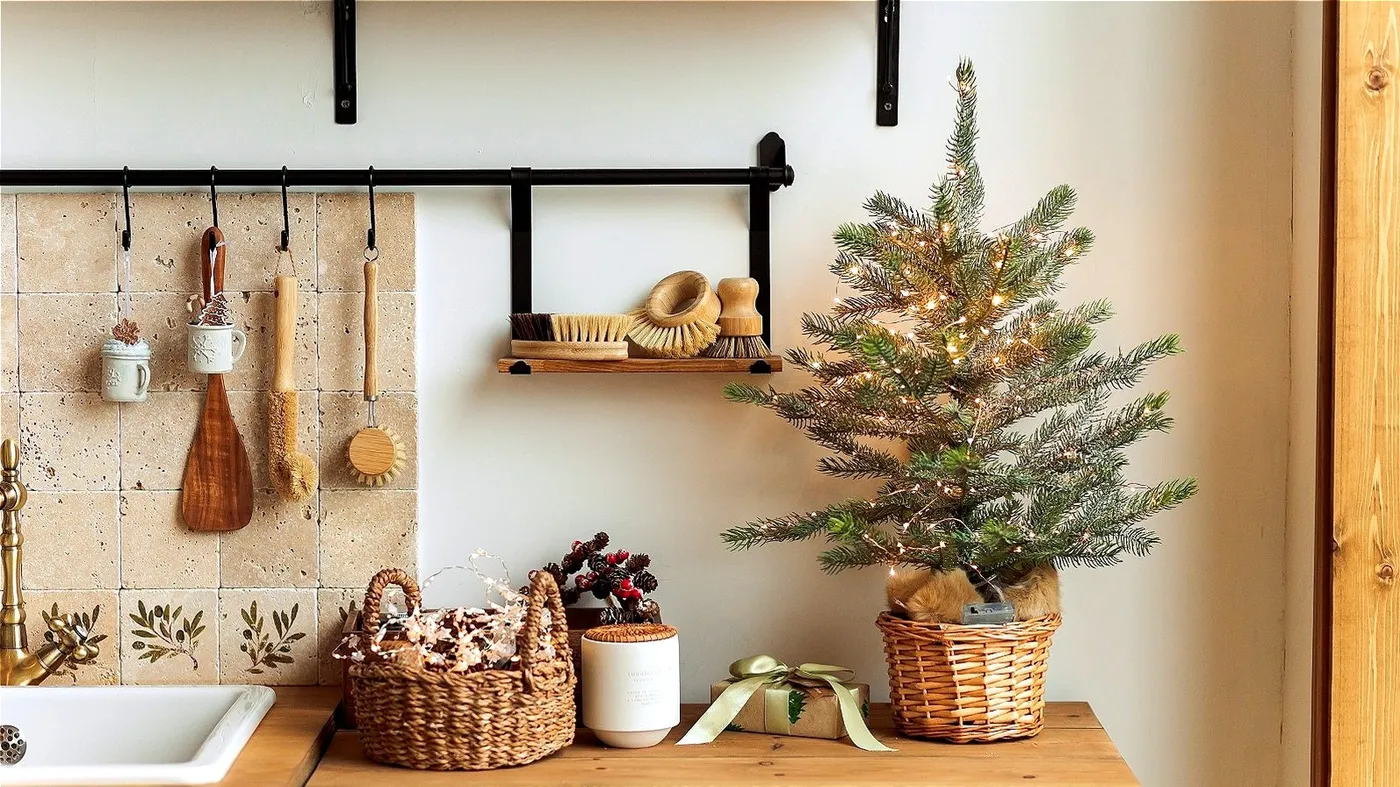
On a countertop run under 6 feet, keep your holiday cluster to a footprint of roughly 14 inches square. Any bigger and you’re decorating your way out of a workspace. This arrangement works because everything sits in one basket: the tree, the lights, the weight. It also leans on an existing black metal rail — if you have one, hang your wooden utensils there instead of adding new hardware, and the room reads styled rather than decorated.
20. Flocked Tree in a Planter Box on a Rustic Shelf
- Check shelf depth — a planter box plus a lantern needs at least 12 inches front to back.
- Confirm the shelf is anchored into studs; a lantern with a glass shade is heavier than it looks.
- Use LED candles only on a wood shelf, and keep pine branches away from any heat source below.
- Refresh the greenery weekly, or switch to faux mixed pine so it doesn’t brown by mid-month.
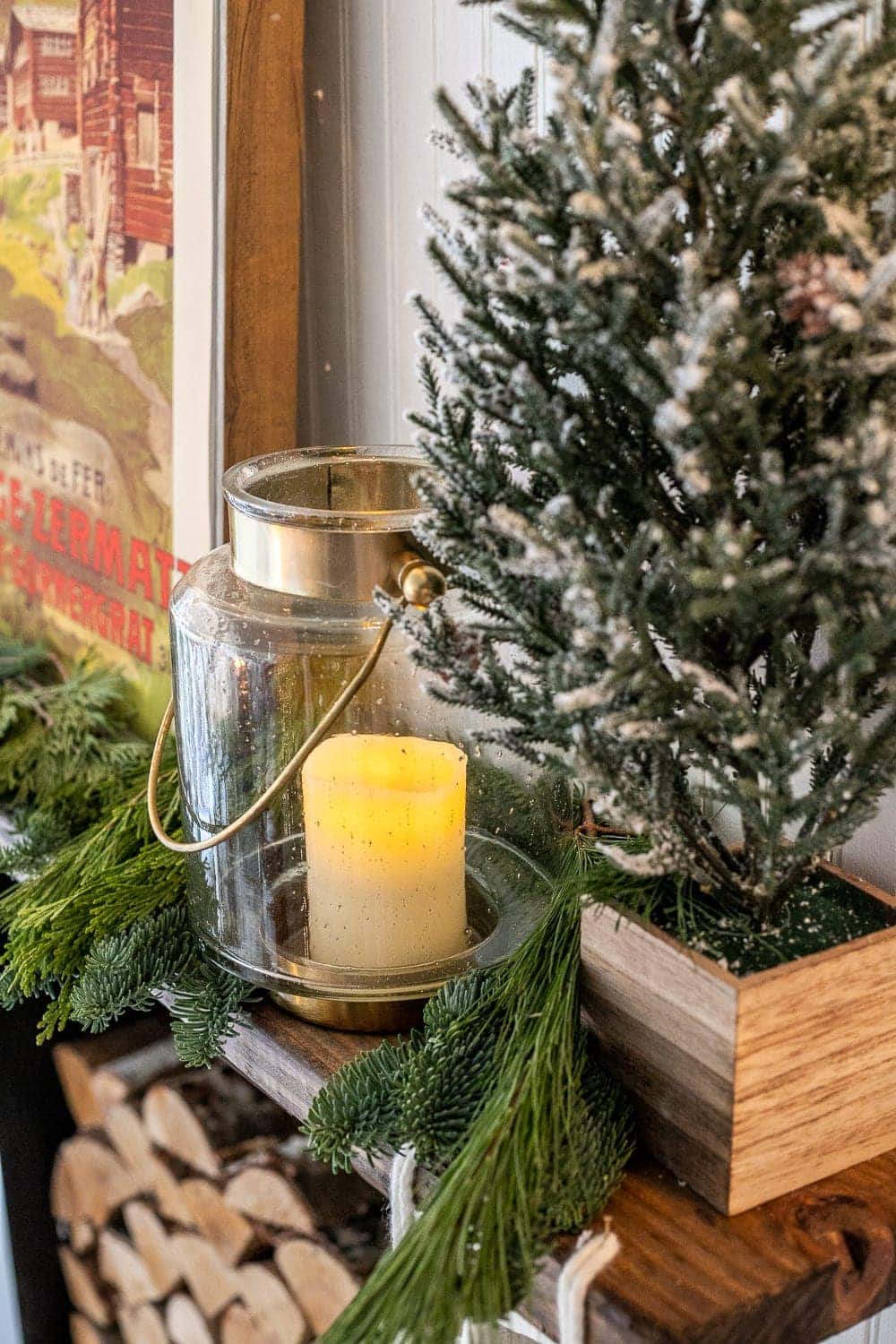
The lantern. A tiny flocked tree in a wooden planter box is nice on its own; a tiny flocked tree next to a brass-accented glass lantern with a candle glowing inside is a scene from a storybook. It’s the second light source, the vertical shape, and the reflective glass all at once. Remove it and you still have a pleasant shelf. Keep it and the shelf gains a focal point that catches your eye the moment you walk in.
21. Cream Bottle Brush Trees Under a Brass Sconce
Scale is the whole game here. Two cream bottle brush trees, four and six inches tall, sitting under a full-size brass wall sconce — the contrast makes the little trees look precious instead of puny. The dark-painted wooden house and the stacked wooden bowls repeat the wood tone three times, and the dark green garland with lights sits behind everything as a backdrop rather than a feature. Small, quiet, and layered beats a big flashy display on a shelf every time.
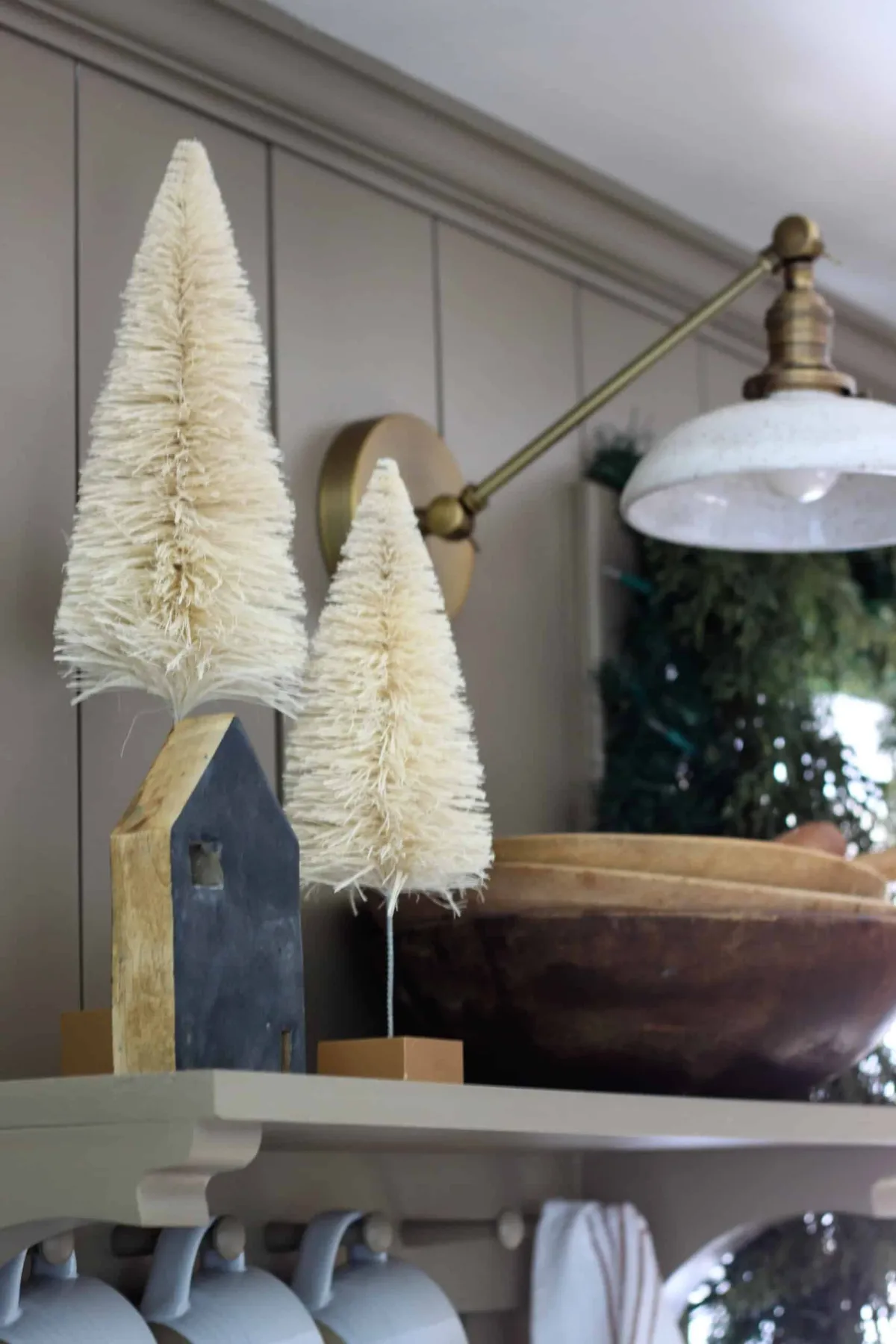
Bottle brush trees are absurdly easy to make: dollar-store sisal trees, a pot of cream craft paint, and a foam brush — about $8 for six. The wooden house ornament is the splurge item; Etsy has handmade versions from $18, or cut one from scrap wood if you’re handy. The brass sconce is where I’d spend real money, $45–$120, because it’s the piece you’ll still love in five years.
22. Island Tree With Red-and-White Striped Ribbon
- Anchor the tree on the island, off-center, at the end that isn’t your primary work zone.
- Wrap the tree in red-and-white striped ribbon first — ribbon before ornaments means no crushing later.
- Add berries and baubles in odd numbers, working top down so you can see the silhouette.
- Hang small green wreaths on cabinet doors with removable adhesive hooks rated for 1 pound.
- Repeat one wreath on each bar stool back so the theme carries down to the seating.
- Stand wooden cutting boards upright against the backsplash as a quiet backdrop.
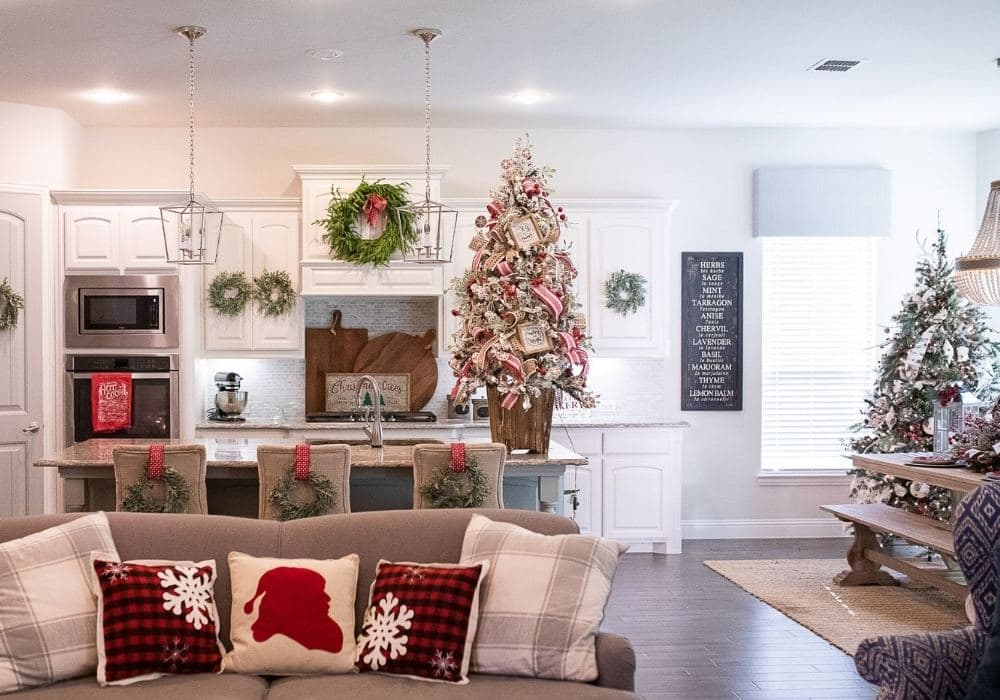
About two hours and $80–$180 depending on what you already own.
An island tree needs an island. That means at least 6 feet of counter length with 36 inches of clearance on all walkway sides — anything tighter and people will be dodging branches while carrying hot sheet pans. If your island is 5 feet or shorter, use a 3- to 4-foot tabletop tree instead of a full skirted one. This is the scaled-up version of Idea #14, which keeps the tree in the corner and the island for serving.
23. Heavily Flocked Tree With Rose Gold Ornaments
Rose gold on a flocked tree is the look that took over holiday feeds a few seasons back and hasn’t let go, because the flocking already reads cool and the warm metallic wakes it up. Draping string lights over the countertops — not just the tree — is the newer half of this trend, and it’s the part people are actually copying from boards this year. The snow-covered wreath above the stove is the detail that makes it feel like a kitchen rather than a showroom.
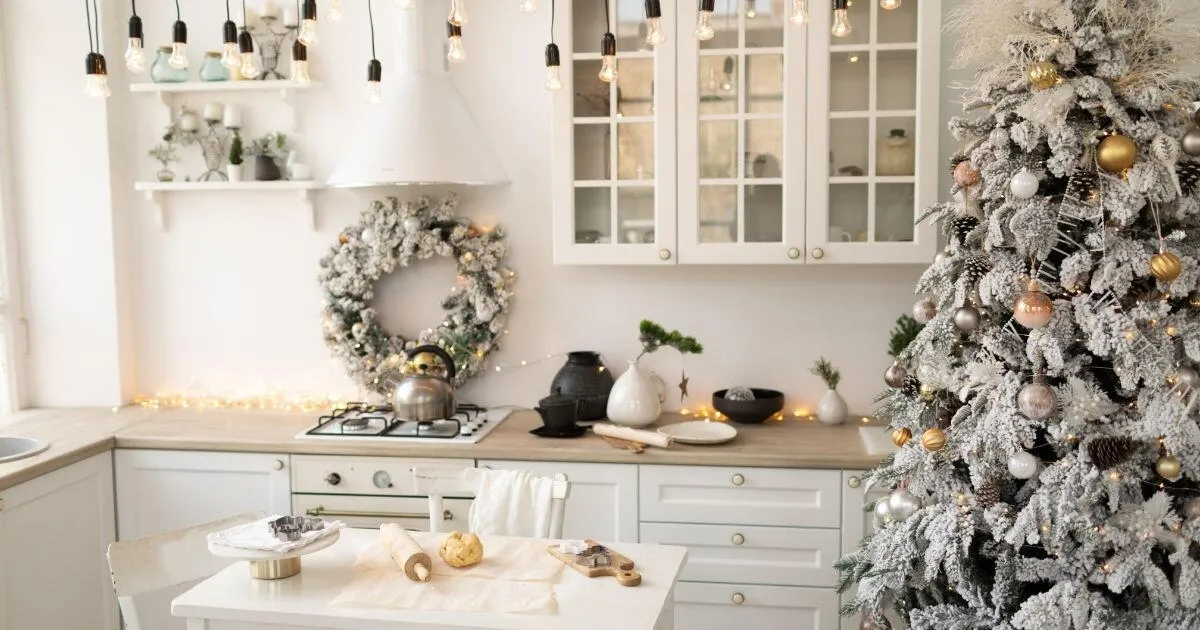
A heavily flocked tree drops fibers constantly and can’t be vacuumed effectively once it’s full of ornaments. If anyone in the house has allergies or asthma, that’s a real consideration, and a lightly frosted option is the better call. Also: bright white kitchens make warm metallics look almost neutral. Bump up the contrast with a couple of deep-toned pieces if you want it to read festive in person, not just on camera.
24. Mini Trees in Vintage Cans on a Checkered Runner
The table formula: 45% red and white (checkered runner, layered plates, banner), 30% green (garland overhead, small trees), 15% amber and wood (vintage cans, warm details), 10% silver glitter for sparkle. White hydrangeas are the neutral that keeps it from getting too sweet. If you’d rather go blue-and-white, keep every proportion and just swap the red — the structure carries it.
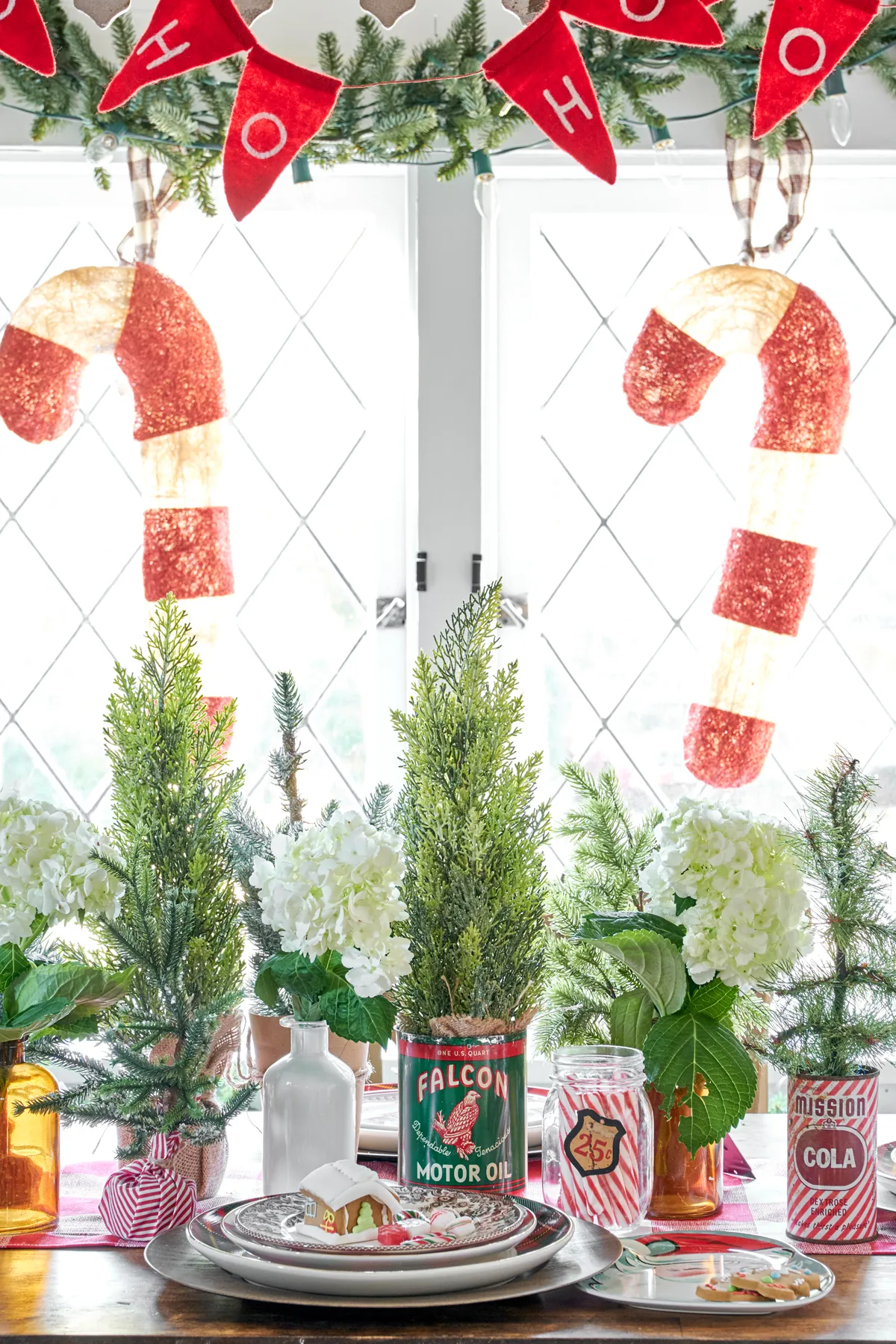
For a centerpiece that doesn’t block conversation, keep everything under 12 inches tall and leave a 4-inch clear zone in front of each place setting. Small trees in vintage cans work because the cans add height without adding width. And put the candy canes on the plates, not in the centerpiece — guests can take them, which means your table decor quietly deconstructs itself as the night goes on instead of just sitting there.
25. Cream Cabinets and a Silver-Gold Tree in the Corner
- Tree, 7 ft with warm white lights: $150–$500
- Ornaments, silver/gold/white balls, about 100 pieces: $60–$220
- Fluffy white tree skirt: $30–$90
- Clear glass pendant lights, pair: $100–$400
- Ribbon and miscellaneous decor: $25–$80
- Total: roughly $365–$1,290
- Budget alternative: buy a pre-lit tree in January at 60% off, use one ornament color family instead of three, and skip the new pendants — about $180 all in.
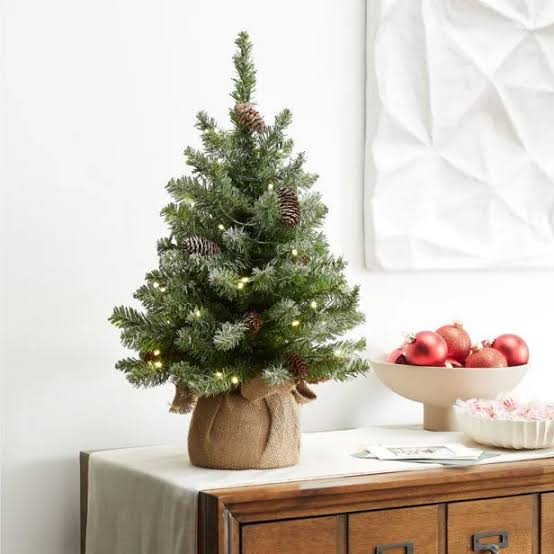
Flocked or heavily lit trees in kitchens are dust traps, and a fluffy white skirt in a room where people cook is going to show every spill. Shake the skirt out weekly, spot clean with a damp cloth, and keep the tree at least three feet from the stove. Warm-white incandescent bulbs get hot enough to matter; LED runs cool and cuts your December electric bill noticeably if you’re burning lights six hours a day. Compare with Idea #4, where the same silver-and-white palette lives entirely on garland and countertop decor with no tree at all.
26. Gingerbread Houses and Snow Jars on the Counter
The jars. Clear glass jars with tiny winter scenes inside — a few trees, some faux snow — turn a countertop into a miniature world. Without them you’d have a nice seasonal display. With them you have something guests pick up and turn over in their hands. They’re the cheapest items on this counter and the ones people will actually remember. And notice the rolling pins and cookie cutters: this is decor that admits you’re going to bake.
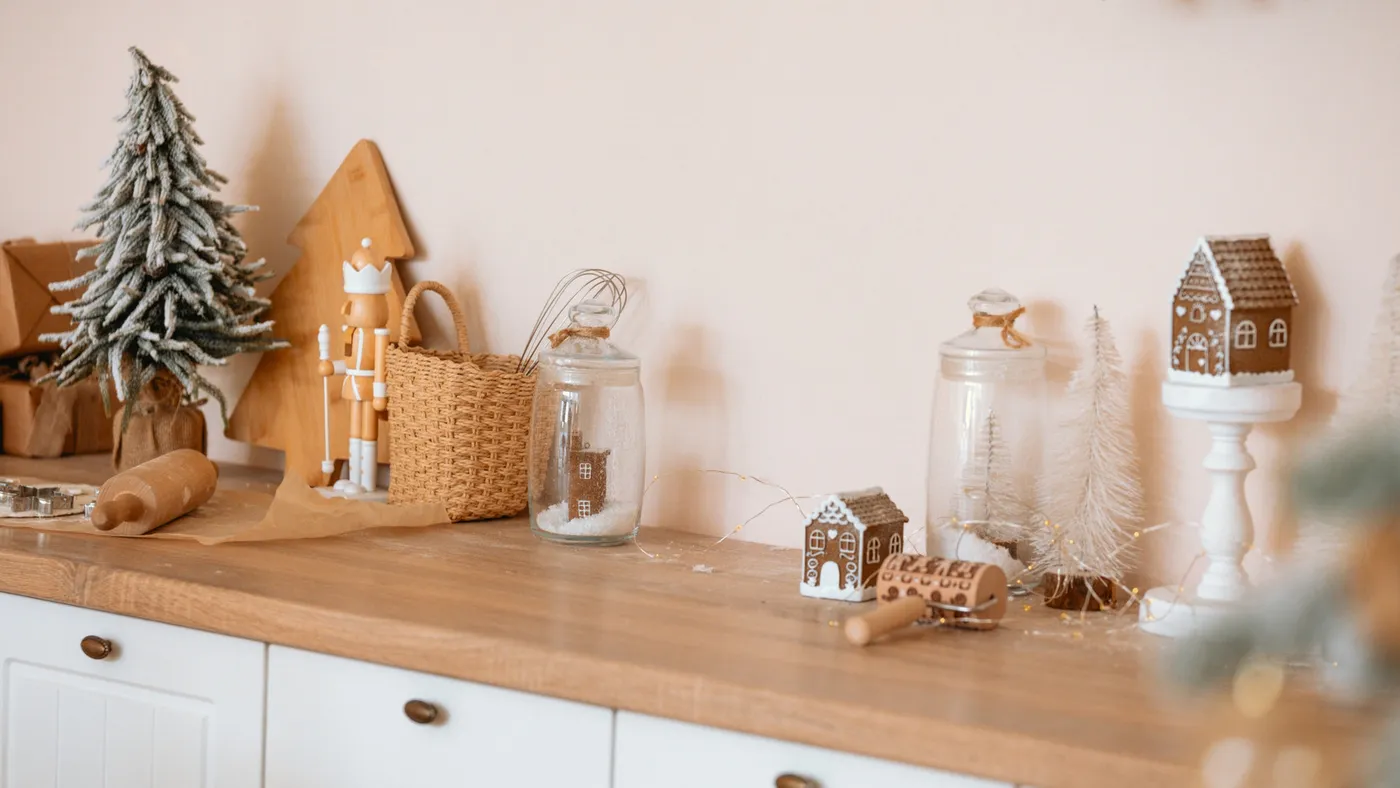
- Collect 3–4 clear jars with wide mouths — mason jars work fine, thrifted apothecary jars are better.
- Fill the bottom third with coarse faux snow or Epsom salt.
- Tuck in a miniature bottle-brush tree and, if you have one, a tiny figurine or wooden nutcracker.
- Seal and set on the counter in a cluster of varying heights.
- Layer frosted mini trees and a gingerbread house around them, keeping one jar taller than everything else.
Roughly 30 minutes, and about $30 if you already own the jars.
27. Three Glass Trees Against a Multi-Paned Window
Glass trees need light behind them or they disappear. This exact setup wants a window — preferably east or north facing, so the light is diffuse rather than a hard beam that creates glare across the wood. Three trees at roughly 6, 9, and 12 inches, on a surface at least 18 inches deep and 30 inches wide. In a windowless kitchen, set them under a warm pendant and let the light come from above; see Idea #21 for how that plays out on a shelf.
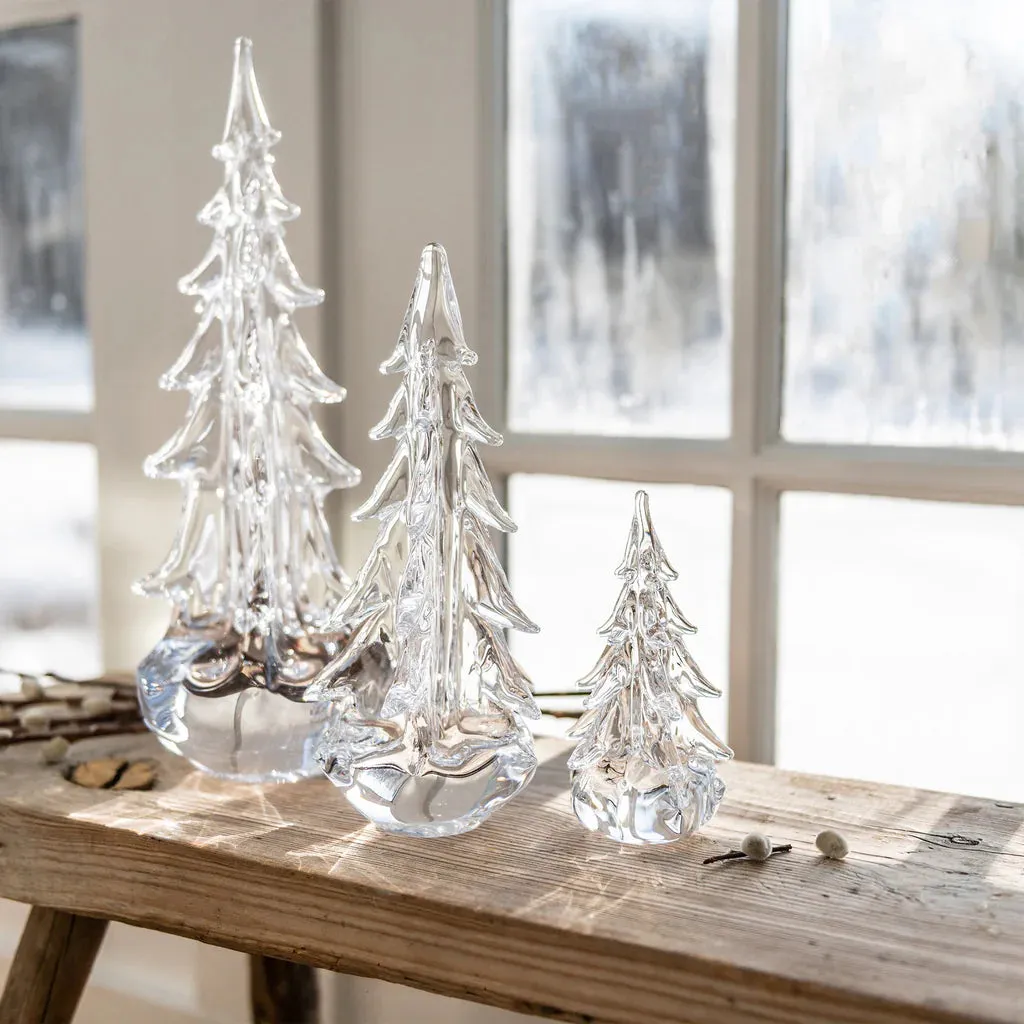
Nothing here is decorated. The three clear trees, the bare branches, the small white spheres — it’s an exercise in restraint, and the light does the decorating for you. The varying heights create a rhythm, the multi-paned window behind provides a grid of lines that contrasts nicely with the trees’ curves, and the light wooden surface keeps the whole thing bright rather than precious.
28. Play Kitchen With a Santa Advent Tapestry
Kids’ spaces are where you can go maximal, and it’s the right answer. The rule: repeat a shape three times so it reads as intentional — here it’s the tree, the banner, and the tapestry, all taller than they are wide. Keep anything breakable above 40 inches off the floor, and use fabric bunting or wool bead garland instead of glass or metal, since it can take a tug and still look fine. Anything she can reach is going to get handled.
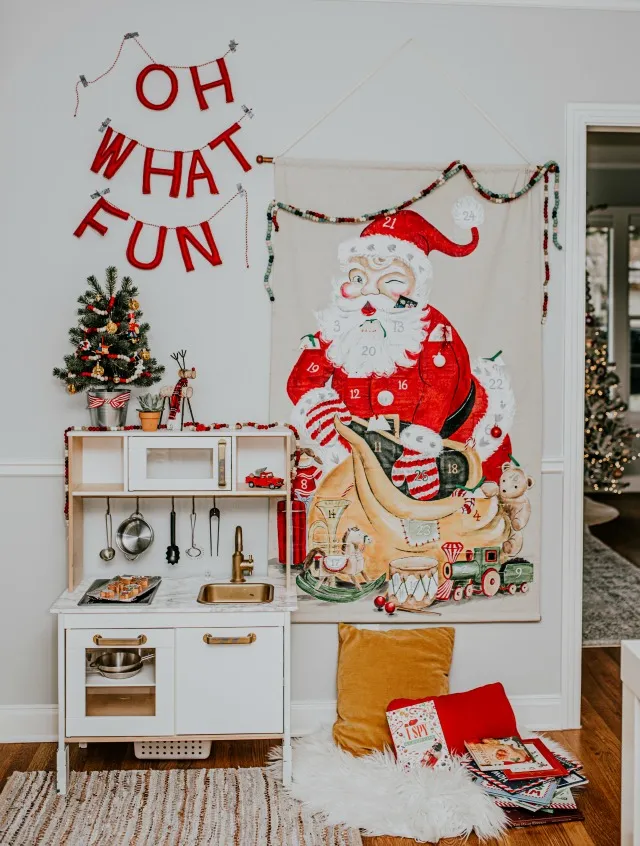
A mini tree in a metal bucket looks charming and tips easily. Add weight to the bottom — a few handfuls of dried beans in a sealed bag does it — and keep the bucket off any surface a toddler can climb. Also, fabric advent calendars with pockets are wonderful until the day you forget to refill them, which you will. Set a phone reminder for December 1 and then let it be imperfect.
29. Metallic Ornaments on a Tree Beside Dark Cabinets
Dark lower cabinets, light counters, white subway tile: that’s already a 60/30/10 formula before any holiday comes in — 60% dark, 30% light, 10% stainless. So the tree should be mostly green with warm light and metallic accents, and nothing else on the counters needs to be festive. One decorated tree plus a matching garland over the window is plenty. Adding a second color story here would tip a confident kitchen into a busy one. See Idea #16 for the deep-green version of this same instinct.
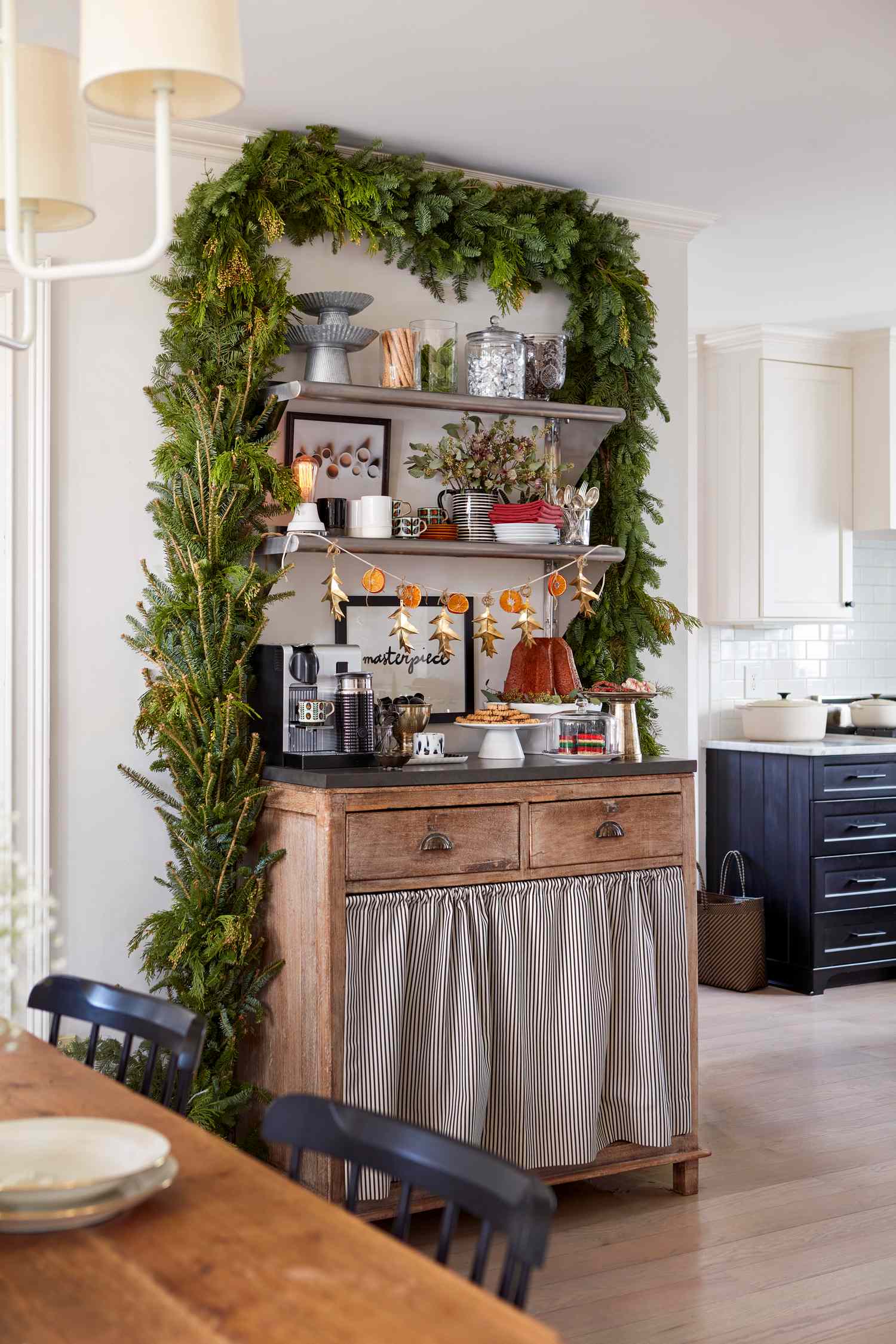
Metallic ornaments get marked up in November. Buy a mixed tub of gold, silver, and bronze balls at Walmart or Target for $12–$20, then thin them out with dollar-store filler ornaments in the back of the tree where nobody looks. A 6.5-foot tree at $60 and one 9-foot garland at $25 gets you this corner. Under $110, and those dark cabinets do the expensive-looking part for free.
30. Pastel Ornaments and a Moss-Covered Tree Base
- Start with a small, deliberately sparse tree — the gaps are the point.
- Hang matte pastel balls by size, largest low, working up to the smallest near the top.
- Thread silver tinsel loosely through the branches; don’t wrap the tree, just weave it.
- Add a pastel pom-pom garland at mid-level for texture.
- Set the tree in a moss-covered sphere wrapped with twine, and top with a frayed blush ribbon.
- Place a bowl of matching ornaments beside it so the palette reads deliberate.
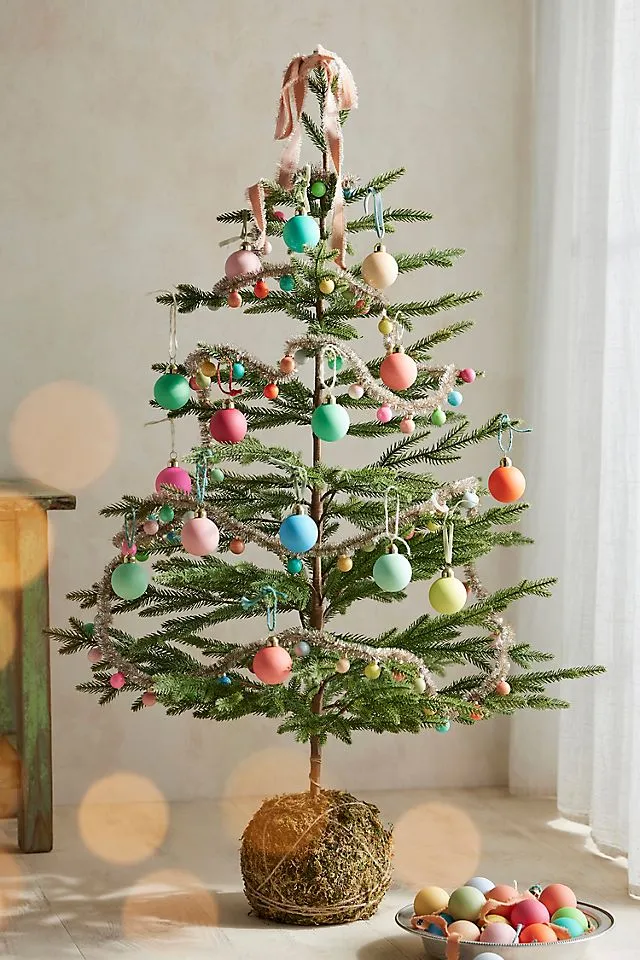
About an hour. Most of the time goes into spacing the ornaments evenly.
- Small sparse tree, 3–4 ft: $25–$70
- Matte pastel ornament set, 40–60 pieces: $25–$60
- Silver tinsel and pom-pom garland: $10–$25
- Moss sphere base and twine: $15–$35
- Ribbon topper: $8–$18
- Total: roughly $83–$208
- Budget alternative: thrift a small tree for $8 and paint dollar-store ornaments with matte craft paint in pastel shades — near $45 all in.
31. Pre-Lit Tree in a Woven Pot Next to the Farmhouse Sink
When a tree lives next to a sink, keep it under 24 inches tall and the container water-tight or entirely faux. Anything wider than the sink’s edge will get splashed daily. And match the tree’s pot to an existing material in the room — here the woven pot echoes the light wood counter, which is why it looks built-in rather than plopped down. That’s a two-minute decision that saves the whole vignette.
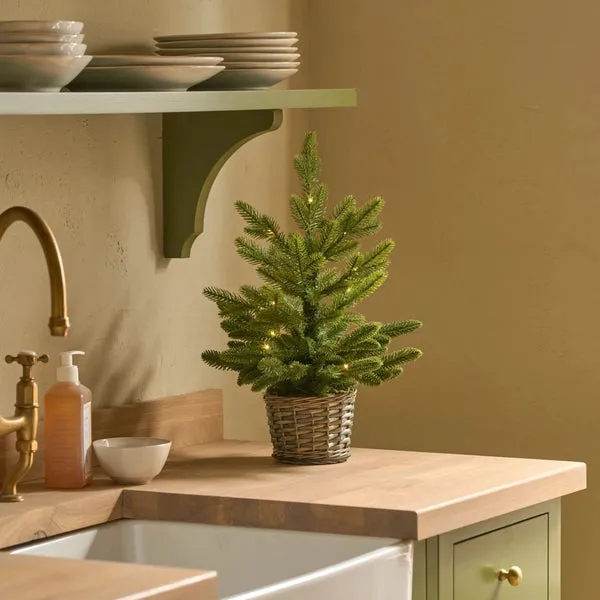
The sage-green shelf above the sink. Stacked neutral plates and bowls in a soft green frame create a vertical backdrop that makes the little tree look composed instead of lonely. Take the shelf away and it’s a plant next to a sink. With it, the sink becomes a spot you actually want to look at while you’re scrubbing a pan. Simple, free, and the reason this photo works at all.
32. Silver Bottle Brush Trees Behind a Bundt Cake
Dessert-as-centerpiece has quietly become the holiday styling move of the last two seasons. A bundt cake with powdered sugar and red berries reads as decoration first, food second — and it photographs better than any figurine. The three glittery silver bottle brush trees of different heights behind it are the supporting cast. This is Pinterest behavior in a nutshell: people want tables that look effortless, and cake looks effortless even when it took three attempts.
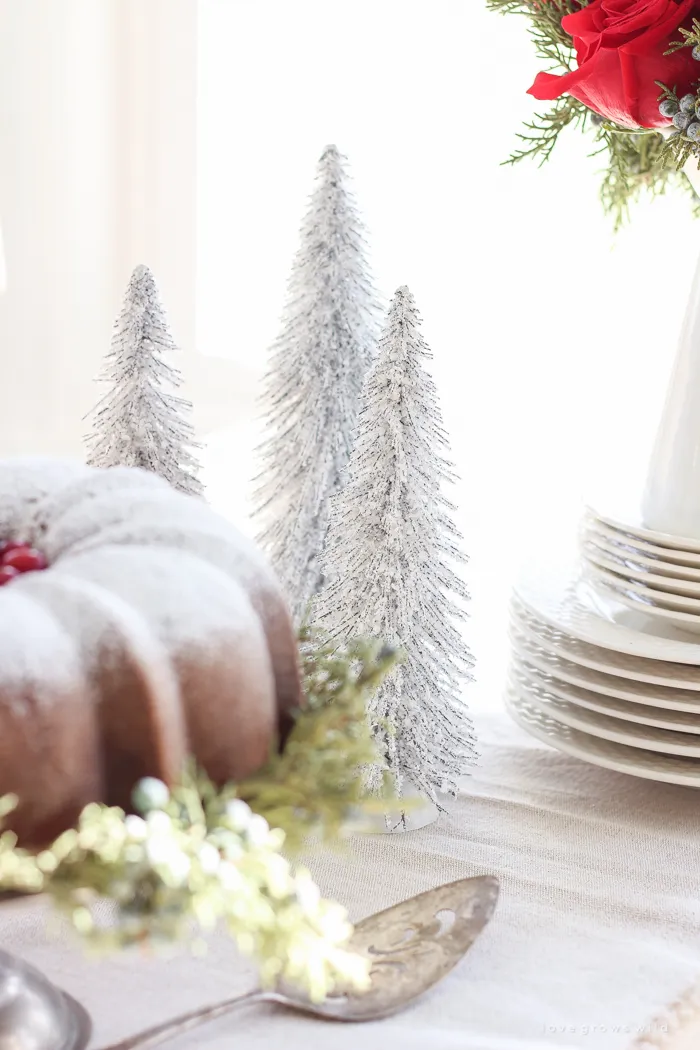
Glittery bottle brush trees shed. Set them on a tray or a light beige linen cloth you can shake out, and keep them away from anything damp — moisture dulls the glitter and it’s nearly impossible to restore. The cake has a 24-hour shelf life at room temperature, and powdered sugar will slide off in a humid room. If your kitchen runs warm, dust it right before guests sit down.
33. Garland Cascading Down a Glass-Front Cabinet
Garland usually goes sideways. Here it goes down — draped vertically from the dark glass-front cabinet and pooling onto the black and white checkerboard floor, which turns a horizontal trim into a vertical gesture. That floor does the anchoring work: without such a strong pattern below, the garland would just look like it fell. And the dark cabinet gives all that green something deep to sit against, so the whole thing reads intentional. Compare with Idea #12, where the tree frames an archway instead.
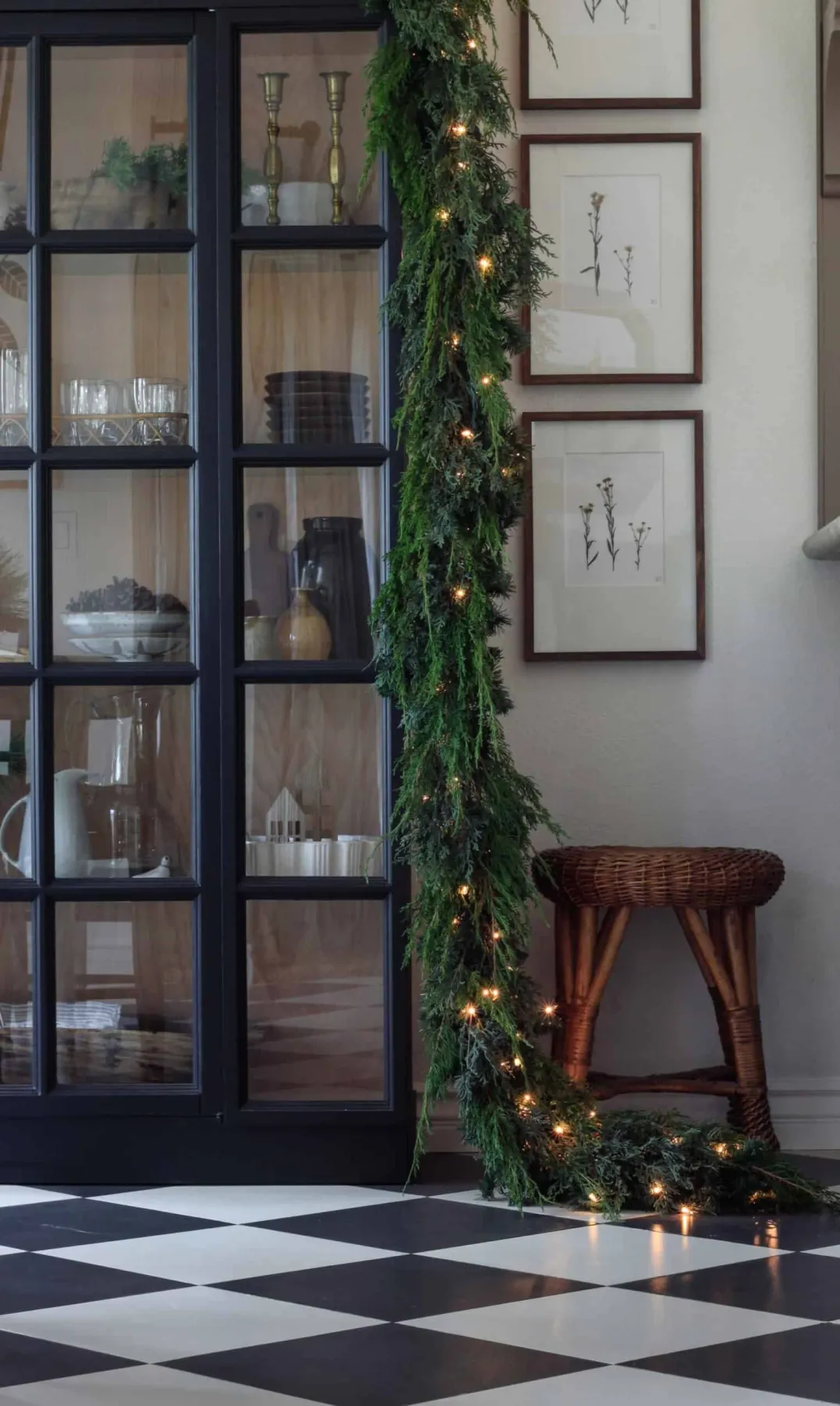
Vertical garland needs more greenery than you think — plan on two 9-foot strands twisted together for a run of about 6 feet. Because it touches the floor, use faux only. Real evergreen on a floor means sap on your tile within a day. Secure the top with a clip inside the cabinet door hinge, then let gravity do the rest; no other fasteners needed if it’s dense enough.
34. Light-Up Snowman on a Long Dark Dining Table
- Measure the runner first — a patterned runner on a dark table shows every overhang mistake.
- Confirm a power source for the light-up snowman; battery packs last about three weeks of evenings.
- Clear at least 36 inches of seating on each long side before you build the display.
- Decide what stays after December — the wooden tree and boat tray can live on past New Year’s; the snowman can’t.
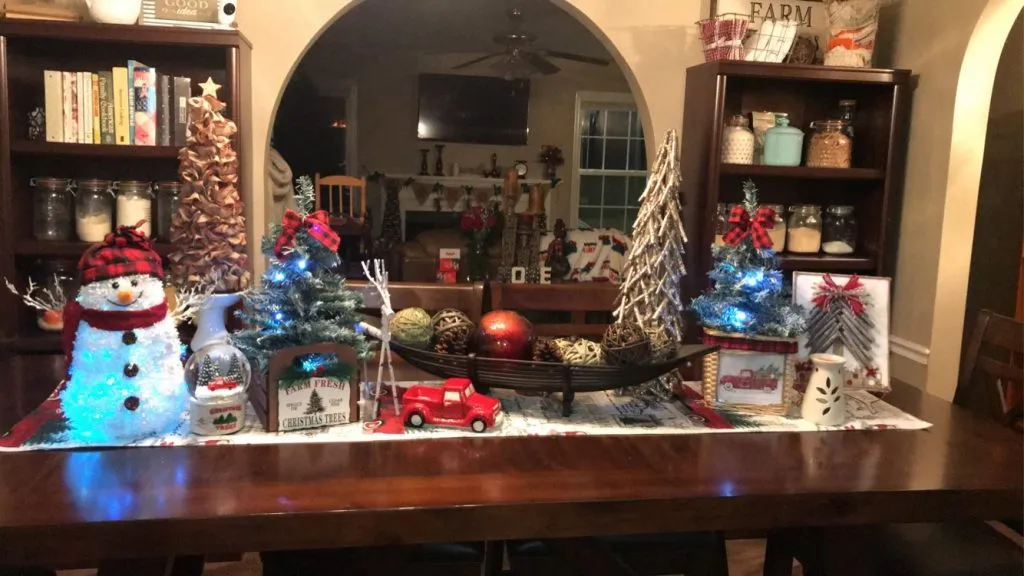
A display this dense needs a long table — 72 inches minimum, ideally 84 or more, and a dining room of at least 150 square feet so the dark wood bookshelves behind don’t make it feel like a tunnel. Centerpiece height should stay under 14 inches so people can see across the table. In a smaller room, borrow the cluster idea from Idea #17 and reduce it to a single tray of three trees.
Your Counter Is a Mantel — Treat It Like One
You don’t need the biggest tree in the house. You need the right one for the twelve inches of counter you actually have, a decent strand of warm-white lights, and one detail — a vintage bin, a sheer red bow, a lantern — that makes people stop and look. Start with the idea that matches your kitchen’s scale, and layer in the rest next December.
📌 Pin your favorites now so they’re waiting for you when the decorations come down from the attic.