You know the feeling: it’s mid-November, your Pinterest board is a wall of frosted trees and velvet ribbon, and not one of them looks like your living room. That’s exactly why we built this guide.
We spent serious time browsing Etsy, HomeGoods, Target, Anthropologie, and Amazon to bring you 34 real trees from real homes — everything from a $12 dried-orange ornament to a $2,400 full glam mantel moment. Rustic farmhouse, pastel whimsical, metallic glam, retro tinsel, and woodland natural styles all show up, and most ideas come with a budget version sitting right next to the luxury one.
2026 is the year the themed tree stopped being a novelty: nostalgia-driven tinsel, handmade ornaments, and flocked trees in colors that aren’t green are all surging on Pinterest right now.
And stay until the end — we break down the most common mistakes that can ruin these looks. 📌 Save this to Pinterest for later — you’ll want to revisit these ideas.
1. Cozy Attic Bedroom Tree With Tiny Glowing Houses
The miniature lit houses are the whole story here. Take them away and you’ve got a pleasant frosted tree in a bedroom; keep them and the corner reads like a tiny lit-up village, with the red plaid pillow and the red-wrapped gifts as supporting cast instead of random props. Buy six to ten house ornaments before anything else, then fill in with berry picks and plain red baubles.
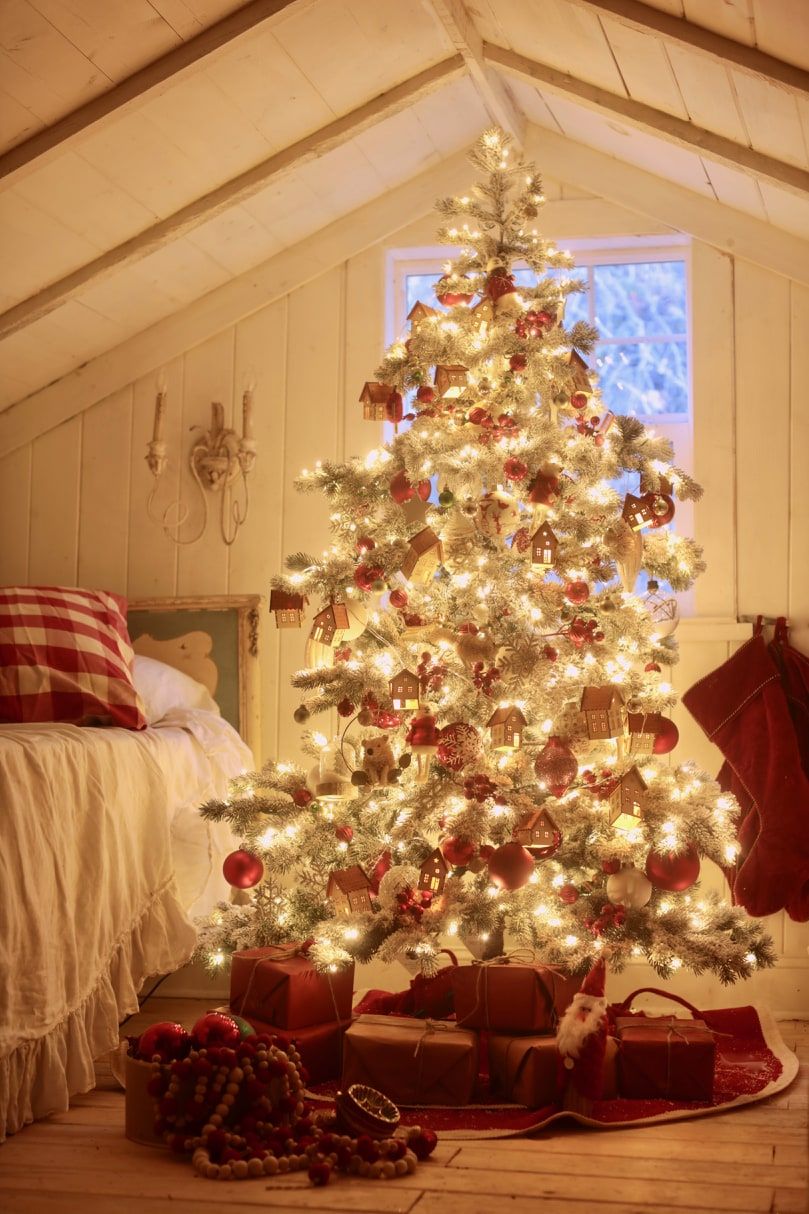
Sloped ceilings change the math. Keep the tree 6 inches clear of the angled roofline so the lights don’t wash the white paneling into one flat glow, and cluster ornaments 36 to 54 inches off the floor, which is where warm light actually pools. Vertical zigzags of strung light beat spirals on a narrow tree — brighter-looking and about 30% less strand.
2. A Beaded Bowl of Vintage Ornaments on a Plaid Runner
This display runs on a simple recipe: 70% warm wood and cream, 20% red-and-white pattern, 10% candlelight. Swap the red for forest green and the same white beaded bowl still works for a more grown-up table. The plaid runner is doing the heavy lifting — everything else is texture stacked on top of it, so if your runner is busy, keep the ornaments solid.
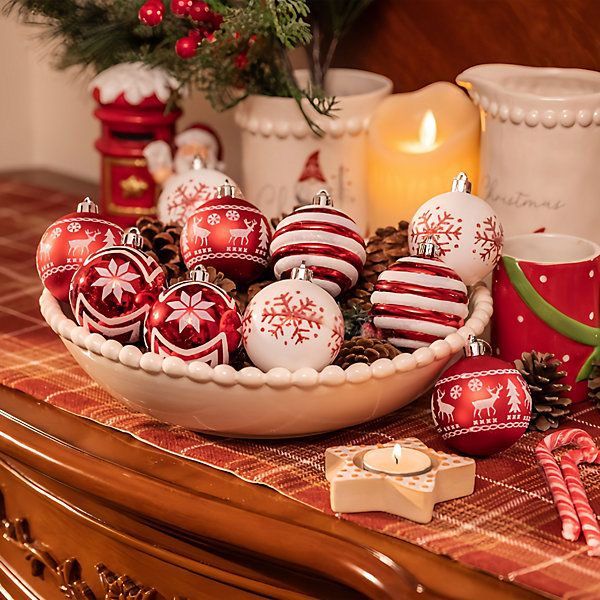
- White beaded bowl: $18–$45
- Pinecones, bag of 12: $8–$15
- Patterned ornaments, 8–12 pieces: $24–$60
- Plaid table runner: $12–$30
- Pillar and tea light candles: $10–$22
- Mini red postbox and candy canes: $9–$20
Total: $81–$192
Budget alternative: thrift the bowl for $6–$10 and raid last year’s ornament bin — same arrangement, about 55% less.
3. Frosted White Tree in Blush Pink and Silver
Two things are working at once. The flocked tree is matte and slightly chalky, so shiny silver and pale pink baubles pop with almost no effort — that contrast is why it reads elegant instead of washed out. Then the glass-topped gold coffee table picks the brass back up at floor level, so the metallics don’t live only in the tree.
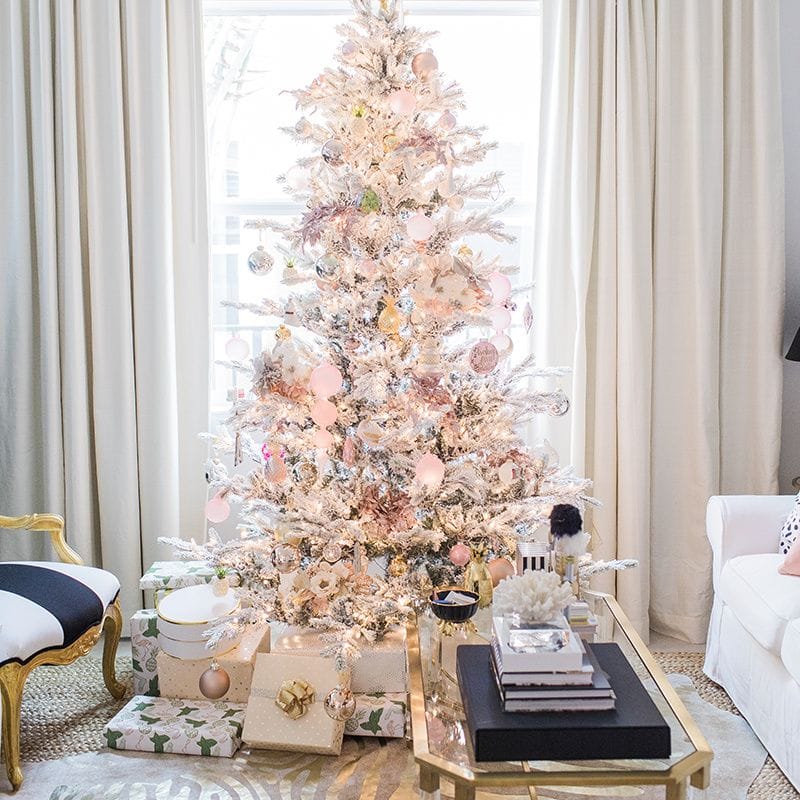
A 6-foot flocked tree runs $79–$129 at Target or Walmart versus $400 and up for a designer version, and nobody is measuring. Blush ornaments from Dollar Tree plus a can of matte white spray paint on ornaments you already own gets the palette for under $40. Skip the glass-and-gold table and set a thrifted brass tray on what you have.
This palette needs air around it: give it a 10×12 room and 8-foot ceilings at minimum. For the smaller-space version, see Idea #5.
4. Natural Light and a Glowing Tree by the Window
A tree beside a big window is beautiful and also a slow-fade experiment. Direct sun bleaches ribbon and fades flocking within a single season, so leave 12 inches of breathing room from the glass and rotate the tree a quarter turn every week or two. Warm-white bulbs are the move here — daylight plus cool-white LED looks clinical both in photos and in person.
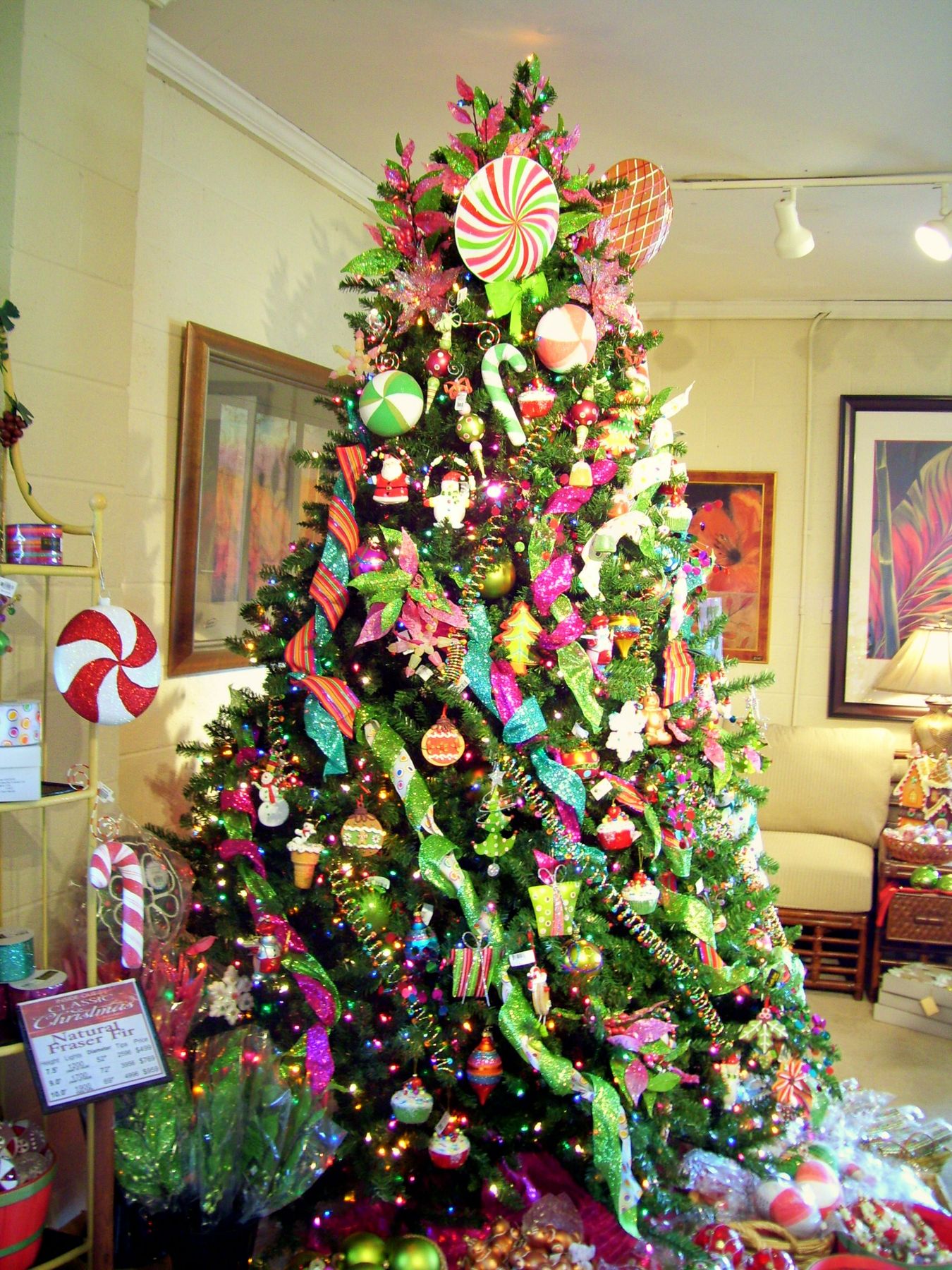
Here’s the cheap trick: set the tree on a $15 furniture dolly before you decorate. It disappears under the skirt, and you can spin a fully dressed 7-footer to face the room, the window, or the sofa in about four seconds. Also worth knowing that a tree backed by a bright window needs roughly 20% more lights to look equally luminous at night.
5. Pale Pink Wonderland Tree With Chunky Knit Layers
This one needs room to breathe. The pink wonderland look lands best in a space 12×14 feet or larger with 9-foot ceilings, where a 7- to 7.5-foot tree can sit off-center without blocking traffic. With standard 8-foot ceilings, drop to a 6- to 6.5-foot tree and let the chunky knit throw carry the scale instead. Short on floor space? Idea #18 does the same soft palette at countertop size.
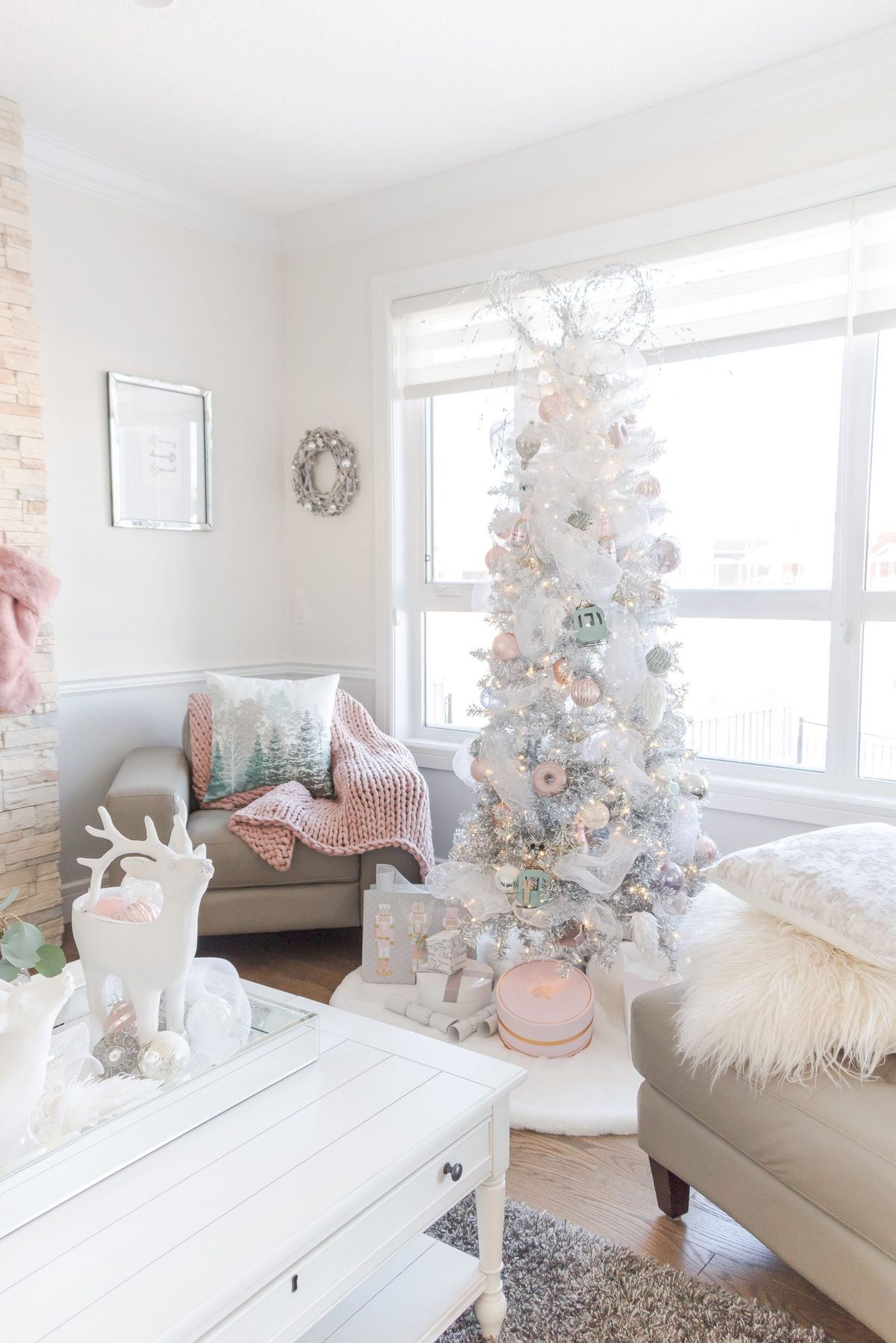
Layering the throw and ornaments:
- Drape the pink knit over the arm nearest the tree, not across the whole sofa.
- Hang pale pink baubles first, spaced 5 to 6 inches apart.
- Weave white mesh ribbon horizontally in three loose bands.
- Tuck silver ornaments into the gaps last, once you can see where the dark spots are.
About 25 minutes, and $0 if the throw is already yours.
6. Champagne Ribbon and Silver Blooms by the Fire
- 4-inch champagne velvet ribbon, 3 rolls: $45–$90
- Silver and gold floral picks, 12: $36–$72
- Metallic ornaments, 30–40: $40–$120
- Warm string lights, 600 count: $25–$45
- Matching mantel garland: $30–$65
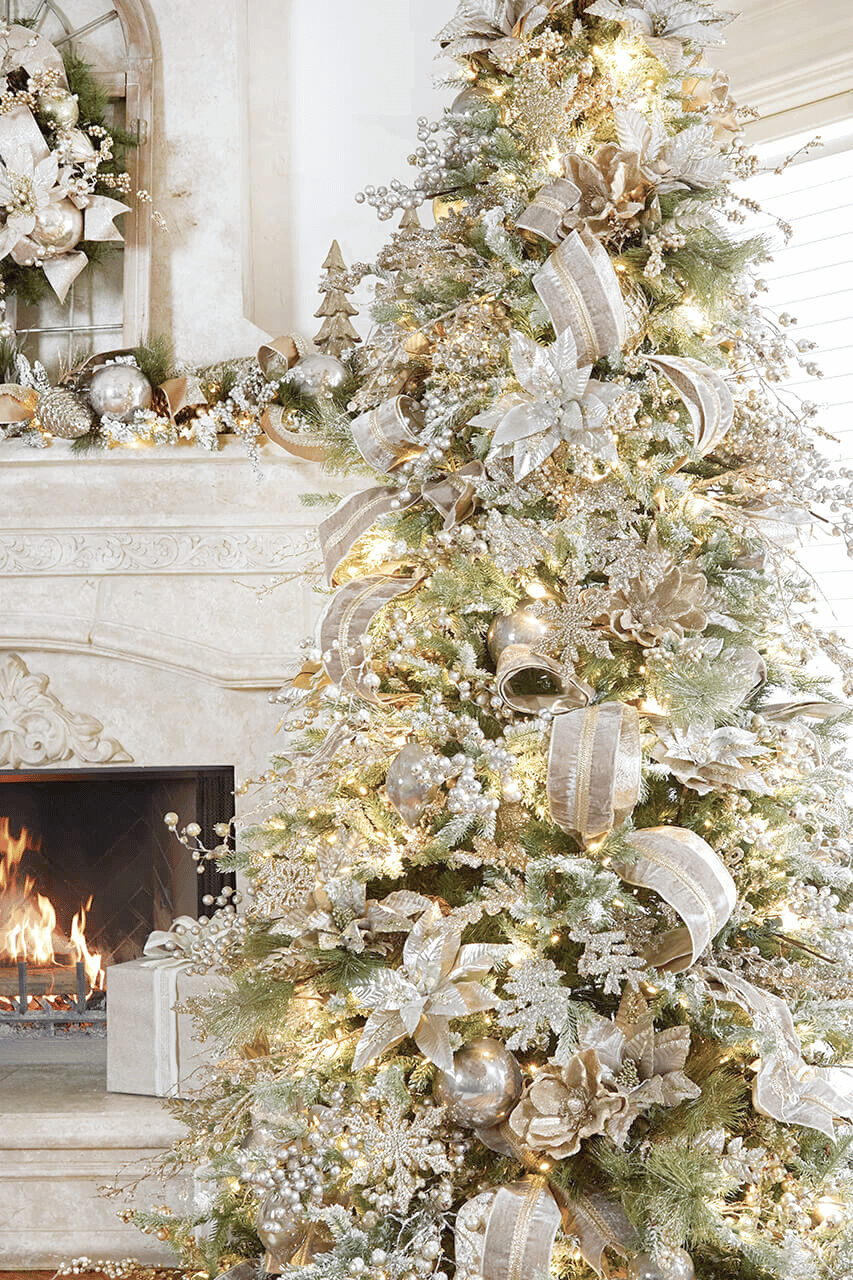
Total: $176–$392
Budget alternative: buy one wide roll instead of three, add $12 in craft-store poinsettia stems, and thrift the ornaments — roughly 50% off.
It’s the champagne velvet ribbon. Nine loops, loosely gathered rather than tied into perfect bows, gives this tree its expensive weight, because the fabric catches firelight and softens the metallic glare. The ribbon is the difference between luxe and craft-store.
7. Building a Tree the Kids Can Actually Touch
The rule for a tree kids can reach: nothing glass or heirloom below 48 inches off the floor. That’s roughly shoulder height on a 5-year-old, and it’s the line most parents get wrong because they decorate top-down and run out of patience near the bottom. Fill the lower third with shatterproof, felt, or wood, and twist-tie the light strand every 8 inches so a tug pulls one branch instead of the whole run.
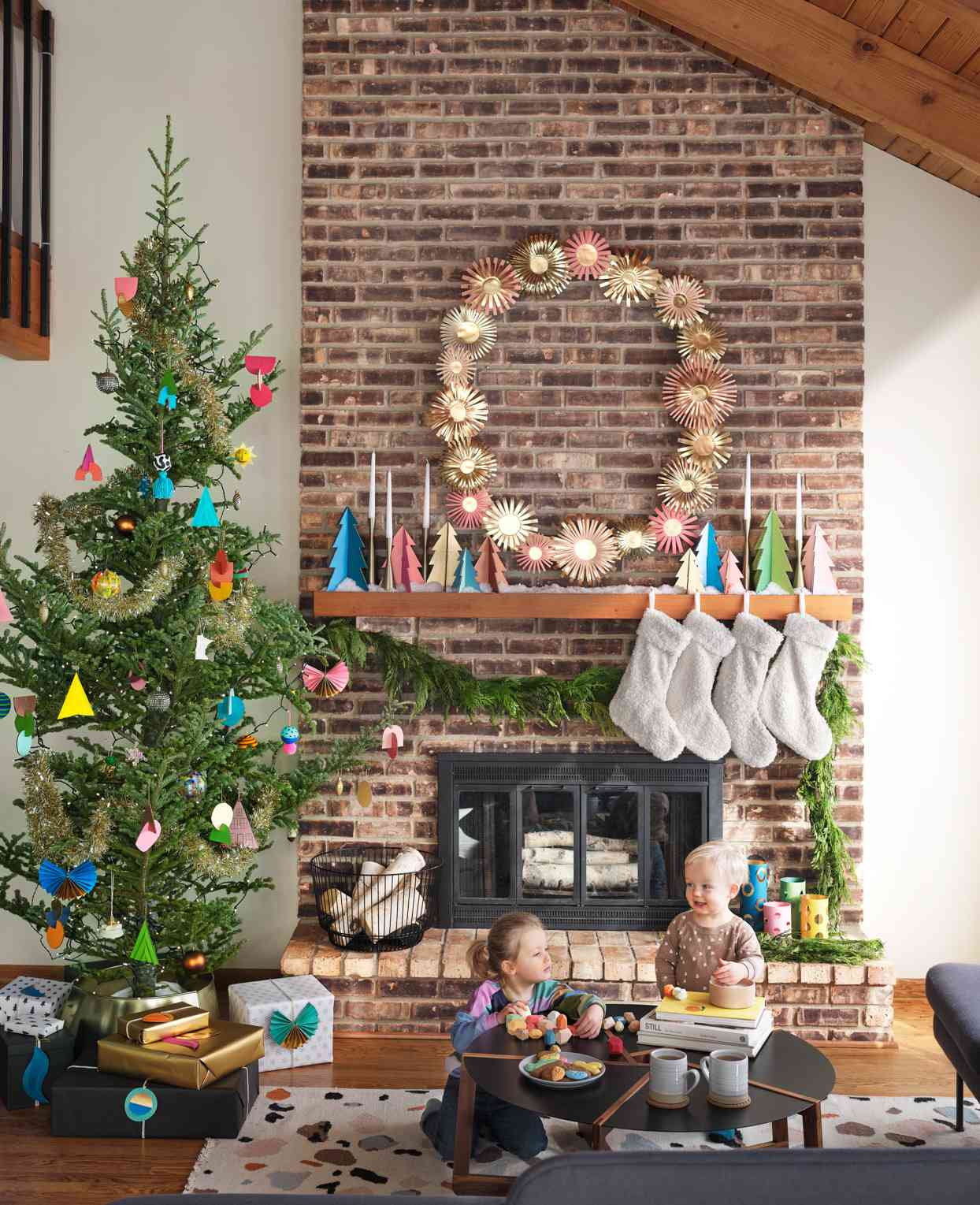
Setting up a kid-proof tree, bottom first:
- Measure 48 inches up the trunk and mark it with painter’s tape.
- Load everything soft, felt, or wood below the tape.
- Reserve hooks for the top two-thirds, and use wire hooks over plastic.
- Anchor the tree to the wall with the included strap — no exceptions.
- Test the bottom third by gently pulling; anything that moves gets rewired.
Forty minutes, and about $15 in felt ornaments if you’re starting fresh.
8. Gold Ferns, Oversized Baubles, and a Mantel Mirror
The fern topper is the splurge signal, and it’s the easiest part to fake: gold-painted fern picks run $4–$8 each at a craft store, and five of them fluffed into a fan costs under $40 versus $120 or more for a designer topper. Oversized gold baubles? Metallic spray paint on dollar-store plastic balls. Cascading mesh ribbon runs $12 a roll at Walmart.
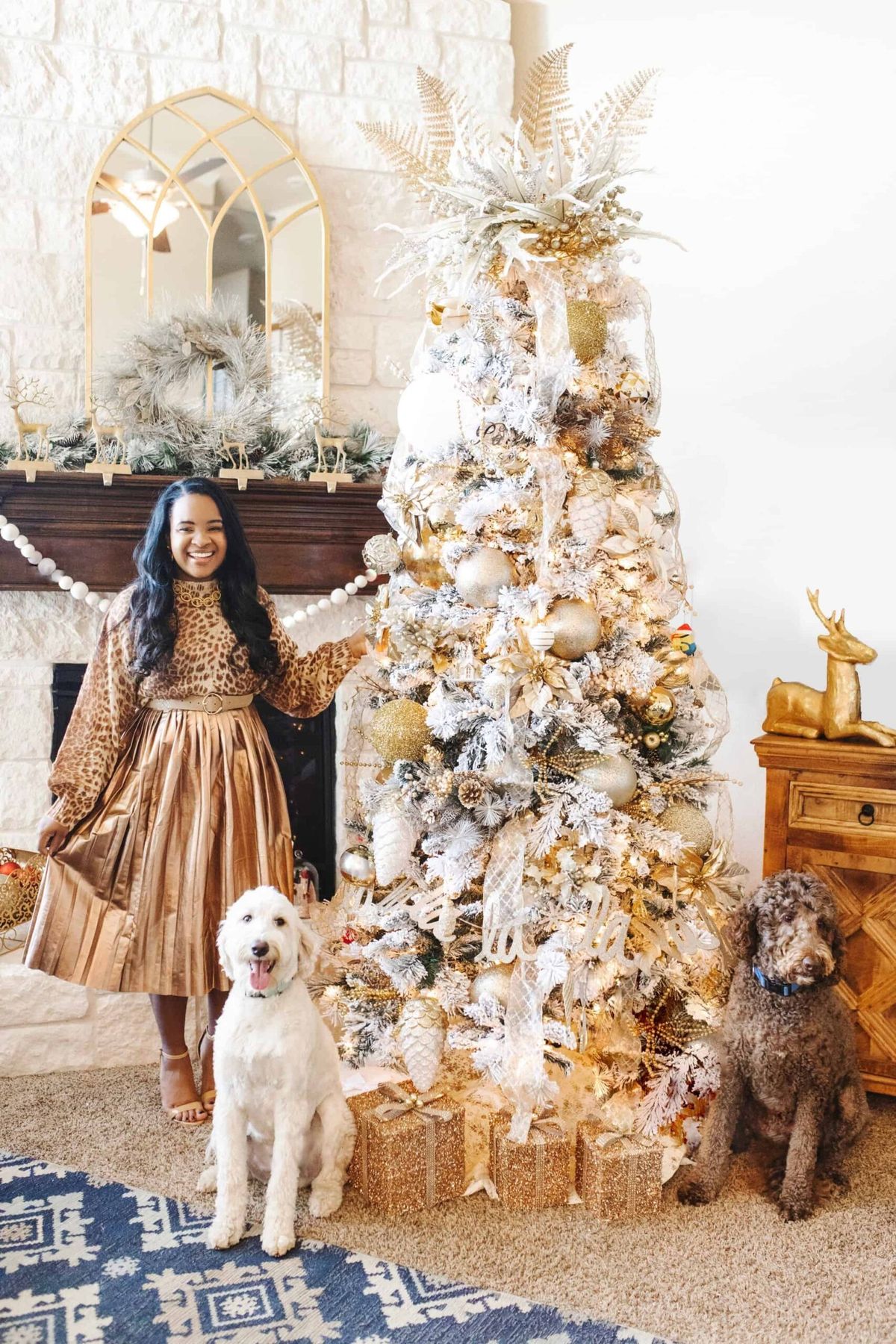
Layered metallics — gold and silver together, deliberately — have replaced the old pick-one-metal rule, and 2026 styling leans hard into mixed finishes with a dark wood anchor so it never turns into a glitter bomb. The arch mirror above the mantel is the tell: it doubles the candlelight and makes a small room feel like it has twice the tree.
9. Pinecones and Brick: A Hearth-Side Evergreen
The palette is doing something specific: warm gold ornaments and warm fairy lights sit in the same temperature range as terracotta brick, so tree and hearth feel related rather than separate. Natural pinecones repeat the tree’s own texture at a different scale, which reads as depth instead of clutter. Together, the terracotta-to-gold pairing is the whole trick. See Idea #13 for the stone-fireplace version of the same idea.
Real pinecones shed scale for the first two seasons, so keep a lint roller nearby. Brick hearths also release fine dust when fires burn, and it settles on ornament tops — a soft brush once a month handles it. Faux pinecones cost about the same as treated real ones and skip the shedding entirely.
- 6.5-foot tree: $90–$220
- Warm fairy lights, 400 count: $18–$35
- Gold baubles, 40 pieces: $30–$70
- Pinecone and berry picks: $16–$40
- Evergreen garland: $20–$45
- Wooden box planter: $25–$60
Total: $199–$470
Budget alternative: a thrifted box planter for $8 and a yard-sale tree gets you under $120.
10. Garland-Draped Bookshelves Behind the Tree
- Measure shelf depth — garland needs 4 to 5 inches or it looks squashed against the wall.
- Find the nearest outlet; you’ll want two strands per shelf, not one.
- Check whether the books below are ones you care about, since greenery can leave moisture marks on paper.
- Confirm your hooks: removable, rated 5 lbs minimum, about four per shelf.
- Decide the drop length before you buy — 12 to 18 inches reads best.
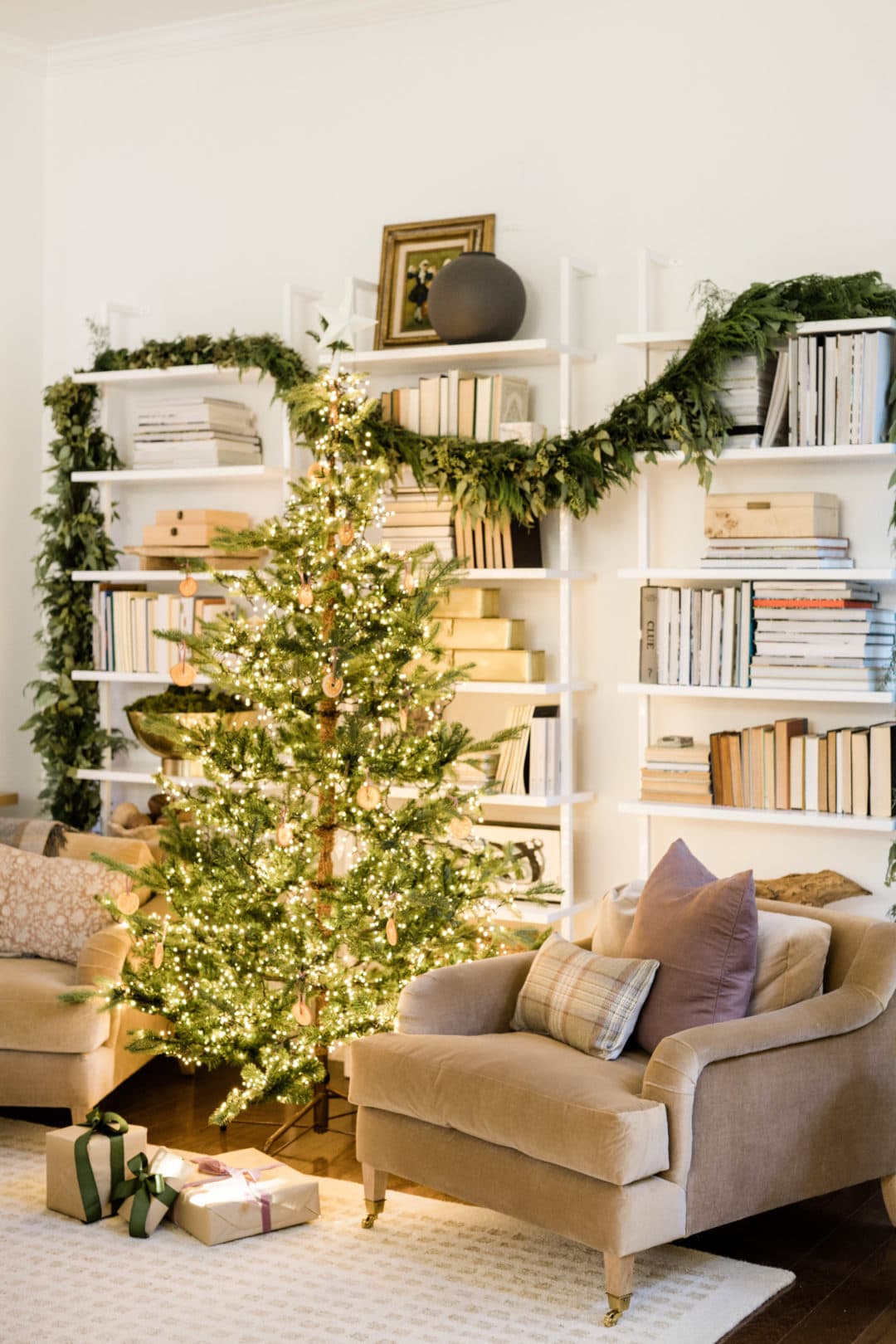
Run garland in a shallow swag rather than a taut line, using two anchor points per shelf and roughly 30% more garland than the shelf length. Attach with removable hooks every 12 inches so nothing dents the painted shelving, and keep the strand off the top row of books or you’ll be picking pine needles out of spines in January.
11. A Palette That Grows With Your Kids Each Year
The formula that survives children: 50% base green or flocked white, 30% one hero color you genuinely like, 20% whatever the kids pick this year. The base and the hero stay locked for a decade. The 20% changes. That way a dinosaur ornament phase never wrecks the tree — it just joins it.
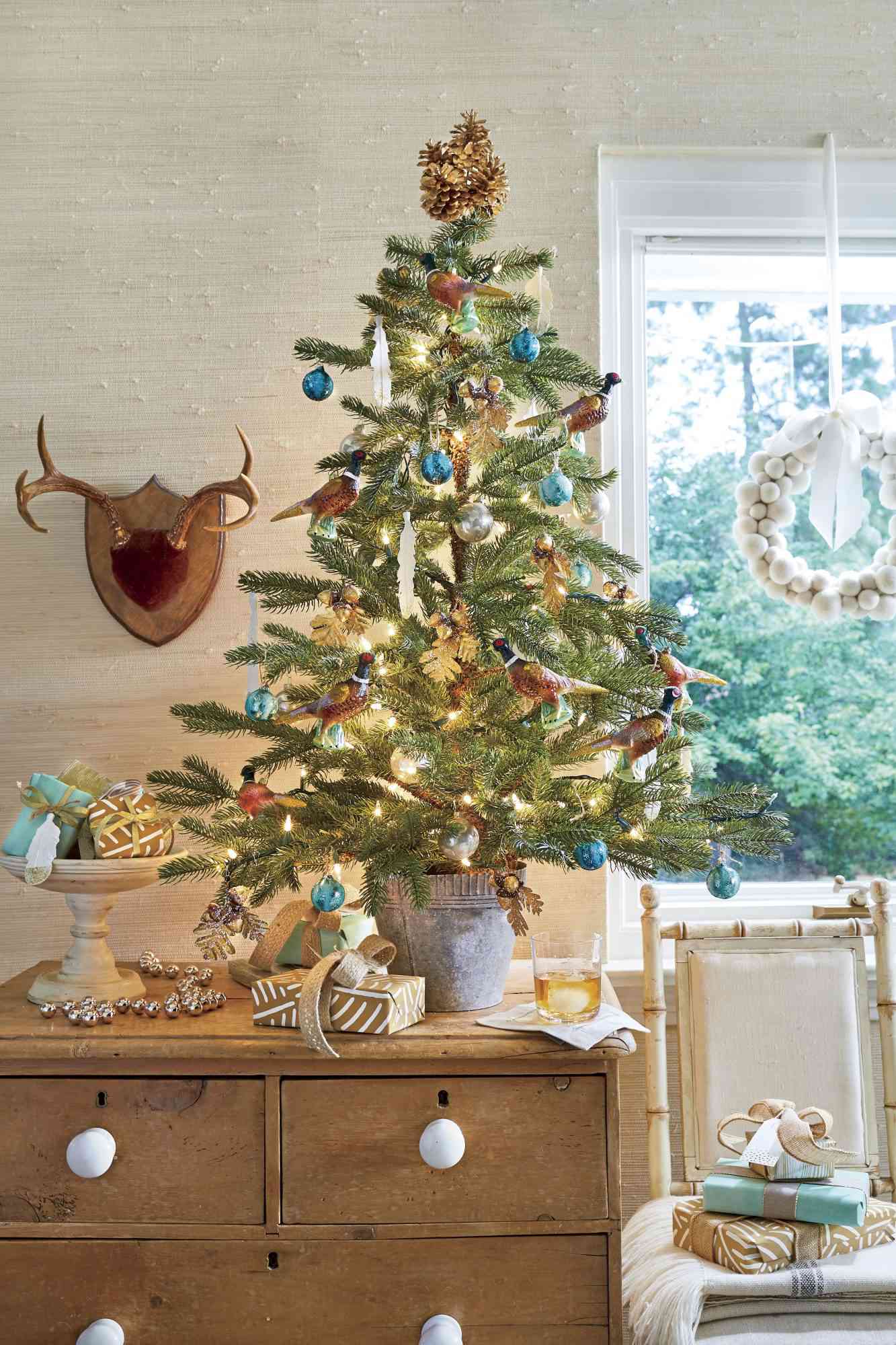
A kid-driven palette can drift toward chaos fast, so cap their picks at one color family per year, not one per ornament. Also worth saying out loud: tinsel is a choking hazard and a genuine nightmare with pets, and small shiny baubles look like candy to toddlers. If the tree lives in a playroom, run the lights on a foot switch so nobody is crawling under branches to unplug it.
12. Where Themed Trees Go Wrong Before You Plug In
Before anything gets plugged in:
- Lay every ornament on the floor and sort by category — more than four categories means you cut one.
- Test all strands on the floor, not on the tree.
- Check that your extension cord is 14-gauge and rated for the load.
- Confirm the trunk is standing plumb with a level before lights go on.
- Photograph the finished tree from the doorway — if it reads as one blur, remove ornaments rather than adding.
Twenty minutes that saves an entire evening.
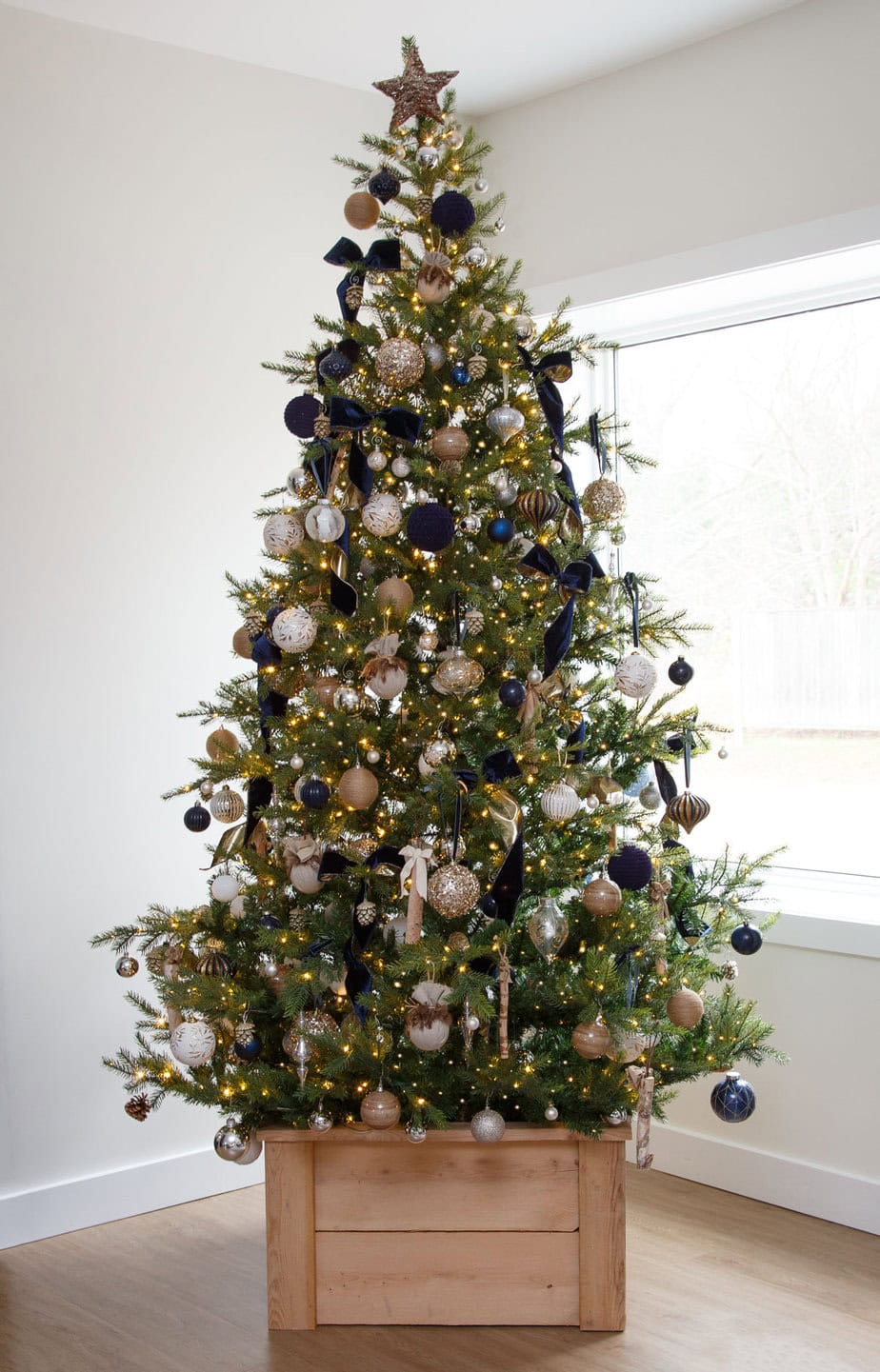
A themed tree reads as themed because of repetition, not quantity: three materials, three shapes, one metallic. The moment a fourth motif shows up, the eye stops tracking the theme and starts tracking objects. Restraint is the entire difference between “that’s a theme” and “that’s a collection.”
13. Gold Baubles in a Wooden Box Planter by Stone
The wooden box planter. Without it, a gold-ornament tree beside rough stone looks generic; with it, the base becomes part of the architecture and the tree looks built in. It hides the stand, holds the trunk steady, and gives you somewhere to tuck a plaid pillow and a throw blanket at the end of the night.
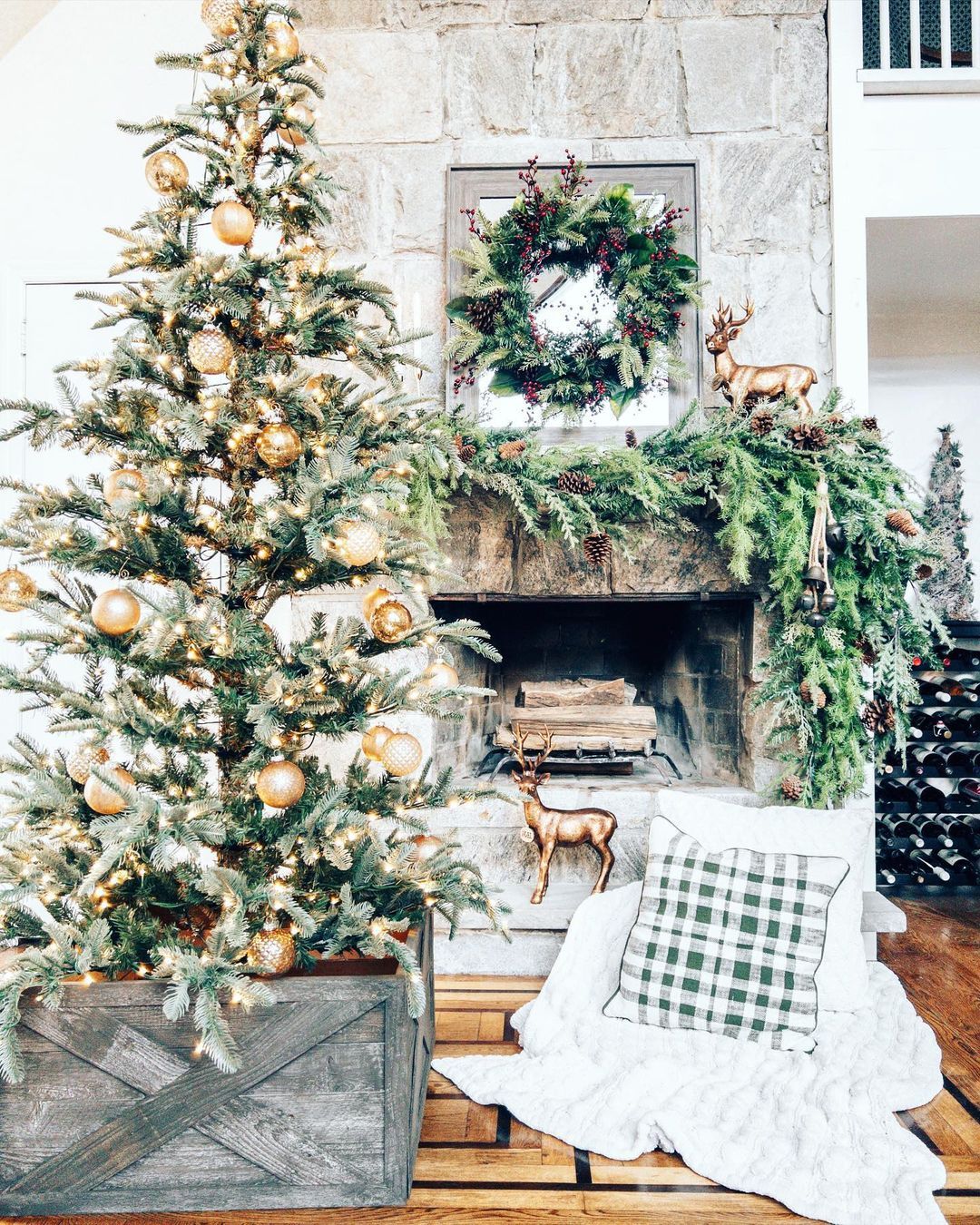
- 7-foot tree: $110–$260
- Gold ornaments, 50 pieces: $35–$85
- Warm fairy lights, 500 count: $22–$40
- Garland, pinecones, reindeer figurine: $35–$80
- Wooden box planter: $25–$60
- Berry wreath: $18–$45
Total: $245–$570
Budget alternative: build the planter from scrap plywood for $15 and paint it — same look, about 45% less.
14. Farm Animal Ornaments and a Wicker Basket Base
Whimsical ornament collecting is the quiet trend of 2026 — figural pieces you add to year after year instead of a matched set bought in one afternoon. Nostalgia is driving it, and it pairs naturally with the checkered ribbon and wicker accents showing up in farmhouse styling right now. Bonus: it’s the most kid-friendly idea on this entire list.
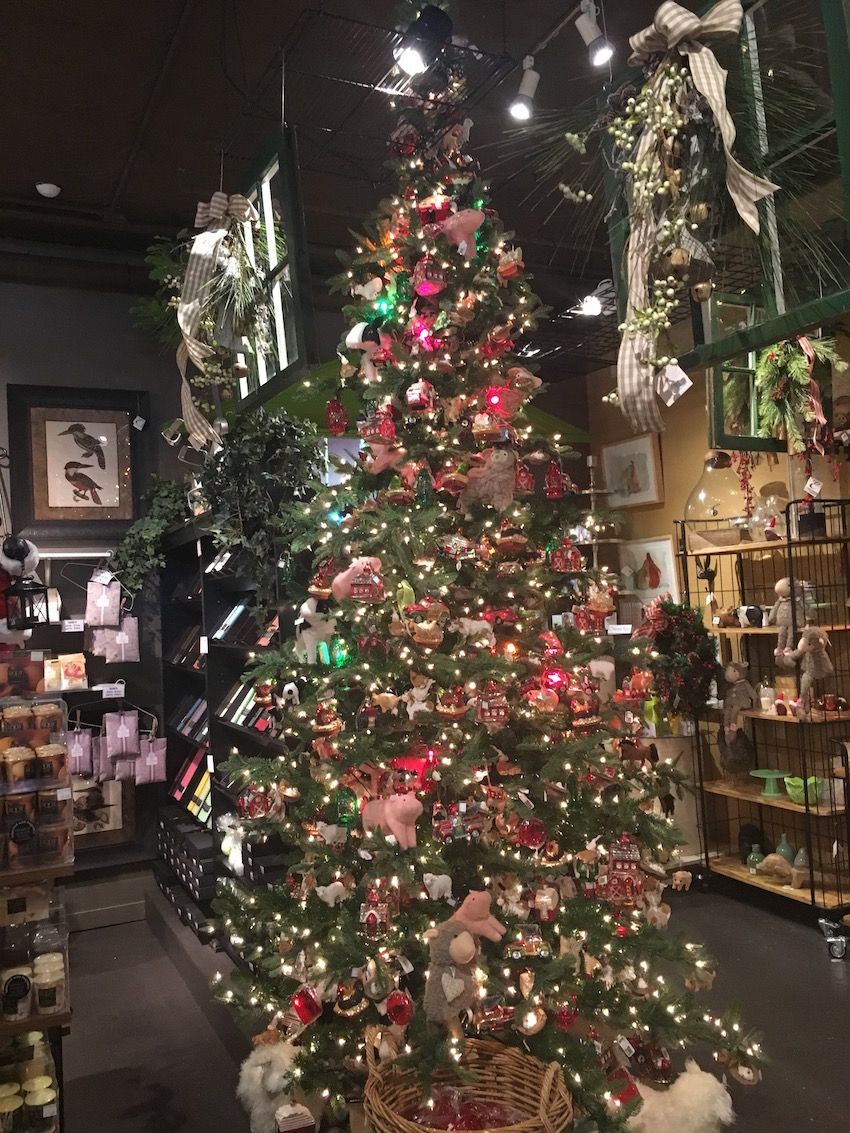
Figural ornaments need air around them. Hang animal figures in odd-numbered clusters of three, spaced 10 to 12 inches apart, and vary their depth on the branch so nothing hides behind a neighbor. If you’re building a collection, budget one or two new figures a year at $12–$25 each rather than a dozen at once — the tree gets better, not busier.
15. Cream Velvet Bows and Neutral Matte Ornaments
This is a 70/20/10 tree: 70% cream and warm white, 20% texture from velvet ribbon, matte finishes, and a woven skirt, and 10% green from the tree itself. Swap cream for soft grey and it works in a cooler room; swap velvet for raw linen and it turns farmhouse instead of glam. The proportions stay identical either way.
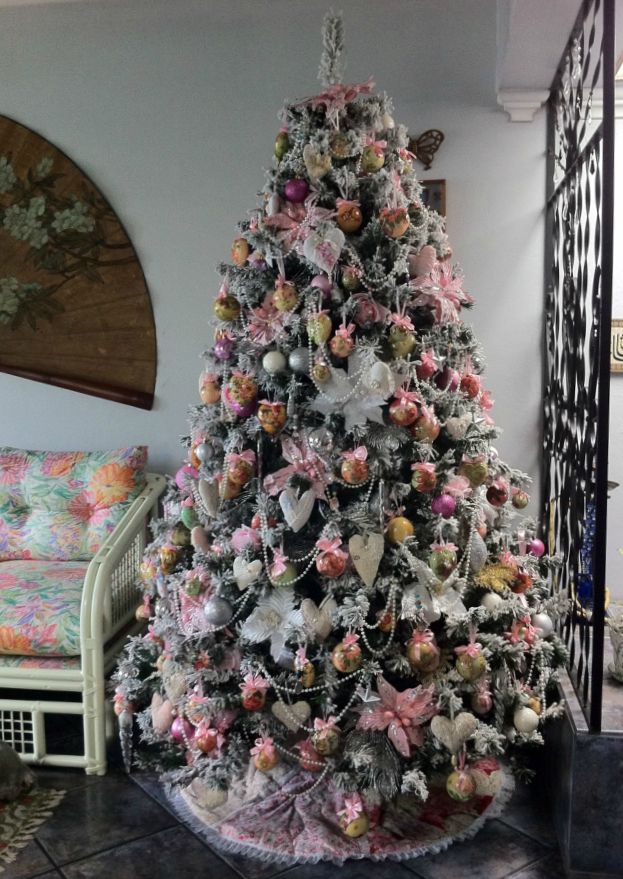
Comfortable in rooms from 10×11 feet up, with 8-foot ceilings minimum for a 6.5- to 7-foot tree. In anything smaller this palette gets lost against the walls — go tabletop, or try Idea #18, which keeps the neutral mood at a fifth of the footprint. Want the same silhouette with more sparkle? Idea #6.
Velvet bows look best at 4 to 6 inches wide, about 8 to 10 per tree, placed at the outer tips of branches rather than deep inside. Wire-edged ribbon holds its loop; if yours is flat, threading a single pipe cleaner through the back fixes it for pennies.
16. The Barely-There Rustic Tree With a Textured Skirt
There’s almost nothing on this tree, and that’s the achievement. Dense evergreen needles catch warm bulbs differently than sparse branches do, so the light scatters instead of pooling, and a few rustic ornaments supply just enough shape to keep it from reading as bare. Textured skirt, neutral wall, done.
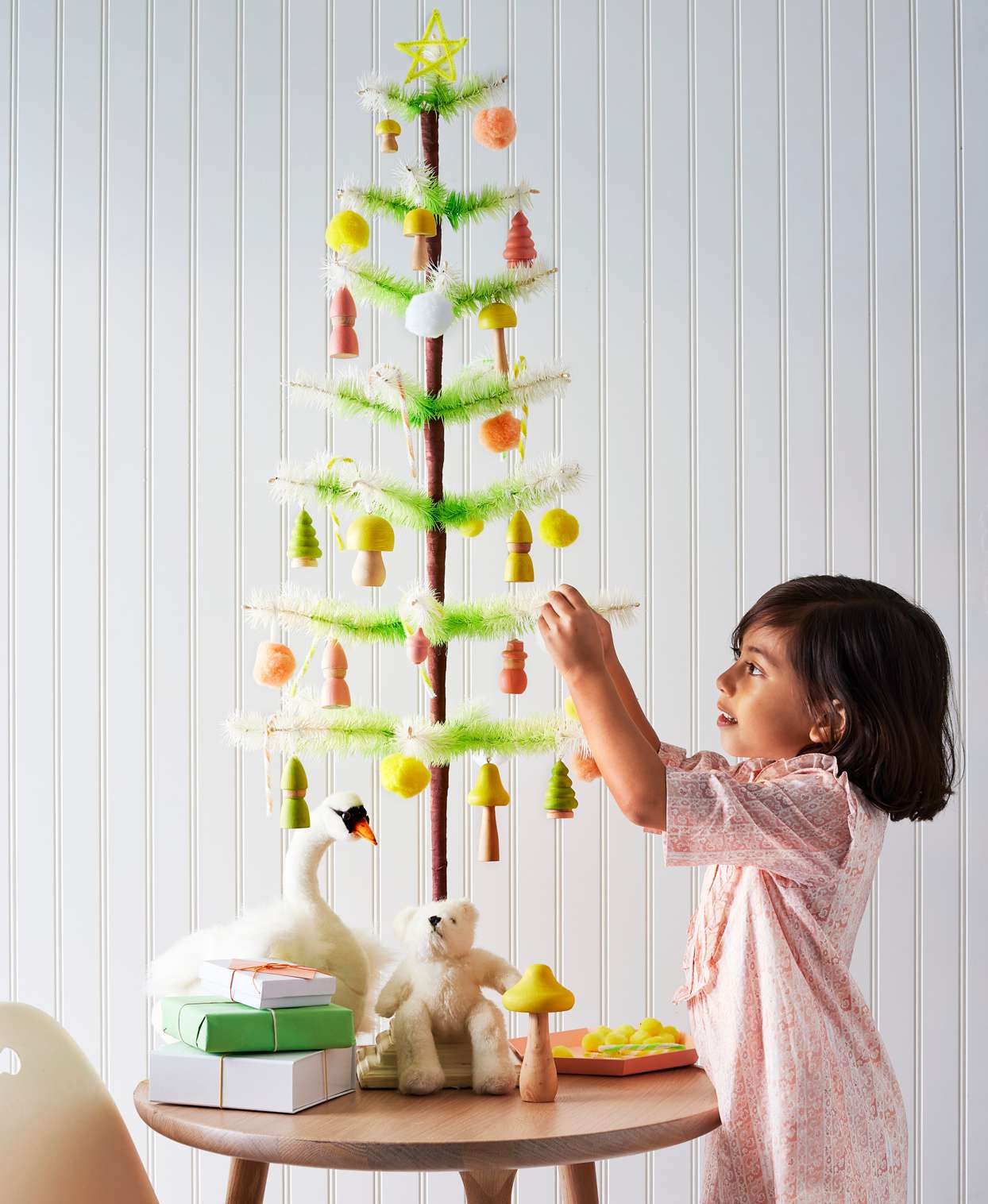
You don’t need a designer tree for this one. A $60–$100 mid-range 7-footer plus 400 warm-white lights from Walmart looks nearly identical to a $400 version once ornaments go on, because rustic styling reads as handmade rather than expensive. Thrift-store ornaments and a burlap remnant for the skirt: about $15 total.
17. Stacked Weathered Planks Built Into a Tree
Building the plank tree:
- Collect 12 to 16 weathered boards, cut to graduated lengths from 12 up to 40 inches.
- Sand the edges so nothing snags your garland.
- Predrill and screw each plank to a vertical center spine.
- Add a triangular base for stability.
- Attach lights with small cup hooks, never staples.
A weekend project, roughly $30–$60 in materials if you’re scrounging free pallet wood.
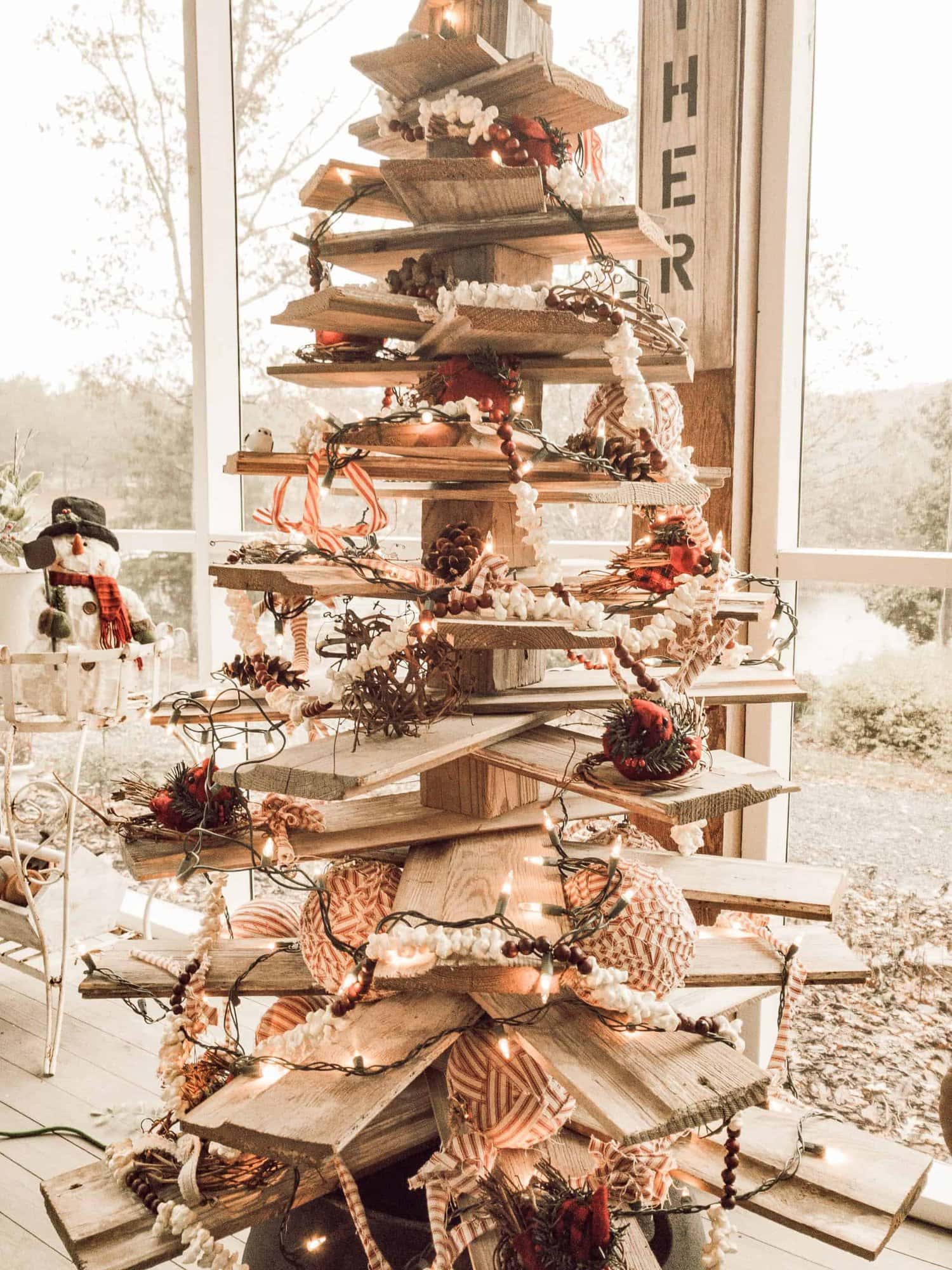
Raw wood means splinters, dust, and the occasional spider, so blow it off with a hair dryer on cool every few weeks through the season. Popcorn garland is charming right up until a pet or toddler finds it, and it yellows in sunlight and can’t be reused. For the same rustic energy with less upkeep, switch to wooden bead garland, which wipes clean and stores flat.
18. A Tabletop Cedar on the Beadboard Mantel
Tabletop trees work in the spaces most people give up on: 8×10 entry consoles, kitchen windowsills, bathroom counters, apartments under 500 square feet. A 20- to 24-inch potted cedar needs about 18 inches of clear space and a shallow pot, and it looks intentional rather than like a leftover. For the full-size version of this palette, see Idea #16.
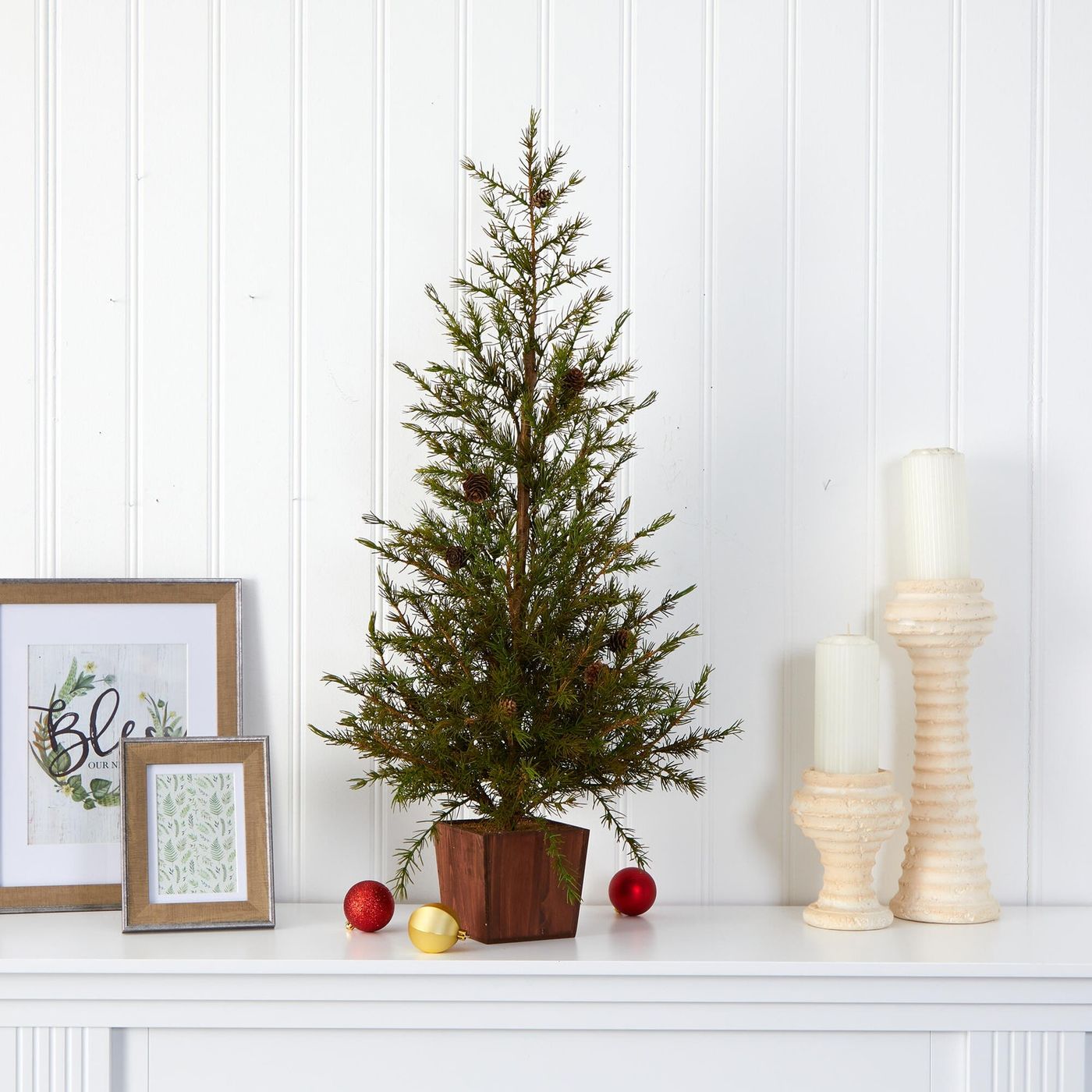
It’s the scale of the objects around it. Mini pinecones and five or six loose ornaments grouped beside a 20-inch tree give the vignette real weight — without them, a tiny tree on a white mantel reads like a decoration that never got finished. The pillar candles and framed botanical prints aren’t filler either; they establish that this tree belongs to an actual room.
19. Dried Orange Slices on Real Pine Branches
Dried oranges only work if they’re actually dry. Slice them 1/4 inch thick, blot the moisture, and bake at 200°F for 3 to 4 hours, flipping halfway through. Underbaked slices grow mold inside a warm room and leave sticky residue on branches. Expect the color to fade from bright orange to a soft amber by February, which honestly looks good.

Hang orange slices on twine loops rather than hooks, and cluster two or three together instead of spacing them evenly — a citrus cluster reads deliberate, where an even row reads like a school project. Pair them with cinnamon sticks and a few sprigs of dried rosemary and the tree smells better than any candle you could buy.
20. Stockings on the Mantel, Warm Light on the Tree
- 7-foot tree: $100–$240
- Warm-white lights, 600 count: $25–$45
- Ornament set, 70–90 pieces: $45–$110
- Stockings, set of 4: $24–$60
- Mantel garland: $20–$45
- Tree skirt: $18–$40
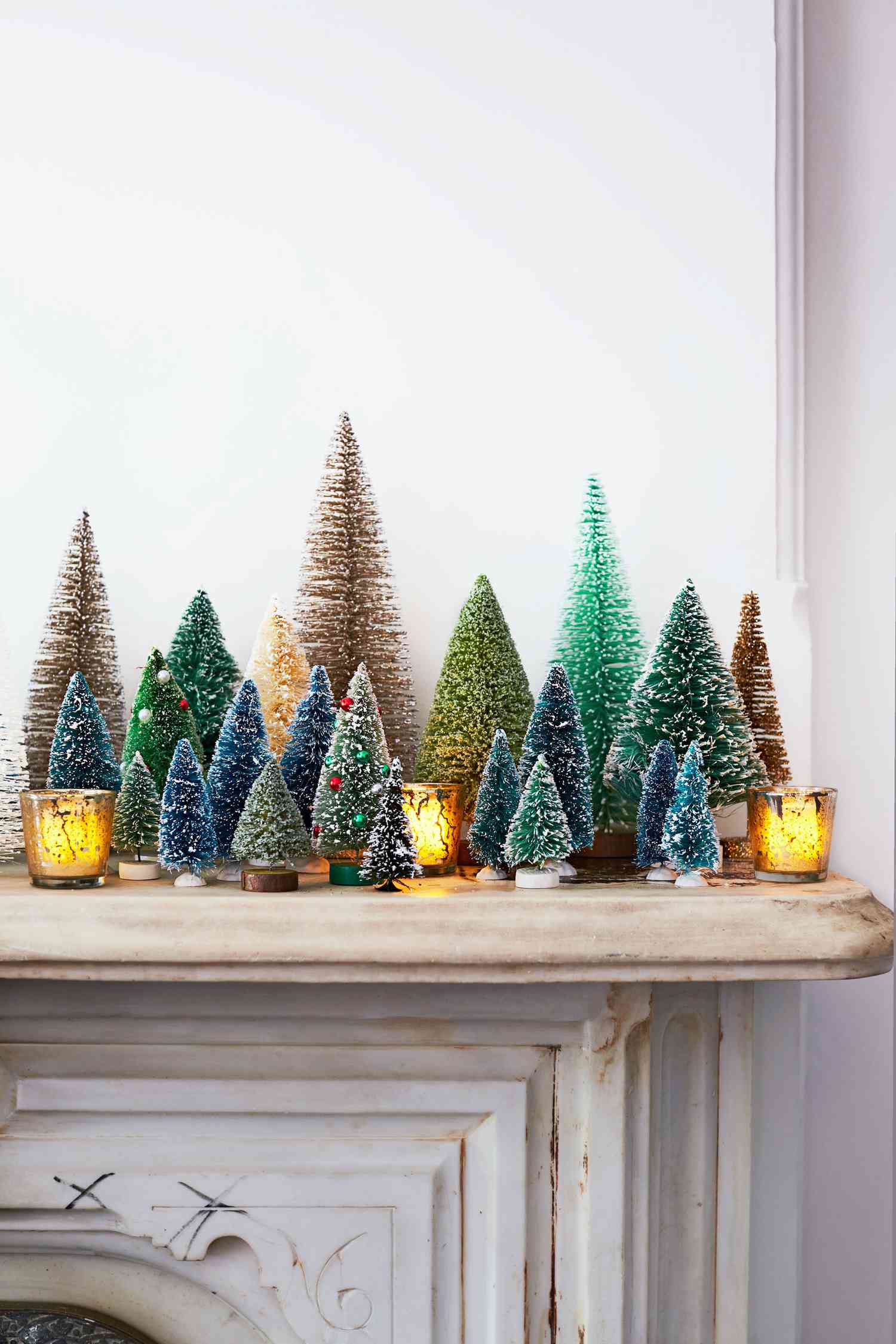
Total: $232–$540
Budget alternative: thrift the stockings and skip the skirt in favor of a $10 burlap remnant — under $150 all in.
The classic brick-and-evergreen living room is having a genuine comeback in 2026, partly as a reaction to the minimalist holiday look that dominated for years. People want warmth they can feel, and a glowing tree near an actually burning fire delivers that better than any styled vignette. This is the one trend on the list with zero risk of looking dated next December.
21. Patchwork Fabric Stars With Raw Frayed Edges
Making a patchwork star:
- Cut ten 5-inch squares from scrap cotton in three or four muted prints.
- Pair them right sides together and stitch around three sides.
- Turn, stuff lightly with batting, and hand-sew the opening.
- Arrange five points into a star and tack the centers together.
- Add a twine loop and leave the seam edges raw and slightly frayed.
About 25 minutes each, and $6–$10 in fabric if you aren’t already using scraps.
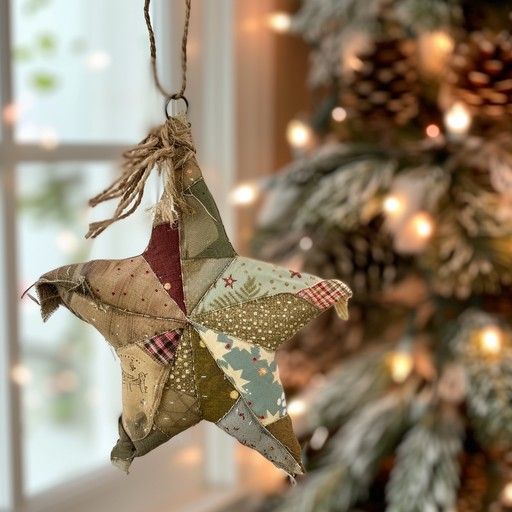
The formula is 60% muted prints — olive, muted red, sage blue, beige — 25% natural twine and raw edges, 15% contrast or metallic thread. Switch the palette to jewel tones and the exact same star reads formal. The frayed edge is what keeps it from looking like a church bazaar craft.
22. A Retro Silver Tinsel Tree Between Green Chairs
Silver tinsel works because it’s a mirror, not a color — it picks up the green of the tufted armchairs and the red of the ornaments and throws both back. The floral drapes and wood paneling supply the vintage backdrop that makes an obviously fake tree feel intentional. Take away the chairs and it’s a novelty; keep them and it’s a scene.
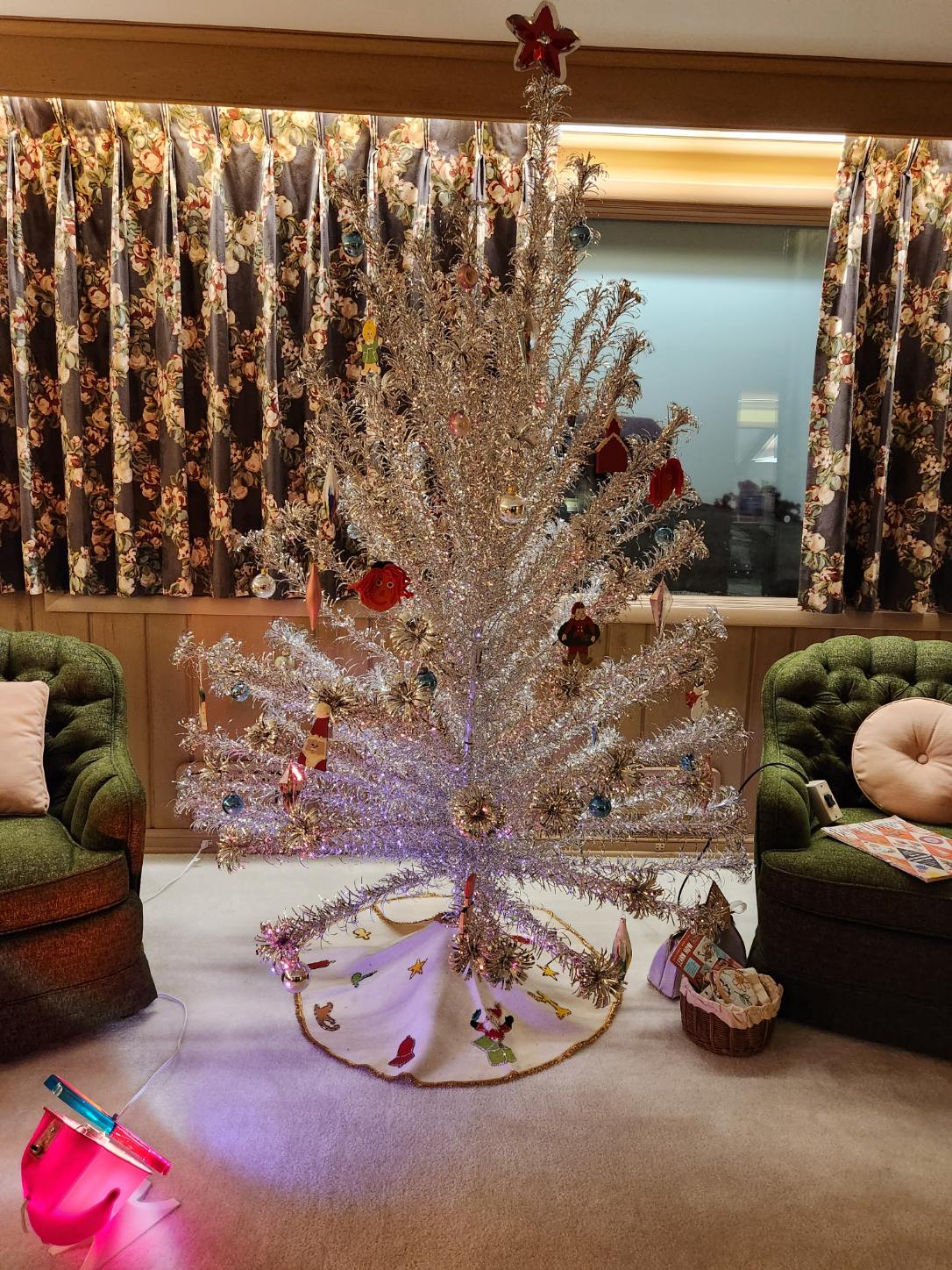
Vintage tinsel trees turn up constantly on Facebook Marketplace and at estate sales for $35–$90, and the honest truth is that most of them are better made than the new ones. Retro ornaments are the cheap part: box lots at thrift stores run $5–$12 a dozen, and a red star topper is about $8.
The white tree skirt with embroidered motifs does more than it gets credit for. It’s the piece that says curated retro moment rather than silver tree in a room with green chairs, and it keeps the look from falling apart at floor level where the eye lands first. Compare with Idea #2 — same ornaments, arranged instead of hung.
23. Geometric Wood Trees and a Burgundy Nutcracker
Small decorations on a tabletop need a triangle: tallest object at the back, medium in the middle, smallest in front, all inside an 18-inch cluster. Heights of 10, 8, and 6 inches read better than three pieces at 8 inches. Keep the nutcracker and the snowman at least 4 inches apart — when they touch, the eye reads them as one messy shape instead of two characters.
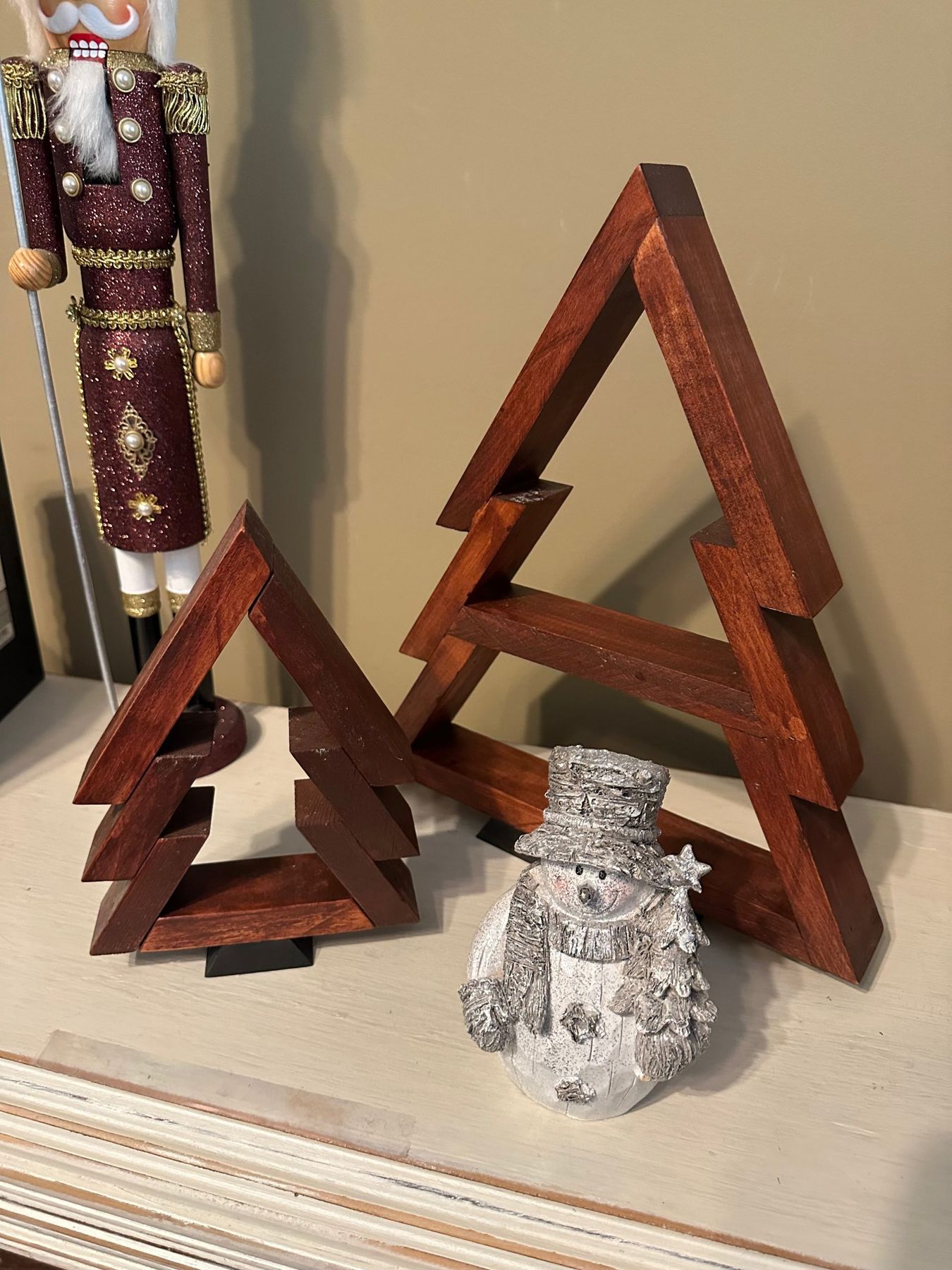
- Measure your surface; these pieces need 20 to 24 inches of width to look arranged rather than crowded.
- Check the wall behind them — beige and cream make burgundy and silver pop, cool grey mutes both.
- Decide whether kids will handle them, because glitter sheds and small hats snap off.
- Confirm you have a storage bin, since geometric wood pieces do not stack.
24. Woodland Ornaments: Wood Finials and Glass Chalets
Glass globe ornaments are lovely and unforgiving: fingerprints show, and anything inside fogs when the room gets humid. Wipe them with a dry microfiber cloth, never a damp one. Raw wood finials dry out and can crack near a heat source, so keep the tree at least 3 feet from forced-air registers if natural wood is hanging on it.
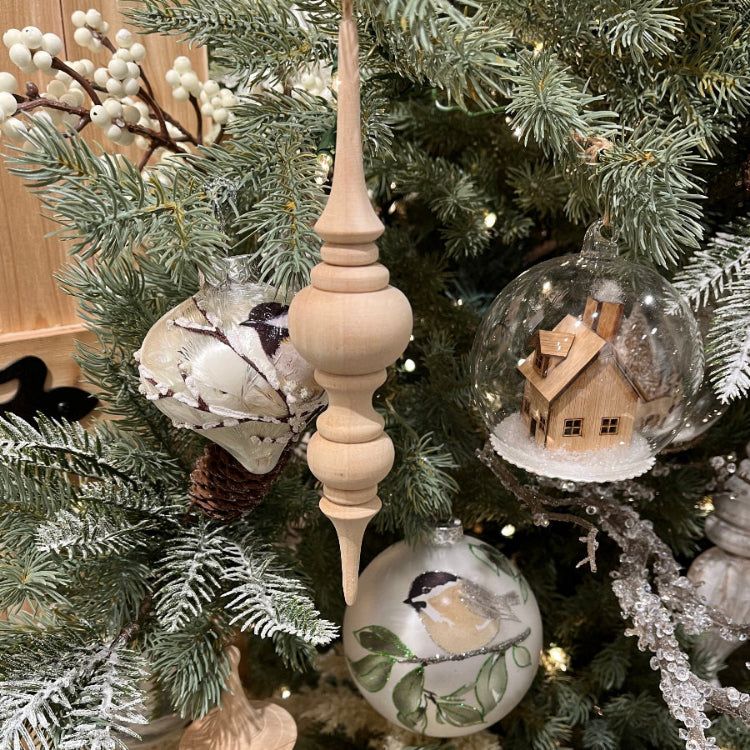
The clear glass globe with the miniature wooden chalet inside. It’s the one ornament on the tree that tells a story, when everything else is texture. Buy them one at a time and slowly — three glass globes with scenes read richer than thirty generic baubles, and guests will actually pick them up to look.
25. Distressed Bells, Birch Spheres, and a Shiplap Corner
Distressed white bells, birch-patterned spheres, and burlap-edged picks are the sort of thing that costs $4–$9 each at a boutique and $1.25 at Dollar Tree for nearly the same look. Birch spheres are easy to fake: a $6 roll of birch-pattern contact paper over dollar-store balls. Rope hangers cost about 20 cents apiece in twine.
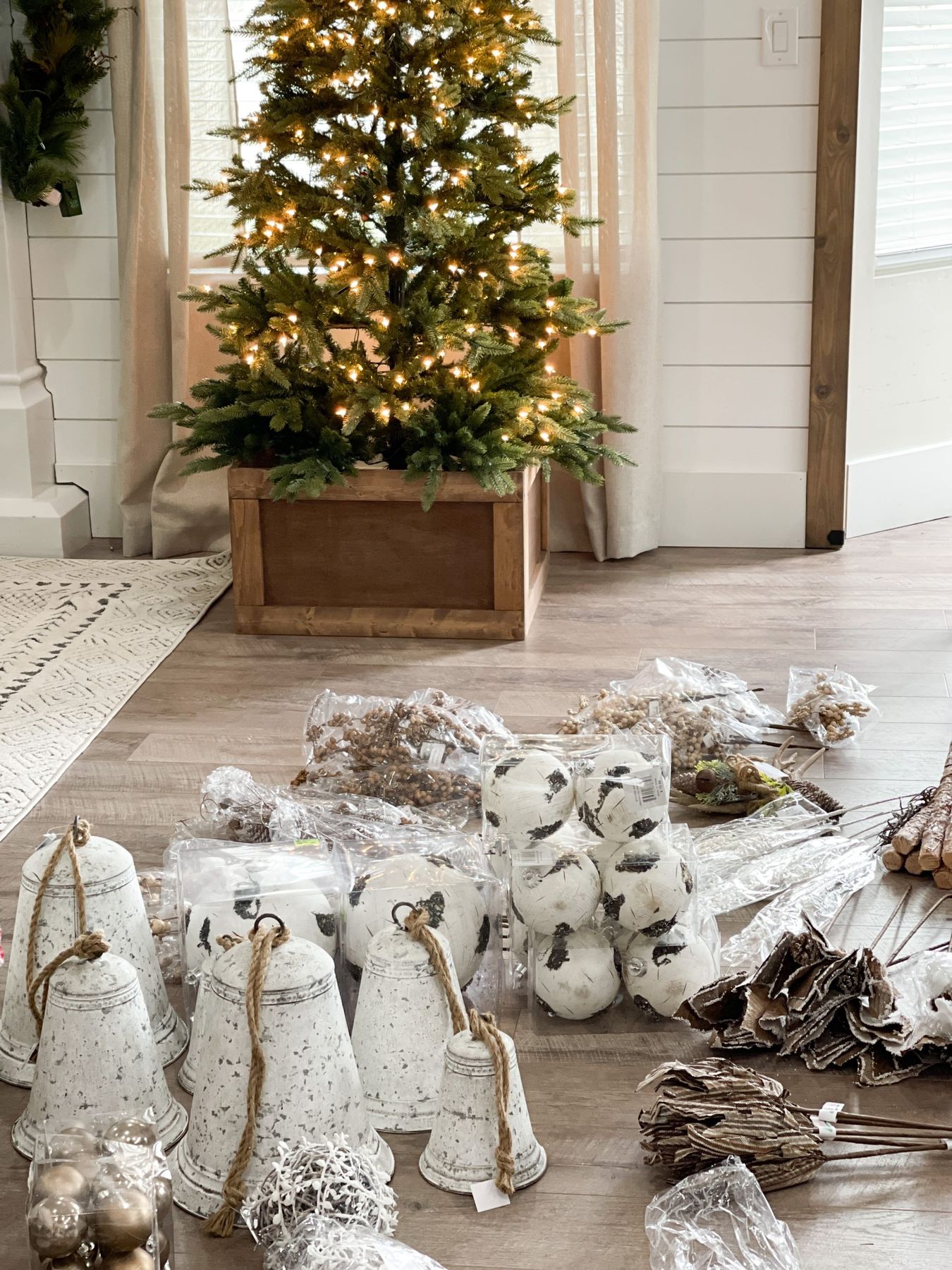
Working a shiplap corner:
- Lay every stem and pick on the floor first and group them by color.
- Trim the wire stems to 6 to 8 inches with wire cutters.
- Insert picks at a 45-degree angle, not straight in.
- Add the heaviest elements low, near the wooden box.
- Step back six feet and hunt for gaps.
About 45 minutes and no special tools.
26. A Pine-Garlanded Piano Under an Antique Window
The antique multi-pane window frame above the piano does the work of three pieces of art: it adds height, it frames the garland, and its weathered white paint ties a dark wood piano to off-white walls. Without it, the piano is just a big brown box with pine needles on top.
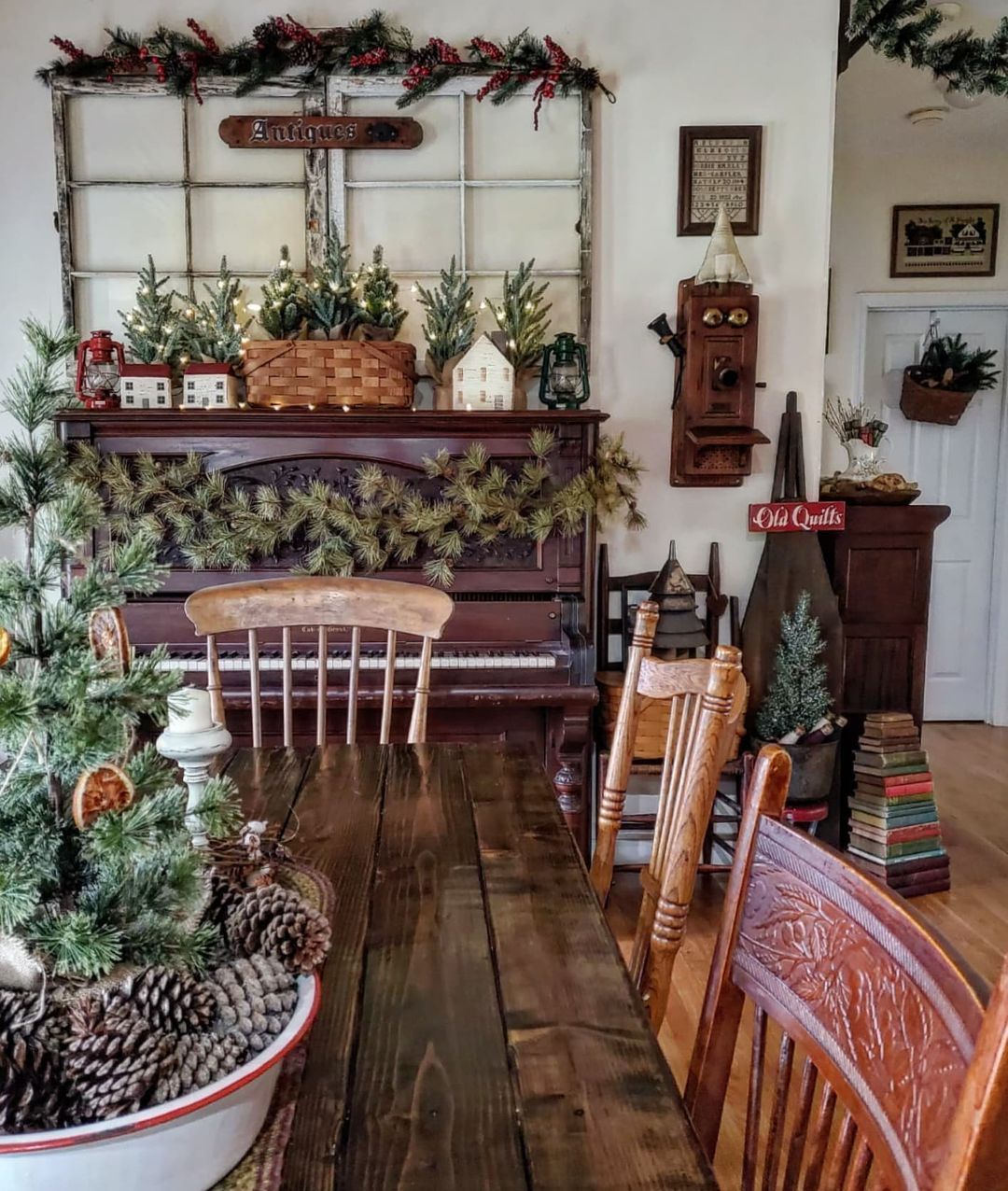
Dining rooms of 12×14 feet and up handle this arrangement well. The piano wants roughly 5 feet of wall and 2.5 feet of clearance in front for chairs. In smaller rooms, keep the garland and lose the window frame — or try Idea #18, which delivers the mini tree moment on a single mantel.
Nostalgia styling is the biggest holiday thread of 2026: bottlebrush trees, old window frames, and pinecone bowls are all over Pinterest because they read as inherited rather than purchased. It’s the same impulse behind the tinsel revival, and it’s why thrifted holiday decor is currently outperforming new decor on saves.
27. Flocked Mini Tree Under a Pastel Balloon Arch
Balloon arches crossed into holiday decor around 2024, and they’re still going strong — especially for December birthdays. The 2026 version is a pastel, non-traditional palette paired with a small flocked tree, so the arch and the tree feel like one installation instead of two competing party props.
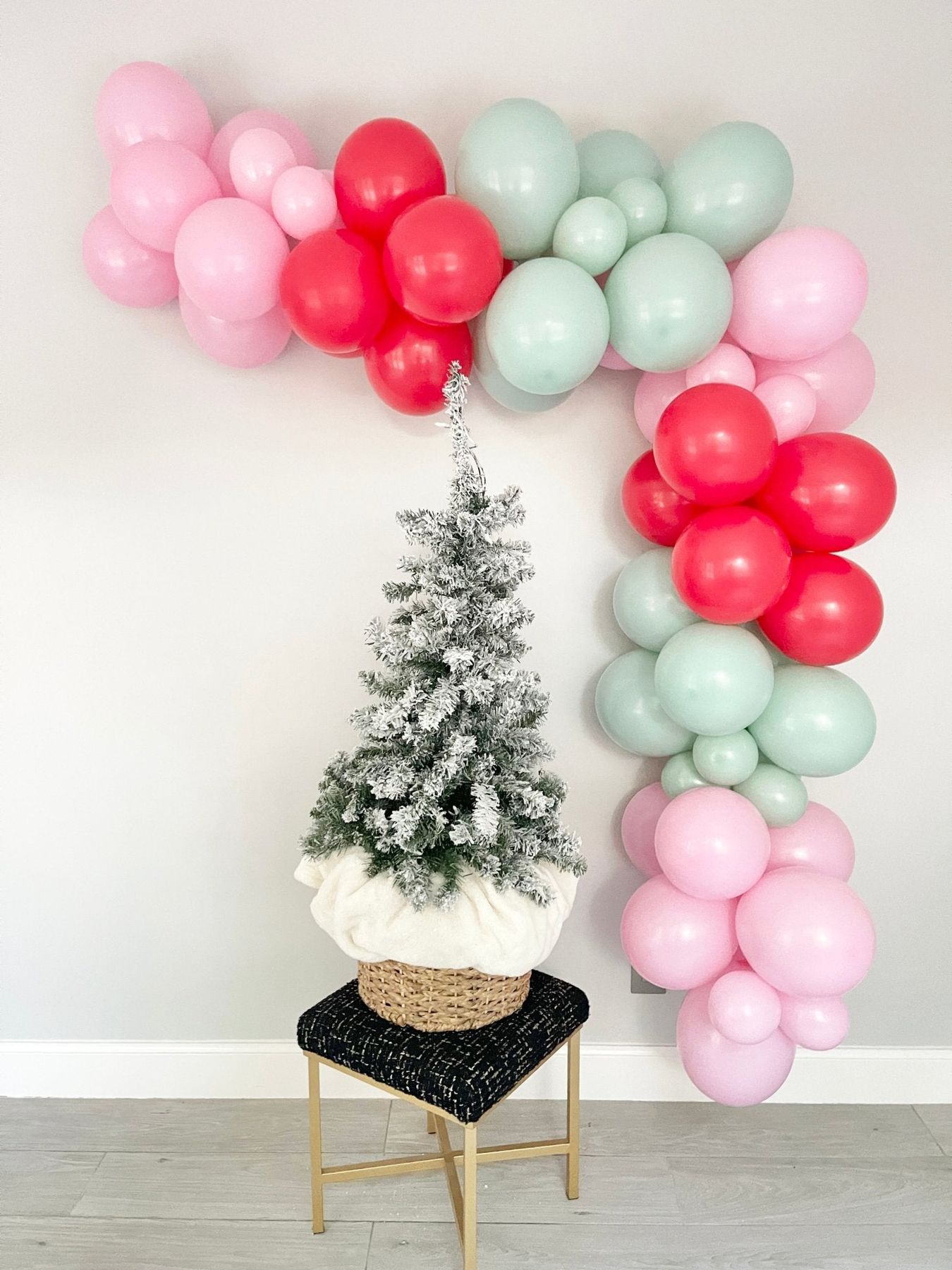
- Mini flocked tree, 2–3 ft: $30–$70
- Woven basket tree collar: $15–$35
- Balloon kit, 100 pieces: $18–$35
- Electric balloon pump: $8–$15
- Stool with gold legs: $40–$120
Total: $111–$275
Budget alternative: use a wooden crate you already own as the tree base and a $12 hand pump — about 55% off.
28. A Pastel Blue and Pink Bird Tree Figurine
A figurine is not a tree, and it won’t fill a mantel. If you’re buying this expecting a full display, plan on three or five pieces and treat them as a group. Ceramic and resin break when knocked off a shelf, so keep them above toddler reach, and check for chips on arrival — shipping is genuinely hard on sculpted birds and delicate gold garlands.
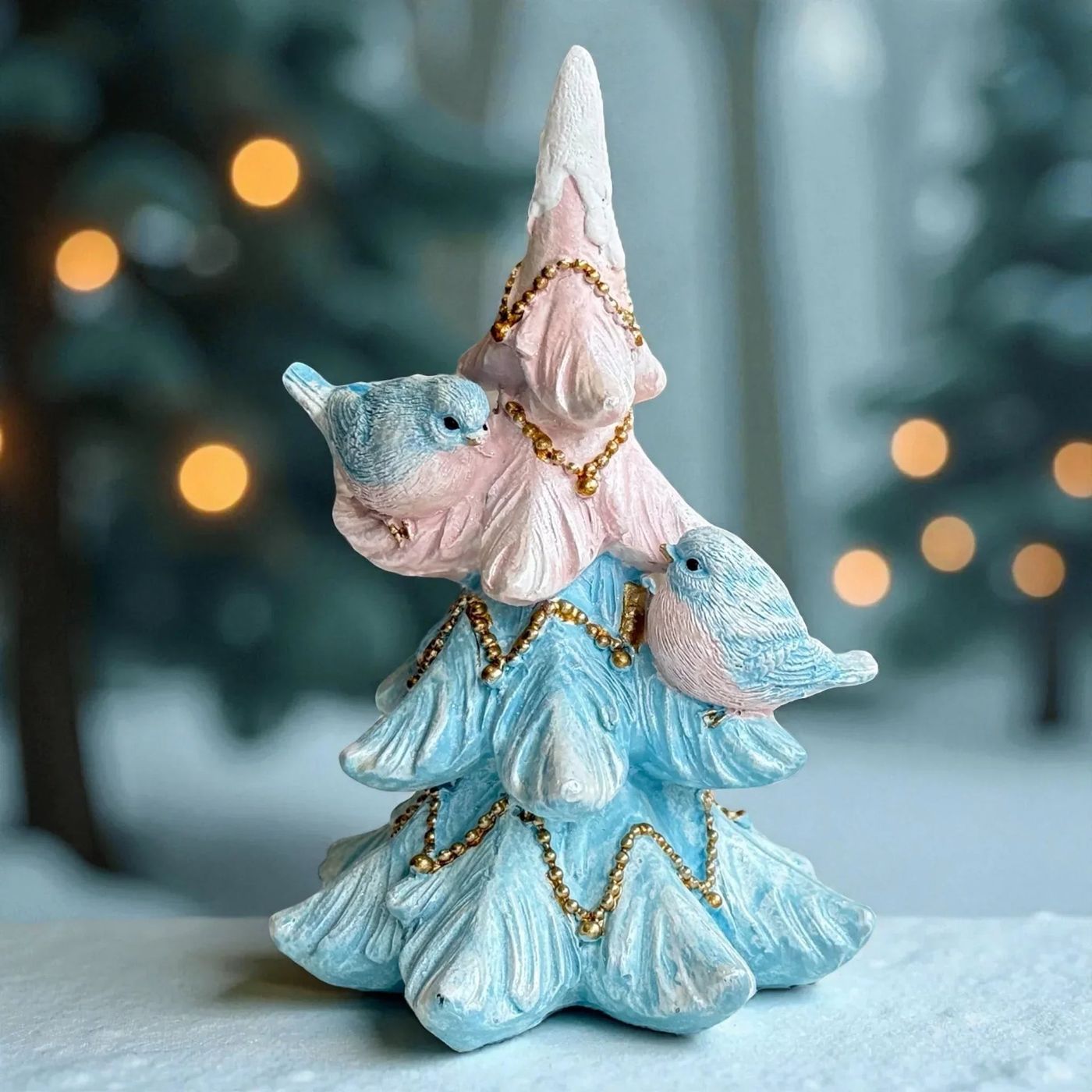
The formula: 55% pastel blue, 30% pastel pink, 10% white snow, 5% gold bead. That last 5% matters, because pastel ceramics without any metallic thread can look like a nursery toy. Swap blue for lavender and pink for peach and the piece reads Easter-adjacent instead of wintry, so keep at least one cool tone in the mix.
29. Neutral Textiles, Soft Gold Glow, and a Full Tree
This is the most flexible look in the entire list. A 7-foot tree with neutral textiles and soft gold works anywhere from 12×12 feet up through open-plan rooms, because neutral ornaments don’t demand a specific wall color or furniture style. In a studio under 500 square feet, go 5-foot and skip the second seating arrangement.
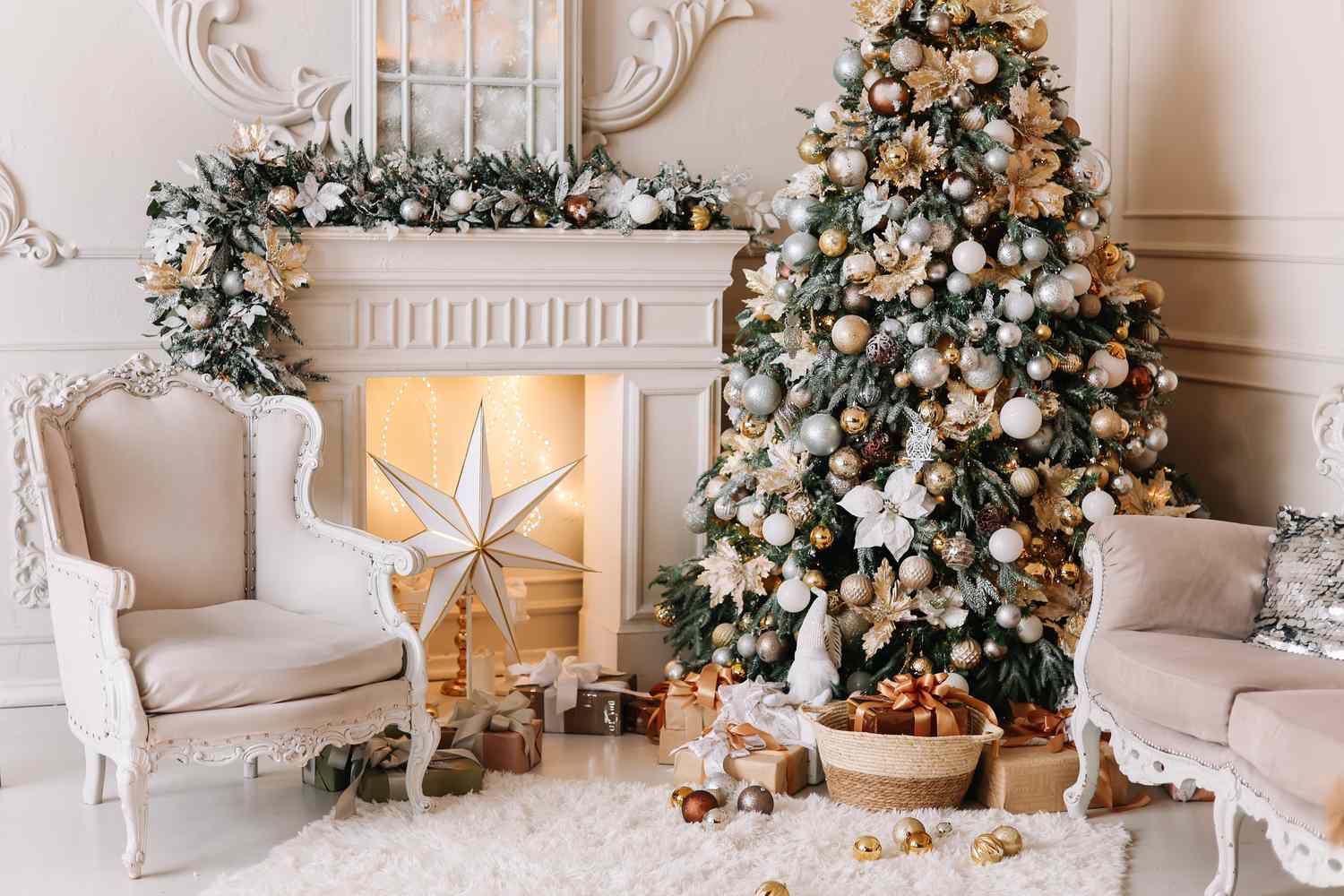
Neutral ornaments need depth, not color. Mix three finishes — matte, satin, and one metallic — inside a single palette and the tree reads layered. Keep the ornament count around 10 per foot of tree height, so roughly 70 on a 7-footer, and place your largest pieces on the lowest third, where the eye expects weight.
30. Rust Plaid Ribbon and Amber Fairy Lights
It’s the amber fairy lights. Not warm white — amber, around 2200K, which is what makes rust and copper ornaments glow instead of turning brown. Swap in standard warm-white bulbs and the plaid ribbon suddenly looks muted and a little sad. Buy the lights before the ornaments and everything else gets easier.
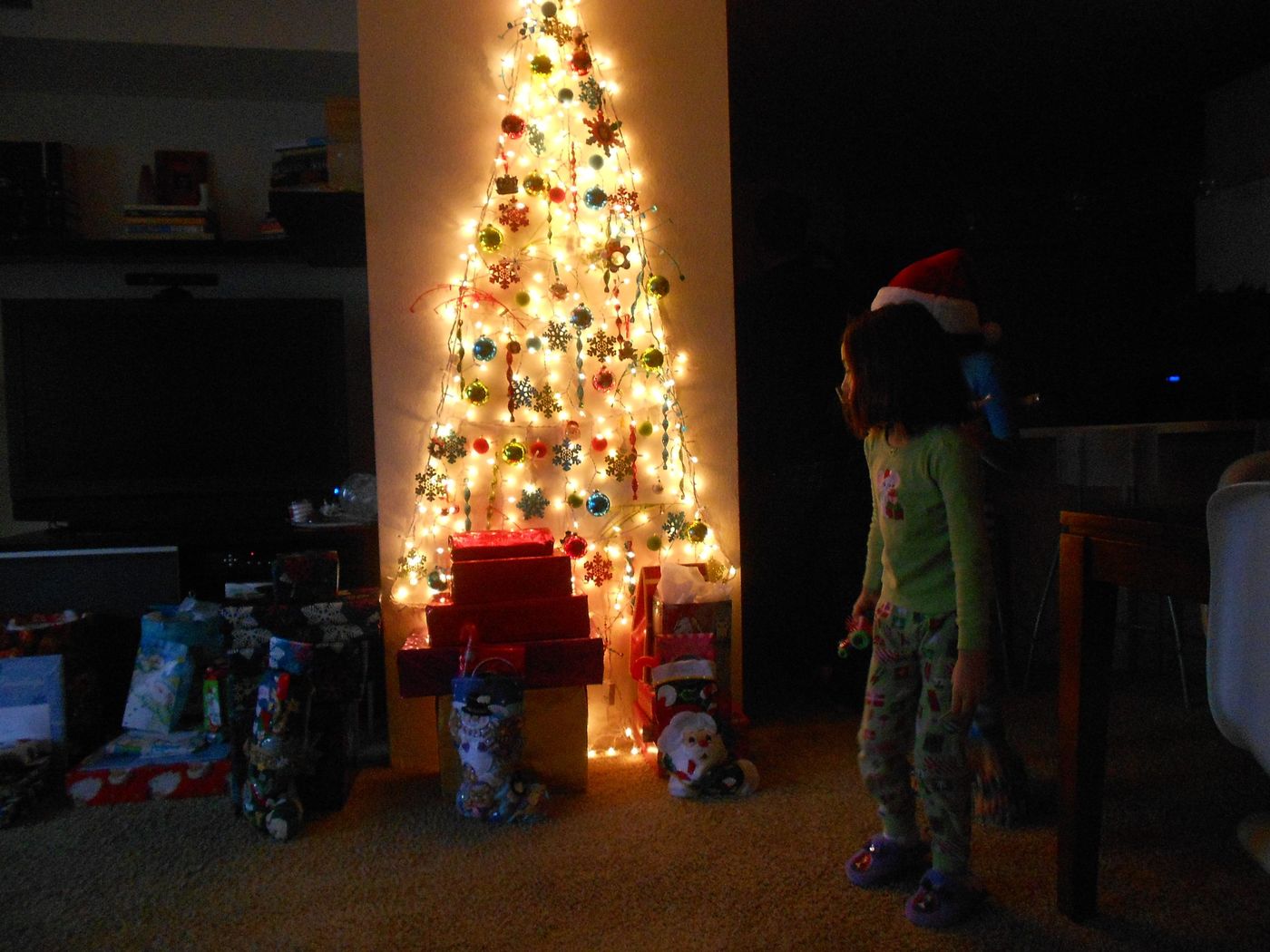
Amber bulbs tend to burn hotter and dim faster than warm-white LED, so plan on replacing two or three strands a season instead of one. Plaid ribbon holds dust and pet hair, so a quick pass with a sticky roller every couple of weeks keeps it crisp. Woven tree skirts need spot cleaning only; machine washing collapses the weave for good.
31. Pinecone Cone Trees on a Burgundy Burlap Runner
Making pinecone cone trees:
- Start with a foam or cardboard cone from a craft store.
- Hot-glue pinecones from the bottom up, largest at the base.
- Fill the gaps with small pinecones and berry sprigs.
- Top with a bow or a single large cone.
- Seal with matte clear spray so the cones stop shedding.
One cone takes about an hour and $12–$25 in materials.
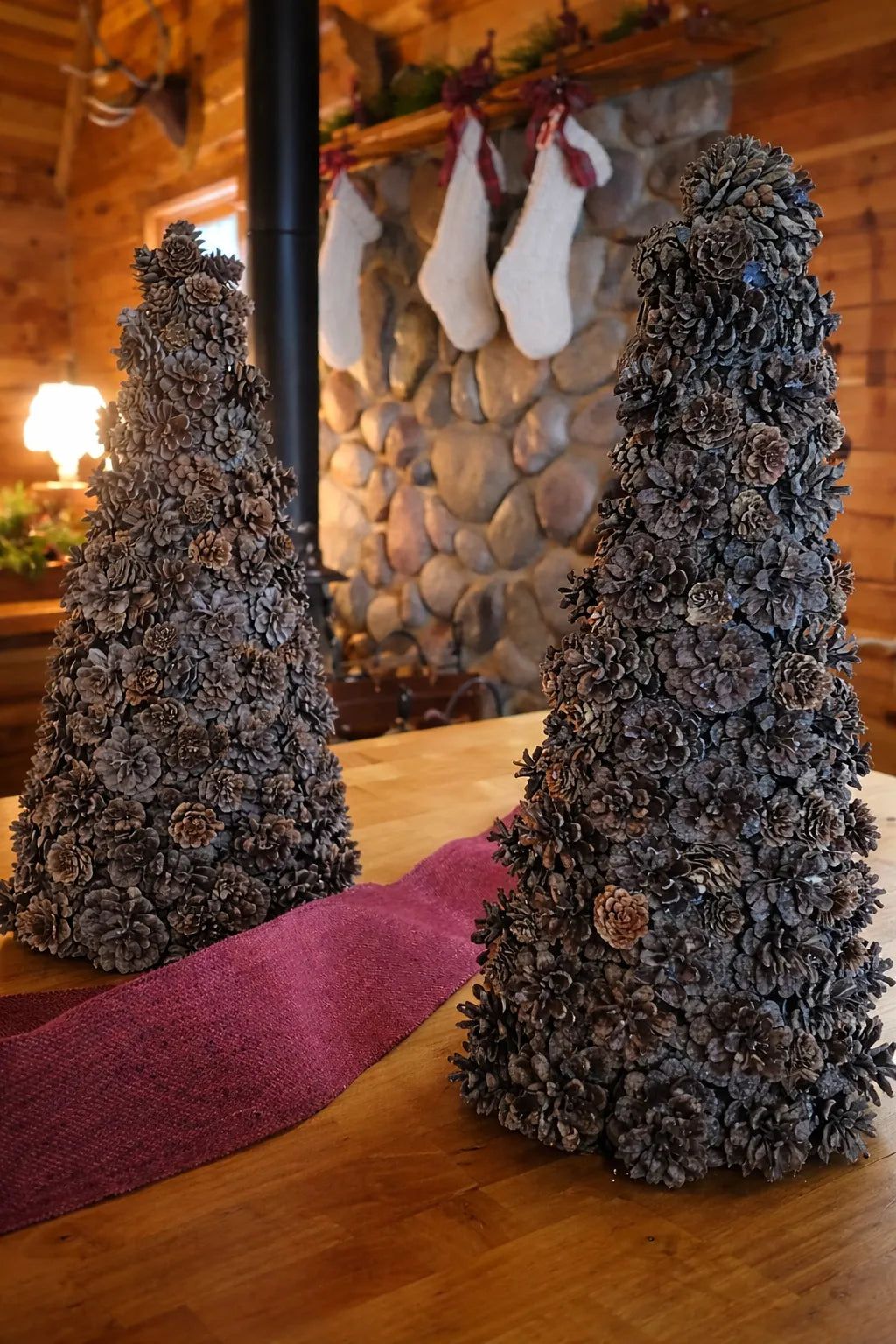
Collect pinecones for free on a fall walk, rinse them, and bake at 200°F for 30 minutes to kill anything living inside. A foam cone is $4 at a craft store, hot glue is $3, and a burlap runner can be a $6 remnant cut with pinking shears so it won’t fray. Whole project under $20 for two trees.
Scale matters more than count. Two cones at 16 and 12 inches look better than four at 10 inches each, and the runner should sit at least 8 inches in from each table edge so plates have room. Anchor the grouping with one taller, non-matching object, like a candle.
32. Nut and Pinecone Trees on a Snow-Dusted Slice
- Check for nut allergies before putting this within reach of kids or guests.
- Test your hot glue first — undyed cardboard bases soak it up and glue pops off.
- Seal the finish; unsealed nuts and berries attract pantry pests.
- Confirm you have a low-traffic surface, since these tip over easily.
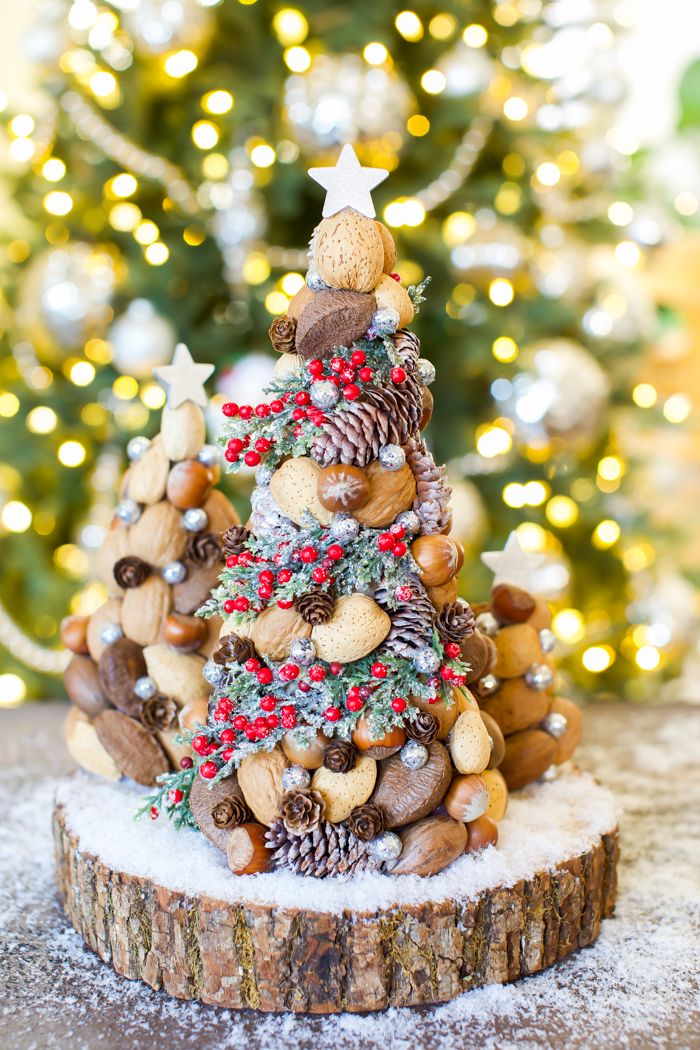
The texture contrast is what keeps this from looking like a craft fair. Whole nuts read smooth and hard, pinecone scales read rough and organic, tiny berries add saturated color, and the snow-dusted wood slice grounds the whole thing. Four materials, one palette, and it holds up under a camera.
33. Dot-Painted Glass Ornament With a Gold Cap
Dot art on glass has a learning curve, so practice on a cheap ornament first. Work from the largest dots to the smallest, let each color dry about 20 minutes before adding the next, and rotate the ornament rather than your hand so the pattern stays even. Rubber dotting tools beat toothpicks by a mile, and a set runs about $8.
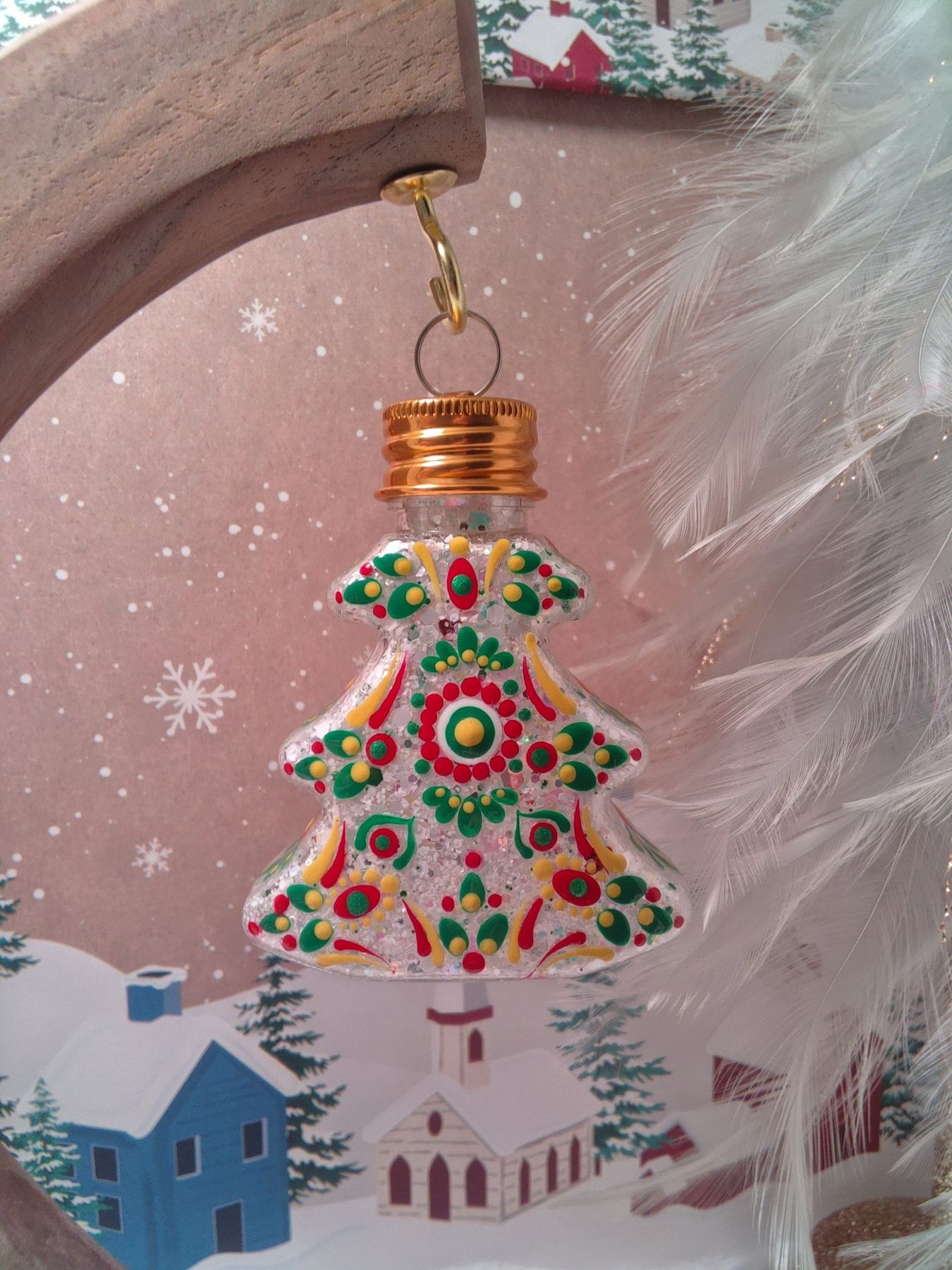
- Tree-shaped glass ornament: $4–$12
- Enamel craft paint set: $10–$22
- Dotting tool set: $8–$15
- Gold cap and hanging loop: $3–$8
- Loose glitter, optional: $4–$9
Total: $29–$66
Budget alternative: use acrylic paint you already own and a pencil eraser for dots — under $15 all in.
Hand-painted ornaments work as accents, never as sets: five to eight on a full tree, clustered on the front-facing branches where they’re actually visible. On a tabletop tree of 2 feet or less, one or two is plenty — a tiny tree crowded with hand-painted glass starts to look heavy instead of precious.
34. Cardboard Cutout Trees With Iridescent Glitter
Simple ratio: 60% raw cardboard, 30% white dot or matte finish, 10% iridescent shine. Change that 30% to red-and-green stripes and the same cutout becomes a kids’ craft; keep it white and glittered and it reads modern. The textured burlap runner underneath adds the rustic note without competing for attention.
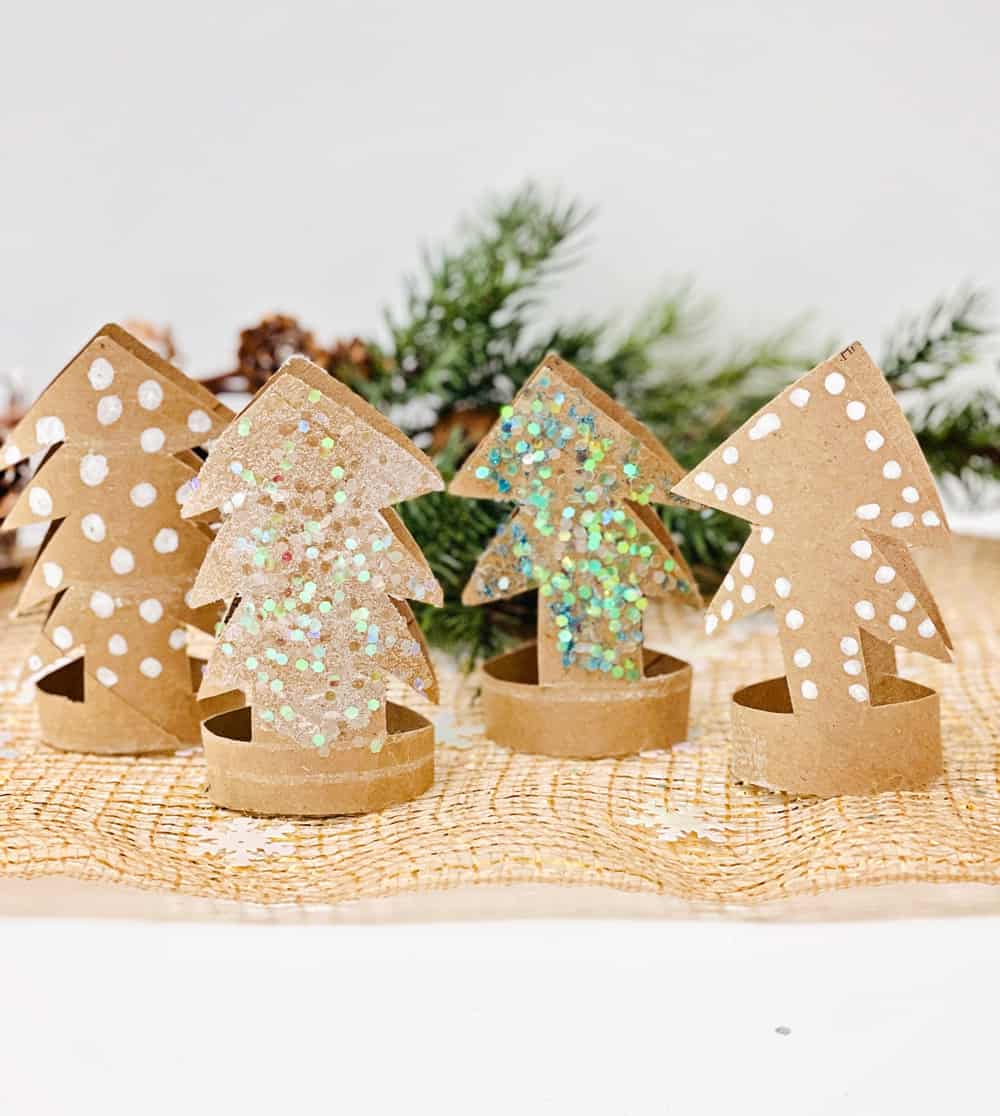
Cardboard trees tip over, and glitter goes everywhere. Weight the bases with a couple of pennies hot-glued underneath, and spray a light coat of clear sealer over the glitter so it stops migrating onto the runner. Keep them well away from candles and radiators, because cardboard near an open flame is a genuinely bad idea. Before you style your table, glance at the mistakes section below.
One Theme, One Weekend, One Tree Worth Photographing
Pick the theme that matches the room you actually have — the attic corner, the brick hearth, the shiplap wall you’ve been meaning to decorate — and let the rest of the list wait for next year. Start with the one element that carries the look, then fill in slowly, because a tree gets better when you stop adding.
📌 Save this to Pinterest before you head to the attic — next December you’ll thank yourself for having the palette already picked out.