You know that feeling when you finally spot the wreath that looks exactly right — and then find out it’s $240 and backordered until next November? Same. This year we went looking for the real thing: full greenery with texture you can actually see from the sidewalk, ribbons that don’t wilt, and ornament placement that doesn’t look like confetti.
We spent serious time browsing Etsy, Target, Home Depot, Michael’s, and Amazon to bring you only what’s worth your attention this year, across price points from about $18 to $240.
Inside you’ll find 34 curated christmas wreath ideas for 2026, spanning rustic natural, traditional red-and-green, modern minimal, and even a coastal version with starfish. Budget and luxury versions sit right next to each other, so you can see exactly where the money goes.
The 2026 shift is toward texture over tinsel — dried botanicals, frosted eucalyptus, and warm-white lighting that photographs like candlelight. And stay until the end — we break down the most common mistakes that can ruin these looks.
📌 Save this to Pinterest for later — you’ll want to revisit these ideas.
1. Plaid Bow, Silver Pinecones, and a Very Full Evergreen
Here’s the math behind that traditional-but-not-dated read: about 60% mixed evergreen base, 25% red and silver baubles, 10% plaid textile, and 5% white glitter picks for the snow-dusted sparkle. Swap buffalo check for the plaid and burgundy for the red and the formula still holds — it just leans modern farmhouse instead of classic. The evergreen base is the anchor; everything else is negotiable.

- Mixed evergreen wreath base, 24 in.: $35–$90
- Red and silver shatterproof ornaments, set of 12: $12–$28
- Silver-painted pinecones, set of 6: $15–$30
- Plaid wired ribbon, 2.5 in. x 10 yd.: $8–$18
- White glitter snowflake picks: $6–$14
Total: $76–$180 for one wreath. Budget alternative: a plain 24-inch faux evergreen runs about $20 in a January craft store sale, and most people already own enough ornaments to fill it — realistically $45 all in.
2. Crimson Velvet Blooms on a Very Deep Green
It’s the oversized crimson flowers — three of them, roughly six inches across — sitting slightly proud of the foliage. Take them away and you have a perfectly nice evergreen wreath. Leave them in and the whole thing starts to look like it cost three times what it did. The metallic gold leaves and berry clusters are supporting cast; the blooms do the talking.
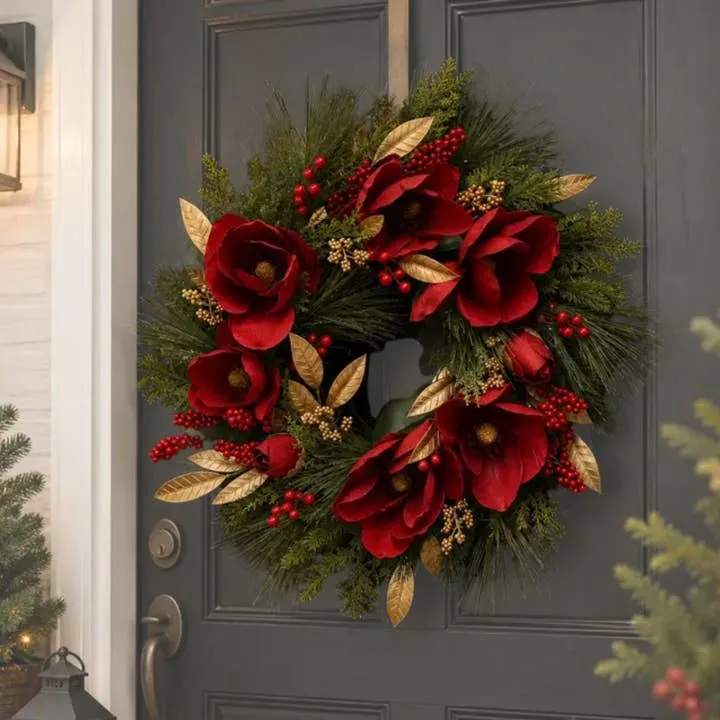
Place large focal blooms at 10, 2, and 6 o’clock, never evenly around the ring. An odd number of oversized elements reads as designed; an even number reads as a clock face. If you’re using velvet flowers, bend the stem wire into a shallow hook and thread it through the inner ring so each bloom tilts forward about 15 degrees toward the viewer.
3. Dried Botanicals Tied with a Chartreuse Velvet Ribbon
Dried florals have been creeping into holiday decor for a few seasons, and 2026 is the year they went fully mainstream — partly because the quiet-Christmas look photographs beautifully, and partly because dried stems cost a fraction of fresh magnolia. Chartreuse is the sleeper color of the season: acidic enough to feel modern against dusty pink and lavender without shouting at anyone.
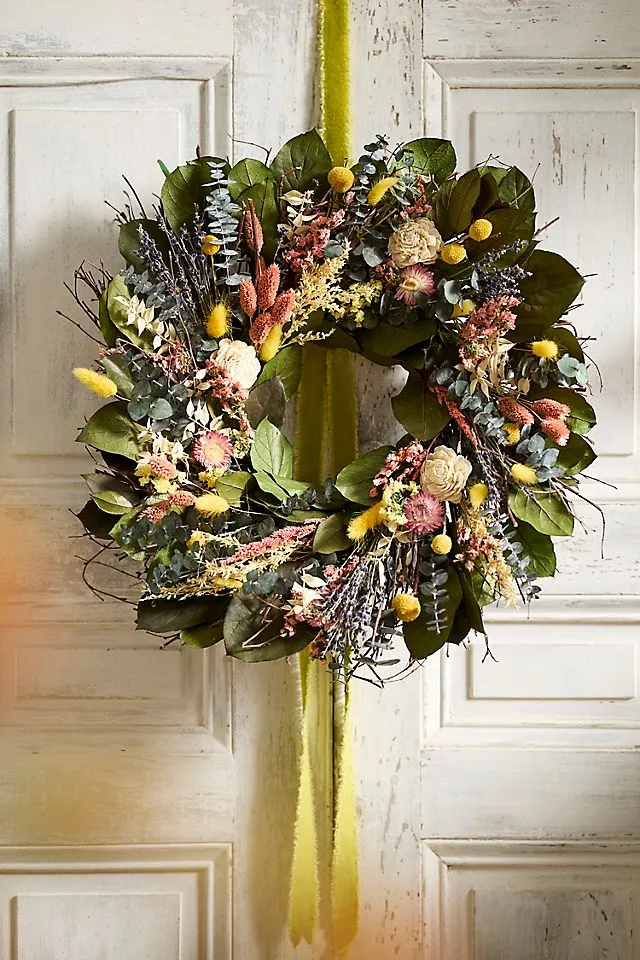
Dried botanicals don’t last forever, and they don’t love moisture. Expect some shedding the first week — that’s normal — and a gradual fade over two or three seasons if you store it in a dry closet rather than a damp garage. If your door faces full afternoon sun, the pink and yellow elements will bleach toward beige by February. Keep this one under a covered porch or on an interior door.
4. Fir, Eucalyptus, and Olive in One Dense Wreath
- Gather three greenery types: a fir base, one round leaf (eucalyptus), and one fine-textured sprig (olive or cedar).
- Bundle them in alternating order and wire each 6-inch bunch to the form, overlapping by half.
- Keep the round leaves pointing outward — they catch light and add silver.
- Tuck reddish-brown seed pods into the gaps so no wire shows.
- Finish with a moss-green textured ribbon bow at the top left.
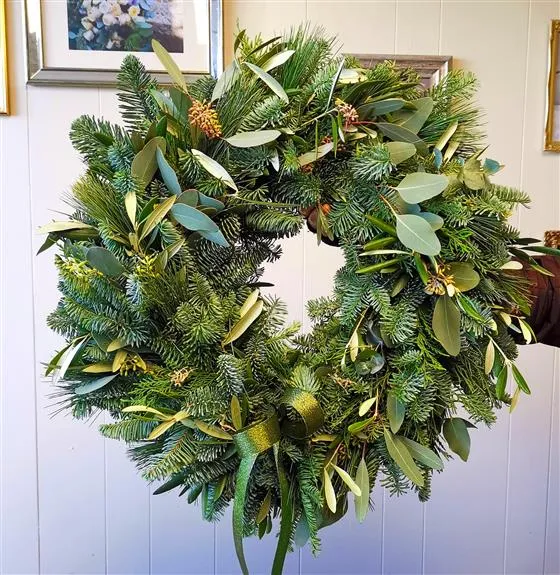
Time: about 50 minutes. Materials: $30–$55 if you’re using faux stems bought on sale.
Two things are doing the work here. First, contrast of leaf shape — needle, round, slender — which keeps a monochrome wreath from reading as a flat green blob. Second, that single shimmering ribbon, the only piece of shine in the whole arrangement. Repetition of one color with variation in texture is the oldest trick in the book, and it’s why this looks expensive with zero ornaments on it.
5. Eucalyptus and Berry Buds in a Sunny Window
This window treatment works best on a single-hung window between 28 and 36 inches wide, with the wreath sized 20 to 24 inches so at least two inches of glass stays visible on each side. An eight-foot ceiling is plenty — the candles in the foreground handle the lower half of the frame. If your windows are smaller, go with a 16-inch wreath and skip the candles entirely, or borrow the hoop approach in Idea #16, which scales down far more gracefully.
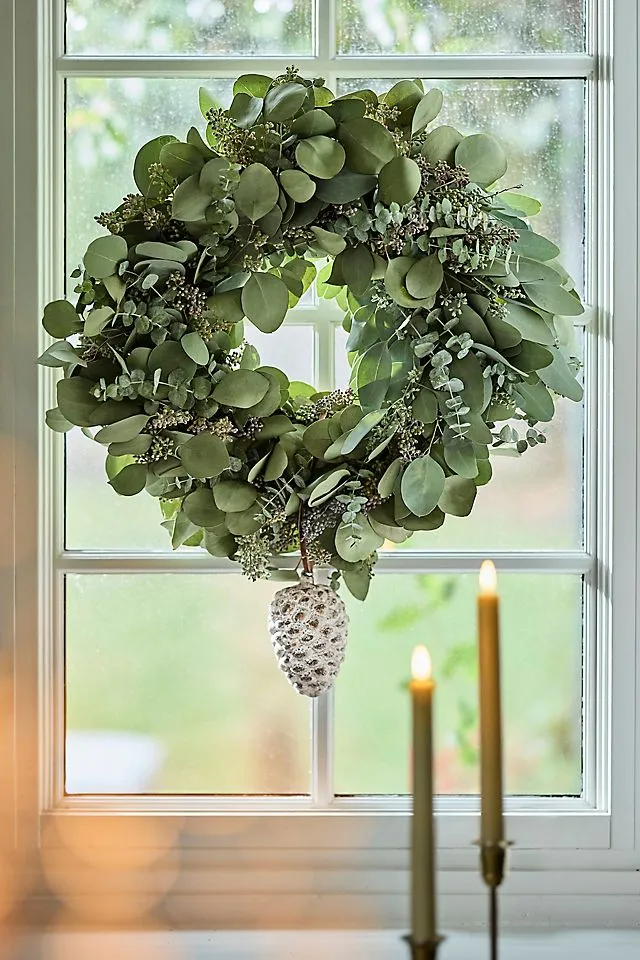
Real eucalyptus dried in place holds its shape for a year or more, but it drops leaves when you bump it — expect a few on the sill each week. The bigger chore is the candles: unscented pillars in brass holders, trimmed to a quarter inch each time, or you’ll get soot on the window frame above. If you’d rather skip the maintenance, a preserved eucalyptus wreath is treated and won’t shed for years.
6. Golden Bow and Rustic Bells on Gray Slats
You don’t need a designer wreath to get this. A 24-inch faux evergreen from IKEA or Walmart runs $15–$25, and a roll of textured gold ribbon is about $6 at Target. The bells are the only piece worth spending on — a pair of aged metal bells with real jingle in them costs $12–$20 at a craft store, and they’re what make the arrangement feel collected rather than purchased. Total: under $50.
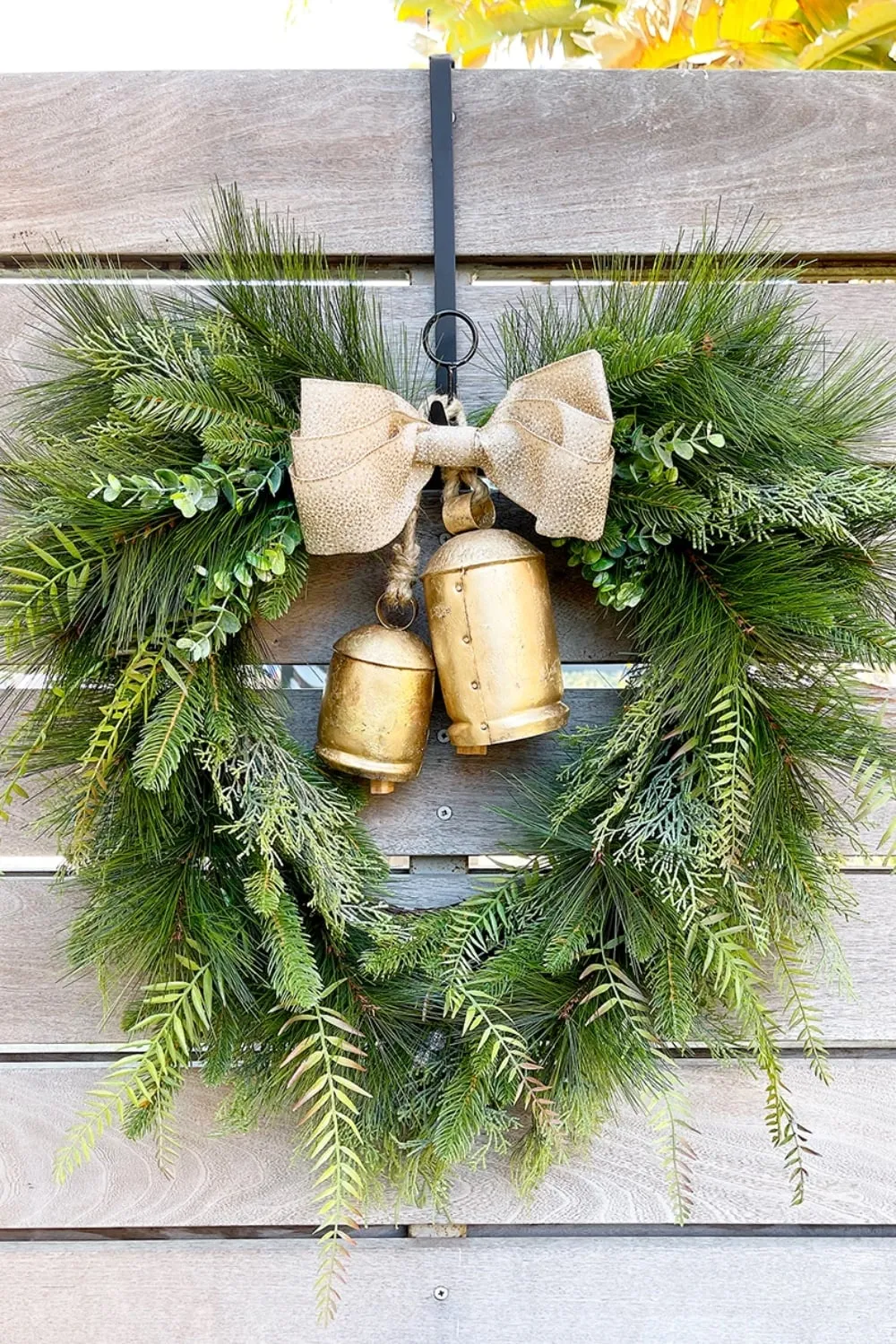
Hang height matters more than people think. On a standard 80-inch door, the wreath center should sit at 60 to 66 inches — roughly your eyeline, not the door’s midpoint. If you’re using a ribbon hanger, keep the visible drop between 10 and 14 inches; any longer and the wreath starts to look like it’s sliding off. On slat walls, use a removable adhesive hook rated for 5 pounds instead of a nail.
7. Dried Oranges and a Red Plaid Bow Tied Low
- Measure your door or wall space — wreaths 24 inches and under fit most single doors.
- Check which direction the door faces; dried citrus fades fast in direct sun.
- Confirm your hanger is rated for the finished weight, and add 1–2 lb for fruit and pinecones.
- Decide bow placement first, because top or bottom changes everything below it.
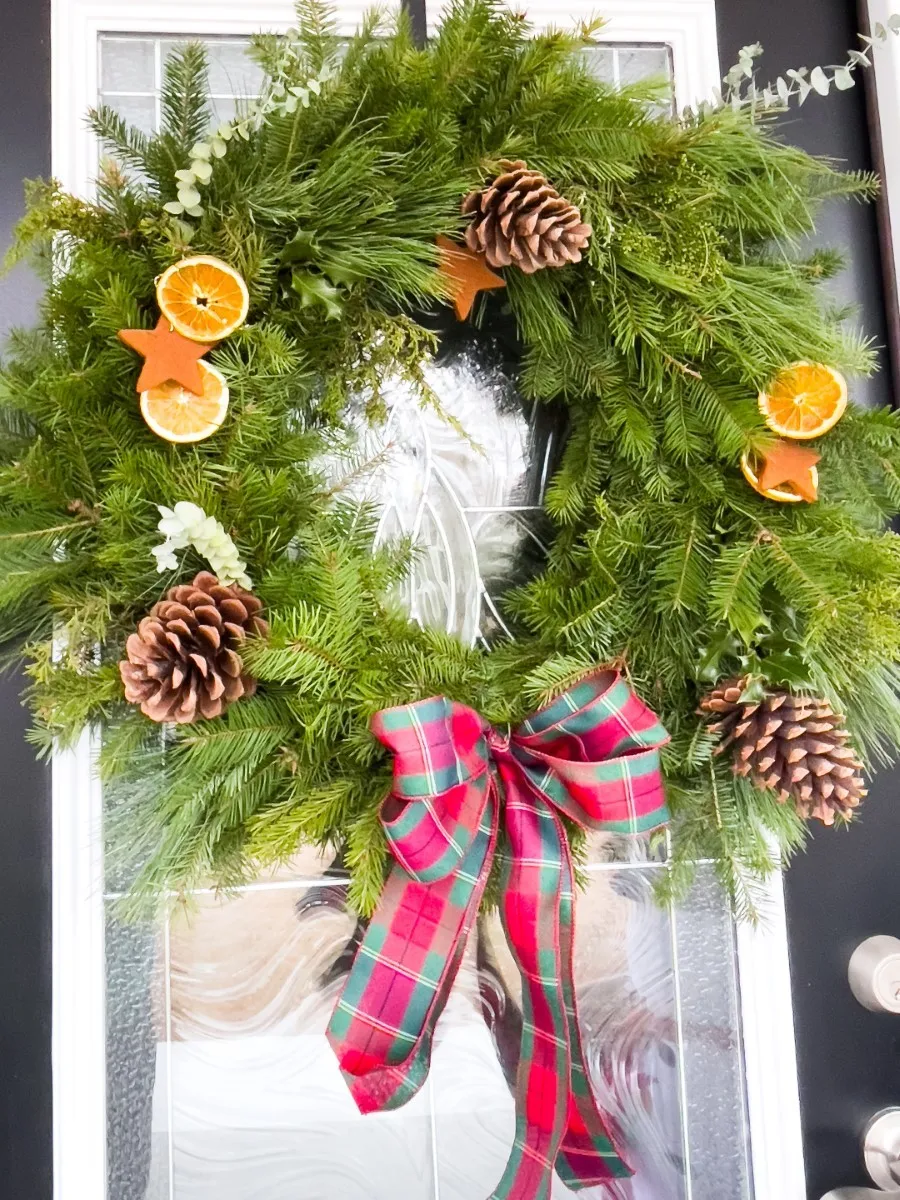
The bow is at the bottom, and that one decision flips the whole personality of the wreath. Top bows read formal and traditional; a bottom bow reads relaxed, handmade, a little bit country. The dried orange slices and pinecones are lovely, but move that plaid bow to the top and you’d have a completely different wreath made from identical parts.
8. White Berries and Pinecones Against Distressed Wood
The trick is mixing needle lengths. Long pine needles beside soft, short-branched fir create depth without a single ornament — your eye reads the variation as lush even though the palette is only two colors. Then the off-white berries act as punctuation every few inches, which is exactly the rhythm ornaments would give you, minus the shine. Monochrome plus texture beats multicolor almost every time.
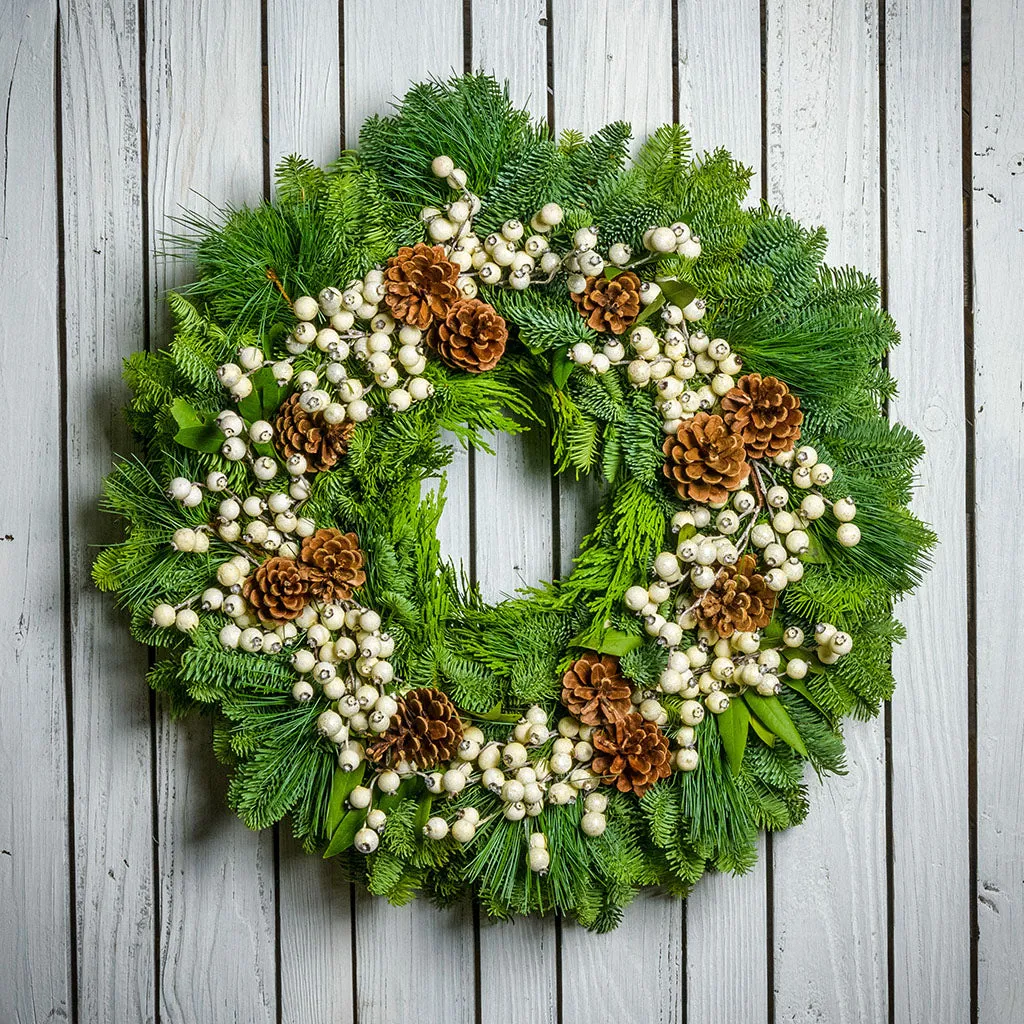
- Mixed evergreen faux wreath, 26 in.: $40–$95
- Off-white berry sprays, set of 4: $14–$26
- Natural pinecones, bag of 12: $8–$16
- Floral wire and paddle: $5–$9
Total: $67–$146. Cheaper route: gather pinecones from a park, bake them at 200°F for 30 minutes to deal with anything living inside, and buy the berries after Christmas when they drop to half price.
9. Magnolia Leaves Against Rusted Corrugated Metal
Magnolia leaves are gorgeous and they are also the messiest thing in this entire article. They brown at the edges within about three weeks indoors, and they curl hard once they dry. That’s fine if you’re after the aged, collected look — less fine if you want the wreath to look identical in January. Rusted metal backgrounds also transfer rust to fabric and hands, so handle this one with gloves when you take it down in January.
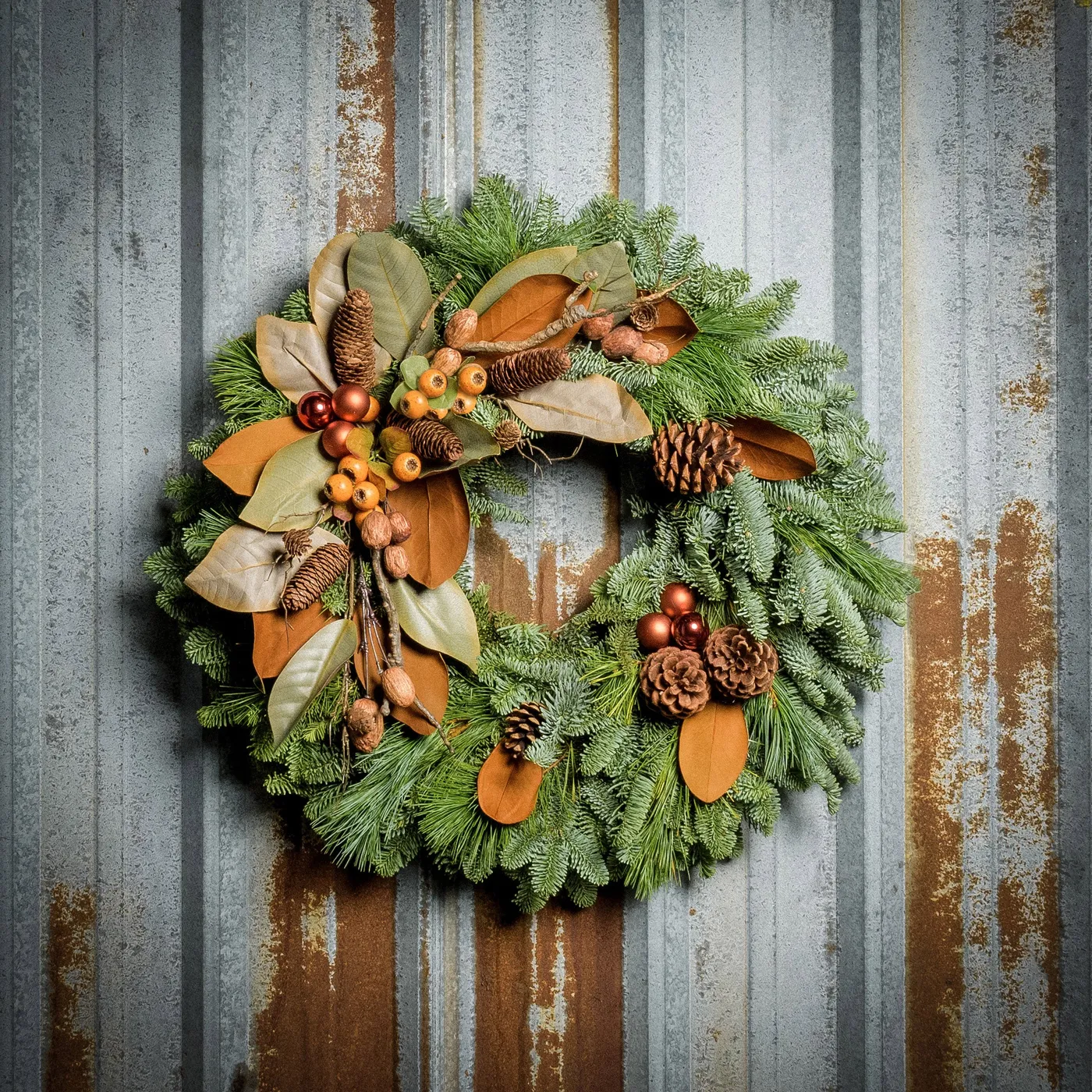
Call it 55% evergreen, 20% dried magnolia, 15% pinecone and pod texture, and 10% matte ornaments for a whisper of color. That matte finish is deliberate — a single shiny bauble in this mix would look like a mistake. Swap the orange berries for deep red and the whole thing shifts from earthy to classic Christmas without changing anything structural.
10. Dried Oranges, a Brass Bell, and a Cream Bow
- Slice three oranges a quarter inch thick and dry them at 200°F for 3–4 hours, flipping once.
- Wire each slice to a 6-inch floral pick so it sits flat against the wreath instead of pressed into it.
- Place orange slices at roughly 4, 7, and 9 o’clock, leaving the upper third cleaner.
- Hang the brass bell from the top center on a cotton rope loop.
- Tie the cream bow at the bottom with the tails pointing down.
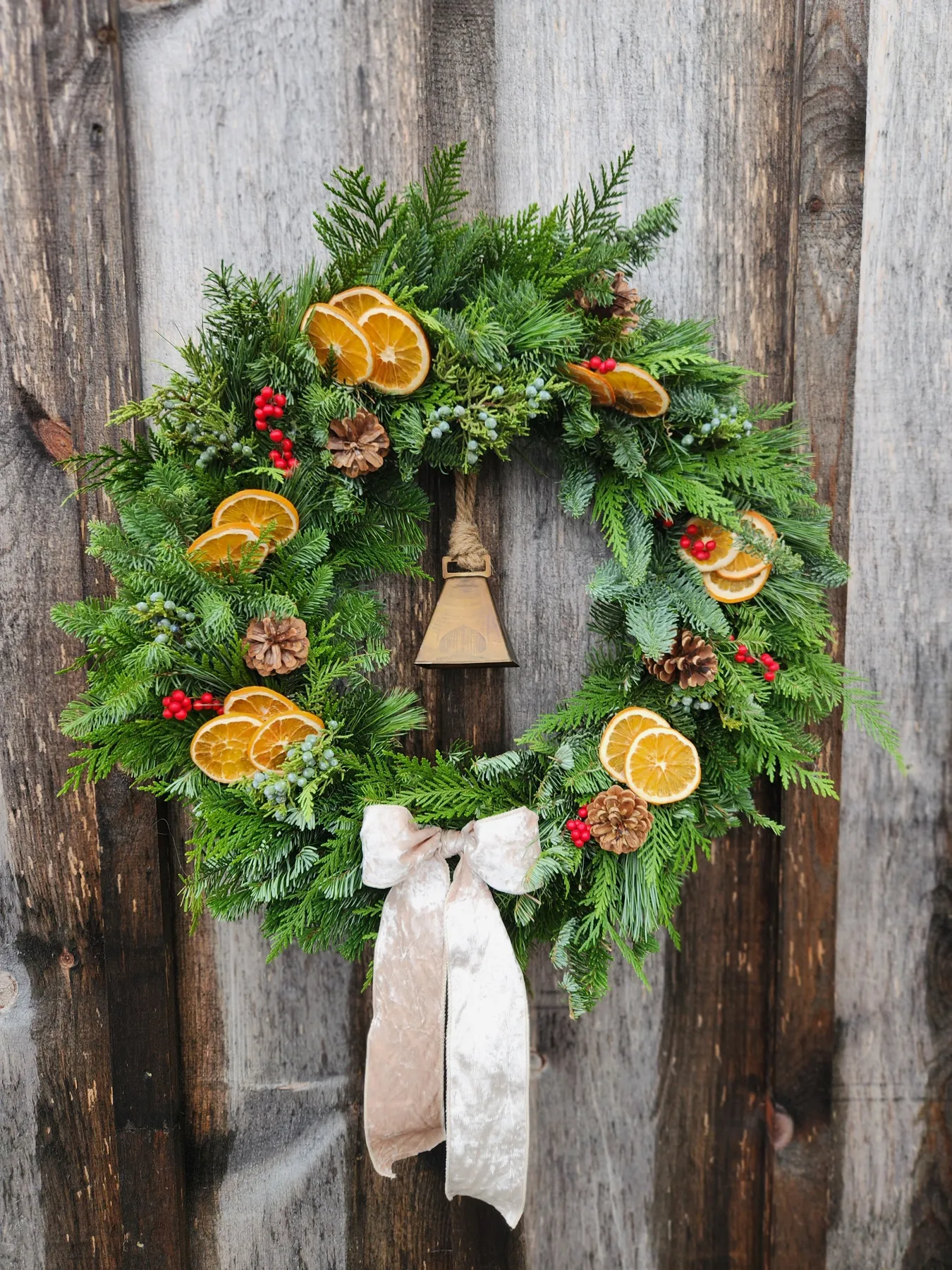
Time: half a day, mostly oven. Materials: around $25 on top of a base wreath you already own.
Oven-dried citrus is the single cheapest way to make a store-bought wreath look custom — three oranges cost about $2. The brass bell is where you should spend: a thrift store bell runs $3–$8 and does more visual work than $30 worth of ornaments. Blue-green berries and pinecones you already have? They go here. Nothing about this arrangement depends on new purchases.
11. Pre-Lit Greenery Above a Mercury Glass Mantel
When a wreath hangs over a mantel, match its diameter to about one-third of the mantel width. A 72-inch mantel wants a 24-inch wreath; a 48-inch mantel wants 16 inches. Keep the bottom of the wreath at least 12 inches above the tallest candle, too — otherwise the mirror reflects a green blur and the flames look like they’re licking foliage.
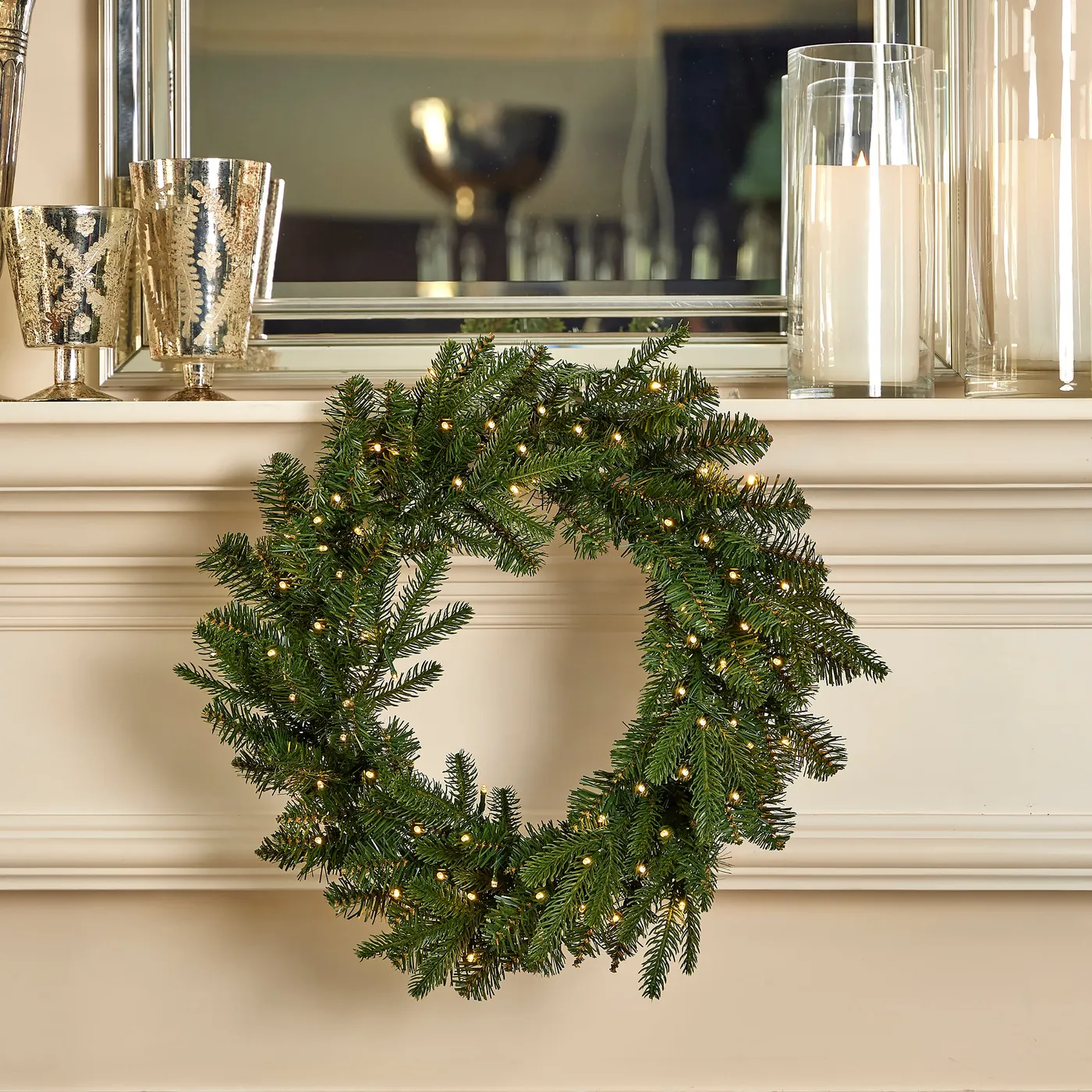
This setup needs a mantel at least 60 inches wide and a room with a 9-foot ceiling so the mirror doesn’t feel cramped. Mercury glass votives work at any scale, but under a 48-inch mantel, drop to three vessels and a 16-inch wreath. For small spaces, look at Idea #12, which gets a very similar glow from lighting alone.
12. The Simplest Pre-Lit Pine Wreath, Done Right
It’s the even light distribution, and nothing else is on this wreath at all — no ornaments, no ribbon, no picks. What makes it feel finished is that the warm-white LEDs are spaced evenly around the entire ring rather than clustered at the top, so the whole thing reads as a single glowing circle. Remove the lighting and it’s just a green ring. That’s how much weight one element is carrying here.
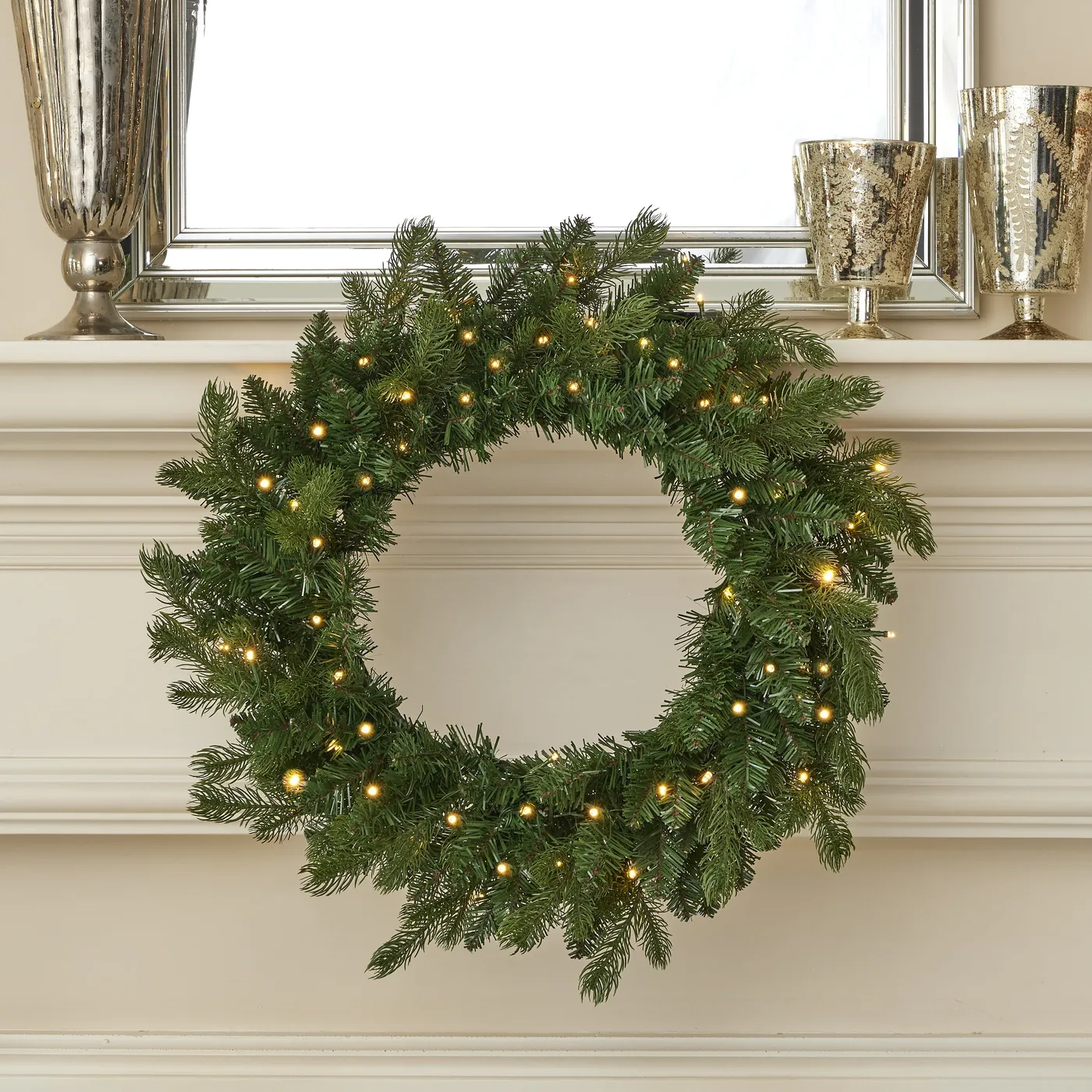
Pre-lit wreaths have quietly taken over the category. Battery packs and timers got small enough to hide, and warm-white rather than cool-white LEDs finally became the default — which is why this look reads cozy in photos instead of clinical. It’s also the most renter-friendly option going: no wiring, no outlet, and it comes down in ten seconds.
13. Burgundy, Sage, and Deep Red Pinecones
Burgundy and sage are both desaturated, muted tones, so nothing in this wreath competes and the eye relaxes. Then the deep red textured pinecones provide the only saturated moment, and because there are just a handful, they read as deliberate accents rather than decoration. It’s the same principle as a mostly-neutral room with one strong piece of art. Compare with Idea #22 — same natural instinct, way more texture.
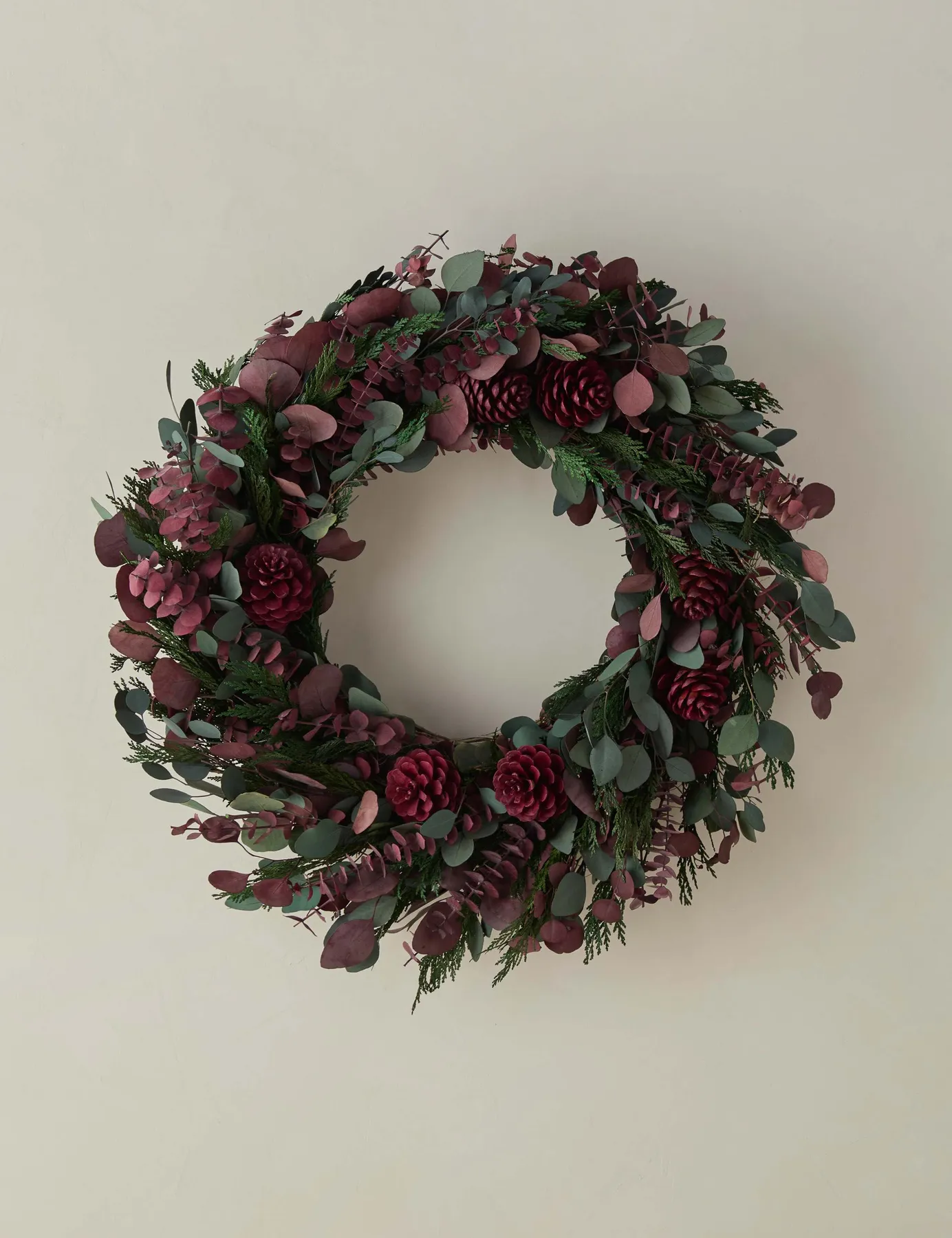
Dried and preserved foliage in this palette tends to be brittle. Store it in a box with tissue, not a garbage bag, and keep it away from radiators — heat will curl burgundy leaves within a week. Expect to replace the pinecone accents every second year; the base greenery will hold for five or more if it’s faux.
14. A Rustic Swag with Antique Star-Cut Jingle Bells
Roughly 65% mixed evergreen drape, 20% red and dark berries, 10% aged metal bells, 5% patterned ribbon. The metal is what keeps it from tipping into craft fair territory — it’s the only hard material in the whole arrangement. Swap the bronze bells for matte black and the same formula turns moody and modern in about a minute.

- Start with a swag base, or bend a 24-inch wreath form into an arc and secure both ends.
- Wire the two bells at the center first — they set the visual anchor.
- Build outward in 6-inch bundles, alternating needle types.
- Tuck berries into gaps so no wire shows from the front.
- Loop the patterned ribbon loosely behind the bells, never over them.
Time: 40–60 minutes. Materials: $35–$70 depending on the bells.
15. Sage Green, Dried Oranges, and Distressed White Planks
- Mixed green faux wreath base, 22 in.: $25–$60
- Dried orange slices, bag of 20: $10–$18
- Small natural pinecones, bag of 24: $7–$14
- Hot glue sticks and floral wire: $6–$10
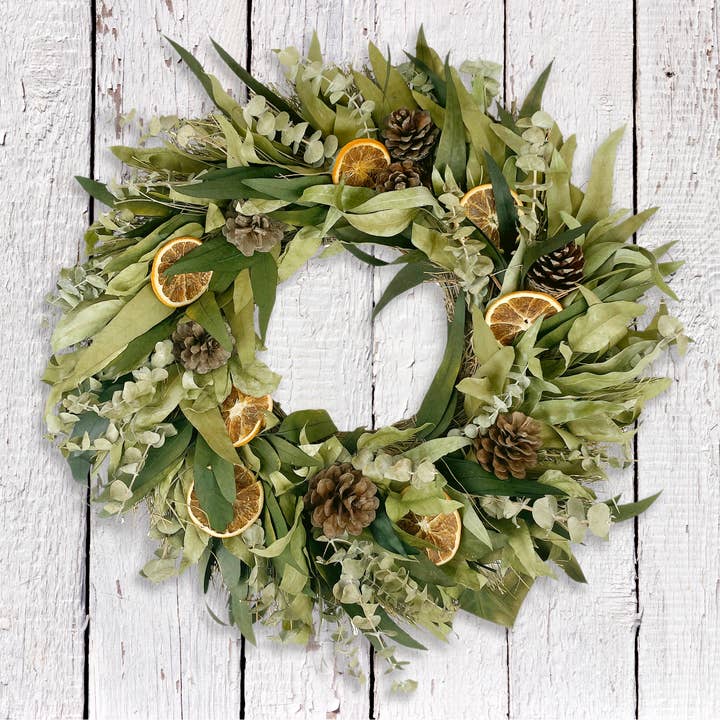
Total: $48–$102. The budget version: buy a plain wreath the week after Thanksgiving at 40% off, dry your own oranges for about $2, and collect pinecones for free. Most people finish this one under $40.
Hot glue and cold weather do not get along. If this wreath lives on an exterior door in a freezing climate, use floral wire instead of glue for anything heavy — the glue will pop the first time the temperature drops below 20°F. Also worth knowing: dried orange slices darken over a season, so the bright amber you see in December will be closer to brown by March.
16. A Wooden Beaded Hoop, Half-Dressed in Greenery
Keep the greenery on roughly half the hoop and leave the other half completely bare. A 60/40 split anchored at the bottom left is the sweet spot — it shows off the wood and stops the wreath from looking like a circular hedge. For the garland below, match the pinecone size to the hoop beads; if the beads are 1 inch, keep the cones under 3 inches or the scale fights itself.
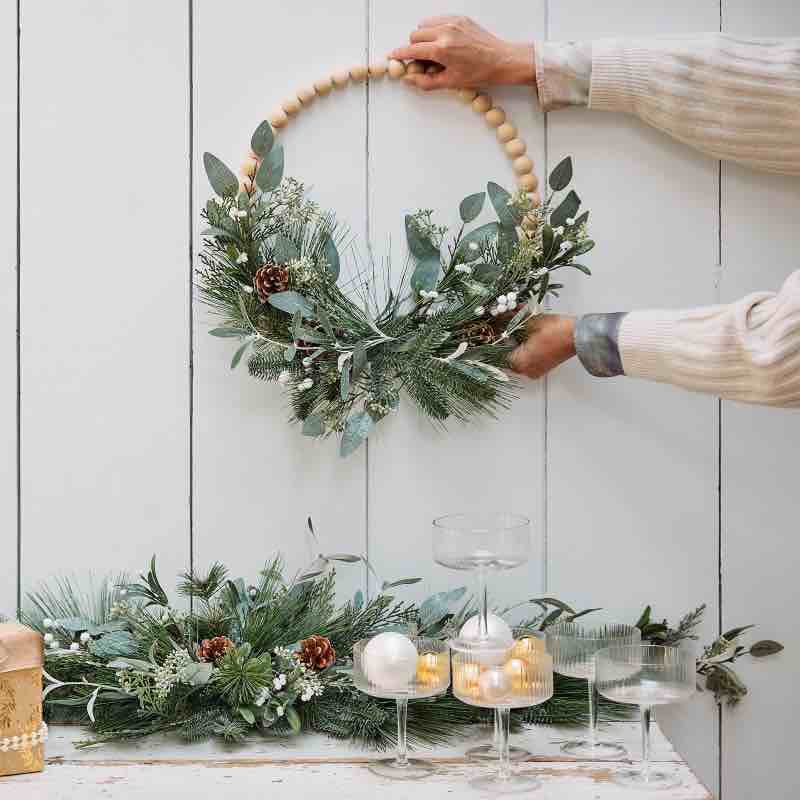
Wooden bead hoops are one of the easiest DIYs in this whole list: a 14-inch craft hoop is about $5, a bag of 20mm wooden beads runs $8, and you’re drilling and threading for maybe 30 minutes. Total under $25 with greenery you already own. Mass-market versions sell for $70–$120, and honestly the DIY looks better because you control bead size.
17. Gold Baubles and Glitter on a White Panel Door
Gold-heavy wreaths photograph best against white — the contrast does the work for you. A 24-inch wreath on a standard 36-inch door leaves six inches of white on each side, which is the ratio you want. If your door is the wider 42-inch style, step up to 28 inches, or anything smaller starts to look like a coaster on a table.
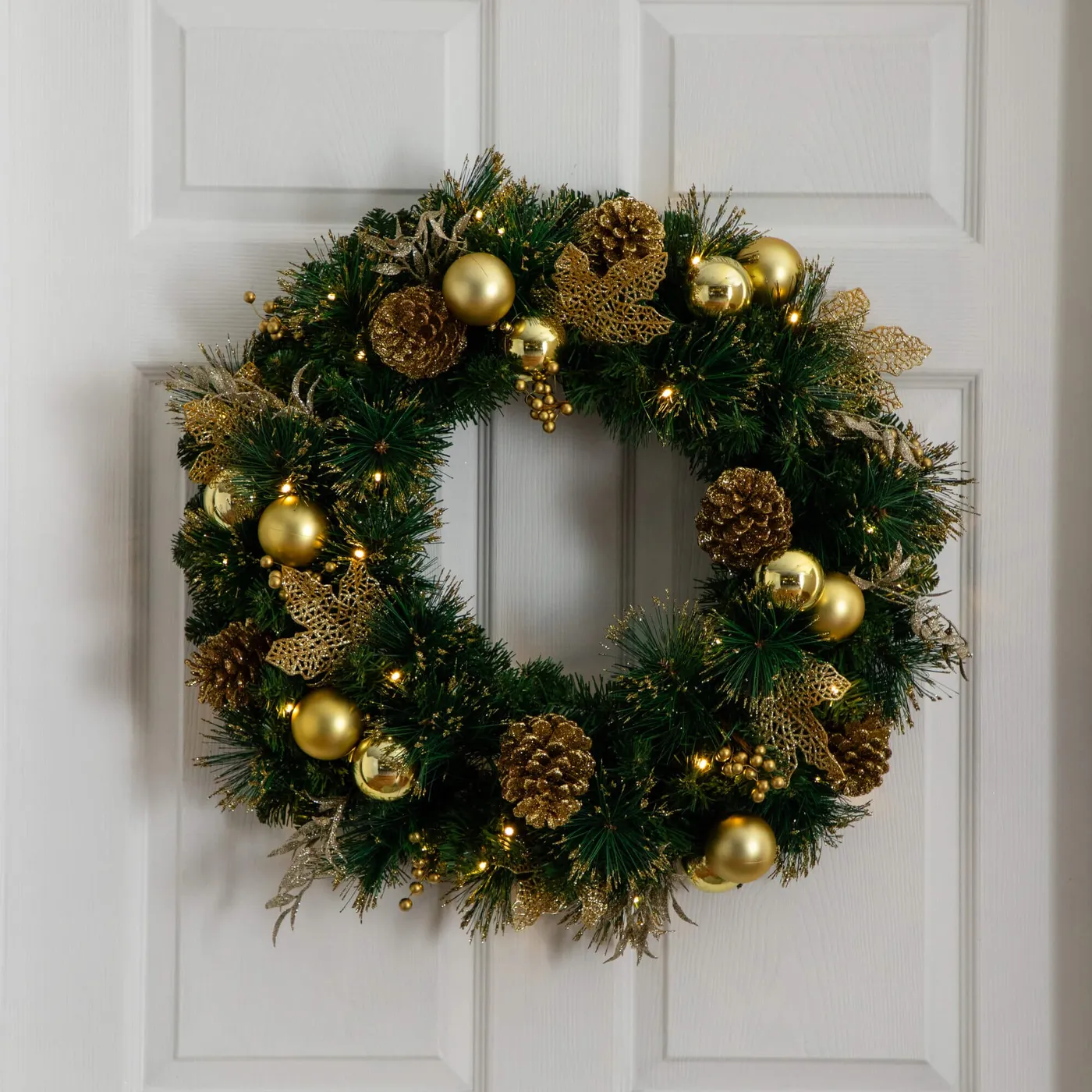
Every ornament here is gold — matte, shiny, and glitter — but there’s no second color anywhere. That’s why a wreath with this much decoration still reads elegant instead of chaotic. Texture variation inside a single hue is the difference between decorated and overdecorated. The integrated lights add a third layer of gold by reflection, which is a happy accident.
18. Grapevine, Blue Berries, and Oversized Pinecones
The visible grapevine base. Most wreath builders cover the form completely, and that’s usually the right call — but here the exposed twig ring is the point. It gives the arrangement structure, a rustic edge, and somewhere for your eye to rest between the big pinecones and the blue berry clusters. Cover it and you’d lose the wreath’s entire personality.
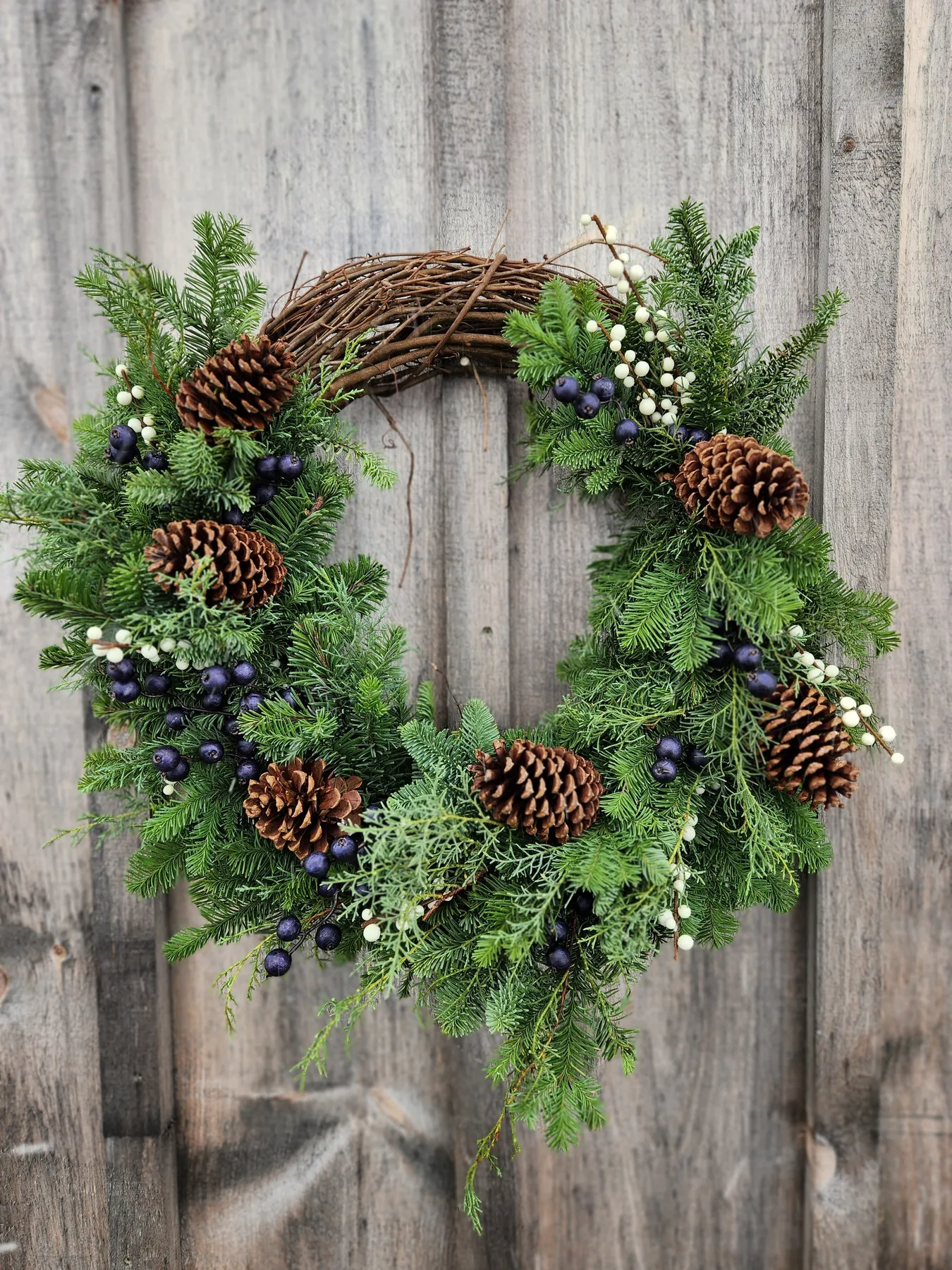
- Check your grapevine base for loose twigs and re-wrap anything that wobbles.
- Weigh the finished wreath before hanging — vine plus cones can hit 4 lb.
- Decide which side carries the heavy cluster, then hang accordingly.
- Test the berry color against your door color in daylight, not at night.
19. A White Reindeer Wreath on a Frosted Door
Figurines on wreaths are charming and they are also heavy and slightly fragile. A ceramic reindeer can push total weight past 5 pounds, which means a standard over-the-door hook will start bowing the frame. Use a hanger rated for 10 pounds and add a small felt pad where the hooves rest, or the paint on the back of your door will be marked by New Year’s. Twig and string lights near a door that gets slammed, meanwhile, will not survive December.
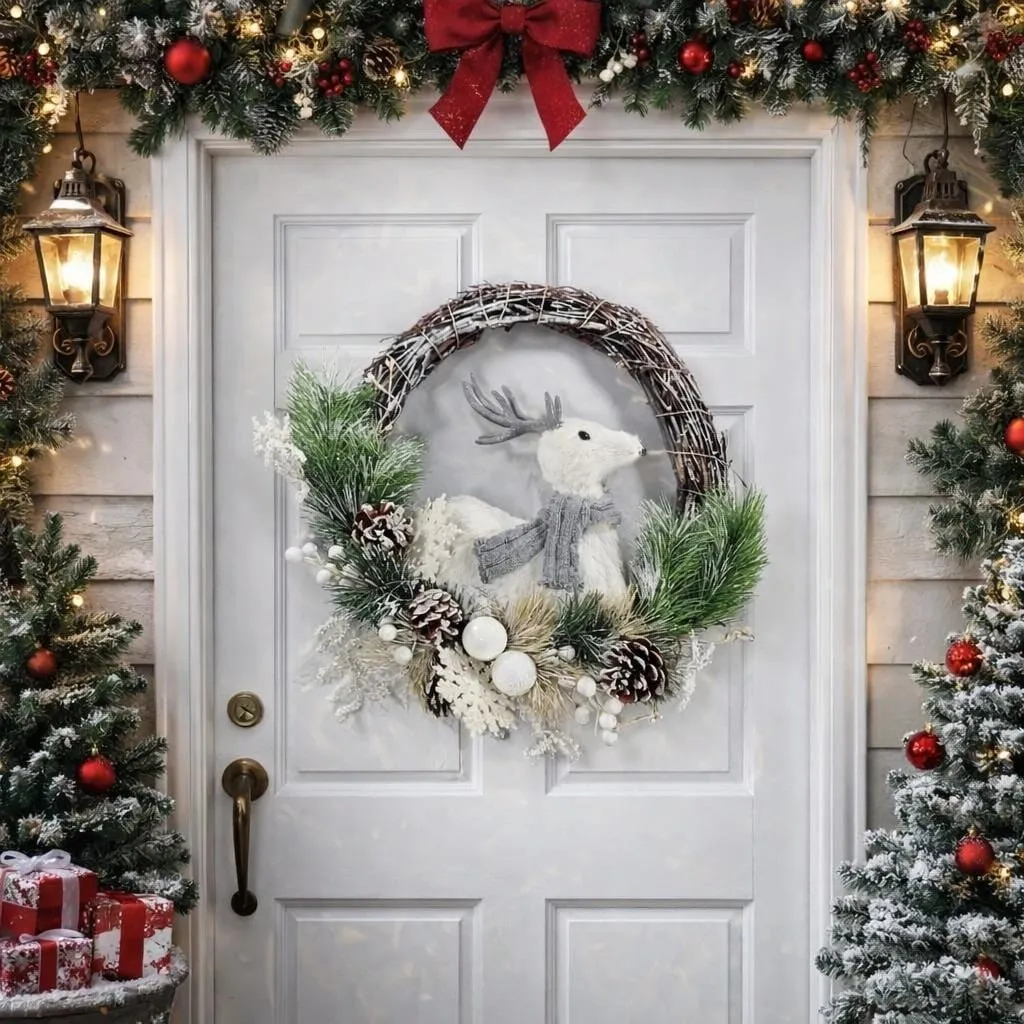
The palette runs about 45% white, 30% dark green, 20% red accents, 5% warm twinkle. That white-dominant mix is why this reads winter more than Christmas — the same reason a snowy scene works on a card. To shift it warmer, trade the white reindeer for a natural wood one and change nothing else.
20. Dark Pine on a Glossy Red Door
Glossy painted doors are having a moment on Pinterest right now — high-sheen red, deep green, even black — and the styling rule stays consistent. Let the door color be the star and the wreath be the supporting role. That’s why lightly decorated pine and a single emerald ribbon look so good here. Ten years ago this door would have worn a wreath with forty ornaments on it and both would have fought for attention — see Idea #10 for another restrained take.
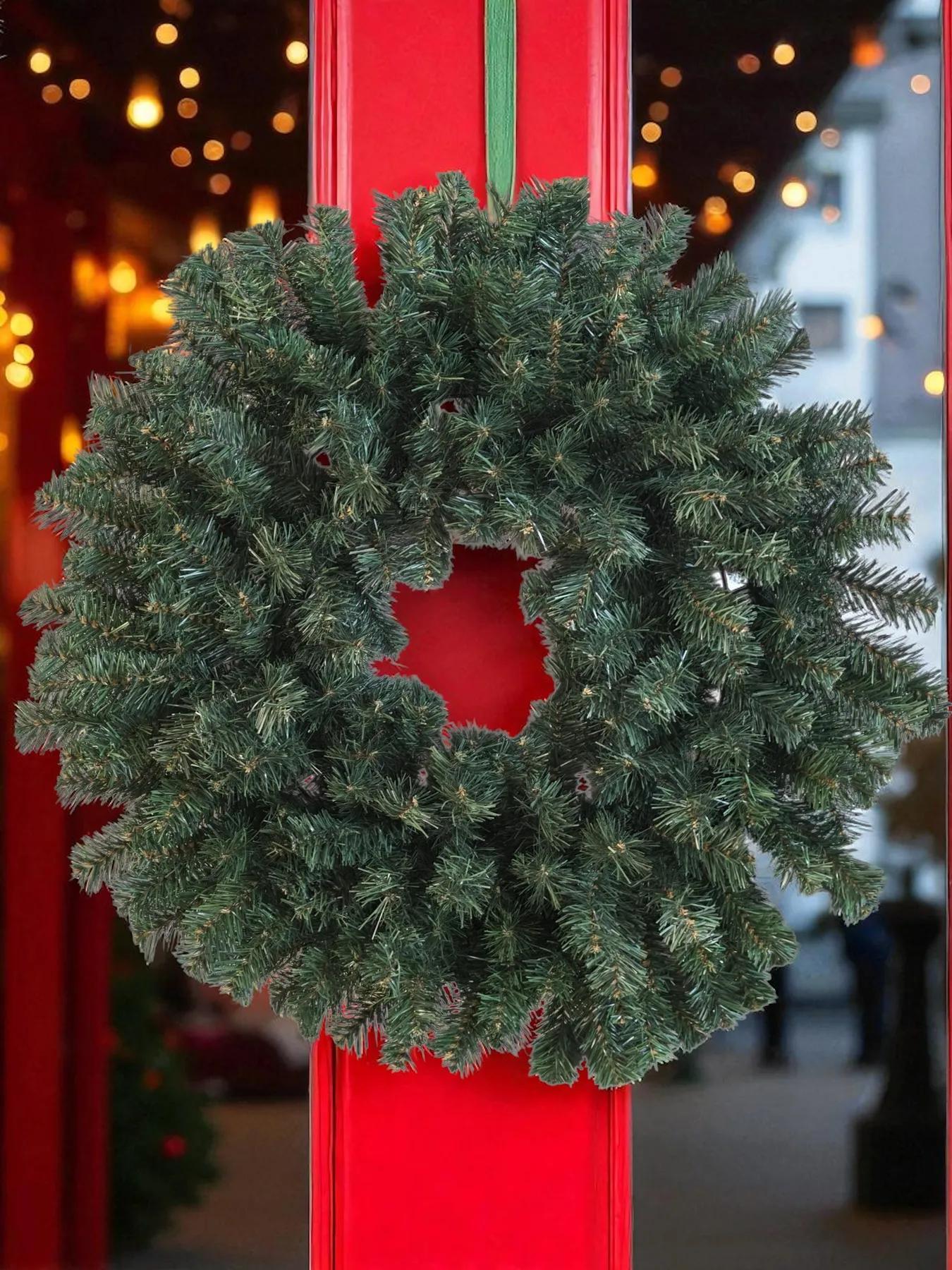
- Wipe the door down and let it dry fully — a wreath hides dust, it doesn’t remove it.
- Choose an over-the-door hanger with a felt back so the glossy finish stays unmarked.
- Tie a single ribbon in a flat knot, not a bow, so it reads as a hanging strap.
- Hang it so the top third overlaps the upper door panel — that anchors the composition.
Time: 10 minutes. Materials: ribbon, $6–$12. That’s it.
21. Burlap Bow, White Stars, and Frosted Pinecones
Frosted pinecones are the easiest thing in this article to fake. Buy plain pinecones ($5 a bag), dip the tips in white craft paint thinned with water, and dust with fine glitter while they’re still wet. You’ve just made $40 worth of frosted picks for about $8. Burlap ribbon is the cheapest ribbon there is — three yards for $4 at Walmart. Facebook Marketplace is also full of secondhand wreath bases in early December, often $10 or less.
Burlap is stiff, so a simple two-loop bow with a tail works better than a multi-loop one — anything fancier looks lumpy. Cut the tails on a 45-degree angle and singe the ends with a lighter to stop fraying. Keep the star ornaments to three or five; an even number around the ring reads as a pattern, and you want it to read as a scattering.
22. Dried Ferns and Thistle in a Textural Mix
This is a high-shed wreath. Dried ferns and thistle drop a fine dust, so if it hangs indoors, plan on vacuuming beneath it every couple of weeks. Thistle heads also flatten if anything rests against them — store this one alone in a box, not stacked with the rest of your decorations. Expect a two-season lifespan from the dried elements, with the green leaves lasting considerably longer.

- Best on a 36-inch door or a large wall area of at least 3 ft x 4 ft
- Ideal diameter: 24–28 inches; anything under 22 inches loses the detail
- Ceilings of 9 feet or more let it breathe; at 8 feet, hang it lower
- Not recommended as a window wreath — it blocks too much light
For a smaller wall, drop to 18 inches and pull out the broadest leaves so the silhouette stays open.
23. Half-Dressed Branch Wreath with Blue-Gray Berries
Leaving the top half of the branch base exposed is a spatial decision, not laziness. It gives the arrangement negative space — your eye needs somewhere to rest, and a fully packed 26-inch wreath can feel oppressive on a wall. The blue-gray berries also do something subtle: they’re the coolest color in the mix, so they push the warm browns forward and make the whole thing look deeper than it actually is.

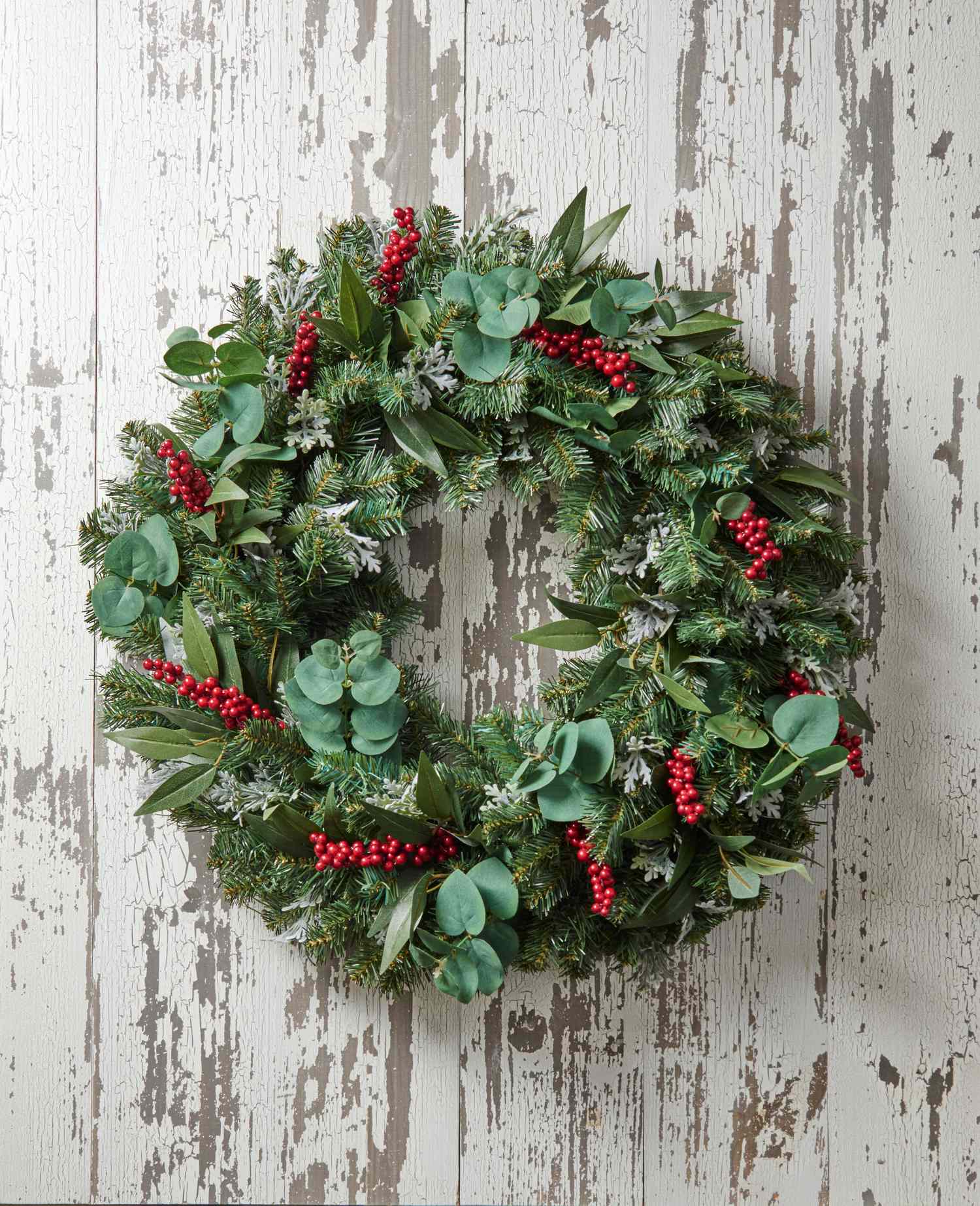
- Natural twig wreath base, 24 in.: $18–$40
- Eucalyptus stems, 3 bunches: $18–$36
- Small blue-gray berry sprays: $12–$22
- Brown pinecones, bag of 12: $8–$16
- Floral wire and snips: $8–$14
Total: $64–$128 for a large wreath. Thrift stores and estate sales turn up twig bases for $5 constantly, and the greenery is something you can accumulate over a season.
24. Plaid and Sheer Gold Ribbon on a Weathered Fence
The double-layer bow. There’s a structured plaid ribbon underneath and a sheer, shimmery gold-beige ribbon on top, and together they make a bow that costs six dollars and looks like it costs thirty. A single ribbon in this exact arrangement would look flat and slightly cheap. The sheerness is the secret — it lets the plaid read through it, creating depth no single ribbon can produce.
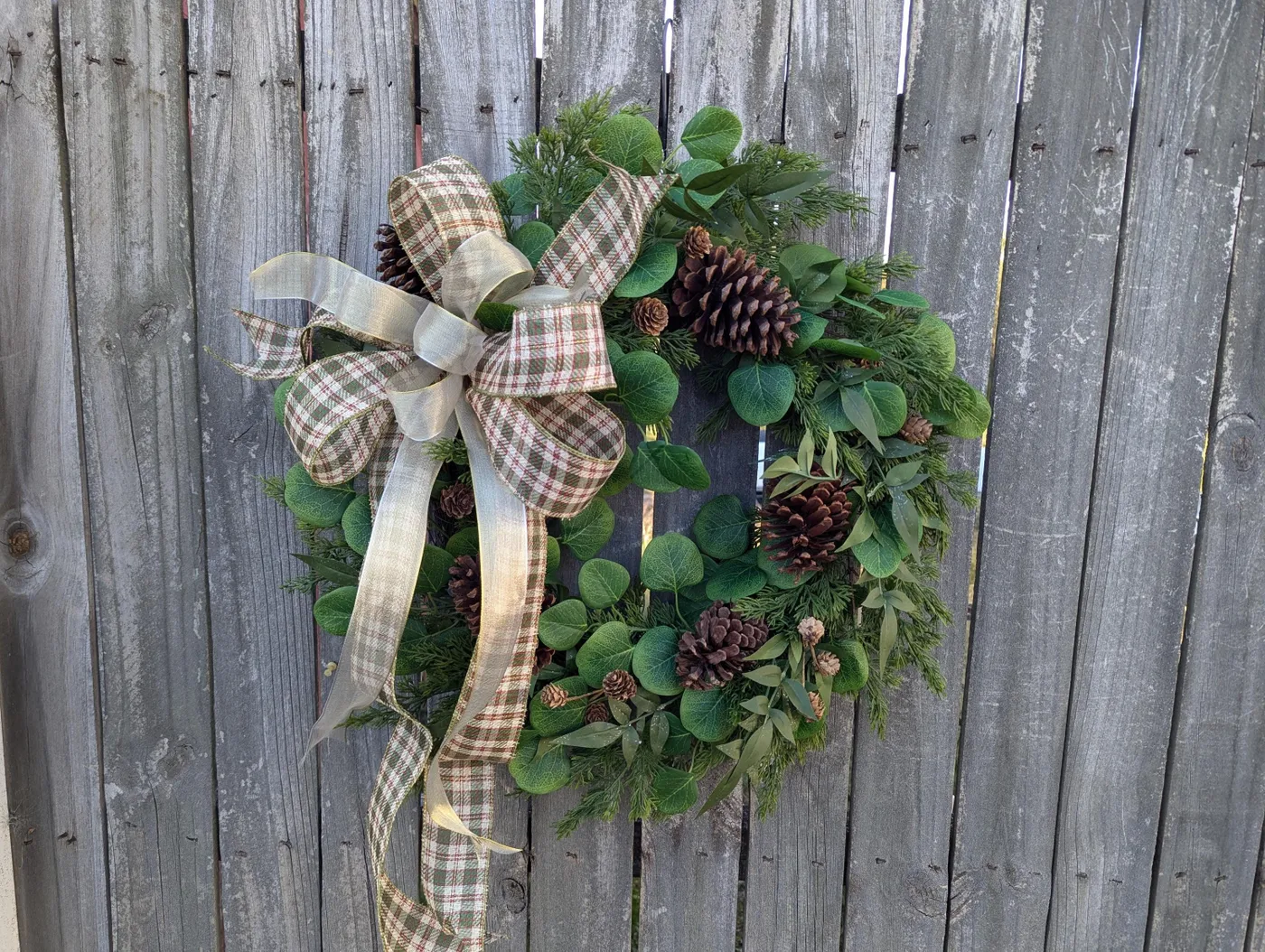
- Cut two lengths of ribbon, one plaid and one sheer, each about 3 yards.
- Lay the sheer over the plaid and pinch both together at the center.
- Make four loops total, alternating which ribbon ends up on the outside.
- Wired ribbon holds its shape; unwired needs a pipe cleaner to cinch.
- Wire the finished bow to the wreath last, after the greenery is set.
Time: 15 minutes. Materials: $8–$16 for both ribbons.
25. Frosted Pine with Pink-Berry Clusters
About 70% frosted pine, 20% pinecones, 10% blush berries. The blush is the interesting choice — most people would reach for red here, and red would make this a hundred other wreaths. Soft pink keeps it in frosted-morning territory instead of Santa’s workshop. Swap the blush for pure white and you get a similar effect with even less color commitment.
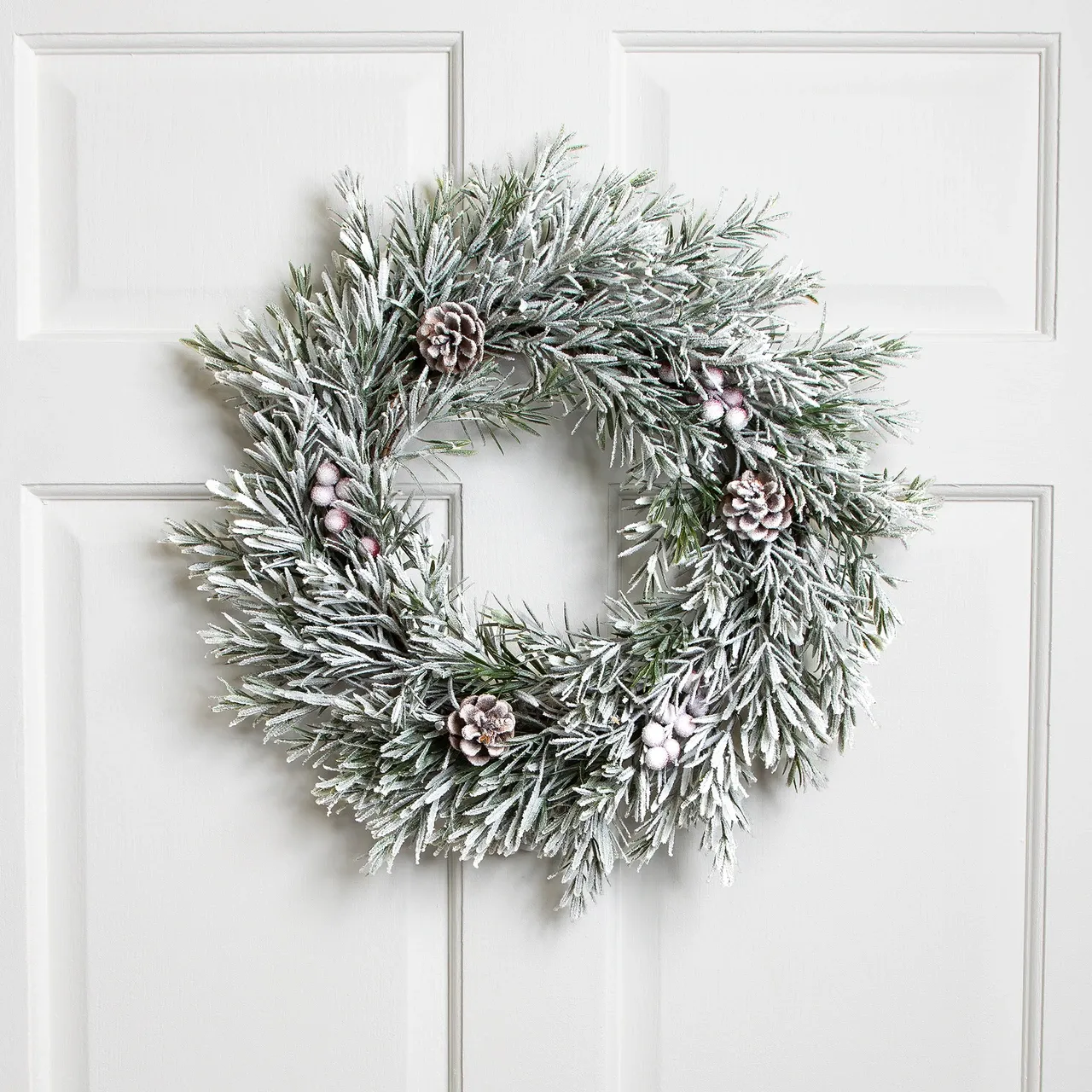
Flocking sheds. There’s no polite way to say it — that white powder will dust your floor, your doormat, and eventually your hands every time you touch it. Spray flocking holds up better than the loose stuff, and a matte clear coat over the top helps. Check whether your wreath is rated for outdoor use, because cheap flocking turns gray and gummy in rain within a single season.
26. Red Berries, Black Sconces, and a Wooden Sled
Symmetry is your friend on a front porch. Put the wreath dead center at eye level, then balance it with matching sconces or trees at equal distance on both sides. The wreath diameter should be roughly a third of the door width, and the flanking elements shouldn’t exceed twice the wreath’s height. If your wreath is 24 inches, keep the pre-lit trees under 4 feet or the entry starts to look like a store display.
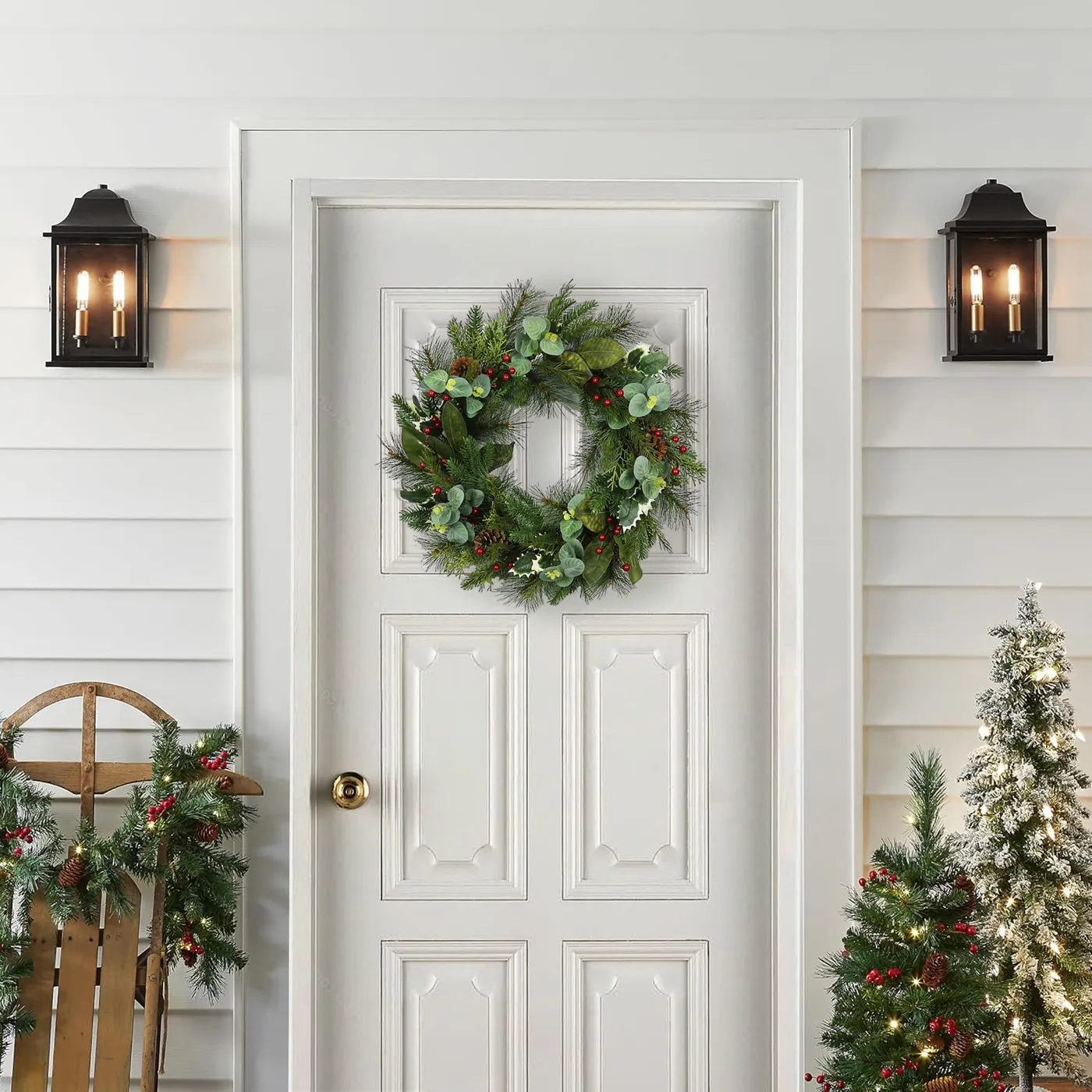
An old wooden sled from Facebook Marketplace or a yard sale runs $15–$40 and does the work of $200 worth of porch decor. Drape it with a garland you already own, add one small pre-lit tree (Target’s 3-foot versions are about $25), and you’re done. The wreath itself can be the simplest one on the block — the surrounding props are what people photograph.
27. Sage Eucalyptus and Coppery Pinecones on Warm Wood
- Works on walls with warm undertones — cream, greige, or natural wood
- Best diameter: 22–26 inches
- Needs a wall section at least 3 feet wide so it doesn’t look crowded
- Fine under 8-foot ceilings; no vertical demand at all
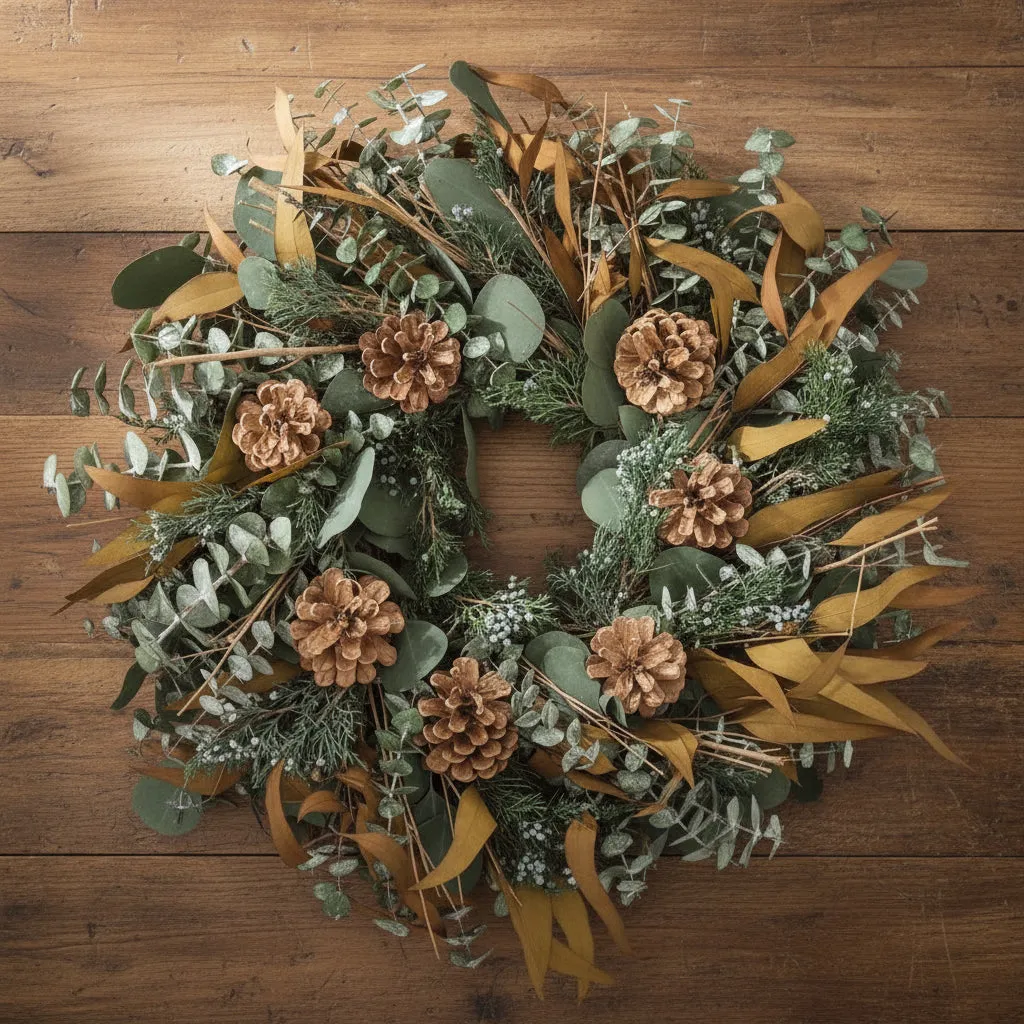
Small spaces actually do better with this one than with a heavily ornamented wreath, because the copper tones recede rather than pop.
Two temperature families are collaborating here: cool sage and warm copper-brown. Mixing warm and cool inside the same natural palette is what makes a wreath feel collected over years instead of bought in one trip. Notice the thin light-brown twigs too — they break up the dense greenery and keep the silhouette from closing into a solid circle.
28. Pinecones and Red Berries on a Pale Green Door
- Artificial mixed greenery wreath, 24 in.: $30–$70
- Brown pinecones, set of 8: $12–$22
- Red berry clusters, set of 6: $10–$20
- Wreath hanger: $6–$15
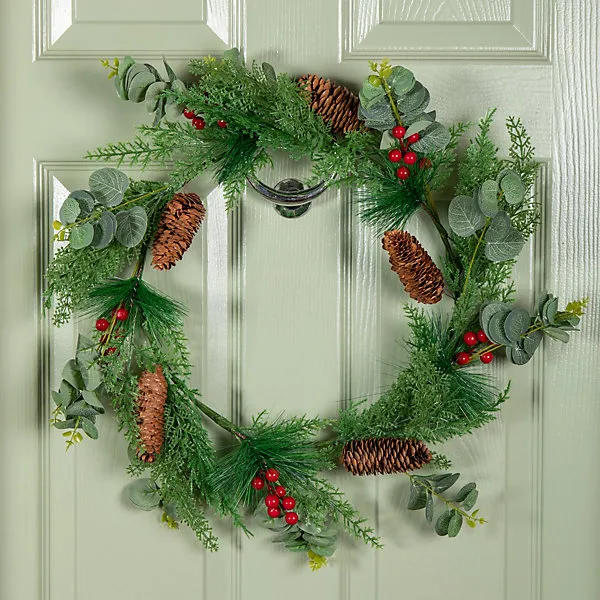
Total: $58–$127. This is the most repeatable wreath in the article — nothing here is trendy or seasonal, so you can rebuild it for about $20 by reusing the base and buying fresh berries every few years.
Uniformity is what makes it sing. Every pinecone is the same size, every berry cluster holds the same three berries, and they’re spaced evenly around the ring. That’s why this reads calm and traditional rather than busy. Scatter different sizes and shapes around it and you’d get a charming rustic wreath — just not this one.
29. Eucalyptus with a Burlap Bow Tied Low
Burlap is rough, and rough ribbon frays. Within a season you’ll see loose threads on the tails unless you seal the cut ends with fabric glue or a quick pass with a lighter. It also holds dust noticeably more than satin, so plan to shake it out. And because burlap is stiff, a big bow tends to stick straight out from the wreath — perfectly fine on a wall, awkward on a door that gets pulled shut twenty times a day.
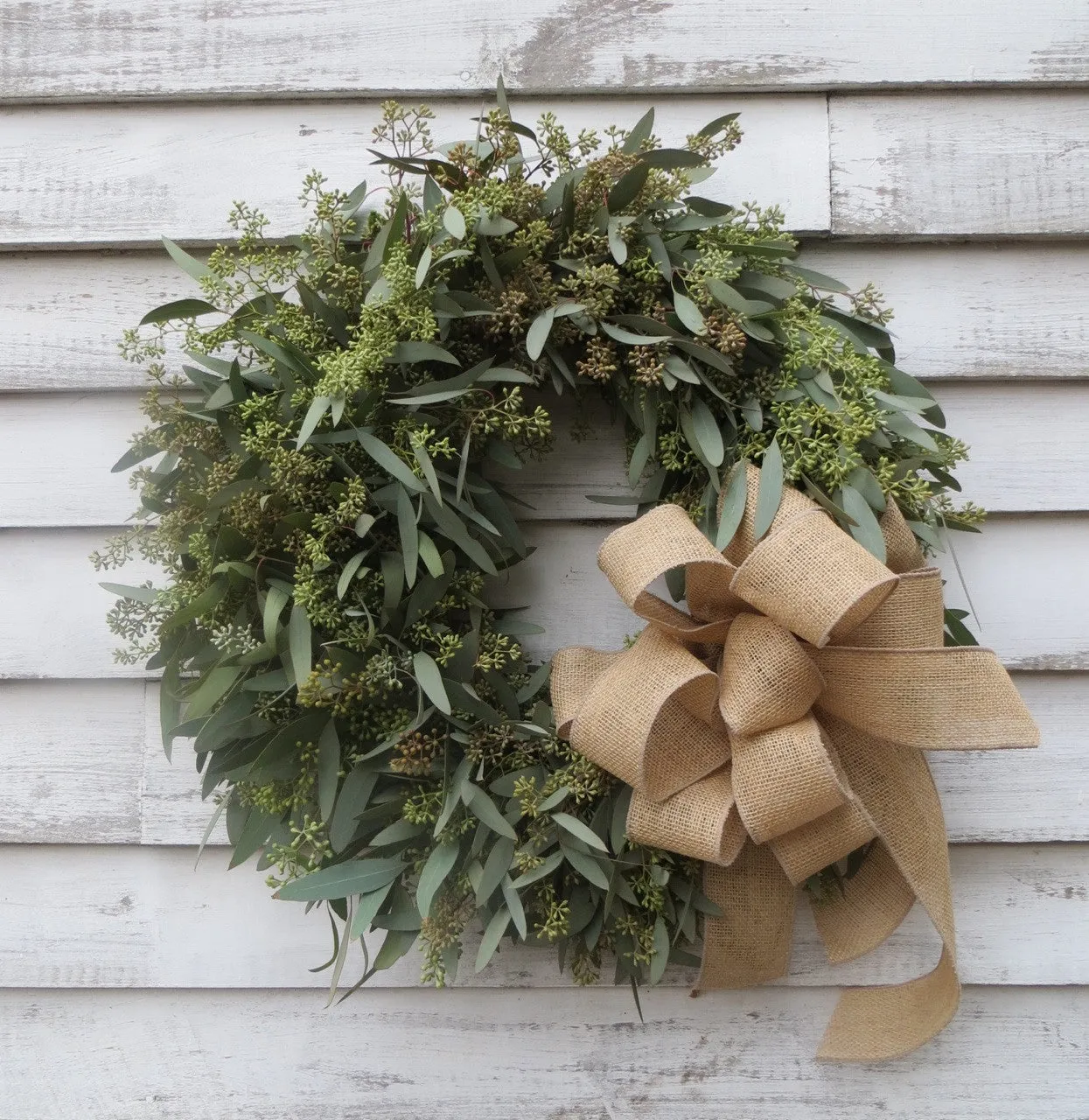
A eucalyptus wreath is one of the few things you can genuinely thrift. Real dried eucalyptus bundles show up at Goodwill for $3–$6 in November, and a grapevine base is about $5 at a craft store. Twelve dollars plus a $4 roll of burlap gets you this exact look, no waiting for a sale.
30. One Big Pinecone as the Focal Point
- Choose one pinecone that’s meaningfully larger than the rest — 5 inches or more.
- Wire it to the wreath first, slightly off-center at roughly 5 o’clock.
- Fill around it with fine needle foliage, leaving a two-inch breathing gap.
- Add small seed pods as repetition of the focal shape, not competition.
- Finish with a few subtle glittered leaves for sparkle.
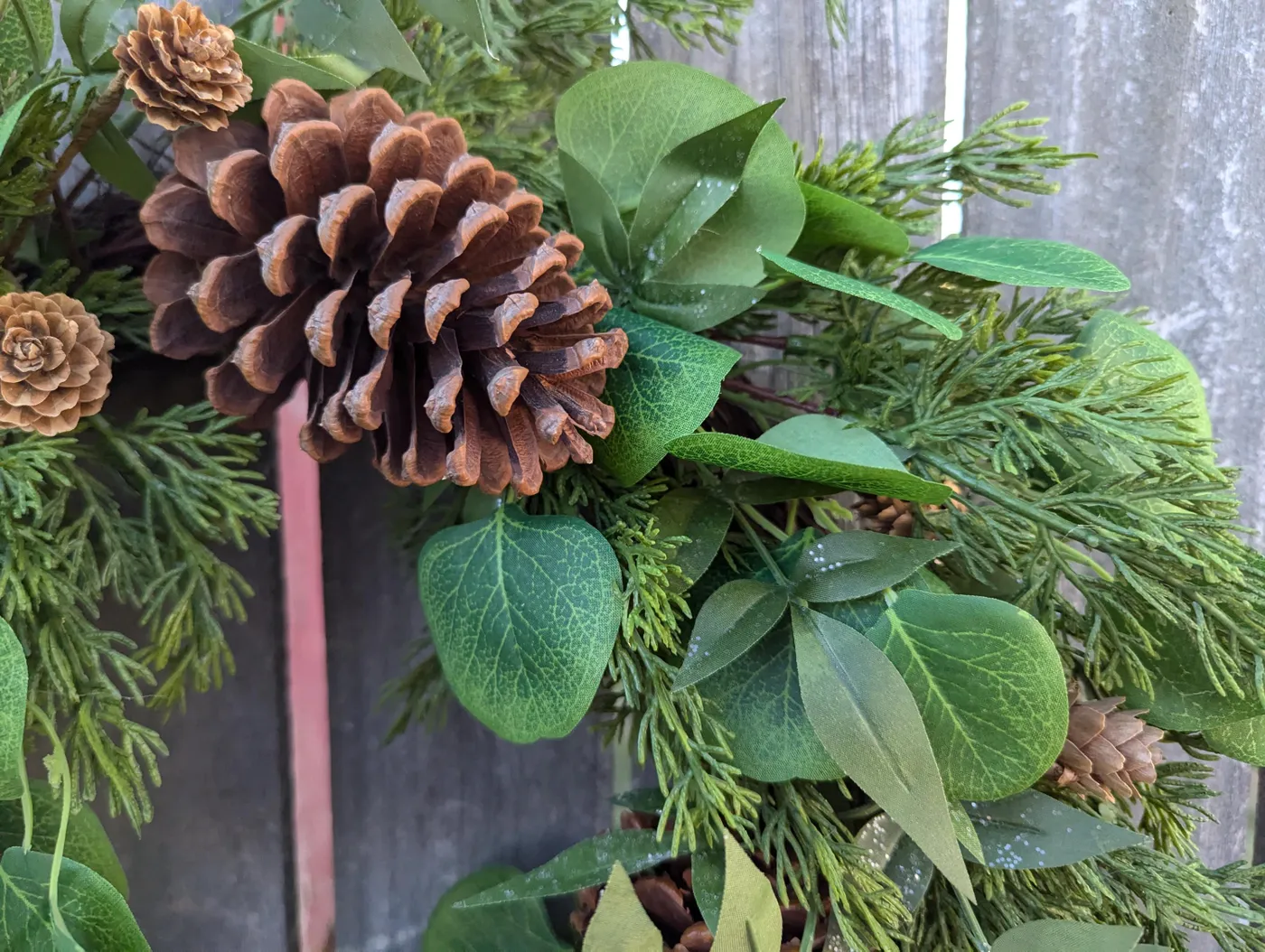
Time: 30 minutes. Materials: $15–$30 on top of a base you already own.
One focal point per wreath, maximum. Add a second large pinecone and the eye has nowhere to land, so the composition flattens out. A good test: squint at the wreath from six feet away. Whatever you still see first is your focal point — and there should only be one thing in that category.
31. Heavily Frosted Evergreen with Warm White Lights
Frosted wreaths with integrated lighting are the low-maintenance champions here, with one caveat: heat. Incandescent mini lights can warm the flocking enough that it yellows over a few seasons. LEDs don’t. If your wreath came with incandescent bulbs, swapping the strands is a $12 fix that can double the wreath’s life. Store it in a breathable bag rather than a sealed bin, so the flocking doesn’t get damp and clump.
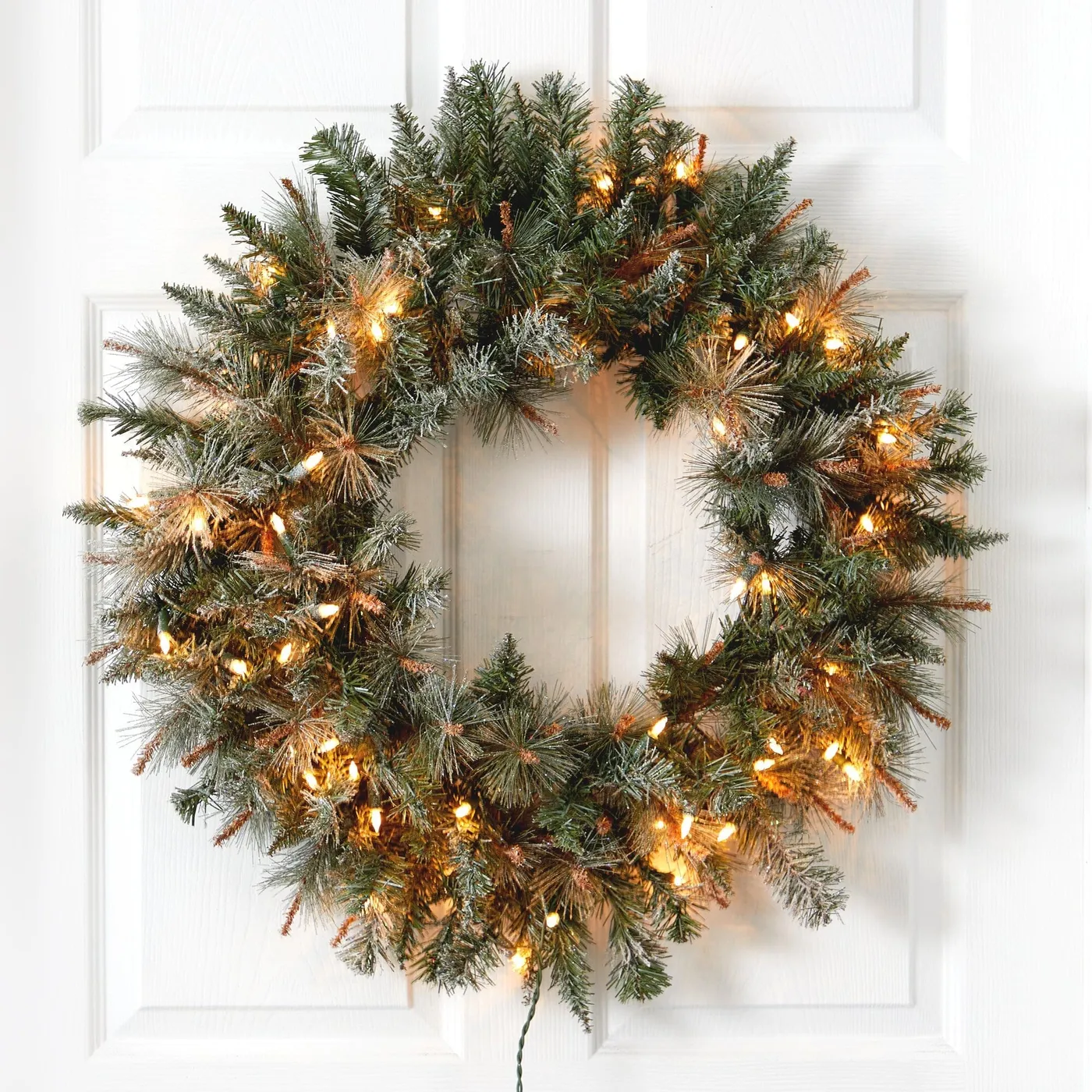
And worth saying out loud: a $60 frosted wreath you replace every three years costs more than a $120 one you keep for a decade.
- Ideal on doors 36 inches wide and up; 28-inch diameter works best
- Also excellent on a blank wall of 3 ft x 3 ft or larger
- Requires a nearby outlet or a battery pack with a timer
- Ceiling height: no constraint
On narrow doors under 32 inches, a 20-inch version keeps the frosting detail readable without overwhelming the frame.
32. Seashells, Starfish, and a Bronze Glitter Bow
The formula is 60% evergreen, 20% natural coastal (shells, starfish, pinecones), 15% teal and silver baubles, 5% glitter. The teal is what makes it work — without a cool color, shells on greenery can read as a summer wreath that got lost. Swap teal for navy and the palette turns crisper; swap it for coral and it goes warm and beachy again. One color change moves this wreath a long way.
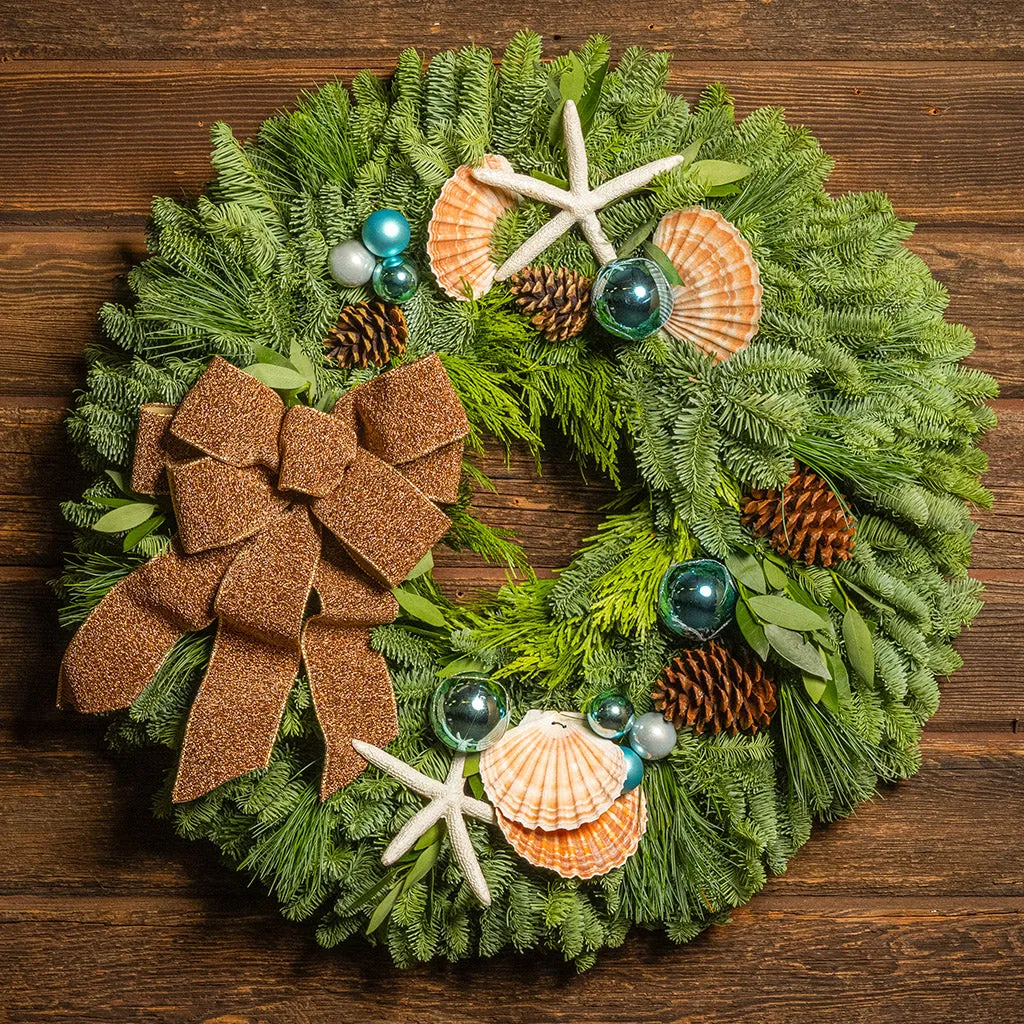
This is also the most regional wreath in the article — it looks effortless in a coastal town and slightly odd in a landlocked suburb. Consider Idea #24, which brings the same natural instinct but reads well anywhere.
33. Glittered Eucalyptus and Antiqued Bronze Bells
The glitter isn’t painted on — it’s dusted, so it catches light only at certain angles and from the right distance. That’s why this reads elegant instead of sparkly-chaotic. Meanwhile, the frosted light-green eucalyptus and the dark conifer sprigs give you two different greens, and the antique bronze bells are the only warm metal in the whole mix. Three materials, one mood.
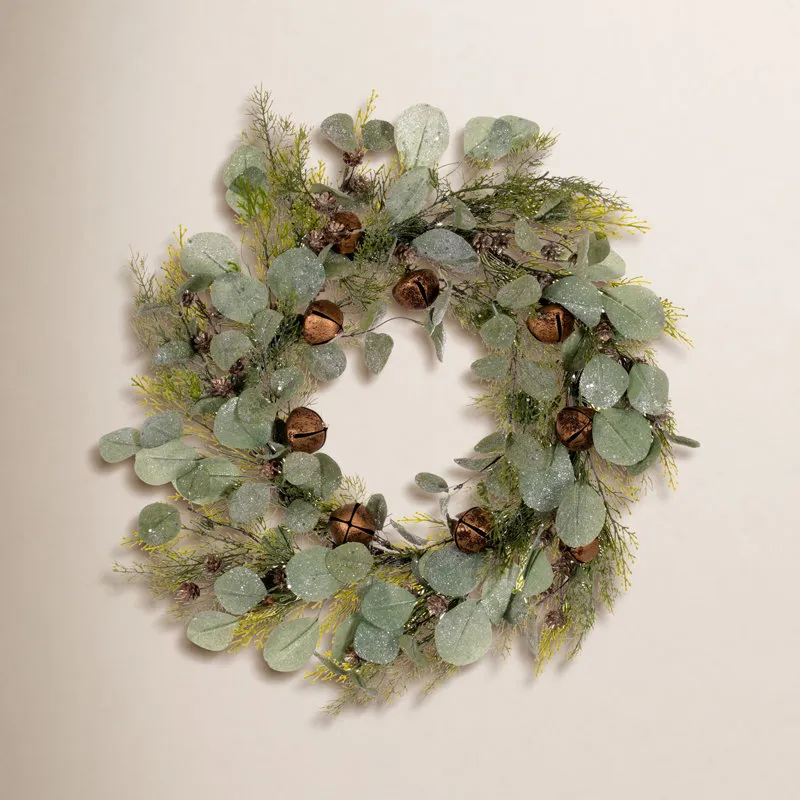
- Shake the wreath outdoors before hanging — loose glitter will fall.
- Check that the bell clappers won’t rattle against your door in the wind.
- Confirm your wall color; glitter reads best on cream and warm white, not gray.
- Decide now whether it’s an indoor or covered-outdoor wreath.
34. Wreath and Matching Garland, All Lit Up
- Pre-lit evergreen wreath, 24 in.: $45–$110
- Matching pre-lit garland, 9 ft.: $35–$85
- Extra pinecones and berry picks: $12–$26
- Battery packs or extension cord: $8–$18
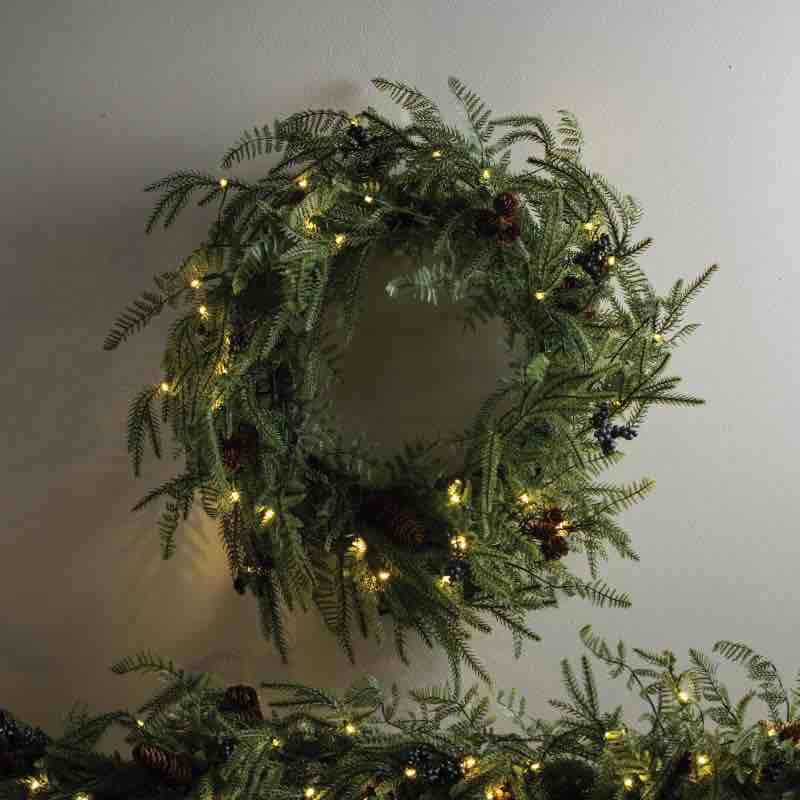
Total: $100–$239 for the pair. Buying them as a set usually saves $20–$40 over buying separately, and the light color will actually match — which is the real reason to buy together rather than chase two sales.
- Hang the wreath first so the garland can be aligned beneath it.
- Set both to the same timer schedule, or you’ll be switching them on twice a day.
- Point the garland’s light strands downward so they hide behind the foliage.
- Add extra pinecones at the garland’s low points where the greenery looks thinnest.
Time: 20 minutes. This is the fastest whole-entryway-done setup in the article.
Thirty-Four Wreaths and One Very Good December
The wreath is the smallest decision in your whole holiday setup and somehow the one people notice first — from the sidewalk, from the car, from the doorway while they’re stamping snow off their boots. Pick the one that matches your door, your light, and your actual patience for upkeep, and let the rest of the house stay quiet.
If you make one of these this year, we want to see it. 📌 Pin the version you’re building so you can find it again next November — and the one after that.