You know that feeling when you’ve saved forty photos of dried orange garlands and still can’t picture any of them in your own house? That’s usually the moment a real plan starts — and it almost never begins with a cart full of plastic at a big-box store. We spent a long stretch digging through Etsy, Terrain, and Michaels, then compared what designers are actually hanging this winter, and narrowed it down to 34 ideas worth your time — from about $8 for a bundle of cinnamon sticks to roughly $1,450 if you’re going all in on fresh garlands and wreaths.
Inside you’ll find rustic woodland trees, vintage-traditional mantels, organic modern wreaths, and cozy cottage tables pulled from real homes — with budget and luxury versions of the same look sitting side by side, and shop links on every single idea.
Natural Christmas decor is having its biggest year yet in 2026, mostly because Pinterest searches for foraged and reusable trimmings keep climbing while shoppers quietly push back on plastic.
And stay until the end — we break down the most common mistakes that can ruin these looks. 📌 Save this to Pinterest for later — you’ll want to revisit these ideas.
1. Dried Orange Garland with Candles and a Wooden Star
Pull any single element off this mantel and it still works — except the dried orange slices. They’re the only warm note in a run of deep green, dark pinecones, and white pillar candles, and that one hit of orange is what keeps the garland from reading like every other evergreen swag on the block. The spacing matters as much as the citrus: the slices sit roughly a hand’s width apart, which gives the eye somewhere to rest between the heavier pinecones.
- Evergreen garland, 8–9 ft: $35–$90
- White pillar candles and holders: $18–$45
- Dried orange slices, bought or homemade: $8–$22
- Pinecones and red berry clusters: $12–$30
- Wooden star ornament: $10–$28
Total: $83–$215
Budget alternative: dry your own orange slices — about $4 of fruit and three hours at 200°F — and gather pinecones from a park or your own yard. That pulls the whole mantel down to $45–$80, and it’s the version that smells better.
2. A Dried Botanical Wreath Against Cedar Shingles
Build in three passes and let the base show through. Start with a 12-inch wire form and wire your biggest shapes first — magnolia leaves, dried fungi, seed pods — at roughly 10, 2, and 6 o’clock so the weight is balanced before you fill in the middle. Work in 5- to 7-inch sprigs angled about 30 degrees, overlapping each one over the stem of the last. Save the small dried moss for last; it hides every bit of visible wire and makes the whole thing look foraged instead of assembled.
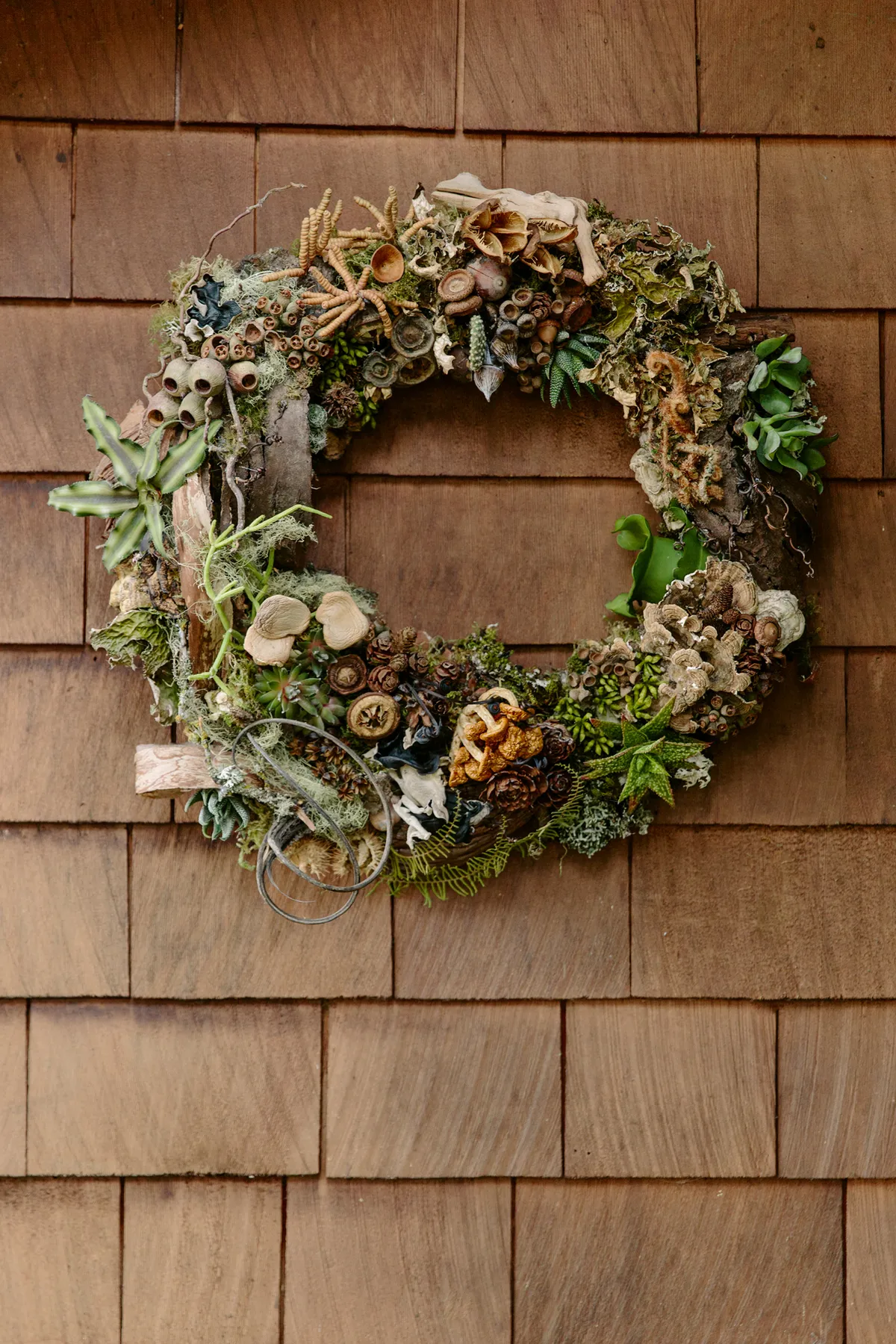
Two things are happening here. First, texture contrast — the shingle wall is flat and repetitive, so a wreath full of curls, caps, and seed pods reads as sculpture rather than decoration. Second, shape repetition: the round fungi, the round pinecones, and the twisted wire loops all echo the circle of the wreath itself, which is why nothing looks out of place even though the materials are wildly different. Keep the palette in one family and you can throw almost anything at it.
3. Dried Orange Tree with a Wooden Bead Garland
Here’s the formula: roughly 55% deep green foliage, 25% warm naturals (dried orange, pinecones, wooden beads), 15% soft white from the knitted tree skirt and fairy lights, and 5% twine and brown paper down at the base. Swap the orange for dried apple rings and nothing changes. Swap the white skirt for charcoal felt and the tree goes moody. What you can’t do is add a fourth color — that’s the point where natural starts looking like clutter.
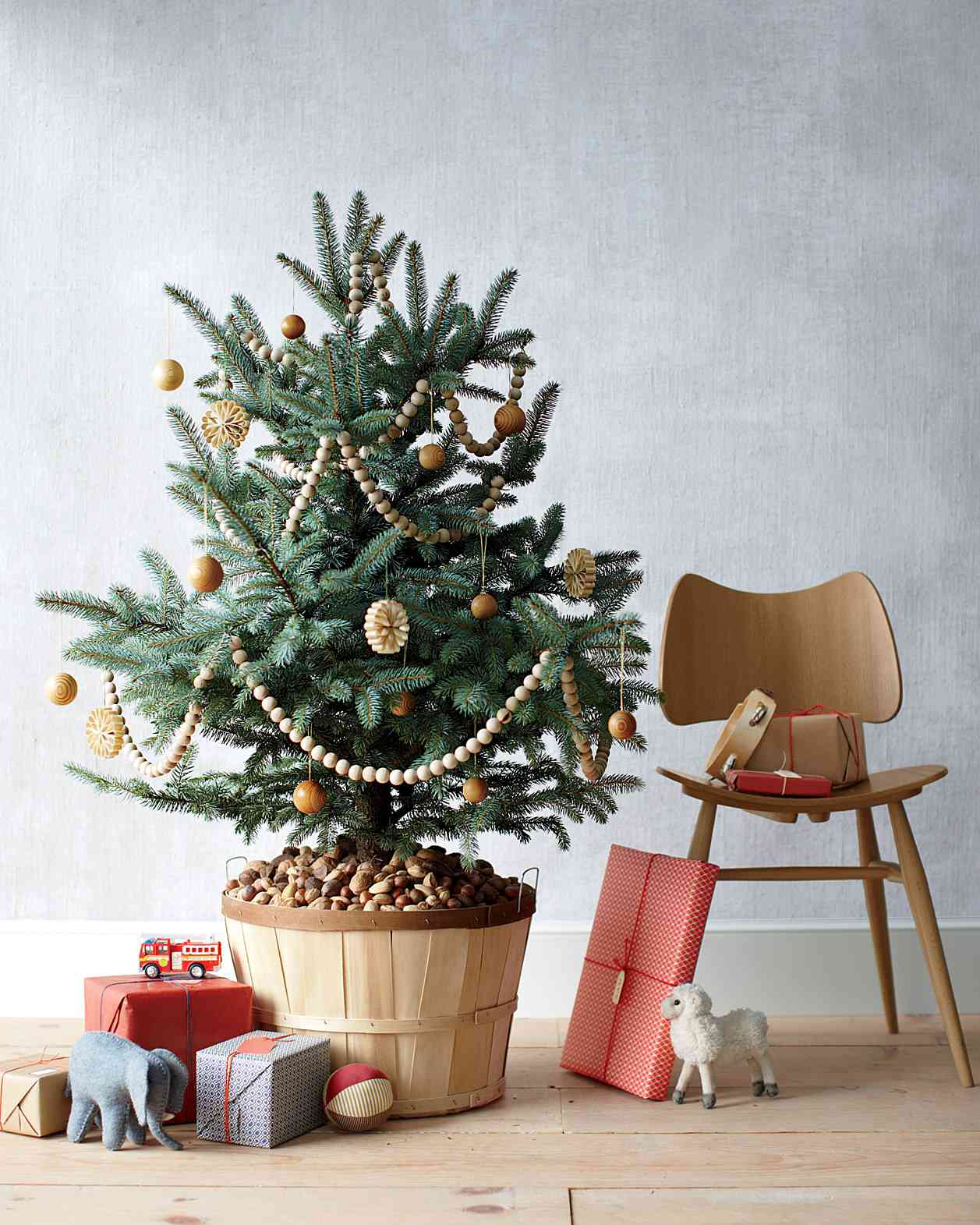
None of this requires a decor budget. Brown kraft paper runs about $5 a roll at Target or Walmart, and a wooden bead garland is roughly $6 of beads plus an afternoon with twine. Dry your own citrus in the oven, pull pinecones from the yard, and buy the tree skirt secondhand — Facebook Marketplace is full of knitted skirts every January. You can build the entire look for under $60, and it photographs exactly like the version that costs five times as much.
4. A Woodland Table Wrapped in Pine and Cinnamon
Time: about 25 minutes. Cost: roughly $30 if you’re buying everything.
- Run a linen runner or a 12-inch strip of kraft paper down the center of the table.
- Lay pine branches in overlapping layers, tips pointing outward on both sides.
- Tuck cinnamon sticks, dried orange slices, and pinecones into the gaps, keeping the tallest pieces in the middle.
- Set three white pillar candles in clear glass holders, spaced evenly along the run.
- Finish with one small sprig on each plate so the tablescape carries all the way to the edges.
This centerpiece needs a table at least 36 inches wide and 60 inches long — anything narrower and the candle holders start crowding elbows. Ceiling height doesn’t matter much, but if a pendant hangs lower than 30 inches above the table, drop to two candles instead of three. For a 48-inch table, shorten the branch run to 24 inches and use a single candle in the center.
5. Red Tulips and Plaid Pillows on a Christmas Table
Two honest notes. Red tulips in December are a florist purchase, not a grocery store impulse buy — expect $25–$45 a bunch, and they’ll hold for five to seven days. If that’s a stretch, red amaryllis or even a few stems of red carnations read nearly the same from across the room. Second: tall tapers, a chunky knit throw, and a crowd of people means a lot of open flame near textiles. Trim wicks to a quarter inch, keep the throw off the chair backs while you eat, and never leave the table with candles burning.
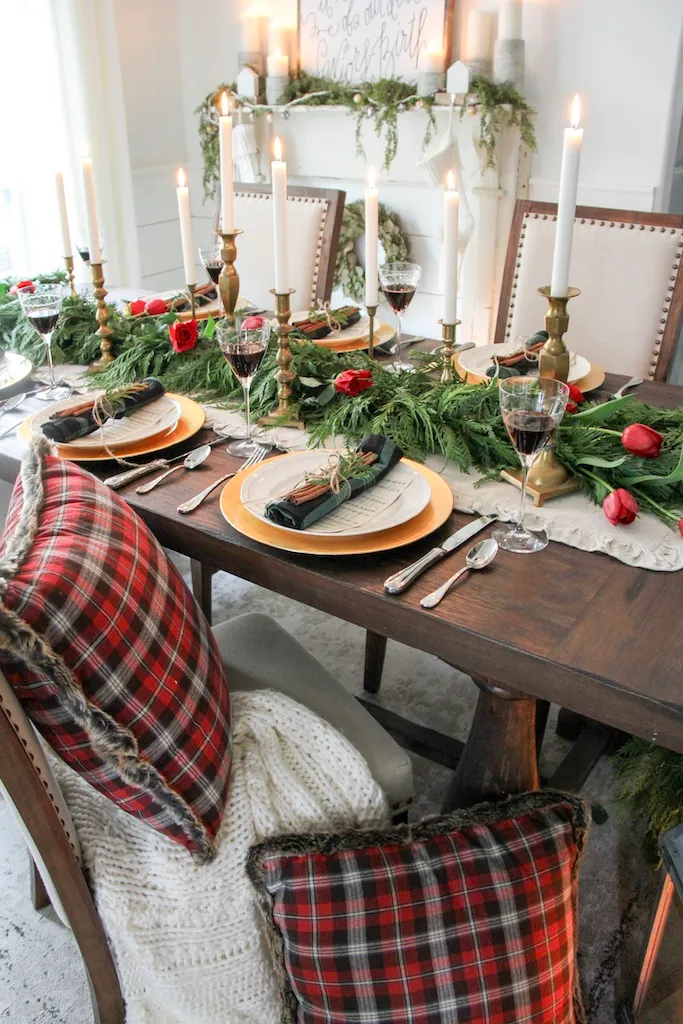
The pillows are the sneaky hero. Red plaid with faux fur trim on the dining chairs takes a table that could have been any December table and makes it feel like a room someone actually lives in. Dining chairs get styled least and noticed most. If you only do one extra thing beyond the centerpiece, do this: two pillows on each end chair, one on each side seat, and skip the rest.
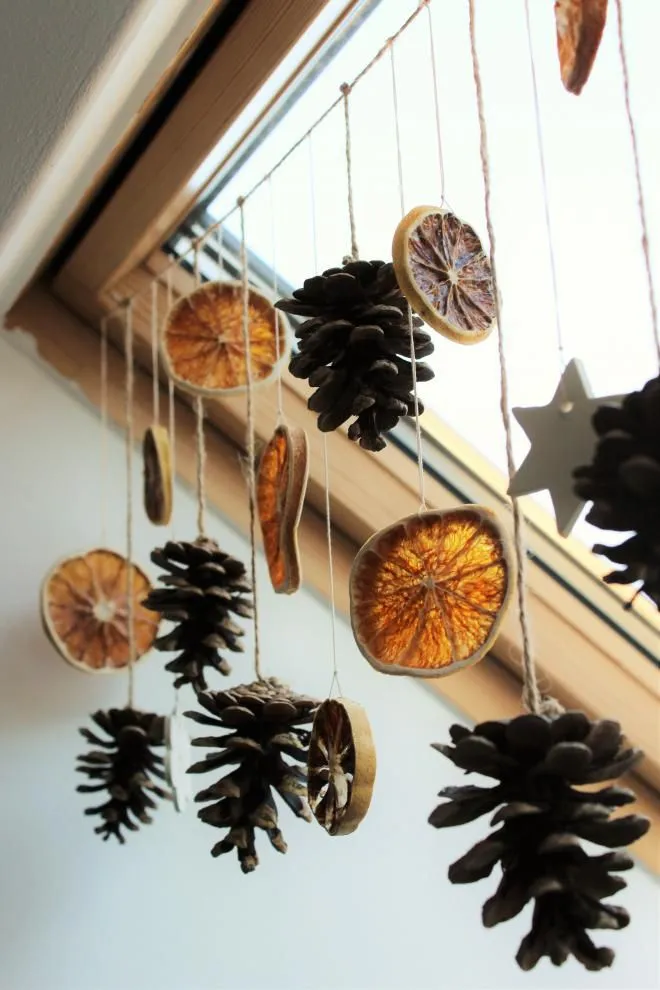
6. Cinnamon Bundles and Dried Citrus on the Branch
Dried citrus and cinnamon are close to maintenance-free, with two caveats. Cinnamon sticks lose their scent after a season — refresh them with one drop of cinnamon oil on the back of each bundle, not the front, or you’ll leave a stain. Dried orange slices go brittle and crumble if handled, so store them flat in a rigid box with tissue between layers rather than in a plastic bag. The same bundles work beautifully on a mantel garland, as in Idea #1.
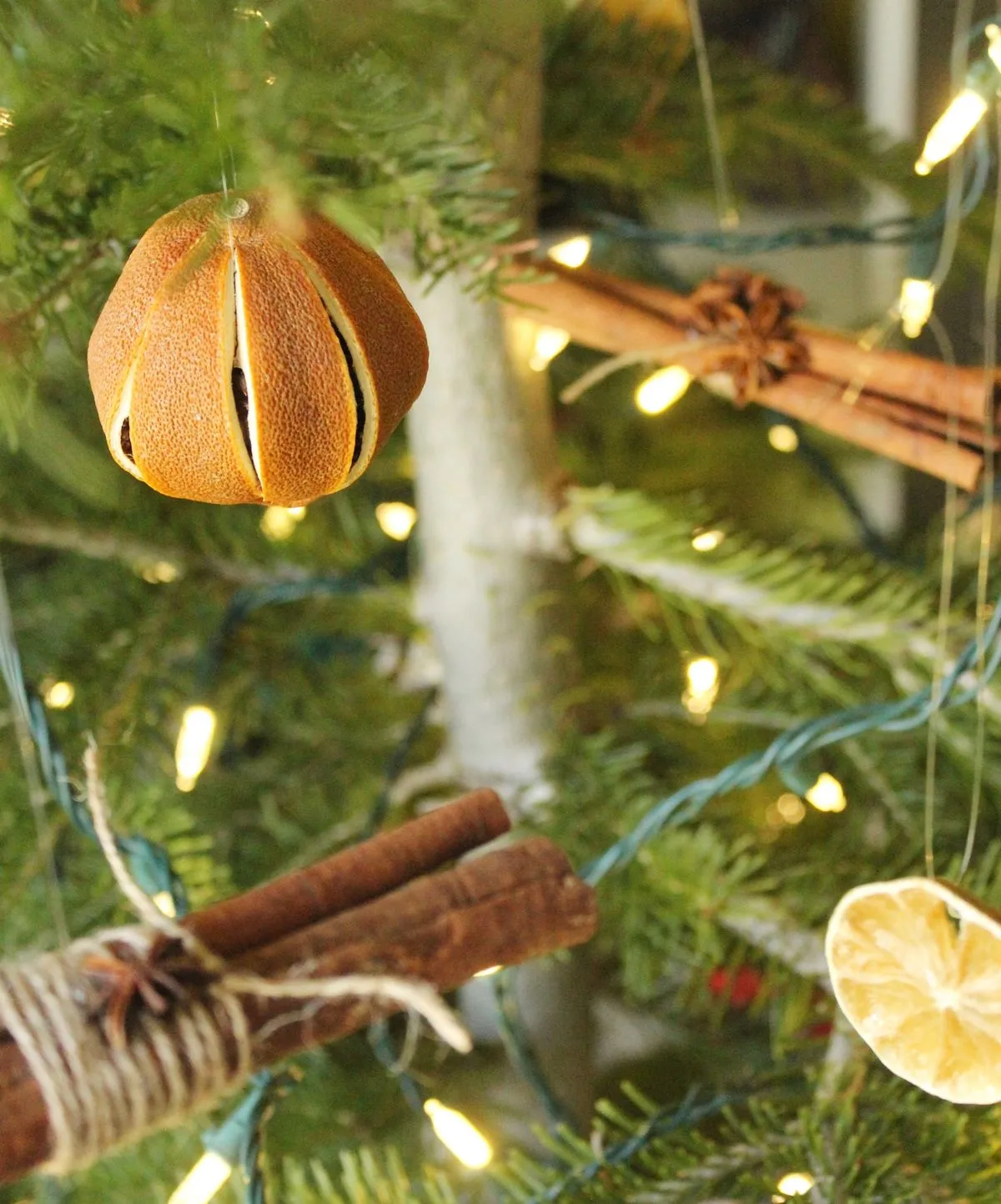
Bundle cinnamon sticks in fives or sevens, never even numbers — odd counts read as intentional. Wrap jute twine twice around the middle, knot at the back, and leave 3-inch tails so the bundle hangs slightly askew instead of perfectly vertical. A bent paperclip makes a better hanger than a wire ornament hook, because the green wire disappears into the needles. And pick 2700K bulbs, not 4000K: warm white makes dried orange glow, while cool white makes it look dusty.
7. A Twinkle-Lit Christmas Table Beneath the Evergreens
- Wooden dining table: $0 if you already own one ($350–$900 new)
- Linen or natural runner: $20–$45
- Red and white dishware, service for six: $40–$120
- Small potted evergreens, four: $60–$120
- Pinecones and pine branches: free–$15
- Warm-white string lights, two strands: $15–$35
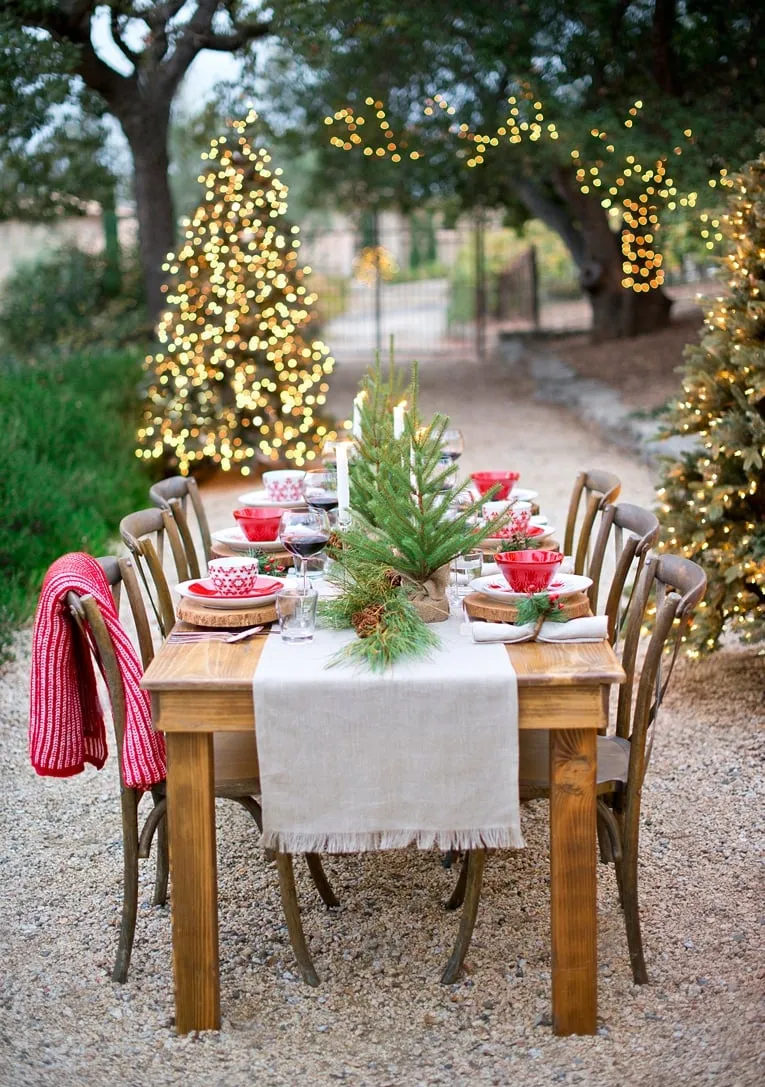
Total: $135–$335
Budget alternative: use the plates you already own, swap the potted evergreens for clipped branches from a tree lot’s discard pile, and buy lights on sale in early November. A runner plus two strands of warm bulbs gets you 80% of the way there for about $40.
Winter dining keeps moving outdoors, and 2026 is the year string lights replaced the chandelier for a lot of people. The shift tracks with the broader move toward warm-white 2700K lighting and away from the icy cool-white glow of a decade ago, which flatters wood, linen, and skin tones instead of rendering them gray. It’s a trend with real staying power, since the pieces are reusable and mostly free.
8. Twig Triangles and Cinnamon on a Budget Tree
The palette is nearly monochrome — dark green, burnt orange, cinnamon brown, twine — so the shapes have to do the talking, and they do. The twig triangle repeats a pointed silhouette that shows up again in the pinecone scales and the star-like cinnamon bundles. Because the contrast between ornament and needle is low, the warm lights read as the brightest thing on the tree, which is exactly where you want the eye to land. Busy trees lose this. Restrained ones keep it.
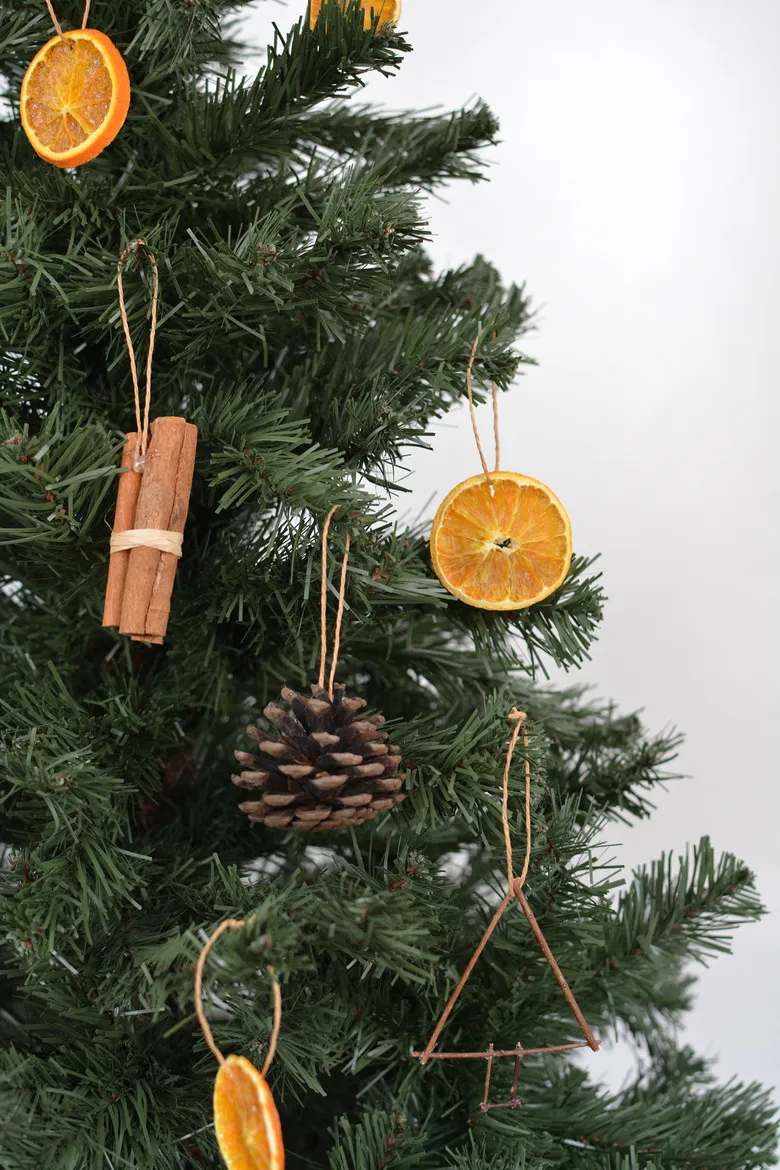
You can make a dozen of these ornaments for about $12. Walmart and Dollar Tree sell jute twine for $2–$3 a spool, cinnamon sticks run $4–$8 a bag, and a single orange costs about a dollar. Facebook Marketplace is the move for the tree itself — artificial trees list for $30–$60 in early December and drop to $15 by New Year’s. Buy ornaments secondhand too; thrift stores are full of twine-and-wood pieces that fit this look perfectly.
- Measure the visible height of your tree — ornaments above eye level need to be larger to register.
- Count your light strands and check the color temperature on the box (2700K, not 4000K).
- Test one ornament for weight before you commit to making a dozen.
- Clear a storage bin now, or these will end up in a grocery bag by February.
9. Sage Napkins and Burnt Orange Tapers on Light Wood
The mix here is 60% light wood and off-white (the table, the plates, the runner), 25% green between the garland and the sage linen napkins, 10% burnt orange from the taper candles, and 5% silver from the candle holders. That’s a classic three-color formula with the saturation held low, which is why it feels calm instead of Christmas-card loud. Swap the burnt orange tapers for ivory and the table goes quiet and formal. Swap them for deep plum and it turns moody. The ratio stays the same either way.
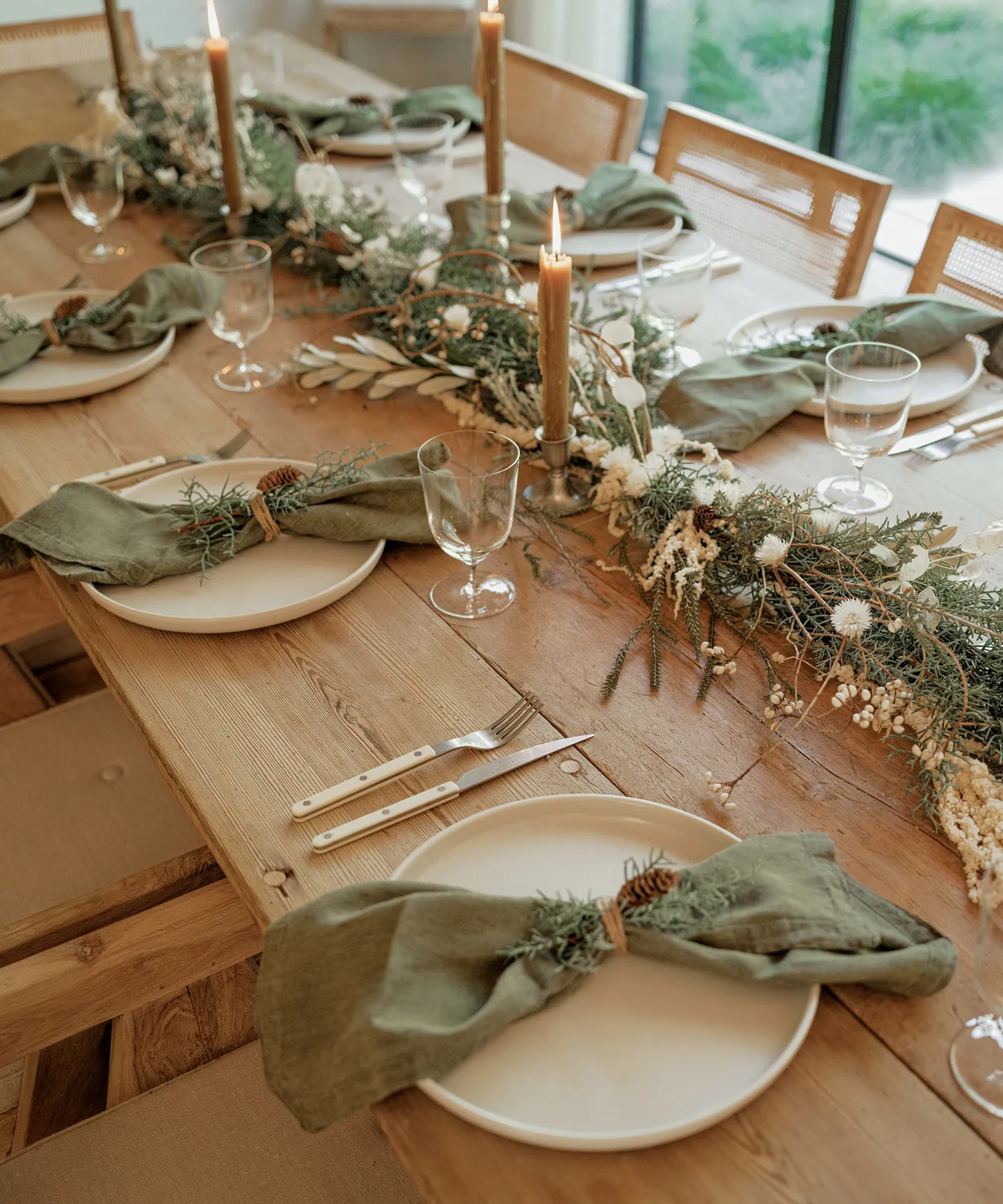
Tall tapers only work if the ceiling cooperates. Measure from the tabletop to your light fixture — under 30 inches, go with short pillars or someone gets a sleeve full of hot wax.
- Burnt orange tapers: dye ivory candles or order from a small Etsy maker.
- Fresh juniper sprigs on napkins: add them the morning of the meal, not the day before.
- Linen napkins: press once, then roll — hard creases look store-bought.
None of these are dealbreakers, but each one is the difference between a table that looks styled and one that looks staged.
10. Pinecones, Citrus and Cinnamon Up Close
It’s the size range. Every pinecone in this arrangement is a different size — roughly 2 inches up to 5 — and that’s what makes a pile of brown cones look collected rather than purchased. A bowl of identical pinecones, no matter how many you use, reads flat. Mix in the orange slices for color and a few cinnamon sticks for vertical lines, and you’ve got real depth in a space the size of a dinner plate. If you take one thing from this idea: vary your scale, always.
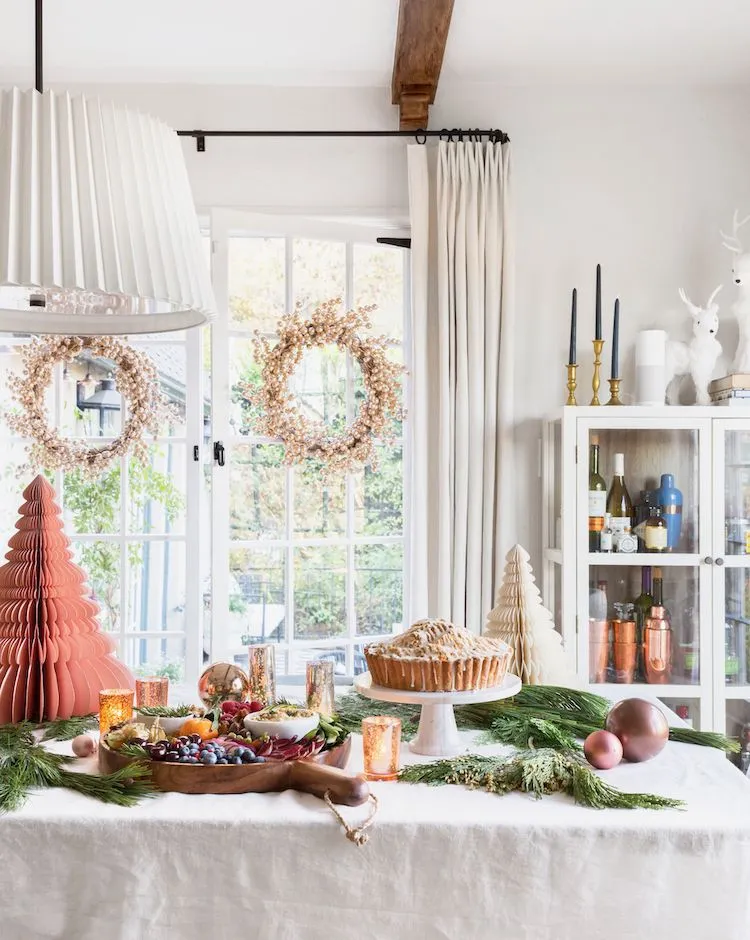
This arrangement belongs in a bowl 10 to 14 inches wide, centered on a table at least 48 inches long. It’s the right answer for small dining rooms, round tables, and sideboards where a full runner would overwhelm everything. Working with a 36-inch bistro table? Drop to an 8-inch bowl and lose the candle. Bigger rooms can scale it up into a low wooden trough, but past about 18 inches it starts competing with the plates.
11. A Berry-Strewn Evergreen Wreath on Weathered Wood
Place berries in odd-numbered clusters — three or five — and put them where the wreath’s silhouette is weakest, usually the lower left or lower right. Berries are a corrective tool, not a sprinkle. Mix at least two berry sizes and two finishes (matte and frosted), and wire each cluster with 22-gauge floral wire instead of gluing, so you can shift things after it’s hanging. If the wreath looks perfectly balanced while it’s lying on your table, it’ll look lopsided on the wall — gravity is a design element.
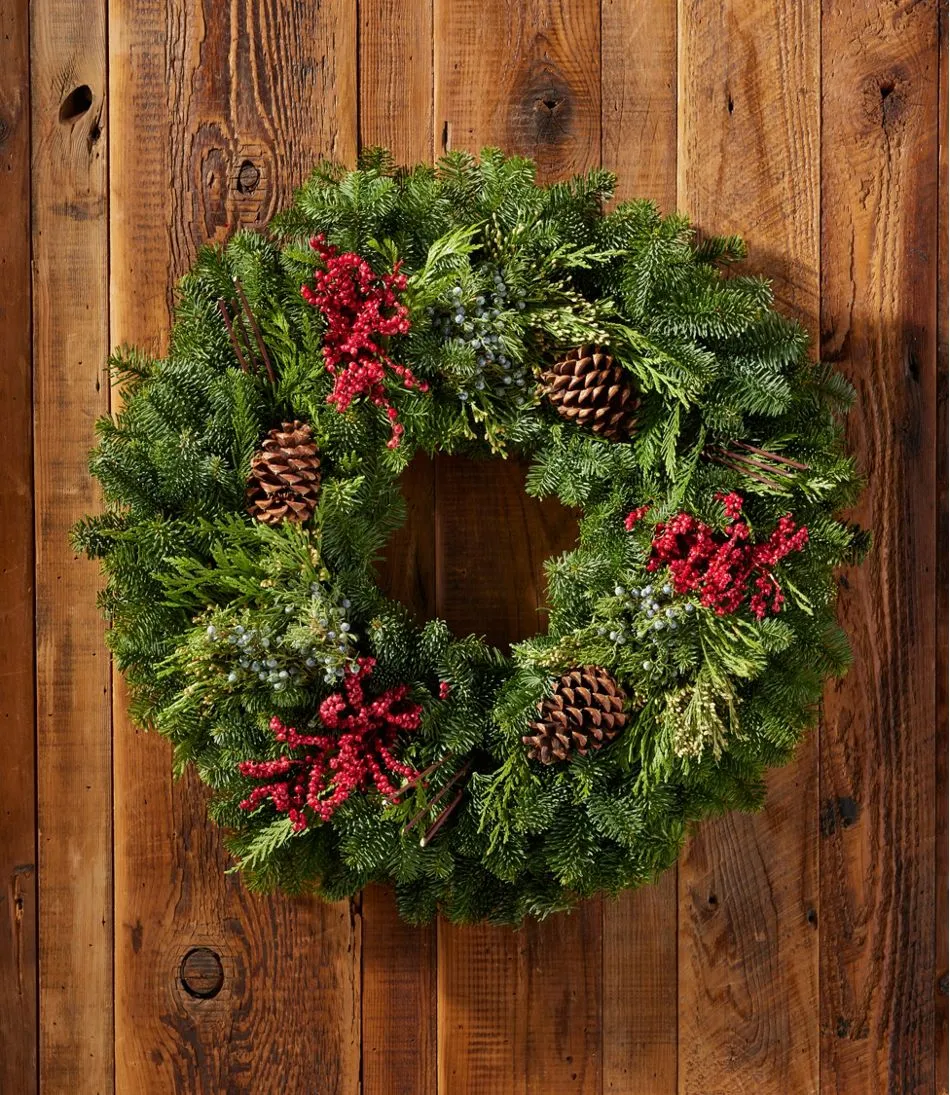
- Measure the door or wall width — the wreath should be about one-third of it.
- Check what you’re hanging from: a hollow-core door needs an over-the-door hook, not a nail.
- Confirm the hook’s weight rating against the wreath’s weight, especially with wet fresh greens.
- Decide where it lives in January before you buy it in November.
12. Dark Red Napkins and Twig Wreaths at the Table
Time: 15 minutes. Cost: about $6 for eight napkin rings.
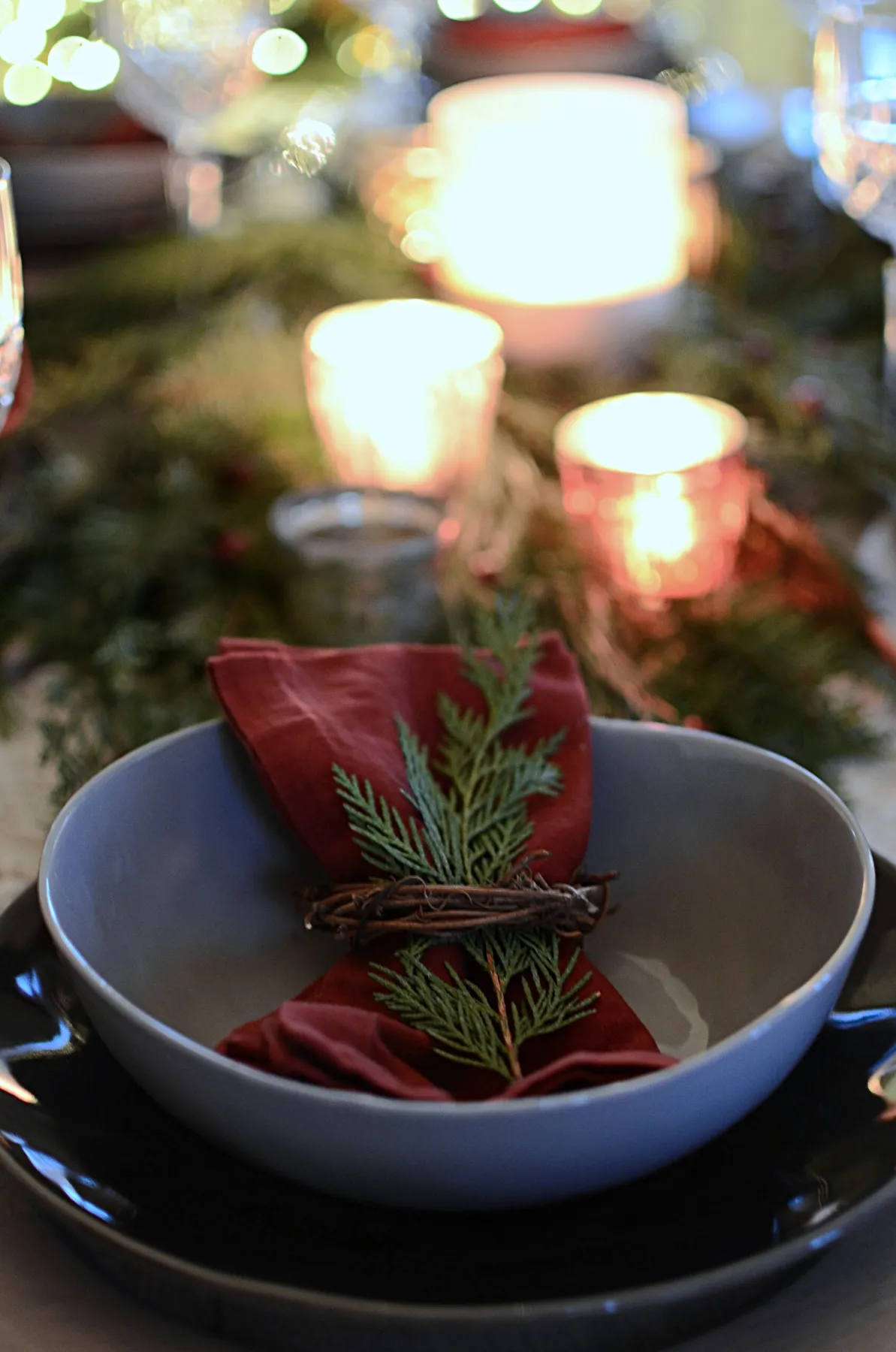
- Gather 8 to 10 thin twigs, each about 5 inches long and a quarter inch thick.
- Soak them in warm water for 10 minutes so they bend without snapping.
- Form each twig into a 2-inch circle and wrap the overlap tightly with jute twine.
- Slide a folded napkin through and set it on the plate.
- Tuck one evergreen sprig behind the ring so it spills over the plate edge.
Deep, muted red is having a quiet moment in 2026 — think oxblood and brick rather than candy-cane bright. It reads richer against charcoal and grey, and it photographs better in the low, warm light of a dining room after dark. The palette lines up with the broader shift toward earthy, vintage-leaning holiday decor that designers keep pulling from estate sales and antique malls.
- Dark grey dinner plates, set of 6: $48–$90
- Light grey ceramic bowls, set of 6: $36–$72
- Dark red linen napkins, set of 6: $24–$54
- Votive candles and holders, eight: $16–$40
- Evergreen garland, 6 ft: $20–$55
- Twig napkin rings, homemade: $6
Total: $150–$317
Budget alternative: thrift the plates and bowls for $1–$3 each, cut napkins from a yard of clearance linen, and save your votive jars all year. That’s about $45 for the whole table.
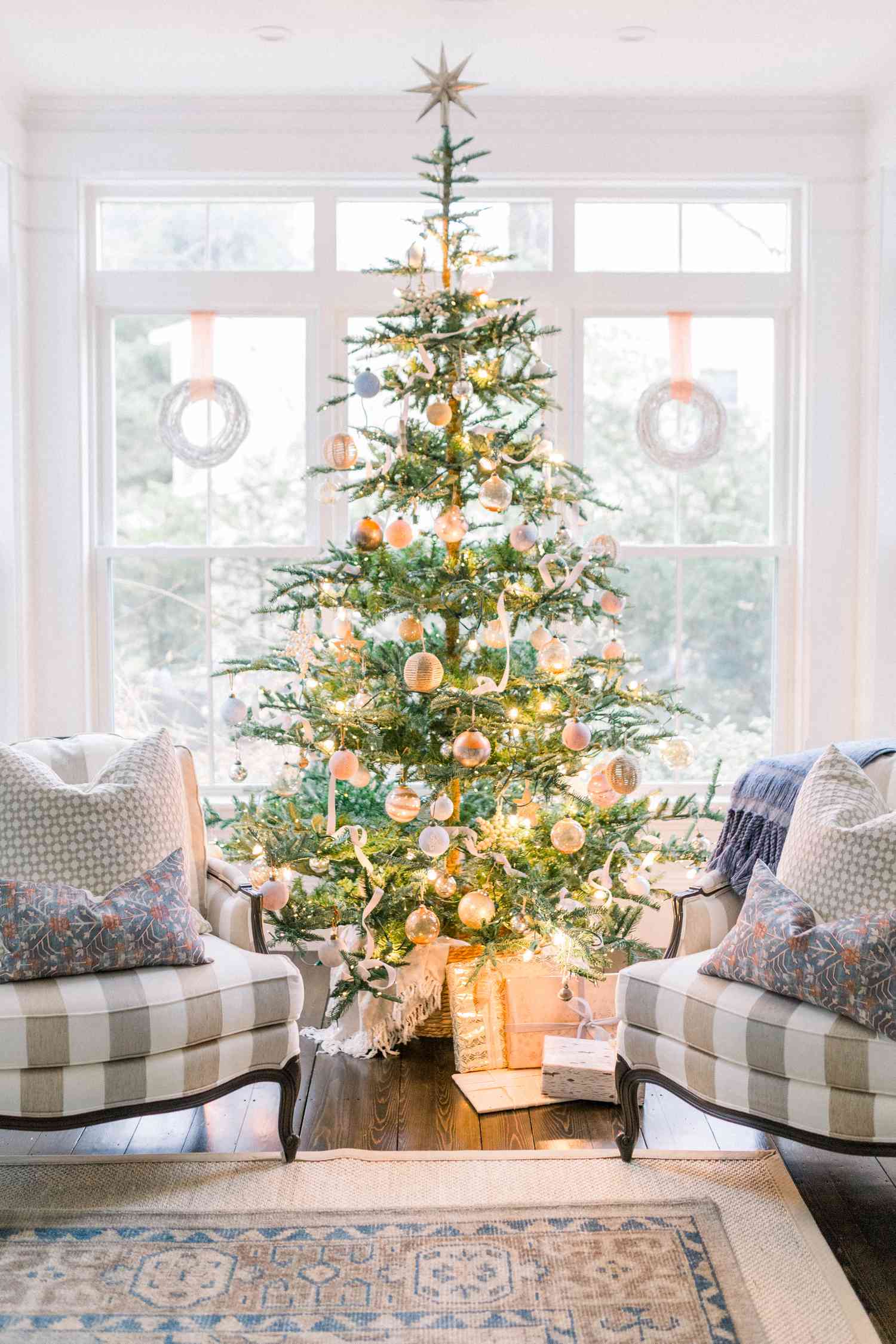
13. A Potted Norfolk Pine in a Woven Basket
A Norfolk pine runs $25–$60 at a nursery, and Trader Joe’s and Home Depot often have small ones for around $20 near Thanksgiving. The seagrass basket is an IKEA staple at $15–$30, and kraft paper plus navy ribbon costs maybe $10 total. Skip the glittery ornaments if you want the natural look; if you love them, buy them after Christmas at 70% off. Facebook Marketplace is full of potted trees every January when people realize they can’t keep them alive — though Norfolk pines actually do fine indoors if you water them. It’s the basket-dressed cousin of the terracotta-pot tree in Idea #16.
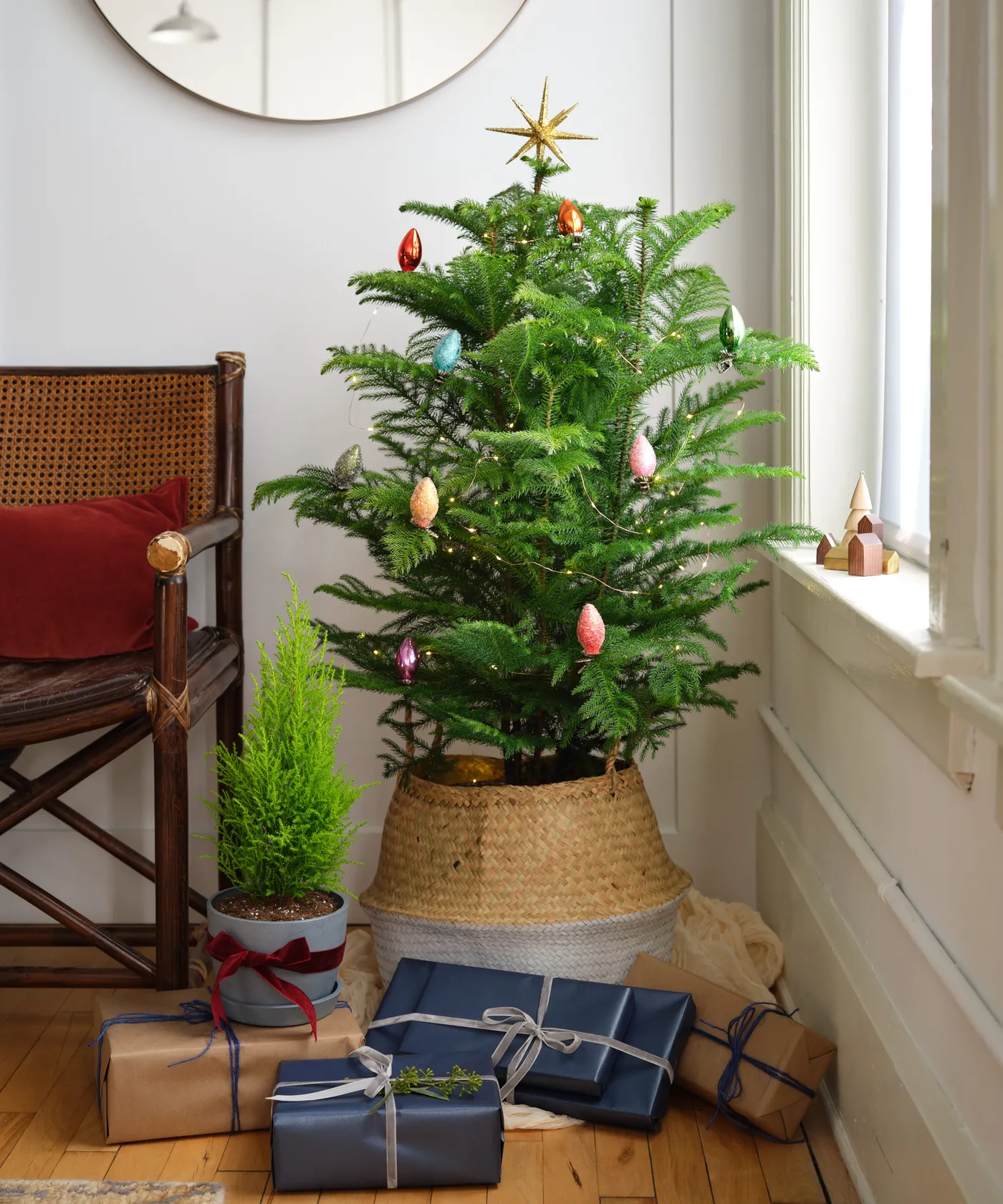
The woven basket is the whole personality. Swap it for a red plastic tree stand and this becomes a plant someone brought home from the grocery store. The seagrass hides the pot, adds a texture that matches the natural ornaments, and says I meant to do this. A basket also gives you somewhere to tuck the cord and the water saucer, which is a practical win you’ll appreciate every single time you water.
14. Antlers and Iron Candelabras for a Formal Table
Two practical things. Real antlers are pricey and hard to source ethically; resin replicas run $20–$45 a pair and look identical from across a table. Second, dark candles drip. If you’re using them over a tablecloth you actually care about, buy dripless tapers or set them on a tray. Wrought-iron candelabras are also heavier than they look — rest them on felt pads so they don’t scratch a wood table when someone bumps the edge. And keep them back from the table’s rim if there are kids in the house.
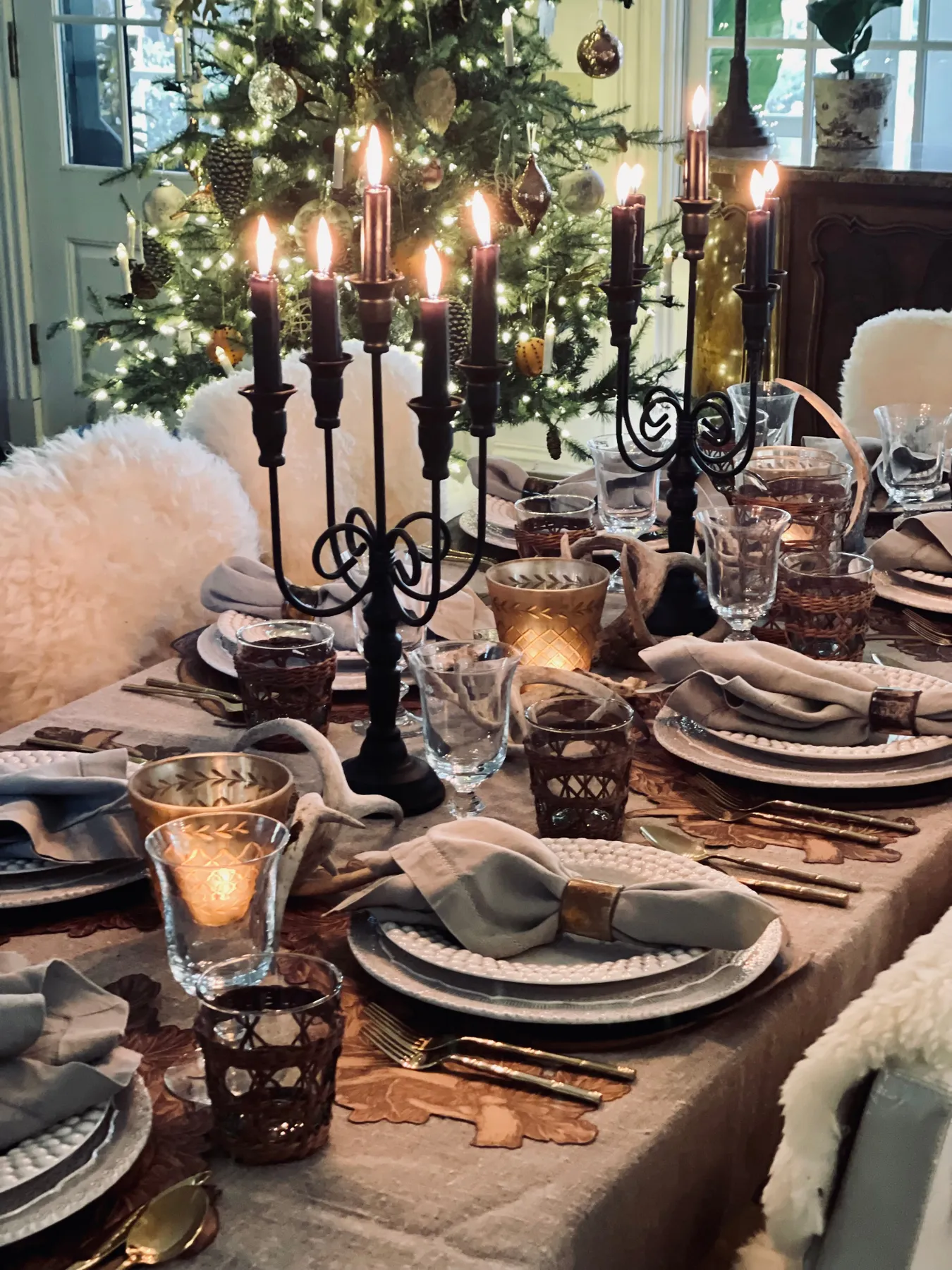
The formula is 45% creamy white and beige (plates, napkins, tablecloth), 30% warm gold and bronze, 15% charcoal black from the candelabras, and 10% forest green from the tree behind it. That’s a warm-dominant mix, which is why it reads elegant rather than spooky. Swap the gold accents for silver and the whole table gets colder and more modern. Swap the charcoal for brown and it goes rustic instantly.
15. Glass Terrarium Ornaments on a Blue-Green Tree
Glass globes are heavy, and a branch that holds a plastic bauble fine will sag under a terrarium. Hang them within 8 inches of the trunk on branches at least a quarter inch thick, and cap it at 8 to 12 globes on a 7-foot tree. If you’re using real succulents inside, mist them lightly every two weeks and skip watering entirely — condensation inside the glass will kill them faster than dryness. Faux succulents look just as good and won’t rot by New Year’s.
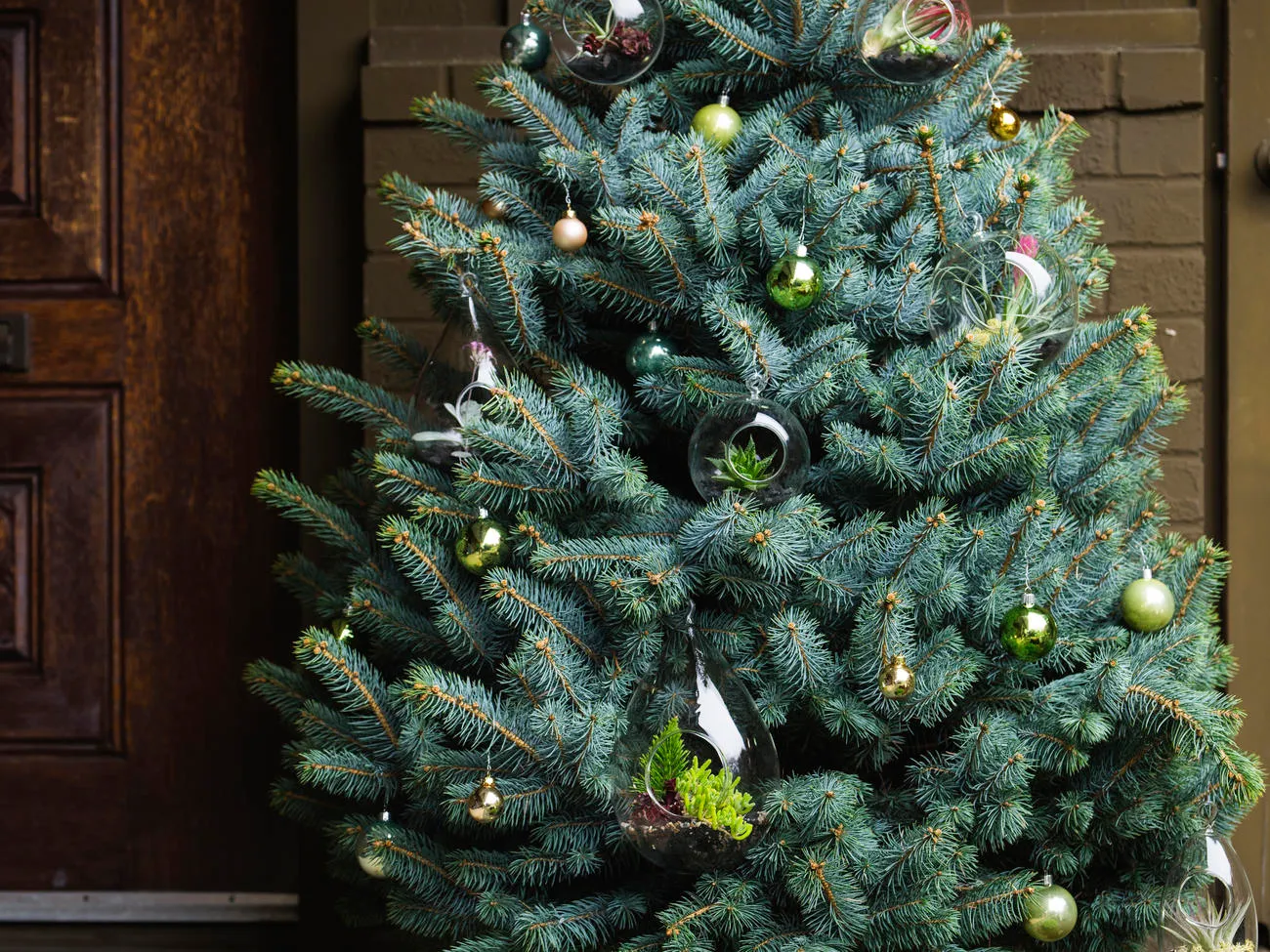
These read best on a 7-foot tree or taller, where you have enough weight-bearing branches to spread them out. On a 4-foot tabletop tree, limit yourself to four globes and let the metallic baubles carry the rest. Ceiling height isn’t the constraint here — branch density is. If your tree is sparse, hang the globes toward the back where they catch window light, or skip them and go with a garland instead.
Living ornaments took off alongside the broader biophilic design movement, and 2026 is the year it went mainstream — Pinterest searches for terrarium ornaments climbed steadily all last winter. It’s partly a reaction against plastic-heavy decor and partly a practical shift: people are buying fewer, better ornaments instead of a hundred cheap ones.
16. Mushroom Ornaments in a Terracotta Pot
A tree in a terracotta pot needs a liner or saucer, because terracotta sweats and will leave a ring on a wood floor. With a real tree, expect to water every other day and sweep needles off that checkered tile daily. Mushroom and animal ornaments are usually resin or ceramic — resin survives a drop, ceramic doesn’t, so hang the clay pieces higher up. And check the pot’s weight before you commit: a 6-foot tree in terracotta is heavy enough that you won’t want to move it twice.
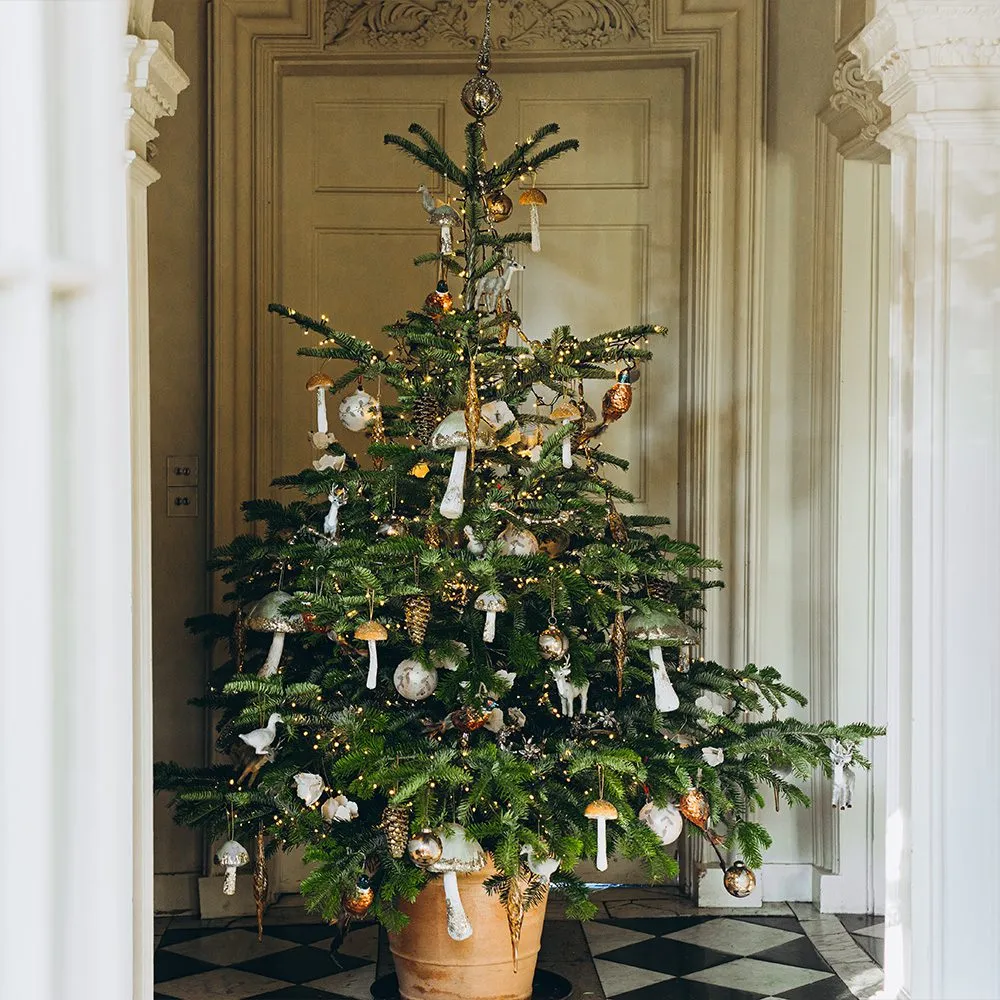
The checkered floor is doing more work here than the ornaments. A graphic floor pattern would normally fight a decorated tree, but with a palette limited to black, white, terracotta, and green, it settles into the background and lets the whimsy read. The narrow tree in a wide, low pot also creates a strong silhouette against the paneled door, which frames the whole thing like a picture. Restraint in color buys you room for personality in shape.
17. A Grand Mantel Loaded with Roses and Reindeer
- Fresh garland, 12 ft with floral accents: $90–$200
- Faux roses and white flowers, two dozen: $30–$70
- Gold reindeer figures, three: $75–$180
- Nutcrackers, assorted sizes: $60–$240
- Flocked and green mini trees, four: $80–$200
- Red bows and ribbon: $15–$35
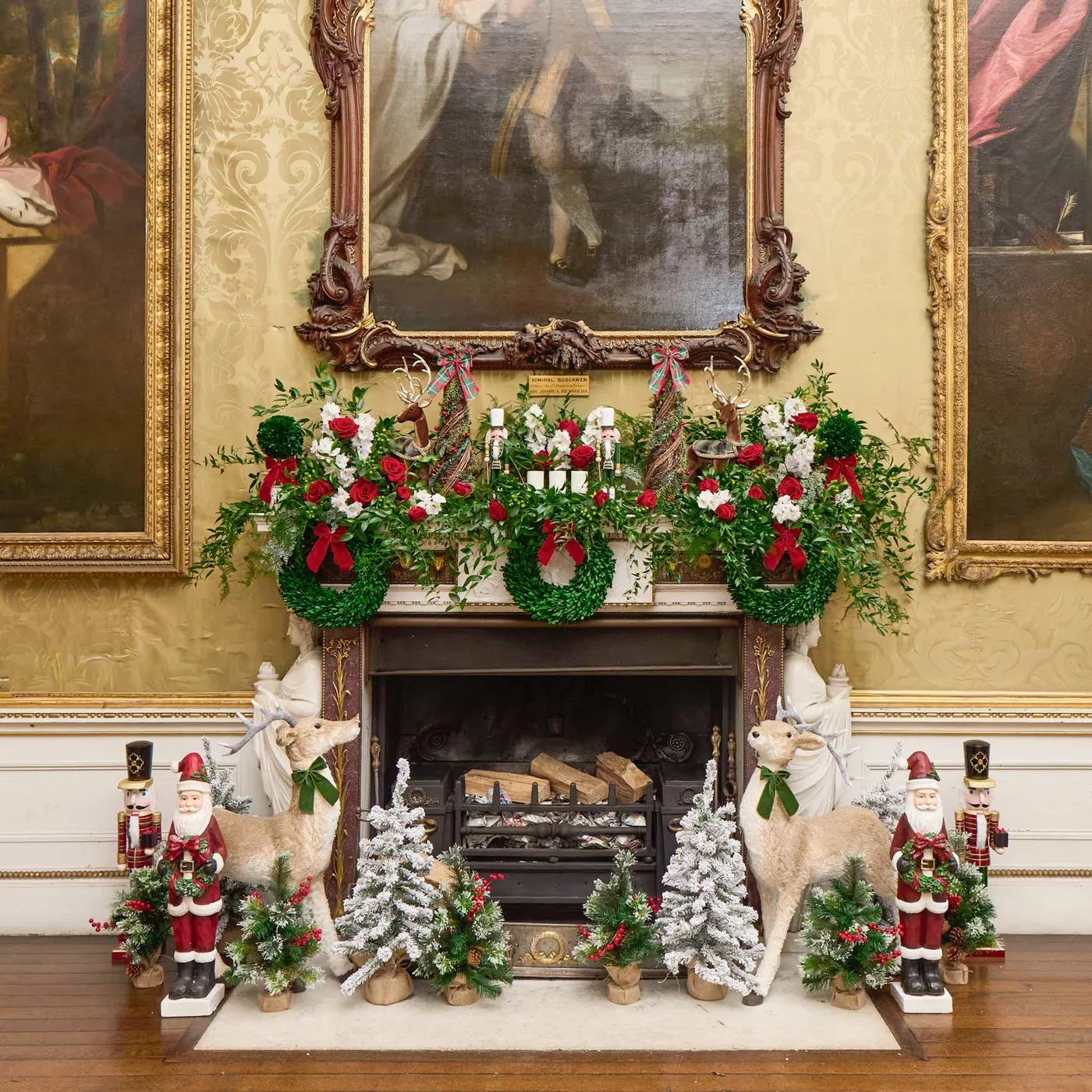
Total: $350–$925
Budget alternative: buy the garland plain and add your own roses from a craft store bunch, source nutcrackers at estate sales for $5–$20 each, and use three statement pieces instead of twelve. The layered look survives on far fewer objects if the ones you keep are large.
Fresh roses wired into a garland above a working fireplace will wilt within a day or two — heat rises, and cut flowers hate it. Use them only if the fire stays unlit, or go faux and skip the heartbreak. The bigger risk is overfilling. When you’re layering reindeer, nutcrackers, candles, and trees, pick three heights and keep everything else low. Otherwise the mantel becomes a shelf instead of a focal point.
18. An Evergreen Garland That Trails to the Floor
The garland doesn’t stop at the table edge — that’s the entire trick. Letting the greens cascade all the way to the floor, with red apples resting in the spill, turns a centerpiece into an event. It also visually anchors the table to the room instead of leaving it floating there. Remove that trailing section and you have a nice, ordinary holiday table. The apples matter too: they’re the same red as the tulips up top, so the eye follows the garland down and back up again.
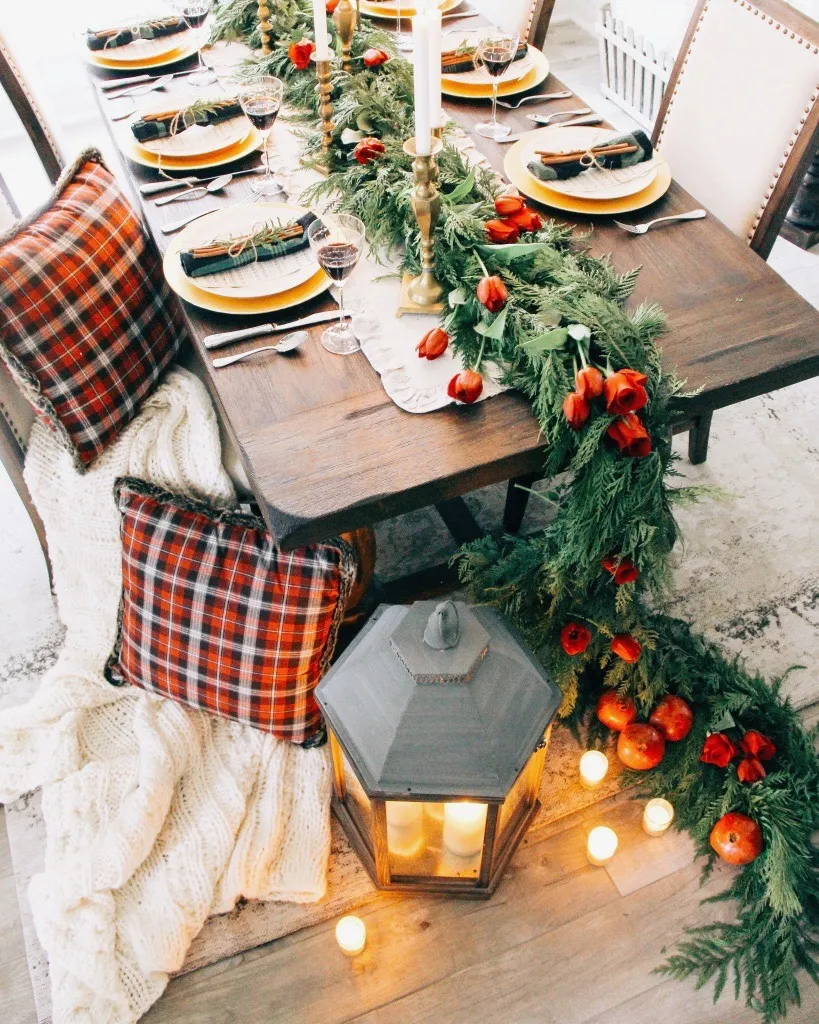
Time: 40 minutes. Cost: $45–$90 depending on what you forage.
- Start at the table center and work outward, laying branches so the tips point away from you.
- At each end, let the garland fall — two or three branches overlapping downward toward the floor.
- Secure the falling section to the table leg with clear fishing line so nobody kicks it loose.
- Nestle red apples into the lowest greens so they sit on the floor, not on the table.
- Tuck brass taper holders into the tabletop section and light them at the very last minute.
19. A Lit Wire Star Against Reclaimed Wood
The oversized light-up star is the natural evolution of the giant wreath trend — one large, unmistakable object instead of twenty small ones. It also fits how people are decorating in 2026: fewer pieces, bigger impact, and light sources that stay up past Christmas. Wireframe stars and snowflakes in warm white are some of the most-saved holiday lighting images on Pinterest right now, and unlike a lot of trendy decor, they store flat and come back year after year.
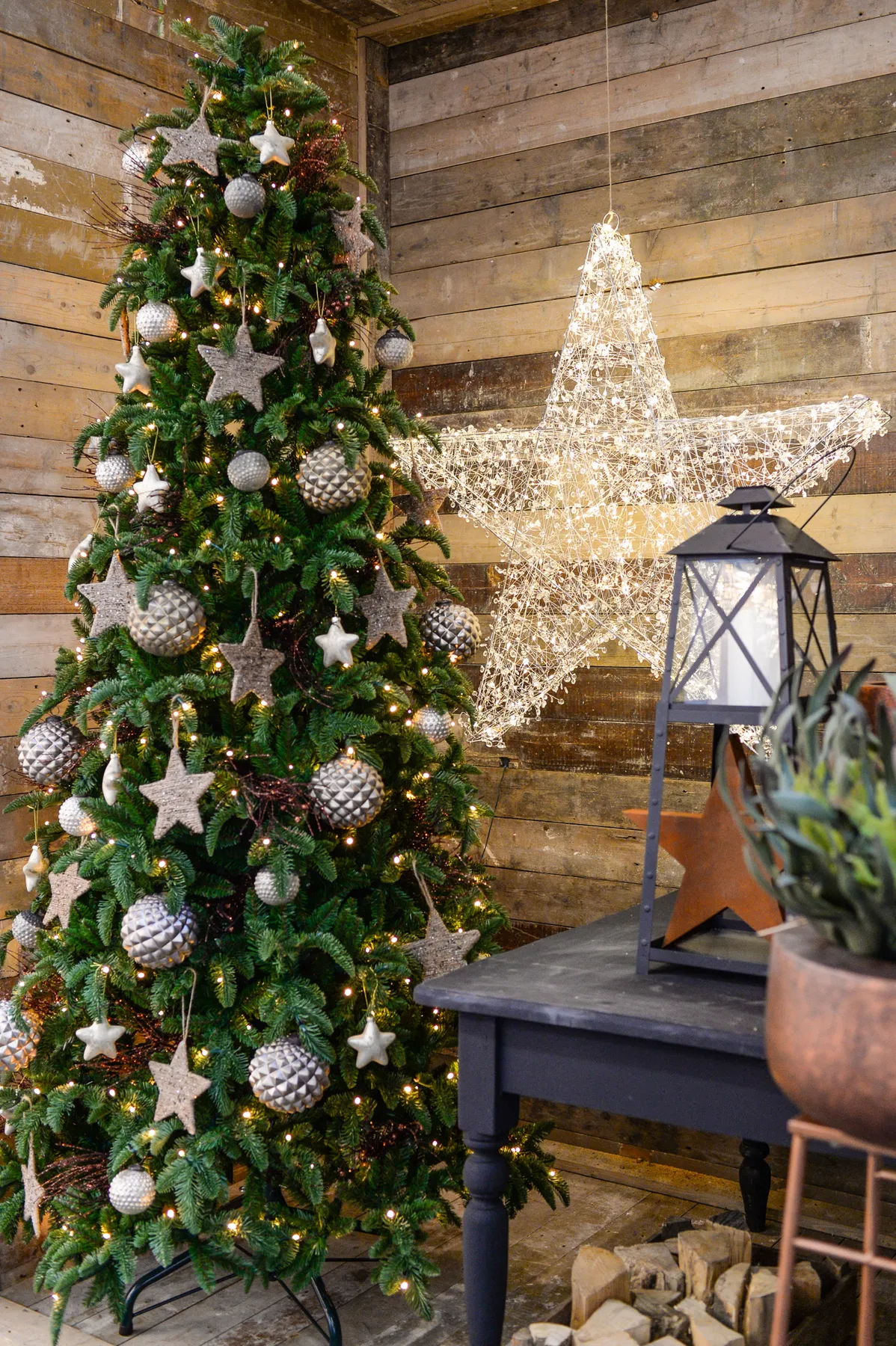
Scale contrast is the whole story. A 24-inch star next to a slim 6-foot tree makes both look bigger, and hanging it on a horizontal plank wall creates a grid that makes the star’s geometry pop. The warm white glow against weathered gray-brown wood is also a temperature contrast — cool wood, warm light — which is why this corner feels cozy instead of flat. The dark console and black lantern below keep the brightness from floating away.
Give this at least 8-foot ceilings and about 10 feet of wall. Anything smaller and a 24-inch star starts crowding the room — drop to 16 inches and hang it lower. In a tight space, the bowl arrangement in Idea #10 delivers a similar mood in a fraction of the footprint. Small rooms want one hero, not two.
20. White Roses and Blue Plaid for a Winter Table
Break it down as 40% blue and brown plaid, 30% cream white from the roses and china, 20% forest green from the foliage, and 10% gold in the cutlery and candlelight. Plaid gets a bad rap for being busy, but it behaves when it’s the largest color field and everything else stays quiet. Swap the plaid for a solid navy cloth and the table turns formal. Swap it for natural linen and it goes full rustic. The greenery ratio never changes.
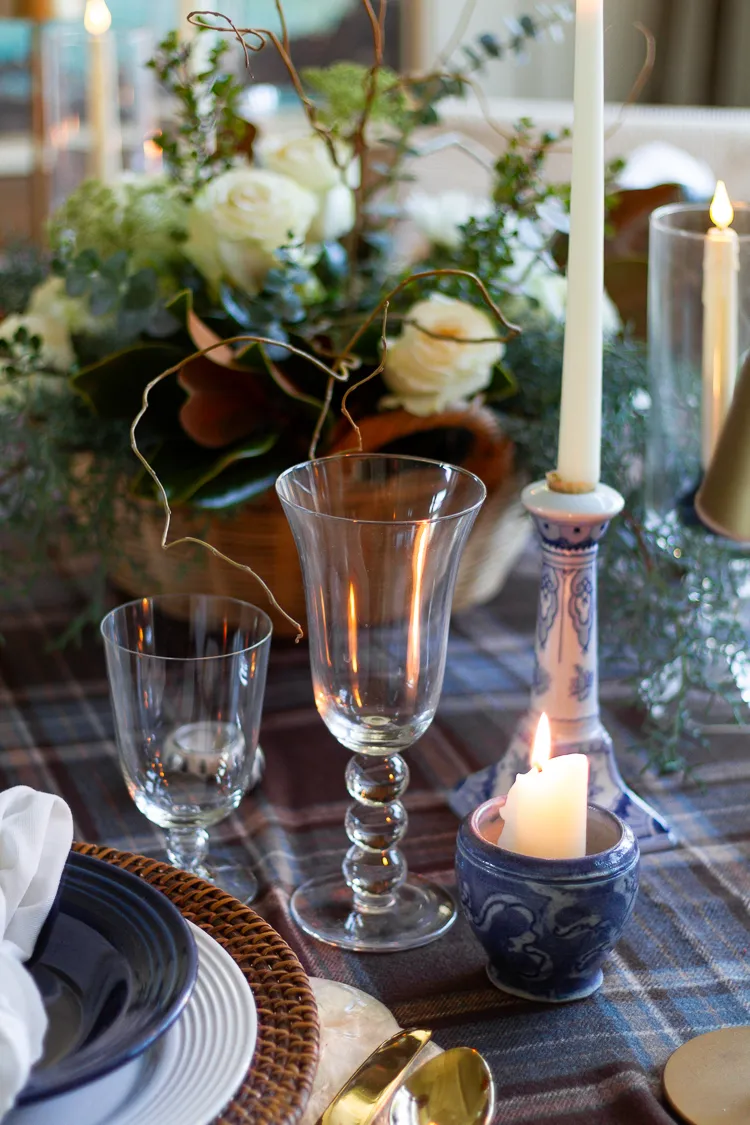
White roses in a woven basket need a hidden mechanism to look full: a 10-inch basket takes 18 to 24 stems set into soaked floral foam, not a vase. Foam holds them exactly where you place them, which is why this arrangement looks deliberate instead of plopped. Gather:
- Floral foam and a plastic liner for the basket
- 18–24 white roses, slightly open
- Two bunches of green foliage, cut into 6-inch pieces
- Curly brown twigs for height and movement
Set the outer ring first, then fill the middle, and save the twigs for last.
21. Tarnished Silver Urns Overflowing with Evergreen
Tarnished silver is one of the last true bargains. Thrift stores and estate sales sell silver-plate urns for $4–$15 because most people don’t want to polish them — and you don’t have to. Brown velvet runs $12–$20 a yard at a fabric store, and vintage paper scraps come free inside old books. Fresh evergreen trimmings are usually free at tree lots if you ask nicely, and a bucket of them costs nothing to maintain. The whole look can come together for under $40 if you shop secondhand first.
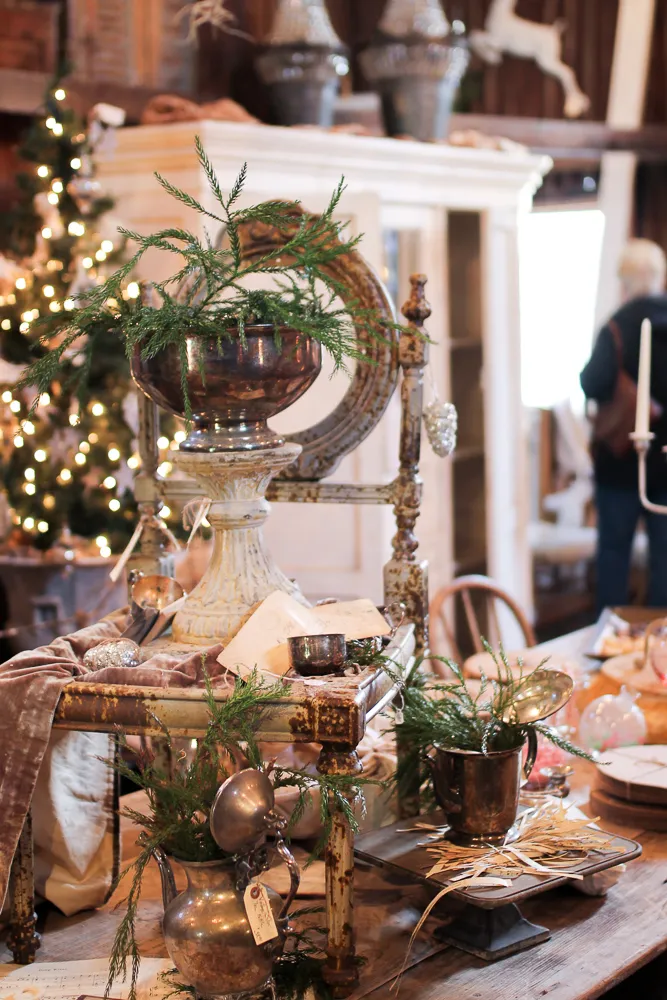
Fresh greens drink water, and a tarnished silver vessel that isn’t watertight will rust from the inside and leave a wet ring on your wood table. Line every urn with a glass jar or a plastic cup before the greens go in. Tarnish also transfers — it’ll leave gray smudges on a linen runner, so set the vessels on a tray. And while nobody expects you to polish, a quick rub with a soft cloth on the visible rim makes the arrangement look intentional instead of neglected.
22. Dried Ferns and Blue Berries in a Winter Wreath
Dried fern fronds are the secret weapon. They’re lighter than evergreen and they arc outward, which breaks up the dense circle and gives the wreath somewhere to breathe. The color story works because blue-green, rust brown, and deep blue sit close to each other on the color wheel — near enough to feel related, far enough apart to stay interesting. And the deep red ribbon is the only true red in the mix, so it reads as a focal point instead of just one more color.
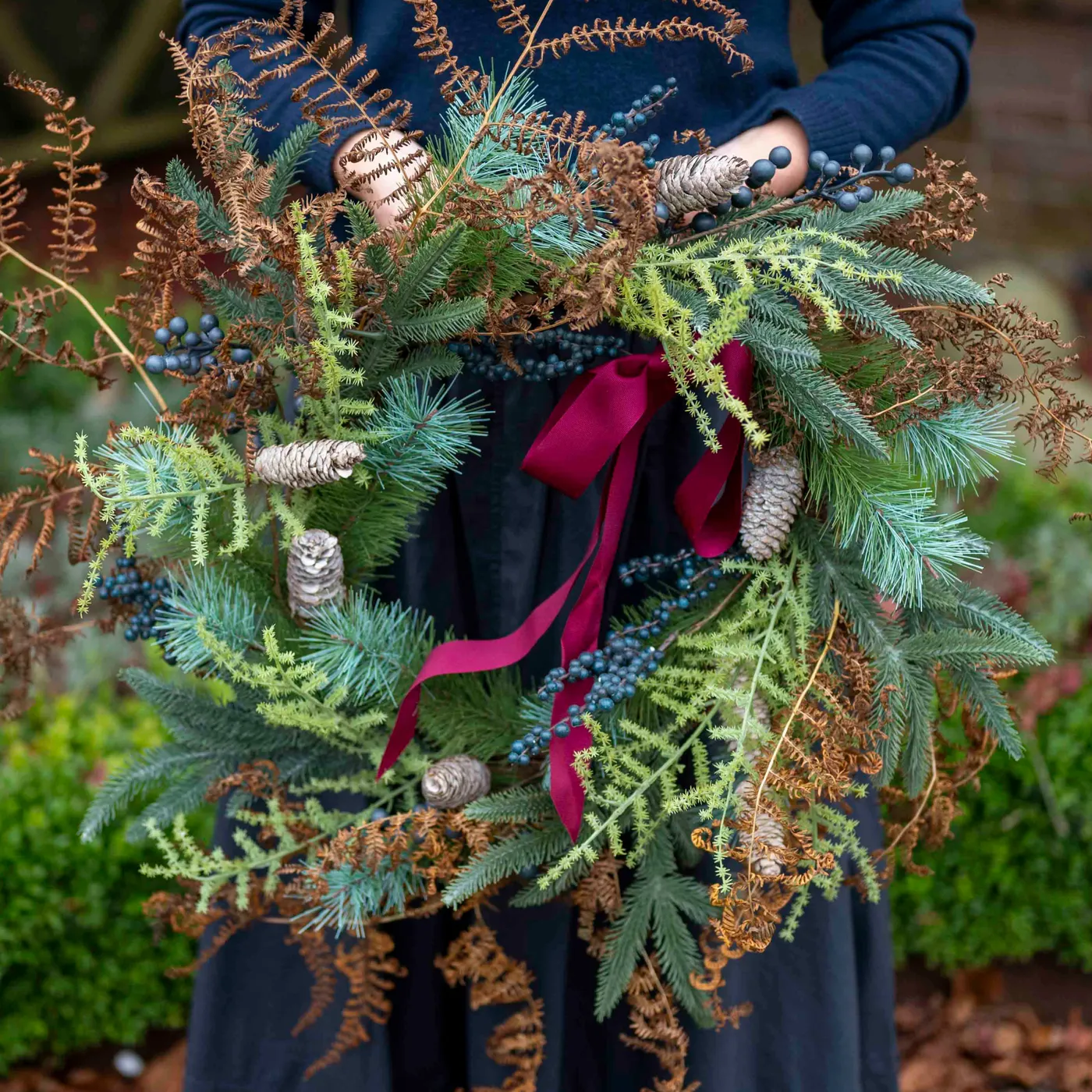
Dried ferns are brittle. Keep this one out of direct sun and away from doors that get slammed, because fronds snap at the stem and there’s no fixing them. The blue berries are almost always faux — check before hanging in a humid spot, since real berries mold. Spray the whole wreath with a matte anti-desiccant if you want the greens to hold color for a full season, and store it in a box with the ribbon removed so it doesn’t crease.
The ratio is roughly 65% green across two tones, 20% rust and brown from the dried ferns and pinecones, 10% deep blue from the berries, and 5% deep red for the ribbon. It’s an unusual mix that works because two of the four colors are quiet neutrals. Trade the red ribbon for ivory in January and it carries right through winter.
23. Bottle Brush Trees and Braided Jute Placemats
Time: 20 minutes. Cost: $12–$25.
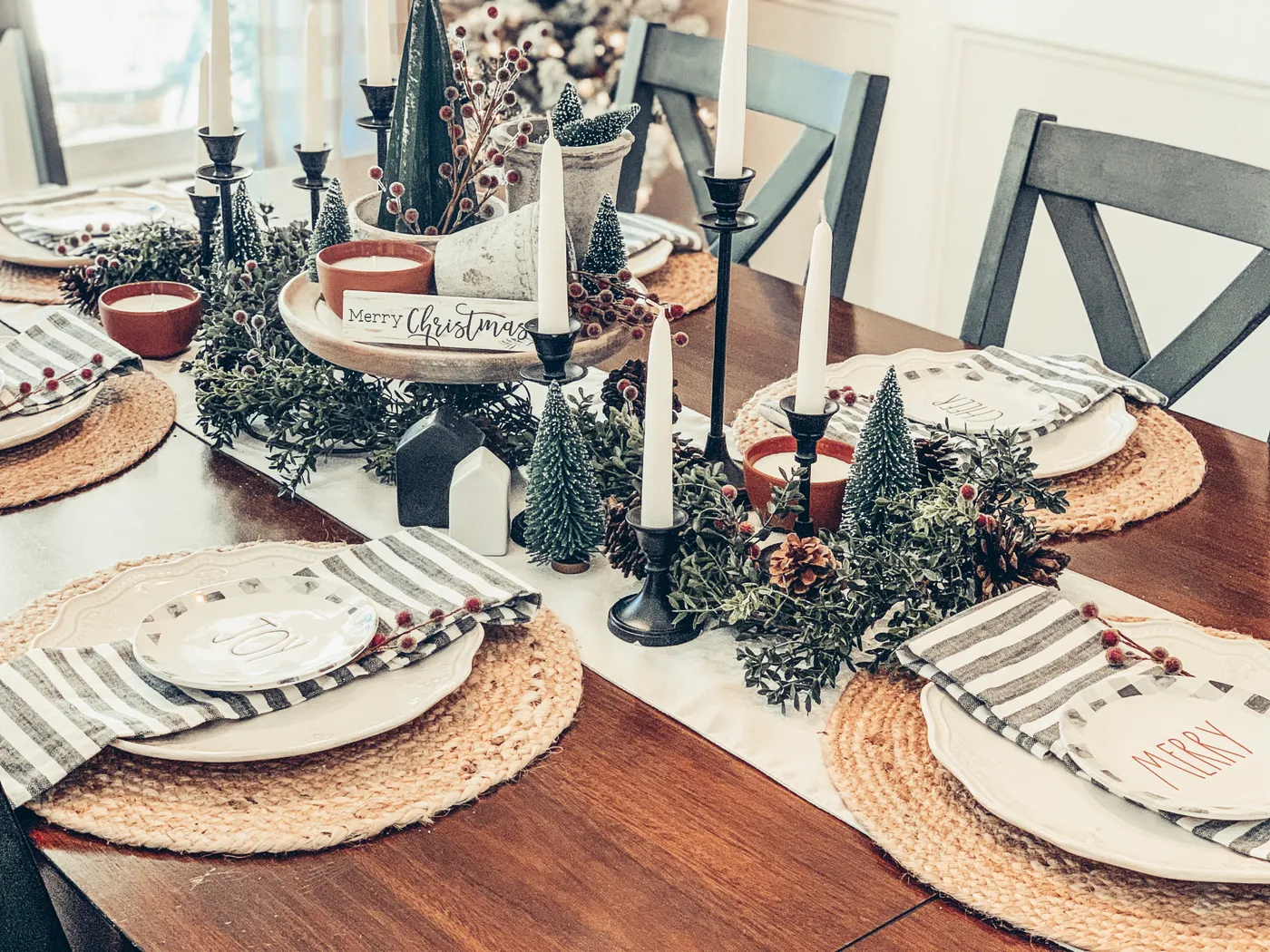
- Clear the center of the table and lay a narrow strip of natural linen down the middle.
- Cluster small bottle brush trees in odd-numbered groups of three or five, varying the heights.
- Place two black metal candelabras, one at each end of the greenery, with white tapers.
- Scatter pinecones and a few red berry sprigs between the trees.
- Set the table with braided placemats and striped napkins so the texture continues outward.
It’s the black metal candelabras. Everything else in this tablescape is warm — wood, cream, green, red — and two black candelabras give the whole arrangement something to push against. Without them, the centerpiece is pleasant but soft. With them, it has a spine. Black is also the easiest color to add on a budget: matte black candlesticks turn up constantly at thrift stores and discount stores for under $10 a pair.
24. A Eucalyptus Swag Tied to the Chair Back
Chair-back swags need at least 14 inches of visible chair back above the seat, or the greenery ends up in someone’s shoulder blades. On a standard 36-inch round table with four chairs, plan on four swags and keep them under 16 inches long. Long rectangular tables with six to eight chairs work fine too — just make sure the swags are identical in length, because mismatched greenery reads as a mistake from across the room. Measure your chair back before you cut a single ribbon.
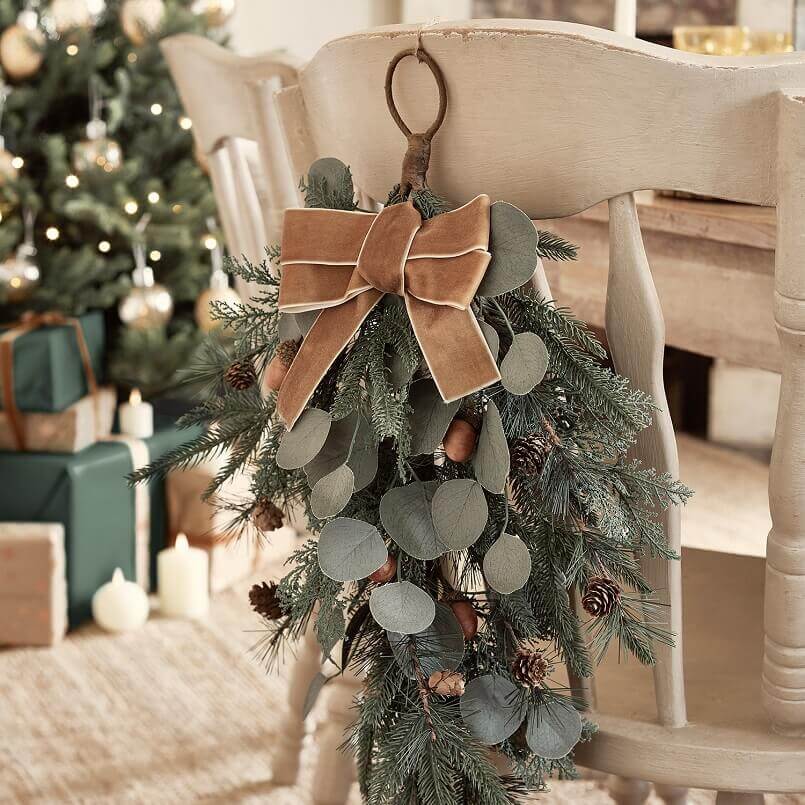
Fresh eucalyptus is one of the cheapest greens going — Trader Joe’s sells bunches for $6–$10, and it dries beautifully, so you get two seasons out of one purchase. Velvet ribbon runs about $8 a roll at Michaels with a coupon, and pinecones are free. Where brown velvet does the same job in a different spot, see Idea #21. Buy ribbon in one long roll rather than precut lengths; it’s always cheaper per yard.
- Measure chair backs from seat to top — under 14 inches, skip the swag.
- Cut all ribbons to the same length before you tie anything.
- Decide if guests will lean back; if so, keep the swag thin.
- Check that your ribbon is wired or stiff enough to hold a bow shape.
25. A Mossy Wreath Built From Mixed Foliage
Build in a spiral and never reverse direction — that’s what keeps the wreath from looking pieced together. Wrap a moss base with 22-gauge wire in one continuous coil, then tuck 5- to 7-inch sprigs at about a 30-degree angle, each one overlapping the stem of the last. Aim for three distinct green tones so the texture reads from a distance. When you’re done, walk ten feet back and look at it; if you can spot the wire form, add another pass of sprigs over the gaps.
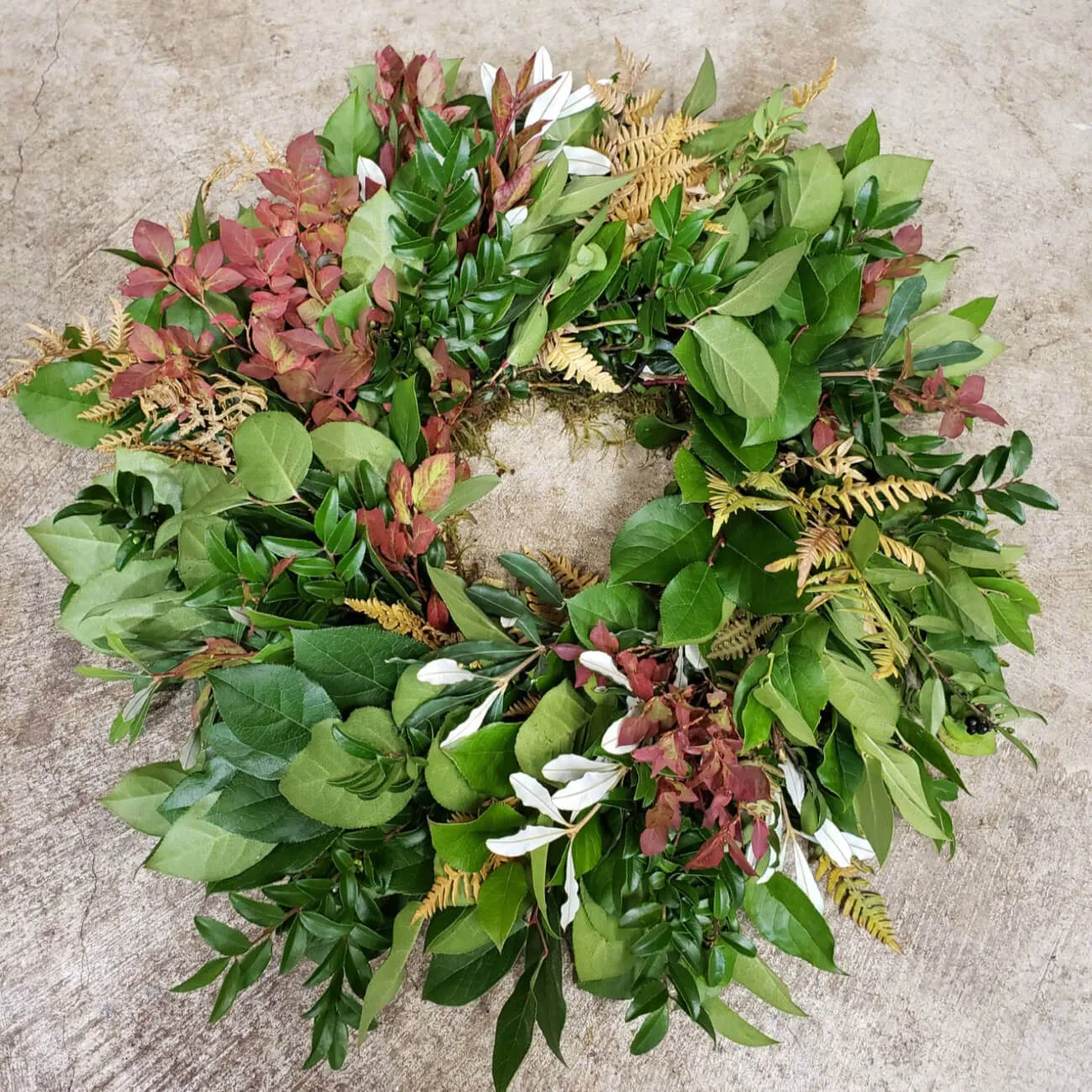
The mossy base is unglamorous and absolutely essential. It hides every wire and stem so the wreath reads as something that grew rather than something that was assembled, and it holds moisture, which keeps fresh greens alive longer. Then there’s the color temperature play: the golden-brown fern fronds are warm, the greens are cool, and together they keep the wreath from looking like flat evergreen. Add a touch of reddish-brown foliage and you have depth without a single ornament.
26. Sage and Gold Beside a Wood-Burning Stove
A wood-burning stove needs clearance — usually 36 inches to combustibles, and that includes garland, gift wrap, and a lightweight throw. Check your stove’s manual, because the number varies by model, and never let greenery drape closer than the manufacturer says. Faux fur rugs are lovely but they trap ash and they’re a pain to clean; shake them outside weekly. And keep wrapped gifts off the hearth entirely, since paper near an open fire is the one risk nobody forgives themselves for.
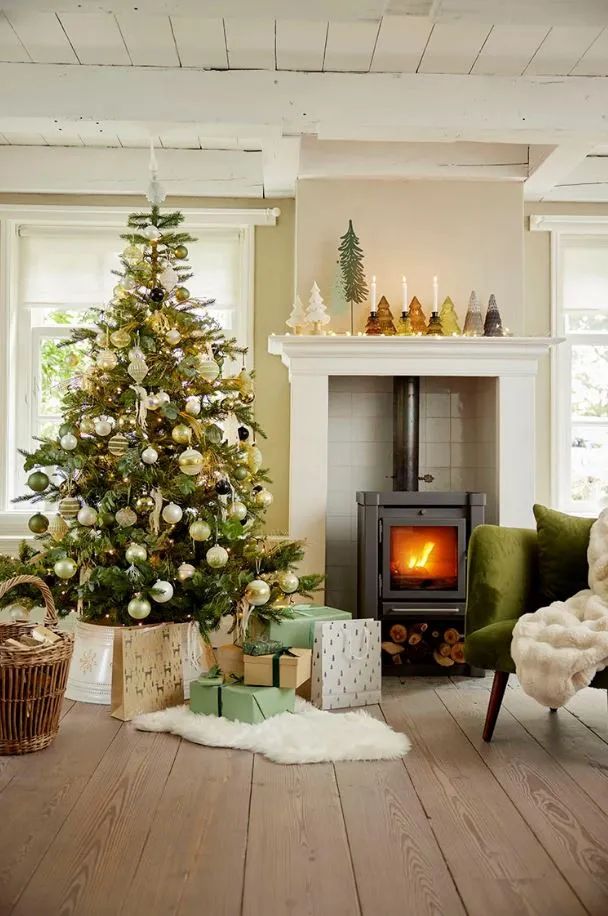
The mix is 45% forest green across the tree and the armchair, 20% gold from the ornaments, 20% white and cream from the mantel and faux fur rug, 10% light wood floor, and 5% black from the stove. That’s essentially a warm-neutral room with one saturated color, which is why it feels calm even with a full tree in it. Want a colder version? Swap the gold ornaments for brushed silver and the whole corner turns Scandinavian.
27. A Lit Fir Wreath on a Dark Blue Door
- Measure your door width — a wreath should run about one-third of it, so a 36-inch door takes a 12-inch wreath at minimum.
- Decide between battery packs and an outlet; corded wreaths limit where you can hang them.
- Check whether the surface faces direct sun, which fades faux fir fast.
- Confirm your hanger’s weight rating, especially over a glass panel.
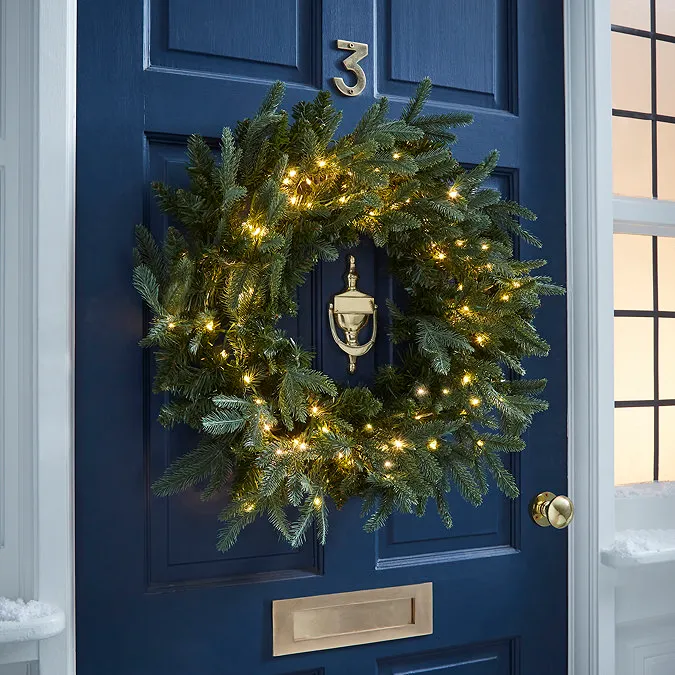
Colored doors are quietly having a decade, and dark blue paired with unlacquered brass is the combination designers keep coming back to. A lit wreath on a saturated door works because the green and the blue are both cool — nothing fights — while the warm bulbs do all the contrast work. It’s also the rare holiday look that still reads as intentional in January. If you want a softer version, the magnolia treatment in Idea #29 solves the same problem with less light.
28. The Red Flag That Sinks a Natural Christmas Look
There’s a specific red flag that sinks a natural Christmas look, and it isn’t plastic. It’s competing finishes — matte dried citrus next to high-gloss glitter next to frosted flocking next to shiny tinsel. Each one is fine alone; together they cancel each other out and the tree looks like a clearance aisle. Pick one finish family and stay inside it. If you love sparkle, choose satin or antiqued metallics, which reflect light softly instead of shooting it back at you. We break down the three most common versions of this in the mistakes section at the end.
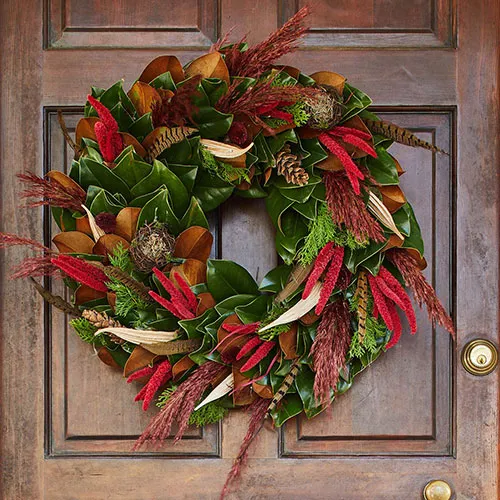
The single decision that matters is your accent color — one, not three. Natural decor leans on green, brown, and cream, which are all neutrals, so the accent is what gives the whole scheme a pulse. This year the safest picks are burnt orange from dried citrus, deep muted red, or brushed gold. Choose one accent color, then let everything else stay quiet. That’s the whole secret, and it costs nothing to follow.
29. A Magnolia Leaf Wreath with Striped Ribbon
Magnolia leaves have two faces: glossy green on top, suede-brown underneath. The best wreaths deliberately flip some leaves so both show, which creates depth without adding a single other material. They also hold their shape for two to three weeks indoors, longer than most evergreens. When you wire them, work from the outside edge inward and let the tips overhang the form by an inch — that soft, uneven edge is what makes a wreath look gathered by hand rather than stamped out.
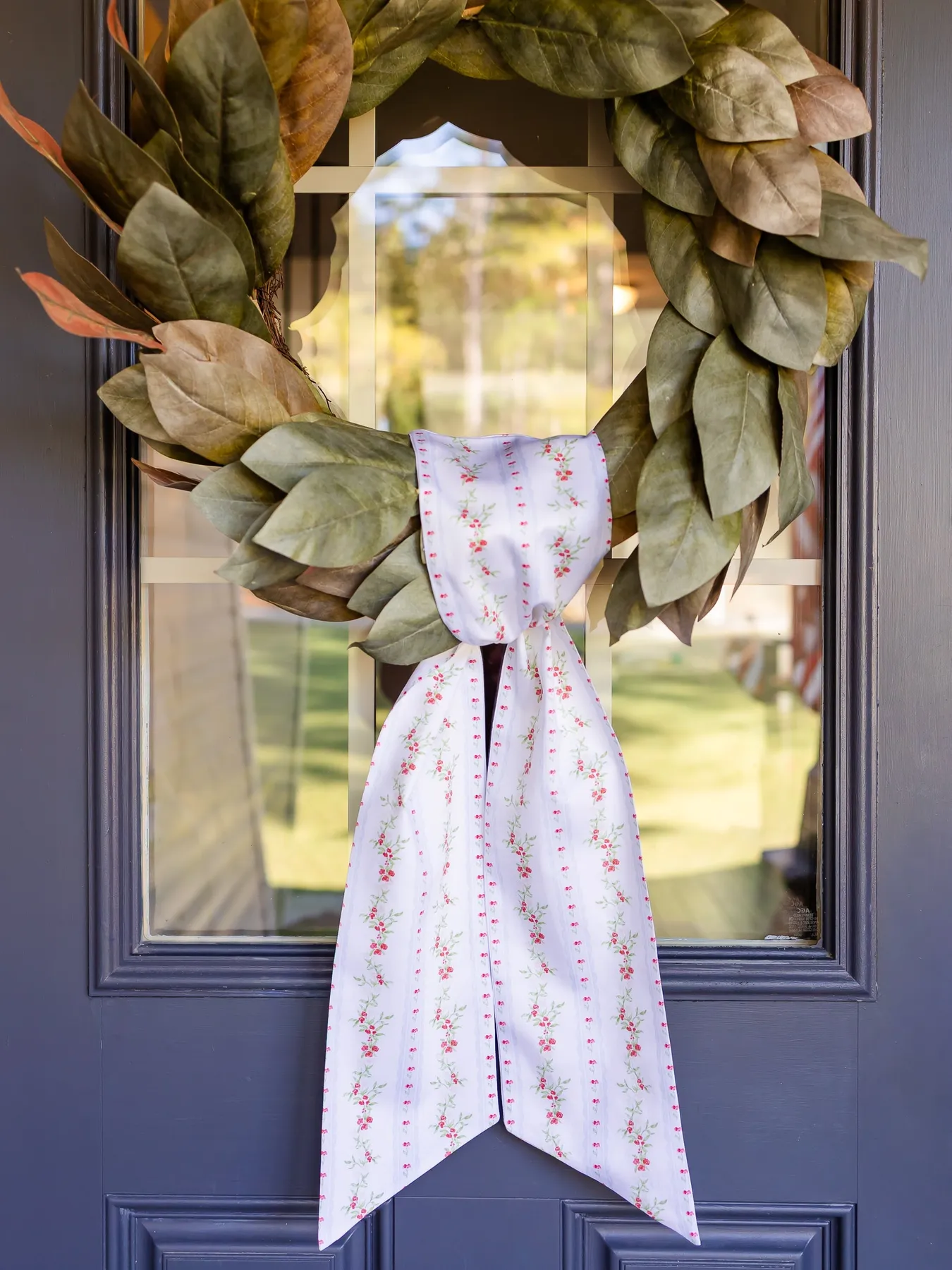
A 24-inch magnolia wreath is the sweet spot for a standard 36-inch front door. Go smaller and it disappears; go to 30 inches and it can look like it’s swallowing the door, especially on a paneled surface with a window. For ribbon, use a width that’s about one-eighth of the wreath’s diameter — roughly 3 inches of ribbon for a 24-inch wreath. Wider ribbon on a small wreath is the most common proportion mistake.
Time: 10 minutes. Cost: free if you keep ribbon on hand.
- Loop a length of ribbon through the top of the wreath and knot it behind.
- Hang a removable adhesive hook or over-door hanger at eye level, about 5 1/2 feet up.
- Lay the ribbon tails over the top of the door and tape them inside.
- Cut the tails so they fall just past the door’s upper panel, then let them drape naturally.
30. Silver Lanterns and Flocked Pine on the Table
Count it out: 50% snowy white from the flocked branches, artificial snow, and napkins, 25% forest green from the pinecones and printed place cards, 15% natural wood brown from the chargers, and 10% silver from the lanterns and candlesticks. Silver is the wild card — at 10% it reads as a cool accent, at 30% it takes over and the table stops feeling cozy. Keep it to the lanterns and one or two small pieces and you’re in good shape.
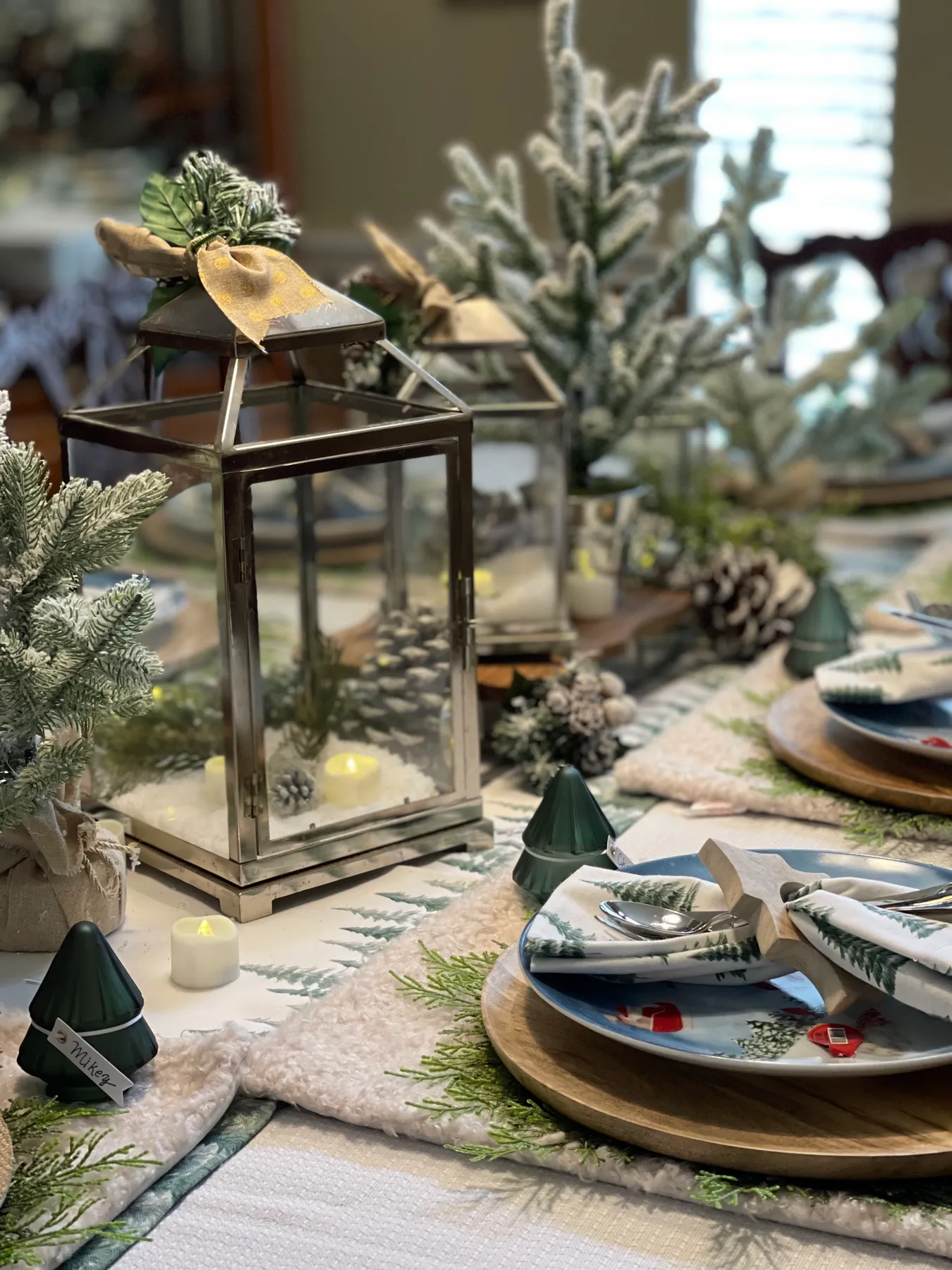
Flocking spray is about $8 a can and turns a plain faux garland into the snowy version for a fraction of what pre-flocked greenery costs. Walmart carries silver lanterns from $12–$25, and wooden chargers are $3 each at IKEA. Blue-and-white winter plates show up constantly at thrift stores and estate sales for $2–$5 apiece. The patterned runners are the easiest thing to skip entirely; a plain white runner and a dusting of artificial snow gets the same effect.
31. Magnolia Garlands and Birds on a Green Door
Time: about 45 minutes. Cost: $70–$140.
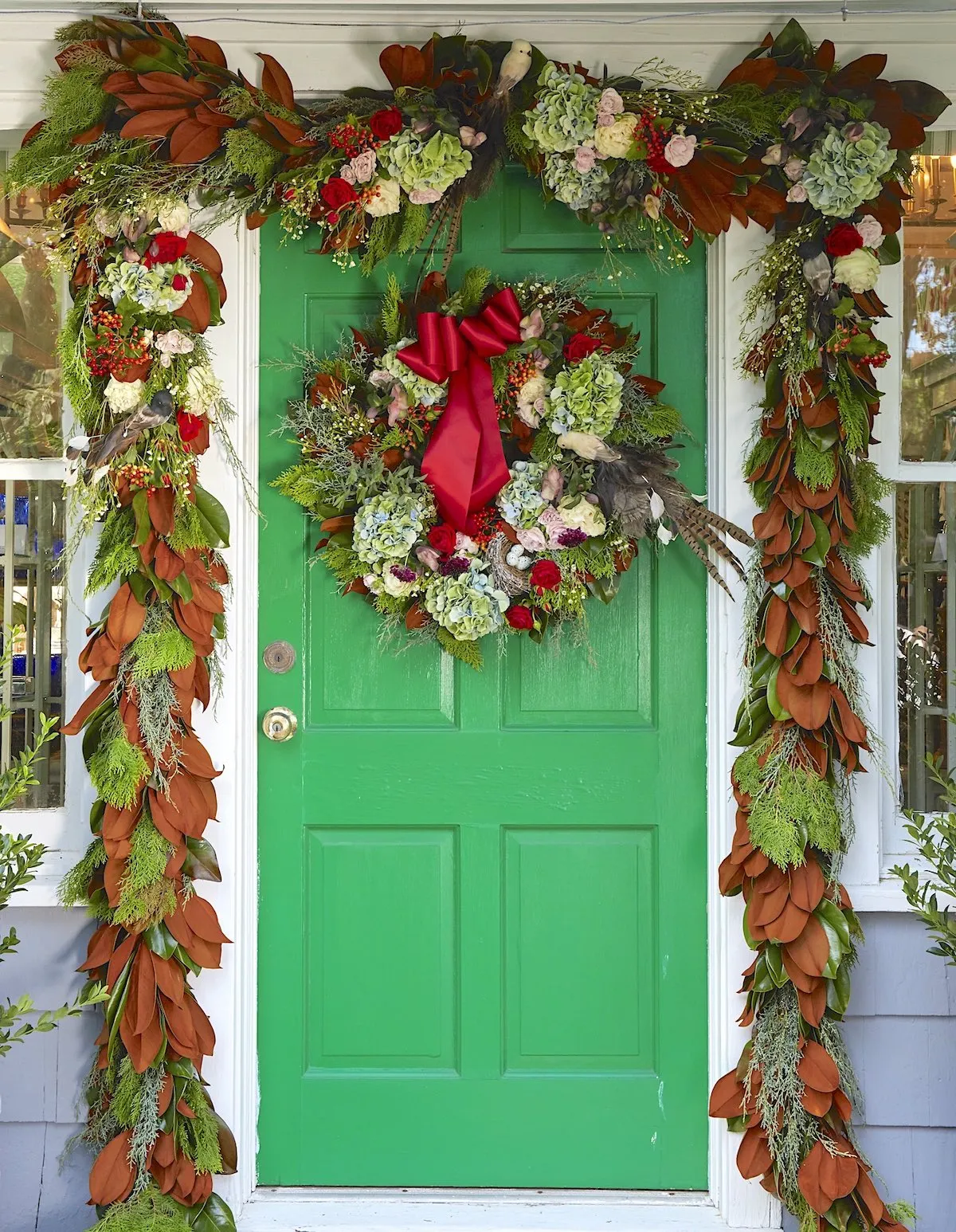
- Start with a plain 9-foot garland and hang it asymmetrically, heavier on one side.
- Wire in magnolia leaves first so the brown undersides face outward at intervals.
- Add evergreen sprigs in three shades, then red berries in odd-numbered clusters.
- Tuck in hydrangeas and small roses, keeping flowers clear of the door’s hardware.
- Finish with the red satin bow off-center and add bird figurines last, near eye level.
The garland is generous, but the success is really about three balances:
- One dominant focal point, the bow, with everything else supporting it
- Mixed leaf sizes, from big magnolia down to small sprigs, for depth
- Repeated birds and berries that give the eye a rhythm as it travels the door
Take away the bow and it’s a very pretty garland. Keep it, and the whole doorway has a center.
32. Evergreen, Bells and a Deep Red Bow
- Evergreen wreath, 24 in, fresh or faux: $25–$70
- Deep red velvet ribbon, 3 yd: $8–$18
- Pinecones: free–$10
- Dark metal bells, two: $6–$15
- Over-door hook or hanger: $5–$12
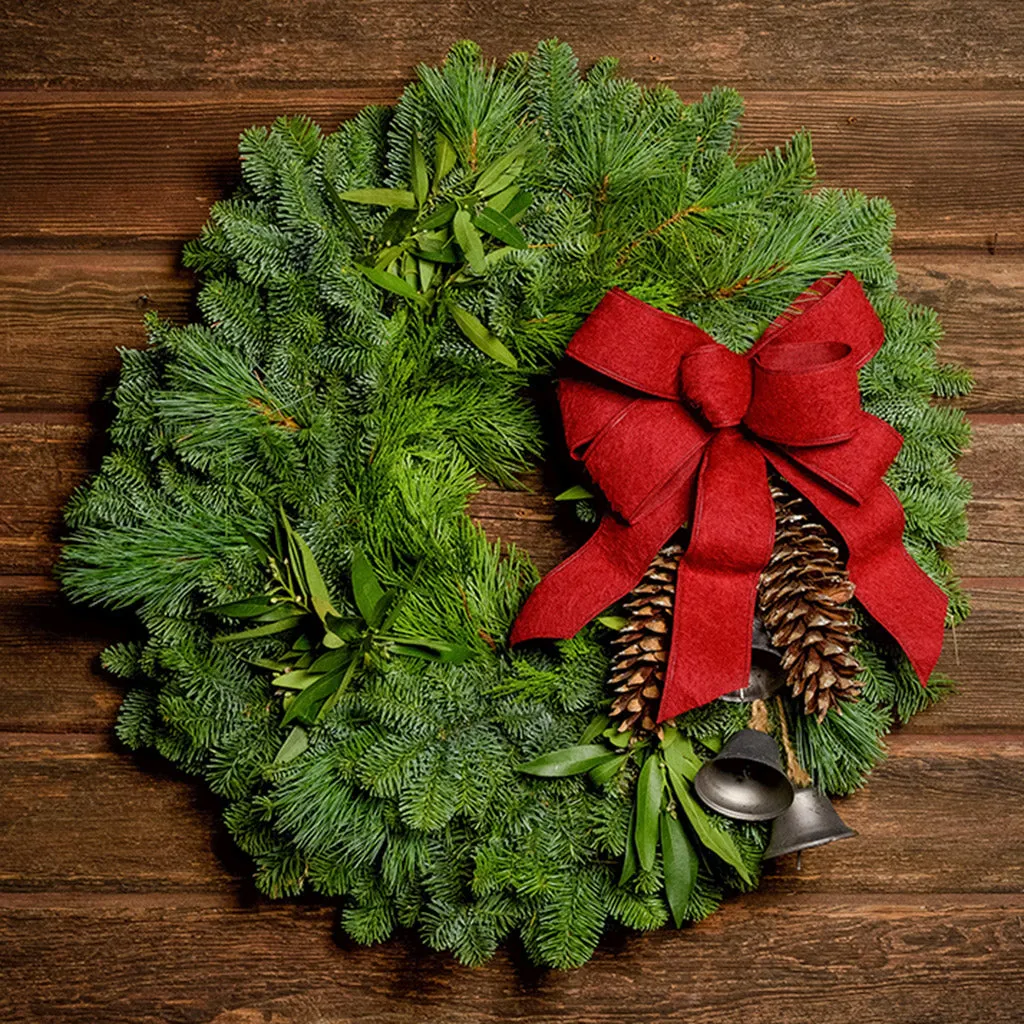
Total: $44–$125
Budget alternative: buy a plain faux wreath at a discount store for $15–$25, add ribbon from the remnant bin, and hang two pinecones you gathered yourself. Under $30 for a look that holds up on a door all season.
Faux wreaths on a sun-facing door fade to a dull olive within a season or two; rotate them to a shaded spot every other year if you can. Fresh wreaths hold for about three to four weeks, then start dropping needles — an anti-desiccant spray and indirect light will stretch that. Velvet ribbon creases permanently if you fold it, so roll it around a cardboard tube. Bells tarnish outdoors; a dry cloth in spring is all they need.
33. Citrus and Cinnamon on a White Brick Mantel
Everything on this mantel can come from a dollar store plus your oven. Cinnamon sticks run $1–$2 a bag at discount stores, oranges are about a dollar each, and drying them costs nothing but time. Miniature decorative trees show up at thrift stores for $2–$4, and a clear glass vase is a Goodwill staple. The whole project lands around $20–$35, and if you already have twigs in the yard, you’re basically done. The dried citrus is the only part that takes real effort.
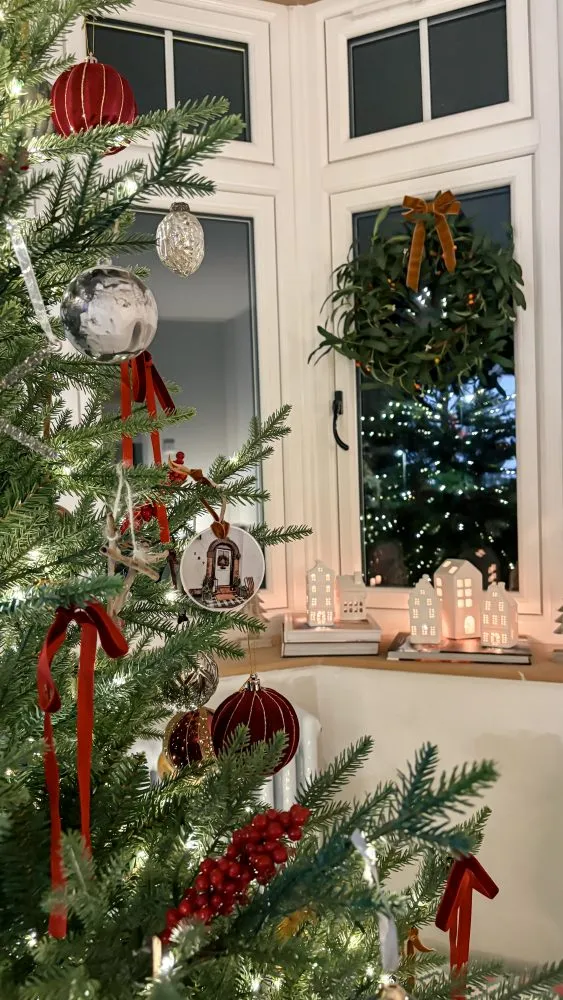
Two small things make a dried citrus garland look professional. First, press your orange slices under a heavy book for 24 hours after drying — flat slices lie against the garland instead of sticking out at odd angles. Second, keep the mantel in three tiers: garland draping over the edge, small trees and containers sitting on top, and one taller element like a twig vase off to one side. Compare with Idea #1 — same citrus, a completely different mantel.
34. Hand-Knitted Santa Ornaments in the Branches
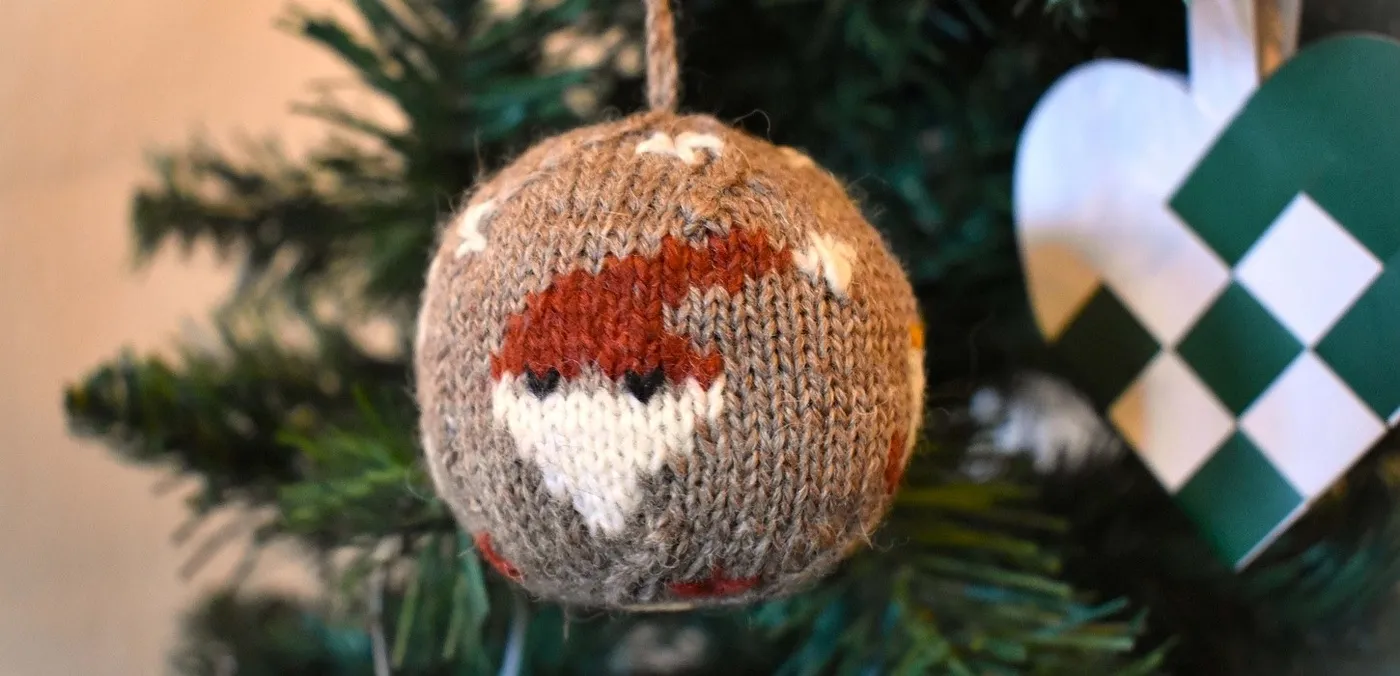
- Hand-knitted ornament, each: $6–$14 on Etsy
- Yarn for a DIY version: $3–$5 per ornament
- Woven checkered heart ornament: $5–$12
- Jute twine for hangers: $2–$4
Total for a set of six: $50–$110
Budget alternative: knit them yourself from leftover worsted-weight yarn — a small stuffed ball takes about 45 minutes once you’ve got the rhythm, and the face is just a few stitches of red and black. Thrift stores and estate sales turn up hand-knit ornaments for a dollar or two apiece, especially in January.
Wool ornaments need more care than glass ones. Moths are the real enemy — store knits in a sealed bin with cedar blocks or a lavender sachet, never loose in the attic. Red yarn fades in direct sun, so keep these off the window side of the tree. For dust, use a soft brush or a quick pass with a lint roller rather than washing, because wet wool felts and loses its stitch definition. Handled well, a knitted ornament easily lasts twenty years.
Your Foraged Christmas Starts on the Mantel
You don’t need a designer, a truckload of new ornaments, or a single piece of plastic tinsel to get a Christmas that looks like it grew in your house. Start with one thing — a garland, a wreath, a bowl of pinecones and citrus — and let it set the tone for everything else.
📌 Pin your favorite idea now so you can find it again when the tree comes out of the box, and tag us when you hang the dried oranges.