You know the feeling: you’ve saved forty garage door light displays to a Pinterest board, and not one of them looks like your actual house. Here’s the thing nobody says out loud — the garage is usually the widest, flattest surface on your entire facade, which makes it either the best canvas you own or the fastest way to look like the lighting aisle exploded.
We spent serious time browsing Home Depot, Walmart, Lowe’s, Target, and Amazon to bring you only what’s worth your attention this year, with looks ranging from about $12 to $600. Inside you’ll find 35 ideas covering warm-white roofline tracing, multicolor C9 rooflines, projected snowflakes, and elegant stone-and-garland frontages, with budget and luxury versions compared side by side.
In 2026 the big shift is restraint — one considered line of light is beating a tangle of everything, and Pinterest is rewarding it. And stay until the end — we break down the most common mistakes that can ruin these looks. 📌 Save this to Pinterest for later — you’ll want to revisit these ideas.
1. Stone Facade Outlined in Warm Roofline String Lights
Outlining the roofline works because it draws one continuous line around the entire house — your eye follows the glow instead of bouncing between scattered decorations. Warm yellow bulbs against a dusk-blue sky and gray stone also create genuine contrast: the light reads gold, the stone reads cool, and suddenly the facade has depth. The dark wood garage doors stay unlit on purpose. They anchor the bottom of the composition so the whole thing doesn’t float.
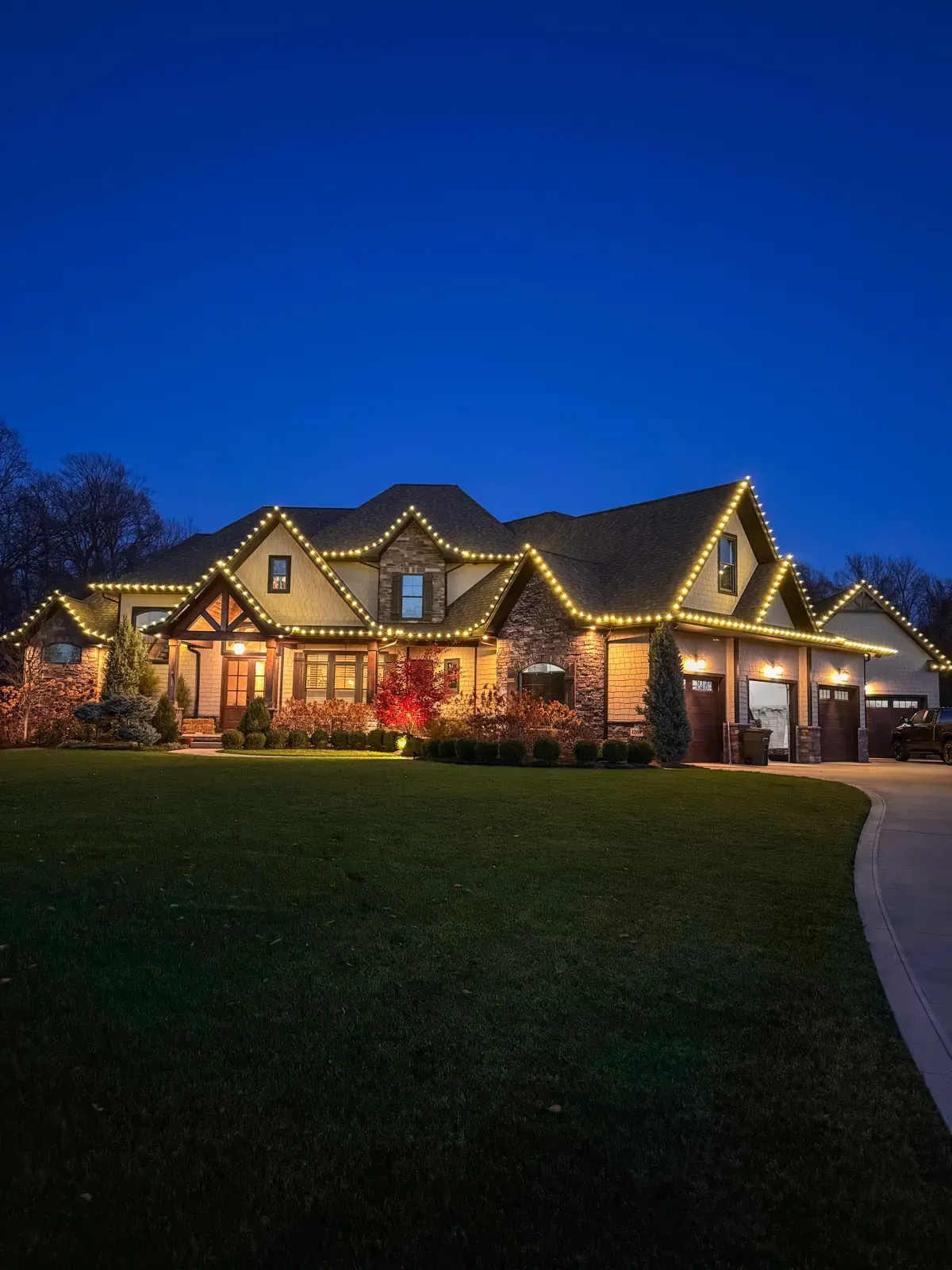
This is a big-house approach. It wants a facade roughly 30 feet wide and at least two gables to look intentional; on a narrow single-story eave line, a double outline starts to feel crowded. If your eave height is under 10 feet, skip the second row. Smaller homes do better with the tighter porch framing in Idea #7.
2. Gold Tinsel Garlands and Glowing Starbursts on a Dark Garage Door
When you hang decor on stacked stone, don’t drill it — clip to the mortar joints instead, and keep your starbursts at least 24 inches off the garage door trim so the door still reads as a door. Stagger the pieces 6 to 8 inches off-center from each other; a perfectly even grid of starbursts looks like a retail display. And use a 14-gauge outdoor extension cord rated for the run, not a lamp cord from the garage shelf.
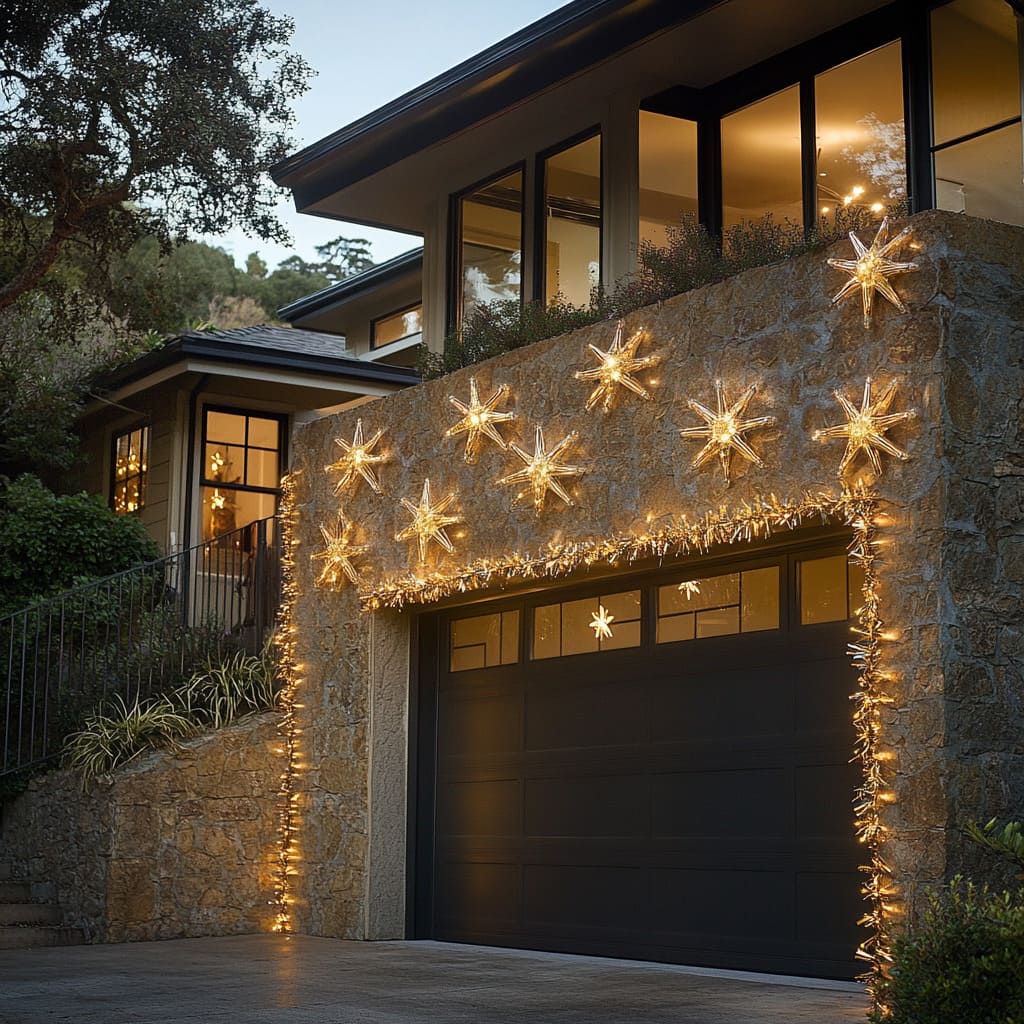
The garland is the whole idea. Gold tinsel with warm bulbs tucked inside, wrapping the opening and climbing one side of the stone, is what turns a dark paneled door into the centerpiece of the facade. Take it away and you have generic sparkle; keep it and the starbursts have something to belong to. Run it asymmetrically — one side only — rather than mirroring both.
3. Multi-Colored Lights Tracing Brick Rooflines and Garage Bays
The formula here is roughly 70% untouched architecture, 20% multicolor bulbs, 10% wreath greenery. The red brick and white trim carry the base; the lights just trace what’s already there. To swap the mood, keep the same percentages and trade multicolor for warm white (calmer) or red-and-amber only (more traditional). If your brick is heavily patterned, drop the bulbs to 15% and let the wreaths and wrapped columns take over.
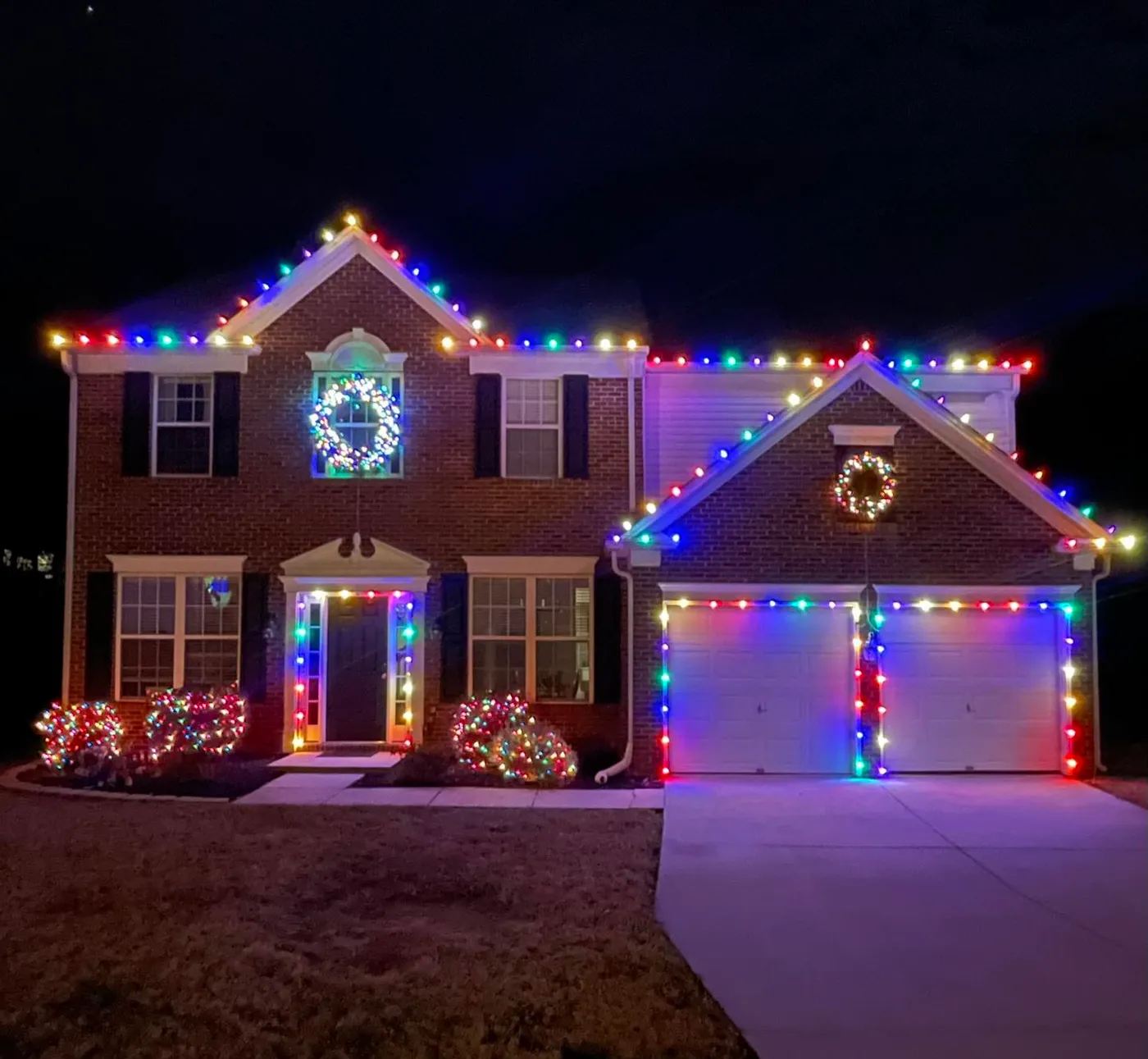
Multicolor C9 strands pull real wattage. A single 25-foot run of incandescent C9s can draw around 175 watts, so three or four strands on one circuit plus a garage door opener can trip a breaker on a cold night. Stay under 80% of a 15-amp circuit, and choose LED C9s — they cost more up front and draw a fraction of the power, and they don’t burn out one bulb at a time. Love the outline but not the rainbow? Idea #1 is the same framework in warm white.
4. Santa Waving From a Snowflake-Curtained Garage Door Mural
A custom-printed garage door mural runs $200 to $600 installed, but you can get 90% of the effect for under $80. A holiday garage door banner usually runs $30-$70 at Walmart, Amazon, or Target in November, hangs from the door’s top edge with included hooks, and rolls up in seconds. Add a $12 strand of warm lights across the top trim and a $20 light-up figure beside the driveway, and nobody driving past will know the difference.
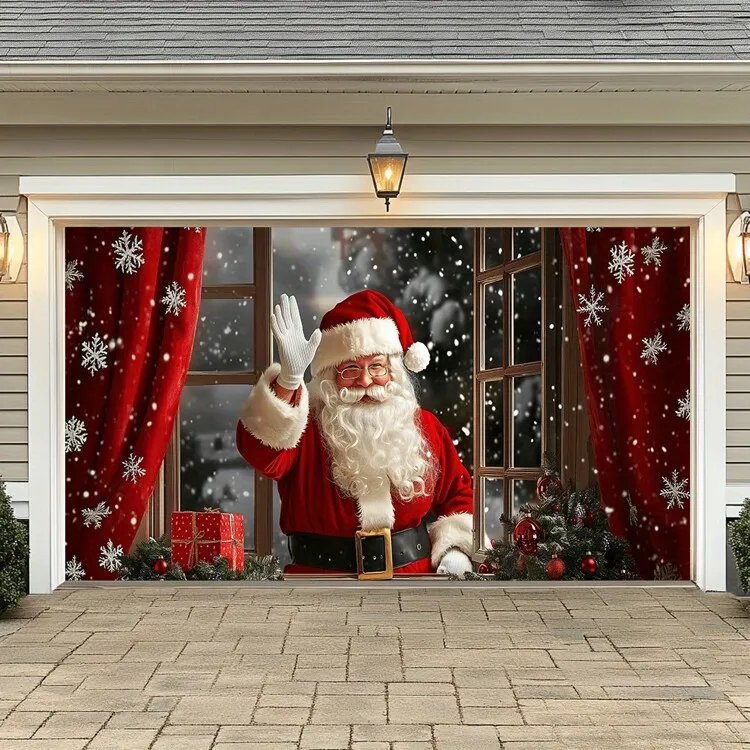
Hanging a garage door banner takes about 30 minutes and costs $30-$70.
- Measure your door width and height — standard singles are 8-9 feet wide, doubles are 16 feet.
- Order a banner sized to the door, not the opening, so the graphic doesn’t get cropped.
- Wipe down the top section of the door so hooks or straps sit flat.
- Attach the top edge first, then pull downward and tension the bottom corners evenly.
- Test that the door still opens fully before leaving the banner up overnight.
5. Alpine Double Garage Framed by Wreaths and Uplit Pines
The alpine look — warm rooflines, big wreaths, uplit pines, zero inflatables — has been climbing on Pinterest for three seasons and shows no sign of cooling in 2026. It’s part of the broader quiet-luxury shift: fewer, better decorations instead of a yard full of plastic. The upside is staying power. Warm string lights and evergreen wreaths will look just as good in 2032, which is more than you can say for a trends-driven inflatable collection.
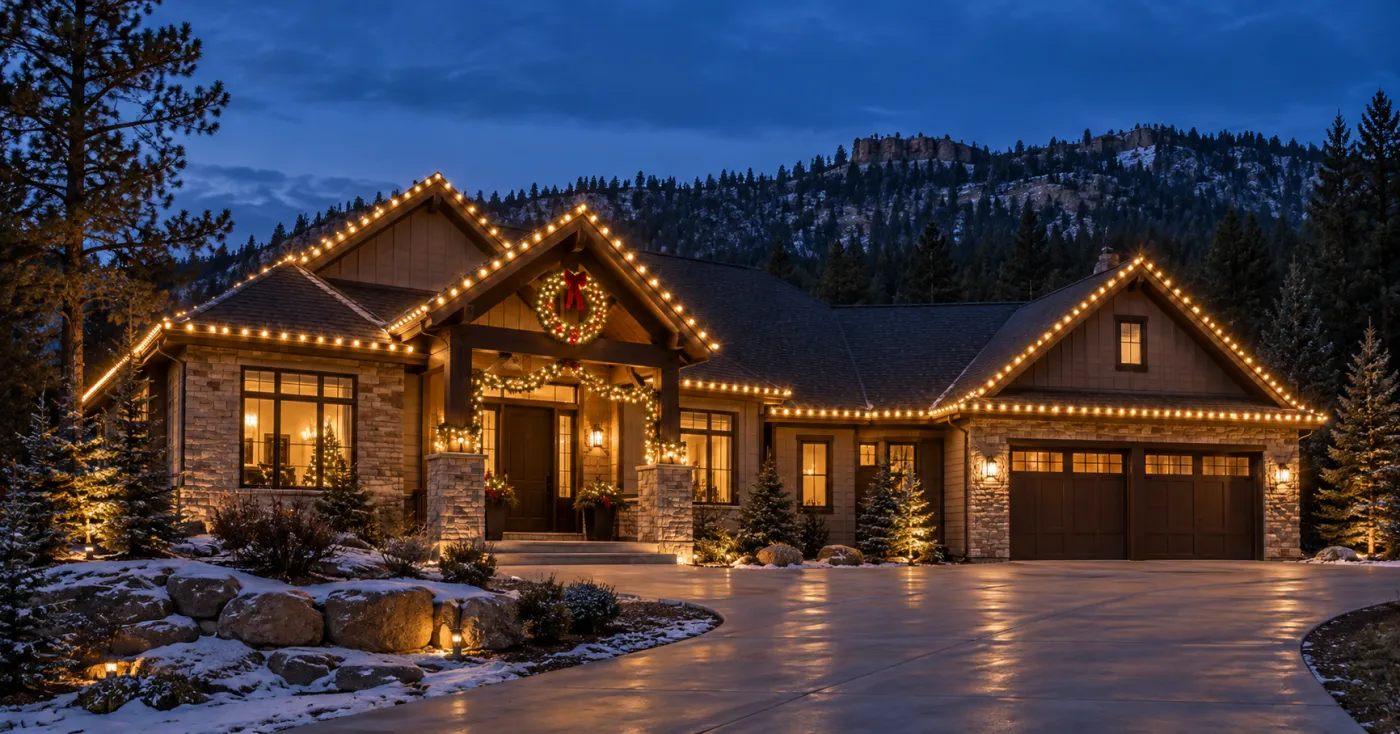
Real greenery on stone and wood means real upkeep. Fresh wreaths drop needles within three to four weeks outdoors in wind, so plan to replace them yearly — or spend $60-$120 per wreath on a quality faux version you’ll reuse for a decade. Sap is the sneaky part: it stains stone and painted trim, so set greenery on a hidden liner or plastic backing before it touches the wall.
6. Snowflake Motifs Above a Light-Framed White Garage Door
Two things are doing the work here: symmetry and vertical framing. The white paneled door sits dead center, flanked by matching strands that pull the eye downward, while the glowing snowflakes sit up on the upper right and break the pattern just enough to keep it from looking machine-made. The off-white stucco matters too — warm white bulbs on a warm-toned wall stay soft, whereas the same strands on bright white siding would read harsh. It’s the compact, tidier cousin of Idea #2.
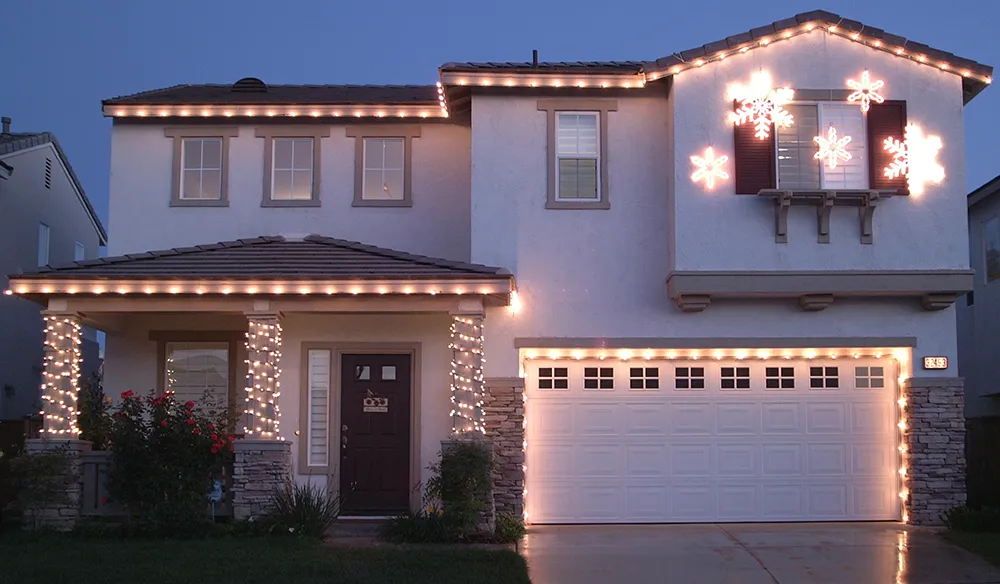
Space your vertical strands every 18 to 24 inches; closer than that and the wall turns into a light curtain instead of a frame. Hang the snowflake motifs so their centers sit about 60% of the way up the facade — high enough to read from the street, low enough that they don’t collide with the roofline lights. Use adhesive-backed clips on stucco, and never tape directly to painted trim in freezing weather.
7. Wrapped Porch Columns and Roofline Lights Over a Traditional Garage
Wrapping one porch column takes 20-30 minutes and about $15-$25 in lights.
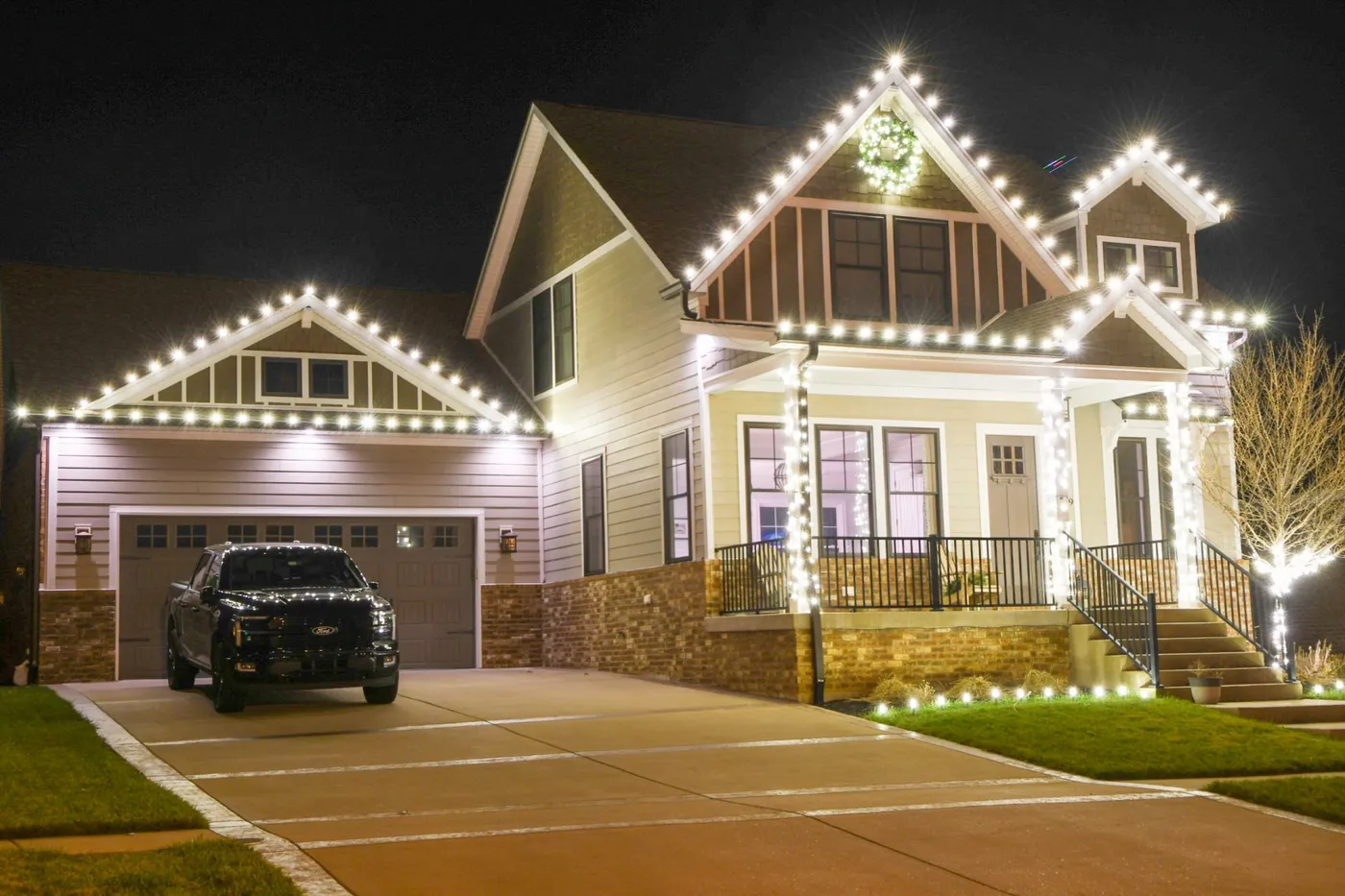
- Start at the base and tape the plug end to the back of the column, out of sight.
- Run the strand diagonally rather than in flat rings for a tighter spiral.
- Keep the wraps 2-3 inches apart and consistent the whole way up.
- Finish at the top, then run the remaining strand along the porch beam.
- Zip-tie or clip the transition every 12 inches so wind can’t work it loose.
Wrapped columns pay off on porches at least 8 feet wide; narrower, and they crowd the front door. Stair railings are worth doing if the run is 6 feet or longer — shorter and it just looks messy. If your porch is tiny, the doorway framing in Idea #6 does more with less.
8. Projected Snowflakes Blanketing a Garage Door and Balcony
The projector is everything. Swap it out and this becomes a house with some string lights and a dark garage door. Because the snowflakes are projected rather than hung, they cover the door, the siding, and the balcony in one continuous pattern — something no number of physical decorations can pull off without $500 in hardware and a lot of ladder work. One good projector plus a timer buys you an entire facade’s worth of decorating.
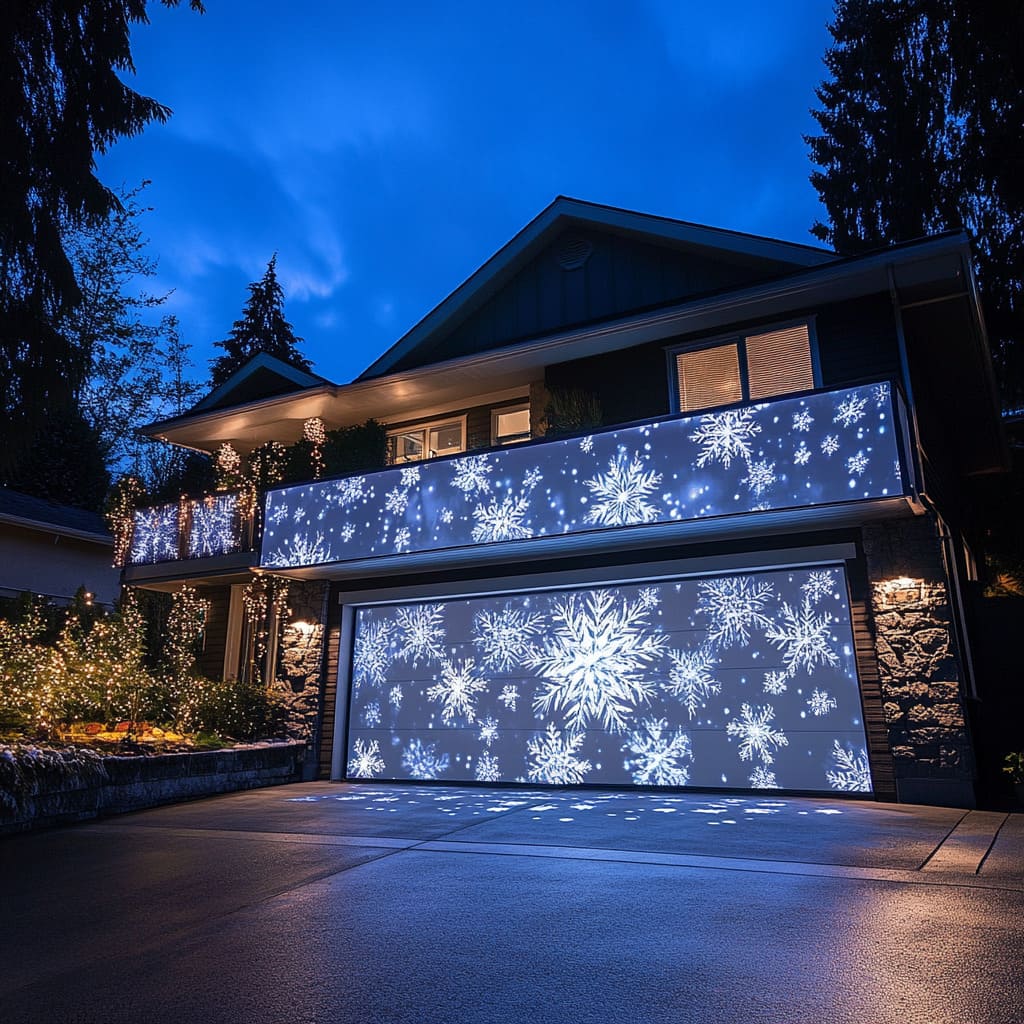
Projectors are fussy about surfaces. They need a flat, light-colored wall or door to read clearly, and they wash out fast if a streetlight or a neighbor’s security light is aimed at your house. Distance matters — most home units cover 10-20 feet, so mount across the driveway or on the garage wall facing the house. Check the beam angle too: what looks magical from your sidewalk can land straight in a neighbor’s bedroom window.
9. Framed Garage Door Lights With a Light-Up Santa on the Lawn
- Warm LED string lights, 300-500 feet: $60-$180
- Light clips and gutter clips: $15-$35
- Outdoor extension cords and stakes: $30-$60
- Illuminated wreath and front door decor: $40-$120
- Light-up Santa lawn figure: $50-$150
- Timer and outdoor power strip: $20-$45
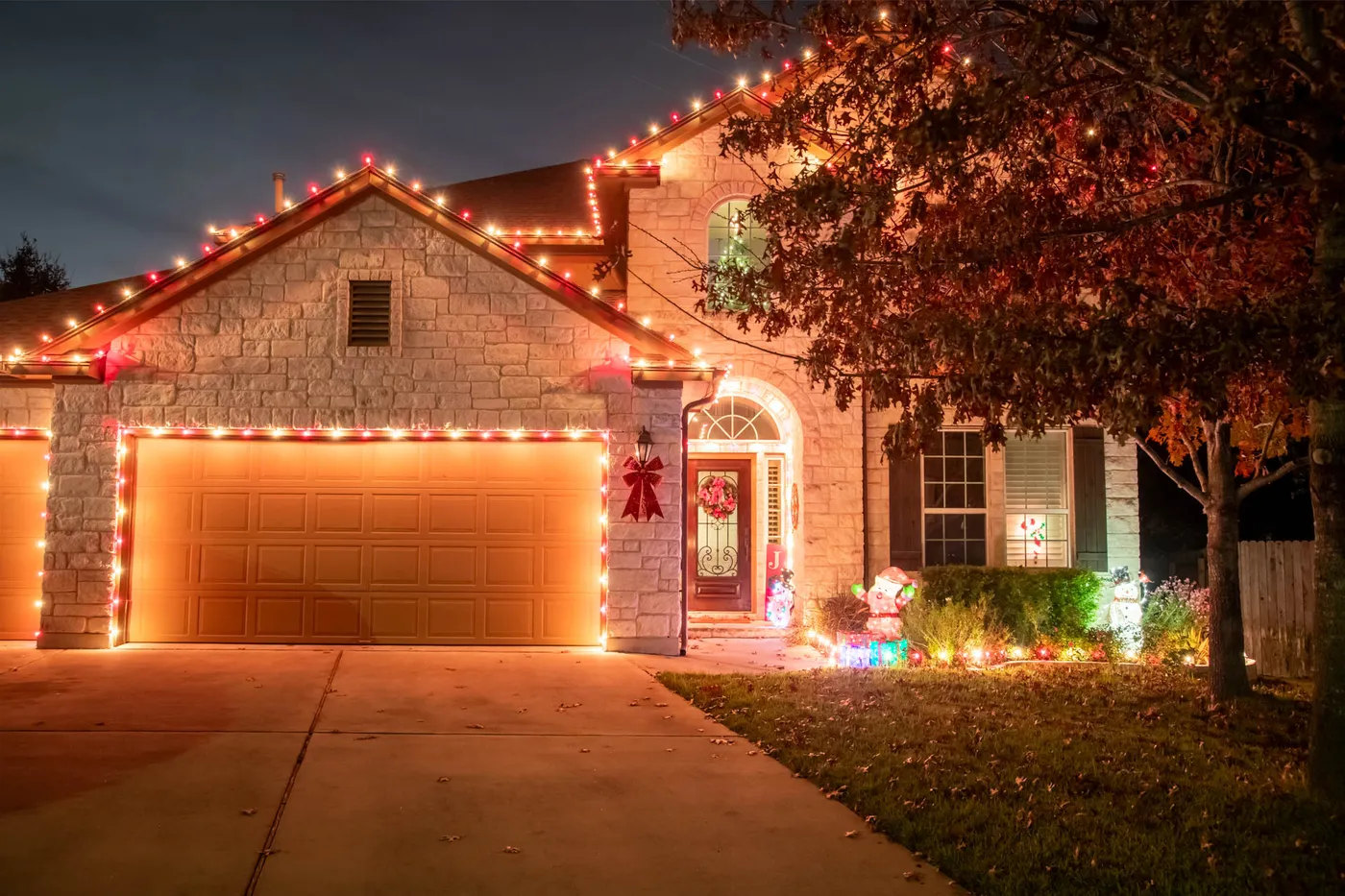
Total: roughly $215 to $590 for a fully framed stone facade, less if you already own the cords.
Budget alternative around $95-$180: skip the Santa figure, buy two 100-foot LED spools on sale, and re-light your existing wreath with a $12 battery string.
Frame the garage door, then stop. The most common mistake on stone is outlining every window as well, which flattens the architecture into a light grid. Pick two focal planes — roofline and garage opening — and leave the rest alone. Aim lawn figures slightly toward the street so they read as decoration rather than a warning.
10. Door-Topped Garland With Gable Snowflake Projections
Think 50% architecture, 30% warm light, 20% projected color. The white siding and dark garage door supply the base; the garland and window wreaths add warm mid-tones; the cool snowflake projection adds the accent that makes everything else pop. Swap the projection for a warm-gold gobo and the whole house goes cozy instead of icy — same formula, opposite mood. Want a third option? Keep everything, drop the garland, and let the projections carry it.
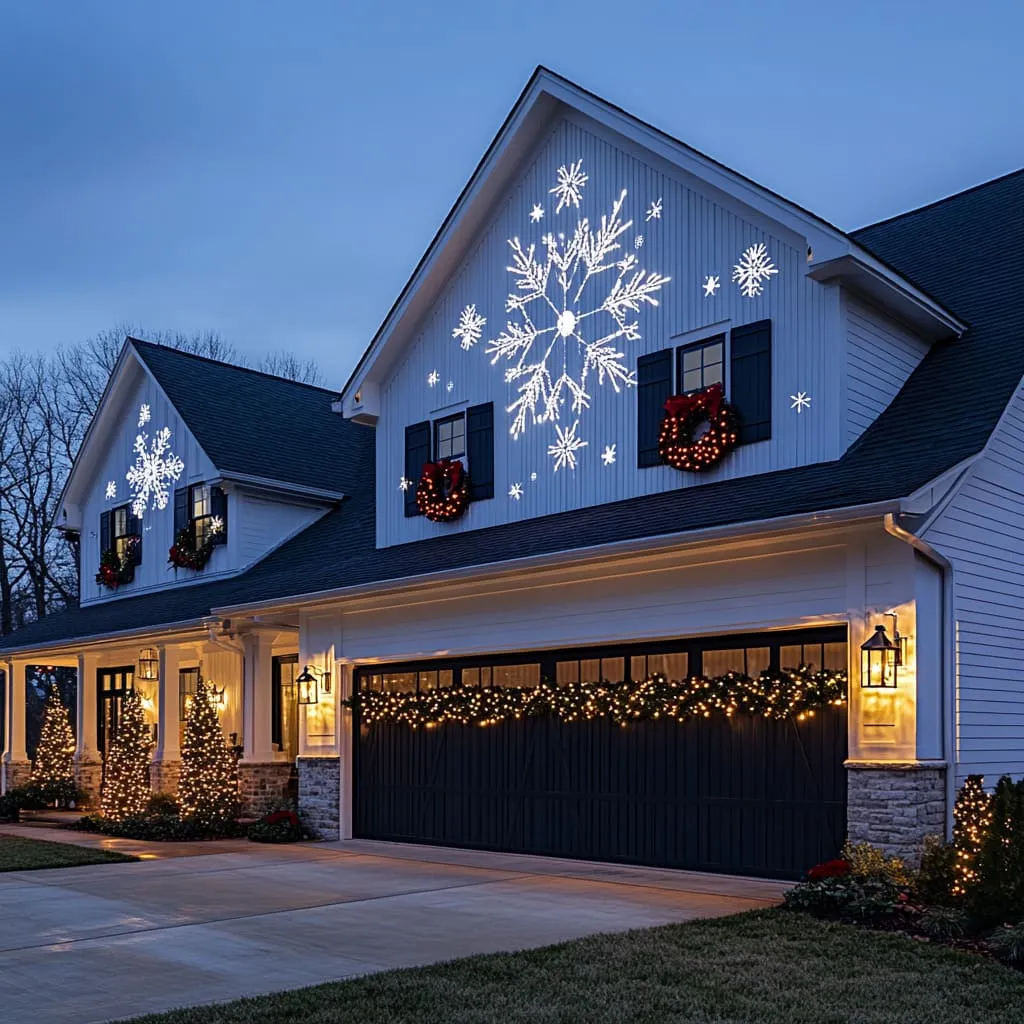
Layering projected light over physical decorations is what keeps this from feeling like one idea repeated. The garland is dimensional and reads up close; the projection is flat and reads from far away, so together they cover both viewing distances. The red bows matter more than they look — they’re the only warm-red moment in a mostly white-and-gray composition, so your eye lands exactly where you want it.
11. Bright White Eaves Against a Dark Multi-Car Garage
Single-color roofline outlines need wide facades to feel graceful. Under 25 feet, one color reads thin and unfinished; at 30 to 45 feet with two or more gables, it looks deliberate and architectural. With dark siding and dark garage doors, budget at least 400 feet of strand for a two-story outline — buy in 100-foot spools so you aren’t splicing every 20 feet. Smaller footprints get more from the restrained layout in Idea #28.
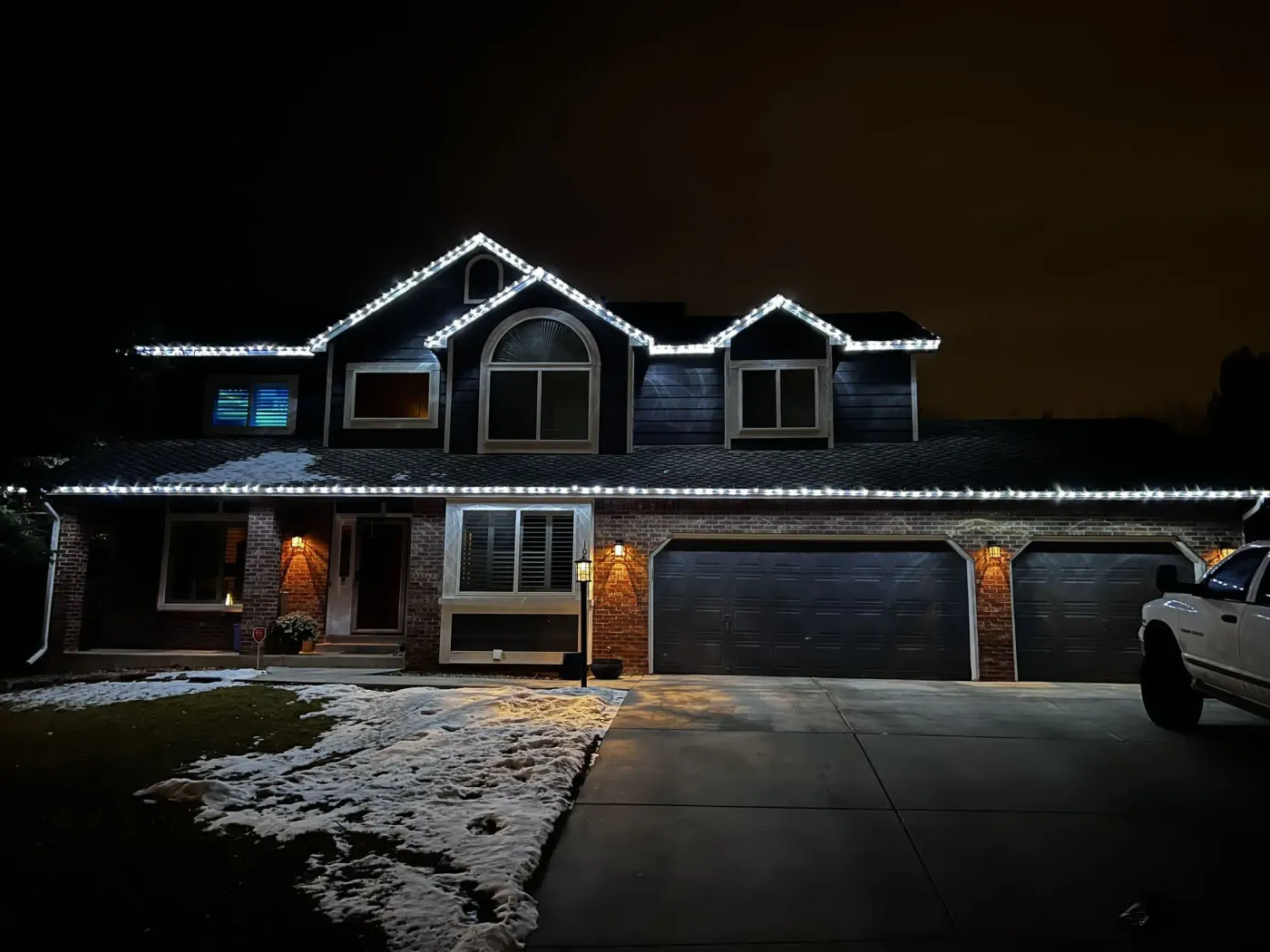
It’s the discipline of one color. Bright white strands against dark siding wouldn’t work nearly as well with warm-yellow bulbs mixed in, and they’d fall apart completely in multicolor. Keeping every bulb the same white temperature is the entire effect — it reads as architecture rather than decoration, and the reddish-brown brick and warm sconces supply all the color the house needs.
12. Light Strands Tracing a Simple Garage Facade
- Count your outdoor outlets — you want one within 25 feet of the garage, ideally on a GFCI circuit.
- Measure the run: door opening, top trim, and both sides. Add 15% for slack and mistakes.
- Check the forecast — most clips and adhesive tabs won’t stick below 40°F.
- Total the wattage of every strand you plan to plug into one outlet before you start.
- Choose your timer now, not after the lights are up. Nobody wants to unplug things in the snow.
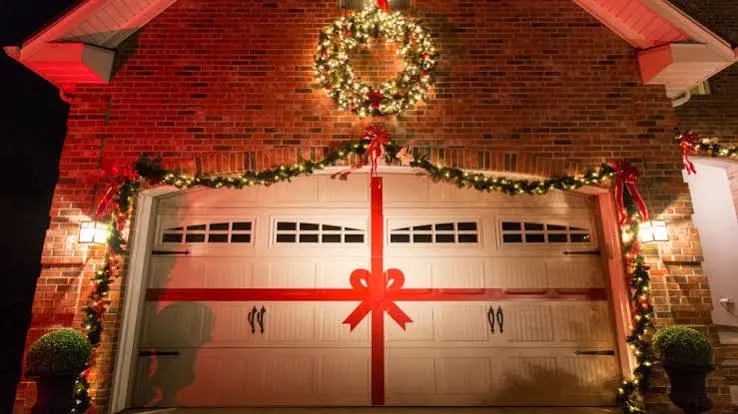
The garage facade is the easiest part of a house to light and the easiest to overdo. Because the door is one big flat surface, any strand you run across it shows every sag, every crooked clip, and every color mismatch. Work in daylight with the lights plugged in so you can see the line you’re creating. And leave the door handle and track alone — moving parts and cords don’t mix.
13. Red and Green Segmented Rooflines Over a White Paneled Garage
Mapping a two-color roofline takes about an hour of planning, then $60-$150 in lights.
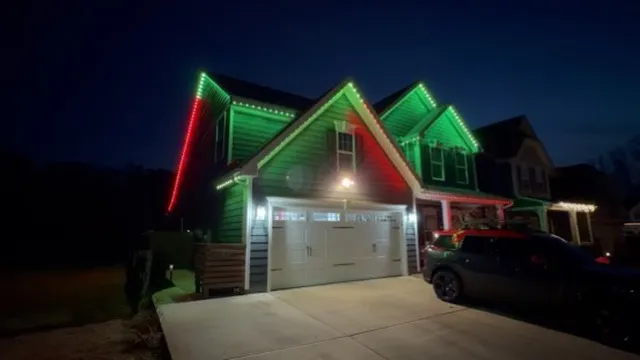
- Sketch your roofline and split it into visible segments.
- Assign red or green to each segment so colors alternate in blocks, not randomly.
- Buy matching counts of each color — uneven spools are the number-one reason these displays end mid-gable.
- Run each color on its own circuit so one failure doesn’t kill the whole line.
- Test everything on the ground before anything goes up.
A pro install for a two-color roofline can run $900-$2,500. You can do the same layout yourself for $120-$260 with two spools of LED C9s, a $20 timer, and a Saturday. Buy LED even though it costs more — replacing incandescent C9s every other season eats the savings fast. This is the budget version of Idea #24, same two colors with a different rhythm.
14. Red Bulbs and Cascading Icicle Lights on a Stucco Facade
Go 70% warm white as the frame, 20% red as the accent, 10% icicle white as texture. The white paneled garage and beige stucco hold the neutral base; the red roofline gives the house a spine; the icicles at the peaks add movement. To shift the palette, swap red for deep amber (softer, more vintage) or a cooler white (sharper, more modern). Keep the proportions either way — it’s the ratio, not the color, that makes it look designed.
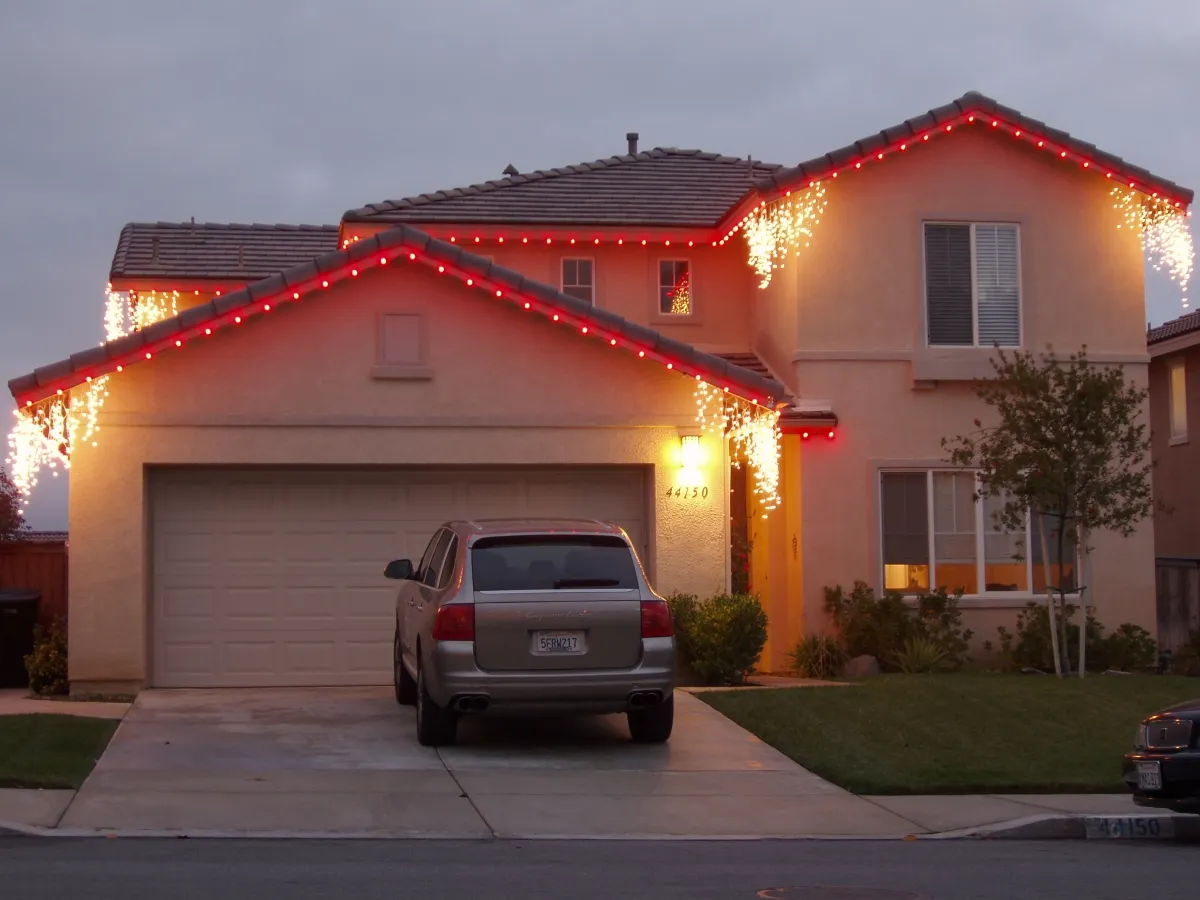
Icicle lights are the highest-maintenance strand in the box. They tangle in storage, lose bulbs in sections, and once one section dies the rest usually follows. Wrap them around cardboard or a hose reel instead of stuffing them in a bag, and expect to replace at least one strand every two seasons. If that sounds exhausting, a run of warm-white C9s along the same peak gives a similar silhouette with half the fuss.
15. Snow-Covered Brick Garage Doors Glowing in Twilight
- Check whether your garage doors have glass inserts, and whether that glass is single or double pane.
- Confirm the interior garage lights are on a switch you can reach without opening the overhead door.
- Note your usual snow line — clips and cords buried in snow are the fastest route to a shorted strand.
- Measure door width to the inch before ordering anything sized to fit.
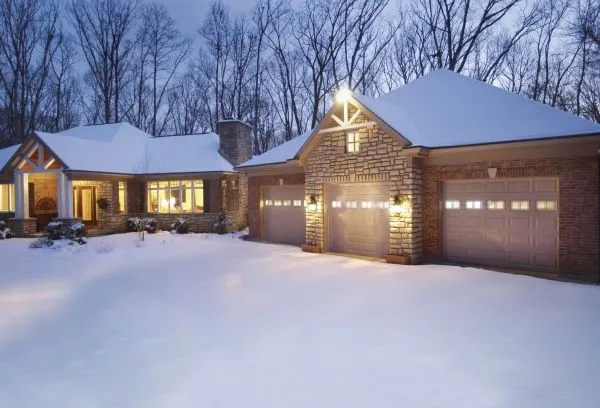
The glowing windows do it. Three paneled garage doors with lit upper panes turn what could be a flat, dark wall of brick into something that reads like a row of lanterns. You’re not adding a single decoration to the doors themselves — just leaving the interior lights on and letting the glass do the work. That’s why it looks expensive and costs almost nothing.
16. Warm-Lit Wood Garage Doors Under a White Roofline
This works on three levels at once: roofline up high, warm-lit garage doors at mid-height, and red landscape glow down at the bases. Your eye travels vertically, which makes the facade feel taller than it is. The cool white outline and warm bulb light also play nicely together — cool above, warm below, with red as the low accent that grounds everything. Remove any one layer and the house still reads festive, just flatter.
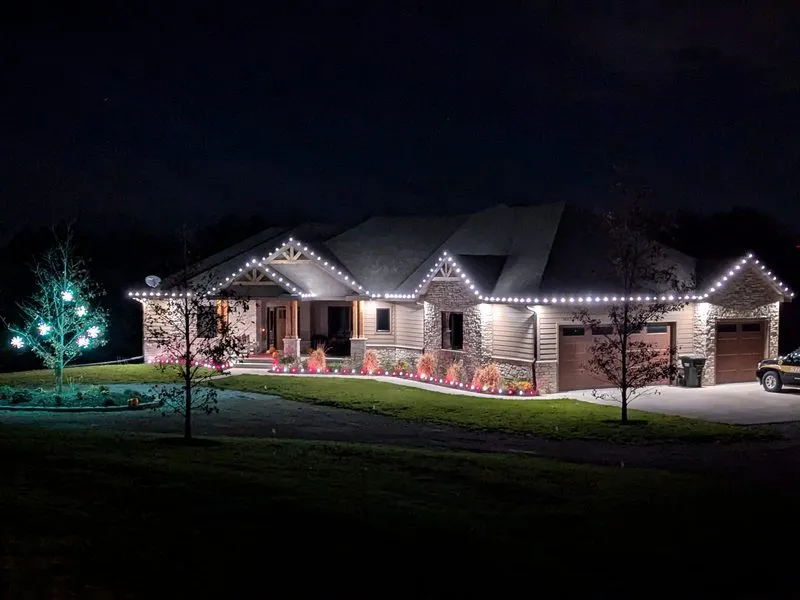
- White LED roofline strands, 300 feet: $70-$160
- Warm clip-on lights for the garage door trim: $25-$60
- Red landscape spotlights, 4-pack: $40-$90
- Lighted snowflake tree display: $45-$130
- Timer, clips, and outdoor cords: $35-$70
Total: about $215 to $510.
Budget alternative at $85-$150: one spool for the roofline, two red spotlights instead of four, and a snowflake you already own.
17. Aerial View of Warm White Outlines on Porch and Garage Bays
Run one continuous strand per elevation instead of one per gable. Every splice is a future failure point, and tucking the transition behind a downspout keeps the line clean. Use a dusk-to-dawn timer set to come on about 15 minutes after sunset rather than a fixed clock time — it adjusts with the season and saves you the January reprogramming. On a two-story, plan ladder placement in daylight; dark shingles hide the edges you need to see.
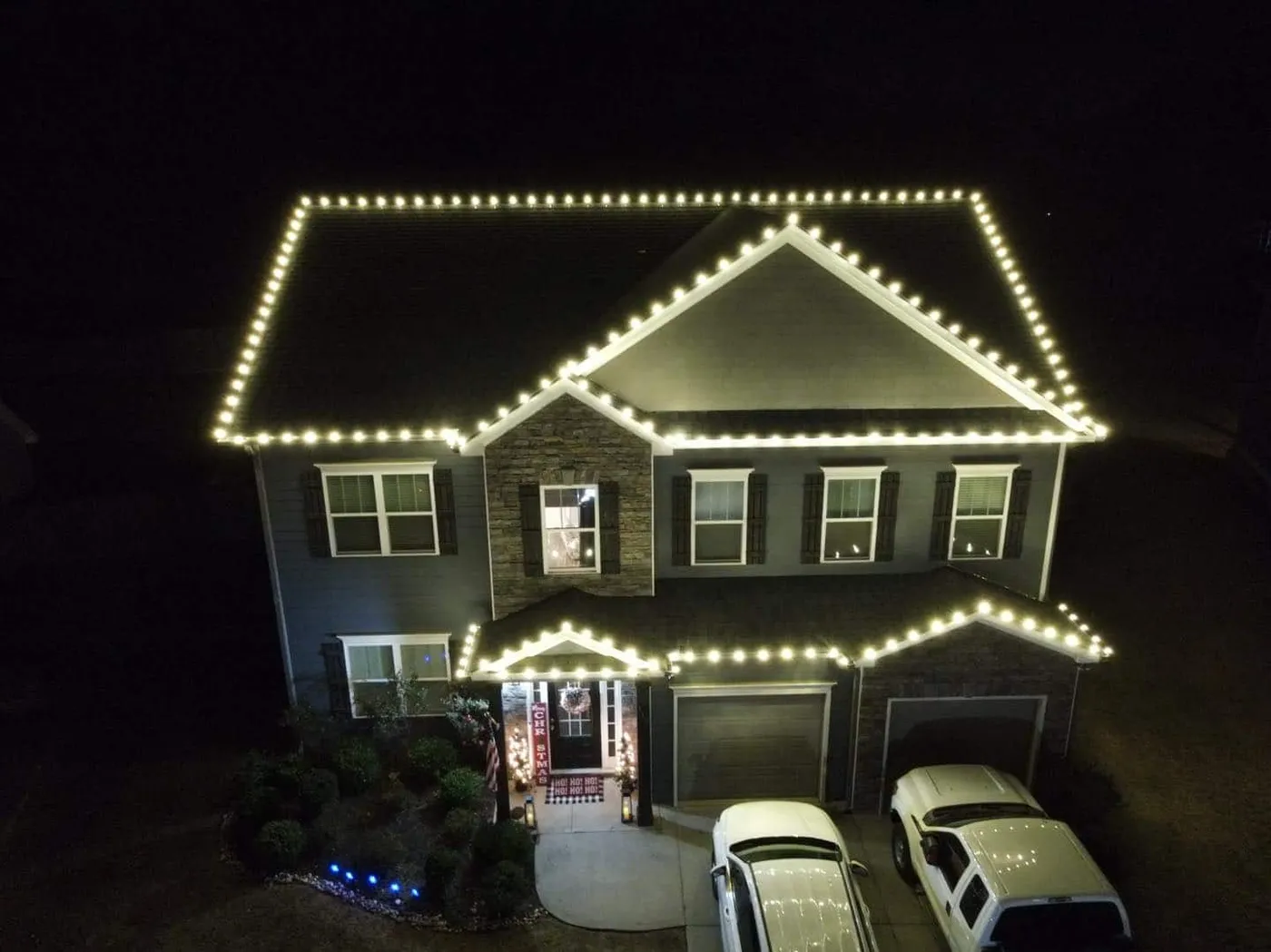
Full perimeter outlines are for houses with at least 2,000 square feet of visible facade. Under that, the outline starts crowding windows and the porch disappears from view. Above 3,500 square feet, expect 600-800 feet of strand and split the run across two circuits so the garage door opening doesn’t trip a breaker. Smaller homes get more impact from Idea #7‘s porch-and-gable approach.
18. Blue Trim Lights Over Twin White Garage Doors in the Snow
Cool-tone palettes are having a moment. After years of warm-white dominance, blue-and-white rooflines are showing up everywhere in 2026 — partly because blue LEDs got cheaper and brighter, partly because the icy look photographs beautifully against snow. It’s festive without being nostalgic, which is exactly what a lot of newer builds and modern facades need. Staying power? Moderate. Warm white will outlast it, but blue-and-white is unlikely to feel dated in five years.
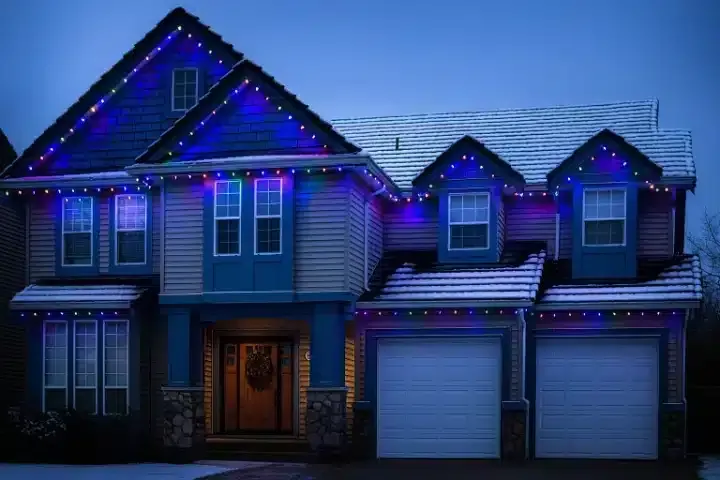
The mix is about 70% blue to 30% white, and the white should sit at peaks and corners where it reads as a highlight rather than another color. Keep the palette to two hues only — adding green or red to a blue run makes it read as multicolor from the street. Swap blue for deep teal to warm it slightly, or trade pure white for a soft warm white if your siding is cream instead of gray.
19. Hanging C9 Bulbs Along a White Fascia Board
Clipping C9 bulbs to shingle fascia takes 15-20 minutes per 25-foot run and costs $25-$60 per strand plus clips.
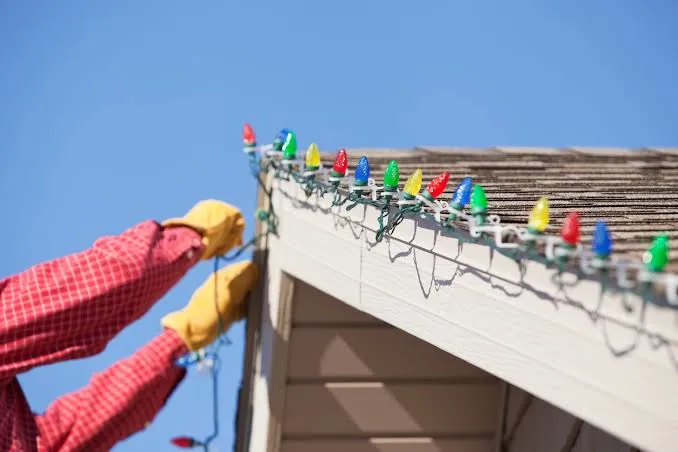
- Put on gloves — the faceted bases have sharp edges and it’s cold out.
- Snap a plastic shingle clip onto the strand every 12 inches.
- Slide each clip under the shingle edge until it seats, working left to right.
- Leave a little slack in the wire between clips so wind can’t yank bulbs loose.
- Plug in and step across the street to check the line before moving on.
Twelve inches between C9 bulbs is the sweet spot. Closer and you burn through strands and wattage for no visual gain; wider and the roofline looks dotted instead of drawn. For the row above a garage door, drop to 10 inches so the denser line matches the shorter distance your eye travels. Buy clips in bulk — one per bulb, plus spares.
20. Red Roofline Strands Above a Navy X-Brace Garage Door
Red light on a navy door is straight complementary contrast — they sit opposite each other on the color wheel, so the effect lands from two blocks away. The warm wall sconces are the quiet hero: they light the door’s actual surface, which keeps it from going black once the sun is down. Without them, a red roofline floats above a dark hole. The yellow potted mums add a third, softer warm note at ground level so nothing feels abrupt.
![22 Outdoor Lighting Ideas for Your Backyard [2026] | Govee US](https://interior-inspo.com/wp-content/uploads/2026/10/22-outdoor-lighting-ideas-for-your-backy-20.webp)
Roughly 55% dark base, 30% red light, 15% warm gold. The navy door and horizontal siding carry the base; red roofline strands are the accent; sconces, mums, and any interior glow supply the gold. Swap navy for charcoal and the red softens. Swap red for warm amber and it goes from bold to traditional. Keep the gold layer either way — it’s what stops the palette from feeling like a sports team.
21. Cool Blue and White Gable Outlines Above Paneled Garage Doors
Blue light is dramatic at night and basically invisible at 4 p.m. in December. If you’re home during the day, you’re looking at a lot of unlit plastic. Blue LEDs also glare more than warm ones, so keep strands off surfaces you look at directly from inside — reflecting blue off snow is gorgeous, reflecting blue into your kitchen is not. Check color consistency between brands, too; two blues from two stores rarely match.
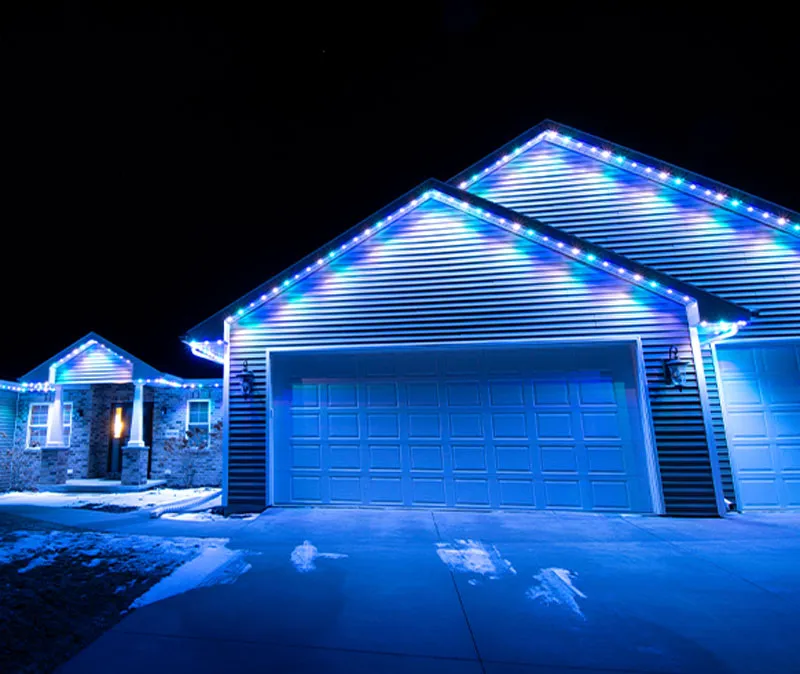
You don’t need to outline every gable to get this. One 100-foot blue spool across the front roofline plus a second in white along the garage doors runs about $45 at Walmart or Target in early December, and a $15 timer finishes the job. Compare with Idea #8 — same cool palette, but the light is projected instead of hung, and it lands in completely different places.
22. Wreaths and Landscape Borders on a White Two-Story Garage Wing
Warm light on bright white siding is the easiest pairing in exterior decorating — the siding offers no color competition, so the bulbs read as pure warmth. The lit gable wreaths also create rhythm: two identical circles at the same height teach your eye what to expect, and the ground-level border lights close the composition at the bottom. The dark garage doors matter here too. They give a mostly-white facade somewhere to land.
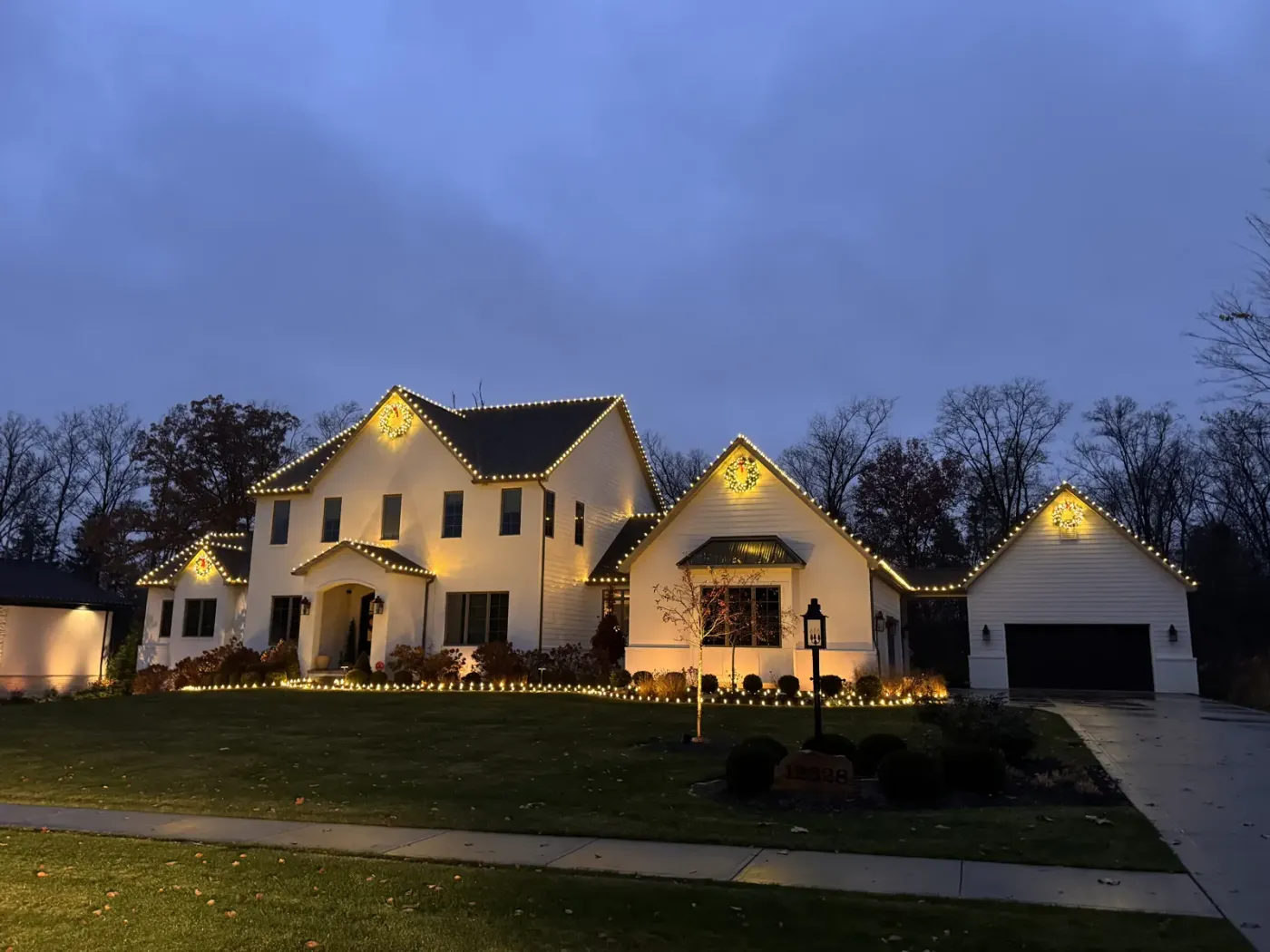
White siding is unforgiving. Clips, tape residue, and rust streaks from cheap cords all show up by March, and warm bulbs attract insects that leave spots. Plan a spring rinse with a hose and a soft brush, and use plastic clips rather than adhesive tabs — adhesive leaves a ghost outline that takes a whole season to fade. Budget about 30 minutes per elevation on cleanup.
23. Green Porch Glow on a Multi-Gable Stone Facade
One accent color per facade, aimed rather than scattered. A single green fixture washing the porch entrance reads from the street; five green bulbs dotted around the house just look accidental. Use a narrow-beam fixture in the 25-40 degree range aimed at one specific architectural surface. On stone, cool green can look sickly against warm tan, so choose a warmer, mossier green — or switch to amber if the stone leans very yellow.
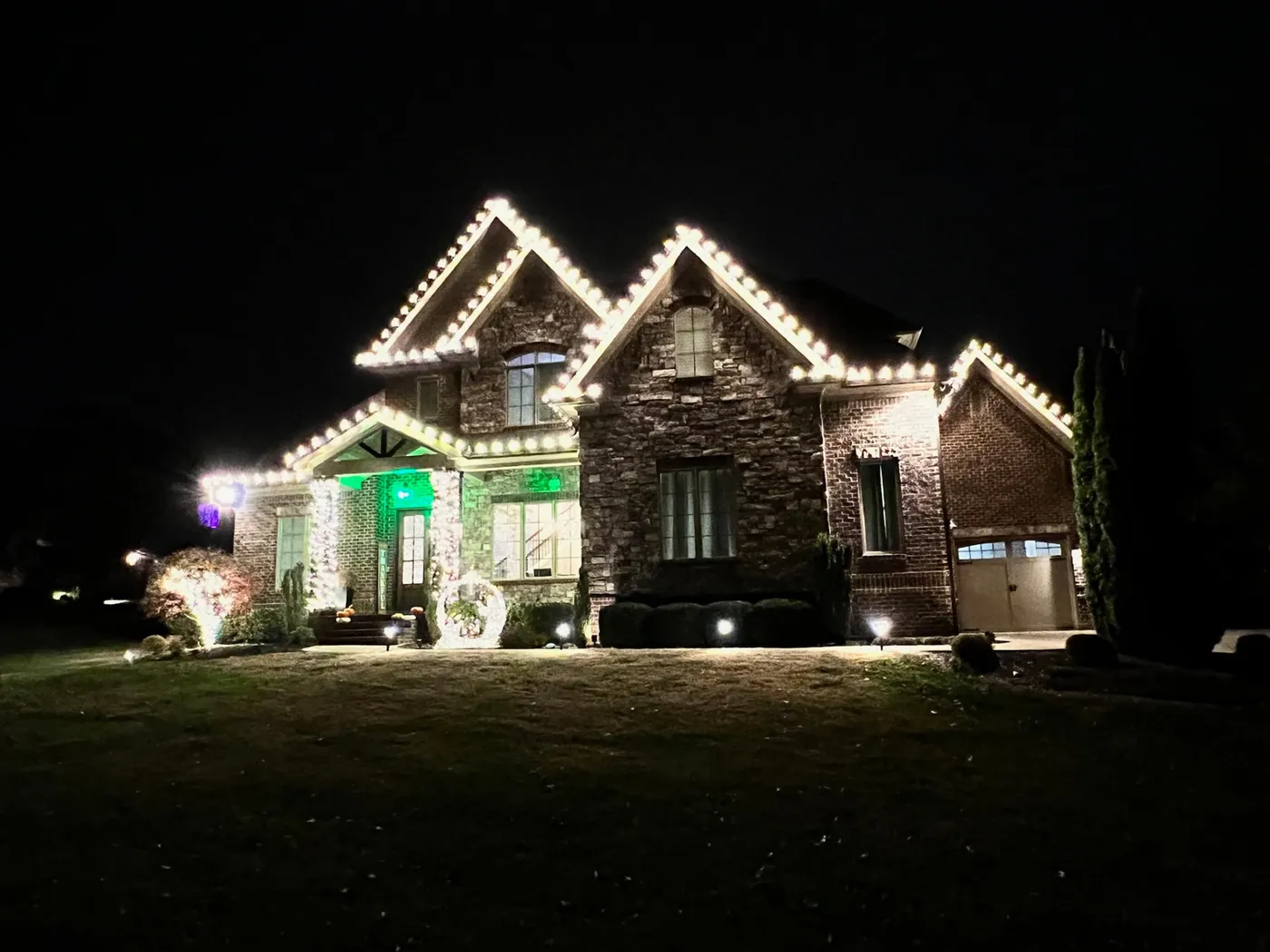
This is a large-facade formula. Multi-gable stone houses in the 3,000-4,500 square foot range carry a full warm-white outline beautifully because the rooflines are long and the light has room to breathe. Space clips about 18 inches apart at that scale. Around 1,800 square feet, tighten to 12 inches and pick one roofline instead of all of them — the restraint in Idea #11 is a better starting point for smaller builds.
24. Alternating Red and Green Rooflines Over Twin Garage Doors
- Red LED C9 strands, 200 feet: $60-$130
- Green LED C9 strands, 200 feet: $60-$130
- Shingle clips, 200-pack: $18-$30
- Two outdoor timers: $30-$50
- Extension cords and stakes: $25-$55
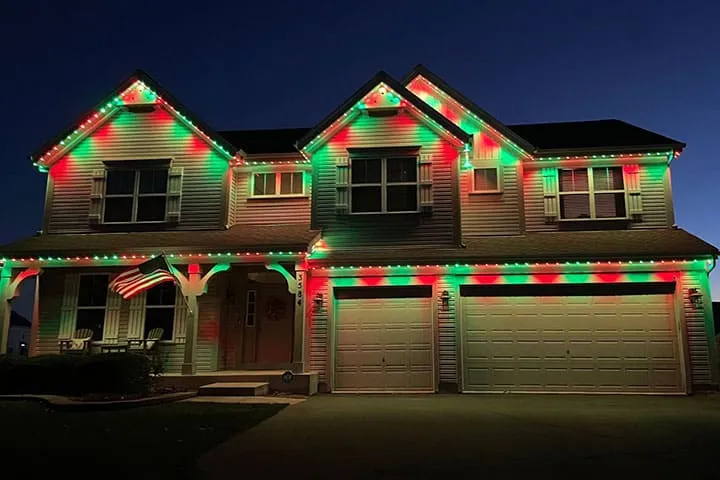
Total: roughly $195 to $395 for a two-color roofline on a two-story home.
Budget alternative at $90-$160: one 150-foot spool of color-changing LED string split into alternating segments with the remote — you give up some color purity but keep the effect.
Running two circuits so red and green can be controlled separately takes about 45 minutes and $30-$50.
- Divide the roofline into a red run and a green run, ending each at a different corner.
- Plug each run into its own outdoor-rated extension cord.
- Run both cords down the same downspout so they look like one.
- Connect each cord to a separate channel on a dual-outlet timer.
- Test both runs independently before final clipping.
25. Tudor Brickwork Framed by Warm Roofline Lights and Gable Wreaths
The wreaths. This may be the most classic house on the list, but it’s the two oversized illuminated wreaths with red bows centered on the gables that make it feel like a home rather than a lighting display. They give the eye a destination at the top of the facade. Skip them and you have a nicely outlined Tudor; keep them and the whole house reads as decorated on purpose.
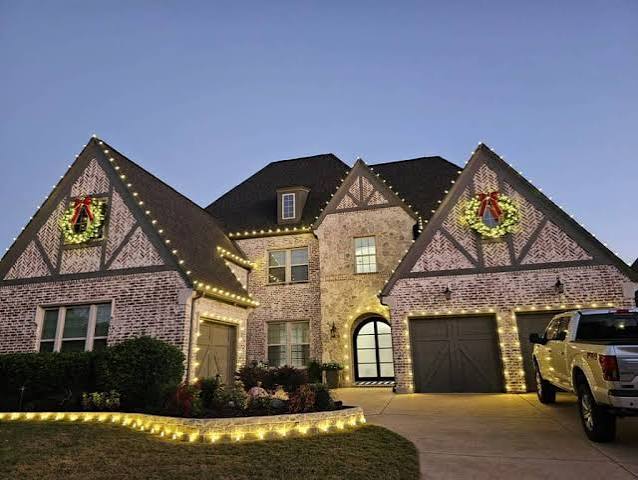
A 48-inch pre-lit wreath can run $150-$300, and that’s per wreath. Target and Walmart carry 30-inch pre-lit versions for $25-$45, and two of those hung on the gables with a $6 ribbon bow each get you the same silhouette from the street. For the garage door perimeters, skip custom frame kits and use standard shingle clips — same result, about $20 instead of $90.
26. Vibrant Green Perimeter Lighting Over Dual Garage Doors
Single-color light displays — one hue, edge to edge, no mixing — are the 2026 Pinterest breakout. Call it the one-color, one-story approach: green, white, red, or blue, used consistently across rooflines, windows, and porch. It’s popular because it looks intentional in photos and much calmer in person than a multicolor tangle. It also has real staying power because it borrows from architectural lighting rather than holiday decoration.
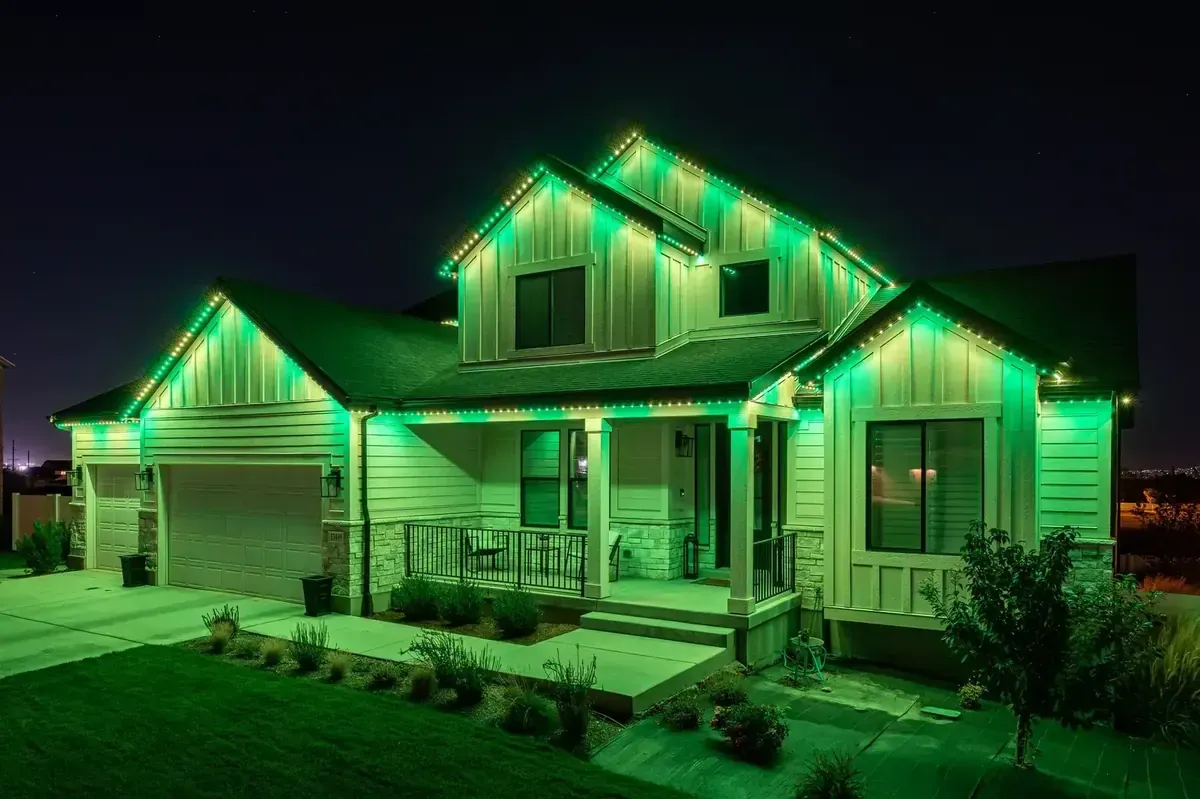
This one is 85% single hue, 15% supporting white. Everything visible — roofline, gables, porch railings — stays green, while a small amount of warm or cool white goes in the windows and on the door. Swap the green for warm white and you get the quiet-luxury version. Swap it for red and the same house turns traditional. That 15% is what keeps a monochrome display from looking like a mistake.
27. Candy Cane Columns With Multicolor Roofline Lights
Candy cane columns photograph beautifully and wear you out. Every wrapped pillar needs its own strand, its own plug, and usually its own extension cord, which means four cords crossing the driveway before the display even turns on. If your garage pillars sit directly in the driveway path, skip the candy canes and wrap porch columns instead — same look, no trip hazard in the dark. Plan for wind, too: loose wraps flap, and flapping wraps break filaments.
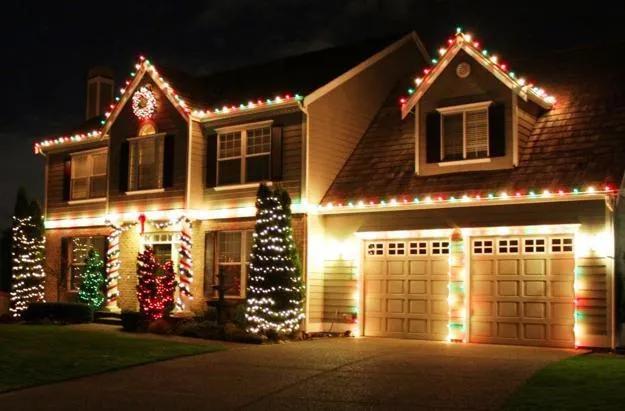
Two wrapped pillars, four lit trees, and a roofline can hit $600-$900 in retail decorations. Flip it for $180-$300: hit after-Christmas clearance at Target and Walmart for the trees (usually 50-70% off), buy candy cane lights from a dollar store at $3-$5 each, and use one spool of multicolor C9s for the roofline instead of three separate sets. Store everything in labeled bins so next year costs nothing.
28. Warm White Gable Outlines Above a Multi-Pane Garage Door
Thin lines against thick architecture is the trick. The warm white strands are delicate; the dark multi-pane garage door and brick columns are heavy and grounded. That contrast keeps the display from looking flimsy. The light siding also does something useful — it bounces the warm glow back onto the driveway, so the house lights its own entry without extra fixtures. Simple, and it reads well from both the street and the front step.
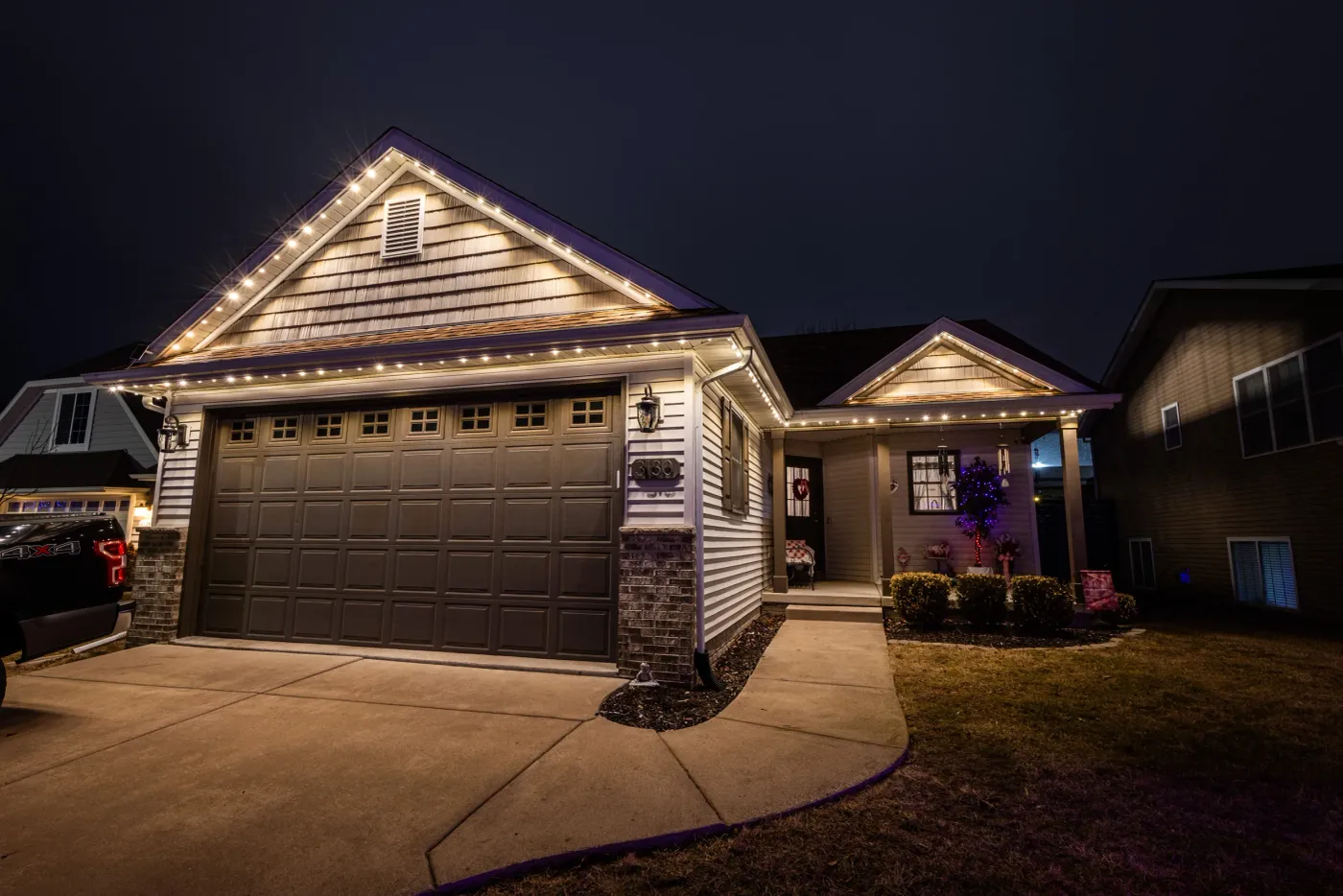
This layout is built for single-story or modest two-story homes — think 1,200-2,000 square feet with a 20-30 foot front elevation. Keep strands about 12 inches apart along the gables and one line per eave; doubling up at this size looks cluttered. If your facade is wider, the extended outline in Idea #17 fits better. Have a porch? Add the column wraps from Idea #7 and stop there.
29. Stacked Stone Columns and Warm Sconces Under Roofline Lights
Wall sconces and string lights are two warm sources competing for the same wall, and when both are on, the stone columns between them go flat. Put the sconces on a separate switch or smart plug so you can choose — sconces only for dinner parties, string lights only when you want the full outline. Check the sconce bulb temperature as well: a 4000K bulb beside warm 2700K strands looks like a mistake you can’t unsee.
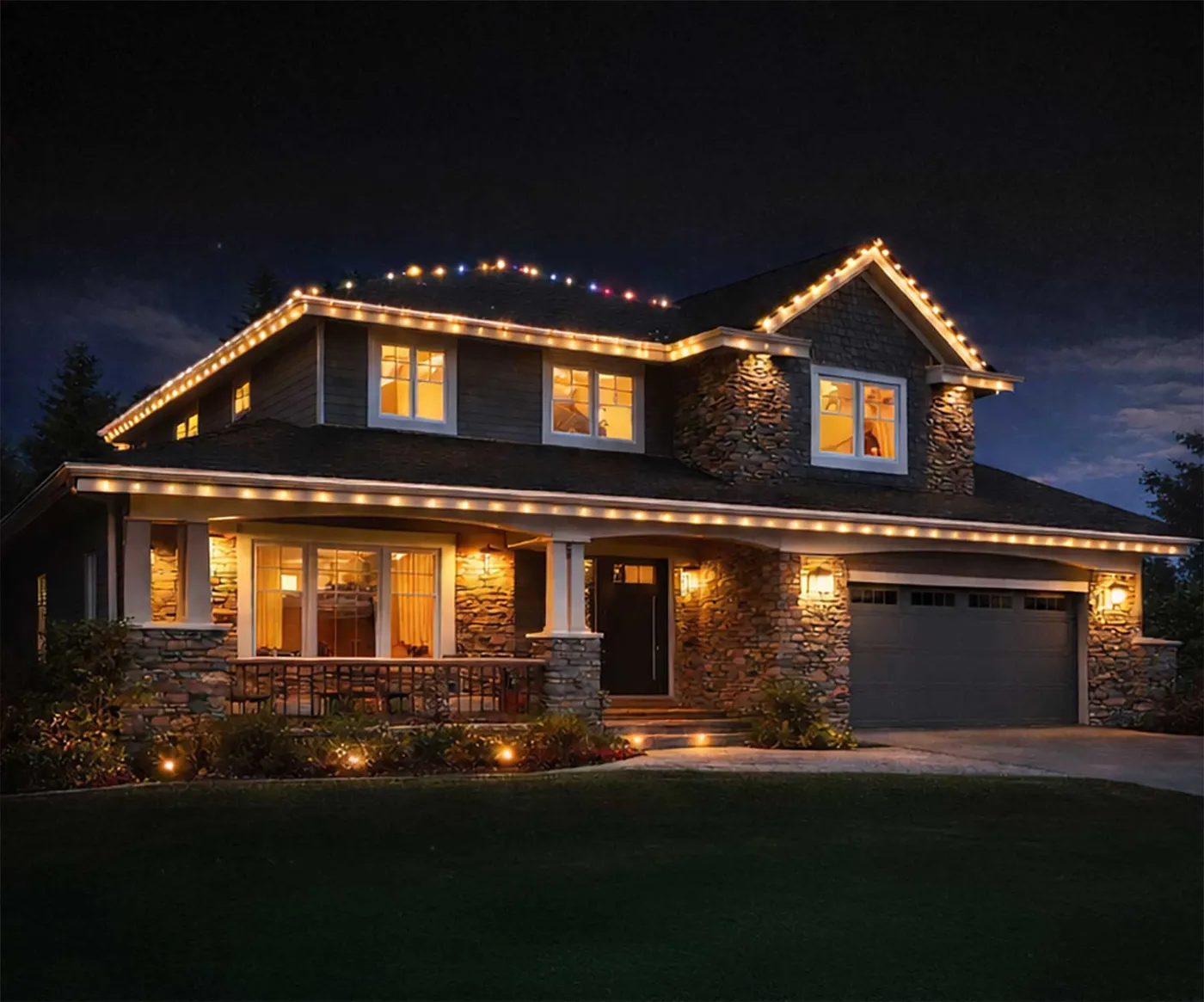
Stacked stone collects dust, pollen, and cobwebs in every crevice, and a light display makes all of it visible after dark. Plan a soft-brush cleaning once a year, ideally in spring when the lights come down. Clips pressed into stone joints can loosen mortar over years, so swap to gutter-mounted clips wherever possible. If your sconces have glass panels, expect to clean them twice a season.
30. Red and Green C9 Bulbs With a Light-Wrapped Yard Tree
- Red and green C9 LED strands, 250 feet total: $80-$170
- Warm white strands for column wraps, 150 feet: $40-$90
- Light-wrapped yard tree, pre-lit or DIY with 300 feet: $70-$200
- Path border lights and stakes: $30-$70
- Timer, clips, and outdoor cords: $40-$75
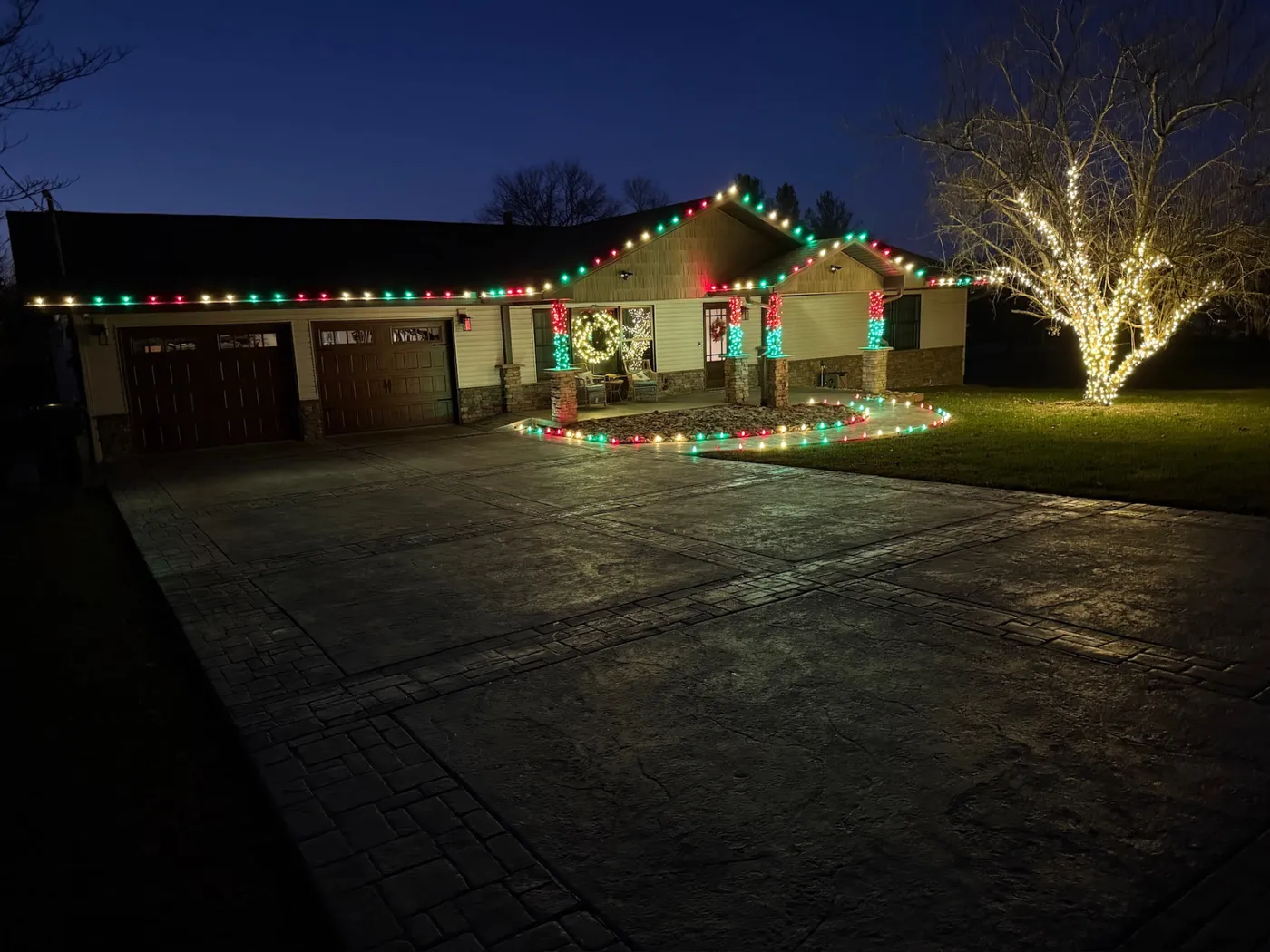
Total: about $260 to $605.
Budget alternative at $110-$200: wrap just one column, run a 100-foot spool through the tree trunk and main branches, and skip the path border entirely.
It’s the densely wrapped tree. Everything else on this house is a line — the roofline, the columns, the driveway border. The tree is a solid mass of light, and that’s what gives the display a focal point instead of a uniform glow. Wrapping one densely takes 300-500 feet of strand and a couple of hours, but it’s the single element that makes a one-story house look professionally done.
31. Arched Wooden Garage Doors With Evergreen Window Boxes
Around 60% stone, 25% dark wood, 15% greenery and burgundy. The light gray stacked stone is the base, the arched wood doors are the anchor, and the window box and tall planter supply the only real color. That ratio is why this reads elegant instead of rustic — no competing pattern, and the greens are deep rather than bright. Swap the burgundy foliage for red berries or copper tones and the mood shifts from refined to warm and traditional.
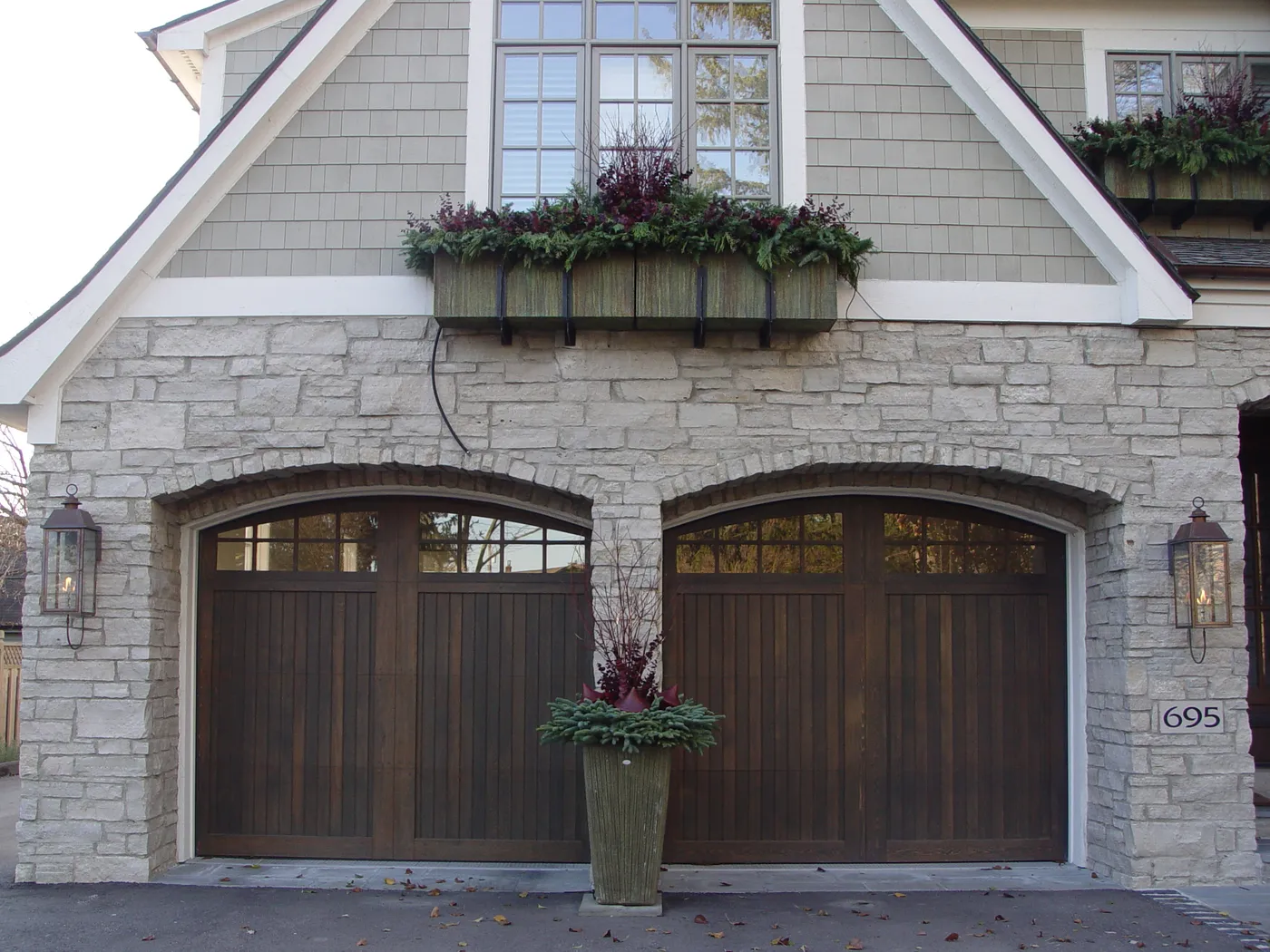
Your window box should be about one-third wider than the window opening — narrower looks like a shelf, wider crowds the stone. For a 48-inch box, use three to five evergreen elements at 18-24 inches tall, and let a few pieces trail 6-8 inches over the front edge. In a floor planter, work to roughly 1.5 times the container height so the arrangement doesn’t disappear against tall doors.
32. Snowy Driveway, Red Front Door, and Warm Garage Roofline Lights
- Confirm your clips will grip a snow-covered or icy shingle — many won’t, and you’ll need gutter clips instead.
- Decide where cords land and whether that spot holds snowmelt or standing water.
- Check the paint on your door before adding a wreath hook that could scratch it.
- Measure ground to lowest eave — over 12 feet means a ladder and a second set of hands.
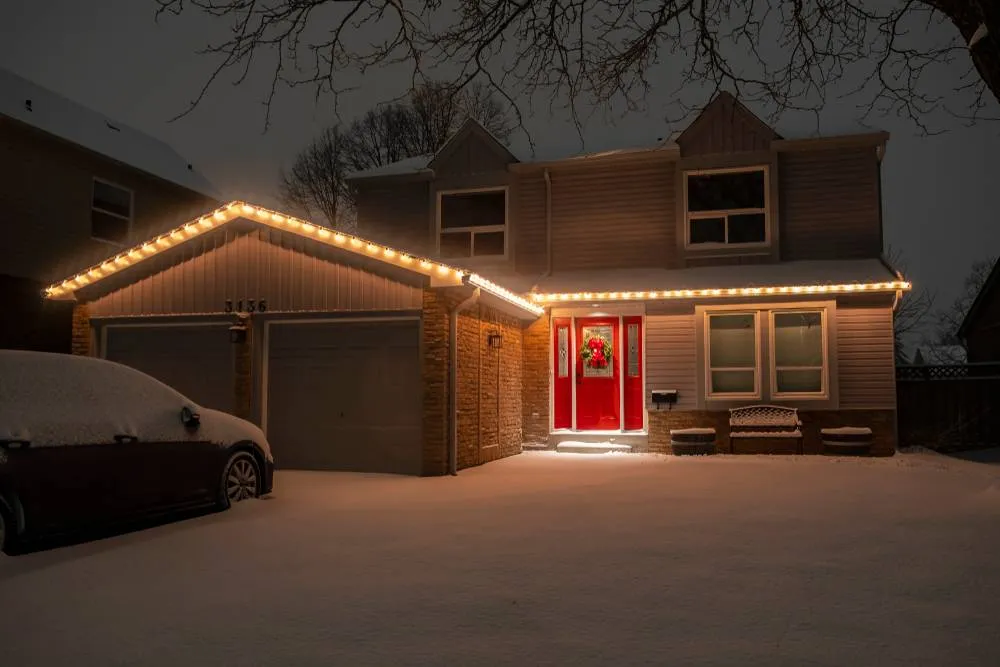
You can get this snowy, warm-white look for $90-$180 instead of $300+. Buy 200 feet of warm white LED strand on sale in early December, reuse last year’s wreath with a fresh $8 ribbon bow, and skip decorative path lighting entirely — snow reflects your existing strands and does half the work. A small wooden bench from Facebook Marketplace for $30-$60 gives the entry the same lived-in feel as the pricier version.
33. White Roofline Strands Over Gray Paneled Brick Garages
- Warm white LED roofline strands, 250 feet: $60-$140
- Shingle and gutter clips: $15-$35
- Outdoor extension cords, 2 x 50 feet: $30-$60
- Dusk-to-dawn timer: $15-$30
- Replacement fuses and spare bulbs: $8-$20
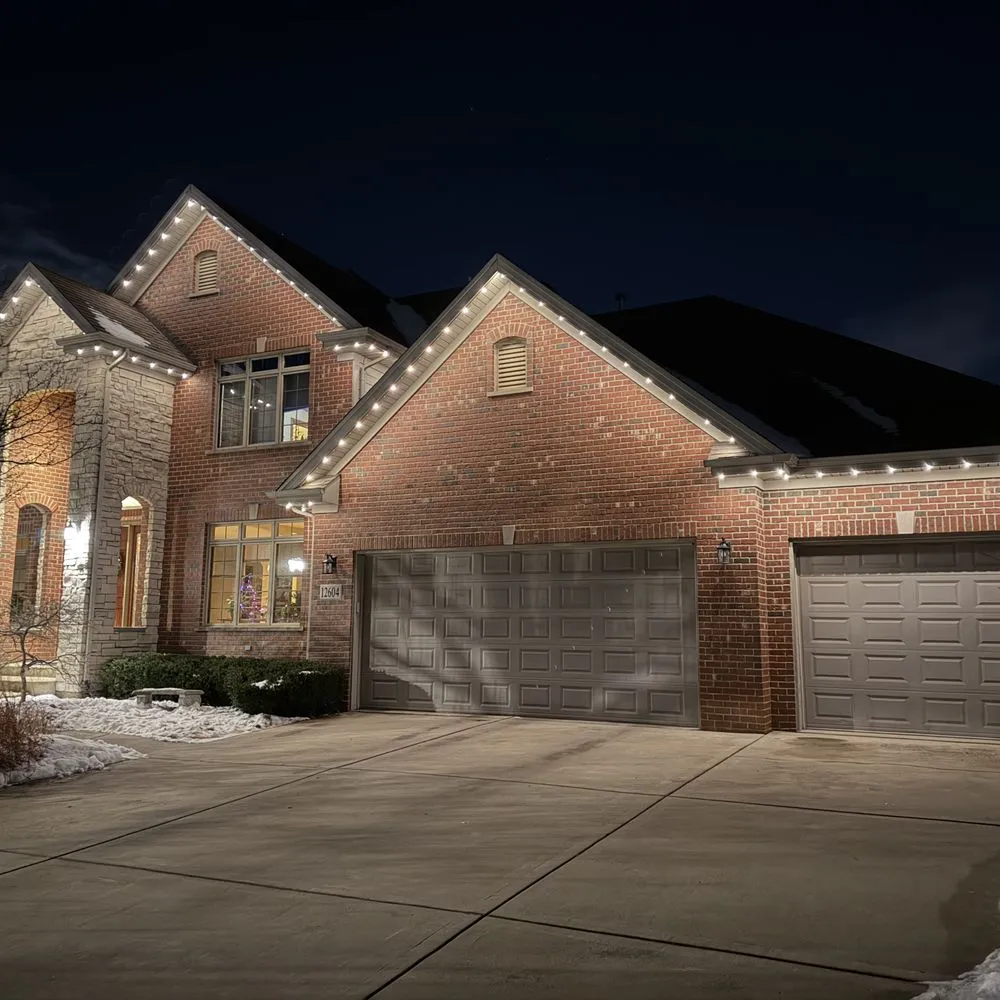
Total: about $130 to $285 for a clean, single-color outline on a brick and stone facade.
Budget alternative at $60-$120: one 150-foot spool, outlining only the garage and the main gable instead of every roof plane.
Cold is the enemy of every light display. Below freezing, plastic clips get brittle and snap, cords stiffen into awkward shapes, and some LED drivers are rated only to 14°F. Install on a mild day and leave a little slack in every run — tight cords shrink in the cold and pull clips off the shingles. Keep any ground-level plug connection clear of snow. If you’re tired of fighting clips, the setup in the mistakes section below is worth a read first.
34. Window Wreaths and Path Lights on a Full Brick Facade
The path lights. A roofline outline is the expected move; what makes this brick house memorable is that the glow follows you from the driveway to the front door. Ground-level lighting pulls the display down to human scale, so it isn’t just decoration you admire from the car — it’s decoration that greets you. It also solves a practical problem: on a dark night, path lights are the difference between festive and ankle-twisting.
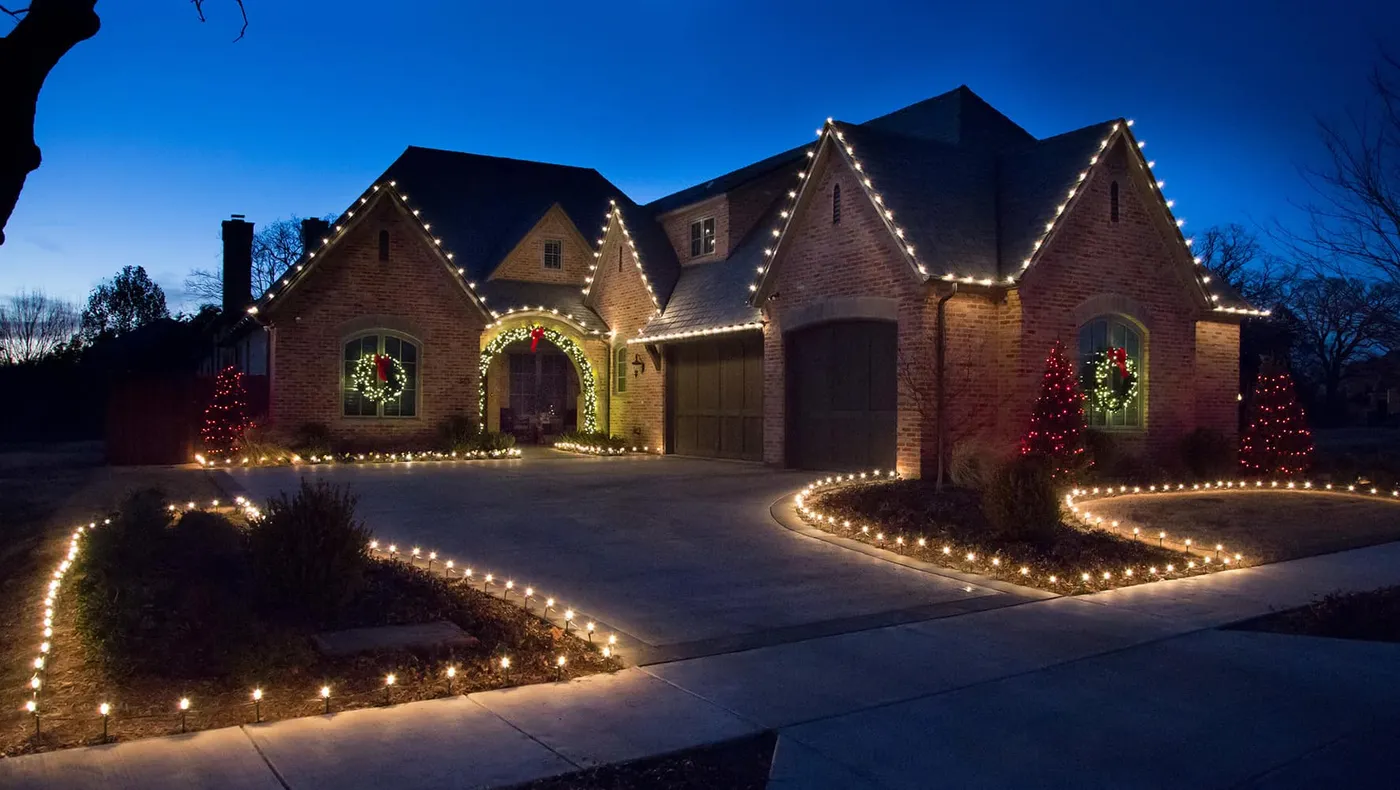
Count on roughly one path light every 6-8 feet along the walk, plus one at each flower bed corner. This layout wants a driveway at least 40 feet deep to feel generous; on a shorter run, use three lights instead of six. Two-story brick facades 30-40 feet wide carry the full roofline-plus-wreath treatment well, while smaller homes look better with the restrained version in Idea #28 than with a trimmed-down copy of this one.
35. Metallic Reindeer Herd in Front of Light-Outlined Garages
Large-scale lawn sculptures — reindeer especially — are the fastest-growing category in holiday exterior decor right now, and 2026’s versions are bigger, brighter, and more metallic than cartoonish. The appeal is scale: a six-foot reindeer standing in front of an outlined garage door reads as a designed vignette rather than a pile of decorations. It has more staying power than most yard trends because it’s essentially sculptural, and a good set will last a decade with indoor storage.
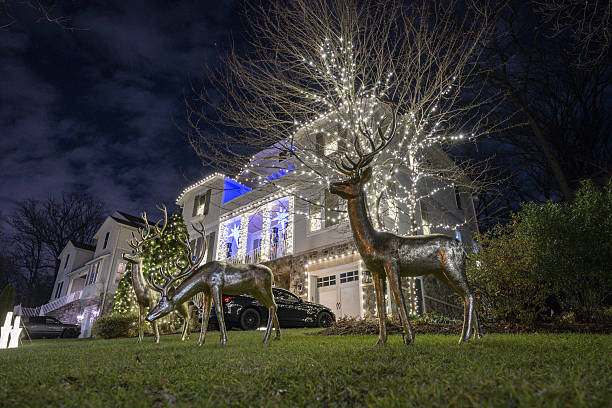
Staking and wiring a large reindeer display takes about two hours and $20-$45 in hardware.
- Pick a spot 4-6 feet in front of the garage doors so the outline lights read as a backdrop.
- Drive the included stakes at a slight angle away from the figure for better wind resistance.
- Add two ground anchors per figure in sandy or snowy soil.
- Cable-tie the legs to the stakes at two points, not one.
- Run cords along the base of the garage wall and cover them with a mat or cable ramp.
Your Garage Door Just Became the Best-Lit Spot on the Block
Start with one thing — the roofline, the door, or the wreath — and let it earn the rest. Measure twice, buy LED, and put it all on a timer; that’s about 90% of what separates a house that looks decorated from a house that looks designed.
📌 Pin your favorite version now so future-you has the plan ready when the ladders come out.