Christmas tree color ideas are having a major moment on Pinterest right now — and the saves make it obvious why. The all-red-and-gold era is officially sharing the spotlight with flocked neutrals, mustard-adjacent golds, and full-on rainbow trees that look like the best party you weren’t invited to.
We spent serious time browsing Target, Walmart, Etsy, HomeGoods, and Amazon to bring you only what’s worth your attention this year, from $12 ornament sets to $1,200 statement trees.
Inside you’ll find 35 curated ideas covering traditional red-and-gold, flocked woodland neutrals, maximalist multicolor, and clean modern white-and-green — with budget and luxury versions compared side by side. And stay until the end — we break down the most common mistakes that can ruin these looks.
In 2026 the real shift is toward a color story you commit to rather than a collection you accumulate: pick a palette, repeat it three times, and the tree does the rest.
📌 Save this to Pinterest for later — you’ll want to revisit these ideas.
This post contains affiliate links — if you buy through them, we may earn a small commission at no extra cost to you.
1. Red and Gold Classic Anchored by a Stone Fireplace
The tree works because the room repeats its palette instead of competing with it. Crimson shows up on the tree, again in the knitted stockings, and once more in the berry clusters on the wreath. Gold appears as baubles and then echoes in the gift wrap. That repetition is what makes a red-and-gold tree look chosen rather than store-bought. The grey stone fireplace adds a cool note so all those warm reds never tip into candy-cane territory.
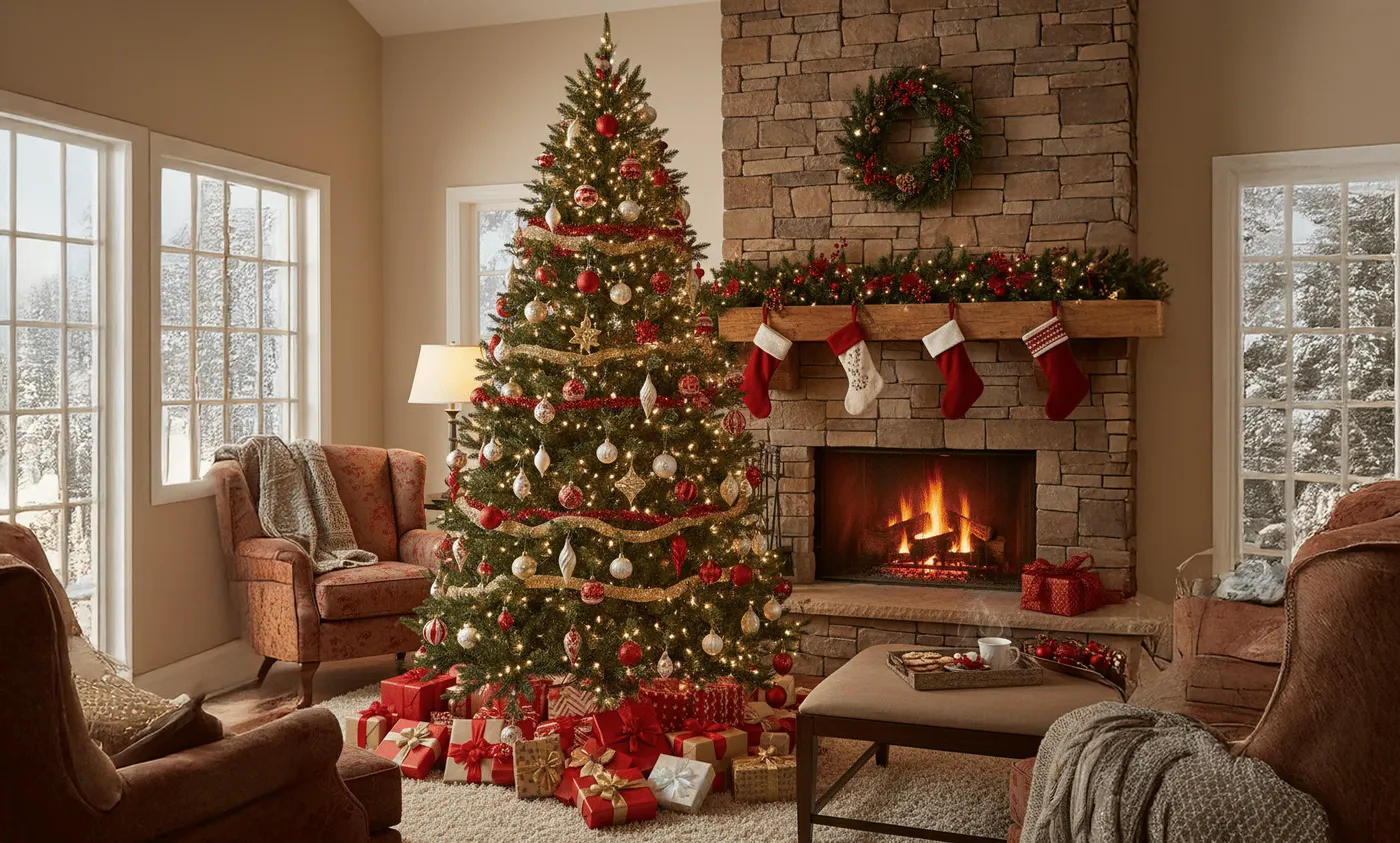
Hang ornaments in odd-numbered clusters of three, and vary the size: 4-inch balls out at the branch tips, 2.5-inch ones mid-branch, 1.5-inch tucked deep toward the trunk. You’ll get depth instead of a flat wall of spheres. For a 7.5-foot tree that’s roughly 80 to 100 ornaments, and keep red and gold at about a 2:1 ratio so the gold reads as punctuation rather than a second act.
2. Flocked White Tree with Sage and Light Wood
The formula here is roughly 70 percent white and cream, 20 percent sage green, 10 percent warm gold. Swap sage for dusty blue and the serenity stays but the mood turns colder. Swap the cream ornaments for oatmeal and the whole thing goes woodland. The ratio is the point: keep your accent color under a quarter of the visual field and a room full of pale upholstery and big greenery garlands stays calm instead of noisy.
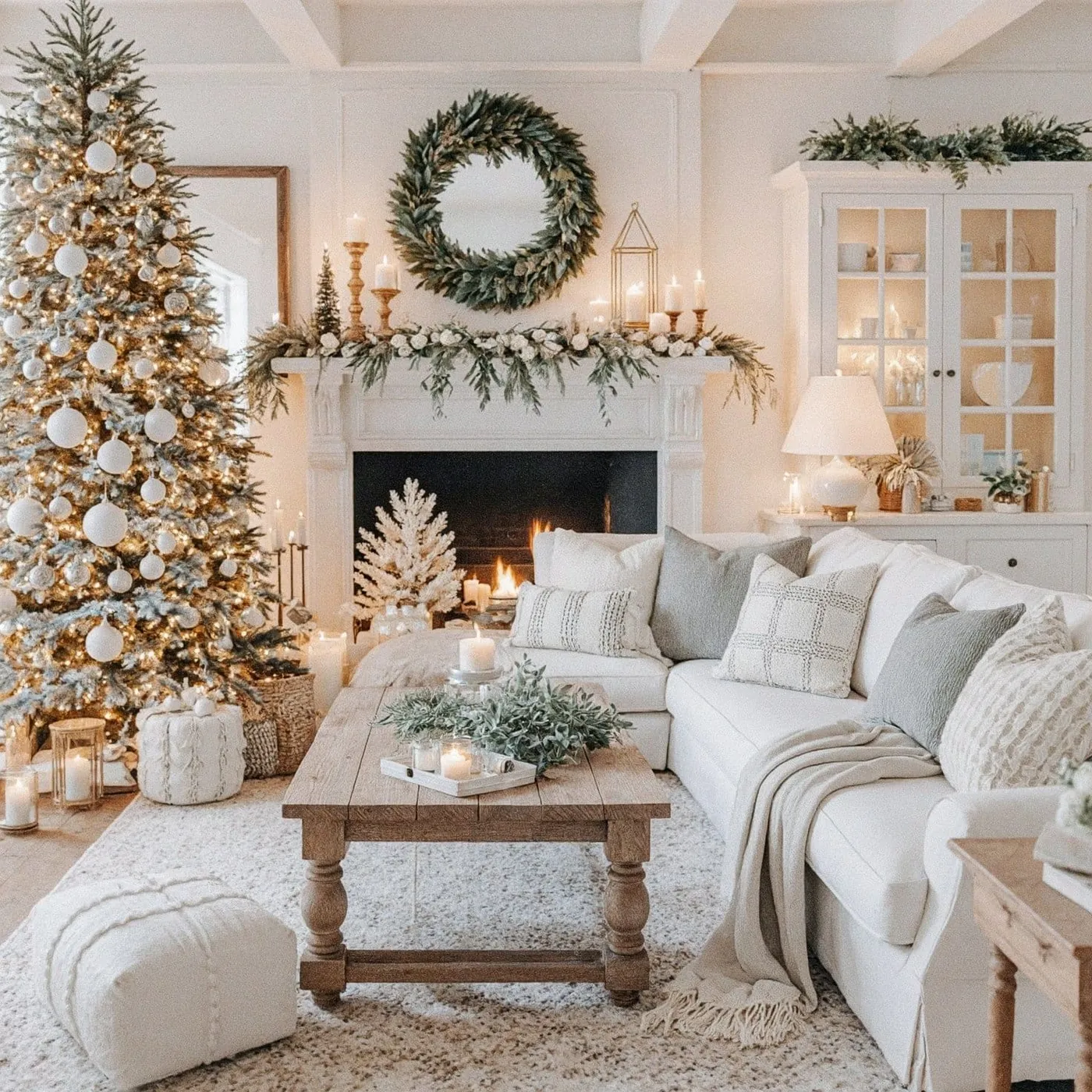
The flocking is what makes it. Without that dusted white finish, a room of white sofas, light wood, and oversized greenery would look like a tree that simply hasn’t been decorated yet. The flocking gives branches weight and light, and it lets matte white ornaments vanish into the needles and then reappear. Take it away and the snowed-in feeling goes with it.
3. Clear Glass and Burlap with a Matte Silver Pairing
Pair one reflective finish with one matte finish and you get twice the visual interest for half the ornaments. Matte silver absorbs light and reads as a solid shape; clear glass passes light through and makes the warm string lights feel like part of the decoration. Cap yourself at two metal finishes per tree — here it’s silver and natural burlap — or the branches start looking like a sample sale.

Clear glass ornaments are the easiest thing to fake. Thrift stores and Facebook Marketplace are full of 1980s glass balls for a dollar apiece, and Walmart sells clear fillable ornaments in six-packs for well under $10. Fill them with burlap scraps, jute twine, or dried orange slices instead of buying pre-filled versions at $8 each. Total swap: about $25 for two dozen ornaments and a very smug feeling.
4. A Tall Pre-Lit Tree Against Crisp White Paneling
Pre-lit trees are convenient right up until one section goes dark and you’re playing electrician in your living room. Before you buy, check whether the strands are replaceable and whether the sections connect with fuses or plugs — a tree you can partially re-string is a tree that lasts a decade. Also worth knowing: dense green foliage against a white panel wall photographs beautifully, but it shows every stray piece of tinsel and every bit of dust.
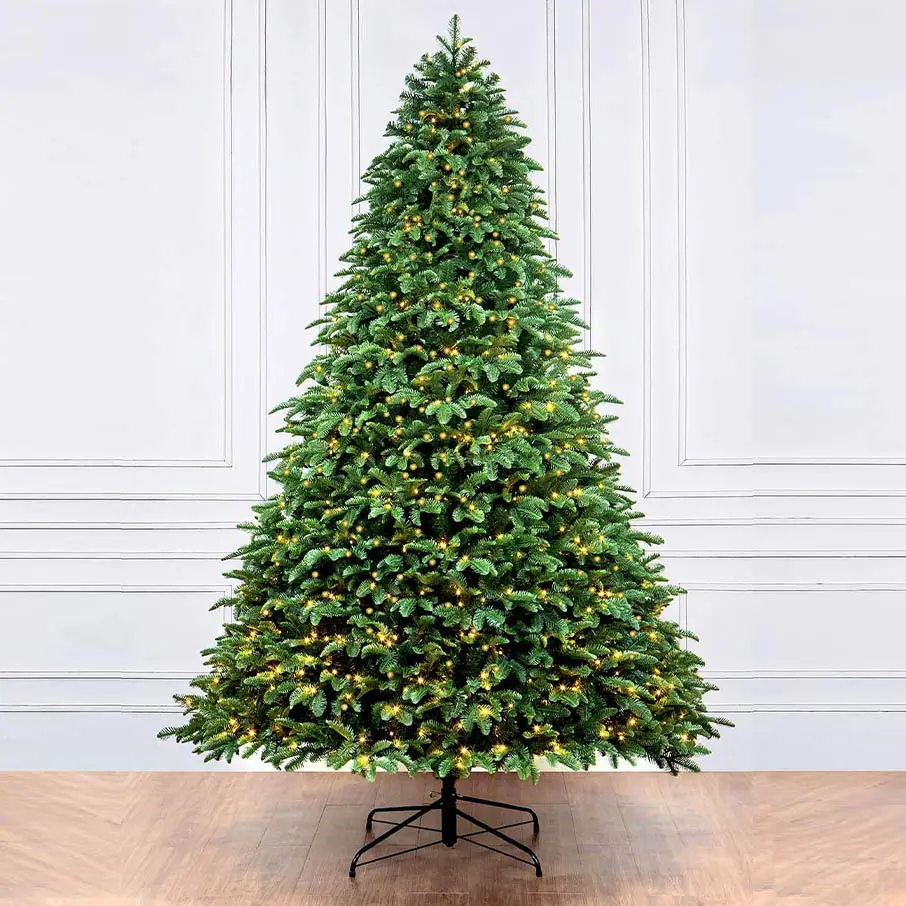
This tree is doing almost nothing, and that’s the trick. No garland, no ribbon, no topper competing for attention — just dense forest-green foliage, warm white lights, and a black metal stand on a light wood floor. The paneled wall gives it a clean backdrop, so the tree reads as sculpture rather than decoration. If you want to spend your budget on one great tree instead of forty ornaments, this is the move.
5. Frosted Branches with Burlap Ribbon and a Golden Star
- Cut burlap ribbon into 24-inch lengths — about 12 pieces for a 7-foot tree.
- Fold each into a loose loop and pinch the center, leaving a 4-inch tail.
- Wire the pinch with 22-gauge floral wire, then fluff the loop open.
- Attach with a twist tie at a branch tip, alternating with ornaments.
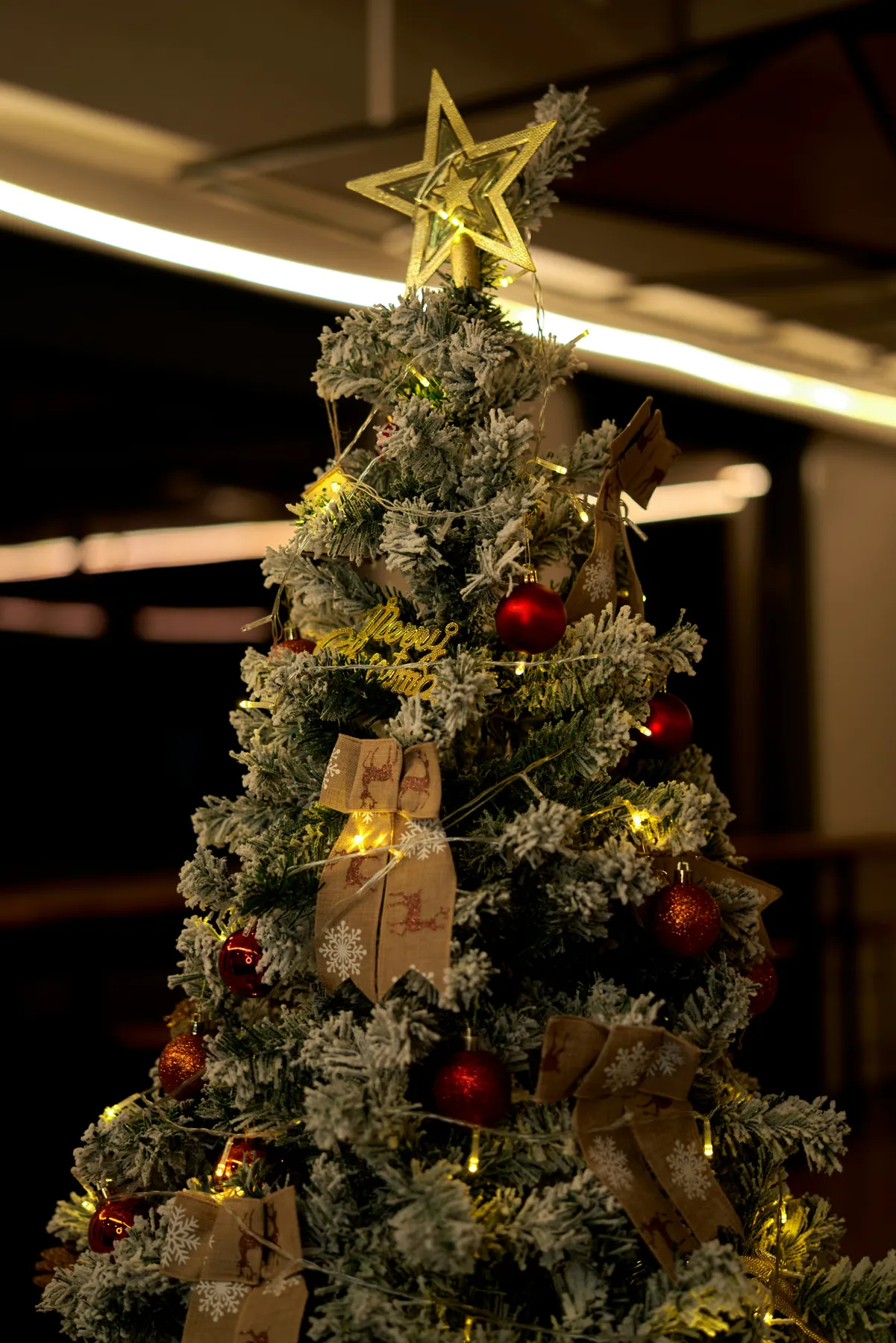
Time: about 45 minutes for twelve loops. Materials: roughly $12 for a 10-yard roll of burlap ribbon plus $3 for wire. The gold star topper and patterned reindeer ribbons pull it together with zero extra effort.
A 7.5-foot tree is the sweet spot for a standard 8-foot ceiling — it leaves six inches of breathing room for a topper. With a 9-foot ceiling, go to a 9-foot tree and plan on a step stool for the top third. This frost-and-burlap look needs width to work, so keep at least 30 inches of clearance on the sides, and never push a flocked tree flat against a wall. Tight spaces are better served by a tabletop version, like Idea #12.
6. White and Silver Ornaments Framed by Wooden Windows
The dark faux fur throw on the white sofa is the whole design. Everything else here is pale — white ornaments, silver accents, light wood window frames, a wood-paneled ceiling — and without that one dark, textured layer the scene flattens into a showroom. It gives the eye somewhere to land and makes the warm white lights feel warmer by contrast. Remove it and you’ve got pretty, but you’ve lost the coziness that sells the whole room.
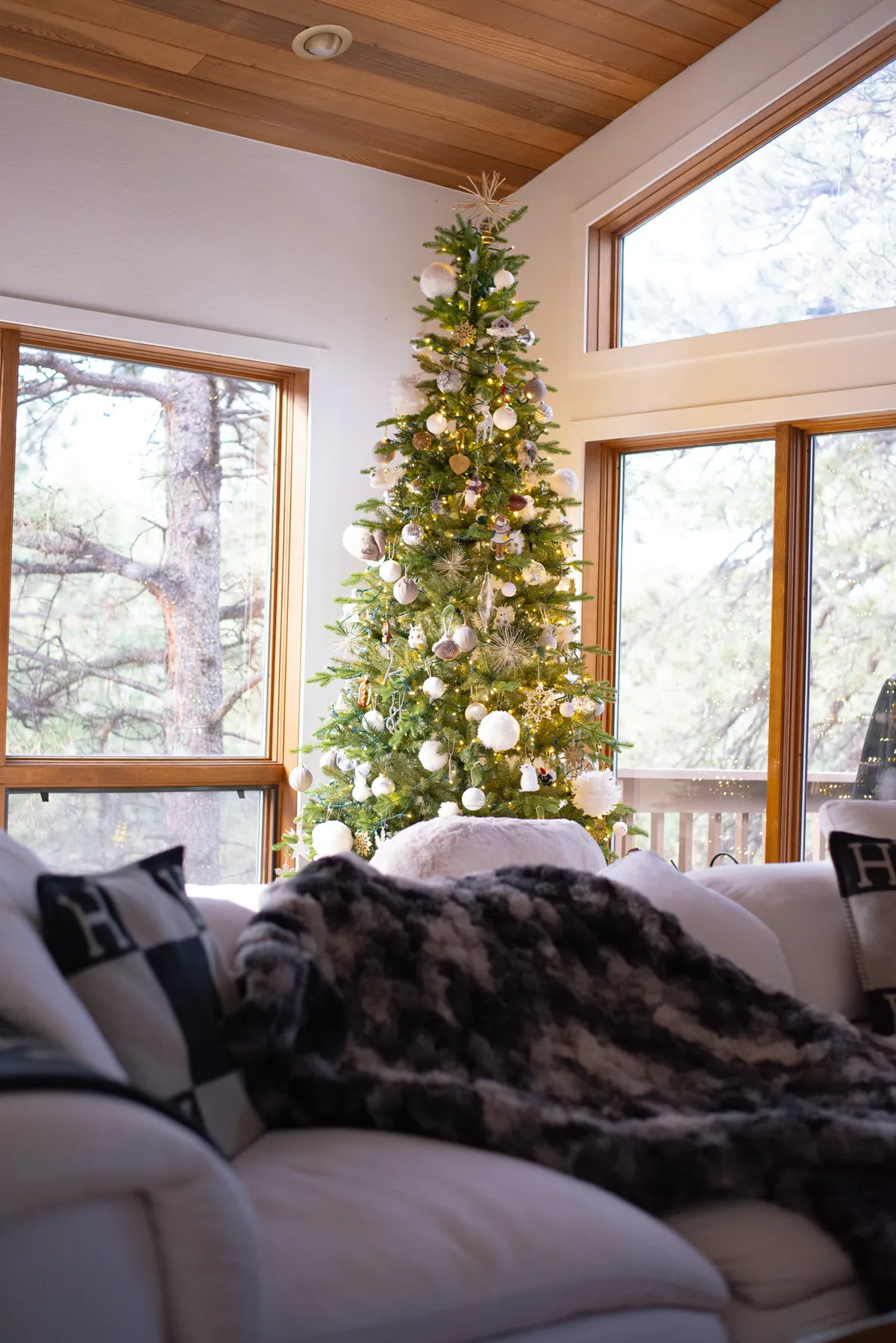
Faux fur sheds for the first few weeks and then settles, but it needs a weekly shake and a brush to keep the pile from matting, especially if anyone actually sits on that sofa. White and silver ornaments are unforgiving about dust, so a soft microfiber pass once a week through December is realistic. Want the same look with less work? Trade the fur for a charcoal wool throw and switch to matte white ornaments.
7. Bronze Pinecones, Dried Oranges, and Copper Birds
- Decor — metallic pinecones, copper bird clips, mixed ornament set: $60–$140
- Lighting — 300 warm white LED strand lights: $25–$45
- Textiles — tree skirt or woven collar: $30–$70
- Accessories — dried orange slices, cinnamon bundles, sprigs: $15–$35
- Tree — 7.5-foot frosted faux pine: $180–$600
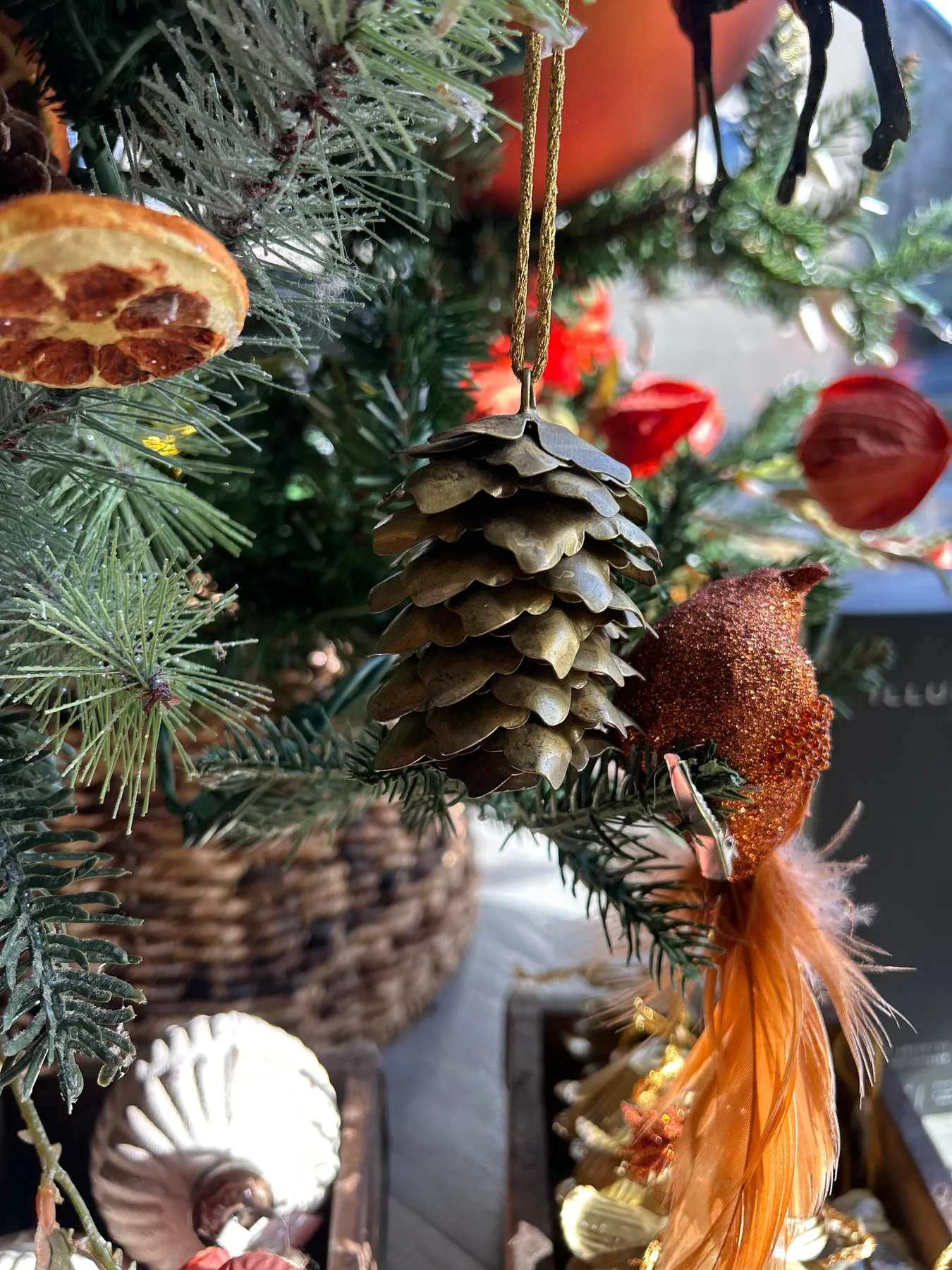
Total: roughly $310 to $890 for the full setup. Budget alternative: skip the metallic pinecones and dry your own orange slices — three oranges, a 200°F oven for three hours, and a spool of twine gets you the same warm burnt-orange note for about $8.
Skip the store-bought ornament hooks and use brown floral wire instead. It disappears into the branches, holds heavier natural pieces like pinecones without slipping, and costs about $4 for a 100-foot roll — enough for two trees. Wire your dried oranges and copper birds slightly above eye level so they catch the warm light instead of sitting in shadow under the branches.
8. Flocked Woodland Tree with Birch Ribbon and Plaid
Think of it as 60 percent cream and white, 25 percent muted grey and natural brown, 15 percent warm gold from the lights. Birch-patterned ribbon and frosty white berries live in the cream zone; galvanized bells and deer silhouettes sit in the grey; the plaid is the wild card that keeps everything from washing out. Trade the plaid for black watch and it goes moodier. Trade it for buffalo check and it turns farmhouse. The ratio never changes.
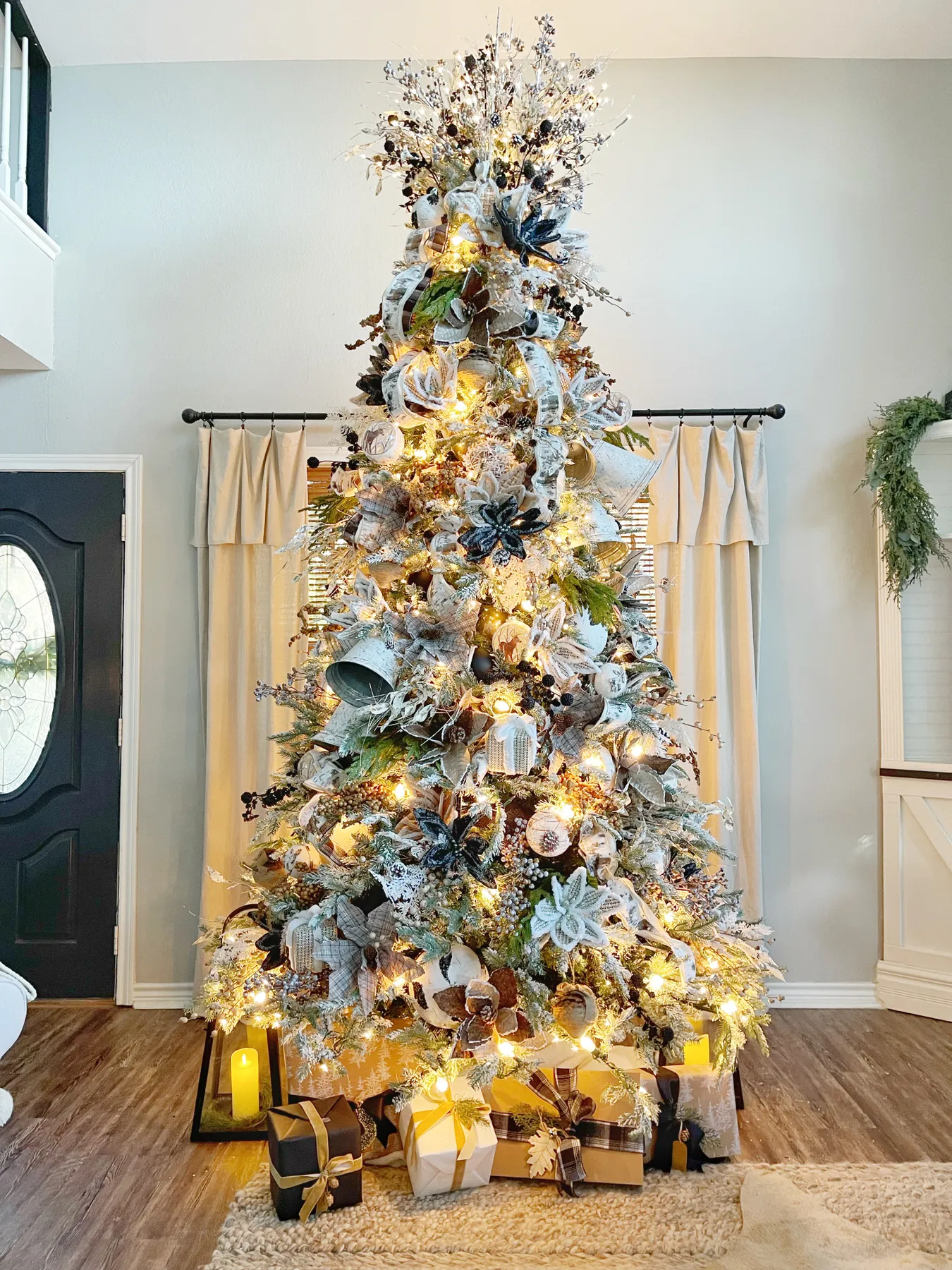
Flocked trees are the expensive part, and you don’t have to buy one. A can of spray snow plus one afternoon gets a thrifted green tree close enough, and the savings go straight into ornaments. Holiday decor at Target and Walmart drops about 50 percent the day after Christmas — buy your neutral baubles, birch ribbon, and bells then and store them flat. Facebook Marketplace in January is where flocked trees show up at a third of retail.
9. Whimsical Character Ornaments and a Big Bow Topper
Sentimental ornament collecting has moved from “my mom’s attic” to a deliberate design choice. Food-shaped baubles, character figures, and vacation souvenirs are showing up on trees that would have been strictly color-coordinated five years ago — call it nostalgia maximalism, and Pinterest has been quietly rewarding it. The reason it has staying power is that it’s basically free: this tree grows a little every year instead of getting replaced when the palette changes.
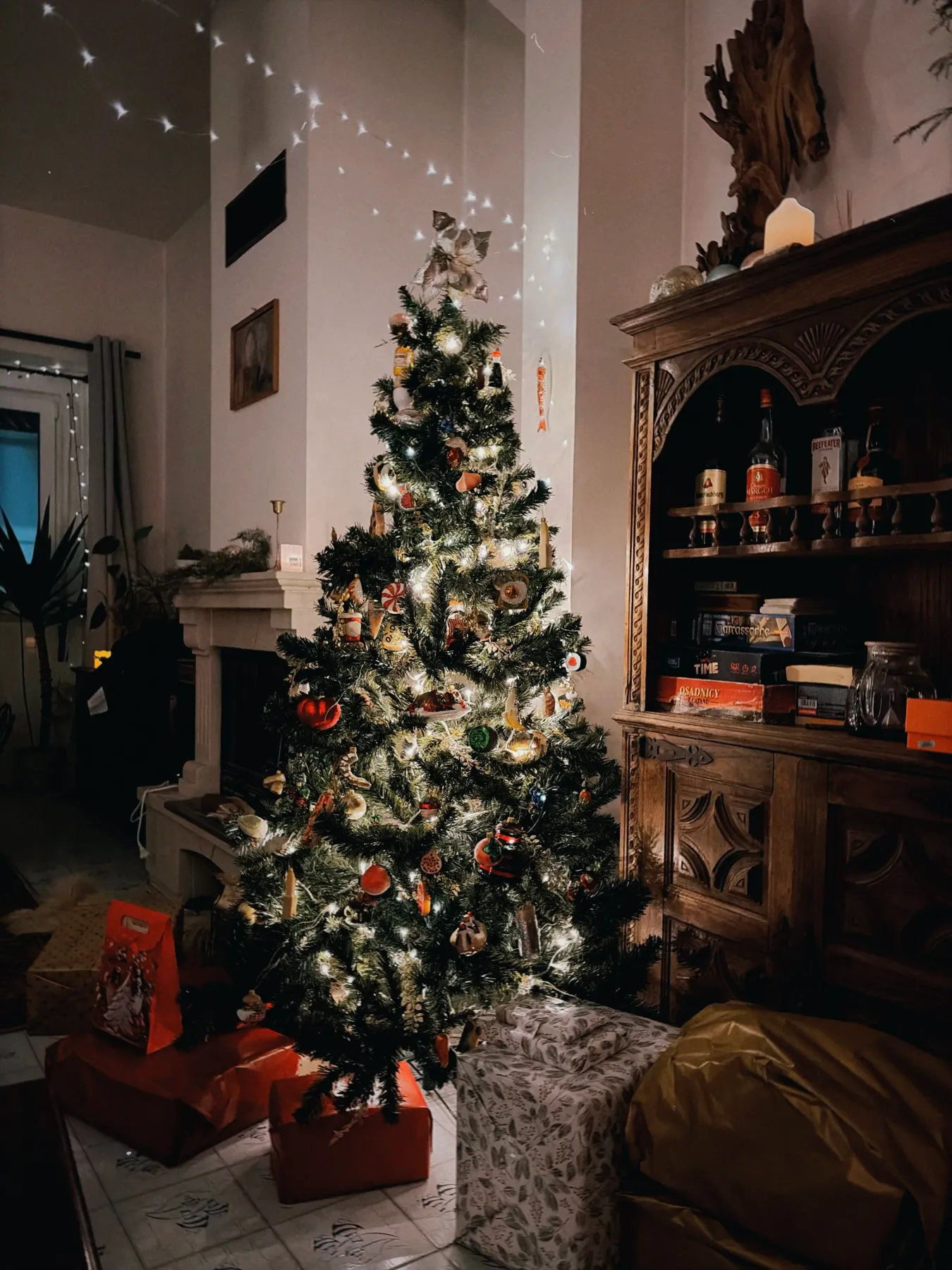
The big light-colored bow on top does something clever — it frames a tree that has no color scheme at all. An eclectic mix of food ornaments, character figures, and warm white lights would look chaotic under a traditional star; the oversized bow gives the eye one calm, repeated shape to return to. The dark carved wood hutch behind it matters just as much, absorbing all that busy color so the tree isn’t fighting a bright wall.
10. Snow-Dusted Branches with Red Berries and Pinecones
Berry-and-pinecone decorating wants a narrow tree. Full-width flocked trees with this much texture overwhelm a small room; a 6 to 7-foot slim profile on a black metal stand fits a 10-by-12 living room without eating the walkway. Leave 24 inches minimum between the tree and any doorway you actually use. Smaller than that, scale the whole idea down to a 4-foot tabletop version and go lighter on the palette, like the bottle-light tree in Idea #12.
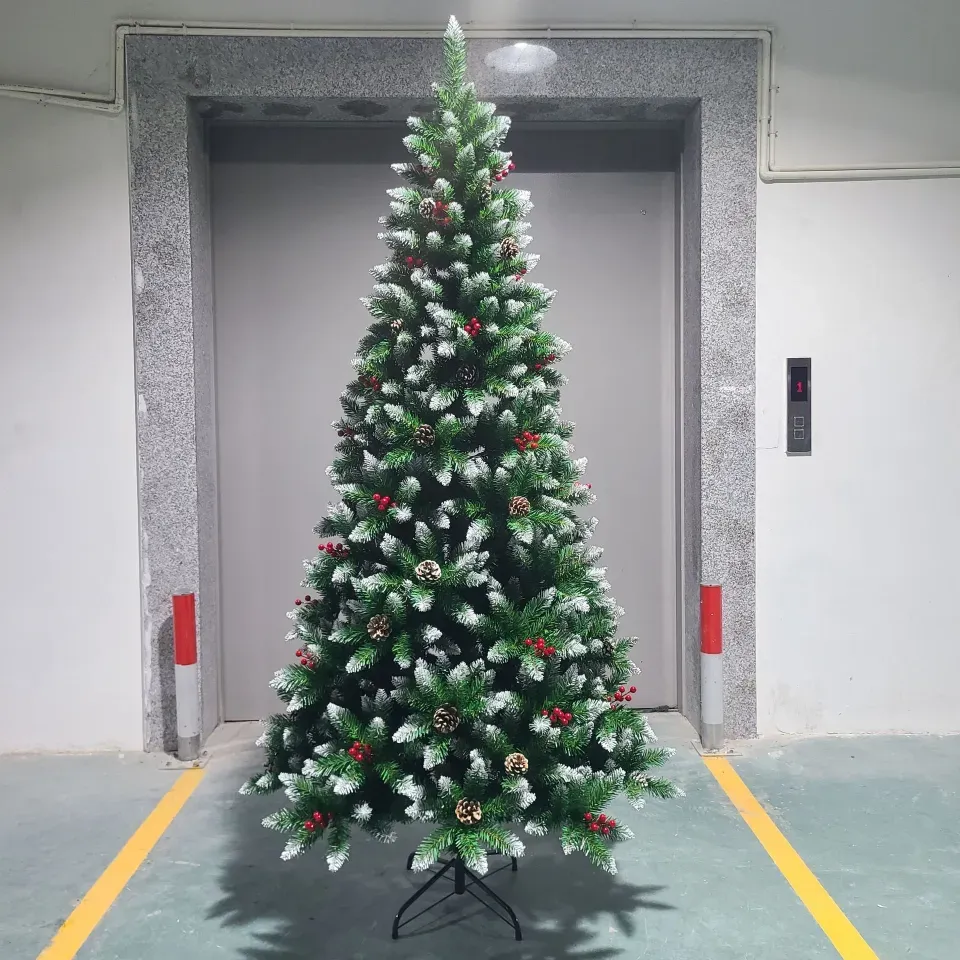
Bright red berries are the riskiest thing you can put on a flocked tree. Cheaper faux berry sprays can leave dye transfer on white flocking if your house runs humid, and the berries pop off and roll under furniture by mid-December. Look for coated or fabric-wrapped berries rather than painted foam, and clip them a few inches in from the branch tips so heavier ornaments aren’t leaning on them.
11. Sheer Red Ribbon and an Embroidered Patterned Tree Skirt
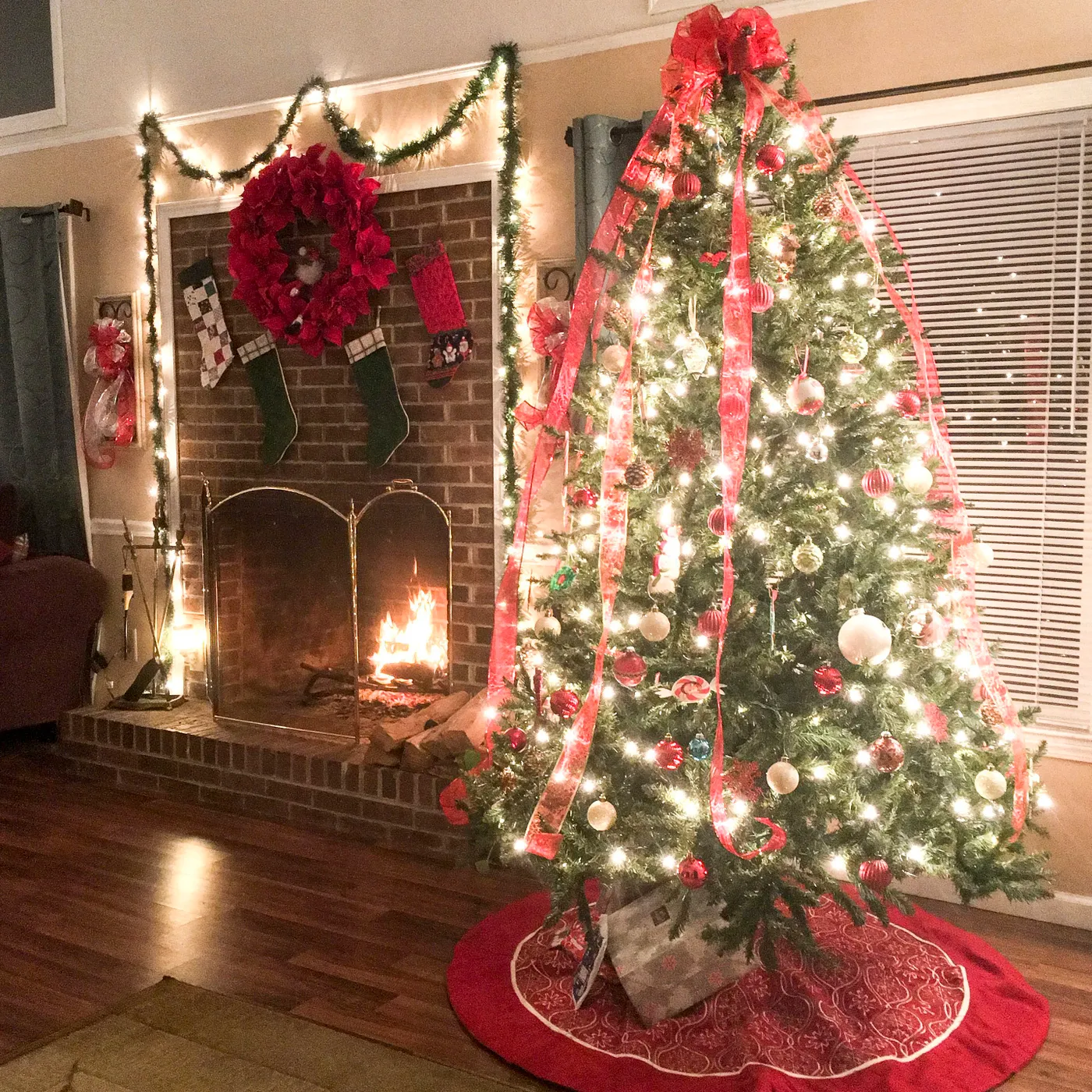
Sheer ribbon behaves differently from wired ribbon, and that’s the whole point. Wired ribbon holds a stiff loop; sheer ribbon drapes and lets the warm lights bleed through, which is why this tree glows instead of glinting. Run it in wide, loose spirals — one full wrap every 18 inches of tree height — and tuck the ends inward instead of knotting them where anyone can see. Two 25-foot rolls cover a 7.5-foot tree comfortably.
- Red sheer ribbon, two 25-foot rolls: $18–$40
- Red, gold, and white ornament set, about 100 pieces: $45–$120
- Patterned tree skirt: $25–$60
- Warm white LED lights, 400 count: $20–$40
- 7.5-foot full green tree: $150–$500
Total: about $258 to $760. Budget alternative: buy a solid red skirt for $15 at Walmart and add a $6 strip of white trim — the embroidered detail is what your eye actually reads anyway.
12. Tabletop Flocked Tree with Crackled Bottle Lights
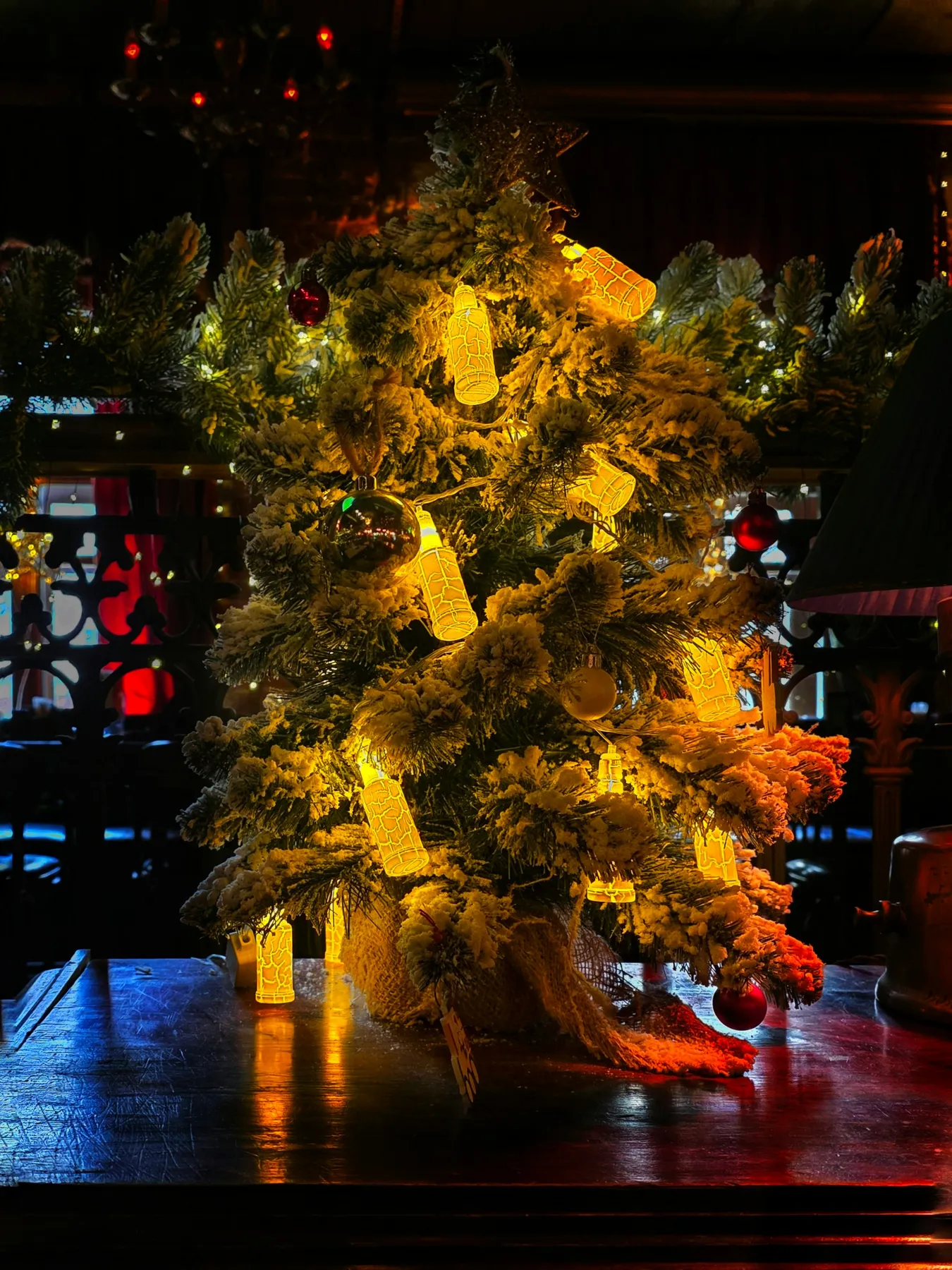
The bottle-shaped crackled lights are the entire personality of this little tree. Everything else — the flocking, the red baubles, the metallic green ball, the glitter star — is standard holiday stock you can find anywhere. But those amber, bubbly glass shapes throw a soft, irregular glow no standard strand replicates, and they turn a three-foot tabletop tree into a lantern on a dark reflective surface. Without them it’s a nice miniature. With them, people ask about it.
- Set the tree on a dark, reflective surface — stained wood or a black tray.
- Wrap the strand loosely, one loop every 3 inches of trunk height, so the bottles hang rather than tuck.
- Add six to eight red or metallic ornaments and keep it sparse so the glow reads.
- Finish with a small dark star topper and a burlap collar at the base.
Time: under 20 minutes. Cost: about $45 for the tree and $20 for the bottle-light strand if you already own ornaments.
13. A Grand Tall Tree with a Gold Starburst Topper
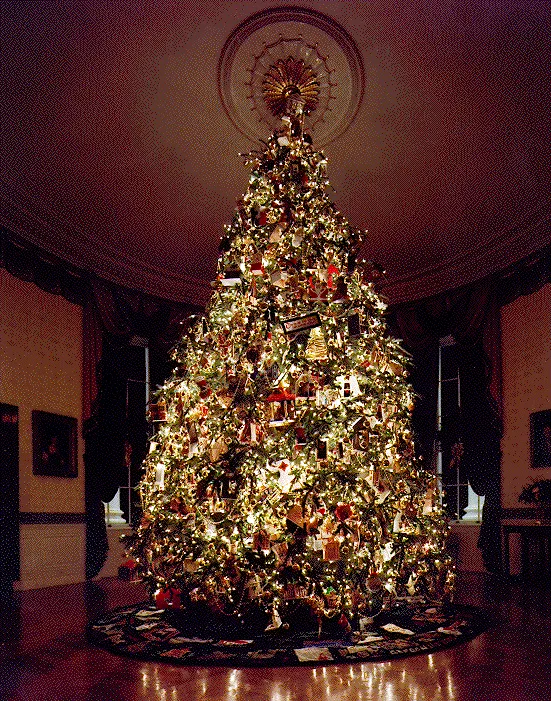
Scale is the design here. A tree that nearly reaches a high ceiling, densely strung with lights and an assortment of small ornaments, reads as architecture rather than decor — and a polished wood floor doubles the glow back up into the room. The gold starburst topper works because it’s open and airy; a solid star or an angel would block the light coming off the top third of the tree. Let the tree be a light source, not just a decorated object.
- Measure ceiling height, subtract 8 inches for the topper, then subtract the stand.
- Confirm the doorway or stairwell is wide enough to move a sectioned tree through it.
- Find the outlet and check how many strands that circuit can safely carry.
- Decide where the skirt goes before you pile gifts at the base.
14. Brown Paper Gifts, Red Velvet Ribbon, and Dark Wood
This is a 65 percent dark green and dark brown base, 20 percent deep red, 15 percent warm gold formula. The dark wood paneling and flooring carry the base, gold ornaments and warm string lights provide the lift, and red ribbons supply the accent. Swap the red velvet for tartan and it turns Scottish hunting lodge. Swap gold for matte brass and it turns quietly modern. Keep red under a quarter of the visual field and it stays elegant.
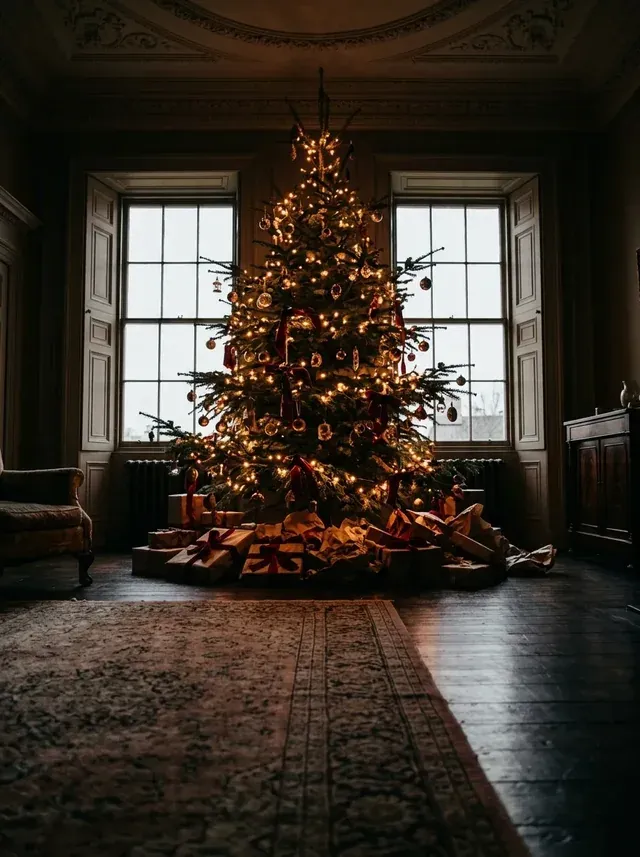
Brown kraft paper costs about $8 for a 100-foot roll and instantly reads expensive — it’s the ribbon doing the work. Splurge on one roll of real velvet ribbon at $15 and reuse it for years, or hit Walmart for wide satin at $5. Gift stacking is free design: vary box heights in threes, lean the tallest against the tree base, and tuck the smallest in front. Compare with Idea #24 for the bookshelf version of this same idea.
15. Red Bows and Gold Ornaments with a Crown Chandelier
When a room already has strong pattern — blue and gold pillows, leopard print, a mirrored coffee table — the tree has to hold its own with texture instead of more pattern. Red velvet bows at three scales (6-inch, 4-inch, 3-inch) repeat the same shape enough times that the tree reads as one unit against a busy room. Keep bows to about 20 on a 7-foot tree, and place them slightly off-center from the ornaments so nothing lines up in rows.
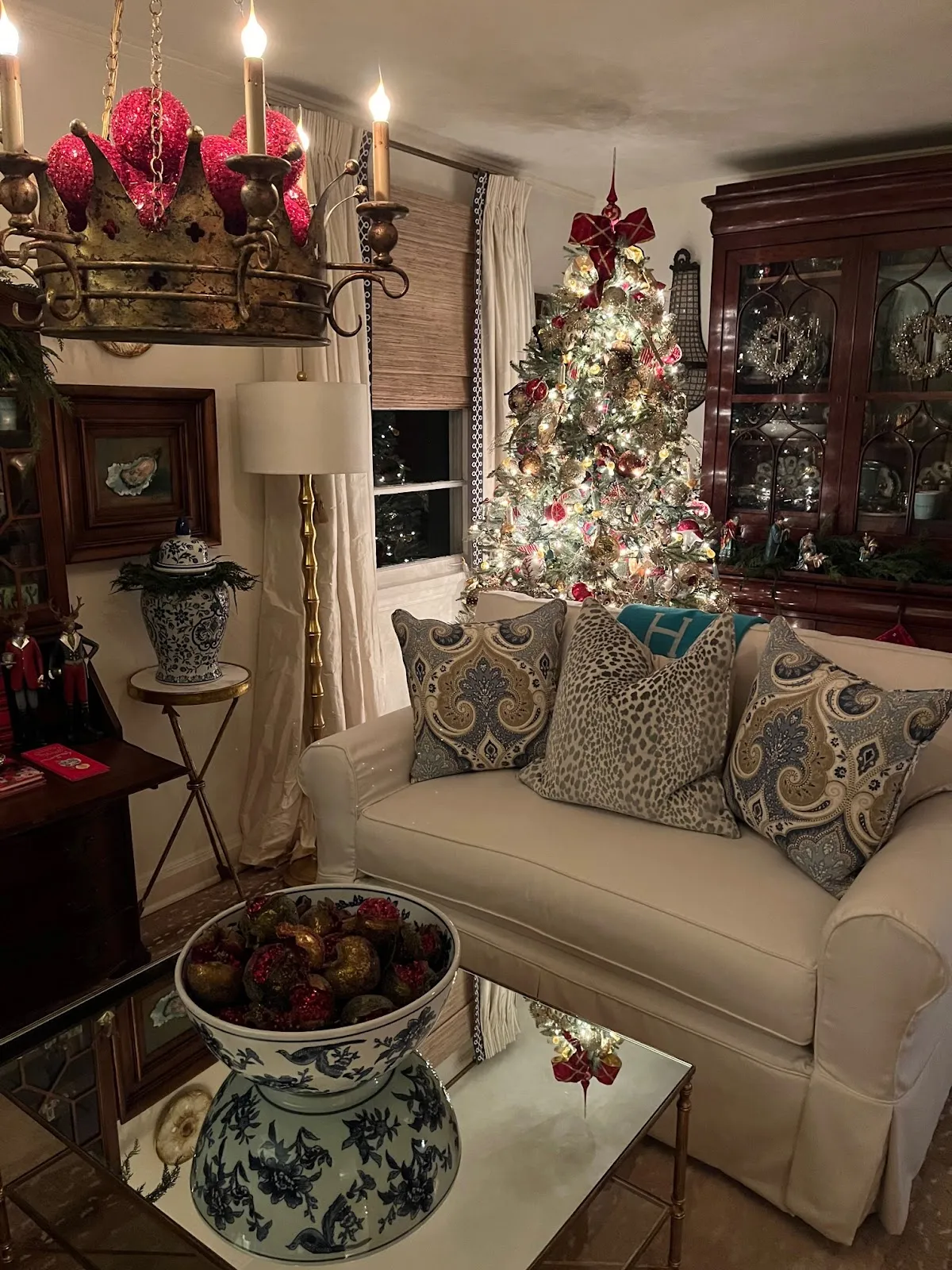
Mirrored furniture plus a tree full of warm lights equals glare, and glare shows every fingerprint and water ring. If your coffee table is mirrored, plan on keeping a microfiber cloth in the drawer and enforcing a coaster policy nobody will follow. Also: red velvet bows fade unevenly in direct sun, so keep the tree away from a west-facing window if you want to reuse them next year.
16. White Tree with Lime Green and Chartreuse Accents
A white tree with lime and forest green ornaments is a statement, and statements need room. This works best in a space of 200 square feet or more, where the tree can stand 3 feet from a grey sofa without blocking traffic. In a smaller living room, drop to a 6-foot tree and edit the palette down to lime green and white so it doesn’t read as noisy. For a compact alternative, see Idea #33.
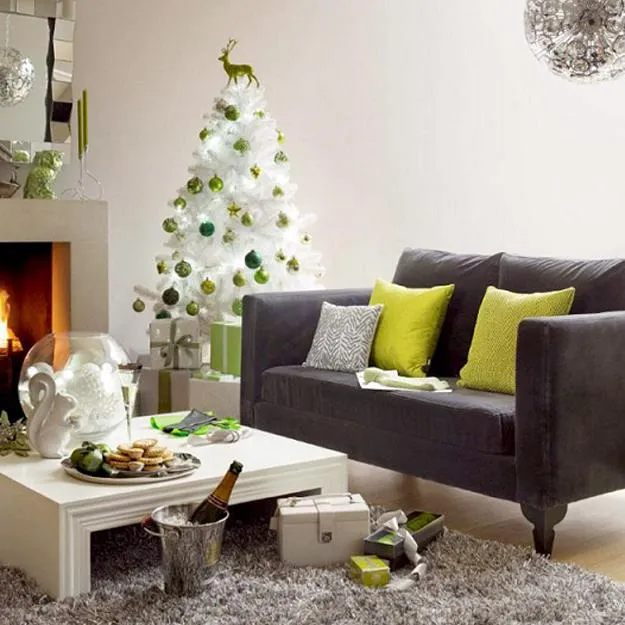
The chartreuse throw pillows on the dark grey sofa are what tie the whole room together — and they’re not on the tree at all. Without them, a white tree covered in green balls sits in a grey and white room and looks like it arrived in the wrong box. Those pillows pull the lime green off the branches and into the seating area, so the color feels like a decision instead of an accident.
17. Gold Glitter Ribbon and Dark Red Bows by Firewood
- Large gold glitter baubles, set of 12: $25–$60
- White and mercury glass ornaments, 40 pieces: $35–$90
- Gold metallic ribbon, two rolls: $16–$35
- Dark red and brown bows, 12 count: $12–$30
- Pre-lit 7.5-foot green tree: $220–$650
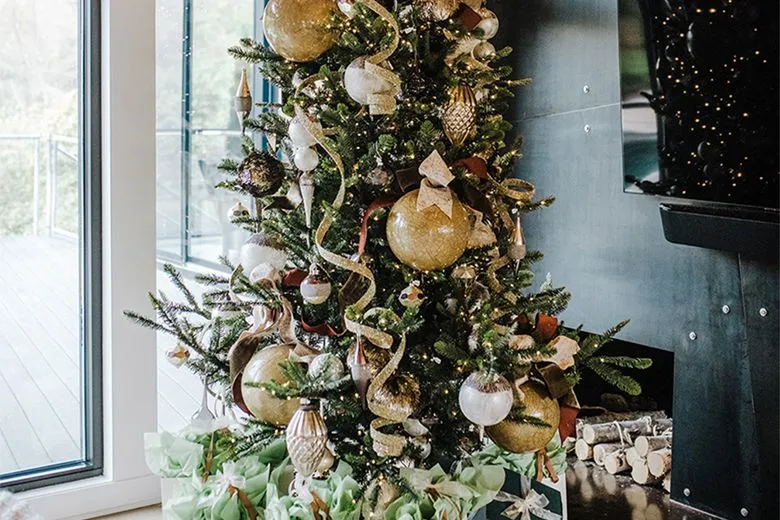
Total: about $308 to $865. Budget alternative: buy plain gold baubles and roll them in Mod Podge and fine glitter for roughly $12 a dozen — messy, but it’s an afternoon project with kids, which is its own kind of value.
Stacked firewood beside a dark grey fireplace is doing a lot of visual work in 2026 — it’s the texture story that replaced the blanket ladder of five years ago. It signals a real, used room rather than a styled one, which is exactly why gold-and-white trees look better in front of it than against a blank wall. The upside: firewood costs nothing if you have a woodpile.
18. Real Fir Tree with Red Candlelight on a Wooden Mantel
- Measure the mantel and space brass holders 8 to 10 inches apart.
- Choose tapers at least 10 inches tall so they clear the garland.
- Weave the lighted garland behind the holders, not in front — greens frame, they don’t block.
- Add red berries every 12 inches to repeat the tree’s color.
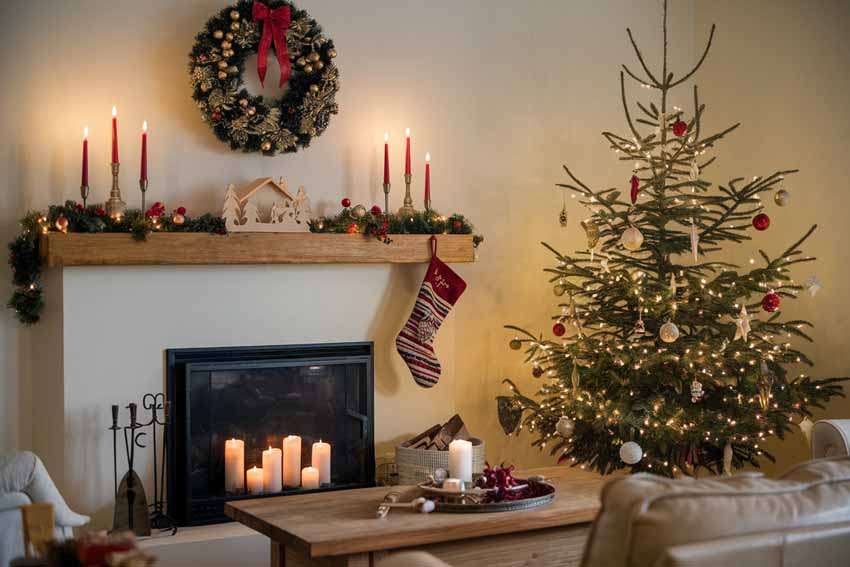
Time: about 30 minutes. Cost: roughly $30 for a lighted garland, $18 for a set of brass holders, and $10 for candles.
A real fir with fairy lights and simple red, gold, and white balls doesn’t need much, and the mantel is why. The garland, the candle stems, and the wreath with its big red bow all echo the tree using the same three colors at different scales. Repetition across a room is what makes a holiday scheme feel designed instead of merely decorated. Note how the wooden mantel shelf keeps the whole composition grounded.
19. Monarch Butterfly Ornaments Against Deep Olive Walls
Butterfly ornaments are usually fabric or feather, which means dust settles in and doesn’t wipe off — plan on a monthly pass with compressed air, and store them in a lidded bin with tissue between layers. Warm white lights against deep olive walls will reveal every bit of dust in the air, so a quick vacuum of the base area matters more here than in a pale room. Realistically, expect to replace a few wings each season.
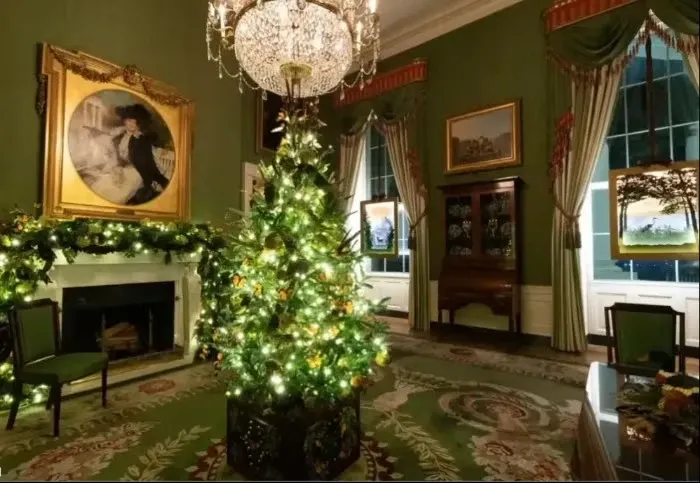
What makes this read as opulent is the ratio: roughly 55 percent deep olive and dark wood, 30 percent warm white light, 15 percent gold and yellow-orange from the butterflies and the crystal chandelier. The dark walls and traditional furnishings do the base work; the butterflies are the entire accent budget. Prefer a lighter mood? Switch to warm sage walls, keep the gold, and the formula survives.
20. Matte Gold, Red Baubles, and Clear Angel Accents
Clear angel ornaments are gorgeous and slightly cruel. They’re fragile, they catch fingerprints, and if you hang them where string lights sit directly behind, the material can look cloudy instead of luminous. Hang them at the outer tips with nothing behind them. Also budget for breakage: with kids or cats in the house, buy clear ornaments in multipacks rather than individually, because replacing one at $14 hurts more than it should.
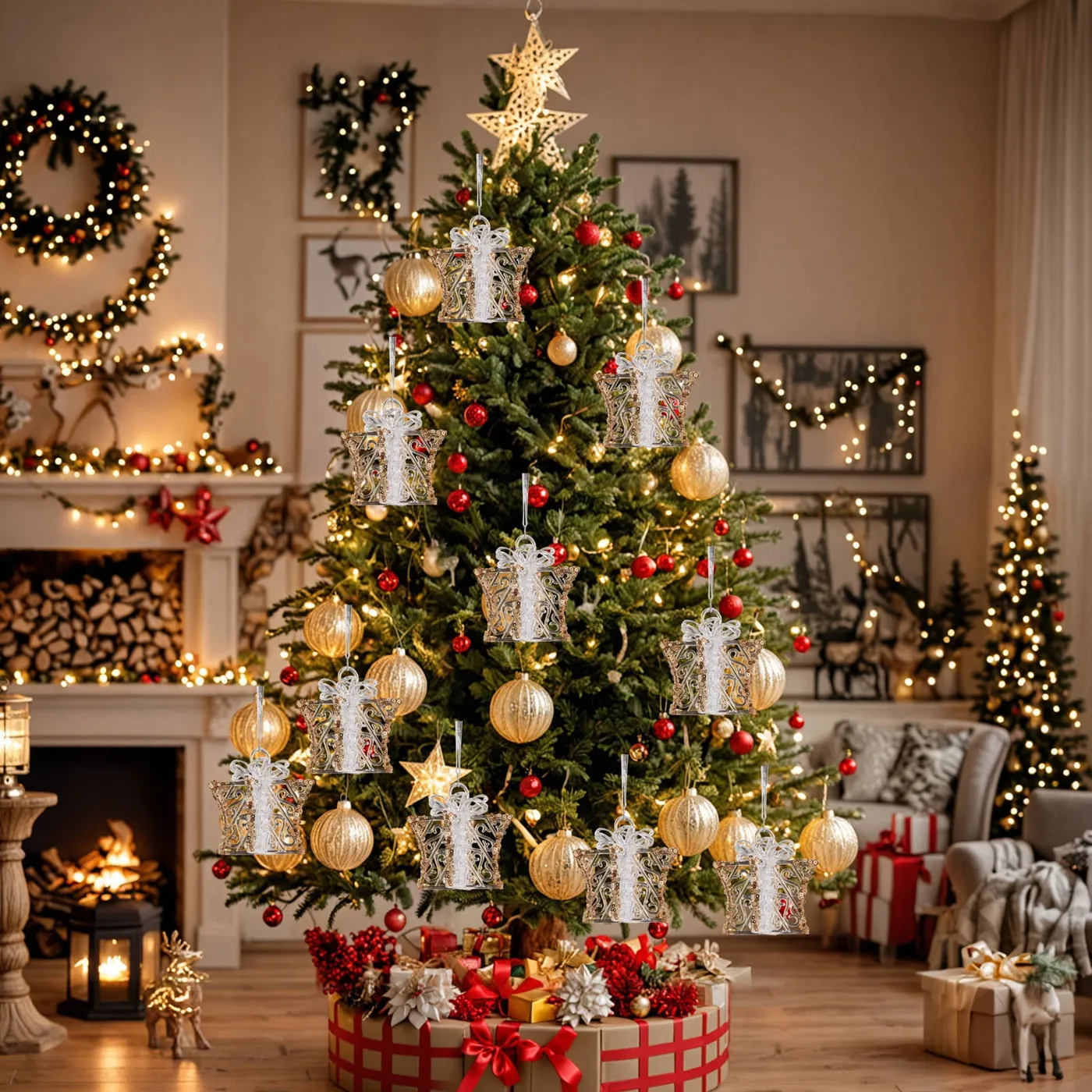
This classic ratio — red baubles, matte gold, clear accents — is the most forgiving scheme for a standard room. It works at any tree height from 6 to 12 feet because the palette never fights the architecture. Where it needs care is width: with a skirt full of gifts, keep 36 inches of walking space in front of the tree. Tighter than that, drop to a narrow profile and skip the oversized skirt.
21. Red Ribbon, Gold Starbursts, and a White Urn Base
The white urn-style stand is the most copyable part of this tree. A plain ceramic or resin urn from a garden center runs $25 to $60, and a plastic one from Walmart under $20 looks nearly identical once ornaments hide the top edge. Pair it with a thrifted white slipcover or a $30 stretch slipcover from Amazon and you get that crisp white-on-green contrast for a fraction of the designer price. Compare with Idea #11, which uses a patterned skirt for a completely different effect.
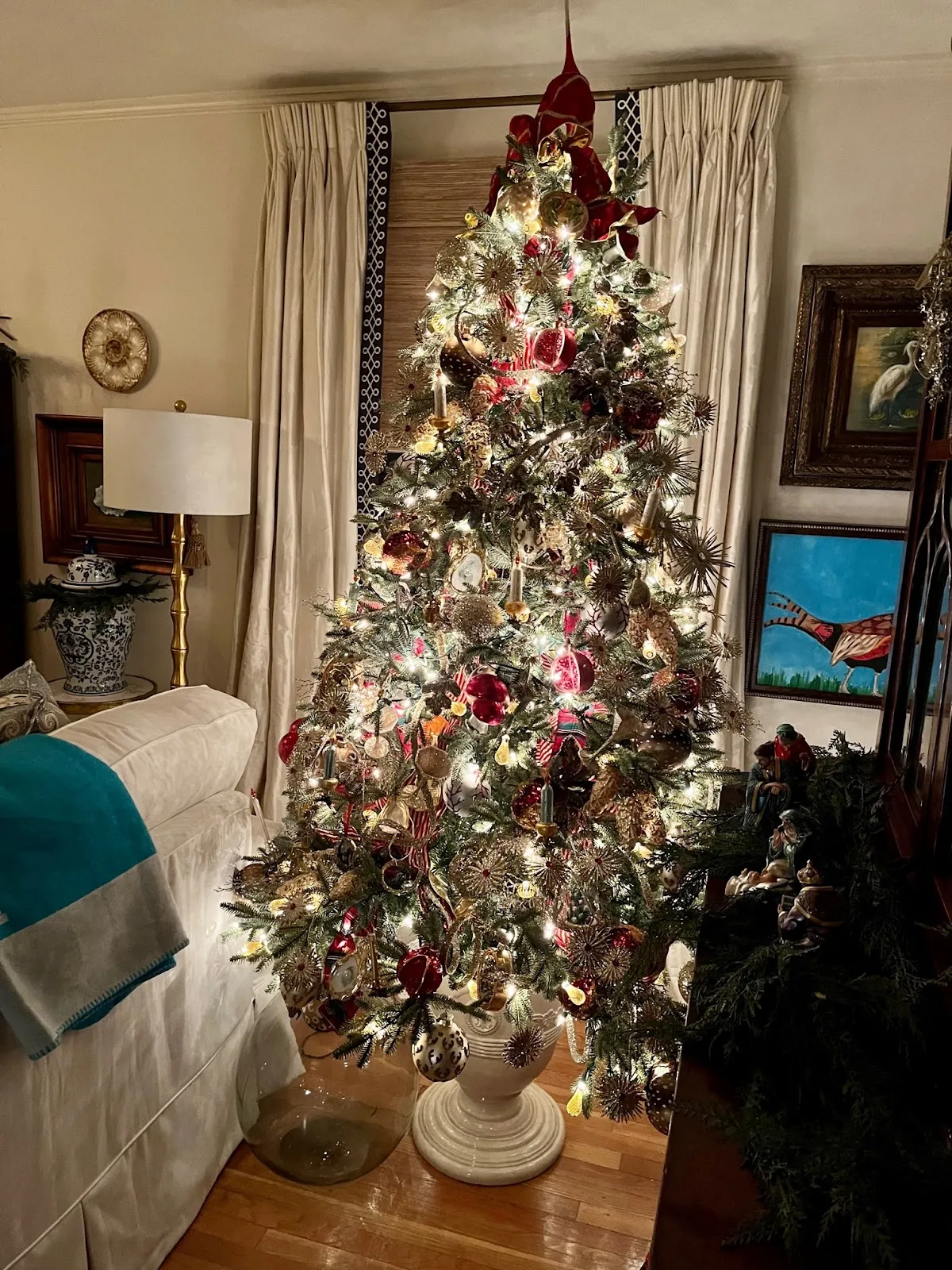
The white urn is the one thing. Swap it for a red skirt or a woven basket and this becomes a different design entirely — warmer, more casual, more farmhouse. The urn lifts the tree slightly, gives it a hard line where the branches meet the floor, and echoes the white sofa across the room. That echo is why the whole corner looks considered.
22. Eucalyptus, Pinecones, and Tiny White Houses
Fresh eucalyptus on a tree dries out in about two weeks and starts dropping leaves that crunch underfoot — lovely for a party, less lovely on December 28th. If you want the look to last the season, buy preserved eucalyptus or good faux stems and work them in from the trunk where they won’t get knocked loose. One more thing: little white house ornaments are heavy for their size, so hang them on thicker inner branches rather than the tips.
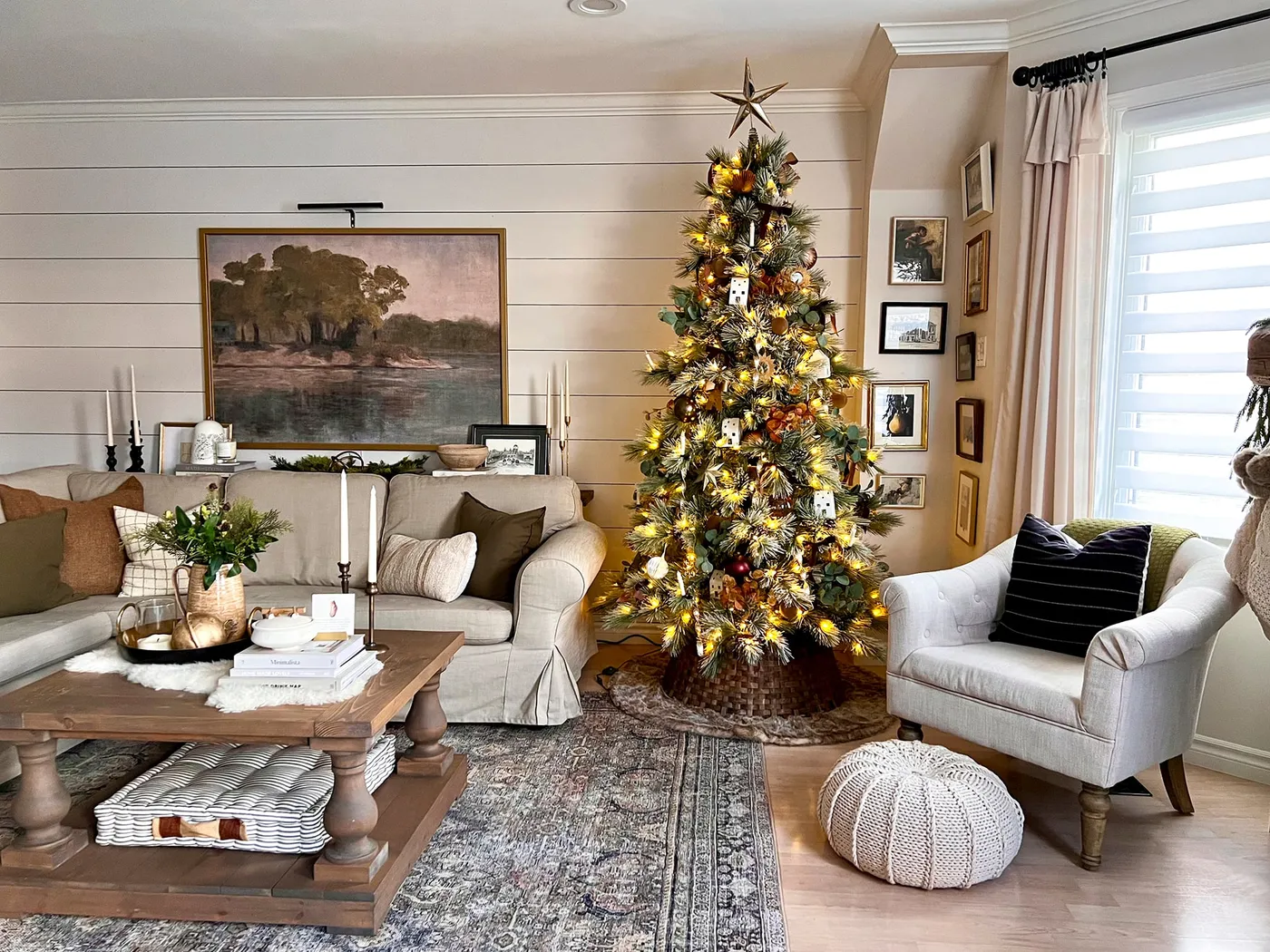
- Choose five to seven faux eucalyptus stems and separate them into single sprigs.
- Tuck each sprig a few inches in from a branch tip, angled outward.
- Cluster pinecones in threes near the eucalyptus so the textures read as one gesture.
- Hang the white house ornaments last, on sturdy inner branches.
- Finish with a woven basket collar instead of a fabric skirt.
Time: about 40 minutes. Cost: $25 to $40 for stems and pinecones you don’t already own.
23. Rainbow Matte Baubles with a White Reindeer
Six colors sounds like chaos, but matte finishes are what save it. Glossy baubles in pink, yellow, orange, blue, green, and purple would sparkle into a blur; matte ones hold their edges and let each hue register separately against the green branches. The white reindeer at the base does the same job a white urn does — it gives the eye a neutral anchor. Small white string lights keep the whole thing glowing rather than shouting, and the heart and candy-cane accents add a playful wink.
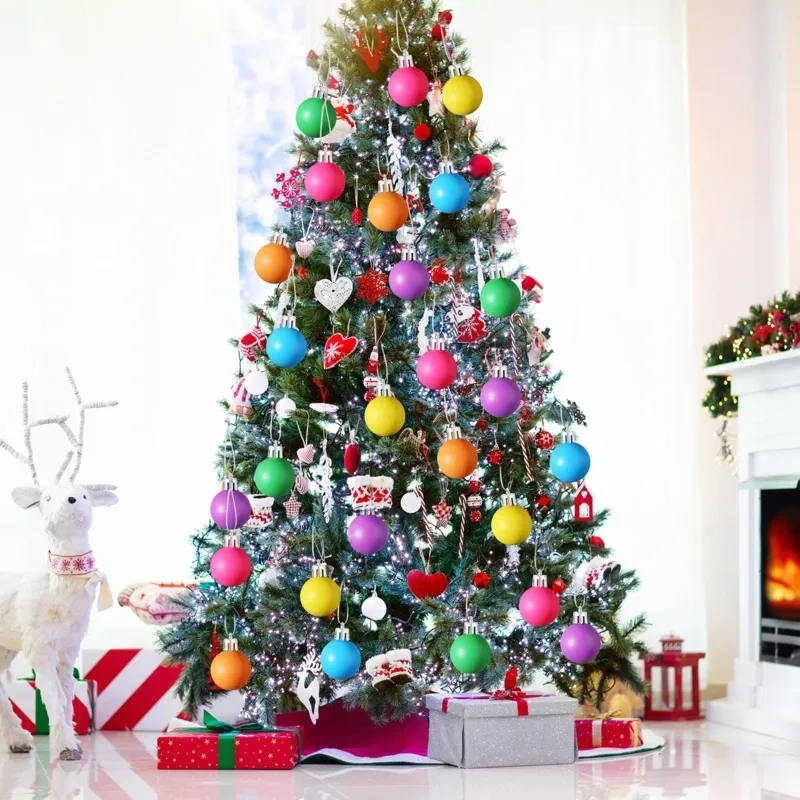
- Multicolor matte bauble set, 60 to 100 pieces: $30–$75
- White string lights, 300 LED count: $18–$35
- Heart and candy-cane accents, small set: $10–$25
- White decorative reindeer figure: $20–$60
- Green 7-foot artificial tree: $90–$300
Total: roughly $168 to $495. Budget alternative: three large bags of mixed matte balls from a dollar store, split by color — same effect for about $20.
24. Gold Ornaments and Red Bows Against a Full Bookshelf
The palette is simple — 60 percent warm white and cream, 25 percent green, 15 percent gold and red combined — but the placement is what makes it work. Because the tree sits in front of floor-to-ceiling bookshelves, the visual field is already busy, so the tree’s scheme has to repeat rather than introduce. Gold spheres and red bows are used at the same scale, roughly three inches across, so your eye reads texture instead of noise.
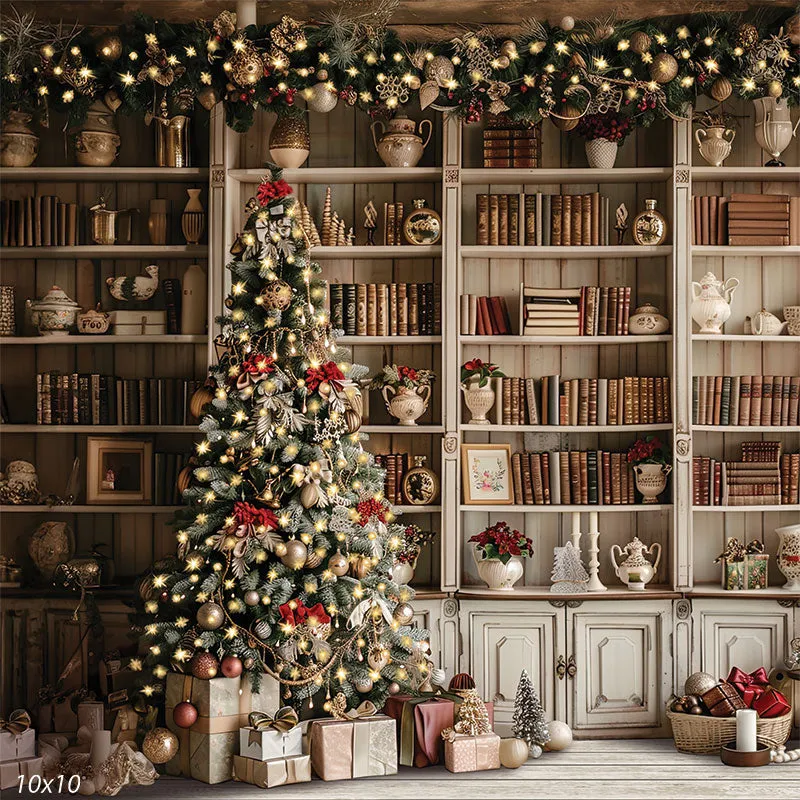
When a tree lives in front of a bookshelf, light the shelf, not just the tree. A continuous garland with warm lights running along the top shelf line throws the tree forward and turns the books into a backdrop instead of clutter. Keep the shelf garland ornament count low — gold balls every 10 inches and nothing else — so it never competes with the tree directly below it.
25. Striped Burlap Ribbon with Rose Gold Berry Sprigs
The rose gold berry sprigs are the detail that keeps this from being just another rustic tree. Natural pinecones and burlap give you warm, dull, matte texture; the metallic berries pick up the string lights and bounce them back with a pinkish glow. Without them, this tree is pleasant but flattens out. With them, it looks like someone who knows what they’re doing spent an hour on the details. The olive and red stripe in the burlap ribbon seals it.
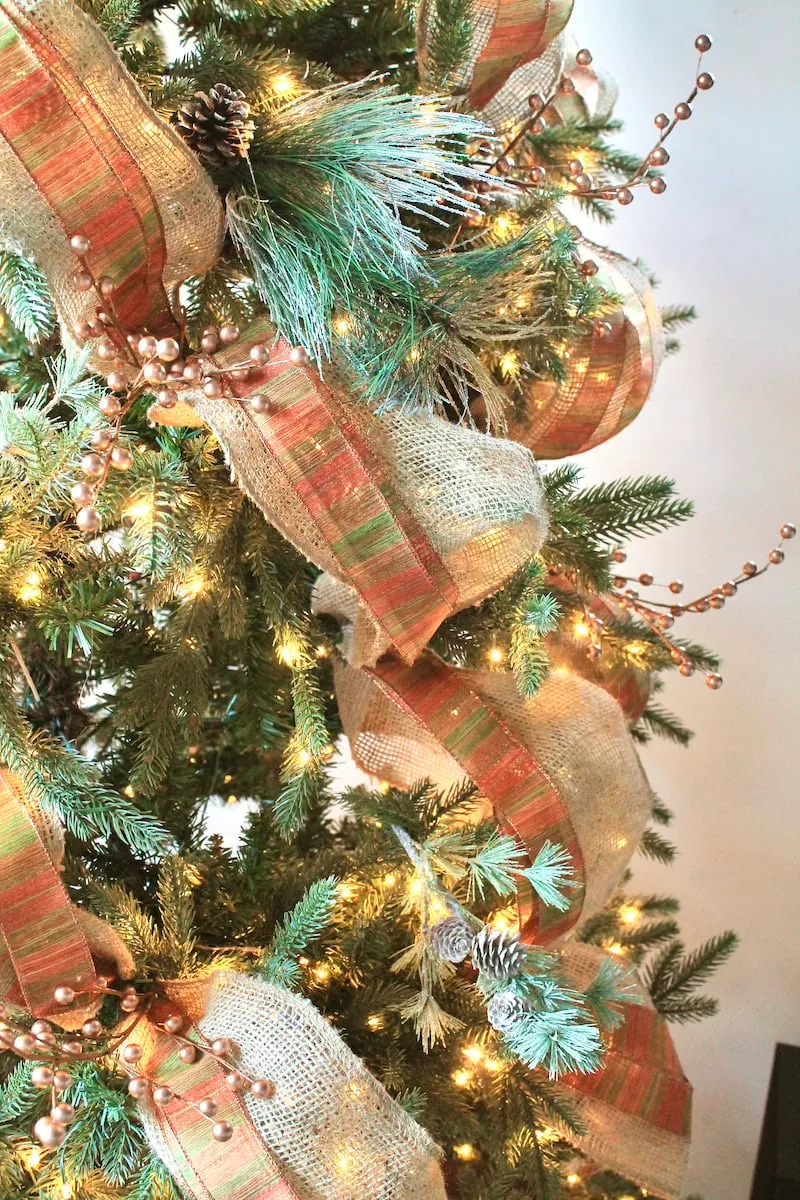
Striped burlap ribbon costs $10 to $25 for a 10-yard roll, and you only need two rolls for a 7-foot tree. You can also layer cheaper materials: a solid burlap roll with a narrow olive and red striped ribbon on top reads identical from three feet away. Frosted faux pine sprigs and pinecones are the cheapest part — many dollar stores carry bundles under $5, and rose gold berry sprays run about $8 for a dozen.
26. A Fruit and Greenery Centerpiece Tree on the Table
- Measure your table’s center third — the tree shouldn’t crowd place settings.
- Confirm the built-in depth: five to seven inches wide is the sweet spot.
- Choose fruits that won’t weep onto linens — citrus, apples, and pears hold best.
- Plan for height: keep it under 18 inches so guests can see across the table.
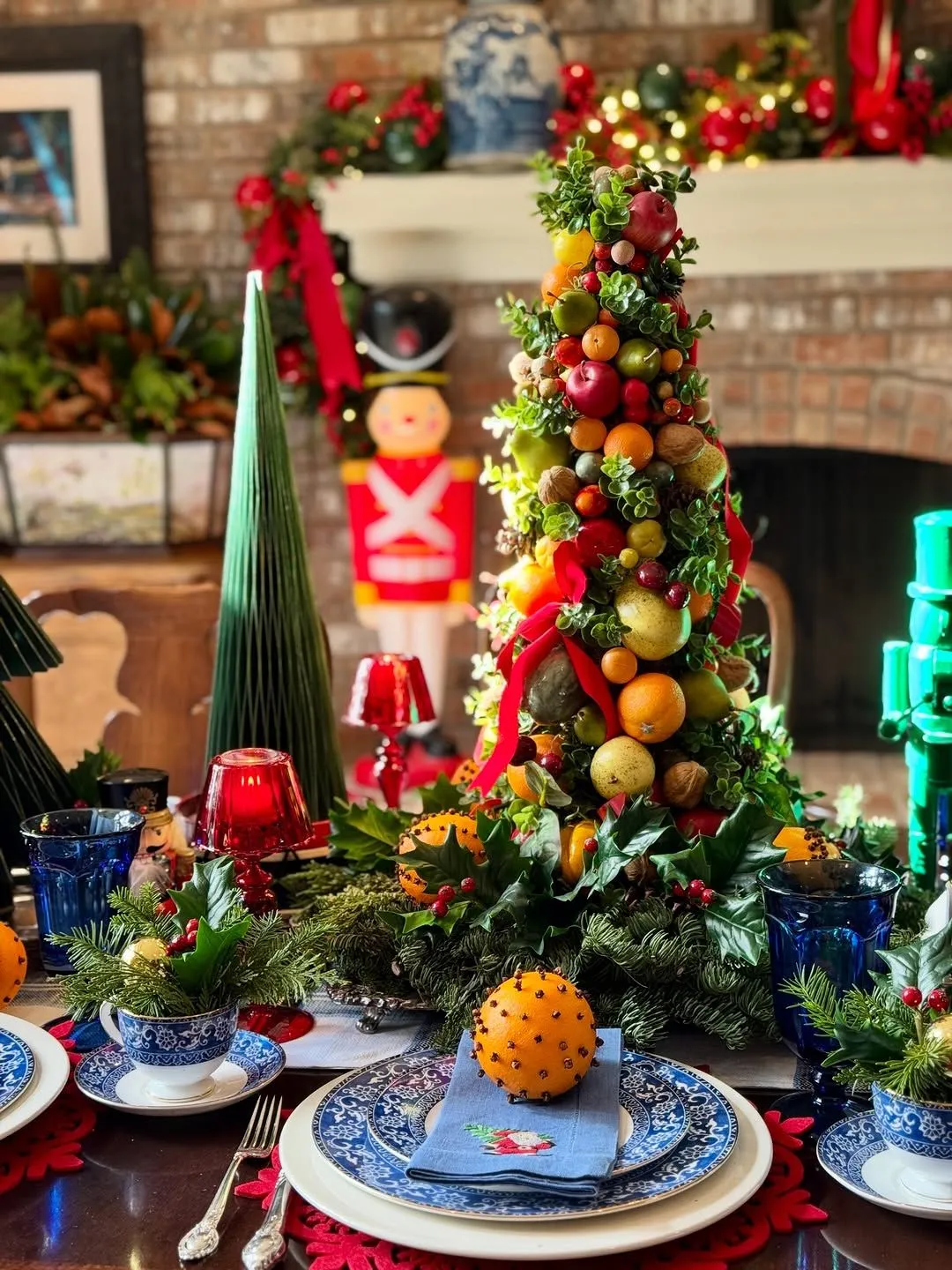
This tabletop concept works on dining tables 60 inches and longer. On anything smaller, the fruit-and-greenery tree crowds the plates and conversation dies. It also needs a room where the dining table is a focal point rather than an afterthought. If your holiday focal point is the living room tree instead, look at Idea #18 for a mantel-led alternative. Total footprint: about 14 inches across, including the red ribbon base.
27. Navy Velvet Poinsettias with Champagne Gold and Blush
Navy on a Christmas tree used to feel like a mistake. In 2026 it’s the palette people are saving most, partly because blue-and-white dinnerware, blue cabinetry, and blue painted rooms have been in the design conversation for several seasons, and partly because blush pink softens navy in a way gold never did. It’s luxurious without being red, which is exactly what a lot of people are hunting for. Expect this one to hold for another three or four seasons.
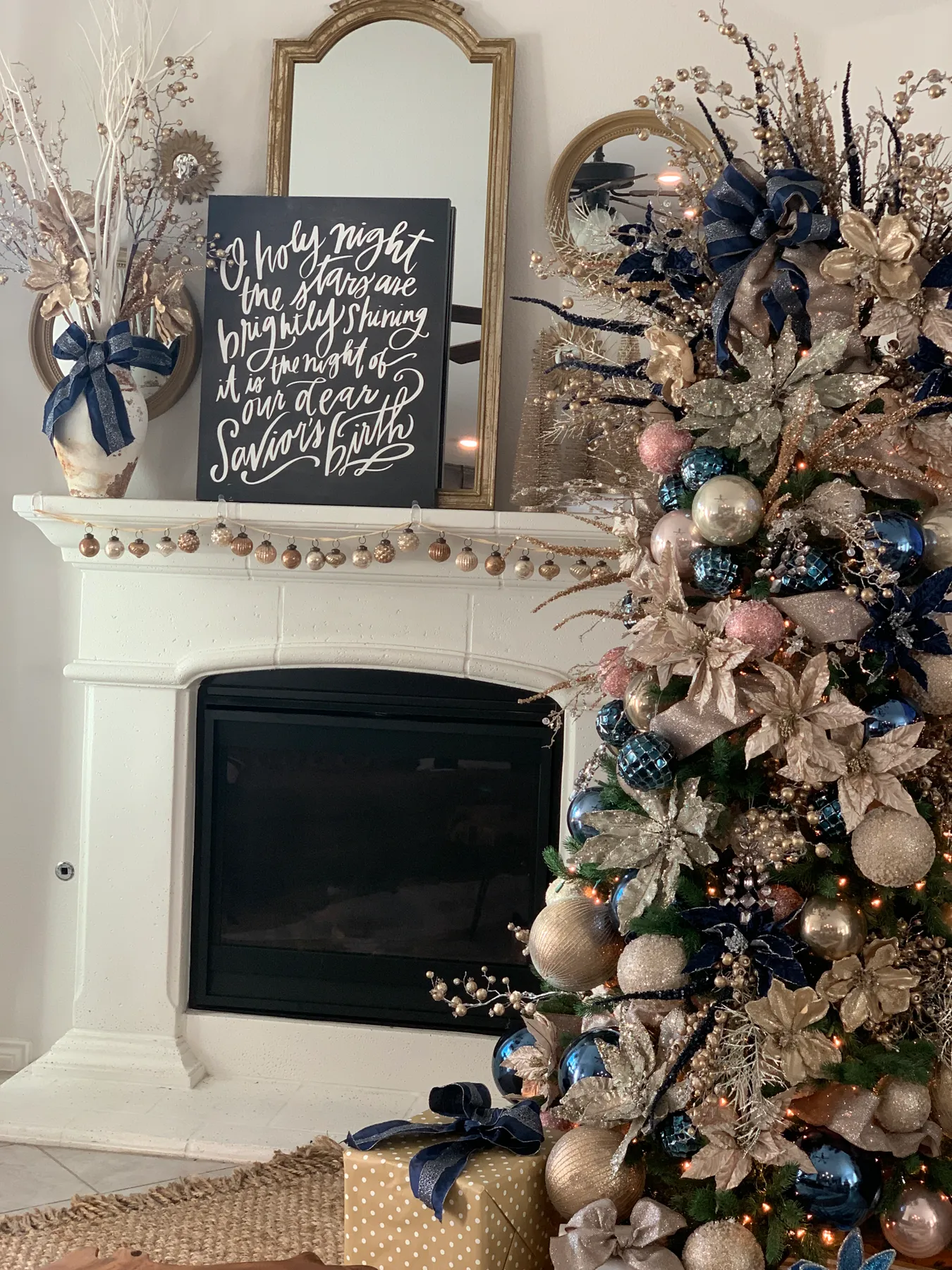
Velvet poinsettias and ribbons attract fuzz and pet hair like nothing else. A lint roller handles most of it and compressed air gets the crevices, but plan on a quick pass before anyone comes over. Glitter is the bigger commitment: loose glitter from ornaments and sprigs settles on the mantel and into fireplace tile grout within a week. Vacuum with a brush attachment, not a beater bar, or you’ll seed the whole room.
28. Gold and Silver Icicles Against a Mustard Yellow Wall
A warm wall changes how metals read. Mustard yellow sits close to gold on the color wheel, so gold ornaments blend into the wall while silver leaps off it. That’s fine — just weight the tree accordingly: roughly two silver ornaments for every gold one, or the gold disappears entirely. If you want the opposite effect, where gold glows and silver recedes, put a cooler backdrop behind the tree.
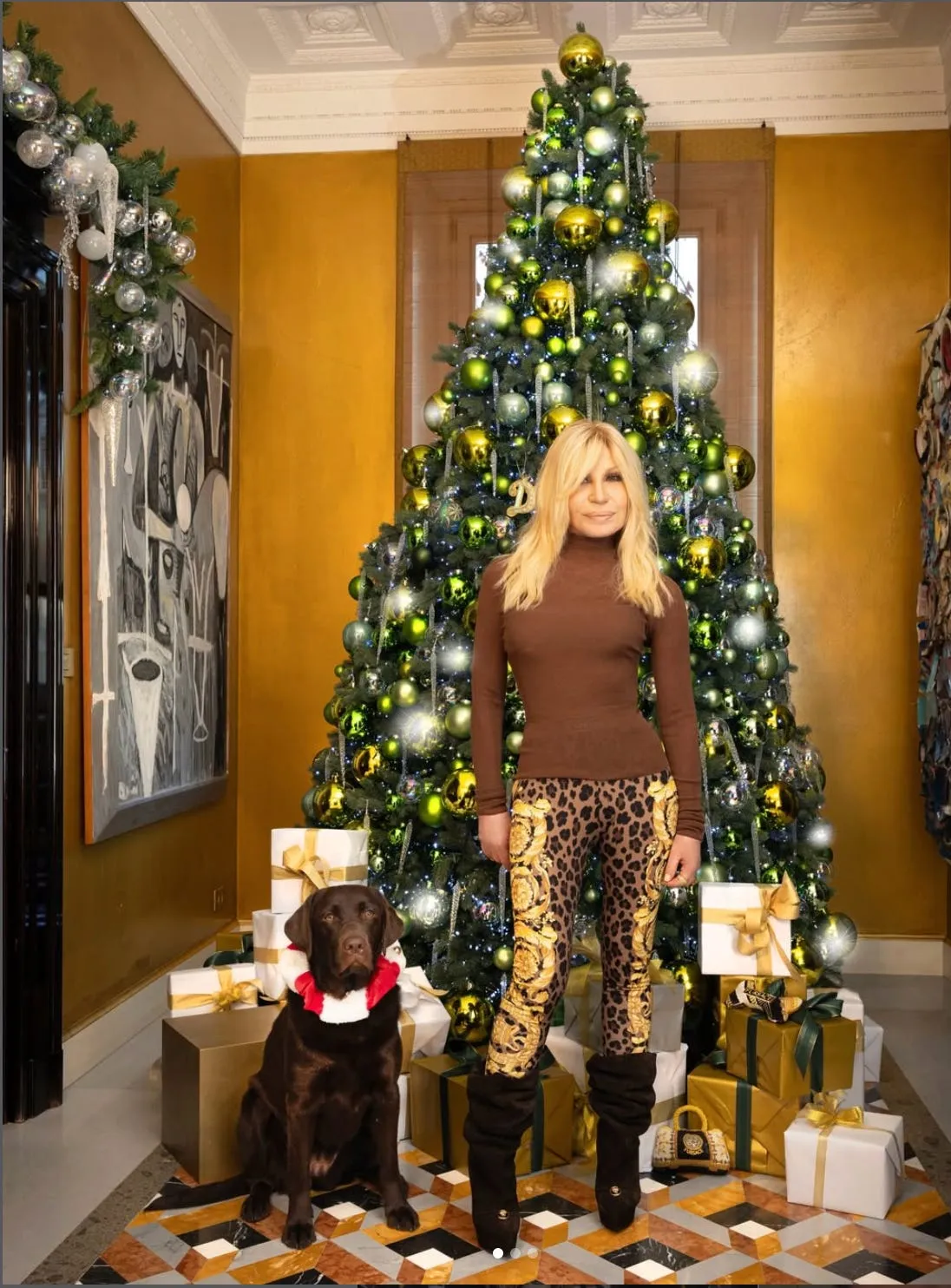
The formula is 45 percent green foliage, 30 percent metallic gold and silver, 15 percent white light, 10 percent warm wall. A saturated wall lowers the amount of ornament color a tree can absorb before it looks busy, so this tree treats metallics as neutrals rather than accents. Swap the wall to cream and you can triple the green ornaments without losing anything. Same tree, different room, entirely new mood.
29. A Heavily Flocked Tree in Front of Expansive Windows
- Flocked 9-foot artificial tree: $300–$900
- Warm white LED lights, 600 count: $30–$60
- Tree collar or metal stand: $35–$90
- Extension cords and a timer: $15–$30
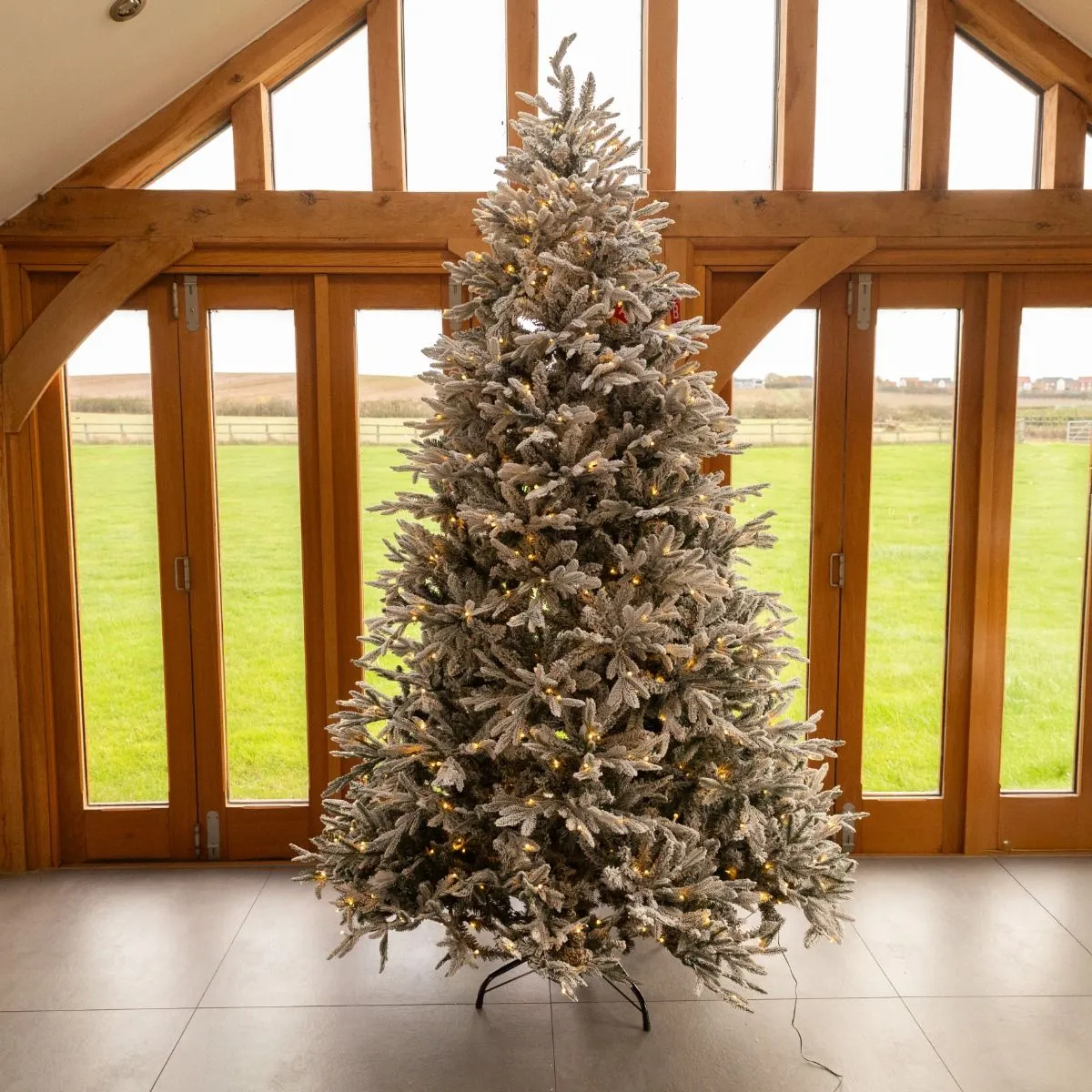
Total: about $380 to $1,080 for the full frame. Budget alternative: buy an unfrosted tree and a $12 can of spray snow, applied outdoors in light passes. It won’t match factory flocking up close, but in front of bright windows the difference disappears.
Backlighting is the catch. A tree in front of a large window looks spectacular after dark and washed out at 3 p.m. in December, when daylight pours in from behind. If that’s your setup, plan on a heavier ornament load for daytime and lean on the warm lights after sunset. Also check that cords reach an outlet without creating a trip hazard across a walkway.
30. Neutral Ornaments in a Dim Room with Dark Curtains
- Use one continuous color temperature — all warm white, 2700K, no exceptions.
- Layer three light sources: the tree, a floor lamp, and one small dimmable table lamp.
- Keep ornaments in cream, oatmeal, and soft bronze so they don’t vanish.
- Avoid high shine — matte finishes hold their shape when the room is dim.
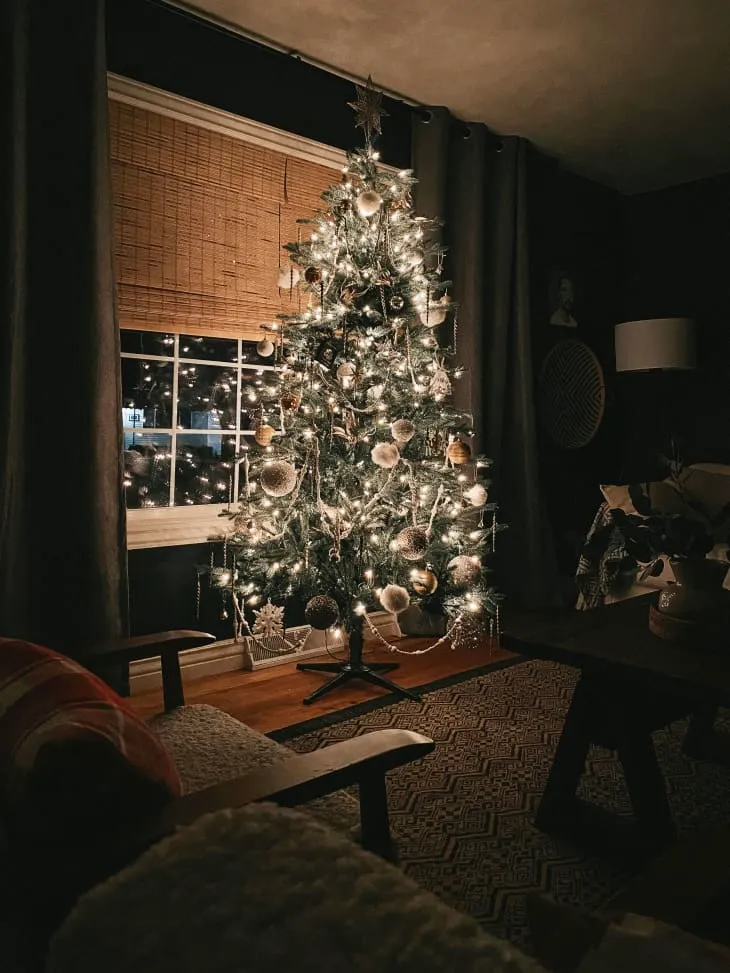
Time: one evening. Cost: $0 if you already own a lamp, or about $25 for a warm-white dimmable bulb set.
The string lights are the one thing, not the ornaments. In a room with dark walls, dark grey curtains, and a patterned rug, the ornaments are practically invisible until you’re standing right next to them — the tree is really a light fixture. That’s why the light count matters more than the decoration here: this tree carries at least twice the strand count of a bright-room tree, and the neutral ornaments exist to catch that light.
31. Golden Glitter Pinecones Tucked into Frosted Branches
Natural pinecones and glitter pinecones play different roles, so use both. Keep the natural ones deep in the branches where their brown texture blends, and put the glitter ones at the tips where they’ll catch and scatter the string lights. Cluster them in threes with slight size variation, and space clusters about 8 inches apart on a 7-foot tree. Nine to twelve cones total is plenty — any more and the tree starts looking like a forest floor.
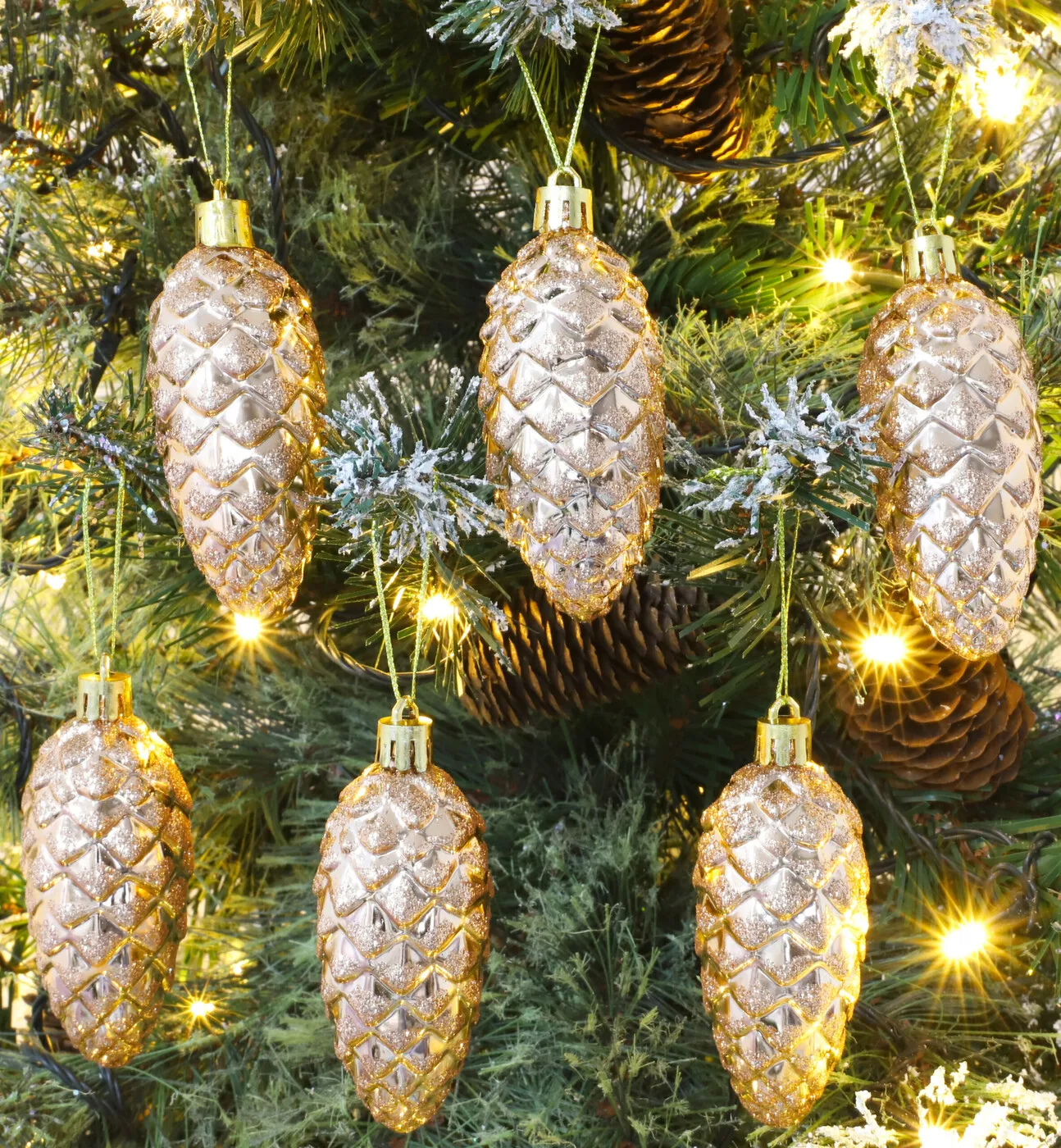
Frosted branches and glittered pinecones work together because one is matte and one is reflective. The flocking gives you a soft white field; the gold gives you hard little points of light that bounce back at the eye. It’s the same principle as pairing matte ornaments with mercury glass, just in a woodland register. A plain green tree with the same cones would read heavier and less wintry, because there’d be no white to set off the gold.
32. Flocked Tree with Sage Velvet Skirt and Rose Gold Ribbon
The sage velvet tree skirt is the piece nobody wants to pay retail for. Two yards of sage velvet or crushed panne from a fabric store runs $12 to $20, and a simple circle cut with a slit and a hook-and-loop closure takes twenty minutes. Same story with the black and white patterned ribbon — a $6 roll of gingham or houndstooth adds the graphic edge that makes the whole palette feel deliberate. Compare with Idea #8, which uses patterned ribbon the same way.
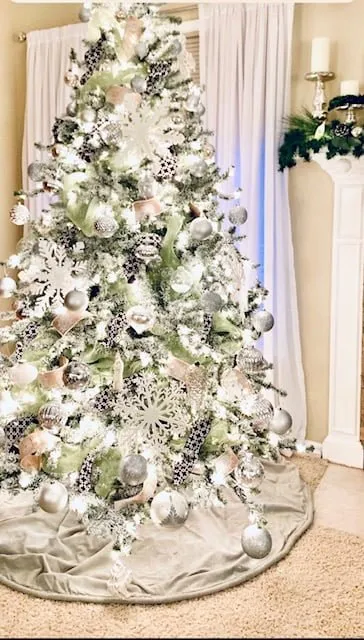
Three ribbons plus silver balls plus snowflakes plus flocking is a lot of visual information, and it needs a tree at least 7.5 feet tall to hold it without looking crammed. Below that, drop one ribbon — the black and white pattern is the one to lose in a small room, since high contrast makes tight spaces feel tighter. This look also wants floor space: 3 feet of clearance on all visible sides so the velvet skirt sits flat.
33. A Small Evergreen Dressed Only in Clear Crystal
The monochrome discipline is the one thing. A small, dense evergreen with nothing but clear faceted teardrops and a matching clear topper on a wooden stand — no color, no garland, no ribbon — works because every ornament does the same job: it catches whatever light exists in the room and throws it back. Add even one red ball and the spell breaks. The eye goes straight to it, and the crystal stops reading as one continuous sparkle.
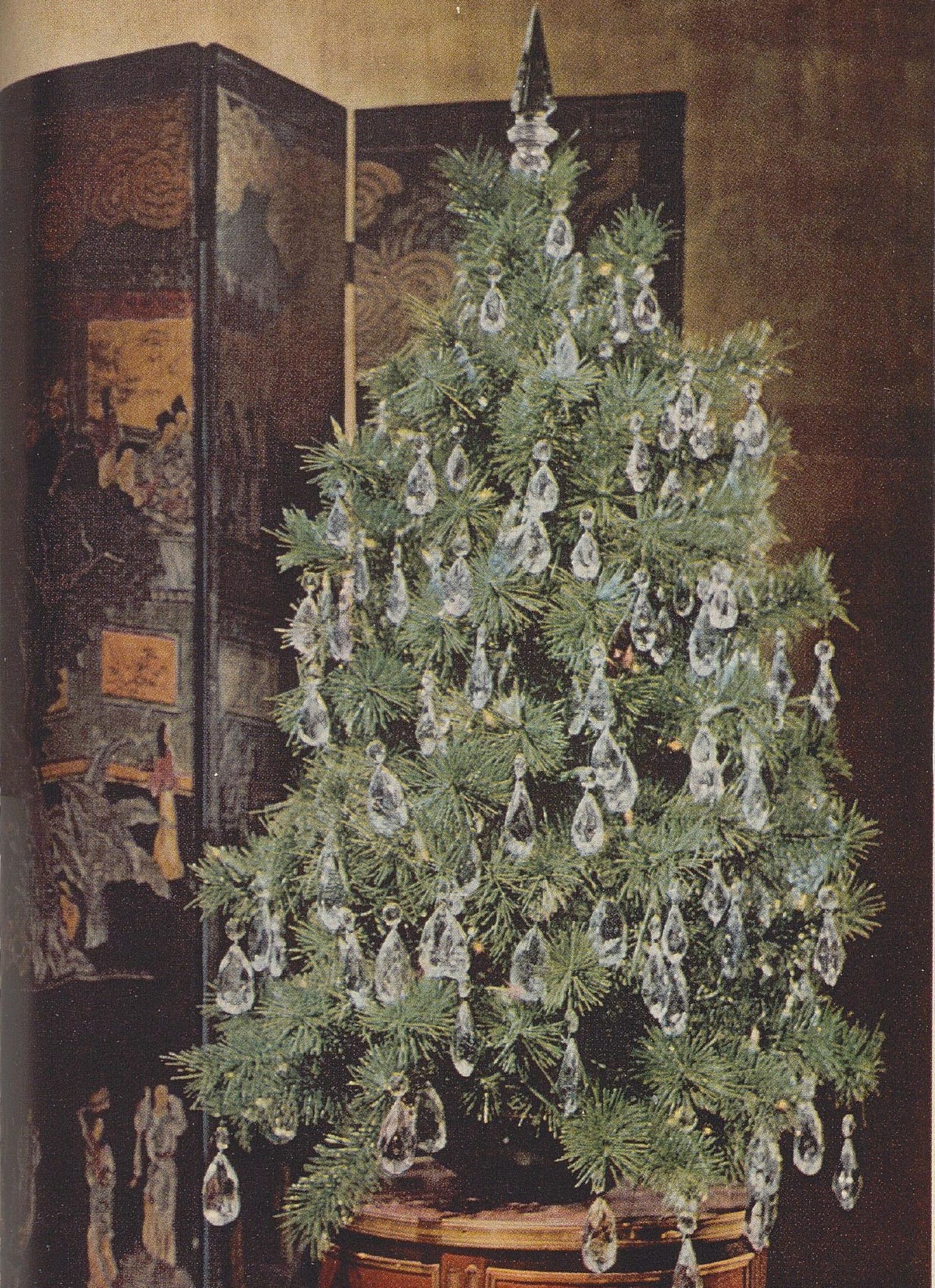
- Confirm the tree will sit against a dark backdrop — the folding screen here is doing real work.
- Count your clear ornaments: you need roughly four times the usual density.
- Check that your light strand is warm white, not cool, or crystal reads icy and clinical.
- Clear faceted teardrop ornaments, 40 pieces: $30–$70
- Clear pointed tree topper: $10–$25
- Small dense evergreen tree, 4 to 5 feet: $50–$180
- Round wooden stand or bucket: $20–$45
Total: $110 to $320. Budget alternative: dollar-store clear ornaments look nearly identical grouped this densely — nobody inspects facet quality from across the room.
34. Bare Multi-Tone Green Branches on a Metal Stand
Even an undecorated tree has a color formula: roughly 70 percent deep forest green, 25 percent lighter lime-green tips, 5 percent dark metal from the stand. The multi-tone needles are what make a bare tree look alive rather than plastic — the lighter tips catch room light and give the silhouette depth. If you plan to decorate it later, that gradient means your ornaments should skew slightly lighter to stay visible against the dark interior branches.
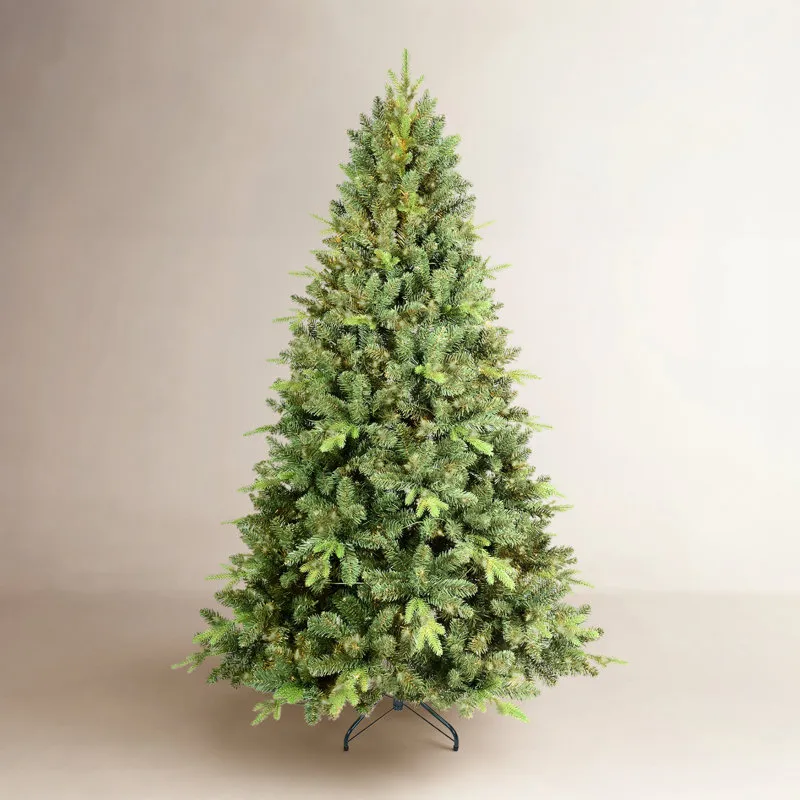
An undecorated tree is a commitment to restraint that lasts about nine days. Once gifts appear and someone hangs a single sentimental ornament, the effect is gone. If you want the sculptural look to survive the season, put the ornaments on a separate small tree or a wreath instead and keep this one strictly bare. Also worth knowing: unlit trees read as artificial under evening lighting, so a warm uplight aimed up through the branches helps a lot.
35. Two Evergreen Spruces Strung with Warm White Lights
Hide the wire and the lights do more work. The blue-cord strand is visible here because it’s wrapped around the outside of the branches — flip the technique by tucking the strand in along the trunk first, then bringing it out to the tips only on every third branch. On a 6-foot tree, that’s roughly 300 lights placed rather than wrapped, and the glow reads twice as deep for the same wattage.
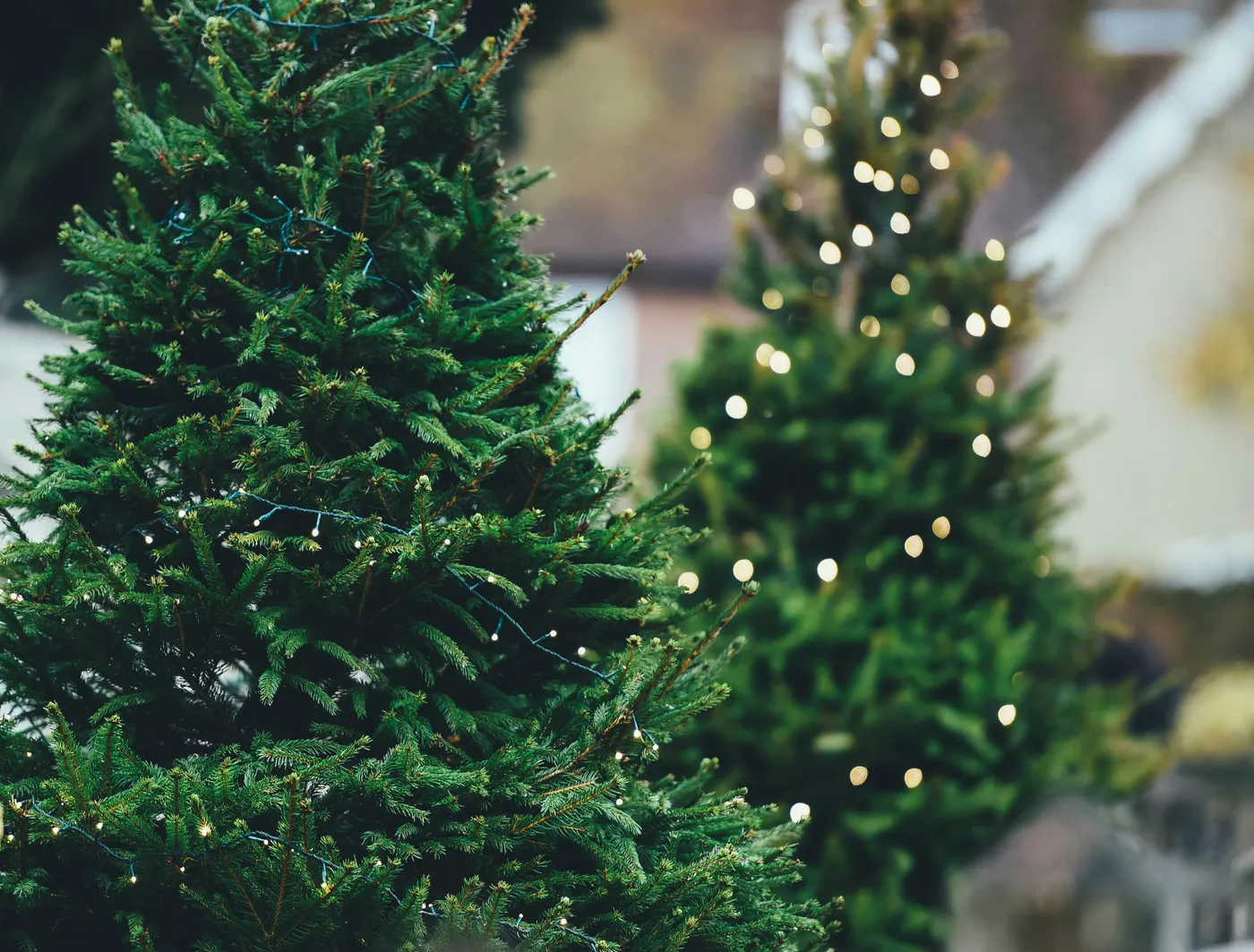
Pairing two trees at different depths is a small-space strategy that caught on as apartment living rooms got smaller — one real focal tree instead of a giant one, plus a second at a different distance to build depth. It also solves the “my tree is too wide for this corner” problem without giving up the tradition. Two 5-foot trees cost less than one 8-foot tree, and you get two color stories instead of one.
Pick a Color Story, Then Let the Tree Do the Rest
Whether you go full crimson-and-gold or strip it back to nothing but clear crystal, the trees that actually work are the ones where someone picked a palette and repeated it three times — ornaments, textiles, and gifts all speaking the same language. Start with the color story, then buy ornaments, and everything else falls into place.
📌 Pin this guide for later — next December you’ll be glad you didn’t start from scratch.