Still scrolling Christmas tree photos at 11 p.m., saving screenshots you’ll never open again? That’s how most of us decorate — collecting a hundred ideas and freezing the moment it’s time to hang the first ornament. We spent weeks browsing Terrain, Anthropologie, Target, West Elm, and Amazon to narrow it down to 35 elegant Christmas trees for 2026 that actually translate to a real living room. Everything here sits between $18 and $1,450, so there’s a version for a studio apartment and a version for a double-height foyer.
You’ll find quiet-luxury neutrals, nostalgic vintage red, pastel-blue whimsy, and frost-and-gold glamour — with budget and luxury takes compared side by side. And 2026 is the year of the quieter tree: flocked branches, warm-white LEDs, and shoppers searching “un-ornamented tree” more than ever before. And stay until the end — we break down the most common mistakes that can ruin these looks.
📌 Save this to Pinterest for later — you’ll want to revisit these ideas.
1. Velvet, Rattan, and Kraft Paper: Quiet Minimalism
A tall, sparse fir dressed only in rust and cream velvet balls, tiny gold stars, and pinecones — that’s the entire ornament story, and it’s enough. What holds the look together is the woven rattan basket sitting where a tree skirt would normally go. Take it away and the tree stops reading as deliberately minimal and starts reading as unfinished. The basket gives the base weight, echoes the brown kraft paper packages tied with velvet ribbon, and picks up warm texture against the white plantation shutters behind it.
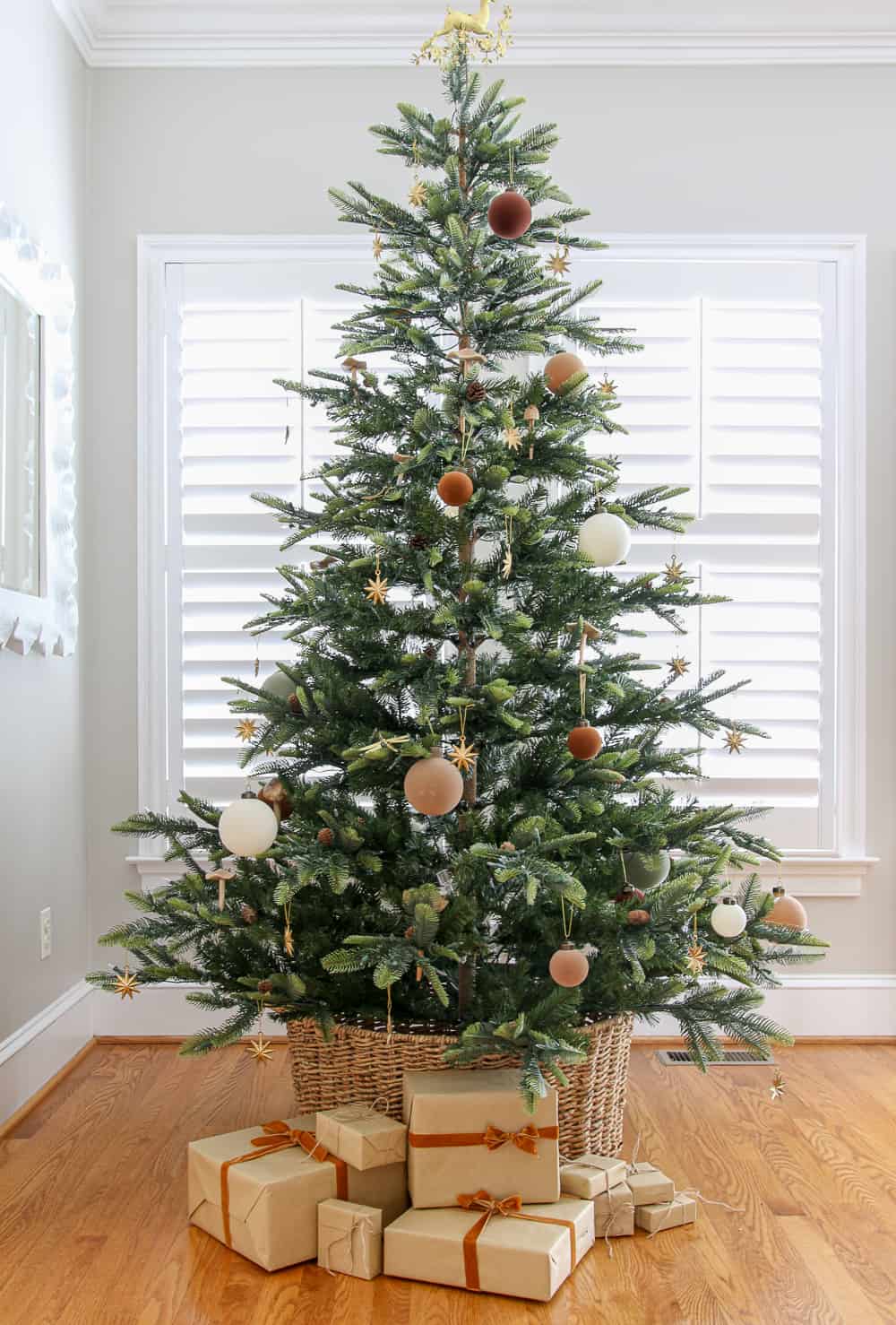
You can build almost this exact tree for under $120. The velvet ornaments are the one splurge worth making — Target’s Threshold line does velvet-finish balls in rust and cream for around $12 for a set of six, and IKEA’s VINTERFINT stars run about $6. For the collar, skip the $80 designer versions and hunt a wide woven basket at a thrift store or on Facebook Marketplace — anything 18 to 22 inches across will hide a standard tree stand. Wrap your gifts in plain kraft paper and tie them with ribbon you already own.
2. Vintage Santas Against a Moody Navy Wall
Two things make this tree feel theatrical instead of cluttered. First, the backdrop — moody navy walls and distressed wooden doors turn a busy red-and-green tree into a staged still life rather than a corner decoration. Second, the density is deliberate: beaded red garlands, vintage Santa figures, and red-and-white baubles packed tight enough that you can’t see daylight through the branches. A crystal chandelier and flickering pillar candles add a second, higher light source, so the tree glows from two directions instead of one.
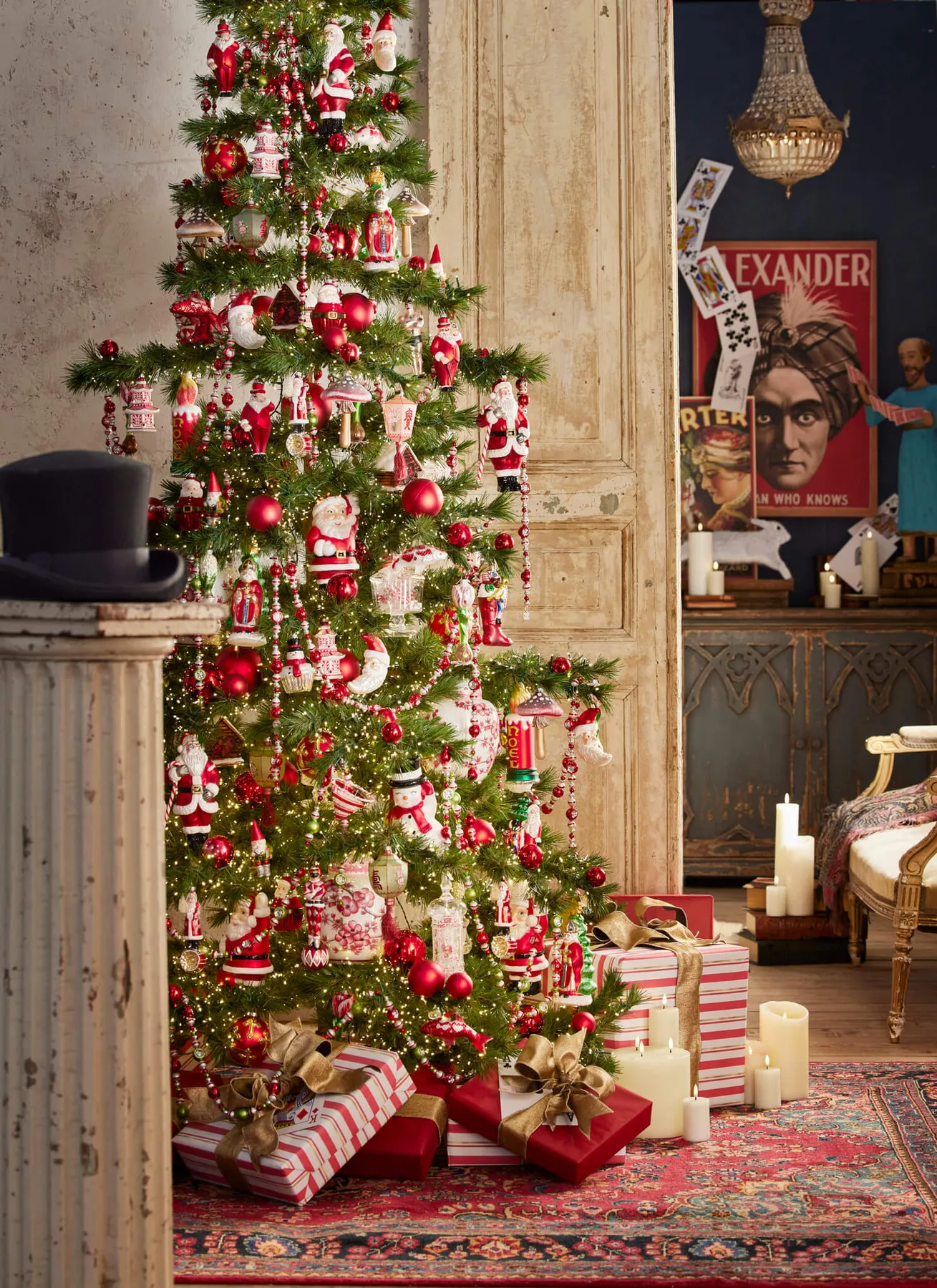
heavily loaded trees need a sturdy frame. If yours has thin wire branches, cluster ornaments near the trunk where the branch is strongest and save the heirloom pieces for the outer third. And if those candles are real flames near dry branches, swap them for flameless tapers with a warm 2200K glow — you keep the atmosphere without the fire risk. Store glass ornaments in divided boxes; attic heat is what cracks them, not the dropping.
3. Sage Green Dining Room with Pink Taper Candles
- Main furniture (round table plus four twisted metal chairs): $600–$1,800
- Lighting (branch-form candelabra plus pink taper candles): $120–$450
- Textiles (beige tablecloth, patterned chair cushions): $80–$250
- Decor (silver and glass ornaments, evergreen picks): $90–$300
- Paint (sage green panel walls, two coats plus trim): $120–$400
- Total: roughly $1,010 to $3,200
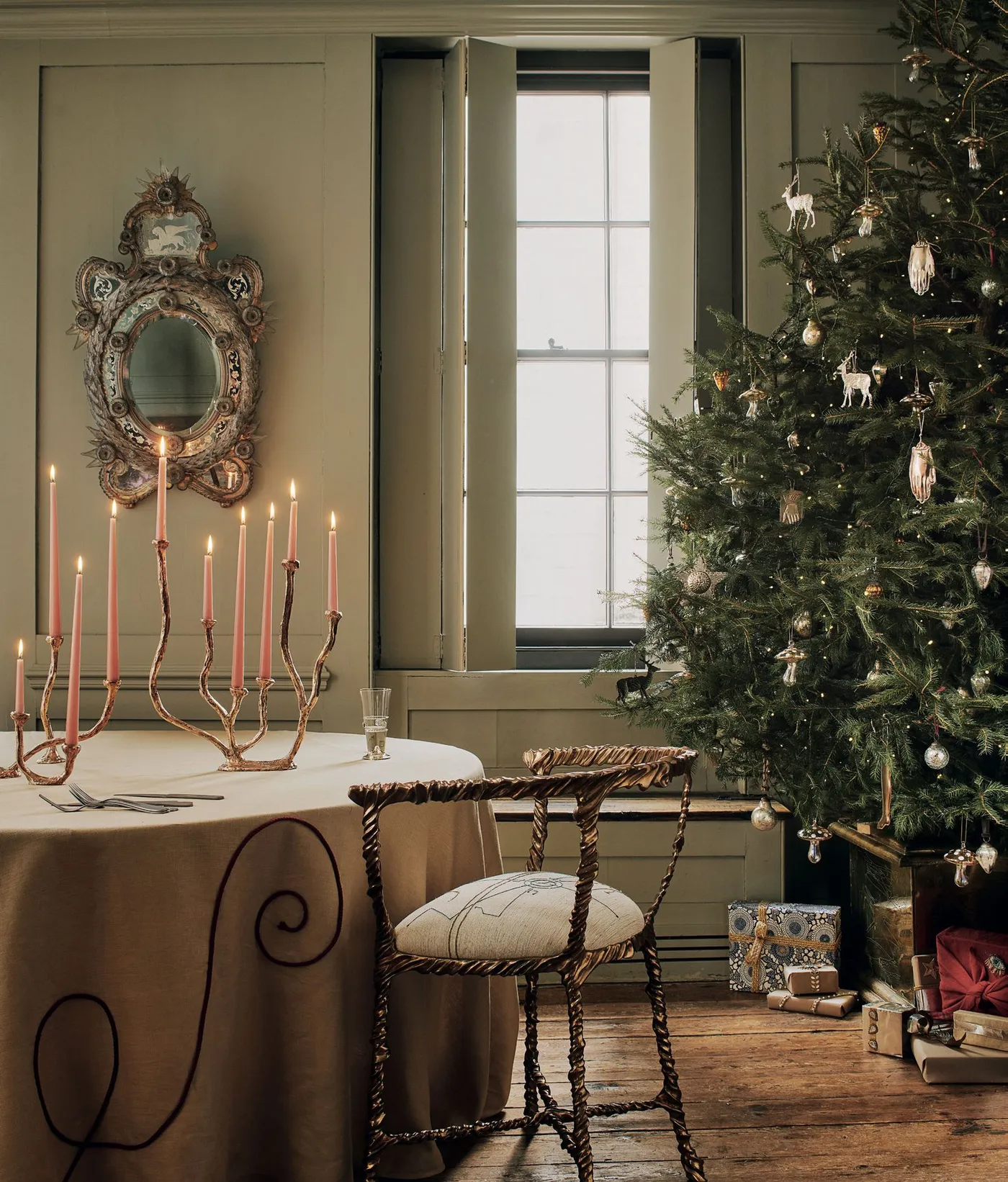
Budget alternative: paint only the lower panel section in sage and leave the upper wall neutral. Source the candelabra secondhand, and buy glass ornaments in mixed lots rather than boxed sets.
Here’s the trick that makes delicate ornaments read expensive: hang them in clusters of three at varying depths — one tucked 4 inches into the branches, one at mid-depth, one near the tip. Silver and glass lose all their impact when they sit in a flat ring on the outer branches, because flat reads cheap. Also match your candle color to a secondary note in the room — those pink tapers echo the blush in the chair cushion fabric, which is what makes the table feel styled rather than assembled.
4. Frosted Tree in the Corner, Fireplace Doing the Rest
The formula here is 70% frosted white and cream, 20% warm beige and natural wood, 10% soft gold. That last 10% does all the work — it shows up in the candle flames, the mirror frame, and the faint warmth of the string lights, and it’s what keeps an all-white tree from going cold and clinical. Swap the gold for brushed silver and the room turns alpine; swap the cream armchair for camel leather and the whole thing gets cozier and more lodge-like. The ratio holds either way.
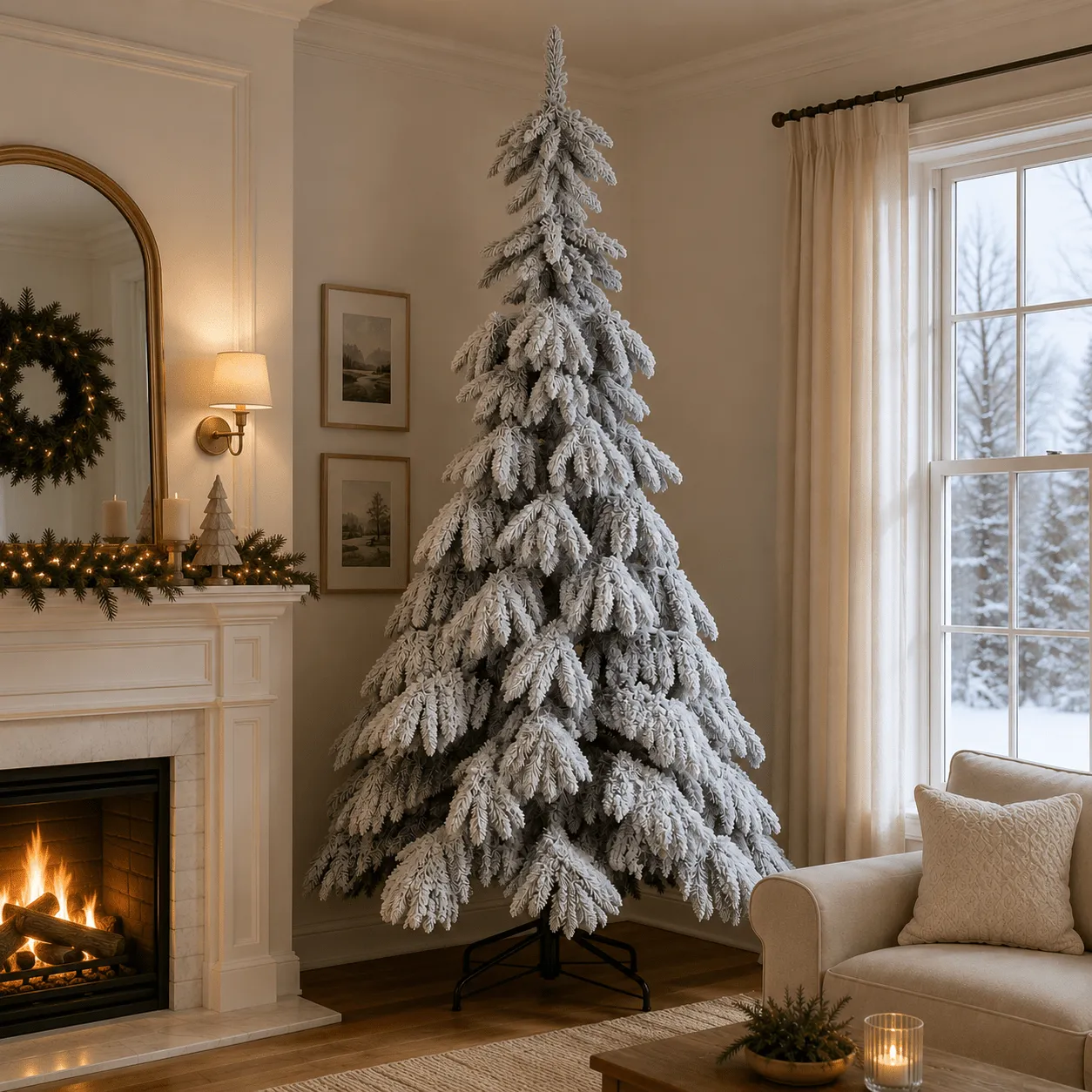
This arrangement needs a real corner. Plan on at least a 9-foot ceiling and a tree in the 7.5 to 9-foot range, so the frosted tips sit below the crown molding but still fill the vertical space beside the mantel. The room wants 12 by 14 feet minimum, because you need roughly 30 inches of walkway between the tree and the armchair. In a tighter space, go shorter and wider — an 8-foot tree with a full base. Compare with Idea #16, which solves the same problem with a slender silhouette.
5. Frosted Branches with Black-and-White Flower Punches
Strip away the black-and-white floral picks and the patterned ribbon and this tree is just another frosted neutral — pretty, forgettable. Those graphic black accents are the entire personality: they give the eye something crisp to land on between all that soft cream, and they tie the tree back to the neutral sofa and dark accents in the room. It’s a lesson in restraint. You don’t need a new color scheme, you need one high-contrast element repeated on a steady rhythm.
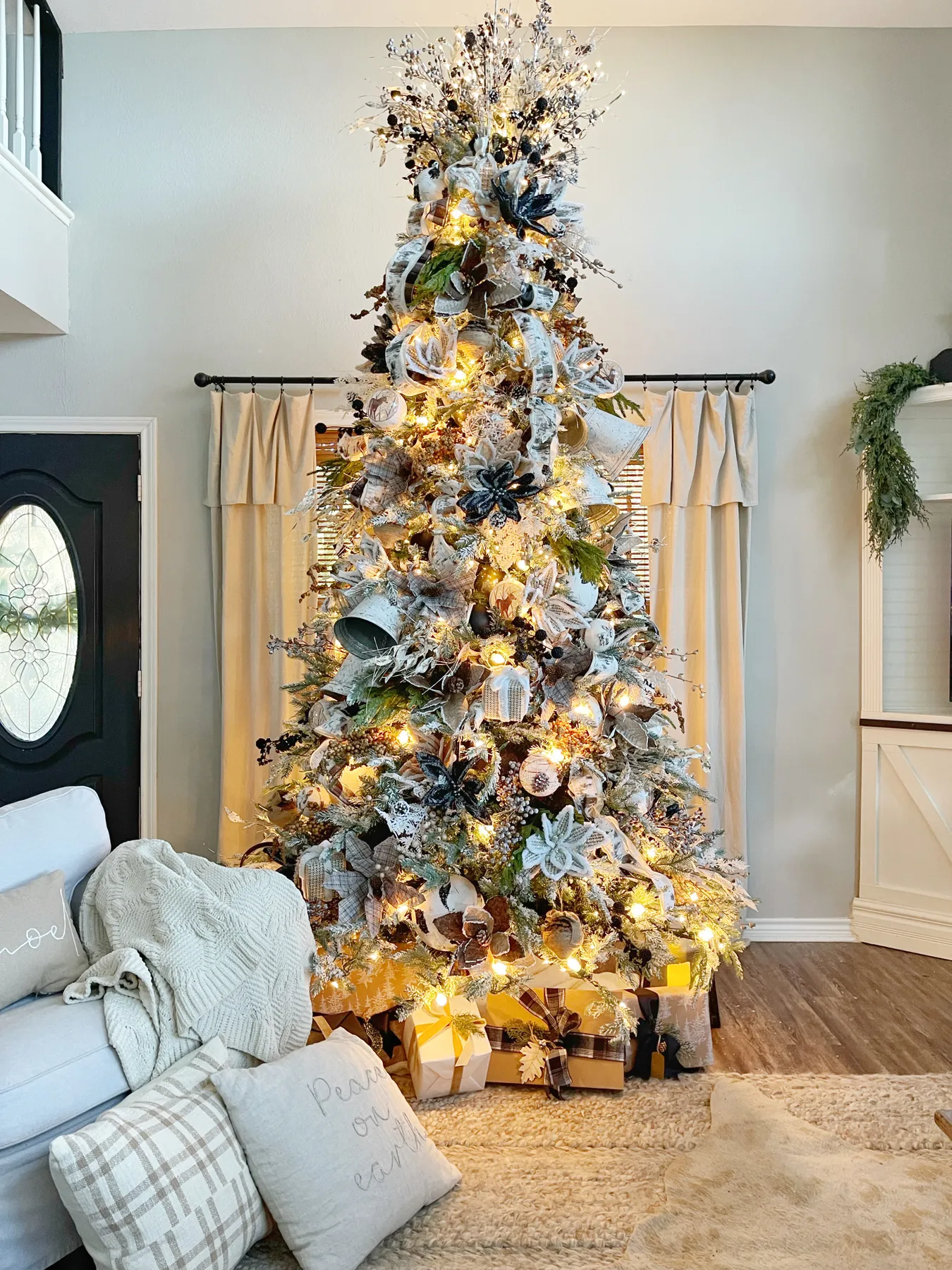
Flocking is essentially glue and powder, and it sheds. Expect a light dusting on the floor every time you move the tree, and vacuum with a brush attachment rather than a beater bar. Keep it out of humid basements — moisture makes flocking go tacky and yellow within a season. Wipe ornaments with a dry microfiber cloth, never water. An unadorned tree with a soft skirt gets you the same quiet softness without the yearly cleanup.
6. A Slim Tower Tree Built for a Grand Foyer
This is a tree for architecture, not for a living room. You need at least a 14-foot ceiling, ideally 18 to 20 if you want the tree sitting under the chandeliers rather than beside them. A slim silhouette — 28 to 32 inches wide, 10 to 12 feet tall — fills that vertical volume without blocking the mirrored panels or the marble inlay. In a standard 8-foot entry, the same concept works at 6.5 feet with a 22-inch width.
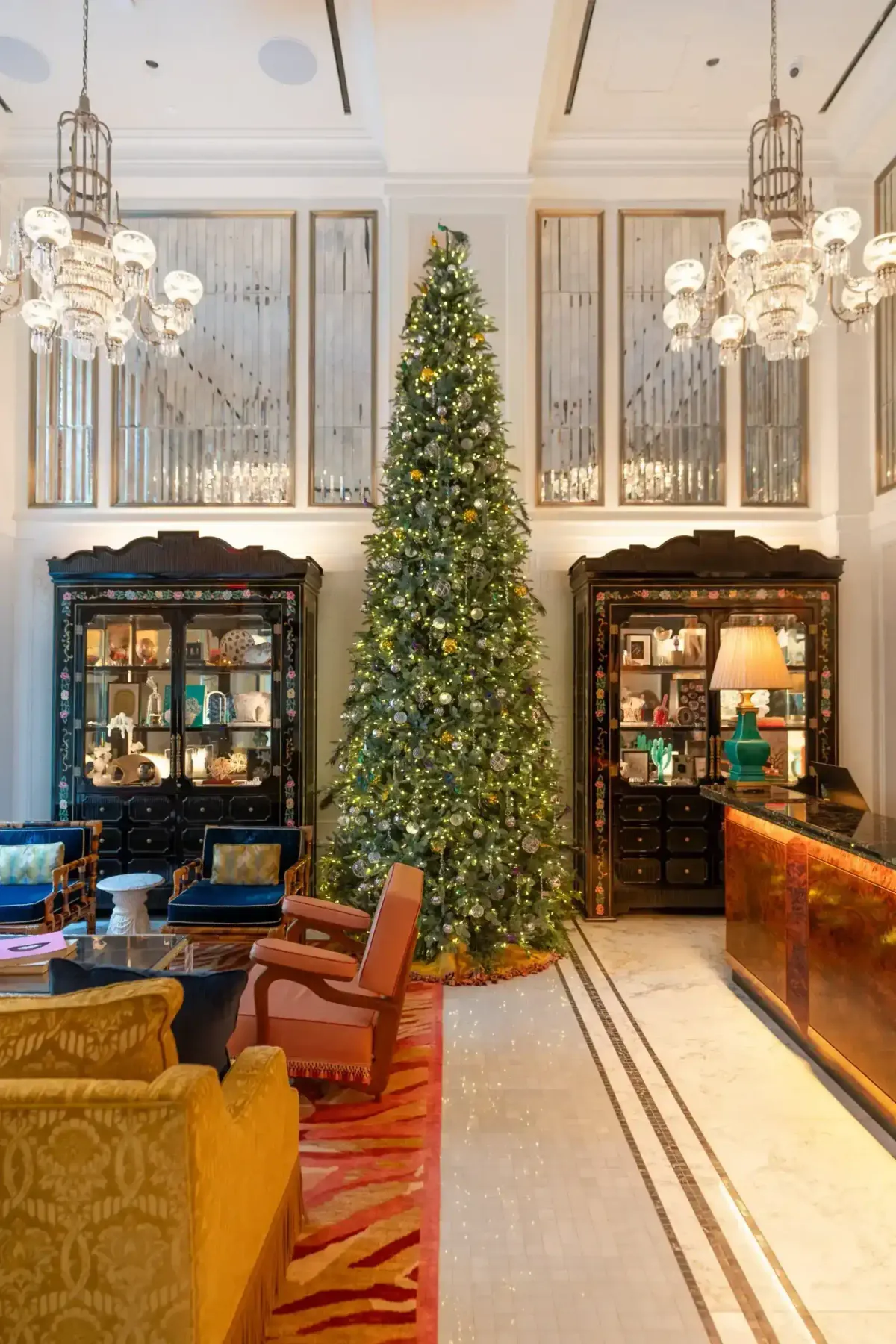
On a tall slim tree, decorate in vertical bands instead of a spiral. Work in three-story sections — lights first, then a light scattering of ornaments, then the statement pieces — and step back every 15 minutes to check the balance. The rule of thumb is roughly one ornament per 10 inches of tree height, doubled for anything wider than 36 inches. And weight the base: a 12-foot tree with a slim profile tips easily on marble. A 40-pound sandbag inside the stand, hidden by a collar, is invisible insurance.
7. Pastel Blue and Champagne Roses, Softly Done
60% natural green, 25% pastel blue, 10% champagne gold, 5% cream. The green is the base — never cover it up entirely, because that’s what makes the blue read as a choice rather than a candy theme. Swap pastel blue for dusty lavender and you get the same softness with more depth; swap the champagne for pearl white and the tree turns almost bridal. Keep the metal at 10% and never let the accent climb past 30%, or elegance tips into novelty.
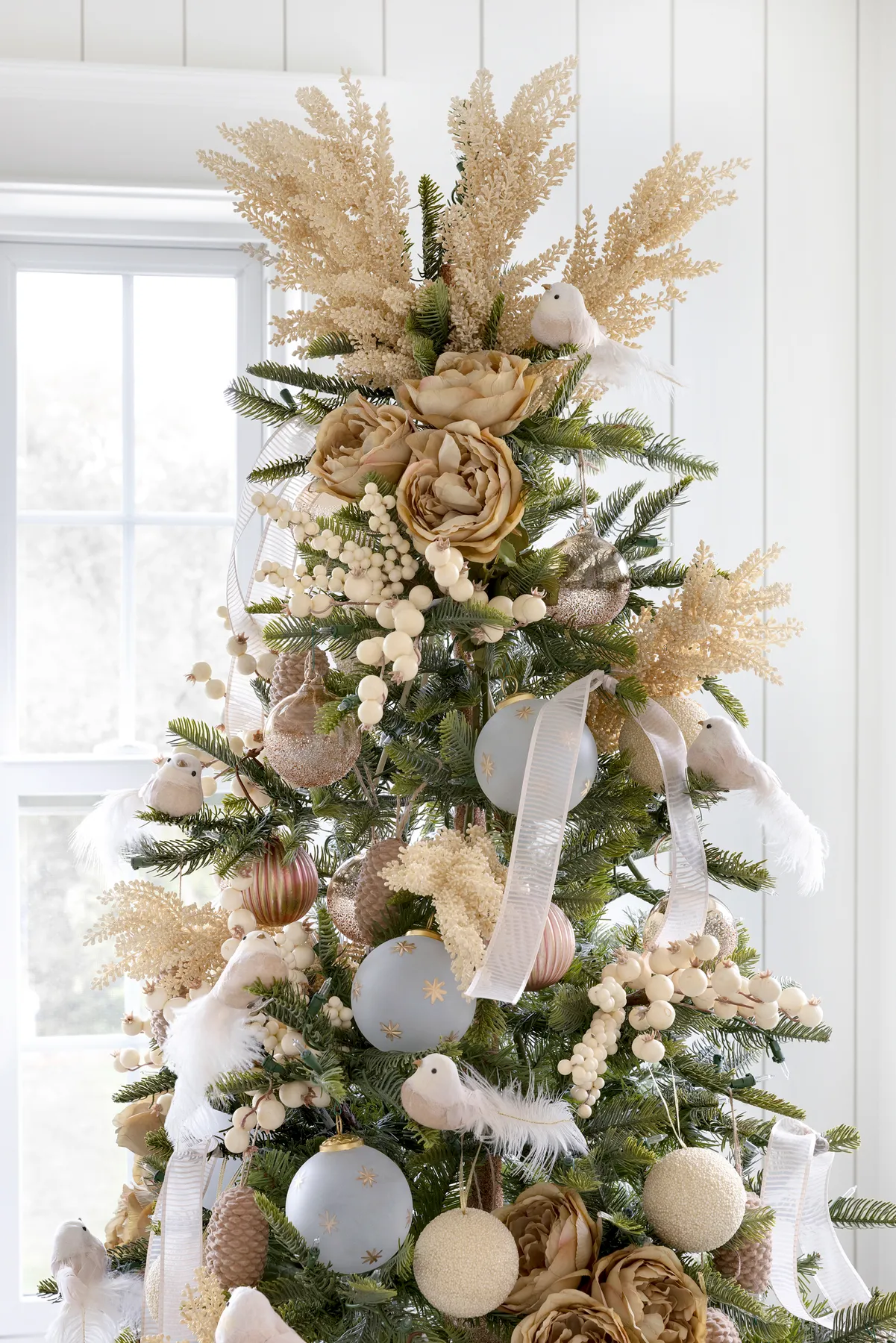
It’s the topper. A tall, feathery plume — not a star, not a bow — reaches up and out, adding height and softness the branches can’t supply on their own. Everything else on this tree is round or clustered: the roses, the berries, the little bird figurines. The feather breaks that repetition and gives the silhouette an unexpected edge. Remove it and you’re left with a pleasant but shapeless mass of ornaments. Budget versions: a spray of preserved pampas or three dyed ostrich feathers wired together do the same job for under $20.
8. One Bare Tree and a Soft Taupe Skirt
An unadorned tree is the most honest thing you can put in a room — there’s nowhere to hide. Sparse branches, uneven needle color, and that gap you keep rotating toward the wall will all be on display. The upside is real: no ornament storage, no yearly restyling, and a fraction of the cost. Just know that guests will ask if you’ve finished decorating, and you’ll need a rehearsed line. The line is: yes.
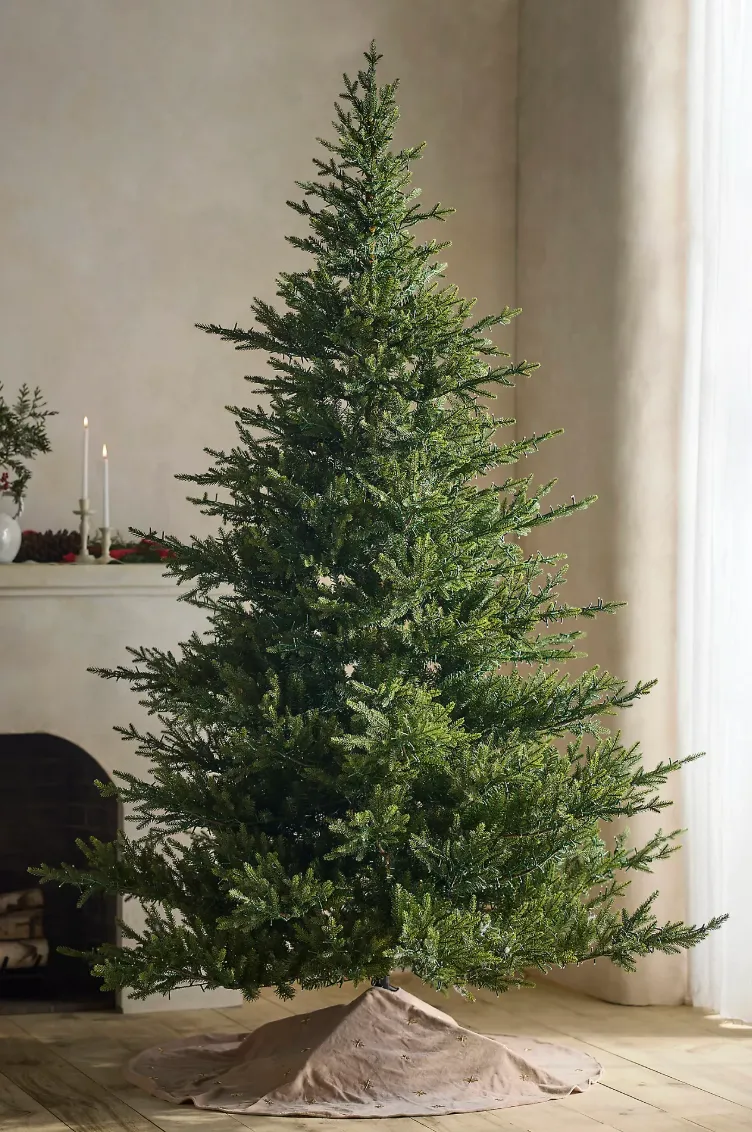
- Measure ceiling height and subtract at least 12 inches for the topper and stand.
- Check the light direction — a bare tree needs daylight or warm artificial light, or it reads as a silhouette.
- Confirm your skirt or basket is wide enough to hide the stand: 30 to 36 inches across.
- Budget for a better-quality tree than you’d normally buy, since this one is the whole show.
- Decide the light count in advance: 100 warm-white mini lights per foot of tree height.
9. Rose Gold Ornaments and a Console of Old Suitcases
Rose gold gets expensive fast, but you only need two finishes to sell it: textured metallic and matte champagne. Walmart and Target carry rose gold ball sets for around $15 for twelve, and a single roll of metallic patterned ribbon — about $8 — does more for this tree than a whole box of ornaments. For the console vignette, skip the antique shop and stack your own vintage suitcases, thrifted books, and two dollar-store bottlebrush trees. Under $90 versus $400 for the fully styled version.
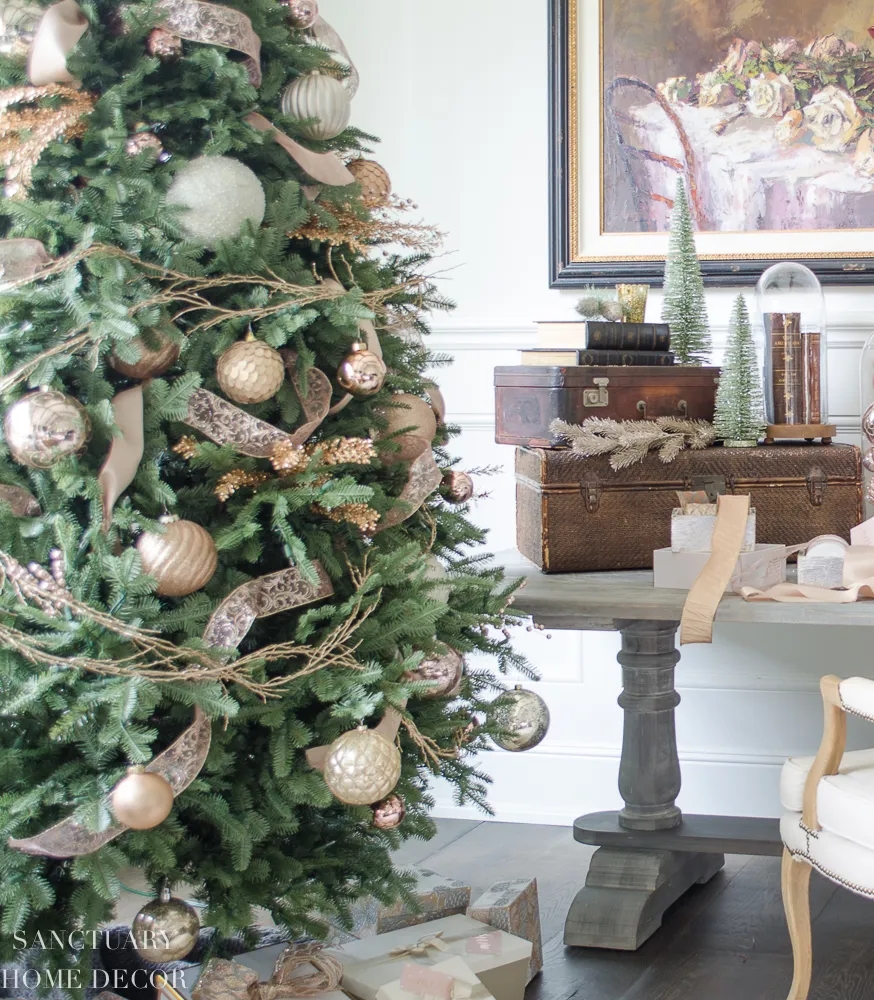
Two principles are doing the heavy lifting. First, tonal layering — the ornaments, the ribbon, and the little bottlebrush trees all sit within a few shades of each other, so the eye reads texture instead of color noise. Second, asymmetry: the console isn’t centered on the tree, it’s offset and lower, creating a diagonal line from the treetop down to the suitcase stack. That diagonal is the reason the corner feels composed instead of crowded.
10. A Densely Lit Tree That Anchors a Modern Living Room
Lighting is 80% of the look, so do it first and do it properly: 100 mini lights per foot of tree height, wrapped along the trunk and out each major branch rather than spiraled around the outside. That’s what creates interior glow instead of a lit outline. Use warm white at 2700K — anything cooler fights the beige sofa and the sheer curtains. Buy one tree’s worth of lights in a single order so the color temperature matches, because batches vary more than you’d think.
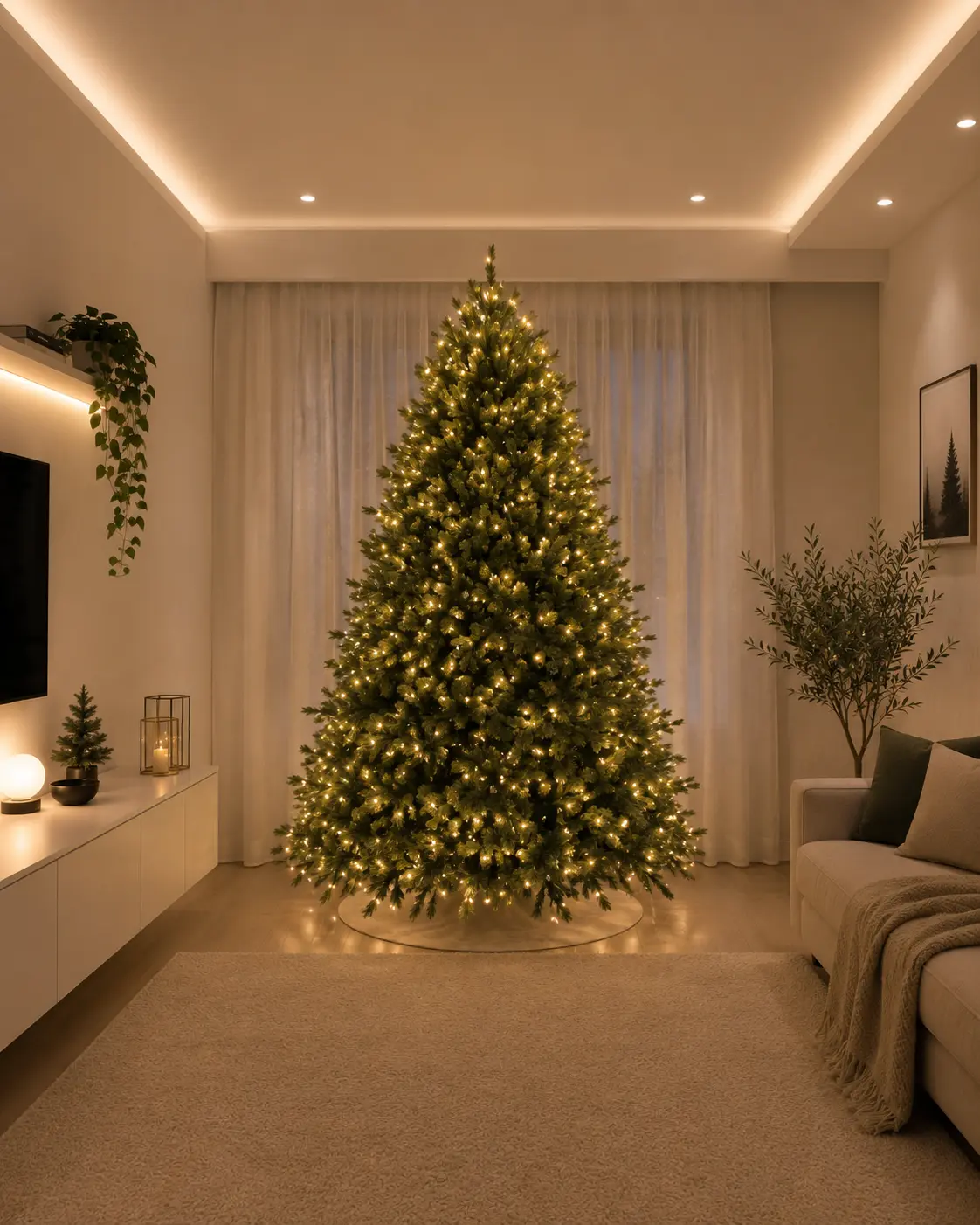
The proportions work here because the tree is allowed to be the tallest thing in the room. This setup suits an open living area of 250 square feet or more with 9-foot ceilings, where a 9-foot tree can stand clear of the window wall and still leave circulation space. Keep 36 inches between the tree and any seat you actually use. In a smaller footprint, drop to 7.5 feet and angle the tree into the corner — Idea #4 shows how that reads in a neutral room.
11. Gold Ribbon, Knit Stockings, and a Properly Lush Mantel
- Start with a plain 9-foot faux cedar garland as the base layer — it’s the cheapest part and nobody sees it.
- Zip-tie three or four real-touch evergreen picks in at uneven intervals to break the manufactured uniformity.
- Tuck in a second layer of eucalyptus or magnolia so the garland has two distinct greens.
- Weave the string lights along the underside, not the top, so the glow bounces off the mantel.
- Finish with white knit stockings on matching hooks, spaced 8 to 10 inches apart.
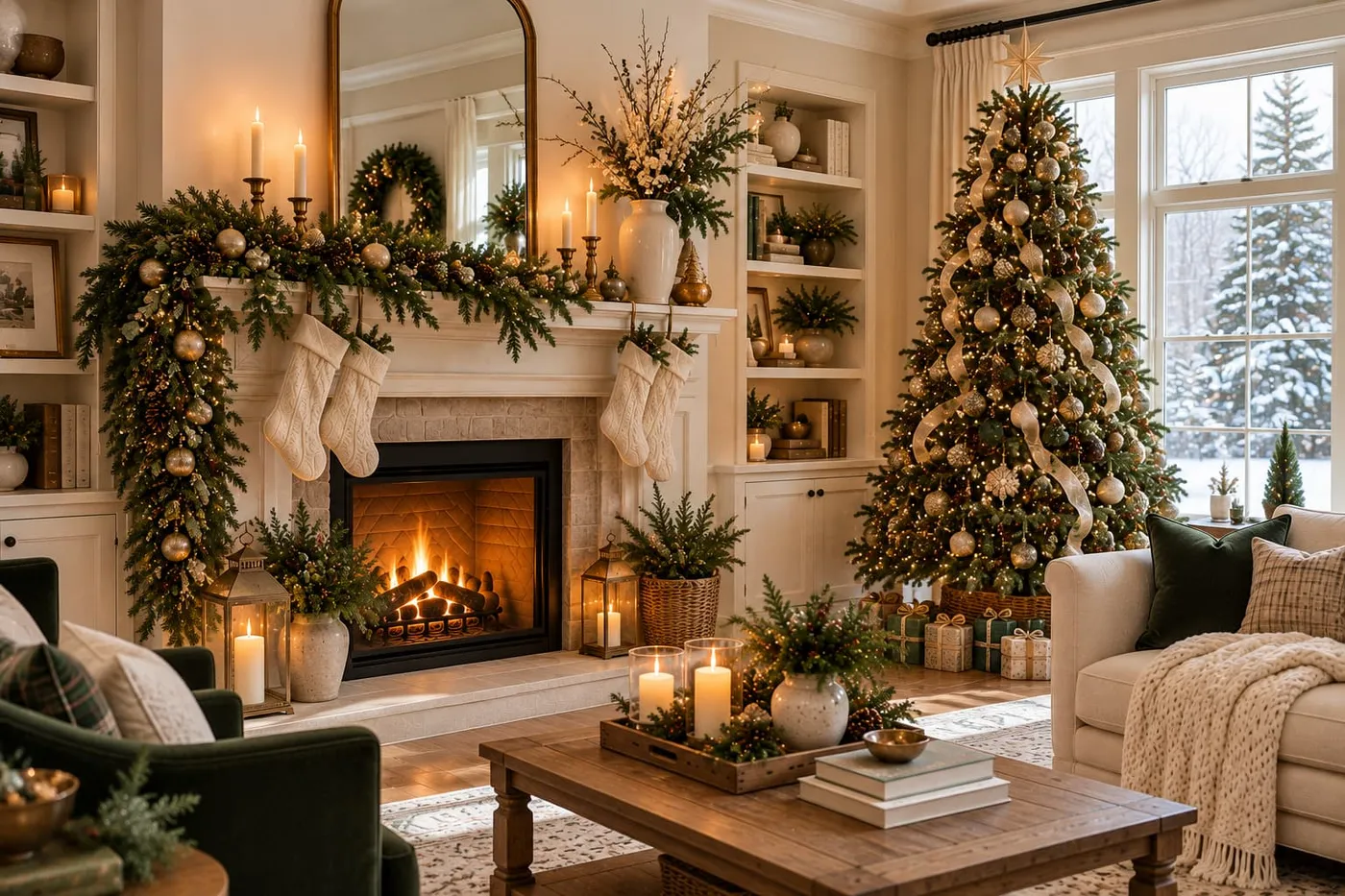
Time: about 90 minutes. Materials: $60 to $140 depending on whether you reuse last year’s garland.
- Tree (9 ft, warm-white pre-lit): $250–$700
- Garland, hooks, knit stockings: $70–$180
- Ornaments and ribbon (gold, champagne, cream glass): $60–$220
- Bookshelf greenery and pillar candles: $40–$120
- Coffee table tray and accessories: $35–$110
- Total: $455 to $1,330
12. Blue-and-Gold Baubles, Where the Detail Wins
Up close, the whole design rests on two decisions: a deep blue with visible pattern, and a gold with genuine reflectivity. This bauble carries gold stars and beaded detailing, so it rewards a second look — that’s the difference between a $4 ornament and a $40 one. The second principle is light placement. Warm string lights sit behind the ornament rather than above it, so the bokeh creates a halo and the blue stays saturated instead of going flat and dark.

The patterned blue bauble is what makes this scheme feel expensive, and it’s the one thing I’d never swap for plain gloss. Solid navy balls disappear into the green; the gold line work is what lifts them forward. If you’re building a blue-and-gold tree, make at least a third of your ornaments patterned — stripes, stars, damask, anything with line — and keep the rest solid gold. Solid blue plus solid gold reads flat. Pattern is the spark.
13. A Tabletop Tree in a Textured White Pot
Think in small numbers: 70% white and cream, 20% natural green, 10% metallic warmth. On a two-foot tree that’s roughly eight ornaments — six white or silver, two rose gold. The textured white pot counts as part of the white base, which is why the terracotta mug beside it works as an accent instead of a clash. Want a different mood? Swap the rose gold for black and the little tree reads Scandinavian; swap it for copper and it turns warm and autumnal.
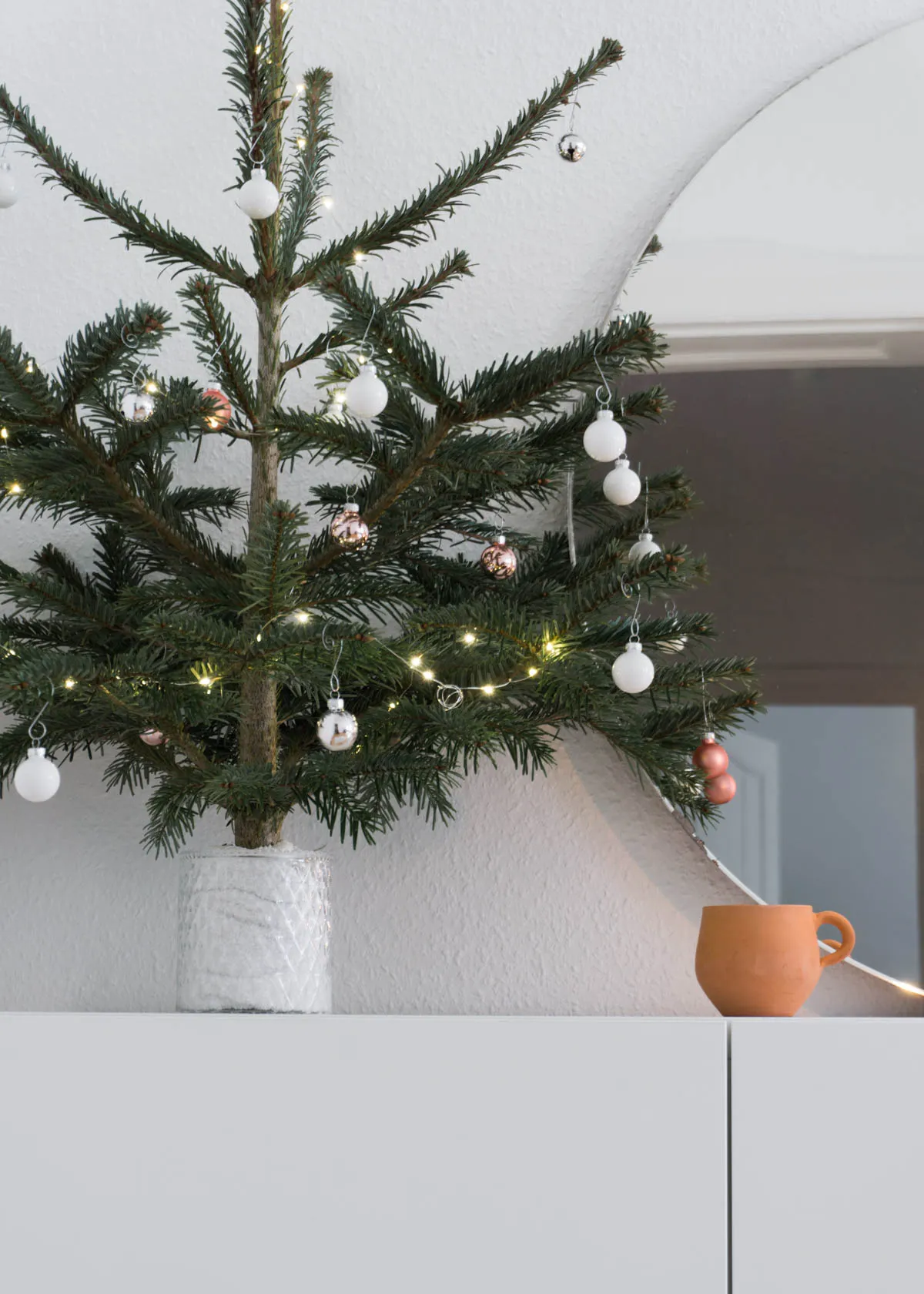
A tabletop tree should cost less than dinner. IKEA’s small potted faux trees run $15 to $25, and a plain terracotta or ceramic pot is under $12 at any garden center — spray it with textured stone paint if you want the artisan finish. Ornaments: one set of mini balls from Target, about $8. Lights: a $6 battery strand with a built-in timer. Thrift the mug. You’re under $60 for something that looks like a boutique hotel did it.
14. Black-and-White Checkerboard Baubles, Very Graphic
Black ornaments on a green tree are a genuine gamble. Against dark, tightly packed branches they vanish, and your tree reads half-finished from across the room. The fix is contrast management: cluster the black baubles near string lights or back them with white ribbon so they’re always edged by something bright. Also, painted and glitter-finished ornaments chip — handle them by the cap, and skip them entirely if you have toddlers who treat the tree like a climbing frame.
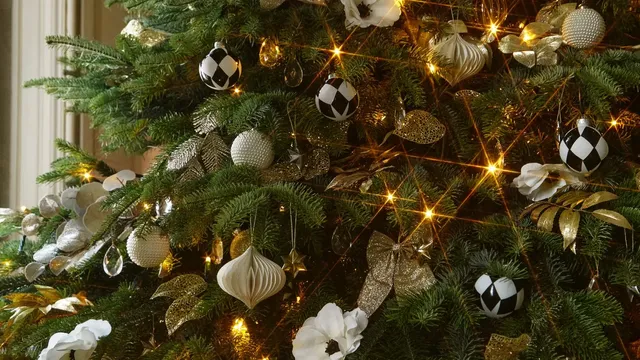
Use a 3:2:1 size ratio. For every six ornaments you hang, three should be small, two medium, and one large statement piece. Most people buy all one size, which is why their tree looks flat no matter what they spend. Mix finishes too — matte, glass, glitter, fabric — but keep the palette to three colors maximum. This tree runs green, black, and white with gold as the metallic, and that’s exactly the right discipline.
15. Frosted Tips, Silver Glitter, and Clip-On Candles
Here’s the honest math: flocked trees shed, glitter ornaments shed, and wax candles drip. Combined, this look needs about 20 minutes of cleanup a week through December and a full vacuum-and-fluff session in January. Keep the flocked tree away from heat registers and radiators — dry heat turns flocking brittle and it flakes off in patches. Budget $30 to $60 a year for replacement light strands and a canister of touch-up flocking spray for bald spots.
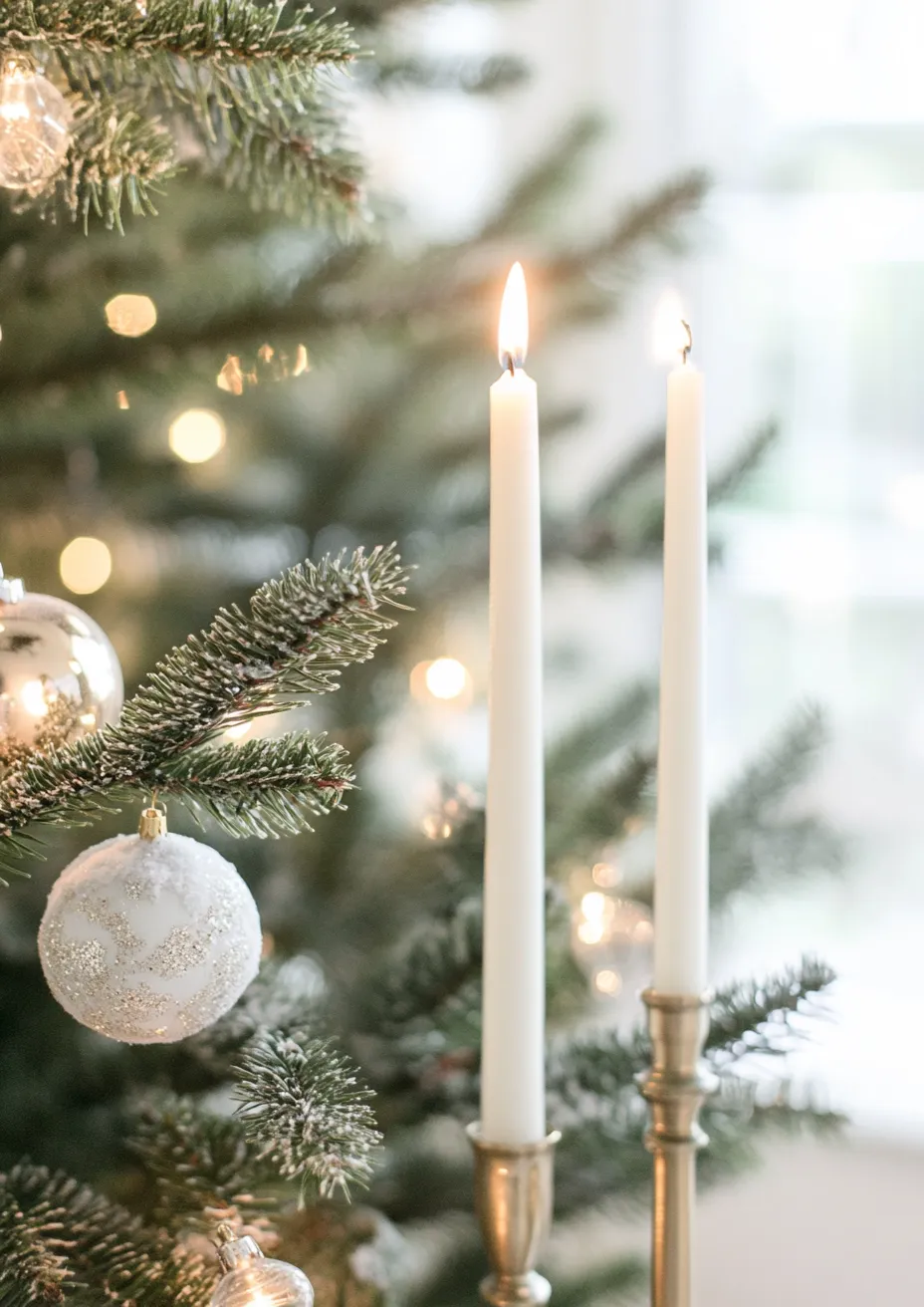
- Buy clip-on candle holders sized to your branch thickness — thin branches need the mini clips.
- Place candles no more than 12 inches apart, never directly under an upper branch.
- Choose LED tapers with a warm 2200K glow if the tree is flocked.
- Wire the candles to a single remote switch so you’re not reaching into the branches nightly.
- Balance each candle with a silver ornament directly below it so the eye travels down the branch.
Time: 45 minutes. Cost: $40 to $120 for a dozen clip-on LED tapers.
16. Slender, Sparsely Lit, and Deliberately Quiet
“Quiet Christmas” is having a real moment heading into 2026 — searches for sparse, unadorned, and single-color trees have climbed steadily as people get tired of restyling the same tree every December. It’s part of the broader shift toward fewer, better objects that started in furniture and has now reached holiday decor. My honest read: this one has staying power. It’s cheaper, faster, and it doesn’t require six bins in the attic.
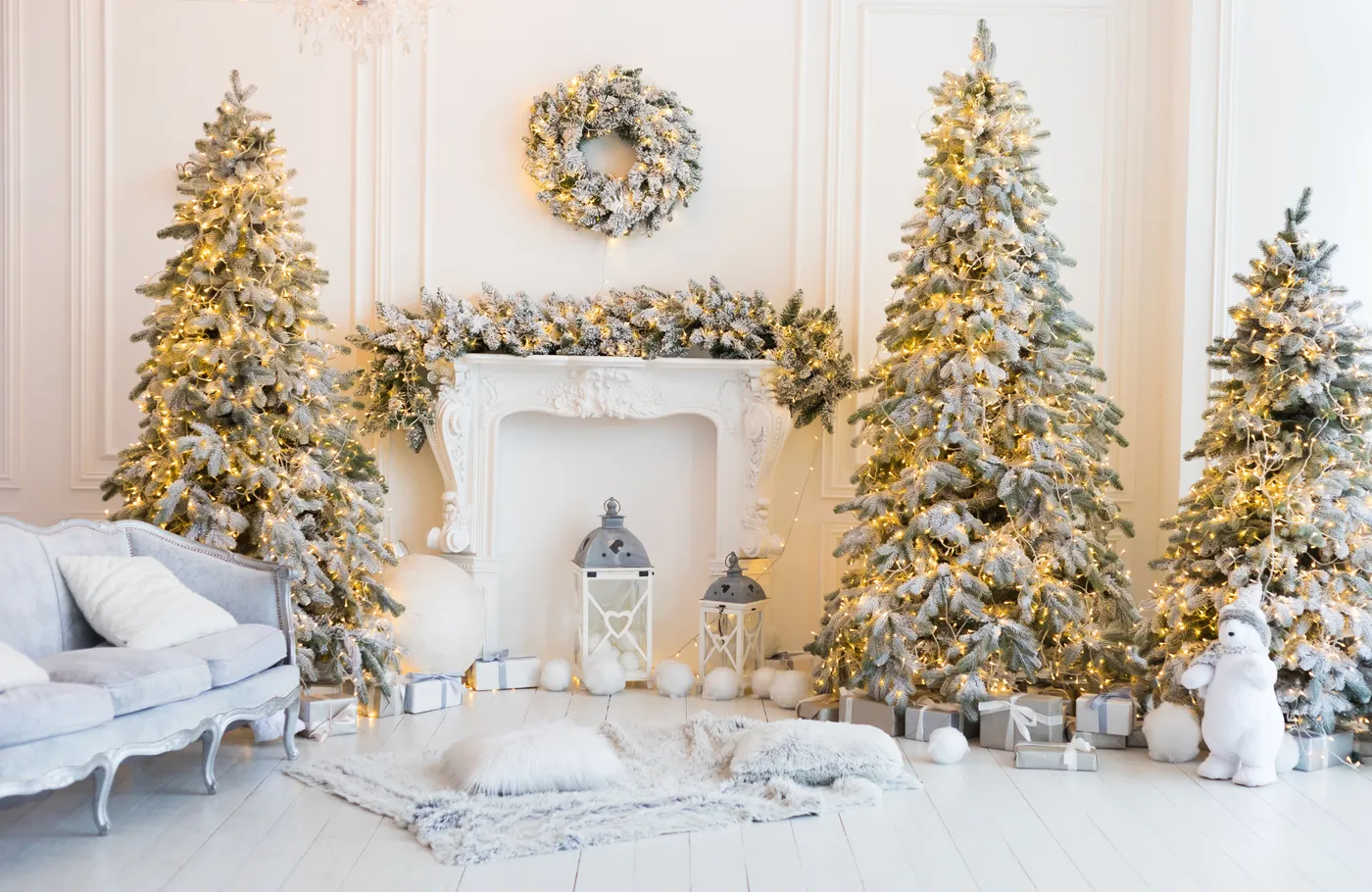
Give yourself a light count. This tree carries maybe 200 lights on a 7-foot frame — far fewer than the 100-per-foot rule — and that’s the point: the sparse glow IS the aesthetic. Pick a strand with a warm 2700K tone, use one continuous run so there’s no color mismatch between strands, and drop the cord down the back of the trunk. Finish with a fabric-wrapped cord cover in a neutral tone so nothing interrupts the pale wall behind it.
17. Clip-On Red Candles and a Straw Star
- Tree (7.5 ft, unlit): $120–$350
- Clip-on candle lights, set of 20: $40–$110
- Red glass baubles and bells, mixed sets: $35–$90
- Straw star and wooden figurine accents: $25–$70
- Warm white replacement light strands: $20–$45
- Total: $240 to $665

Budget alternative: buy the candle clips in plain brass and use your own LED tealights inside them — a set of 20 clips runs about $18, and tealights are $10 for a pack of 24.
The candles, obviously — but the detail that matters is where they’re clipped. Traditional German trees place them on the outer third of the branch, tilted slightly upward, so the flame reads as a small point of light against dark green rather than getting lost inside. Clip candles at random and you get a muddle. Clip them on an even rhythm and you get a tree that looks like it came from a museum.
18. Red Gloss, Clear Glass, and a Wall of Warm Light
Red and clear is one of the smartest pairings in Christmas decorating. The glossy red ornament reflects the fairy lights and pops against the green; the transparent glass one beside it lets light pass straight through, so it reads as a soft glow instead of a solid shape. Alternating opaque and transparent ornaments at the same scale gives a tree depth without adding a single new color. Add a matte finish into the mix and it flattens immediately.
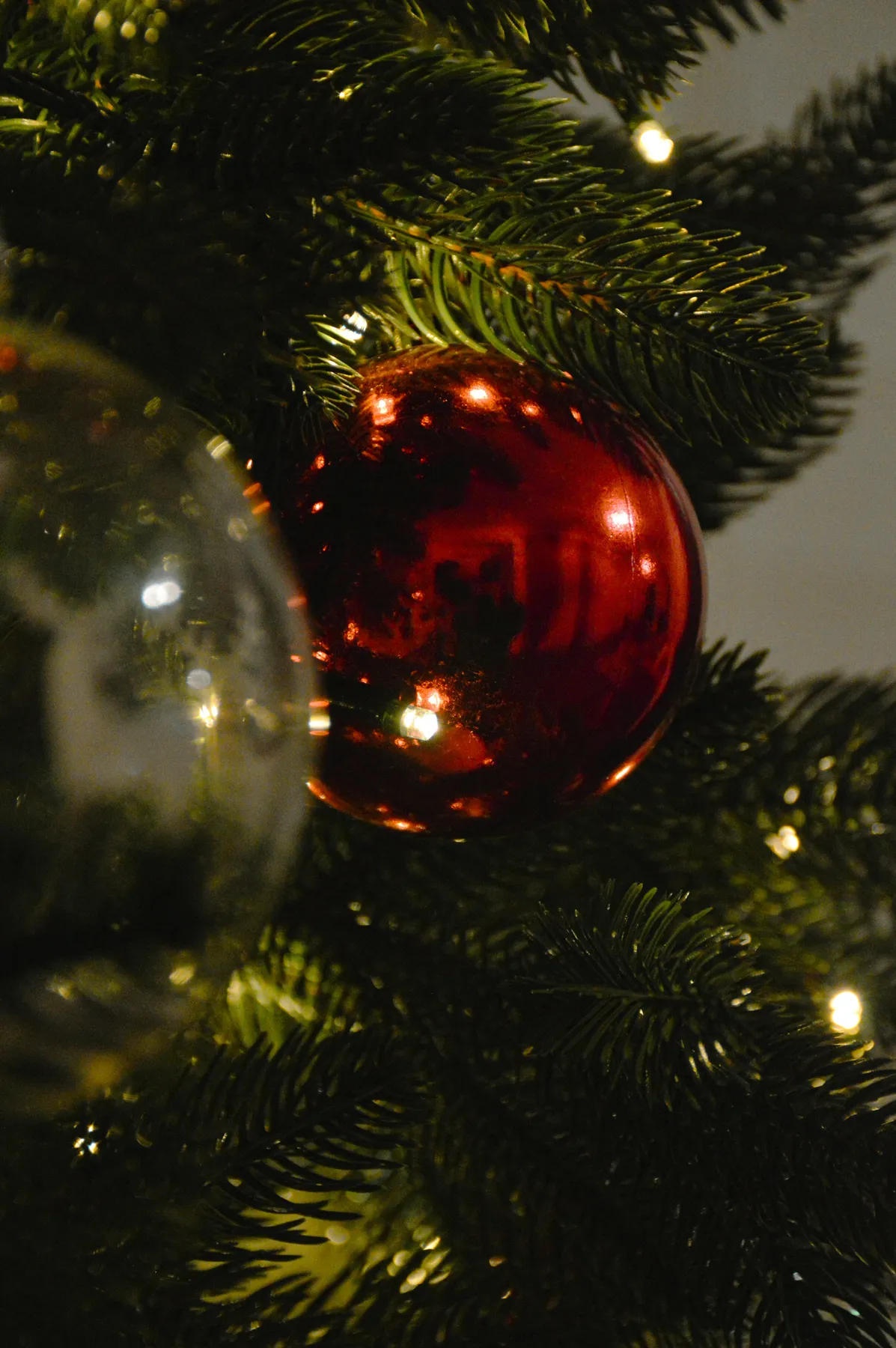
Ornament density like this needs room to breathe, and it needs branch depth. A tree under 6 feet looks cluttered at this density — halve the ornament count and open the spacing to about 8 inches. It works best on trees 7.5 feet and taller with a base width of 48 inches or more. If you’re working under an 8-foot ceiling, see Idea #34 for a sparse approach that solves the same small-room problem.
19. Silver and White in the Bedroom, Because Why Not
A bedroom tree doesn’t need to match the living room’s budget. Buy a small 4 to 5-foot flocked tree, load it with white and silver ornaments from the dollar store — they look identical in low light — and skip the ribbon entirely. Faux fur throw from Walmart, around $25. Mirrored side table from Facebook Marketplace, $40 to $60 if you’re patient. The whole corner comes together for under $200 and looks like a boutique hotel suite.
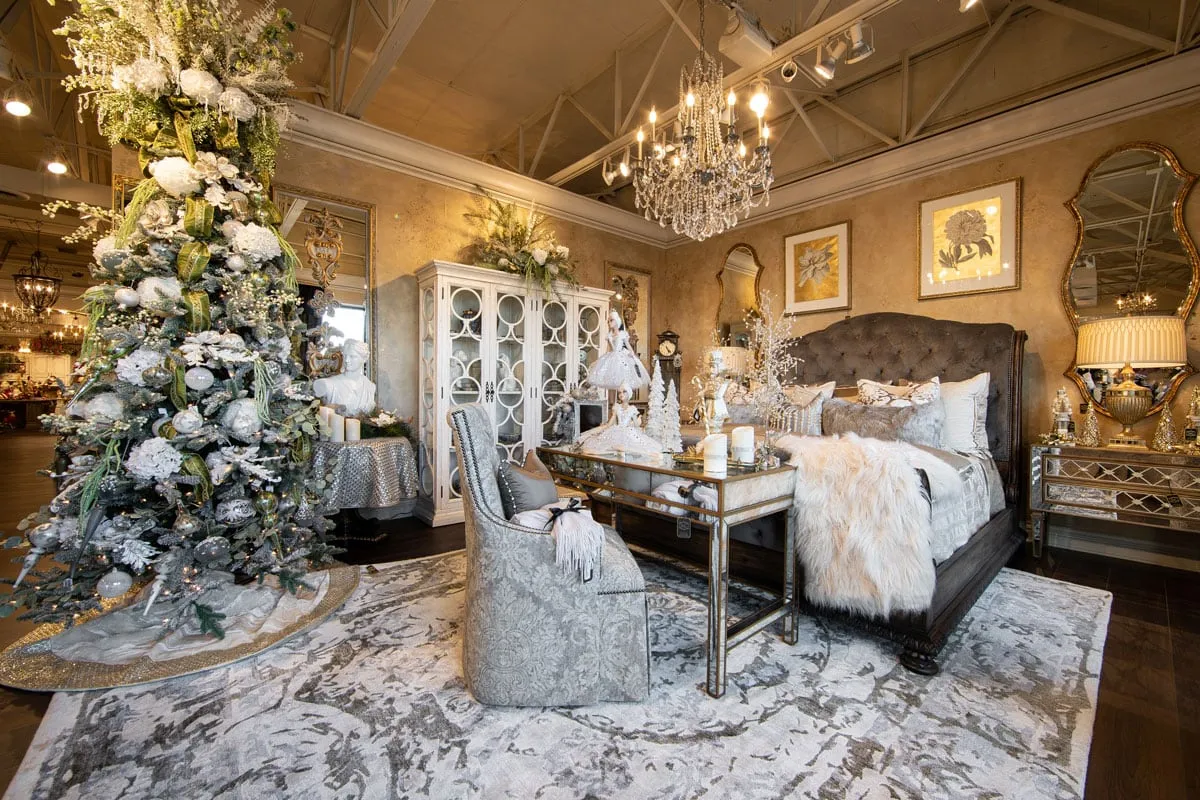
Bedroom trees need low-glare lighting. Stick to 2700K warm white, and put the strand on a dimmer or smart plug with a scene — full brightness for entertaining, 30% for the last hour before sleep. Keep the ornament count down too; in a bedroom, restraint reads as luxury. And if you’re using silver, add one brushed finish so the reflections don’t turn into a disco ball.
20. An Arched Window, a Glowing Tree, and Pillows
- Set the tree where the arched window’s light will backlight the branches during the day.
- Wrap the trunk first with lights, then work outward along the major branches.
- Style the sofa with two wildlife-themed pillows and a throw that pulls a color from the tree.
- Place wooden tray tables between the sofa and fireplace, each with one pillar candle in a glass hurricane.
- Finish the fireplace wall with a wreath on a removable hook, centered above the firebox.
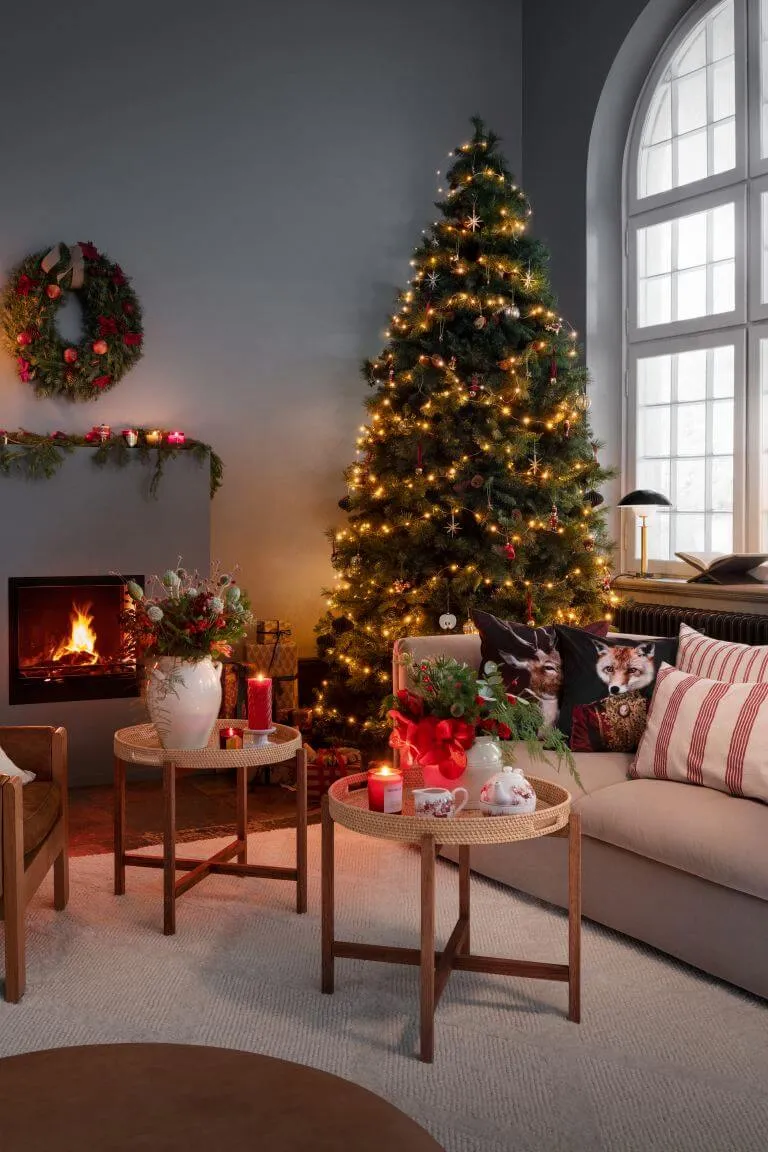
Time: about two hours. Materials: $0 to $80 if you already own the trays and candles.
- Measure the gap between the arched window and the fireplace — you need at least 30 inches of clearance.
- Check that no branch will sit within 3 feet of the fireplace opening.
- Confirm outlet locations, because you’ll want the tree on a switch, not a reach-behind.
- Test every strand for color consistency before you wrap anything.
21. A Double-Height Room Deserves a Double-The-Ornaments Tree
Double-height rooms are their own category. You want a tree at least 12 feet tall and 6 to 7 feet wide at the base, positioned so it doesn’t compete with the stone fireplace for the same sightline. Allow 4 feet of clearance from the hearth and 5 feet from the windows. This scale only works in rooms of 400 square feet or more with ceilings over 16 feet. Below that, a 9-foot tree with a wide base does the same job — Idea #10 handles that proportion beautifully.
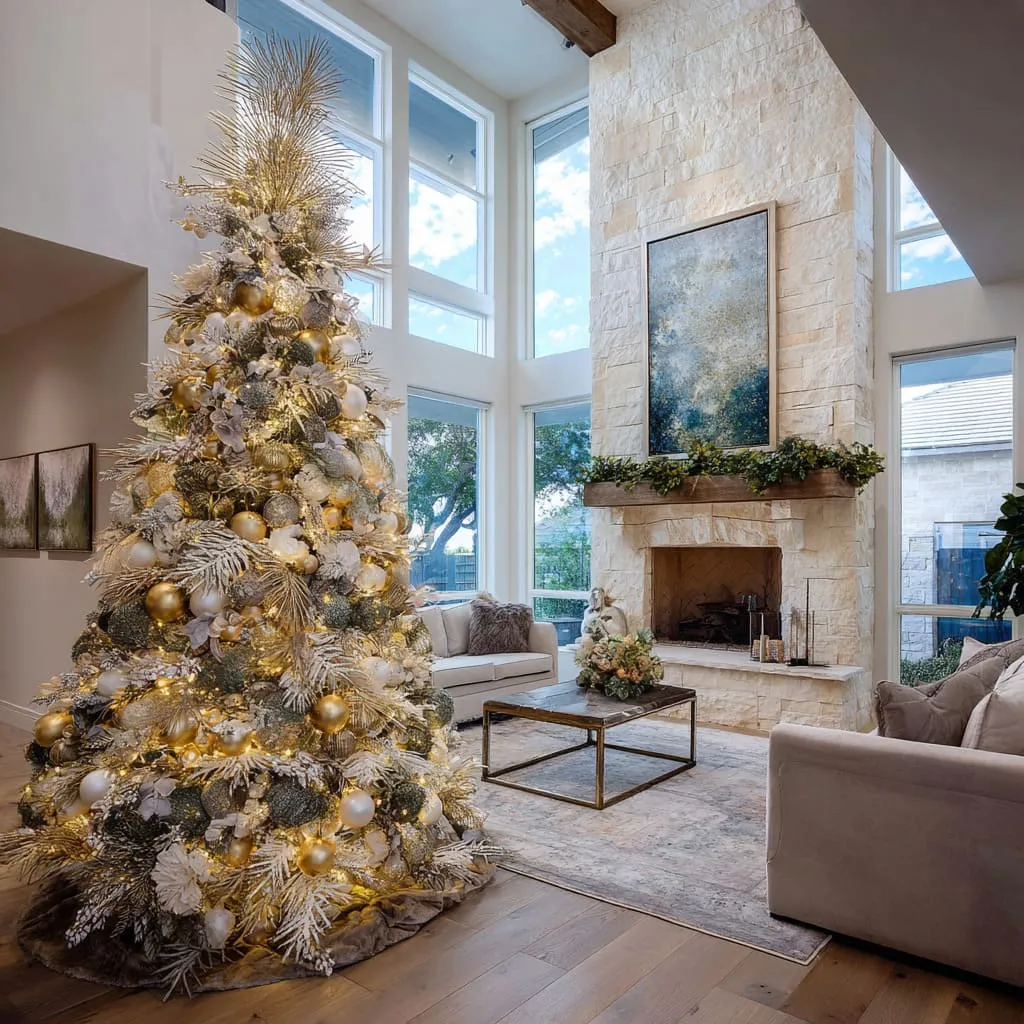
60% warm cream and champagne, 25% soft blue, 10% natural wood, 5% charcoal. That muted blue in the artwork is the anchor — the ornaments echo it at low saturation, which is why the tree feels like part of the room rather than a seasonal arrival. Change the art and the tree changes with it: a deep green abstract would let you push the ornaments toward moss and brass. The formula survives either swap.
22. Gold Roses, a Silver Dancer, and Sequined Butterflies
It’s the oddball — a silver dancer figurine standing in for what would normally be another ball ornament. Everything else here is botanical or geometric: glittery gold roses, frosted berry sprays, sheer mesh butterflies. A single human figure breaks the pattern and gives the tree a story. That’s the one thing I’d protect. If you’re shopping for something similar, find one sculptural ornament you genuinely love and build the surrounding picks around its metal finish.
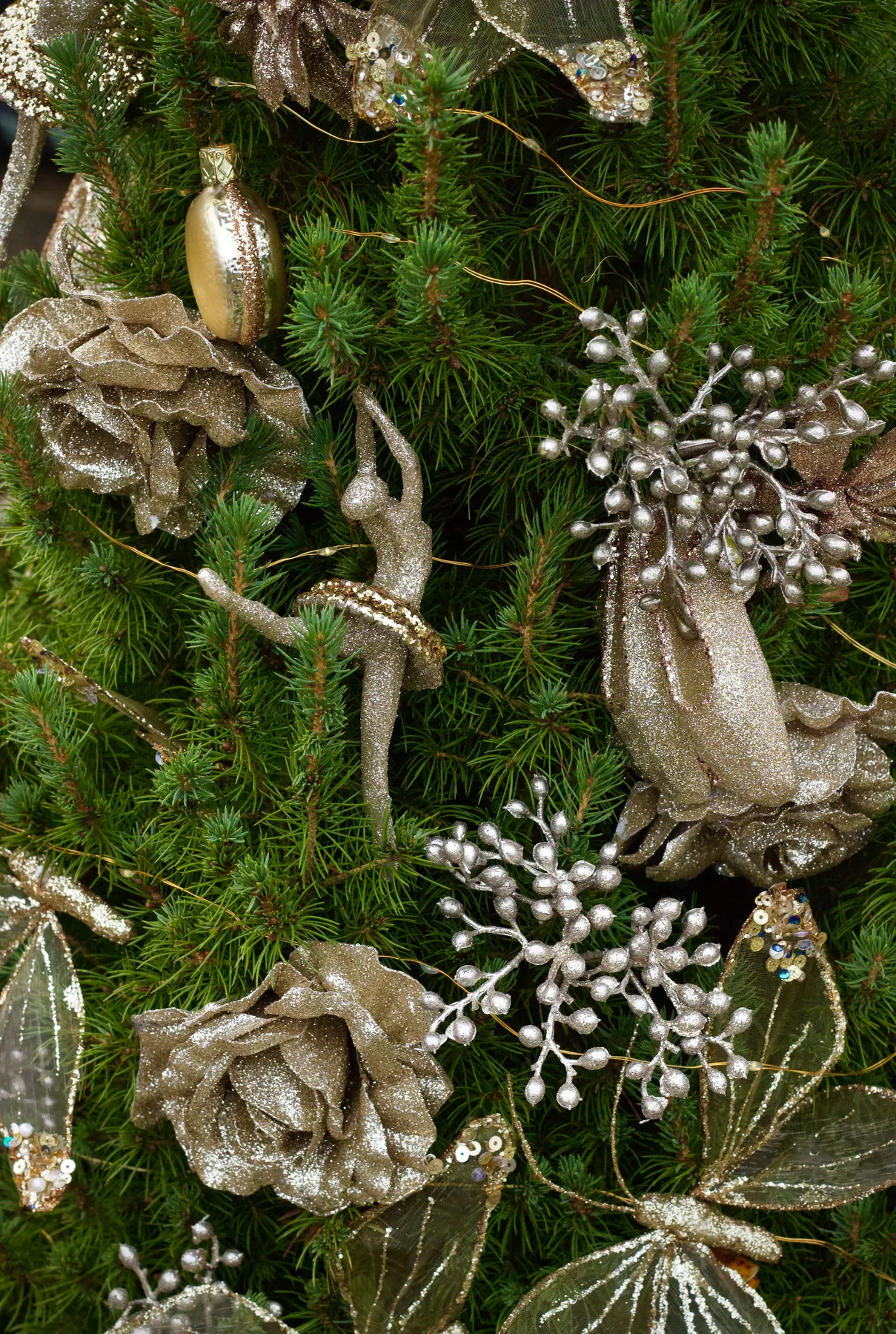
Fragile figurine ornaments and sequined mesh do not survive enthusiastic kids, cats, or a cold snap that makes plastic brittle. If your household is high-traffic, hang the figurines in the upper third where hands don’t reach, and wire the loops closed rather than using open hooks. Also, glitter sheds. Put a white sheet under the tree while you decorate, then pull it out instead of vacuuming glitter out of the rug for three months.
23. One Rose Gold Bow, Styled Like Jewelry
Fabric bows should be wired, not tied. Buy ribbon with a wired edge — 2.5 inches wide is the sweet spot — and pinch-and-twist the loops so they hold a shape instead of collapsing. For a bow this size, use about 30 inches of ribbon, and finish the tails at an angle; straight-cut tails look unfinished on a textured fabric. Place one large bow where the light actually hits it and let the rest of the tree stay quiet.
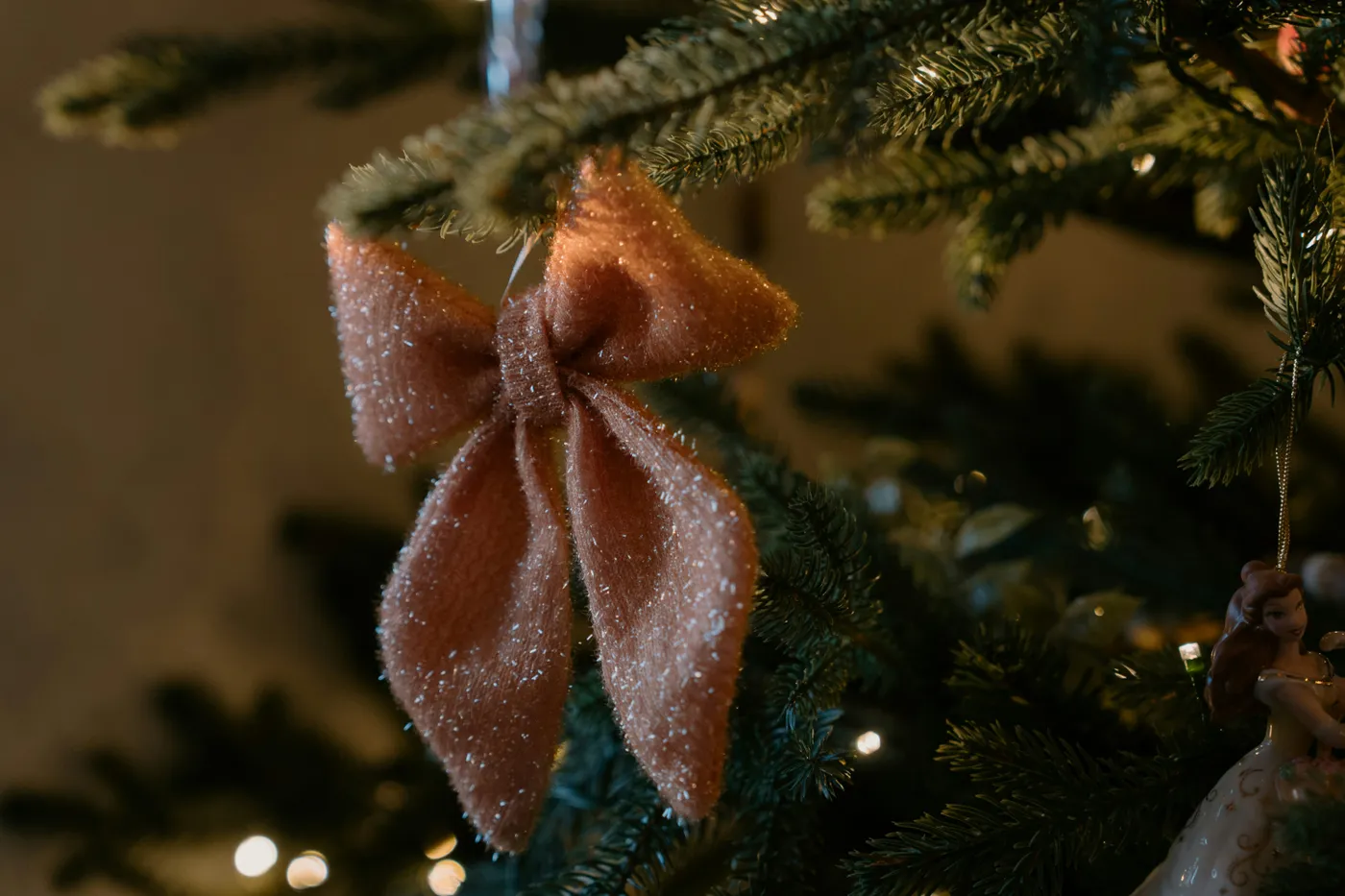
Metallic fabric ribbon is where the money goes, but craft stores sell sparkle-edged wired ribbon for $6 to $9 a roll, and one roll makes four to six bows at this size. Make them once, store them flat in a shoebox, and you’ll have them for a decade. The same trick works with leftover upholstery fabric cut into strips — a rose gold velvet remnant from a fabric store’s discount bin does the job for a third of the price.
24. Flocked Branches with Red and Gold, Grey Everything Else
The grey room is what makes the red and gold work. Against cream or beige, red-and-gold tips straight into cliché; against cool grey, warm ornaments feel intentional and slightly unexpected. There’s a nice scale play too — the tree is tall and dense, the furniture is low and squared-off, and the abstract art echoes the tree’s shape without repeating its colors. Compare with Idea #5 — same frosted base, completely different energy.
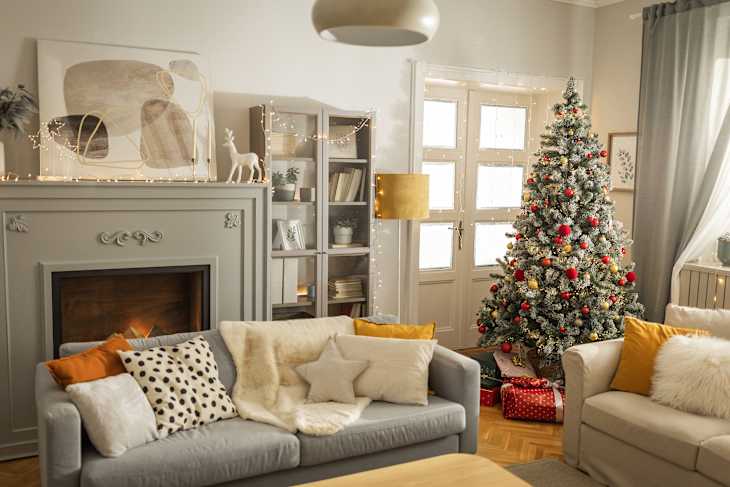
Flocked trees in a grey-and-white room are unforgiving: every shed needle shows on a pale rug. Vacuum weekly with a brush attachment, and put a felt pad under the stand to catch the worst of it. Faux snow clumps over time — fluff the branches gently each season and store the tree upright in a breathable bag, never a sealed plastic one. Annual upkeep runs about $20 for touch-up spray plus an hour of your time.
25. A Giant White Bow and Presents Tied in Black
- Tree (7.5 to 9 ft, pre-lit): $220–$650
- Matte white ornaments, 60 to 80 count: $50–$160
- Wide white ribbon for topper, garland, and wreath: $30–$70
- Garland and wreath, undecorated: $45–$130
- Wrapping paper, black ribbon, boxes: $25–$60
- Total: $370 to $1,070
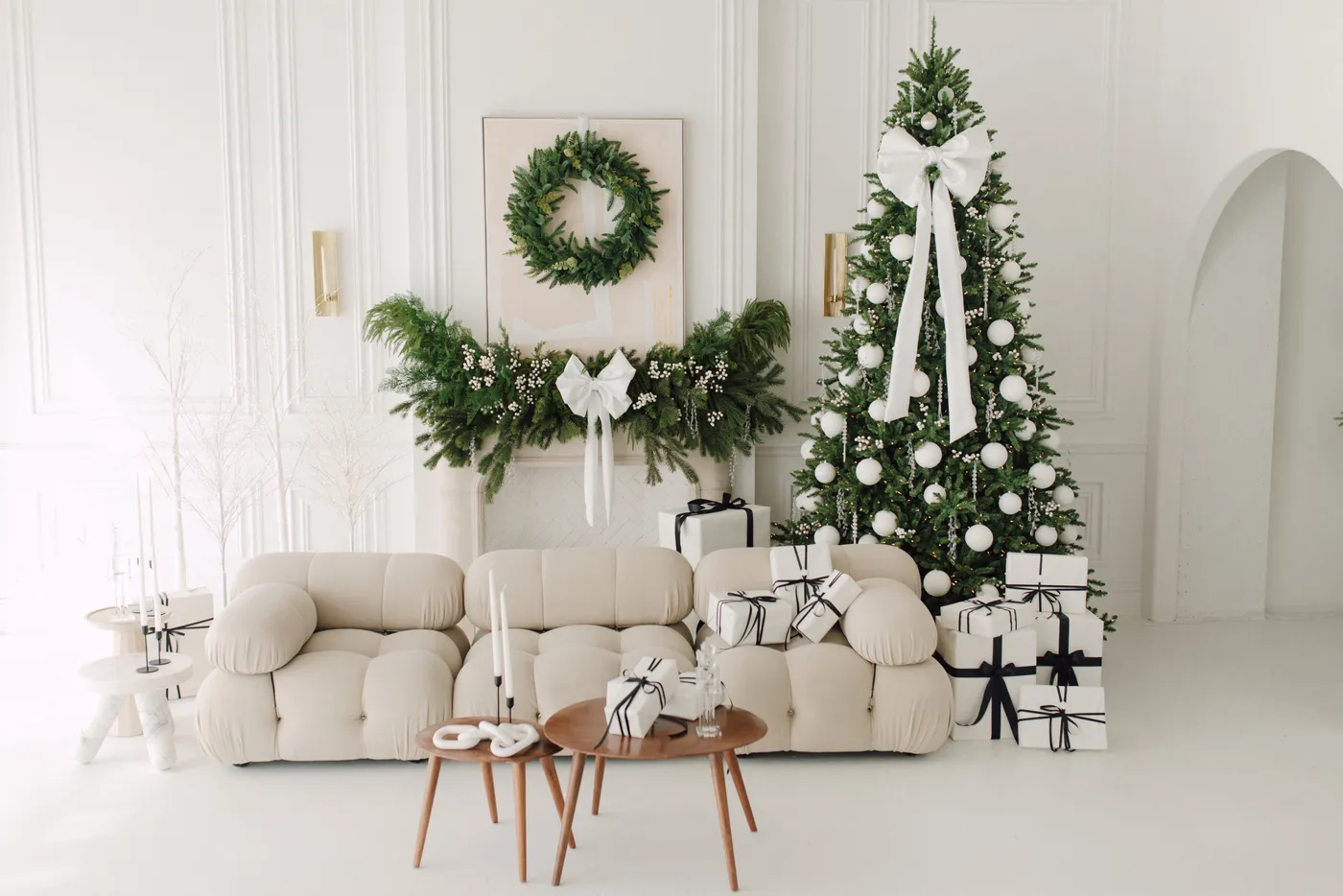
- Build the bow flat on a table — six loops, wired ribbon, tails four times the loop length.
- Attach it to a heavy floral pick and anchor it into the top third of the trunk, not the tip.
- Bend the top branch up behind the bow so it supports the shape from behind.
- Wrap the mantel garland with the same ribbon, spacing loops 18 inches apart.
- Finish presents with a single black satin ribbon each — no visible tags from the front.
Time: 40 minutes. Cost: about $25 in ribbon. White-on-white trees are the Pinterest sleeper hit of the season, driven partly by the “match your decor, not the holiday” approach that’s dominated holiday styling since 2024. It photographs beautifully, which matters more than anyone admits.
26. The Tree Isn’t Decorated — That’s the Whole Idea
A completely bare tree in a minimal room only works if the room is genuinely minimal. Put this in a space with busy wallpaper, patterned curtains, and a full bookshelf, and it looks like you forgot. It also demands a good tree — no bald patches, no visible wires, no plastic-looking needles — so budget for quality here, because there’s nothing to distract from it. And check the light: bare green against beige can go muddy fast in the afternoon.
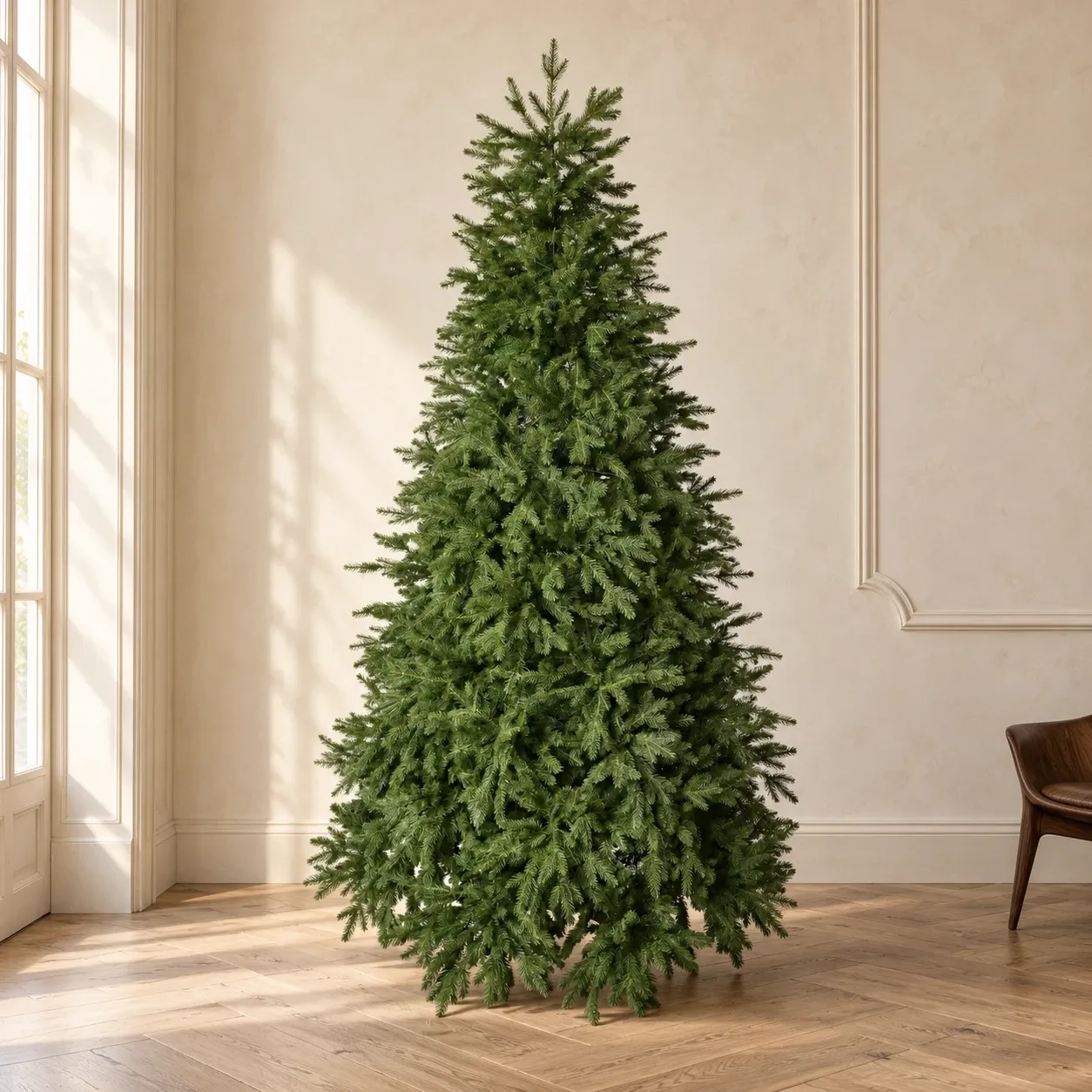
The formula is extreme: 90% architectural neutral, 8% green, 2% dark wood. Nothing else is allowed in. That’s why the herringbone floor and the molding do so much work — they are the decoration. If you want to loosen it up, add a single basket or woven mat at the base and stop. Two accents maximum, and neither one should be a color. Anything brighter than beige changes this from a design statement into an unfinished room.
You’re saving money by not buying ornaments, so spend it on the tree. A good 7.5-foot unlit artificial tree runs $150 to $400, and unlit versions typically have better branch structure than pre-lit ones. Under $200 gets you this exact look. Bonus: buy in January, when artificial trees drop 60 to 70%.
27. Blue-and-White Porcelain Ornaments, Maxed Out
When a tree is this full, spacing matters more than selection. Keep a consistent 4-inch gap between ornament clusters so the branches still read as green underneath. Hang the heaviest pieces — the porcelain-style balls — within 8 inches of the trunk where the branch is thickest. And hide the mechanics: no visible hooks, no wire, no hanging loops on the front-facing ornaments.
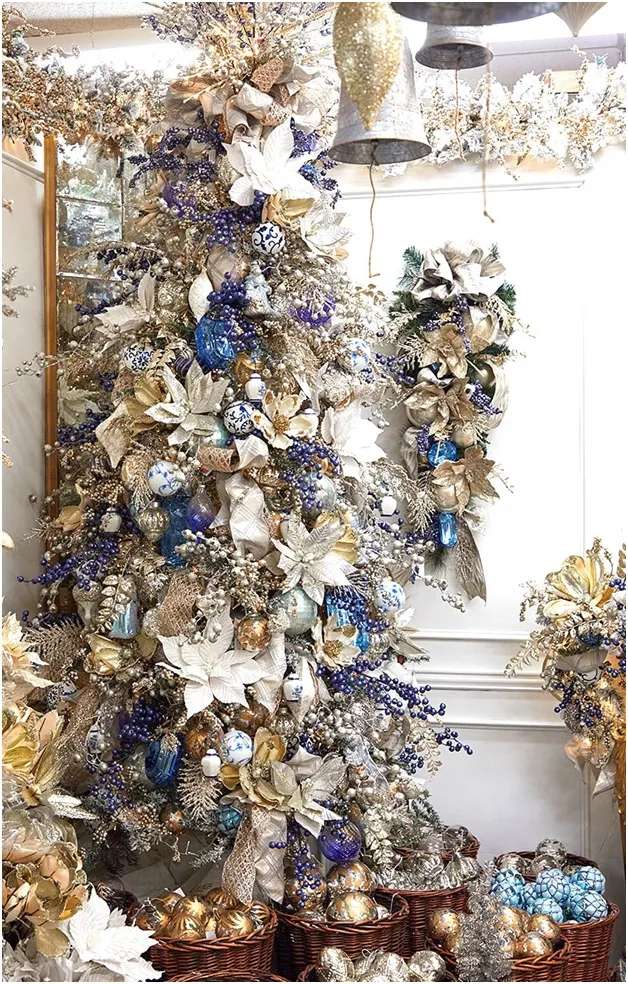
Three things make it work. The white poinsettias add floral volume without weight. The blue-and-white patterned ornaments quote a classic porcelain motif, which makes the whole thing feel collected rather than bought in one trip. And the baskets of ornaments at the base give the eye somewhere to rest after all that density — without them, the tree would be exhausting. A busy tree needs a quiet base. Steal that one.
- Count your branches: this density needs a tree with at least 1,200 tips at 7.5 feet.
- Weigh your stand’s capacity — heavily decorated trees can top 80 pounds.
- Plan storage for the florals, not just the ornaments; picks crush easily.
- Leave 18 inches of ceiling clearance for a large topper.
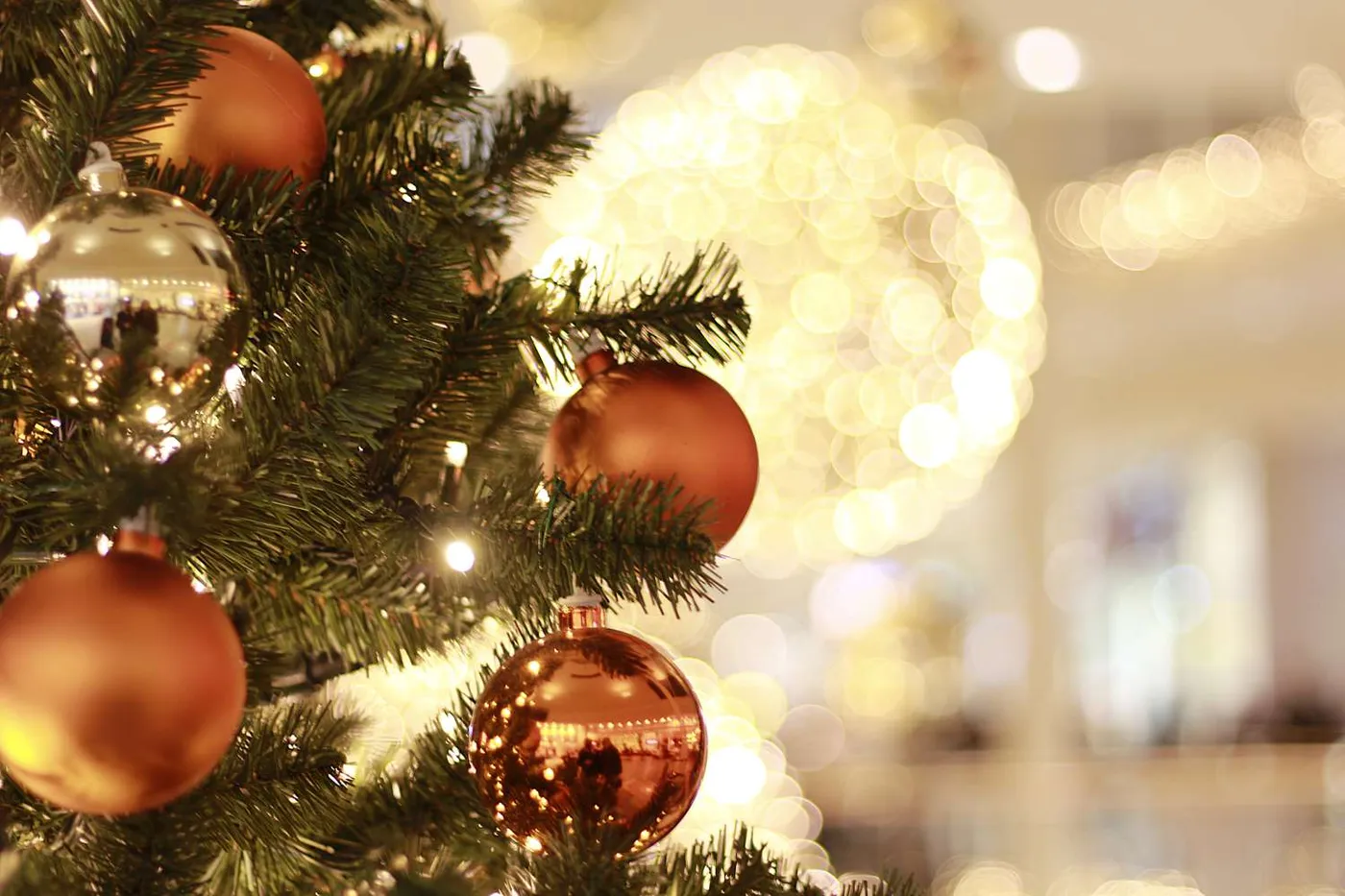
28. Red Glitter, Warm Bokeh, and a Reality Check
Glitter ornaments shed for their entire life. That sparkle on the floor in February is still this ornament. Seal them with a light coat of clear matte spray before hanging — it locks about 80% of the fallout without dulling the finish. Store them in a fabric bag rather than a hard box, so the coating doesn’t chip against the sides.

- Glitter ornament sets, 12 to 24 count: $15–$45
- Warm white string lights, 300 count: $20–$40
- Tree, 7.5 ft unlit: $100–$300
- Clear matte sealant spray: $8–$14
- Total: $143 to $399
Red glitter is the most forgiving Christmas color and the least forgiving texture. It hides a cheap tree beautifully, but it also sticks to everything — hands, pets, the white sofa. If there’s a light rug under the tree, put a felt pad down first, and keep glitter ornaments out of the lower third if you have a dog that investigates.
29. Warm Lights, Wainscoting, and Ornaments You Can Barely See
- Install the tree’s internal lights before anything else touches the branches.
- Add ornaments only at the two size extremes — tiny glass drops and a few large statement pieces.
- Layer two rugs under the seating area to soften the wood floor’s reflection.
- Keep the mantel simple: one garland, a few candles, nothing stacked.
- Angle the armchairs toward the tree rather than running them parallel to it.
Time: about two hours. Cost: mostly free if you’re reusing ornaments.
The white wainscoting. It isn’t decor, it’s architecture — and it’s the reason this room reads elegant instead of plain. The horizontal line at chair-rail height gives the eye somewhere to sit, and the bright white bounces light back onto the tree. Painting the lower wall in a semi-gloss cream is a weekend project for around $80 and does more for a holiday room than any new ornament set. This is the classic 12-by-16 living room, and it’s forgiving — a 7.5 to 9-foot tree works as long as the ceiling clears 9 feet. Smaller room? See Idea #13 for tabletop scale, or Idea #16 for a slim silhouette with the same footprint.
30. Silver Tinsel and Every Color You Own
This tree flips the usual rule: 70% metallic silver tinsel base, 20% multicolor ornaments, 10% pink and turquoise accents pulled from the pouf and the pillow. The silver is what makes chaos look intentional — it’s a neutral that reflects everything around it. Swap the silver for matte champagne and the whole tree calms down immediately. Swap it for black and you’ve got something genuinely dramatic.
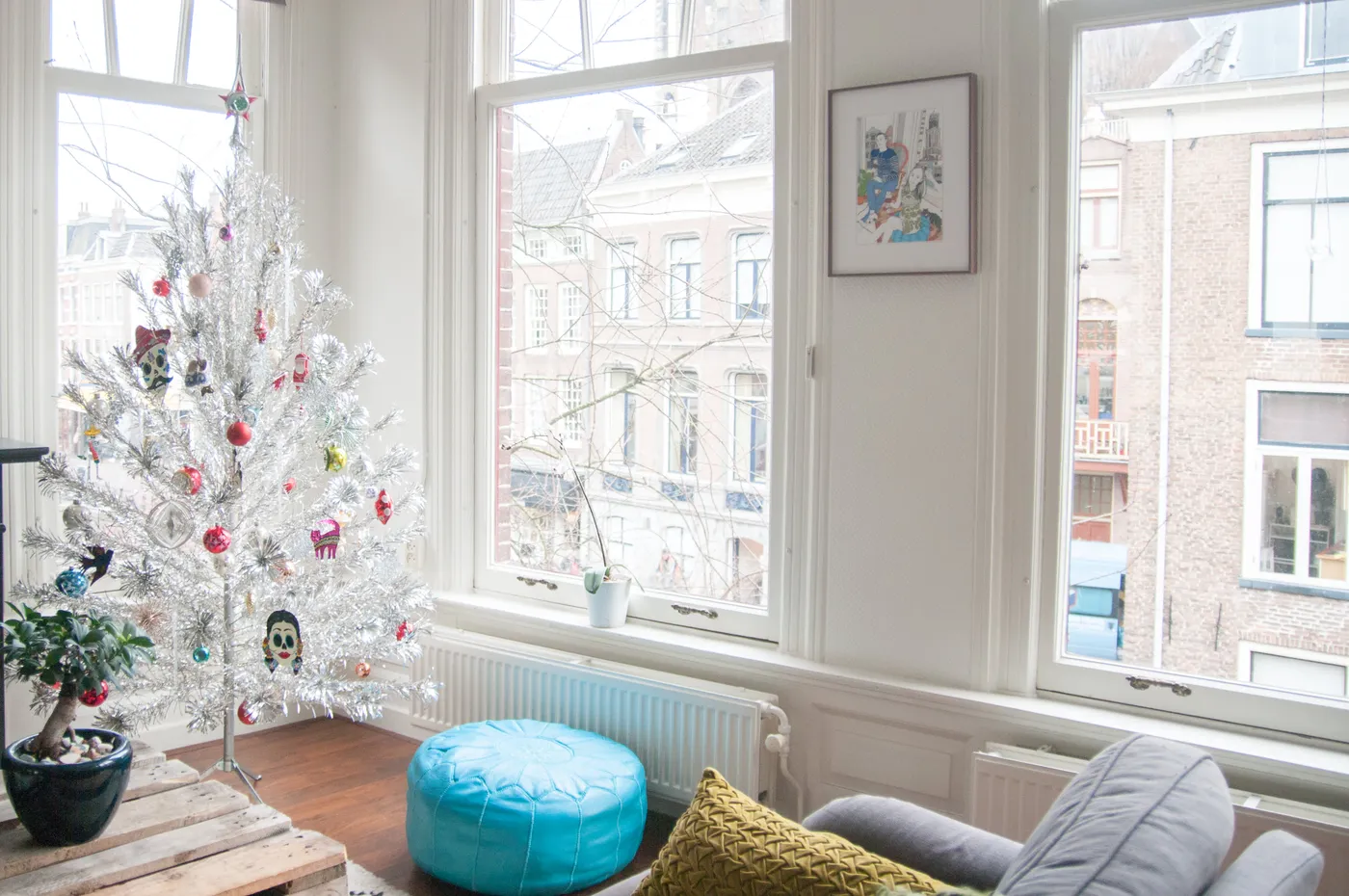
Vintage tinsel trees are back and they are not cheap at antique stores. Skip the vintage markup: new silver tinsel trees run $60 to $150 for 6 to 7 feet at Target and Walmart. Ornaments can be a total thrift haul — mixed vintage balls at $2 to $4 each look better than a matched set anyway. Total possible under $150.
- Fluff the tinsel branches outward in sections so light passes through instead of reflecting in one sheet.
- Hang the largest ornaments closest to the trunk, smaller ones toward the tips.
- Group colors in clusters of two or three instead of scattering them evenly.
- Leave the bottom third sparser so the tree skirt and pouf stay visible.
31. A Natural-Shaped Tree Beside the Piano
Naturally shaped, slightly asymmetrical artificial trees have quietly overtaken perfectly conical ones over the last two seasons. Shoppers in 2026 want trees that look like they grew, and brands responded — most major retailers now carry at least one “natural” silhouette. It’s a good trend: irregular trees are more forgiving to decorate and they photograph with more depth.
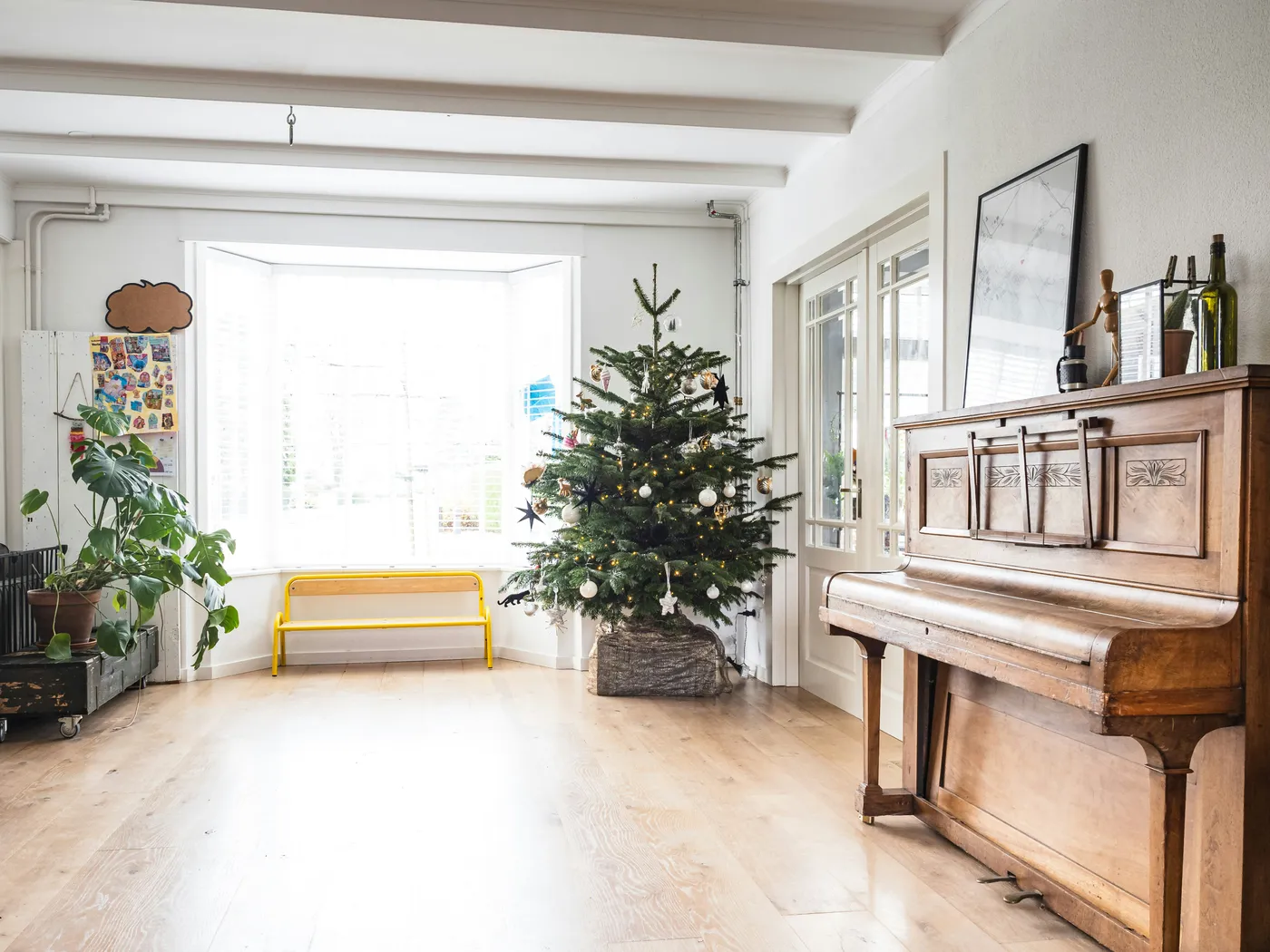
A natural-shaped tree shows its gaps. Put it where you’ll walk past it daily and rotate it a quarter turn every few days through December, so it doesn’t develop one flat back side from being pressed near the wall. And if it sits beside a piano, keep a felt pad under the stand — a heavy tree shifting on wood flooring leaves marks that don’t come out.
Match ornament size to branch spacing. On a naturally shaped tree with wide-set branches, use larger ornaments — 3 to 4 inches — spaced about 10 inches apart. Small ornaments disappear into the gaps and make the tree look under-decorated. Keep to two colors plus one metal; this tree uses white and dark charcoal with no metallic at all, which is why it feels calm next to the warm wood of the piano.
32. Kraft Paper, Red Ribbon, and a Woven Round Rug
- Flocked tree, 7.5 ft: $180–$500
- Warm white lights: $25–$50
- Kraft paper and red satin ribbon: $20–$45
- Round woven jute rug: $60–$180
- Armchair pillow and throw: $40–$110
- Total: $325 to $885
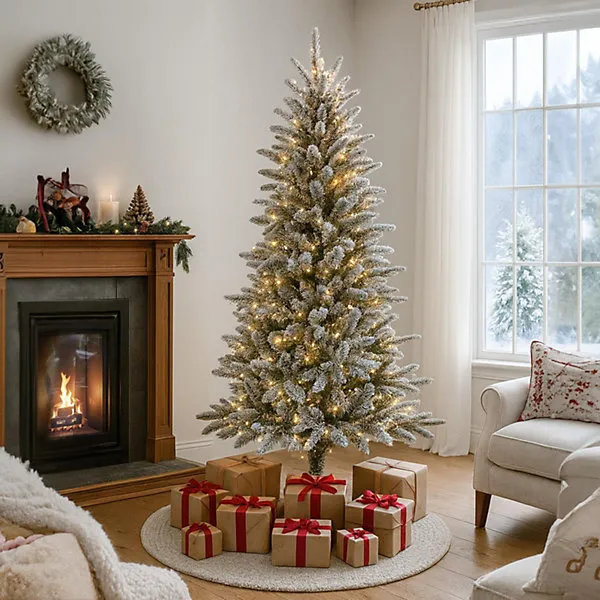
Budget alternative: skip the rug and use a woven basket collar under the tree instead — same texture, a third of the cost.
Everything here comes from the same three materials: wood, wool, and paper. That’s why it reads warm instead of busy. The round rug also does something clever — it defines a “tree zone” on a wood floor, which stops the pile of gifts from looking like clutter. Circles are calming against all those squared-off furniture legs. The color math is 65% frosted white and neutral, 20% kraft brown and natural wood, 15% red. Red at 15% is the sweet spot: festive without dominating. Push it to 30% and it’s a greeting card. Drop it to 5% and it goes flat.
33. White Plank Fireplace, Pine Wreath, Black Ribbon
- Measure the mantel and add 12 inches of drape on each side for the garland.
- Anchor the garland with two small cup hooks under the mantel ledge, not on top of it.
- Layer in pinecones and a few berry sprigs so the garland isn’t uniform.
- Hang the wreath about two-thirds along the mantel rather than dead center.
- Offset the crate tree to the left so it reads as a companion, not a matching pair.
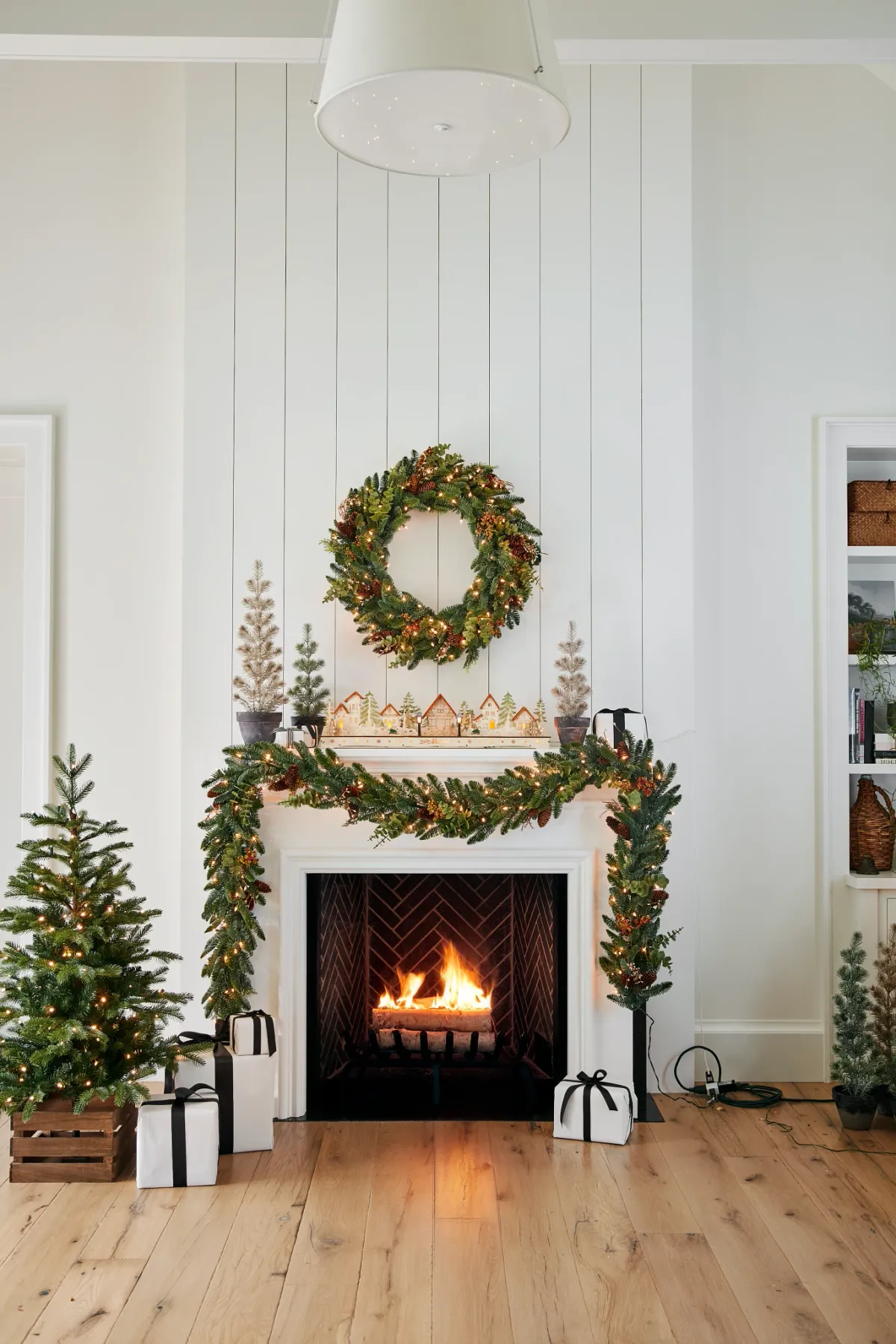
Time: 45 minutes. Cost: $60 to $150 including the wooden crate.
- Confirm your hooks won’t damage the paint or wood finish.
- Check outlet access for two lit pieces — garland and crate tree.
- Measure the space left of the fireplace before buying a crate.
- Decide where wrapped gifts will land so they don’t block the hearth.
The single-wall holiday vignette — fireplace only, no tree — is growing fast, especially among renters and small-space dwellers. Pinterest saves for small-space Christmas decor have climbed every year since 2022, and 2026 looks like the biggest yet. It has real staying power because it’s driven by housing reality, not aesthetics.
34. Sparse Branches, Warm Lights, Faux Fur Base
Backlighting a sparse tree against a window is a beautiful idea with a real catch: at night, with the room lights on, the window becomes a black mirror and the tree loses its glow entirely. Use this look with sheer or unlined curtains you can actually close, and keep the tree on a dimmer. Also, if that window faces the street, remember everyone can see in. Not a dealbreaker — just know what you’re signing up for.
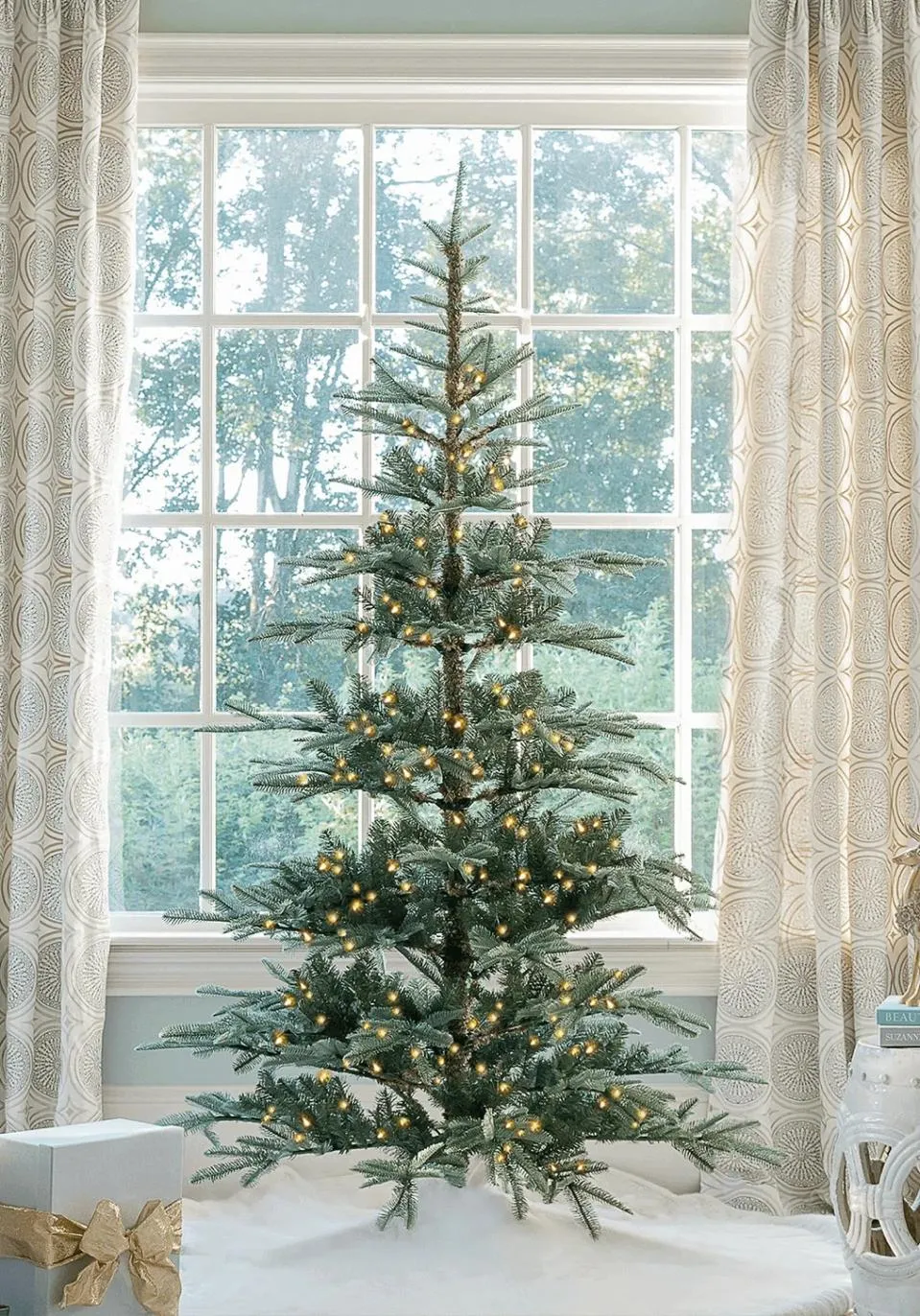
Faux fur tree skirts collect every pet hair and needle in a 10-foot radius. Shake them out weekly and vacuum on the lowest suction with no beater bar — the fibers mat down permanently if you overdo it. Plan on replacing a faux fur skirt every three to four years if it lives in a high-traffic room.
On an undecorated tree, the light spacing IS the decoration. Use 50 lights per foot instead of 100 — enough to define the silhouette without filling in the gaps. Tuck the strand behind the branch line rather than on top of it, and choose bulbs with a visible filament look rather than a plastic cap, which reads warmer and slightly vintage at this scale.
35. Blue Ribbon, White Florals, and a Faux Fur Skirt
- Tree (7.5 to 9 ft, pre-lit): $250–$700
- Blue ribbon, 2.5 in wide, three rolls: $24–$60
- White floral picks and silver ornaments: $60–$180
- White faux fur tree skirt: $30–$80
- Mantel stockings and lanterns: $50–$150
- Total: $414 to $1,170
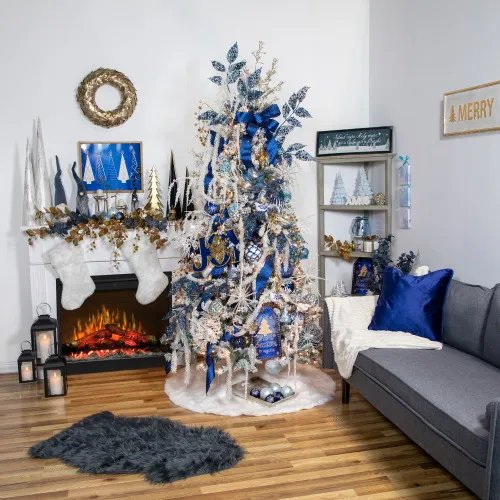
Budget alternative: let ribbon be your only blue element and skip colored ornaments entirely — ribbon costs a fraction of a full ornament set.
The ribbon. It’s the thread that runs through this entire scheme — wound through the branches, repeated on the mantel, echoed in the blue pillow on the sofa. Without it, you’d have a tree with blue objects on it. With it, everything in the room reads as one decision. If you only buy one thing for a blue-and-white tree, buy three rolls of wide royal blue ribbon and use all of it.
One Tree, One Room, One Very Good December
Here’s the thing about elegant Christmas trees: the ones people remember are almost never the most decorated. They’re the ones where somebody made a decision and stuck to it — one palette, one texture story, one strong idea. Pick the version above that fits your actual room, not the one that photographs best, and you’ll be happy with it on December 26th too.
📌 Pin your favorite from this list now — when the boxes come out next year, you’ll be glad you saved it.