You pin the same miniature tree three years running and never quite replicate it — and the reason is almost never the tree. It’s the base, the light temperature, and one accent color repeated three times. Get those right and a two-foot tree can carry a whole corner of your home.
We spent serious time browsing Walmart, Temu, and SHEIN to bring you only what’s worth your attention this year, plus boutique finds from about $5 up to $180. After filtering through hundreds of options, we narrowed it down to 35 ideas that actually deliver.
Inside you’ll find flocked and pastel trees, rustic woodland vignettes, vintage tinsel and feather-tree styling, fresh-greens florals, and wood-toned minimal pieces — with budget and luxury versions compared side by side and real costs for each. And stay until the end — we break down the most common mistakes that can ruin these looks.
Small-space decorating is what’s driving the whole category in 2026: renters, dorm rooms, and studio apartments are styling three-foot trees with the same care people once gave a seven-footer.
📌 Save this to Pinterest for later — you’ll want to revisit these ideas.
1. Flocked Mini Tree Dressed in Rose Gold and Blush
Take away the rose gold baubles, the pink bow, even the string lights, and this tree still reads as elegant — because of the cream felt pot with the reindeer cutout. That base is the whole idea. Swap it for bare plastic or orange terra cotta and the pale pink and silver suddenly look like leftover birthday decor. Soft neutrals are what let blush and metallic behave together.
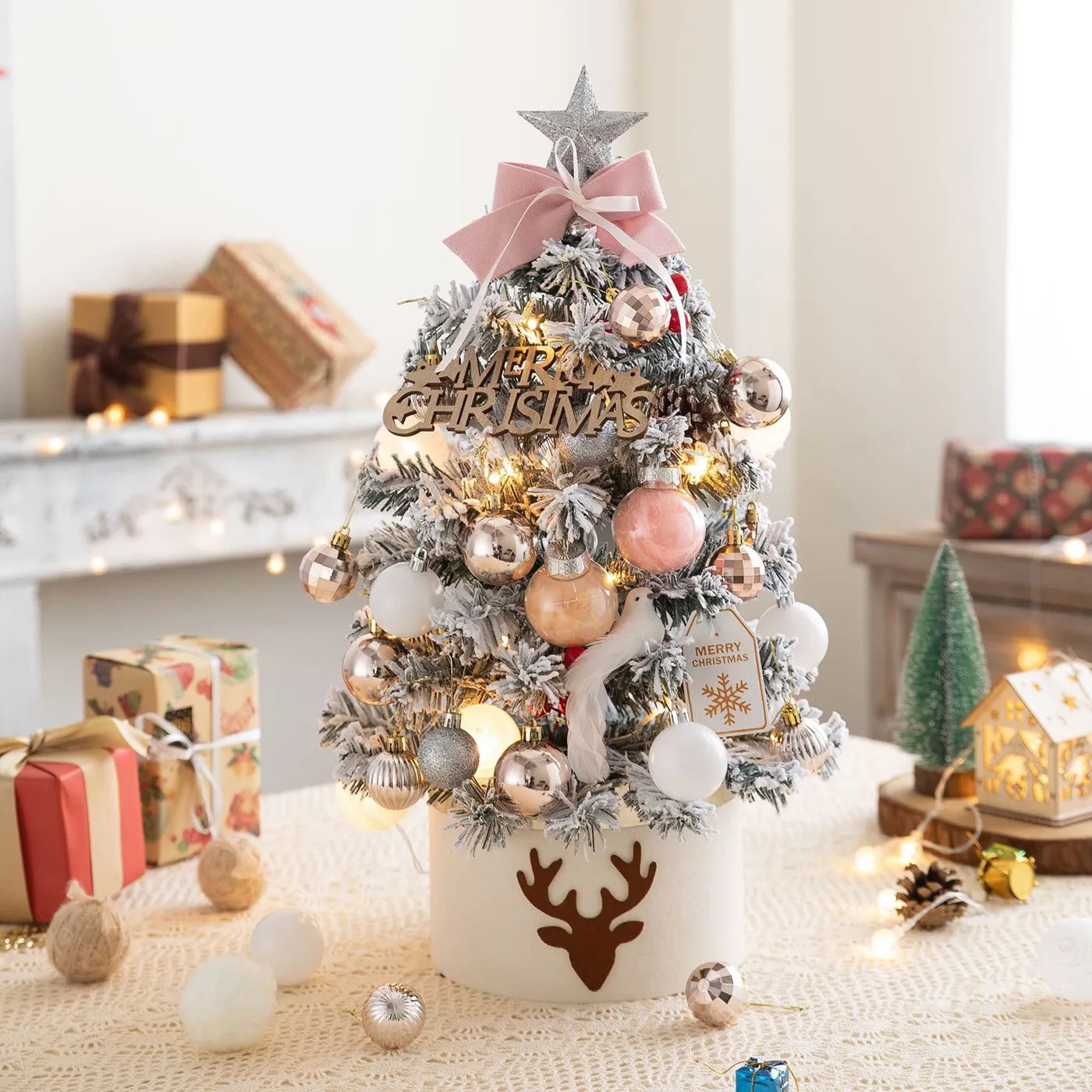
On a flocked tree this small, work ornaments in three sizes and never skip the smallest: tuck 1.5-inch balls into the branches first, hang 2-inch baubles on the outer tips, and cap it at three or four larger pieces, no more. Cluster the tiny ones in threes, a half-inch apart. Flocking eats contrast, so you need depth of layers, not bigger ornaments.
2. Gold Baubles and a Wide Ribbon Bow on a Wood Pedestal
- Tabletop tree, 24–30 in, pre-lit: $35–$90
- Gold baubles, 30–40 pieces in mixed sizes: $20–$45
- Wide glitter ribbon, 2–3 rolls: $12–$30
- Pedestal side table, or use what you have: $60–$180
- Gold bead clusters and picks: $10–$25
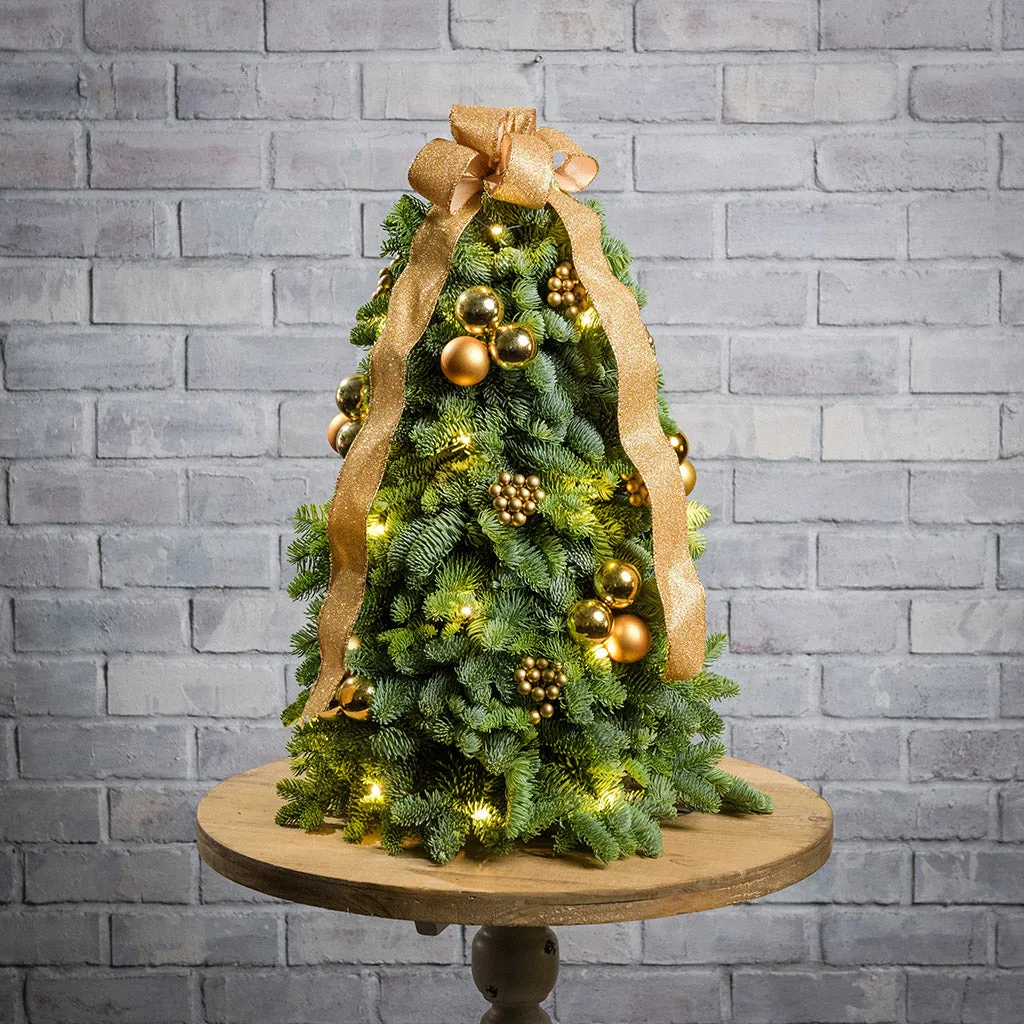
Total: $137–$370, and the table part is optional — this look works just as well on a shelf. Budget route: gold ornament tubes under $15 plus a thrifted pedestal at $20–$40 gets you there for about $85.
Gold on deep green is centuries old, but what keeps this from looking like a mall display is repetition at three scales: round baubles, beaded clusters, and a ribbon the width of the tree’s own silhouette. Same metal, three weights. The warm white lights finish it — switch to cool white and every gold surface turns brassy against the brick.
3. A Potted Evergreen With Bronze Star and Pinecone Ornaments
Real potted evergreens indoors are a short-term guest, not a December-long commitment. Seven to ten days is the honest window before warm, dry air starts dropping needles, and moving one from a cold nursery straight into a heated living room is the fastest way to shock it. Water when the top inch of soil is dry, keep it off radiators, and expect bronze ornaments to read nearly black in dim corners.
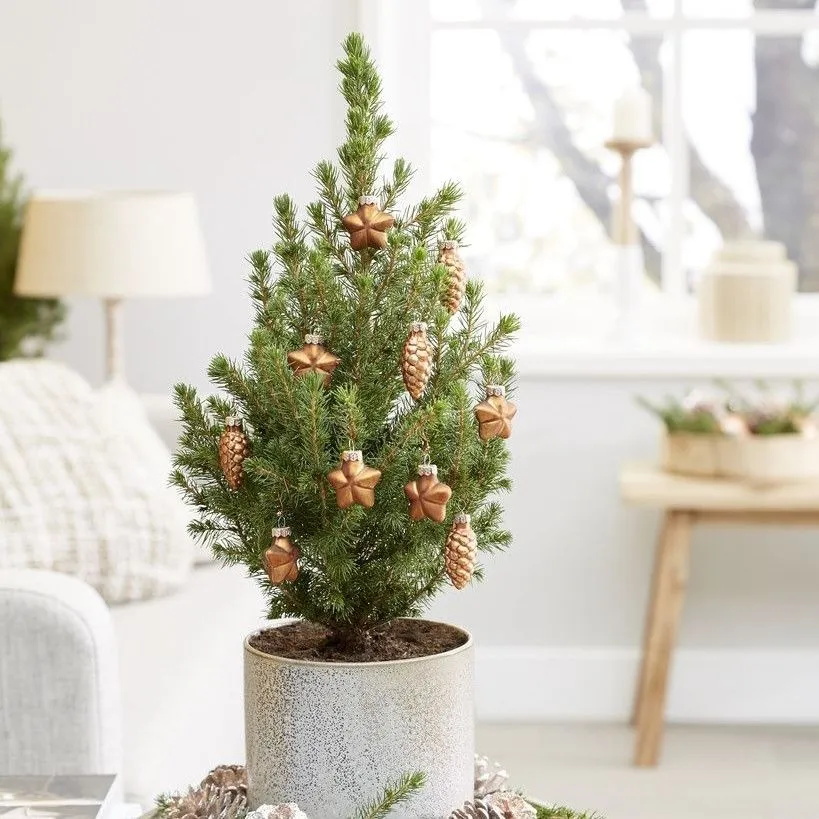
The pot should be roughly one-third the height of the tree — an 8-inch cylinder under a two-foot evergreen looks intentional; a 4-inch pot looks like it tipped over. Leave 10 inches of clearance below the lowest branch so the pot reads. Under 90 square feet of floor space gets tight fast, so for truly tiny footprints see Idea #11. Frosted pinecones and cut sprigs on the floor widen the base visually.
4. A Small Tree That Earns Its Corner
You don’t need a $200 vignette to make a small holiday tree feel like it belongs. A $25 unlit tabletop tree, a $6 string of warm LEDs, a thrifted brass candlestick for height, and three ornaments you already own will do more than one big spend on a single designer piece. Facebook Marketplace is full of people selling last year’s mini trees for $10 in early November.
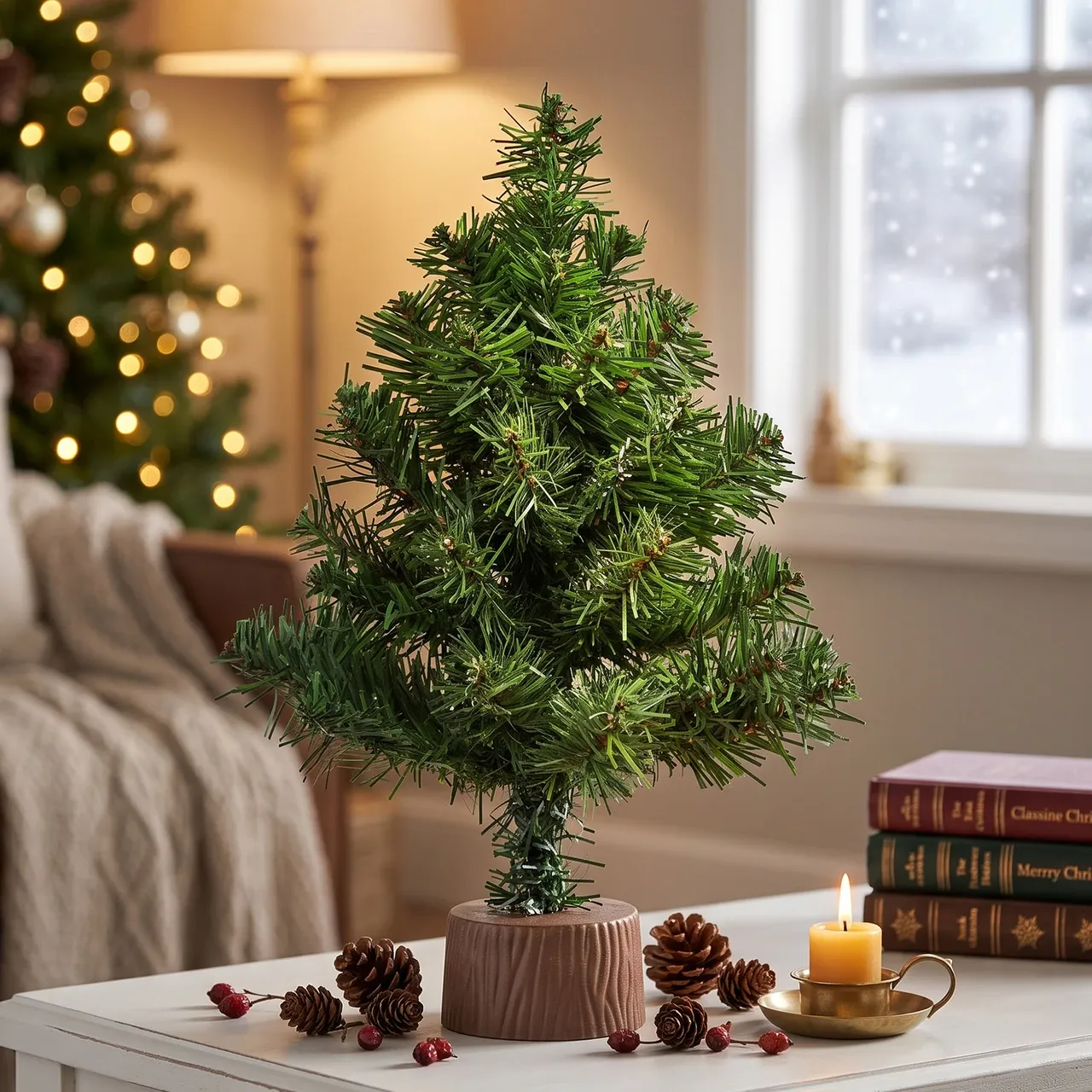
The formula behind a display that reads calm instead of busy: 60 percent neutral base (tree, pot, cloth or tray), 25 percent one accent color used three times, 15 percent metallic. Pick your accent — red, blush, bronze — and repeat it in three different materials so it doesn’t look like a kit. Swap the accent freely; the math still holds. Compare with Idea #2, where gold plays all three roles.
5. Blush Pink Tree Beside a Faux Fireplace
Pink Christmas stopped being a novelty around 2023 and now has its own Etsy category. What’s driving it in 2026 is the same thing pushing plush figures and LED candles: people want a holiday that feels soft after years of maximalist gold. A blush tree with cotton accents and a small herd of plush characters is nostalgia with better lighting.
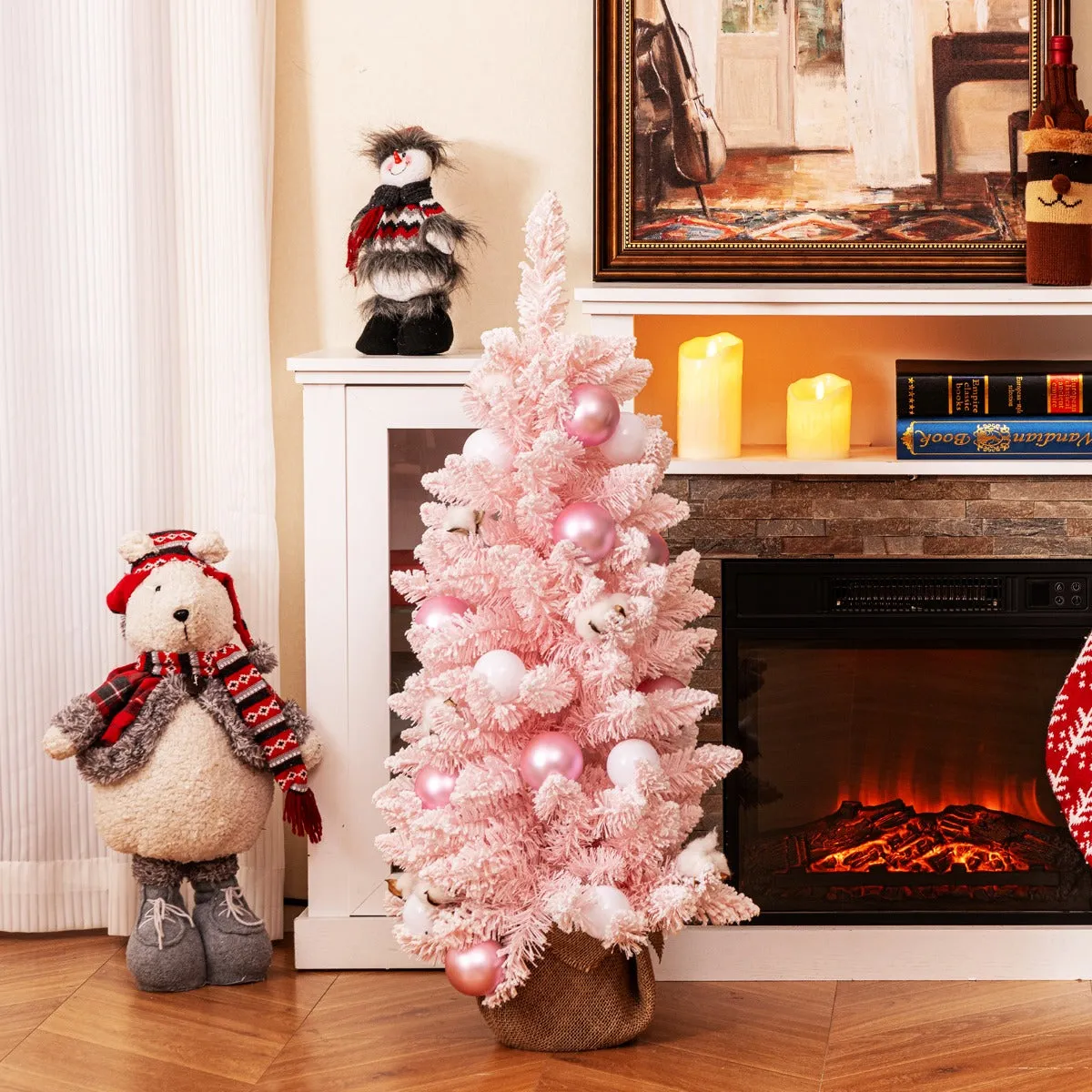
What saves this from being a sugar overload is the burlap-wrapped base. Under a pastel tree with pink and white ornaments, that rough tan texture is the only matte, unglamorous material in the whole vignette — and it’s what makes the pink look deliberate. Swap it for a glossy pink pot and the whimsy turns to syrup in about four seconds.
6. Flocked Tree on Snow With a Miniature House
Flocking swallows light, so over-light on purpose: a two-foot flocked tree can take 100 warm mini lights without looking crowded. Run the strand up the trunk first, then spiral outward along the branch tips, and stay at 2700K. Cool-white LEDs turn flocking blue-grey, which is the difference between fresh snow and wet slush. Tuck the battery pack behind the wooden base, not under the artificial snow.
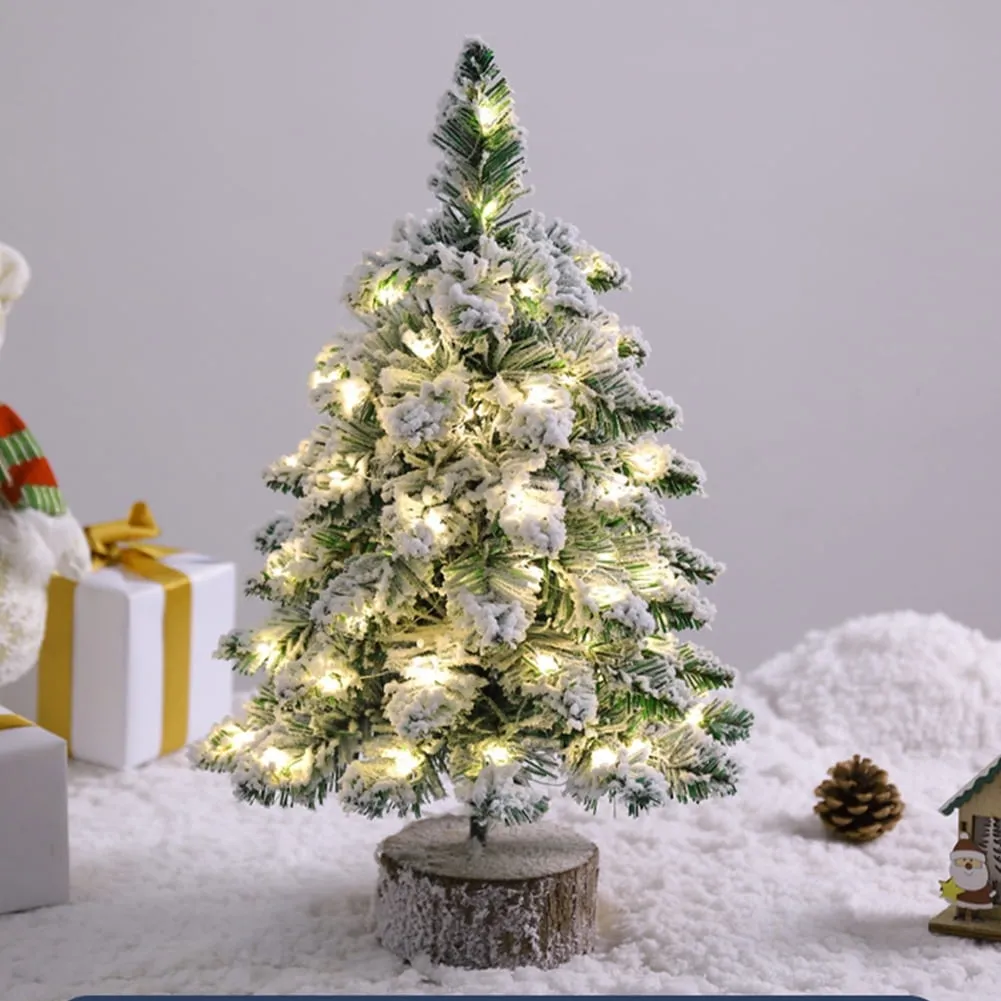
Flocking sheds. Expect a fine dusting on the table every time you move this tree, and never vacuum it with a beater bar — use a brush attachment or a lint roller. The faux snow needs a tray or shallow bowl underneath or it migrates onto the floor. Store the tree in a bag and upright if you can; crushed flocking creases and never quite fluffs back out.
7. Sisal Bottle Brush Trees on Wood Bases
Sisal bottle brush trees are one of the few decor categories where the cheap version genuinely holds up. Dollar-store trees at $1.25 each look nearly identical to $8 versions once they’re grouped — you’re paying for packaging and a wood base. Buy six inexpensive trees, then spend $12 on one real wood slice to anchor the cluster. That’s about $20 instead of $120.
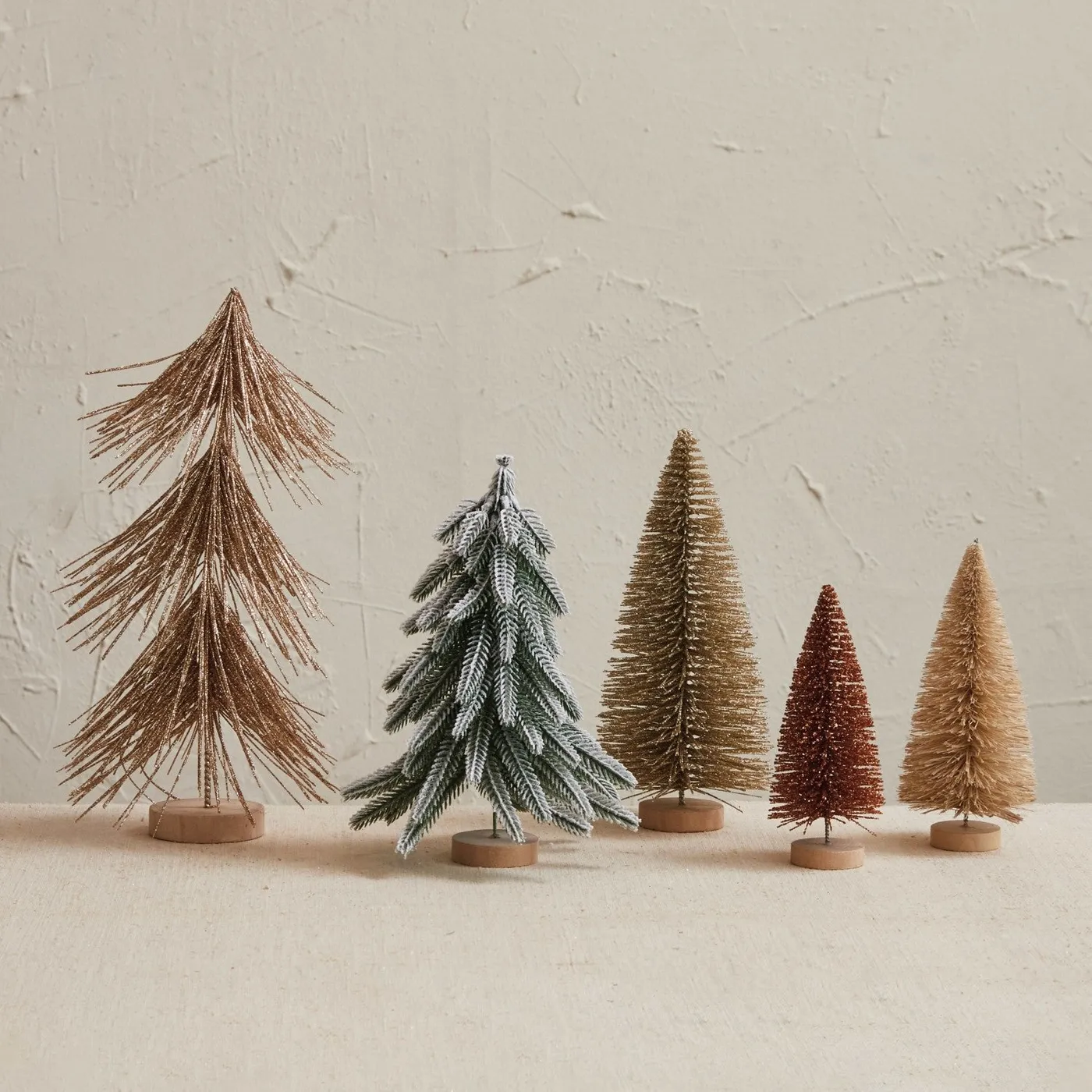
- Measure your shelf or console depth — a bottle brush cluster needs 6–8 inches front to back
- Check that every base sits flat; sisal trees wobble on uneven wood
- Decide your color story before you buy: all-natural, or cream with one red
- Leave 3 inches of empty space above the tallest tree
8. Berry-Lit Evergreen Under a Golden Star Finial
This works as a dining centerpiece because every element echoes: the golden star finial rhymes with the gold rims on the ribbed glassware, red berries are the only saturated color in the room, and the green garland spreads the tree’s own material outward so it doesn’t read as one lonely object on a big table. Keep the tree under about 16 inches tall or you’ll be talking through branches all dinner.
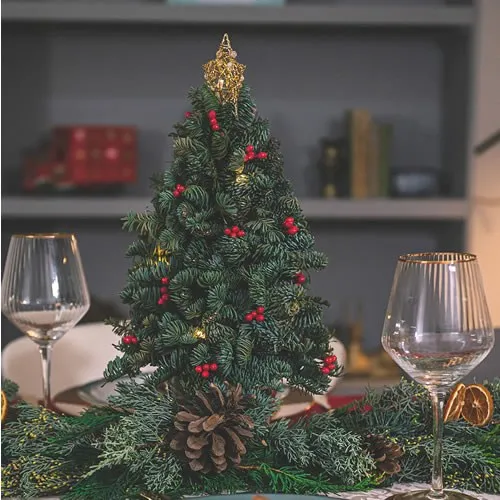
- Clear the center third of the table and lay cedar or magnolia garland in a loose oval
- Nestle a low bowl at the center and set the mini tree inside
- Tuck pinecones in with alternating faces so no two point the same way
- Thread one battery fairy strand through the tree and garland on a single timer
- Cluster three ribbed glasses to one side, not evenly spaced
About 30 minutes and $25–$60.
The math: 60 percent deep green, 25 percent red berries, 15 percent gold. Swap berries for cream ones and gold for brushed copper — same percentages, entirely different mood.
9. A Florist’s Mini Tree, Wrapped Like a Bouquet
A floral mini tree built from fresh evergreen is gorgeous for about a week, then it starts dropping needles onto your tablecloth. The greens sit in floral foam, which needs water every day — pour slowly so it doesn’t overflow — and anything within three feet of a heat vent dries out twice as fast. Plan this for a dinner party, not for the whole month of December.
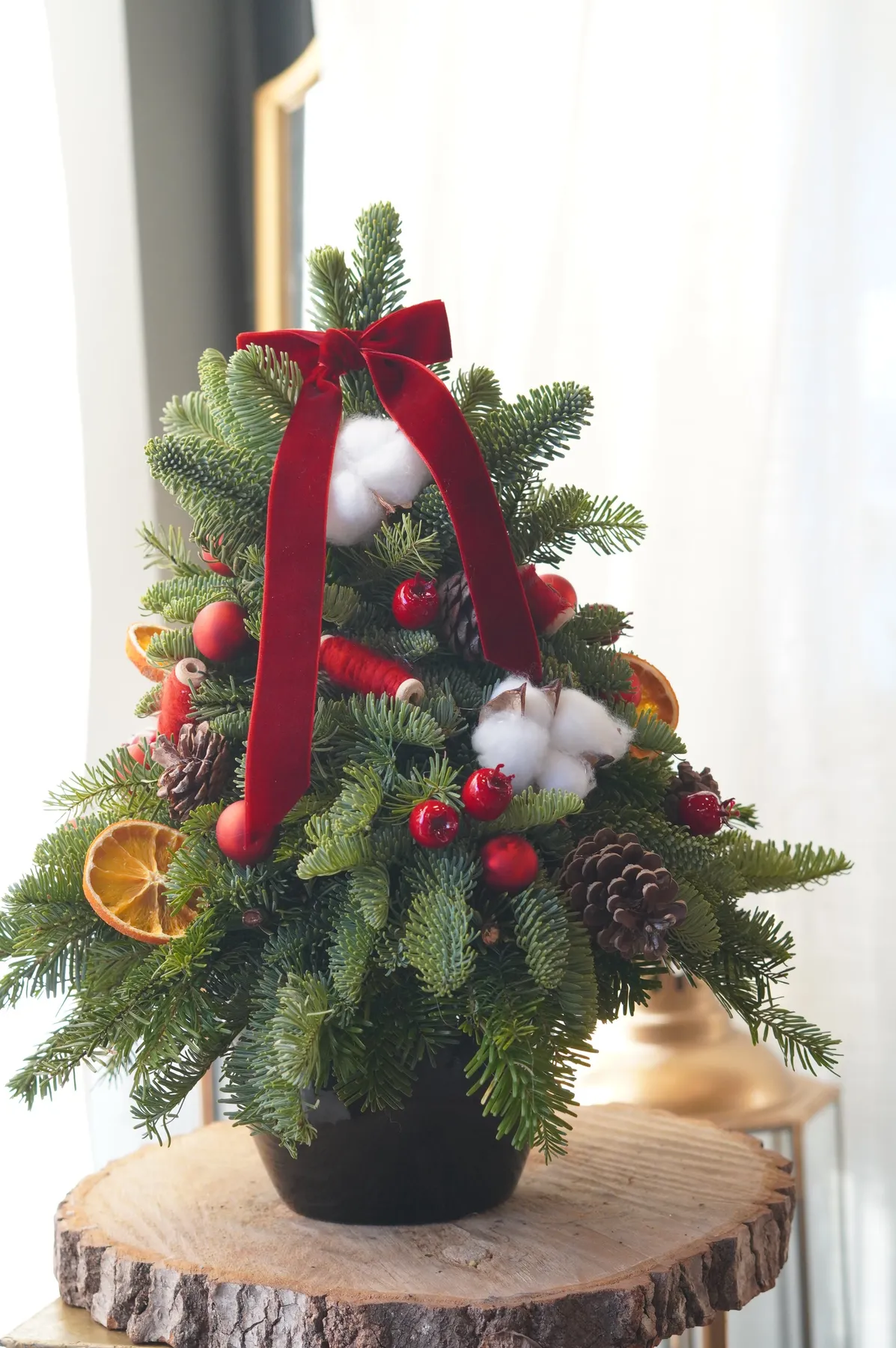
Florists charge $65–$120 for these, and the markup is mostly labor. Buy a $12 bunch of cedar or fir at the grocery store, a $5 brick of floral foam, and use a bowl you already own, and you’re at roughly $25 for the same silhouette. Add roses only if they’re on sale — otherwise a few cinnamon sticks do the work. This is the budget cousin of Idea #8.
10. White Ceramic Ornaments That Glow Softly
An all-white mini tree lives or dies by temperature: roughly 70 percent white ceramic, 20 percent warm light, 10 percent natural wood. Get the light wrong and the whole thing looks like a bathroom fixture. Swap the ceramic for matte plaster and the mood turns chalky; swap in pearl-finish baubles and it goes wedding. Same ratio, three different holidays.
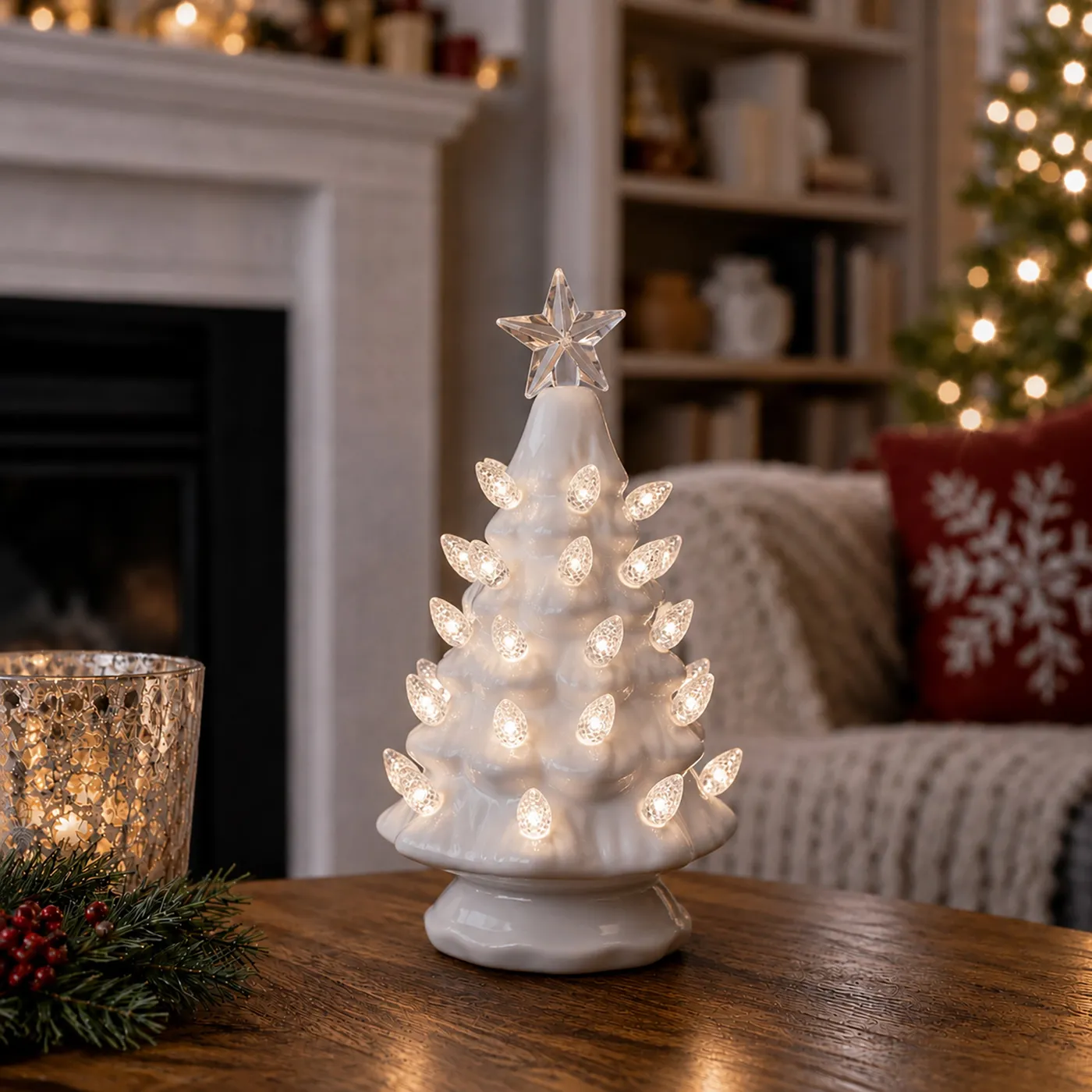
White on white needs shadow to read as shape rather than one pale blob, so light from the side, not from above. A small battery puck tucked behind and slightly left of the tree will graze each ceramic ornament and cast a soft edge. If the tree itself is already LED-lit, don’t add a second source — two warm lights from two directions cancel the effect.
11. Bottle Brush Tree on a Wood Slice Base
That thin slice of natural wood under a four-inch bottle brush tree is the detail that separates a miniature from a toy. Dark green bristles dusted with white flocking, a tiny gold star, and then — a raw wood base with visible grain and a live edge. It’s the same trick as putting a real linen napkin under a paper plate. Remove the slice and the tree is cute. Keep it and it’s collectible.
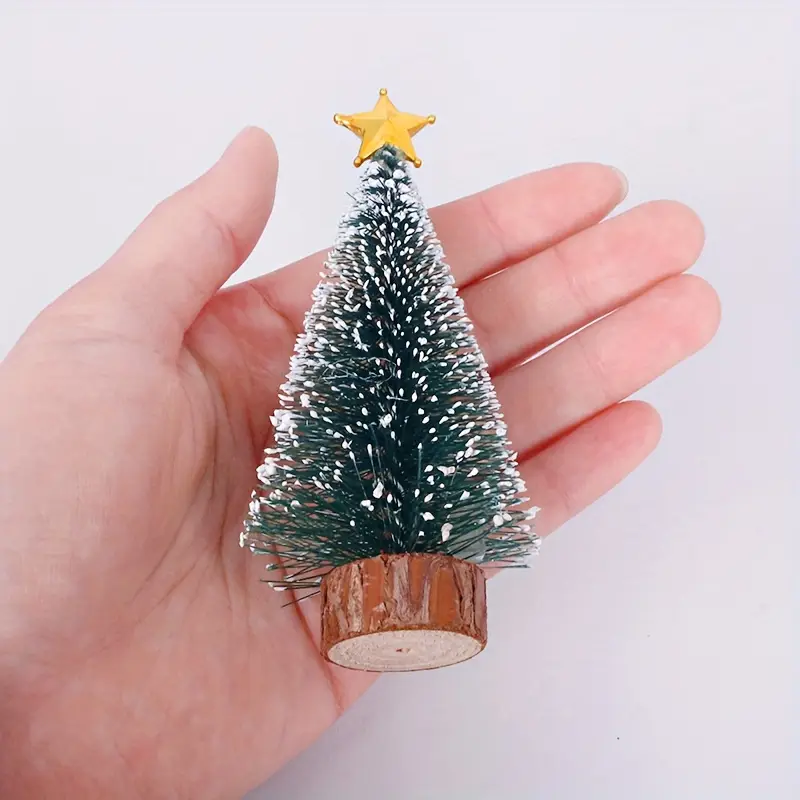
Three to six inches tall is the useful range, which makes standard 10–12 inch bookshelf clearance the natural home. Group three to five at staggered heights — 3, 4 and 6 inches — on a stacked-book riser no deeper than 8 inches. Anything taller than 8 inches starts competing with real books and reads as clutter instead of a collection.
12. Handmade Tiny Trees, Small-Batch and Imperfect
- Handmade or small-shop mini tree: $28–$75
- Mercury glass ornaments, 12–18 pieces: $15–$40
- Small riser, box, or stack of books: $8–$22
- Warm LED string: $8–$16
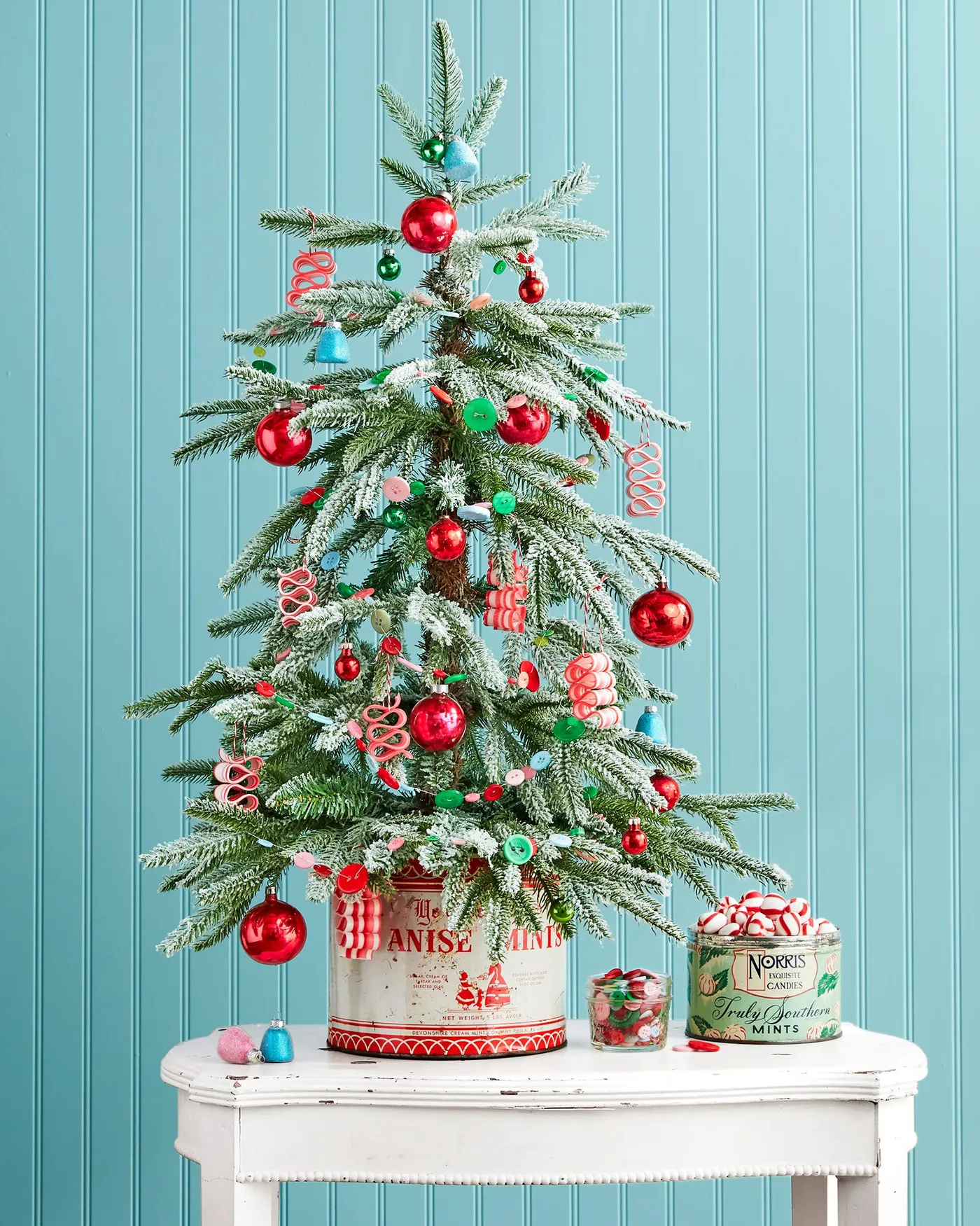
Total: $59–$153. Budget alternative: start with a $10 plain tabletop tree and a $7 tube of ornaments, then add one handmade piece — a felt garland or a knitted topper — for about $30 all in.
Handmade mini trees are having a moment because buyers got tired of identical big-box ornaments, and because small makers now ship nationally through Etsy and craft fairs. The look is deliberately imperfect: slightly uneven bristles, hand-painted bases, visible stitches. That imperfection is the point in 2026, and it’s why these pieces hold their resale value better than mass-market trees.
13. Pre-Lit Mini Tree With No Visible Cord
Before you buy a pre-lit mini tree, check the light count per foot, not the total. Forty to fifty lights per foot is the sweet spot for an unflocked tree; below 25 and you’ll see dark gaps from the doorway. If it runs on batteries, the pack is almost always the ugly part — build the base with a hollow gap behind it, or tuck the pack into a lidded box under the branches.
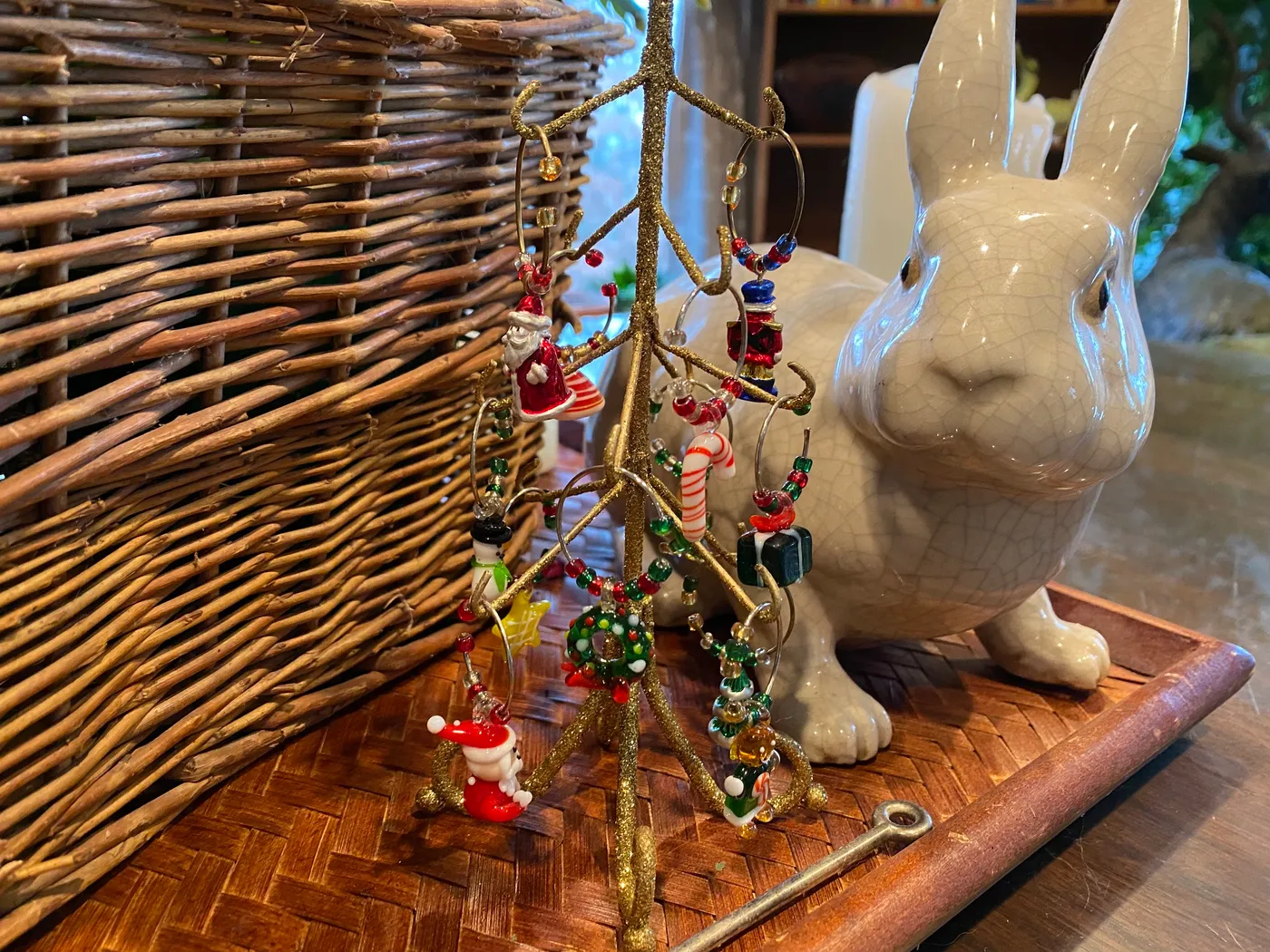
A cordless mini tree is a decorating cheat code. No outlet means the entry console, the bathroom counter, the top of the fridge, and the windowsill above the kitchen sink are all suddenly fair game. It also means you can move it on a whim, which is exactly why these trees get restyled all season instead of sitting in one spot until January.
14. A Set of Three Flocked Trees, Styled as One
Inexpensive flocking sheds more than the professional kind, especially in the first season — expect a light dusting every time you move the set. Dust with a soft brush or lint roller rather than a damp cloth, which smears the flocking and leaves a grey water line. Store the three trees separately, wrapped loosely in tissue; stacked together, the bristles crush and the flocked tips flatten permanently.
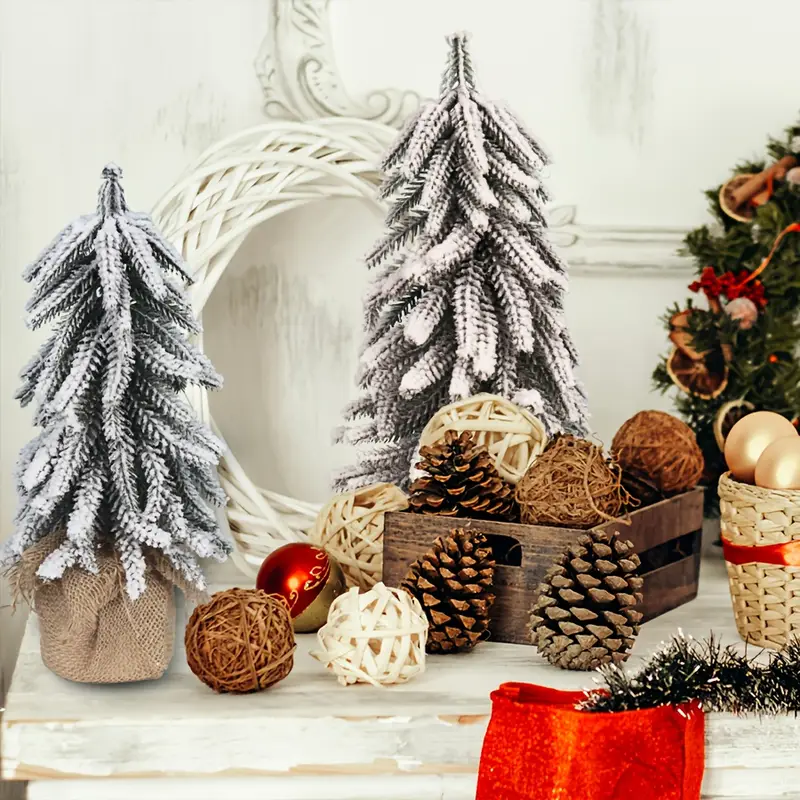
A three-piece flocked set is one of the best value plays in holiday decor, because you get three styling moments for one purchase. Cheaper routes: a $10 plain tree plus a $9 can of spray flocking gets you a custom version with heavier snow where you want it. Or buy one good tree and two dollar-store fillers, and place the nicest one front and center where the light hits.
15. Vintage Silver Tinsel Tree, Fifteen Inches of Retro
Fluffing a tinsel tree is its own skill:
- Work from the trunk outward, one row at a time, bending each tip into a slight upward curve.
- Even out your roughly 125 tips before you hang anything.
- Add warm lights — tinsel reflects hard, so cooler LEDs sparkle too aggressively.
- Hang ornaments on thread, not metal hooks, which snag the foil.
About 20 minutes and no cost if you already own the ornaments.
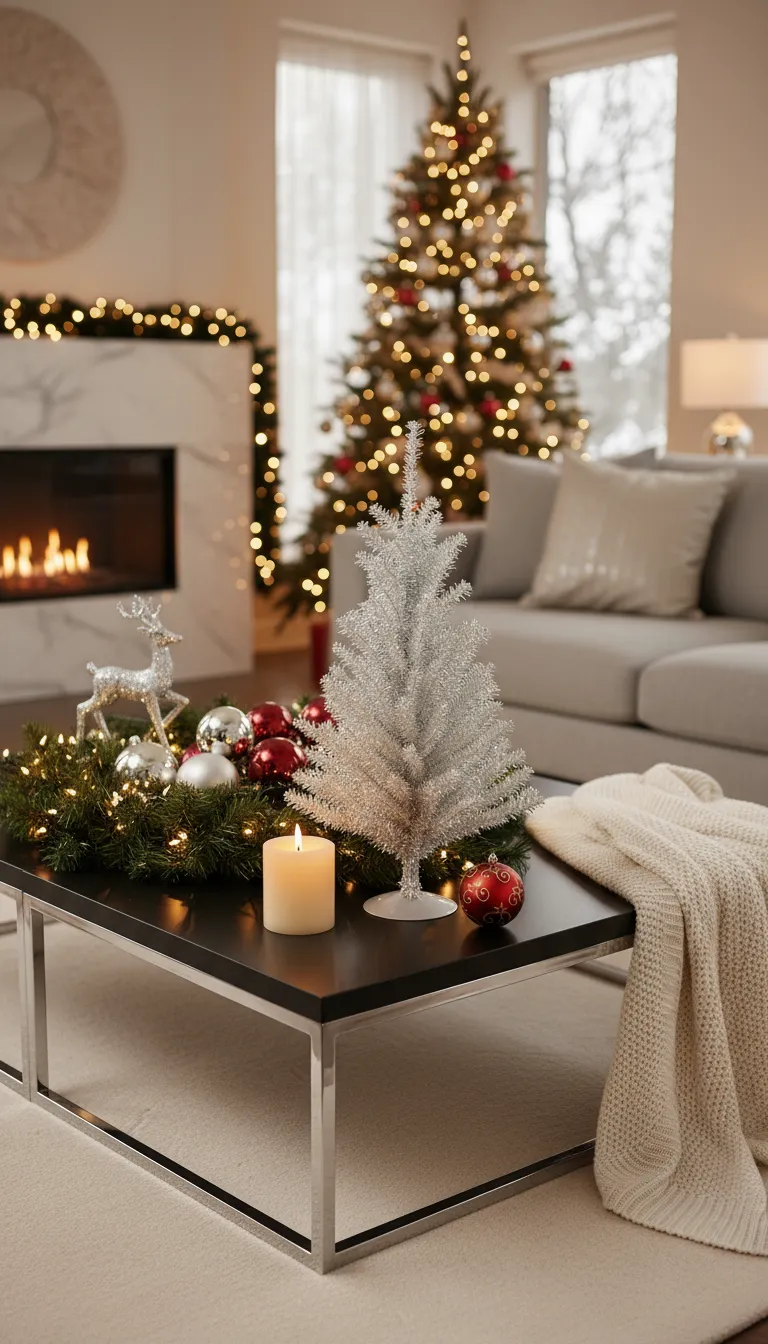
Honest downsides: tinsel sheds thin metallic strands that find their way into carpet, paws, and vacuum filters, and there’s no fixing a bent foil branch once it creases. Vintage aluminum trees can’t hold anything heavier than a golf ball, so skip the heirloom glass. Keep it away from heat sources — old foil and hot bulbs are a bad combination.
16. The Living Potted Tree You Plant in Spring
Match container to tree: a 30–40 cm pot for a 60–80 cm evergreen, with at least two inches of soil around the root ball. Indoors, give it a spot within six feet of a bright window and away from heat registers. It works on a wide sill or a deep console, not on a narrow shelf. For a version that stays tabletop-sized forever, compare Idea #3.
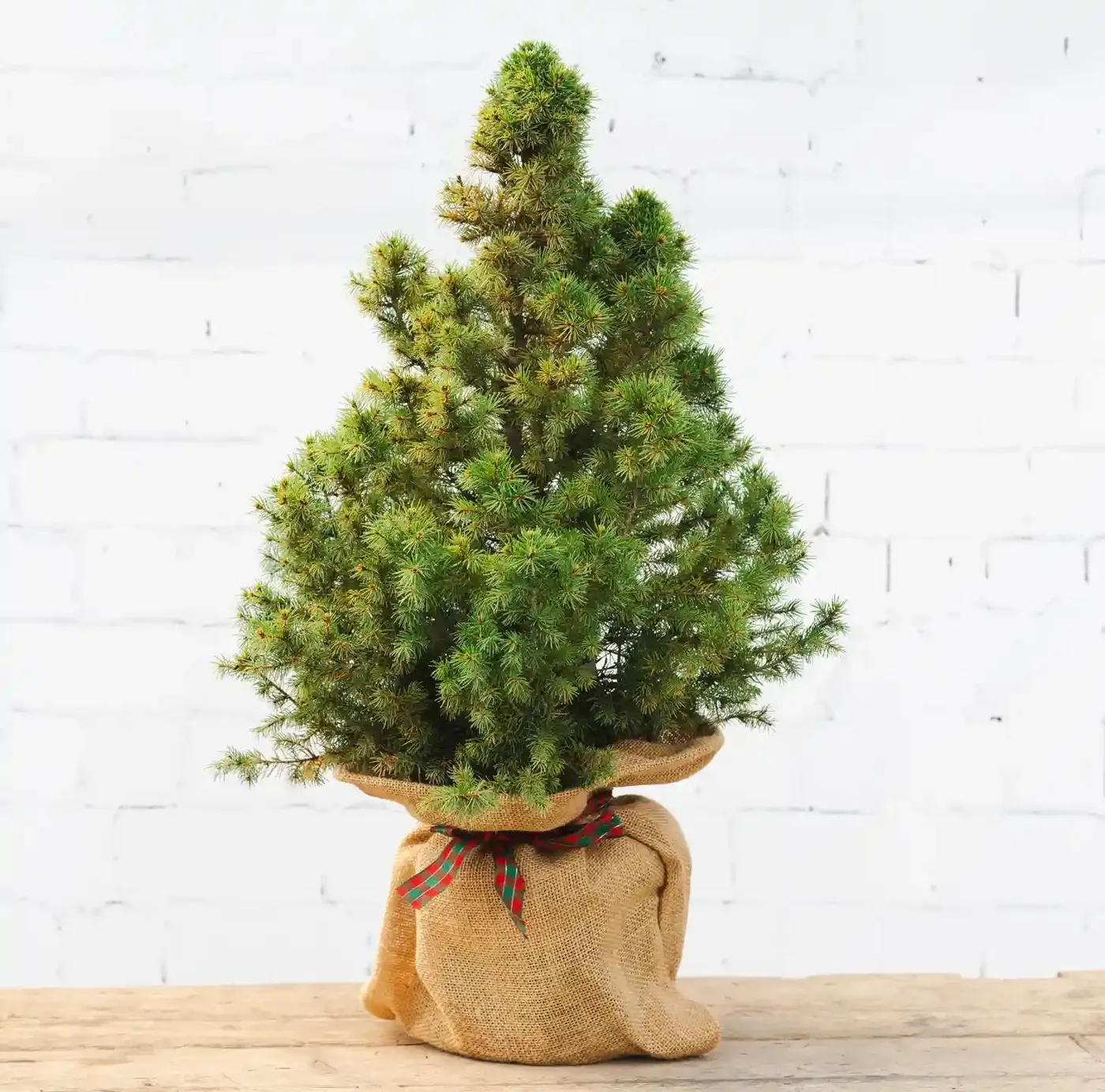
Living trees want water roughly every other day indoors — more if the room is dry — and they hate standing in a full saucer. Tip the pot after 10 minutes and dump the excess. Twelve days inside is a fair maximum; then move it to a cool garage for a week before planting, or temperature shock will kill it. Mist the needles every few days to slow the drying.
17. Hand-Turned Wooden Trees With a Feathered Finish
The finish is everything here. Hand-turned wood with a feathered, ridged surface catches light in stripes as you walk past — something a smooth painted cone never does. At 7, 9 and 12 inches, the three sizes aren’t just decorative: the feathering shifts scale, so a small grouping reads as a forest rather than three identical objects in a row.
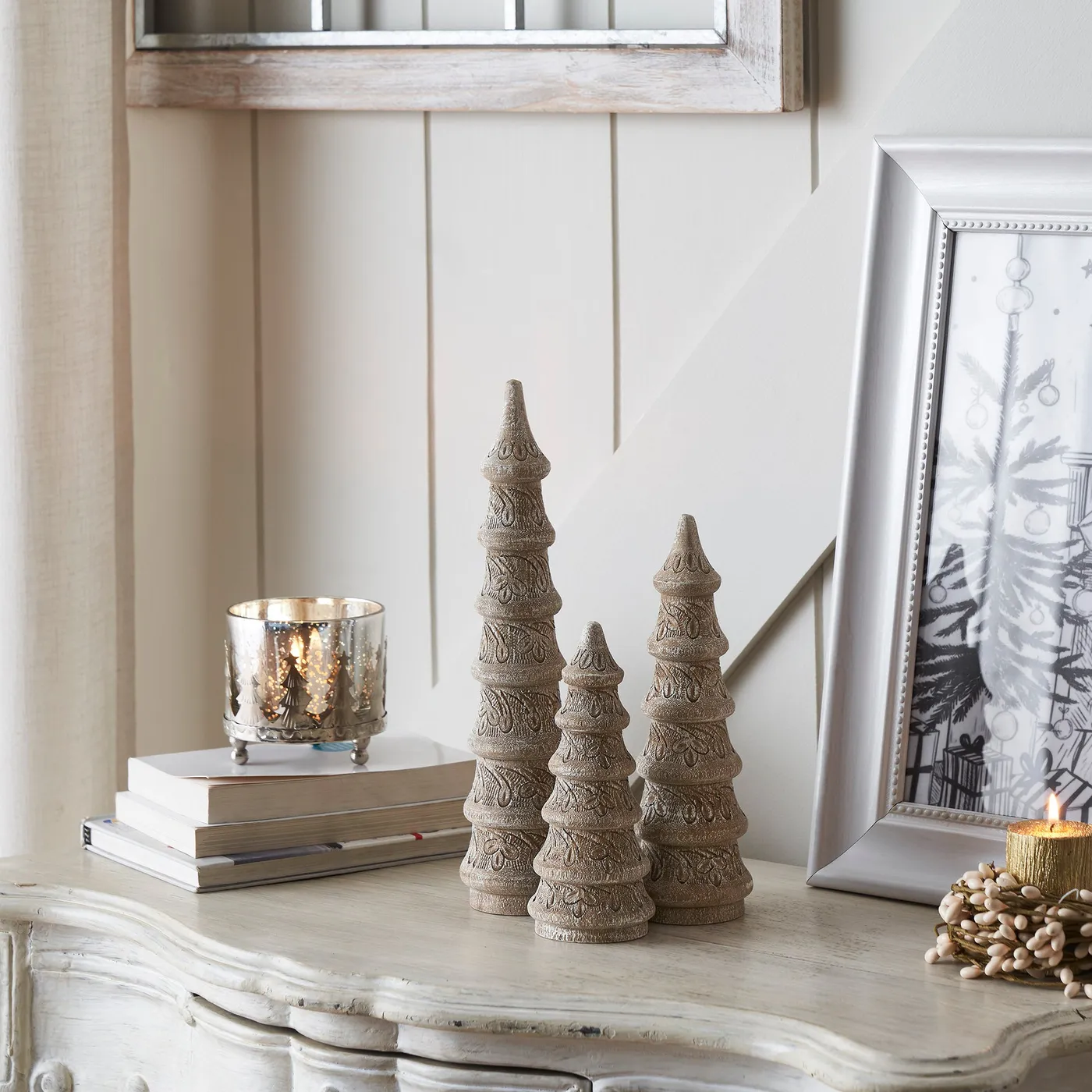
The formula: three wood tones as your base, one live green element, one textile. Roughly 60 percent bare wood, 30 percent green, 10 percent linen or wool. Stay in one wood family — all pale ash, or all walnut — because mixed species fight at this small scale. Want it lighter? Bleach the wood and swap the green for a single cedar sprig.
- Place the tallest piece at the back left of the shelf, not the center
- Set the middle size 3–4 inches to the right and slightly forward
- Put the smallest one in front, angled so its feathers catch the window light
- Stand back three feet and rotate each piece until no ridge line matches
18. A Feather Tree Dressed in 25mm Glass Ornaments
- Feather tree reproduction, 18–24 in: $25–$60
- 25 mm glass ornaments, 24–36 pieces: $90–$200
- Small felt base or skirt: $8–$20
- Replacement bulbs or mini lights: $6–$14
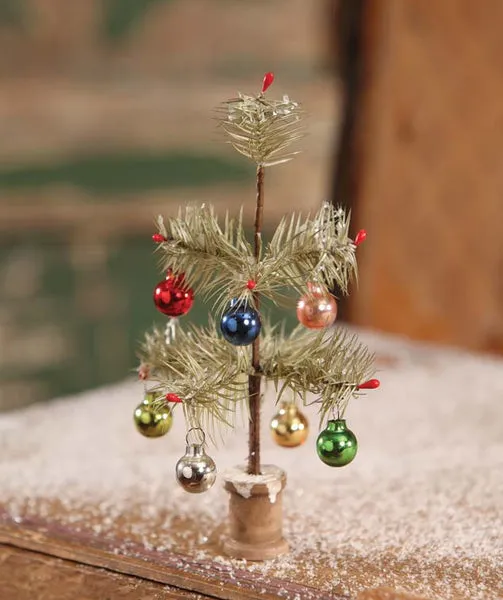
Total: $129–$294, and the ornaments are the entire bill. Budget alternative: put six real 25 mm glass pieces up front and 30 plastic reproductions behind them at about $3 each — nobody notices from the doorway.
Feather trees are delicate by design: reproduction goose-feather and paper branches bend, shed, and hate being handled, so decorate once and leave it alone. Antique 25 mm glass ornaments chip if they touch, so leave a finger’s width between hangers. Cats find both irresistible. Set it high on a shelf and skip the tinsel — it will shred the feathers.
19. Red Plaid Ribbons on a Bench by the Window
Scale your plaid to your tree. On a two-foot mini, ribbon between one and one and a half inches wide looks right; anything over two inches turns the tree into a gift box. And repeat your motifs in threes — the three small green wreaths across the window read as one thought, not three decorations. Two wreaths would look accidental; four would look like a storefront.
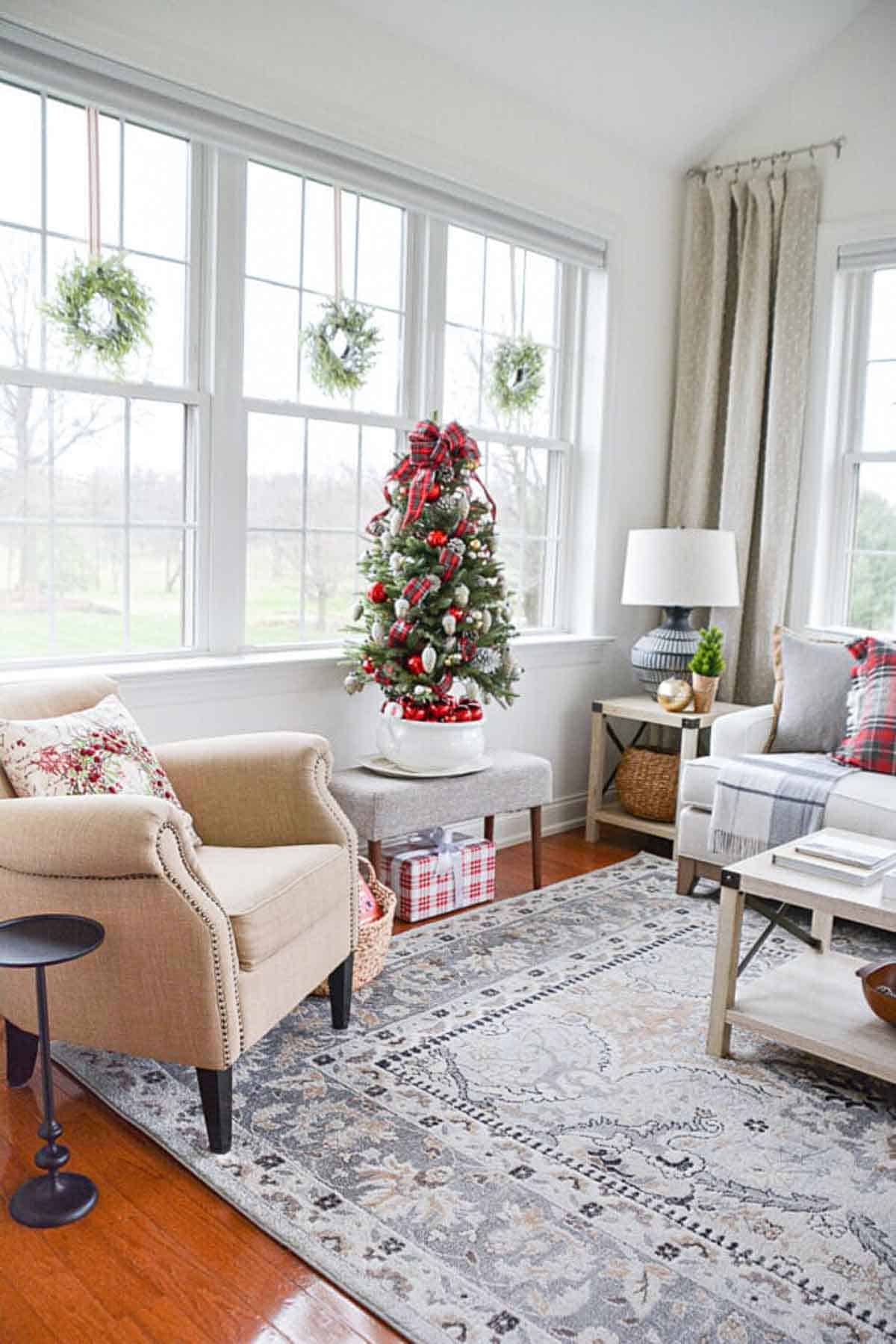
Building the white bowl base:
- Choose a bowl about one and a half times the width of the tree’s pot.
- Line it with a plastic bag so the ornaments don’t rattle.
- Fill with 15–20 shatterproof balls, keeping the center clear.
- Set the pot in, then run the cord down the back and out the bottom.
- Add the plaid gift box beside it — off center, never dead-center.
Fifteen minutes and $15–$30.
20. A White Snowflake Tree for Windowsills and Desks
White on white works here because the tree sits in front of a window. Backlighting does the styling for you: the 22 cm PE-and-cloth silhouette with its snowflake detail reads as shape and shadow rather than an object competing with the room. In a dark corner the same tree looks like a lampshade. Put it where daylight or a single warm bulb sits behind it and it suddenly looks designed.
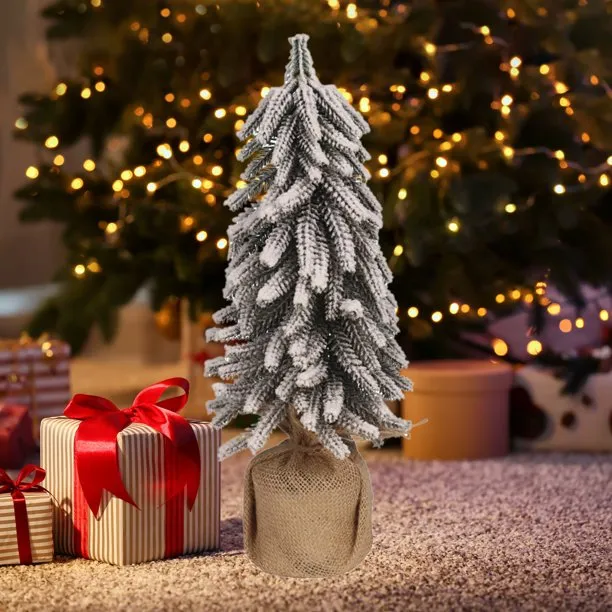
A $5 dollar-store white tree, a $4 bag of cotton snow, and a $6 battery LED candle get you close to this for under $20. Walmart and Target both carry white PE tabletop trees under $15 in early November, before the good ones sell out. The one thing worth spending on: an even white tone across tree and snow, because mismatched whites look like laundry.
21. Burlap and Berries With a Woodland Deer
Woodland Christmas — burlap, pinecones, a faux deer — has been building since the mid-2010s and still holds up because the materials are inexpensive and the palette is forgiving. What’s shifting in 2026 is restraint: glitter now shows up as a single accent, like the dusting on the wreath pinecones, rather than across everything. Natural texture is doing the work sparkle used to.
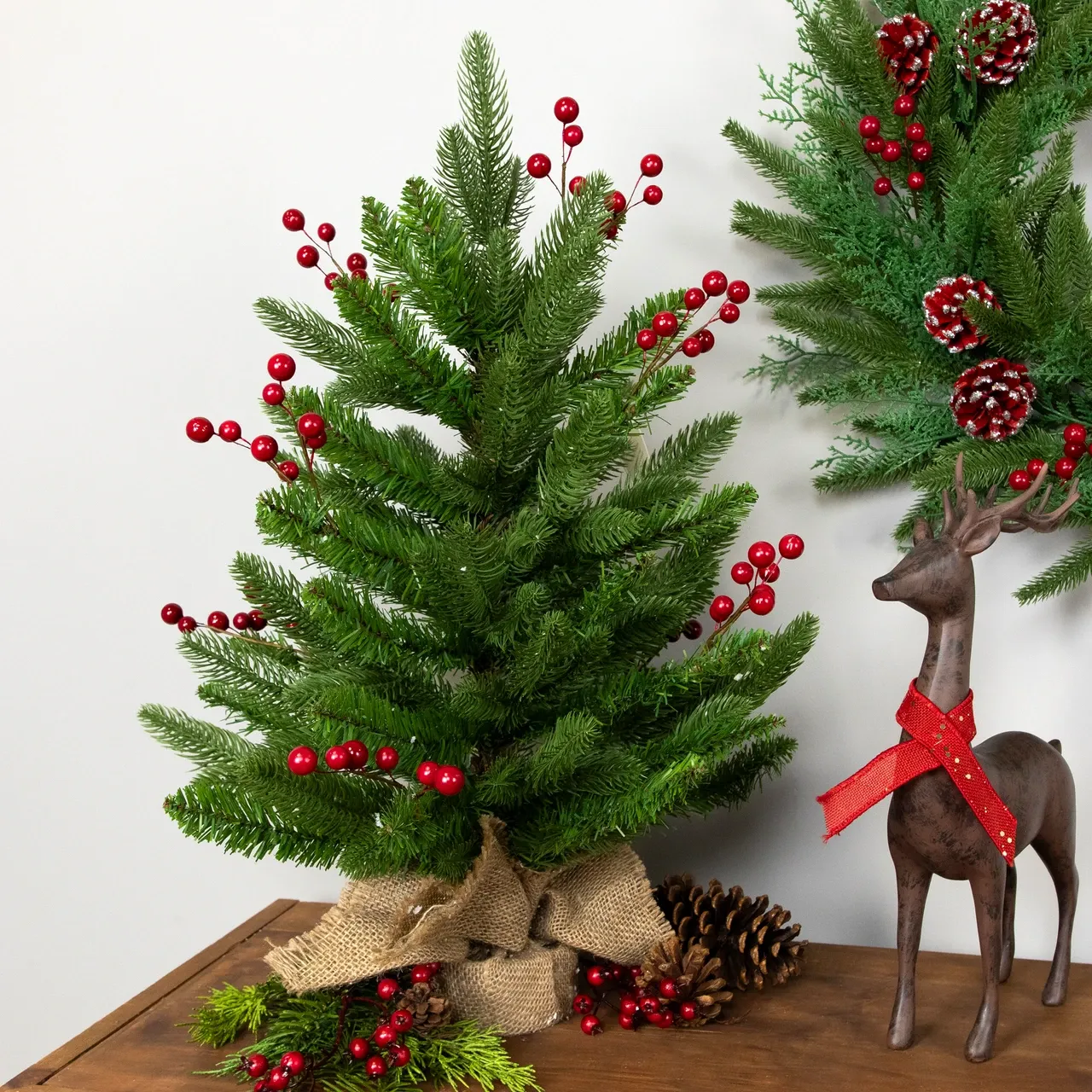
Size the deer to the tree: a 6–9 inch figurine next to a 20–24 inch evergreen reads as a companion, while anything over 12 inches becomes a separate display. On a console, keep the grouping to about 36 inches wide with a 6-inch gap between tree and deer. Hang the wreath so its diameter is roughly a third of the window or wall bay it sits on.
22. Roses, Cinnamon Sticks and Bronze Baubles
Real roses in a holiday arrangement are a two-week romance. They brown at the petal edges first, then the whole bloom goes soft, so plan this for a party or the week of Christmas. Cinnamon sticks attached with hot glue pop off when the air gets dry — use floral wire or craft putty instead. Keep it off radiators and away from the oven; heat kills the greens and the glue at the same time.
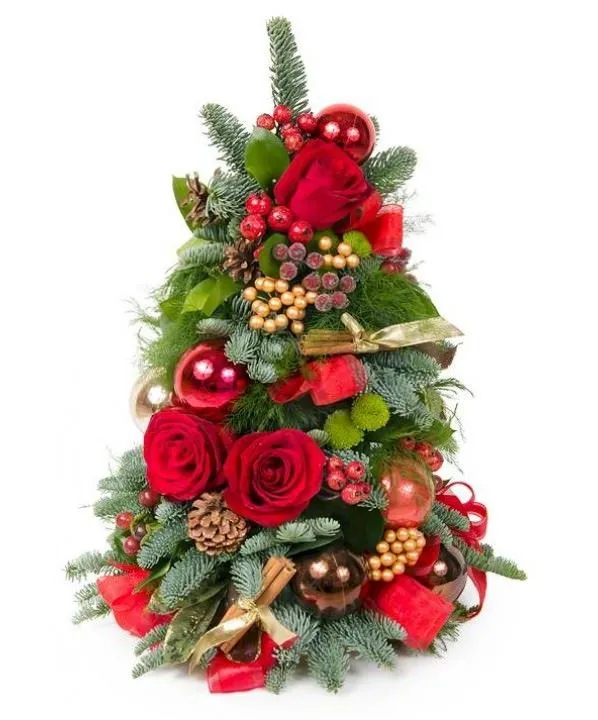
Build from the base up and work in threes. Insert evergreen stems at a 45-degree angle first to create the cone, then add three roses spaced evenly around the circumference, then three cinnamon bundles, then berries, then baubles last so you’re not reaching past anything. Spritz the greens daily with cool water and it looks fresh for ten days instead of five. Compare with Idea #8, which stays strictly red and green.
23. Red and White Florals Under a Snowflake Topper
The fine metallic chain garland is what does it. Florals, berries, and a snowflake topper are all chunky, round shapes — the chain is the only element with a linear line, and it drapes in soft scallops that echo a full-size tree. It’s also the cheapest part of the entire arrangement. Replace it with a beaded strand and the tree gets heavier; replace it with nothing and the branches look empty.
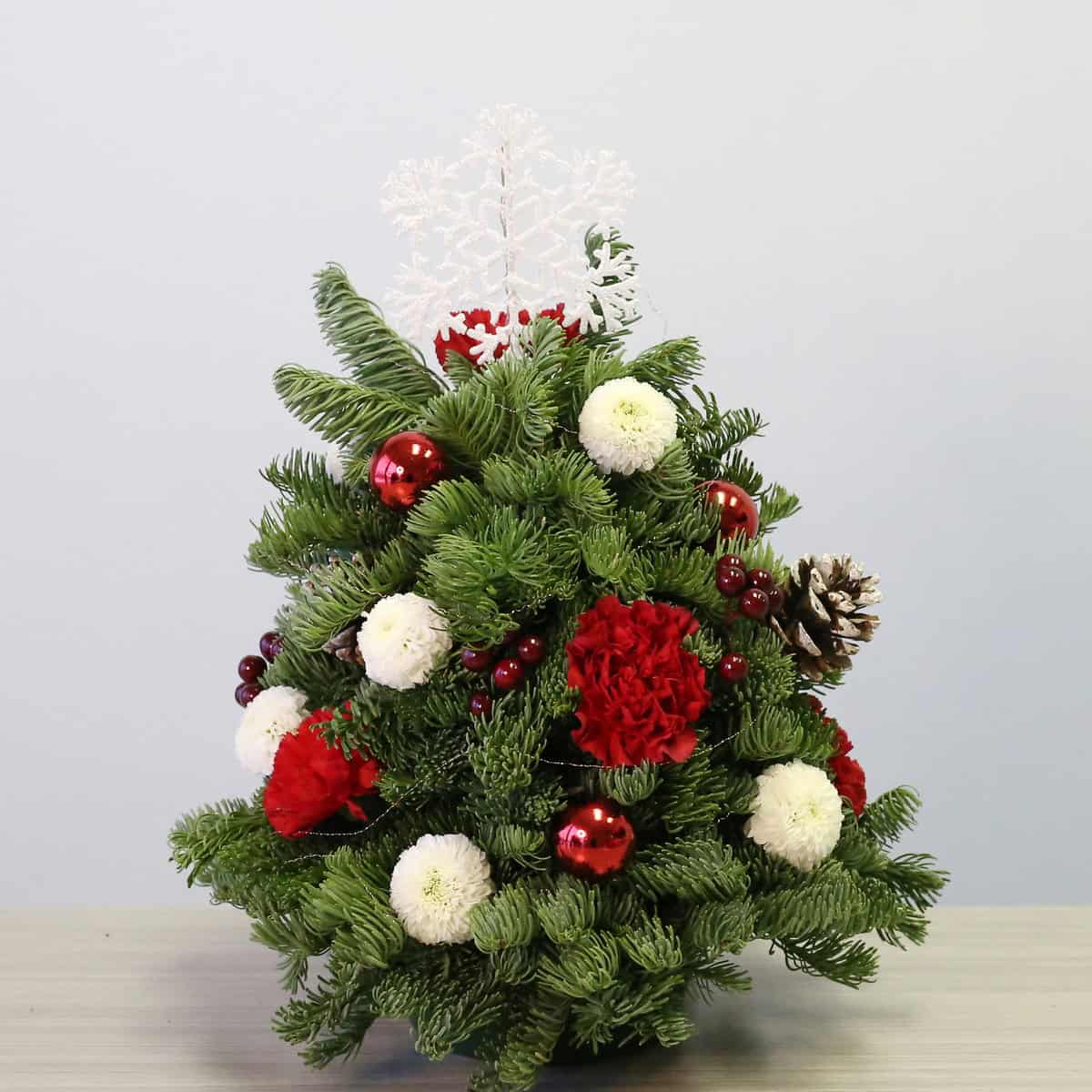
Fresh floral clusters on foam last about 10 days in a cool room, less near a vent. Check the foam every other day and add water in small pours — overfilled foam rots the stems. Metallic chain tarnishes with handling, so store it in a bag rather than coiled in a box, and untangle it over the table, not standing up, or beads will rain onto the floor and disappear.
24. Three Wire-Light Trees for Ambient Glow
- 3-piece LED wire tree set, cedar: $18–$45
- Weighted bases or small stones: $5–$15
- Mirror or dark tray to catch the glow: $10–$30
- Batteries or rechargeable AAs: $8–$20
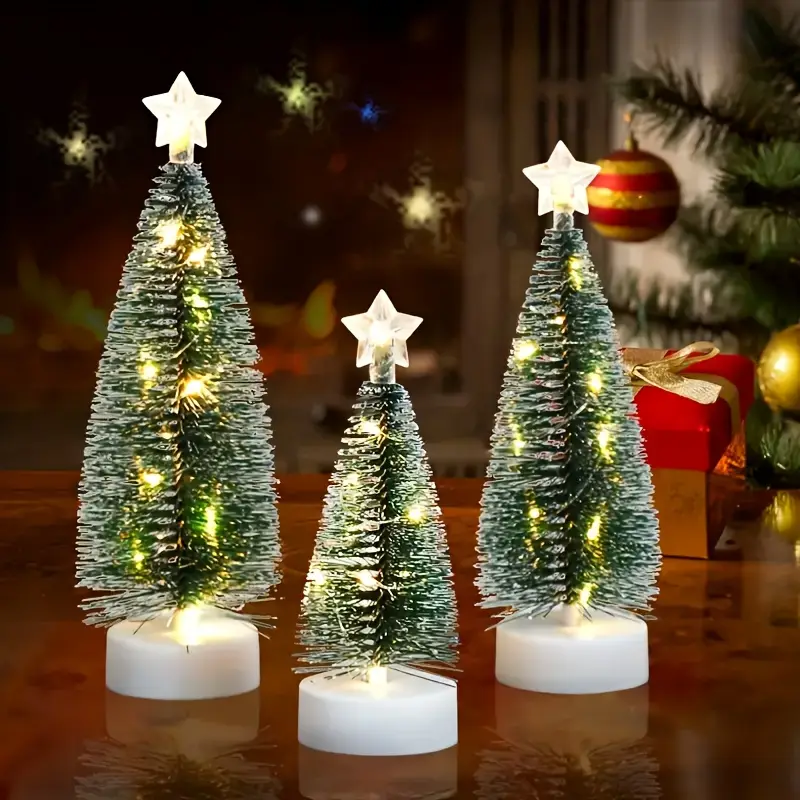
Total: $41–$110. Budget alternative: one $12 wire tree plus a $4 craft-store mirror tile does about 70 percent of the ambient effect — the mirror doubles the light for a fraction of the cost.
Shaping wire trees without wrecking them:
- Uncoil slowly, following the natural curve instead of forcing it straight.
- Open each into a cone, then lean the top slightly forward so light faces you.
- Anchor the base with flat stones or museum putty if pets are around.
- Group the three at different heights using books or a riser.
- Set one timer for all three so they turn on together.
Twenty minutes, no tools.
25. A 42 cm Spiral Wood Tree That Reads as Sculpture
A spiral wood tree is sculpture first, holiday second, which is exactly why it should sit at eye level instead of on the floor. Forty-two centimeters is the sweet spot for a bookshelf’s top third. Light it from the front with a small battery puck, not from above — overhead light flattens the spiral’s lines, while a low front light lets the curve cast its own shadow on the wall behind it.
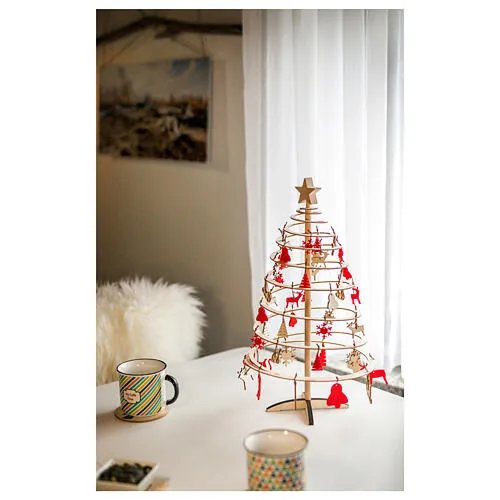
Negative space is the quiet advantage of an open spiral: you can see the wall through it, so a small room doesn’t feel like it just gained another solid object. Compare that with a dense mini tree, which reads heavier in a tight space even at the same height. In apartments and small offices, this is the format that keeps the holiday without costing you square footage.
26. Tower-Shaped Flocked Cedar for Desks and Sills
Desktop flocked cedars in a slim tower shape run $12–$20 at big-box retailers and about $55–$70 from boutique decor shops for a nearly identical silhouette. Buy the inexpensive one and spend the difference on a good base — a $12 stoneware pot or a wood slice makes a $15 tree look like a $60 one. Temu, SHEIN, and Walmart all stock versions under $20; inspect the flocking in person if you can.
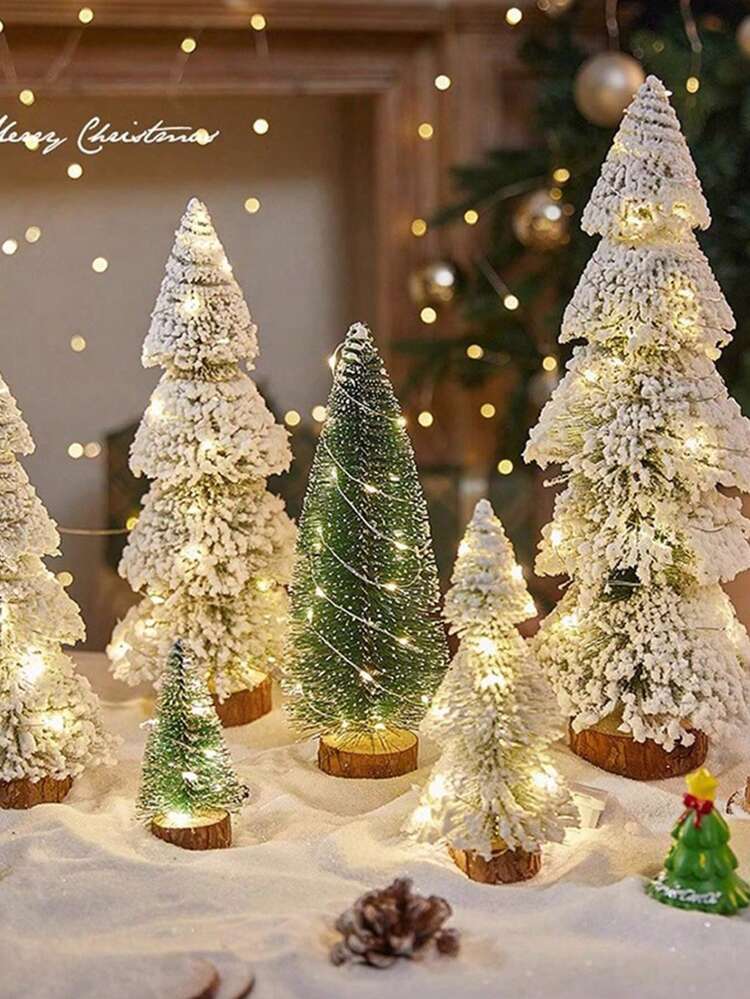
Tower trees earn their keep in narrow spots: a desk with at least 20 inches of depth, a windowsill 4 inches or deeper, a bathroom counter with 6 inches of clearance behind it. For height, keep a desk tree between 12 and 16 inches so it doesn’t block your monitor line, and go to 24 inches only on a floor pedestal. Small spaces do better with three towers than one wide tree.
27. Pop-Up Pre-Lit Frosted Pine, Stored Flat
Pre-lit frosted pines come partly styled, so your formula is mostly subtraction: about 80 percent tree, 15 percent ornaments, 5 percent base and skirt. On a flocked pre-lit tree, six to ten statement ornaments total is plenty — the flocking and the LEDs are already doing the decorating. If you want a color story, pick one and use it in three materials, then stop.
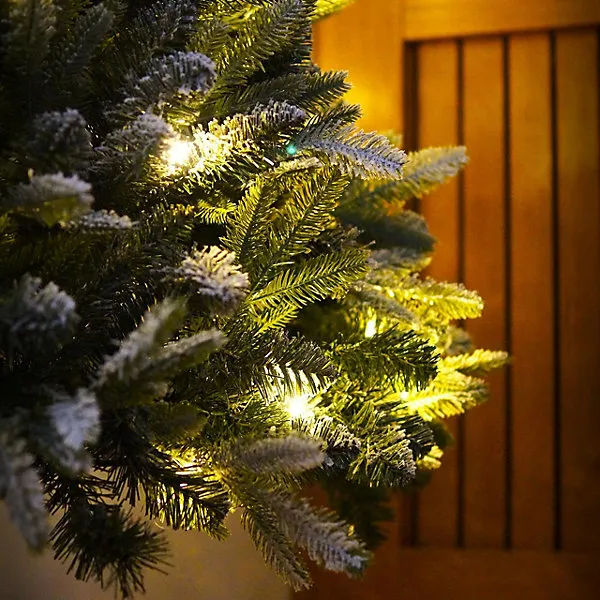
Two honest caveats. First, a seven-foot pop-up tree is not a small tree — measure your ceiling, and expect it to need about 30 inches of floor diameter once the branches open. Second, 150 LEDs across seven feet is sparse at eye level; plan on adding a strand or two. Pop-up frames show gaps in the first row, so keep a tree collar handy. In a tighter room, see Idea #26.
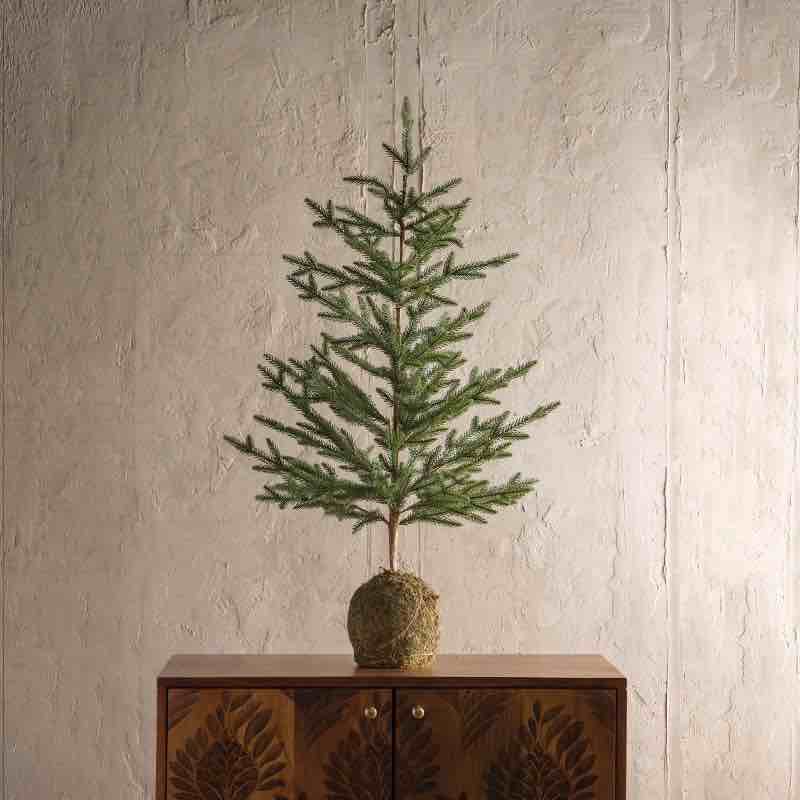
28. A Tabletop Tree Anchored in a Moss Ball
A weighted moss ball base solves the biggest problem with tabletop trees: the tipping. Set the moss so it stays visible above the rim of whatever shallow bowl you place it in, and keep the ball about half the width of the tree’s spread so the proportions look planted, not potted. A 39-inch tree on a table needs a base that weighs at least a few pounds — otherwise one cat ends the whole display.
- Confirm the table’s weight limit — a weighted base plus water is heavier than you think
- Check the surface isn’t in direct afternoon sun, which dries moss out fast
- Find the nearest outlet; a tabletop tree on a table means a cord across the floor
- Measure clearance above: lamps, art, and hanging fixtures all compete for space
29. Lights Behind Ornaments: The Close-Up Trick
Why close-up photos of trees always look better than the tree in your living room: the lights sit behind the ornaments, not in front of them.
- Run every strand first, pushing bulbs toward the trunk.
- Then hang ornaments 2–3 inches deeper than the outer tips.
- Tuck a few ornaments inside the branches, facing the wall.
- Leave the outer 4 inches of branch mostly bare so light shows through.
About 40 minutes for a three-foot tree.
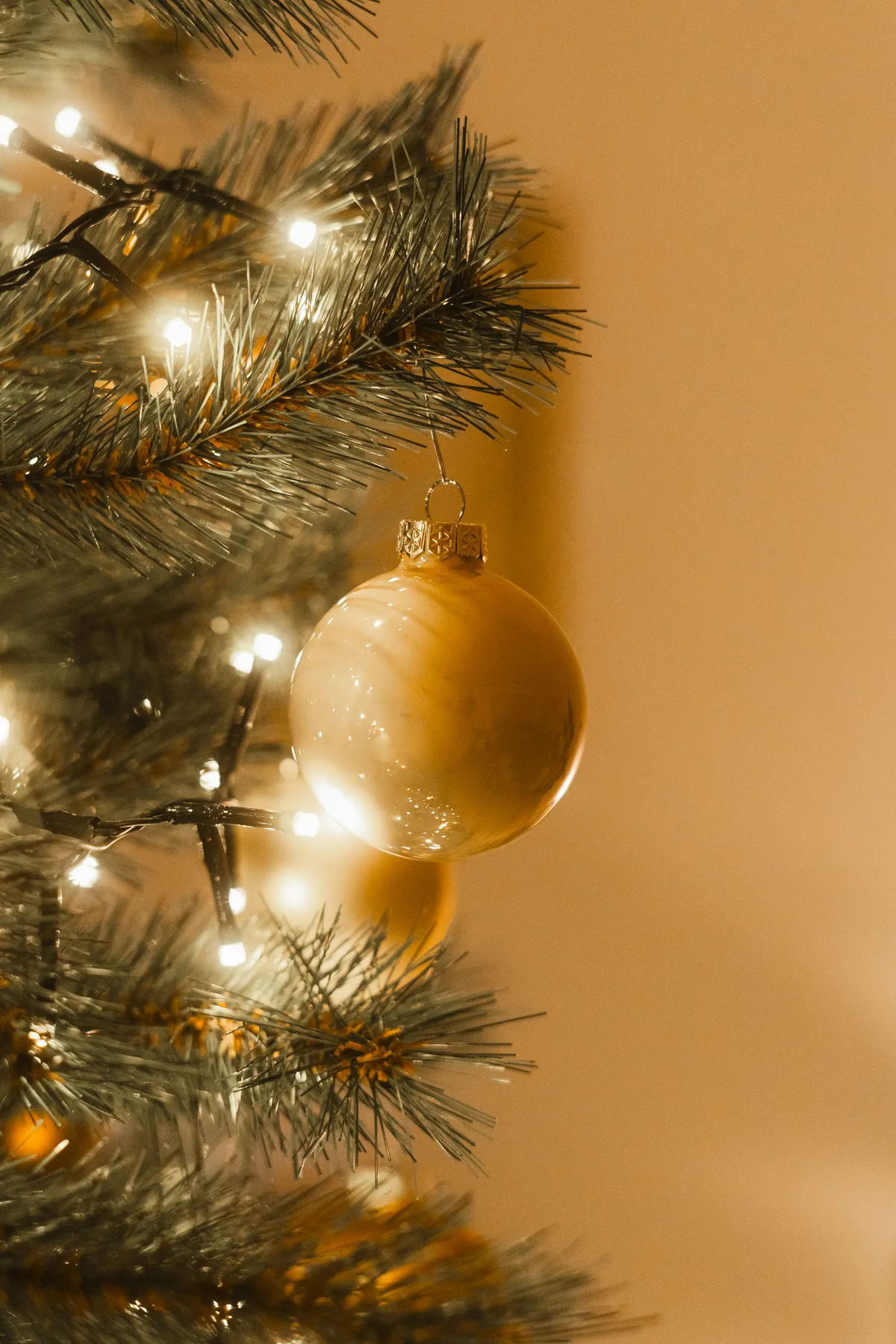
Backlighting is the single detail that makes ornaments glow instead of merely reflect. Put lights in front of a bauble and you get a hot spot and a dull shadow; put them behind and the glass turns into a small lantern. It costs nothing but sequencing, and it’s why a tree styled by a designer photographs differently than the same ornaments tossed on at random.
30. Four Ornaments Only, Spaced Like a Gallery
- Mini tree, 18–24 in: $30–$70
- Four sculptural statement ornaments: $40–$160
- Warm LED strand: $8–$16
- Base or small vessel: $10–$30
Total: $88–$276. Budget alternative: buy one $20 statement ornament and use three from your existing collection that share its finish. Grouping beats buying — nobody counts ornaments, they read the spacing.
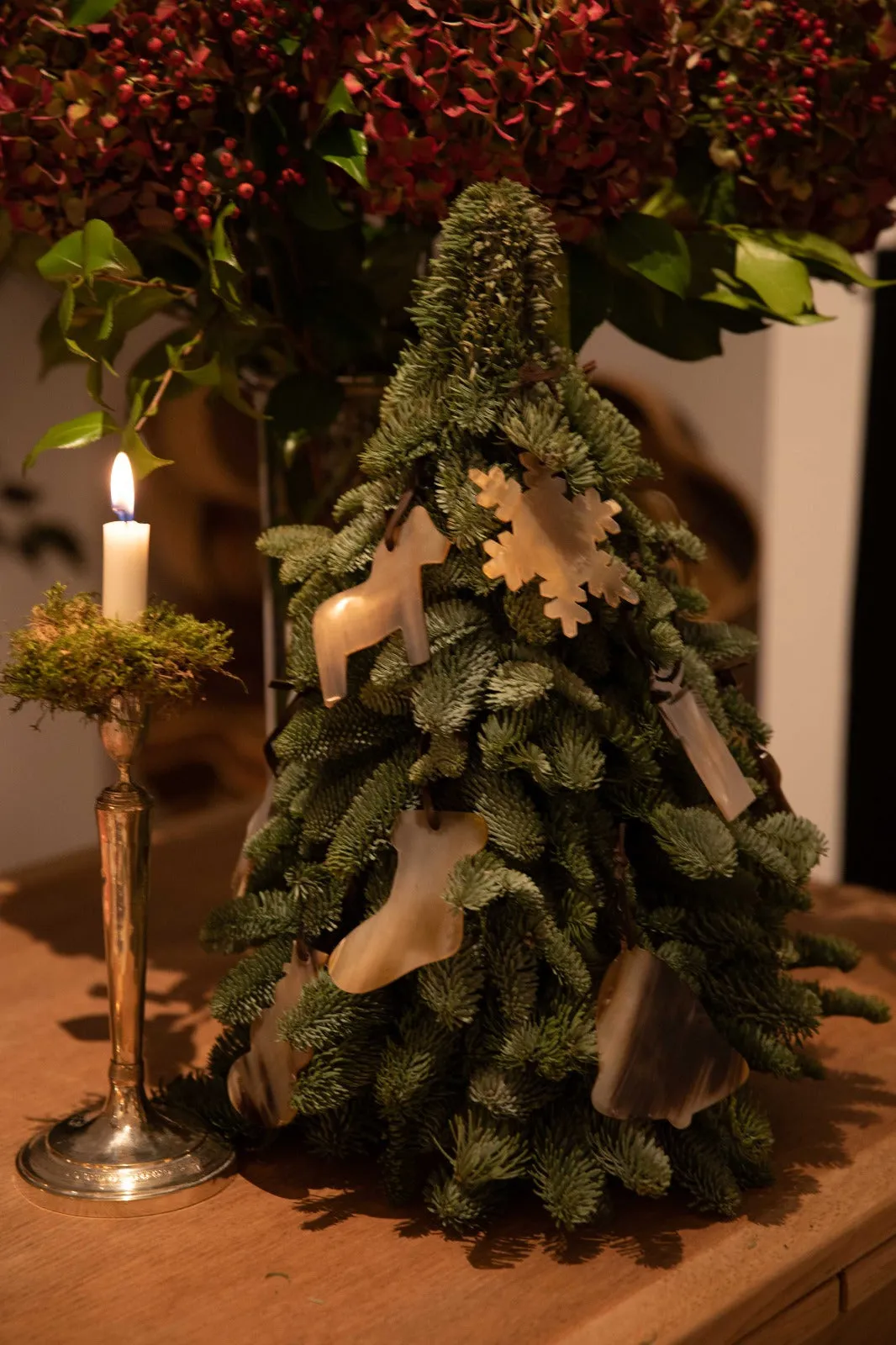
Restraint reads as confidence. Four ornaments, evenly spaced, force the eye to notice the tree’s shape, the branch spacing, and the light — all things a packed tree hides. It’s the same principle as hanging one large piece of art instead of nine small ones. Keep spacing even at roughly 90 degrees around the tree, and vary heights by a couple of inches so it doesn’t look mechanical.
31. Battery Ceramic Tree That Doubles as a Nightlight
Ceramic mini trees are charming and slightly annoying. The bulbs on most vintage-style versions are fixed and can’t be swapped, so one dead bulb is forever. Battery versions eat AAs — budget for rechargeables and expect about a month of nightly use per charge. And because the light is low and warm, it’s genuinely good as a nightlight but useless as actual room lighting. Run it 6–8 hours, not around the clock.
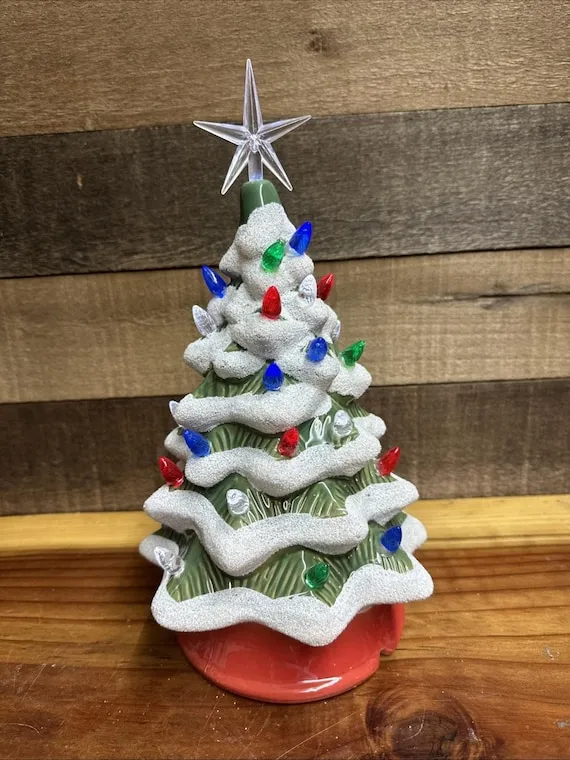
Size to the surface: an 8–12 inch ceramic tree needs about 6 inches of clearance from the wall so the light spills rather than bounces, which suits a nightstand, a kitchen counter with 18 inches of depth, or a bathroom vanity. Anything taller belongs on a console or floor pedestal. On a surface under 12 inches deep, go 6–8 inches tall and set it against the wall for a soft halo.
32. Scattering Tiny Trees Instead of One Statement
Repetition only works with variation. Use five to nine tiny trees in one color family, but change height in 2-inch increments and place each one within about 10 inches of its neighbor so the eye reads them as a single composition. Group in odd numbers — three, five, seven — and keep one taller anchor tree to lead the collection. An even-numbered row of identical trees looks like inventory.
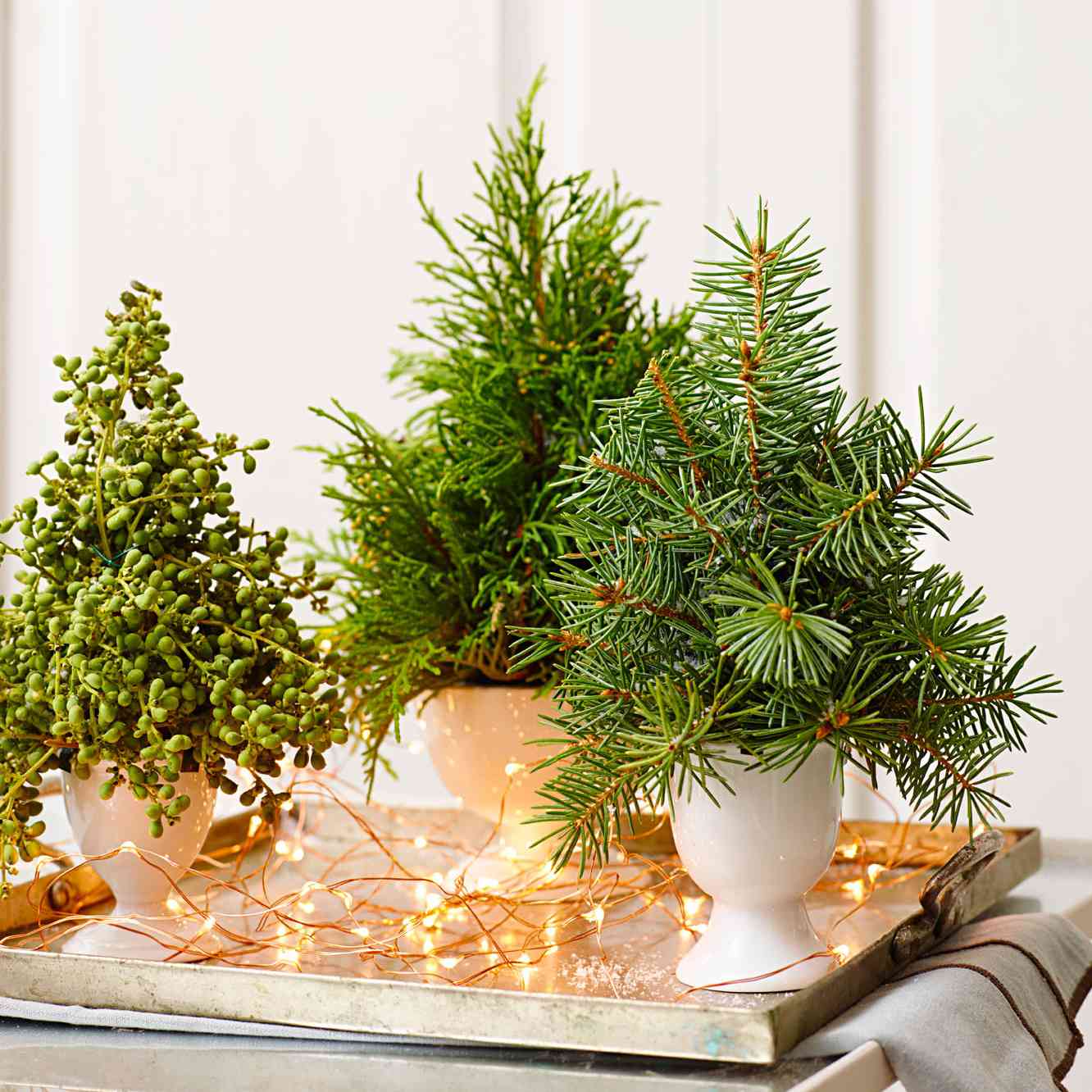
Dollar-store bottle brush trees at $1.25 each are the cheapest way to test a scattered arrangement before you commit. Buy nine, paint three in a matte color, and use books, candlesticks, or upside-down bowls as risers instead of buying pedestals. Total spend: under $25 for a full mantel. Then, once you know which heights work, upgrade one or two pieces a season.
33. Host Your Own Mini Tree Workshop
Centerpiece trees follow a simple split: about 50 percent greens, 30 percent one statement element (roses, dried citrus, or ornaments), 20 percent glow from lights and candles. If the greens look thin, add more greens — not more statement. That’s how centerpieces go from elegant to chaotic. Swap the statement element seasonally and the same formula carries you from Thanksgiving through New Year’s.
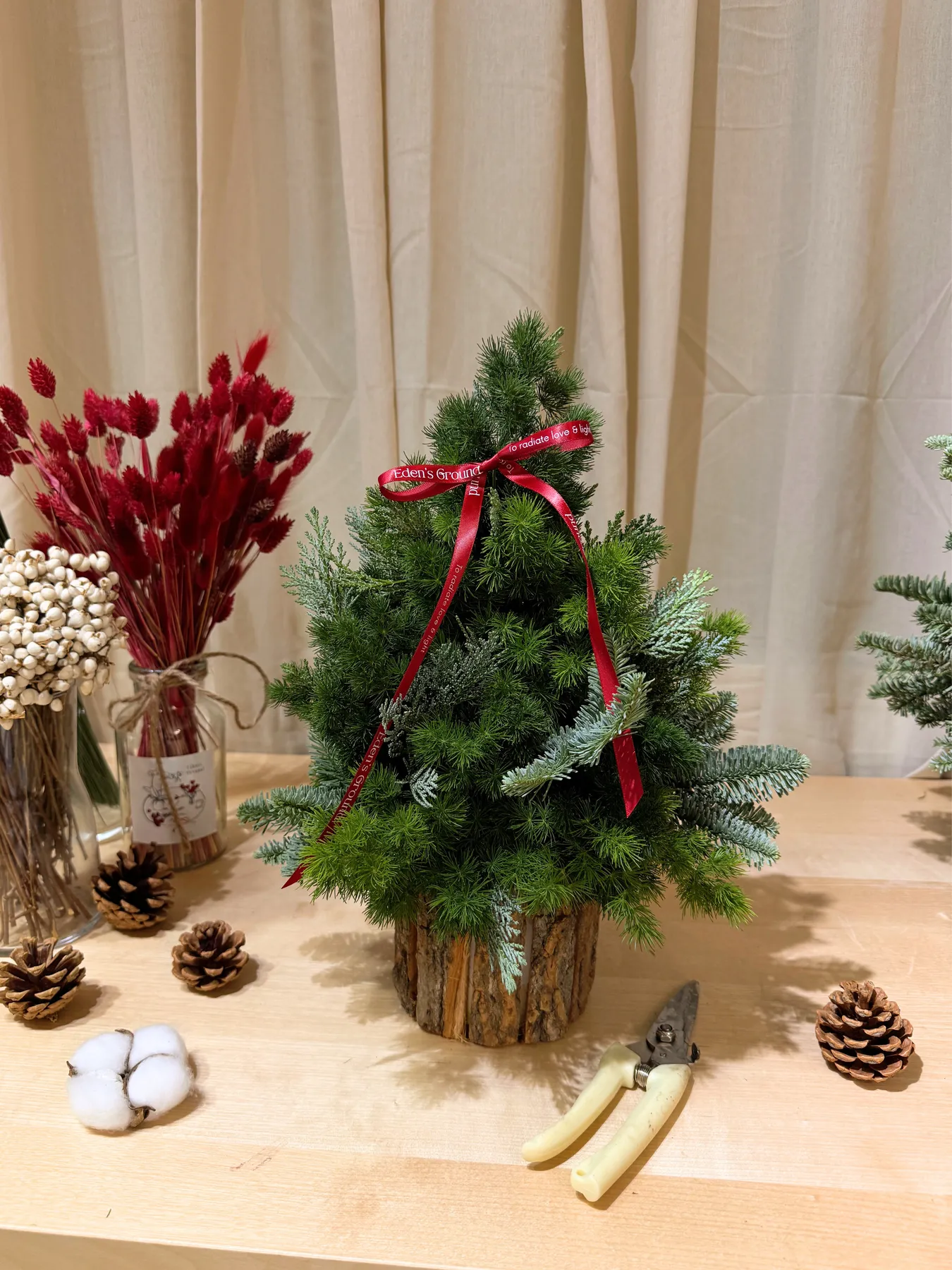
Running one as a group activity:
- Give each person 3 feet of table space and a small foam cone.
- Set out shared bins — greens, berries, ribbon, ornaments — not individual kits.
- Demo inserting stems at 45 degrees for five minutes, then let people work.
- Budget 90 minutes; most finish in 60 and keep tweaking.
- Send everyone home with a plastic bag and care instructions.
About $18–$25 per person in supplies.
34. A Decorated Desktop Tree, Ready to Go
When a mini tree comes already covered in matching balls, the styling moves off the branches and onto everything around it. The vessel, the riser, and the light become the design. A desktop tree that arrives decorated isn’t less creative — it’s a different job. Your one real decision is where it lands: on a stack of books, inside a wide bowl, or alone in an empty corner of the desk.
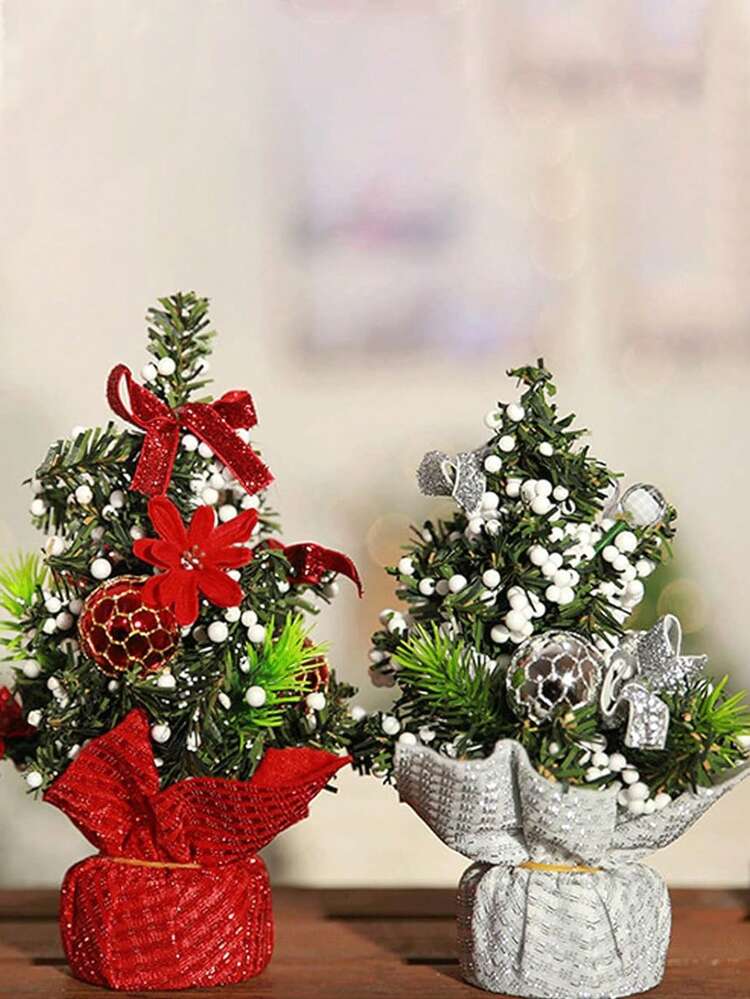
Pre-decorated mini trees have quietly become the dorm, office, and small-apartment answer to holiday decorating, and they’re trending for unglamorous reasons: no storage boxes, no ornament sorting, no decision fatigue. In 2026 the market has moved toward these all-in-one pieces at every price point. They don’t have the heirloom feel of a tree you decorate yourself, but they do get put up — which is more than most of us manage some years.
35. Color-Change Slender Pine With 3mm LEDs
- Slender color-change pre-lit tree, 5–7 ft: $120–$350
- Extra warm-white strand: $15–$30
- Tree collar or narrow skirt: $20–$50
- Remote batteries: $6–$12
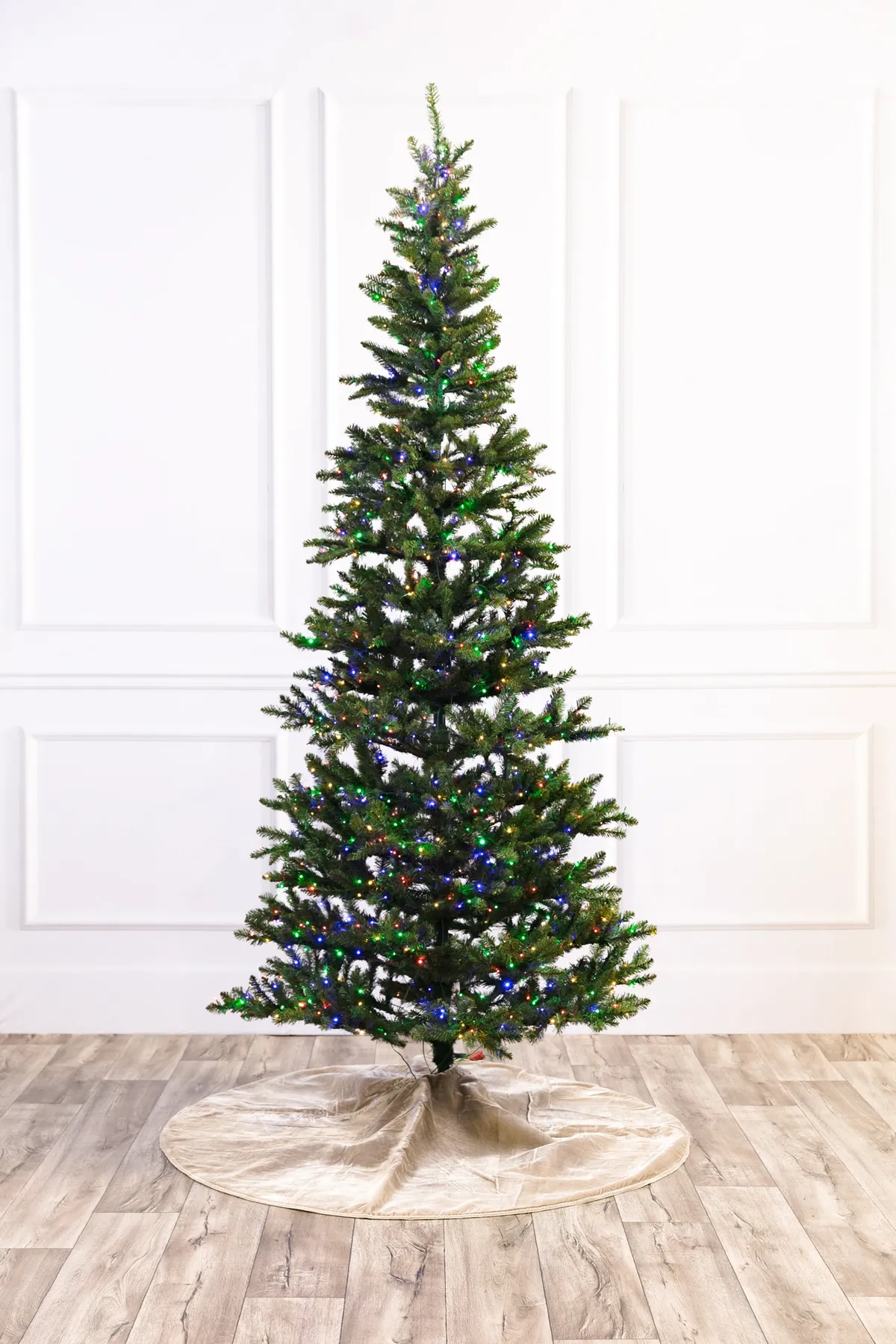
Total: $161–$442. Budget alternative: a $60 unlit slender tree plus a $25 color-change LED strand gets you the same effect, minus the one-button convenience, for about a third of the price.
Color-change LEDs work best used sparingly. Warm white at 2700K for most nights, one color moment for a party, and the tree reads as designed rather than as a gadget. The 3 mm diodes are the other point in their favor — smaller bulbs mean more of the branch structure shows through, which is exactly what a slender silhouette needs to avoid looking sparse.
Four Square Feet Is Plenty of Room for Christmas
Start with one corner, one surface, and one accent color repeated three times — the smallest tree in this list can carry a whole room if the base and the light are right. You don’t need the biggest tree on the block, just the best-lit one.
📌 Pin your favorites now so they’re waiting for you in November, and tag us when yours goes up — we want to see which idea won.